Cambridge A Level Economics 9708 — 2022 May/June Paper 2 · Variant 1
9708/21/M/J/22 · 4 questions · 40 marks · ≈45 min
The question paper and its mark scheme, free to read here and free to download. This is Cambridge’s own paper, exactly as it was sat.
Question paper4 pages
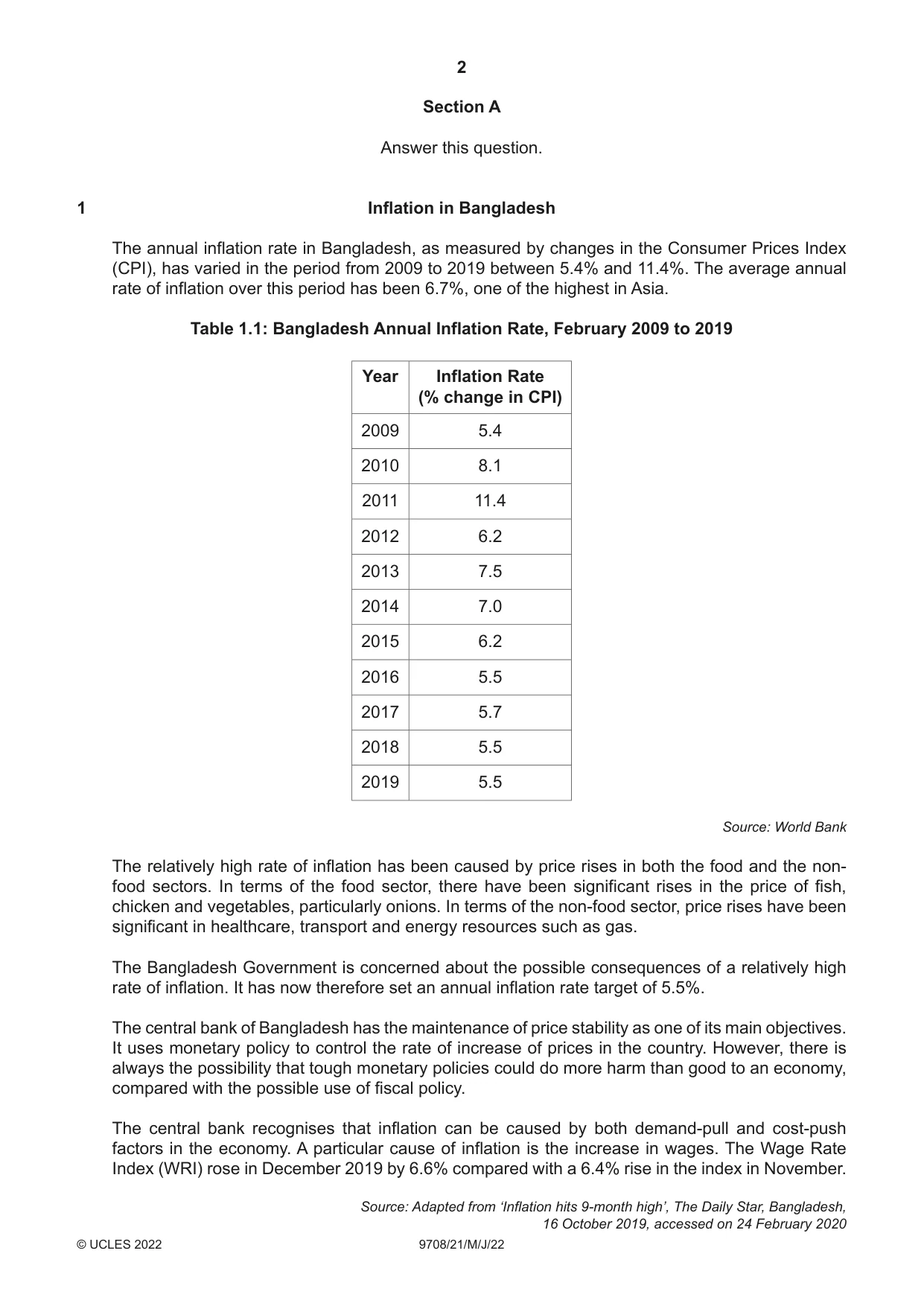
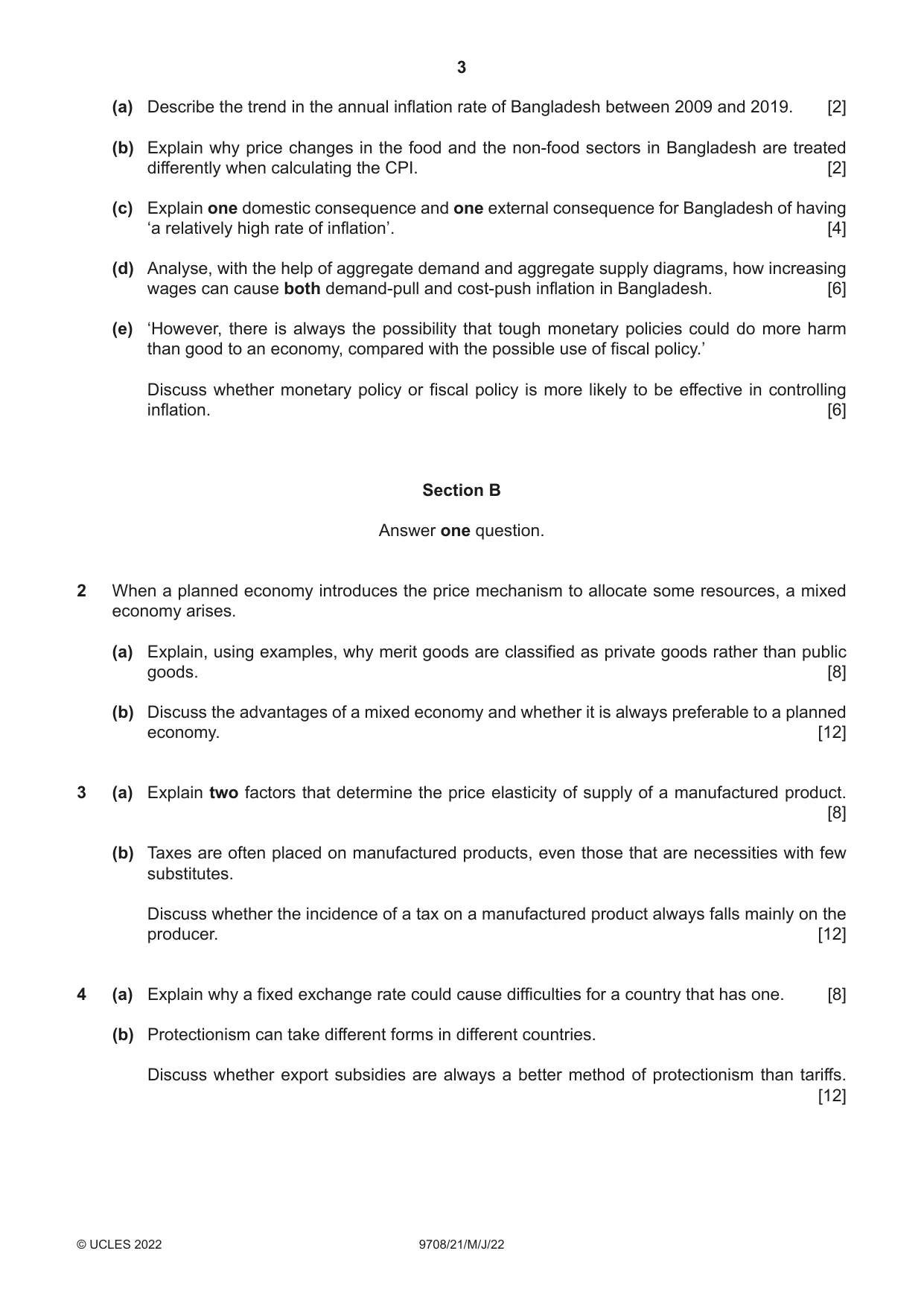
Mark scheme17 pages
Answers below. Sit the paper first if you are practising.
Questions as text
Q1 · Inflation in Bangladesh The annual inflation rate in Bangladesh, as measured by changes…
1 Inflation in Bangladesh The annual inflation rate in Bangladesh, as measured by changes in the Consumer Prices Index (CPI), has varied in the period from 2009 to 2019 between 5.4% and 11.4%. The average annual rate of inflation over this period has been 6.7%, one of the highest in Asia. Table 1.1: Bangladesh Annual Inflation Rate, February 2009 to 2019 Year Inflation Rate (% change in CPI) 2009 5.4 2010 8.1 2011 11.4 2012 6.2 2013 7.5 2014 7.0 2015 6.2 2016 5.5 2017 5.7 2018 5.5 2019 5.5 Source: World Bank The relatively high rate of inflation has been caused by price rises in both the food and the non- food sectors. In terms of the food sector, there have been significant rises in the price of fish, chicken and vegetables, particularly onions. In terms of the non-food sector, price rises have been significant in healthcare, transport and energy resources such as gas. The Bangladesh Government is concerned about the possible consequences of a relatively high rate of inflation. It has now therefore set an annual inflation rate target of 5.5%. The central bank of Bangladesh has the maintenance of price stability as one of its main objectives. It uses monetary policy to control the rate of increase of prices in the country. However, there is always the possibility that tough monetary policies could do more harm than good to an economy, compared with the possible use of fiscal policy. The central bank recognises that inflation can be caused by both demand-pull and cost-push factors in the economy. A particular cause of inflation is the increase in wages. The Wage Rate Index (WRI) rose in December 2019 by 6.6% compared with a 6.4% rise in the index in November. Source: Adapted from ‘Inflation hits 9-month high’, The Daily Star, Bangladesh, 16 October 2019, accessed on 24 February 2020 (a) Describe the trend in the annual inflation rate of Bangladesh between 2009 and 2019. [2] (b) Explain why price changes in the food and the non-food sectors in Bangladesh are treated differently when calculating the CPI. [2] (c) Explain one domestic consequence and one external consequence for Bangladesh of having ‘a relatively high rate of inflation’. [4] (d) Analyse, with the help of aggregate demand and aggregate supply diagrams, how increasing wages can cause both demand-pull and cost-push inflation in Bangladesh. [6] (e) ‘However, there is always the possibility that tough monetary policies could do more harm than good to an economy, compared with the possible use of fiscal policy.’ Discuss whether monetary policy or fiscal policy is more likely to be effective in controlling inflation. [6]
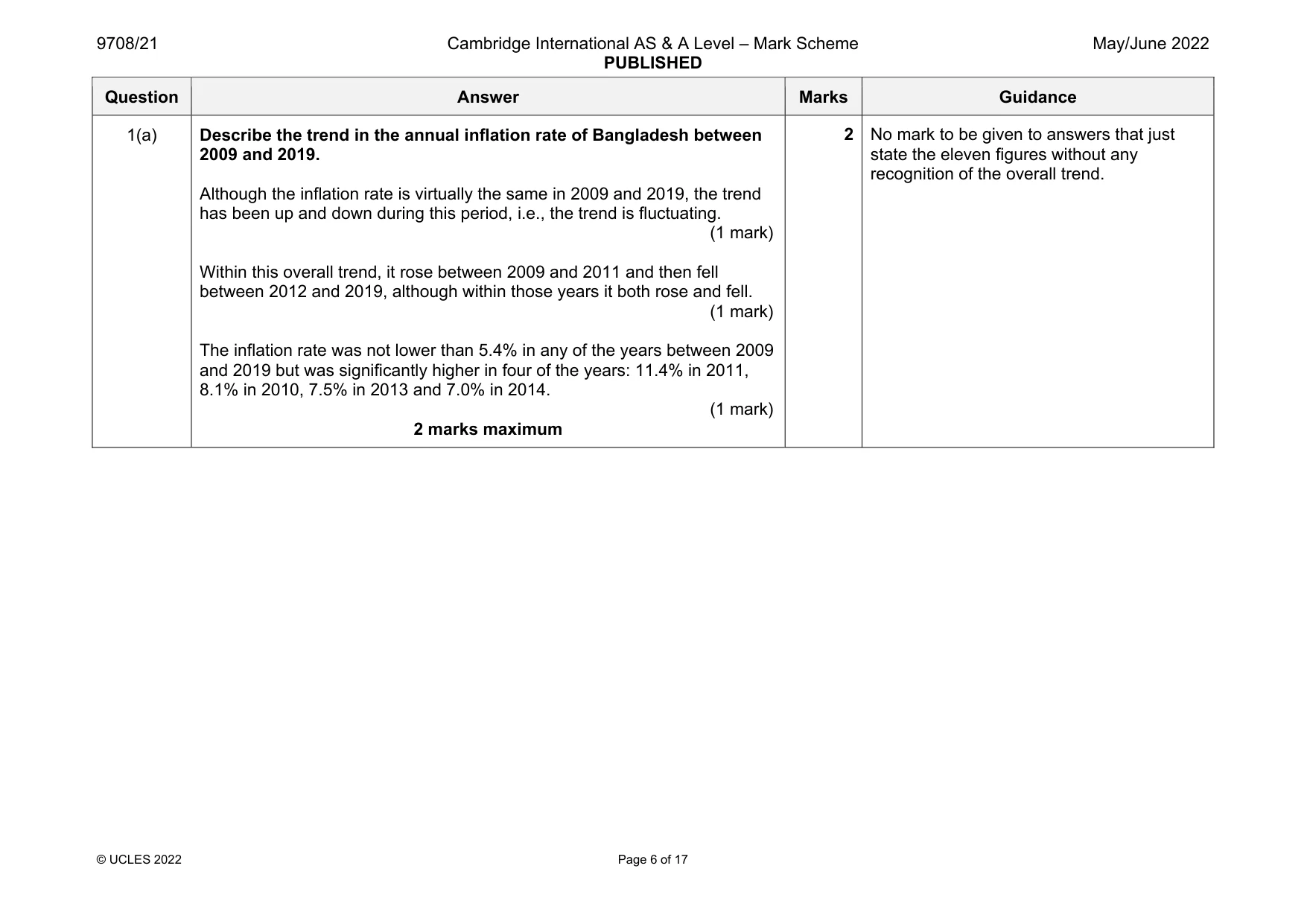
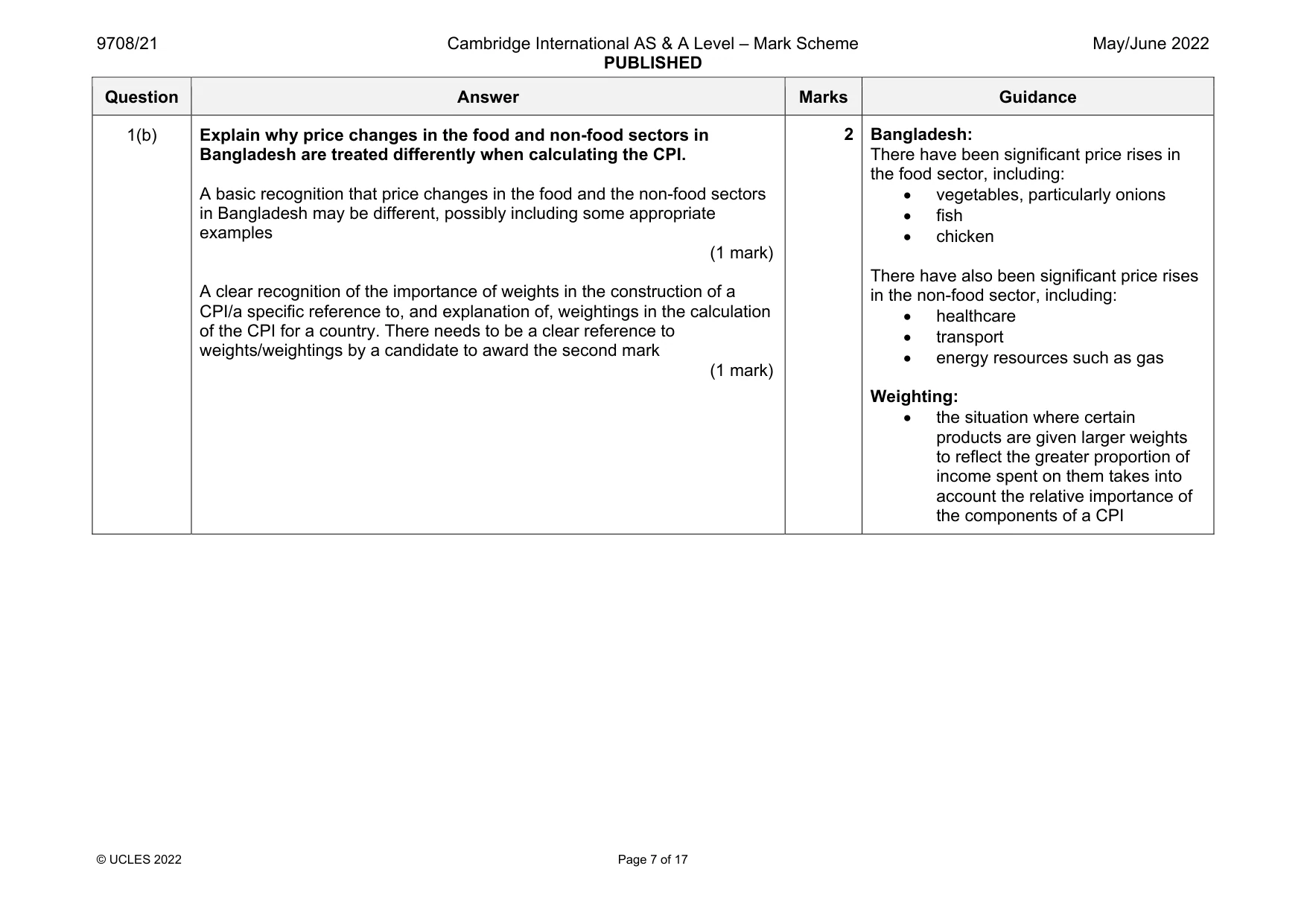
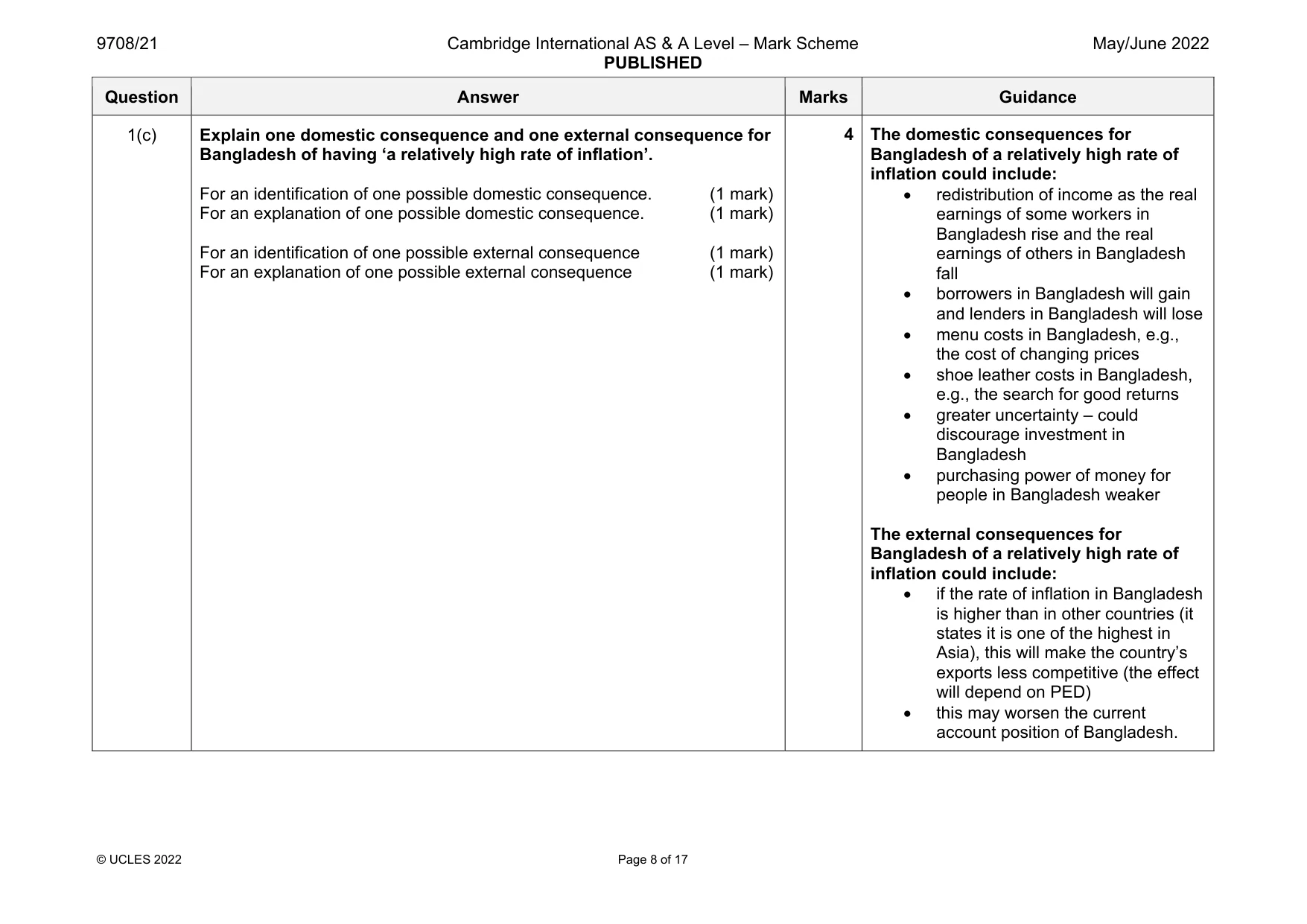
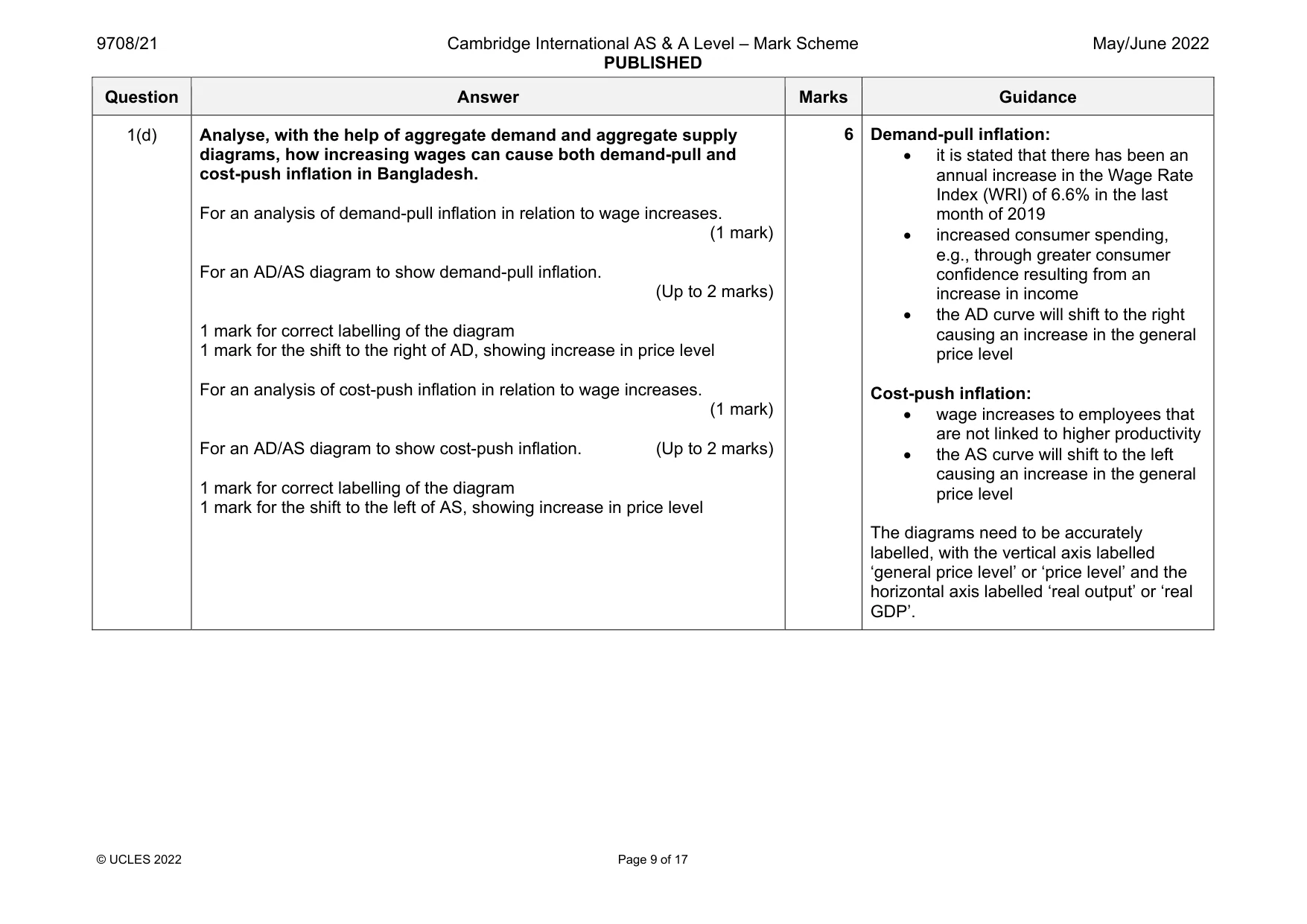
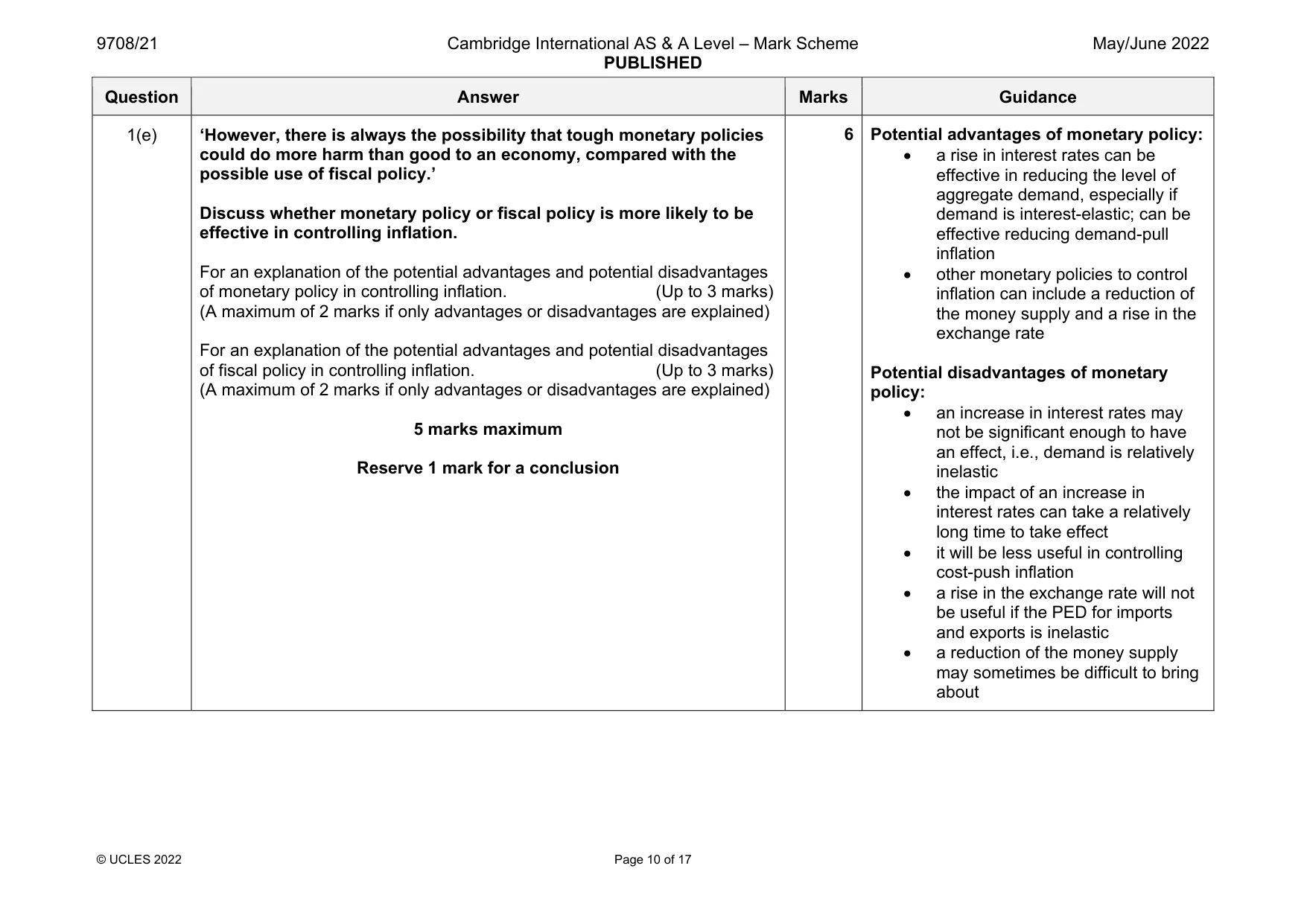
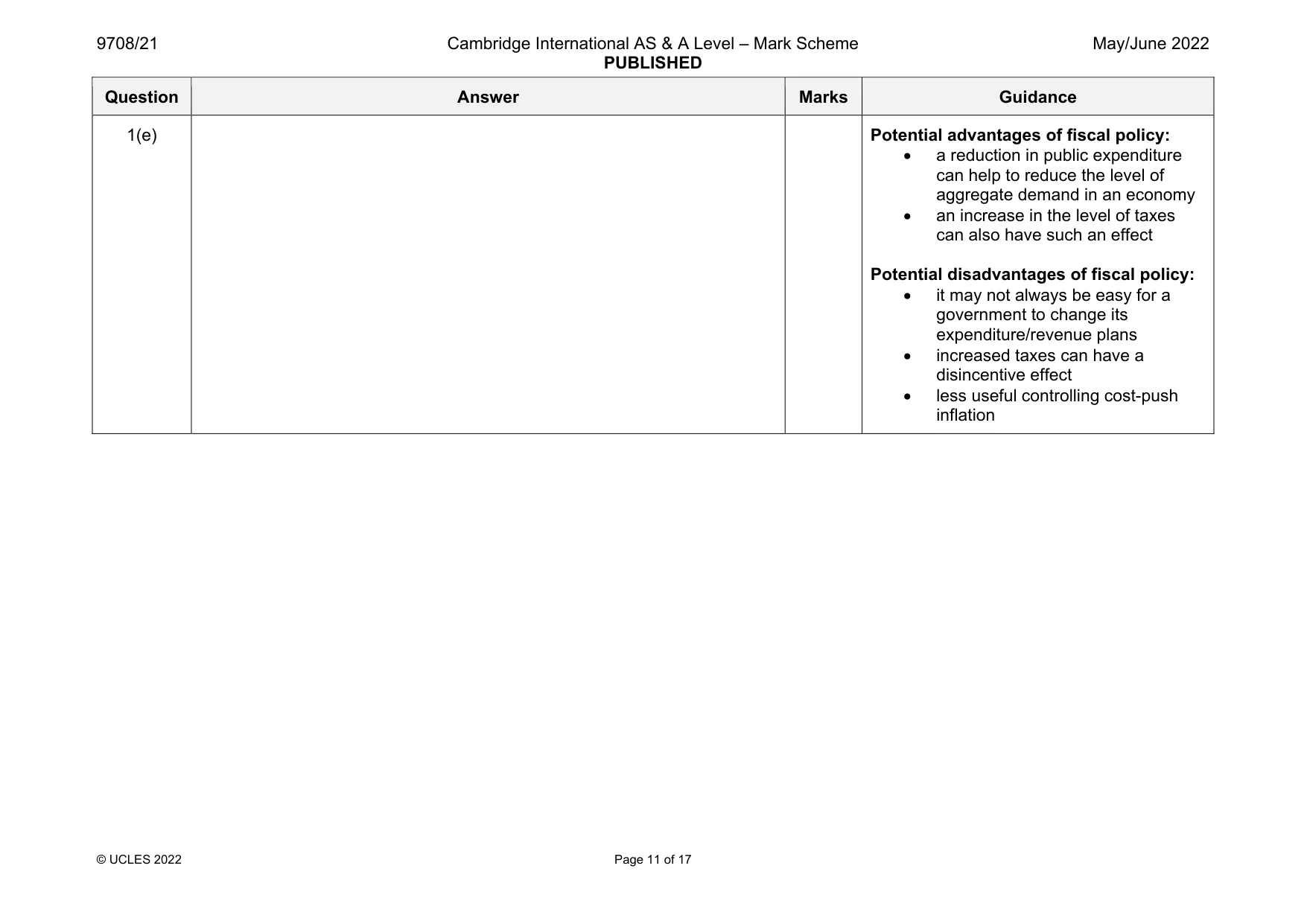
Mark scheme: 1(a) Describe the trend in the annual inflation rate of Bangladesh between 2009 and 2019. Although the inflation rate is virtually the same in 2009 and 2019, the trend has been up and down during this period, i.e., the trend is fluctuating. (1 mark) Within this overall trend, it rose between 2009 and 2011 and then fell between 2012 and 2019, although within those years it both rose and fell. (1 mark) The inflation rate was not lower than 5.4% in any of the years between 2009 and 2019 but was significantly higher in four of the years: 11.4% in 2011, 8.1% in 2010, 7.5% in 2013 and 7.0% in 2014. (1 mark) 2 marks maximum state the eleven figures without any recognition of the overall trend. Question Answer Marks Guidance 1(b) Explain why price changes in the food and non-food sectors in Bangladesh are treated differently when calculating the CPI. A basic recognition that price changes in the food and the non-food sectors in Bangladesh may be different, possibly including some appropriate examples (1 mark) A clear recognition of the importance of weights in the construction of a CPI/a specific reference to, and explanation of, weightings in the calculation of the CPI for a country. There needs to be a clear reference to weights/weightings by a candidate to award the second mark (1 mark) 2 Bangladesh: There have been significant price rises in the food sector, including: vegetables, particularly onions fish chicken There have also been significant price rises in the non-food sector, including: healthcare transport energy resources such as gas Weighting: the situation where certain products are given larger weights to reflect the greater proportion of income spent on them takes into account the relative importance of the components of a CPI Question Answer Marks Guidance 1(c) Explain one domestic consequence and one external consequence for Bangladesh of having ‘a relatively high rate of inflation’. For an identification of one possible domestic consequence. (1 mark) For an explanation of one possible domestic consequence. (1 mark) For an identification of one possible external consequence (1 mark) For an explanation of one possible external consequence (1 mark) 4 The domestic consequences for Bangladesh of a relatively high rate of inflation could include: redistribution of income as the real earnings of some workers in Bangladesh rise and the real earnings of others in Bangladesh fall borrowers in Bangladesh will gain and lenders in Bangladesh will lose menu costs in Bangladesh, e.g., the cost of changing prices shoe leather costs in Bangladesh, e.g., the search for good returns greater uncertainty – could discourage investment in Bangladesh purchasing power of money for people in Bangladesh weaker The external consequences for Bangladesh of a relatively high rate of inflation could include: if the rate of inflation in Bangladesh is higher than in other countries (it states it is one of the highest in Asia), this will make the country’s exports less competitive (the effect will depend on PED) this may worsen the current account position of Bangladesh. Question Answer Marks Guidance 1(d) Analyse, with the help of aggregate demand and aggregate supply diagrams, how increasing wages can cause both demand-pull and cost-push inflation in Bangladesh. For an analysis of demand-pull inflation in relation to wage increases. (1 mark) For an AD/AS diagram to show demand-pull inflation. (Up to 2 marks) 1 mark for correct labelling of the diagram 1 mark for the shift to the right of AD, showing increase in price level For an analysis of cost-push inflation in relation to wage increases. (1 mark) For an AD/AS diagram to show cost-push inflation. (Up to 2 marks) 1 mark for correct labelling of the diagram 1 mark for the shift to the left of AS, showing increase in price level 6 Demand-pull inflation: it is stated that there has been an annual increase in the Wage Rate Index (WRI) of 6.6% in the last month of 2019 increased consumer spending, e.g., through greater consumer confidence resulting from an increase in income the AD curve will shift to the right causing an increase in the general price level Cost-push inflation: wage increases to employees that are not linked to higher productivity the AS curve will shift to the left causing an increase in the general price level The diagrams need to be accurately labelled, with the vertical axis labelled ‘general price level’ or ‘price level’ and the horizontal axis labelled ‘real output’ or ‘real GDP’. Question Answer Marks Guidance 1(e) ‘However, there is always the possibility that tough monetary policies could do more harm than good to an economy, compared with the possible use of fiscal policy.’ Discuss whether monetary policy or fiscal policy is more likely to be effective in controlling inflation. For an explanation of the potential advantages and potential disadvantages of monetary policy in controlling inflation. (Up to 3 marks) (A maximum of 2 marks if only advantages or disadvantages are explained) For an explanation of the potential advantages and potential disadvantages of fiscal policy in controlling inflation. (Up to 3 marks) (A maximum of 2 marks if only advantages or disadvantages are explained) 5 marks maximum Reserve 1 mark for a conclusion 6 Potential advantages of monetary policy: a rise in interest rates can be effective in reducing the level of aggregate demand, especially if demand is interest-elastic; can be effective reducing demand-pull inflation other monetary policies to control inflation can include a reduction of the money supply and a rise in the exchange rate Potential disadvantages of monetary policy: an increase in interest rates may not be significant enough to have an effect, i.e., demand is relatively inelastic the impact of an increase in interest rates can take a relatively long time to take effect it will be less useful in controlling cost-push inflation a rise in the exchange rate will not be useful if the PED for imports and exports is inelastic a reduction of the money supply may sometimes be difficult to bring about Question Answer Marks Guidance 1(e) Potential advantages of fiscal policy: a reduction in public expenditure can help to reduce the level of aggregate demand in an economy an increase in the level of taxes can also have such an effect Potential disadvantages of fiscal policy: it may not always be easy for a government to change its expenditure/revenue plans increased taxes can have a disincentive effect less useful controlling cost-push inflation
Q2 · When a planned economy introduces the price mechanism to allocate some resources, a mixed…
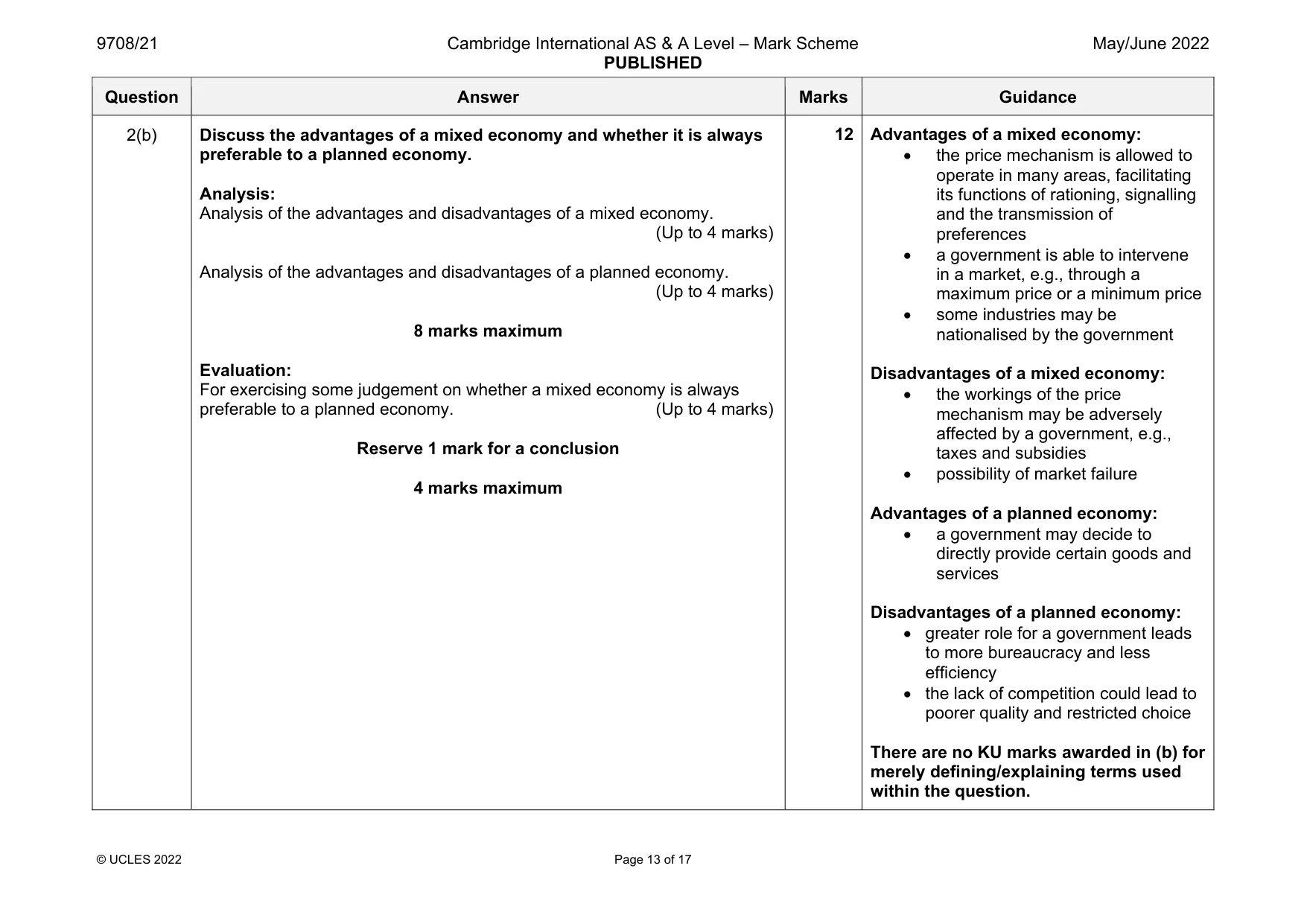
2 When a planned economy introduces the price mechanism to allocate some resources, a mixed economy arises. (a) Explain, using examples, why merit goods are classified as private goods rather than public goods. [8] (b) Discuss the advantages of a mixed economy and whether it is always preferable to a planned economy. [12]
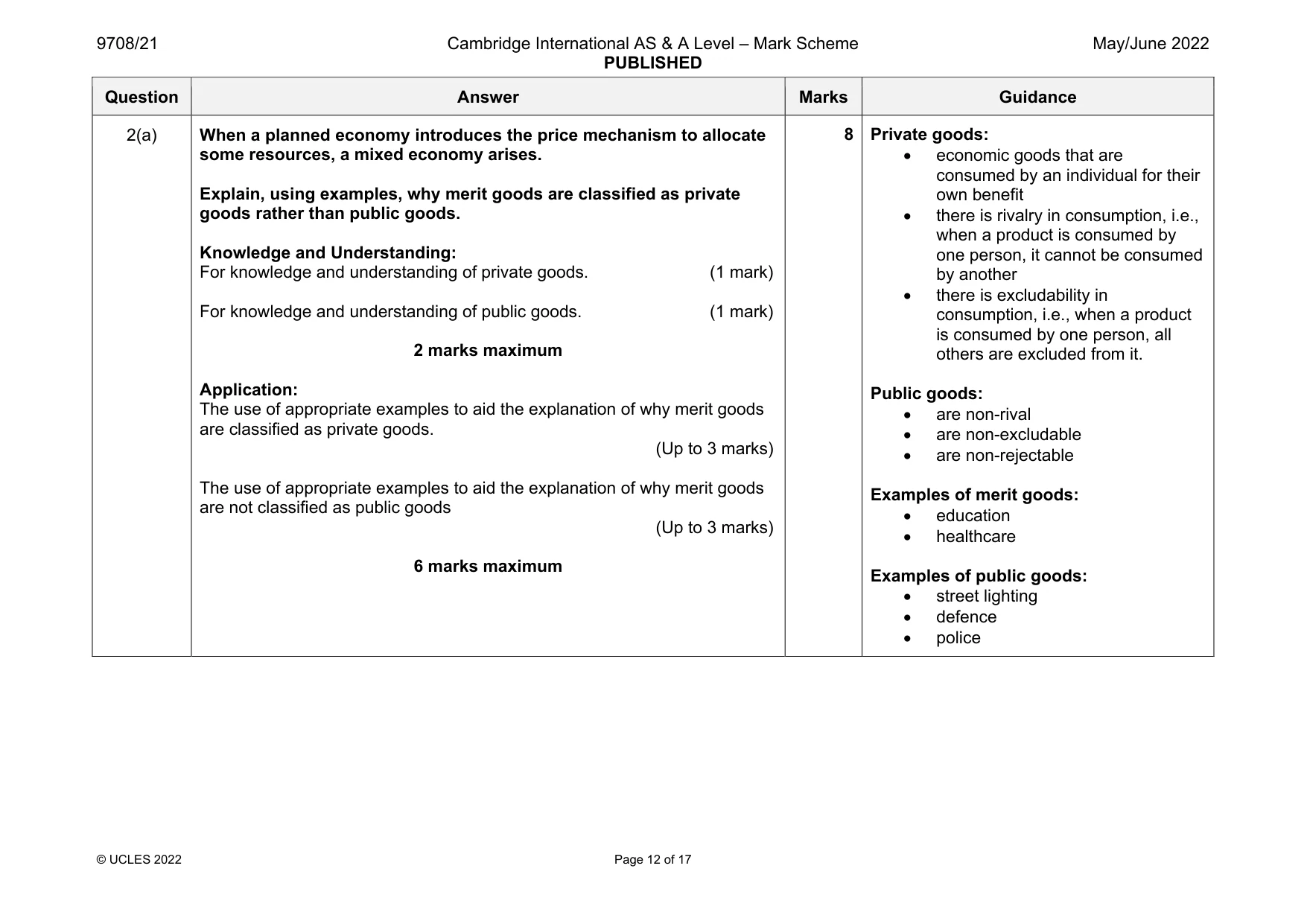
Mark scheme: 2(a) When a planned economy introduces the price mechanism to allocate some resources, a mixed economy arises. Explain, using examples, why merit goods are classified as private goods rather than public goods. Knowledge and Understanding: For knowledge and understanding of private goods. (1 mark) For knowledge and understanding of public goods. (1 mark) 2 marks maximum Application: The use of appropriate examples to aid the explanation of why merit goods are classified as private goods. (Up to 3 marks) The use of appropriate examples to aid the explanation of why merit goods are not classified as public goods (Up to 3 marks) 6 marks maximum economic goods that are consumed by an individual for their own benefit there is rivalry in consumption, i.e., when a product is consumed by one person, it cannot be consumed by another there is excludability in consumption, i.e., when a product is consumed by one person, all others are excluded from it. Public goods: are non-rival are non-excludable are non-rejectable Examples of merit goods: education healthcare Examples of public goods: street lighting defence police Question Answer Marks Guidance 2(b) Discuss the advantages of a mixed economy and whether it is always preferable to a planned economy. Analysis: Analysis of the advantages and disadvantages of a mixed economy. (Up to 4 marks) Analysis of the advantages and disadvantages of a planned economy. (Up to 4 marks) 8 marks maximum Evaluation: For exercising some judgement on whether a mixed economy is always preferable to a planned economy. (Up to 4 marks) Reserve 1 mark for a conclusion 4 marks maximum 12 Advantages of a mixed economy: the price mechanism is allowed to operate in many areas, facilitating its functions of rationing, signalling and the transmission of preferences a government is able to intervene in a market, e.g., through a maximum price or a minimum price some industries may be nationalised by the government Disadvantages of a mixed economy: the workings of the price mechanism may be adversely affected by a government, e.g., taxes and subsidies possibility of market failure Advantages of a planned economy: a government may decide to directly provide certain goods and services Disadvantages of a planned economy: greater role for a government leads to more bureaucracy and less efficiency the lack of competition could lead to poorer quality and restricted choice There are no KU marks awarded in (b) for merely defining/explaining terms used within the question.
More questions on Resource allocation in different economic systems
Q3 · Explain two factors that determine the price elasticity of supply of a manufactured…
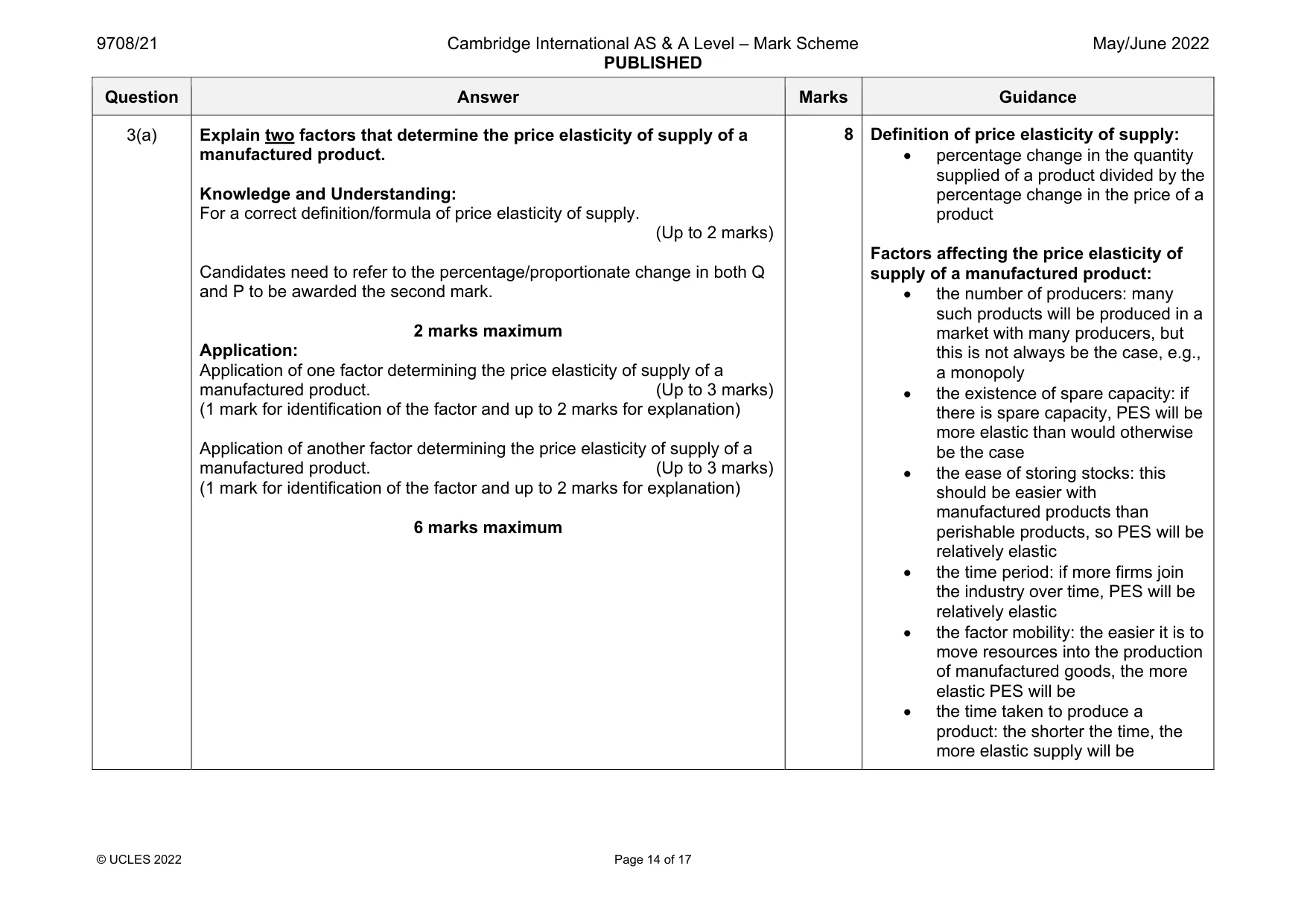
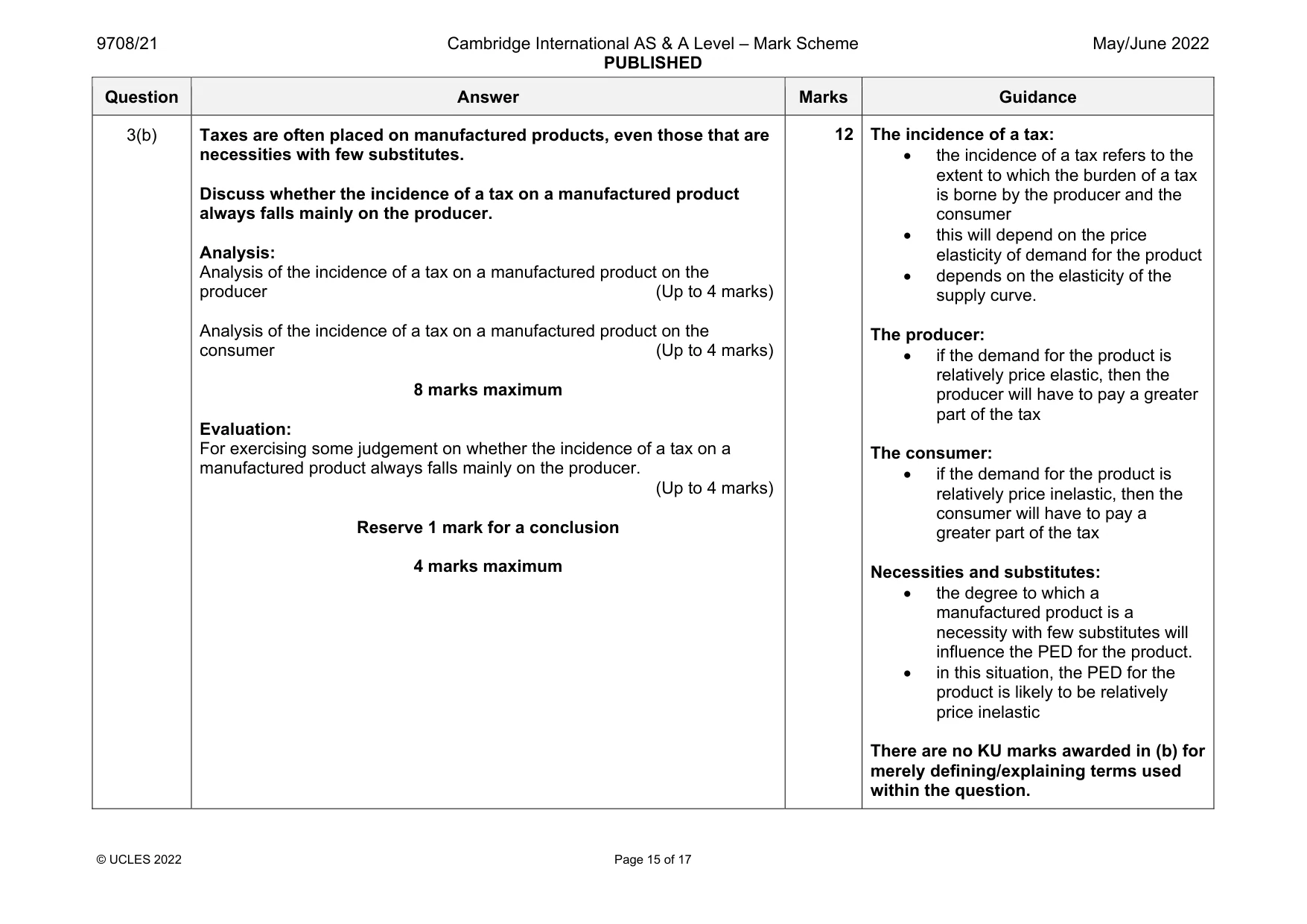
3 (a) Explain two factors that determine the price elasticity of supply of a manufactured product. [8] (b) Taxes are often placed on manufactured products, even those that are necessities with few substitutes. Discuss whether the incidence of a tax on a manufactured product always falls mainly on the producer. [12]
Mark scheme: 3(a) Explain two factors that determine the price elasticity of supply of a manufactured product. Knowledge and Understanding: For a correct definition/formula of price elasticity of supply. (Up to 2 marks) Candidates need to refer to the percentage/proportionate change in both Q and P to be awarded the second mark. 2 marks maximum Application: Application of one factor determining the price elasticity of supply of a manufactured product. (Up to 3 marks) (1 mark for identification of the factor and up to 2 marks for explanation) Application of another factor determining the price elasticity of supply of a manufactured product. (Up to 3 marks) (1 mark for identification of the factor and up to 2 marks for explanation) 6 marks maximum percentage change in the quantity supplied of a product divided by the percentage change in the price of a product Factors affecting the price elasticity of supply of a manufactured product: the number of producers: many such products will be produced in a market with many producers, but this is not always be the case, e.g., a monopoly the existence of spare capacity: if there is spare capacity, PES will be more elastic than would otherwise be the case the ease of storing stocks: this should be easier with manufactured products than perishable products, so PES will be relatively elastic the time period: if more firms join the industry over time, PES will be relatively elastic the factor mobility: the easier it is to move resources into the production of manufactured goods, the more elastic PES will be the time taken to produce a product: the shorter the time, the more elastic supply will be Question Answer Marks Guidance 3(b) Taxes are often placed on manufactured products, even those that are necessities with few substitutes. Discuss whether the incidence of a tax on a manufactured product always falls mainly on the producer. Analysis: Analysis of the incidence of a tax on a manufactured product on the producer (Up to 4 marks) Analysis of the incidence of a tax on a manufactured product on the consumer (Up to 4 marks) 8 marks maximum Evaluation: For exercising some judgement on whether the incidence of a tax on a manufactured product always falls mainly on the producer. (Up to 4 marks) Reserve 1 mark for a conclusion 4 marks maximum 12 The incidence of a tax: the incidence of a tax refers to the extent to which the burden of a tax is borne by the producer and the consumer this will depend on the price elasticity of demand for the product depends on the elasticity of the supply curve. The producer: if the demand for the product is relatively price elastic, then the producer will have to pay a greater part of the tax The consumer: if the demand for the product is relatively price inelastic, then the consumer will have to pay a greater part of the tax Necessities and substitutes: the degree to which a manufactured product is a necessity with few substitutes will influence the PED for the product. in this situation, the PED for the product is likely to be relatively price inelastic There are no KU marks awarded in (b) for merely defining/explaining terms used within the question.
More questions on Methods and effects of government intervention in markets
Q4 · Explain why a fixed exchange rate could cause difficulties for a country that has one
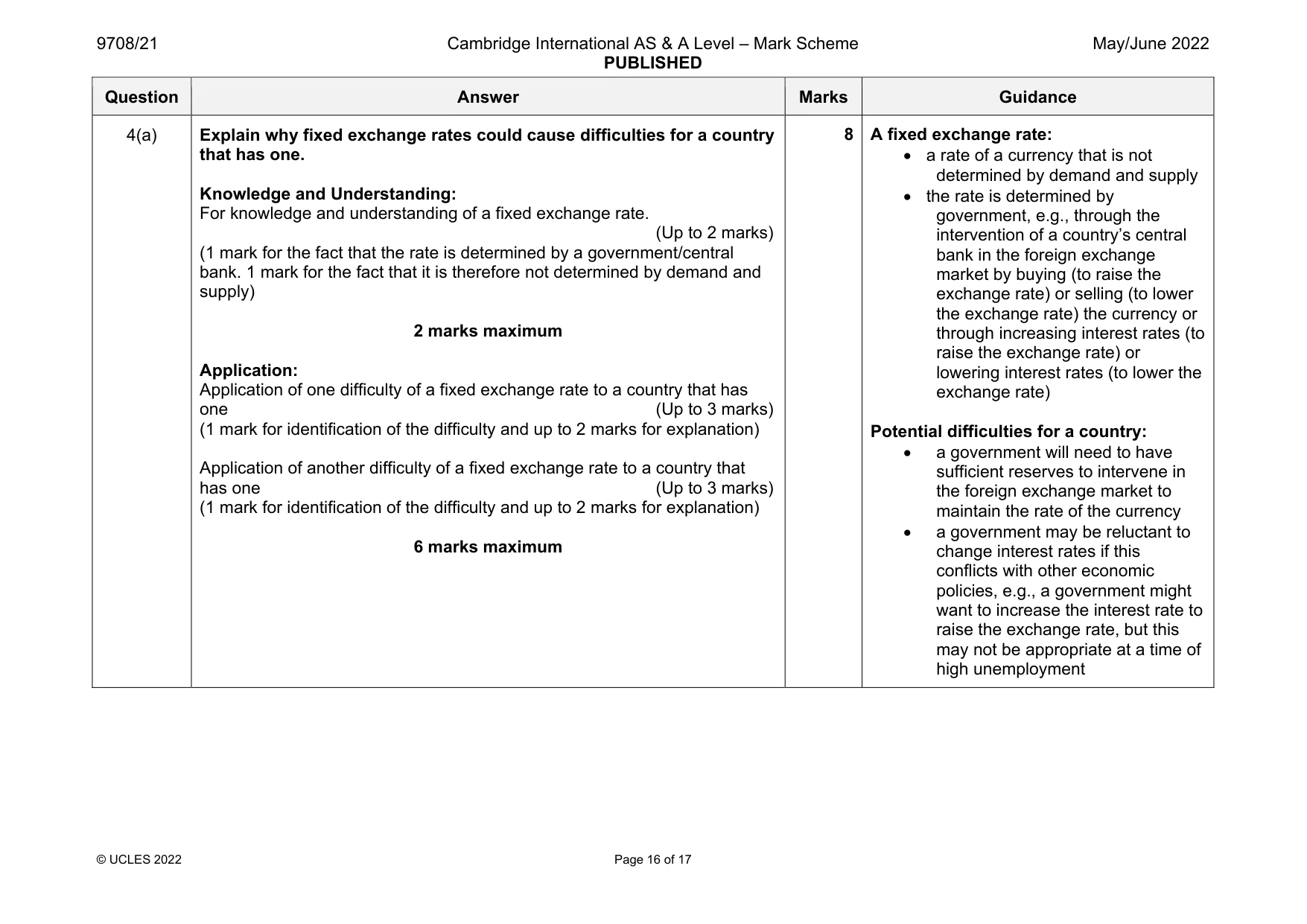
4 (a) Explain why a fixed exchange rate could cause difficulties for a country that has one. [8] (b) Protectionism can take different forms in different countries. Discuss whether export subsidies are always a better method of protectionism than tariffs. [12]
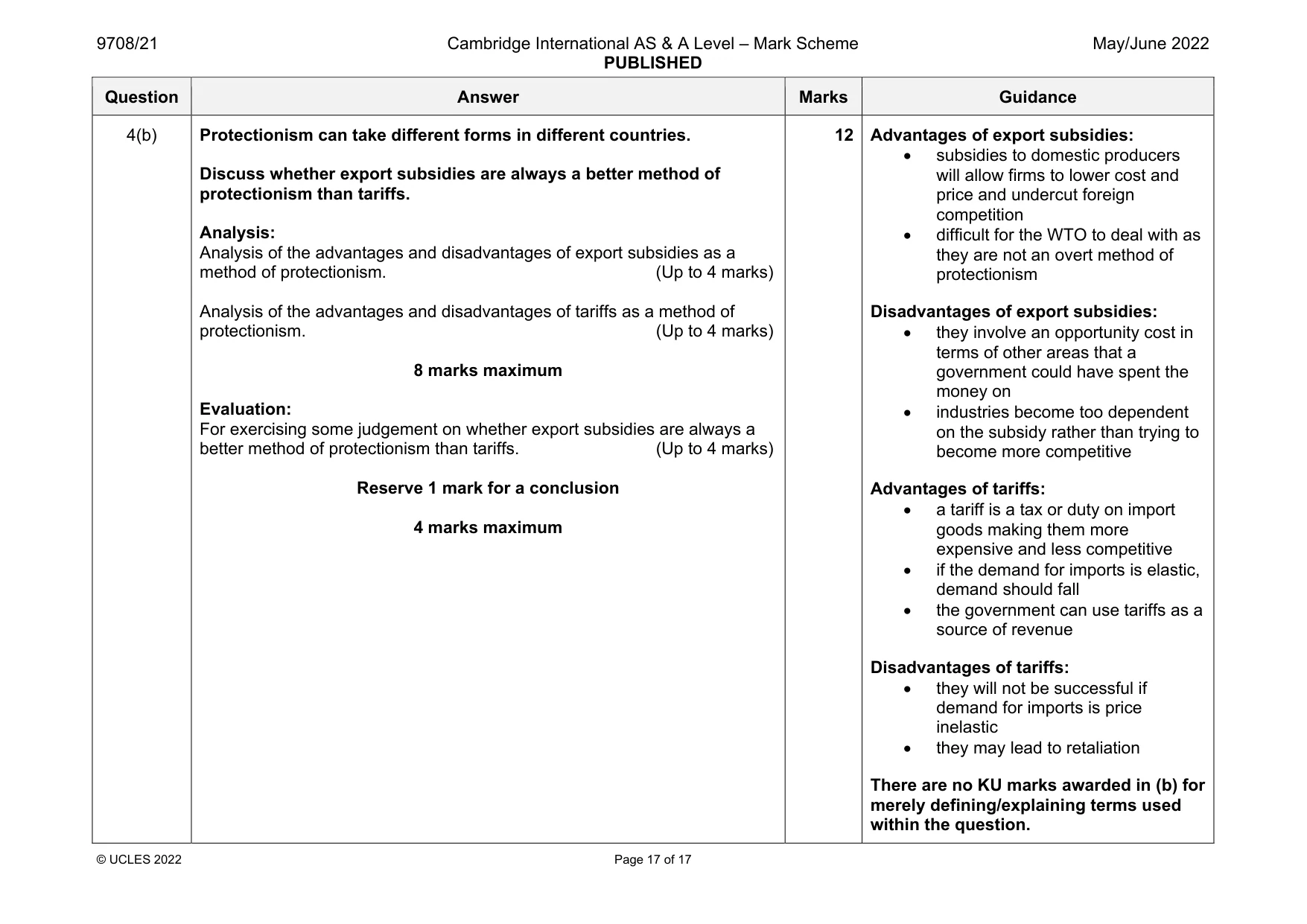
Mark scheme: 4(a) Explain why fixed exchange rates could cause difficulties for a country that has one. Knowledge and Understanding: For knowledge and understanding of a fixed exchange rate. (Up to 2 marks) (1 mark for the fact that the rate is determined by a government/central bank. 1 mark for the fact that it is therefore not determined by demand and supply) 2 marks maximum Application: Application of one difficulty of a fixed exchange rate to a country that has one (Up to 3 marks) (1 mark for identification of the difficulty and up to 2 marks for explanation) Application of another difficulty of a fixed exchange rate to a country that has one (Up to 3 marks) (1 mark for identification of the difficulty and up to 2 marks for explanation) 6 marks maximum a rate of a currency that is not determined by demand and supply the rate is determined by government, e.g., through the intervention of a country’s central bank in the foreign exchange market by buying (to raise the exchange rate) or selling (to lower the exchange rate) the currency or through increasing interest rates (to raise the exchange rate) or lowering interest rates (to lower the exchange rate) Potential difficulties for a country: a government will need to have sufficient reserves to intervene in the foreign exchange market to maintain the rate of the currency a government may be reluctant to change interest rates if this conflicts with other economic policies, e.g., a government might want to increase the interest rate to raise the exchange rate, but this may not be appropriate at a time of high unemployment Question Answer Marks Guidance 4(b) Protectionism can take different forms in different countries. Discuss whether export subsidies are always a better method of protectionism than tariffs. Analysis: Analysis of the advantages and disadvantages of export subsidies as a method of protectionism. (Up to 4 marks) Analysis of the advantages and disadvantages of tariffs as a method of protectionism. (Up to 4 marks) 8 marks maximum Evaluation: For exercising some judgement on whether export subsidies are always a better method of protectionism than tariffs. (Up to 4 marks) Reserve 1 mark for a conclusion 4 marks maximum 12 Advantages of export subsidies: subsidies to domestic producers will allow firms to lower cost and price and undercut foreign competition difficult for the WTO to deal with as they are not an overt method of protectionism Disadvantages of export subsidies: they involve an opportunity cost in terms of other areas that a government could have spent the money on industries become too dependent on the subsidy rather than trying to become more competitive Advantages of tariffs: a tariff is a tax or duty on import goods making them more expensive and less competitive if the demand for imports is elastic, demand should fall the government can use tariffs as a source of revenue Disadvantages of tariffs: they will not be successful if demand for imports is price inelastic they may lead to retaliation There are no KU marks awarded in (b) for merely defining/explaining terms used within the question.
What was in this paper
The subtopics covered by these 4 questions, and how many questions each got. Open one in a new tab to see every Cambridge question on it.
What you needed in this session
Cambridge’s own grade thresholds for 2022 May/June, Paper 2 · Variant 1. A higher threshold means an easier paper — the bar moves with how the cohort did.