Questions as text
Q1 · Which mixtures, on heating, produce the gas ND3? 9701/11 Oct/Nov 2007
37 Which mixtures, on heating, produce the gas ND3? [D = H 2 , an isotope of hydrogen] 1 1 CaO(s) and ND4Cl(s) 2 CH3CN and NaOD in D2O 3 NDH3Cl and NaOD in D2O
1 marks
Answer: B
This question in 9701/11 Oct/Nov 2007
Q2 · Which reactions are examples of nucleophilic substitution? 9701/11 May/June 2010
39 Which reactions are examples of nucleophilic substitution? 1 CH3CH2Br + OH– → CH3CH2OH + Br– H + 2 CH3I + H2O → CH3OH + HI 3 CH3CH2CH2Cl + NH3 → CH3CH2CH2NH2 + HCl
1 marks
Answer: A
This question in 9701/11 May/June 2010
Q3 · Which reactions are examples of nucleophilic substitution? 9701/12 May/June 2010
37 Which reactions are examples of nucleophilic substitution? 1 CH3CH2Br + OH– → CH3CH2OH + Br– H + 2 CH3I + H2O → CH3OH + HI 3 CH3CH2CH2Cl + NH3 → CH3CH2CH2NH2 + HCl
1 marks
Answer: A
This question in 9701/12 May/June 2010
Q4 · Which reactions are examples of nucleophilic substitution? 9701/13 May/June 2010
38 Which reactions are examples of nucleophilic substitution? 1 CH3CH2Br + OH– → CH3CH2OH + Br– H + 2 CH3I + H2O → CH3OH + HI 3 CH3CH2CH2Cl + NH3 → CH3CH2CH2NH2 + HCl
1 marks
Answer: A
This question in 9701/13 May/June 2010
Q5 · How can a good yield of ethylamine be made using bromoethane as starting material? 9701/11 May/June 2012
40 How can a good yield of ethylamine be made using bromoethane as starting material? 1 by heating bromoethane with an excess of ammonia gas in a sealed tube 2 by adding dilute aqueous ammonia to bromoethane at room temperature 3 by heating bromoethane under reflux with aqueous ammonium chloride
1 marks
Answer: D
This question in 9701/11 May/June 2012
Q6 · Coniine is the major constituent of the poison ‘oil of hemlock’ 9701/12 May/June 2012
28 Coniine is the major constituent of the poison ‘oil of hemlock’. N CH2CH2CH3 H coniine Coniine can be synthesised by reacting ammonia with a dibromo compound, X. NH3 + C8H16Br2 → coniine + 2HBr X What is the name of compound X? A 1,1-dibromo-2-propylcyclopentane B 1,2-dibromo-2-propylcyclopentane C 1,4-dibromooctane D 1,5-dibromooctane
1 marks
Answer: D
This question in 9701/12 May/June 2012
Q7 · How can a good yield of ethylamine be made using bromoethane as starting material? 9701/13 May/June 2012
39 How can a good yield of ethylamine be made using bromoethane as starting material? 1 by heating bromoethane with an excess of ammonia gas in a sealed tube 2 by adding dilute aqueous ammonia to bromoethane at room temperature 3 by heating bromoethane under reflux with aqueous ammonium chloride
1 marks
Answer: D
This question in 9701/13 May/June 2012
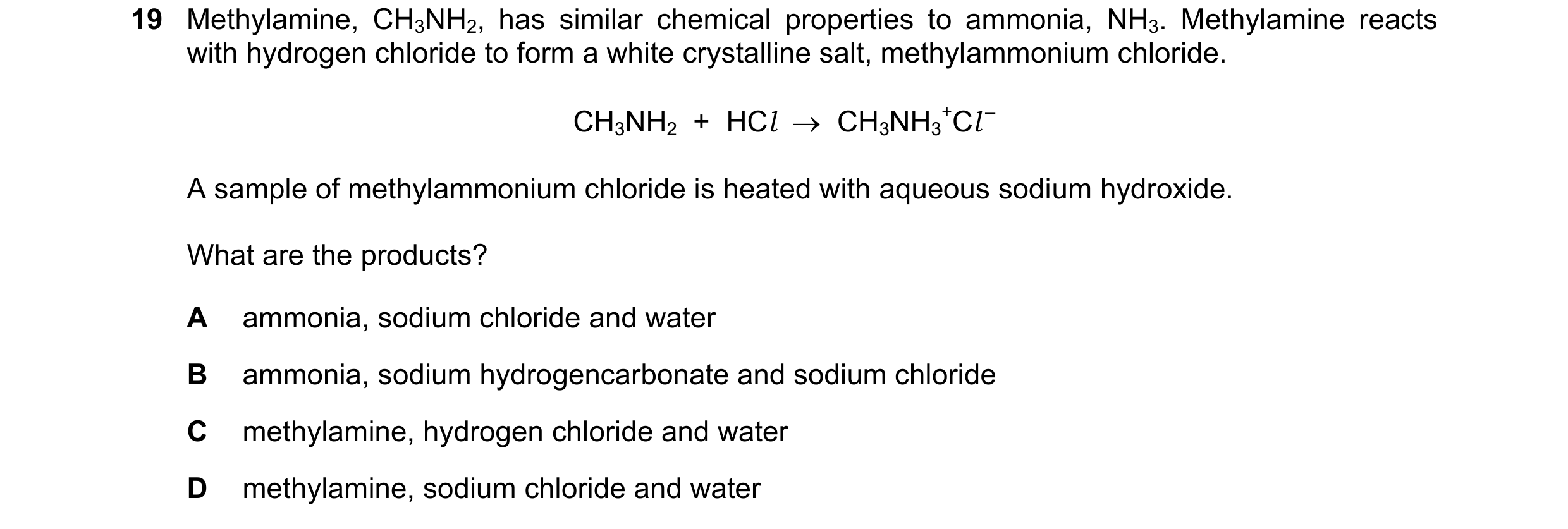
Q8 · Methylamine, CH3NH2, has similar chemical properties to ammonia, NH3 9701/12 Feb/March 2021
19 Methylamine, CH3NH2, has similar chemical properties to ammonia, NH3. Methylamine reacts with hydrogen chloride to form a white crystalline salt, methylammonium chloride. CH3NH2 + HCl CH3NH3 +Cl – A sample of methylammonium chloride is heated with aqueous sodium hydroxide. What are the products? A ammonia, sodium chloride and water B ammonia, sodium hydrogencarbonate and sodium chloride C methylamine, hydrogen chloride and water D methylamine, sodium chloride and water
1 marks
Answer: D
This question in 9701/12 Feb/March 2021
Q9 · Which statements about ammonium chloride are correct? 9701/12 Oct/Nov 2021
36 Which statements about ammonium chloride are correct? 1 It reacts with hot aqueous sodium hydroxide to produce an alkaline gas. 2 In solution, it reacts with aqueous silver nitrate to produce a white precipitate. 3 When solid, it reacts with concentrated sulfuric acid to produce chlorine.
1 marks
Answer: B
This question in 9701/12 Oct/Nov 2021
Q10 · An amine is produced in the following reaction 9701/13 May/June 2025
33 An amine is produced in the following reaction. C2H5I + 2NH3 → C2H5NH2 + NH4I What is the mechanism? A electrophilic addition B free-radical substitution C nucleophilic addition D nucleophilic substitution
1 marks
Answer: D
This question in 9701/13 May/June 2025
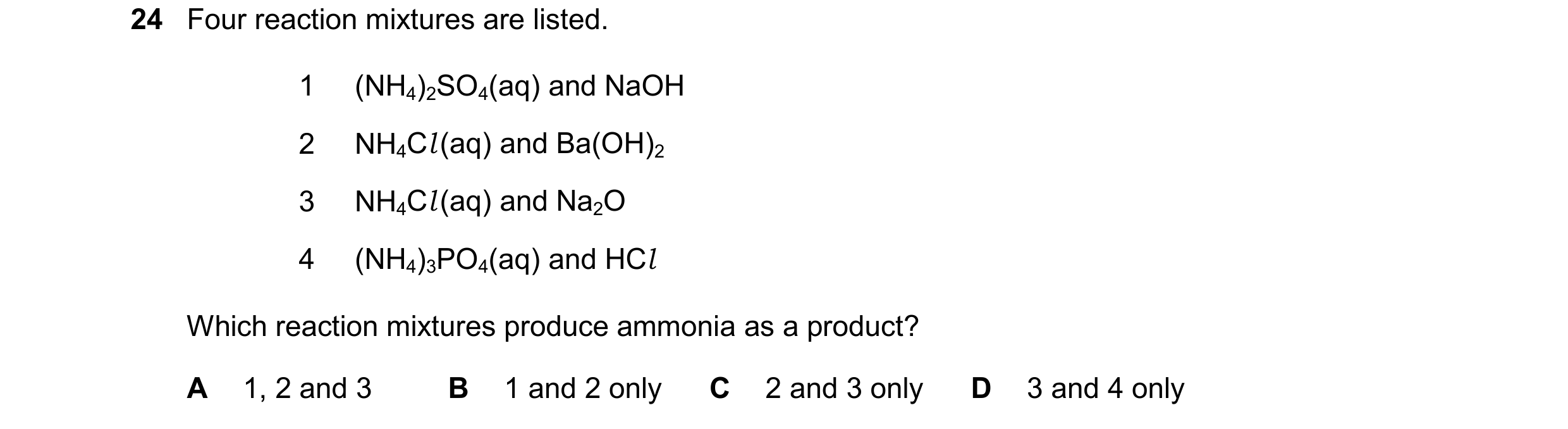
Q11 · Four reaction mixtures are listed 9701/12 Oct/Nov 2025
24 Four reaction mixtures are listed. 1 (NH4)2SO4(aq) and NaOH 2 NH4Cl (aq) and Ba(OH)2 3 NH4Cl (aq) and Na2O 4 (NH4)3PO4(aq) and HCl Which reaction mixtures produce ammonia as a product? A 1, 2 and 3 B 1 and 2 only C 2 and 3 only D 3 and 4 only
1 marks
Answer: A
This question in 9701/12 Oct/Nov 2025
![Question 1: Which mixtures, on heating, produce the gas ND3? [D = H 2 , an isotope of hydrogen] 1 1 CaO(s) and ND4Cl(s) 2 CH3CN and NaOD in D2O 3 NDH3C…](https://img.pastlit.com/crops/95489c85-ae77-4795-8693-5d2b2fe3edd0/q37.png)



 1 / 3
1 / 3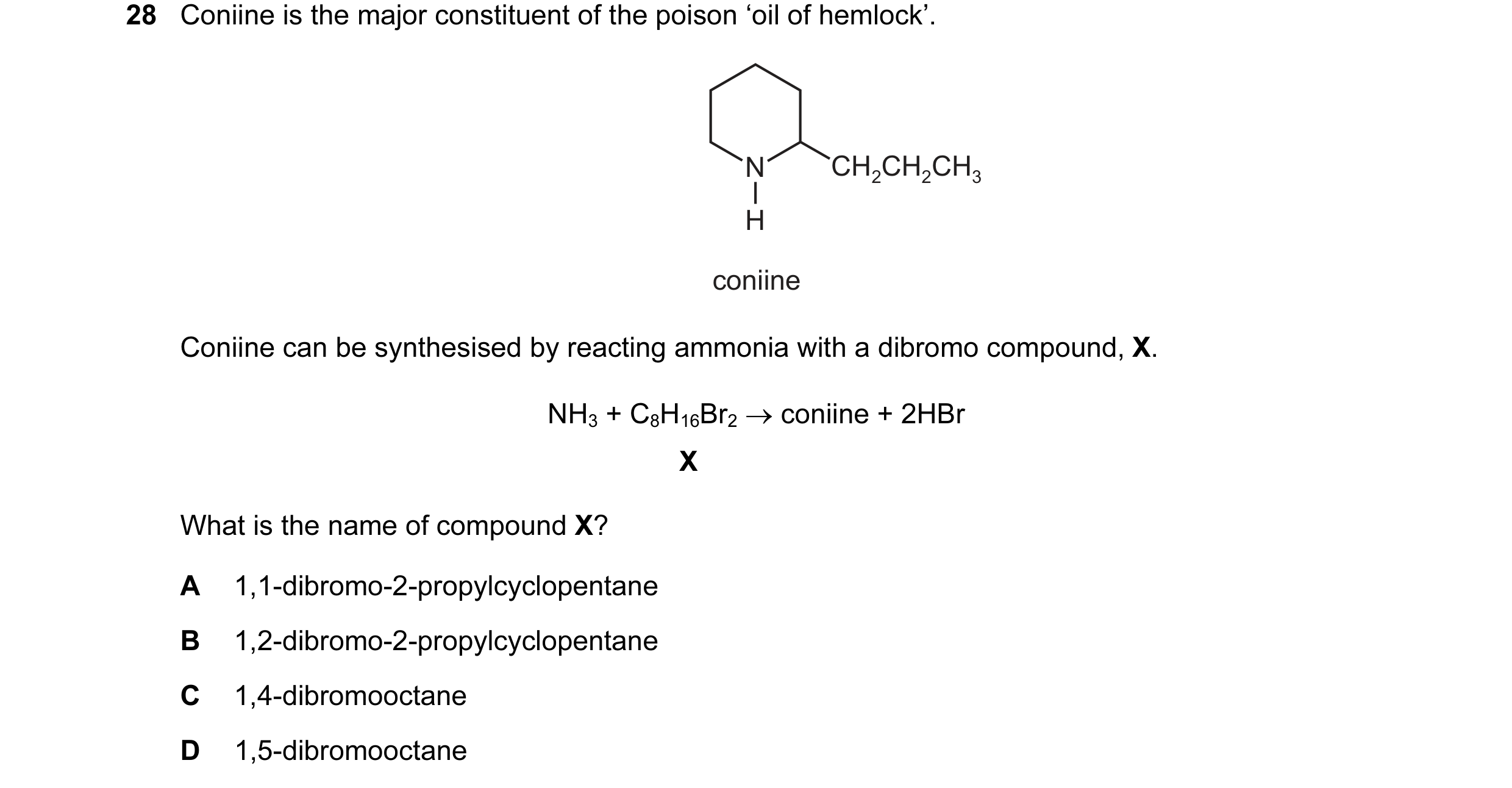

 2 / 3
2 / 3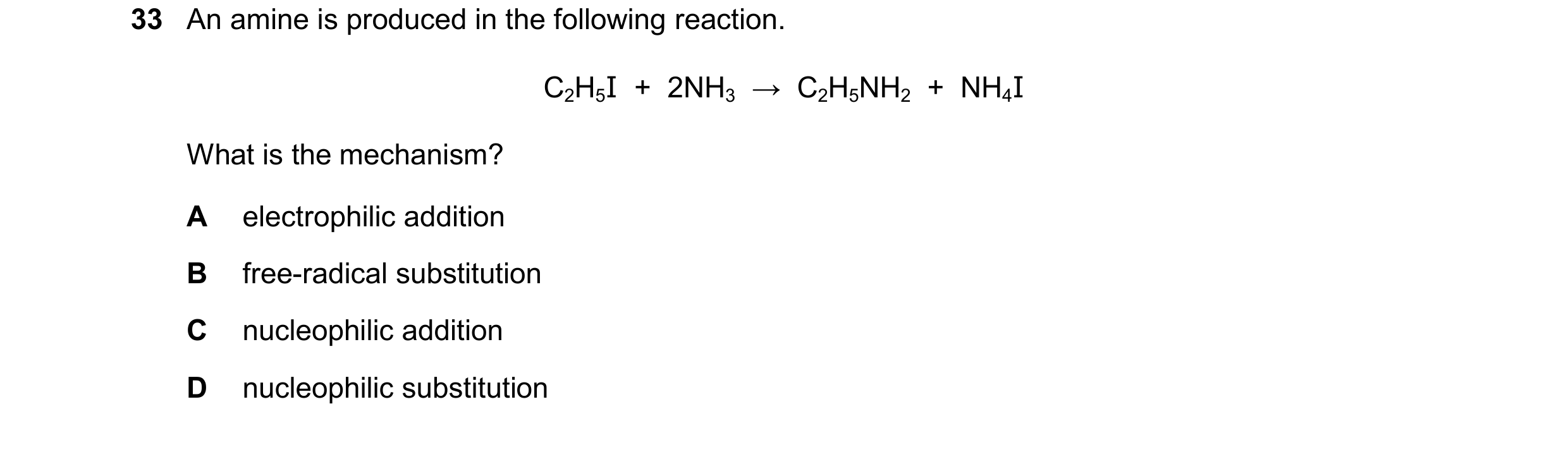
 3 / 3
3 / 3