Questions as text
Q1 · In the DNA sequence for sickle cell anaemia, adenine replaces thymine in a CTT triplet… 9700/11 Oct/Nov 2004
22 In the DNA sequence for sickle cell anaemia, adenine replaces thymine in a CTT triplet, forming the triplet CAT. During synthesis of the sickle cell haemoglobin molecule, the amino acid valine is incorporated instead of glutamic acid. What is the anticodon in the transfer RNA molecule carrying this valine? A CAT B CAU C GTA D GUA
1 marks
Answer: B
This question in 9700/11 Oct/Nov 2004
Q2 · What is the minimum number of base substitutions required to change the nucleotide… 9700/12 May/June 2010
23 What is the minimum number of base substitutions required to change the nucleotide sequence of the HbA (normal) allele to the HbS (sickle cell) allele? A 1 B 2 C 3 D 4
1 marks
Answer: A
This question in 9700/12 May/June 2010
Q3 · What is the minimum number of base substitutions required to change the nucleotide… 9700/13 May/June 2010
39 What is the minimum number of base substitutions required to change the nucleotide sequence of the HbA (normal) allele to the HbS (sickle cell) allele? A 1 B 2 C 3 D 4
1 marks
Answer: A
This question in 9700/13 May/June 2010
Q4 · S and T are products of a biochemical pathway 9700/12 Oct/Nov 2010
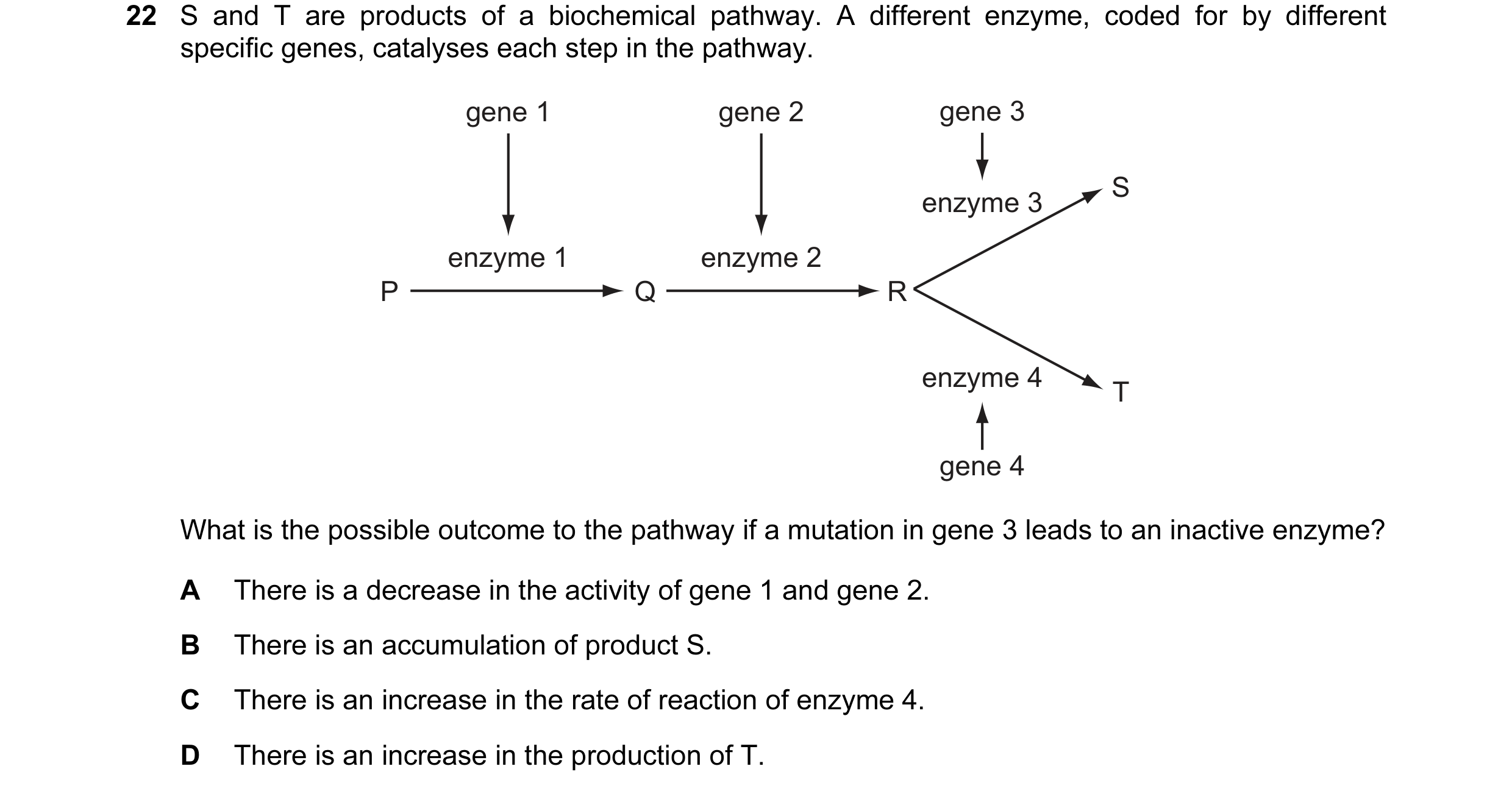
22 S and T are products of a biochemical pathway. A different enzyme, coded for by different specific genes, catalyses each step in the pathway. gene 1 gene 2 gene 3 S enzyme 3 enzyme 1 enzyme 2 P Q R enzyme 4 T gene 4 What is the possible outcome to the pathway if a mutation in gene 3 leads to an inactive enzyme? A There is a decrease in the activity of gene 1 and gene 2. B There is an accumulation of product S. C There is an increase in the rate of reaction of enzyme 4. D There is an increase in the production of T.
1 marks
Answer: D
This question in 9700/12 Oct/Nov 2010
Q5 · A gene codes for the production of a protein, p53, that binds to damaged DNA during… 9700/11 Oct/Nov 2011
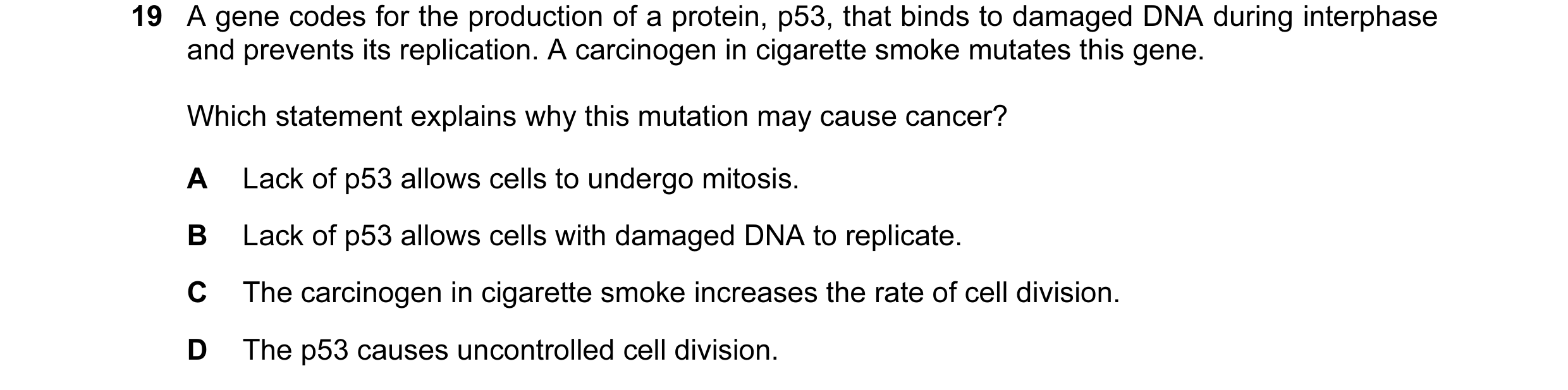
19 A gene codes for the production of a protein, p53, that binds to damaged DNA during interphase and prevents its replication. A carcinogen in cigarette smoke mutates this gene. Which statement explains why this mutation may cause cancer? A Lack of p53 allows cells to undergo mitosis. B Lack of p53 allows cells with damaged DNA to replicate. C The carcinogen in cigarette smoke increases the rate of cell division. D The p53 causes uncontrolled cell division.
1 marks
Answer: B
This question in 9700/11 Oct/Nov 2011
Q6 · Gene mutations in either the BRCA71 or the BRCA2 genes are responsible for the majority… 9700/13 May/June 2013
21 Gene mutations in either the BRCA71 or the BRCA2 genes are responsible for the majority of
hereditary breast cancer in humans.
The proteins produced by the two genes migrate to the nucleus where they interact with other
proteins, such as those produced by the tumour suppressor gene, p53 and the DNA repair gene,
RADS1.
Which combination of gene activity is most likely to result in breast cancer?
gene
OAS. 53 RAD51
A Vv Vv J
B Vv V x
c V x J
D x x x
key
/ = gene produces normal protein
X =gene produces abnormal protein
or no protein
1 marks
Answer: D
This question in 9700/13 May/June 2013
Q7 · Which term best describes the length of DNA that codes for the synthesis of a polypeptide? 9700/13 Oct/Nov 2013
20 Which term best describes the length of DNA that codes for the synthesis of a polypeptide? A anticodon B codon C gene D nucleotide
1 marks
Answer: C
This question in 9700/13 Oct/Nov 2013
Q8 · The statements are about genes and proteins involved in breast cancer 9700/13 May/June 2014
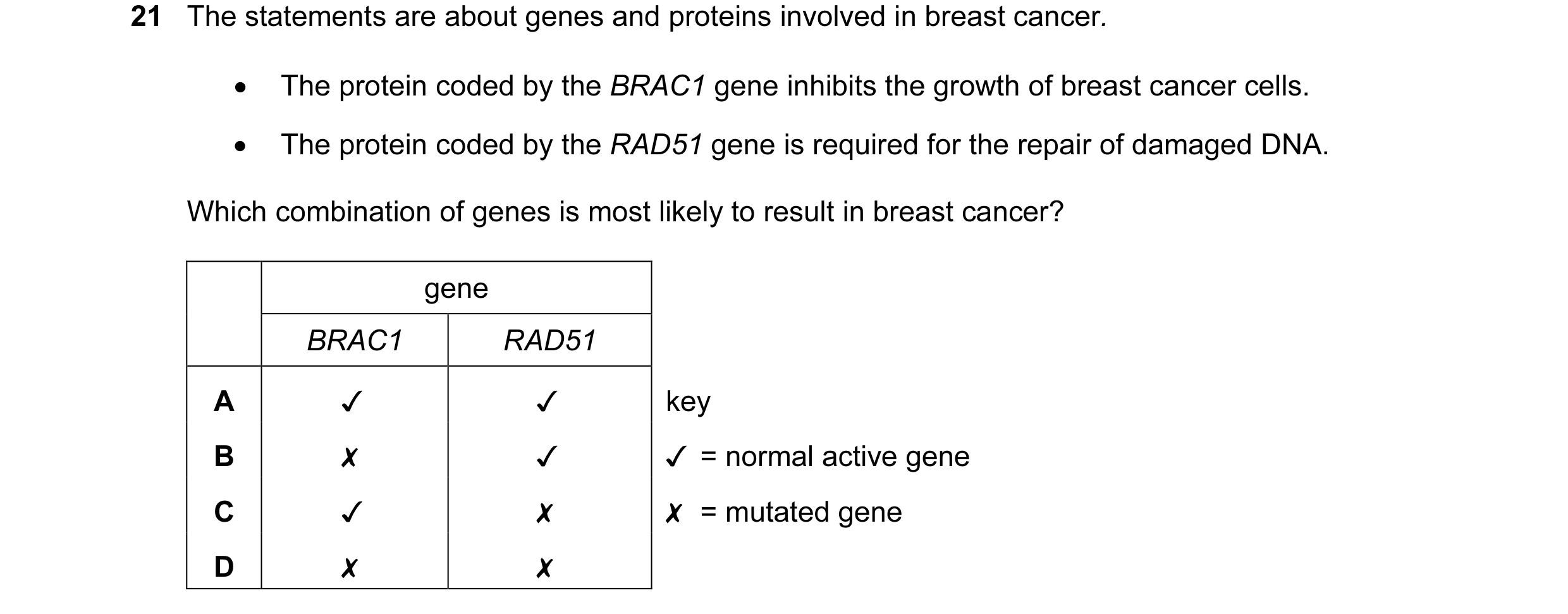
21 The statements are about genes and proteins involved in breast cancer.
e The protein coded by the BRAC7 gene inhibits the growth of breast cancer cells.
e The protein coded by the RAD57 gene is required for the repair of damaged DNA.
Which combination of genes is most likely to result in breast cancer?
gene
BRAC1 RAD51
v v key
¥ =normal active gene
X = mutated gene
0 OW D>
~ «K &
x
v
x
1 marks
Answer: D
This question in 9700/13 May/June 2014
Q9 · The statements are about genes and proteins, involved in breast cancer 9700/13 Oct/Nov 2014
18 The statements are about genes and proteins, involved in breast cancer.
e The protein coded by the BRAC7 gene inhibits the growth of breast cancer cells.
e The protein coded by the p53 gene suppresses tumours.
Which combination of genes is most likely to result in breast cancer?
gene
BRAC1 p53
A x x
B x J
Cc J x
D J J
key
¥ =normal active gene
X = mutated gene
1 marks
Answer: A
This question in 9700/13 Oct/Nov 2014
Q10 · Haemoglobin, a globular protein, consists of four polypeptide chains, two alpha chains… 9700/13 Oct/Nov 2015
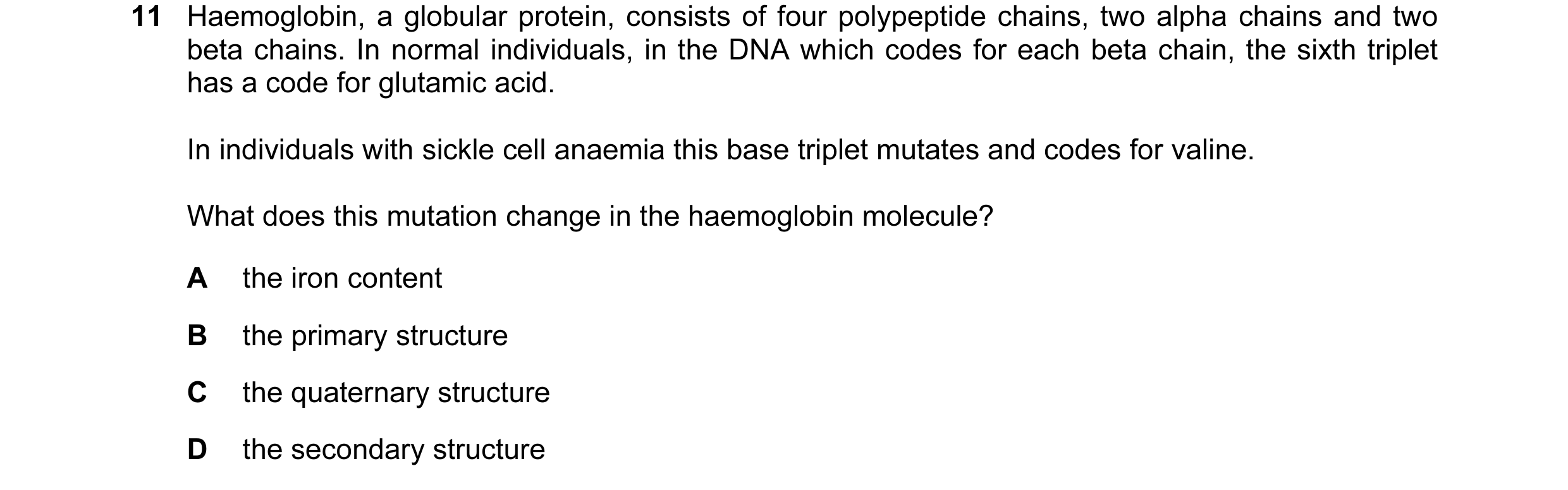
11 Haemoglobin, a globular protein, consists of four polypeptide chains, two alpha chains and two beta chains. In normal individuals, in the DNA which codes for each beta chain, the sixth triplet has a code for glutamic acid. In individuals with sickle cell anaemia this base triplet mutates and codes for valine. What does this mutation change in the haemoglobin molecule? A the iron content B the primary structure C the quaternary structure D the secondary structure
1 marks
Answer: B
This question in 9700/13 Oct/Nov 2015
Q11 · Gene mutations in either the BRCA7 or the BRCA2 genes are responsible for the majority of… 9700/13 Oct/Nov 2016
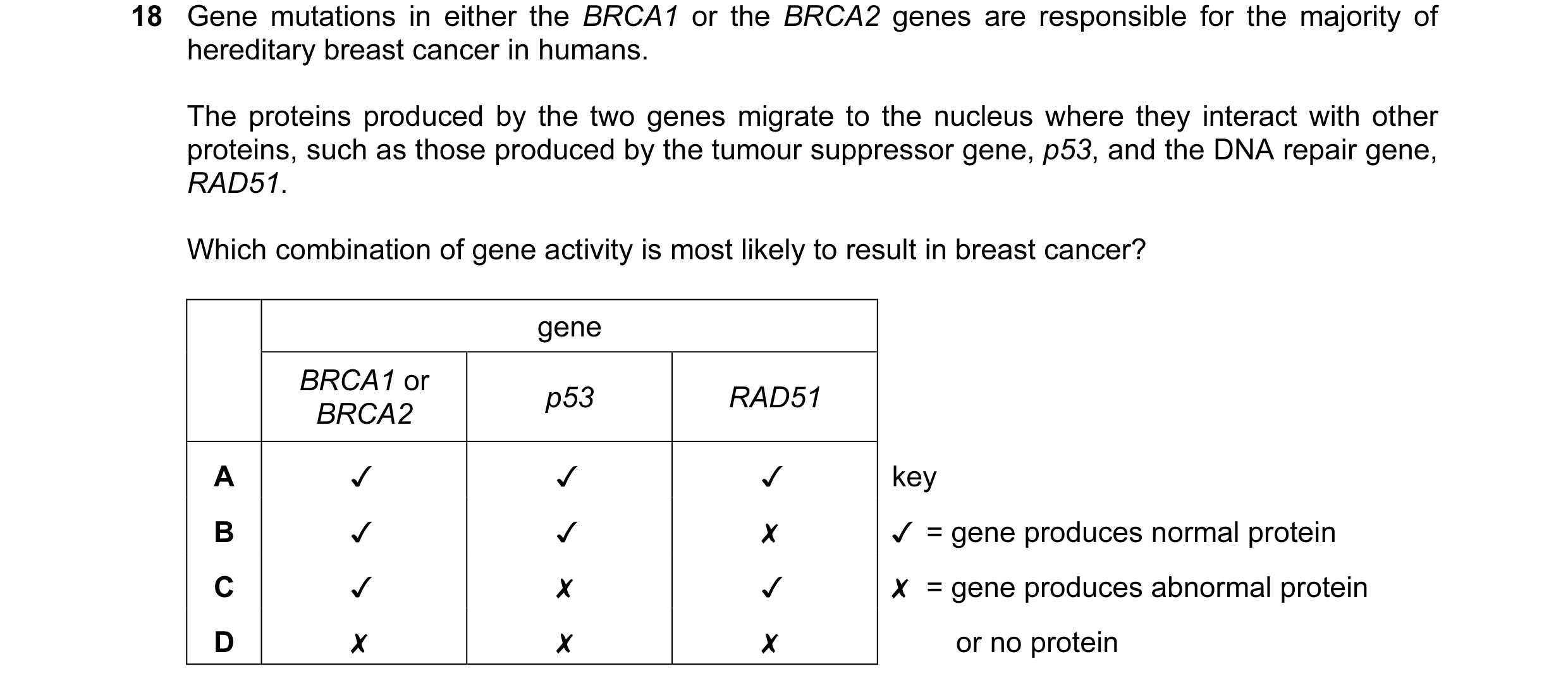
18 Gene mutations in either the BRCA7 or the BRCA2 genes are responsible for the majority of
hereditary breast cancer in humans.
The proteins produced by the two genes migrate to the nucleus where they interact with other
proteins, such as those produced by the tumour suppressor gene, p53, and the DNA repair gene,
RADS1.
Which combination of gene activity is most likely to result in breast cancer?
gene
Ona > p53 RAD51
A J J V
B J J x
Cc J x V
D x x x
key
/ = gene produces normal protein
X =gene produces abnormal protein
or no protein
1 marks
Answer: D
This question in 9700/13 Oct/Nov 2016
Q12 · A gene codes for the sequence of amino acids in a single polypeptide 9700/13 Oct/Nov 2017
24 A gene codes for the sequence of amino acids in a single polypeptide. Haemoglobin consists of two α-globins and two β-globins. How many genes are needed to code for a single haemoglobin molecule? A 1 B 2 C 4 D 8
1 marks
Answer: B
This question in 9700/13 Oct/Nov 2017
Q13 · A single substitution in an allele of the gene coding for haemoglobin results in sickle… 9700/13 Oct/Nov 2017
25 A single substitution in an allele of the gene coding for haemoglobin results in sickle cell haemoglobin. The mRNA sequence for three amino acids for normal haemoglobin is shown. CCUGAAGAG The mRNA sequence for sickle cell haemoglobin is shown. CCUGUAGAG The table shows some of the triplet codes for two amino acids. DNA triplet codes amino acid CTC Glu CTT Glu CAT Val CAC Val Which row is correct for the substituted DNA nucleotide of the allele and the substituted amino acid of the protein? DNA new amino nucleotide acid A A Glu B A Val C T Glu D T Val
1 marks
Answer: B
This question in 9700/13 Oct/Nov 2017
Q14 · A gene codes for the production of a protein, p53, that binds to damaged DNA during… 9700/13 May/June 2019
24 A gene codes for the production of a protein, p53, that binds to damaged DNA during interphase and prevents its replication. A carcinogen in cigarette smoke mutates this gene. Which statement explains why this mutation may cause cancer? A Cells with no p53 are allowed to undergo mitosis. B Cells with no p53 allow their damaged DNA to replicate. C The carcinogen in cigarette smoke increases the rate of cell division. D The p53 causes uncontrolled cell division.
1 marks
Answer: B
This question in 9700/13 May/June 2019



 1 / 4
1 / 4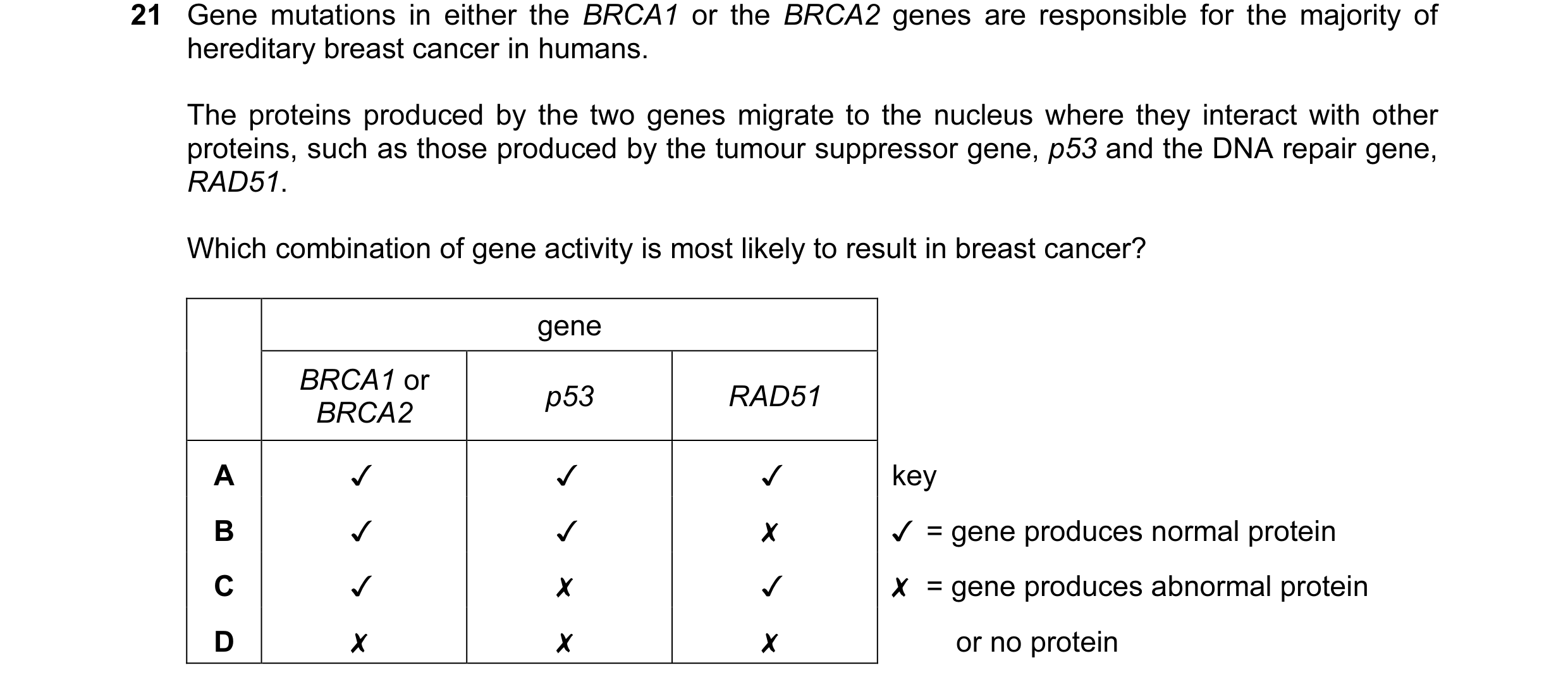

 2 / 4
2 / 4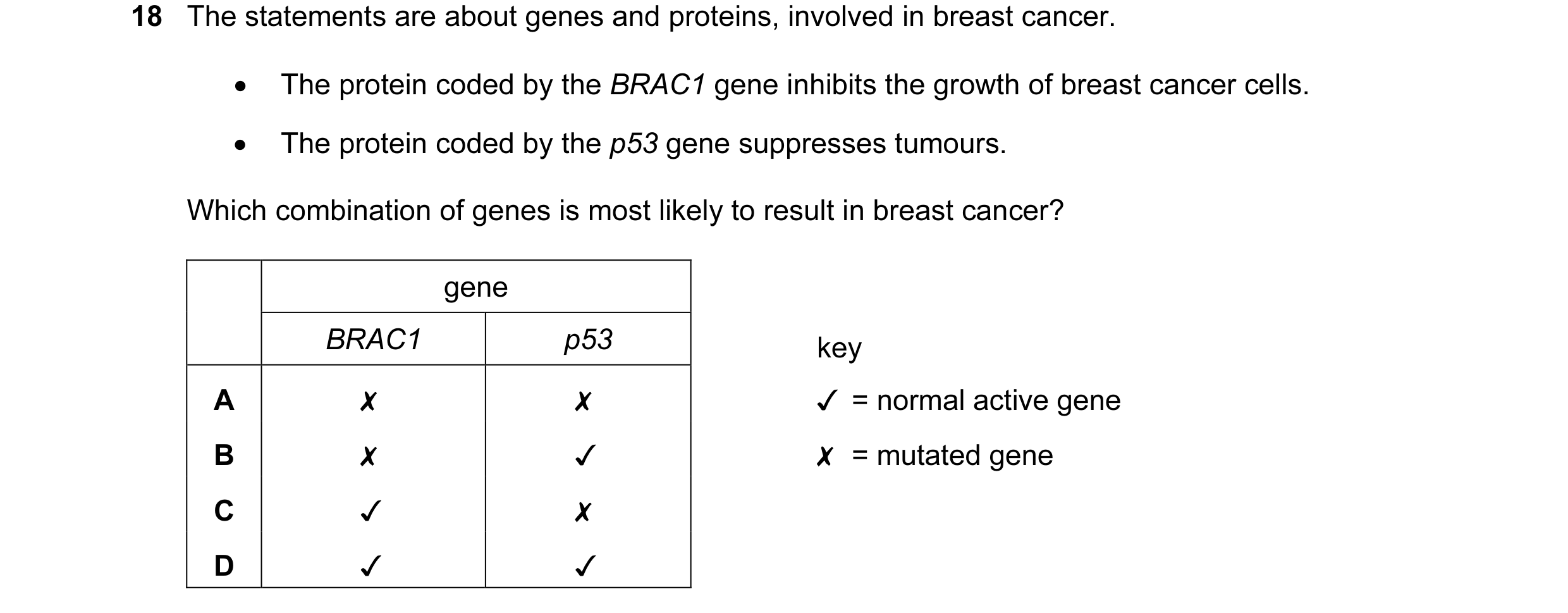
 3 / 4
3 / 4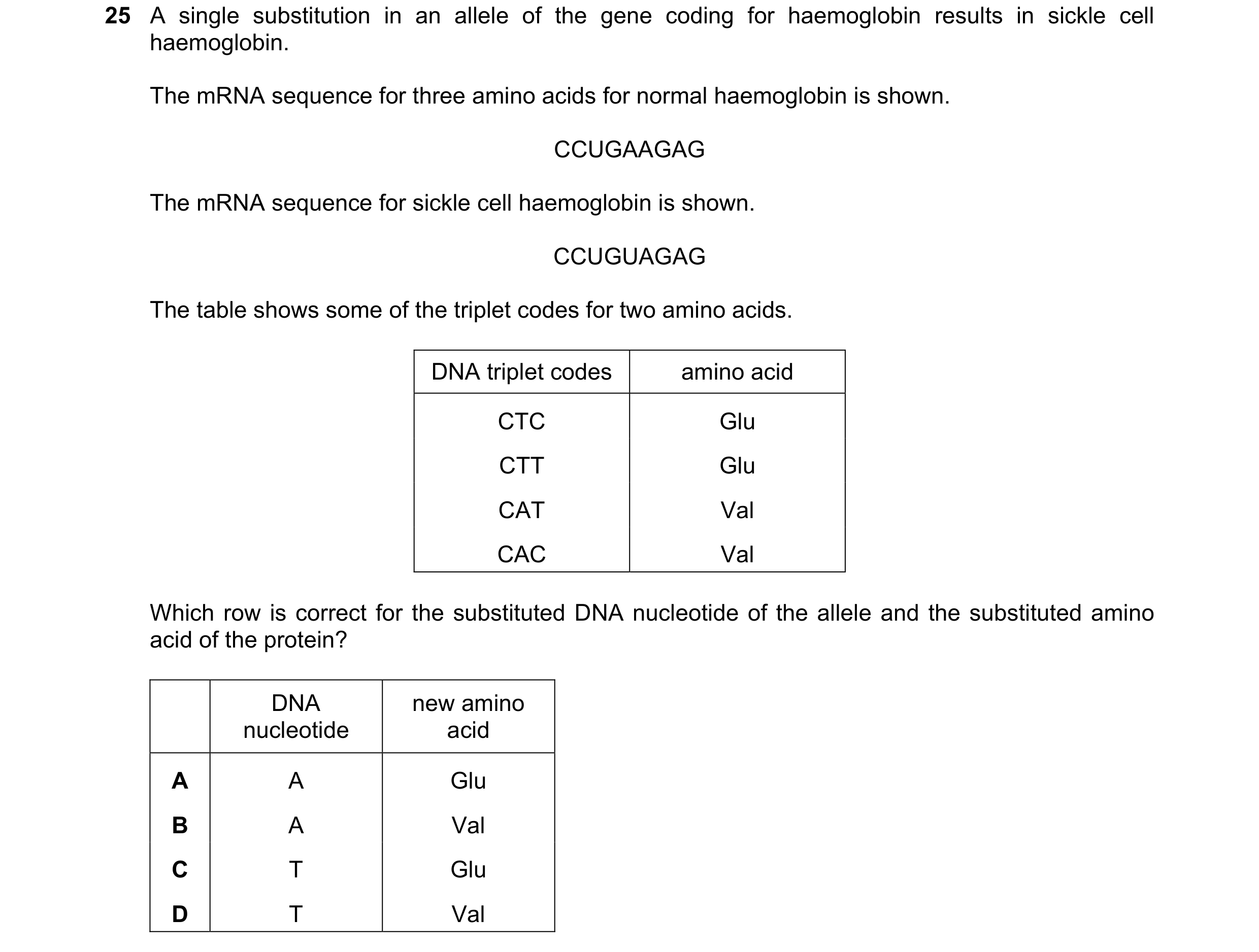
 4 / 4
4 / 4