Cambridge A Level Biology 9700 — 2025 Oct/Nov Paper 2 · Variant 1
9700/21/O/N/25 · 6 questions · 60 marks · 75 min
The question paper and its mark scheme, free to read here and free to download. This is Cambridge’s own paper, exactly as it was sat.
Question paper20 pages

Mark scheme17 pages
Answers below. Sit the paper first if you are practising.
Questions as text
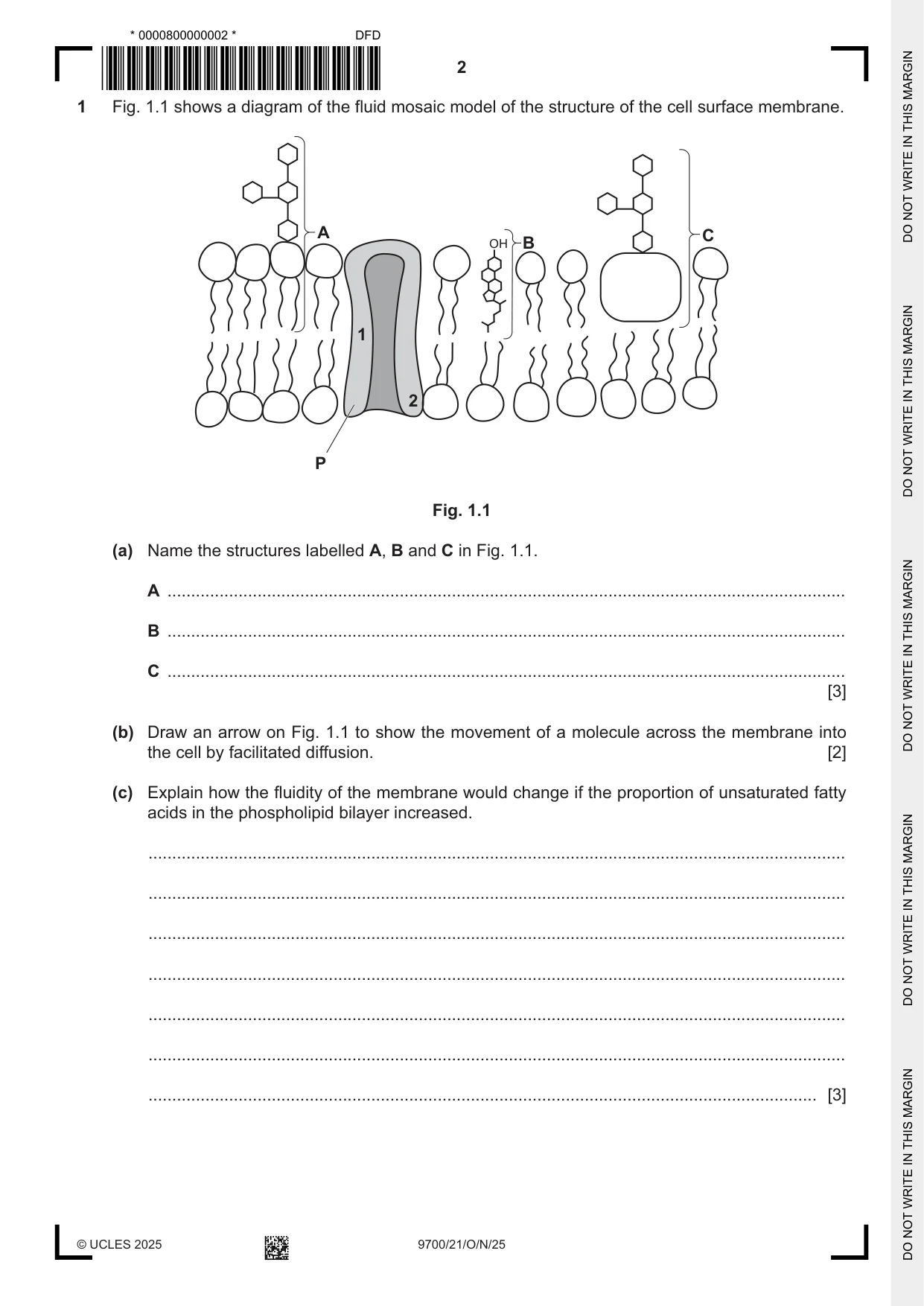
Q1 · A diagram of the fluid mosaic model of the structure of the cell surface membrane
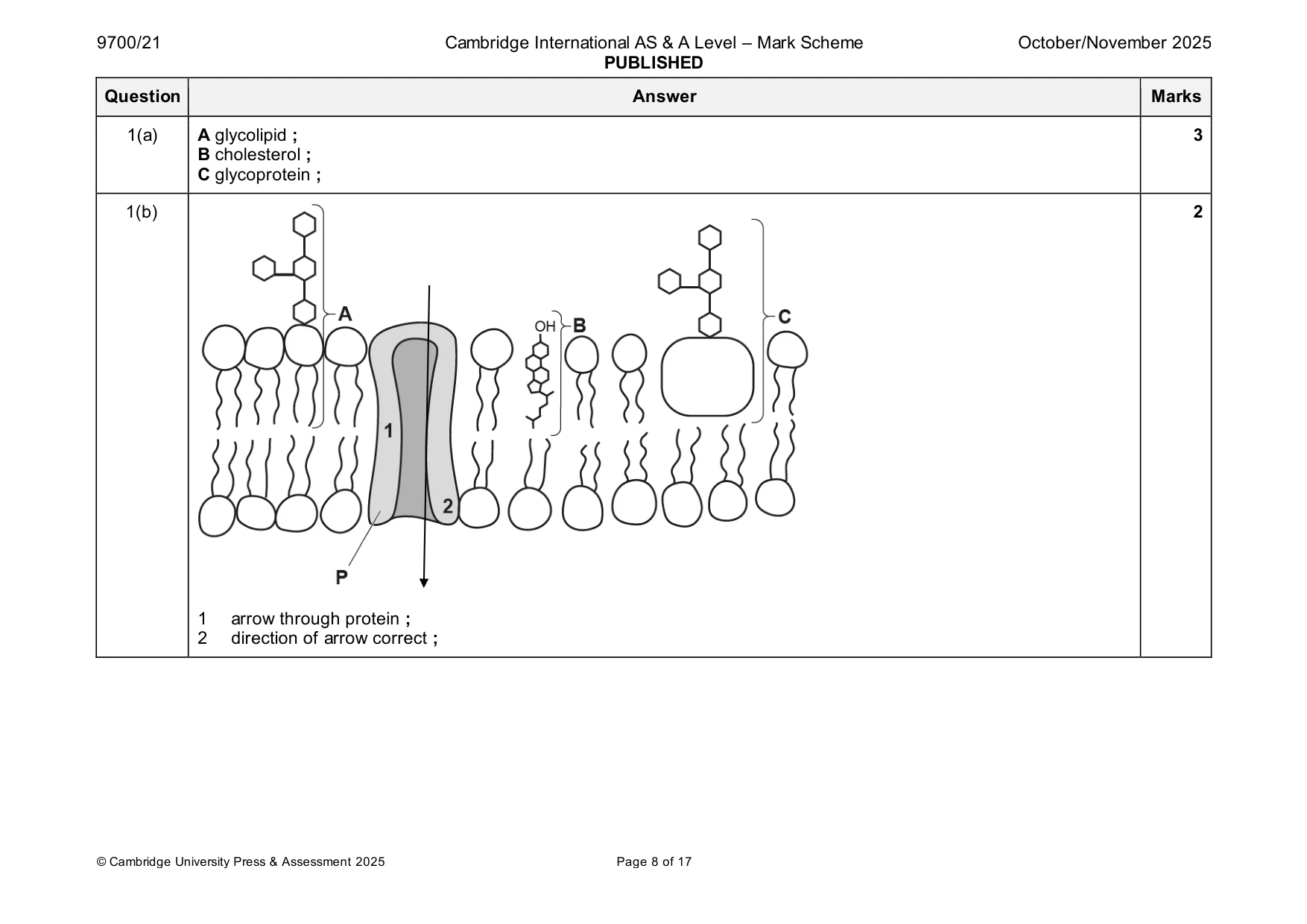
1 Fig. 1.1 shows a diagram of the fluid mosaic model of the structure of the cell surface membrane. A C OH B 1 2 P Fig. 1.1 (a) Name the structures labelled A, B and C in Fig. 1.1. A ............................................................................................................................................... B ............................................................................................................................................... C ............................................................................................................................................... [3] (b) Draw an arrow on Fig. 1.1 to show the movement of a molecule across the membrane into the cell by facilitated diffusion. [2] (c) Explain how the fluidity of the membrane would change if the proportion of unsaturated fatty acids in the phospholipid bilayer increased. ................................................................................................................................................... ................................................................................................................................................... ................................................................................................................................................... ................................................................................................................................................... ................................................................................................................................................... ................................................................................................................................................... ............................................................................................................................................. [3] (d) The R‑groups of amino acids give them different properties. Suggest how the properties of the R‑groups of the amino acids at position 1 of P may differ from the R‑groups of the amino acids at position 2. ................................................................................................................................................... ................................................................................................................................................... ............................................................................................................................................. [1] [Total: 9]
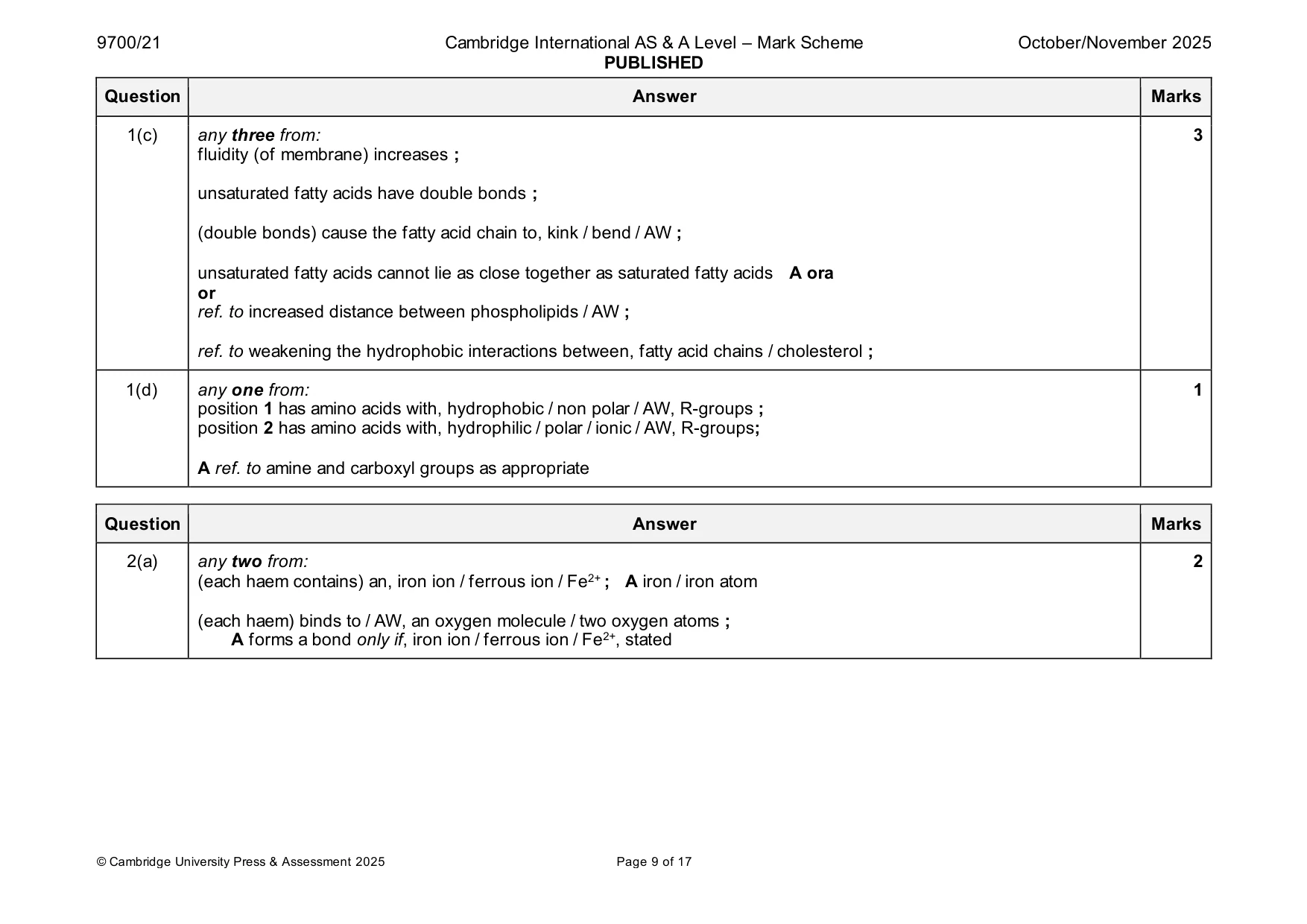
Mark scheme: Question Answer Marks 1(a) A glycolipid ; 3 B cholesterol ; C glycoprotein ; 1(b) 2 1 arrow through protein ; 2 direction of arrow correct ; 1(c) any three from: 3 fluidity (of membrane) increases ; unsaturated fatty acids have double bonds ; (double bonds) cause the fatty acid chain to, kink / bend / AW ; unsaturated fatty acids cannot lie as close together as saturated fatty acids A ora or ref. to increased distance between phospholipids / AW ; ref. to weakening the hydrophobic interactions between, fatty acid chains / cholesterol ; 1(d) any one from: 1 position 1 has amino acids with, hydrophobic / non polar / AW, R-groups ; position 2 has amino acids with, hydrophilic / polar / ionic / AW, R-groups; A ref. to amine and carboxyl groups as appropriate
Q2 · Haemoglobin is a globular protein containing haem groups
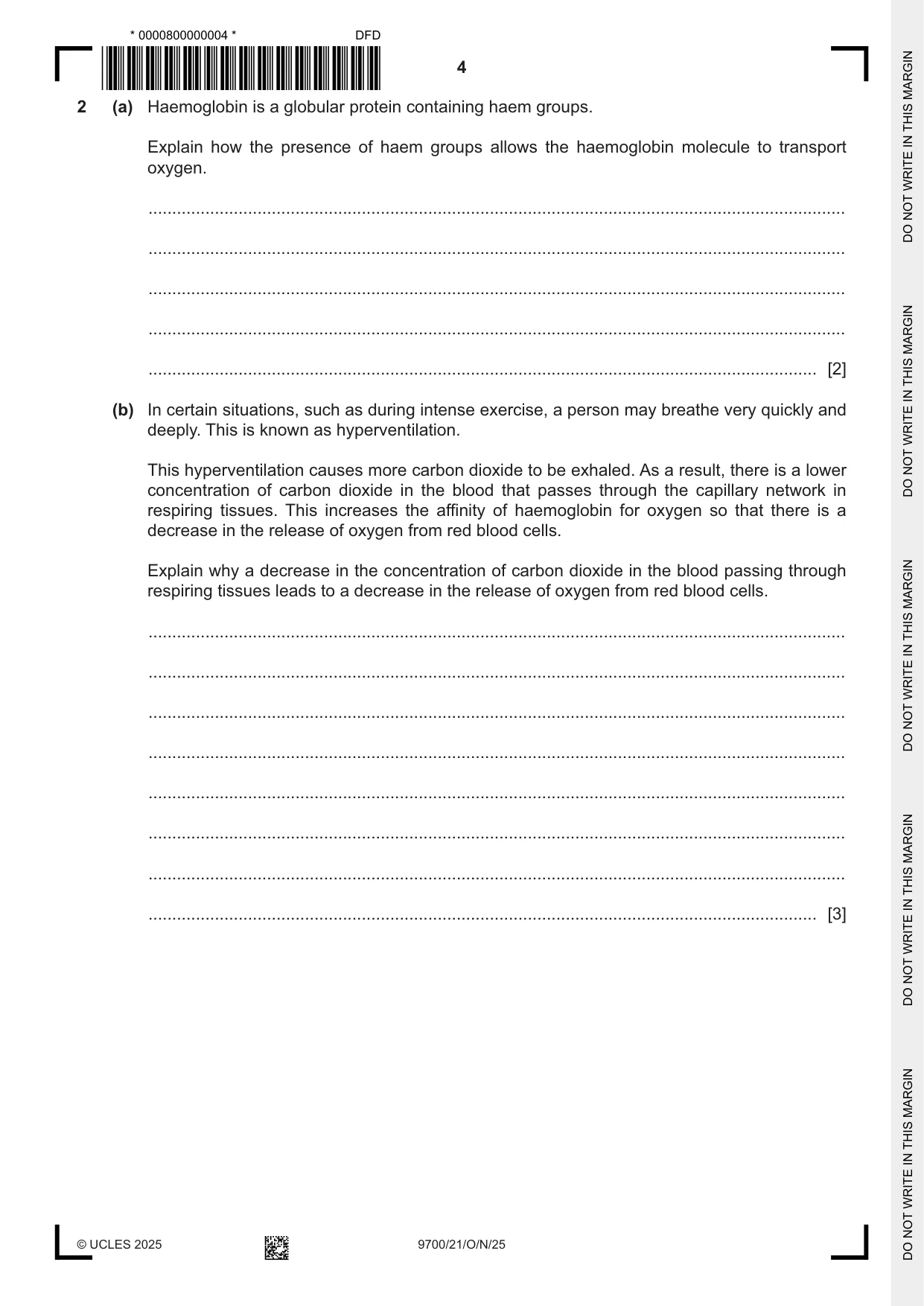
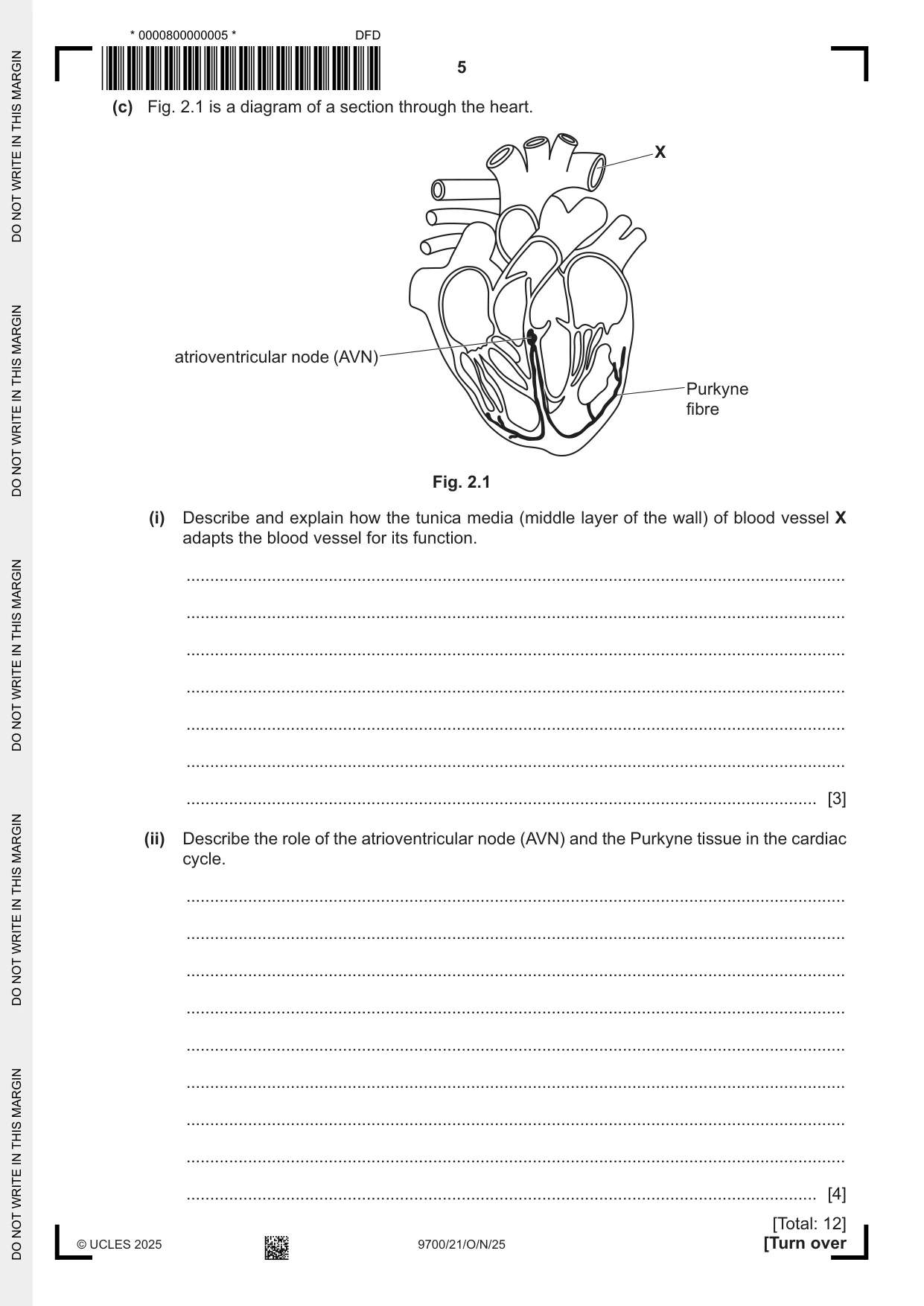
2 (a) Haemoglobin is a globular protein containing haem groups. Explain how the presence of haem groups allows the haemoglobin molecule to transport oxygen. ................................................................................................................................................... ................................................................................................................................................... ................................................................................................................................................... ................................................................................................................................................... ............................................................................................................................................. [2] (b) In certain situations, such as during intense exercise, a person may breathe very quickly and deeply. This is known as hyperventilation. This hyperventilation causes more carbon dioxide to be exhaled. As a result, there is a lower concentration of carbon dioxide in the blood that passes through the capillary network in respiring tissues. This increases the affinity of haemoglobin for oxygen so that there is a decrease in the release of oxygen from red blood cells. Explain why a decrease in the concentration of carbon dioxide in the blood passing through respiring tissues leads to a decrease in the release of oxygen from red blood cells. ................................................................................................................................................... ................................................................................................................................................... ................................................................................................................................................... ................................................................................................................................................... ................................................................................................................................................... ................................................................................................................................................... ................................................................................................................................................... ............................................................................................................................................. [3] (c) Fig. 2.1 is a diagram of a section through the heart. X atrioventricular node (AVN) Purkyne fibre Fig. 2.1 (i) Describe and explain how the tunica media (middle layer of the wall) of blood vessel X adapts the blood vessel for its function. ........................................................................................................................................... ........................................................................................................................................... ........................................................................................................................................... ........................................................................................................................................... ........................................................................................................................................... ........................................................................................................................................... ..................................................................................................................................... [3] (ii) Describe the role of the atrioventricular node (AVN) and the Purkyne tissue in the cardiac cycle. ........................................................................................................................................... ........................................................................................................................................... ........................................................................................................................................... ........................................................................................................................................... ........................................................................................................................................... ........................................................................................................................................... ........................................................................................................................................... ........................................................................................................................................... ..................................................................................................................................... [4] [Total: 12]
Mark scheme: 2(a) any two from: 2 (each haem contains) an, iron ion / ferrous ion / Fe2+ ; A iron / iron atom (each haem) binds to / AW, an oxygen molecule / two oxygen atoms ; A forms a bond only if, iron ion / ferrous ion / Fe2+, stated 2(b) any three from: 3 less carbon dioxide diffuses into red blood cells ; less carbon dioxide reacts with water ; less carbonic acid is formed ; less, dissociation of carbonic acid / formation of hydrogen ions and hydrogen carbonate ions ; less haemoglobinic acid is formed ; A description e.g. H+ binds to haemoglobin less oxygen (released from haem) diffuses out of red blood cells (to respiring tissues) ; ref. to carbaminohaemoglobin ; AVP ; e.g. ref. to change in shape of haemoglobin when H+ binds 2(c)(i) idea that blood vessel X carries (oxygenated blood) at high pressure (to body tissues) ; 3 A ref. to systemic circulation any two from: difference high proportion of elastic fibres (and low proportion of smooth muscle) ; explanation (elastic fibres allow X to) expand / stretch, qualified ; e.g. to accommodate / AW, blood from ventricular, systole / contraction with, surges / pulses, of blood leaving heart to prevent, bursting / rupture recoil of elastic fibres, detail ; e.g.to allow surges / pulses, to continue idea of allowing continued flow of blood to tissues maintains, onward pressure / high pressure of blood if no marks gained in this section allow one mark for: stretch and recoil with one detail or ref. to two correct details but stretch and recoil not stated 2(c)(ii) allow, impulses / wave of excitation, for electrical impulses R nerve impulses once and allow ecf 4 must attempt AVN and Purkyne tissue to gain max any four from: both involved in, co-ordination / control, of, systole / contraction, of, heart / heart muscle / cardiac muscle / ventricles ; AVN only pathway for impulses to travel from atria to ventricles ; AW A impulses must pass through AVN for ventricular, contraction / systole allow, a delay / 0.1 s, for impulse to pass from atria to ventricles ; so, ventricles contract after atria contract / ventricular systole occurs after atrial systole ; allows atria to (fully) empty before, ventricles (begin to) contract / ventricular systole or allows blood to fill ventricles before ventricular, contraction / systole ; Purkyne tissue carries / transmits / AW, impulse(s), (down septum), to base of ventricles / through walls of the ventricles ; for ventricular systole / AW ; ventricular muscles contract / AW, together / at same time / simultaneously / from the base upwards / from apex of heart ;
Q3 · The lock‑and‑key hypothesis and the induced‑fit hypothesis are used to describe the…
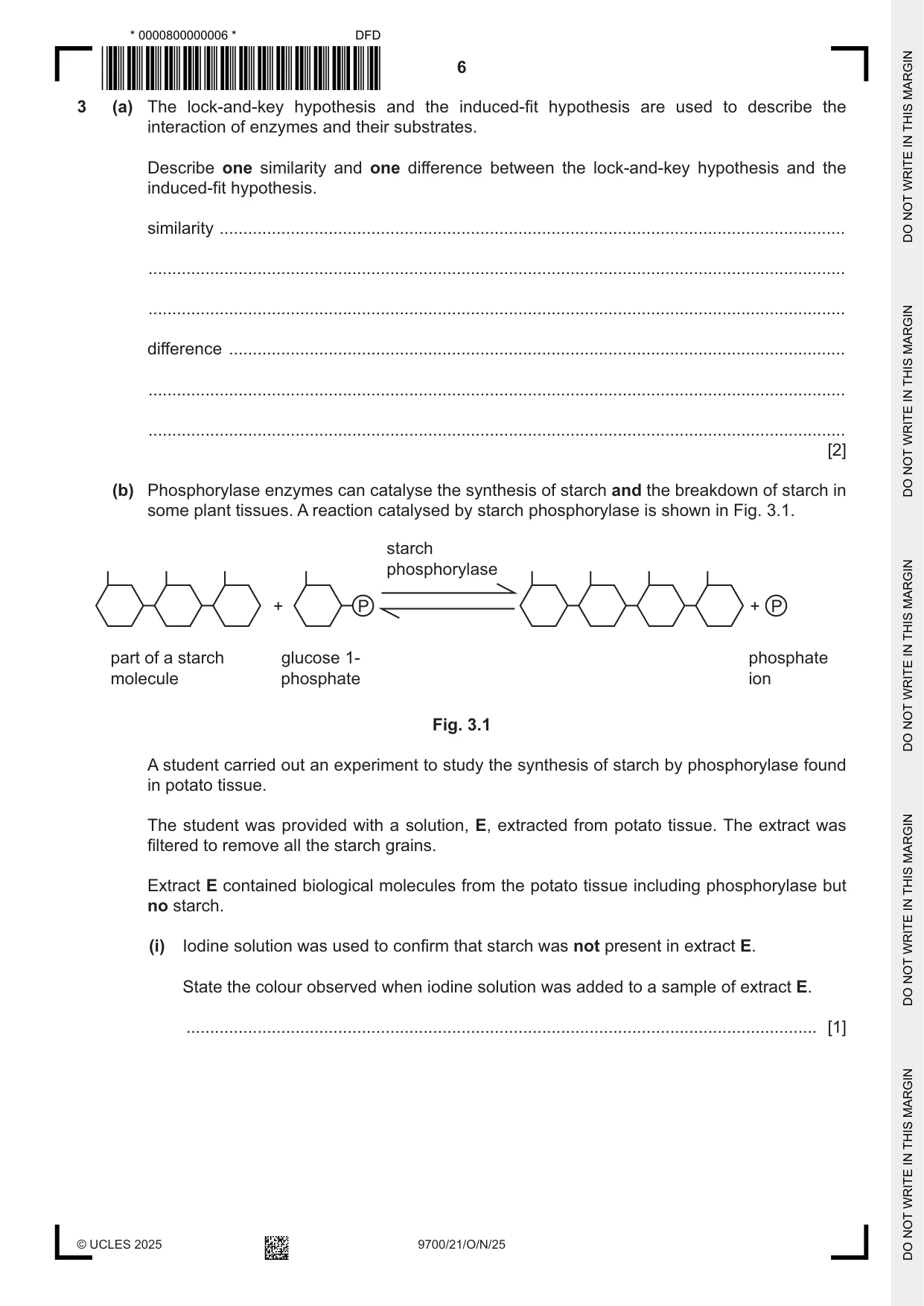
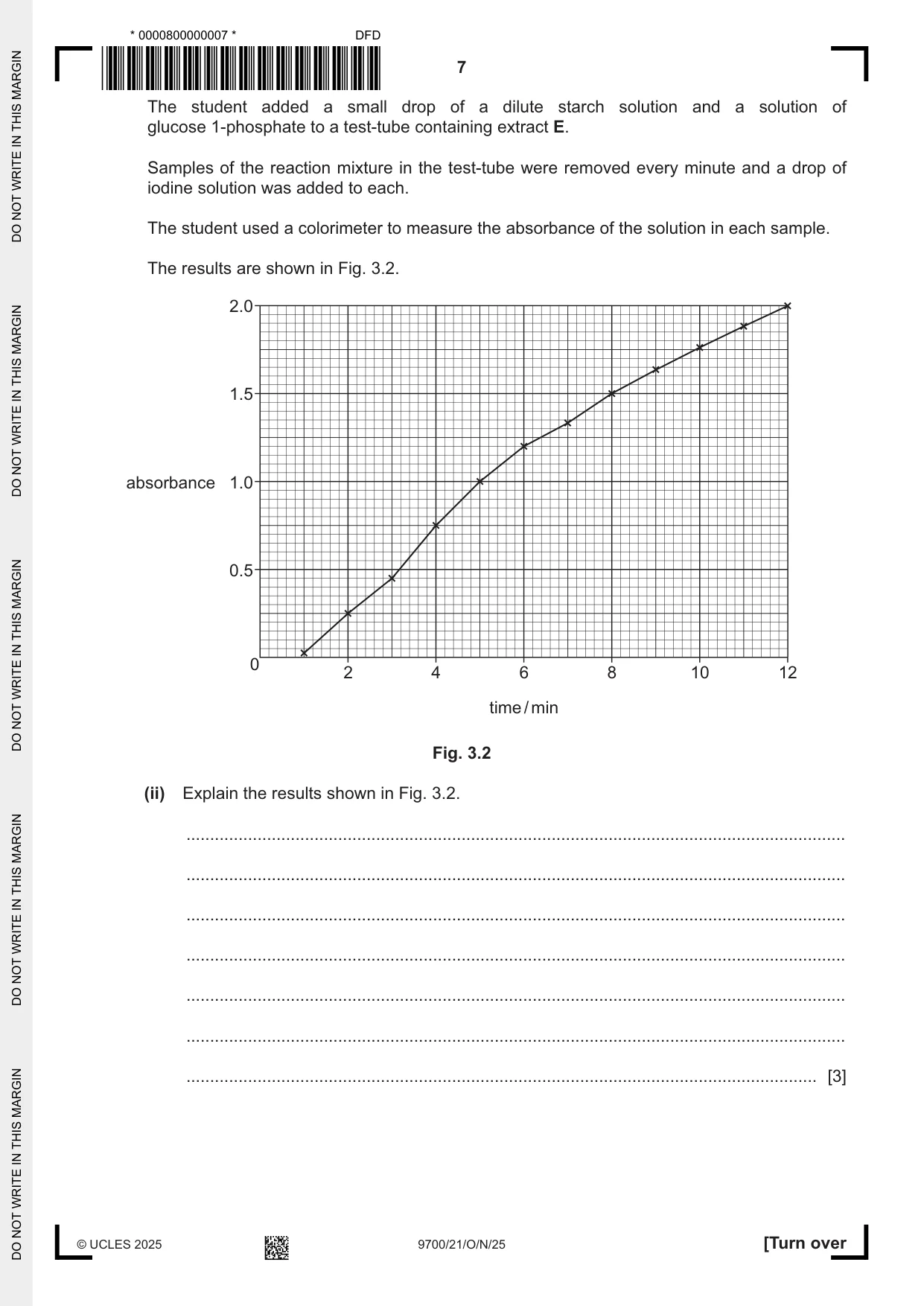
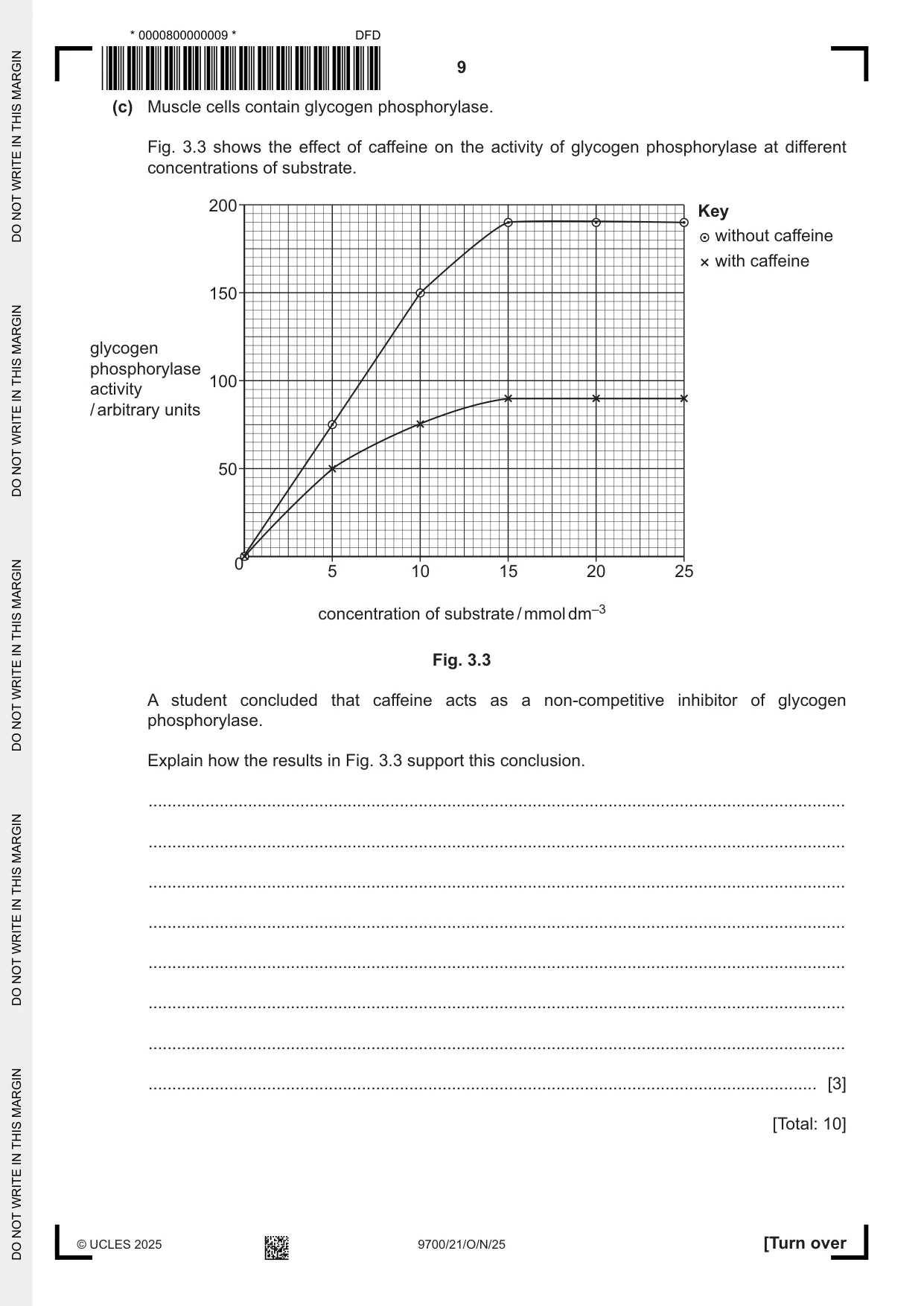
3 (a) The lock‑and‑key hypothesis and the induced‑fit hypothesis are used to describe the interaction of enzymes and their substrates. Describe one similarity and one difference between the lock‑and‑key hypothesis and the induced‑fit hypothesis. similarity .................................................................................................................................... ................................................................................................................................................... ................................................................................................................................................... difference .................................................................................................................................. ................................................................................................................................................... ................................................................................................................................................... [2] (b) Phosphorylase enzymes can catalyse the synthesis of starch and the breakdown of starch in some plant tissues. A reaction catalysed by starch phosphorylase is shown in Fig. 3.1. starch phosphorylase + P + P part of a starch glucose 1- phosphate molecule phosphate ion Fig. 3.1 A student carried out an experiment to study the synthesis of starch by phosphorylase found in potato tissue. The student was provided with a solution, E, extracted from potato tissue. The extract was filtered to remove all the starch grains. Extract E contained biological molecules from the potato tissue including phosphorylase but no starch. (i) Iodine solution was used to confirm that starch was not present in extract E. State the colour observed when iodine solution was added to a sample of extract E. ..................................................................................................................................... [1] The student added a small drop of a dilute starch solution and a solution of glucose 1‑phosphate to a test‑tube containing extract E. Samples of the reaction mixture in the test‑tube were removed every minute and a drop of iodine solution was added to each. The student used a colorimeter to measure the absorbance of the solution in each sample. The results are shown in Fig. 3.2. 2.0 1.5 absorbance 1.0 0.5 0 2 4 6 8 10 12 time / min Fig. 3.2 (ii) Explain the results shown in Fig. 3.2. ........................................................................................................................................... ........................................................................................................................................... ........................................................................................................................................... ........................................................................................................................................... ........................................................................................................................................... ........................................................................................................................................... ..................................................................................................................................... [3] (iii) After 12 minutes, the student added a solution containing phosphate ions to the reaction mixture. The student continued taking samples every minute, adding iodine solution to each sample. The absorbance of the solution in each of these samples was measured. The results showed that the absorbance decreased over time. Suggest why the absorbance decreased. ........................................................................................................................................... ........................................................................................................................................... ..................................................................................................................................... [1] (c) Muscle cells contain glycogen phosphorylase. Fig. 3.3 shows the effect of caffeine on the activity of glycogen phosphorylase at different concentrations of substrate. 200 Key without caffeine with caffeine 150 glycogen phosphorylase 100activity / arbitrary units 50 0 5 10 15 20 25 concentration of substrate / mmol dm–3 Fig. 3.3 A student concluded that caffeine acts as a non‑competitive inhibitor of glycogen phosphorylase. Explain how the results in Fig. 3.3 support this conclusion. ................................................................................................................................................... ................................................................................................................................................... ................................................................................................................................................... ................................................................................................................................................... ................................................................................................................................................... ................................................................................................................................................... ................................................................................................................................................... ............................................................................................................................................. [3] [Total: 10]
Mark scheme: 3(a) one similarity ; 2 e.g. substrate binds to active site enzyme-substrate complex forms product leaves active site interaction does not alter enzyme for re-use lower activation energy specific to one or very similar substrate(s) interaction can be affected by, action of inhibitors / pH / AW one difference ; e.g. induced-fit ora for lock-and-key active site not fully complementary to substrate change in, conformation / shape, of active site / AW context of binding substrate or after product release less specificity to substrate 3(b)(i) orange / brown / amber ; 1 A yellow-brown, yellow-orange 3(b)(ii) any three from: 3 phosphorylase (in extract) catalyses addition of glucose 1-phosphate to starch added to extract ; more starch is synthesised by phosphorylase as time progresses / AW ; iodine solution added to mixture turns a, blue / black / blue-black, colour (in the presence of starch) ; the more starch present in the mixture, the, darker / more intense, the, colour / shade ; the darker the colour (of the positive result) the less light passes through, mixture / sample ; the darker the colour / AW, the higher the absorbance (reading of the colorimeter) ; 3(b)(iii) ref. to breakdown of starch catalysed by the enzyme / reaction in Fig. 3.1 goes in the opposite direction ; 1 AVP ; e.g. ref to equilibrium shift ref. to glucose 1-phosphate has run out decrease in concentration of starch, qualified with ref. to iodine solution 3(c) any three from: 3 reduction in activity of phosphorylase (at all concentrations) ; ora higher throughout with caffeine Vmax not reached ; ref. to plateau at a (much) lower activity ; calculated Km value with caffeine is the same as without caffeine ; use of data from the graph to support conclusion ;
Q4 · A photomicrograph of a copepod
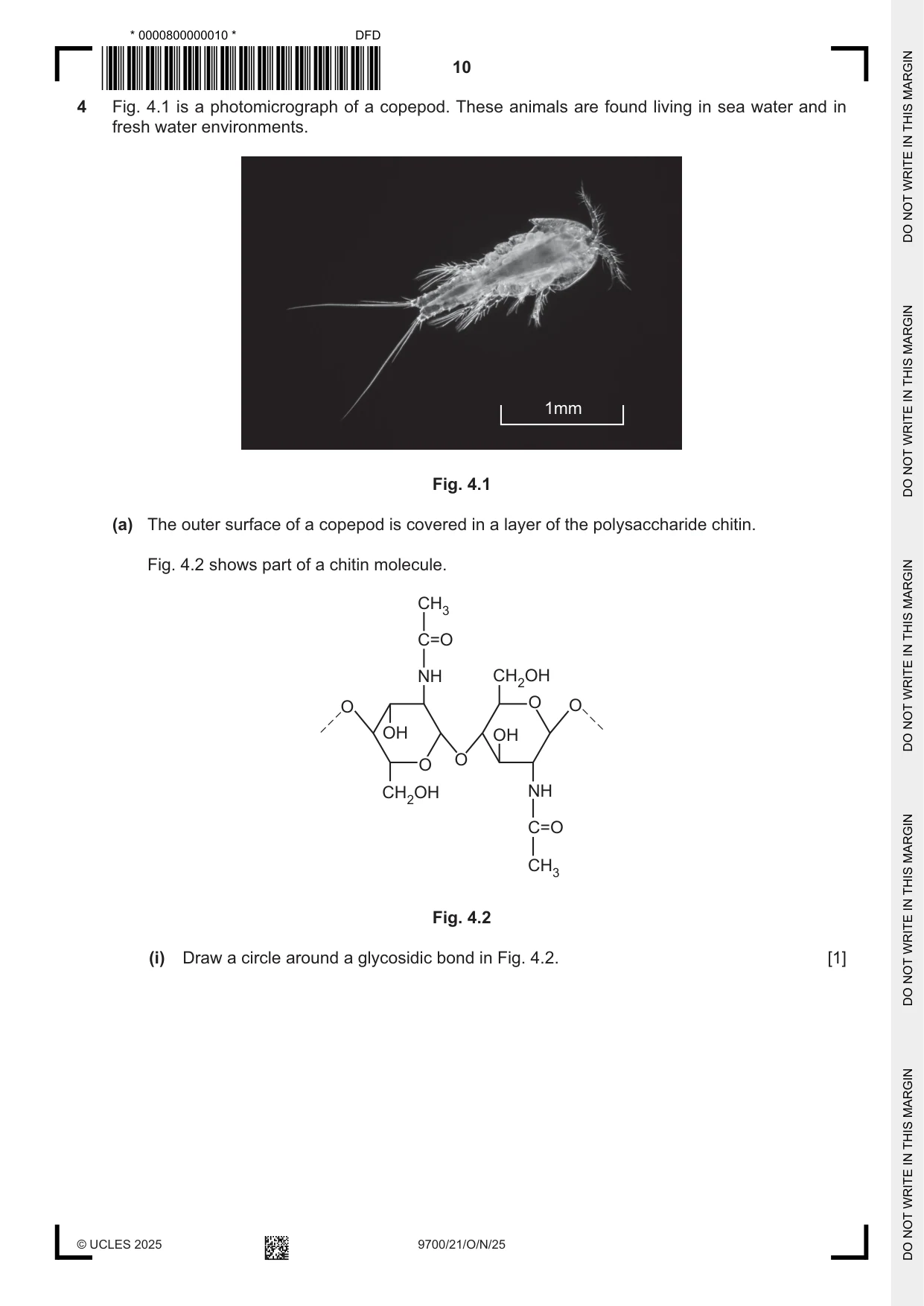
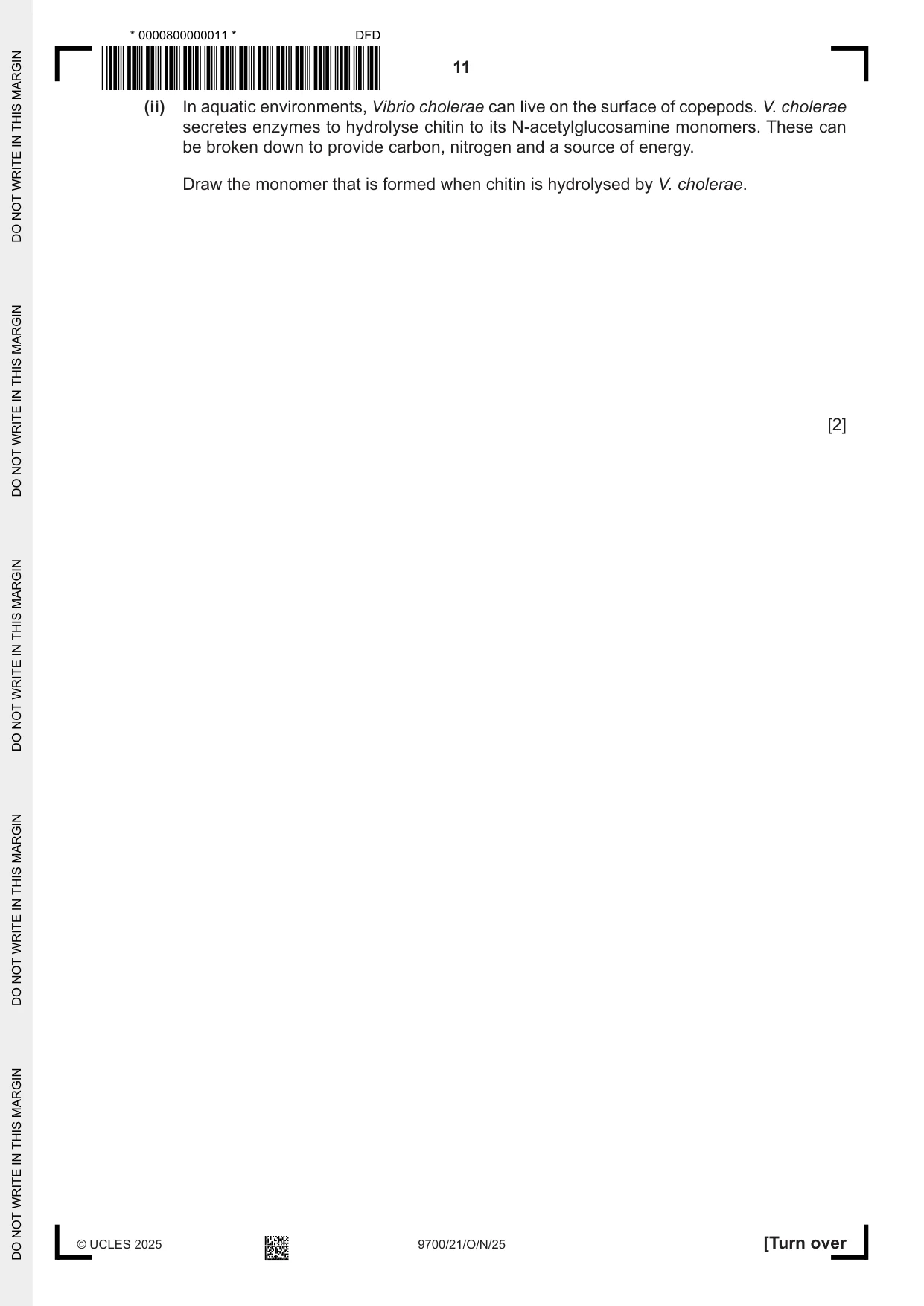
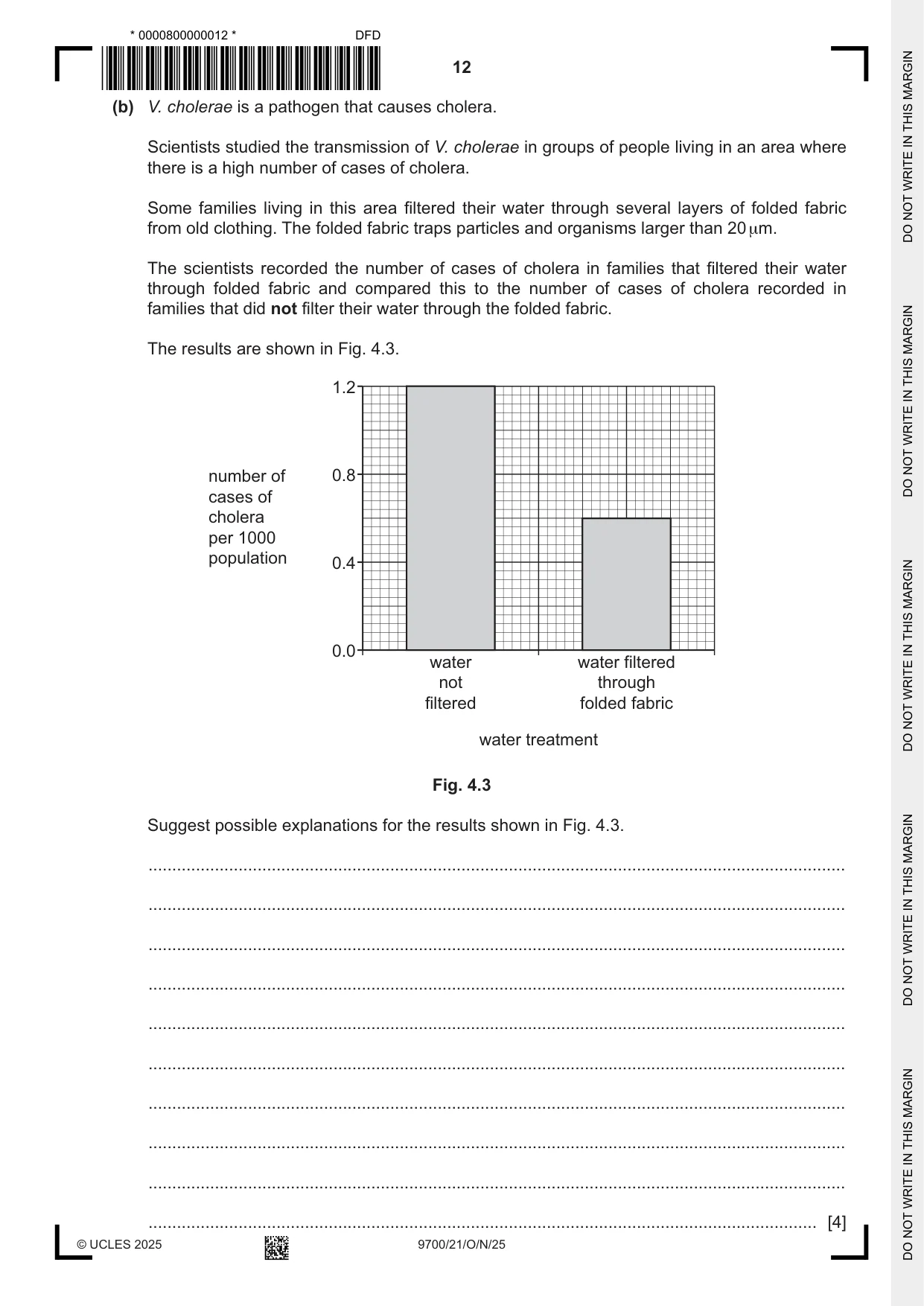
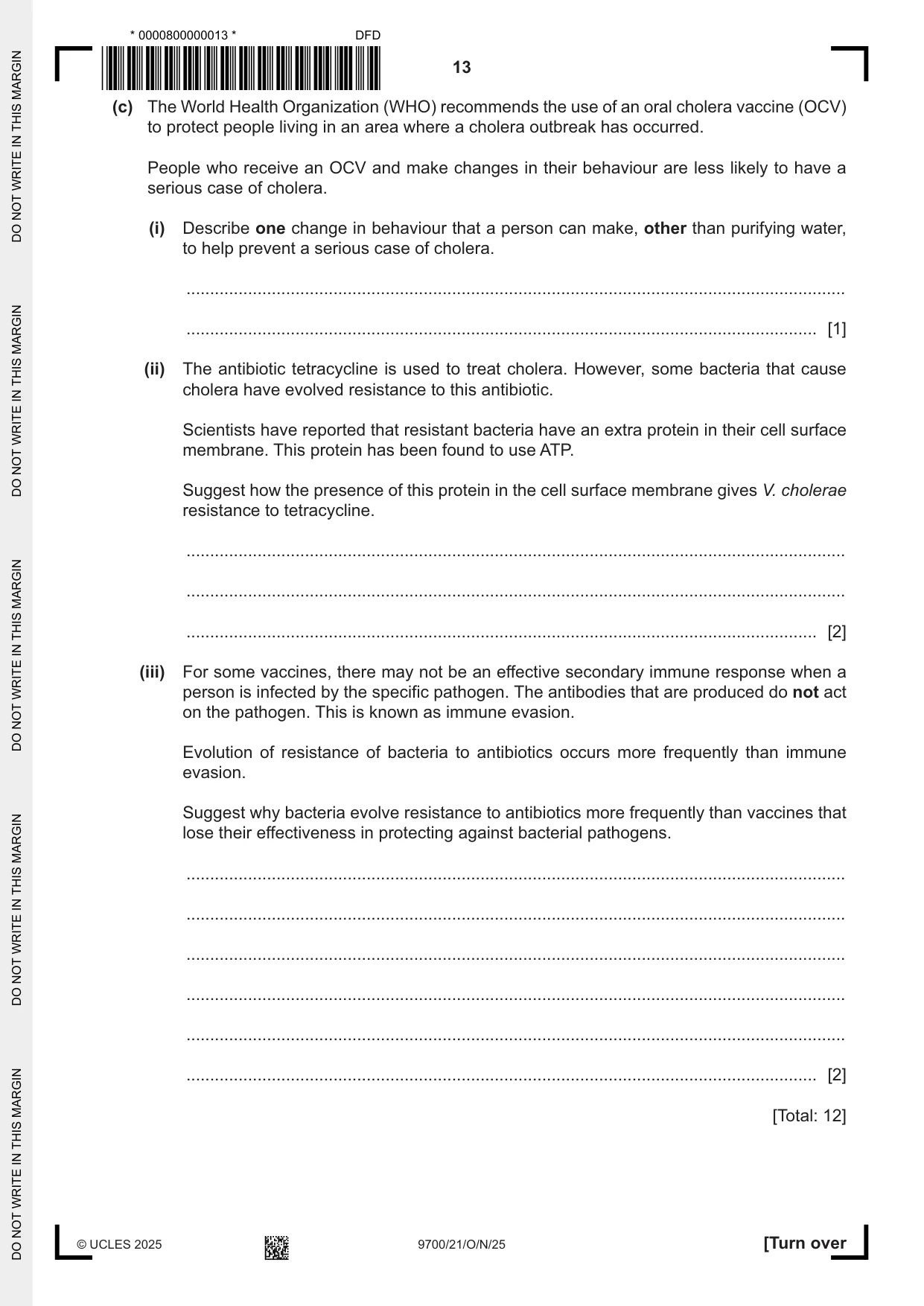
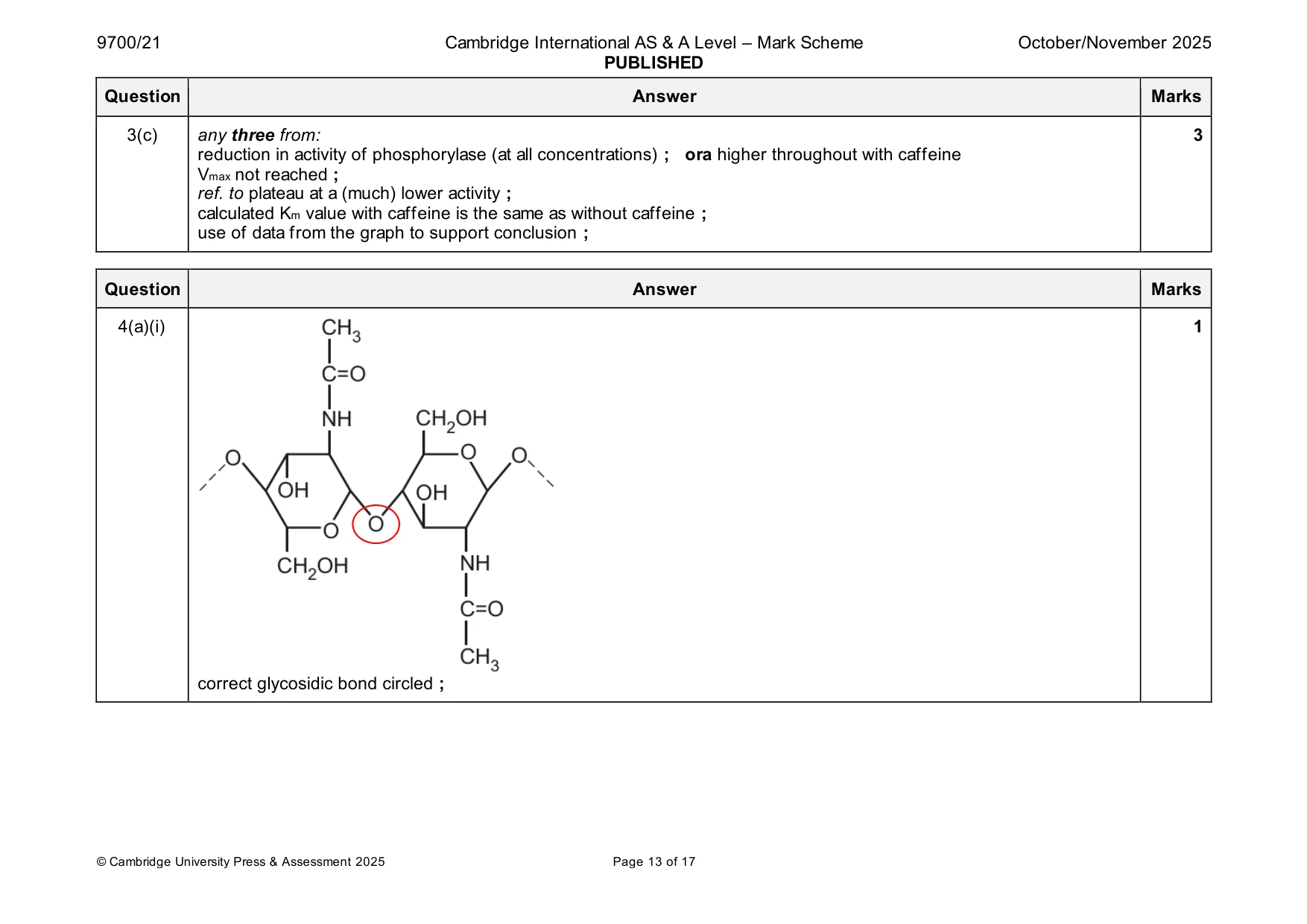
4 Fig. 4.1 is a photomicrograph of a copepod. These animals are found living in sea water and in fresh water environments. 1mm Fig. 4.1 (a) The outer surface of a copepod is covered in a layer of the polysaccharide chitin. Fig. 4.2 shows part of a chitin molecule. CH3 C=O NH CH2OH O O O– – – – – – OH OH O O CH2OH NH C=O CH3 Fig. 4.2 (i) Draw a circle around a glycosidic bond in Fig. 4.2. [1] (ii) In aquatic environments, Vibrio cholerae can live on the surface of copepods. V. cholerae secretes enzymes to hydrolyse chitin to its N‑acetylglucosamine monomers. These can be broken down to provide carbon, nitrogen and a source of energy. Draw the monomer that is formed when chitin is hydrolysed by V. cholerae. [2] (b) V. cholerae is a pathogen that causes cholera. Scientists studied the transmission of V. cholerae in groups of people living in an area where there is a high number of cases of cholera. Some families living in this area filtered their water through several layers of folded fabric from old clothing. The folded fabric traps particles and organisms larger than 20 µm. The scientists recorded the number of cases of cholera in families that filtered their water through folded fabric and compared this to the number of cases of cholera recorded in families that did not filter their water through the folded fabric. The results are shown in Fig. 4.3. 1.2 number of 0.8 cases of cholera per 1000 population 0.4 0.0 water water filtered not through filtered folded fabric water treatment Fig. 4.3 Suggest possible explanations for the results shown in Fig. 4.3. ................................................................................................................................................... ................................................................................................................................................... ................................................................................................................................................... ................................................................................................................................................... ................................................................................................................................................... ................................................................................................................................................... ................................................................................................................................................... ................................................................................................................................................... ................................................................................................................................................... ............................................................................................................................................. [4] (c) The World Health Organization (WHO) recommends the use of an oral cholera vaccine (OCV) to protect people living in an area where a cholera outbreak has occurred. People who receive an OCV and make changes in their behaviour are less likely to have a serious case of cholera. (i) Describe one change in behaviour that a person can make, other than purifying water, to help prevent a serious case of cholera. ........................................................................................................................................... ..................................................................................................................................... [1] (ii) The antibiotic tetracycline is used to treat cholera. However, some bacteria that cause cholera have evolved resistance to this antibiotic. Scientists have reported that resistant bacteria have an extra protein in their cell surface membrane. This protein has been found to use ATP. Suggest how the presence of this protein in the cell surface membrane gives V. cholerae resistance to tetracycline. ........................................................................................................................................... ........................................................................................................................................... ..................................................................................................................................... [2] (iii) For some vaccines, there may not be an effective secondary immune response when a person is infected by the specific pathogen. The antibodies that are produced do not act on the pathogen. This is known as immune evasion. Evolution of resistance of bacteria to antibiotics occurs more frequently than immune evasion. Suggest why bacteria evolve resistance to antibiotics more frequently than vaccines that lose their effectiveness in protecting against bacterial pathogens. ........................................................................................................................................... ........................................................................................................................................... ........................................................................................................................................... ........................................................................................................................................... ........................................................................................................................................... ..................................................................................................................................... [2] [Total: 12]
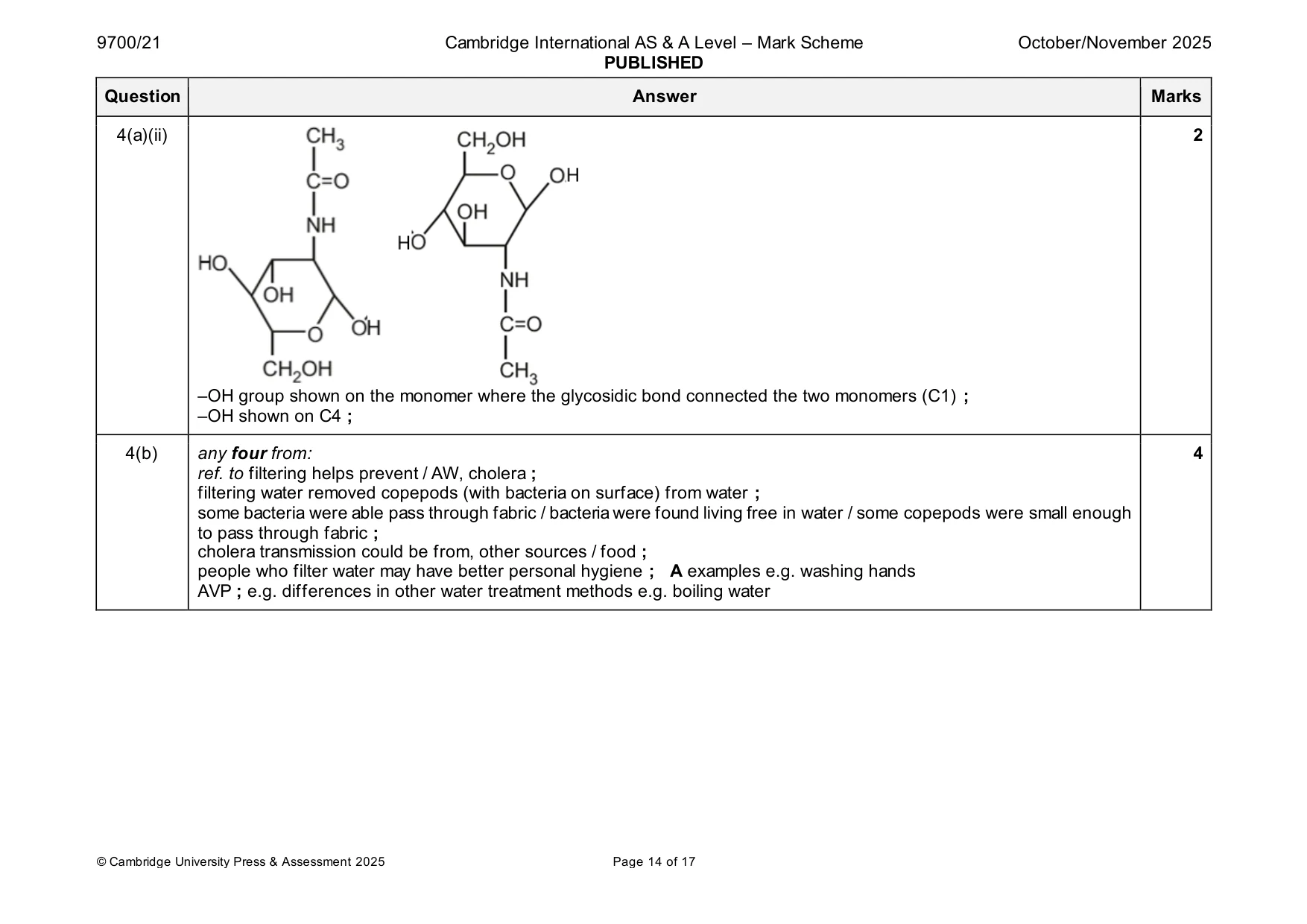
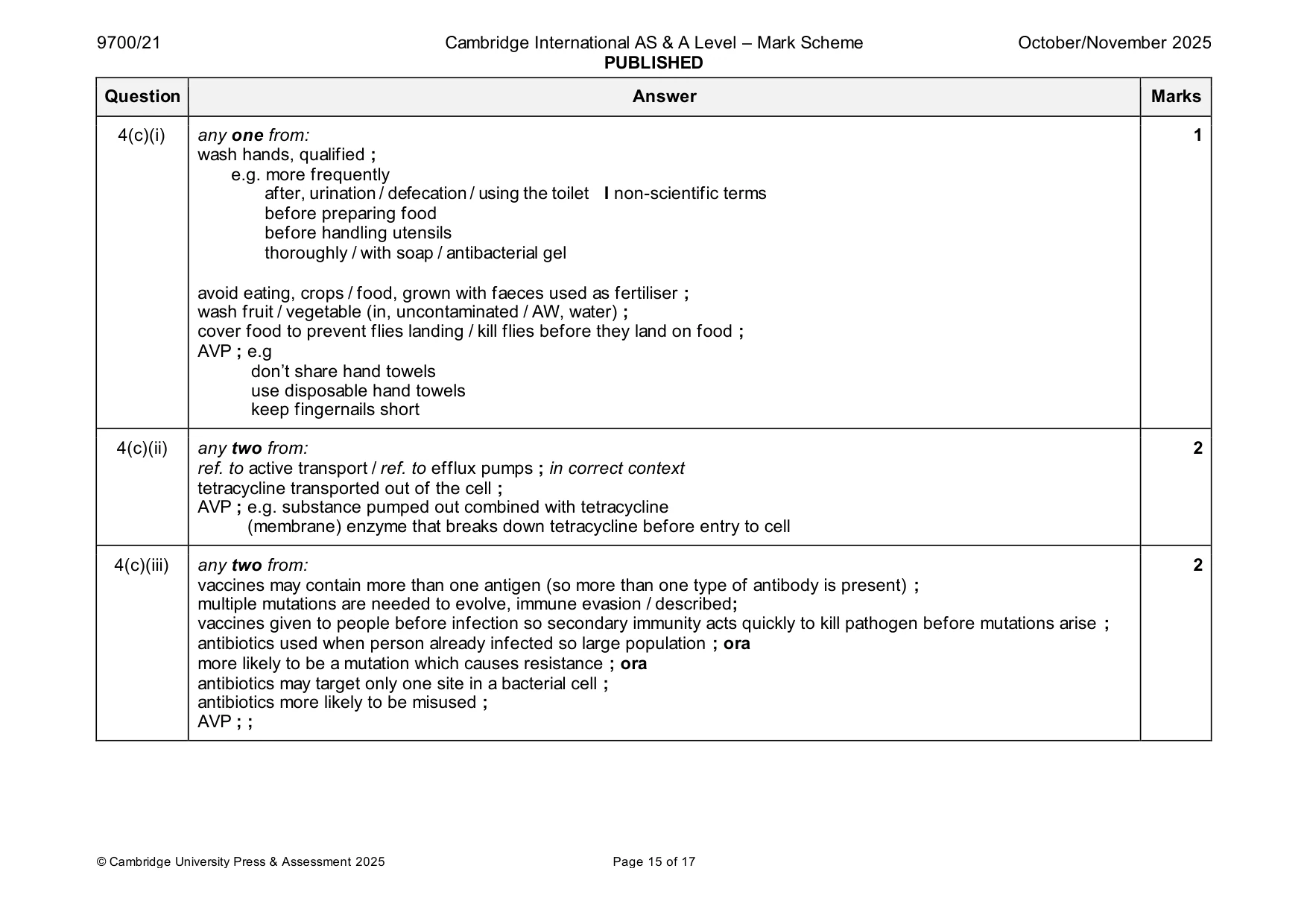
Mark scheme: 4(a)(i) 1 correct glycosidic bond circled ; 4(a)(ii) 2 –OH group shown on the monomer where the glycosidic bond connected the two monomers (C1) ; –OH shown on C4 ; 4(b) any four from: 4 ref. to filtering helps prevent / AW, cholera ; filtering water removed copepods (with bacteria on surface) from water ; some bacteria were able pass through fabric / bacteria were found living free in water / some copepods were small enough to pass through fabric ; cholera transmission could be from, other sources / food ; people who filter water may have better personal hygiene ; A examples e.g. washing hands AVP ; e.g. differences in other water treatment methods e.g. boiling water 4(c)(i) any one from: 1 wash hands, qualified ; e.g. more frequently after, urination / defecation / using the toilet I non-scientific terms before preparing food before handling utensils thoroughly / with soap / antibacterial gel avoid eating, crops / food, grown with faeces used as fertiliser ; wash fruit / vegetable (in, uncontaminated / AW, water) ; cover food to prevent flies landing / kill flies before they land on food ; AVP ; e.g don’t share hand towels use disposable hand towels keep fingernails short 4(c)(ii) any two from: 2 ref. to active transport / ref. to efflux pumps ; in correct context tetracycline transported out of the cell ; AVP ; e.g. substance pumped out combined with tetracycline (membrane) enzyme that breaks down tetracycline before entry to cell 4(c)(iii) any two from: 2 vaccines may contain more than one antigen (so more than one type of antibody is present) ; multiple mutations are needed to evolve, immune evasion / described; vaccines given to people before infection so secondary immunity acts quickly to kill pathogen before mutations arise ; antibiotics used when person already infected so large population ; ora more likely to be a mutation which causes resistance ; ora antibiotics may target only one site in a bacterial cell ; antibiotics more likely to be misused ; AVP ; ;
Q5 · A photomicrograph of a longitudinal section through part of the stem of a plant
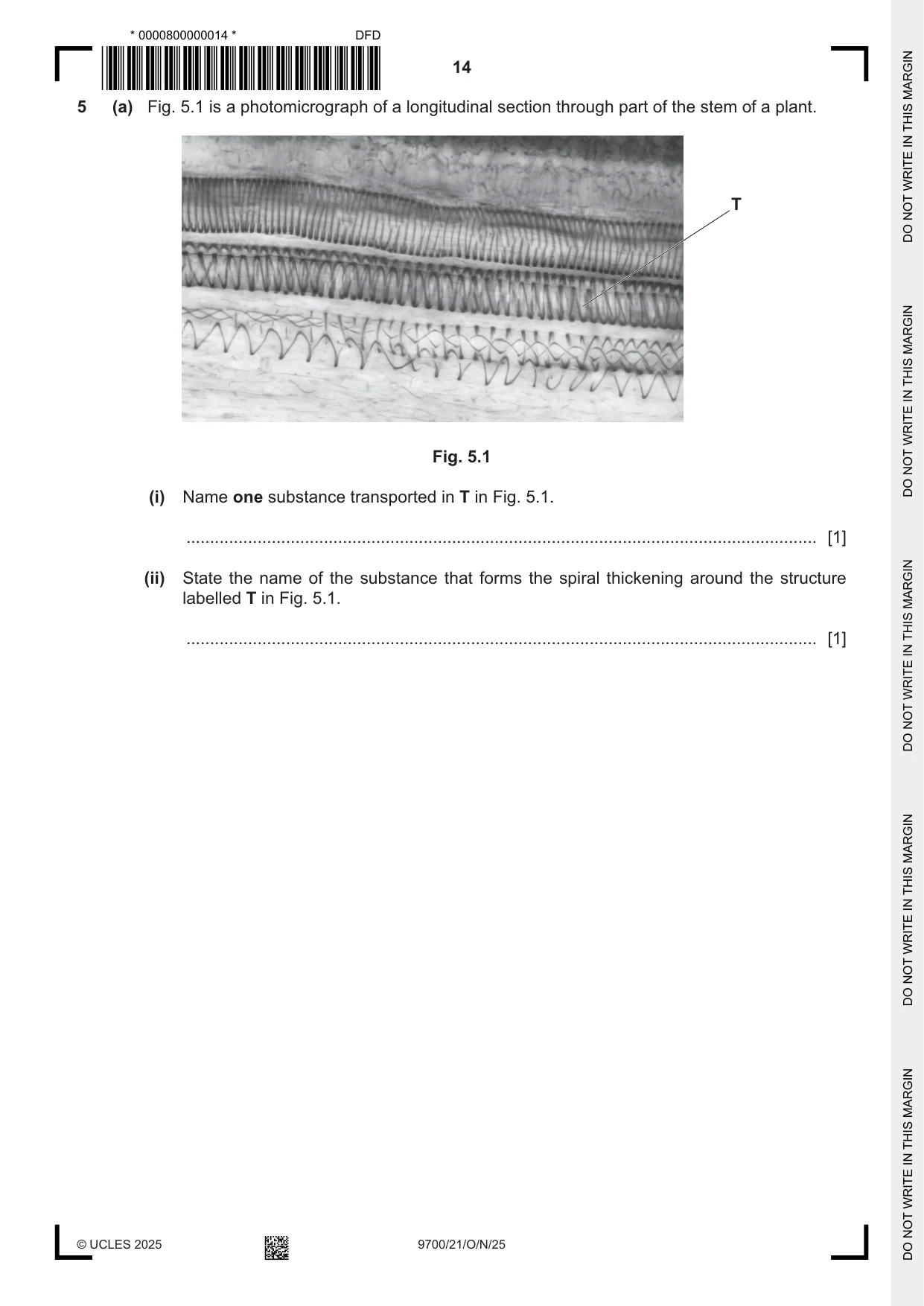
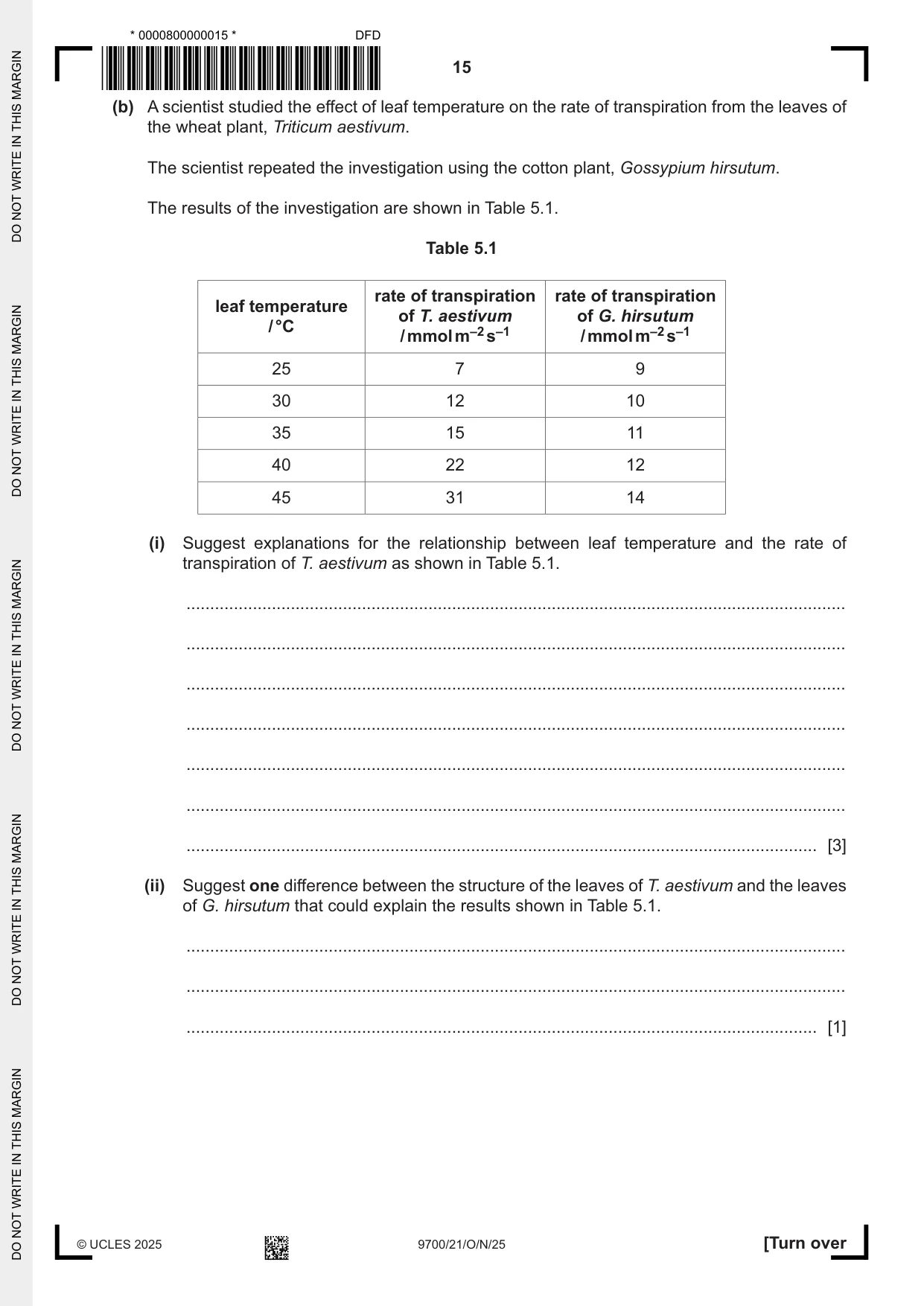
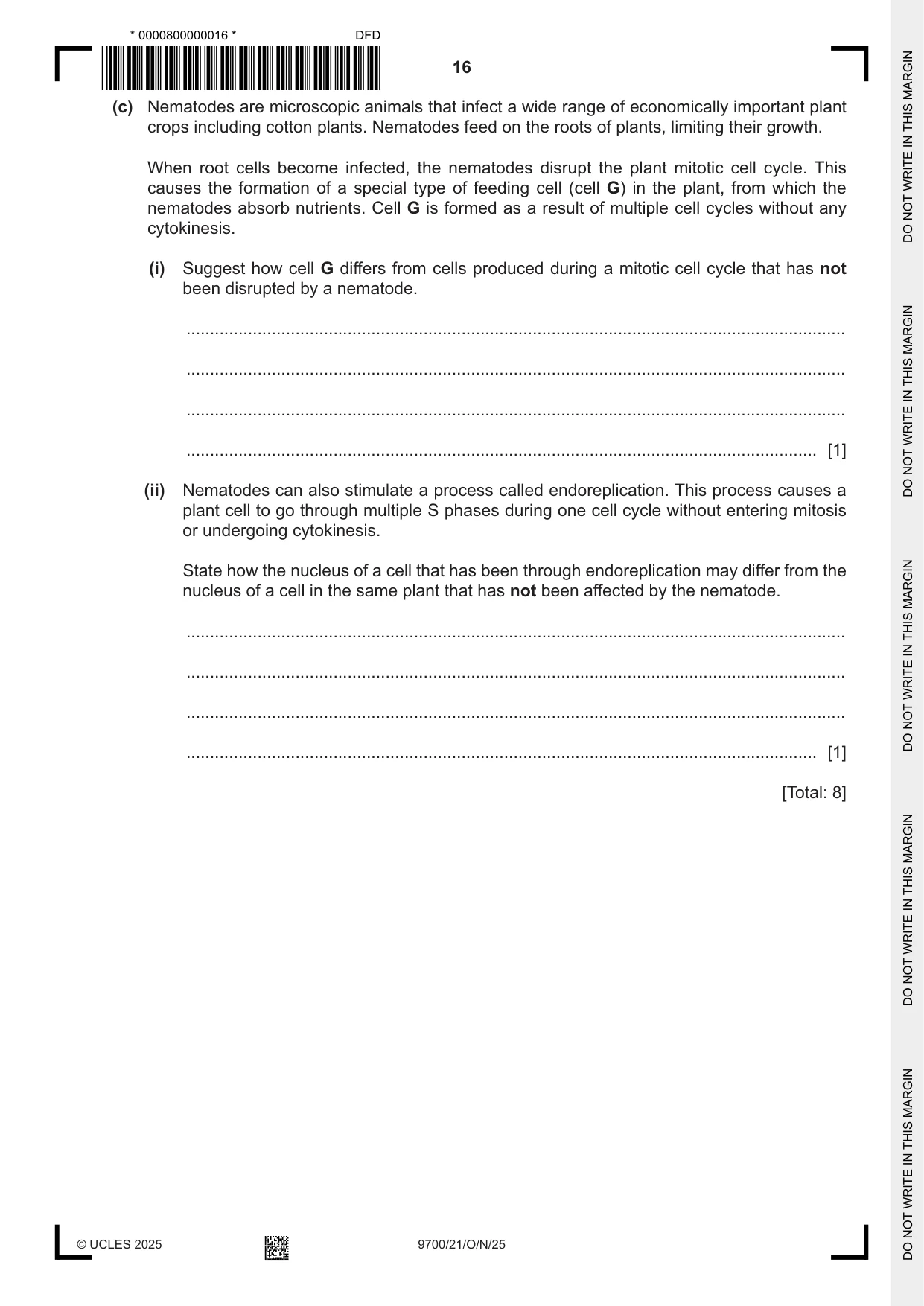
5 (a) Fig. 5.1 is a photomicrograph of a longitudinal section through part of the stem of a plant. T Fig. 5.1 (i) Name one substance transported in T in Fig. 5.1. ..................................................................................................................................... [1] (ii) State the name of the substance that forms the spiral thickening around the structure labelled T in Fig. 5.1. ..................................................................................................................................... [1] (b) A scientist studied the effect of leaf temperature on the rate of transpiration from the leaves of the wheat plant, Triticum aestivum. The scientist repeated the investigation using the cotton plant, Gossypium hirsutum. The results of the investigation are shown in Table 5.1. Table 5.1 rate of transpiration rate of transpiration leaf temperature of T. aestivum of G. hirsutum / °C / mmol m–2 s–1 / mmol m–2 s–1 25 7 9 30 12 10 35 15 11 40 22 12 45 31 14 (i) Suggest explanations for the relationship between leaf temperature and the rate of transpiration of T. aestivum as shown in Table 5.1. ........................................................................................................................................... ........................................................................................................................................... ........................................................................................................................................... ........................................................................................................................................... ........................................................................................................................................... ........................................................................................................................................... ..................................................................................................................................... [3] (ii) Suggest one difference between the structure of the leaves of T. aestivum and the leaves of G. hirsutum that could explain the results shown in Table 5.1. ........................................................................................................................................... ........................................................................................................................................... ..................................................................................................................................... [1] (c) Nematodes are microscopic animals that infect a wide range of economically important plant crops including cotton plants. Nematodes feed on the roots of plants, limiting their growth. When root cells become infected, the nematodes disrupt the plant mitotic cell cycle. This causes the formation of a special type of feeding cell (cell G) in the plant, from which the nematodes absorb nutrients. Cell G is formed as a result of multiple cell cycles without any cytokinesis. (i) Suggest how cell G differs from cells produced during a mitotic cell cycle that has not been disrupted by a nematode. ........................................................................................................................................... ........................................................................................................................................... ........................................................................................................................................... ..................................................................................................................................... [1] (ii) Nematodes can also stimulate a process called endoreplication. This process causes a plant cell to go through multiple S phases during one cell cycle without entering mitosis or undergoing cytokinesis. State how the nucleus of a cell that has been through endoreplication may differ from the nucleus of a cell in the same plant that has not been affected by the nematode. ........................................................................................................................................... ........................................................................................................................................... ........................................................................................................................................... ..................................................................................................................................... [1] [Total: 8]
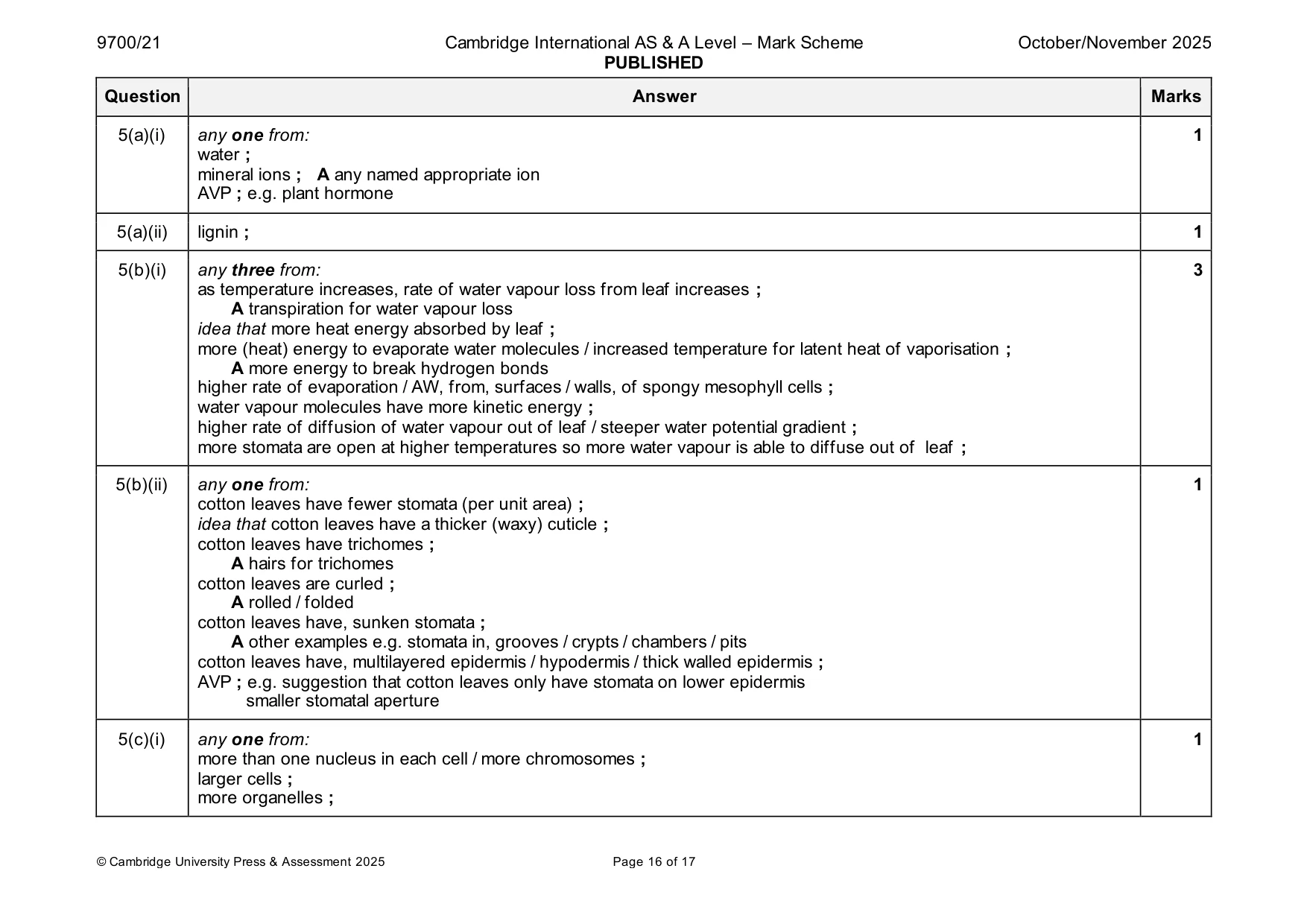
Mark scheme: 5(a)(i) any one from: 1 water ; mineral ions ; A any named appropriate ion AVP ; e.g. plant hormone 5(a)(ii) lignin ; 1 5(b)(i) any three from: 3 as temperature increases, rate of water vapour loss from leaf increases ; A transpiration for water vapour loss idea that more heat energy absorbed by leaf ; more (heat) energy to evaporate water molecules / increased temperature for latent heat of vaporisation ; A more energy to break hydrogen bonds higher rate of evaporation / AW, from, surfaces / walls, of spongy mesophyll cells ; water vapour molecules have more kinetic energy ; higher rate of diffusion of water vapour out of leaf / steeper water potential gradient ; more stomata are open at higher temperatures so more water vapour is able to diffuse out of leaf ; 5(b)(ii) any one from: 1 cotton leaves have fewer stomata (per unit area) ; idea that cotton leaves have a thicker (waxy) cuticle ; cotton leaves have trichomes ; A hairs for trichomes cotton leaves are curled ; A rolled / folded cotton leaves have, sunken stomata ; A other examples e.g. stomata in, grooves / crypts / chambers / pits cotton leaves have, multilayered epidermis / hypodermis / thick walled epidermis ; AVP ; e.g. suggestion that cotton leaves only have stomata on lower epidermis smaller stomatal aperture 5(c)(i) any one from: 1 more than one nucleus in each cell / more chromosomes ; larger cells ; more organelles ; 5(c)(ii) any one from: 1 nucleus will contain more chromosomes / more than 2 copies of each chromosome ; A more DNA molecules / more chromatin AVP ; e.g. ref. to polyploidy (proportionately) larger nuclei
Q6 · Alveolar macrophages are phagocytes found in the human gas exchange system
6 (a) Alveolar macrophages are phagocytes found in the human gas exchange system. They produce hydrolytic enzymes, such as lysozyme, to digest pathogens entering the alveolus. (i) State the term used to describe the sequence of nucleotides in the DNA of the alveolar macrophage that codes for a protein, such as lysozyme. ..................................................................................................................................... [1] (ii) Synthesis of lysozyme occurs in two stages. The first stage occurs in the nucleus using one strand of DNA to synthesise mRNA. State the name of the strand of DNA that is used to synthesise mRNA. ..................................................................................................................................... [1] (iii) Name the organelle where the translation of mRNA takes place to produce lysozyme. ..................................................................................................................................... [1] (iv) Lysozyme destroys bacterial cells by hydrolysing bonds in peptidoglycan. Explain how the hydrolysis of bonds in peptidoglycan leads to the destruction of bacterial cells. ........................................................................................................................................... ........................................................................................................................................... ........................................................................................................................................... ..................................................................................................................................... [2] (b) (i) Alveolar macrophages are found in contact with squamous epithelial cells in the walls of alveoli. Explain how the cells lining the alveoli are adapted for gas exchange. ........................................................................................................................................... ........................................................................................................................................... ........................................................................................................................................... ..................................................................................................................................... [2] (ii) Describe the role of elastic fibres in the wall of an alveolus. ........................................................................................................................................... ........................................................................................................................................... ........................................................................................................................................... ..................................................................................................................................... [2] [Total: 9]
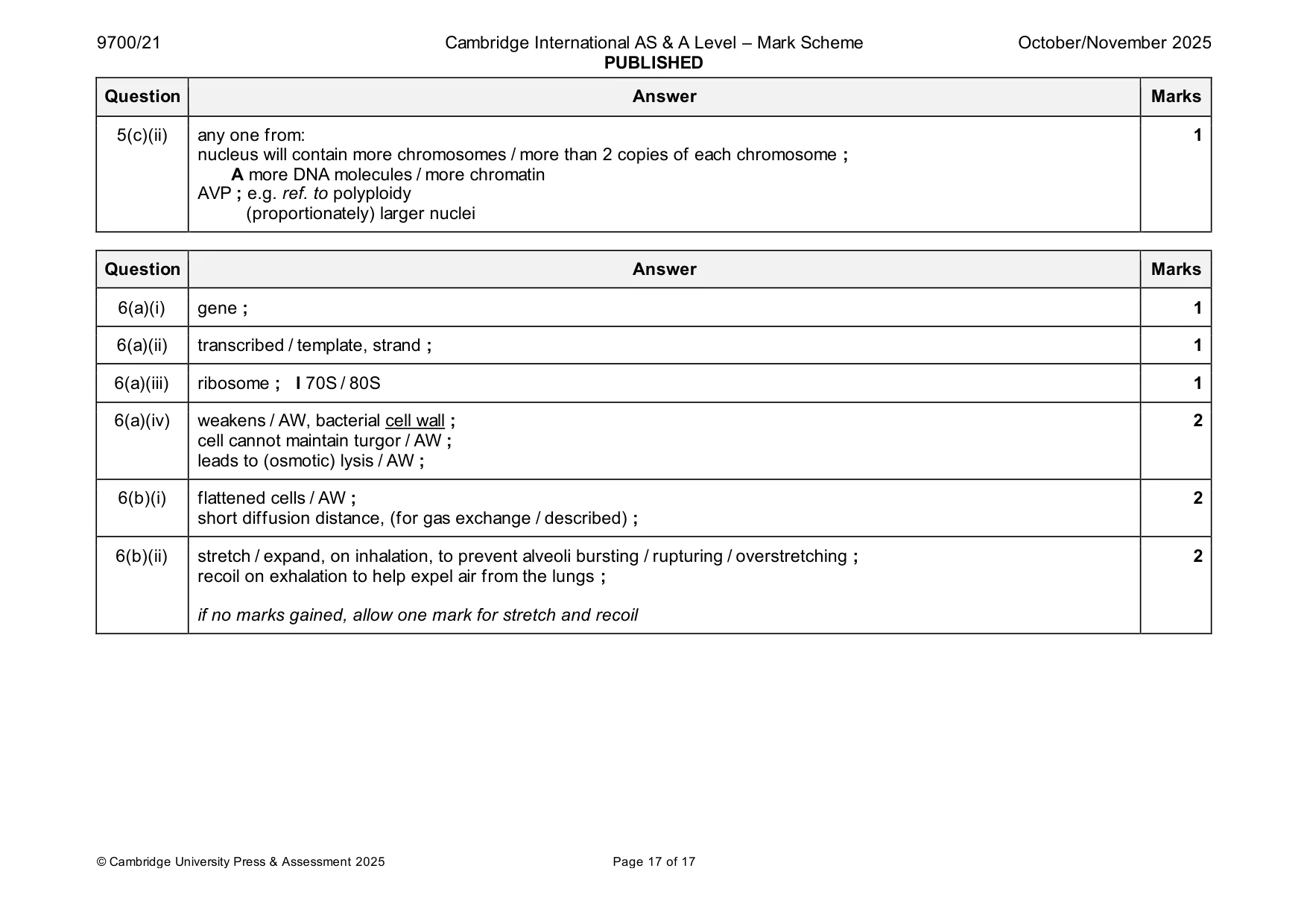
Mark scheme: 6(a)(i) gene ; 1 6(a)(ii) transcribed / template, strand ; 1 6(a)(iii) ribosome ; I 70S / 80S 1 6(a)(iv) weakens / AW, bacterial cell wall ; 2 cell cannot maintain turgor / AW ; leads to (osmotic) lysis / AW ; 6(b)(i) flattened cells / AW ; 2 short diffusion distance, (for gas exchange / described) ; 6(b)(ii) stretch / expand, on inhalation, to prevent alveoli bursting / rupturing / overstretching ; 2 recoil on exhalation to help expel air from the lungs ; if no marks gained, allow one mark for stretch and recoil
What was in this paper
The subtopics covered by these 6 questions, and how many questions each got. Open one in a new tab to see every Cambridge question on it.
What you needed in this session
Cambridge’s own grade thresholds for 2025 Oct/Nov, Paper 2 · Variant 1. A higher threshold means an easier paper — the bar moves with how the cohort did.