Cambridge A Level Biology 9700 — 2025 May/June Paper 4 · Variant 2
9700/42/M/J/25 · 10 questions · 100 marks · 120 min
The question paper and its mark scheme, free to read here and free to download. This is Cambridge’s own paper, exactly as it was sat.
Question paper24 pages
Mark scheme25 pages
Answers below. Sit the paper first if you are practising.
Questions as text
Q1 · A diagram of part of the inner membrane of a mitochondrion
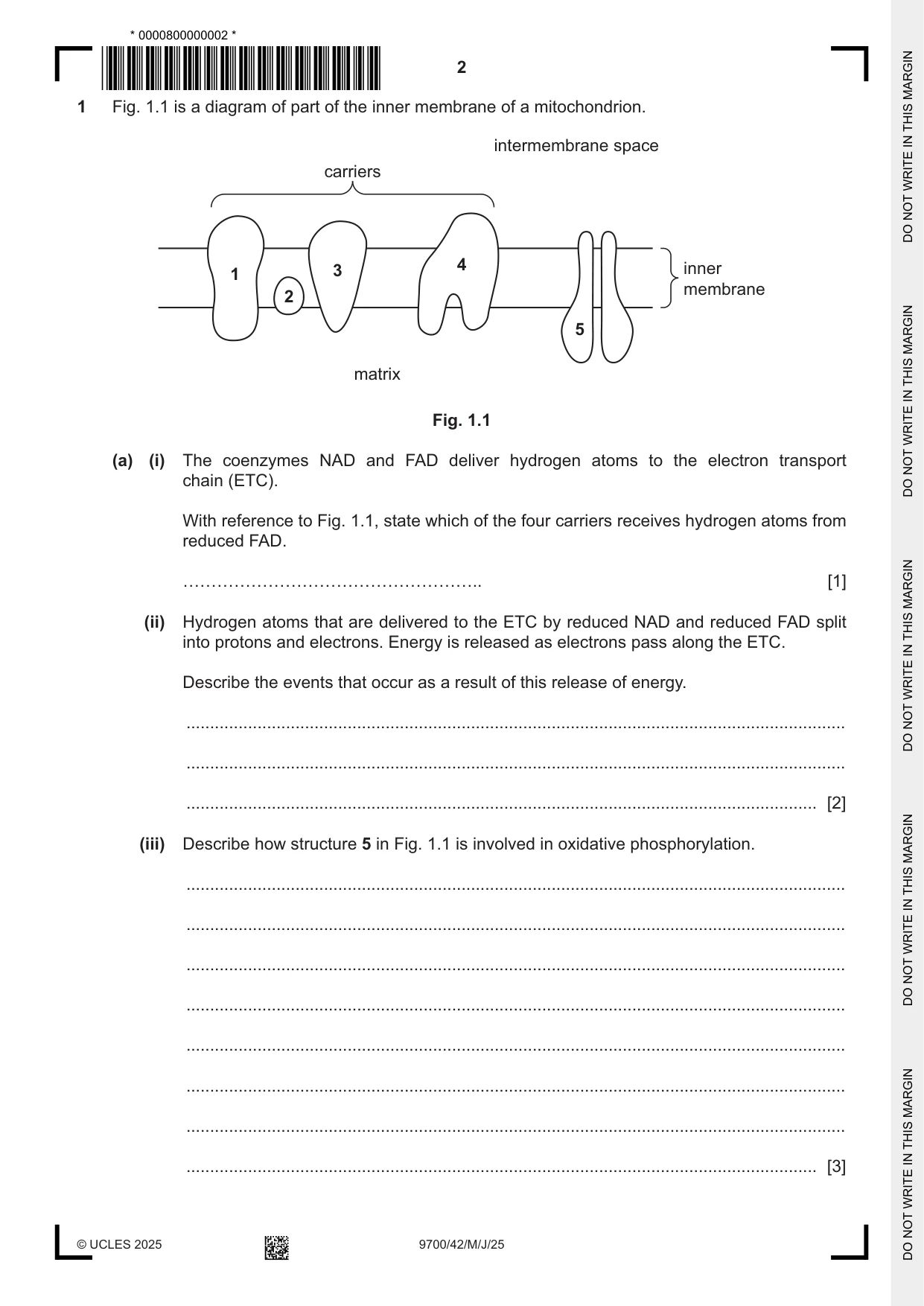
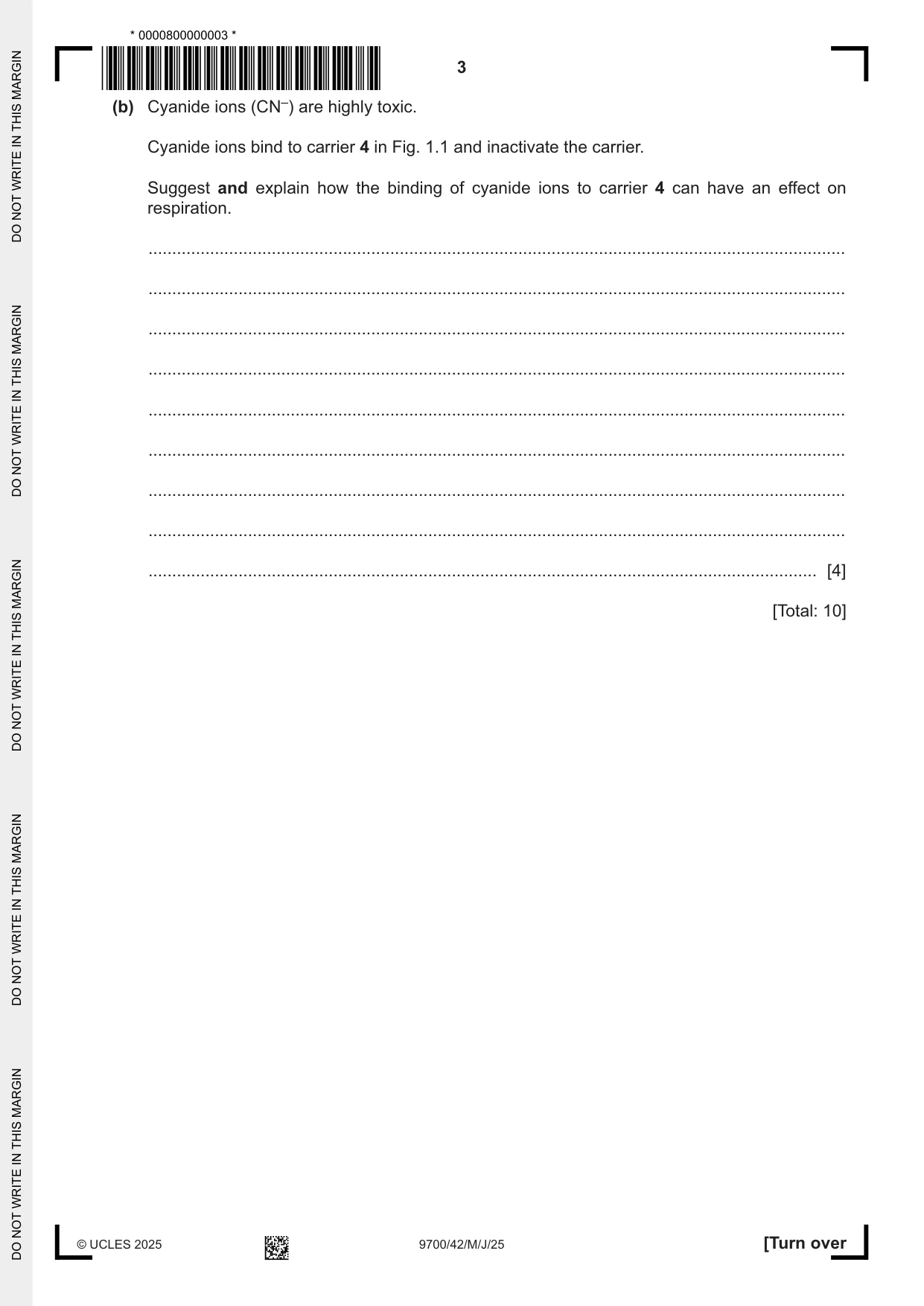
1 Fig. 1.1 is a diagram of part of the inner membrane of a mitochondrion. intermembrane space carriers 4 inner 1 3 membrane 2 5 matrix Fig. 1.1 (a) (i) The coenzymes NAD and FAD deliver hydrogen atoms to the electron transport chain (ETC). With reference to Fig. 1.1, state which of the four carriers receives hydrogen atoms from reduced FAD. [1] (ii) Hydrogen atoms that are delivered to the ETC by reduced NAD and reduced FAD split into protons and electrons. Energy is released as electrons pass along the ETC. Describe the events that occur as a result of this release of energy. ........................................................................................................................................... ........................................................................................................................................... ..................................................................................................................................... [2] (iii) Describe how structure 5 in Fig. 1.1 is involved in oxidative phosphorylation. ........................................................................................................................................... ........................................................................................................................................... ........................................................................................................................................... ........................................................................................................................................... ........................................................................................................................................... ........................................................................................................................................... ........................................................................................................................................... ..................................................................................................................................... [3] (b) Cyanide ions (CN–) are highly toxic. Cyanide ions bind to carrier 4 in Fig. 1.1 and inactivate the carrier. Suggest and explain how the binding of cyanide ions to carrier 4 can have an effect on respiration. ................................................................................................................................................... ................................................................................................................................................... ................................................................................................................................................... ................................................................................................................................................... ................................................................................................................................................... ................................................................................................................................................... ................................................................................................................................................... ................................................................................................................................................... ............................................................................................................................................. [4] [Total: 10]
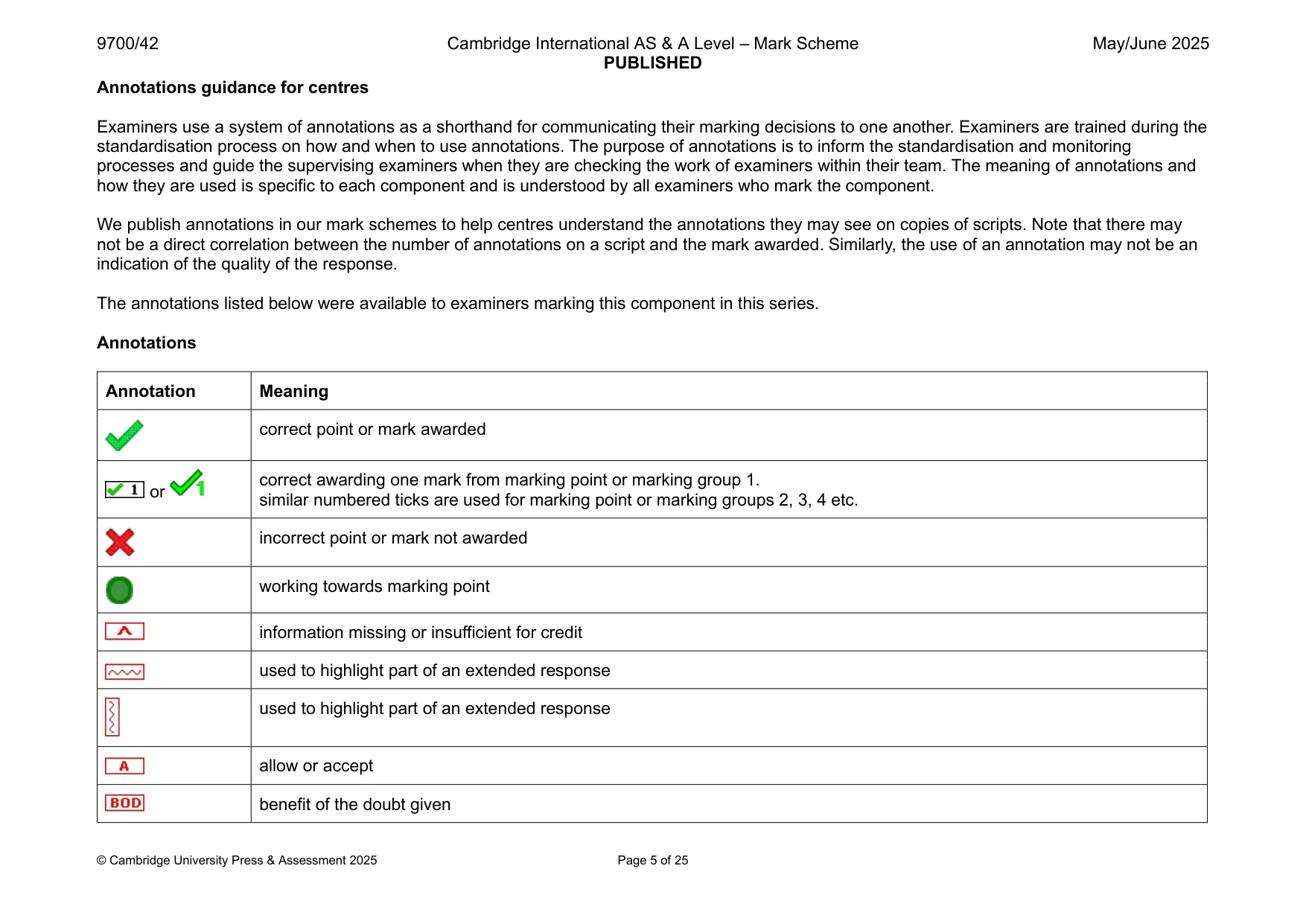
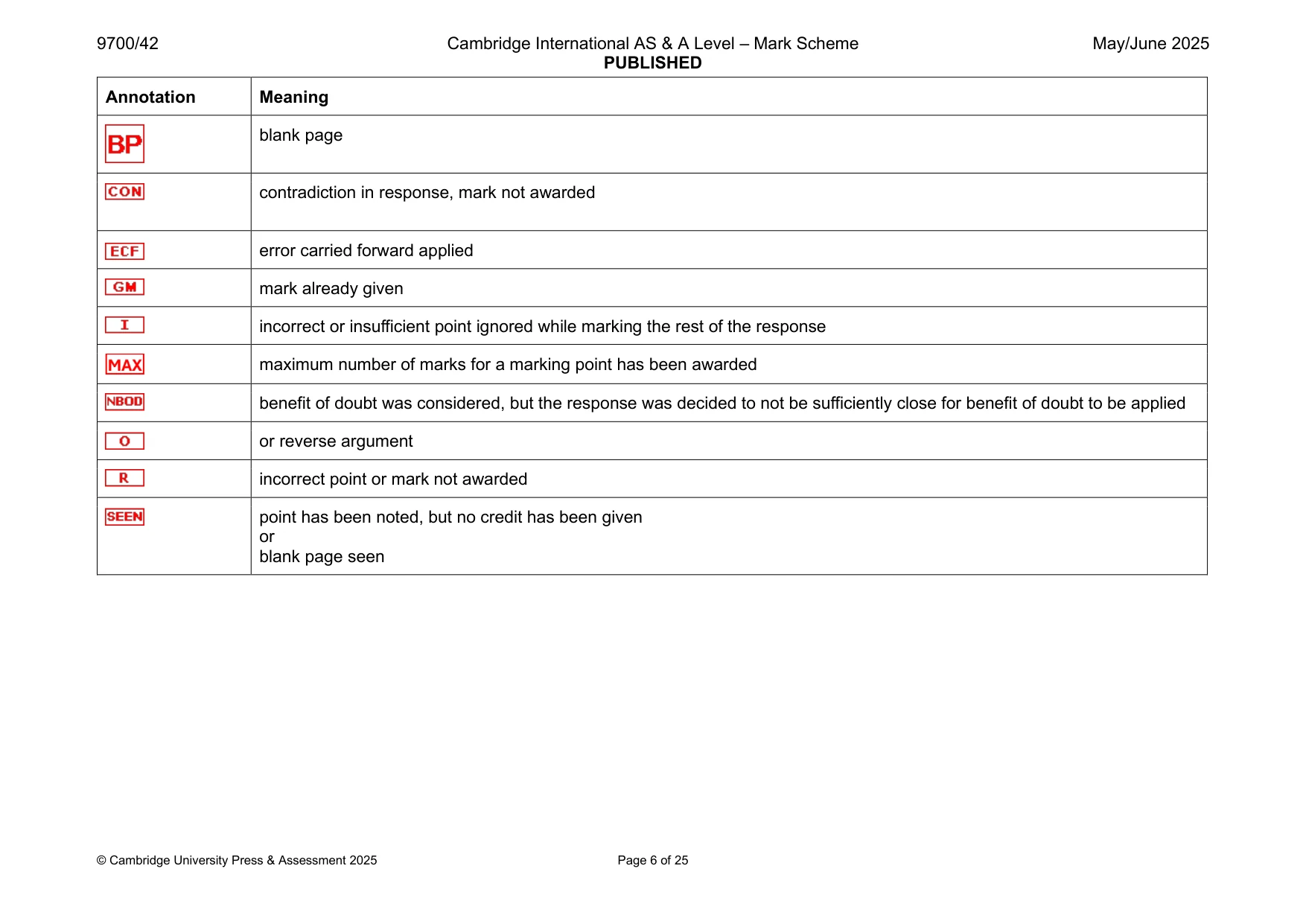
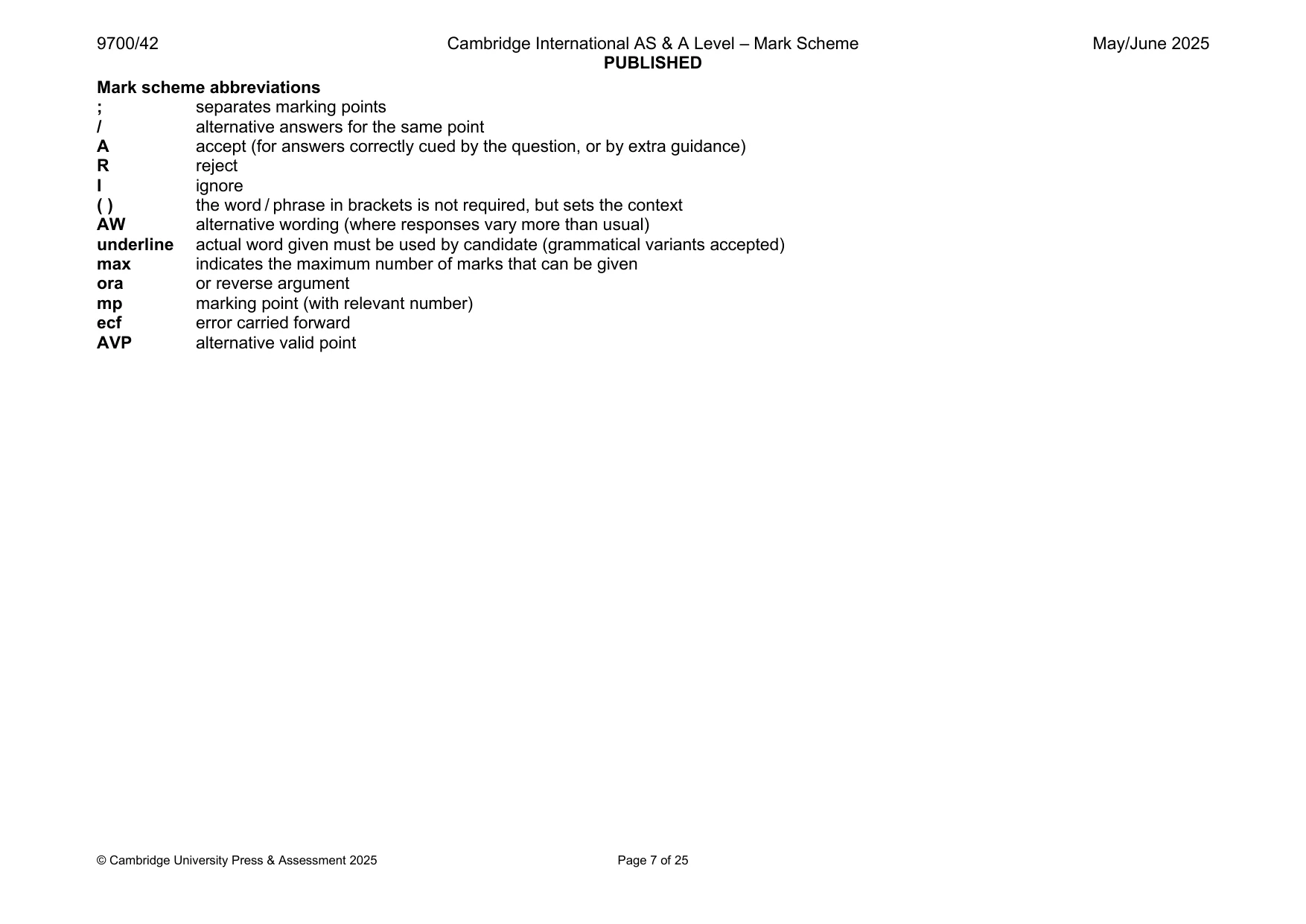
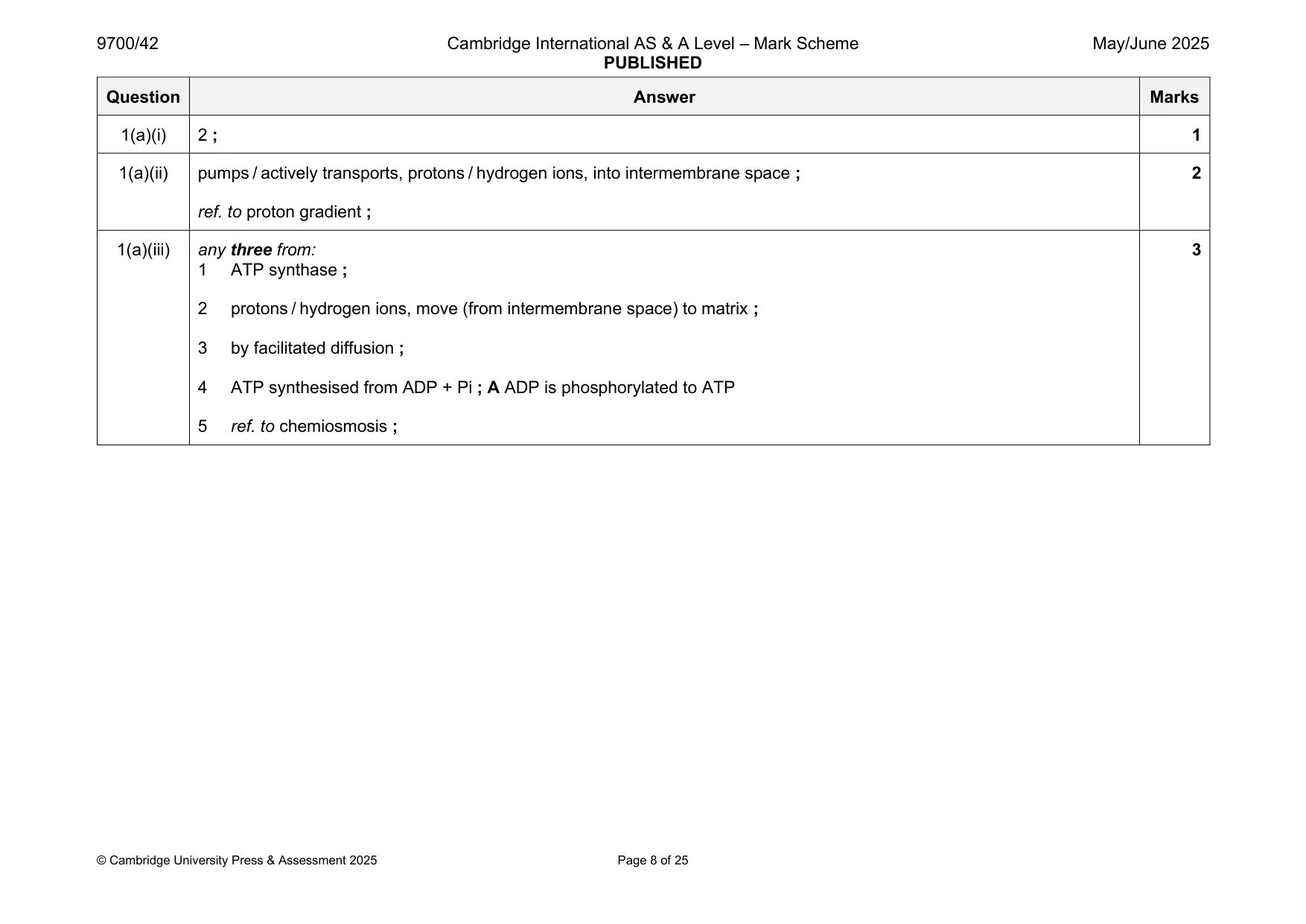
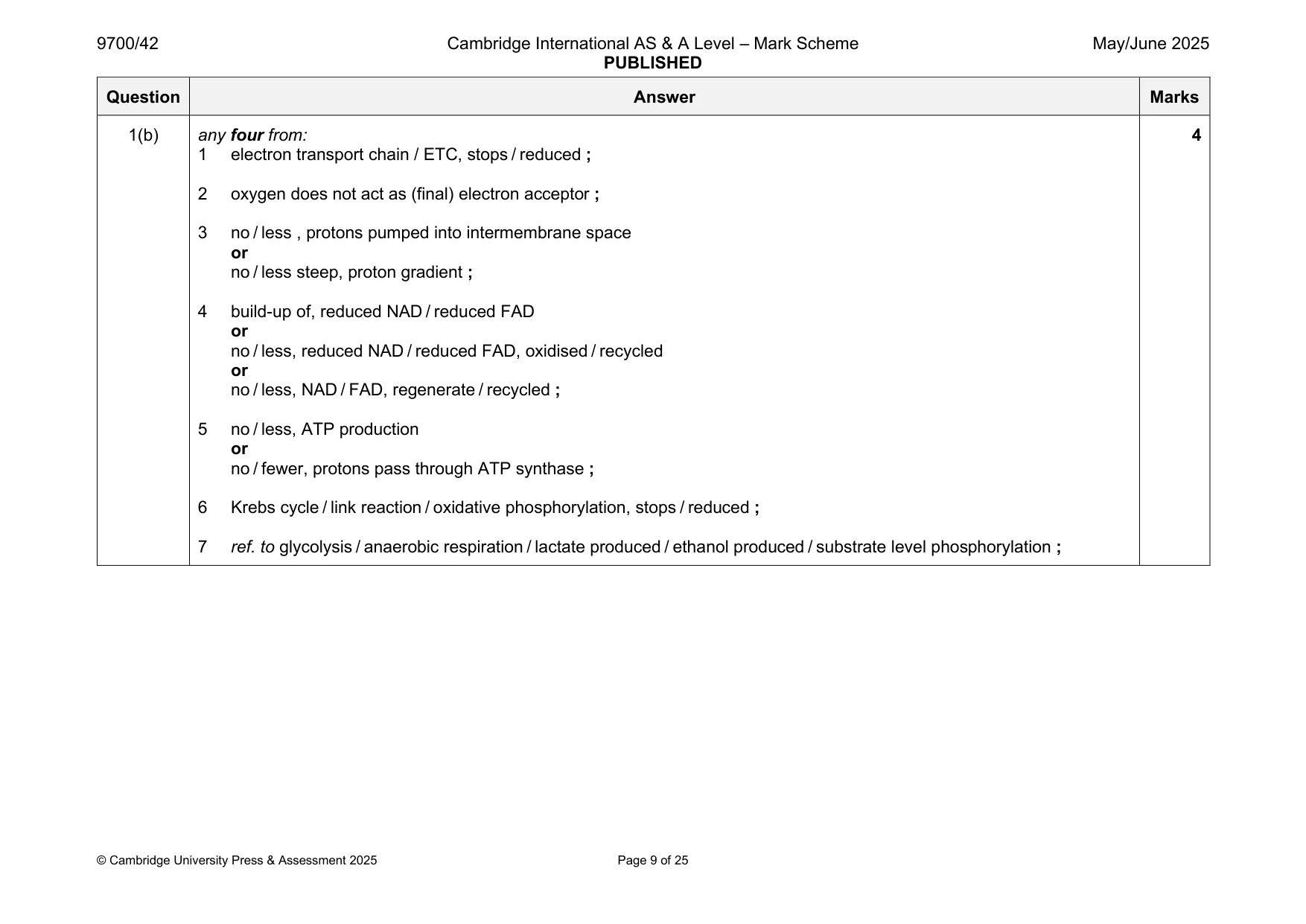
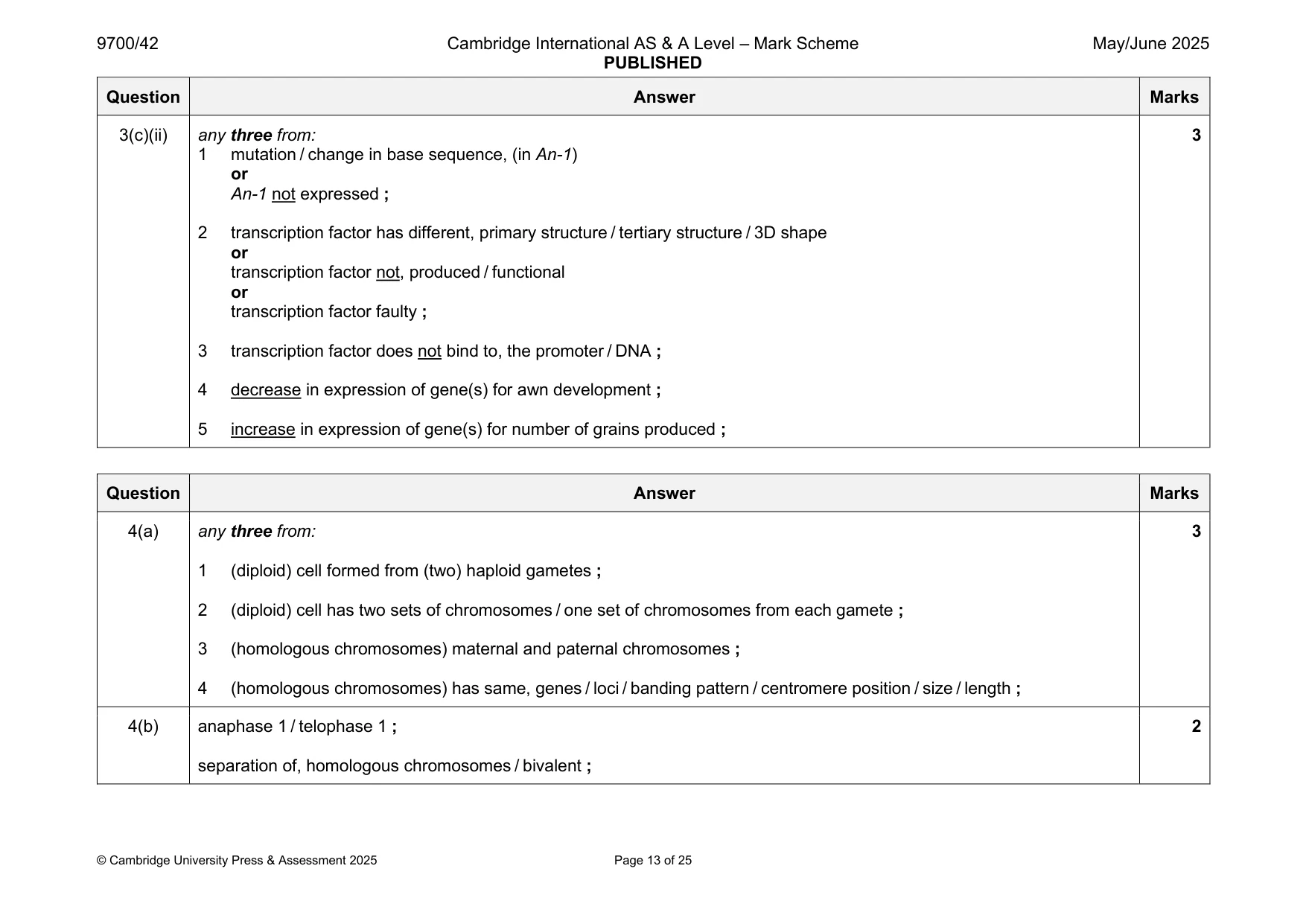
Mark scheme: Question Answer Marks 1(a)(i) 2 ; 1 1(a)(ii) pumps / actively transports, protons / hydrogen ions, into intermembrane space ; 2 ref. to proton gradient ; 1(a)(iii) any three from: 3 1 ATP synthase ; 2 protons / hydrogen ions, move (from intermembrane space) to matrix ; 3 by facilitated diffusion ; 4 ATP synthesised from ADP + Pi ; A ADP is phosphorylated to ATP 5 ref. to chemiosmosis ; 1(b) any four from: 4 1 electron transport chain / ETC, stops / reduced ; 2 oxygen does not act as (final) electron acceptor ; 3 no / less , protons pumped into intermembrane space or no / less steep, proton gradient ; 4 build-up of, reduced NAD / reduced FAD or no / less, reduced NAD / reduced FAD, oxidised / recycled or no / less, NAD / FAD, regenerate / recycled ; 5 no / less, ATP production or no / fewer, protons pass through ATP synthase ; 6 Krebs cycle / link reaction / oxidative phosphorylation, stops / reduced ; 7 ref. to glycolysis / anaerobic respiration / lactate produced / ethanol produced / substrate level phosphorylation ;
Q2 · When organisms reproduce, they pass on their alleles to the next generation
2 When organisms reproduce, they pass on their alleles to the next generation. There are many factors that can affect how allele frequencies change over time in a population. Explain how genetic drift and the founder effect may affect allele frequencies in populations. .......................................................................................................................................................... .......................................................................................................................................................... .......................................................................................................................................................... .......................................................................................................................................................... .......................................................................................................................................................... .......................................................................................................................................................... .......................................................................................................................................................... .......................................................................................................................................................... .......................................................................................................................................................... .......................................................................................................................................................... .......................................................................................................................................................... .......................................................................................................................................................... .......................................................................................................................................................... .......................................................................................................................................................... .......................................................................................................................................................... .......................................................................................................................................................... [Total: 6]
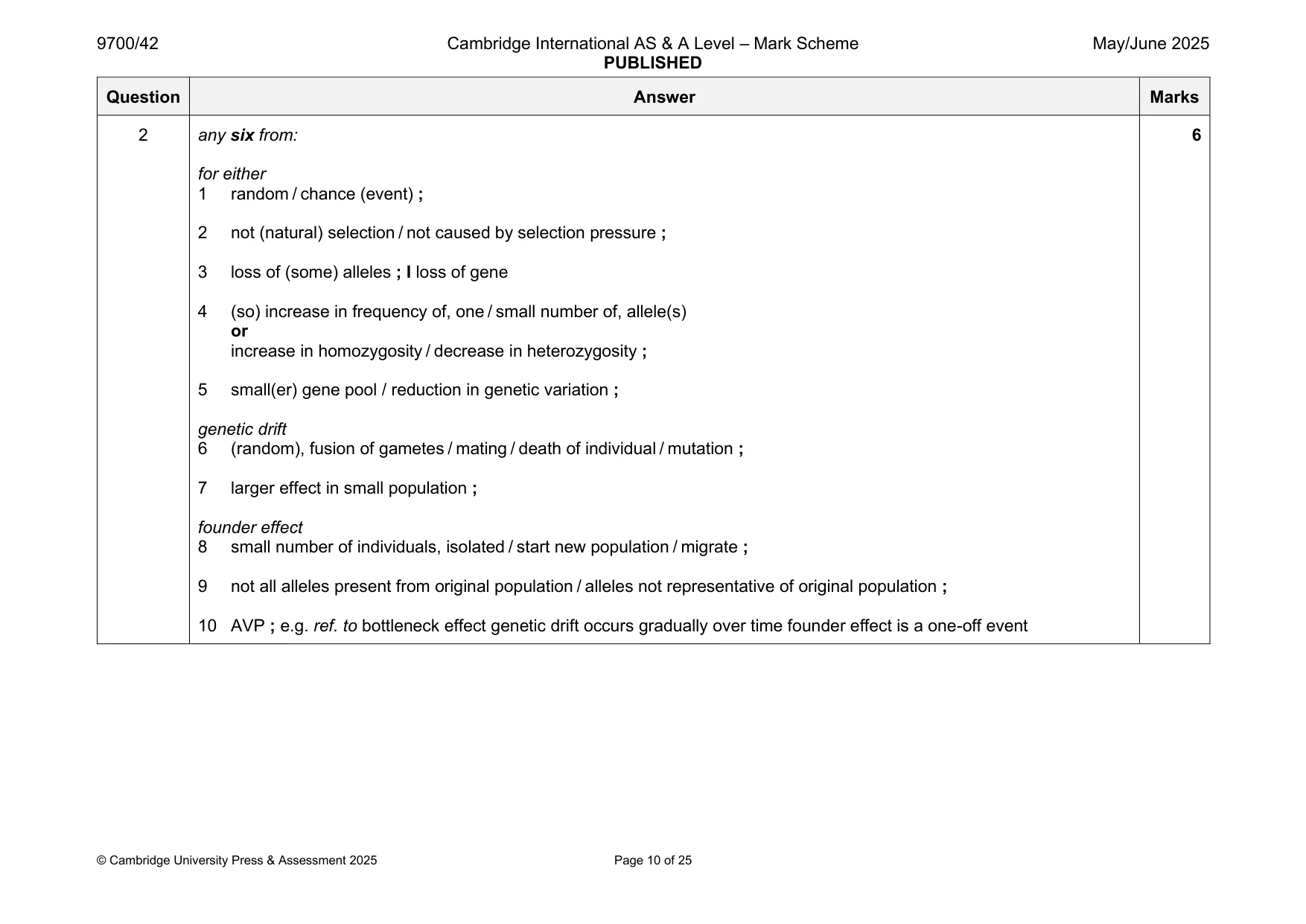
Mark scheme: 2 any six from: 6 for either 1 random / chance (event) ; 2 not (natural) selection / not caused by selection pressure ; 3 loss of (some) alleles ; I loss of gene 4 (so) increase in frequency of, one / small number of, allele(s) or increase in homozygosity / decrease in heterozygosity ; 5 small(er) gene pool / reduction in genetic variation ; genetic drift 6 (random), fusion of gametes / mating / death of individual / mutation ; 7 larger effect in small population ; founder effect 8 small number of individuals, isolated / start new population / migrate ; 9 not all alleles present from original population / alleles not representative of original population ; 10 AVP ; e.g. ref. to bottleneck effect genetic drift occurs gradually over time founder effect is a one-off event
Q3 · Rice, Oryza sativa, is an important grain crop
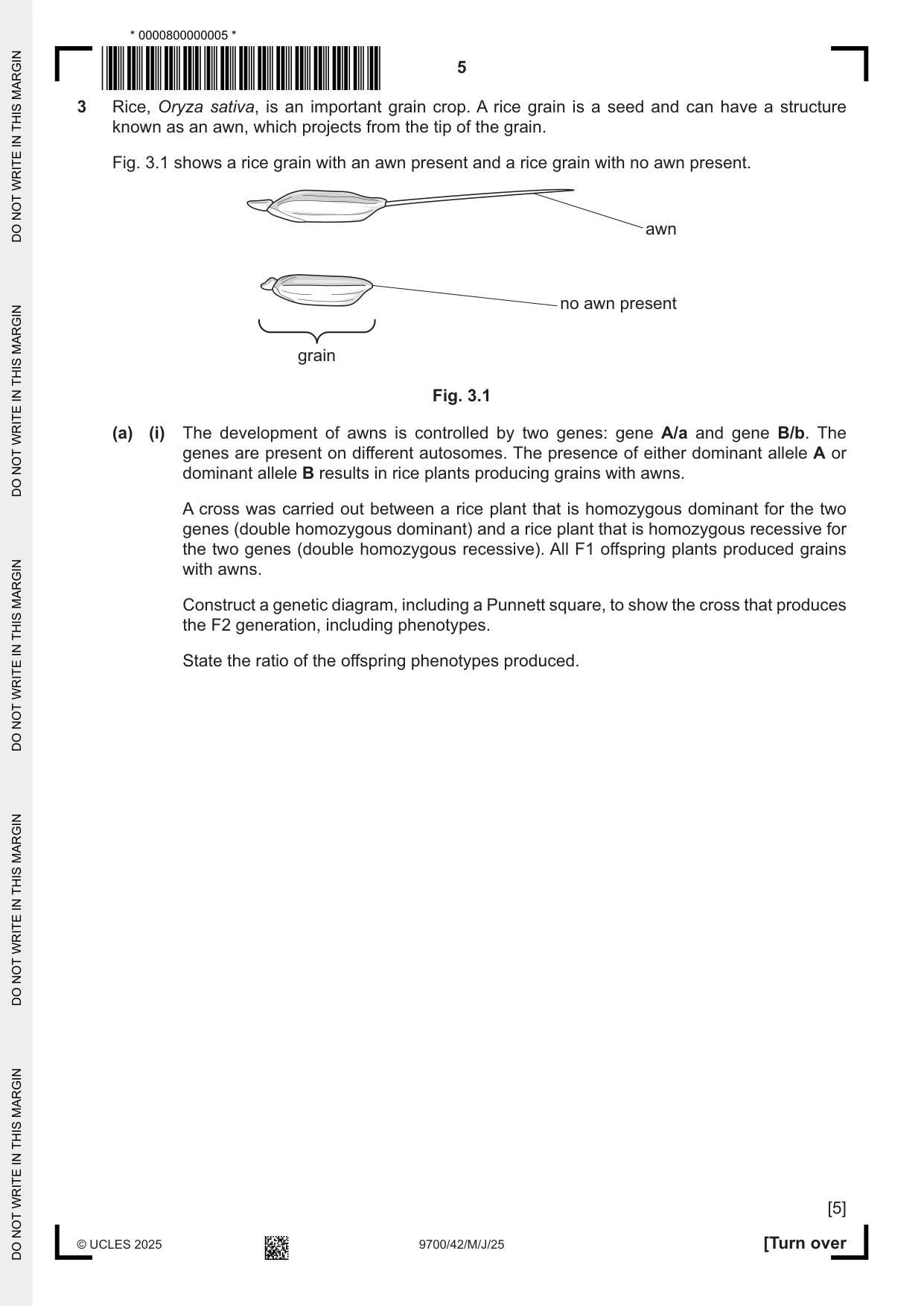
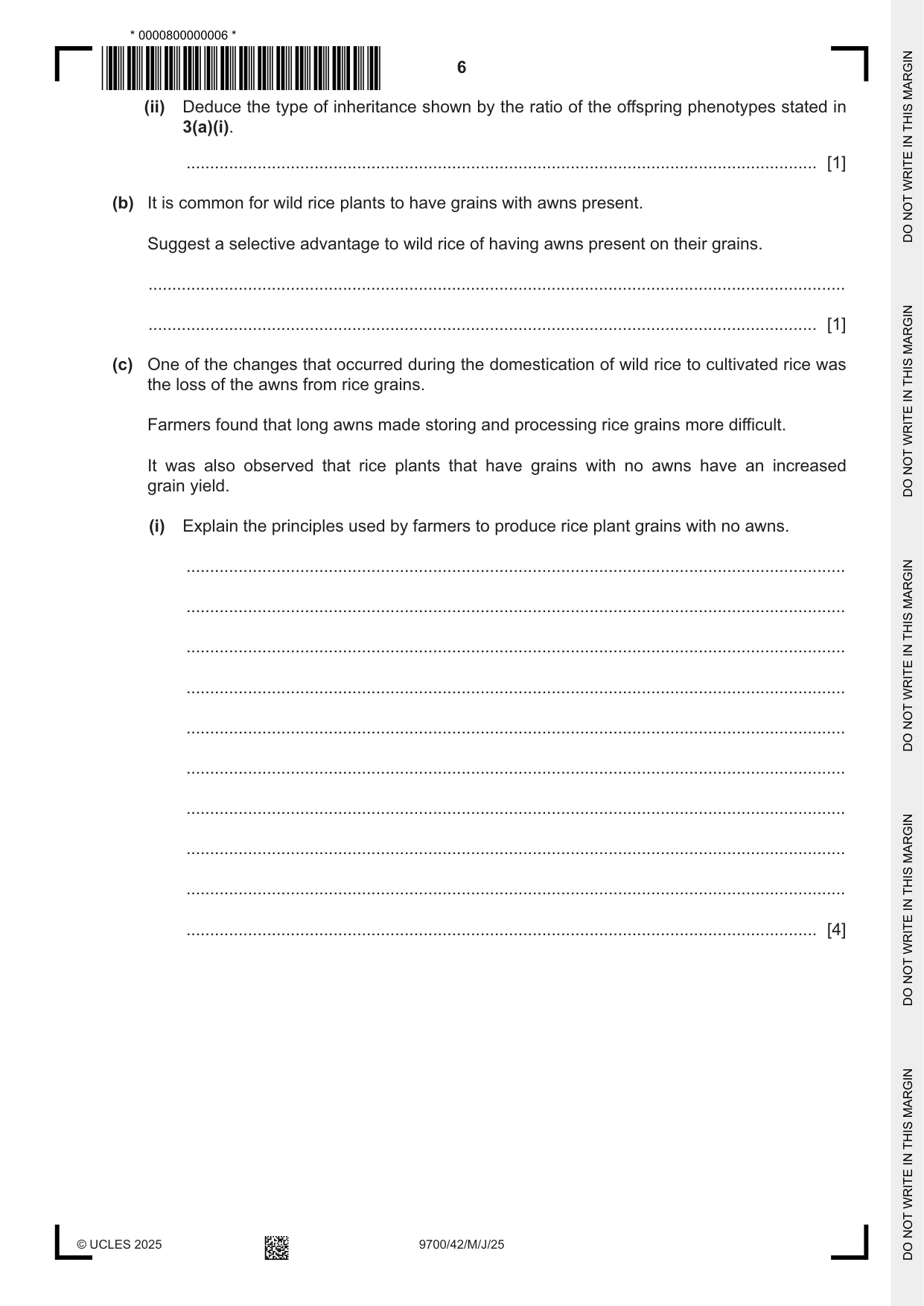
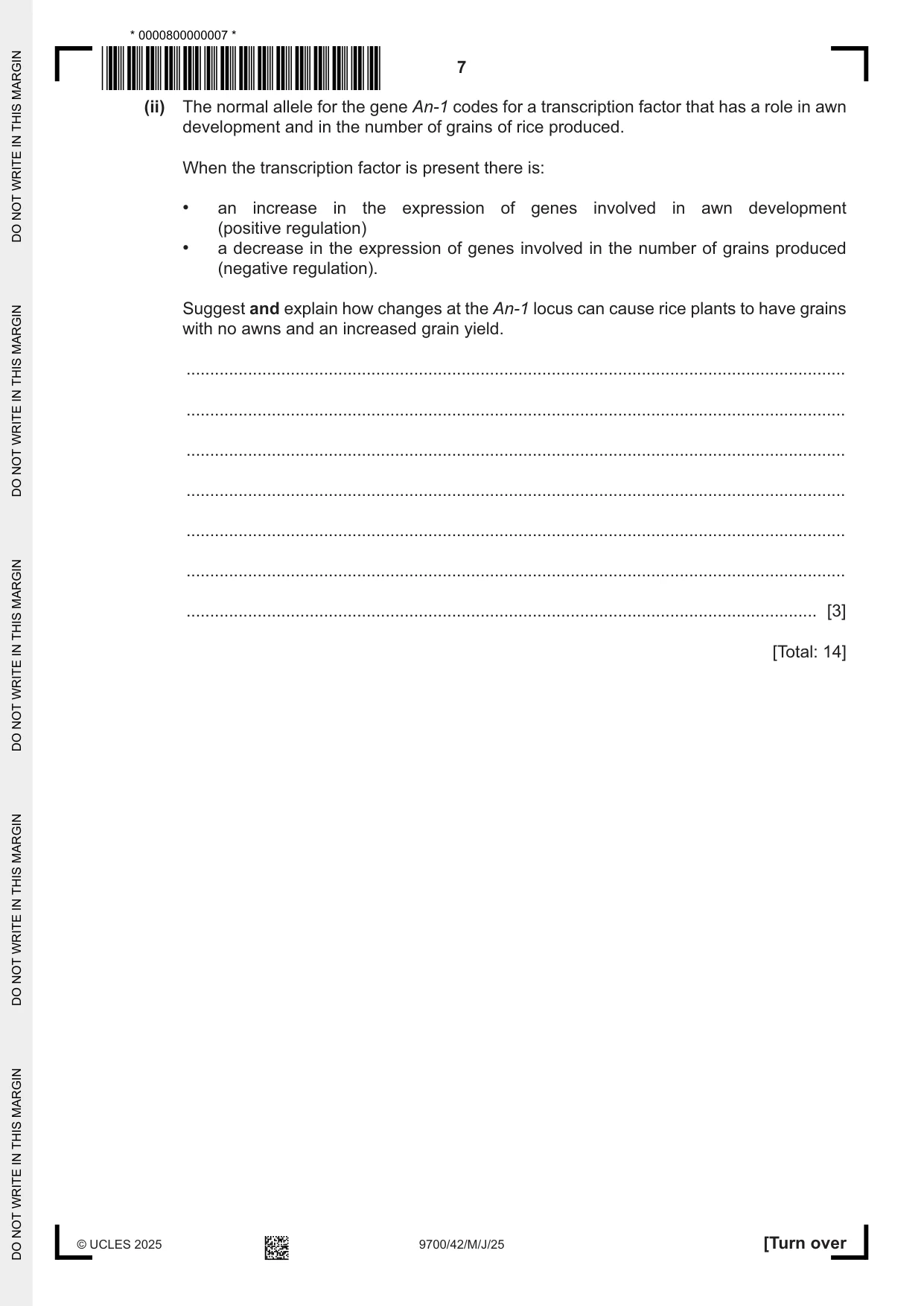
3 Rice, Oryza sativa, is an important grain crop. A rice grain is a seed and can have a structure known as an awn, which projects from the tip of the grain. Fig. 3.1 shows a rice grain with an awn present and a rice grain with no awn present. awn no awn present grain Fig. 3.1 (a) (i) The development of awns is controlled by two genes: gene A/a and gene B/b. The genes are present on different autosomes. The presence of either dominant allele A or dominant allele B results in rice plants producing grains with awns. A cross was carried out between a rice plant that is homozygous dominant for the two genes (double homozygous dominant) and a rice plant that is homozygous recessive for the two genes (double homozygous recessive). All F1 offspring plants produced grains with awns. Construct a genetic diagram, including a Punnett square, to show the cross that produces the F2 generation, including phenotypes. State the ratio of the offspring phenotypes produced. [5] (ii) Deduce the type of inheritance shown by the ratio of the offspring phenotypes stated in 3(a)(i). ..................................................................................................................................... [1] (b) It is common for wild rice plants to have grains with awns present. Suggest a selective advantage to wild rice of having awns present on their grains. ................................................................................................................................................... ............................................................................................................................................. [1] (c) One of the changes that occurred during the domestication of wild rice to cultivated rice was the loss of the awns from rice grains. Farmers found that long awns made storing and processing rice grains more difficult. It was also observed that rice plants that have grains with no awns have an increased grain yield. (i) Explain the principles used by farmers to produce rice plant grains with no awns. ........................................................................................................................................... ........................................................................................................................................... ........................................................................................................................................... ........................................................................................................................................... ........................................................................................................................................... ........................................................................................................................................... ........................................................................................................................................... ........................................................................................................................................... ........................................................................................................................................... ..................................................................................................................................... [4] (ii) The normal allele for the gene An‑1 codes for a transcription factor that has a role in awn development and in the number of grains of rice produced. When the transcription factor is present there is: • an increase in the expression of genes involved in awn development (positive regulation) • a decrease in the expression of genes involved in the number of grains produced (negative regulation). Suggest and explain how changes at the An‑1 locus can cause rice plants to have grains with no awns and an increased grain yield. ........................................................................................................................................... ........................................................................................................................................... ........................................................................................................................................... ........................................................................................................................................... ........................................................................................................................................... ........................................................................................................................................... ..................................................................................................................................... [3] [Total: 14]
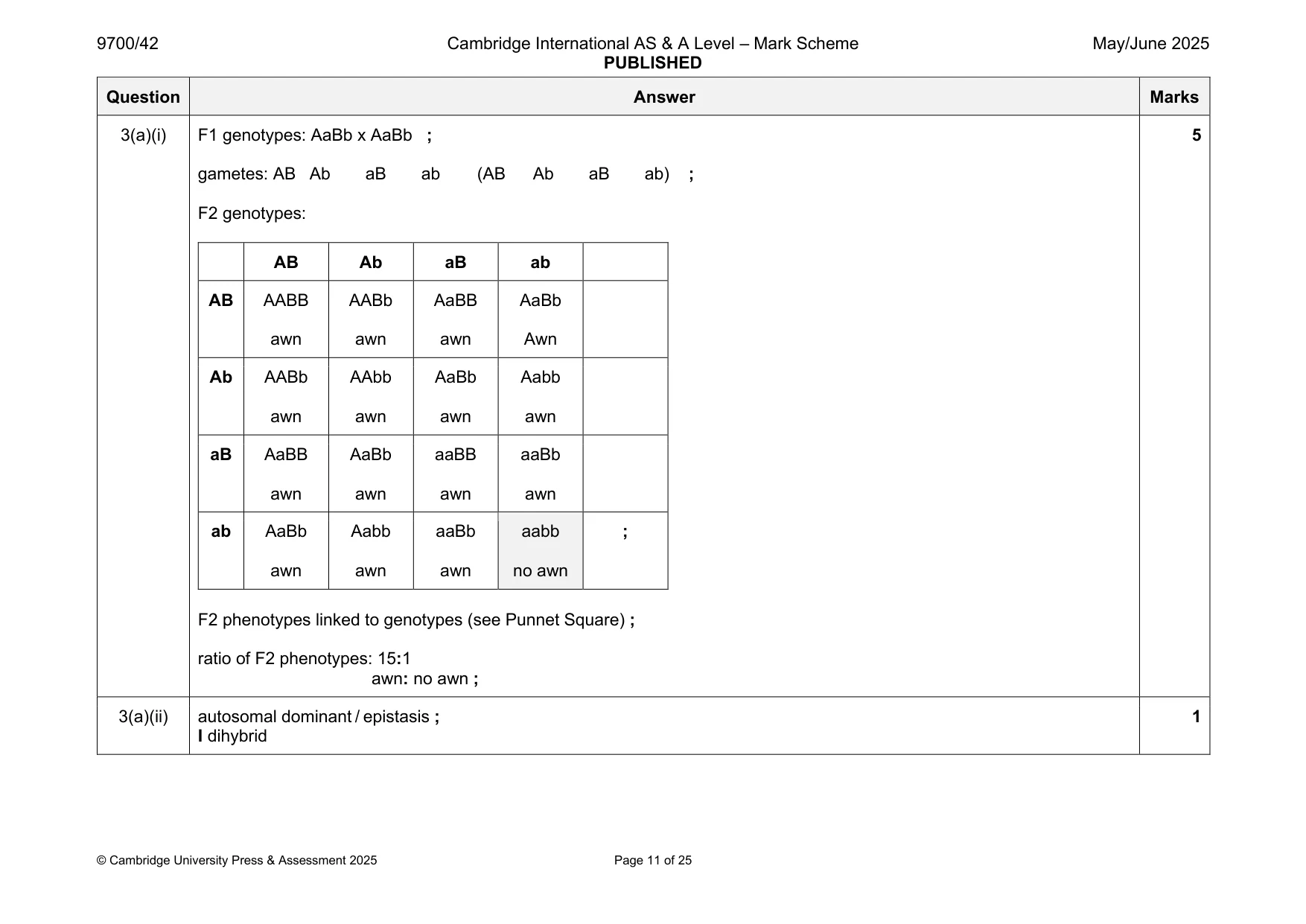
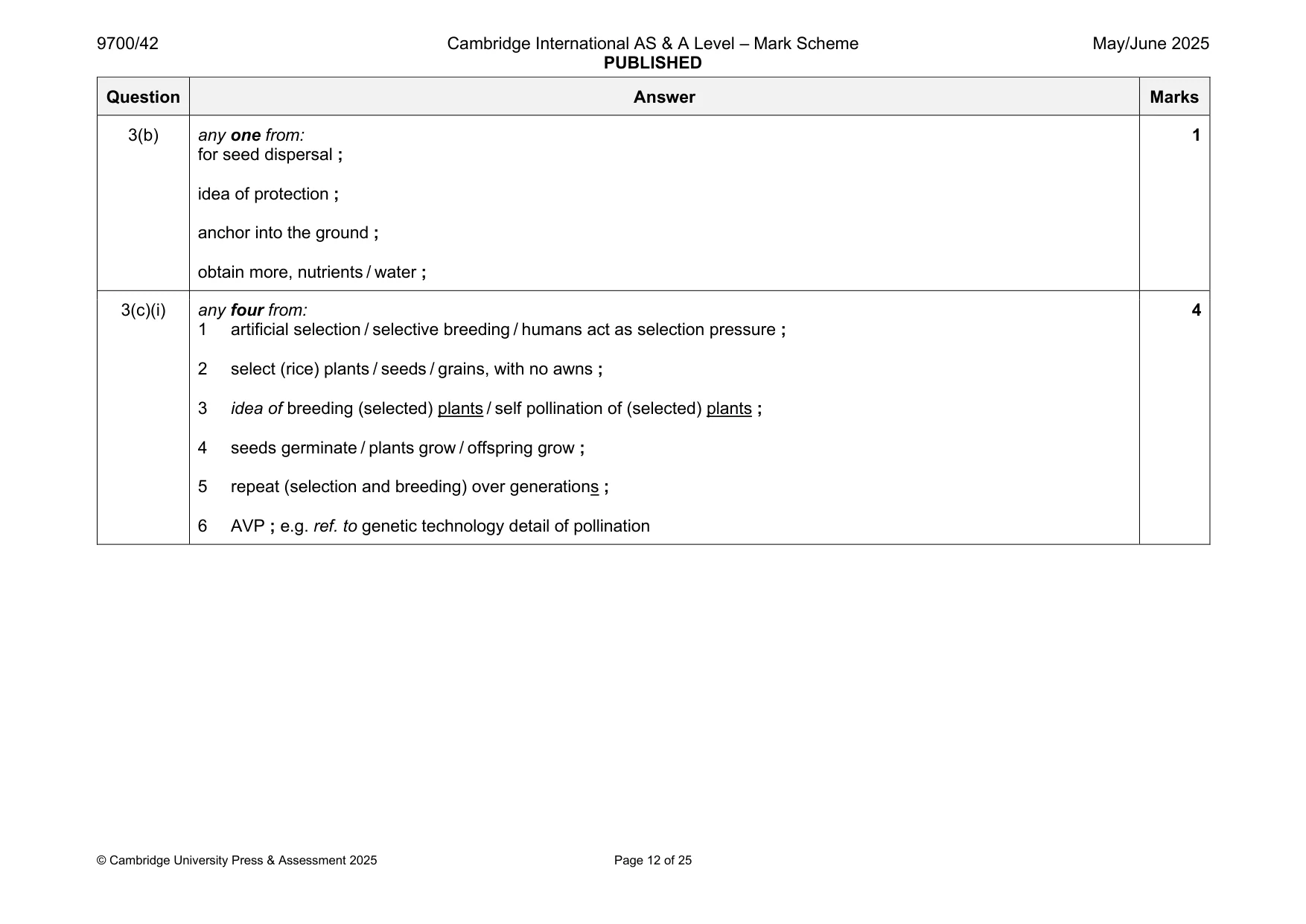
Mark scheme: 3(a)(i) F1 genotypes: AaBb x AaBb ; 5 gametes: AB Ab aB ab (AB Ab aB ab) ; F2 genotypes: AB Ab aB ab AB AABB AABb AaBB AaBb awn awn awn Awn Ab AABb AAbb AaBb Aabb awn awn awn awn aB AaBB AaBb aaBB aaBb awn awn awn awn ab AaBb Aabb aaBb aabb ; awn awn awn no awn F2 phenotypes linked to genotypes (see Punnet Square) ; ratio of F2 phenotypes: 15:1 awn: no awn ; 3(a)(ii) autosomal dominant / epistasis ; 1 I dihybrid 3(b) any one from: 1 for seed dispersal ; idea of protection ; anchor into the ground ; obtain more, nutrients / water ; 3(c)(i) any four from: 4 1 artificial selection / selective breeding / humans act as selection pressure ; 2 select (rice) plants / seeds / grains, with no awns ; 3 idea of breeding (selected) plants / self pollination of (selected) plants ; 4 seeds germinate / plants grow / offspring grow ; 5 repeat (selection and breeding) over generations ; 6 AVP ; e.g. ref. to genetic technology detail of pollination 3(c)(ii) any three from: 3 1 mutation / change in base sequence, (in An-1) or An-1 not expressed ; 2 transcription factor has different, primary structure / tertiary structure / 3D shape or transcription factor not, produced / functional or transcription factor faulty ; 3 transcription factor does not bind to, the promoter / DNA ; 4 decrease in expression of gene(s) for awn development ; 5 increase in expression of gene(s) for number of grains produced ;
Q4 · Sexual reproduction in plants and animals involves: • the formation of gametes as a…
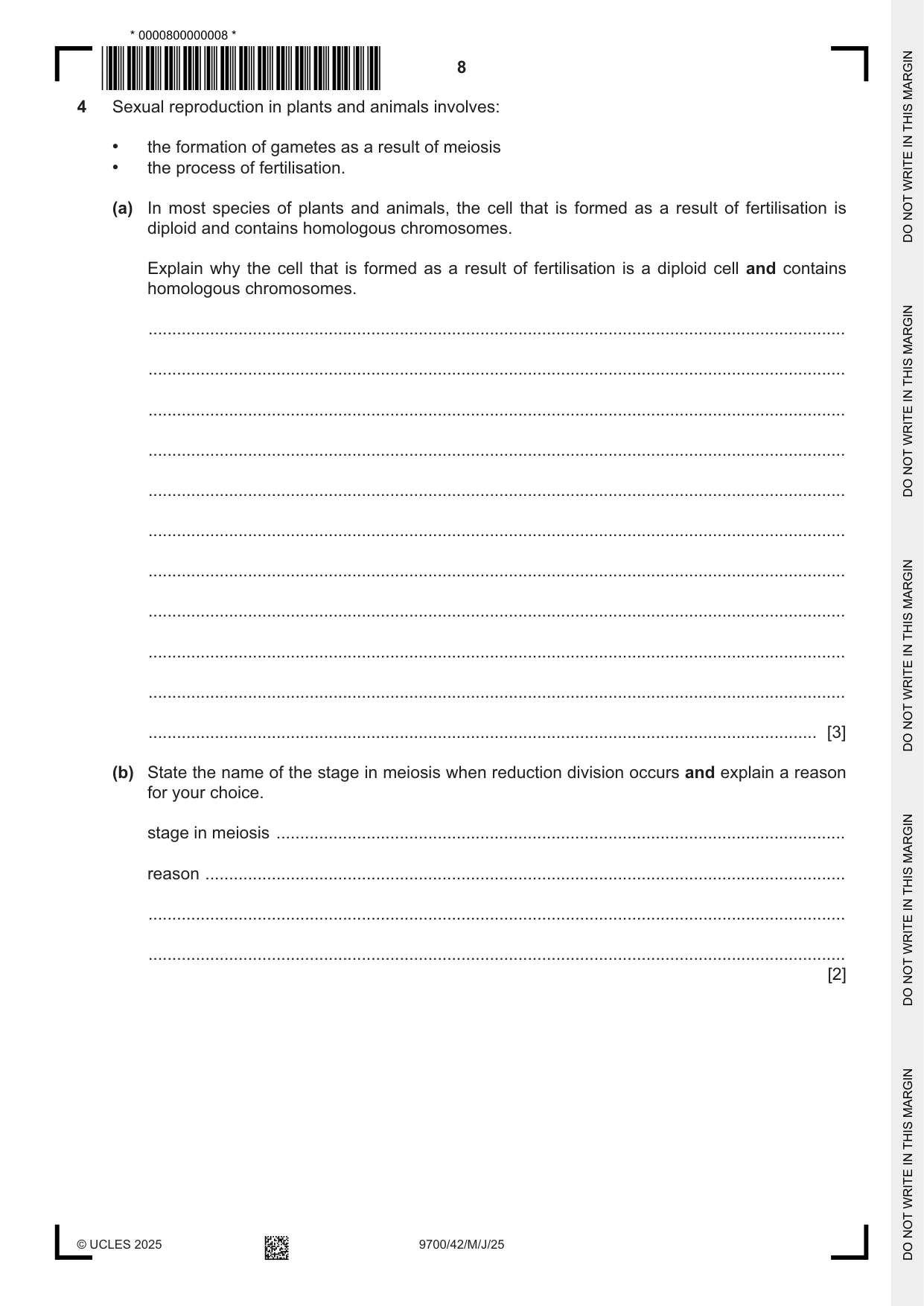
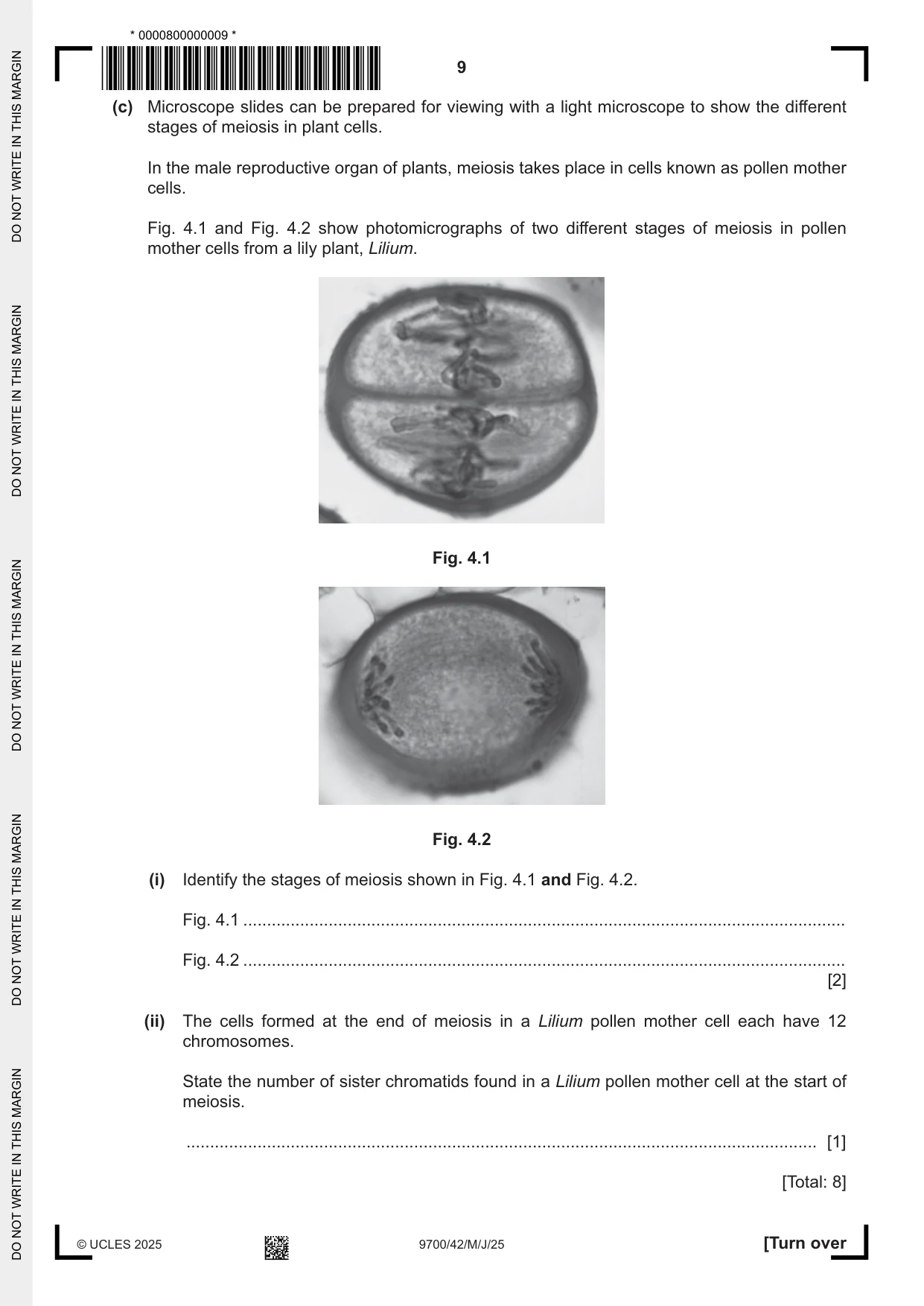
4 Sexual reproduction in plants and animals involves: • the formation of gametes as a result of meiosis • the process of fertilisation. (a) In most species of plants and animals, the cell that is formed as a result of fertilisation is diploid and contains homologous chromosomes. Explain why the cell that is formed as a result of fertilisation is a diploid cell and contains homologous chromosomes. ................................................................................................................................................... ................................................................................................................................................... ................................................................................................................................................... ................................................................................................................................................... ................................................................................................................................................... ................................................................................................................................................... ................................................................................................................................................... ................................................................................................................................................... ................................................................................................................................................... ................................................................................................................................................... ............................................................................................................................................. [3] (b) State the name of the stage in meiosis when reduction division occurs and explain a reason for your choice. stage in meiosis ........................................................................................................................ reason ....................................................................................................................................... ................................................................................................................................................... ................................................................................................................................................... [2] (c) Microscope slides can be prepared for viewing with a light microscope to show the different stages of meiosis in plant cells. In the male reproductive organ of plants, meiosis takes place in cells known as pollen mother cells. Fig. 4.1 and Fig. 4.2 show photomicrographs of two different stages of meiosis in pollen mother cells from a lily plant, Lilium. Fig. 4.1 Fig. 4.2 (i) Identify the stages of meiosis shown in Fig. 4.1 and Fig. 4.2. Fig. 4.1 ............................................................................................................................... Fig. 4.2 ............................................................................................................................... [2] (ii) The cells formed at the end of meiosis in a Lilium pollen mother cell each have 12 chromosomes. State the number of sister chromatids found in a Lilium pollen mother cell at the start of meiosis. ..................................................................................................................................... [1] [Total: 8]
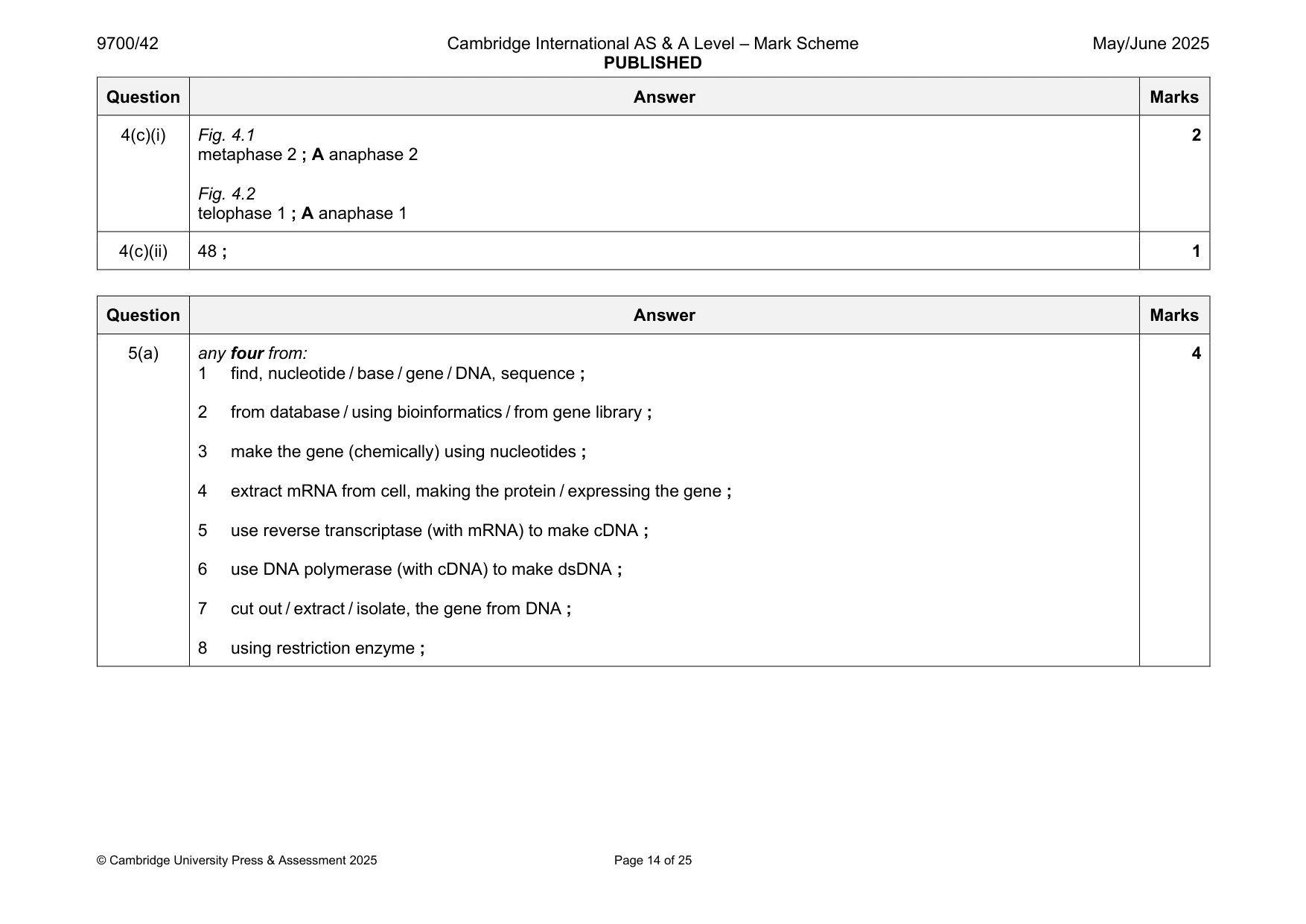
Mark scheme: 4(a) any three from: 3 1 (diploid) cell formed from (two) haploid gametes ; 2 (diploid) cell has two sets of chromosomes / one set of chromosomes from each gamete ; 3 (homologous chromosomes) maternal and paternal chromosomes ; 4 (homologous chromosomes) has same, genes / loci / banding pattern / centromere position / size / length ; 4(b) anaphase 1 / telophase 1 ; 2 separation of, homologous chromosomes / bivalent ; 4(c)(i) Fig. 4.1 2 metaphase 2 ; A anaphase 2 Fig. 4.2 telophase 1 ; A anaphase 1 4(c)(ii) 48 ; 1
More questions on Replication and division of nuclei and cells
Q5 · A number of diseases in humans can be treated using recombinant human proteins
5 A number of diseases in humans can be treated using recombinant human proteins. These are produced by recombinant DNA technology. (a) To produce a human protein for treatment of a disease, recombinant DNA technology needs a gene coding for the particular human protein. Outline the different ways that can be used to obtain a gene that codes for a human protein. ................................................................................................................................................... ................................................................................................................................................... ................................................................................................................................................... ................................................................................................................................................... ................................................................................................................................................... ................................................................................................................................................... ................................................................................................................................................... ................................................................................................................................................... ................................................................................................................................................... ................................................................................................................................................... ............................................................................................................................................. [4] (b) Diabetes mellitus is a disease in which the blood glucose concentration cannot be controlled. Many people with diabetes mellitus use recombinant human insulin to help control their blood glucose concentration. Before recombinant human insulin became available, animals were the main source of insulin. Explain the advantages of using recombinant human insulin to treat diabetes. ................................................................................................................................................... ................................................................................................................................................... ................................................................................................................................................... ................................................................................................................................................... ................................................................................................................................................... ................................................................................................................................................... ............................................................................................................................................. [3] (c) Explain why the DNA involved in the production of recombinant human insulin is termed recombinant DNA. ................................................................................................................................................... ............................................................................................................................................. [1] (d) Recombinant human insulin analogues are insulin proteins that have slightly altered amino acid sequences compared with recombinant human insulin. These analogues can be more effective than human insulin. Synthetic genes coding for insulin analogues have been developed. The bacterium Escherichia coli can be used as a host for a synthetic gene for the large-scale manufacture of an analogue. When scientists have determined the changes that are needed to produce an insulin analogue, they can obtain a synthetic gene coding for the analogue by making changes to a length of DNA using genetic engineering. Suggest how scientists genetically engineer a synthetic gene coding for the insulin analogue and explain how the changes they make allow the correct analogue to be produced. ................................................................................................................................................... ................................................................................................................................................... ................................................................................................................................................... ................................................................................................................................................... ................................................................................................................................................... ................................................................................................................................................... ................................................................................................................................................... ................................................................................................................................................... ............................................................................................................................................. [4] [Total: 12]
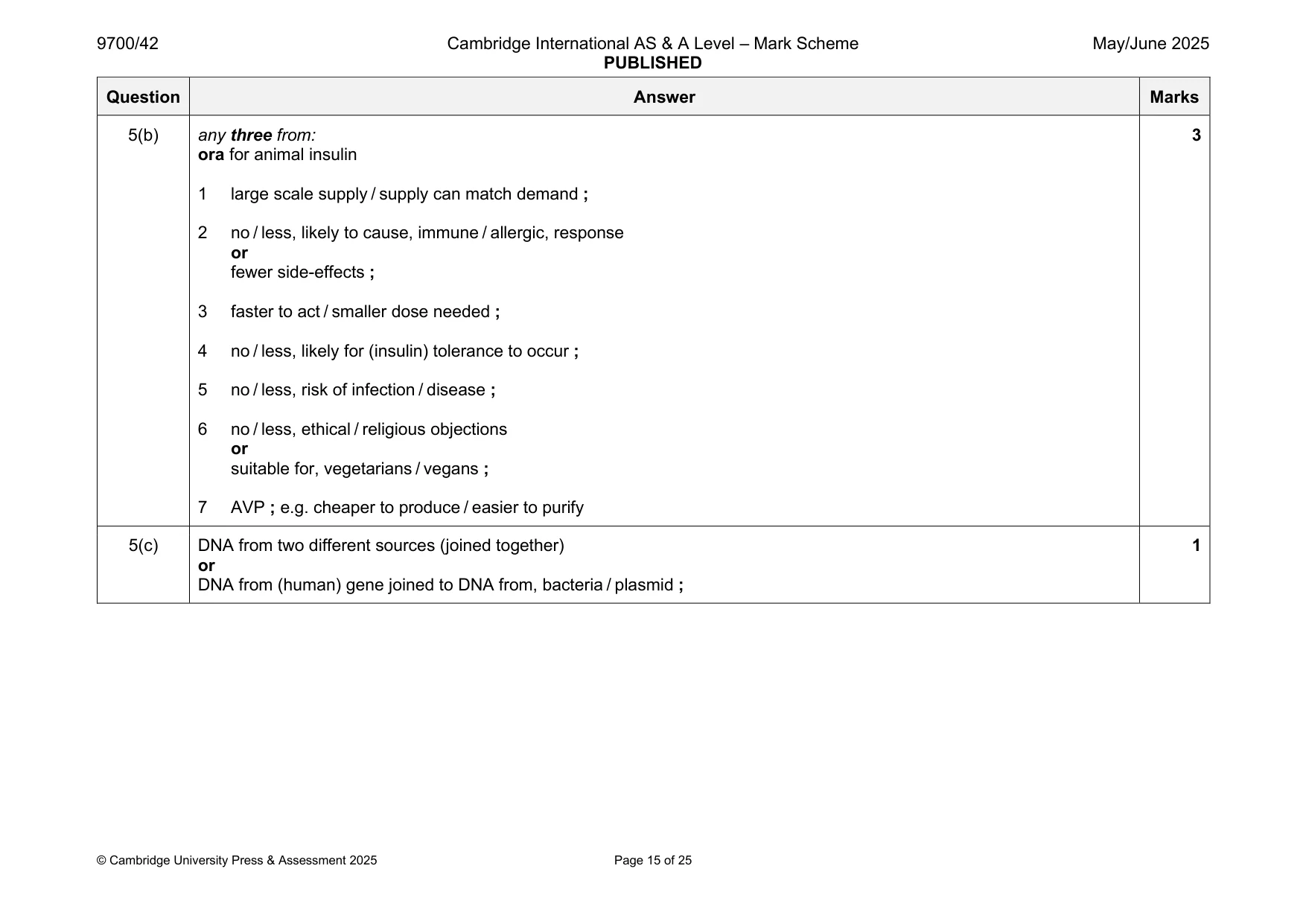
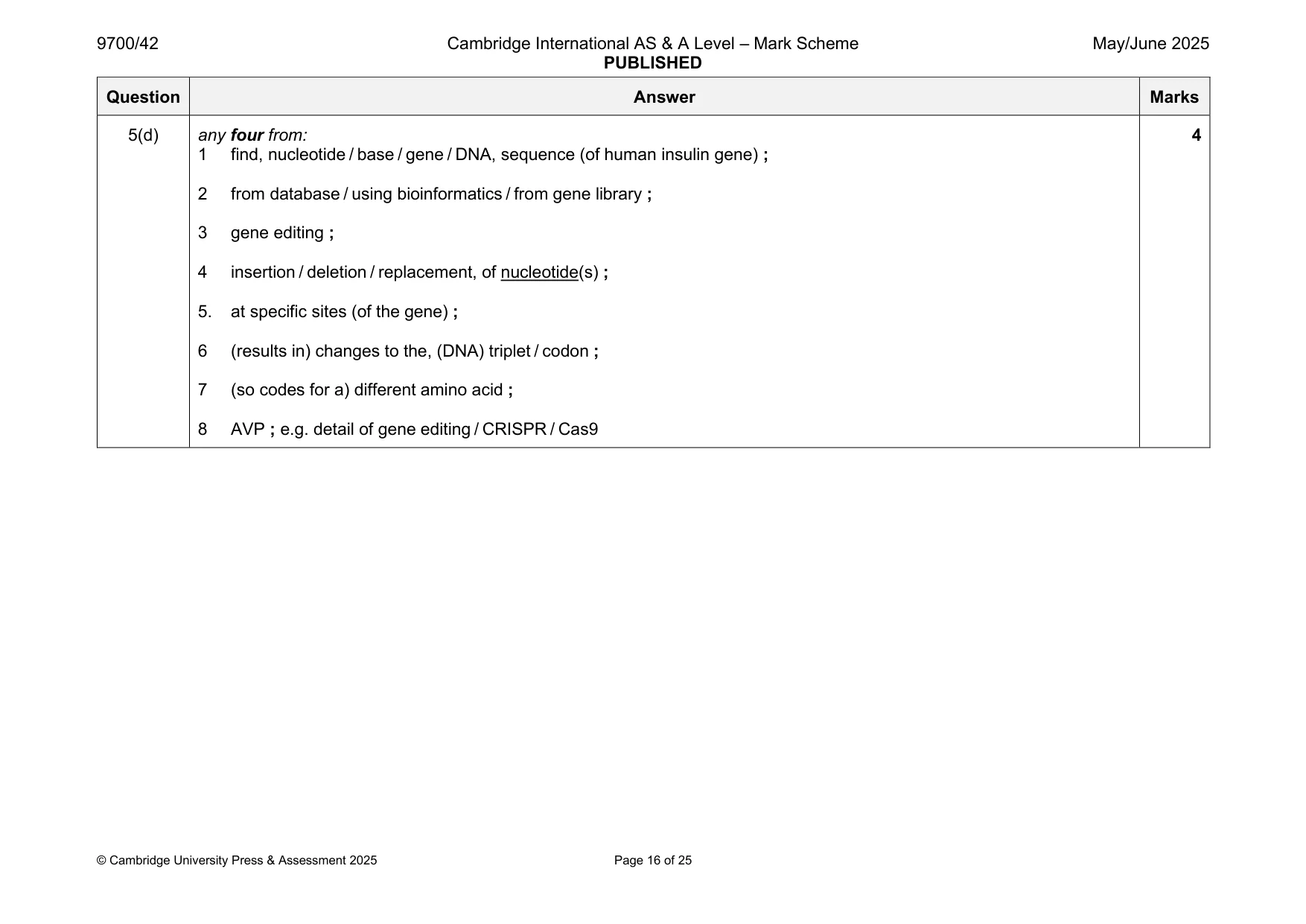
Mark scheme: 5(a) any four from: 4 1 find, nucleotide / base / gene / DNA, sequence ; 2 from database / using bioinformatics / from gene library ; 3 make the gene (chemically) using nucleotides ; 4 extract mRNA from cell, making the protein / expressing the gene ; 5 use reverse transcriptase (with mRNA) to make cDNA ; 6 use DNA polymerase (with cDNA) to make dsDNA ; 7 cut out / extract / isolate, the gene from DNA ; 8 using restriction enzyme ; 5(b) any three from: 3 ora for animal insulin 1 large scale supply / supply can match demand ; 2 no / less, likely to cause, immune / allergic, response or fewer side-effects ; 3 faster to act / smaller dose needed ; 4 no / less, likely for (insulin) tolerance to occur ; 5 no / less, risk of infection / disease ; 6 no / less, ethical / religious objections or suitable for, vegetarians / vegans ; 7 AVP ; e.g. cheaper to produce / easier to purify 5(c) DNA from two different sources (joined together) 1 or DNA from (human) gene joined to DNA from, bacteria / plasmid ; 5(d) any four from: 4 1 find, nucleotide / base / gene / DNA, sequence (of human insulin gene) ; 2 from database / using bioinformatics / from gene library ; 3 gene editing ; 4 insertion / deletion / replacement, of nucleotide(s) ; 5. at specific sites (of the gene) ; 6 (results in) changes to the, (DNA) triplet / codon ; 7 (so codes for a) different amino acid ; 8 AVP ; e.g. detail of gene editing / CRISPR / Cas9
Q6 · Guard cells are located in the epidermis of the leaves of most plants
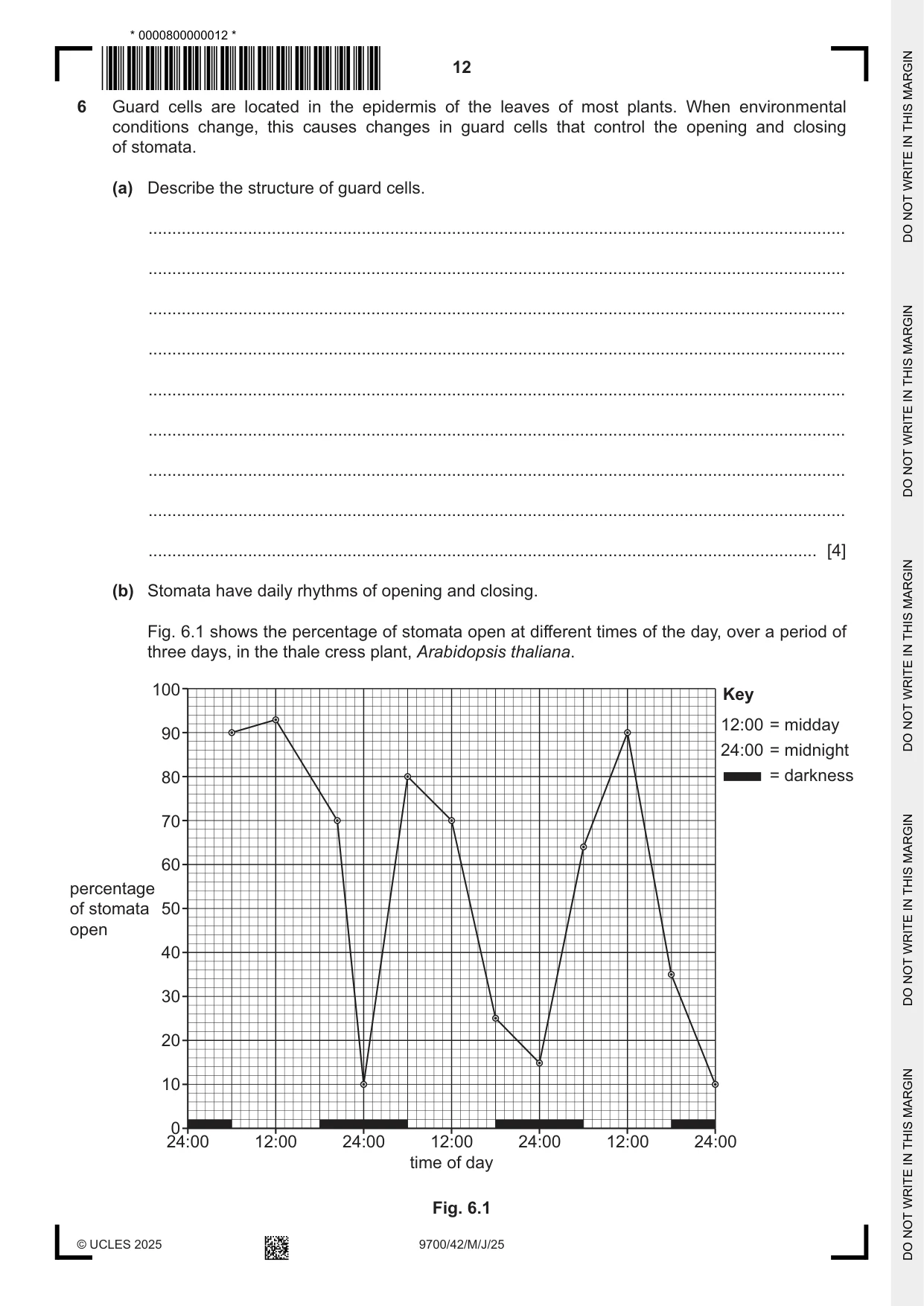
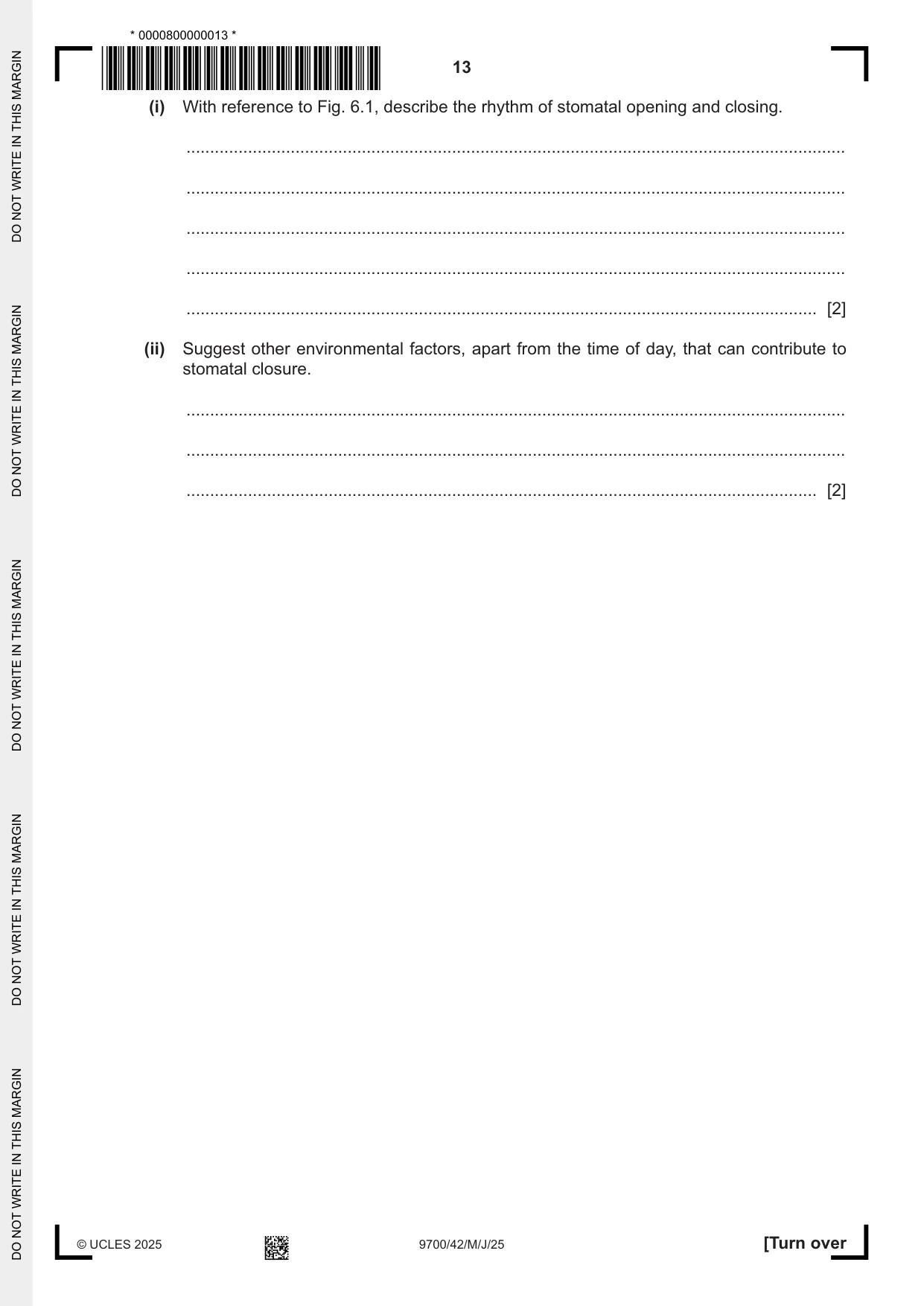
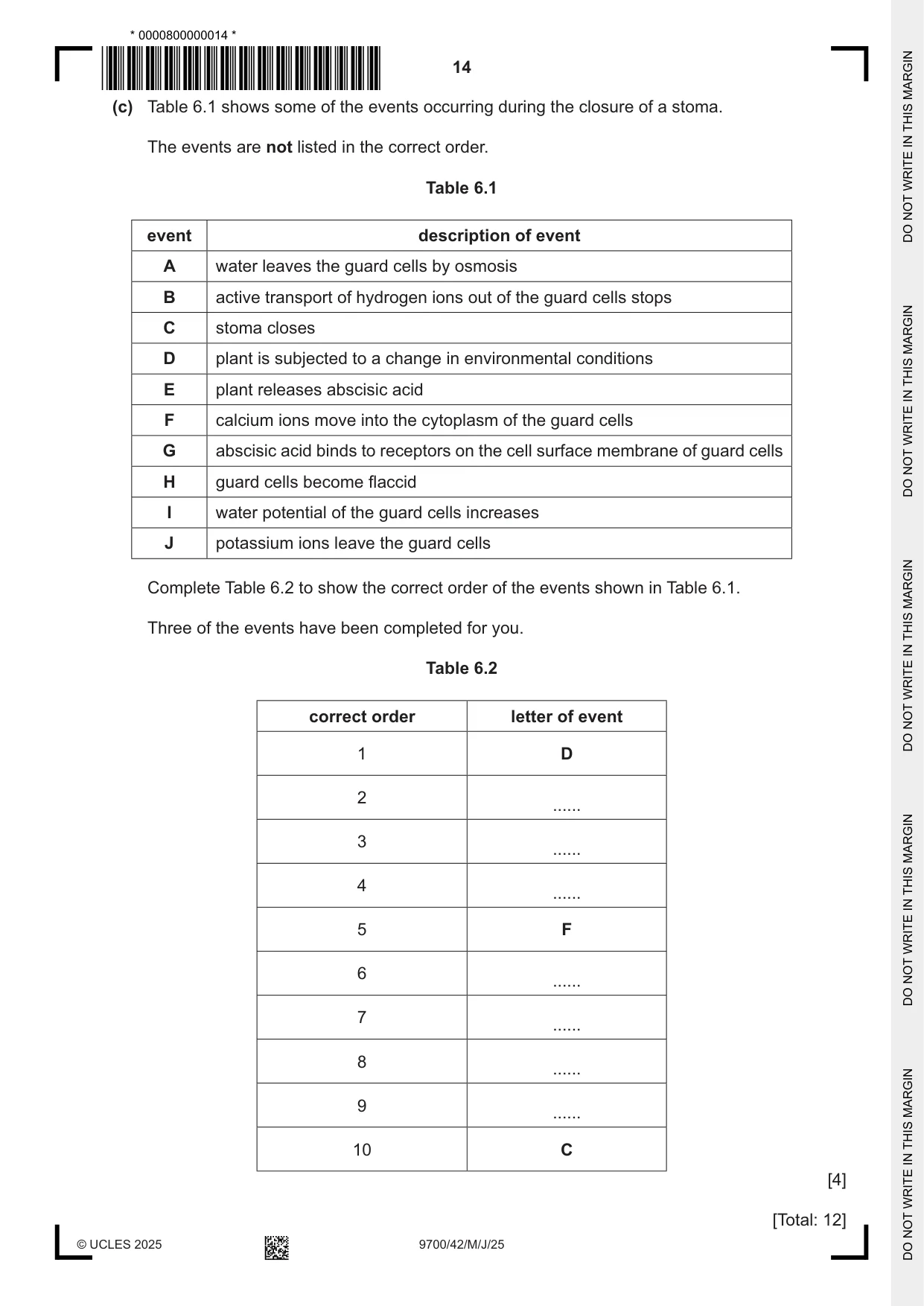
6 Guard cells are located in the epidermis of the leaves of most plants. When environmental conditions change, this causes changes in guard cells that control the opening and closing of stomata. (a) Describe the structure of guard cells. ................................................................................................................................................... ................................................................................................................................................... ................................................................................................................................................... ................................................................................................................................................... ................................................................................................................................................... ................................................................................................................................................... ................................................................................................................................................... ................................................................................................................................................... ............................................................................................................................................. [4] (b) Stomata have daily rhythms of opening and closing. Fig. 6.1 shows the percentage of stomata open at different times of the day, over a period of three days, in the thale cress plant, Arabidopsis thaliana. 100 Key 12:00 = midday 90 24:00 = midnight 80 = darkness 70 60 percentage of stomata 50 open 40 30 20 10 0 24:00 12:00 24:00 12:00 24:00 12:00 24:00 time of day Fig. 6.1 (i) With reference to Fig. 6.1, describe the rhythm of stomatal opening and closing. ........................................................................................................................................... ........................................................................................................................................... ........................................................................................................................................... ........................................................................................................................................... ..................................................................................................................................... [2] (ii) Suggest other environmental factors, apart from the time of day, that can contribute to stomatal closure. ........................................................................................................................................... ........................................................................................................................................... ..................................................................................................................................... [2] (c) Table 6.1 shows some of the events occurring during the closure of a stoma. The events are not listed in the correct order. Table 6.1 event description of event A water leaves the guard cells by osmosis B active transport of hydrogen ions out of the guard cells stops C stoma closes D plant is subjected to a change in environmental conditions E plant releases abscisic acid F calcium ions move into the cytoplasm of the guard cells G abscisic acid binds to receptors on the cell surface membrane of guard cells H guard cells become flaccid I water potential of the guard cells increases J potassium ions leave the guard cells Complete Table 6.2 to show the correct order of the events shown in Table 6.1. Three of the events have been completed for you. Table 6.2 correct order letter of event 1 D 2 ...... 3 ...... 4 ...... 5 F 6 ...... 7 ...... 8 ...... 9 ...... 10 C [4] [Total: 12]
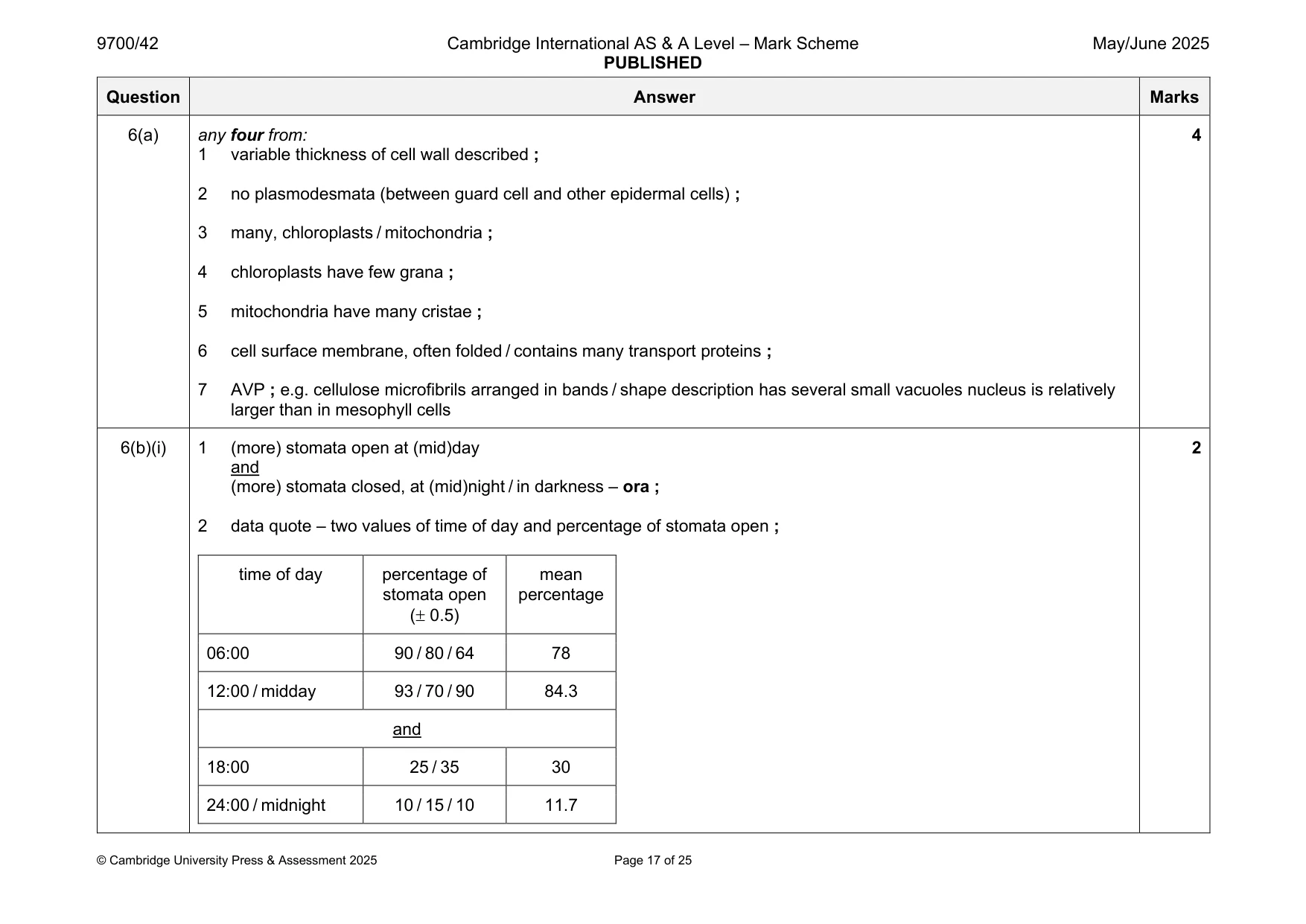
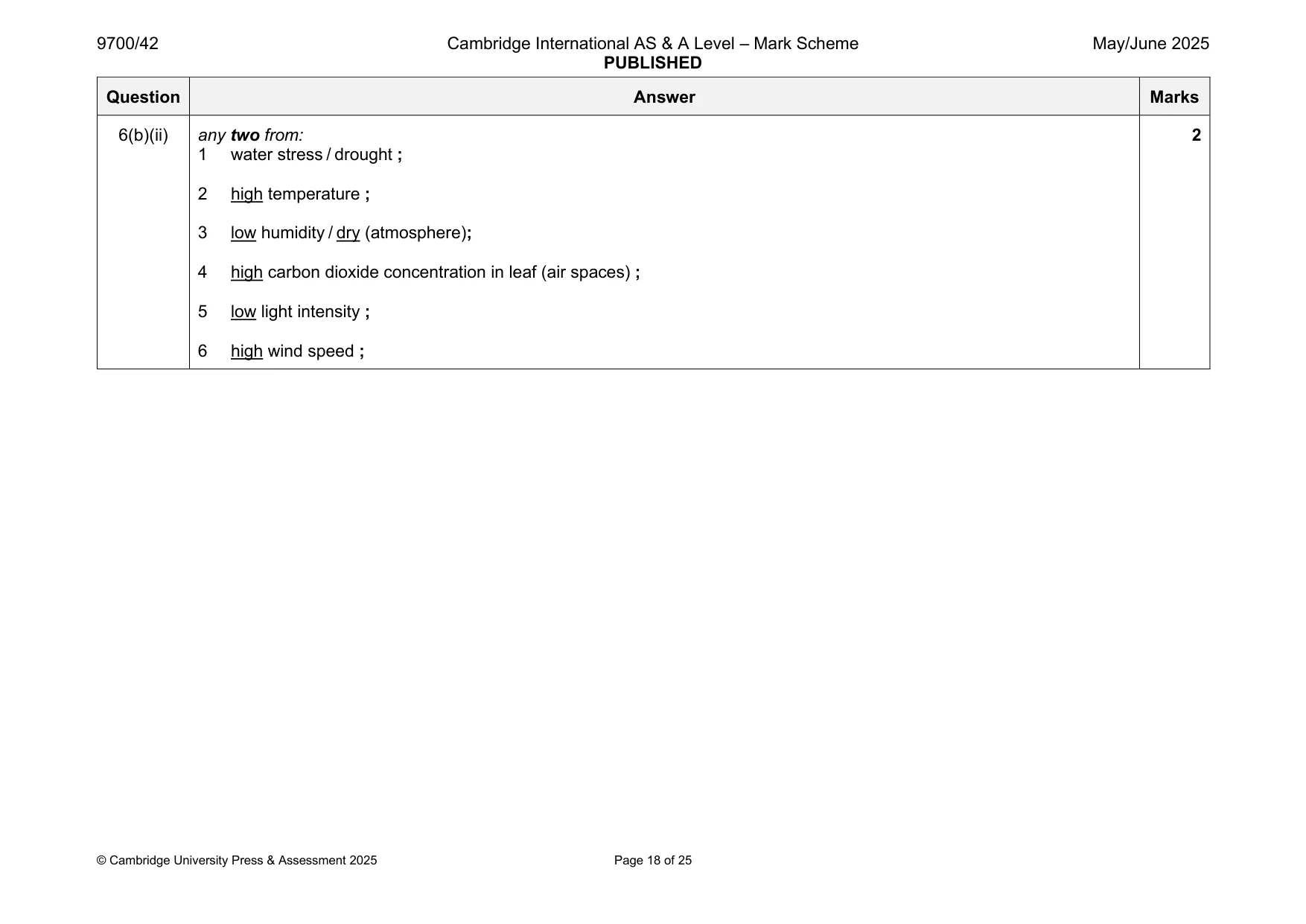
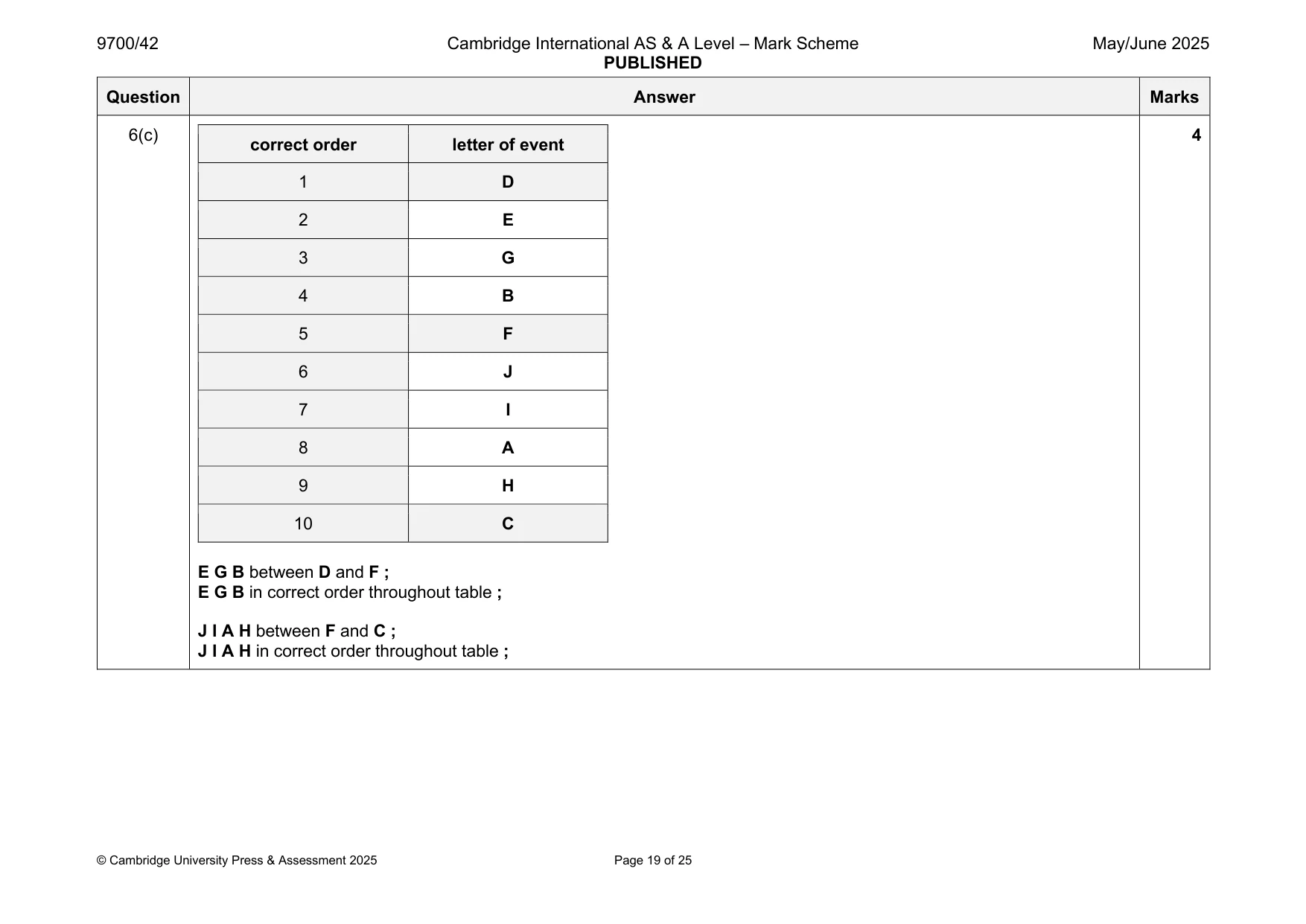
Mark scheme: 6(a) any four from: 4 1 variable thickness of cell wall described ; 2 no plasmodesmata (between guard cell and other epidermal cells) ; 3 many, chloroplasts / mitochondria ; 4 chloroplasts have few grana ; 5 mitochondria have many cristae ; 6 cell surface membrane, often folded / contains many transport proteins ; 7 AVP ; e.g. cellulose microfibrils arranged in bands / shape description has several small vacuoles nucleus is relatively larger than in mesophyll cells 6(b)(i) 1 (more) stomata open at (mid)day 2 and (more) stomata closed, at (mid)night / in darkness – ora ; 2 data quote – two values of time of day and percentage of stomata open ; time of day percentage of mean stomata open percentage ( 0.5) 06:00 90 / 80 / 64 78 12:00 / midday 93 / 70 / 90 84.3 and 18:00 25 / 35 30 24:00 / midnight 10 / 15 / 10 11.7 6(b)(ii) any two from: 2 1 water stress / drought ; 2 high temperature ; 3 low humidity / dry (atmosphere); 4 high carbon dioxide concentration in leaf (air spaces) ; 5 low light intensity ; 6 high wind speed ; 6(c) 4 correct order letter of event 1 D 2 E 3 G 4 B 5 F 6 J 7 I 8 A 9 H 10 C E G B between D and F ; E G B in correct order throughout table ; J I A H between F and C ; J I A H in correct order throughout table ;
Q7 · An axon membrane is described as being at its resting potential when an action potential…
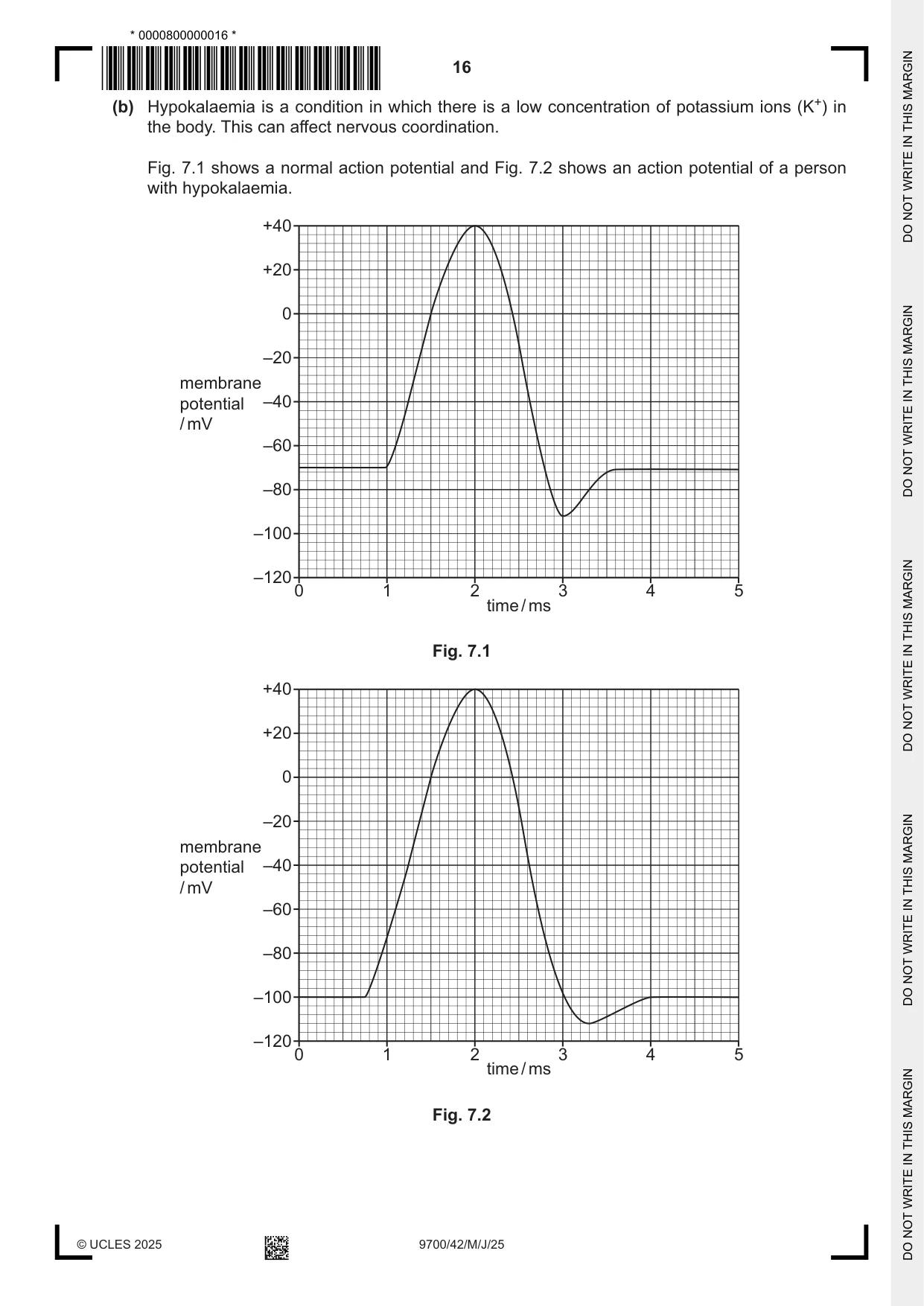
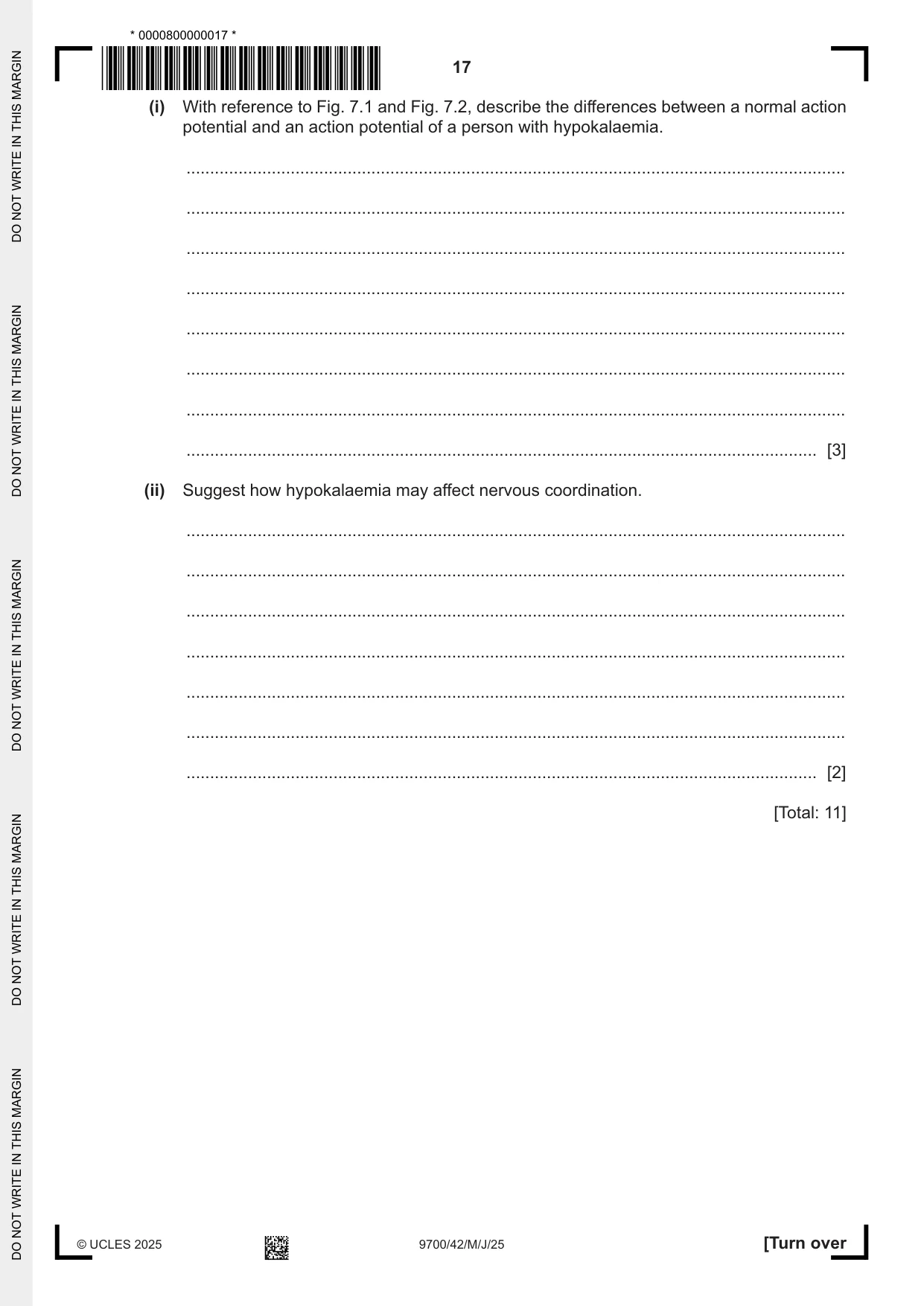
7 (a) An axon membrane is described as being at its resting potential when an action potential is not occurring. Describe and explain how a resting potential of an axon membrane is maintained. ................................................................................................................................................... ................................................................................................................................................... ................................................................................................................................................... ................................................................................................................................................... ................................................................................................................................................... ................................................................................................................................................... ................................................................................................................................................... ................................................................................................................................................... ................................................................................................................................................... ................................................................................................................................................... ................................................................................................................................................... ................................................................................................................................................... ................................................................................................................................................... ................................................................................................................................................... ............................................................................................................................................. [6] (b) Hypokalaemia is a condition in which there is a low concentration of potassium ions (K+) in the body. This can affect nervous coordination. Fig. 7.1 shows a normal action potential and Fig. 7.2 shows an action potential of a person with hypokalaemia. +40 +20 0 –20 membrane potential –40 / mV –60 –80 –100 –120 0 1 2 3 4 5 time / ms Fig. 7.1 +40 +20 0 –20 membrane potential –40 / mV –60 –80 –100 –120 0 1 2 3 4 5 time / ms Fig. 7.2 (i) With reference to Fig. 7.1 and Fig. 7.2, describe the differences between a normal action potential and an action potential of a person with hypokalaemia. ........................................................................................................................................... ........................................................................................................................................... ........................................................................................................................................... ........................................................................................................................................... ........................................................................................................................................... ........................................................................................................................................... ........................................................................................................................................... ..................................................................................................................................... [3] (ii) Suggest how hypokalaemia may affect nervous coordination. ........................................................................................................................................... ........................................................................................................................................... ........................................................................................................................................... ........................................................................................................................................... ........................................................................................................................................... ........................................................................................................................................... ..................................................................................................................................... [2] [Total: 11]
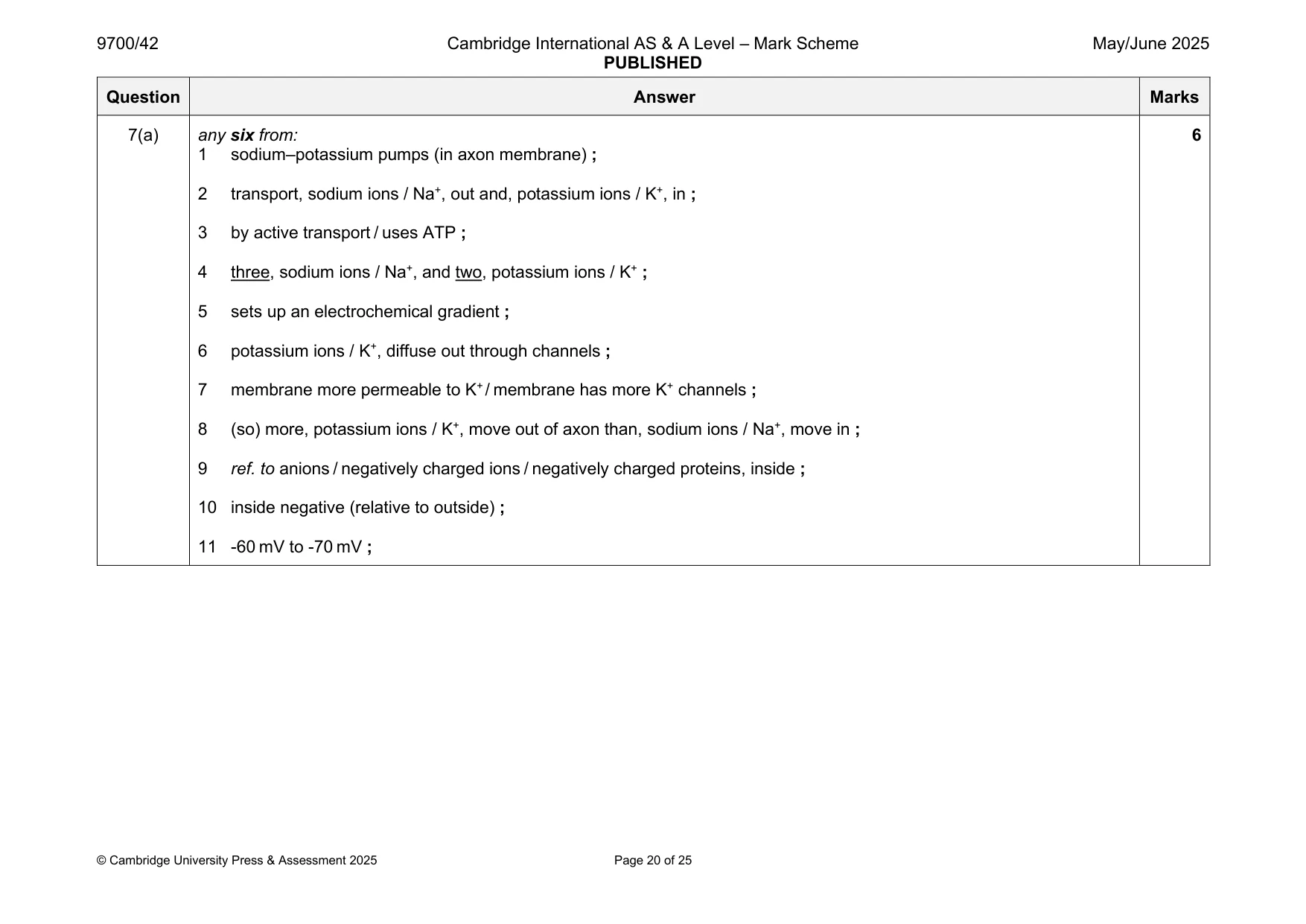
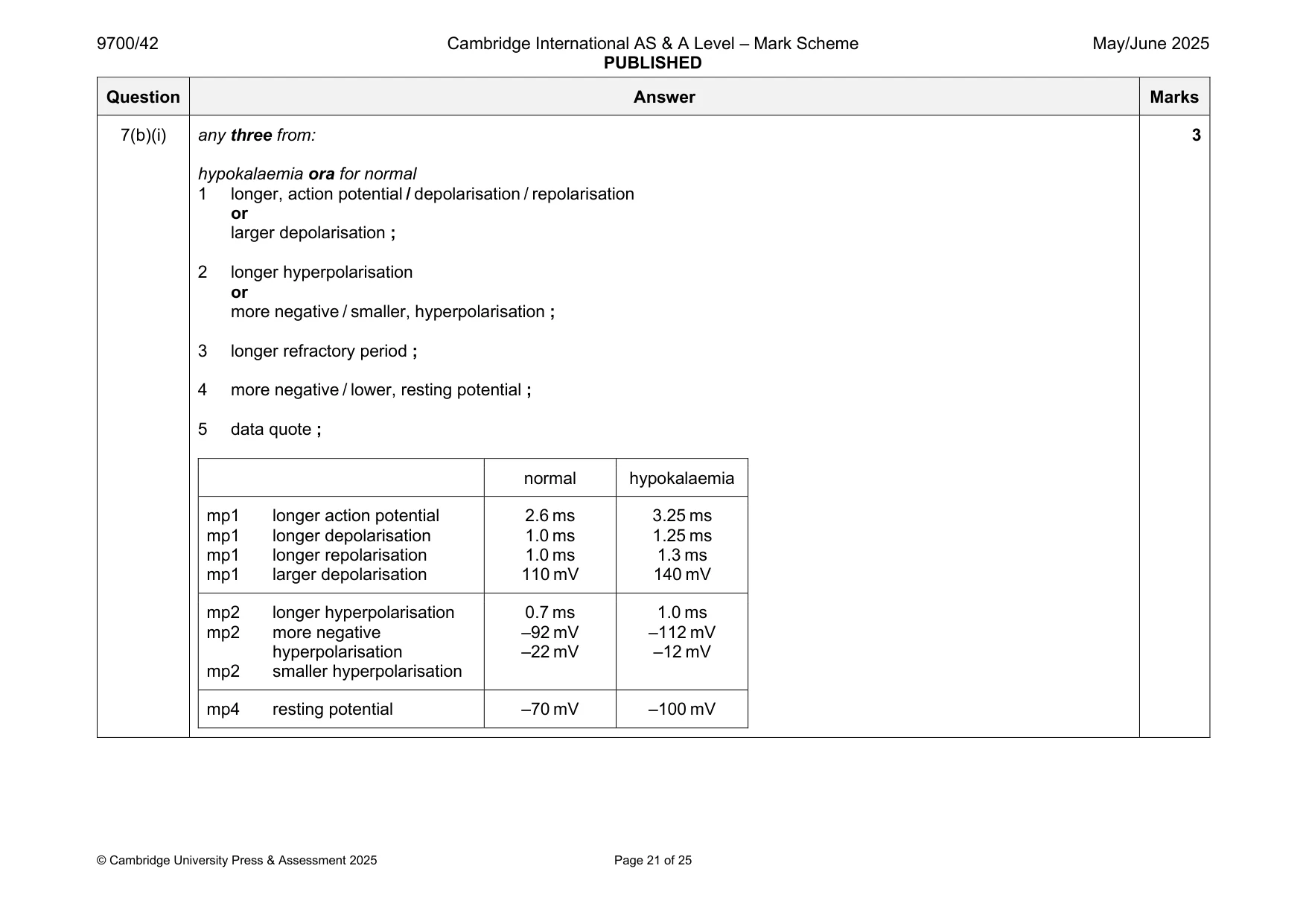
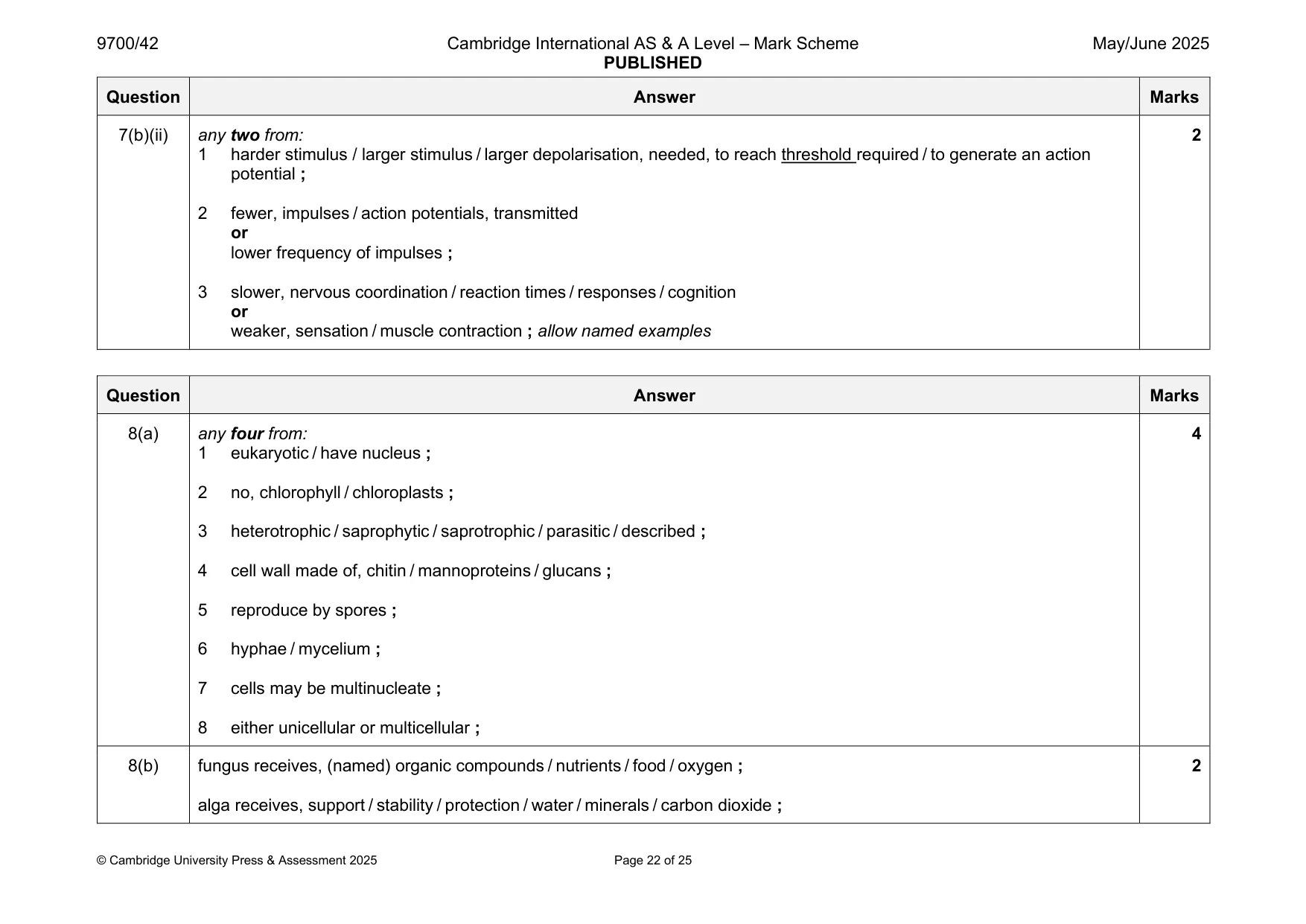
Mark scheme: 7(a) any six from: 6 1 sodium–potassium pumps (in axon membrane) ; 2 transport, sodium ions / Na+, out and, potassium ions / K+, in ; 3 by active transport / uses ATP ; 4 three, sodium ions / Na+, and two, potassium ions / K+ ; 5 sets up an electrochemical gradient ; 6 potassium ions / K+, diffuse out through channels ; 7 membrane more permeable to K+ / membrane has more K+ channels ; 8 (so) more, potassium ions / K+, move out of axon than, sodium ions / Na+, move in ; 9 ref. to anions / negatively charged ions / negatively charged proteins, inside ; 10 inside negative (relative to outside) ; 11 -60 mV to -70 mV ; 7(b)(i) any three from: 3 hypokalaemia ora for normal 1 longer, action potential / depolarisation / repolarisation or larger depolarisation ; 2 longer hyperpolarisation or more negative / smaller, hyperpolarisation ; 3 longer refractory period ; 4 more negative / lower, resting potential ; 5 data quote ; normal hypokalaemia mp1 longer action potential 2.6 ms 3.25 ms mp1 longer depolarisation 1.0 ms 1.25 ms mp1 longer repolarisation 1.0 ms 1.3 ms mp1 larger depolarisation 110 mV 140 mV mp2 longer hyperpolarisation 0.7 ms 1.0 ms mp2 more negative –92 mV –112 mV hyperpolarisation –22 mV –12 mV mp2 smaller hyperpolarisation mp4 resting potential –70 mV –100 mV 7(b)(ii) any two from: 2 1 harder stimulus / larger stimulus / larger depolarisation, needed, to reach threshold required / to generate an action potential ; 2 fewer, impulses / action potentials, transmitted or lower frequency of impulses ; 3 slower, nervous coordination / reaction times / responses / cognition or weaker, sensation / muscle contraction ; allow named examples
Q8 · A lichen describes a mutually beneficial association of a fungus with an organism termed…
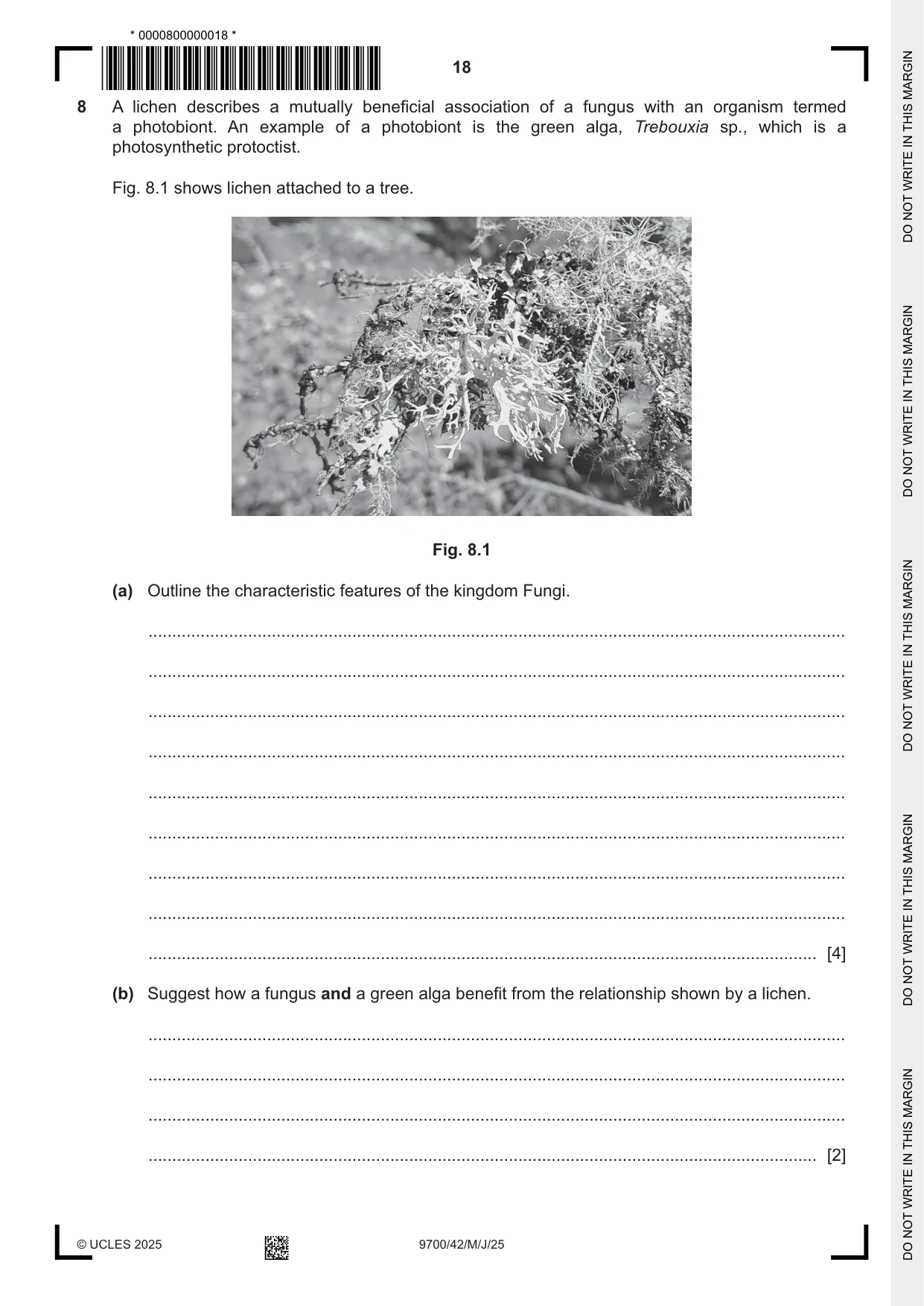
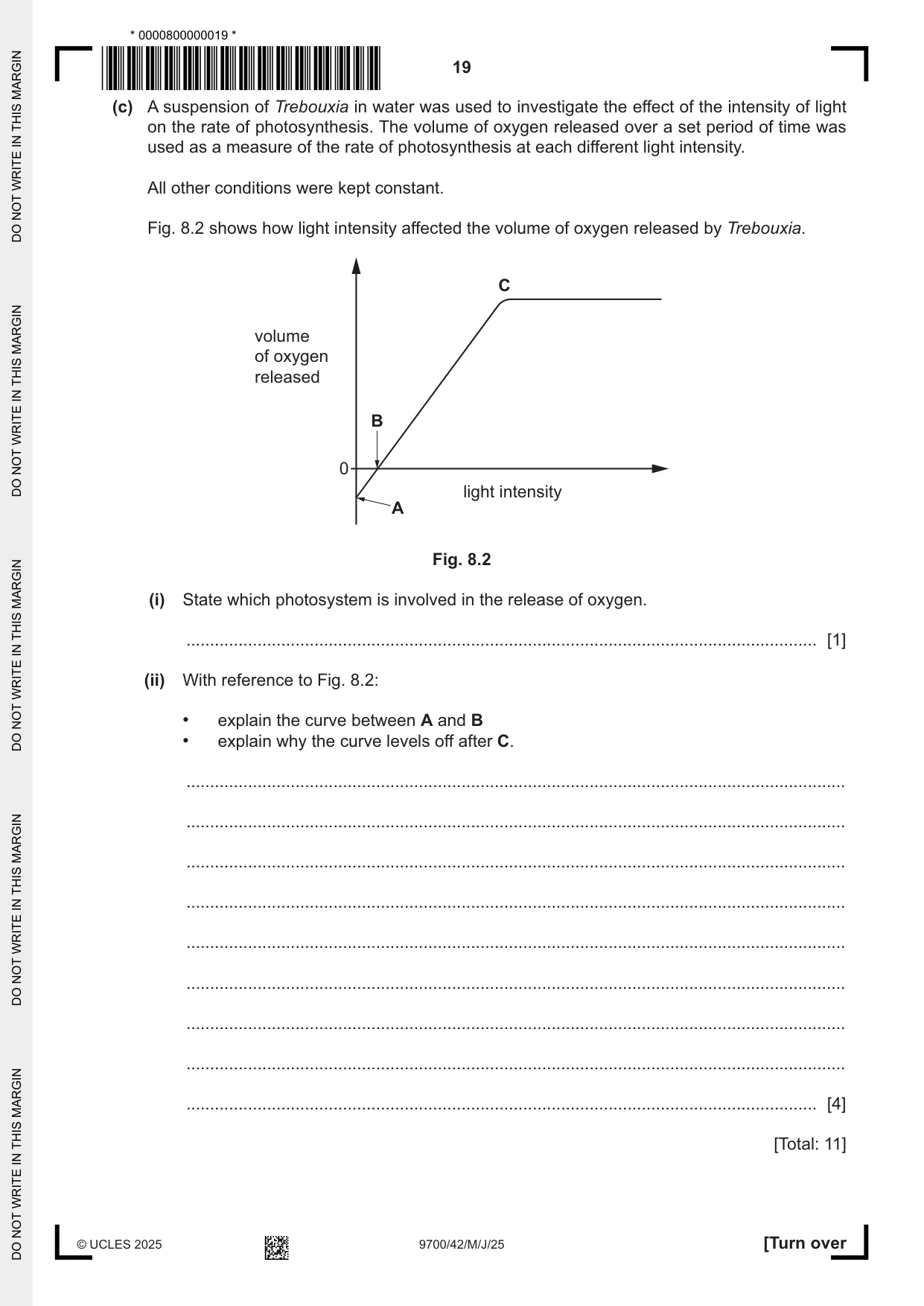
8 A lichen describes a mutually beneficial association of a fungus with an organism termed a photobiont. An example of a photobiont is the green alga, Trebouxia sp., which is a photosynthetic protoctist. Fig. 8.1 shows lichen attached to a tree. Fig. 8.1 (a) Outline the characteristic features of the kingdom Fungi. ................................................................................................................................................... ................................................................................................................................................... ................................................................................................................................................... ................................................................................................................................................... ................................................................................................................................................... ................................................................................................................................................... ................................................................................................................................................... ................................................................................................................................................... ............................................................................................................................................. [4] (b) Suggest how a fungus and a green alga benefit from the relationship shown by a lichen. ................................................................................................................................................... ................................................................................................................................................... ................................................................................................................................................... ............................................................................................................................................. [2] (c) A suspension of Trebouxia in water was used to investigate the effect of the intensity of light on the rate of photosynthesis. The volume of oxygen released over a set period of time was used as a measure of the rate of photosynthesis at each different light intensity. All other conditions were kept constant. Fig. 8.2 shows how light intensity affected the volume of oxygen released by Trebouxia. C volume of oxygen released B 0 light intensity A Fig. 8.2 (i) State which photosystem is involved in the release of oxygen. ..................................................................................................................................... [1] (ii) With reference to Fig. 8.2: • explain the curve between A and B • explain why the curve levels off after C. ........................................................................................................................................... ........................................................................................................................................... ........................................................................................................................................... ........................................................................................................................................... ........................................................................................................................................... ........................................................................................................................................... ........................................................................................................................................... ........................................................................................................................................... ..................................................................................................................................... [4] [Total: 11]
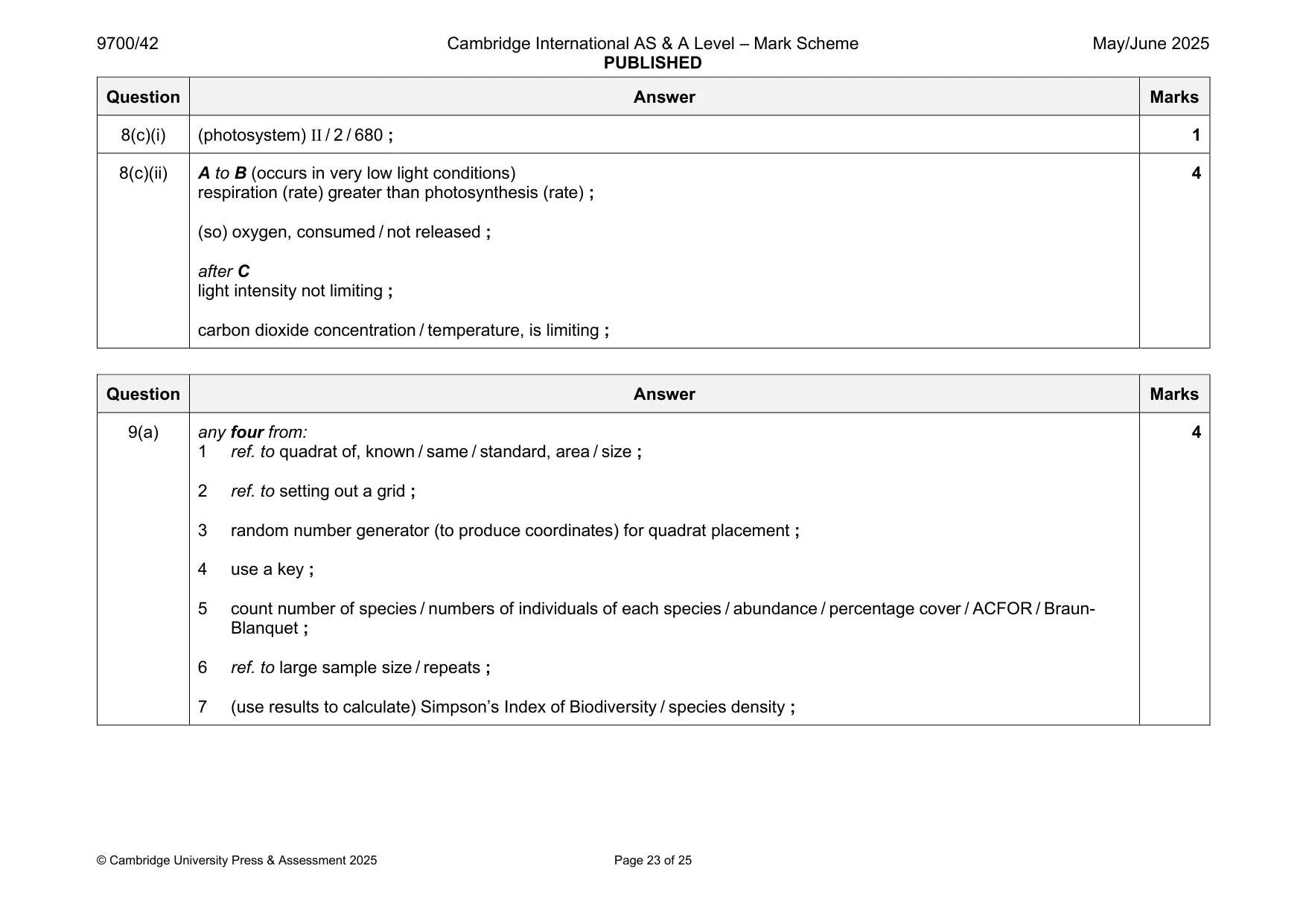
Mark scheme: 8(a) any four from: 4 1 eukaryotic / have nucleus ; 2 no, chlorophyll / chloroplasts ; 3 heterotrophic / saprophytic / saprotrophic / parasitic / described ; 4 cell wall made of, chitin / mannoproteins / glucans ; 5 reproduce by spores ; 6 hyphae / mycelium ; 7 cells may be multinucleate ; 8 either unicellular or multicellular ; 8(b) fungus receives, (named) organic compounds / nutrients / food / oxygen ; 2 alga receives, support / stability / protection / water / minerals / carbon dioxide ; 8(c)(i) (photosystem) II / 2 / 680 ; 1 8(c)(ii) A to B (occurs in very low light conditions) 4 respiration (rate) greater than photosynthesis (rate) ; (so) oxygen, consumed / not released ; after C light intensity not limiting ; carbon dioxide concentration / temperature, is limiting ;
Q9 · The biodiversity of an area can be assessed using a variety of sampling methods
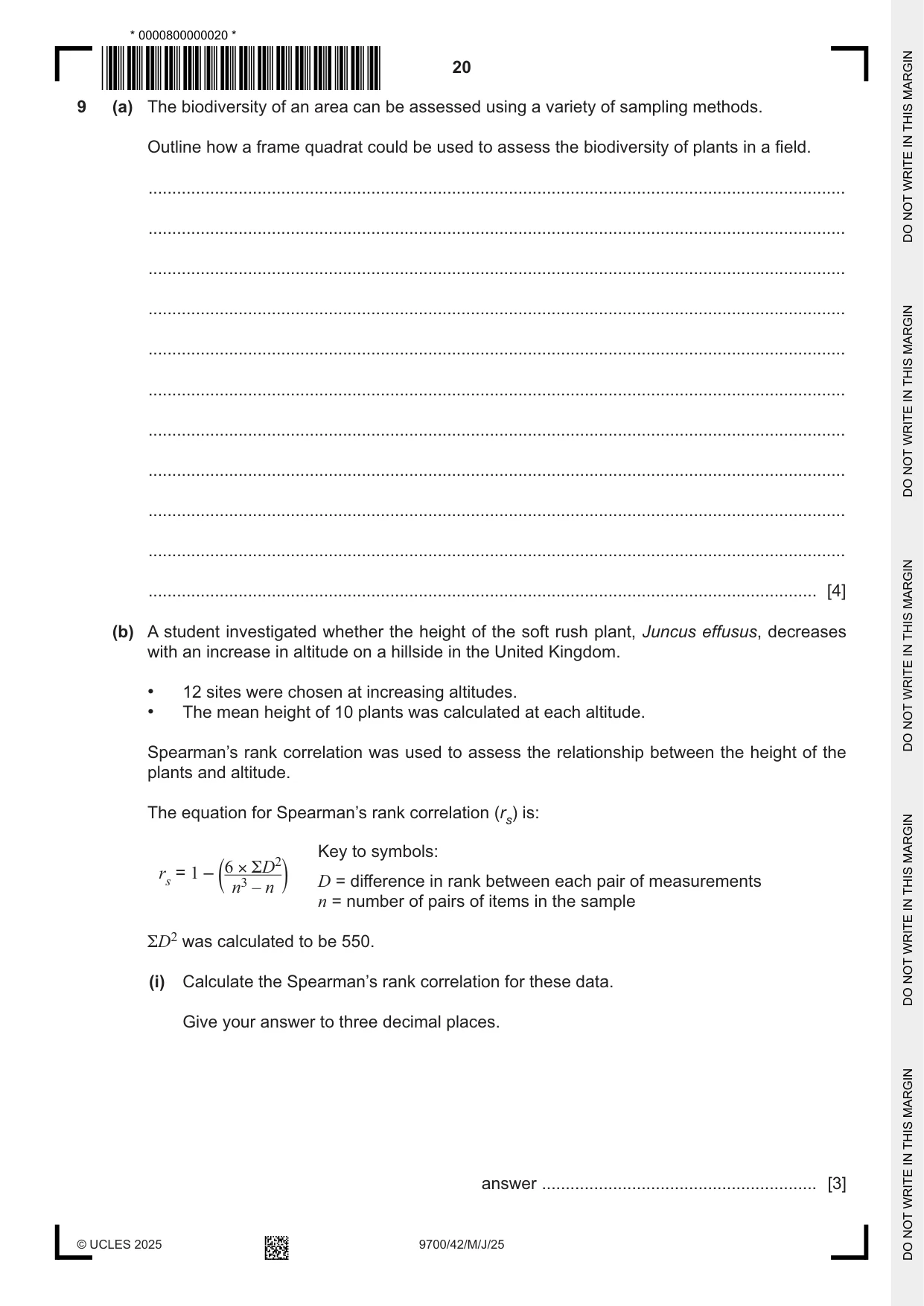
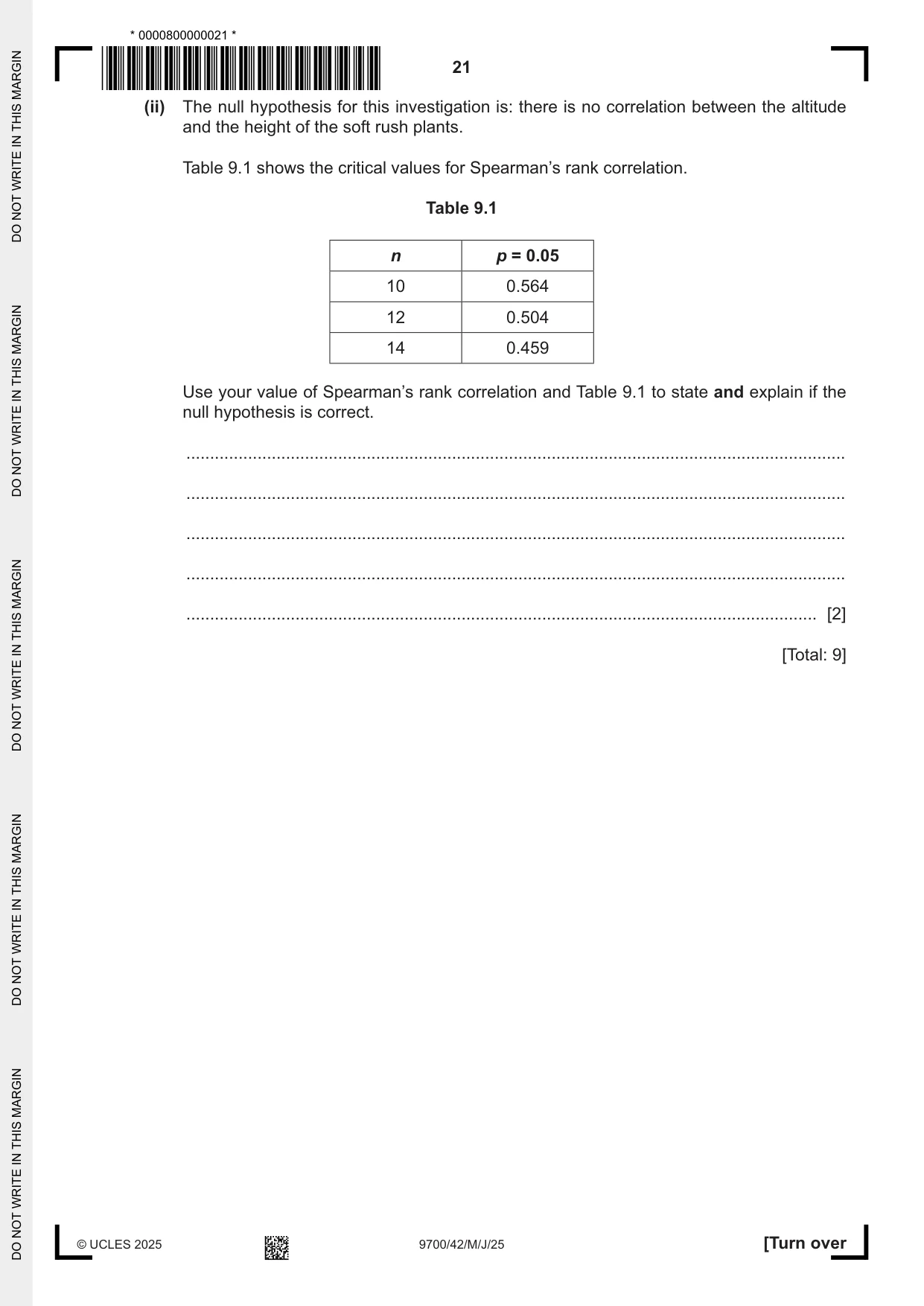
9 (a) The biodiversity of an area can be assessed using a variety of sampling methods. Outline how a frame quadrat could be used to assess the biodiversity of plants in a field. ................................................................................................................................................... ................................................................................................................................................... ................................................................................................................................................... ................................................................................................................................................... ................................................................................................................................................... ................................................................................................................................................... ................................................................................................................................................... ................................................................................................................................................... ................................................................................................................................................... ................................................................................................................................................... ............................................................................................................................................. [4] (b) A student investigated whether the height of the soft rush plant, Juncus effusus, decreases with an increase in altitude on a hillside in the United Kingdom. • 12 sites were chosen at increasing altitudes. • The mean height of 10 plants was calculated at each altitude. Spearman’s rank correlation was used to assess the relationship between the height of the plants and altitude. The equation for Spearman’s rank correlation (rs) is: Key to symbols: × ΣD2 rs = 1 – D = difference in rank between each pair of measurements (6n3 – n ) n = number of pairs of items in the sample ΣD2 was calculated to be 550. (i) Calculate the Spearman’s rank correlation for these data. Give your answer to three decimal places. answer .......................................................... [3] (ii) The null hypothesis for this investigation is: there is no correlation between the altitude and the height of the soft rush plants. Table 9.1 shows the critical values for Spearman’s rank correlation. Table 9.1 n p = 0.05 10 0.564 12 0.504 14 0.459 Use your value of Spearman’s rank correlation and Table 9.1 to state and explain if the null hypothesis is correct. ........................................................................................................................................... ........................................................................................................................................... ........................................................................................................................................... ........................................................................................................................................... ..................................................................................................................................... [2] [Total: 9]
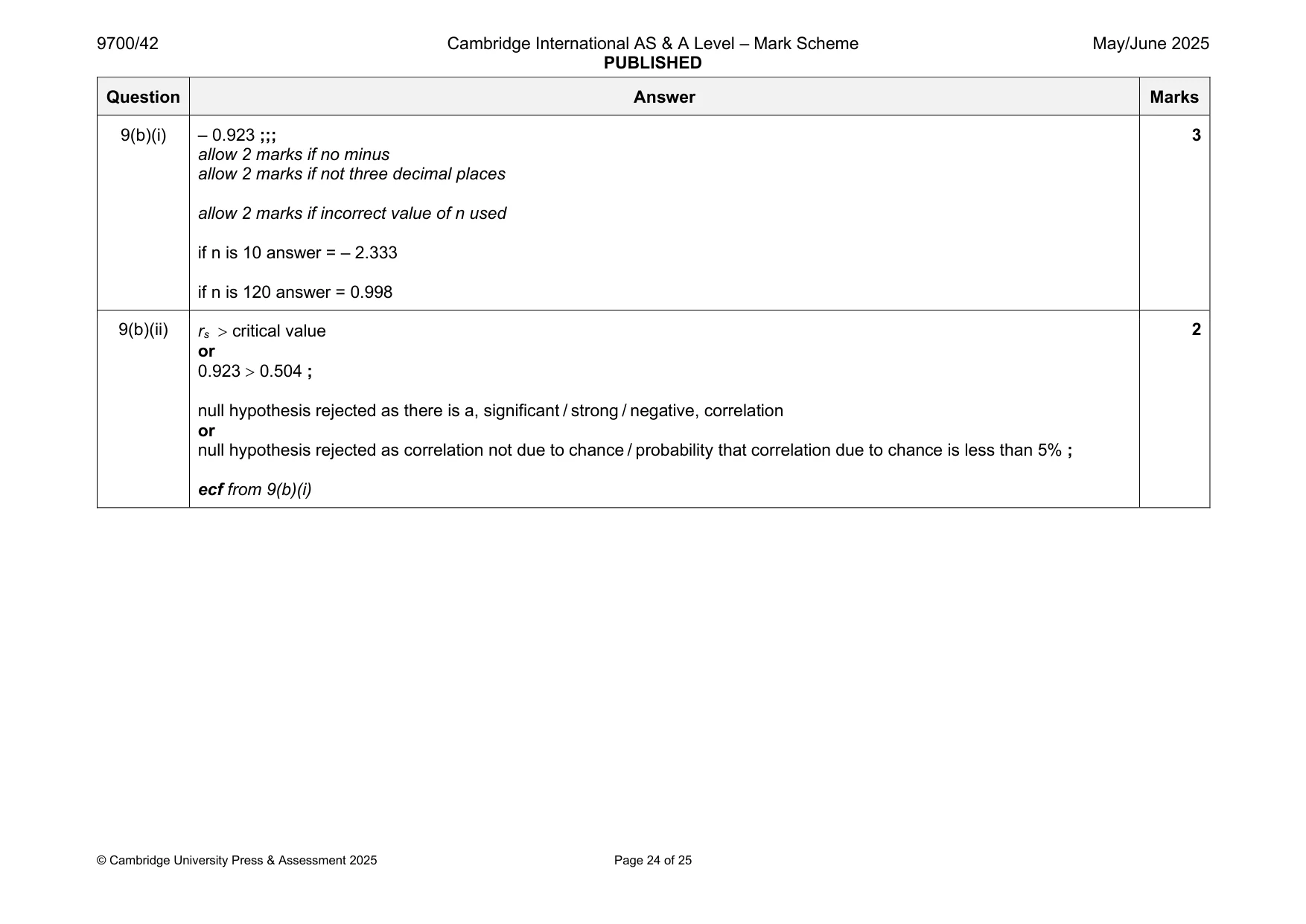
Mark scheme: 9(a) any four from: 4 1 ref. to quadrat of, known / same / standard, area / size ; 2 ref. to setting out a grid ; 3 random number generator (to produce coordinates) for quadrat placement ; 4 use a key ; 5 count number of species / numbers of individuals of each species / abundance / percentage cover / ACFOR / Braun- Blanquet ; 6 ref. to large sample size / repeats ; 7 (use results to calculate) Simpson’s Index of Biodiversity / species density ; 9(b)(i) – 0.923 ;;; 3 allow 2 marks if no minus allow 2 marks if not three decimal places allow 2 marks if incorrect value of n used if n is 10 answer = – 2.333 if n is 120 answer = 0.998 9(b)(ii) rs critical value 2 or 0.923 0.504 ; null hypothesis rejected as there is a, significant / strong / negative, correlation or null hypothesis rejected as correlation not due to chance / probability that correlation due to chance is less than 5% ; ecf from 9(b)(i)
Q10 · The grey seal, Halichoerus grypus, is an aquatic mammal that lives in the North Atlantic…
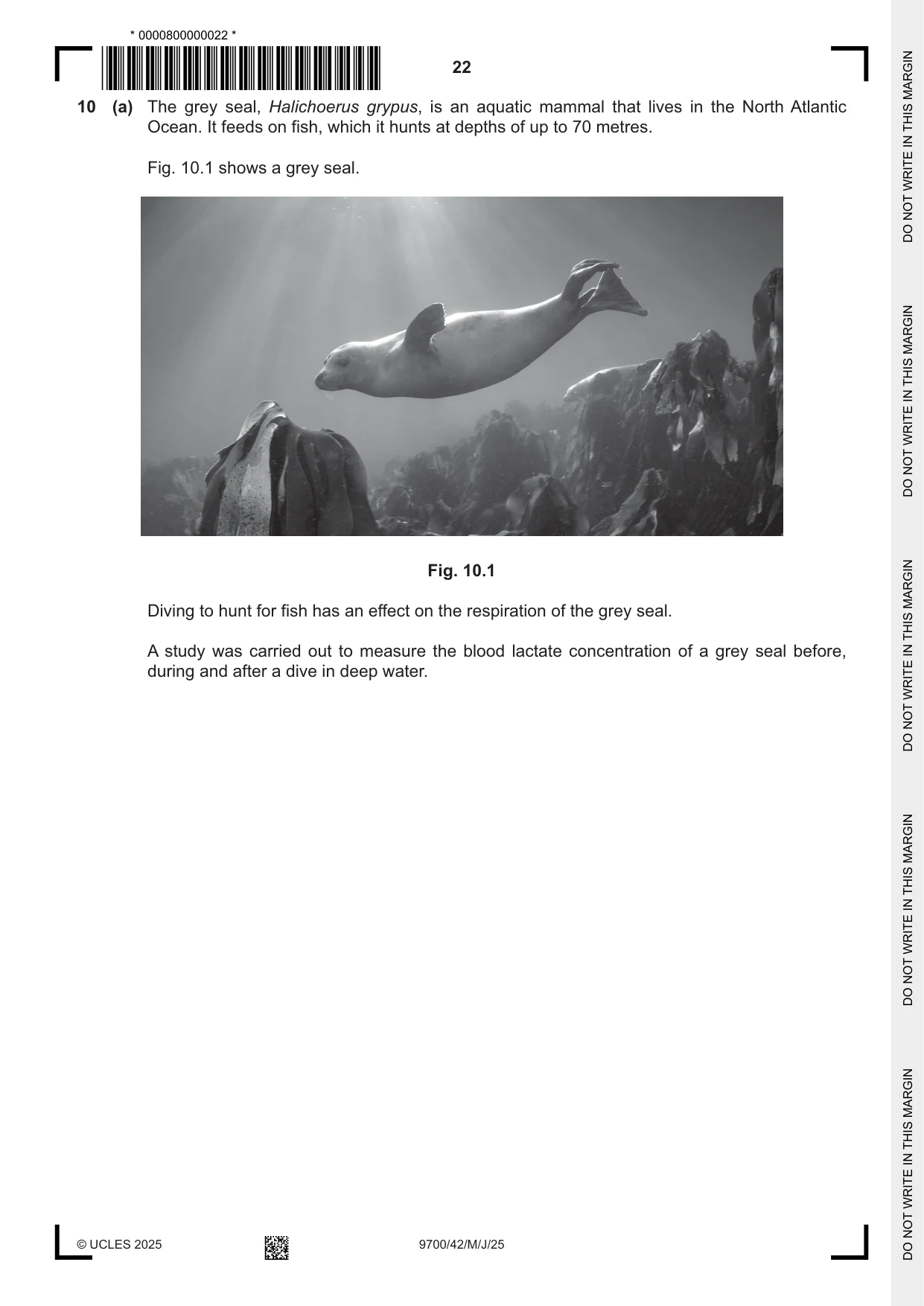
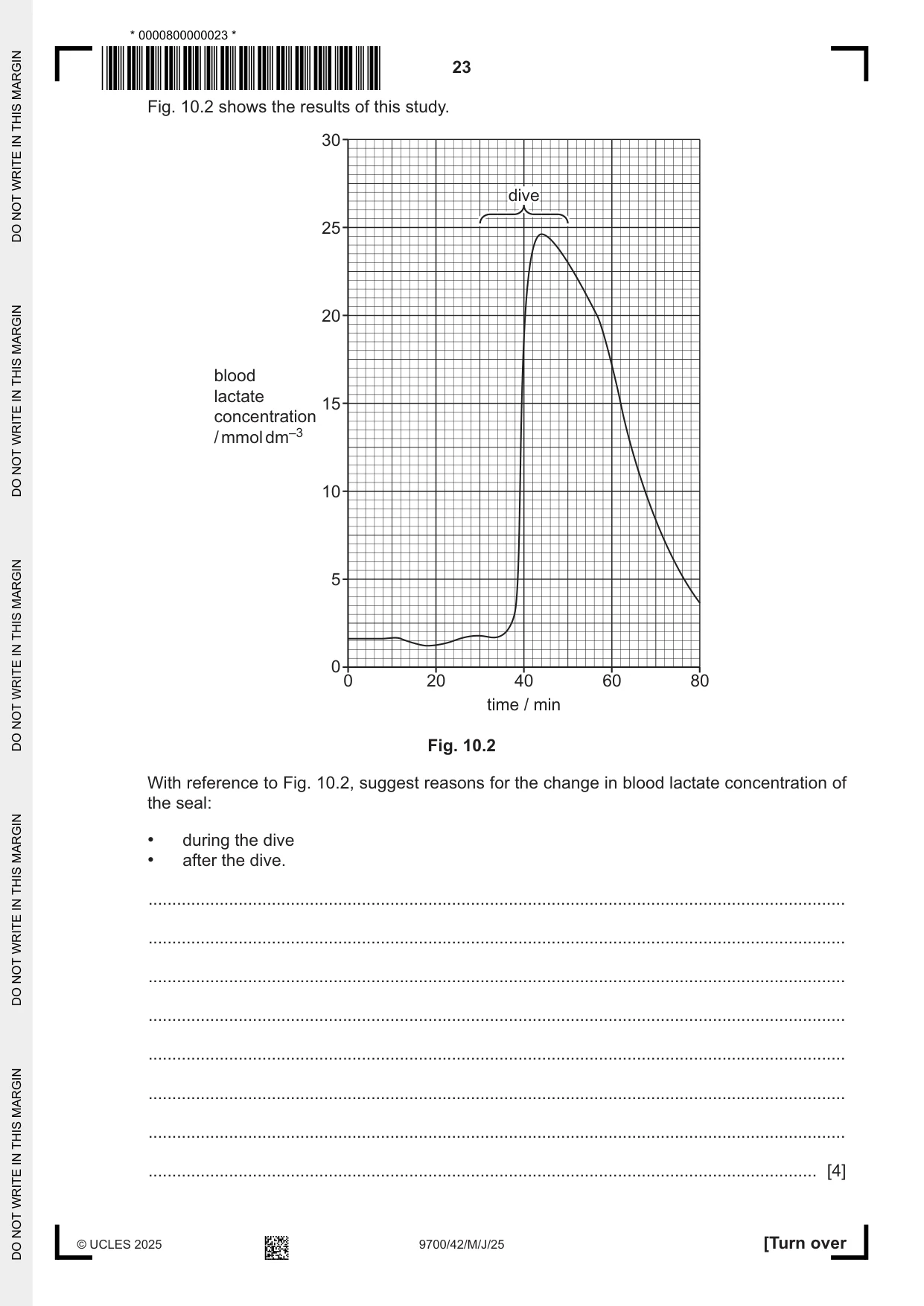
10 (a) The grey seal, Halichoerus grypus, is an aquatic mammal that lives in the North Atlantic Ocean. It feeds on fish, which it hunts at depths of up to 70 metres. Fig. 10.1 shows a grey seal. Fig. 10.1 Diving to hunt for fish has an effect on the respiration of the grey seal. A study was carried out to measure the blood lactate concentration of a grey seal before, during and after a dive in deep water. Fig. 10.2 shows the results of this study. 30 dive 25 20 blood lactate 15 concentration / mmol dm–3 10 5 0 0 20 40 60 80 time / min Fig. 10.2 With reference to Fig. 10.2, suggest reasons for the change in blood lactate concentration of the seal: • during the dive • after the dive. ................................................................................................................................................... ................................................................................................................................................... ................................................................................................................................................... ................................................................................................................................................... ................................................................................................................................................... ................................................................................................................................................... ................................................................................................................................................... ............................................................................................................................................. [4] (b) Some seal species are classified as endangered on the IUCN Red List of Threatened SpeciesTM. Suggest ways in which seal species may be conserved. ................................................................................................................................................... ................................................................................................................................................... ................................................................................................................................................... ................................................................................................................................................... ................................................................................................................................................... ................................................................................................................................................... ................................................................................................................................................... ............................................................................................................................................. [3] [Total: 7] The boundaries and names shown, the designations used and the presentation of material on any maps contained in this question paper/insert do not imply official endorsement or acceptance by Cambridge Assessment International Education concerning the legal status of any country, territory, or area or any of its authorities, or of the delimitation of its frontiers or boundaries.
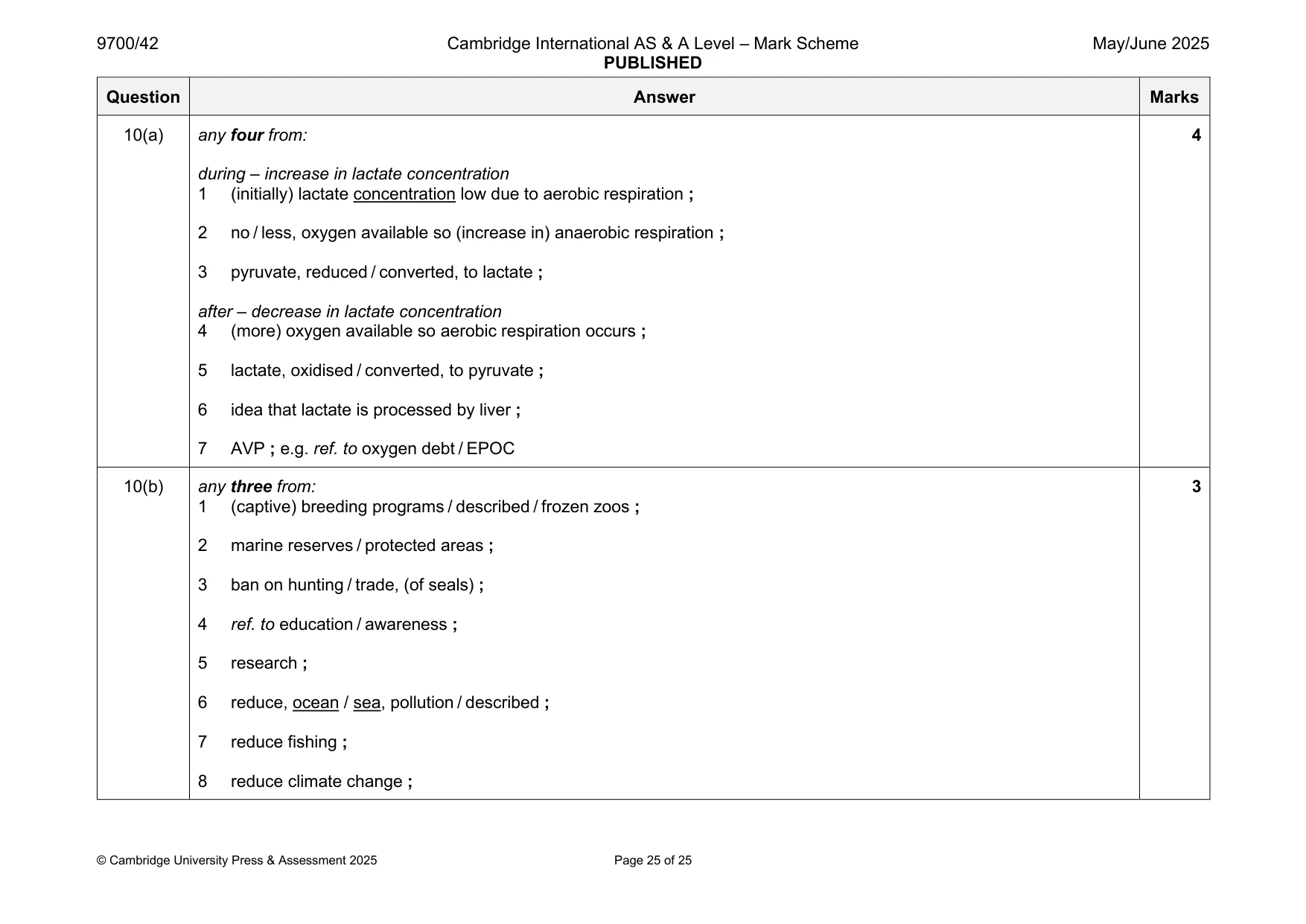
Mark scheme: 10(a) any four from: 4 during – increase in lactate concentration 1 (initially) lactate concentration low due to aerobic respiration ; 2 no / less, oxygen available so (increase in) anaerobic respiration ; 3 pyruvate, reduced / converted, to lactate ; after – decrease in lactate concentration 4 (more) oxygen available so aerobic respiration occurs ; 5 lactate, oxidised / converted, to pyruvate ; 6 idea that lactate is processed by liver ; 7 AVP ; e.g. ref. to oxygen debt / EPOC 10(b) any three from: 3 1 (captive) breeding programs / described / frozen zoos ; 2 marine reserves / protected areas ; 3 ban on hunting / trade, (of seals) ; 4 ref. to education / awareness ; 5 research ; 6 reduce, ocean / sea, pollution / described ; 7 reduce fishing ; 8 reduce climate change ;
What was in this paper
The subtopics covered by these 10 questions, and how many questions each got. Open one in a new tab to see every Cambridge question on it.
What you needed in this session
Cambridge’s own grade thresholds for 2025 May/June, Paper 4 · Variant 2. A higher threshold means an easier paper — the bar moves with how the cohort did.