Cambridge A Level Biology 9700 — 2025 May/June Paper 4 · Variant 3
9700/43/M/J/25 · 10 questions · 100 marks · 120 min
The question paper and its mark scheme, free to read here and free to download. This is Cambridge’s own paper, exactly as it was sat.
Question paper24 pages

Mark scheme20 pages
Answers below. Sit the paper first if you are practising.
Questions as text
Q1 · A diagram of part of a liver cell
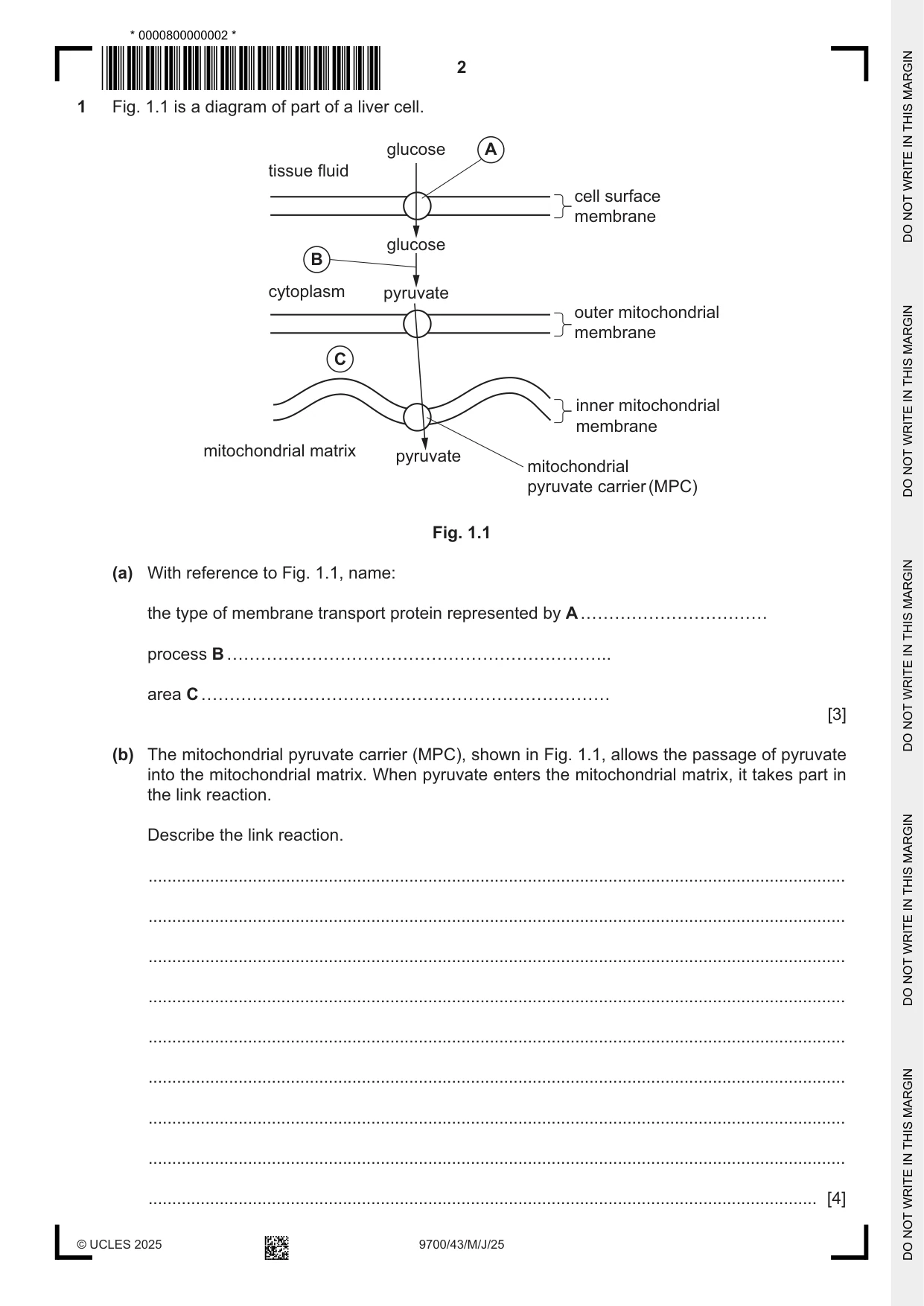
1 Fig. 1.1 is a diagram of part of a liver cell. glucose A tissue fluid cell surface membrane glucose B cytoplasm pyruvate outer mitochondrial membrane C inner mitochondrial membrane mitochondrial matrix pyruvate mitochondrial pyruvate carrier (MPC) Fig. 1.1 (a) With reference to Fig. 1.1, name: the type of membrane transport protein represented by A …………………………… process B ………………………………………………………….. area C ……………………………………………………………… [3] (b) The mitochondrial pyruvate carrier (MPC), shown in Fig. 1.1, allows the passage of pyruvate into the mitochondrial matrix. When pyruvate enters the mitochondrial matrix, it takes part in the link reaction. Describe the link reaction. ................................................................................................................................................... ................................................................................................................................................... ................................................................................................................................................... ................................................................................................................................................... ................................................................................................................................................... ................................................................................................................................................... ................................................................................................................................................... ................................................................................................................................................... ............................................................................................................................................. [4] (c) Some tumour cells have a greatly reduced ability to transport pyruvate into the matrix of the mitochondrion. Suggest how a reduction in pyruvate transport could affect respiration in these tumour cells. ................................................................................................................................................... ................................................................................................................................................... ................................................................................................................................................... ................................................................................................................................................... ................................................................................................................................................... ................................................................................................................................................... ............................................................................................................................................. [3] [Total: 10]
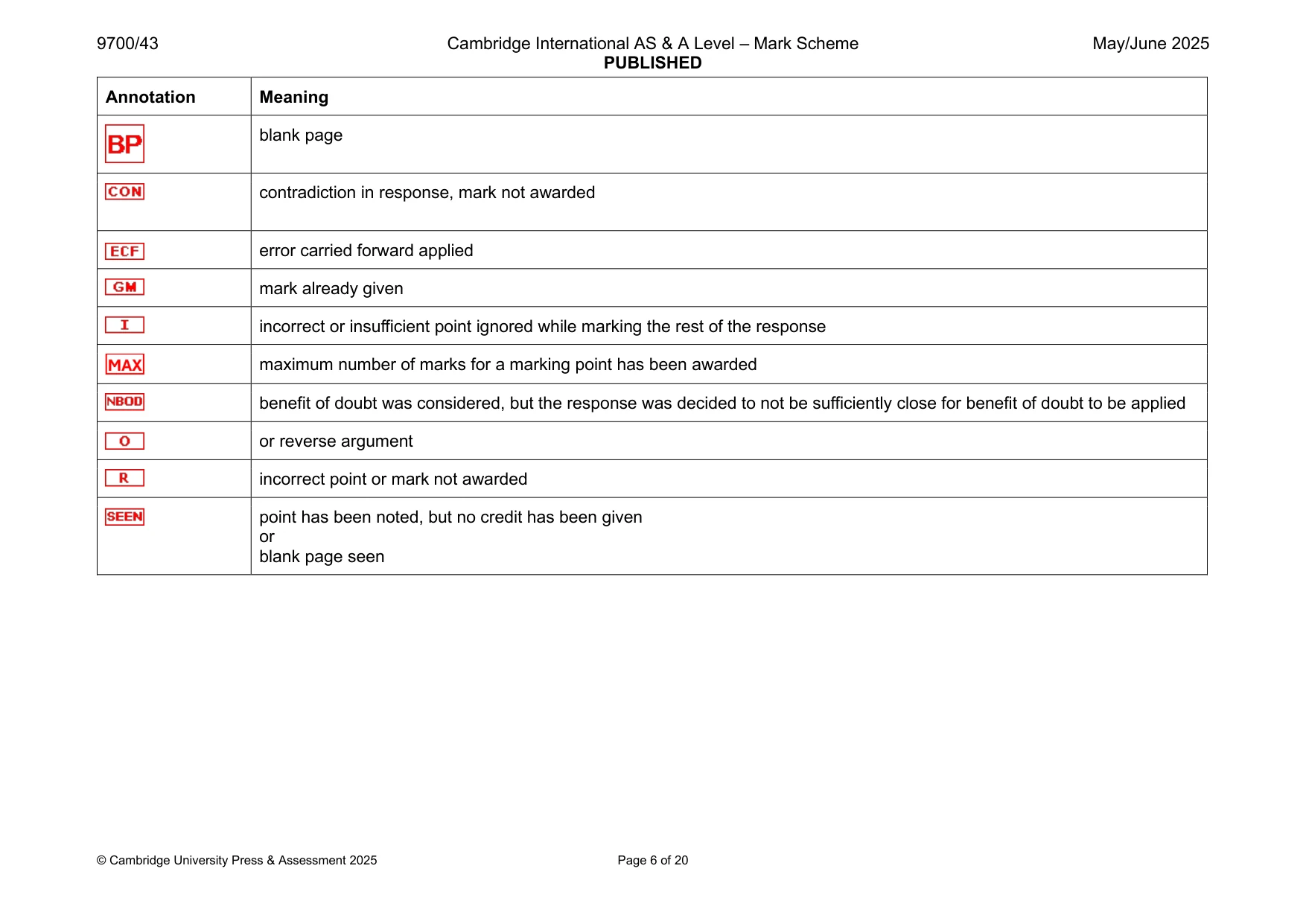
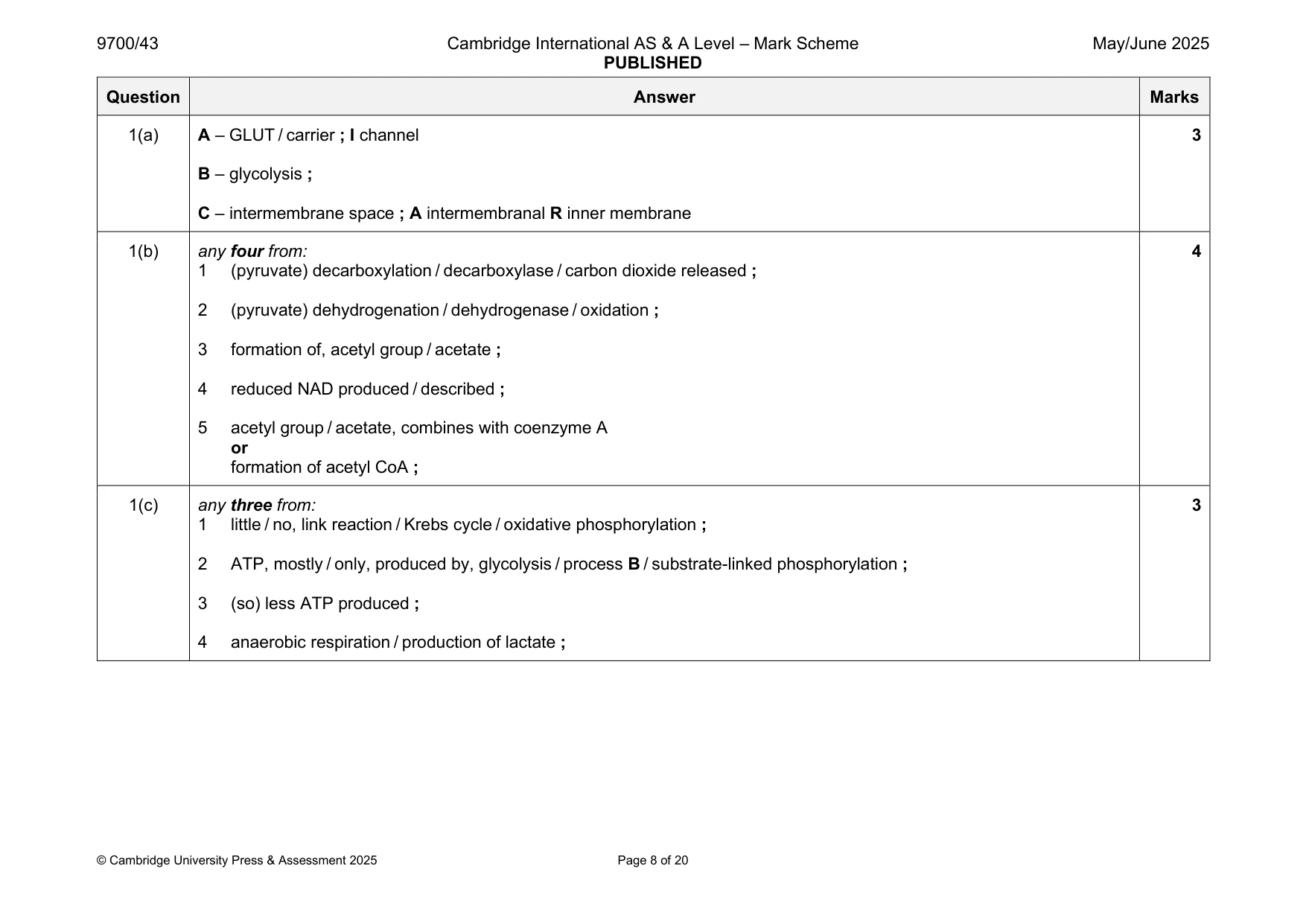
Mark scheme: Question Answer Marks 1(a) A – GLUT / carrier ; I channel 3 B – glycolysis ; C – intermembrane space ; A intermembranal R inner membrane 1(b) any four from: 4 1 (pyruvate) decarboxylation / decarboxylase / carbon dioxide released ; 2 (pyruvate) dehydrogenation / dehydrogenase / oxidation ; 3 formation of, acetyl group / acetate ; 4 reduced NAD produced / described ; 5 acetyl group / acetate, combines with coenzyme A or formation of acetyl CoA ; 1(c) any three from: 3 1 little / no, link reaction / Krebs cycle / oxidative phosphorylation ; 2 ATP, mostly / only, produced by, glycolysis / process B / substrate-linked phosphorylation ; 3 (so) less ATP produced ; 4 anaerobic respiration / production of lactate ;
Q2 · Natural selection and selective breeding (artificial selection) are processes that result…
2 Natural selection and selective breeding (artificial selection) are processes that result in changes in the gene pool of a population. Natural selection and selective breeding have implications for humans. (a) If a person with a bacterial infection does not finish the course of an antibiotic given, it provides the conditions for a population of bacteria to become resistant to this antibiotic. (i) A mutation in a bacterial gene can give resistance to an antibiotic. Directional selection can occur when the antibiotic is present in the environment. A bacterium can also gain resistance when it receives genetic material from another bacterium in a process known as horizontal gene transfer. Outline how directional selection and horizontal gene transfer result in a new population of bacteria that is resistant to an antibiotic. ........................................................................................................................................... ........................................................................................................................................... ........................................................................................................................................... ........................................................................................................................................... ........................................................................................................................................... ........................................................................................................................................... ........................................................................................................................................... ..................................................................................................................................... [4] (ii) Some bacterial diseases can be treated only with one antibiotic, because the bacterial pathogens are resistant to all other antibiotics. A drug is being developed to help treatment. • The drug is a small polynucleotide. • The drug inhibits translation of the messenger RNA (mRNA) produced by transcription of the gene associated with antibiotic resistance. • The bacteria are then susceptible to more antibiotics. Suggest and explain how the drug could cause bacteria to become susceptible to more antibiotics. ........................................................................................................................................... ........................................................................................................................................... ........................................................................................................................................... ........................................................................................................................................... ..................................................................................................................................... [2] (b) (i) Outline how natural selection differs from selective breeding. ........................................................................................................................................... ........................................................................................................................................... ........................................................................................................................................... ........................................................................................................................................... ........................................................................................................................................... ........................................................................................................................................... ........................................................................................................................................... ........................................................................................................................................... ..................................................................................................................................... [3] (ii) Selective breeding is used to produce uniform varieties of maize. The maize plants in a crop ripen at the same time and are the same height. The advantage of this is that harvesting is easy and quick. The disadvantage is that farmers must buy new seeds each year. Explain why farmers must buy new seeds each year. ........................................................................................................................................... ........................................................................................................................................... ........................................................................................................................................... ..................................................................................................................................... [2] [Total: 11]
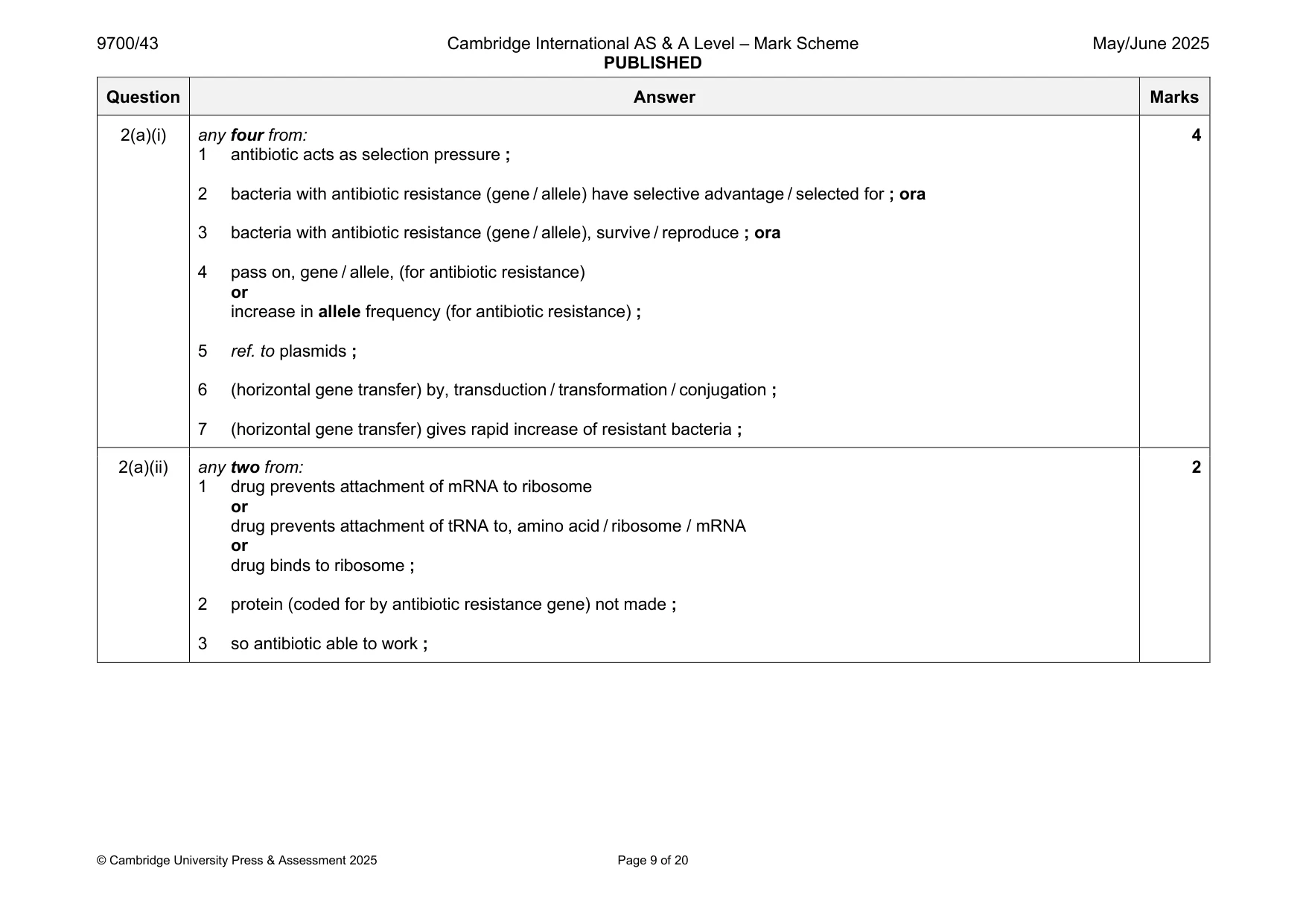
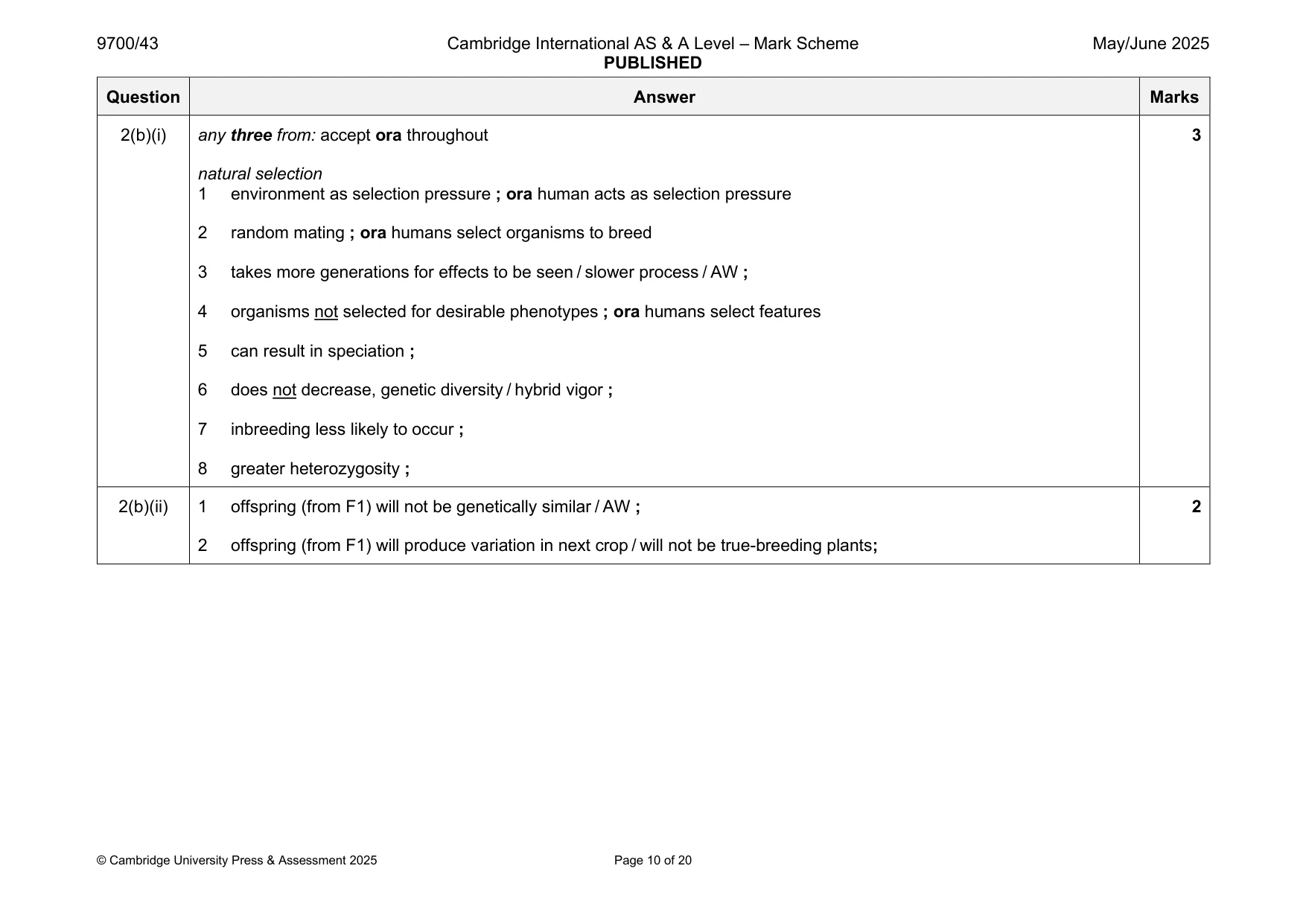
Mark scheme: 2(a)(i) any four from: 4 1 antibiotic acts as selection pressure ; 2 bacteria with antibiotic resistance (gene / allele) have selective advantage / selected for ; ora 3 bacteria with antibiotic resistance (gene / allele), survive / reproduce ; ora 4 pass on, gene / allele, (for antibiotic resistance) or increase in allele frequency (for antibiotic resistance) ; 5 ref. to plasmids ; 6 (horizontal gene transfer) by, transduction / transformation / conjugation ; 7 (horizontal gene transfer) gives rapid increase of resistant bacteria ; 2(a)(ii) any two from: 2 1 drug prevents attachment of mRNA to ribosome or drug prevents attachment of tRNA to, amino acid / ribosome / mRNA or drug binds to ribosome ; 2 protein (coded for by antibiotic resistance gene) not made ; 3 so antibiotic able to work ; 2(b)(i) any three from: accept ora throughout 3 natural selection 1 environment as selection pressure ; ora human acts as selection pressure 2 random mating ; ora humans select organisms to breed 3 takes more generations for effects to be seen / slower process / AW ; 4 organisms not selected for desirable phenotypes ; ora humans select features 5 can result in speciation ; 6 does not decrease, genetic diversity / hybrid vigor ; 7 inbreeding less likely to occur ; 8 greater heterozygosity ; 2(b)(ii) 1 offspring (from F1) will not be genetically similar / AW ; 2 2 offspring (from F1) will produce variation in next crop / will not be true-breeding plants;
Q3 · An operon is a section of DNA found in prokaryotes
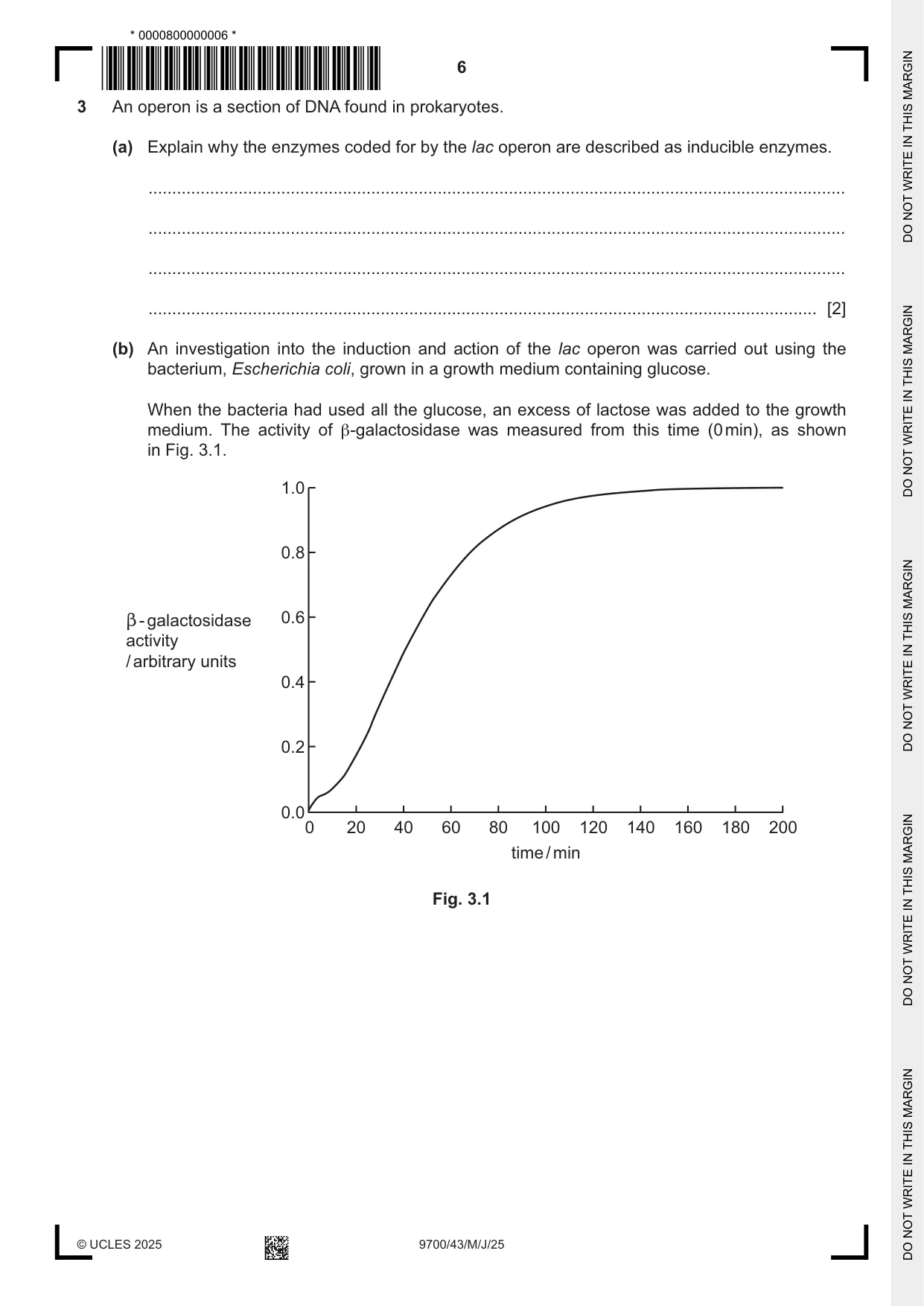
3 An operon is a section of DNA found in prokaryotes. (a) Explain why the enzymes coded for by the lac operon are described as inducible enzymes. ................................................................................................................................................... ................................................................................................................................................... ................................................................................................................................................... ............................................................................................................................................. [2] (b) An investigation into the induction and action of the lac operon was carried out using the bacterium, Escherichia coli, grown in a growth medium containing glucose. When the bacteria had used all the glucose, an excess of lactose was added to the growth medium. The activity of β-galactosidase was measured from this time (0 min), as shown in Fig. 3.1. 1.0 0.8 b - galactosidase 0.6 activity / arbitrary units 0.4 0.2 0.0 0 20 40 60 80 100 120 140 160 180 200 time / min Fig. 3.1 With reference to the lac operon, explain the shape of the curve in Fig. 3.1. ................................................................................................................................................... ................................................................................................................................................... ................................................................................................................................................... ................................................................................................................................................... ................................................................................................................................................... ................................................................................................................................................... ................................................................................................................................................... ................................................................................................................................................... ................................................................................................................................................... ................................................................................................................................................... ................................................................................................................................................... ................................................................................................................................................... ................................................................................................................................................... ................................................................................................................................................... ................................................................................................................................................... ................................................................................................................................................... ............................................................................................................................................. [7] [Total: 9]
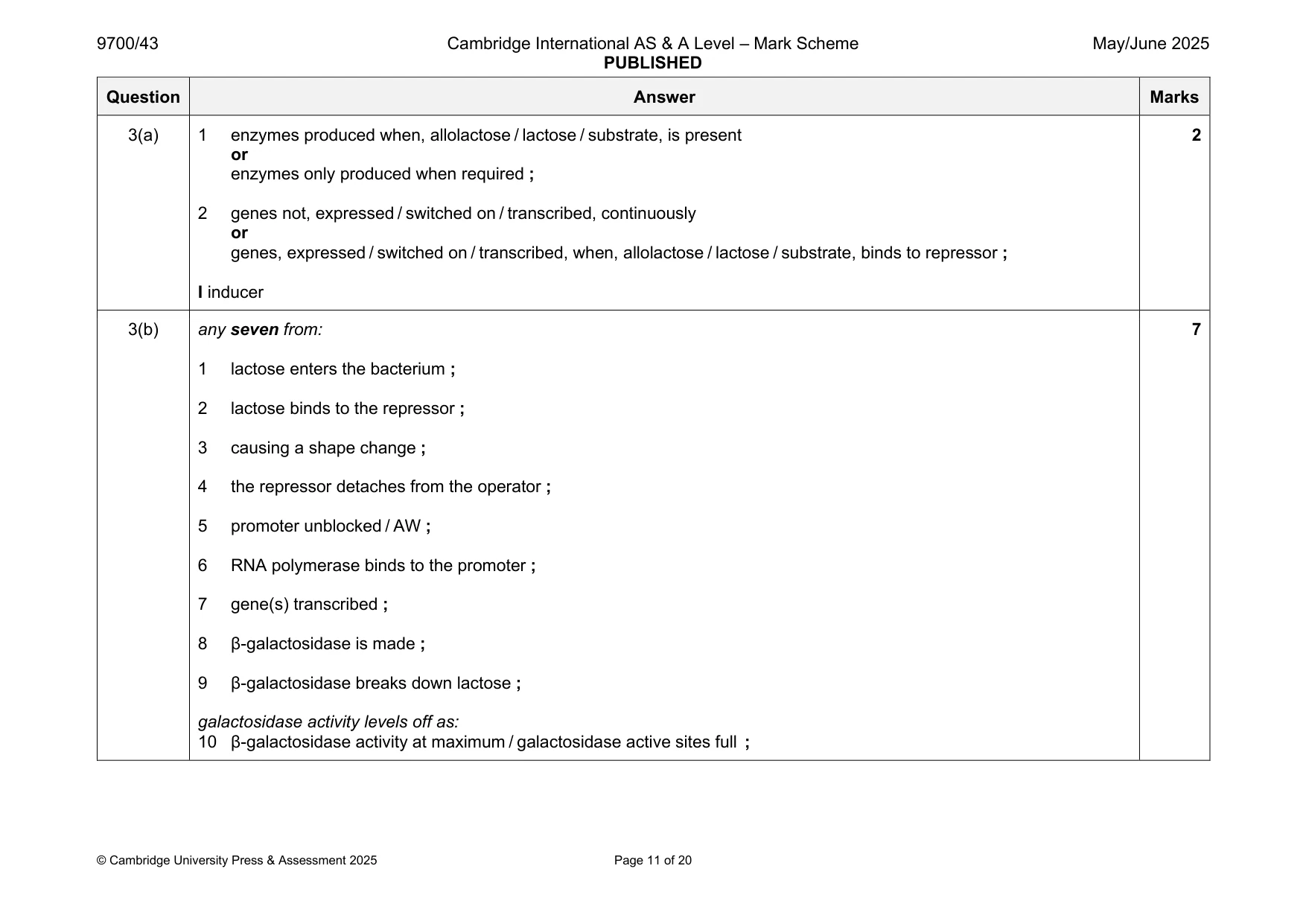
Mark scheme: 3(a) 1 enzymes produced when, allolactose / lactose / substrate, is present 2 or enzymes only produced when required ; 2 genes not, expressed / switched on / transcribed, continuously or genes, expressed / switched on / transcribed, when, allolactose / lactose / substrate, binds to repressor ; I inducer 3(b) any seven from: 7 1 lactose enters the bacterium ; 2 lactose binds to the repressor ; 3 causing a shape change ; 4 the repressor detaches from the operator ; 5 promoter unblocked / AW ; 6 RNA polymerase binds to the promoter ; 7 gene(s) transcribed ; 8 β-galactosidase is made ; 9 β-galactosidase breaks down lactose ; galactosidase activity levels off as: 10 β-galactosidase activity at maximum / galactosidase active sites full ;
Q4 · The Grand Canyon is located in Arizona, USA
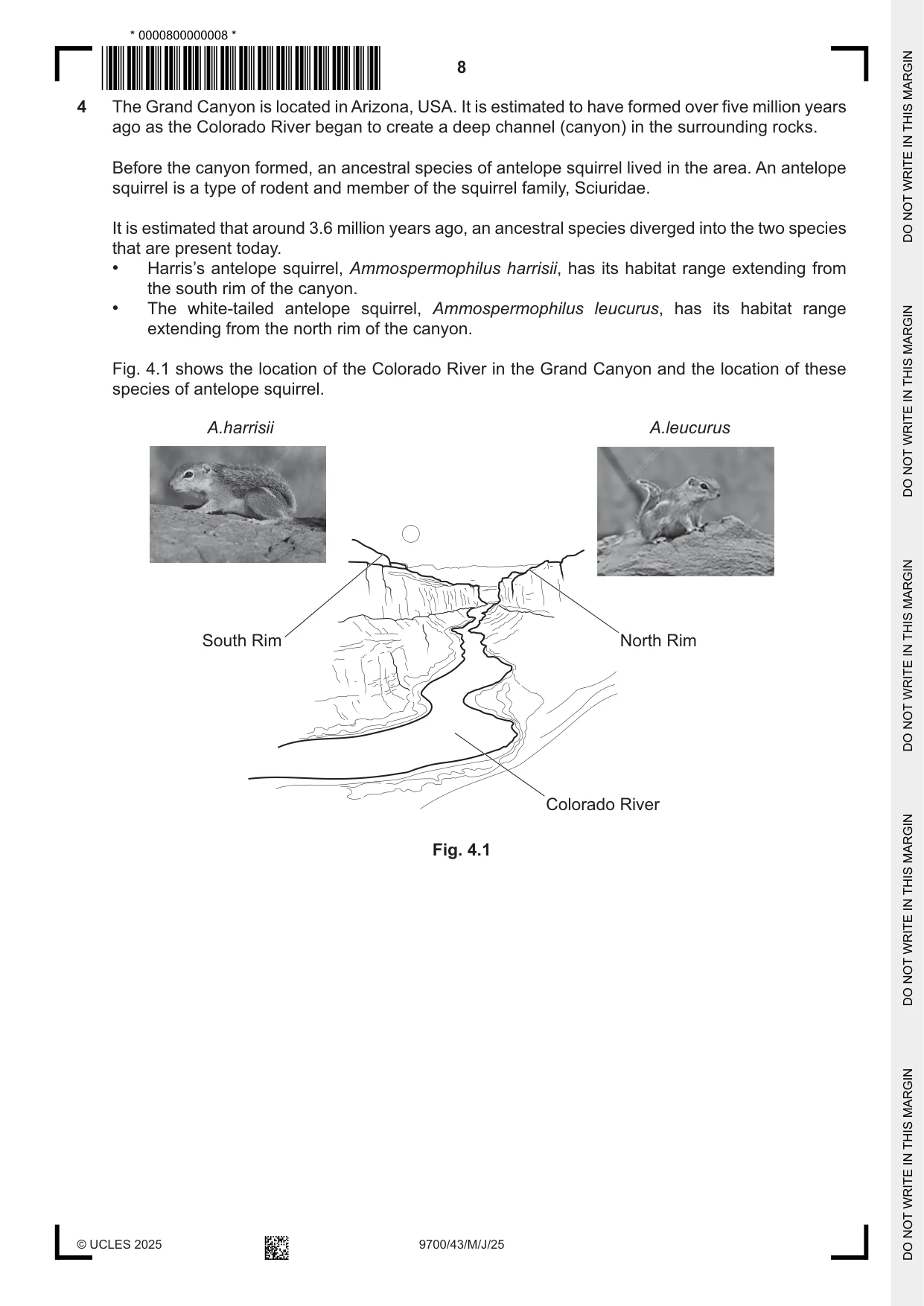
4 The Grand Canyon is located in Arizona, USA. It is estimated to have formed over five million years ago as the Colorado River began to create a deep channel (canyon) in the surrounding rocks. Before the canyon formed, an ancestral species of antelope squirrel lived in the area. An antelope squirrel is a type of rodent and member of the squirrel family, Sciuridae. It is estimated that around 3.6 million years ago, an ancestral species diverged into the two species that are present today. • Harris’s antelope squirrel, Ammospermophilus harrisii, has its habitat range extending from the south rim of the canyon. • The white-tailed antelope squirrel, Ammospermophilus leucurus, has its habitat range extending from the north rim of the canyon. Fig. 4.1 shows the location of the Colorado River in the Grand Canyon and the location of these species of antelope squirrel. A.harrisii A.leucurus South Rim North Rim Colorado River Fig. 4.1 (a) Suggest and explain how A. harrisii and A. leucurus evolved from an ancestral species. ................................................................................................................................................... ................................................................................................................................................... ................................................................................................................................................... ................................................................................................................................................... ................................................................................................................................................... ................................................................................................................................................... ................................................................................................................................................... ............................................................................................................................................. [4] (b) Scientists investigated the evolutionary relationships of the squirrel family, Sciuridae. The scientists took samples from the current species in the family and carried out DNA sequencing and morphological analysis. To compare current species with species from the past: • specimens from museums were used to provide the tissue for DNA sequencing • teeth and skulls from fossils were compared as part of the morphological analysis. Describe the advantages of using DNA sequencing rather than morphological analysis to find out more about the evolutionary relationships of the squirrel family. ................................................................................................................................................... ................................................................................................................................................... ................................................................................................................................................... ................................................................................................................................................... ................................................................................................................................................... ................................................................................................................................................... ............................................................................................................................................. [3] (c) The estimate for the date that an ancestral species diverged into A. harrisii and A. leucurus is 3.58 million years ago. This estimate has a large uncertainty. DNA sequencing, including DNA from fossils, was used to estimate this date of divergence. Suggest a reason why there is such a large uncertainty for this date estimate. ................................................................................................................................................... ............................................................................................................................................. [1] [Total: 8]
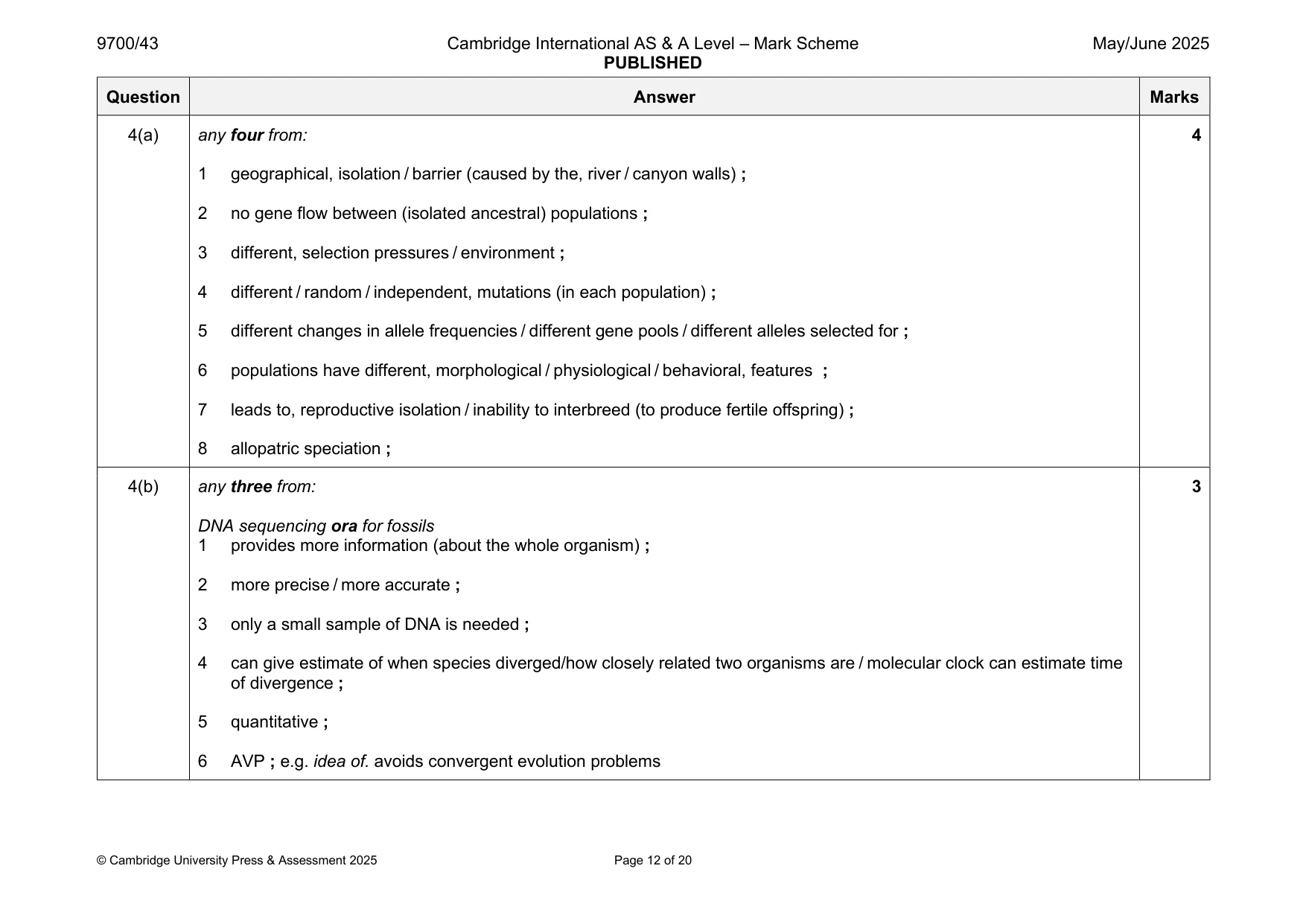
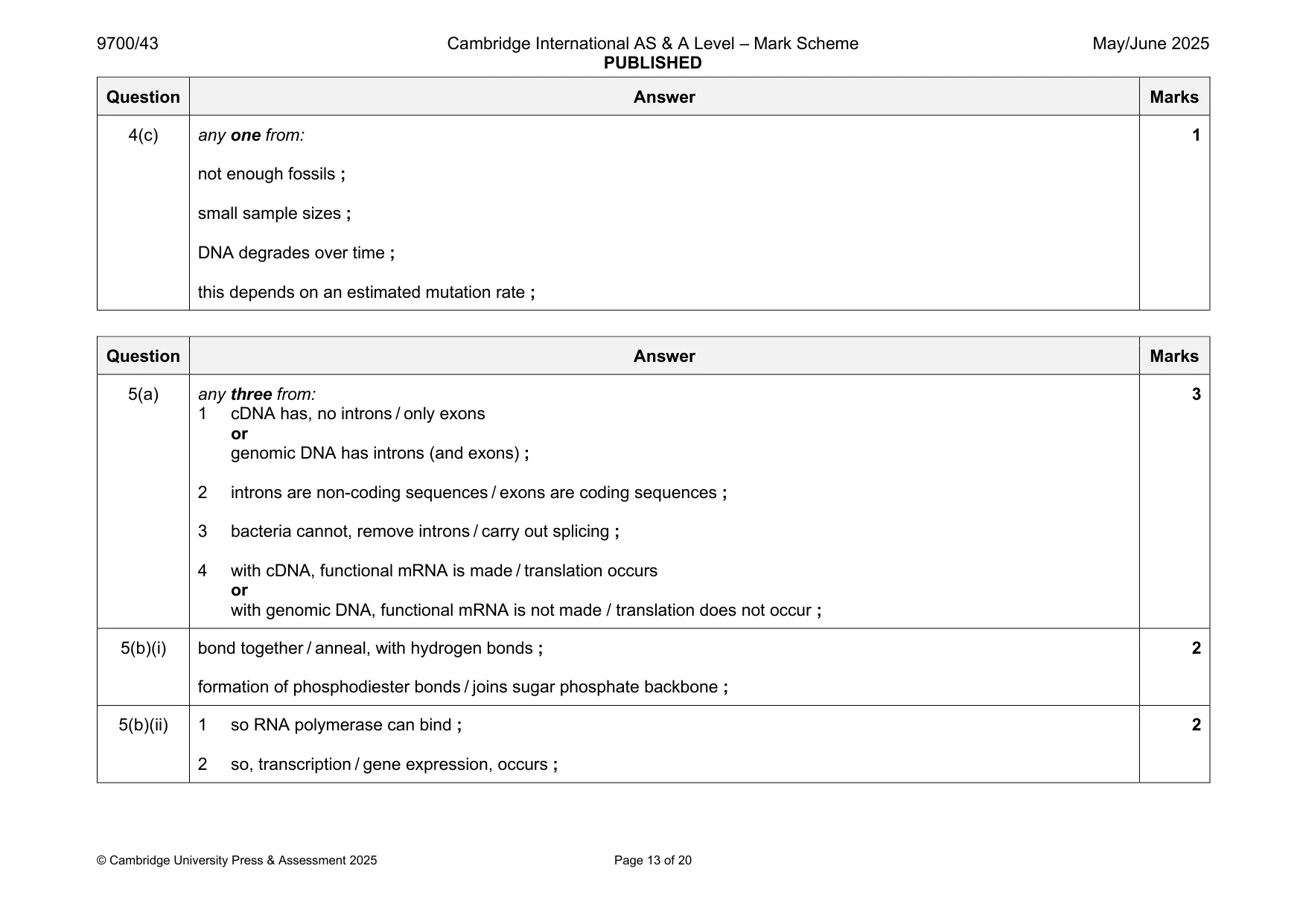
Mark scheme: 4(a) any four from: 4 1 geographical, isolation / barrier (caused by the, river / canyon walls) ; 2 no gene flow between (isolated ancestral) populations ; 3 different, selection pressures / environment ; 4 different / random / independent, mutations (in each population) ; 5 different changes in allele frequencies / different gene pools / different alleles selected for ; 6 populations have different, morphological / physiological / behavioral, features ; 7 leads to, reproductive isolation / inability to interbreed (to produce fertile offspring) ; 8 allopatric speciation ; 4(b) any three from: 3 DNA sequencing ora for fossils 1 provides more information (about the whole organism) ; 2 more precise / more accurate ; 3 only a small sample of DNA is needed ; 4 can give estimate of when species diverged/how closely related two organisms are / molecular clock can estimate time of divergence ; 5 quantitative ; 6 AVP ; e.g. idea of. avoids convergent evolution problems 4(c) any one from: 1 not enough fossils ; small sample sizes ; DNA degrades over time ; this depends on an estimated mutation rate ;
Q5 · Recombinant DNA technology is used to make recombinant human proteins
5 Recombinant DNA technology is used to make recombinant human proteins. Two of the available methods to obtain the gene of interest are: • cutting the gene out of genomic DNA using restriction enzymes • obtaining messenger RNA (mRNA) from cells that are expressing the gene and then using reverse transcriptase to make complementary DNA (cDNA). Plasmids can be used as vectors to transfer the gene of interest into a host organism. (a) Recombinant human insulin is a protein that is made using recombinant DNA technology. Bacteria can be used as host cells to express the recombinant protein. For the human insulin gene to be successfully expressed in bacteria, one method chosen to obtain the gene is to extract mRNA from β-cells in the pancreas. The gene coding for insulin is not expressed in the bacterial host when it has been obtained by cutting it out of genomic DNA. Suggest and explain how the structural difference of cDNA and genomic DNA leads to only cDNA being expressed successfully. ................................................................................................................................................... ................................................................................................................................................... ................................................................................................................................................... ................................................................................................................................................... ................................................................................................................................................... ................................................................................................................................................... ............................................................................................................................................. [3] (b) Plasmids are cut using a restriction enzyme to create sticky ends. The plasmids are mixed with many copies of the desired gene and DNA ligase. The gene is inserted into many plasmids. (i) State the role of DNA ligase in the formation of recombinant plasmids. ........................................................................................................................................... ........................................................................................................................................... ........................................................................................................................................... ..................................................................................................................................... [2] (ii) Explain why a promoter, as well as the gene, may have to be transferred into the plasmid. ........................................................................................................................................... ........................................................................................................................................... ........................................................................................................................................... ..................................................................................................................................... [2] (c) Explain how a marker gene coding for a fluorescent product could be used. ................................................................................................................................................... ................................................................................................................................................... ................................................................................................................................................... ................................................................................................................................................... ................................................................................................................................................... ............................................................................................................................................. [3] (d) The unicellular fungus Saccharomyces cerevisiae is a species of yeast that has been used to produce human insulin. S. cerevisiae cells are able to take up recombinant plasmids. Suggest advantages of using yeast compared to using bacteria for human insulin production. ................................................................................................................................................... ................................................................................................................................................... ................................................................................................................................................... ............................................................................................................................................. [2] [Total: 12]
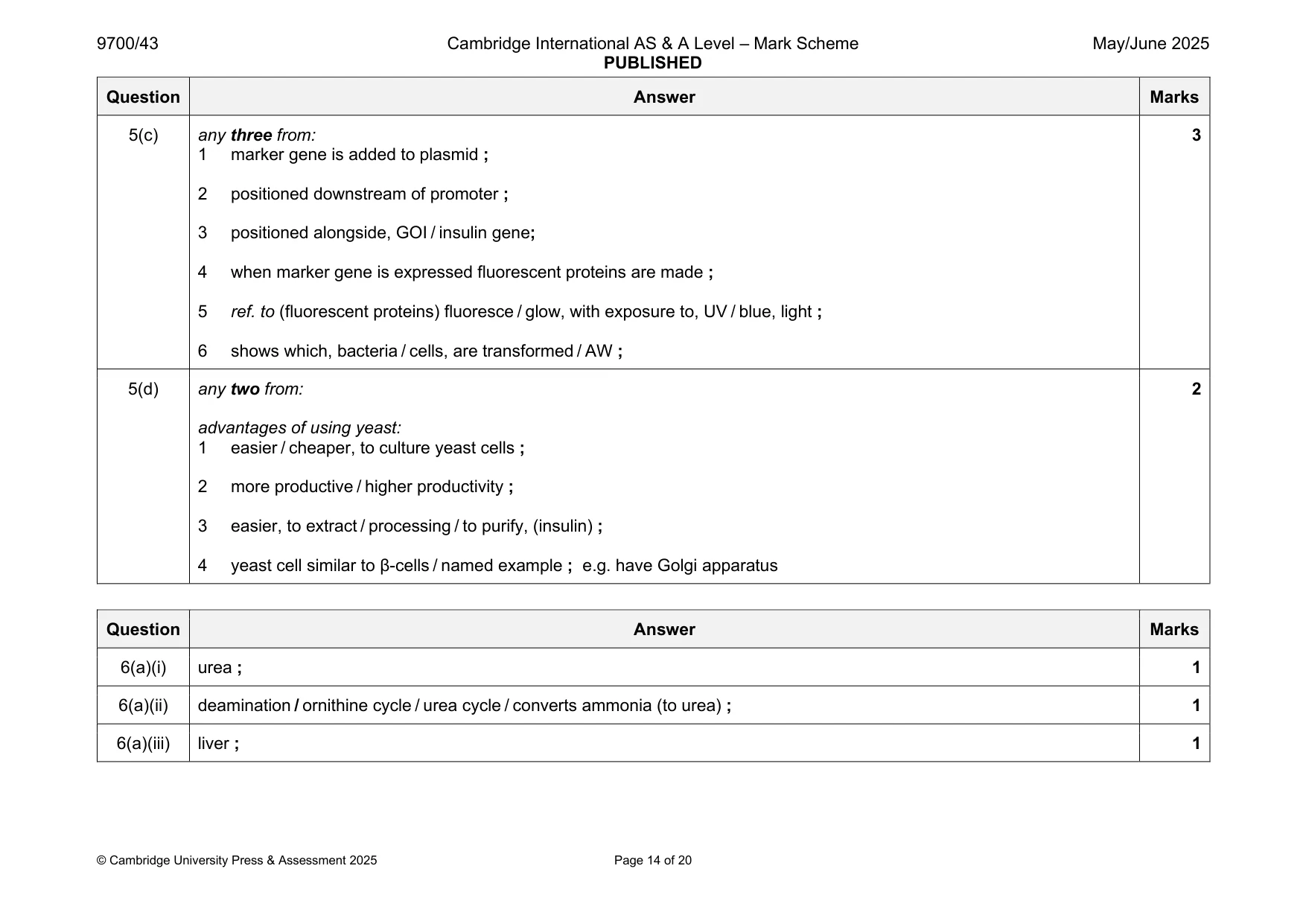
Mark scheme: 5(a) any three from: 3 1 cDNA has, no introns / only exons or genomic DNA has introns (and exons) ; 2 introns are non-coding sequences / exons are coding sequences ; 3 bacteria cannot, remove introns / carry out splicing ; 4 with cDNA, functional mRNA is made / translation occurs or with genomic DNA, functional mRNA is not made / translation does not occur ; 5(b)(i) bond together / anneal, with hydrogen bonds ; 2 formation of phosphodiester bonds / joins sugar phosphate backbone ; 5(b)(ii) 1 so RNA polymerase can bind ; 2 2 so, transcription / gene expression, occurs ; 5(c) any three from: 3 1 marker gene is added to plasmid ; 2 positioned downstream of promoter ; 3 positioned alongside, GOI / insulin gene; 4 when marker gene is expressed fluorescent proteins are made ; 5 ref. to (fluorescent proteins) fluoresce / glow, with exposure to, UV / blue, light ; 6 shows which, bacteria / cells, are transformed / AW ; 5(d) any two from: 2 advantages of using yeast: 1 easier / cheaper, to culture yeast cells ; 2 more productive / higher productivity ; 3 easier, to extract / processing / to purify, (insulin) ; 4 yeast cell similar to β-cells / named example ; e.g. have Golgi apparatus
Q6 · The kidneys have a role in excretion and in osmoregulation
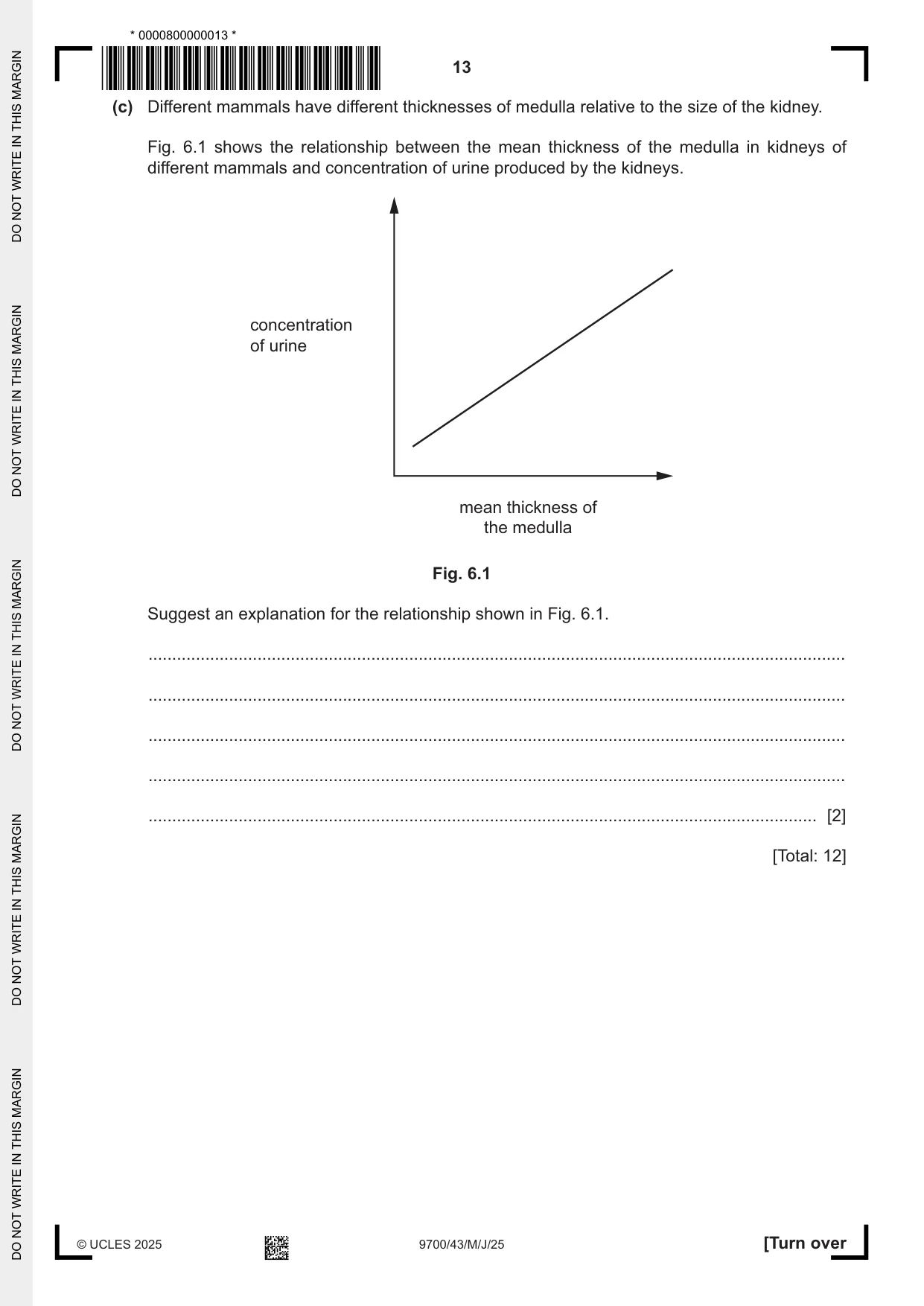
6 The kidneys have a role in excretion and in osmoregulation. Excretion is the removal of the waste products of metabolism or the removal of substances that are in excess. (a) (i) Name the main metabolic waste product excreted by the kidneys. ..................................................................................................................................... [1] (ii) State how this metabolic product is made. ..................................................................................................................................... [1] (iii) State where this metabolic product is made. ..................................................................................................................................... [1] (b) Glomerular filtrate is formed by the process of ultrafiltration. Describe the process of ultrafiltration. ................................................................................................................................................... ................................................................................................................................................... ................................................................................................................................................... ................................................................................................................................................... ................................................................................................................................................... ................................................................................................................................................... ................................................................................................................................................... ................................................................................................................................................... ................................................................................................................................................... ................................................................................................................................................... ................................................................................................................................................... ................................................................................................................................................... ................................................................................................................................................... ............................................................................................................................................. [7] (c) Different mammals have different thicknesses of medulla relative to the size of the kidney. Fig. 6.1 shows the relationship between the mean thickness of the medulla in kidneys of different mammals and concentration of urine produced by the kidneys. concentration of urine mean thickness of the medulla Fig. 6.1 Suggest an explanation for the relationship shown in Fig. 6.1. ................................................................................................................................................... ................................................................................................................................................... ................................................................................................................................................... ................................................................................................................................................... ............................................................................................................................................. [2] [Total: 12]
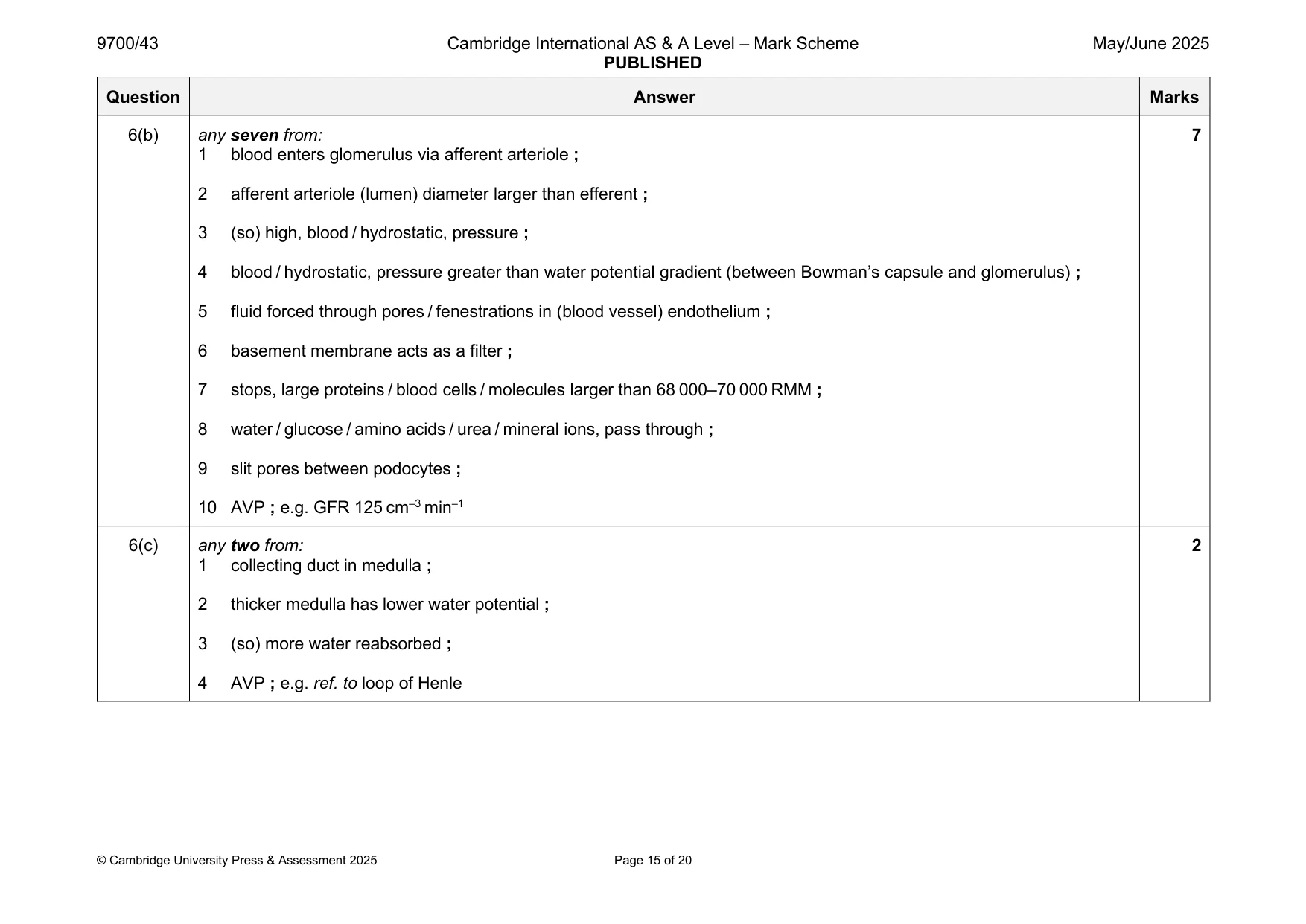
Mark scheme: 6(a)(i) urea ; 1 6(a)(ii) deamination / ornithine cycle / urea cycle / converts ammonia (to urea) ; 1 6(a)(iii) liver ; 1 6(b) any seven from: 7 1 blood enters glomerulus via afferent arteriole ; 2 afferent arteriole (lumen) diameter larger than efferent ; 3 (so) high, blood / hydrostatic, pressure ; 4 blood / hydrostatic, pressure greater than water potential gradient (between Bowman’s capsule and glomerulus) ; 5 fluid forced through pores / fenestrations in (blood vessel) endothelium ; 6 basement membrane acts as a filter ; 7 stops, large proteins / blood cells / molecules larger than 68 000–70 000 RMM ; 8 water / glucose / amino acids / urea / mineral ions, pass through ; 9 slit pores between podocytes ; 10 AVP ; e.g. GFR 125 cm–3 min–1 6(c) any two from: 2 1 collecting duct in medulla ; 2 thicker medulla has lower water potential ; 3 (so) more water reabsorbed ; 4 AVP ; e.g. ref. to loop of Henle
Q7 · A chloroplast is composed of many structures, each with a different function
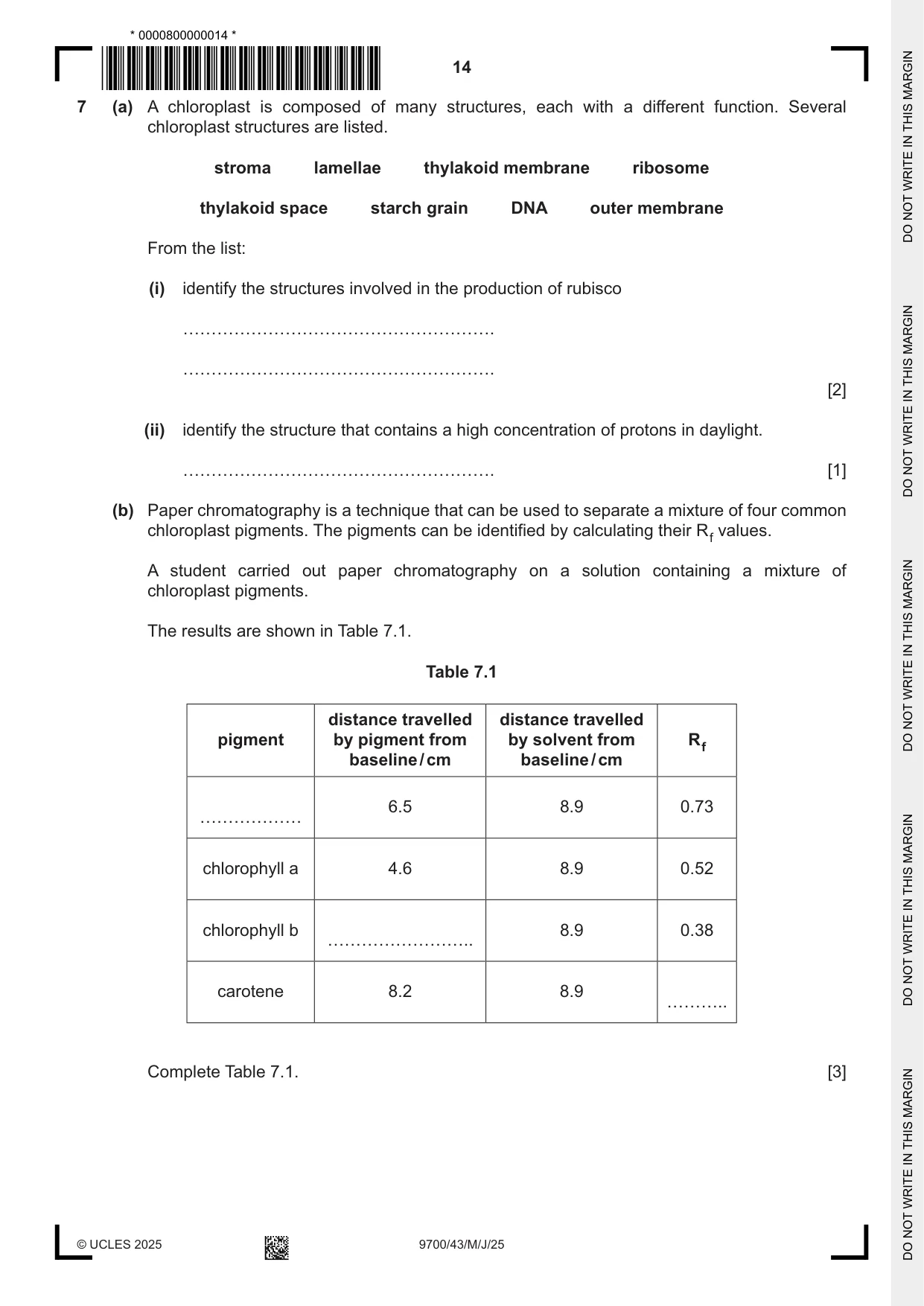
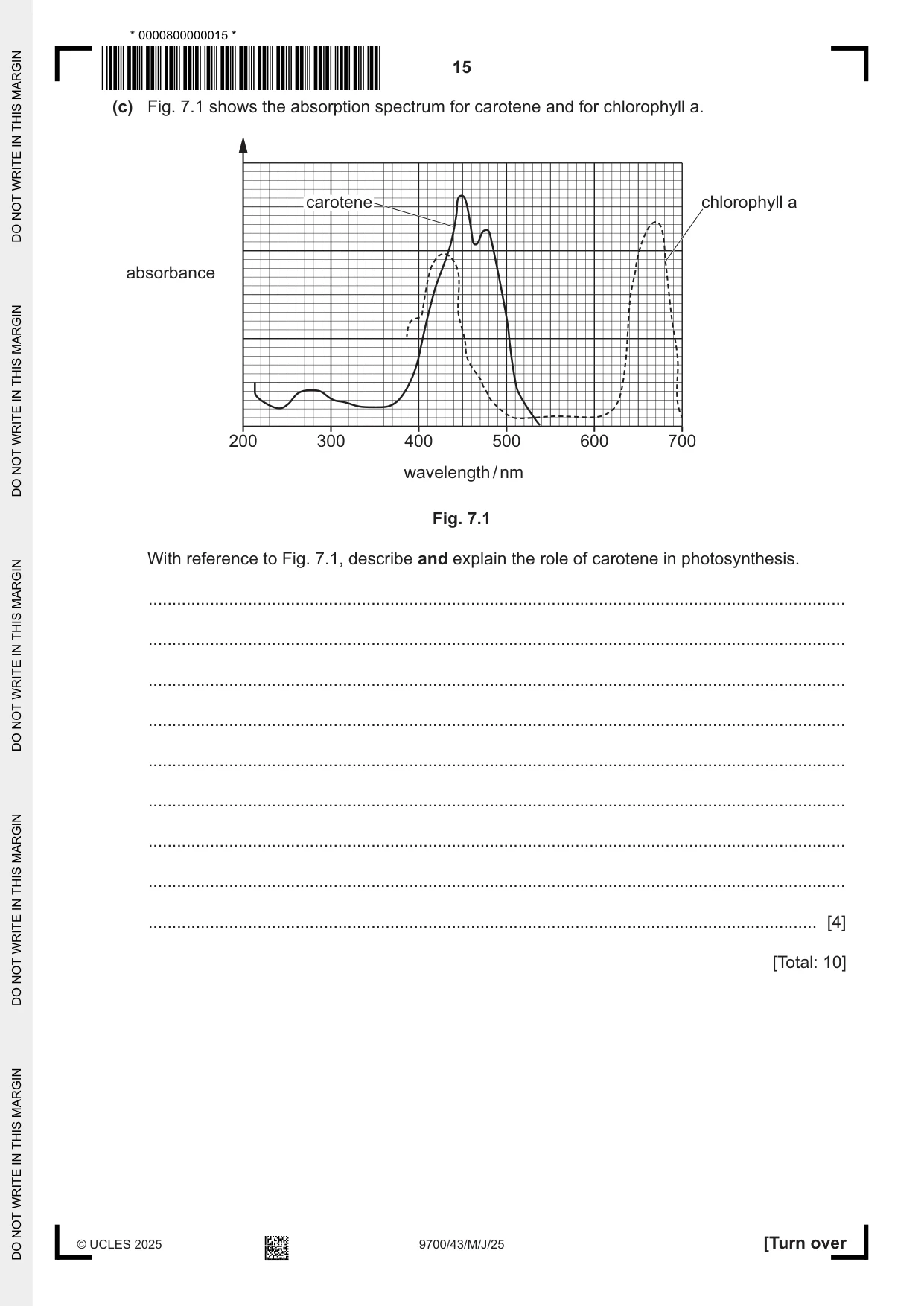
7 (a) A chloroplast is composed of many structures, each with a different function. Several chloroplast structures are listed. stroma lamellae thylakoid membrane ribosome thylakoid space starch grain DNA outer membrane From the list: (i) identify the structures involved in the production of rubisco [2] (ii) identify the structure that contains a high concentration of protons in daylight. [1] (b) Paper chromatography is a technique that can be used to separate a mixture of four common chloroplast pigments. The pigments can be identified by calculating their Rf values. A student carried out paper chromatography on a solution containing a mixture of chloroplast pigments. The results are shown in Table 7.1. Table 7.1 distance travelled distance travelled pigment by pigment from by solvent from Rf baseline / cm baseline / cm 6.5 8.9 0.73 ……………… chlorophyll a 4.6 8.9 0.52 chlorophyll b 8.9 0.38 carotene 8.2 8.9 ……….. Complete Table 7.1. [3] (c) Fig. 7.1 shows the absorption spectrum for carotene and for chlorophyll a. carotene chlorophyll a absorbance 200 300 400 500 600 700 wavelength / nm Fig. 7.1 With reference to Fig. 7.1, describe and explain the role of carotene in photosynthesis. ................................................................................................................................................... ................................................................................................................................................... ................................................................................................................................................... ................................................................................................................................................... ................................................................................................................................................... ................................................................................................................................................... ................................................................................................................................................... ................................................................................................................................................... ............................................................................................................................................. [4] [Total: 10]
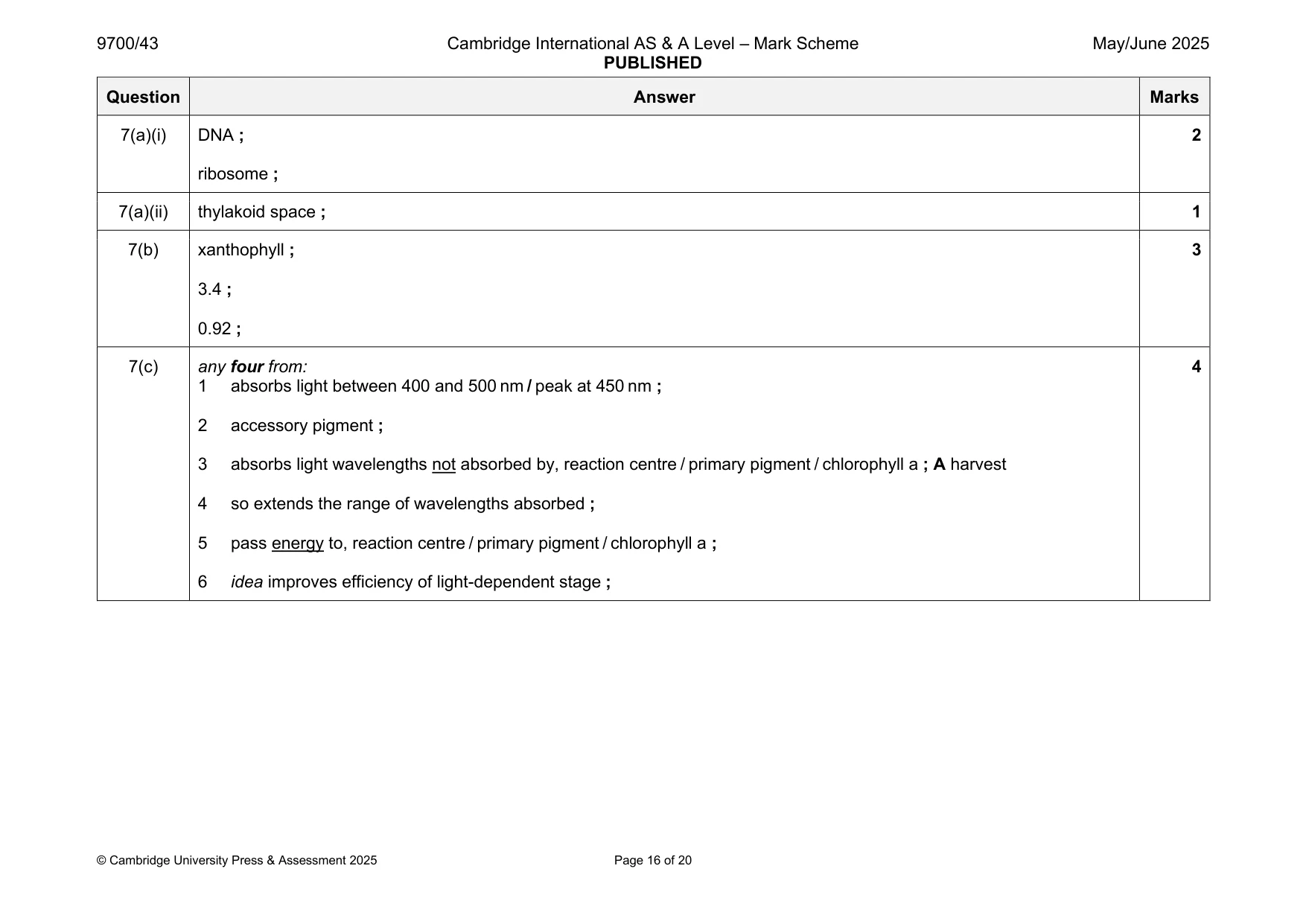
Mark scheme: 7(a)(i) DNA ; 2 ribosome ; 7(a)(ii) thylakoid space ; 1 7(b) xanthophyll ; 3 3.4 ; 0.92 ; 7(c) any four from: 4 1 absorbs light between 400 and 500 nm / peak at 450 nm ; 2 accessory pigment ; 3 absorbs light wavelengths not absorbed by, reaction centre / primary pigment / chlorophyll a ; A harvest 4 so extends the range of wavelengths absorbed ; 5 pass energy to, reaction centre / primary pigment / chlorophyll a ; 6 idea improves efficiency of light-dependent stage ;
More questions on Photosynthesis as an energy transfer process
Q8 · The Boelen’s python, Simalia boeleni, is a non-venomous snake found only on the island of…
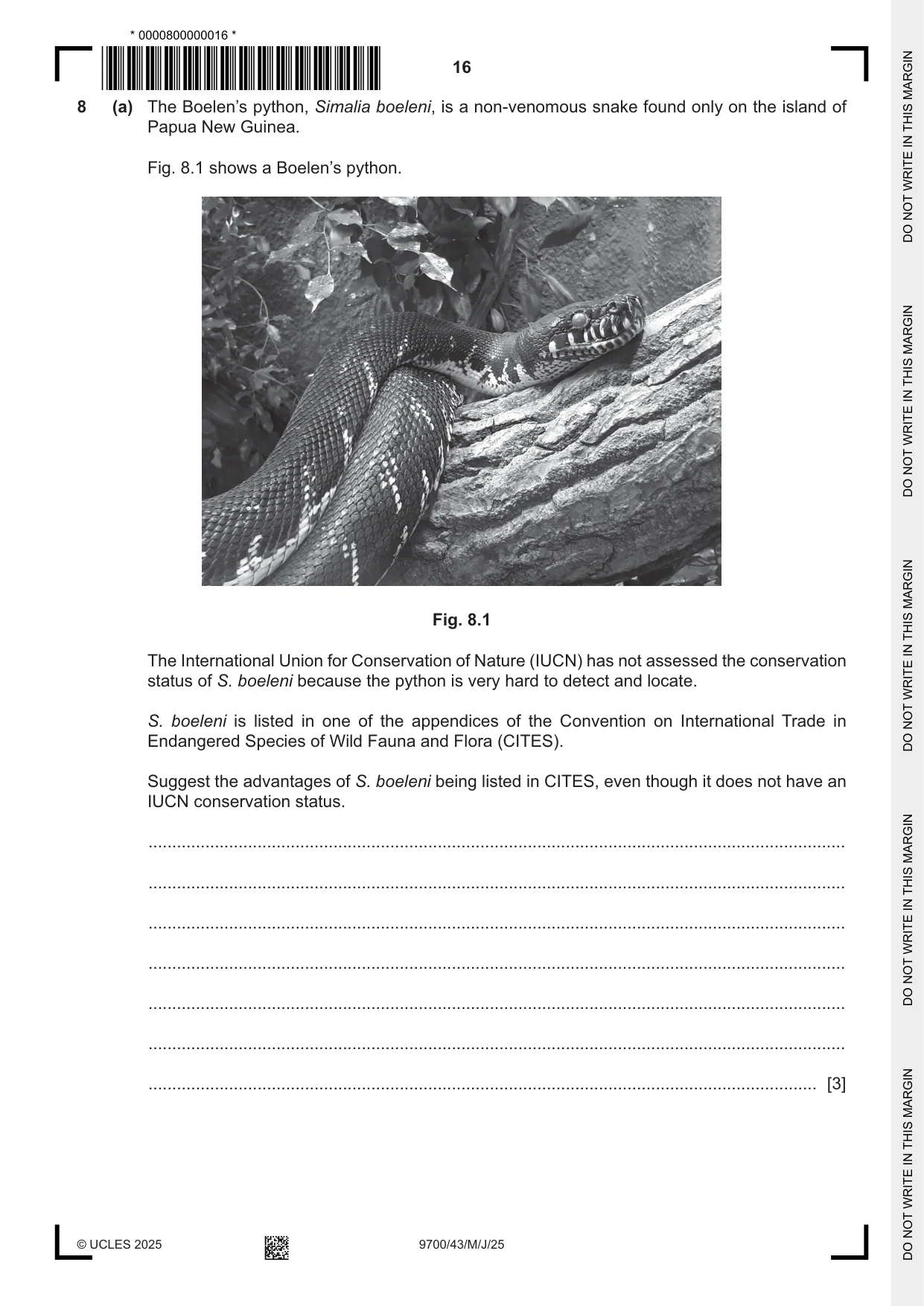
8 (a) The Boelen’s python, Simalia boeleni, is a non-venomous snake found only on the island of Papua New Guinea. Fig. 8.1 shows a Boelen’s python. Fig. 8.1 The International Union for Conservation of Nature (IUCN) has not assessed the conservation status of S. boeleni because the python is very hard to detect and locate. S. boeleni is listed in one of the appendices of the Convention on International Trade in Endangered Species of Wild Fauna and Flora (CITES). Suggest the advantages of S. boeleni being listed in CITES, even though it does not have an IUCN conservation status. ................................................................................................................................................... ................................................................................................................................................... ................................................................................................................................................... ................................................................................................................................................... ................................................................................................................................................... ................................................................................................................................................... ............................................................................................................................................. [3] (b) S. boeleni is a member of the kingdom Animalia. Outline the characteristic features of the kingdom Animalia. ................................................................................................................................................... ................................................................................................................................................... ................................................................................................................................................... ................................................................................................................................................... ................................................................................................................................................... ................................................................................................................................................... ................................................................................................................................................... ................................................................................................................................................... ................................................................................................................................................... ............................................................................................................................................. [4] [Total: 7]
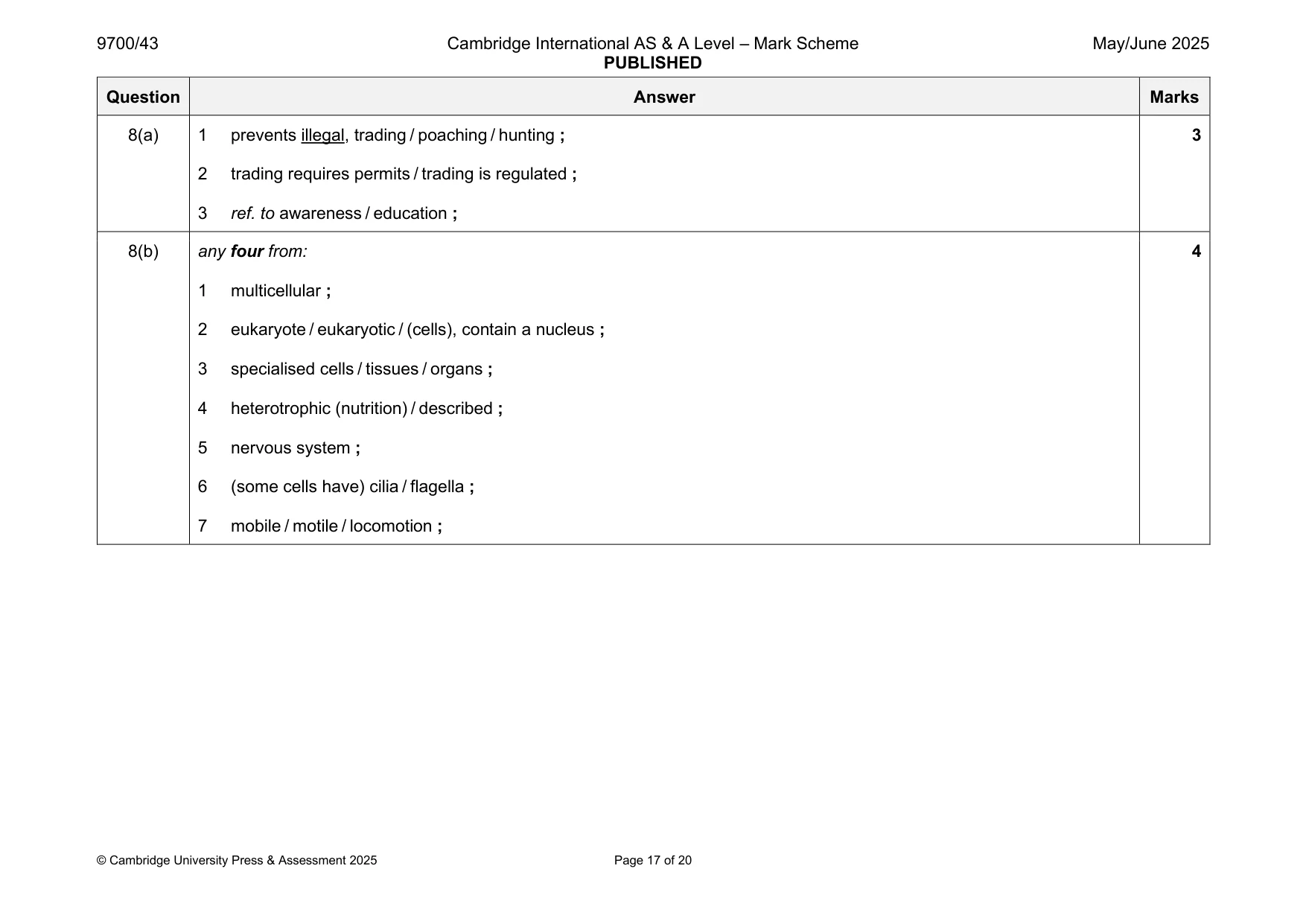
Mark scheme: 8(a) 1 prevents illegal, trading / poaching / hunting ; 3 2 trading requires permits / trading is regulated ; 3 ref. to awareness / education ; 8(b) any four from: 4 1 multicellular ; 2 eukaryote / eukaryotic / (cells), contain a nucleus ; 3 specialised cells / tissues / organs ; 4 heterotrophic (nutrition) / described ; 5 nervous system ; 6 (some cells have) cilia / flagella ; 7 mobile / motile / locomotion ;
Q9 · Most carnivorous mammals need to move to hunt their prey
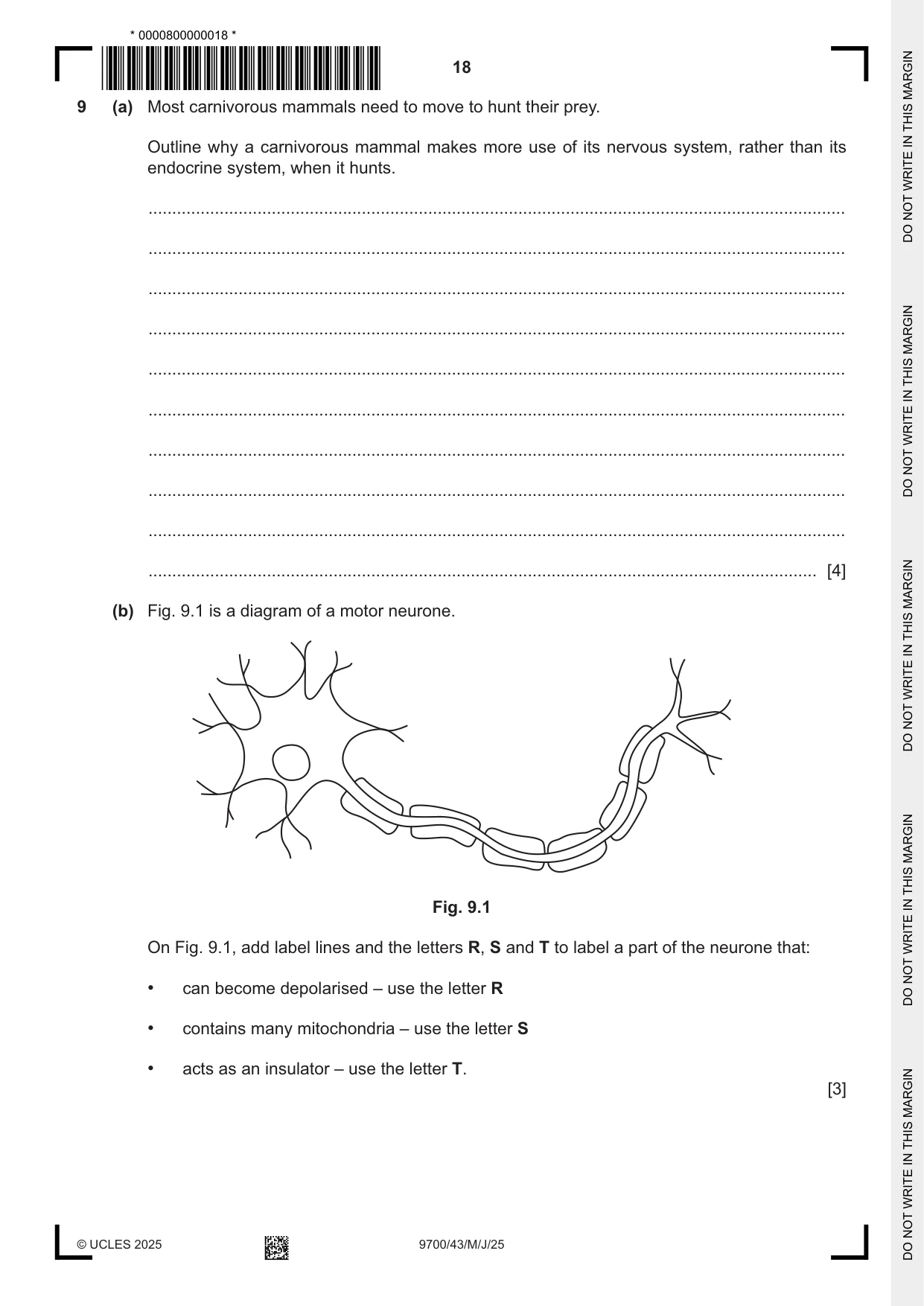
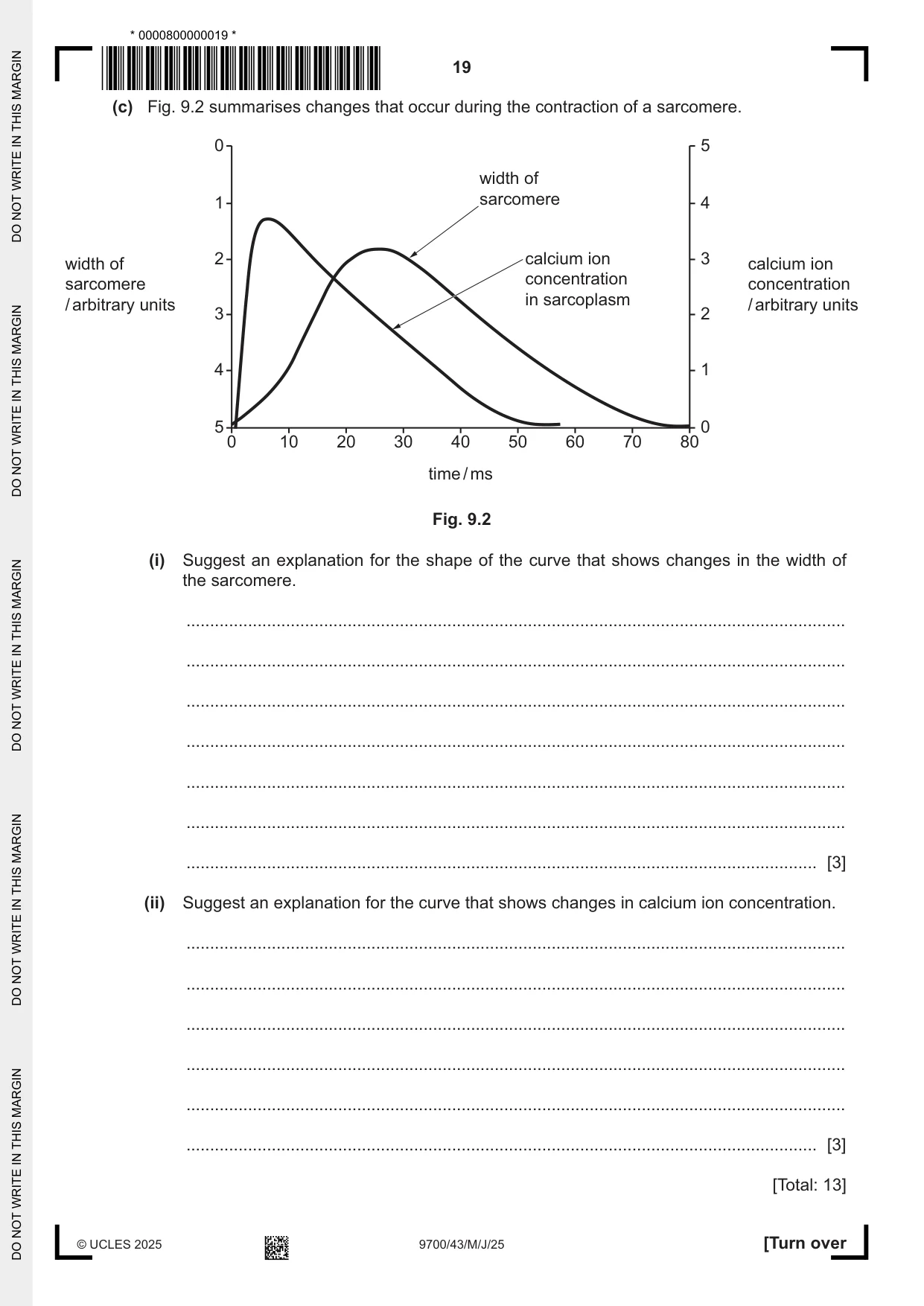
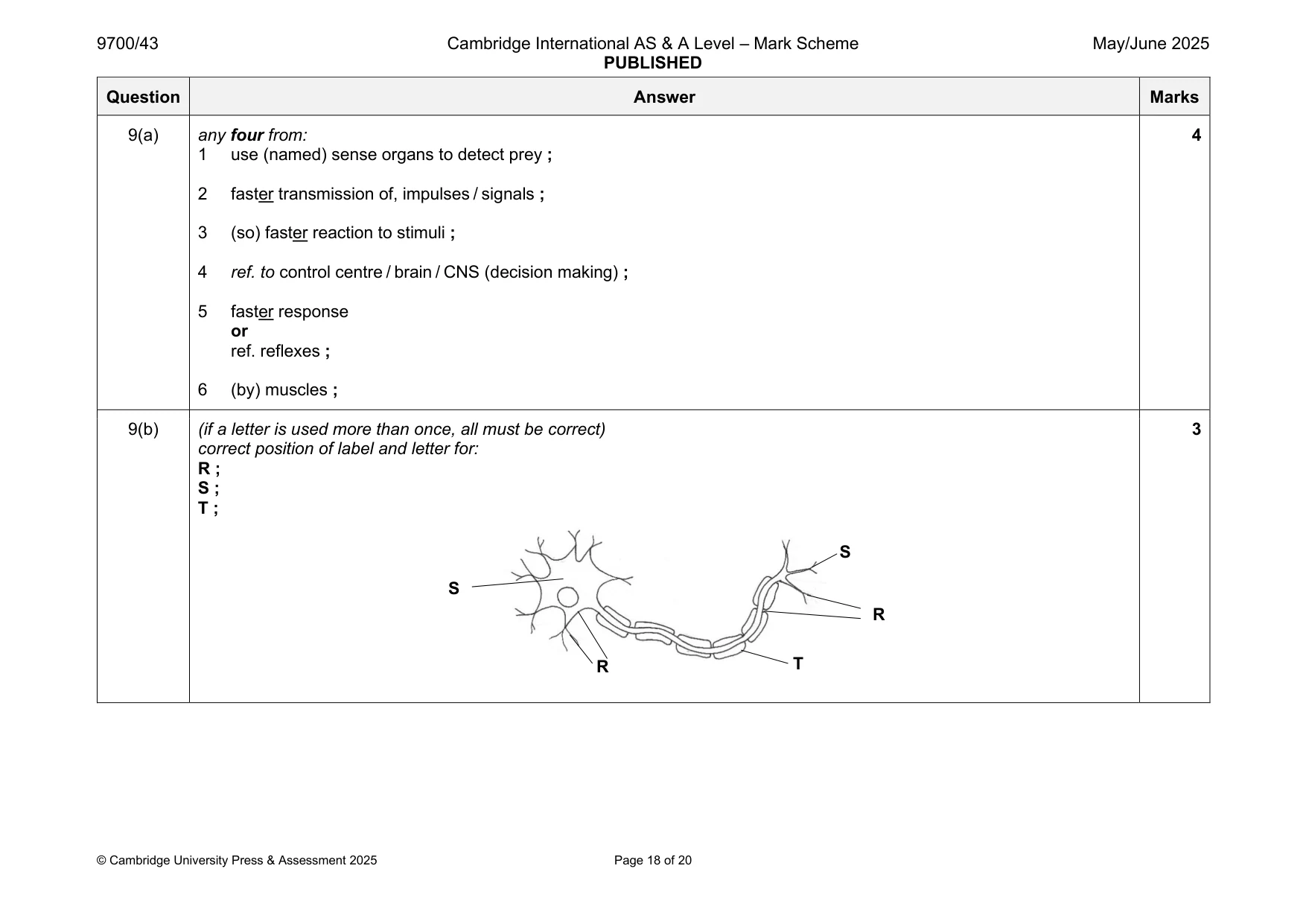
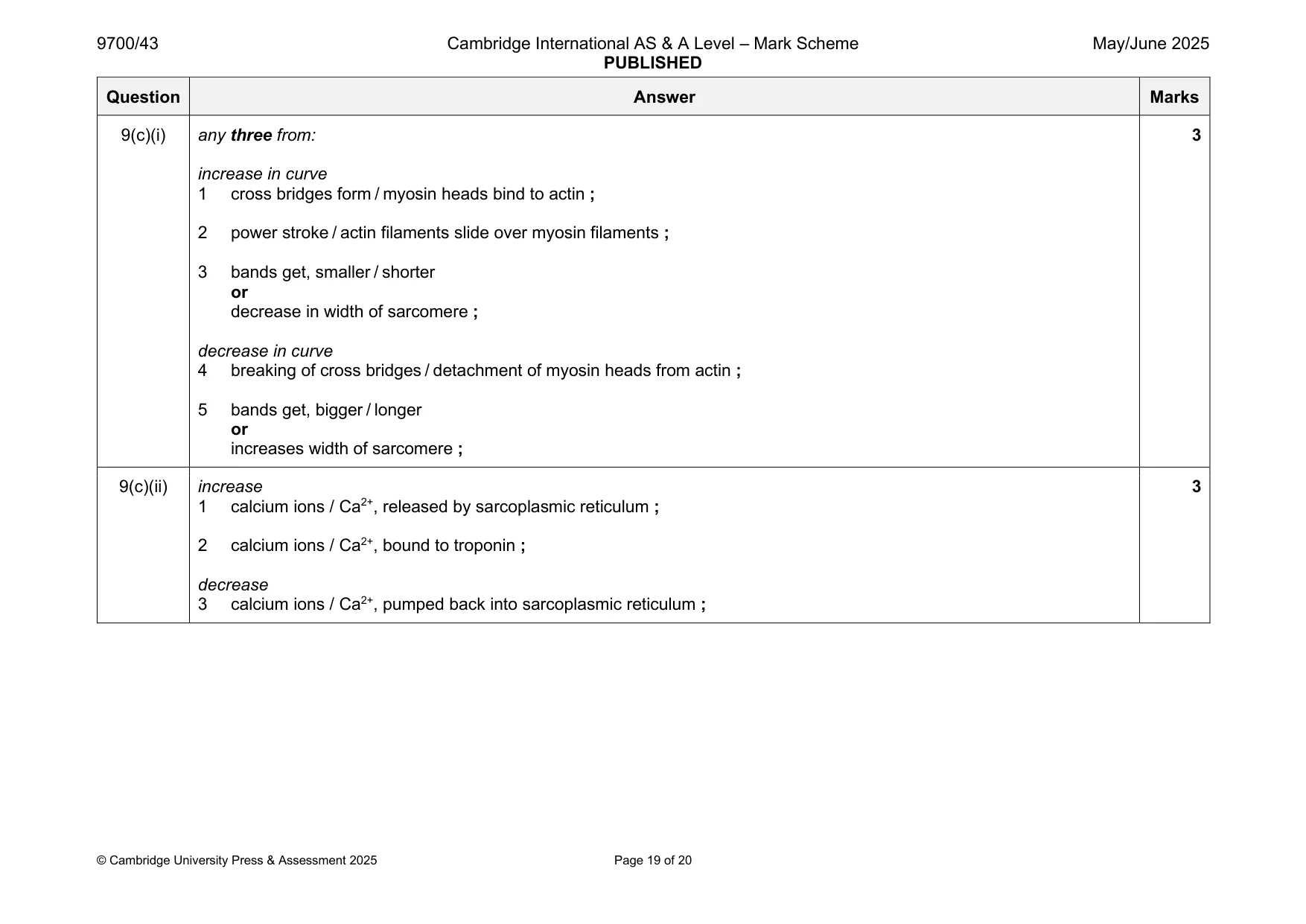
9 (a) Most carnivorous mammals need to move to hunt their prey. Outline why a carnivorous mammal makes more use of its nervous system, rather than its endocrine system, when it hunts. ................................................................................................................................................... ................................................................................................................................................... ................................................................................................................................................... ................................................................................................................................................... ................................................................................................................................................... ................................................................................................................................................... ................................................................................................................................................... ................................................................................................................................................... ................................................................................................................................................... ............................................................................................................................................. [4] (b) Fig. 9.1 is a diagram of a motor neurone. Fig. 9.1 On Fig. 9.1, add label lines and the letters R, S and T to label a part of the neurone that: • can become depolarised – use the letter R • contains many mitochondria – use the letter S • acts as an insulator – use the letter T. [3] (c) Fig. 9.2 summarises changes that occur during the contraction of a sarcomere. 0 5 width of 1 sarcomere 4 2 calcium ion 3width of calcium ion concentrationsarcomere concentration in sarcoplasm/ arbitrary units / arbitrary units 3 2 4 1 5 0 0 10 20 30 40 50 60 70 80 time / ms Fig. 9.2 (i) Suggest an explanation for the shape of the curve that shows changes in the width of the sarcomere. ........................................................................................................................................... ........................................................................................................................................... ........................................................................................................................................... ........................................................................................................................................... ........................................................................................................................................... ........................................................................................................................................... ..................................................................................................................................... [3] (ii) Suggest an explanation for the curve that shows changes in calcium ion concentration. ........................................................................................................................................... ........................................................................................................................................... ........................................................................................................................................... ........................................................................................................................................... ........................................................................................................................................... ..................................................................................................................................... [3] [Total: 13]
Mark scheme: 9(a) any four from: 4 1 use (named) sense organs to detect prey ; 2 faster transmission of, impulses / signals ; 3 (so) faster reaction to stimuli ; 4 ref. to control centre / brain / CNS (decision making) ; 5 faster response or ref. reflexes ; 6 (by) muscles ; 9(b) (if a letter is used more than once, all must be correct) 3 correct position of label and letter for: R ; S ; T ; S S R R T 9(c)(i) any three from: 3 increase in curve 1 cross bridges form / myosin heads bind to actin ; 2 power stroke / actin filaments slide over myosin filaments ; 3 bands get, smaller / shorter or decrease in width of sarcomere ; decrease in curve 4 breaking of cross bridges / detachment of myosin heads from actin ; 5 bands get, bigger / longer or increases width of sarcomere ; 9(c)(ii) increase 3 1 calcium ions / Ca2+, released by sarcoplasmic reticulum ; 2 calcium ions / Ca2+, bound to troponin ; decrease 3 calcium ions / Ca2+, pumped back into sarcoplasmic reticulum ;
Q10 · The golden poison dart frog, Phyllobates terribilis, lives in the Colombian rainforest…
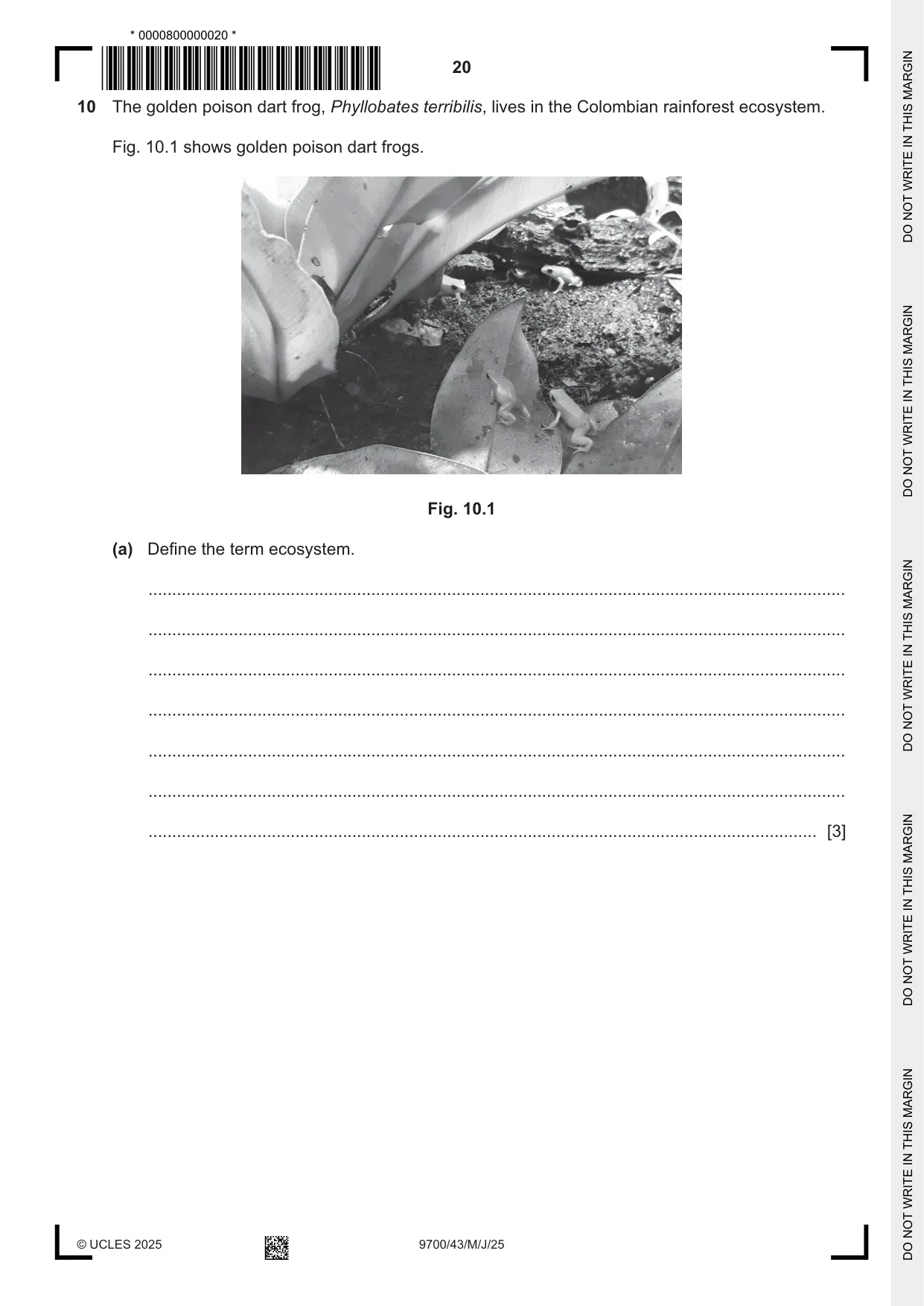
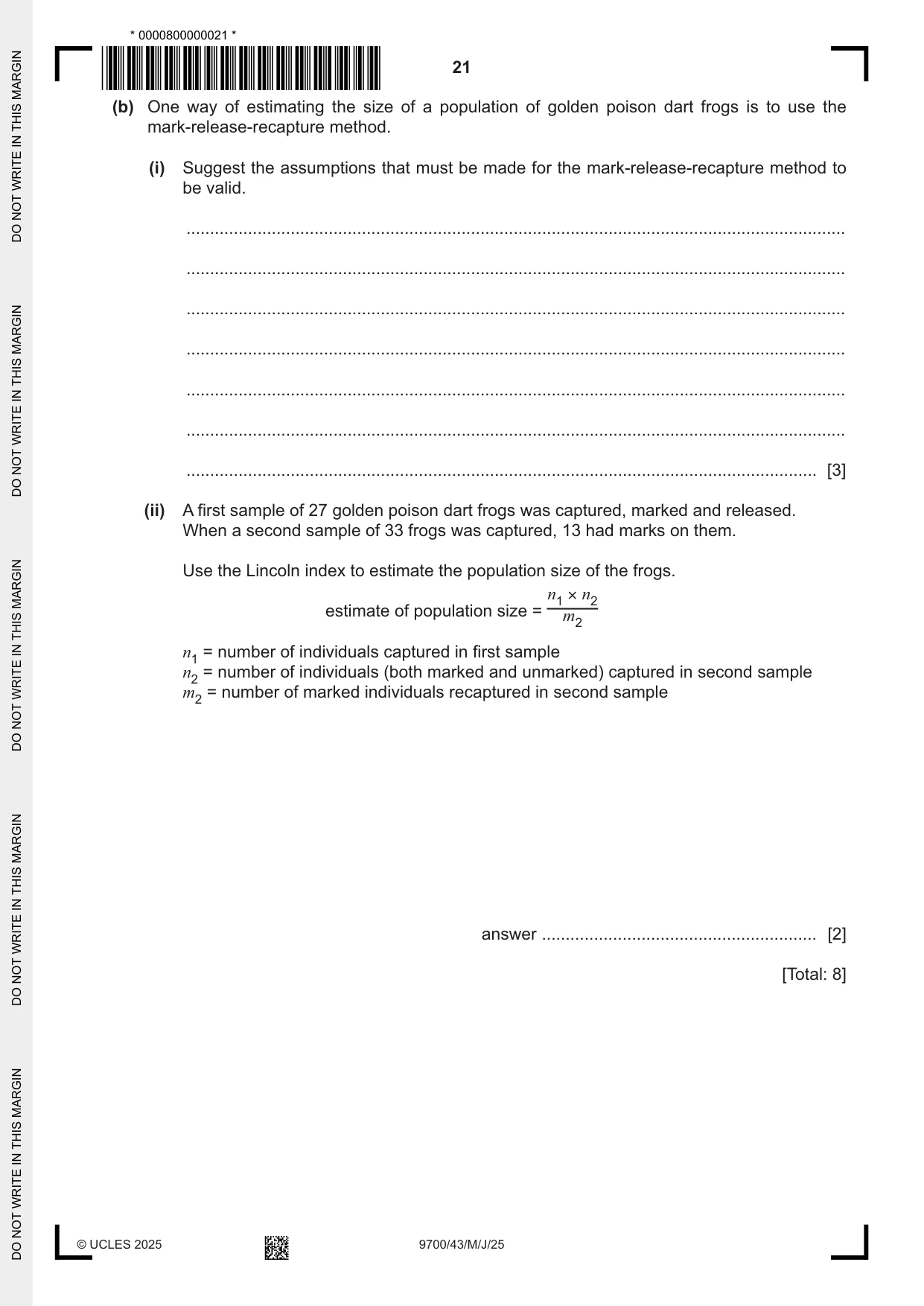
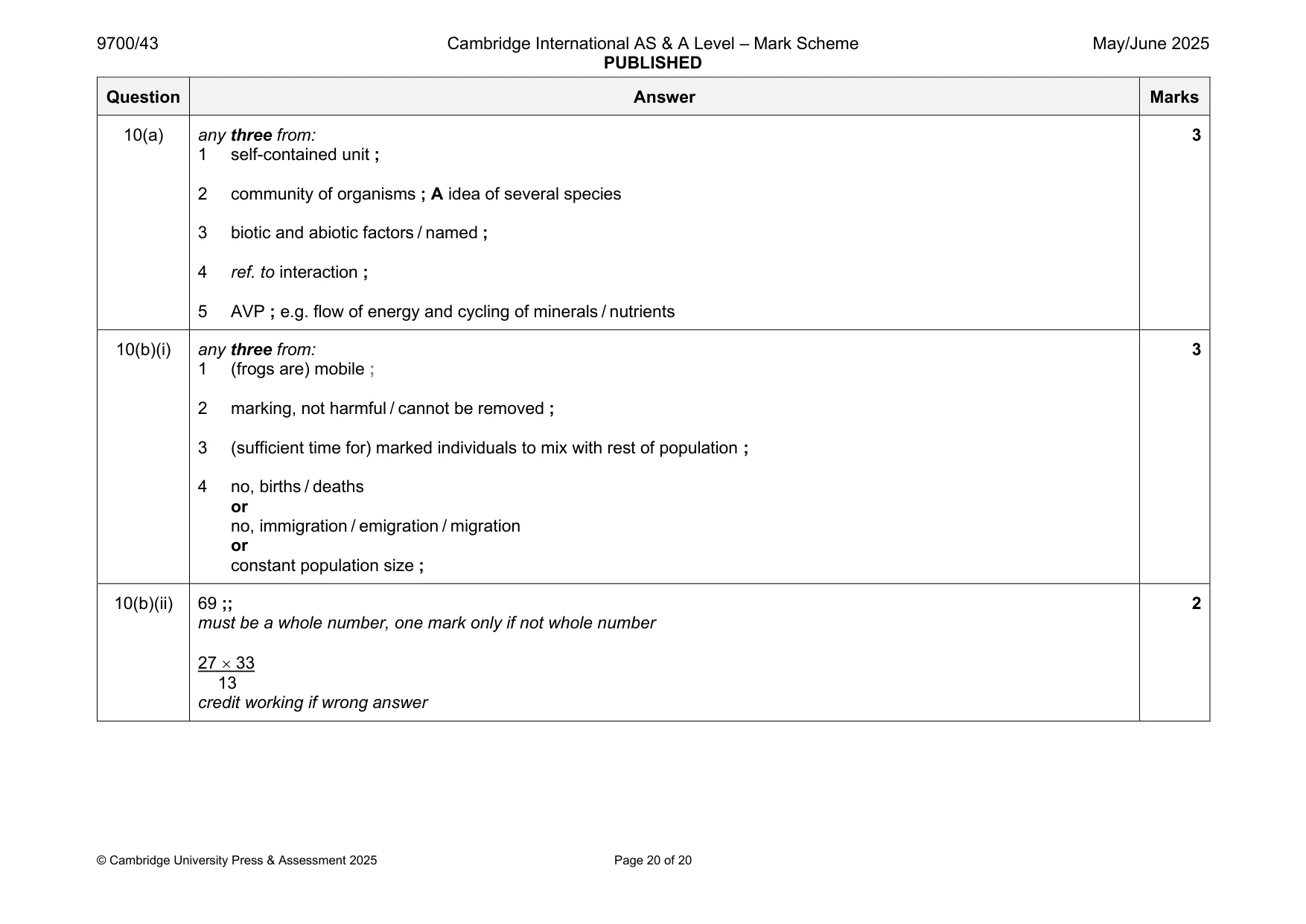
10 The golden poison dart frog, Phyllobates terribilis, lives in the Colombian rainforest ecosystem. Fig. 10.1 shows golden poison dart frogs. Fig. 10.1 (a) Define the term ecosystem. ................................................................................................................................................... ................................................................................................................................................... ................................................................................................................................................... ................................................................................................................................................... ................................................................................................................................................... ................................................................................................................................................... ............................................................................................................................................. [3] (b) One way of estimating the size of a population of golden poison dart frogs is to use the mark-release-recapture method. (i) Suggest the assumptions that must be made for the mark-release-recapture method to be valid. ........................................................................................................................................... ........................................................................................................................................... ........................................................................................................................................... ........................................................................................................................................... ........................................................................................................................................... ........................................................................................................................................... ..................................................................................................................................... [3] (ii) A first sample of 27 golden poison dart frogs was captured, marked and released. When a second sample of 33 frogs was captured, 13 had marks on them. Use the Lincoln index to estimate the population size of the frogs. n1 × n2 estimate of population size = m2 n1 = number of individuals captured in first sample n2 = number of individuals (both marked and unmarked) captured in second sample m2 = number of marked individuals recaptured in second sample answer .......................................................... [2] [Total: 8]
Mark scheme: 10(a) any three from: 3 1 self-contained unit ; 2 community of organisms ; A idea of several species 3 biotic and abiotic factors / named ; 4 ref. to interaction ; 5 AVP ; e.g. flow of energy and cycling of minerals / nutrients 10(b)(i) any three from: 3 1 (frogs are) mobile ; 2 marking, not harmful / cannot be removed ; 3 (sufficient time for) marked individuals to mix with rest of population ; 4 no, births / deaths or no, immigration / emigration / migration or constant population size ; 10(b)(ii) 69 ;; 2 must be a whole number, one mark only if not whole number 27 33 13 credit working if wrong answer
What was in this paper
The subtopics covered by these 10 questions, and how many questions each got. Open one in a new tab to see every Cambridge question on it.
What you needed in this session
Cambridge’s own grade thresholds for 2025 May/June, Paper 4 · Variant 3. A higher threshold means an easier paper — the bar moves with how the cohort did.