Cambridge A Level Biology 9700 — 2024 Oct/Nov Paper 4 · Variant 2
9700/42/O/N/24 · 10 questions · 100 marks · ≈113 min
The question paper and its mark scheme, free to read here and free to download. This is Cambridge’s own paper, exactly as it was sat.
Question paper24 pages
Mark scheme19 pages
Answers below. Sit the paper first if you are practising.
Questions as text
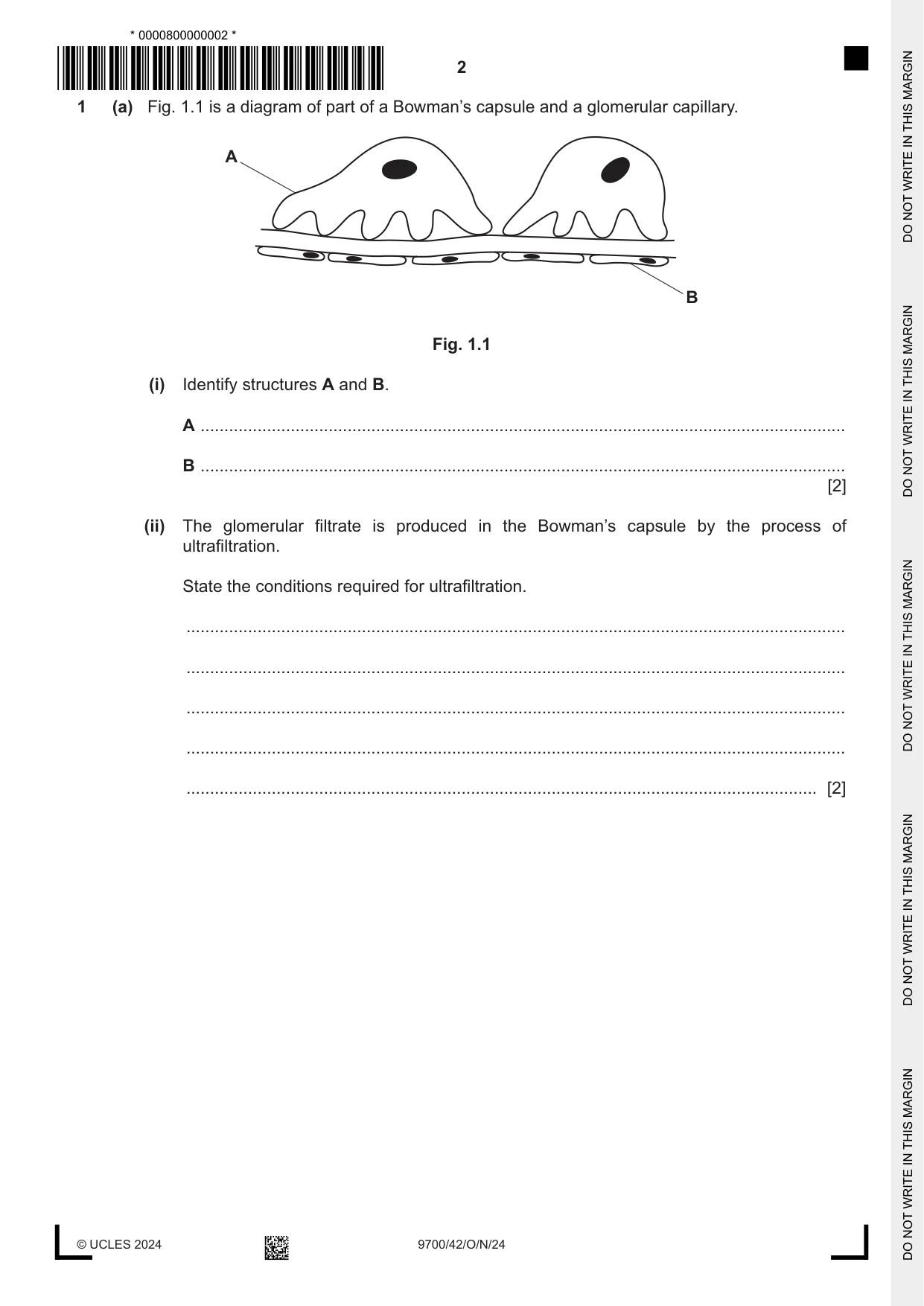
Q1 · A diagram of part of a Bowman’s capsule and a glomerular capillary
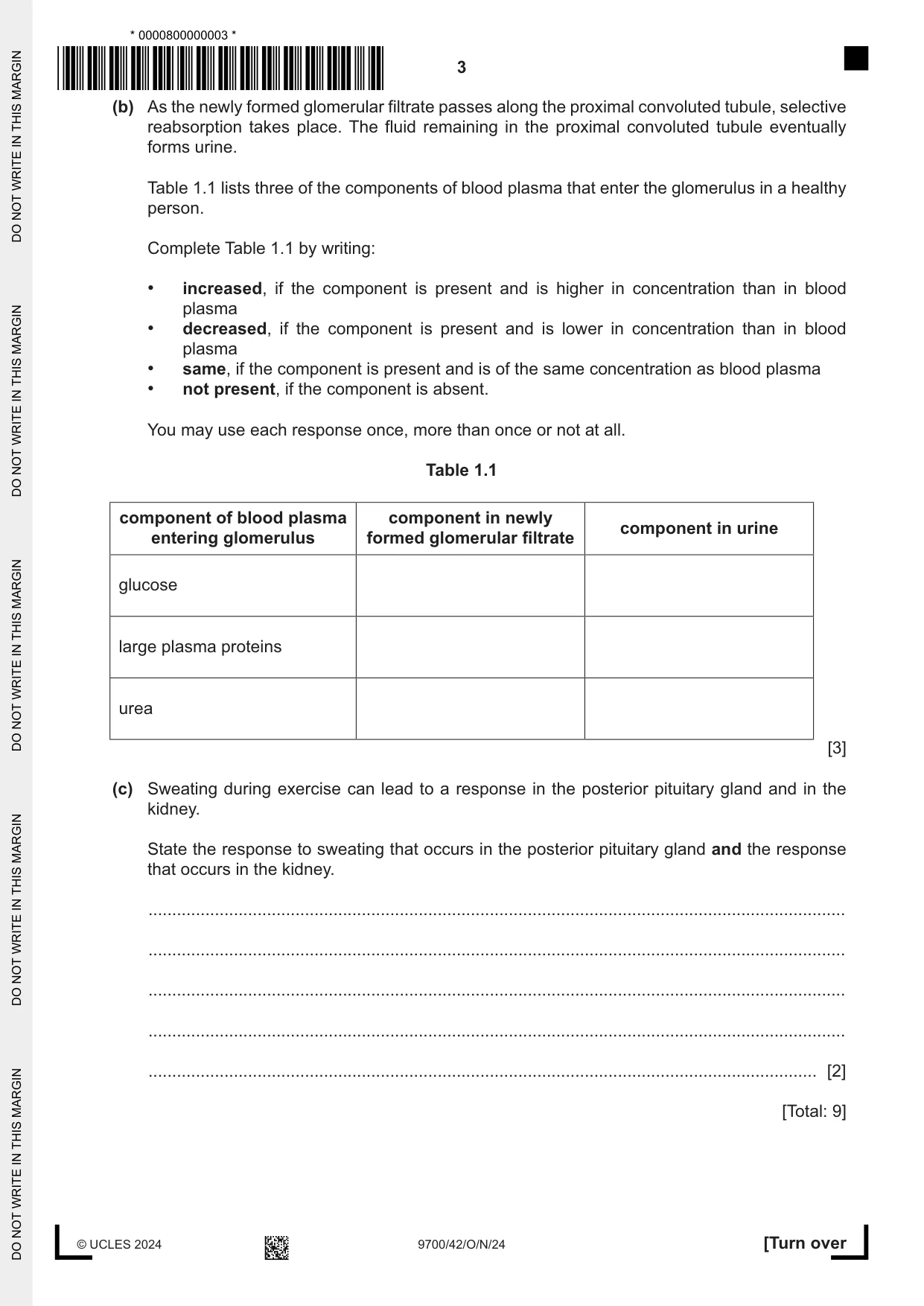
1 (a) Fig. 1.1 is a diagram of part of a Bowman’s capsule and a glomerular capillary. A B Fig. 1.1 (i) Identify structures A and B. A ........................................................................................................................................ B ........................................................................................................................................ [2] (ii) The glomerular filtrate is produced in the Bowman’s capsule by the process of ultrafiltration. State the conditions required for ultrafiltration. ........................................................................................................................................... ........................................................................................................................................... ........................................................................................................................................... ........................................................................................................................................... ..................................................................................................................................... [2] (b) As the newly formed glomerular filtrate passes along the proximal convoluted tubule, selective reabsorption takes place. The fluid remaining in the proximal convoluted tubule eventually forms urine. Table 1.1 lists three of the components of blood plasma that enter the glomerulus in a healthy person. Complete Table 1.1 by writing: • increased, if the component is present and is higher in concentration than in blood plasma • decreased, if the component is present and is lower in concentration than in blood plasma • same, if the component is present and is of the same concentration as blood plasma • not present, if the component is absent. You may use each response once, more than once or not at all. Table 1.1 component of blood plasma component in newly component in urine entering glomerulus formed glomerular filtrate glucose large plasma proteins urea [3] (c) Sweating during exercise can lead to a response in the posterior pituitary gland and in the kidney. State the response to sweating that occurs in the posterior pituitary gland and the response that occurs in the kidney. ................................................................................................................................................... ................................................................................................................................................... ................................................................................................................................................... ................................................................................................................................................... ............................................................................................................................................. [2] [Total: 9]
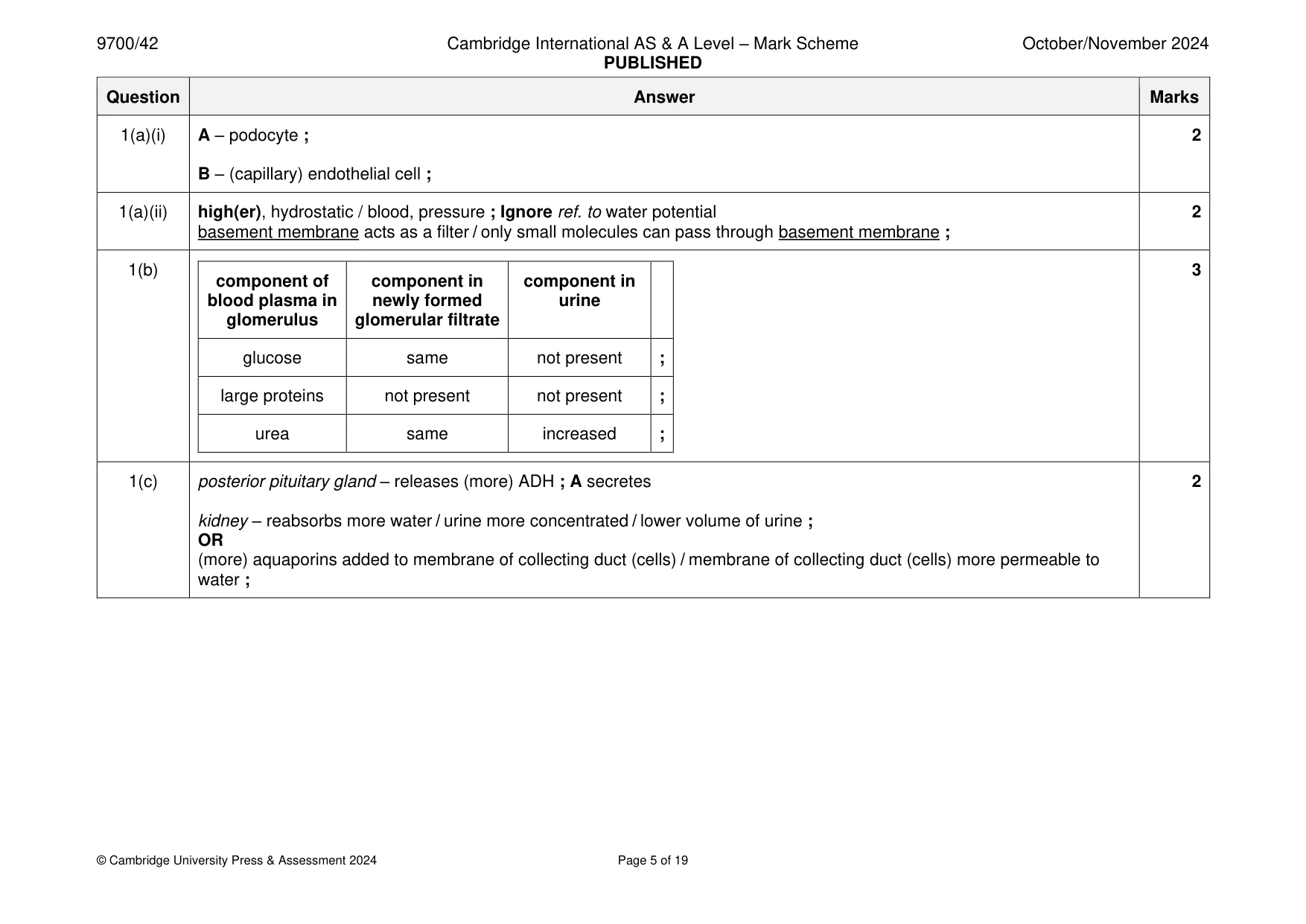
Mark scheme: Question Answer Marks 1(a)(i) A – podocyte ; 2 B – (capillary) endothelial cell ; 1(a)(ii) high(er), hydrostatic / blood, pressure ; Ignore ref. to water potential 2 basement membrane acts as a filter / only small molecules can pass through basement membrane ; 1(b) 3 component of component in component in blood plasma in newly formed urine glomerulus glomerular filtrate glucose same not present ; large proteins not present not present ; urea same increased ; 1(c) posterior pituitary gland – releases (more) ADH ; A secretes 2 kidney – reabsorbs more water / urine more concentrated / lower volume of urine ; OR (more) aquaporins added to membrane of collecting duct (cells) / membrane of collecting duct (cells) more permeable to water ;
Q2 · Several different processes can affect allele frequencies in populations
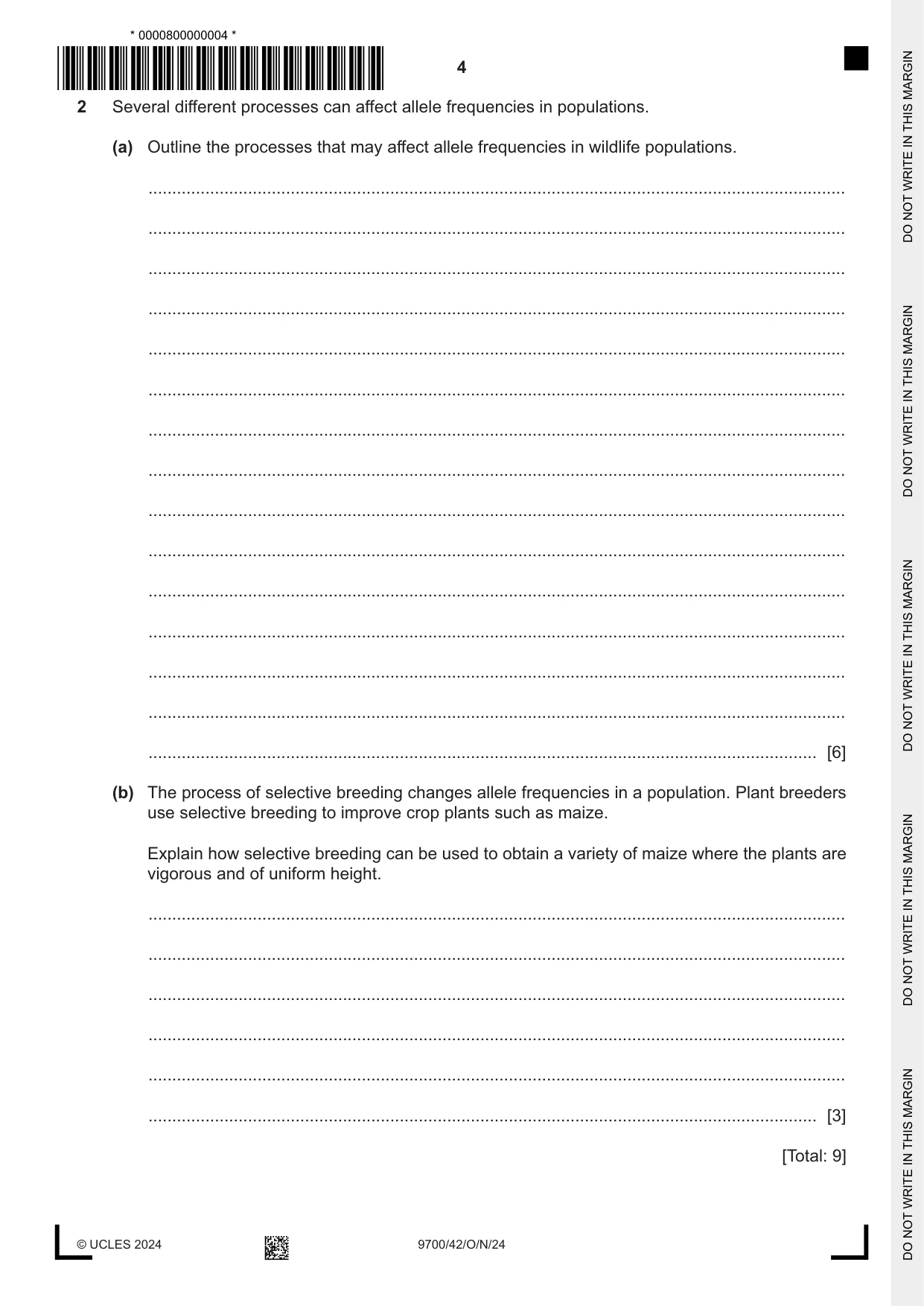
2 Several different processes can affect allele frequencies in populations. (a) Outline the processes that may affect allele frequencies in wildlife populations. ................................................................................................................................................... ................................................................................................................................................... ................................................................................................................................................... ................................................................................................................................................... ................................................................................................................................................... ................................................................................................................................................... ................................................................................................................................................... ................................................................................................................................................... ................................................................................................................................................... ................................................................................................................................................... ................................................................................................................................................... ................................................................................................................................................... ................................................................................................................................................... ................................................................................................................................................... ............................................................................................................................................. [6] (b) The process of selective breeding changes allele frequencies in a population. Plant breeders use selective breeding to improve crop plants such as maize. Explain how selective breeding can be used to obtain a variety of maize where the plants are vigorous and of uniform height. ................................................................................................................................................... ................................................................................................................................................... ................................................................................................................................................... ................................................................................................................................................... ................................................................................................................................................... ............................................................................................................................................. [3] [Total: 9]
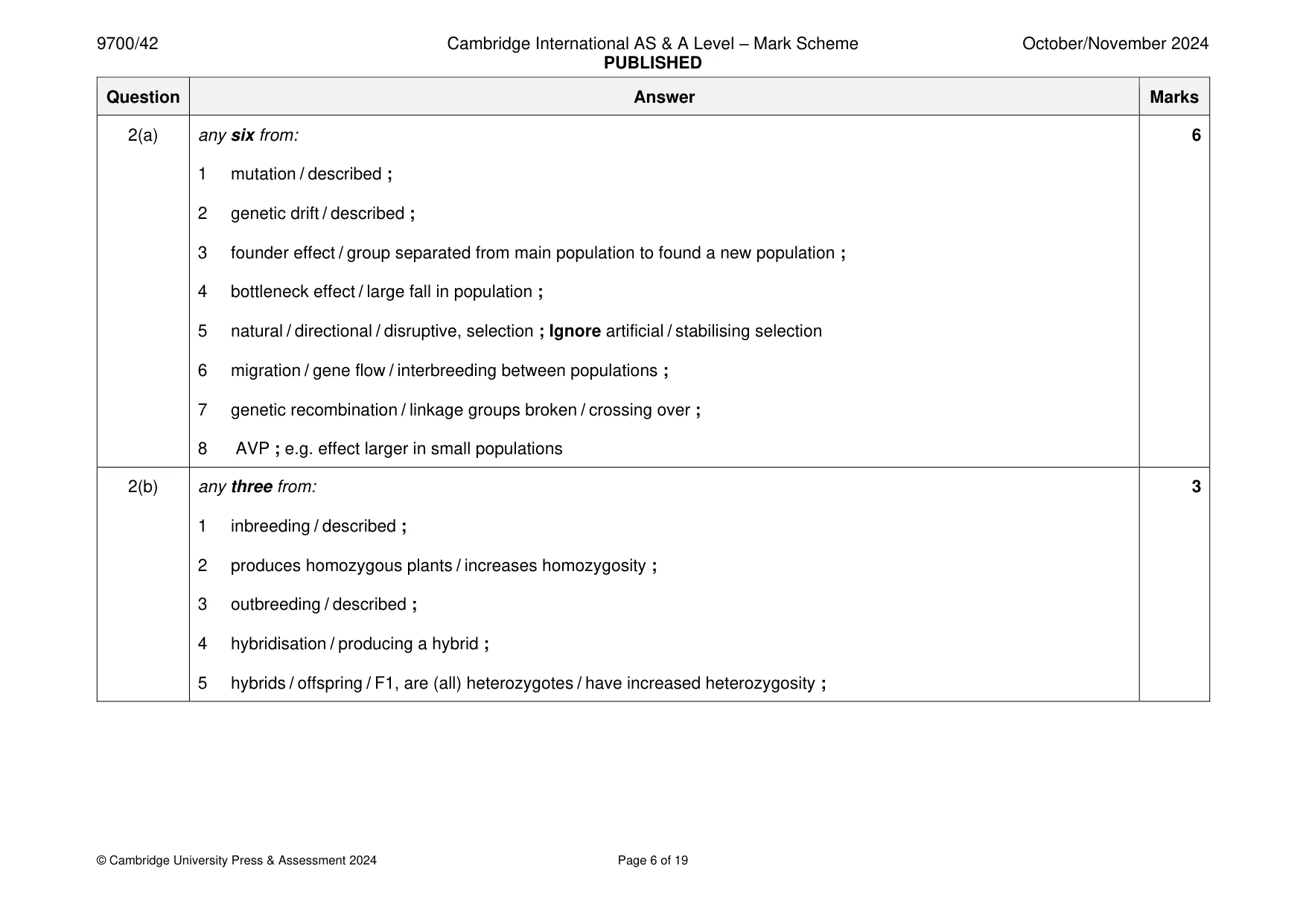
Mark scheme: 2(a) any six from: 6 1 mutation / described ; 2 genetic drift / described ; 3 founder effect / group separated from main population to found a new population ; 4 bottleneck effect / large fall in population ; 5 natural / directional / disruptive, selection ; Ignore artificial / stabilising selection 6 migration / gene flow / interbreeding between populations ; 7 genetic recombination / linkage groups broken / crossing over ; 8 AVP ; e.g. effect larger in small populations 2(b) any three from: 3 1 inbreeding / described ; 2 produces homozygous plants / increases homozygosity ; 3 outbreeding / described ; 4 hybridisation / producing a hybrid ; 5 hybrids / offspring / F1, are (all) heterozygotes / have increased heterozygosity ;
Q3 · The treatment of many diseases has been improved by the use of genetic technology in…
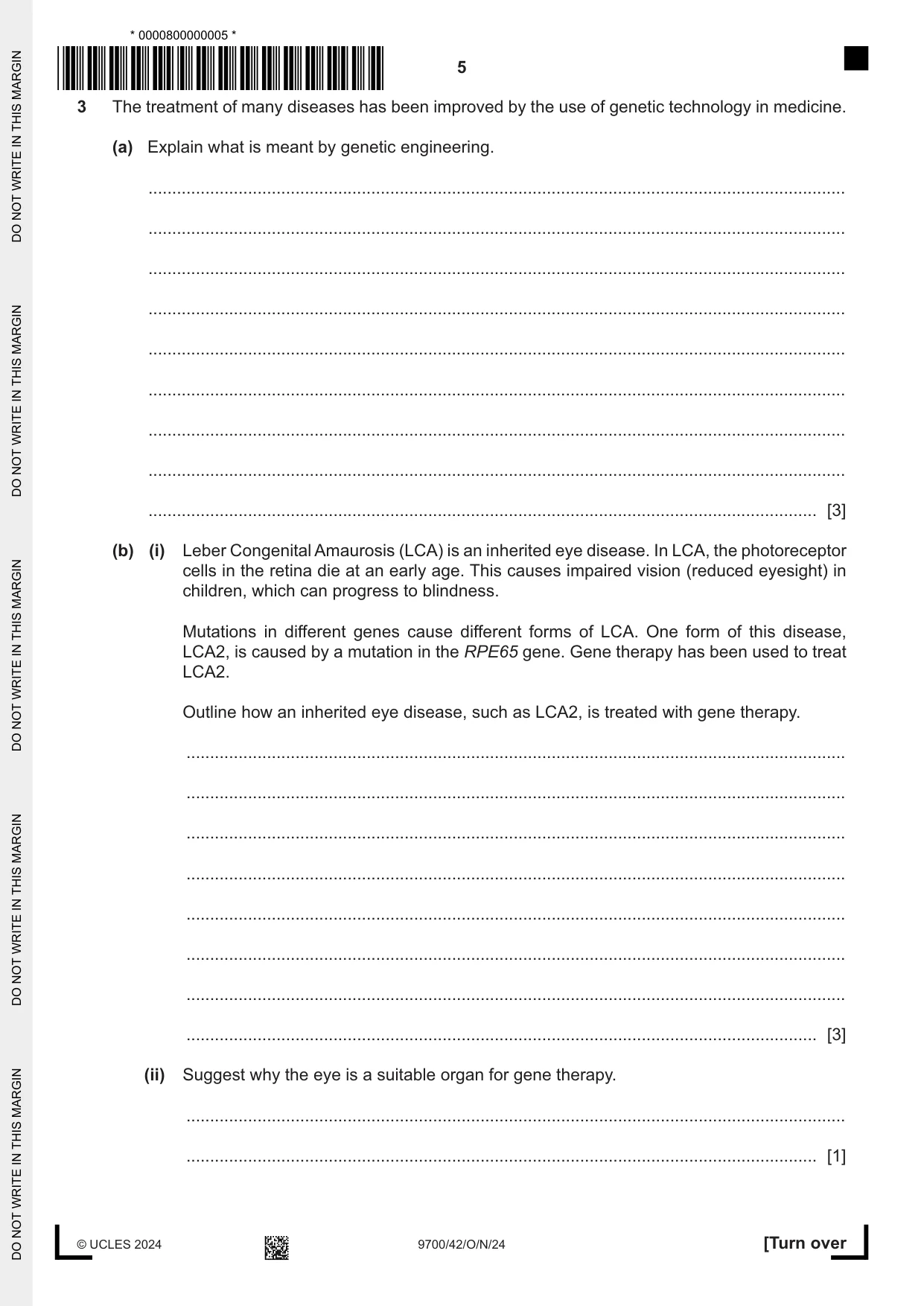
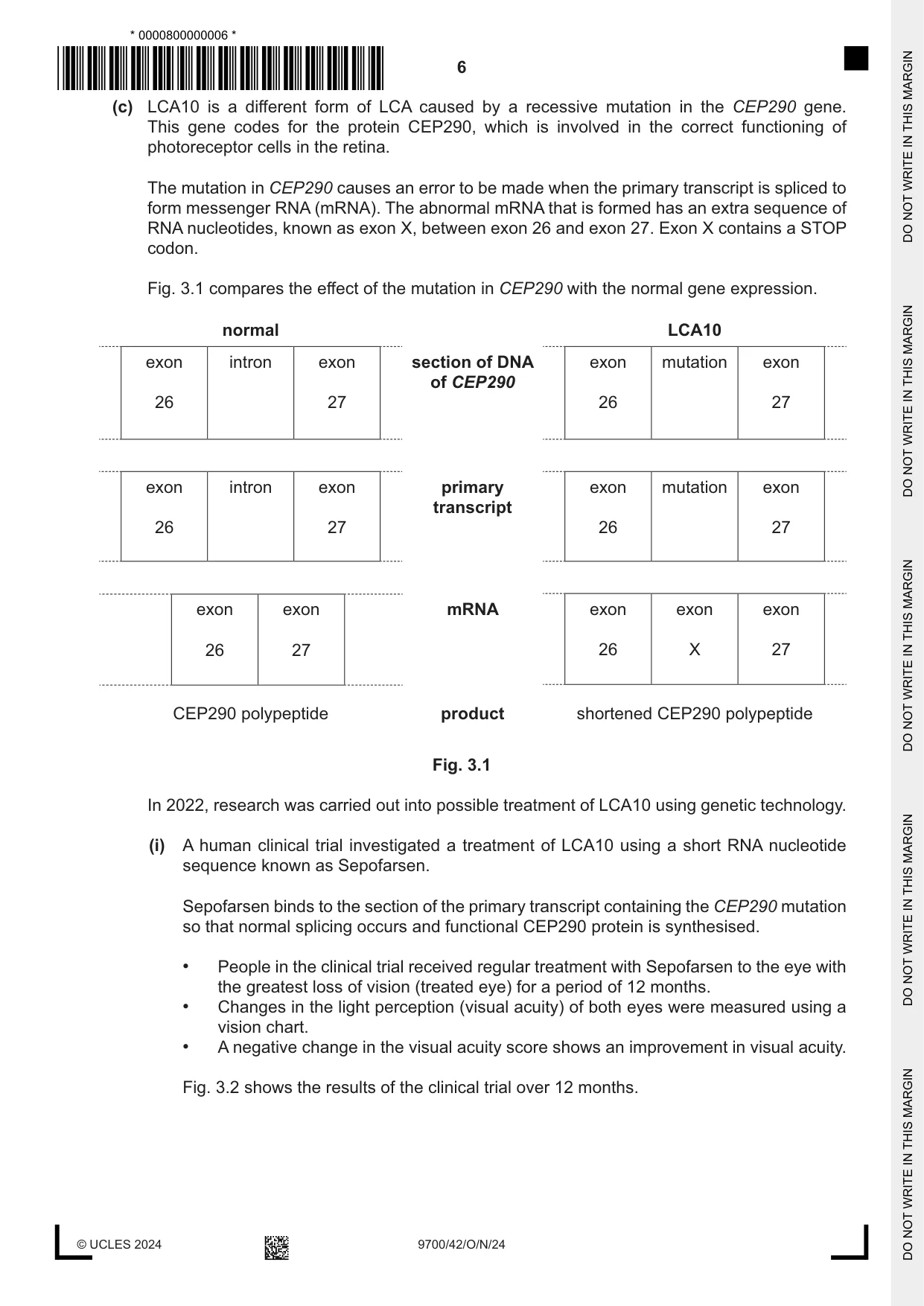
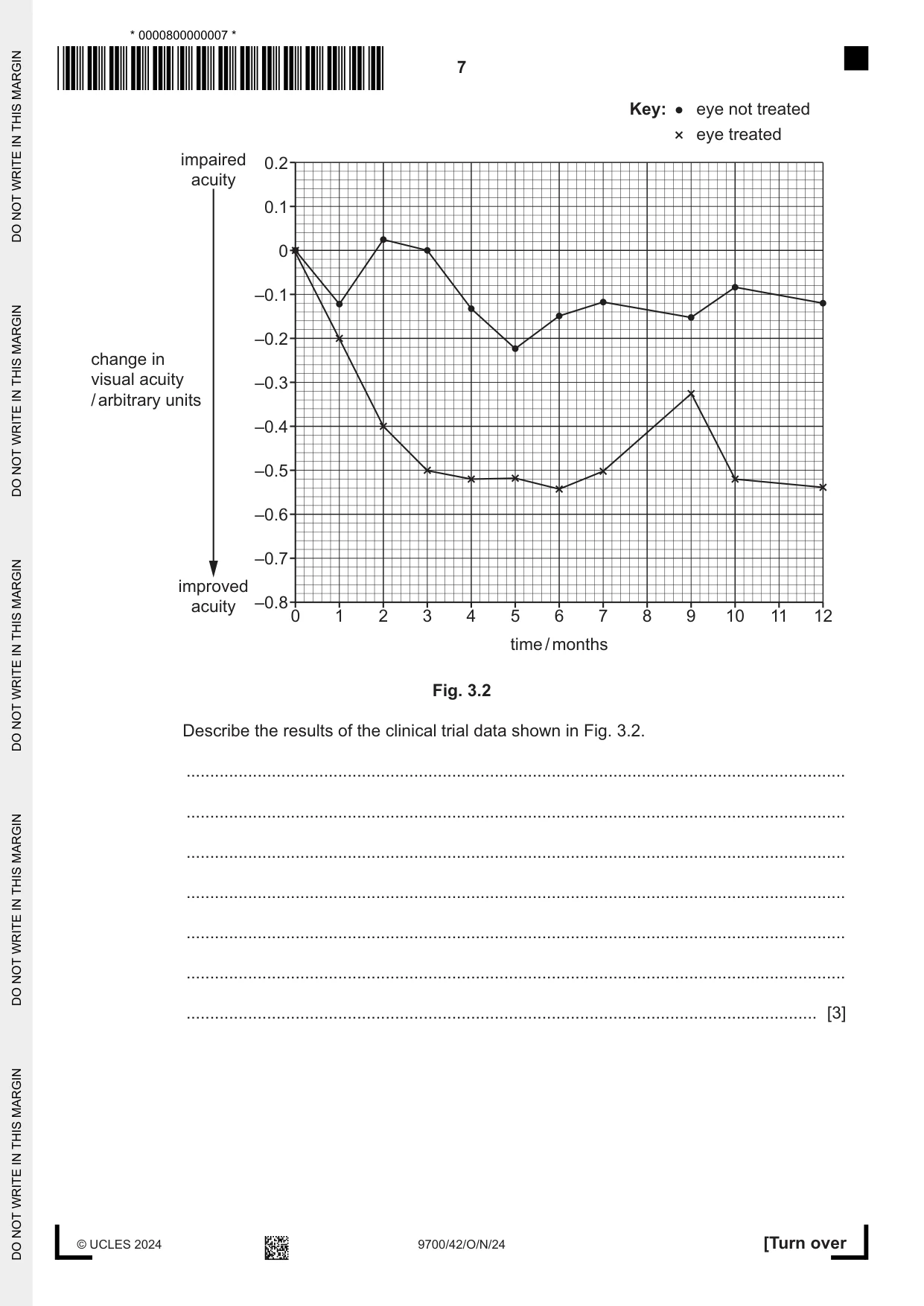
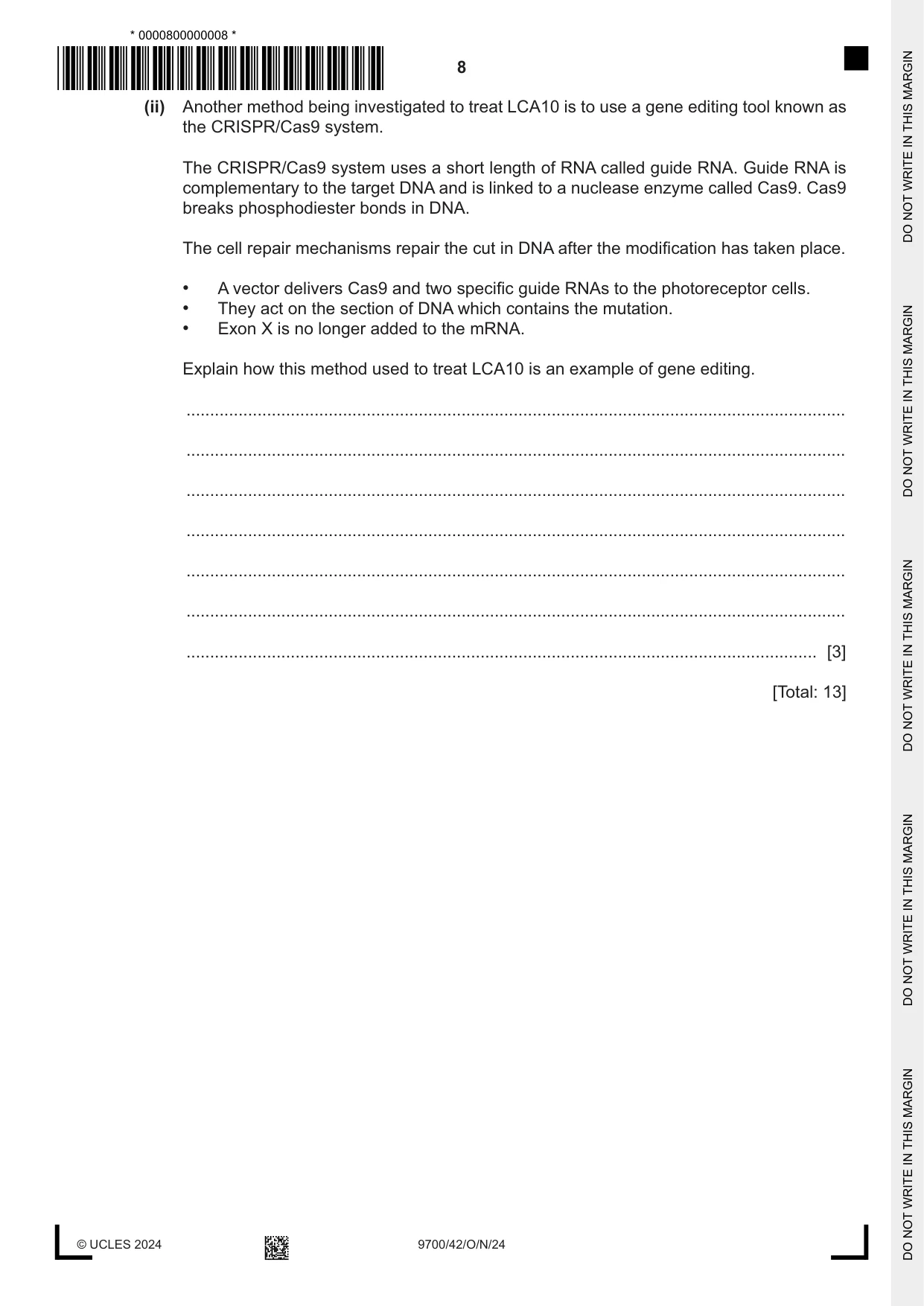
3 The treatment of many diseases has been improved by the use of genetic technology in medicine. (a) Explain what is meant by genetic engineering. ................................................................................................................................................... ................................................................................................................................................... ................................................................................................................................................... ................................................................................................................................................... ................................................................................................................................................... ................................................................................................................................................... ................................................................................................................................................... ................................................................................................................................................... ............................................................................................................................................. [3] (b) (i) Leber Congenital Amaurosis (LCA) is an inherited eye disease. In LCA, the photoreceptor cells in the retina die at an early age. This causes impaired vision (reduced eyesight) in children, which can progress to blindness. Mutations in different genes cause different forms of LCA. One form of this disease, LCA2, is caused by a mutation in the RPE65 gene. Gene therapy has been used to treat LCA2. Outline how an inherited eye disease, such as LCA2, is treated with gene therapy. ........................................................................................................................................... ........................................................................................................................................... ........................................................................................................................................... ........................................................................................................................................... ........................................................................................................................................... ........................................................................................................................................... ........................................................................................................................................... ..................................................................................................................................... [3] (ii) Suggest why the eye is a suitable organ for gene therapy. ........................................................................................................................................... ..................................................................................................................................... [1] (c) LCA10 is a different form of LCA caused by a recessive mutation in the CEP290 gene. This gene codes for the protein CEP290, which is involved in the correct functioning of photoreceptor cells in the retina. The mutation in CEP290 causes an error to be made when the primary transcript is spliced to form messenger RNA (mRNA). The abnormal mRNA that is formed has an extra sequence of RNA nucleotides, known as exon X, between exon 26 and exon 27. Exon X contains a STOP codon. Fig. 3.1 compares the effect of the mutation in CEP290 with the normal gene expression. normal LCA10 exon intron exon section of DNA exon mutation exon of CEP290 26 27 26 27 exon intron exon primary exon mutation exon transcript 26 27 26 27 exon exon mRNA exon exon exon 26 27 26 X 27 CEP290 polypeptide product shortened CEP290 polypeptide Fig. 3.1 In 2022, research was carried out into possible treatment of LCA10 using genetic technology. (i) A human clinical trial investigated a treatment of LCA10 using a short RNA nucleotide sequence known as Sepofarsen. Sepofarsen binds to the section of the primary transcript containing the CEP290 mutation so that normal splicing occurs and functional CEP290 protein is synthesised. • People in the clinical trial received regular treatment with Sepofarsen to the eye with the greatest loss of vision (treated eye) for a period of 12 months. • Changes in the light perception (visual acuity) of both eyes were measured using a vision chart. • A negative change in the visual acuity score shows an improvement in visual acuity. Fig. 3.2 shows the results of the clinical trial over 12 months. Key: eye not treated eye treated impaired 0.2 acuity 0.1 0 –0.1 –0.2 change in visual acuity –0.3 / arbitrary units –0.4 –0.5 –0.6 –0.7 improved acuity –0.8 0 1 2 3 4 5 6 7 8 9 10 11 12 time / months Fig. 3.2 Describe the results of the clinical trial data shown in Fig. 3.2. ........................................................................................................................................... ........................................................................................................................................... ........................................................................................................................................... ........................................................................................................................................... ........................................................................................................................................... ........................................................................................................................................... ..................................................................................................................................... [3] (ii) Another method being investigated to treat LCA10 is to use a gene editing tool known as the CRISPR/Cas9 system. The CRISPR/Cas9 system uses a short length of RNA called guide RNA. Guide RNA is complementary to the target DNA and is linked to a nuclease enzyme called Cas9. Cas9 breaks phosphodiester bonds in DNA. The cell repair mechanisms repair the cut in DNA after the modification has taken place. • A vector delivers Cas9 and two specific guide RNAs to the photoreceptor cells. • They act on the section of DNA which contains the mutation. • Exon X is no longer added to the mRNA. Explain how this method used to treat LCA10 is an example of gene editing. ........................................................................................................................................... ........................................................................................................................................... ........................................................................................................................................... ........................................................................................................................................... ........................................................................................................................................... ........................................................................................................................................... ..................................................................................................................................... [3] [Total: 13] Question 4 starts on page 10
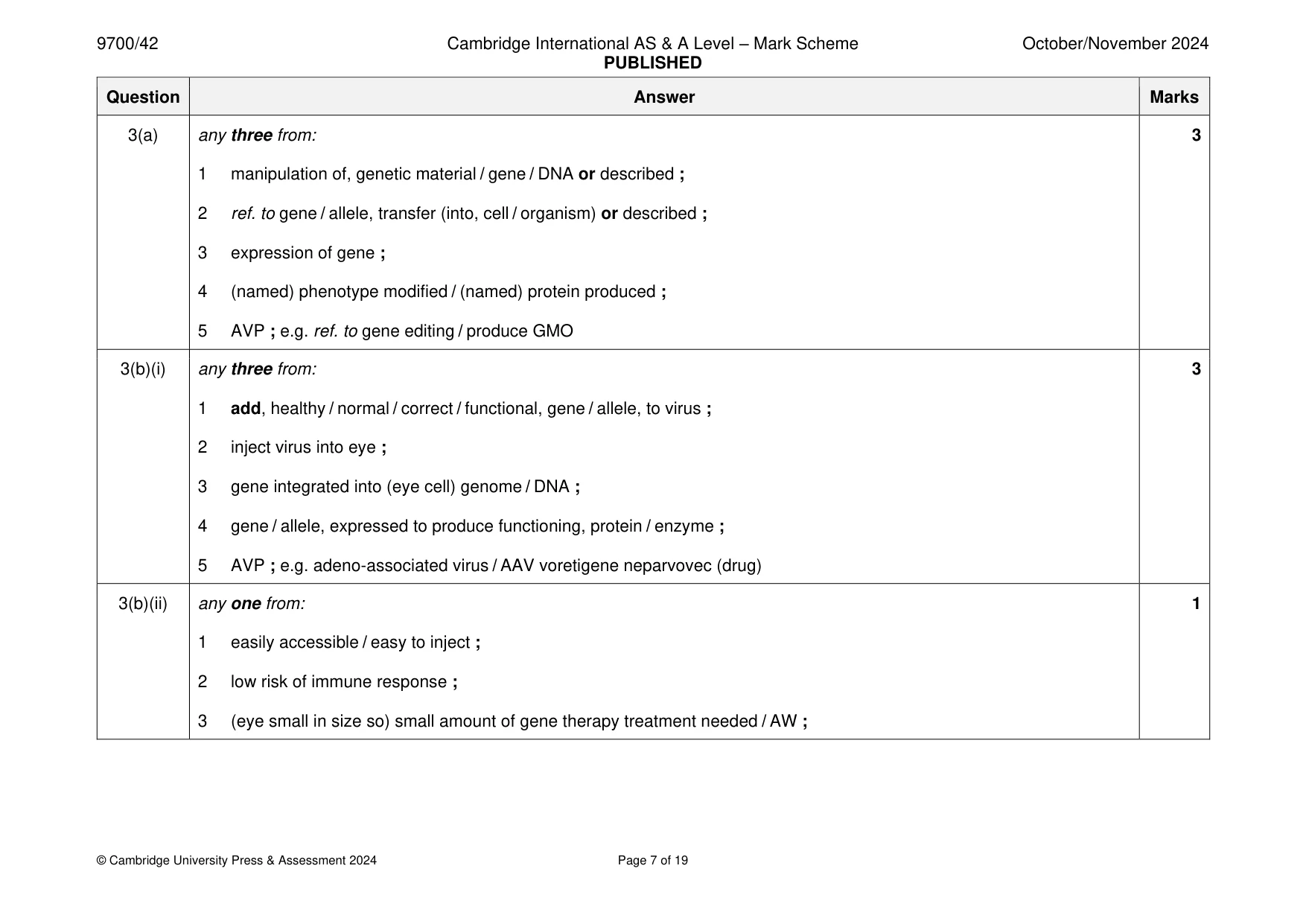
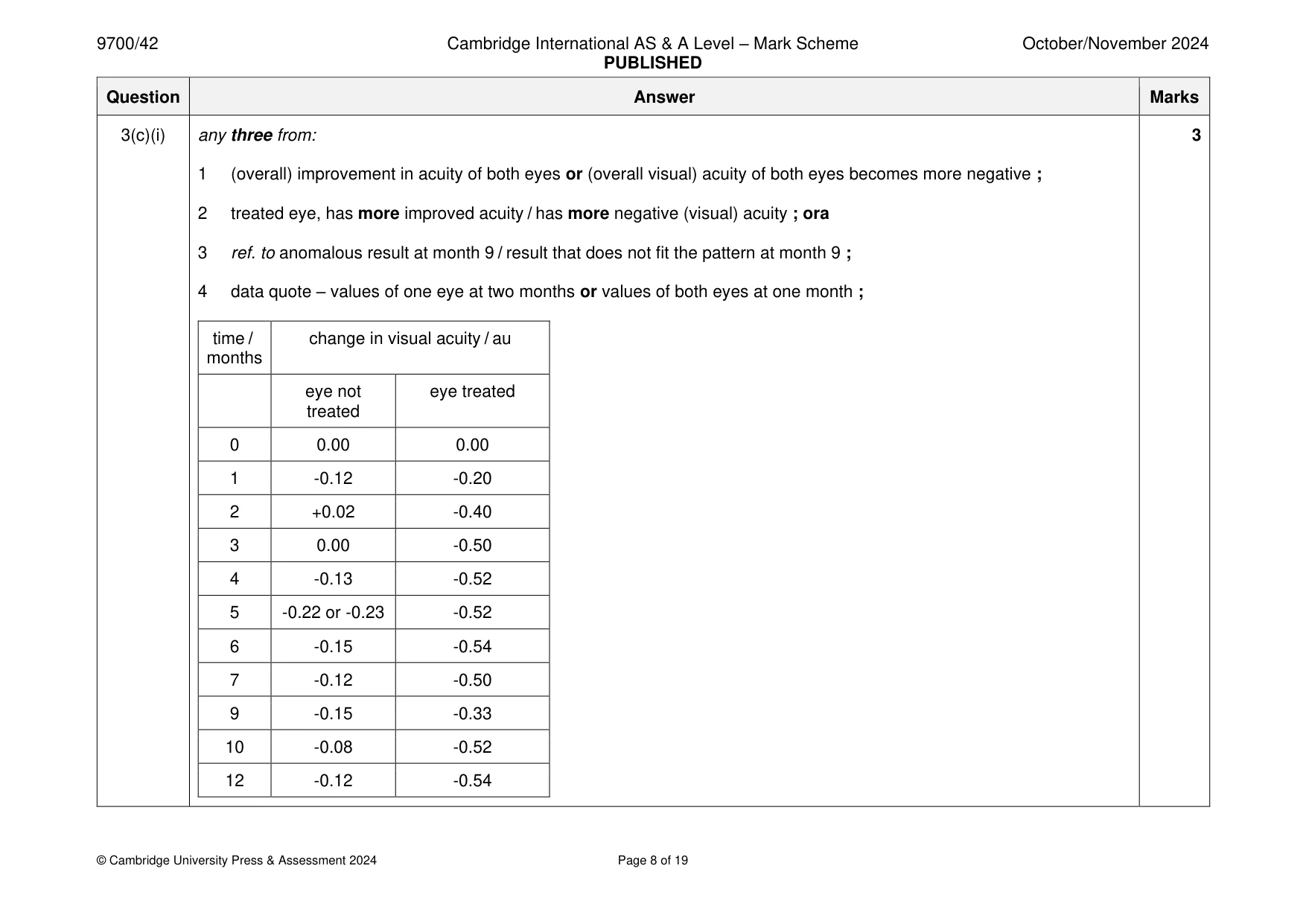
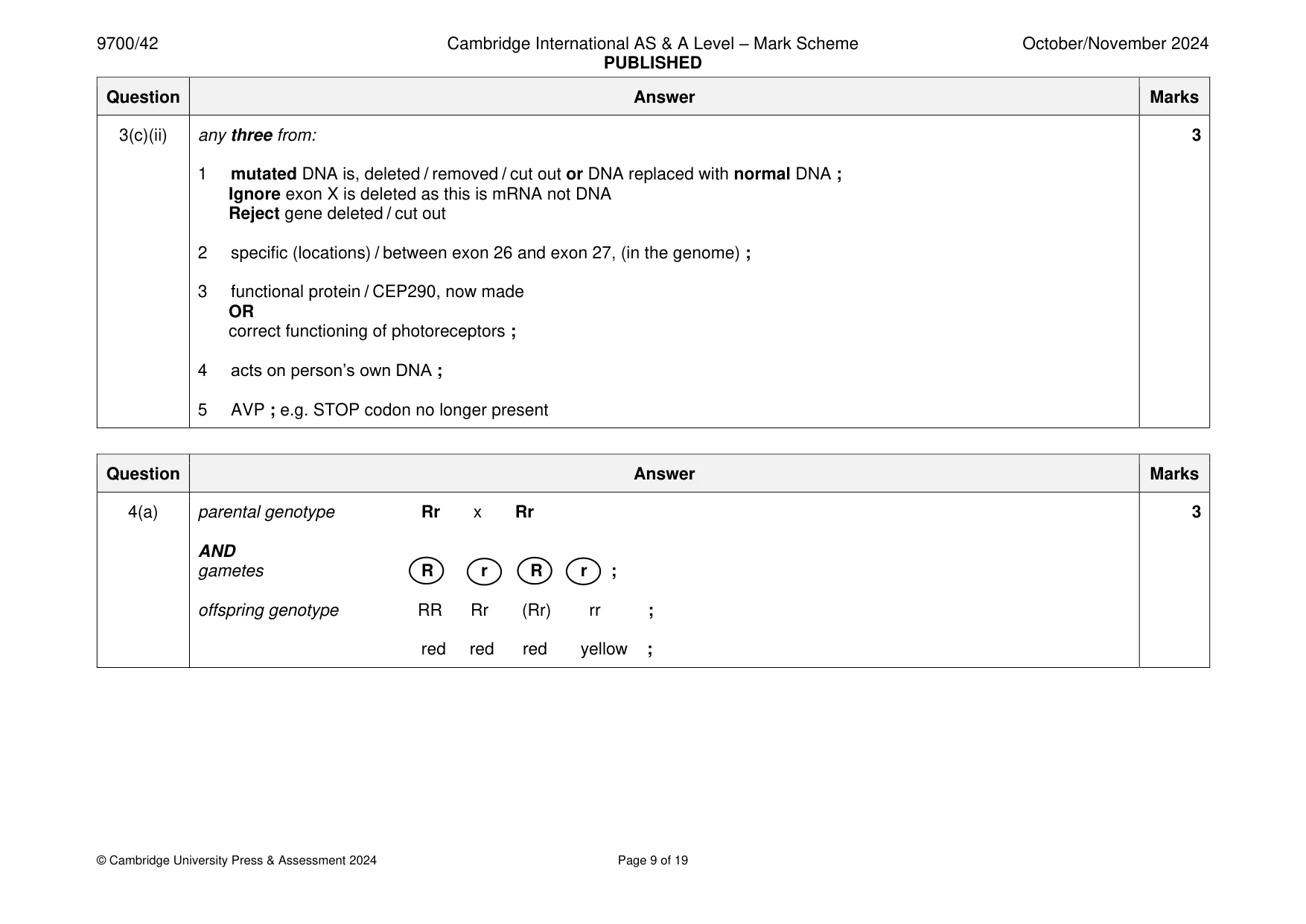
Mark scheme: 3(a) any three from: 3 1 manipulation of, genetic material / gene / DNA or described ; 2 ref. to gene / allele, transfer (into, cell / organism) or described ; 3 expression of gene ; 4 (named) phenotype modified / (named) protein produced ; 5 AVP ; e.g. ref. to gene editing / produce GMO 3(b)(i) any three from: 3 1 add, healthy / normal / correct / functional, gene / allele, to virus ; 2 inject virus into eye ; 3 gene integrated into (eye cell) genome / DNA ; 4 gene / allele, expressed to produce functioning, protein / enzyme ; 5 AVP ; e.g. adeno-associated virus / AAV voretigene neparvovec (drug) 3(b)(ii) any one from: 1 1 easily accessible / easy to inject ; 2 low risk of immune response ; 3 (eye small in size so) small amount of gene therapy treatment needed / AW ; 3(c)(i) any three from: 3 1 (overall) improvement in acuity of both eyes or (overall visual) acuity of both eyes becomes more negative ; 2 treated eye, has more improved acuity / has more negative (visual) acuity ; ora 3 ref. to anomalous result at month 9 / result that does not fit the pattern at month 9 ; 4 data quote – values of one eye at two months or values of both eyes at one month ; time / change in visual acuity / au months eye not eye treated treated 0 0.00 0.00 1 -0.12 -0.20 2 +0.02 -0.40 3 0.00 -0.50 4 -0.13 -0.52 5 -0.22 or -0.23 -0.52 6 -0.15 -0.54 7 -0.12 -0.50 9 -0.15 -0.33 10 -0.08 -0.52 12 -0.12 -0.54 3(c)(ii) any three from: 3 1 mutated DNA is, deleted / removed / cut out or DNA replaced with normal DNA ; Ignore exon X is deleted as this is mRNA not DNA Reject gene deleted / cut out 2 specific (locations) / between exon 26 and exon 27, (in the genome) ; 3 functional protein / CEP290, now made OR correct functioning of photoreceptors ; 4 acts on person’s own DNA ; 5 AVP ; e.g. STOP codon no longer present
Q4 · Genetic crosses can be used to investigate patterns of inheritance
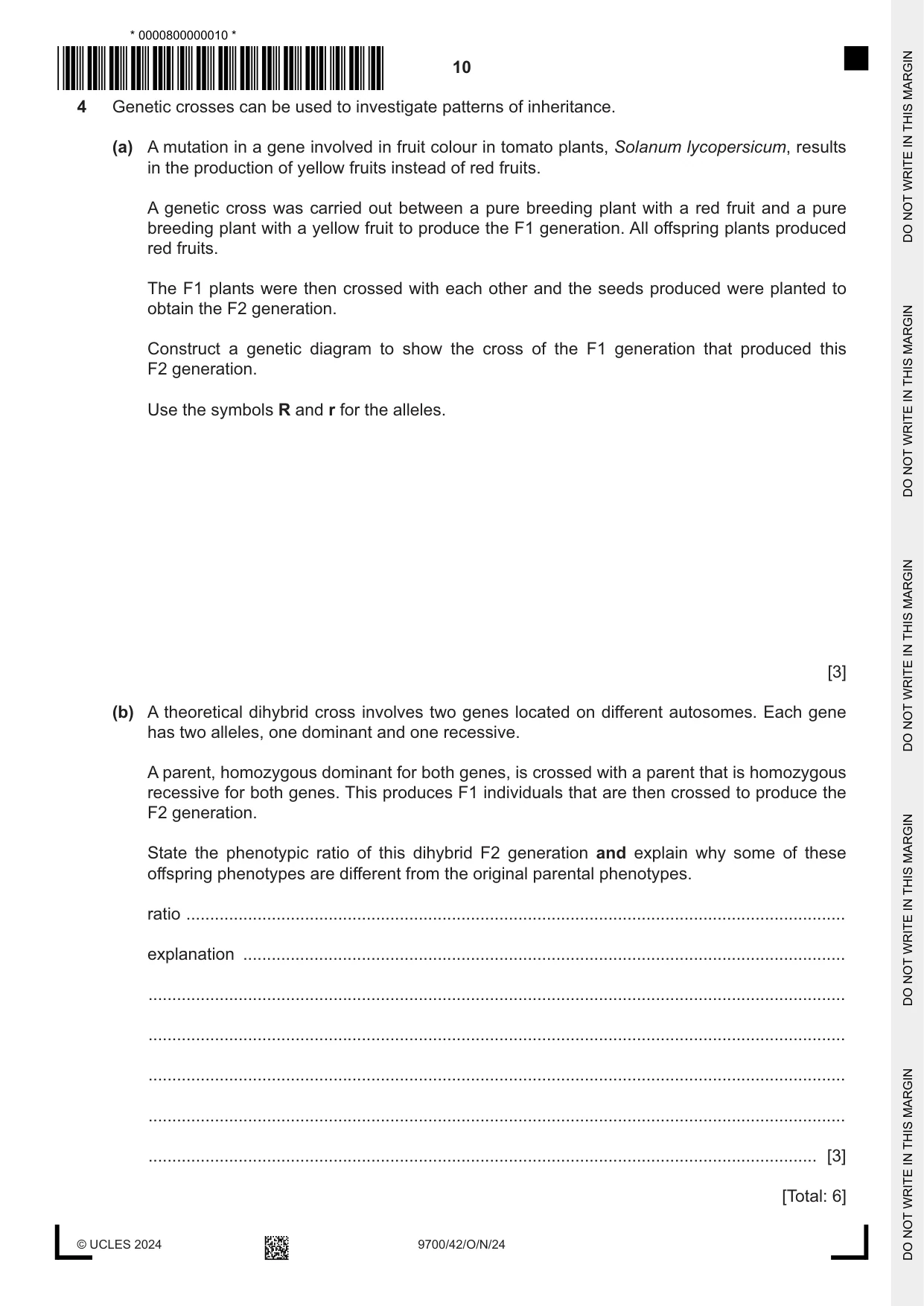
4 Genetic crosses can be used to investigate patterns of inheritance. (a) A mutation in a gene involved in fruit colour in tomato plants, Solanum lycopersicum, results in the production of yellow fruits instead of red fruits. A genetic cross was carried out between a pure breeding plant with a red fruit and a pure breeding plant with a yellow fruit to produce the F1 generation. All offspring plants produced red fruits. The F1 plants were then crossed with each other and the seeds produced were planted to obtain the F2 generation. Construct a genetic diagram to show the cross of the F1 generation that produced this F2 generation. Use the symbols R and r for the alleles. [3] (b) A theoretical dihybrid cross involves two genes located on different autosomes. Each gene has two alleles, one dominant and one recessive. A parent, homozygous dominant for both genes, is crossed with a parent that is homozygous recessive for both genes. This produces F1 individuals that are then crossed to produce the F2 generation. State the phenotypic ratio of this dihybrid F2 generation and explain why some of these offspring phenotypes are different from the original parental phenotypes. ratio ........................................................................................................................................... explanation ............................................................................................................................... ................................................................................................................................................... ................................................................................................................................................... ................................................................................................................................................... ................................................................................................................................................... ............................................................................................................................................. [3] [Total: 6]
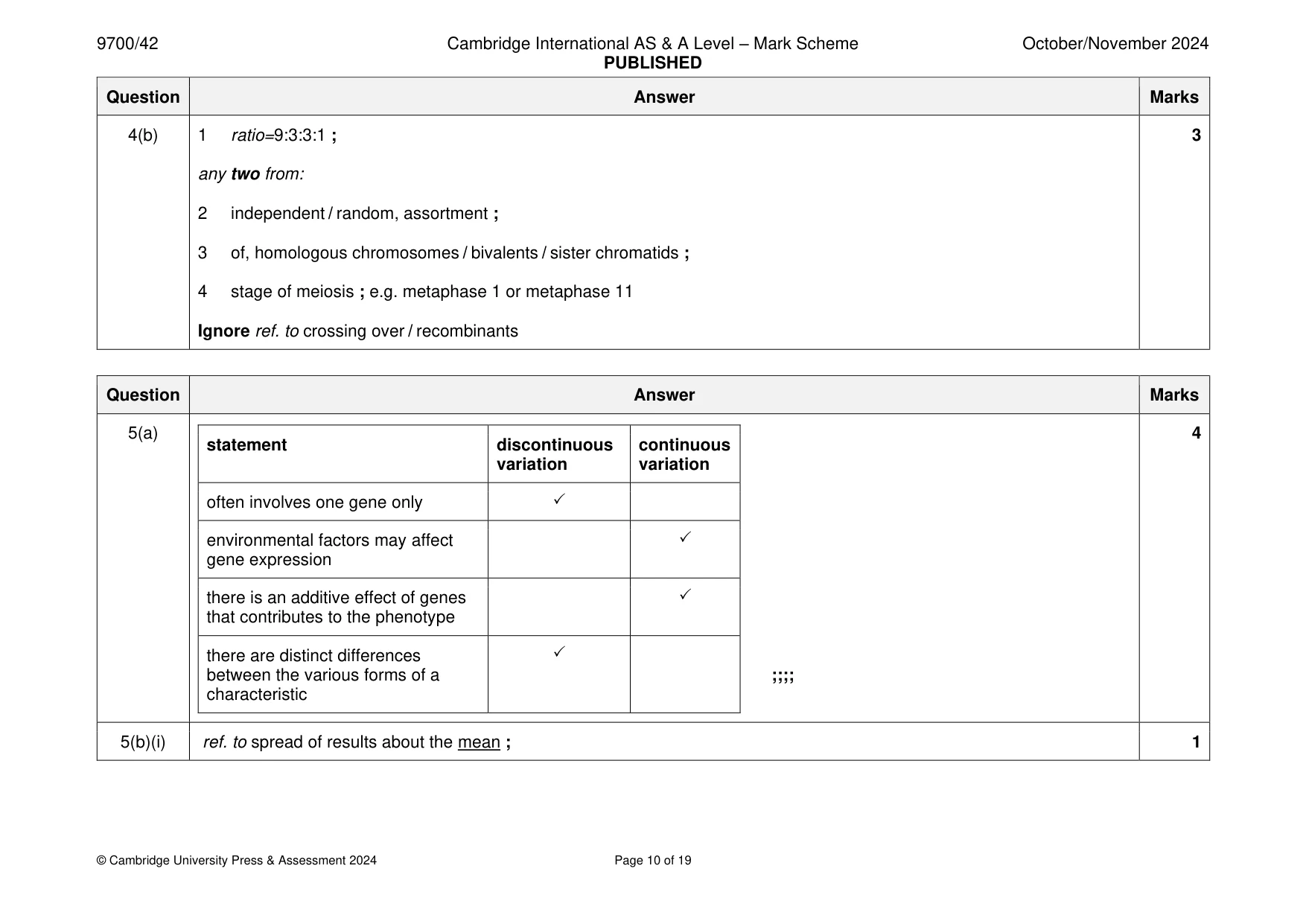
Mark scheme: 4(a) parental genotype Rr x Rr 3 AND gametes R r R r ; offspring genotype RR Rr (Rr) rr ; red red red yellow ; 4(b) 1 ratio=9:3:3:1 ; 3 any two from: 2 independent / random, assortment ; 3 of, homologous chromosomes / bivalents / sister chromatids ; 4 stage of meiosis ; e.g. metaphase 1 or metaphase 11 Ignore ref. to crossing over / recombinants
More questions on Passage of information from parents to offspring
Q5 · Phenotypic variation exists in natural populations
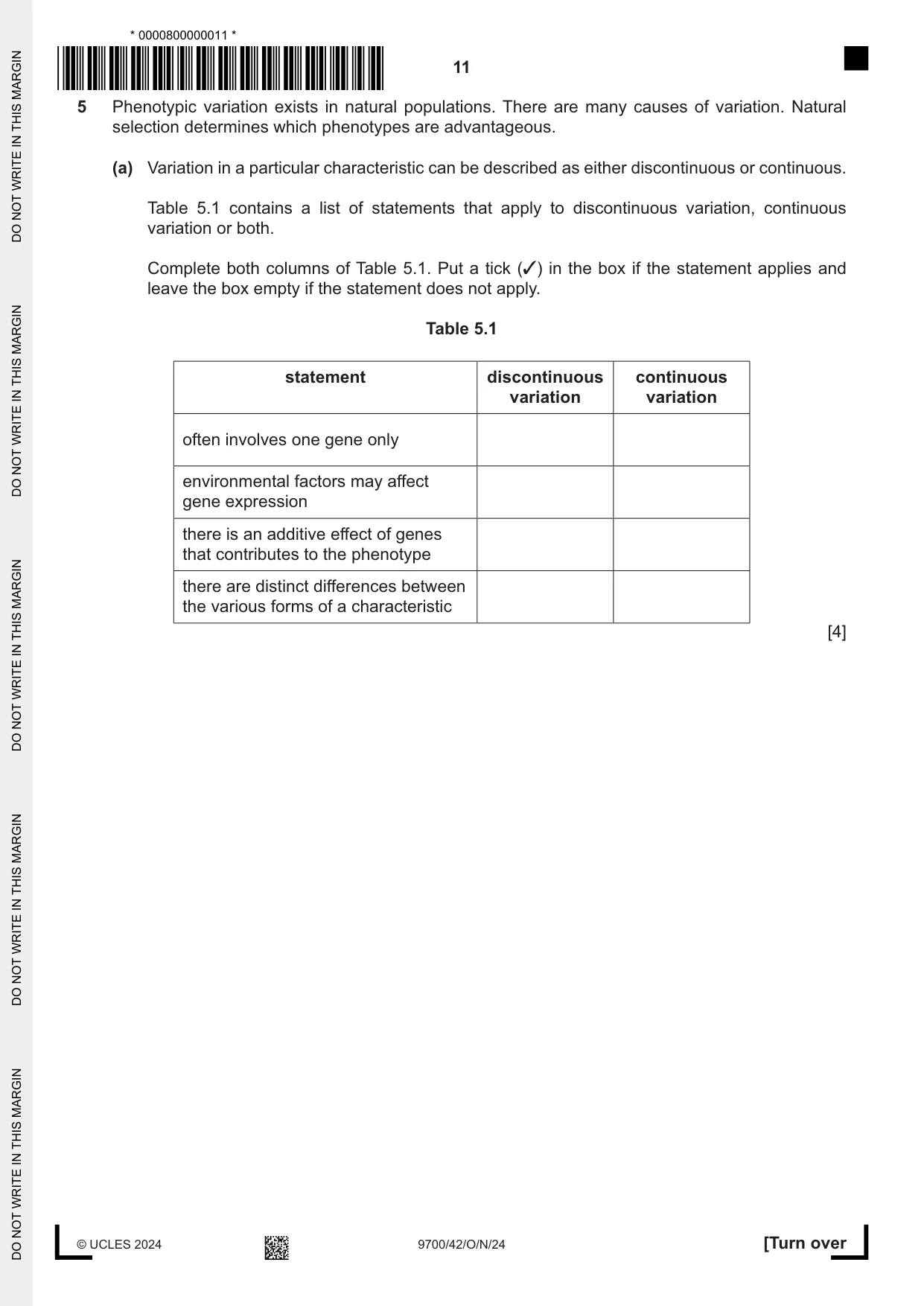
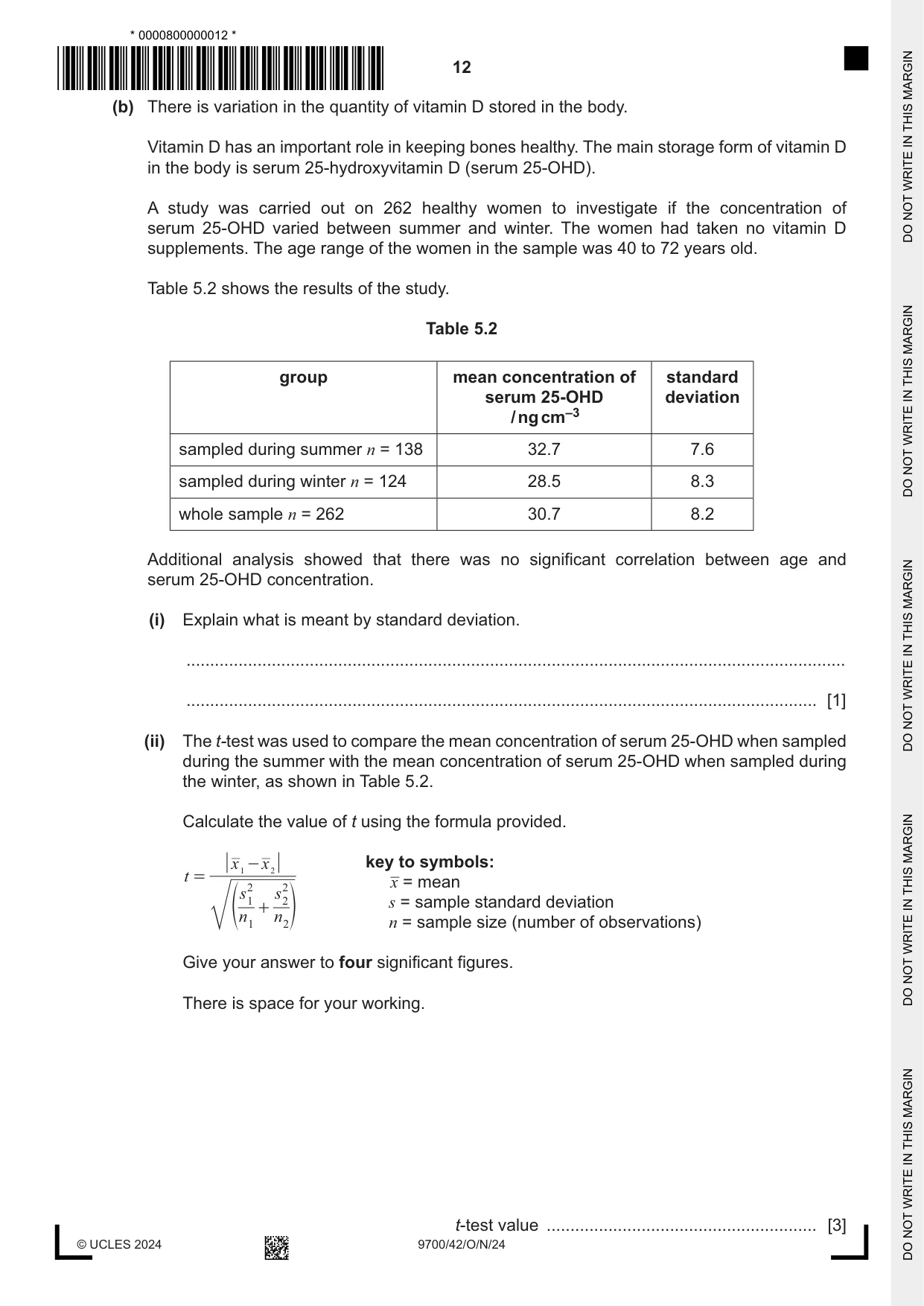
5 Phenotypic variation exists in natural populations. There are many causes of variation. Natural selection determines which phenotypes are advantageous. (a) Variation in a particular characteristic can be described as either discontinuous or continuous. Table 5.1 contains a list of statements that apply to discontinuous variation, continuous variation or both. Complete both columns of Table 5.1. Put a tick (✓) in the box if the statement applies and leave the box empty if the statement does not apply. Table 5.1 statement discontinuous continuous variation variation often involves one gene only environmental factors may affect gene expression there is an additive effect of genes that contributes to the phenotype there are distinct differences between the various forms of a characteristic [4] (b) There is variation in the quantity of vitamin D stored in the body. Vitamin D has an important role in keeping bones healthy. The main storage form of vitamin D in the body is serum 25‑hydroxyvitamin D (serum 25‑OHD). A study was carried out on 262 healthy women to investigate if the concentration of serum 25‑OHD varied between summer and winter. The women had taken no vitamin D supplements. The age range of the women in the sample was 40 to 72 years old. Table 5.2 shows the results of the study. Table 5.2 group mean concentration of standard serum 25‑OHD deviation / ng cm–3 sampled during summer n = 138 32.7 7.6 sampled during winter n = 124 28.5 8.3 whole sample n = 262 30.7 8.2 Additional analysis showed that there was no significant correlation between age and serum 25‑OHD concentration. (i) Explain what is meant by standard deviation. ........................................................................................................................................... ..................................................................................................................................... [1] (ii) The t‑test was used to compare the mean concentration of serum 25‑OHD when sampled during the summer with the mean concentration of serum 25‑OHD when sampled during the winter, as shown in Table 5.2. Calculate the value of t using the formula provided. x 1 - x 2 key to symbols: t = 2 2 ¯x = mean s s f 1 + 2 p s = sample standard deviation n n 1 2 n = sample size (number of observations) Give your answer to four significant figures. There is space for your working. t‑test value ......................................................... [3] (iii) The critical value at the 0.0001 probability level is 3.773. State the conclusion that can be made about the results of the study shown in Table 5.2 and explain how the result of your calculation in (b)(ii) can be used to support this conclusion. ........................................................................................................................................... ........................................................................................................................................... ........................................................................................................................................... ........................................................................................................................................... ........................................................................................................................................... ........................................................................................................................................... ........................................................................................................................................... ........................................................................................................................................... ..................................................................................................................................... [3] (iv) Suggest the likely causes of variation in quantity of vitamin D stored in the body in this sample of women. ........................................................................................................................................... ........................................................................................................................................... ..................................................................................................................................... [1] [Total: 12]
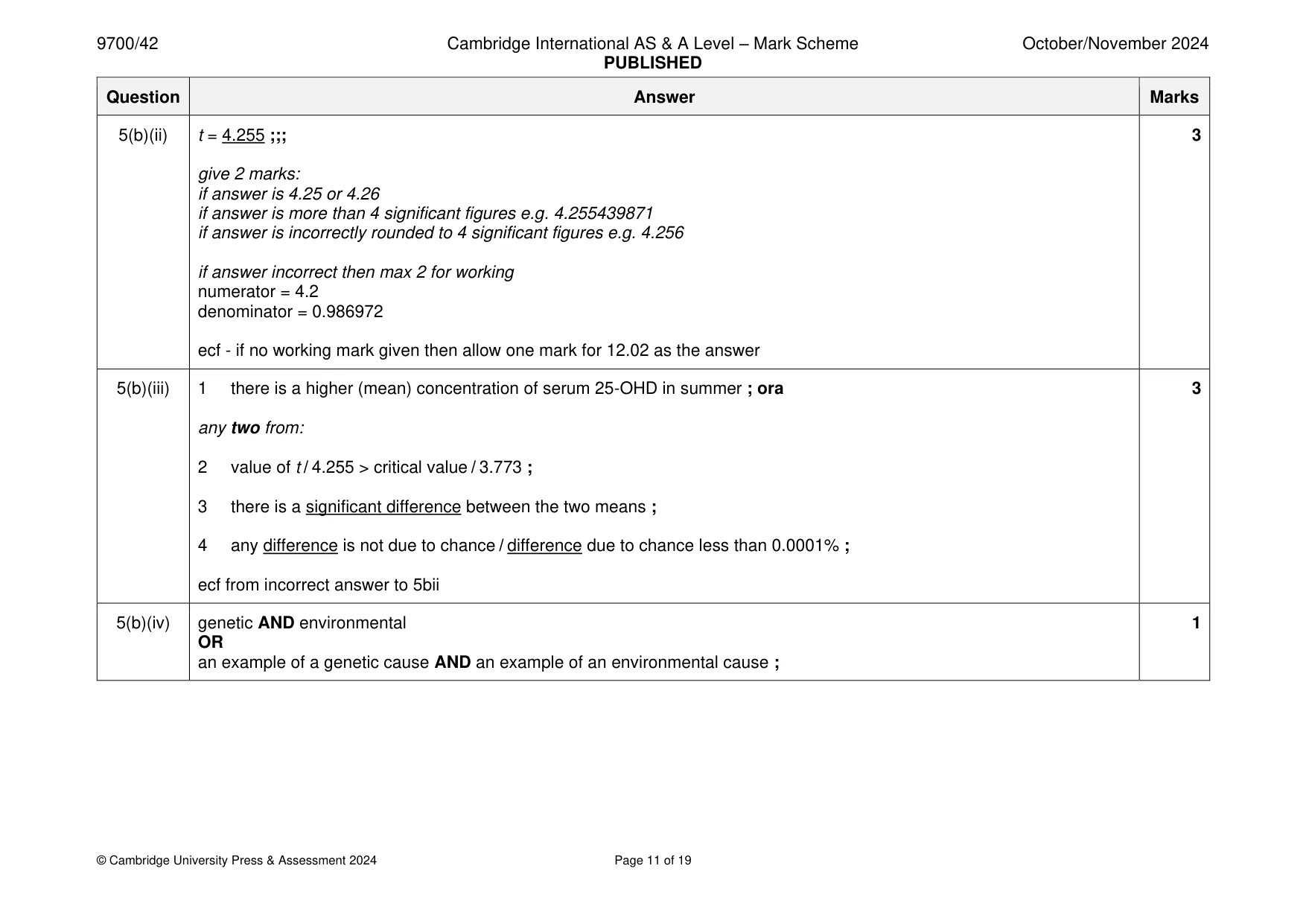
Mark scheme: 5(a) 4 statement discontinuous continuous variation variation often involves one gene only environmental factors may affect gene expression there is an additive effect of genes that contributes to the phenotype there are distinct differences between the various forms of a ;;;; characteristic 5(b)(i) ref. to spread of results about the mean ; 1 5(b)(ii) t = 4.255 ;;; 3 give 2 marks: if answer is 4.25 or 4.26 if answer is more than 4 significant figures e.g. 4.255439871 if answer is incorrectly rounded to 4 significant figures e.g. 4.256 if answer incorrect then max 2 for working numerator = 4.2 denominator = 0.986972 ecf - if no working mark given then allow one mark for 12.02 as the answer 5(b)(iii) 1 there is a higher (mean) concentration of serum 25-OHD in summer ; ora 3 any two from: 2 value of t / 4.255 > critical value / 3.773 ; 3 there is a significant difference between the two means ; 4 any difference is not due to chance / difference due to chance less than 0.0001% ; ecf from incorrect answer to 5bii 5(b)(iv) genetic AND environmental 1 OR an example of a genetic cause AND an example of an environmental cause ;
Q6 · DCPIP is an indicator and can be used to determine the rate of respiration of organisms…
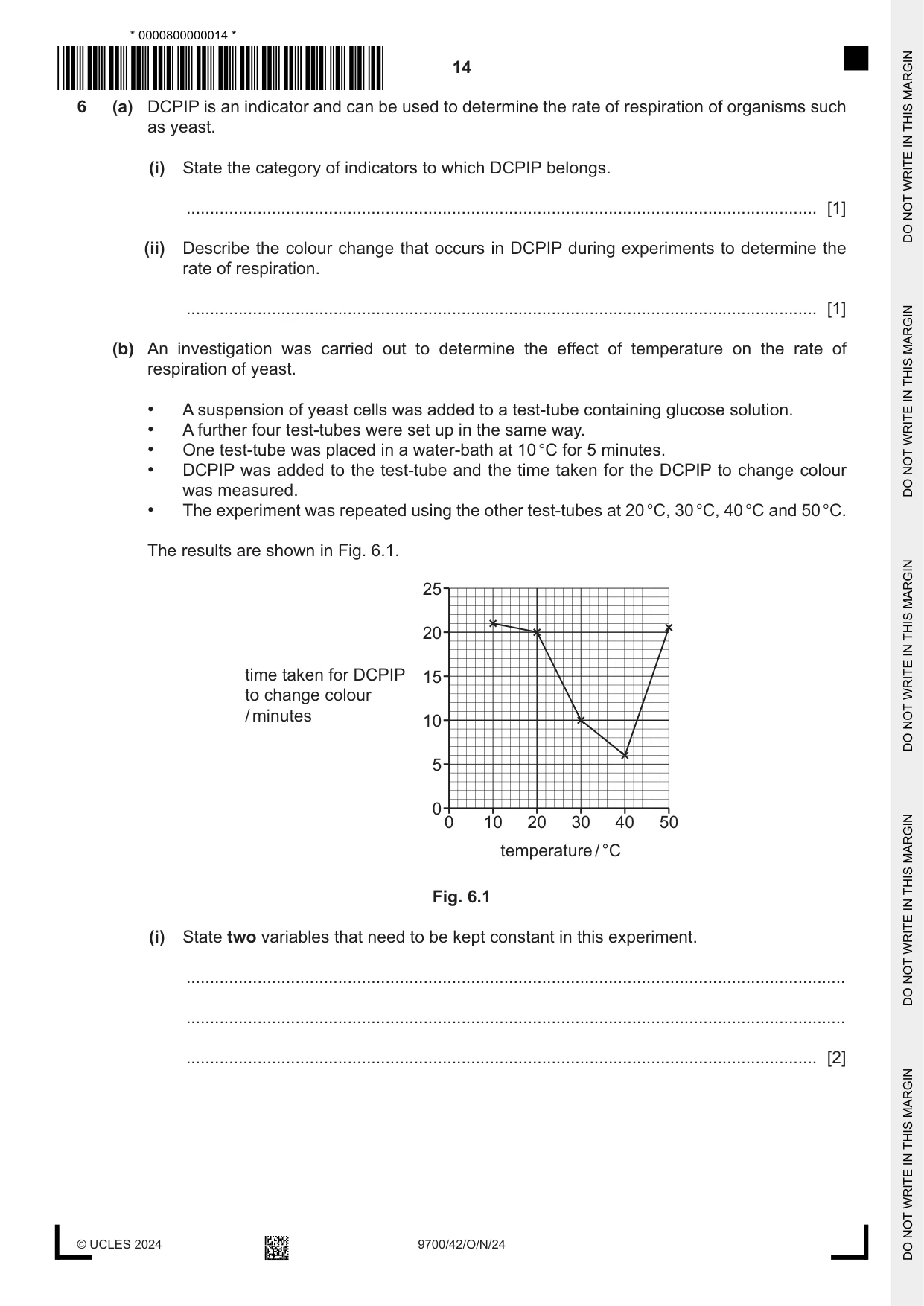
6 (a) DCPIP is an indicator and can be used to determine the rate of respiration of organisms such as yeast. (i) State the category of indicators to which DCPIP belongs. ..................................................................................................................................... [1] (ii) Describe the colour change that occurs in DCPIP during experiments to determine the rate of respiration. ..................................................................................................................................... [1] (b) An investigation was carried out to determine the effect of temperature on the rate of respiration of yeast. • A suspension of yeast cells was added to a test‑tube containing glucose solution. • A further four test‑tubes were set up in the same way. • One test‑tube was placed in a water‑bath at 10 °C for 5 minutes. • DCPIP was added to the test‑tube and the time taken for the DCPIP to change colour was measured. • The experiment was repeated using the other test‑tubes at 20 °C, 30 °C, 40 °C and 50 °C. The results are shown in Fig. 6.1. 25 20 time taken for DCPIP 15 to change colour / minutes 10 5 0 0 10 20 30 40 50 temperature / °C Fig. 6.1 (i) State two variables that need to be kept constant in this experiment. ........................................................................................................................................... ........................................................................................................................................... ..................................................................................................................................... [2] (ii) Explain the results shown in Fig. 6.1. ........................................................................................................................................... ........................................................................................................................................... ........................................................................................................................................... ........................................................................................................................................... ........................................................................................................................................... ........................................................................................................................................... ........................................................................................................................................... ........................................................................................................................................... ..................................................................................................................................... [3] [Total: 7]
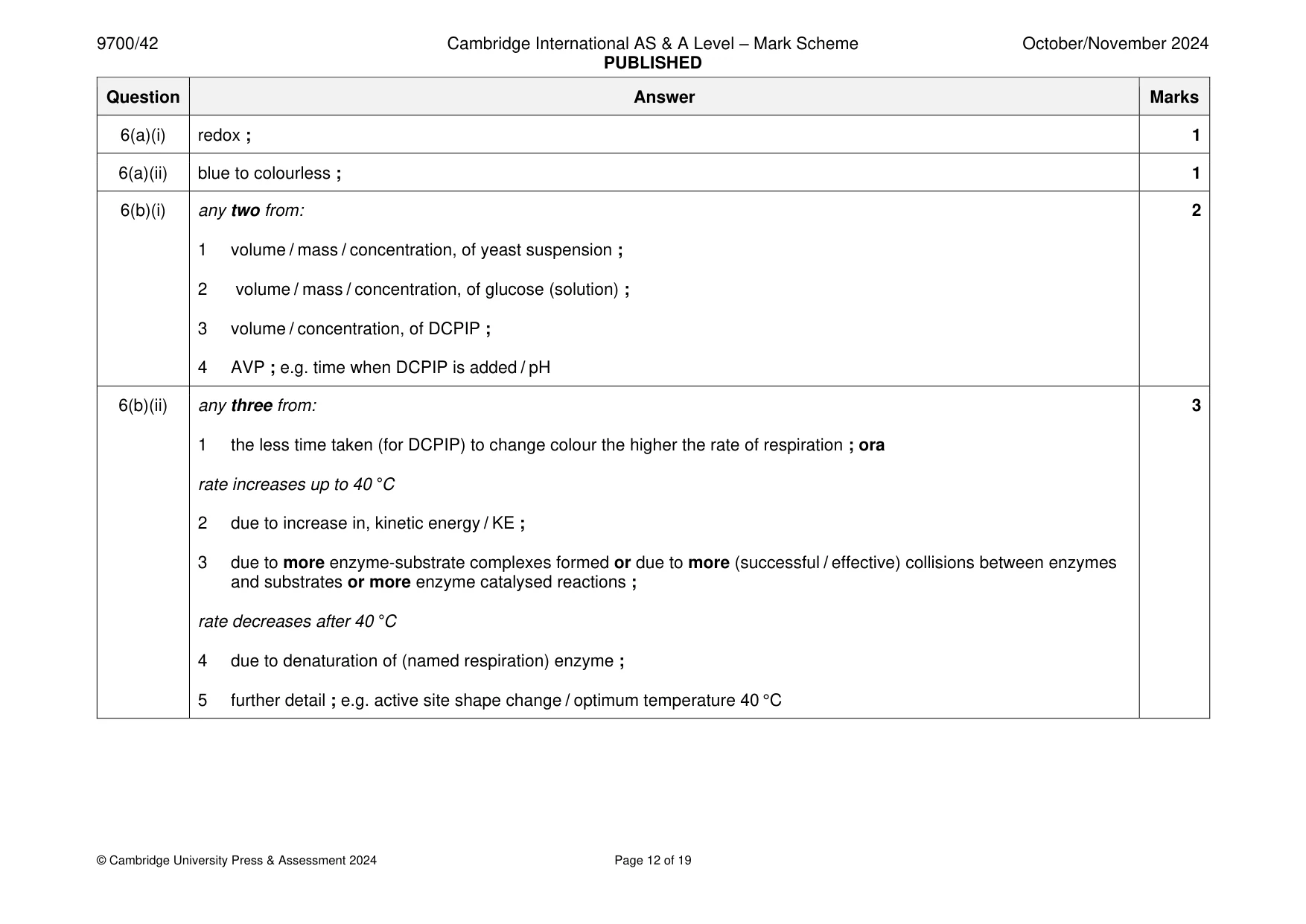
Mark scheme: 6(a)(i) redox ; 1 6(a)(ii) blue to colourless ; 1 6(b)(i) any two from: 2 1 volume / mass / concentration, of yeast suspension ; 2 volume / mass / concentration, of glucose (solution) ; 3 volume / concentration, of DCPIP ; 4 AVP ; e.g. time when DCPIP is added / pH 6(b)(ii) any three from: 3 1 the less time taken (for DCPIP) to change colour the higher the rate of respiration ; ora rate increases up to 40 °C 2 due to increase in, kinetic energy / KE ; 3 due to more enzyme-substrate complexes formed or due to more (successful / effective) collisions between enzymes and substrates or more enzyme catalysed reactions ; rate decreases after 40 °C 4 due to denaturation of (named respiration) enzyme ; 5 further detail ; e.g. active site shape change / optimum temperature 40 °C
Q7 · Paper chromatography is a technique that can be used to separate and identify different…
7 (a) Paper chromatography is a technique that can be used to separate and identify different chloroplast pigments. Describe how the results of paper chromatography can be used to identify chloroplast pigments. ................................................................................................................................................... ................................................................................................................................................... ................................................................................................................................................... ................................................................................................................................................... ................................................................................................................................................... ................................................................................................................................................... ............................................................................................................................................. [3] (b) Carotene and xanthophyll are chloroplast pigments. Describe the role played by these pigments in photosynthesis. ................................................................................................................................................... ................................................................................................................................................... ................................................................................................................................................... ................................................................................................................................................... ................................................................................................................................................... ................................................................................................................................................... ............................................................................................................................................. [3] (c) The light‑dependent stage of photosynthesis produces ATP and reduced NADP, which are used in the light‑independent stage. Describe the light‑independent stage of photosynthesis. ................................................................................................................................................... ................................................................................................................................................... ................................................................................................................................................... ................................................................................................................................................... ................................................................................................................................................... ................................................................................................................................................... ................................................................................................................................................... ................................................................................................................................................... ................................................................................................................................................... ................................................................................................................................................... ................................................................................................................................................... ................................................................................................................................................... ................................................................................................................................................... ................................................................................................................................................... ................................................................................................................................................... ............................................................................................................................................. [7] [Total: 13]
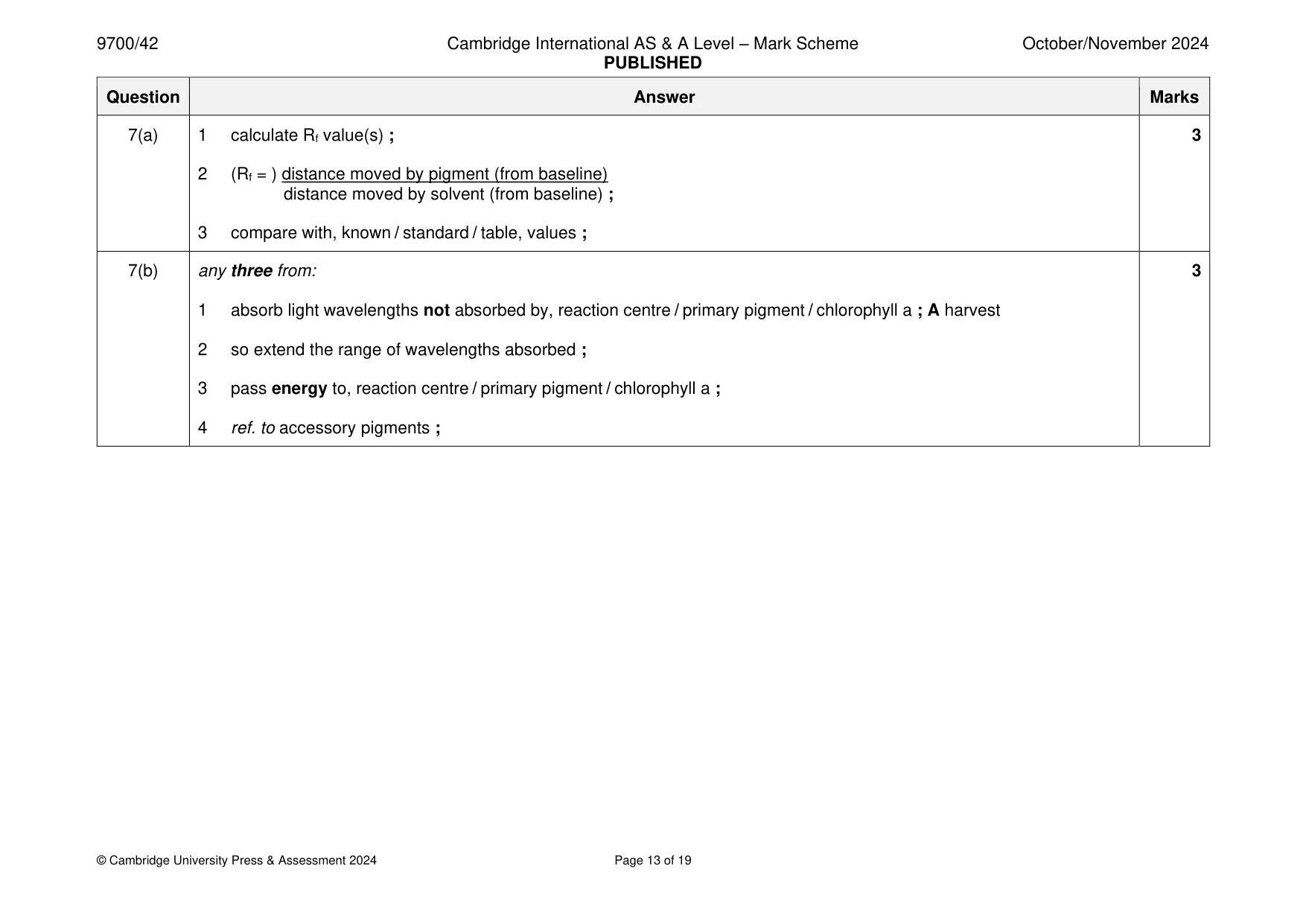
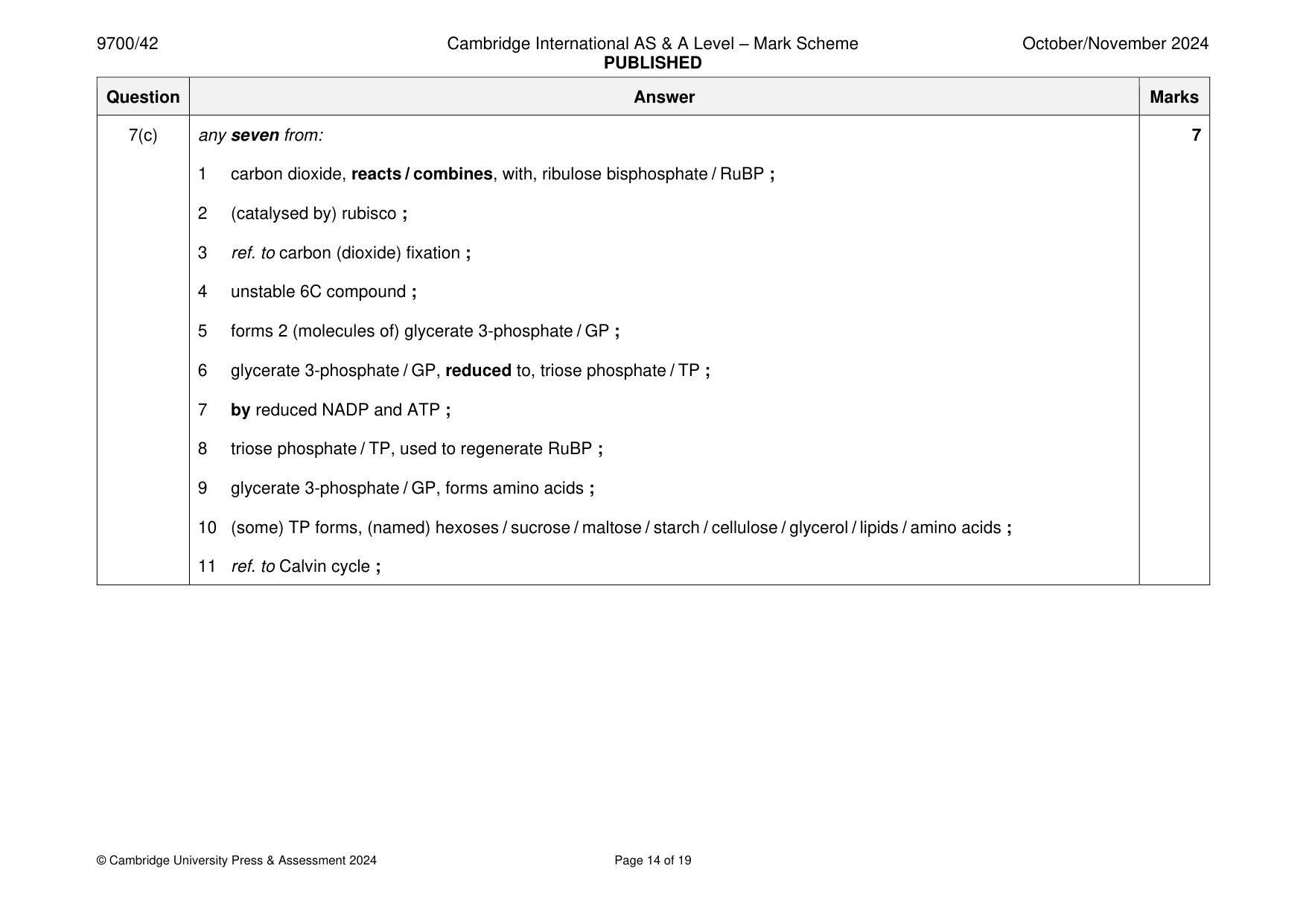
Mark scheme: 7(a) 1 calculate Rf value(s) ; 3 2 (Rf = ) distance moved by pigment (from baseline) distance moved by solvent (from baseline) ; 3 compare with, known / standard / table, values ; 7(b) any three from: 3 1 absorb light wavelengths not absorbed by, reaction centre / primary pigment / chlorophyll a ; A harvest 2 so extend the range of wavelengths absorbed ; 3 pass energy to, reaction centre / primary pigment / chlorophyll a ; 4 ref. to accessory pigments ; 7(c) any seven from: 7 1 carbon dioxide, reacts / combines, with, ribulose bisphosphate / RuBP ; 2 (catalysed by) rubisco ; 3 ref. to carbon (dioxide) fixation ; 4 unstable 6C compound ; 5 forms 2 (molecules of) glycerate 3-phosphate / GP ; 6 glycerate 3-phosphate / GP, reduced to, triose phosphate / TP ; 7 by reduced NADP and ATP ; 8 triose phosphate / TP, used to regenerate RuBP ; 9 glycerate 3-phosphate / GP, forms amino acids ; 10 (some) TP forms, (named) hexoses / sucrose / maltose / starch / cellulose / glycerol / lipids / amino acids ; 11 ref. to Calvin cycle ;
More questions on Photosynthesis as an energy transfer process
Q8 · A diagram of a motor neurone
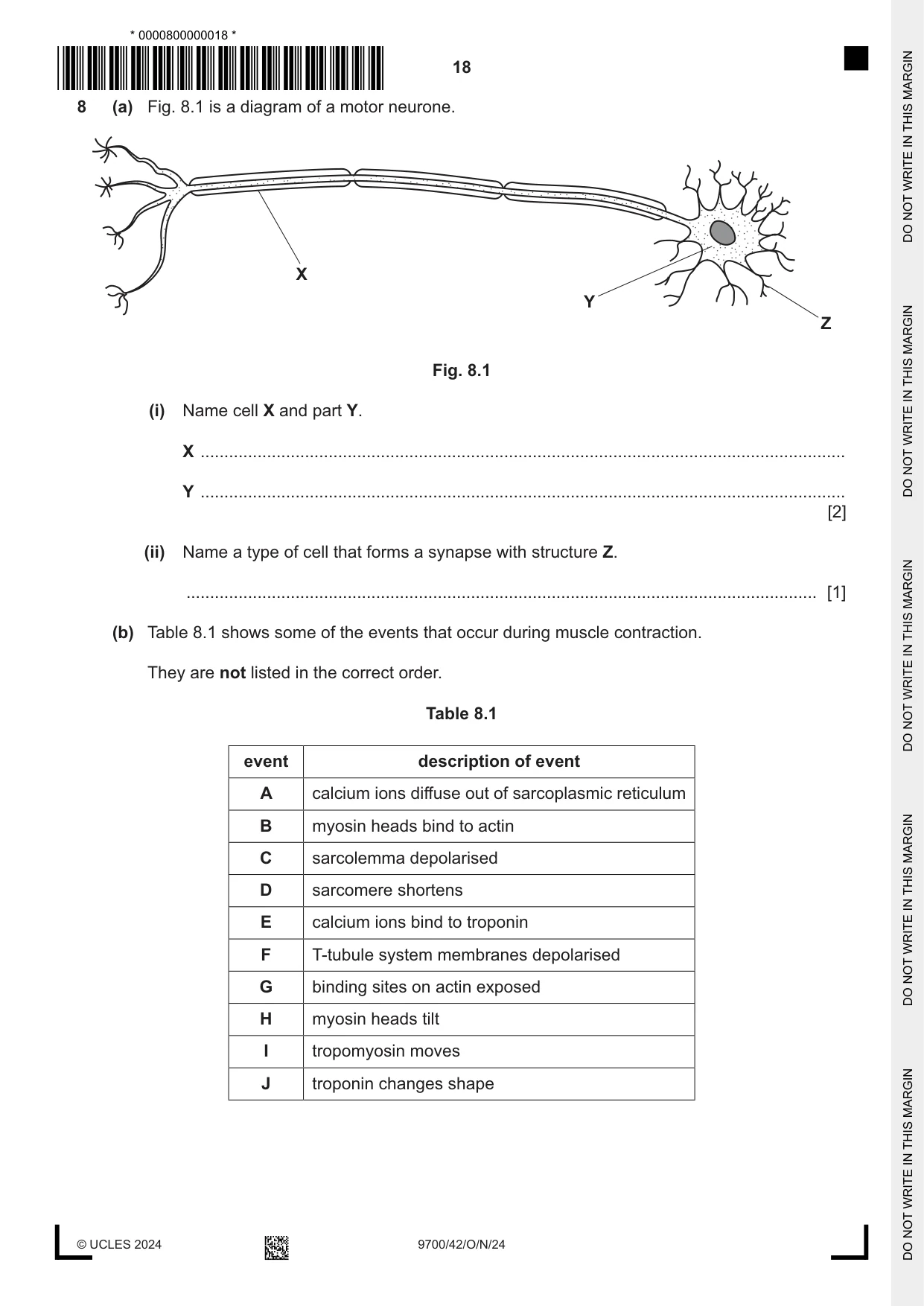
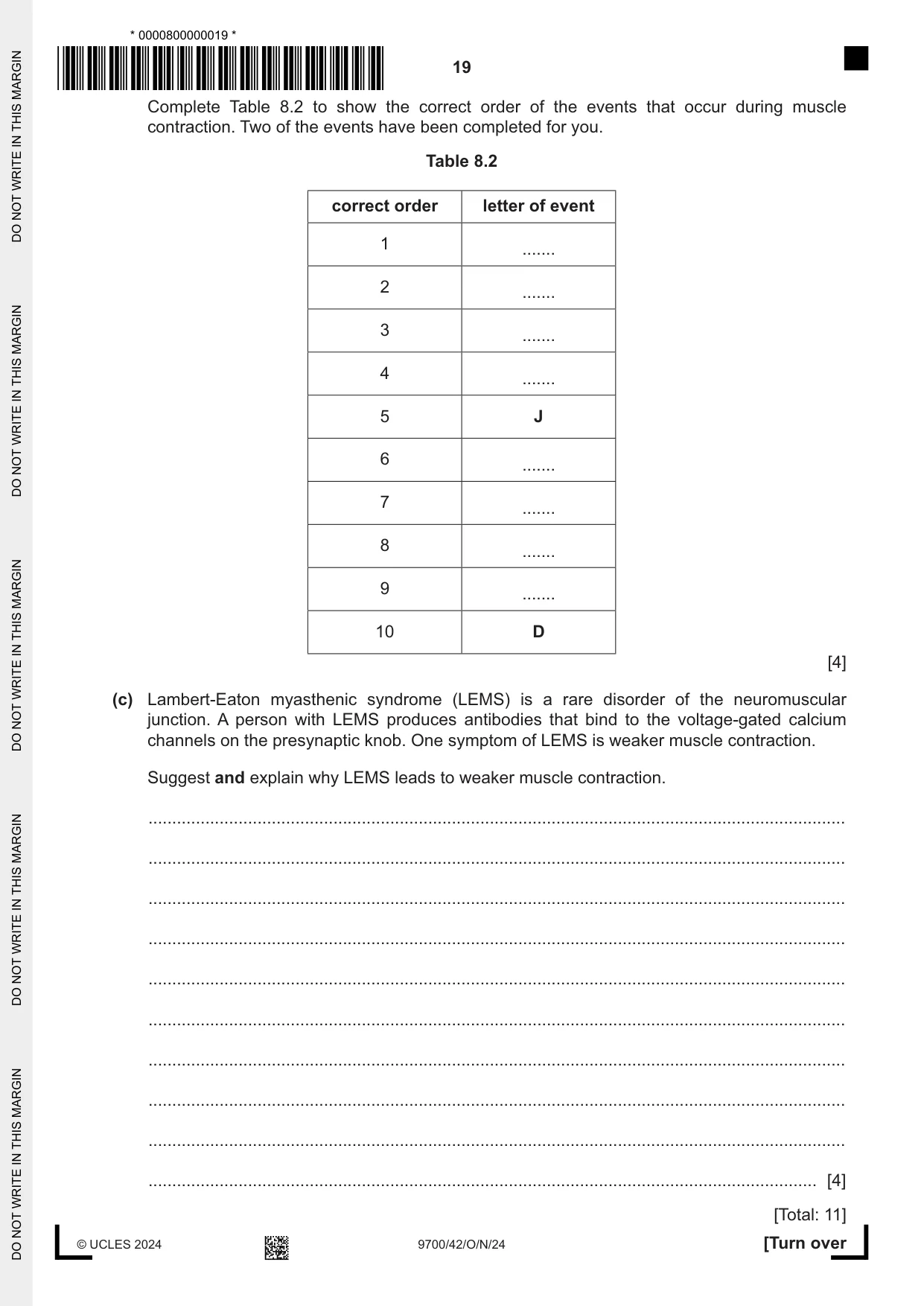
8 (a) Fig. 8.1 is a diagram of a motor neurone. X Y Z Fig. 8.1 (i) Name cell X and part Y. X ........................................................................................................................................ Y ........................................................................................................................................ [2] (ii) Name a type of cell that forms a synapse with structure Z. ..................................................................................................................................... [1] (b) Table 8.1 shows some of the events that occur during muscle contraction. They are not listed in the correct order. Table 8.1 event description of event A calcium ions diffuse out of sarcoplasmic reticulum B myosin heads bind to actin C sarcolemma depolarised D sarcomere shortens E calcium ions bind to troponin F T‑tubule system membranes depolarised G binding sites on actin exposed H myosin heads tilt I tropomyosin moves J troponin changes shape Complete Table 8.2 to show the correct order of the events that occur during muscle contraction. Two of the events have been completed for you. Table 8.2 correct order letter of event 1 ....... 2 ....... 3 ....... 4 ....... 5 J 6 ....... 7 ....... 8 ....... 9 ....... 10 D [4] (c) Lambert‑Eaton myasthenic syndrome (LEMS) is a rare disorder of the neuromuscular junction. A person with LEMS produces antibodies that bind to the voltage‑gated calcium channels on the presynaptic knob. One symptom of LEMS is weaker muscle contraction. Suggest and explain why LEMS leads to weaker muscle contraction. ................................................................................................................................................... ................................................................................................................................................... ................................................................................................................................................... ................................................................................................................................................... ................................................................................................................................................... ................................................................................................................................................... ................................................................................................................................................... ................................................................................................................................................... ................................................................................................................................................... ............................................................................................................................................. [4] [Total: 11]
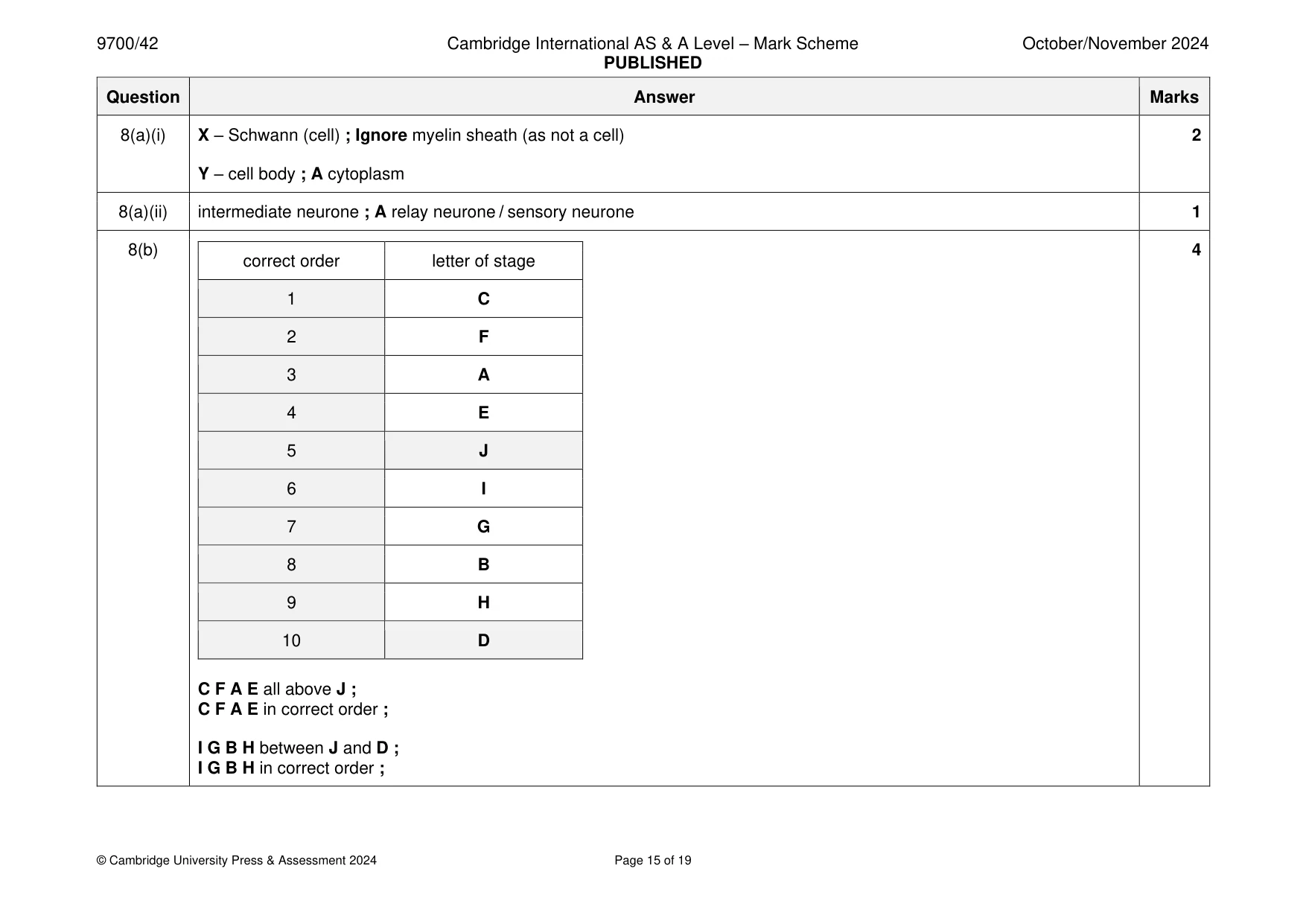
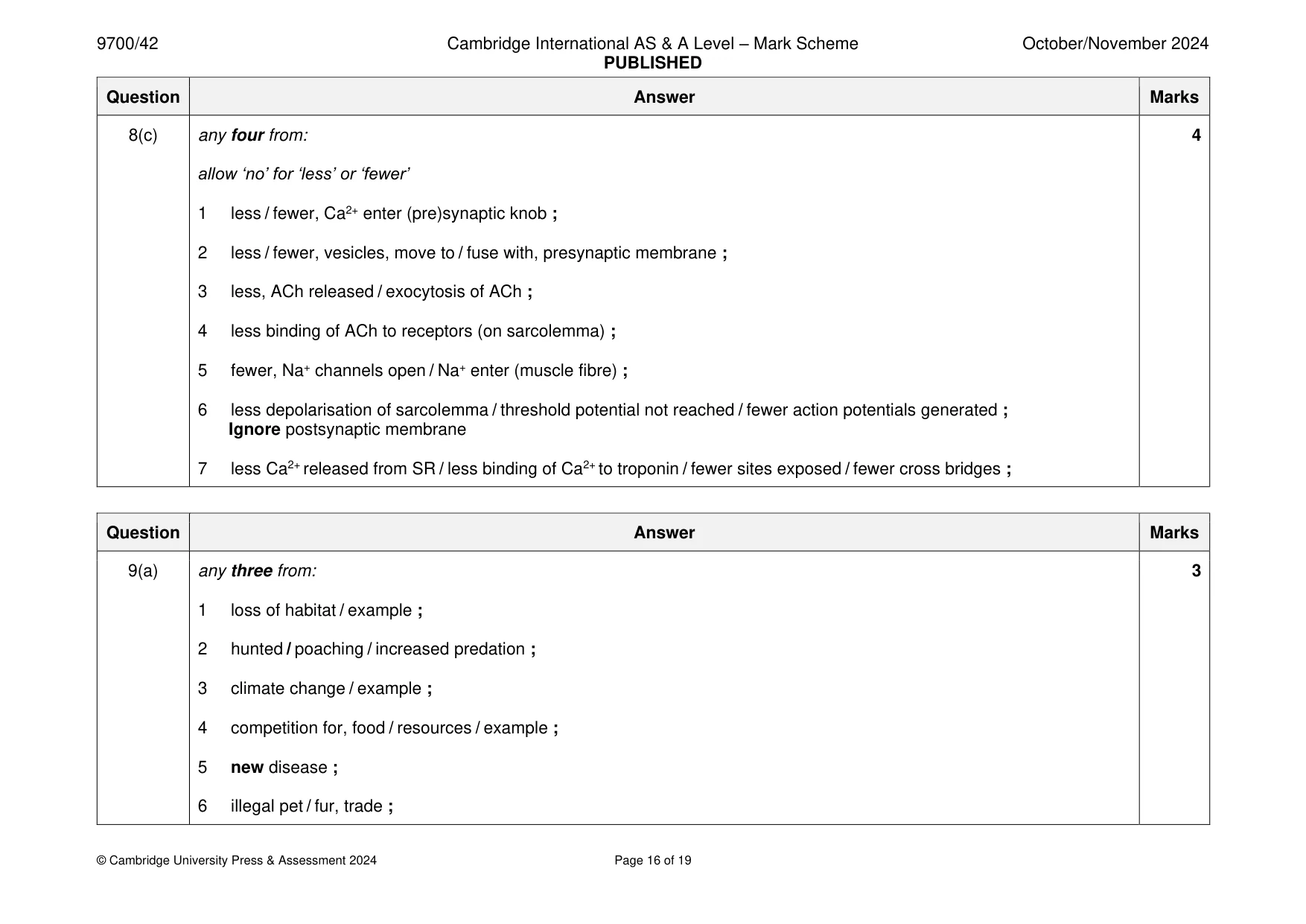
Mark scheme: 8(a)(i) X – Schwann (cell) ; Ignore myelin sheath (as not a cell) 2 Y – cell body ; A cytoplasm 8(a)(ii) intermediate neurone ; A relay neurone / sensory neurone 1 8(b) 4 correct order letter of stage 1 C 2 F 3 A 4 E 5 J 6 I 7 G 8 B 9 H 10 D C F A E all above J ; C F A E in correct order ; I G B H between J and D ; I G B H in correct order ; 8(c) any four from: 4 allow ‘no’ for ‘less’ or ‘fewer’ 1 less / fewer, Ca2+ enter (pre)synaptic knob ; 2 less / fewer, vesicles, move to / fuse with, presynaptic membrane ; 3 less, ACh released / exocytosis of ACh ; 4 less binding of ACh to receptors (on sarcolemma) ; 5 fewer, Na+ channels open / Na+ enter (muscle fibre) ; 6 less depolarisation of sarcolemma / threshold potential not reached / fewer action potentials generated ; Ignore postsynaptic membrane 7 less Ca2+ released from SR / less binding of Ca2+ to troponin / fewer sites exposed / fewer cross bridges ;
Q9 · The red ruffed lemur, Varecia rubra, is a mammal found only in the rainforests of the…
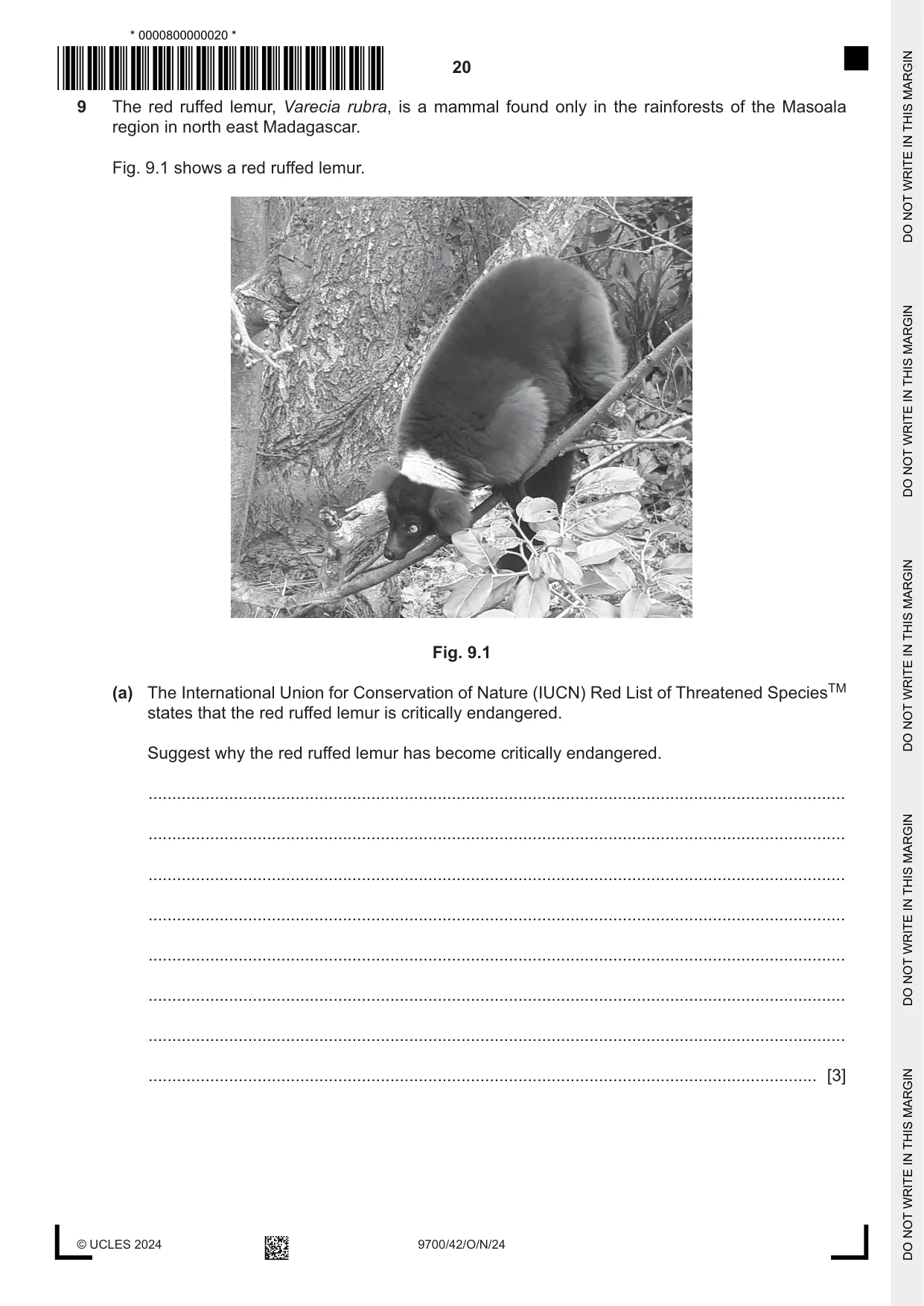
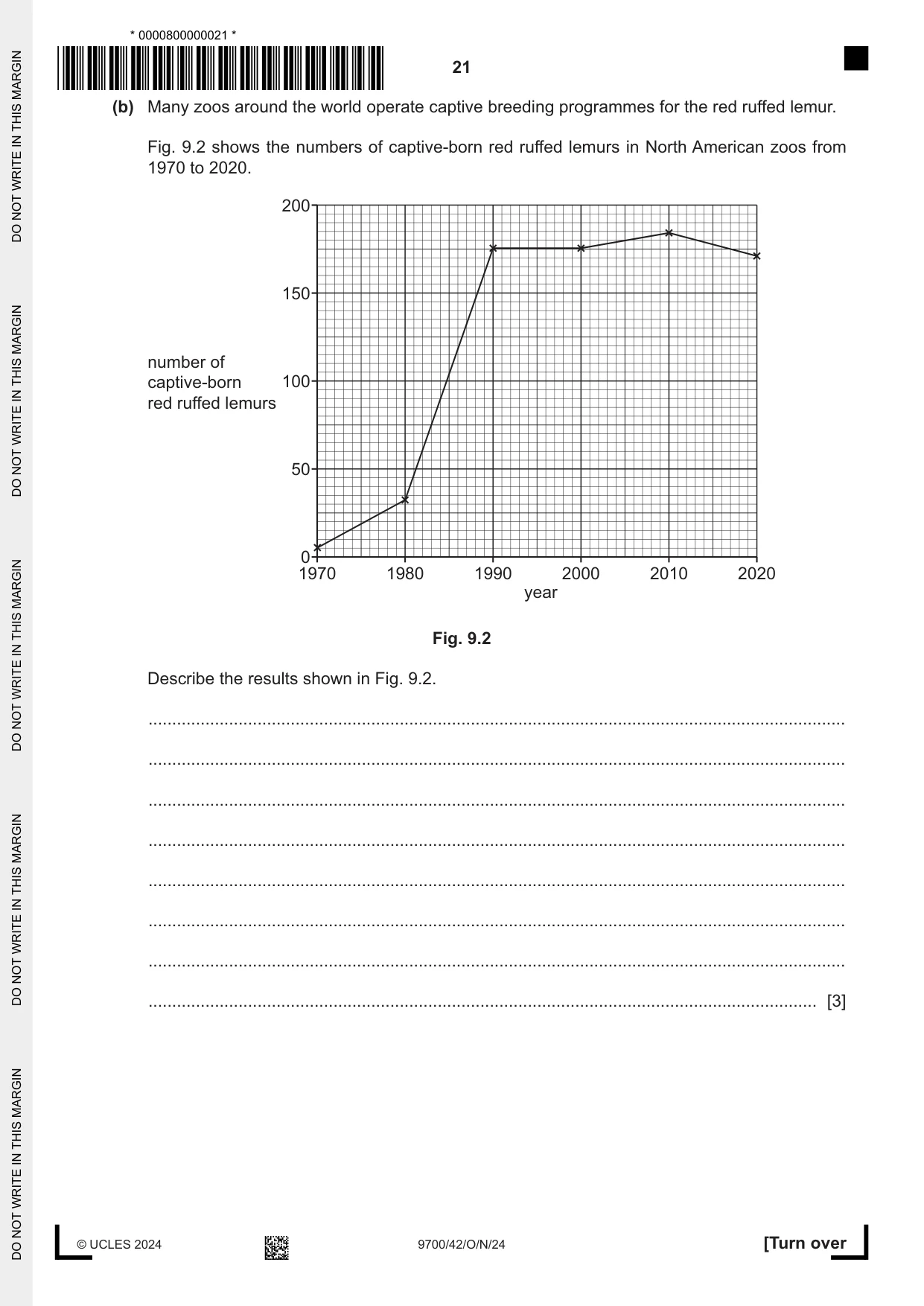
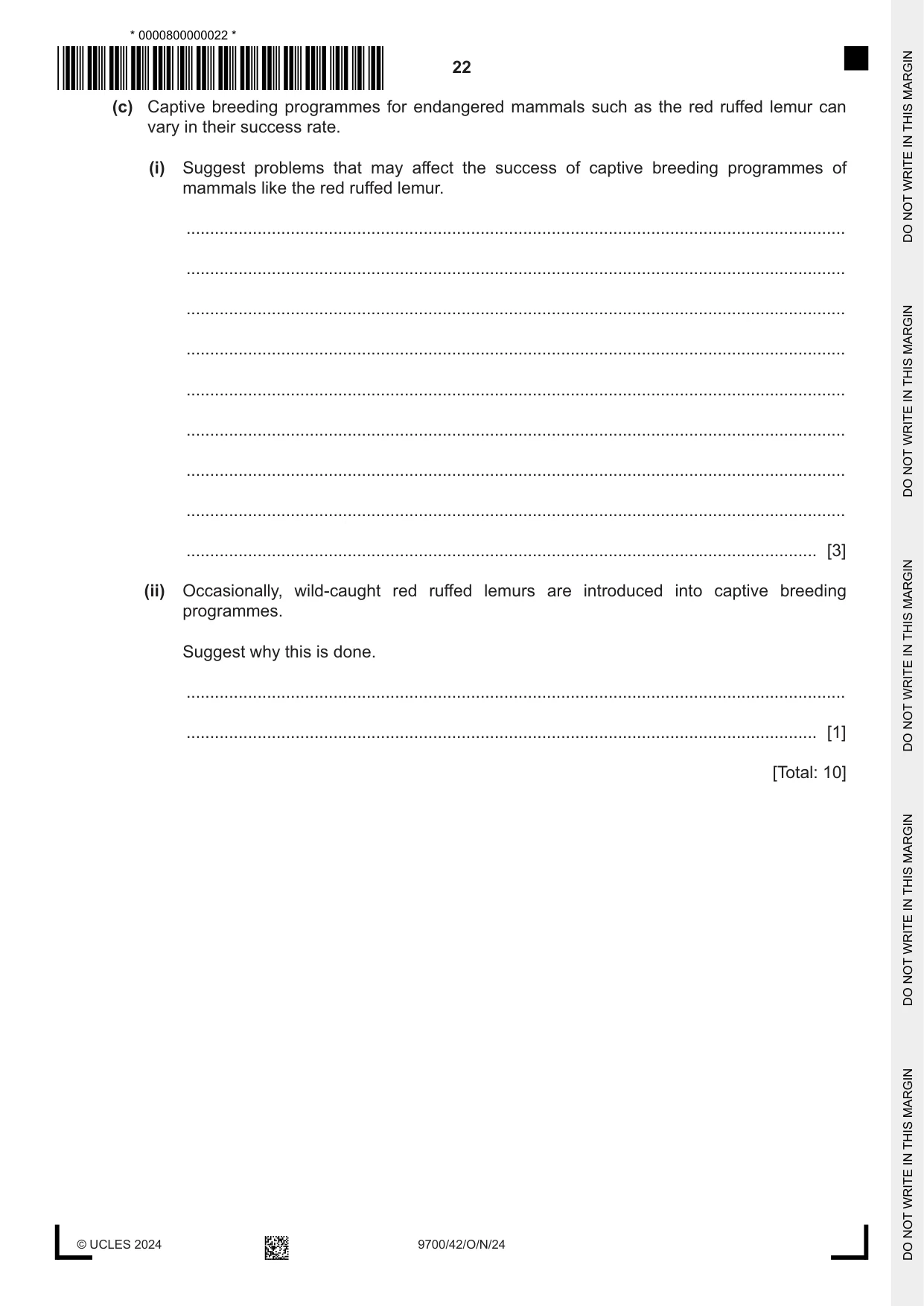
9 The red ruffed lemur, Varecia rubra, is a mammal found only in the rainforests of the Masoala region in north east Madagascar. Fig. 9.1 shows a red ruffed lemur. Fig. 9.1 (a) The International Union for Conservation of Nature (IUCN) Red List of Threatened SpeciesTM states that the red ruffed lemur is critically endangered. Suggest why the red ruffed lemur has become critically endangered. ................................................................................................................................................... ................................................................................................................................................... ................................................................................................................................................... ................................................................................................................................................... ................................................................................................................................................... ................................................................................................................................................... ................................................................................................................................................... ............................................................................................................................................. [3] (b) Many zoos around the world operate captive breeding programmes for the red ruffed lemur. Fig. 9.2 shows the numbers of captive‑born red ruffed lemurs in North American zoos from 1970 to 2020. 200 150 number of captive-born 100 red ruffed lemurs 50 0 1970 1980 1990 2000 2010 2020 year Fig. 9.2 Describe the results shown in Fig. 9.2. ................................................................................................................................................... ................................................................................................................................................... ................................................................................................................................................... ................................................................................................................................................... ................................................................................................................................................... ................................................................................................................................................... ................................................................................................................................................... ............................................................................................................................................. [3] (c) Captive breeding programmes for endangered mammals such as the red ruffed lemur can vary in their success rate. (i) Suggest problems that may affect the success of captive breeding programmes of mammals like the red ruffed lemur. ........................................................................................................................................... ........................................................................................................................................... ........................................................................................................................................... ........................................................................................................................................... ........................................................................................................................................... ........................................................................................................................................... ........................................................................................................................................... ........................................................................................................................................... ..................................................................................................................................... [3] (ii) Occasionally, wild‑caught red ruffed lemurs are introduced into captive breeding programmes. Suggest why this is done. ........................................................................................................................................... ..................................................................................................................................... [1] [Total: 10]
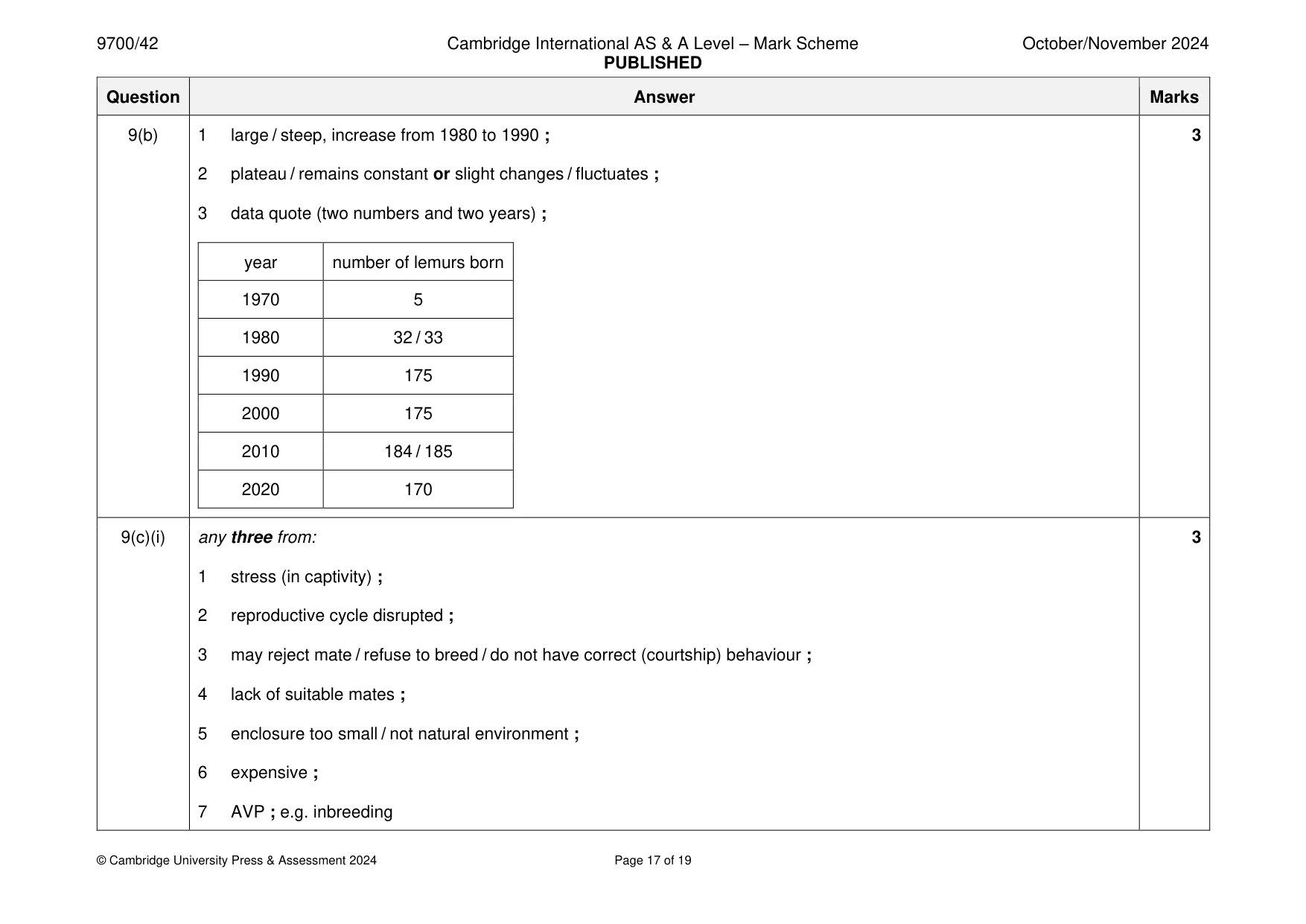
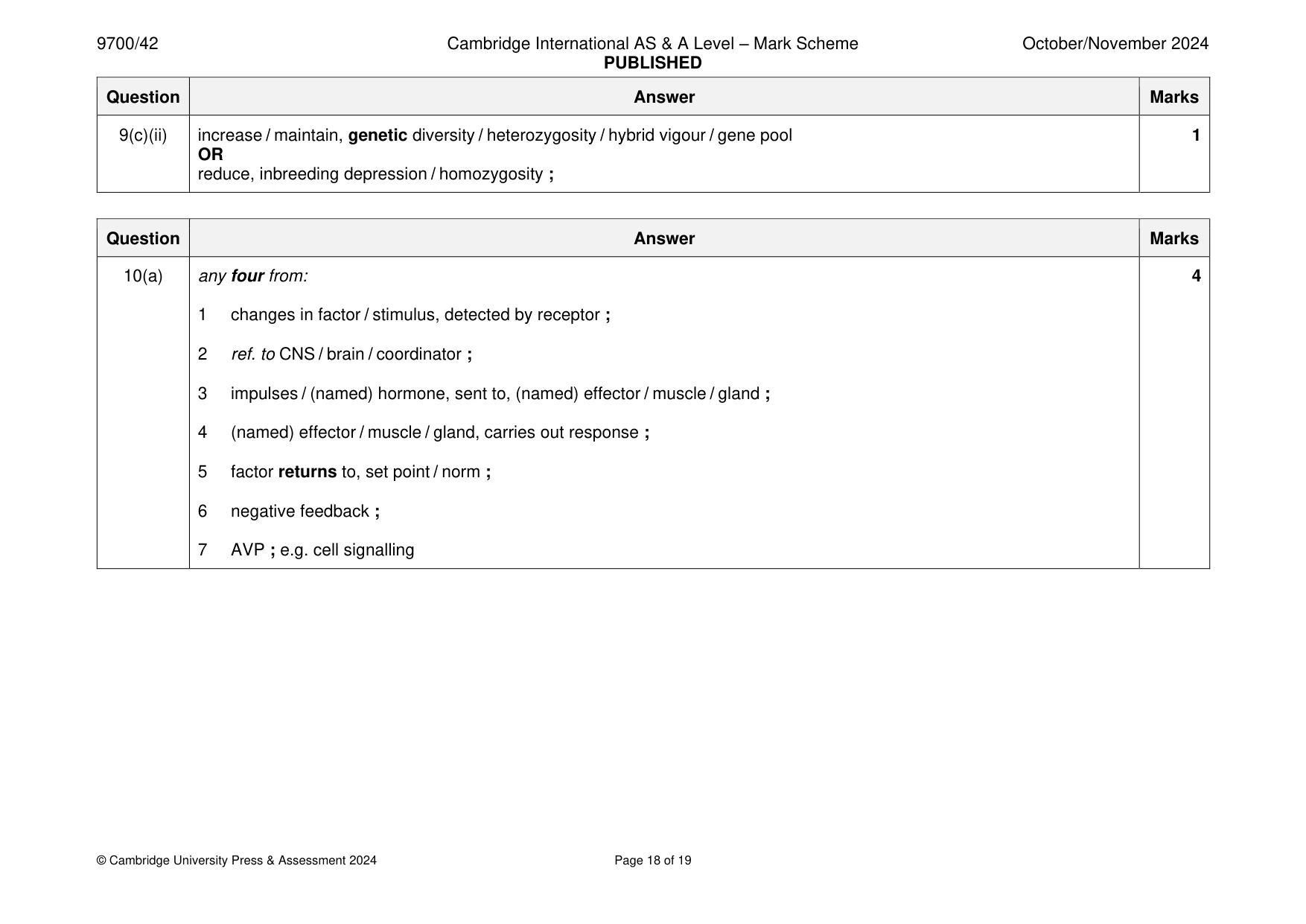
Mark scheme: 9(a) any three from: 3 1 loss of habitat / example ; 2 hunted / poaching / increased predation ; 3 climate change / example ; 4 competition for, food / resources / example ; 5 new disease ; 6 illegal pet / fur, trade ; 9(b) 1 large / steep, increase from 1980 to 1990 ; 3 2 plateau / remains constant or slight changes / fluctuates ; 3 data quote (two numbers and two years) ; year number of lemurs born 1970 5 1980 32 / 33 1990 175 2000 175 2010 184 / 185 2020 170 9(c)(i) any three from: 3 1 stress (in captivity) ; 2 reproductive cycle disrupted ; 3 may reject mate / refuse to breed / do not have correct (courtship) behaviour ; 4 lack of suitable mates ; 5 enclosure too small / not natural environment ; 6 expensive ; 7 AVP ; e.g. inbreeding 9(c)(ii) increase / maintain, genetic diversity / heterozygosity / hybrid vigour / gene pool 1 OR reduce, inbreeding depression / homozygosity ;
Q10 · Blood glucose concentration is maintained around a set point by homeostasis
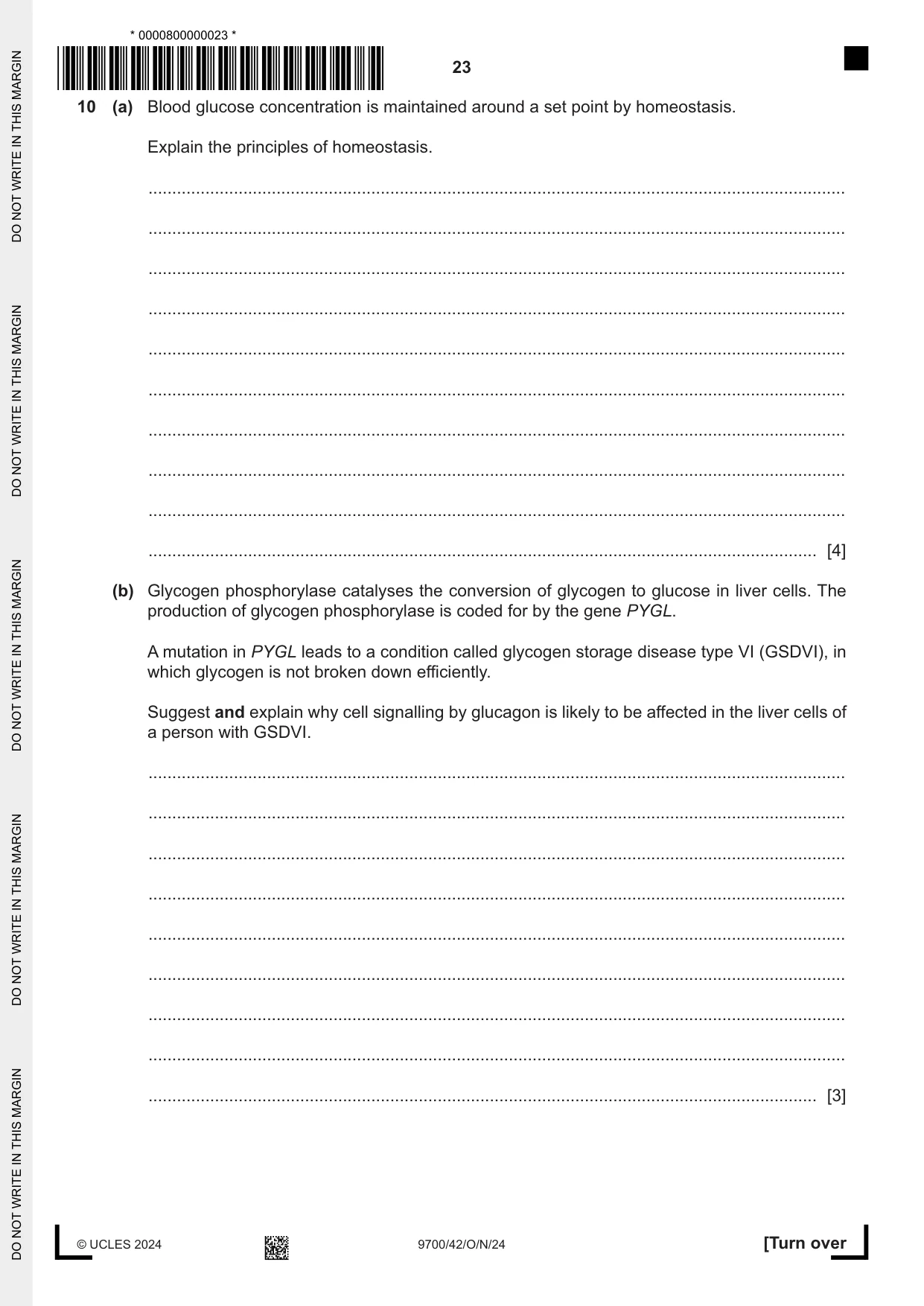
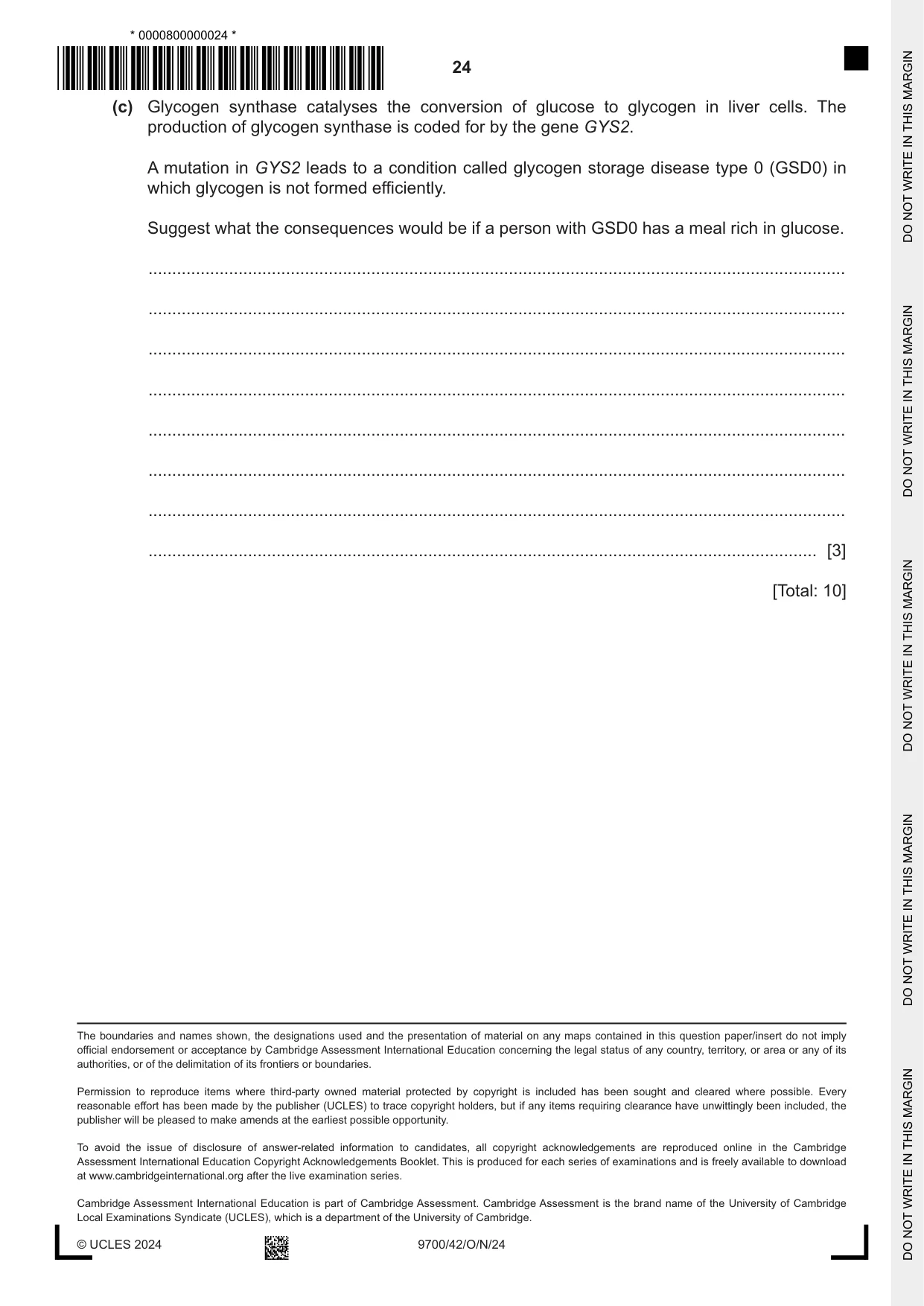
10 (a) Blood glucose concentration is maintained around a set point by homeostasis. Explain the principles of homeostasis. ................................................................................................................................................... ................................................................................................................................................... ................................................................................................................................................... ................................................................................................................................................... ................................................................................................................................................... ................................................................................................................................................... ................................................................................................................................................... ................................................................................................................................................... ................................................................................................................................................... ............................................................................................................................................. [4] (b) Glycogen phosphorylase catalyses the conversion of glycogen to glucose in liver cells. The production of glycogen phosphorylase is coded for by the gene PYGL. A mutation in PYGL leads to a condition called glycogen storage disease type VI (GSDVI), in which glycogen is not broken down efficiently. Suggest and explain why cell signalling by glucagon is likely to be affected in the liver cells of a person with GSDVI. ................................................................................................................................................... ................................................................................................................................................... ................................................................................................................................................... ................................................................................................................................................... ................................................................................................................................................... ................................................................................................................................................... ................................................................................................................................................... ................................................................................................................................................... ............................................................................................................................................. [3] (c) Glycogen synthase catalyses the conversion of glucose to glycogen in liver cells. The production of glycogen synthase is coded for by the gene GYS2. A mutation in GYS2 leads to a condition called glycogen storage disease type 0 (GSD0) in which glycogen is not formed efficiently. Suggest what the consequences would be if a person with GSD0 has a meal rich in glucose. ................................................................................................................................................... ................................................................................................................................................... ................................................................................................................................................... ................................................................................................................................................... ................................................................................................................................................... ................................................................................................................................................... ................................................................................................................................................... ............................................................................................................................................. [3] [Total: 10] The boundaries and names shown, the designations used and the presentation of material on any maps contained in this question paper/insert do not imply official endorsement or acceptance by Cambridge Assessment International Education concerning the legal status of any country, territory, or area or any of its authorities, or of the delimitation of its frontiers or boundaries.
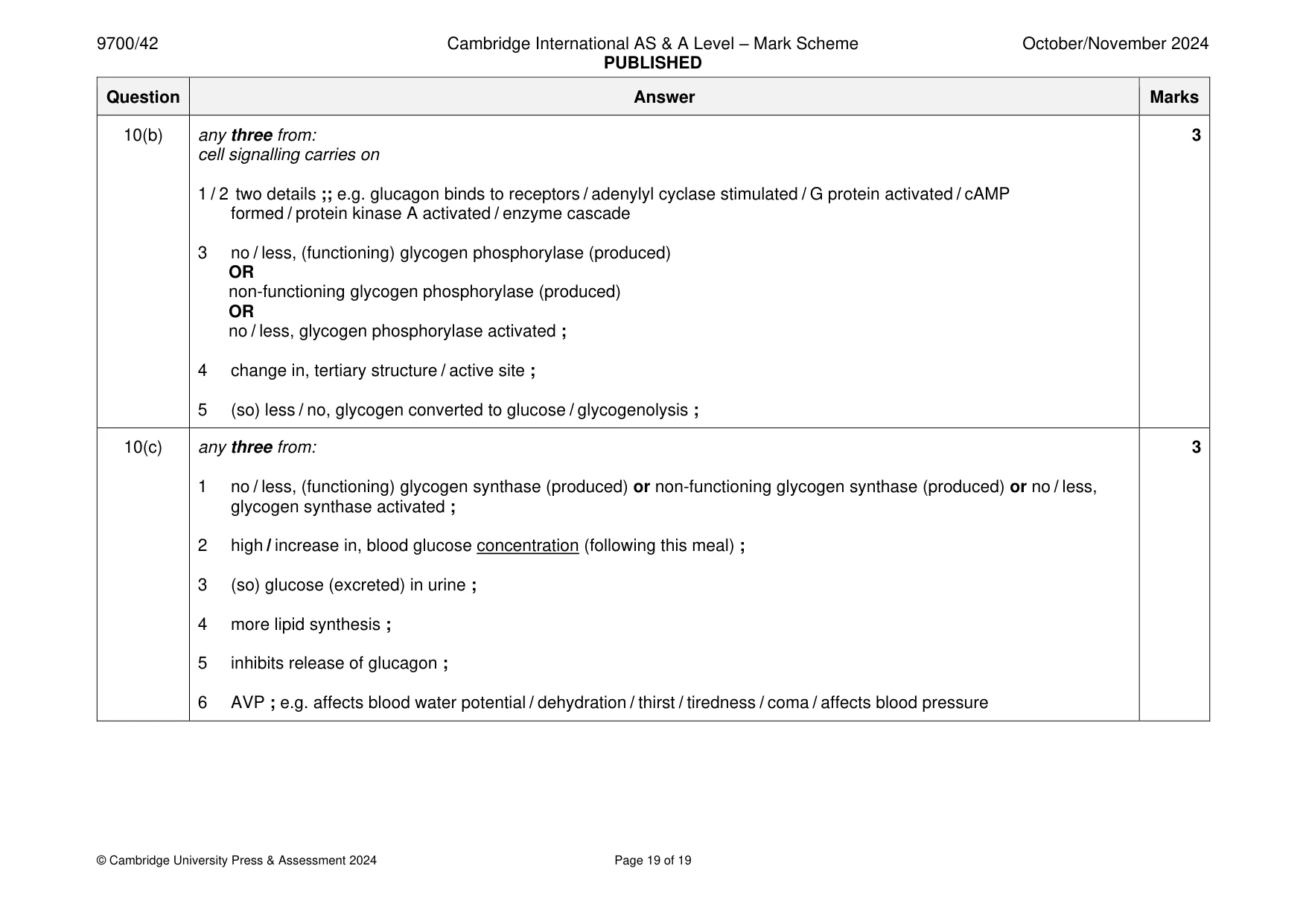
Mark scheme: 10(a) any four from: 4 1 changes in factor / stimulus, detected by receptor ; 2 ref. to CNS / brain / coordinator ; 3 impulses / (named) hormone, sent to, (named) effector / muscle / gland ; 4 (named) effector / muscle / gland, carries out response ; 5 factor returns to, set point / norm ; 6 negative feedback ; 7 AVP ; e.g. cell signalling 10(b) any three from: 3 cell signalling carries on 1 / 2 two details ;; e.g. glucagon binds to receptors / adenylyl cyclase stimulated / G protein activated / cAMP formed / protein kinase A activated / enzyme cascade 3 no / less, (functioning) glycogen phosphorylase (produced) OR non-functioning glycogen phosphorylase (produced) OR no / less, glycogen phosphorylase activated ; 4 change in, tertiary structure / active site ; 5 (so) less / no, glycogen converted to glucose / glycogenolysis ; 10(c) any three from: 3 1 no / less, (functioning) glycogen synthase (produced) or non-functioning glycogen synthase (produced) or no / less, glycogen synthase activated ; 2 high / increase in, blood glucose concentration (following this meal) ; 3 (so) glucose (excreted) in urine ; 4 more lipid synthesis ; 5 inhibits release of glucagon ; 6 AVP ; e.g. affects blood water potential / dehydration / thirst / tiredness / coma / affects blood pressure
What was in this paper
The subtopics covered by these 10 questions, and how many questions each got. Open one in a new tab to see every Cambridge question on it.
What you needed in this session
Cambridge’s own grade thresholds for 2024 Oct/Nov, Paper 4 · Variant 2. A higher threshold means an easier paper — the bar moves with how the cohort did.