Cambridge A Level Biology 9700 — 2025 May/June Paper 4 · Variant 1
9700/41/M/J/25 · 10 questions · 100 marks · 120 min
The question paper and its mark scheme, free to read here and free to download. This is Cambridge’s own paper, exactly as it was sat.
Question paper24 pages
Mark scheme17 pages
Answers below. Sit the paper first if you are practising.
Questions as text
Q1 · Organisms need a source of energy for many cellular processes
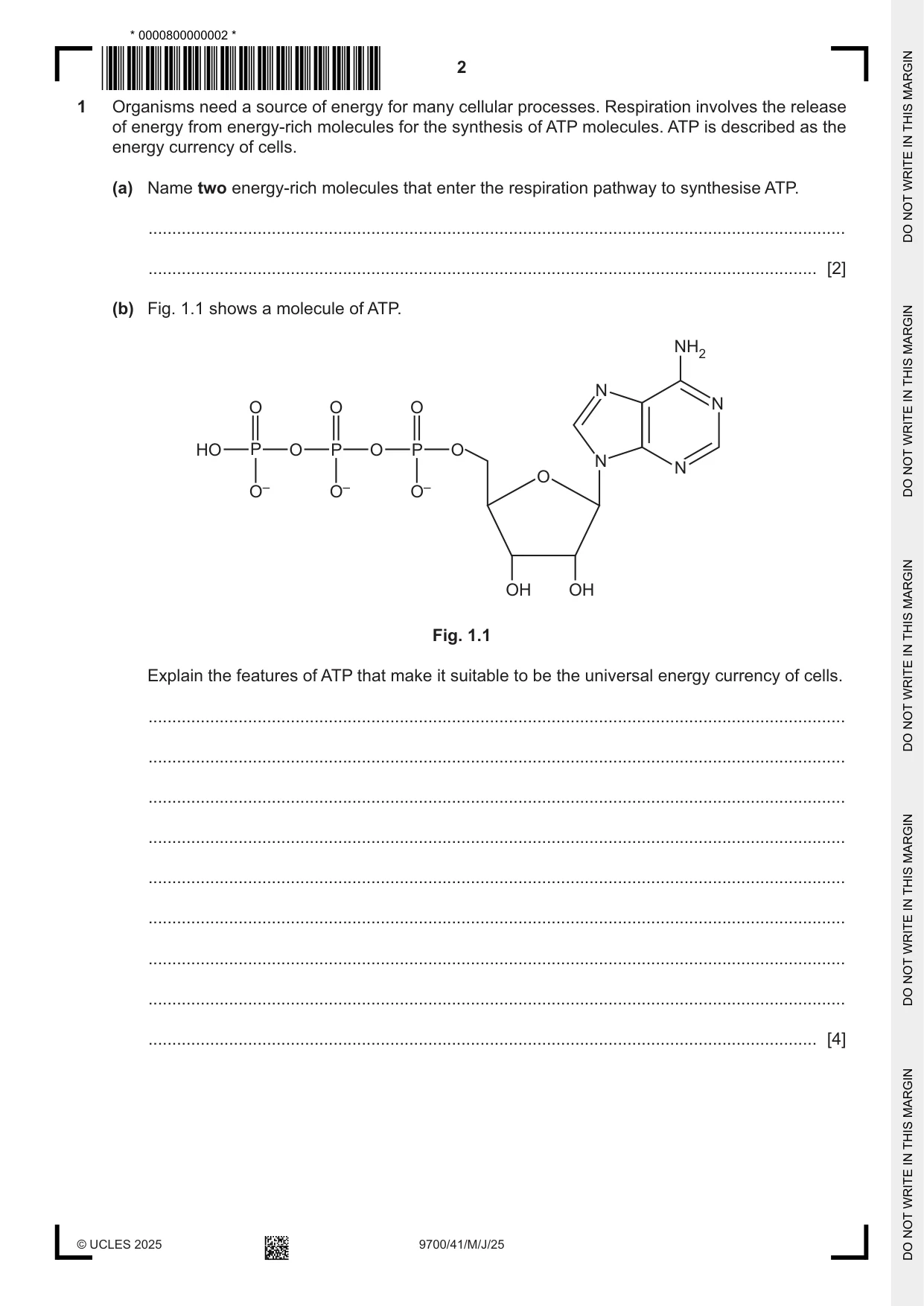
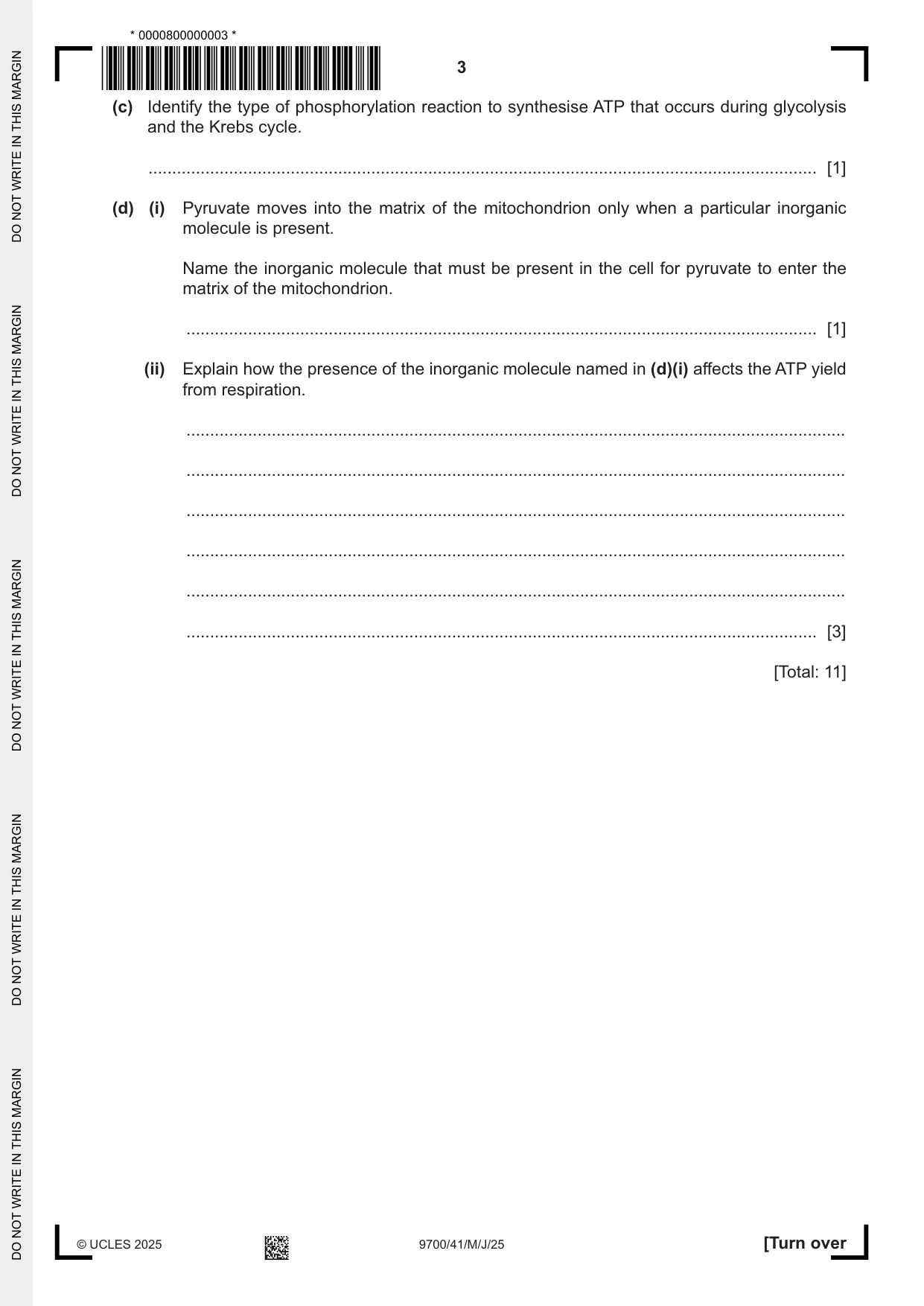
1 Organisms need a source of energy for many cellular processes. Respiration involves the release of energy from energy-rich molecules for the synthesis of ATP molecules. ATP is described as the energy currency of cells. (a) Name two energy-rich molecules that enter the respiration pathway to synthesise ATP. ................................................................................................................................................... ............................................................................................................................................. [2] (b) Fig. 1.1 shows a molecule of ATP. NH2 N O O O N HO P O P O P O N N O O– O– O– OH OH Fig. 1.1 Explain the features of ATP that make it suitable to be the universal energy currency of cells. ................................................................................................................................................... ................................................................................................................................................... ................................................................................................................................................... ................................................................................................................................................... ................................................................................................................................................... ................................................................................................................................................... ................................................................................................................................................... ................................................................................................................................................... ............................................................................................................................................. [4] (c) Identify the type of phosphorylation reaction to synthesise ATP that occurs during glycolysis and the Krebs cycle. ............................................................................................................................................. [1] (d) (i) Pyruvate moves into the matrix of the mitochondrion only when a particular inorganic molecule is present. Name the inorganic molecule that must be present in the cell for pyruvate to enter the matrix of the mitochondrion. ..................................................................................................................................... [1] (ii) Explain how the presence of the inorganic molecule named in (d)(i) affects the ATP yield from respiration. ........................................................................................................................................... ........................................................................................................................................... ........................................................................................................................................... ........................................................................................................................................... ........................................................................................................................................... ..................................................................................................................................... [3] [Total: 11]
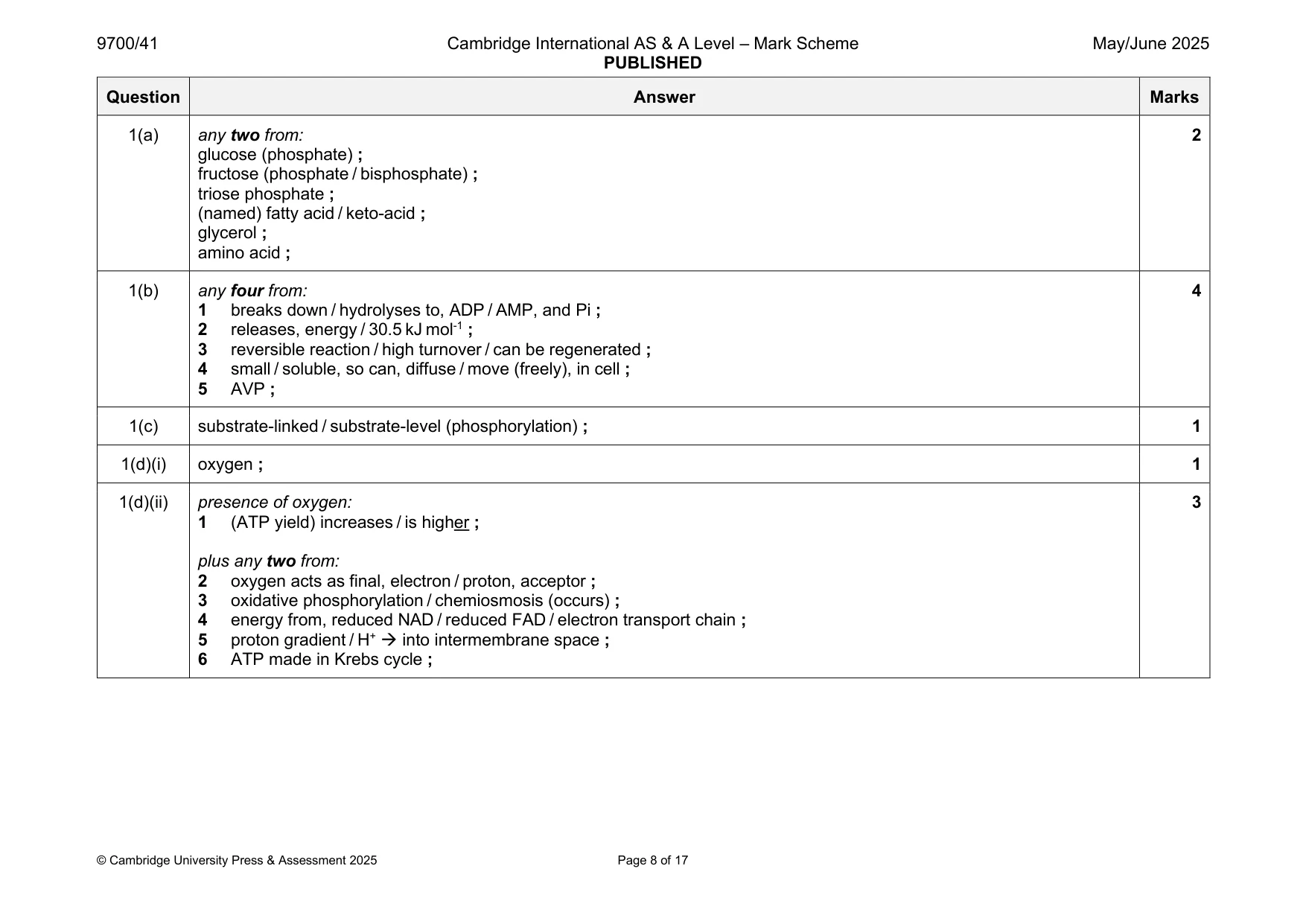
Mark scheme: Question Answer Marks 1(a) any two from: 2 glucose (phosphate) ; fructose (phosphate / bisphosphate) ; triose phosphate ; (named) fatty acid / keto-acid ; glycerol ; amino acid ; 1(b) any four from: 4 1 breaks down / hydrolyses to, ADP / AMP, and Pi ; 2 releases, energy / 30.5 kJ mol-1 ; 3 reversible reaction / high turnover / can be regenerated ; 4 small / soluble, so can, diffuse / move (freely), in cell ; 5 AVP ; 1(c) substrate-linked / substrate-level (phosphorylation) ; 1 1(d)(i) oxygen ; 1 1(d)(ii) presence of oxygen: 3 1 (ATP yield) increases / is higher ; plus any two from: 2 oxygen acts as final, electron / proton, acceptor ; 3 oxidative phosphorylation / chemiosmosis (occurs) ; 4 energy from, reduced NAD / reduced FAD / electron transport chain ; 5 proton gradient / H+ → into intermembrane space ; 6 ATP made in Krebs cycle ;
Q2 · A respirometer can be used to investigate how temperature affects the rate of respiration…
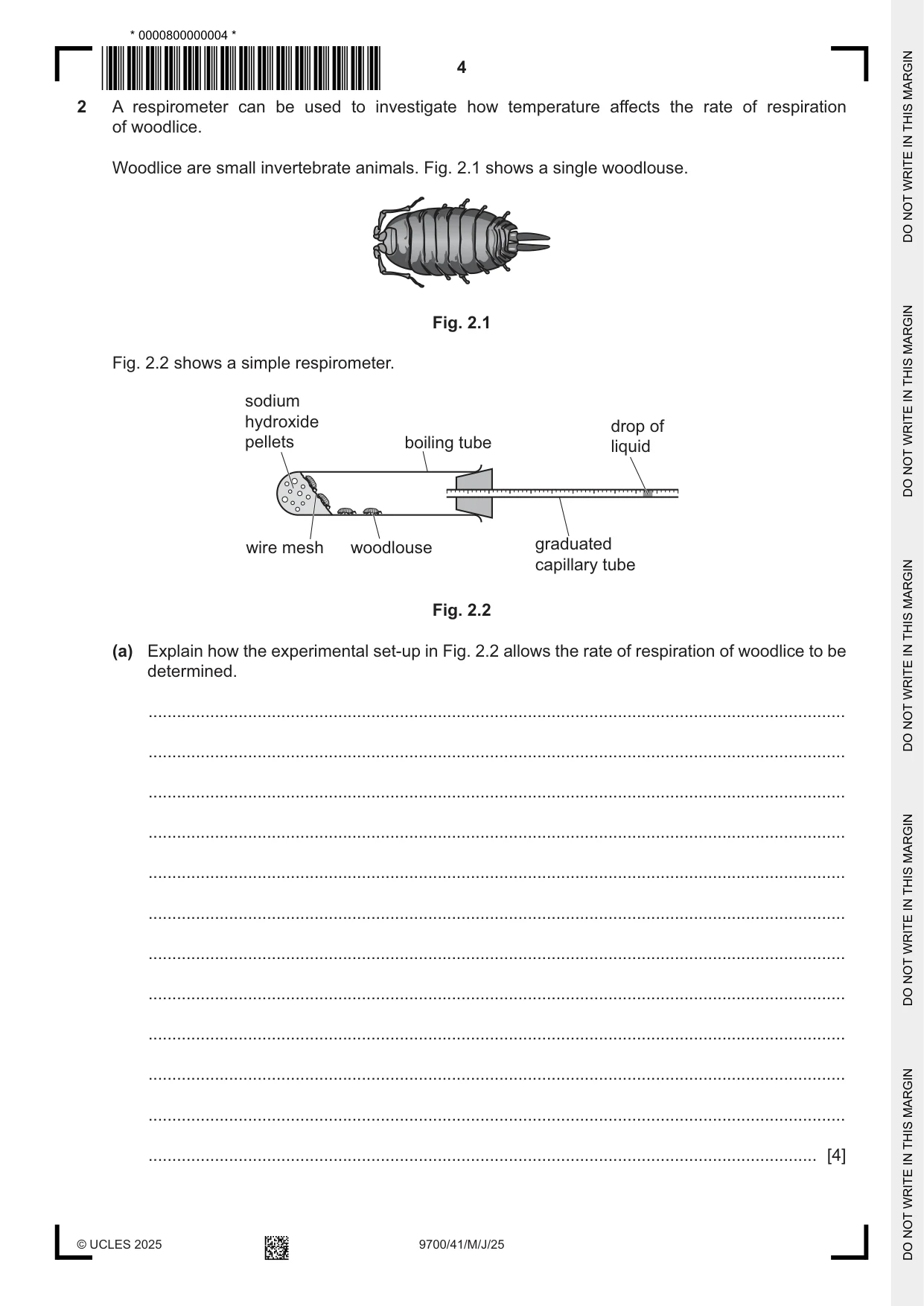
2 A respirometer can be used to investigate how temperature affects the rate of respiration of woodlice. Woodlice are small invertebrate animals. Fig. 2.1 shows a single woodlouse. Fig. 2.1 Fig. 2.2 shows a simple respirometer. sodium hydroxide drop of pellets boiling tube liquid wire mesh woodlouse graduated capillary tube Fig. 2.2 (a) Explain how the experimental set-up in Fig. 2.2 allows the rate of respiration of woodlice to be determined. ................................................................................................................................................... ................................................................................................................................................... ................................................................................................................................................... ................................................................................................................................................... ................................................................................................................................................... ................................................................................................................................................... ................................................................................................................................................... ................................................................................................................................................... ................................................................................................................................................... ................................................................................................................................................... ................................................................................................................................................... ............................................................................................................................................. [4] (b) A student determined the rate of respiration of woodlice at a temperature of 5 °C and at a temperature of 20 °C. Predict and explain how the rate of respiration of woodlice differs at 5 °C compared to 20 °C. ................................................................................................................................................... ................................................................................................................................................... ............................................................................................................................................. [1] [Total: 5]
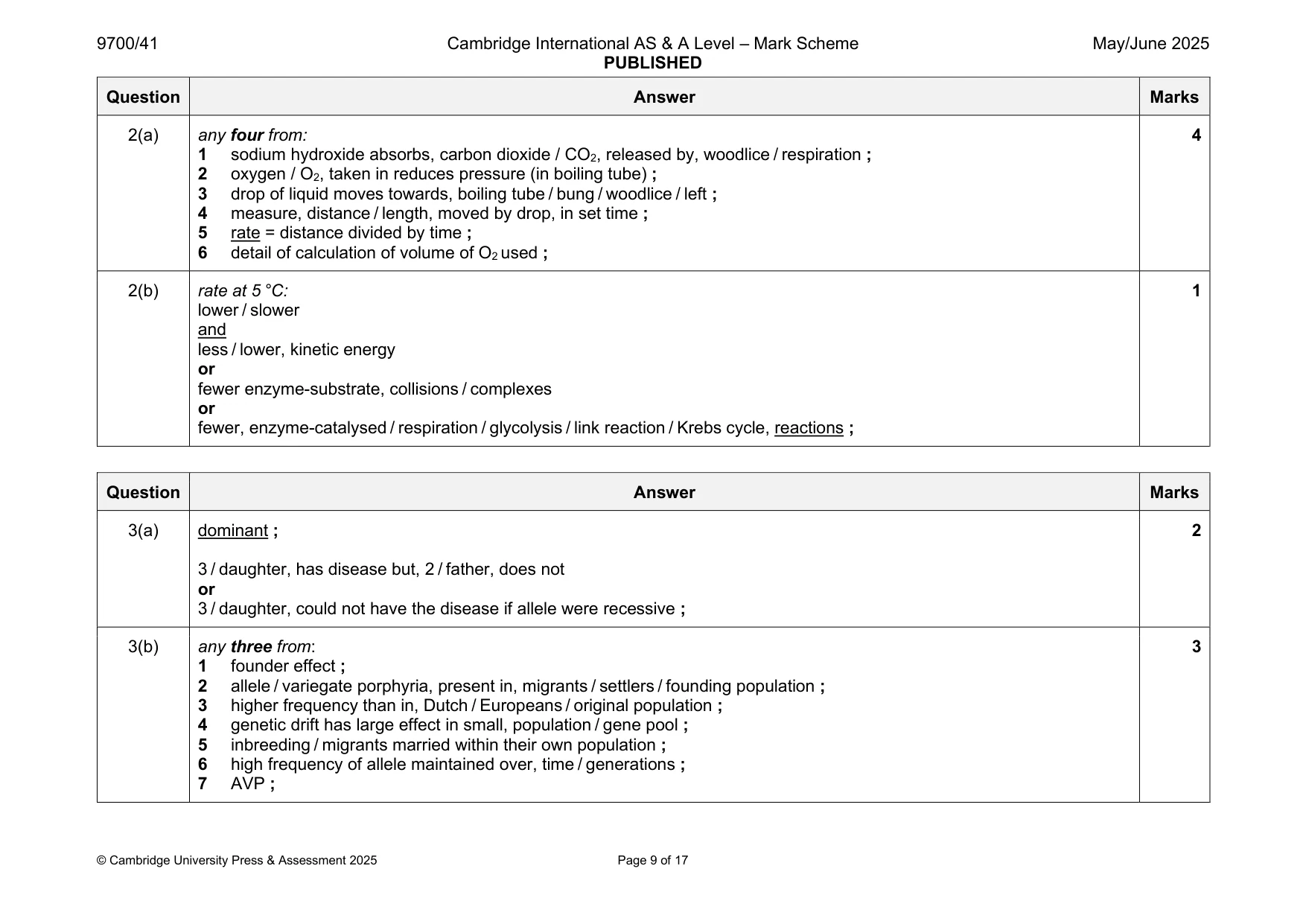
Mark scheme: 2(a) any four from: 4 1 sodium hydroxide absorbs, carbon dioxide / CO2, released by, woodlice / respiration ; 2 oxygen / O2, taken in reduces pressure (in boiling tube) ; 3 drop of liquid moves towards, boiling tube / bung / woodlice / left ; 4 measure, distance / length, moved by drop, in set time ; 5 rate = distance divided by time ; 6 detail of calculation of volume of O2 used ; 2(b) rate at 5 °C: 1 lower / slower and less / lower, kinetic energy or fewer enzyme-substrate, collisions / complexes or fewer, enzyme-catalysed / respiration / glycolysis / link reaction / Krebs cycle, reactions ;
Q3 · Porphyria is a group of rare genetic diseases in which molecules called porphyrins…
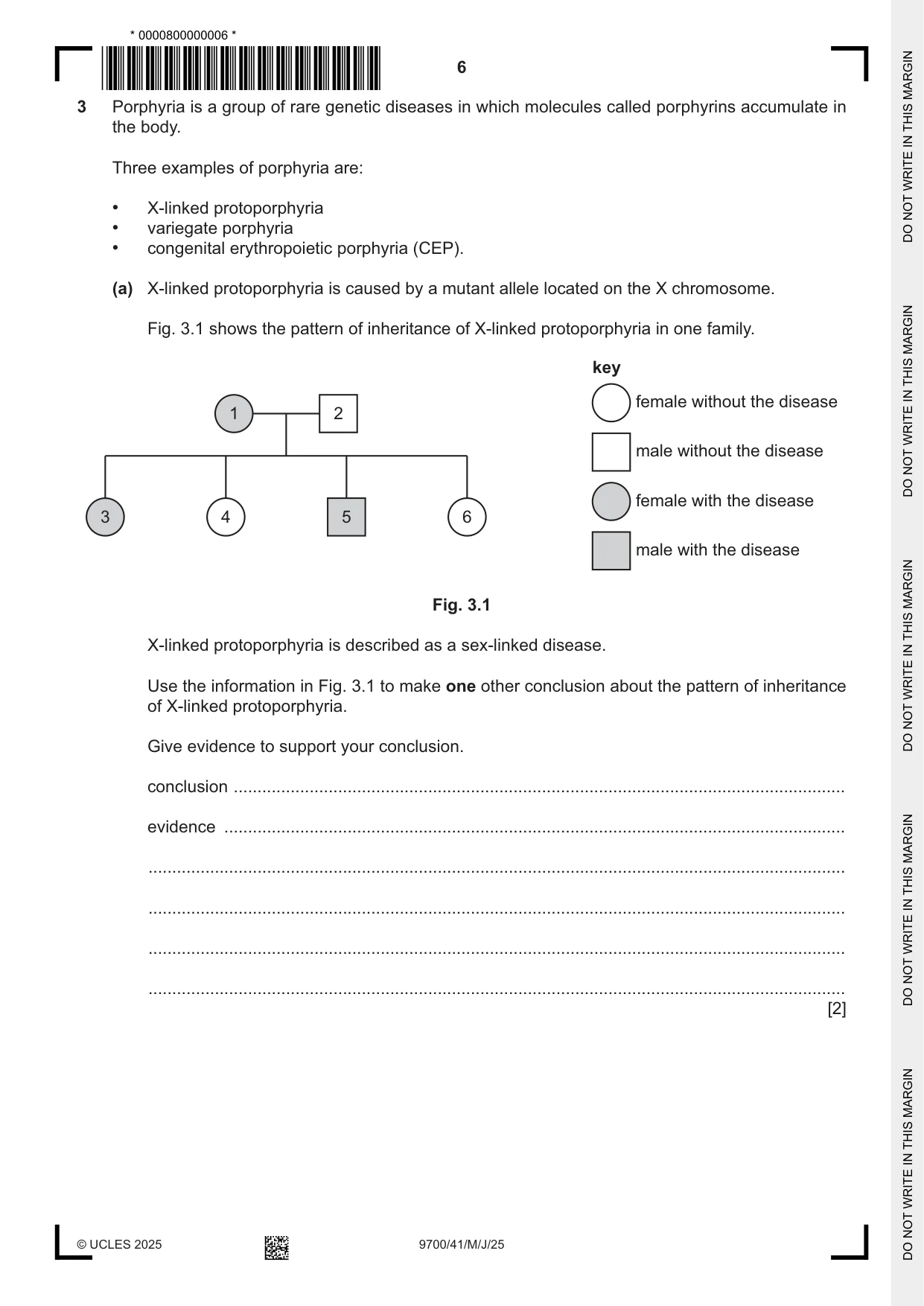
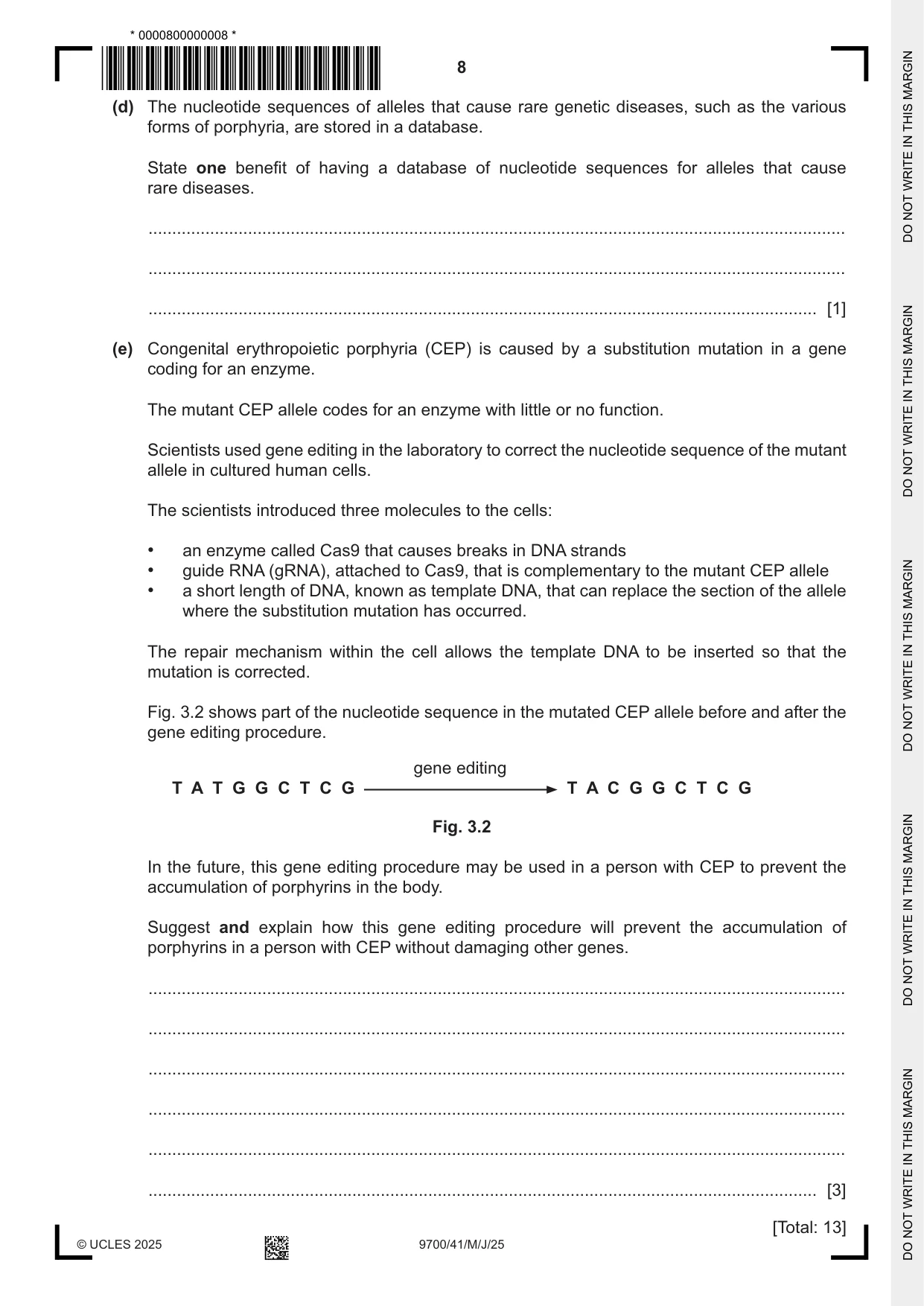
3 Porphyria is a group of rare genetic diseases in which molecules called porphyrins accumulate in the body. Three examples of porphyria are: • X-linked protoporphyria • variegate porphyria • congenital erythropoietic porphyria (CEP). (a) X-linked protoporphyria is caused by a mutant allele located on the X chromosome. Fig. 3.1 shows the pattern of inheritance of X-linked protoporphyria in one family. key female without the disease 1 2 male without the disease female with the disease 3 4 5 6 male with the disease Fig. 3.1 X-linked protoporphyria is described as a sex-linked disease. Use the information in Fig. 3.1 to make one other conclusion about the pattern of inheritance of X-linked protoporphyria. Give evidence to support your conclusion. conclusion ................................................................................................................................. evidence ................................................................................................................................... ................................................................................................................................................... ................................................................................................................................................... ................................................................................................................................................... ................................................................................................................................................... [2] (b) Variegate porphyria occurs in 1 in 100 000 people in Europe. In the 1600s, approximately 100 Dutch people migrated from Europe to South Africa. The population of people of Dutch descent in South Africa is now 2.5 million. Variegate porphyria occurs in 1 in 1000 people in this population. Suggest and explain why variegate porphyria is more common among people of Dutch descent in South Africa than among people in Europe. ................................................................................................................................................... ................................................................................................................................................... ................................................................................................................................................... ................................................................................................................................................... ................................................................................................................................................... ................................................................................................................................................... ............................................................................................................................................. [3] (c) Microarrays can be used to detect various forms of porphyria caused by mutant alleles. Describe how microarrays can be used to detect a disease by analysing gene expression. ................................................................................................................................................... ................................................................................................................................................... ................................................................................................................................................... ................................................................................................................................................... ................................................................................................................................................... ................................................................................................................................................... ................................................................................................................................................... ............................................................................................................................................. [4] (d) The nucleotide sequences of alleles that cause rare genetic diseases, such as the various forms of porphyria, are stored in a database. State one benefit of having a database of nucleotide sequences for alleles that cause rare diseases. ................................................................................................................................................... ................................................................................................................................................... ............................................................................................................................................. [1] (e) Congenital erythropoietic porphyria (CEP) is caused by a substitution mutation in a gene coding for an enzyme. The mutant CEP allele codes for an enzyme with little or no function. Scientists used gene editing in the laboratory to correct the nucleotide sequence of the mutant allele in cultured human cells. The scientists introduced three molecules to the cells: • an enzyme called Cas9 that causes breaks in DNA strands • guide RNA (gRNA), attached to Cas9, that is complementary to the mutant CEP allele • a short length of DNA, known as template DNA, that can replace the section of the allele where the substitution mutation has occurred. The repair mechanism within the cell allows the template DNA to be inserted so that the mutation is corrected. Fig. 3.2 shows part of the nucleotide sequence in the mutated CEP allele before and after the gene editing procedure. gene editing T A T G G C T C G T A C G G C T C G Fig. 3.2 In the future, this gene editing procedure may be used in a person with CEP to prevent the accumulation of porphyrins in the body. Suggest and explain how this gene editing procedure will prevent the accumulation of porphyrins in a person with CEP without damaging other genes. ................................................................................................................................................... ................................................................................................................................................... ................................................................................................................................................... ................................................................................................................................................... ................................................................................................................................................... ............................................................................................................................................. [3] [Total: 13]
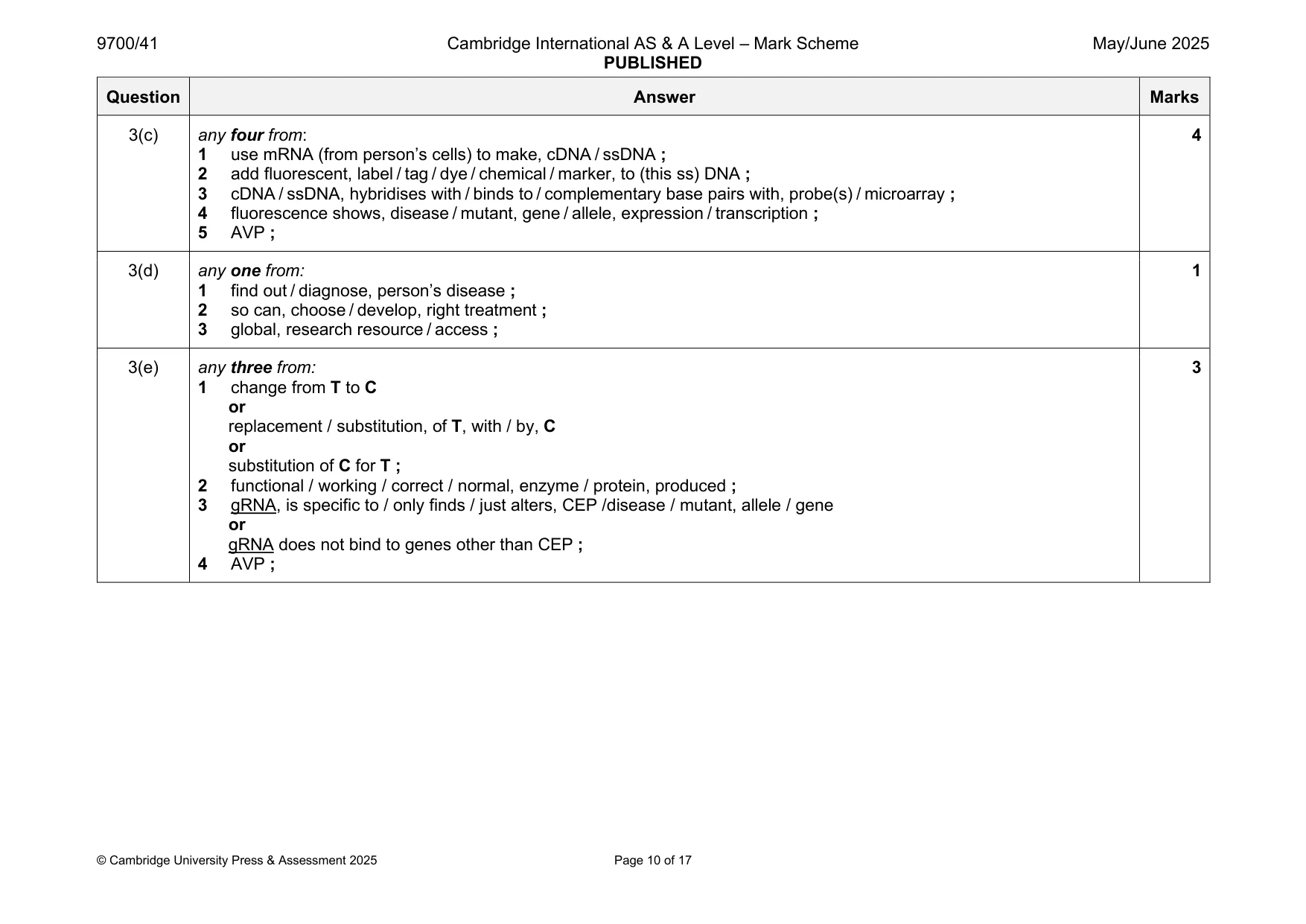
Mark scheme: 3(a) dominant ; 2 3 / daughter, has disease but, 2 / father, does not or 3 / daughter, could not have the disease if allele were recessive ; 3(b) any three from: 3 1 founder effect ; 2 allele / variegate porphyria, present in, migrants / settlers / founding population ; 3 higher frequency than in, Dutch / Europeans / original population ; 4 genetic drift has large effect in small, population / gene pool ; 5 inbreeding / migrants married within their own population ; 6 high frequency of allele maintained over, time / generations ; 7 AVP ; 3(c) any four from: 4 1 use mRNA (from person’s cells) to make, cDNA / ssDNA ; 2 add fluorescent, label / tag / dye / chemical / marker, to (this ss) DNA ; 3 cDNA / ssDNA, hybridises with / binds to / complementary base pairs with, probe(s) / microarray ; 4 fluorescence shows, disease / mutant, gene / allele, expression / transcription ; 5 AVP ; 3(d) any one from: 1 1 find out / diagnose, person’s disease ; 2 so can, choose / develop, right treatment ; 3 global, research resource / access ; 3(e) any three from: 3 1 change from T to C or replacement / substitution, of T, with / by, C or substitution of C for T ; 2 functional / working / correct / normal, enzyme / protein, produced ; 3 gRNA, is specific to / only finds / just alters, CEP /disease / mutant, allele / gene or gRNA does not bind to genes other than CEP ; 4 AVP ;
Q4 · Scientists have invented a way of producing food by artificial photosynthesis
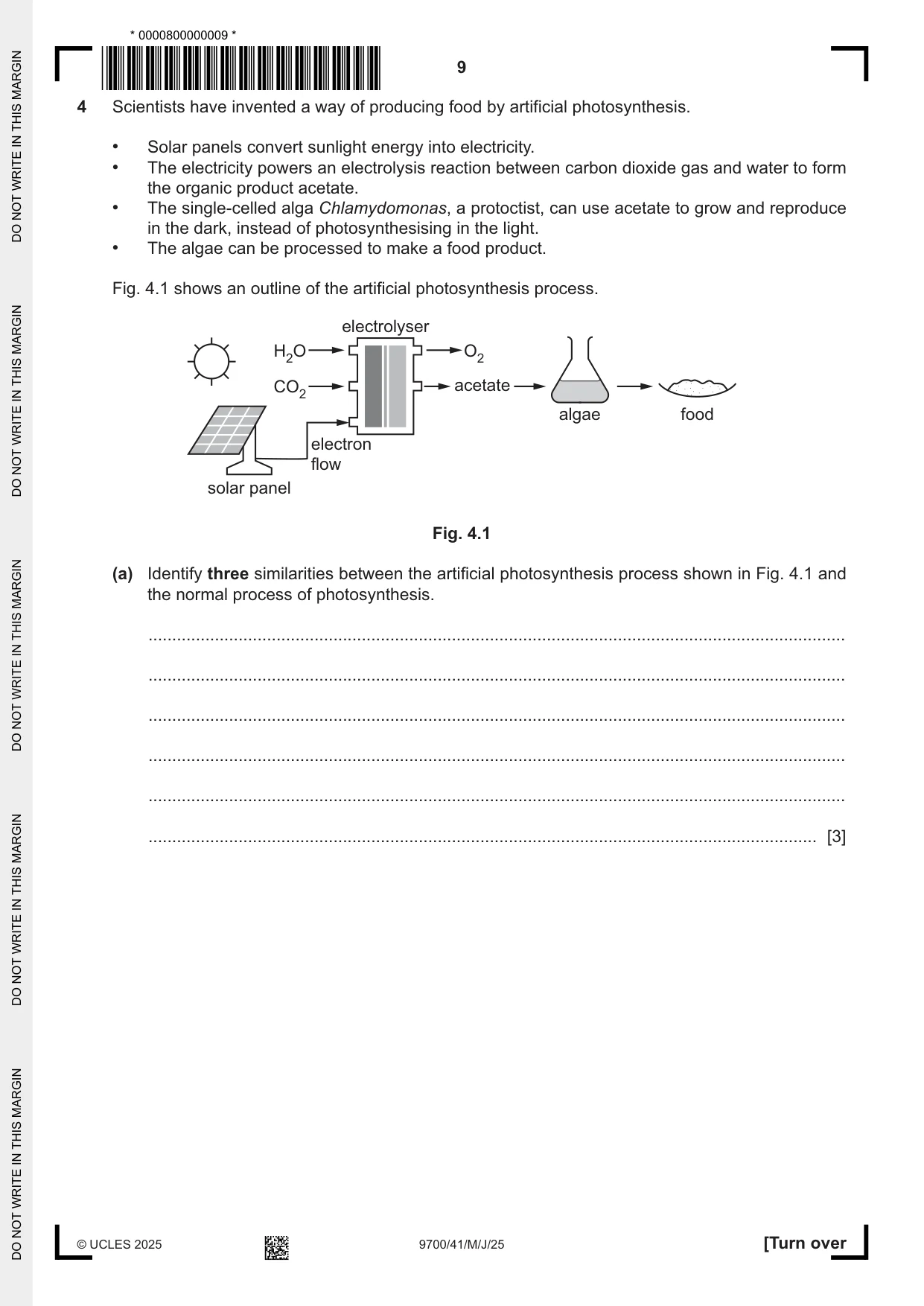
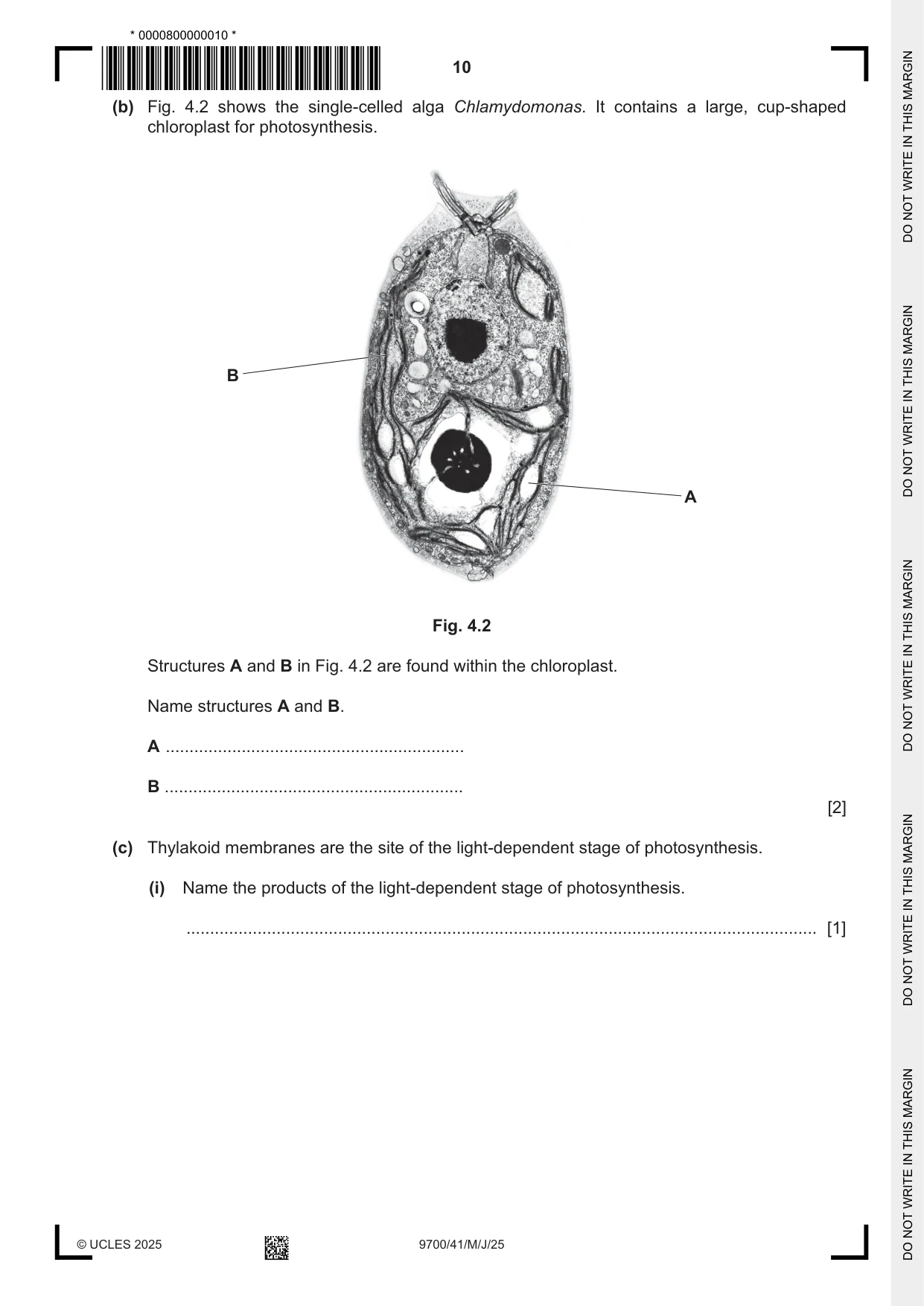
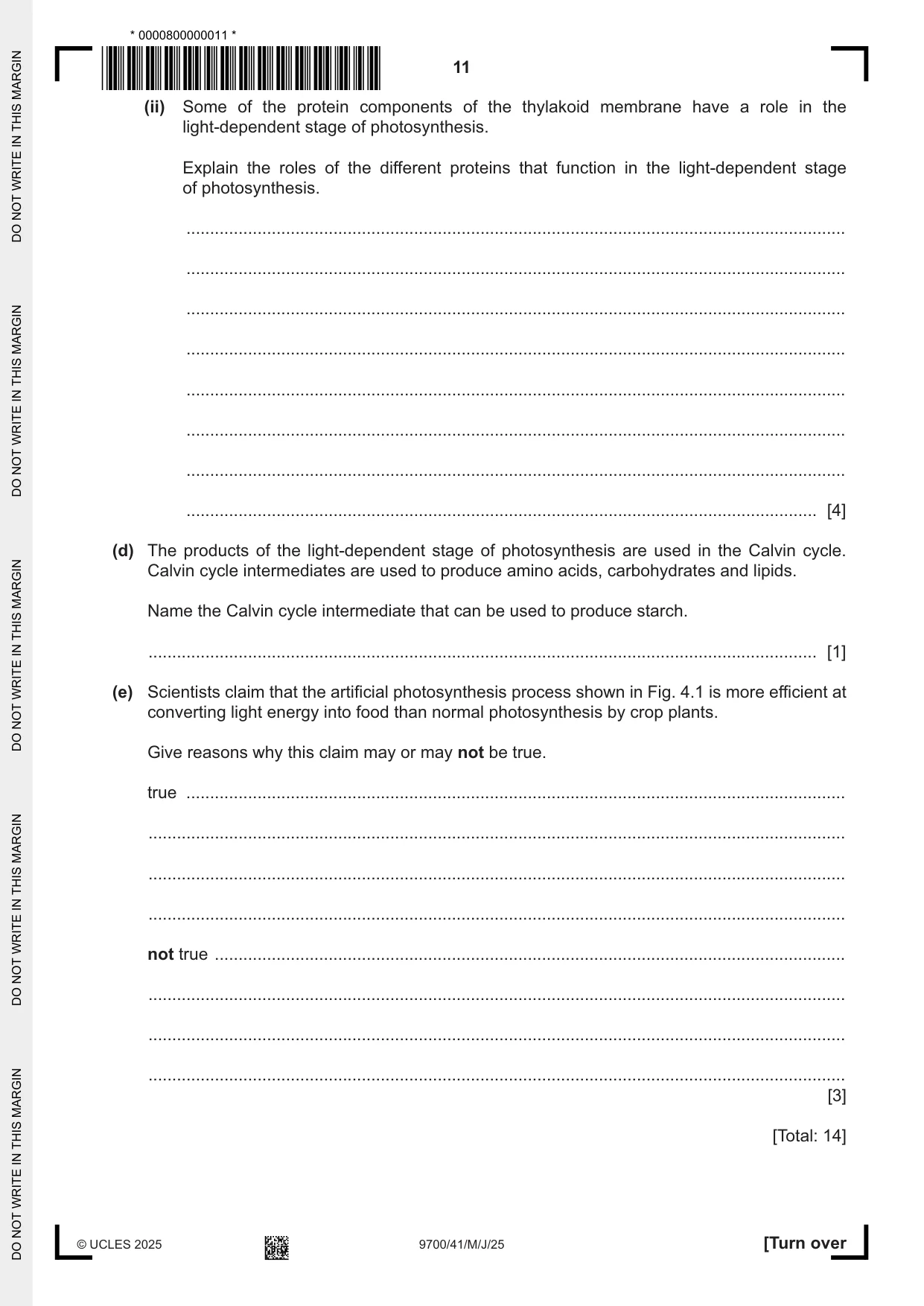
4 Scientists have invented a way of producing food by artificial photosynthesis. • Solar panels convert sunlight energy into electricity. • The electricity powers an electrolysis reaction between carbon dioxide gas and water to form the organic product acetate. • The single-celled alga Chlamydomonas, a protoctist, can use acetate to grow and reproduce in the dark, instead of photosynthesising in the light. • The algae can be processed to make a food product. Fig. 4.1 shows an outline of the artificial photosynthesis process. electrolyser H2O O2 CO2 acetate algae food electron flow solar panel Fig. 4.1 (a) Identify three similarities between the artificial photosynthesis process shown in Fig. 4.1 and the normal process of photosynthesis. ................................................................................................................................................... ................................................................................................................................................... ................................................................................................................................................... ................................................................................................................................................... ................................................................................................................................................... ............................................................................................................................................. [3] (b) Fig. 4.2 shows the single-celled alga Chlamydomonas. It contains a large, cup-shaped chloroplast for photosynthesis. B A Fig. 4.2 Structures A and B in Fig. 4.2 are found within the chloroplast. Name structures A and B. A ............................................................... B ............................................................... [2] (c) Thylakoid membranes are the site of the light-dependent stage of photosynthesis. (i) Name the products of the light-dependent stage of photosynthesis. ..................................................................................................................................... [1] (ii) Some of the protein components of the thylakoid membrane have a role in the light-dependent stage of photosynthesis. Explain the roles of the different proteins that function in the light-dependent stage of photosynthesis. ........................................................................................................................................... ........................................................................................................................................... ........................................................................................................................................... ........................................................................................................................................... ........................................................................................................................................... ........................................................................................................................................... ........................................................................................................................................... ..................................................................................................................................... [4] (d) The products of the light-dependent stage of photosynthesis are used in the Calvin cycle. Calvin cycle intermediates are used to produce amino acids, carbohydrates and lipids. Name the Calvin cycle intermediate that can be used to produce starch. ............................................................................................................................................. [1] (e) Scientists claim that the artificial photosynthesis process shown in Fig. 4.1 is more efficient at converting light energy into food than normal photosynthesis by crop plants. Give reasons why this claim may or may not be true. true ........................................................................................................................................... ................................................................................................................................................... ................................................................................................................................................... ................................................................................................................................................... not true ..................................................................................................................................... ................................................................................................................................................... ................................................................................................................................................... ................................................................................................................................................... [3] [Total: 14]
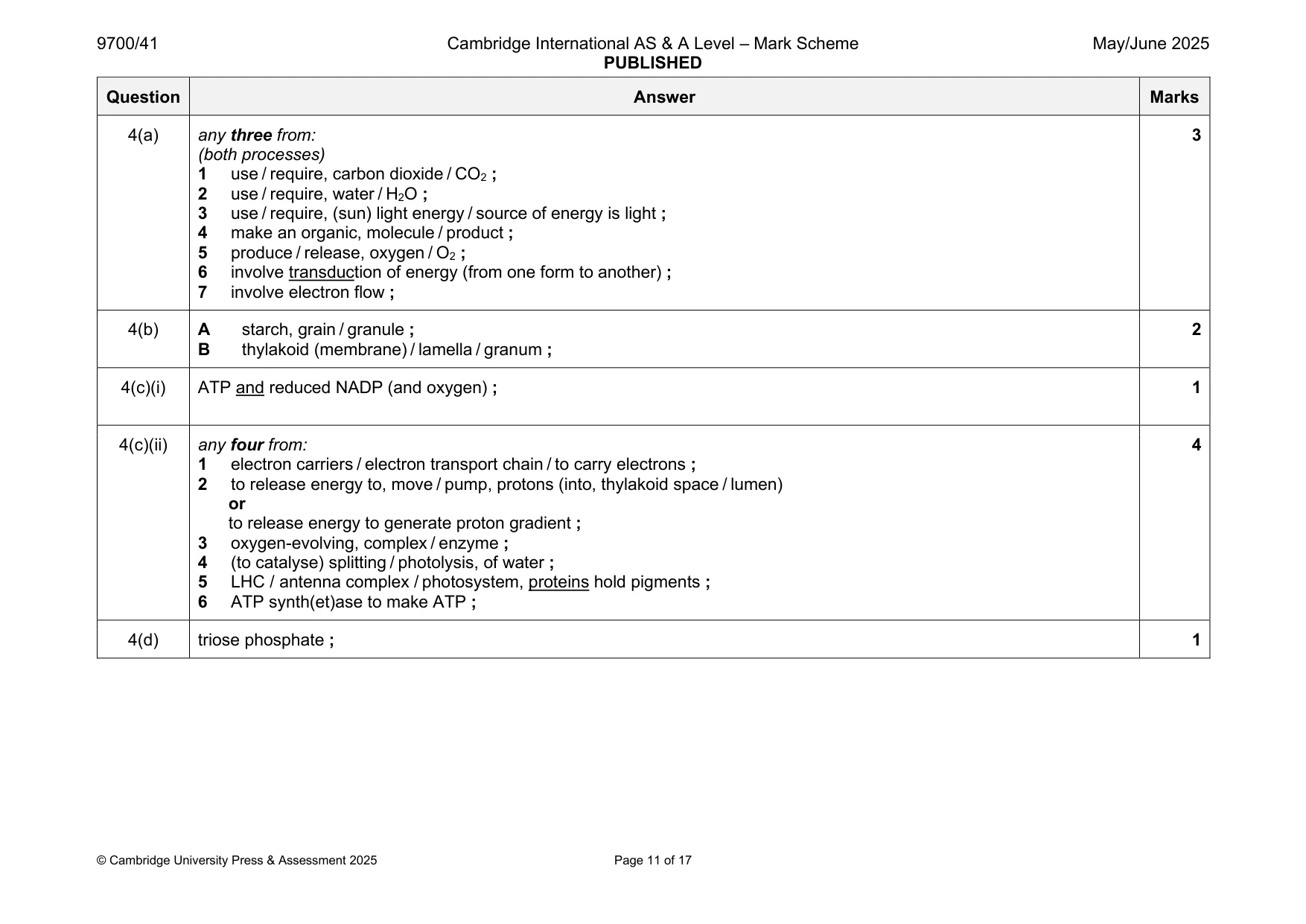
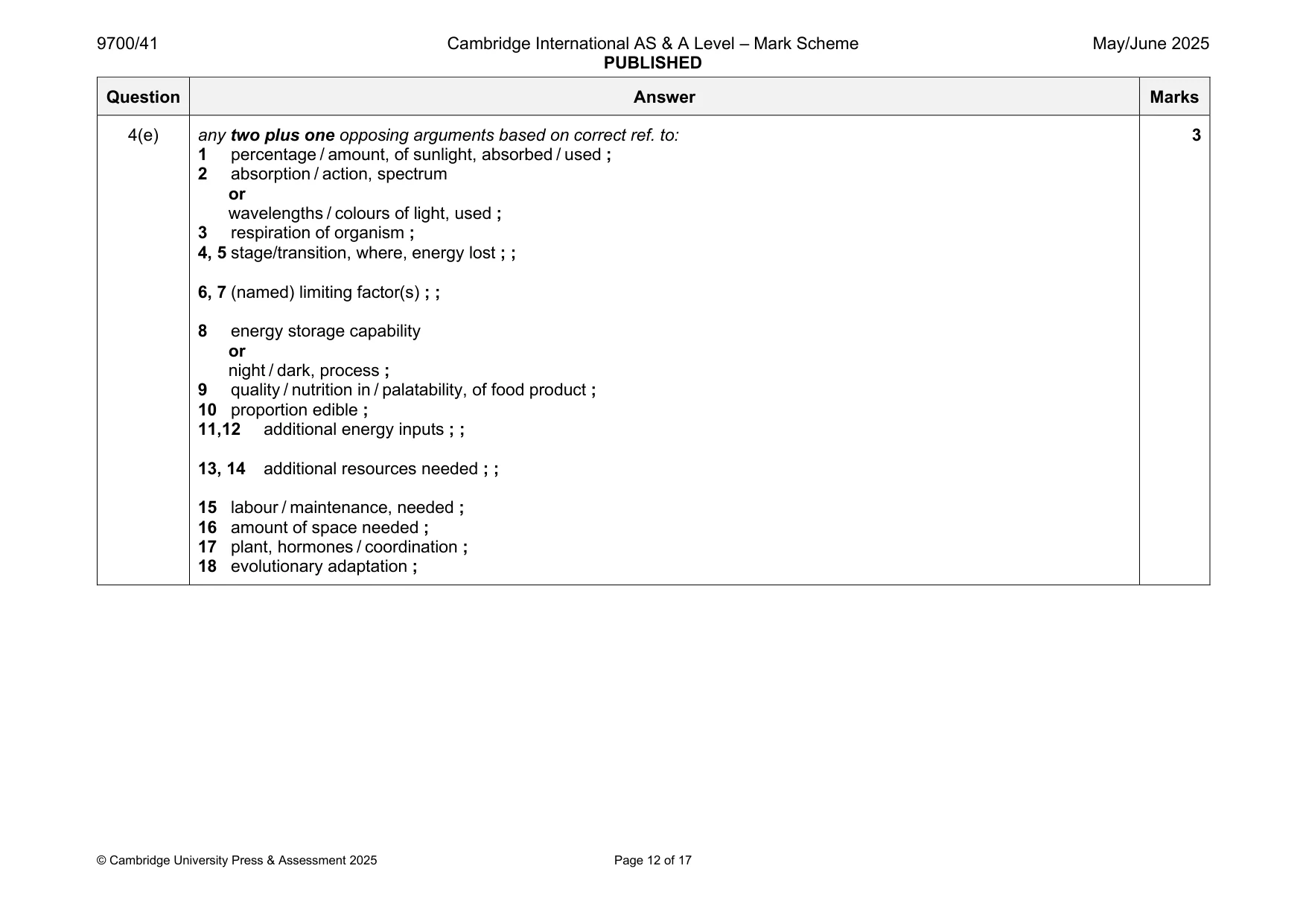
Mark scheme: 4(a) any three from: 3 (both processes) 1 use / require, carbon dioxide / CO2 ; 2 use / require, water / H2O ; 3 use / require, (sun) light energy / source of energy is light ; 4 make an organic, molecule / product ; 5 produce / release, oxygen / O2 ; 6 involve transduction of energy (from one form to another) ; 7 involve electron flow ; 4(b) A starch, grain / granule ; 2 B thylakoid (membrane) / lamella / granum ; 4(c)(i) ATP and reduced NADP (and oxygen) ; 1 4(c)(ii) any four from: 4 1 electron carriers / electron transport chain / to carry electrons ; 2 to release energy to, move / pump, protons (into, thylakoid space / lumen) or to release energy to generate proton gradient ; 3 oxygen-evolving, complex / enzyme ; 4 (to catalyse) splitting / photolysis, of water ; 5 LHC / antenna complex / photosystem, proteins hold pigments ; 6 ATP synth(et)ase to make ATP ; 4(d) triose phosphate ; 1 4(e) any two plus one opposing arguments based on correct ref. to: 3 1 percentage / amount, of sunlight, absorbed / used ; 2 absorption / action, spectrum or wavelengths / colours of light, used ; 3 respiration of organism ; 4, 5 stage/transition, where, energy lost ; ; 6, 7 (named) limiting factor(s) ; ; 8 energy storage capability or night / dark, process ; 9 quality / nutrition in / palatability, of food product ; 10 proportion edible ; 11,12 additional energy inputs ; ; 13, 14 additional resources needed ; ; 15 labour / maintenance, needed ; 16 amount of space needed ; 17 plant, hormones / coordination ; 18 evolutionary adaptation ;
More questions on Photosynthesis as an energy transfer process
Q5 · The Galápagos is a group of islands with a high biodiversity
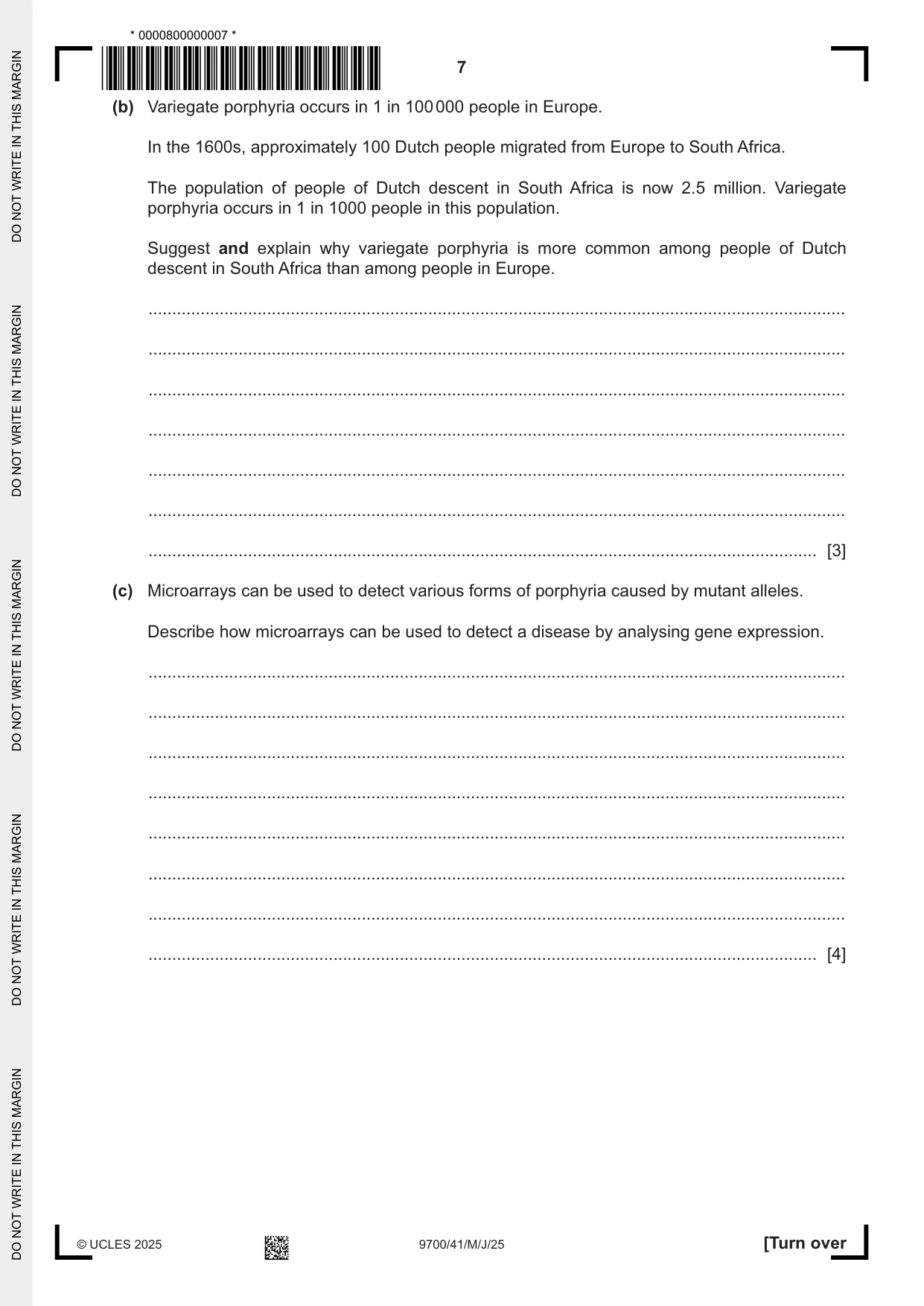
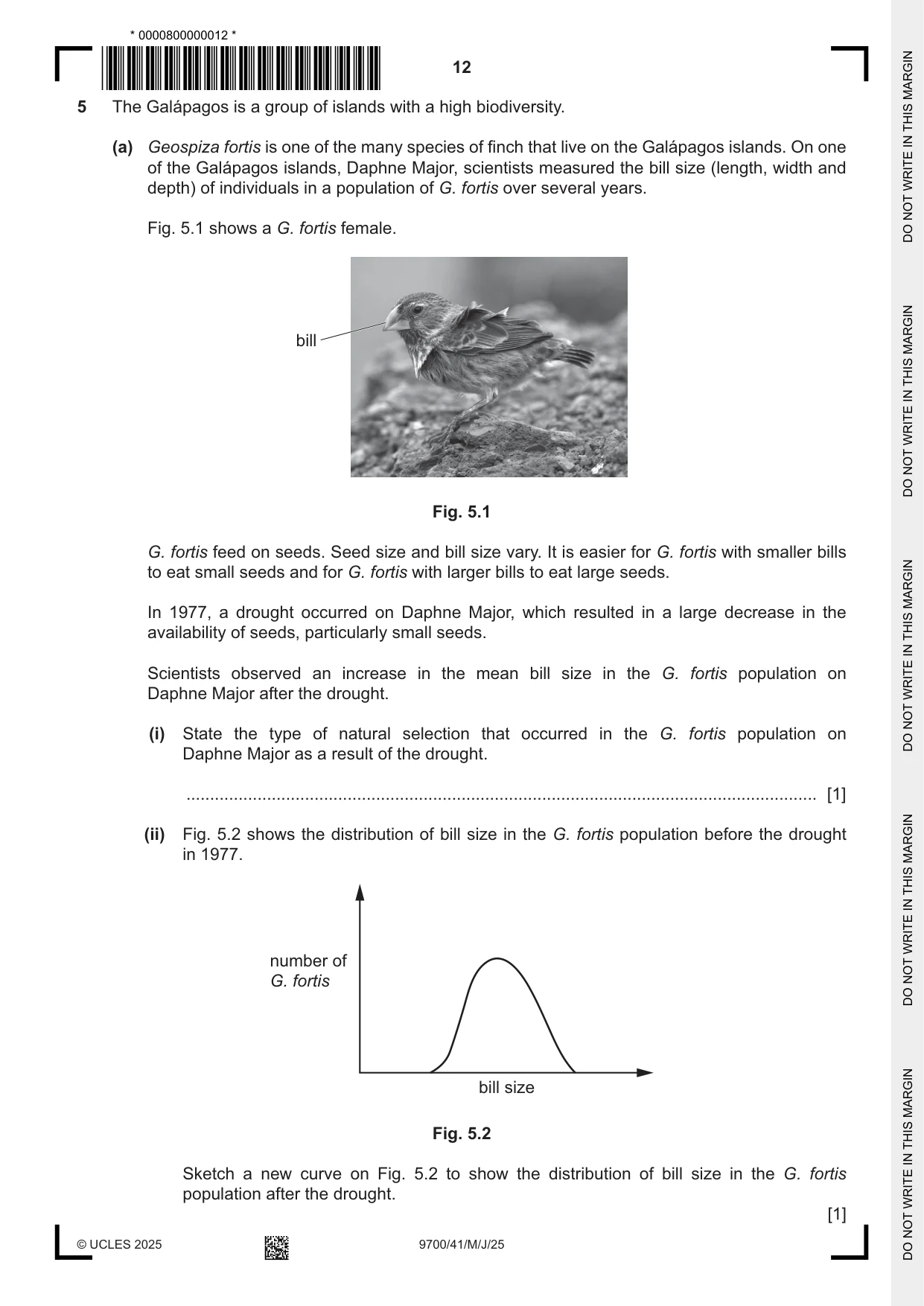
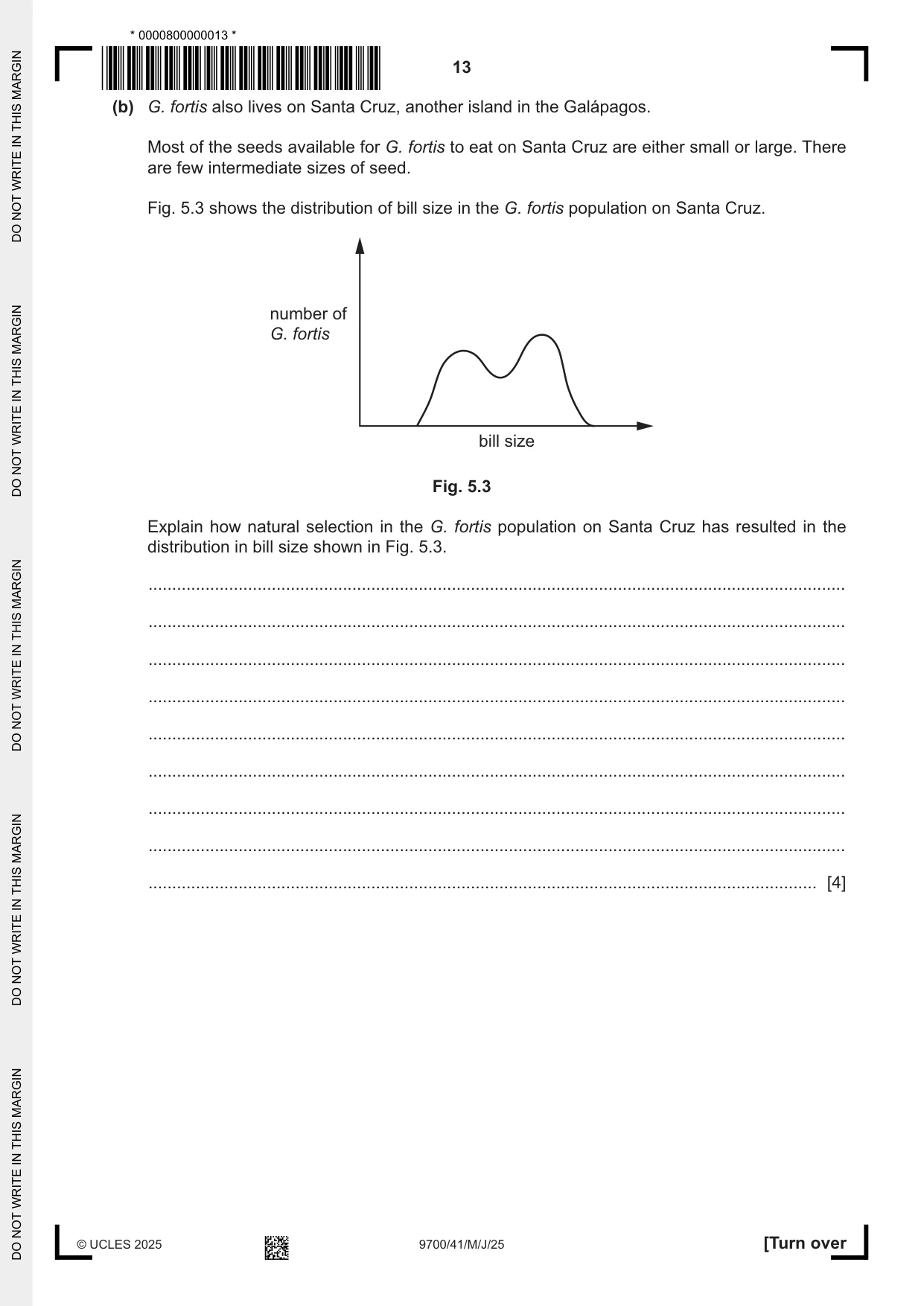
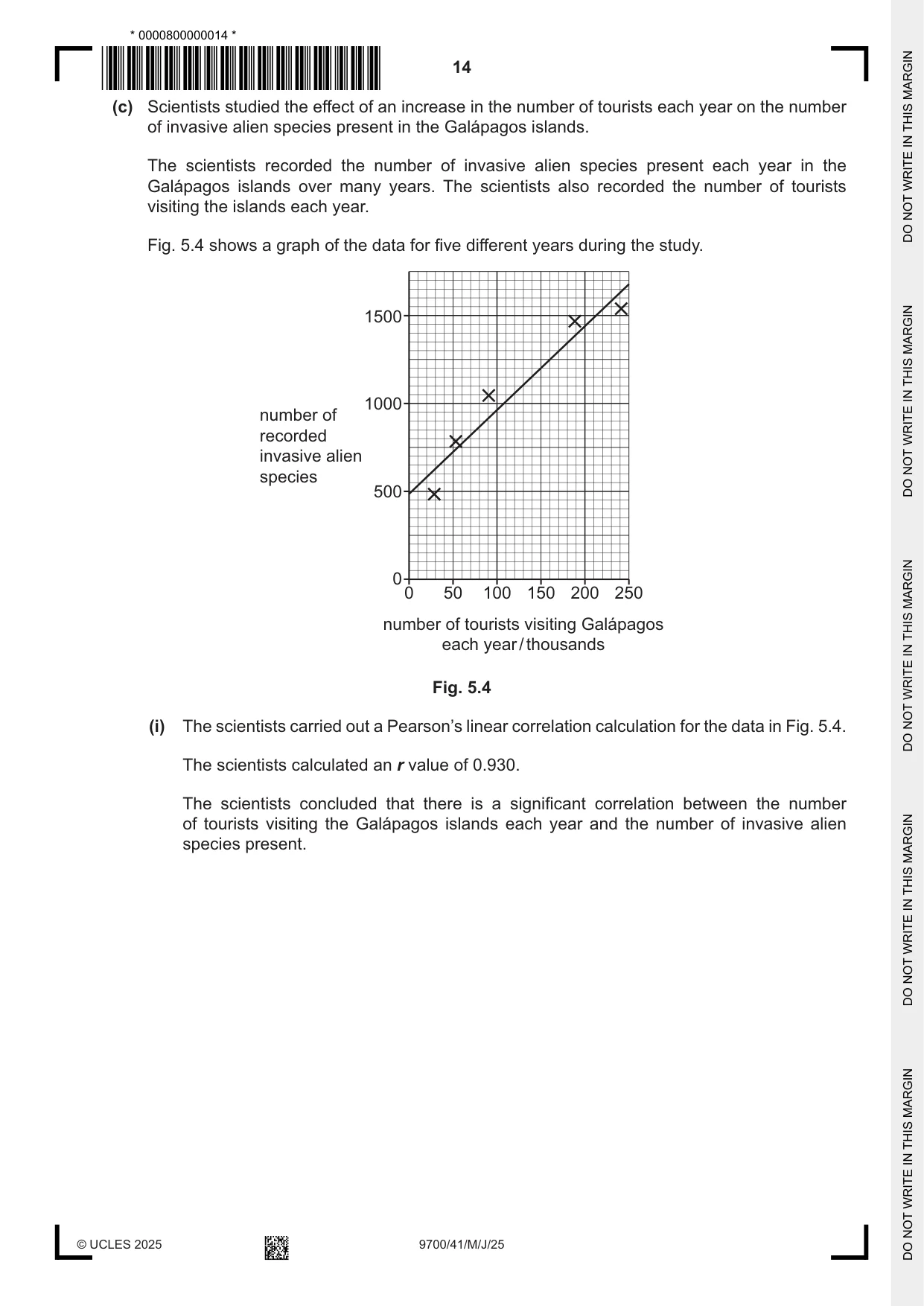
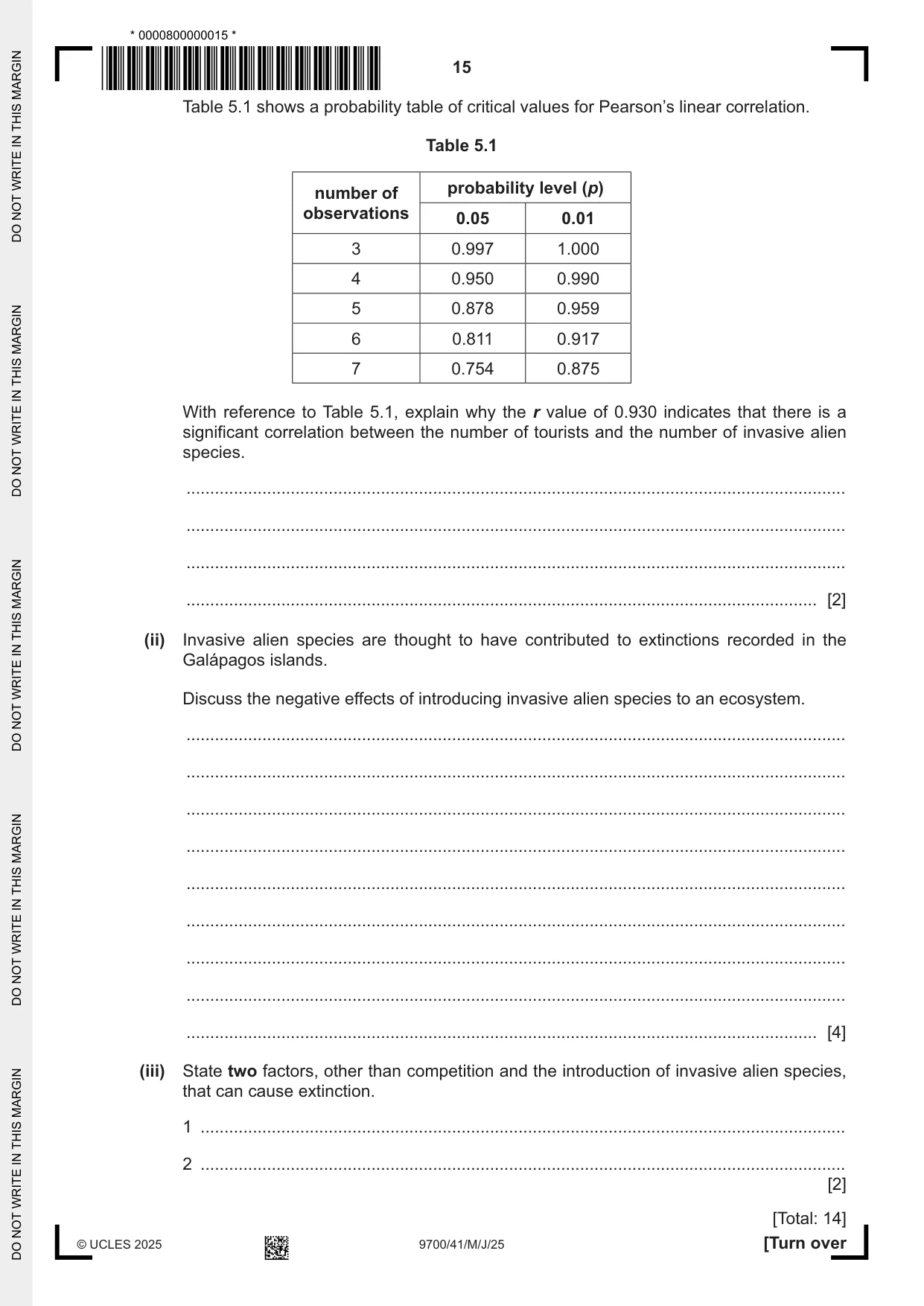
5 The Galápagos is a group of islands with a high biodiversity. (a) Geospiza fortis is one of the many species of finch that live on the Galápagos islands. On one of the Galápagos islands, Daphne Major, scientists measured the bill size (length, width and depth) of individuals in a population of G. fortis over several years. Fig. 5.1 shows a G. fortis female. bill Fig. 5.1 G. fortis feed on seeds. Seed size and bill size vary. It is easier for G. fortis with smaller bills to eat small seeds and for G. fortis with larger bills to eat large seeds. In 1977, a drought occurred on Daphne Major, which resulted in a large decrease in the availability of seeds, particularly small seeds. Scientists observed an increase in the mean bill size in the G. fortis population on Daphne Major after the drought. (i) State the type of natural selection that occurred in the G. fortis population on Daphne Major as a result of the drought. ..................................................................................................................................... [1] (ii) Fig. 5.2 shows the distribution of bill size in the G. fortis population before the drought in 1977. number of G. fortis bill size Fig. 5.2 Sketch a new curve on Fig. 5.2 to show the distribution of bill size in the G. fortis population after the drought. [1] (b) G. fortis also lives on Santa Cruz, another island in the Galápagos. Most of the seeds available for G. fortis to eat on Santa Cruz are either small or large. There are few intermediate sizes of seed. Fig. 5.3 shows the distribution of bill size in the G. fortis population on Santa Cruz. number of G. fortis bill size Fig. 5.3 Explain how natural selection in the G. fortis population on Santa Cruz has resulted in the distribution in bill size shown in Fig. 5.3. ................................................................................................................................................... ................................................................................................................................................... ................................................................................................................................................... ................................................................................................................................................... ................................................................................................................................................... ................................................................................................................................................... ................................................................................................................................................... ................................................................................................................................................... ............................................................................................................................................. [4] (c) Scientists studied the effect of an increase in the number of tourists each year on the number of invasive alien species present in the Galápagos islands. The scientists recorded the number of invasive alien species present each year in the Galápagos islands over many years. The scientists also recorded the number of tourists visiting the islands each year. Fig. 5.4 shows a graph of the data for five different years during the study. 1500 1000 number of recorded invasive alien species 500 0 0 50 100 150 200 250 number of tourists visiting Galápagos each year / thousands Fig. 5.4 (i) The scientists carried out a Pearson’s linear correlation calculation for the data in Fig. 5.4. The scientists calculated an r value of 0.930. The scientists concluded that there is a significant correlation between the number of tourists visiting the Galápagos islands each year and the number of invasive alien species present. Table 5.1 shows a probability table of critical values for Pearson’s linear correlation. Table 5.1 probability level (p) number of observations 0.05 0.01 3 0.997 1.000 4 0.950 0.990 5 0.878 0.959 6 0.811 0.917 7 0.754 0.875 With reference to Table 5.1, explain why the r value of 0.930 indicates that there is a significant correlation between the number of tourists and the number of invasive alien species. ........................................................................................................................................... ........................................................................................................................................... ........................................................................................................................................... ..................................................................................................................................... [2] (ii) Invasive alien species are thought to have contributed to extinctions recorded in the Galápagos islands. Discuss the negative effects of introducing invasive alien species to an ecosystem. ........................................................................................................................................... ........................................................................................................................................... ........................................................................................................................................... ........................................................................................................................................... ........................................................................................................................................... ........................................................................................................................................... ........................................................................................................................................... ........................................................................................................................................... ..................................................................................................................................... [4] (iii) State two factors, other than competition and the introduction of invasive alien species, that can cause extinction. 1 ........................................................................................................................................ 2 ........................................................................................................................................ [2] [Total: 14]
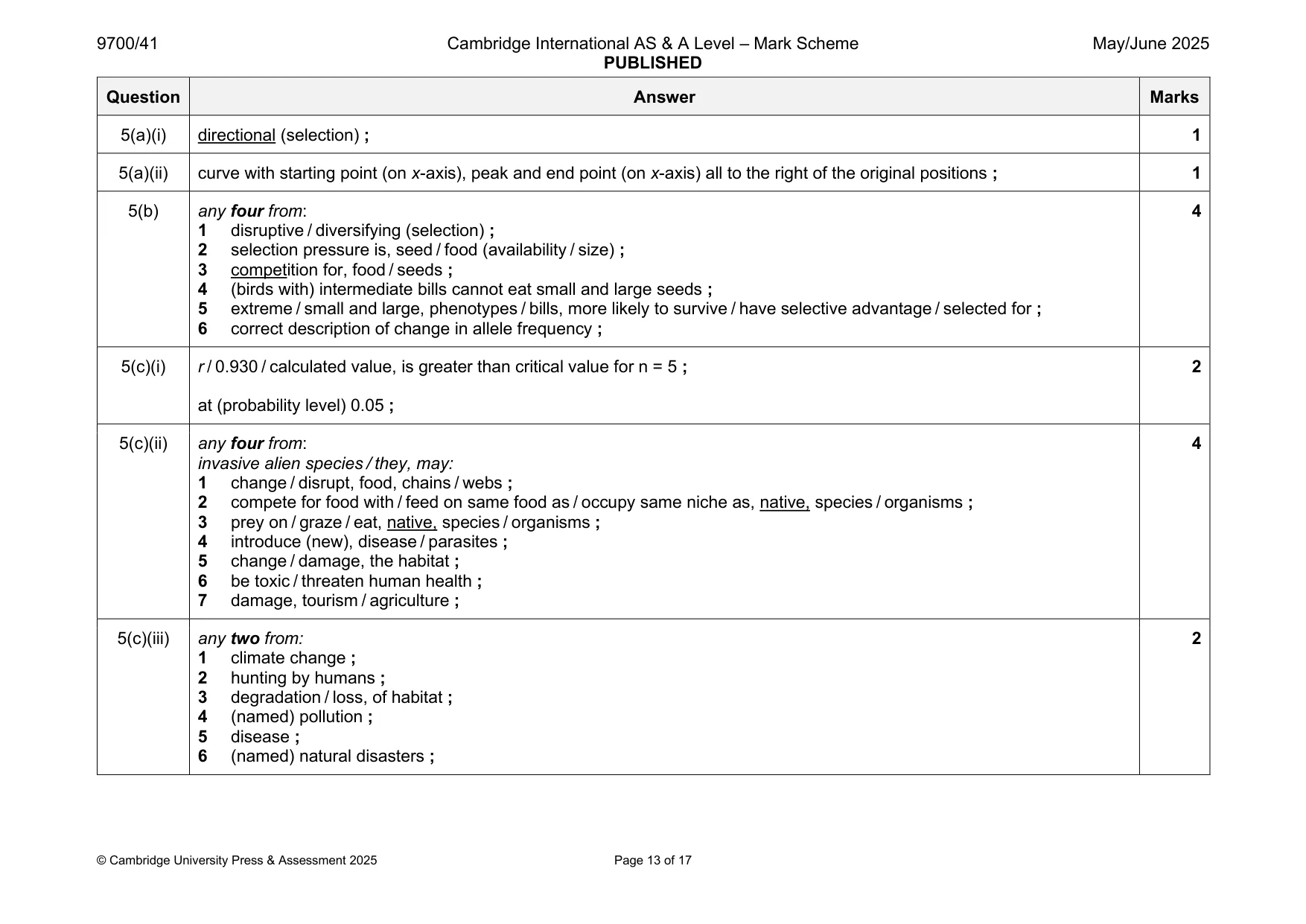
Mark scheme: 5(a)(i) directional (selection) ; 1 5(a)(ii) curve with starting point (on x-axis), peak and end point (on x-axis) all to the right of the original positions ; 1 5(b) any four from: 4 1 disruptive / diversifying (selection) ; 2 selection pressure is, seed / food (availability / size) ; 3 competition for, food / seeds ; 4 (birds with) intermediate bills cannot eat small and large seeds ; 5 extreme / small and large, phenotypes / bills, more likely to survive / have selective advantage / selected for ; 6 correct description of change in allele frequency ; 5(c)(i) r / 0.930 / calculated value, is greater than critical value for n = 5 ; 2 at (probability level) 0.05 ; 5(c)(ii) any four from: 4 invasive alien species / they, may: 1 change / disrupt, food, chains / webs ; 2 compete for food with / feed on same food as / occupy same niche as, native, species / organisms ; 3 prey on / graze / eat, native, species / organisms ; 4 introduce (new), disease / parasites ; 5 change / damage, the habitat ; 6 be toxic / threaten human health ; 7 damage, tourism / agriculture ; 5(c)(iii) any two from: 2 1 climate change ; 2 hunting by humans ; 3 degradation / loss, of habitat ; 4 (named) pollution ; 5 disease ; 6 (named) natural disasters ;
Q6 · In the kidney, various molecules move between the blood and the kidney nephron
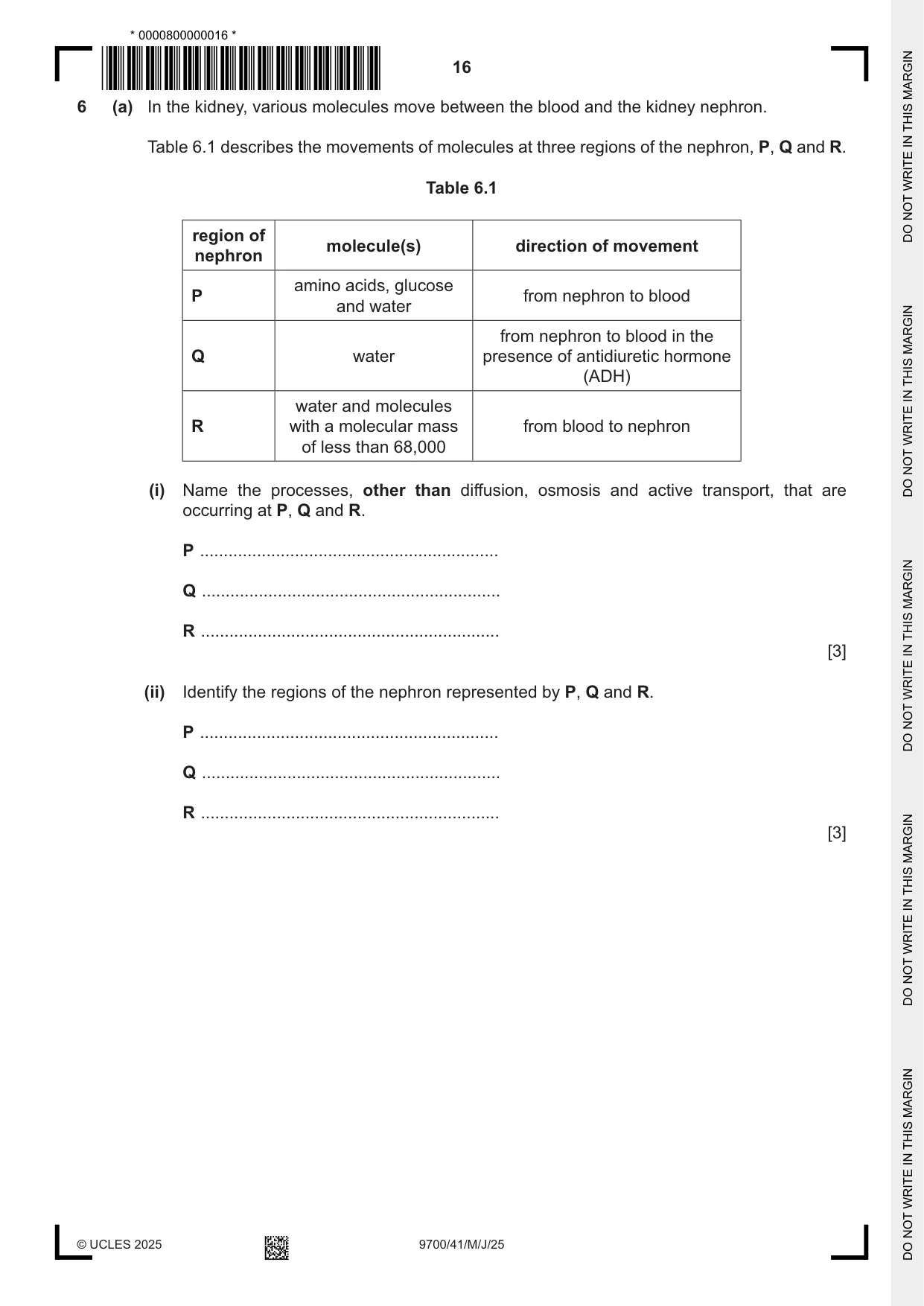
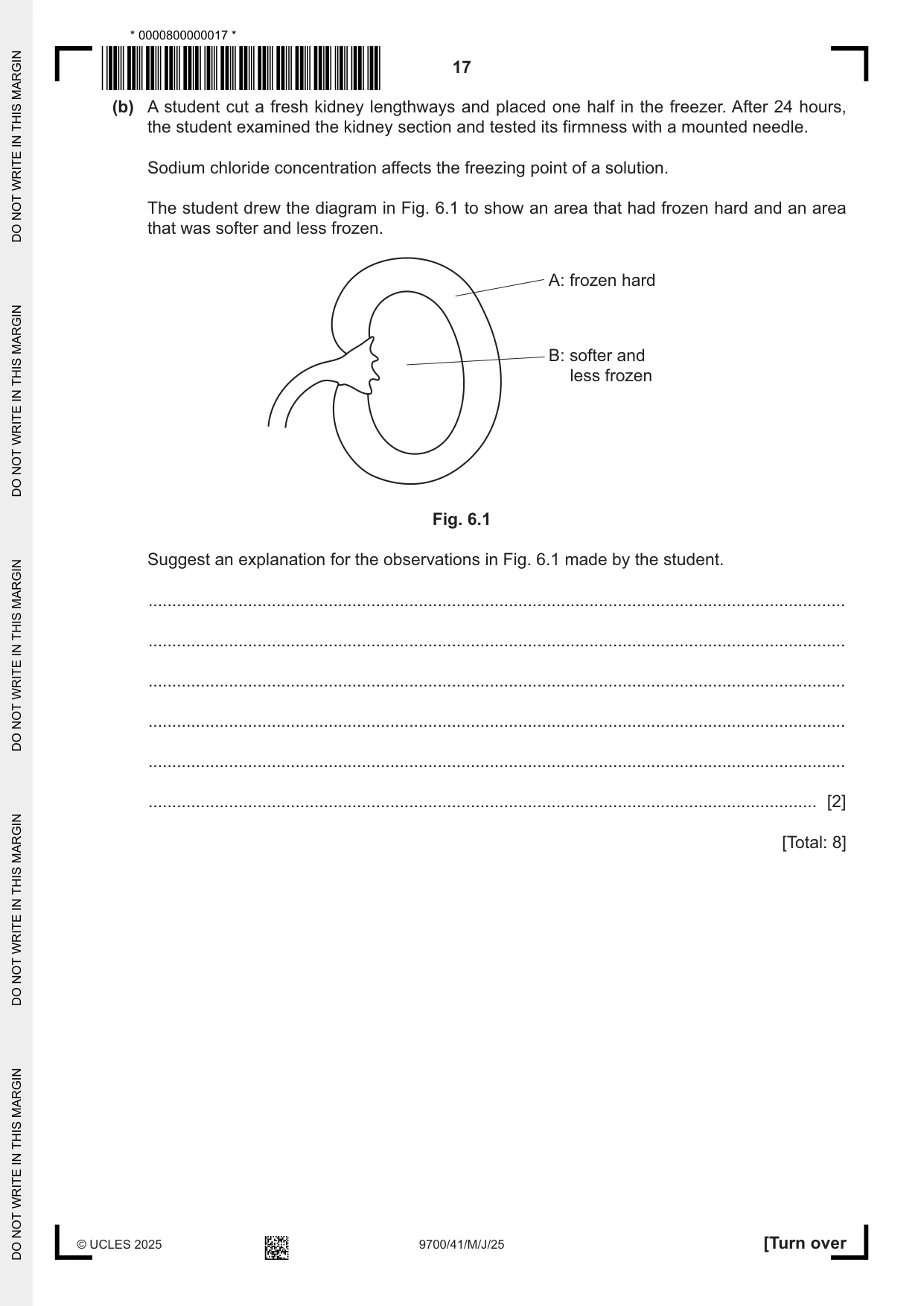
6 (a) In the kidney, various molecules move between the blood and the kidney nephron. Table 6.1 describes the movements of molecules at three regions of the nephron, P, Q and R. Table 6.1 region of molecule(s) direction of movement nephron amino acids, glucose P from nephron to blood and water from nephron to blood in the Q water presence of antidiuretic hormone (ADH) water and molecules R with a molecular mass from blood to nephron of less than 68,000 (i) Name the processes, other than diffusion, osmosis and active transport, that are occurring at P, Q and R. P ............................................................... Q ............................................................... R ............................................................... [3] (ii) Identify the regions of the nephron represented by P, Q and R. P ............................................................... Q ............................................................... R ............................................................... [3] (b) A student cut a fresh kidney lengthways and placed one half in the freezer. After 24 hours, the student examined the kidney section and tested its firmness with a mounted needle. Sodium chloride concentration affects the freezing point of a solution. The student drew the diagram in Fig. 6.1 to show an area that had frozen hard and an area that was softer and less frozen. A: frozen hard B: softer and less frozen Fig. 6.1 Suggest an explanation for the observations in Fig. 6.1 made by the student. ................................................................................................................................................... ................................................................................................................................................... ................................................................................................................................................... ................................................................................................................................................... ................................................................................................................................................... ............................................................................................................................................. [2] [Total: 8]
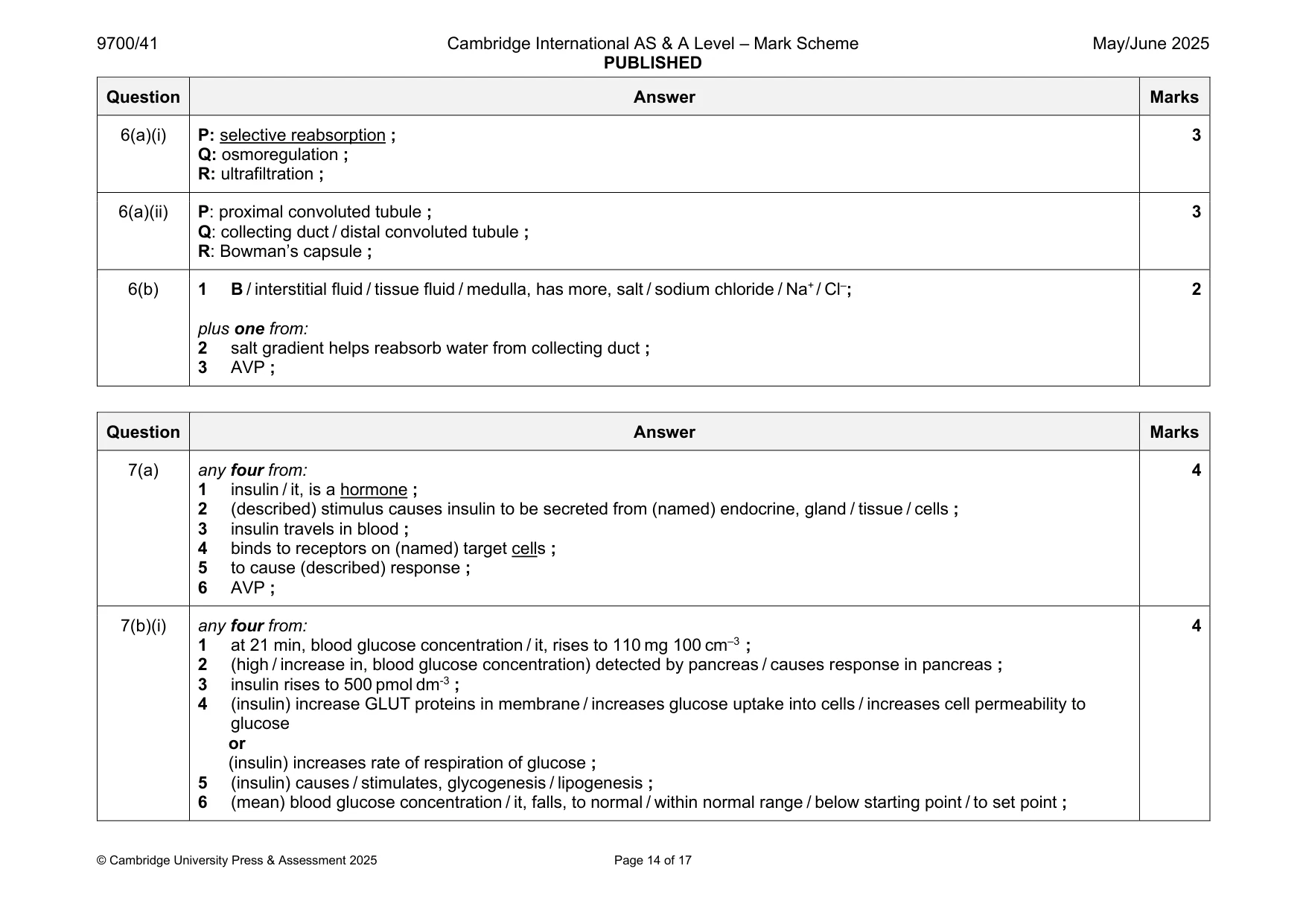
Mark scheme: 6(a)(i) P: selective reabsorption ; 3 Q: osmoregulation ; R: ultrafiltration ; 6(a)(ii) P: proximal convoluted tubule ; 3 Q: collecting duct / distal convoluted tubule ; R: Bowman’s capsule ; 6(b) 1 B / interstitial fluid / tissue fluid / medulla, has more, salt / sodium chloride / Na+ / Cl–; 2 plus one from: 2 salt gradient helps reabsorb water from collecting duct ; 3 AVP ;
Q7 · Insulin is an example of a cell-signalling molecule of the endocrine system
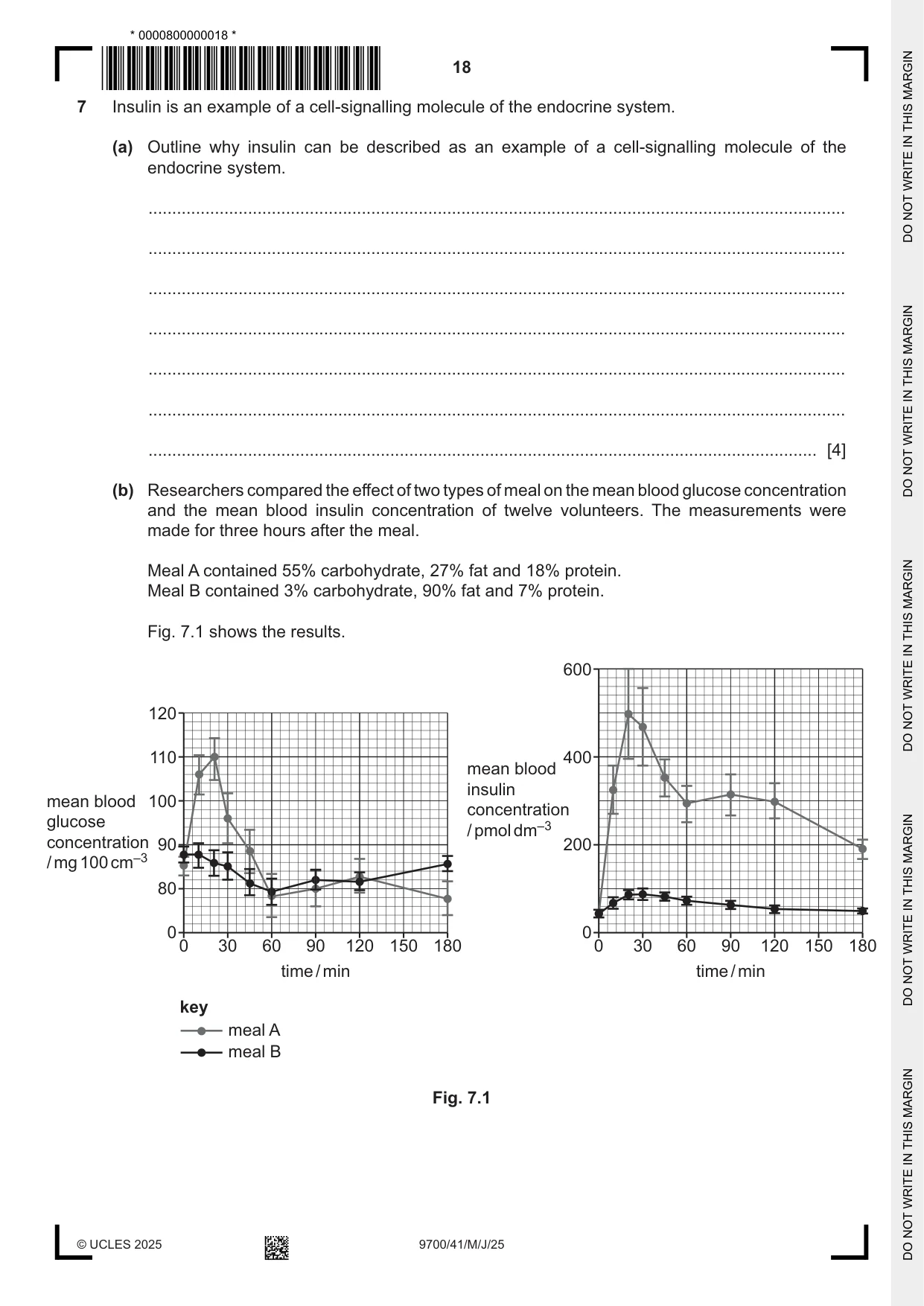
7 Insulin is an example of a cell-signalling molecule of the endocrine system. (a) Outline why insulin can be described as an example of a cell-signalling molecule of the endocrine system. ................................................................................................................................................... ................................................................................................................................................... ................................................................................................................................................... ................................................................................................................................................... ................................................................................................................................................... ................................................................................................................................................... ............................................................................................................................................. [4] (b) Researchers compared the effect of two types of meal on the mean blood glucose concentration and the mean blood insulin concentration of twelve volunteers. The measurements were made for three hours after the meal. Meal A contained 55% carbohydrate, 27% fat and 18% protein. Meal B contained 3% carbohydrate, 90% fat and 7% protein. Fig. 7.1 shows the results. 600 120 110 400 mean blood insulin mean blood 100 concentration glucose / pmol dm–3 concentration 90 200 / mg 100 cm–3 80 0 0 0 30 60 90 120 150 180 0 30 60 90 120 150 180 time / min time / min key meal A meal B Fig. 7.1 (i) With reference to Fig. 7.1, explain how negative feedback operates to control mean blood glucose concentration in the volunteers who ate meal A. ........................................................................................................................................... ........................................................................................................................................... ........................................................................................................................................... ........................................................................................................................................... ........................................................................................................................................... ........................................................................................................................................... ........................................................................................................................................... ........................................................................................................................................... ........................................................................................................................................... ..................................................................................................................................... [4] (ii) Suggest explanations for the changes in mean blood glucose concentration of the volunteers who ate meal B. ........................................................................................................................................... ........................................................................................................................................... ........................................................................................................................................... ........................................................................................................................................... ........................................................................................................................................... ........................................................................................................................................... ........................................................................................................................................... ..................................................................................................................................... [3] [Total: 11]
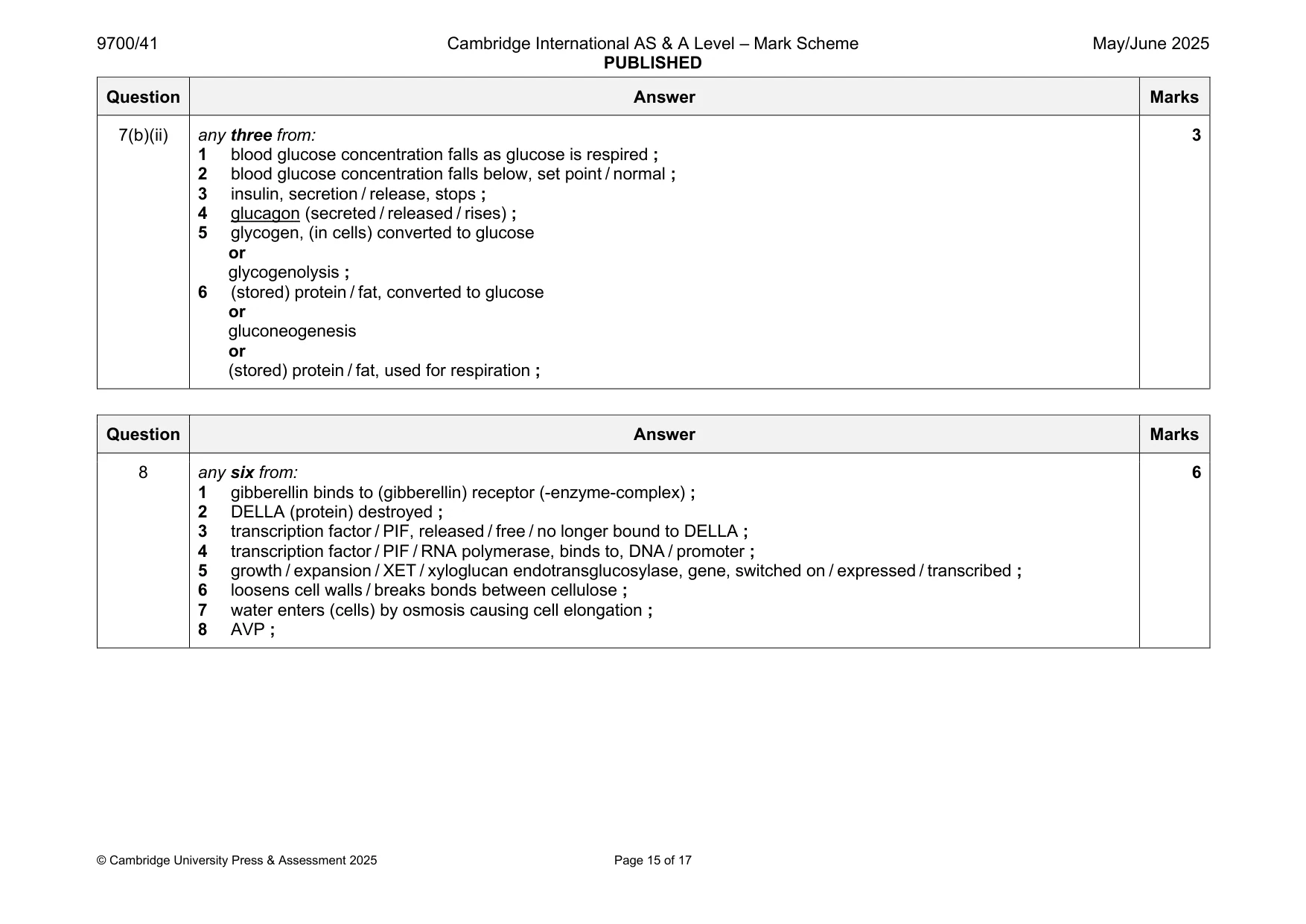
Mark scheme: 7(a) any four from: 4 1 insulin / it, is a hormone ; 2 (described) stimulus causes insulin to be secreted from (named) endocrine, gland / tissue / cells ; 3 insulin travels in blood ; 4 binds to receptors on (named) target cells ; 5 to cause (described) response ; 6 AVP ; 7(b)(i) any four from: 4 1 at 21 min, blood glucose concentration / it, rises to 110 mg 100 cm–3 ; 2 (high / increase in, blood glucose concentration) detected by pancreas / causes response in pancreas ; 3 insulin rises to 500 pmol dm-3 ; 4 (insulin) increase GLUT proteins in membrane / increases glucose uptake into cells / increases cell permeability to glucose or (insulin) increases rate of respiration of glucose ; 5 (insulin) causes / stimulates, glycogenesis / lipogenesis ; 6 (mean) blood glucose concentration / it, falls, to normal / within normal range / below starting point / to set point ; 7(b)(ii) any three from: 3 1 blood glucose concentration falls as glucose is respired ; 2 blood glucose concentration falls below, set point / normal ; 3 insulin, secretion / release, stops ; 4 glucagon (secreted / released / rises) ; 5 glycogen, (in cells) converted to glucose or glycogenolysis ; 6 (stored) protein / fat, converted to glucose or gluconeogenesis or (stored) protein / fat, used for respiration ;
Q8 · The presence of gibberellins in a plant cell leads to the expression of genes involved in…
8 The presence of gibberellins in a plant cell leads to the expression of genes involved in stem elongation. Describe how gibberellin causes stem elongation in plants. .......................................................................................................................................................... .......................................................................................................................................................... .......................................................................................................................................................... .......................................................................................................................................................... .......................................................................................................................................................... .......................................................................................................................................................... .......................................................................................................................................................... .......................................................................................................................................................... .......................................................................................................................................................... .......................................................................................................................................................... .......................................................................................................................................................... .......................................................................................................................................................... .......................................................................................................................................................... .......................................................................................................................................................... [Total: 6]
Mark scheme: 8 any six from: 6 1 gibberellin binds to (gibberellin) receptor (-enzyme-complex) ; 2 DELLA (protein) destroyed ; 3 transcription factor / PIF, released / free / no longer bound to DELLA ; 4 transcription factor / PIF / RNA polymerase, binds to, DNA / promoter ; 5 growth / expansion / XET / xyloglucan endotransglucosylase, gene, switched on / expressed / transcribed ; 6 loosens cell walls / breaks bonds between cellulose ; 7 water enters (cells) by osmosis causing cell elongation ; 8 AVP ;
Q9 · A species is classified into one of three domains
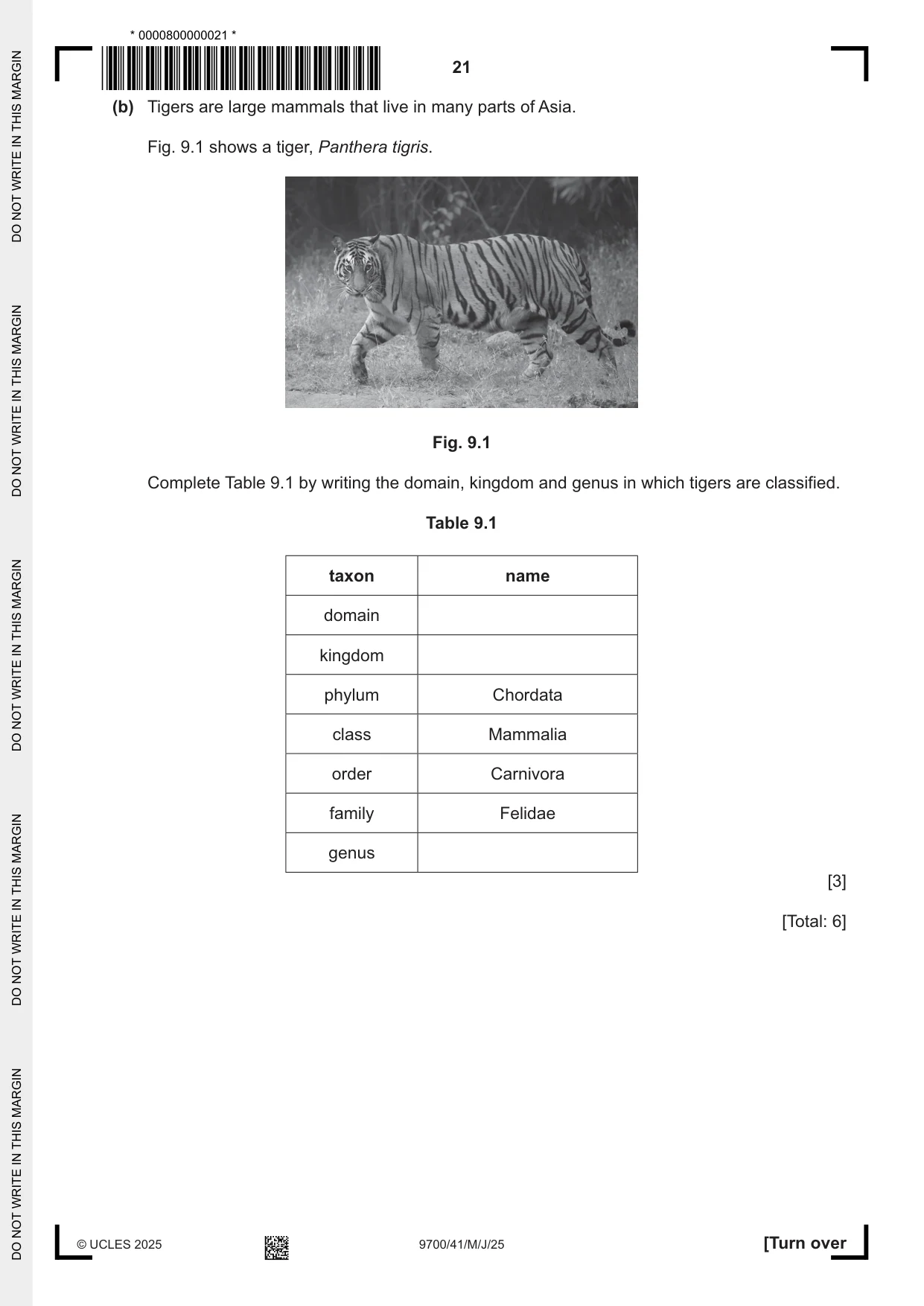
9 A species is classified into one of three domains. (a) Two of the domains contain only prokaryotic species. With reference to the two prokaryotic domains, describe the features used to classify prokaryotic species into two different domains. ................................................................................................................................................... ................................................................................................................................................... ................................................................................................................................................... ................................................................................................................................................... ................................................................................................................................................... ................................................................................................................................................... ............................................................................................................................................. [3] (b) Tigers are large mammals that live in many parts of Asia. Fig. 9.1 shows a tiger, Panthera tigris. Fig. 9.1 Complete Table 9.1 by writing the domain, kingdom and genus in which tigers are classified. Table 9.1 taxon name domain kingdom phylum Chordata class Mammalia order Carnivora family Felidae genus [3] [Total: 6]
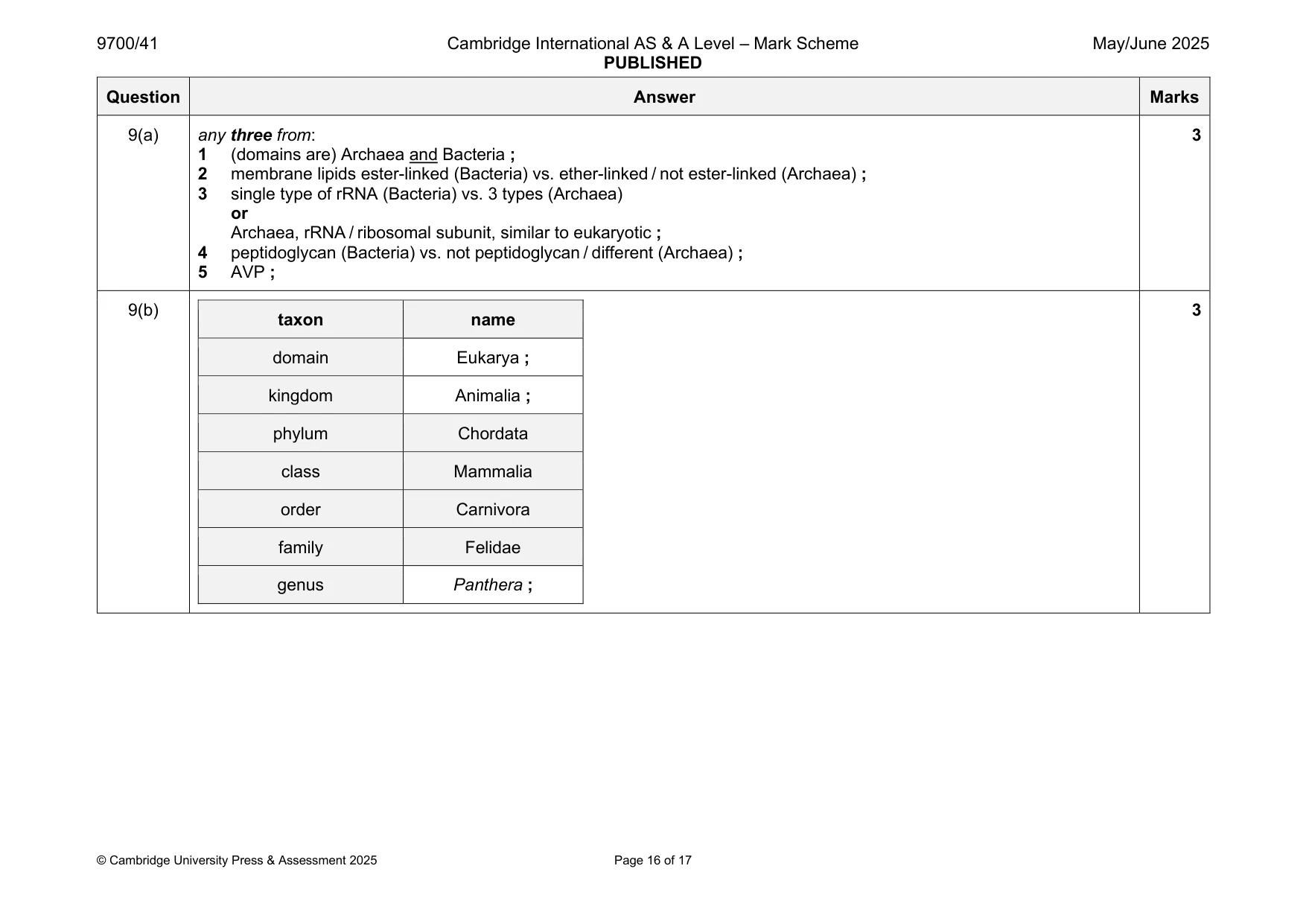
Mark scheme: 9(a) any three from: 3 1 (domains are) Archaea and Bacteria ; 2 membrane lipids ester-linked (Bacteria) vs. ether-linked / not ester-linked (Archaea) ; 3 single type of rRNA (Bacteria) vs. 3 types (Archaea) or Archaea, rRNA / ribosomal subunit, similar to eukaryotic ; 4 peptidoglycan (Bacteria) vs. not peptidoglycan / different (Archaea) ; 5 AVP ; 9(b) 3 taxon name domain Eukarya ; kingdom Animalia ; phylum Chordata class Mammalia order Carnivora family Felidae genus Panthera ;
Q10 · During the course of an action potential, the potential difference across a neurone…
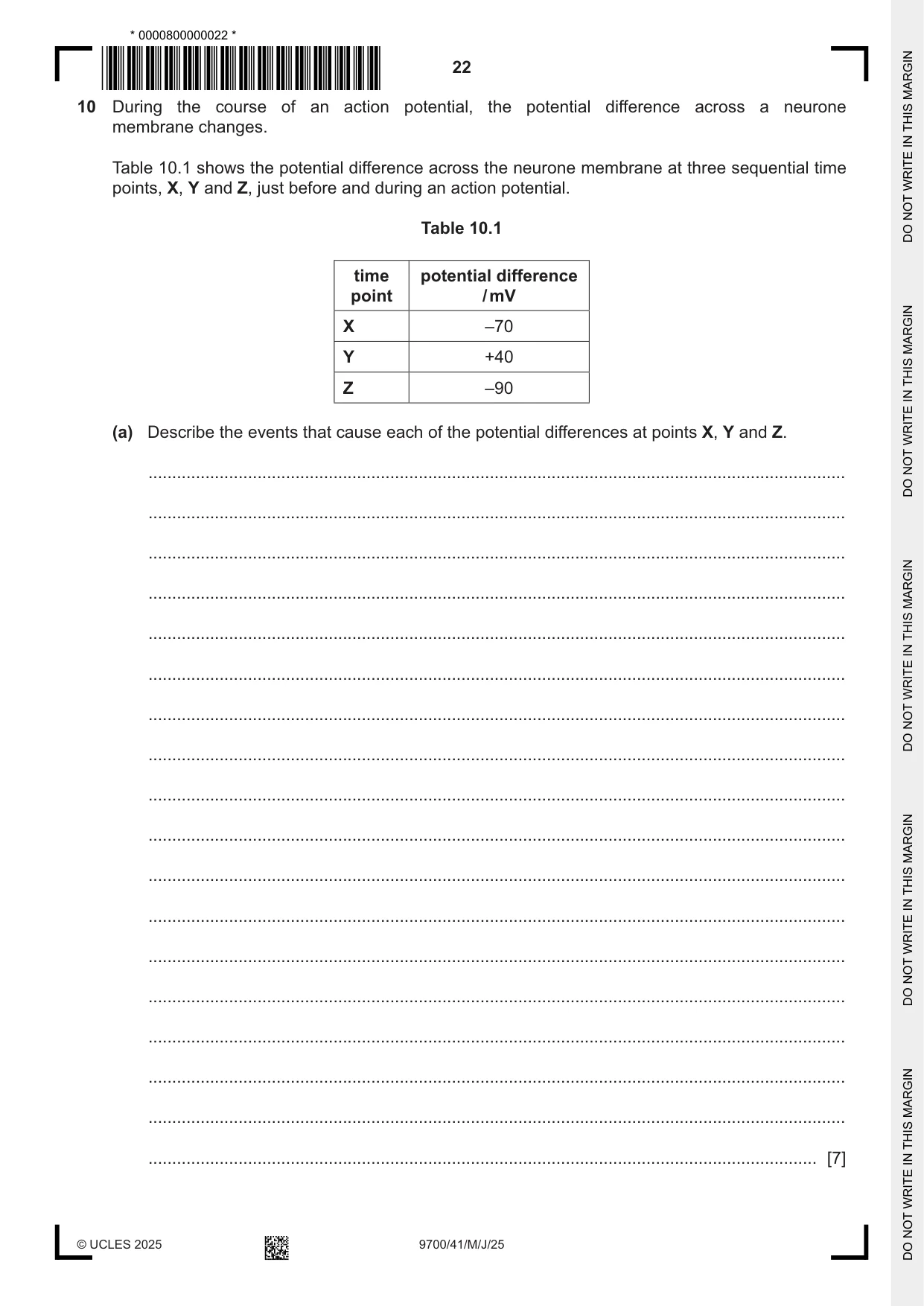
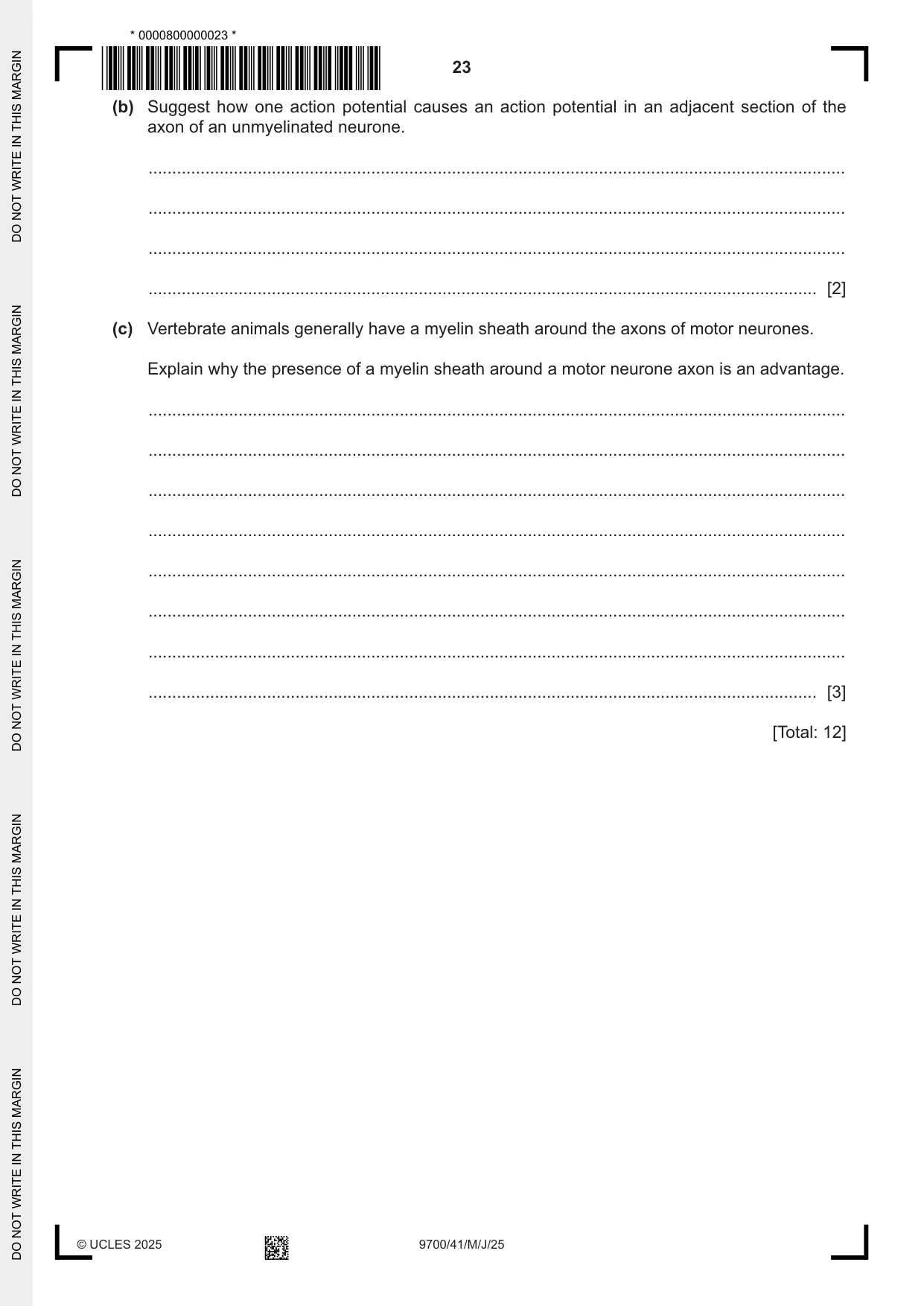
10 During the course of an action potential, the potential difference across a neurone membrane changes. Table 10.1 shows the potential difference across the neurone membrane at three sequential time points, X, Y and Z, just before and during an action potential. Table 10.1 time potential difference point / mV X –70 Y +40 Z –90 (a) Describe the events that cause each of the potential differences at points X, Y and Z. ................................................................................................................................................... ................................................................................................................................................... ................................................................................................................................................... ................................................................................................................................................... ................................................................................................................................................... ................................................................................................................................................... ................................................................................................................................................... ................................................................................................................................................... ................................................................................................................................................... ................................................................................................................................................... ................................................................................................................................................... ................................................................................................................................................... ................................................................................................................................................... ................................................................................................................................................... ................................................................................................................................................... ................................................................................................................................................... ................................................................................................................................................... ............................................................................................................................................. [7] (b) Suggest how one action potential causes an action potential in an adjacent section of the axon of an unmyelinated neurone. ................................................................................................................................................... ................................................................................................................................................... ................................................................................................................................................... ............................................................................................................................................. [2] (c) Vertebrate animals generally have a myelin sheath around the axons of motor neurones. Explain why the presence of a myelin sheath around a motor neurone axon is an advantage. ................................................................................................................................................... ................................................................................................................................................... ................................................................................................................................................... ................................................................................................................................................... ................................................................................................................................................... ................................................................................................................................................... ................................................................................................................................................... ............................................................................................................................................. [3] [Total: 12]
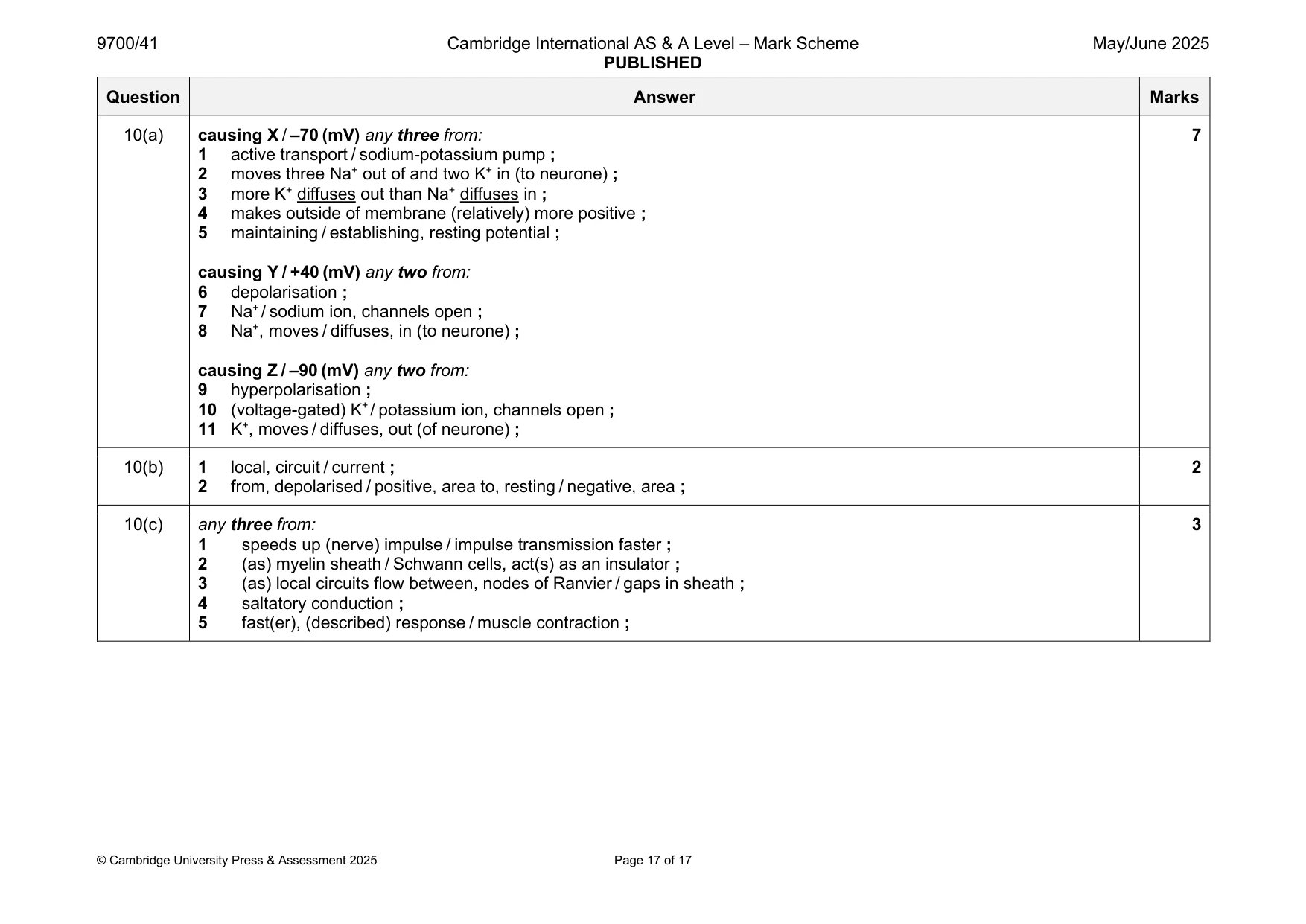
Mark scheme: 10(a) causing X / –70 (mV) any three from: 7 1 active transport / sodium-potassium pump ; 2 moves three Na+ out of and two K+ in (to neurone) ; 3 more K+ diffuses out than Na+ diffuses in ; 4 makes outside of membrane (relatively) more positive ; 5 maintaining / establishing, resting potential ; causing Y / +40 (mV) any two from: 6 depolarisation ; 7 Na+ / sodium ion, channels open ; 8 Na+, moves / diffuses, in (to neurone) ; causing Z / –90 (mV) any two from: 9 hyperpolarisation ; 10 (voltage-gated) K+ / potassium ion, channels open ; 11 K+, moves / diffuses, out (of neurone) ; 10(b) 1 local, circuit / current ; 2 2 from, depolarised / positive, area to, resting / negative, area ; 10(c) any three from: 3 1 speeds up (nerve) impulse / impulse transmission faster ; 2 (as) myelin sheath / Schwann cells, act(s) as an insulator ; 3 (as) local circuits flow between, nodes of Ranvier / gaps in sheath ; 4 saltatory conduction ; 5 fast(er), (described) response / muscle contraction ;
What was in this paper
The subtopics covered by these 10 questions, and how many questions each got. Open one in a new tab to see every Cambridge question on it.
What you needed in this session
Cambridge’s own grade thresholds for 2025 May/June, Paper 4 · Variant 1. A higher threshold means an easier paper — the bar moves with how the cohort did.