Cambridge A Level Biology 9700 — 2024 May/June Paper 4 · Variant 2
9700/42/M/J/24 · 10 questions · 100 marks · ≈113 min
The question paper and its mark scheme, free to read here and free to download. This is Cambridge’s own paper, exactly as it was sat.
Question paper24 pages


Mark scheme20 pages
Answers below. Sit the paper first if you are practising.
Questions as text
Q1 · Osmoregulation is the control of the water potential of body fluids such as blood
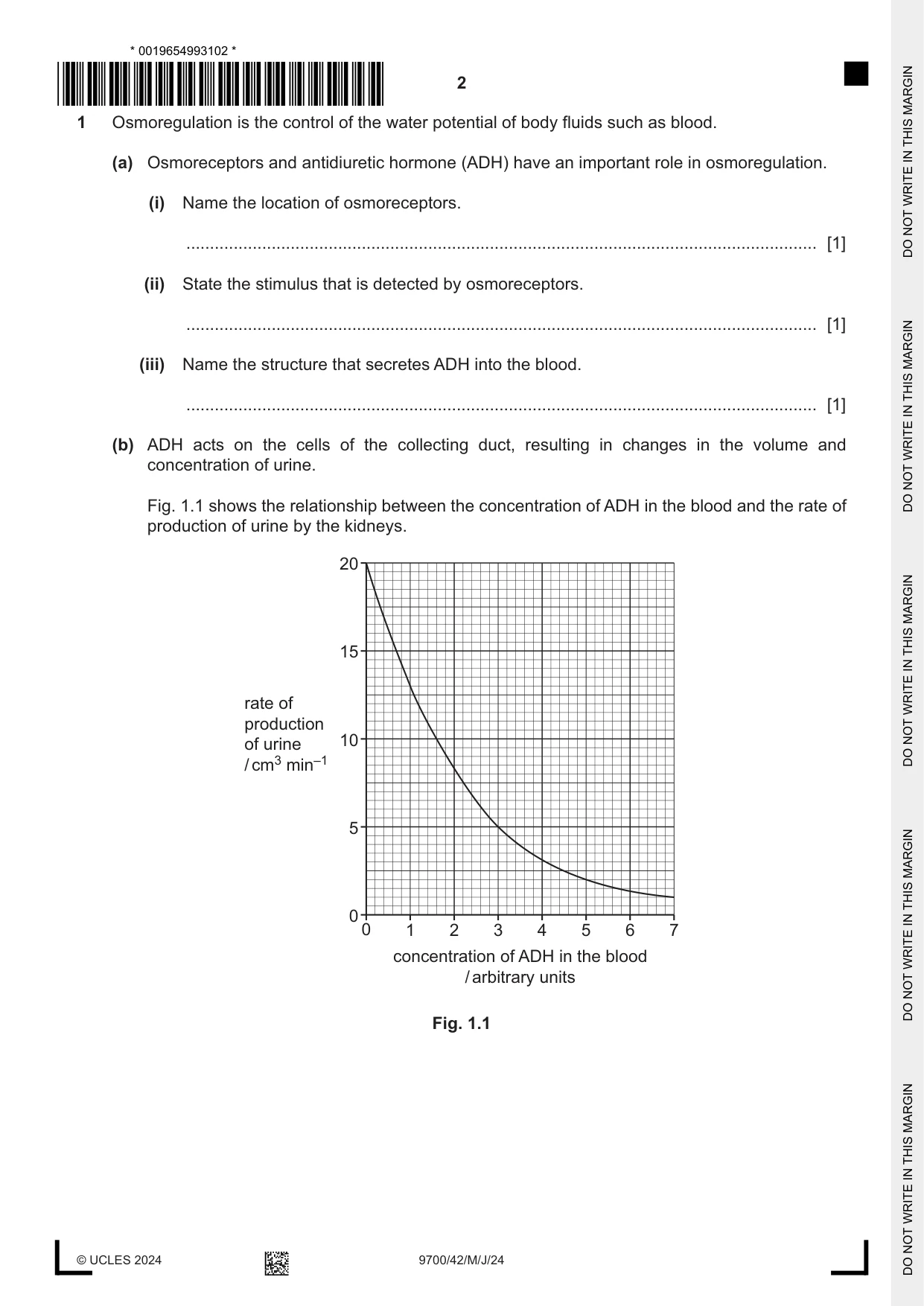
1 Osmoregulation is the control of the water potential of body fluids such as blood. (a) Osmoreceptors and antidiuretic hormone (ADH) have an important role in osmoregulation. (i) Name the location of osmoreceptors. ..................................................................................................................................... [1] (ii) State the stimulus that is detected by osmoreceptors. ..................................................................................................................................... [1] (iii) Name the structure that secretes ADH into the blood. ..................................................................................................................................... [1] (b) ADH acts on the cells of the collecting duct, resulting in changes in the volume and concentration of urine. Fig. 1.1 shows the relationship between the concentration of ADH in the blood and the rate of production of urine by the kidneys. 20 15 rate of production of urine 10 / cm3 min–1 5 0 0 1 2 3 4 5 6 7 concentration of ADH in the blood / arbitrary units Fig. 1.1 (i) As the concentration of ADH in the blood increases, the rate of production of urine decreases. Using Fig. 1.1, calculate the percentage decrease in the rate of production of urine between ADH concentrations of 1 and 3 arbitrary units. Show your working. Give your answer to one decimal place. answer = ......................................................... [2] (ii) Explain the relationship shown in Fig. 1.1. ........................................................................................................................................... ........................................................................................................................................... ........................................................................................................................................... ........................................................................................................................................... ........................................................................................................................................... ........................................................................................................................................... ........................................................................................................................................... ..................................................................................................................................... [3] [Total: 8]
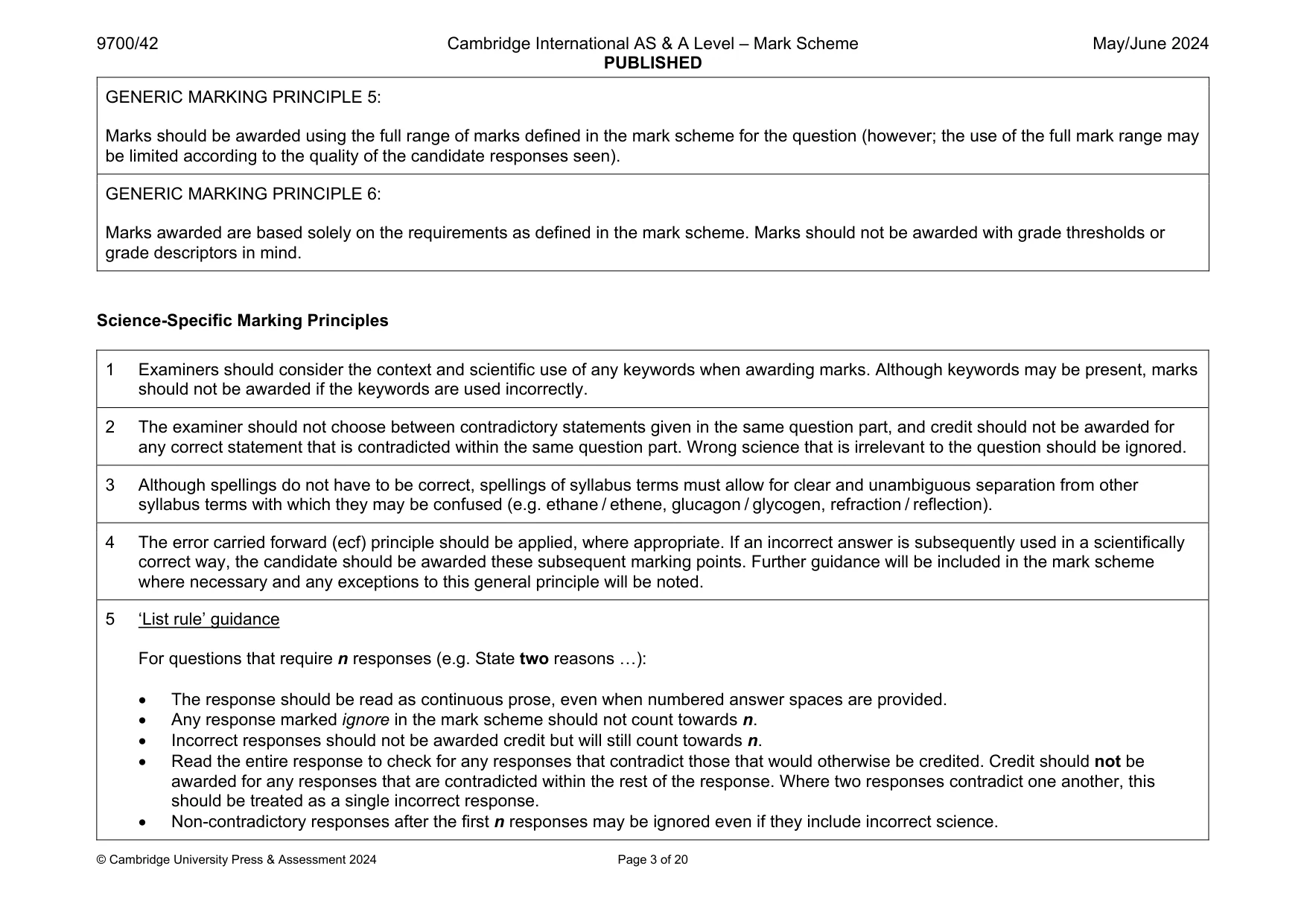
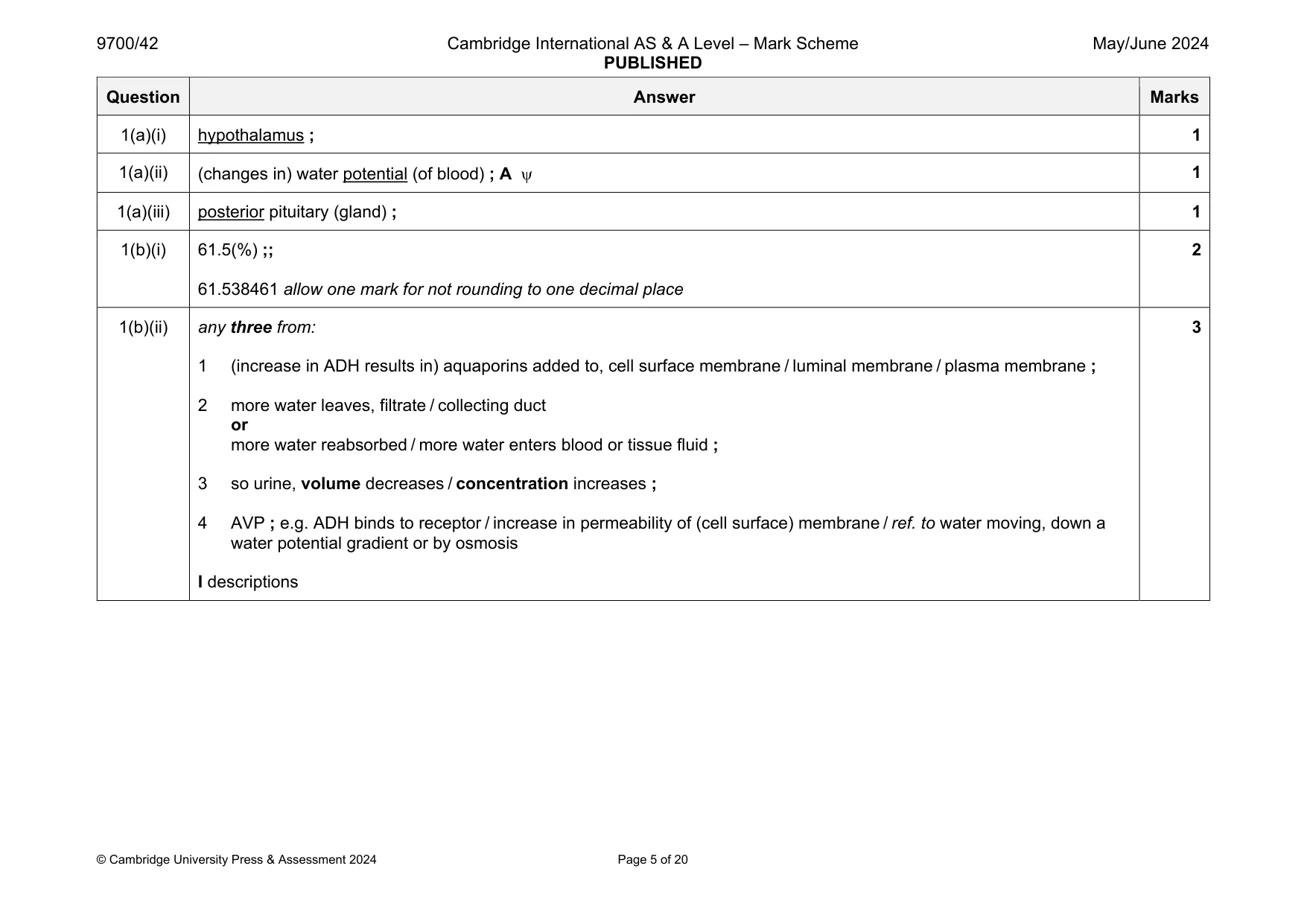
Mark scheme: 1(a)(i) hypothalamus ; 1 1(a)(ii) (changes in) water potential (of blood) ; A 1 1(a)(iii) posterior pituitary (gland) ; 1 1(b)(i) 61.5(%) ;; 61.538461 allow one mark for not rounding to one decimal place 2 1(b)(ii) any three from: 1 (increase in ADH results in) aquaporins added to, cell surface membrane / luminal membrane / plasma membrane ; 2 more water leaves, filtrate / collecting duct or more water reabsorbed / more water enters blood or tissue fluid ; 3 so urine, volume decreases / concentration increases ; 4 AVP ; e.g. ADH binds to receptor / increase in permeability of (cell surface) membrane / ref. to water moving, down a water potential gradient or by osmosis I descriptions 3
Q2 · Variation exists in populations of a species and this may provide the opportunity for…
2 Variation exists in populations of a species and this may provide the opportunity for evolution to occur. (a) Phenotypic variation exists in many forms and has a number of possible causes. Describe the main factors that are the cause of phenotypic variation. ................................................................................................................................................... ................................................................................................................................................... ................................................................................................................................................... ................................................................................................................................................... ............................................................................................................................................. [3] (b) (i) Outline the theory of evolution. ........................................................................................................................................... ........................................................................................................................................... ........................................................................................................................................... ........................................................................................................................................... ........................................................................................................................................... ..................................................................................................................................... [3] (ii) The theory of evolution is supported by DNA sequence data. Explain how DNA sequences are used to show evolutionary relationships between species. ........................................................................................................................................... ........................................................................................................................................... ........................................................................................................................................... ........................................................................................................................................... ........................................................................................................................................... ........................................................................................................................................... ..................................................................................................................................... [3] [Total: 9] Question 3 starts on page 6.
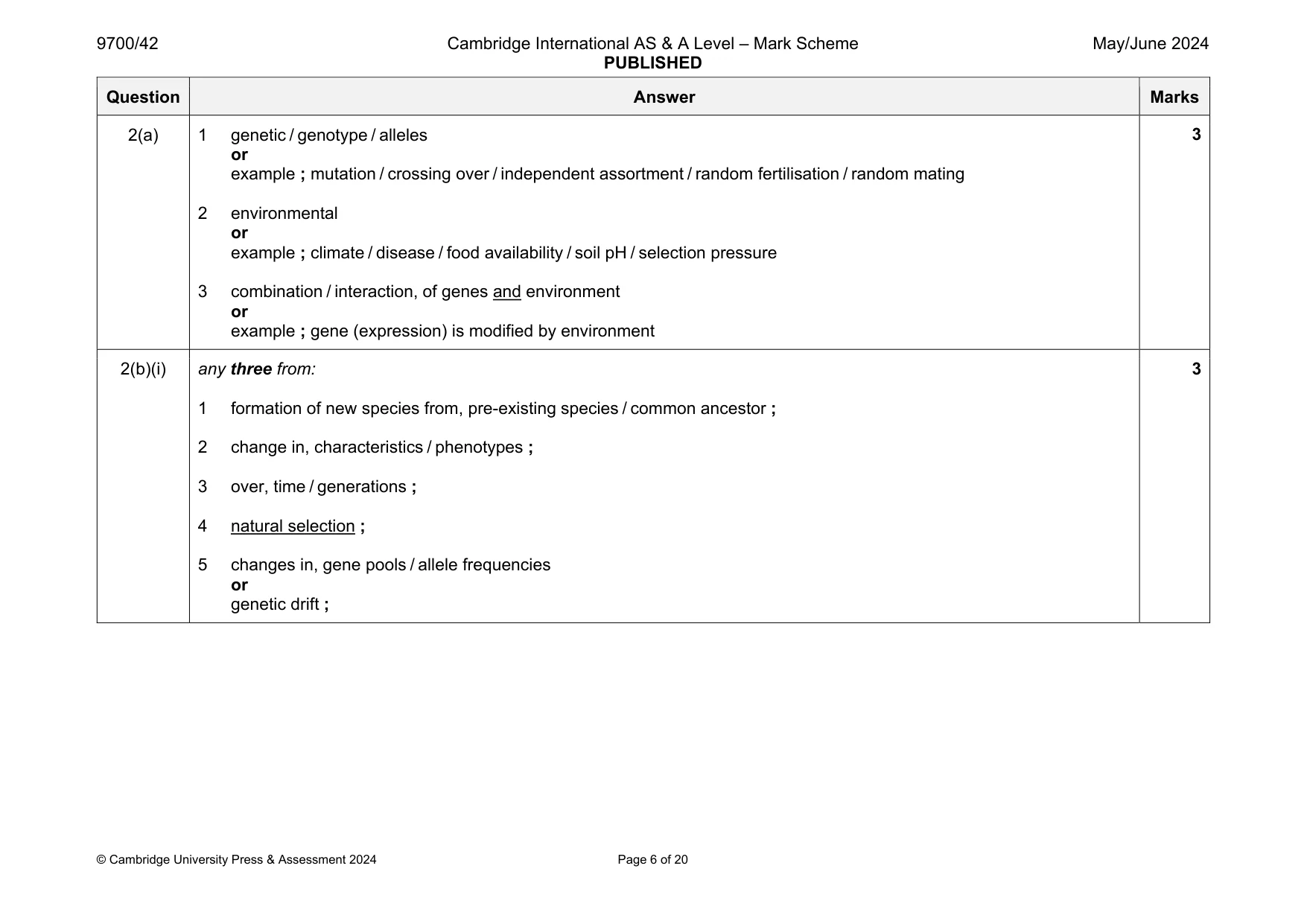
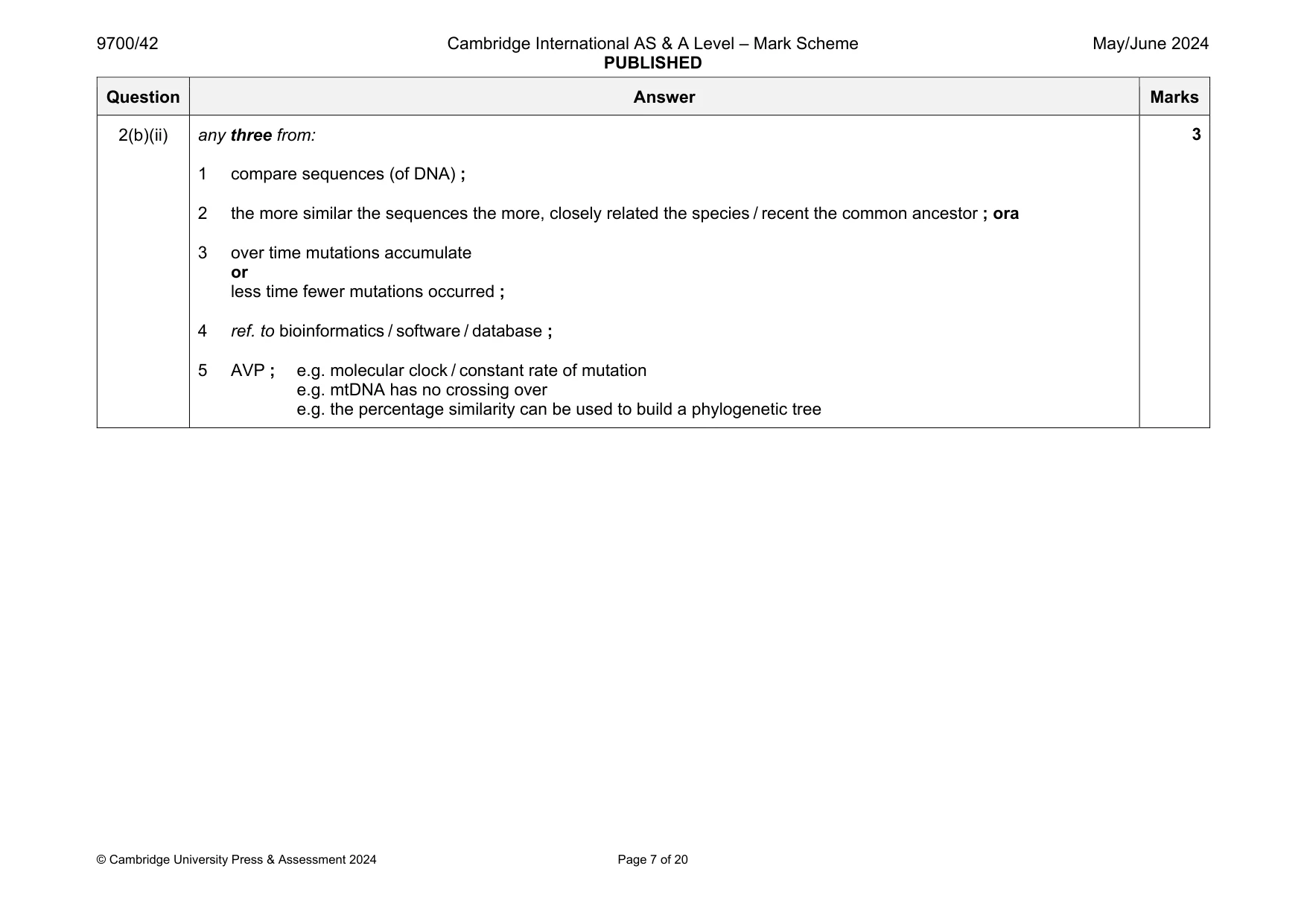
Mark scheme: 2(a) 1 genetic / genotype / alleles or example ; mutation / crossing over / independent assortment / random fertilisation / random mating 2 environmental or example ; climate / disease / food availability / soil pH / selection pressure 3 combination / interaction, of genes and environment or example ; gene (expression) is modified by environment 2(b)(i) any three from: 1 formation of new species from, pre-existing species / common ancestor ; 2 change in, characteristics / phenotypes ; 3 over, time / generations ; 4 natural selection ; 5 changes in, gene pools / allele frequencies or genetic drift ; 3 Question Answer Marks 2(b)(ii) any three from: 1 compare sequences (of DNA) ; 2 the more similar the sequences the more, closely related the species / recent the common ancestor ; ora 3 over time mutations accumulate or less time fewer mutations occurred ; 4 ref. to bioinformatics / software / database ; 5 AVP ; e.g. molecular clock / constant rate of mutation e.g. mtDNA has no crossing over e.g. the percentage similarity can be used to build a phylogenetic tree 3
Q3 · The tortoise beetle, Chelymorpha alternans, is an insect found in Panama that has several…
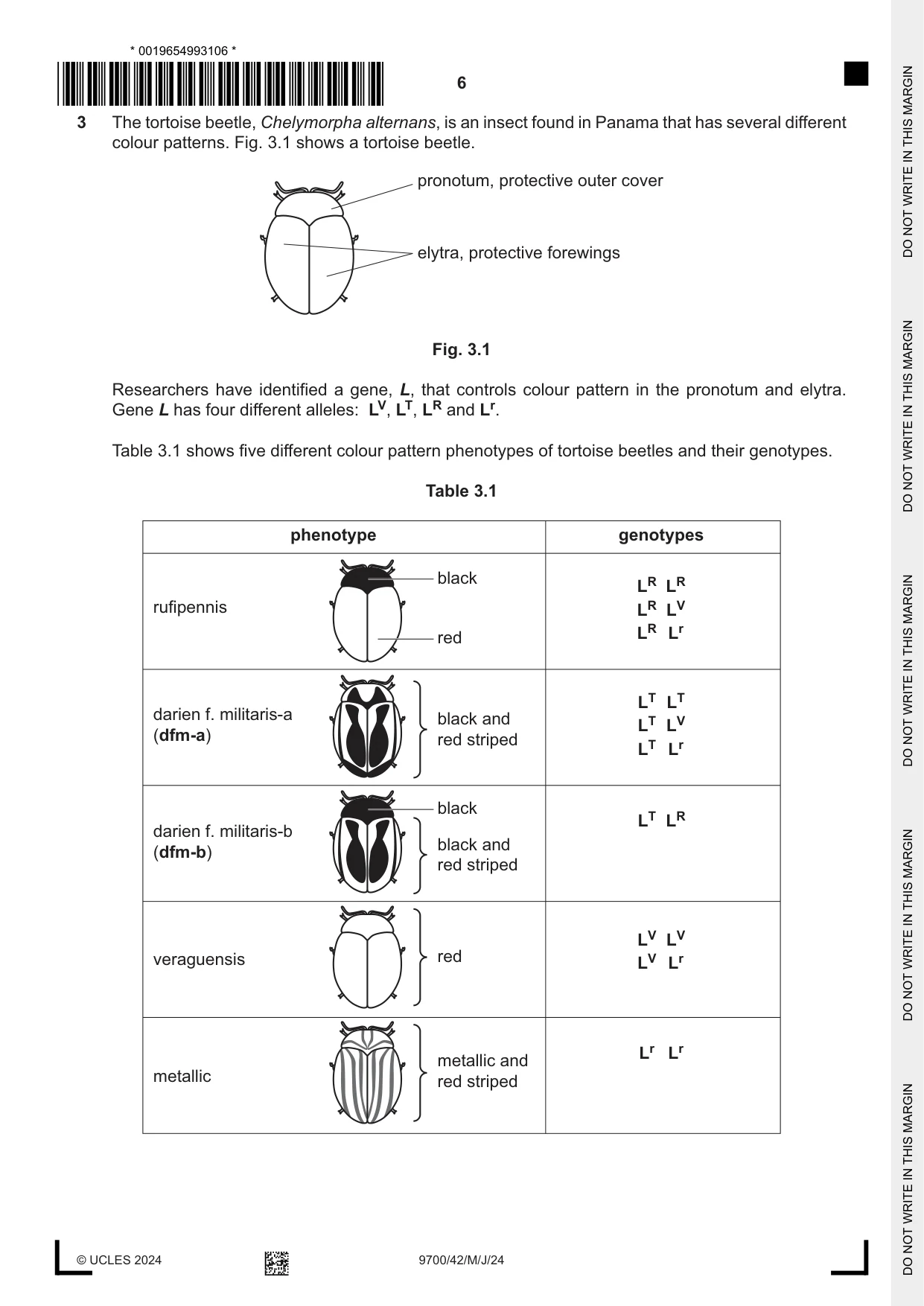
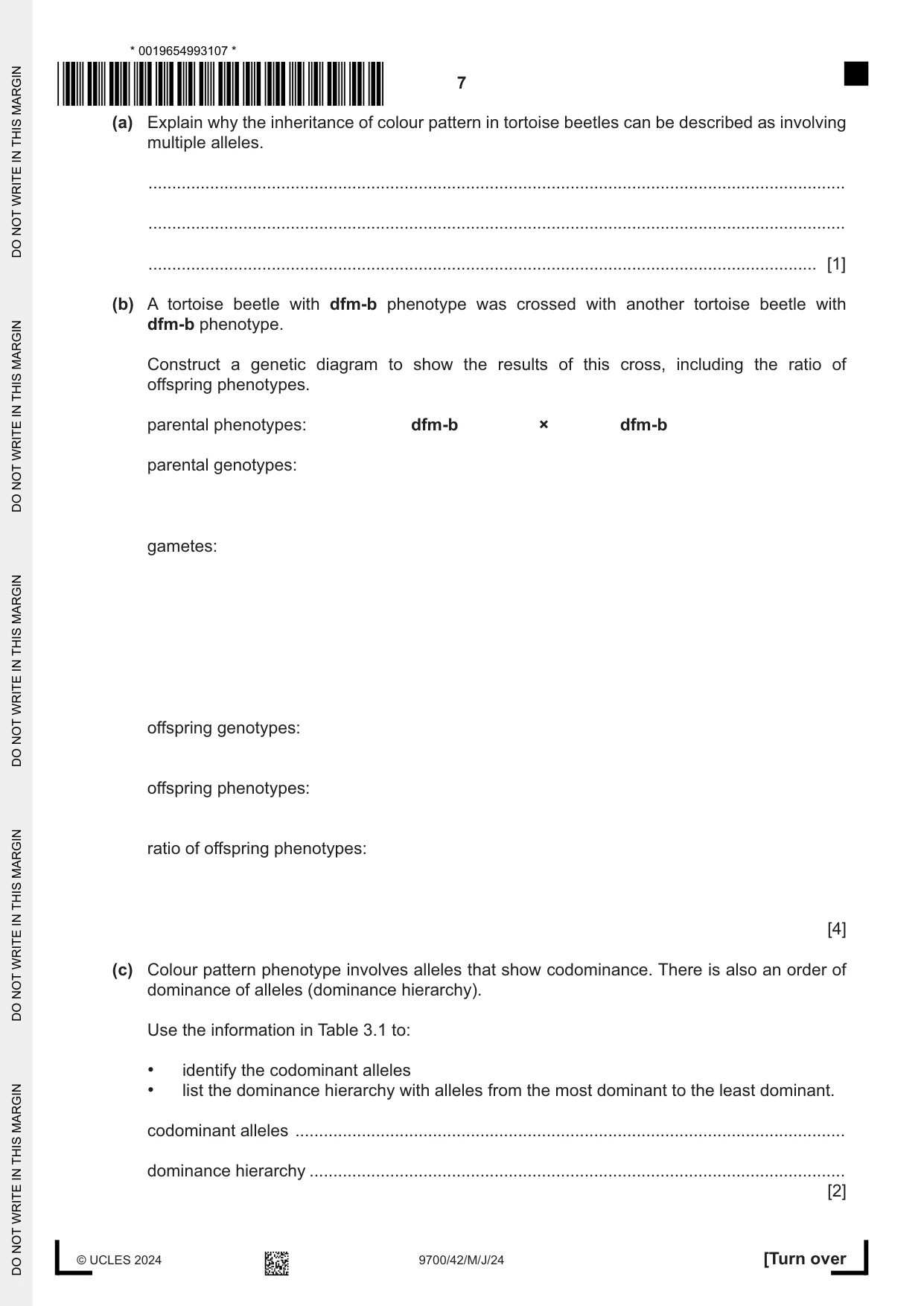
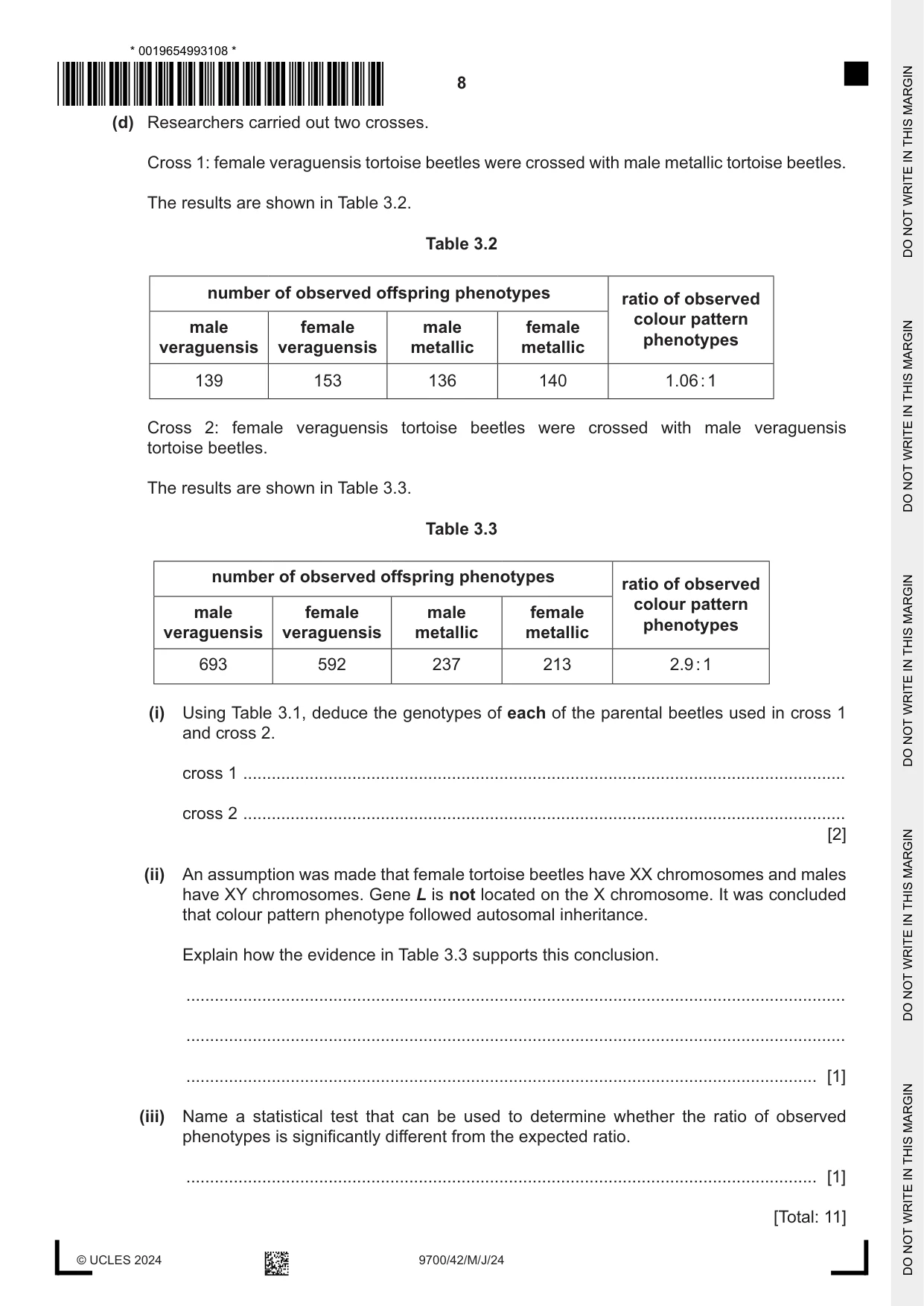
3 The tortoise beetle, Chelymorpha alternans, is an insect found in Panama that has several different colour patterns. Fig. 3.1 shows a tortoise beetle. pronotum, protective outer cover elytra, protective forewings Fig. 3.1 Researchers have identified a gene, L, that controls colour pattern in the pronotum and elytra. Gene L has four different alleles: LV, LT, LR and Lr. Table 3.1 shows five different colour pattern phenotypes of tortoise beetles and their genotypes. Table 3.1 phenotype genotypes black LR LR rufipennis LR LV red LR Lr LT LT darien f. militaris-a black and LT LV (dfm-a) red striped LT Lr black LT LR darien f. militaris-b black and (dfm-b) red striped LV LV veraguensis red LV Lr Lr Lr metallic and metallic red striped (a) Explain why the inheritance of colour pattern in tortoise beetles can be described as involving multiple alleles. ................................................................................................................................................... ................................................................................................................................................... ............................................................................................................................................. [1] (b) A tortoise beetle with dfm‑b phenotype was crossed with another tortoise beetle with dfm‑b phenotype. Construct a genetic diagram to show the results of this cross, including the ratio of offspring phenotypes. parental phenotypes: dfm‑b × dfm‑b parental genotypes: gametes: offspring genotypes: offspring phenotypes: ratio of offspring phenotypes: [4] (c) Colour pattern phenotype involves alleles that show codominance. There is also an order of dominance of alleles (dominance hierarchy). Use the information in Table 3.1 to: • identify the codominant alleles • list the dominance hierarchy with alleles from the most dominant to the least dominant. codominant alleles .................................................................................................................... dominance hierarchy ................................................................................................................. [2] (d) Researchers carried out two crosses. Cross 1: female veraguensis tortoise beetles were crossed with male metallic tortoise beetles. The results are shown in Table 3.2. Table 3.2 number of observed offspring phenotypes ratio of observed colour pattern male female male female phenotypes veraguensis veraguensis metallic metallic 139 153 136 140 1.06 : 1 Cross 2: female veraguensis tortoise beetles were crossed with male veraguensis tortoise beetles. The results are shown in Table 3.3. Table 3.3 number of observed offspring phenotypes ratio of observed colour pattern male female male female phenotypes veraguensis veraguensis metallic metallic 693 592 237 213 2.9 : 1 (i) Using Table 3.1, deduce the genotypes of each of the parental beetles used in cross 1 and cross 2. cross 1 ............................................................................................................................... cross 2 ............................................................................................................................... [2] (ii) An assumption was made that female tortoise beetles have XX chromosomes and males have XY chromosomes. Gene L is not located on the X chromosome. It was concluded that colour pattern phenotype followed autosomal inheritance. Explain how the evidence in Table 3.3 supports this conclusion. ........................................................................................................................................... ........................................................................................................................................... ..................................................................................................................................... [1] (iii) Name a statistical test that can be used to determine whether the ratio of observed phenotypes is significantly different from the expected ratio. ..................................................................................................................................... [1] [Total: 11]
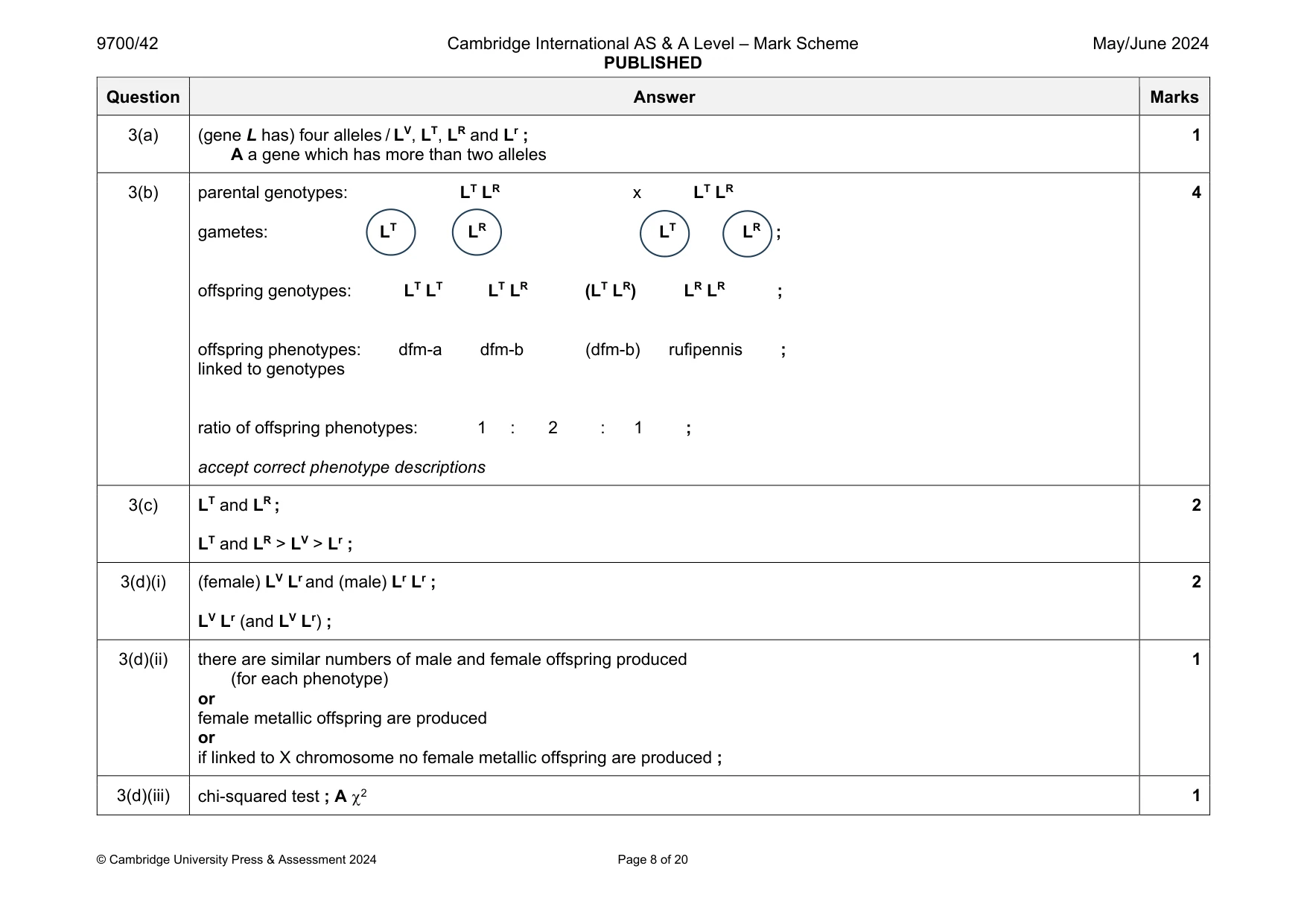
Mark scheme: 3(a) A a gene which has more than two alleles 1 3(b) parental genotypes: LT LR x LT LR gametes: LT LR LT LR ; offspring genotypes: LT LT LT LR (LT LR) LR LR ; offspring phenotypes: dfm-a dfm-b (dfm-b) rufipennis ; linked to genotypes ratio of offspring phenotypes: 1 : 2 : 1 ; accept correct phenotype descriptions 4 3(c) LT and LR ; LT and LR > LV > Lr ; 2 3(d)(i) (female) LV Lr and (male) Lr Lr ; LV Lr (and LV Lr) ; 2 3(d)(ii) there are similar numbers of male and female offspring produced (for each phenotype) or female metallic offspring are produced or if linked to X chromosome no female metallic offspring are produced ; 1 3(d)(iii) chi-squared test ; A 2 1
More questions on Passage of information from parents to offspring
Q4 · Genes have a role in determining the overall phenotype of an organism
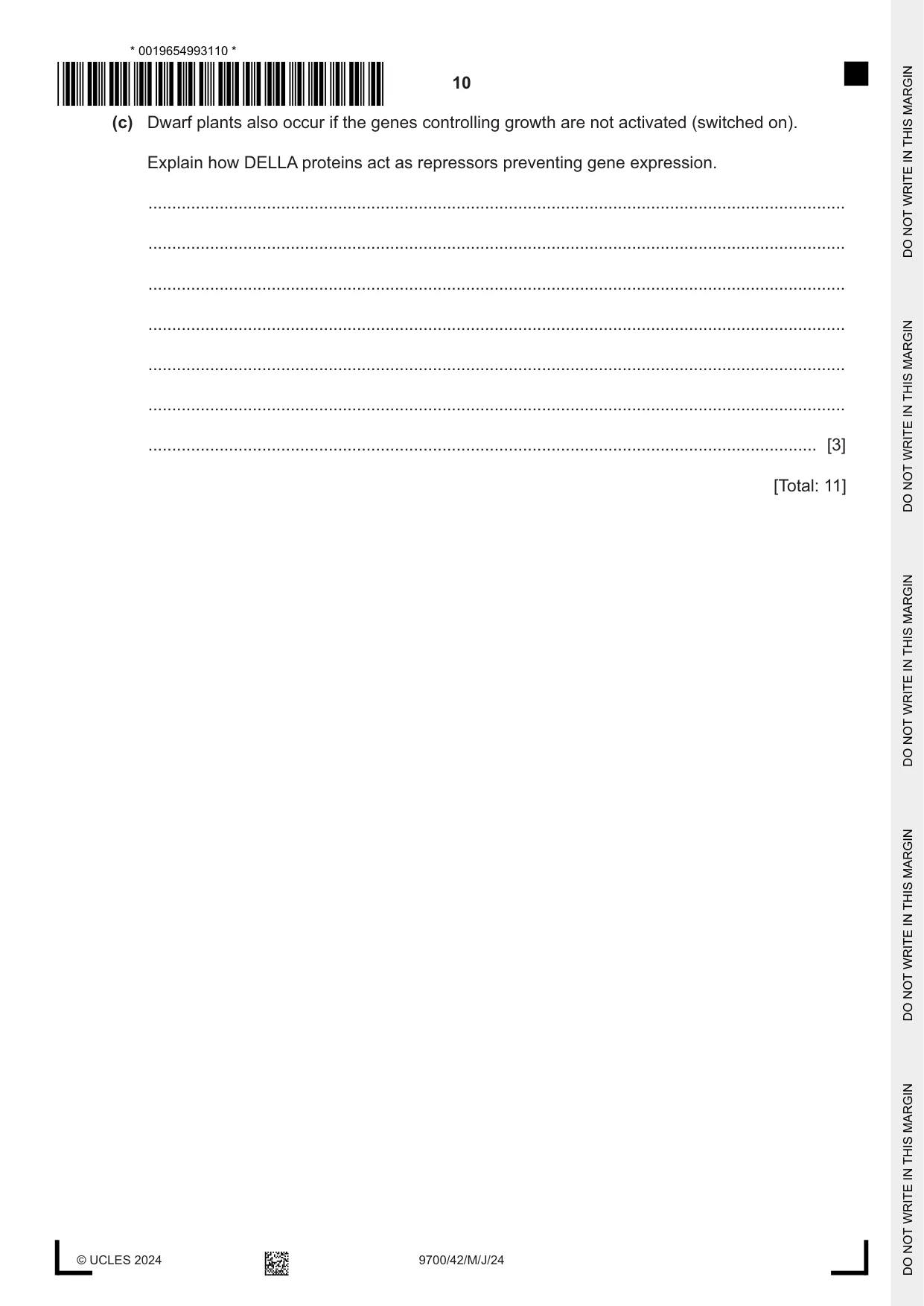
4 Genes have a role in determining the overall phenotype of an organism. (a) Using haemophilia as an example, explain the relationship between a gene, a protein and a phenotype. ................................................................................................................................................... ................................................................................................................................................... ................................................................................................................................................... ................................................................................................................................................... ................................................................................................................................................... ................................................................................................................................................... ................................................................................................................................................... ................................................................................................................................................... ................................................................................................................................................... ................................................................................................................................................... ................................................................................................................................................... ................................................................................................................................................... ............................................................................................................................................. [5] (b) In the pea plant, Pisum sativum, the genotype lele results in plants with short stems (dwarf plants). Explain how the lele genotype and its gene product results in dwarf plants. ................................................................................................................................................... ................................................................................................................................................... ................................................................................................................................................... ................................................................................................................................................... ................................................................................................................................................... ................................................................................................................................................... ............................................................................................................................................. [3] (c) Dwarf plants also occur if the genes controlling growth are not activated (switched on). Explain how DELLA proteins act as repressors preventing gene expression. ................................................................................................................................................... ................................................................................................................................................... ................................................................................................................................................... ................................................................................................................................................... ................................................................................................................................................... ................................................................................................................................................... ............................................................................................................................................. [3] [Total: 11]
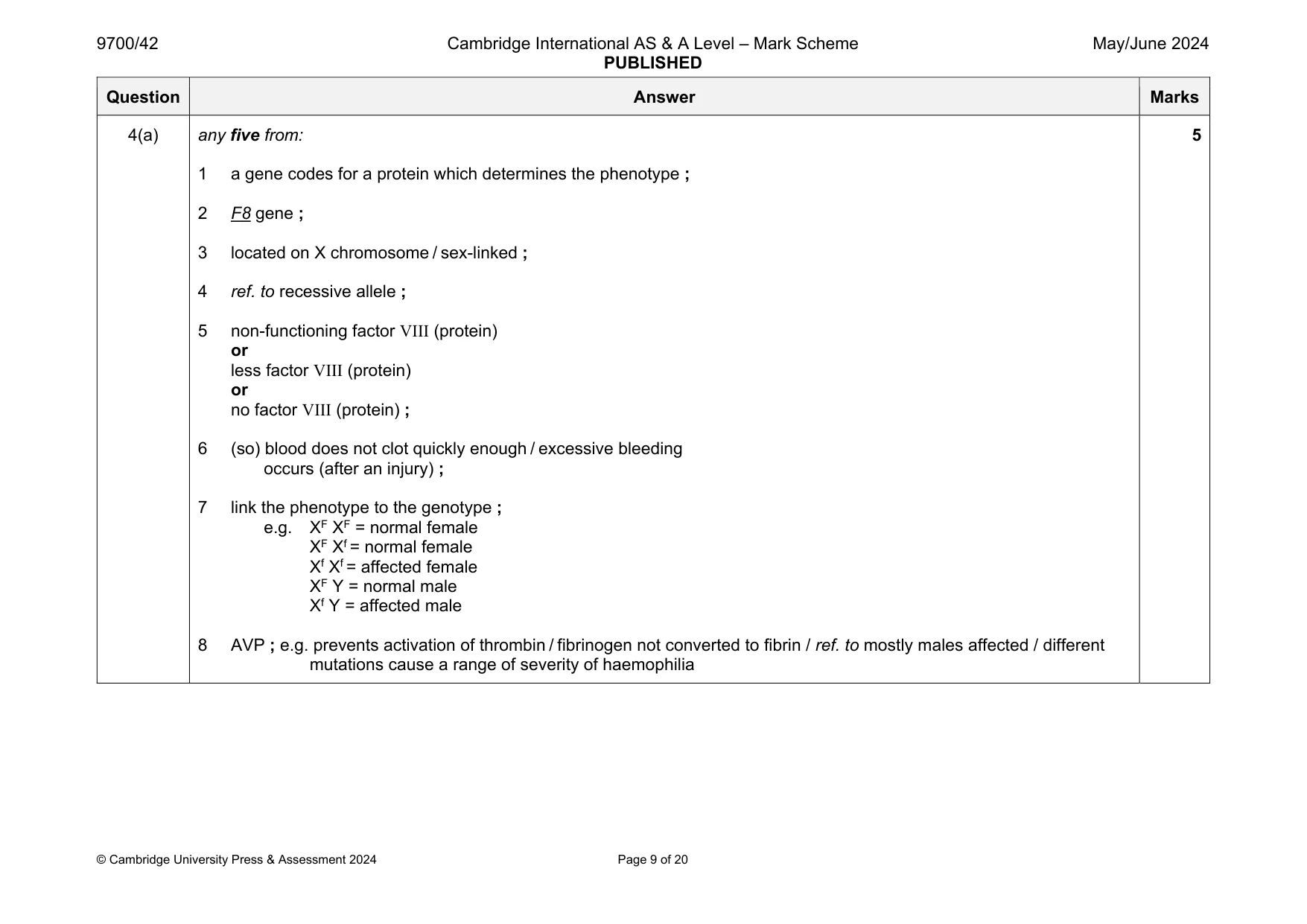
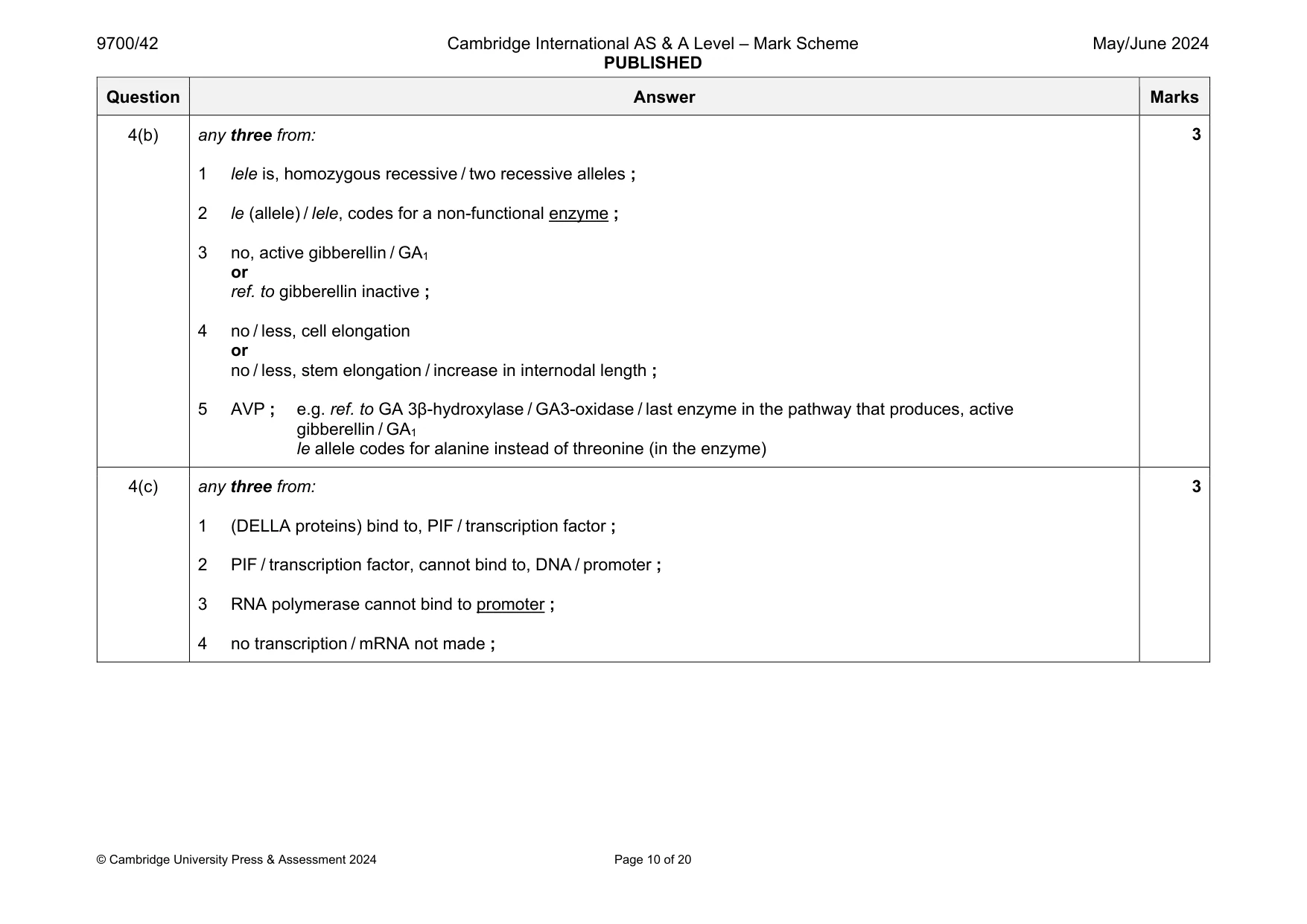
Mark scheme: 4(a) any five from: 1 a gene codes for a protein which determines the phenotype ; 2 F8 gene ; 3 located on X chromosome / sex-linked ; 4 ref. to recessive allele ; 5 non-functioning factor VIII (protein) or less factor VIII (protein) or no factor VIII (protein) ; 6 (so) blood does not clot quickly enough / excessive bleeding occurs (after an injury) ; 7 link the phenotype to the genotype ; e.g. XF XF = normal female XF Xf = normal female Xf Xf = affected female XF Y = normal male Xf Y = affected male 8 AVP ; e.g. prevents activation of thrombin / fibrinogen not converted to fibrin / ref. to mostly males affected / different mutations cause a range of severity of haemophilia 5 Question Answer Marks 4(b) any three from: 1 lele is, homozygous recessive / two recessive alleles ; 2 le (allele) / lele, codes for a non-functional enzyme ; 3 no, active gibberellin / GA1 or ref. to gibberellin inactive ; 4 no / less, cell elongation or no / less, stem elongation / increase in internodal length ; 5 AVP ; e.g. ref. to GA 3β-hydroxylase / GA3-oxidase / last enzyme in the pathway that produces, active gibberellin / GA1 le allele codes for alanine instead of threonine (in the enzyme) 3 4(c) any three from: 1 (DELLA proteins) bind to, PIF / transcription factor ; 2 PIF / transcription factor, cannot bind to, DNA / promoter ; 3 RNA polymerase cannot bind to promoter ; 4 no transcription / mRNA not made ; 3
Q5 · The gene BRCA1 is expressed in breast tissue and in several other tissues of the body
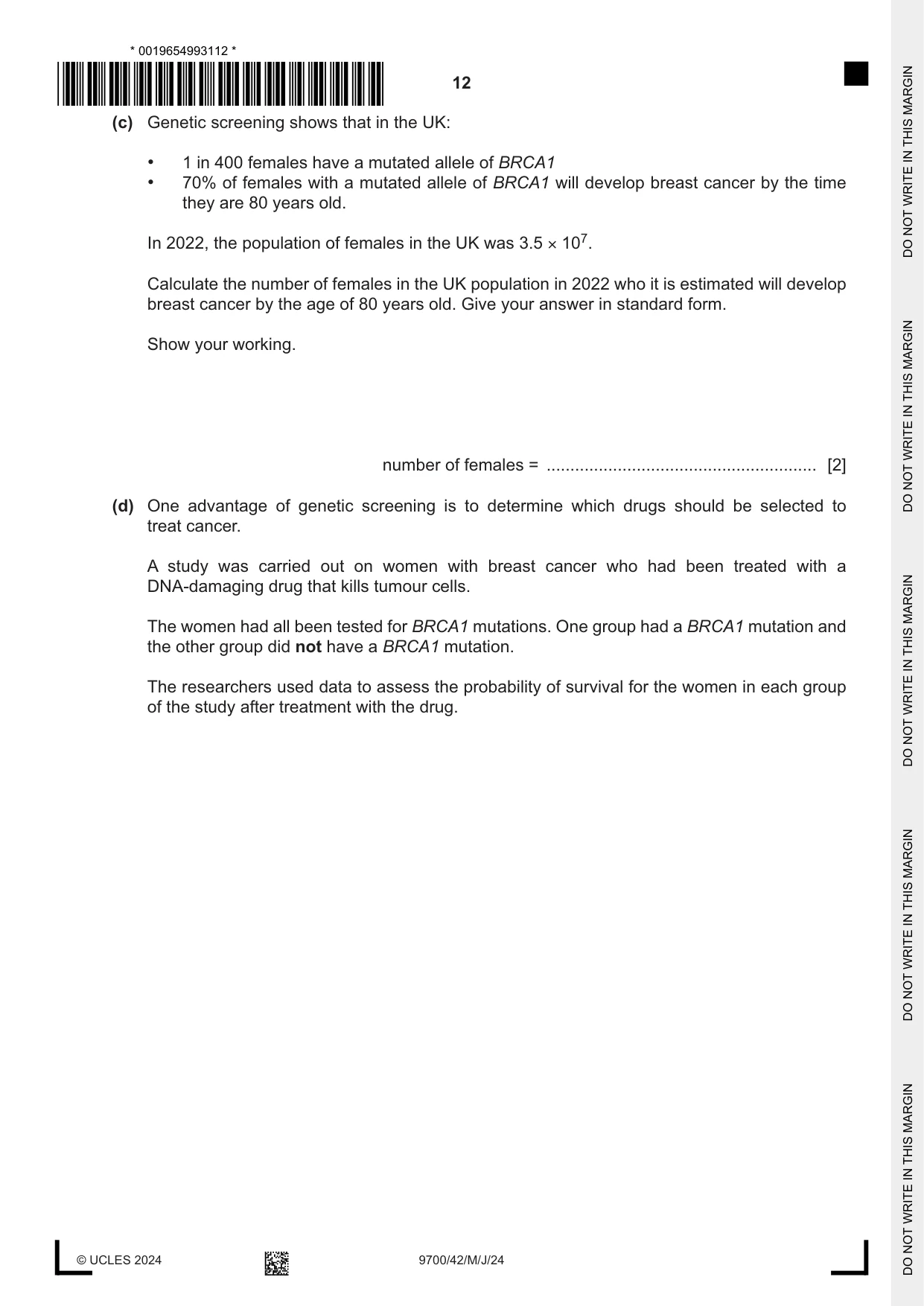
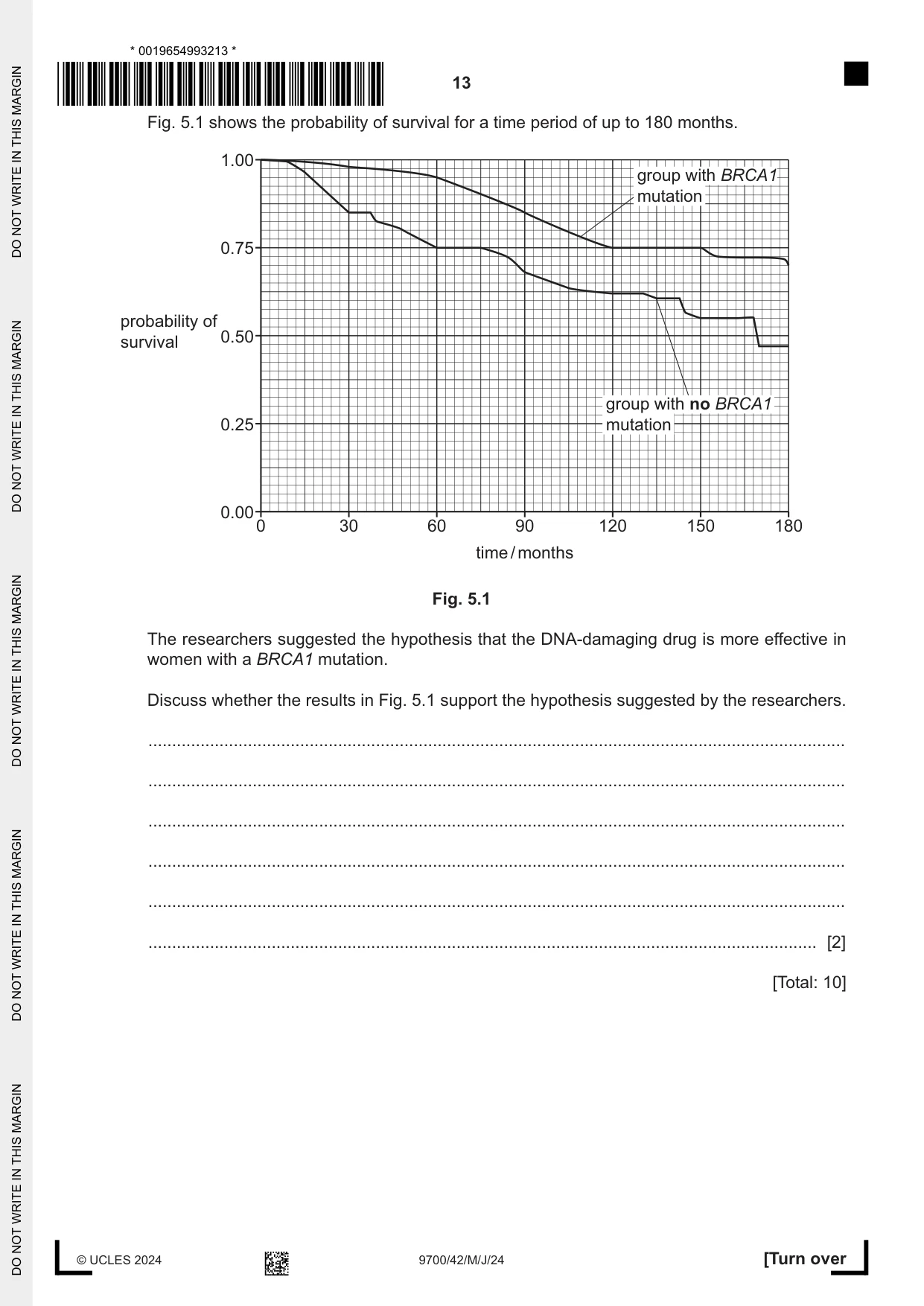
5 The gene BRCA1 is expressed in breast tissue and in several other tissues of the body. BRCA1 codes for a tumour suppressor protein. This protein is involved in either repairing damaged DNA, or in triggering the death of a cell if DNA cannot be repaired. Some mutations in BRCA1 are associated with an increased risk of developing breast cancer. (a) State one reason why a doctor would recommend that a person has genetic testing for a mutation in the gene BRCA1 and explain why this mutation would put the person at a greater risk of breast cancer. ................................................................................................................................................... ................................................................................................................................................... ................................................................................................................................................... ................................................................................................................................................... ................................................................................................................................................... ................................................................................................................................................... ................................................................................................................................................... ................................................................................................................................................... ................................................................................................................................................... ................................................................................................................................................... ............................................................................................................................................. [4] (b) DNA sequencing is one method used to test for mutations in BRCA1. Before DNA sequencing occurs, the DNA sample goes through the polymerase chain reaction (PCR). Suggest why PCR is used for testing for mutations in BRCA1. ................................................................................................................................................... ................................................................................................................................................... ................................................................................................................................................... ................................................................................................................................................... ............................................................................................................................................. [2] (c) Genetic screening shows that in the UK: • 1 in 400 females have a mutated allele of BRCA1 • 70% of females with a mutated allele of BRCA1 will develop breast cancer by the time they are 80 years old. In 2022, the population of females in the UK was 3.5 × 10⁷. Calculate the number of females in the UK population in 2022 who it is estimated will develop breast cancer by the age of 80 years old. Give your answer in standard form. Show your working. number of females = ......................................................... [2] (d) One advantage of genetic screening is to determine which drugs should be selected to treat cancer. A study was carried out on women with breast cancer who had been treated with a DNA‑damaging drug that kills tumour cells. The women had all been tested for BRCA1 mutations. One group had a BRCA1 mutation and the other group did not have a BRCA1 mutation. The researchers used data to assess the probability of survival for the women in each group of the study after treatment with the drug. Fig. 5.1 shows the probability of survival for a time period of up to 180 months. 1.00 group with BRCA1 mutation 0.75 probability of 0.50survival group with no BRCA1 0.25 mutation 0.00 0 30 60 90 120 150 180 time / months Fig. 5.1 The researchers suggested the hypothesis that the DNA‑damaging drug is more effective in women with a BRCA1 mutation. Discuss whether the results in Fig. 5.1 support the hypothesis suggested by the researchers. ................................................................................................................................................... ................................................................................................................................................... ................................................................................................................................................... ................................................................................................................................................... ................................................................................................................................................... ............................................................................................................................................. [2] [Total: 10]
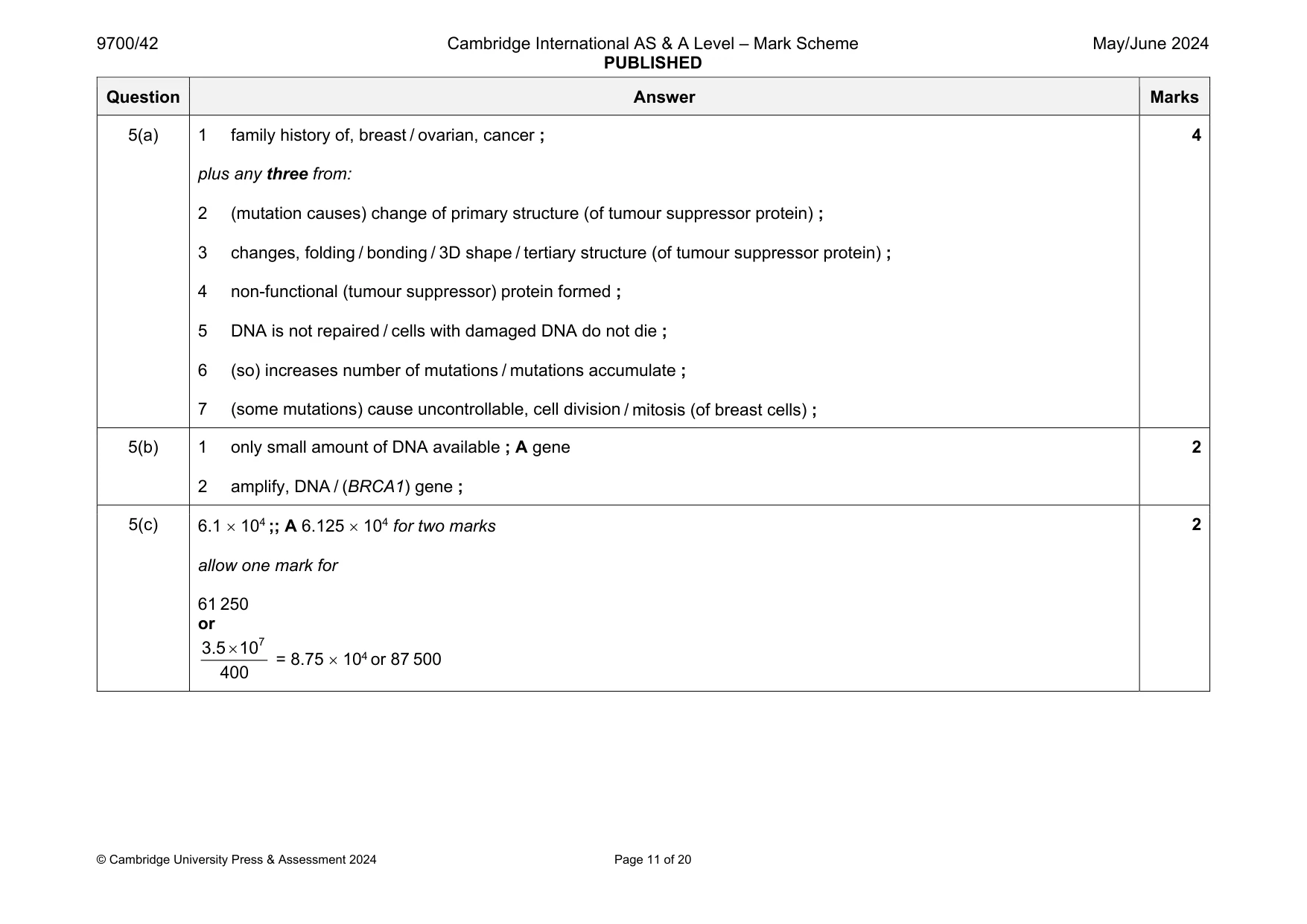
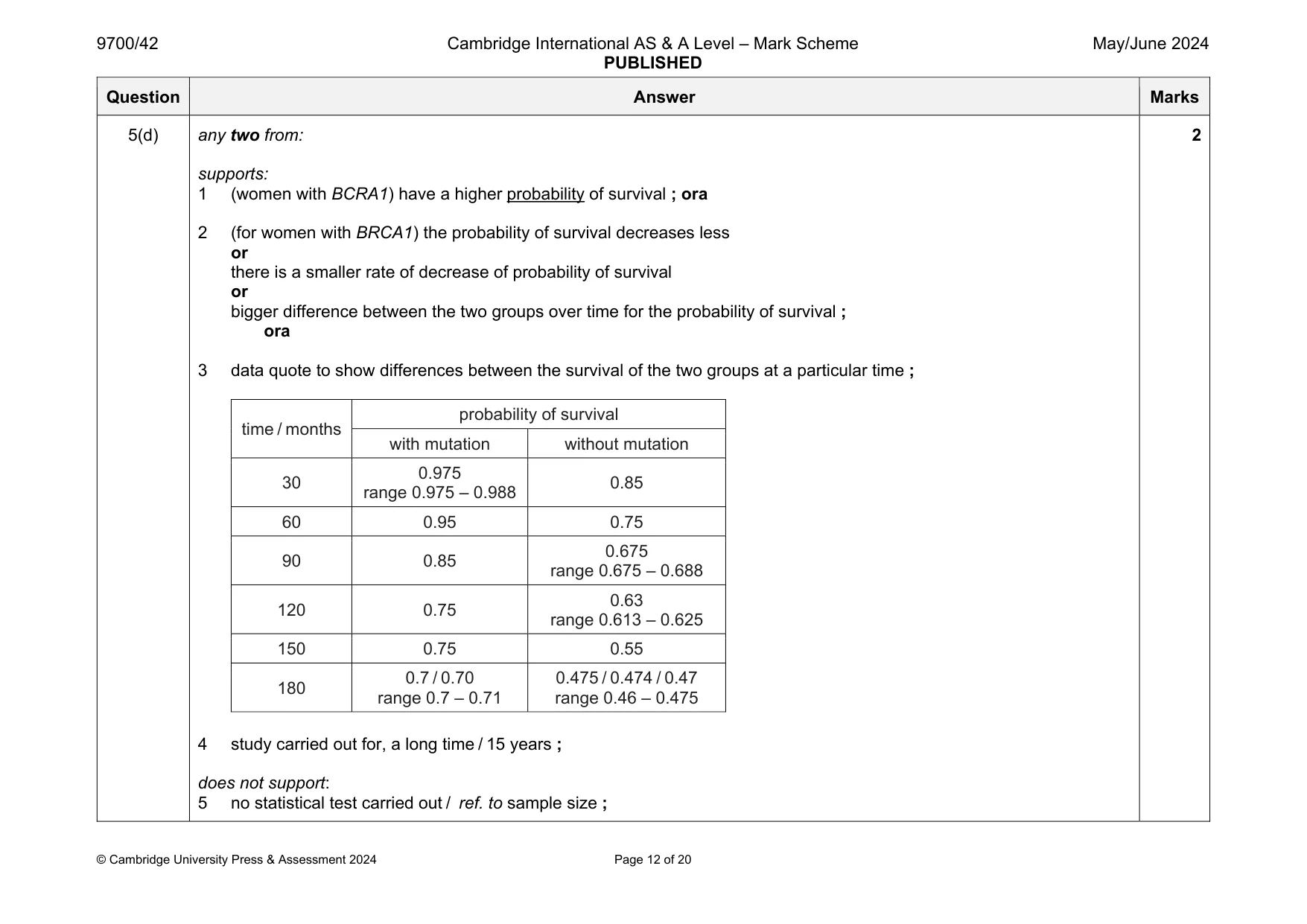
Mark scheme: 5(a) 1 family history of, breast / ovarian, cancer ; plus any three from: 2 (mutation causes) change of primary structure (of tumour suppressor protein) ; 3 changes, folding / bonding / 3D shape / tertiary structure (of tumour suppressor protein) ; 4 non-functional (tumour suppressor) protein formed ; 5 DNA is not repaired / cells with damaged DNA do not die ; 6 (so) increases number of mutations / mutations accumulate ; 7 (some mutations) cause uncontrollable, cell division / mitosis (of breast cells) ; 4 5(b) 1 only small amount of DNA available ; A gene 2 amplify, DNA / (BRCA1) gene ; 2 5(c) 6.1 104 ;; A 6.125 104 for two marks allow one mark for 61 250 or 7 3.5 10 400 = 8.75 104 or 87 500 2 Question Answer Marks 5(d) any two from: supports: 1 (women with BCRA1) have a higher probability of survival ; ora 2 (for women with BRCA1) the probability of survival decreases less or there is a smaller rate of decrease of probability of survival or bigger difference between the two groups over time for the probability of survival ; ora 3 data quote to show differences between the survival of the two groups at a particular time ; time / months probability of survival with mutation without mutation 30 0.975 range 0.975 – 0.988 0.85 60 0.95 0.75 90 0.85 0.675 range 0.675 – 0.688 120 0.75 0.63 range 0.613 – 0.625 150 0.75 0.55 180 0.7 / 0.70 range 0.7 – 0.71 0.475 / 0.474 / 0.47 range 0.46 – 0.475 4 study carried out for, a long time / 15 years ; does not support: 5 no statistical test carried out / ref. to sample size ; 2
Q6 · A diagram of part of a mitochondrion
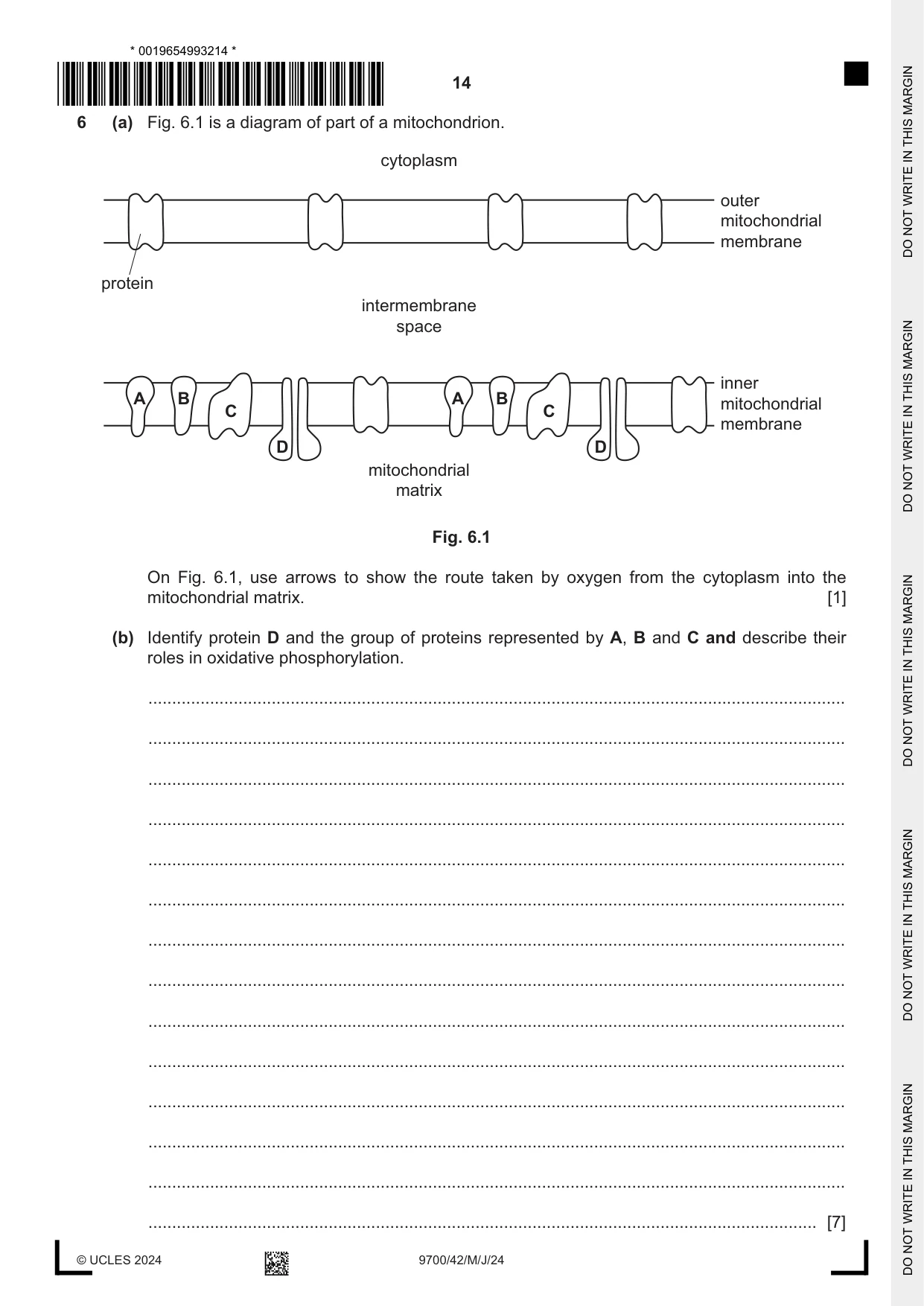
6 (a) Fig. 6.1 is a diagram of part of a mitochondrion. cytoplasm outer mitochondrial membrane protein intermembrane space inner A B A B mitochondrial C C membrane D D mitochondrial matrix Fig. 6.1 On Fig. 6.1, use arrows to show the route taken by oxygen from the cytoplasm into the mitochondrial matrix. [1] (b) Identify protein D and the group of proteins represented by A, B and C and describe their roles in oxidative phosphorylation. ................................................................................................................................................... ................................................................................................................................................... ................................................................................................................................................... ................................................................................................................................................... ................................................................................................................................................... ................................................................................................................................................... ................................................................................................................................................... ................................................................................................................................................... ................................................................................................................................................... ................................................................................................................................................... ................................................................................................................................................... ................................................................................................................................................... ................................................................................................................................................... ............................................................................................................................................. [7] (c) The matrix of a mitochondrion contains small circular DNA. In the cells of humans, the mitochondria have circular DNA that contains 37 genes. Suggest functions for these mitochondrial genes. ................................................................................................................................................... ................................................................................................................................................... ................................................................................................................................................... ................................................................................................................................................... ................................................................................................................................................... ................................................................................................................................................... ............................................................................................................................................. [3] [Total: 11]
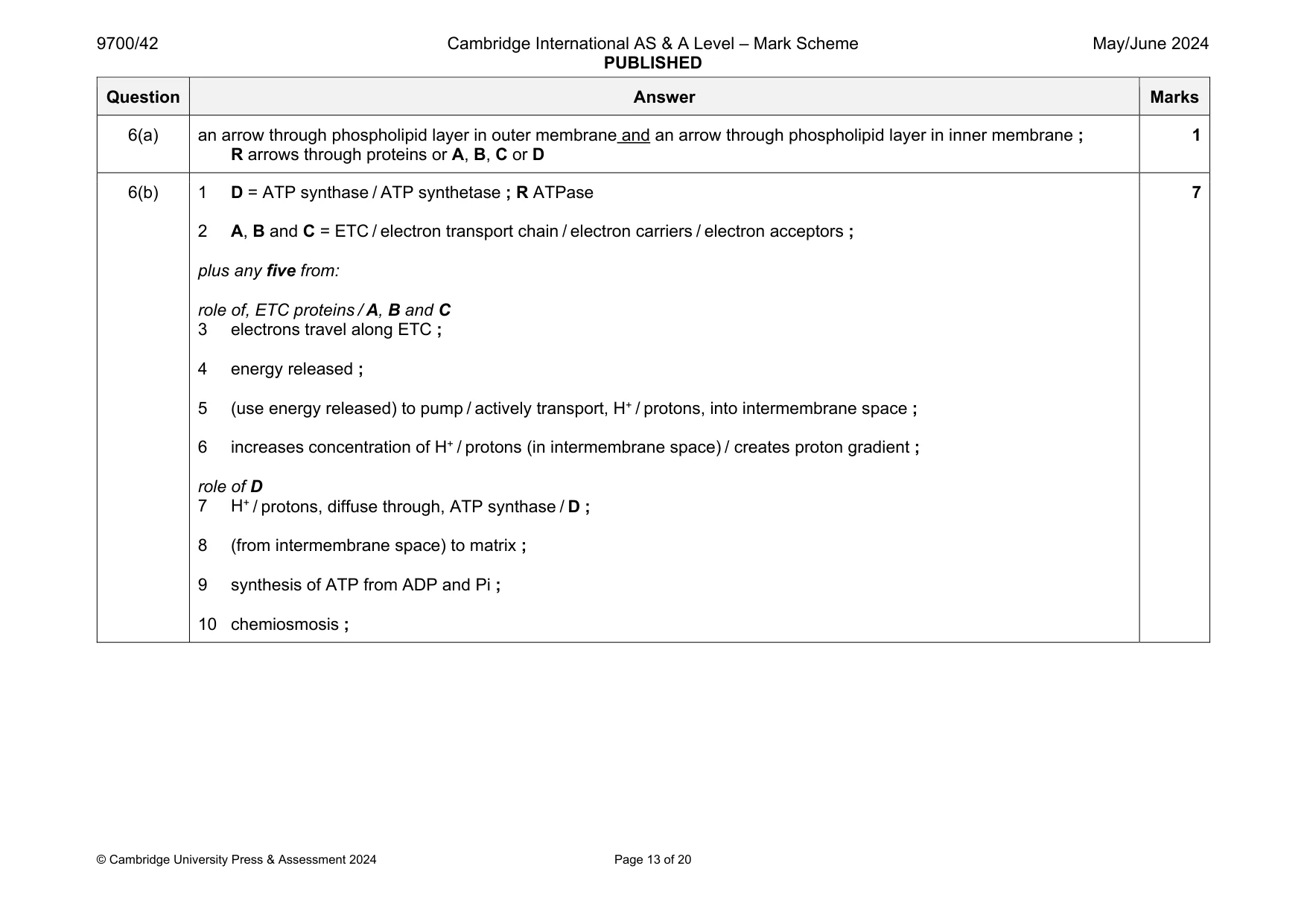
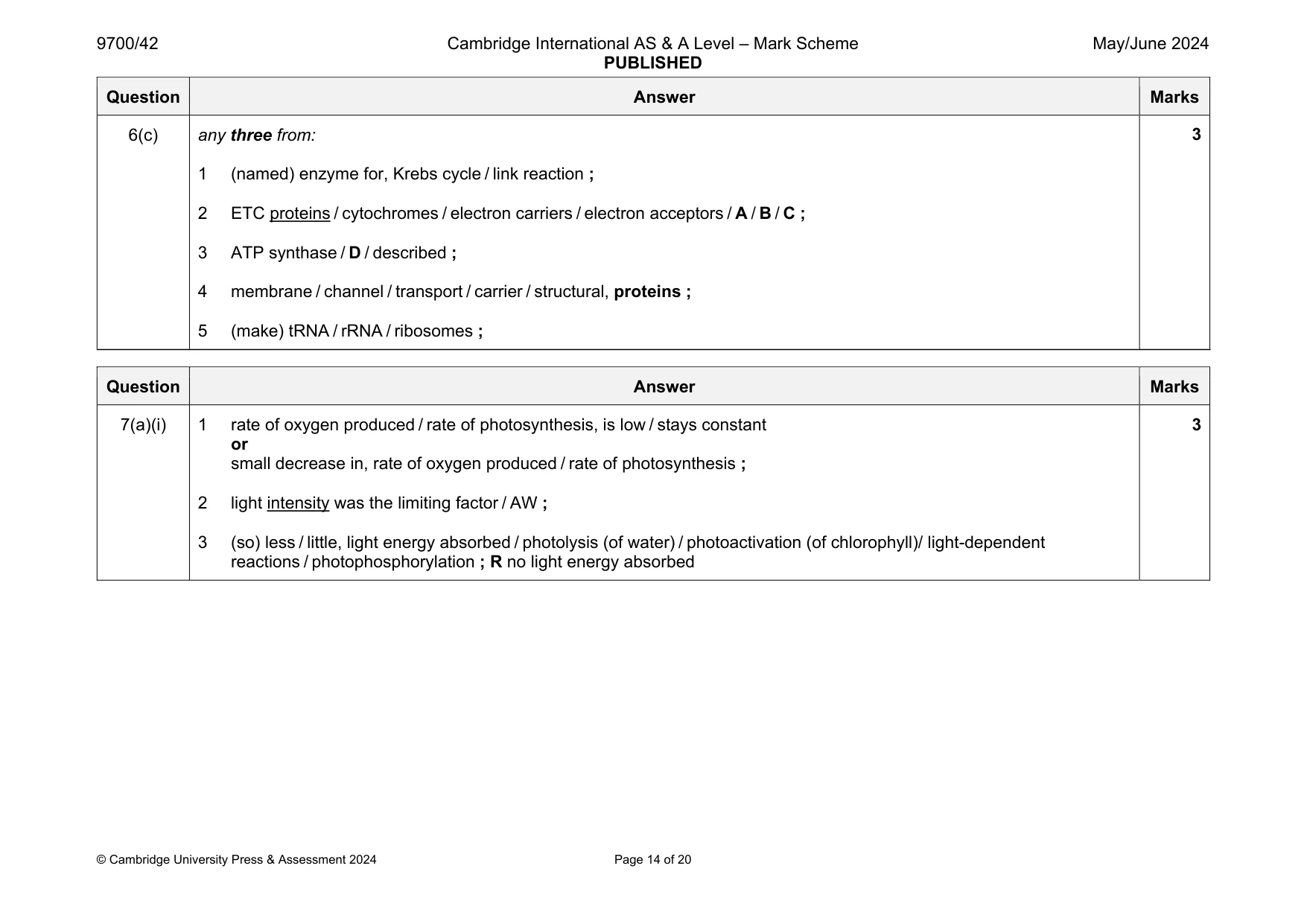
Mark scheme: 6(a) an arrow through phospholipid layer in outer membrane and an arrow through phospholipid layer in inner membrane ; R arrows through proteins or A, B, C or D 1 6(b) 1 D = ATP synthase / ATP synthetase ; R ATPase 2 A, B and C = ETC / electron transport chain / electron carriers / electron acceptors ; plus any five from: role of, ETC proteins / A, B and C 3 electrons travel along ETC ; 4 energy released ; 5 (use energy released) to pump / actively transport, H+ / protons, into intermembrane space ; 6 increases concentration of H+ / protons (in intermembrane space) / creates proton gradient ; role of D 7 H+ / protons, diffuse through, ATP synthase / D ; 8 (from intermembrane space) to matrix ; 9 synthesis of ATP from ADP and Pi ; 10 chemiosmosis ; 7 Question Answer Marks 6(c) any three from: 1 (named) enzyme for, Krebs cycle / link reaction ; 2 ETC proteins / cytochromes / electron carriers / electron acceptors / A / B / C ; 3 ATP synthase / D / described ; 4 membrane / channel / transport / carrier / structural, proteins ; 5 (make) tRNA / rRNA / ribosomes ; 3
Q7 · A student investigated the effect of temperature on the rate of photosynthesis at two…
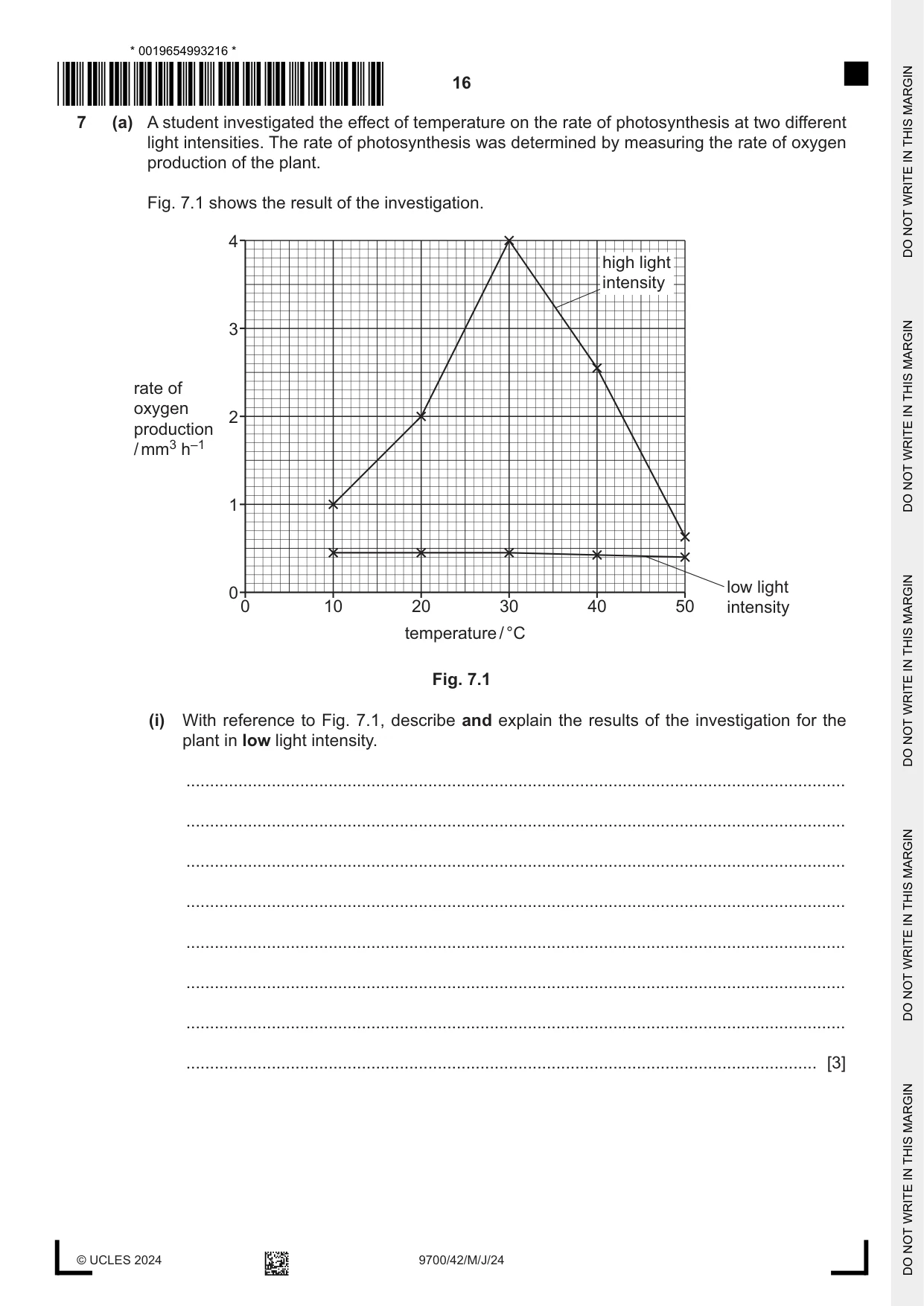
7 (a) A student investigated the effect of temperature on the rate of photosynthesis at two different light intensities. The rate of photosynthesis was determined by measuring the rate of oxygen production of the plant. Fig. 7.1 shows the result of the investigation. 4 high light intensity 3 rate of oxygen 2 production / mm3 h–1 1 low light 0 0 10 20 30 40 50 intensity temperature / °C Fig. 7.1 (i) With reference to Fig. 7.1, describe and explain the results of the investigation for the plant in low light intensity. ........................................................................................................................................... ........................................................................................................................................... ........................................................................................................................................... ........................................................................................................................................... ........................................................................................................................................... ........................................................................................................................................... ........................................................................................................................................... ..................................................................................................................................... [3] (ii) With reference to Fig. 7.1, describe and explain the results of the investigation for the plant in high light intensity above 30 °C. ........................................................................................................................................... ........................................................................................................................................... ........................................................................................................................................... ........................................................................................................................................... ........................................................................................................................................... ........................................................................................................................................... ........................................................................................................................................... ..................................................................................................................................... [3] (b) Describe the process that produces oxygen during non‑cyclic photophosphorylation. ................................................................................................................................................... ................................................................................................................................................... ................................................................................................................................................... ................................................................................................................................................... ................................................................................................................................................... ................................................................................................................................................... ................................................................................................................................................... ............................................................................................................................................. [3] [Total: 9]
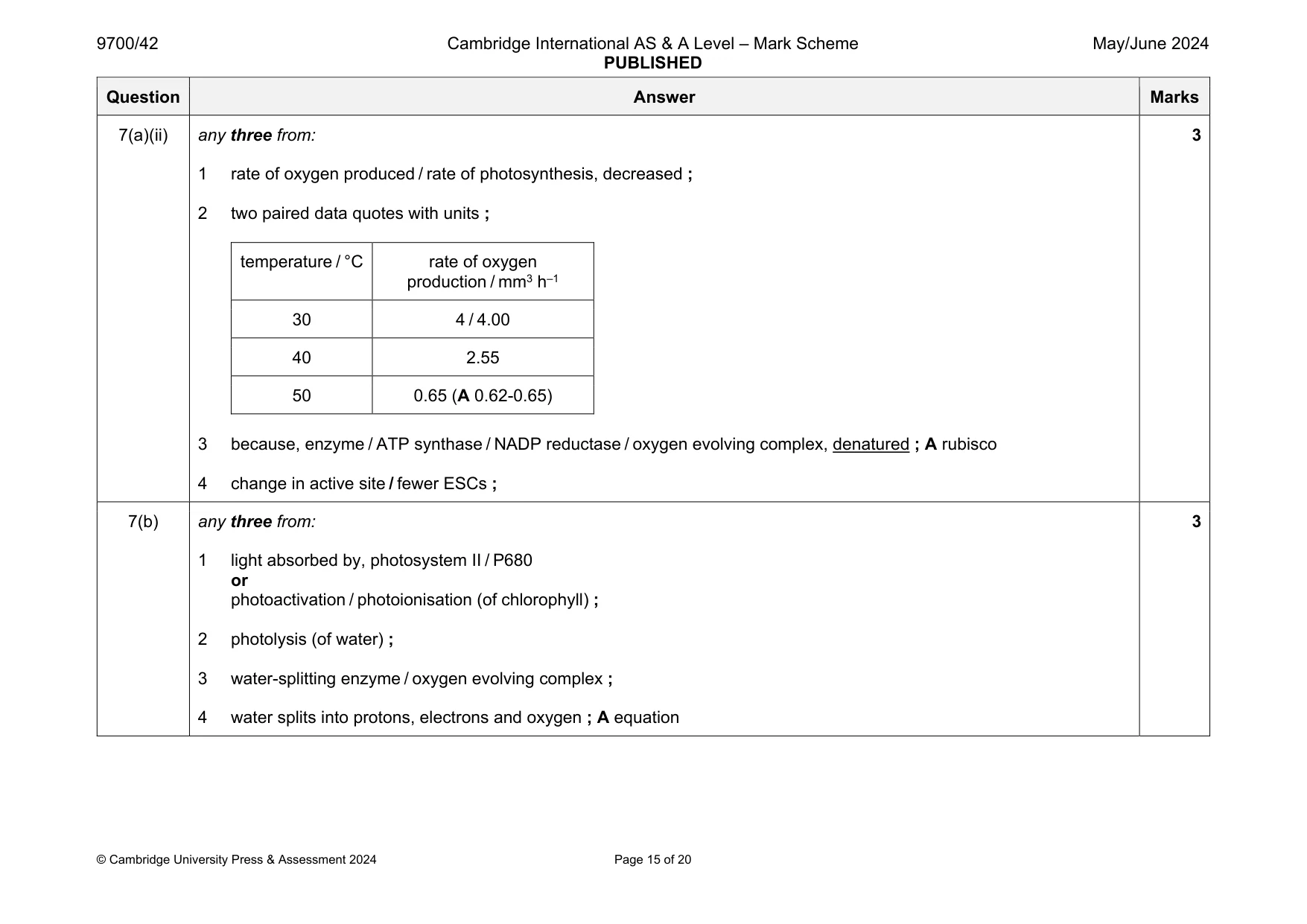
Mark scheme: 7(a)(i) 1 rate of oxygen produced / rate of photosynthesis, is low / stays constant or small decrease in, rate of oxygen produced / rate of photosynthesis ; 2 light intensity was the limiting factor / AW ; 3 (so) less / little, light energy absorbed / photolysis (of water) / photoactivation (of chlorophyll)/ light-dependent reactions / photophosphorylation ; R no light energy absorbed 3 Question Answer Marks 7(a)(ii) any three from: 1 rate of oxygen produced / rate of photosynthesis, decreased ; 2 two paired data quotes with units ; temperature / °C rate of oxygen production / mm3 h–1 30 4 / 4.00 40 2.55 50 0.65 (A 0.62-0.65) 3 because, enzyme / ATP synthase / NADP reductase / oxygen evolving complex, denatured ; A rubisco 4 change in active site / fewer ESCs ; 3 7(b) any three from: 1 light absorbed by, photosystem II / P680 or photoactivation / photoionisation (of chlorophyll) ; 2 photolysis (of water) ; 3 water-splitting enzyme / oxygen evolving complex ; 4 water splits into protons, electrons and oxygen ; A equation 3
Q8 · A diagram of a sensory neurone
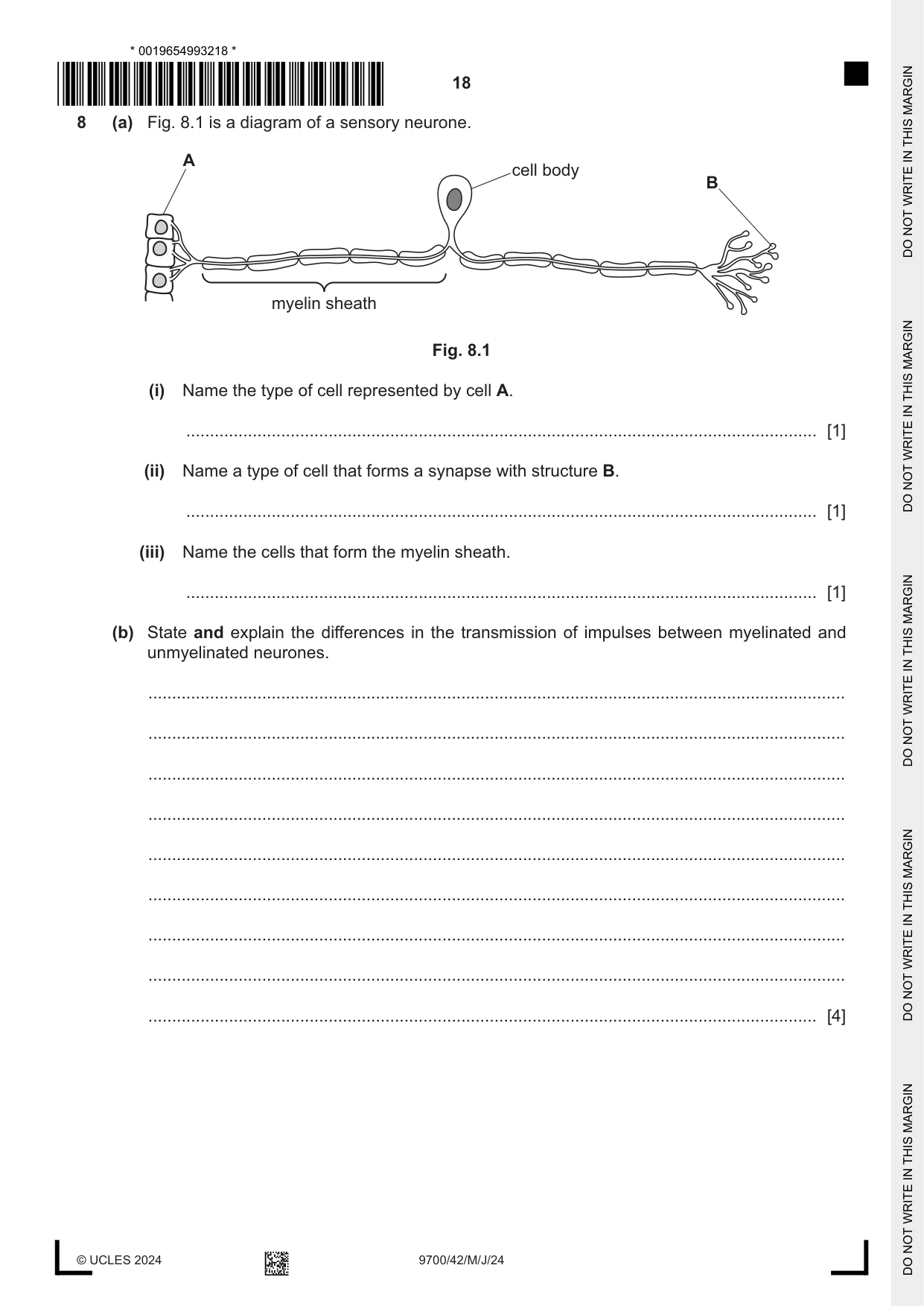
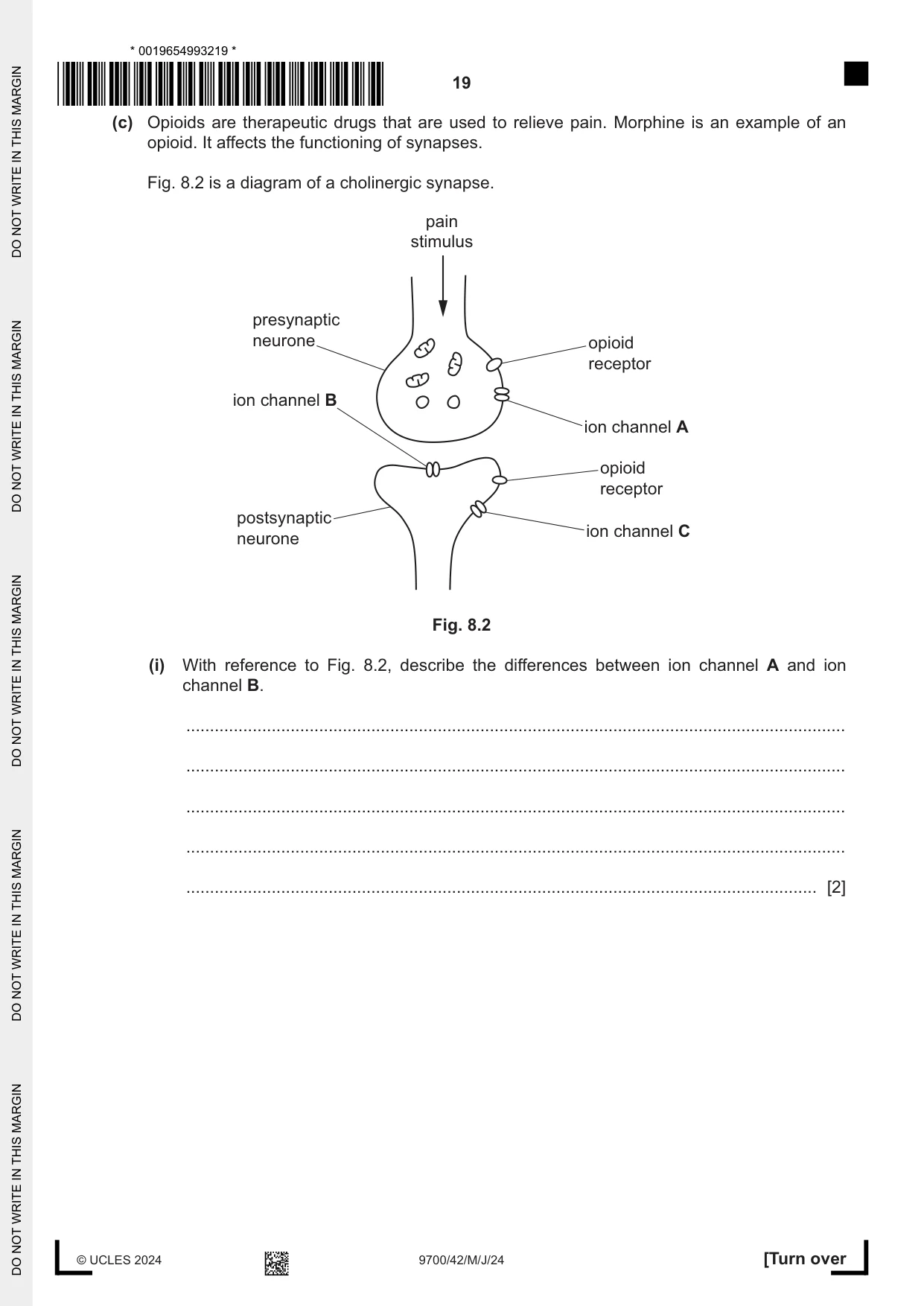
8 (a) Fig. 8.1 is a diagram of a sensory neurone. A cell body B myelin sheath Fig. 8.1 (i) Name the type of cell represented by cell A. ..................................................................................................................................... [1] (ii) Name a type of cell that forms a synapse with structure B. ..................................................................................................................................... [1] (iii) Name the cells that form the myelin sheath. ..................................................................................................................................... [1] (b) State and explain the differences in the transmission of impulses between myelinated and unmyelinated neurones. ................................................................................................................................................... ................................................................................................................................................... ................................................................................................................................................... ................................................................................................................................................... ................................................................................................................................................... ................................................................................................................................................... ................................................................................................................................................... ................................................................................................................................................... ............................................................................................................................................. [4] (c) Opioids are therapeutic drugs that are used to relieve pain. Morphine is an example of an opioid. It affects the functioning of synapses. Fig. 8.2 is a diagram of a cholinergic synapse. pain stimulus presynaptic neurone opioid receptor ion channel B ion channel A opioid receptor postsynaptic ion channel C neurone Fig. 8.2 (i) With reference to Fig. 8.2, describe the differences between ion channel A and ion channel B. ........................................................................................................................................... ........................................................................................................................................... ........................................................................................................................................... ........................................................................................................................................... ..................................................................................................................................... [2] (ii) Morphine binds to the opioid receptor in the presynaptic membrane. This stops the ion channel A from opening. Suggest and describe the effects of the binding of morphine to this opioid receptor on the functioning of the cholinergic synapse. ........................................................................................................................................... ........................................................................................................................................... ........................................................................................................................................... ........................................................................................................................................... ........................................................................................................................................... ........................................................................................................................................... ........................................................................................................................................... ........................................................................................................................................... ..................................................................................................................................... [4] (iii) Morphine also binds to the opioid receptor in the postsynaptic membrane. This results in the opening of ion channel C, allowing potassium ions to diffuse out of the cell. Suggest how this would affect the synapse. ........................................................................................................................................... ........................................................................................................................................... ........................................................................................................................................... ........................................................................................................................................... ..................................................................................................................................... [2] [Total: 15]
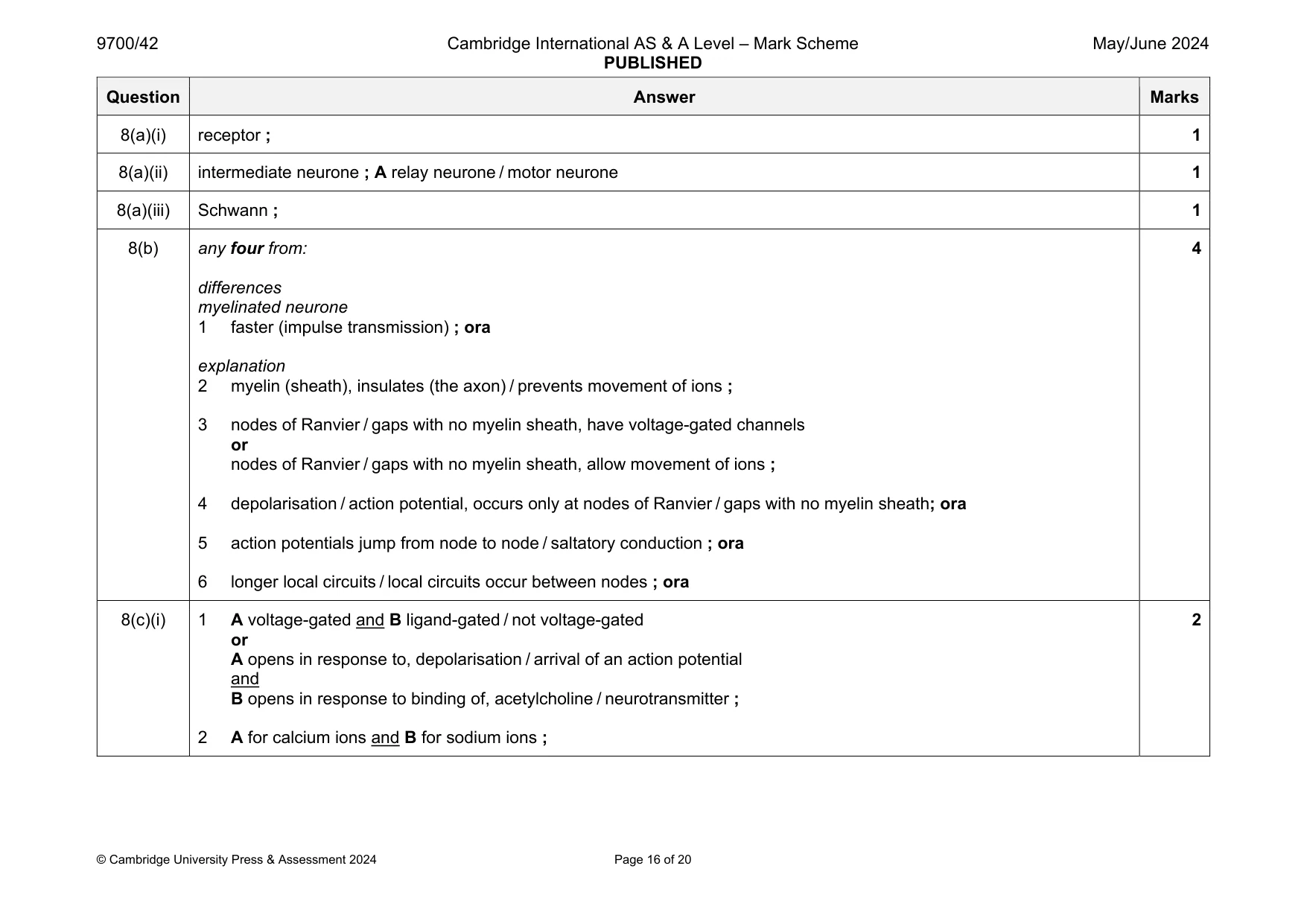
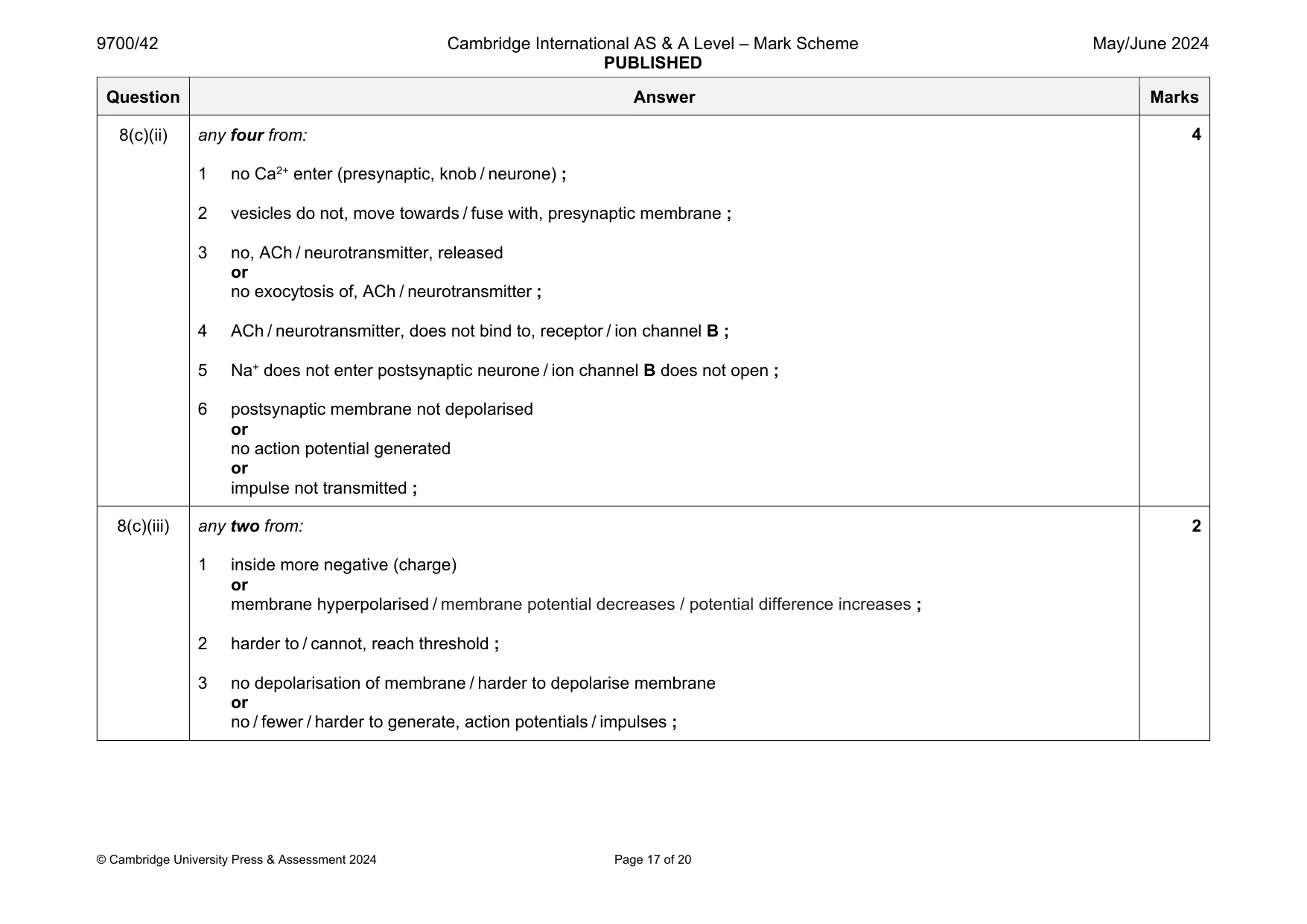
Mark scheme: 8(a)(i) receptor ; 1 8(a)(ii) intermediate neurone ; A relay neurone / motor neurone 1 8(a)(iii) Schwann ; 1 8(b) any four from: differences myelinated neurone 1 faster (impulse transmission) ; ora explanation 2 myelin (sheath), insulates (the axon) / prevents movement of ions ; 3 nodes of Ranvier / gaps with no myelin sheath, have voltage-gated channels or nodes of Ranvier / gaps with no myelin sheath, allow movement of ions ; 4 depolarisation / action potential, occurs only at nodes of Ranvier / gaps with no myelin sheath; ora 5 action potentials jump from node to node / saltatory conduction ; ora 6 longer local circuits / local circuits occur between nodes ; ora 4 8(c)(i) 1 A voltage-gated and B ligand-gated / not voltage-gated or A opens in response to, depolarisation / arrival of an action potential and B opens in response to binding of, acetylcholine / neurotransmitter ; 2 A for calcium ions and B for sodium ions ; 2 Question Answer Marks 8(c)(ii) any four from: 1 no Ca2+ enter (presynaptic, knob / neurone) ; 2 vesicles do not, move towards / fuse with, presynaptic membrane ; 3 no, ACh / neurotransmitter, released or no exocytosis of, ACh / neurotransmitter ; 4 ACh / neurotransmitter, does not bind to, receptor / ion channel B ; 5 Na+ does not enter postsynaptic neurone / ion channel B does not open ; 6 postsynaptic membrane not depolarised or no action potential generated or impulse not transmitted ; 4 8(c)(iii) any two from: 1 inside more negative (charge) or membrane hyperpolarised / membrane potential decreases / potential difference increases ; 2 harder to / cannot, reach threshold ; 3 no depolarisation of membrane / harder to depolarise membrane or no / fewer / harder to generate, action potentials / impulses ; 2
Q9 · The Asian common toad, Duttaphrynus melanostictus, arrived accidentally in eastern…
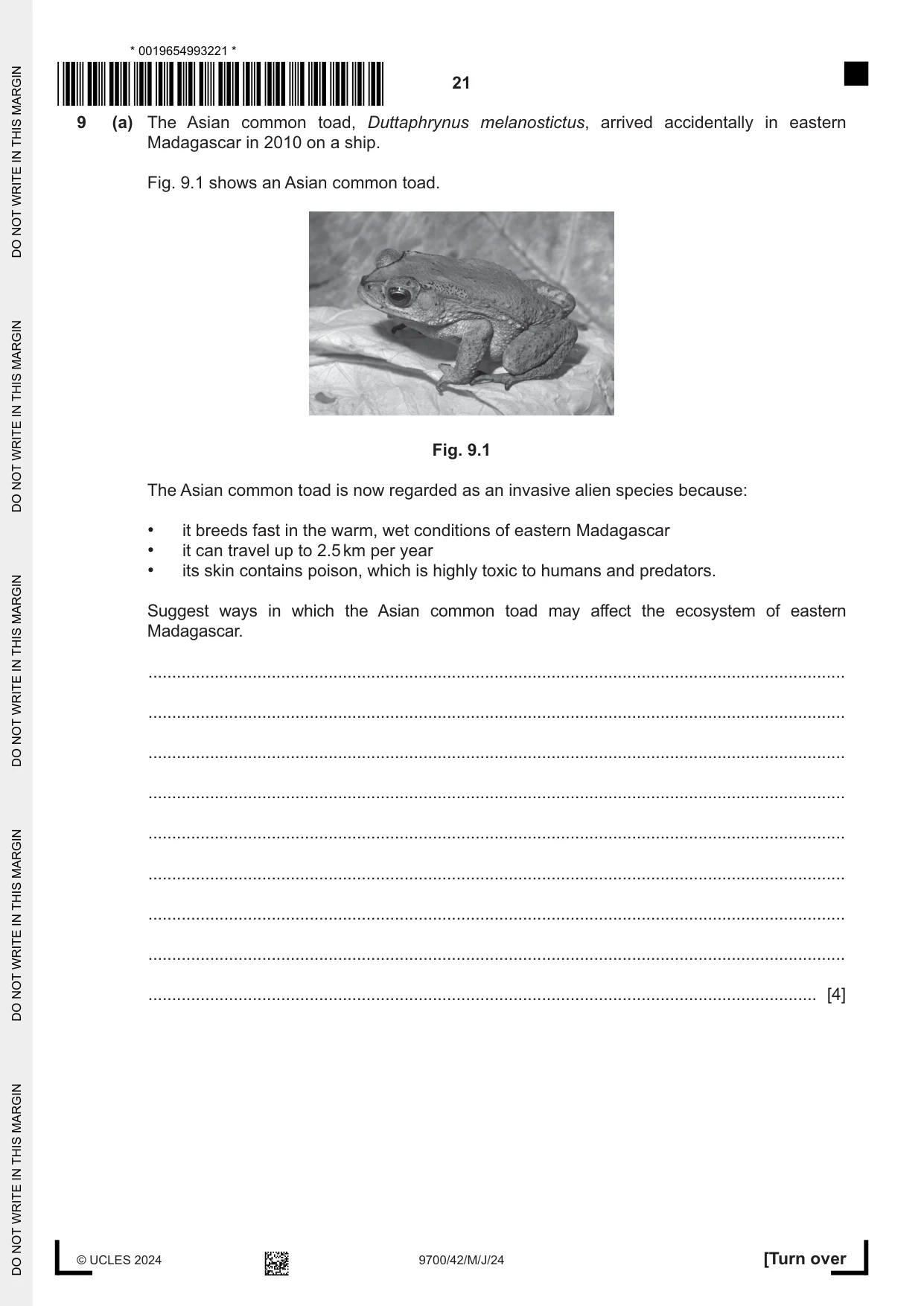
9 (a) The Asian common toad, Duttaphrynus melanostictus, arrived accidentally in eastern Madagascar in 2010 on a ship. Fig. 9.1 shows an Asian common toad. Fig. 9.1 The Asian common toad is now regarded as an invasive alien species because: • it breeds fast in the warm, wet conditions of eastern Madagascar • it can travel up to 2.5 km per year • its skin contains poison, which is highly toxic to humans and predators. Suggest ways in which the Asian common toad may affect the ecosystem of eastern Madagascar. ................................................................................................................................................... ................................................................................................................................................... ................................................................................................................................................... ................................................................................................................................................... ................................................................................................................................................... ................................................................................................................................................... ................................................................................................................................................... ................................................................................................................................................... ............................................................................................................................................. [4] (b) Zoos work with local groups around the world to help conserve endangered species. One example of this is the use of assisted reproduction, such as IVF, with endangered mammals such as the eastern black rhino. Outline the process of IVF. ................................................................................................................................................... ................................................................................................................................................... ................................................................................................................................................... ................................................................................................................................................... ................................................................................................................................................... ................................................................................................................................................... ................................................................................................................................................... ................................................................................................................................................... ............................................................................................................................................. [4] [Total: 8]
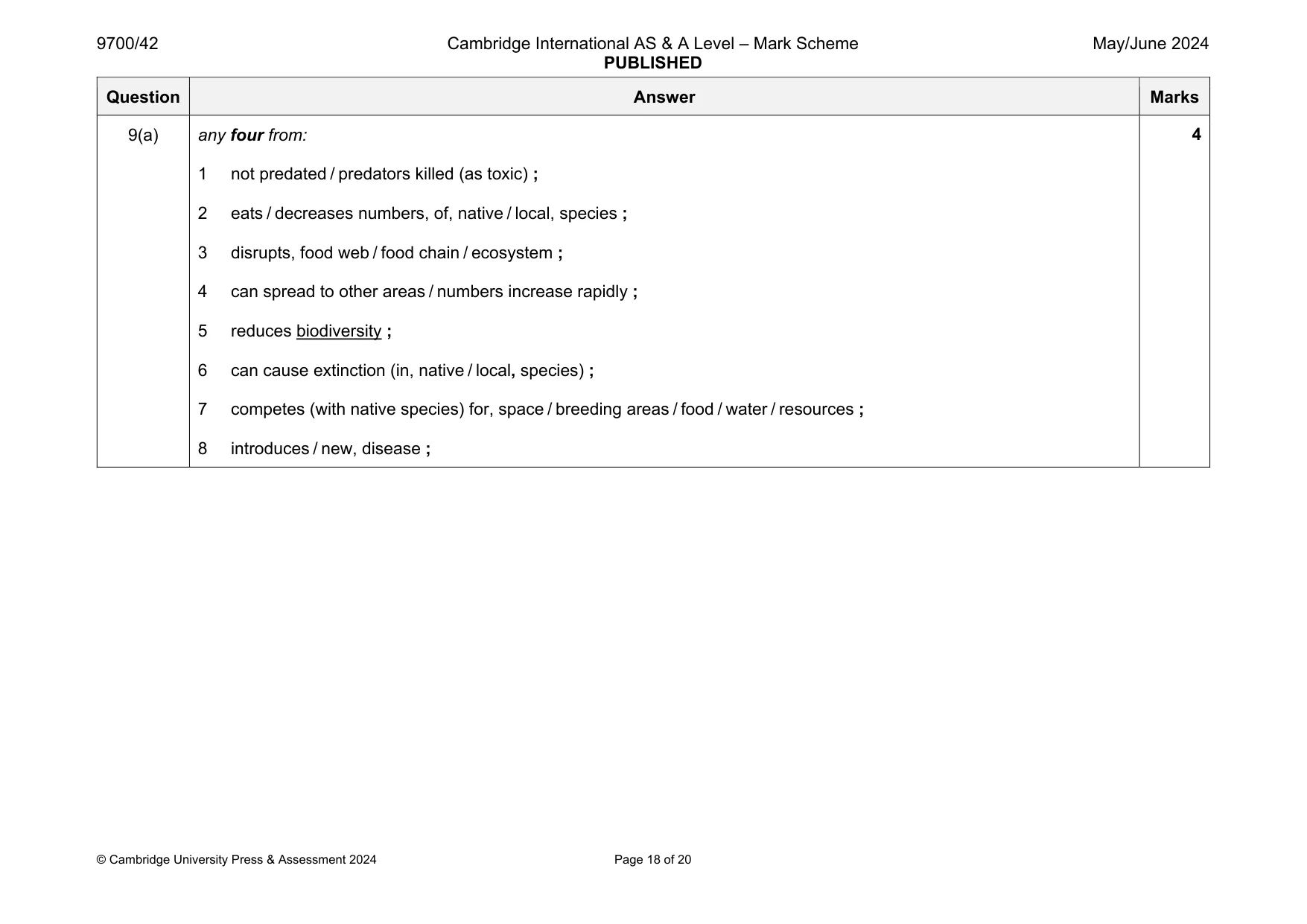
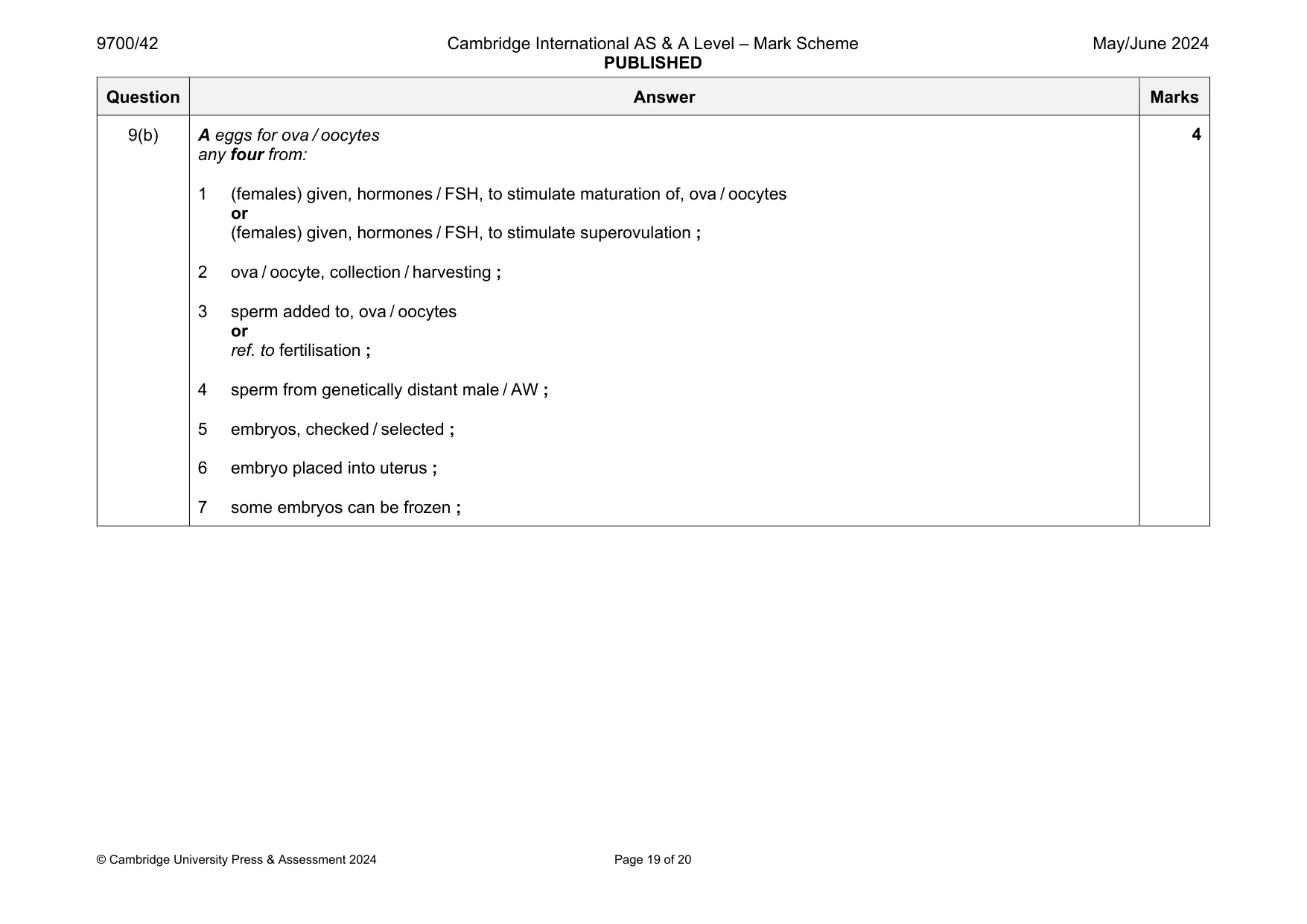
Mark scheme: 9(a) any four from: 1 not predated / predators killed (as toxic) ; 2 eats / decreases numbers, of, native / local, species ; 3 disrupts, food web / food chain / ecosystem ; 4 can spread to other areas / numbers increase rapidly ; 5 reduces biodiversity ; 6 can cause extinction (in, native / local, species) ; 7 competes (with native species) for, space / breeding areas / food / water / resources ; 8 introduces / new, disease ; Question Answer Marks 9(b) A eggs for ova / oocytes any four from: 1 (females) given, hormones / FSH, to stimulate maturation of, ova / oocytes or (females) given, hormones / FSH, to stimulate superovulation ; 2 ova / oocyte, collection / harvesting ; 3 sperm added to, ova / oocytes or ref. to fertilisation ; 4 sperm from genetically distant male / AW ; 5 embryos, checked / selected ; 6 embryo placed into uterus ; 7 some embryos can be frozen ; 4
Q10 · In mammals, blood glucose concentration is maintained around a set point so that the…
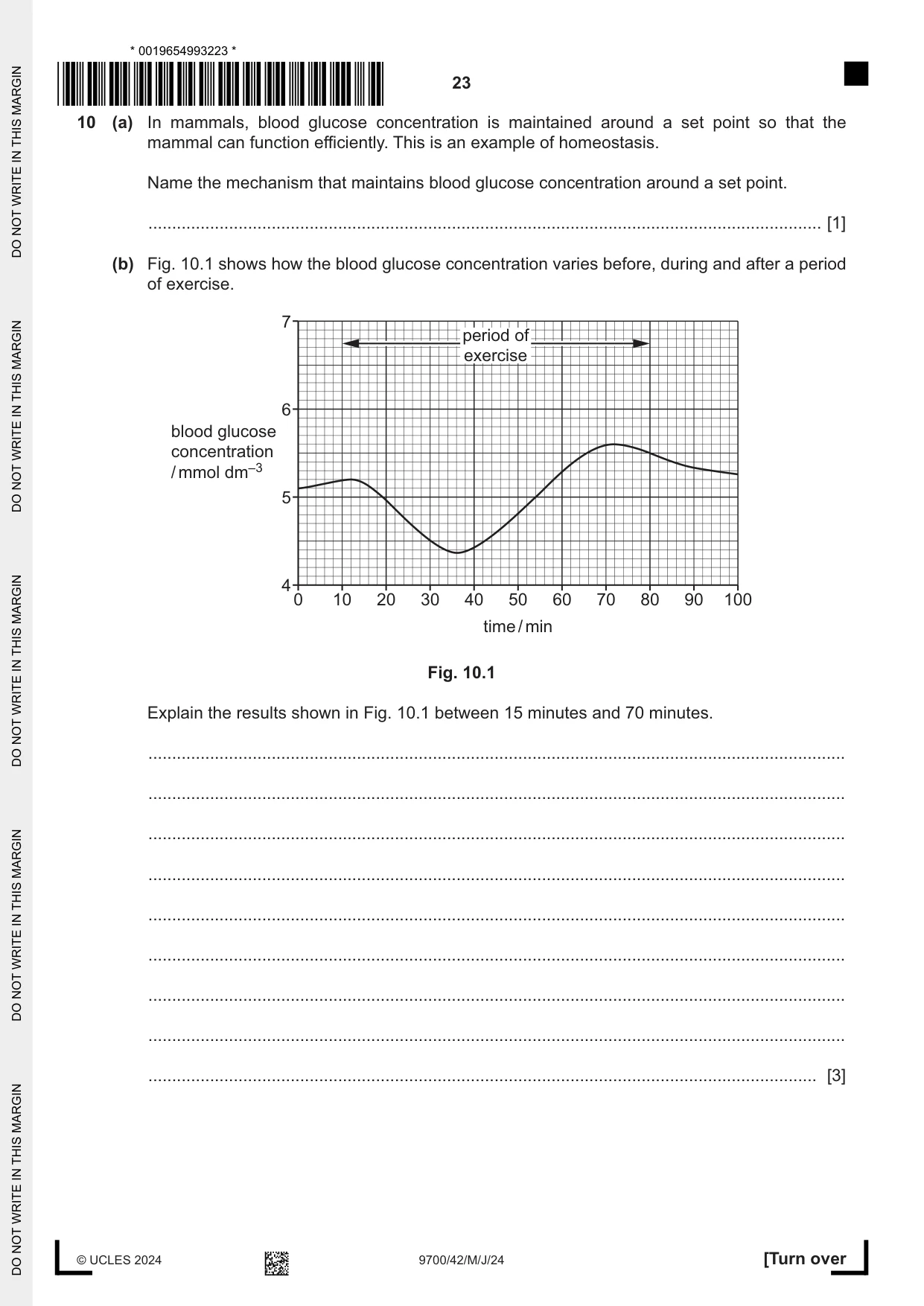
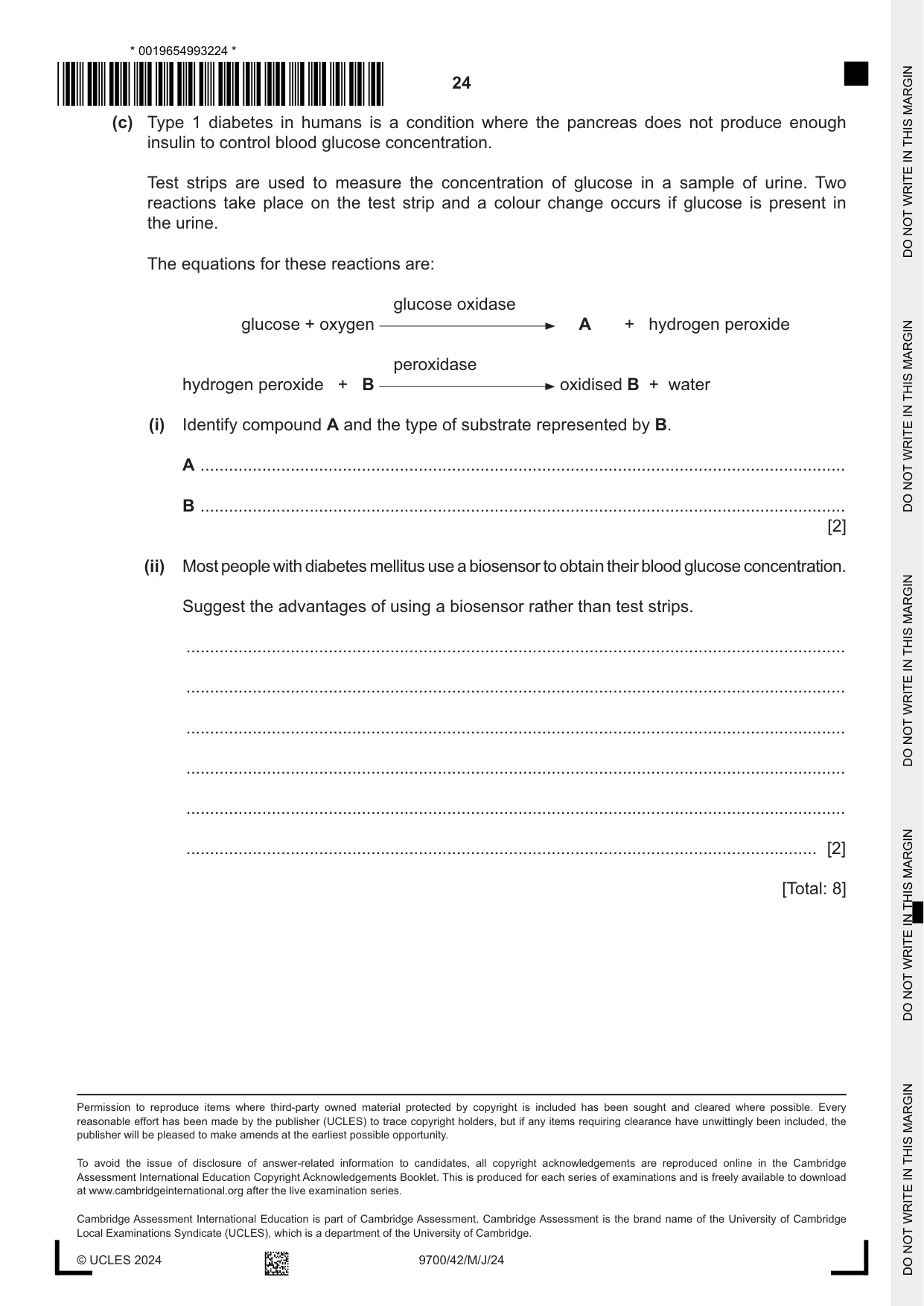
10 (a) In mammals, blood glucose concentration is maintained around a set point so that the mammal can function efficiently. This is an example of homeostasis. Name the mechanism that maintains blood glucose concentration around a set point. .............................................................................................................................................. [1] (b) Fig. 10.1 shows how the blood glucose concentration varies before, during and after a period of exercise. 7 period of exercise 6 blood glucose concentration / mmol dm–3 5 4 0 10 20 30 40 50 60 70 80 90 100 time / min Fig. 10.1 Explain the results shown in Fig. 10.1 between 15 minutes and 70 minutes. ................................................................................................................................................... ................................................................................................................................................... ................................................................................................................................................... ................................................................................................................................................... ................................................................................................................................................... ................................................................................................................................................... ................................................................................................................................................... ................................................................................................................................................... ............................................................................................................................................. [3] (c) Type 1 diabetes in humans is a condition where the pancreas does not produce enough insulin to control blood glucose concentration. Test strips are used to measure the concentration of glucose in a sample of urine. Two reactions take place on the test strip and a colour change occurs if glucose is present in the urine. The equations for these reactions are: glucose oxidase glucose + oxygen A + hydrogen peroxide peroxidase hydrogen peroxide + B oxidised B + water (i) Identify compound A and the type of substrate represented by B. A ........................................................................................................................................ B ........................................................................................................................................ [2] (ii) Most people with diabetes mellitus use a biosensor to obtain their blood glucose concentration. Suggest the advantages of using a biosensor rather than test strips. ........................................................................................................................................... ........................................................................................................................................... ........................................................................................................................................... ........................................................................................................................................... ........................................................................................................................................... ..................................................................................................................................... [2] [Total: 8]
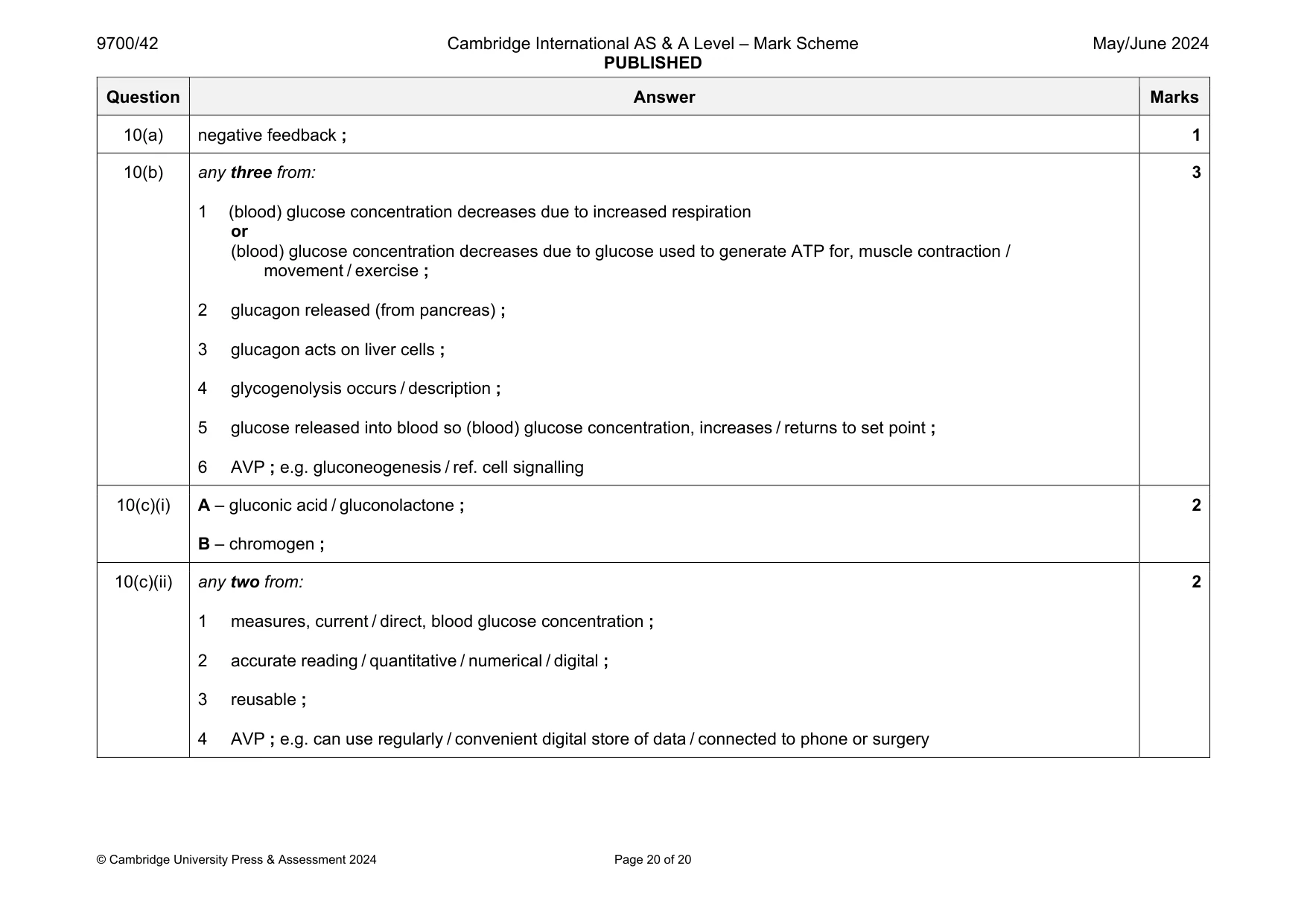
Mark scheme: 10(a) negative feedback ; 1 10(b) any three from: 1 (blood) glucose concentration decreases due to increased respiration or (blood) glucose concentration decreases due to glucose used to generate ATP for, muscle contraction / movement / exercise ; 2 glucagon released (from pancreas) ; 3 glucagon acts on liver cells ; 4 glycogenolysis occurs / description ; 5 glucose released into blood so (blood) glucose concentration, increases / returns to set point ; 6 AVP ; e.g. gluconeogenesis / ref. cell signalling 3 10(c)(i) A – gluconic acid / gluconolactone ; B – chromogen ; 2 10(c)(ii) any two from: 1 measures, current / direct, blood glucose concentration ; 2 accurate reading / quantitative / numerical / digital ; 3 reusable ; 4 AVP ; e.g. can use regularly / convenient digital store of data / connected to phone or surgery 2
What was in this paper
The subtopics covered by these 10 questions, and how many questions each got. Open one in a new tab to see every Cambridge question on it.
What you needed in this session
Cambridge’s own grade thresholds for 2024 May/June, Paper 4 · Variant 2. A higher threshold means an easier paper — the bar moves with how the cohort did.