Cambridge A Level Biology 9700 — 2022 Oct/Nov Paper 4 · Variant 1
9700/41/O/N/22 · 10 questions · 100 marks · ≈113 min
The question paper and its mark scheme, free to read here and free to download. This is Cambridge’s own paper, exactly as it was sat.
Question paper24 pages
Mark scheme19 pages
Answers below. Sit the paper first if you are practising.
Questions as text
Q1 · The wild Bactrian camel, Camelus ferus, lives only in the desert regions of Mongolia and…
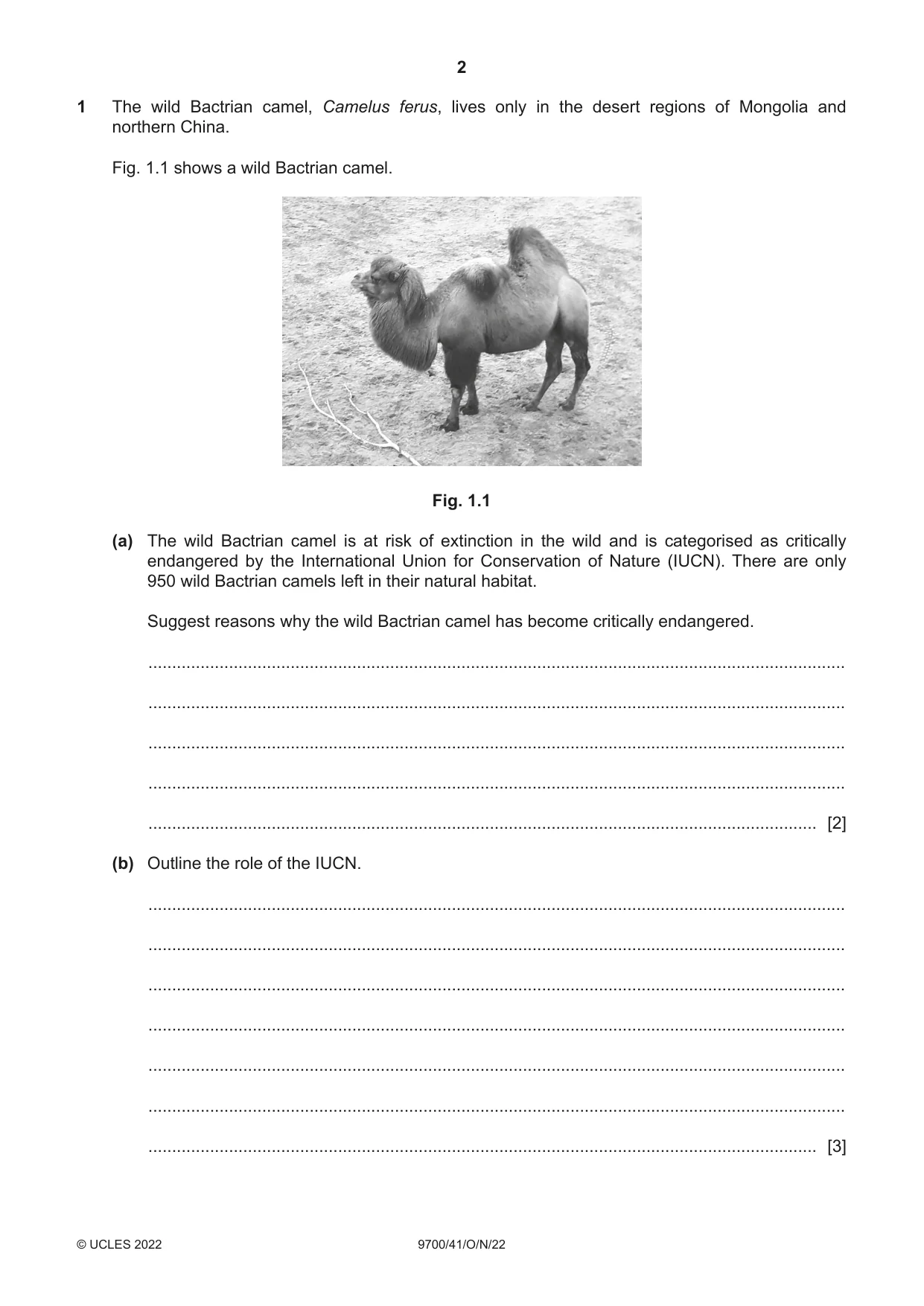
1 The wild Bactrian camel, Camelus ferus, lives only in the desert regions of Mongolia and northern China. Fig. 1.1 shows a wild Bactrian camel. Fig. 1.1 (a) The wild Bactrian camel is at risk of extinction in the wild and is categorised as critically endangered by the International Union for Conservation of Nature (IUCN). There are only 950 wild Bactrian camels left in their natural habitat. Suggest reasons why the wild Bactrian camel has become critically endangered. ................................................................................................................................................... ................................................................................................................................................... ................................................................................................................................................... ................................................................................................................................................... ............................................................................................................................................. [2] (b) Outline the role of the IUCN. ................................................................................................................................................... ................................................................................................................................................... ................................................................................................................................................... ................................................................................................................................................... ................................................................................................................................................... ................................................................................................................................................... ............................................................................................................................................. [3] (c) Some zoos use assisted reproduction techniques, such as embryo transfer, in their captive breeding programmes for endangered species. Embryo transfer has resulted in domesticated dromedary camels giving birth to wild Bactrian camel calves. Describe the procedure of embryo transfer in a mammal such as a camel. ................................................................................................................................................... ................................................................................................................................................... ................................................................................................................................................... ................................................................................................................................................... ................................................................................................................................................... ................................................................................................................................................... ................................................................................................................................................... ................................................................................................................................................... ............................................................................................................................................. [4] [Total: 9]
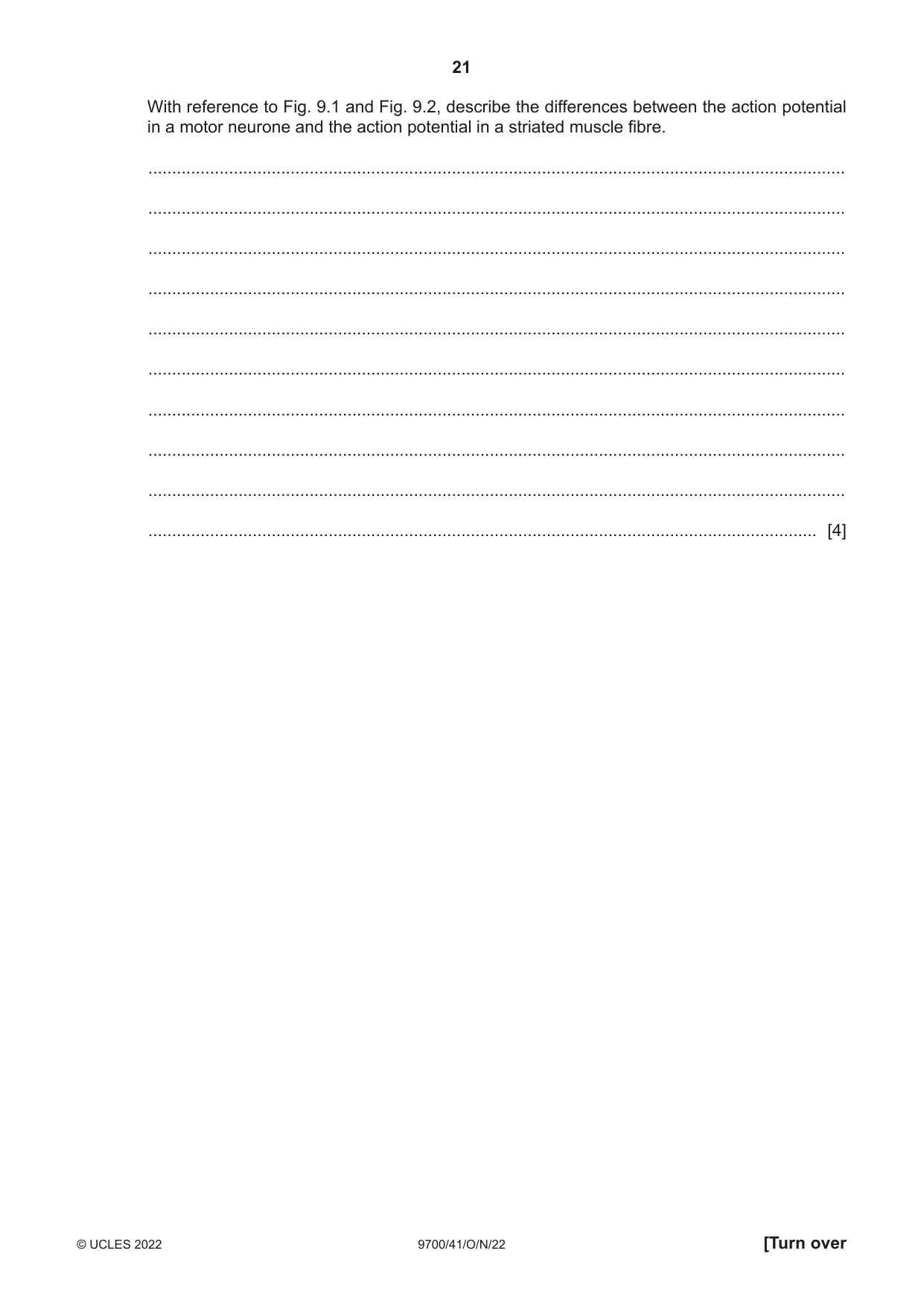
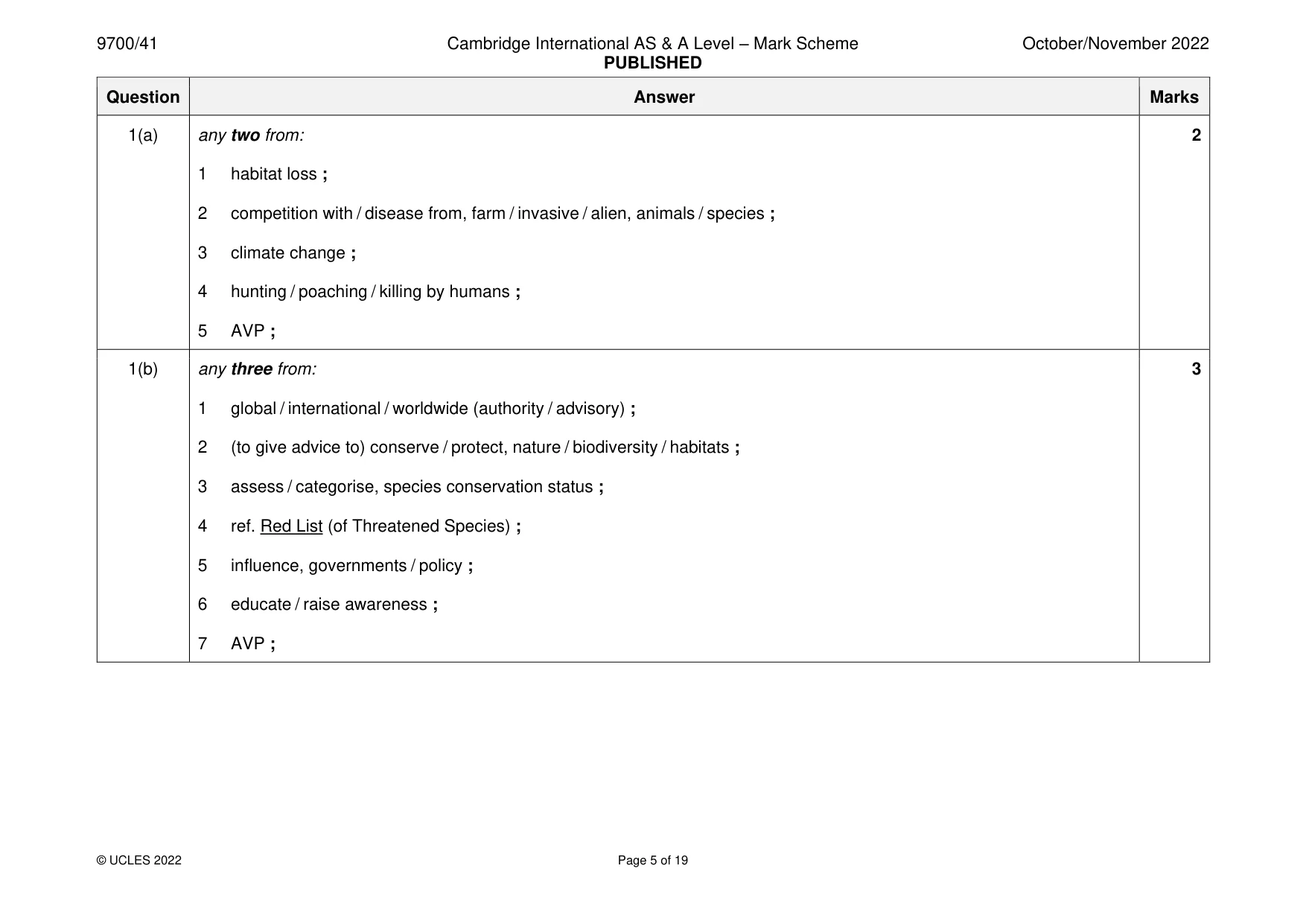
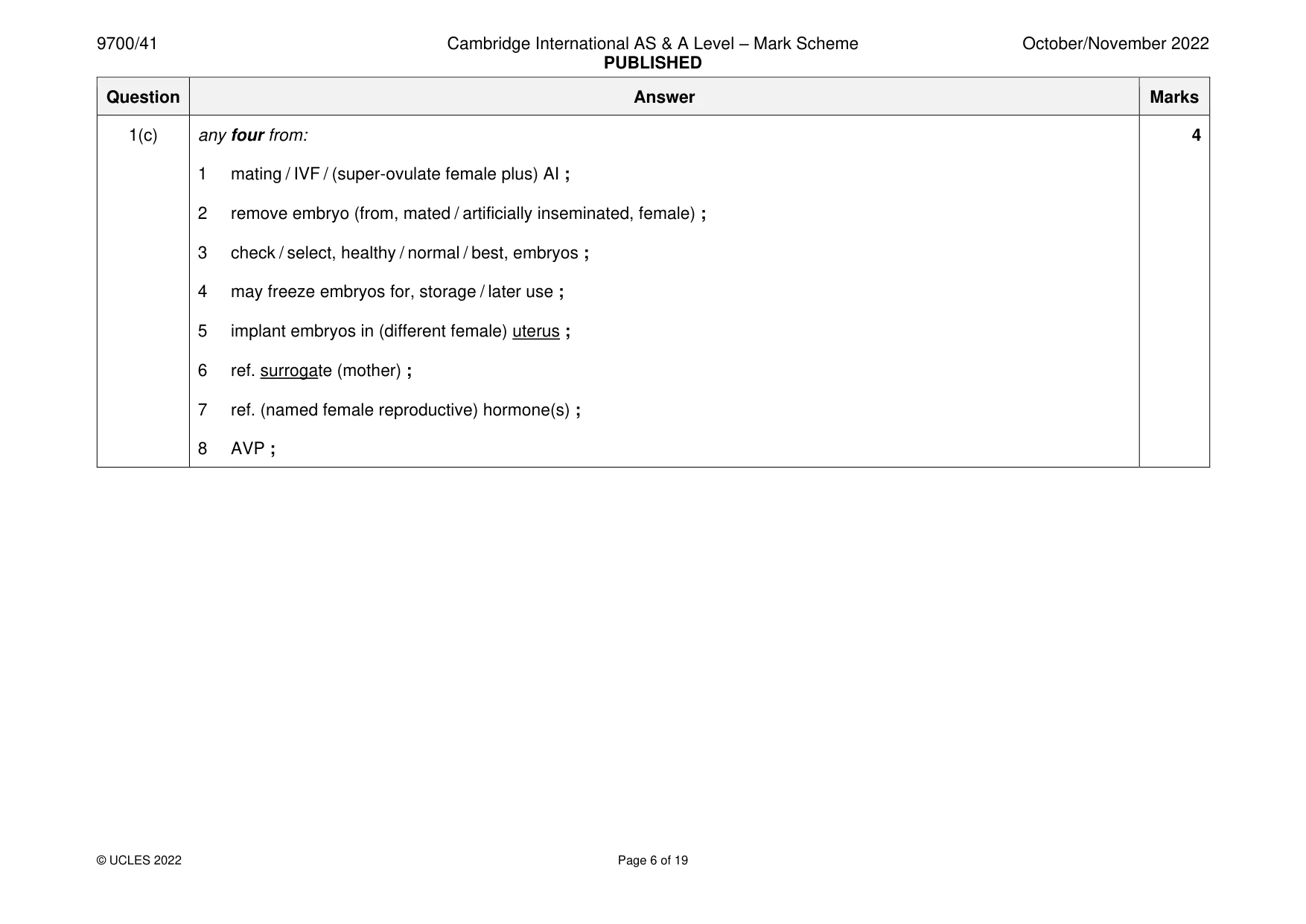
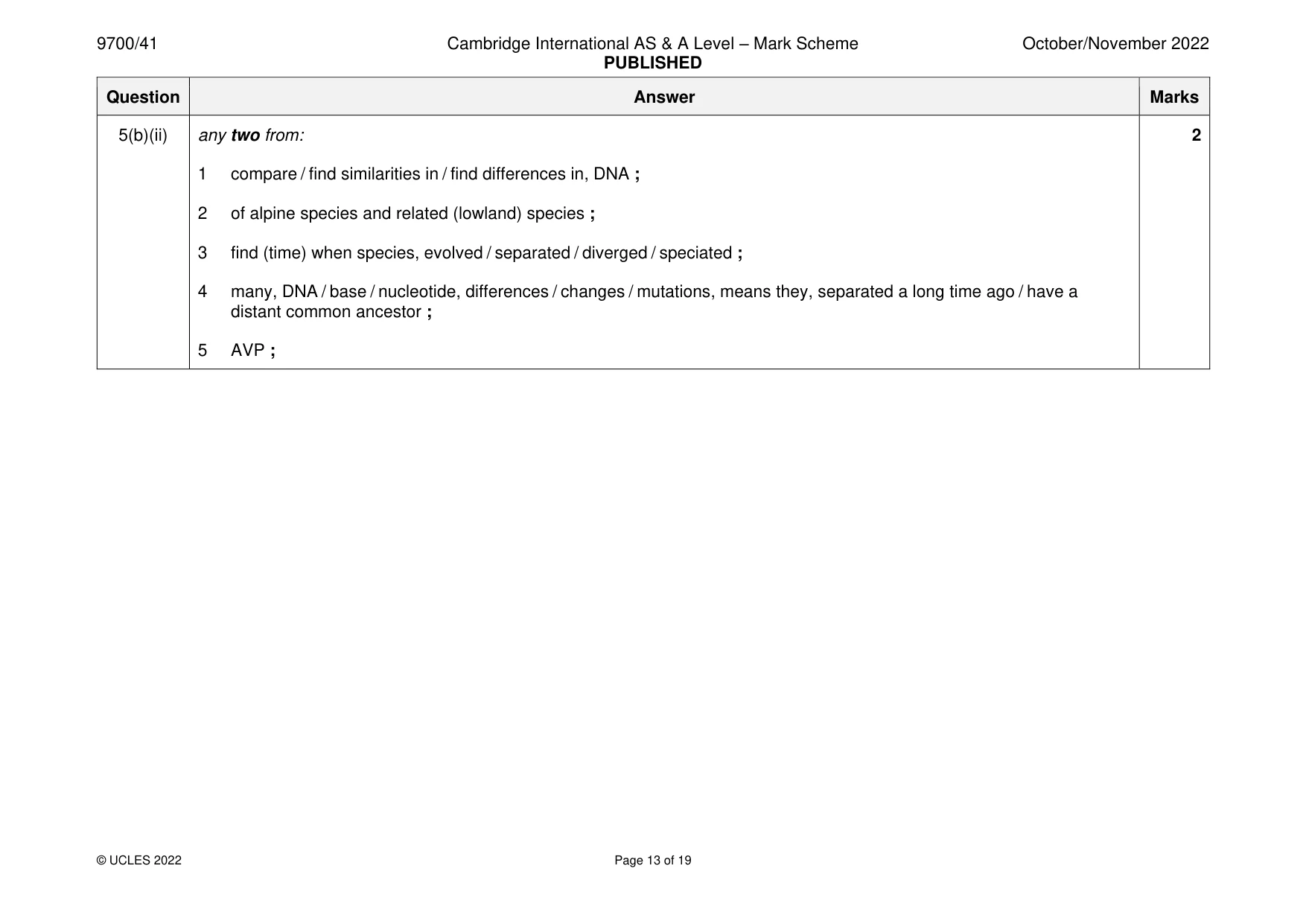
Mark scheme: Question Answer Marks 1(a) any two from: 2 1 habitat loss ; 2 competition with / disease from, farm / invasive / alien, animals / species ; 3 climate change ; 4 hunting / poaching / killing by humans ; 5 AVP ; 1(b) any three from: 3 1 global / international / worldwide (authority / advisory) ; 2 (to give advice to) conserve / protect, nature / biodiversity / habitats ; 3 assess / categorise, species conservation status ; 4 ref. Red List (of Threatened Species) ; 5 influence, governments / policy ; 6 educate / raise awareness ; 7 AVP ; 1(c) any four from: 4 1 mating / IVF / (super-ovulate female plus) AI ; 2 remove embryo (from, mated / artificially inseminated, female) ; 3 check / select, healthy / normal / best, embryos ; 4 may freeze embryos for, storage / later use ; 5 implant embryos in (different female) uterus ; 6 ref. surrogate (mother) ; 7 ref. (named female reproductive) hormone(s) ; 8 AVP ;
Q2 · Photosynthesis is an important energy transfer process
2 Photosynthesis is an important energy transfer process. (a) Name one chloroplast pigment. ................................................................................................................................................... ............................................................................................................................................. [1] (b) Explain the relationship between the absorption spectrum of the main chloroplast pigments in a species of plant and the action spectrum for photosynthesis for that species. ................................................................................................................................................... ................................................................................................................................................... ................................................................................................................................................... ................................................................................................................................................... ................................................................................................................................................... ............................................................................................................................................. [2] (c) Explain why temperature can be a limiting factor of photosynthesis. ................................................................................................................................................... ................................................................................................................................................... ................................................................................................................................................... ................................................................................................................................................... ................................................................................................................................................... ............................................................................................................................................. [3] (d) Outline how the light-independent stage of photosynthesis leads to the production of carbohydrates such as starch in plant leaves. ................................................................................................................................................... ................................................................................................................................................... ................................................................................................................................................... ................................................................................................................................................... ................................................................................................................................................... ............................................................................................................................................. [3] [Total: 9]
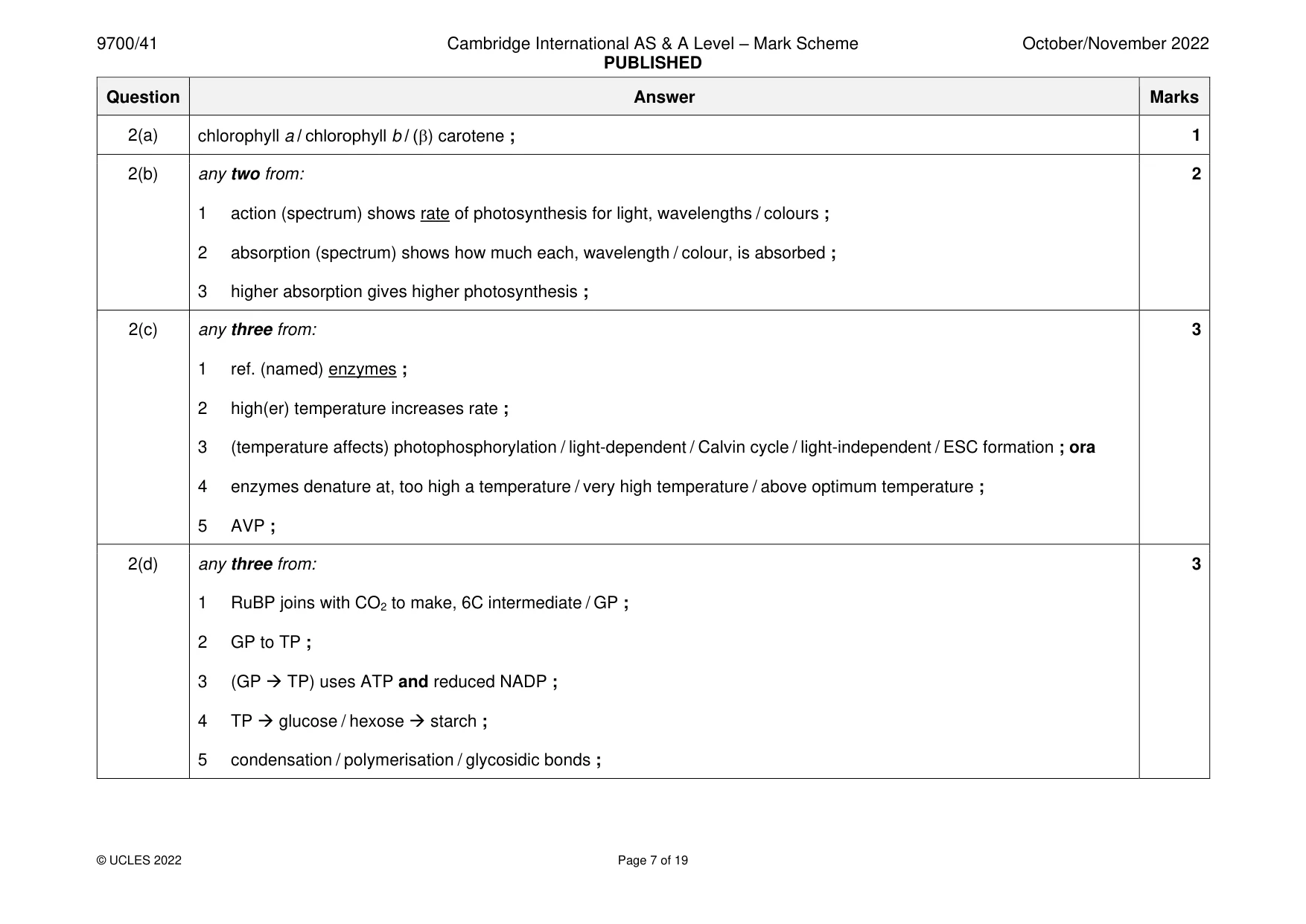
Mark scheme: 2(a) chlorophyll a / chlorophyll b / () carotene ; 1 2(b) any two from: 2 1 action (spectrum) shows rate of photosynthesis for light, wavelengths / colours ; 2 absorption (spectrum) shows how much each, wavelength / colour, is absorbed ; 3 higher absorption gives higher photosynthesis ; 2(c) any three from: 3 1 ref. (named) enzymes ; 2 high(er) temperature increases rate ; 3 (temperature affects) photophosphorylation / light-dependent / Calvin cycle / light-independent / ESC formation ; ora 4 enzymes denature at, too high a temperature / very high temperature / above optimum temperature ; 5 AVP ; 2(d) any three from: 3 1 RuBP joins with CO2 to make, 6C intermediate / GP ; 2 GP to TP ; 3 (GP → TP) uses ATP and reduced NADP ; 4 TP → glucose / hexose → starch ; 5 condensation / polymerisation / glycosidic bonds ;
More questions on Photosynthesis as an energy transfer process
Q3 · The results of investigations carried out on mitochondria show how the structure of a…
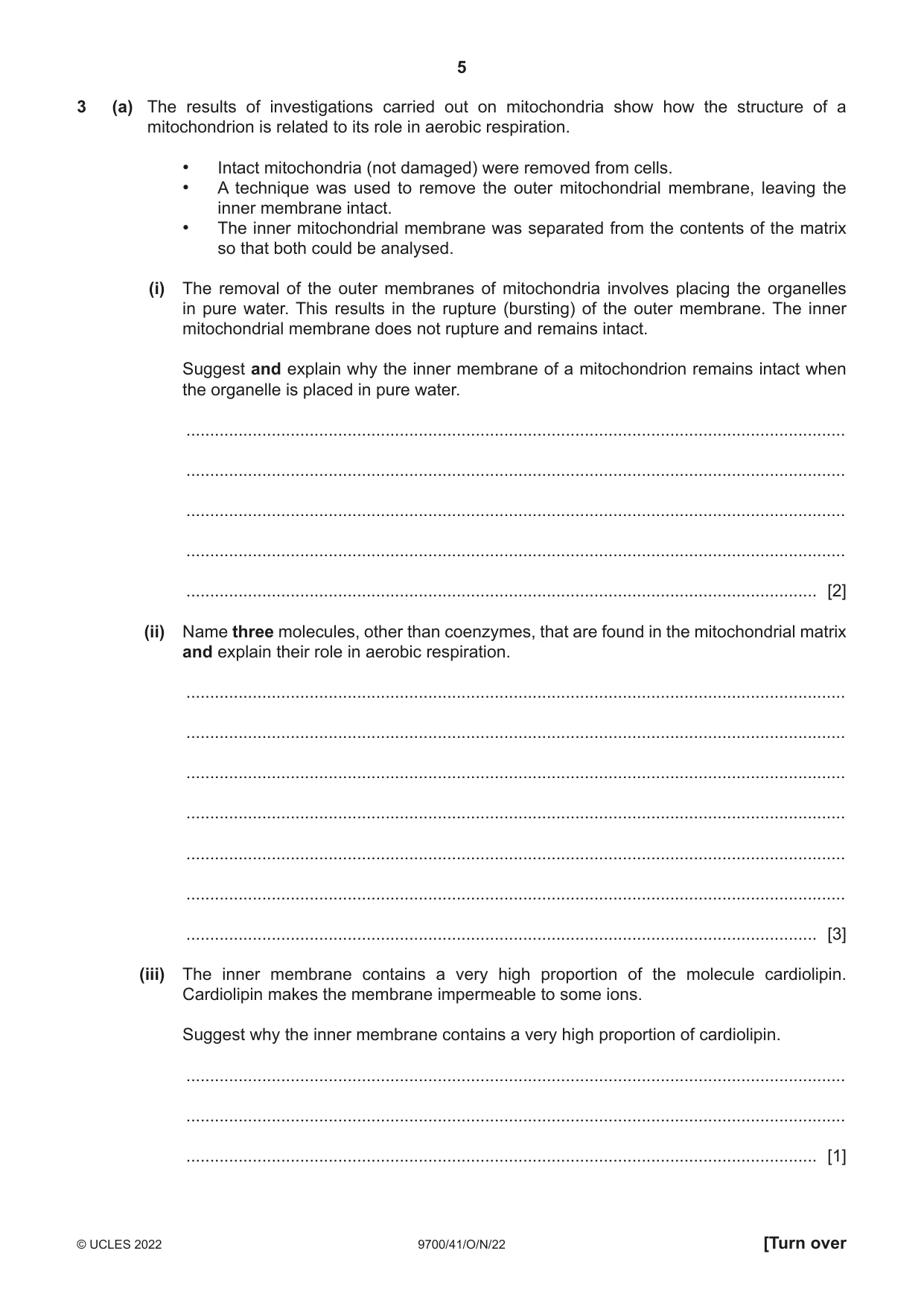
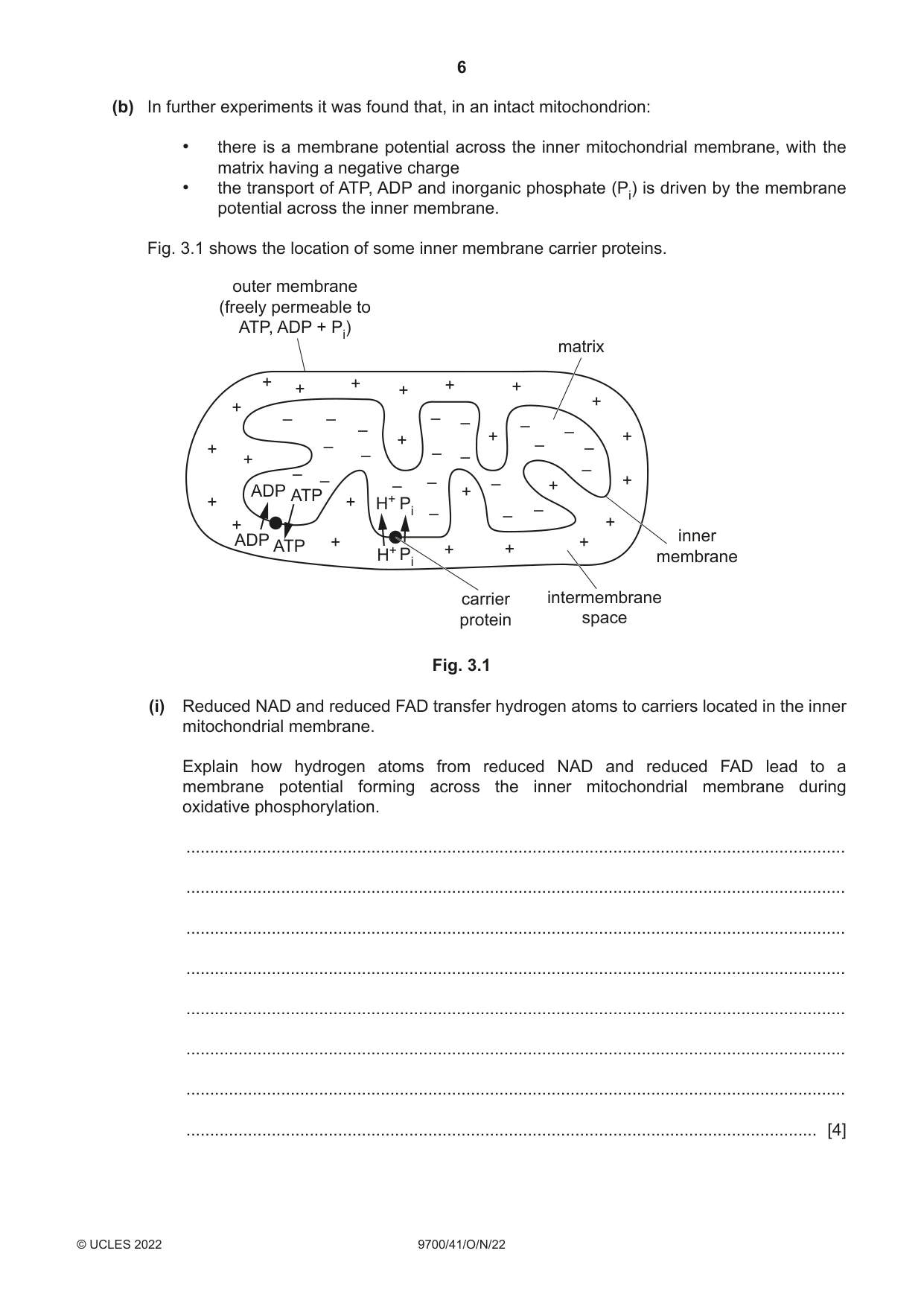
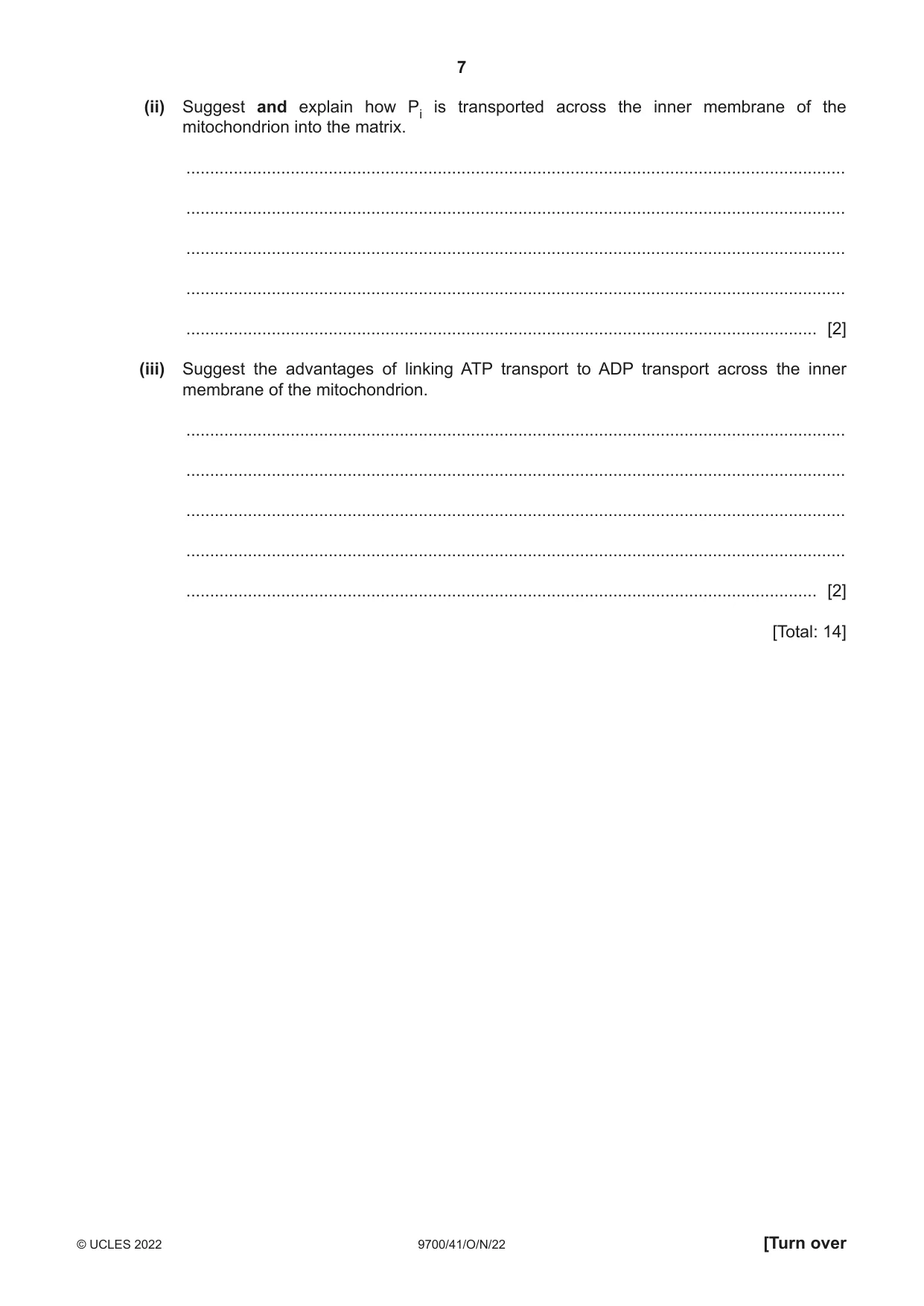
3 (a) The results of investigations carried out on mitochondria show how the structure of a mitochondrion is related to its role in aerobic respiration. • Intact mitochondria (not damaged) were removed from cells. • A technique was used to remove the outer mitochondrial membrane, leaving the inner membrane intact. • The inner mitochondrial membrane was separated from the contents of the matrix so that both could be analysed. (i) The removal of the outer membranes of mitochondria involves placing the organelles in pure water. This results in the rupture (bursting) of the outer membrane. The inner mitochondrial membrane does not rupture and remains intact. Suggest and explain why the inner membrane of a mitochondrion remains intact when the organelle is placed in pure water. ........................................................................................................................................... ........................................................................................................................................... ........................................................................................................................................... ........................................................................................................................................... ..................................................................................................................................... [2] (ii) Name three molecules, other than coenzymes, that are found in the mitochondrial matrix and explain their role in aerobic respiration. ........................................................................................................................................... ........................................................................................................................................... ........................................................................................................................................... ........................................................................................................................................... ........................................................................................................................................... ........................................................................................................................................... ..................................................................................................................................... [3] (iii) The inner membrane contains a very high proportion of the molecule cardiolipin. Cardiolipin makes the membrane impermeable to some ions. Suggest why the inner membrane contains a very high proportion of cardiolipin. ........................................................................................................................................... ........................................................................................................................................... ..................................................................................................................................... [1] (b) In further experiments it was found that, in an intact mitochondrion: • there is a membrane potential across the inner mitochondrial membrane, with the matrix having a negative charge • the transport of ATP, ADP and inorganic phosphate (Pi) is driven by the membrane potential across the inner membrane. Fig. 3.1 shows the location of some inner membrane carrier proteins. outer membrane (freely permeable to ATP, ADP + Pi) matrix + + + + + + + + – – – – – – – + + + – – – + – – – + – – – – – – + + ADP ATP + + + H+ Pi – – – + + inner ADP ATP + + + + H+ Pi membrane carrier intermembrane protein space Fig. 3.1 (i) Reduced NAD and reduced FAD transfer hydrogen atoms to carriers located in the inner mitochondrial membrane. Explain how hydrogen atoms from reduced NAD and reduced FAD lead to a membrane potential forming across the inner mitochondrial membrane during oxidative phosphorylation. ........................................................................................................................................... ........................................................................................................................................... ........................................................................................................................................... ........................................................................................................................................... ........................................................................................................................................... ........................................................................................................................................... ........................................................................................................................................... ..................................................................................................................................... [4] (ii) Suggest and explain how Pi is transported across the inner membrane of the mitochondrion into the matrix. ........................................................................................................................................... ........................................................................................................................................... ........................................................................................................................................... ........................................................................................................................................... ..................................................................................................................................... [2] (iii) Suggest the advantages of linking ATP transport to ADP transport across the inner membrane of the mitochondrion. ........................................................................................................................................... ........................................................................................................................................... ........................................................................................................................................... ........................................................................................................................................... ..................................................................................................................................... [2] [Total: 14]
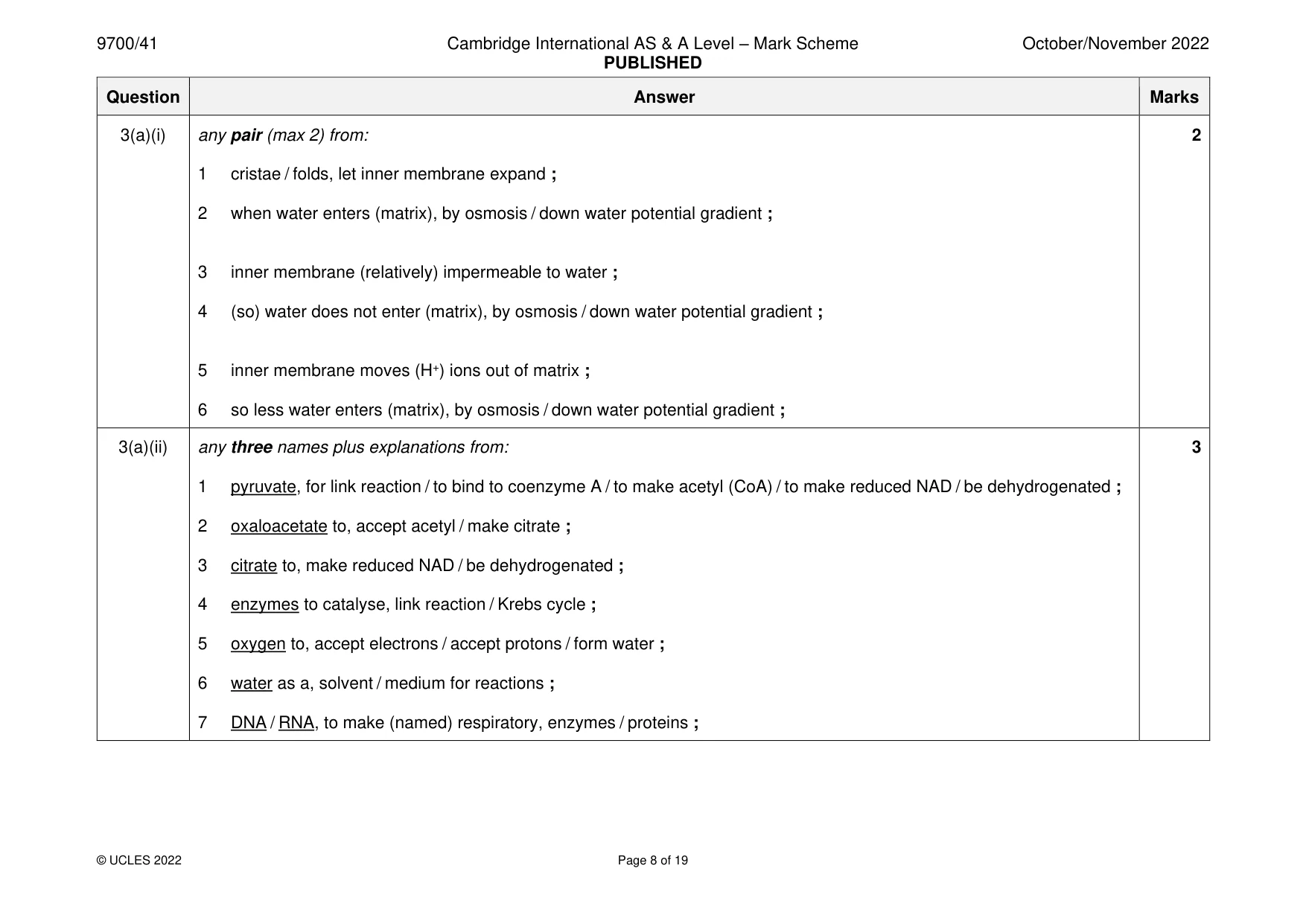
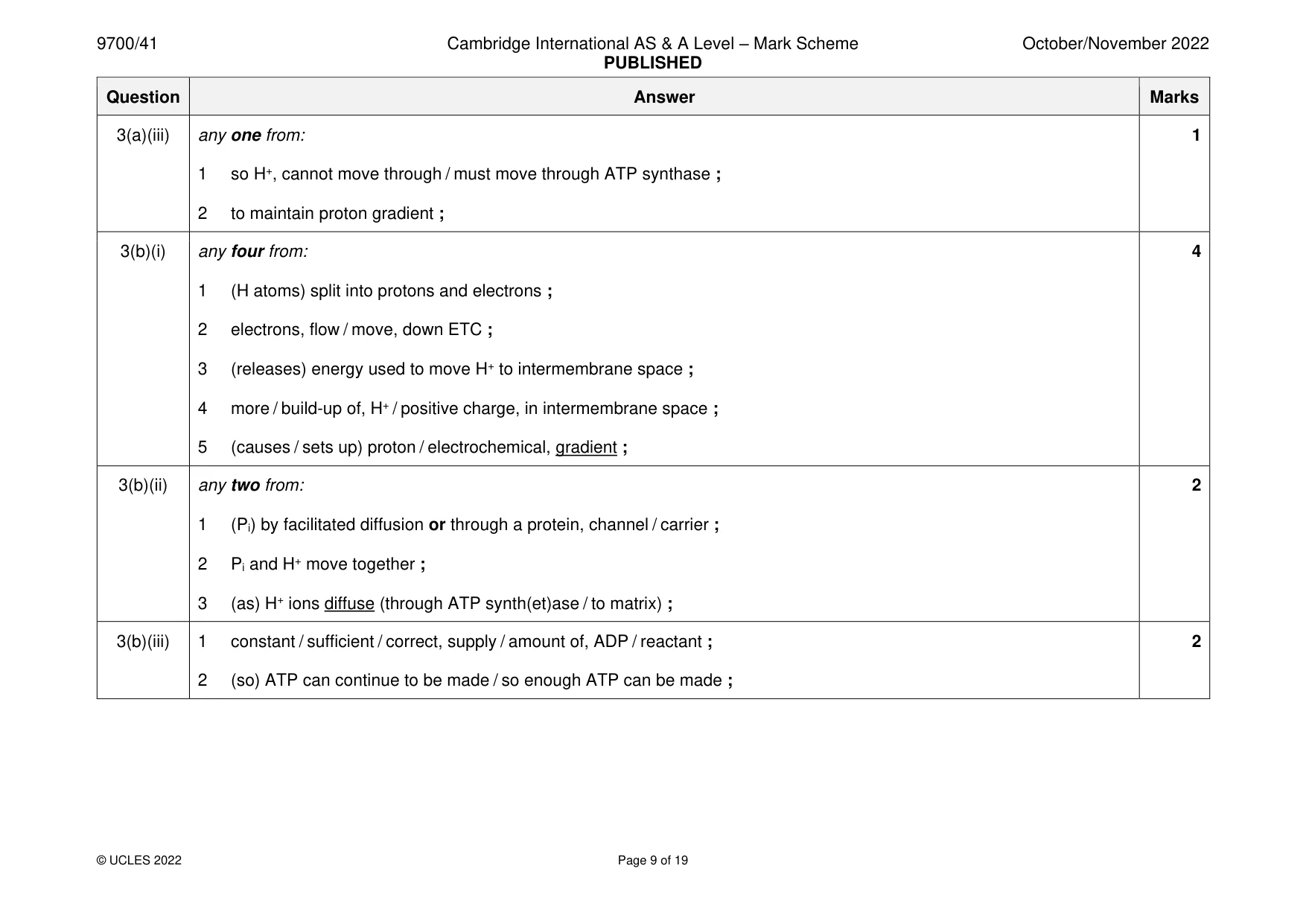
Mark scheme: 3(a)(i) any pair (max 2) from: 2 1 cristae / folds, let inner membrane expand ; 2 when water enters (matrix), by osmosis / down water potential gradient ; 3 inner membrane (relatively) impermeable to water ; 4 (so) water does not enter (matrix), by osmosis / down water potential gradient ; 5 inner membrane moves (H+) ions out of matrix ; 6 so less water enters (matrix), by osmosis / down water potential gradient ; 3(a)(ii) any three names plus explanations from: 3 1 pyruvate, for link reaction / to bind to coenzyme A / to make acetyl (CoA) / to make reduced NAD / be dehydrogenated ; 2 oxaloacetate to, accept acetyl / make citrate ; 3 citrate to, make reduced NAD / be dehydrogenated ; 4 enzymes to catalyse, link reaction / Krebs cycle ; 5 oxygen to, accept electrons / accept protons / form water ; 6 water as a, solvent / medium for reactions ; 7 DNA / RNA, to make (named) respiratory, enzymes / proteins ; 3(a)(iii) any one from: 1 1 so H+, cannot move through / must move through ATP synthase ; 2 to maintain proton gradient ; 3(b)(i) any four from: 4 1 (H atoms) split into protons and electrons ; 2 electrons, flow / move, down ETC ; 3 (releases) energy used to move H+ to intermembrane space ; 4 more / build-up of, H+ / positive charge, in intermembrane space ; 5 (causes / sets up) proton / electrochemical, gradient ; 3(b)(ii) any two from: 2 1 (Pi) by facilitated diffusion or through a protein, channel / carrier ; 2 Pi and H+ move together ; 3 (as) H+ ions diffuse (through ATP synth(et)ase / to matrix) ; 3(b)(iii) 1 constant / sufficient / correct, supply / amount of, ADP / reactant ; 2 2 (so) ATP can continue to be made / so enough ATP can be made ;
Q4 · Adenosine deaminase (ADA) deficiency is an immune system disorder caused by a recessive…
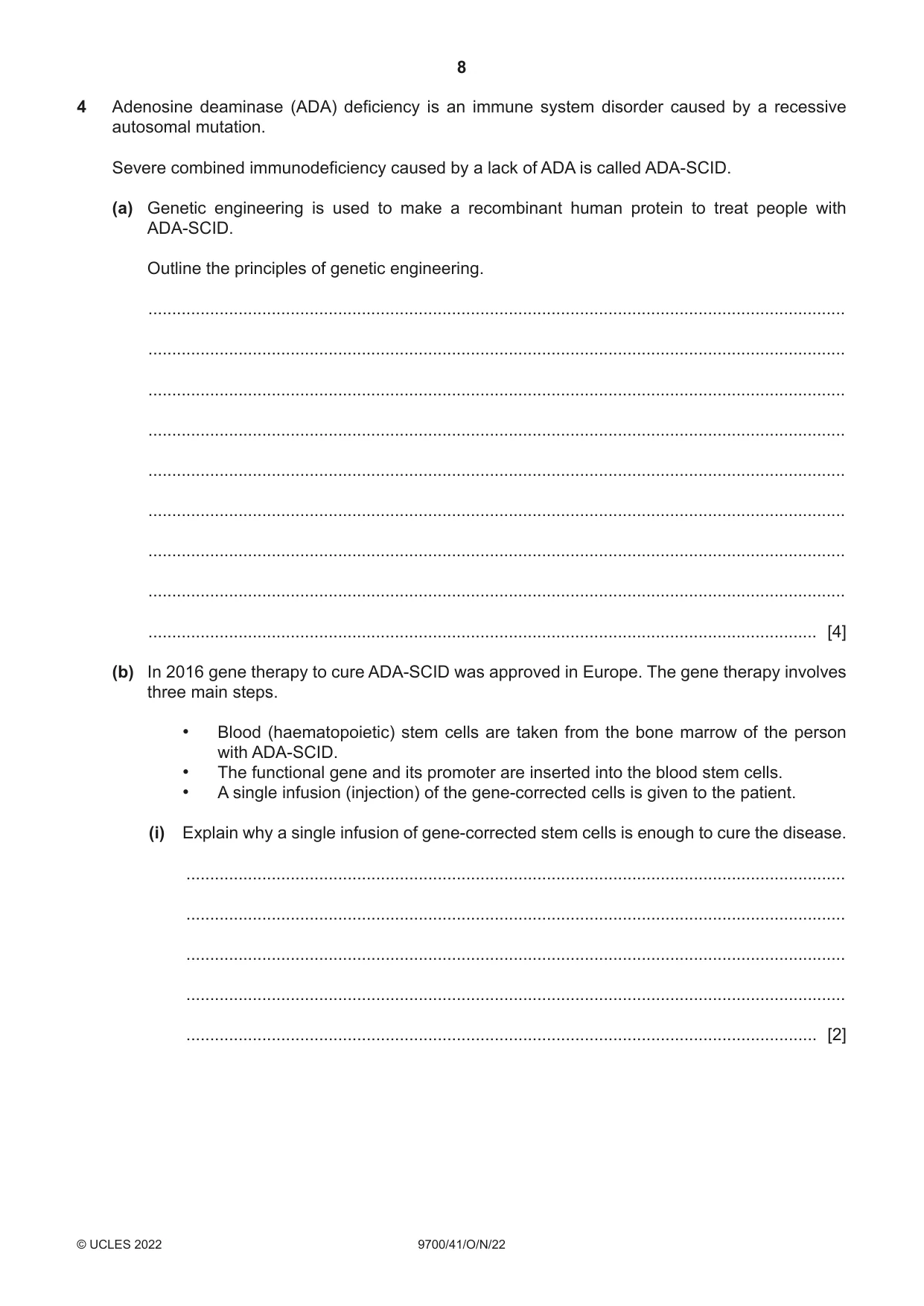
4 Adenosine deaminase (ADA) deficiency is an immune system disorder caused by a recessive autosomal mutation. Severe combined immunodeficiency caused by a lack of ADA is called ADA-SCID. (a) Genetic engineering is used to make a recombinant human protein to treat people with ADA-SCID. Outline the principles of genetic engineering. ................................................................................................................................................... ................................................................................................................................................... ................................................................................................................................................... ................................................................................................................................................... ................................................................................................................................................... ................................................................................................................................................... ................................................................................................................................................... ................................................................................................................................................... ............................................................................................................................................. [4] (b) In 2016 gene therapy to cure ADA-SCID was approved in Europe. The gene therapy involves three main steps. • Blood (haematopoietic) stem cells are taken from the bone marrow of the person with ADA-SCID. • The functional gene and its promoter are inserted into the blood stem cells. • A single infusion (injection) of the gene-corrected cells is given to the patient. (i) Explain why a single infusion of gene-corrected stem cells is enough to cure the disease. ........................................................................................................................................... ........................................................................................................................................... ........................................................................................................................................... ........................................................................................................................................... ..................................................................................................................................... [2] (ii) Explain why a promoter has to be transferred as well as the desired gene. ........................................................................................................................................... ........................................................................................................................................... ........................................................................................................................................... ........................................................................................................................................... ..................................................................................................................................... [2] (iii) A modified retrovirus is used to insert the new gene into the DNA of the blood stem cells. State two ethical considerations of using a retrovirus for gene therapy. ........................................................................................................................................... ........................................................................................................................................... ........................................................................................................................................... ........................................................................................................................................... ..................................................................................................................................... [2] (c) The gene therapy technique used to cure ADA-SCID is not suitable for treating the genetic disease called Huntington’s disease. A newer technique called gene editing could potentially be used instead to cure Huntington’s disease. Explain why gene editing is more suitable as a potential cure for Huntington’s disease. ................................................................................................................................................... ................................................................................................................................................... ................................................................................................................................................... ................................................................................................................................................... ................................................................................................................................................... ................................................................................................................................................... ............................................................................................................................................. [3] [Total: 13]
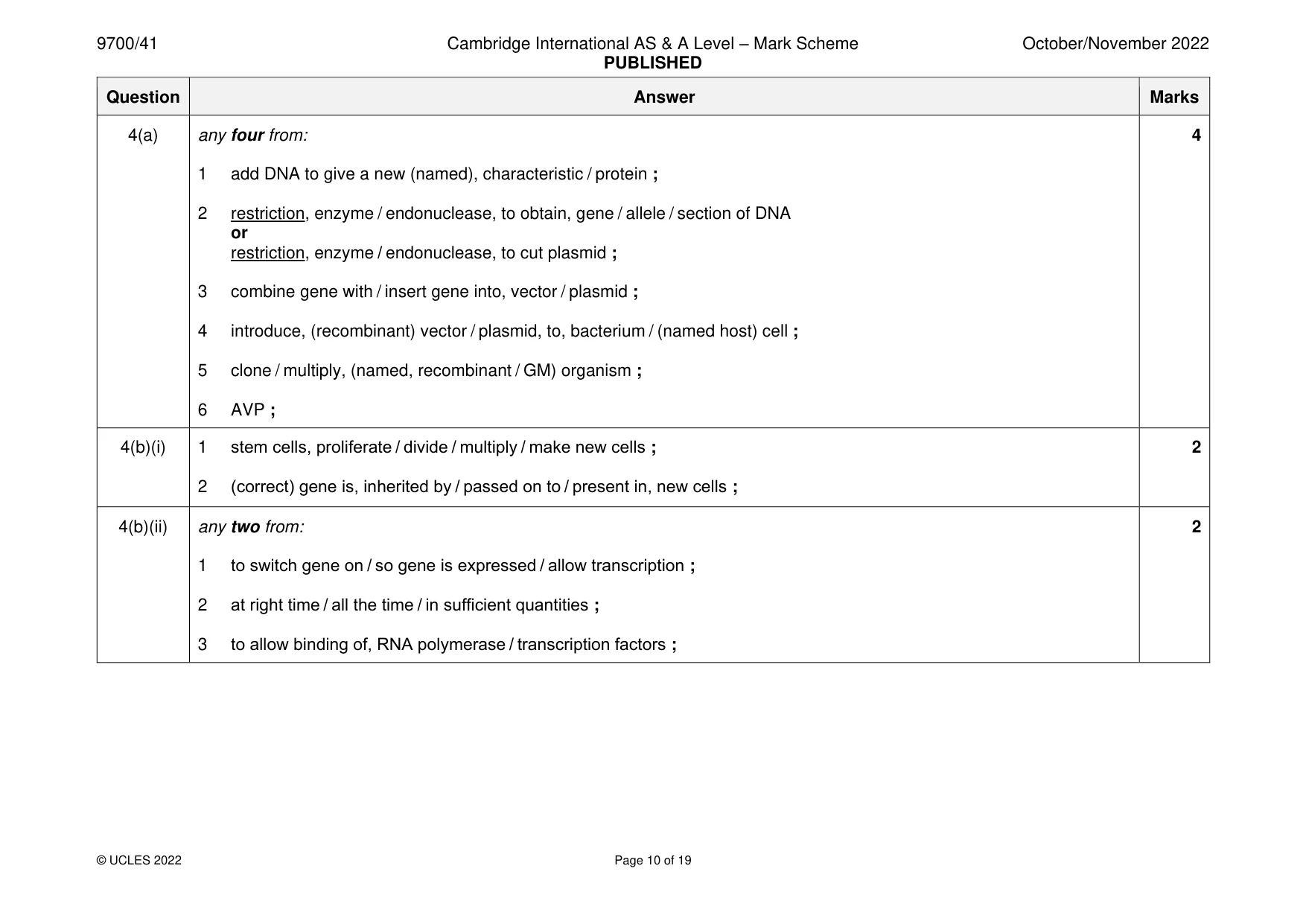
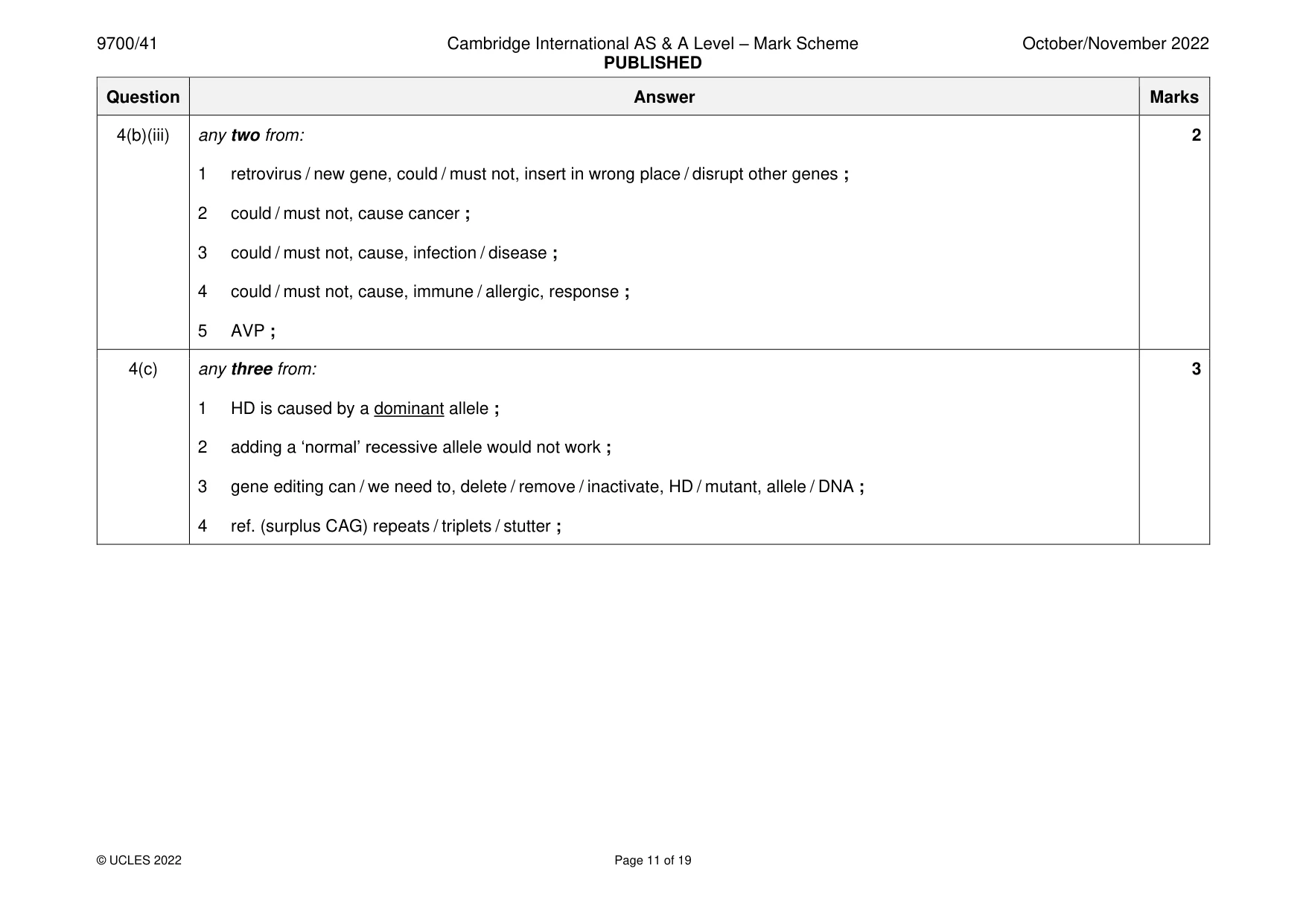
Mark scheme: 4(a) any four from: 4 1 add DNA to give a new (named), characteristic / protein ; 2 restriction, enzyme / endonuclease, to obtain, gene / allele / section of DNA or restriction, enzyme / endonuclease, to cut plasmid ; 3 combine gene with / insert gene into, vector / plasmid ; 4 introduce, (recombinant) vector / plasmid, to, bacterium / (named host) cell ; 5 clone / multiply, (named, recombinant / GM) organism ; 6 AVP ; 4(b)(i) 1 stem cells, proliferate / divide / multiply / make new cells ; 2 2 (correct) gene is, inherited by / passed on to / present in, new cells ; 4(b)(ii) any two from: 2 1 to switch gene on / so gene is expressed / allow transcription ; 2 at right time / all the time / in sufficient quantities ; 3 to allow binding of, RNA polymerase / transcription factors ; 4(b)(iii) any two from: 2 1 retrovirus / new gene, could / must not, insert in wrong place / disrupt other genes ; 2 could / must not, cause cancer ; 3 could / must not, cause, infection / disease ; 4 could / must not, cause, immune / allergic, response ; 5 AVP ; 4(c) any three from: 3 1 HD is caused by a dominant allele ; 2 adding a ‘normal’ recessive allele would not work ; 3 gene editing can / we need to, delete / remove / inactivate, HD / mutant, allele / DNA ; 4 ref. (surplus CAG) repeats / triplets / stutter ;
Q5 · A large number of alpine plant species grow in the mountains of New Zealand’s South Island
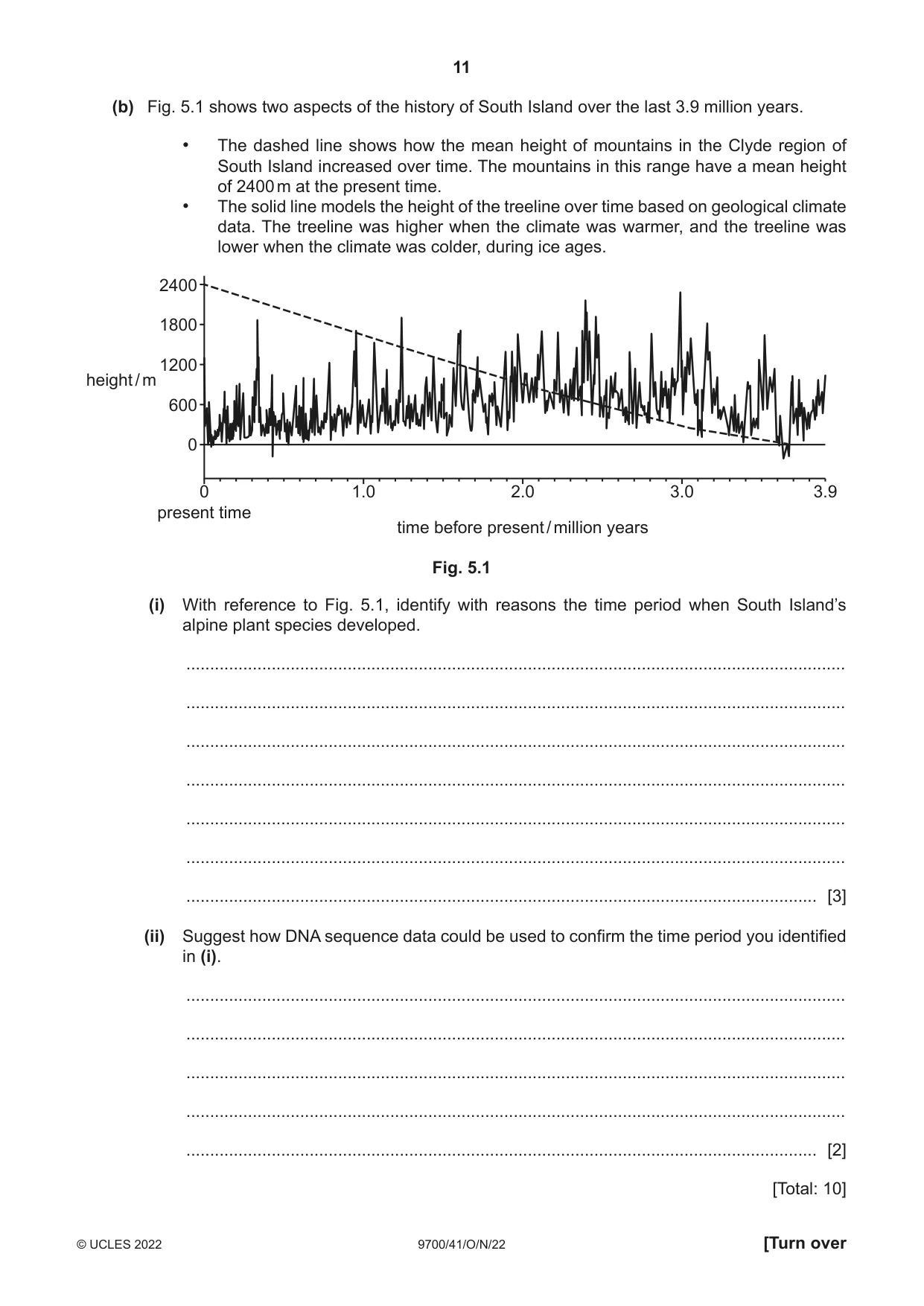
5 A large number of alpine plant species grow in the mountains of New Zealand’s South Island. Alpine plants are defined as plants that live above the treeline, which is the height above which trees cannot grow. The current treeline for most of South Island is 1200 m. (a) The alpine areas nearest to South Island are 1500–2000 km away across the sea. Many of South Island’s alpine species live nowhere else in the world. Explain how a large number of alpine plant species developed on South Island. ................................................................................................................................................... ................................................................................................................................................... ................................................................................................................................................... ................................................................................................................................................... ................................................................................................................................................... ................................................................................................................................................... ................................................................................................................................................... ................................................................................................................................................... ................................................................................................................................................... ................................................................................................................................................... ............................................................................................................................................. [5] (b) Fig. 5.1 shows two aspects of the history of South Island over the last 3.9 million years. • The dashed line shows how the mean height of mountains in the Clyde region of South Island increased over time. The mountains in this range have a mean height of 2400 m at the present time. • The solid line models the height of the treeline over time based on geological climate data. The treeline was higher when the climate was warmer, and the treeline was lower when the climate was colder, during ice ages. 2400 1800 1200 height / m 600 0 0 1.0 2.0 3.0 3.9 present time time before present / million years Fig. 5.1 (i) With reference to Fig. 5.1, identify with reasons the time period when South Island’s alpine plant species developed. ........................................................................................................................................... ........................................................................................................................................... ........................................................................................................................................... ........................................................................................................................................... ........................................................................................................................................... ........................................................................................................................................... ..................................................................................................................................... [3] (ii) Suggest how DNA sequence data could be used to confirm the time period you identified in (i). ........................................................................................................................................... ........................................................................................................................................... ........................................................................................................................................... ........................................................................................................................................... ..................................................................................................................................... [2] [Total: 10]
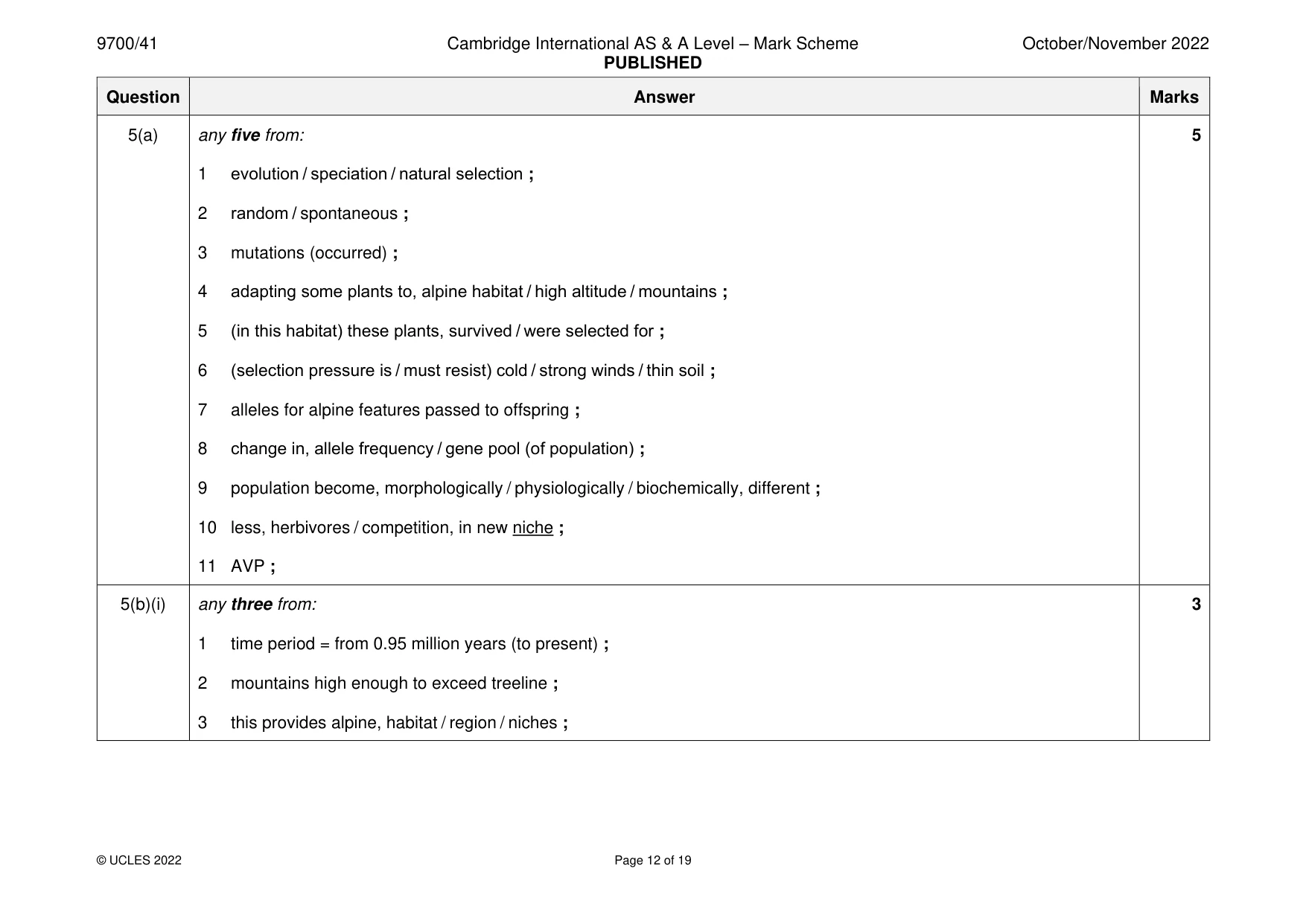
Mark scheme: 5(a) any five from: 5 1 evolution / speciation / natural selection ; 2 random / spontaneous ; 3 mutations (occurred) ; 4 adapting some plants to, alpine habitat / high altitude / mountains ; 5 (in this habitat) these plants, survived / were selected for ; 6 (selection pressure is / must resist) cold / strong winds / thin soil ; 7 alleles for alpine features passed to offspring ; 8 change in, allele frequency / gene pool (of population) ; 9 population become, morphologically / physiologically / biochemically, different ; 10 less, herbivores / competition, in new niche ; 11 AVP ; 5(b)(i) any three from: 3 1 time period = from 0.95 million years (to present) ; 2 mountains high enough to exceed treeline ; 3 this provides alpine, habitat / region / niches ; 5(b)(ii) any two from: 2 1 compare / find similarities in / find differences in, DNA ; 2 of alpine species and related (lowland) species ; 3 find (time) when species, evolved / separated / diverged / speciated ; 4 many, DNA / base / nucleotide, differences / changes / mutations, means they, separated a long time ago / have a distant common ancestor ; 5 AVP ;
Q6 · Selective breeding has been used to improve the characteristics of crop plants, including…
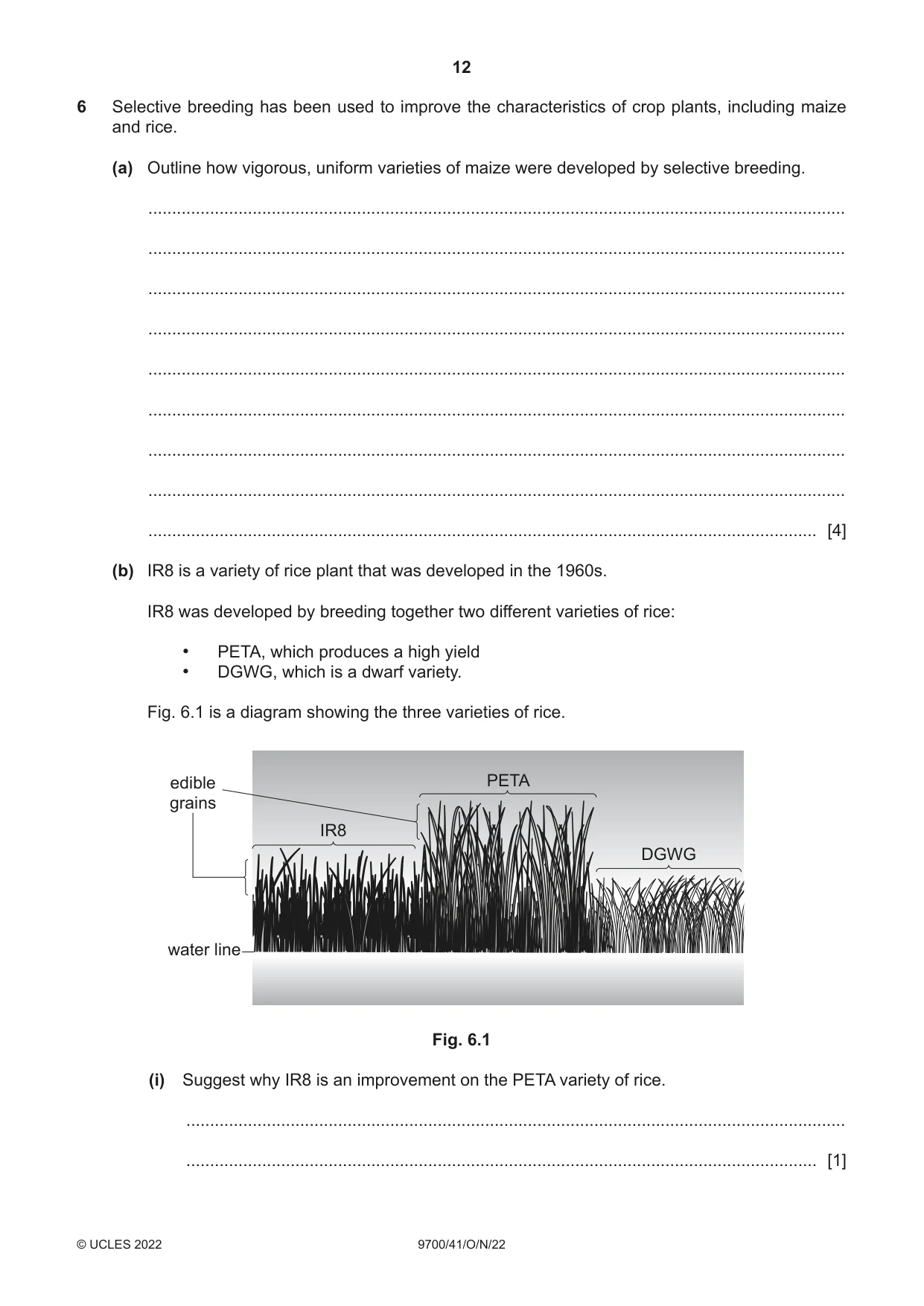
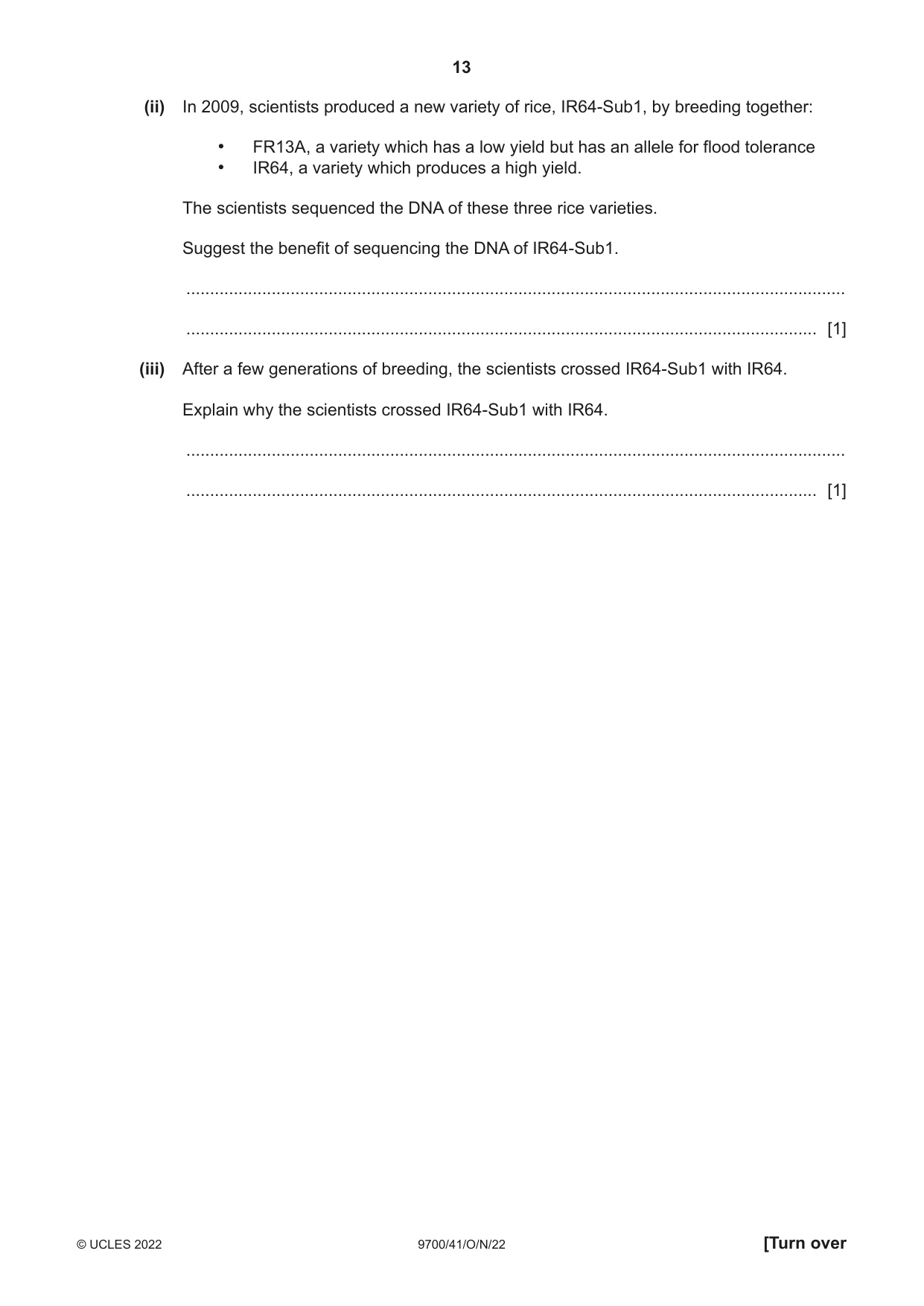
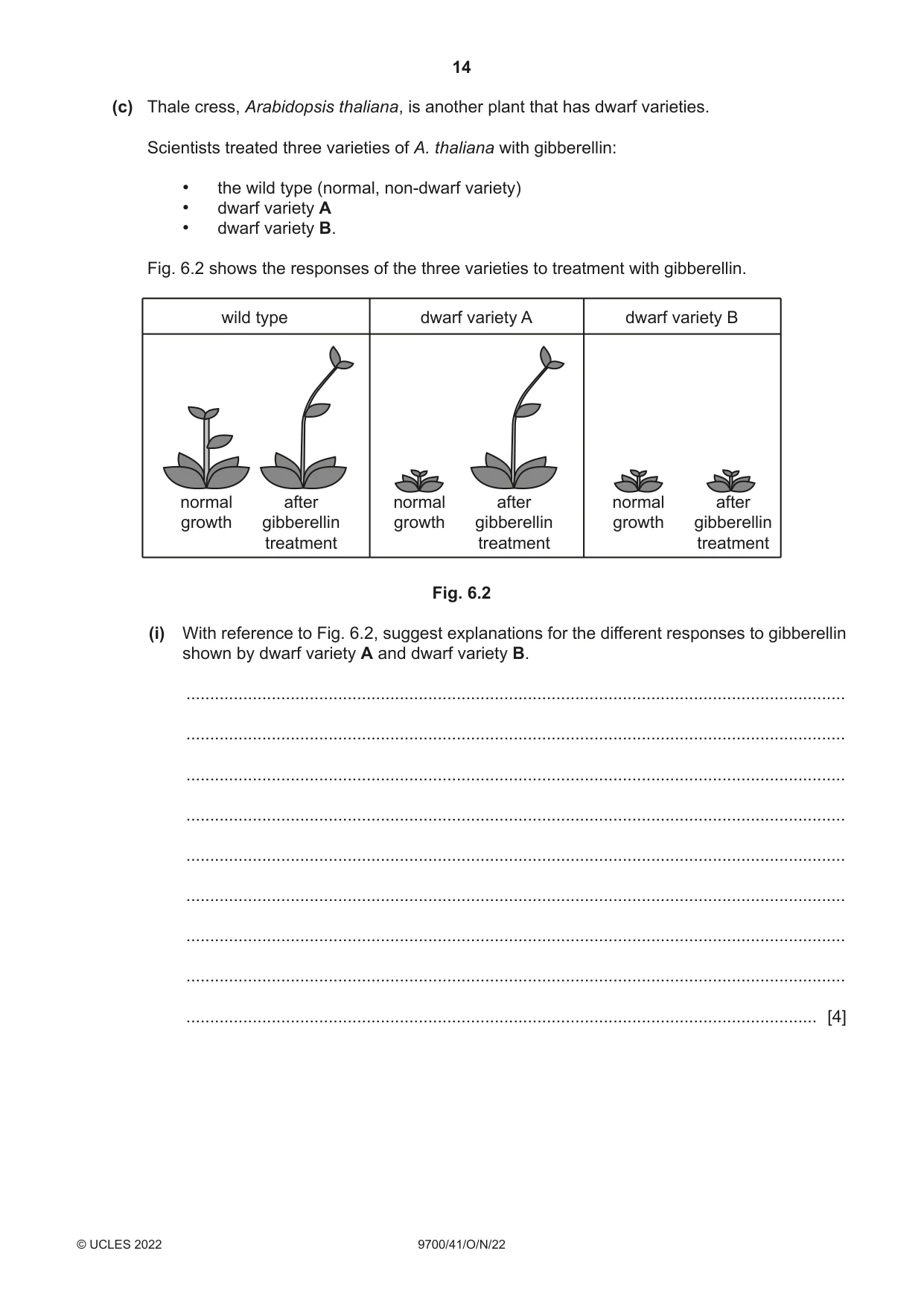
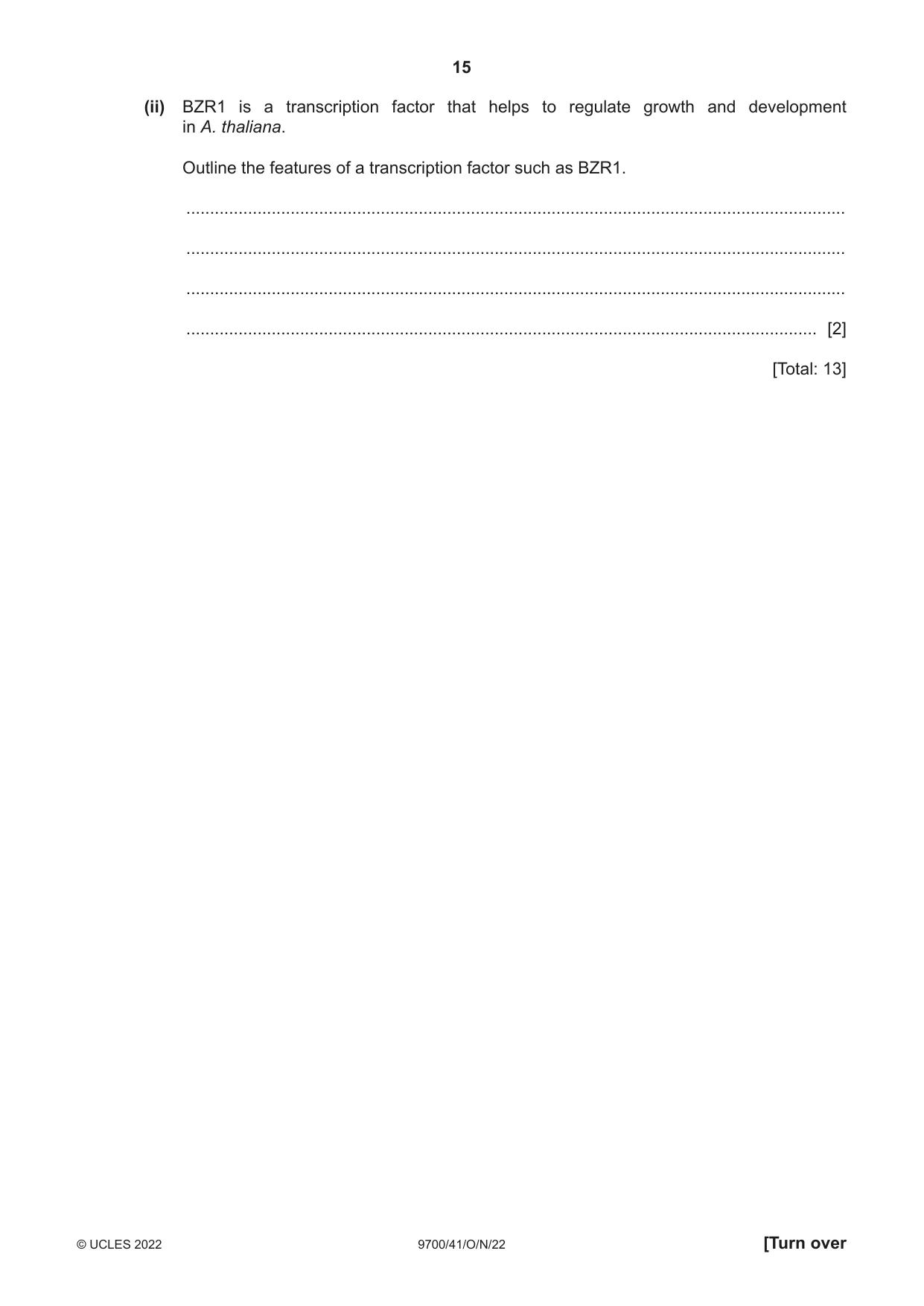
6 Selective breeding has been used to improve the characteristics of crop plants, including maize and rice. (a) Outline how vigorous, uniform varieties of maize were developed by selective breeding. ................................................................................................................................................... ................................................................................................................................................... ................................................................................................................................................... ................................................................................................................................................... ................................................................................................................................................... ................................................................................................................................................... ................................................................................................................................................... ................................................................................................................................................... ............................................................................................................................................. [4] (b) IR8 is a variety of rice plant that was developed in the 1960s. IR8 was developed by breeding together two different varieties of rice: • PETA, which produces a high yield • DGWG, which is a dwarf variety. Fig. 6.1 is a diagram showing the three varieties of rice. edible PETA grains IR8 DGWG water line Fig. 6.1 (i) Suggest why IR8 is an improvement on the PETA variety of rice. ........................................................................................................................................... ..................................................................................................................................... [1] (ii) In 2009, scientists produced a new variety of rice, IR64-Sub1, by breeding together: • FR13A, a variety which has a low yield but has an allele for flood tolerance • IR64, a variety which produces a high yield. The scientists sequenced the DNA of these three rice varieties. Suggest the benefit of sequencing the DNA of IR64-Sub1. ........................................................................................................................................... ..................................................................................................................................... [1] (iii) After a few generations of breeding, the scientists crossed IR64-Sub1 with IR64. Explain why the scientists crossed IR64-Sub1 with IR64. ........................................................................................................................................... ..................................................................................................................................... [1] (c) Thale cress, Arabidopsis thaliana, is another plant that has dwarf varieties. Scientists treated three varieties of A. thaliana with gibberellin: • the wild type (normal, non-dwarf variety) • dwarf variety A • dwarf variety B. Fig. 6.2 shows the responses of the three varieties to treatment with gibberellin. wild type dwarf variety A dwarf variety B normal after normal after normal after growth gibberellin growth gibberellin growth gibberellin treatment treatment treatment Fig. 6.2 (i) With reference to Fig. 6.2, suggest explanations for the different responses to gibberellin shown by dwarf variety A and dwarf variety B. ........................................................................................................................................... ........................................................................................................................................... ........................................................................................................................................... ........................................................................................................................................... ........................................................................................................................................... ........................................................................................................................................... ........................................................................................................................................... ........................................................................................................................................... ..................................................................................................................................... [4] (ii) BZR1 is a transcription factor that helps to regulate growth and development in A. thaliana. Outline the features of a transcription factor such as BZR1. ........................................................................................................................................... ........................................................................................................................................... ........................................................................................................................................... ..................................................................................................................................... [2] [Total: 13]
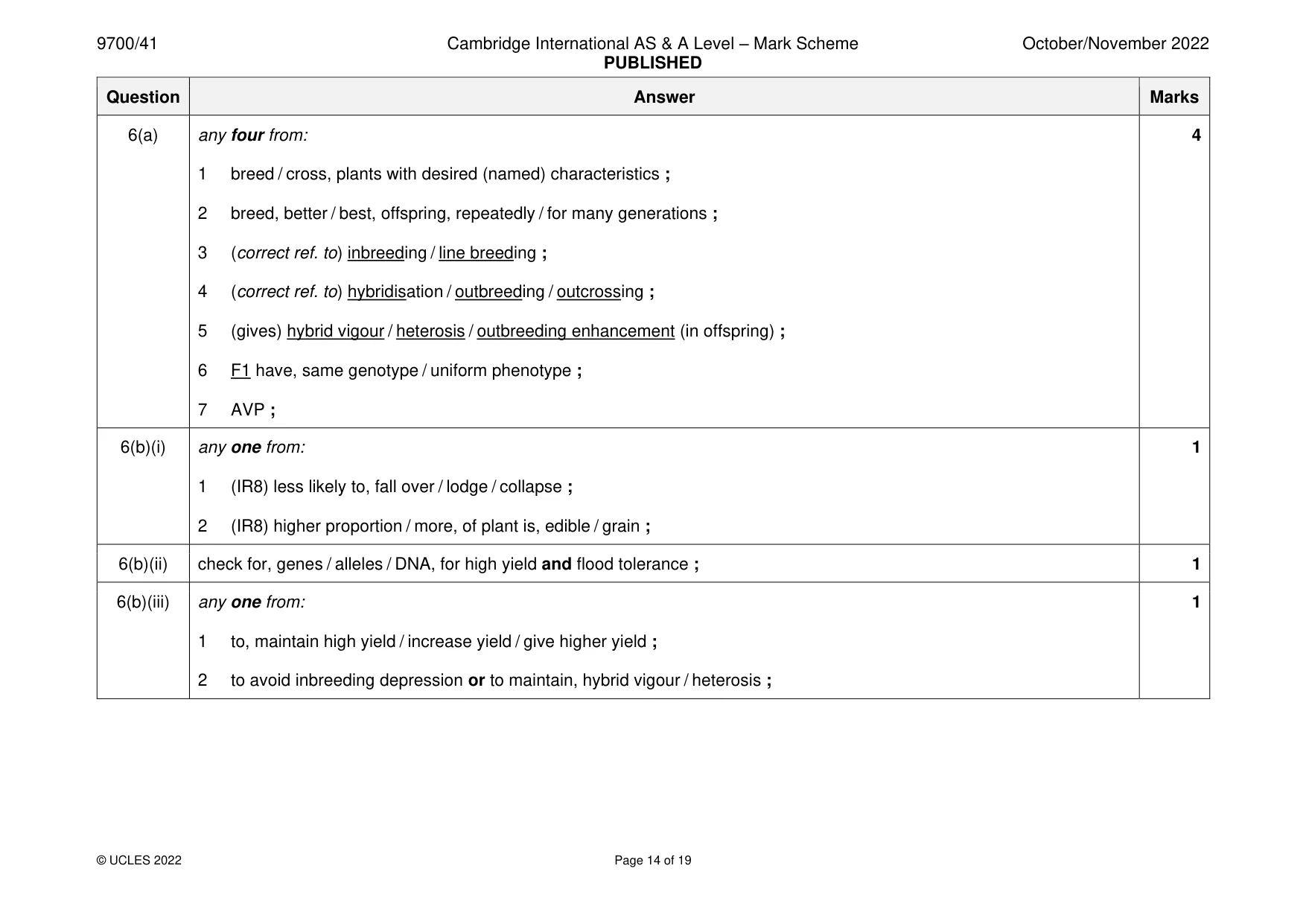
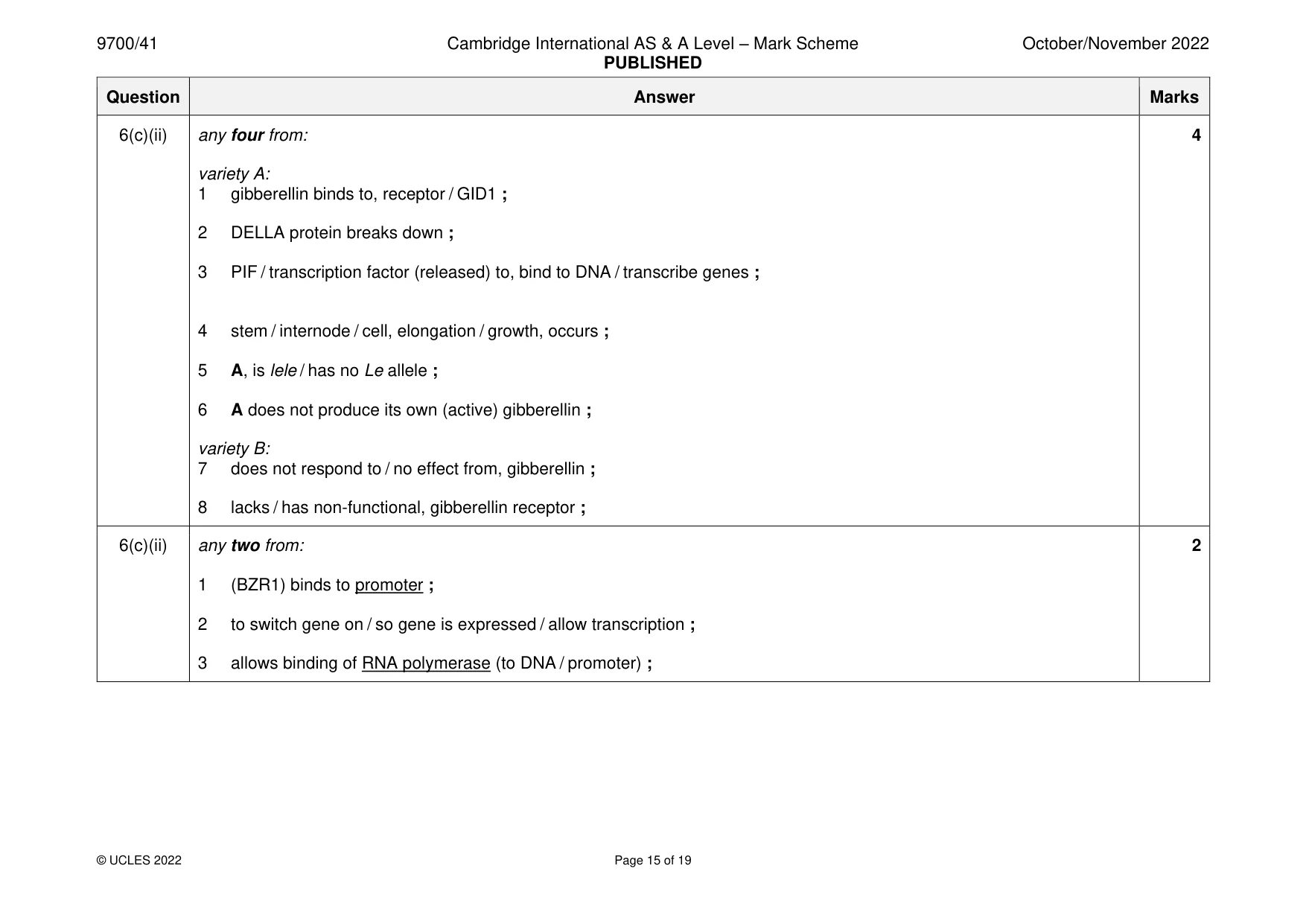
Mark scheme: 6(a) any four from: 4 1 breed / cross, plants with desired (named) characteristics ; 2 breed, better / best, offspring, repeatedly / for many generations ; 3 (correct ref. to) inbreeding / line breeding ; 4 (correct ref. to) hybridisation / outbreeding / outcrossing ; 5 (gives) hybrid vigour / heterosis / outbreeding enhancement (in offspring) ; 6 F1 have, same genotype / uniform phenotype ; 7 AVP ; 6(b)(i) any one from: 1 1 (IR8) less likely to, fall over / lodge / collapse ; 2 (IR8) higher proportion / more, of plant is, edible / grain ; 6(b)(ii) check for, genes / alleles / DNA, for high yield and flood tolerance ; 1 6(b)(iii) any one from: 1 1 to, maintain high yield / increase yield / give higher yield ; 2 to avoid inbreeding depression or to maintain, hybrid vigour / heterosis ; 6(c)(ii) any four from: 4 variety A: 1 gibberellin binds to, receptor / GID1 ; 2 DELLA protein breaks down ; 3 PIF / transcription factor (released) to, bind to DNA / transcribe genes ; 4 stem / internode / cell, elongation / growth, occurs ; 5 A, is lele / has no Le allele ; 6 A does not produce its own (active) gibberellin ; variety B: 7 does not respond to / no effect from, gibberellin ; 8 lacks / has non-functional, gibberellin receptor ; 6(c)(ii) any two from: 2 1 (BZR1) binds to promoter ; 2 to switch gene on / so gene is expressed / allow transcription ; 3 allows binding of RNA polymerase (to DNA / promoter) ;
Q7 · In some varieties of domestic cats the gene for fur colour is located on the X chromosome
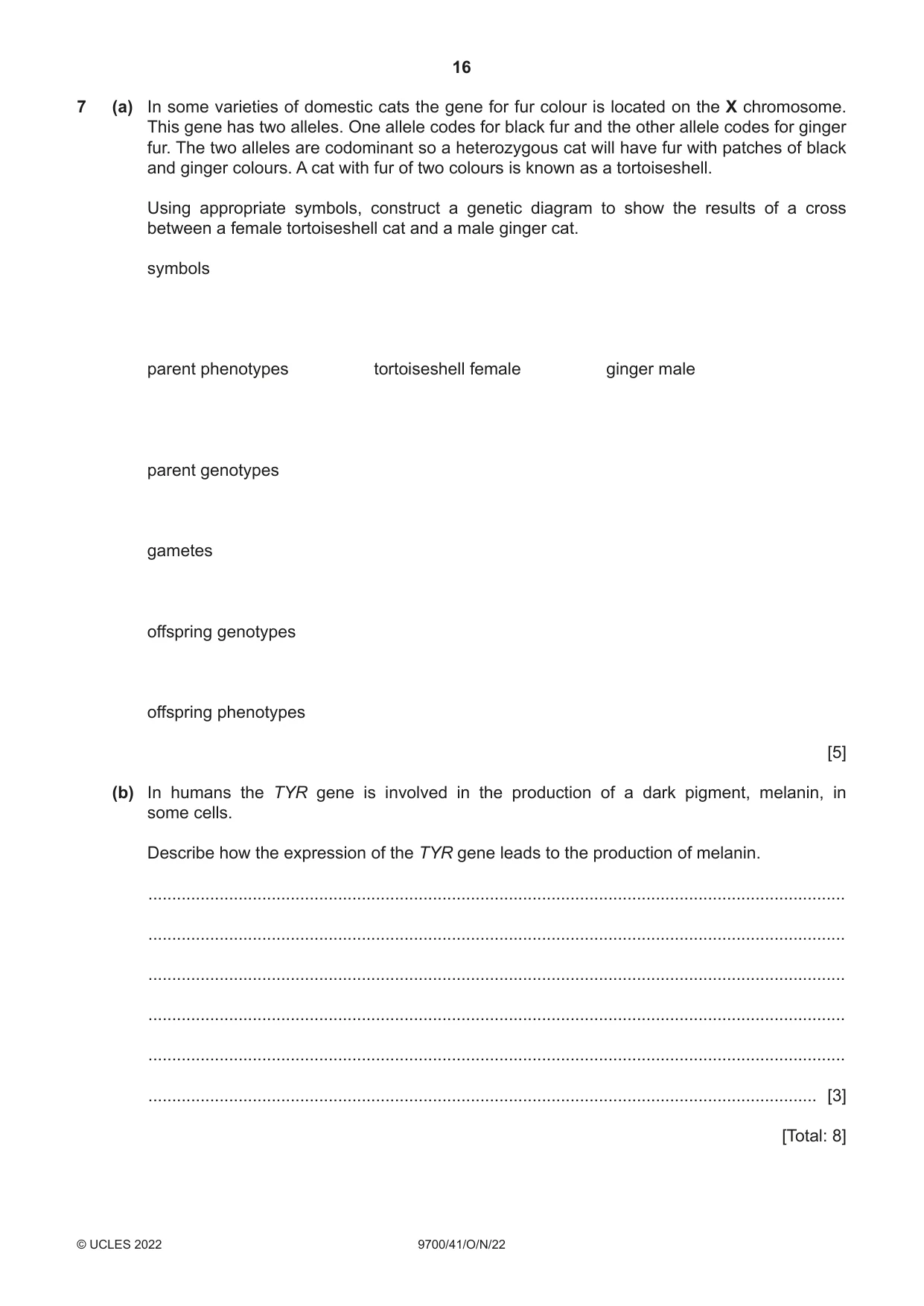
7 (a) In some varieties of domestic cats the gene for fur colour is located on the X chromosome. This gene has two alleles. One allele codes for black fur and the other allele codes for ginger fur. The two alleles are codominant so a heterozygous cat will have fur with patches of black and ginger colours. A cat with fur of two colours is known as a tortoiseshell. Using appropriate symbols, construct a genetic diagram to show the results of a cross between a female tortoiseshell cat and a male ginger cat. symbols parent phenotypes tortoiseshell female ginger male parent genotypes gametes offspring genotypes offspring phenotypes [5] (b) In humans the TYR gene is involved in the production of a dark pigment, melanin, in some cells. Describe how the expression of the TYR gene leads to the production of melanin. ................................................................................................................................................... ................................................................................................................................................... ................................................................................................................................................... ................................................................................................................................................... ................................................................................................................................................... ............................................................................................................................................. [3] [Total: 8]
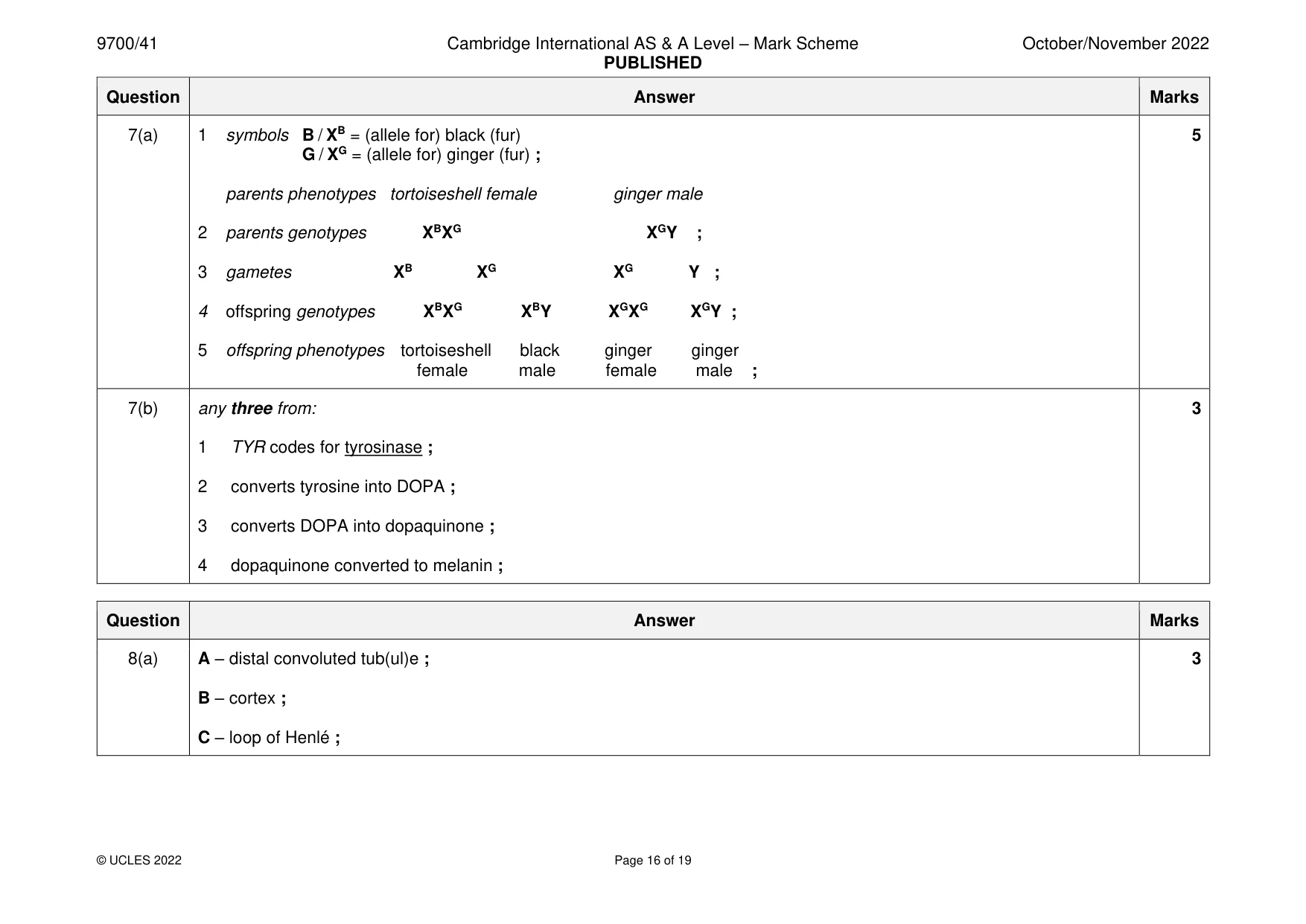
Mark scheme: 7(a) 1 symbols B / XB = (allele for) black (fur) 5 G / XG = (allele for) ginger (fur) ; parents phenotypes tortoiseshell female ginger male 2 parents genotypes XBXG XGY ; 3 gametes XB XG XG Y ; 4 offspring genotypes XBXG XBY XGXG XGY ; 5 offspring phenotypes tortoiseshell black ginger ginger female male female male ; 7(b) any three from: 3 1 TYR codes for tyrosinase ; 2 converts tyrosine into DOPA ; 3 converts DOPA into dopaquinone ; 4 dopaquinone converted to melanin ;
More questions on Passage of information from parents to offspring
Q8 · A diagram of a kidney nephron
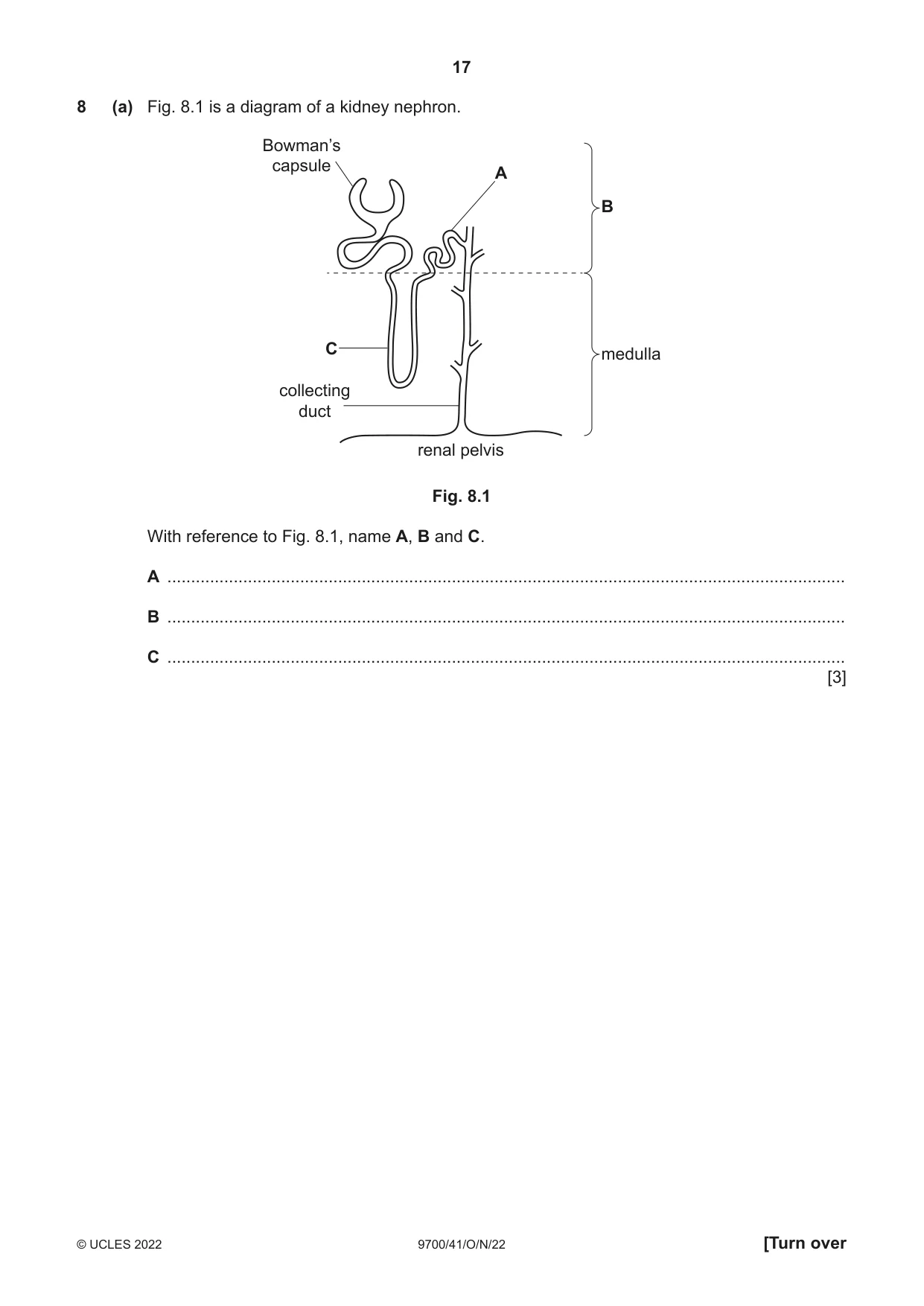
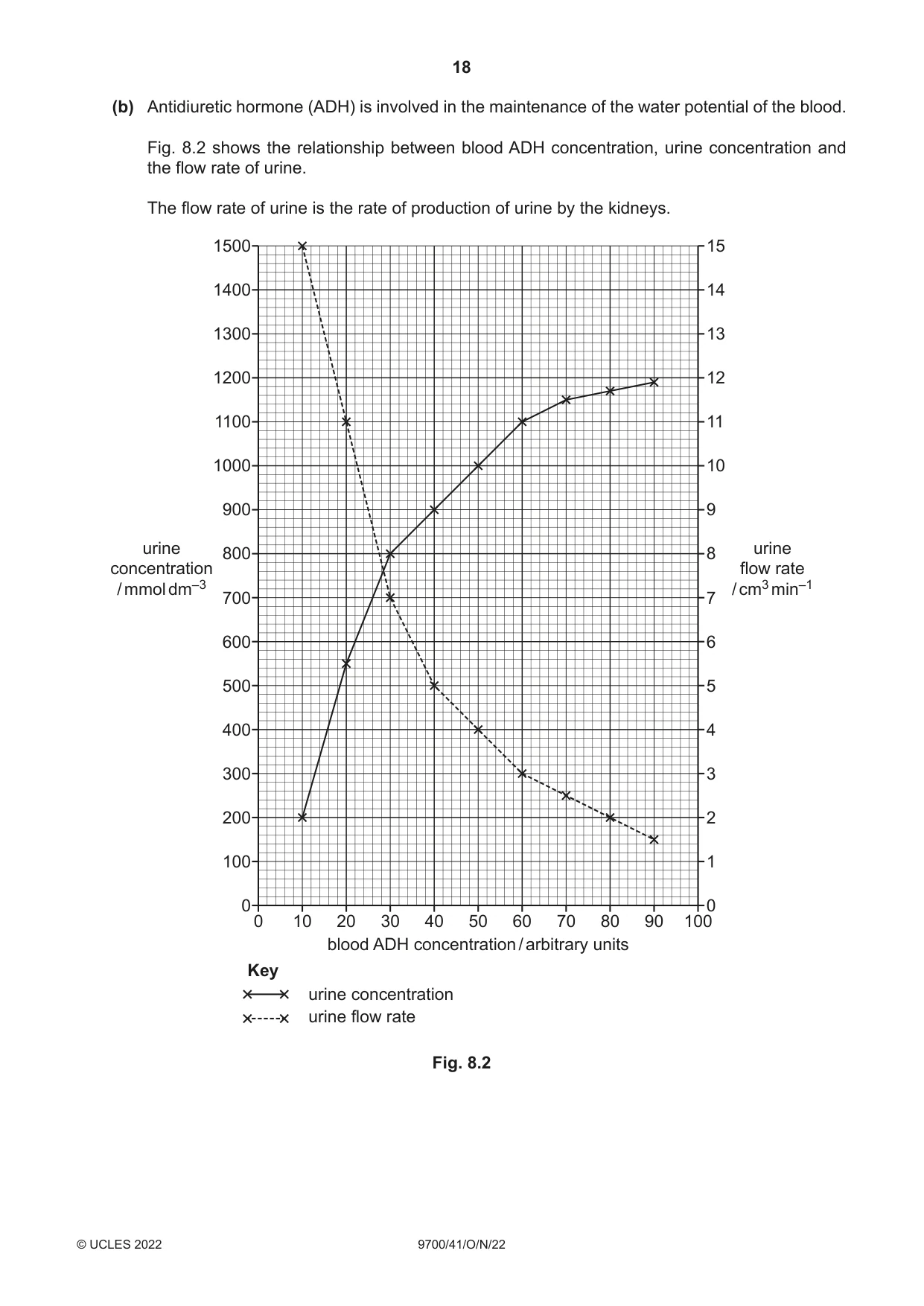
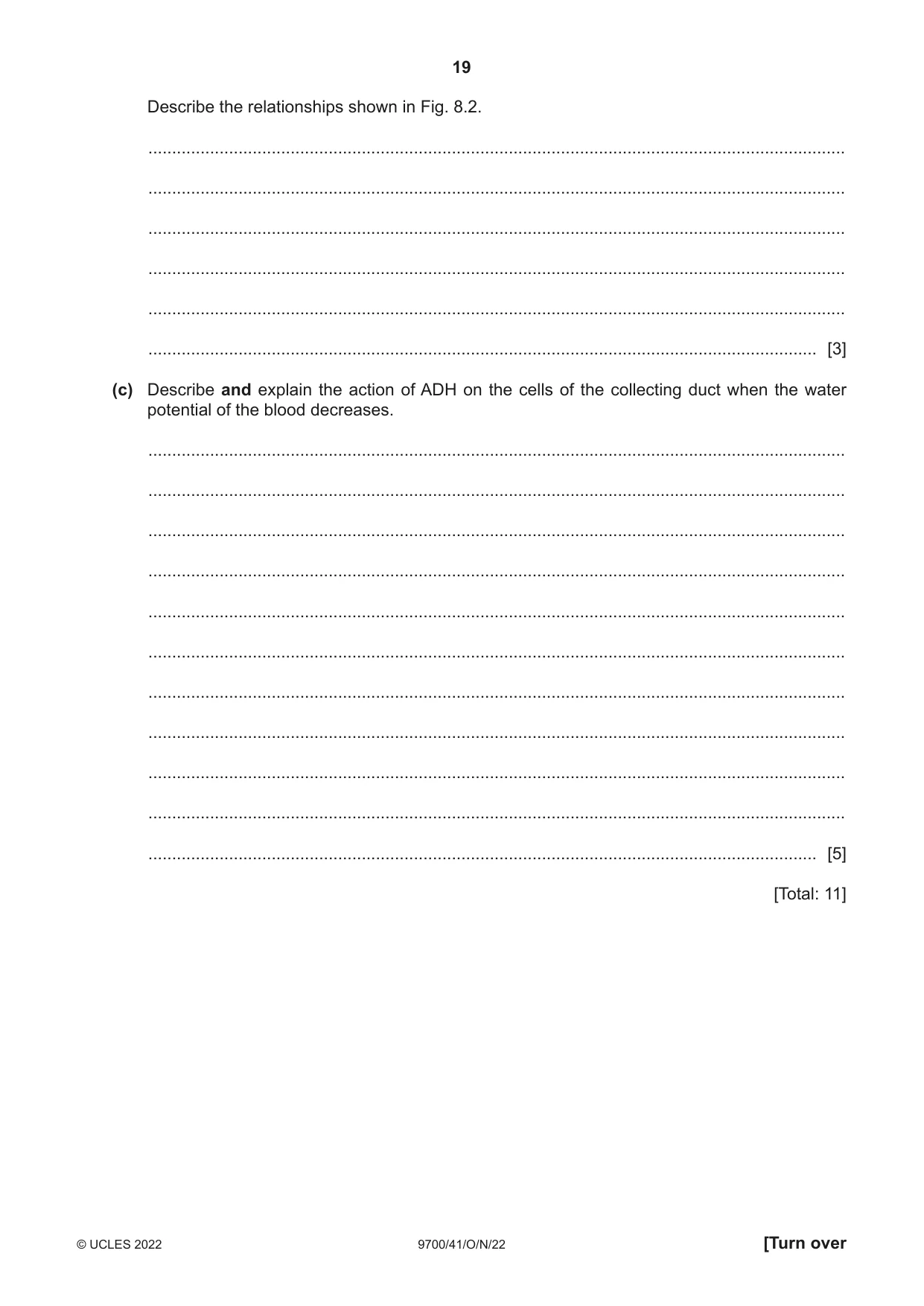
8 (a) Fig. 8.1 is a diagram of a kidney nephron. Bowman’s capsule A B C medulla collecting duct renal pelvis Fig. 8.1 With reference to Fig. 8.1, name A, B and C. A ............................................................................................................................................... B ............................................................................................................................................... C ............................................................................................................................................... [3] (b) Antidiuretic hormone (ADH) is involved in the maintenance of the water potential of the blood. Fig. 8.2 shows the relationship between blood ADH concentration, urine concentration and the flow rate of urine. The flow rate of urine is the rate of production of urine by the kidneys. 1500 15 1400 14 1300 13 1200 12 1100 11 1000 10 900 9 urine urine 800 8 concentration flow rate / mmol dm–3 / cm3 min–1 700 7 600 6 500 5 400 4 300 3 200 2 100 1 0 0 0 10 20 30 40 50 60 70 80 90 100 blood ADH concentration / arbitrary units Key urine concentration urine flow rate Fig. 8.2 Describe the relationships shown in Fig. 8.2. ................................................................................................................................................... ................................................................................................................................................... ................................................................................................................................................... ................................................................................................................................................... ................................................................................................................................................... ............................................................................................................................................. [3] (c) Describe and explain the action of ADH on the cells of the collecting duct when the water potential of the blood decreases. ................................................................................................................................................... ................................................................................................................................................... ................................................................................................................................................... ................................................................................................................................................... ................................................................................................................................................... ................................................................................................................................................... ................................................................................................................................................... ................................................................................................................................................... ................................................................................................................................................... ................................................................................................................................................... ............................................................................................................................................. [5] [Total: 11]
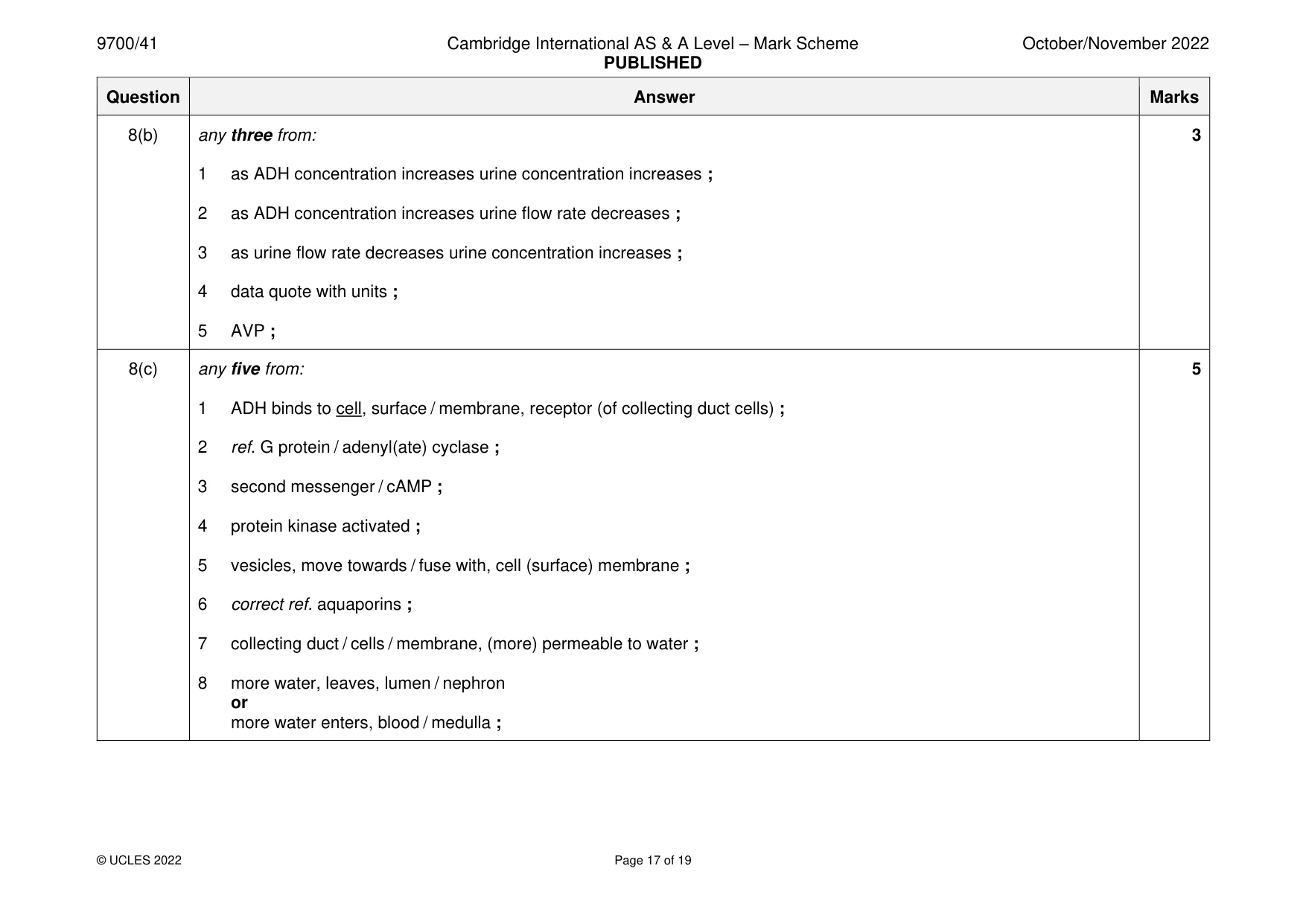
Mark scheme: 8(a) A – distal convoluted tub(ul)e ; 3 B – cortex ; C – loop of Henlé ; 8(b) any three from: 3 1 as ADH concentration increases urine concentration increases ; 2 as ADH concentration increases urine flow rate decreases ; 3 as urine flow rate decreases urine concentration increases ; 4 data quote with units ; 5 AVP ; 8(c) any five from: 5 1 ADH binds to cell, surface / membrane, receptor (of collecting duct cells) ; 2 ref. G protein / adenyl(ate) cyclase ; 3 second messenger / cAMP ; 4 protein kinase activated ; 5 vesicles, move towards / fuse with, cell (surface) membrane ; 6 correct ref. aquaporins ; 7 collecting duct / cells / membrane, (more) permeable to water ; 8 more water, leaves, lumen / nephron or more water enters, blood / medulla ;
Q9 · A neuromuscular junction allows the transmission of an action potential from a motor…
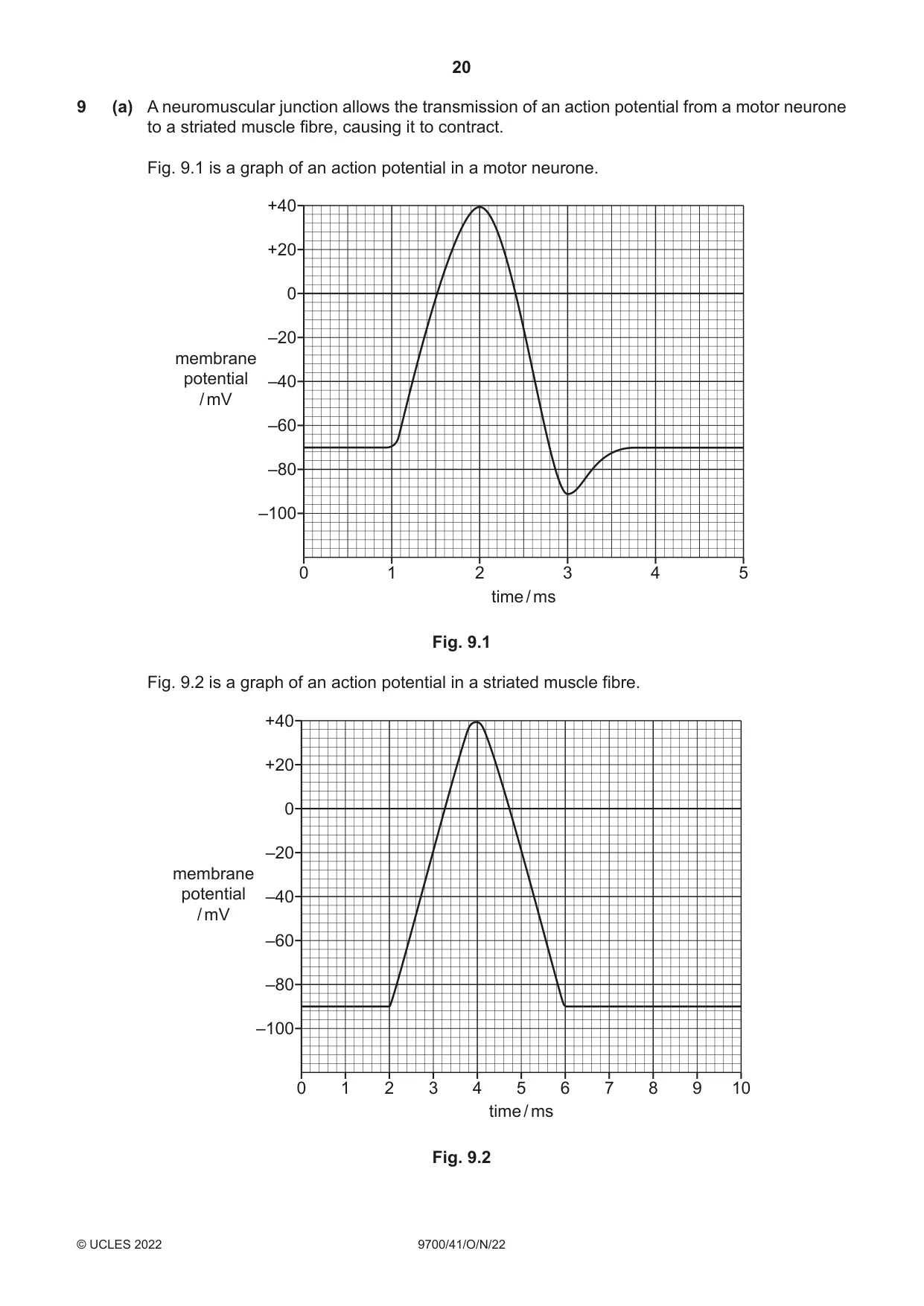
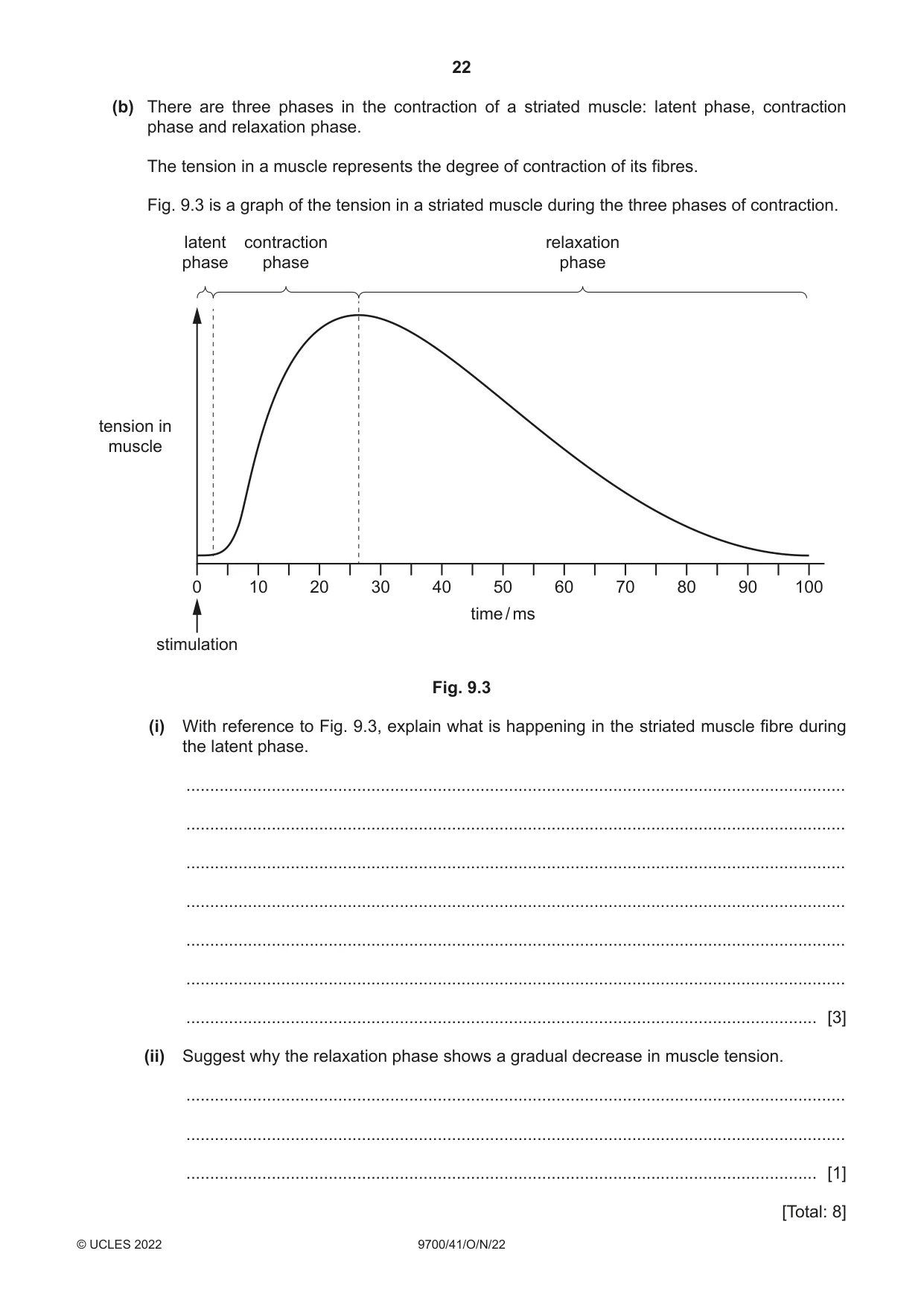
9 (a) A neuromuscular junction allows the transmission of an action potential from a motor neurone to a striated muscle fibre, causing it to contract. Fig. 9.1 is a graph of an action potential in a motor neurone. +40 +20 0 –20 membrane potential –40 / mV –60 –80 –100 0 1 2 3 4 5 time / ms Fig. 9.1 Fig. 9.2 is a graph of an action potential in a striated muscle fibre. +40 +20 0 –20 membrane potential –40 / mV –60 –80 –100 0 1 2 3 4 5 6 7 8 9 10 time / ms Fig. 9.2 With reference to Fig. 9.1 and Fig. 9.2, describe the differences between the action potential in a motor neurone and the action potential in a striated muscle fibre. ................................................................................................................................................... ................................................................................................................................................... ................................................................................................................................................... ................................................................................................................................................... ................................................................................................................................................... ................................................................................................................................................... ................................................................................................................................................... ................................................................................................................................................... ................................................................................................................................................... ............................................................................................................................................. [4] (b) There are three phases in the contraction of a striated muscle: latent phase, contraction phase and relaxation phase. The tension in a muscle represents the degree of contraction of its fibres. Fig. 9.3 is a graph of the tension in a striated muscle during the three phases of contraction. latent contraction relaxation phase phase phase tension in muscle 0 10 20 30 40 50 60 70 80 90 100 time / ms stimulation Fig. 9.3 (i) With reference to Fig. 9.3, explain what is happening in the striated muscle fibre during the latent phase. ........................................................................................................................................... ........................................................................................................................................... ........................................................................................................................................... ........................................................................................................................................... ........................................................................................................................................... ........................................................................................................................................... ..................................................................................................................................... [3] (ii) Suggest why the relaxation phase shows a gradual decrease in muscle tension. ........................................................................................................................................... ........................................................................................................................................... ..................................................................................................................................... [1] [Total: 8]
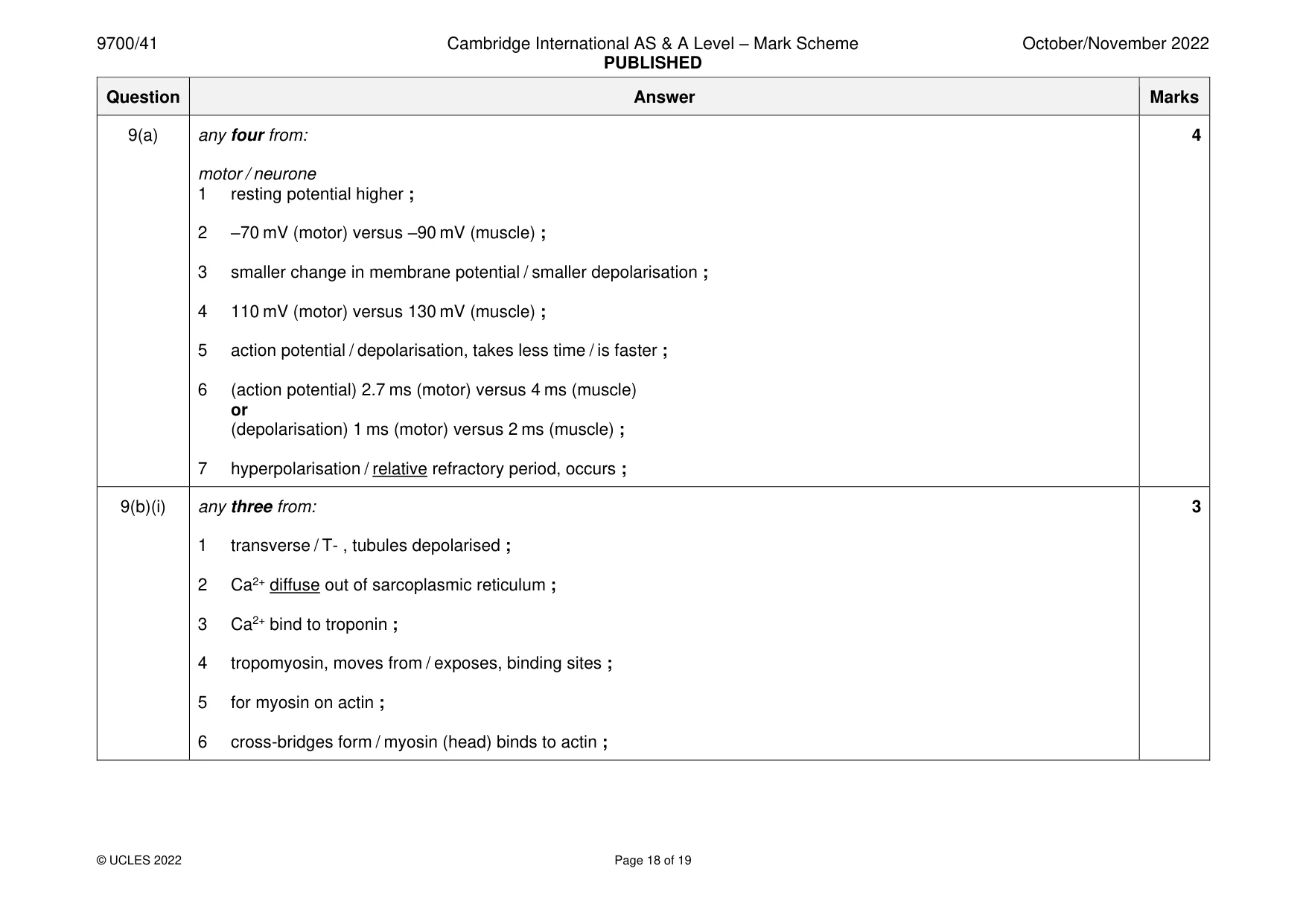
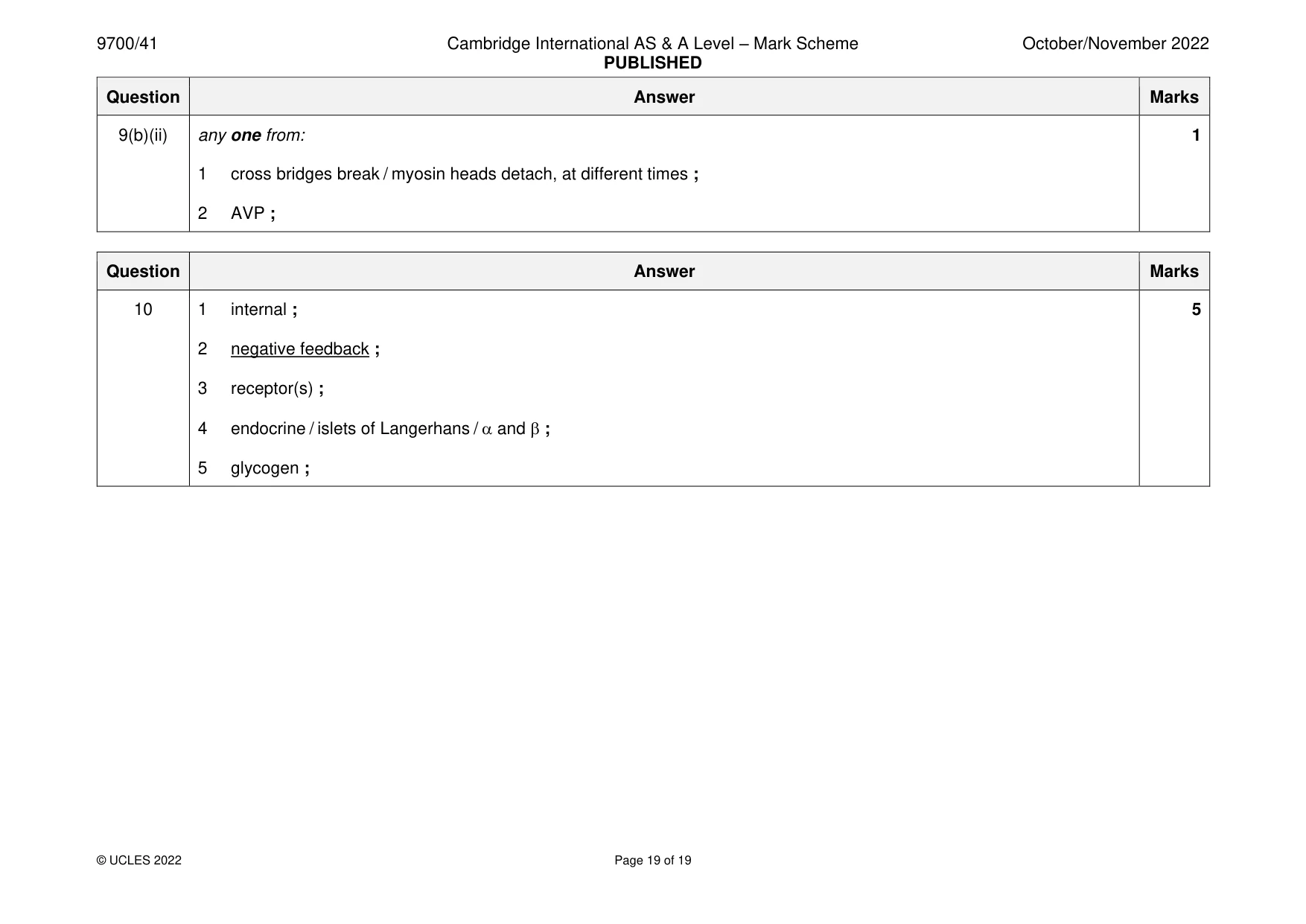
Mark scheme: 9(a) any four from: 4 motor / neurone 1 resting potential higher ; 2 –70 mV (motor) versus –90 mV (muscle) ; 3 smaller change in membrane potential / smaller depolarisation ; 4 110 mV (motor) versus 130 mV (muscle) ; 5 action potential / depolarisation, takes less time / is faster ; 6 (action potential) 2.7 ms (motor) versus 4 ms (muscle) or (depolarisation) 1 ms (motor) versus 2 ms (muscle) ; 7 hyperpolarisation / relative refractory period, occurs ; 9(b)(i) any three from: 3 1 transverse / T- , tubules depolarised ; 2 Ca2+ diffuse out of sarcoplasmic reticulum ; 3 Ca2+ bind to troponin ; 4 tropomyosin, moves from / exposes, binding sites ; 5 for myosin on actin ; 6 cross-bridges form / myosin (head) binds to actin ; 9(b)(ii) any one from: 1 1 cross bridges break / myosin heads detach, at different times ; 2 AVP ;
Q10 · The passage below outlines homeostasis
10 The passage below outlines homeostasis. Complete the passage by using the most appropriate scientific terms. Homeostasis, in mammals, is the process of keeping the ........................................... environment of the body in optimum conditions so that cells can function efficiently. Blood water potential, core temperature and blood glucose concentration are all factors that need to be kept at optimum values or set-point. When a condition deviates from its set-point, a corrective mechanism is triggered. An increase in blood glucose concentration triggers processes to decrease it and vice versa. This corrective mechanism is called ........................................... . The pancreas is involved in the control of blood glucose concentration. Glucose binds to ........................................... on the cell surface membrane of pancreatic cells. These are ........................................... cells, which secrete hormones such as insulin and glucagon. The two hormones have opposite effects on the blood glucose concentration. For example the action of one hormone stimulates the uptake of glucose by cells for respiration and the action of the other hormone stimulates the breakdown of ........................................... to glucose in the liver. [Total: 5]
Mark scheme: Question Answer Marks 10 1 internal ; 5 2 negative feedback ; 3 receptor(s) ; 4 endocrine / islets of Langerhans / and ; 5 glycogen ;
What was in this paper
The subtopics covered by these 10 questions, and how many questions each got. Open one in a new tab to see every Cambridge question on it.
What you needed in this session
Cambridge’s own grade thresholds for 2022 Oct/Nov, Paper 4 · Variant 1. A higher threshold means an easier paper — the bar moves with how the cohort did.