Cambridge A Level Biology 9700 — 2022 May/June Paper 4 · Variant 1
9700/41/M/J/22 · 10 questions · 100 marks · ≈113 min
The question paper and its mark scheme, free to read here and free to download. This is Cambridge’s own paper, exactly as it was sat.
Question paper24 pages


Mark scheme19 pages
Answers below. Sit the paper first if you are practising.
Questions as text
Q1 · The golden mantella, Mantella aurantiaca, is a small terrestrial frog found in Madagascar
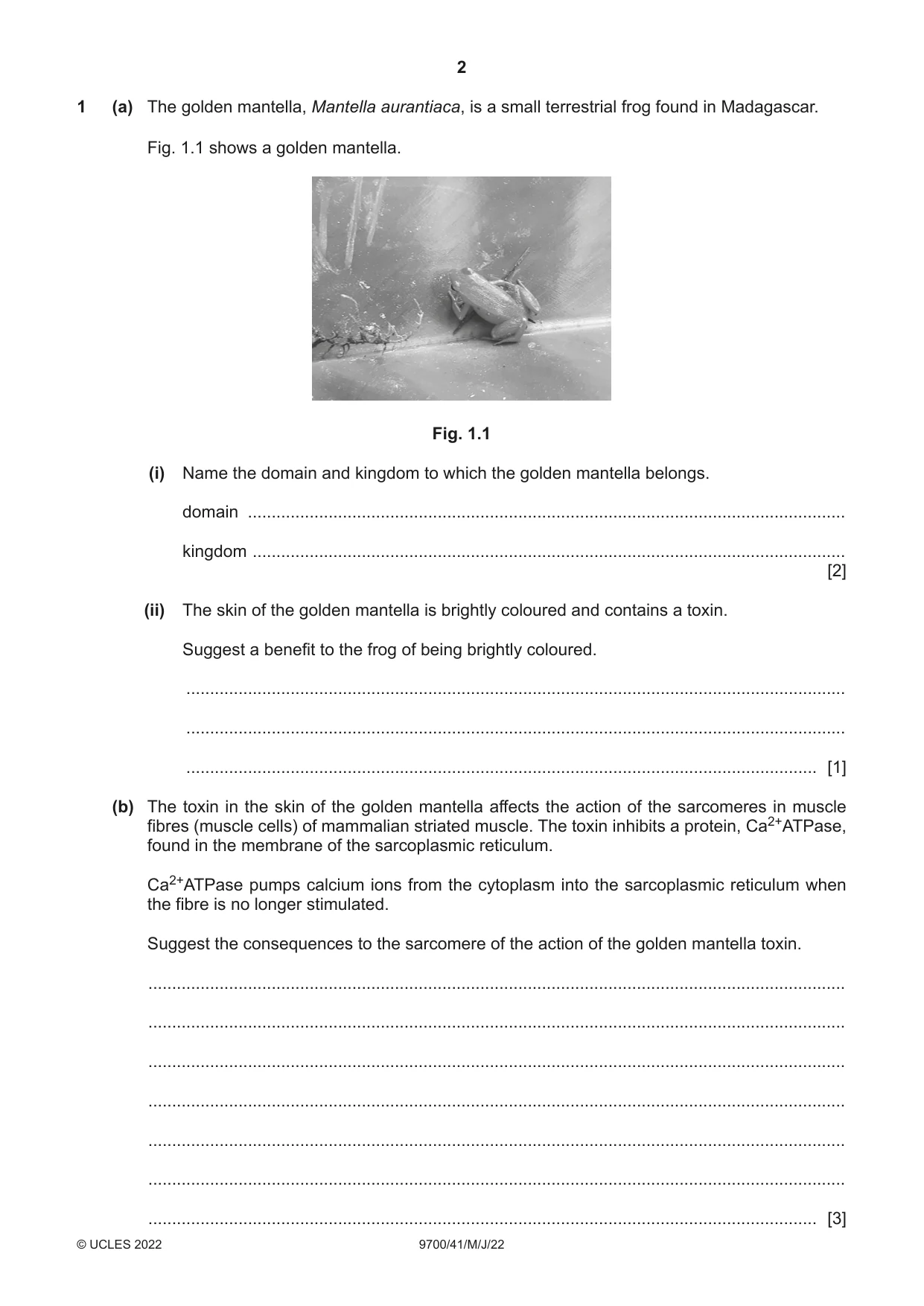
1 (a) The golden mantella, Mantella aurantiaca, is a small terrestrial frog found in Madagascar. Fig. 1.1 shows a golden mantella. Fig. 1.1 (i) Name the domain and kingdom to which the golden mantella belongs. domain .............................................................................................................................. kingdom ............................................................................................................................. [2] (ii) The skin of the golden mantella is brightly coloured and contains a toxin. Suggest a benefit to the frog of being brightly coloured. ........................................................................................................................................... ........................................................................................................................................... ..................................................................................................................................... [1] (b) The toxin in the skin of the golden mantella affects the action of the sarcomeres in muscle fibres (muscle cells) of mammalian striated muscle. The toxin inhibits a protein, Ca2+ATPase, found in the membrane of the sarcoplasmic reticulum. Ca2+ATPase pumps calcium ions from the cytoplasm into the sarcoplasmic reticulum when the fibre is no longer stimulated. Suggest the consequences to the sarcomere of the action of the golden mantella toxin. ................................................................................................................................................... ................................................................................................................................................... ................................................................................................................................................... ................................................................................................................................................... ................................................................................................................................................... ................................................................................................................................................... ............................................................................................................................................. [3] (c) Describe the role of calcium ions in a cholinergic synapse. ................................................................................................................................................... ................................................................................................................................................... ................................................................................................................................................... ................................................................................................................................................... ................................................................................................................................................... ................................................................................................................................................... ............................................................................................................................................. [3] [Total: 9]
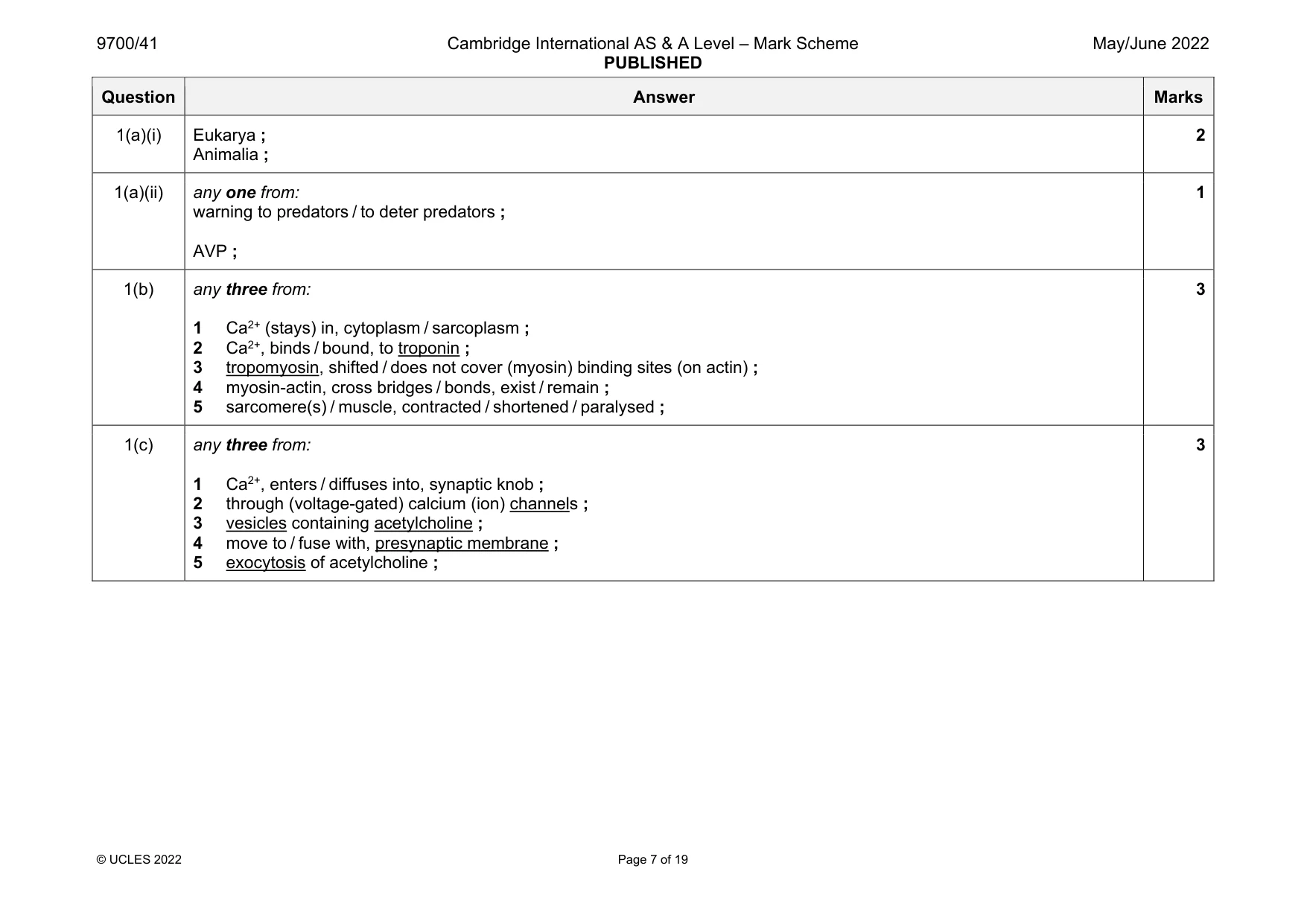
Mark scheme: 1(a)(i) Eukarya ; Animalia ; 2 1(a)(ii) any one from: warning to predators / to deter predators ; AVP ; 1 1(b) any three from: 1 Ca2+ (stays) in, cytoplasm / sarcoplasm ; 2 Ca2+, binds / bound, to troponin ; 3 tropomyosin, shifted / does not cover (myosin) binding sites (on actin) ; 4 myosin-actin, cross bridges / bonds, exist / remain ; 5 sarcomere(s) / muscle, contracted / shortened / paralysed ; 3 1(c) any three from: 1 Ca2+, enters / diffuses into, synaptic knob ; 2 through (voltage-gated) calcium (ion) channels ; 3 vesicles containing acetylcholine ; 4 move to / fuse with, presynaptic membrane ; 5 exocytosis of acetylcholine ; 3
Q2 · In eukaryotes, the cells of plants and photosynthetic protoctists contain chloroplasts
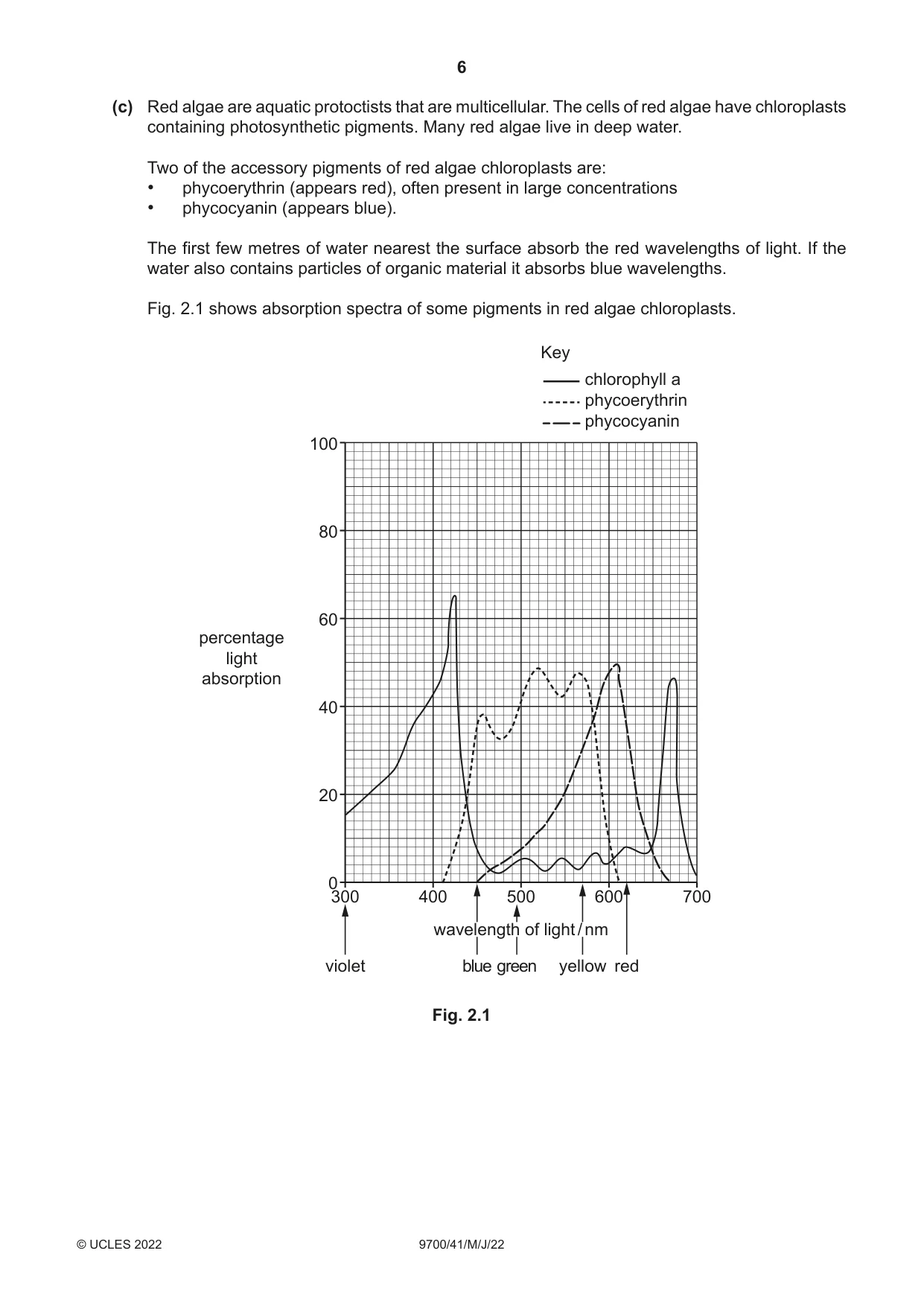
2 (a) In eukaryotes, the cells of plants and photosynthetic protoctists contain chloroplasts. Describe the relationship between the function of a chloroplast and its structure. ................................................................................................................................................... ................................................................................................................................................... ................................................................................................................................................... ................................................................................................................................................... ................................................................................................................................................... ................................................................................................................................................... ................................................................................................................................................... ................................................................................................................................................... ................................................................................................................................................... ................................................................................................................................................... ............................................................................................................................................. [4] (b) Outline the main features of cyclic photophosphorylation. ................................................................................................................................................... ................................................................................................................................................... ................................................................................................................................................... ................................................................................................................................................... ................................................................................................................................................... ................................................................................................................................................... ................................................................................................................................................... ............................................................................................................................................. [3] (c) Red algae are aquatic protoctists that are multicellular. The cells of red algae have chloroplasts containing photosynthetic pigments. Many red algae live in deep water. Two of the accessory pigments of red algae chloroplasts are: • phycoerythrin (appears red), often present in large concentrations • phycocyanin (appears blue). The first few metres of water nearest the surface absorb the red wavelengths of light. If the water also contains particles of organic material it absorbs blue wavelengths. Fig. 2.1 shows absorption spectra of some pigments in red algae chloroplasts. Key chlorophyll a phycoerythrin phycocyanin 100 80 60 percentage light absorption 40 20 0 300 400 500 600 700 wavelength of light / nm violet blue green yellow red Fig. 2.1 Describe the differences in the absorption spectra of the three photosynthetic pigments shown in Fig. 2.1 and explain how these differences help red algae to survive in deep water. ................................................................................................................................................... ................................................................................................................................................... ................................................................................................................................................... ................................................................................................................................................... ................................................................................................................................................... ................................................................................................................................................... ................................................................................................................................................... ................................................................................................................................................... ................................................................................................................................................... ................................................................................................................................................... ................................................................................................................................................... ................................................................................................................................................... ................................................................................................................................................... ................................................................................................................................................... ................................................................................................................................................... ............................................................................................................................................. [7] [Total: 14]
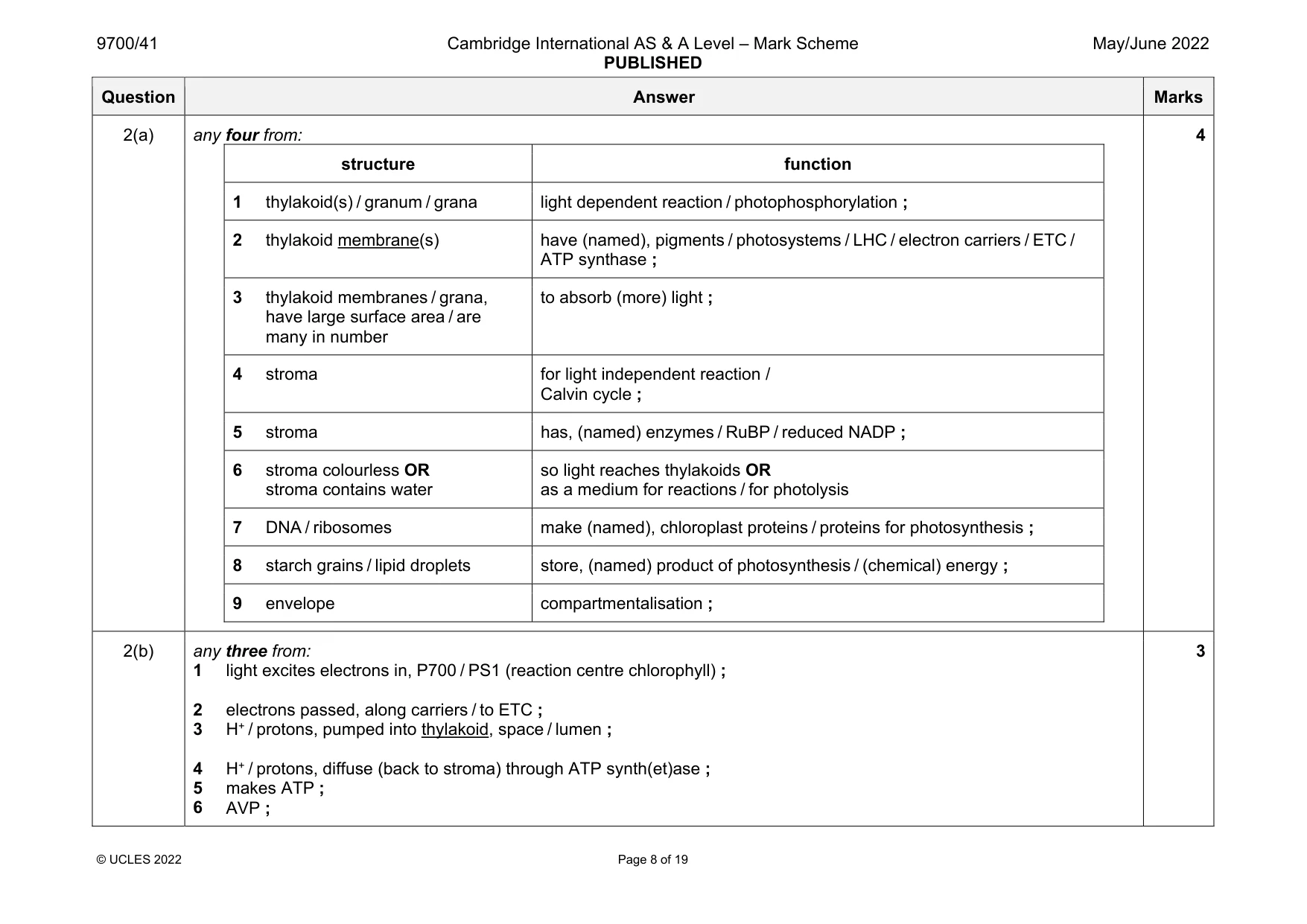
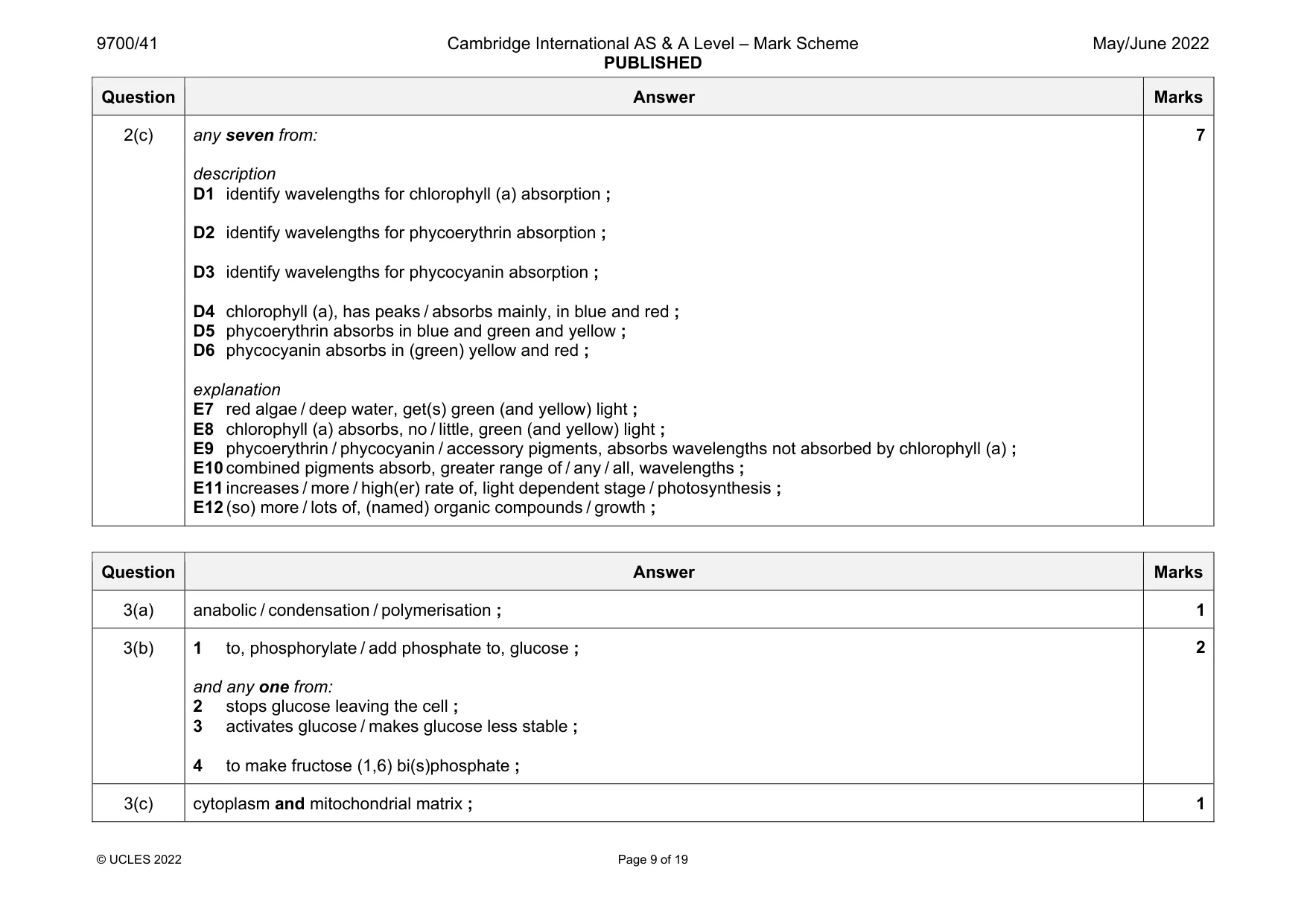
Mark scheme: 2(a) any four from: structure function 1 thylakoid(s) / granum / grana light dependent reaction / photophosphorylation ; 2 thylakoid membrane(s) have (named), pigments / photosystems / LHC / electron carriers / ETC / ATP synthase ; 3 thylakoid membranes / grana, have large surface area / are many in number to absorb (more) light ; 4 stroma for light independent reaction / Calvin cycle ; 5 stroma has, (named) enzymes / RuBP / reduced NADP ; 6 stroma colourless OR stroma contains water so light reaches thylakoids OR as a medium for reactions / for photolysis 7 DNA / ribosomes make (named), chloroplast proteins / proteins for photosynthesis ; 8 starch grains / lipid droplets store, (named) product of photosynthesis / (chemical) energy ; 9 envelope compartmentalisation ; 4 2(b) any three from: 1 light excites electrons in, P700 / PS1 (reaction centre chlorophyll) ; 2 electrons passed, along carriers / to ETC ; 3 H+ / protons, pumped into thylakoid, space / lumen ; 4 H+ / protons, diffuse (back to stroma) through ATP synth(et)ase ; 5 makes ATP ; 6 AVP ; 3 Question Answer Marks 2(c) any seven from: description D1 identify wavelengths for chlorophyll (a) absorption ; D2 identify wavelengths for phycoerythrin absorption ; D3 identify wavelengths for phycocyanin absorption ; D4 chlorophyll (a), has peaks / absorbs mainly, in blue and red ; D5 phycoerythrin absorbs in blue and green and yellow ; D6 phycocyanin absorbs in (green) yellow and red ; explanation E7 red algae / deep water, get(s) green (and yellow) light ; E8 chlorophyll (a) absorbs, no / little, green (and yellow) light ; E9 phycoerythrin / phycocyanin / accessory pigments, absorbs wavelengths not absorbed by chlorophyll (a) ; E10 combined pigments absorb, greater range of / any / all, wavelengths ; E11 increases / more / high(er) rate of, light dependent stage / photosynthesis ; E12 (so) more / lots of, (named) organic compounds / growth ; 7
More questions on Photosynthesis as an energy transfer process
Q3 · Respiration is a process that results in the synthesis of ATP
3 Respiration is a process that results in the synthesis of ATP. The ATP can be used within the cell for energy-requiring reactions and processes. There are four stages in aerobic respiration: glycolysis, the link reaction, the Krebs cycle and oxidative phosphorylation. (a) The ATP synthesised in respiration can be used to make larger and more complex biological molecules from smaller molecules. Name the type of reaction that occurs when larger more complex biological molecules are made from smaller molecules. ............................................................................................................................................. [1] (b) The first part of glycolysis uses ATP. Explain why ATP is needed in the first part of glycolysis. ................................................................................................................................................... ................................................................................................................................................... ................................................................................................................................................... ................................................................................................................................................... ............................................................................................................................................. [2] (c) State the precise locations of substrate-linked phosphorylation reactions in aerobic respiration. ................................................................................................................................................... ............................................................................................................................................. [1] (d) Explain what happens to pyruvate in the link reaction in aerobic respiration. ................................................................................................................................................... ................................................................................................................................................... ................................................................................................................................................... ................................................................................................................................................... ............................................................................................................................................. [2] (e) Chemiosmosis is a process that occurs in mitochondria during aerobic respiration and in chloroplasts during photosynthesis. Describe the differences between the process of chemiosmosis in mitochondria and the process of chemiosmosis in chloroplasts. ................................................................................................................................................... ................................................................................................................................................... ................................................................................................................................................... ................................................................................................................................................... ................................................................................................................................................... ................................................................................................................................................... ................................................................................................................................................... ............................................................................................................................................. [3] [Total: 9]
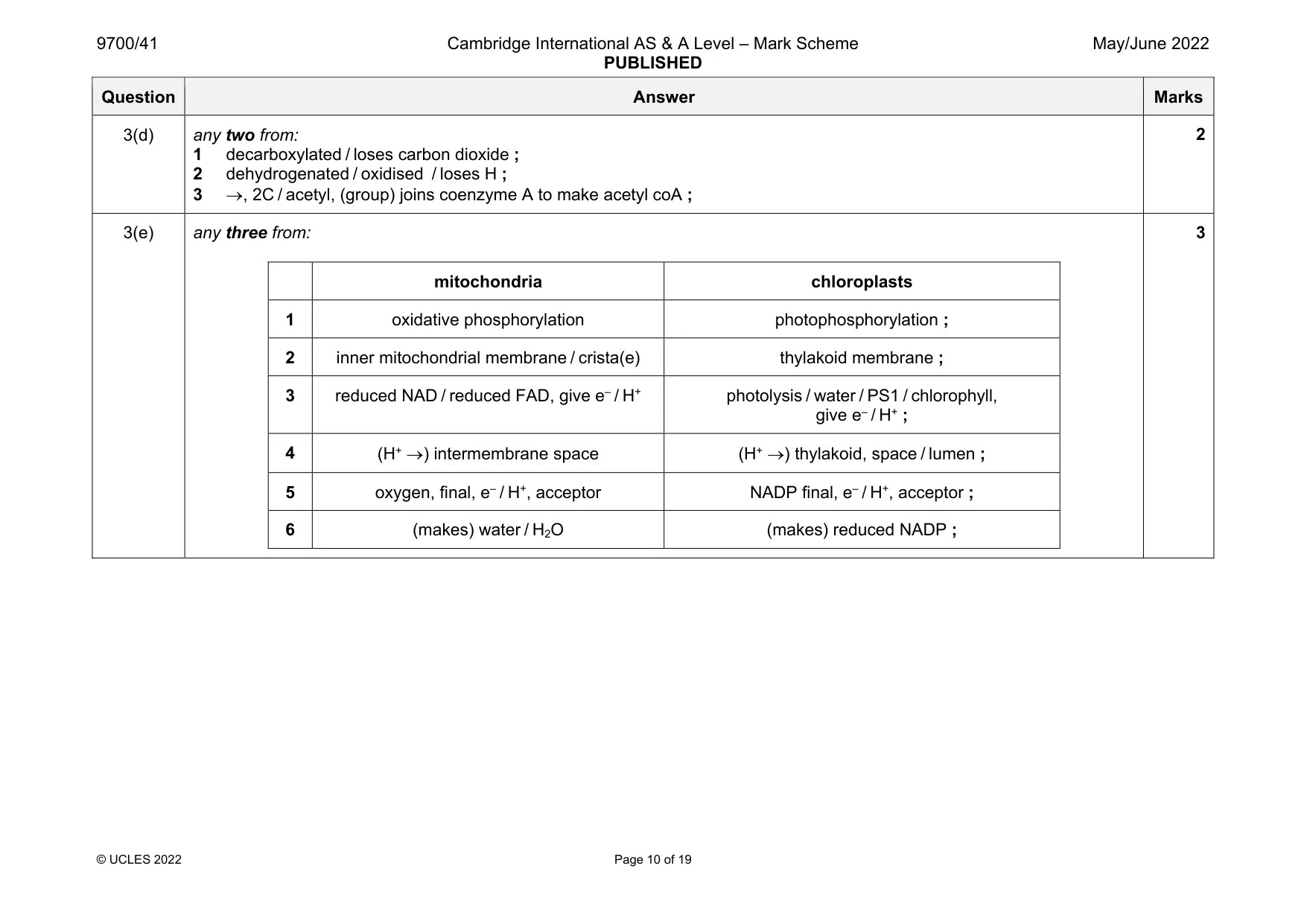
Mark scheme: 3(a) anabolic / condensation / polymerisation ; 1 3(b) 1 to, phosphorylate / add phosphate to, glucose ; and any one from: 2 stops glucose leaving the cell ; 3 activates glucose / makes glucose less stable ; 4 to make fructose (1,6) bi(s)phosphate ; 2 3(c) cytoplasm and mitochondrial matrix ; 1 Question Answer Marks 3(d) any two from: 1 decarboxylated / loses carbon dioxide ; 2 dehydrogenated / oxidised / loses H ; 3 , 2C / acetyl, (group) joins coenzyme A to make acetyl coA ; 2 3(e) any three from: mitochondria chloroplasts 1 oxidative phosphorylation photophosphorylation ; 2 inner mitochondrial membrane / crista(e) thylakoid membrane ; 3 reduced NAD / reduced FAD, give e– / H+ photolysis / water / PS1 / chlorophyll, give e– / H+ ; 4 (H+ ) intermembrane space (H+ ) thylakoid, space / lumen ; 5 oxygen, final, e– / H+, acceptor NADP final, e– / H+, acceptor ; 6 (makes) water / H2O (makes) reduced NADP ; 3
Q4 · In 1973 a technique for genetic engineering was used for the first time
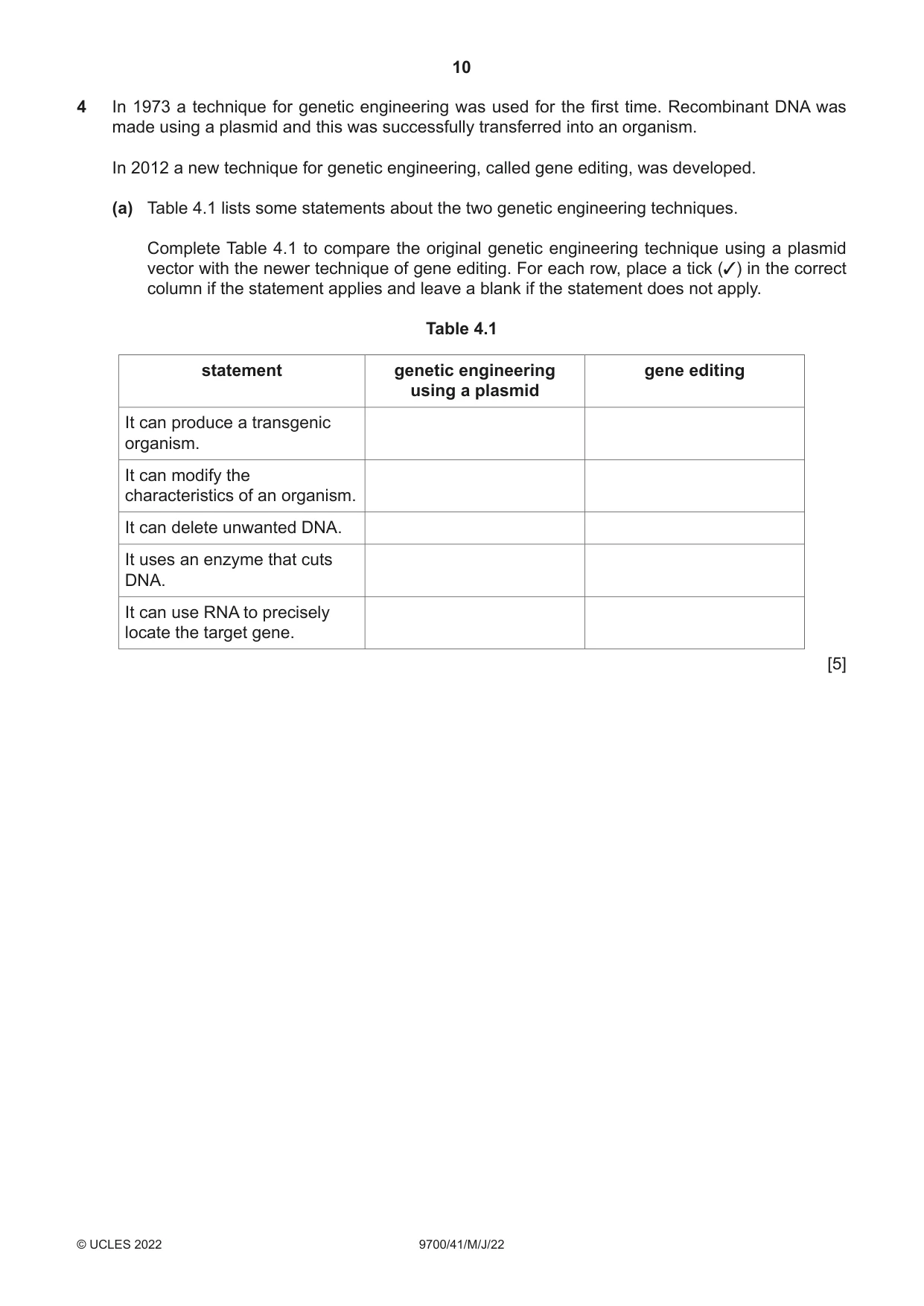
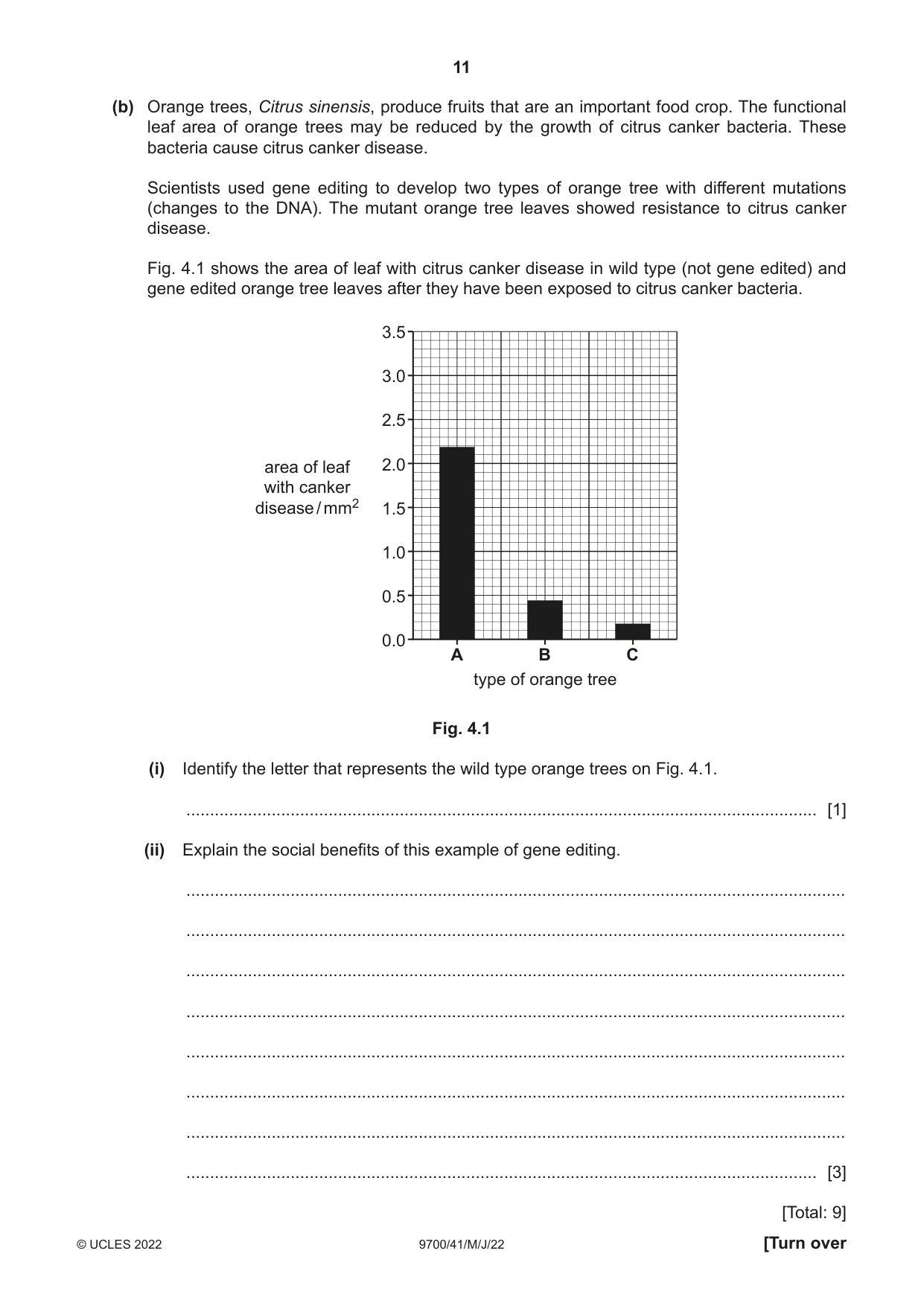
4 In 1973 a technique for genetic engineering was used for the first time. Recombinant DNA was made using a plasmid and this was successfully transferred into an organism. In 2012 a new technique for genetic engineering, called gene editing, was developed. (a) Table 4.1 lists some statements about the two genetic engineering techniques. Complete Table 4.1 to compare the original genetic engineering technique using a plasmid vector with the newer technique of gene editing. For each row, place a tick (3) in the correct column if the statement applies and leave a blank if the statement does not apply. Table 4.1 statement genetic engineering gene editing using a plasmid It can produce a transgenic organism. It can modify the characteristics of an organism. It can delete unwanted DNA. It uses an enzyme that cuts DNA. It can use RNA to precisely locate the target gene. [5] (b) Orange trees, Citrus sinensis, produce fruits that are an important food crop. The functional leaf area of orange trees may be reduced by the growth of citrus canker bacteria. These bacteria cause citrus canker disease. Scientists used gene editing to develop two types of orange tree with different mutations (changes to the DNA). The mutant orange tree leaves showed resistance to citrus canker disease. Fig. 4.1 shows the area of leaf with citrus canker disease in wild type (not gene edited) and gene edited orange tree leaves after they have been exposed to citrus canker bacteria. 3.5 3.0 2.5 area of leaf 2.0 with canker disease / mm2 1.5 1.0 0.5 0.0 A B C type of orange tree Fig. 4.1 (i) Identify the letter that represents the wild type orange trees on Fig. 4.1. ..................................................................................................................................... [1] (ii) Explain the social benefits of this example of gene editing. ........................................................................................................................................... ........................................................................................................................................... ........................................................................................................................................... ........................................................................................................................................... ........................................................................................................................................... ........................................................................................................................................... ........................................................................................................................................... ..................................................................................................................................... [3] [Total: 9]
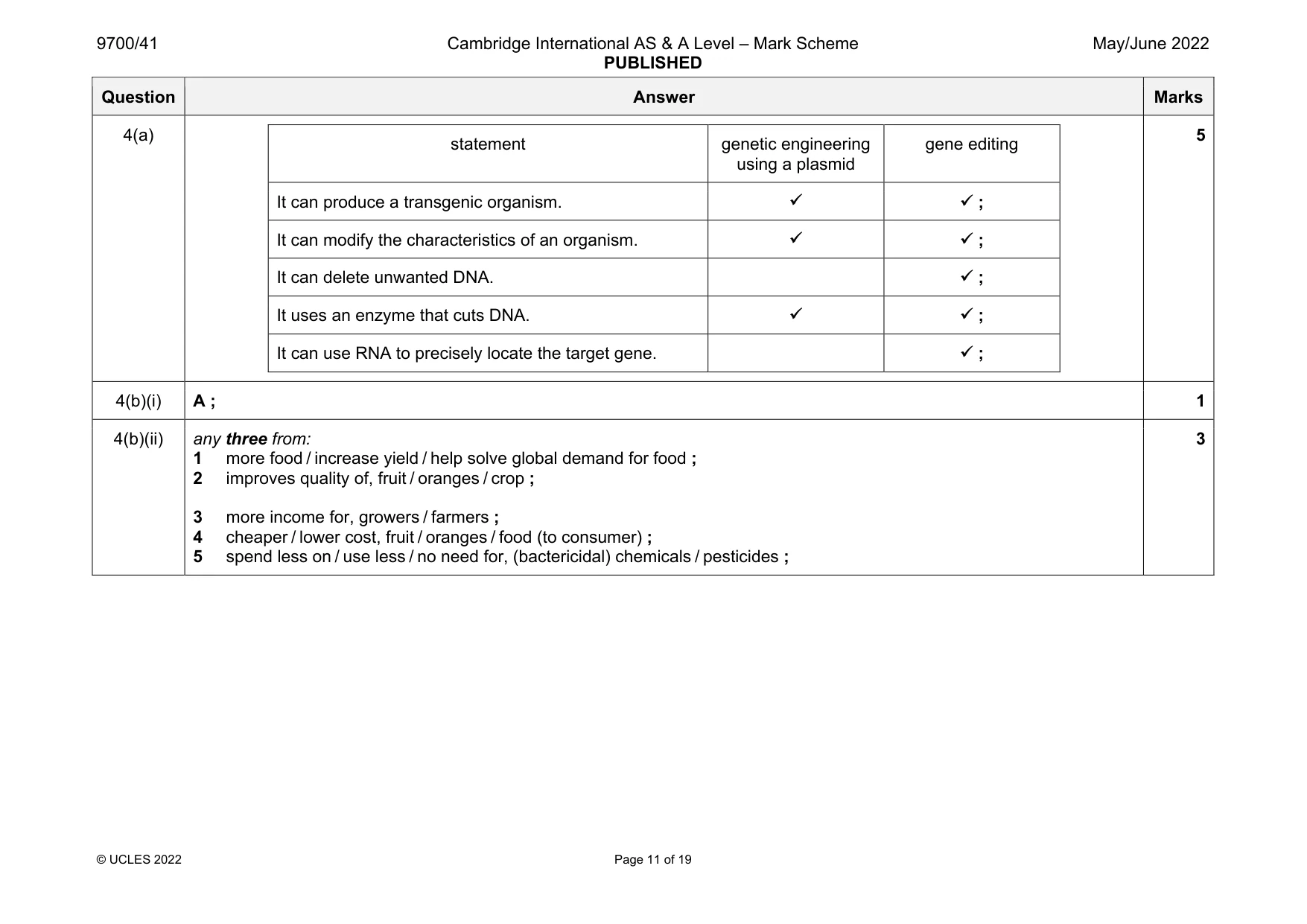
Mark scheme: 4(a) statement genetic engineering using a plasmid gene editing It can produce a transgenic organism. ; It can modify the characteristics of an organism. ; It can delete unwanted DNA. ; It uses an enzyme that cuts DNA. ; It can use RNA to precisely locate the target gene. ; 5 4(b)(i) A ; 1 4(b)(ii) any three from: 1 more food / increase yield / help solve global demand for food ; 2 improves quality of, fruit / oranges / crop ; 3 more income for, growers / farmers ; 4 cheaper / lower cost, fruit / oranges / food (to consumer) ; 5 spend less on / use less / no need for, (bactericidal) chemicals / pesticides ; 3
Q5 · Two subspecies of reindeer, Rangifer tarandus, live in North America
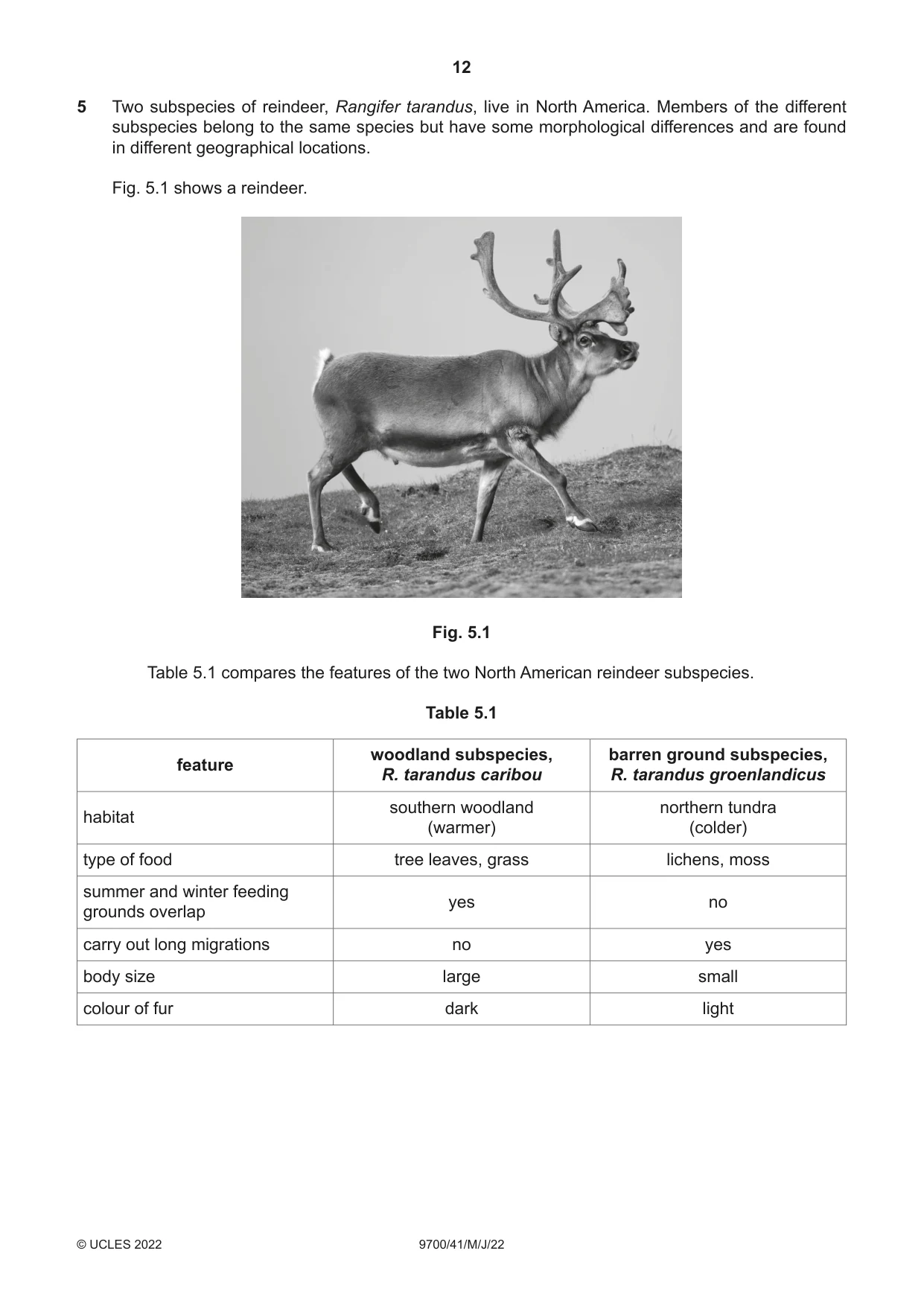
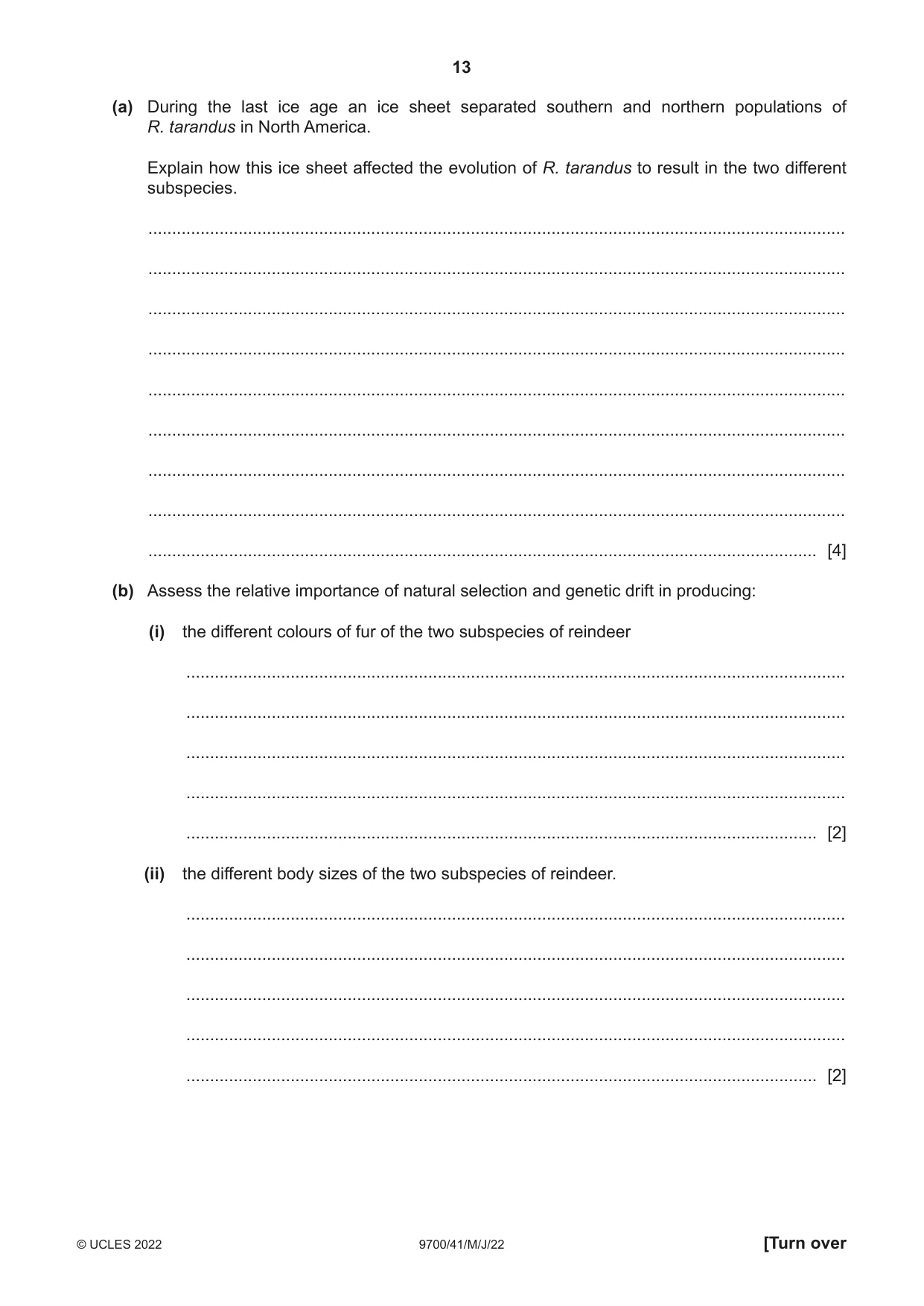
5 Two subspecies of reindeer, Rangifer tarandus, live in North America. Members of the different subspecies belong to the same species but have some morphological differences and are found in different geographical locations. Fig. 5.1 shows a reindeer. Fig. 5.1 Table 5.1 compares the features of the two North American reindeer subspecies. Table 5.1 woodland subspecies, barren ground subspecies, feature R. tarandus caribou R. tarandus groenlandicus southern woodland northern tundra habitat (warmer) (colder) type of food tree leaves, grass lichens, moss summer and winter feeding yes no grounds overlap carry out long migrations no yes body size large small colour of fur dark light (a) During the last ice age an ice sheet separated southern and northern populations of R. tarandus in North America. Explain how this ice sheet affected the evolution of R. tarandus to result in the two different subspecies. ................................................................................................................................................... ................................................................................................................................................... ................................................................................................................................................... ................................................................................................................................................... ................................................................................................................................................... ................................................................................................................................................... ................................................................................................................................................... ................................................................................................................................................... ............................................................................................................................................. [4] (b) Assess the relative importance of natural selection and genetic drift in producing: (i) the different colours of fur of the two subspecies of reindeer ........................................................................................................................................... ........................................................................................................................................... ........................................................................................................................................... ........................................................................................................................................... ..................................................................................................................................... [2] (ii) the different body sizes of the two subspecies of reindeer. ........................................................................................................................................... ........................................................................................................................................... ........................................................................................................................................... ........................................................................................................................................... ..................................................................................................................................... [2] (c) Hybridisation has occurred between individuals of the two subspecies which now live in the area previously covered by the ice sheet. Comment on how the hybrid populations compare to the pure subspecies in terms of genetic variation and potential to adapt to climate change. ................................................................................................................................................... ................................................................................................................................................... ................................................................................................................................................... ................................................................................................................................................... ................................................................................................................................................... ................................................................................................................................................... ............................................................................................................................................. [3] (d) Outline how practical techniques could be used to test the hypothesis that migratory behaviour in reindeer has a genetic basis. ................................................................................................................................................... ................................................................................................................................................... ................................................................................................................................................... ................................................................................................................................................... ................................................................................................................................................... ................................................................................................................................................... ................................................................................................................................................... ............................................................................................................................................. [3] [Total: 14]
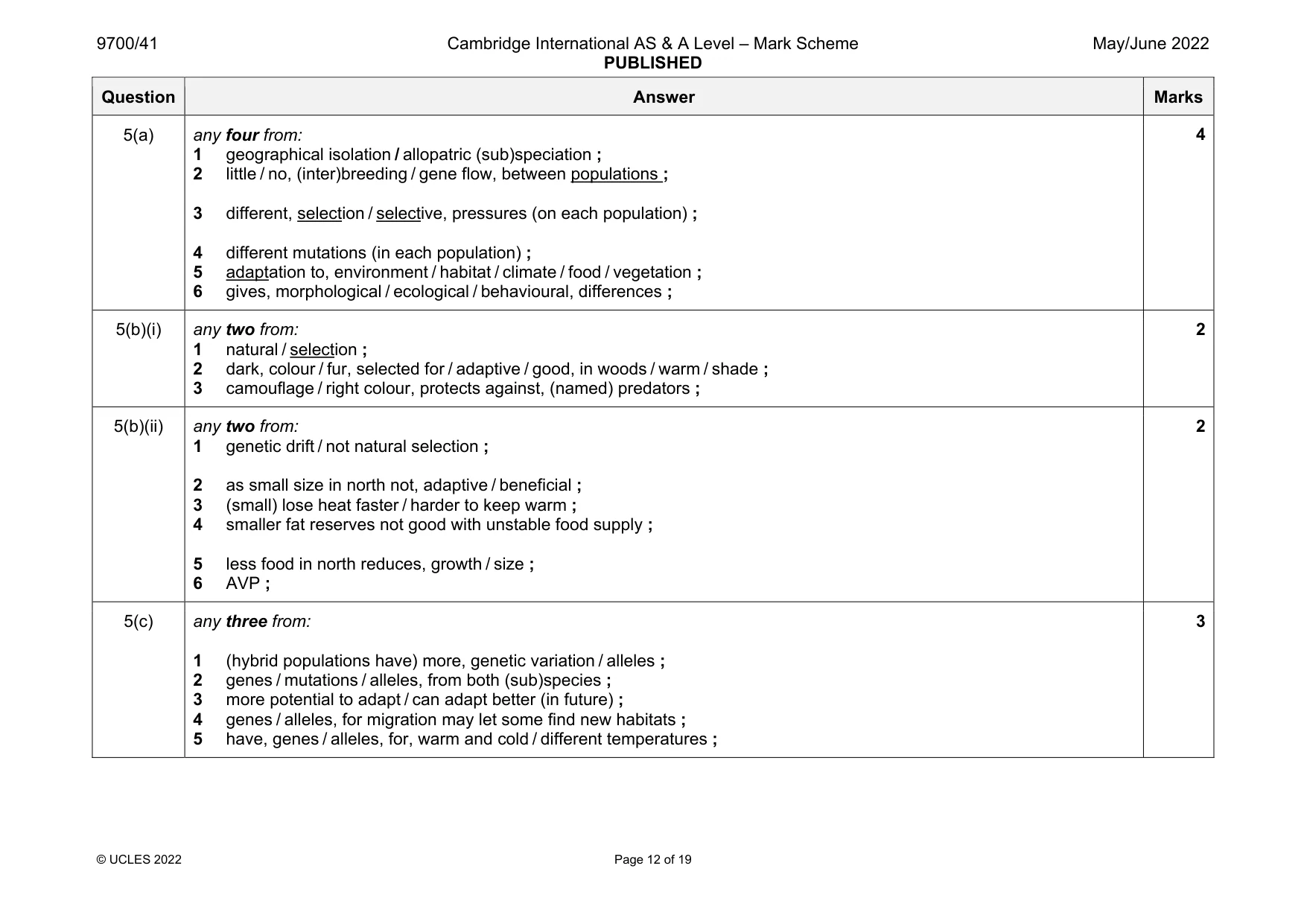
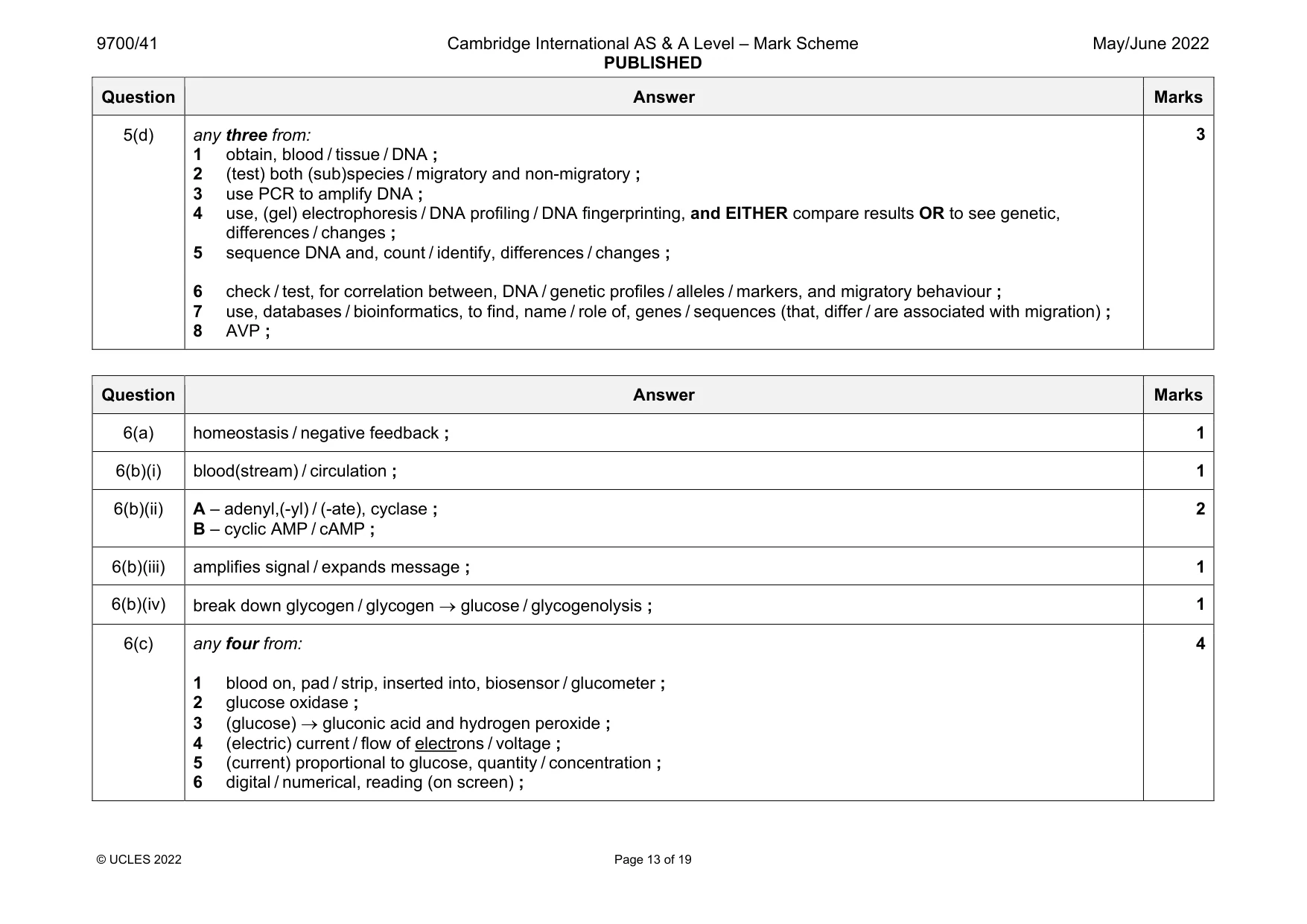
Mark scheme: 5(a) any four from: 1 geographical isolation / allopatric (sub)speciation ; 2 little / no, (inter)breeding / gene flow, between populations ; 3 different, selection / selective, pressures (on each population) ; 4 different mutations (in each population) ; 5 adaptation to, environment / habitat / climate / food / vegetation ; 6 gives, morphological / ecological / behavioural, differences ; 5(b)(i) any two from: 1 natural / selection ; 2 dark, colour / fur, selected for / adaptive / good, in woods / warm / shade ; 3 camouflage / right colour, protects against, (named) predators ; 2 5(b)(ii) any two from: 1 genetic drift / not natural selection ; 2 as small size in north not, adaptive / beneficial ; 3 (small) lose heat faster / harder to keep warm ; 4 smaller fat reserves not good with unstable food supply ; 5 less food in north reduces, growth / size ; 6 AVP ; 2 5(c) any three from: 1 (hybrid populations have) more, genetic variation / alleles ; 2 genes / mutations / alleles, from both (sub)species ; 3 more potential to adapt / can adapt better (in future) ; 4 genes / alleles, for migration may let some find new habitats ; 5 have, genes / alleles, for, warm and cold / different temperatures ; 3 Question Answer Marks 5(d) any three from: 1 obtain, blood / tissue / DNA ; 2 (test) both (sub)species / migratory and non-migratory ; 3 use PCR to amplify DNA ; 4 use, (gel) electrophoresis / DNA profiling / DNA fingerprinting, and EITHER compare results OR to see genetic, differences / changes ; 5 sequence DNA and, count / identify, differences / changes ; 6 check / test, for correlation between, DNA / genetic profiles / alleles / markers, and migratory behaviour ; 7 use, databases / bioinformatics, to find, name / role of, genes / sequences (that, differ / are associated with migration) ; 8 AVP ; 3
Q6 · In mammals, the blood glucose concentration must be maintained within narrow limits so…
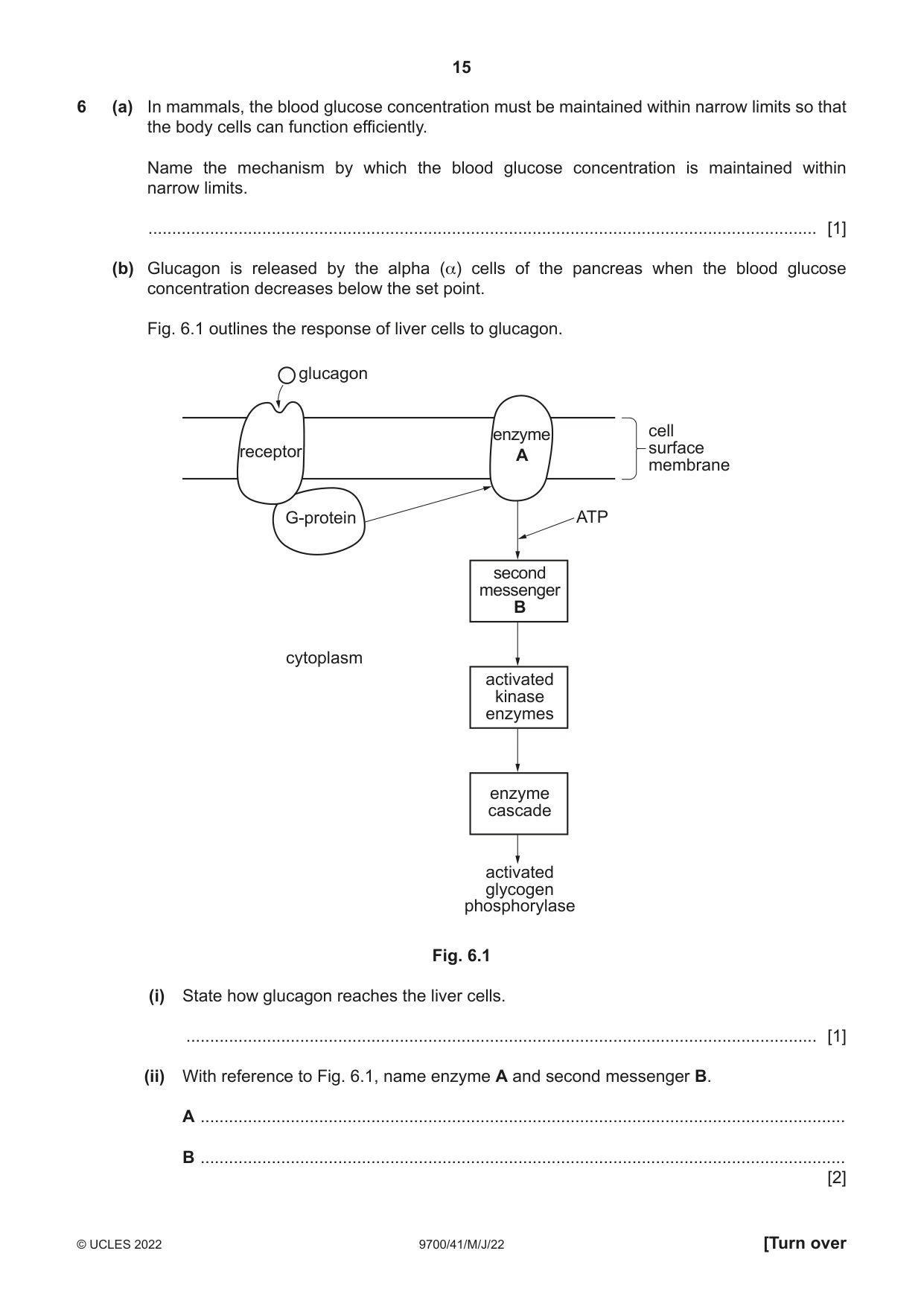
6 (a) In mammals, the blood glucose concentration must be maintained within narrow limits so that the body cells can function efficiently. Name the mechanism by which the blood glucose concentration is maintained within narrow limits. ............................................................................................................................................. [1] (b) Glucagon is released by the alpha (α) cells of the pancreas when the blood glucose concentration decreases below the set point. Fig. 6.1 outlines the response of liver cells to glucagon. glucagon enzyme cell receptor A surface membrane G-protein ATP second messenger B cytoplasm activated kinase enzymes enzyme cascade activated glycogen phosphorylase Fig. 6.1 (i) State how glucagon reaches the liver cells. ..................................................................................................................................... [1] (ii) With reference to Fig. 6.1, name enzyme A and second messenger B. A ........................................................................................................................................ B ........................................................................................................................................ [2] (iii) State the role of the enzyme cascade. ........................................................................................................................................... ..................................................................................................................................... [1] (iv) State the function of the final enzyme in the pathway, glycogen phosphorylase. ..................................................................................................................................... [1] (c) A biosensor is used to measure blood glucose concentration to check that it is within the normal range. Describe how a glucose biosensor works. ................................................................................................................................................... ................................................................................................................................................... ................................................................................................................................................... ................................................................................................................................................... ................................................................................................................................................... ................................................................................................................................................... ................................................................................................................................................... ................................................................................................................................................... ............................................................................................................................................. [4] [Total: 10]
Mark scheme: 6(a) homeostasis / negative feedback ; 1 6(b)(i) blood(stream) / circulation ; 1 6(b)(ii) A – adenyl,(-yl) / (-ate), cyclase ; B – cyclic AMP / cAMP ; 2 6(b)(iii) amplifies signal / expands message ; 1 6(b)(iv) break down glycogen / glycogen glucose / glycogenolysis ; 1 6(c) any four from: 1 blood on, pad / strip, inserted into, biosensor / glucometer ; 2 glucose oxidase ; 3 (glucose) gluconic acid and hydrogen peroxide ; 4 (electric) current / flow of electrons / voltage ; 5 (current) proportional to glucose, quantity / concentration ; 6 digital / numerical, reading (on screen) ; 4
Q7 · The fruit fly, Drosophila melanogaster, usually has red eyes
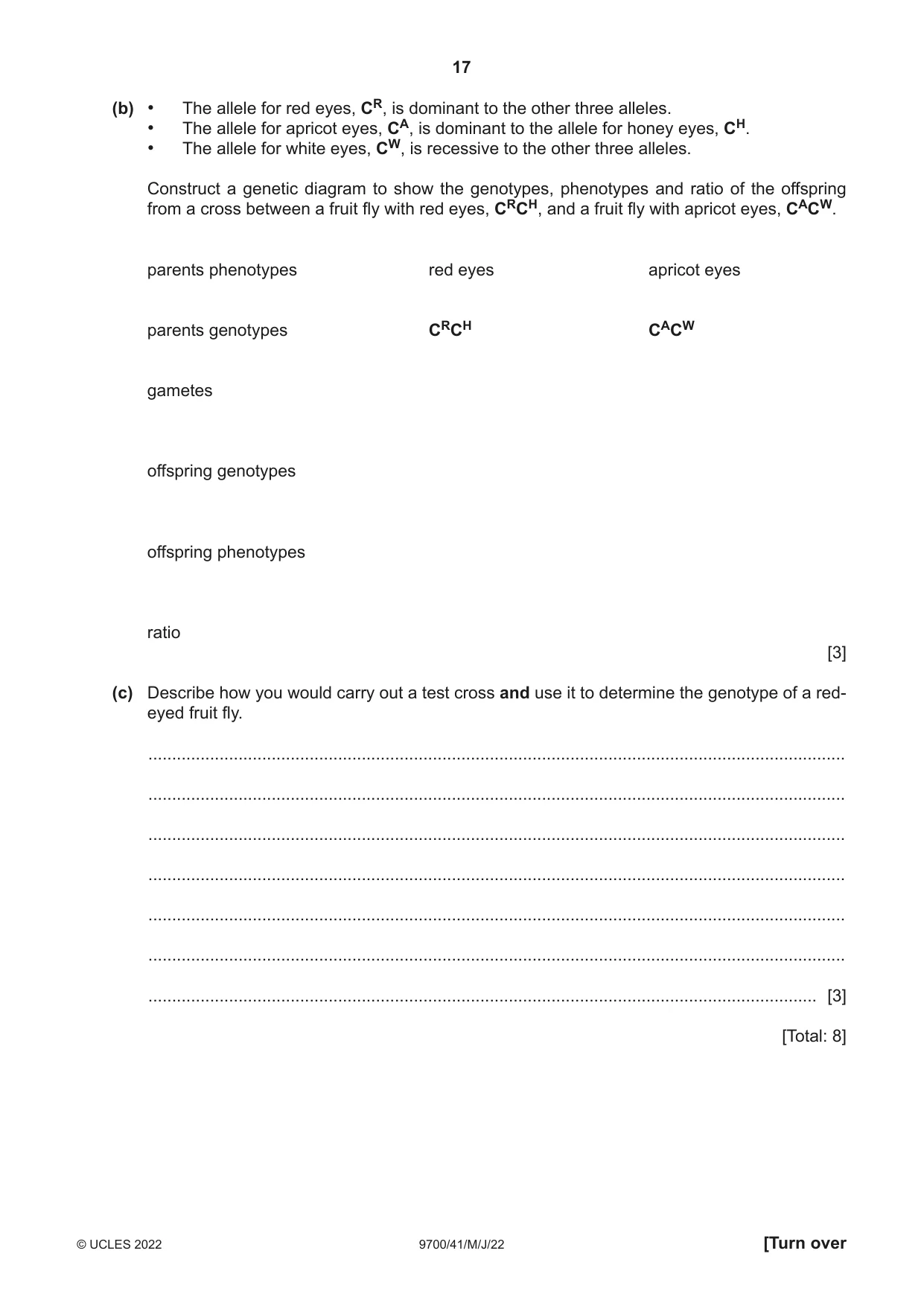
7 (a) The fruit fly, Drosophila melanogaster, usually has red eyes. A gene for eye colour has four alleles: red, apricot, honey and white. Define the terms gene and allele. gene .......................................................................................................................................... ................................................................................................................................................... allele ......................................................................................................................................... ................................................................................................................................................... [2] (b) • The allele for red eyes, CR, is dominant to the other three alleles. • The allele for apricot eyes, CA, is dominant to the allele for honey eyes, CH. • The allele for white eyes, CW, is recessive to the other three alleles. Construct a genetic diagram to show the genotypes, phenotypes and ratio of the offspring from a cross between a fruit fly with red eyes, CRCH, and a fruit fly with apricot eyes, CACW. parents phenotypes red eyes apricot eyes parents genotypes CRCH CACW gametes offspring genotypes offspring phenotypes ratio [3] (c) Describe how you would carry out a test cross and use it to determine the genotype of a red- eyed fruit fly. ................................................................................................................................................... ................................................................................................................................................... ................................................................................................................................................... ................................................................................................................................................... ................................................................................................................................................... ................................................................................................................................................... ............................................................................................................................................. [3] [Total: 8]
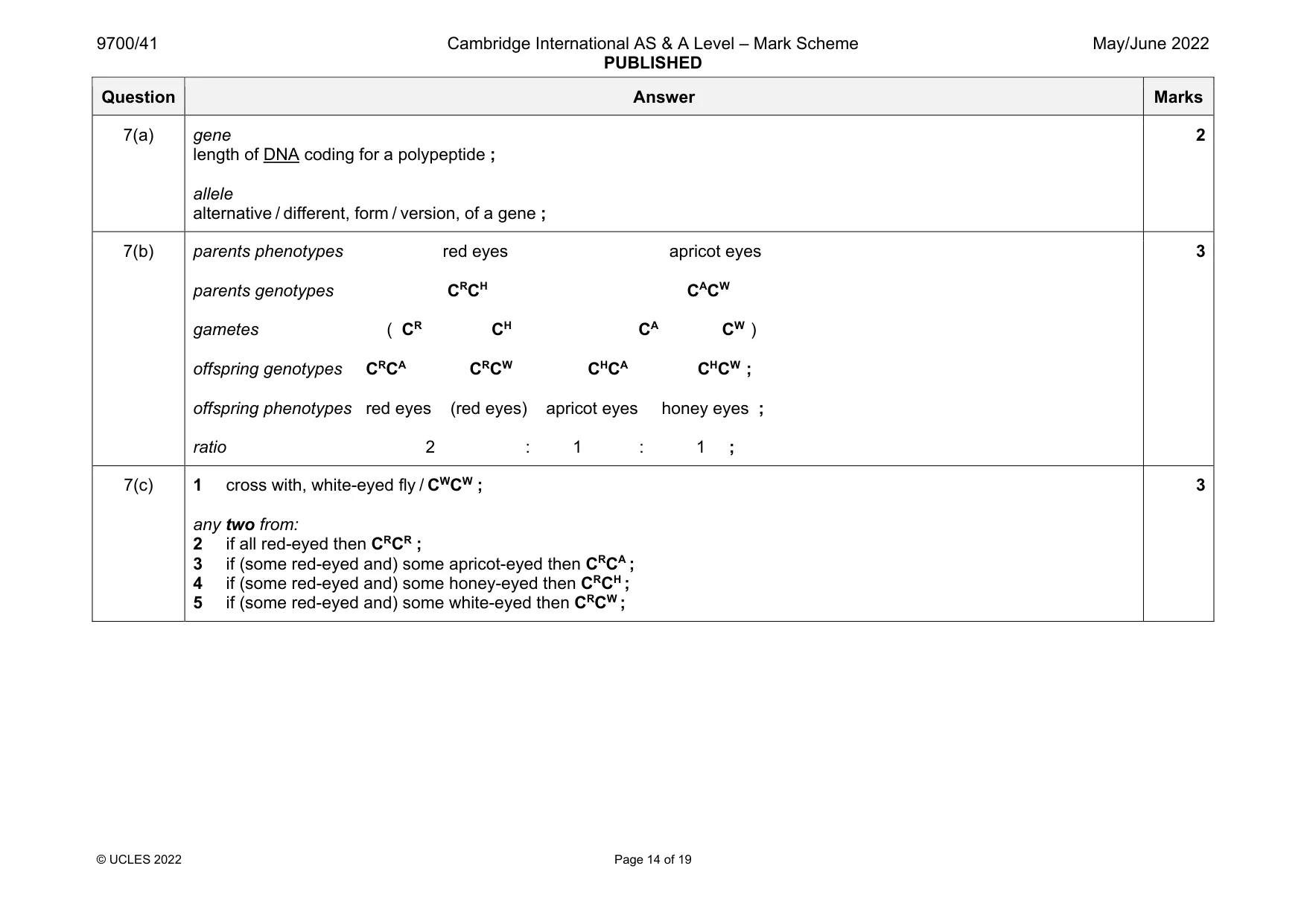
Mark scheme: 7(a) gene length of DNA coding for a polypeptide ; allele alternative / different, form / version, of a gene ; 2 7(b) parents phenotypes red eyes apricot eyes parents genotypes CRCH CACW gametes ( CR CH CA CW ) offspring genotypes CRCA CRCW CHCA CHCW ; offspring phenotypes red eyes (red eyes) apricot eyes honey eyes ; ratio 2 : 1 : 1 ; 3 7(c) 1 cross with, white-eyed fly / CWCW ; any two from: 2 if all red-eyed then CRCR ; 3 if (some red-eyed and) some apricot-eyed then CRCA ; 4 if (some red-eyed and) some honey-eyed then CRCH ; 5 if (some red-eyed and) some white-eyed then CRCW ; 3
More questions on Passage of information from parents to offspring
Q8 · Over the past 200 years, many species of animals and plants have become extinct
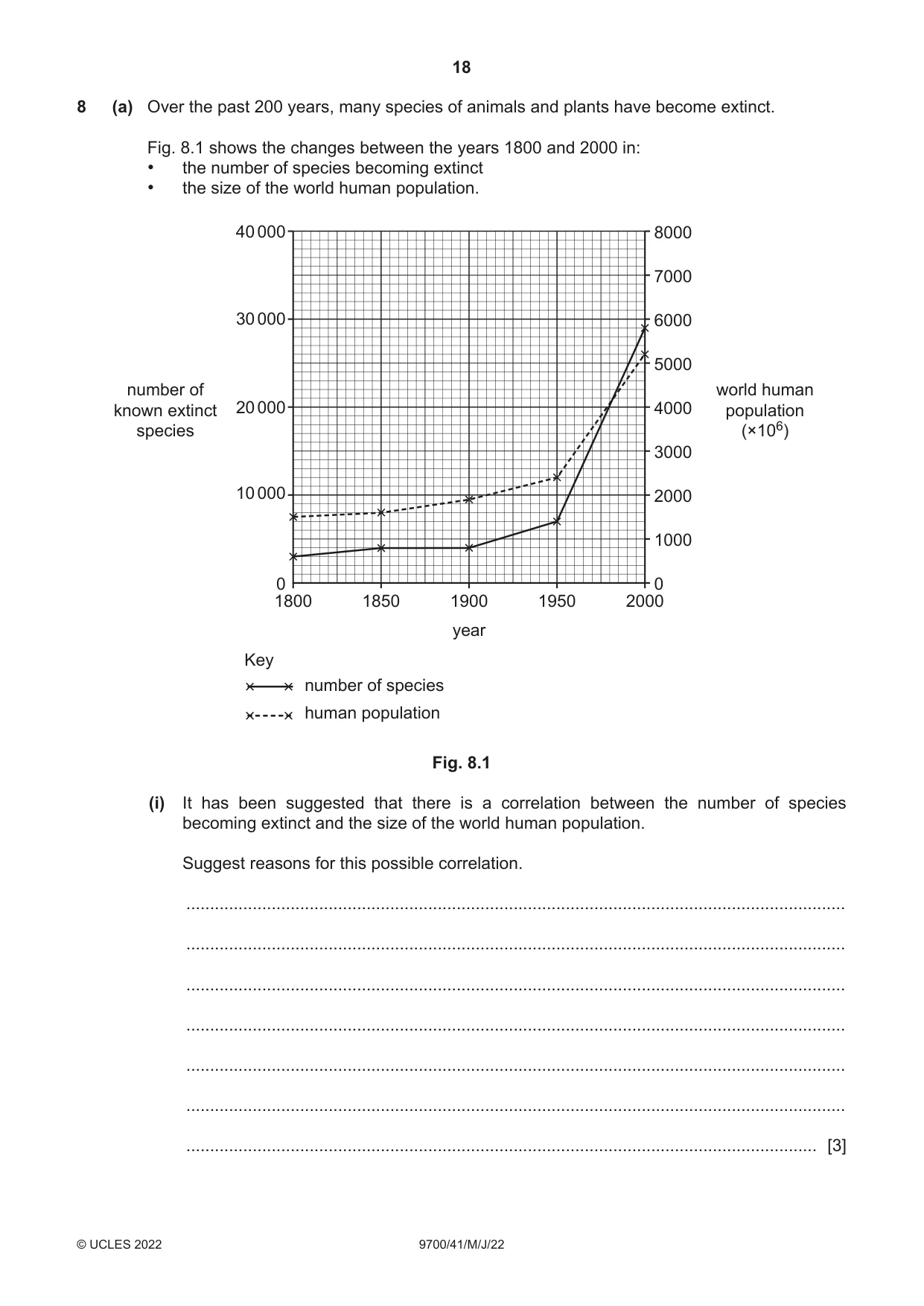
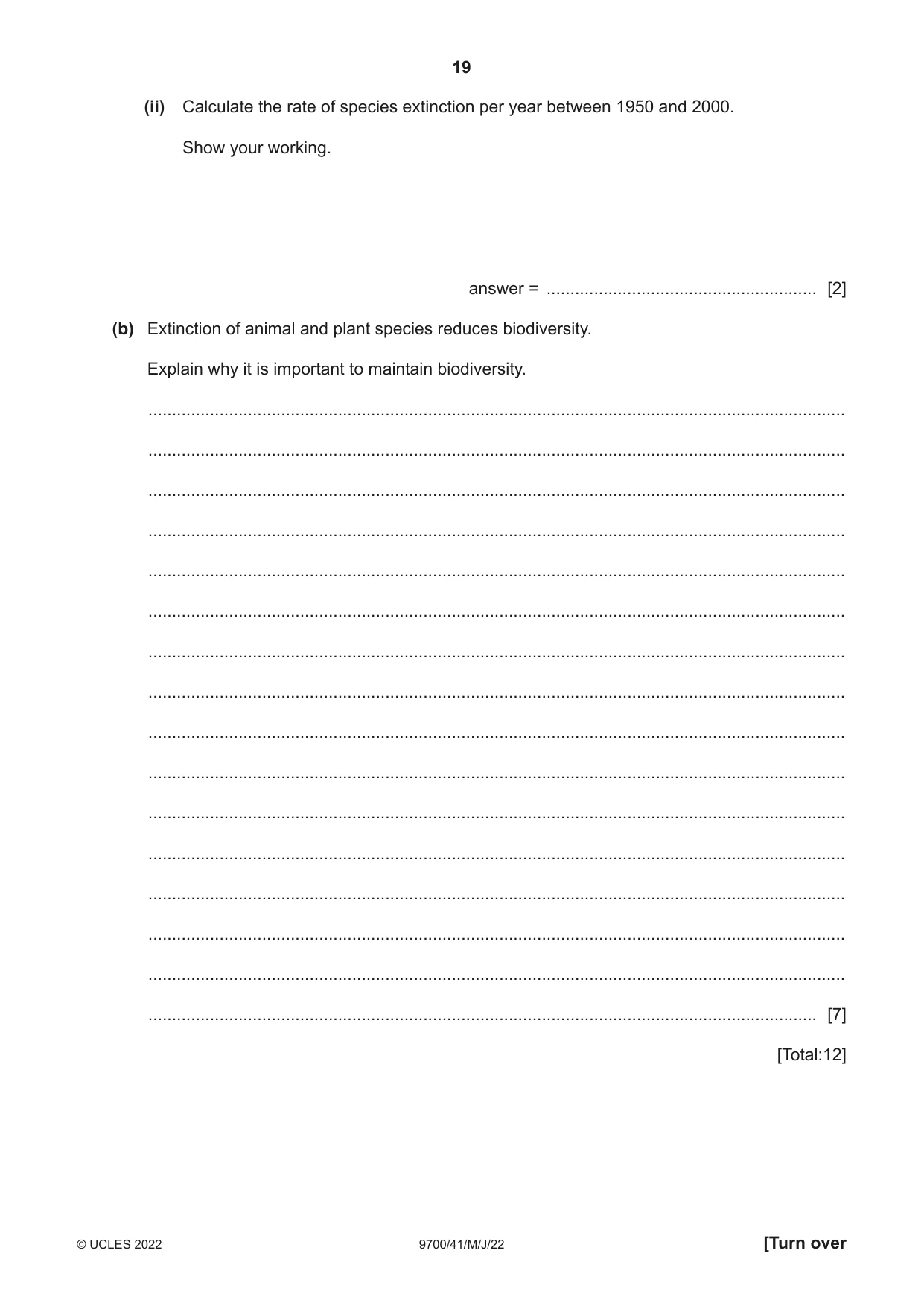
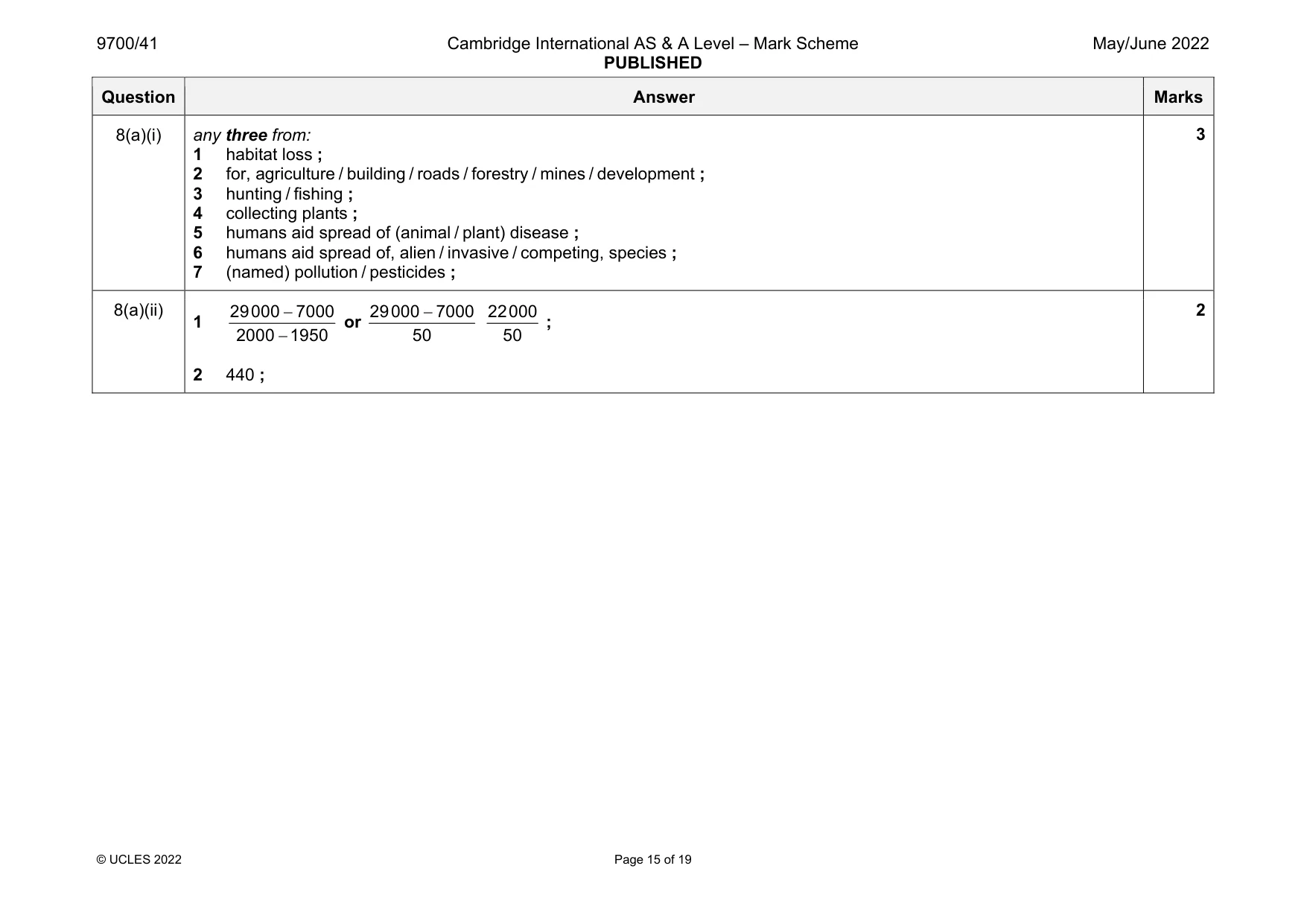
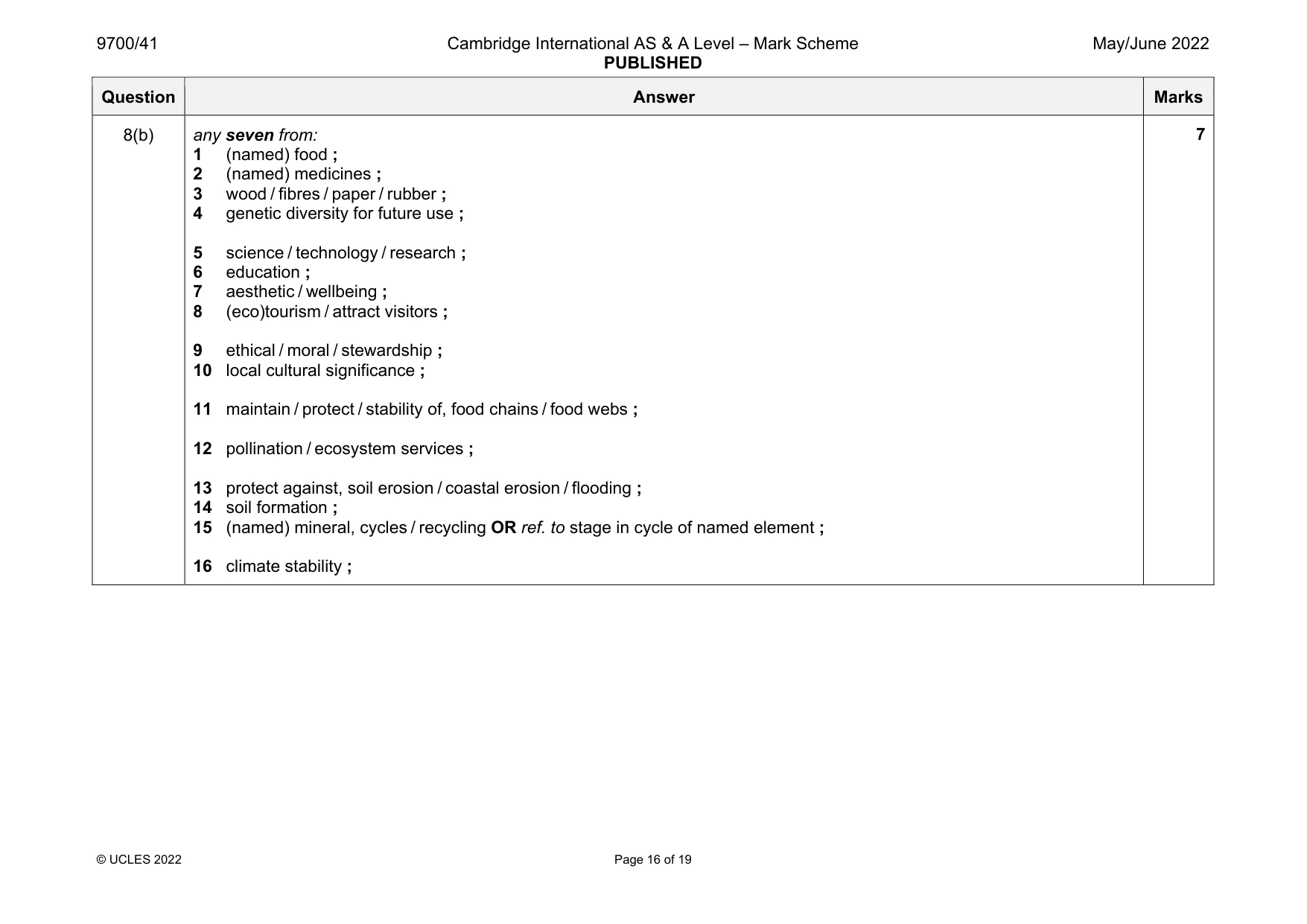
8 (a) Over the past 200 years, many species of animals and plants have become extinct. Fig. 8.1 shows the changes between the years 1800 and 2000 in: • the number of species becoming extinct • the size of the world human population. 40 000 8000 7000 30 000 6000 5000 number of world human known extinct 20 000 4000 population species (×106) 3000 10 000 2000 1000 0 0 1800 1850 1900 1950 2000 year Key number of species human population Fig. 8.1 (i) It has been suggested that there is a correlation between the number of species becoming extinct and the size of the world human population. Suggest reasons for this possible correlation. ........................................................................................................................................... ........................................................................................................................................... ........................................................................................................................................... ........................................................................................................................................... ........................................................................................................................................... ........................................................................................................................................... ..................................................................................................................................... [3] (ii) Calculate the rate of species extinction per year between 1950 and 2000. Show your working. answer = ......................................................... [2] (b) Extinction of animal and plant species reduces biodiversity. Explain why it is important to maintain biodiversity. ................................................................................................................................................... ................................................................................................................................................... ................................................................................................................................................... ................................................................................................................................................... ................................................................................................................................................... ................................................................................................................................................... ................................................................................................................................................... ................................................................................................................................................... ................................................................................................................................................... ................................................................................................................................................... ................................................................................................................................................... ................................................................................................................................................... ................................................................................................................................................... ................................................................................................................................................... ................................................................................................................................................... ............................................................................................................................................. [7] [Total:12]
Mark scheme: 8(a)(i) any three from: 1 habitat loss ; 2 for, agriculture / building / roads / forestry / mines / development ; 3 hunting / fishing ; 4 collecting plants ; 5 humans aid spread of (animal / plant) disease ; 6 humans aid spread of, alien / invasive / competing, species ; 7 (named) pollution / pesticides ; 8(a)(ii) 1 29000 7000 2000 1950 or 29000 7000 50 22000 50 ; 2 440 ; 2 Question Answer Marks 8(b) any seven from: 1 (named) food ; 2 (named) medicines ; 3 wood / fibres / paper / rubber ; 4 genetic diversity for future use ; 5 science / technology / research ; 6 education ; 7 aesthetic / wellbeing ; 8 (eco)tourism / attract visitors ; 9 ethical / moral / stewardship ; 10 local cultural significance ; 11 maintain / protect / stability of, food chains / food webs ; 12 pollination / ecosystem services ; 13 protect against, soil erosion / coastal erosion / flooding ; 14 soil formation ; 15 (named) mineral, cycles / recycling OR ref. to stage in cycle of named element ; 16 climate stability ; 7
Q9 · Stomata are involved in both transpiration and photosynthesis in plants
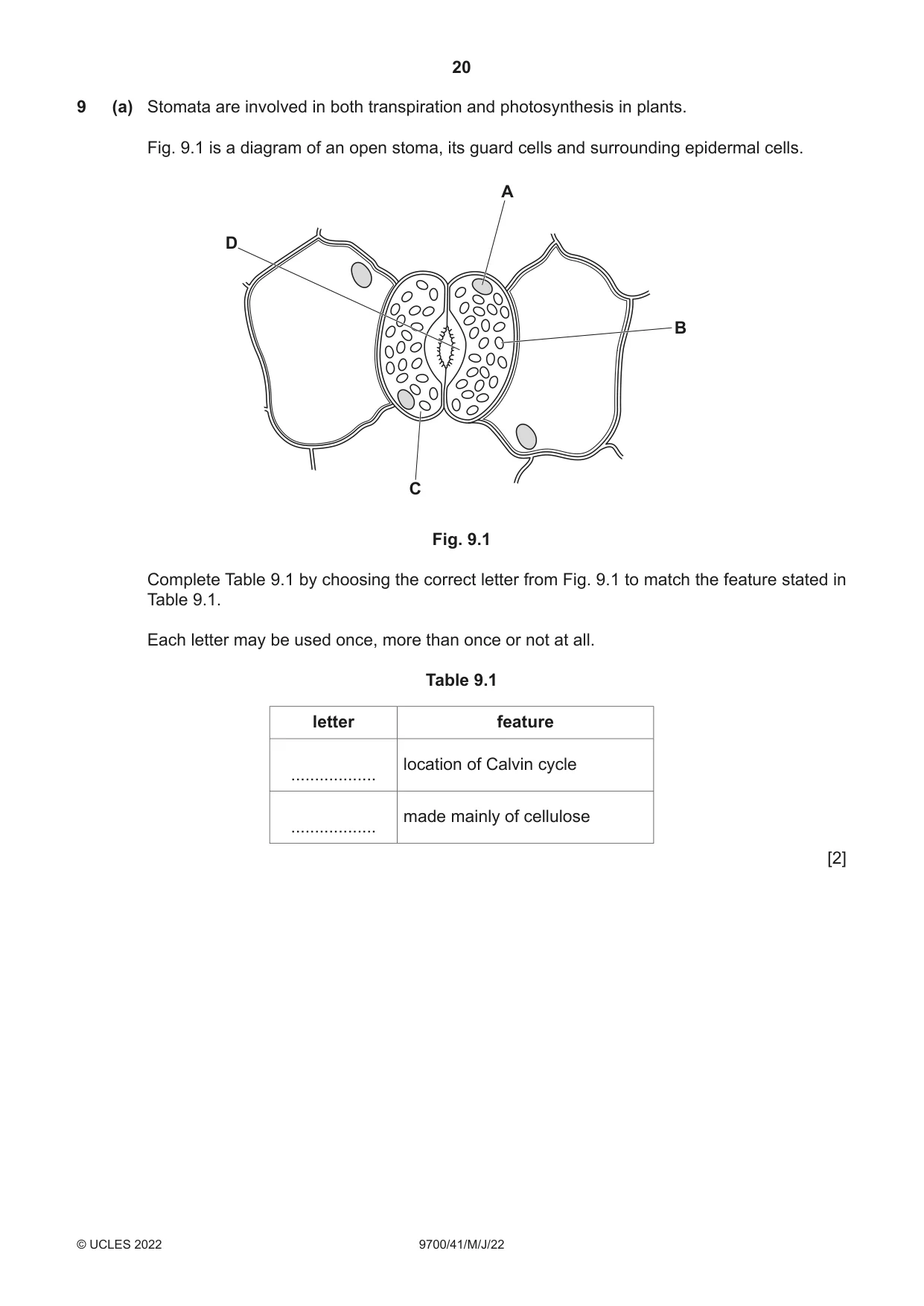
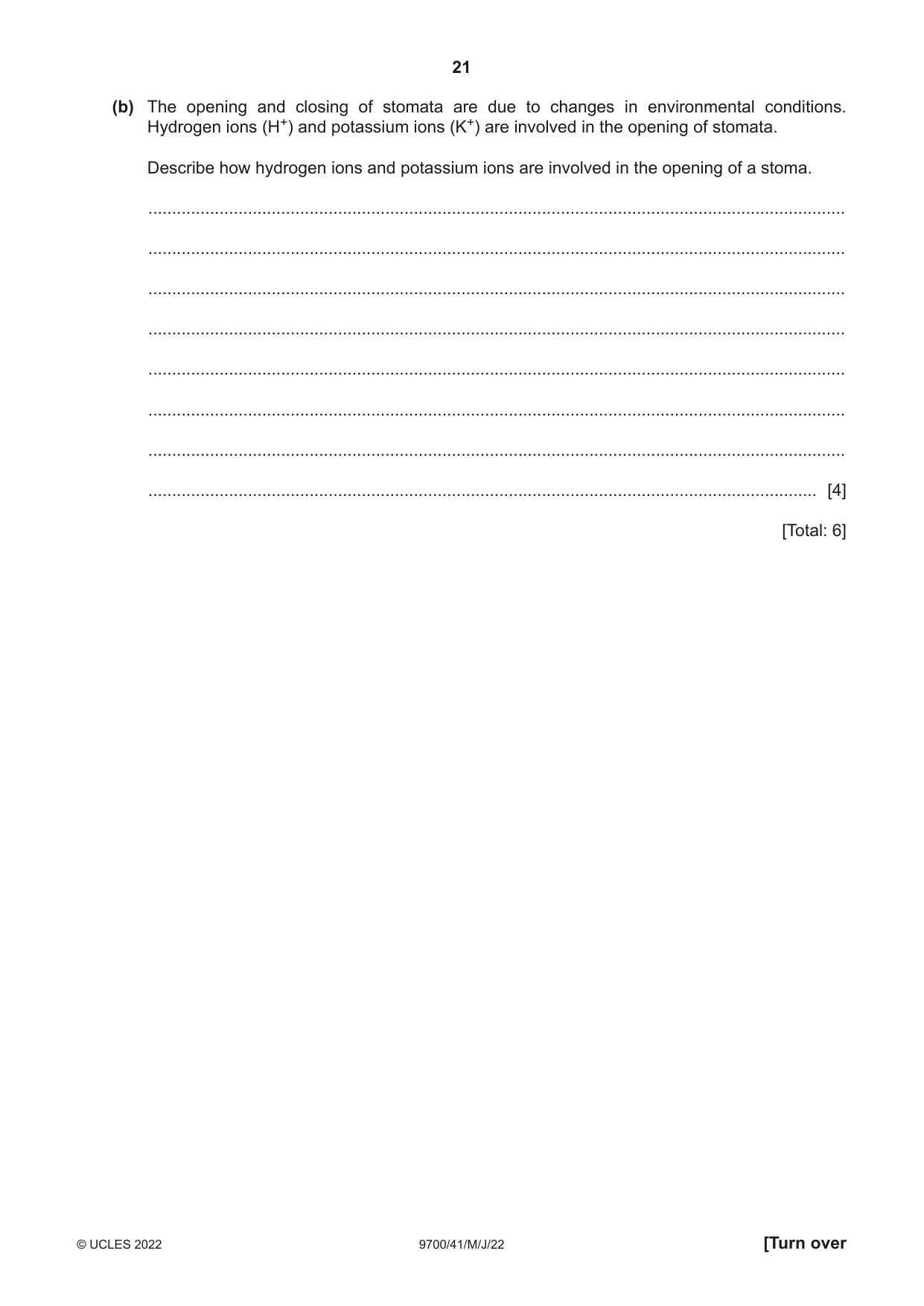
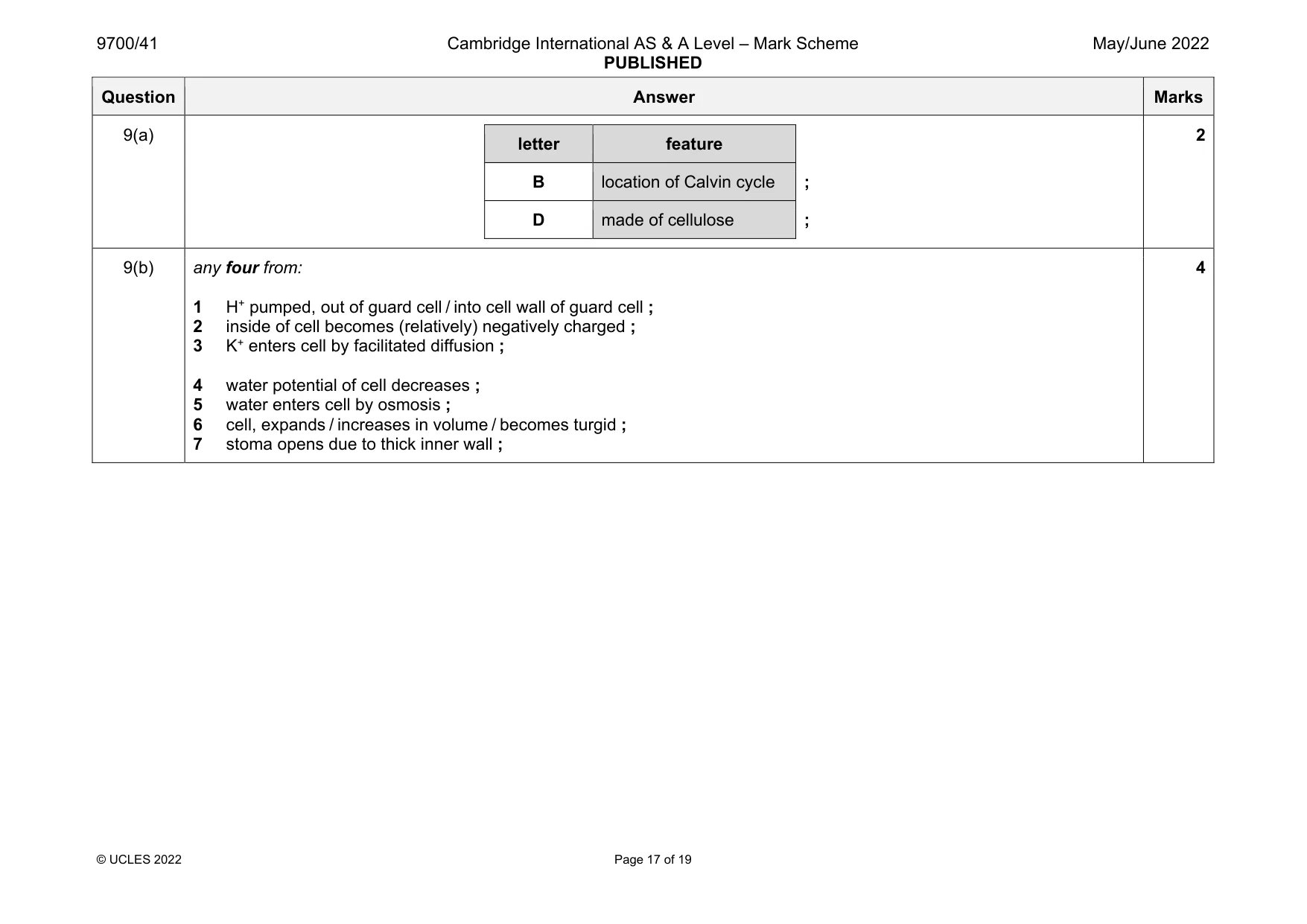
9 (a) Stomata are involved in both transpiration and photosynthesis in plants. Fig. 9.1 is a diagram of an open stoma, its guard cells and surrounding epidermal cells. A D B C Fig. 9.1 Complete Table 9.1 by choosing the correct letter from Fig. 9.1 to match the feature stated in Table 9.1. Each letter may be used once, more than once or not at all. Table 9.1 letter feature location of Calvin cycle .................. made mainly of cellulose .................. [2] (b) The opening and closing of stomata are due to changes in environmental conditions. Hydrogen ions (H+) and potassium ions (K+) are involved in the opening of stomata. Describe how hydrogen ions and potassium ions are involved in the opening of a stoma. ................................................................................................................................................... ................................................................................................................................................... ................................................................................................................................................... ................................................................................................................................................... ................................................................................................................................................... ................................................................................................................................................... ................................................................................................................................................... ............................................................................................................................................. [4] [Total: 6]
Mark scheme: 9(a) letter feature B location of Calvin cycle ; D made of cellulose ; 2 9(b) any four from: 1 H+ pumped, out of guard cell / into cell wall of guard cell ; 2 inside of cell becomes (relatively) negatively charged ; 3 K+ enters cell by facilitated diffusion ; 4 water potential of cell decreases ; 5 water enters cell by osmosis ; 6 cell, expands / increases in volume / becomes turgid ; 7 stoma opens due to thick inner wall ; 4
Q10 · Motor neurones and sensory neurones have different roles in nervous coordination
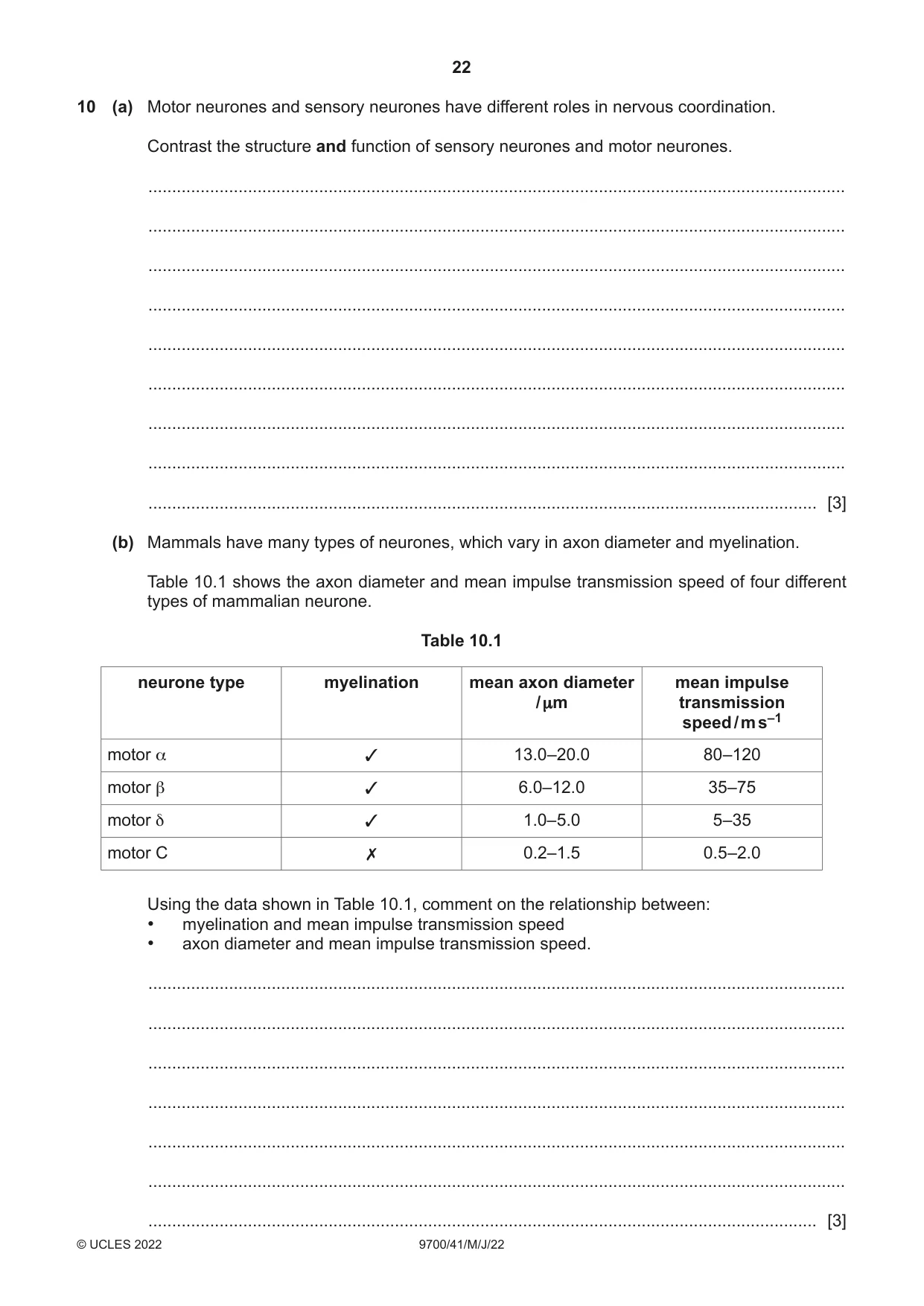
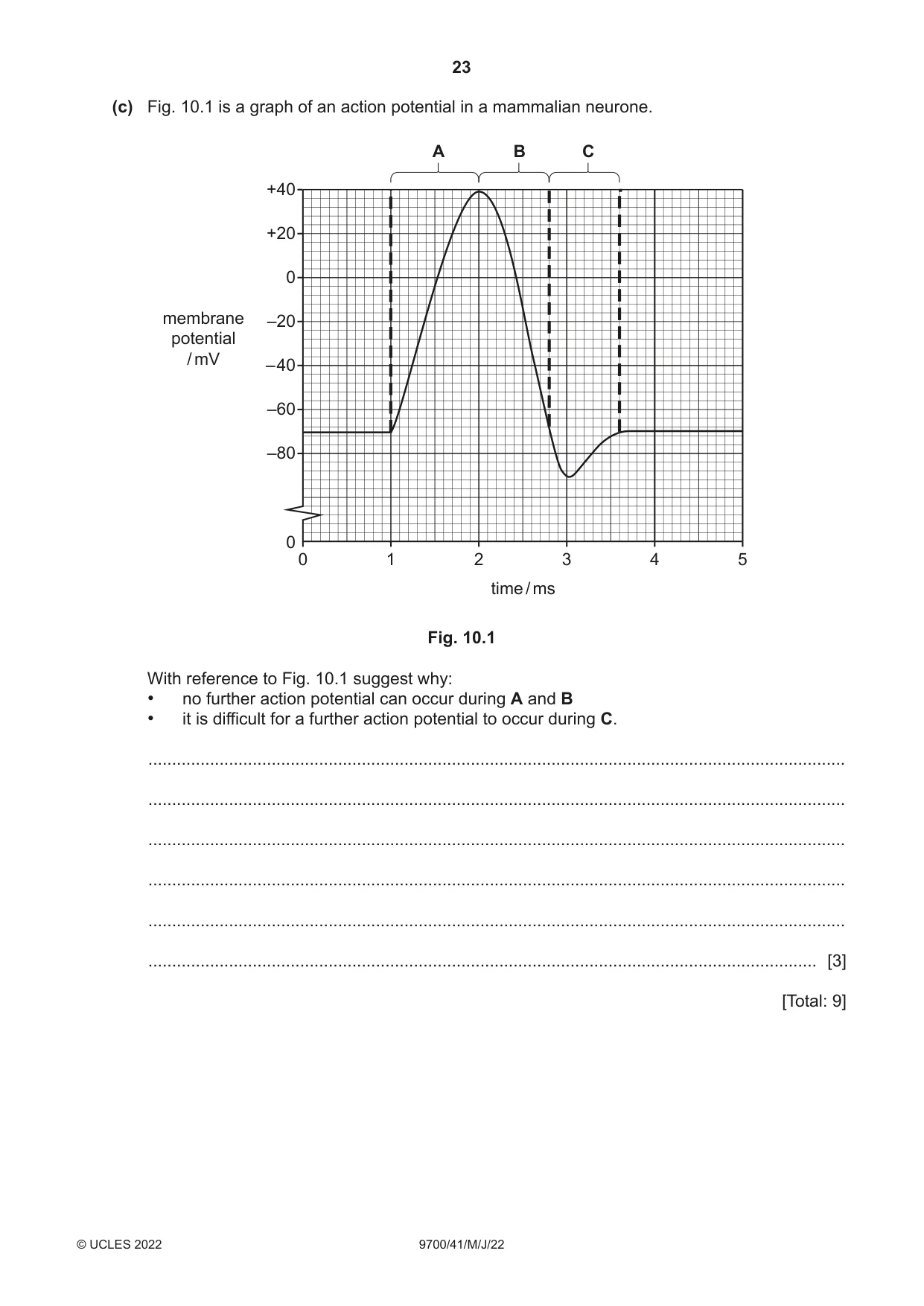
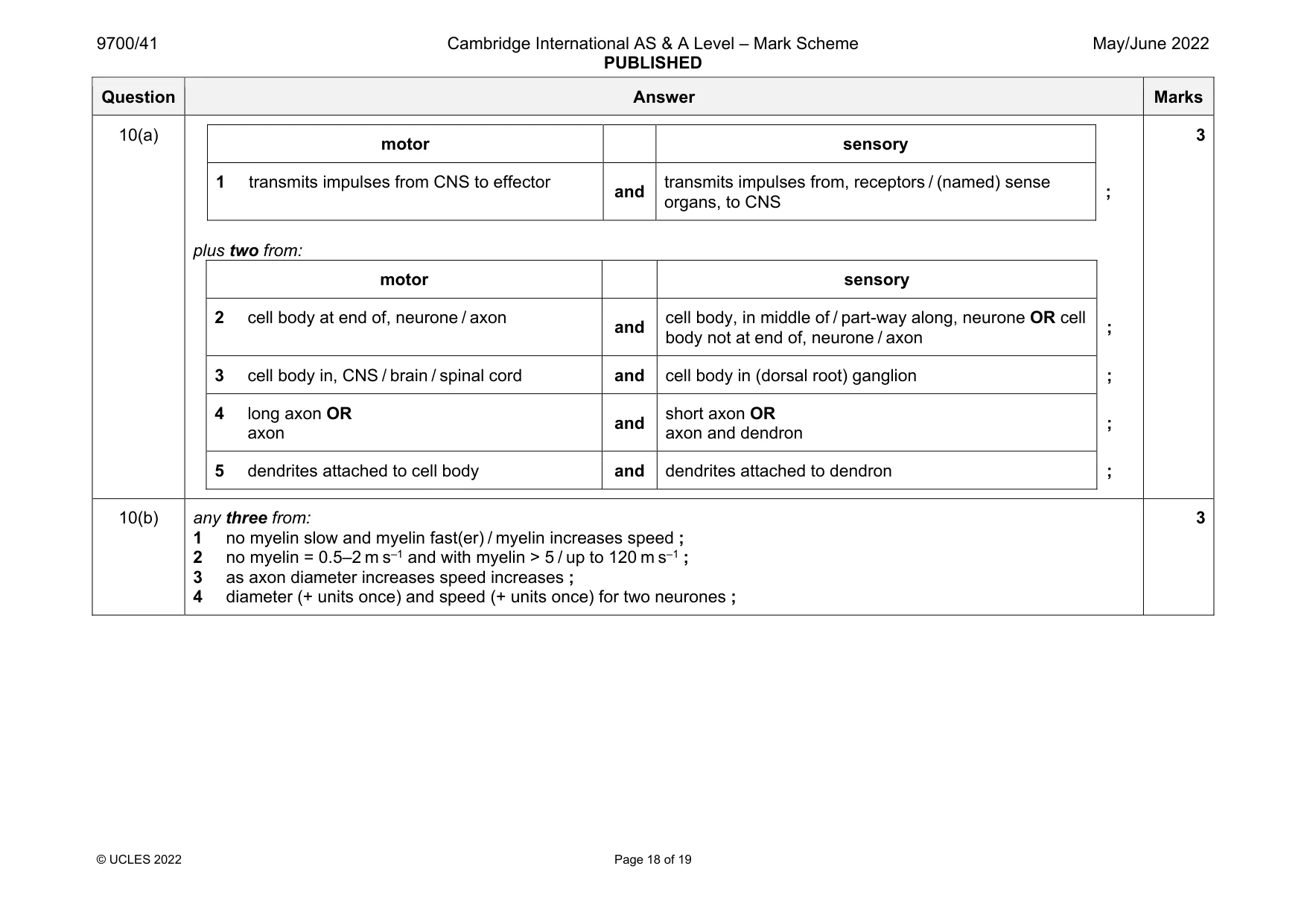
10 (a) Motor neurones and sensory neurones have different roles in nervous coordination. Contrast the structure and function of sensory neurones and motor neurones. ................................................................................................................................................... ................................................................................................................................................... ................................................................................................................................................... ................................................................................................................................................... ................................................................................................................................................... ................................................................................................................................................... ................................................................................................................................................... ................................................................................................................................................... ............................................................................................................................................. [3] (b) Mammals have many types of neurones, which vary in axon diameter and myelination. Table 10.1 shows the axon diameter and mean impulse transmission speed of four different types of mammalian neurone. Table 10.1 neurone type myelination mean axon diameter mean impulse / µm transmission speed / m s–1 motor α 3 13.0–20.0 80–120 motor β 3 6.0–12.0 35–75 motor δ 3 1.0–5.0 5–35 motor C 7 0.2–1.5 0.5–2.0 Using the data shown in Table 10.1, comment on the relationship between: • myelination and mean impulse transmission speed • axon diameter and mean impulse transmission speed. ................................................................................................................................................... ................................................................................................................................................... ................................................................................................................................................... ................................................................................................................................................... ................................................................................................................................................... ................................................................................................................................................... ............................................................................................................................................. [3] (c) Fig. 10.1 is a graph of an action potential in a mammalian neurone. A B C +40 +20 0 membrane –20 potential / mV – 40 –60 –80 0 0 1 2 3 4 5 time / ms Fig. 10.1 With reference to Fig. 10.1 suggest why: • no further action potential can occur during A and B • it is difficult for a further action potential to occur during C. ................................................................................................................................................... ................................................................................................................................................... ................................................................................................................................................... ................................................................................................................................................... ................................................................................................................................................... ............................................................................................................................................. [3] [Total: 9]
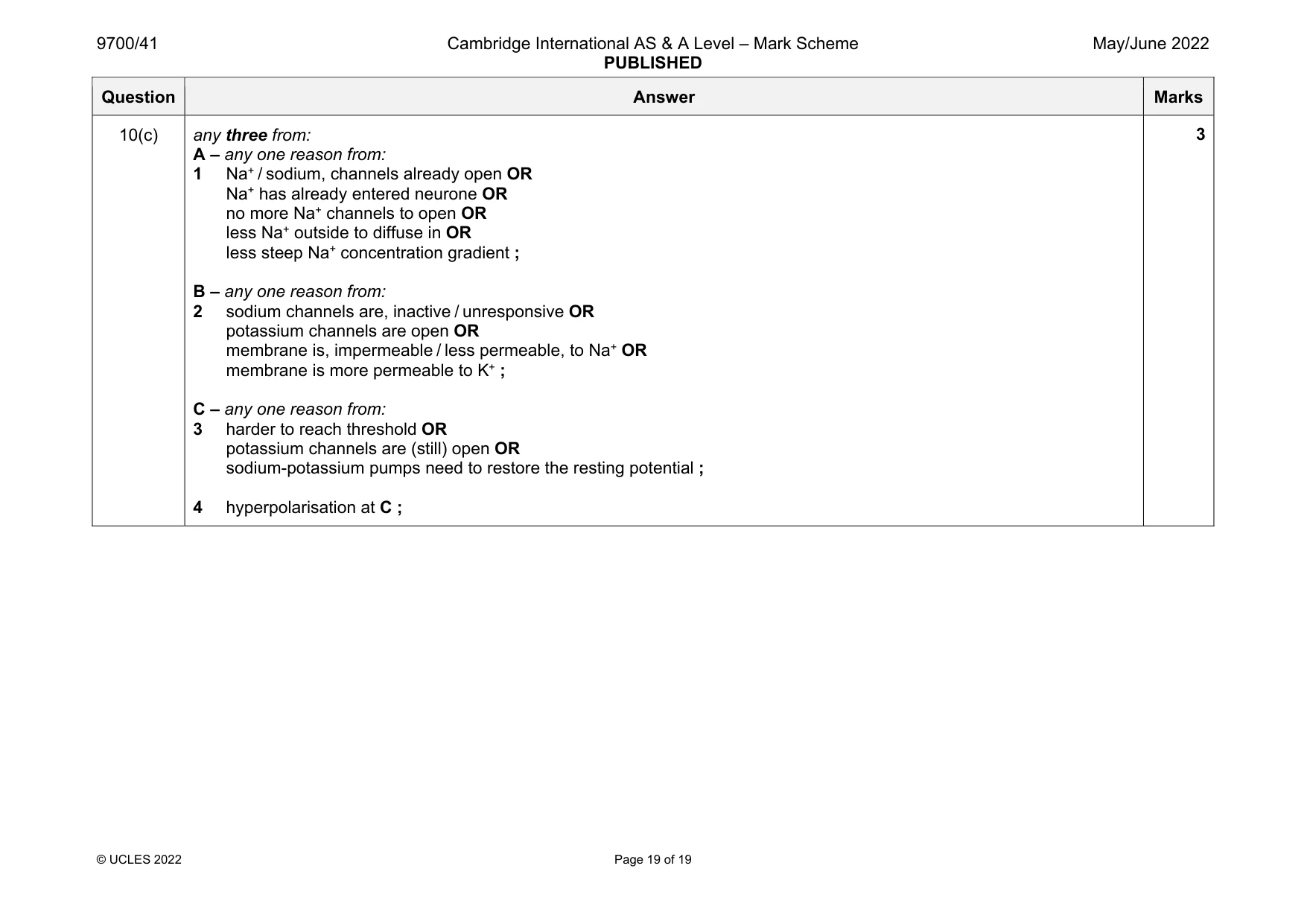
Mark scheme: 10(a) motor sensory 1 transmits impulses from CNS to effector and transmits impulses from, receptors / (named) sense organs, to CNS ; plus two from: motor sensory 2 cell body at end of, neurone / axon and cell body, in middle of / part-way along, neurone OR cell body not at end of, neurone / axon ; 3 cell body in, CNS / brain / spinal cord and cell body in (dorsal root) ganglion ; 4 long axon OR axon and short axon OR axon and dendron ; 5 dendrites attached to cell body and dendrites attached to dendron ; 3 10(b) any three from: 1 no myelin slow and myelin fast(er) / myelin increases speed ; 2 no myelin = 0.5–2 m s–1 and with myelin > 5 / up to 120 m s–1 ; 3 as axon diameter increases speed increases ; 4 diameter (+ units once) and speed (+ units once) for two neurones ; 3 Question Answer Marks 10(c) any three from: A – any one reason from: 1 Na+ / sodium, channels already open OR Na+ has already entered neurone OR no more Na+ channels to open OR less Na+ outside to diffuse in OR less steep Na+ concentration gradient ; B – any one reason from: 2 sodium channels are, inactive / unresponsive OR potassium channels are open OR membrane is, impermeable / less permeable, to Na+ OR membrane is more permeable to K+ ; C – any one reason from: 3 harder to reach threshold OR potassium channels are (still) open OR sodium-potassium pumps need to restore the resting potential ; 4 hyperpolarisation at C ; 3
What was in this paper
The subtopics covered by these 10 questions, and how many questions each got. Open one in a new tab to see every Cambridge question on it.
What you needed in this session
Cambridge’s own grade thresholds for 2022 May/June, Paper 4 · Variant 1. A higher threshold means an easier paper — the bar moves with how the cohort did.