Cambridge A Level Biology 9700 — 2025 May/June Paper 2 · Variant 2
9700/22/M/J/25 · 6 questions · 60 marks · 75 min
The question paper and its mark scheme, free to read here and free to download. This is Cambridge’s own paper, exactly as it was sat.
Question paper16 pages
Mark scheme21 pages
Answers below. Sit the paper first if you are practising.
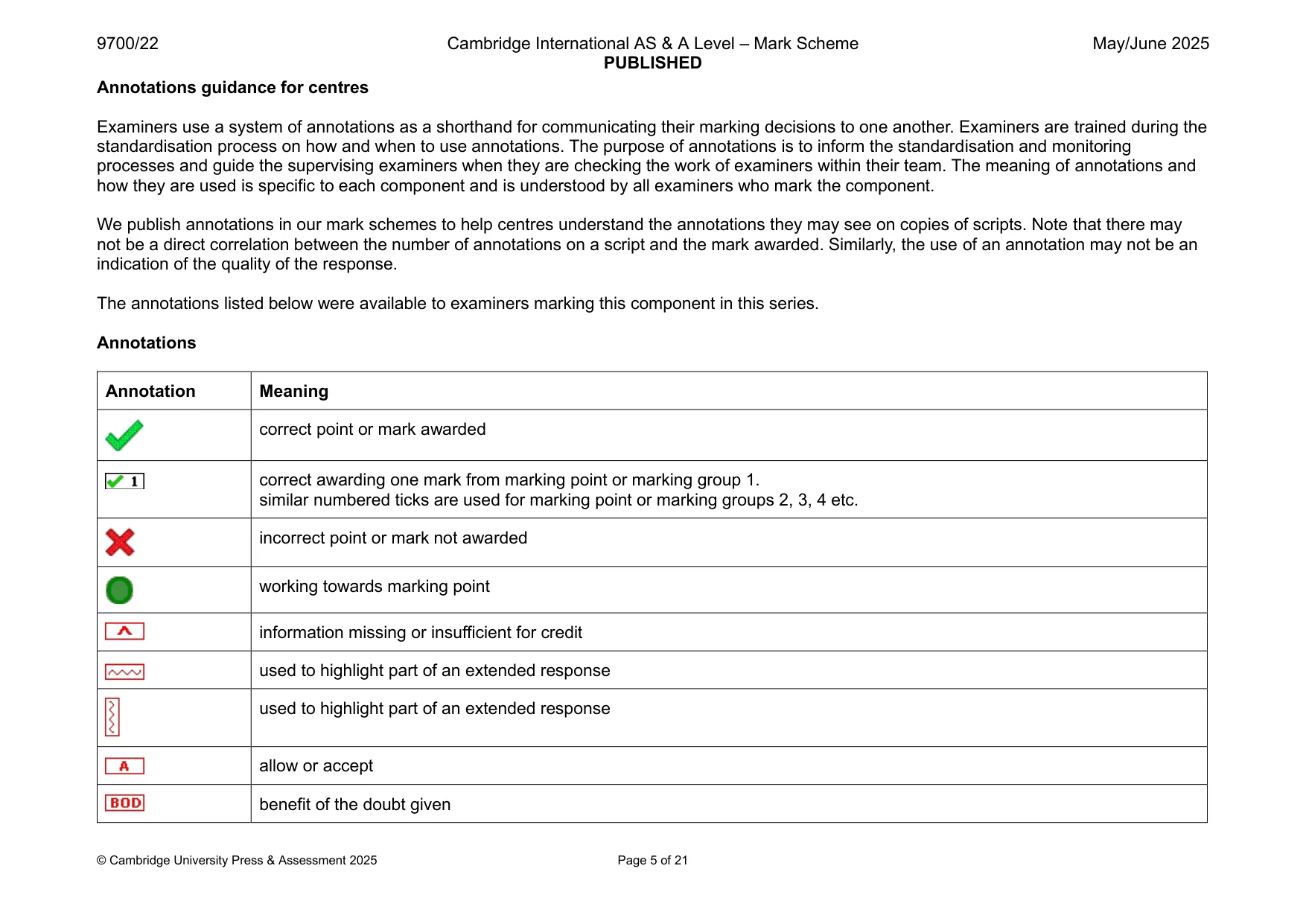
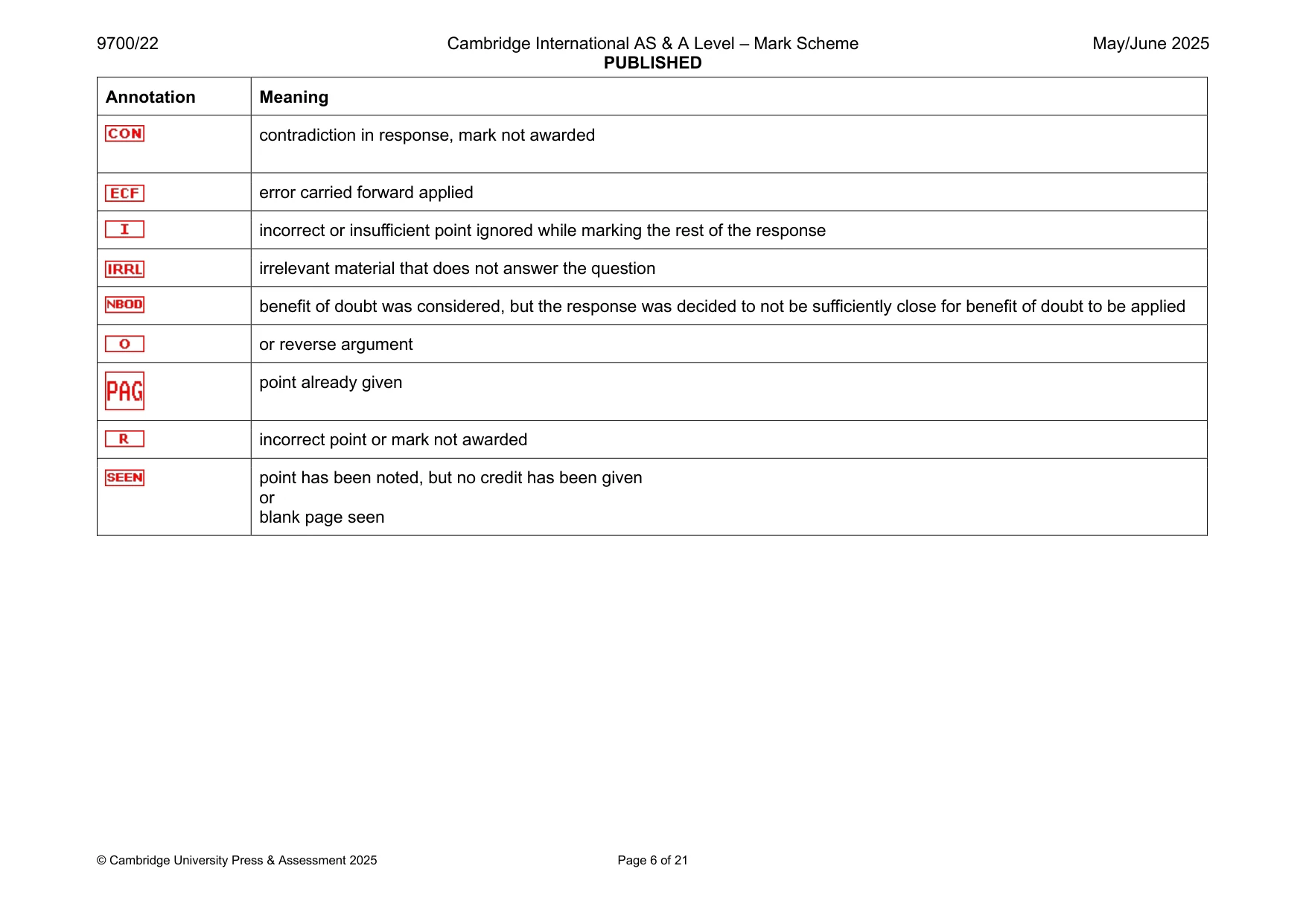
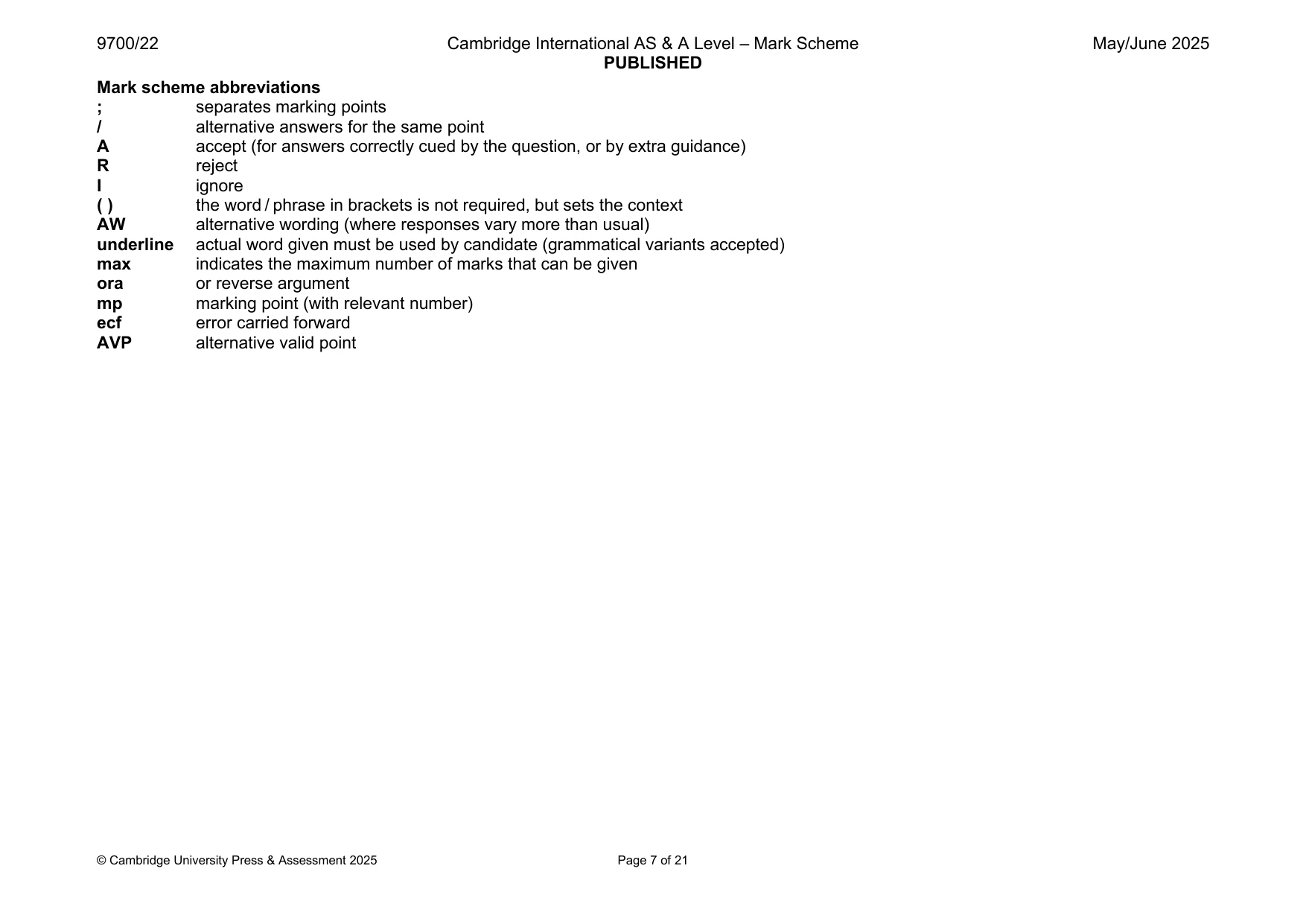
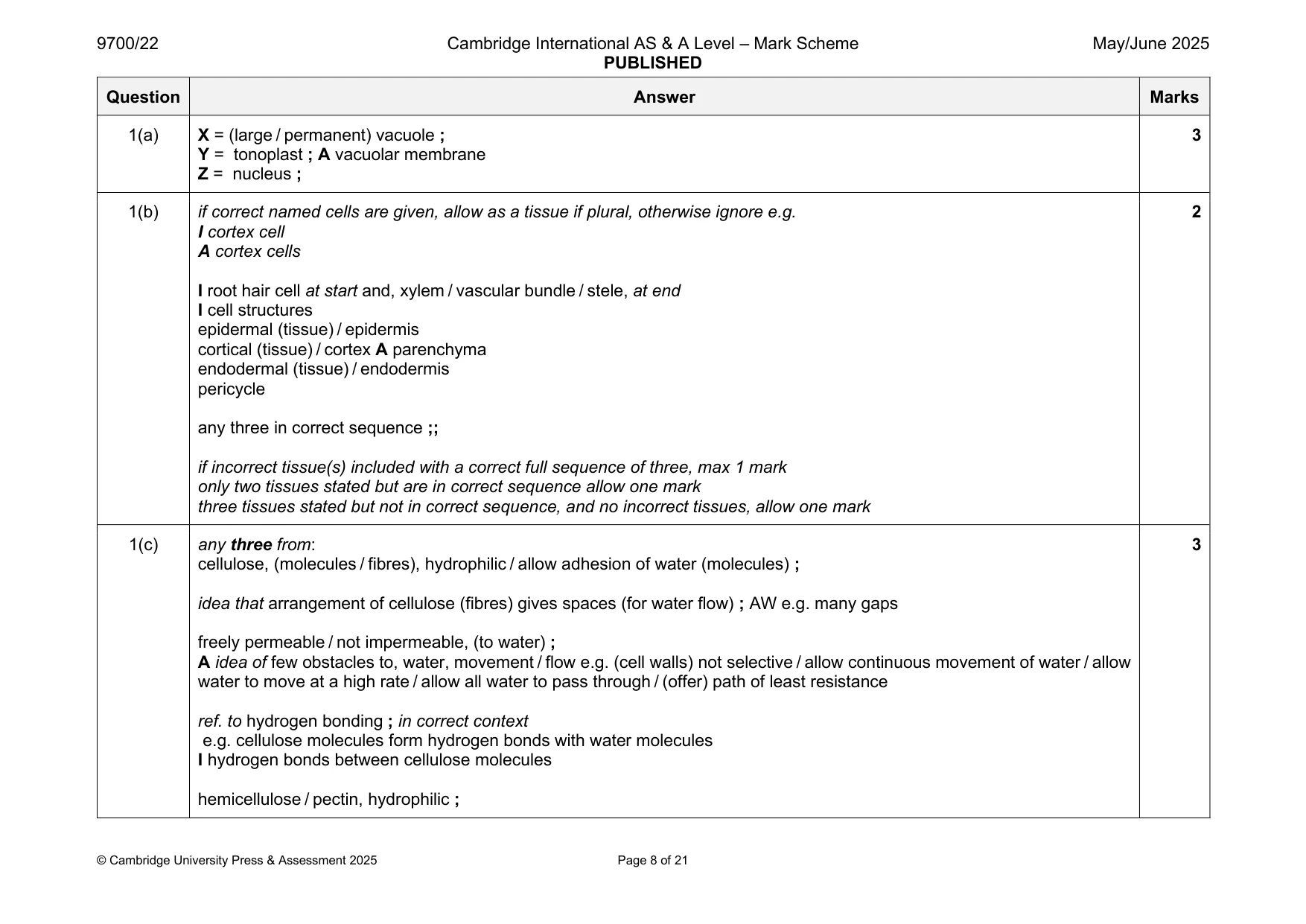
Questions as text
Q1 · Root hair cells are specialised plant cells located in the outer layer of young roots of…
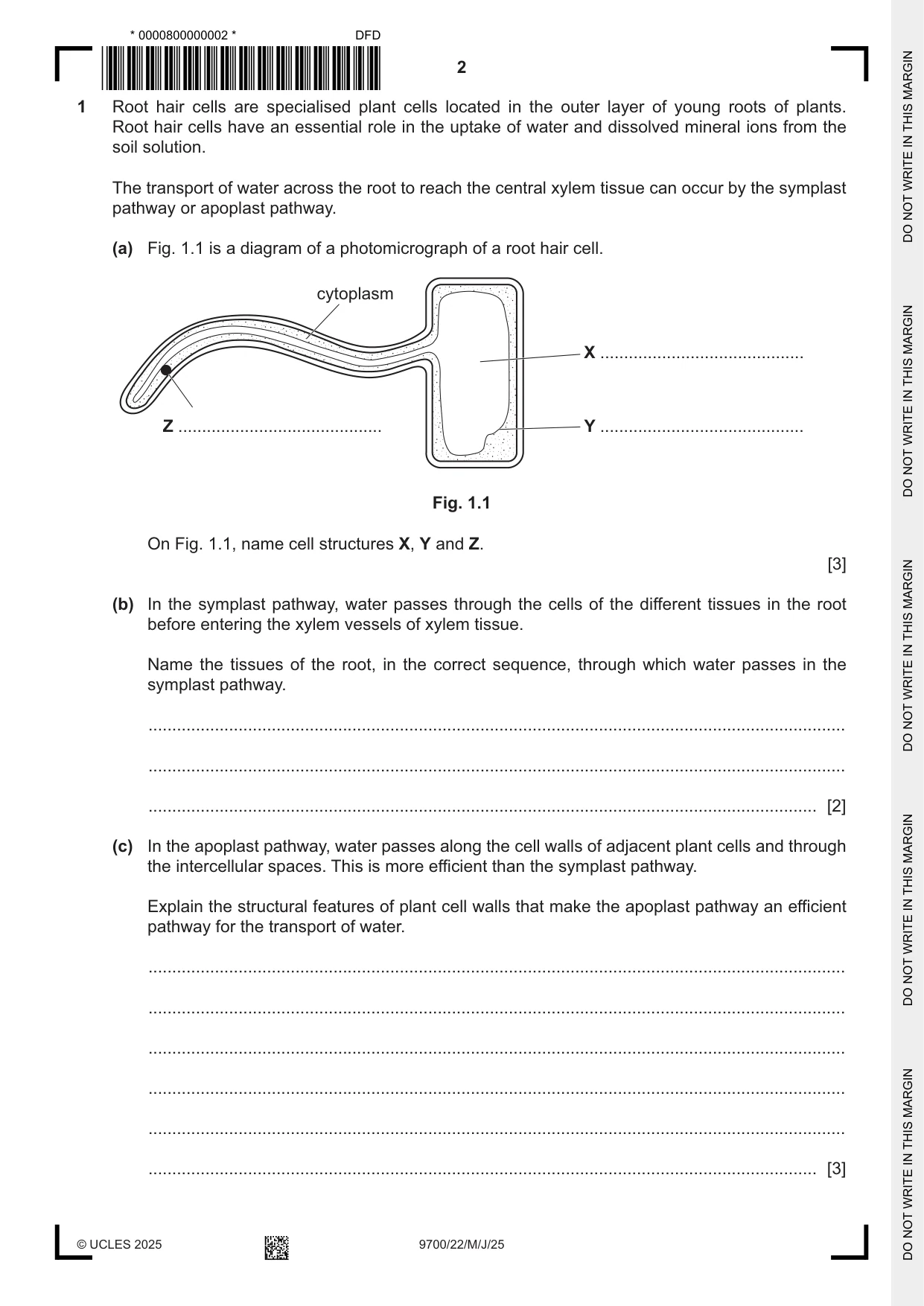
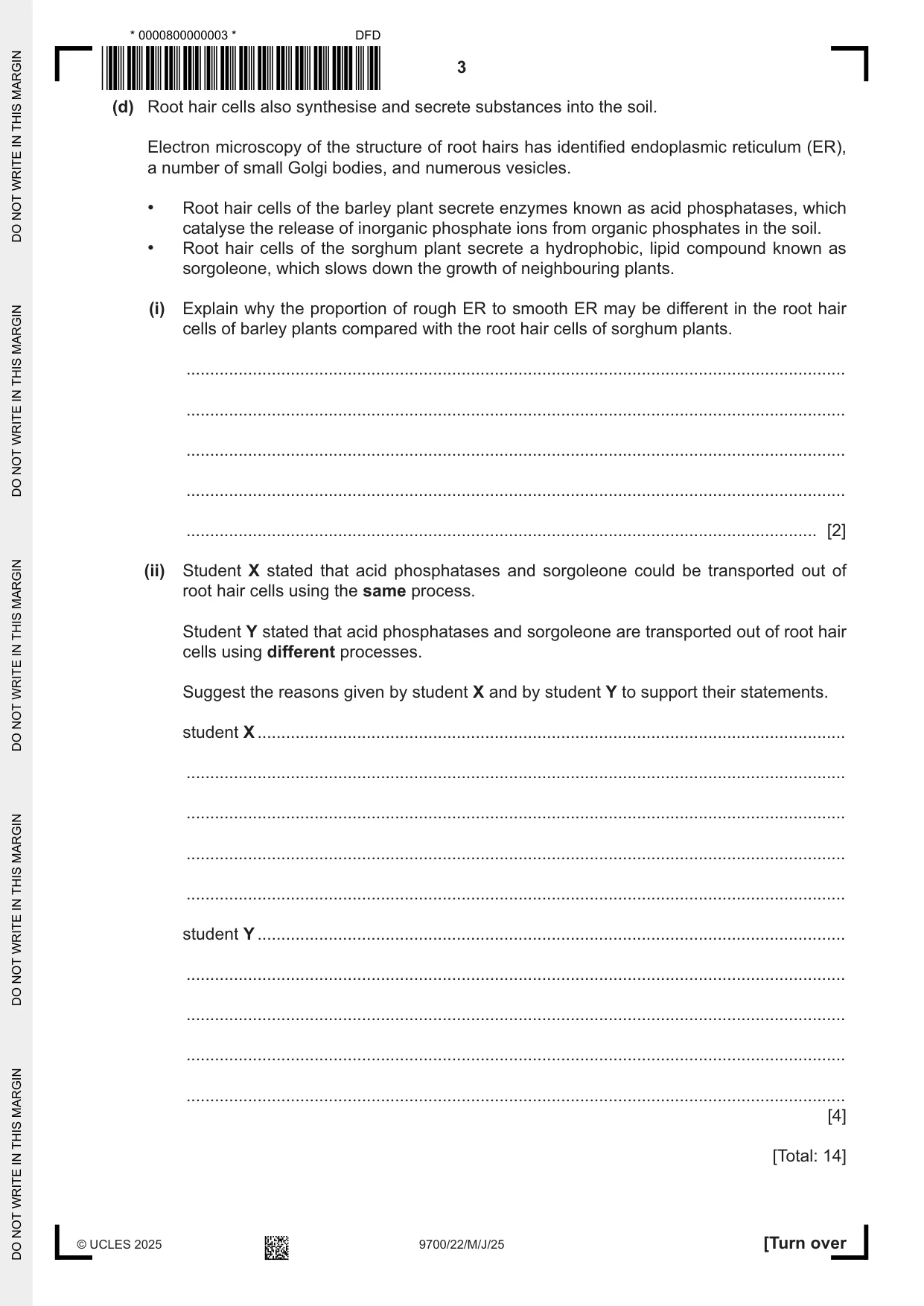
1 Root hair cells are specialised plant cells located in the outer layer of young roots of plants. Root hair cells have an essential role in the uptake of water and dissolved mineral ions from the soil solution. The transport of water across the root to reach the central xylem tissue can occur by the symplast pathway or apoplast pathway. (a) Fig. 1.1 is a diagram of a photomicrograph of a root hair cell. cytoplasm X ........................................... Z ........................................... Y ........................................... Fig. 1.1 On Fig. 1.1, name cell structures X, Y and Z. [3] (b) In the symplast pathway, water passes through the cells of the different tissues in the root before entering the xylem vessels of xylem tissue. Name the tissues of the root, in the correct sequence, through which water passes in the symplast pathway. ................................................................................................................................................... ................................................................................................................................................... ............................................................................................................................................. [2] (c) In the apoplast pathway, water passes along the cell walls of adjacent plant cells and through the intercellular spaces. This is more efficient than the symplast pathway. Explain the structural features of plant cell walls that make the apoplast pathway an efficient pathway for the transport of water. ................................................................................................................................................... ................................................................................................................................................... ................................................................................................................................................... ................................................................................................................................................... ................................................................................................................................................... ............................................................................................................................................. [3] (d) Root hair cells also synthesise and secrete substances into the soil. Electron microscopy of the structure of root hairs has identified endoplasmic reticulum (ER), a number of small Golgi bodies, and numerous vesicles. • Root hair cells of the barley plant secrete enzymes known as acid phosphatases, which catalyse the release of inorganic phosphate ions from organic phosphates in the soil. • Root hair cells of the sorghum plant secrete a hydrophobic, lipid compound known as sorgoleone, which slows down the growth of neighbouring plants. (i) Explain why the proportion of rough ER to smooth ER may be different in the root hair cells of barley plants compared with the root hair cells of sorghum plants. ........................................................................................................................................... ........................................................................................................................................... ........................................................................................................................................... ........................................................................................................................................... ..................................................................................................................................... [2] (ii) Student X stated that acid phosphatases and sorgoleone could be transported out of root hair cells using the same process. Student Y stated that acid phosphatases and sorgoleone are transported out of root hair cells using different processes. Suggest the reasons given by student X and by student Y to support their statements. student X ............................................................................................................................ ........................................................................................................................................... ........................................................................................................................................... ........................................................................................................................................... ........................................................................................................................................... student Y ............................................................................................................................ ........................................................................................................................................... ........................................................................................................................................... ........................................................................................................................................... ........................................................................................................................................... [4] [Total: 14]
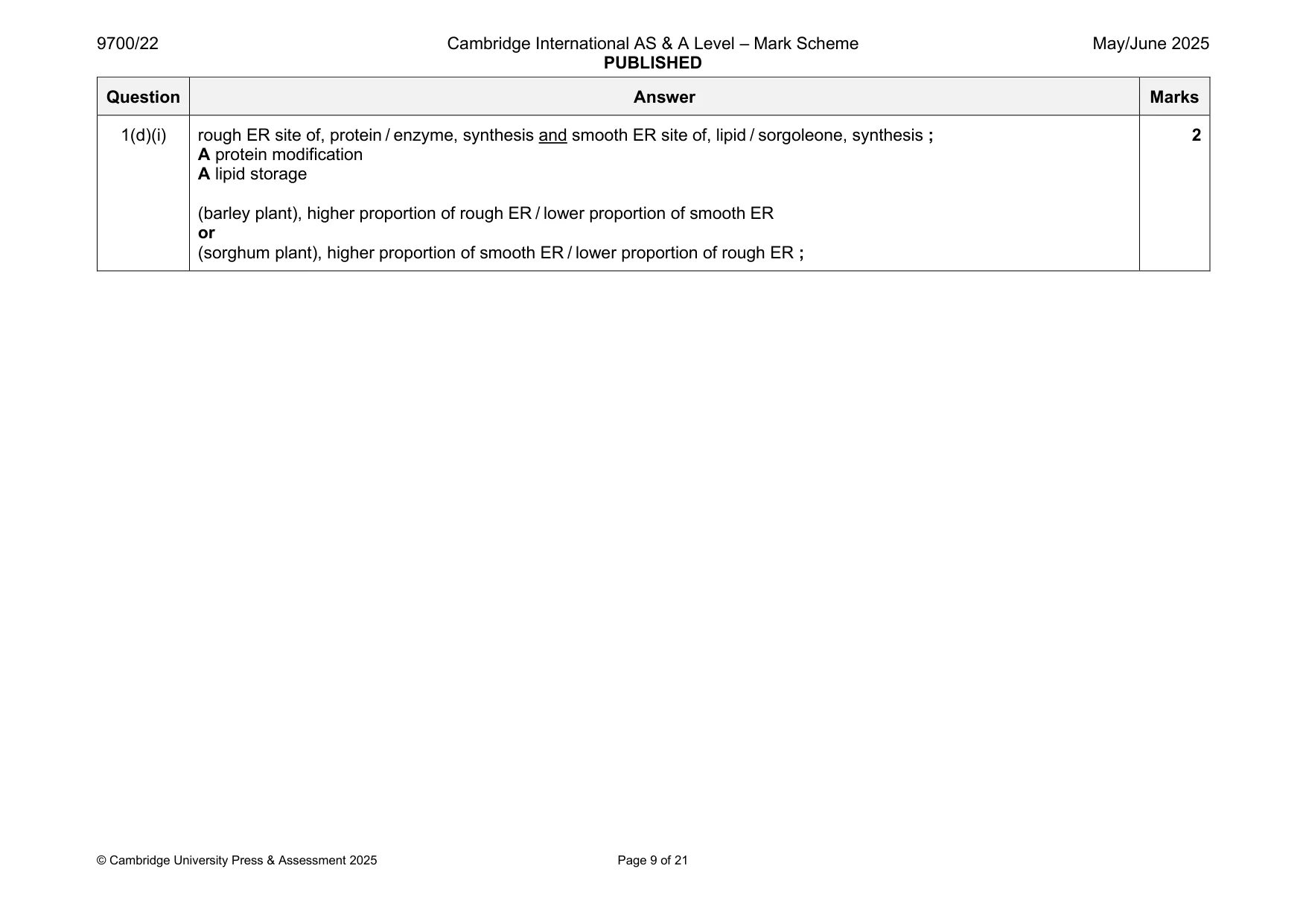
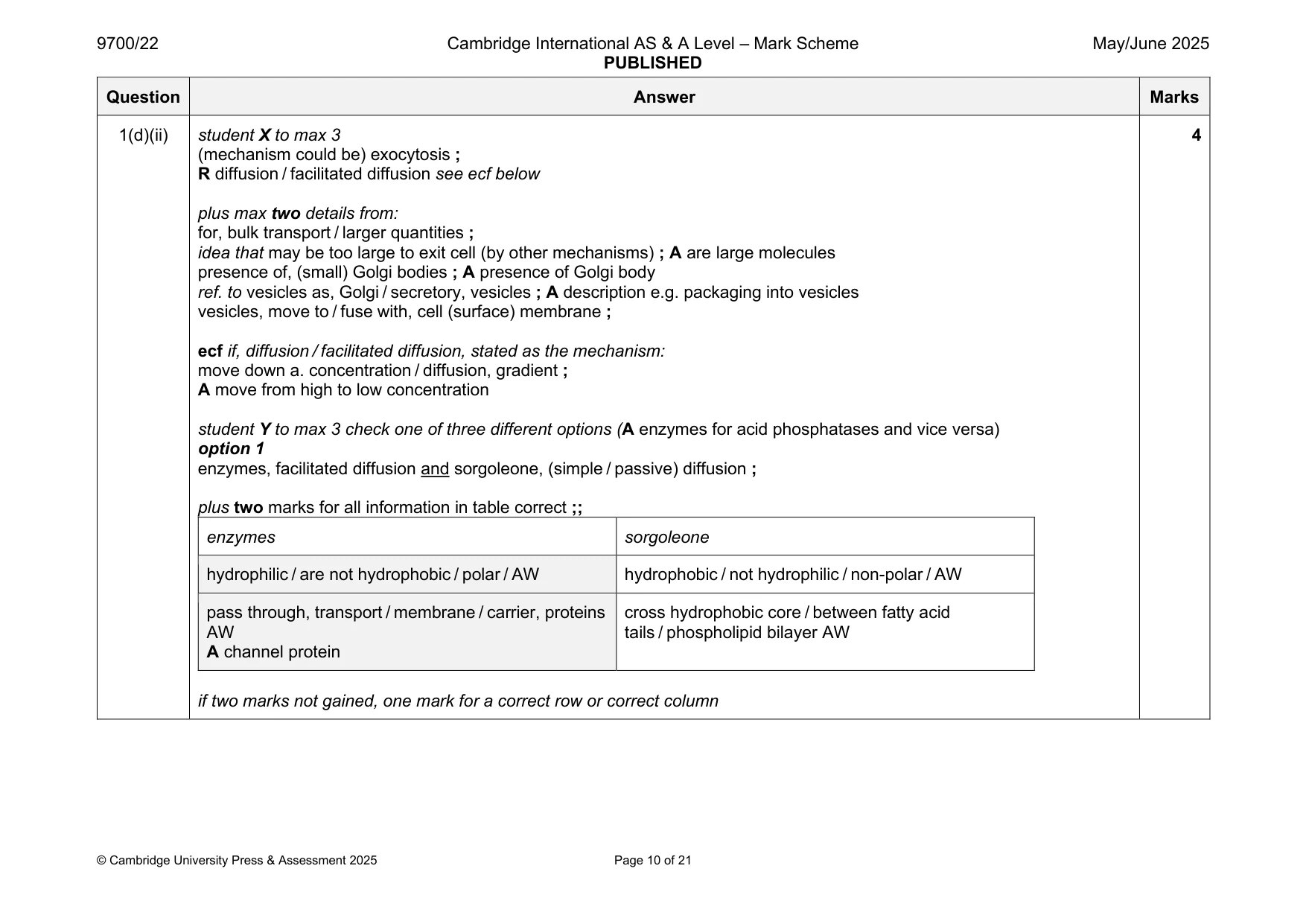
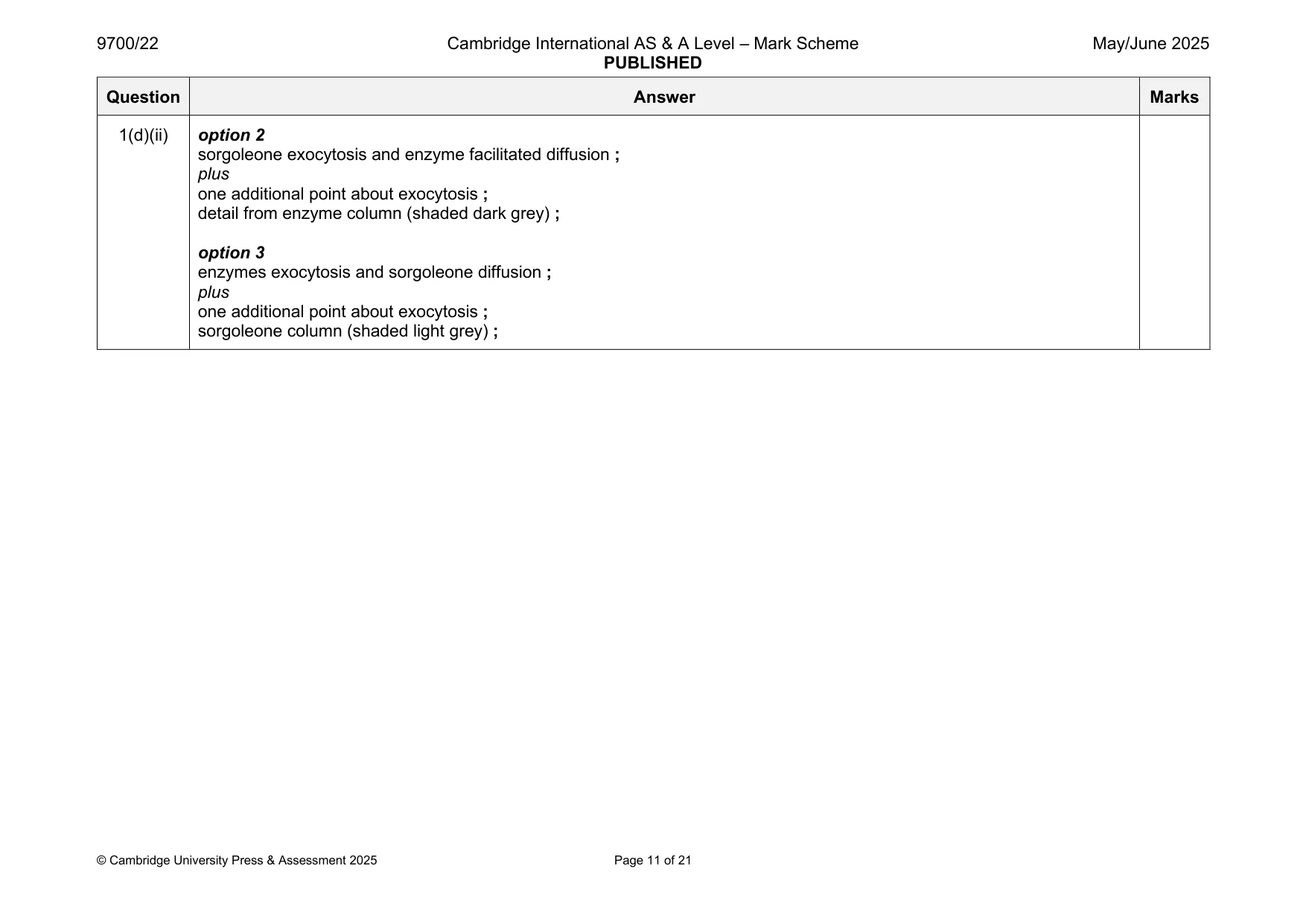
Mark scheme: Question Answer Marks 1(a) X = (large / permanent) vacuole ; 3 Y = tonoplast ; A vacuolar membrane Z = nucleus ; 1(b) if correct named cells are given, allow as a tissue if plural, otherwise ignore e.g. 2 I cortex cell A cortex cells I root hair cell at start and, xylem / vascular bundle / stele, at end I cell structures epidermal (tissue) / epidermis cortical (tissue) / cortex A parenchyma endodermal (tissue) / endodermis pericycle any three in correct sequence ;; if incorrect tissue(s) included with a correct full sequence of three, max 1 mark only two tissues stated but are in correct sequence allow one mark three tissues stated but not in correct sequence, and no incorrect tissues, allow one mark 1(c) any three from: 3 cellulose, (molecules / fibres), hydrophilic / allow adhesion of water (molecules) ; idea that arrangement of cellulose (fibres) gives spaces (for water flow) ; AW e.g. many gaps freely permeable / not impermeable, (to water) ; A idea of few obstacles to, water, movement / flow e.g. (cell walls) not selective / allow continuous movement of water / allow water to move at a high rate / allow all water to pass through / (offer) path of least resistance ref. to hydrogen bonding ; in correct context e.g. cellulose molecules form hydrogen bonds with water molecules I hydrogen bonds between cellulose molecules hemicellulose / pectin, hydrophilic ; 1(d)(i) rough ER site of, protein / enzyme, synthesis and smooth ER site of, lipid / sorgoleone, synthesis ; 2 A protein modification A lipid storage (barley plant), higher proportion of rough ER / lower proportion of smooth ER or (sorghum plant), higher proportion of smooth ER / lower proportion of rough ER ; 1(d)(ii) student X to max 3 4 (mechanism could be) exocytosis ; R diffusion / facilitated diffusion see ecf below plus max two details from: for, bulk transport / larger quantities ; idea that may be too large to exit cell (by other mechanisms) ; A are large molecules presence of, (small) Golgi bodies ; A presence of Golgi body ref. to vesicles as, Golgi / secretory, vesicles ; A description e.g. packaging into vesicles vesicles, move to / fuse with, cell (surface) membrane ; ecf if, diffusion / facilitated diffusion, stated as the mechanism: move down a. concentration / diffusion, gradient ; A move from high to low concentration student Y to max 3 check one of three different options (A enzymes for acid phosphatases and vice versa) option 1 enzymes, facilitated diffusion and sorgoleone, (simple / passive) diffusion ; plus two marks for all information in table correct ;; enzymes sorgoleone hydrophilic / are not hydrophobic / polar / AW hydrophobic / not hydrophilic / non-polar / AW pass through, transport / membrane / carrier, proteins cross hydrophobic core / between fatty acid AW tails / phospholipid bilayer AW A channel protein if two marks not gained, one mark for a correct row or correct column 1(d)(ii) option 2 sorgoleone exocytosis and enzyme facilitated diffusion ; plus one additional point about exocytosis ; detail from enzyme column (shaded dark grey) ; option 3 enzymes exocytosis and sorgoleone diffusion ; plus one additional point about exocytosis ; sorgoleone column (shaded light grey) ;
More questions on Cells as the basic units of living organisms
Q2 · The transport of respiratory gases involves blood plasma and red blood cells
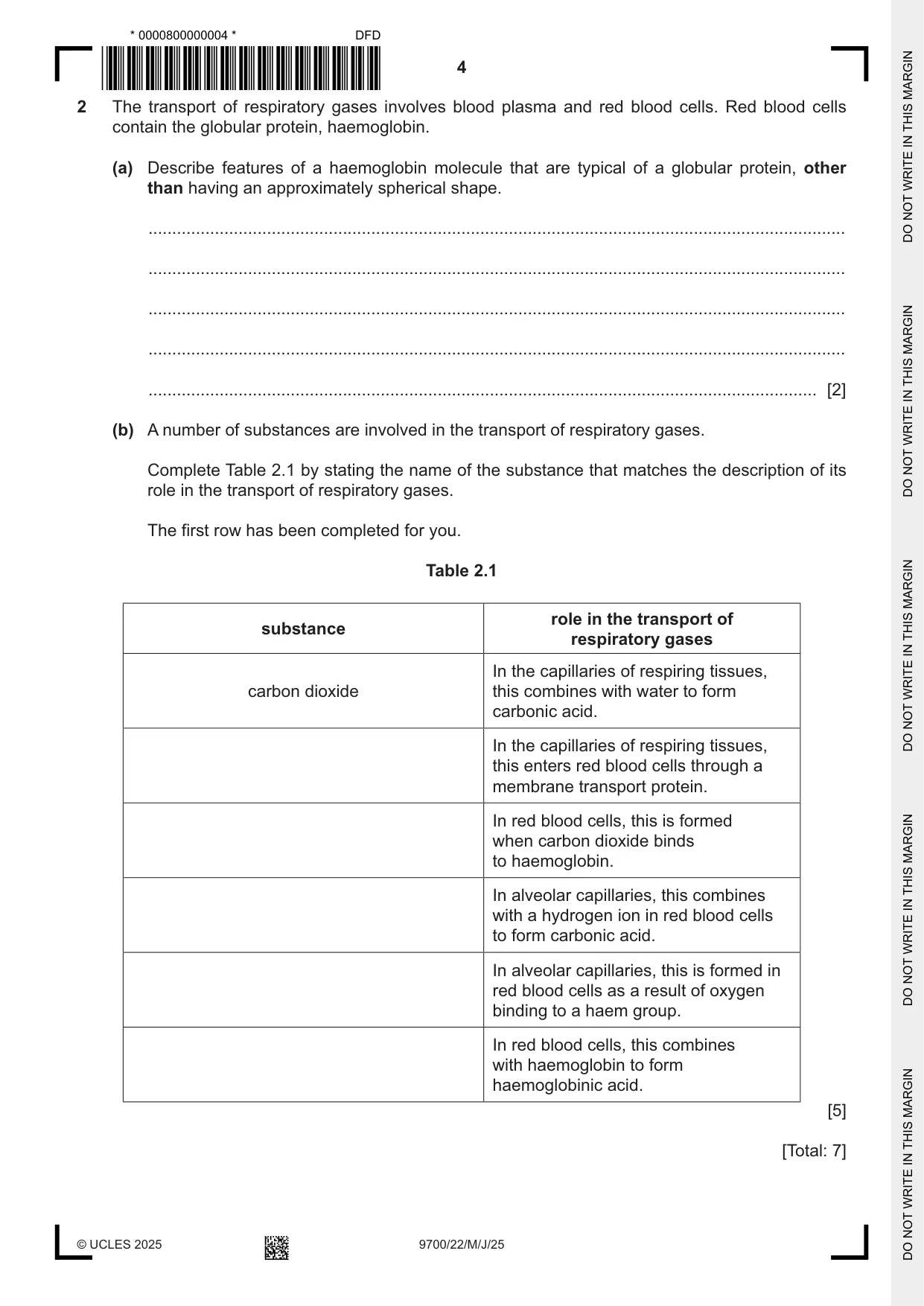
2 The transport of respiratory gases involves blood plasma and red blood cells. Red blood cells contain the globular protein, haemoglobin. (a) Describe features of a haemoglobin molecule that are typical of a globular protein, other than having an approximately spherical shape. ................................................................................................................................................... ................................................................................................................................................... ................................................................................................................................................... ................................................................................................................................................... ............................................................................................................................................. [2] (b) A number of substances are involved in the transport of respiratory gases. Complete Table 2.1 by stating the name of the substance that matches the description of its role in the transport of respiratory gases. The first row has been completed for you. Table 2.1 role in the transport of substance respiratory gases In the capillaries of respiring tissues, carbon dioxide this combines with water to form carbonic acid. In the capillaries of respiring tissues, this enters red blood cells through a membrane transport protein. In red blood cells, this is formed when carbon dioxide binds to haemoglobin. In alveolar capillaries, this combines with a hydrogen ion in red blood cells to form carbonic acid. In alveolar capillaries, this is formed in red blood cells as a result of oxygen binding to a haem group. In red blood cells, this combines with haemoglobin to form haemoglobinic acid. [5] [Total: 7]
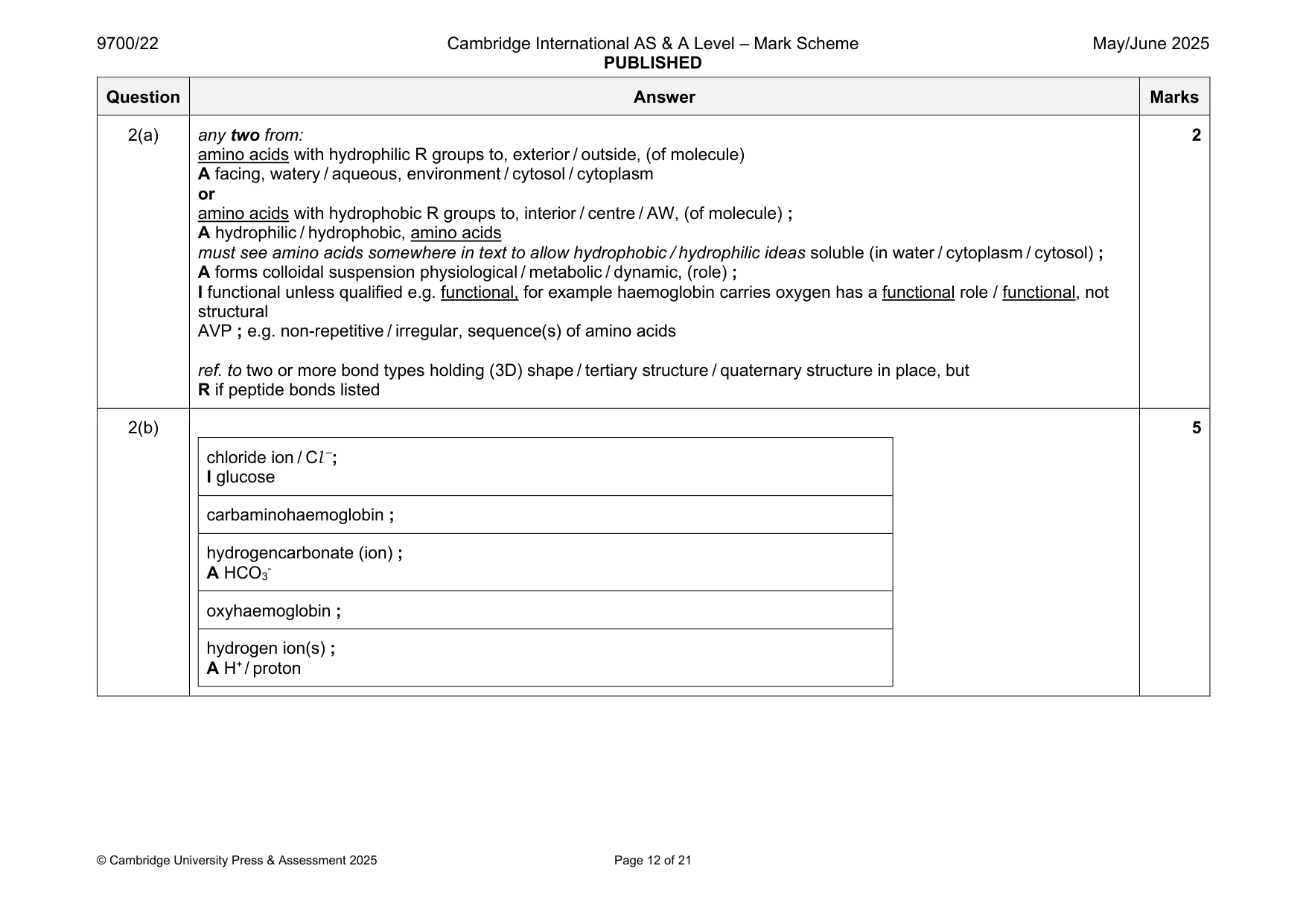
Mark scheme: 2(a) any two from: 2 amino acids with hydrophilic R groups to, exterior / outside, (of molecule) A facing, watery / aqueous, environment / cytosol / cytoplasm or amino acids with hydrophobic R groups to, interior / centre / AW, (of molecule) ; A hydrophilic / hydrophobic, amino acids must see amino acids somewhere in text to allow hydrophobic / hydrophilic ideas soluble (in water / cytoplasm / cytosol) ; A forms colloidal suspension physiological / metabolic / dynamic, (role) ; I functional unless qualified e.g. functional, for example haemoglobin carries oxygen has a functional role / functional, not structural AVP ; e.g. non-repetitive / irregular, sequence(s) of amino acids ref. to two or more bond types holding (3D) shape / tertiary structure / quaternary structure in place, but R if peptide bonds listed 2(b) 5 chloride ion / Cl –; I glucose carbaminohaemoglobin ; hydrogencarbonate (ion) ; A HCO3- oxyhaemoglobin ; hydrogen ion(s) ; A H+ / proton
Q3 · Carrots are root vegetables of the carrot plant
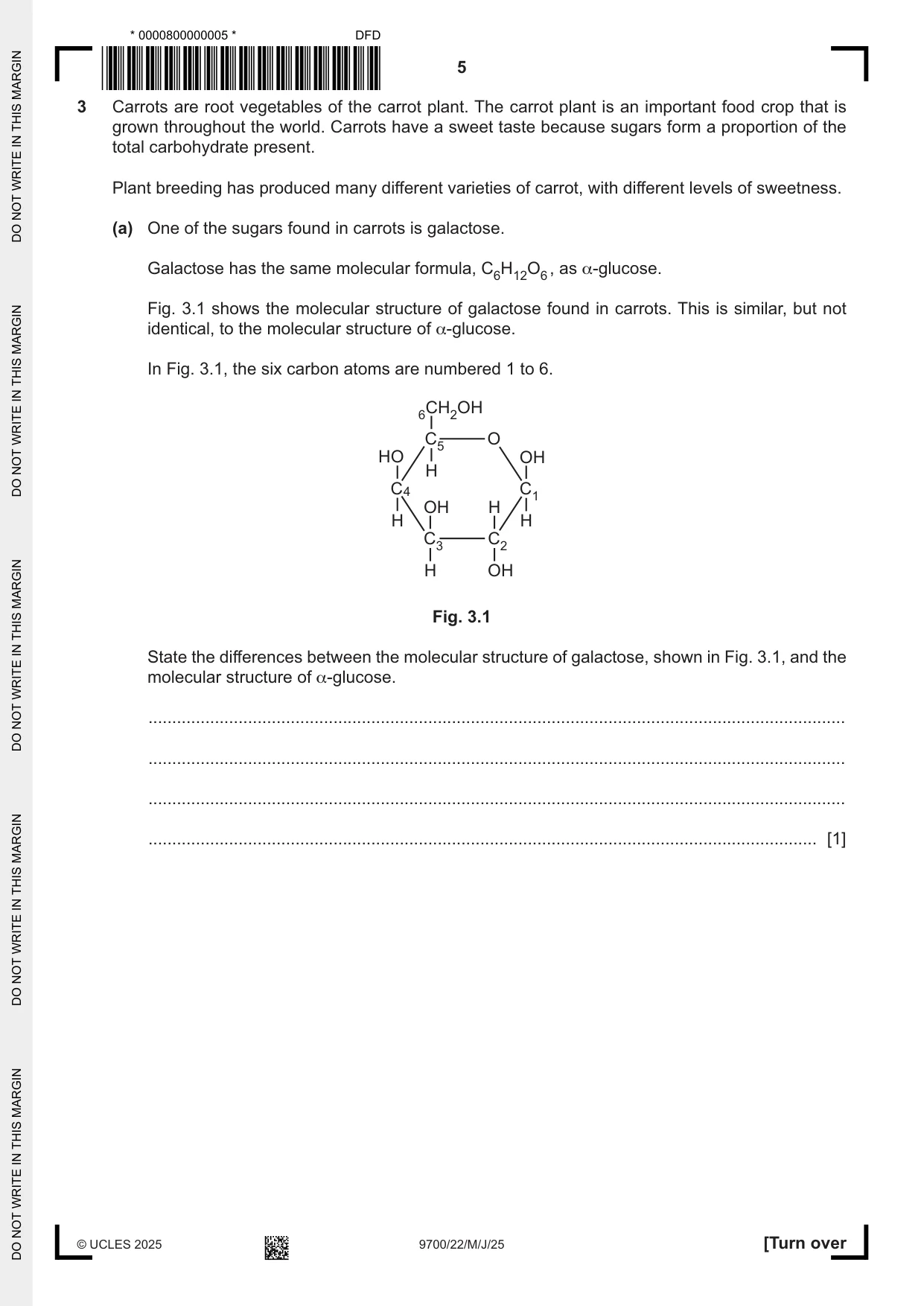
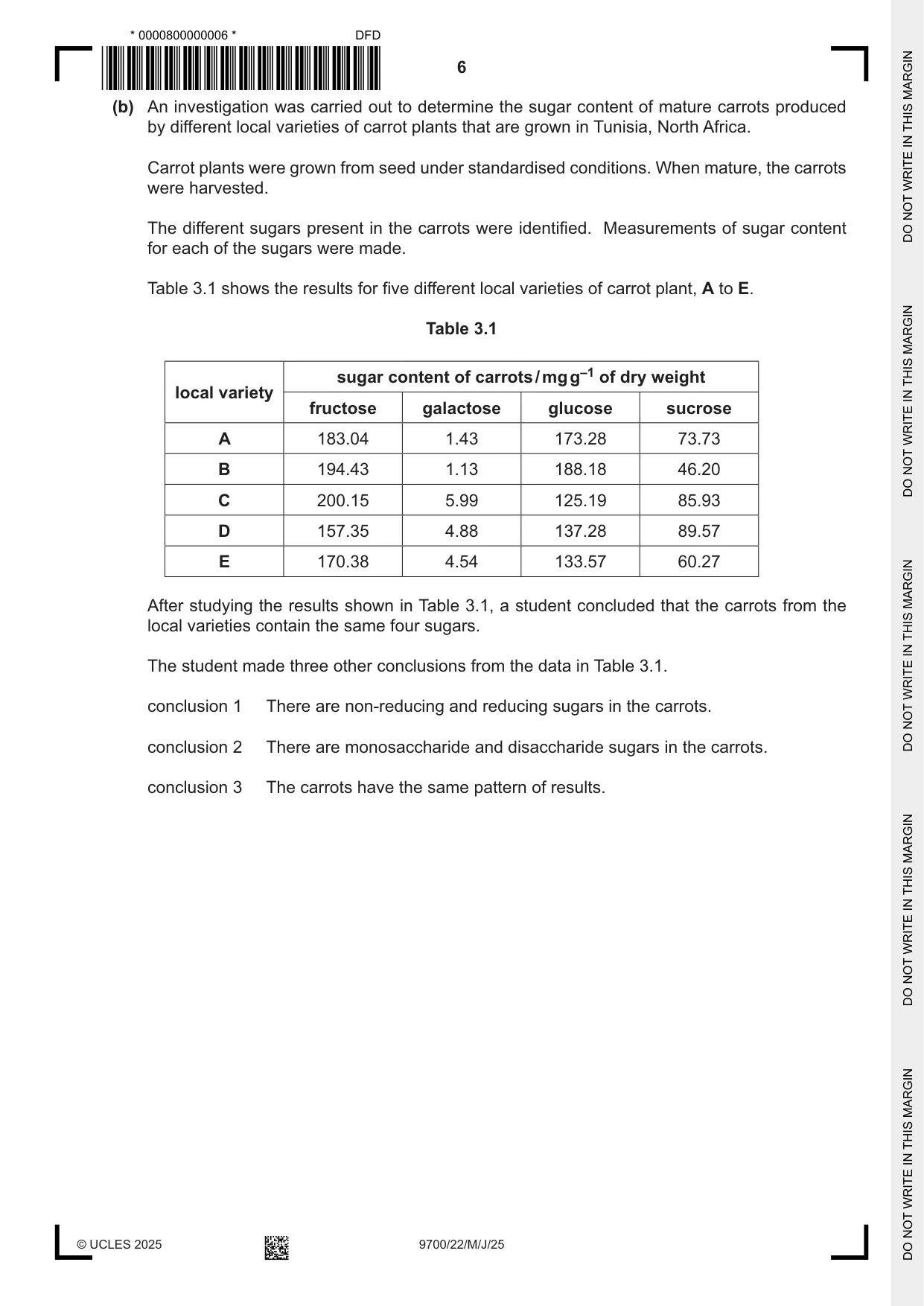
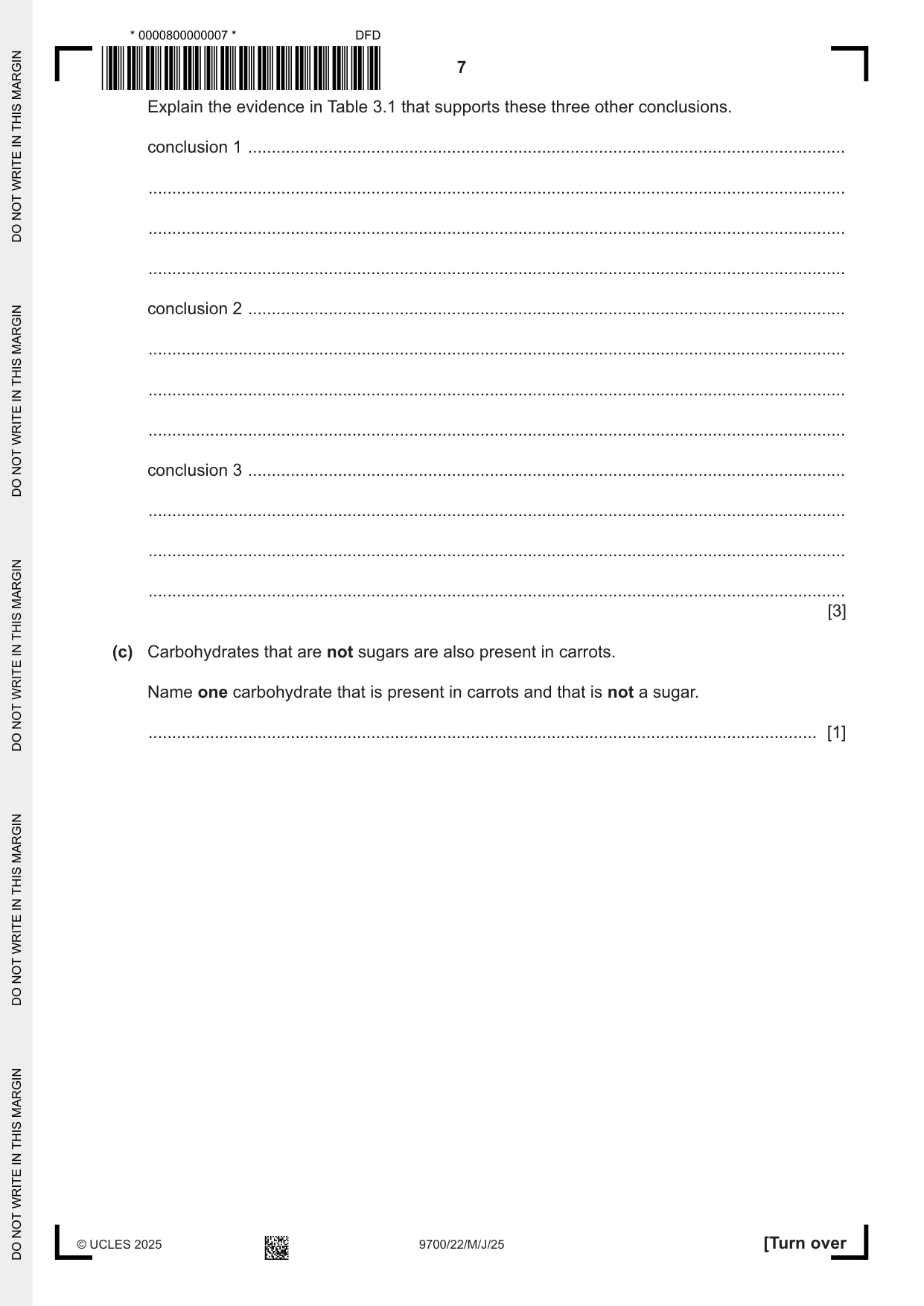
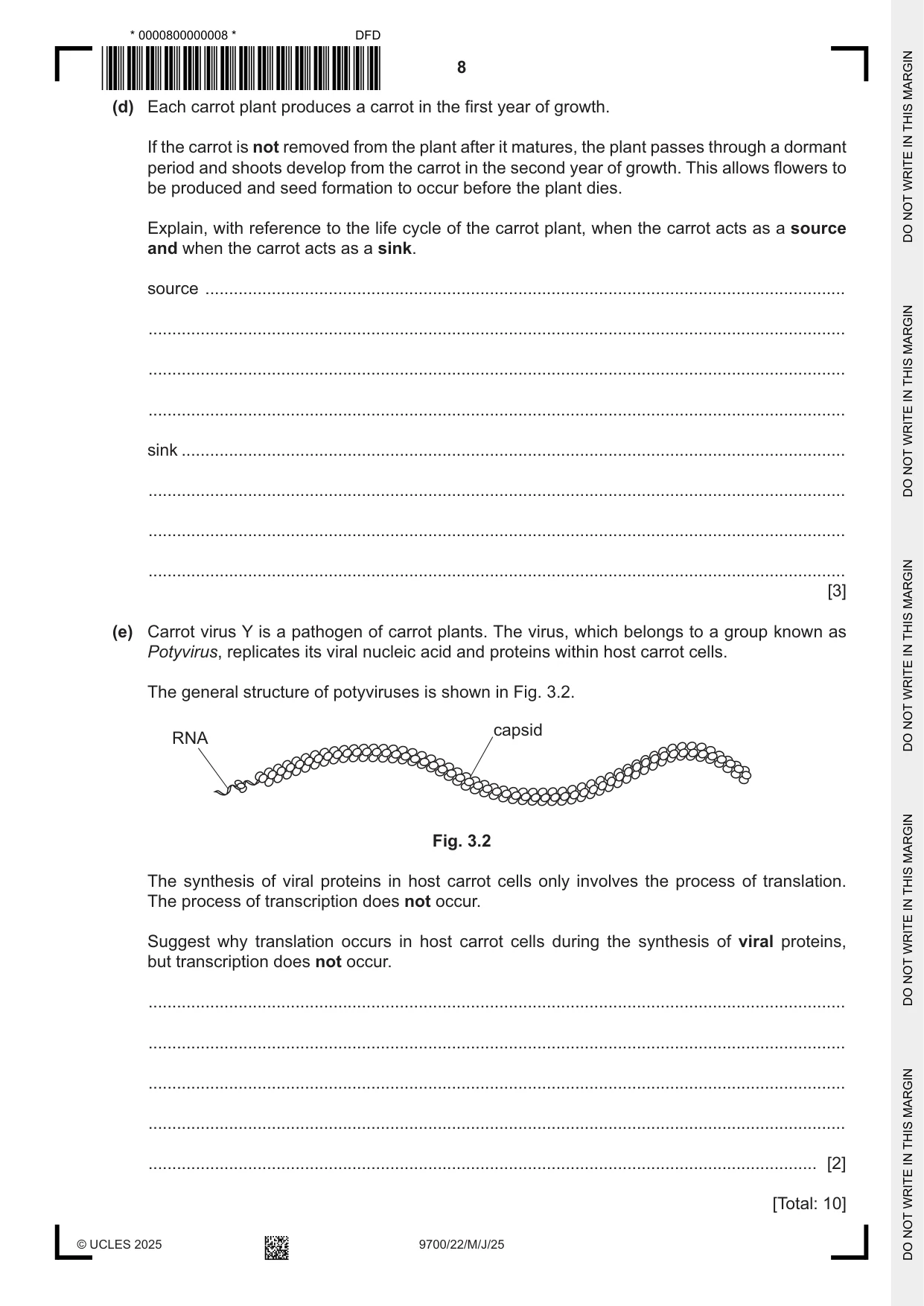
3 Carrots are root vegetables of the carrot plant. The carrot plant is an important food crop that is grown throughout the world. Carrots have a sweet taste because sugars form a proportion of the total carbohydrate present. Plant breeding has produced many different varieties of carrot, with different levels of sweetness. (a) One of the sugars found in carrots is galactose. Galactose has the same molecular formula, C6H12O6 , as α‑glucose. Fig. 3.1 shows the molecular structure of galactose found in carrots. This is similar, but not identical, to the molecular structure of α‑glucose. In Fig. 3.1, the six carbon atoms are numbered 1 to 6. 6CH2OH C5 O HO OH H C4 C1 OH H H H C3 C2 H OH Fig. 3.1 State the differences between the molecular structure of galactose, shown in Fig. 3.1, and the molecular structure of α‑glucose. ................................................................................................................................................... ................................................................................................................................................... ................................................................................................................................................... ............................................................................................................................................. [1] (b) An investigation was carried out to determine the sugar content of mature carrots produced by different local varieties of carrot plants that are grown in Tunisia, North Africa. Carrot plants were grown from seed under standardised conditions. When mature, the carrots were harvested. The different sugars present in the carrots were identified. Measurements of sugar content for each of the sugars were made. Table 3.1 shows the results for five different local varieties of carrot plant, A to E. Table 3.1 sugar content of carrots / mg g–1 of dry weight local variety fructose galactose glucose sucrose A 183.04 1.43 173.28 73.73 B 194.43 1.13 188.18 46.20 C 200.15 5.99 125.19 85.93 D 157.35 4.88 137.28 89.57 E 170.38 4.54 133.57 60.27 After studying the results shown in Table 3.1, a student concluded that the carrots from the local varieties contain the same four sugars. The student made three other conclusions from the data in Table 3.1. conclusion 1 There are non‑reducing and reducing sugars in the carrots. conclusion 2 There are monosaccharide and disaccharide sugars in the carrots. conclusion 3 The carrots have the same pattern of results. Explain the evidence in Table 3.1 that supports these three other conclusions. conclusion 1 .............................................................................................................................. ................................................................................................................................................... ................................................................................................................................................... ................................................................................................................................................... conclusion 2 .............................................................................................................................. ................................................................................................................................................... ................................................................................................................................................... ................................................................................................................................................... conclusion 3 .............................................................................................................................. ................................................................................................................................................... ................................................................................................................................................... ................................................................................................................................................... [3] (c) Carbohydrates that are not sugars are also present in carrots. Name one carbohydrate that is present in carrots and that is not a sugar. ............................................................................................................................................. [1] (d) Each carrot plant produces a carrot in the first year of growth. If the carrot is not removed from the plant after it matures, the plant passes through a dormant period and shoots develop from the carrot in the second year of growth. This allows flowers to be produced and seed formation to occur before the plant dies. Explain, with reference to the life cycle of the carrot plant, when the carrot acts as a source and when the carrot acts as a sink. source ....................................................................................................................................... ................................................................................................................................................... ................................................................................................................................................... ................................................................................................................................................... sink ............................................................................................................................................ ................................................................................................................................................... ................................................................................................................................................... ................................................................................................................................................... [3] (e) Carrot virus Y is a pathogen of carrot plants. The virus, which belongs to a group known as Potyvirus, replicates its viral nucleic acid and proteins within host carrot cells. The general structure of potyviruses is shown in Fig. 3.2. capsid RNA Fig. 3.2 The synthesis of viral proteins in host carrot cells only involves the process of translation. The process of transcription does not occur. Suggest why translation occurs in host carrot cells during the synthesis of viral proteins, but transcription does not occur. ................................................................................................................................................... ................................................................................................................................................... ................................................................................................................................................... ................................................................................................................................................... ............................................................................................................................................. [2] [Total: 10]
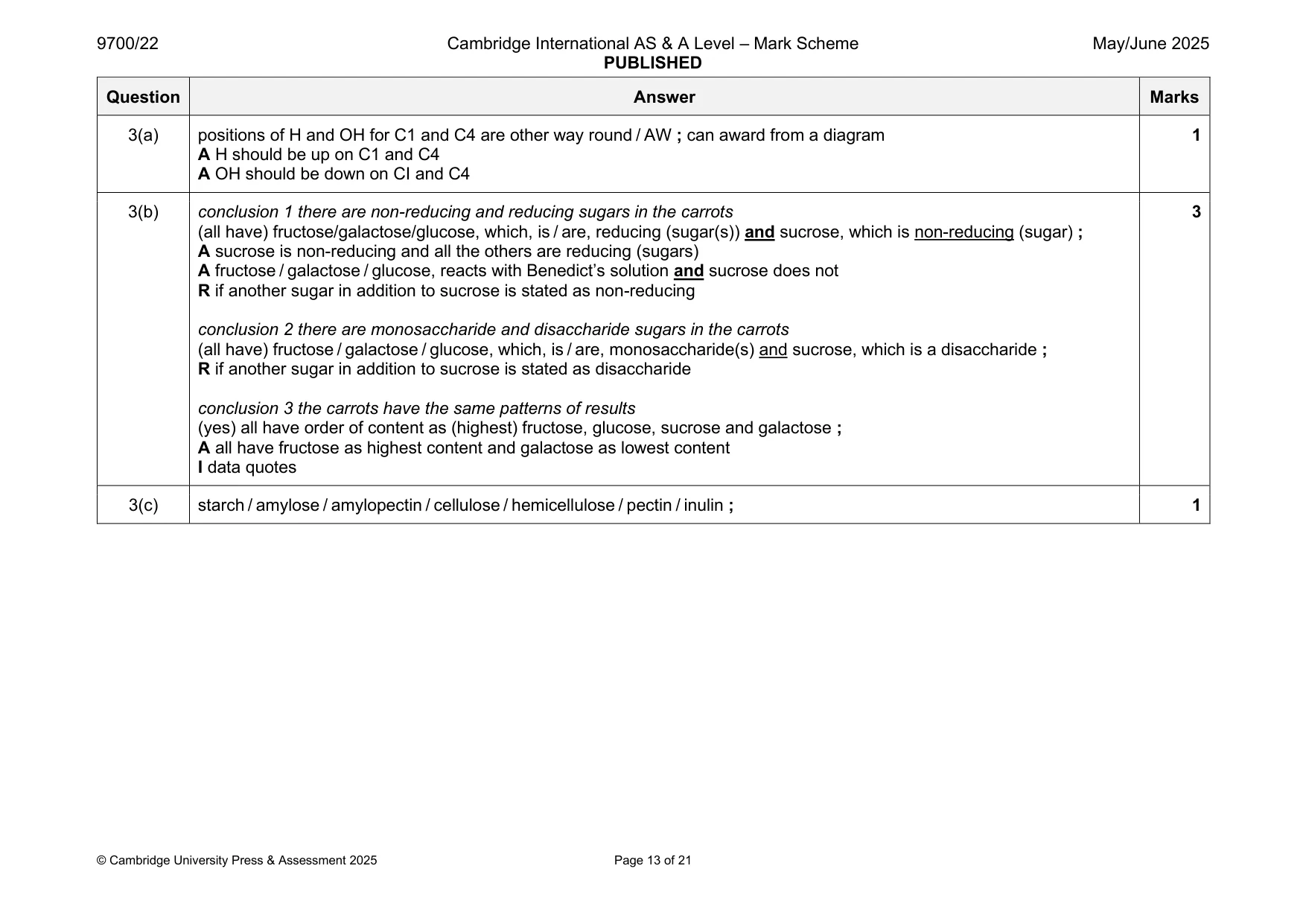
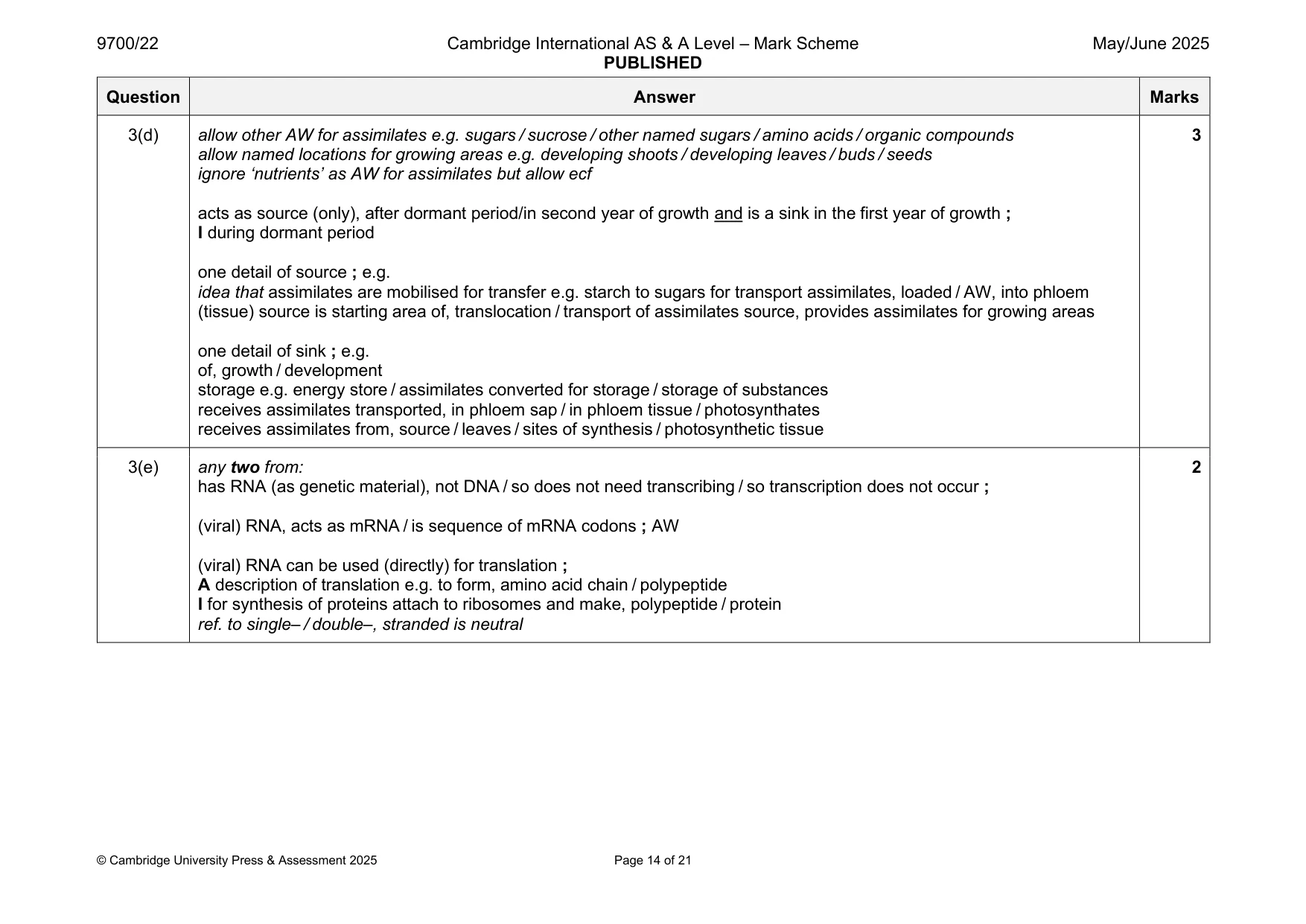
Mark scheme: 3(a) positions of H and OH for C1 and C4 are other way round / AW ; can award from a diagram 1 A H should be up on C1 and C4 A OH should be down on CI and C4 3(b) conclusion 1 there are non-reducing and reducing sugars in the carrots 3 (all have) fructose/galactose/glucose, which, is / are, reducing (sugar(s)) and sucrose, which is non-reducing (sugar) ; A sucrose is non-reducing and all the others are reducing (sugars) A fructose / galactose / glucose, reacts with Benedict’s solution and sucrose does not R if another sugar in addition to sucrose is stated as non-reducing conclusion 2 there are monosaccharide and disaccharide sugars in the carrots (all have) fructose / galactose / glucose, which, is / are, monosaccharide(s) and sucrose, which is a disaccharide ; R if another sugar in addition to sucrose is stated as disaccharide conclusion 3 the carrots have the same patterns of results (yes) all have order of content as (highest) fructose, glucose, sucrose and galactose ; A all have fructose as highest content and galactose as lowest content I data quotes 3(c) starch / amylose / amylopectin / cellulose / hemicellulose / pectin / inulin ; 1 3(d) allow other AW for assimilates e.g. sugars / sucrose / other named sugars / amino acids / organic compounds 3 allow named locations for growing areas e.g. developing shoots / developing leaves / buds / seeds ignore ‘nutrients’ as AW for assimilates but allow ecf acts as source (only), after dormant period/in second year of growth and is a sink in the first year of growth ; I during dormant period one detail of source ; e.g. idea that assimilates are mobilised for transfer e.g. starch to sugars for transport assimilates, loaded / AW, into phloem (tissue) source is starting area of, translocation / transport of assimilates source, provides assimilates for growing areas one detail of sink ; e.g. of, growth / development storage e.g. energy store / assimilates converted for storage / storage of substances receives assimilates transported, in phloem sap / in phloem tissue / photosynthates receives assimilates from, source / leaves / sites of synthesis / photosynthetic tissue 3(e) any two from: 2 has RNA (as genetic material), not DNA / so does not need transcribing / so transcription does not occur ; (viral) RNA, acts as mRNA / is sequence of mRNA codons ; AW (viral) RNA can be used (directly) for translation ; A description of translation e.g. to form, amino acid chain / polypeptide I for synthesis of proteins attach to ribosomes and make, polypeptide / protein ref. to single– / double–, stranded is neutral
Q4 · Tuberculosis (TB) is an infectious disease that is caused by a bacterial pathogen
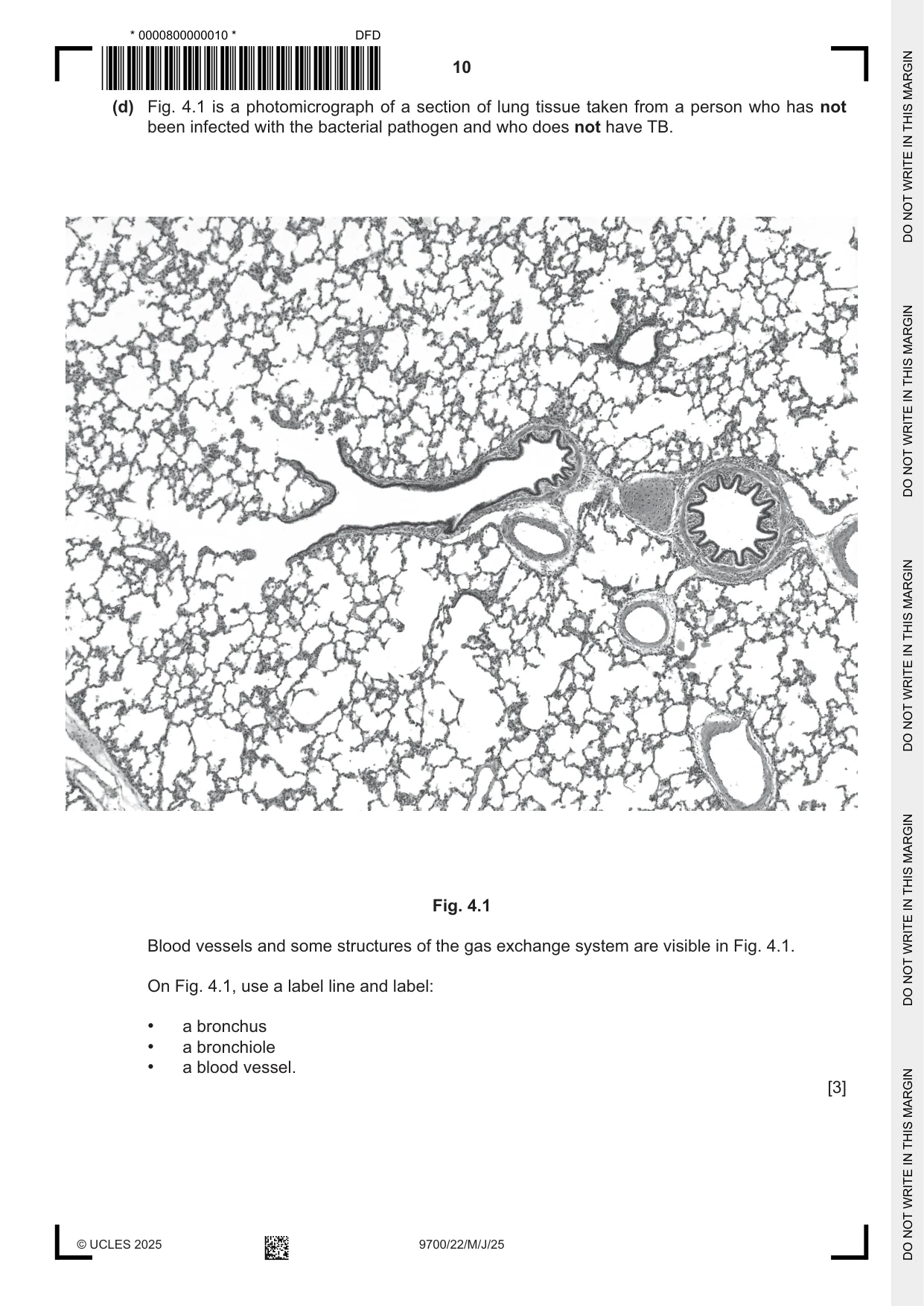
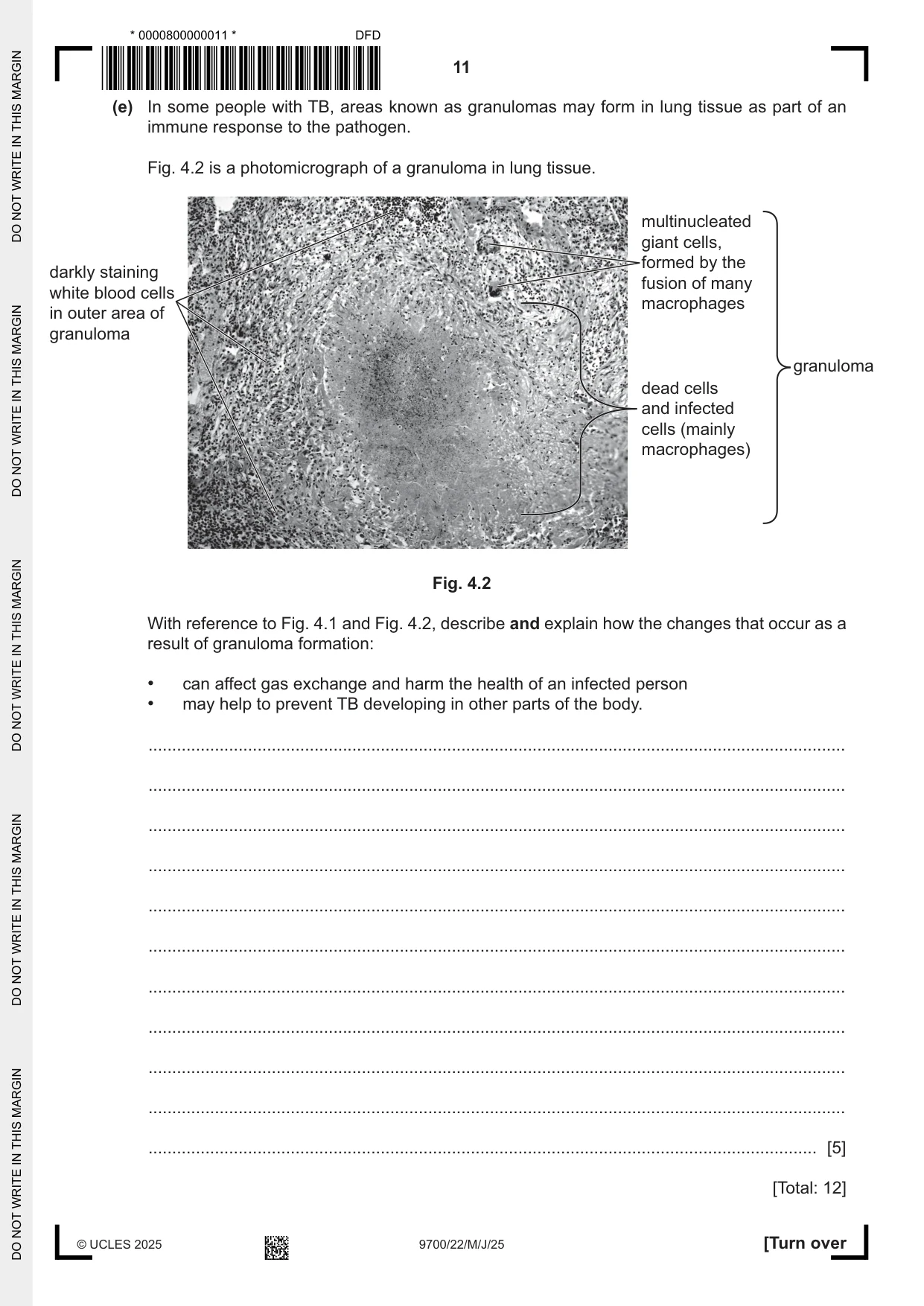
4 Tuberculosis (TB) is an infectious disease that is caused by a bacterial pathogen. The pathogen has mechanisms to avoid digestion by phagocytes. Macrophages may engulf the bacteria, but in some cases the bacteria remain alive within the cells instead of being killed. (a) Although there are two main species of bacterium causing TB, it is rare for the species that causes bovine TB in cattle to infect humans. Name the species of bacterium that is the main cause of TB in humans. ............................................................................................................................................. [1] (b) Explain how the pathogen named in (a) is transmitted from a person with the disease to a person who is uninfected. ................................................................................................................................................... ................................................................................................................................................... ................................................................................................................................................... ................................................................................................................................................... ............................................................................................................................................. [2] (c) State the type of therapeutic drug used to treat TB. ............................................................................................................................................. [1] (d) Fig. 4.1 is a photomicrograph of a section of lung tissue taken from a person who has not been infected with the bacterial pathogen and who does not have TB. Fig. 4.1 Blood vessels and some structures of the gas exchange system are visible in Fig. 4.1. On Fig. 4.1, use a label line and label: • a bronchus • a bronchiole • a blood vessel. [3] (e) In some people with TB, areas known as granulomas may form in lung tissue as part of an immune response to the pathogen. Fig. 4.2 is a photomicrograph of a granuloma in lung tissue. multinucleated giant cells, formed by the darkly staining fusion of many white blood cells macrophages in outer area of granuloma granuloma dead cells and infected cells (mainly macrophages) Fig. 4.2 With reference to Fig. 4.1 and Fig. 4.2, describe and explain how the changes that occur as a result of granuloma formation: • can affect gas exchange and harm the health of an infected person • may help to prevent TB developing in other parts of the body. ................................................................................................................................................... ................................................................................................................................................... ................................................................................................................................................... ................................................................................................................................................... ................................................................................................................................................... ................................................................................................................................................... ................................................................................................................................................... ................................................................................................................................................... ................................................................................................................................................... ................................................................................................................................................... ............................................................................................................................................. [5] [Total: 12]
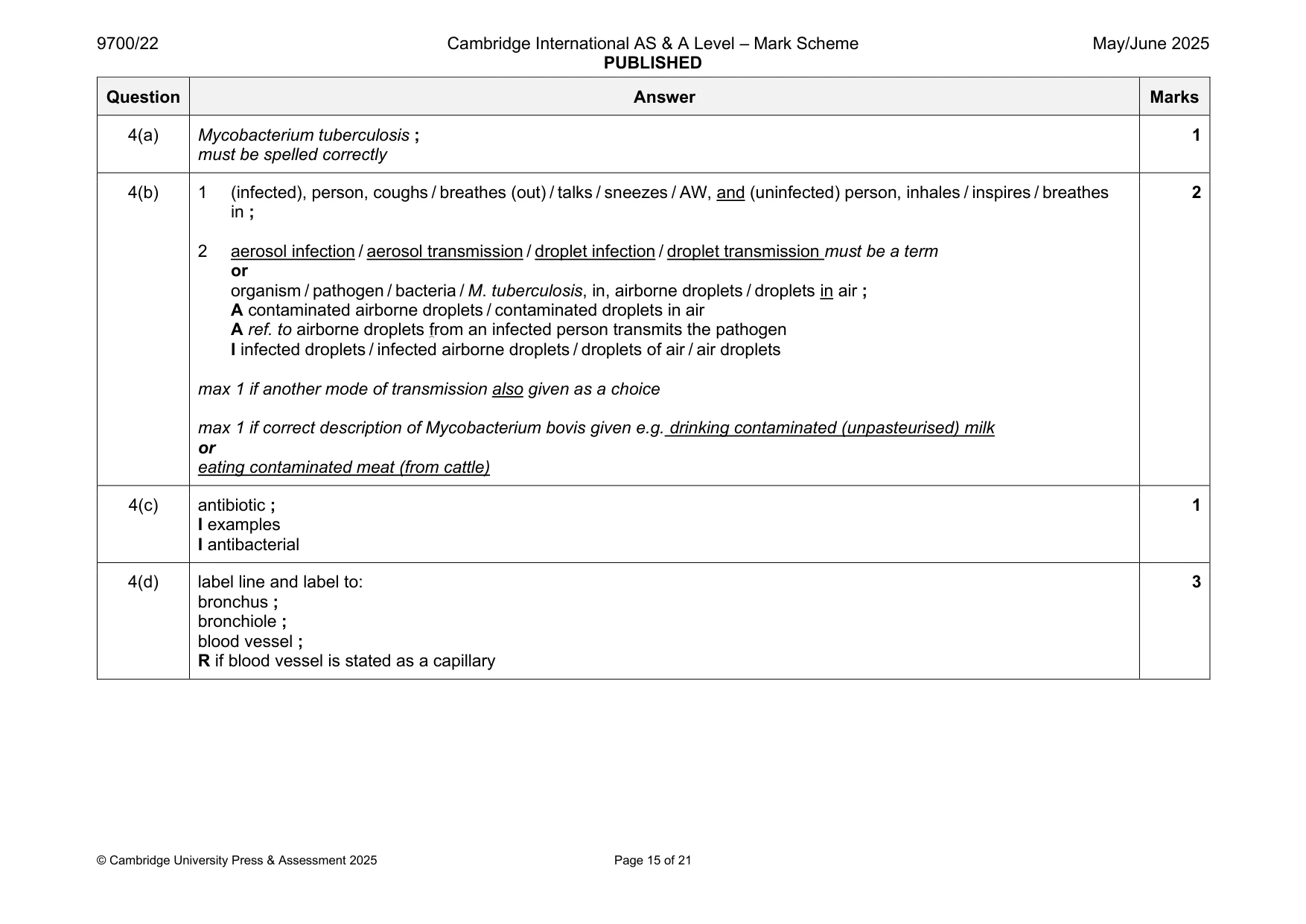
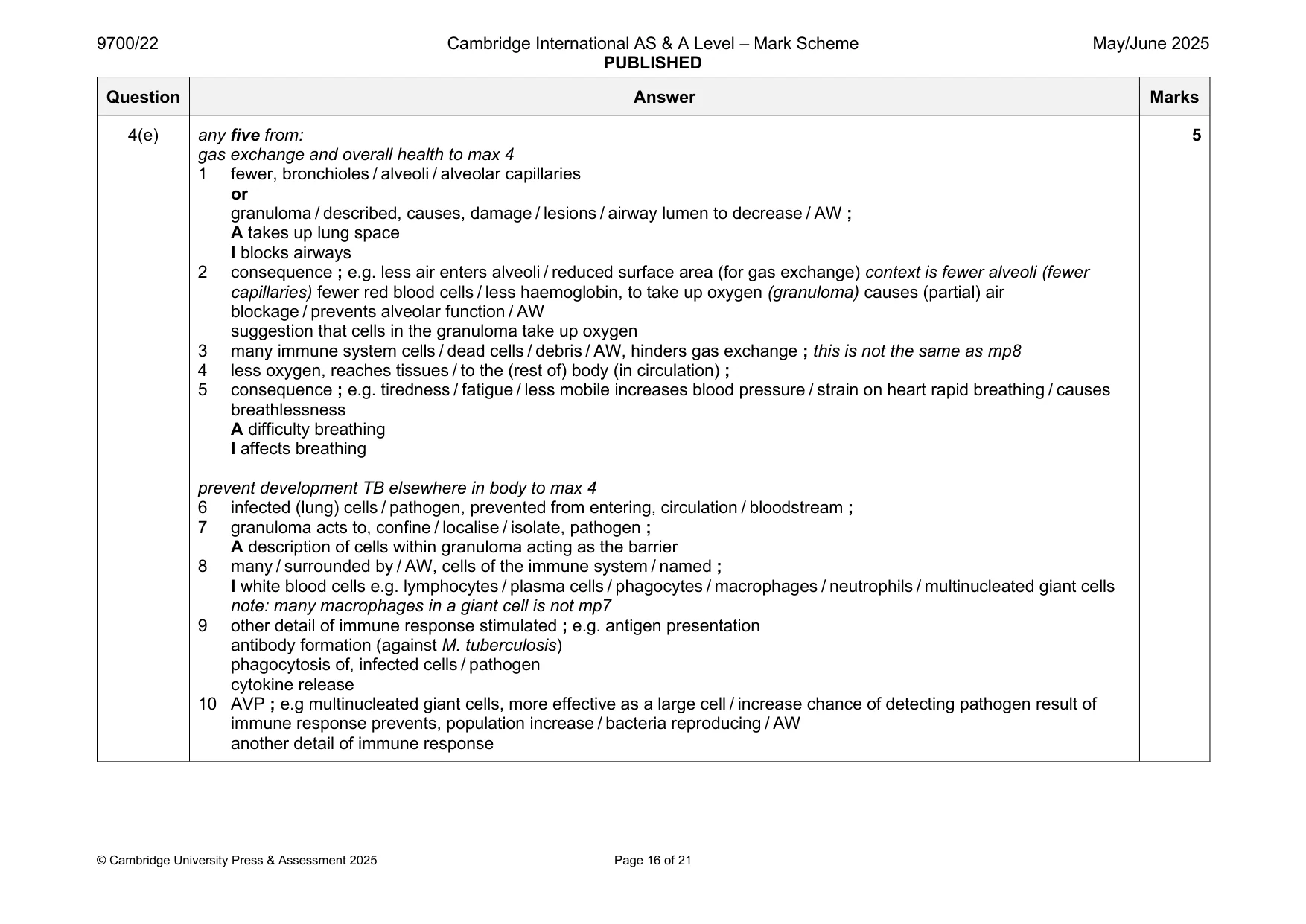
Mark scheme: 4(a) Mycobacterium tuberculosis ; 1 must be spelled correctly 4(b) 1 (infected), person, coughs / breathes (out) / talks / sneezes / AW, and (uninfected) person, inhales / inspires / breathes 2 in ; 2 aerosol infection / aerosol transmission / droplet infection / droplet transmission must be a term or organism / pathogen / bacteria / M. tuberculosis, in, airborne droplets / droplets in air ; A contaminated airborne droplets / contaminated droplets in air A ref. to airborne droplets from an infected person transmits the pathogen I infected droplets / infected airborne droplets / droplets of air / air droplets max 1 if another mode of transmission also given as a choice max 1 if correct description of Mycobacterium bovis given e.g. drinking contaminated (unpasteurised) milk or eating contaminated meat (from cattle) 4(c) antibiotic ; 1 I examples I antibacterial 4(d) label line and label to: 3 bronchus ; bronchiole ; blood vessel ; R if blood vessel is stated as a capillary 4(e) any five from: 5 gas exchange and overall health to max 4 1 fewer, bronchioles / alveoli / alveolar capillaries or granuloma / described, causes, damage / lesions / airway lumen to decrease / AW ; A takes up lung space I blocks airways 2 consequence ; e.g. less air enters alveoli / reduced surface area (for gas exchange) context is fewer alveoli (fewer capillaries) fewer red blood cells / less haemoglobin, to take up oxygen (granuloma) causes (partial) air blockage / prevents alveolar function / AW suggestion that cells in the granuloma take up oxygen 3 many immune system cells / dead cells / debris / AW, hinders gas exchange ; this is not the same as mp8 4 less oxygen, reaches tissues / to the (rest of) body (in circulation) ; 5 consequence ; e.g. tiredness / fatigue / less mobile increases blood pressure / strain on heart rapid breathing / causes breathlessness A difficulty breathing I affects breathing prevent development TB elsewhere in body to max 4 6 infected (lung) cells / pathogen, prevented from entering, circulation / bloodstream ; 7 granuloma acts to, confine / localise / isolate, pathogen ; A description of cells within granuloma acting as the barrier 8 many / surrounded by / AW, cells of the immune system / named ; I white blood cells e.g. lymphocytes / plasma cells / phagocytes / macrophages / neutrophils / multinucleated giant cells note: many macrophages in a giant cell is not mp7 9 other detail of immune response stimulated ; e.g. antigen presentation antibody formation (against M. tuberculosis) phagocytosis of, infected cells / pathogen cytokine release 10 AVP ; e.g multinucleated giant cells, more effective as a large cell / increase chance of detecting pathogen result of immune response prevents, population increase / bacteria reproducing / AW another detail of immune response
Q5 · There is a global shortage of blood for transfusions
5 There is a global shortage of blood for transfusions. Researchers can culture bone marrow stem cells in the laboratory to manufacture red blood cells for potential use as an artificial blood product. The researchers collect bone marrow stem cells that are present in small quantities in blood, rather than extracting them from bone marrow. • Antibodies, specific to bone marrow stem cells, are attached to tiny magnetic beads. • The beads are added to a sample of blood. • An electric field is applied to immobilise the beads so that the bone marrow stem cells can be collected. (a) The antibodies are attached to the beads so that the sites used for binding to specific molecules on the bone marrow stem cells are left exposed. Name the term given to the specific molecules on the bone marrow stem cells that attach to the antibody binding sites. ............................................................................................................................................. [1] (b) Suggest and explain the advantages of using bone marrow stem cells from the blood sample to manufacture artificial red blood cells. ................................................................................................................................................... ................................................................................................................................................... ................................................................................................................................................... ................................................................................................................................................... ................................................................................................................................................... ................................................................................................................................................... ............................................................................................................................................. [3] (c) One desirable feature of artificial blood products, such as artificial red blood cells, is that they should be economical to produce. Suggest other desirable features of artificial blood products. ................................................................................................................................................... ................................................................................................................................................... ................................................................................................................................................... ................................................................................................................................................... ................................................................................................................................................... ............................................................................................................................................. [3] [Total: 7]
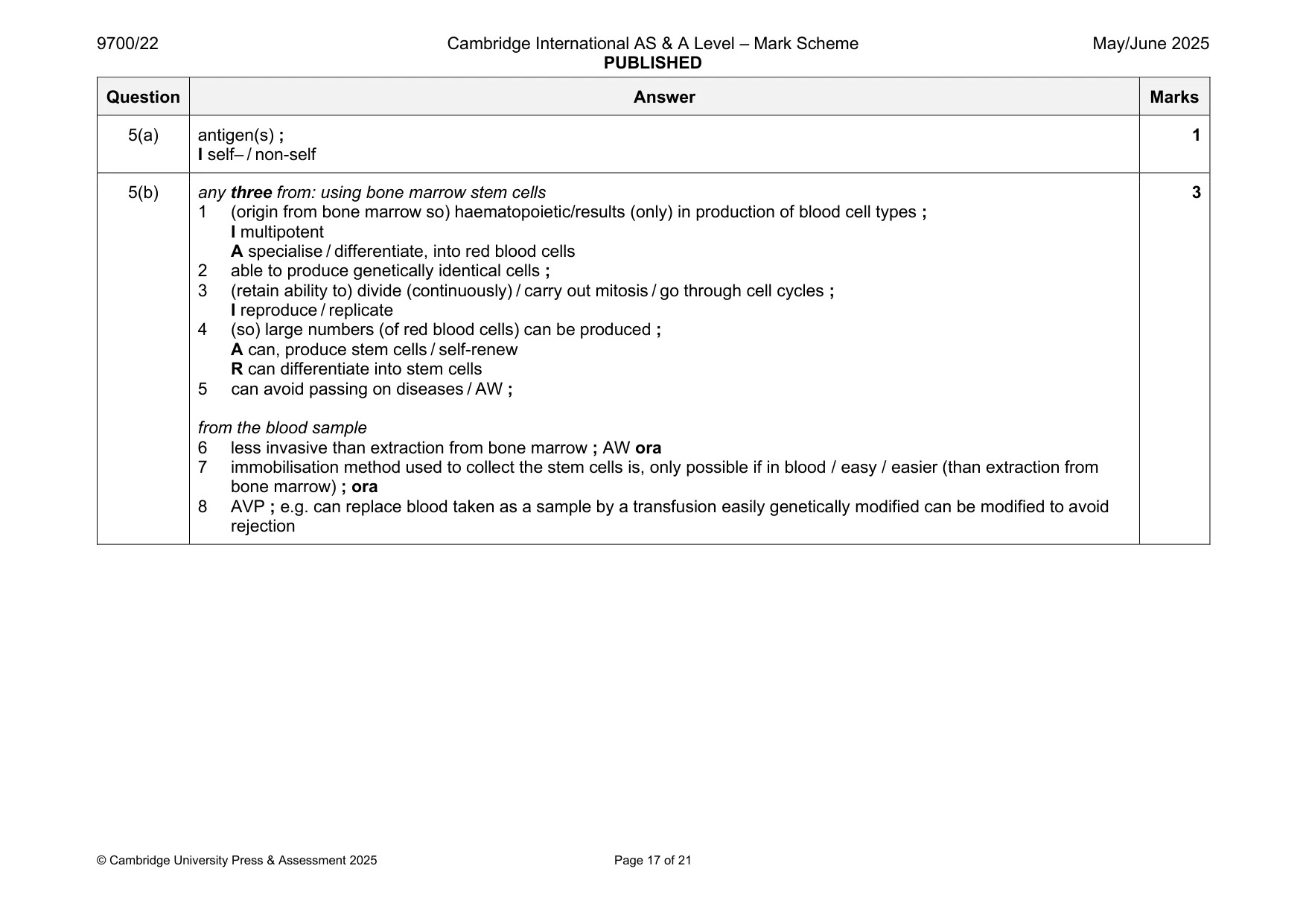
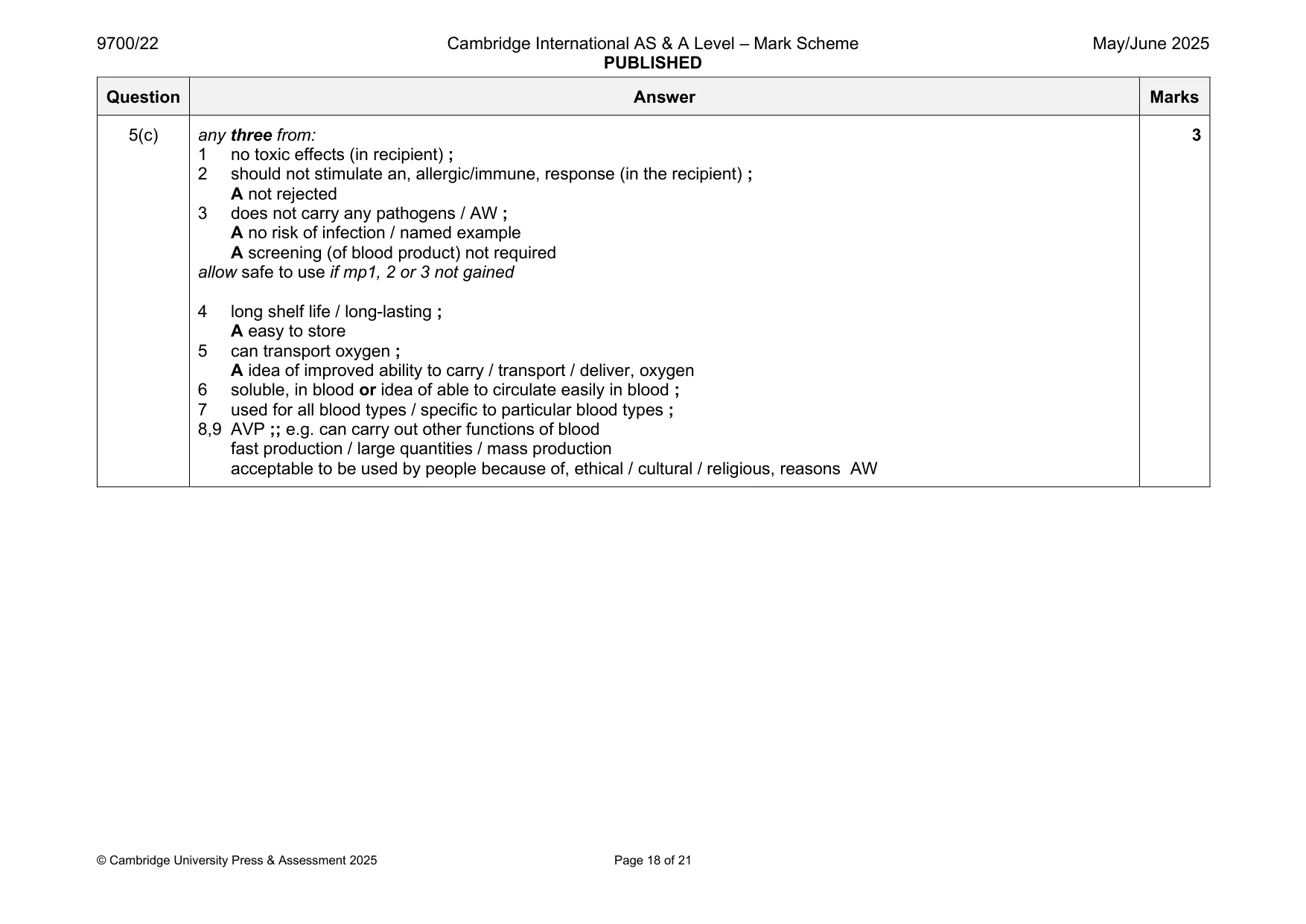
Mark scheme: 5(a) antigen(s) ; 1 I self– / non-self 5(b) any three from: using bone marrow stem cells 3 1 (origin from bone marrow so) haematopoietic/results (only) in production of blood cell types ; I multipotent A specialise / differentiate, into red blood cells 2 able to produce genetically identical cells ; 3 (retain ability to) divide (continuously) / carry out mitosis / go through cell cycles ; I reproduce / replicate 4 (so) large numbers (of red blood cells) can be produced ; A can, produce stem cells / self-renew R can differentiate into stem cells 5 can avoid passing on diseases / AW ; from the blood sample 6 less invasive than extraction from bone marrow ; AW ora 7 immobilisation method used to collect the stem cells is, only possible if in blood / easy / easier (than extraction from bone marrow) ; ora 8 AVP ; e.g. can replace blood taken as a sample by a transfusion easily genetically modified can be modified to avoid rejection 5(c) any three from: 3 1 no toxic effects (in recipient) ; 2 should not stimulate an, allergic/immune, response (in the recipient) ; A not rejected 3 does not carry any pathogens / AW ; A no risk of infection / named example A screening (of blood product) not required allow safe to use if mp1, 2 or 3 not gained 4 long shelf life / long-lasting ; A easy to store 5 can transport oxygen ; A idea of improved ability to carry / transport / deliver, oxygen 6 soluble, in blood or idea of able to circulate easily in blood ; 7 used for all blood types / specific to particular blood types ; 8,9 AVP ;; e.g. can carry out other functions of blood fast production / large quantities / mass production acceptable to be used by people because of, ethical / cultural / religious, reasons AW
More questions on Cells as the basic units of living organisms
Q6 · Horseradish peroxidase (HRP) is an enzyme that can be extracted from the roots of the…
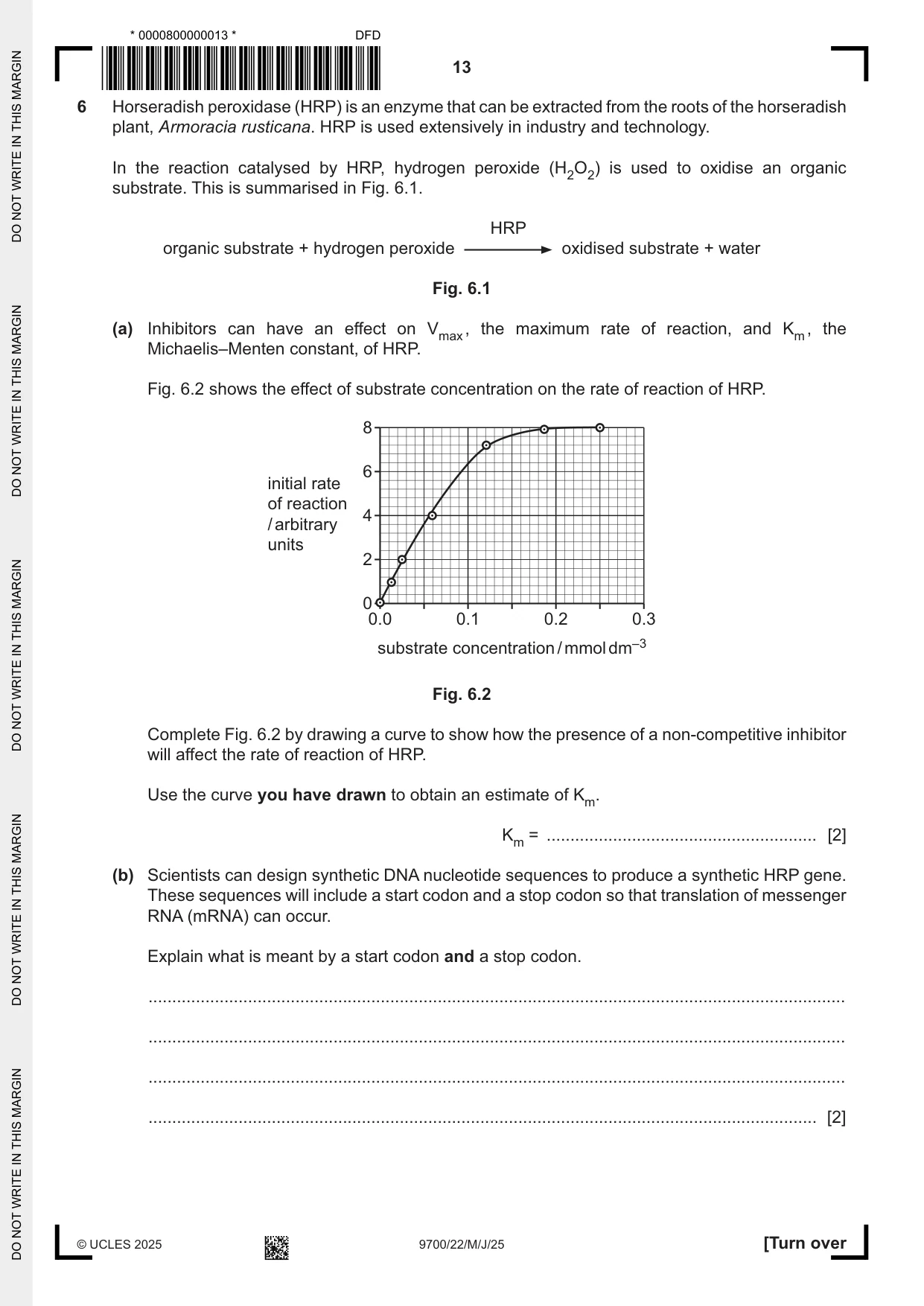
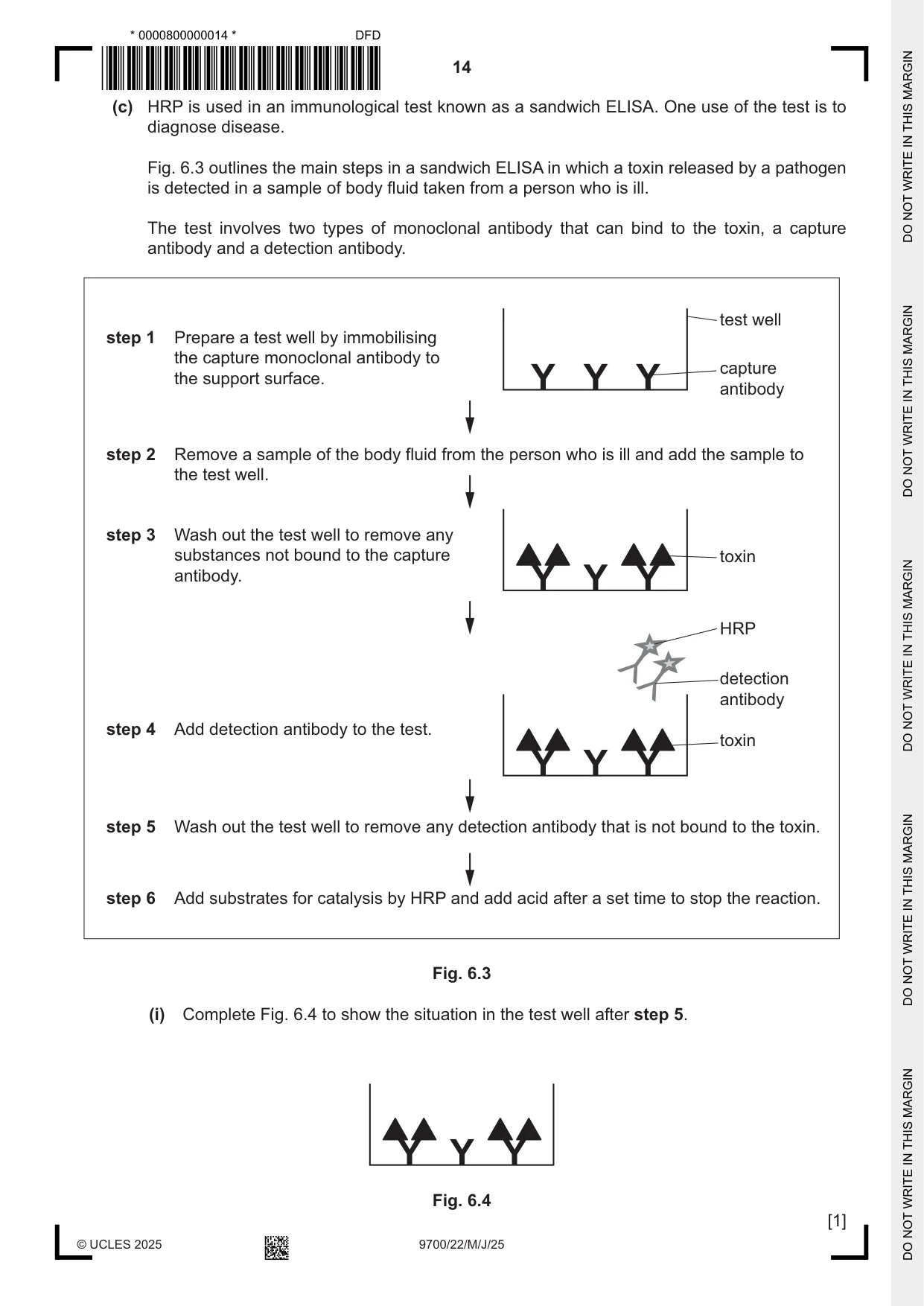
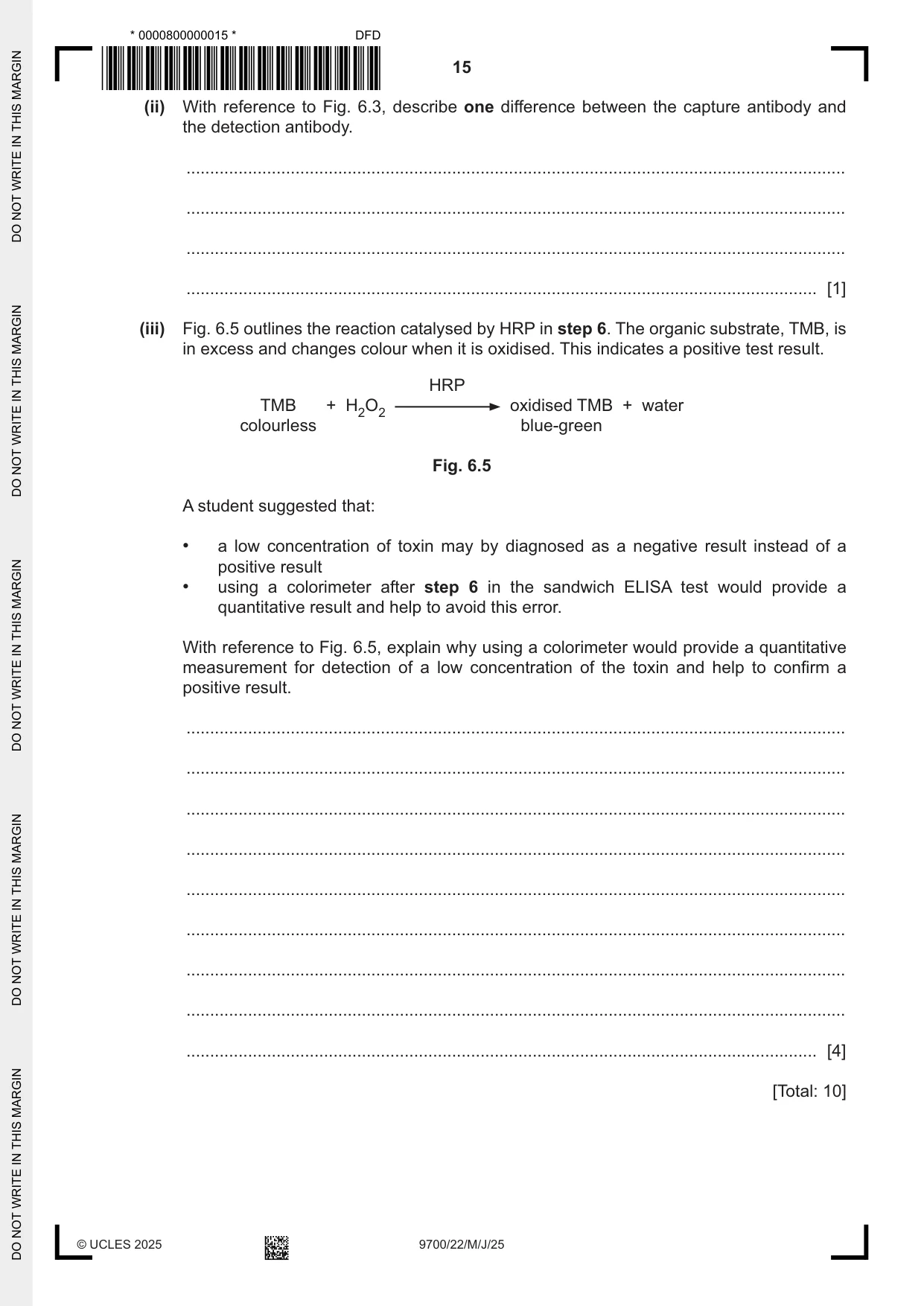
6 Horseradish peroxidase (HRP) is an enzyme that can be extracted from the roots of the horseradish plant, Armoracia rusticana. HRP is used extensively in industry and technology. In the reaction catalysed by HRP, hydrogen peroxide (H2O2) is used to oxidise an organic substrate. This is summarised in Fig. 6.1. HRP organic substrate + hydrogen peroxide oxidised substrate + water Fig. 6.1 (a) Inhibitors can have an effect on Vmax , the maximum rate of reaction, and Km , the Michaelis –Menten constant, of HRP. Fig. 6.2 shows the effect of substrate concentration on the rate of reaction of HRP. 8 6 initial rate of reaction 4 / arbitrary units 2 0 0.0 0.1 0.2 0.3 substrate concentration / mmol dm–3 Fig. 6.2 Complete Fig. 6.2 by drawing a curve to show how the presence of a non‑competitive inhibitor will affect the rate of reaction of HRP. Use the curve you have drawn to obtain an estimate of Km. Km = ......................................................... [2] (b) Scientists can design synthetic DNA nucleotide sequences to produce a synthetic HRP gene. These sequences will include a start codon and a stop codon so that translation of messenger RNA (mRNA) can occur. Explain what is meant by a start codon and a stop codon. ................................................................................................................................................... ................................................................................................................................................... ................................................................................................................................................... ............................................................................................................................................. [2] (c) HRP is used in an immunological test known as a sandwich ELISA. One use of the test is to diagnose disease. Fig. 6.3 outlines the main steps in a sandwich ELISA in which a toxin released by a pathogen is detected in a sample of body fluid taken from a person who is ill. The test involves two types of monoclonal antibody that can bind to the toxin, a capture antibody and a detection antibody. test well step 1 Prepare a test well by immobilising the capture monoclonal antibody to capture the support surface. antibody step 2 Remove a sample of the body fluid from the person who is ill and add the sample to the test well. step 3 Wash out the test well to remove any substances not bound to the capture toxin antibody. HRP detection antibody step 4 Add detection antibody to the test. toxin step 5 Wash out the test well to remove any detection antibody that is not bound to the toxin. step 6 Add substrates for catalysis by HRP and add acid after a set time to stop the reaction. Fig. 6.3 (i) Complete Fig. 6.4 to show the situation in the test well after step 5. Fig. 6.4 [1] (ii) With reference to Fig. 6.3, describe one difference between the capture antibody and the detection antibody. ........................................................................................................................................... ........................................................................................................................................... ........................................................................................................................................... ..................................................................................................................................... [1] (iii) Fig. 6.5 outlines the reaction catalysed by HRP in step 6. The organic substrate, TMB, is in excess and changes colour when it is oxidised. This indicates a positive test result. HRP TMB + H2O2 oxidised TMB + water colourless blue‑green Fig. 6.5 A student suggested that: • a low concentration of toxin may by diagnosed as a negative result instead of a positive result • using a colorimeter after step 6 in the sandwich ELISA test would provide a quantitative result and help to avoid this error. With reference to Fig. 6.5, explain why using a colorimeter would provide a quantitative measurement for detection of a low concentration of the toxin and help to confirm a positive result. ........................................................................................................................................... ........................................................................................................................................... ........................................................................................................................................... ........................................................................................................................................... ........................................................................................................................................... ........................................................................................................................................... ........................................................................................................................................... ........................................................................................................................................... ..................................................................................................................................... [4] [Total: 10]
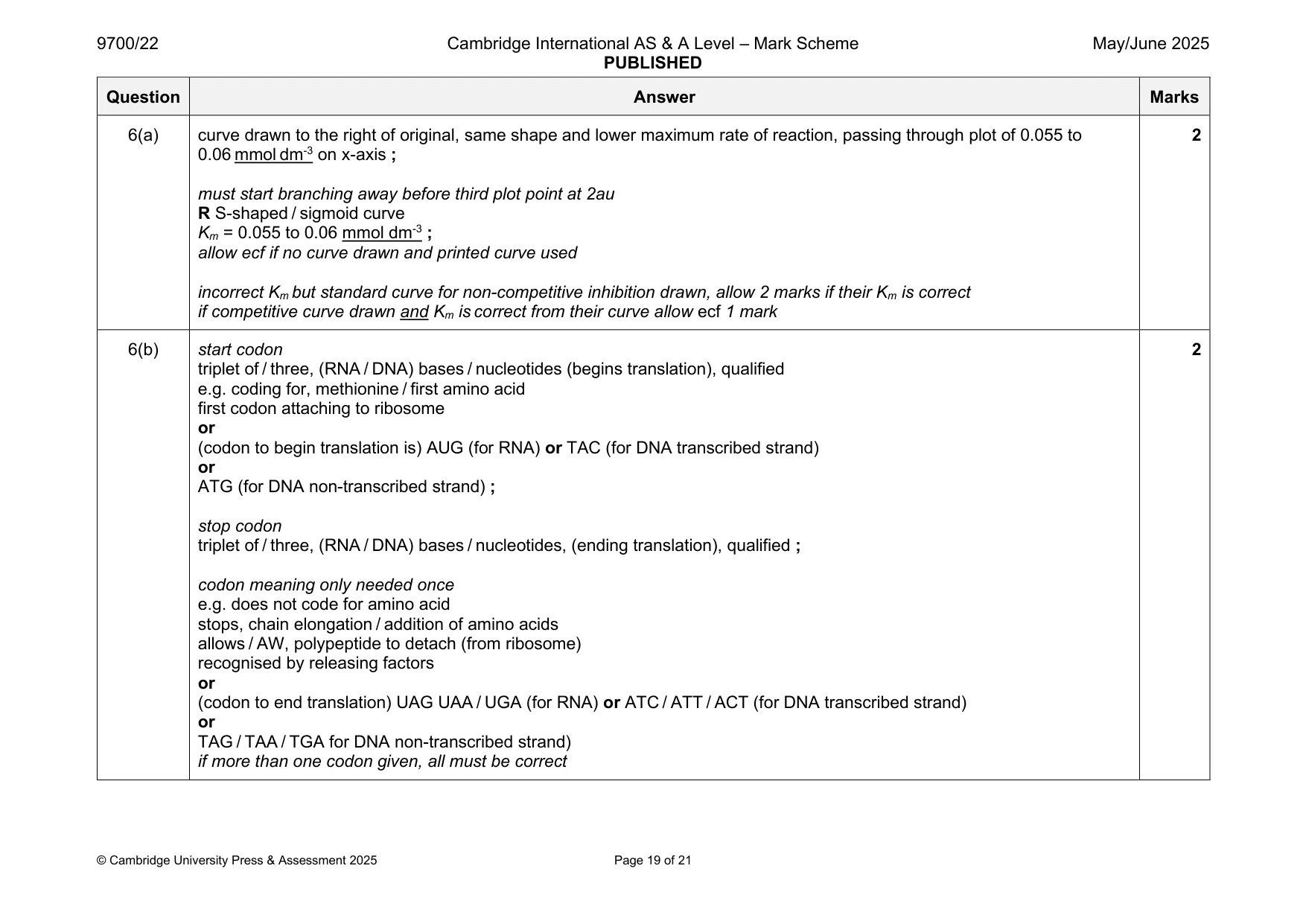
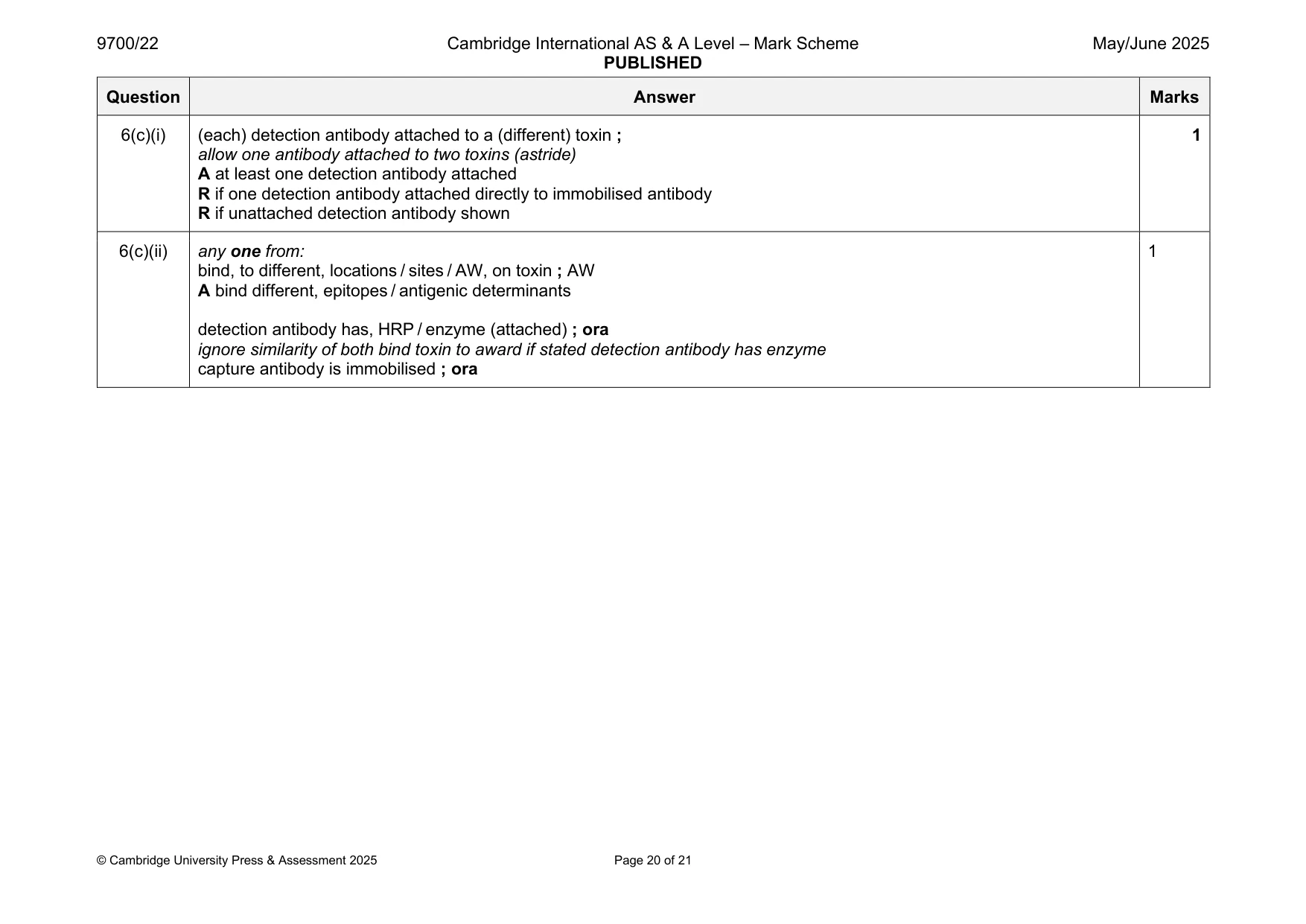
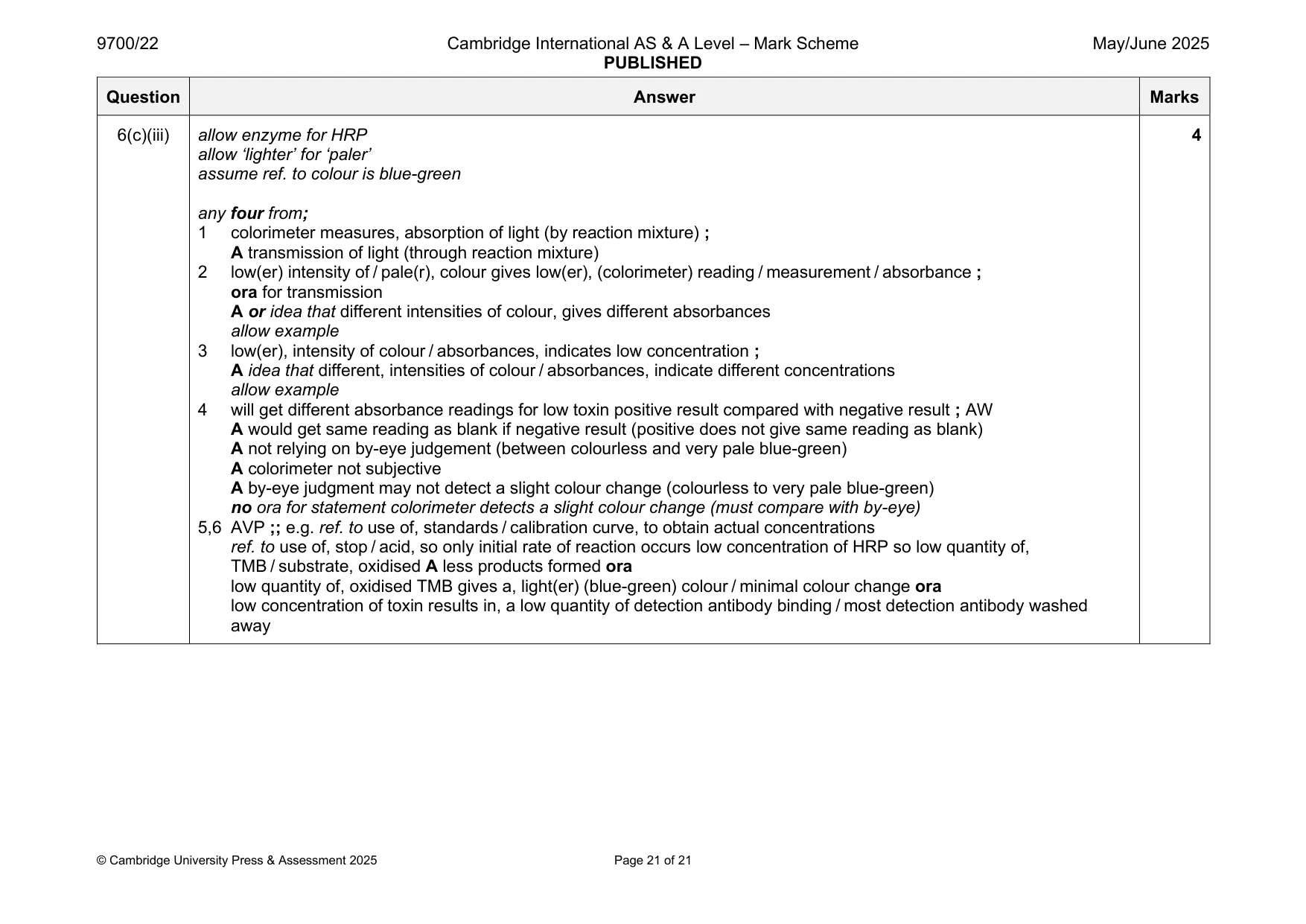
Mark scheme: 6(a) curve drawn to the right of original, same shape and lower maximum rate of reaction, passing through plot of 0.055 to 2 0.06 mmol dm-3 on x-axis ; must start branching away before third plot point at 2au R S-shaped / sigmoid curve Km = 0.055 to 0.06 mmol dm-3 ; allow ecf if no curve drawn and printed curve used incorrect Km but standard curve for non-competitive inhibition drawn, allow 2 marks if their Km is correct if competitive curve drawn and Km is correct from their curve allow ecf 1 mark 6(b) start codon 2 triplet of / three, (RNA / DNA) bases / nucleotides (begins translation), qualified e.g. coding for, methionine / first amino acid first codon attaching to ribosome or (codon to begin translation is) AUG (for RNA) or TAC (for DNA transcribed strand) or ATG (for DNA non-transcribed strand) ; stop codon triplet of / three, (RNA / DNA) bases / nucleotides, (ending translation), qualified ; codon meaning only needed once e.g. does not code for amino acid stops, chain elongation / addition of amino acids allows / AW, polypeptide to detach (from ribosome) recognised by releasing factors or (codon to end translation) UAG UAA / UGA (for RNA) or ATC / ATT / ACT (for DNA transcribed strand) or TAG / TAA / TGA for DNA non-transcribed strand) if more than one codon given, all must be correct 6(c)(i) (each) detection antibody attached to a (different) toxin ; 1 allow one antibody attached to two toxins (astride) A at least one detection antibody attached R if one detection antibody attached directly to immobilised antibody R if unattached detection antibody shown 6(c)(ii) any one from: 1 bind, to different, locations / sites / AW, on toxin ; AW A bind different, epitopes / antigenic determinants detection antibody has, HRP / enzyme (attached) ; ora ignore similarity of both bind toxin to award if stated detection antibody has enzyme capture antibody is immobilised ; ora 6(c)(iii) allow enzyme for HRP 4 allow ‘lighter’ for ‘paler’ assume ref. to colour is blue-green any four from; 1 colorimeter measures, absorption of light (by reaction mixture) ; A transmission of light (through reaction mixture) 2 low(er) intensity of / pale(r), colour gives low(er), (colorimeter) reading / measurement / absorbance ; ora for transmission A or idea that different intensities of colour, gives different absorbances allow example 3 low(er), intensity of colour / absorbances, indicates low concentration ; A idea that different, intensities of colour / absorbances, indicate different concentrations allow example 4 will get different absorbance readings for low toxin positive result compared with negative result ; AW A would get same reading as blank if negative result (positive does not give same reading as blank) A not relying on by-eye judgement (between colourless and very pale blue-green) A colorimeter not subjective A by-eye judgment may not detect a slight colour change (colourless to very pale blue-green) no ora for statement colorimeter detects a slight colour change (must compare with by-eye) 5,6 AVP ;; e.g. ref. to use of, standards / calibration curve, to obtain actual concentrations ref. to use of, stop / acid, so only initial rate of reaction occurs low concentration of HRP so low quantity of, TMB / substrate, oxidised A less products formed ora low quantity of, oxidised TMB gives a, light(er) (blue-green) colour / minimal colour change ora low concentration of toxin results in, a low quantity of detection antibody binding / most detection antibody washed away
What was in this paper
The subtopics covered by these 6 questions, and how many questions each got. Open one in a new tab to see every Cambridge question on it.
What you needed in this session
Cambridge’s own grade thresholds for 2025 May/June, Paper 2 · Variant 2. A higher threshold means an easier paper — the bar moves with how the cohort did.