Cambridge A Level Biology 9700 — 2024 Oct/Nov Paper 2 · Variant 2
9700/22/O/N/24 · 6 questions · 60 marks · ≈68 min
The question paper and its mark scheme, free to read here and free to download. This is Cambridge’s own paper, exactly as it was sat.
Question paper16 pages
Mark scheme21 pages
Answers below. Sit the paper first if you are practising.
Questions as text
Q1 · The olive plant, Olea europaea, is grown in many parts of the world
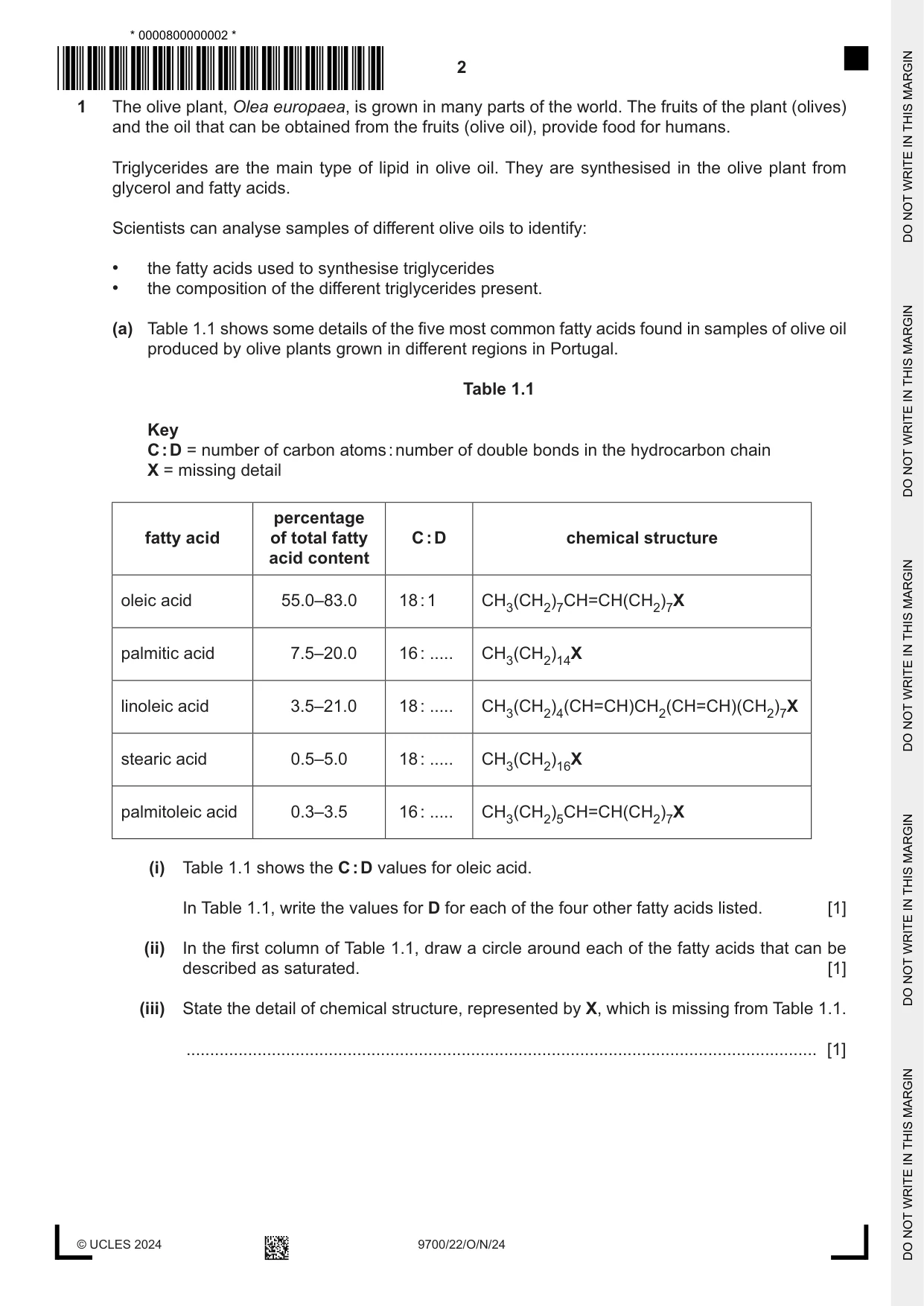
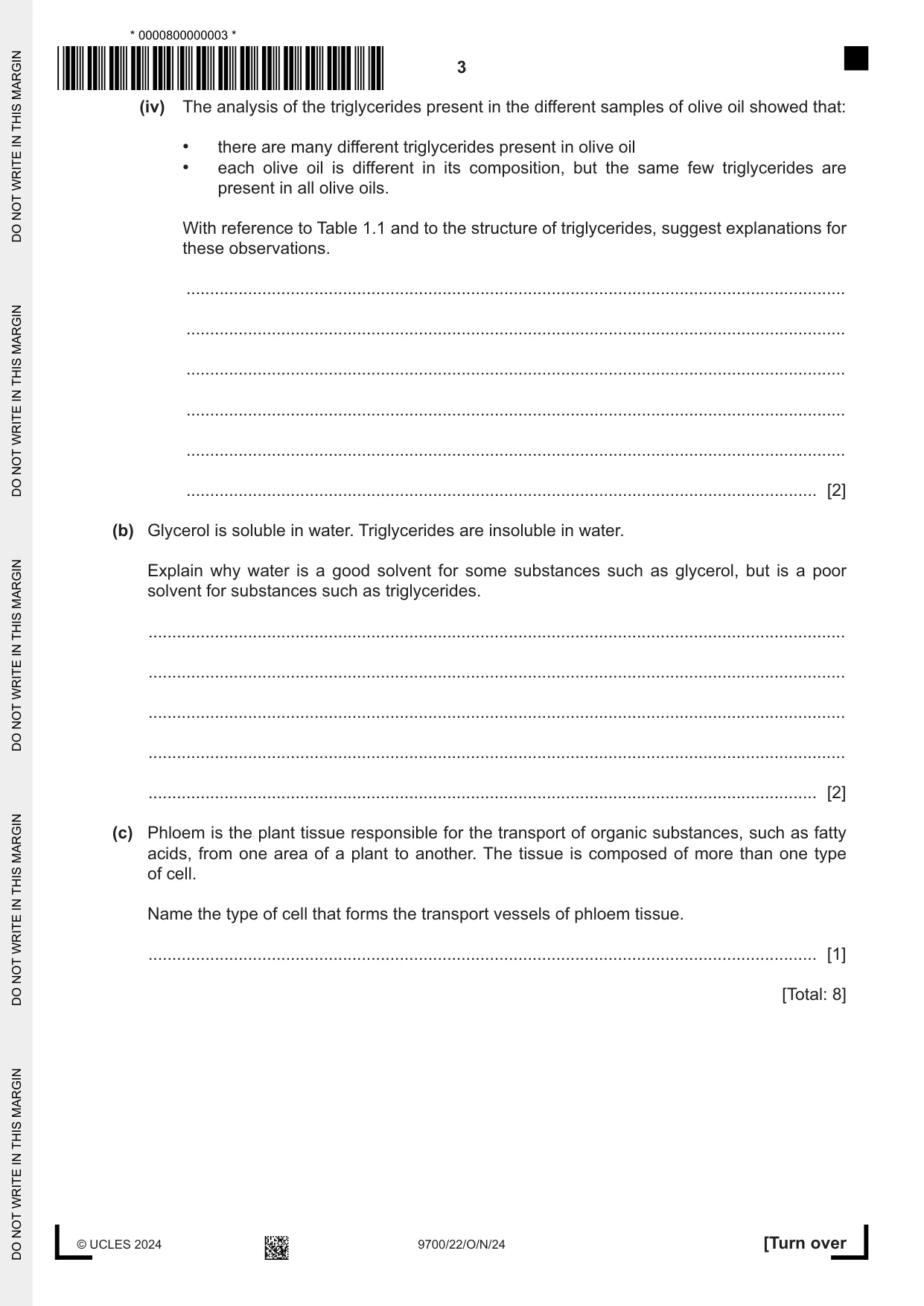
1 The olive plant, Olea europaea, is grown in many parts of the world. The fruits of the plant (olives) and the oil that can be obtained from the fruits (olive oil), provide food for humans. Triglycerides are the main type of lipid in olive oil. They are synthesised in the olive plant from glycerol and fatty acids. Scientists can analyse samples of different olive oils to identify: • the fatty acids used to synthesise triglycerides • the composition of the different triglycerides present. (a) Table 1.1 shows some details of the five most common fatty acids found in samples of olive oil produced by olive plants grown in different regions in Portugal. Table 1.1 Key C : D = number of carbon atoms : number of double bonds in the hydrocarbon chain X = missing detail percentage fatty acid of total fatty C : D chemical structure acid content oleic acid 55.0–83.0 18 : 1 CH3(CH2)7CH=CH(CH2)7X palmitic acid 7.5–20.0 16 : ..... CH3(CH2)14X linoleic acid 3.5–21.0 18 : ..... CH3(CH2)4(CH=CH)CH2(CH=CH)(CH2)7X stearic acid 0.5–5.0 18 : ..... CH3(CH2)16X palmitoleic acid 0.3–3.5 16 : ..... CH3(CH2)5CH=CH(CH2)7X (i) Table 1.1 shows the C : D values for oleic acid. In Table 1.1, write the values for D for each of the four other fatty acids listed. [1] (ii) In the first column of Table 1.1, draw a circle around each of the fatty acids that can be described as saturated. [1] (iii) State the detail of chemical structure, represented by X, which is missing from Table 1.1. ..................................................................................................................................... [1] (iv) The analysis of the triglycerides present in the different samples of olive oil showed that: • there are many different triglycerides present in olive oil • each olive oil is different in its composition, but the same few triglycerides are present in all olive oils. With reference to Table 1.1 and to the structure of triglycerides, suggest explanations for these observations. ........................................................................................................................................... ........................................................................................................................................... ........................................................................................................................................... ........................................................................................................................................... ........................................................................................................................................... ..................................................................................................................................... [2] (b) Glycerol is soluble in water. Triglycerides are insoluble in water. Explain why water is a good solvent for some substances such as glycerol, but is a poor solvent for substances such as triglycerides. ................................................................................................................................................... ................................................................................................................................................... ................................................................................................................................................... ................................................................................................................................................... ............................................................................................................................................. [2] (c) Phloem is the plant tissue responsible for the transport of organic substances, such as fatty acids, from one area of a plant to another. The tissue is composed of more than one type of cell. Name the type of cell that forms the transport vessels of phloem tissue. ............................................................................................................................................. [1] [Total: 8]
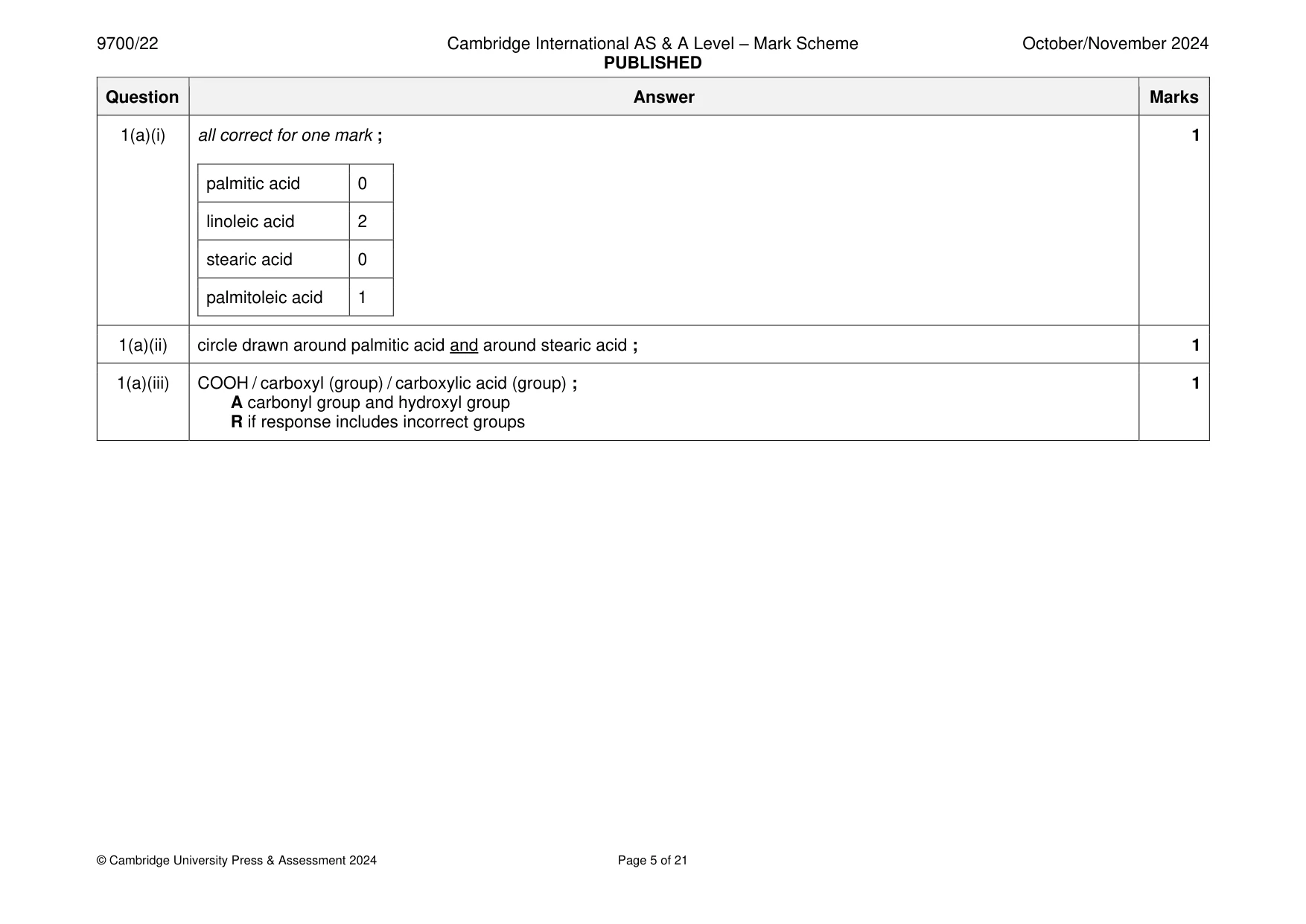
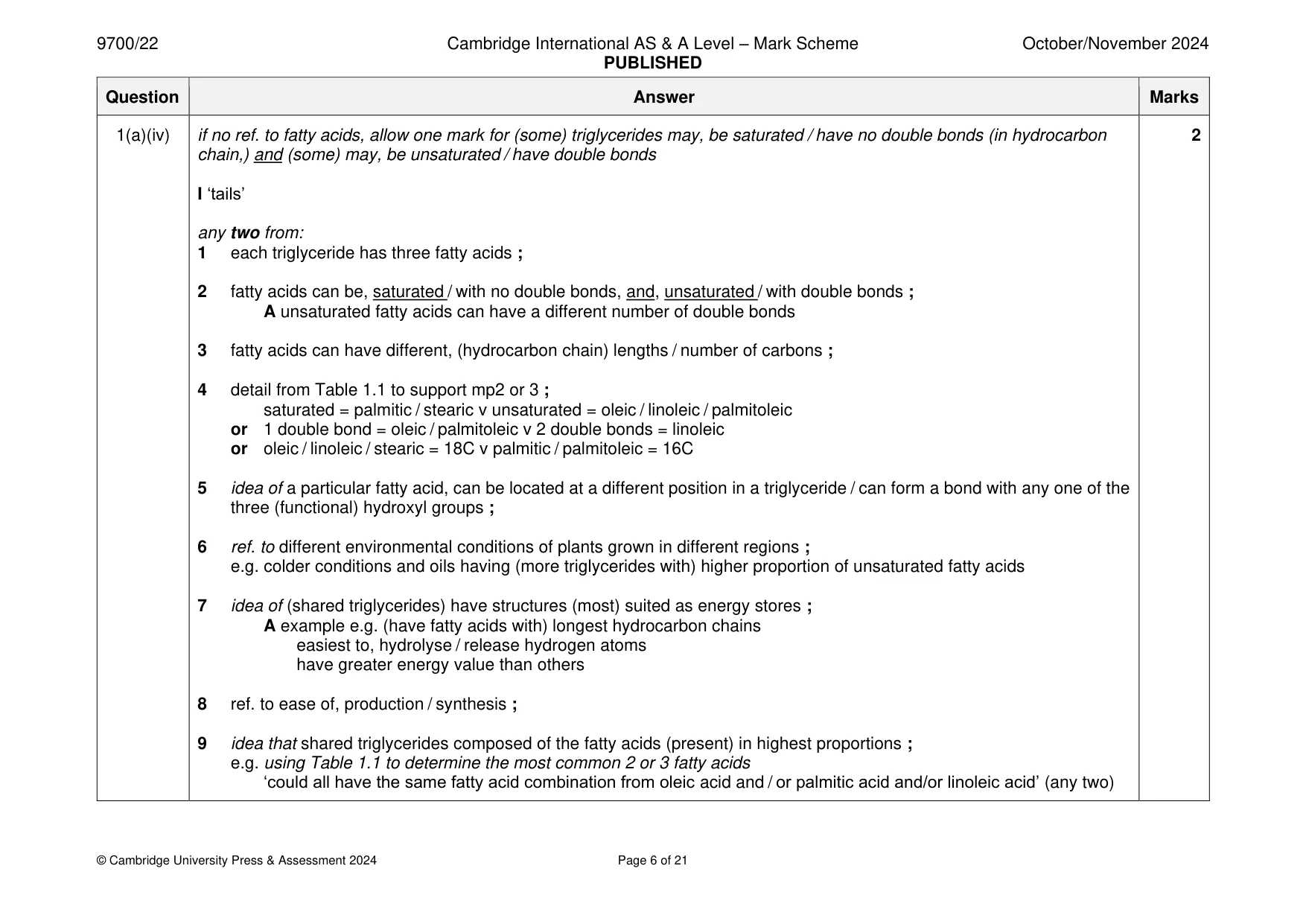
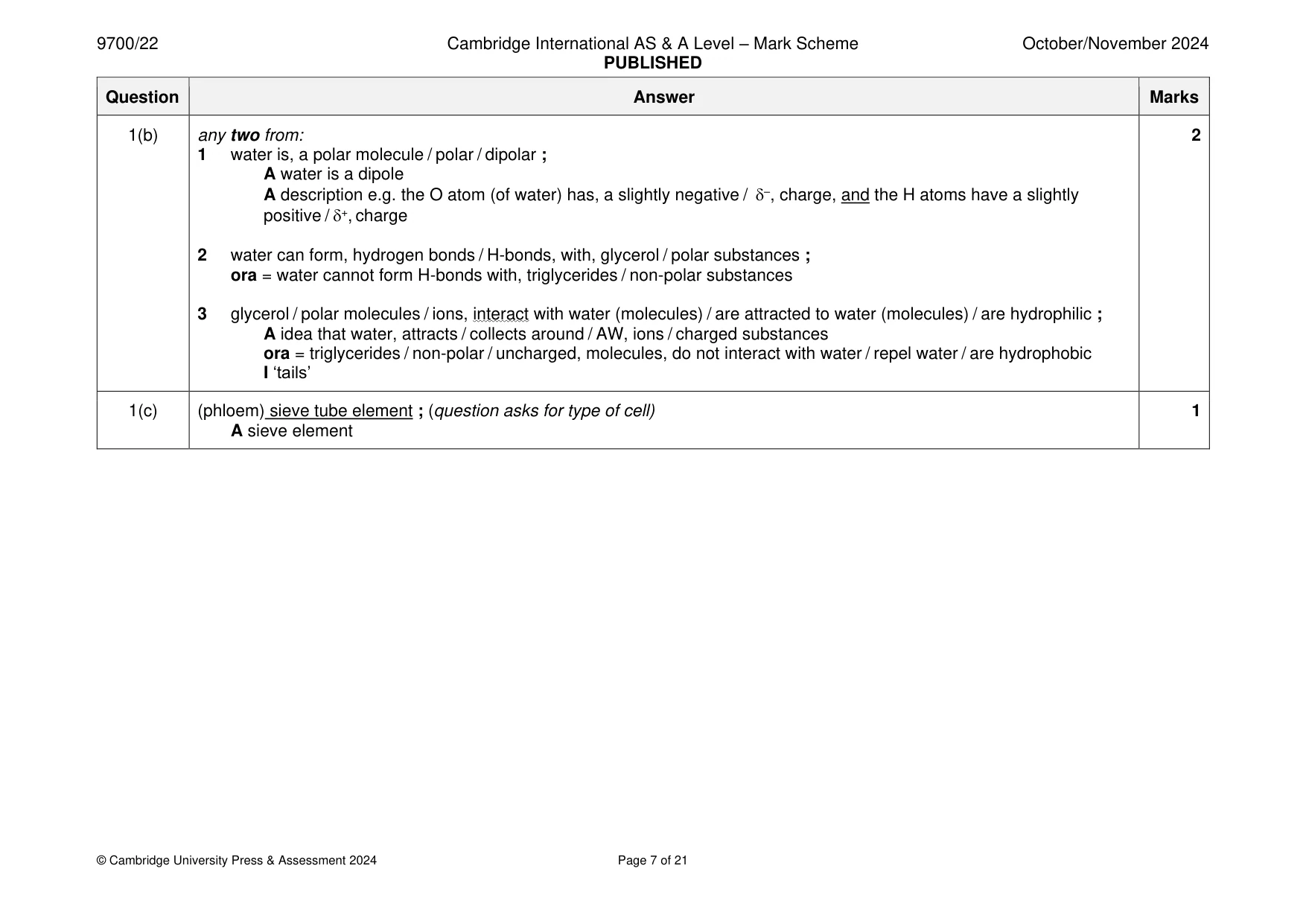
Mark scheme: Question Answer Marks 1(a)(i) all correct for one mark ; 1 palmitic acid 0 linoleic acid 2 stearic acid 0 palmitoleic acid 1 1(a)(ii) circle drawn around palmitic acid and around stearic acid ; 1 1(a)(iii) COOH / carboxyl (group) / carboxylic acid (group) ; 1 A carbonyl group and hydroxyl group R if response includes incorrect groups 1(a)(iv) if no ref. to fatty acids, allow one mark for (some) triglycerides may, be saturated / have no double bonds (in hydrocarbon 2 chain,) and (some) may, be unsaturated / have double bonds I ‘tails’ any two from: 1 each triglyceride has three fatty acids ; 2 fatty acids can be, saturated / with no double bonds, and, unsaturated / with double bonds ; A unsaturated fatty acids can have a different number of double bonds 3 fatty acids can have different, (hydrocarbon chain) lengths / number of carbons ; 4 detail from Table 1.1 to support mp2 or 3 ; saturated = palmitic / stearic v unsaturated = oleic / linoleic / palmitoleic or 1 double bond = oleic / palmitoleic v 2 double bonds = linoleic or oleic / linoleic / stearic = 18C v palmitic / palmitoleic = 16C 5 idea of a particular fatty acid, can be located at a different position in a triglyceride / can form a bond with any one of the three (functional) hydroxyl groups ; 6 ref. to different environmental conditions of plants grown in different regions ; e.g. colder conditions and oils having (more triglycerides with) higher proportion of unsaturated fatty acids 7 idea of (shared triglycerides) have structures (most) suited as energy stores ; A example e.g. (have fatty acids with) longest hydrocarbon chains easiest to, hydrolyse / release hydrogen atoms have greater energy value than others 8 ref. to ease of, production / synthesis ; 9 idea that shared triglycerides composed of the fatty acids (present) in highest proportions ; e.g. using Table 1.1 to determine the most common 2 or 3 fatty acids ‘could all have the same fatty acid combination from oleic acid and / or palmitic acid and/or linoleic acid’ (any two) 1(b) any two from: 2 1 water is, a polar molecule / polar / dipolar ; A water is a dipole A description e.g. the O atom (of water) has, a slightly negative / –, charge, and the H atoms have a slightly positive / +, charge 2 water can form, hydrogen bonds / H-bonds, with, glycerol / polar substances ; ora = water cannot form H-bonds with, triglycerides / non-polar substances 3 glycerol / polar molecules / ions, interact with water (molecules) / are attracted to water (molecules) / are hydrophilic ; A idea that water, attracts / collects around / AW, ions / charged substances ora = triglycerides / non-polar / uncharged, molecules, do not interact with water / repel water / are hydrophobic I ‘tails’ 1(c) (phloem) sieve tube element ; (question asks for type of cell) 1 A sieve element
Q2 · People who become infected with human immunodeficiency virus (HIV) are at risk of…
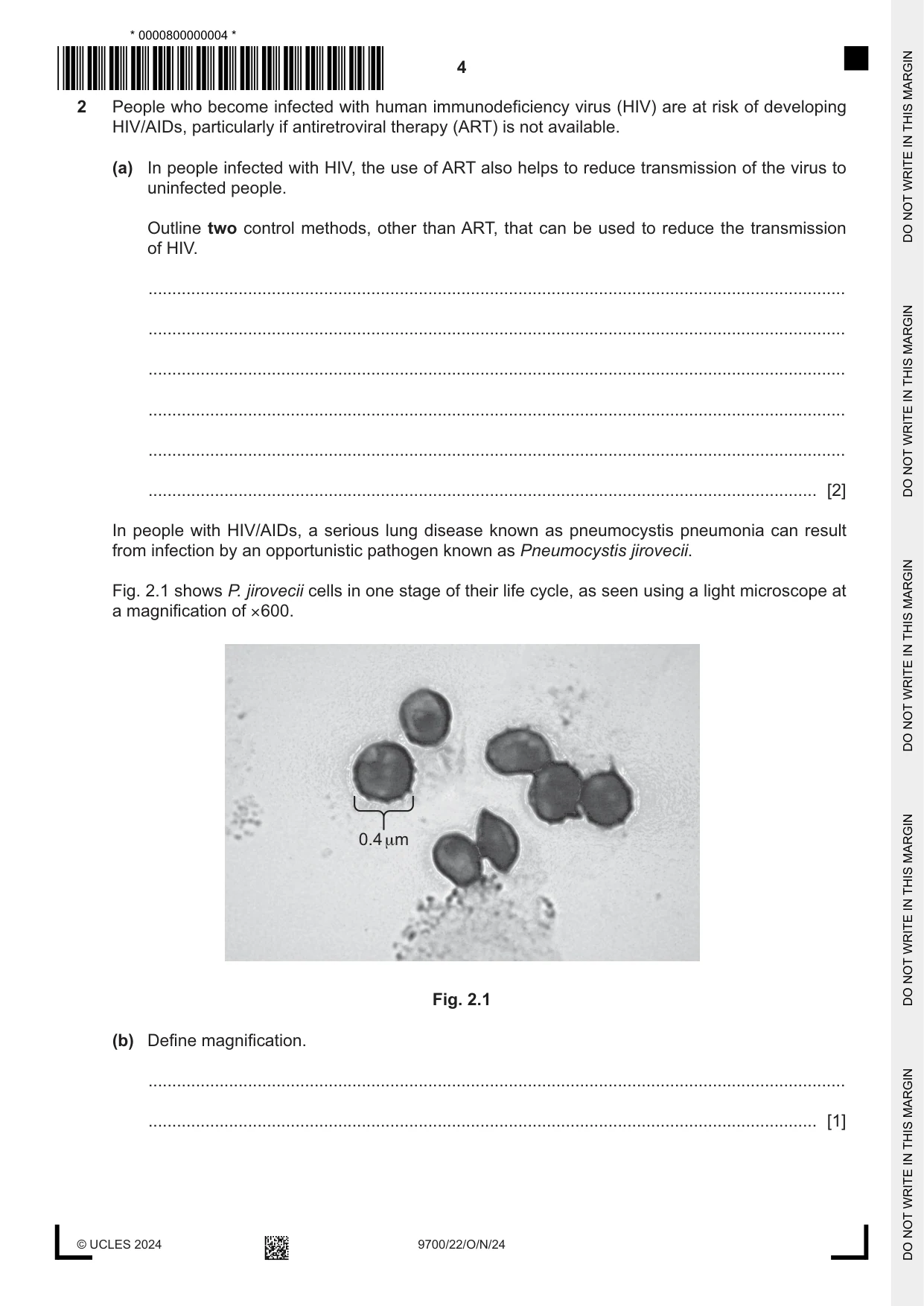
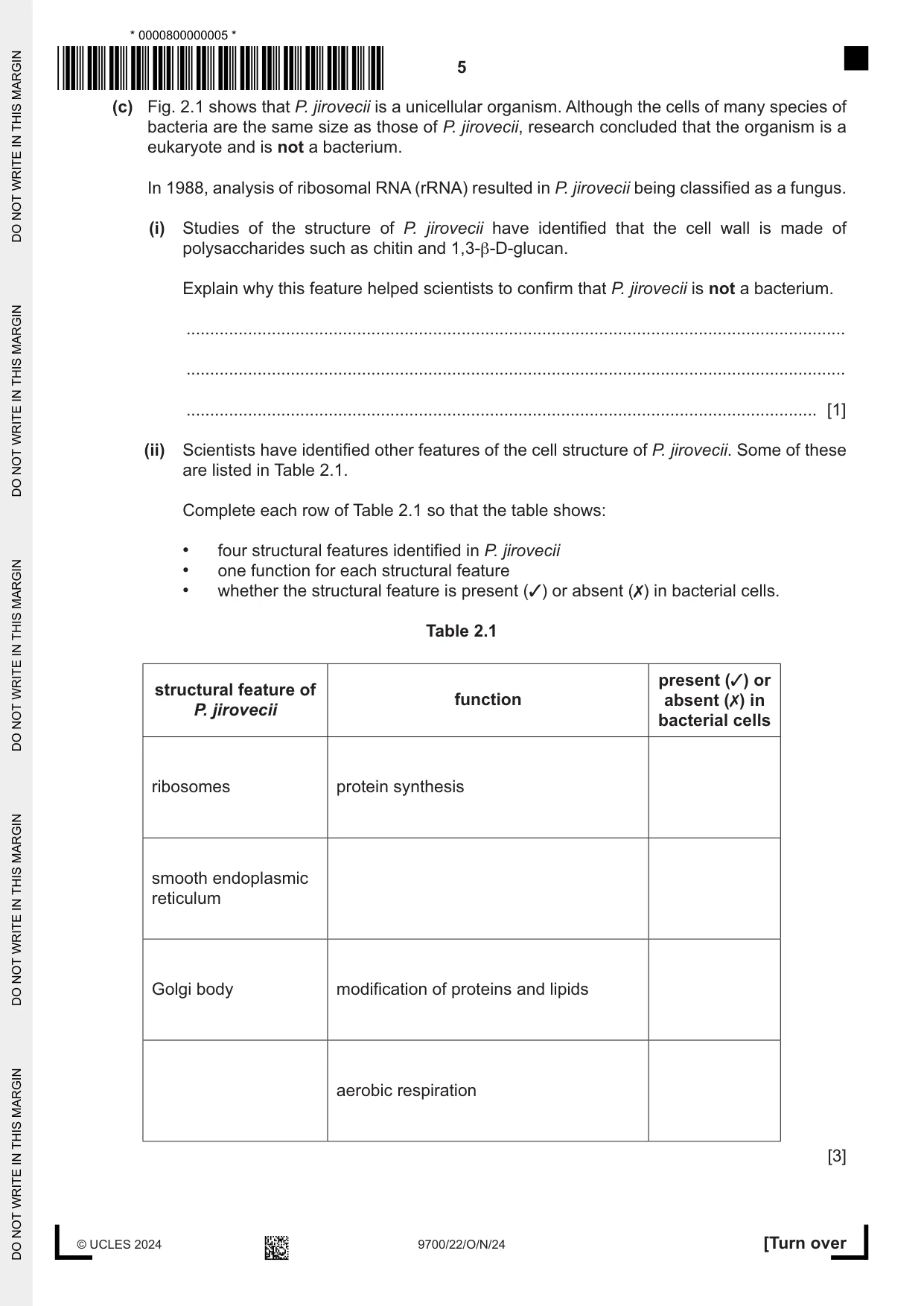
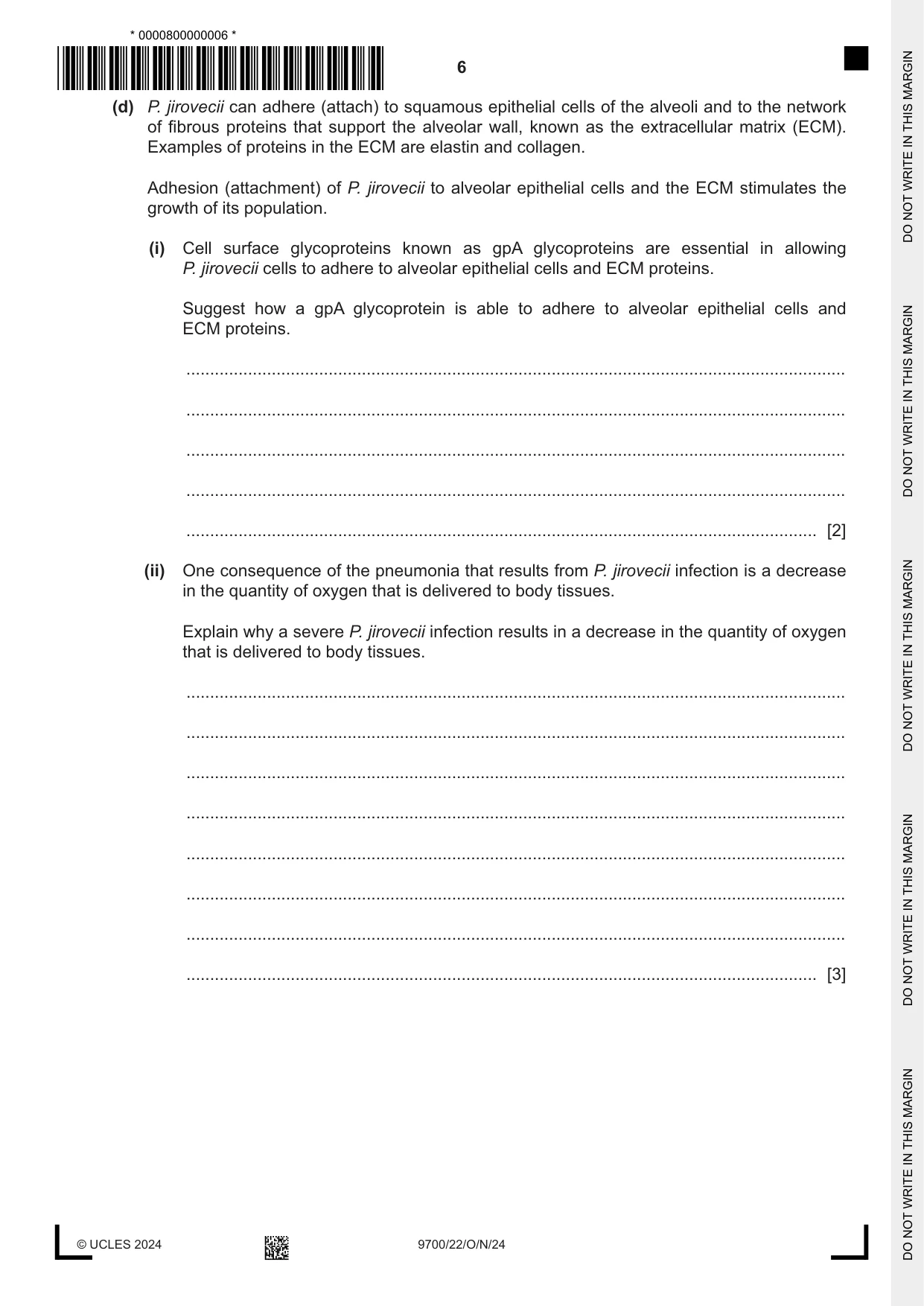
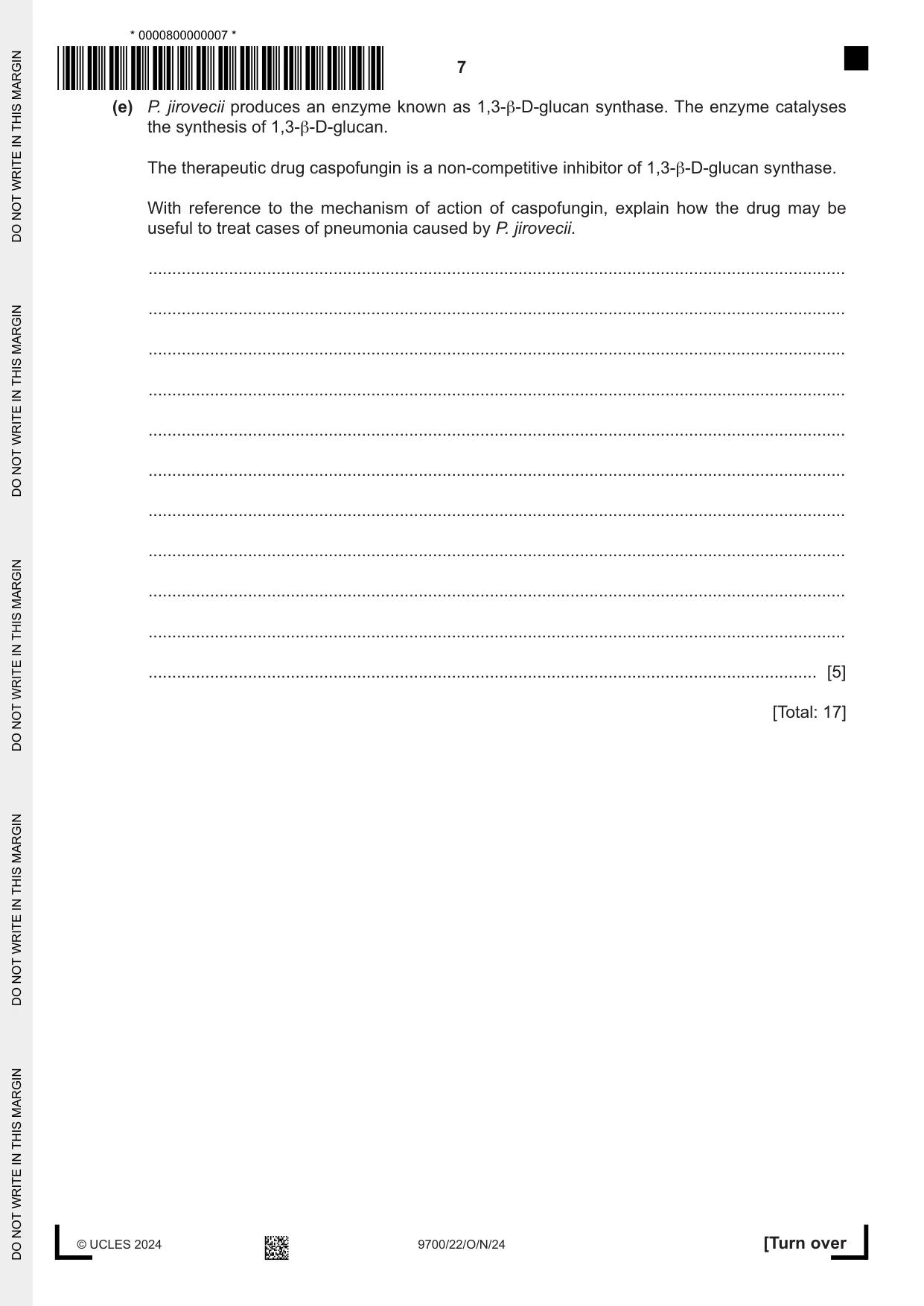
2 People who become infected with human immunodeficiency virus (HIV) are at risk of developing HIV/AIDs, particularly if antiretroviral therapy (ART) is not available. (a) In people infected with HIV, the use of ART also helps to reduce transmission of the virus to uninfected people. Outline two control methods, other than ART, that can be used to reduce the transmission of HIV. ................................................................................................................................................... ................................................................................................................................................... ................................................................................................................................................... ................................................................................................................................................... ................................................................................................................................................... ............................................................................................................................................. [2] In people with HIV/AIDs, a serious lung disease known as pneumocystis pneumonia can result from infection by an opportunistic pathogen known as Pneumocystis jirovecii. Fig. 2.1 shows P. jirovecii cells in one stage of their life cycle, as seen using a light microscope at a magnification of ×600. 0.4 μm Fig. 2.1 (b) Define magnification. ................................................................................................................................................... ............................................................................................................................................. [1] (c) Fig. 2.1 shows that P. jirovecii is a unicellular organism. Although the cells of many species of bacteria are the same size as those of P. jirovecii, research concluded that the organism is a eukaryote and is not a bacterium. In 1988, analysis of ribosomal RNA (rRNA) resulted in P. jirovecii being classified as a fungus. (i) Studies of the structure of P. jirovecii have identified that the cell wall is made of polysaccharides such as chitin and 1,3‑β‑D‑glucan. Explain why this feature helped scientists to confirm that P. jirovecii is not a bacterium. ........................................................................................................................................... ........................................................................................................................................... ..................................................................................................................................... [1] (ii) Scientists have identified other features of the cell structure of P. jirovecii. Some of these are listed in Table 2.1. Complete each row of Table 2.1 so that the table shows: • four structural features identified in P. jirovecii • one function for each structural feature • whether the structural feature is present (✓) or absent (✗) in bacterial cells. Table 2.1 present (✓) or structural feature of function absent (✗) in P. jirovecii bacterial cells ribosomes protein synthesis smooth endoplasmic reticulum Golgi body modification of proteins and lipids aerobic respiration [3] (d) P. jirovecii can adhere (attach) to squamous epithelial cells of the alveoli and to the network of fibrous proteins that support the alveolar wall, known as the extracellular matrix (ECM). Examples of proteins in the ECM are elastin and collagen. Adhesion (attachment) of P. jirovecii to alveolar epithelial cells and the ECM stimulates the growth of its population. (i) Cell surface glycoproteins known as gpA glycoproteins are essential in allowing P. jirovecii cells to adhere to alveolar epithelial cells and ECM proteins. Suggest how a gpA glycoprotein is able to adhere to alveolar epithelial cells and ECM proteins. ........................................................................................................................................... ........................................................................................................................................... ........................................................................................................................................... ........................................................................................................................................... ..................................................................................................................................... [2] (ii) One consequence of the pneumonia that results from P. jirovecii infection is a decrease in the quantity of oxygen that is delivered to body tissues. Explain why a severe P. jirovecii infection results in a decrease in the quantity of oxygen that is delivered to body tissues. ........................................................................................................................................... ........................................................................................................................................... ........................................................................................................................................... ........................................................................................................................................... ........................................................................................................................................... ........................................................................................................................................... ........................................................................................................................................... ..................................................................................................................................... [3] (e) P. jirovecii produces an enzyme known as 1,3‑β‑D‑glucan synthase. The enzyme catalyses the synthesis of 1,3‑β‑D‑glucan. The therapeutic drug caspofungin is a non‑competitive inhibitor of 1,3‑β‑D‑glucan synthase. With reference to the mechanism of action of caspofungin, explain how the drug may be useful to treat cases of pneumonia caused by P. jirovecii. ................................................................................................................................................... ................................................................................................................................................... ................................................................................................................................................... ................................................................................................................................................... ................................................................................................................................................... ................................................................................................................................................... ................................................................................................................................................... ................................................................................................................................................... ................................................................................................................................................... ................................................................................................................................................... ............................................................................................................................................. [5] [Total: 17]
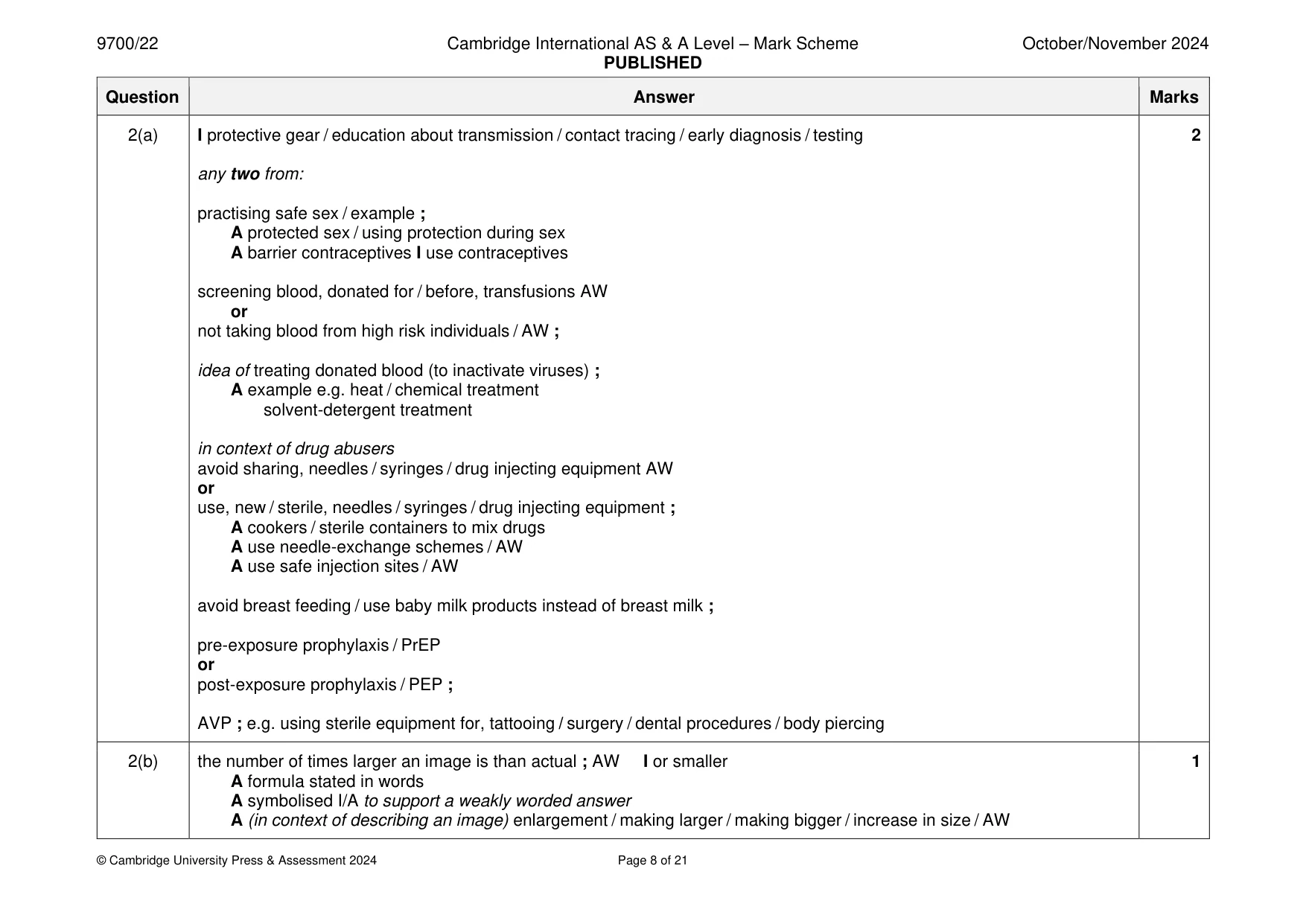
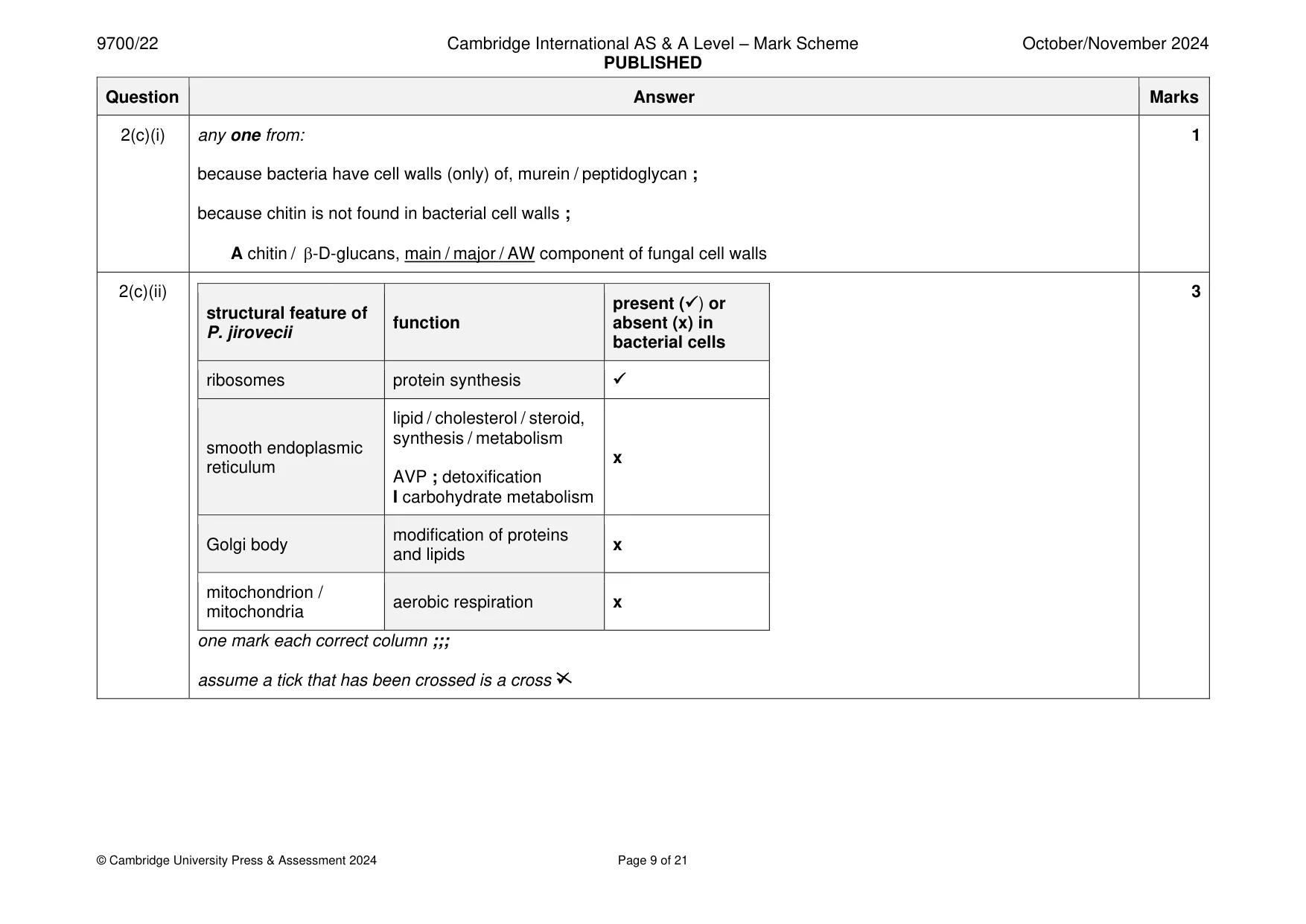
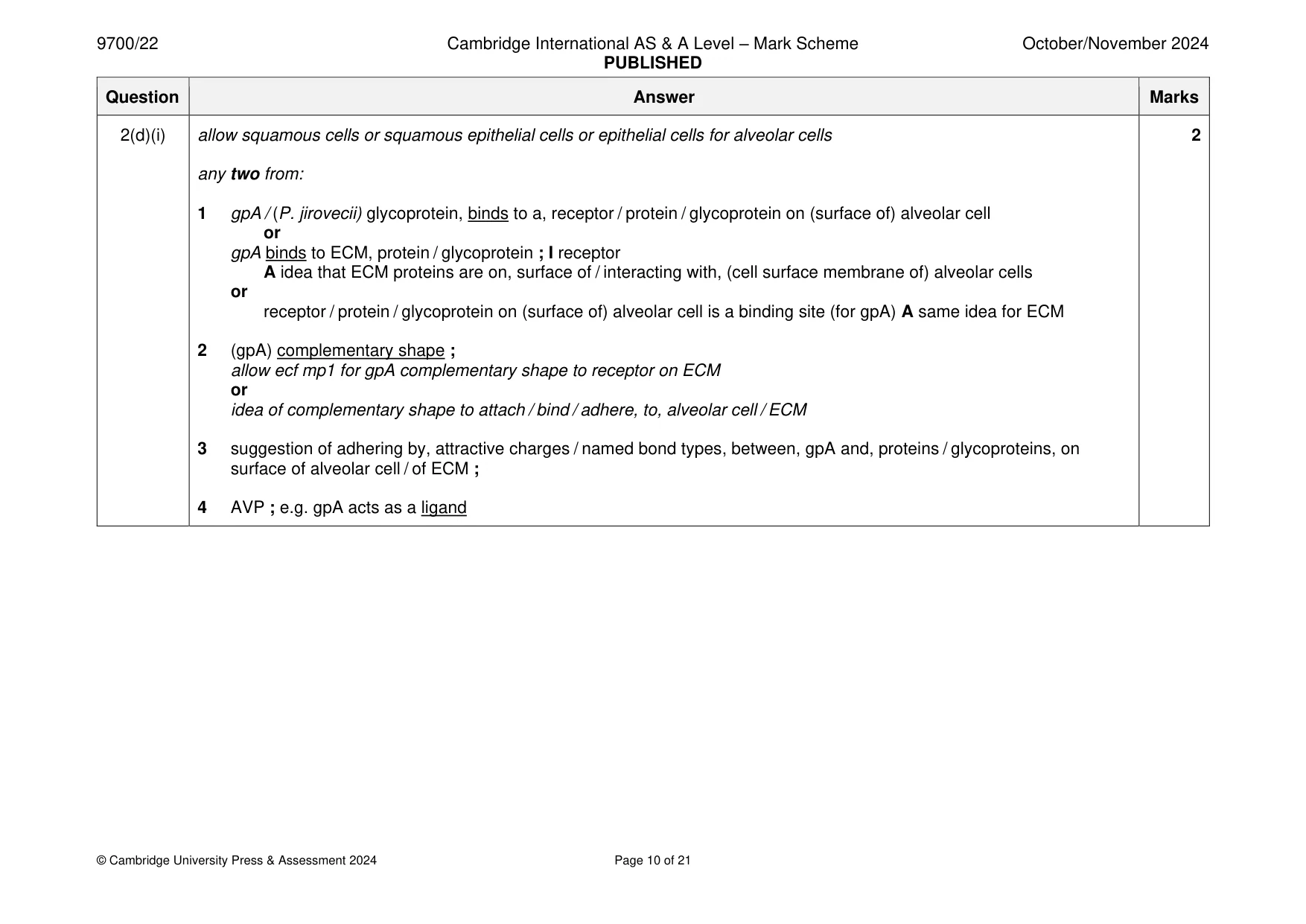
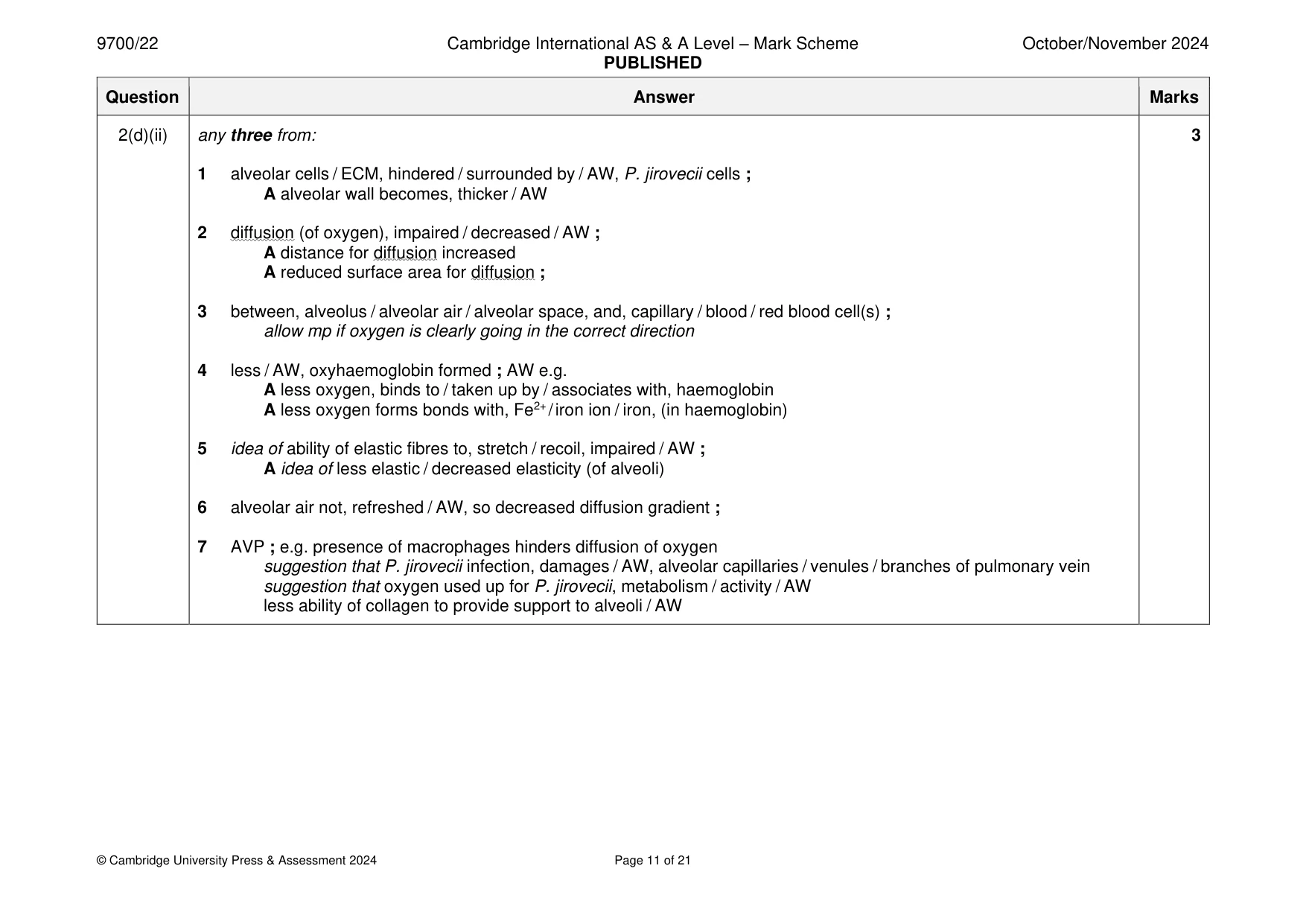
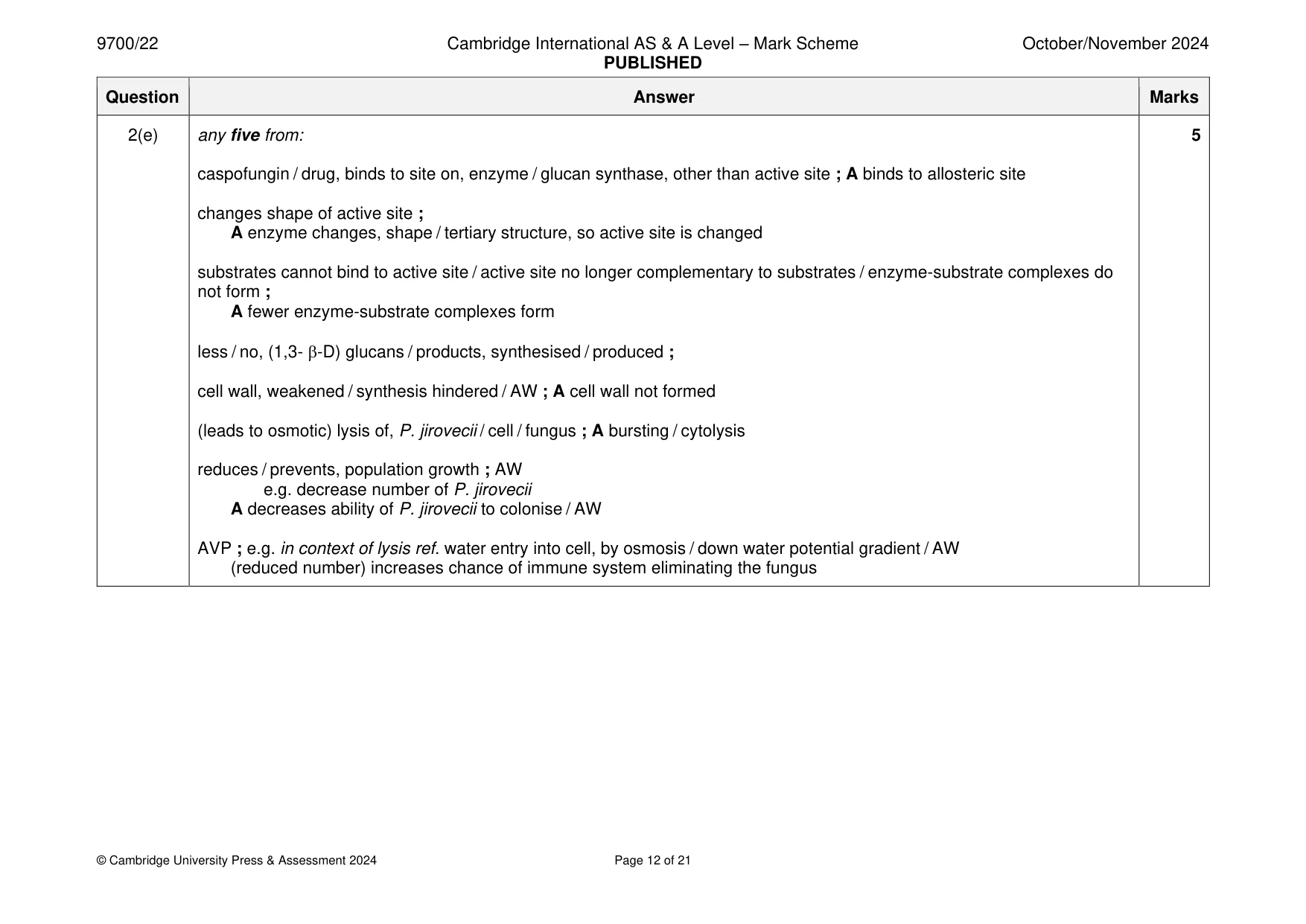
Mark scheme: 2(a) I protective gear / education about transmission / contact tracing / early diagnosis / testing 2 any two from: practising safe sex / example ; A protected sex / using protection during sex A barrier contraceptives I use contraceptives screening blood, donated for / before, transfusions AW or not taking blood from high risk individuals / AW ; idea of treating donated blood (to inactivate viruses) ; A example e.g. heat / chemical treatment solvent-detergent treatment in context of drug abusers avoid sharing, needles / syringes / drug injecting equipment AW or use, new / sterile, needles / syringes / drug injecting equipment ; A cookers / sterile containers to mix drugs A use needle-exchange schemes / AW A use safe injection sites / AW avoid breast feeding / use baby milk products instead of breast milk ; pre-exposure prophylaxis / PrEP or post-exposure prophylaxis / PEP ; AVP ; e.g. using sterile equipment for, tattooing / surgery / dental procedures / body piercing 2(b) the number of times larger an image is than actual ; AW I or smaller 1 A formula stated in words A symbolised I/A to support a weakly worded answer A (in context of describing an image) enlargement / making larger / making bigger / increase in size / AW 2(c)(i) any one from: 1 because bacteria have cell walls (only) of, murein / peptidoglycan ; because chitin is not found in bacterial cell walls ; A chitin / -D-glucans, main / major / AW component of fungal cell walls 2(c)(ii) 3 present (✓) or structural feature of function absent (x) in P. jirovecii bacterial cells ribosomes protein synthesis ✓ lipid / cholesterol / steroid, synthesis / metabolism smooth endoplasmic x reticulum AVP ; detoxification I carbohydrate metabolism modification of proteins Golgi body x and lipids mitochondrion / aerobic respiration x mitochondria one mark each correct column ;;; assume a tick that has been crossed is a cross ✓ 2(d)(i) allow squamous cells or squamous epithelial cells or epithelial cells for alveolar cells 2 any two from: 1 gpA / (P. jirovecii) glycoprotein, binds to a, receptor / protein / glycoprotein on (surface of) alveolar cell or gpA binds to ECM, protein / glycoprotein ; I receptor A idea that ECM proteins are on, surface of / interacting with, (cell surface membrane of) alveolar cells or receptor / protein / glycoprotein on (surface of) alveolar cell is a binding site (for gpA) A same idea for ECM 2 (gpA) complementary shape ; allow ecf mp1 for gpA complementary shape to receptor on ECM or idea of complementary shape to attach / bind / adhere, to, alveolar cell / ECM 3 suggestion of adhering by, attractive charges / named bond types, between, gpA and, proteins / glycoproteins, on surface of alveolar cell / of ECM ; 4 AVP ; e.g. gpA acts as a ligand 2(d)(ii) any three from: 3 1 alveolar cells / ECM, hindered / surrounded by / AW, P. jirovecii cells ; A alveolar wall becomes, thicker / AW 2 diffusion (of oxygen), impaired / decreased / AW ; A distance for diffusion increased A reduced surface area for diffusion ; 3 between, alveolus / alveolar air / alveolar space, and, capillary / blood / red blood cell(s) ; allow mp if oxygen is clearly going in the correct direction 4 less / AW, oxyhaemoglobin formed ; AW e.g. A less oxygen, binds to / taken up by / associates with, haemoglobin A less oxygen forms bonds with, Fe2+ / iron ion / iron, (in haemoglobin) 5 idea of ability of elastic fibres to, stretch / recoil, impaired / AW ; A idea of less elastic / decreased elasticity (of alveoli) 6 alveolar air not, refreshed / AW, so decreased diffusion gradient ; 7 AVP ; e.g. presence of macrophages hinders diffusion of oxygen suggestion that P. jirovecii infection, damages / AW, alveolar capillaries / venules / branches of pulmonary vein suggestion that oxygen used up for P. jirovecii, metabolism / activity / AW less ability of collagen to provide support to alveoli / AW 2(e) any five from: 5 caspofungin / drug, binds to site on, enzyme / glucan synthase, other than active site ; A binds to allosteric site changes shape of active site ; A enzyme changes, shape / tertiary structure, so active site is changed substrates cannot bind to active site / active site no longer complementary to substrates / enzyme-substrate complexes do not form ; A fewer enzyme-substrate complexes form less / no, (1,3- -D) glucans / products, synthesised / produced ; cell wall, weakened / synthesis hindered / AW ; A cell wall not formed (leads to osmotic) lysis of, P. jirovecii / cell / fungus ; A bursting / cytolysis reduces / prevents, population growth ; AW e.g. decrease number of P. jirovecii A decreases ability of P. jirovecii to colonise / AW AVP ; e.g. in context of lysis ref. water entry into cell, by osmosis / down water potential gradient / AW (reduced number) increases chance of immune system eliminating the fungus
More questions on Cells as the basic units of living organisms
Q3 · During transcription, base pairing occurs between nucleotides
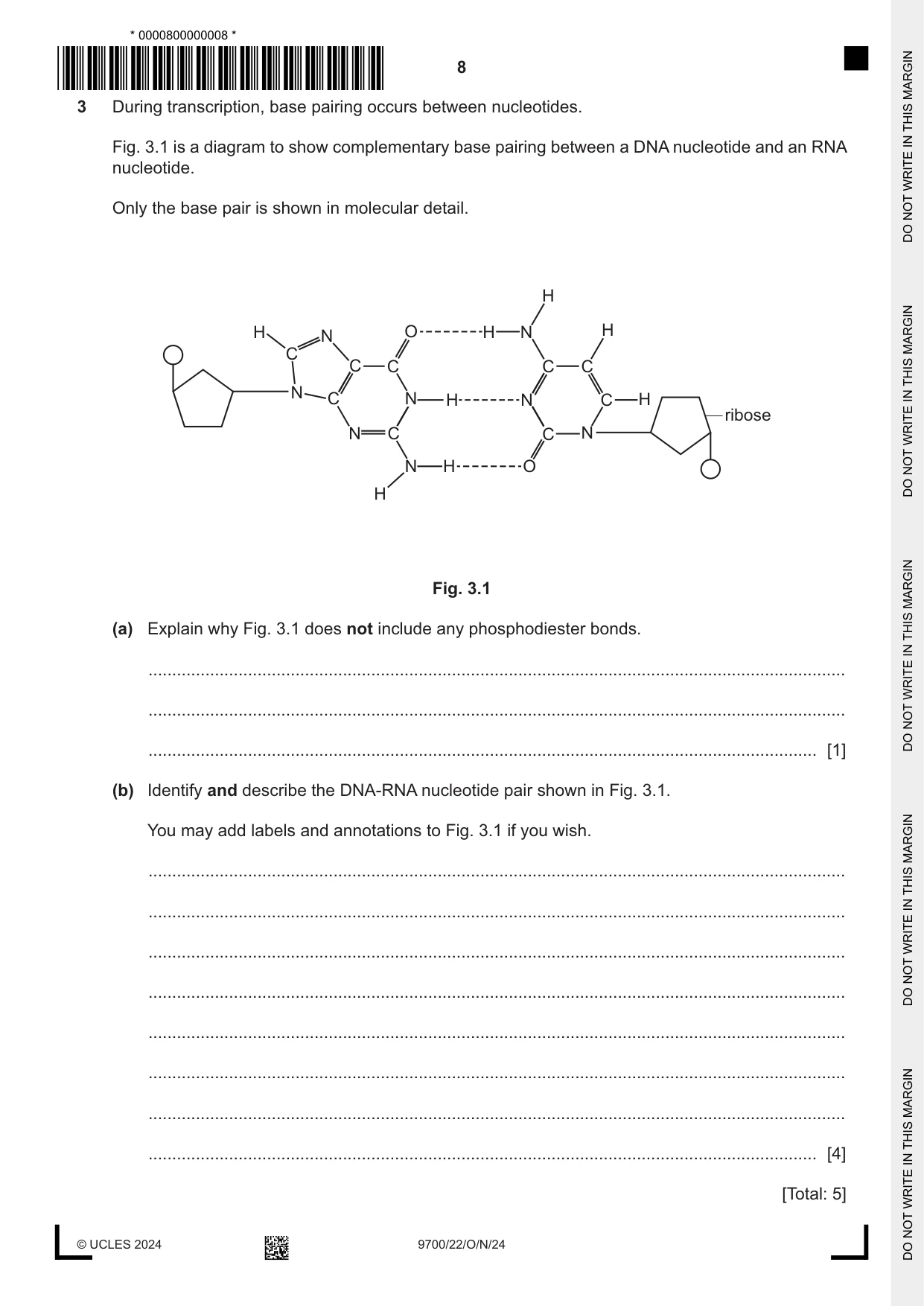
3 During transcription, base pairing occurs between nucleotides. Fig. 3.1 is a diagram to show complementary base pairing between a DNA nucleotide and an RNA nucleotide. Only the base pair is shown in molecular detail. H H N O H N H C C C C C N C N H N C H ribose N C C N N H O H Fig. 3.1 (a) Explain why Fig. 3.1 does not include any phosphodiester bonds. ................................................................................................................................................... ................................................................................................................................................... ............................................................................................................................................. [1] (b) Identify and describe the DNA‑RNA nucleotide pair shown in Fig. 3.1. You may add labels and annotations to Fig. 3.1 if you wish. ................................................................................................................................................... ................................................................................................................................................... ................................................................................................................................................... ................................................................................................................................................... ................................................................................................................................................... ................................................................................................................................................... ................................................................................................................................................... ............................................................................................................................................. [4] [Total: 5]
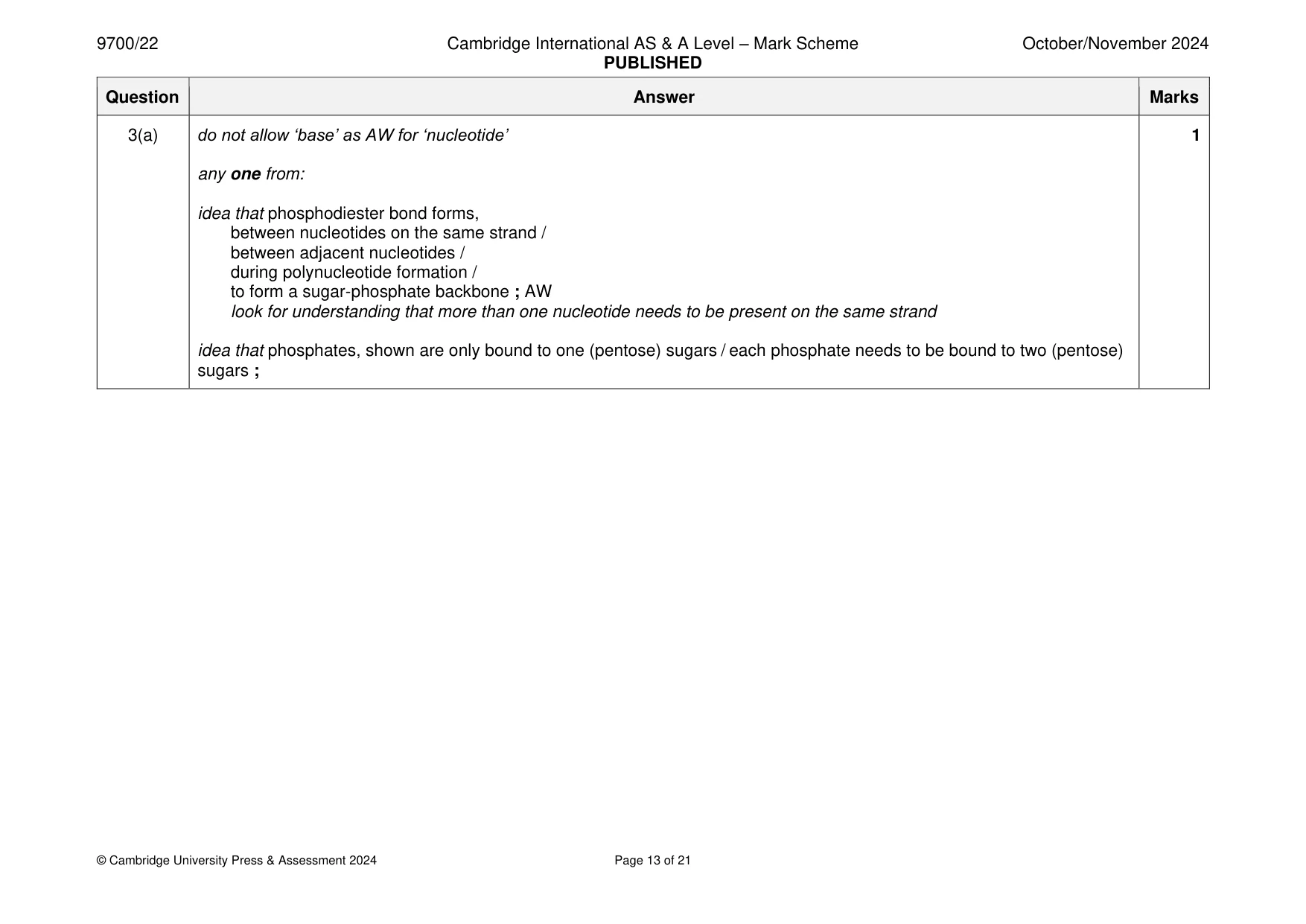
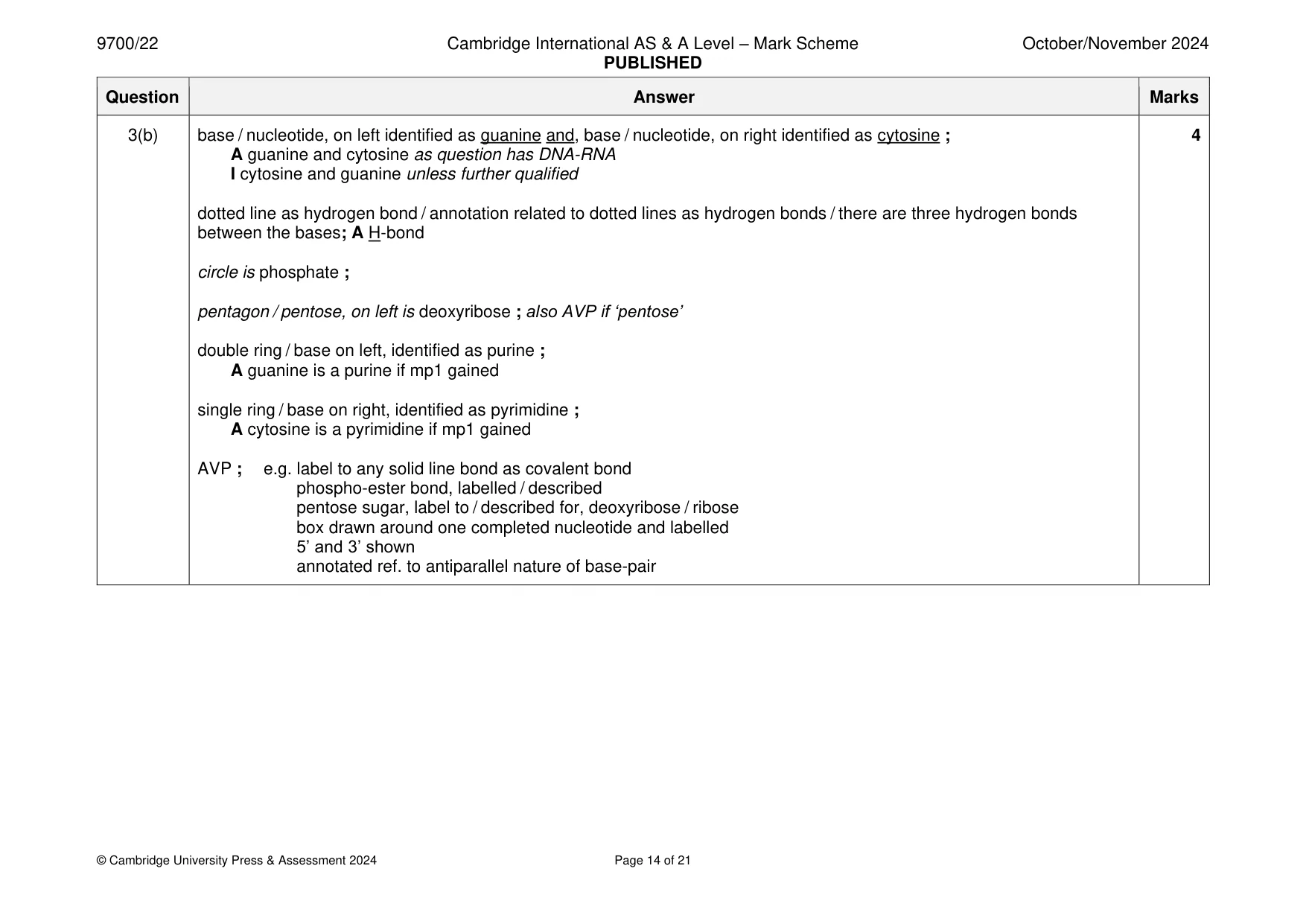
Mark scheme: 3(a) do not allow ‘base’ as AW for ‘nucleotide’ 1 any one from: idea that phosphodiester bond forms, between nucleotides on the same strand / between adjacent nucleotides / during polynucleotide formation / to form a sugar-phosphate backbone ; AW look for understanding that more than one nucleotide needs to be present on the same strand idea that phosphates, shown are only bound to one (pentose) sugars / each phosphate needs to be bound to two (pentose) sugars ; 3(b) base / nucleotide, on left identified as guanine and, base / nucleotide, on right identified as cytosine ; 4 A guanine and cytosine as question has DNA-RNA I cytosine and guanine unless further qualified dotted line as hydrogen bond / annotation related to dotted lines as hydrogen bonds / there are three hydrogen bonds between the bases; A H-bond circle is phosphate ; pentagon / pentose, on left is deoxyribose ; also AVP if ‘pentose’ double ring / base on left, identified as purine ; A guanine is a purine if mp1 gained single ring / base on right, identified as pyrimidine ; A cytosine is a pyrimidine if mp1 gained AVP ; e.g. label to any solid line bond as covalent bond phospho-ester bond, labelled / described pentose sugar, label to / described for, deoxyribose / ribose box drawn around one completed nucleotide and labelled 5’ and 3’ shown annotated ref. to antiparallel nature of base-pair
More questions on Structure of nucleic acids and replication of DNA
Q4 · Adult stem cells are undifferentiated cells that are found in most animal tissues
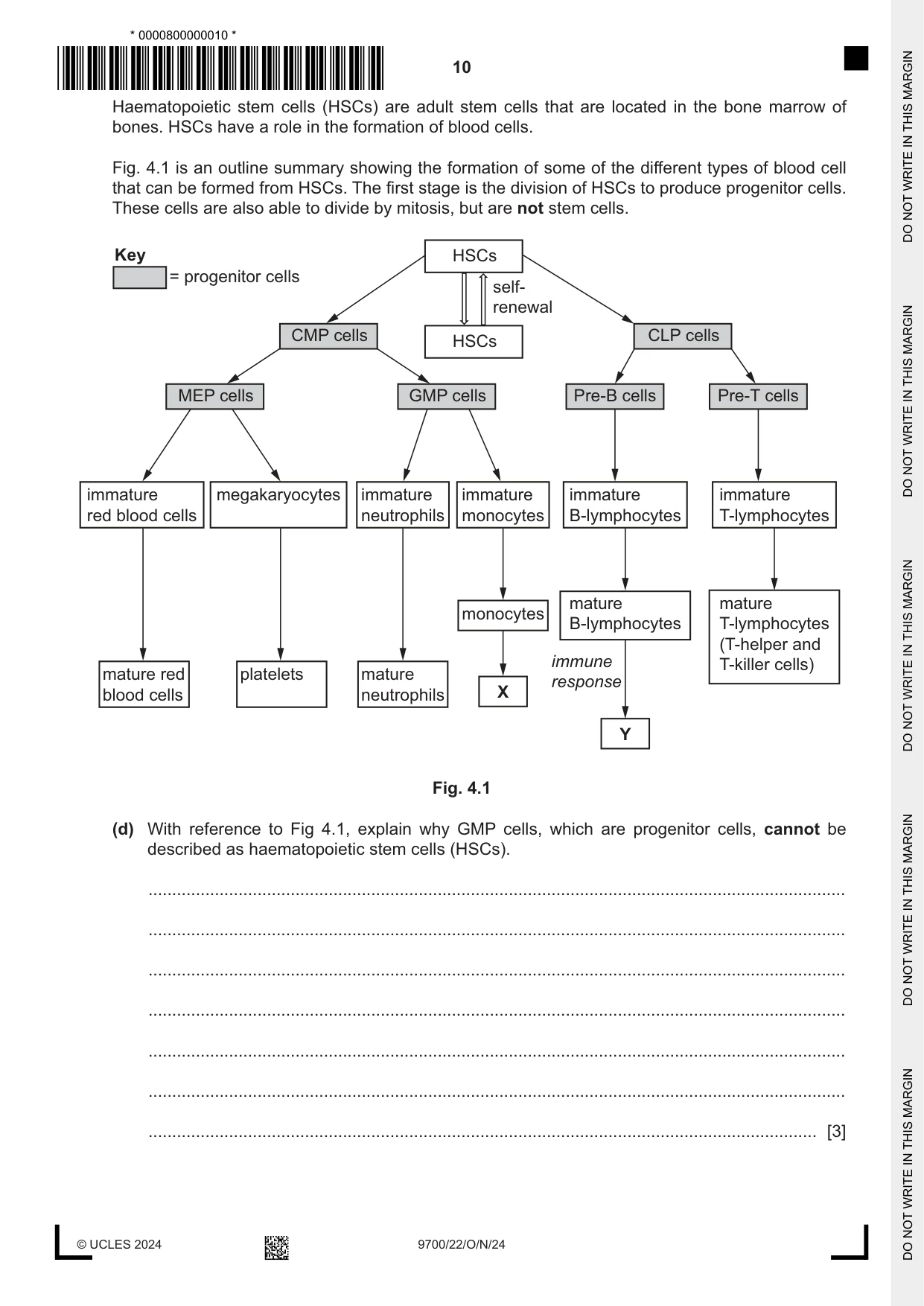
4 Adult stem cells are undifferentiated cells that are found in most animal tissues. Adult stem cells can divide by mitosis throughout their lifespan to form identical stem cells (self‑renewal) or to form cells that can differentiate into the functioning cells of that tissue. (a) Mitosis is important for the repair of tissues. Explain what is meant by repair of tissues. ................................................................................................................................................... ................................................................................................................................................... ............................................................................................................................................. [1] (b) Uncontrolled cell division is a characteristic feature of tumour formation from a differentiated cell. Describe other features of tumour formation from a fully differentiated cell. ................................................................................................................................................... ................................................................................................................................................... ................................................................................................................................................... ................................................................................................................................................... ............................................................................................................................................. [2] (c) Telomeres prevent loss of genes. Adult stem cells have chromosomes with long telomeres. Explain why long telomeres are an advantage to cells that carry out many cell cycles. ................................................................................................................................................... ................................................................................................................................................... ................................................................................................................................................... ................................................................................................................................................... ................................................................................................................................................... ............................................................................................................................................. [2] Haematopoietic stem cells (HSCs) are adult stem cells that are located in the bone marrow of bones. HSCs have a role in the formation of blood cells. Fig. 4.1 is an outline summary showing the formation of some of the different types of blood cell that can be formed from HSCs. The first stage is the division of HSCs to produce progenitor cells. These cells are also able to divide by mitosis, but are not stem cells. Key HSCs = progenitor cells self- renewal CMP cells CLP cells HSCs MEP cells GMP cells Pre-B cells Pre-T cells immature megakaryocytes immature immature immature immature red blood cells neutrophils monocytes B-lymphocytes T-lymphocytes mature mature monocytes B-lymphocytes T-lymphocytes (T-helper and immune T-killer cells) mature red platelets mature response blood cells neutrophils X Y Fig. 4.1 (d) With reference to Fig 4.1, explain why GMP cells, which are progenitor cells, cannot be described as haematopoietic stem cells (HSCs). ................................................................................................................................................... ................................................................................................................................................... ................................................................................................................................................... ................................................................................................................................................... ................................................................................................................................................... ................................................................................................................................................... ............................................................................................................................................. [3] (e) Fig. 4.1 shows that monocytes differentiate into cell type X, which has a similar function to neutrophils. Name cell type X. ............................................................................................................................................. [1] (f) Cell type Y shown in Fig. 4.1 releases molecules with antigen binding sites. Name the molecules released by cell type Y. ............................................................................................................................................. [1] (g) The differentiation of T‑lymphocytes begins in the bone marrow and continues in an organ known as the thymus to produce fully differentiated T‑helper and T‑killer cells. In the thymus, T‑lymphocytes that bind to self antigens are destroyed. Explain why T‑lymphocytes that bind to self antigens need to be destroyed in the thymus. ................................................................................................................................................... ................................................................................................................................................... ................................................................................................................................................... ................................................................................................................................................... ................................................................................................................................................... ................................................................................................................................................... ............................................................................................................................................. [3] [Total: 13]
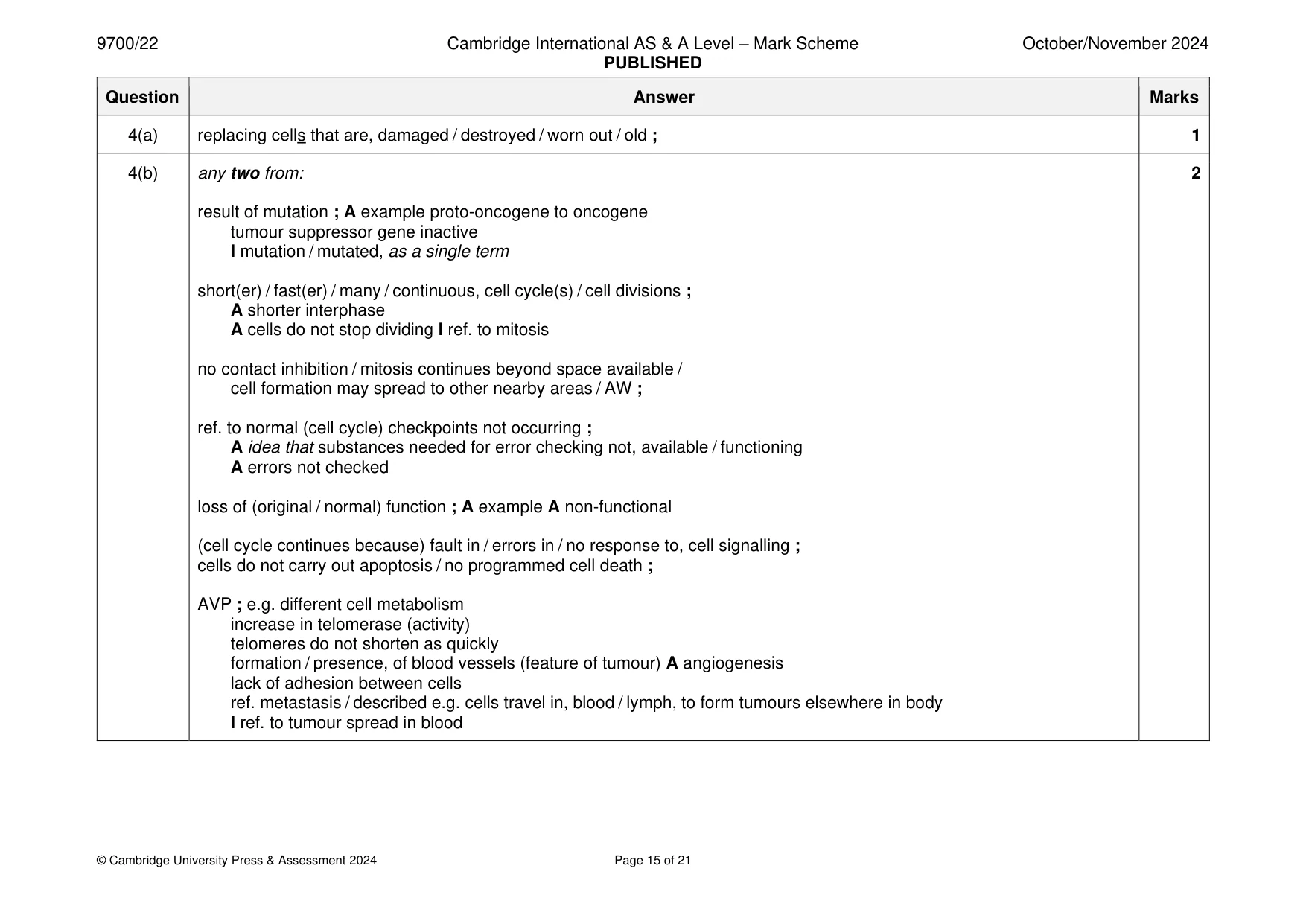
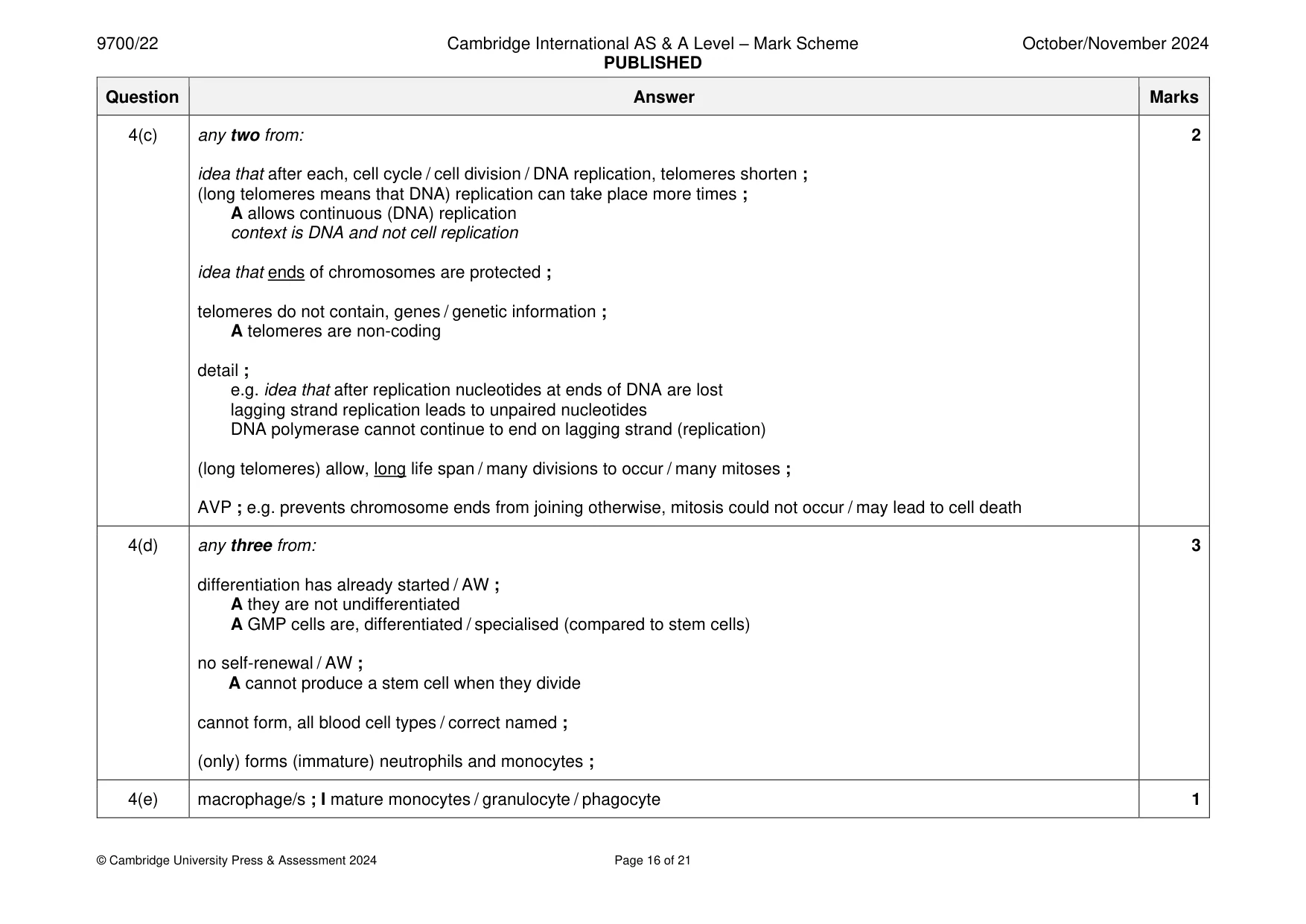
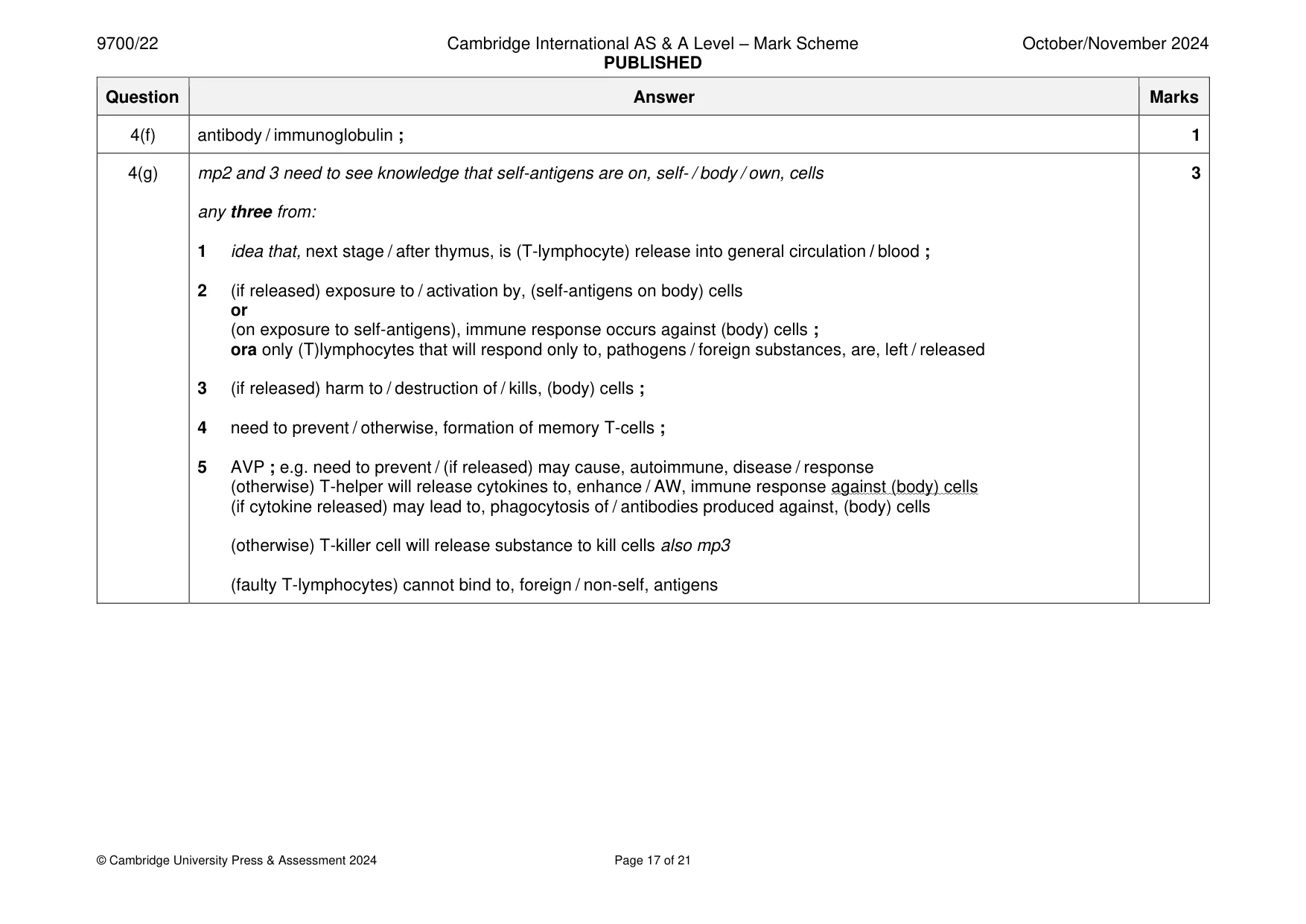
Mark scheme: 4(a) replacing cells that are, damaged / destroyed / worn out / old ; 1 4(b) any two from: 2 result of mutation ; A example proto-oncogene to oncogene tumour suppressor gene inactive I mutation / mutated, as a single term short(er) / fast(er) / many / continuous, cell cycle(s) / cell divisions ; A shorter interphase A cells do not stop dividing I ref. to mitosis no contact inhibition / mitosis continues beyond space available / cell formation may spread to other nearby areas / AW ; ref. to normal (cell cycle) checkpoints not occurring ; A idea that substances needed for error checking not, available / functioning A errors not checked loss of (original / normal) function ; A example A non-functional (cell cycle continues because) fault in / errors in / no response to, cell signalling ; cells do not carry out apoptosis / no programmed cell death ; AVP ; e.g. different cell metabolism increase in telomerase (activity) telomeres do not shorten as quickly formation / presence, of blood vessels (feature of tumour) A angiogenesis lack of adhesion between cells ref. metastasis / described e.g. cells travel in, blood / lymph, to form tumours elsewhere in body I ref. to tumour spread in blood 4(c) any two from: 2 idea that after each, cell cycle / cell division / DNA replication, telomeres shorten ; (long telomeres means that DNA) replication can take place more times ; A allows continuous (DNA) replication context is DNA and not cell replication idea that ends of chromosomes are protected ; telomeres do not contain, genes / genetic information ; A telomeres are non-coding detail ; e.g. idea that after replication nucleotides at ends of DNA are lost lagging strand replication leads to unpaired nucleotides DNA polymerase cannot continue to end on lagging strand (replication) (long telomeres) allow, long life span / many divisions to occur / many mitoses ; AVP ; e.g. prevents chromosome ends from joining otherwise, mitosis could not occur / may lead to cell death 4(d) any three from: 3 differentiation has already started / AW ; A they are not undifferentiated A GMP cells are, differentiated / specialised (compared to stem cells) no self-renewal / AW ; A cannot produce a stem cell when they divide cannot form, all blood cell types / correct named ; (only) forms (immature) neutrophils and monocytes ; 4(e) macrophage/s ; I mature monocytes / granulocyte / phagocyte 1 4(f) antibody / immunoglobulin ; 1 4(g) mp2 and 3 need to see knowledge that self-antigens are on, self- / body / own, cells 3 any three from: 1 idea that, next stage / after thymus, is (T-lymphocyte) release into general circulation / blood ; 2 (if released) exposure to / activation by, (self-antigens on body) cells or (on exposure to self-antigens), immune response occurs against (body) cells ; ora only (T)lymphocytes that will respond only to, pathogens / foreign substances, are, left / released 3 (if released) harm to / destruction of / kills, (body) cells ; 4 need to prevent / otherwise, formation of memory T-cells ; 5 AVP ; e.g. need to prevent / (if released) may cause, autoimmune, disease / response (otherwise) T-helper will release cytokines to, enhance / AW, immune response against (body) cells (if cytokine released) may lead to, phagocytosis of / antibodies produced against, (body) cells (otherwise) T-killer cell will release substance to kill cells also mp3 (faulty T-lymphocytes) cannot bind to, foreign / non-self, antigens
More questions on Replication and division of nuclei and cells
Q5 · Malaria is an infectious disease caused by the protoctist, Plasmodium
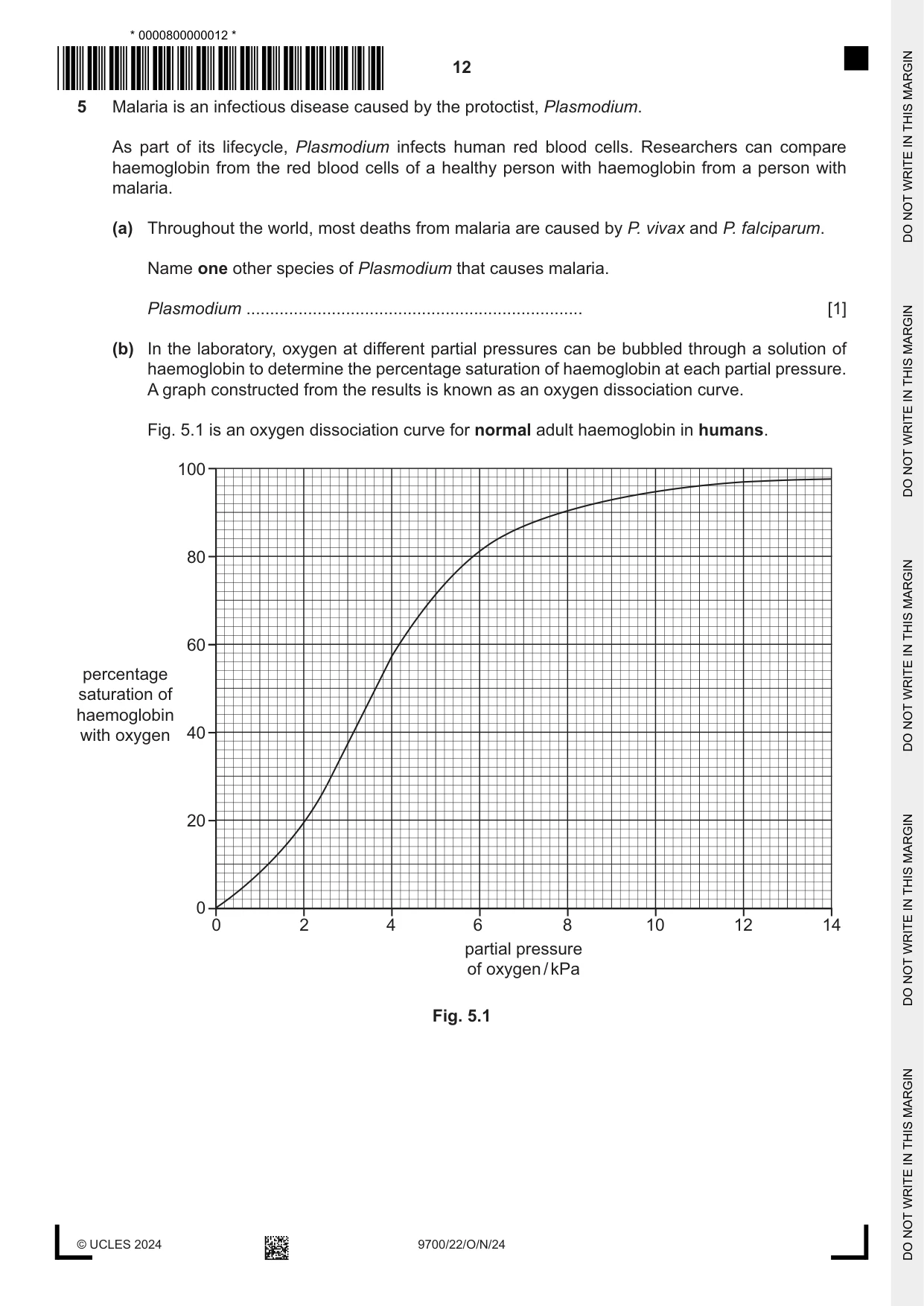
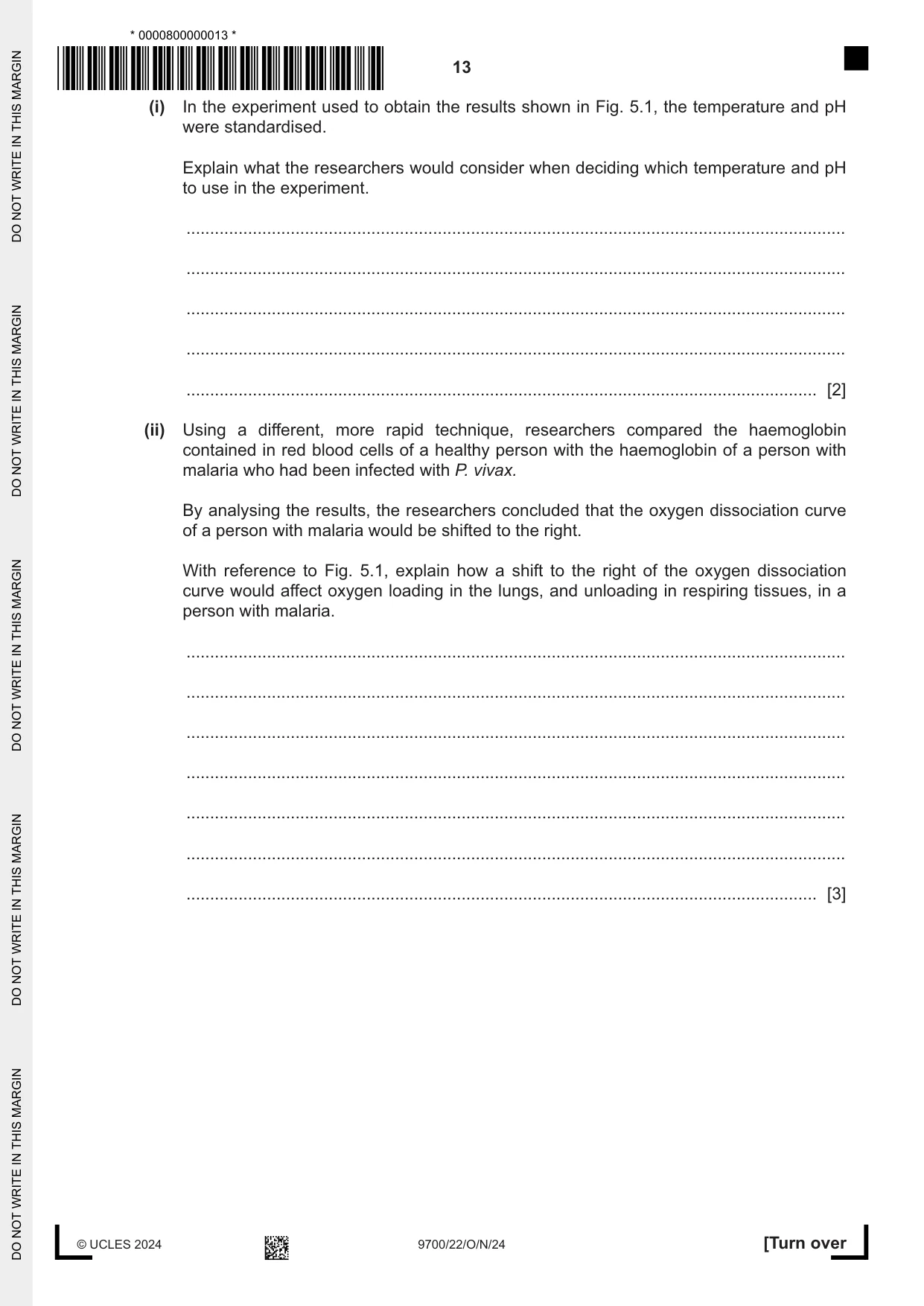
5 Malaria is an infectious disease caused by the protoctist, Plasmodium. As part of its lifecycle, Plasmodium infects human red blood cells. Researchers can compare haemoglobin from the red blood cells of a healthy person with haemoglobin from a person with malaria. (a) Throughout the world, most deaths from malaria are caused by P. vivax and P. falciparum. Name one other species of Plasmodium that causes malaria. Plasmodium ....................................................................... [1] (b) In the laboratory, oxygen at different partial pressures can be bubbled through a solution of haemoglobin to determine the percentage saturation of haemoglobin at each partial pressure. A graph constructed from the results is known as an oxygen dissociation curve. Fig. 5.1 is an oxygen dissociation curve for normal adult haemoglobin in humans. 100 80 60 percentage saturation of haemoglobin with oxygen 40 20 0 0 2 4 6 8 10 12 14 partial pressure of oxygen / kPa Fig. 5.1 (i) In the experiment used to obtain the results shown in Fig. 5.1, the temperature and pH were standardised. Explain what the researchers would consider when deciding which temperature and pH to use in the experiment. ........................................................................................................................................... ........................................................................................................................................... ........................................................................................................................................... ........................................................................................................................................... ..................................................................................................................................... [2] (ii) Using a different, more rapid technique, researchers compared the haemoglobin contained in red blood cells of a healthy person with the haemoglobin of a person with malaria who had been infected with P. vivax. By analysing the results, the researchers concluded that the oxygen dissociation curve of a person with malaria would be shifted to the right. With reference to Fig. 5.1, explain how a shift to the right of the oxygen dissociation curve would affect oxygen loading in the lungs, and unloading in respiring tissues, in a person with malaria. ........................................................................................................................................... ........................................................................................................................................... ........................................................................................................................................... ........................................................................................................................................... ........................................................................................................................................... ........................................................................................................................................... ..................................................................................................................................... [3] (c) A red blood cell that is infected with Plasmodium cannot carry out its function as effectively as a normal red blood cell. Describe how the size and structure of a red blood cell is related to its function, other than the fact that it contains a very large number of haemoglobin molecules. ................................................................................................................................................... ................................................................................................................................................... ................................................................................................................................................... ................................................................................................................................................... ................................................................................................................................................... ................................................................................................................................................... ................................................................................................................................................... ................................................................................................................................................... ............................................................................................................................................. [4] [Total: 10]
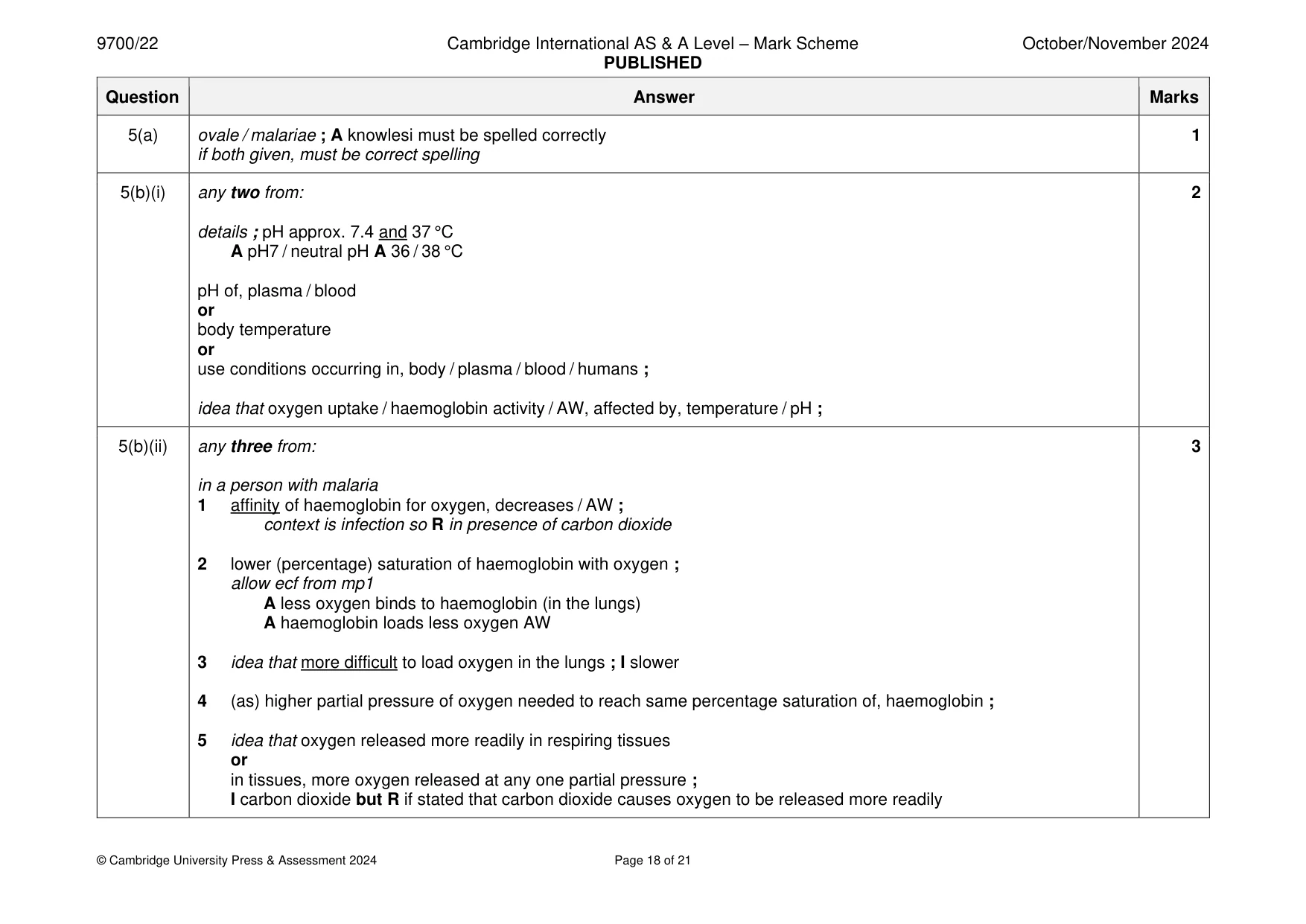
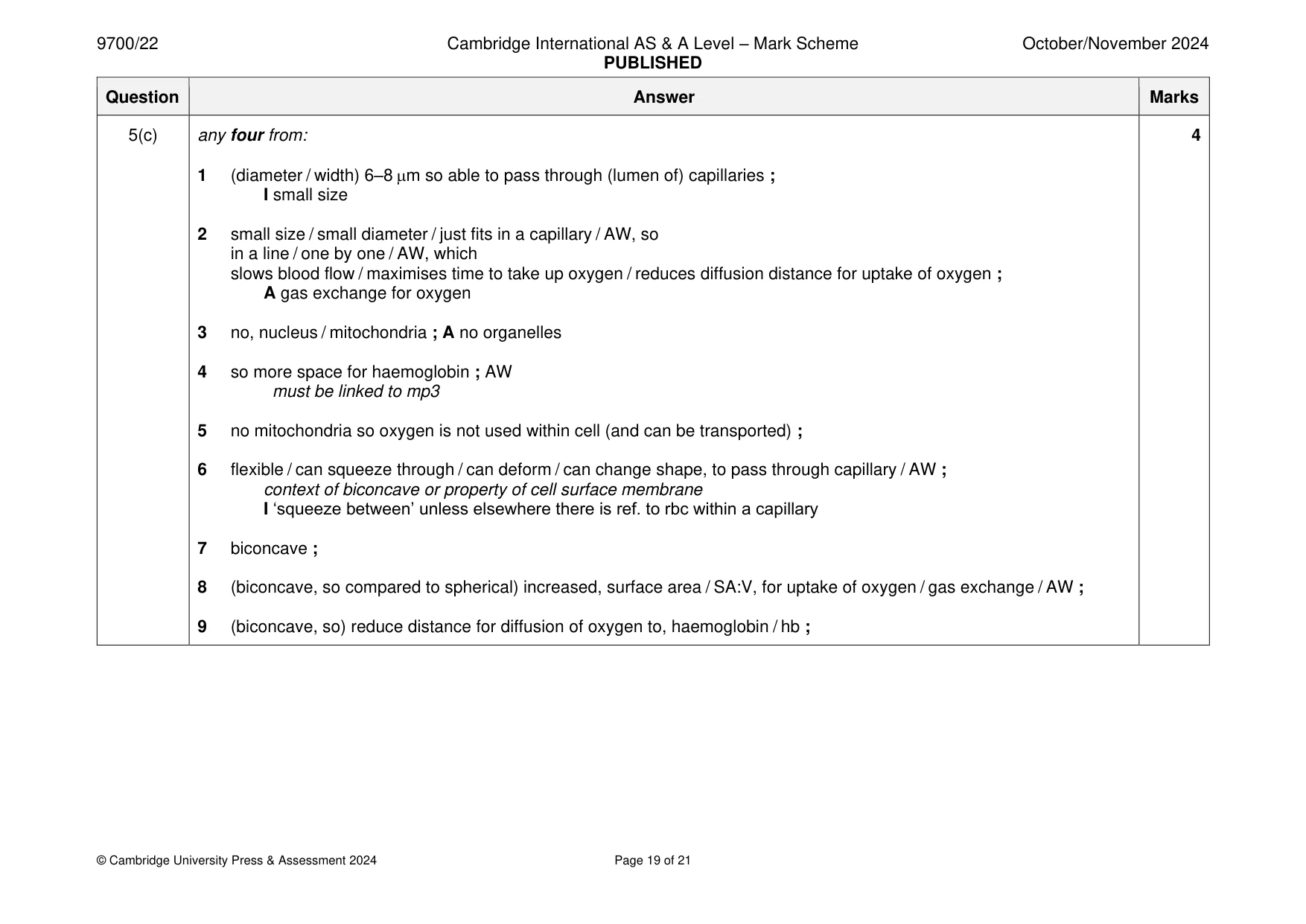
Mark scheme: 5(a) ovale / malariae ; A knowlesi must be spelled correctly 1 if both given, must be correct spelling 5(b)(i) any two from: 2 details ; pH approx. 7.4 and 37 °C A pH7 / neutral pH A 36 / 38 °C pH of, plasma / blood or body temperature or use conditions occurring in, body / plasma / blood / humans ; idea that oxygen uptake / haemoglobin activity / AW, affected by, temperature / pH ; 5(b)(ii) any three from: 3 in a person with malaria 1 affinity of haemoglobin for oxygen, decreases / AW ; context is infection so R in presence of carbon dioxide 2 lower (percentage) saturation of haemoglobin with oxygen ; allow ecf from mp1 A less oxygen binds to haemoglobin (in the lungs) A haemoglobin loads less oxygen AW 3 idea that more difficult to load oxygen in the lungs ; I slower 4 (as) higher partial pressure of oxygen needed to reach same percentage saturation of, haemoglobin ; 5 idea that oxygen released more readily in respiring tissues or in tissues, more oxygen released at any one partial pressure ; I carbon dioxide but R if stated that carbon dioxide causes oxygen to be released more readily 5(c) any four from: 4 1 (diameter / width) 6–8 m so able to pass through (lumen of) capillaries ; I small size 2 small size / small diameter / just fits in a capillary / AW, so in a line / one by one / AW, which slows blood flow / maximises time to take up oxygen / reduces diffusion distance for uptake of oxygen ; A gas exchange for oxygen 3 no, nucleus / mitochondria ; A no organelles 4 so more space for haemoglobin ; AW must be linked to mp3 5 no mitochondria so oxygen is not used within cell (and can be transported) ; 6 flexible / can squeeze through / can deform / can change shape, to pass through capillary / AW ; context of biconcave or property of cell surface membrane I ‘squeeze between’ unless elsewhere there is ref. to rbc within a capillary 7 biconcave ; 8 (biconcave, so compared to spherical) increased, surface area / SA:V, for uptake of oxygen / gas exchange / AW ; 9 (biconcave, so) reduce distance for diffusion of oxygen to, haemoglobin / hb ;
Q6 · The transport of water from the soil solution to the xylem of roots occurs by the…
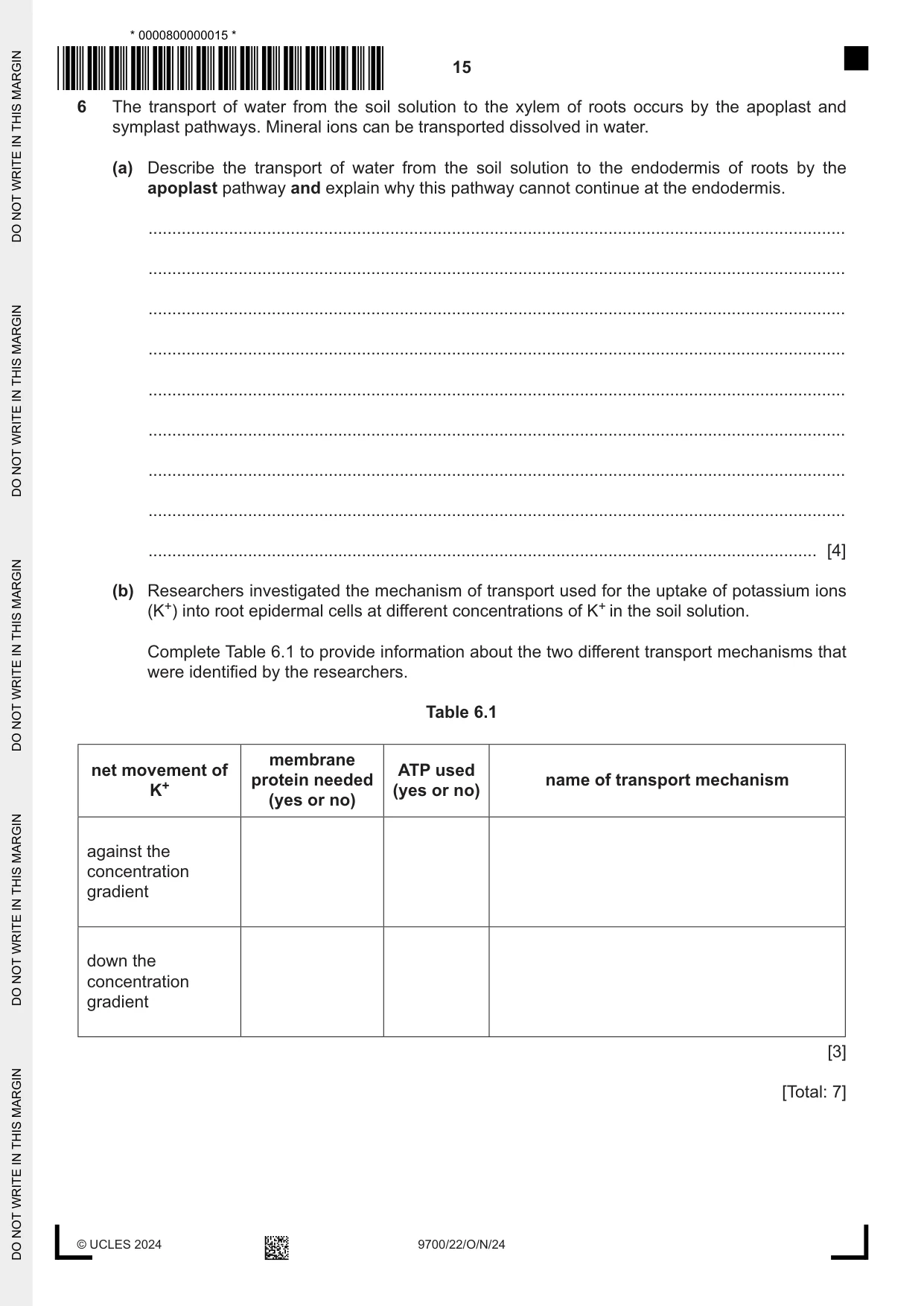
6 The transport of water from the soil solution to the xylem of roots occurs by the apoplast and symplast pathways. Mineral ions can be transported dissolved in water. (a) Describe the transport of water from the soil solution to the endodermis of roots by the apoplast pathway and explain why this pathway cannot continue at the endodermis. ................................................................................................................................................... ................................................................................................................................................... ................................................................................................................................................... ................................................................................................................................................... ................................................................................................................................................... ................................................................................................................................................... ................................................................................................................................................... ................................................................................................................................................... ............................................................................................................................................. [4] (b) Researchers investigated the mechanism of transport used for the uptake of potassium ions (K+) into root epidermal cells at different concentrations of K+ in the soil solution. Complete Table 6.1 to provide information about the two different transport mechanisms that were identified by the researchers. Table 6.1 membrane net movement of ATP used protein needed name of transport mechanism K+ (yes or no) (yes or no) against the concentration gradient down the concentration gradient [3] [Total: 7]
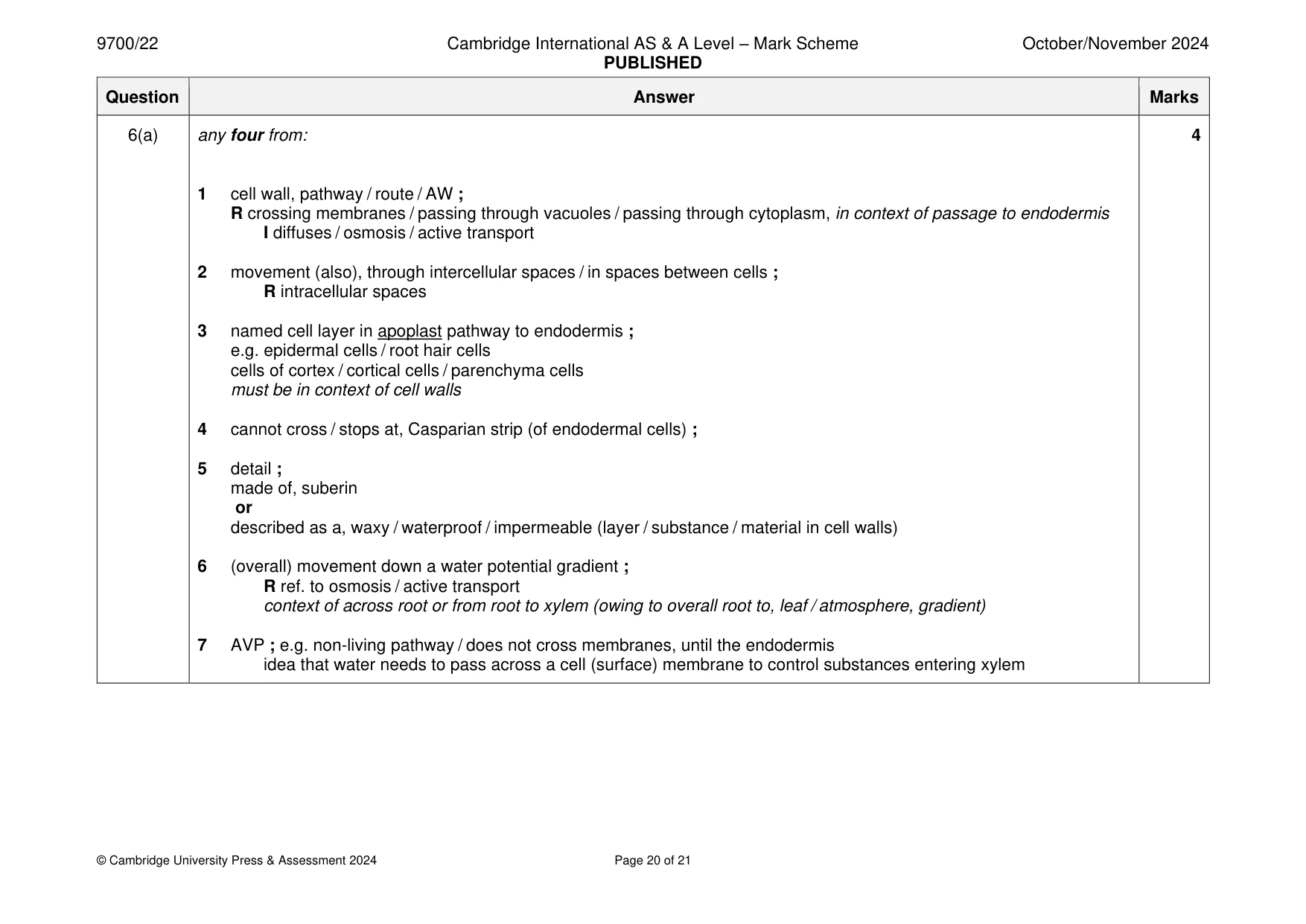
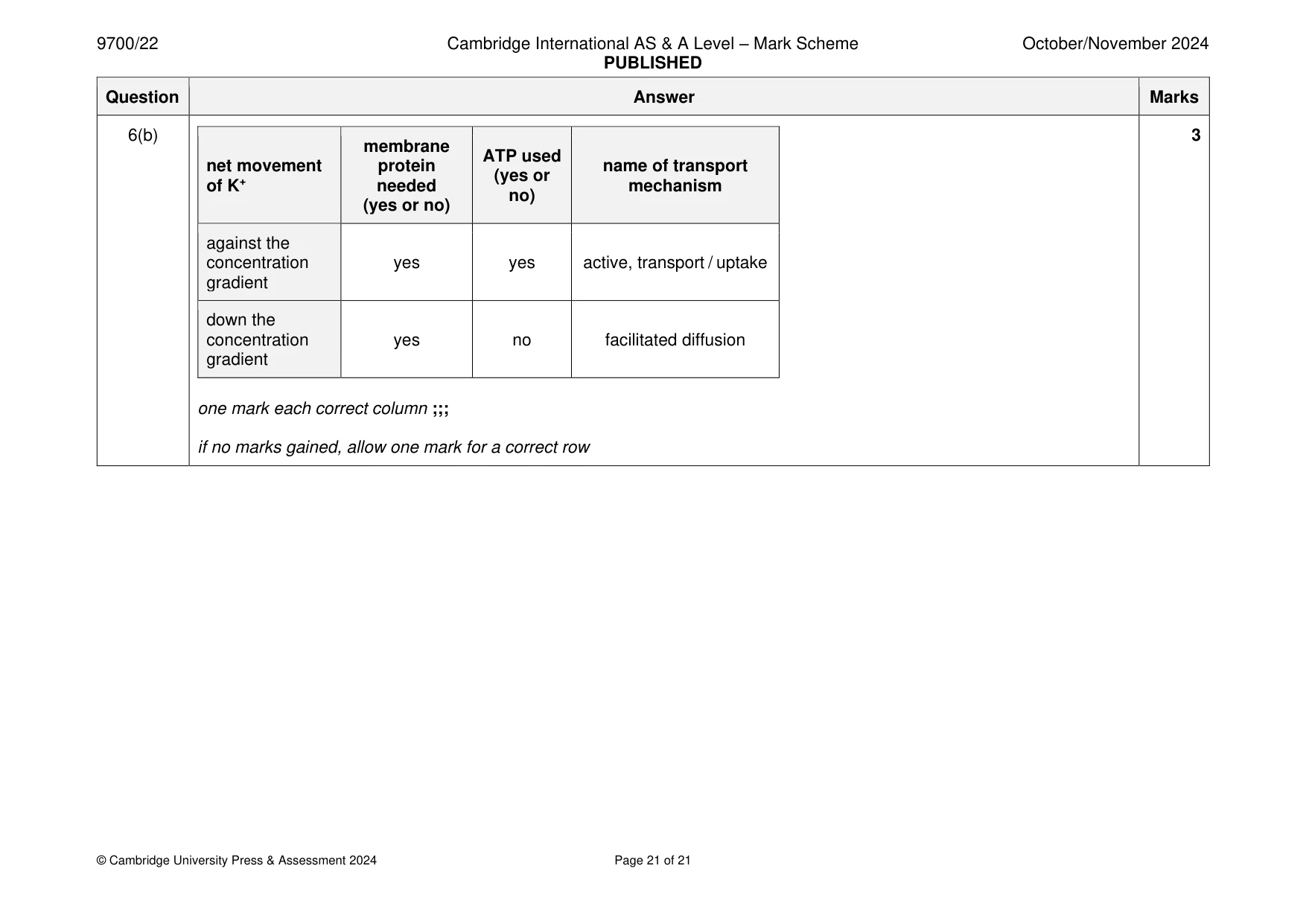
Mark scheme: 6(a) any four from: 4 1 cell wall, pathway / route / AW ; R crossing membranes / passing through vacuoles / passing through cytoplasm, in context of passage to endodermis I diffuses / osmosis / active transport 2 movement (also), through intercellular spaces / in spaces between cells ; R intracellular spaces 3 named cell layer in apoplast pathway to endodermis ; e.g. epidermal cells / root hair cells cells of cortex / cortical cells / parenchyma cells must be in context of cell walls 4 cannot cross / stops at, Casparian strip (of endodermal cells) ; 5 detail ; made of, suberin or described as a, waxy / waterproof / impermeable (layer / substance / material in cell walls) 6 (overall) movement down a water potential gradient ; R ref. to osmosis / active transport context of across root or from root to xylem (owing to overall root to, leaf / atmosphere, gradient) 7 AVP ; e.g. non-living pathway / does not cross membranes, until the endodermis idea that water needs to pass across a cell (surface) membrane to control substances entering xylem 6(b) 3 membrane ATP used net movement protein name of transport (yes or of K+ needed mechanism no) (yes or no) against the concentration yes yes active, transport / uptake gradient down the concentration yes no facilitated diffusion gradient one mark each correct column ;;; if no marks gained, allow one mark for a correct row
What was in this paper
The subtopics covered by these 6 questions, and how many questions each got. Open one in a new tab to see every Cambridge question on it.
What you needed in this session
Cambridge’s own grade thresholds for 2024 Oct/Nov, Paper 2 · Variant 2. A higher threshold means an easier paper — the bar moves with how the cohort did.