Cambridge IGCSE Spanish - Foreign Language 0530 — 2022 May/June Paper 2 · Variant 3
0530/23/M/J/22 · 45 marks · ≈51 min
The question paper and its mark scheme, free to read here and free to download. This is Cambridge’s own paper, exactly as it was sat.
Question paper12 pages
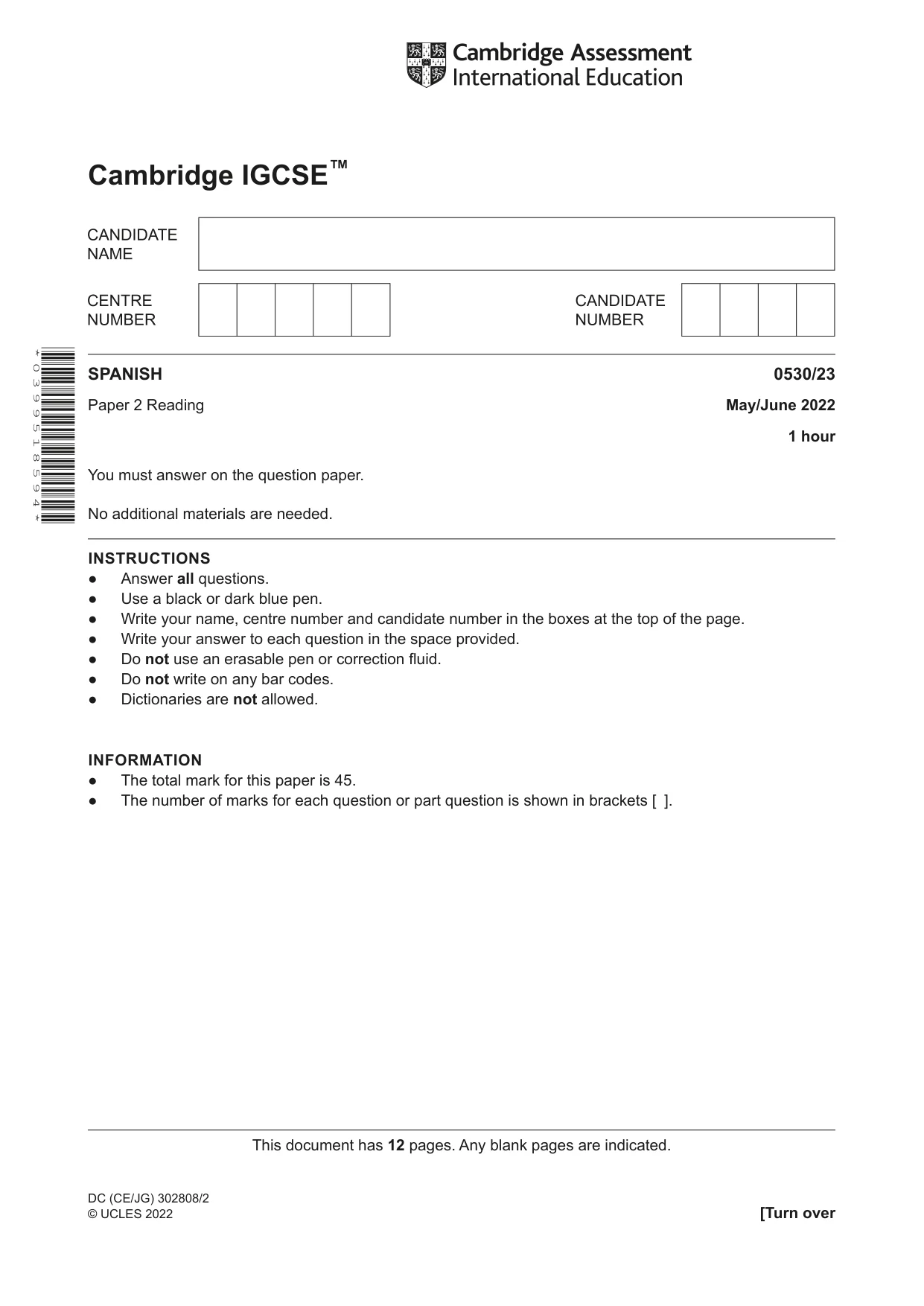

Mark scheme11 pages
Answers below. Sit the paper first if you are practising.
Paper as text
Question paper, page 1
This document has 12 pages. Any blank pages are indicated. [Turn over Cambridge IGCSE™ DC (CE/JG) 302808/2 © UCLES 2022 * 0 3 9 9 5 1 8 5 9 4 * SPANISH 0530/23 Paper 2 Reading May/June 2022 1 hour You must answer on the question paper. No additional materials are needed. INSTRUCTIONS ● Answer all questions. ● Use a black or dark blue pen. ● Write your name, centre number and candidate number in the boxes at the top of the page. ● Write your answer to each question in the space provided. ● Do not use an erasable pen or correction fluid. ● Do not write on any bar codes. ● Dictionaries are not allowed. INFORMATION ● The total mark for this paper is 45. ● The number of marks for each question or part question is shown in brackets [ ].
Question paper, page 2
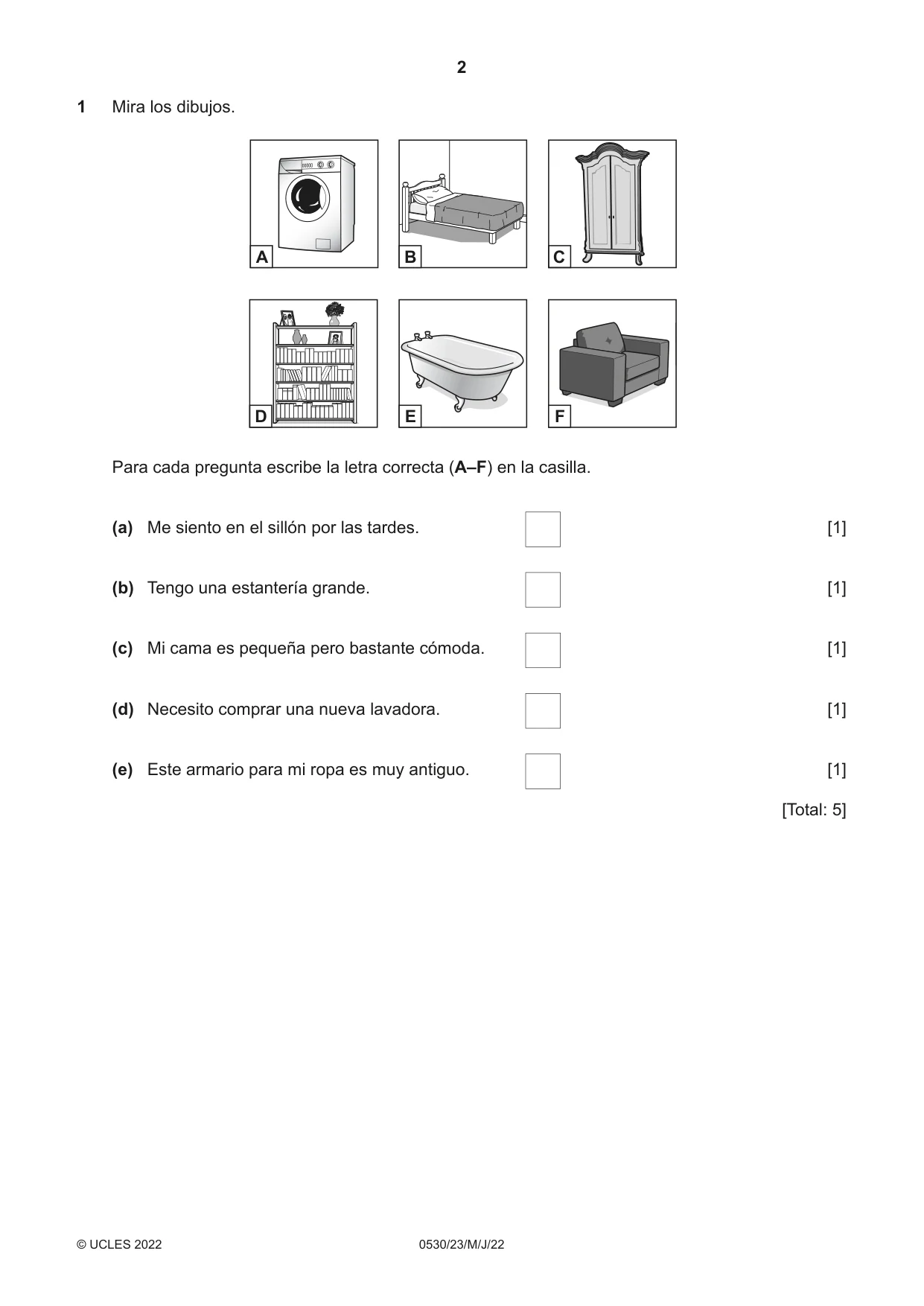
2 0530/23/M/J/22 © UCLES 2022 1 Mira los dibujos. C B A E D F Para cada pregunta escribe la letra correcta (A–F) en la casilla. (a) Me siento en el sillón por las tardes. [1] (b) Tengo una estantería grande. [1] (c) Mi cama es pequeña pero bastante cómoda. [1] (d) Necesito comprar una nueva lavadora. [1] (e) Este armario para mi ropa es muy antiguo. [1] [Total: 5]
Question paper, page 3
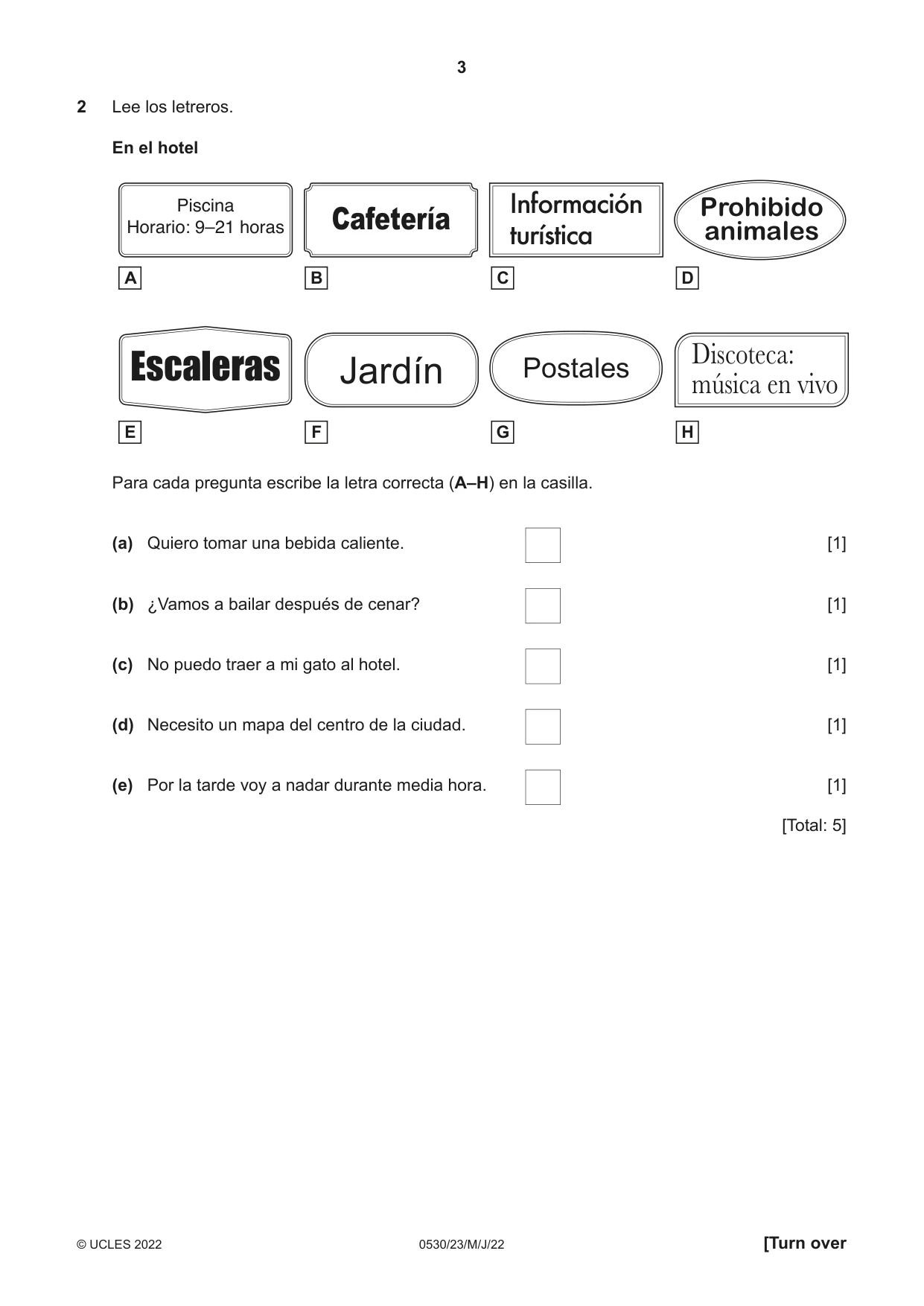
3 0530/23/M/J/22 © UCLES 2022 [Turn over 2 Lee los letreros. En el hotel A B C D E F G H Piscina Horario: 9–21 horas Cafetería Información turística Prohibido animales Escaleras Jardín Postales Discoteca: música en vivo Para cada pregunta escribe la letra correcta (A–H) en la casilla. (a) Quiero tomar una bebida caliente. [1] (b) ¿Vamos a bailar después de cenar? [1] (c) No puedo traer a mi gato al hotel. [1] (d) Necesito un mapa del centro de la ciudad. [1] (e) Por la tarde voy a nadar durante media hora. [1] [Total: 5]
Question paper, page 4
4 0530/23/M/J/22 © UCLES 2022 3 Lee el texto. Para cada pregunta indica tu respuesta escribiendo una X en la casilla correcta (A–C). ¡Hola! Estoy muy contenta porque el sábado que viene es la boda de mi hermano. La fiesta será en el campo. Han alquilado un castillo muy bonito. Entre familia y amigos, habrá entre 90 y 100 invitados. Para la boda, tengo un vestido nuevo azul. Mi hermano se va a poner los pantalones que mi padre llevó en su boda. ¡Fíjate! Mi hermano, como es miembro de un grupo, ha escrito una canción y la cantará durante la fiesta. Dice que, si nos gusta, la incluirá en su próximo concierto. Yo he ayudado a preparar la tarta. Pusimos melocotones y fresas en ella. ¡Estará riquísima! Había pensado regalarle a la pareja un reloj, pero al final decidí hacer algo a mano. Pinté un plato como regalo sorpresa. ¡Hasta luego! Natalia (a) ¿Cuándo es la boda? A mañana B en 15 días C el próximo fin de semana [1] (b) ¿Dónde va a ser la fiesta? A en un restaurante B en un castillo C en un hotel [1]
Question paper, page 5
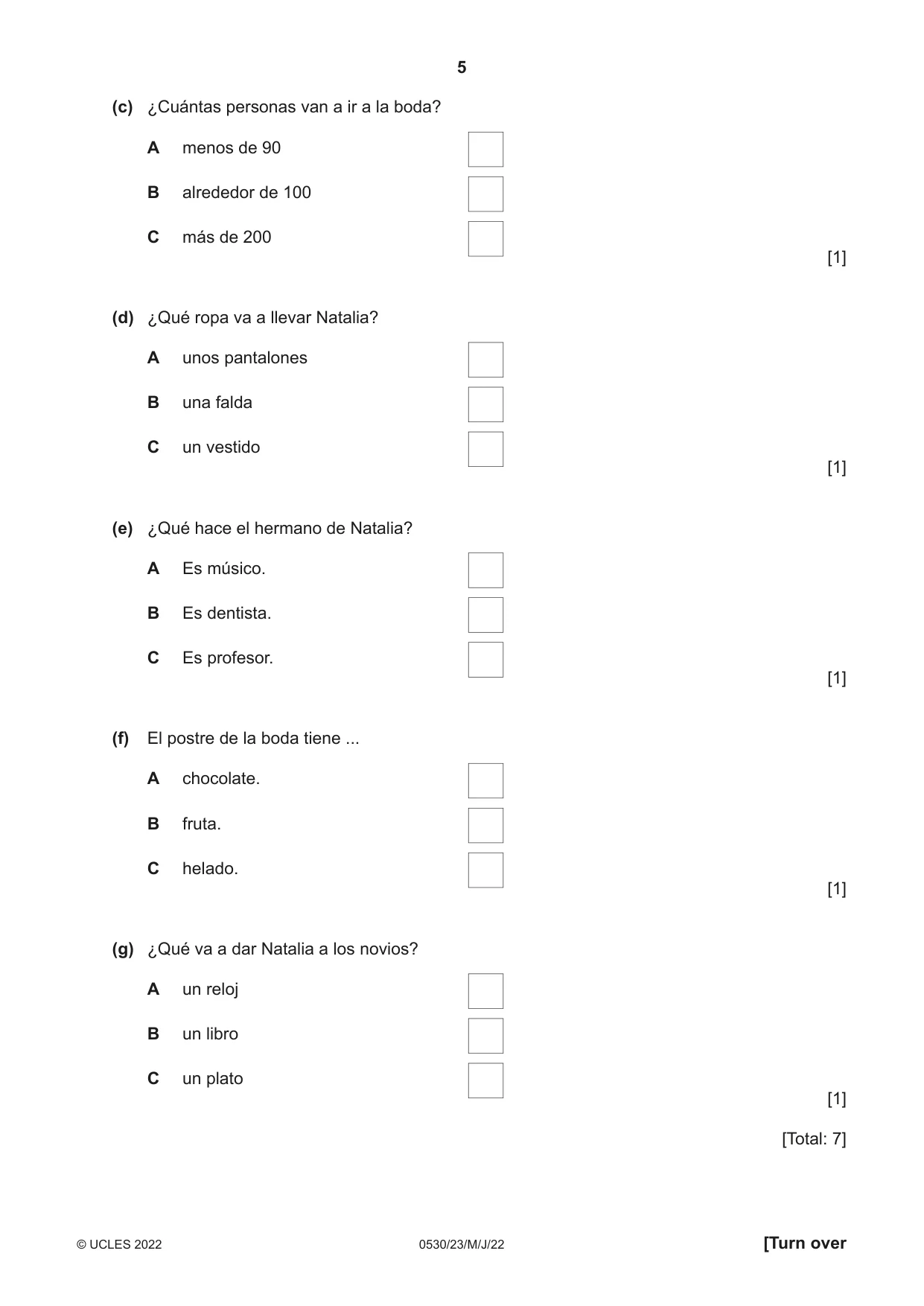
5 0530/23/M/J/22 © UCLES 2022 [Turn over (c) ¿Cuántas personas van a ir a la boda? A menos de 90 B alrededor de 100 C más de 200 [1] (d) ¿Qué ropa va a llevar Natalia? A unos pantalones B una falda C un vestido [1] (e) ¿Qué hace el hermano de Natalia? A Es músico. B Es dentista. C Es profesor. [1] (f) El postre de la boda tiene ... A chocolate. B fruta. C helado. [1] (g) ¿Qué va a dar Natalia a los novios? A un reloj B un libro C un plato [1] [Total: 7]
Question paper, page 6
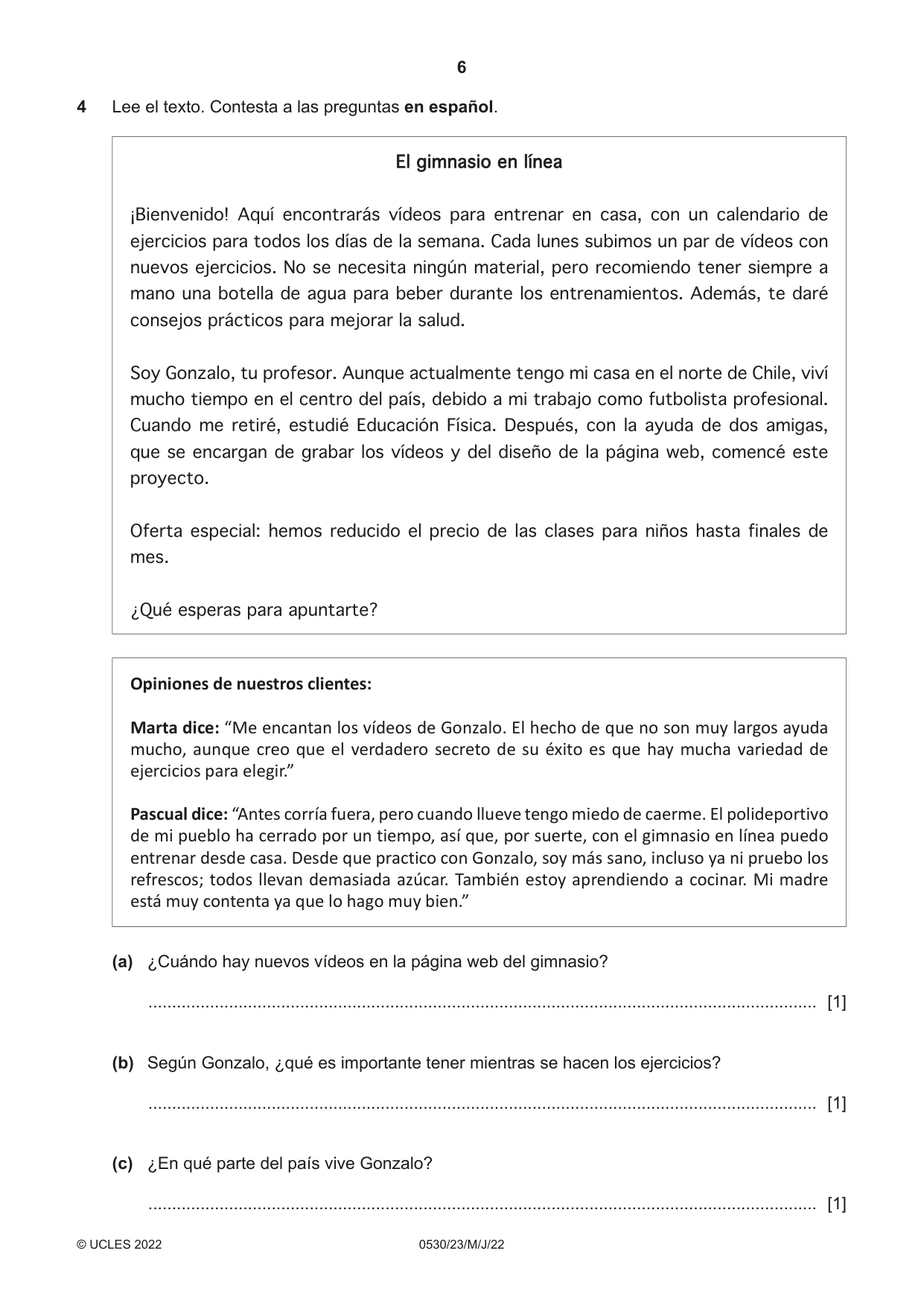
6 0530/23/M/J/22 © UCLES 2022 4 Lee el texto. Contesta a las preguntas en español. El gimnasio en línea ¡Bienvenido! Aquí encontrarás vídeos para entrenar en casa, con un calendario de ejercicios para todos los días de la semana. Cada lunes subimos un par de vídeos con nuevos ejercicios. No se necesita ningún material, pero recomiendo tener siempre a mano una botella de agua para beber durante los entrenamientos. Además, te daré consejos prácticos para mejorar la salud. Soy Gonzalo, tu profesor. Aunque actualmente tengo mi casa en el norte de Chile, viví mucho tiempo en el centro del país, debido a mi trabajo como futbolista profesional. Cuando me retiré, estudié Educación Física. Después, con la ayuda de dos amigas, que se encargan de grabar los vídeos y del diseño de la página web, comencé este proyecto. Oferta especial: hemos reducido el precio de las clases para niños hasta finales de mes. ¿Qué esperas para apuntarte? Opiniones de nuestros clientes: Marta dice: “Me encantan los vídeos de Gonzalo. El hecho de que no son muy largos ayuda mucho, aunque creo que el verdadero secreto de su éxito es que hay mucha variedad de ejercicios para elegir.” Pascual dice: “Antes corría fuera, pero cuando llueve tengo miedo de caerme. El polideportivo de mi pueblo ha cerrado por un tiempo, así que, por suerte, con el gimnasio en línea puedo entrenar desde casa. Desde que practico con Gonzalo, soy más sano, incluso ya ni pruebo los refrescos; todos llevan demasiada azúcar. También estoy aprendiendo a cocinar. Mi madre está muy contenta ya que lo hago muy bien.” (a) ¿Cuándo hay nuevos vídeos en la página web del gimnasio? … [1] (b) Según Gonzalo, ¿qué es importante tener mientras se hacen los ejercicios? … [1] (c) ¿En qué parte del país vive Gonzalo? … [1]
Question paper, page 7
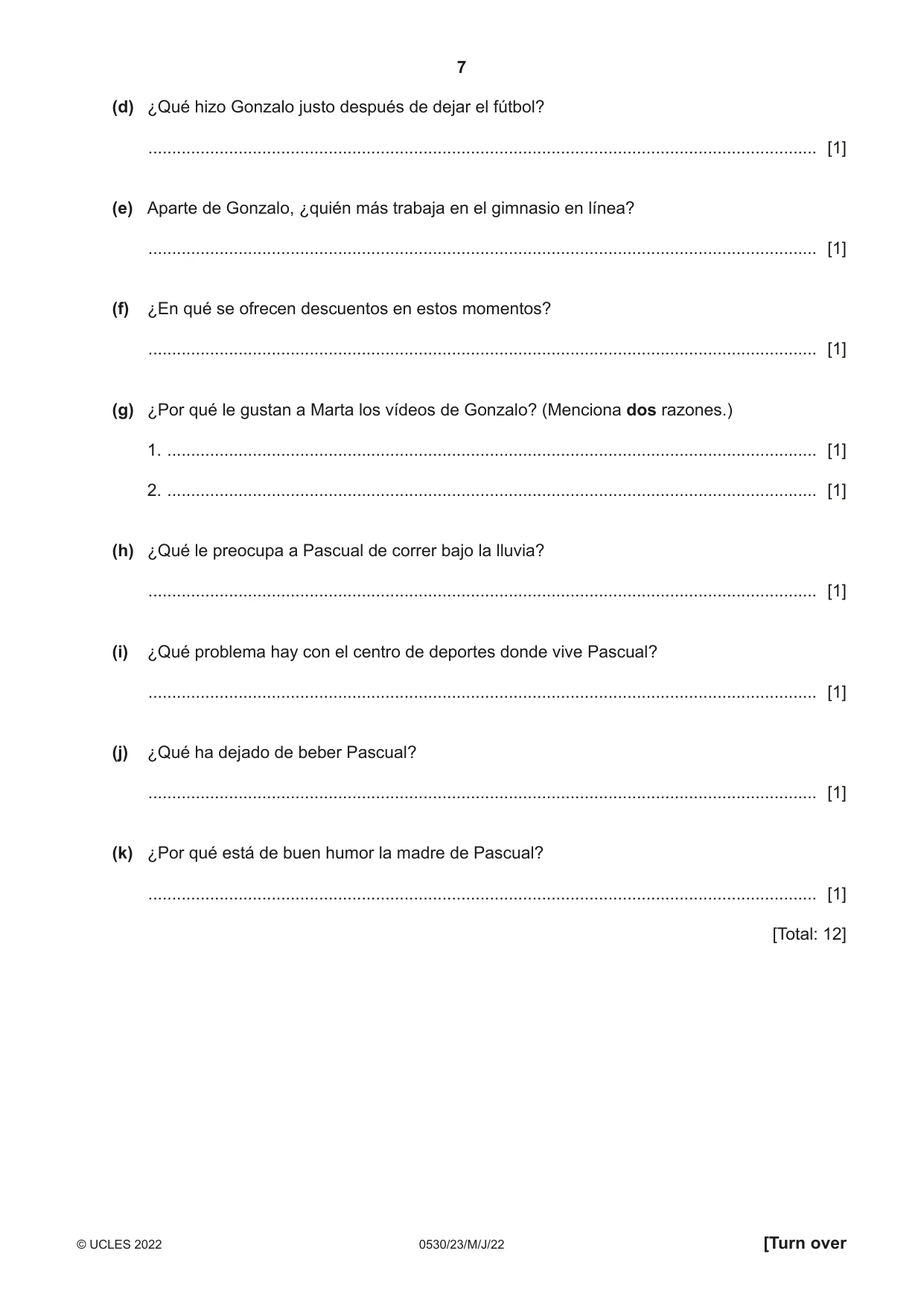
7 0530/23/M/J/22 © UCLES 2022 [Turn over (d) ¿Qué hizo Gonzalo justo después de dejar el fútbol? … [1] (e) Aparte de Gonzalo, ¿quién más trabaja en el gimnasio en línea? … [1] (f) ¿En qué se ofrecen descuentos en estos momentos? … [1] (g) ¿Por qué le gustan a Marta los vídeos de Gonzalo? (Menciona dos razones.) 1. … [1] 2. … [1] (h) ¿Qué le preocupa a Pascual de correr bajo la lluvia? … [1] (i) ¿Qué problema hay con el centro de deportes donde vive Pascual? … [1] (j) ¿Qué ha dejado de beber Pascual? … [1] (k) ¿Por qué está de buen humor la madre de Pascual? … [1] [Total: 12]
Question paper, page 8
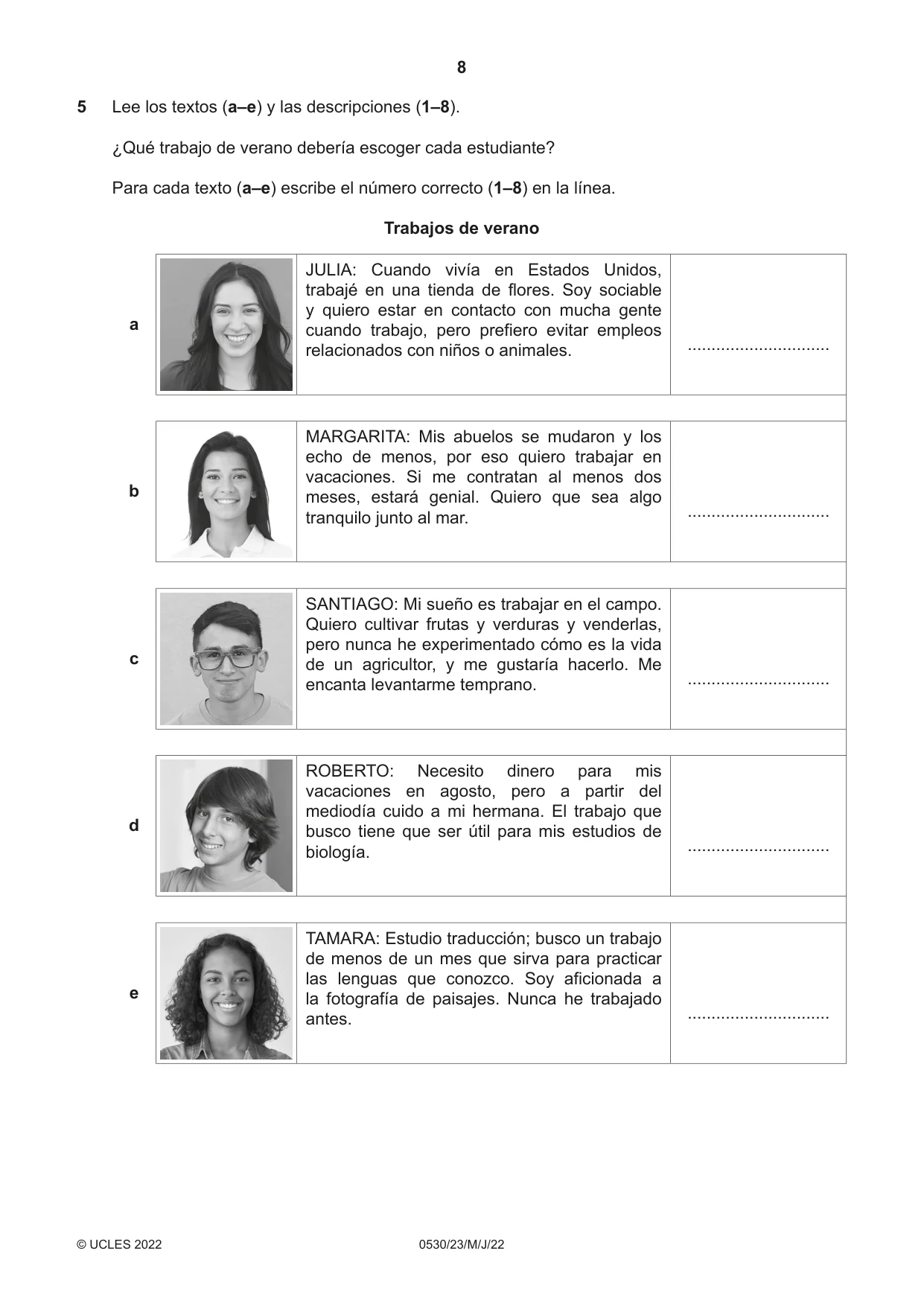
8 0530/23/M/J/22 © UCLES 2022 5 Lee los textos (a–e) y las descripciones (1–8). ¿Qué trabajo de verano debería escoger cada estudiante? Para cada texto (a–e) escribe el número correcto (1–8) en la línea. Trabajos de verano a JULIA: Cuando vivía en Estados Unidos, trabajé en una tienda de flores. Soy sociable y quiero estar en contacto con mucha gente cuando trabajo, pero prefiero evitar empleos relacionados con niños o animales. … b MARGARITA: Mis abuelos se mudaron y los echo de menos, por eso quiero trabajar en vacaciones. Si me contratan al menos dos meses, estará genial. Quiero que sea algo tranquilo junto al mar. … c SANTIAGO: Mi sueño es trabajar en el campo. Quiero cultivar frutas y verduras y venderlas, pero nunca he experimentado cómo es la vida de un agricultor, y me gustaría hacerlo. Me encanta levantarme temprano. … d ROBERTO: Necesito dinero para mis vacaciones en agosto, pero a partir del mediodía cuido a mi hermana. El trabajo que busco tiene que ser útil para mis estudios de biología. … e TAMARA: Estudio traducción; busco un trabajo de menos de un mes que sirva para practicar las lenguas que conozco. Soy aficionada a la fotografía de paisajes. Nunca he trabajado antes. …
Question paper, page 9
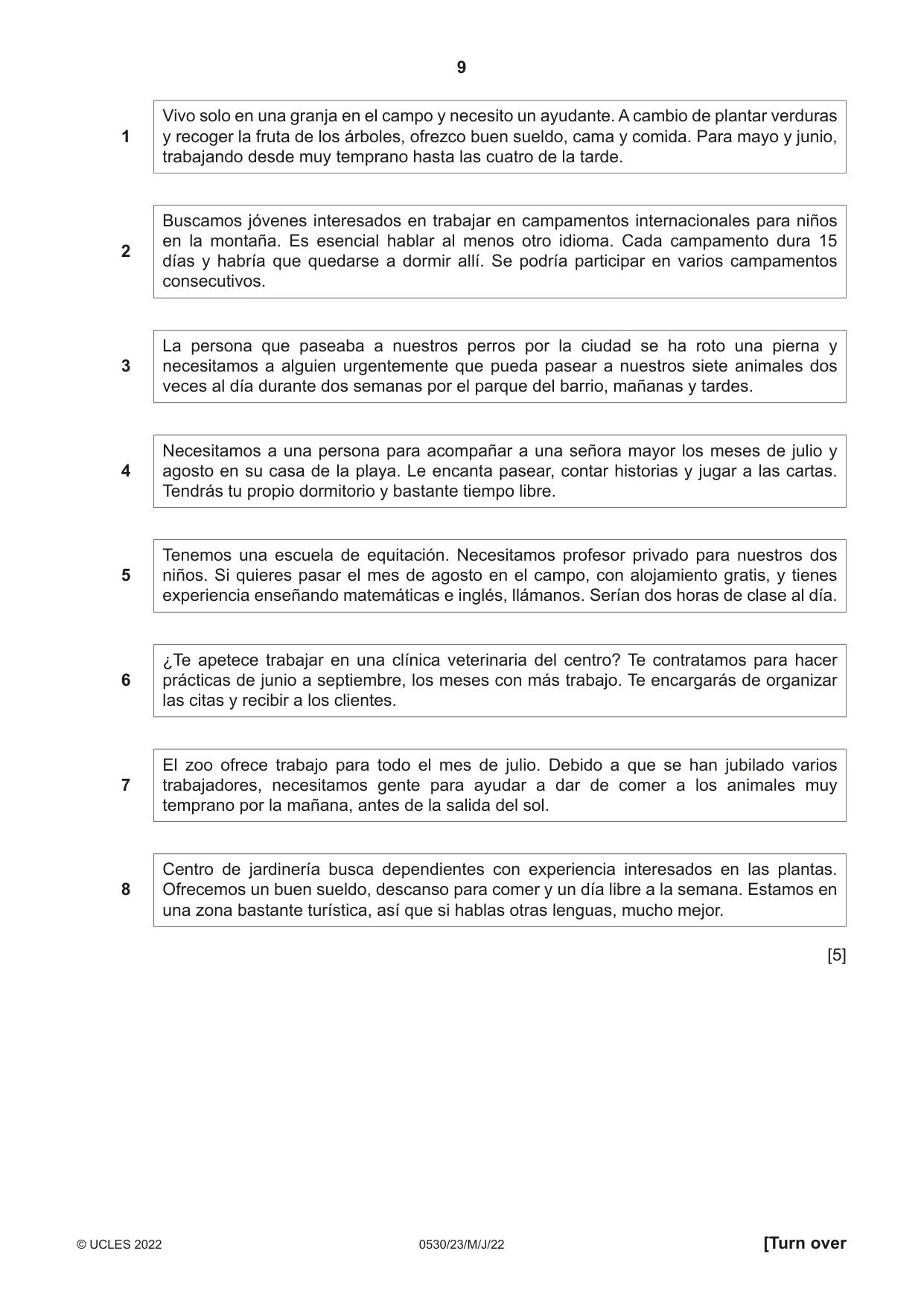
9 0530/23/M/J/22 © UCLES 2022 [Turn over 1 Vivo solo en una granja en el campo y necesito un ayudante. A cambio de plantar verduras y recoger la fruta de los árboles, ofrezco buen sueldo, cama y comida. Para mayo y junio, trabajando desde muy temprano hasta las cuatro de la tarde. 2 Buscamos jóvenes interesados en trabajar en campamentos internacionales para niños en la montaña. Es esencial hablar al menos otro idioma. Cada campamento dura 15 días y habría que quedarse a dormir allí. Se podría participar en varios campamentos consecutivos. 3 La persona que paseaba a nuestros perros por la ciudad se ha roto una pierna y necesitamos a alguien urgentemente que pueda pasear a nuestros siete animales dos veces al día durante dos semanas por el parque del barrio, mañanas y tardes. 4 Necesitamos a una persona para acompañar a una señora mayor los meses de julio y agosto en su casa de la playa. Le encanta pasear, contar historias y jugar a las cartas. Tendrás tu propio dormitorio y bastante tiempo libre. 5 Tenemos una escuela de equitación. Necesitamos profesor privado para nuestros dos niños. Si quieres pasar el mes de agosto en el campo, con alojamiento gratis, y tienes experiencia enseñando matemáticas e inglés, llámanos. Serían dos horas de clase al día. 6 ¿Te apetece trabajar en una clínica veterinaria del centro? Te contratamos para hacer prácticas de junio a septiembre, los meses con más trabajo. Te encargarás de organizar las citas y recibir a los clientes. 7 El zoo ofrece trabajo para todo el mes de julio. Debido a que se han jubilado varios trabajadores, necesitamos gente para ayudar a dar de comer a los animales muy temprano por la mañana, antes de la salida del sol. 8 Centro de jardinería busca dependientes con experiencia interesados en las plantas. Ofrecemos un buen sueldo, descanso para comer y un día libre a la semana. Estamos en una zona bastante turística, así que si hablas otras lenguas, mucho mejor. [5]
Question paper, page 10
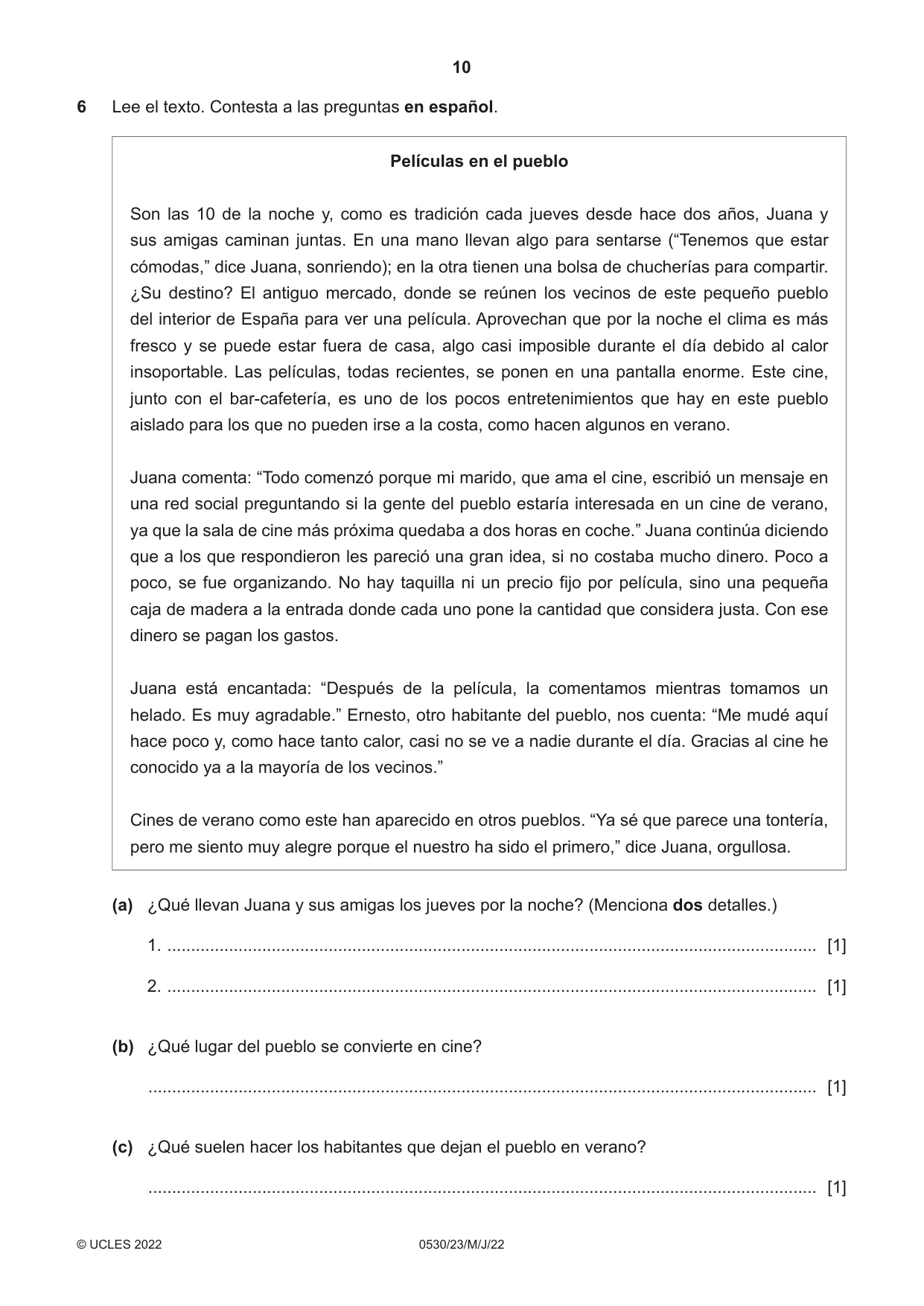
10 0530/23/M/J/22 © UCLES 2022 6 Lee el texto. Contesta a las preguntas en español. Películas en el pueblo Son las 10 de la noche y, como es tradición cada jueves desde hace dos años, Juana y sus amigas caminan juntas. En una mano llevan algo para sentarse (“Tenemos que estar cómodas,” dice Juana, sonriendo); en la otra tienen una bolsa de chucherías para compartir. ¿Su destino? El antiguo mercado, donde se reúnen los vecinos de este pequeño pueblo del interior de España para ver una película. Aprovechan que por la noche el clima es más fresco y se puede estar fuera de casa, algo casi imposible durante el día debido al calor insoportable. Las películas, todas recientes, se ponen en una pantalla enorme. Este cine, junto con el bar-cafetería, es uno de los pocos entretenimientos que hay en este pueblo aislado para los que no pueden irse a la costa, como hacen algunos en verano. Juana comenta: “Todo comenzó porque mi marido, que ama el cine, escribió un mensaje en una red social preguntando si la gente del pueblo estaría interesada en un cine de verano, ya que la sala de cine más próxima quedaba a dos horas en coche.” Juana continúa diciendo que a los que respondieron les pareció una gran idea, si no costaba mucho dinero. Poco a poco, se fue organizando. No hay taquilla ni un precio fijo por película, sino una pequeña caja de madera a la entrada donde cada uno pone la cantidad que considera justa. Con ese dinero se pagan los gastos. Juana está encantada: “Después de la película, la comentamos mientras tomamos un helado. Es muy agradable.” Ernesto, otro habitante del pueblo, nos cuenta: “Me mudé aquí hace poco y, como hace tanto calor, casi no se ve a nadie durante el día. Gracias al cine he conocido ya a la mayoría de los vecinos.” Cines de verano como este han aparecido en otros pueblos. “Ya sé que parece una tontería, pero me siento muy alegre porque el nuestro ha sido el primero,” dice Juana, orgullosa. (a) ¿Qué llevan Juana y sus amigas los jueves por la noche? (Menciona dos detalles.) 1. … [1] 2. … [1] (b) ¿Qué lugar del pueblo se convierte en cine? … [1] (c) ¿Qué suelen hacer los habitantes que dejan el pueblo en verano? … [1]
Question paper, page 11
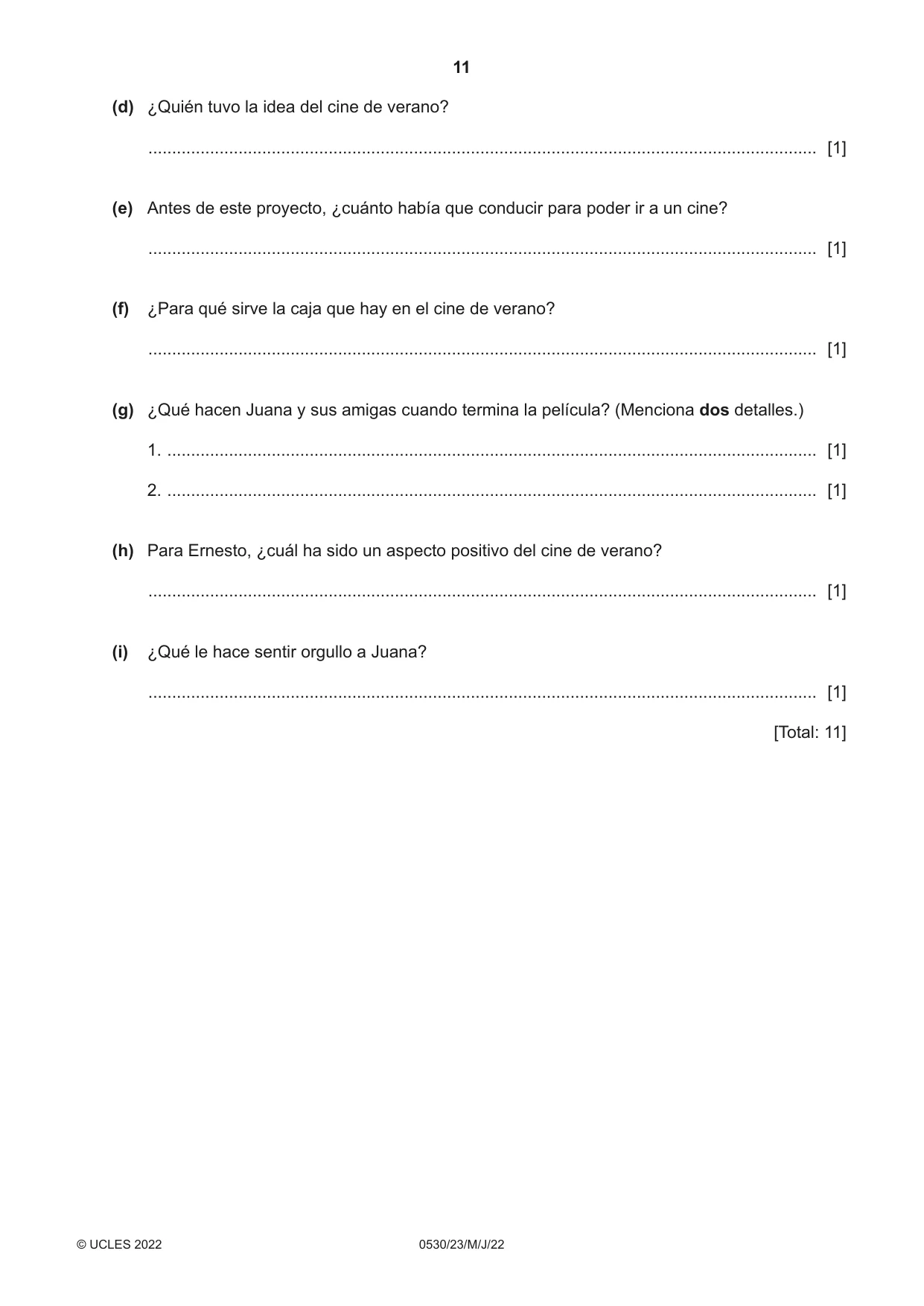
11 0530/23/M/J/22 © UCLES 2022 (d) ¿Quién tuvo la idea del cine de verano? … [1] (e) Antes de este proyecto, ¿cuánto había que conducir para poder ir a un cine? … [1] (f) ¿Para qué sirve la caja que hay en el cine de verano? … [1] (g) ¿Qué hacen Juana y sus amigas cuando termina la película? (Menciona dos detalles.) 1. … [1] 2. … [1] (h) Para Ernesto, ¿cuál ha sido un aspecto positivo del cine de verano? … [1] (i) ¿Qué le hace sentir orgullo a Juana? … [1] [Total: 11]
Question paper, page 12
12 0530/23/M/J/22 © UCLES 2022 Permission to reproduce items where third-party owned material protected by copyright is included has been sought and cleared where possible. Every reasonable effort has been made by the publisher (UCLES) to trace copyright holders, but if any items requiring clearance have unwittingly been included, the publisher will be pleased to make amends at the earliest possible opportunity. To avoid the issue of disclosure of answer-related information to candidates, all copyright acknowledgements are reproduced online in the Cambridge Assessment International Education Copyright Acknowledgements Booklet. This is produced for each series of examinations and is freely available to download at www.cambridgeinternational.org after the live examination series. Cambridge Assessment International Education is part of Cambridge Assessment. Cambridge Assessment is the brand name of the University of Cambridge Local Examinations Syndicate (UCLES), which is a department of the University of Cambridge. BLANK PAGE
Mark scheme, page 1
This document consists of 11 printed pages. © UCLES 2022 [Turn over Cambridge IGCSE™ SPANISH 0530/23 Paper 2 Reading May/June 2022 MARK SCHEME Maximum Mark: 45 Published This mark scheme is published as an aid to teachers and candidates, to indicate the requirements of the examination. It shows the basis on which Examiners were instructed to award marks. It does not indicate the details of the discussions that took place at an Examiners’ meeting before marking began, which would have considered the acceptability of alternative answers. Mark schemes should be read in conjunction with the question paper and the Principal Examiner Report for Teachers. Cambridge International will not enter into discussions about these mark schemes. Cambridge International is publishing the mark schemes for the May/June 2022 series for most Cambridge IGCSE, Cambridge International A and AS Level and Cambridge Pre-U components, and some Cambridge O Level components.
Mark scheme, page 2
0530/23 Cambridge IGCSE – Mark Scheme PUBLISHED May/June 2022 © UCLES 2022 Page 2 of 11 Generic Marking Principles These general marking principles must be applied by all examiners when marking candidate answers. They should be applied alongside the specific content of the mark scheme or generic level descriptors for a question. Each question paper and mark scheme will also comply with these marking principles. GENERIC MARKING PRINCIPLE 1: Marks must be awarded in line with: the specific content of the mark scheme or the generic level descriptors for the question the specific skills defined in the mark scheme or in the generic level descriptors for the question the standard of response required by a candidate as exemplified by the standardisation scripts. GENERIC MARKING PRINCIPLE 2: Marks awarded are always whole marks (not half marks, or other fractions). GENERIC MARKING PRINCIPLE 3: Marks must be awarded positively: marks are awarded for correct/valid answers, as defined in the mark scheme. However, credit is given for valid answers which go beyond the scope of the syllabus and mark scheme, referring to your Team Leader as appropriate marks are awarded when candidates clearly demonstrate what they know and can do marks are not deducted for errors marks are not deducted for omissions answers should only be judged on the quality of spelling, punctuation and grammar when these features are specifically assessed by the question as indicated by the mark scheme. The meaning, however, should be unambiguous. GENERIC MARKING PRINCIPLE 4: Rules must be applied consistently, e.g. in situations where candidates have not followed instructions or in the application of generic level descriptors.
Mark scheme, page 3
0530/23 Cambridge IGCSE – Mark Scheme PUBLISHED May/June 2022 © UCLES 2022 Page 3 of 11 GENERIC MARKING PRINCIPLE 5: Marks should be awarded using the full range of marks defined in the mark scheme for the question (however; the use of the full mark range may be limited according to the quality of the candidate responses seen). GENERIC MARKING PRINCIPLE 6: Marks awarded are based solely on the requirements as defined in the mark scheme. Marks should not be awarded with grade thresholds or grade descriptors in mind. Additional Guidance The following guidance underpins the detailed instructions provided in the mark scheme. Where a decision is taken to deviate from this guidance for a particular question, this will be specified in the mark scheme. Often the additional guidance points will have to be weighed up against each other, e.g. the answer might look or sound like the intended word/phrase in Spanish, but if what the candidate has written means something different in Spanish from what is expected, the mark cannot be awarded. It is not possible to list all acceptable alternatives in the mark scheme. If you encounter an answer which is not covered by the mark scheme, you will need to make a decision about whether it communicates the required elements (in consultation with your Team Leader if necessary, or with your Product Manager if you are a single examiner), and award marks accordingly. Crossing out: (a) If a candidate changes his/her mind about an answer and crosses out an attempt, award a mark if the final attempt is correct. (b) If a candidate crosses out an answer to a whole question but makes no second attempt at it, mark the crossed out work. More than the stipulated number of boxes ticked/crossed by the candidate: (a) If more than one attempt is visible but the candidate has clearly indicated which attempt is his/her final answer (e.g. by crossing out other attempts or by annotating the script in some way), mark in the usual way. (b) If two attempts are visible (e.g. two boxes ticked instead of the one box stipulated), and neither has been crossed out/discounted by the candidate, no mark can be awarded.
Mark scheme, page 4
0530/23 Cambridge IGCSE – Mark Scheme PUBLISHED May/June 2022 © UCLES 2022 Page 4 of 11 For questions requiring more than one element for the answer, 1 and 2, where the answers are interchangeable: (a) Both of the correct answers are on line 1 and line 2 blank (or vice versa) = 2 marks (b) Both correct answers on line 1 and line 2 contains a wrong answer (or vice versa) = 1 mark Mark for communication: Answers requiring the use of Spanish (rather than a non-verbal response) should be marked for communication. Tolerate inaccuracies provided that the message is clear. However, do not accept incorrect Spanish if the word written by the candidate means something else in Spanish (unless the mark scheme specifies otherwise). (a) If you read aloud what the candidate has written, does it sound like the correct answer? Would a native speaker of Spanish understand it? (b) Does what the candidate has written look like the correct answer, e.g. one letter missing but no other word created? Would a native speaker of Spanish understand it? (c) Tolerate incorrect auxiliaries and incorrect use of the infinitive unless the mark scheme specifies otherwise. Annotations used in the mark scheme: (a) INV = invalidation. This is used when the additional material included by the candidate is judged to invalidate an otherwise correct answer and therefore prevents him/her from scoring the mark. (INV = 0) (b) tc = ‘tout court’. This means that, on its own, the material is not sufficient to score the mark. (c) HA = harmless addition. This means that the candidate has included additional material which, in conjunction with the correct answer, does not prevent him/her from scoring the mark. No response and ‘0’ marks: (a) Award NR (no response): If there is nothing written at all in the answer space or If there is only a comment which does not in any way relate to the question being asked (e.g. ‘can’t do’ or ‘don’t know’) or If there is only a mark which isn’t an attempt at the question (e.g. a dash, a question mark). (b) Award 0: If there is any attempt that earns no credit, e.g. the candidate has copied out part or all of the question.
Mark scheme, page 5
0530/23 Cambridge IGCSE – Mark Scheme PUBLISHED May/June 2022 © UCLES 2022 Page 5 of 11 Extra material: Candidates need to answer the questions in such a way as to demonstrate that they have understood the text. The mark scheme cannot cover all eventualities so where specific instructions are not provided, the examiner must check the text to ensure that the correct elements which would attract the mark are not contradicted or distorted by any extra material. The following general rules should be applied: (a) Extra material, mentioned in the mark scheme, which reinforces the correct answer or in itself constitutes an alternative correct answer: This is acceptable and is not penalised. (b) Extra material which constitutes an alternative answer, but which is not explicitly mentioned in the mark scheme: The examiner needs to decide, by consulting the transcript/text and the Team Leader if necessary, whether the alternative answer constitutes: (i) an alternative correct answer, in which case this falls into category (a) and the answer should be rewarded, or (ii) an answer which on its own would be rejected, in which case this falls into category (c) and the answer should be rejected. (c) Extra material which constitutes an alternative answer specifically rejected in the mark scheme: This puts the examiner in the position of having to ‘choose’ which the intended answer is. The examiner cannot therefore be sure what the candidate has understood and the mark cannot be awarded. (d) Extra material which distorts or contradicts the correct answer: This affects communication. The examiner cannot be sure what the candidate has understood and therefore the mark cannot be awarded. (e) Extra material introduced by the candidate and which does not feature in the original text: This affects communication. The examiner cannot be sure what the candidate has understood and therefore the mark cannot be awarded. It can sometimes be difficult to draw the line between what is a deduction made by an able candidate on the basis of what they have read and pure guesswork. Therefore, where a particular answer is not covered by the mark scheme, the examiner should consult the Team Leader.
Mark scheme, page 6
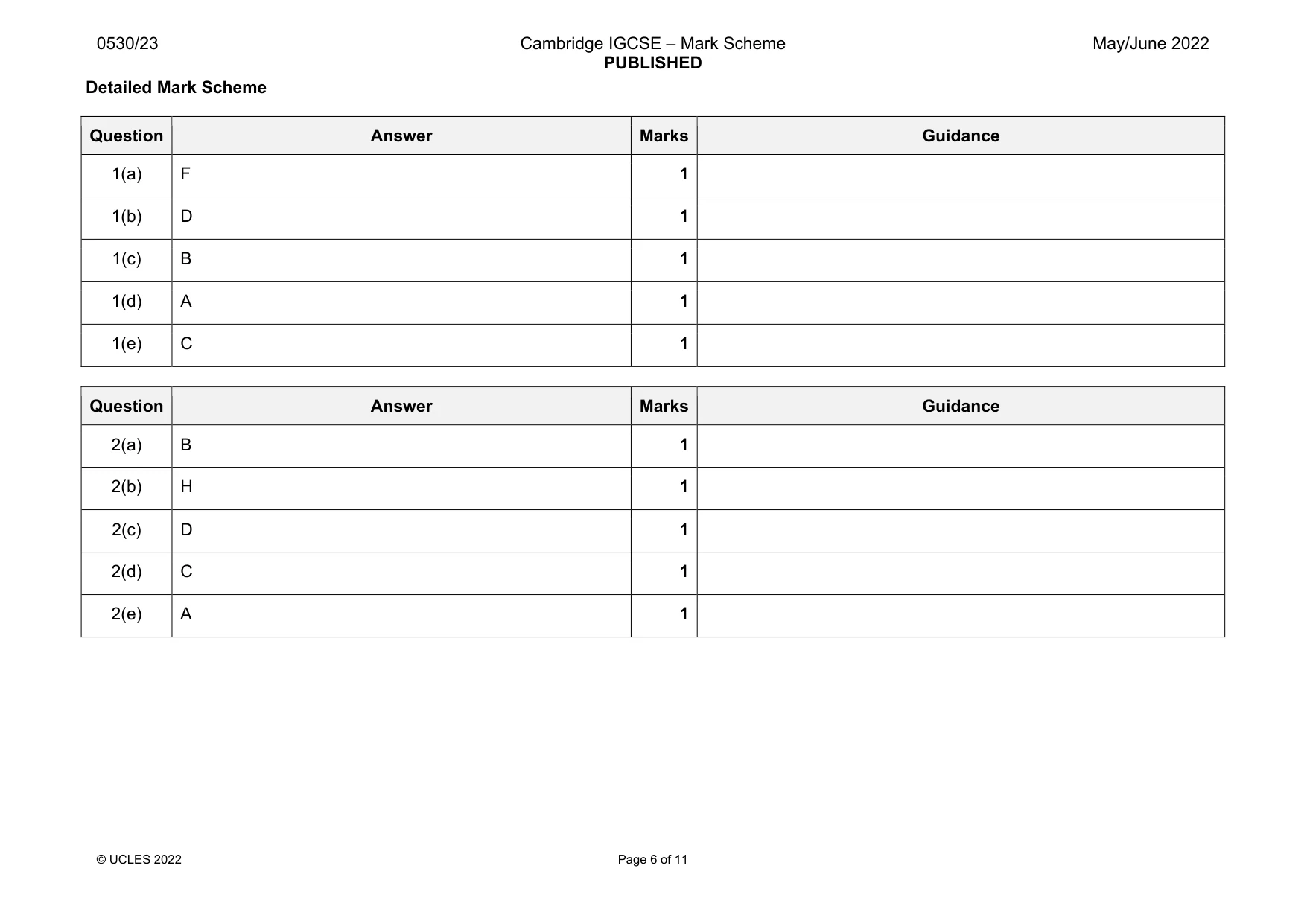
0530/23 Cambridge IGCSE – Mark Scheme PUBLISHED May/June 2022 © UCLES 2022 Page 6 of 11 Detailed Mark Scheme Question Answer Marks Guidance 1(a) F 1 1(b) D 1 1(c) B 1 1(d) A 1 1(e) C 1 Question Answer Marks Guidance 2(a) B 1 2(b) H 1 2(c) D 1 2(d) C 1 2(e) A 1
Mark scheme, page 7
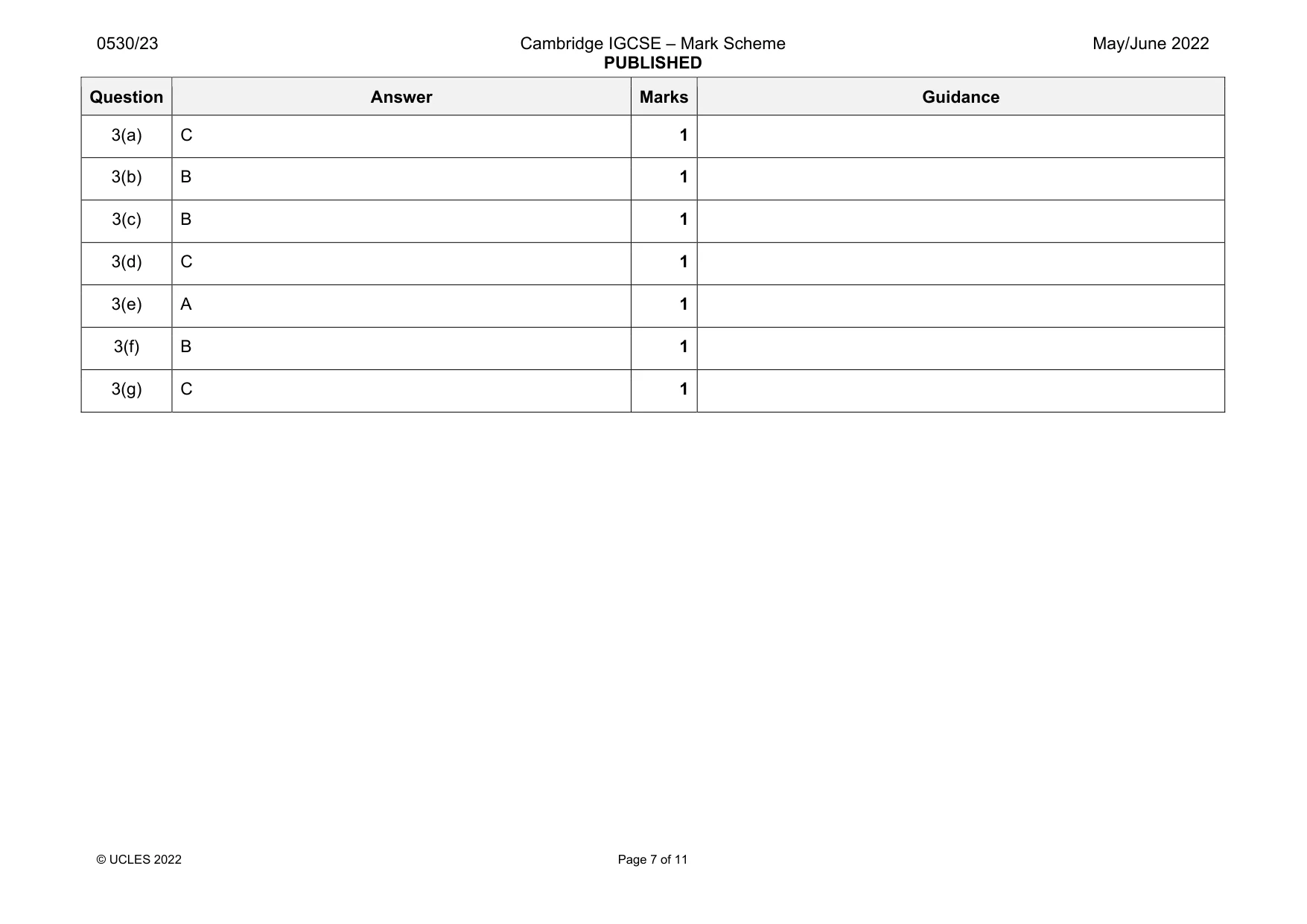
0530/23 Cambridge IGCSE – Mark Scheme PUBLISHED May/June 2022 © UCLES 2022 Page 7 of 11 Question Answer Marks Guidance 3(a) C 1 3(b) B 1 3(c) B 1 3(d) C 1 3(e) A 1 3(f) B 1 3(g) C 1
Mark scheme, page 8
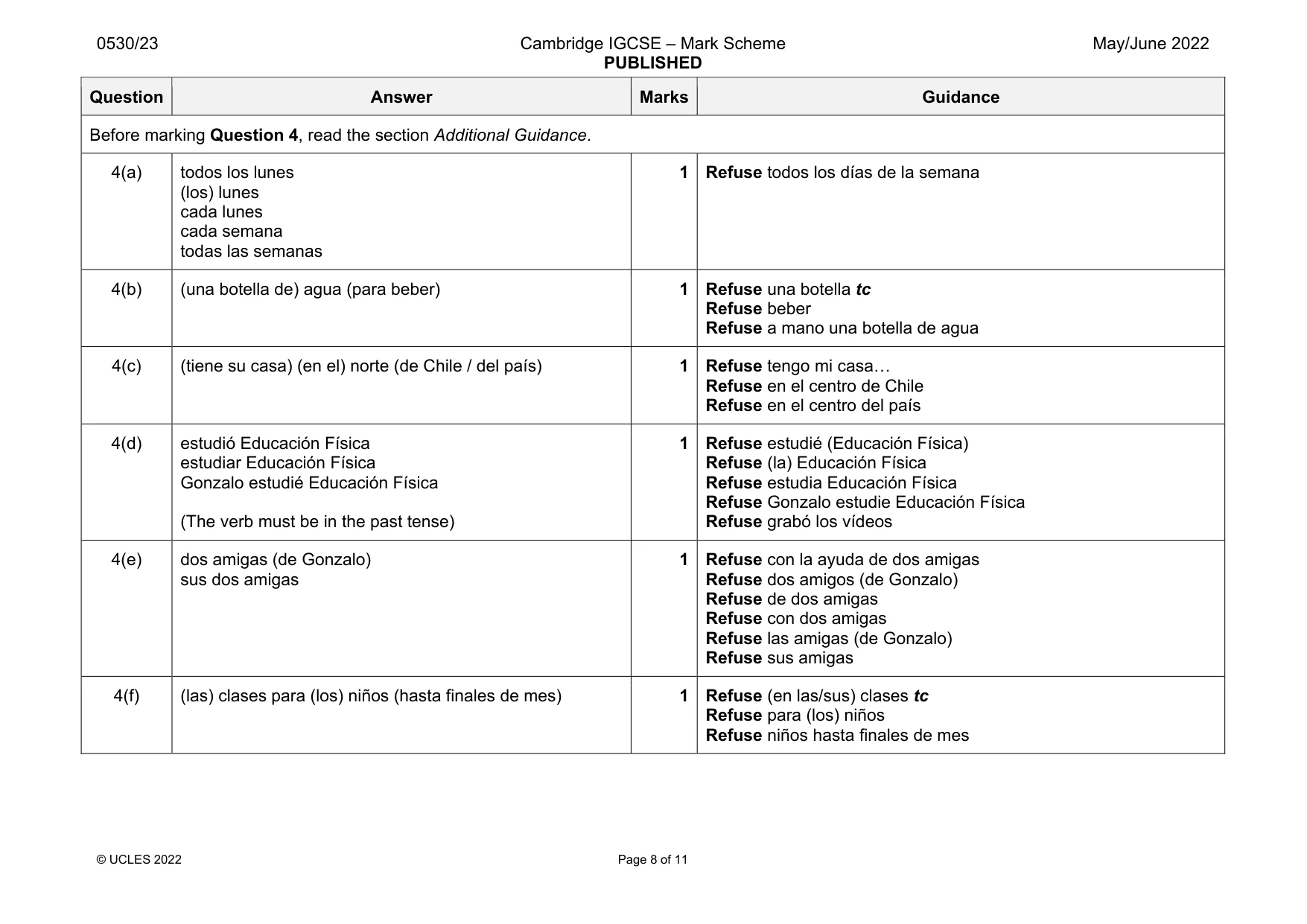
0530/23 Cambridge IGCSE – Mark Scheme PUBLISHED May/June 2022 © UCLES 2022 Page 8 of 11 Question Answer Marks Guidance Before marking Question 4, read the section Additional Guidance. 4(a) todos los lunes (los) lunes cada lunes cada semana todas las semanas 1 Refuse todos los días de la semana 4(b) (una botella de) agua (para beber) 1 Refuse una botella tc Refuse beber Refuse a mano una botella de agua 4(c) (tiene su casa) (en el) norte (de Chile / del país) 1 Refuse tengo mi casa… Refuse en el centro de Chile Refuse en el centro del país 4(d) estudió Educación Física estudiar Educación Física Gonzalo estudié Educación Física (The verb must be in the past tense) 1 Refuse estudié (Educación Física) Refuse (la) Educación Física Refuse estudia Educación Física Refuse Gonzalo estudie Educación Física Refuse grabó los vídeos 4(e) dos amigas (de Gonzalo) sus dos amigas 1 Refuse con la ayuda de dos amigas Refuse dos amigos (de Gonzalo) Refuse de dos amigas Refuse con dos amigas Refuse las amigas (de Gonzalo) Refuse sus amigas 4(f) (las) clases para (los) niños (hasta finales de mes) 1 Refuse (en las/sus) clases tc Refuse para (los) niños Refuse niños hasta finales de mes
Mark scheme, page 9
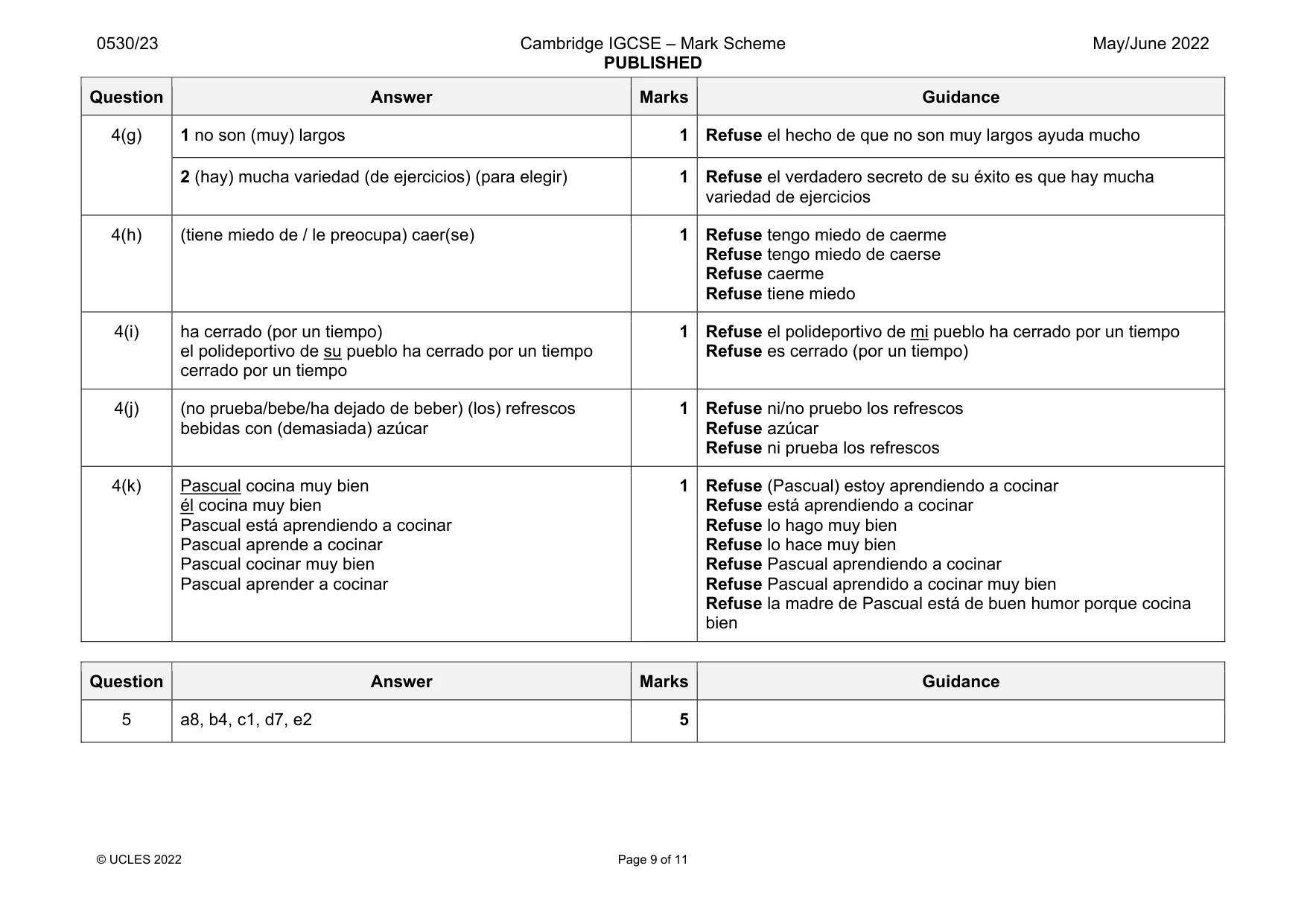
0530/23 Cambridge IGCSE – Mark Scheme PUBLISHED May/June 2022 © UCLES 2022 Page 9 of 11 Question Answer Marks Guidance 4(g) 1 no son (muy) largos 1 Refuse el hecho de que no son muy largos ayuda mucho 2 (hay) mucha variedad (de ejercicios) (para elegir) 1 Refuse el verdadero secreto de su éxito es que hay mucha variedad de ejercicios 4(h) (tiene miedo de / le preocupa) caer(se) 1 Refuse tengo miedo de caerme Refuse tengo miedo de caerse Refuse caerme Refuse tiene miedo 4(i) ha cerrado (por un tiempo) el polideportivo de su pueblo ha cerrado por un tiempo cerrado por un tiempo 1 Refuse el polideportivo de mi pueblo ha cerrado por un tiempo Refuse es cerrado (por un tiempo) 4(j) (no prueba/bebe/ha dejado de beber) (los) refrescos bebidas con (demasiada) azúcar 1 Refuse ni/no pruebo los refrescos Refuse azúcar Refuse ni prueba los refrescos 4(k) Pascual cocina muy bien él cocina muy bien Pascual está aprendiendo a cocinar Pascual aprende a cocinar Pascual cocinar muy bien Pascual aprender a cocinar 1 Refuse (Pascual) estoy aprendiendo a cocinar Refuse está aprendiendo a cocinar Refuse lo hago muy bien Refuse lo hace muy bien Refuse Pascual aprendiendo a cocinar Refuse Pascual aprendido a cocinar muy bien Refuse la madre de Pascual está de buen humor porque cocina bien Question Answer Marks Guidance 5 a8, b4, c1, d7, e2 5
Mark scheme, page 10
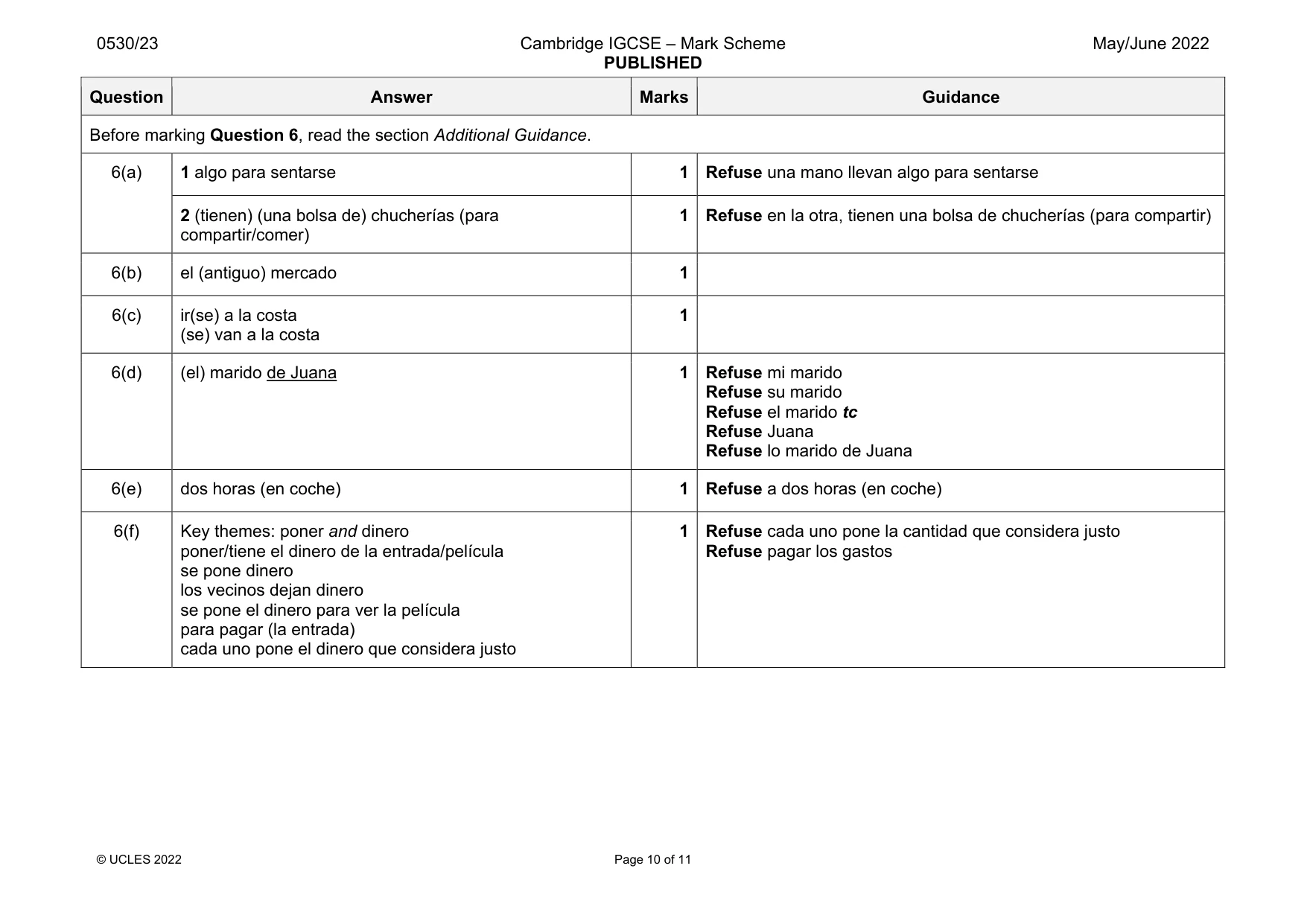
0530/23 Cambridge IGCSE – Mark Scheme PUBLISHED May/June 2022 © UCLES 2022 Page 10 of 11 Question Answer Marks Guidance Before marking Question 6, read the section Additional Guidance. 6(a) 1 algo para sentarse 1 Refuse una mano llevan algo para sentarse 2 (tienen) (una bolsa de) chucherías (para compartir/comer) 1 Refuse en la otra, tienen una bolsa de chucherías (para compartir) 6(b) el (antiguo) mercado 1 6(c) ir(se) a la costa (se) van a la costa 1 6(d) (el) marido de Juana 1 Refuse mi marido Refuse su marido Refuse el marido tc Refuse Juana Refuse lo marido de Juana 6(e) dos horas (en coche) 1 Refuse a dos horas (en coche) 6(f) Key themes: poner and dinero poner/tiene el dinero de la entrada/película se pone dinero los vecinos dejan dinero se pone el dinero para ver la película para pagar (la entrada) cada uno pone el dinero que considera justo 1 Refuse cada uno pone la cantidad que considera justo Refuse pagar los gastos
Mark scheme, page 11
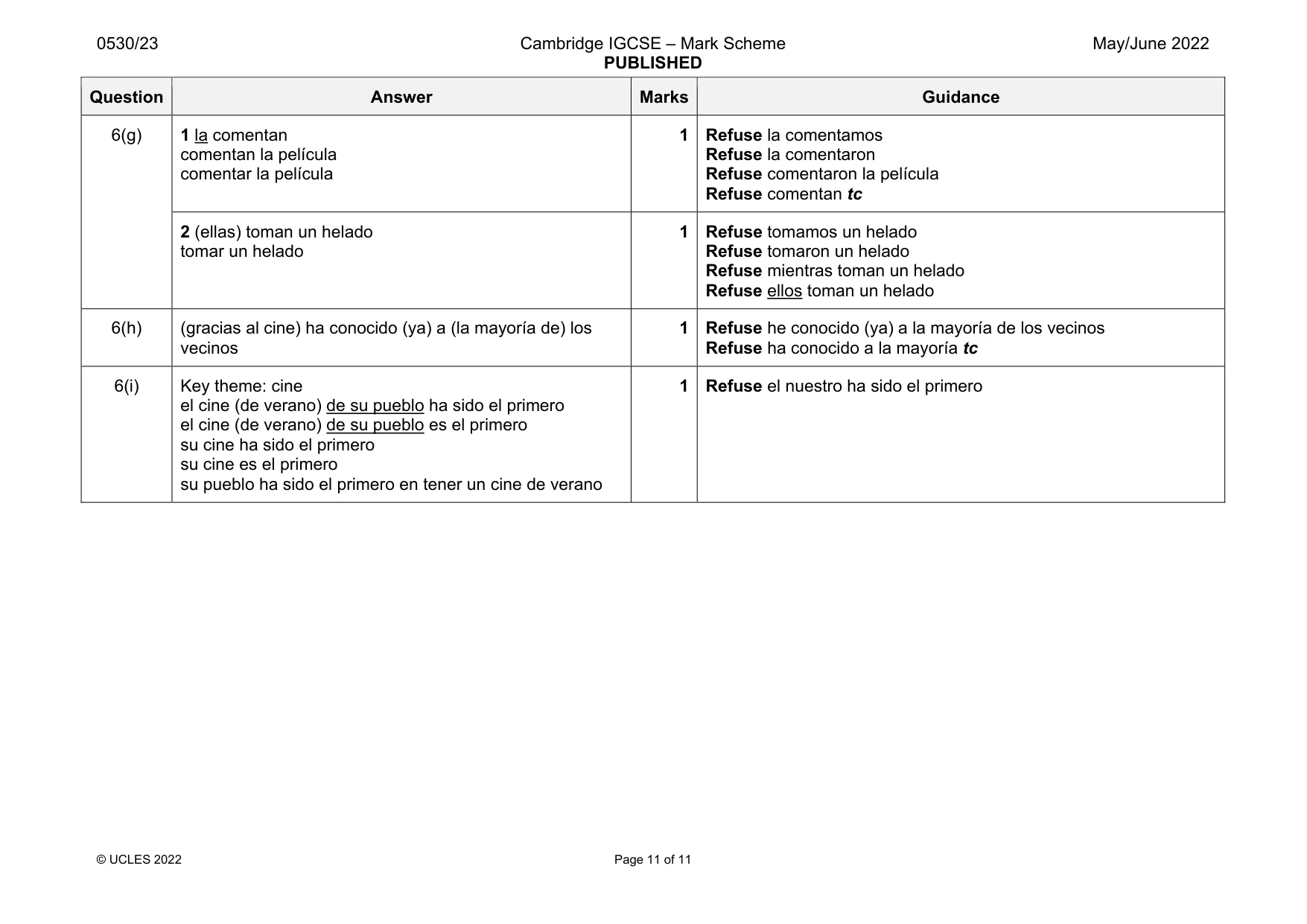
0530/23 Cambridge IGCSE – Mark Scheme PUBLISHED May/June 2022 © UCLES 2022 Page 11 of 11 Question Answer Marks Guidance 6(g) 1 la comentan comentan la película comentar la película 1 Refuse la comentamos Refuse la comentaron Refuse comentaron la película Refuse comentan tc 2 (ellas) toman un helado tomar un helado 1 Refuse tomamos un helado Refuse tomaron un helado Refuse mientras toman un helado Refuse ellos toman un helado 6(h) (gracias al cine) ha conocido (ya) a (la mayoría de) los vecinos 1 Refuse he conocido (ya) a la mayoría de los vecinos Refuse ha conocido a la mayoría tc 6(i) Key theme: cine el cine (de verano) de su pueblo ha sido el primero el cine (de verano) de su pueblo es el primero su cine ha sido el primero su cine es el primero su pueblo ha sido el primero en tener un cine de verano 1 Refuse el nuestro ha sido el primero
What you needed in this session
Cambridge’s own grade thresholds for 2022 May/June, Paper 2 · Variant 3. A higher threshold means an easier paper — the bar moves with how the cohort did.