Cambridge IGCSE Spanish - Foreign Language 0530 — 2022 May/June Paper 2 · Variant 2
0530/22/M/J/22 · 45 marks · ≈51 min
The question paper and its mark scheme, free to read here and free to download. This is Cambridge’s own paper, exactly as it was sat.
Question paper12 pages

Mark scheme11 pages
Answers below. Sit the paper first if you are practising.
Paper as text
Question paper, page 1
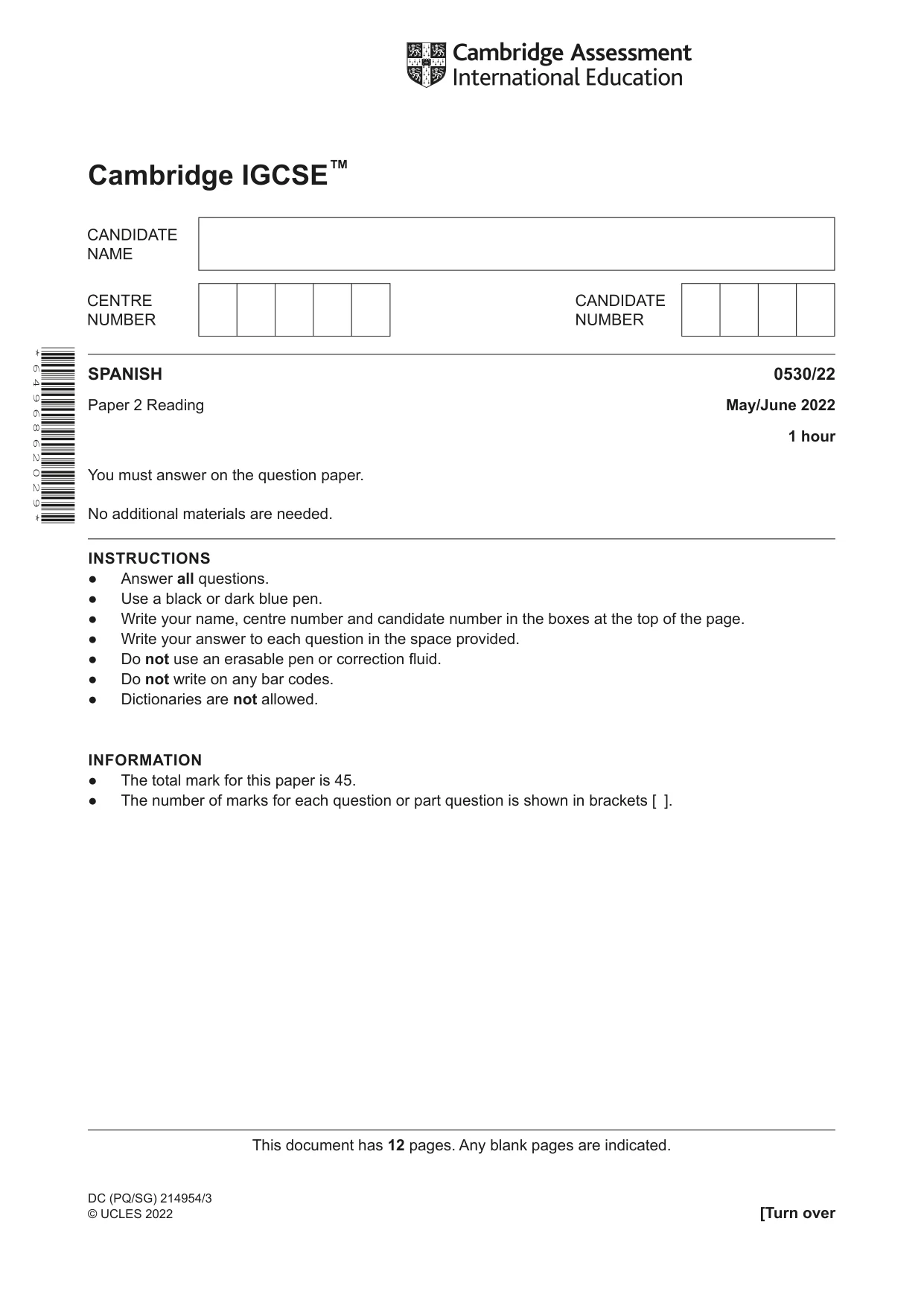
This document has 12 pages. Any blank pages are indicated. [Turn over Cambridge IGCSE™ DC (PQ/SG) 214954/3 © UCLES 2022 * 6 4 9 6 8 6 2 0 2 9 * SPANISH 0530/22 Paper 2 Reading May/June 2022 1 hour You must answer on the question paper. No additional materials are needed. INSTRUCTIONS ● Answer all questions. ● Use a black or dark blue pen. ● Write your name, centre number and candidate number in the boxes at the top of the page. ● Write your answer to each question in the space provided. ● Do not use an erasable pen or correction fluid. ● Do not write on any bar codes. ● Dictionaries are not allowed. INFORMATION ● The total mark for this paper is 45. ● The number of marks for each question or part question is shown in brackets [ ].
Question paper, page 2
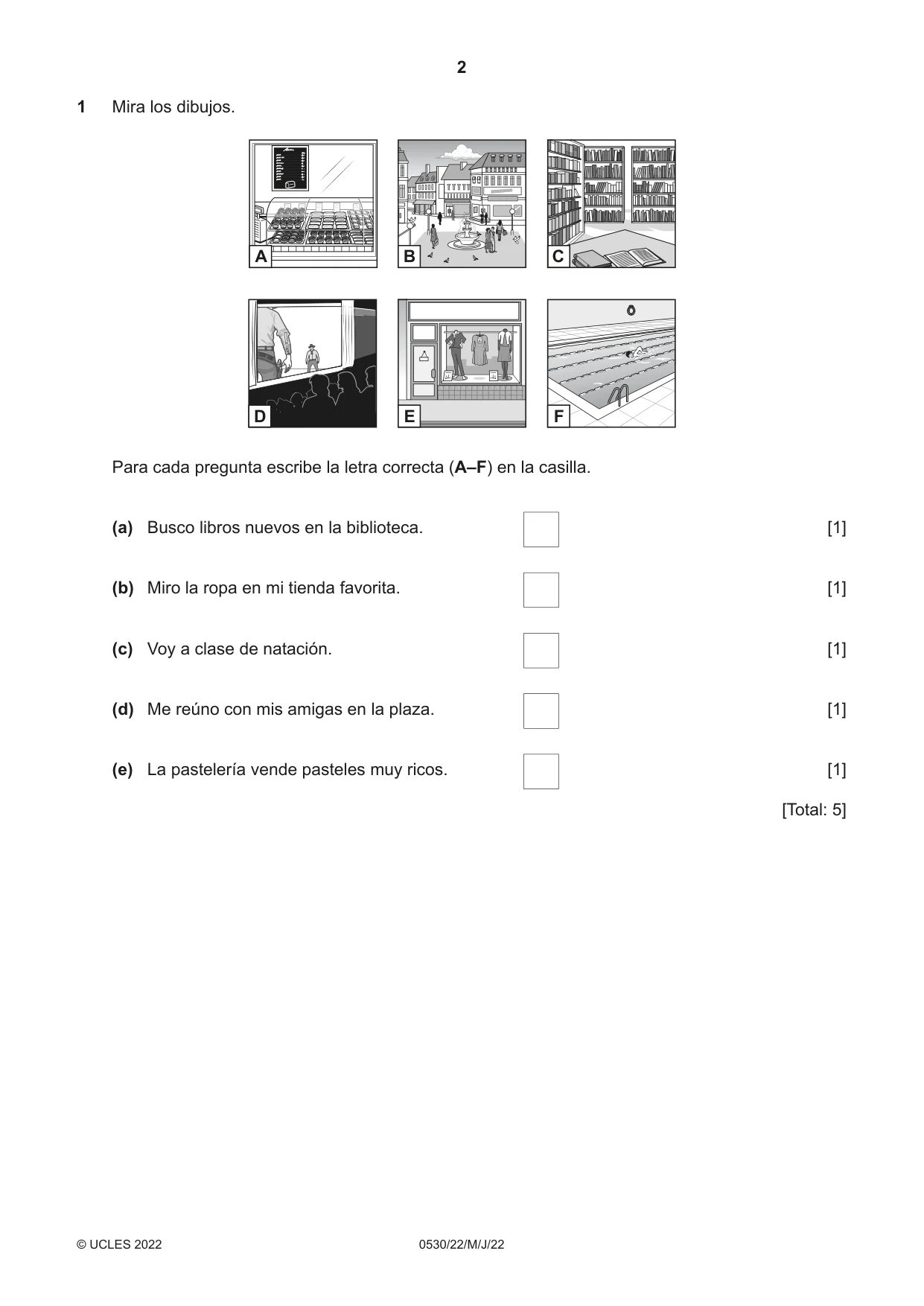
2 0530/22/ M / J /22 © UCLES 2022 1 Mira los dibujos. C B A E D F Para cada pregunta escribe la letra correcta (A–F) en la casilla. (a) Busco libros nuevos en la biblioteca. [1] (b) Miro la ropa en mi tienda favorita. [1] (c) Voy a clase de natación. [1] (d) Me reúno con mis amigas en la plaza. [1] (e) La pastelería vende pasteles muy ricos. [1] [Total: 5]
Question paper, page 3
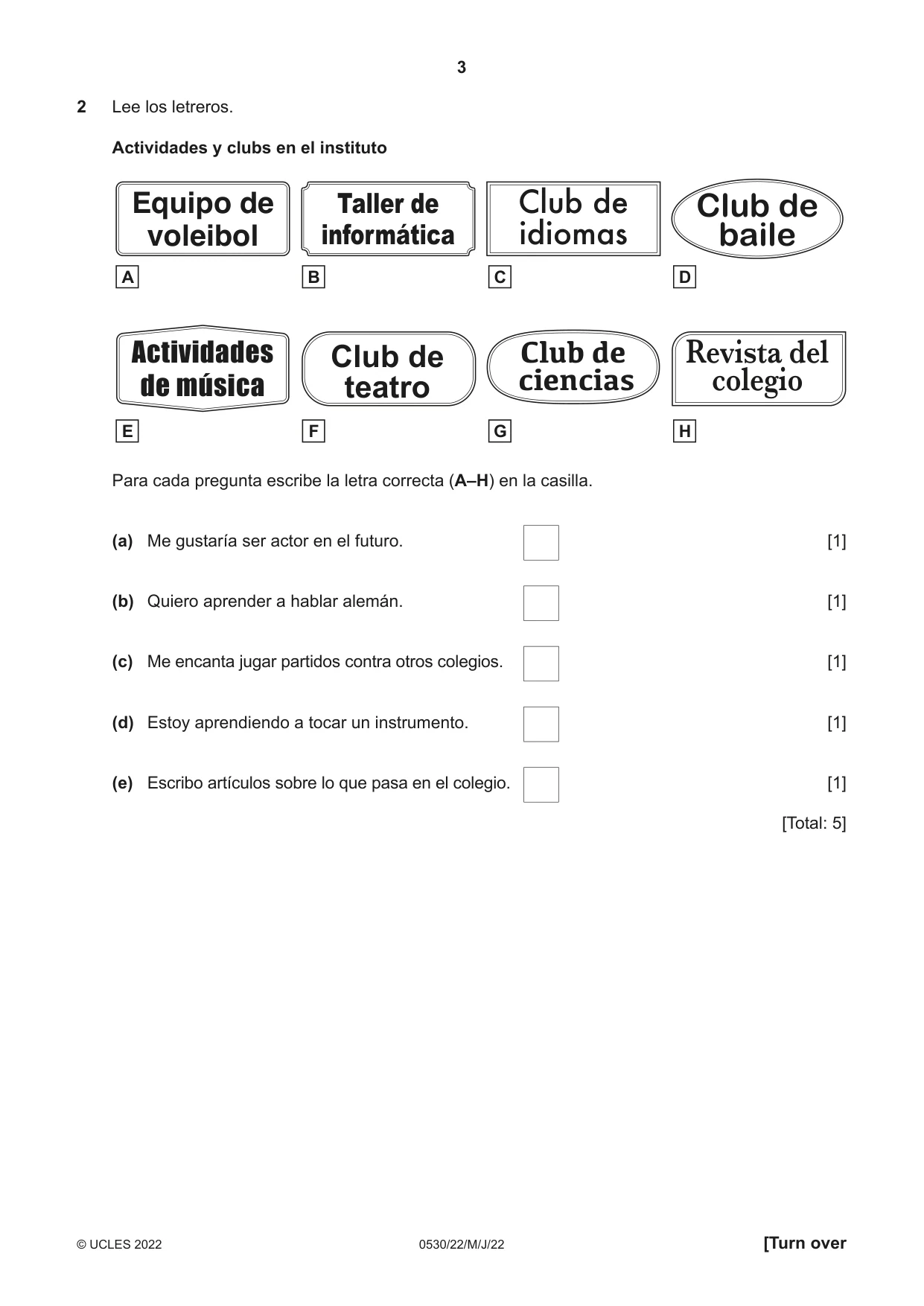
3 0530/22/M/J/22 © UCLES 2022 [Turn over 2 Lee los letreros. Actividades y clubs en el instituto Equipo de voleibol Actividades de música Club de teatro Club de ciencias Taller de informática Club de idiomas Club de baile Revista del colegio A B C D E F G H Para cada pregunta escribe la letra correcta (A–H) en la casilla. (a) Me gustaría ser actor en el futuro. [1] (b) Quiero aprender a hablar alemán. [1] (c) Me encanta jugar partidos contra otros colegios. [1] (d) Estoy aprendiendo a tocar un instrumento. [1] (e) Escribo artículos sobre lo que pasa en el colegio. [1] [Total: 5]
Question paper, page 4
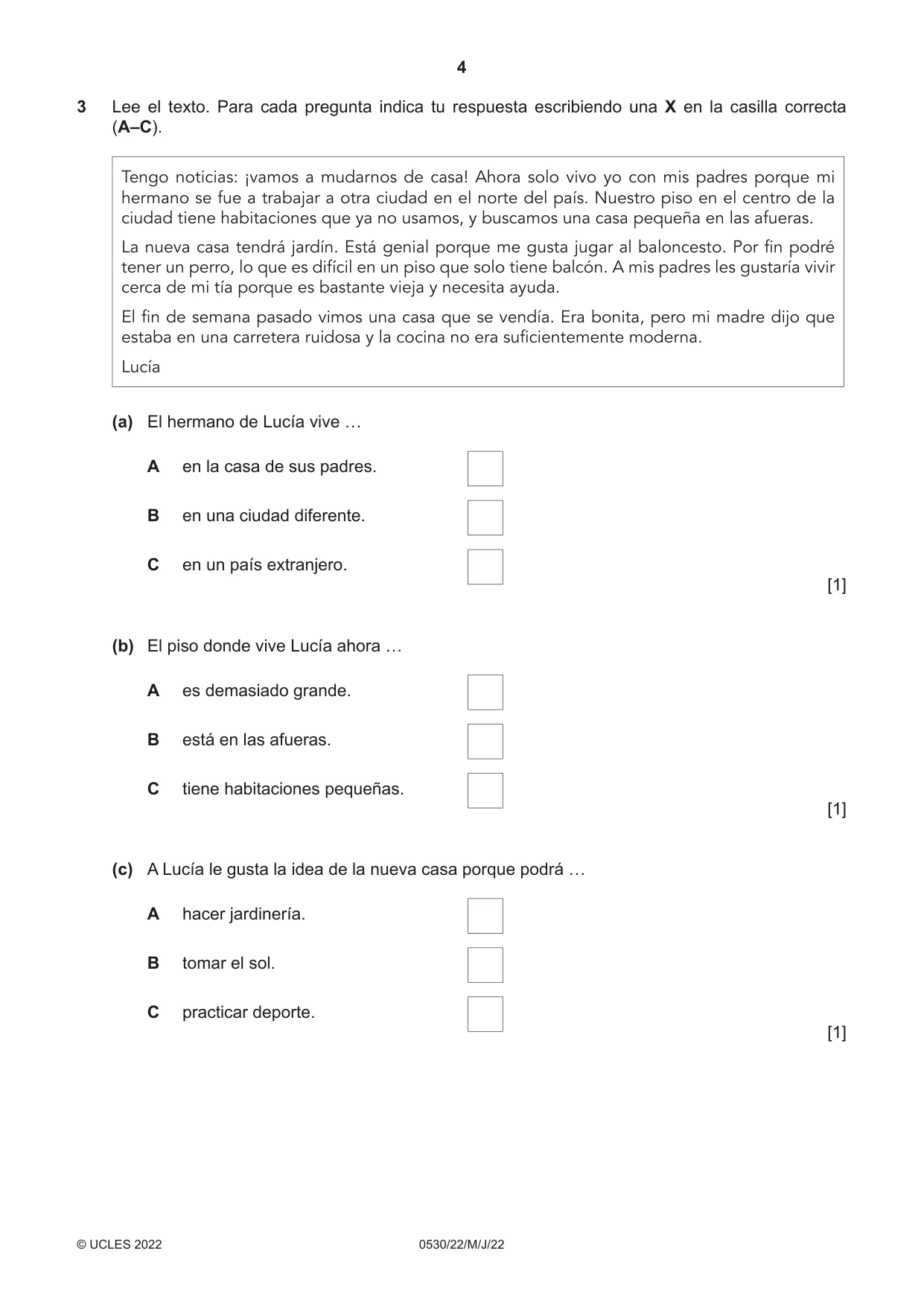
4 0530/22/M/J/22 © UCLES 2022 3 Lee el texto. Para cada pregunta indica tu respuesta escribiendo una X en la casilla correcta (A–C). Tengo noticias: ¡vamos a mudarnos de casa! Ahora solo vivo yo con mis padres porque mi hermano se fue a trabajar a otra ciudad en el norte del país. Nuestro piso en el centro de la ciudad tiene habitaciones que ya no usamos, y buscamos una casa pequeña en las afueras. La nueva casa tendrá jardín. Está genial porque me gusta jugar al baloncesto. Por fin podré tener un perro, lo que es difícil en un piso que solo tiene balcón. A mis padres les gustaría vivir cerca de mi tía porque es bastante vieja y necesita ayuda. El fin de semana pasado vimos una casa que se vendía. Era bonita, pero mi madre dijo que estaba en una carretera ruidosa y la cocina no era suficientemente moderna. Lucía (a) El hermano de Lucía vive … A en la casa de sus padres. B en una ciudad diferente. C en un país extranjero. [1] (b) El piso donde vive Lucía ahora … A es demasiado grande. B está en las afueras. C tiene habitaciones pequeñas. [1] (c) A Lucía le gusta la idea de la nueva casa porque podrá … A hacer jardinería. B tomar el sol. C practicar deporte. [1]
Question paper, page 5
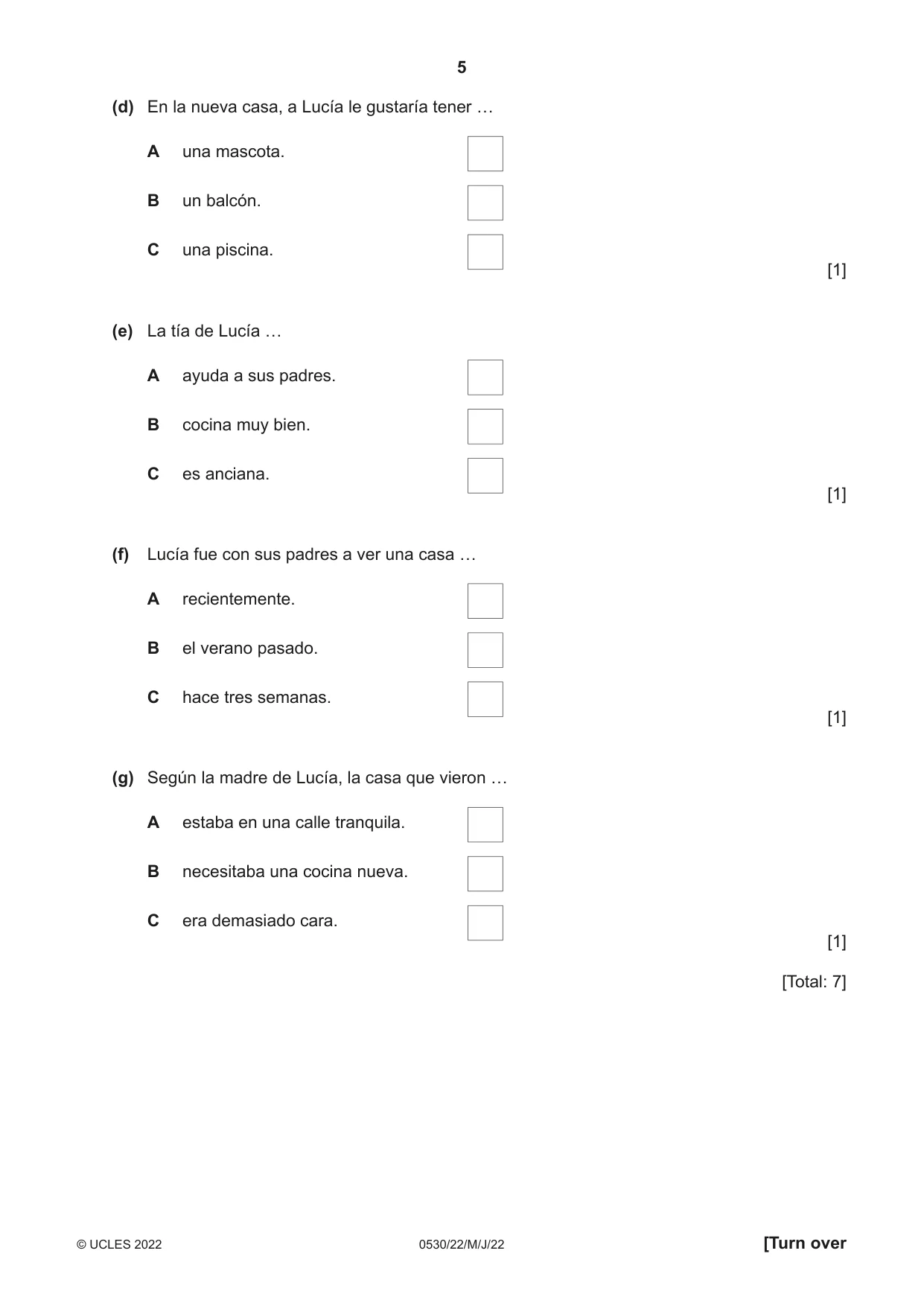
5 0530/22/M/J/22 © UCLES 2022 [Turn over (d) En la nueva casa, a Lucía le gustaría tener … A una mascota. B un balcón. C una piscina. [1] (e) La tía de Lucía … A ayuda a sus padres. B cocina muy bien. C es anciana. [1] (f) Lucía fue con sus padres a ver una casa … A recientemente. B el verano pasado. C hace tres semanas. [1] (g) Según la madre de Lucía, la casa que vieron … A estaba en una calle tranquila. B necesitaba una cocina nueva. C era demasiado cara. [1] [Total: 7]
Question paper, page 6
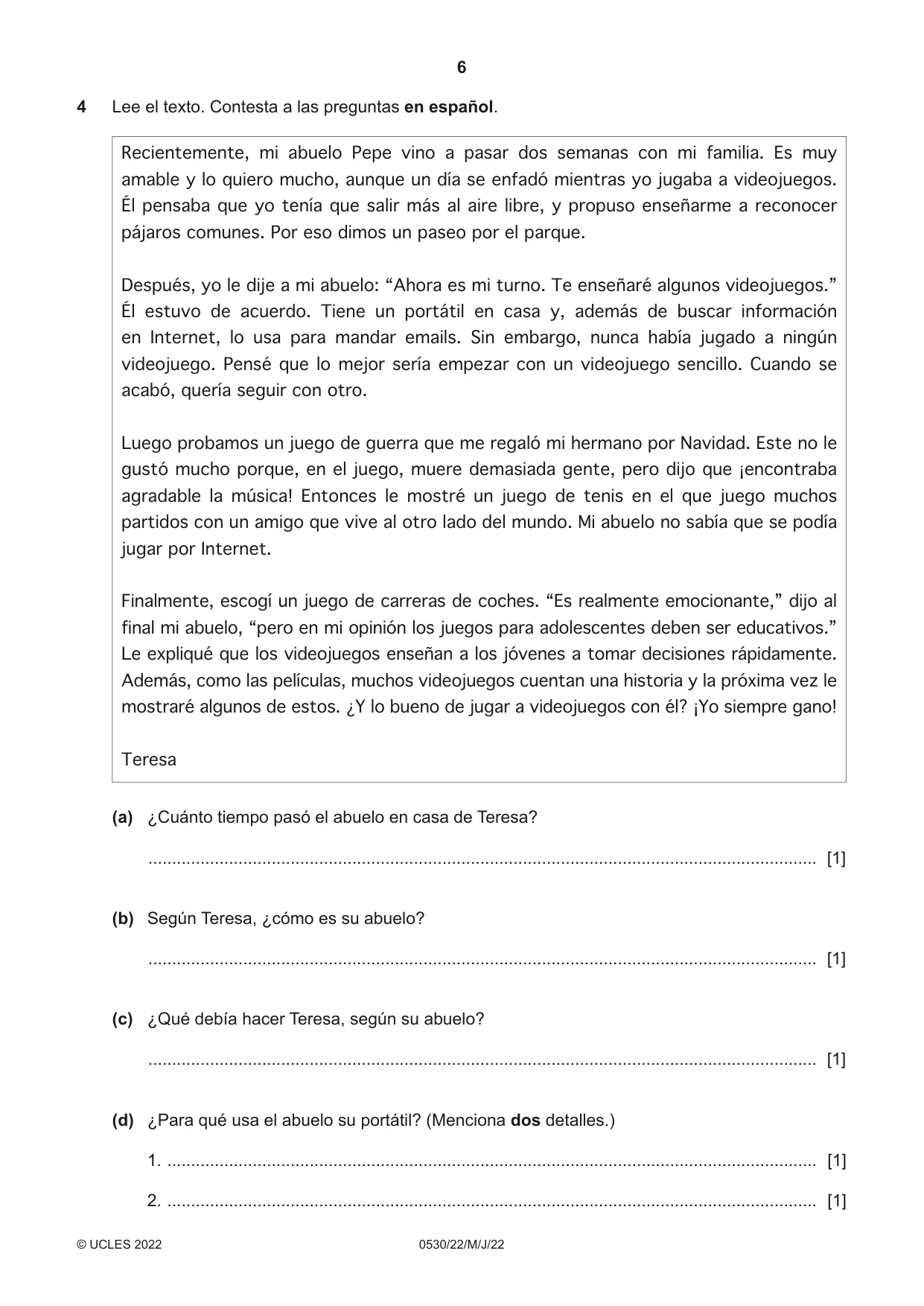
6 0530/22/M/J/22 © UCLES 2022 4 Lee el texto. Contesta a las preguntas en español. Recientemente, mi abuelo Pepe vino a pasar dos semanas con mi familia. Es muy amable y lo quiero mucho, aunque un día se enfadó mientras yo jugaba a videojuegos. Él pensaba que yo tenía que salir más al aire libre, y propuso enseñarme a reconocer pájaros comunes. Por eso dimos un paseo por el parque. Después, yo le dije a mi abuelo: “Ahora es mi turno. Te enseñaré algunos videojuegos.” Él estuvo de acuerdo. Tiene un portátil en casa y, además de buscar información en Internet, lo usa para mandar emails. Sin embargo, nunca había jugado a ningún videojuego. Pensé que lo mejor sería empezar con un videojuego sencillo. Cuando se acabó, quería seguir con otro. Luego probamos un juego de guerra que me regaló mi hermano por Navidad. Este no le gustó mucho porque, en el juego, muere demasiada gente, pero dijo que ¡encontraba agradable la música! Entonces le mostré un juego de tenis en el que juego muchos partidos con un amigo que vive al otro lado del mundo. Mi abuelo no sabía que se podía jugar por Internet. Finalmente, escogí un juego de carreras de coches. “Es realmente emocionante,” dijo al final mi abuelo, “pero en mi opinión los juegos para adolescentes deben ser educativos.” Le expliqué que los videojuegos enseñan a los jóvenes a tomar decisiones rápidamente. Además, como las películas, muchos videojuegos cuentan una historia y la próxima vez le mostraré algunos de estos. ¿Y lo bueno de jugar a videojuegos con él? ¡Yo siempre gano! Teresa (a) ¿Cuánto tiempo pasó el abuelo en casa de Teresa? … [1] (b) Según Teresa, ¿cómo es su abuelo? … [1] (c) ¿Qué debía hacer Teresa, según su abuelo? … [1] (d) ¿Para qué usa el abuelo su portátil? (Menciona dos detalles.) 1. … [1] 2. … [1]
Question paper, page 7
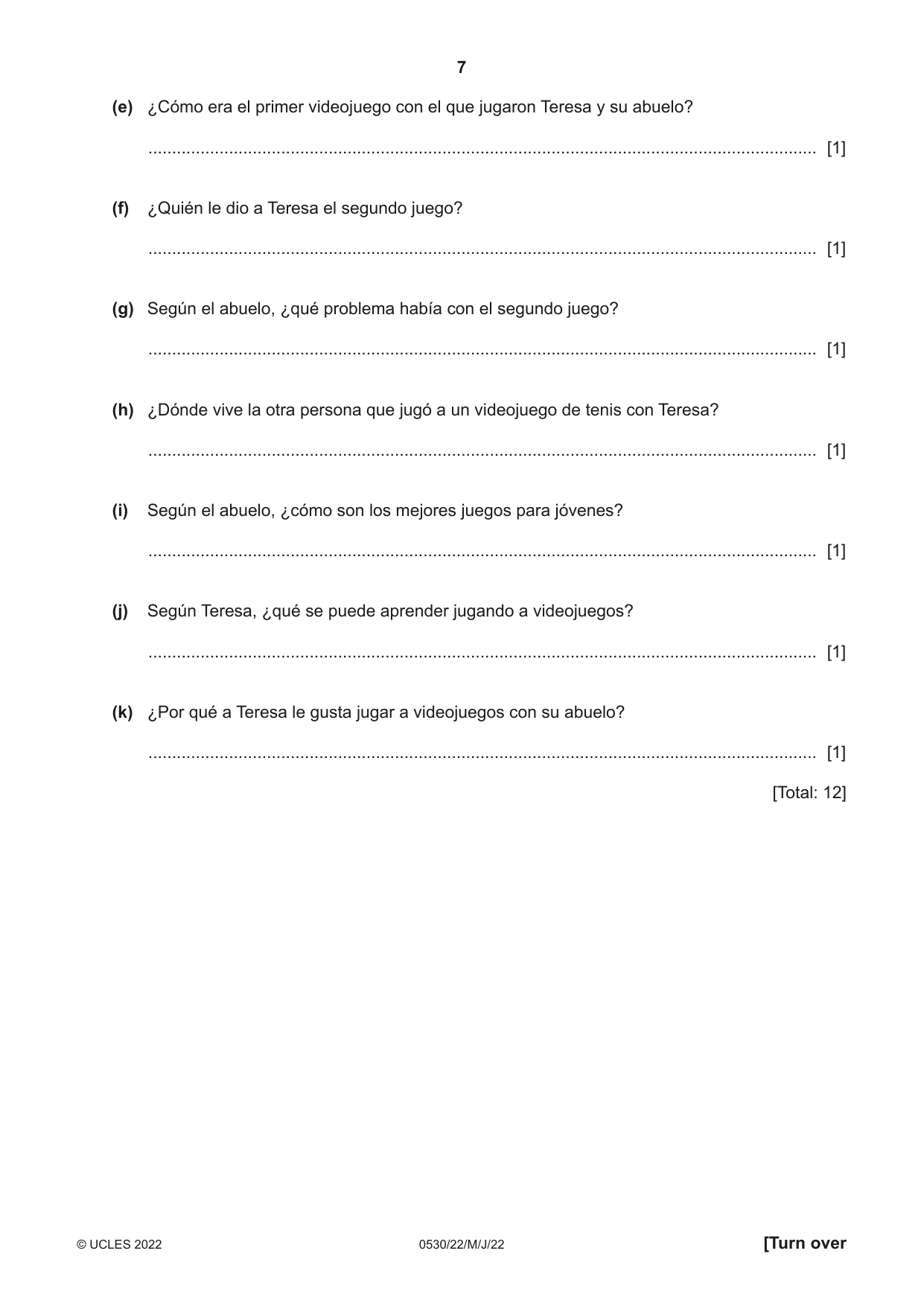
7 0530/22/M/J/22 © UCLES 2022 [Turn over (e) ¿Cómo era el primer videojuego con el que jugaron Teresa y su abuelo? … [1] (f) ¿Quién le dio a Teresa el segundo juego? … [1] (g) Según el abuelo, ¿qué problema había con el segundo juego? … [1] (h) ¿Dónde vive la otra persona que jugó a un videojuego de tenis con Teresa? … [1] (i) Según el abuelo, ¿cómo son los mejores juegos para jóvenes? … [1] (j) Según Teresa, ¿qué se puede aprender jugando a videojuegos? … [1] (k) ¿Por qué a Teresa le gusta jugar a videojuegos con su abuelo? … [1] [Total: 12]
Question paper, page 8
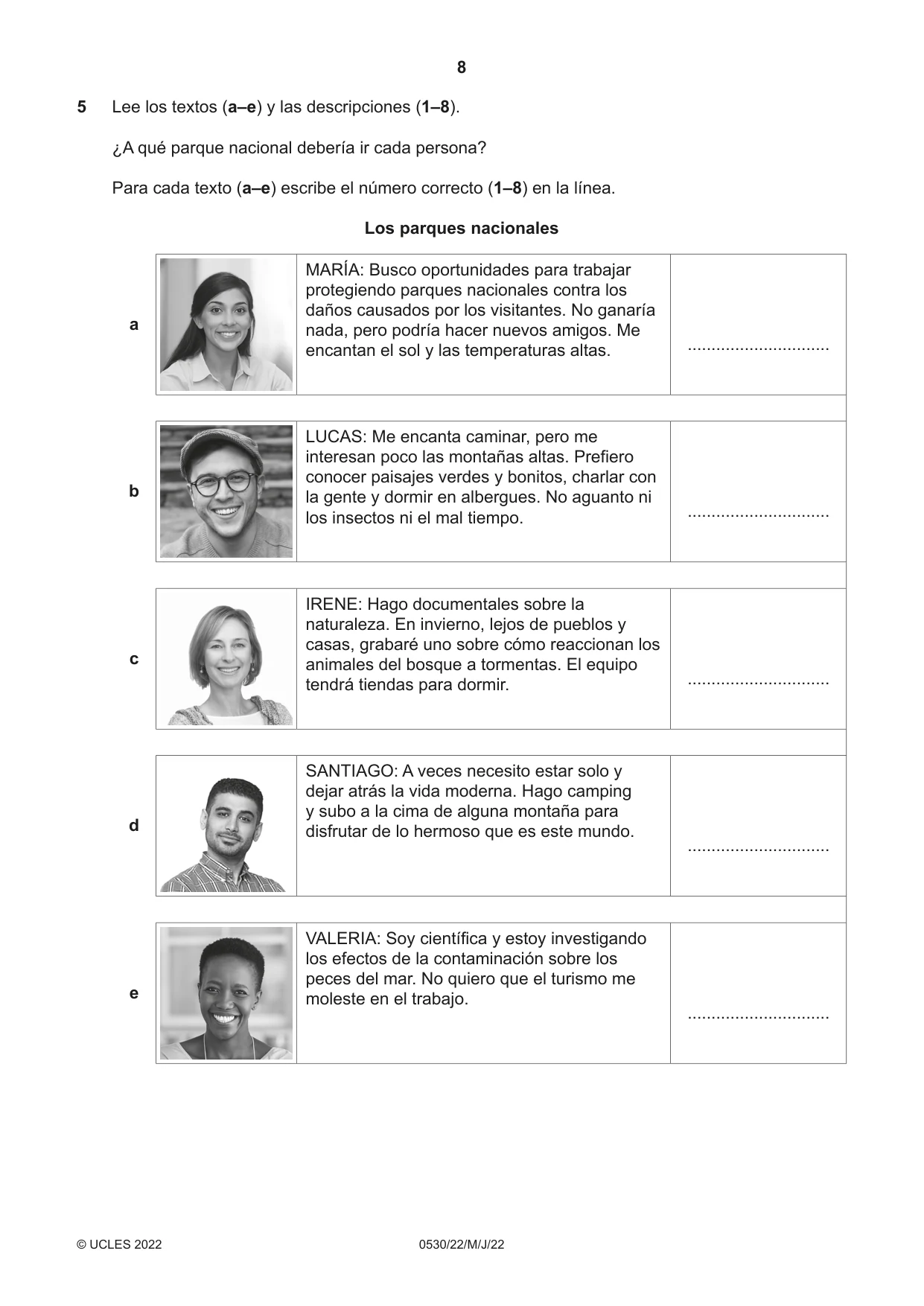
8 0530/22/M/J/22 © UCLES 2022 5 Lee los textos (a–e) y las descripciones (1–8). ¿A qué parque nacional debería ir cada persona? Para cada texto (a–e) escribe el número correcto (1–8) en la línea. Los parques nacionales a MARÍA: Busco oportunidades para trabajar protegiendo parques nacionales contra los daños causados por los visitantes. No ganaría nada, pero podría hacer nuevos amigos. Me encantan el sol y las temperaturas altas. … b LUCAS: Me encanta caminar, pero me interesan poco las montañas altas. Prefiero conocer paisajes verdes y bonitos, charlar con la gente y dormir en albergues. No aguanto ni los insectos ni el mal tiempo. … c IRENE: Hago documentales sobre la naturaleza. En invierno, lejos de pueblos y casas, grabaré uno sobre cómo reaccionan los animales del bosque a tormentas. El equipo tendrá tiendas para dormir. … d SANTIAGO: A veces necesito estar solo y dejar atrás la vida moderna. Hago camping y subo a la cima de alguna montaña para disfrutar de lo hermoso que es este mundo. … e VALERIA: Soy científica y estoy investigando los efectos de la contaminación sobre los peces del mar. No quiero que el turismo me moleste en el trabajo. …
Question paper, page 9
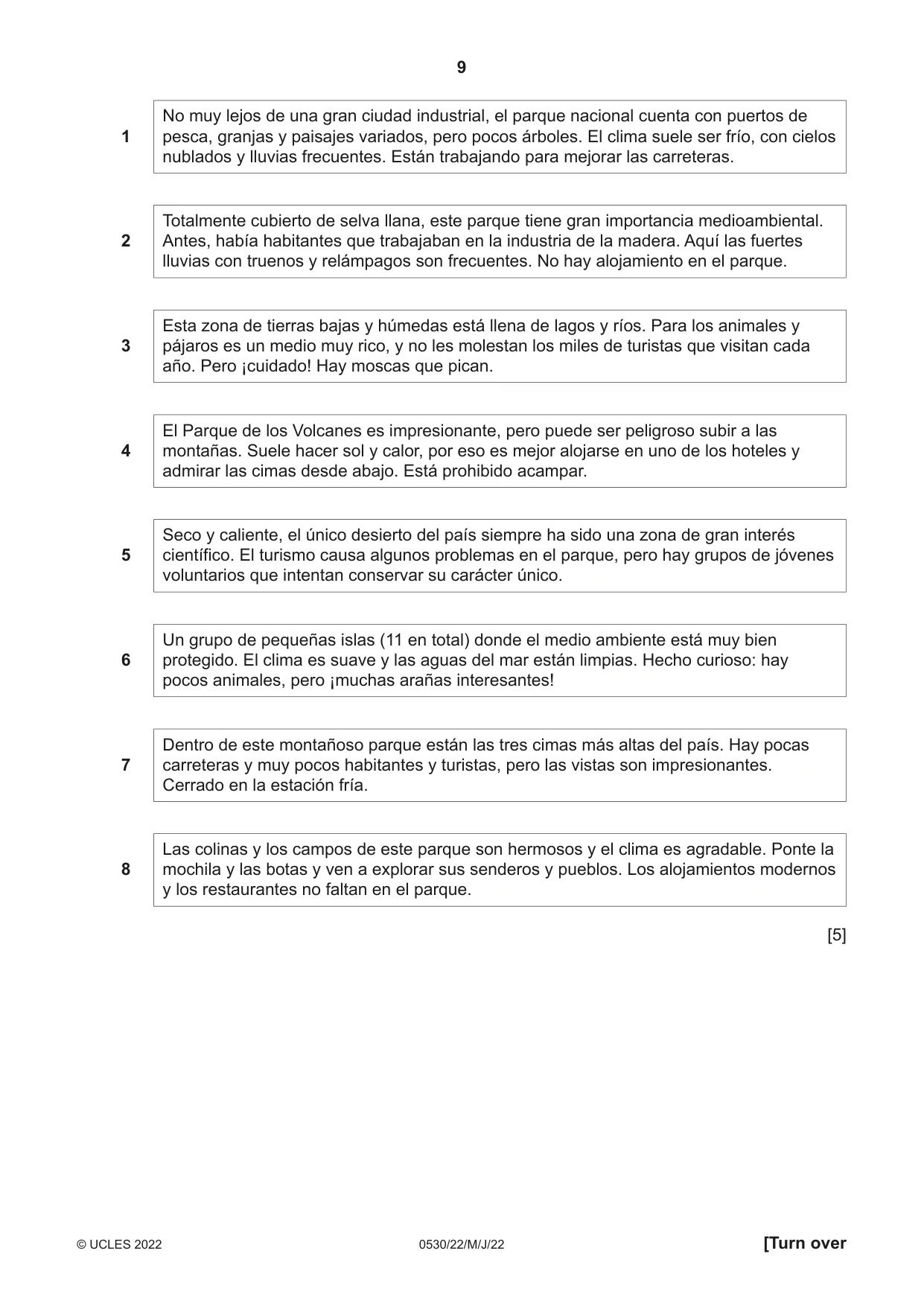
9 0530/22/M/J/22 © UCLES 2022 [Turn over 1 No muy lejos de una gran ciudad industrial, el parque nacional cuenta con puertos de pesca, granjas y paisajes variados, pero pocos árboles. El clima suele ser frío, con cielos nublados y lluvias frecuentes. Están trabajando para mejorar las carreteras. 2 Totalmente cubierto de selva llana, este parque tiene gran importancia medioambiental. Antes, había habitantes que trabajaban en la industria de la madera. Aquí las fuertes lluvias con truenos y relámpagos son frecuentes. No hay alojamiento en el parque. 3 Esta zona de tierras bajas y húmedas está llena de lagos y ríos. Para los animales y pájaros es un medio muy rico, y no les molestan los miles de turistas que visitan cada año. Pero ¡cuidado! Hay moscas que pican. 4 El Parque de los Volcanes es impresionante, pero puede ser peligroso subir a las montañas. Suele hacer sol y calor, por eso es mejor alojarse en uno de los hoteles y admirar las cimas desde abajo. Está prohibido acampar. 5 Seco y caliente, el único desierto del país siempre ha sido una zona de gran interés científico. El turismo causa algunos problemas en el parque, pero hay grupos de jóvenes voluntarios que intentan conservar su carácter único. 6 Un grupo de pequeñas islas (11 en total) donde el medio ambiente está muy bien protegido. El clima es suave y las aguas del mar están limpias. Hecho curioso: hay pocos animales, pero ¡muchas arañas interesantes! 7 Dentro de este montañoso parque están las tres cimas más altas del país. Hay pocas carreteras y muy pocos habitantes y turistas, pero las vistas son impresionantes. Cerrado en la estación fría. 8 Las colinas y los campos de este parque son hermosos y el clima es agradable. Ponte la mochila y las botas y ven a explorar sus senderos y pueblos. Los alojamientos modernos y los restaurantes no faltan en el parque. [5]
Question paper, page 10
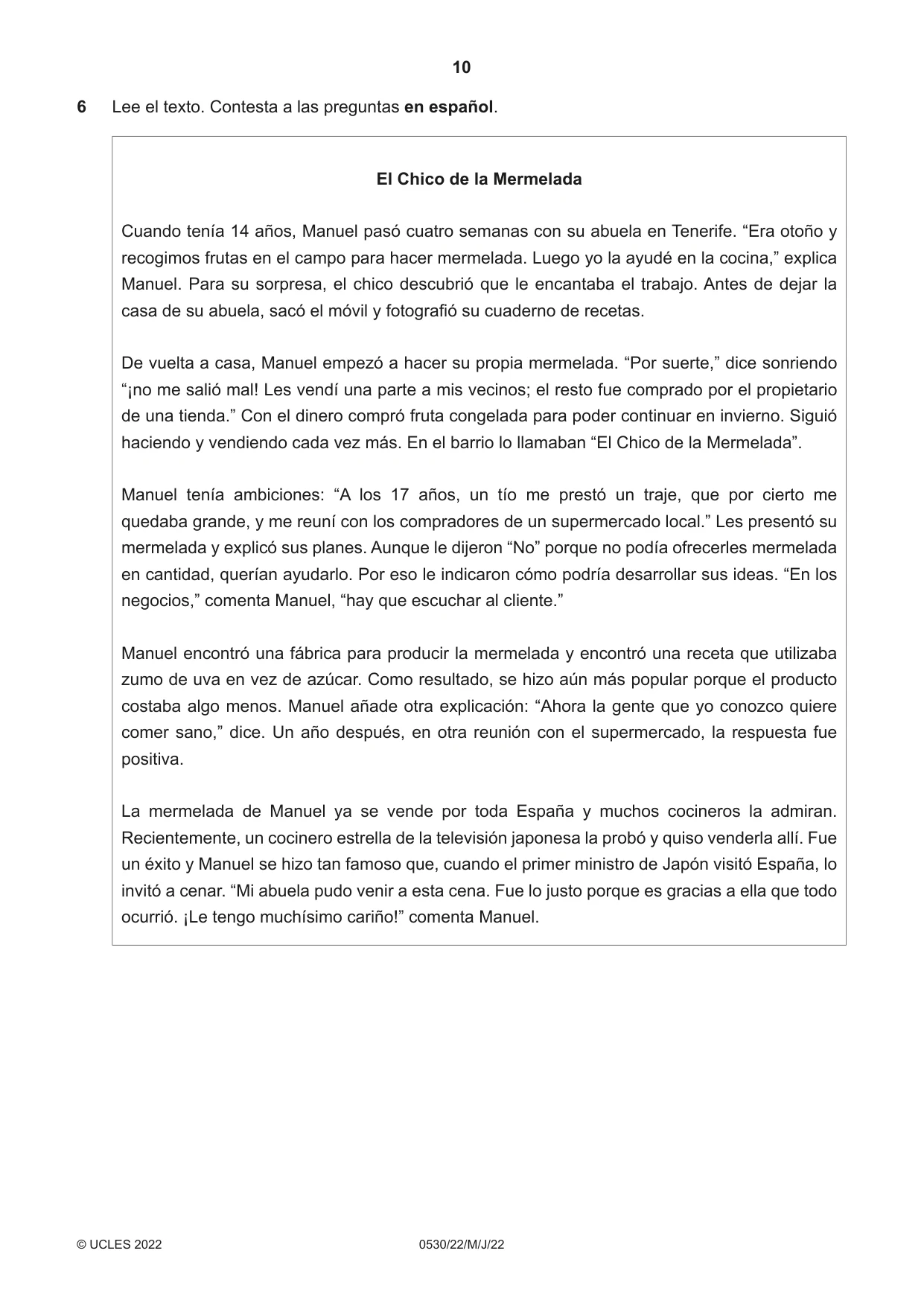
10 0530/22/M/J/22 © UCLES 2022 6 Lee el texto. Contesta a las preguntas en español. El Chico de la Mermelada Cuando tenía 14 años, Manuel pasó cuatro semanas con su abuela en Tenerife. “Era otoño y recogimos frutas en el campo para hacer mermelada. Luego yo la ayudé en la cocina,” explica Manuel. Para su sorpresa, el chico descubrió que le encantaba el trabajo. Antes de dejar la casa de su abuela, sacó el móvil y fotografió su cuaderno de recetas. De vuelta a casa, Manuel empezó a hacer su propia mermelada. “Por suerte,” dice sonriendo “¡no me salió mal! Les vendí una parte a mis vecinos; el resto fue comprado por el propietario de una tienda.” Con el dinero compró fruta congelada para poder continuar en invierno. Siguió haciendo y vendiendo cada vez más. En el barrio lo llamaban “El Chico de la Mermelada”. Manuel tenía ambiciones: “A los 17 años, un tío me prestó un traje, que por cierto me quedaba grande, y me reuní con los compradores de un supermercado local.” Les presentó su mermelada y explicó sus planes. Aunque le dijeron “No” porque no podía ofrecerles mermelada en cantidad, querían ayudarlo. Por eso le indicaron cómo podría desarrollar sus ideas. “En los negocios,” comenta Manuel, “hay que escuchar al cliente.” Manuel encontró una fábrica para producir la mermelada y encontró una receta que utilizaba zumo de uva en vez de azúcar. Como resultado, se hizo aún más popular porque el producto costaba algo menos. Manuel añade otra explicación: “Ahora la gente que yo conozco quiere comer sano,” dice. Un año después, en otra reunión con el supermercado, la respuesta fue positiva. La mermelada de Manuel ya se vende por toda España y muchos cocineros la admiran. Recientemente, un cocinero estrella de la televisión japonesa la probó y quiso venderla allí. Fue un éxito y Manuel se hizo tan famoso que, cuando el primer ministro de Japón visitó España, lo invitó a cenar. “Mi abuela pudo venir a esta cena. Fue lo justo porque es gracias a ella que todo ocurrió. ¡Le tengo muchísimo cariño!” comenta Manuel.
Question paper, page 11
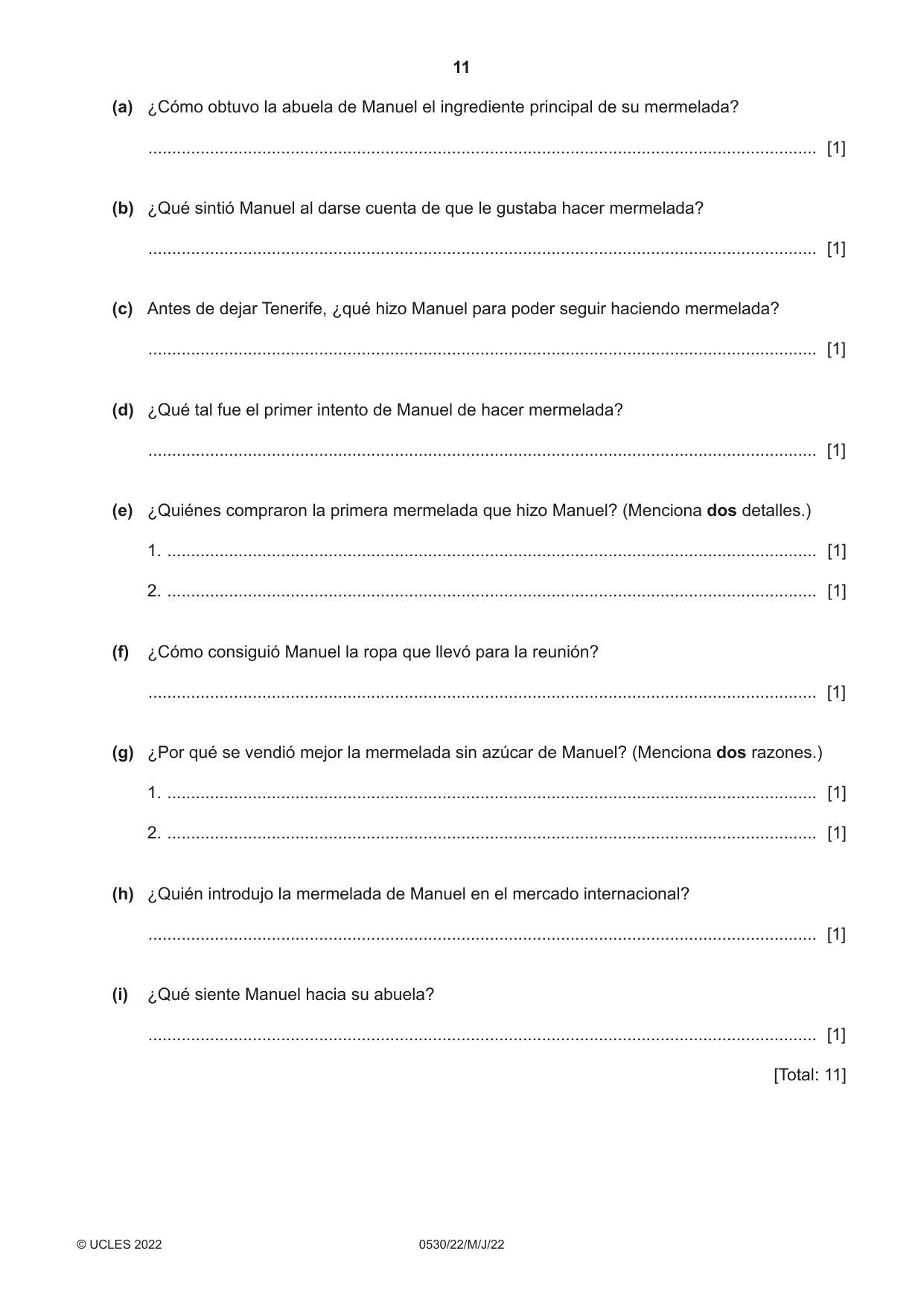
11 0530/22/M/J/22 © UCLES 2022 (a) ¿Cómo obtuvo la abuela de Manuel el ingrediente principal de su mermelada? … [1] (b) ¿Qué sintió Manuel al darse cuenta de que le gustaba hacer mermelada? … [1] (c) Antes de dejar Tenerife, ¿qué hizo Manuel para poder seguir haciendo mermelada? … [1] (d) ¿Qué tal fue el primer intento de Manuel de hacer mermelada? … [1] (e) ¿Quiénes compraron la primera mermelada que hizo Manuel? (Menciona dos detalles.) 1. … [1] 2. … [1] (f) ¿Cómo consiguió Manuel la ropa que llevó para la reunión? … [1] (g) ¿Por qué se vendió mejor la mermelada sin azúcar de Manuel? (Menciona dos razones.) 1. … [1] 2. … [1] (h) ¿Quién introdujo la mermelada de Manuel en el mercado internacional? … [1] (i) ¿Qué siente Manuel hacia su abuela? … [1] [Total: 11]
Question paper, page 12
12 0530/22/M/J/22 © UCLES 2022 Permission to reproduce items where third-party owned material protected by copyright is included has been sought and cleared where possible. Every reasonable effort has been made by the publisher (UCLES) to trace copyright holders, but if any items requiring clearance have unwittingly been included, the publisher will be pleased to make amends at the earliest possible opportunity. To avoid the issue of disclosure of answer-related information to candidates, all copyright acknowledgements are reproduced online in the Cambridge Assessment International Education Copyright Acknowledgements Booklet. This is produced for each series of examinations and is freely available to download at www.cambridgeinternational.org after the live examination series. Cambridge Assessment International Education is part of Cambridge Assessment. Cambridge Assessment is the brand name of the University of Cambridge Local Examinations Syndicate (UCLES), which is a department of the University of Cambridge. BLANK PAGE
Mark scheme, page 1
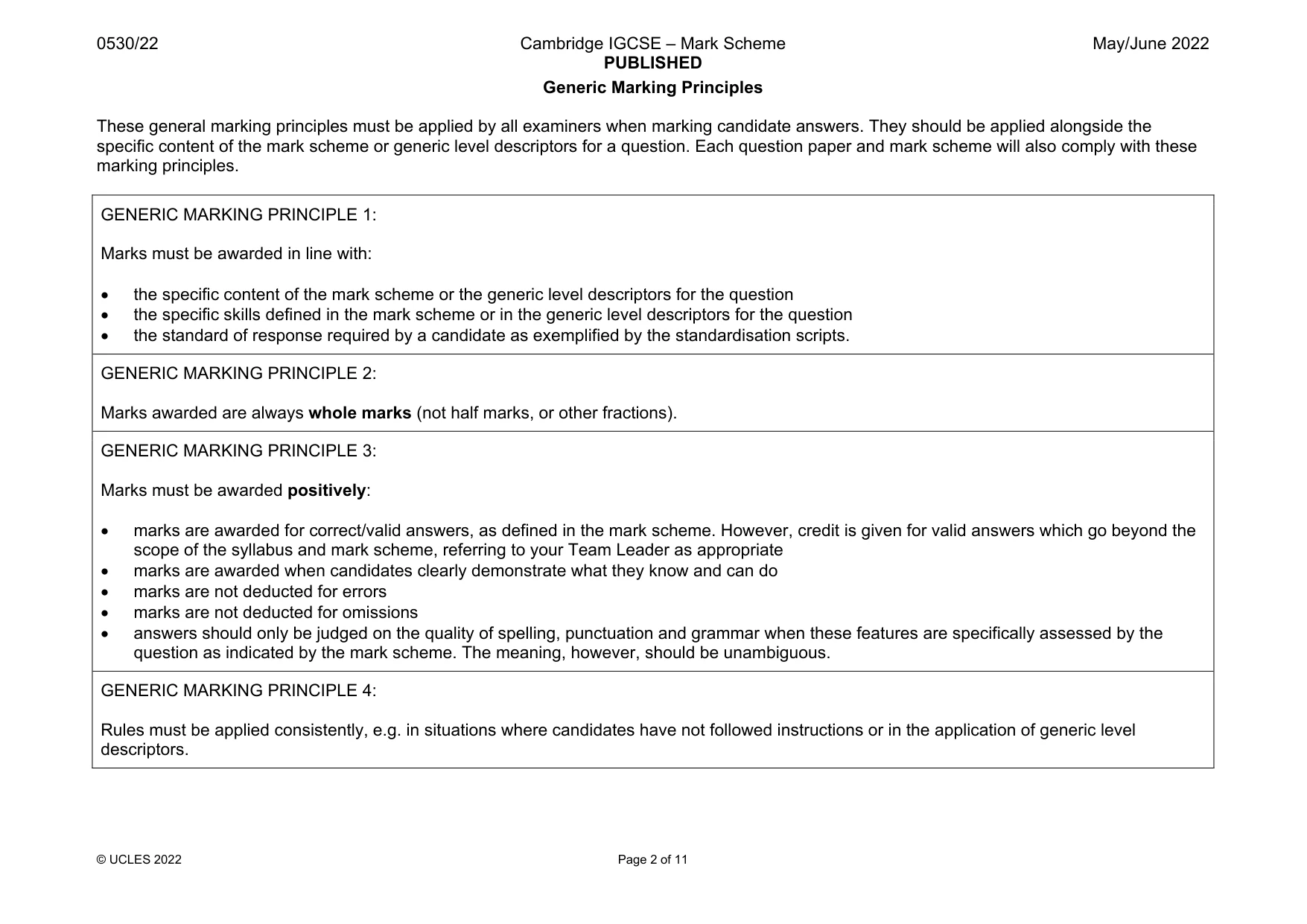
This document consists of 11 printed pages. © UCLES 2022 [Turn over Cambridge IGCSE™ SPANISH 0530/22 Paper 2 Reading May/June 2022 MARK SCHEME Maximum Mark: 45 Published This mark scheme is published as an aid to teachers and candidates, to indicate the requirements of the examination. It shows the basis on which Examiners were instructed to award marks. It does not indicate the details of the discussions that took place at an Examiners’ meeting before marking began, which would have considered the acceptability of alternative answers. Mark schemes should be read in conjunction with the question paper and the Principal Examiner Report for Teachers. Cambridge International will not enter into discussions about these mark schemes. Cambridge International is publishing the mark schemes for the May/June 2022 series for most Cambridge IGCSE, Cambridge International A and AS Level and Cambridge Pre-U components, and some Cambridge O Level components.
Mark scheme, page 2
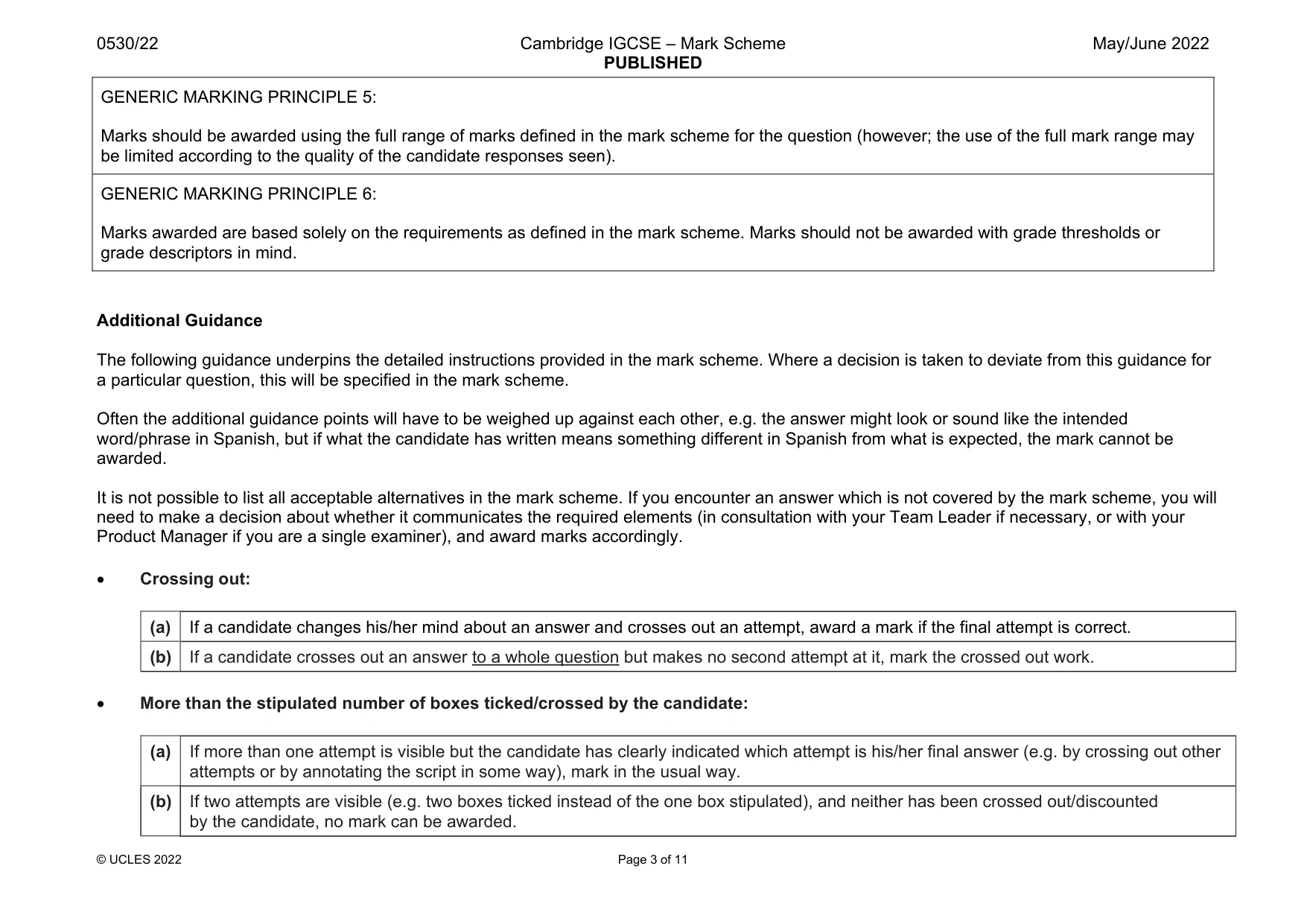
0530/22 Cambridge IGCSE – Mark Scheme PUBLISHED May/June 2022 © UCLES 2022 Page 2 of 11 Generic Marking Principles These general marking principles must be applied by all examiners when marking candidate answers. They should be applied alongside the specific content of the mark scheme or generic level descriptors for a question. Each question paper and mark scheme will also comply with these marking principles. GENERIC MARKING PRINCIPLE 1: Marks must be awarded in line with: the specific content of the mark scheme or the generic level descriptors for the question the specific skills defined in the mark scheme or in the generic level descriptors for the question the standard of response required by a candidate as exemplified by the standardisation scripts. GENERIC MARKING PRINCIPLE 2: Marks awarded are always whole marks (not half marks, or other fractions). GENERIC MARKING PRINCIPLE 3: Marks must be awarded positively: marks are awarded for correct/valid answers, as defined in the mark scheme. However, credit is given for valid answers which go beyond the scope of the syllabus and mark scheme, referring to your Team Leader as appropriate marks are awarded when candidates clearly demonstrate what they know and can do marks are not deducted for errors marks are not deducted for omissions answers should only be judged on the quality of spelling, punctuation and grammar when these features are specifically assessed by the question as indicated by the mark scheme. The meaning, however, should be unambiguous. GENERIC MARKING PRINCIPLE 4: Rules must be applied consistently, e.g. in situations where candidates have not followed instructions or in the application of generic level descriptors.
Mark scheme, page 3
0530/22 Cambridge IGCSE – Mark Scheme PUBLISHED May/June 2022 © UCLES 2022 Page 3 of 11 GENERIC MARKING PRINCIPLE 5: Marks should be awarded using the full range of marks defined in the mark scheme for the question (however; the use of the full mark range may be limited according to the quality of the candidate responses seen). GENERIC MARKING PRINCIPLE 6: Marks awarded are based solely on the requirements as defined in the mark scheme. Marks should not be awarded with grade thresholds or grade descriptors in mind. Additional Guidance The following guidance underpins the detailed instructions provided in the mark scheme. Where a decision is taken to deviate from this guidance for a particular question, this will be specified in the mark scheme. Often the additional guidance points will have to be weighed up against each other, e.g. the answer might look or sound like the intended word/phrase in Spanish, but if what the candidate has written means something different in Spanish from what is expected, the mark cannot be awarded. It is not possible to list all acceptable alternatives in the mark scheme. If you encounter an answer which is not covered by the mark scheme, you will need to make a decision about whether it communicates the required elements (in consultation with your Team Leader if necessary, or with your Product Manager if you are a single examiner), and award marks accordingly. Crossing out: (a) If a candidate changes his/her mind about an answer and crosses out an attempt, award a mark if the final attempt is correct. (b) If a candidate crosses out an answer to a whole question but makes no second attempt at it, mark the crossed out work. More than the stipulated number of boxes ticked/crossed by the candidate: (a) If more than one attempt is visible but the candidate has clearly indicated which attempt is his/her final answer (e.g. by crossing out other attempts or by annotating the script in some way), mark in the usual way. (b) If two attempts are visible (e.g. two boxes ticked instead of the one box stipulated), and neither has been crossed out/discounted by the candidate, no mark can be awarded.
Mark scheme, page 4
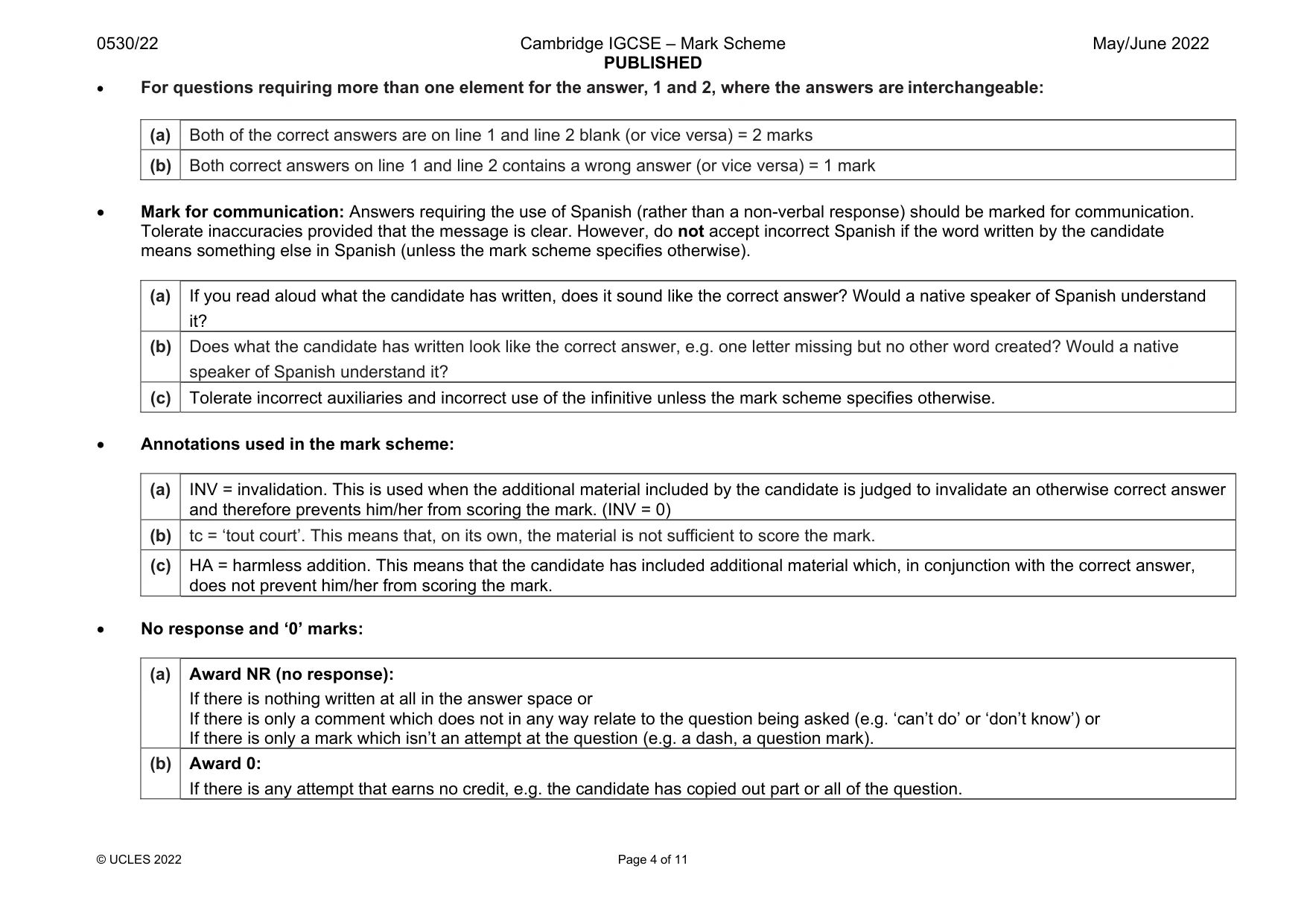
0530/22 Cambridge IGCSE – Mark Scheme PUBLISHED May/June 2022 © UCLES 2022 Page 4 of 11 For questions requiring more than one element for the answer, 1 and 2, where the answers are interchangeable: (a) Both of the correct answers are on line 1 and line 2 blank (or vice versa) = 2 marks (b) Both correct answers on line 1 and line 2 contains a wrong answer (or vice versa) = 1 mark Mark for communication: Answers requiring the use of Spanish (rather than a non-verbal response) should be marked for communication. Tolerate inaccuracies provided that the message is clear. However, do not accept incorrect Spanish if the word written by the candidate means something else in Spanish (unless the mark scheme specifies otherwise). (a) If you read aloud what the candidate has written, does it sound like the correct answer? Would a native speaker of Spanish understand it? (b) Does what the candidate has written look like the correct answer, e.g. one letter missing but no other word created? Would a native speaker of Spanish understand it? (c) Tolerate incorrect auxiliaries and incorrect use of the infinitive unless the mark scheme specifies otherwise. Annotations used in the mark scheme: (a) INV = invalidation. This is used when the additional material included by the candidate is judged to invalidate an otherwise correct answer and therefore prevents him/her from scoring the mark. (INV = 0) (b) tc = ‘tout court’. This means that, on its own, the material is not sufficient to score the mark. (c) HA = harmless addition. This means that the candidate has included additional material which, in conjunction with the correct answer, does not prevent him/her from scoring the mark. No response and ‘0’ marks: (a) Award NR (no response): If there is nothing written at all in the answer space or If there is only a comment which does not in any way relate to the question being asked (e.g. ‘can’t do’ or ‘don’t know’) or If there is only a mark which isn’t an attempt at the question (e.g. a dash, a question mark). (b) Award 0: If there is any attempt that earns no credit, e.g. the candidate has copied out part or all of the question.
Mark scheme, page 5
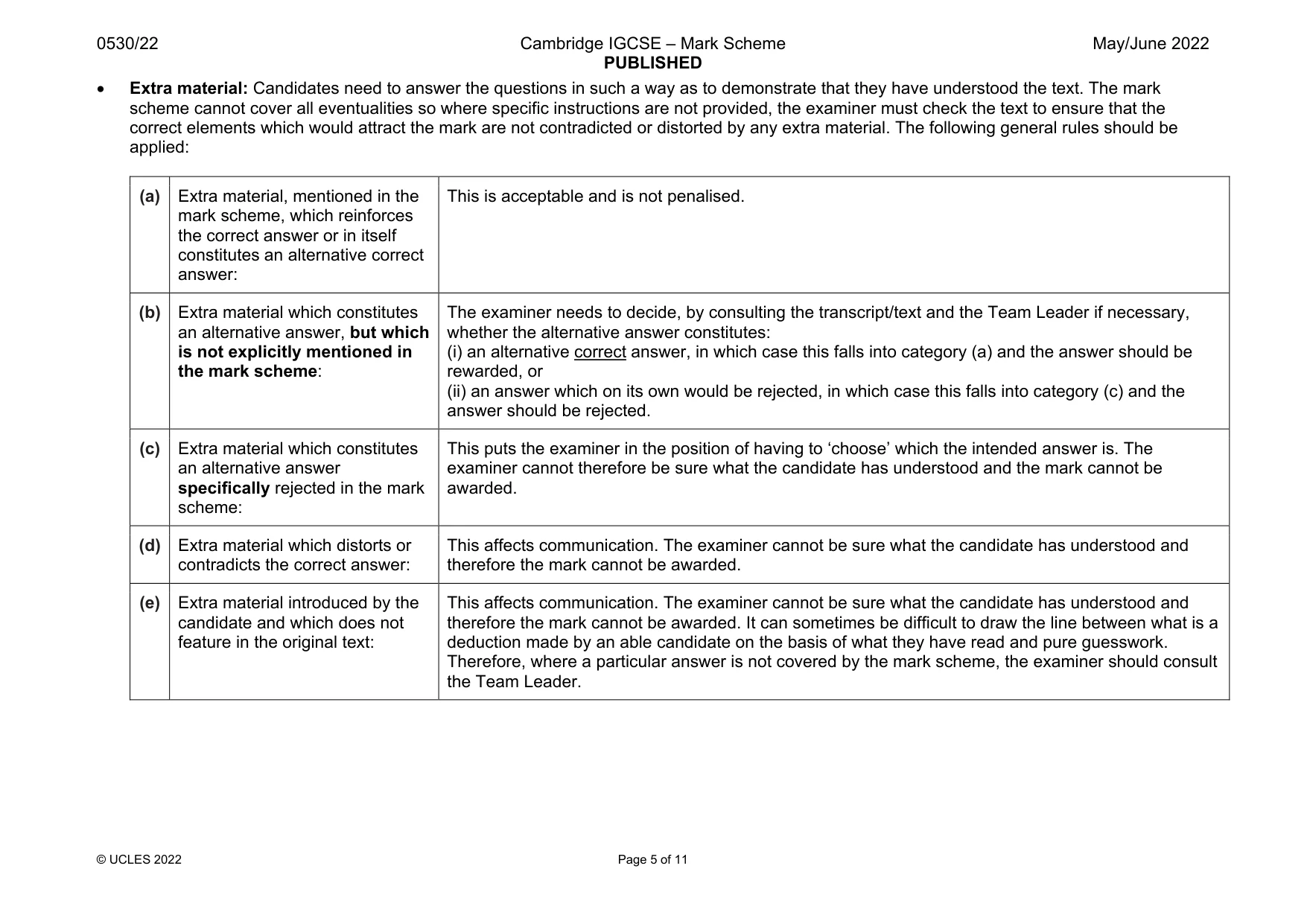
0530/22 Cambridge IGCSE – Mark Scheme PUBLISHED May/June 2022 © UCLES 2022 Page 5 of 11 Extra material: Candidates need to answer the questions in such a way as to demonstrate that they have understood the text. The mark scheme cannot cover all eventualities so where specific instructions are not provided, the examiner must check the text to ensure that the correct elements which would attract the mark are not contradicted or distorted by any extra material. The following general rules should be applied: (a) Extra material, mentioned in the mark scheme, which reinforces the correct answer or in itself constitutes an alternative correct answer: This is acceptable and is not penalised. (b) Extra material which constitutes an alternative answer, but which is not explicitly mentioned in the mark scheme: The examiner needs to decide, by consulting the transcript/text and the Team Leader if necessary, whether the alternative answer constitutes: (i) an alternative correct answer, in which case this falls into category (a) and the answer should be rewarded, or (ii) an answer which on its own would be rejected, in which case this falls into category (c) and the answer should be rejected. (c) Extra material which constitutes an alternative answer specifically rejected in the mark scheme: This puts the examiner in the position of having to ‘choose’ which the intended answer is. The examiner cannot therefore be sure what the candidate has understood and the mark cannot be awarded. (d) Extra material which distorts or contradicts the correct answer: This affects communication. The examiner cannot be sure what the candidate has understood and therefore the mark cannot be awarded. (e) Extra material introduced by the candidate and which does not feature in the original text: This affects communication. The examiner cannot be sure what the candidate has understood and therefore the mark cannot be awarded. It can sometimes be difficult to draw the line between what is a deduction made by an able candidate on the basis of what they have read and pure guesswork. Therefore, where a particular answer is not covered by the mark scheme, the examiner should consult the Team Leader.
Mark scheme, page 6
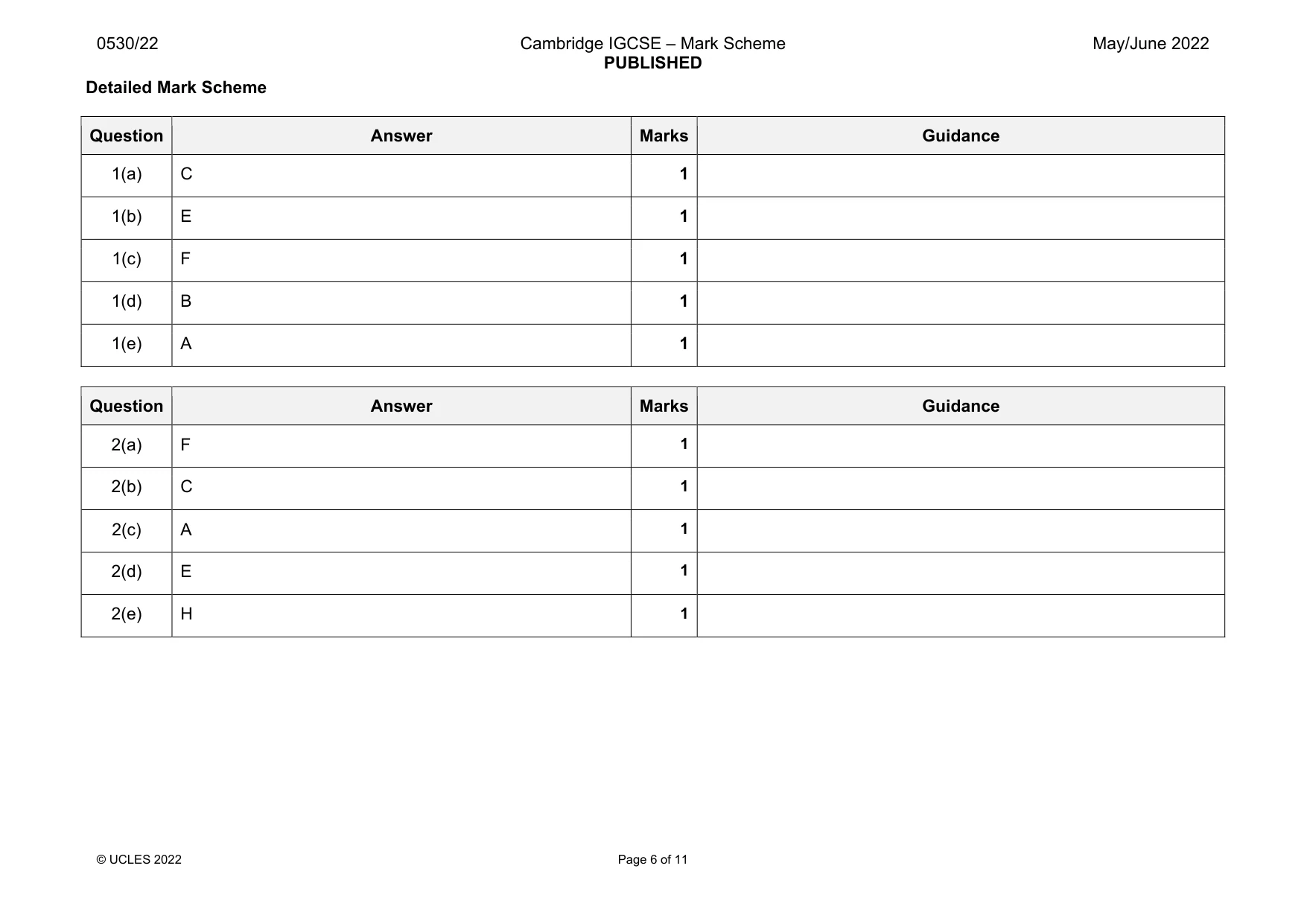
0530/22 Cambridge IGCSE – Mark Scheme PUBLISHED May/June 2022 © UCLES 2022 Page 6 of 11 Detailed Mark Scheme Question Answer Marks Guidance 1(a) C 1 1(b) E 1 1(c) F 1 1(d) B 1 1(e) A 1 Question Answer Marks Guidance 2(a) F 1 2(b) C 1 2(c) A 1 2(d) E 1 2(e) H 1
Mark scheme, page 7
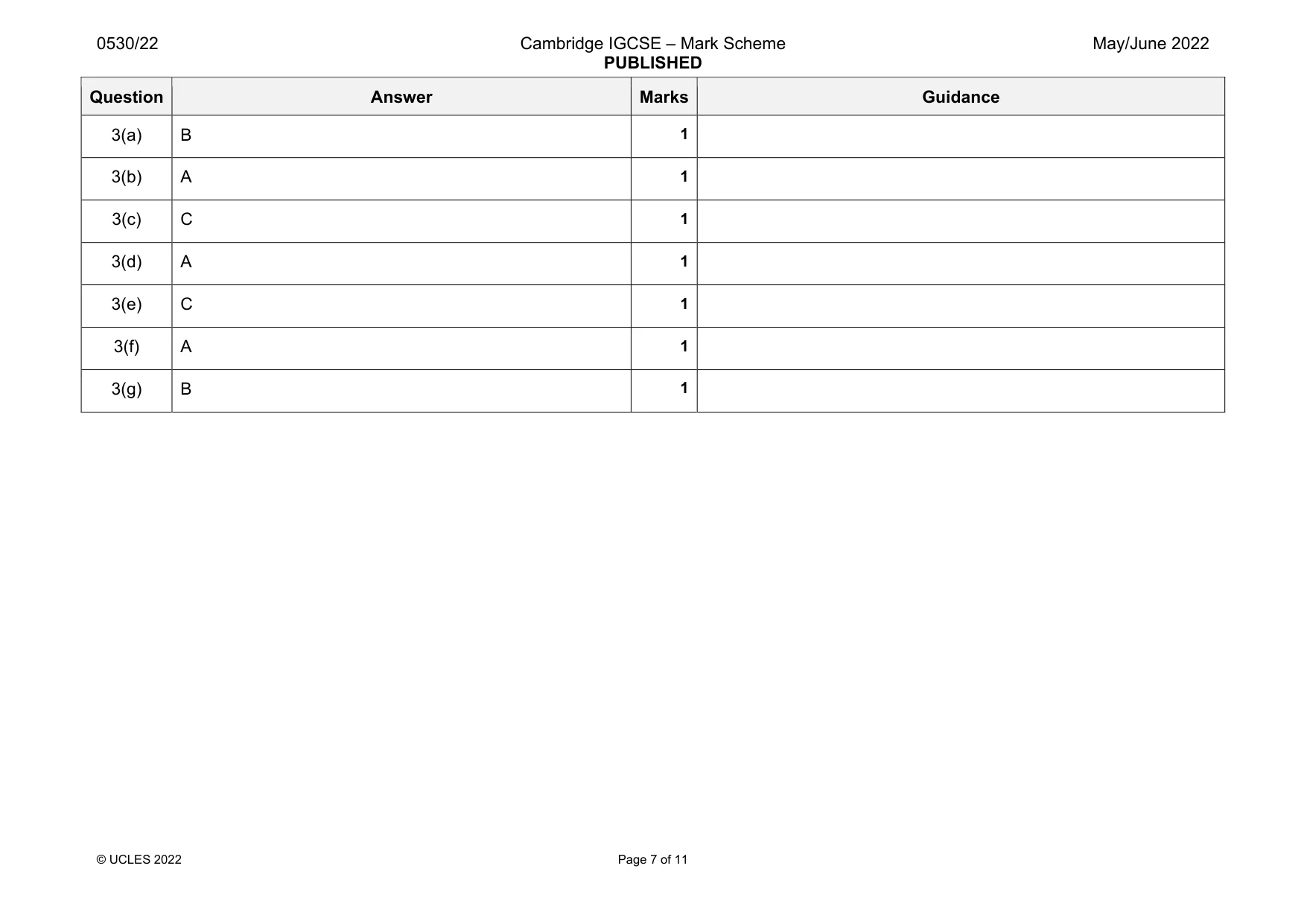
0530/22 Cambridge IGCSE – Mark Scheme PUBLISHED May/June 2022 © UCLES 2022 Page 7 of 11 Question Answer Marks Guidance 3(a) B 1 3(b) A 1 3(c) C 1 3(d) A 1 3(e) C 1 3(f) A 1 3(g) B 1
Mark scheme, page 8
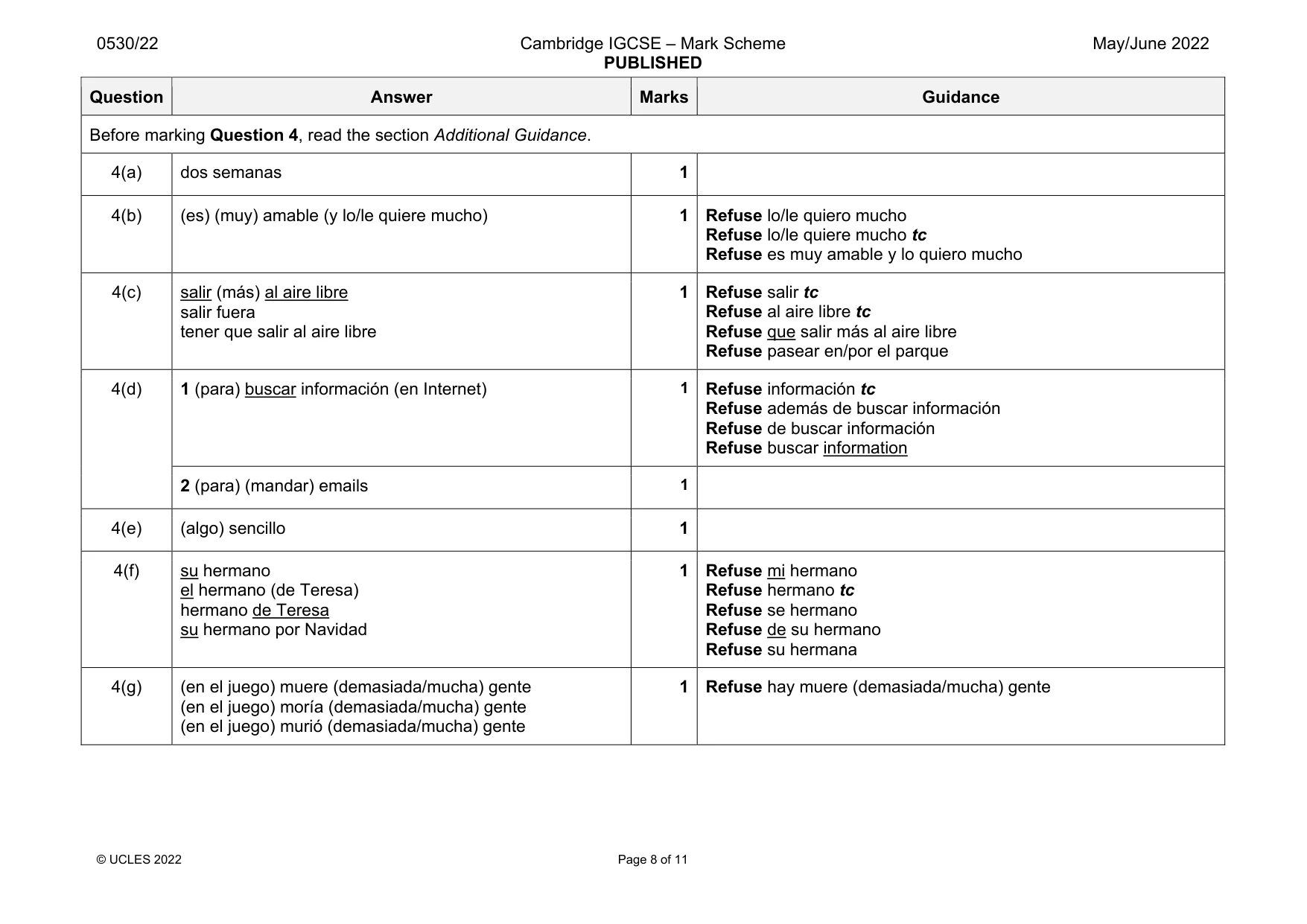
0530/22 Cambridge IGCSE – Mark Scheme PUBLISHED May/June 2022 © UCLES 2022 Page 8 of 11 Question Answer Marks Guidance Before marking Question 4, read the section Additional Guidance. 4(a) dos semanas 1 4(b) (es) (muy) amable (y lo/le quiere mucho) 1 Refuse lo/le quiero mucho Refuse lo/le quiere mucho tc Refuse es muy amable y lo quiero mucho 4(c) salir (más) al aire libre salir fuera tener que salir al aire libre 1 Refuse salir tc Refuse al aire libre tc Refuse que salir más al aire libre Refuse pasear en/por el parque 4(d) 1 (para) buscar información (en Internet) 1 Refuse información tc Refuse además de buscar información Refuse de buscar información Refuse buscar information 2 (para) (mandar) emails 1 4(e) (algo) sencillo 1 4(f) su hermano el hermano (de Teresa) hermano de Teresa su hermano por Navidad 1 Refuse mi hermano Refuse hermano tc Refuse se hermano Refuse de su hermano Refuse su hermana 4(g) (en el juego) muere (demasiada/mucha) gente (en el juego) moría (demasiada/mucha) gente (en el juego) murió (demasiada/mucha) gente 1 Refuse hay muere (demasiada/mucha) gente
Mark scheme, page 9
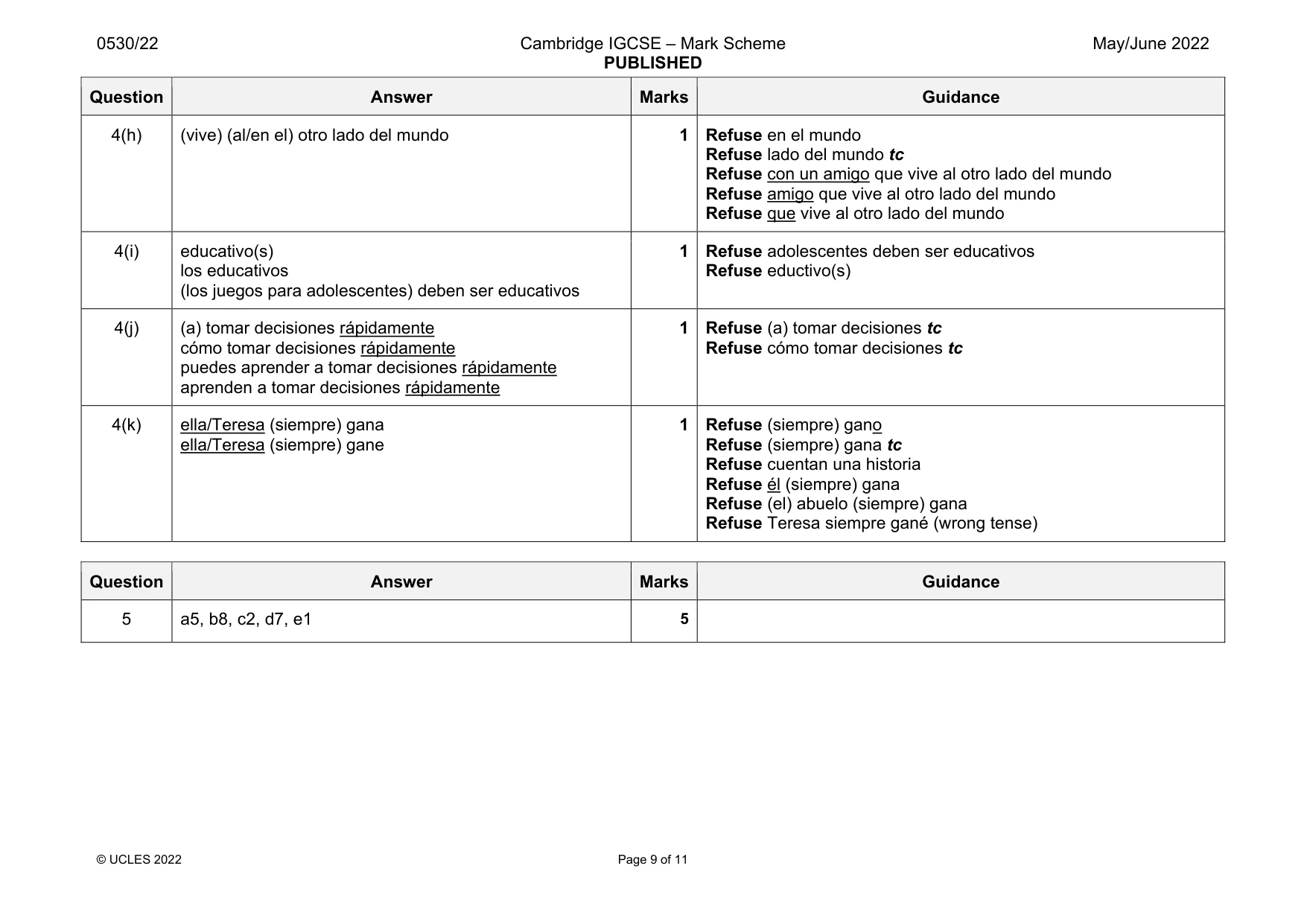
0530/22 Cambridge IGCSE – Mark Scheme PUBLISHED May/June 2022 © UCLES 2022 Page 9 of 11 Question Answer Marks Guidance 4(h) (vive) (al/en el) otro lado del mundo 1 Refuse en el mundo Refuse lado del mundo tc Refuse con un amigo que vive al otro lado del mundo Refuse amigo que vive al otro lado del mundo Refuse que vive al otro lado del mundo 4(i) educativo(s) los educativos (los juegos para adolescentes) deben ser educativos 1 Refuse adolescentes deben ser educativos Refuse eductivo(s) 4(j) (a) tomar decisiones rápidamente cómo tomar decisiones rápidamente puedes aprender a tomar decisiones rápidamente aprenden a tomar decisiones rápidamente 1 Refuse (a) tomar decisiones tc Refuse cómo tomar decisiones tc 4(k) ella/Teresa (siempre) gana ella/Teresa (siempre) gane 1 Refuse (siempre) gano Refuse (siempre) gana tc Refuse cuentan una historia Refuse él (siempre) gana Refuse (el) abuelo (siempre) gana Refuse Teresa siempre gané (wrong tense) Question Answer Marks Guidance 5 a5, b8, c2, d7, e1 5
Mark scheme, page 10
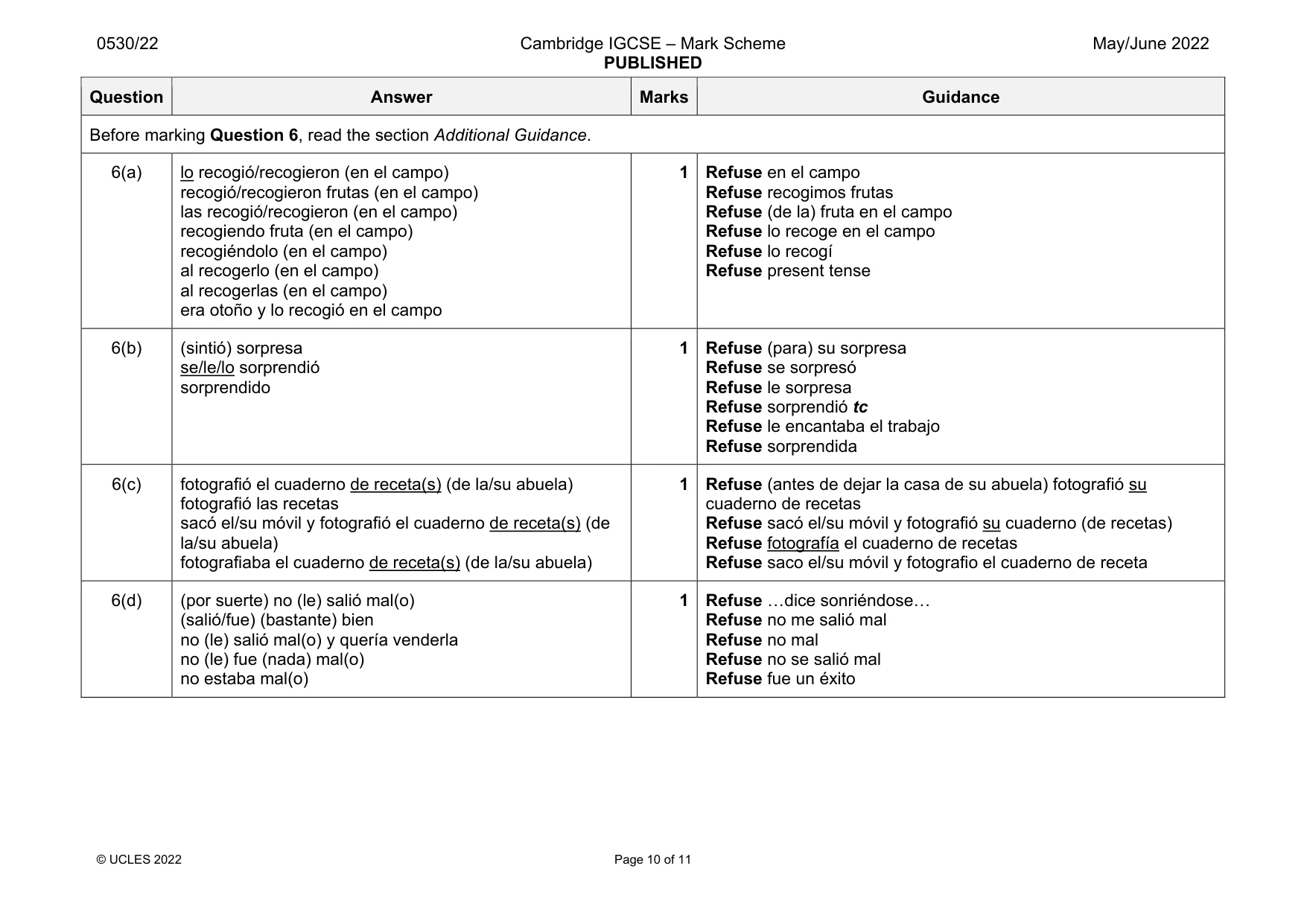
0530/22 Cambridge IGCSE – Mark Scheme PUBLISHED May/June 2022 © UCLES 2022 Page 10 of 11 Question Answer Marks Guidance Before marking Question 6, read the section Additional Guidance. 6(a) lo recogió/recogieron (en el campo) recogió/recogieron frutas (en el campo) las recogió/recogieron (en el campo) recogiendo fruta (en el campo) recogiéndolo (en el campo) al recogerlo (en el campo) al recogerlas (en el campo) era otoño y lo recogió en el campo 1 Refuse en el campo Refuse recogimos frutas Refuse (de la) fruta en el campo Refuse lo recoge en el campo Refuse lo recogí Refuse present tense 6(b) (sintió) sorpresa se/le/lo sorprendió sorprendido 1 Refuse (para) su sorpresa Refuse se sorpresó Refuse le sorpresa Refuse sorprendió tc Refuse le encantaba el trabajo Refuse sorprendida 6(c) fotografió el cuaderno de receta(s) (de la/su abuela) fotografió las recetas sacó el/su móvil y fotografió el cuaderno de receta(s) (de la/su abuela) fotografiaba el cuaderno de receta(s) (de la/su abuela) 1 Refuse (antes de dejar la casa de su abuela) fotografió su cuaderno de recetas Refuse sacó el/su móvil y fotografió su cuaderno (de recetas) Refuse fotografía el cuaderno de recetas Refuse saco el/su móvil y fotografio el cuaderno de receta 6(d) (por suerte) no (le) salió mal(o) (salió/fue) (bastante) bien no (le) salió mal(o) y quería venderla no (le) fue (nada) mal(o) no estaba mal(o) 1 Refuse …dice sonriéndose… Refuse no me salió mal Refuse no mal Refuse no se salió mal Refuse fue un éxito
Mark scheme, page 11
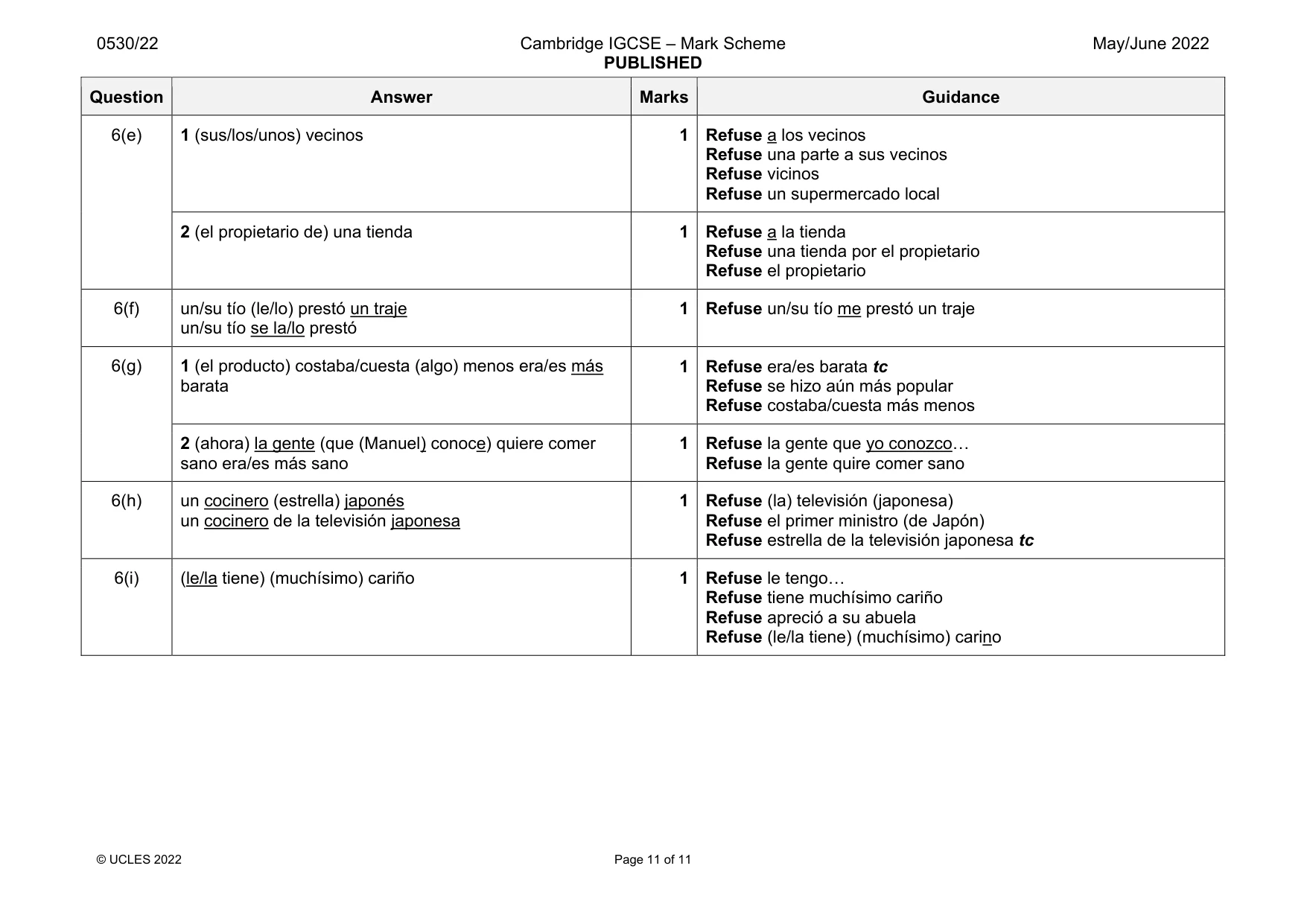
0530/22 Cambridge IGCSE – Mark Scheme PUBLISHED May/June 2022 © UCLES 2022 Page 11 of 11 Question Answer Marks Guidance 6(e) 1 (sus/los/unos) vecinos 1 Refuse a los vecinos Refuse una parte a sus vecinos Refuse vicinos Refuse un supermercado local 2 (el propietario de) una tienda 1 Refuse a la tienda Refuse una tienda por el propietario Refuse el propietario 6(f) un/su tío (le/lo) prestó un traje un/su tío se la/lo prestó 1 Refuse un/su tío me prestó un traje 6(g) 1 (el producto) costaba/cuesta (algo) menos era/es más barata 1 Refuse era/es barata tc Refuse se hizo aún más popular Refuse costaba/cuesta más menos 2 (ahora) la gente (que (Manuel) conoce) quiere comer sano era/es más sano 1 Refuse la gente que yo conozco… Refuse la gente quire comer sano 6(h) un cocinero (estrella) japonés un cocinero de la televisión japonesa 1 Refuse (la) televisión (japonesa) Refuse el primer ministro (de Japón) Refuse estrella de la televisión japonesa tc 6(i) (le/la tiene) (muchísimo) cariño 1 Refuse le tengo… Refuse tiene muchísimo cariño Refuse apreció a su abuela Refuse (le/la tiene) (muchísimo) carino
What you needed in this session
Cambridge’s own grade thresholds for 2022 May/June, Paper 2 · Variant 2. A higher threshold means an easier paper — the bar moves with how the cohort did.