Cambridge IGCSE Spanish - Foreign Language 0530 — 2023 Oct/Nov Paper 2 · Variant 3
0530/23/O/N/23 · 45 marks · ≈51 min
The question paper and its mark scheme, free to read here and free to download. This is Cambridge’s own paper, exactly as it was sat.
Question paper12 pages

Mark scheme10 pages
Answers below. Sit the paper first if you are practising.
Paper as text
Question paper, page 1
This document has 12 pages. Any blank pages are indicated. [Turn over Cambridge IGCSE™ DC (LK/CB) 316099/2 © UCLES 2023 * 2 5 8 9 5 9 9 1 9 9 * SPANISH 0530/23 Paper 2 Reading October/November 2023 1 hour You must answer on the question paper. No additional materials are needed. INSTRUCTIONS ● Answer all questions. ● Use a black or dark blue pen. ● Write your name, centre number and candidate number in the boxes at the top of the page. ● Write your answer to each question in the space provided. ● Do not use an erasable pen or correction fluid. ● Do not write on any bar codes. ● Dictionaries are not allowed. INFORMATION ● The total mark for this paper is 45. ● The number of marks for each question or part question is shown in brackets [ ].
Question paper, page 2
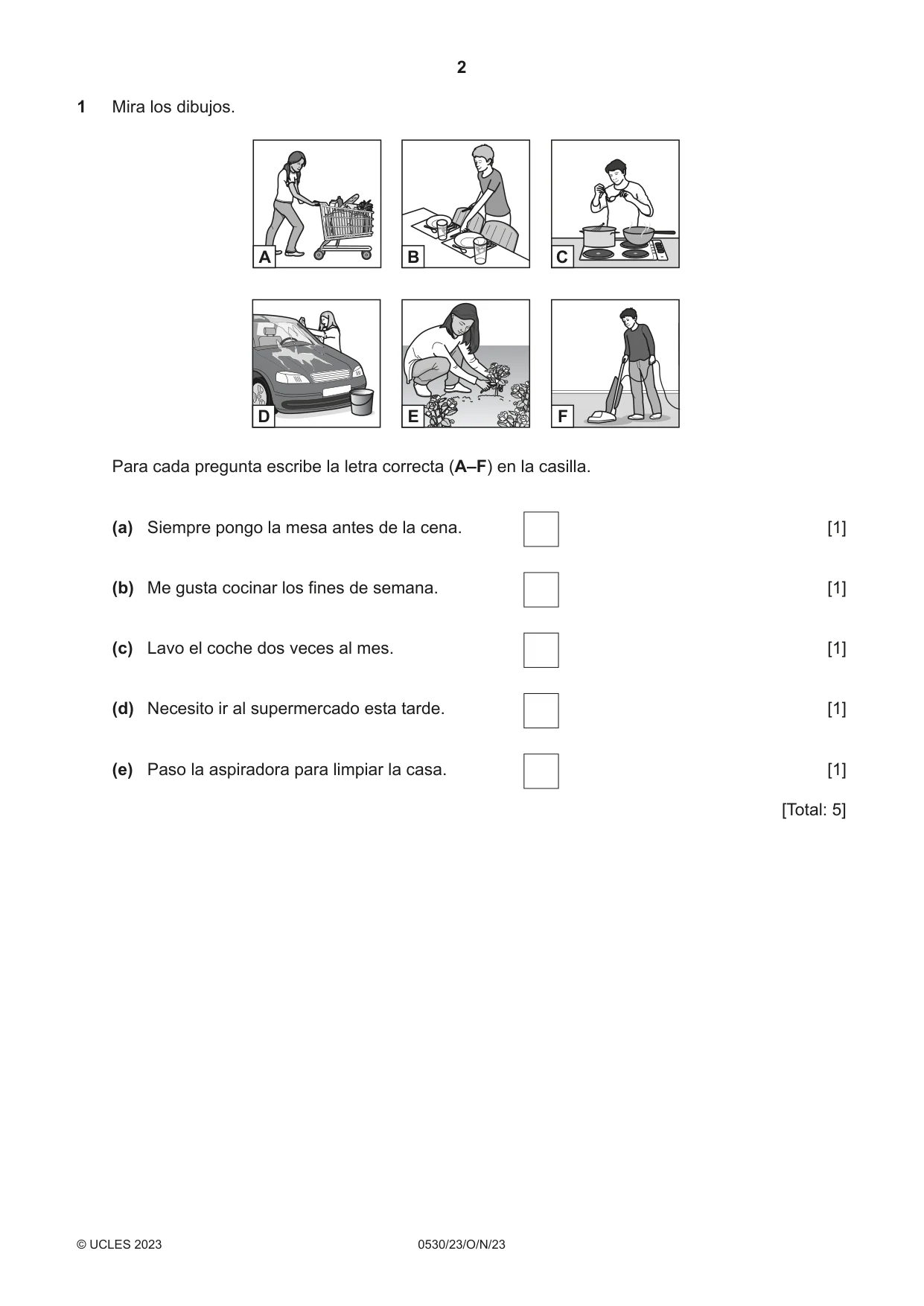
2 0530/23/ O/ N/23 © UCLES 2023 1 Mira los dibujos. C B A E D F Para cada pregunta escribe la letra correcta (A–F) en la casilla. (a) Siempre pongo la mesa antes de la cena. [1] (b) Me gusta cocinar los fines de semana. [1] (c) Lavo el coche dos veces al mes. [1] (d) Necesito ir al supermercado esta tarde. [1] (e) Paso la aspiradora para limpiar la casa. [1] [Total: 5]
Question paper, page 3
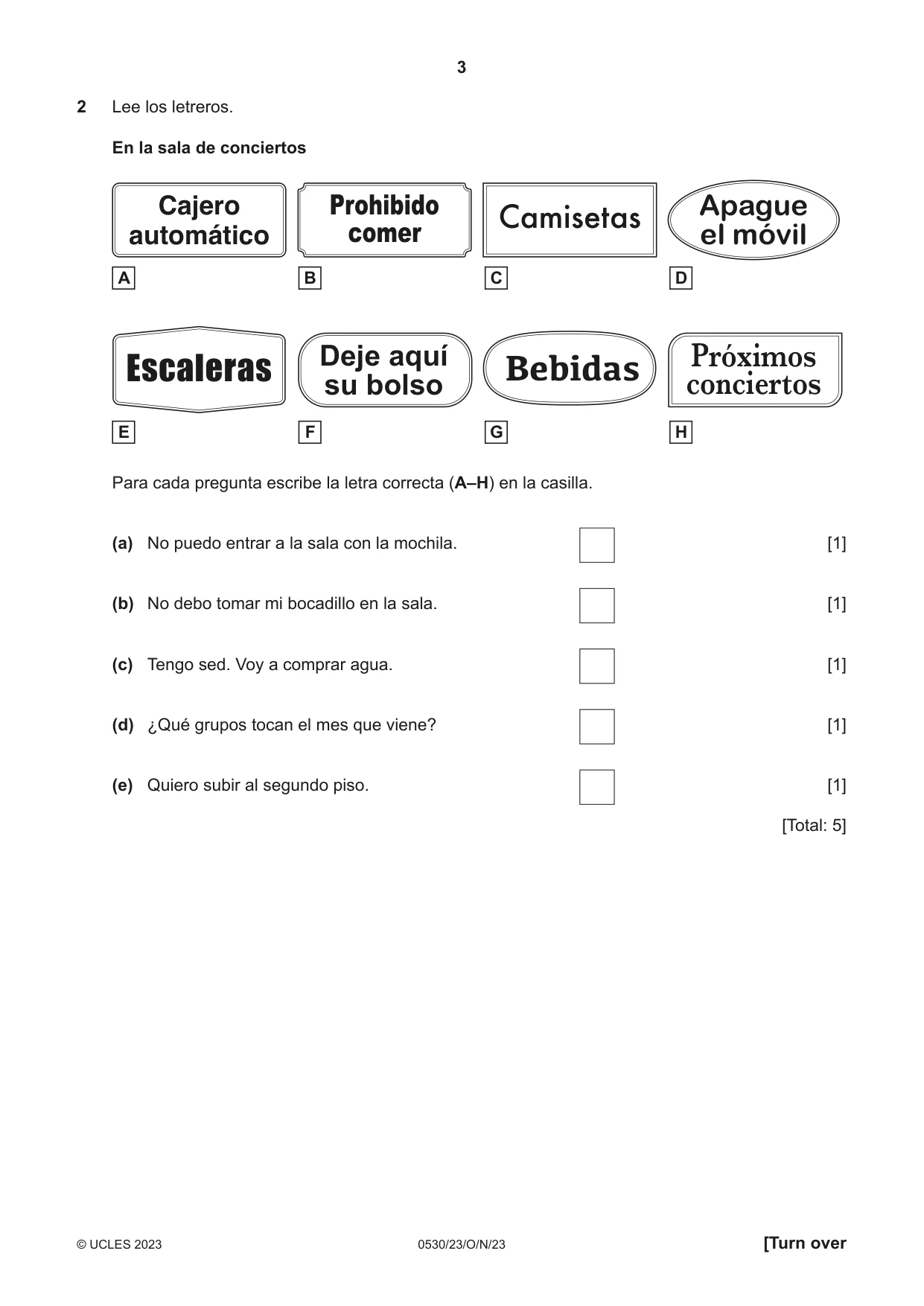
3 0530/23/O/N/23 © UCLES 2023 [Turn over 2 Lee los letreros. En la sala de conciertos Cajero automático Escaleras Deje aquí su bolso Bebidas Prohibido comer Camisetas Apague el móvil Próximos conciertos A B C D E F G H Para cada pregunta escribe la letra correcta (A–H) en la casilla. (a) No puedo entrar a la sala con la mochila. [1] (b) No debo tomar mi bocadillo en la sala. [1] (c) Tengo sed. Voy a comprar agua. [1] (d) ¿Qué grupos tocan el mes que viene? [1] (e) Quiero subir al segundo piso. [1] [Total: 5]
Question paper, page 4
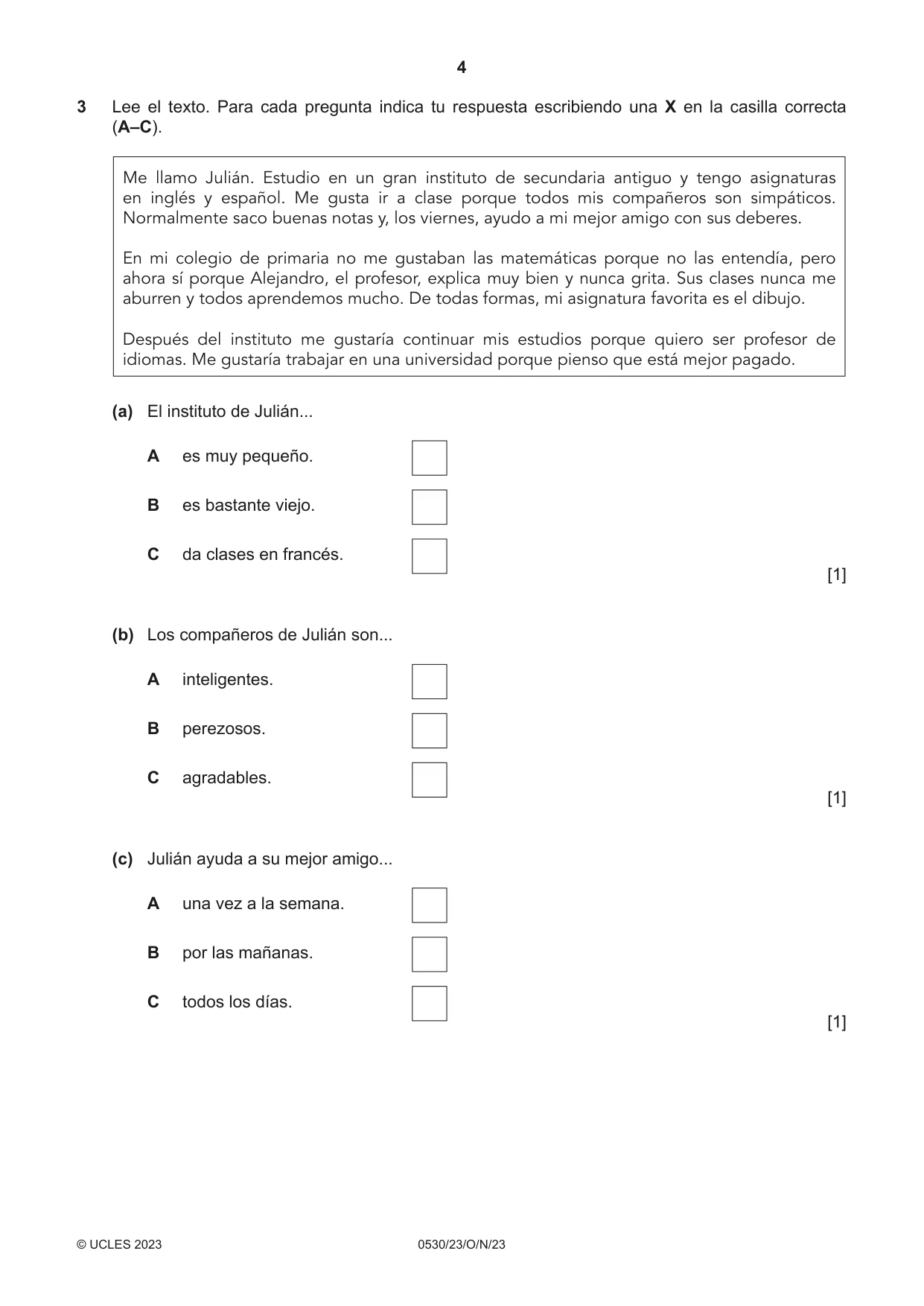
4 0530/23/O/N/23 © UCLES 2023 3 Lee el texto. Para cada pregunta indica tu respuesta escribiendo una X en la casilla correcta (A–C). Me llamo Julián. Estudio en un gran instituto de secundaria antiguo y tengo asignaturas en inglés y español. Me gusta ir a clase porque todos mis compañeros son simpáticos. Normalmente saco buenas notas y, los viernes, ayudo a mi mejor amigo con sus deberes. En mi colegio de primaria no me gustaban las matemáticas porque no las entendía, pero ahora sí porque Alejandro, el profesor, explica muy bien y nunca grita. Sus clases nunca me aburren y todos aprendemos mucho. De todas formas, mi asignatura favorita es el dibujo. Después del instituto me gustaría continuar mis estudios porque quiero ser profesor de idiomas. Me gustaría trabajar en una universidad porque pienso que está mejor pagado. (a) El instituto de Julián... A es muy pequeño. B es bastante viejo. C da clases en francés. [1] (b) Los compañeros de Julián son... A inteligentes. B perezosos. C agradables. [1] (c) Julián ayuda a su mejor amigo... A una vez a la semana. B por las mañanas. C todos los días. [1]
Question paper, page 5
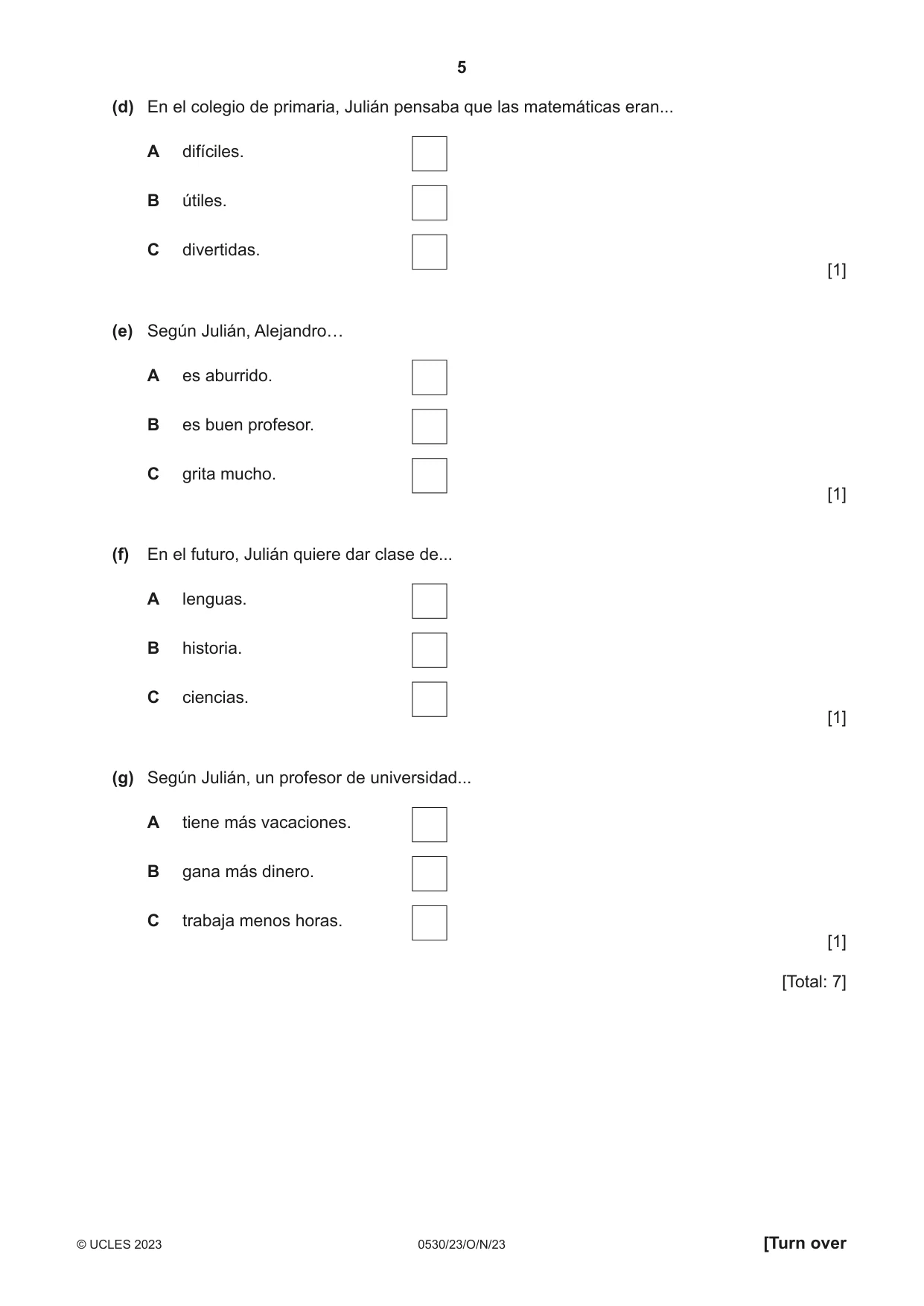
5 0530/23/O/N/23 © UCLES 2023 [Turn over (d) En el colegio de primaria, Julián pensaba que las matemáticas eran... A difíciles. B útiles. C divertidas. [1] (e) Según Julián, Alejandro… A es aburrido. B es buen profesor. C grita mucho. [1] (f) En el futuro, Julián quiere dar clase de... A lenguas. B historia. C ciencias. [1] (g) Según Julián, un profesor de universidad... A tiene más vacaciones. B gana más dinero. C trabaja menos horas. [1] [Total: 7]
Question paper, page 6
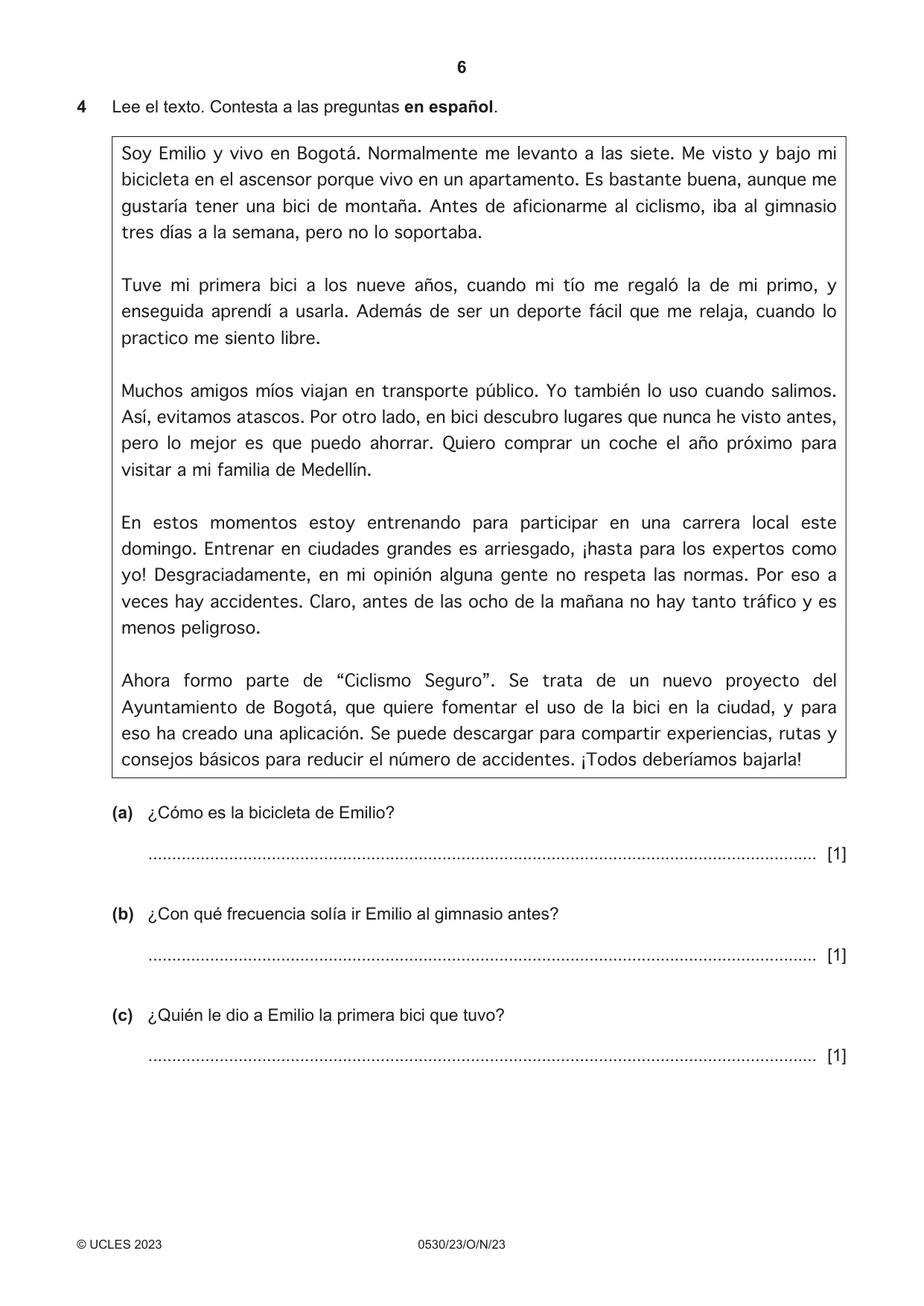
6 0530/23/O/N/23 © UCLES 2023 4 Lee el texto. Contesta a las preguntas en español. Soy Emilio y vivo en Bogotá. Normalmente me levanto a las siete. Me visto y bajo mi bicicleta en el ascensor porque vivo en un apartamento. Es bastante buena, aunque me gustaría tener una bici de montaña. Antes de aficionarme al ciclismo, iba al gimnasio tres días a la semana, pero no lo soportaba. Tuve mi primera bici a los nueve años, cuando mi tío me regaló la de mi primo, y enseguida aprendí a usarla. Además de ser un deporte fácil que me relaja, cuando lo practico me siento libre. Muchos amigos míos viajan en transporte público. Yo también lo uso cuando salimos. Así, evitamos atascos. Por otro lado, en bici descubro lugares que nunca he visto antes, pero lo mejor es que puedo ahorrar. Quiero comprar un coche el año próximo para visitar a mi familia de Medellín. En estos momentos estoy entrenando para participar en una carrera local este domingo. Entrenar en ciudades grandes es arriesgado, ¡hasta para los expertos como yo! Desgraciadamente, en mi opinión alguna gente no respeta las normas. Por eso a veces hay accidentes. Claro, antes de las ocho de la mañana no hay tanto tráfico y es menos peligroso. Ahora formo parte de “Ciclismo Seguro”. Se trata de un nuevo proyecto del Ayuntamiento de Bogotá, que quiere fomentar el uso de la bici en la ciudad, y para eso ha creado una aplicación. Se puede descargar para compartir experiencias, rutas y consejos básicos para reducir el número de accidentes. ¡Todos deberíamos bajarla! (a) ¿Cómo es la bicicleta de Emilio? … [1] (b) ¿Con qué frecuencia solía ir Emilio al gimnasio antes? … [1] (c) ¿Quién le dio a Emilio la primera bici que tuvo? … [1]
Question paper, page 7
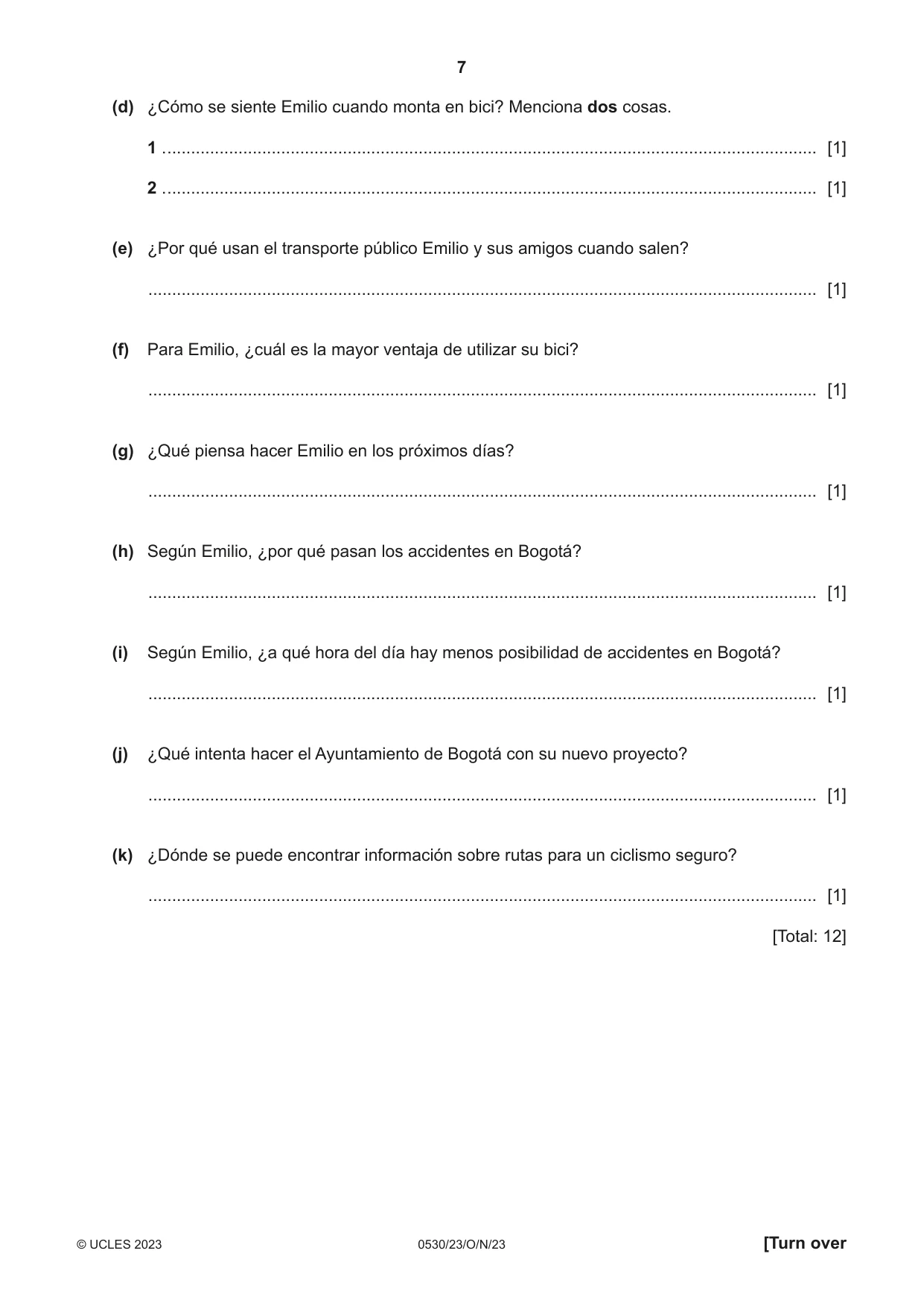
7 0530/23/O/N/23 © UCLES 2023 [Turn over (d) ¿Cómo se siente Emilio cuando monta en bici? Menciona dos cosas. 1 . … [1] 2 . … [1] (e) ¿Por qué usan el transporte público Emilio y sus amigos cuando salen? … [1] (f) Para Emilio, ¿cuál es la mayor ventaja de utilizar su bici? … [1] (g) ¿Qué piensa hacer Emilio en los próximos días? … [1] (h) Según Emilio, ¿por qué pasan los accidentes en Bogotá? … [1] (i) Según Emilio, ¿a qué hora del día hay menos posibilidad de accidentes en Bogotá? … [1] (j) ¿Qué intenta hacer el Ayuntamiento de Bogotá con su nuevo proyecto? … [1] (k) ¿Dónde se puede encontrar información sobre rutas para un ciclismo seguro? … [1] [Total: 12]
Question paper, page 8
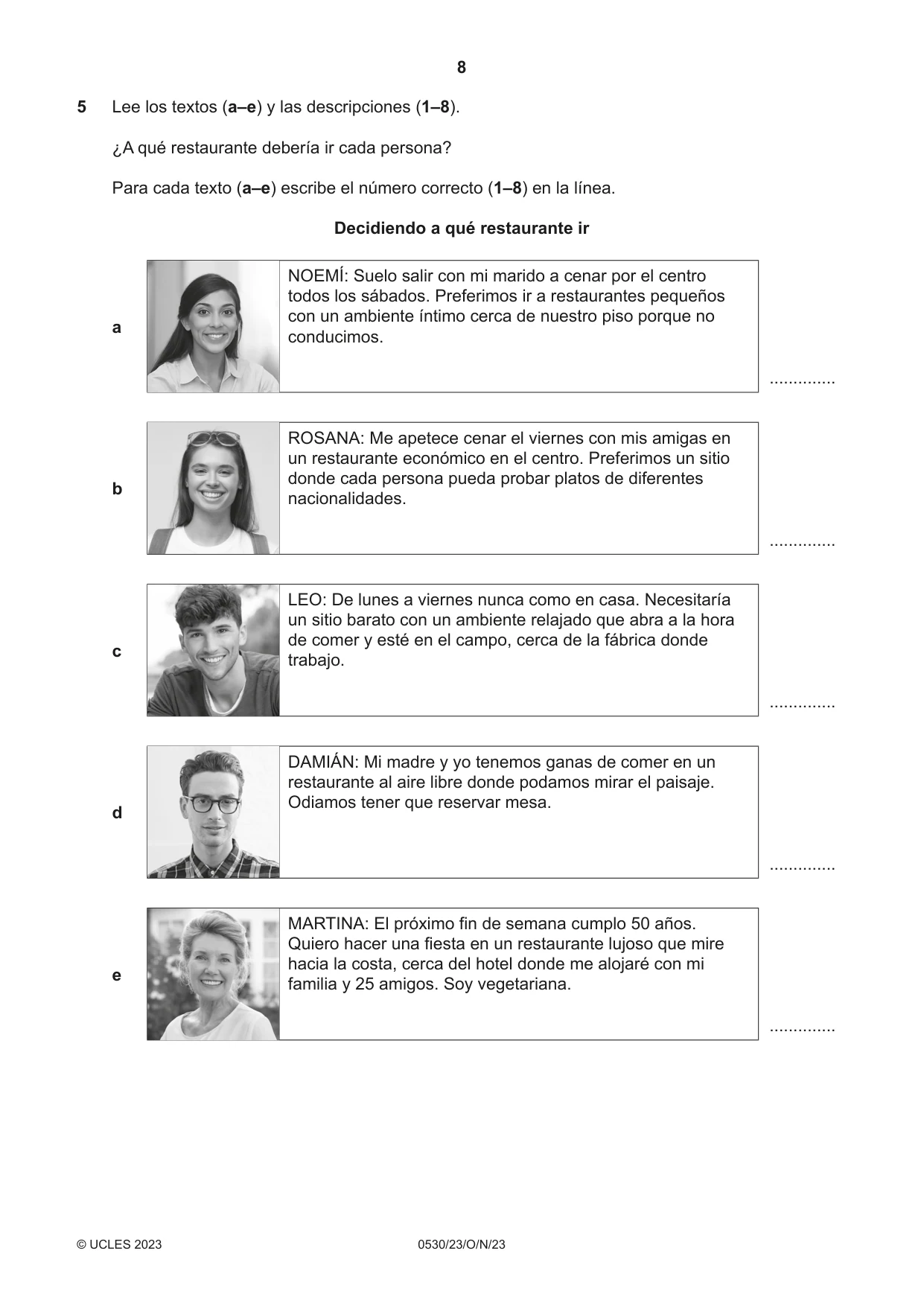
8 0530/23/O/N/23 © UCLES 2023 5 Lee los textos (a–e) y las descripciones (1–8). ¿A qué restaurante debería ir cada persona? Para cada texto (a–e) escribe el número correcto (1–8) en la línea. Decidiendo a qué restaurante ir a NOEMÍ: Suelo salir con mi marido a cenar por el centro todos los sábados. Preferimos ir a restaurantes pequeños con un ambiente íntimo cerca de nuestro piso porque no conducimos. … b ROSANA: Me apetece cenar el viernes con mis amigas en un restaurante económico en el centro. Preferimos un sitio donde cada persona pueda probar platos de diferentes nacionalidades. … c LEO: De lunes a viernes nunca como en casa. Necesitaría un sitio barato con un ambiente relajado que abra a la hora de comer y esté en el campo, cerca de la fábrica donde trabajo. … d DAMIÁN: Mi madre y yo tenemos ganas de comer en un restaurante al aire libre donde podamos mirar el paisaje. Odiamos tener que reservar mesa. … e MARTINA: El próximo fin de semana cumplo 50 años. Quiero hacer una fiesta en un restaurante lujoso que mire hacia la costa, cerca del hotel donde me alojaré con mi familia y 25 amigos. Soy vegetariana. …
Question paper, page 9
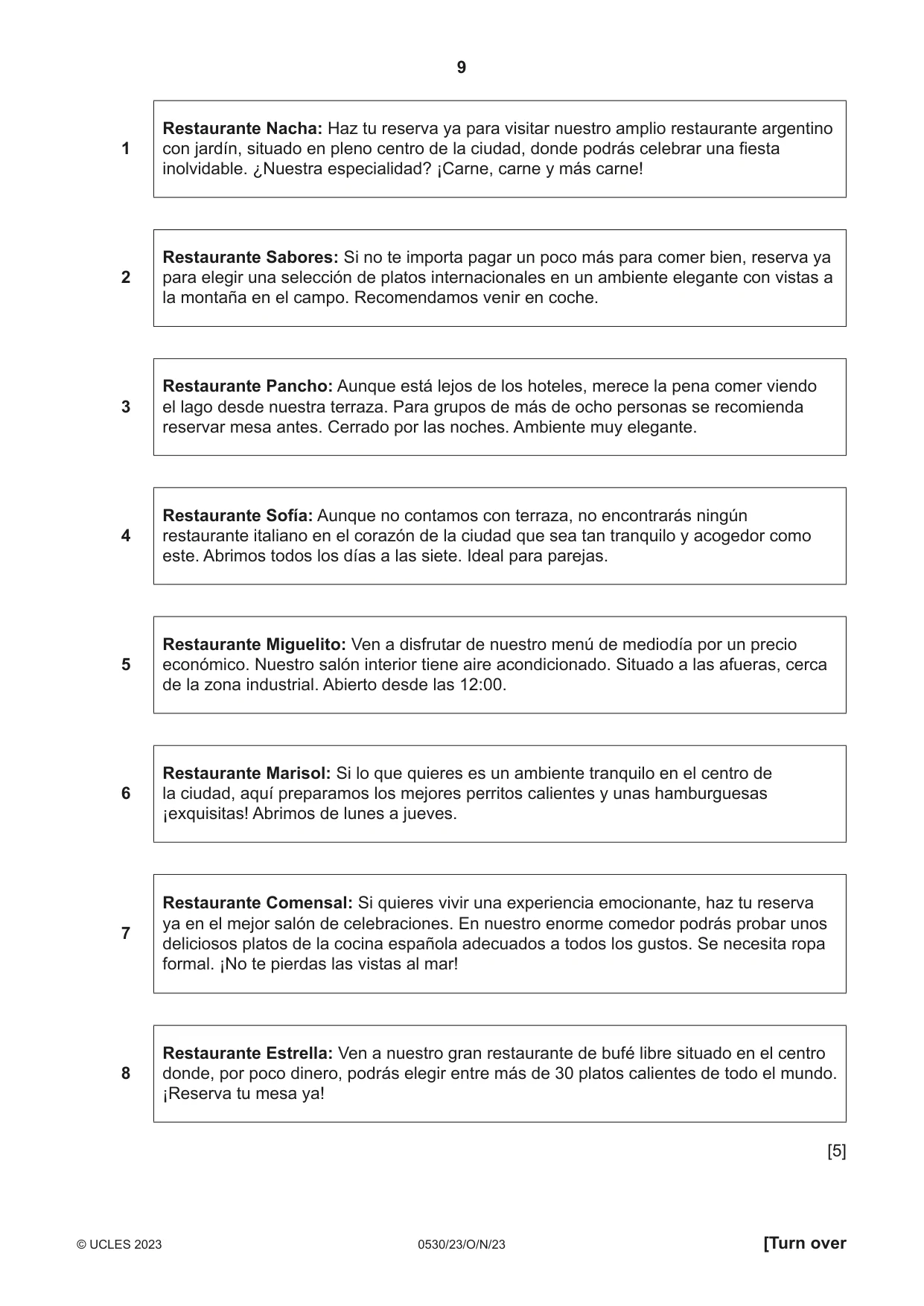
9 0530/23/O/N/23 © UCLES 2023 [Turn over 1 Restaurante Nacha: Haz tu reserva ya para visitar nuestro amplio restaurante argentino con jardín, situado en pleno centro de la ciudad, donde podrás celebrar una fiesta inolvidable. ¿Nuestra especialidad? ¡Carne, carne y más carne! 2 Restaurante Sabores: Si no te importa pagar un poco más para comer bien, reserva ya para elegir una selección de platos internacionales en un ambiente elegante con vistas a la montaña en el campo. Recomendamos venir en coche. 3 Restaurante Pancho: Aunque está lejos de los hoteles, merece la pena comer viendo el lago desde nuestra terraza. Para grupos de más de ocho personas se recomienda reservar mesa antes. Cerrado por las noches. Ambiente muy elegante. 4 Restaurante Sofía: Aunque no contamos con terraza, no encontrarás ningún restaurante italiano en el corazón de la ciudad que sea tan tranquilo y acogedor como este. Abrimos todos los días a las siete. Ideal para parejas. 5 Restaurante Miguelito: Ven a disfrutar de nuestro menú de mediodía por un precio económico. Nuestro salón interior tiene aire acondicionado. Situado a las afueras, cerca de la zona industrial. Abierto desde las 12:00. 6 Restaurante Marisol: Si lo que quieres es un ambiente tranquilo en el centro de la ciudad, aquí preparamos los mejores perritos calientes y unas hamburguesas ¡exquisitas! Abrimos de lunes a jueves. 7 Restaurante Comensal: Si quieres vivir una experiencia emocionante, haz tu reserva ya en el mejor salón de celebraciones. En nuestro enorme comedor podrás probar unos deliciosos platos de la cocina española adecuados a todos los gustos. Se necesita ropa formal. ¡No te pierdas las vistas al mar! 8 Restaurante Estrella: Ven a nuestro gran restaurante de bufé libre situado en el centro donde, por poco dinero, podrás elegir entre más de 30 platos calientes de todo el mundo. ¡Reserva tu mesa ya! [5]
Question paper, page 10
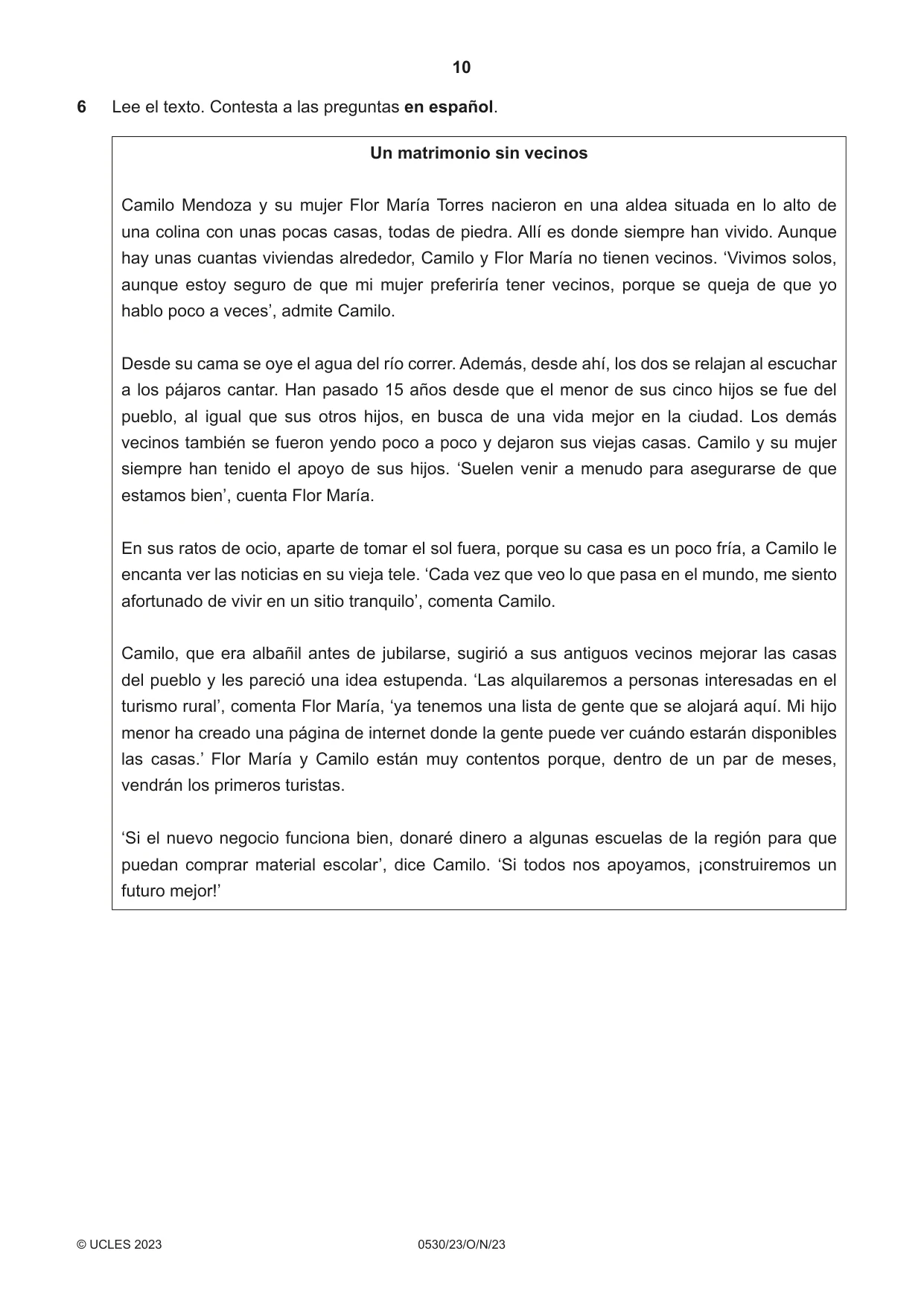
10 0530/23/O/N/23 © UCLES 2023 6 Lee el texto. Contesta a las preguntas en español. Un matrimonio sin vecinos Camilo Mendoza y su mujer Flor María Torres nacieron en una aldea situada en lo alto de una colina con unas pocas casas, todas de piedra. Allí es donde siempre han vivido. Aunque hay unas cuantas viviendas alrededor, Camilo y Flor María no tienen vecinos. ‘Vivimos solos, aunque estoy seguro de que mi mujer preferiría tener vecinos, porque se queja de que yo hablo poco a veces’, admite Camilo. Desde su cama se oye el agua del río correr. Además, desde ahí, los dos se relajan al escuchar a los pájaros cantar. Han pasado 15 años desde que el menor de sus cinco hijos se fue del pueblo, al igual que sus otros hijos, en busca de una vida mejor en la ciudad. Los demás vecinos también se fueron yendo poco a poco y dejaron sus viejas casas. Camilo y su mujer siempre han tenido el apoyo de sus hijos. ‘Suelen venir a menudo para asegurarse de que estamos bien’, cuenta Flor María. En sus ratos de ocio, aparte de tomar el sol fuera, porque su casa es un poco fría, a Camilo le encanta ver las noticias en su vieja tele. ‘Cada vez que veo lo que pasa en el mundo, me siento afortunado de vivir en un sitio tranquilo’, comenta Camilo. Camilo, que era albañil antes de jubilarse, sugirió a sus antiguos vecinos mejorar las casas del pueblo y les pareció una idea estupenda. ‘Las alquilaremos a personas interesadas en el turismo rural’, comenta Flor María, ‘ya tenemos una lista de gente que se alojará aquí. Mi hijo menor ha creado una página de internet donde la gente puede ver cuándo estarán disponibles las casas.’ Flor María y Camilo están muy contentos porque, dentro de un par de meses, vendrán los primeros turistas. ‘Si el nuevo negocio funciona bien, donaré dinero a algunas escuelas de la región para que puedan comprar material escolar’, dice Camilo. ‘Si todos nos apoyamos, ¡construiremos un futuro mejor!’
Question paper, page 11
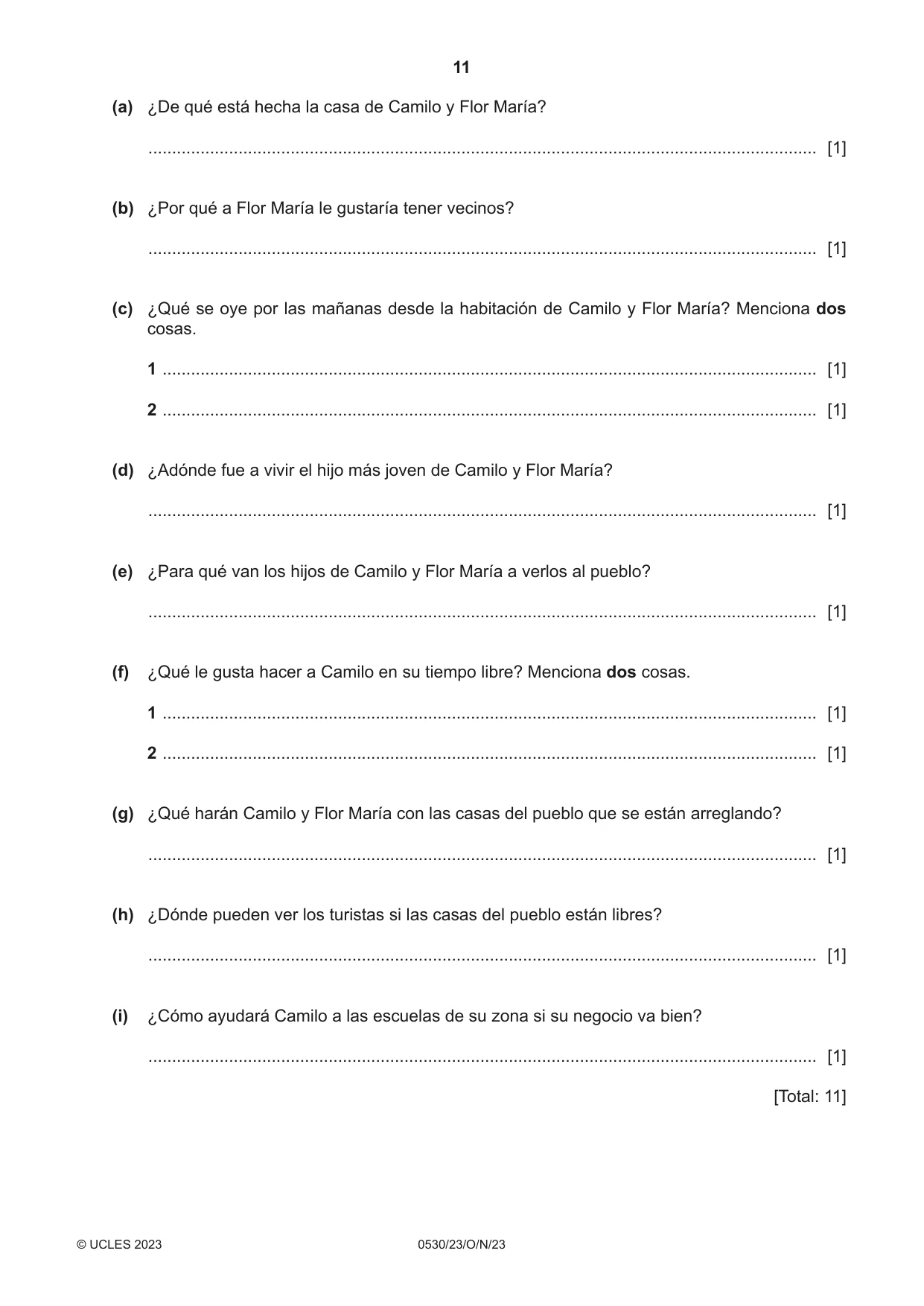
11 0530/23/O/N/23 © UCLES 2023 (a) ¿De qué está hecha la casa de Camilo y Flor María? … [1] (b) ¿Por qué a Flor María le gustaría tener vecinos? … [1] (c) ¿Qué se oye por las mañanas desde la habitación de Camilo y Flor María? Menciona dos cosas. 1 … [1] 2 … [1] (d) ¿Adónde fue a vivir el hijo más joven de Camilo y Flor María? … [1] (e) ¿Para qué van los hijos de Camilo y Flor María a verlos al pueblo? … [1] (f) ¿Qué le gusta hacer a Camilo en su tiempo libre? Menciona dos cosas. 1 … [1] 2 … [1] (g) ¿Qué harán Camilo y Flor María con las casas del pueblo que se están arreglando? … [1] (h) ¿Dónde pueden ver los turistas si las casas del pueblo están libres? … [1] (i) ¿Cómo ayudará Camilo a las escuelas de su zona si su negocio va bien? … [1] [Total: 11]
Question paper, page 12
12 0530/23/O/N/23 © UCLES 2023 Permission to reproduce items where third-party owned material protected by copyright is included has been sought and cleared where possible. Every reasonable effort has been made by the publisher (UCLES) to trace copyright holders, but if any items requiring clearance have unwittingly been included, the publisher will be pleased to make amends at the earliest possible opportunity. To avoid the issue of disclosure of answer-related information to candidates, all copyright acknowledgements are reproduced online in the Cambridge Assessment International Education Copyright Acknowledgements Booklet. This is produced for each series of examinations and is freely available to download at www.cambridgeinternational.org after the live examination series. Cambridge Assessment International Education is part of Cambridge Assessment. Cambridge Assessment is the brand name of the University of Cambridge Local Examinations Syndicate (UCLES), which is a department of the University of Cambridge. BLANK PAGE
Mark scheme, page 1
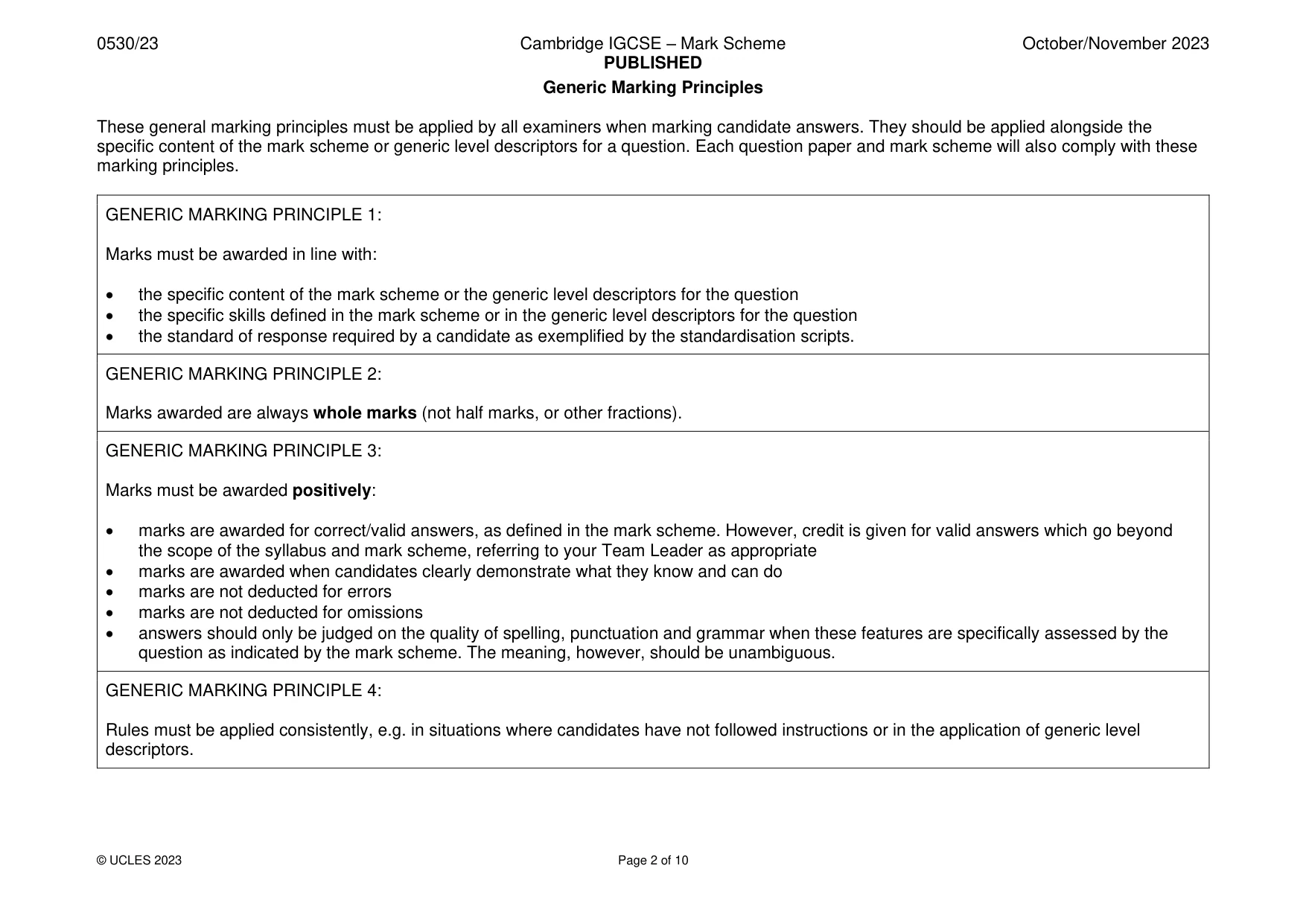
This document consists of 10 printed pages. © UCLES 2023 [Turn over Cambridge IGCSE™ SPANISH 0530/23 Paper 2 Reading October/November 2023 MARK SCHEME Maximum Mark: 45 Published This mark scheme is published as an aid to teachers and candidates, to indicate the requirements of the examination. It shows the basis on which Examiners were instructed to award marks. It does not indicate the details of the discussions that took place at an Examiners’ meeting before marking began, which would have considered the acceptability of alternative answers. Mark schemes should be read in conjunction with the question paper and the Principal Examiner Report for Teachers. Cambridge International will not enter into discussions about these mark schemes. Cambridge International is publishing the mark schemes for the October/November 2023 series for most Cambridge IGCSE, Cambridge International A and AS Level components, and some Cambridge O Level components.
Mark scheme, page 2
0530/23 Cambridge IGCSE – Mark Scheme PUBLISHED October/November 2023 © UCLES 2023 Page 2 of 10 Generic Marking Principles These general marking principles must be applied by all examiners when marking candidate answers. They should be applied alongside the specific content of the mark scheme or generic level descriptors for a question. Each question paper and mark scheme will also comply with these marking principles. GENERIC MARKING PRINCIPLE 1: Marks must be awarded in line with: • the specific content of the mark scheme or the generic level descriptors for the question • the specific skills defined in the mark scheme or in the generic level descriptors for the question • the standard of response required by a candidate as exemplified by the standardisation scripts. GENERIC MARKING PRINCIPLE 2: Marks awarded are always whole marks (not half marks, or other fractions). GENERIC MARKING PRINCIPLE 3: Marks must be awarded positively: • marks are awarded for correct/valid answers, as defined in the mark scheme. However, credit is given for valid answers which go beyond the scope of the syllabus and mark scheme, referring to your Team Leader as appropriate • marks are awarded when candidates clearly demonstrate what they know and can do • marks are not deducted for errors • marks are not deducted for omissions • answers should only be judged on the quality of spelling, punctuation and grammar when these features are specifically assessed by the question as indicated by the mark scheme. The meaning, however, should be unambiguous. GENERIC MARKING PRINCIPLE 4: Rules must be applied consistently, e.g. in situations where candidates have not followed instructions or in the application of generic level descriptors.
Mark scheme, page 3
0530/23 Cambridge IGCSE – Mark Scheme PUBLISHED October/November 2023 © UCLES 2023 Page 3 of 10 GENERIC MARKING PRINCIPLE 5: Marks should be awarded using the full range of marks defined in the mark scheme for the question (however; the use of the full mark range may be limited according to the quality of the candidate responses seen). GENERIC MARKING PRINCIPLE 6: Marks awarded are based solely on the requirements as defined in the mark scheme. Marks should not be awarded with grade thresholds or grade descriptors in mind.
Mark scheme, page 4
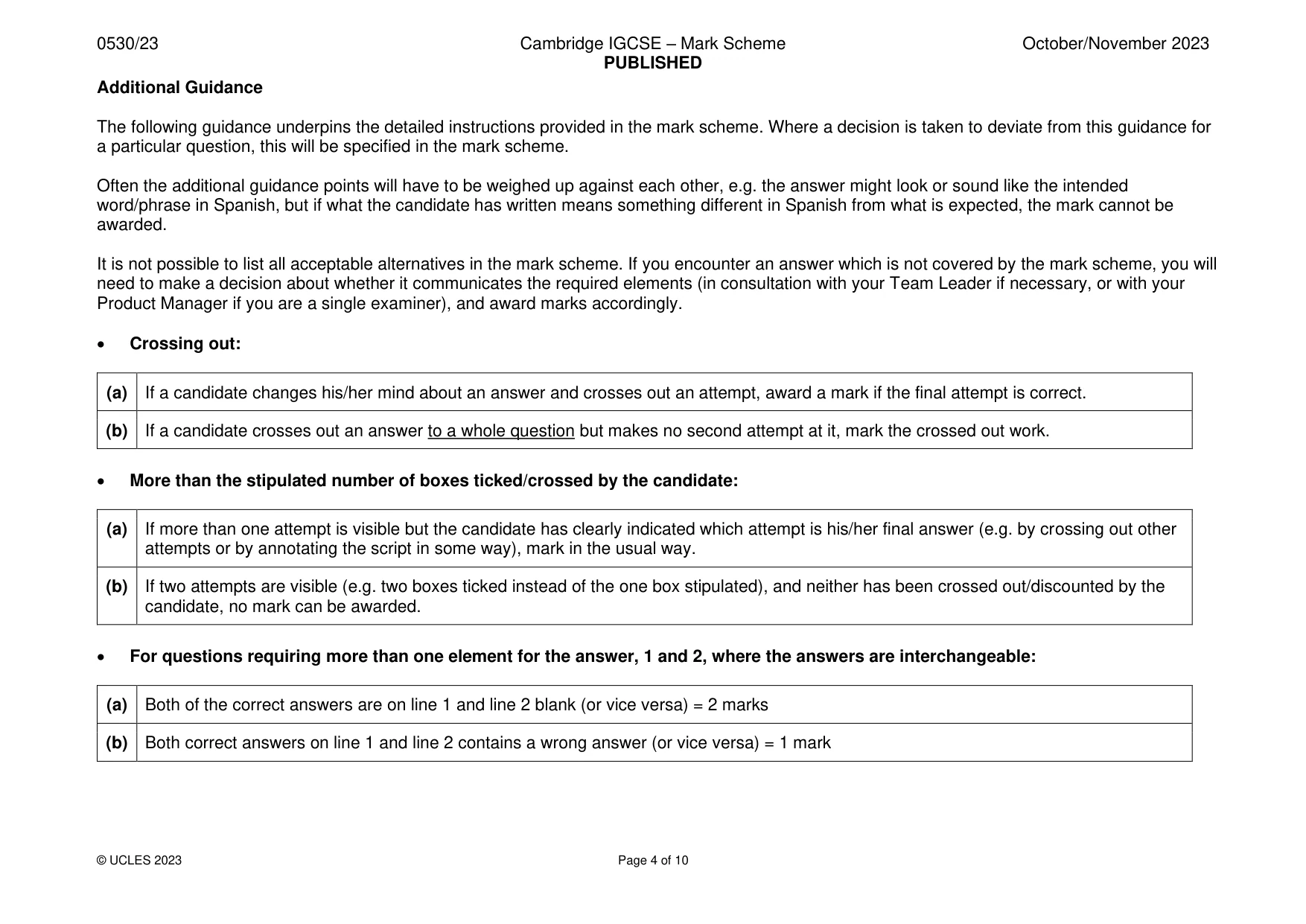
0530/23 Cambridge IGCSE – Mark Scheme PUBLISHED October/November 2023 © UCLES 2023 Page 4 of 10 Additional Guidance The following guidance underpins the detailed instructions provided in the mark scheme. Where a decision is taken to deviate from this guidance for a particular question, this will be specified in the mark scheme. Often the additional guidance points will have to be weighed up against each other, e.g. the answer might look or sound like the intended word/phrase in Spanish, but if what the candidate has written means something different in Spanish from what is expected, the mark cannot be awarded. It is not possible to list all acceptable alternatives in the mark scheme. If you encounter an answer which is not covered by the mark scheme, you will need to make a decision about whether it communicates the required elements (in consultation with your Team Leader if necessary, or with your Product Manager if you are a single examiner), and award marks accordingly. • Crossing out: (a) If a candidate changes his/her mind about an answer and crosses out an attempt, award a mark if the final attempt is correct. (b) If a candidate crosses out an answer to a whole question but makes no second attempt at it, mark the crossed out work. • More than the stipulated number of boxes ticked/crossed by the candidate: (a) If more than one attempt is visible but the candidate has clearly indicated which attempt is his/her final answer (e.g. by crossing out other attempts or by annotating the script in some way), mark in the usual way. (b) If two attempts are visible (e.g. two boxes ticked instead of the one box stipulated), and neither has been crossed out/discounted by the candidate, no mark can be awarded. • For questions requiring more than one element for the answer, 1 and 2, where the answers are interchangeable: (a) Both of the correct answers are on line 1 and line 2 blank (or vice versa) = 2 marks (b) Both correct answers on line 1 and line 2 contains a wrong answer (or vice versa) = 1 mark
Mark scheme, page 5
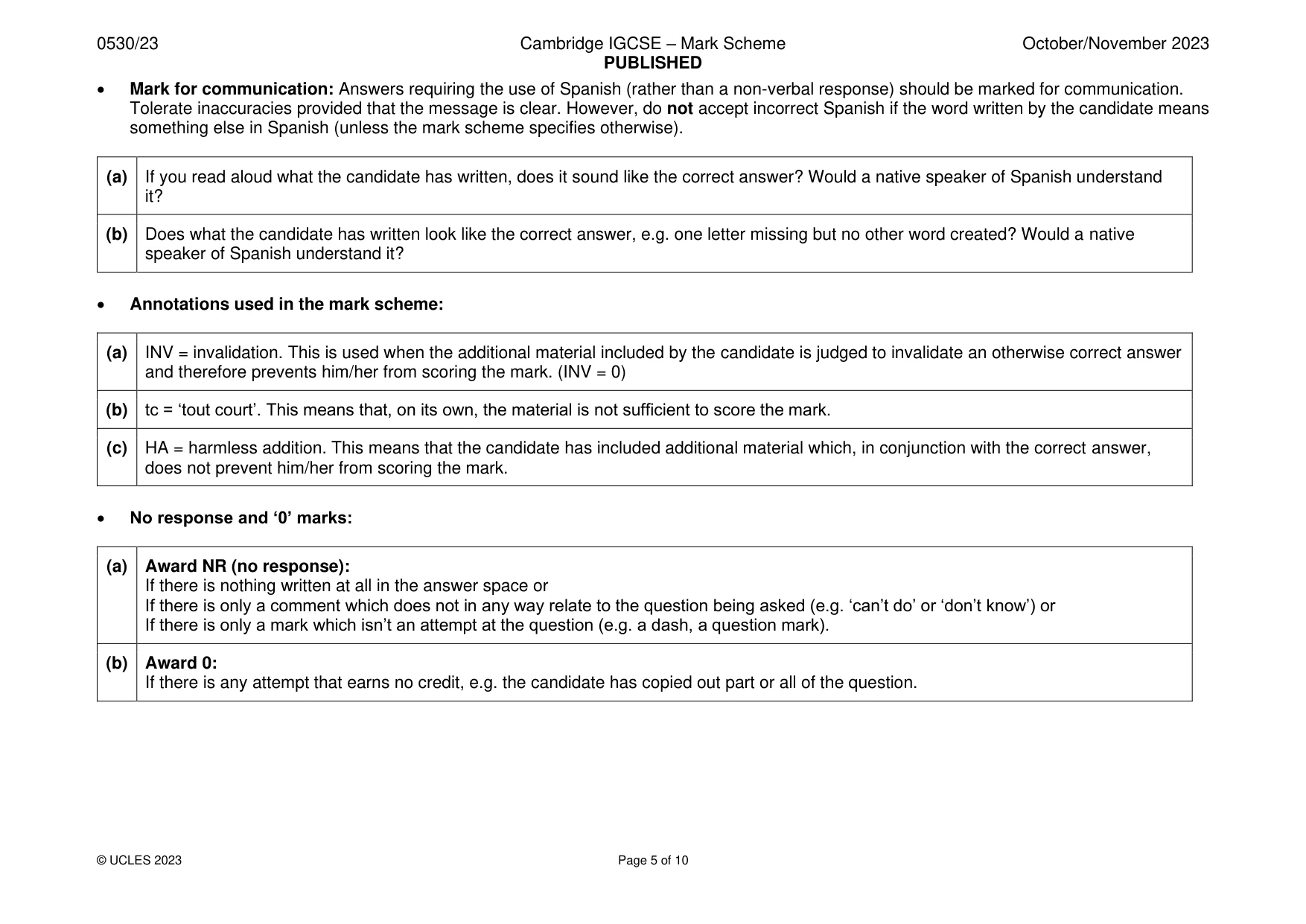
0530/23 Cambridge IGCSE – Mark Scheme PUBLISHED October/November 2023 © UCLES 2023 Page 5 of 10 • Mark for communication: Answers requiring the use of Spanish (rather than a non-verbal response) should be marked for communication. Tolerate inaccuracies provided that the message is clear. However, do not accept incorrect Spanish if the word written by the candidate means something else in Spanish (unless the mark scheme specifies otherwise). (a) If you read aloud what the candidate has written, does it sound like the correct answer? Would a native speaker of Spanish understand it? (b) Does what the candidate has written look like the correct answer, e.g. one letter missing but no other word created? Would a native speaker of Spanish understand it? • Annotations used in the mark scheme: (a) INV = invalidation. This is used when the additional material included by the candidate is judged to invalidate an otherwise correct answer and therefore prevents him/her from scoring the mark. (INV = 0) (b) tc = ‘tout court’. This means that, on its own, the material is not sufficient to score the mark. (c) HA = harmless addition. This means that the candidate has included additional material which, in conjunction with the correct answer, does not prevent him/her from scoring the mark. • No response and ‘0’ marks: (a) Award NR (no response): If there is nothing written at all in the answer space or If there is only a comment which does not in any way relate to the question being asked (e.g. ‘can’t do’ or ‘don’t know’) or If there is only a mark which isn’t an attempt at the question (e.g. a dash, a question mark). (b) Award 0: If there is any attempt that earns no credit, e.g. the candidate has copied out part or all of the question.
Mark scheme, page 6
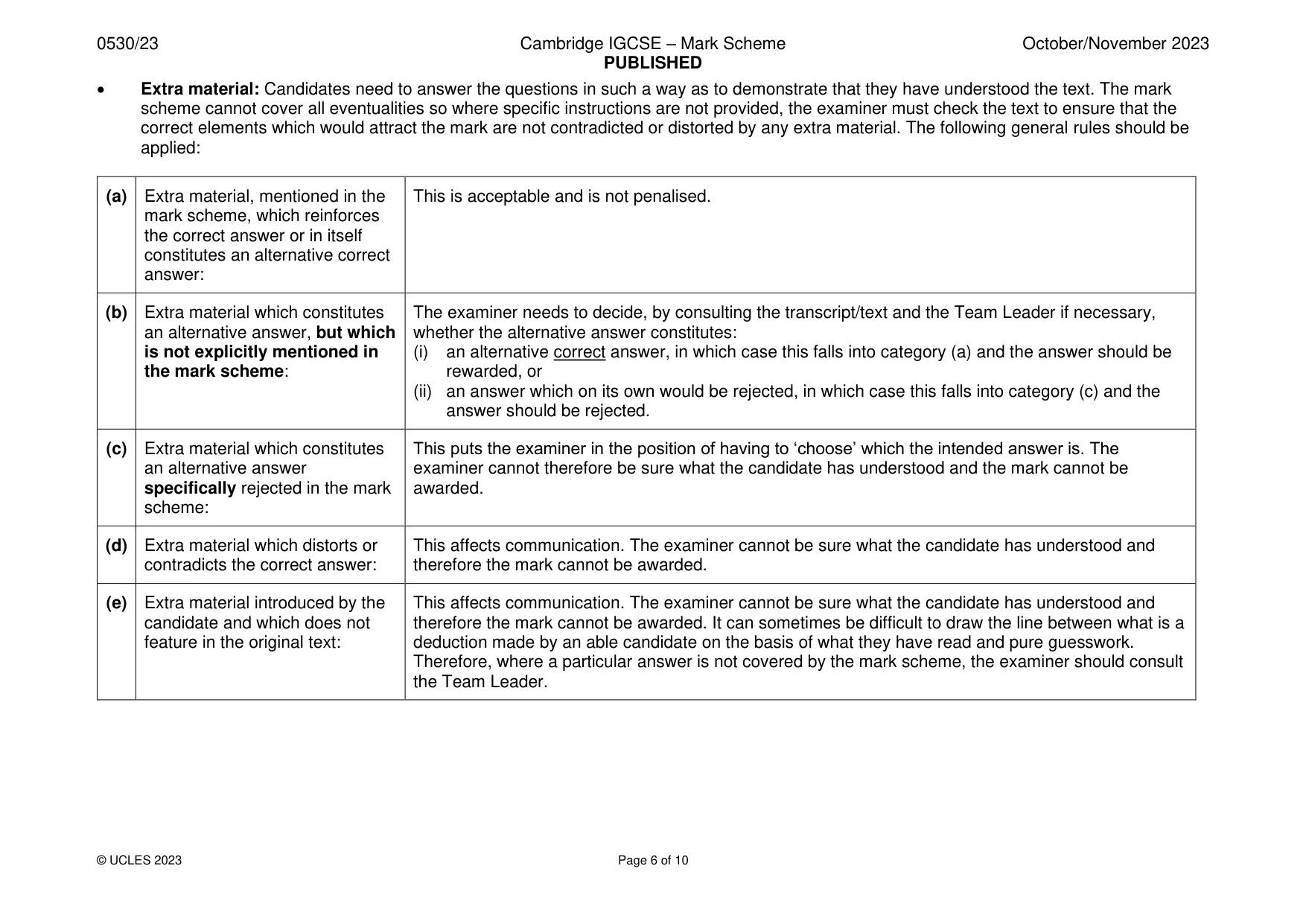
0530/23 Cambridge IGCSE – Mark Scheme PUBLISHED October/November 2023 © UCLES 2023 Page 6 of 10 • Extra material: Candidates need to answer the questions in such a way as to demonstrate that they have understood the text. The mark scheme cannot cover all eventualities so where specific instructions are not provided, the examiner must check the text to ensure that the correct elements which would attract the mark are not contradicted or distorted by any extra material. The following general rules should be applied: (a) Extra material, mentioned in the mark scheme, which reinforces the correct answer or in itself constitutes an alternative correct answer: This is acceptable and is not penalised. (b) Extra material which constitutes an alternative answer, but which is not explicitly mentioned in the mark scheme: The examiner needs to decide, by consulting the transcript/text and the Team Leader if necessary, whether the alternative answer constitutes: (i) an alternative correct answer, in which case this falls into category (a) and the answer should be rewarded, or (ii) an answer which on its own would be rejected, in which case this falls into category (c) and the answer should be rejected. (c) Extra material which constitutes an alternative answer specifically rejected in the mark scheme: This puts the examiner in the position of having to ‘choose’ which the intended answer is. The examiner cannot therefore be sure what the candidate has understood and the mark cannot be awarded. (d) Extra material which distorts or contradicts the correct answer: This affects communication. The examiner cannot be sure what the candidate has understood and therefore the mark cannot be awarded. (e) Extra material introduced by the candidate and which does not feature in the original text: This affects communication. The examiner cannot be sure what the candidate has understood and therefore the mark cannot be awarded. It can sometimes be difficult to draw the line between what is a deduction made by an able candidate on the basis of what they have read and pure guesswork. Therefore, where a particular answer is not covered by the mark scheme, the examiner should consult the Team Leader.
Mark scheme, page 7
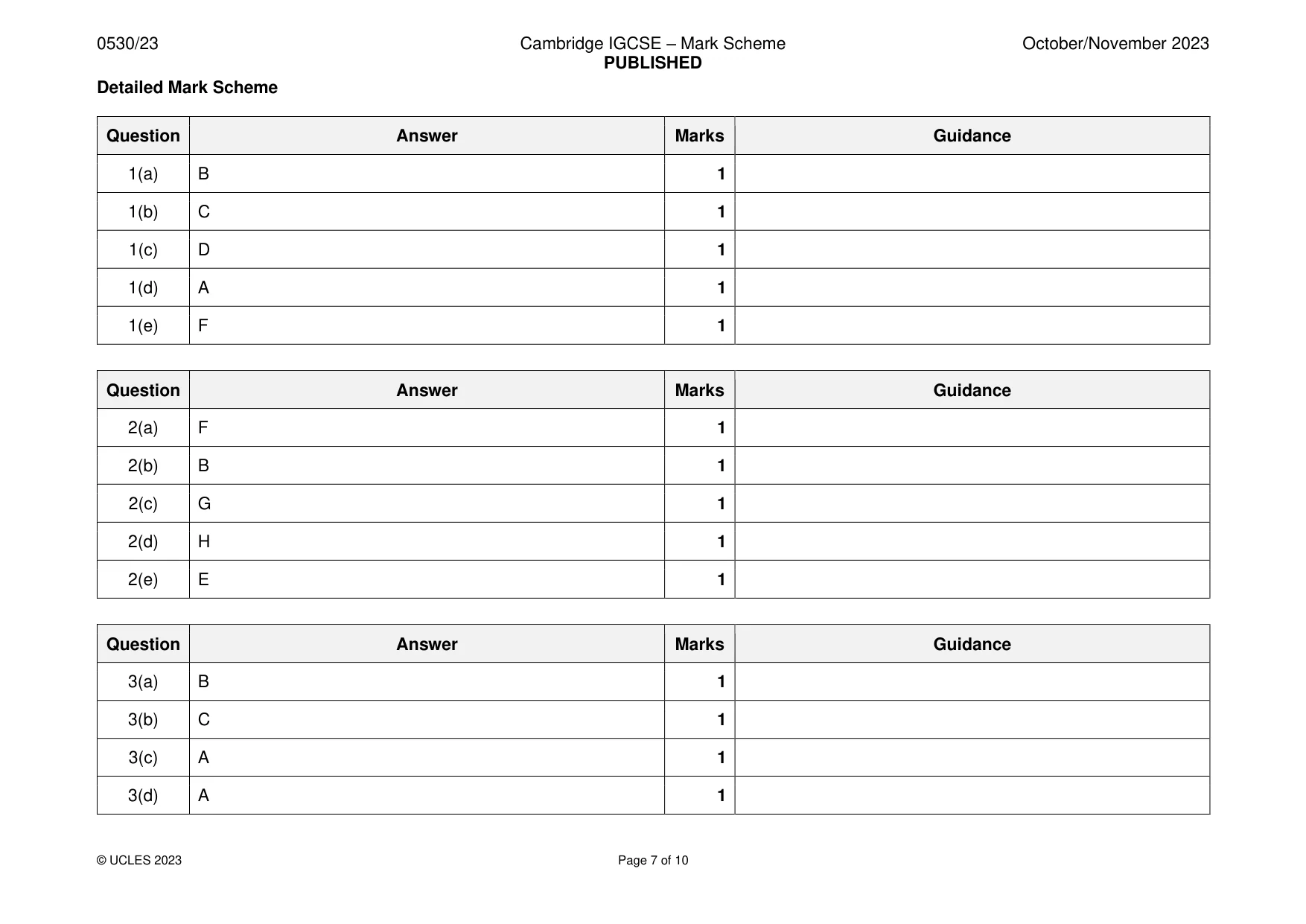
0530/23 Cambridge IGCSE – Mark Scheme PUBLISHED October/November 2023 © UCLES 2023 Page 7 of 10 Detailed Mark Scheme Question Answer Marks Guidance 1(a) B 1 1(b) C 1 1(c) D 1 1(d) A 1 1(e) F 1 Question Answer Marks Guidance 2(a) F 1 2(b) B 1 2(c) G 1 2(d) H 1 2(e) E 1 Question Answer Marks Guidance 3(a) B 1 3(b) C 1 3(c) A 1 3(d) A 1
Mark scheme, page 8
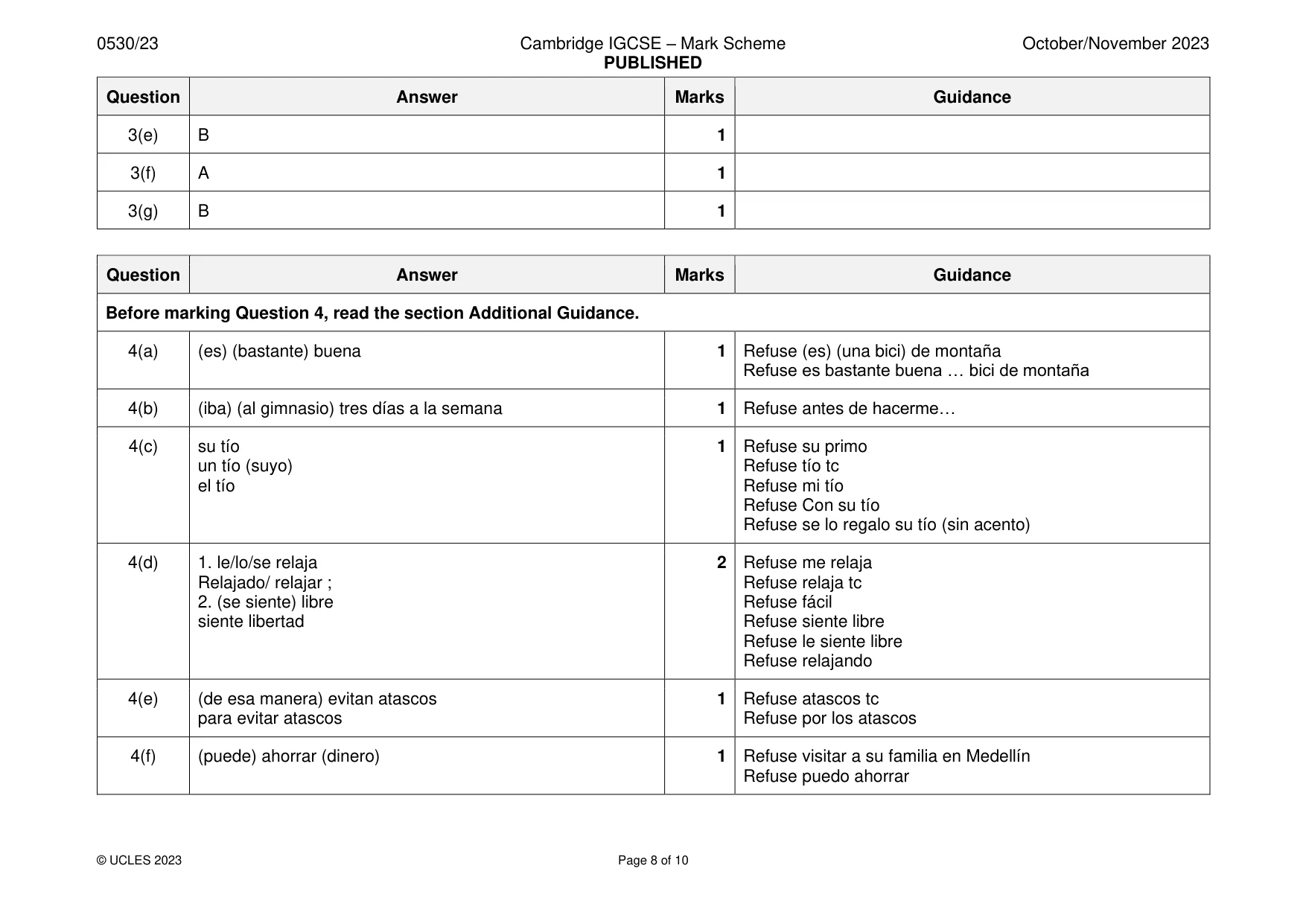
0530/23 Cambridge IGCSE – Mark Scheme PUBLISHED October/November 2023 © UCLES 2023 Page 8 of 10 Question Answer Marks Guidance 3(e) B 1 3(f) A 1 3(g) B 1 Question Answer Marks Guidance Before marking Question 4, read the section Additional Guidance. 4(a) (es) (bastante) buena 1 Refuse (es) (una bici) de montaña Refuse es bastante buena … bici de montaña 4(b) (iba) (al gimnasio) tres días a la semana 1 Refuse antes de hacerme… 4(c) su tío un tío (suyo) el tío 1 Refuse su primo Refuse tío tc Refuse mi tío Refuse Con su tío Refuse se lo regalo su tío (sin acento) 4(d) 1. le/lo/se relaja Relajado/ relajar ; 2. (se siente) libre siente libertad 2 Refuse me relaja Refuse relaja tc Refuse fácil Refuse siente libre Refuse le siente libre Refuse relajando 4(e) (de esa manera) evitan atascos para evitar atascos 1 Refuse atascos tc Refuse por los atascos 4(f) (puede) ahorrar (dinero) 1 Refuse visitar a su familia en Medellín Refuse puedo ahorrar
Mark scheme, page 9
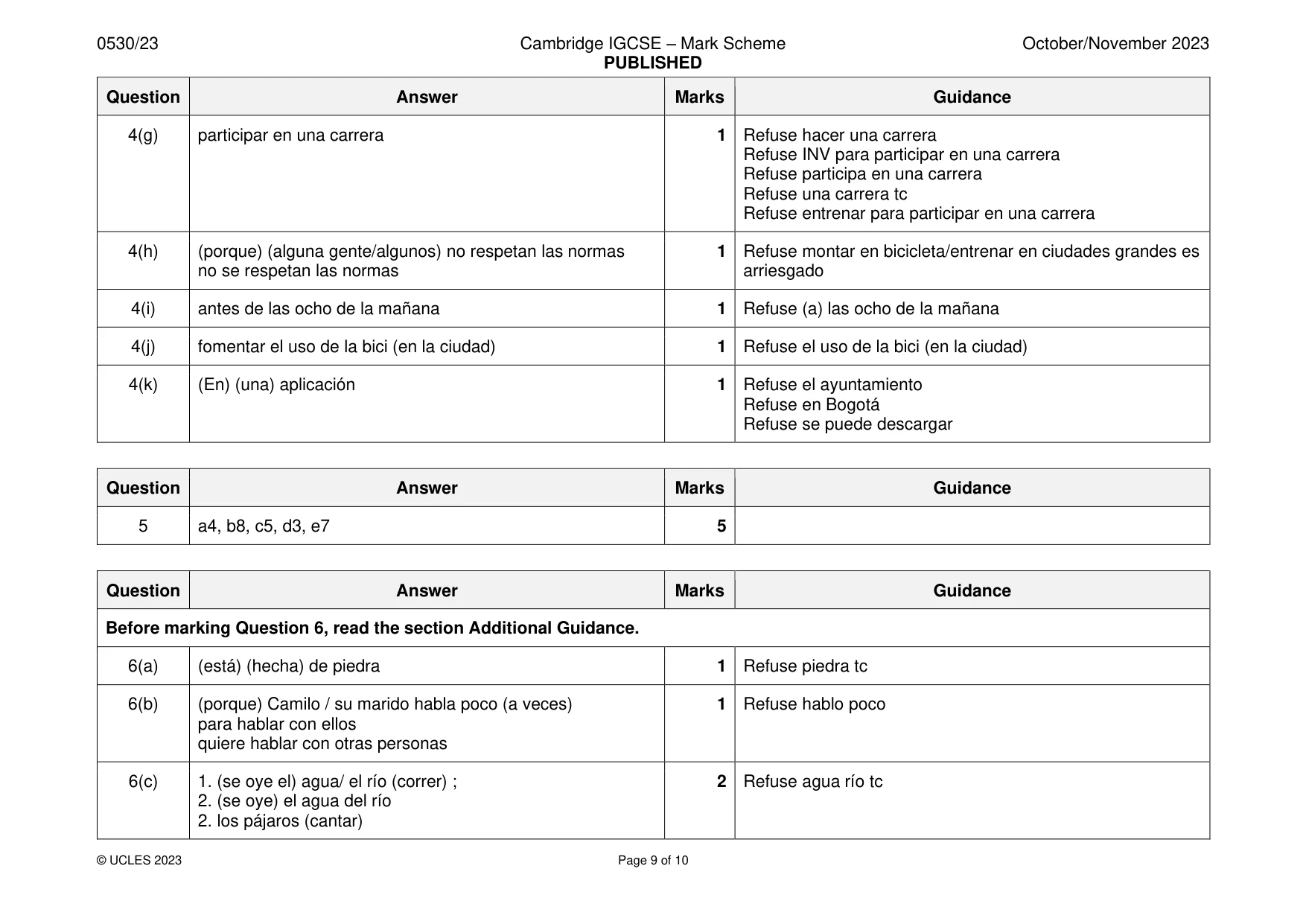
0530/23 Cambridge IGCSE – Mark Scheme PUBLISHED October/November 2023 © UCLES 2023 Page 9 of 10 Question Answer Marks Guidance 4(g) participar en una carrera 1 Refuse hacer una carrera Refuse INV para participar en una carrera Refuse participa en una carrera Refuse una carrera tc Refuse entrenar para participar en una carrera 4(h) (porque) (alguna gente/algunos) no respetan las normas no se respetan las normas 1 Refuse montar en bicicleta/entrenar en ciudades grandes es arriesgado 4(i) antes de las ocho de la mañana 1 Refuse (a) las ocho de la mañana 4(j) fomentar el uso de la bici (en la ciudad) 1 Refuse el uso de la bici (en la ciudad) 4(k) (En) (una) aplicación 1 Refuse el ayuntamiento Refuse en Bogotá Refuse se puede descargar Question Answer Marks Guidance 5 a4, b8, c5, d3, e7 5 Question Answer Marks Guidance Before marking Question 6, read the section Additional Guidance. 6(a) (está) (hecha) de piedra 1 Refuse piedra tc 6(b) (porque) Camilo / su marido habla poco (a veces) para hablar con ellos quiere hablar con otras personas 1 Refuse hablo poco 6(c) 1. (se oye el) agua/ el río (correr) ; 2. (se oye) el agua del río 2. los pájaros (cantar) 2 Refuse agua río tc
Mark scheme, page 10
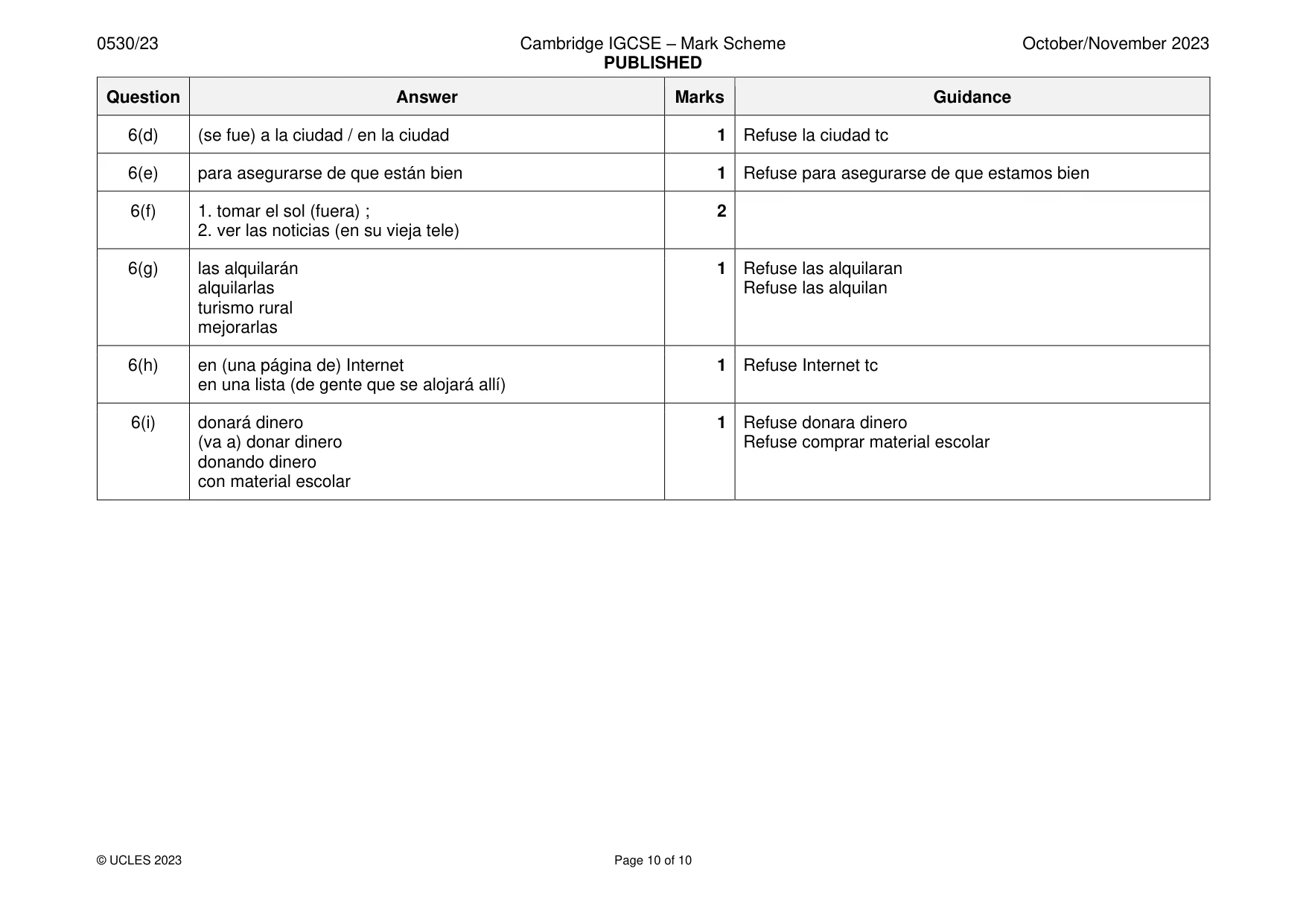
0530/23 Cambridge IGCSE – Mark Scheme PUBLISHED October/November 2023 © UCLES 2023 Page 10 of 10 Question Answer Marks Guidance 6(d) (se fue) a la ciudad / en la ciudad 1 Refuse la ciudad tc 6(e) para asegurarse de que están bien 1 Refuse para asegurarse de que estamos bien 6(f) 1. tomar el sol (fuera) ; 2. ver las noticias (en su vieja tele) 2 6(g) las alquilarán alquilarlas turismo rural mejorarlas 1 Refuse las alquilaran Refuse las alquilan 6(h) en (una página de) Internet en una lista (de gente que se alojará allí) 1 Refuse Internet tc 6(i) donará dinero (va a) donar dinero donando dinero con material escolar 1 Refuse donara dinero Refuse comprar material escolar
What you needed in this session
Cambridge’s own grade thresholds for 2023 Oct/Nov, Paper 2 · Variant 3. A higher threshold means an easier paper — the bar moves with how the cohort did.