Cambridge IGCSE Spanish - Foreign Language 0530 — 2022 May/June Paper 2 · Variant 1
0530/21/M/J/22 · 45 marks · ≈51 min
The question paper and its mark scheme, free to read here and free to download. This is Cambridge’s own paper, exactly as it was sat.
Question paper12 pages

Mark scheme11 pages
Answers below. Sit the paper first if you are practising.
Paper as text
Question paper, page 1
This document has 12 pages. Any blank pages are indicated. [Turn over Cambridge IGCSE™ * 9 6 0 3 0 4 3 8 9 6 * DC (PQ/JG) 303363/5 © UCLES 2022 SPANISH 0530/21 Paper 2 Reading May/June 2022 1 hour You must answer on the question paper. No additional materials are needed. INSTRUCTIONS ● Answer all questions. ● Use a black or dark blue pen. ● Write your name, centre number and candidate number in the boxes at the top of the page. ● Write your answer to each question in the space provided. ● Do not use an erasable pen or correction fluid. ● Do not write on any bar codes. ● Dictionaries are not allowed. INFORMATION ● The total mark for this paper is 45. ● The number of marks for each question or part question is shown in brackets [ ].
Question paper, page 2
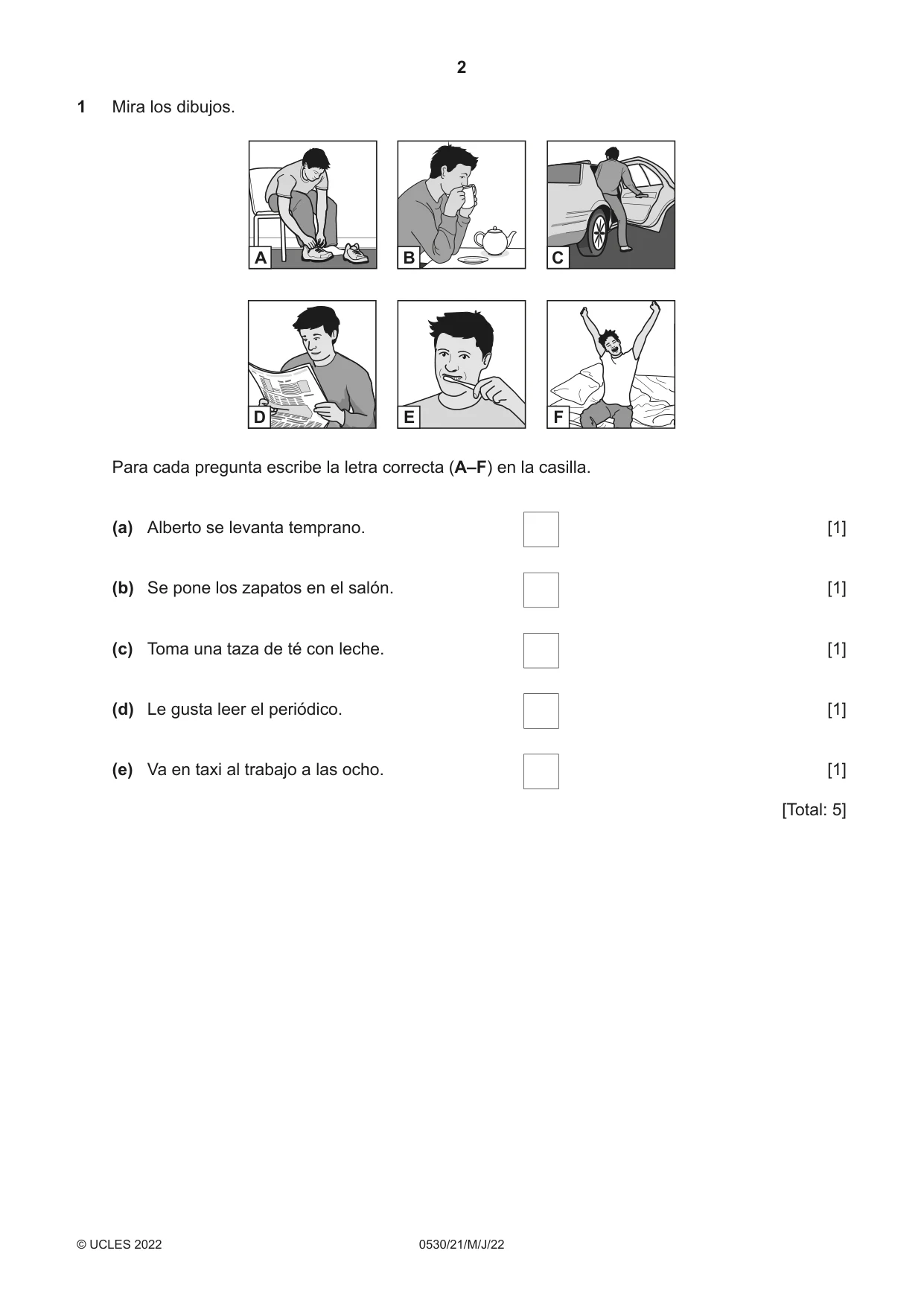
2 0530/21/ M / J /22 © UCLES 2022 1 Mira los dibujos. C B A E D F Para cada pregunta escribe la letra correcta (A–F) en la casilla. (a) Alberto se levanta temprano. [1] (b) Se pone los zapatos en el salón. [1] (c) Toma una taza de té con leche. [1] (d) Le gusta leer el periódico. [1] (e) Va en taxi al trabajo a las ocho. [1] [Total: 5]
Question paper, page 3
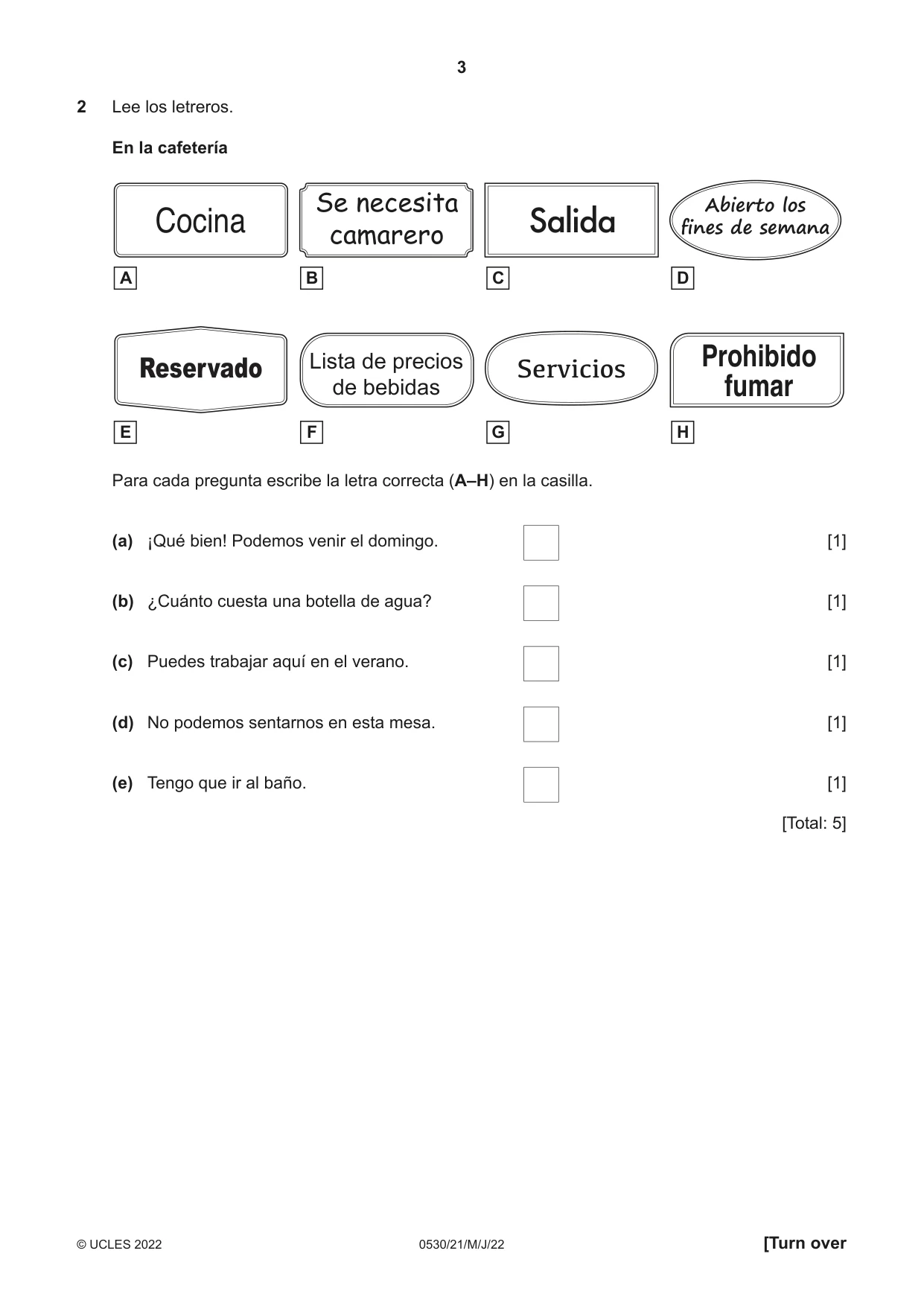
3 0530/21/M/J/22 © UCLES 2022 [Turn over 2 Lee los letreros. En la cafetería Cocina Servicios Reservado Salida Abierto los fines de semana Prohibido fumar A B C D E F G H Se necesita camarero Lista de precios de bebidas Para cada pregunta escribe la letra correcta (A–H) en la casilla. (a) ¡Qué bien! Podemos venir el domingo. [1] (b) ¿Cuánto cuesta una botella de agua? [1] (c) Puedes trabajar aquí en el verano. [1] (d) No podemos sentarnos en esta mesa. [1] (e) Tengo que ir al baño. [1] [Total: 5]
Question paper, page 4
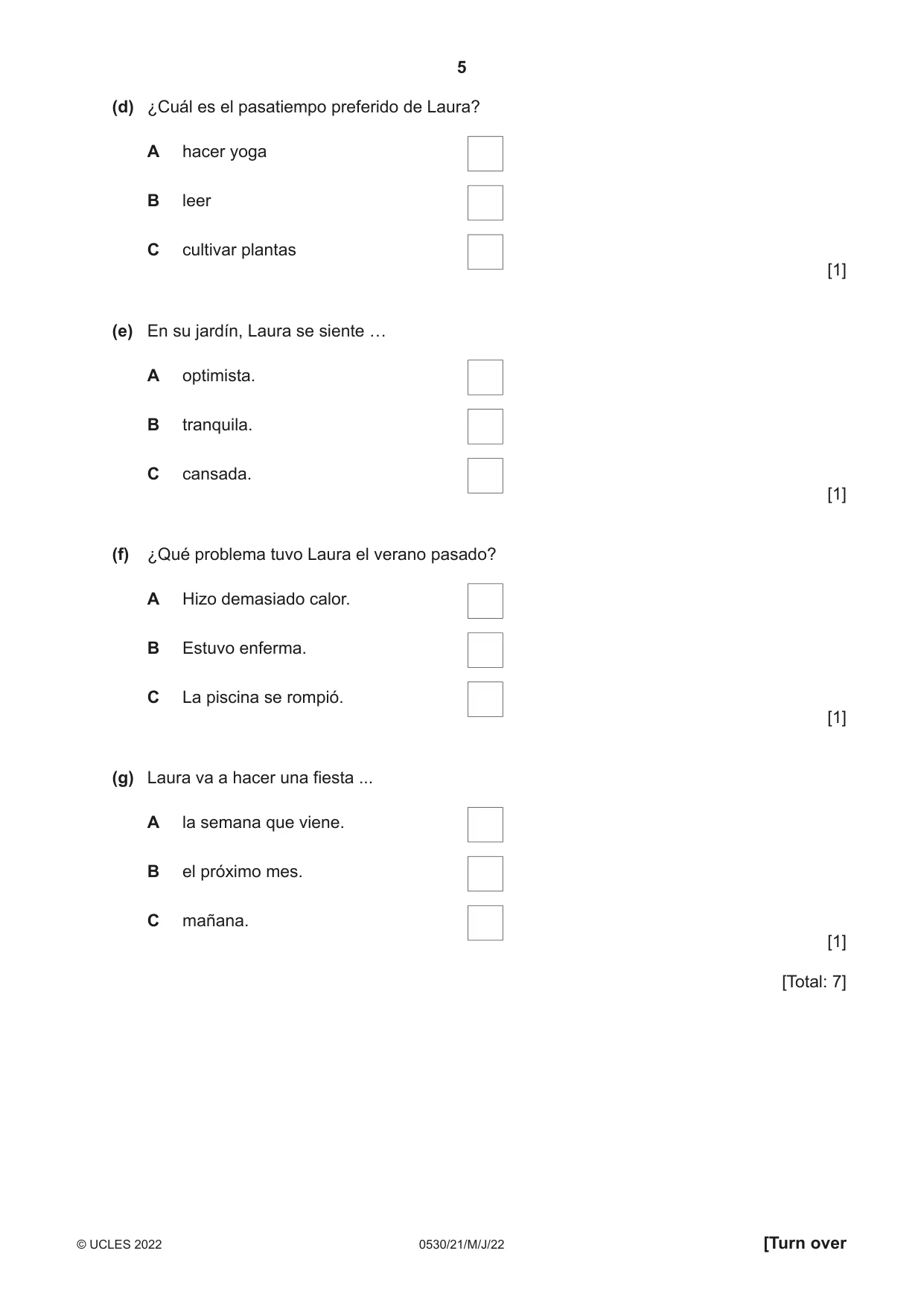
4 0530/21/M/J/22 © UCLES 2022 3 Lee el texto. Para cada pregunta indica tu respuesta escribiendo una X en la casilla correcta (A–C). Hola a todos: Me llamo Laura. Vivo en una casa enorme y lo que más me gusta es el jardín. Allí juego mucho con mi perro, Paco. Mi madre me lo regaló hace cuatro años. Es muy simpático, pero los vecinos se molestan porque hace mucho ruido. Lo mejor de mi jardín es que allí practico mi afición preferida: la jardinería. Planto tanto flores como verduras y, como lo hago yo sola, me tomo todo el tiempo que necesito. La verdad es que allí siempre me relajo mucho. Sin embargo, el verano pasado no disfruté tanto del jardín a causa de las altas temperaturas. Por eso quisiera tener una piscina. De momento, planeo celebrar mi cumpleaños en el jardín el mes que viene. ¡Será muy divertido! Hasta otro día, Laura (a) Laura vive en una casa ... A moderna. B grande. C bonita. [1] (b) Laura pasa tiempo en el jardín con ... A su madre. B su mejor amiga. C su animal de compañía. [1] (c) Los vecinos de Laura a veces ... A se enfadan. B son ruidosos. C salen hasta tarde. [1]
Question paper, page 5
5 0530/21/M/J/22 © UCLES 2022 [Turn over (d) ¿Cuál es el pasatiempo preferido de Laura? A hacer yoga B leer C cultivar plantas [1] (e) En su jardín, Laura se siente … A optimista. B tranquila. C cansada. [1] (f) ¿Qué problema tuvo Laura el verano pasado? A Hizo demasiado calor. B Estuvo enferma. C La piscina se rompió. [1] (g) Laura va a hacer una fiesta ... A la semana que viene. B el próximo mes. C mañana. [1] [Total: 7]
Question paper, page 6
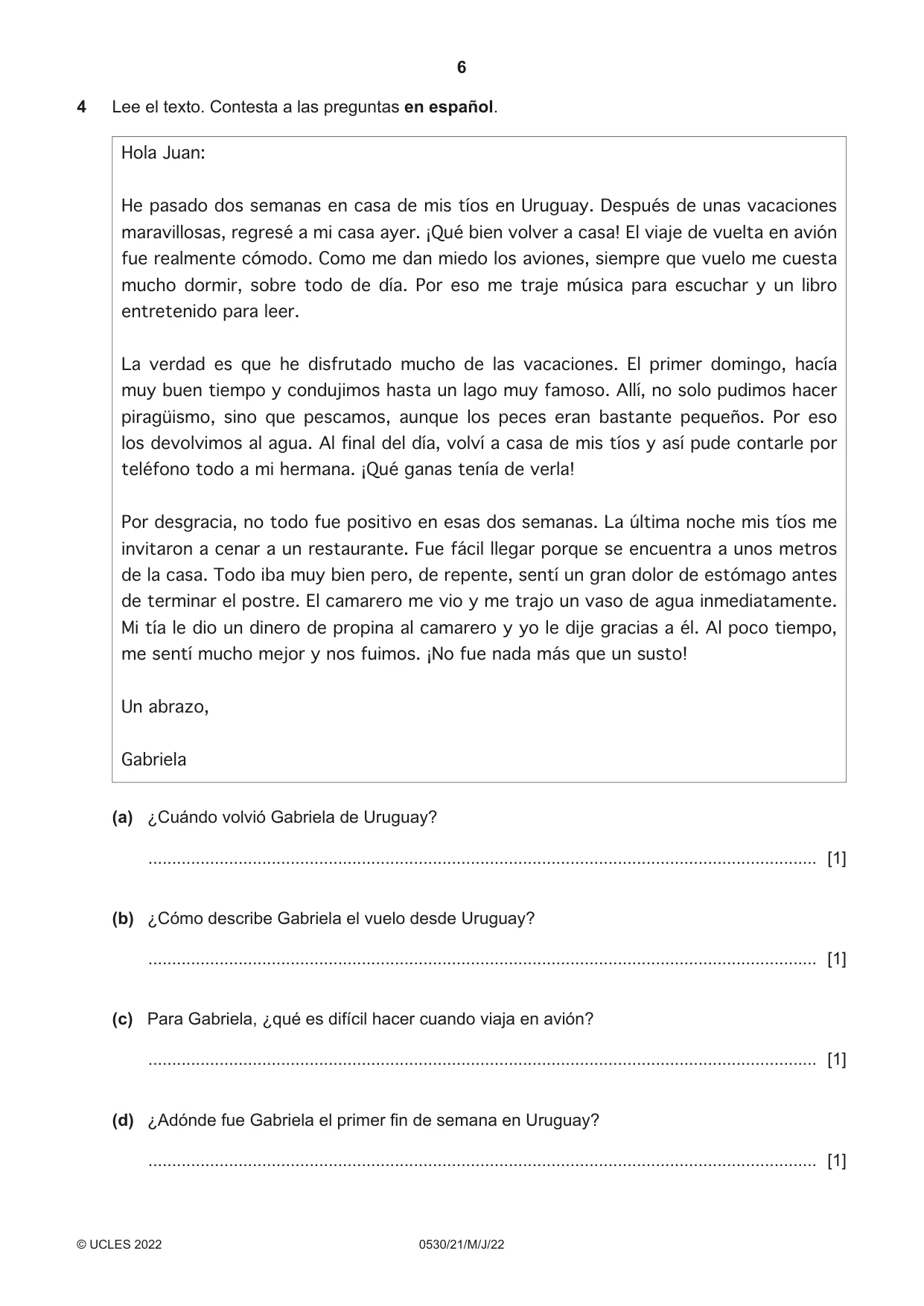
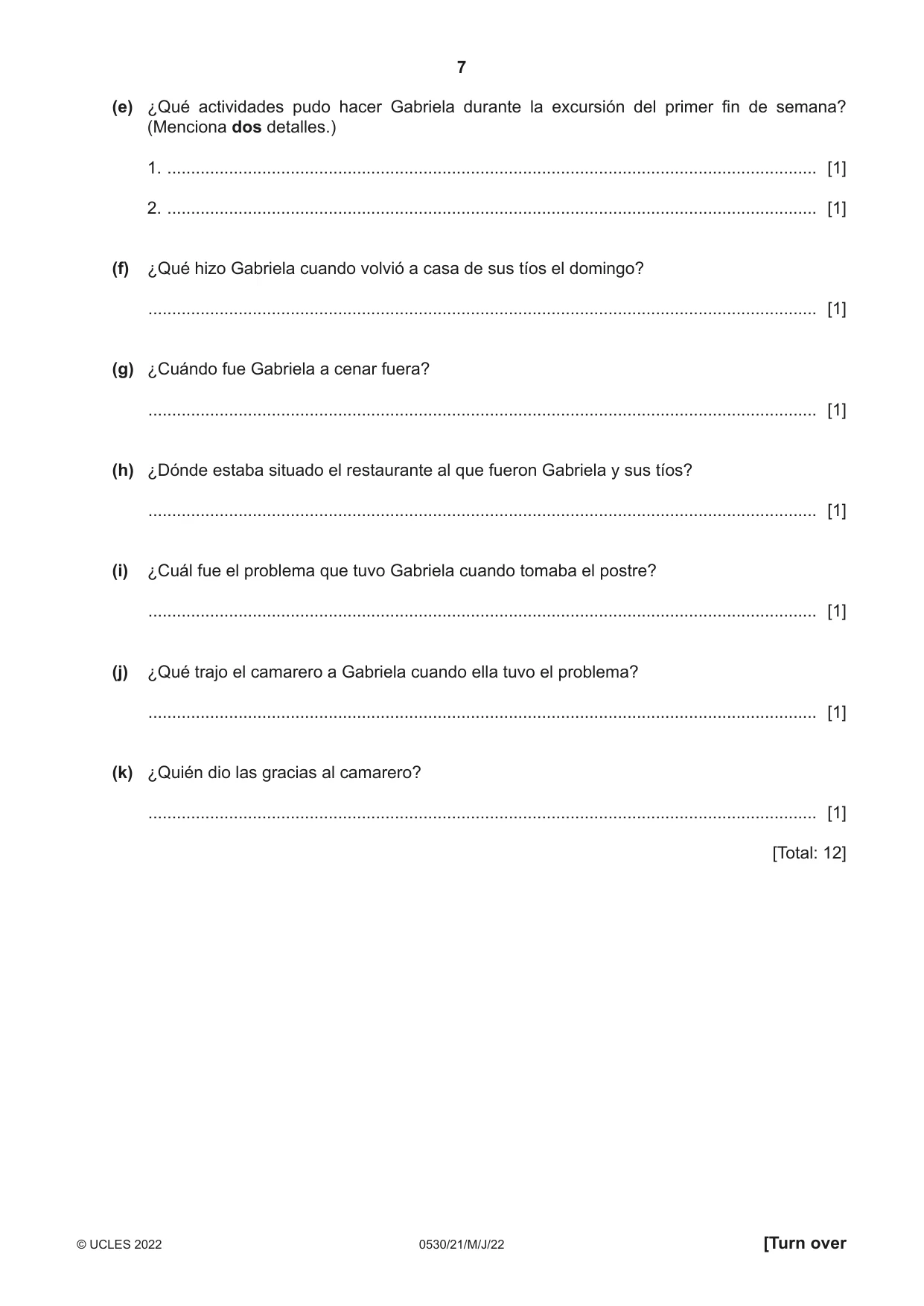
6 0530/21/M/J/22 © UCLES 2022 4 Lee el texto. Contesta a las preguntas en español. Hola Juan: He pasado dos semanas en casa de mis tíos en Uruguay. Después de unas vacaciones maravillosas, regresé a mi casa ayer. ¡Qué bien volver a casa! El viaje de vuelta en avión fue realmente cómodo. Como me dan miedo los aviones, siempre que vuelo me cuesta mucho dormir, sobre todo de día. Por eso me traje música para escuchar y un libro entretenido para leer. La verdad es que he disfrutado mucho de las vacaciones. El primer domingo, hacía muy buen tiempo y condujimos hasta un lago muy famoso. Allí, no solo pudimos hacer piragüismo, sino que pescamos, aunque los peces eran bastante pequeños. Por eso los devolvimos al agua. Al final del día, volví a casa de mis tíos y así pude contarle por teléfono todo a mi hermana. ¡Qué ganas tenía de verla! Por desgracia, no todo fue positivo en esas dos semanas. La última noche mis tíos me invitaron a cenar a un restaurante. Fue fácil llegar porque se encuentra a unos metros de la casa. Todo iba muy bien pero, de repente, sentí un gran dolor de estómago antes de terminar el postre. El camarero me vio y me trajo un vaso de agua inmediatamente. Mi tía le dio un dinero de propina al camarero y yo le dije gracias a él. Al poco tiempo, me sentí mucho mejor y nos fuimos. ¡No fue nada más que un susto! Un abrazo, Gabriela (a) ¿Cuándo volvió Gabriela de Uruguay? … [1] (b) ¿Cómo describe Gabriela el vuelo desde Uruguay? … [1] (c) Para Gabriela, ¿qué es difícil hacer cuando viaja en avión? … [1] (d) ¿Adónde fue Gabriela el primer fin de semana en Uruguay? … [1]
Question paper, page 7
7 0530/21/M/J/22 © UCLES 2022 [Turn over (e) ¿Qué actividades pudo hacer Gabriela durante la excursión del primer fin de semana? (Menciona dos detalles.) 1. … [1] 2. … [1] (f) ¿Qué hizo Gabriela cuando volvió a casa de sus tíos el domingo? … [1] (g) ¿Cuándo fue Gabriela a cenar fuera? … [1] (h) ¿Dónde estaba situado el restaurante al que fueron Gabriela y sus tíos? … [1] (i) ¿Cuál fue el problema que tuvo Gabriela cuando tomaba el postre? … [1] (j) ¿Qué trajo el camarero a Gabriela cuando ella tuvo el problema? … [1] (k) ¿Quién dio las gracias al camarero? … [1] [Total: 12]
Question paper, page 8
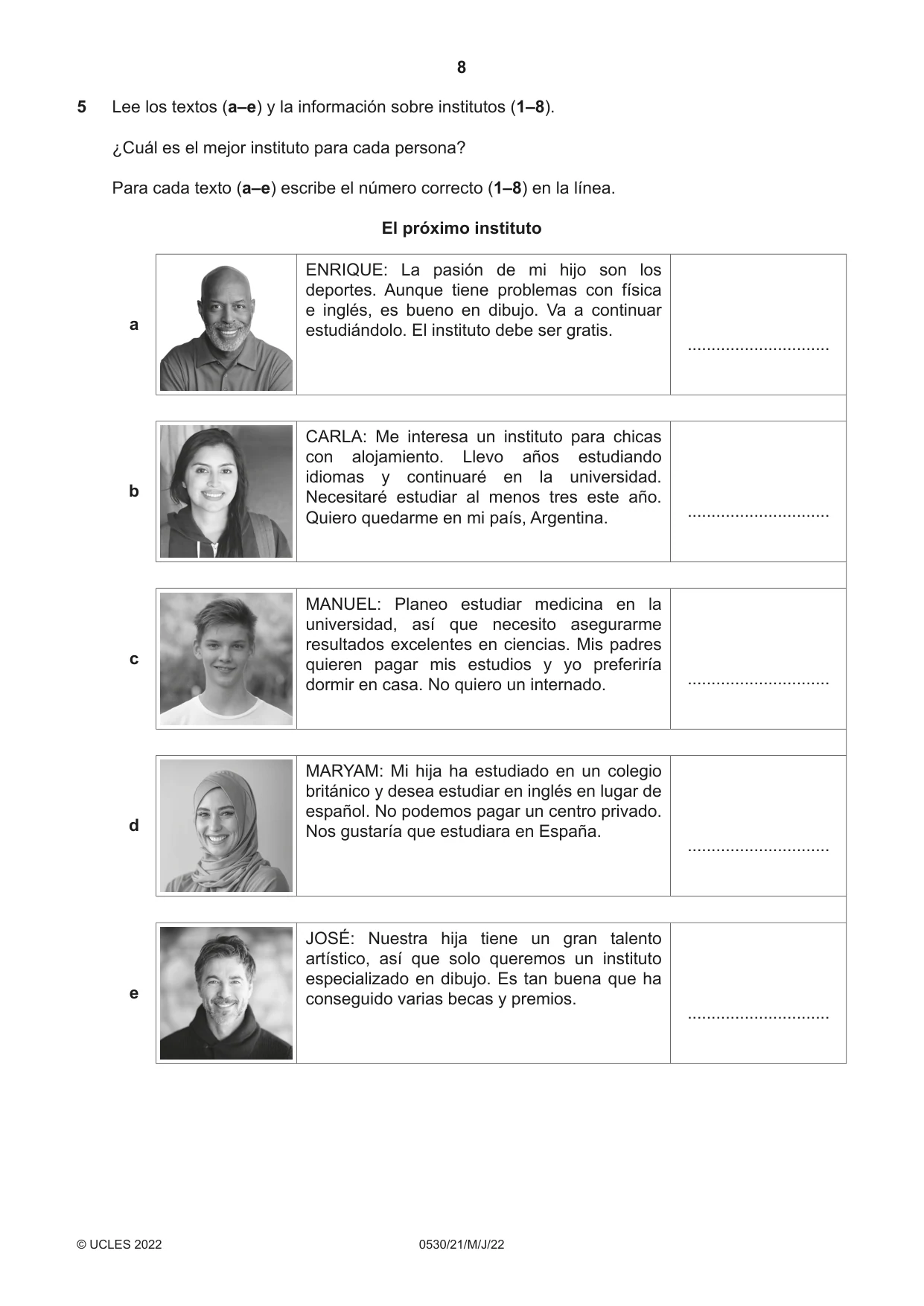
8 0530/21/M/J/22 © UCLES 2022 5 Lee los textos (a–e) y la información sobre institutos (1–8). ¿Cuál es el mejor instituto para cada persona? Para cada texto (a–e) escribe el número correcto (1–8) en la línea. El próximo instituto a ENRIQUE: La pasión de mi hijo son los deportes. Aunque tiene problemas con física e inglés, es bueno en dibujo. Va a continuar estudiándolo. El instituto debe ser gratis. … b CARLA: Me interesa un instituto para chicas con alojamiento. Llevo años estudiando idiomas y continuaré en la universidad. Necesitaré estudiar al menos tres este año. Quiero quedarme en mi país, Argentina. … c MANUEL: Planeo estudiar medicina en la universidad, así que necesito asegurarme resultados excelentes en ciencias. Mis padres quieren pagar mis estudios y yo preferiría dormir en casa. No quiero un internado. … d MARYAM: Mi hija ha estudiado en un colegio británico y desea estudiar en inglés en lugar de español. No podemos pagar un centro privado. Nos gustaría que estudiara en España. … e JOSÉ: Nuestra hija tiene un gran talento artístico, así que solo queremos un instituto especializado en dibujo. Es tan buena que ha conseguido varias becas y premios. …
Question paper, page 9
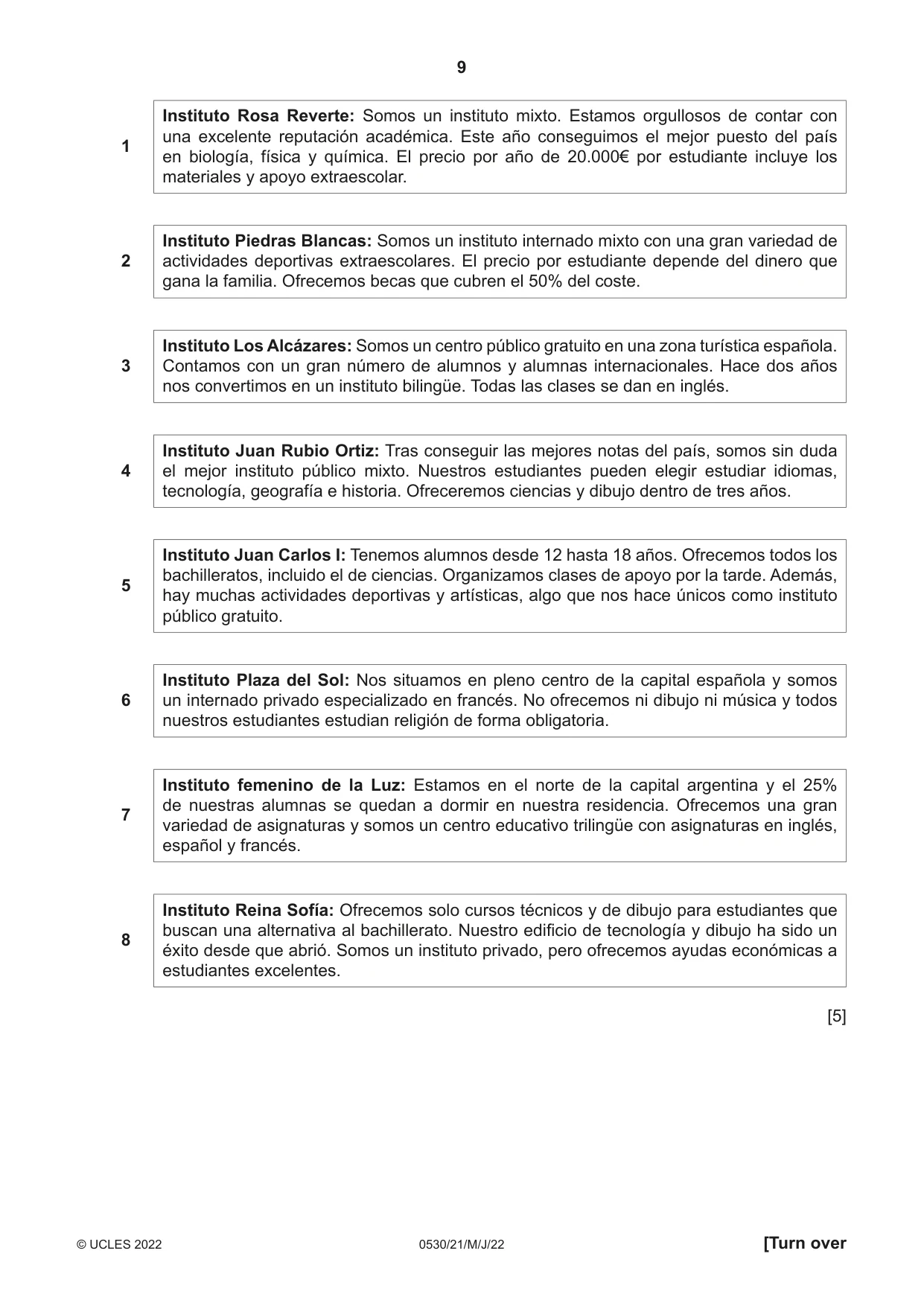
9 0530/21/M/J/22 © UCLES 2022 [Turn over 1 Instituto Rosa Reverte: Somos un instituto mixto. Estamos orgullosos de contar con una excelente reputación académica. Este año conseguimos el mejor puesto del país en biología, física y química. El precio por año de 20.000€ por estudiante incluye los materiales y apoyo extraescolar. 2 Instituto Piedras Blancas: Somos un instituto internado mixto con una gran variedad de actividades deportivas extraescolares. El precio por estudiante depende del dinero que gana la familia. Ofrecemos becas que cubren el 50% del coste. 3 Instituto Los Alcázares: Somos un centro público gratuito en una zona turística española. Contamos con un gran número de alumnos y alumnas internacionales. Hace dos años nos convertimos en un instituto bilingüe. Todas las clases se dan en inglés. 4 Instituto Juan Rubio Ortiz: Tras conseguir las mejores notas del país, somos sin duda el mejor instituto público mixto. Nuestros estudiantes pueden elegir estudiar idiomas, tecnología, geografía e historia. Ofreceremos ciencias y dibujo dentro de tres años. 5 Instituto Juan Carlos I: Tenemos alumnos desde 12 hasta 18 años. Ofrecemos todos los bachilleratos, incluido el de ciencias. Organizamos clases de apoyo por la tarde. Además, hay muchas actividades deportivas y artísticas, algo que nos hace únicos como instituto público gratuito. 6 Instituto Plaza del Sol: Nos situamos en pleno centro de la capital española y somos un internado privado especializado en francés. No ofrecemos ni dibujo ni música y todos nuestros estudiantes estudian religión de forma obligatoria. 7 Instituto femenino de la Luz: Estamos en el norte de la capital argentina y el 25% de nuestras alumnas se quedan a dormir en nuestra residencia. Ofrecemos una gran variedad de asignaturas y somos un centro educativo trilingüe con asignaturas en inglés, español y francés. 8 Instituto Reina Sofía: Ofrecemos solo cursos técnicos y de dibujo para estudiantes que buscan una alternativa al bachillerato. Nuestro edificio de tecnología y dibujo ha sido un éxito desde que abrió. Somos un instituto privado, pero ofrecemos ayudas económicas a estudiantes excelentes. [5]
Question paper, page 10
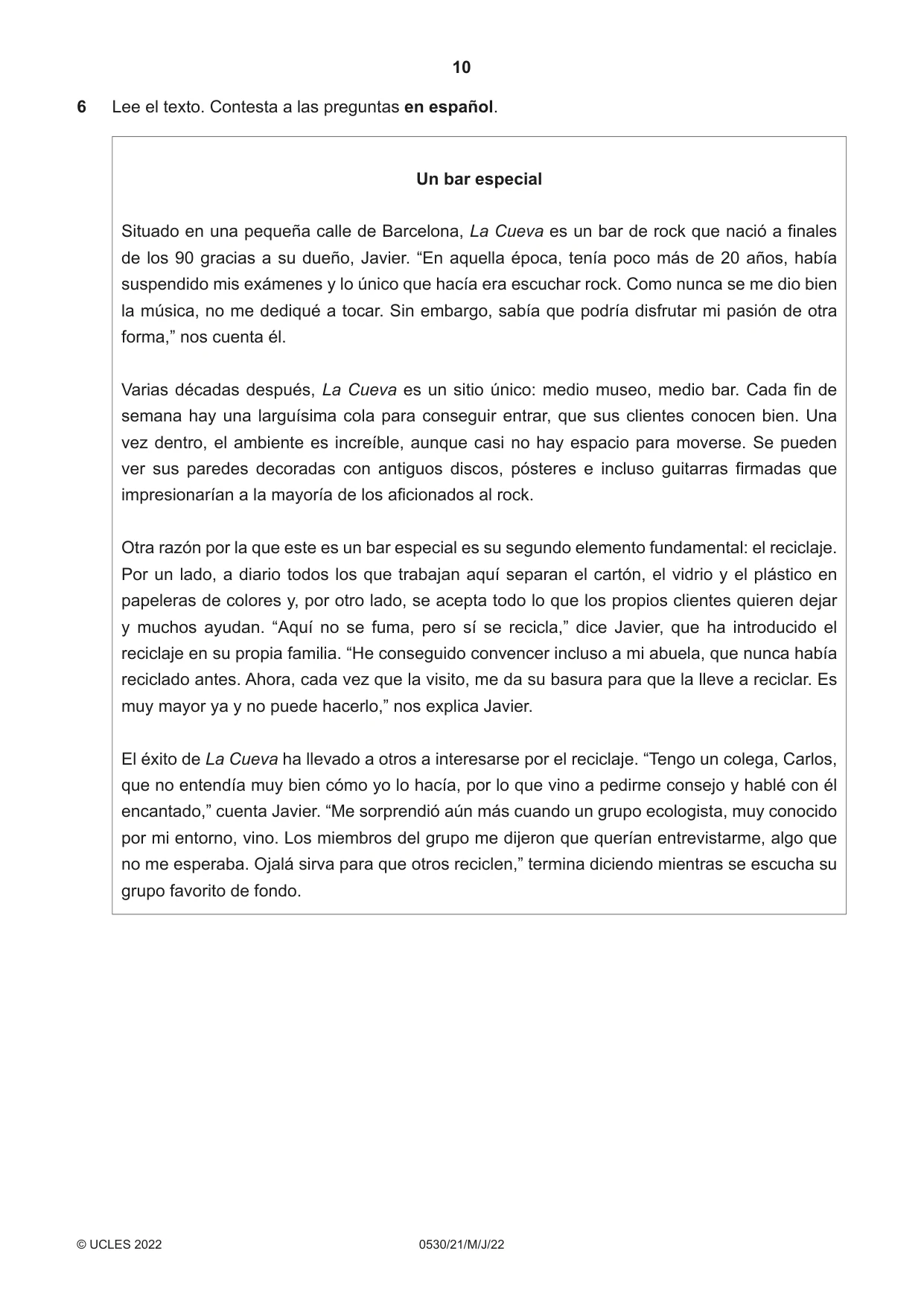
10 0530/21/M/J/22 © UCLES 2022 6 Lee el texto. Contesta a las preguntas en español. Un bar especial Situado en una pequeña calle de Barcelona, La Cueva es un bar de rock que nació a finales de los 90 gracias a su dueño, Javier. “En aquella época, tenía poco más de 20 años, había suspendido mis exámenes y lo único que hacía era escuchar rock. Como nunca se me dio bien la música, no me dediqué a tocar. Sin embargo, sabía que podría disfrutar mi pasión de otra forma,” nos cuenta él. Varias décadas después, La Cueva es un sitio único: medio museo, medio bar. Cada fin de semana hay una larguísima cola para conseguir entrar, que sus clientes conocen bien. Una vez dentro, el ambiente es increíble, aunque casi no hay espacio para moverse. Se pueden ver sus paredes decoradas con antiguos discos, pósteres e incluso guitarras firmadas que impresionarían a la mayoría de los aficionados al rock. Otra razón por la que este es un bar especial es su segundo elemento fundamental: el reciclaje. Por un lado, a diario todos los que trabajan aquí separan el cartón, el vidrio y el plástico en papeleras de colores y, por otro lado, se acepta todo lo que los propios clientes quieren dejar y muchos ayudan. “Aquí no se fuma, pero sí se recicla,” dice Javier, que ha introducido el reciclaje en su propia familia. “He conseguido convencer incluso a mi abuela, que nunca había reciclado antes. Ahora, cada vez que la visito, me da su basura para que la lleve a reciclar. Es muy mayor ya y no puede hacerlo,” nos explica Javier. El éxito de La Cueva ha llevado a otros a interesarse por el reciclaje. “Tengo un colega, Carlos, que no entendía muy bien cómo yo lo hacía, por lo que vino a pedirme consejo y hablé con él encantado,” cuenta Javier. “Me sorprendió aún más cuando un grupo ecologista, muy conocido por mi entorno, vino. Los miembros del grupo me dijeron que querían entrevistarme, algo que no me esperaba. Ojalá sirva para que otros reciclen,” termina diciendo mientras se escucha su grupo favorito de fondo.
Question paper, page 11
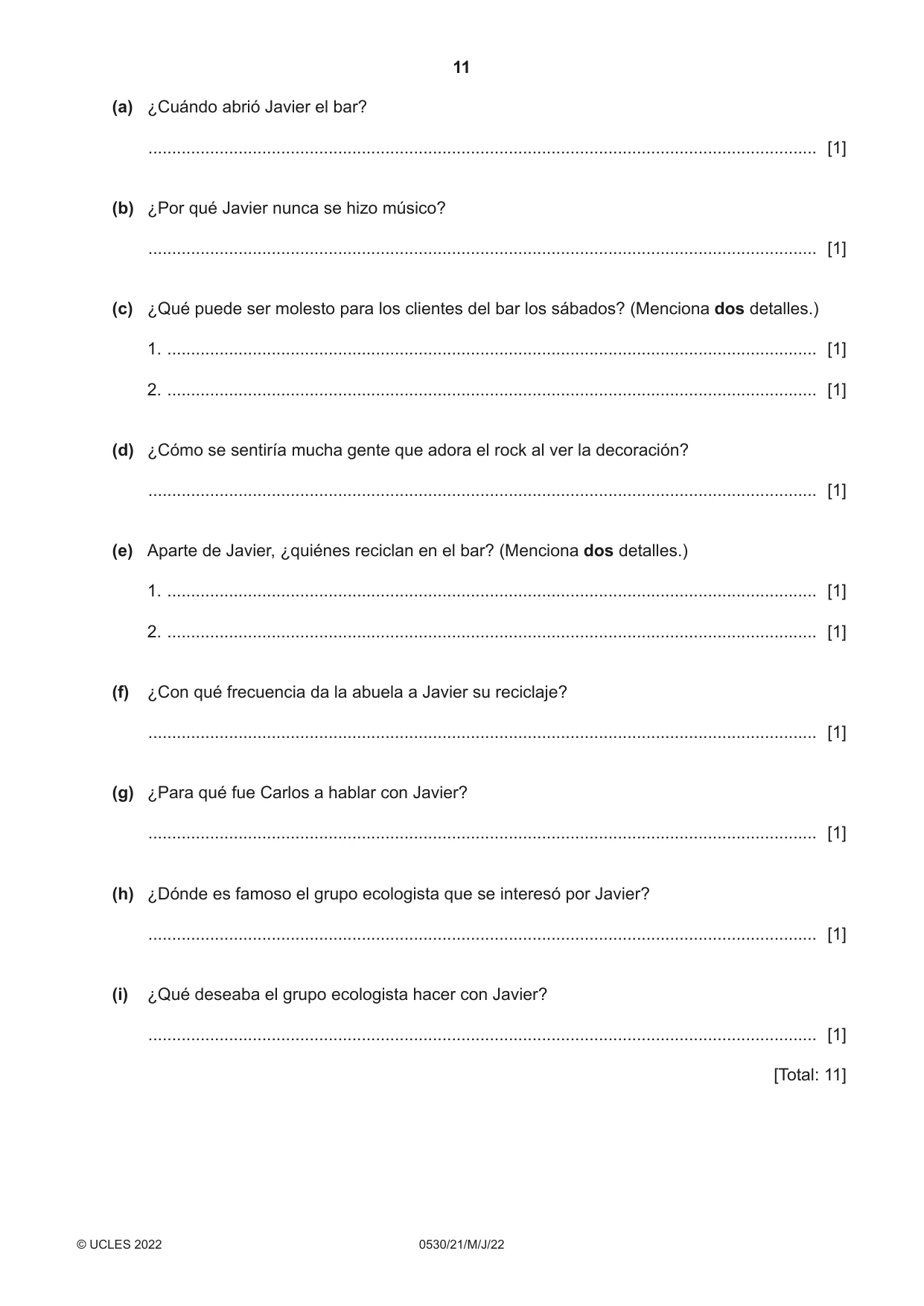
11 0530/21/M/J/22 © UCLES 2022 (a) ¿Cuándo abrió Javier el bar? … [1] (b) ¿Por qué Javier nunca se hizo músico? … [1] (c) ¿Qué puede ser molesto para los clientes del bar los sábados? (Menciona dos detalles.) 1. … [1] 2. … [1] (d) ¿Cómo se sentiría mucha gente que adora el rock al ver la decoración? … [1] (e) Aparte de Javier, ¿quiénes reciclan en el bar? (Menciona dos detalles.) 1. … [1] 2. … [1] (f) ¿Con qué frecuencia da la abuela a Javier su reciclaje? … [1] (g) ¿Para qué fue Carlos a hablar con Javier? … [1] (h) ¿Dónde es famoso el grupo ecologista que se interesó por Javier? … [1] (i) ¿Qué deseaba el grupo ecologista hacer con Javier? … [1] [Total: 11]
Question paper, page 12
12 0530/21/M/J/22 © UCLES 2022 Permission to reproduce items where third-party owned material protected by copyright is included has been sought and cleared where possible. Every reasonable effort has been made by the publisher (UCLES) to trace copyright holders, but if any items requiring clearance have unwittingly been included, the publisher will be pleased to make amends at the earliest possible opportunity. To avoid the issue of disclosure of answer-related information to candidates, all copyright acknowledgements are reproduced online in the Cambridge Assessment International Education Copyright Acknowledgements Booklet. This is produced for each series of examinations and is freely available to download at www.cambridgeinternational.org after the live examination series. Cambridge Assessment International Education is part of Cambridge Assessment. Cambridge Assessment is the brand name of the University of Cambridge Local Examinations Syndicate (UCLES), which is a department of the University of Cambridge. BLANK PAGE
Mark scheme, page 1
This document consists of 11 printed pages. © UCLES 2022 [Turn over Cambridge IGCSE™ SPANISH 0530/21 Paper 2 Reading May/June 2022 MARK SCHEME Maximum Mark: 45 Published This mark scheme is published as an aid to teachers and candidates, to indicate the requirements of the examination. It shows the basis on which Examiners were instructed to award marks. It does not indicate the details of the discussions that took place at an Examiners’ meeting before marking began, which would have considered the acceptability of alternative answers. Mark schemes should be read in conjunction with the question paper and the Principal Examiner Report for Teachers. Cambridge International will not enter into discussions about these mark schemes. Cambridge International is publishing the mark schemes for the May/June 2022 series for most Cambridge IGCSE, Cambridge International A and AS Level and Cambridge Pre-U components, and some Cambridge O Level components.
Mark scheme, page 2
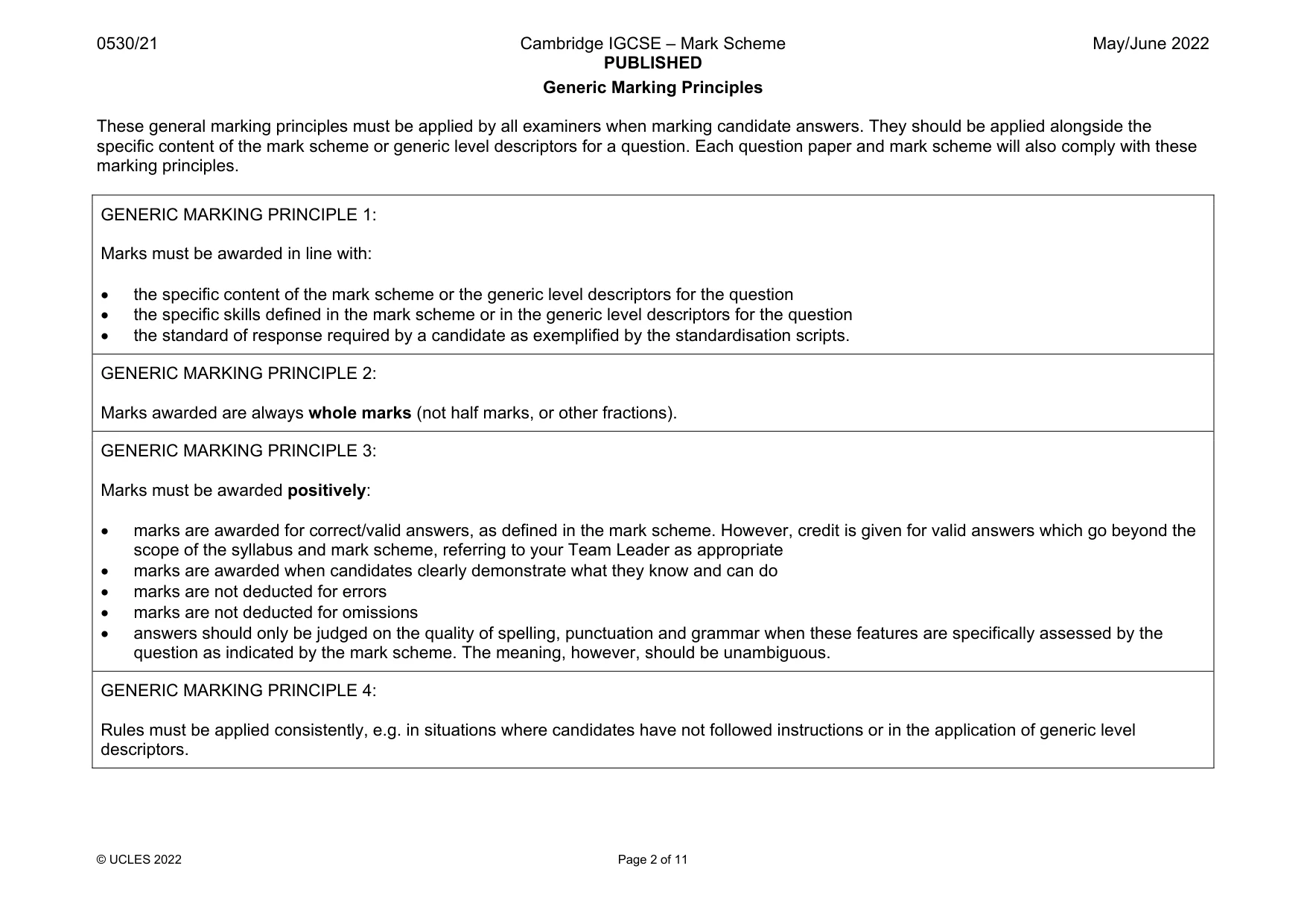
0530/21 Cambridge IGCSE – Mark Scheme PUBLISHED May/June 2022 © UCLES 2022 Page 2 of 11 Generic Marking Principles These general marking principles must be applied by all examiners when marking candidate answers. They should be applied alongside the specific content of the mark scheme or generic level descriptors for a question. Each question paper and mark scheme will also comply with these marking principles. GENERIC MARKING PRINCIPLE 1: Marks must be awarded in line with: the specific content of the mark scheme or the generic level descriptors for the question the specific skills defined in the mark scheme or in the generic level descriptors for the question the standard of response required by a candidate as exemplified by the standardisation scripts. GENERIC MARKING PRINCIPLE 2: Marks awarded are always whole marks (not half marks, or other fractions). GENERIC MARKING PRINCIPLE 3: Marks must be awarded positively: marks are awarded for correct/valid answers, as defined in the mark scheme. However, credit is given for valid answers which go beyond the scope of the syllabus and mark scheme, referring to your Team Leader as appropriate marks are awarded when candidates clearly demonstrate what they know and can do marks are not deducted for errors marks are not deducted for omissions answers should only be judged on the quality of spelling, punctuation and grammar when these features are specifically assessed by the question as indicated by the mark scheme. The meaning, however, should be unambiguous. GENERIC MARKING PRINCIPLE 4: Rules must be applied consistently, e.g. in situations where candidates have not followed instructions or in the application of generic level descriptors.
Mark scheme, page 3
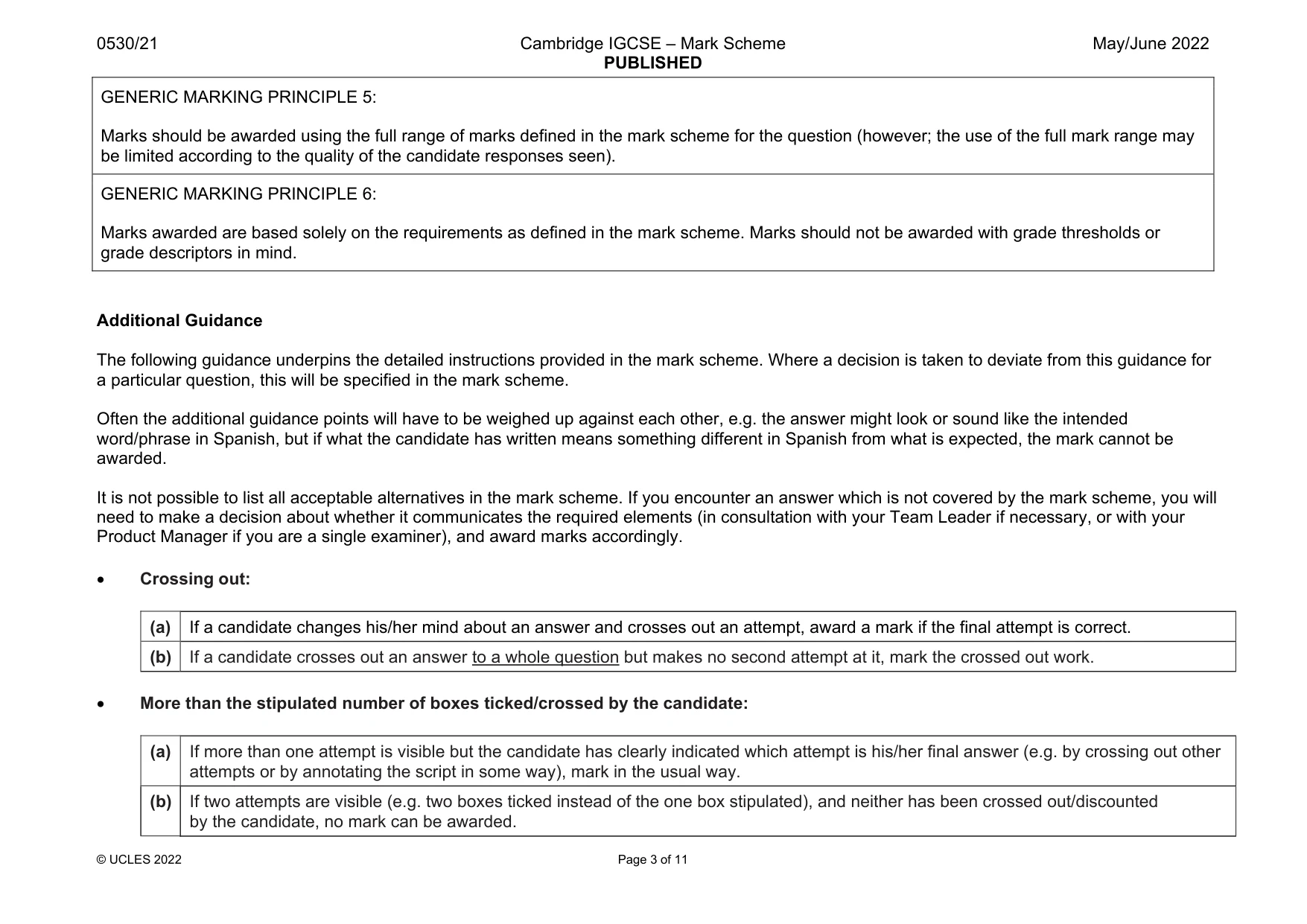
0530/21 Cambridge IGCSE – Mark Scheme PUBLISHED May/June 2022 © UCLES 2022 Page 3 of 11 GENERIC MARKING PRINCIPLE 5: Marks should be awarded using the full range of marks defined in the mark scheme for the question (however; the use of the full mark range may be limited according to the quality of the candidate responses seen). GENERIC MARKING PRINCIPLE 6: Marks awarded are based solely on the requirements as defined in the mark scheme. Marks should not be awarded with grade thresholds or grade descriptors in mind. Additional Guidance The following guidance underpins the detailed instructions provided in the mark scheme. Where a decision is taken to deviate from this guidance for a particular question, this will be specified in the mark scheme. Often the additional guidance points will have to be weighed up against each other, e.g. the answer might look or sound like the intended word/phrase in Spanish, but if what the candidate has written means something different in Spanish from what is expected, the mark cannot be awarded. It is not possible to list all acceptable alternatives in the mark scheme. If you encounter an answer which is not covered by the mark scheme, you will need to make a decision about whether it communicates the required elements (in consultation with your Team Leader if necessary, or with your Product Manager if you are a single examiner), and award marks accordingly. Crossing out: (a) If a candidate changes his/her mind about an answer and crosses out an attempt, award a mark if the final attempt is correct. (b) If a candidate crosses out an answer to a whole question but makes no second attempt at it, mark the crossed out work. More than the stipulated number of boxes ticked/crossed by the candidate: (a) If more than one attempt is visible but the candidate has clearly indicated which attempt is his/her final answer (e.g. by crossing out other attempts or by annotating the script in some way), mark in the usual way. (b) If two attempts are visible (e.g. two boxes ticked instead of the one box stipulated), and neither has been crossed out/discounted by the candidate, no mark can be awarded.
Mark scheme, page 4
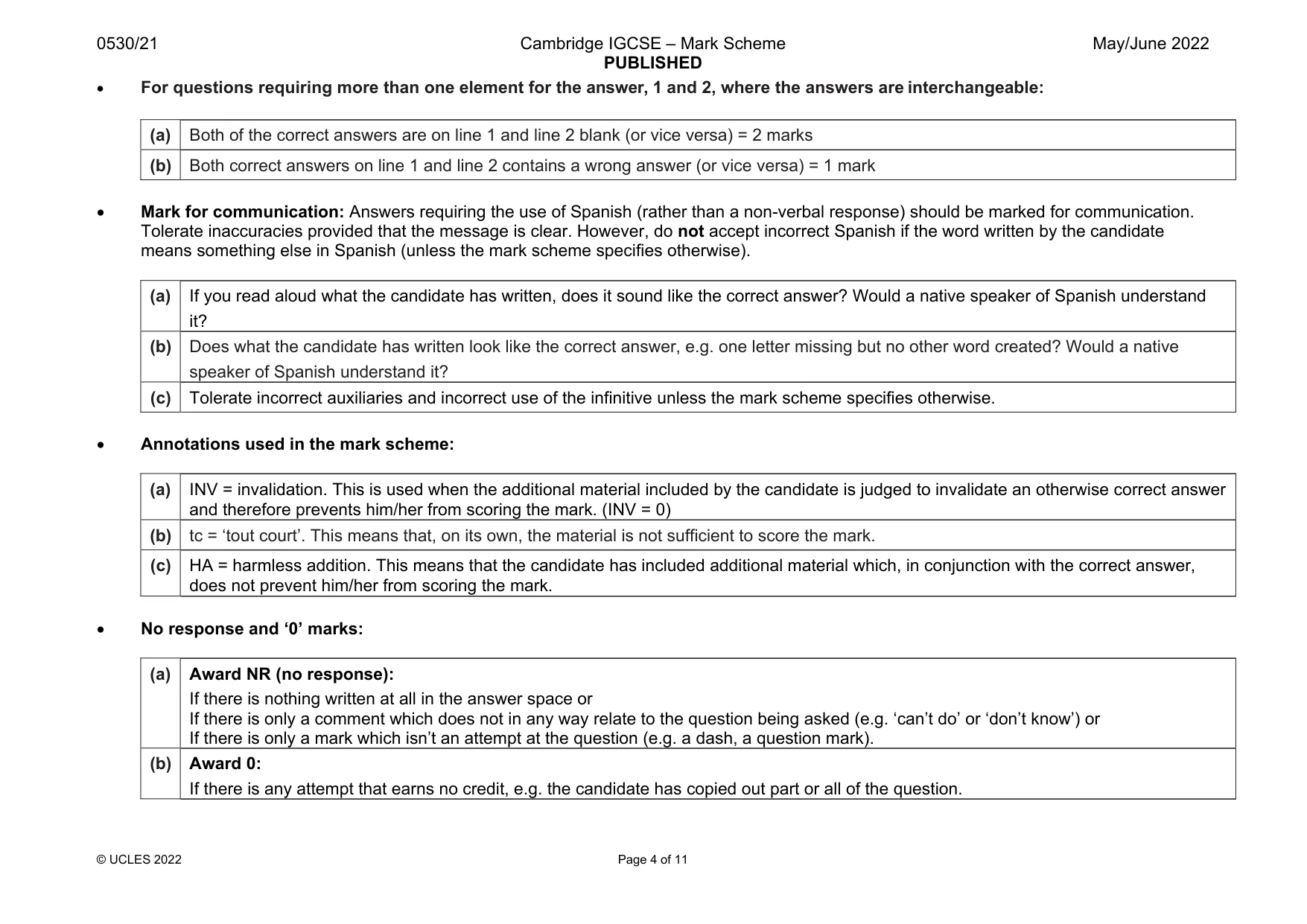
0530/21 Cambridge IGCSE – Mark Scheme PUBLISHED May/June 2022 © UCLES 2022 Page 4 of 11 For questions requiring more than one element for the answer, 1 and 2, where the answers are interchangeable: (a) Both of the correct answers are on line 1 and line 2 blank (or vice versa) = 2 marks (b) Both correct answers on line 1 and line 2 contains a wrong answer (or vice versa) = 1 mark Mark for communication: Answers requiring the use of Spanish (rather than a non-verbal response) should be marked for communication. Tolerate inaccuracies provided that the message is clear. However, do not accept incorrect Spanish if the word written by the candidate means something else in Spanish (unless the mark scheme specifies otherwise). (a) If you read aloud what the candidate has written, does it sound like the correct answer? Would a native speaker of Spanish understand it? (b) Does what the candidate has written look like the correct answer, e.g. one letter missing but no other word created? Would a native speaker of Spanish understand it? (c) Tolerate incorrect auxiliaries and incorrect use of the infinitive unless the mark scheme specifies otherwise. Annotations used in the mark scheme: (a) INV = invalidation. This is used when the additional material included by the candidate is judged to invalidate an otherwise correct answer and therefore prevents him/her from scoring the mark. (INV = 0) (b) tc = ‘tout court’. This means that, on its own, the material is not sufficient to score the mark. (c) HA = harmless addition. This means that the candidate has included additional material which, in conjunction with the correct answer, does not prevent him/her from scoring the mark. No response and ‘0’ marks: (a) Award NR (no response): If there is nothing written at all in the answer space or If there is only a comment which does not in any way relate to the question being asked (e.g. ‘can’t do’ or ‘don’t know’) or If there is only a mark which isn’t an attempt at the question (e.g. a dash, a question mark). (b) Award 0: If there is any attempt that earns no credit, e.g. the candidate has copied out part or all of the question.
Mark scheme, page 5
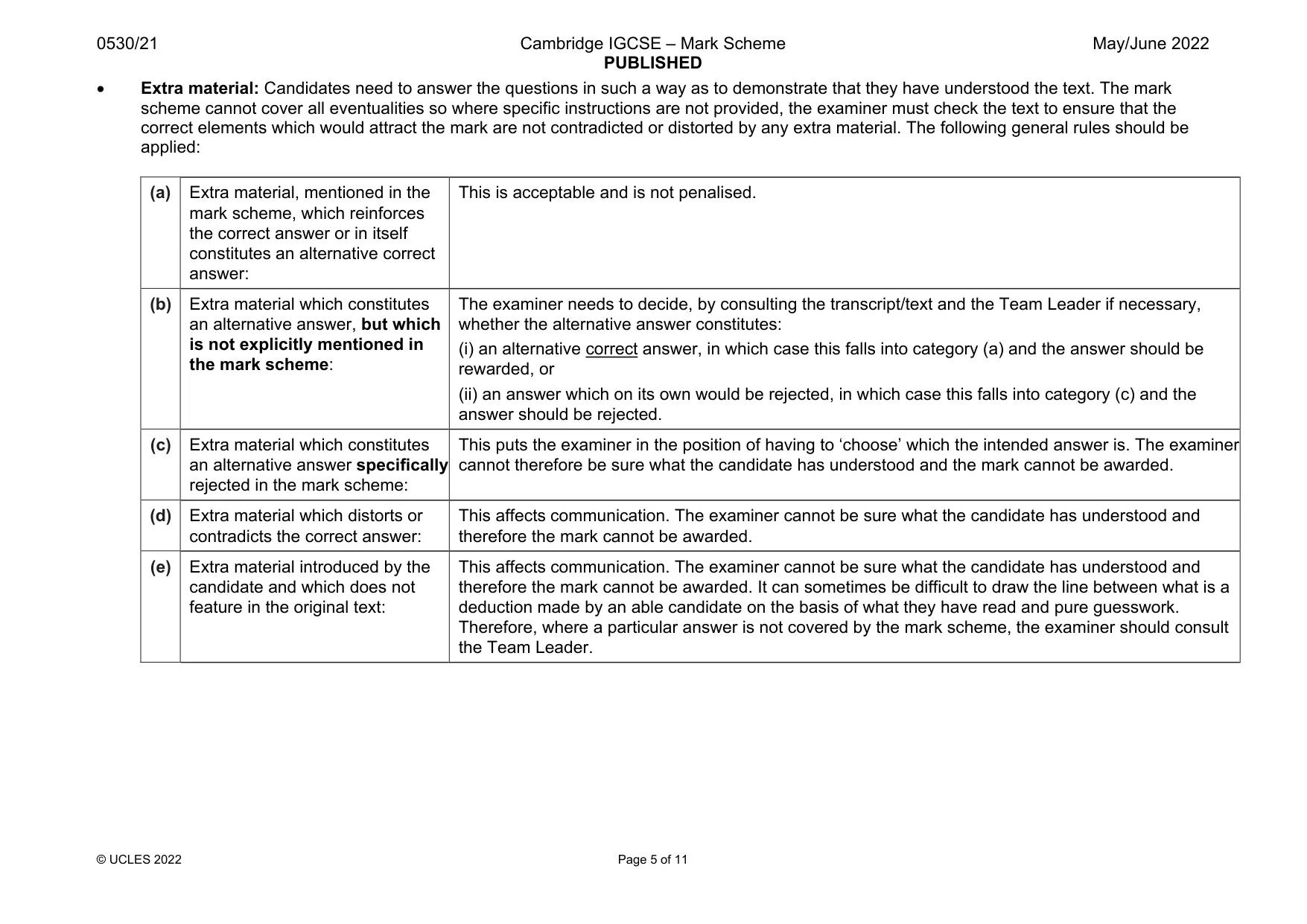
0530/21 Cambridge IGCSE – Mark Scheme PUBLISHED May/June 2022 © UCLES 2022 Page 5 of 11 Extra material: Candidates need to answer the questions in such a way as to demonstrate that they have understood the text. The mark scheme cannot cover all eventualities so where specific instructions are not provided, the examiner must check the text to ensure that the correct elements which would attract the mark are not contradicted or distorted by any extra material. The following general rules should be applied: (a) Extra material, mentioned in the mark scheme, which reinforces the correct answer or in itself constitutes an alternative correct answer: This is acceptable and is not penalised. (b) Extra material which constitutes an alternative answer, but which is not explicitly mentioned in the mark scheme: The examiner needs to decide, by consulting the transcript/text and the Team Leader if necessary, whether the alternative answer constitutes: (i) an alternative correct answer, in which case this falls into category (a) and the answer should be rewarded, or (ii) an answer which on its own would be rejected, in which case this falls into category (c) and the answer should be rejected. (c) Extra material which constitutes an alternative answer specifically rejected in the mark scheme: This puts the examiner in the position of having to ‘choose’ which the intended answer is. The examiner cannot therefore be sure what the candidate has understood and the mark cannot be awarded. (d) Extra material which distorts or contradicts the correct answer: This affects communication. The examiner cannot be sure what the candidate has understood and therefore the mark cannot be awarded. (e) Extra material introduced by the candidate and which does not feature in the original text: This affects communication. The examiner cannot be sure what the candidate has understood and therefore the mark cannot be awarded. It can sometimes be difficult to draw the line between what is a deduction made by an able candidate on the basis of what they have read and pure guesswork. Therefore, where a particular answer is not covered by the mark scheme, the examiner should consult the Team Leader.
Mark scheme, page 6
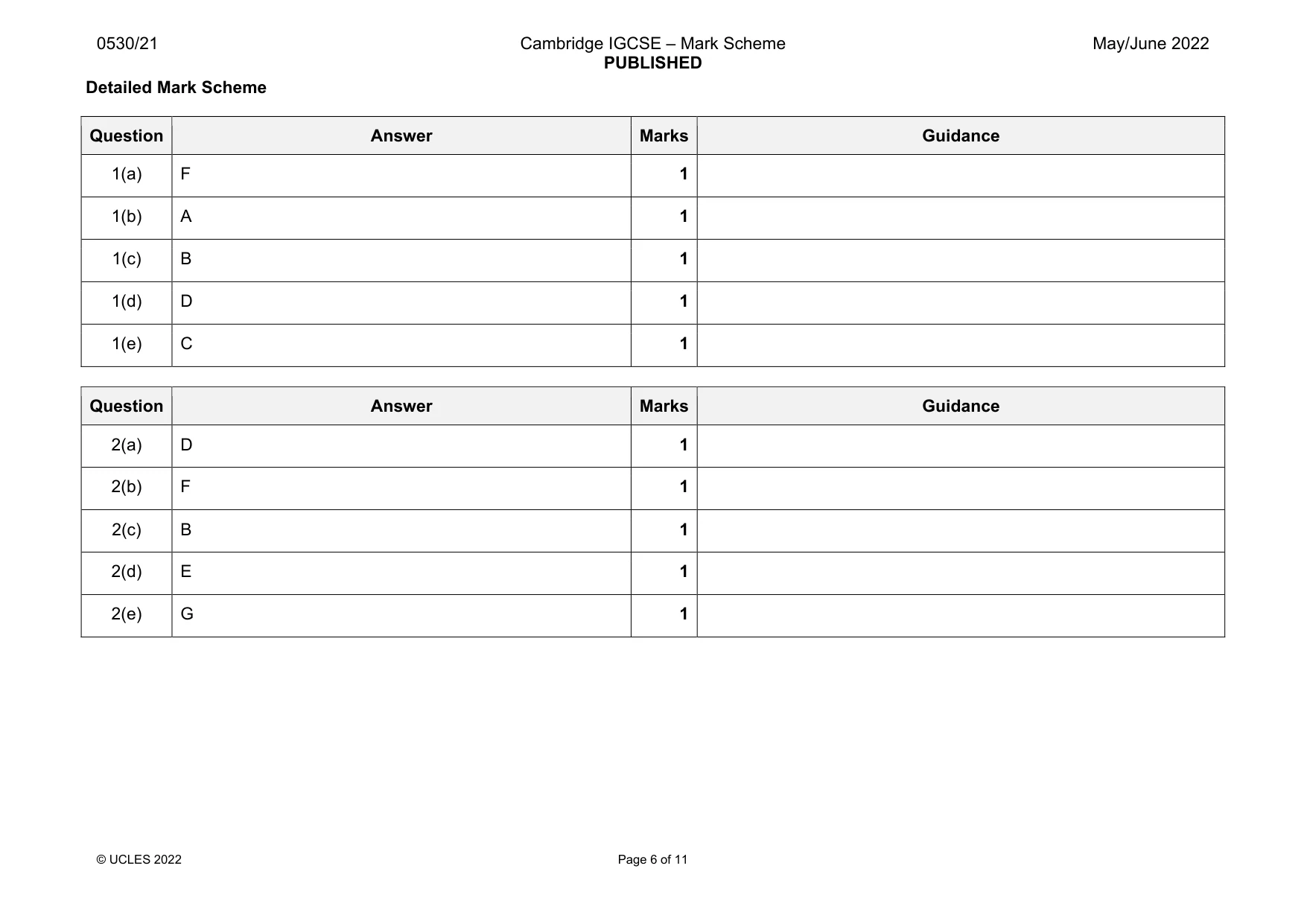
0530/21 Cambridge IGCSE – Mark Scheme PUBLISHED May/June 2022 © UCLES 2022 Page 6 of 11 Detailed Mark Scheme Question Answer Marks Guidance 1(a) F 1 1(b) A 1 1(c) B 1 1(d) D 1 1(e) C 1 Question Answer Marks Guidance 2(a) D 1 2(b) F 1 2(c) B 1 2(d) E 1 2(e) G 1
Mark scheme, page 7
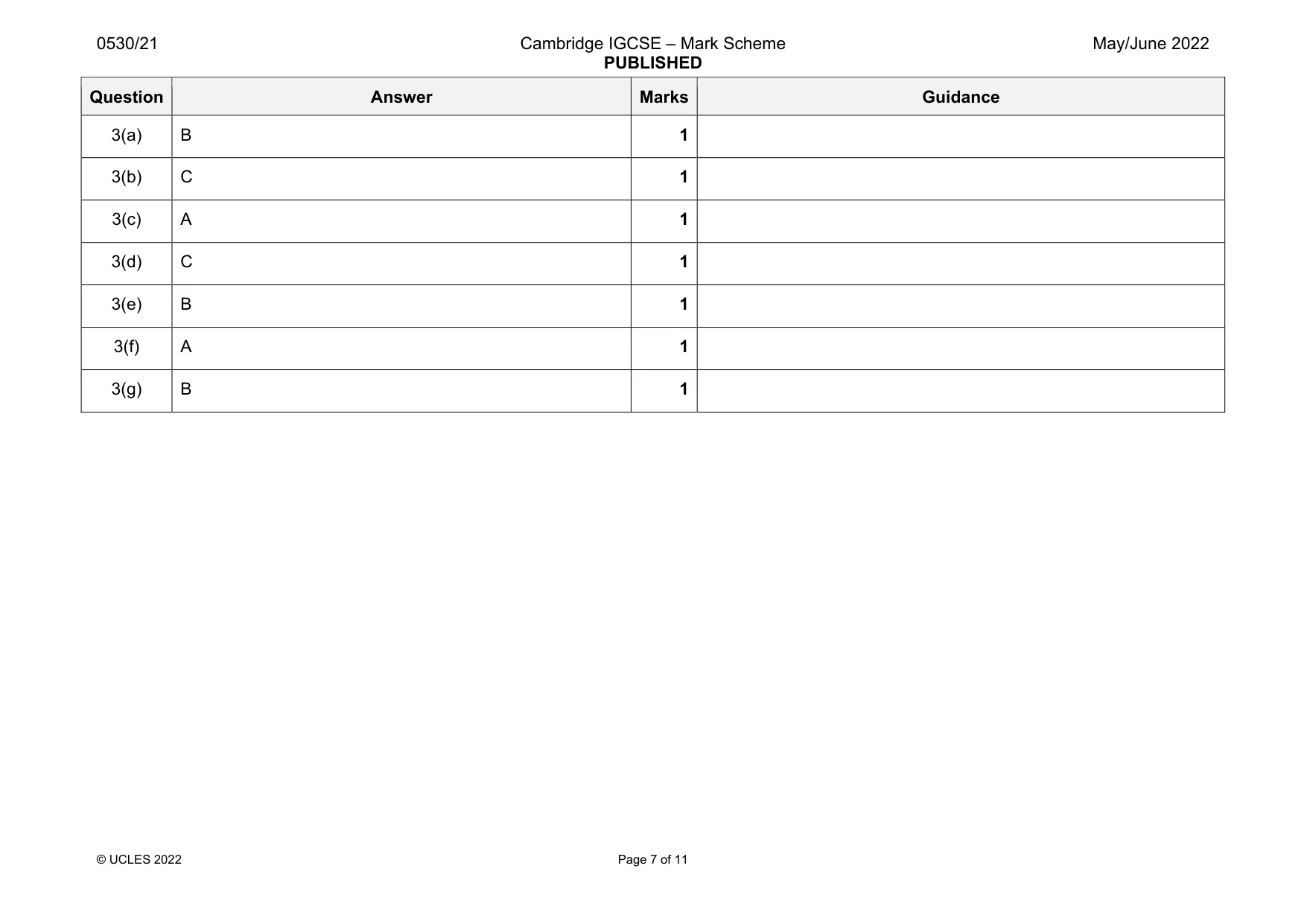
0530/21 Cambridge IGCSE – Mark Scheme PUBLISHED May/June 2022 © UCLES 2022 Page 7 of 11 Question Answer Marks Guidance 3(a) B 1 3(b) C 1 3(c) A 1 3(d) C 1 3(e) B 1 3(f) A 1 3(g) B 1
Mark scheme, page 8
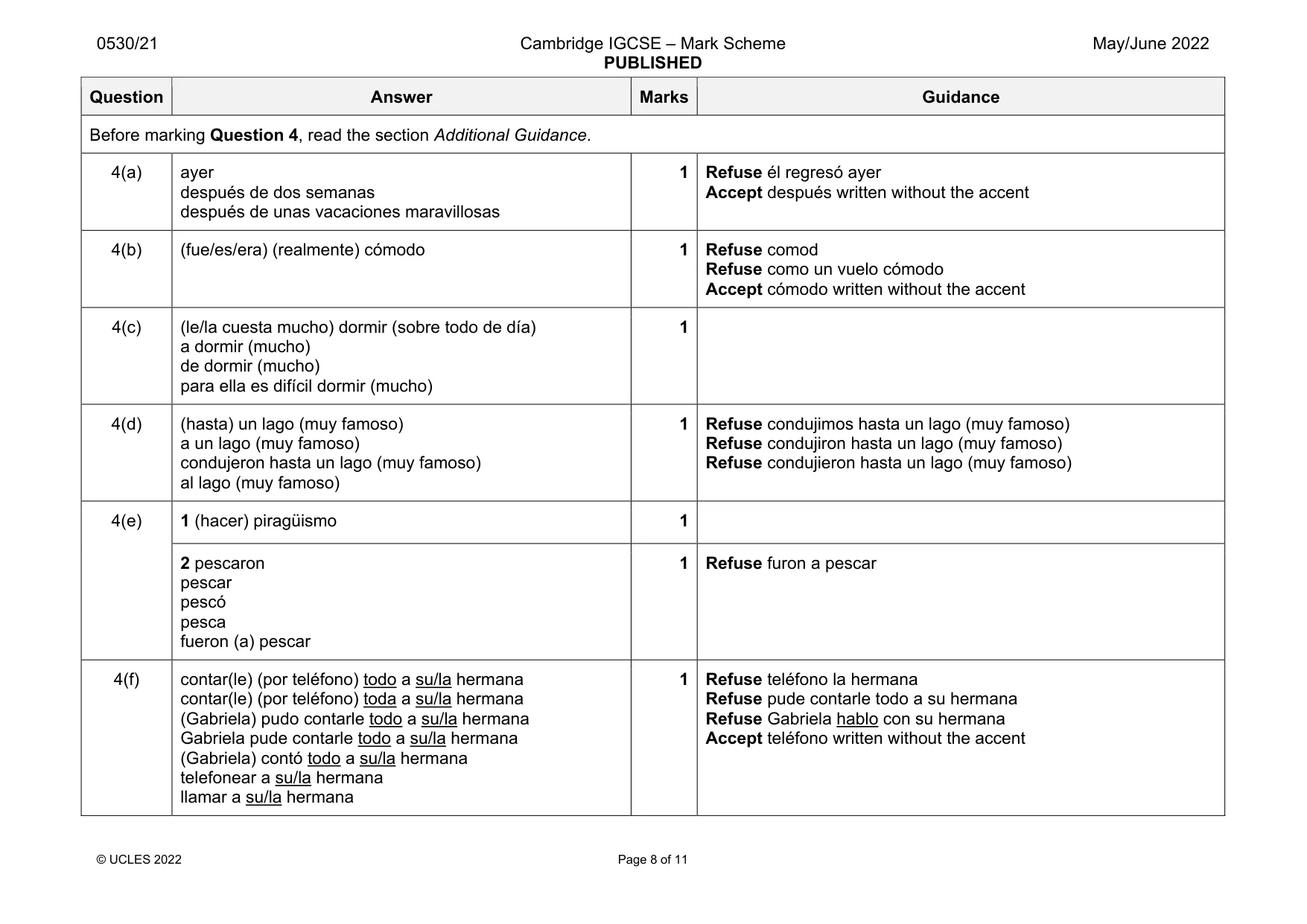
0530/21 Cambridge IGCSE – Mark Scheme PUBLISHED May/June 2022 © UCLES 2022 Page 8 of 11 Question Answer Marks Guidance Before marking Question 4, read the section Additional Guidance. 4(a) ayer después de dos semanas después de unas vacaciones maravillosas 1 Refuse él regresó ayer Accept después written without the accent 4(b) (fue/es/era) (realmente) cómodo 1 Refuse comod Refuse como un vuelo cómodo Accept cómodo written without the accent 4(c) (le/la cuesta mucho) dormir (sobre todo de día) a dormir (mucho) de dormir (mucho) para ella es difícil dormir (mucho) 1 4(d) (hasta) un lago (muy famoso) a un lago (muy famoso) condujeron hasta un lago (muy famoso) al lago (muy famoso) 1 Refuse condujimos hasta un lago (muy famoso) Refuse condujiron hasta un lago (muy famoso) Refuse condujieron hasta un lago (muy famoso) 4(e) 1 (hacer) piragüismo 1 2 pescaron pescar pescó pesca fueron (a) pescar 1 Refuse furon a pescar 4(f) contar(le) (por teléfono) todo a su/la hermana contar(le) (por teléfono) toda a su/la hermana (Gabriela) pudo contarle todo a su/la hermana Gabriela pude contarle todo a su/la hermana (Gabriela) contó todo a su/la hermana telefonear a su/la hermana llamar a su/la hermana 1 Refuse teléfono la hermana Refuse pude contarle todo a su hermana Refuse Gabriela hablo con su hermana Accept teléfono written without the accent
Mark scheme, page 9
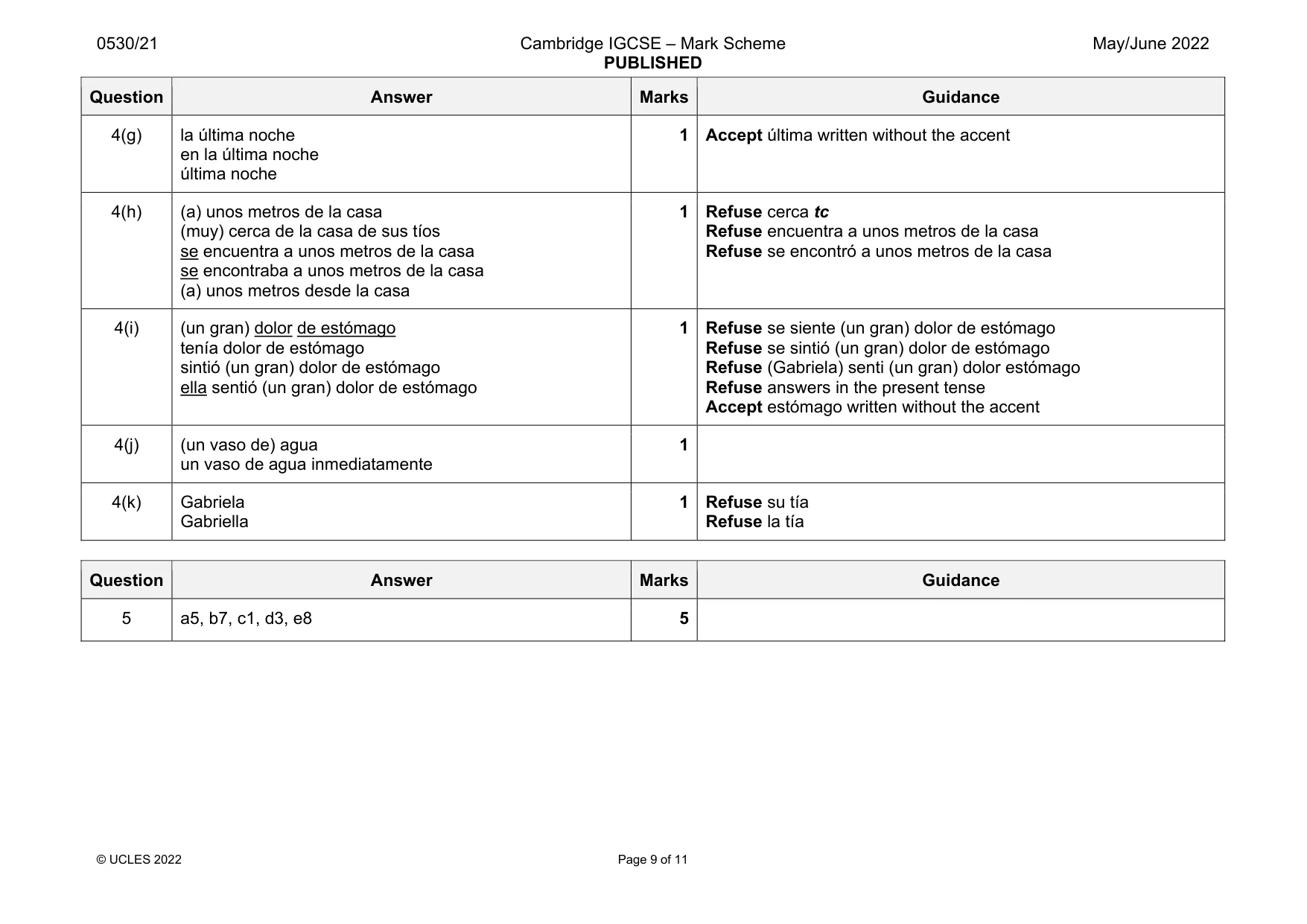
0530/21 Cambridge IGCSE – Mark Scheme PUBLISHED May/June 2022 © UCLES 2022 Page 9 of 11 Question Answer Marks Guidance 4(g) la última noche en la última noche última noche 1 Accept última written without the accent 4(h) (a) unos metros de la casa (muy) cerca de la casa de sus tíos se encuentra a unos metros de la casa se encontraba a unos metros de la casa (a) unos metros desde la casa 1 Refuse cerca tc Refuse encuentra a unos metros de la casa Refuse se encontró a unos metros de la casa 4(i) (un gran) dolor de estómago tenía dolor de estómago sintió (un gran) dolor de estómago ella sentió (un gran) dolor de estómago 1 Refuse se siente (un gran) dolor de estómago Refuse se sintió (un gran) dolor de estómago Refuse (Gabriela) senti (un gran) dolor estómago Refuse answers in the present tense Accept estómago written without the accent 4(j) (un vaso de) agua un vaso de agua inmediatamente 1 4(k) Gabriela Gabriella 1 Refuse su tía Refuse la tía Question Answer Marks Guidance 5 a5, b7, c1, d3, e8 5
Mark scheme, page 10
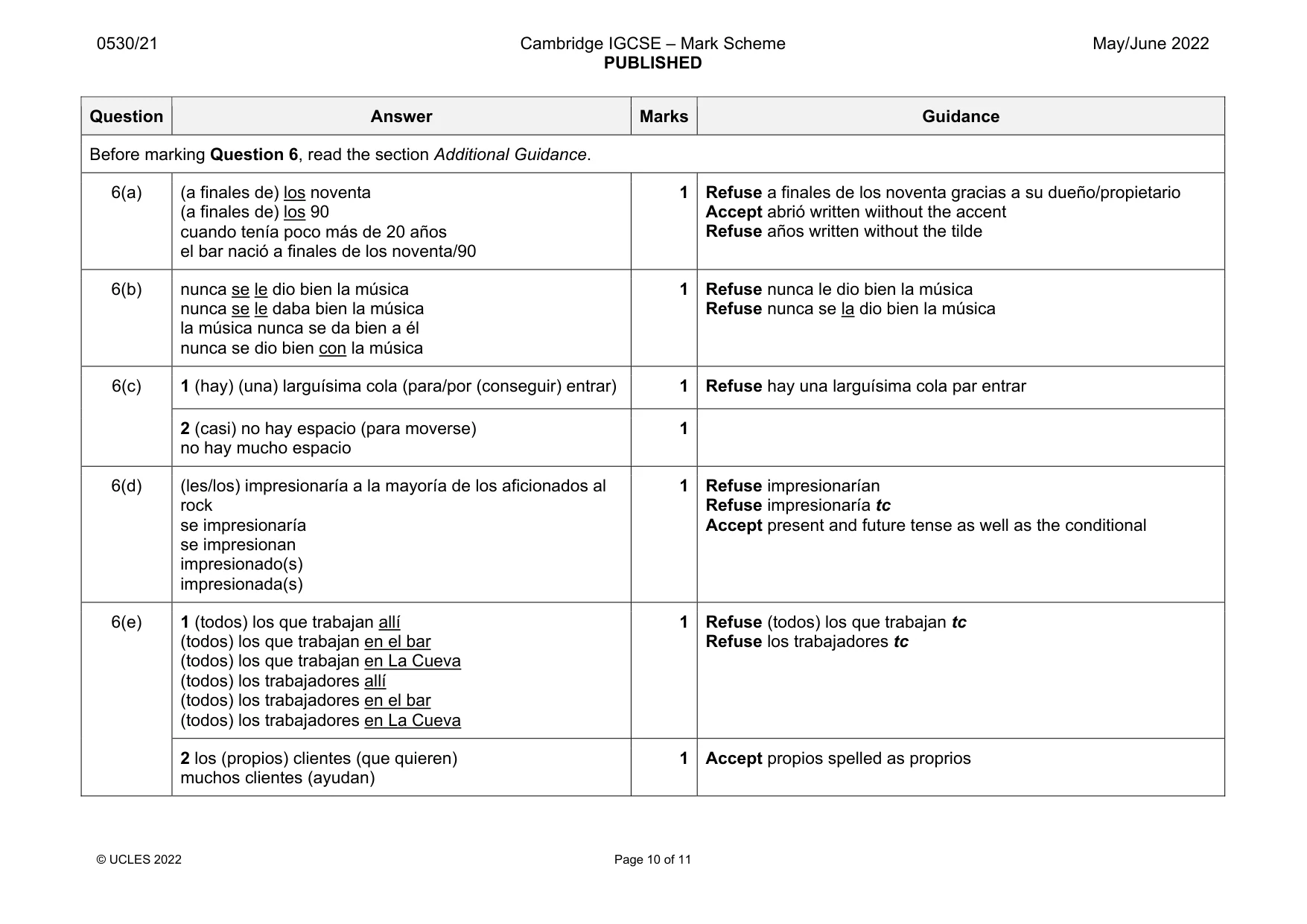
0530/21 Cambridge IGCSE – Mark Scheme PUBLISHED May/June 2022 © UCLES 2022 Page 10 of 11 Question Answer Marks Guidance Before marking Question 6, read the section Additional Guidance. 6(a) (a finales de) los noventa (a finales de) los 90 cuando tenía poco más de 20 años el bar nació a finales de los noventa/90 1 Refuse a finales de los noventa gracias a su dueño/propietario Accept abrió written wiithout the accent Refuse años written without the tilde 6(b) nunca se le dio bien la música nunca se le daba bien la música la música nunca se da bien a él nunca se dio bien con la música 1 Refuse nunca le dio bien la música Refuse nunca se la dio bien la música 6(c) 1 (hay) (una) larguísima cola (para/por (conseguir) entrar) 1 Refuse hay una larguísima cola par entrar 2 (casi) no hay espacio (para moverse) no hay mucho espacio 1 6(d) (les/los) impresionaría a la mayoría de los aficionados al rock se impresionaría se impresionan impresionado(s) impresionada(s) 1 Refuse impresionarían Refuse impresionaría tc Accept present and future tense as well as the conditional 6(e) 1 (todos) los que trabajan allí (todos) los que trabajan en el bar (todos) los que trabajan en La Cueva (todos) los trabajadores allí (todos) los trabajadores en el bar (todos) los trabajadores en La Cueva 1 Refuse (todos) los que trabajan tc Refuse los trabajadores tc 2 los (propios) clientes (que quieren) muchos clientes (ayudan) 1 Accept propios spelled as proprios
Mark scheme, page 11
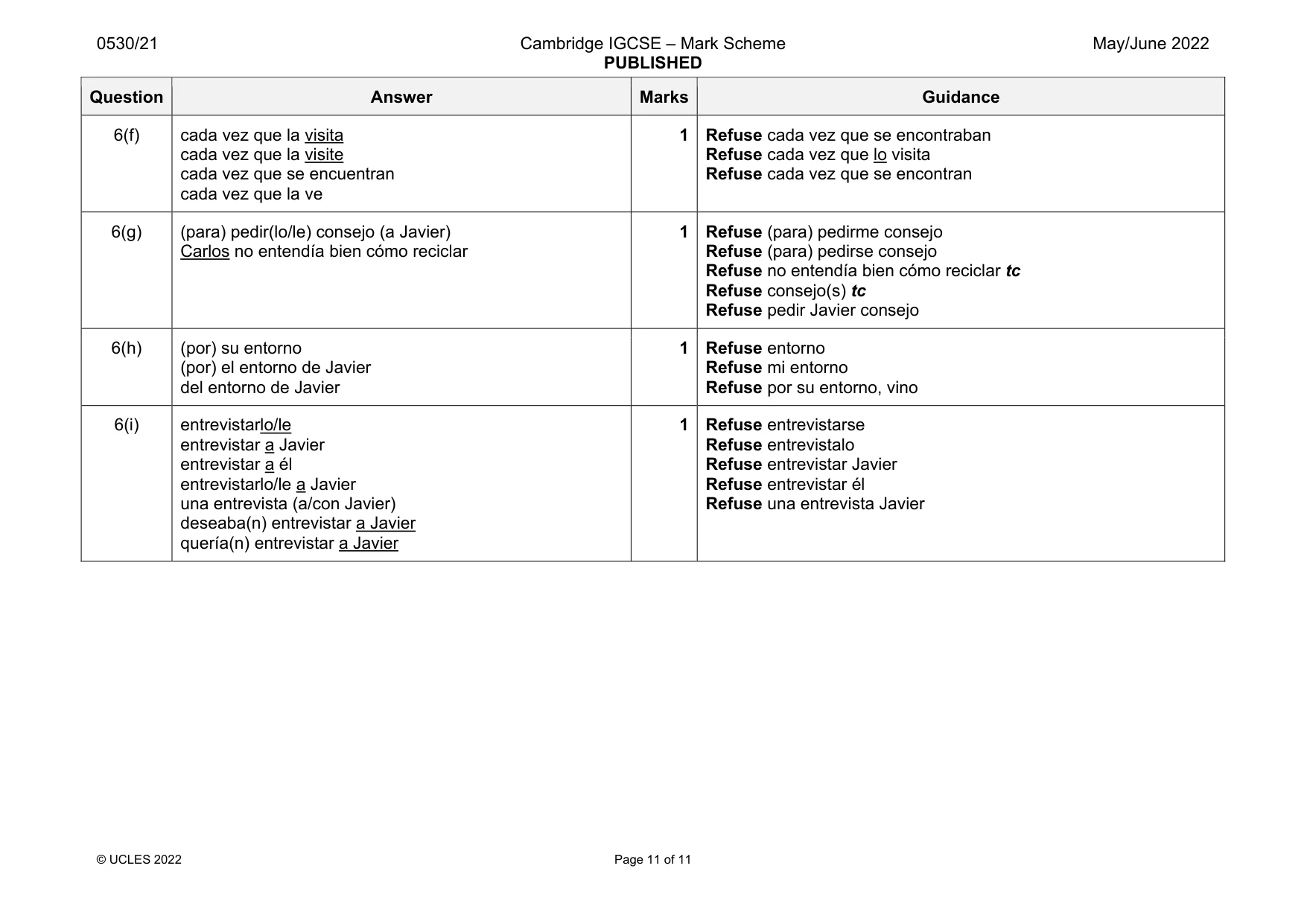
0530/21 Cambridge IGCSE – Mark Scheme PUBLISHED May/June 2022 © UCLES 2022 Page 11 of 11 Question Answer Marks Guidance 6(f) cada vez que la visita cada vez que la visite cada vez que se encuentran cada vez que la ve 1 Refuse cada vez que se encontraban Refuse cada vez que lo visita Refuse cada vez que se encontran 6(g) (para) pedir(lo/le) consejo (a Javier) Carlos no entendía bien cómo reciclar 1 Refuse (para) pedirme consejo Refuse (para) pedirse consejo Refuse no entendía bien cómo reciclar tc Refuse consejo(s) tc Refuse pedir Javier consejo 6(h) (por) su entorno (por) el entorno de Javier del entorno de Javier 1 Refuse entorno Refuse mi entorno Refuse por su entorno, vino 6(i) entrevistarlo/le entrevistar a Javier entrevistar a él entrevistarlo/le a Javier una entrevista (a/con Javier) deseaba(n) entrevistar a Javier quería(n) entrevistar a Javier 1 Refuse entrevistarse Refuse entrevistalo Refuse entrevistar Javier Refuse entrevistar él Refuse una entrevista Javier
What you needed in this session
Cambridge’s own grade thresholds for 2022 May/June, Paper 2 · Variant 1. A higher threshold means an easier paper — the bar moves with how the cohort did.