Cambridge IGCSE Spanish - Foreign Language 0530 — 2020 May/June Paper 2 · Variant 3
0530/23/M/J/20
The question paper and its mark scheme, free to read here and free to download. This is Cambridge’s own paper, exactly as it was sat.
Question paper16 pages



Mark scheme14 pages
Answers below. Sit the paper first if you are practising.
Paper as text
Question paper, page 1
Cambridge IGCSE™ DC (KS/FC) 181004/2 © UCLES 2020 [Turn over * 1 6 0 5 9 0 0 3 4 6 * This document has 16 pages. Blank pages are indicated. SPANISH 0530/23 Paper 2 Reading May/June 2020 1 hour You must answer on the question paper. No additional materials are needed. INSTRUCTIONS ● Answer all questions. ● Use a black or dark blue pen. ● Write your name, centre number and candidate number in the boxes at the top of the page. ● Write your answer to each question in the space provided. ● Do not use an erasable pen or correction fluid. ● Do not write on any bar codes. INFORMATION ● The total mark for this paper is 45. ● The number of marks for each question or part question is shown in brackets [ ].
Question paper, page 2
2 0530/23/M/J/20 © UCLES 2020 BLANK PAGE
Question paper, page 3
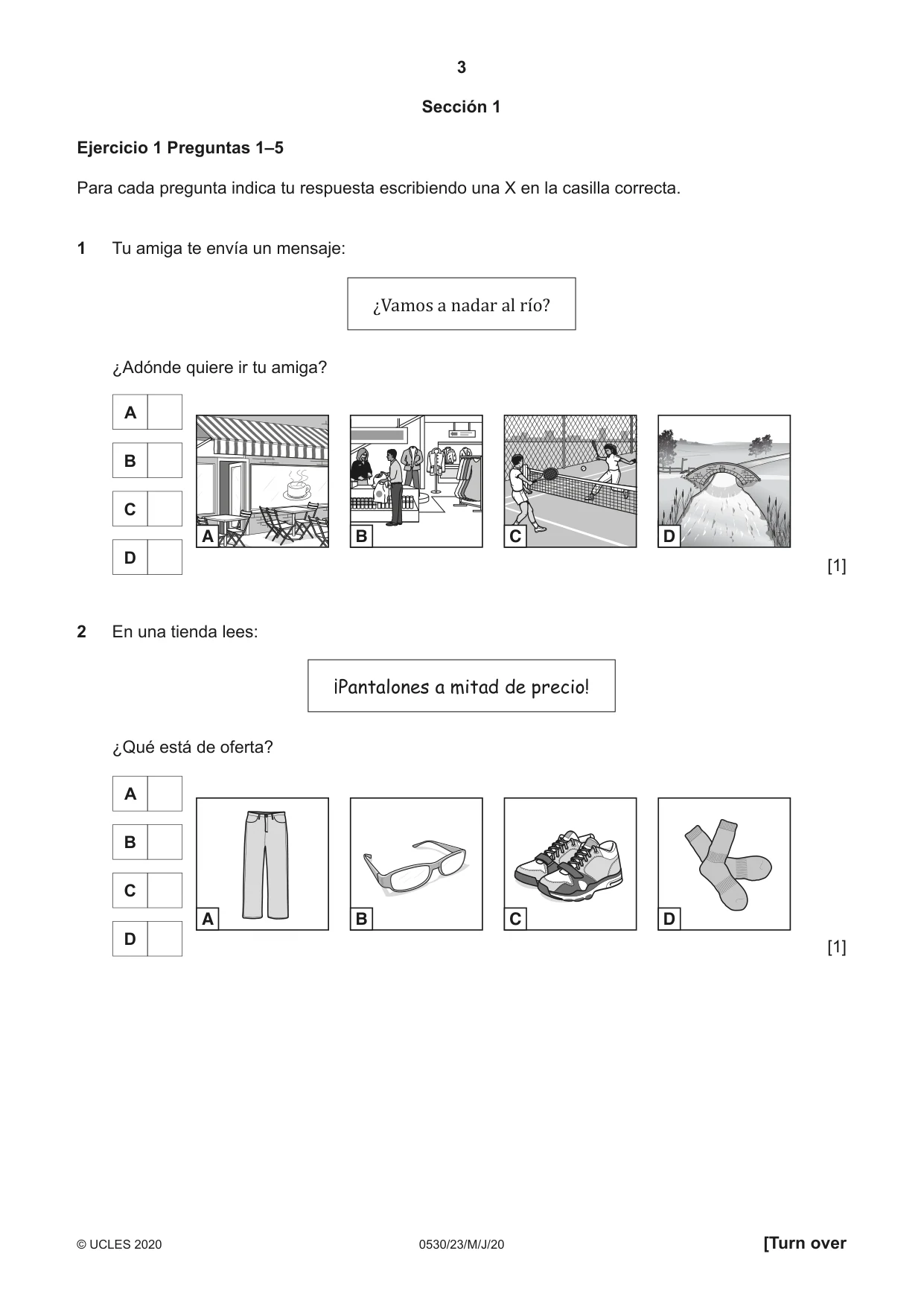
3 0530/23/M/J/20 © UCLES 2020 [Turn over Sección 1 Ejercicio 1 Preguntas 1–5 Para cada pregunta indica tu respuesta escribiendo una X en la casilla correcta. 1 Tu amiga te envía un mensaje: ¿Vamos a nadar al río? ¿Adónde quiere ir tu amiga? A B C D A B C D [1] 2 En una tienda lees: ¡Pantalones a mitad de precio! ¿Qué está de oferta? A B C D A B C D [1]
Question paper, page 4
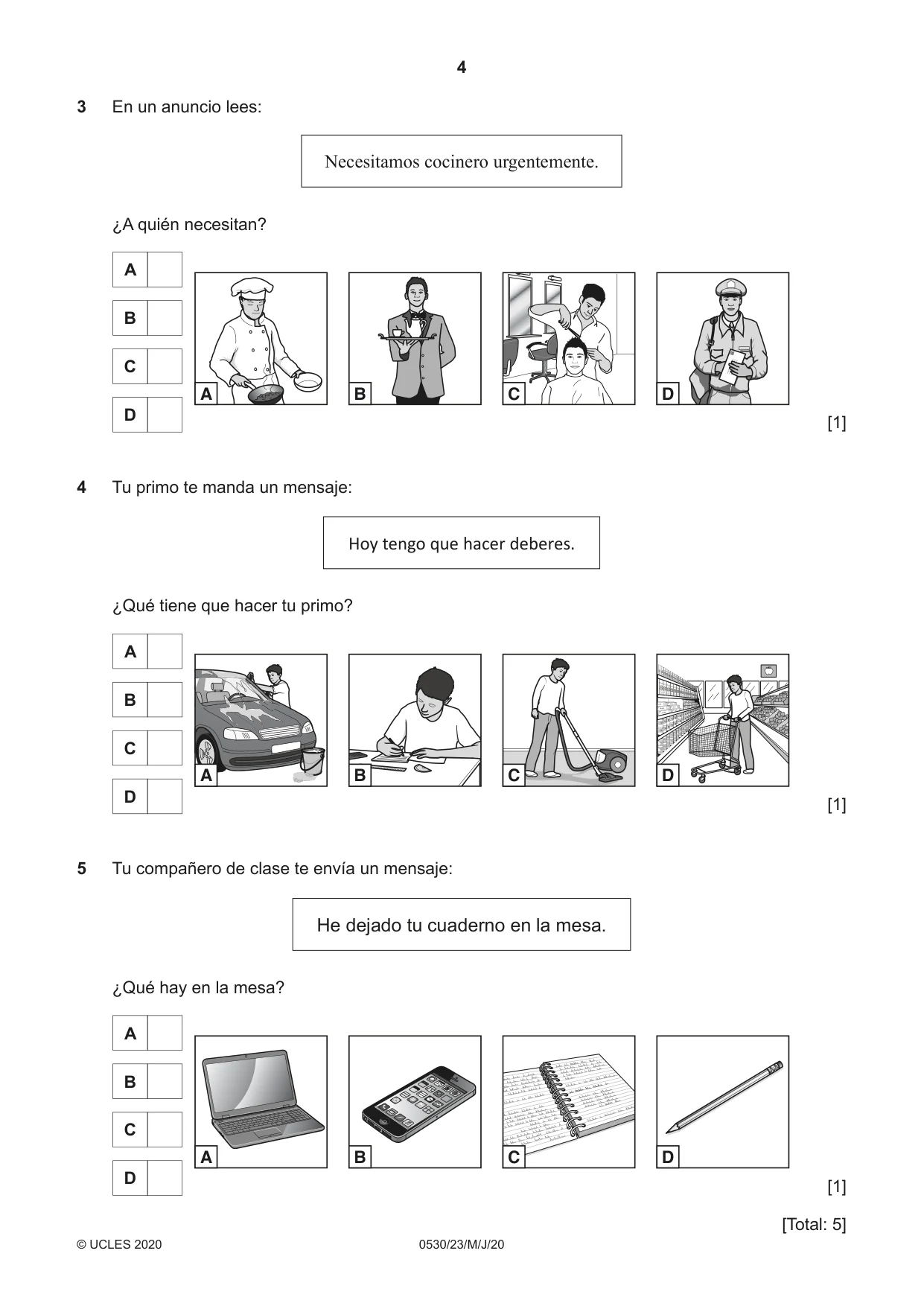
4 0530/23/M/J/20 © UCLES 2020 3 En un anuncio lees: Necesitamos cocinero urgentemente. ¿A quién necesitan? A B C D A B C D [1] 4 Tu primo te manda un mensaje: Hoy tengo que hacer deberes. ¿Qué tiene que hacer tu primo? A B C D A B C D [1] 5 Tu compañero de clase te envía un mensaje: He dejado tu cuaderno en la mesa. ¿Qué hay en la mesa? A B C D A B C D [1] [Tot al: 5]
Question paper, page 5
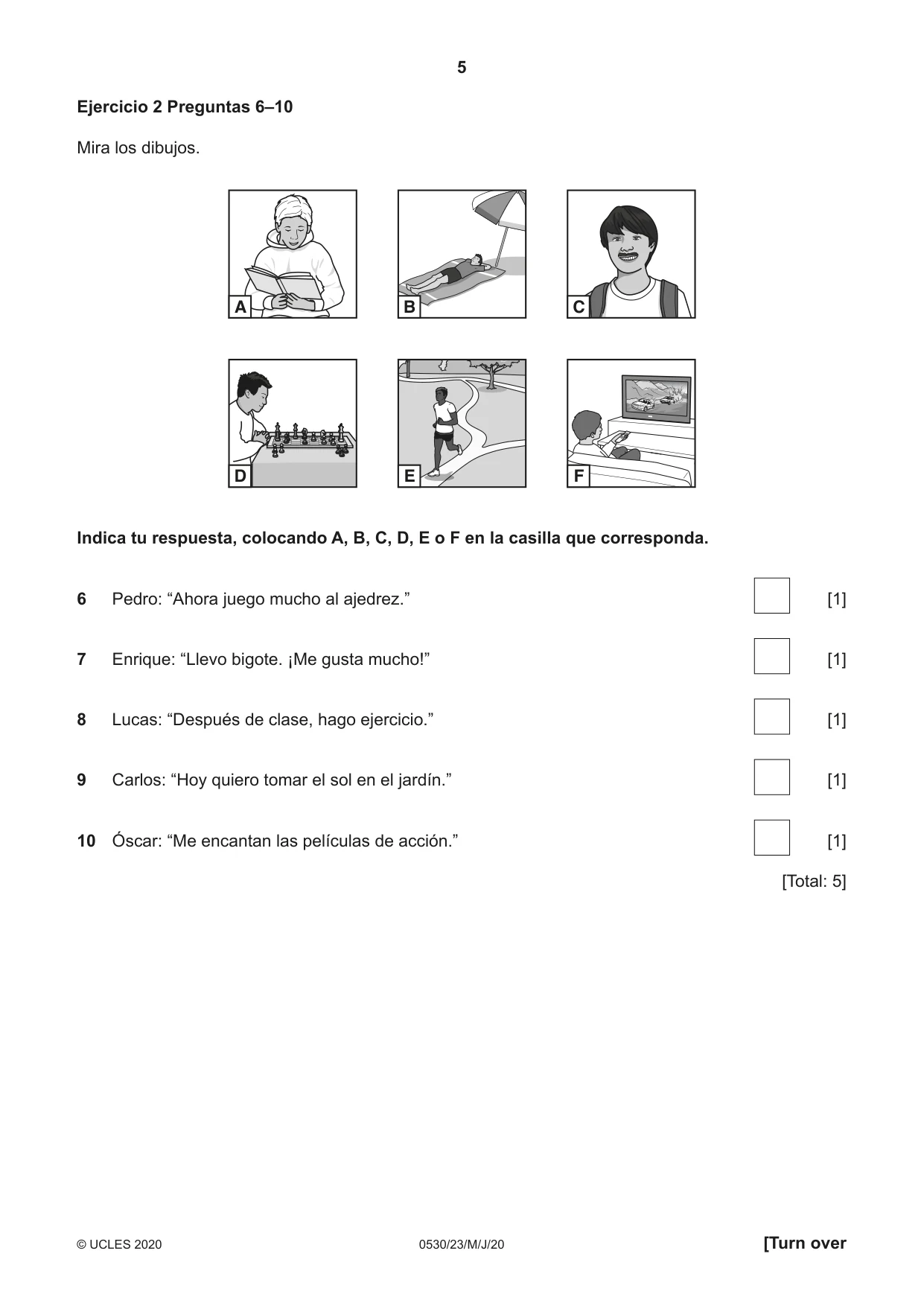
5 0530/23/M/J/20 © UCLES 2020 [Turn over Ejercicio 2 Preguntas 6–10 Mira los dibujos. A B C D E F Indica tu respuesta, colocando A, B, C, D, E o F en la casilla que corresponda. 6 Pedro: “Ahora juego mucho al ajedrez.” [1] 7 Enrique: “Llevo bigote. ¡Me gusta mucho!” [1] 8 Lucas: “Después de clase, hago ejercicio.” [1] 9 Carlos: “Hoy quiero tomar el sol en el jardín.” [1] 10 Óscar: “Me encantan las películas de acción.” [1] [Total: 5]
Question paper, page 6
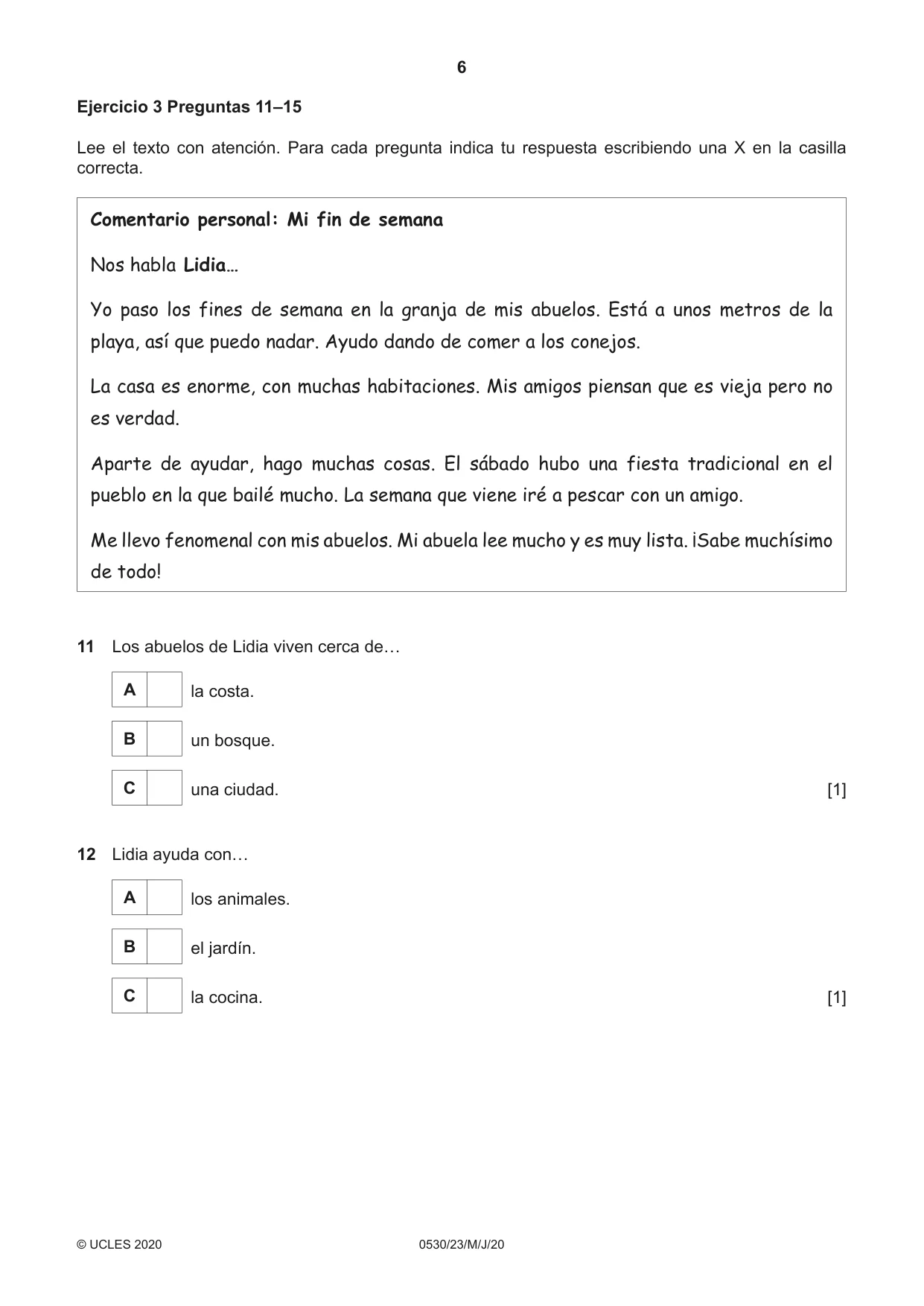
6 0530/23/M/J/20 © UCLES 2020 Ejercicio 3 Preguntas 11–15 Lee el texto con atención. Para cada pregunta indica tu respuesta escribiendo una X en la casilla correcta. Comentario personal: Mi fin de semana Nos habla Lidia… Yo paso los fines de semana en la granja de mis abuelos. Está a unos metros de la playa, así que puedo nadar. Ayudo dando de comer a los conejos. La casa es enorme, con muchas habitaciones. Mis amigos piensan que es vieja pero no es verdad. Aparte de ayudar, hago muchas cosas. El sábado hubo una fiesta tradicional en el pueblo en la que bailé mucho. La semana que viene iré a pescar con un amigo. Me llevo fenomenal con mis abuelos. Mi abuela lee mucho y es muy lista. ¡Sabe muchísimo de todo! 11 Los abuelos de Lidia viven cerca de… A la costa. B un bosque. C una ciudad. [1] 12 Lidia ayuda con… A los animales. B el jardín. C la cocina. [1]
Question paper, page 7
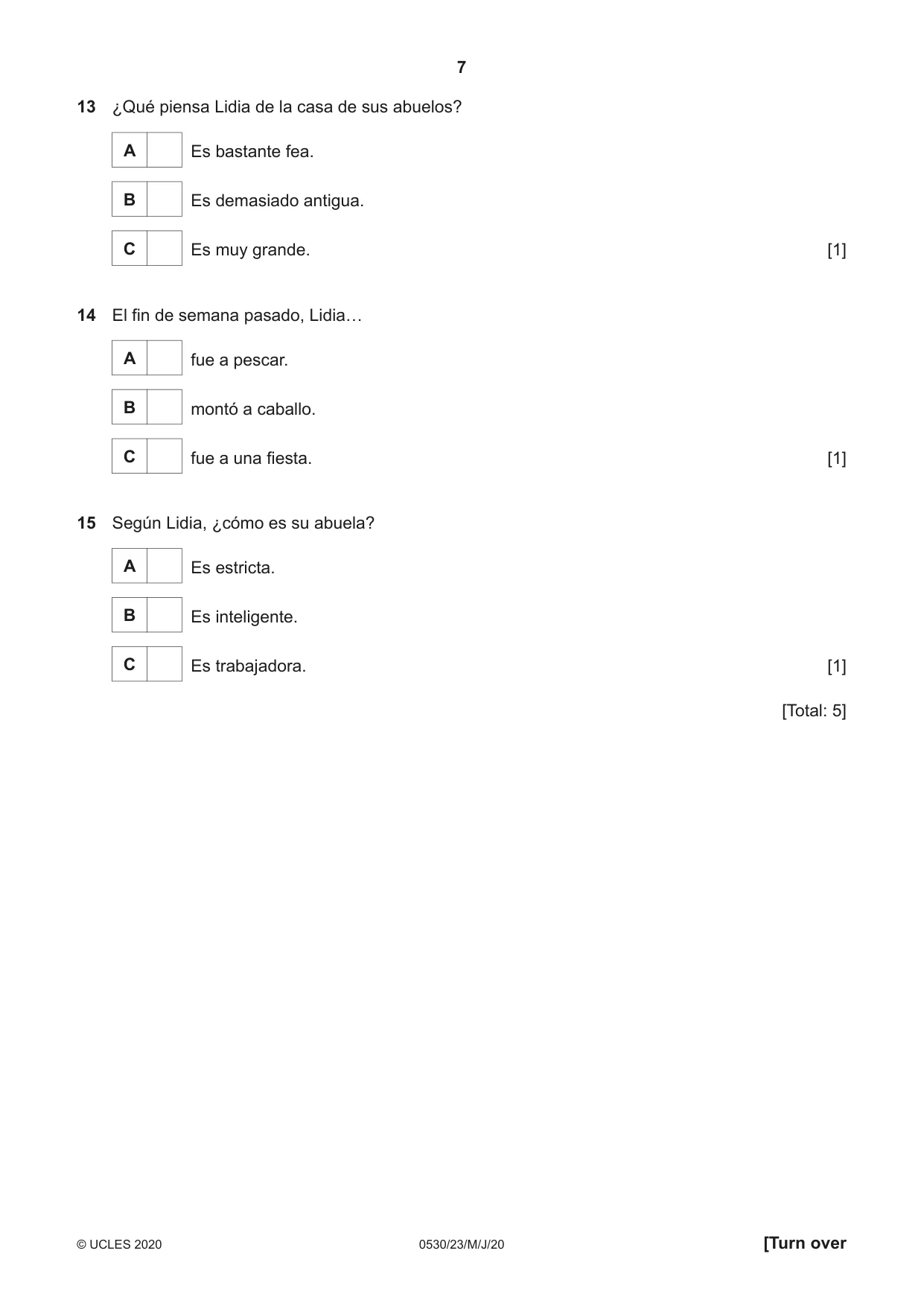
7 0530/23/M/J/20 © UCLES 2020 [Turn over 13 ¿Qué piensa Lidia de la casa de sus abuelos? A Es bastante fea. B Es demasiado antigua. C Es muy grande. [1] 14 El fin de semana pasado, Lidia… A fue a pescar. B montó a caballo. C fue a una fiesta. [1] 15 Según Lidia, ¿cómo es su abuela? A Es estricta. B Es inteligente. C Es trabajadora. [1] [Total: 5]
Question paper, page 8
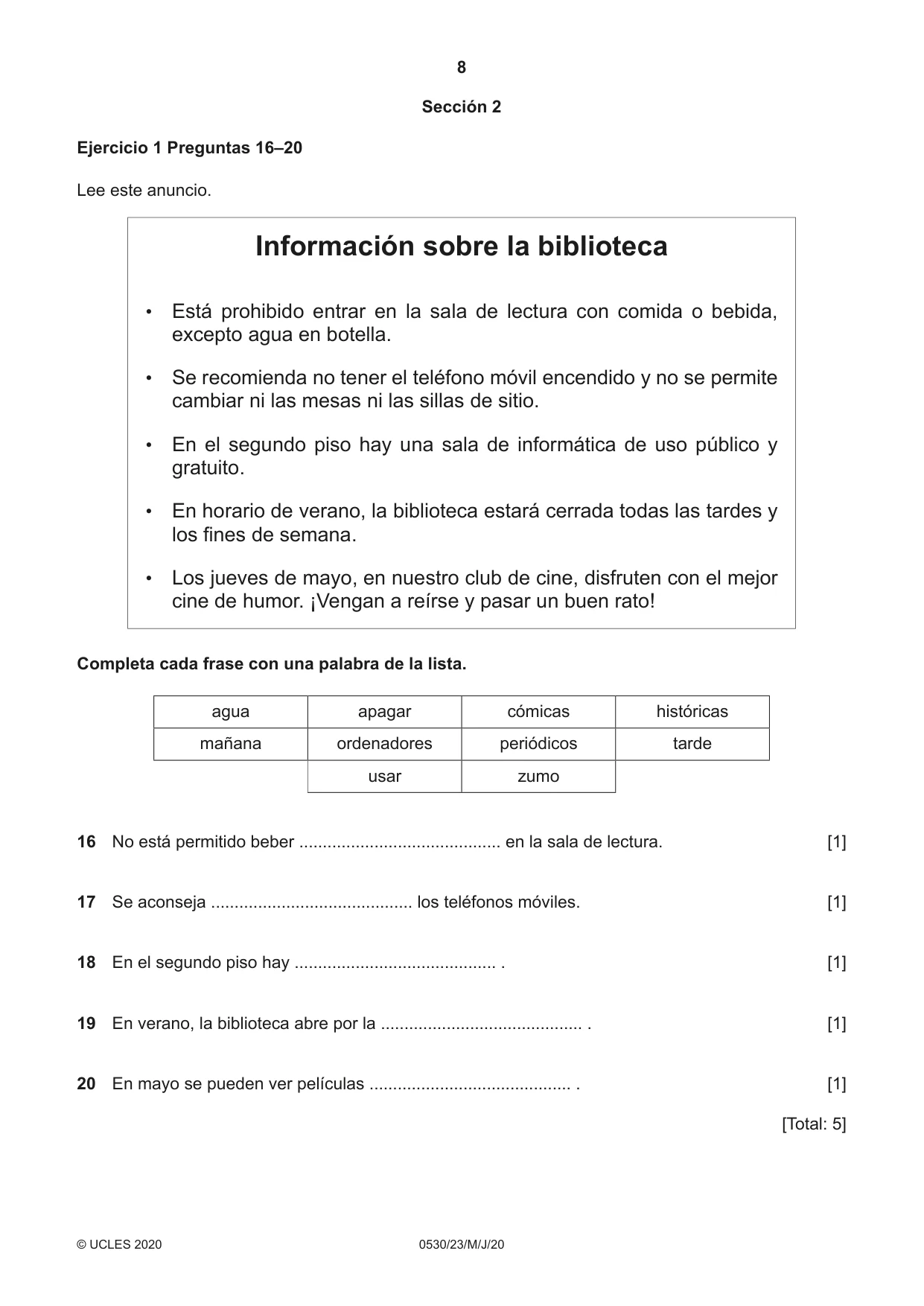
8 0530/23/M/J/20 © UCLES 2020 Sección 2 Ejercicio 1 Preguntas 16–20 Lee este anuncio. Información sobre la biblioteca • Está prohibido entrar en la sala de lectura con comida o bebida, excepto agua en botella. • Se recomienda no tener el teléfono móvil encendido y no se permite cambiar ni las mesas ni las sillas de sitio. • En el segundo piso hay una sala de informática de uso público y gratuito. • En horario de verano, la biblioteca estará cerrada todas las tardes y los fines de semana. • Los jueves de mayo, en nuestro club de cine, disfruten con el mejor cine de humor. ¡Vengan a reírse y pasar un buen rato! Completa cada frase con una palabra de la lista. agua apagar cómicas históricas mañana ordenadores periódicos tarde usar zumo 16 No está permitido beber … en la sala de lectura. [1] 17 Se aconseja … los teléfonos móviles. [1] 18 En el segundo piso hay … . [1] 19 En verano, la biblioteca abre por la … . [1] 20 En mayo se pueden ver películas … . [1] [Total: 5]
Question paper, page 9
9 0530/23/M/J/20 © UCLES 2020 [Turn over Dar la vuelta para el Ejercicio 2.
Question paper, page 10
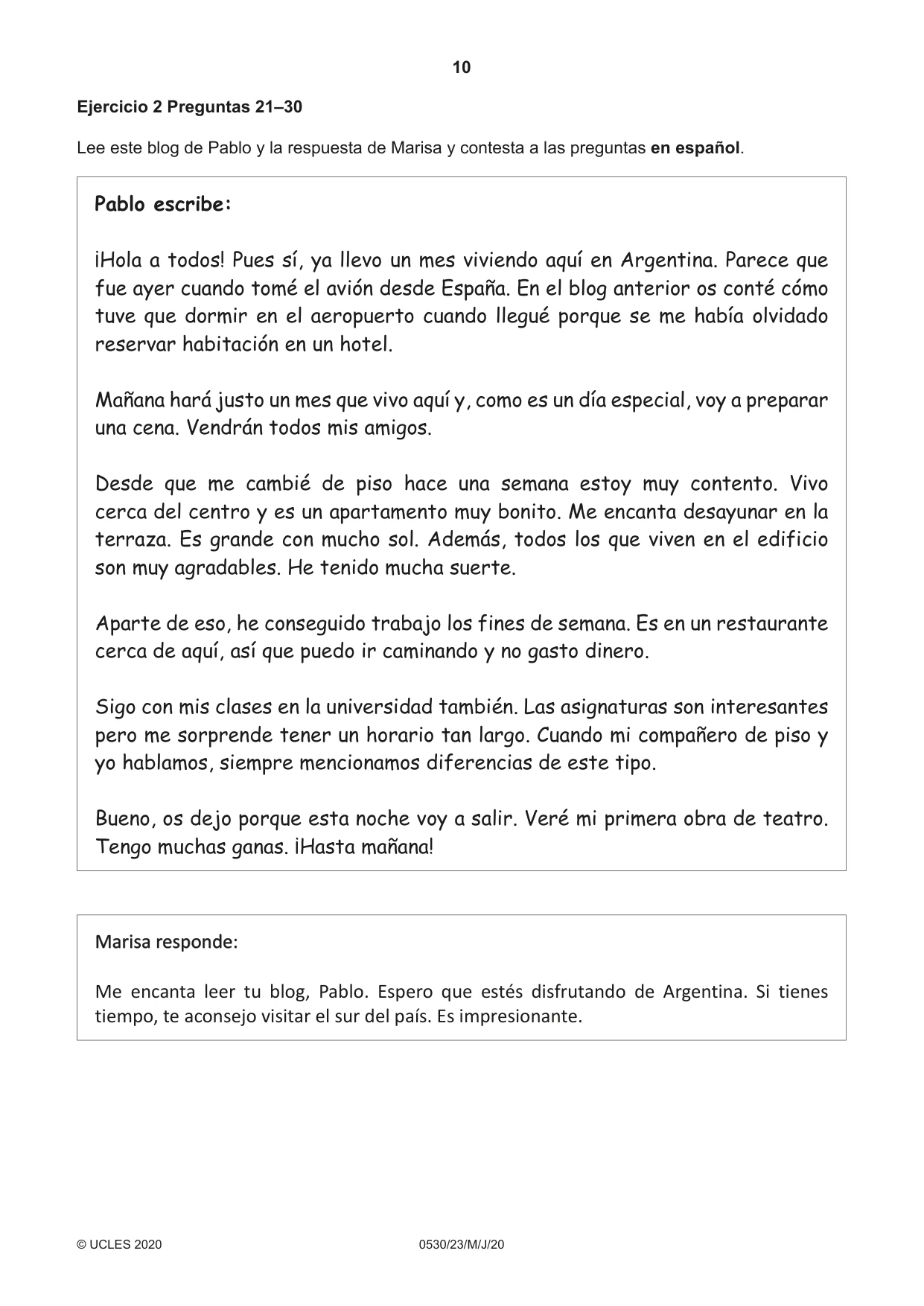
10 0530/23/M/J/20 © UCLES 2020 Ejercicio 2 Preguntas 21–30 Lee este blog de Pablo y la respuesta de Marisa y contesta a las preguntas en español. Pablo escribe: ¡Hola a todos! Pues sí, ya llevo un mes viviendo aquí en Argentina. Parece que fue ayer cuando tomé el avión desde España. En el blog anterior os conté cómo tuve que dormir en el aeropuerto cuando llegué porque se me había olvidado reservar habitación en un hotel. Mañana hará justo un mes que vivo aquí y, como es un día especial, voy a preparar una cena. Vendrán todos mis amigos. Desde que me cambié de piso hace una semana estoy muy contento. Vivo cerca del centro y es un apartamento muy bonito. Me encanta desayunar en la terraza. Es grande con mucho sol. Además, todos los que viven en el edificio son muy agradables. He tenido mucha suerte. Aparte de eso, he conseguido trabajo los fines de semana. Es en un restaurante cerca de aquí, así que puedo ir caminando y no gasto dinero. Sigo con mis clases en la universidad también. Las asignaturas son interesantes pero me sorprende tener un horario tan largo. Cuando mi compañero de piso y yo hablamos, siempre mencionamos diferencias de este tipo. Bueno, os dejo porque esta noche voy a salir. Veré mi primera obra de teatro. Tengo muchas ganas. ¡Hasta mañana! Marisa responde: Me encanta leer tu blog, Pablo. Espero que estés disfrutando de Argentina. Si tienes tiempo, te aconsejo visitar el sur del país. Es impresionante.
Question paper, page 11
11 0530/23/M/J/20 © UCLES 2020 [Turn over 21 ¿Dónde pasó Pablo su primera noche en Argentina? … [1] 22 ¿Qué va a hacer Pablo para celebrar su primer mes en Argentina? … [1] 23 ¿Cuándo se mudó Pablo a su nuevo apartamento? … [1] 24 ¿Qué le gusta hacer a Pablo cuando está en casa? … [1] 25 ¿Cómo son los vecinos de Pablo? … [1] 26 ¿Cómo va al trabajo Pablo? … [1] 27 ¿Qué le parece extraño a Pablo de la universidad? … [1] 28 ¿Con quién habla Pablo sobre la universidad? … [1] 29 ¿Qué va a ver Pablo hoy? … [1] 30 Según Marisa, ¿adónde debería ir Pablo de viaje? … [1] [Total: 10]
Question paper, page 12
12 0530/23/M/J/20 © UCLES 2020 Sección 3 Ejercicio 1 Preguntas 31–35 Lee este artículo e indica si las afirmaciones que siguen son verdaderas o falsas. Si son FALSAS, escribe una frase en español para corregirlas. ATENCIÓN: hay 2 afirmaciones que son VERDADERAS y 3 afirmaciones que son FALSAS. Clarisa: piloto de vuelos comerciales Clarisa Ruiz, de Panamá, es piloto desde hace 10 años. Aunque comenzó los estudios para ser ingeniera, los dejó cuando descubrió su afición por volar. ¿Siempre quiso ser piloto, Clarisa? Desde que yo recuerdo, sí. Creo que tenía unos 11 años cuando me presentaron a Sonia Pérez, la primera mujer piloto de Panamá. Sonia visitó el colegio para hablarnos sobre aviones. Yo no sabía de ella antes. Me dijeron que había aparecido en entrevistas pero yo no las había visto. Me emocioné mucho cuando la conocí. ¿Cómo fue su primer vuelo comercial? Lo recuerdo perfectamente. No había dormido porque estaba nerviosa. Cuando llegué al aeropuerto, me dijeron que había un problema técnico con mi avión. Entonces me cambiaron a un vuelo por la noche. A mí no me gusta nada volar en la oscuridad, aunque todo salió muy bien. ¿Ha vivido alguna experiencia especial en sus años como piloto? ¡Muchas! Cada vuelo es diferente. Por ejemplo, el sábado pasado los pasajeros en mi vuelo eran un grupo de 30 chicos y chicas de secundaria. Yo pensé que se pasarían el vuelo viendo películas y lo que me sorprendió fue que cantaron todo el rato, lo cual me alegró el día. ¿Qué le gusta de su trabajo en estos momentos? Estoy en un proyecto para animar a más chicas a que se metan en la profesión de piloto, puesto que todavía somos pocas, por desgracia. También enseño a volar a futuros pilotos. Los entreno y les doy clases varias veces a la semana. ¿Hay algo que le haga sentir bien cuando va en un avión? Es muy agradable cuando los pasajeros te agradecen tu trabajo después del aterrizaje. Como no nos ven durante el viaje, parece que no estamos ahí. Por eso, cuando alguien se acuerda, me pone de buen humor.
Question paper, page 13
13 0530/23/M/J/20 © UCLES 2020 [Turn over Ejemplo: VERDADERO FALSO Clarisa lleva menos de un mes como piloto. û Clarisa es piloto desde hace 10 años. … VERDADERO FALSO 31 Clarisa conoció a Sonia Pérez por una entrevista en la televisión. … VERDADERO FALSO 32 Clarisa prefiere volar durante el día. … VERDADERO FALSO 33 El sábado pasado, unos pasajeros vieron películas durante todo el vuelo. … VERDADERO FALSO 34 Para Clarisa, el número de mujeres pilotos ya es bastante alto. … VERDADERO FALSO 35 A Clarisa le gusta que los pasajeros hablen con ella al final del vuelo. … [Total: 8]
Question paper, page 14
14 0530/23/M/J/20 © UCLES 2020 Ejercicio 2 Preguntas 36–42 Lee este artículo y contesta a las preguntas en español. El Bar Boricua: un bar con mucha historia El Bar Boricua abre sus puertas todos los días a las cinco de la mañana. Cristián, su dueño, dice: “A esa hora empiezan el turno los empleados de la fábrica y tradicionalmente se toman aquí su café antes de entrar.” Tras esa primera hora punta, el bar está tranquilo hasta casi las nueve, cuando se sirven los desayunos. “Entre las seis y las nueve de la mañana aprovechamos para descansar un poco, porque el resto del día no paramos,” dice un camarero. El Bar Boricua, en la ciudad de Gijón, en el norte de España, es uno de los más antiguos de la región. Su nombre se lo puso el abuelo de Cristián. “‘Boricua’ es como se llama a la gente de Puerto Rico. Mi abuelo, aunque nació en Cuba y vivió allí hasta los 20 años, siempre soñó con irse a Puerto Rico, por eso llamó así a su negocio,” cuenta Cristián. Cuando abrió hace un siglo, en el bar se hacían helados de frutas que tenían mucha fama. “Estaban buenísimos,” dice Cristián, “pero no vendíamos ninguno durante las temporadas frías, así que decidimos sacarlos del menú.” El ambiente es fantástico. Un camarero dice: “Somos como una familia. Hace un mes, tuve una enfermedad y no podía trabajar, pero un grupo de clientes me llamaba diariamente y eso me animó mucho.” Cristián explica que habrá cambios en el bar. “Vamos a poner un piso más. Necesitamos más sitio y queremos hacer las obras antes de la llegada de los turistas en verano, así que cerraremos durante tres meses,” dice. Un cliente regular del bar cuenta: “Café bueno y bocadillos los hay en otros bares, pero en ningún otro se hacen bocadillos tan ricos, y ¡yo he probado muchos!” Parece que el bar seguirá teniendo éxito por mucho tiempo.
Question paper, page 15
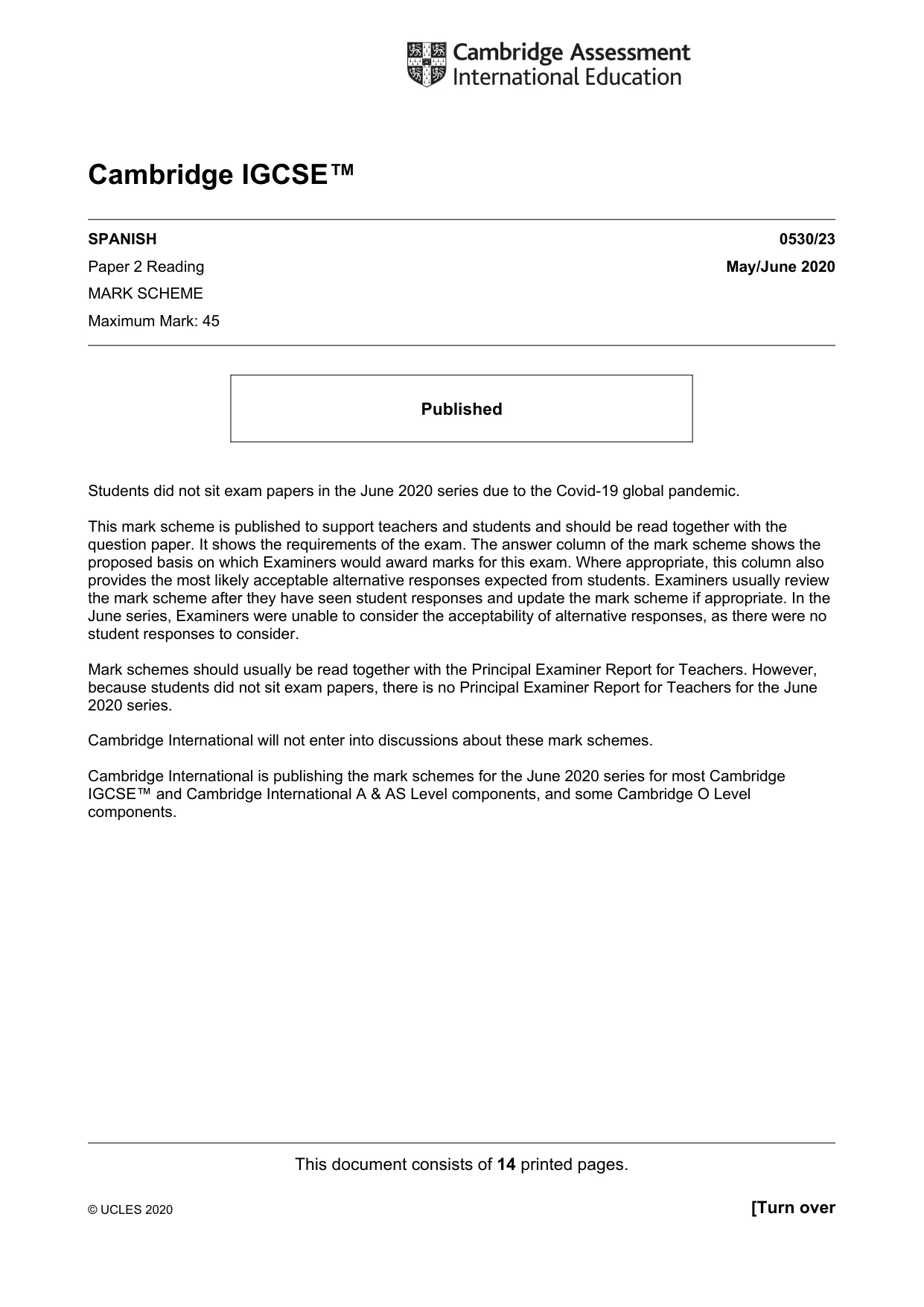
15 0530/23/M/J/20 © UCLES 2020 36 ¿A quién sirve el Bar Boricua a primera hora de la mañana? … [1] 37 ¿Qué hacen los camareros del bar de seis a nueve de la mañana? … [1] 38 ¿Dónde pasó sus primeros años de vida el abuelo de Cristián? … [1] 39 ¿Por qué dejaron de hacer helados en el Bar Boricua? … [1] 40 ¿Qué hacía sentirse mejor a un camarero del bar cuando estaba enfermo? … [1] 41 ¿Cuándo se va a construir un nuevo piso en el bar? … [1] 42 Según un cliente, ¿cuál es el secreto del éxito del Bar Boricua? … [1] [Total: 7]
Question paper, page 16
16 0530/23/M/J/20 © UCLES 2020 Permission to reproduce items where third-party owned material protected by copyright is included has been sought and cleared where possible. Every reasonable effort has been made by the publisher (UCLES) to trace copyright holders, but if any items requiring clearance have unwittingly been included, the publisher will be pleased to make amends at the earliest possible opportunity. To avoid the issue of disclosure of answer-related information to candidates, all copyright acknowledgements are reproduced online in the Cambridge Assessment International Education Copyright Acknowledgements Booklet. This is produced for each series of examinations and is freely available to download at www.cambridgeinternational.org after the live examination series. Cambridge Assessment International Education is part of the Cambridge Assessment Group. Cambridge Assessment is the brand name of the University of Cambridge Local Examinations Syndicate (UCLES), which itself is a department of the University of Cambridge. BLANK PAGE
Mark scheme, page 1
This document consists of 14 printed pages. © UCLES 2020 [Turn over Cambridge IGCSE™ SPANISH 0530/23 Paper 2 Reading May/June 2020 MARK SCHEME Maximum Mark: 45 Published Students did not sit exam papers in the June 2020 series due to the Covid-19 global pandemic. This mark scheme is published to support teachers and students and should be read together with the question paper. It shows the requirements of the exam. The answer column of the mark scheme shows the proposed basis on which Examiners would award marks for this exam. Where appropriate, this column also provides the most likely acceptable alternative responses expected from students. Examiners usually review the mark scheme after they have seen student responses and update the mark scheme if appropriate. In the June series, Examiners were unable to consider the acceptability of alternative responses, as there were no student responses to consider. Mark schemes should usually be read together with the Principal Examiner Report for Teachers. However, because students did not sit exam papers, there is no Principal Examiner Report for Teachers for the June 2020 series. Cambridge International will not enter into discussions about these mark schemes. Cambridge International is publishing the mark schemes for the June 2020 series for most Cambridge IGCSE™ and Cambridge International A & AS Level components, and some Cambridge O Level components.
Mark scheme, page 2
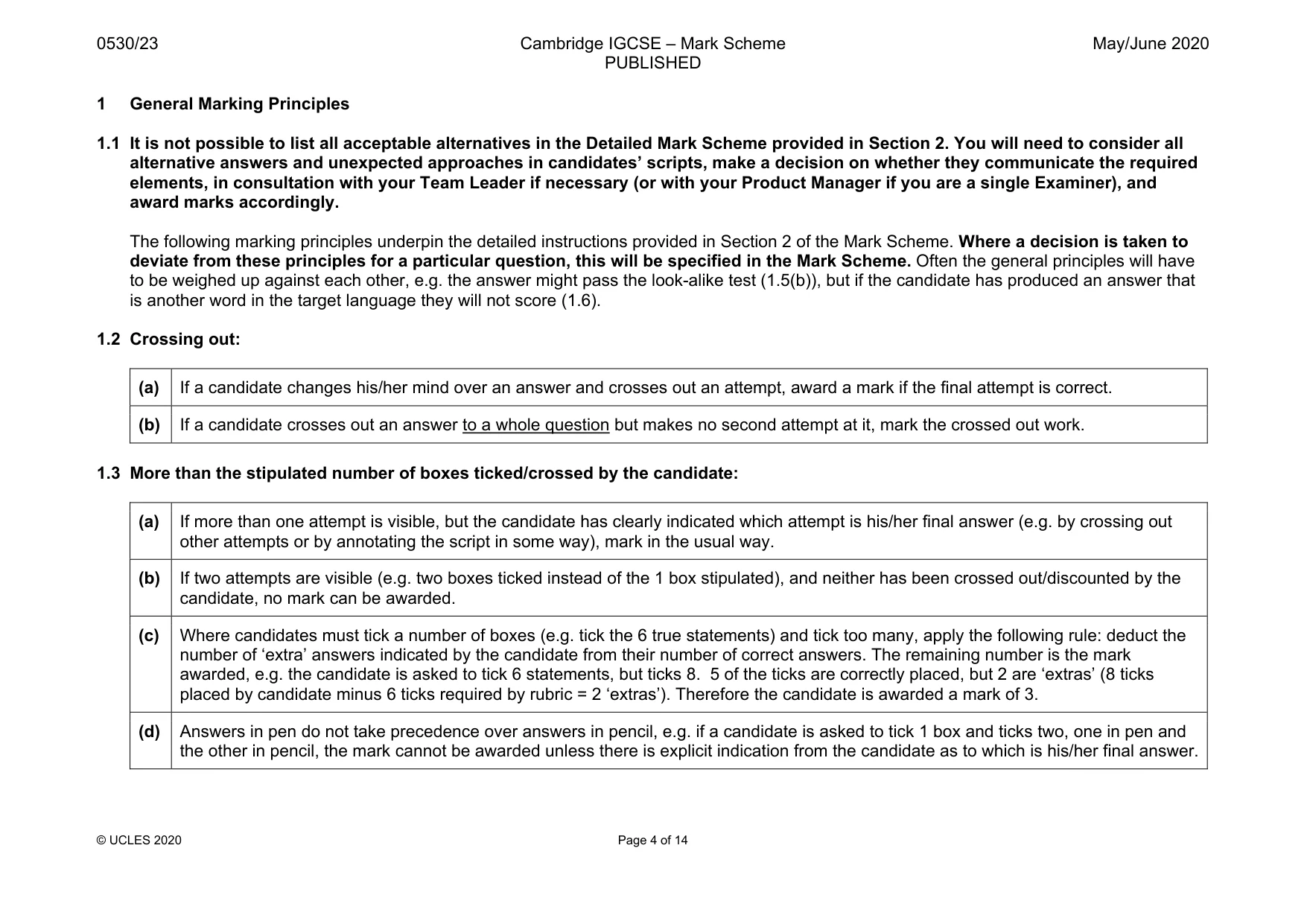
0530/23 Cambridge IGCSE – Mark Scheme PUBLISHED May/June 2020 © UCLES 2020 Page 2 of 14 Generic Marking Principles These general marking principles must be applied by all examiners when marking candidate answers. They should be applied alongside the specific content of the mark scheme or generic level descriptors for a question. Each question paper and mark scheme will also comply with these marking principles. GENERIC MARKING PRINCIPLE 1: Marks must be awarded in line with: • the specific content of the mark scheme or the generic level descriptors for the question • the specific skills defined in the mark scheme or in the generic level descriptors for the question • the standard of response required by a candidate as exemplified by the standardisation scripts. GENERIC MARKING PRINCIPLE 2: Marks awarded are always whole marks (not half marks, or other fractions). GENERIC MARKING PRINCIPLE 3: Marks must be awarded positively: • marks are awarded for correct/valid answers, as defined in the mark scheme. However, credit is given for valid answers which go beyond the scope of the syllabus and mark scheme, referring to your Team Leader as appropriate • marks are awarded when candidates clearly demonstrate what they know and can do • marks are not deducted for errors • marks are not deducted for omissions • answers should only be judged on the quality of spelling, punctuation and grammar when these features are specifically assessed by the question as indicated by the mark scheme. The meaning, however, should be unambiguous. GENERIC MARKING PRINCIPLE 4: Rules must be applied consistently e.g. in situations where candidates have not followed instructions or in the application of generic level descriptors.
Mark scheme, page 3
0530/23 Cambridge IGCSE – Mark Scheme PUBLISHED May/June 2020 © UCLES 2020 Page 3 of 14 GENERIC MARKING PRINCIPLE 5: Marks should be awarded using the full range of marks defined in the mark scheme for the question (however; the use of the full mark range may be limited according to the quality of the candidate responses seen). GENERIC MARKING PRINCIPLE 6: Marks awarded are based solely on the requirements as defined in the mark scheme. Marks should not be awarded with grade thresholds or grade descriptors in mind.
Mark scheme, page 4
0530/23 Cambridge IGCSE – Mark Scheme PUBLISHED May/June 2020 © UCLES 2020 Page 4 of 14 1 General Marking Principles 1.1 It is not possible to list all acceptable alternatives in the Detailed Mark Scheme provided in Section 2. You will need to consider all alternative answers and unexpected approaches in candidates’ scripts, make a decision on whether they communicate the required elements, in consultation with your Team Leader if necessary (or with your Product Manager if you are a single Examiner), and award marks accordingly. The following marking principles underpin the detailed instructions provided in Section 2 of the Mark Scheme. Where a decision is taken to deviate from these principles for a particular question, this will be specified in the Mark Scheme. Often the general principles will have to be weighed up against each other, e.g. the answer might pass the look-alike test (1.5(b)), but if the candidate has produced an answer that is another word in the target language they will not score (1.6). 1.2 Crossing out: (a) If a candidate changes his/her mind over an answer and crosses out an attempt, award a mark if the final attempt is correct. (b) If a candidate crosses out an answer to a whole question but makes no second attempt at it, mark the crossed out work. 1.3 More than the stipulated number of boxes ticked/crossed by the candidate: (a) If more than one attempt is visible, but the candidate has clearly indicated which attempt is his/her final answer (e.g. by crossing out other attempts or by annotating the script in some way), mark in the usual way. (b) If two attempts are visible (e.g. two boxes ticked instead of the 1 box stipulated), and neither has been crossed out/discounted by the candidate, no mark can be awarded. (c) Where candidates must tick a number of boxes (e.g. tick the 6 true statements) and tick too many, apply the following rule: deduct the number of ‘extra’ answers indicated by the candidate from their number of correct answers. The remaining number is the mark awarded, e.g. the candidate is asked to tick 6 statements, but ticks 8. 5 of the ticks are correctly placed, but 2 are ‘extras’ (8 ticks placed by candidate minus 6 ticks required by rubric = 2 ‘extras’). Therefore the candidate is awarded a mark of 3. (d) Answers in pen do not take precedence over answers in pencil, e.g. if a candidate is asked to tick 1 box and ticks two, one in pen and the other in pencil, the mark cannot be awarded unless there is explicit indication from the candidate as to which is his/her final answer.
Mark scheme, page 5
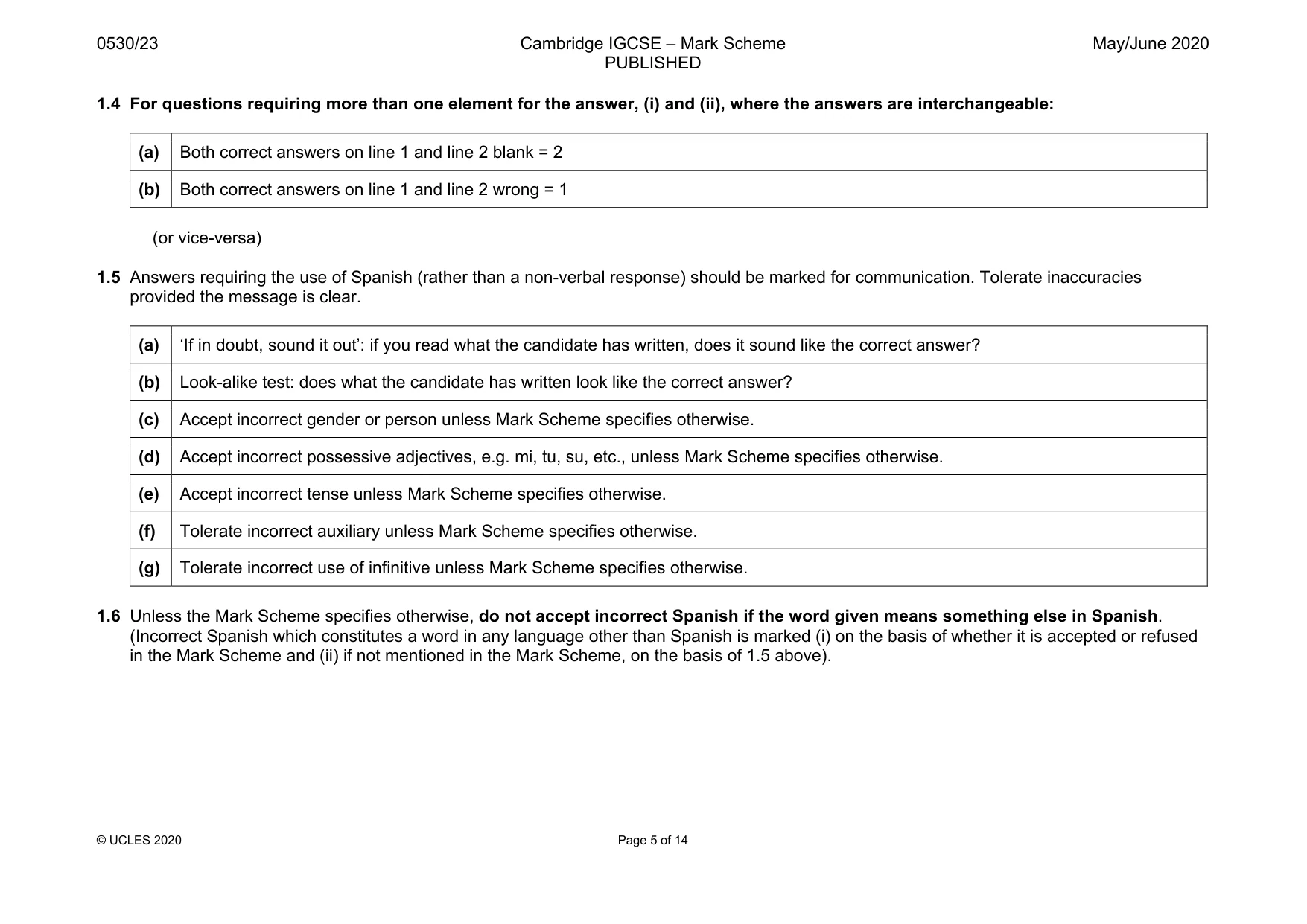
0530/23 Cambridge IGCSE – Mark Scheme PUBLISHED May/June 2020 © UCLES 2020 Page 5 of 14 1.4 For questions requiring more than one element for the answer, (i) and (ii), where the answers are interchangeable: (a) Both correct answers on line 1 and line 2 blank = 2 (b) Both correct answers on line 1 and line 2 wrong = 1 (or vice-versa) 1.5 Answers requiring the use of Spanish (rather than a non-verbal response) should be marked for communication. Tolerate inaccuracies provided the message is clear. (a) ‘If in doubt, sound it out’: if you read what the candidate has written, does it sound like the correct answer? (b) Look-alike test: does what the candidate has written look like the correct answer? (c) Accept incorrect gender or person unless Mark Scheme specifies otherwise. (d) Accept incorrect possessive adjectives, e.g. mi, tu, su, etc., unless Mark Scheme specifies otherwise. (e) Accept incorrect tense unless Mark Scheme specifies otherwise. (f) Tolerate incorrect auxiliary unless Mark Scheme specifies otherwise. (g) Tolerate incorrect use of infinitive unless Mark Scheme specifies otherwise. 1.6 Unless the Mark Scheme specifies otherwise, do not accept incorrect Spanish if the word given means something else in Spanish. (Incorrect Spanish which constitutes a word in any language other than Spanish is marked (i) on the basis of whether it is accepted or refused in the Mark Scheme and (ii) if not mentioned in the Mark Scheme, on the basis of 1.5 above).
Mark scheme, page 6
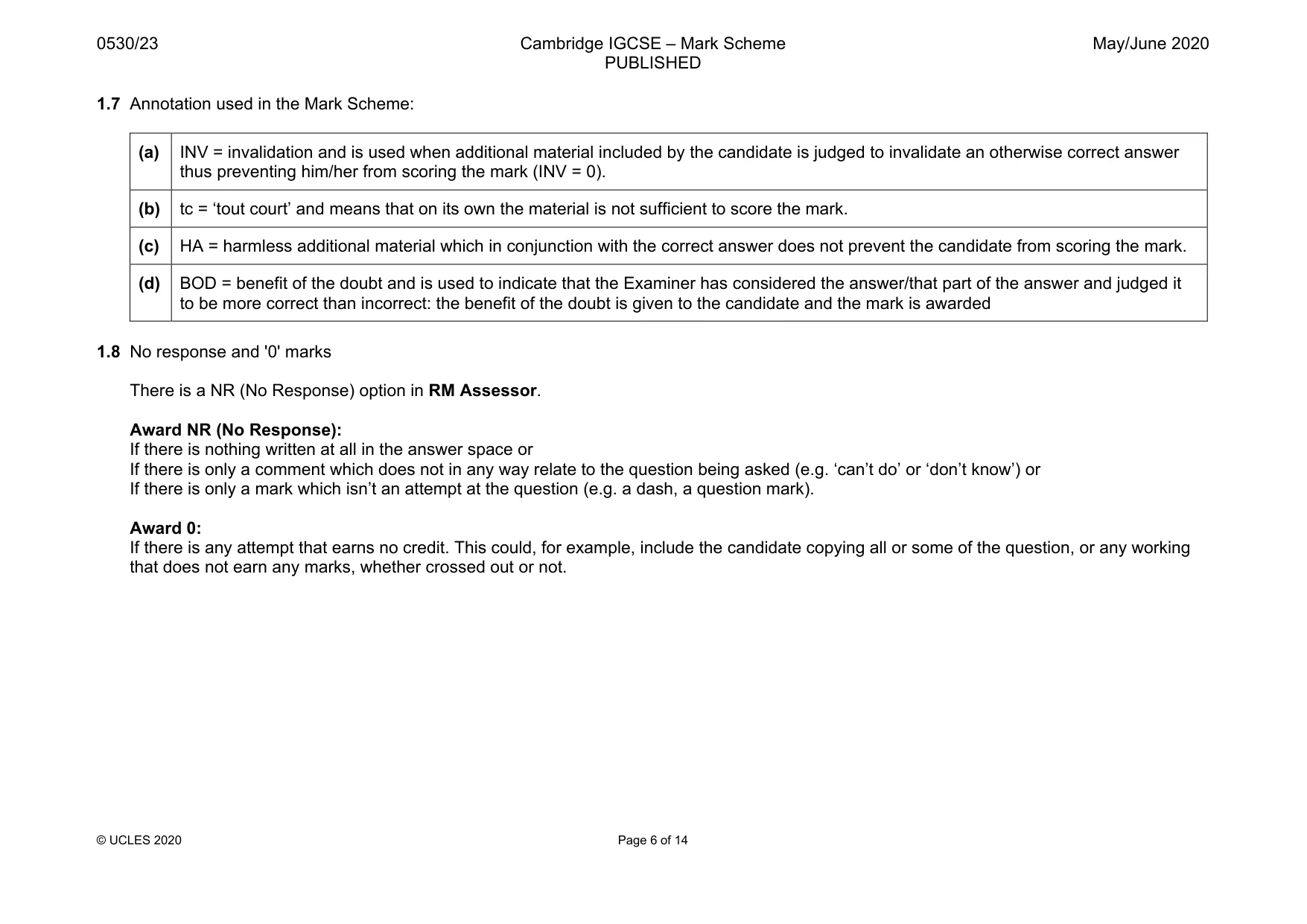
0530/23 Cambridge IGCSE – Mark Scheme PUBLISHED May/June 2020 © UCLES 2020 Page 6 of 14 1.7 Annotation used in the Mark Scheme: (a) INV = invalidation and is used when additional material included by the candidate is judged to invalidate an otherwise correct answer thus preventing him/her from scoring the mark (INV = 0). (b) tc = ‘tout court’ and means that on its own the material is not sufficient to score the mark. (c) HA = harmless additional material which in conjunction with the correct answer does not prevent the candidate from scoring the mark. (d) BOD = benefit of the doubt and is used to indicate that the Examiner has considered the answer/that part of the answer and judged it to be more correct than incorrect: the benefit of the doubt is given to the candidate and the mark is awarded 1.8 No response and '0' marks There is a NR (No Response) option in RM Assessor. Award NR (No Response): If there is nothing written at all in the answer space or If there is only a comment which does not in any way relate to the question being asked (e.g. ‘can’t do’ or ‘don’t know’) or If there is only a mark which isn’t an attempt at the question (e.g. a dash, a question mark). Award 0: If there is any attempt that earns no credit. This could, for example, include the candidate copying all or some of the question, or any working that does not earn any marks, whether crossed out or not.
Mark scheme, page 7
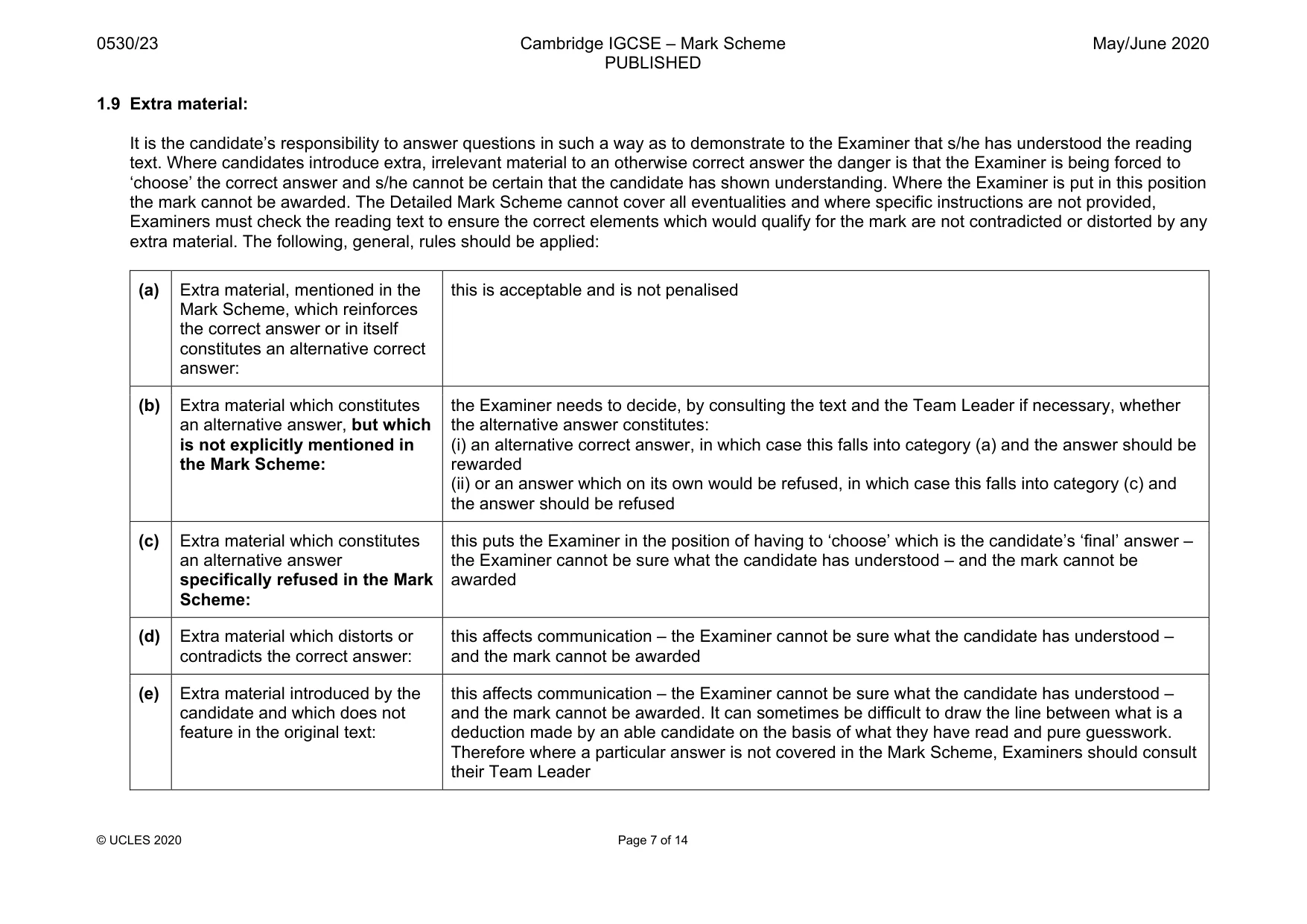
0530/23 Cambridge IGCSE – Mark Scheme PUBLISHED May/June 2020 © UCLES 2020 Page 7 of 14 1.9 Extra material: It is the candidate’s responsibility to answer questions in such a way as to demonstrate to the Examiner that s/he has understood the reading text. Where candidates introduce extra, irrelevant material to an otherwise correct answer the danger is that the Examiner is being forced to ‘choose’ the correct answer and s/he cannot be certain that the candidate has shown understanding. Where the Examiner is put in this position the mark cannot be awarded. The Detailed Mark Scheme cannot cover all eventualities and where specific instructions are not provided, Examiners must check the reading text to ensure the correct elements which would qualify for the mark are not contradicted or distorted by any extra material. The following, general, rules should be applied: (a) Extra material, mentioned in the Mark Scheme, which reinforces the correct answer or in itself constitutes an alternative correct answer: this is acceptable and is not penalised (b) Extra material which constitutes an alternative answer, but which is not explicitly mentioned in the Mark Scheme: the Examiner needs to decide, by consulting the text and the Team Leader if necessary, whether the alternative answer constitutes: (i) an alternative correct answer, in which case this falls into category (a) and the answer should be rewarded (ii) or an answer which on its own would be refused, in which case this falls into category (c) and the answer should be refused (c) Extra material which constitutes an alternative answer specifically refused in the Mark Scheme: this puts the Examiner in the position of having to ‘choose’ which is the candidate’s ‘final’ answer – the Examiner cannot be sure what the candidate has understood – and the mark cannot be awarded (d) Extra material which distorts or contradicts the correct answer: this affects communication – the Examiner cannot be sure what the candidate has understood – and the mark cannot be awarded (e) Extra material introduced by the candidate and which does not feature in the original text: this affects communication – the Examiner cannot be sure what the candidate has understood – and the mark cannot be awarded. It can sometimes be difficult to draw the line between what is a deduction made by an able candidate on the basis of what they have read and pure guesswork. Therefore where a particular answer is not covered in the Mark Scheme, Examiners should consult their Team Leader
Mark scheme, page 8
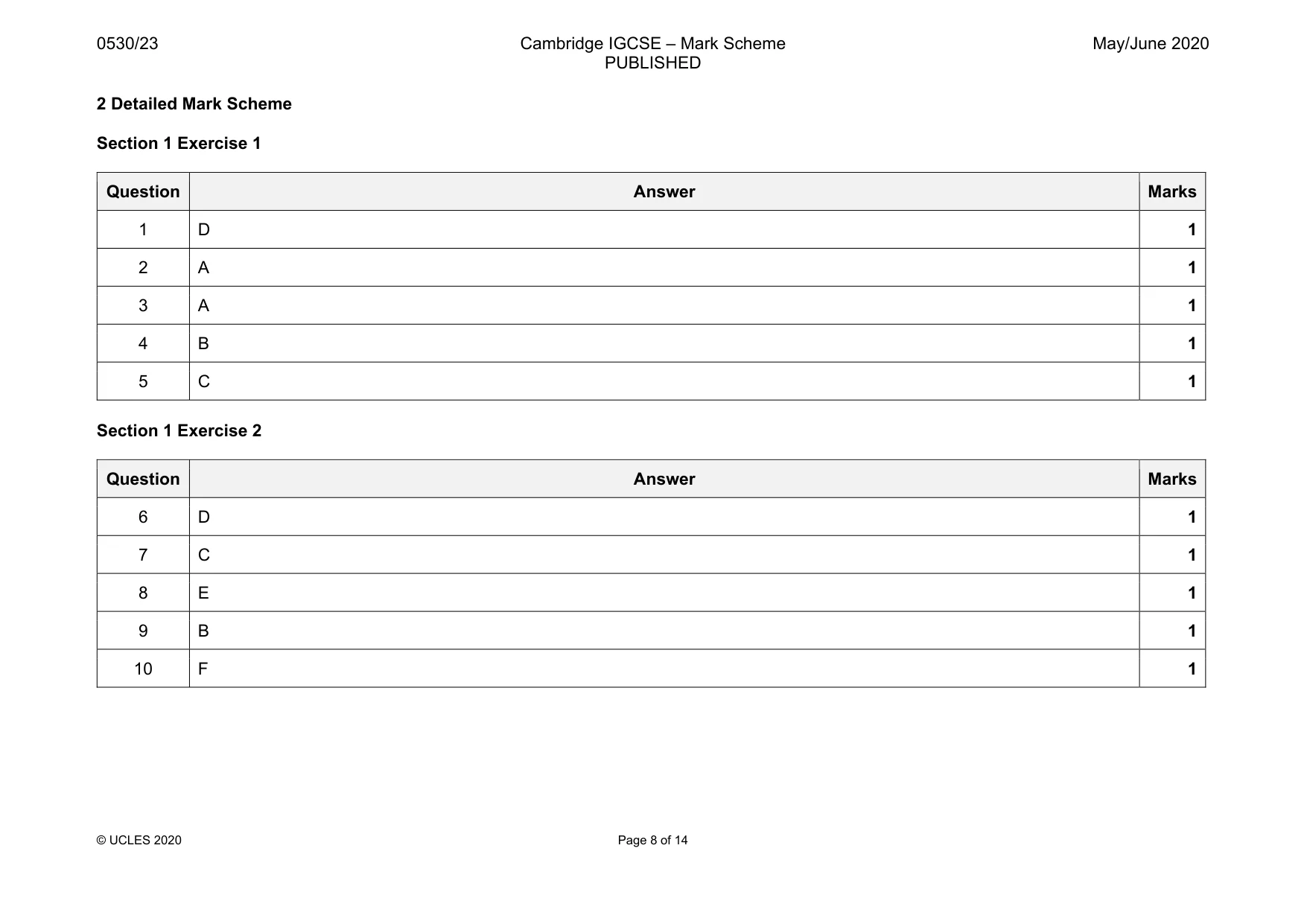
0530/23 Cambridge IGCSE – Mark Scheme PUBLISHED May/June 2020 © UCLES 2020 Page 8 of 14 2 Detailed Mark Scheme Section 1 Exercise 1 Question Answer Marks 1 D 1 2 A 1 3 A 1 4 B 1 5 C 1 Section 1 Exercise 2 Question Answer Marks 6 D 1 7 C 1 8 E 1 9 B 1 10 F 1
Mark scheme, page 9
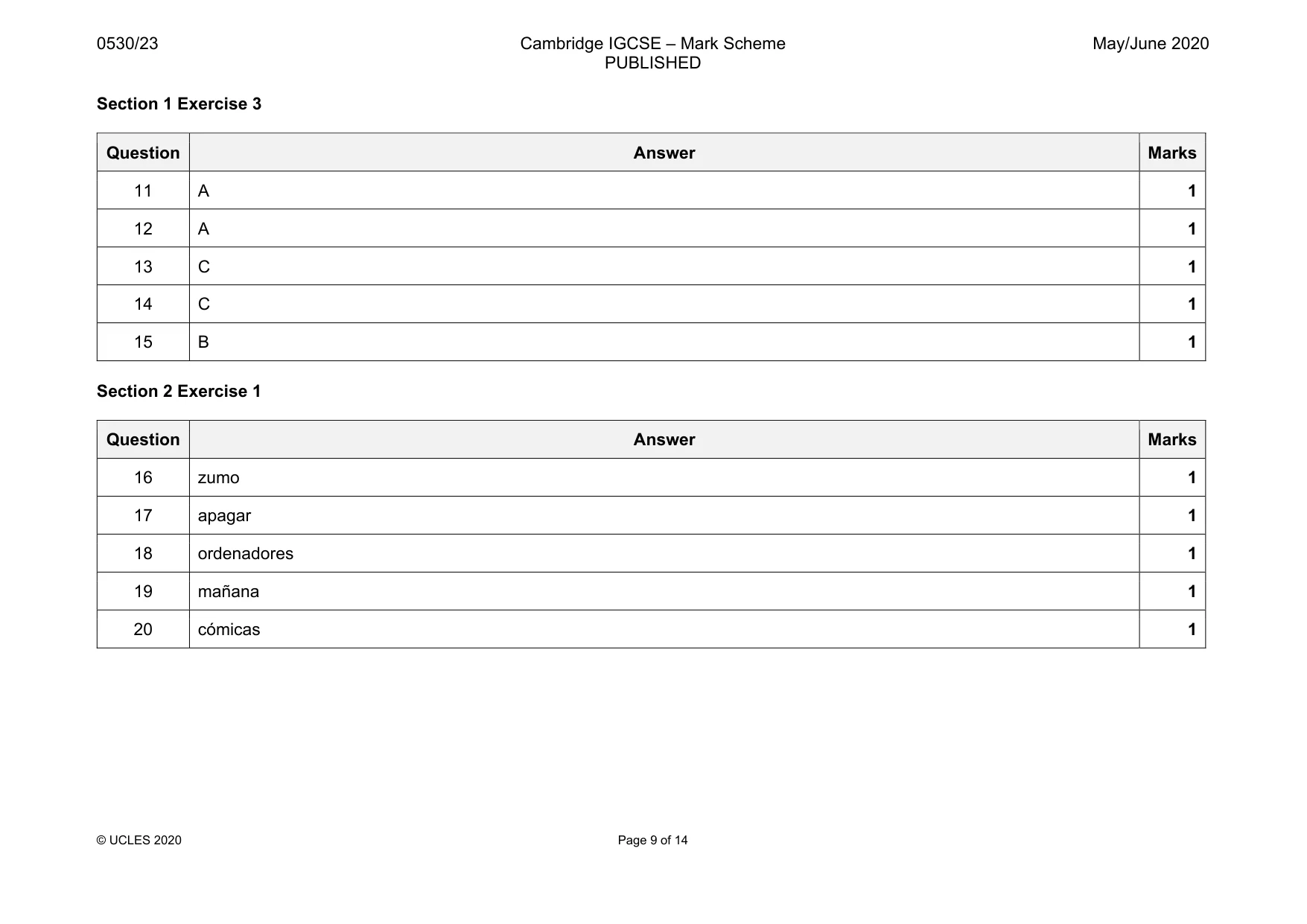
0530/23 Cambridge IGCSE – Mark Scheme PUBLISHED May/June 2020 © UCLES 2020 Page 9 of 14 Section 1 Exercise 3 Question Answer Marks 11 A 1 12 A 1 13 C 1 14 C 1 15 B 1 Section 2 Exercise 1 Question Answer Marks 16 zumo 1 17 apagar 1 18 ordenadores 1 19 mañana 1 20 cómicas 1
Mark scheme, page 10
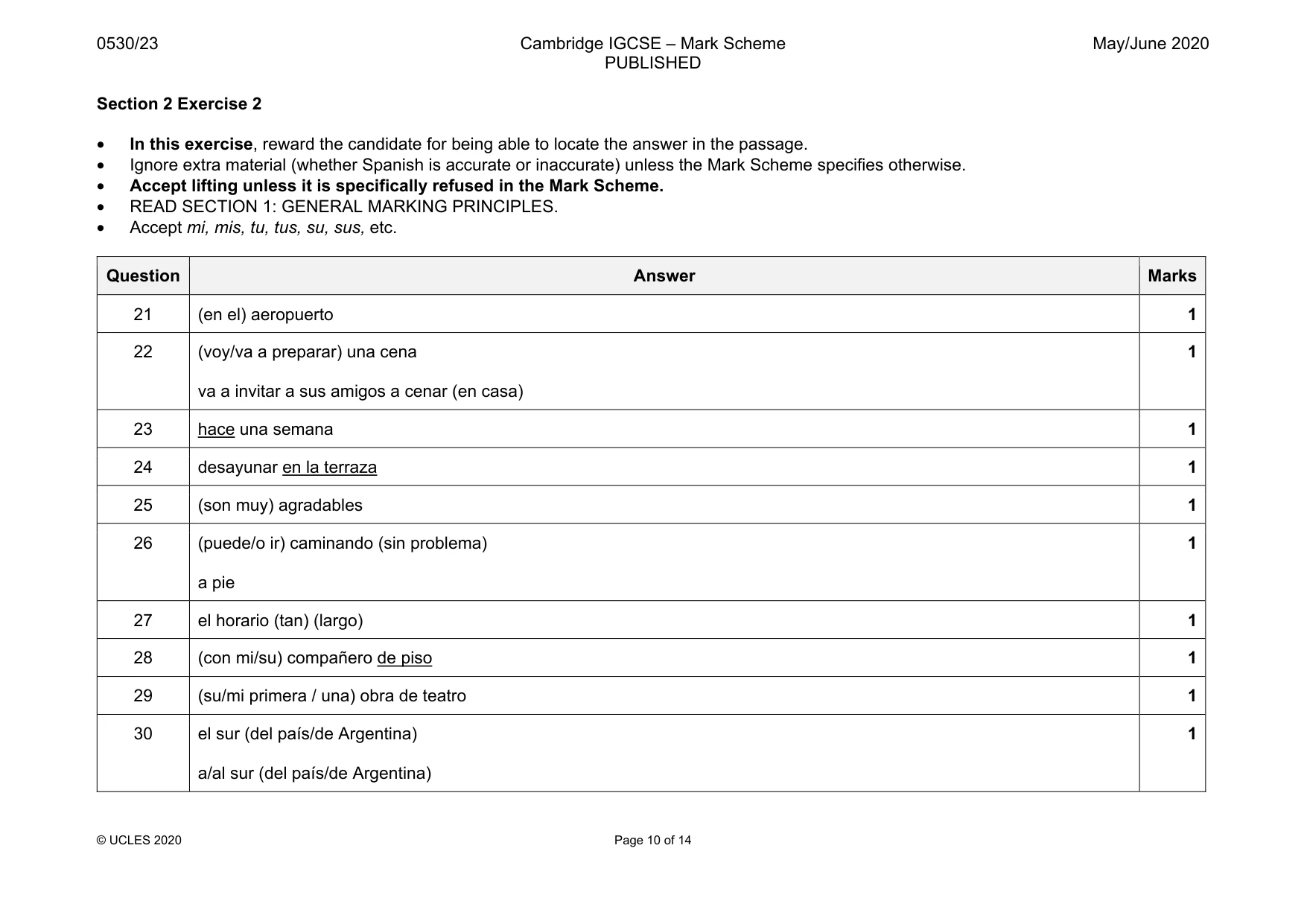
0530/23 Cambridge IGCSE – Mark Scheme PUBLISHED May/June 2020 © UCLES 2020 Page 10 of 14 Section 2 Exercise 2 • In this exercise, reward the candidate for being able to locate the answer in the passage. • Ignore extra material (whether Spanish is accurate or inaccurate) unless the Mark Scheme specifies otherwise. • Accept lifting unless it is specifically refused in the Mark Scheme. • READ SECTION 1: GENERAL MARKING PRINCIPLES. • Accept mi, mis, tu, tus, su, sus, etc. Question Answer Marks 21 (en el) aeropuerto 1 22 (voy/va a preparar) una cena va a invitar a sus amigos a cenar (en casa) 1 23 hace una semana 1 24 desayunar en la terraza 1 25 (son muy) agradables 1 26 (puede/o ir) caminando (sin problema) a pie 1 27 el horario (tan) (largo) 1 28 (con mi/su) compañero de piso 1 29 (su/mi primera / una) obra de teatro 1 30 el sur (del país/de Argentina) a/al sur (del país/de Argentina) 1
Mark scheme, page 11
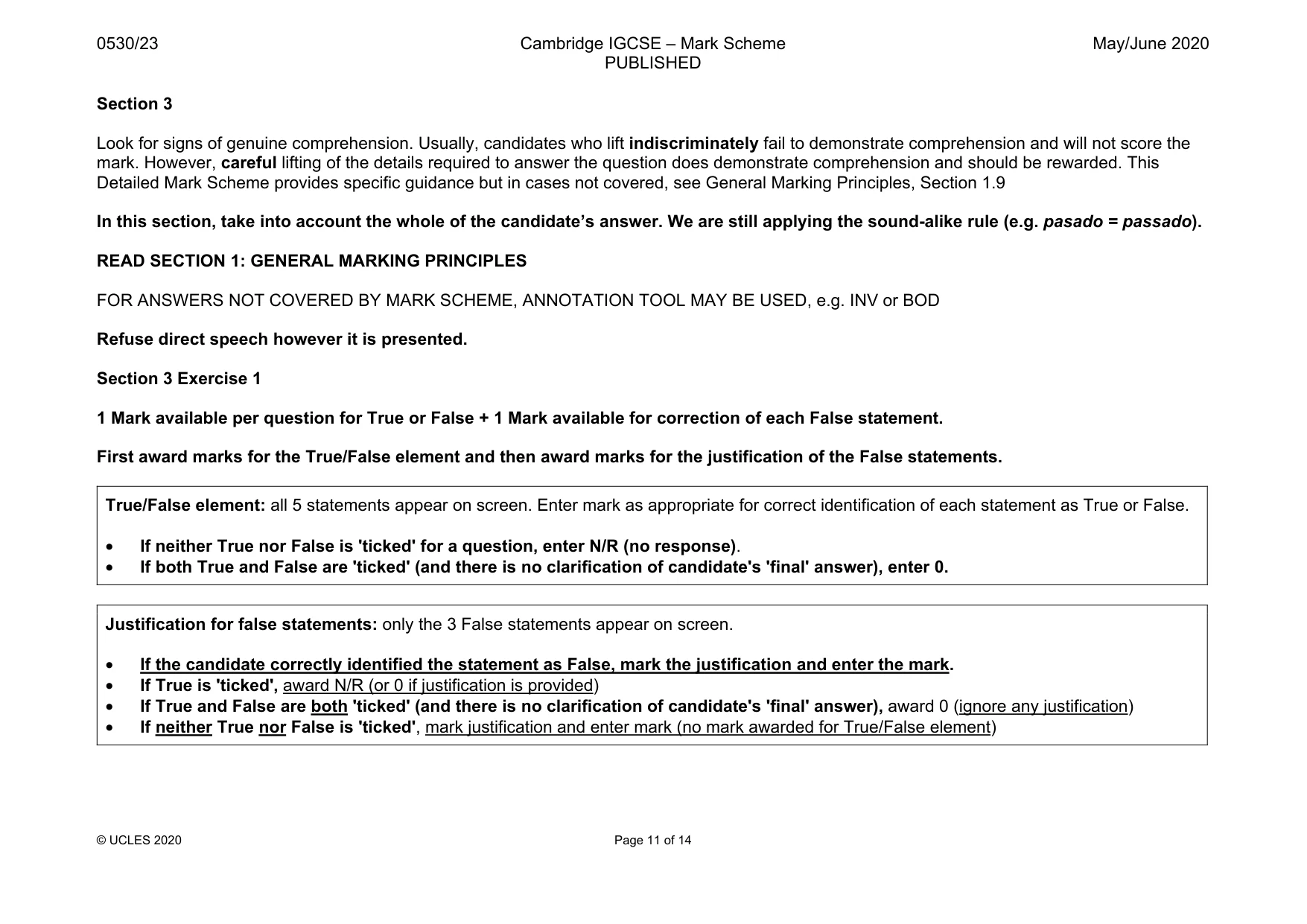
0530/23 Cambridge IGCSE – Mark Scheme PUBLISHED May/June 2020 © UCLES 2020 Page 11 of 14 Section 3 Look for signs of genuine comprehension. Usually, candidates who lift indiscriminately fail to demonstrate comprehension and will not score the mark. However, careful lifting of the details required to answer the question does demonstrate comprehension and should be rewarded. This Detailed Mark Scheme provides specific guidance but in cases not covered, see General Marking Principles, Section 1.9 In this section, take into account the whole of the candidate’s answer. We are still applying the sound-alike rule (e.g. pasado = passado). READ SECTION 1: GENERAL MARKING PRINCIPLES FOR ANSWERS NOT COVERED BY MARK SCHEME, ANNOTATION TOOL MAY BE USED, e.g. INV or BOD Refuse direct speech however it is presented. Section 3 Exercise 1 1 Mark available per question for True or False + 1 Mark available for correction of each False statement. First award marks for the True/False element and then award marks for the justification of the False statements. True/False element: all 5 statements appear on screen. Enter mark as appropriate for correct identification of each statement as True or False. • If neither True nor False is 'ticked' for a question, enter N/R (no response). • If both True and False are 'ticked' (and there is no clarification of candidate's 'final' answer), enter 0. Justification for false statements: only the 3 False statements appear on screen. • If the candidate correctly identified the statement as False, mark the justification and enter the mark. • If True is 'ticked', award N/R (or 0 if justification is provided) • If True and False are both 'ticked' (and there is no clarification of candidate's 'final' answer), award 0 (ignore any justification) • If neither True nor False is 'ticked', mark justification and enter mark (no mark awarded for True/False element)
Mark scheme, page 12
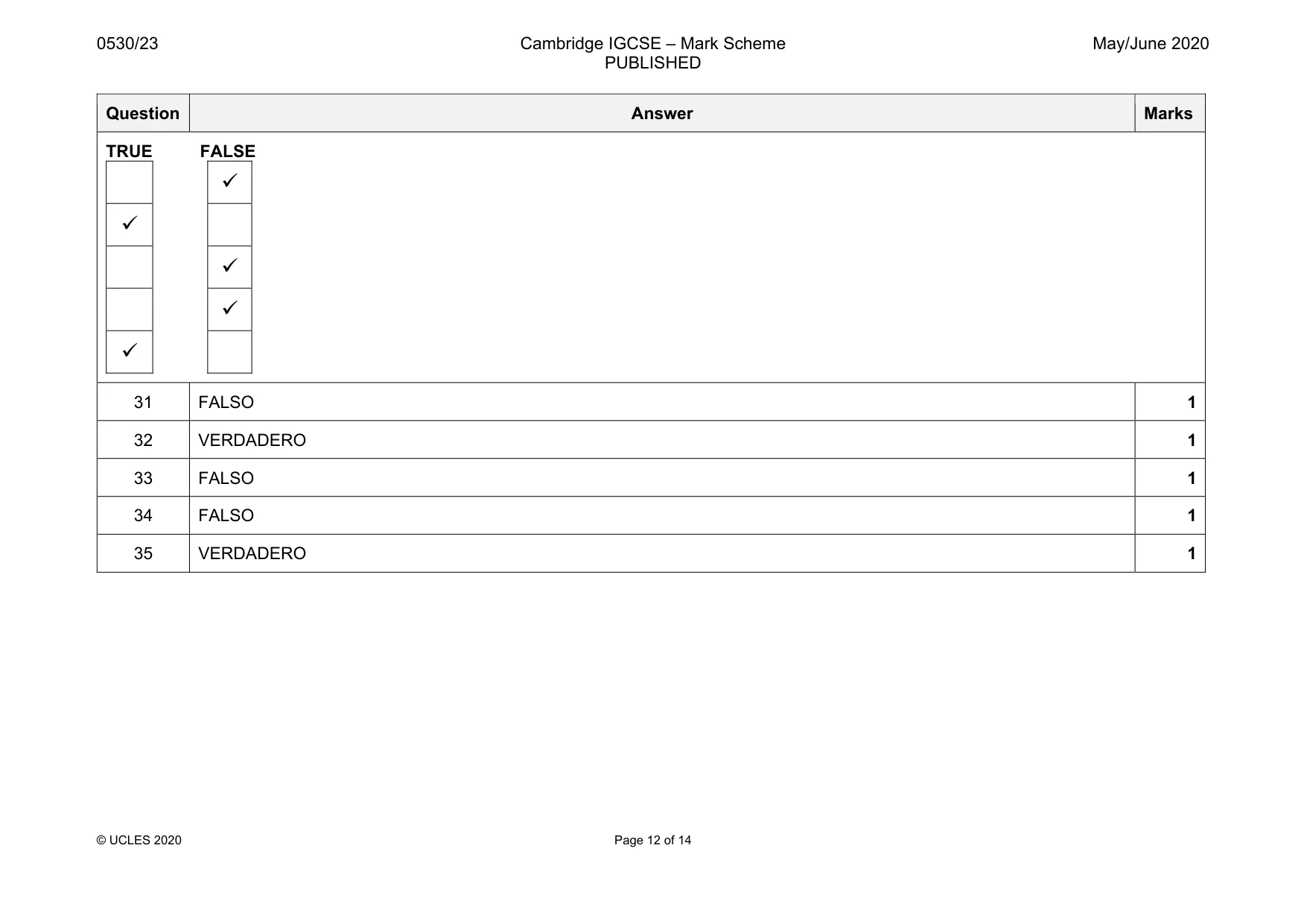
0530/23 Cambridge IGCSE – Mark Scheme PUBLISHED May/June 2020 © UCLES 2020 Page 12 of 14 Question Answer Marks TRUE FALSE 31 FALSO 1 32 VERDADERO 1 33 FALSO 1 34 FALSO 1 35 VERDADERO 1
Mark scheme, page 13
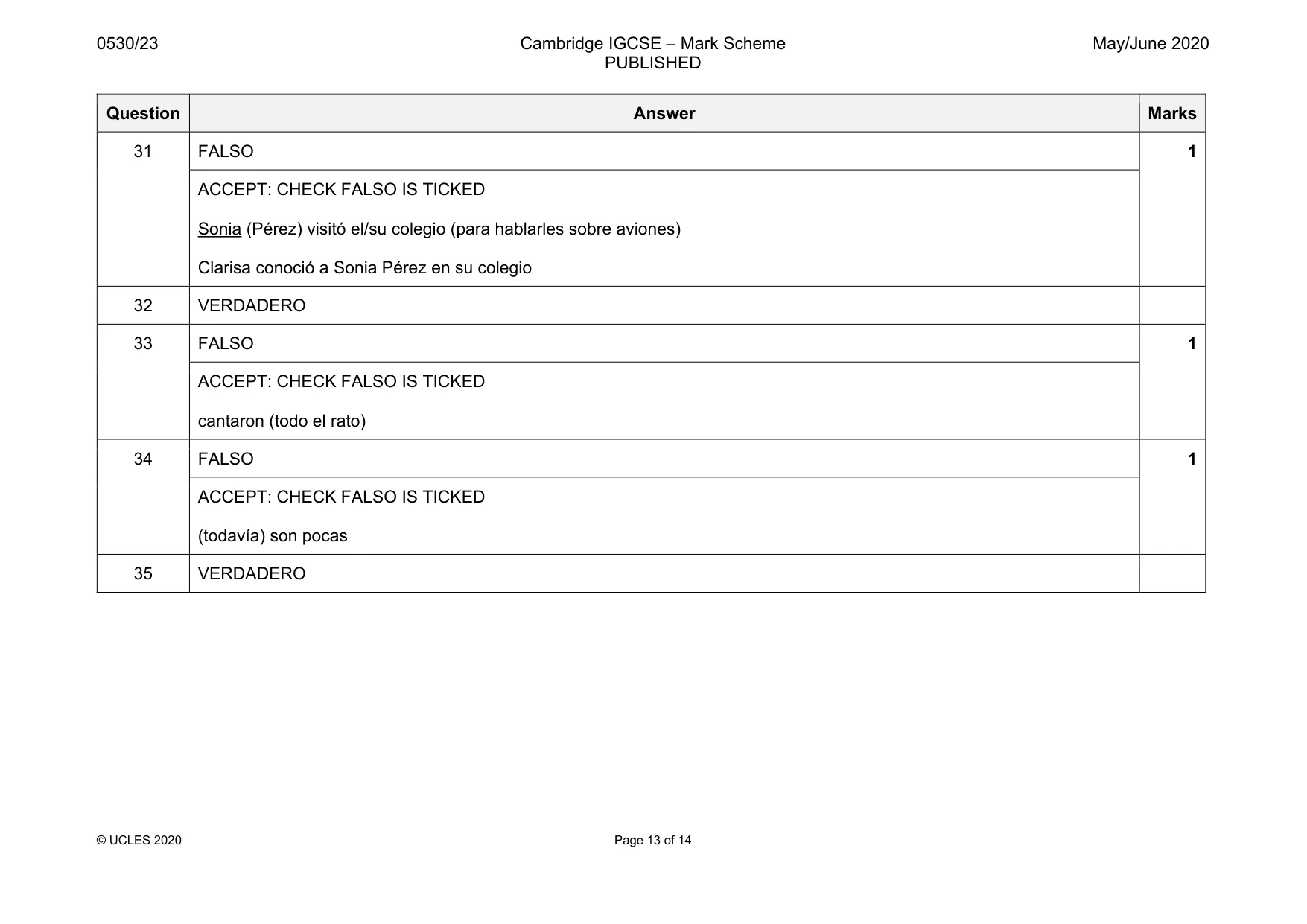
0530/23 Cambridge IGCSE – Mark Scheme PUBLISHED May/June 2020 © UCLES 2020 Page 13 of 14 Question Answer Marks 31 FALSO 1 ACCEPT: CHECK FALSO IS TICKED Sonia (Pérez) visitó el/su colegio (para hablarles sobre aviones) Clarisa conoció a Sonia Pérez en su colegio 32 VERDADERO 33 FALSO 1 ACCEPT: CHECK FALSO IS TICKED cantaron (todo el rato) 34 FALSO 1 ACCEPT: CHECK FALSO IS TICKED (todavía) son pocas 35 VERDADERO
Mark scheme, page 14
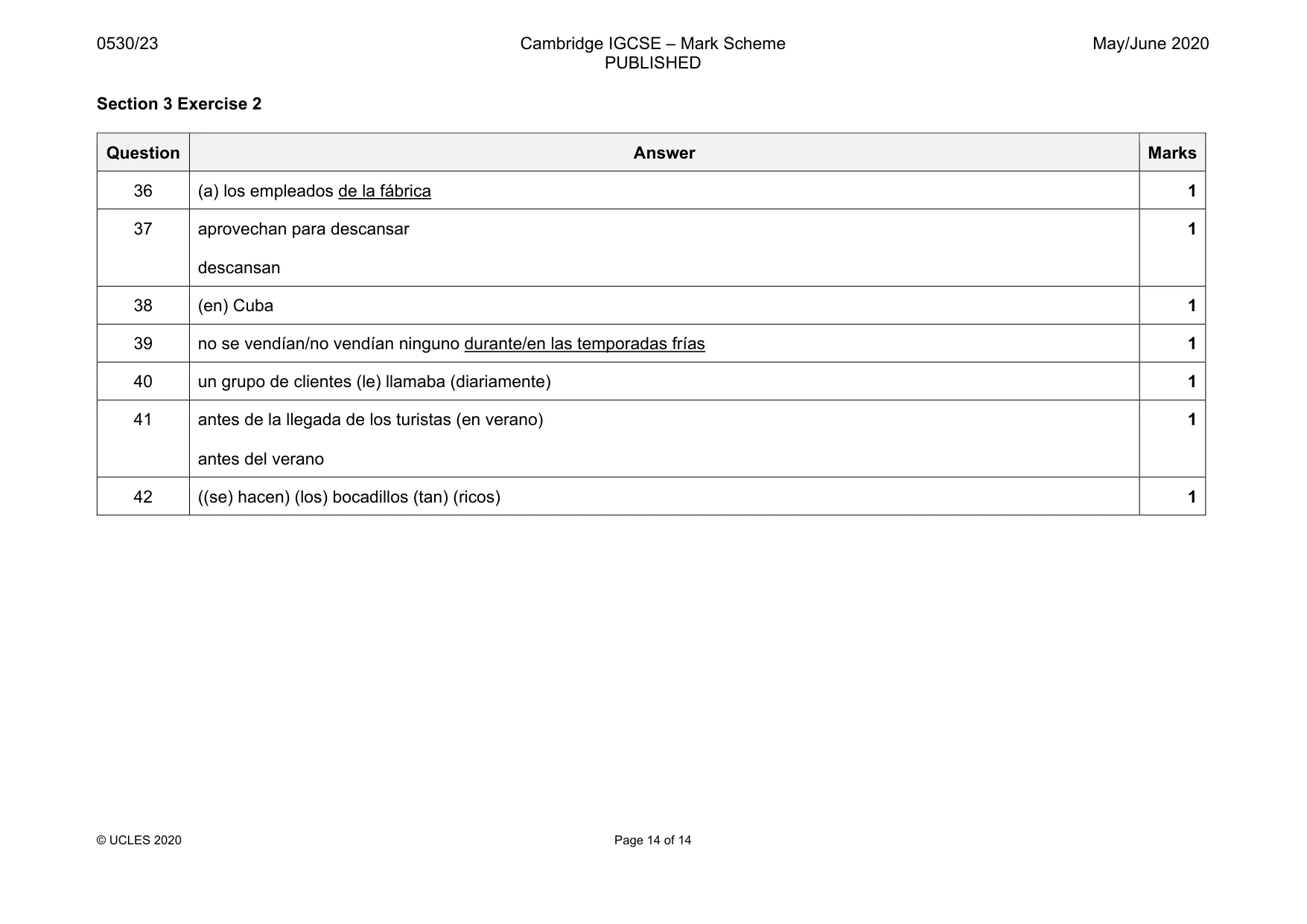
0530/23 Cambridge IGCSE – Mark Scheme PUBLISHED May/June 2020 © UCLES 2020 Page 14 of 14 Section 3 Exercise 2 Question Answer Marks 36 (a) los empleados de la fábrica 1 37 aprovechan para descansar descansan 1 38 (en) Cuba 1 39 no se vendían/no vendían ninguno durante/en las temporadas frías 1 40 un grupo de clientes (le) llamaba (diariamente) 1 41 antes de la llegada de los turistas (en verano) antes del verano 1 42 ((se) hacen) (los) bocadillos (tan) (ricos) 1