Cambridge IGCSE Spanish - Foreign Language 0530 — 2017 May/June Paper 2 · Variant 3
0530/23/M/J/17 · 45 marks · ≈51 min
The question paper and its mark scheme, free to read here and free to download. This is Cambridge’s own paper, exactly as it was sat.
Question paper16 pages



Mark scheme13 pages
Answers below. Sit the paper first if you are practising.
Paper as text
Question paper, page 1
This document consists of 14 printed pages and 2 blank pages. DC (NH/SG) 132027/3 © UCLES 2017 [Turn over * 7 7 9 9 5 1 3 6 6 0 * SPANISH 0530/23 Paper 2 Reading May/June 2017 1 hour Candidates answer on the Question Paper. No Additional Materials are required. READ THESE INSTRUCTIONS FIRST Write your Centre number, candidate number and name in the spaces at the top of this page. Write in dark blue or black pen. Do not use staples, paper clips, glue or correction fluid. DO NOT WRITE IN ANY BARCODES. Answer all questions. The number of marks is given in brackets [ ] at the end of each question or part question. The syllabus is approved for use in England, Wales and Northern Ireland as a Cambridge International Level 1/Level 2 Certificate. Cambridge International Examinations Cambridge International General Certificate of Secondary Education
Question paper, page 2
2 0530/23/M/J/17 © UCLES 2017 BLANK PAGE
Question paper, page 3
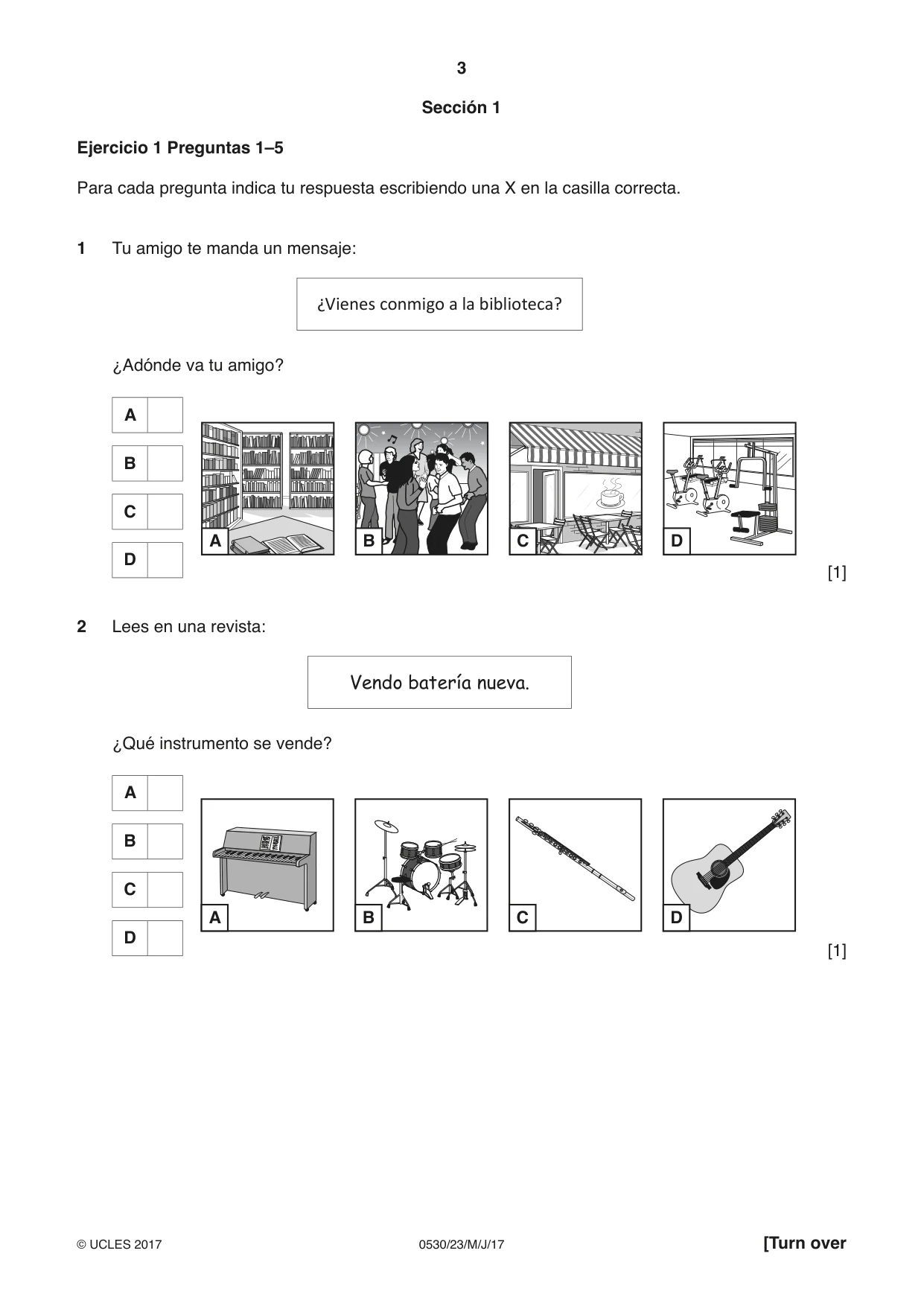
3 0530/23/M/J/17 © UCLES 2017 [Turn over Sección 1 Ejercicio 1 Preguntas 1–5 Para cada pregunta indica tu respuesta escribiendo una X en la casilla correcta. 1 Tu amigo te manda un mensaje: ¿Vienes conmigo a la biblioteca? ¿Adónde va tu amigo? A A B C D [1] B C D 2 Lees en una revista: Vendo batería nueva. ¿Qué instrumento se vende? A A B C D [1] B C D
Question paper, page 4
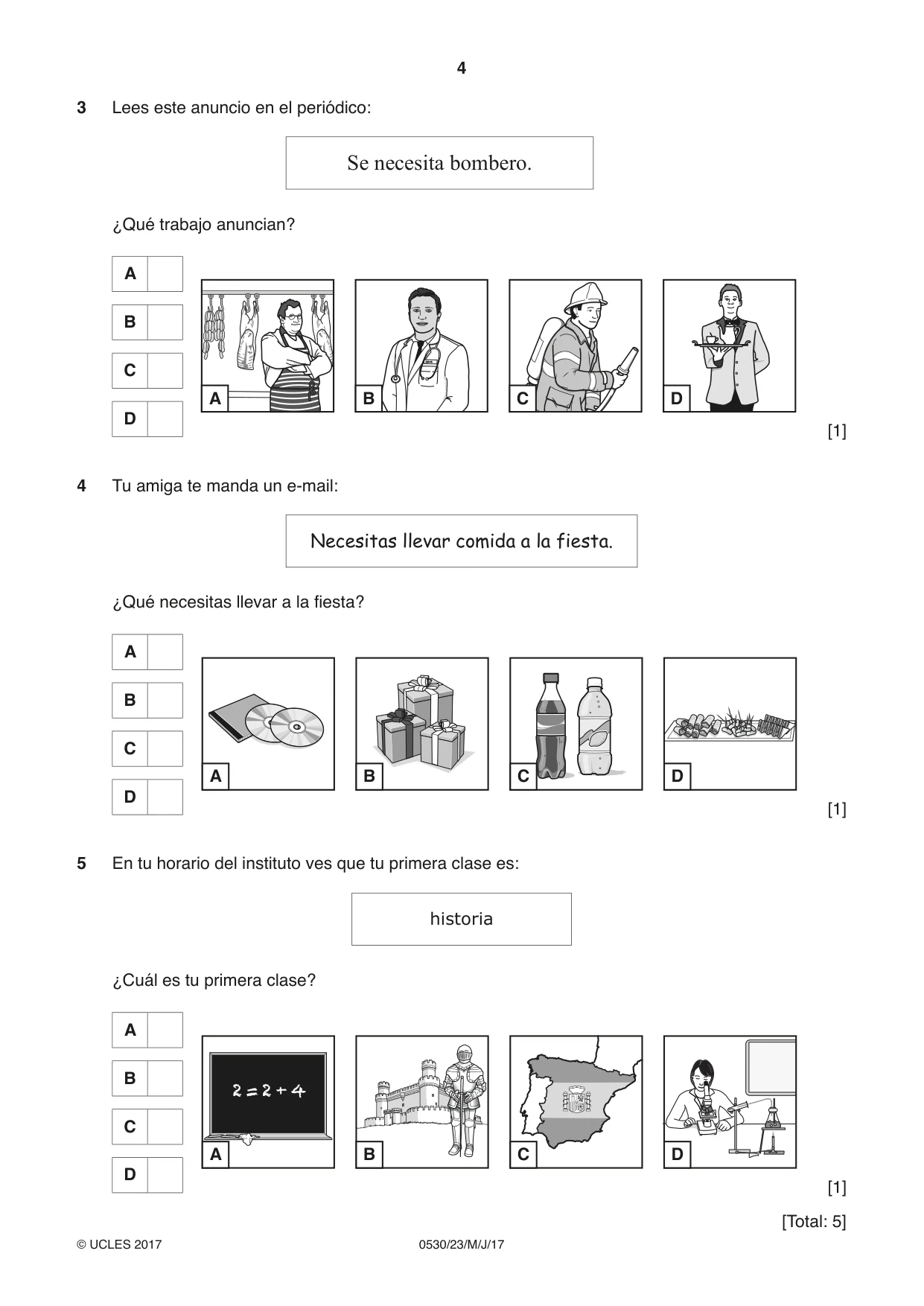
4 0530/23/M/J/17 © UCLES 2017 3 Lees este anuncio en el periódico: Se necesita bombero. ¿Qué trabajo anuncian? A A B C D [1] B C D 4 Tu amiga te manda un e-mail: Necesitas llevar comida a la fiesta. ¿Qué necesitas llevar a la fiesta? A A B C D [1] B C D 5 En tu horario del instituto ves que tu primera clase es: historia ¿Cuál es tu primera clase? A 2 = 2 + 4 A B C D [1] B C D [Tot al: 5]
Question paper, page 5
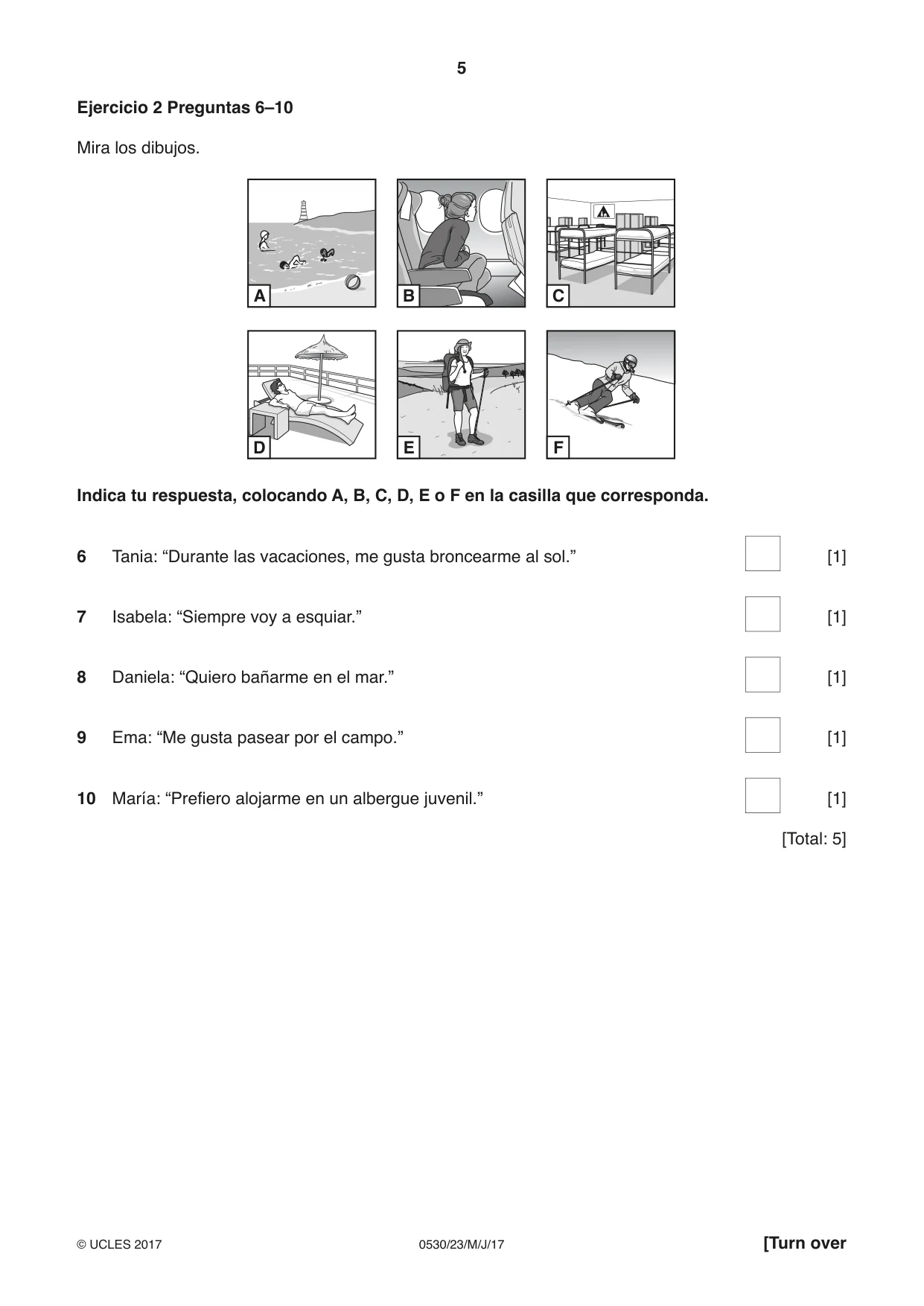
5 0530/23/M/J/17 © UCLES 2017 [Turn over Ejercicio 2 Preguntas 6–10 Mira los dibujos. A B C D E F Indica tu respuesta, colocando A, B, C, D, E o F en la casilla que corresponda. 6 Tania: “Durante las vacaciones, me gusta broncearme al sol.” [1] 7 Isabela: “Siempre voy a esquiar.” [1] 8 Daniela: “Quiero bañarme en el mar.” [1] 9 Ema: “Me gusta pasear por el campo.” [1] 10 María: “Prefiero alojarme en un albergue juvenil.” [1] [Total: 5]
Question paper, page 6
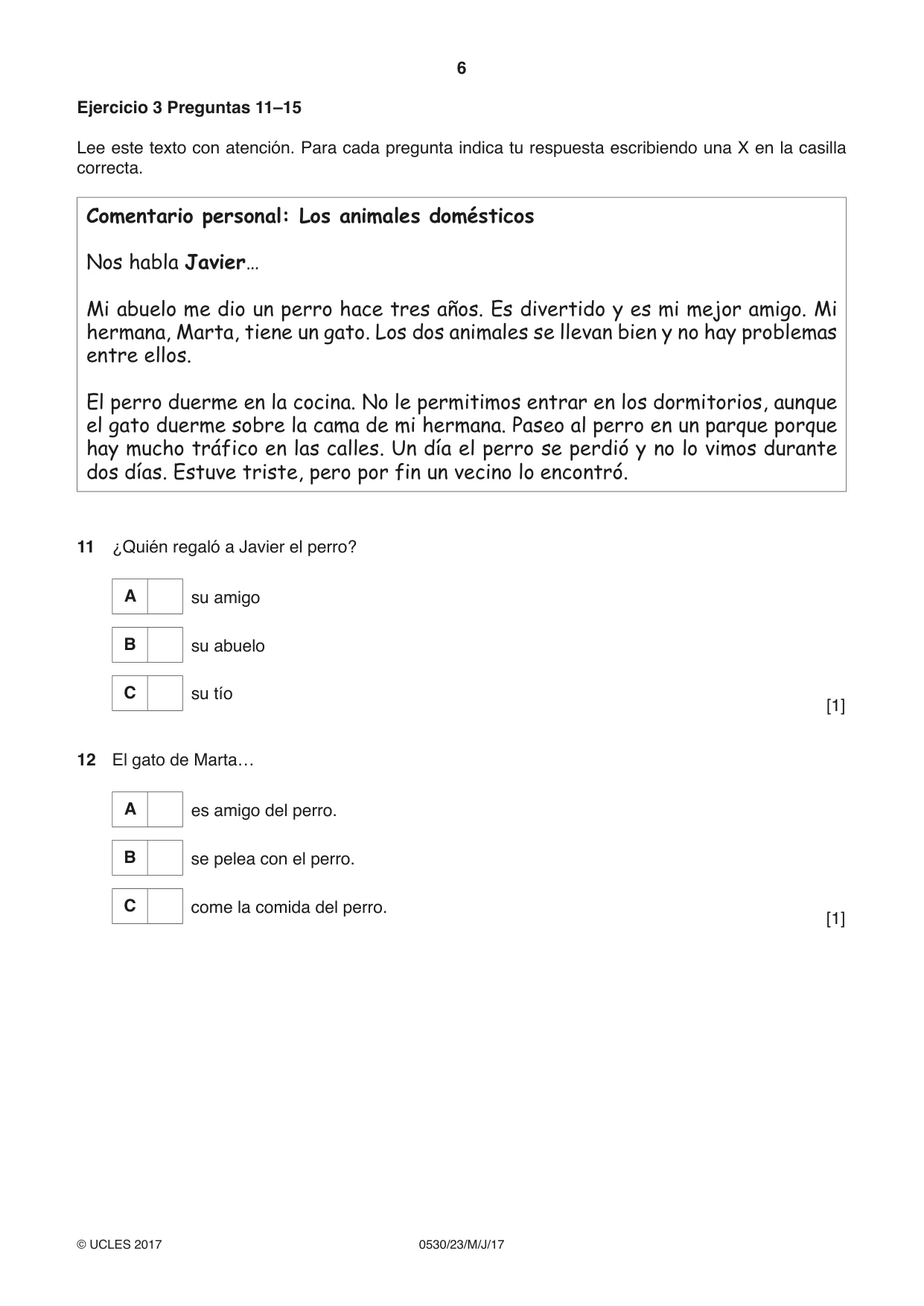
6 0530/23/M/J/17 © UCLES 2017 Ejercicio 3 Preguntas 11–15 Lee este texto con atención. Para cada pregunta indica tu respuesta escribiendo una X en la casilla correcta. Comentario personal: Los animales domésticos Nos habla Javier… Mi abuelo me dio un perro hace tres años. Es divertido y es mi mejor amigo. Mi hermana, Marta, tiene un gato. Los dos animales se llevan bien y no hay problemas entre ellos. El perro duerme en la cocina. No le permitimos entrar en los dormitorios, aunque el gato duerme sobre la cama de mi hermana. Paseo al perro en un parque porque hay mucho tráfico en las calles. Un día el perro se perdió y no lo vimos durante dos días. Estuve triste, pero por fin un vecino lo encontró. 11 ¿Quién regaló a Javier el perro? A su amigo [1] B su abuelo C su tío 12 El gato de Marta… A es amigo del perro. [1] B se pelea con el perro. C come la comida del perro.
Question paper, page 7
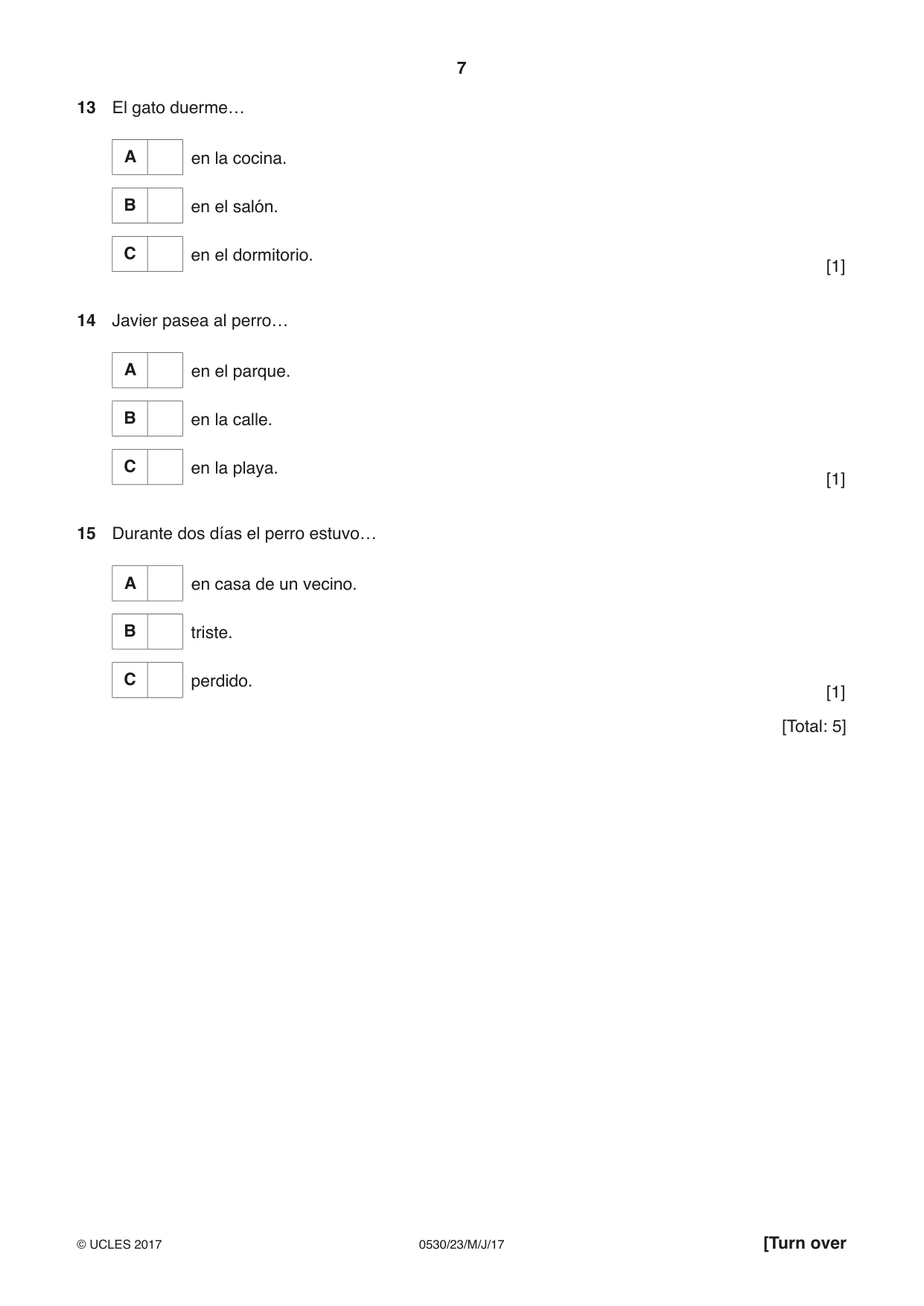
7 0530/23/M/J/17 © UCLES 2017 [Turn over 13 El gato duerme… A en la cocina. [1] B en el salón. C en el dormitorio. 14 Javier pasea al perro… A en el parque. [1] B en la calle. C en la playa. 15 Durante dos días el perro estuvo… A en casa de un vecino. [1] B triste. C perdido. [Total: 5]
Question paper, page 8
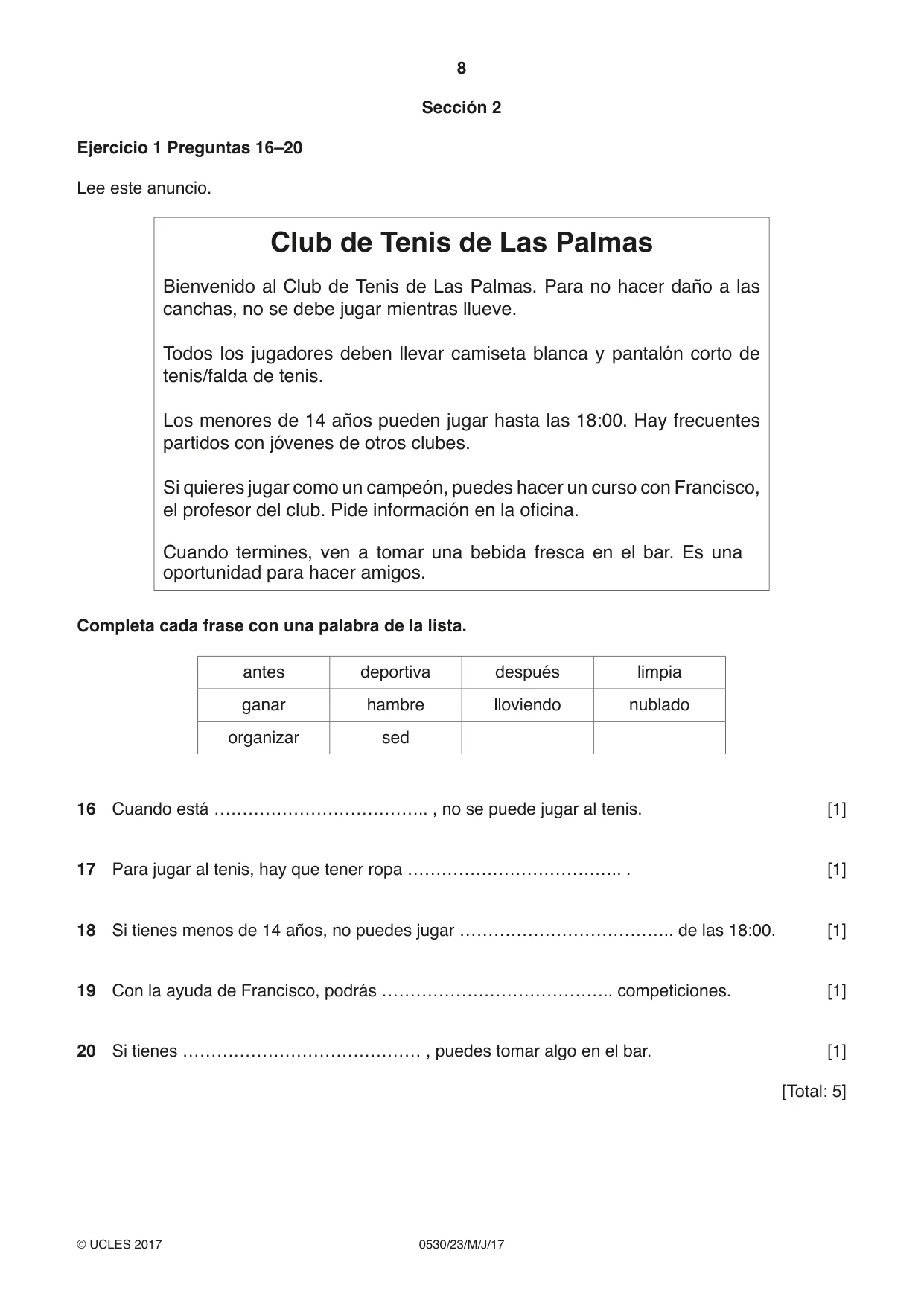
8 0530/23/M/J/17 © UCLES 2017 Sección 2 Ejercicio 1 Preguntas 16–20 Lee este anuncio. Club de Tenis de Las Palmas Bienvenido al Club de Tenis de Las Palmas. Para no hacer daño a las canchas, no se debe jugar mientras llueve. Todos los jugadores deben llevar camiseta blanca y pantalón corto de tenis/falda de tenis. Los menores de 14 años pueden jugar hasta las 18:00. Hay frecuentes partidos con jóvenes de otros clubes. Si quieres jugar como un campeón, puedes hacer un curso con Francisco, el profesor del club. Pide información en la oficina. Cuando termines, ven a tomar una bebida fresca en el bar. Es una oportunidad para hacer amigos. Completa cada frase con una palabra de la lista. antes deportiva después limpia ganar hambre lloviendo nublado organizar sed 16 Cuando está ……………………………….. , no se puede jugar al tenis. [1] 17 Para jugar al tenis, hay que tener ropa ……………………………….. . [1] 18 Si tienes menos de 14 años, no puedes jugar ……………………………….. de las 18:00. [1] 19 Con la ayuda de Francisco, podrás ………………………………….. competiciones. [1] 20 Si tienes …………………………………… , puedes tomar algo en el bar. [1] [Total: 5]
Question paper, page 9
9 0530/23/M/J/17 © UCLES 2017 [Turn over Dar la vuelta para el Ejercicio 2.
Question paper, page 10
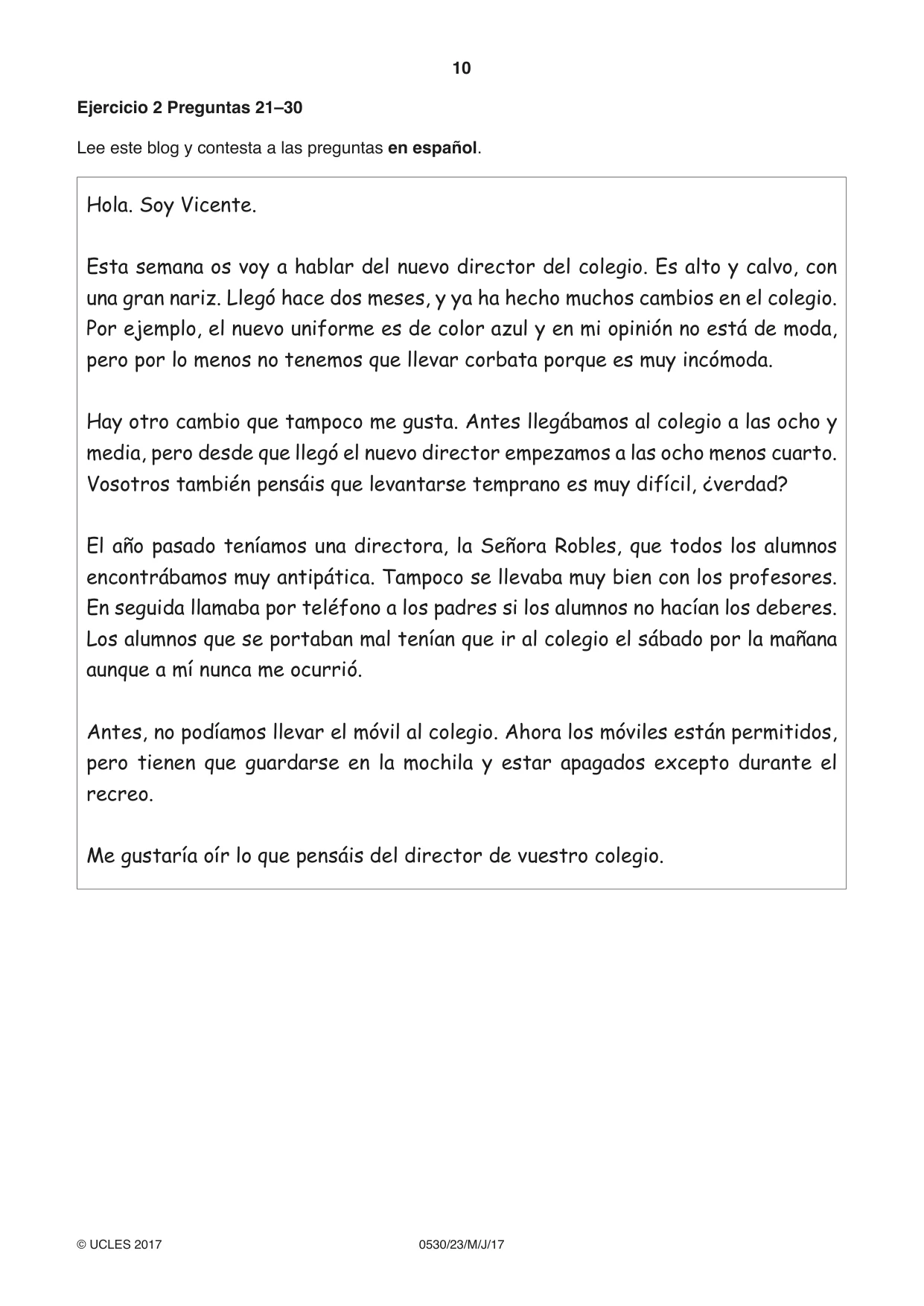
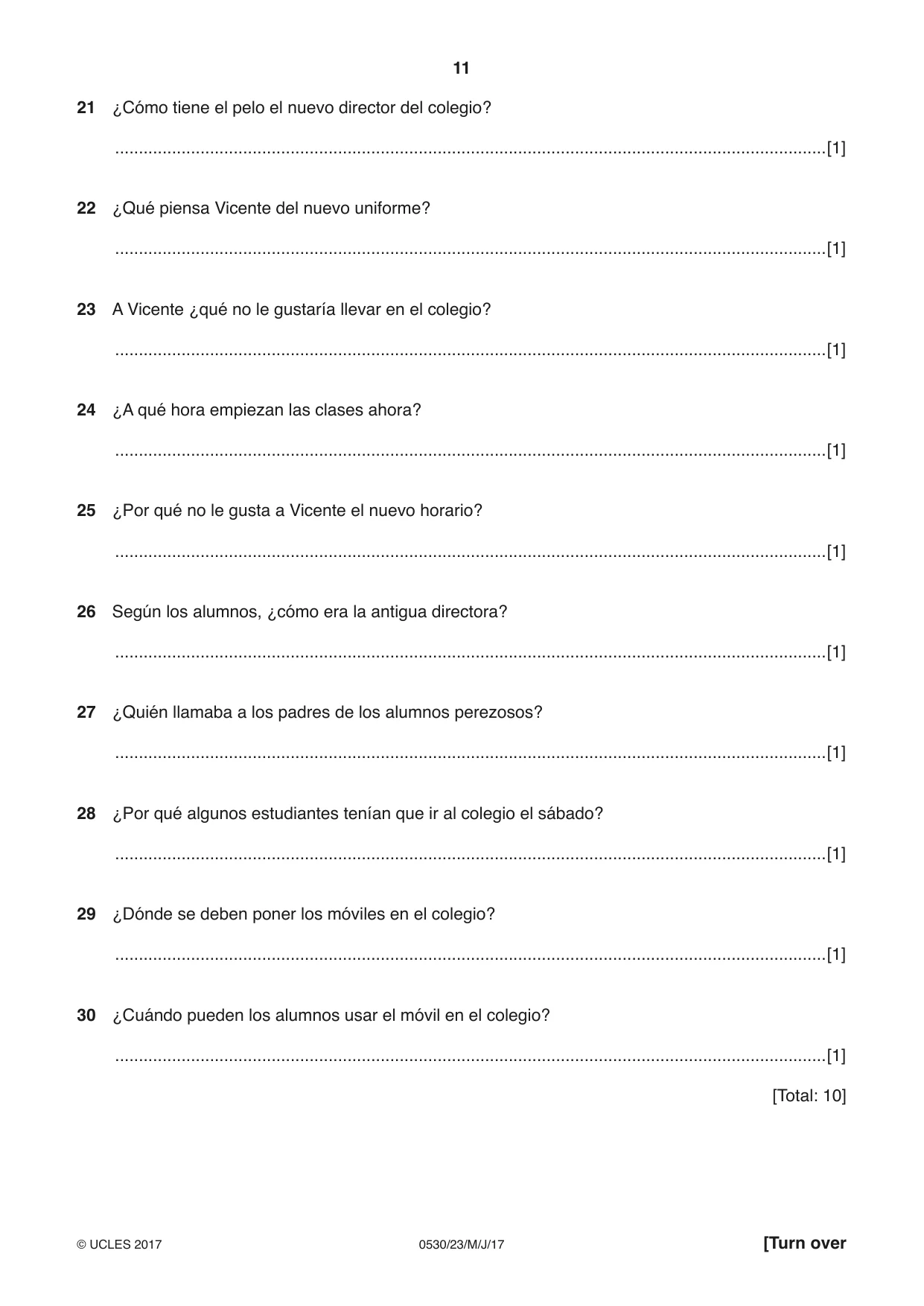
10 0530/23/M/J/17 © UCLES 2017 Ejercicio 2 Preguntas 21–30 Lee este blog y contesta a las preguntas en español. Hola. Soy Vicente. Esta semana os voy a hablar del nuevo director del colegio. Es alto y calvo, con una gran nariz. Llegó hace dos meses, y ya ha hecho muchos cambios en el colegio. Por ejemplo, el nuevo uniforme es de color azul y en mi opinión no está de moda, pero por lo menos no tenemos que llevar corbata porque es muy incómoda. Hay otro cambio que tampoco me gusta. Antes llegábamos al colegio a las ocho y media, pero desde que llegó el nuevo director empezamos a las ocho menos cuarto. Vosotros también pensáis que levantarse temprano es muy difícil, ¿verdad? El año pasado teníamos una directora, la Señora Robles, que todos los alumnos encontrábamos muy antipática. Tampoco se llevaba muy bien con los profesores. En seguida llamaba por teléfono a los padres si los alumnos no hacían los deberes. Los alumnos que se portaban mal tenían que ir al colegio el sábado por la mañana aunque a mí nunca me ocurrió. Antes, no podíamos llevar el móvil al colegio. Ahora los móviles están permitidos, pero tienen que guardarse en la mochila y estar apagados excepto durante el recreo. Me gustaría oír lo que pensáis del director de vuestro colegio.
Question paper, page 11
11 0530/23/M/J/17 © UCLES 2017 [Turn over 21 ¿Cómo tiene el pelo el nuevo director del colegio? …[1] 22 ¿Qué piensa Vicente del nuevo uniforme? …[1] 23 A Vicente ¿qué no le gustaría llevar en el colegio? …[1] 24 ¿A qué hora empiezan las clases ahora? …[1] 25 ¿Por qué no le gusta a Vicente el nuevo horario? …[1] 26 Según los alumnos, ¿cómo era la antigua directora? …[1] 27 ¿Quién llamaba a los padres de los alumnos perezosos? …[1] 28 ¿Por qué algunos estudiantes tenían que ir al colegio el sábado? …[1] 29 ¿Dónde se deben poner los móviles en el colegio? …[1] 30 ¿Cuándo pueden los alumnos usar el móvil en el colegio? …[1] [Total: 10]
Question paper, page 12
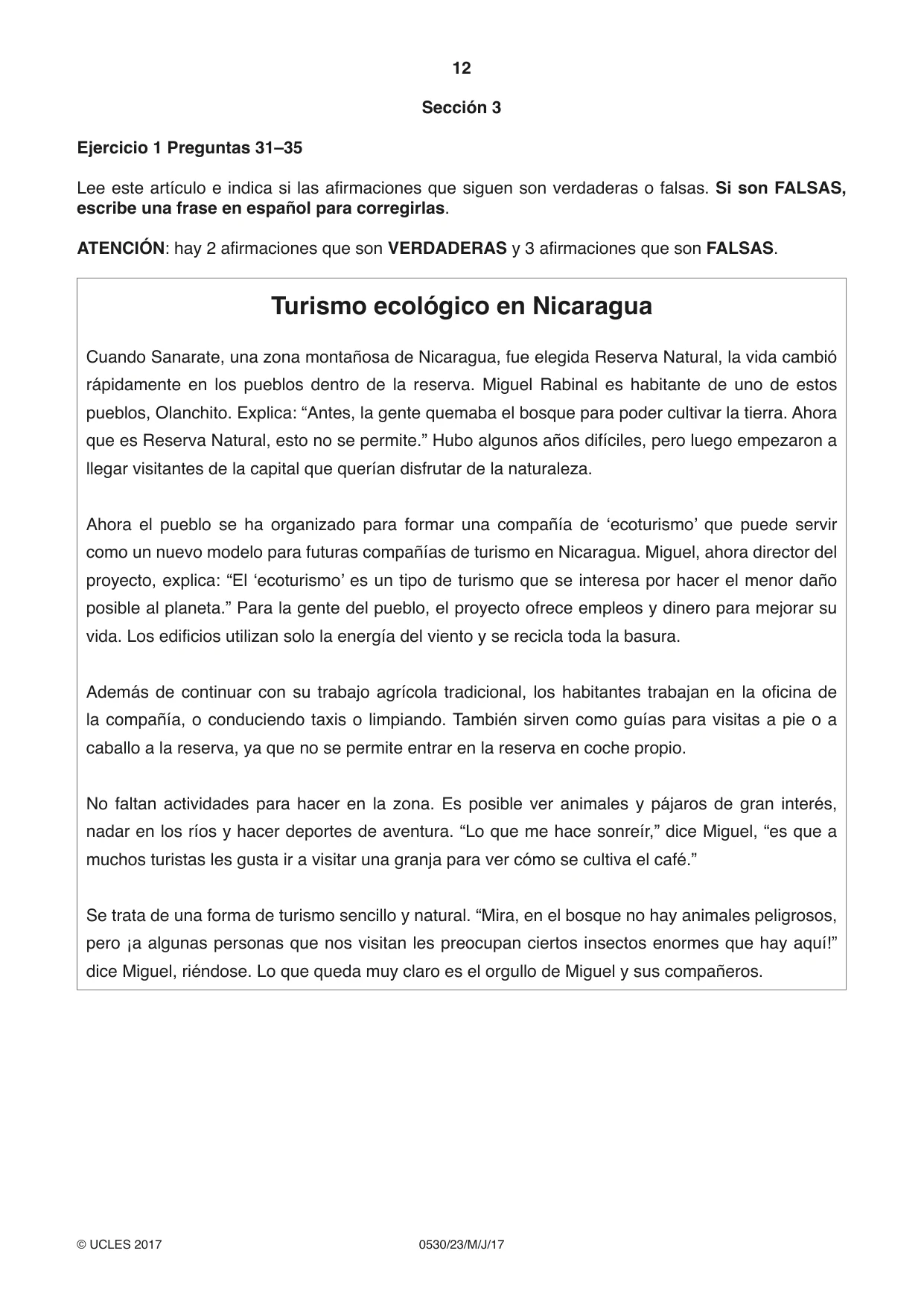
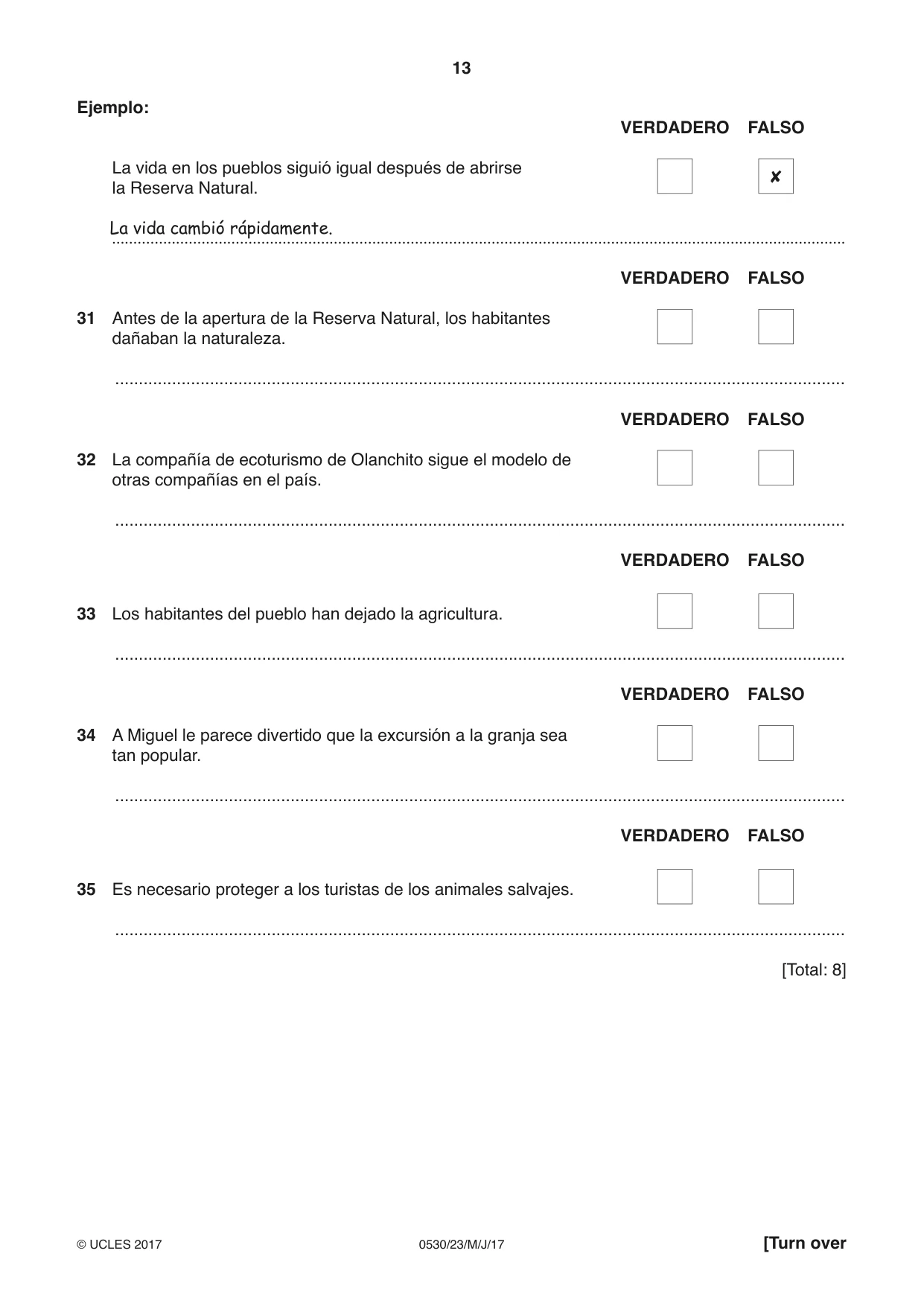
12 0530/23/M/J/17 © UCLES 2017 Sección 3 Ejercicio 1 Preguntas 31–35 Lee este artículo e indica si las afirmaciones que siguen son verdaderas o falsas. Si son FALSAS, escribe una frase en español para corregirlas. ATENCIÓN: hay 2 afirmaciones que son VERDADERAS y 3 afirmaciones que son FALSAS. Turismo ecológico en Nicaragua Cuando Sanarate, una zona montañosa de Nicaragua, fue elegida Reserva Natural, la vida cambió rápidamente en los pueblos dentro de la reserva. Miguel Rabinal es habitante de uno de estos pueblos, Olanchito. Explica: “Antes, la gente quemaba el bosque para poder cultivar la tierra. Ahora que es Reserva Natural, esto no se permite.” Hubo algunos años difíciles, pero luego empezaron a llegar visitantes de la capital que querían disfrutar de la naturaleza. Ahora el pueblo se ha organizado para formar una compañía de ‘ecoturismo’ que puede servir como un nuevo modelo para futuras compañías de turismo en Nicaragua. Miguel, ahora director del proyecto, explica: “El ‘ecoturismo’ es un tipo de turismo que se interesa por hacer el menor daño posible al planeta.” Para la gente del pueblo, el proyecto ofrece empleos y dinero para mejorar su vida. Los edificios utilizan solo la energía del viento y se recicla toda la basura. Además de continuar con su trabajo agrícola tradicional, los habitantes trabajan en la oficina de la compañía, o conduciendo taxis o limpiando. También sirven como guías para visitas a pie o a caballo a la reserva, ya que no se permite entrar en la reserva en coche propio. No faltan actividades para hacer en la zona. Es posible ver animales y pájaros de gran interés, nadar en los ríos y hacer deportes de aventura. “Lo que me hace sonreír,” dice Miguel, “es que a muchos turistas les gusta ir a visitar una granja para ver cómo se cultiva el café.” Se trata de una forma de turismo sencillo y natural. “Mira, en el bosque no hay animales peligrosos, pero ¡a algunas personas que nos visitan les preocupan ciertos insectos enormes que hay aquí!” dice Miguel, riéndose. Lo que queda muy claro es el orgullo de Miguel y sus compañeros.
Question paper, page 13
13 0530/23/M/J/17 © UCLES 2017 [Turn over Ejemplo: VERDADERO FALSO La vida en los pueblos siguió igual después de abrirse la Reserva Natural. 8 La vida cambió rápidamente. … VERDADERO FALSO 31 Antes de la apertura de la Reserva Natural, los habitantes dañaban la naturaleza. … VERDADERO FALSO 32 La compañía de ecoturismo de Olanchito sigue el modelo de otras compañías en el país. … VERDADERO FALSO 33 Los habitantes del pueblo han dejado la agricultura. … VERDADERO FALSO 34 A Miguel le parece divertido que la excursión a la granja sea tan popular. … VERDADERO FALSO 35 Es necesario proteger a los turistas de los animales salvajes. … [Total: 8]
Question paper, page 14
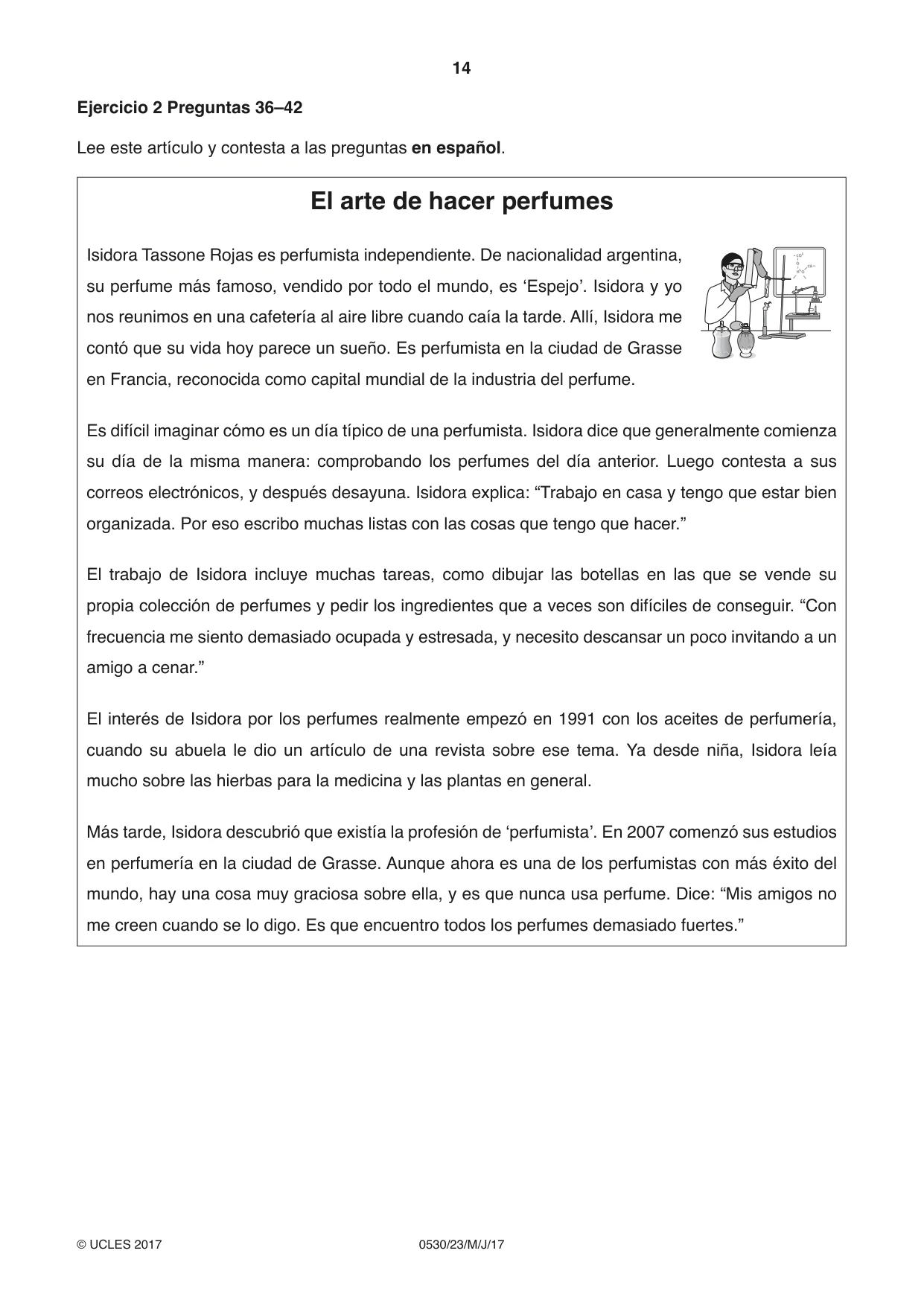
14 0530/23/M/J/17 © UCLES 2017 Ejercicio 2 Preguntas 36–42 Lee este artículo y contesta a las preguntas en español. El arte de hacer perfumes Isidora Tassone Rojas es perfumista independiente. De nacionalidad argentina, su perfume más famoso, vendido por todo el mundo, es ‘Espejo’. Isidora y yo nos reunimos en una cafetería al aire libre cuando caía la tarde. Allí, Isidora me contó que su vida hoy parece un sueño. Es perfumista en la ciudad de Grasse en Francia, reconocida como capital mundial de la industria del perfume. Es difícil imaginar cómo es un día típico de una perfumista. Isidora dice que generalmente comienza su día de la misma manera: comprobando los perfumes del día anterior. Luego contesta a sus correos electrónicos, y después desayuna. Isidora explica: “Trabajo en casa y tengo que estar bien organizada. Por eso escribo muchas listas con las cosas que tengo que hacer.” El trabajo de Isidora incluye muchas tareas, como dibujar las botellas en las que se vende su propia colección de perfumes y pedir los ingredientes que a veces son difíciles de conseguir. “Con frecuencia me siento demasiado ocupada y estresada, y necesito descansar un poco invitando a un amigo a cenar.” El interés de Isidora por los perfumes realmente empezó en 1991 con los aceites de perfumería, cuando su abuela le dio un artículo de una revista sobre ese tema. Ya desde niña, Isidora leía mucho sobre las hierbas para la medicina y las plantas en general. Más tarde, Isidora descubrió que existía la profesión de ‘perfumista’. En 2007 comenzó sus estudios en perfumería en la ciudad de Grasse. Aunque ahora es una de los perfumistas con más éxito del mundo, hay una cosa muy graciosa sobre ella, y es que nunca usa perfume. Dice: “Mis amigos no me creen cuando se lo digo. Es que encuentro todos los perfumes demasiado fuertes.”
Question paper, page 15
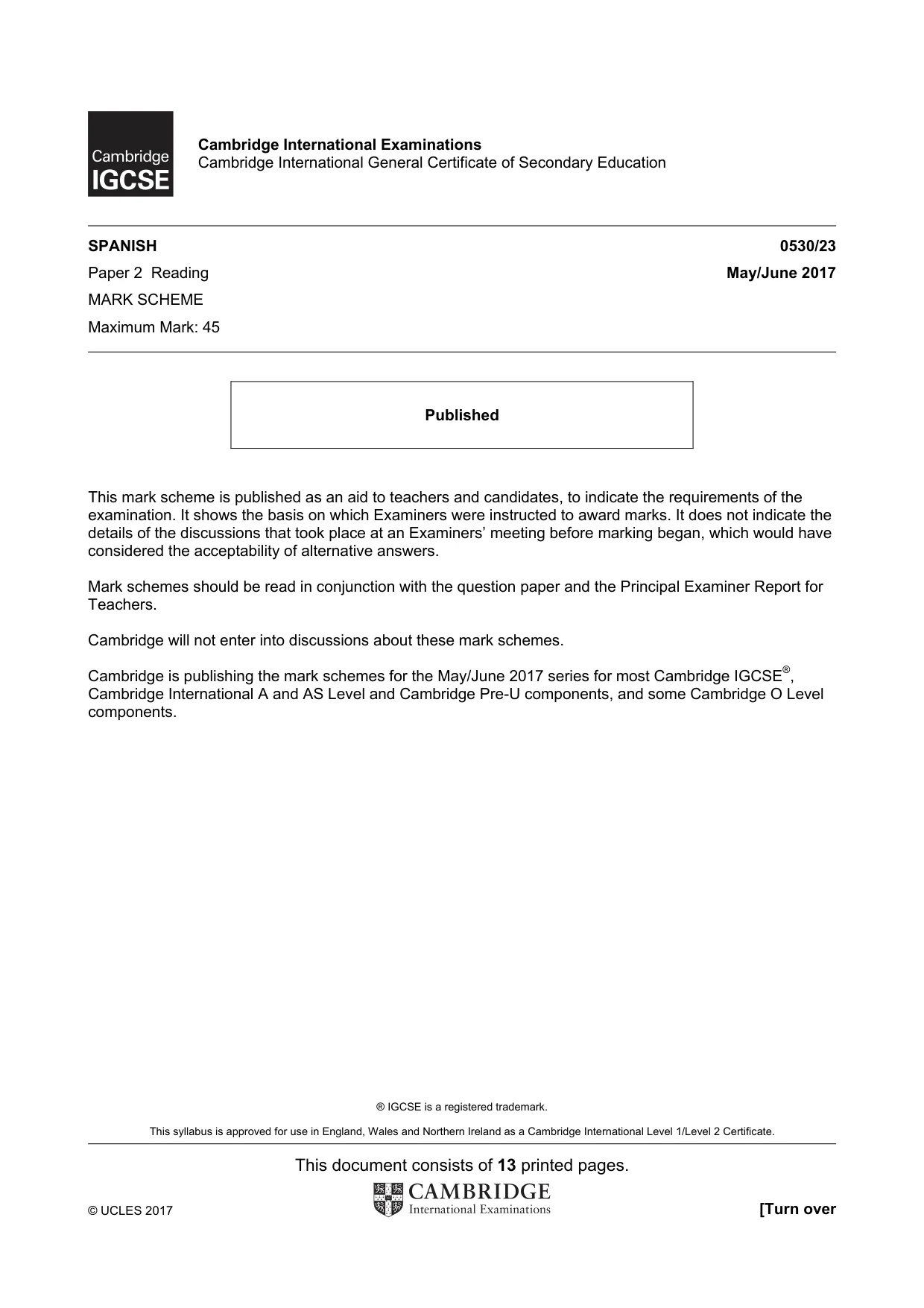
15 0530/23/M/J/17 © UCLES 2017 36 ¿Cuándo se encontraron Isidora y el autor del artículo? …[1] 37 ¿En qué perfumes trabaja Isidora primero por la mañana? …[1] 38 ¿Por qué hace Isidora listas de lo que tiene que hacer? …[1] 39 ¿Por qué algunos ingredientes causan problemas a Isidora? …[1] 40 ¿Cómo descansa Isidora? …[1] 41 ¿De qué trataba el artículo que le dio su abuela a Isidora? …[1] 42 ¿Qué les sorprende a los amigos de Isidora? …[1] [Total: 7]
Question paper, page 16
16 0530/23/M/J/17 © UCLES 2017 Permission to reproduce items where third-party owned material protected by copyright is included has been sought and cleared where possible. Every reasonable effort has been made by the publisher (UCLES) to trace copyright holders, but if any items requiring clearance have unwittingly been included, the publisher will be pleased to make amends at the earliest possible opportunity. To avoid the issue of disclosure of answer-related information to candidates, all copyright acknowledgements are reproduced online in the Cambridge International Examinations Copyright Acknowledgements Booklet. This is produced for each series of examinations and is freely available to download at www.cie.org.uk after the live examination series. Cambridge International Examinations is part of the Cambridge Assessment Group. Cambridge Assessment is the brand name of University of Cambridge Local Examinations Syndicate (UCLES), which is itself a department of the University of Cambridge. BLANK PAGE
Mark scheme, page 1
® IGCSE is a registered trademark. This syllabus is approved for use in England, Wales and Northern Ireland as a Cambridge International Level 1/Level 2 Certificate. This document consists of 13 printed pages. © UCLES 2017 [Turn over Cambridge International Examinations Cambridge International General Certificate of Secondary Education SPANISH 0530/23 Paper 2 Reading May/June 2017 MARK SCHEME Maximum Mark: 45 Published This mark scheme is published as an aid to teachers and candidates, to indicate the requirements of the examination. It shows the basis on which Examiners were instructed to award marks. It does not indicate the details of the discussions that took place at an Examiners’ meeting before marking began, which would have considered the acceptability of alternative answers. Mark schemes should be read in conjunction with the question paper and the Principal Examiner Report for Teachers. Cambridge will not enter into discussions about these mark schemes. Cambridge is publishing the mark schemes for the May/June 2017 series for most Cambridge IGCSE®, Cambridge International A and AS Level and Cambridge Pre-U components, and some Cambridge O Level components.
Mark scheme, page 2
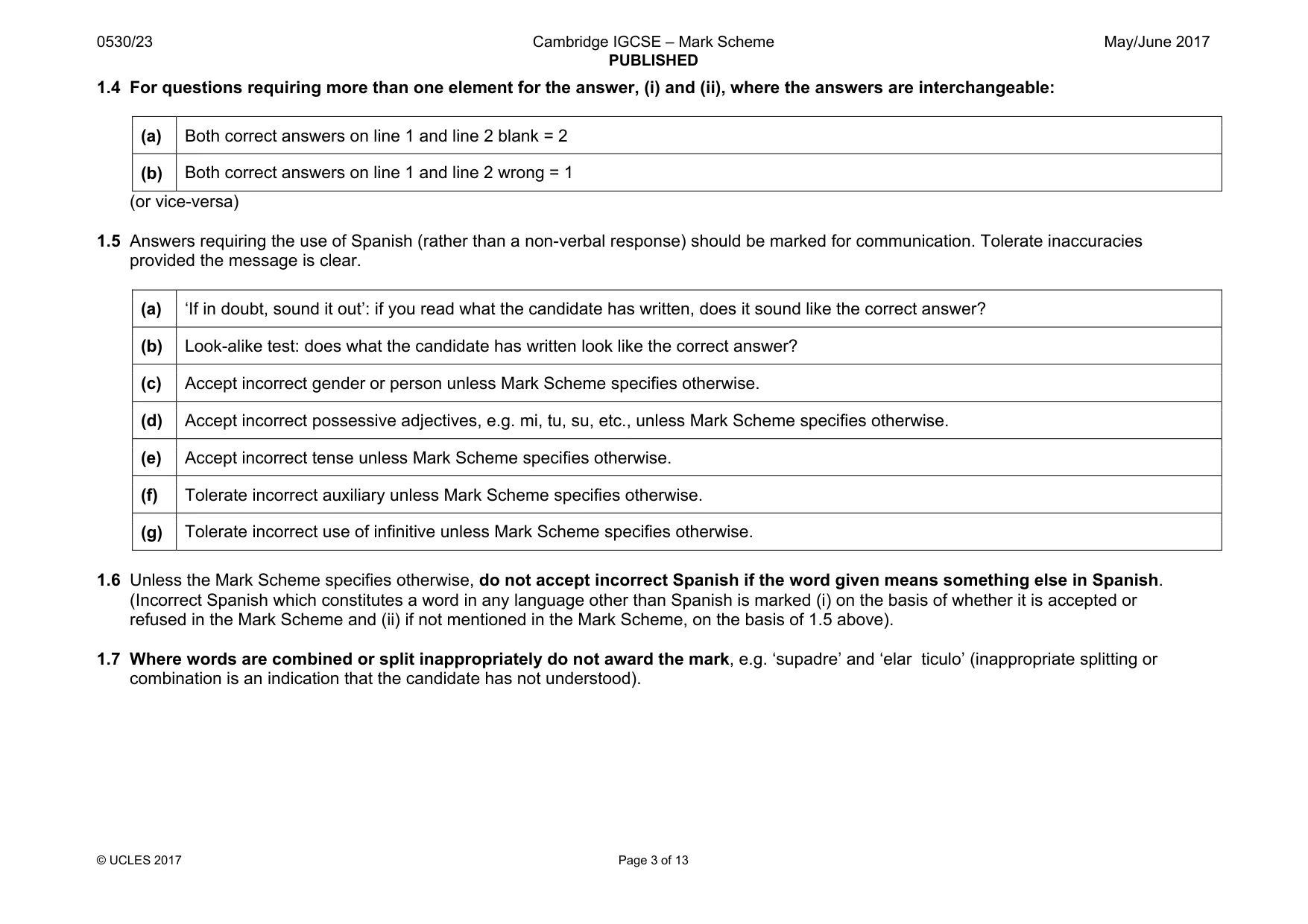
0530/23 Cambridge IGCSE – Mark Scheme PUBLISHED May/June 2017 © UCLES 2017 Page 2 of 13 1.1 It is not possible to list all acceptable alternatives in the Detailed Mark Scheme provided in Section 4. You will need to consider all alternative answers and unexpected approaches in candidates’ scripts, make a decision on whether they communicate the required elements, in consultation with your Team Leader if necessary (or with your Product Manager if you are a single (Examiner), and award marks accordingly. The following marking principles underpin the detailed instructions provided in Section 2 of the Mark Scheme. Where a decision is taken to deviate from these principles for a particular question, this will be specified in the Mark Scheme. Often the general principles will have to be weighed up against each other, e.g. the answer might pass the look-alike test (1.5(b)), but if the candidate has produced an answer that is another word in the target language they will not score (1.6). 1.2 Crossing out: (a) If a candidate changes his/her mind over an answer and crosses out an attempt, award a mark if the final attempt is correct. (b) If a candidate crosses out an answer to a whole question but makes no second attempt at it, mark the crossed out work. 1.3 More than the stipulated number of boxes ticked / crossed by the candidate: (a) If more than one attempt is visible, but the candidate has clearly indicated which attempt is his / her final answer (e.g. by crossing out other attempts or by annotating the script in some way), mark in the usual way. (b) If two attempts are visible (e.g. two boxes ticked instead of the 1 box stipulated), and neither has been crossed out / discounted by the candidate, no mark can be awarded. (c) Where candidates must tick a number of boxes (e.g. tick the 6 true statements) and tick too many, apply the following rule: deduct the number of ‘extra’ answers indicated by the candidate from their number of correct answers. The remaining number is the mark awarded, e.g. the candidate is asked to tick 6 statements, but ticks 8. 5 of the ticks are correctly placed, but 2 are ‘extras’ (8 ticks placed by candidate minus 6 ticks required by rubric = 2 ‘extras’). Therefore the candidate is awarded a mark of 3. (d) Answers in pen do not take precedence over answers in pencil, e.g. if a candidate is asked to tick 1 box and ticks two, one in pen and the other in pencil, the mark cannot be awarded unless there is explicit indication from the candidate as to which is his/her final answer.
Mark scheme, page 3
0530/23 Cambridge IGCSE – Mark Scheme PUBLISHED May/June 2017 © UCLES 2017 Page 3 of 13 1.4 For questions requiring more than one element for the answer, (i) and (ii), where the answers are interchangeable: (a) Both correct answers on line 1 and line 2 blank = 2 (b) Both correct answers on line 1 and line 2 wrong = 1 (or vice-versa) 1.5 Answers requiring the use of Spanish (rather than a non-verbal response) should be marked for communication. Tolerate inaccuracies provided the message is clear. (a) ‘If in doubt, sound it out’: if you read what the candidate has written, does it sound like the correct answer? (b) Look-alike test: does what the candidate has written look like the correct answer? (c) Accept incorrect gender or person unless Mark Scheme specifies otherwise. (d) Accept incorrect possessive adjectives, e.g. mi, tu, su, etc., unless Mark Scheme specifies otherwise. (e) Accept incorrect tense unless Mark Scheme specifies otherwise. (f) Tolerate incorrect auxiliary unless Mark Scheme specifies otherwise. (g) Tolerate incorrect use of infinitive unless Mark Scheme specifies otherwise. 1.6 Unless the Mark Scheme specifies otherwise, do not accept incorrect Spanish if the word given means something else in Spanish. (Incorrect Spanish which constitutes a word in any language other than Spanish is marked (i) on the basis of whether it is accepted or refused in the Mark Scheme and (ii) if not mentioned in the Mark Scheme, on the basis of 1.5 above). 1.7 Where words are combined or split inappropriately do not award the mark, e.g. ‘supadre’ and ‘elar ticulo’ (inappropriate splitting or combination is an indication that the candidate has not understood).
Mark scheme, page 4
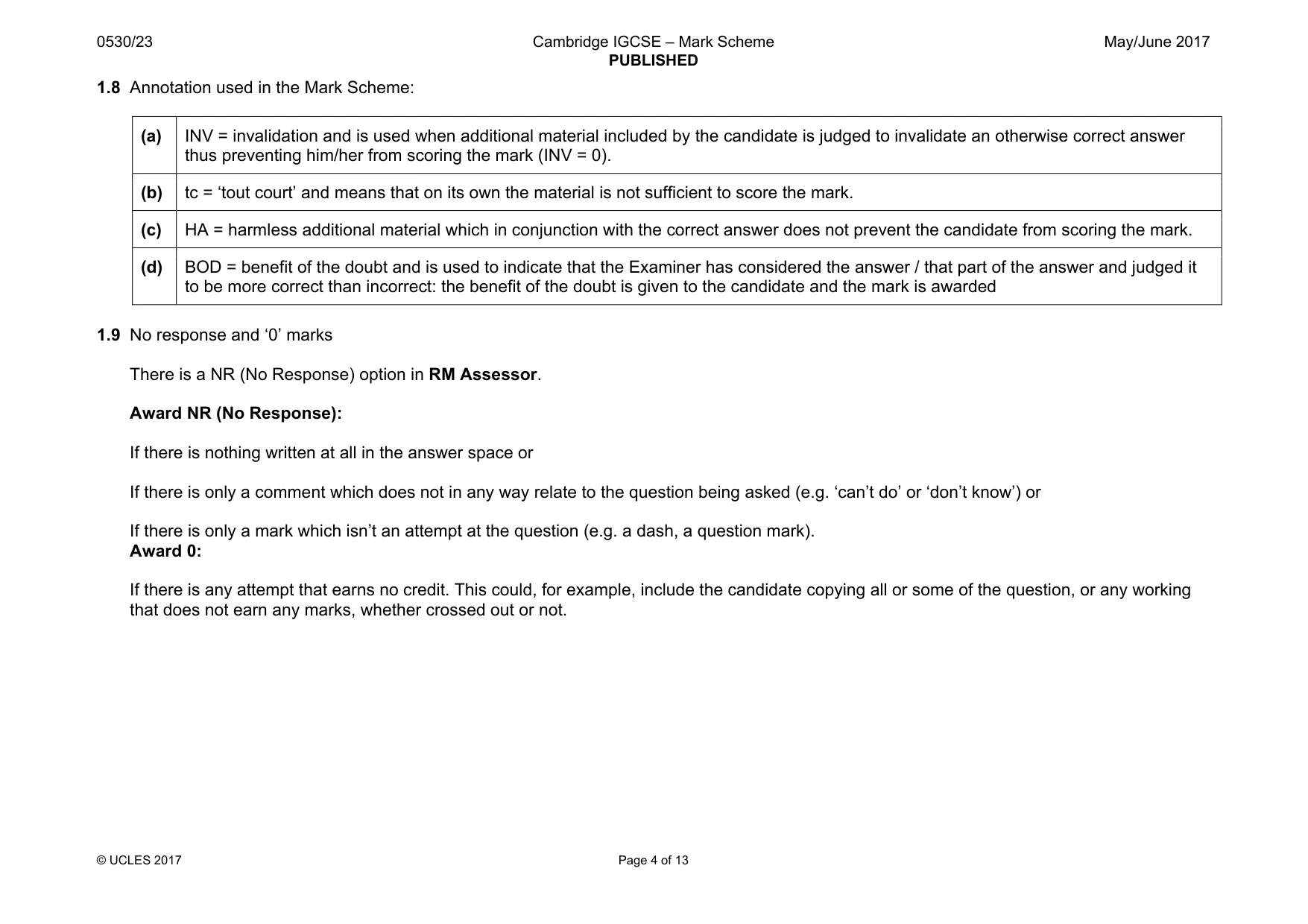
0530/23 Cambridge IGCSE – Mark Scheme PUBLISHED May/June 2017 © UCLES 2017 Page 4 of 13 1.8 Annotation used in the Mark Scheme: (a) INV = invalidation and is used when additional material included by the candidate is judged to invalidate an otherwise correct answer thus preventing him/her from scoring the mark (INV = 0). (b) tc = ‘tout court’ and means that on its own the material is not sufficient to score the mark. (c) HA = harmless additional material which in conjunction with the correct answer does not prevent the candidate from scoring the mark. (d) BOD = benefit of the doubt and is used to indicate that the Examiner has considered the answer / that part of the answer and judged it to be more correct than incorrect: the benefit of the doubt is given to the candidate and the mark is awarded 1.9 No response and ‘0’ marks There is a NR (No Response) option in RM Assessor. Award NR (No Response): If there is nothing written at all in the answer space or If there is only a comment which does not in any way relate to the question being asked (e.g. ‘can’t do’ or ‘don’t know’) or If there is only a mark which isn’t an attempt at the question (e.g. a dash, a question mark). Award 0: If there is any attempt that earns no credit. This could, for example, include the candidate copying all or some of the question, or any working that does not earn any marks, whether crossed out or not.
Mark scheme, page 5
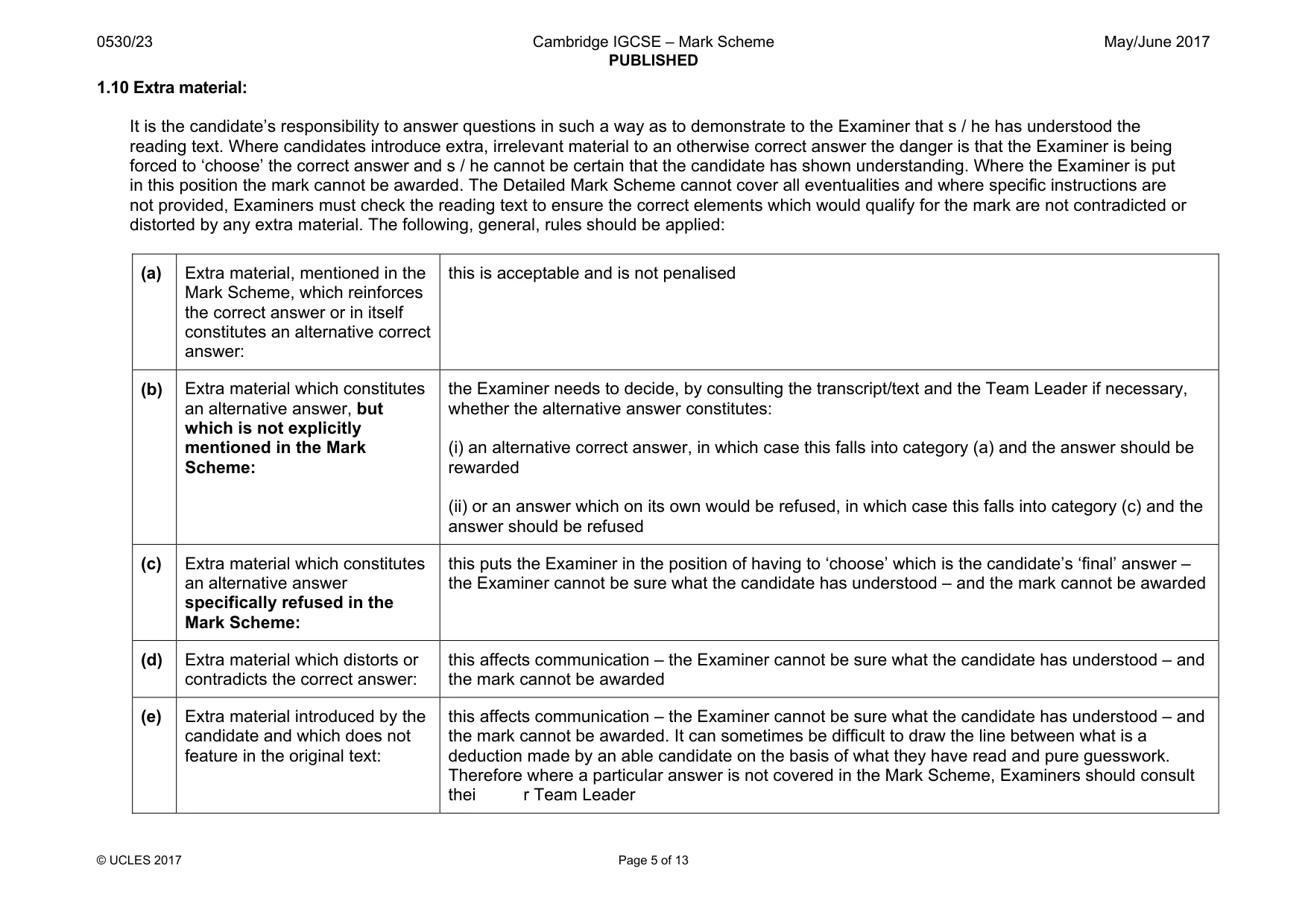
0530/23 Cambridge IGCSE – Mark Scheme PUBLISHED May/June 2017 © UCLES 2017 Page 5 of 13 1.10 Extra material: It is the candidate’s responsibility to answer questions in such a way as to demonstrate to the Examiner that s / he has understood the reading text. Where candidates introduce extra, irrelevant material to an otherwise correct answer the danger is that the Examiner is being forced to ‘choose’ the correct answer and s / he cannot be certain that the candidate has shown understanding. Where the Examiner is put in this position the mark cannot be awarded. The Detailed Mark Scheme cannot cover all eventualities and where specific instructions are not provided, Examiners must check the reading text to ensure the correct elements which would qualify for the mark are not contradicted or distorted by any extra material. The following, general, rules should be applied: (a) Extra material, mentioned in the Mark Scheme, which reinforces the correct answer or in itself constitutes an alternative correct answer: this is acceptable and is not penalised (b) Extra material which constitutes an alternative answer, but which is not explicitly mentioned in the Mark Scheme: the Examiner needs to decide, by consulting the transcript/text and the Team Leader if necessary, whether the alternative answer constitutes: (i) an alternative correct answer, in which case this falls into category (a) and the answer should be rewarded (ii) or an answer which on its own would be refused, in which case this falls into category (c) and the answer should be refused (c) Extra material which constitutes an alternative answer specifically refused in the Mark Scheme: this puts the Examiner in the position of having to ‘choose’ which is the candidate’s ‘final’ answer – the Examiner cannot be sure what the candidate has understood – and the mark cannot be awarded (d) Extra material which distorts or contradicts the correct answer: this affects communication – the Examiner cannot be sure what the candidate has understood – and the mark cannot be awarded (e) Extra material introduced by the candidate and which does not feature in the original text: this affects communication – the Examiner cannot be sure what the candidate has understood – and the mark cannot be awarded. It can sometimes be difficult to draw the line between what is a deduction made by an able candidate on the basis of what they have read and pure guesswork. Therefore where a particular answer is not covered in the Mark Scheme, Examiners should consult thei r Team Leader
Mark scheme, page 6
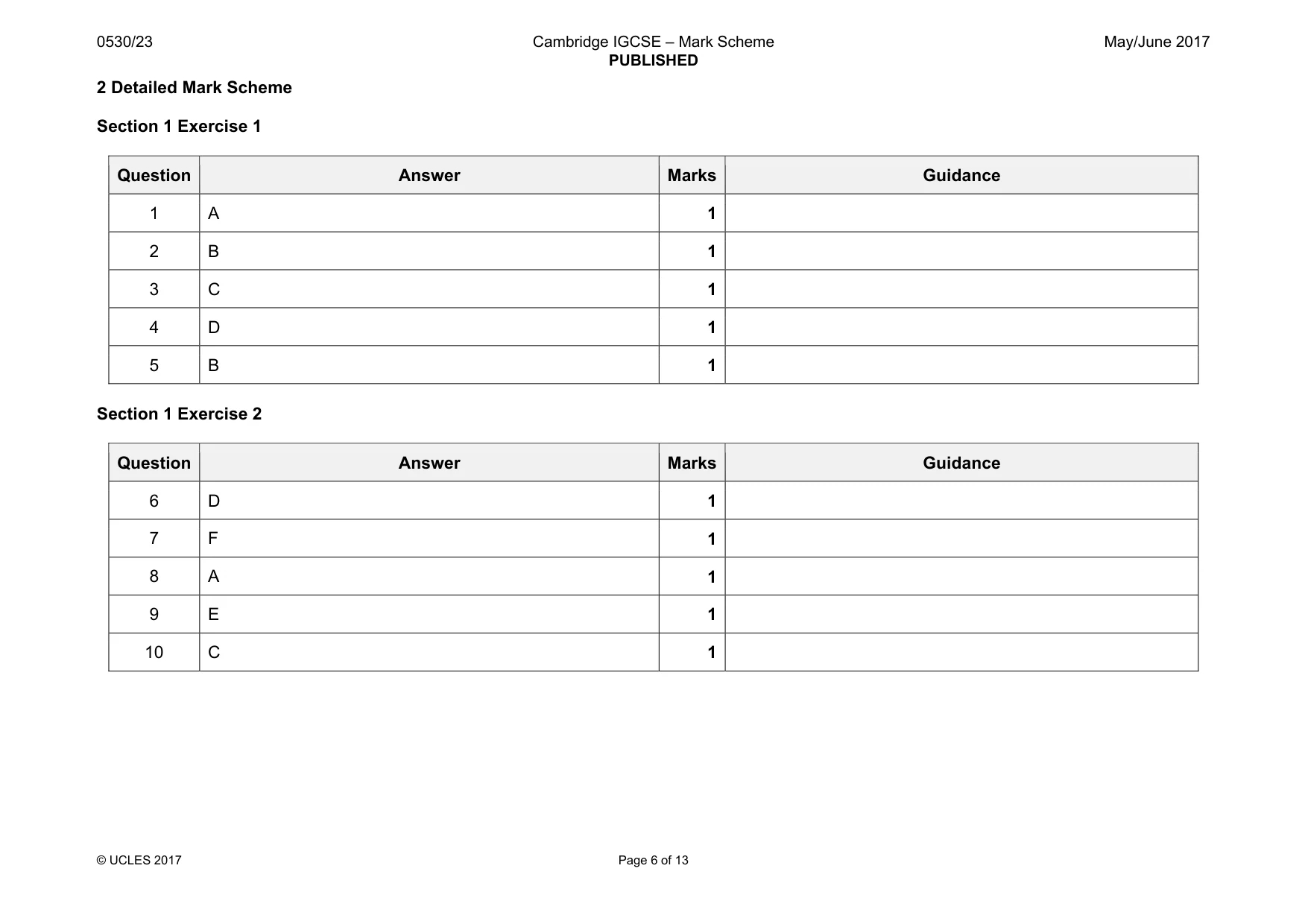
0530/23 Cambridge IGCSE – Mark Scheme PUBLISHED May/June 2017 © UCLES 2017 Page 6 of 13 2 Detailed Mark Scheme Section 1 Exercise 1 Question Answer Marks Guidance 1 A 1 2 B 1 3 C 1 4 D 1 5 B 1 Section 1 Exercise 2 Question Answer Marks Guidance 6 D 1 7 F 1 8 A 1 9 E 1 10 C 1
Mark scheme, page 7
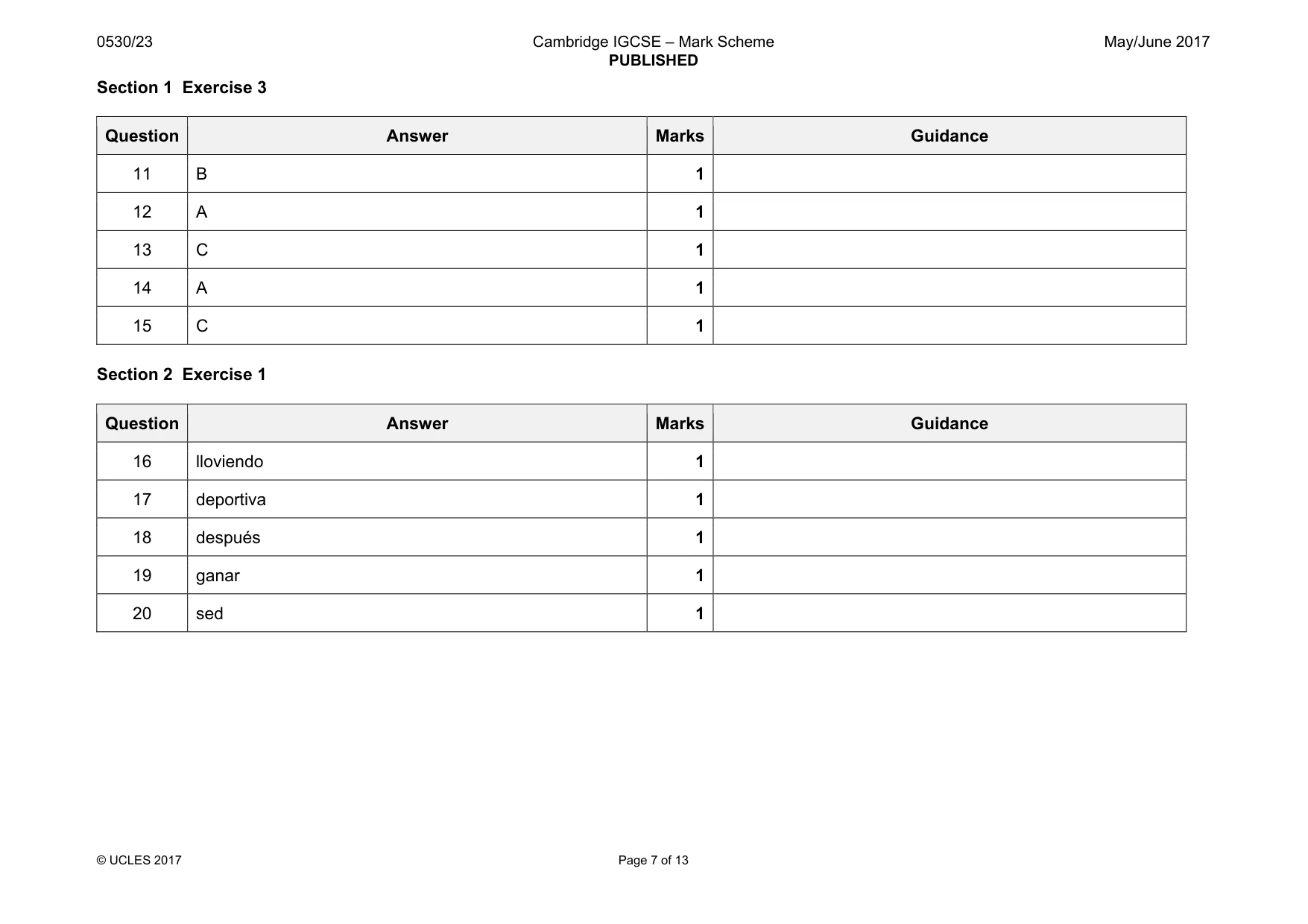
0530/23 Cambridge IGCSE – Mark Scheme PUBLISHED May/June 2017 © UCLES 2017 Page 7 of 13 Section 1 Exercise 3 Question Answer Marks Guidance 11 B 1 12 A 1 13 C 1 14 A 1 15 C 1 Section 2 Exercise 1 Question Answer Marks Guidance 16 lloviendo 1 17 deportiva 1 18 después 1 19 ganar 1 20 sed 1
Mark scheme, page 8
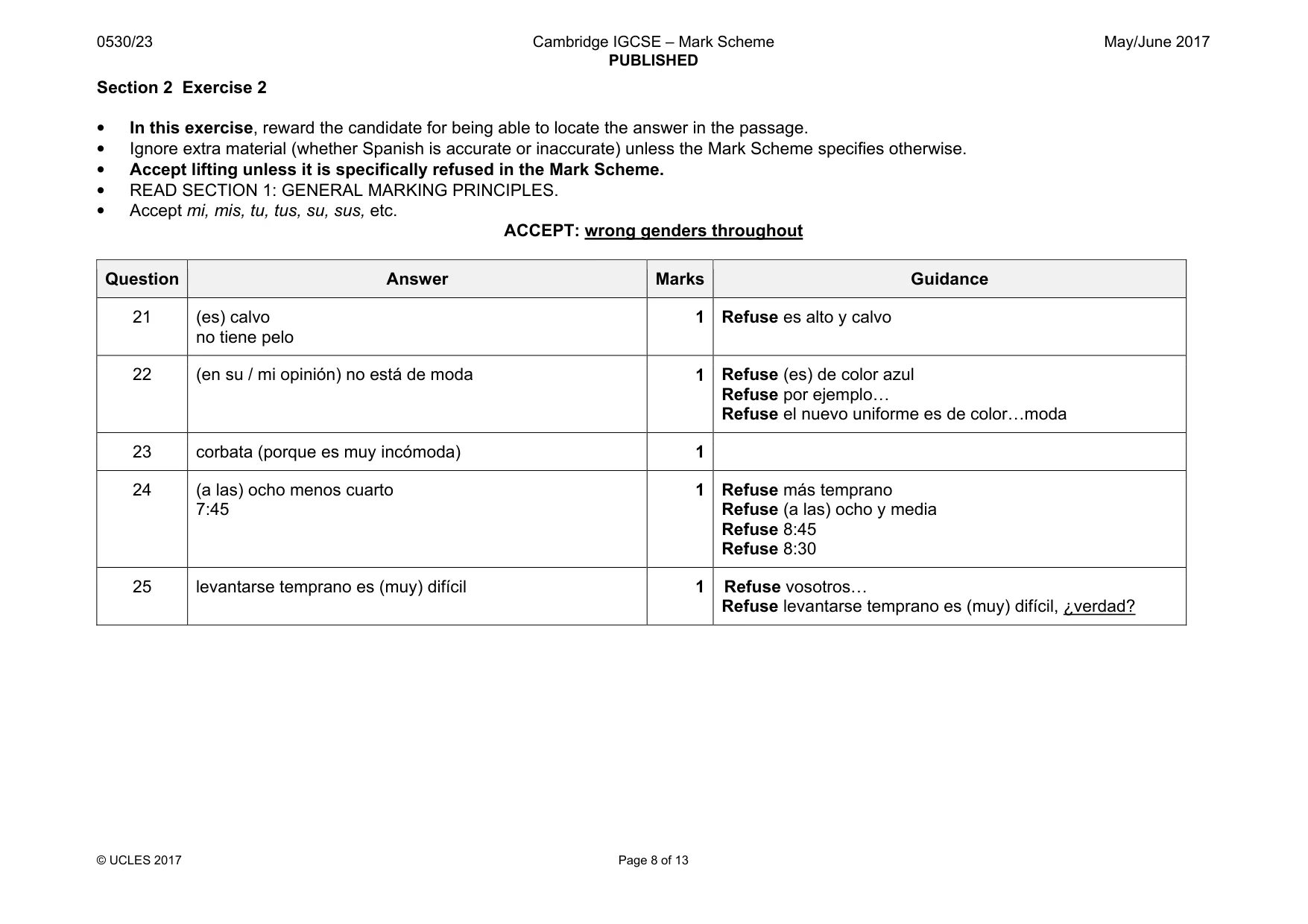
0530/23 Cambridge IGCSE – Mark Scheme PUBLISHED May/June 2017 © UCLES 2017 Page 8 of 13 Section 2 Exercise 2 • In this exercise, reward the candidate for being able to locate the answer in the passage. • Ignore extra material (whether Spanish is accurate or inaccurate) unless the Mark Scheme specifies otherwise. • Accept lifting unless it is specifically refused in the Mark Scheme. • READ SECTION 1: GENERAL MARKING PRINCIPLES. • Accept mi, mis, tu, tus, su, sus, etc. ACCEPT: wrong genders throughout Question Answer Marks Guidance 21 (es) calvo no tiene pelo 1 Refuse es alto y calvo 22 (en su / mi opinión) no está de moda 1 Refuse (es) de color azul Refuse por ejemplo« Refuse el nuevo uniforme es de color«moda 23 corbata (porque es muy incómoda) 1 24 (a las) ocho menos cuarto 7:45 1 Refuse más temprano Refuse (a las) ocho y media Refuse 8:45 Refuse 8:30 25 levantarse temprano es (muy) difícil 1 Refuse vosotros« Refuse levantarse temprano es (muy) difícil, ¿verdad?
Mark scheme, page 9
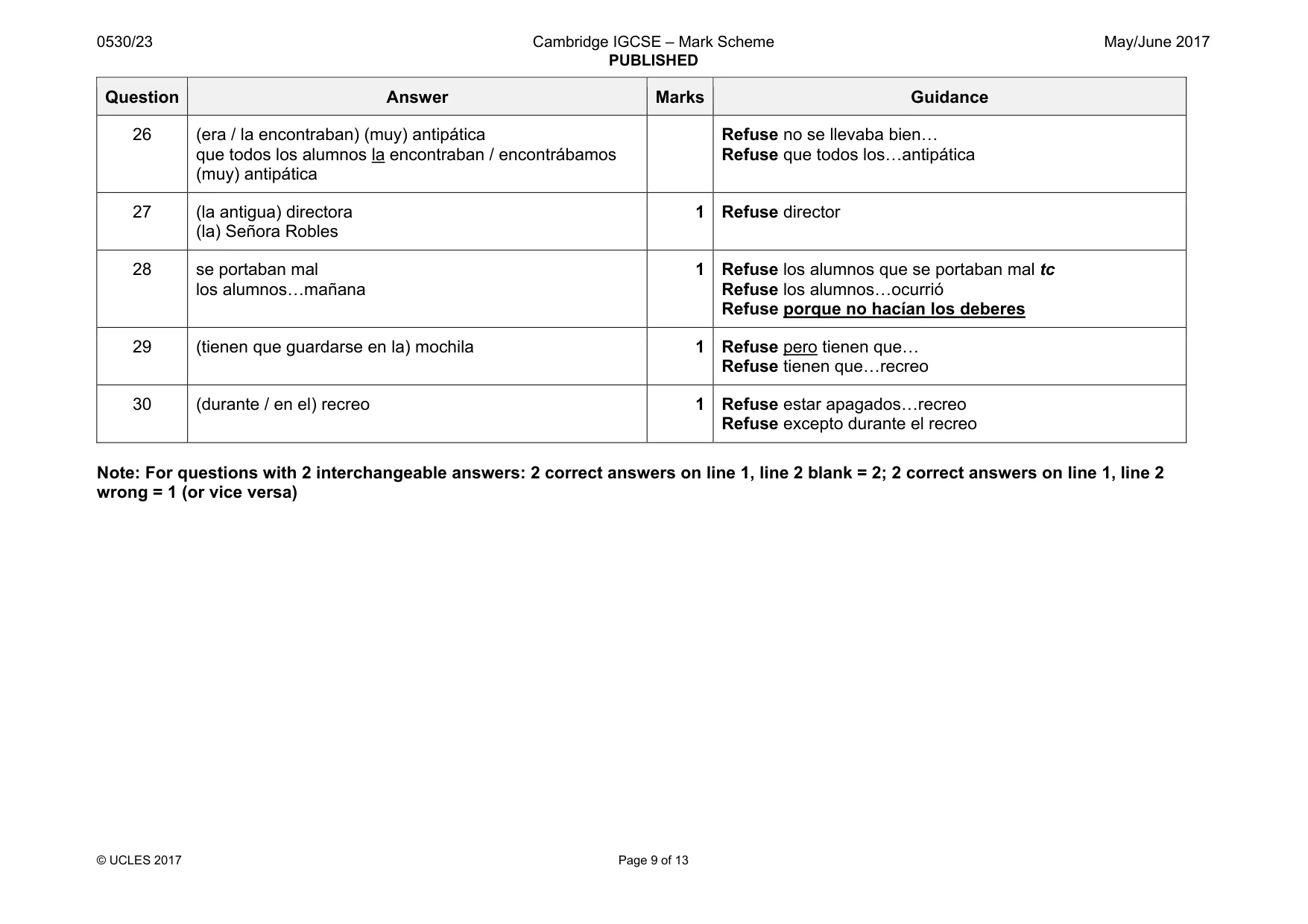
0530/23 Cambridge IGCSE – Mark Scheme PUBLISHED May/June 2017 © UCLES 2017 Page 9 of 13 Question Answer Marks Guidance 26 (era / la encontraban) (muy) antipática que todos los alumnos la encontraban / encontrábamos (muy) antipática Refuse no se llevaba bien« Refuse que todos los«antipática 27 (la antigua) directora (la) Señora Robles 1 Refuse director 28 se portaban mal los alumnos«mañana 1 Refuse los alumnos que se portaban mal tc Refuse los alumnos«ocurrió Refuse porque no hacían los deberes 29 (tienen que guardarse en la) mochila 1 Refuse pero tienen que« Refuse tienen que«recreo 30 (durante / en el) recreo 1 Refuse estar apagados«recreo Refuse excepto durante el recreo Note: For questions with 2 interchangeable answers: 2 correct answers on line 1, line 2 blank = 2; 2 correct answers on line 1, line 2 wrong = 1 (or vice versa)
Mark scheme, page 10
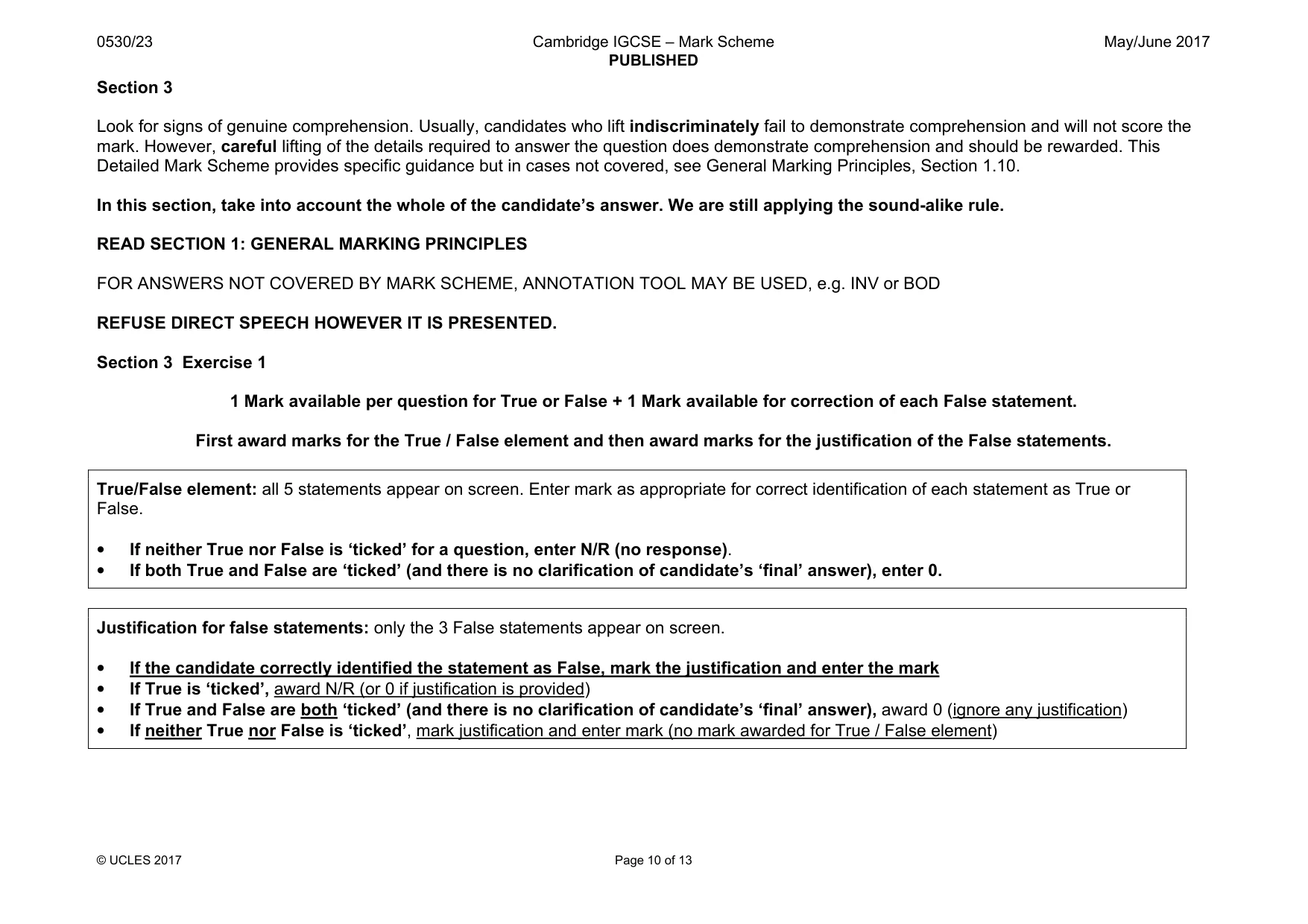
0530/23 Cambridge IGCSE – Mark Scheme PUBLISHED May/June 2017 © UCLES 2017 Page 10 of 13 Section 3 Look for signs of genuine comprehension. Usually, candidates who lift indiscriminately fail to demonstrate comprehension and will not score the mark. However, careful lifting of the details required to answer the question does demonstrate comprehension and should be rewarded. This Detailed Mark Scheme provides specific guidance but in cases not covered, see General Marking Principles, Section 1.10. In this section, take into account the whole of the candidate’s answer. We are still applying the sound-alike rule. READ SECTION 1: GENERAL MARKING PRINCIPLES FOR ANSWERS NOT COVERED BY MARK SCHEME, ANNOTATION TOOL MAY BE USED, e.g. INV or BOD REFUSE DIRECT SPEECH HOWEVER IT IS PRESENTED. Section 3 Exercise 1 1 Mark available per question for True or False + 1 Mark available for correction of each False statement. First award marks for the True / False element and then award marks for the justification of the False statements. True/False element: all 5 statements appear on screen. Enter mark as appropriate for correct identification of each statement as True or False. • If neither True nor False is ‘ticked’ for a question, enter N/R (no response). • If both True and False are ‘ticked’ (and there is no clarification of candidate’s ‘final’ answer), enter 0. Justification for false statements: only the 3 False statements appear on screen. • If the candidate correctly identified the statement as False, mark the justification and enter the mark • If True is ‘ticked’, award N/R (or 0 if justification is provided) • If True and False are both ‘ticked’ (and there is no clarification of candidate’s ‘final’ answer), award 0 (ignore any justification) • If neither True nor False is ‘ticked’, mark justification and enter mark (no mark awarded for True / False element)
Mark scheme, page 11
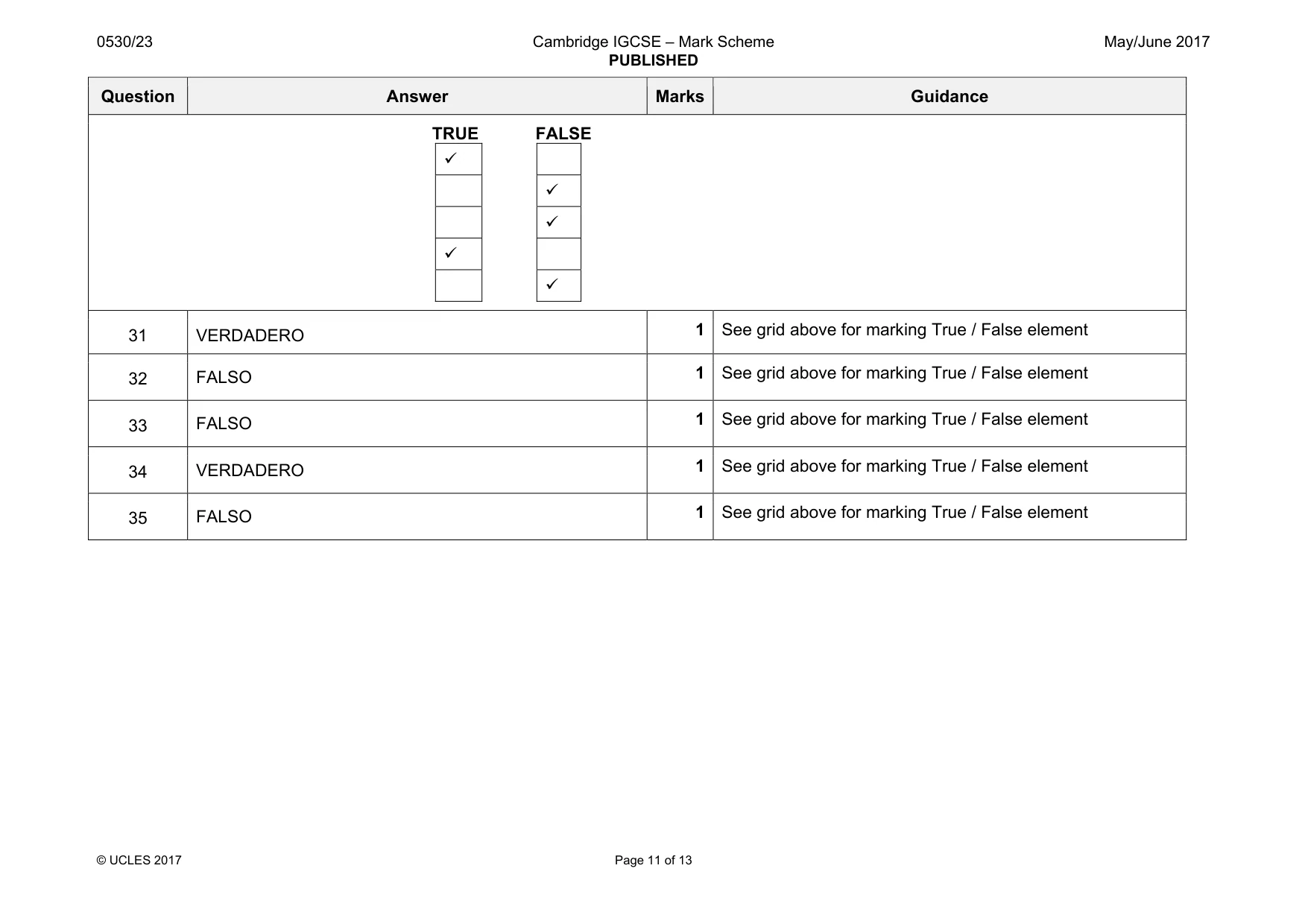
0530/23 Cambridge IGCSE – Mark Scheme PUBLISHED May/June 2017 © UCLES 2017 Page 11 of 13 Question Answer Marks Guidance TRUE FALSE 9 9 9 9 9 31 VERDADERO 1 See grid above for marking True / False element 32 FALSO 1 See grid above for marking True / False element 33 FALSO 1 See grid above for marking True / False element 34 VERDADERO 1 See grid above for marking True / False element 35 FALSO 1 See grid above for marking True / False element
Mark scheme, page 12
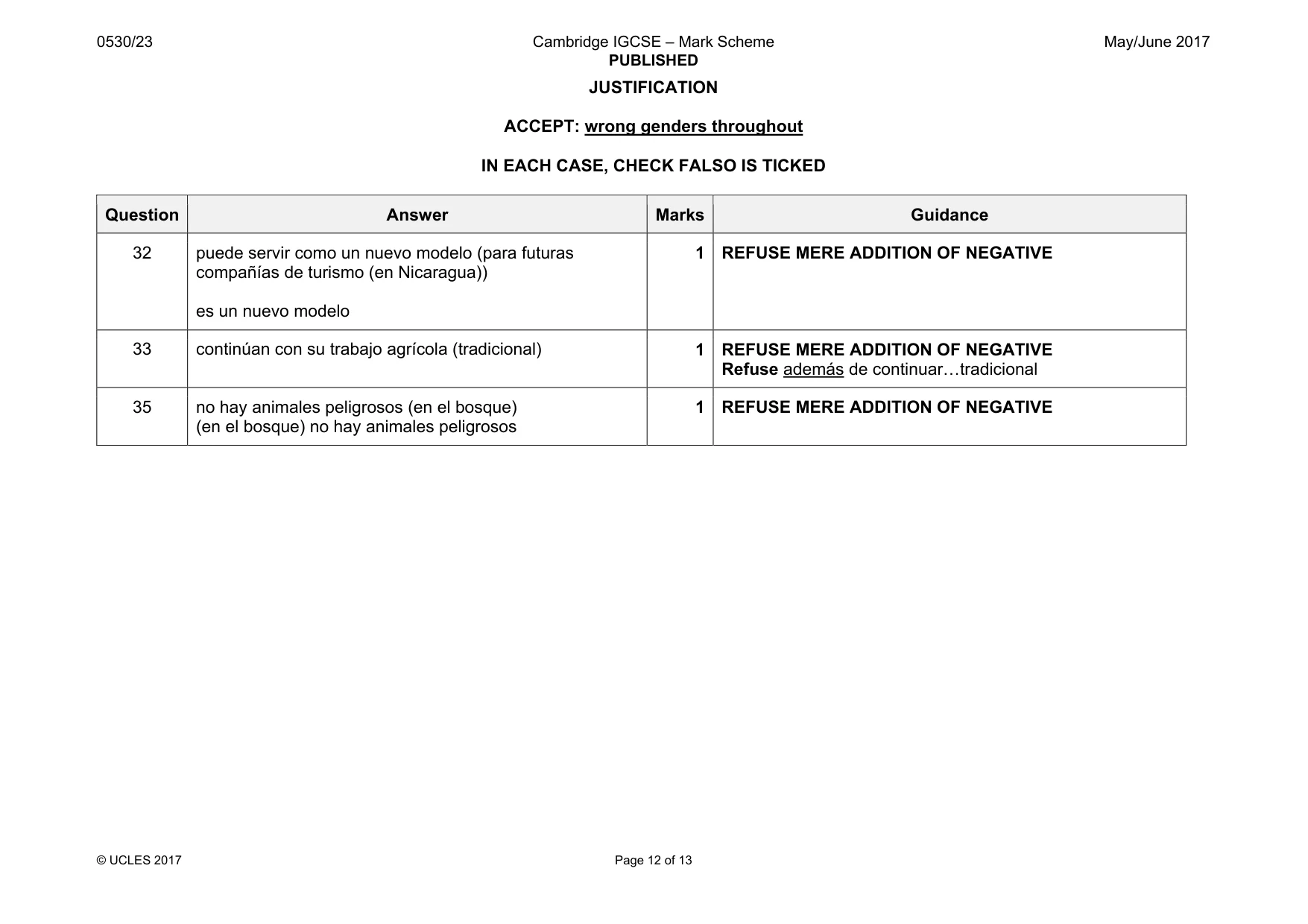
0530/23 Cambridge IGCSE – Mark Scheme PUBLISHED May/June 2017 © UCLES 2017 Page 12 of 13 JUSTIFICATION ACCEPT: wrong genders throughout IN EACH CASE, CHECK FALSO IS TICKED Question Answer Marks Guidance 32 puede servir como un nuevo modelo (para futuras compañías de turismo (en Nicaragua)) es un nuevo modelo 1 REFUSE MERE ADDITION OF NEGATIVE 33 continúan con su trabajo agrícola (tradicional) 1 REFUSE MERE ADDITION OF NEGATIVE Refuse además de continuar«tradicional 35 no hay animales peligrosos (en el bosque) (en el bosque) no hay animales peligrosos 1 REFUSE MERE ADDITION OF NEGATIVE
Mark scheme, page 13
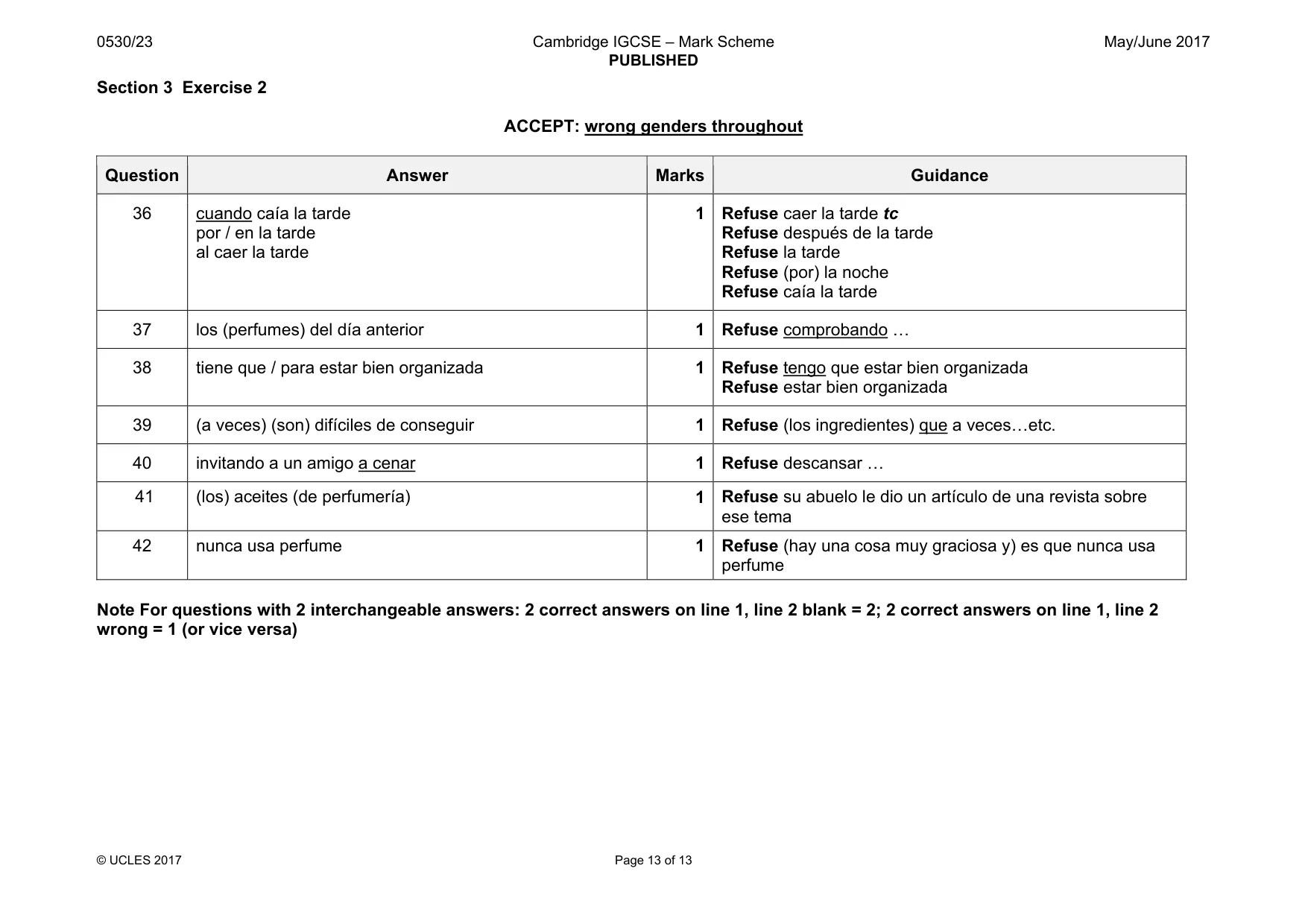
0530/23 Cambridge IGCSE – Mark Scheme PUBLISHED May/June 2017 © UCLES 2017 Page 13 of 13 Section 3 Exercise 2 ACCEPT: wrong genders throughout Question Answer Marks Guidance 36 cuando caía la tarde por / en la tarde al caer la tarde 1 Refuse caer la tarde tc Refuse después de la tarde Refuse la tarde Refuse (por) la noche Refuse caía la tarde 37 los (perfumes) del día anterior 1 Refuse comprobando « 38 tiene que / para estar bien organizada 1 Refuse tengo que estar bien organizada Refuse estar bien organizada 39 (a veces) (son) difíciles de conseguir 1 Refuse (los ingredientes) que a veces«etc. 40 invitando a un amigo a cenar 1 Refuse descansar « 41 (los) aceites (de perfumería) 1 Refuse su abuelo le dio un artículo de una revista sobre ese tema 42 nunca usa perfume 1 Refuse (hay una cosa muy graciosa y) es que nunca usa perfume Note For questions with 2 interchangeable answers: 2 correct answers on line 1, line 2 blank = 2; 2 correct answers on line 1, line 2 wrong = 1 (or vice versa)
What you needed in this session
Cambridge’s own grade thresholds for 2017 May/June, Paper 2 · Variant 3. A higher threshold means an easier paper — the bar moves with how the cohort did.