Cambridge IGCSE Spanish - Foreign Language 0530 — 2017 May/June Paper 2 · Variant 2
0530/22/M/J/17 · 45 marks · ≈51 min
The question paper and its mark scheme, free to read here and free to download. This is Cambridge’s own paper, exactly as it was sat.
Question paper16 pages



Mark scheme15 pages
Answers below. Sit the paper first if you are practising.
Paper as text
Question paper, page 1
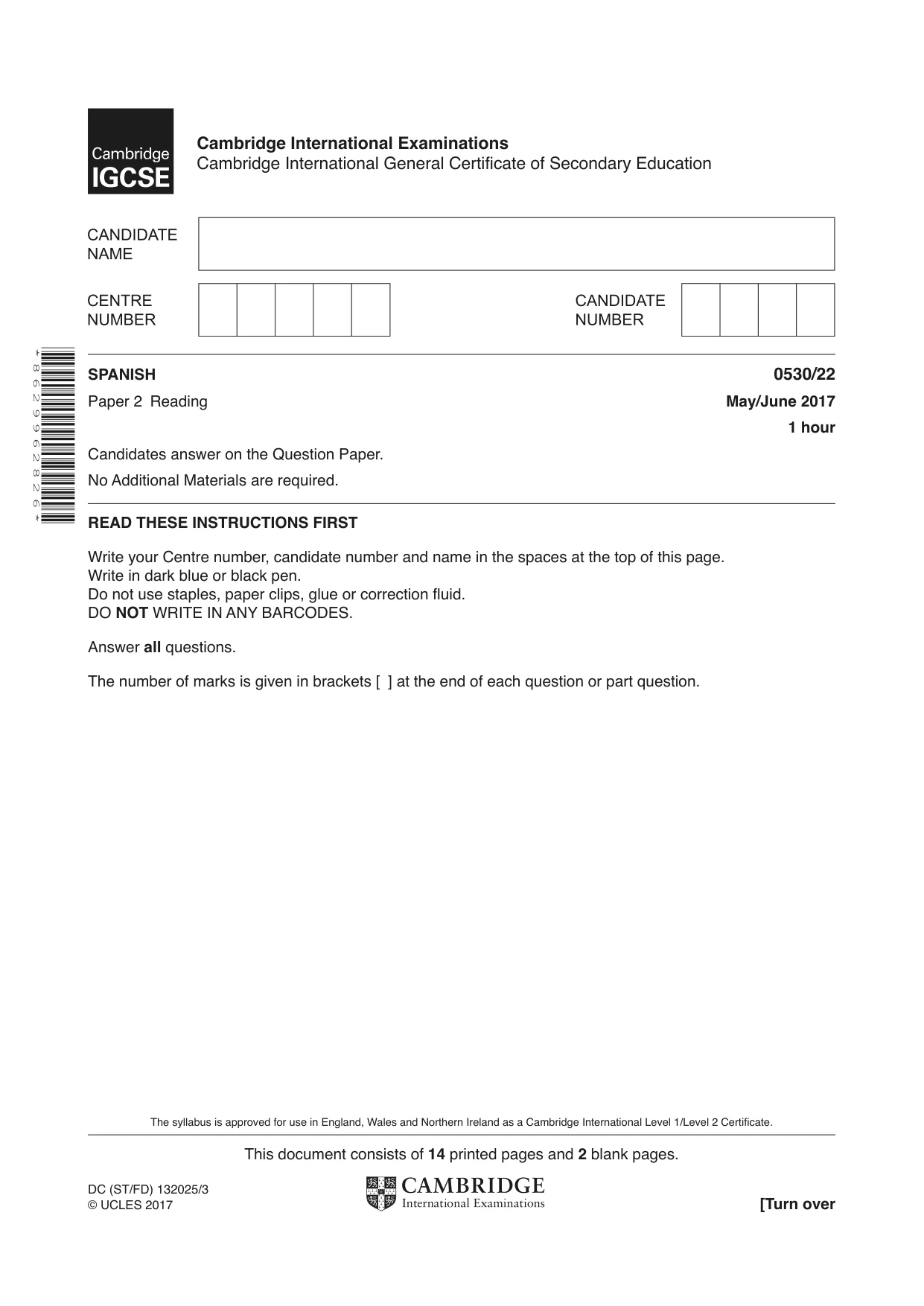
This document consists of 14 printed pages and 2 blank pages. DC (ST/FD) 132025/3 © UCLES 2017 [Turn over Cambridge International Examinations Cambridge International General Certificate of Secondary Education * 8 6 2 9 9 6 2 8 2 6 * SPANISH 0530/22 Paper 2 Reading May/June 2017 1 hour Candidates answer on the Question Paper. No Additional Materials are required. READ THESE INSTRUCTIONS FIRST Write your Centre number, candidate number and name in the spaces at the top of this page. Write in dark blue or black pen. Do not use staples, paper clips, glue or correction fluid. DO NOT WRITE IN ANY BARCODES. Answer all questions. The number of marks is given in brackets [ ] at the end of each question or part question. The syllabus is approved for use in England, Wales and Northern Ireland as a Cambridge International Level 1/Level 2 Certificate.
Question paper, page 2
2 0530/22/M/J/17 © UCLES 2017 BLANK PAGE
Question paper, page 3
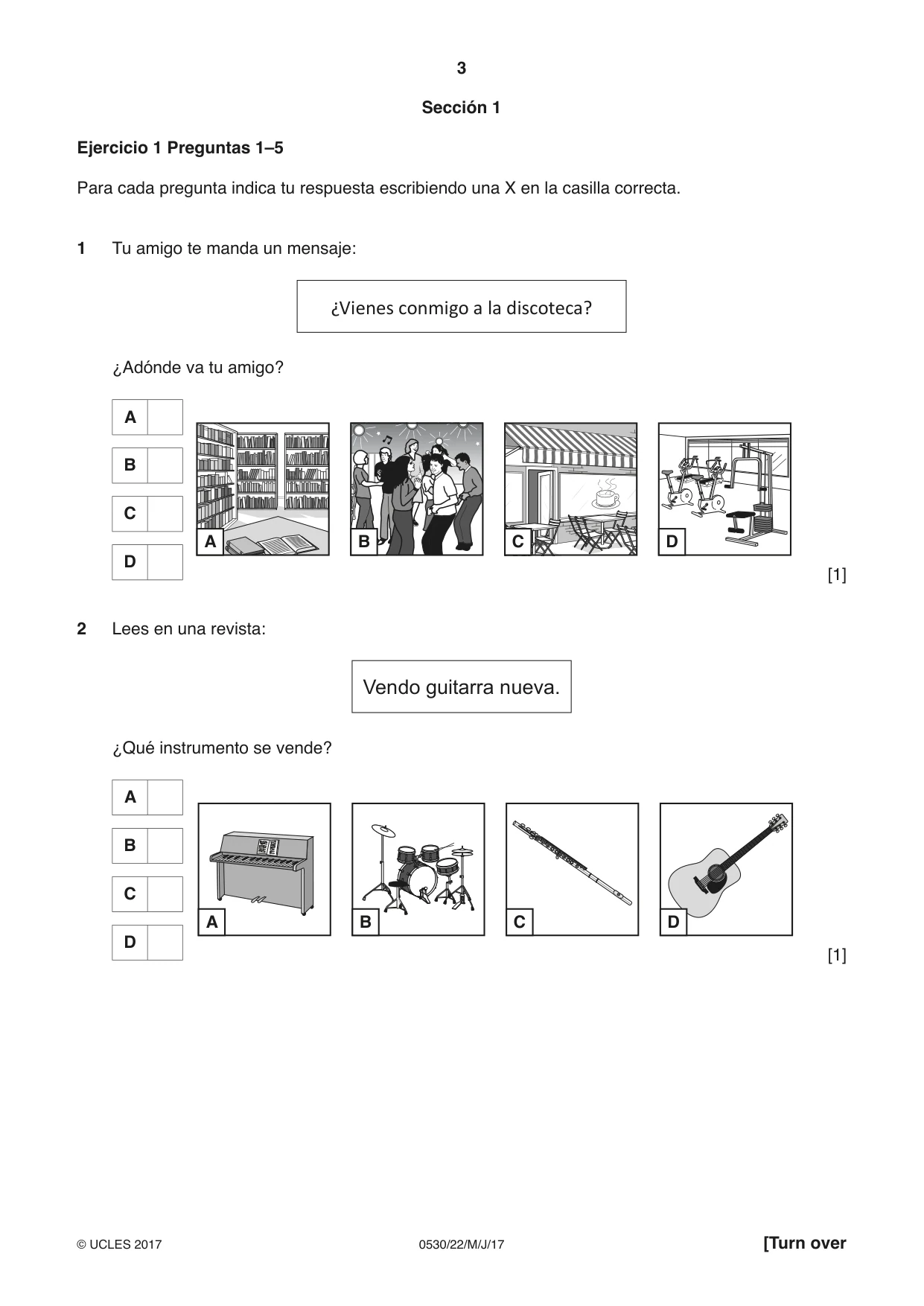
3 0530/22/M/J/17 © UCLES 2017 [Turn over Sección 1 Ejercicio 1 Preguntas 1–5 Para cada pregunta indica tu respuesta escribiendo una X en la casilla correcta. 1 Tu amigo te manda un mensaje: ¿Vienes conmigo a la discoteca? ¿Adónde va tu amigo? A A B C D [1] B C D 2 Lees en una revista: Vendo guitarra nueva. ¿Qué instrumento se vende? A A B C D [1] B C D
Question paper, page 4
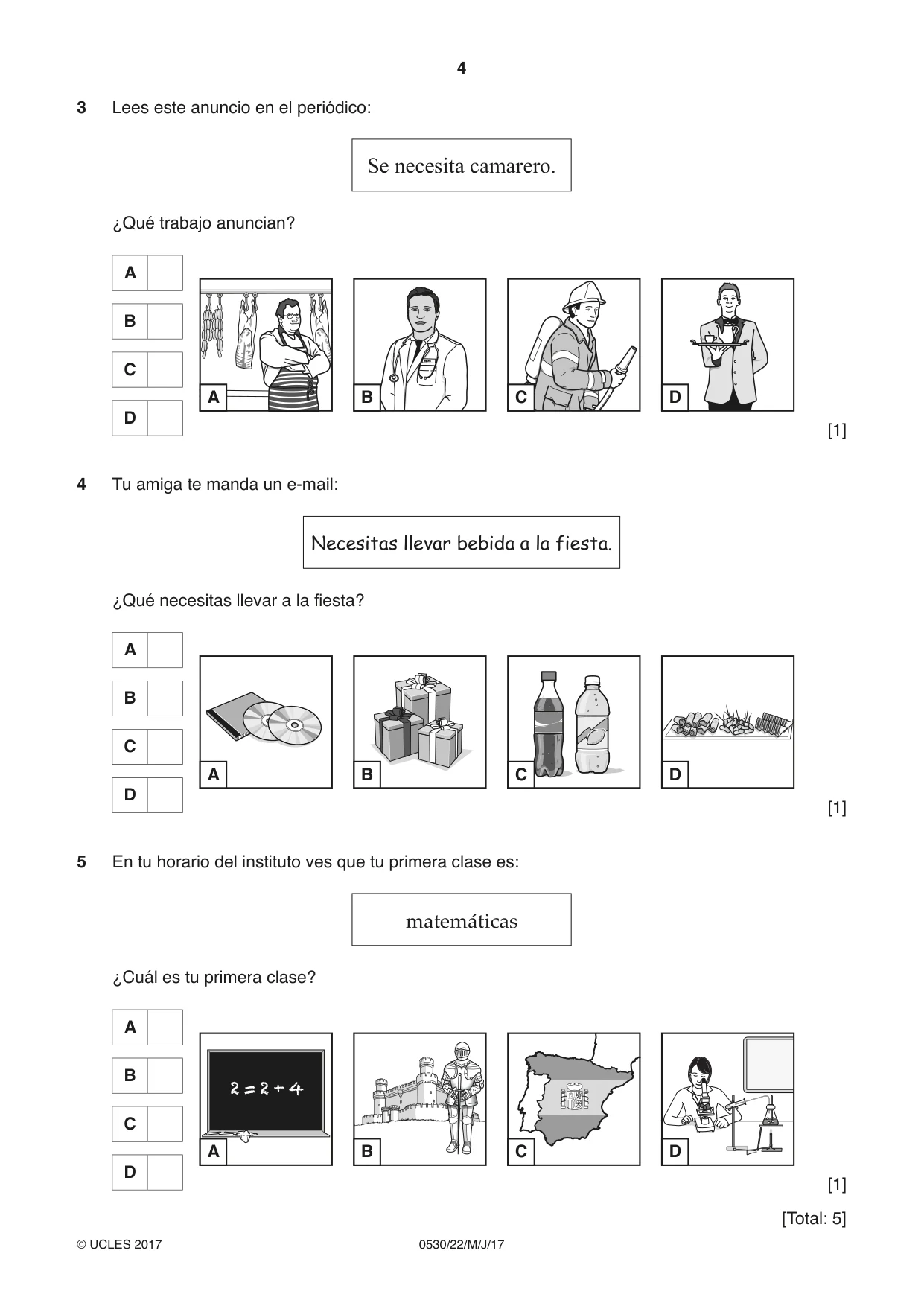
4 0530/22/M/J/17 © UCLES 2017 3 Lees este anuncio en el periódico: Se necesita camarero. ¿Qué trabajo anuncian? A A B C D [1] B C D 4 Tu amiga te manda un e-mail: Necesitas llevar bebida a la fiesta. ¿Qué necesitas llevar a la fiesta? A A B C D [1] B C D 5 En tu horario del instituto ves que tu primera clase es: matemáticas ¿Cuál es tu primera clase? A 2 = 2 + 4 A B C D [1] B C D [Total: 5]
Question paper, page 5
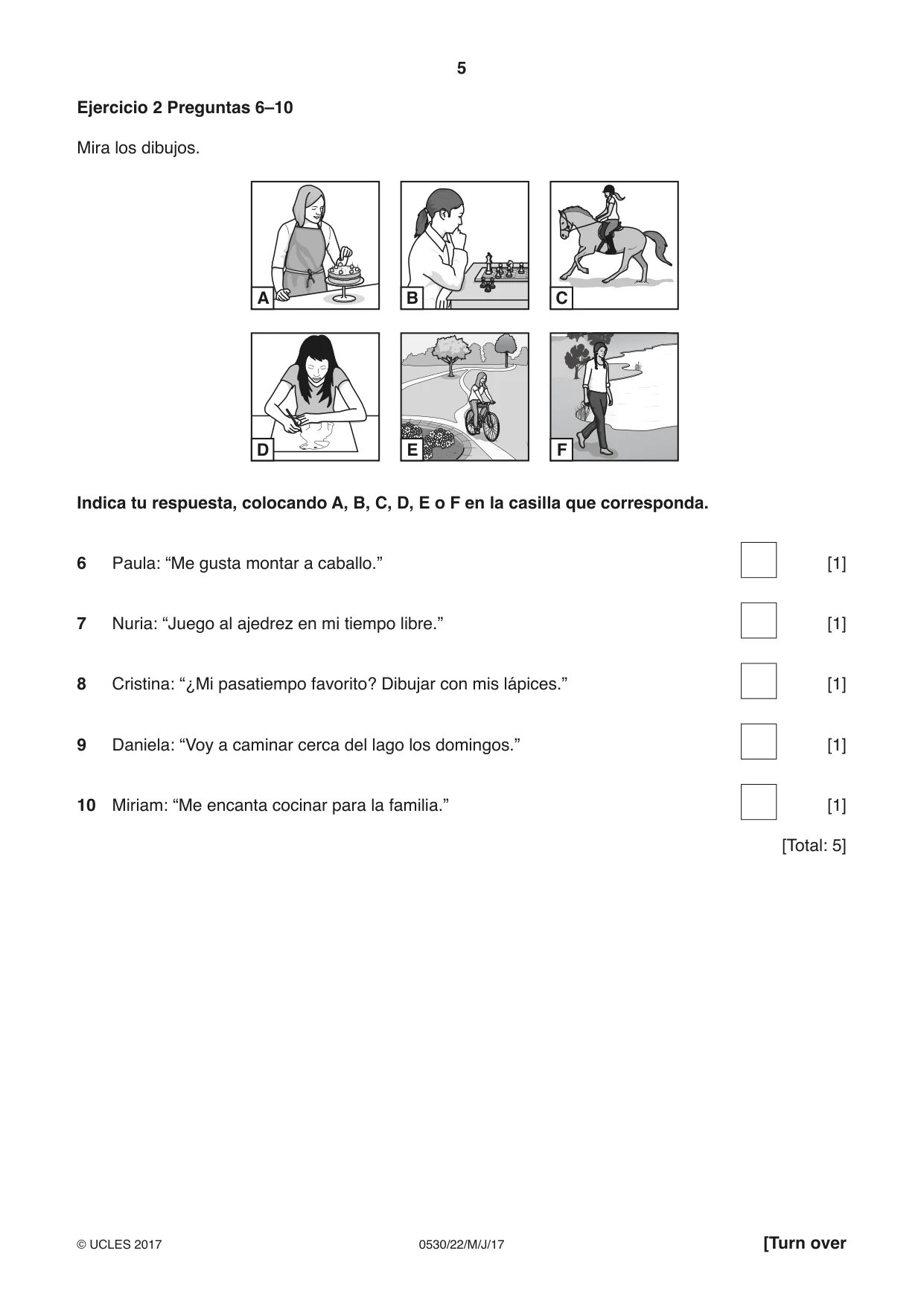
5 0530/22/M/J/17 © UCLES 2017 [Turn over Ejercicio 2 Preguntas 6–10 Mira los dibujos. A B C D E F Indica tu respuesta, colocando A, B, C, D, E o F en la casilla que corresponda. 6 Paula: “Me gusta montar a caballo.” [1] 7 Nuria: “Juego al ajedrez en mi tiempo libre.” [1] 8 Cristina: “¿Mi pasatiempo favorito? Dibujar con mis lápices.” [1] 9 Daniela: “Voy a caminar cerca del lago los domingos.” [1] 10 Miriam: “Me encanta cocinar para la familia.” [1] [Total: 5]
Question paper, page 6
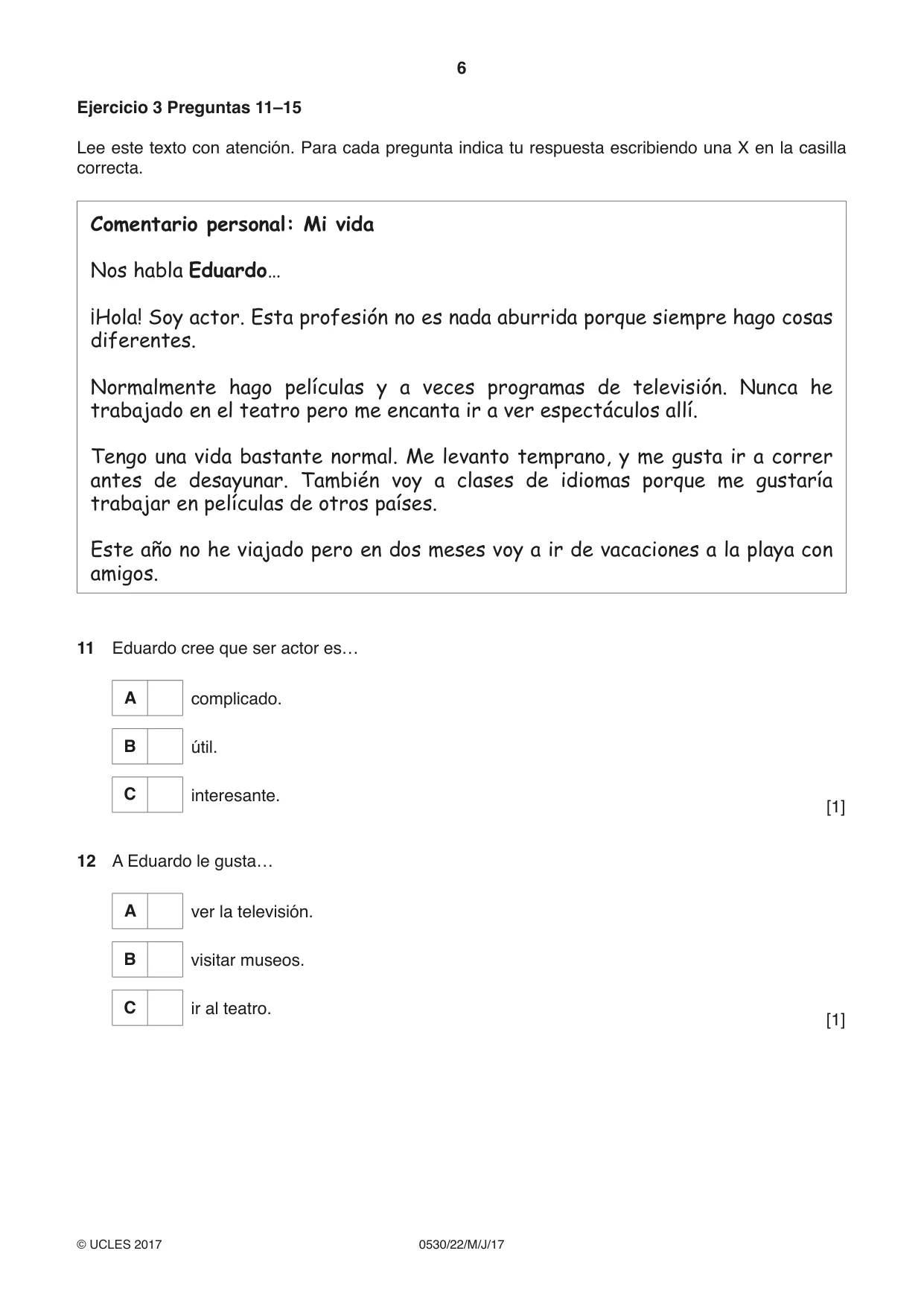
6 0530/22/M/J/17 © UCLES 2017 Ejercicio 3 Preguntas 11–15 Lee este texto con atención. Para cada pregunta indica tu respuesta escribiendo una X en la casilla correcta. Comentario personal: Mi vida Nos habla Eduardo… ¡Hola! Soy actor. Esta profesión no es nada aburrida porque siempre hago cosas diferentes. Normalmente hago películas y a veces programas de televisión. Nunca he trabajado en el teatro pero me encanta ir a ver espectáculos allí. Tengo una vida bastante normal. Me levanto temprano, y me gusta ir a correr antes de desayunar. También voy a clases de idiomas porque me gustaría trabajar en películas de otros países. Este año no he viajado pero en dos meses voy a ir de vacaciones a la playa con amigos. 11 Eduardo cree que ser actor es… A complicado. [1] B útil. C interesante. 12 A Eduardo le gusta… A ver la televisión. [1] B visitar museos. C ir al teatro.
Question paper, page 7
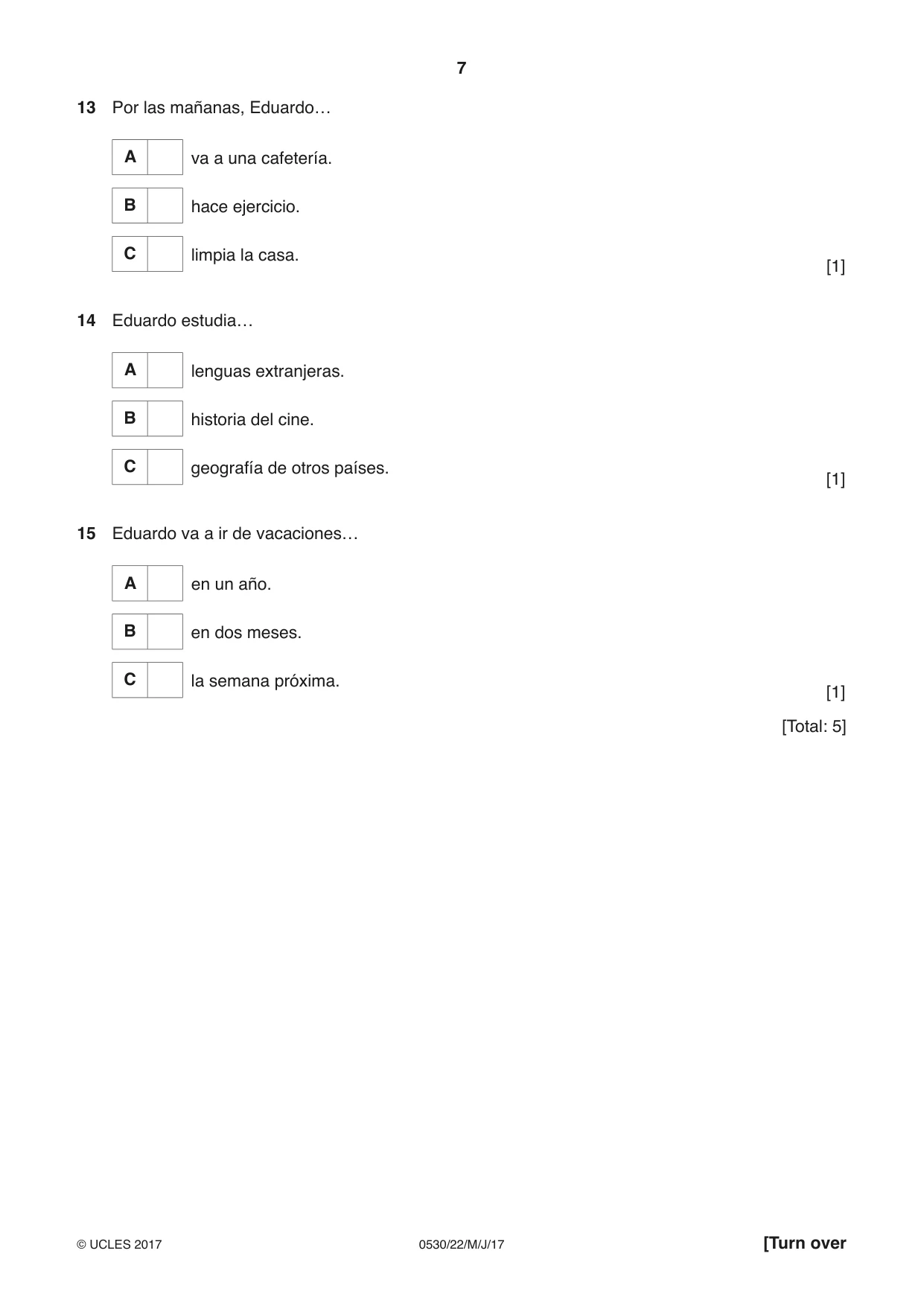
7 0530/22/M/J/17 © UCLES 2017 [Turn over 13 Por las mañanas, Eduardo… A va a una cafetería. [1] B hace ejercicio. C limpia la casa. 14 Eduardo estudia… A lenguas extranjeras. [1] B historia del cine. C geografía de otros países. 15 Eduardo va a ir de vacaciones… A en un año. [1] B en dos meses. C la semana próxima. [Total: 5]
Question paper, page 8
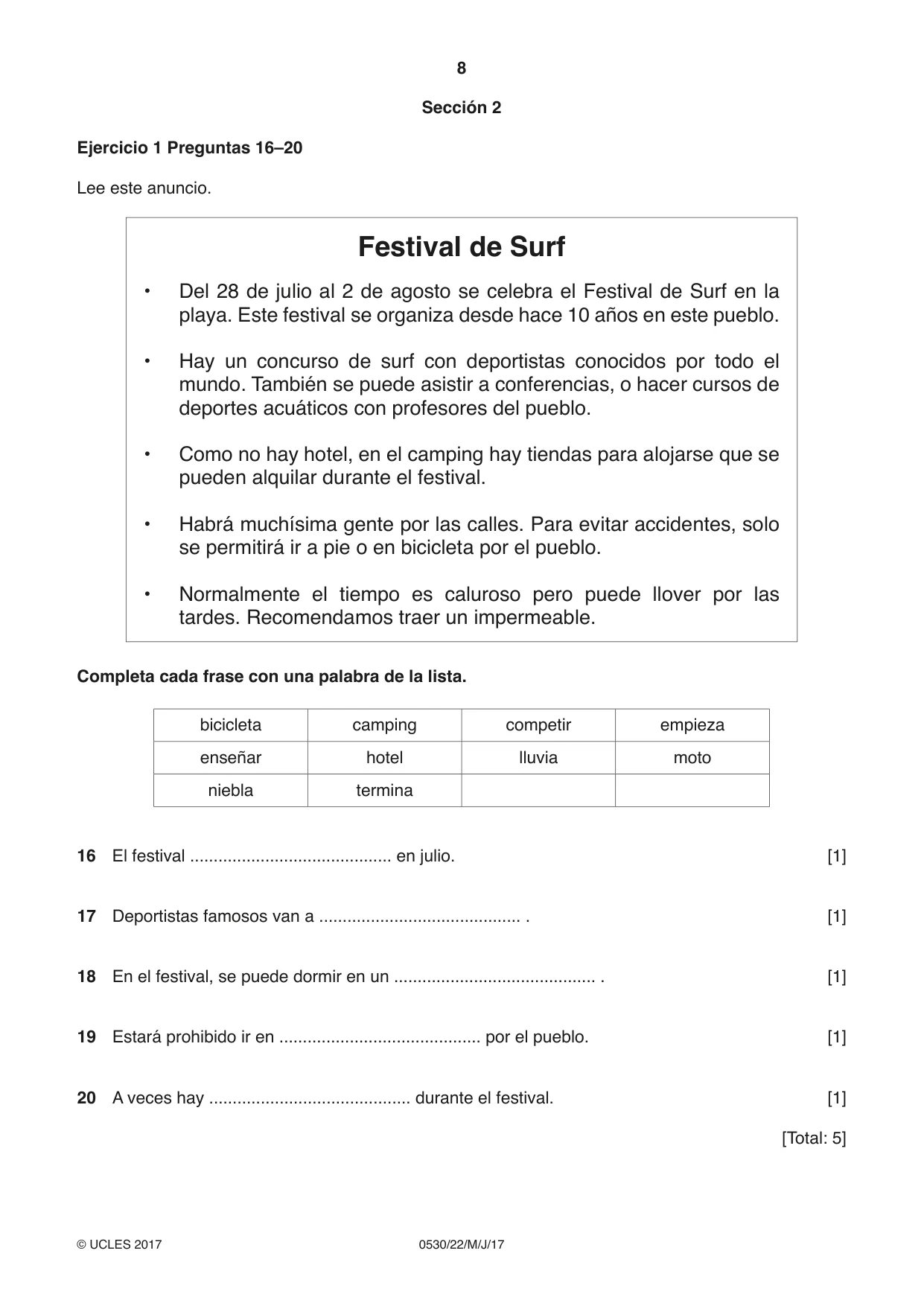
8 0530/22/M/J/17 © UCLES 2017 Sección 2 Ejercicio 1 Preguntas 16–20 Lee este anuncio. Festival de Surf • Del 28 de julio al 2 de agosto se celebra el Festival de Surf en la playa. Este festival se organiza desde hace 10 años en este pueblo. • Hay un concurso de surf con deportistas conocidos por todo el mundo. También se puede asistir a conferencias, o hacer cursos de deportes acuáticos con profesores del pueblo. • Como no hay hotel, en el camping hay tiendas para alojarse que se pueden alquilar durante el festival. • Habrá muchísima gente por las calles. Para evitar accidentes, solo se permitirá ir a pie o en bicicleta por el pueblo. • Normalmente el tiempo es caluroso pero puede llover por las tardes. Recomendamos traer un impermeable. Completa cada frase con una palabra de la lista. bicicleta camping competir empieza enseñar hotel lluvia moto niebla termina 16 El festival … en julio. [1] 17 Deportistas famosos van a … . [1] 18 En el festival, se puede dormir en un … . [1] 19 Estará prohibido ir en … por el pueblo. [1] 20 A veces hay … durante el festival. [1] [Total: 5]
Question paper, page 9
9 0530/22/M/J/17 © UCLES 2017 [Turn over Dar la vuelta para el Ejercicio 2.
Question paper, page 10
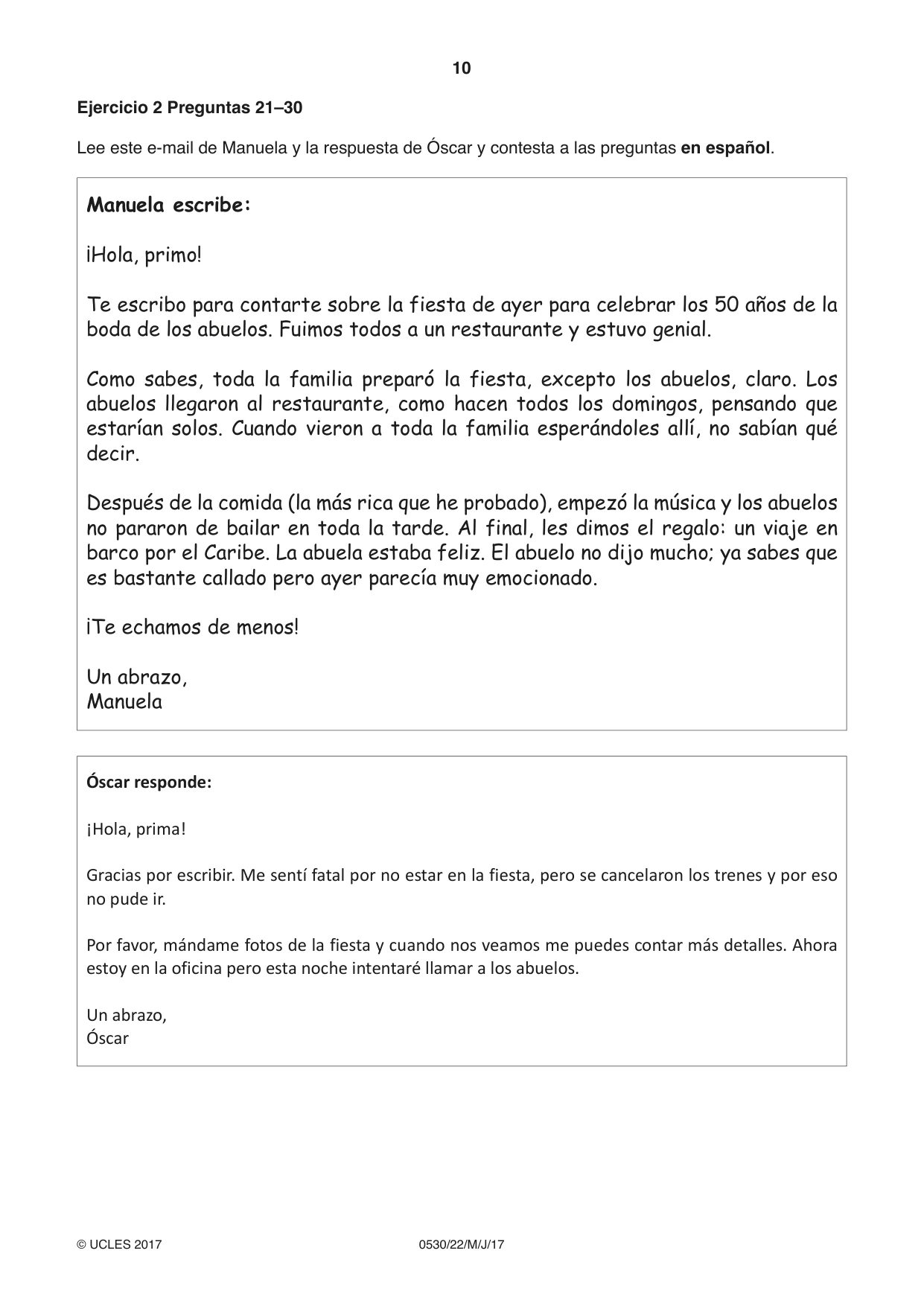
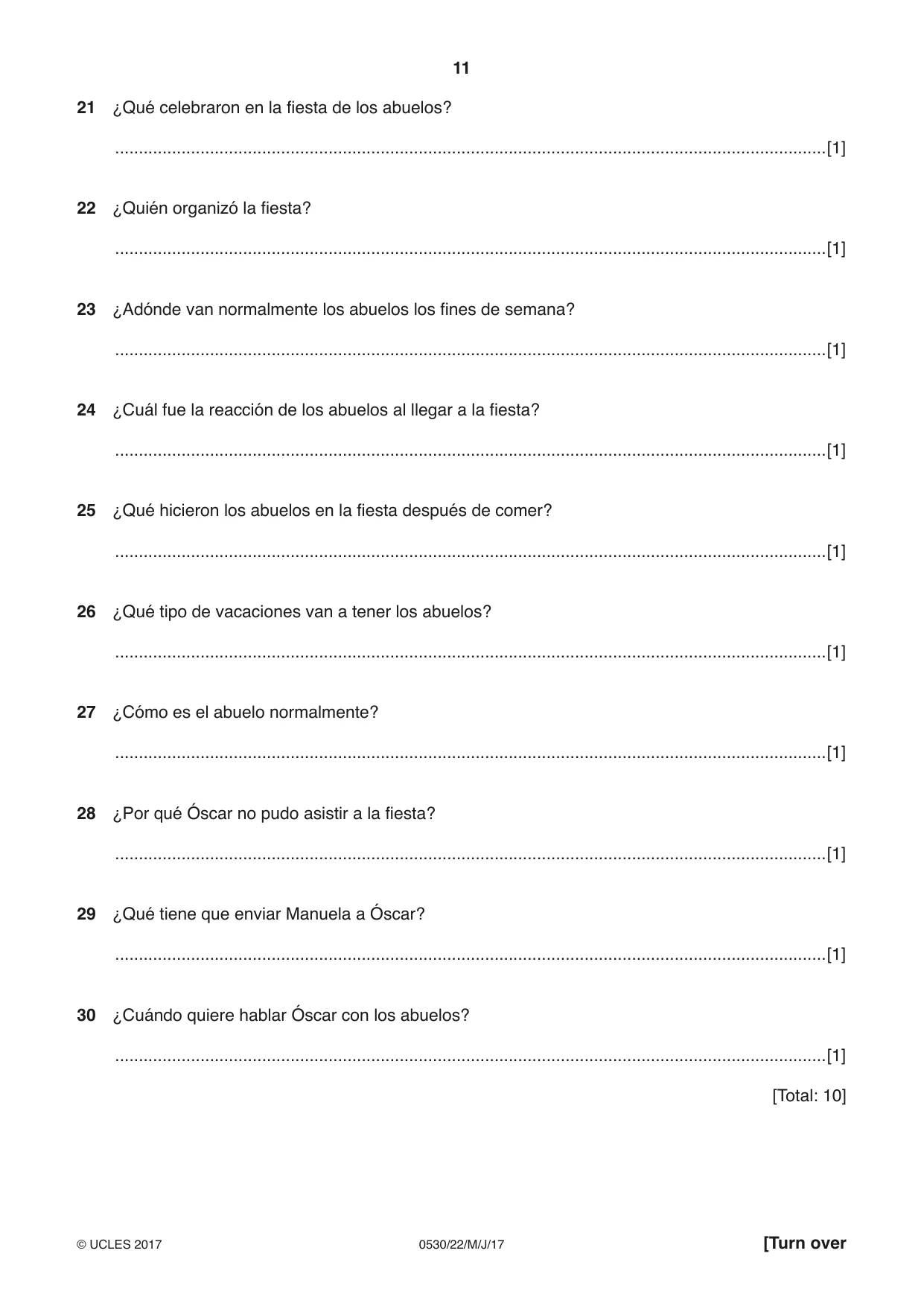
10 0530/22/M/J/17 © UCLES 2017 Ejercicio 2 Preguntas 21–30 Lee este e-mail de Manuela y la respuesta de Óscar y contesta a las preguntas en español. Manuela escribe: ¡Hola, primo! Te escribo para contarte sobre la fiesta de ayer para celebrar los 50 años de la boda de los abuelos. Fuimos todos a un restaurante y estuvo genial. Como sabes, toda la familia preparó la fiesta, excepto los abuelos, claro. Los abuelos llegaron al restaurante, como hacen todos los domingos, pensando que estarían solos. Cuando vieron a toda la familia esperándoles allí, no sabían qué decir. Después de la comida (la más rica que he probado), empezó la música y los abuelos no pararon de bailar en toda la tarde. Al final, les dimos el regalo: un viaje en barco por el Caribe. La abuela estaba feliz. El abuelo no dijo mucho; ya sabes que es bastante callado pero ayer parecía muy emocionado. ¡Te echamos de menos! Un abrazo, Manuela Óscar responde: ¡Hola, prima! Gracias por escribir. Me sentí fatal por no estar en la fiesta, pero se cancelaron los trenes y por eso no pude ir. Por favor, mándame fotos de la fiesta y cuando nos veamos me puedes contar más detalles. Ahora estoy en la oficina pero esta noche intentaré llamar a los abuelos. Un abrazo, Óscar
Question paper, page 11
11 0530/22/M/J/17 © UCLES 2017 [Turn over 21 ¿Qué celebraron en la fiesta de los abuelos? …[1] 22 ¿Quién organizó la fiesta? …[1] 23 ¿Adónde van normalmente los abuelos los fines de semana? …[1] 24 ¿Cuál fue la reacción de los abuelos al llegar a la fiesta? …[1] 25 ¿Qué hicieron los abuelos en la fiesta después de comer? …[1] 26 ¿Qué tipo de vacaciones van a tener los abuelos? …[1] 27 ¿Cómo es el abuelo normalmente? …[1] 28 ¿Por qué Óscar no pudo asistir a la fiesta? …[1] 29 ¿Qué tiene que enviar Manuela a Óscar? …[1] 30 ¿Cuándo quiere hablar Óscar con los abuelos? …[1] [Total: 10]
Question paper, page 12
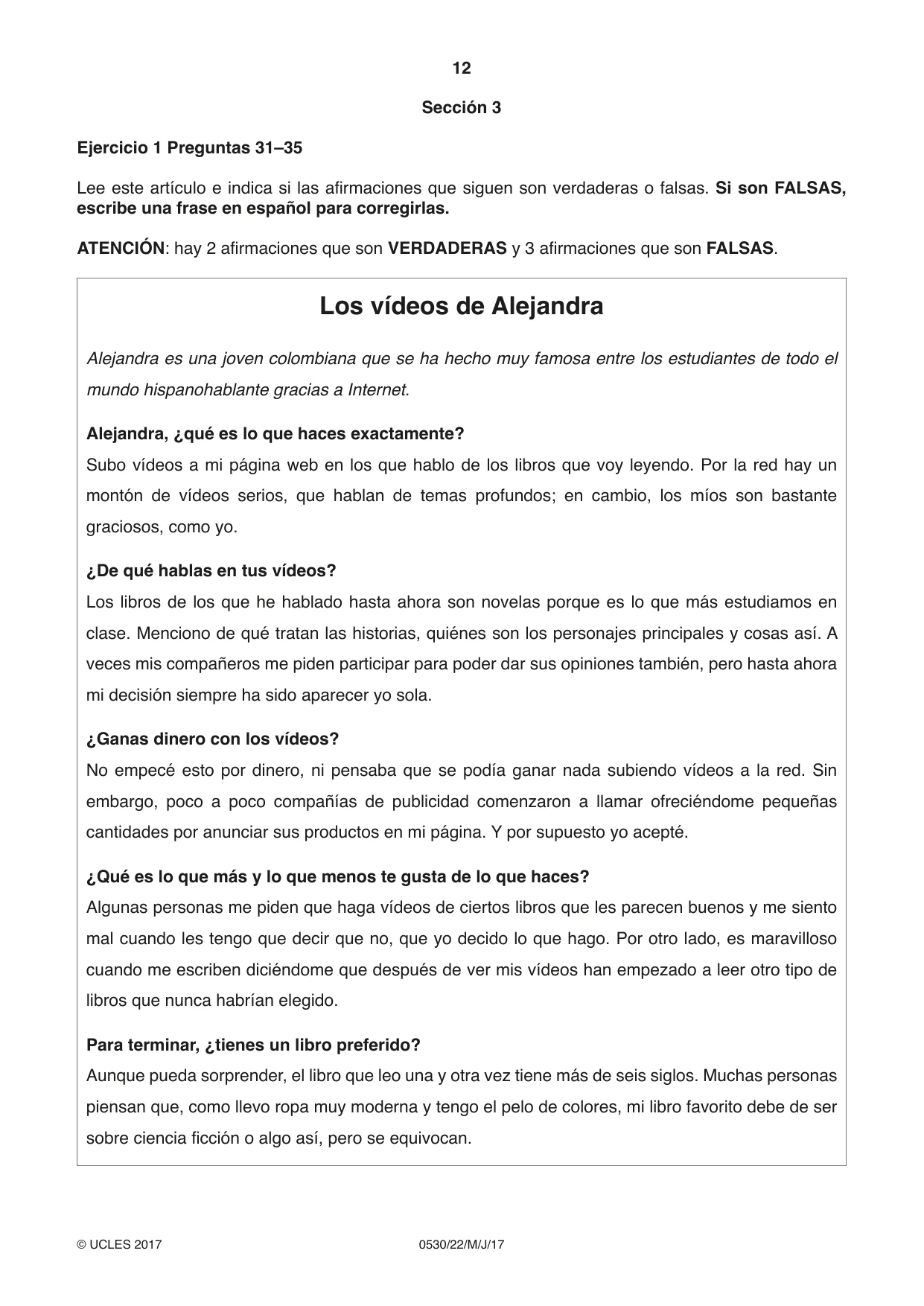
12 0530/22/M/J/17 © UCLES 2017 Sección 3 Ejercicio 1 Preguntas 31–35 Lee este artículo e indica si las afirmaciones que siguen son verdaderas o falsas. Si son FALSAS, escribe una frase en español para corregirlas. ATENCIÓN: hay 2 afirmaciones que son VERDADERAS y 3 afirmaciones que son FALSAS. Los vídeos de Alejandra Alejandra es una joven colombiana que se ha hecho muy famosa entre los estudiantes de todo el mundo hispanohablante gracias a Internet. Alejandra, ¿qué es lo que haces exactamente? Subo vídeos a mi página web en los que hablo de los libros que voy leyendo. Por la red hay un montón de vídeos serios, que hablan de temas profundos; en cambio, los míos son bastante graciosos, como yo. ¿De qué hablas en tus vídeos? Los libros de los que he hablado hasta ahora son novelas porque es lo que más estudiamos en clase. Menciono de qué tratan las historias, quiénes son los personajes principales y cosas así. A veces mis compañeros me piden participar para poder dar sus opiniones también, pero hasta ahora mi decisión siempre ha sido aparecer yo sola. ¿Ganas dinero con los vídeos? No empecé esto por dinero, ni pensaba que se podía ganar nada subiendo vídeos a la red. Sin embargo, poco a poco compañías de publicidad comenzaron a llamar ofreciéndome pequeñas cantidades por anunciar sus productos en mi página. Y por supuesto yo acepté. ¿Qué es lo que más y lo que menos te gusta de lo que haces? Algunas personas me piden que haga vídeos de ciertos libros que les parecen buenos y me siento mal cuando les tengo que decir que no, que yo decido lo que hago. Por otro lado, es maravilloso cuando me escriben diciéndome que después de ver mis vídeos han empezado a leer otro tipo de libros que nunca habrían elegido. Para terminar, ¿tienes un libro preferido? Aunque pueda sorprender, el libro que leo una y otra vez tiene más de seis siglos. Muchas personas piensan que, como llevo ropa muy moderna y tengo el pelo de colores, mi libro favorito debe de ser sobre ciencia ficción o algo así, pero se equivocan.
Question paper, page 13
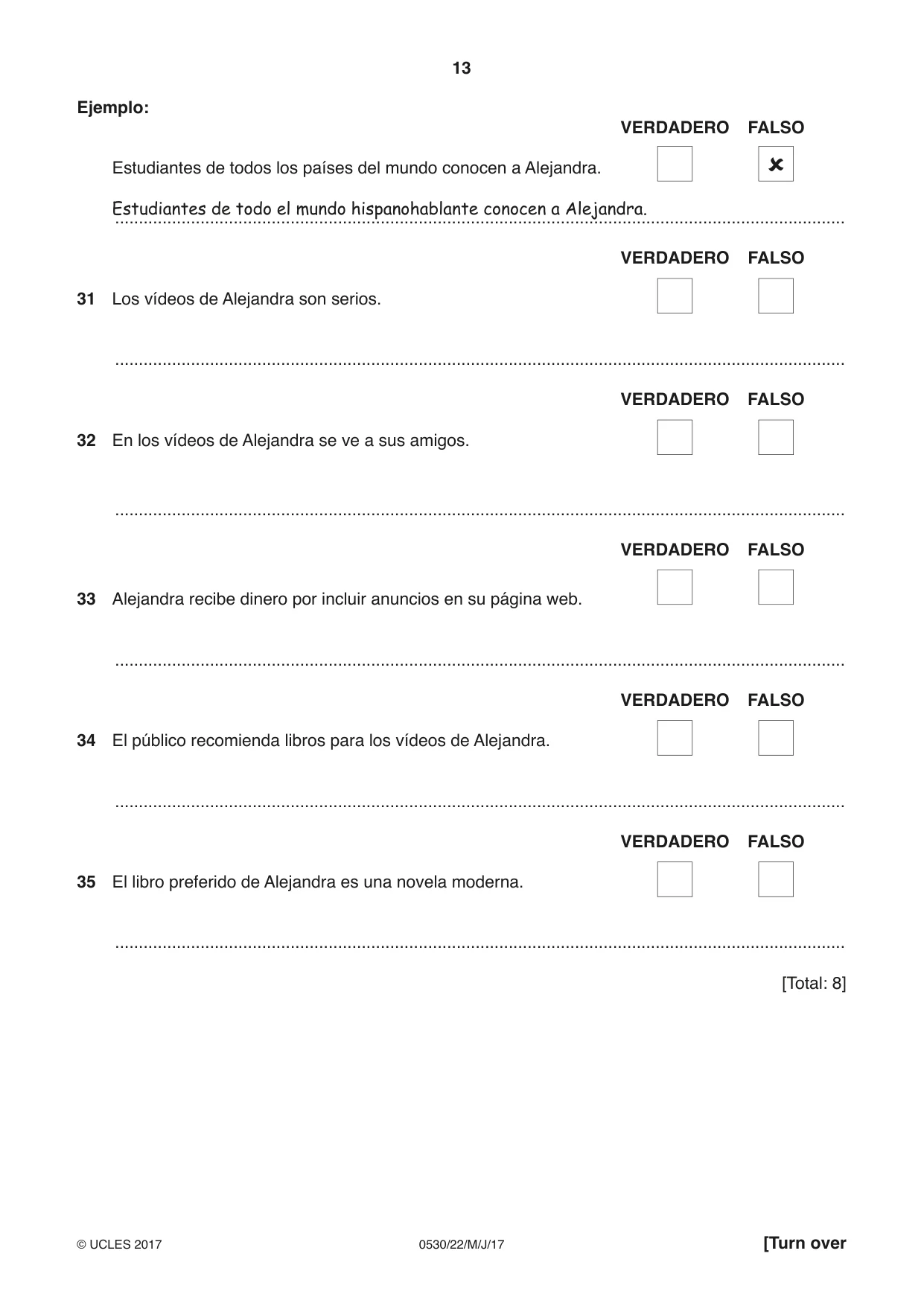
13 0530/22/M/J/17 © UCLES 2017 [Turn over Ejemplo: VERDADERO FALSO Estudiantes de todos los países del mundo conocen a Alejandra. Estudiantes de todo el mundo hispanohablante conocen a Alejandra. … VERDADERO FALSO 31 Los vídeos de Alejandra son serios. … VERDADERO FALSO 32 En los vídeos de Alejandra se ve a sus amigos. … VERDADERO FALSO 33 Alejandra recibe dinero por incluir anuncios en su página web. … VERDADERO FALSO 34 El público recomienda libros para los vídeos de Alejandra. … VERDADERO FALSO 35 El libro preferido de Alejandra es una novela moderna. … [Total: 8]
Question paper, page 14
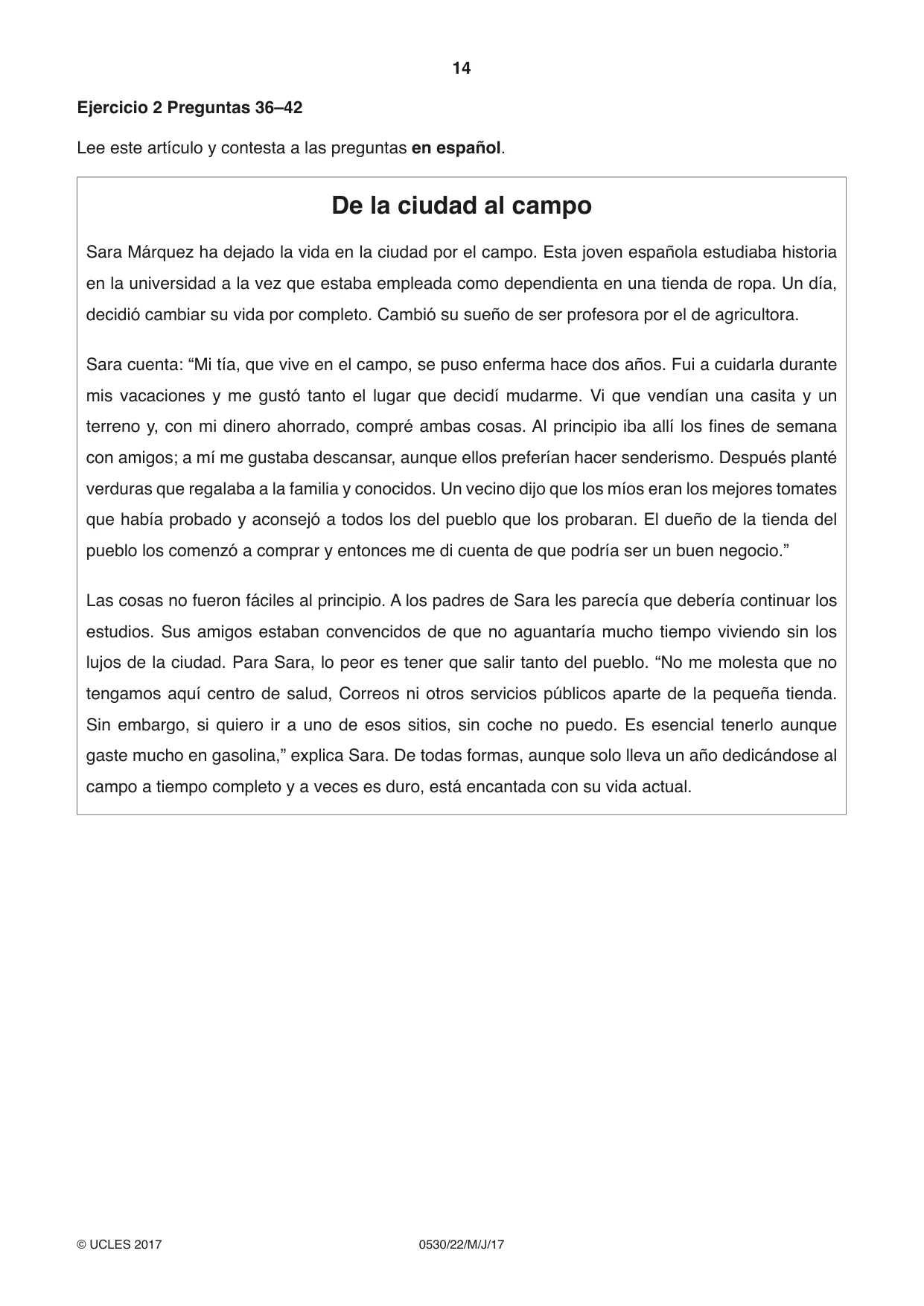
14 0530/22/M/J/17 © UCLES 2017 Ejercicio 2 Preguntas 36–42 Lee este artículo y contesta a las preguntas en español. De la ciudad al campo Sara Márquez ha dejado la vida en la ciudad por el campo. Esta joven española estudiaba historia en la universidad a la vez que estaba empleada como dependienta en una tienda de ropa. Un día, decidió cambiar su vida por completo. Cambió su sueño de ser profesora por el de agricultora. Sara cuenta: “Mi tía, que vive en el campo, se puso enferma hace dos años. Fui a cuidarla durante mis vacaciones y me gustó tanto el lugar que decidí mudarme. Vi que vendían una casita y un terreno y, con mi dinero ahorrado, compré ambas cosas. Al principio iba allí los fines de semana con amigos; a mí me gustaba descansar, aunque ellos preferían hacer senderismo. Después planté verduras que regalaba a la familia y conocidos. Un vecino dijo que los míos eran los mejores tomates que había probado y aconsejó a todos los del pueblo que los probaran. El dueño de la tienda del pueblo los comenzó a comprar y entonces me di cuenta de que podría ser un buen negocio.” Las cosas no fueron fáciles al principio. A los padres de Sara les parecía que debería continuar los estudios. Sus amigos estaban convencidos de que no aguantaría mucho tiempo viviendo sin los lujos de la ciudad. Para Sara, lo peor es tener que salir tanto del pueblo. “No me molesta que no tengamos aquí centro de salud, Correos ni otros servicios públicos aparte de la pequeña tienda. Sin embargo, si quiero ir a uno de esos sitios, sin coche no puedo. Es esencial tenerlo aunque gaste mucho en gasolina,” explica Sara. De todas formas, aunque solo lleva un año dedicándose al campo a tiempo completo y a veces es duro, está encantada con su vida actual.
Question paper, page 15
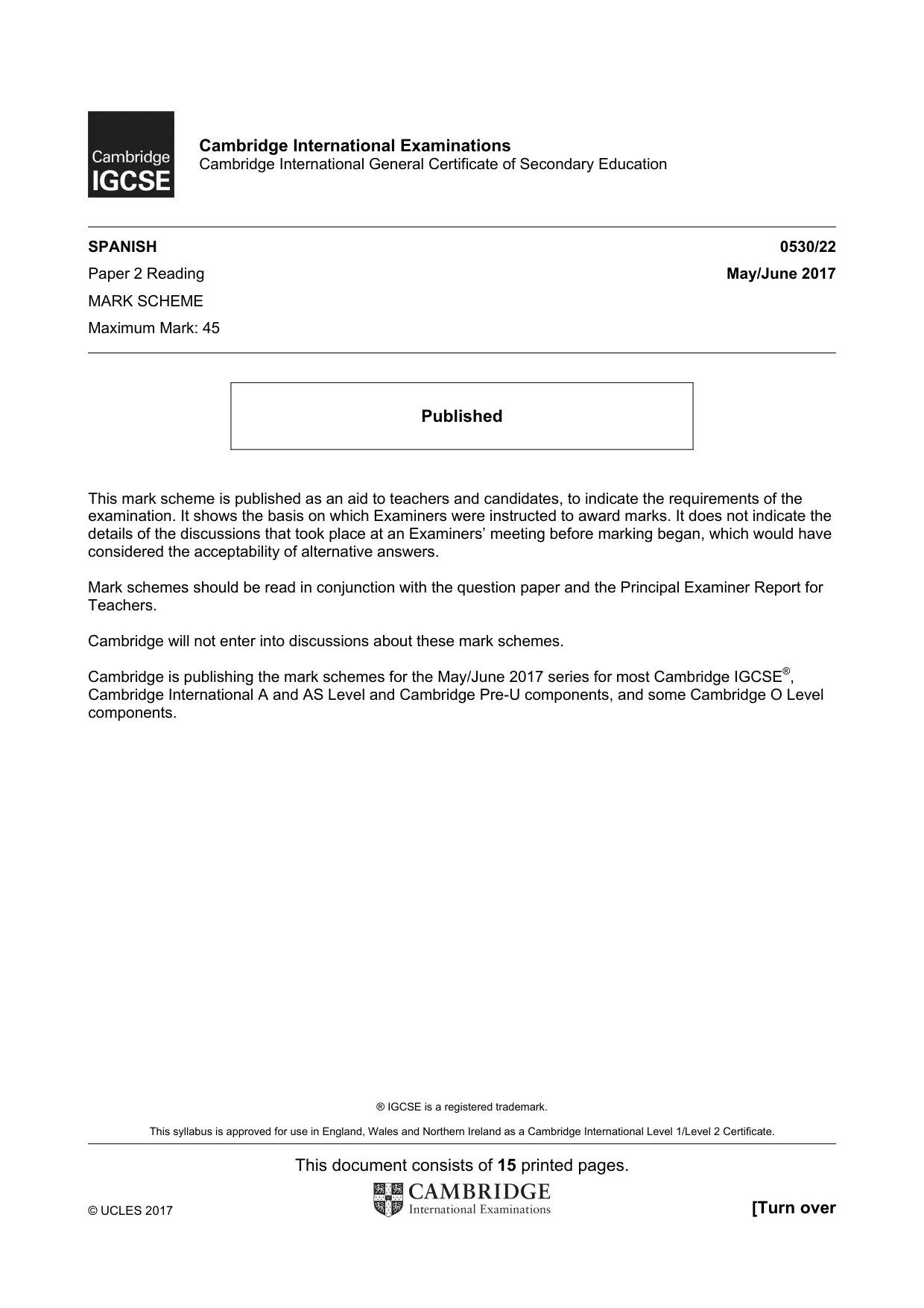
15 0530/22/M/J/17 © UCLES 2017 36 ¿Cuál era el trabajo de Sara cuando vivía en la ciudad? …[1] 37 ¿Qué problema tuvo la tía de Sara? …[1] 38 Aparte de un lugar para vivir, ¿qué compró Sara en el pueblo? …[1] 39 ¿Por qué no hacía Sara senderismo con sus amigos? …[1] 40 ¿Por qué recomendó un vecino comer los tomates de Sara? …[1] 41 Según sus amigos, ¿qué echaría de menos Sara viviendo en el pueblo? …[1] 42 Para Sara, ¿qué es necesario tener si se vive en el pueblo? …[1] [Total: 7]
Question paper, page 16
16 0530/22/M/J/17 © UCLES 2017 Permission to reproduce items where third-party owned material protected by copyright is included has been sought and cleared where possible. Every reasonable effort has been made by the publisher (UCLES) to trace copyright holders, but if any items requiring clearance have unwittingly been included, the publisher will be pleased to make amends at the earliest possible opportunity. To avoid the issue of disclosure of answer-related information to candidates, all copyright acknowledgements are reproduced online in the Cambridge International Examinations Copyright Acknowledgements Booklet. This is produced for each series of examinations and is freely available to download at www.cie.org.uk after the live examination series. Cambridge International Examinations is part of the Cambridge Assessment Group. Cambridge Assessment is the brand name of University of Cambridge Local Examinations Syndicate (UCLES), which is itself a department of the University of Cambridge. BLANK PAGE
Mark scheme, page 1
® IGCSE is a registered trademark. This syllabus is approved for use in England, Wales and Northern Ireland as a Cambridge International Level 1/Level 2 Certificate. This document consists of 15 printed pages. © UCLES 2017 [Turn over Cambridge International Examinations Cambridge International General Certificate of Secondary Education SPANISH 0530/22 Paper 2 Reading May/June 2017 MARK SCHEME Maximum Mark: 45 Published This mark scheme is published as an aid to teachers and candidates, to indicate the requirements of the examination. It shows the basis on which Examiners were instructed to award marks. It does not indicate the details of the discussions that took place at an Examiners’ meeting before marking began, which would have considered the acceptability of alternative answers. Mark schemes should be read in conjunction with the question paper and the Principal Examiner Report for Teachers. Cambridge will not enter into discussions about these mark schemes. Cambridge is publishing the mark schemes for the May/June 2017 series for most Cambridge IGCSE®, Cambridge International A and AS Level and Cambridge Pre-U components, and some Cambridge O Level components.
Mark scheme, page 2
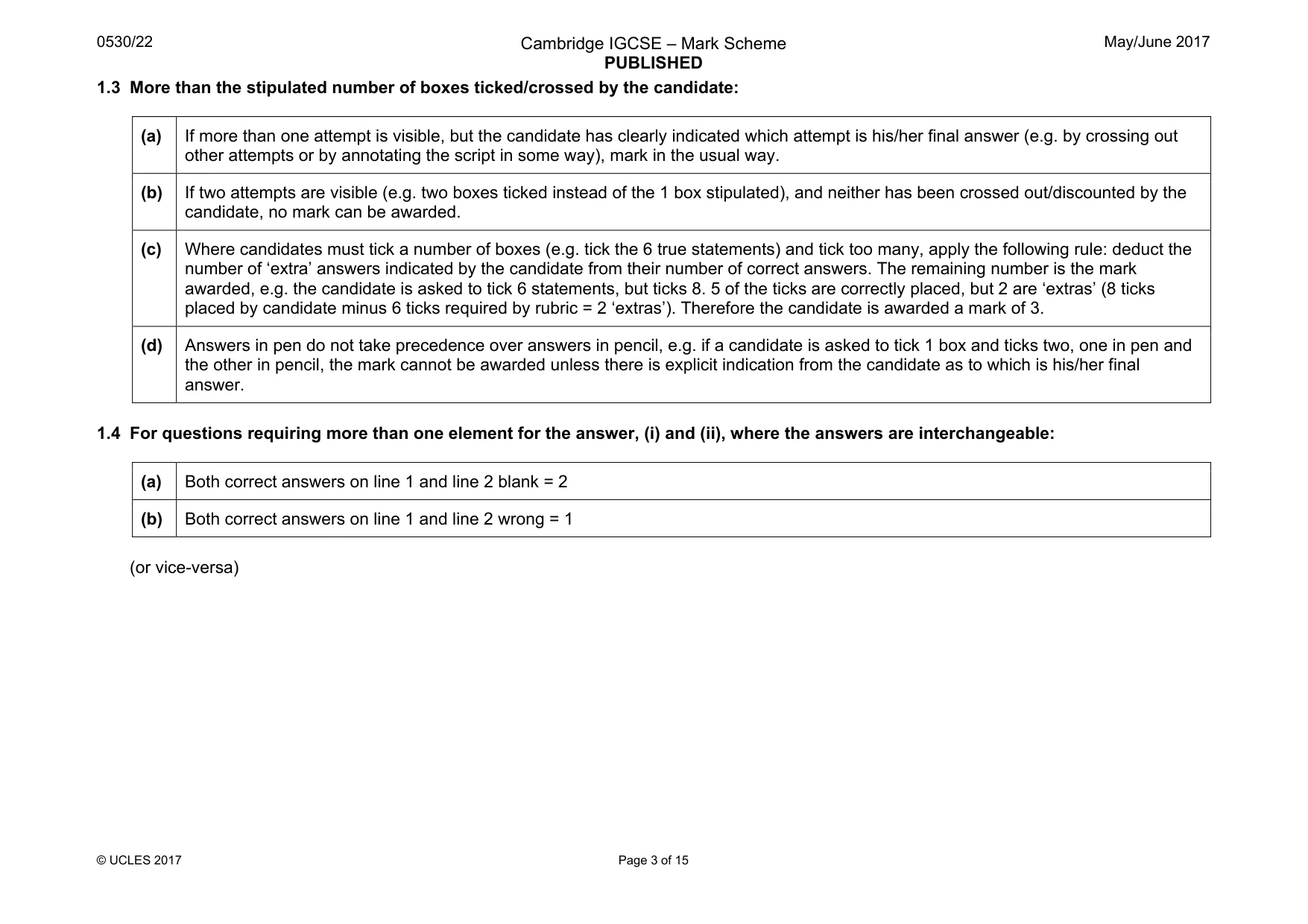
0530/22 Cambridge IGCSE – Mark Scheme PUBLISHED May/June 2017 © UCLES 2017 Page 2 of 15 1 General Marking Principles 1.1 It is not possible to list all acceptable alternatives in the Detailed Mark Scheme provided in Section 2. You will need to consider all alternative answers and unexpected approaches in candidates’ scripts, make a decision on whether they communicate the required elements, in consultation with your Team Leader if necessary (or with your Product Manager if you are a single Examiner), and award marks accordingly. The following marking principles underpin the detailed instructions provided in Section 4 of the Mark Scheme. Where a decision is taken to deviate from these principles for a particular question, this will be specified in the Mark Scheme. Often the general principles will have to be weighed up against each other, e.g. the answer might pass the look-alike test (1.5(b)), but if the candidate has produced an answer that is another word in the target language they will not score (1.6). 1.2 Crossing out: (a) If a candidate changes his/her mind over an answer and crosses out an attempt, award a mark if the final attempt is correct. (b) If a candidate crosses out an answer to a whole question but makes no second attempt at it, mark the crossed out work.
Mark scheme, page 3
0530/22 Cambridge IGCSE – Mark Scheme PUBLISHED May/June 2017 © UCLES 2017 Page 3 of 15 1.3 More than the stipulated number of boxes ticked/crossed by the candidate: (a) If more than one attempt is visible, but the candidate has clearly indicated which attempt is his/her final answer (e.g. by crossing out other attempts or by annotating the script in some way), mark in the usual way. (b) If two attempts are visible (e.g. two boxes ticked instead of the 1 box stipulated), and neither has been crossed out/discounted by the candidate, no mark can be awarded. (c) Where candidates must tick a number of boxes (e.g. tick the 6 true statements) and tick too many, apply the following rule: deduct the number of ‘extra’ answers indicated by the candidate from their number of correct answers. The remaining number is the mark awarded, e.g. the candidate is asked to tick 6 statements, but ticks 8. 5 of the ticks are correctly placed, but 2 are ‘extras’ (8 ticks placed by candidate minus 6 ticks required by rubric = 2 ‘extras’). Therefore the candidate is awarded a mark of 3. (d) Answers in pen do not take precedence over answers in pencil, e.g. if a candidate is asked to tick 1 box and ticks two, one in pen and the other in pencil, the mark cannot be awarded unless there is explicit indication from the candidate as to which is his/her final answer. 1.4 For questions requiring more than one element for the answer, (i) and (ii), where the answers are interchangeable: (a) Both correct answers on line 1 and line 2 blank = 2 (b) Both correct answers on line 1 and line 2 wrong = 1 (or vice-versa)
Mark scheme, page 4
0530/22 Cambridge IGCSE – Mark Scheme PUBLISHED May/June 2017 © UCLES 2017 Page 4 of 15 1.5 Answers requiring the use of Spanish (rather than a non-verbal response) should be marked for communication. Tolerate inaccuracies provided the message is clear. (a) ‘If in doubt, sound it out’: if you read what the candidate has written, does it sound like the correct answer? (b) Look-alike test: does what the candidate has written look like the correct answer? (c) Accept incorrect gender or person unless Mark Scheme specifies otherwise. (d) Accept incorrect possessive adjectives, e.g. mi, tu, su, etc., unless Mark Scheme specifies otherwise. (e) Accept incorrect tense unless Mark Scheme specifies otherwise. (f) Tolerate incorrect auxiliary unless Mark Scheme specifies otherwise. (g) Tolerate incorrect use of infinitive unless Mark Scheme specifies otherwise. 1.6 Unless the Mark Scheme specifies otherwise, do not accept incorrect Spanish if the word given means something else in Spanish. (Incorrect Spanish which constitutes a word in any language other than Spanish is marked (i) on the basis of whether it is accepted or refused in the Mark Scheme and (ii) if not mentioned in the Mark Scheme, on the basis of 1.5 above). 1.7 Where words are combined or split inappropriately do not award the mark, e.g. ‘supadre’ and ‘elar ticulo’ (inappropriate splitting or combination is an indication that the candidate has not understood).
Mark scheme, page 5
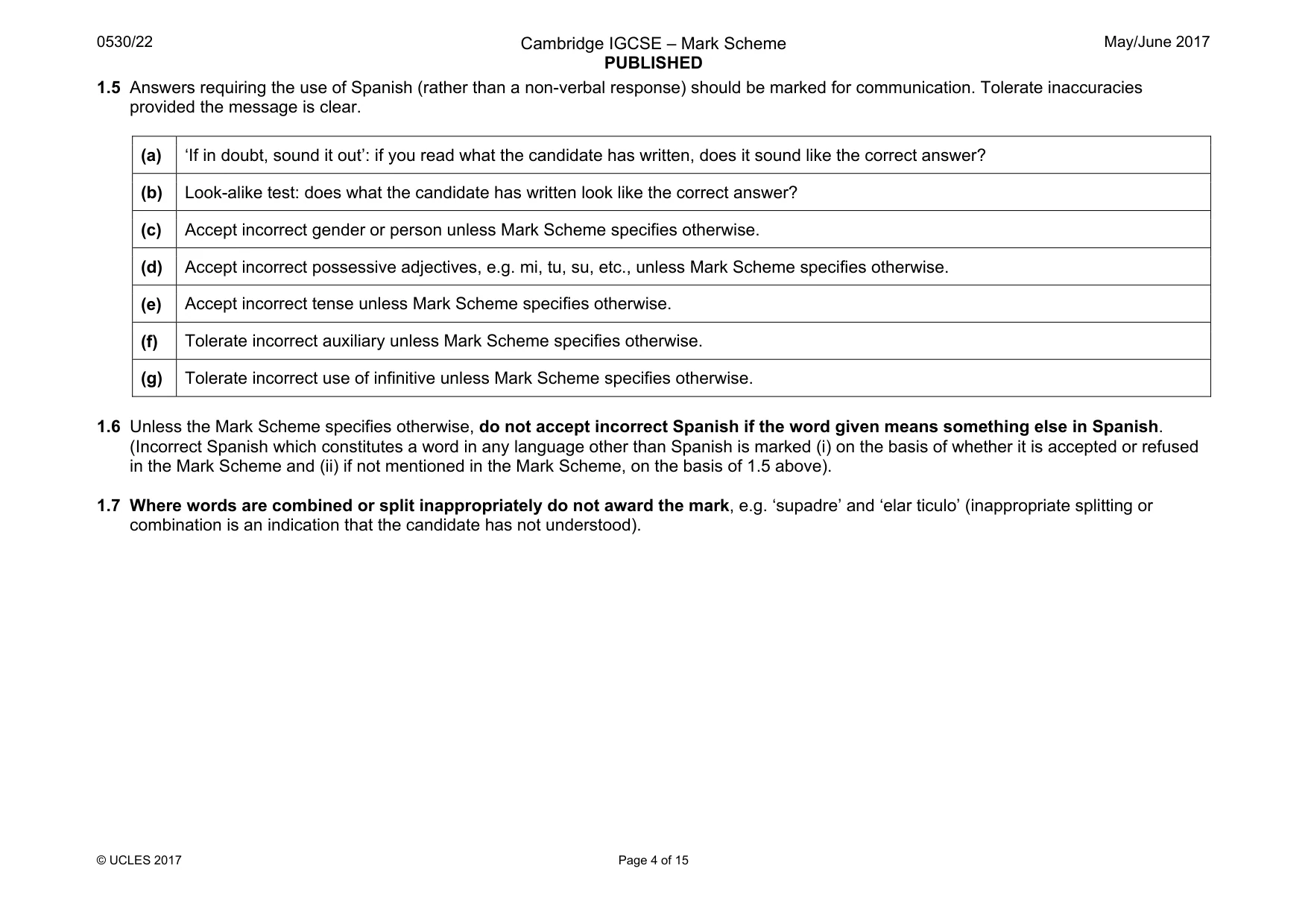
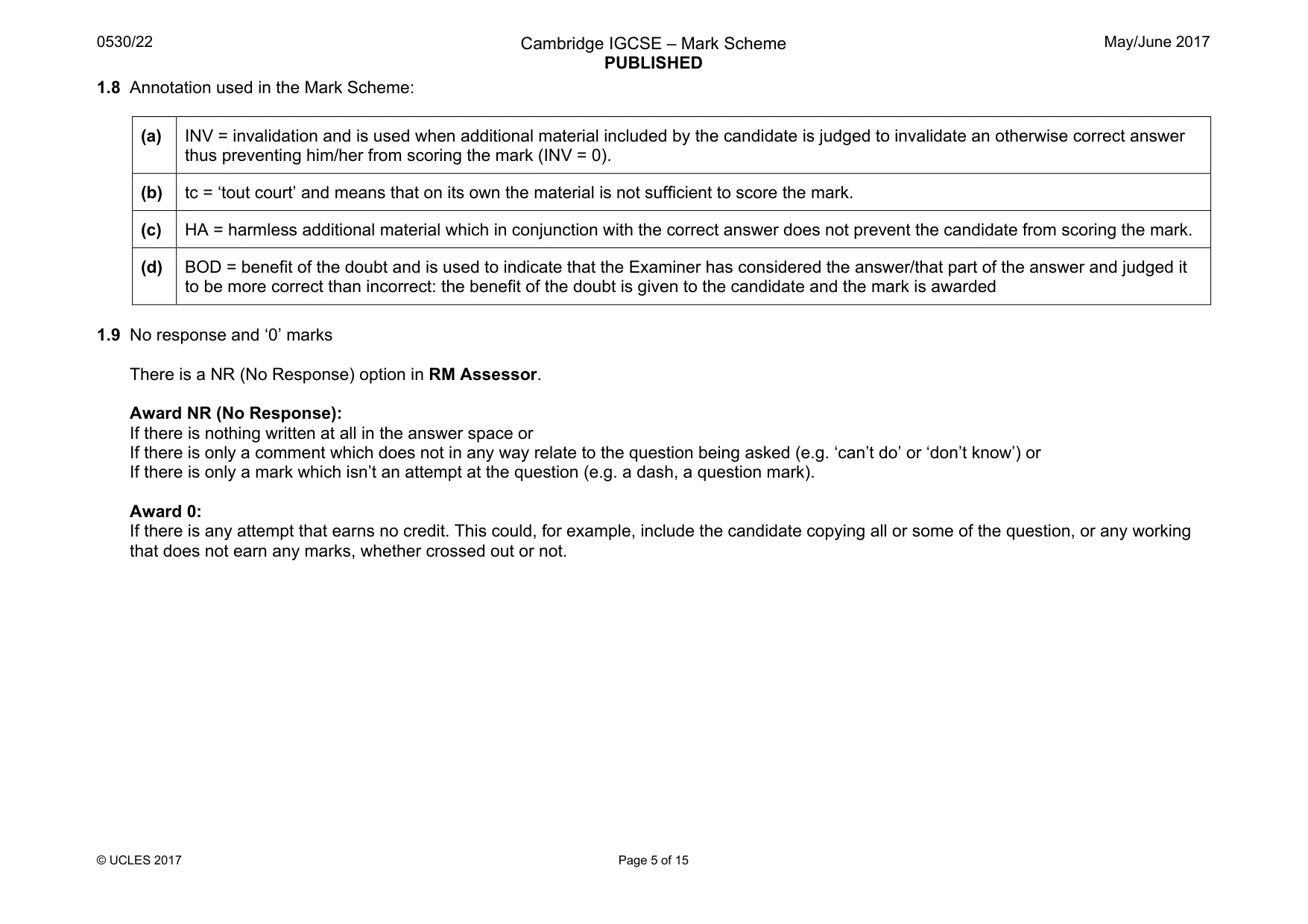
0530/22 Cambridge IGCSE – Mark Scheme PUBLISHED May/June 2017 © UCLES 2017 Page 5 of 15 1.8 Annotation used in the Mark Scheme: (a) INV = invalidation and is used when additional material included by the candidate is judged to invalidate an otherwise correct answer thus preventing him/her from scoring the mark (INV = 0). (b) tc = ‘tout court’ and means that on its own the material is not sufficient to score the mark. (c) HA = harmless additional material which in conjunction with the correct answer does not prevent the candidate from scoring the mark. (d) BOD = benefit of the doubt and is used to indicate that the Examiner has considered the answer/that part of the answer and judged it to be more correct than incorrect: the benefit of the doubt is given to the candidate and the mark is awarded 1.9 No response and ‘0’ marks There is a NR (No Response) option in RM Assessor. Award NR (No Response): If there is nothing written at all in the answer space or If there is only a comment which does not in any way relate to the question being asked (e.g. ‘can’t do’ or ‘don’t know’) or If there is only a mark which isn’t an attempt at the question (e.g. a dash, a question mark). Award 0: If there is any attempt that earns no credit. This could, for example, include the candidate copying all or some of the question, or any working that does not earn any marks, whether crossed out or not.
Mark scheme, page 6
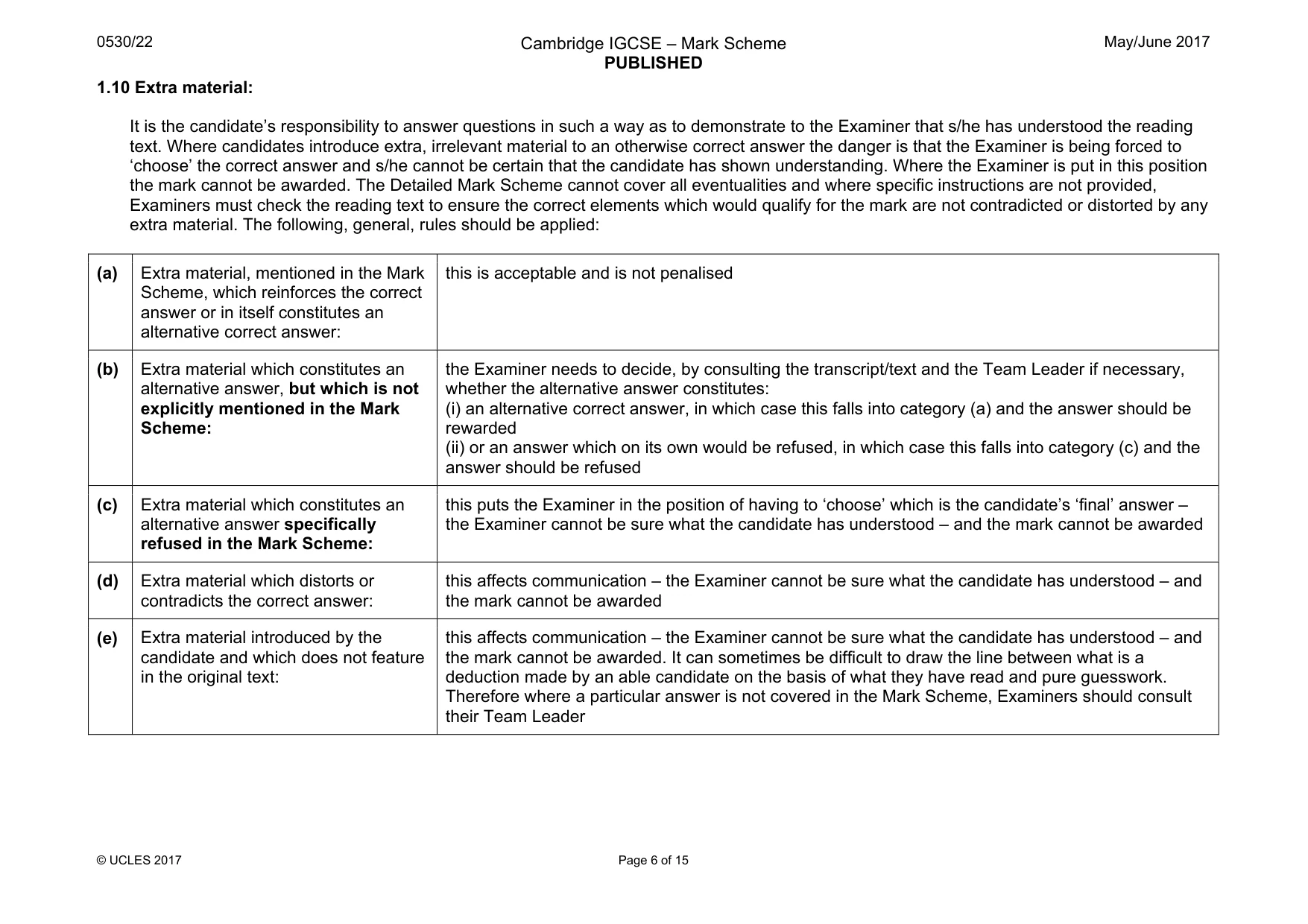
0530/22 Cambridge IGCSE – Mark Scheme PUBLISHED May/June 2017 © UCLES 2017 Page 6 of 15 1.10 Extra material: It is the candidate’s responsibility to answer questions in such a way as to demonstrate to the Examiner that s/he has understood the reading text. Where candidates introduce extra, irrelevant material to an otherwise correct answer the danger is that the Examiner is being forced to ‘choose’ the correct answer and s/he cannot be certain that the candidate has shown understanding. Where the Examiner is put in this position the mark cannot be awarded. The Detailed Mark Scheme cannot cover all eventualities and where specific instructions are not provided, Examiners must check the reading text to ensure the correct elements which would qualify for the mark are not contradicted or distorted by any extra material. The following, general, rules should be applied: (a) Extra material, mentioned in the Mark Scheme, which reinforces the correct answer or in itself constitutes an alternative correct answer: this is acceptable and is not penalised (b) Extra material which constitutes an alternative answer, but which is not explicitly mentioned in the Mark Scheme: the Examiner needs to decide, by consulting the transcript/text and the Team Leader if necessary, whether the alternative answer constitutes: (i) an alternative correct answer, in which case this falls into category (a) and the answer should be rewarded (ii) or an answer which on its own would be refused, in which case this falls into category (c) and the answer should be refused (c) Extra material which constitutes an alternative answer specifically refused in the Mark Scheme: this puts the Examiner in the position of having to ‘choose’ which is the candidate’s ‘final’ answer – the Examiner cannot be sure what the candidate has understood – and the mark cannot be awarded (d) Extra material which distorts or contradicts the correct answer: this affects communication – the Examiner cannot be sure what the candidate has understood – and the mark cannot be awarded (e) Extra material introduced by the candidate and which does not feature in the original text: this affects communication – the Examiner cannot be sure what the candidate has understood – and the mark cannot be awarded. It can sometimes be difficult to draw the line between what is a deduction made by an able candidate on the basis of what they have read and pure guesswork. Therefore where a particular answer is not covered in the Mark Scheme, Examiners should consult their Team Leader
Mark scheme, page 7
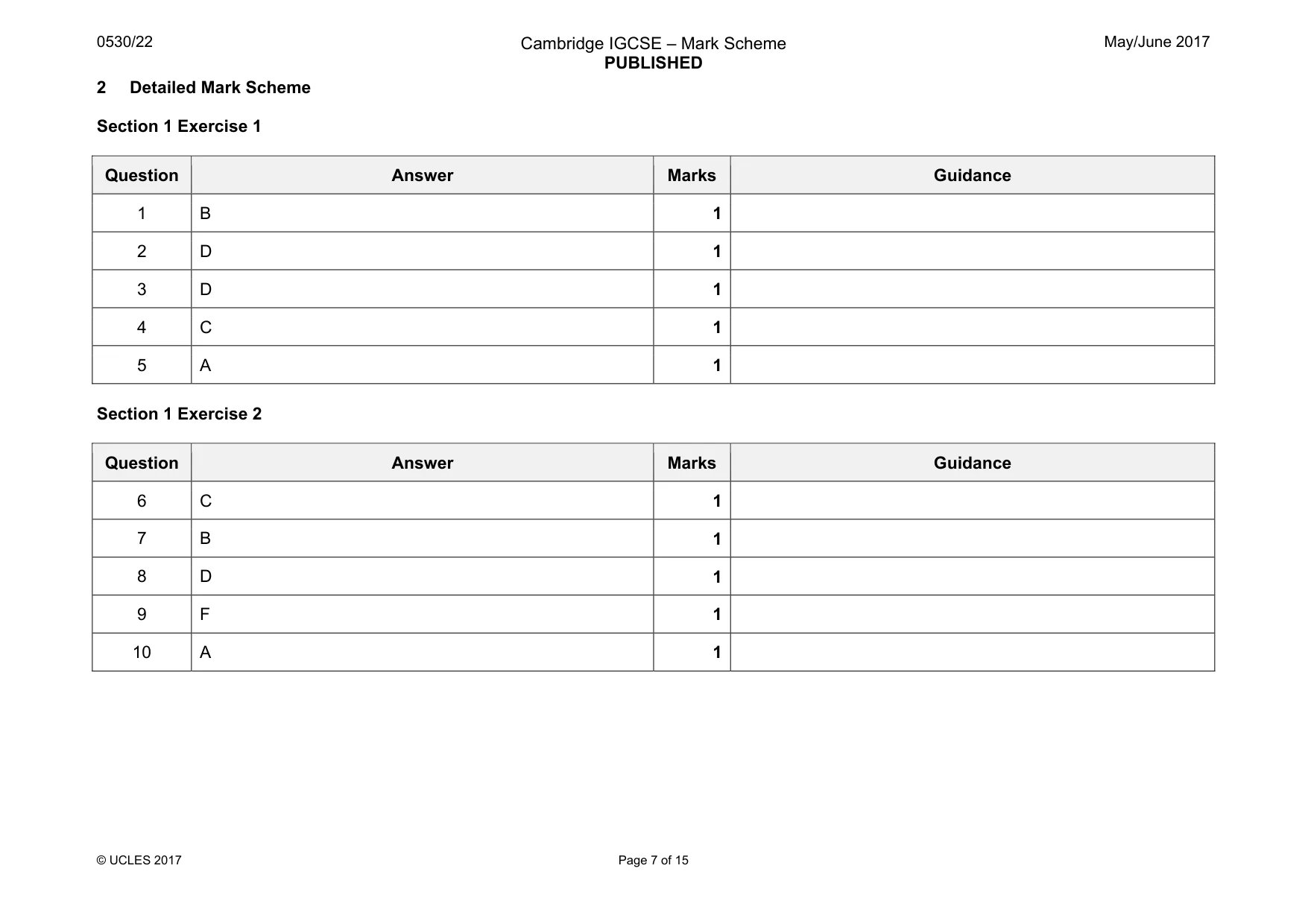
0530/22 Cambridge IGCSE – Mark Scheme PUBLISHED May/June 2017 © UCLES 2017 Page 7 of 15 2 Detailed Mark Scheme Section 1 Exercise 1 Question Answer Marks Guidance 1 B 1 2 D 1 3 D 1 4 C 1 5 A 1 Section 1 Exercise 2 Question Answer Marks Guidance 6 C 1 7 B 1 8 D 1 9 F 1 10 A 1
Mark scheme, page 8
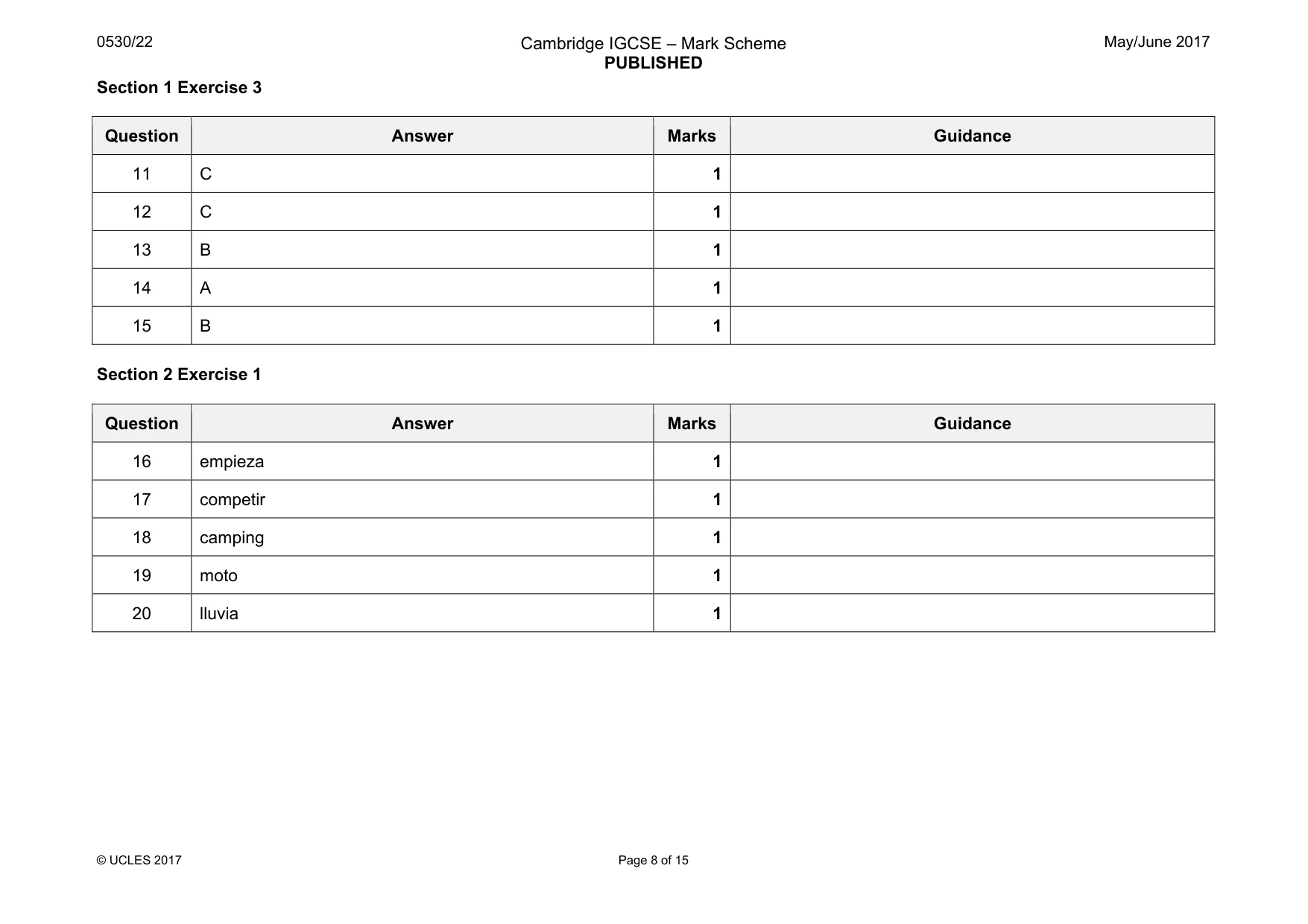
0530/22 Cambridge IGCSE – Mark Scheme PUBLISHED May/June 2017 © UCLES 2017 Page 8 of 15 Section 1 Exercise 3 Question Answer Marks Guidance 11 C 1 12 C 1 13 B 1 14 A 1 15 B 1 Section 2 Exercise 1 Question Answer Marks Guidance 16 empieza 1 17 competir 1 18 camping 1 19 moto 1 20 lluvia 1
Mark scheme, page 9
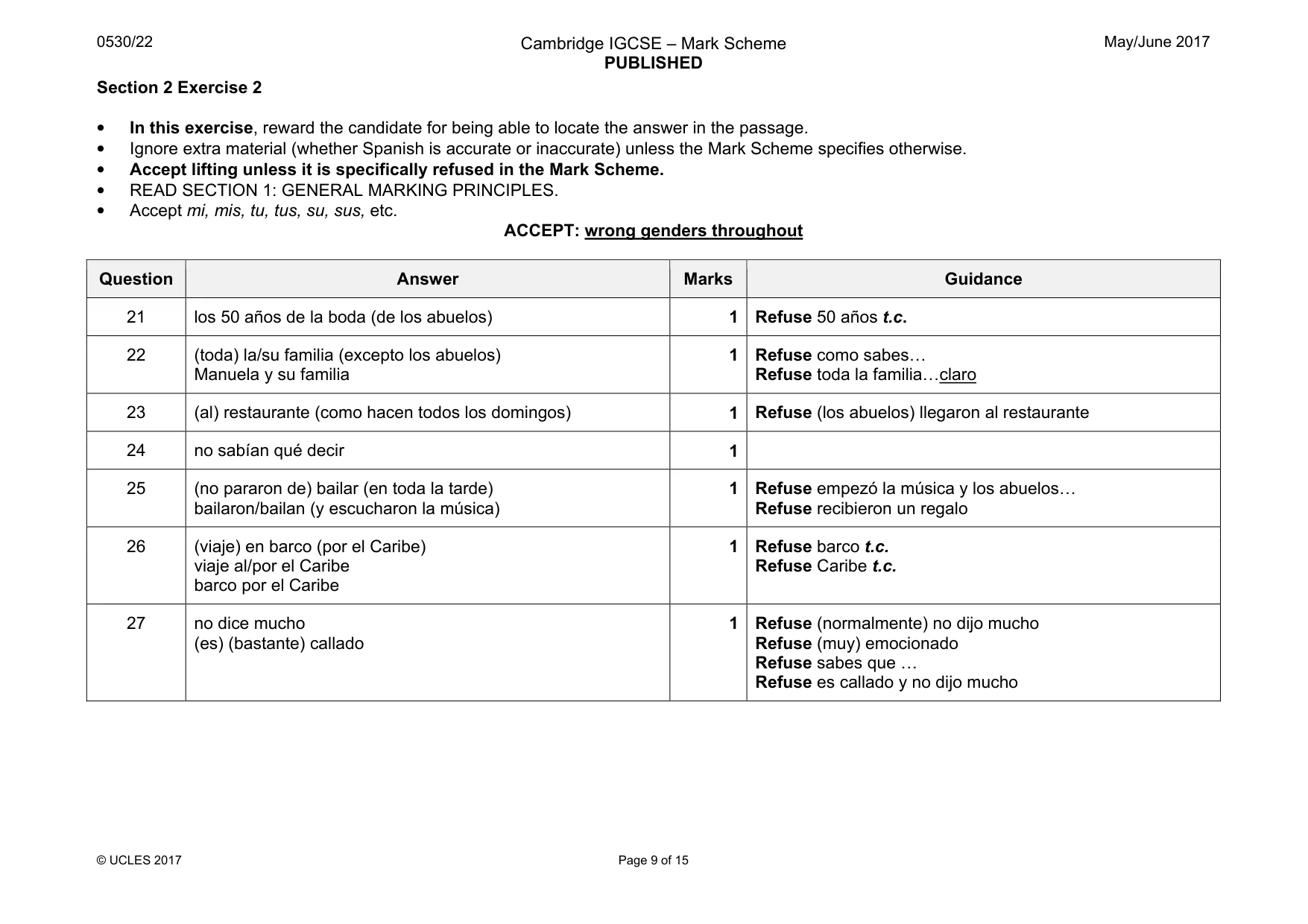
0530/22 Cambridge IGCSE – Mark Scheme PUBLISHED May/June 2017 © UCLES 2017 Page 9 of 15 Section 2 Exercise 2 • In this exercise, reward the candidate for being able to locate the answer in the passage. • Ignore extra material (whether Spanish is accurate or inaccurate) unless the Mark Scheme specifies otherwise. • Accept lifting unless it is specifically refused in the Mark Scheme. • READ SECTION 1: GENERAL MARKING PRINCIPLES. • Accept mi, mis, tu, tus, su, sus, etc. ACCEPT: wrong genders throughout Question Answer Marks Guidance 21 los 50 años de la boda (de los abuelos) 1 Refuse 50 años t.c. 22 (toda) la/su familia (excepto los abuelos) Manuela y su familia 1 Refuse como sabes« Refuse toda la familia«claro 23 (al) restaurante (como hacen todos los domingos) 1 Refuse (los abuelos) llegaron al restaurante 24 no sabían qué decir 1 25 (no pararon de) bailar (en toda la tarde) bailaron/bailan (y escucharon la música) 1 Refuse empezó la música y los abuelos« Refuse recibieron un regalo 26 (viaje) en barco (por el Caribe) viaje al/por el Caribe barco por el Caribe 1 Refuse barco t.c. Refuse Caribe t.c. 27 no dice mucho (es) (bastante) callado 1 Refuse (normalmente) no dijo mucho Refuse (muy) emocionado Refuse sabes que « Refuse es callado y no dijo mucho
Mark scheme, page 10
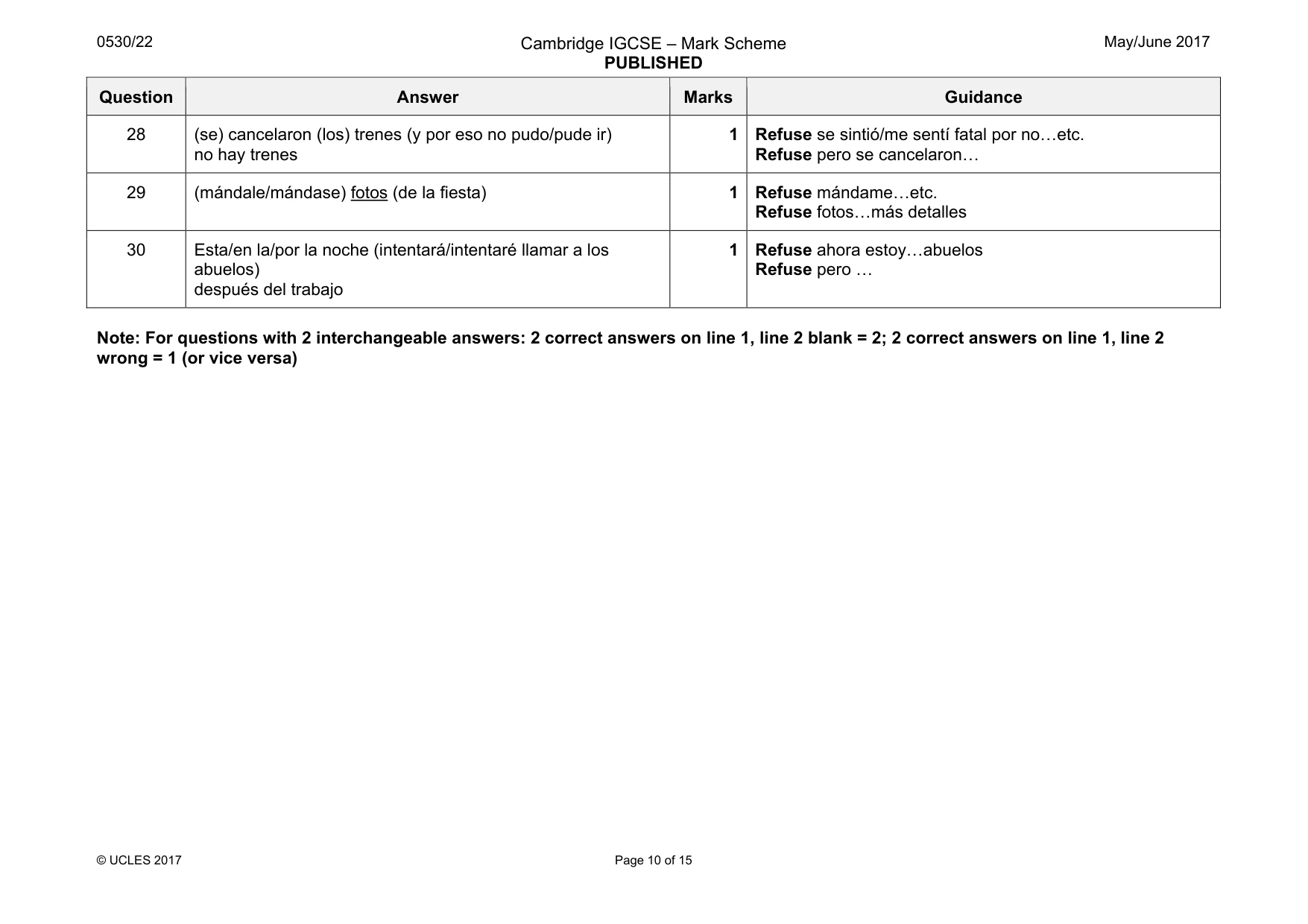
0530/22 Cambridge IGCSE – Mark Scheme PUBLISHED May/June 2017 © UCLES 2017 Page 10 of 15 Question Answer Marks Guidance 28 (se) cancelaron (los) trenes (y por eso no pudo/pude ir) no hay trenes 1 Refuse se sintió/me sentí fatal por no«etc. Refuse pero se cancelaron« 29 (mándale/mándase) fotos (de la fiesta) 1 Refuse mándame«etc. Refuse fotos«más detalles 30 Esta/en la/por la noche (intentará/intentaré llamar a los abuelos) después del trabajo 1 Refuse ahora estoy«abuelos Refuse pero « Note: For questions with 2 interchangeable answers: 2 correct answers on line 1, line 2 blank = 2; 2 correct answers on line 1, line 2 wrong = 1 (or vice versa)
Mark scheme, page 11
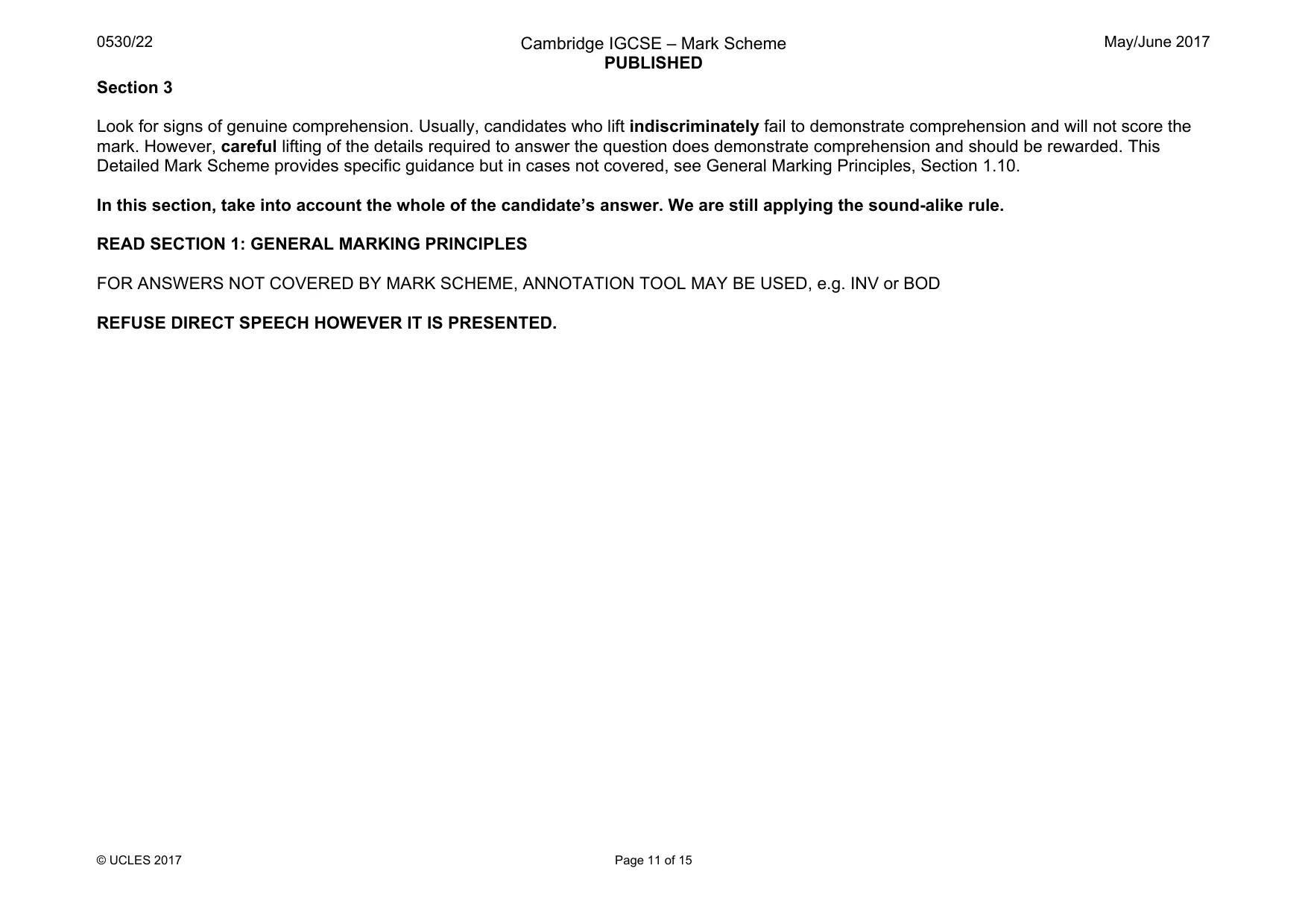
0530/22 Cambridge IGCSE – Mark Scheme PUBLISHED May/June 2017 © UCLES 2017 Page 11 of 15 Section 3 Look for signs of genuine comprehension. Usually, candidates who lift indiscriminately fail to demonstrate comprehension and will not score the mark. However, careful lifting of the details required to answer the question does demonstrate comprehension and should be rewarded. This Detailed Mark Scheme provides specific guidance but in cases not covered, see General Marking Principles, Section 1.10. In this section, take into account the whole of the candidate’s answer. We are still applying the sound-alike rule. READ SECTION 1: GENERAL MARKING PRINCIPLES FOR ANSWERS NOT COVERED BY MARK SCHEME, ANNOTATION TOOL MAY BE USED, e.g. INV or BOD REFUSE DIRECT SPEECH HOWEVER IT IS PRESENTED.
Mark scheme, page 12
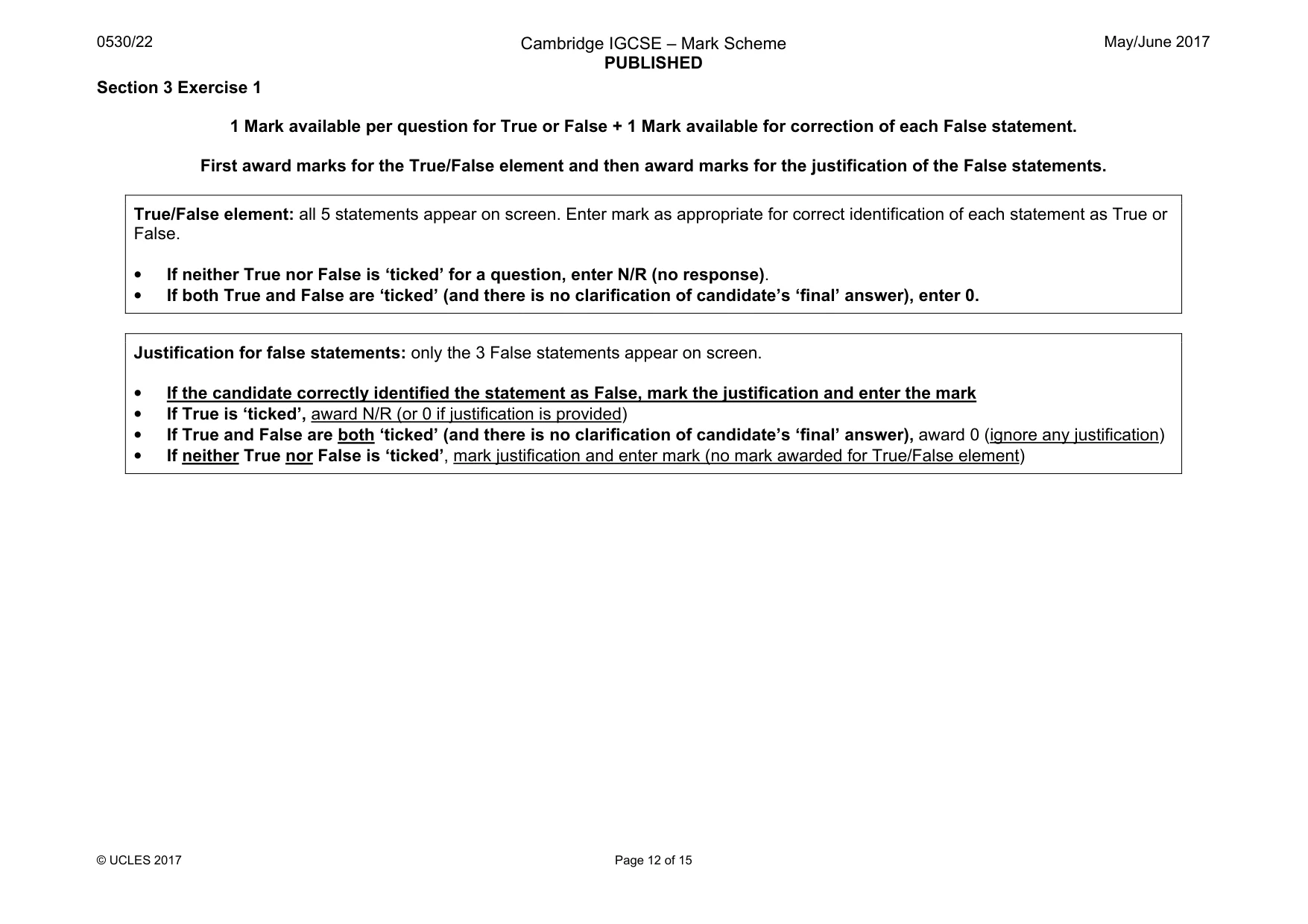
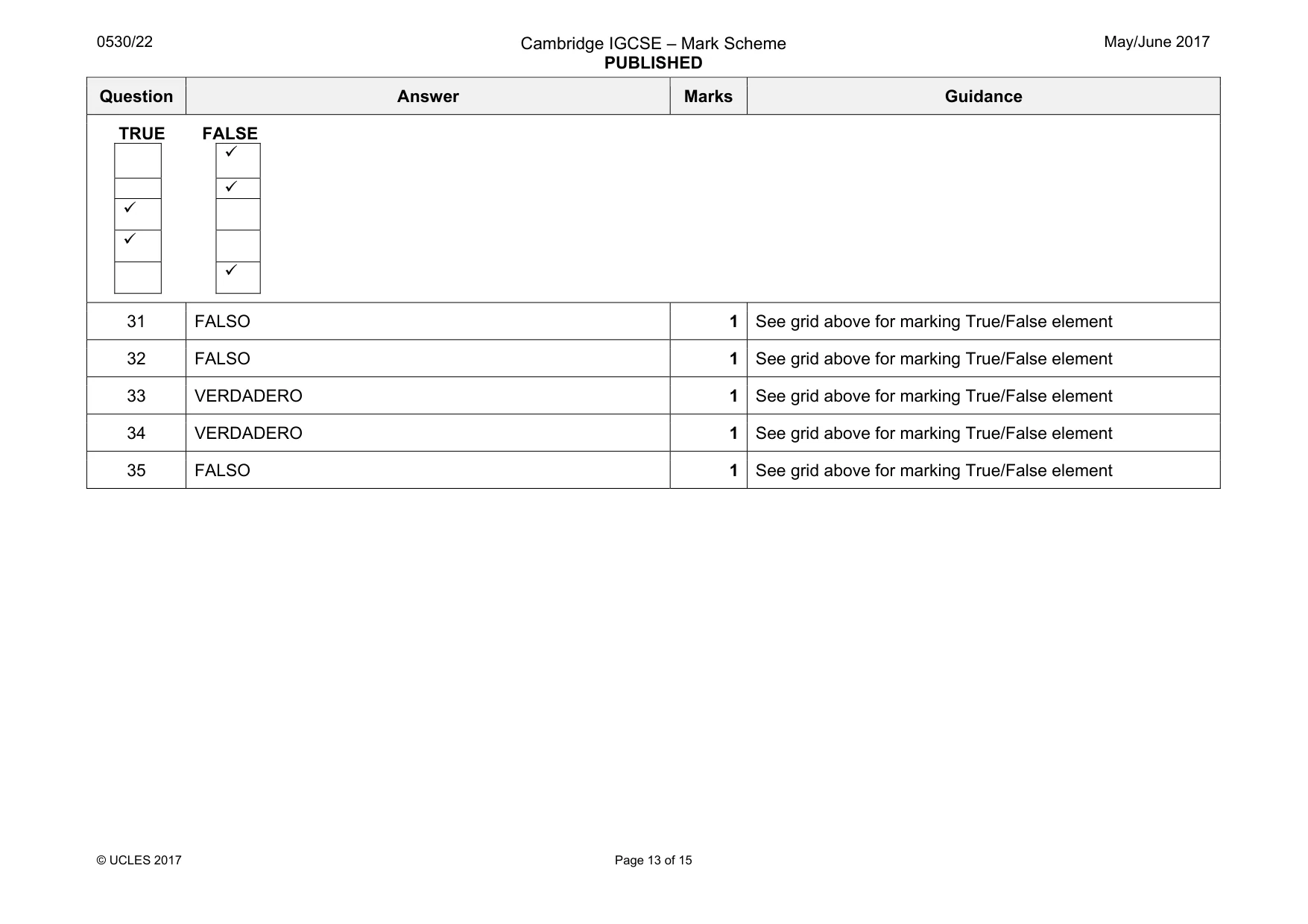
0530/22 Cambridge IGCSE – Mark Scheme PUBLISHED May/June 2017 © UCLES 2017 Page 12 of 15 Section 3 Exercise 1 1 Mark available per question for True or False + 1 Mark available for correction of each False statement. First award marks for the True/False element and then award marks for the justification of the False statements. True/False element: all 5 statements appear on screen. Enter mark as appropriate for correct identification of each statement as True or False. • If neither True nor False is ‘ticked’ for a question, enter N/R (no response). • If both True and False are ‘ticked’ (and there is no clarification of candidate’s ‘final’ answer), enter 0. Justification for false statements: only the 3 False statements appear on screen. • If the candidate correctly identified the statement as False, mark the justification and enter the mark • If True is ‘ticked’, award N/R (or 0 if justification is provided) • If True and False are both ‘ticked’ (and there is no clarification of candidate’s ‘final’ answer), award 0 (ignore any justification) • If neither True nor False is ‘ticked’, mark justification and enter mark (no mark awarded for True/False element)
Mark scheme, page 13
0530/22 Cambridge IGCSE – Mark Scheme PUBLISHED May/June 2017 © UCLES 2017 Page 13 of 15 Question Answer Marks Guidance TRUE FALSE 9 9 9 9 9 31 FALSO 1 See grid above for marking True/False element 32 FALSO 1 See grid above for marking True/False element 33 VERDADERO 1 See grid above for marking True/False element 34 VERDADERO 1 See grid above for marking True/False element 35 FALSO 1 See grid above for marking True/False element
Mark scheme, page 14
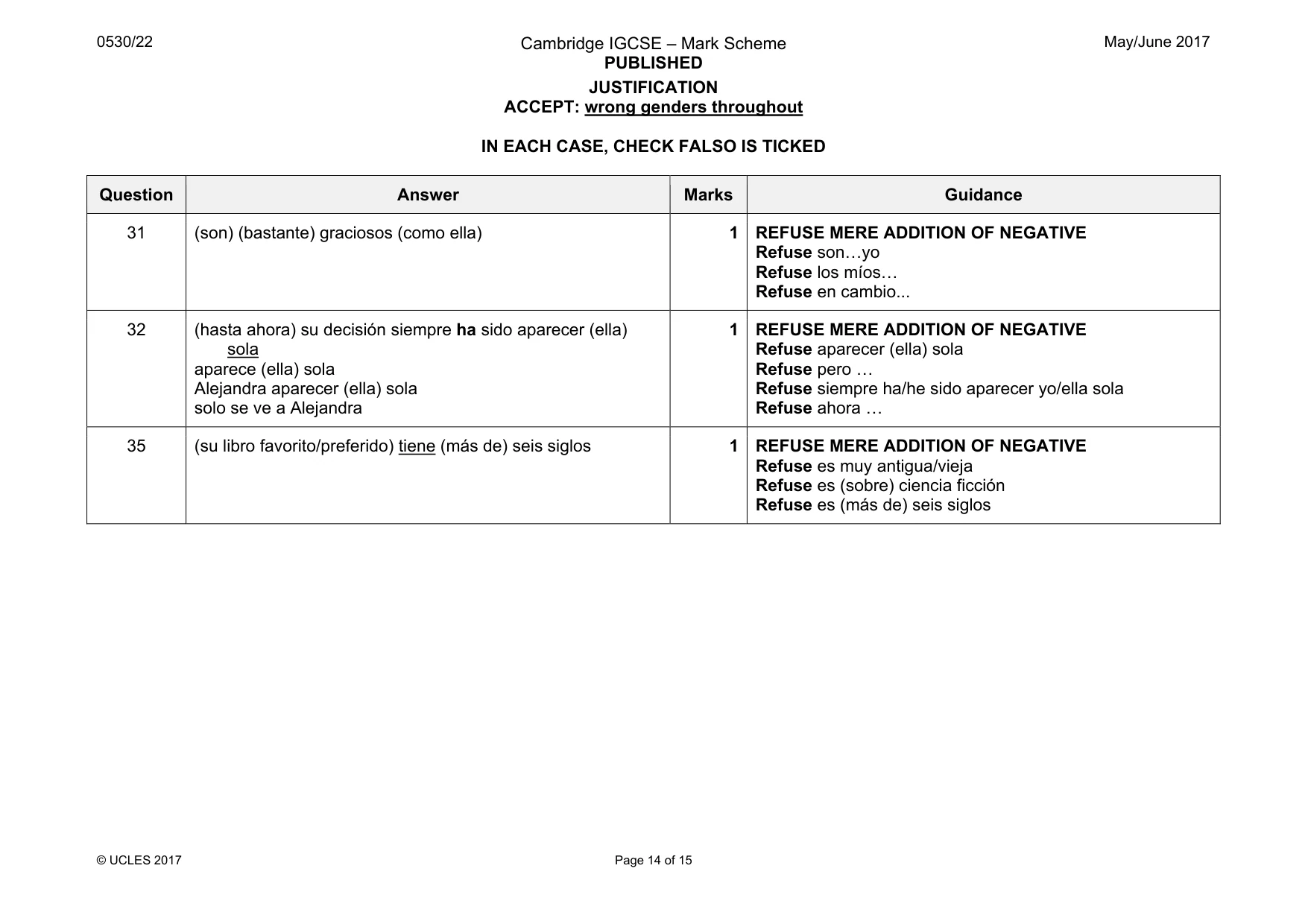
0530/22 Cambridge IGCSE – Mark Scheme PUBLISHED May/June 2017 © UCLES 2017 Page 14 of 15 JUSTIFICATION ACCEPT: wrong genders throughout IN EACH CASE, CHECK FALSO IS TICKED Question Answer Marks Guidance 31 (son) (bastante) graciosos (como ella) 1 REFUSE MERE ADDITION OF NEGATIVE Refuse son«yo Refuse los míos« Refuse en cambio... 32 (hasta ahora) su decisión siempre ha sido aparecer (ella) sola aparece (ella) sola Alejandra aparecer (ella) sola solo se ve a Alejandra 1 REFUSE MERE ADDITION OF NEGATIVE Refuse aparecer (ella) sola Refuse pero « Refuse siempre ha/he sido aparecer yo/ella sola Refuse ahora « 35 (su libro favorito/preferido) tiene (más de) seis siglos 1 REFUSE MERE ADDITION OF NEGATIVE Refuse es muy antigua/vieja Refuse es (sobre) ciencia ficción Refuse es (más de) seis siglos
Mark scheme, page 15
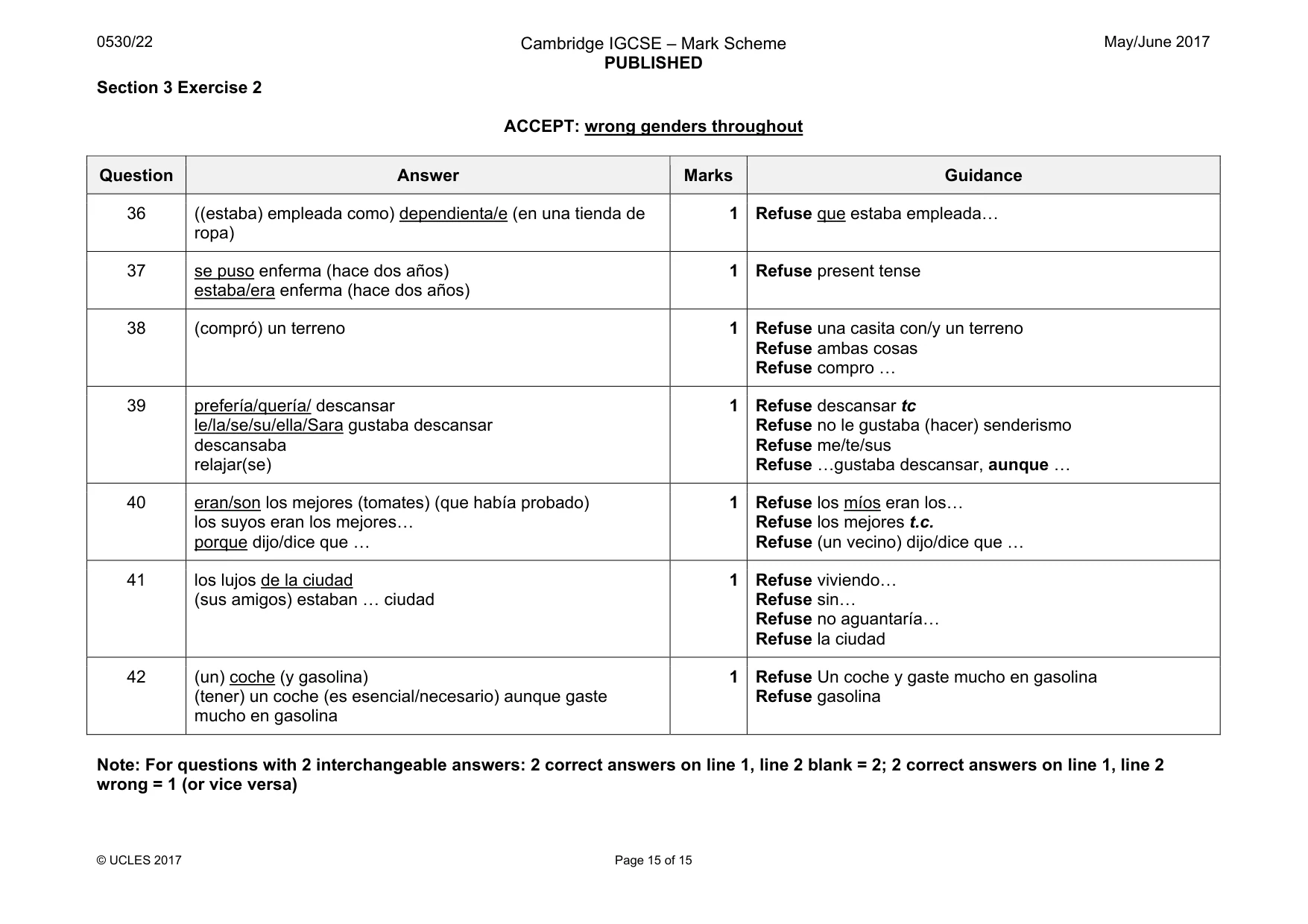
0530/22 Cambridge IGCSE – Mark Scheme PUBLISHED May/June 2017 © UCLES 2017 Page 15 of 15 Section 3 Exercise 2 ACCEPT: wrong genders throughout Question Answer Marks Guidance 36 ((estaba) empleada como) dependienta/e (en una tienda de ropa) 1 Refuse que estaba empleada« 37 se puso enferma (hace dos años) estaba/era enferma (hace dos años) 1 Refuse present tense 38 (compró) un terreno 1 Refuse una casita con/y un terreno Refuse ambas cosas Refuse compro « 39 prefería/quería/ descansar le/la/se/su/ella/Sara gustaba descansar descansaba relajar(se) 1 Refuse descansar tc Refuse no le gustaba (hacer) senderismo Refuse me/te/sus Refuse «gustaba descansar, aunque « 40 eran/son los mejores (tomates) (que había probado) los suyos eran los mejores« porque dijo/dice que « 1 Refuse los míos eran los« Refuse los mejores t.c. Refuse (un vecino) dijo/dice que « 41 los lujos de la ciudad (sus amigos) estaban « ciudad 1 Refuse viviendo« Refuse sin« Refuse no aguantaría« Refuse la ciudad 42 (un) coche (y gasolina) (tener) un coche (es esencial/necesario) aunque gaste mucho en gasolina 1 Refuse Un coche y gaste mucho en gasolina Refuse gasolina Note: For questions with 2 interchangeable answers: 2 correct answers on line 1, line 2 blank = 2; 2 correct answers on line 1, line 2 wrong = 1 (or vice versa)
What you needed in this session
Cambridge’s own grade thresholds for 2017 May/June, Paper 2 · Variant 2. A higher threshold means an easier paper — the bar moves with how the cohort did.