Cambridge IGCSE Spanish - Foreign Language 0530 — 2016 Oct/Nov Paper 2 · Variant 3
0530/23/O/N/16 · 45 marks · ≈51 min
The question paper and its mark scheme, free to read here and free to download. This is Cambridge’s own paper, exactly as it was sat.
Question paper16 pages



Mark scheme9 pages
Answers below. Sit the paper first if you are practising.
Paper as text
Question paper, page 1
This document consists of 14 printed pages and 2 blank pages. DC (NF/FD) 114610/4 © UCLES 2016 [Turn over Cambridge International Examinations Cambridge International General Certificate of Secondary Education * 1 3 0 6 8 4 9 5 6 8 * SPANISH 0530/23 Paper 2 Reading October/November 2016 1 hour Candidates answer on the Question Paper. No Additional Materials are required. READ THESE INSTRUCTIONS FIRST Write your Centre number, candidate number and name on all the work you hand in. Write in dark blue or black pen. Do not use staples, paper clips, glue or correction fluid. DO NOT WRITE IN ANY BARCODES. Answer all questions. The number of marks is given in brackets [ ] at the end of each question or part question. The syllabus is approved for use in England, Wales and Northern Ireland as a Cambridge International Level 1/Level 2 Certificate.
Question paper, page 2
2 0530/23/O/N/16 © UCLES 2016 BLANK PAGE
Question paper, page 3
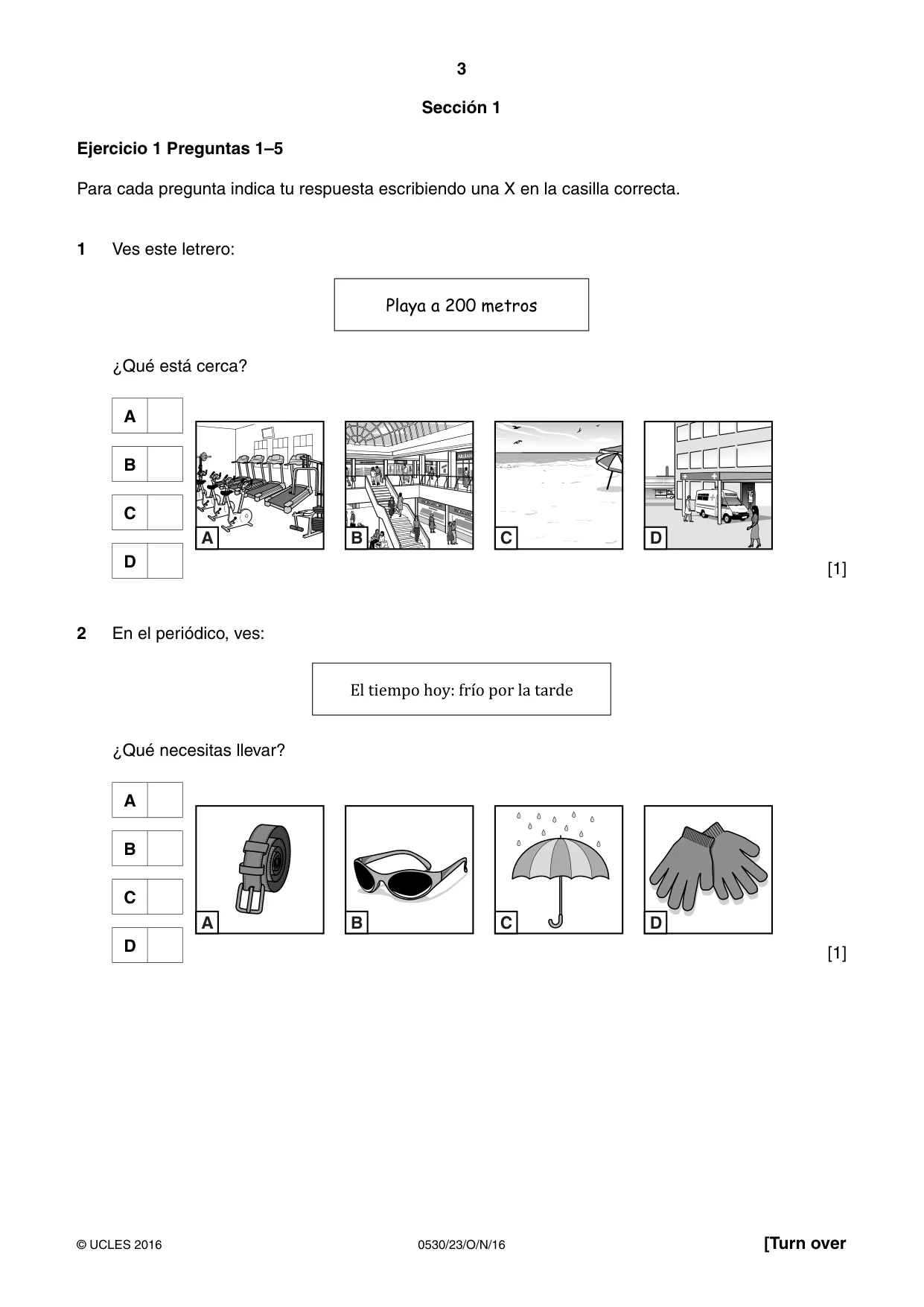
3 0530/23/O/N/16 © UCLES 2016 [Turn over Sección 1 Ejercicio 1 Preguntas 1–5 Para cada pregunta indica tu respuesta escribiendo una X en la casilla correcta. 1 Ves este letrero: Playa a 200 metros ¿Qué está cerca? A A B C D [1] B C D 2 En el periódico, ves: El tiempo hoy: frío por la tarde ¿Qué necesitas llevar? A A B C D [1] B C D
Question paper, page 4
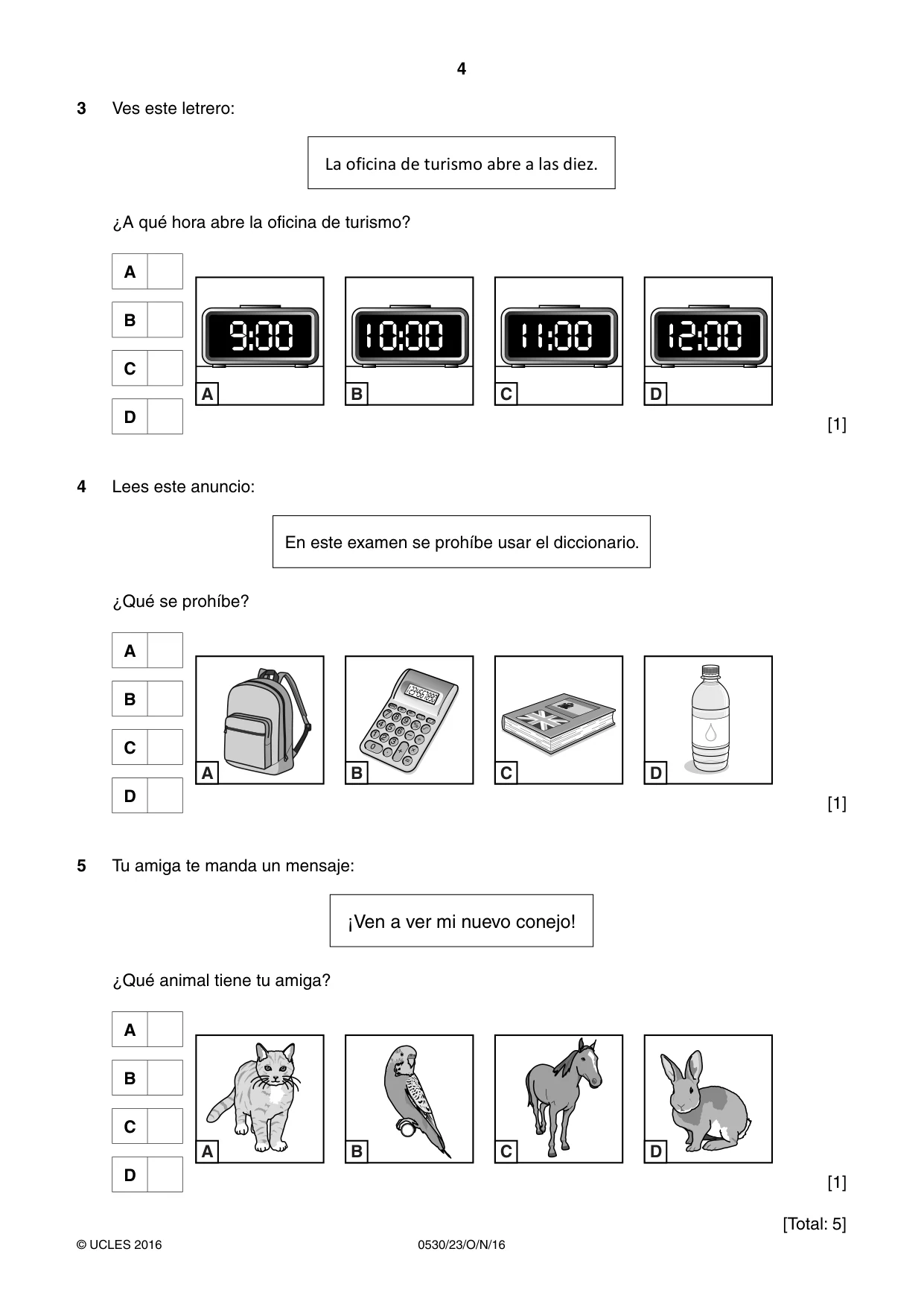
4 0530/23/O/N/16 © UCLES 2016 3 Ves este letrero: La oficina de turismo abre a las diez. ¿A qué hora abre la oficina de turismo? A A B C D [1] B C D 4 Lees este anuncio: En este examen se prohíbe usar el diccionario. ¿Qué se prohíbe? A A B C D [1] B C D 5 Tu amiga te manda un mensaje: ¡Ven a ver mi nuevo conejo! ¿Qué animal tiene tu amiga? A A B C D [1] B C D [Tot al: 5]
Question paper, page 5
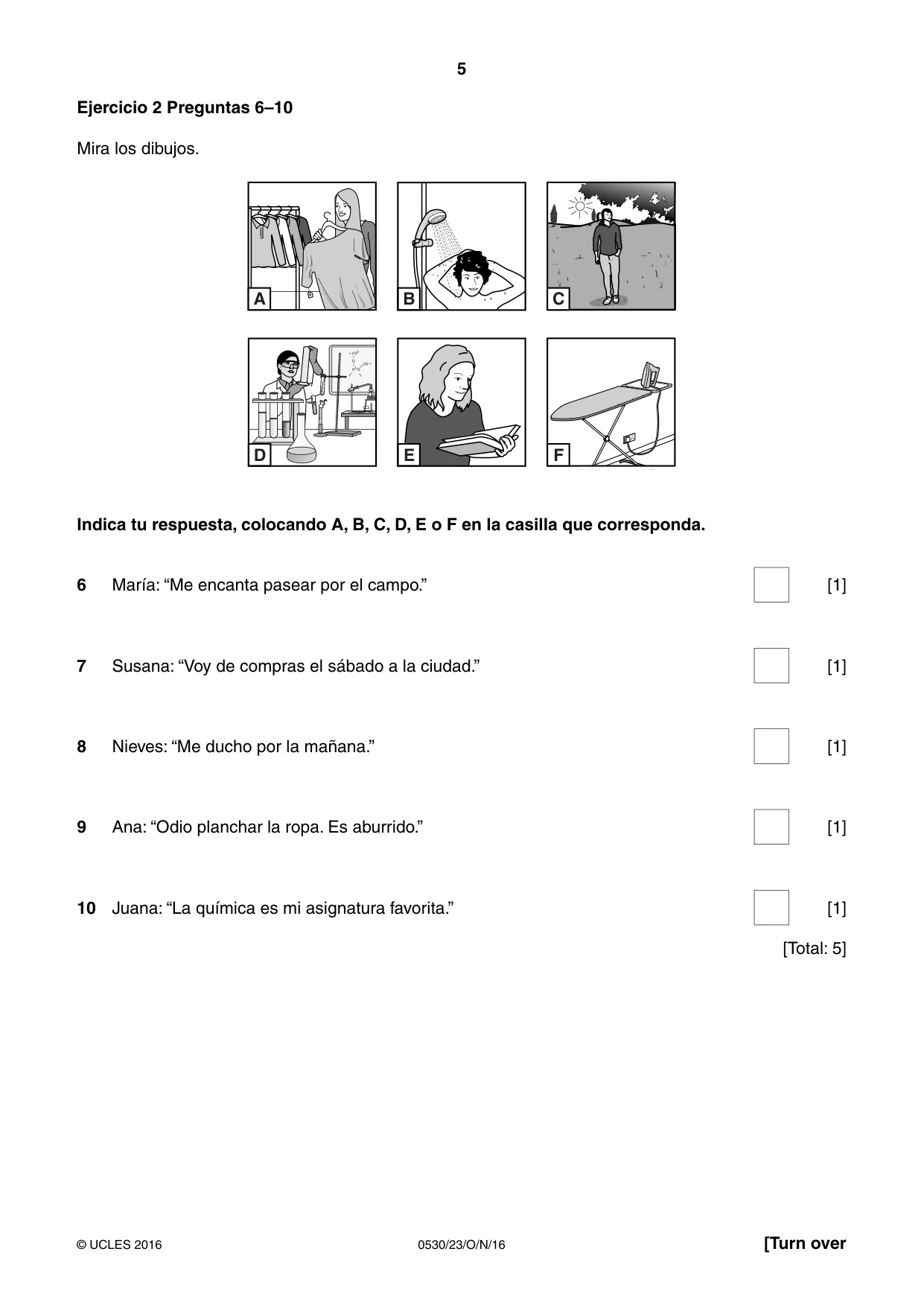
5 0530/23/O/N/16 © UCLES 2016 [Turn over Ejercicio 2 Preguntas 6–10 Mira los dibujos. A B C E F D Indica tu respuesta, colocando A, B, C, D, E o F en la casilla que corresponda. 6 María: “Me encanta pasear por el campo.” [1] 7 Susana: “Voy de compras el sábado a la ciudad.” [1] 8 Nieves: “Me ducho por la mañana.” [1] 9 Ana: “Odio planchar la ropa. Es aburrido.” [1] 10 Juana: “La química es mi asignatura favorita.” [1] [Total: 5]
Question paper, page 6
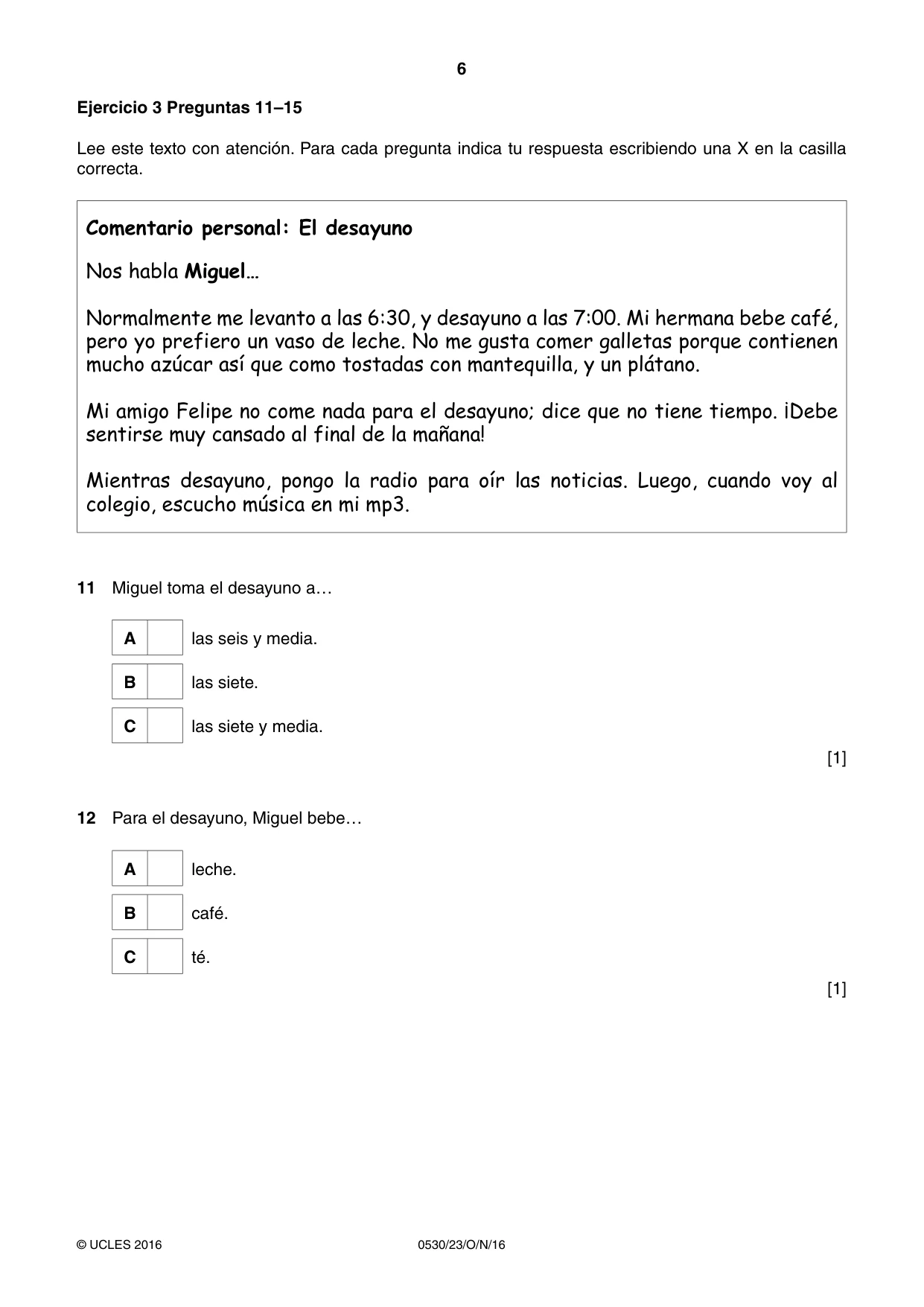
6 0530/23/O/N/16 © UCLES 2016 Ejercicio 3 Preguntas 11–15 Lee este texto con atención. Para cada pregunta indica tu respuesta escribiendo una X en la casilla correcta. Comentario personal: El desayuno Nos habla Miguel… Normalmente me levanto a las 6:30, y desayuno a las 7:00. Mi hermana bebe café, pero yo prefiero un vaso de leche. No me gusta comer galletas porque contienen mucho azúcar así que como tostadas con mantequilla, y un plátano. Mi amigo Felipe no come nada para el desayuno; dice que no tiene tiempo. ¡Debe sentirse muy cansado al final de la mañana! Mientras desayuno, pongo la radio para oír las noticias. Luego, cuando voy al colegio, escucho música en mi mp3. 11 Miguel toma el desayuno a… A las seis y media. B las siete. C las siete y media. [1] 12 Para el desayuno, Miguel bebe… A leche. B café. C té. [1]
Question paper, page 7
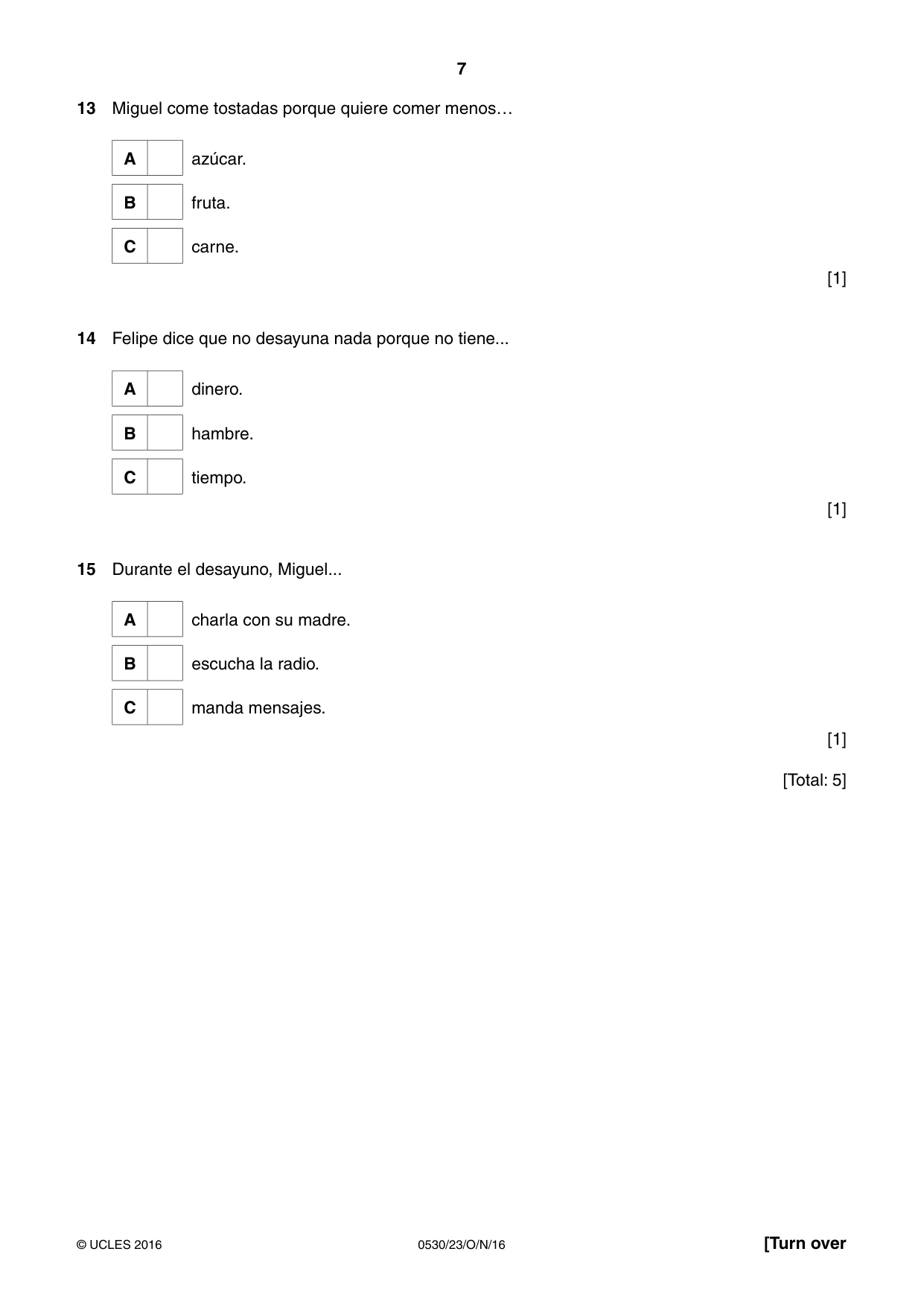
7 0530/23/O/N/16 © UCLES 2016 [Turn over 13 Miguel come tostadas porque quiere comer menos… A azúcar. B fruta. C carne. [1] 14 Felipe dice que no desayuna nada porque no tiene... A dinero. B hambre. C tiempo. [1] 15 Durante el desayuno, Miguel... A charla con su madre. B escucha la radio. C manda mensajes. [1] [Total: 5]
Question paper, page 8
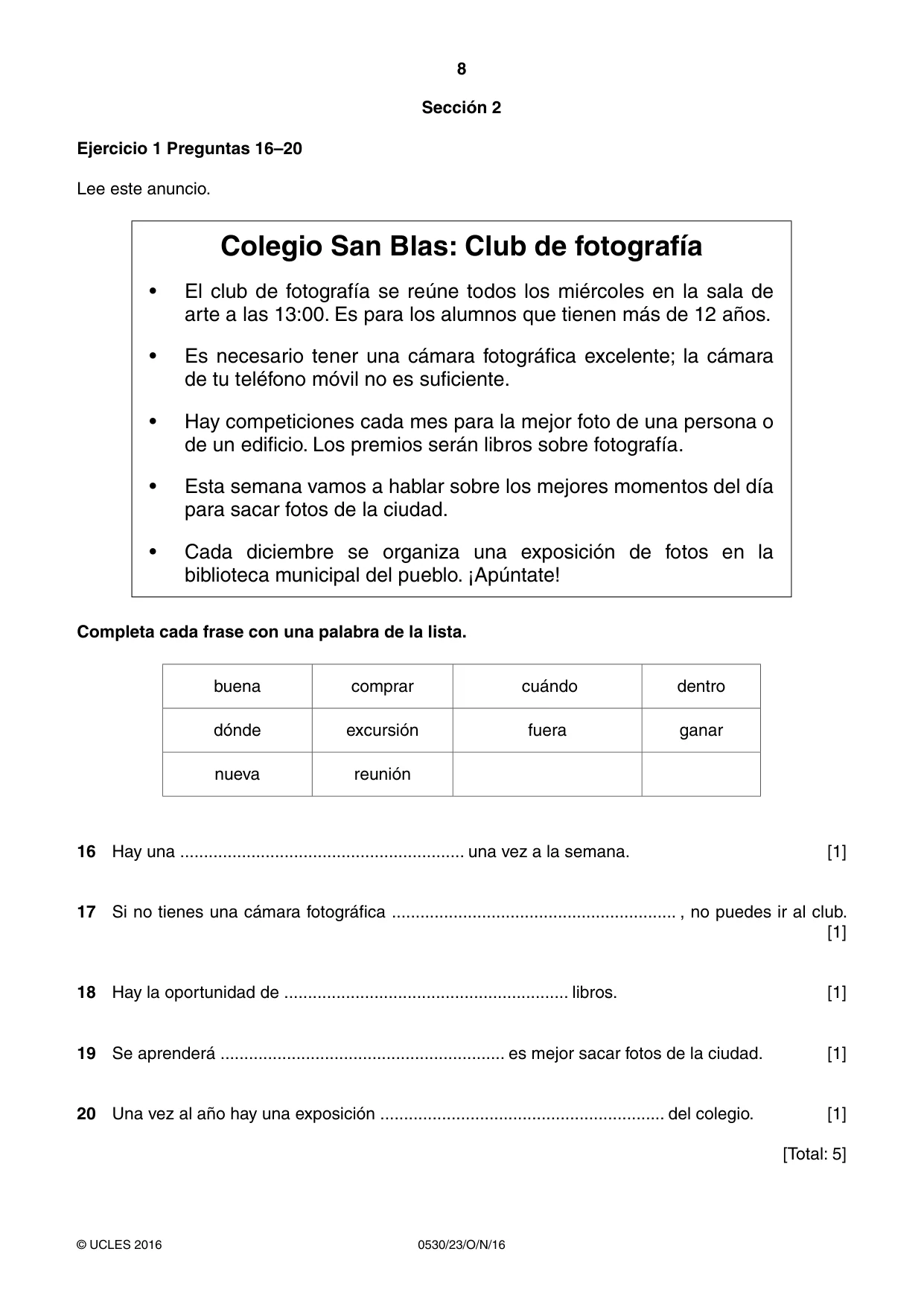
8 0530/23/O/N/16 © UCLES 2016 Sec ción 2 Ejercicio 1 Preguntas 16–20 Lee este anuncio. Colegio San Blas: Club de fotografía • El club de fotografía se reúne todos los miércoles en la sala de arte a las 13:00. Es para los alumnos que tienen más de 12 años. • Es necesario tener una cámara fotográfica excelente; la cámara de tu teléfono móvil no es suficiente. • Hay competiciones cada mes para la mejor foto de una persona o de un edificio. Los premios serán libros sobre fotografía. • Esta semana vamos a hablar sobre los mejores momentos del día para sacar fotos de la ciudad. • Cada diciembre se organiza una exposición de fotos en la biblioteca municipal del pueblo. ¡Apúntate! Completa cada frase con una palabra de la lista. buena comprar cuándo dentro dónde excursión fuera ganar nueva reunión 16 Hay una … una vez a la semana. [1] 17 Si no tienes una cámara fotográfica … , no puedes ir al club. [1] 18 Hay la oportunidad de … libros. [1] 19 Se aprenderá … es mejor sacar fotos de la ciudad. [1] 20 Una vez al año hay una exposición … del colegio. [1] [Total: 5]
Question paper, page 9
9 0530/23/O/N/16 © UCLES 2016 [Turn over Dar la vuelta para el Ejercicio 2.
Question paper, page 10
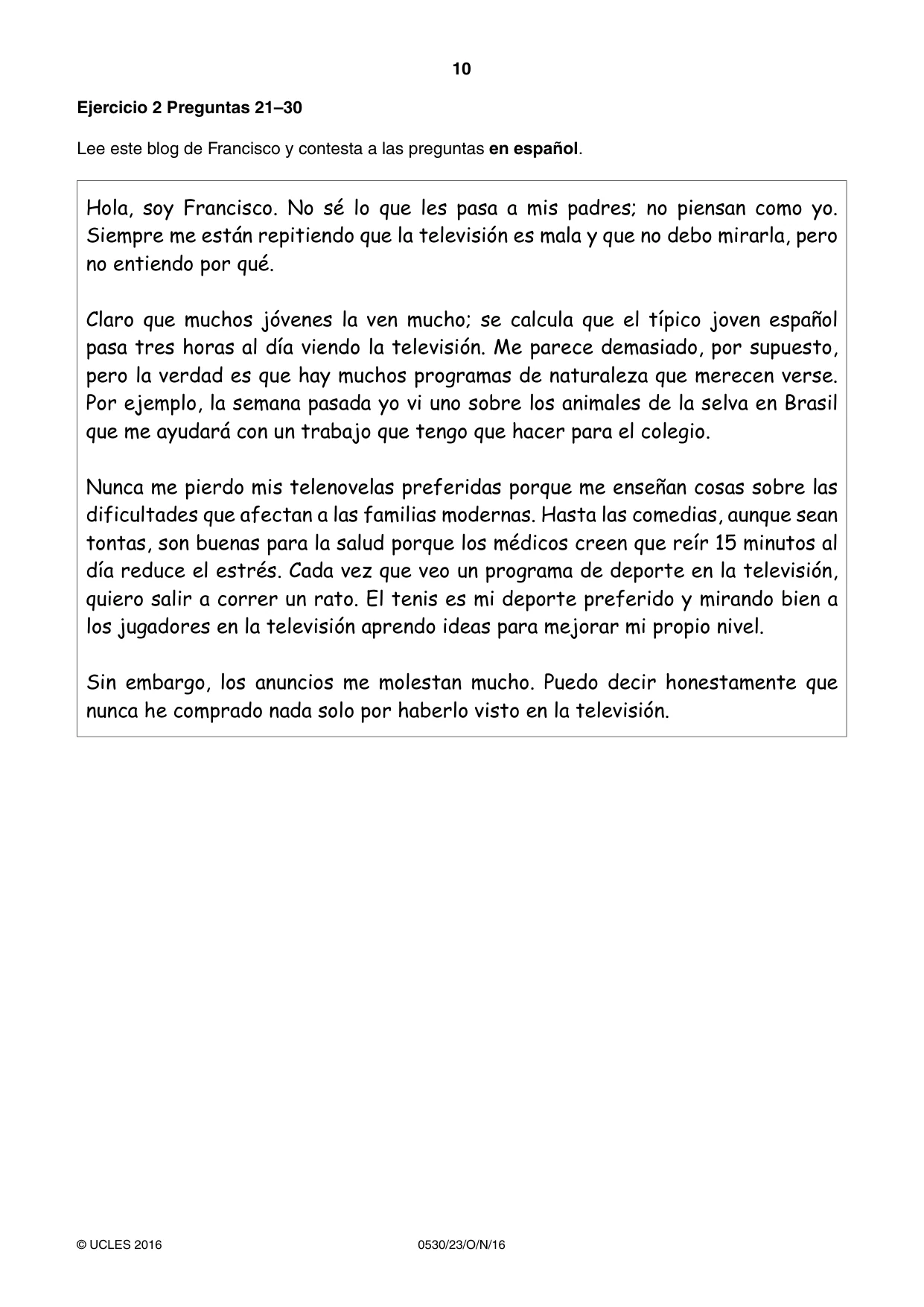
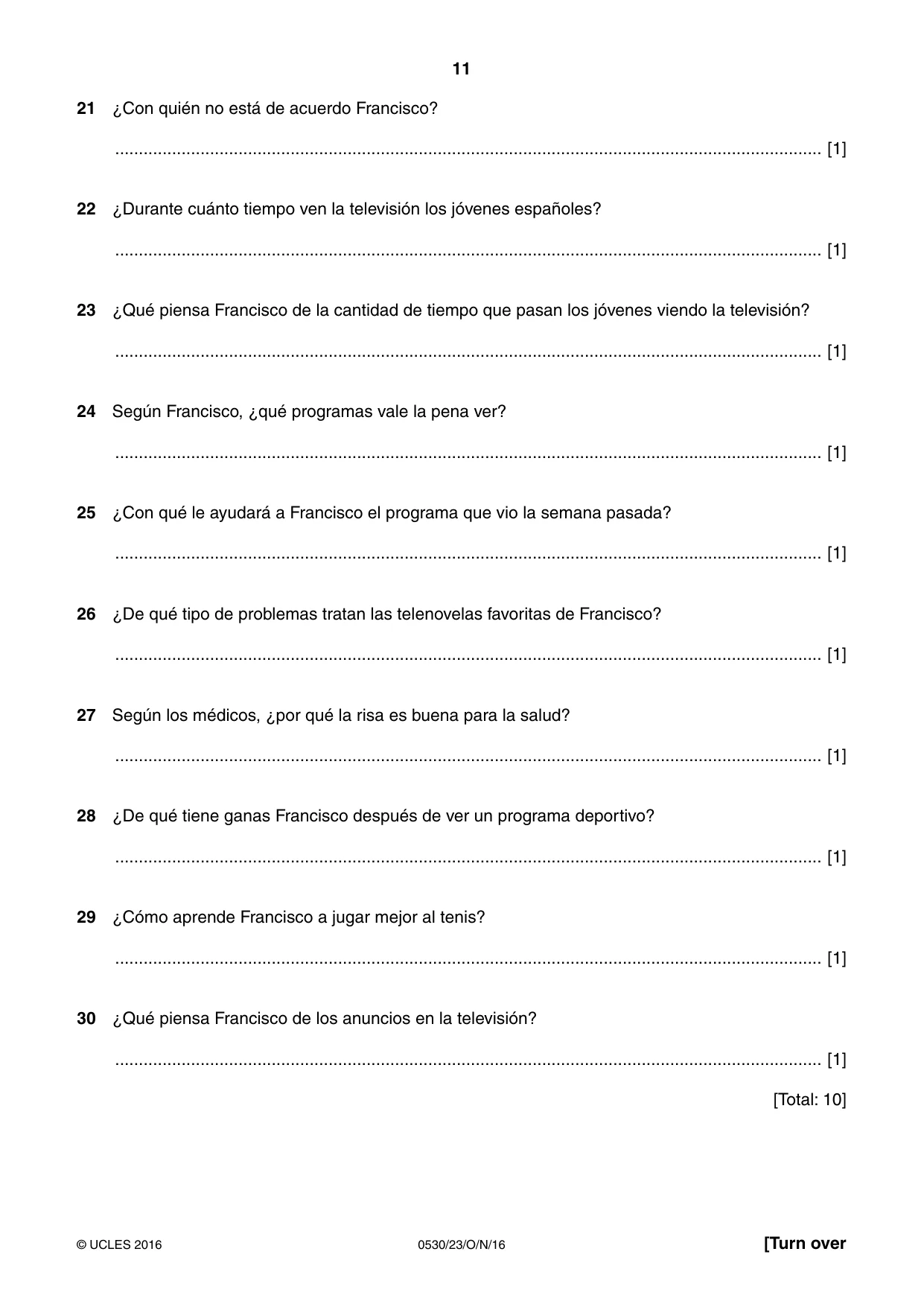
10 0530/23/O/N/16 © UCLES 2016 Ejercicio 2 Preguntas 21–30 Lee este blog de Francisco y contesta a las preguntas en español. Hola, soy Francisco. No sé lo que les pasa a mis padres; no piensan como yo. Siempre me están repitiendo que la televisión es mala y que no debo mirarla, pero no entiendo por qué. Claro que muchos jóvenes la ven mucho; se calcula que el típico joven español pasa tres horas al día viendo la televisión. Me parece demasiado, por supuesto, pero la verdad es que hay muchos programas de naturaleza que merecen verse. Por ejemplo, la semana pasada yo vi uno sobre los animales de la selva en Brasil que me ayudará con un trabajo que tengo que hacer para el colegio. Nunca me pierdo mis telenovelas preferidas porque me enseñan cosas sobre las dificultades que afectan a las familias modernas. Hasta las comedias, aunque sean tontas, son buenas para la salud porque los médicos creen que reír 15 minutos al día reduce el estrés. Cada vez que veo un programa de deporte en la televisión, quiero salir a correr un rato. El tenis es mi deporte preferido y mirando bien a los jugadores en la televisión aprendo ideas para mejorar mi propio nivel. Sin embargo, los anuncios me molestan mucho. Puedo decir honestamente que nunca he comprado nada solo por haberlo visto en la televisión.
Question paper, page 11
11 0530/23/O/N/16 © UCLES 2016 [Turn over 21 ¿Con quién no está de acuerdo Francisco? … [1] 22 ¿Durante cuánto tiempo ven la televisión los jóvenes españoles? … [1] 23 ¿Qué piensa Francisco de la cantidad de tiempo que pasan los jóvenes viendo la televisión? … [1] 24 Según Francisco, ¿qué programas vale la pena ver? … [1] 25 ¿Con qué le ayudará a Francisco el programa que vio la semana pasada? … [1] 26 ¿De qué tipo de problemas tratan las telenovelas favoritas de Francisco? … [1] 27 Según los médicos, ¿por qué la risa es buena para la salud? … [1] 28 ¿De qué tiene ganas Francisco después de ver un programa deportivo? … [1] 29 ¿Cómo aprende Francisco a jugar mejor al tenis? … [1] 30 ¿Qué piensa Francisco de los anuncios en la televisión? … [1] [Total: 10]
Question paper, page 12
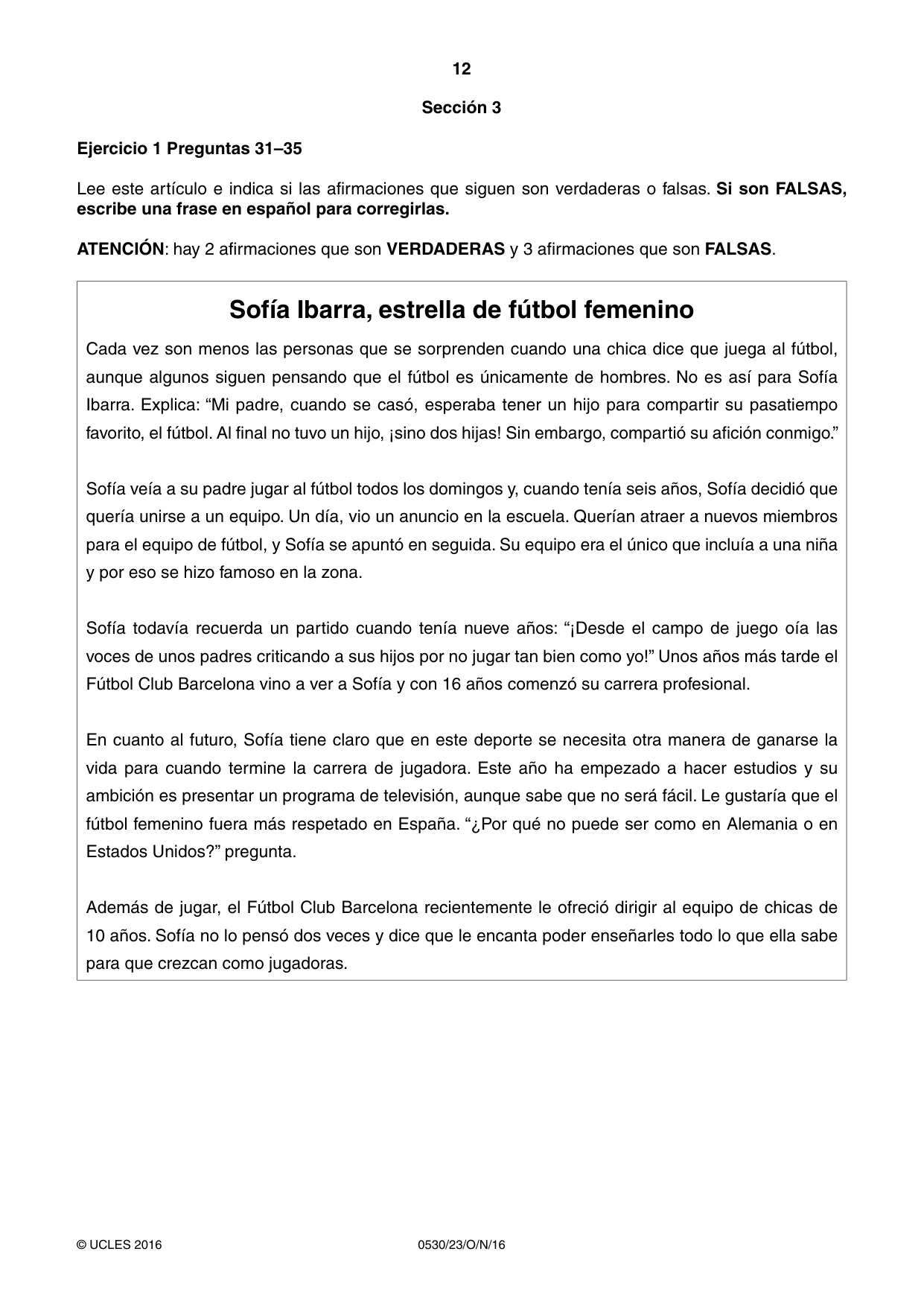
12 0530/23/O/N/16 © UCLES 2016 Secci ón 3 Ejercicio 1 Preguntas 31–35 Lee este artículo e indica si las afirmaciones que siguen son verdaderas o falsas. Si son FALSAS, escribe una frase en español para corregirlas. ATENCIÓN: hay 2 afirmaciones que son VERDADERAS y 3 afirmaciones que son FALSAS. Sofía Ibarra, estrella de fútbol femenino Cada vez son menos las personas que se sorprenden cuando una chica dice que juega al fútbol, aunque algunos siguen pensando que el fútbol es únicamente de hombres. No es así para Sofía Ibarra. Explica: “Mi padre, cuando se casó, esperaba tener un hijo para compartir su pasatiempo favorito, el fútbol. Al final no tuvo un hijo, ¡sino dos hijas! Sin embargo, compartió su afición conmigo.” Sofía veía a su padre jugar al fútbol todos los domingos y, cuando tenía seis años, Sofía decidió que quería unirse a un equipo. Un día, vio un anuncio en la escuela. Querían atraer a nuevos miembros para el equipo de fútbol, y Sofía se apuntó en seguida. Su equipo era el único que incluía a una niña y por eso se hizo famoso en la zona. Sofía todavía recuerda un partido cuando tenía nueve años: “¡Desde el campo de juego oía las voces de unos padres criticando a sus hijos por no jugar tan bien como yo!” Unos años más tarde el Fútbol Club Barcelona vino a ver a Sofía y con 16 años comenzó su carrera profesional. En cuanto al futuro, Sofía tiene claro que en este deporte se necesita otra manera de ganarse la vida para cuando termine la carrera de jugadora. Este año ha empezado a hacer estudios y su ambición es presentar un programa de televisión, aunque sabe que no será fácil. Le gustaría que el fútbol femenino fuera más respetado en España. “¿Por qué no puede ser como en Alemania o en Estados Unidos?” pregunta. Además de jugar, el Fútbol Club Barcelona recientemente le ofreció dirigir al equipo de chicas de 10 años. Sofía no lo pensó dos veces y dice que le encanta poder enseñarles todo lo que ella sabe para que crezcan como jugadoras.
Question paper, page 13
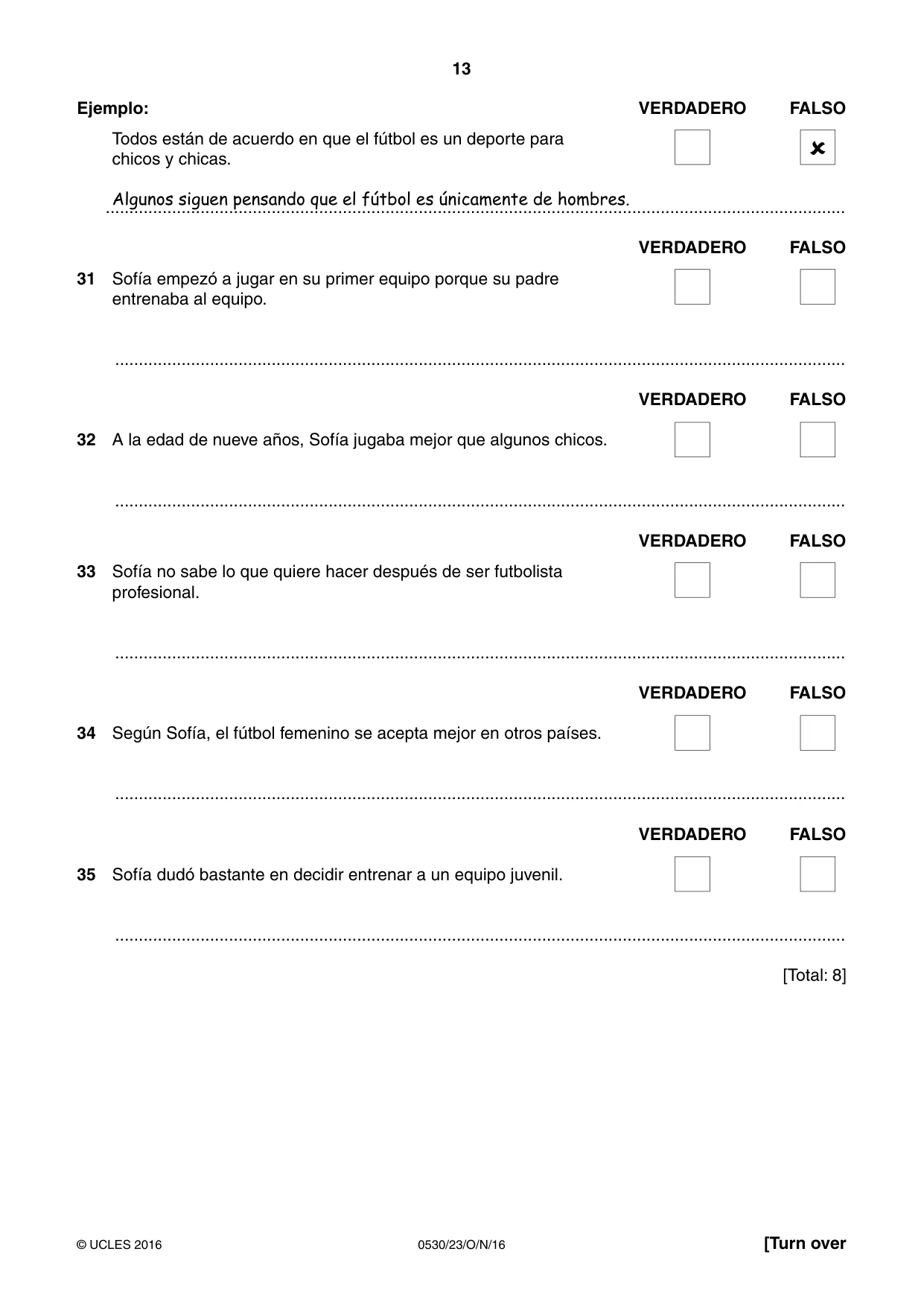
13 0530/23/O/N/16 © UCLES 2016 [Turn over Ejemplo: VERDADERO FALSO Todos están de acuerdo en que el fútbol es un deporte para chicos y chicas. Algunos siguen pensando que el fútbol es únicamente de hombres. … VERDADERO FALSO 31 Sofía empezó a jugar en su primer equipo porque su padre entrenaba al equipo. … VERDADERO FALSO 32 A la edad de nueve años, Sofía jugaba mejor que algunos chicos. … VERDADERO FALSO 33 Sofía no sabe lo que quiere hacer después de ser futbolista profesional. … VERDADERO FALSO 34 Según Sofía, el fútbol femenino se acepta mejor en otros países. … VERDADERO FALSO 35 Sofía dudó bastante en decidir entrenar a un equipo juvenil. … [Total: 8]
Question paper, page 14
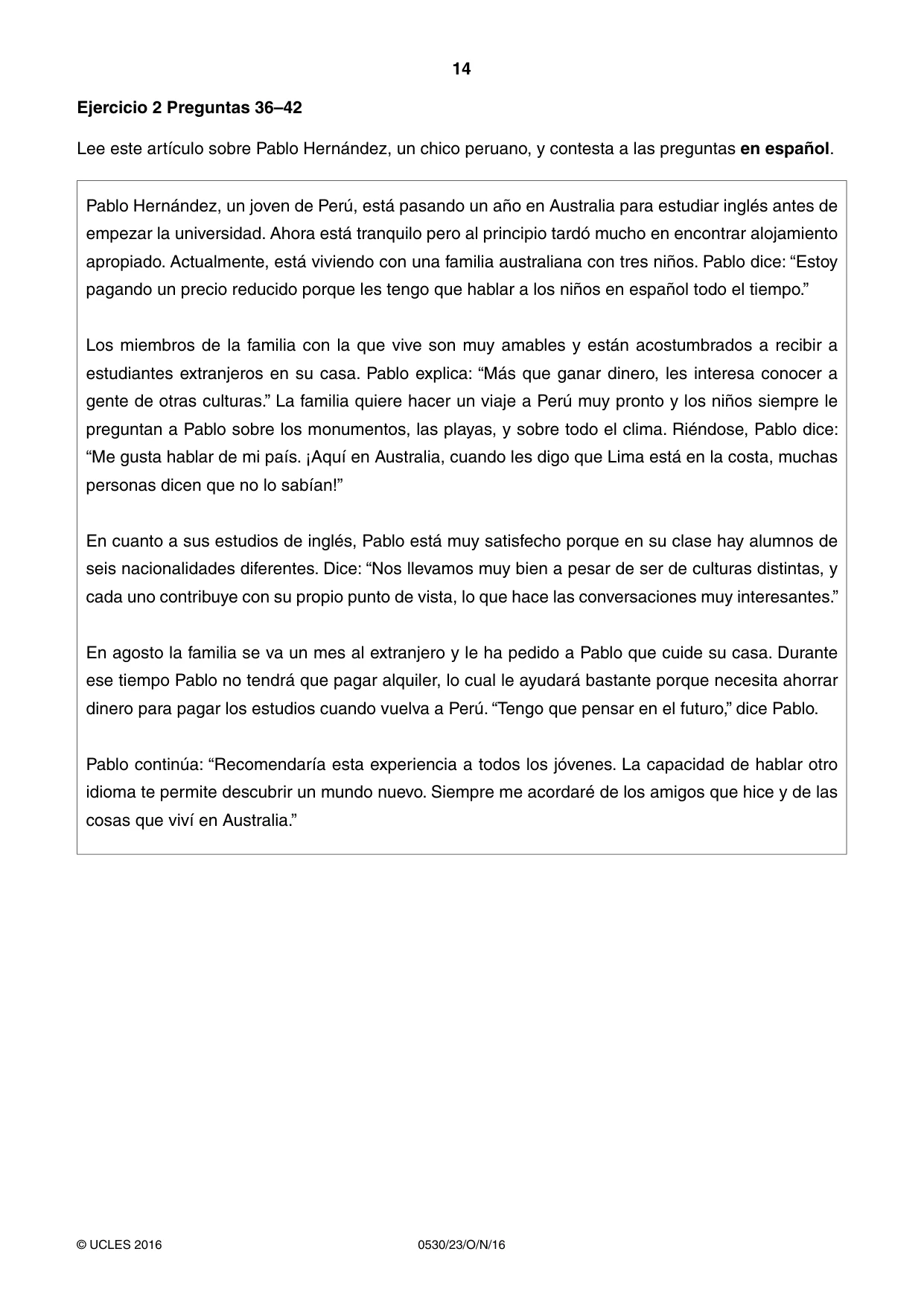
14 0530/23/O/N/16 © UCLES 2016 Ejerci cio 2 Preguntas 36–42 Lee este artículo sobre Pablo Hernández, un chico peruano, y contesta a las preguntas en español. Pablo Hernández, un joven de Perú, está pasando un año en Australia para estudiar inglés antes de empezar la universidad. Ahora está tranquilo pero al principio tardó mucho en encontrar alojamiento apropiado. Actualmente, está viviendo con una familia australiana con tres niños. Pablo dice: “Estoy pagando un precio reducido porque les tengo que hablar a los niños en español todo el tiempo.” Los miembros de la familia con la que vive son muy amables y están acostumbrados a recibir a estudiantes extranjeros en su casa. Pablo explica: “Más que ganar dinero, les interesa conocer a gente de otras culturas.” La familia quiere hacer un viaje a Perú muy pronto y los niños siempre le preguntan a Pablo sobre los monumentos, las playas, y sobre todo el clima. Riéndose, Pablo dice: “Me gusta hablar de mi país. ¡Aquí en Australia, cuando les digo que Lima está en la costa, muchas personas dicen que no lo sabían!” En cuanto a sus estudios de inglés, Pablo está muy satisfecho porque en su clase hay alumnos de seis nacionalidades diferentes. Dice: “Nos llevamos muy bien a pesar de ser de culturas distintas, y cada uno contribuye con su propio punto de vista, lo que hace las conversaciones muy interesantes.” En agosto la familia se va un mes al extranjero y le ha pedido a Pablo que cuide su casa. Durante ese tiempo Pablo no tendrá que pagar alquiler, lo cual le ayudará bastante porque necesita ahorrar dinero para pagar los estudios cuando vuelva a Perú. “Tengo que pensar en el futuro,” dice Pablo. Pablo continúa: “Recomendaría esta experiencia a todos los jóvenes. La capacidad de hablar otro idioma te permite descubrir un mundo nuevo. Siempre me acordaré de los amigos que hice y de las cosas que viví en Australia.”
Question paper, page 15
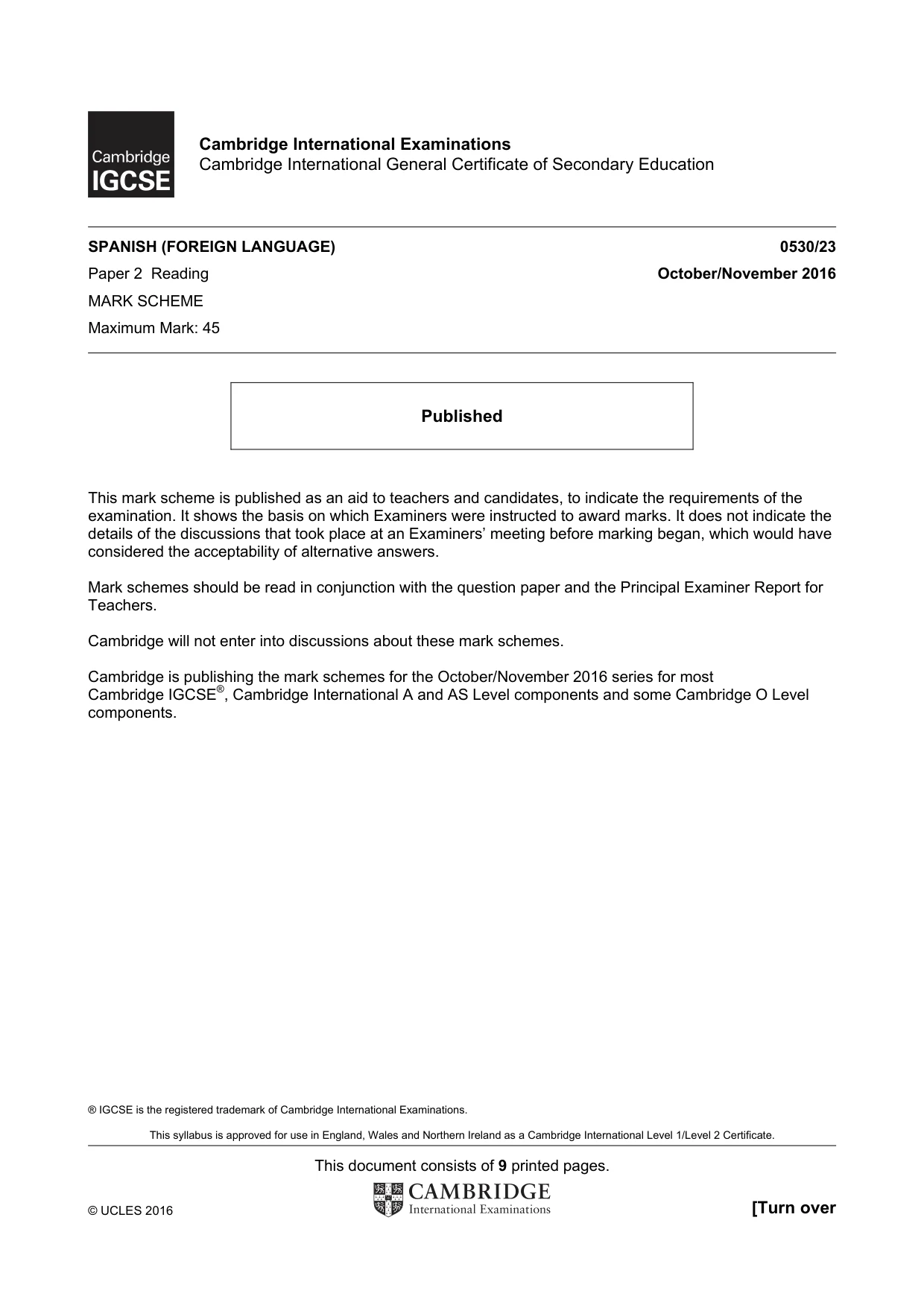
15 0530/23/O/N/16 © UCLES 2016 36 ¿Qué dificultad tuvo Pablo cuando llegó a Australia? … [1] 37 ¿Qué hace Pablo para que el alquiler le cueste menos? … [1] 38 ¿Por qué a la familia le gusta tener estudiantes extranjeros en casa? … [1] 39 Según Pablo, ¿de qué no se dan cuenta muchos australianos? … [1] 40 ¿Cómo hacen interesantes las clases de Pablo las distintas nacionalidades? … [1] 41 ¿Qué hará Pablo con el dinero que ahorrará en agosto? … [1] 42 ¿Por qué Pablo anima a los jóvenes a aprender otra lengua? … [1] [Total: 7]
Question paper, page 16
16 0530/23/O/N/16 © UCLES 2016 BLANK PAGE Permission to reproduce items where third-party owned material protected by copyright is included has been sought and cleared where possible. Every reasonable effort has been made by the publisher (UCLES) to trace copyright holders, but if any items requiring clearance have unwittingly been included, the publisher will be pleased to make amends at the earliest possible opportunity. To avoid the issue of disclosure of answer-related information to candidates, all copyright acknowledgements are reproduced online in the Cambridge International Examinations Copyright Acknowledgements Booklet. This is produced for each series of examinations and is freely available to download at www.cie.org.uk after the live examination series. Cambridge International Examinations is part of the Cambridge Assessment Group. Cambridge Assessment is the brand name of University of Cambridge Local Examinations Syndicate (UCLES), which is itself a department of the University of Cambridge.
Mark scheme, page 1
® IGCSE is the registered trademark of Cambridge International Examinations. This syllabus is approved for use in England, Wales and Northern Ireland as a Cambridge International Level 1/Level 2 Certificate. This document consists of 9 printed pages. © UCLES 2016 [Turn over Cambridge International Examinations Cambridge International General Certificate of Secondary Education SPANISH (FOREIGN LANGUAGE) 0530/23 Paper 2 Reading October/November 2016 MARK SCHEME Maximum Mark: 45 Published This mark scheme is published as an aid to teachers and candidates, to indicate the requirements of the examination. It shows the basis on which Examiners were instructed to award marks. It does not indicate the details of the discussions that took place at an Examiners’ meeting before marking began, which would have considered the acceptability of alternative answers. Mark schemes should be read in conjunction with the question paper and the Principal Examiner Report for Teachers. Cambridge will not enter into discussions about these mark schemes. Cambridge is publishing the mark schemes for the October/November 2016 series for most Cambridge IGCSE®, Cambridge International A and AS Level components and some Cambridge O Level components.
Mark scheme, page 2
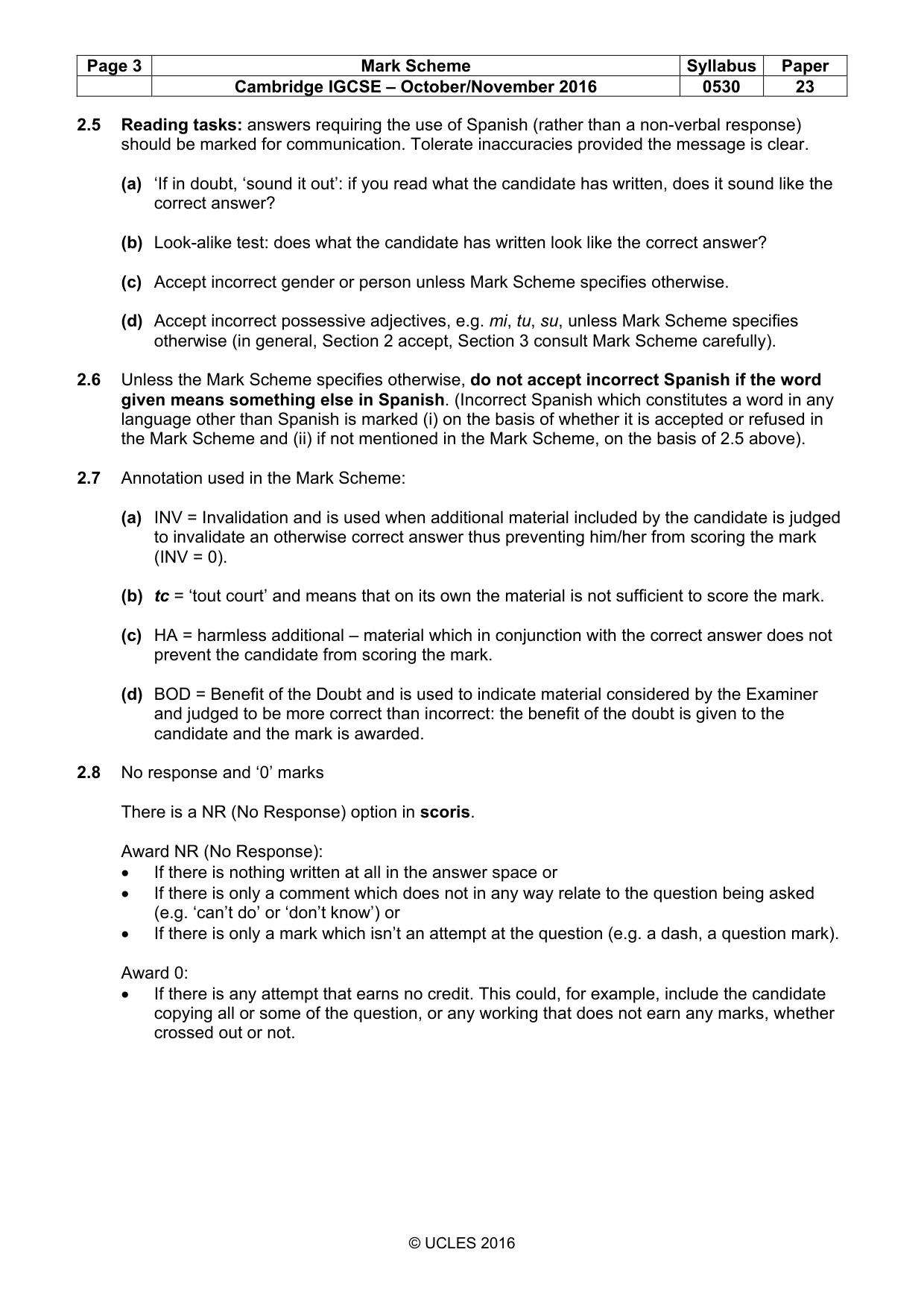
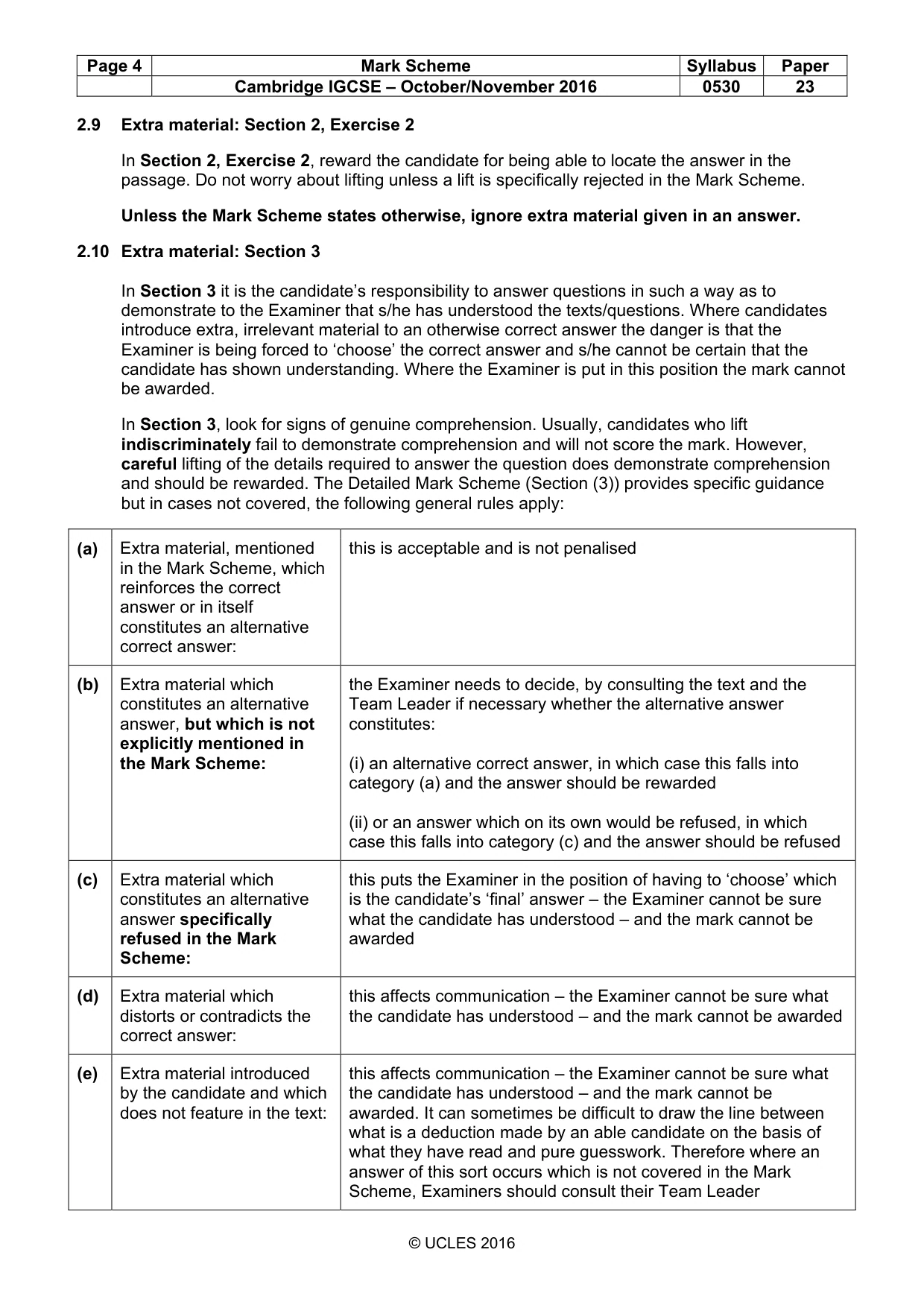
Page 2 Mark Scheme Syllabus Paper Cambridge IGCSE – October/November 2016 0530 23 © UCLES 2016 1 General Marking Notes 2 General Marking Principles 2.1 Please note that it is not possible to list all acceptable alternatives in the Detailed Mark Scheme provided in Section 3. You will need to consider all alternative answers and unexpected approaches in candidates’ scripts, make a decision on whether they communicate the required elements, in consultation with your Team Leader if necessary (or with your Product Manager if you are a single Examiner), and award marks accordingly. The following marking principles underpin the detailed instructions provided in Section 3 of the Mark Scheme. Where a decision is taken to deviate from these principles for a particular question, this will be specified in the Mark Scheme. 2.2 Crossing out: (a) If a candidate changes his/her mind over an answer and crosses out an attempt, award a mark if the final attempt is correct. (b) If a candidate crosses out an answer to a whole question but makes no second attempt at it, mark the crossed out work. 2.3 Reading tasks: more than the stipulated number of boxes ticked/crossed by the candidate: (a) If more than one attempt is visible, but the candidate has clearly indicated which attempt is his/her final answer (e.g. by crossing out other attempts or by annotating the script in some way) mark in the usual way. (b) If two attempts are visible (e.g. two boxes ticked instead of the 1 box stipulated), and neither has been crossed out/discounted by the candidate, no mark can be awarded. (c) In questions where candidates are required to tick a number of boxes (e.g. tick the 6 true statements) the general rule to be applied is as follows: the number of ‘extra’ answers indicated by the candidate is deducted from the number of correct answers and the remaining number is the mark awarded, e.g. the candidate is required to tick 6 true statements, but instead ticks 8 statements. 5 of the 6 ticks are correctly placed, but 2 of the ticks are ‘extras’ (8 ticks placed by candidate minus 6 ticks required by rubric = 2). Therefore the candidate is awarded a mark of 3. number of correct ticks: 5 minus number of extra ticks: –2 mark awarded: = 3 (d) Answers in pen do not take precedence over answers in pencil, e.g. if a candidate is asked to tick 1 box and ticks two, one in pen and the other in pencil, the mark cannot be awarded unless there is some explicit indication from the candidate as to which is his/her final answer. 2.4 Reading tasks: for questions requiring more than one element for the answer, (i) and (ii), where the answers are interchangeable: Both correct answers on line 1 and line 2 blank = 2 Both correct answers on line 1 and line 2 wrong = 1 (or vice-versa)
Mark scheme, page 3
Page 3 Mark Scheme Syllabus Paper Cambridge IGCSE – October/November 2016 0530 23 © UCLES 2016 2.5 Reading tasks: answers requiring the use of Spanish (rather than a non-verbal response) should be marked for communication. Tolerate inaccuracies provided the message is clear. (a) ‘If in doubt, ‘sound it out’: if you read what the candidate has written, does it sound like the correct answer? (b) Look-alike test: does what the candidate has written look like the correct answer? (c) Accept incorrect gender or person unless Mark Scheme specifies otherwise. (d) Accept incorrect possessive adjectives, e.g. mi, tu, su, unless Mark Scheme specifies otherwise (in general, Section 2 accept, Section 3 consult Mark Scheme carefully). 2.6 Unless the Mark Scheme specifies otherwise, do not accept incorrect Spanish if the word given means something else in Spanish. (Incorrect Spanish which constitutes a word in any language other than Spanish is marked (i) on the basis of whether it is accepted or refused in the Mark Scheme and (ii) if not mentioned in the Mark Scheme, on the basis of 2.5 above). 2.7 Annotation used in the Mark Scheme: (a) INV = Invalidation and is used when additional material included by the candidate is judged to invalidate an otherwise correct answer thus preventing him/her from scoring the mark (INV = 0). (b) tc = ‘tout court’ and means that on its own the material is not sufficient to score the mark. (c) HA = harmless additional – material which in conjunction with the correct answer does not prevent the candidate from scoring the mark. (d) BOD = Benefit of the Doubt and is used to indicate material considered by the Examiner and judged to be more correct than incorrect: the benefit of the doubt is given to the candidate and the mark is awarded. 2.8 No response and ‘0’ marks There is a NR (No Response) option in scoris. Award NR (No Response): • If there is nothing written at all in the answer space or • If there is only a comment which does not in any way relate to the question being asked (e.g. ‘can’t do’ or ‘don’t know’) or • If there is only a mark which isn’t an attempt at the question (e.g. a dash, a question mark). Award 0: • If there is any attempt that earns no credit. This could, for example, include the candidate copying all or some of the question, or any working that does not earn any marks, whether crossed out or not.
Mark scheme, page 4
Page 4 Mark Scheme Syllabus Paper Cambridge IGCSE – October/November 2016 0530 23 © UCLES 2016 2.9 Extra material: Section 2, Exercise 2 In Section 2, Exercise 2, reward the candidate for being able to locate the answer in the passage. Do not worry about lifting unless a lift is specifically rejected in the Mark Scheme. Unless the Mark Scheme states otherwise, ignore extra material given in an answer. 2.10 Extra material: Section 3 In Section 3 it is the candidate’s responsibility to answer questions in such a way as to demonstrate to the Examiner that s/he has understood the texts/questions. Where candidates introduce extra, irrelevant material to an otherwise correct answer the danger is that the Examiner is being forced to ‘choose’ the correct answer and s/he cannot be certain that the candidate has shown understanding. Where the Examiner is put in this position the mark cannot be awarded. In Section 3, look for signs of genuine comprehension. Usually, candidates who lift indiscriminately fail to demonstrate comprehension and will not score the mark. However, careful lifting of the details required to answer the question does demonstrate comprehension and should be rewarded. The Detailed Mark Scheme (Section (3)) provides specific guidance but in cases not covered, the following general rules apply: (a) Extra material, mentioned in the Mark Scheme, which reinforces the correct answer or in itself constitutes an alternative correct answer: this is acceptable and is not penalised (b) Extra material which constitutes an alternative answer, but which is not explicitly mentioned in the Mark Scheme: the Examiner needs to decide, by consulting the text and the Team Leader if necessary whether the alternative answer constitutes: (i) an alternative correct answer, in which case this falls into category (a) and the answer should be rewarded (ii) or an answer which on its own would be refused, in which case this falls into category (c) and the answer should be refused (c) Extra material which constitutes an alternative answer specifically refused in the Mark Scheme: this puts the Examiner in the position of having to ‘choose’ which is the candidate’s ‘final’ answer – the Examiner cannot be sure what the candidate has understood – and the mark cannot be awarded (d) Extra material which distorts or contradicts the correct answer: this affects communication – the Examiner cannot be sure what the candidate has understood – and the mark cannot be awarded (e) Extra material introduced by the candidate and which does not feature in the text: this affects communication – the Examiner cannot be sure what the candidate has understood – and the mark cannot be awarded. It can sometimes be difficult to draw the line between what is a deduction made by an able candidate on the basis of what they have read and pure guesswork. Therefore where an answer of this sort occurs which is not covered in the Mark Scheme, Examiners should consult their Team Leader
Mark scheme, page 5
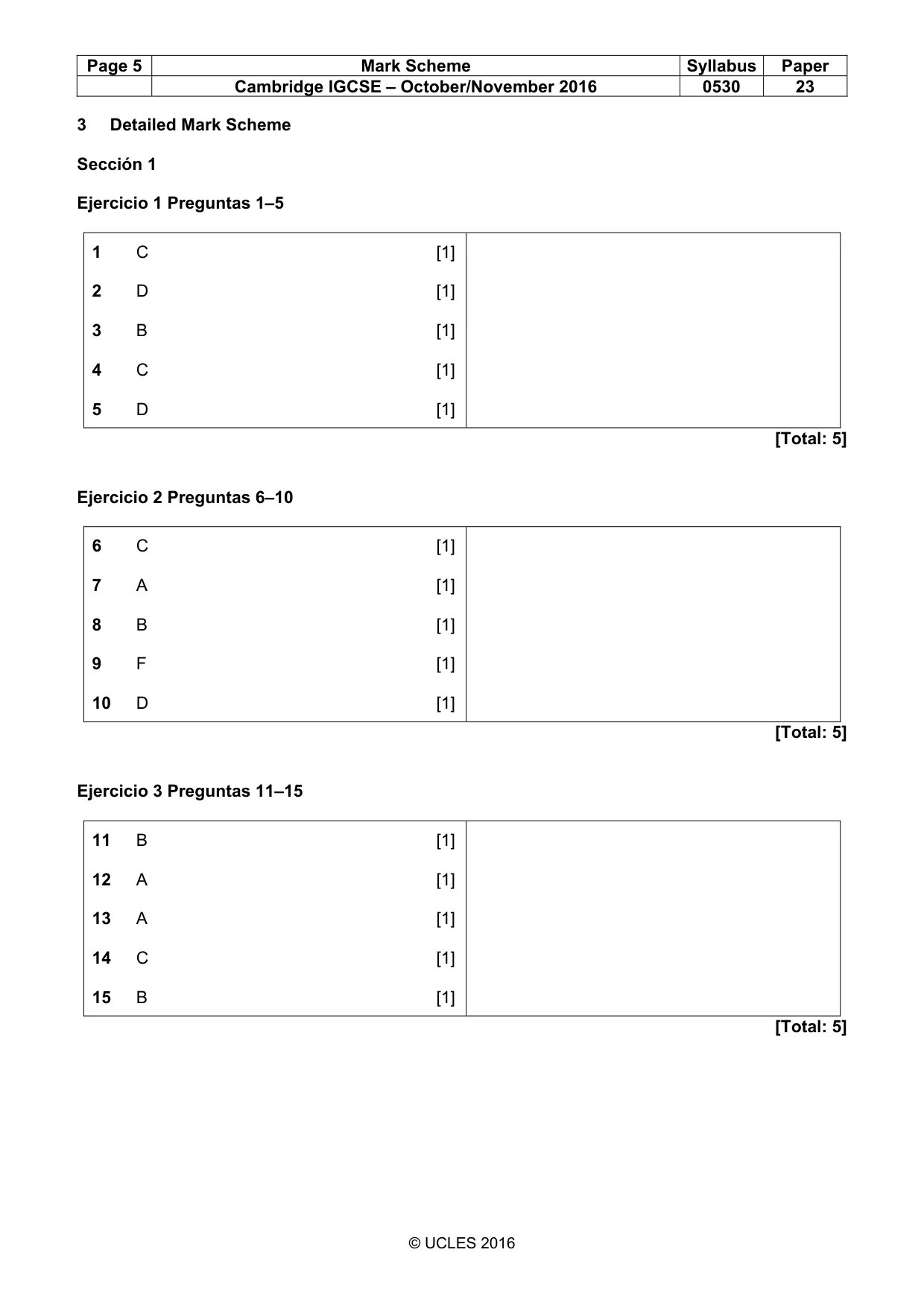
Page 5 Mark Scheme Syllabus Paper Cambridge IGCSE – October/November 2016 0530 23 © UCLES 2016 3 Detailed Mark Scheme Sección 1 Ejercicio 1 Preguntas 1–5 1 C [1] 2 D [1] 3 B [1] 4 C [1] 5 D [1] [Total: 5] Ejercicio 2 Preguntas 6–10 6 C [1] 7 A [1] 8 B [1] 9 F [1] 10 D [1] [Total: 5] Ejercicio 3 Preguntas 11–15 11 B [1] 12 A [1] 13 A [1] 14 C [1] 15 B [1] [Total: 5]
Mark scheme, page 6
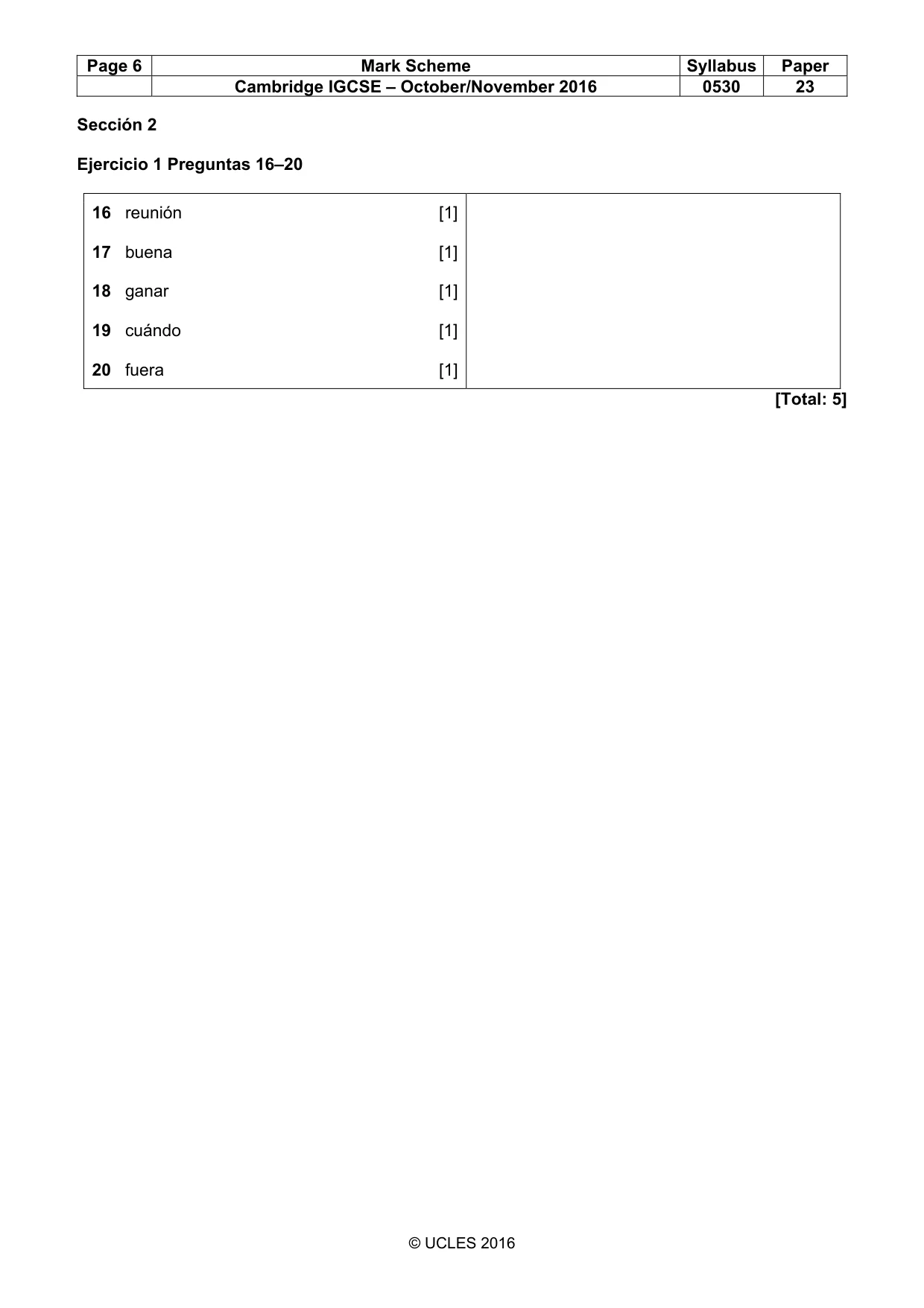
Page 6 Mark Scheme Syllabus Paper Cambridge IGCSE – October/November 2016 0530 23 © UCLES 2016 Sección 2 Ejercicio 1 Preguntas 16–20 16 reunión [1] 17 buena [1] 18 ganar [1] 19 cuándo [1] 20 fuera [1] [Total: 5]
Mark scheme, page 7
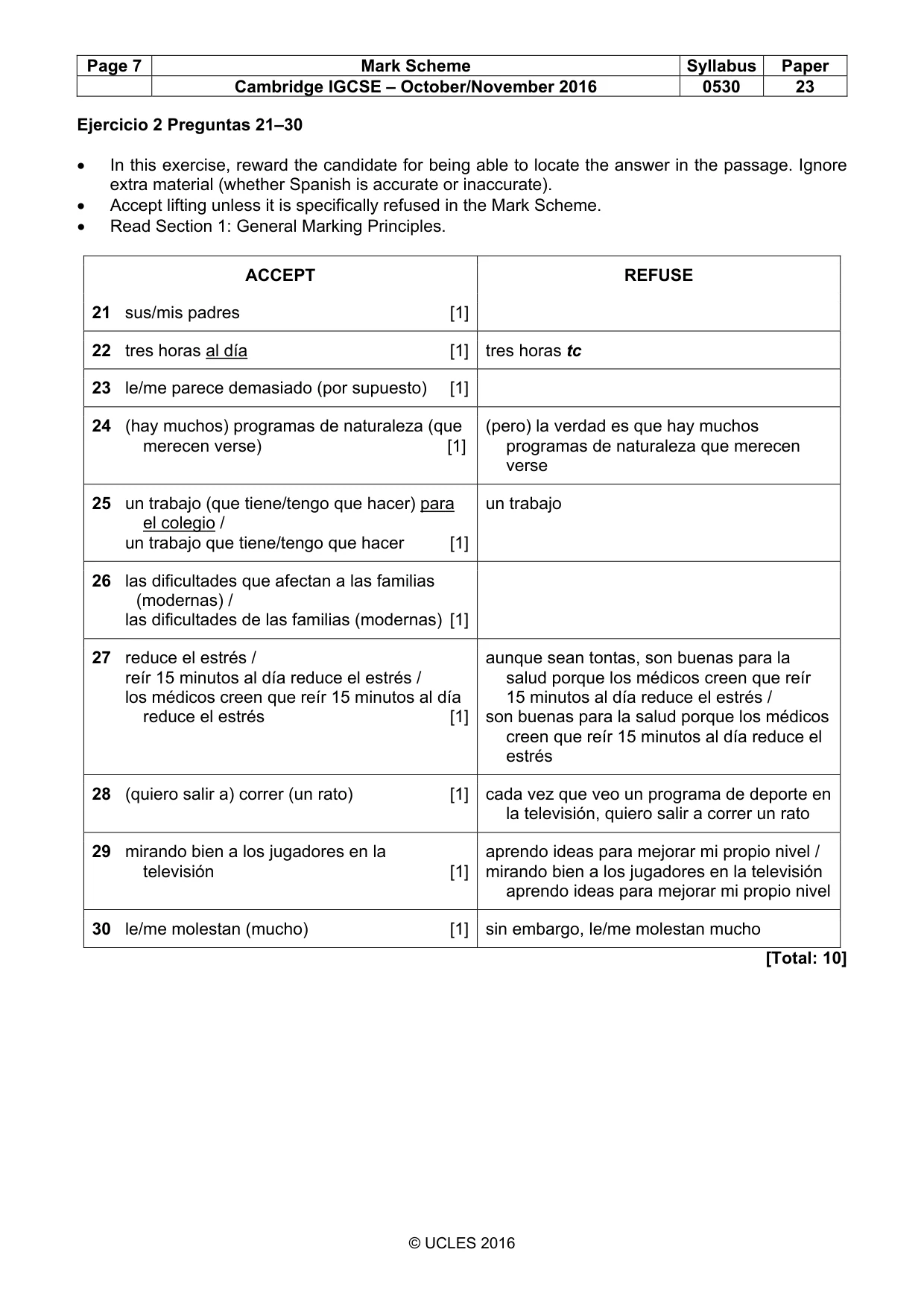
Page 7 Mark Scheme Syllabus Paper Cambridge IGCSE – October/November 2016 0530 23 © UCLES 2016 Ejercicio 2 Preguntas 21–30 • In this exercise, reward the candidate for being able to locate the answer in the passage. Ignore extra material (whether Spanish is accurate or inaccurate). • Accept lifting unless it is specifically refused in the Mark Scheme. • Read Section 1: General Marking Principles. ACCEPT REFUSE 21 sus/mis padres [1] 22 tres horas al día [1] tres horas tc 23 le/me parece demasiado (por supuesto) [1] 24 (hay muchos) programas de naturaleza (que merecen verse) [1] (pero) la verdad es que hay muchos programas de naturaleza que merecen verse 25 un trabajo (que tiene/tengo que hacer) para el colegio / un trabajo que tiene/tengo que hacer [1] un trabajo 26 las dificultades que afectan a las familias (modernas) / las dificultades de las familias (modernas) [1] 27 reduce el estrés / reír 15 minutos al día reduce el estrés / los médicos creen que reír 15 minutos al día reduce el estrés [1] aunque sean tontas, son buenas para la salud porque los médicos creen que reír 15 minutos al día reduce el estrés / son buenas para la salud porque los médicos creen que reír 15 minutos al día reduce el estrés 28 (quiero salir a) correr (un rato) [1] cada vez que veo un programa de deporte en la televisión, quiero salir a correr un rato 29 mirando bien a los jugadores en la televisión [1] aprendo ideas para mejorar mi propio nivel / mirando bien a los jugadores en la televisión aprendo ideas para mejorar mi propio nivel 30 le/me molestan (mucho) [1] sin embargo, le/me molestan mucho [Total: 10]
Mark scheme, page 8
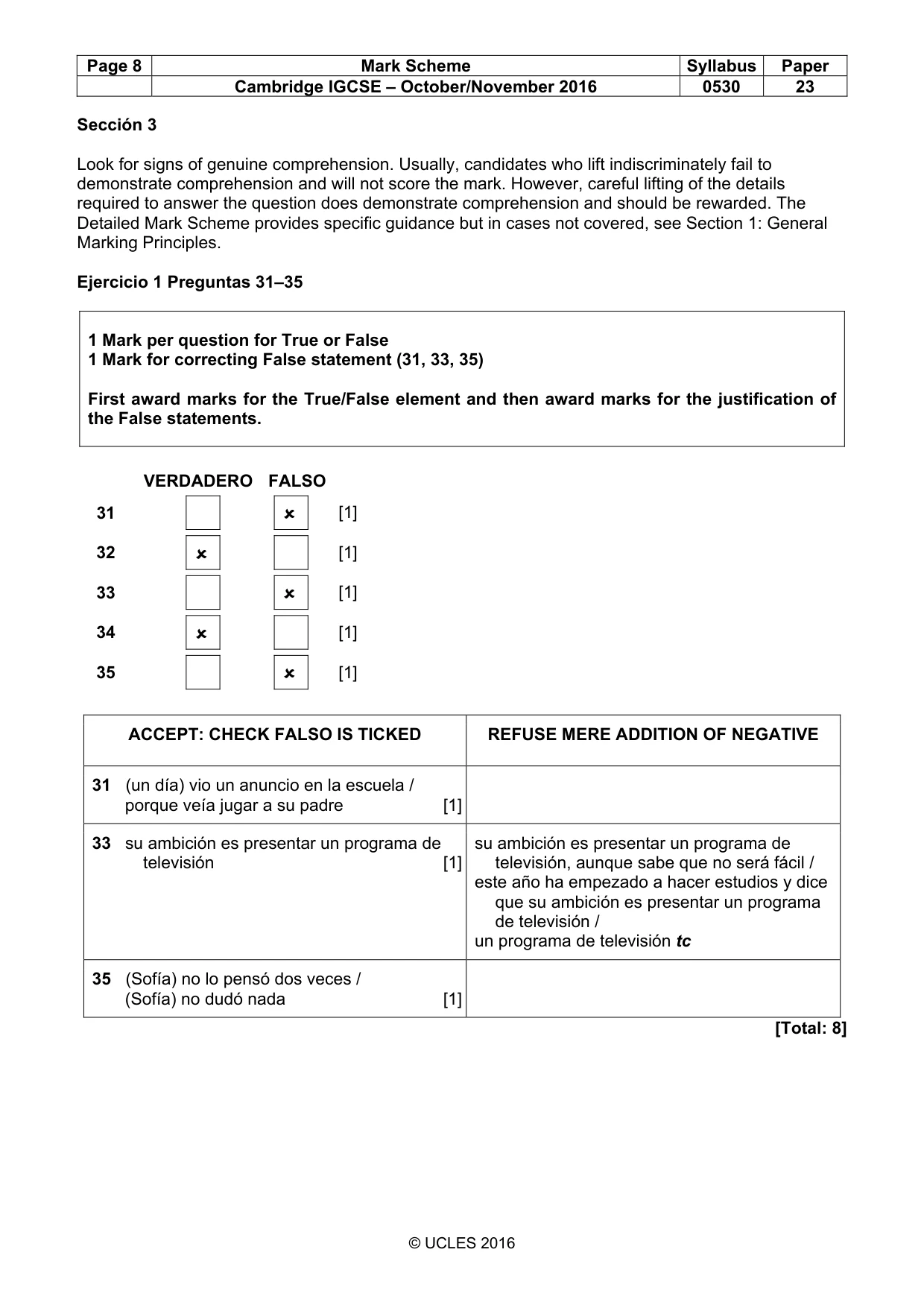
Page 8 Mark Scheme Syllabus Paper Cambridge IGCSE – October/November 2016 0530 23 © UCLES 2016 Sección 3 Look for signs of genuine comprehension. Usually, candidates who lift indiscriminately fail to demonstrate comprehension and will not score the mark. However, careful lifting of the details required to answer the question does demonstrate comprehension and should be rewarded. The Detailed Mark Scheme provides specific guidance but in cases not covered, see Section 1: General Marking Principles. Ejercicio 1 Preguntas 31–35 1 Mark per question for True or False 1 Mark for correcting False statement (31, 33, 35) First award marks for the True/False element and then award marks for the justification of the False statements. VERDADERO FALSO 31 8 [1] 32 8 [1] 33 8 [1] 34 8 [1] 35 8 [1] ACCEPT: CHECK FALSO IS TICKED REFUSE MERE ADDITION OF NEGATIVE 31 (un día) vio un anuncio en la escuela / porque veía jugar a su padre [1] 33 su ambición es presentar un programa de televisión [1] su ambición es presentar un programa de televisión, aunque sabe que no será fácil / este año ha empezado a hacer estudios y dice que su ambición es presentar un programa de televisión / un programa de televisión tc 35 (Sofía) no lo pensó dos veces / (Sofía) no dudó nada [1] [Total: 8]
Mark scheme, page 9
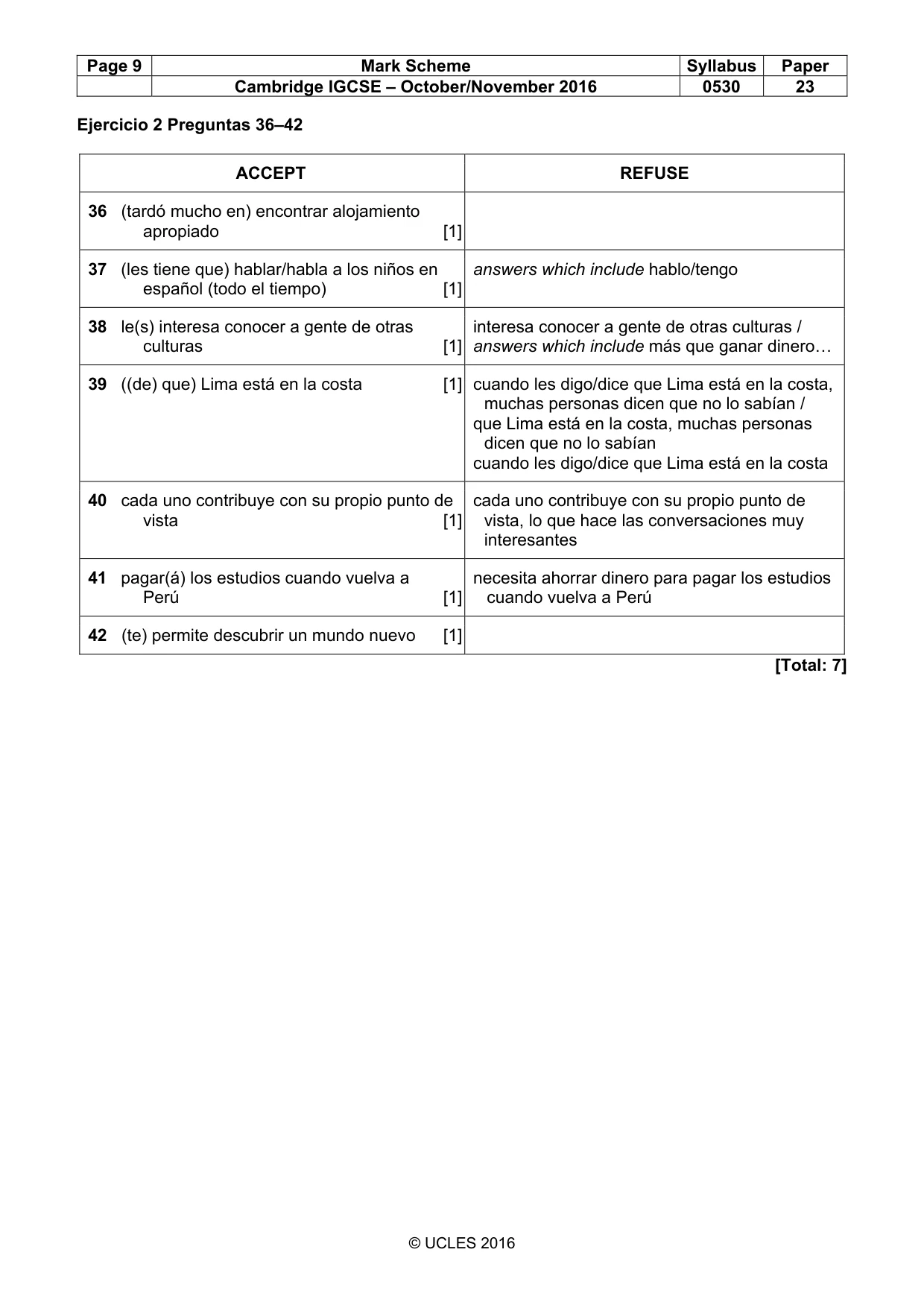
Page 9 Mark Scheme Syllabus Paper Cambridge IGCSE – October/November 2016 0530 23 © UCLES 2016 Ejercicio 2 Preguntas 36–42 ACCEPT REFUSE 36 (tardó mucho en) encontrar alojamiento apropiado [1] 37 (les tiene que) hablar/habla a los niños en español (todo el tiempo) [1] answers which include hablo/tengo 38 le(s) interesa conocer a gente de otras culturas [1] interesa conocer a gente de otras culturas / answers which include más que ganar dinero… 39 ((de) que) Lima está en la costa [1] cuando les digo/dice que Lima está en la costa, muchas personas dicen que no lo sabían / que Lima está en la costa, muchas personas dicen que no lo sabían cuando les digo/dice que Lima está en la costa 40 cada uno contribuye con su propio punto de vista [1] cada uno contribuye con su propio punto de vista, lo que hace las conversaciones muy interesantes 41 pagar(á) los estudios cuando vuelva a Perú [1] necesita ahorrar dinero para pagar los estudios cuando vuelva a Perú 42 (te) permite descubrir un mundo nuevo [1] [Total: 7]
What you needed in this session
Cambridge’s own grade thresholds for 2016 Oct/Nov, Paper 2 · Variant 3. A higher threshold means an easier paper — the bar moves with how the cohort did.