Cambridge IGCSE Spanish - Foreign Language 0530 — 2016 Oct/Nov Paper 2 · Variant 1
0530/21/O/N/16 · 45 marks · ≈51 min
The question paper and its mark scheme, free to read here and free to download. This is Cambridge’s own paper, exactly as it was sat.
Question paper16 pages



Mark scheme8 pages
Answers below. Sit the paper first if you are practising.
Paper as text
Question paper, page 1
This document consists of 14 printed pages and 2 blank pages. DC (NF/FD) 131228/4 R © UCLES 2016 [Turn over Cambridge International Examinations Cambridge International General Certificate of Secondary Education * 2 2 6 8 4 1 7 1 1 6 * SPANISH 0530/21 Paper 2 Reading October/November 2016 1 hour Candidates answer on the Question Paper. No Additional Materials are required. READ THESE INSTRUCTIONS FIRST Write your Centre number, candidate number and name on all the work you hand in. Write in dark blue or black pen. Do not use staples, paper clips, glue or correction fluid. DO NOT WRITE IN ANY BARCODES. Answer all questions. The number of marks is given in brackets [ ] at the end of each question or part question. The syllabus is approved for use in England, Wales and Northern Ireland as a Cambridge International Level 1/Level 2 Certificate.
Question paper, page 2
2 0530/21/O/N/16 © UCLES 2016 BLANK PAGE
Question paper, page 3
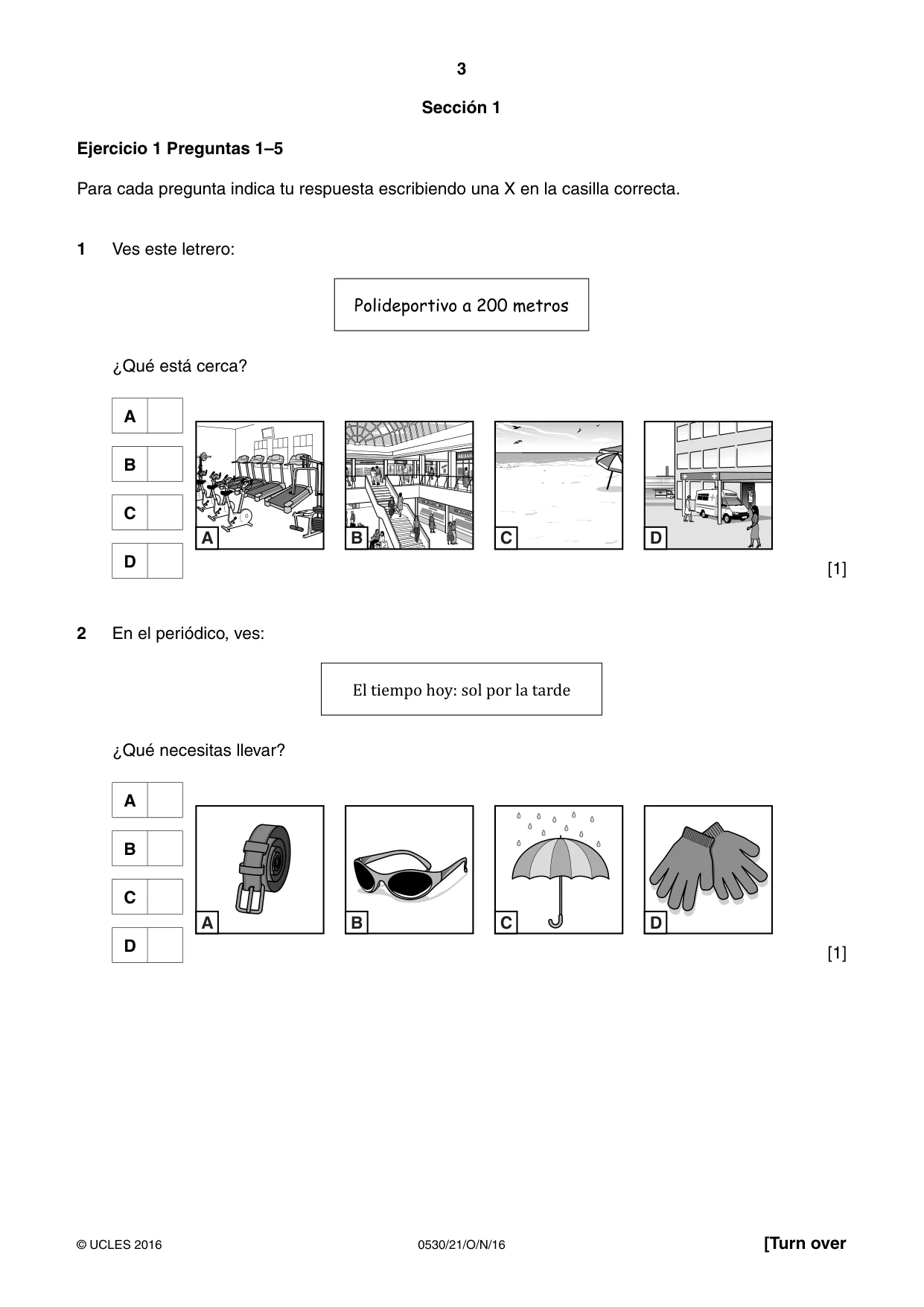
3 0530/21/O/N/16 © UCLES 2016 [Turn over Sección 1 Ejercicio 1 Preguntas 1–5 Para cada pregunta indica tu respuesta escribiendo una X en la casilla correcta. 1 Ves este letrero: Polideportivo a 200 metros ¿Qué está cerca? A A B C D [1] B C D 2 En el periódico, ves: El tiempo hoy: sol por la tarde ¿Qué necesitas llevar? A A B C D [1] B C D
Question paper, page 4
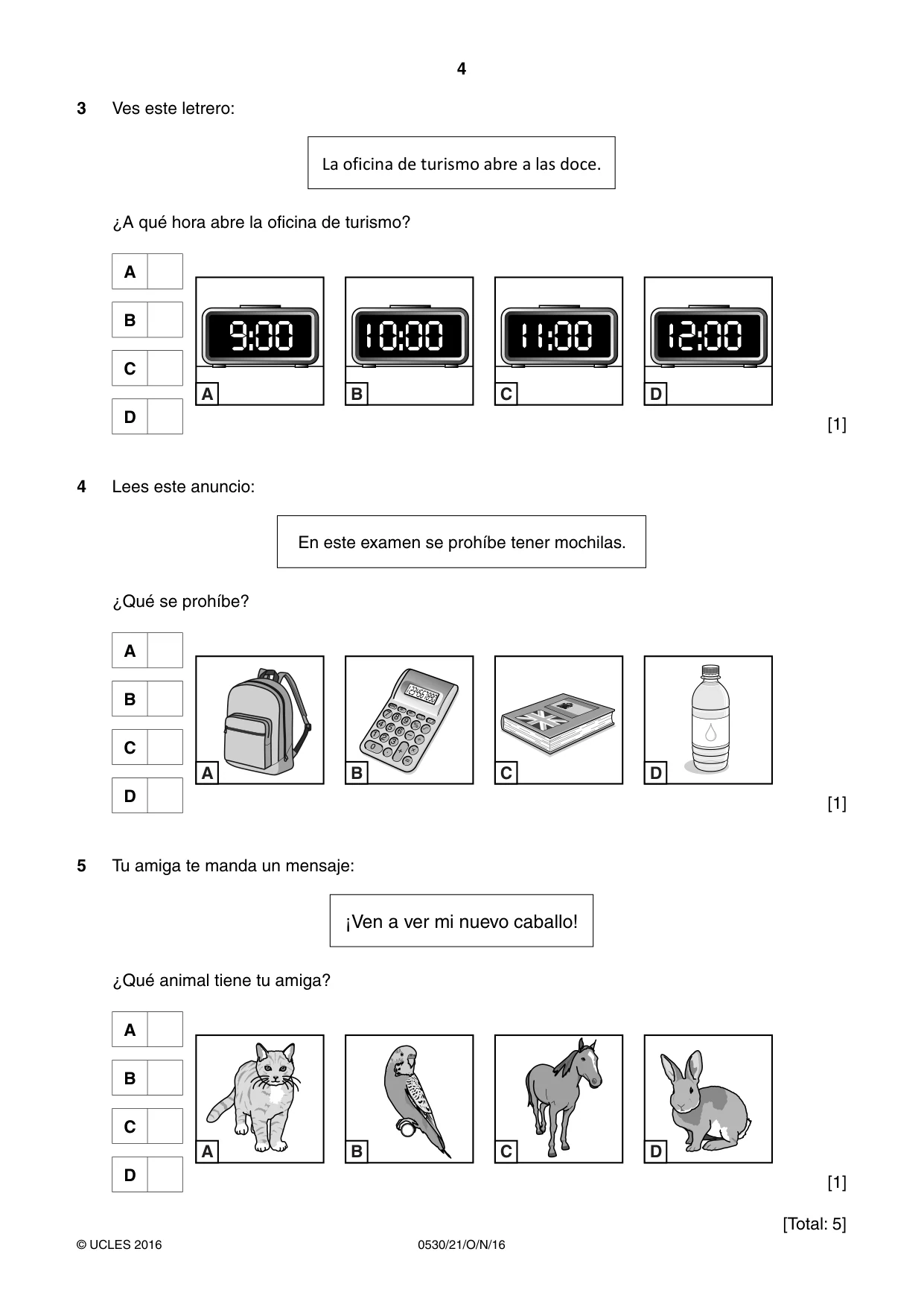
4 0530/21/O/N/16 © UCLES 2016 3 Ves este letrero: La oficina de turismo abre a las doce. ¿A qué hora abre la oficina de turismo? A A B C D [1] B C D 4 Lees este anuncio: En este examen se prohíbe tener mochilas. ¿Qué se prohíbe? A A B C D [1] B C D 5 Tu amiga te manda un mensaje: ¡Ven a ver mi nuevo caballo! ¿Qué animal tiene tu amiga? A A B C D [1] B C D [Tot al: 5]
Question paper, page 5
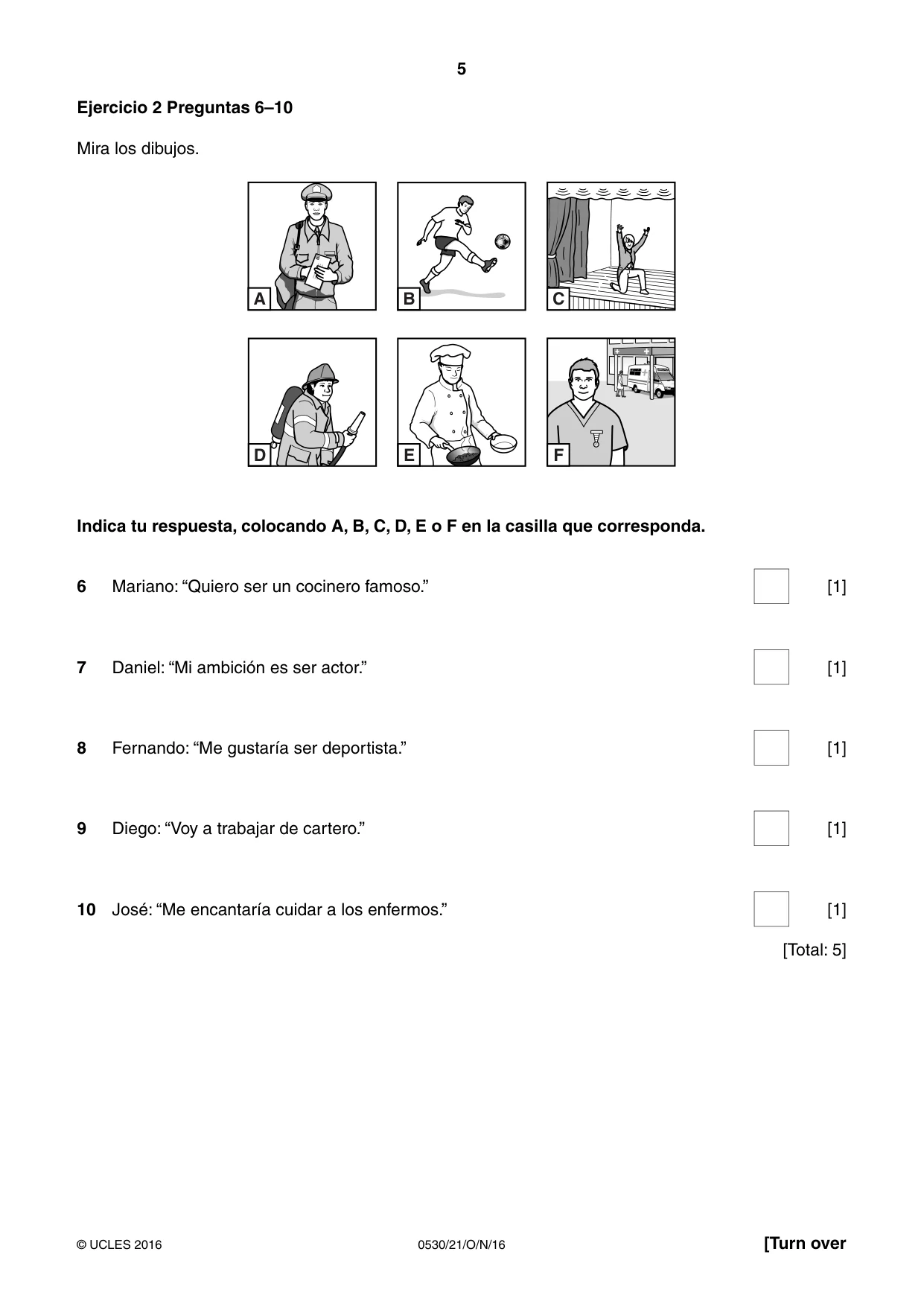
5 0530/21/O/N/16 © UCLES 2016 [Turn over Ejercicio 2 Preguntas 6–10 Mira los dibujos. A B C E F D Indica tu respuesta, colocando A, B, C, D, E o F en la casilla que corresponda. 6 Mariano: “Quiero ser un cocinero famoso.” [1] 7 Daniel: “Mi ambición es ser actor.” [1] 8 Fernando: “Me gustaría ser deportista.” [1] 9 Diego: “Voy a trabajar de cartero.” [1] 10 José: “Me encantaría cuidar a los enfermos.” [1] [Total: 5]
Question paper, page 6
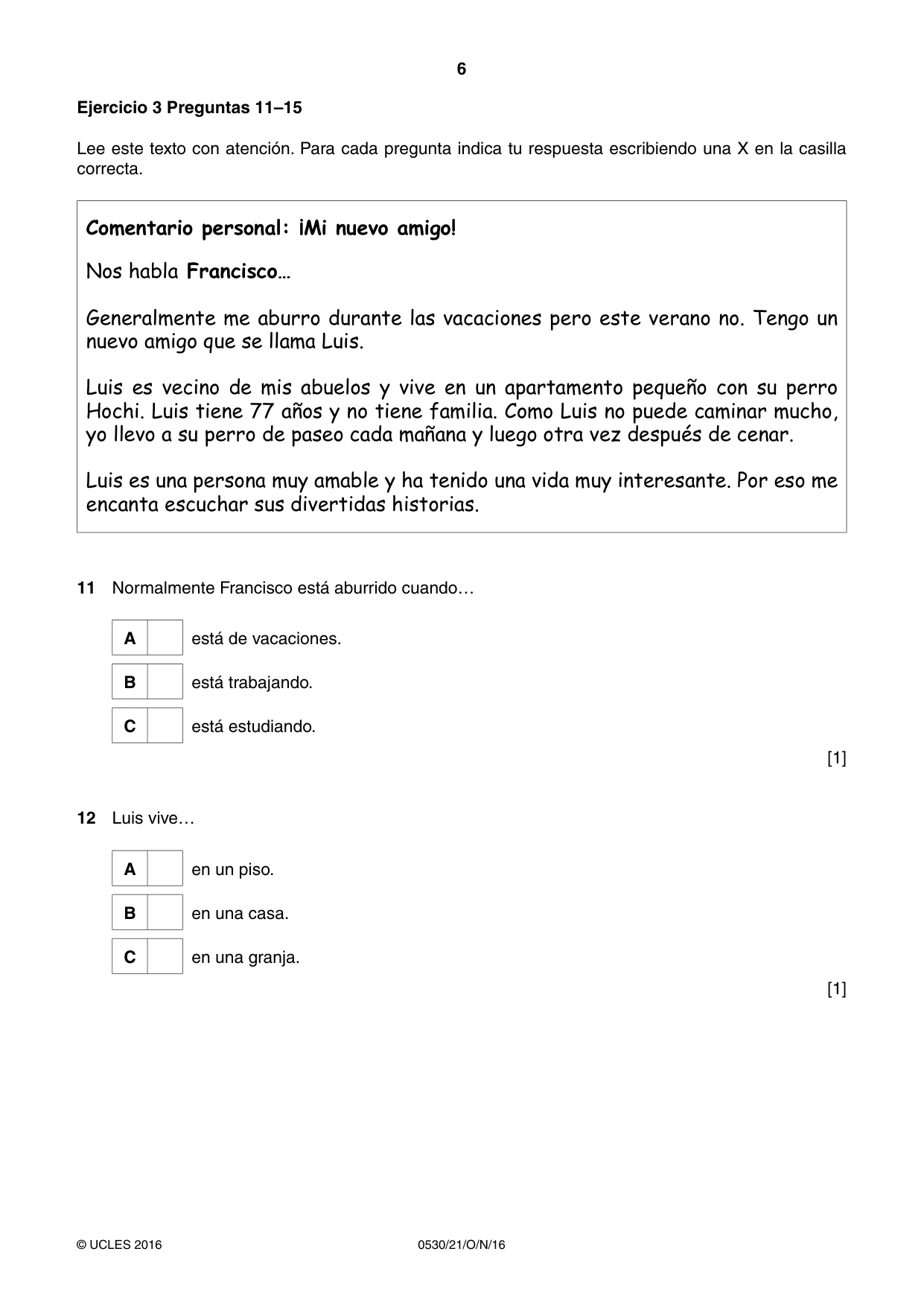
6 0530/21/O/N/16 © UCLES 2016 Ejercicio 3 Preguntas 11–15 Lee este texto con atención. Para cada pregunta indica tu respuesta escribiendo una X en la casilla correcta. Comentario personal: ¡Mi nuevo amigo! Nos habla Francisco… Generalmente me aburro durante las vacaciones pero este verano no. Tengo un nuevo amigo que se llama Luis. Luis es vecino de mis abuelos y vive en un apartamento pequeño con su perro Hochi. Luis tiene 77 años y no tiene familia. Como Luis no puede caminar mucho, yo llevo a su perro de paseo cada mañana y luego otra vez después de cenar. Luis es una persona muy amable y ha tenido una vida muy interesante. Por eso me encanta escuchar sus divertidas historias. 11 Normalmente Francisco está aburrido cuando… A está de vacaciones. B está trabajando. C está estudiando. [1] 12 Luis vive… A en un piso. B en una casa. C en una granja. [1]
Question paper, page 7
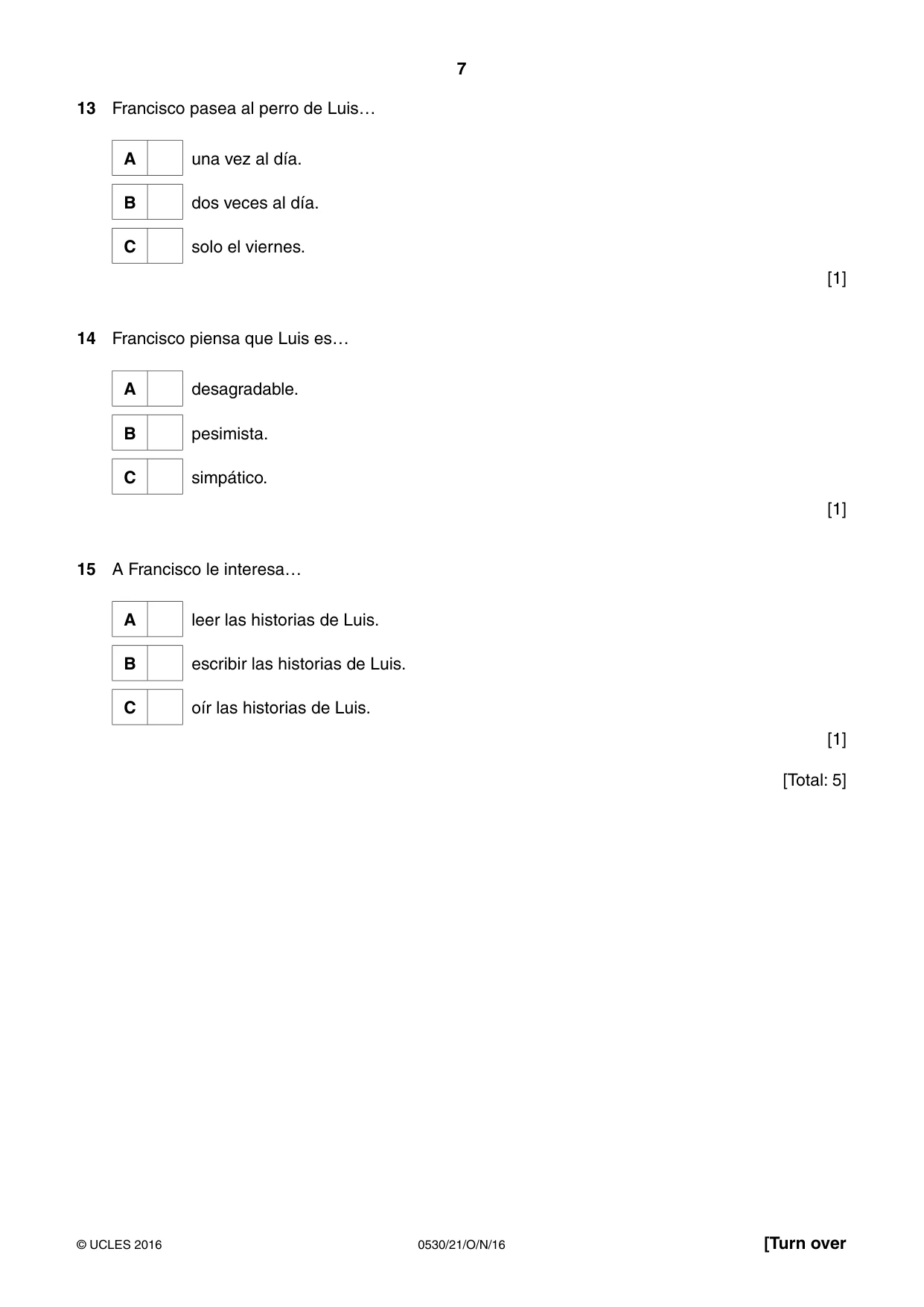
7 0530/21/O/N/16 © UCLES 2016 [Turn over 13 Francisco pasea al perro de Luis… A una vez al día. B dos veces al día. C solo el viernes. [1] 14 Francisco piensa que Luis es… A desagradable. B pesimista. C simpático. [1] 15 A Francisco le interesa… A leer las historias de Luis. B escribir las historias de Luis. C oír las historias de Luis. [1] [Total: 5]
Question paper, page 8
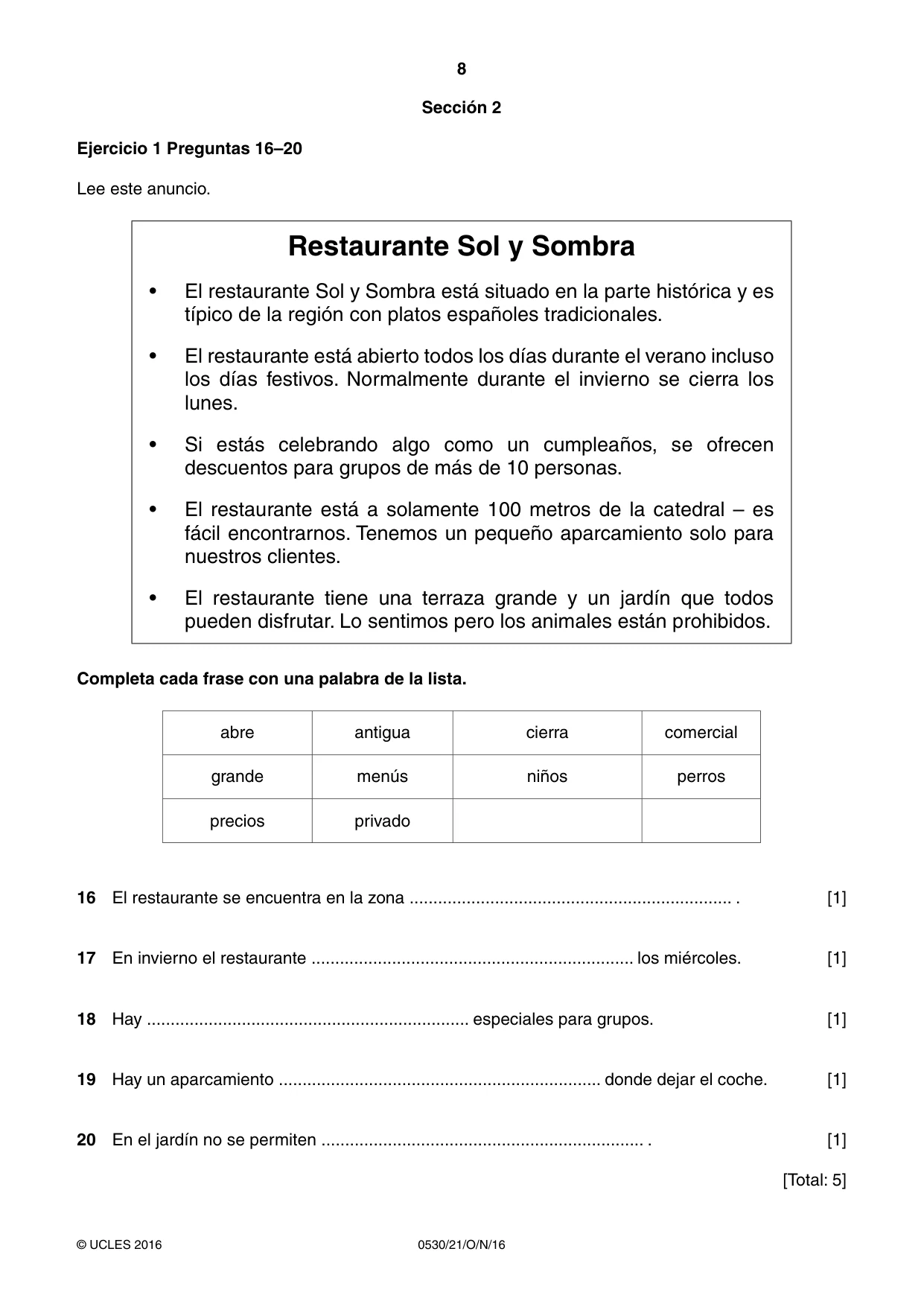
8 0530/21/O/N/16 © UCLES 2016 Sec ción 2 Ejercicio 1 Preguntas 16–20 Lee este anuncio. Restaurante Sol y Sombra • El restaurante Sol y Sombra está situado en la parte histórica y es típico de la región con platos españoles tradicionales. • El restaurante está abierto todos los días durante el verano incluso los días festivos. Normalmente durante el invierno se cierra los lunes. • Si estás celebrando algo como un cumpleaños, se ofrecen descuentos para grupos de más de 10 personas. • El restaurante está a solamente 100 metros de la catedral – es fácil encontrarnos. Tenemos un pequeño aparcamiento solo para nuestros clientes. • El restaurante tiene una terraza grande y un jardín que todos pueden disfrutar. Lo sentimos pero los animales están prohibidos. Completa cada frase con una palabra de la lista. abre antigua cierra comercial grande menús niños perros precios privado 16 El restaurante se encuentra en la zona … . [1] 17 En invierno el restaurante … los miércoles. [1] 18 Hay … especiales para grupos. [1] 19 Hay un aparcamiento … donde dejar el coche. [1] 20 En el jardín no se permiten … . [1] [Total: 5]
Question paper, page 9
9 0530/21/O/N/16 © UCLES 2016 [Turn over Dar la vuelta para el Ejercicio 2.
Question paper, page 10
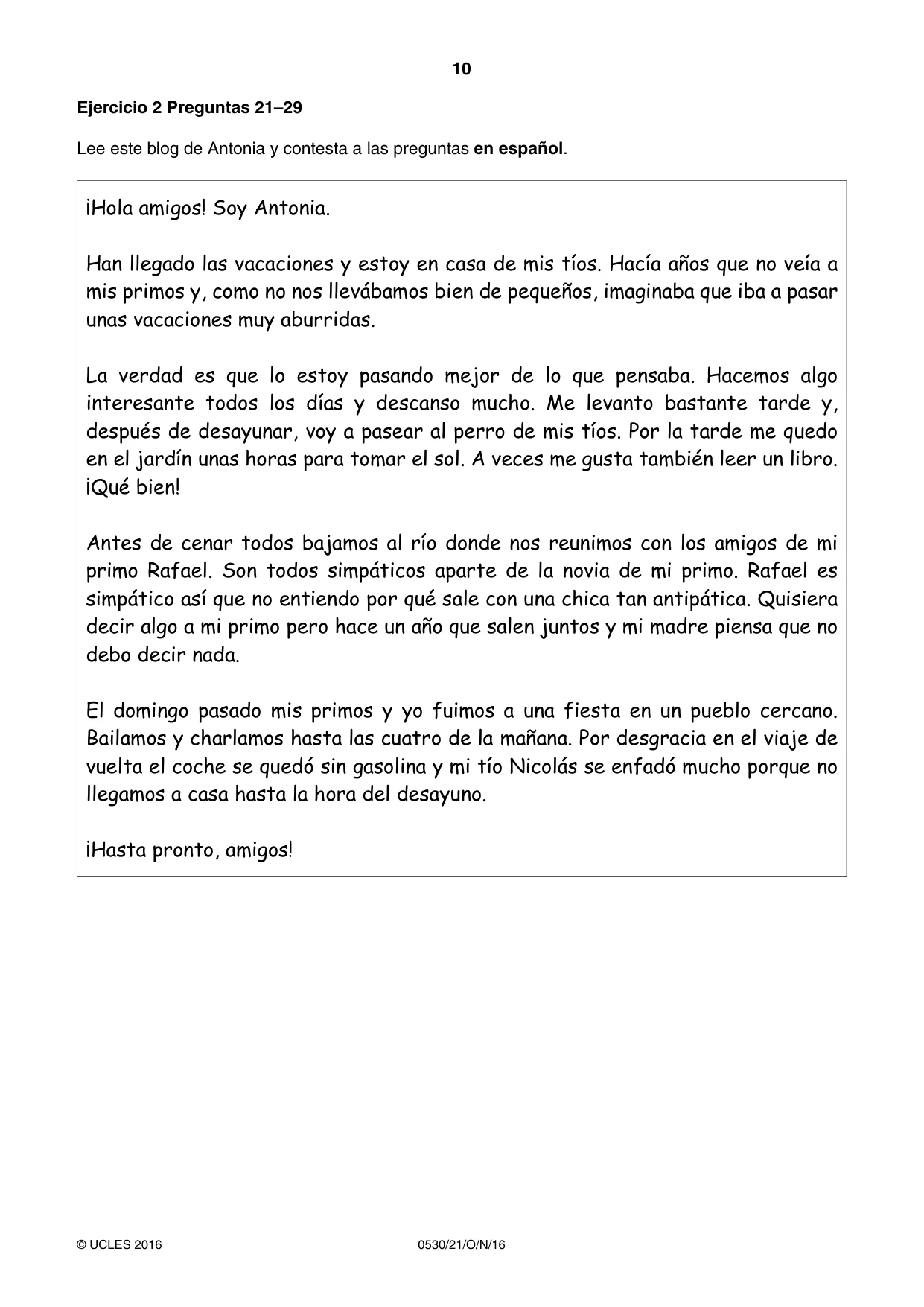
10 0530/21/O/N/16 © UCLES 2016 Ejercicio 2 Preguntas 21–29 Lee este blog de Antonia y contesta a las preguntas en español. ¡Hola amigos! Soy Antonia. Han llegado las vacaciones y estoy en casa de mis tíos. Hacía años que no veía a mis primos y, como no nos llevábamos bien de pequeños, imaginaba que iba a pasar unas vacaciones muy aburridas. La verdad es que lo estoy pasando mejor de lo que pensaba. Hacemos algo interesante todos los días y descanso mucho. Me levanto bastante tarde y, después de desayunar, voy a pasear al perro de mis tíos. Por la tarde me quedo en el jardín unas horas para tomar el sol. A veces me gusta también leer un libro. ¡Qué bien! Antes de cenar todos bajamos al río donde nos reunimos con los amigos de mi primo Rafael. Son todos simpáticos aparte de la novia de mi primo. Rafael es simpático así que no entiendo por qué sale con una chica tan antipática. Quisiera decir algo a mi primo pero hace un año que salen juntos y mi madre piensa que no debo decir nada. El domingo pasado mis primos y yo fuimos a una fiesta en un pueblo cercano. Bailamos y charlamos hasta las cuatro de la mañana. Por desgracia en el viaje de vuelta el coche se quedó sin gasolina y mi tío Nicolás se enfadó mucho porque no llegamos a casa hasta la hora del desayuno. ¡Hasta pronto, amigos!
Question paper, page 11
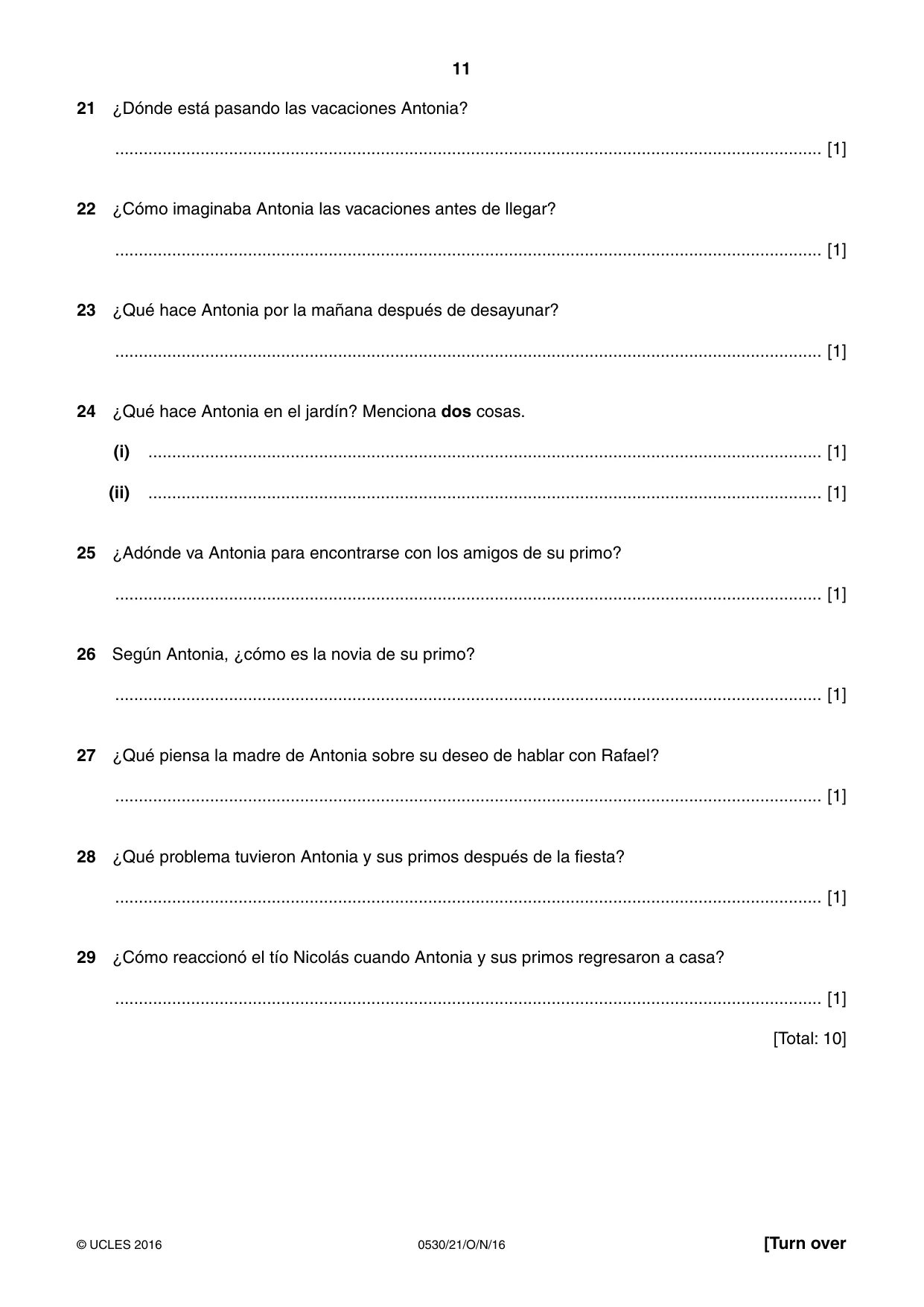
11 0530/21/O/N/16 © UCLES 2016 [Turn over 21 ¿Dónde está pasando las vacaciones Antonia? … [1] 22 ¿Cómo imaginaba Antonia las vacaciones antes de llegar? … [1] 23 ¿Qué hace Antonia por la mañana después de desayunar? … [1] 24 ¿Qué hace Antonia en el jardín? Menciona dos cosas. (i) … [1] (ii) … [1] 25 ¿Adónde va Antonia para encontrarse con los amigos de su primo? … [1] 26 Según Antonia, ¿cómo es la novia de su primo? … [1] 27 ¿Qué piensa la madre de Antonia sobre su deseo de hablar con Rafael? … [1] 28 ¿Qué problema tuvieron Antonia y sus primos después de la fiesta? … [1] 29 ¿Cómo reaccionó el tío Nicolás cuando Antonia y sus primos regresaron a casa? … [1] [Total: 10]
Question paper, page 12
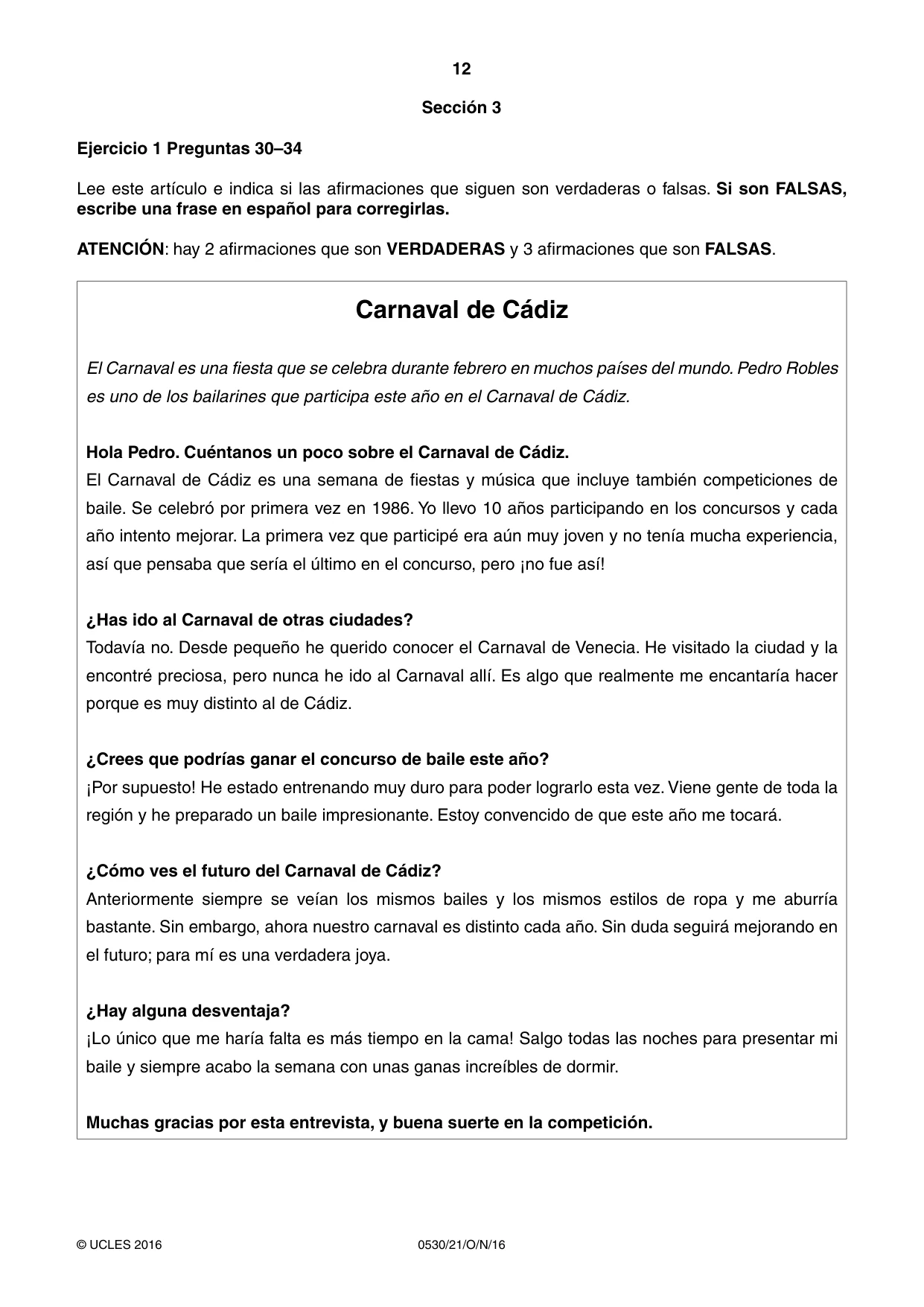
12 0530/21/O/N/16 © UCLES 2016 Secci ón 3 Ejercicio 1 Preguntas 30–34 Lee este artículo e indica si las afirmaciones que siguen son verdaderas o falsas. Si son FALSAS, escribe una frase en español para corregirlas. ATENCIÓN: hay 2 afirmaciones que son VERDADERAS y 3 afirmaciones que son FALSAS. Carnaval de Cádiz El Carnaval es una fiesta que se celebra durante febrero en muchos países del mundo. Pedro Robles es uno de los bailarines que participa este año en el Carnaval de Cádiz. Hola Pedro. Cuéntanos un poco sobre el Carnaval de Cádiz. El Carnaval de Cádiz es una semana de fiestas y música que incluye también competiciones de baile. Se celebró por primera vez en 1986. Yo llevo 10 años participando en los concursos y cada año intento mejorar. La primera vez que participé era aún muy joven y no tenía mucha experiencia, así que pensaba que sería el último en el concurso, pero ¡no fue así! ¿Has ido al Carnaval de otras ciudades? Todavía no. Desde pequeño he querido conocer el Carnaval de Venecia. He visitado la ciudad y la encontré preciosa, pero nunca he ido al Carnaval allí. Es algo que realmente me encantaría hacer porque es muy distinto al de Cádiz. ¿Crees que podrías ganar el concurso de baile este año? ¡Por supuesto! He estado entrenando muy duro para poder lograrlo esta vez. Viene gente de toda la región y he preparado un baile impresionante. Estoy convencido de que este año me tocará. ¿Cómo ves el futuro del Carnaval de Cádiz? Anteriormente siempre se veían los mismos bailes y los mismos estilos de ropa y me aburría bastante. Sin embargo, ahora nuestro carnaval es distinto cada año. Sin duda seguirá mejorando en el futuro; para mí es una verdadera joya. ¿Hay alguna desventaja? ¡Lo único que me haría falta es más tiempo en la cama! Salgo todas las noches para presentar mi baile y siempre acabo la semana con unas ganas increíbles de dormir. Muchas gracias por esta entrevista, y buena suerte en la competición.
Question paper, page 13
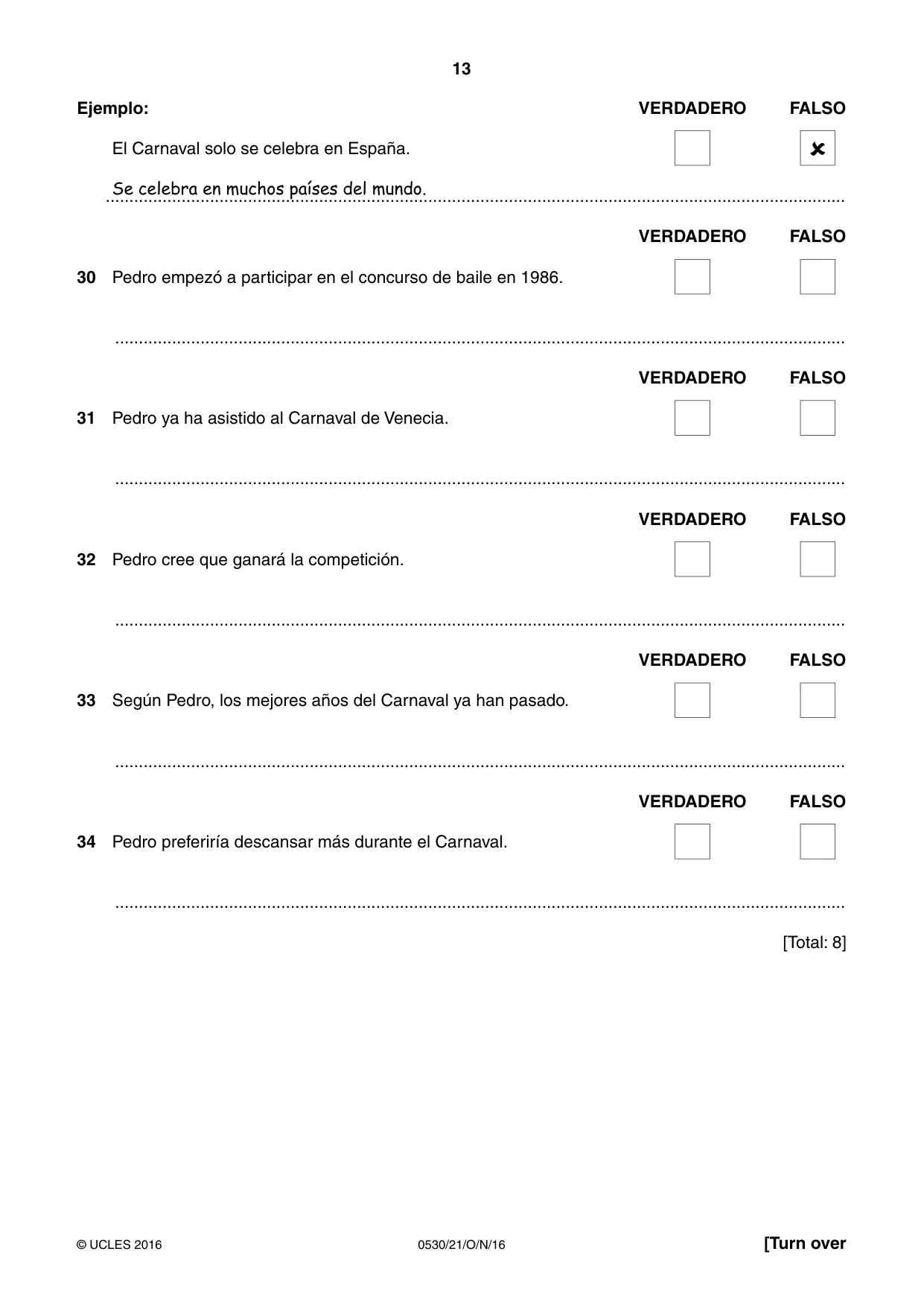
13 0530/21/O/N/16 © UCLES 2016 [Turn over Ejemplo: VERDADERO FALSO El Carnaval solo se celebra en España. Se celebra en muchos países del mundo. … VERDADERO FALSO 30 Pedro empezó a participar en el concurso de baile en 1986. … VERDADERO FALSO 31 Pedro ya ha asistido al Carnaval de Venecia. … VERDADERO FALSO 32 Pedro cree que ganará la competición. … VERDADERO FALSO 33 Según Pedro, los mejores años del Carnaval ya han pasado. … VERDADERO FALSO 34 Pedro preferiría descansar más durante el Carnaval. … [Total: 8]
Question paper, page 14
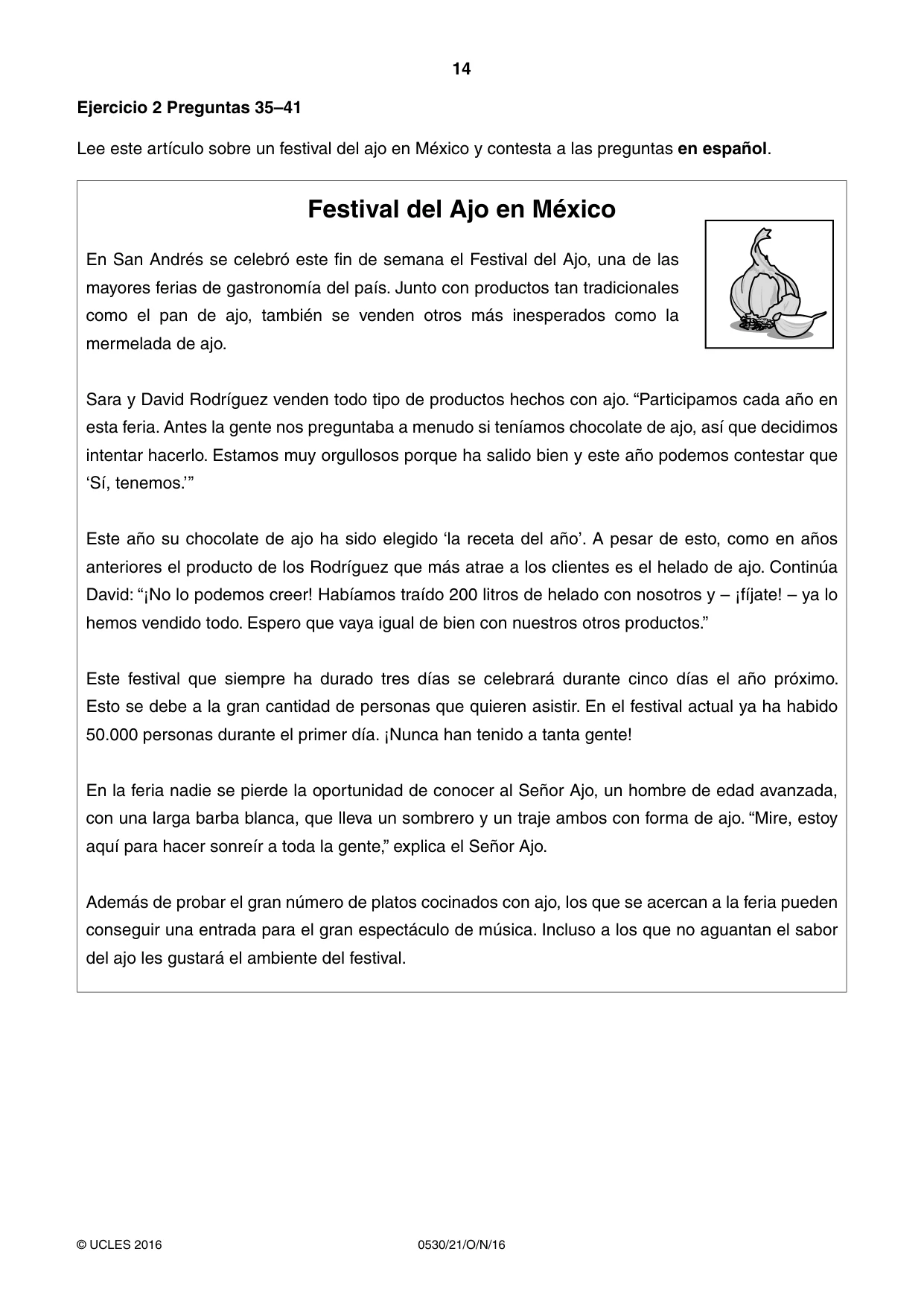
14 0530/21/O/N/16 © UCLES 2016 Ejerci cio 2 Preguntas 35–41 Lee este artículo sobre un festival del ajo en México y contesta a las preguntas en español. Festival del Ajo en México En San Andrés se celebró este fin de semana el Festival del Ajo, una de las mayores ferias de gastronomía del país. Junto con productos tan tradicionales como el pan de ajo, también se venden otros más inesperados como la mermelada de ajo. Sara y David Rodríguez venden todo tipo de productos hechos con ajo. “Participamos cada año en esta feria. Antes la gente nos preguntaba a menudo si teníamos chocolate de ajo, así que decidimos intentar hacerlo. Estamos muy orgullosos porque ha salido bien y este año podemos contestar que ‘Sí, tenemos.’ ” Este año su chocolate de ajo ha sido elegido ‘la receta del año’. A pesar de esto, como en años anteriores el producto de los Rodríguez que más atrae a los clientes es el helado de ajo. Continúa David: “¡No lo podemos creer! Habíamos traído 200 litros de helado con nosotros y – ¡fíjate! – ya lo hemos vendido todo. Espero que vaya igual de bien con nuestros otros productos.” Este festival que siempre ha durado tres días se celebrará durante cinco días el año próximo. Esto se debe a la gran cantidad de personas que quieren asistir. En el festival actual ya ha habido 50.000 personas durante el primer día. ¡Nunca han tenido a tanta gente! En la feria nadie se pierde la oportunidad de conocer al Señor Ajo, un hombre de edad avanzada, con una larga barba blanca, que lleva un sombrero y un traje ambos con forma de ajo. “Mire, estoy aquí para hacer sonreír a toda la gente,” explica el Señor Ajo. Además de probar el gran número de platos cocinados con ajo, los que se acercan a la feria pueden conseguir una entrada para el gran espectáculo de música. Incluso a los que no aguantan el sabor del ajo les gustará el ambiente del festival.
Question paper, page 15
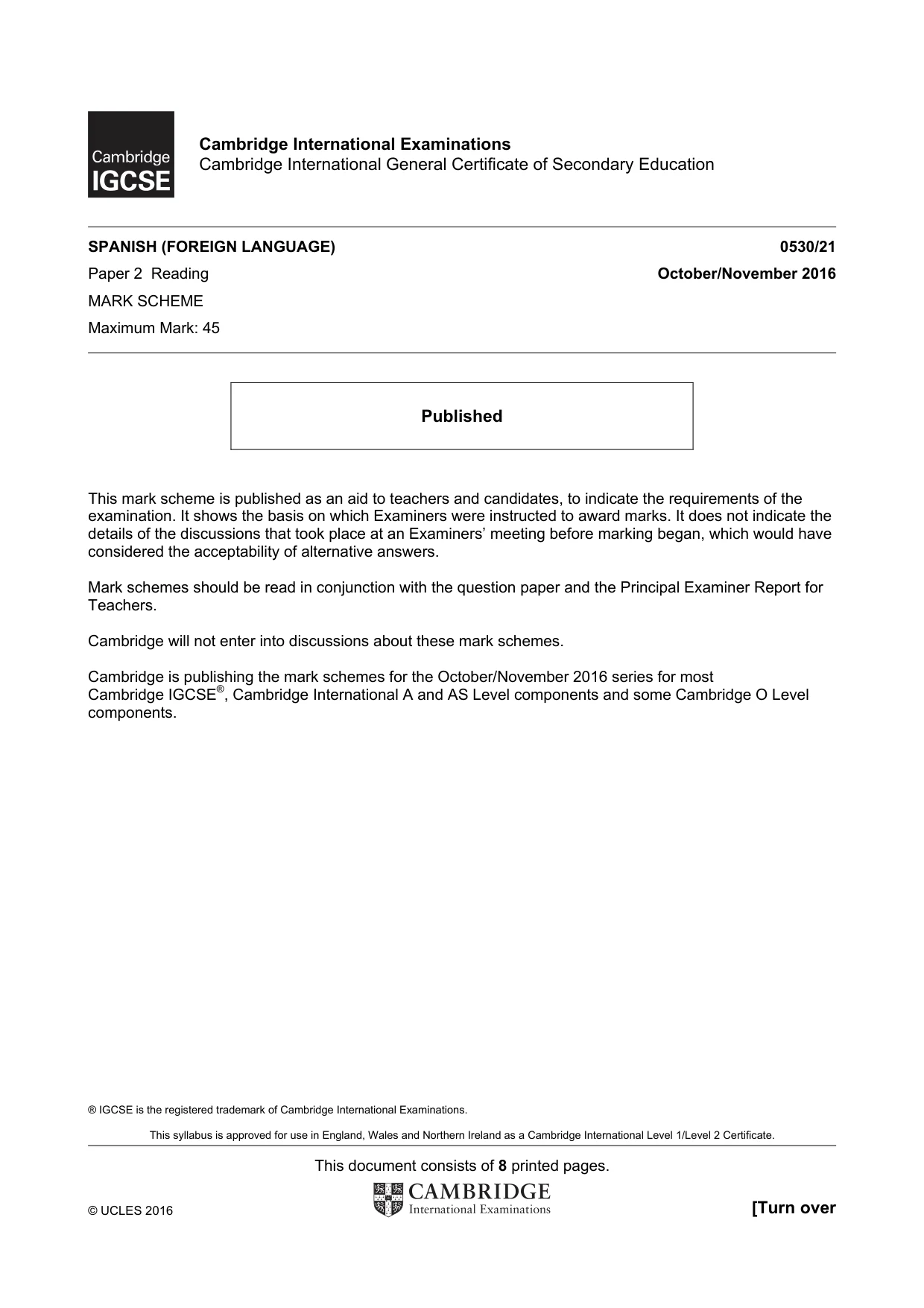
15 0530/21/O/N/16 © UCLES 2016 35 ¿Por qué es importante el Festival del Ajo? … [1] 36 ¿Cómo se sienten los Rodríguez con su nuevo producto? … [1] 37 ¿Qué éxito han tenido los Rodríguez con su chocolate de ajo? … [1] 38 ¿Qué les ha sorprendido a los Rodríguez? … [1] 39 A partir del año que viene, ¿cuánto tiempo durará el festival? … [1] 40 ¿Para qué se viste el hombre anciano como el Señor Ajo? … [1] 41 Aparte de comer, ¿qué otra actividad ofrece el festival? … [1] [Total: 7]
Question paper, page 16
16 0530/21/O/N/16 © UCLES 2016 BLANK PAGE Permission to reproduce items where third-party owned material protected by copyright is included has been sought and cleared where possible. Every reasonable effort has been made by the publisher (UCLES) to trace copyright holders, but if any items requiring clearance have unwittingly been included, the publisher will be pleased to make amends at the earliest possible opportunity. To avoid the issue of disclosure of answer-related information to candidates, all copyright acknowledgements are reproduced online in the Cambridge International Examinations Copyright Acknowledgements Booklet. This is produced for each series of examinations and is freely available to download at www.cie.org.uk after the live examination series. Cambridge International Examinations is part of the Cambridge Assessment Group. Cambridge Assessment is the brand name of University of Cambridge Local Examinations Syndicate (UCLES), which is itself a department of the University of Cambridge.
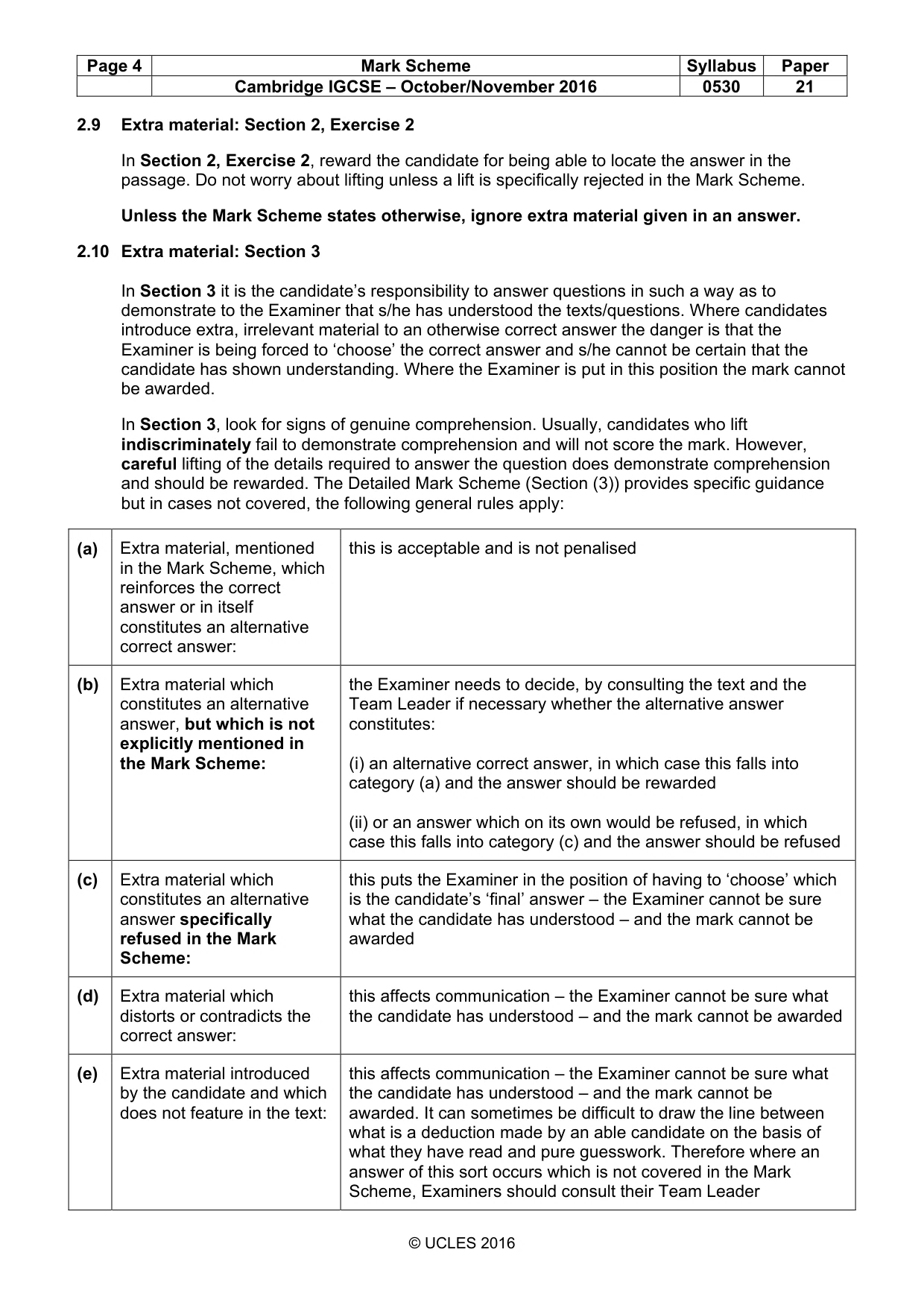
Mark scheme, page 1
® IGCSE is the registered trademark of Cambridge International Examinations. This syllabus is approved for use in England, Wales and Northern Ireland as a Cambridge International Level 1/Level 2 Certificate. This document consists of 8 printed pages. © UCLES 2016 [Turn over Cambridge International Examinations Cambridge International General Certificate of Secondary Education SPANISH (FOREIGN LANGUAGE) 0530/21 Paper 2 Reading October/November 2016 MARK SCHEME Maximum Mark: 45 Published This mark scheme is published as an aid to teachers and candidates, to indicate the requirements of the examination. It shows the basis on which Examiners were instructed to award marks. It does not indicate the details of the discussions that took place at an Examiners’ meeting before marking began, which would have considered the acceptability of alternative answers. Mark schemes should be read in conjunction with the question paper and the Principal Examiner Report for Teachers. Cambridge will not enter into discussions about these mark schemes. Cambridge is publishing the mark schemes for the October/November 2016 series for most Cambridge IGCSE®, Cambridge International A and AS Level components and some Cambridge O Level components.
Mark scheme, page 2
Page 2 Mark Scheme Syllabus Paper Cambridge IGCSE – October/November 2016 0530 21 © UCLES 2016 1 General Marking Notes 2 General Marking Principles 2.1 Please note that it is not possible to list all acceptable alternatives in the Detailed Mark Scheme provided in Section 3. You will need to consider all alternative answers and unexpected approaches in candidates’ scripts, make a decision on whether they communicate the required elements, in consultation with your Team Leader if necessary (or with your Product Manager if you are a single Examiner), and award marks accordingly. The following marking principles underpin the detailed instructions provided in Section 3 of the Mark Scheme. Where a decision is taken to deviate from these principles for a particular question, this will be specified in the Mark Scheme. 2.2 Crossing out: (a) If a candidate changes his/her mind over an answer and crosses out an attempt, award a mark if the final attempt is correct. (b) If a candidate crosses out an answer to a whole question but makes no second attempt at it, mark the crossed out work. 2.3 Reading tasks: more than the stipulated number of boxes ticked/crossed by the candidate: (a) If more than one attempt is visible, but the candidate has clearly indicated which attempt is his/her final answer (e.g. by crossing out other attempts or by annotating the script in some way) mark in the usual way. (b) If two attempts are visible (e.g. two boxes ticked instead of the 1 box stipulated), and neither has been crossed out/discounted by the candidate, no mark can be awarded. (c) In questions where candidates are required to tick a number of boxes (e.g. tick the 6 true statements) the general rule to be applied is as follows: the number of ‘extra’ answers indicated by the candidate is deducted from the number of correct answers and the remaining number is the mark awarded, e.g. the candidate is required to tick 6 true statements, but instead ticks 8 statements. 5 of the 6 ticks are correctly placed, but 2 of the ticks are ‘extras’ (8 ticks placed by candidate minus 6 ticks required by rubric = 2). Therefore the candidate is awarded a mark of 3. number of correct ticks: 5 minus number of extra ticks: –2 mark awarded: = 3 (d) Answers in pen do not take precedence over answers in pencil, e.g. if a candidate is asked to tick 1 box and ticks two, one in pen and the other in pencil, the mark cannot be awarded unless there is some explicit indication from the candidate as to which is his/her final answer. 2.4 Reading tasks: for questions requiring more than one element for the answer, (i) and (ii), where the answers are interchangeable: Both correct answers on line 1 and line 2 blank = 2 Both correct answers on line 1 and line 2 wrong = 1 (or vice-versa)
Mark scheme, page 3
Page 3 Mark Scheme Syllabus Paper Cambridge IGCSE – October/November 2016 0530 21 © UCLES 2016 2.5 Reading tasks: answers requiring the use of Spanish (rather than a non-verbal response) should be marked for communication. Tolerate inaccuracies provided the message is clear. (a) ‘If in doubt, ‘sound it out’: if you read what the candidate has written, does it sound like the correct answer? (b) Look-alike test: does what the candidate has written look like the correct answer? (c) Accept incorrect gender or person unless Mark Scheme specifies otherwise. (d) Accept incorrect possessive adjectives, e.g. mi, tu, su, unless Mark Scheme specifies otherwise (in general, Section 2 accept, Section 3 consult Mark Scheme carefully). 2.6 Unless the Mark Scheme specifies otherwise, do not accept incorrect Spanish if the word given means something else in Spanish. (Incorrect Spanish which constitutes a word in any language other than Spanish is marked (i) on the basis of whether it is accepted or refused in the Mark Scheme and (ii) if not mentioned in the Mark Scheme, on the basis of 2.5 above). 2.7 Annotation used in the Mark Scheme: (a) INV = Invalidation and is used when additional material included by the candidate is judged to invalidate an otherwise correct answer thus preventing him/her from scoring the mark (INV = 0). (b) tc = ‘tout court’ and means that on its own the material is not sufficient to score the mark. (c) HA = harmless additional – material which in conjunction with the correct answer does not prevent the candidate from scoring the mark. (d) BOD = Benefit of the Doubt and is used to indicate material considered by the Examiner and judged to be more correct than incorrect: the benefit of the doubt is given to the candidate and the mark is awarded. 2.8 No response and ‘0’ marks There is a NR (No Response) option in scoris. Award NR (No Response): • If there is nothing written at all in the answer space or • If there is only a comment which does not in any way relate to the question being asked (e.g. ‘can’t do’ or ‘don’t know’) or • If there is only a mark which isn’t an attempt at the question (e.g. a dash, a question mark). Award 0: • If there is any attempt that earns no credit. This could, for example, include the candidate copying all or some of the question, or any working that does not earn any marks, whether crossed out or not.
Mark scheme, page 4
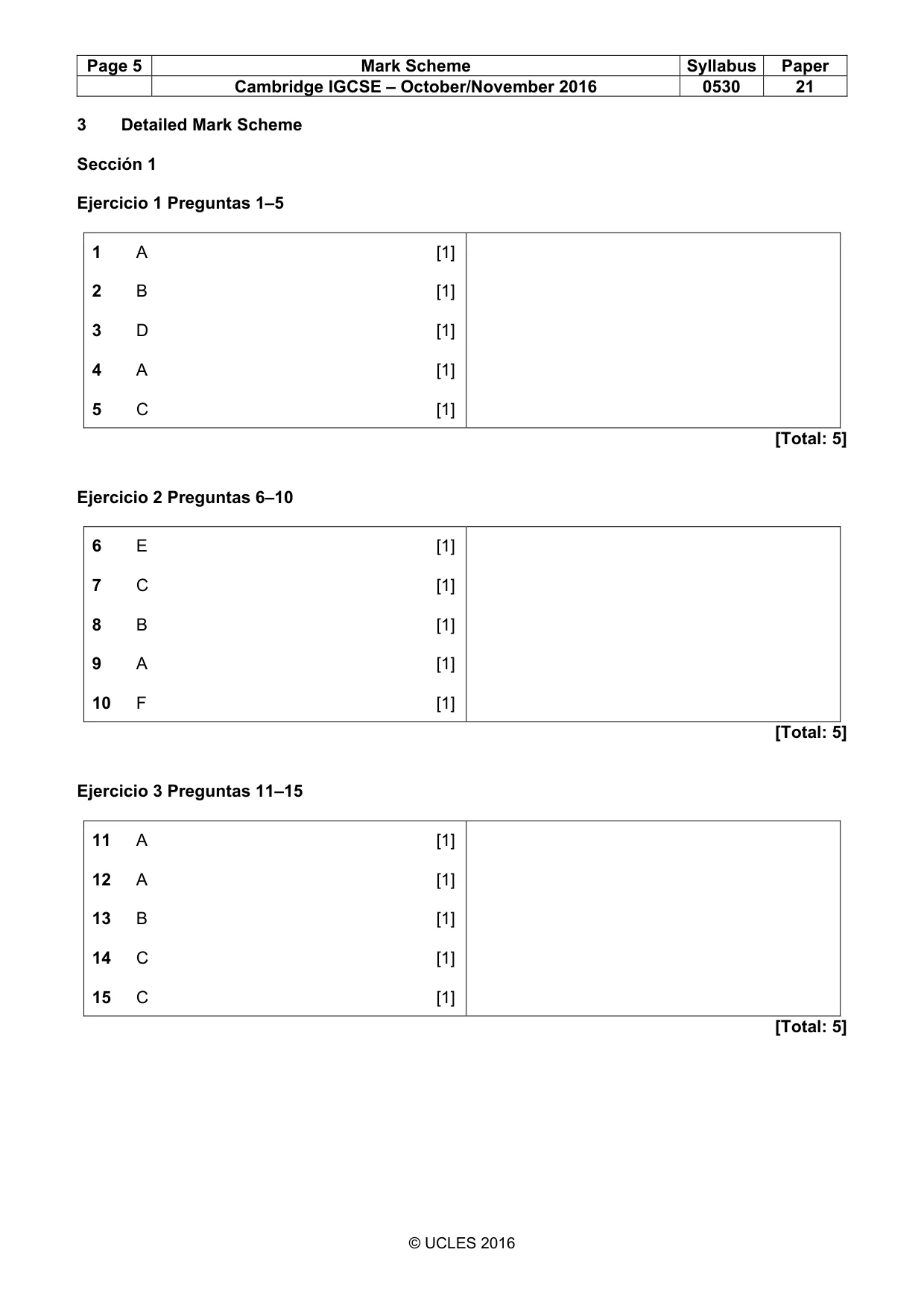
Page 4 Mark Scheme Syllabus Paper Cambridge IGCSE – October/November 2016 0530 21 © UCLES 2016 2.9 Extra material: Section 2, Exercise 2 In Section 2, Exercise 2, reward the candidate for being able to locate the answer in the passage. Do not worry about lifting unless a lift is specifically rejected in the Mark Scheme. Unless the Mark Scheme states otherwise, ignore extra material given in an answer. 2.10 Extra material: Section 3 In Section 3 it is the candidate’s responsibility to answer questions in such a way as to demonstrate to the Examiner that s/he has understood the texts/questions. Where candidates introduce extra, irrelevant material to an otherwise correct answer the danger is that the Examiner is being forced to ‘choose’ the correct answer and s/he cannot be certain that the candidate has shown understanding. Where the Examiner is put in this position the mark cannot be awarded. In Section 3, look for signs of genuine comprehension. Usually, candidates who lift indiscriminately fail to demonstrate comprehension and will not score the mark. However, careful lifting of the details required to answer the question does demonstrate comprehension and should be rewarded. The Detailed Mark Scheme (Section (3)) provides specific guidance but in cases not covered, the following general rules apply: (a) Extra material, mentioned in the Mark Scheme, which reinforces the correct answer or in itself constitutes an alternative correct answer: this is acceptable and is not penalised (b) Extra material which constitutes an alternative answer, but which is not explicitly mentioned in the Mark Scheme: the Examiner needs to decide, by consulting the text and the Team Leader if necessary whether the alternative answer constitutes: (i) an alternative correct answer, in which case this falls into category (a) and the answer should be rewarded (ii) or an answer which on its own would be refused, in which case this falls into category (c) and the answer should be refused (c) Extra material which constitutes an alternative answer specifically refused in the Mark Scheme: this puts the Examiner in the position of having to ‘choose’ which is the candidate’s ‘final’ answer – the Examiner cannot be sure what the candidate has understood – and the mark cannot be awarded (d) Extra material which distorts or contradicts the correct answer: this affects communication – the Examiner cannot be sure what the candidate has understood – and the mark cannot be awarded (e) Extra material introduced by the candidate and which does not feature in the text: this affects communication – the Examiner cannot be sure what the candidate has understood – and the mark cannot be awarded. It can sometimes be difficult to draw the line between what is a deduction made by an able candidate on the basis of what they have read and pure guesswork. Therefore where an answer of this sort occurs which is not covered in the Mark Scheme, Examiners should consult their Team Leader
Mark scheme, page 5
Page 5 Mark Scheme Syllabus Paper Cambridge IGCSE – October/November 2016 0530 21 © UCLES 2016 3 Detailed Mark Scheme Sección 1 Ejercicio 1 Preguntas 1–5 1 A [1] 2 B [1] 3 D [1] 4 A [1] 5 C [1] [Total: 5] Ejercicio 2 Preguntas 6–10 6 E [1] 7 C [1] 8 B [1] 9 A [1] 10 F [1] [Total: 5] Ejercicio 3 Preguntas 11–15 11 A [1] 12 A [1] 13 B [1] 14 C [1] 15 C [1] [Total: 5]
Mark scheme, page 6
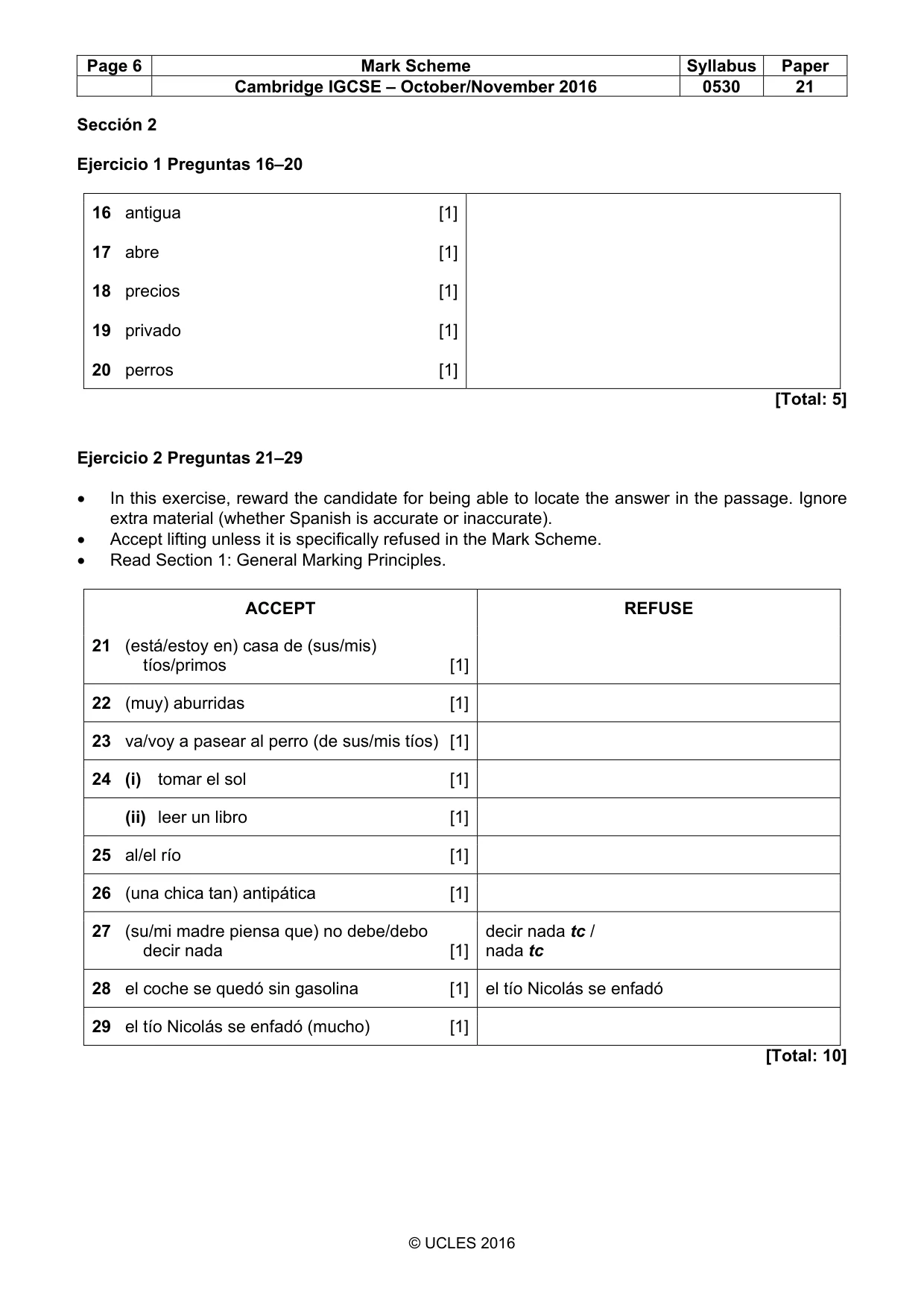
Page 6 Mark Scheme Syllabus Paper Cambridge IGCSE – October/November 2016 0530 21 © UCLES 2016 Sección 2 Ejercicio 1 Preguntas 16–20 16 antigua [1] 17 abre [1] 18 precios [1] 19 privado [1] 20 perros [1] [Total: 5] Ejercicio 2 Preguntas 21–29 • In this exercise, reward the candidate for being able to locate the answer in the passage. Ignore extra material (whether Spanish is accurate or inaccurate). • Accept lifting unless it is specifically refused in the Mark Scheme. • Read Section 1: General Marking Principles. ACCEPT REFUSE 21 (está/estoy en) casa de (sus/mis) tíos/primos [1] 22 (muy) aburridas [1] 23 va/voy a pasear al perro (de sus/mis tíos) [1] 24 (i) tomar el sol [1] (ii) leer un libro [1] 25 al/el río [1] 26 (una chica tan) antipática [1] 27 (su/mi madre piensa que) no debe/debo decir nada [1] decir nada tc / nada tc 28 el coche se quedó sin gasolina [1] el tío Nicolás se enfadó 29 el tío Nicolás se enfadó (mucho) [1] [Total: 10]
Mark scheme, page 7
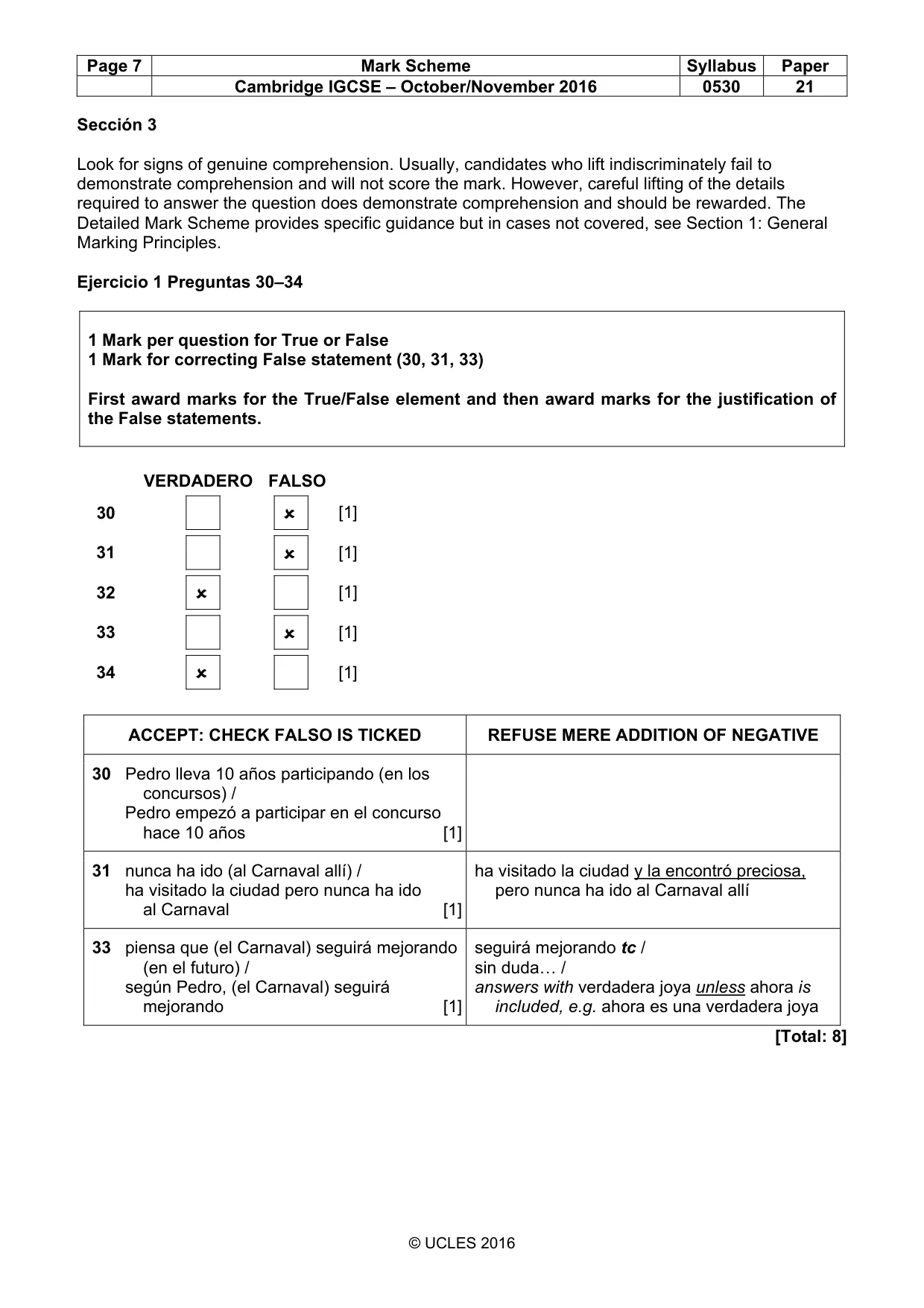
Page 7 Mark Scheme Syllabus Paper Cambridge IGCSE – October/November 2016 0530 21 © UCLES 2016 Sección 3 Look for signs of genuine comprehension. Usually, candidates who lift indiscriminately fail to demonstrate comprehension and will not score the mark. However, careful lifting of the details required to answer the question does demonstrate comprehension and should be rewarded. The Detailed Mark Scheme provides specific guidance but in cases not covered, see Section 1: General Marking Principles. Ejercicio 1 Preguntas 30–34 1 Mark per question for True or False 1 Mark for correcting False statement (30, 31, 33) First award marks for the True/False element and then award marks for the justification of the False statements. VERDADERO FALSO 30 8 [1] 31 8 [1] 32 8 [1] 33 8 [1] 34 8 [1] ACCEPT: CHECK FALSO IS TICKED REFUSE MERE ADDITION OF NEGATIVE 30 Pedro lleva 10 años participando (en los concursos) / Pedro empezó a participar en el concurso hace 10 años [1] 31 nunca ha ido (al Carnaval allí) / ha visitado la ciudad pero nunca ha ido al Carnaval [1] ha visitado la ciudad y la encontró preciosa, pero nunca ha ido al Carnaval allí 33 piensa que (el Carnaval) seguirá mejorando (en el futuro) / según Pedro, (el Carnaval) seguirá mejorando [1] seguirá mejorando tc / sin duda… / answers with verdadera joya unless ahora is included, e.g. ahora es una verdadera joya [Total: 8]
Mark scheme, page 8
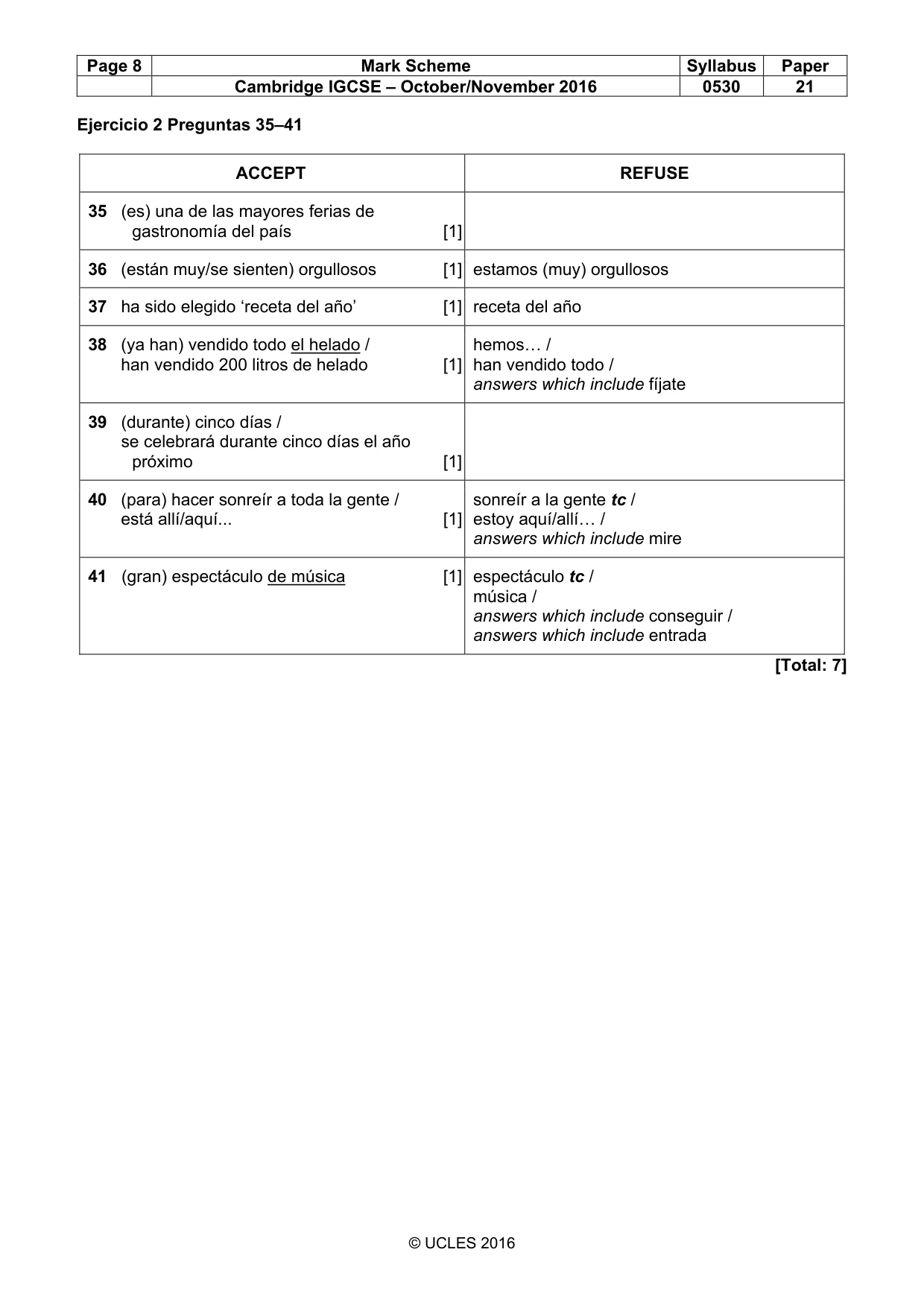
Page 8 Mark Scheme Syllabus Paper Cambridge IGCSE – October/November 2016 0530 21 © UCLES 2016 Ejercicio 2 Preguntas 35–41 ACCEPT REFUSE 35 (es) una de las mayores ferias de gastronomía del país [1] 36 (están muy/se sienten) orgullosos [1] estamos (muy) orgullosos 37 ha sido elegido ‘receta del año’ [1] receta del año 38 (ya han) vendido todo el helado / han vendido 200 litros de helado [1] hemos… / han vendido todo / answers which include fíjate 39 (durante) cinco días / se celebrará durante cinco días el año próximo [1] 40 (para) hacer sonreír a toda la gente / está allí/aquí... [1] sonreír a la gente tc / estoy aquí/allí… / answers which include mire 41 (gran) espectáculo de música [1] espectáculo tc / música / answers which include conseguir / answers which include entrada [Total: 7]
What you needed in this session
Cambridge’s own grade thresholds for 2016 Oct/Nov, Paper 2 · Variant 1. A higher threshold means an easier paper — the bar moves with how the cohort did.