Cambridge IGCSE Spanish - Foreign Language 0530 — 2016 Oct/Nov Paper 2 · Variant 2
0530/22/O/N/16 · 45 marks · ≈51 min
The question paper and its mark scheme, free to read here and free to download. This is Cambridge’s own paper, exactly as it was sat.
Question paper16 pages



Mark scheme8 pages
Answers below. Sit the paper first if you are practising.
Paper as text
Question paper, page 1
This document consists of 14 printed pages and 2 blank pages. DC (NF/FD) 114609/3 © UCLES 2016 [Turn over Cambridge International Examinations Cambridge International General Certificate of Secondary Education * 1 7 5 4 5 5 1 3 4 5 * SPANISH 0530/22 Paper 2 Reading October/November 2016 1 hour Candidates answer on the Question Paper. No Additional Materials are required. READ THESE INSTRUCTIONS FIRST Write your Centre number, candidate number and name on all the work you hand in. Write in dark blue or black pen. Do not use staples, paper clips, glue or correction fluid. DO NOT WRITE IN ANY BARCODES. Answer all questions. The number of marks is given in brackets [ ] at the end of each question or part question. The syllabus is approved for use in England, Wales and Northern Ireland as a Cambridge International Level 1/Level 2 Certificate.
Question paper, page 2
2 0530/22/O/N/16 © UCLES 2016 BLANK PAGE
Question paper, page 3
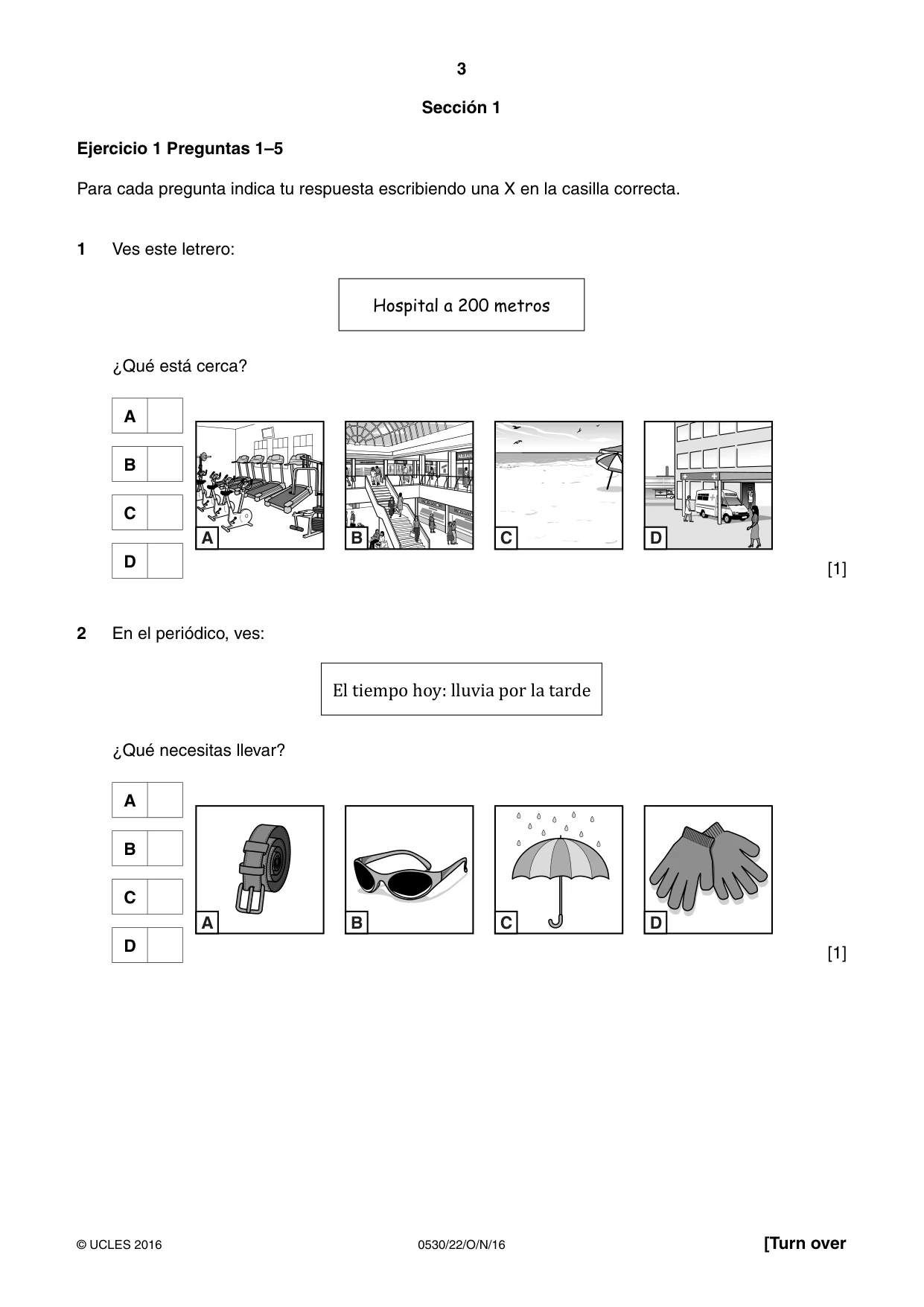
3 0530/22/O/N/16 © UCLES 2016 [Turn over Sección 1 Ejercicio 1 Preguntas 1–5 Para cada pregunta indica tu respuesta escribiendo una X en la casilla correcta. 1 Ves este letrero: Hospital a 200 metros ¿Qué está cerca? A A B C D [1] B C D 2 En el periódico, ves: El tiempo hoy: lluvia por la tarde ¿Qué necesitas llevar? A A B C D [1] B C D
Question paper, page 4
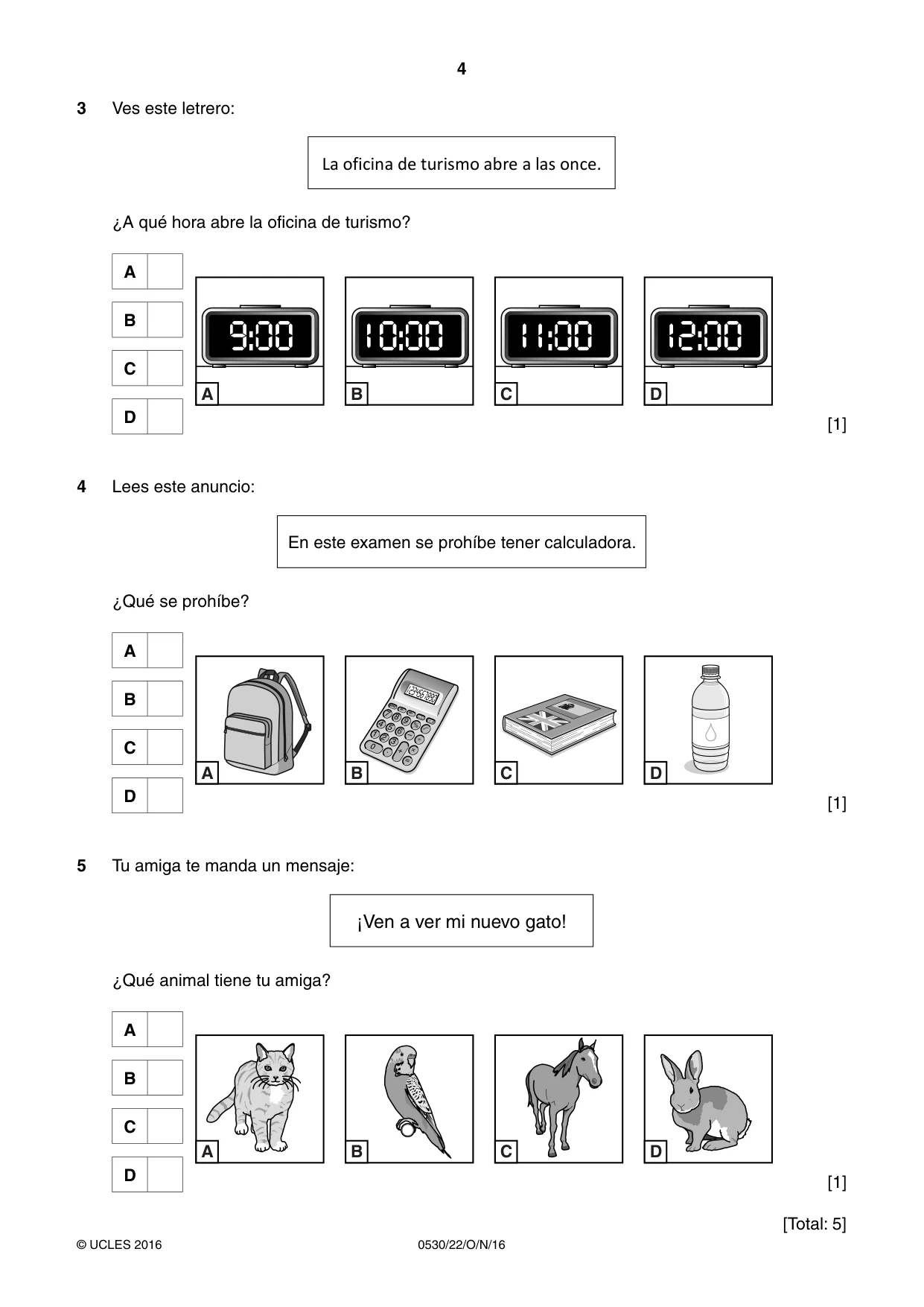
4 0530/22/O/N/16 © UCLES 2016 3 Ves este letrero: La oficina de turismo abre a las once. ¿A qué hora abre la oficina de turismo? A A B C D [1] B C D 4 Lees este anuncio: En este examen se prohíbe tener calculadora. ¿Qué se prohíbe? A A B C D [1] B C D 5 Tu amiga te manda un mensaje: ¡Ven a ver mi nuevo gato! ¿Qué animal tiene tu amiga? A A B C D [1] B C D [Tot al: 5]
Question paper, page 5
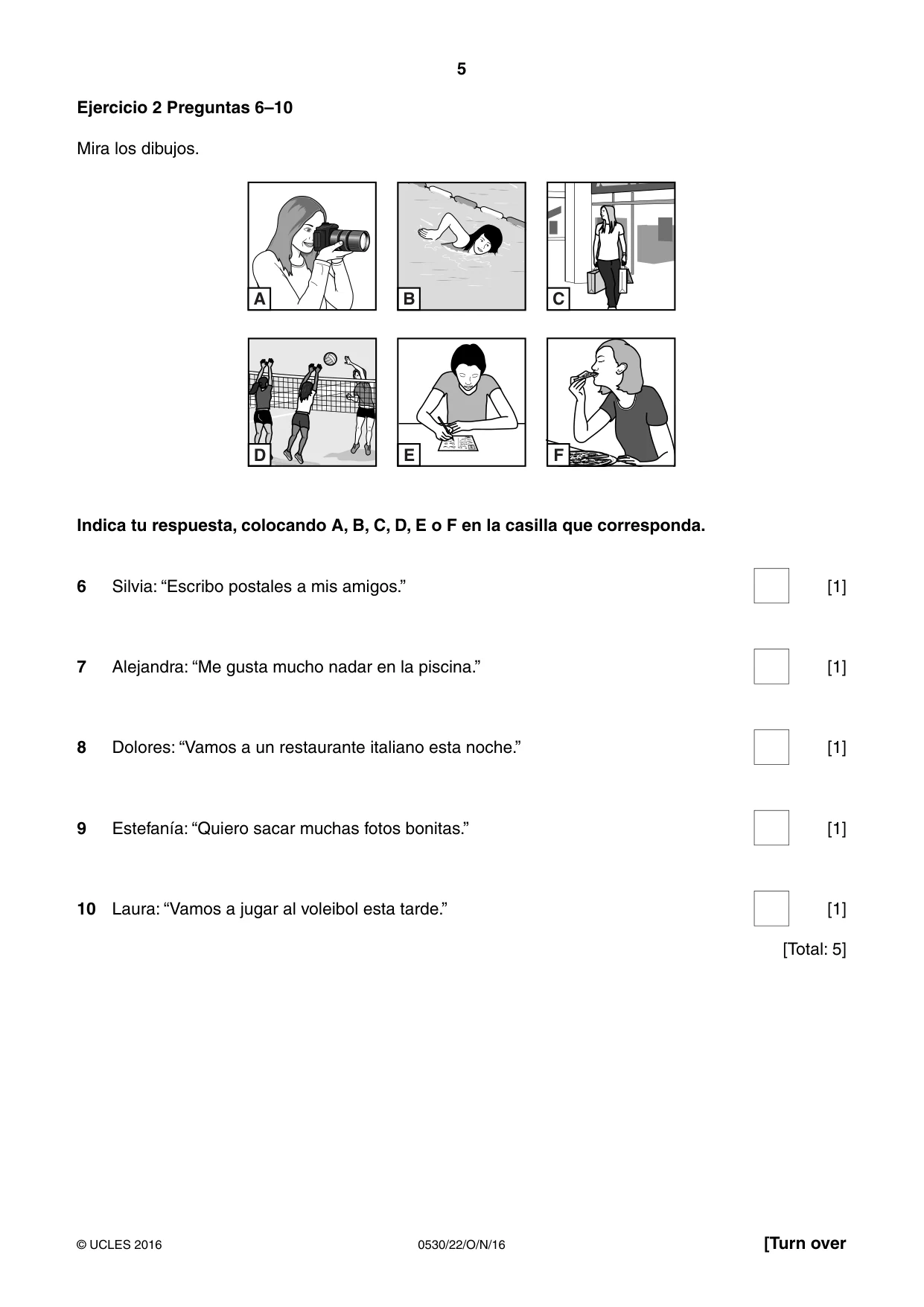
5 0530/22/O/N/16 © UCLES 2016 [Turn over Ejercicio 2 Preguntas 6–10 Mira los dibujos. A B C E F D Indica tu respuesta, colocando A, B, C, D, E o F en la casilla que corresponda. 6 Silvia: “Escribo postales a mis amigos.” [1] 7 Alejandra: “Me gusta mucho nadar en la piscina.” [1] 8 Dolores: “Vamos a un restaurante italiano esta noche.” [1] 9 Estefanía: “Quiero sacar muchas fotos bonitas.” [1] 10 Laura: “Vamos a jugar al voleibol esta tarde.” [1] [Total: 5]
Question paper, page 6
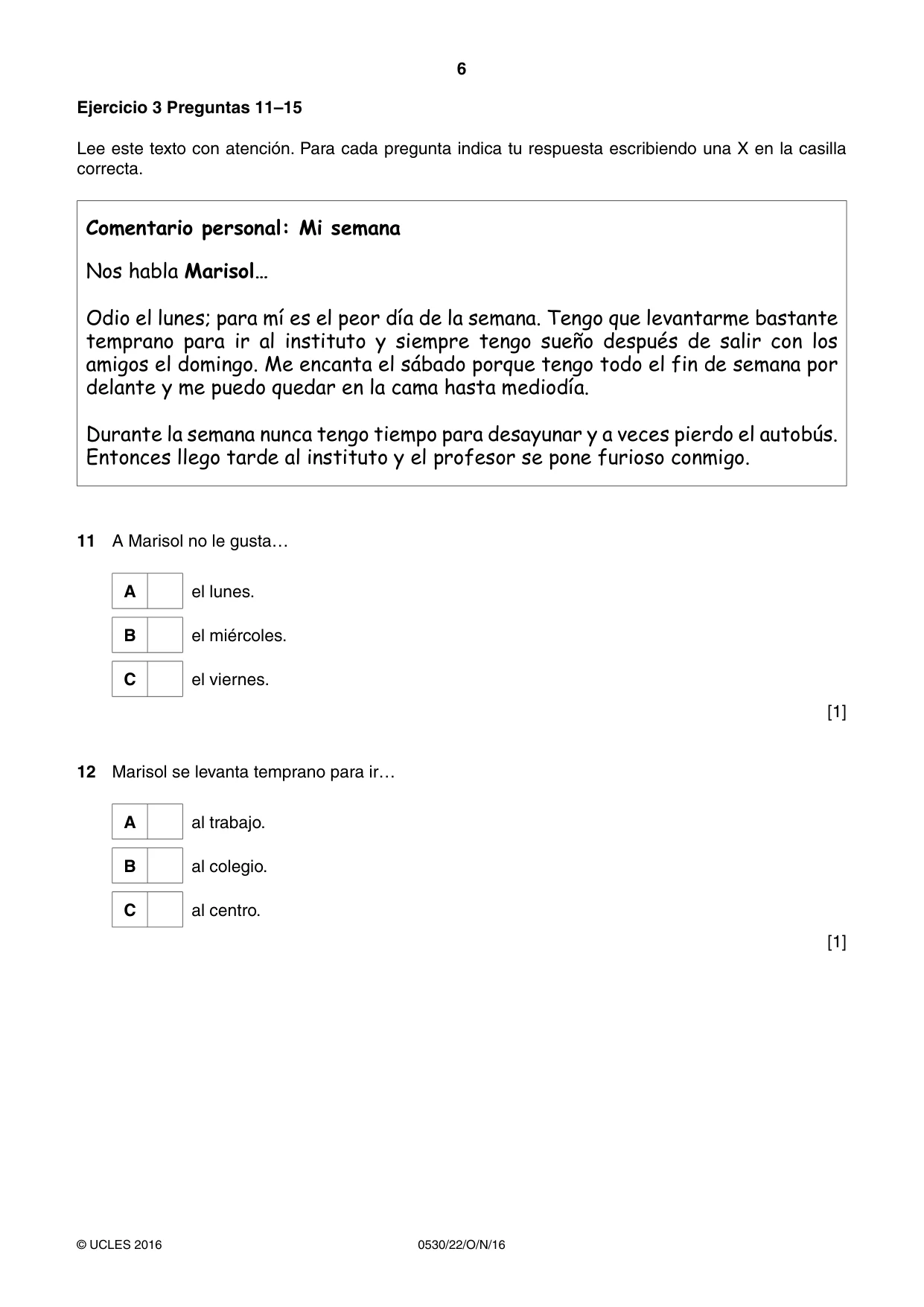
6 0530/22/O/N/16 © UCLES 2016 Ejercicio 3 Preguntas 11–15 Lee este texto con atención. Para cada pregunta indica tu respuesta escribiendo una X en la casilla correcta. Comentario personal: Mi semana Nos habla Marisol… Odio el lunes; para mí es el peor día de la semana. Tengo que levantarme bastante temprano para ir al instituto y siempre tengo sueño después de salir con los amigos el domingo. Me encanta el sábado porque tengo todo el fin de semana por delante y me puedo quedar en la cama hasta mediodía. Durante la semana nunca tengo tiempo para desayunar y a veces pierdo el autobús. Entonces llego tarde al instituto y el profesor se pone furioso conmigo. 11 A Marisol no le gusta… A el lunes. B el miércoles. C el viernes. [1] 12 Marisol se levanta temprano para ir… A al trabajo. B al colegio. C al centro. [1]
Question paper, page 7
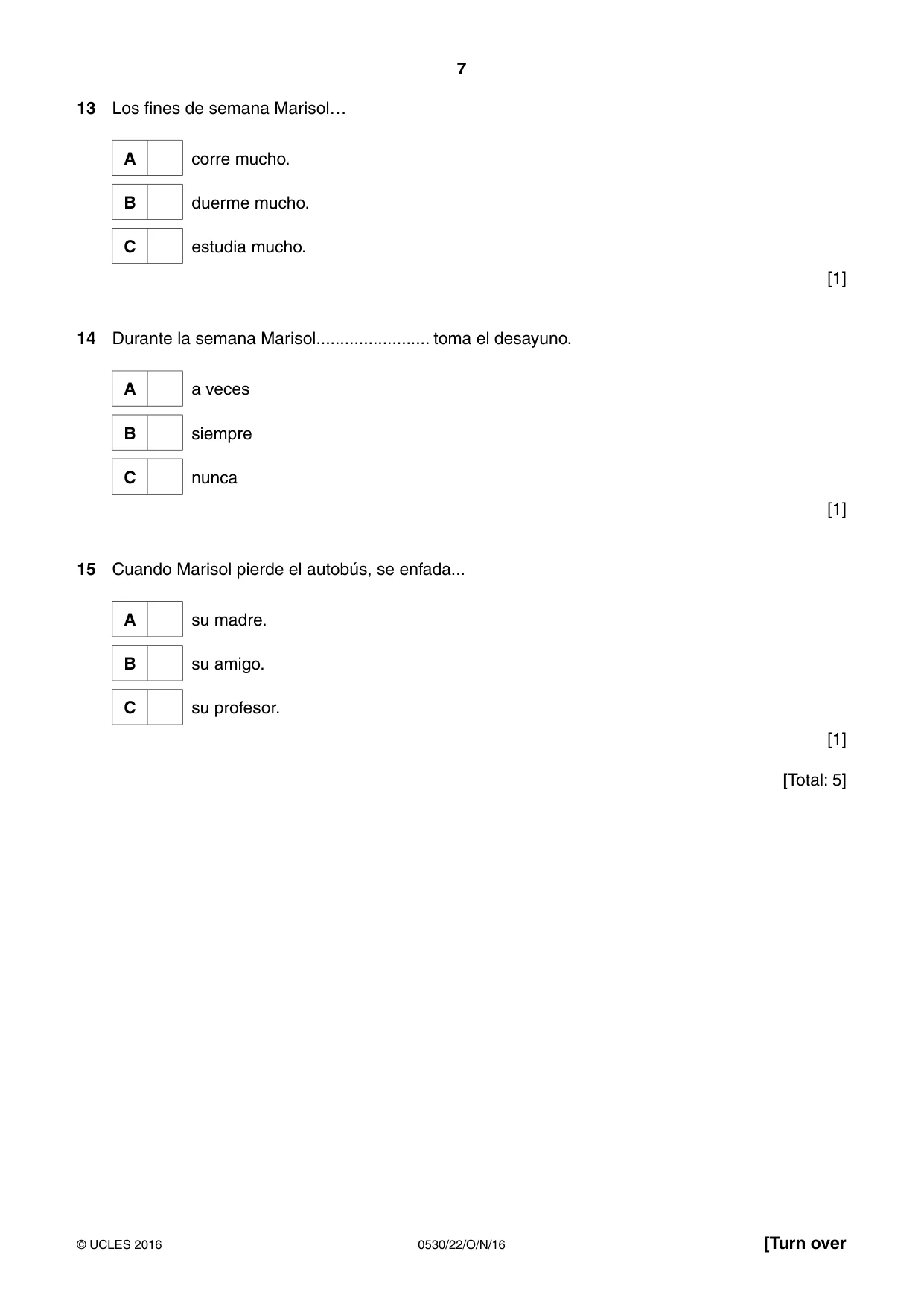
7 0530/22/O/N/16 © UCLES 2016 [Turn over 13 Los fines de semana Marisol… A corre mucho. B duerme mucho. C estudia mucho. [1] 14 Durante la semana Marisol… toma el desayuno. A a veces B siempre C nunca [1] 15 Cuando Marisol pierde el autobús, se enfada... A su madre. B su amigo. C su profesor. [1] [Total: 5]
Question paper, page 8
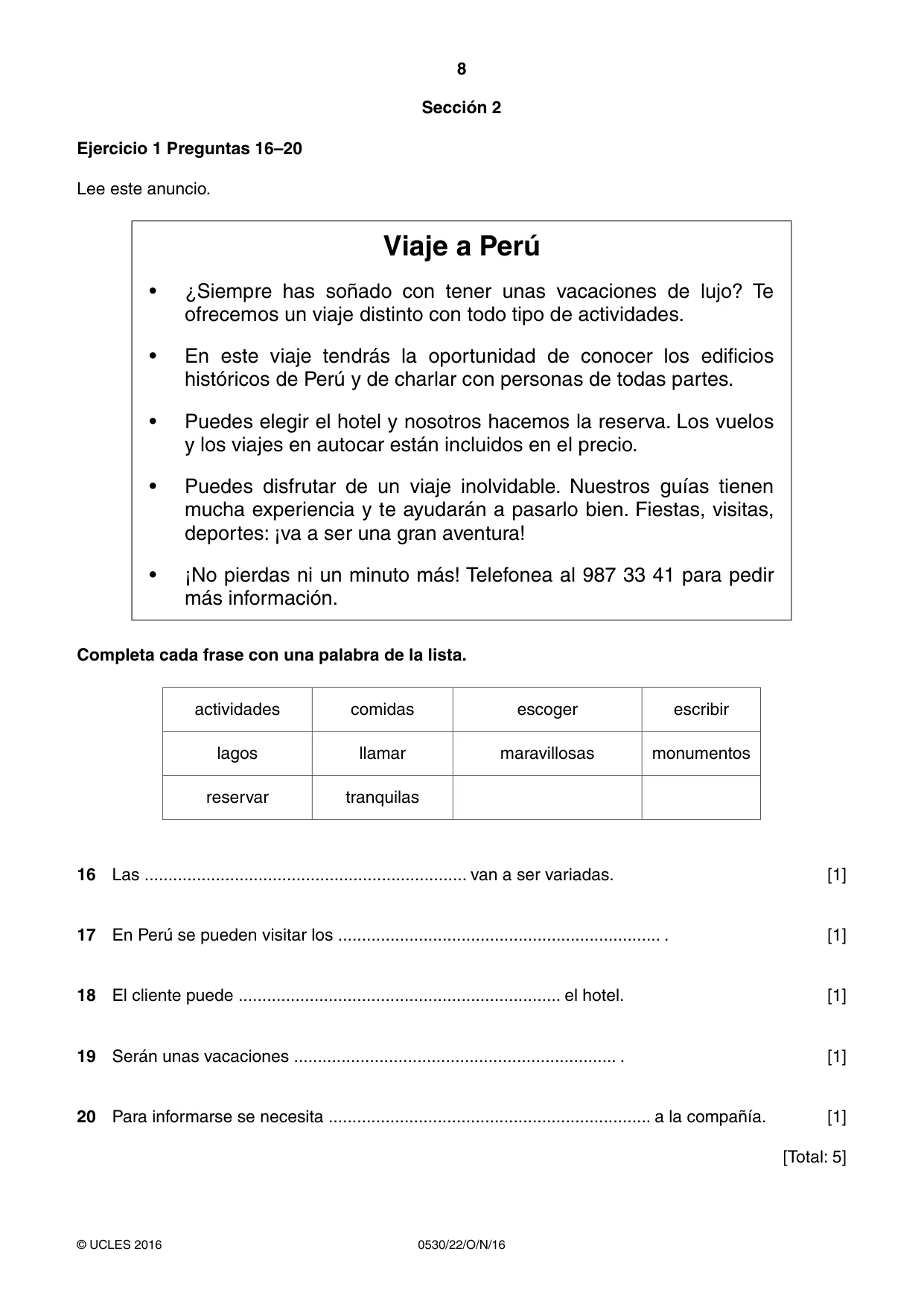
8 0530/22/O/N/16 © UCLES 2016 Sec ción 2 Ejercicio 1 Preguntas 16–20 Lee este anuncio. Viaje a Perú • ¿Siempre has soñado con tener unas vacaciones de lujo? Te ofrecemos un viaje distinto con todo tipo de actividades. • En este viaje tendrás la oportunidad de conocer los edificios históricos de Perú y de charlar con personas de todas partes. • Puedes elegir el hotel y nosotros hacemos la reserva. Los vuelos y los viajes en autocar están incluidos en el precio. • Puedes disfrutar de un viaje inolvidable. Nuestros guías tienen mucha experiencia y te ayudarán a pasarlo bien. Fiestas, visitas, deportes: ¡va a ser una gran aventura! • ¡No pierdas ni un minuto más! Telefonea al 987 33 41 para pedir más información. Completa cada frase con una palabra de la lista. actividades comidas escoger escribir lagos llamar maravillosas monumentos reservar tranquilas 16 Las … van a ser variadas. [1] 17 En Perú se pueden visitar los … . [1] 18 El cliente puede … el hotel. [1] 19 Serán unas vacaciones … . [1] 20 Para informarse se necesita … a la compañía. [1] [Total: 5]
Question paper, page 9
9 0530/22/O/N/16 © UCLES 2016 [Turn over Dar la vuelta para el Ejercicio 2.
Question paper, page 10
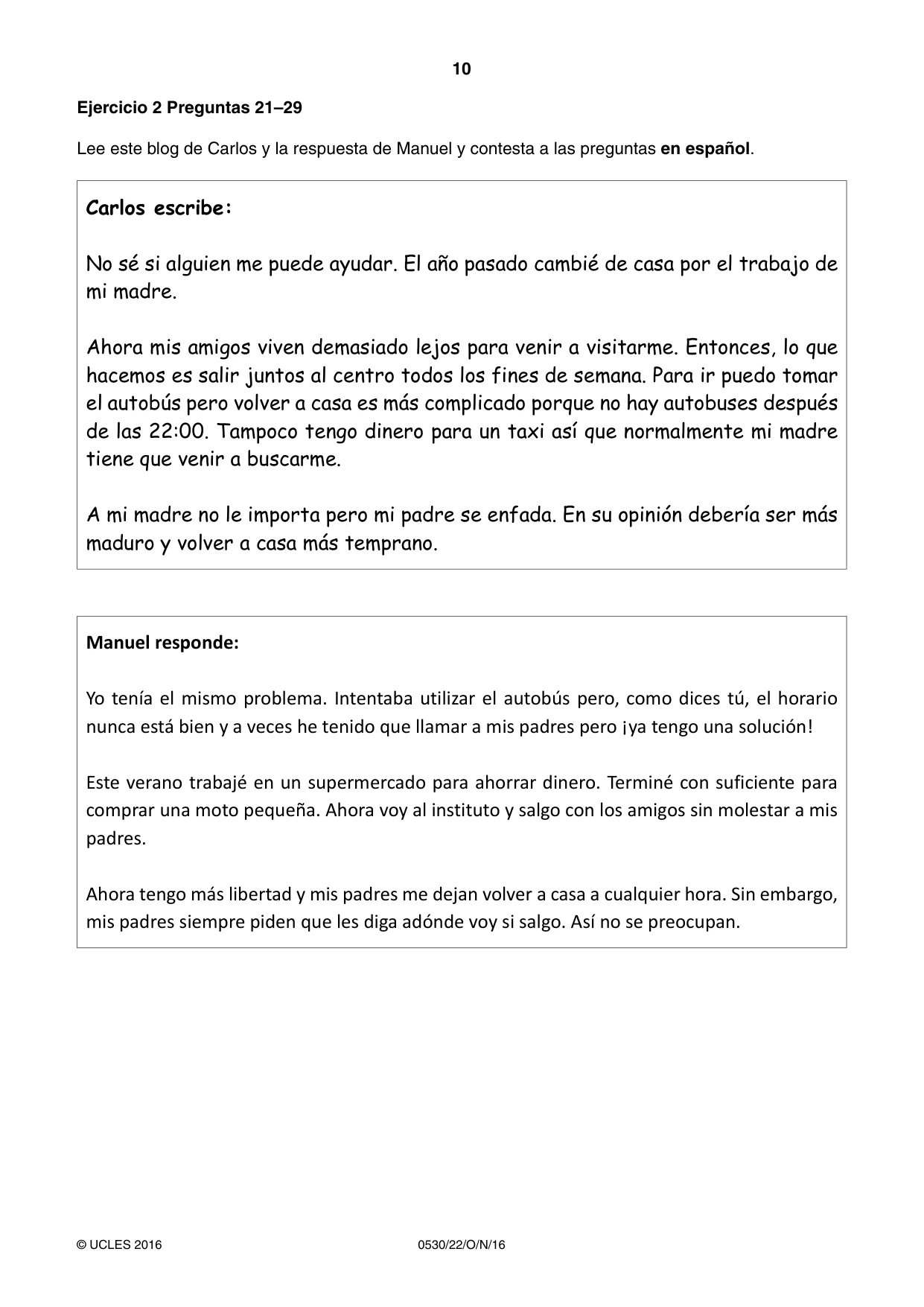
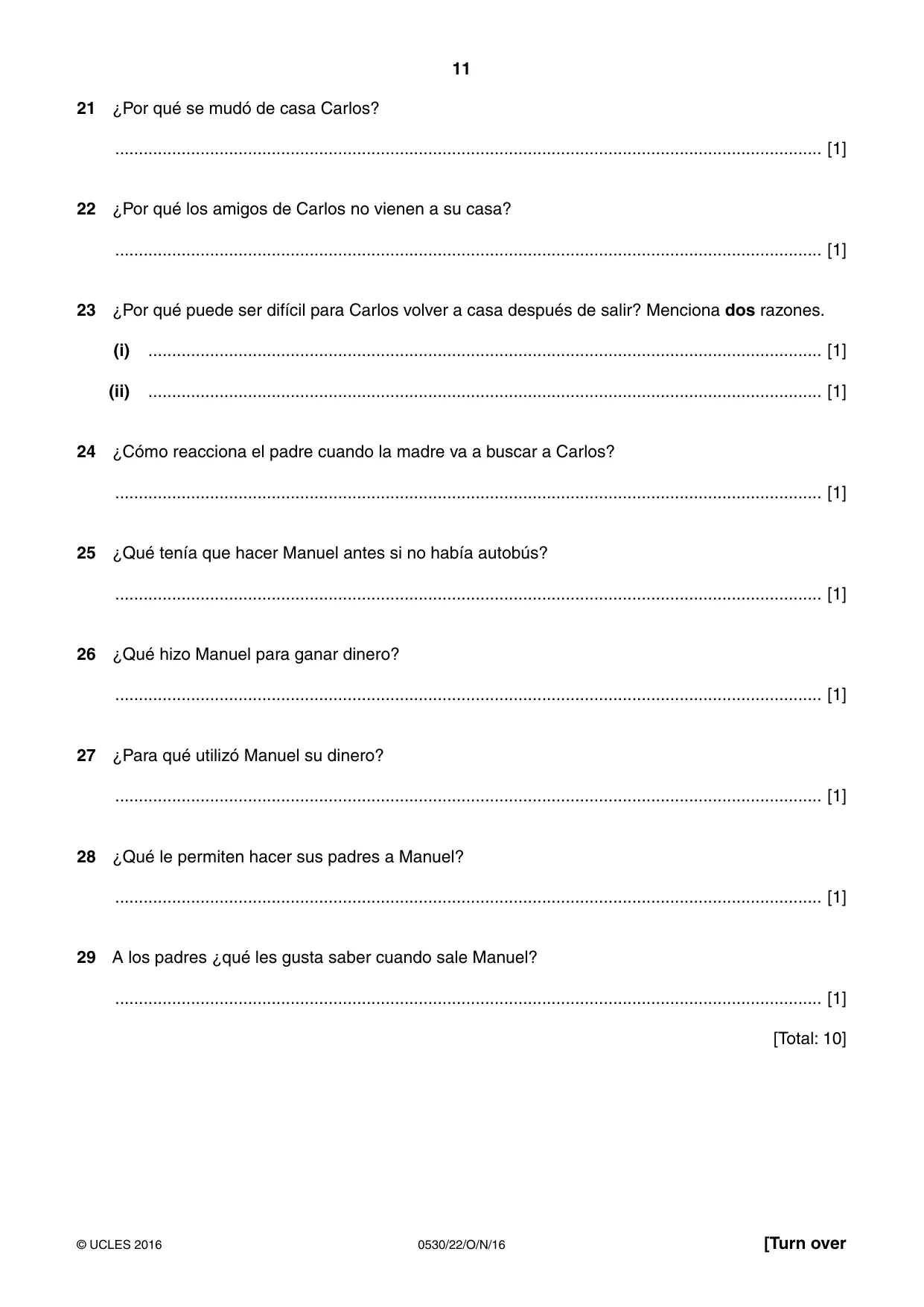
10 0530/22/O/N/16 © UCLES 2016 Ejercicio 2 Preguntas 21–29 Lee este blog de Carlos y la respuesta de Manuel y contesta a las preguntas en español. Carlos escribe: No sé si alguien me puede ayudar. El año pasado cambié de casa por el trabajo de mi madre. Ahora mis amigos viven demasiado lejos para venir a visitarme. Entonces, lo que hacemos es salir juntos al centro todos los fines de semana. Para ir puedo tomar el autobús pero volver a casa es más complicado porque no hay autobuses después de las 22:00. Tampoco tengo dinero para un taxi así que normalmente mi madre tiene que venir a buscarme. A mi madre no le importa pero mi padre se enfada. En su opinión debería ser más maduro y volver a casa más temprano. Manuel responde: Yo tenía el mismo problema. Intentaba utilizar el autobús pero, como dices tú, el horario nunca está bien y a veces he tenido que llamar a mis padres pero ¡ya tengo una solución! Este verano trabajé en un supermercado para ahorrar dinero. Terminé con suficiente para comprar una moto pequeña. Ahora voy al instituto y salgo con los amigos sin molestar a mis padres. Ahora tengo más libertad y mis padres me dejan volver a casa a cualquier hora. Sin embargo, mis padres siempre piden que les diga adónde voy si salgo. Así no se preocupan.
Question paper, page 11
11 0530/22/O/N/16 © UCLES 2016 [Turn over 21 ¿Por qué se mudó de casa Carlos? … [1] 22 ¿Por qué los amigos de Carlos no vienen a su casa? … [1] 23 ¿Por qué puede ser difícil para Carlos volver a casa después de salir? Menciona dos razones. (i) … [1] (ii) … [1] 24 ¿Cómo reacciona el padre cuando la madre va a buscar a Carlos? … [1] 25 ¿Qué tenía que hacer Manuel antes si no había autobús? … [1] 26 ¿Qué hizo Manuel para ganar dinero? … [1] 27 ¿Para qué utilizó Manuel su dinero? … [1] 28 ¿Qué le permiten hacer sus padres a Manuel? … [1] 29 A los padres ¿qué les gusta saber cuando sale Manuel? … [1] [Total: 10]
Question paper, page 12
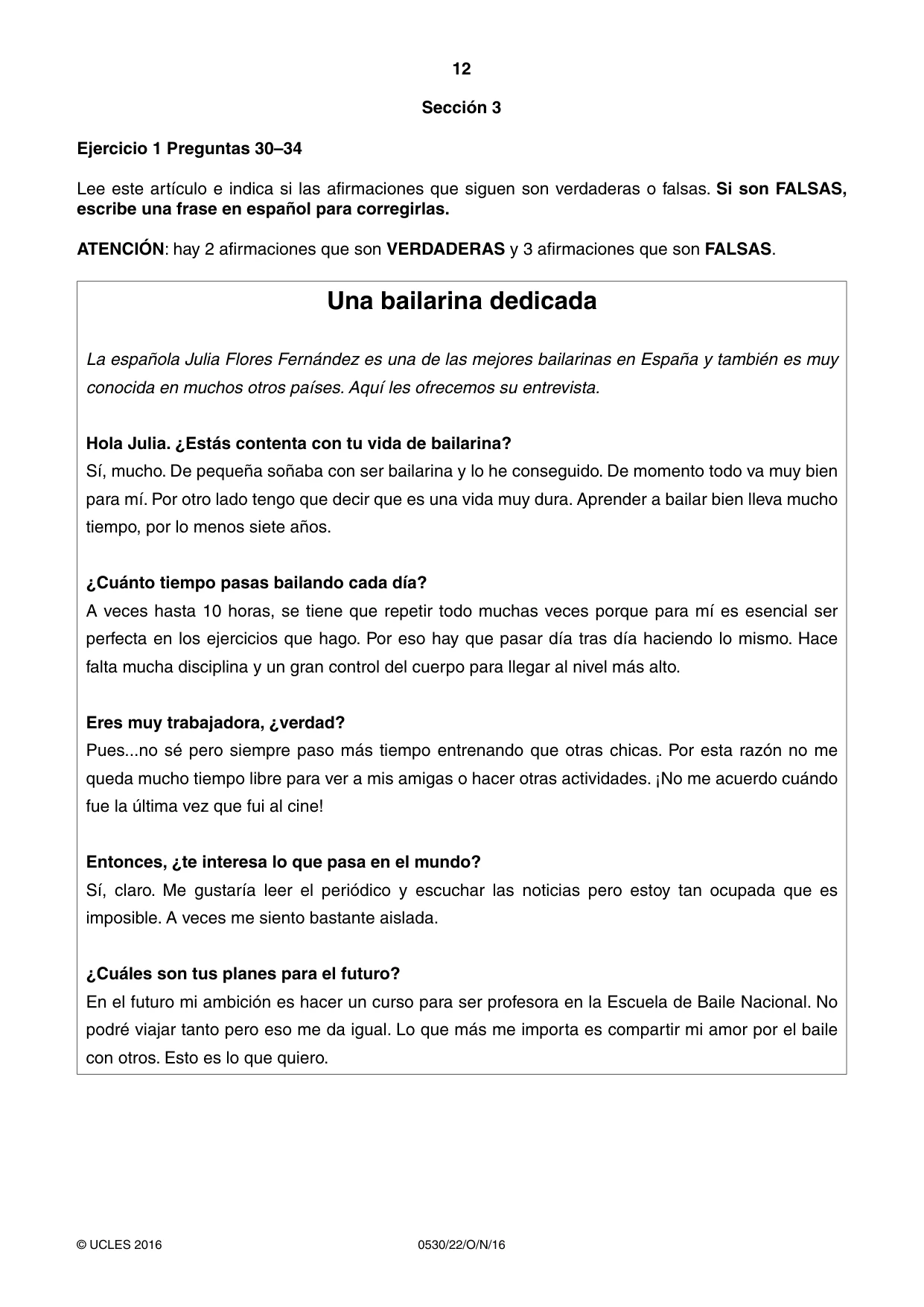
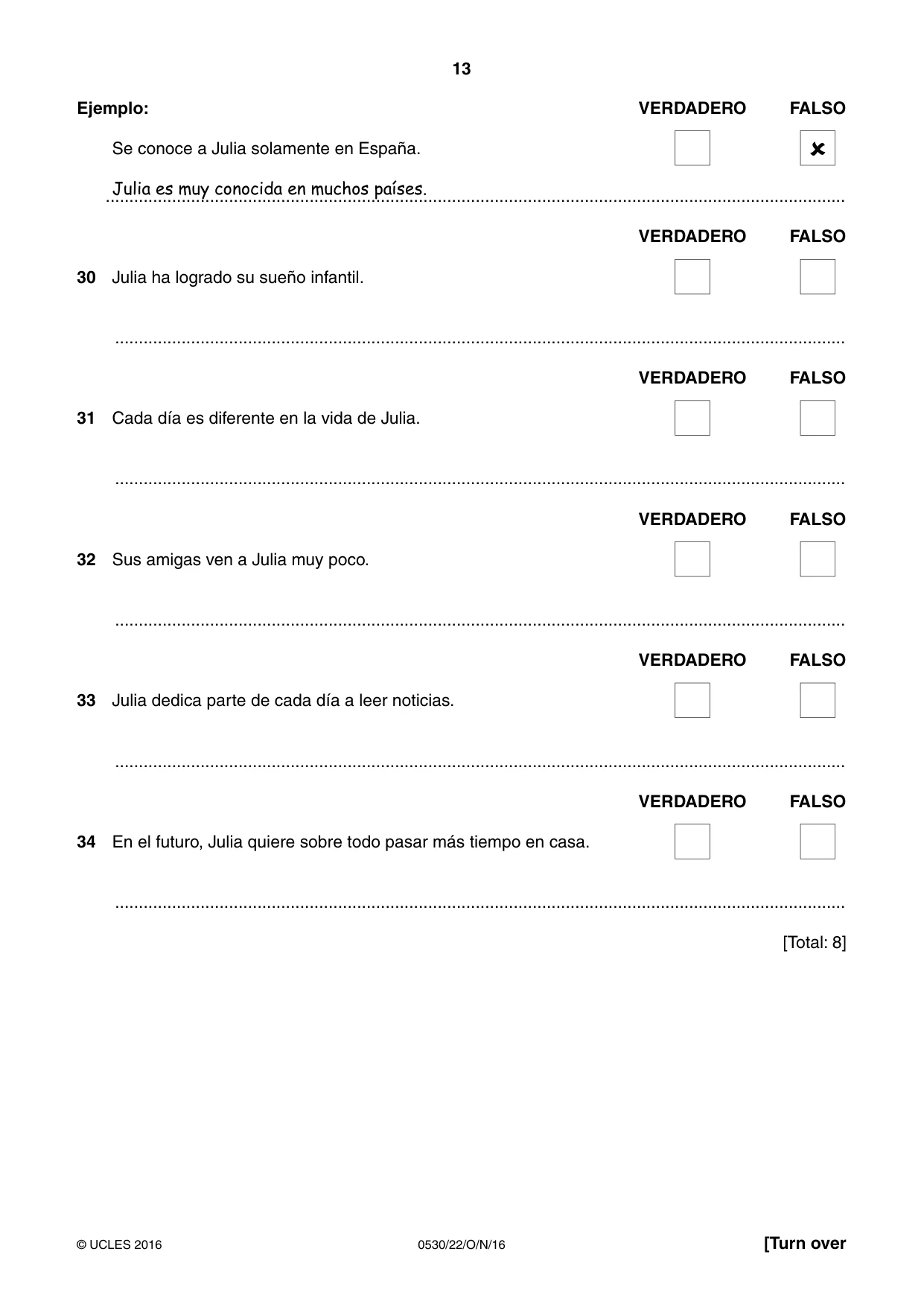
12 0530/22/O/N/16 © UCLES 2016 Secci ón 3 Ejercicio 1 Preguntas 30–34 Lee este artículo e indica si las afirmaciones que siguen son verdaderas o falsas. Si son FALSAS, escribe una frase en español para corregirlas. ATENCIÓN: hay 2 afirmaciones que son VERDADERAS y 3 afirmaciones que son FALSAS. Una bailarina dedicada La española Julia Flores Fernández es una de las mejores bailarinas en España y también es muy conocida en muchos otros países. Aquí les ofrecemos su entrevista. Hola Julia. ¿Estás contenta con tu vida de bailarina? Sí, mucho. De pequeña soñaba con ser bailarina y lo he conseguido. De momento todo va muy bien para mí. Por otro lado tengo que decir que es una vida muy dura. Aprender a bailar bien lleva mucho tiempo, por lo menos siete años. ¿Cuánto tiempo pasas bailando cada día? A veces hasta 10 horas, se tiene que repetir todo muchas veces porque para mí es esencial ser perfecta en los ejercicios que hago. Por eso hay que pasar día tras día haciendo lo mismo. Hace falta mucha disciplina y un gran control del cuerpo para llegar al nivel más alto. Eres muy trabajadora, ¿verdad? Pues...no sé pero siempre paso más tiempo entrenando que otras chicas. Por esta razón no me queda mucho tiempo libre para ver a mis amigas o hacer otras actividades. ¡No me acuerdo cuándo fue la última vez que fui al cine! Entonces, ¿te interesa lo que pasa en el mundo? Sí, claro. Me gustaría leer el periódico y escuchar las noticias pero estoy tan ocupada que es imposible. A veces me siento bastante aislada. ¿Cuáles son tus planes para el futuro? En el futuro mi ambición es hacer un curso para ser profesora en la Escuela de Baile Nacional. No podré viajar tanto pero eso me da igual. Lo que más me importa es compartir mi amor por el baile con otros. Esto es lo que quiero.
Question paper, page 13
13 0530/22/O/N/16 © UCLES 2016 [Turn over Ejemplo: VERDADERO FALSO Se conoce a Julia solamente en España. Julia es muy conocida en muchos países. … VERDADERO FALSO 30 Julia ha logrado su sueño infantil. … VERDADERO FALSO 31 Cada día es diferente en la vida de Julia. … VERDADERO FALSO 32 Sus amigas ven a Julia muy poco. … VERDADERO FALSO 33 Julia dedica parte de cada día a leer noticias. … VERDADERO FALSO 34 En el futuro, Julia quiere sobre todo pasar más tiempo en casa. … [Total: 8]
Question paper, page 14
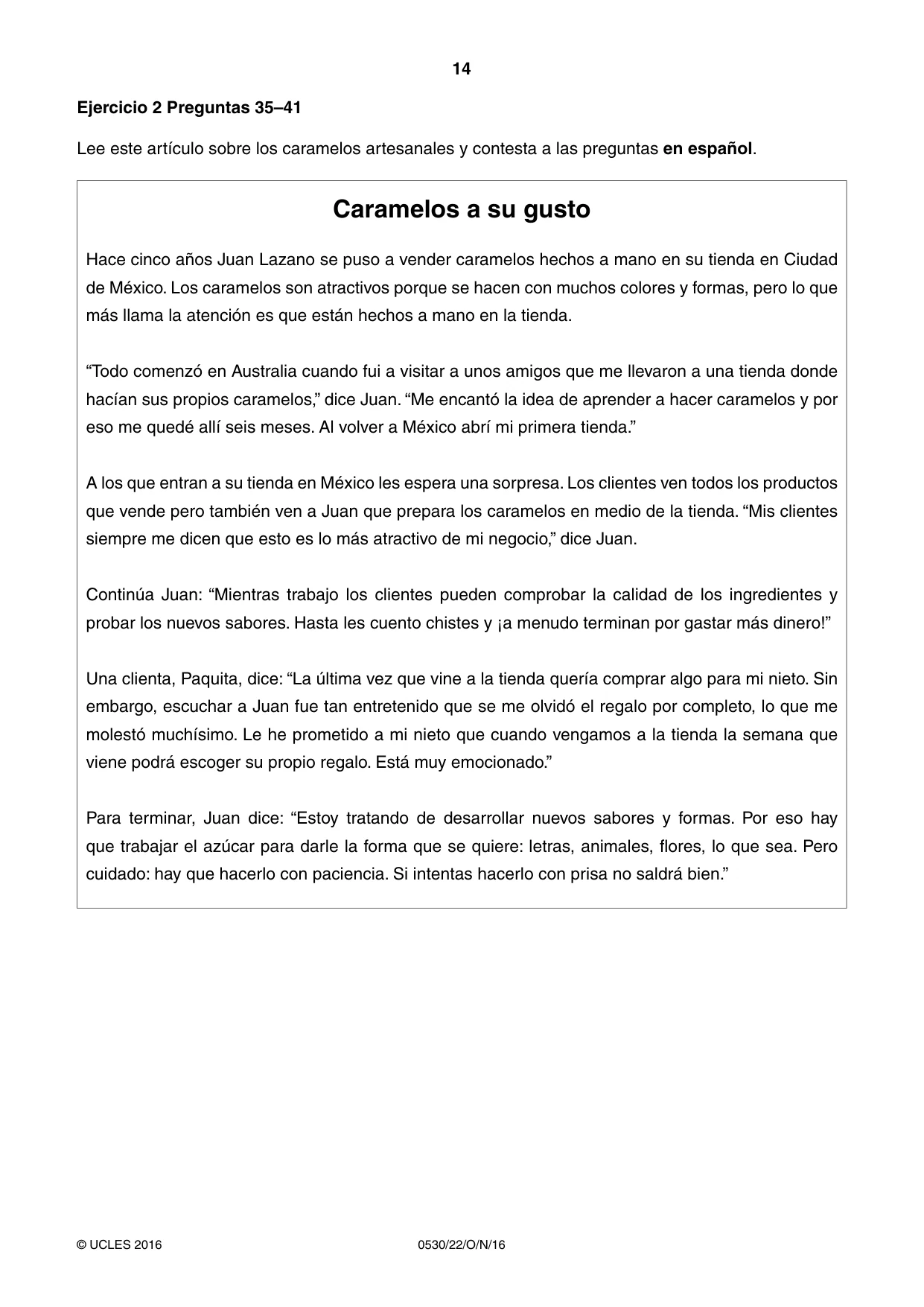
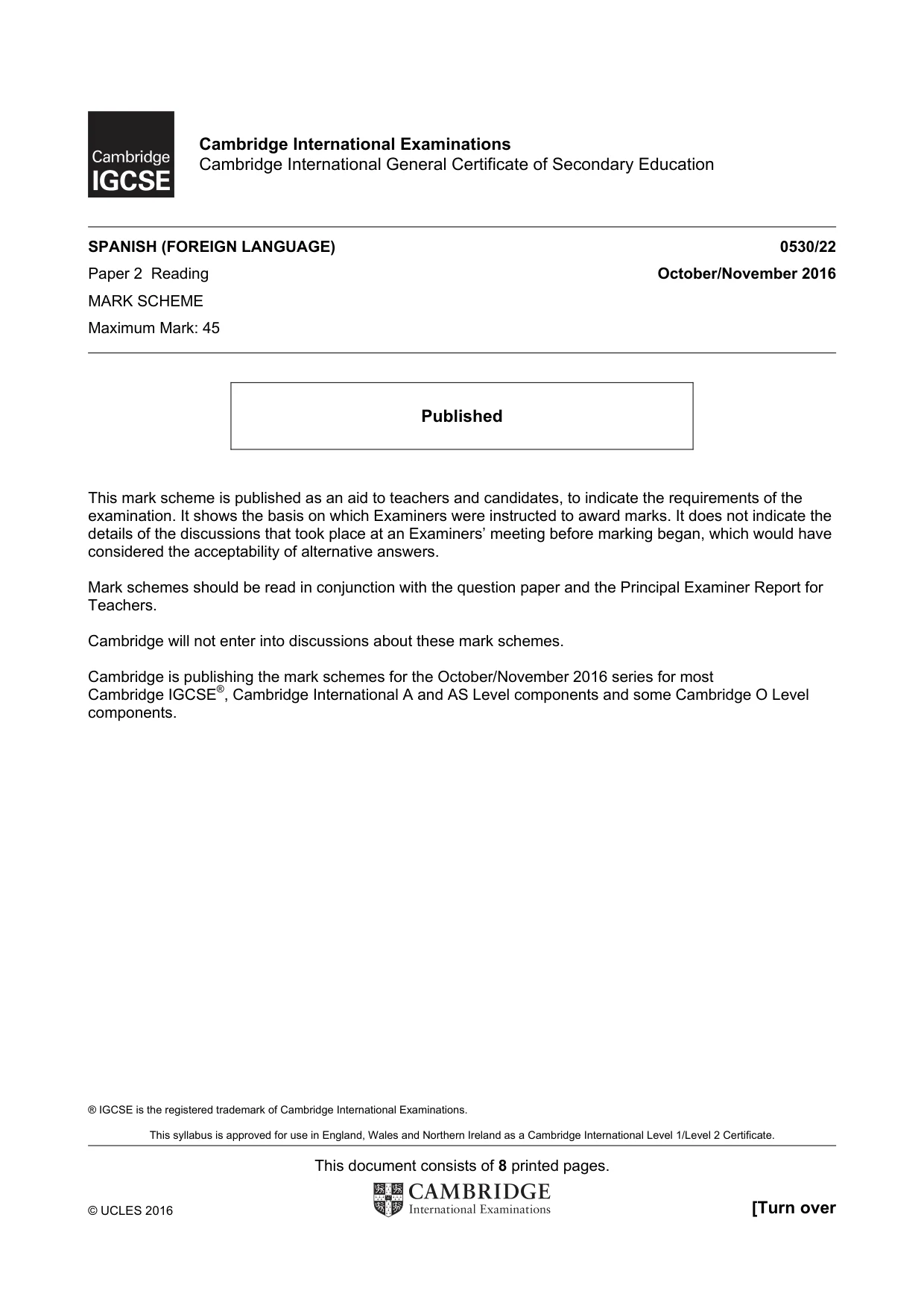
14 0530/22/O/N/16 © UCLES 2016 Ejerci cio 2 Preguntas 35–41 Lee este artículo sobre los caramelos artesanales y contesta a las preguntas en español. Caramelos a su gusto Hace cinco años Juan Lazano se puso a vender caramelos hechos a mano en su tienda en Ciudad de México. Los caramelos son atractivos porque se hacen con muchos colores y formas, pero lo que más llama la atención es que están hechos a mano en la tienda. “Todo comenzó en Australia cuando fui a visitar a unos amigos que me llevaron a una tienda donde hacían sus propios caramelos,” dice Juan. “Me encantó la idea de aprender a hacer caramelos y por eso me quedé allí seis meses. Al volver a México abrí mi primera tienda.” A los que entran a su tienda en México les espera una sorpresa. Los clientes ven todos los productos que vende pero también ven a Juan que prepara los caramelos en medio de la tienda. “Mis clientes siempre me dicen que esto es lo más atractivo de mi negocio,” dice Juan. Continúa Juan: “Mientras trabajo los clientes pueden comprobar la calidad de los ingredientes y probar los nuevos sabores. Hasta les cuento chistes y ¡a menudo terminan por gastar más dinero!” Una clienta, Paquita, dice: “La última vez que vine a la tienda quería comprar algo para mi nieto. Sin embargo, escuchar a Juan fue tan entretenido que se me olvidó el regalo por completo, lo que me molestó muchísimo. Le he prometido a mi nieto que cuando vengamos a la tienda la semana que viene podrá escoger su propio regalo. Está muy emocionado.” Para terminar, Juan dice: “Estoy tratando de desarrollar nuevos sabores y formas. Por eso hay que trabajar el azúcar para darle la forma que se quiere: letras, animales, flores, lo que sea. Pero cuidado: hay que hacerlo con paciencia. Si intentas hacerlo con prisa no saldrá bien.”
Question paper, page 15
15 0530/22/O/N/16 © UCLES 2016 35 ¿Qué tienen de especial los caramelos de Juan? … [1] 36 ¿Qué quería hacer Juan durante los seis meses que pasó en Australia? … [1] 37 ¿Qué sorprende a los clientes de Juan? … [1] 38 ¿Cómo hace reír Juan a sus clientes? … [1] 39 ¿Cuál fue la reacción de Paquita al olvidar el regalo? … [1] 40 ¿Por qué está emocionado el nieto de Paquita? … [1] 41 Según Juan, ¿cómo se tiene que trabajar el azúcar? … [1] [Total: 7]
Question paper, page 16
16 0530/22/O/N/16 © UCLES 2016 BLANK PAGE Permission to reproduce items where third-party owned material protected by copyright is included has been sought and cleared where possible. Every reasonable effort has been made by the publisher (UCLES) to trace copyright holders, but if any items requiring clearance have unwittingly been included, the publisher will be pleased to make amends at the earliest possible opportunity. To avoid the issue of disclosure of answer-related information to candidates, all copyright acknowledgements are reproduced online in the Cambridge International Examinations Copyright Acknowledgements Booklet. This is produced for each series of examinations and is freely available to download at www.cie.org.uk after the live examination series. Cambridge International Examinations is part of the Cambridge Assessment Group. Cambridge Assessment is the brand name of University of Cambridge Local Examinations Syndicate (UCLES), which is itself a department of the University of Cambridge.
Mark scheme, page 1
® IGCSE is the registered trademark of Cambridge International Examinations. This syllabus is approved for use in England, Wales and Northern Ireland as a Cambridge International Level 1/Level 2 Certificate. This document consists of 8 printed pages. © UCLES 2016 [Turn over Cambridge International Examinations Cambridge International General Certificate of Secondary Education SPANISH (FOREIGN LANGUAGE) 0530/22 Paper 2 Reading October/November 2016 MARK SCHEME Maximum Mark: 45 Published This mark scheme is published as an aid to teachers and candidates, to indicate the requirements of the examination. It shows the basis on which Examiners were instructed to award marks. It does not indicate the details of the discussions that took place at an Examiners’ meeting before marking began, which would have considered the acceptability of alternative answers. Mark schemes should be read in conjunction with the question paper and the Principal Examiner Report for Teachers. Cambridge will not enter into discussions about these mark schemes. Cambridge is publishing the mark schemes for the October/November 2016 series for most Cambridge IGCSE®, Cambridge International A and AS Level components and some Cambridge O Level components.
Mark scheme, page 2
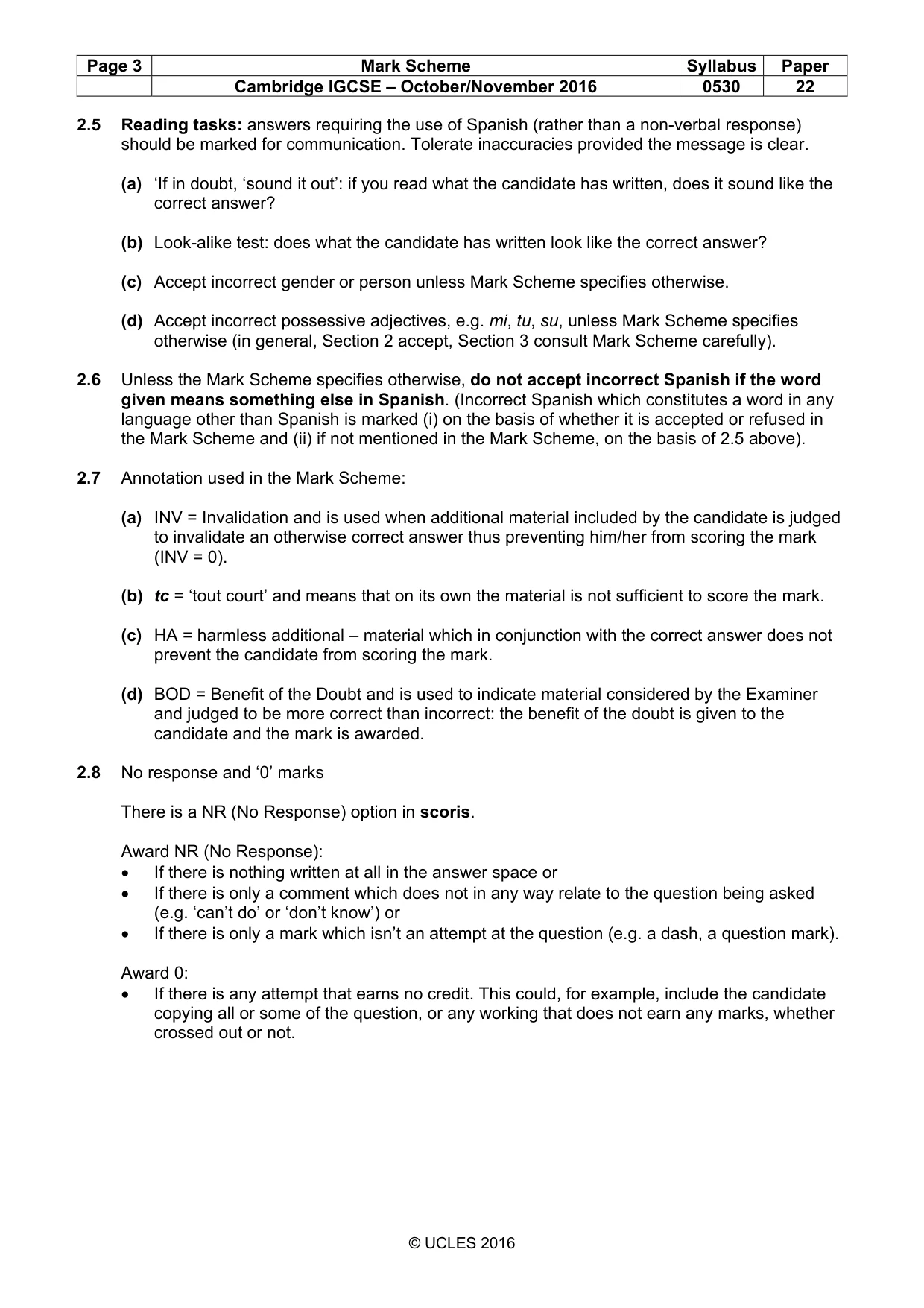
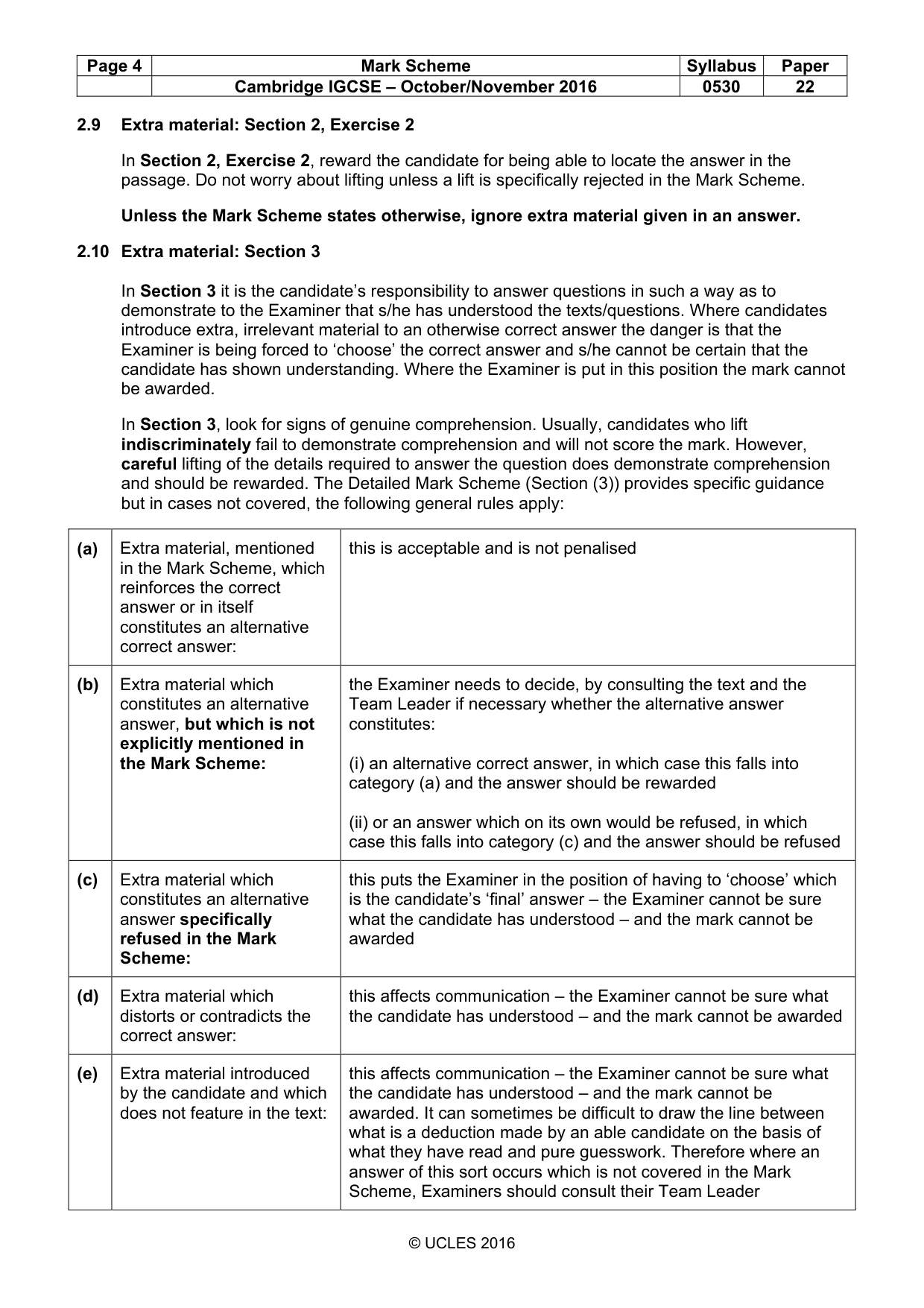
Page 2 Mark Scheme Syllabus Paper Cambridge IGCSE – October/November 2016 0530 22 © UCLES 2016 1 General Marking Notes 2 General Marking Principles 2.1 Please note that it is not possible to list all acceptable alternatives in the Detailed Mark Scheme provided in Section 3. You will need to consider all alternative answers and unexpected approaches in candidates’ scripts, make a decision on whether they communicate the required elements, in consultation with your Team Leader if necessary (or with your Product Manager if you are a single Examiner), and award marks accordingly. The following marking principles underpin the detailed instructions provided in Section 3 of the Mark Scheme. Where a decision is taken to deviate from these principles for a particular question, this will be specified in the Mark Scheme. 2.2 Crossing out: (a) If a candidate changes his/her mind over an answer and crosses out an attempt, award a mark if the final attempt is correct. (b) If a candidate crosses out an answer to a whole question but makes no second attempt at it, mark the crossed out work. 2.3 Reading tasks: more than the stipulated number of boxes ticked/crossed by the candidate: (a) If more than one attempt is visible, but the candidate has clearly indicated which attempt is his/her final answer (e.g. by crossing out other attempts or by annotating the script in some way) mark in the usual way. (b) If two attempts are visible (e.g. two boxes ticked instead of the 1 box stipulated), and neither has been crossed out/discounted by the candidate, no mark can be awarded. (c) In questions where candidates are required to tick a number of boxes (e.g. tick the 6 true statements) the general rule to be applied is as follows: the number of ‘extra’ answers indicated by the candidate is deducted from the number of correct answers and the remaining number is the mark awarded, e.g. the candidate is required to tick 6 true statements, but instead ticks 8 statements. 5 of the 6 ticks are correctly placed, but 2 of the ticks are ‘extras’ (8 ticks placed by candidate minus 6 ticks required by rubric = 2). Therefore the candidate is awarded a mark of 3. number of correct ticks: 5 minus number of extra ticks: –2 mark awarded: = 3 (d) Answers in pen do not take precedence over answers in pencil, e.g. if a candidate is asked to tick 1 box and ticks two, one in pen and the other in pencil, the mark cannot be awarded unless there is some explicit indication from the candidate as to which is his/her final answer. 2.4 Reading tasks: for questions requiring more than one element for the answer, (i) and (ii), where the answers are interchangeable: Both correct answers on line 1 and line 2 blank = 2 Both correct answers on line 1 and line 2 wrong = 1 (or vice-versa)
Mark scheme, page 3
Page 3 Mark Scheme Syllabus Paper Cambridge IGCSE – October/November 2016 0530 22 © UCLES 2016 2.5 Reading tasks: answers requiring the use of Spanish (rather than a non-verbal response) should be marked for communication. Tolerate inaccuracies provided the message is clear. (a) ‘If in doubt, ‘sound it out’: if you read what the candidate has written, does it sound like the correct answer? (b) Look-alike test: does what the candidate has written look like the correct answer? (c) Accept incorrect gender or person unless Mark Scheme specifies otherwise. (d) Accept incorrect possessive adjectives, e.g. mi, tu, su, unless Mark Scheme specifies otherwise (in general, Section 2 accept, Section 3 consult Mark Scheme carefully). 2.6 Unless the Mark Scheme specifies otherwise, do not accept incorrect Spanish if the word given means something else in Spanish. (Incorrect Spanish which constitutes a word in any language other than Spanish is marked (i) on the basis of whether it is accepted or refused in the Mark Scheme and (ii) if not mentioned in the Mark Scheme, on the basis of 2.5 above). 2.7 Annotation used in the Mark Scheme: (a) INV = Invalidation and is used when additional material included by the candidate is judged to invalidate an otherwise correct answer thus preventing him/her from scoring the mark (INV = 0). (b) tc = ‘tout court’ and means that on its own the material is not sufficient to score the mark. (c) HA = harmless additional – material which in conjunction with the correct answer does not prevent the candidate from scoring the mark. (d) BOD = Benefit of the Doubt and is used to indicate material considered by the Examiner and judged to be more correct than incorrect: the benefit of the doubt is given to the candidate and the mark is awarded. 2.8 No response and ‘0’ marks There is a NR (No Response) option in scoris. Award NR (No Response): • If there is nothing written at all in the answer space or • If there is only a comment which does not in any way relate to the question being asked (e.g. ‘can’t do’ or ‘don’t know’) or • If there is only a mark which isn’t an attempt at the question (e.g. a dash, a question mark). Award 0: • If there is any attempt that earns no credit. This could, for example, include the candidate copying all or some of the question, or any working that does not earn any marks, whether crossed out or not.
Mark scheme, page 4
Page 4 Mark Scheme Syllabus Paper Cambridge IGCSE – October/November 2016 0530 22 © UCLES 2016 2.9 Extra material: Section 2, Exercise 2 In Section 2, Exercise 2, reward the candidate for being able to locate the answer in the passage. Do not worry about lifting unless a lift is specifically rejected in the Mark Scheme. Unless the Mark Scheme states otherwise, ignore extra material given in an answer. 2.10 Extra material: Section 3 In Section 3 it is the candidate’s responsibility to answer questions in such a way as to demonstrate to the Examiner that s/he has understood the texts/questions. Where candidates introduce extra, irrelevant material to an otherwise correct answer the danger is that the Examiner is being forced to ‘choose’ the correct answer and s/he cannot be certain that the candidate has shown understanding. Where the Examiner is put in this position the mark cannot be awarded. In Section 3, look for signs of genuine comprehension. Usually, candidates who lift indiscriminately fail to demonstrate comprehension and will not score the mark. However, careful lifting of the details required to answer the question does demonstrate comprehension and should be rewarded. The Detailed Mark Scheme (Section (3)) provides specific guidance but in cases not covered, the following general rules apply: (a) Extra material, mentioned in the Mark Scheme, which reinforces the correct answer or in itself constitutes an alternative correct answer: this is acceptable and is not penalised (b) Extra material which constitutes an alternative answer, but which is not explicitly mentioned in the Mark Scheme: the Examiner needs to decide, by consulting the text and the Team Leader if necessary whether the alternative answer constitutes: (i) an alternative correct answer, in which case this falls into category (a) and the answer should be rewarded (ii) or an answer which on its own would be refused, in which case this falls into category (c) and the answer should be refused (c) Extra material which constitutes an alternative answer specifically refused in the Mark Scheme: this puts the Examiner in the position of having to ‘choose’ which is the candidate’s ‘final’ answer – the Examiner cannot be sure what the candidate has understood – and the mark cannot be awarded (d) Extra material which distorts or contradicts the correct answer: this affects communication – the Examiner cannot be sure what the candidate has understood – and the mark cannot be awarded (e) Extra material introduced by the candidate and which does not feature in the text: this affects communication – the Examiner cannot be sure what the candidate has understood – and the mark cannot be awarded. It can sometimes be difficult to draw the line between what is a deduction made by an able candidate on the basis of what they have read and pure guesswork. Therefore where an answer of this sort occurs which is not covered in the Mark Scheme, Examiners should consult their Team Leader
Mark scheme, page 5
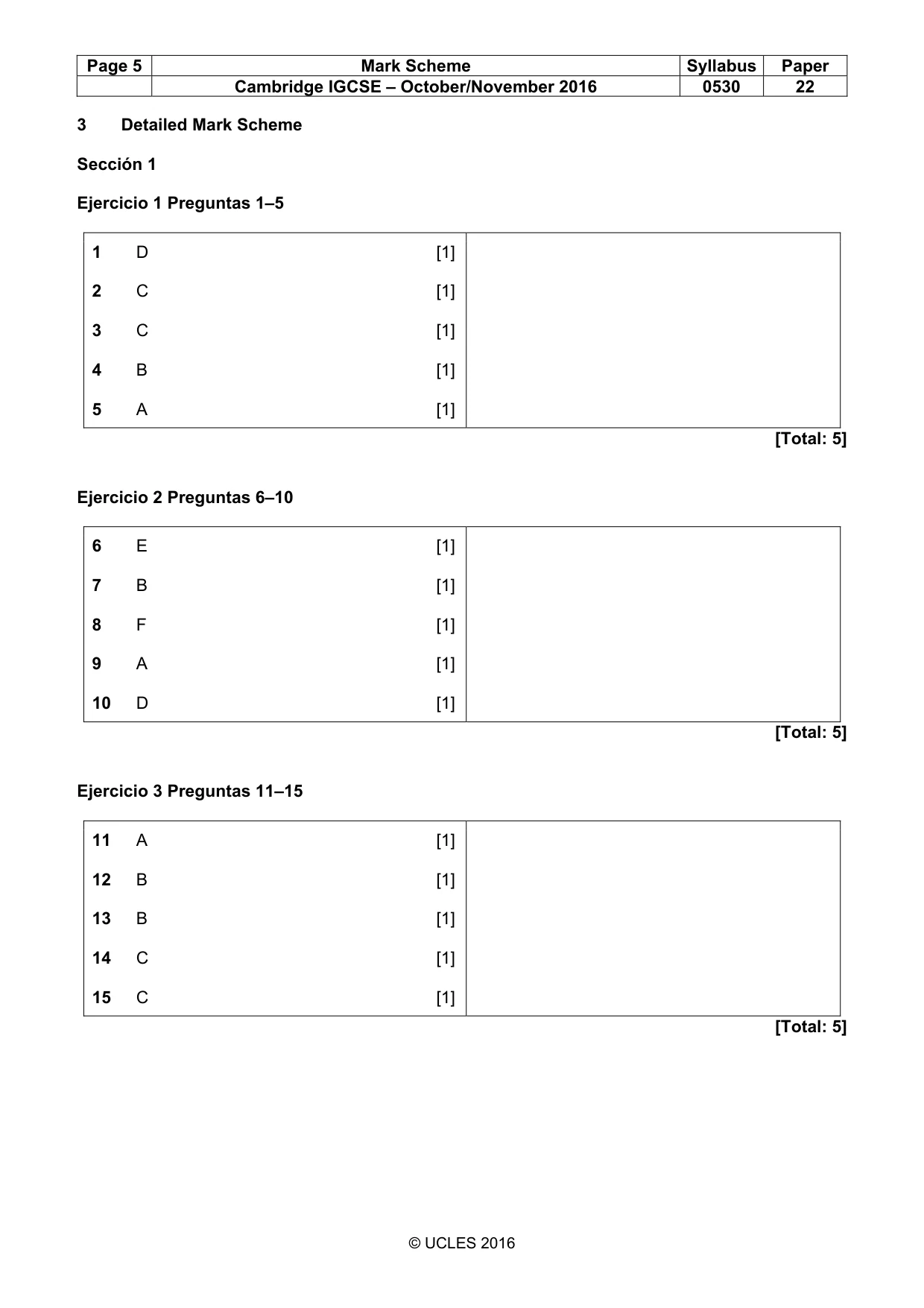
Page 5 Mark Scheme Syllabus Paper Cambridge IGCSE – October/November 2016 0530 22 © UCLES 2016 3 Detailed Mark Scheme Sección 1 Ejercicio 1 Preguntas 1–5 1 D [1] 2 C [1] 3 C [1] 4 B [1] 5 A [1] [Total: 5] Ejercicio 2 Preguntas 6–10 6 E [1] 7 B [1] 8 F [1] 9 A [1] 10 D [1] [Total: 5] Ejercicio 3 Preguntas 11–15 11 A [1] 12 B [1] 13 B [1] 14 C [1] 15 C [1] [Total: 5]
Mark scheme, page 6
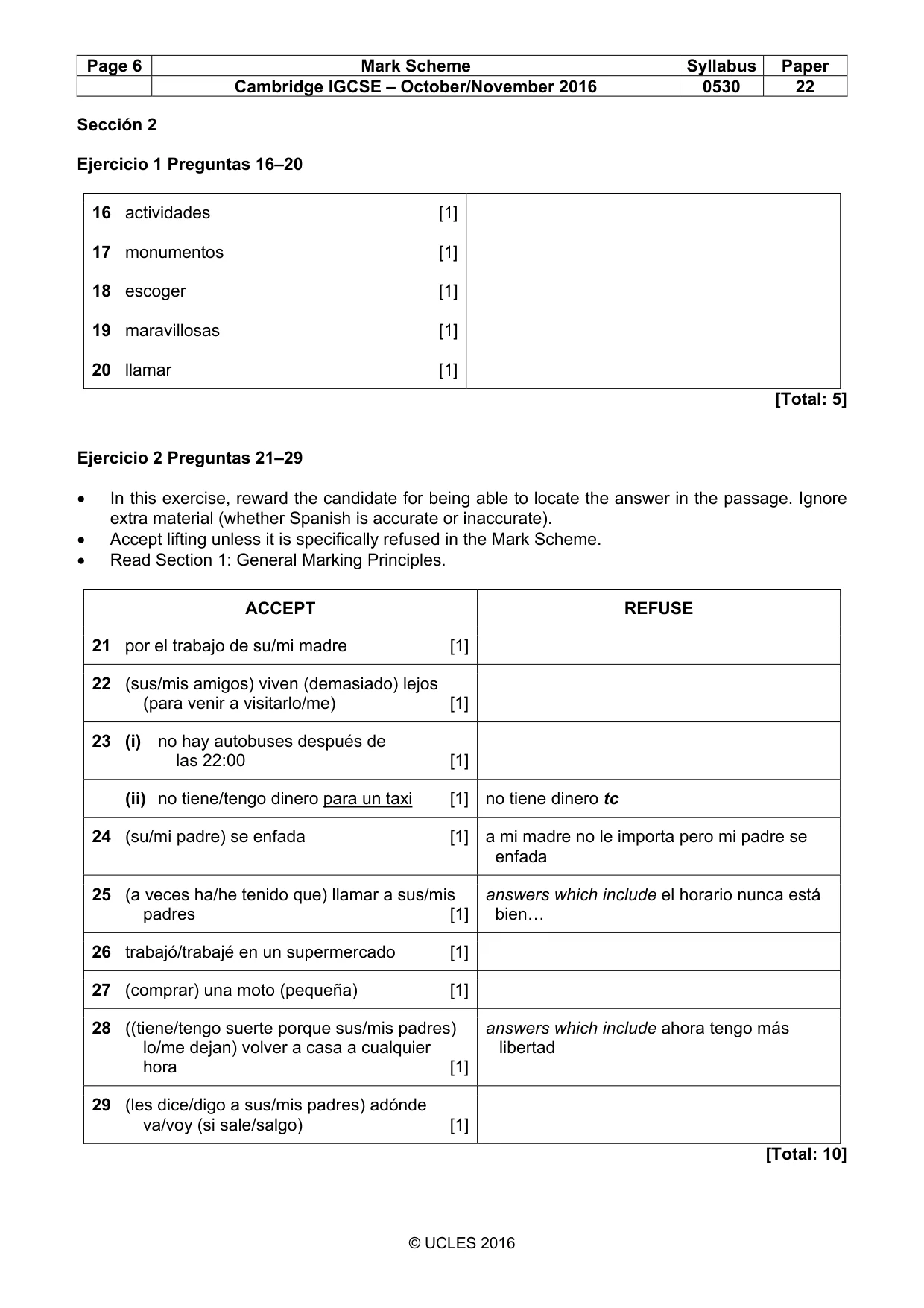
Page 6 Mark Scheme Syllabus Paper Cambridge IGCSE – October/November 2016 0530 22 © UCLES 2016 Sección 2 Ejercicio 1 Preguntas 16–20 16 actividades [1] 17 monumentos [1] 18 escoger [1] 19 maravillosas [1] 20 llamar [1] [Total: 5] Ejercicio 2 Preguntas 21–29 • In this exercise, reward the candidate for being able to locate the answer in the passage. Ignore extra material (whether Spanish is accurate or inaccurate). • Accept lifting unless it is specifically refused in the Mark Scheme. • Read Section 1: General Marking Principles. ACCEPT REFUSE 21 por el trabajo de su/mi madre [1] 22 (sus/mis amigos) viven (demasiado) lejos (para venir a visitarlo/me) [1] 23 (i) no hay autobuses después de las 22:00 [1] (ii) no tiene/tengo dinero para un taxi [1] no tiene dinero tc 24 (su/mi padre) se enfada [1] a mi madre no le importa pero mi padre se enfada 25 (a veces ha/he tenido que) llamar a sus/mis padres [1] answers which include el horario nunca está bien… 26 trabajó/trabajé en un supermercado [1] 27 (comprar) una moto (pequeña) [1] 28 ((tiene/tengo suerte porque sus/mis padres) lo/me dejan) volver a casa a cualquier hora [1] answers which include ahora tengo más libertad 29 (les dice/digo a sus/mis padres) adónde va/voy (si sale/salgo) [1] [Total: 10]
Mark scheme, page 7
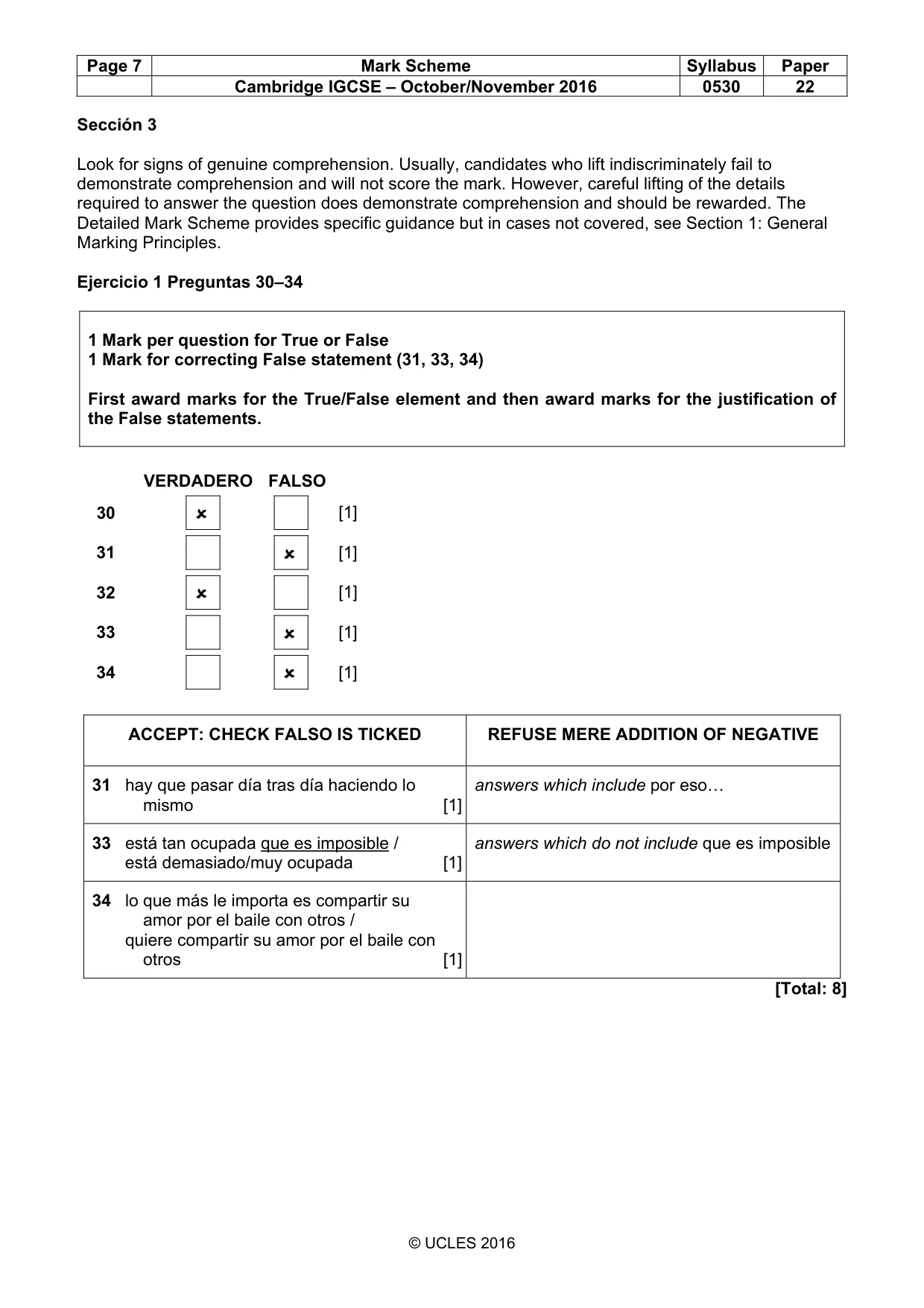
Page 7 Mark Scheme Syllabus Paper Cambridge IGCSE – October/November 2016 0530 22 © UCLES 2016 Sección 3 Look for signs of genuine comprehension. Usually, candidates who lift indiscriminately fail to demonstrate comprehension and will not score the mark. However, careful lifting of the details required to answer the question does demonstrate comprehension and should be rewarded. The Detailed Mark Scheme provides specific guidance but in cases not covered, see Section 1: General Marking Principles. Ejercicio 1 Preguntas 30–34 1 Mark per question for True or False 1 Mark for correcting False statement (31, 33, 34) First award marks for the True/False element and then award marks for the justification of the False statements. VERDADERO FALSO 30 8 [1] 31 8 [1] 32 8 [1] 33 8 [1] 34 8 [1] ACCEPT: CHECK FALSO IS TICKED REFUSE MERE ADDITION OF NEGATIVE 31 hay que pasar día tras día haciendo lo mismo [1] answers which include por eso… 33 está tan ocupada que es imposible / está demasiado/muy ocupada [1] answers which do not include que es imposible 34 lo que más le importa es compartir su amor por el baile con otros / quiere compartir su amor por el baile con otros [1] [Total: 8]
Mark scheme, page 8
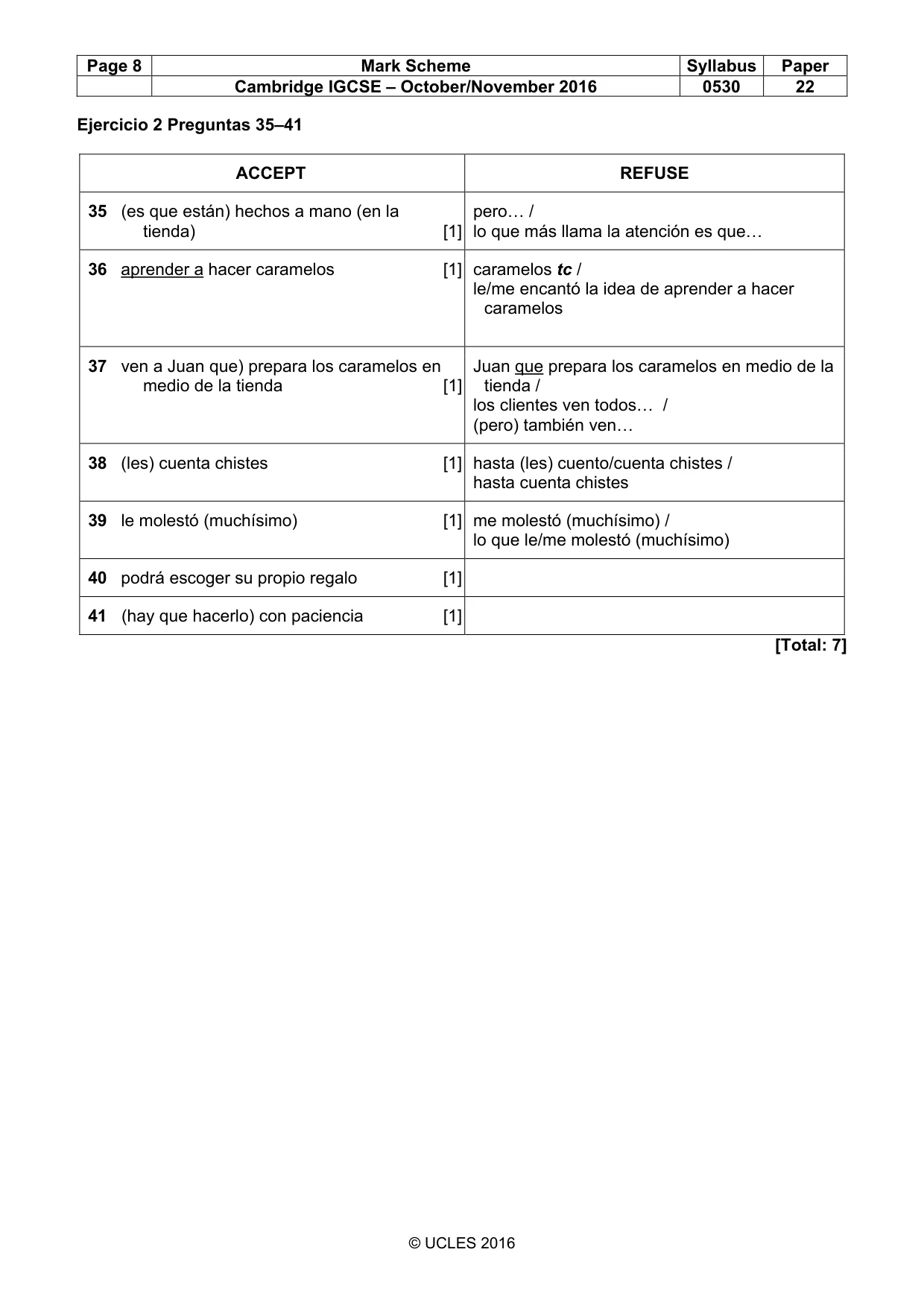
Page 8 Mark Scheme Syllabus Paper Cambridge IGCSE – October/November 2016 0530 22 © UCLES 2016 Ejercicio 2 Preguntas 35–41 ACCEPT REFUSE 35 (es que están) hechos a mano (en la tienda) [1] pero… / lo que más llama la atención es que… 36 aprender a hacer caramelos [1] caramelos tc / le/me encantó la idea de aprender a hacer caramelos 37 ven a Juan que) prepara los caramelos en medio de la tienda [1] Juan que prepara los caramelos en medio de la tienda / los clientes ven todos… / (pero) también ven… 38 (les) cuenta chistes [1] hasta (les) cuento/cuenta chistes / hasta cuenta chistes 39 le molestó (muchísimo) [1] me molestó (muchísimo) / lo que le/me molestó (muchísimo) 40 podrá escoger su propio regalo [1] 41 (hay que hacerlo) con paciencia [1] [Total: 7]
What you needed in this session
Cambridge’s own grade thresholds for 2016 Oct/Nov, Paper 2 · Variant 2. A higher threshold means an easier paper — the bar moves with how the cohort did.