Cambridge IGCSE Spanish - Foreign Language 0530 — 2010 May/June Paper 2 · Variant 3
0530/23/M/J/10 · 65 marks · ≈73 min
The question paper and its mark scheme, free to read here and free to download. This is Cambridge’s own paper, exactly as it was sat.
Question paper16 pages



Mark scheme10 pages
Answers below. Sit the paper first if you are practising.
Paper as text
Question paper, page 1
This document consists of 13 printed pages and 3 blank pages. DC (AC/SW) 24638/3 © UCLES 2010 [Turn over UNIVERSITY OF CAMBRIDGE INTERNATIONAL EXAMINATIONS International General Certificate of Secondary Education * 7 4 8 6 1 6 0 7 6 2 * SPANISH 0530/23 Paper 2 Reading and Directed Writing May/June 2010 1 hour 30 minutes Candidates answer on the Question Paper. No Additional Materials are required. READ THESE INSTRUCTIONS FIRST Write your Centre number candidate number and name on all the work you hand in. Write in dark blue or black pen. Do not use staples, paper clips, highlighters, glue or correction fluid. DO NOT WRITE IN ANY BARCODES. Answer all questions in Section 1, Section 2 and Section 3. At the end of the examination, fasten all your work securely together. The number of marks is given in brackets [ ] at the end of each question or part question. For Examiner’s Use Section 1 Section 2 Section 3 Total www.theallpapers.com
Question paper, page 2
2 0530/23/M/J/10 © UCLES 2010 BLANK PAGE www.theallpapers.com
Question paper, page 3
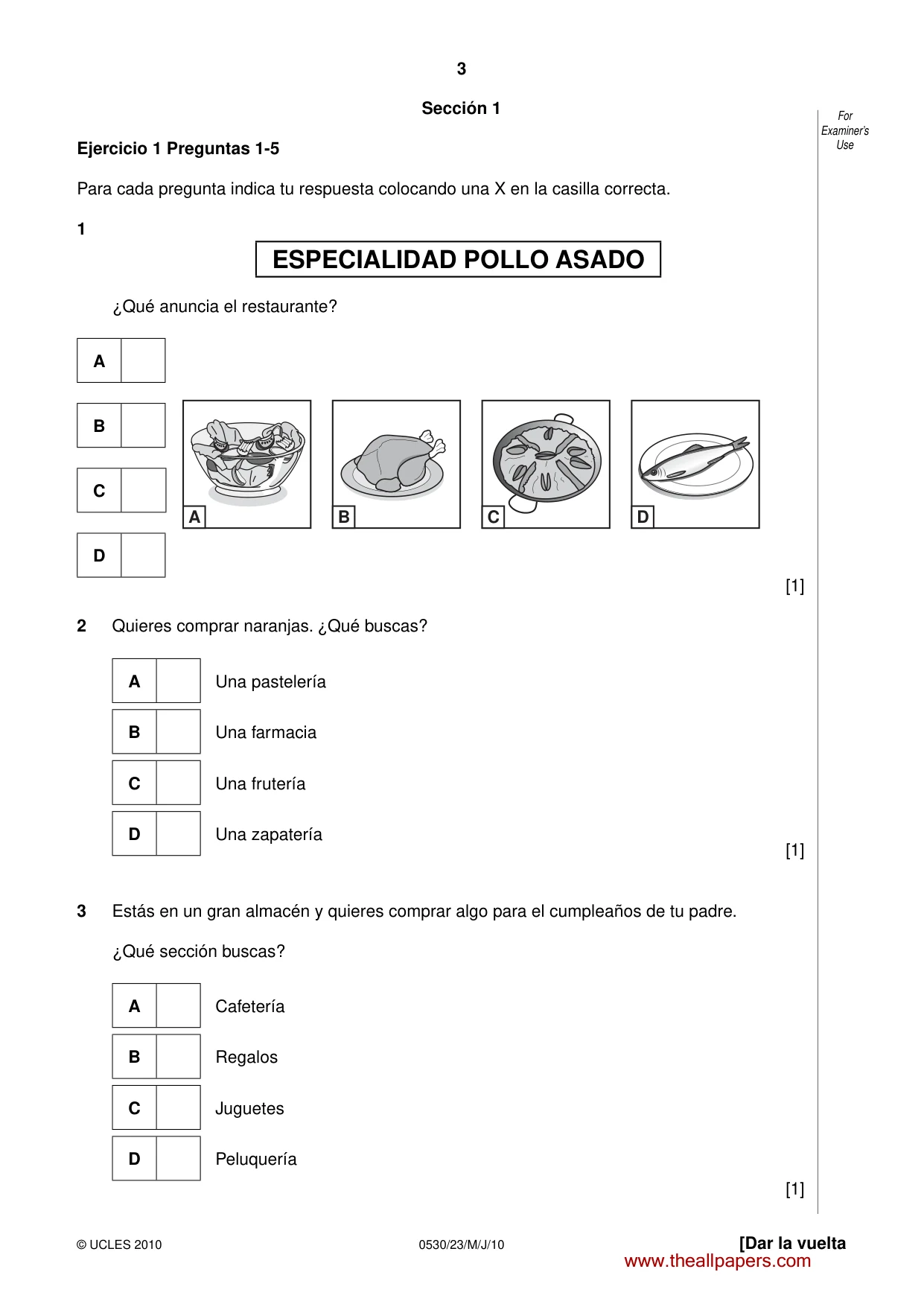
3 0530/23/M/J/10 © UCLES 2010 [Dar la vuelta For Examiner’s Use Sección 1 Ejercicio 1 Preguntas 1-5 Para cada pregunta indica tu respuesta colocando una X en la casilla correcta. 1 ESPECIALIDAD POLLO ASADO ¿Qué anuncia el restaurante? A B A B C D C D [1] 2 Quieres comprar naranjas. ¿Qué buscas? A Una pastelería B Una farmacia C Una frutería D Una zapatería [1] 3 Estás en un gran almacén y quieres comprar algo para el cumpleaños de tu padre. ¿Qué sección buscas? A Cafetería B Regalos C Juguetes D Peluquería [1] www.theallpapers.com
Question paper, page 4
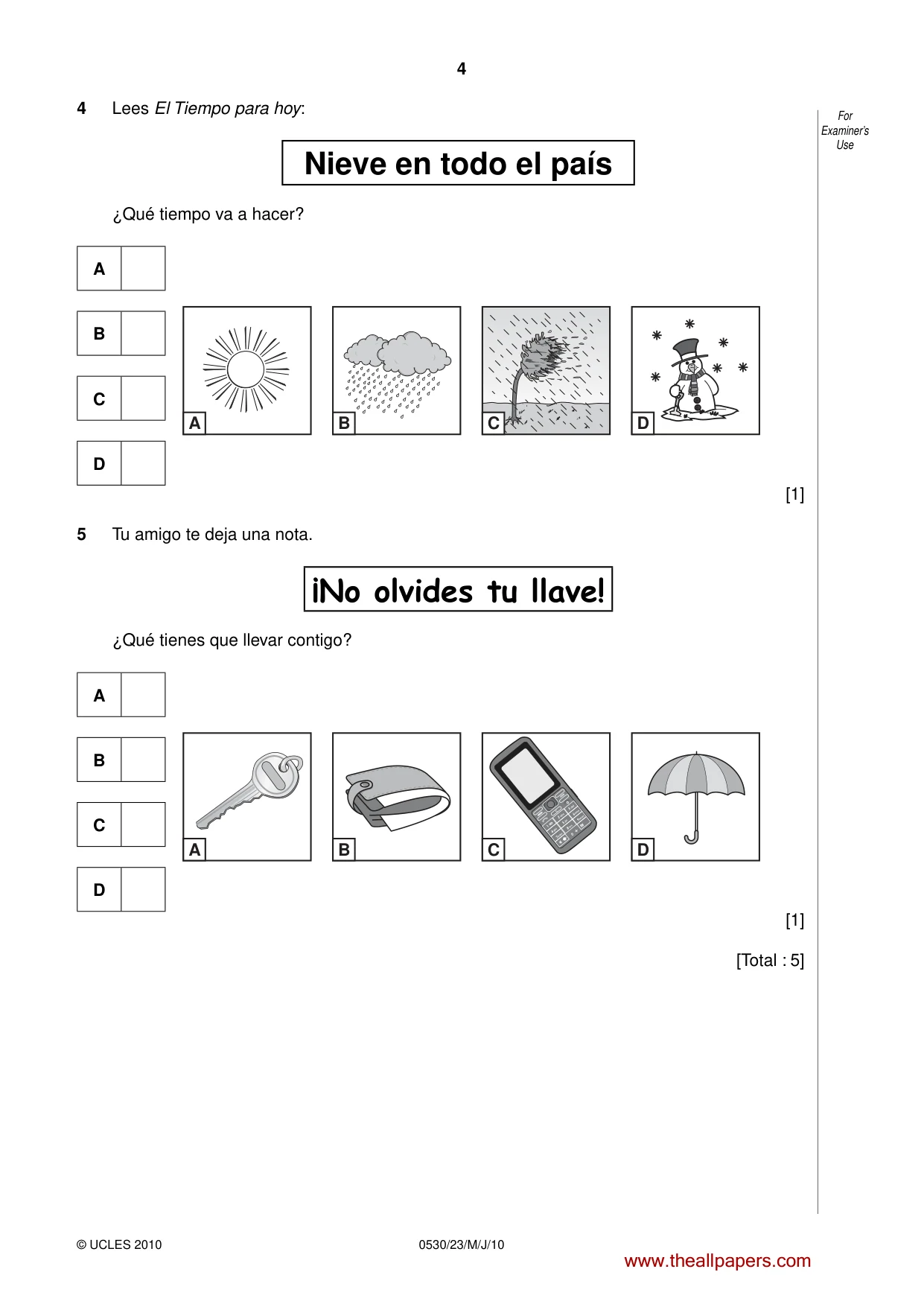
4 0530/23/M/J/10 © UCLES 2010 For Examiner’s Use 4 Lees El Tiempo para hoy: Nieve en todo el país ¿Qué tiempo va a hacer? A B A B C D C D [1] 5 Tu amigo te deja una nota. ¡No olvides tu llave! ¿Qué tienes que llevar contigo? A B A B C D C D [1] [Total : 5] www.theallpapers.com
Question paper, page 5
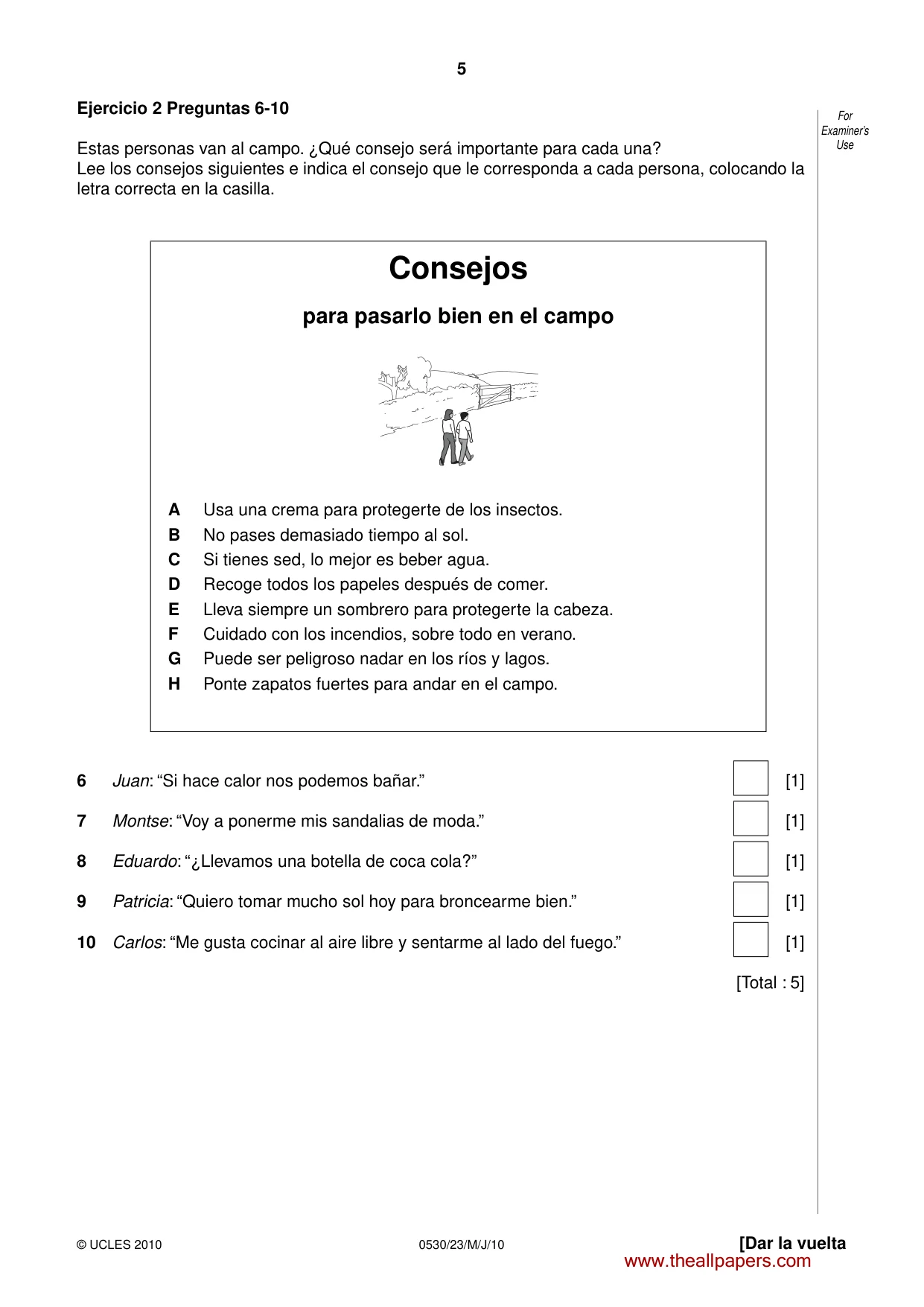
5 0530/23/M/J/10 © UCLES 2010 [Dar la vuelta For Examiner’s Use Ejercicio 2 Preguntas 6-10 Estas personas van al campo. ¿Qué consejo será importante para cada una? Lee los consejos siguientes e indica el consejo que le corresponda a cada persona, colocando la letra correcta en la casilla. Consejos para pasarlo bien en el campo A Usa una crema para protegerte de los insectos. B No pases demasiado tiempo al sol. C Si tienes sed, lo mejor es beber agua. D Recoge todos los papeles después de comer. E Lleva siempre un sombrero para protegerte la cabeza. F Cuidado con los incendios, sobre todo en verano. G Puede ser peligroso nadar en los ríos y lagos. H Ponte zapatos fuertes para andar en el campo. 6 Juan: “Si hace calor nos podemos bañar.” [1] 7 Montse: “Voy a ponerme mis sandalias de moda.” [1] 8 Eduardo: “¿Llevamos una botella de coca cola?” [1] 9 Patricia: “Quiero tomar mucho sol hoy para broncearme bien.” [1] 10 Carlos: “Me gusta cocinar al aire libre y sentarme al lado del fuego.” [1] [Total : 5] www.theallpapers.com
Question paper, page 6
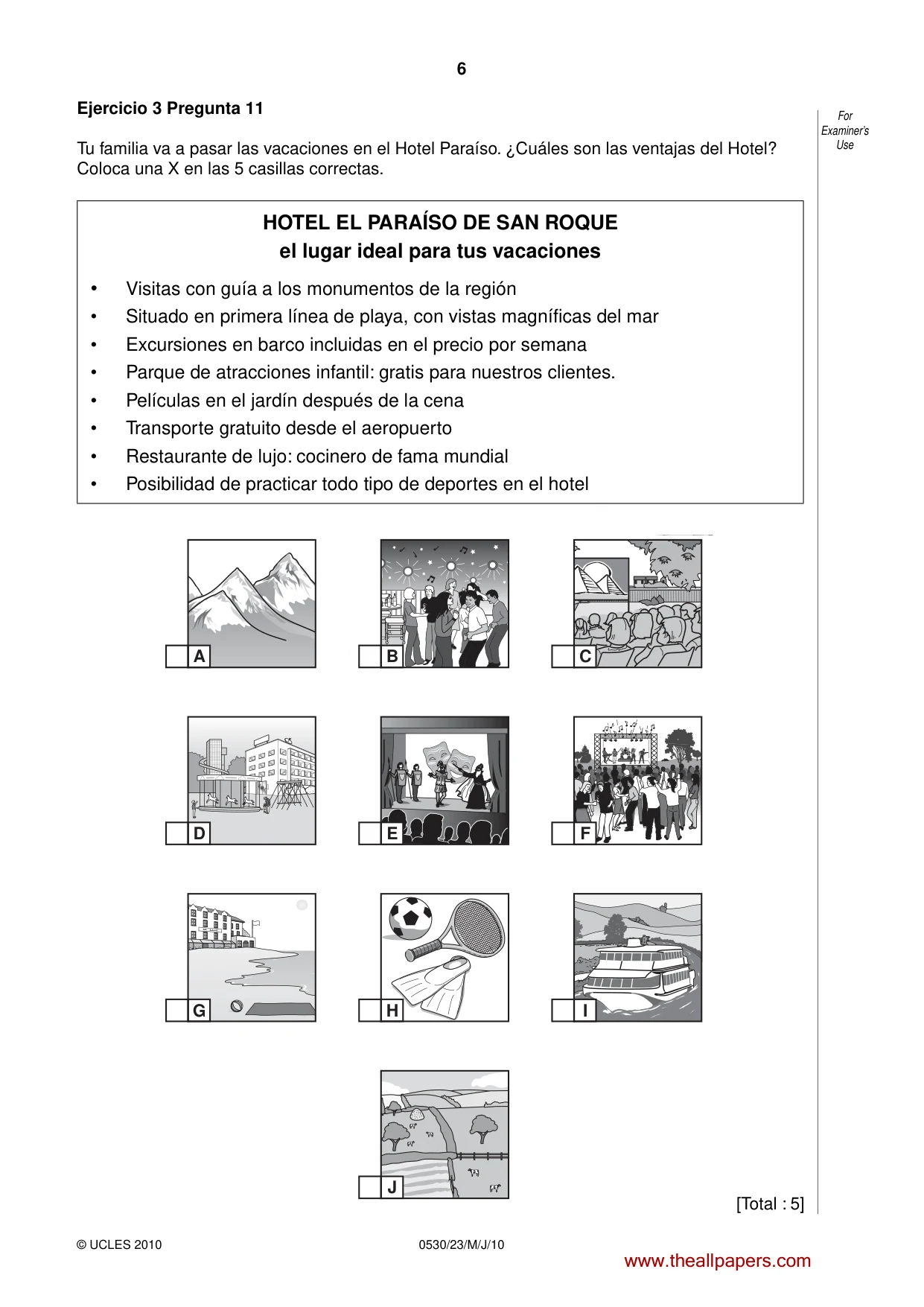
6 0530/23/M/J/10 © UCLES 2010 For Examiner’s Use Ejercicio 3 Pregunta 11 Tu familia va a pasar las vacaciones en el Hotel Paraíso. ¿Cuáles son las ventajas del Hotel? Coloca una X en las 5 casillas correctas. HOTEL EL PARAÍSO DE SAN ROQUE el lugar ideal para tus vacaciones • Visitas con guía a los monumentos de la región • Situado en primera línea de playa, con vistas magníficas del mar • Excursiones en barco incluidas en el precio por semana • Parque de atracciones infantil: gratis para nuestros clientes. • Películas en el jardín después de la cena • Transporte gratuito desde el aeropuerto • Restaurante de lujo: cocinero de fama mundial • Posibilidad de practicar todo tipo de deportes en el hotel A B C D E F G H I J [Total : 5] www.theallpapers.com
Question paper, page 7
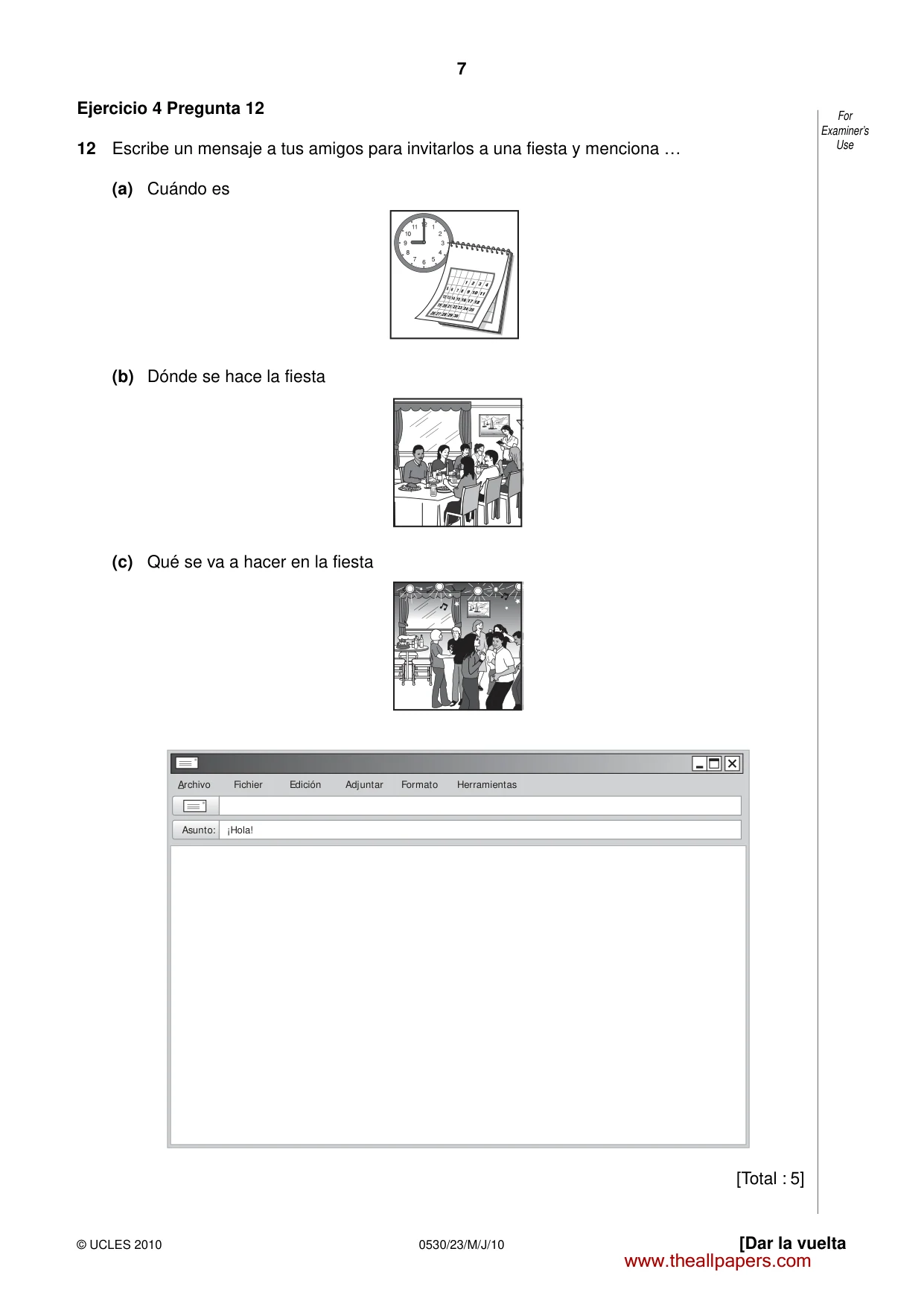
7 0530/23/M/J/10 © UCLES 2010 [Dar la vuelta For Examiner’s Use Ejercicio 4 Pregunta 12 12 Escribe un mensaje a tus amigos para invitarlos a una fiesta y menciona … (a) Cuándo es (b) Dónde se hace la fiesta (c) Qué se va a hacer en la fiesta Asunto: ¡Hola! Archivo Fichier Edición Adjuntar Formato Herramientas [Total : 5] www.theallpapers.com
Question paper, page 8
8 0530/23/M/J/10 © UCLES 2010 Sección 2 Ejercicio 1 Preguntas 13-22 Lee la carta que Silvia le escribió a su amiga Montse en la que cuenta una aventura que vivió. Contesta a las preguntas en español. Hola Montse: Te voy a contar algo increíble que me pasó en las vacaciones. A finales de agosto estaba en Europa y fui a ver a mi primo en Barcelona para celebrar su cumpleaños. Como estábamos aburridos, fuimos mi primo y yo a pasar el día en el centro de la ciudad. Al llegar fuimos a pasear por las Ramblas. Después de caminar un buen rato decidimos tomar algo porque estábamos cansados. Buscamos un bar con terraza porque era un día de sol, y nos sentamos para tomar un refresco. Estábamos mirando la gente que paseaba, cuando de repente llegó un enorme coche de lujo. Se paró en medio de la calle, y el tráfico no pudo pasar. Toda la gente se quedó para ver lo que pasaba. En seguida bajó del coche un hombre alto y guapo, muy bien vestido. La gente estaba cada vez más excitada. Todos comentaban “¡Es Antonio Cruz, el famoso actor de cine!” Antonio se sentó en la terraza justo al lado de nosotros, llegó un equipo de televisión y le hicieron una entrevista. ¡No te imaginas lo triste que estaba cuando me di cuenta que mi cámara no funcionaba y no pude sacar fotos de mi ídolo! De todas maneras me llevé un buen recuerdo de mi visita a la ciudad:¡una servilleta firmada por Antonio! Y además salimos en las noticias de la noche en la televisión. Hasta pronto, Silvia www.theallpapers.com
Question paper, page 9
9 0530/23/M/J/10 © UCLES 2010 [Dar la vuelta For Examiner’s Use 13 ¿Por qué fue Silvia a visitar a su primo? …[1] 14 ¿Por qué Silvia y su primo decidieron ir al centro? …[1] 15 ¿Qué querían después de dar un paseo? …[1] 16 ¿Por qué eligieron ese bar? …[1] 17 ¿Qué problema causó el coche de lujo? …[1] 18 ¿Por qué la gente estaba tan excitada? …[1] 19 ¿Por qué Silvia pudo verlo muy bien a Antonio Cruz? …[1] 20 ¿Qué problema tuvo Silvia? …[1] 21 ¿Qué recuerdo se llevó Silvia? …[1] 22 ¿Qué pasó por la noche? …[1] [Total : 10] www.theallpapers.com
Question paper, page 10
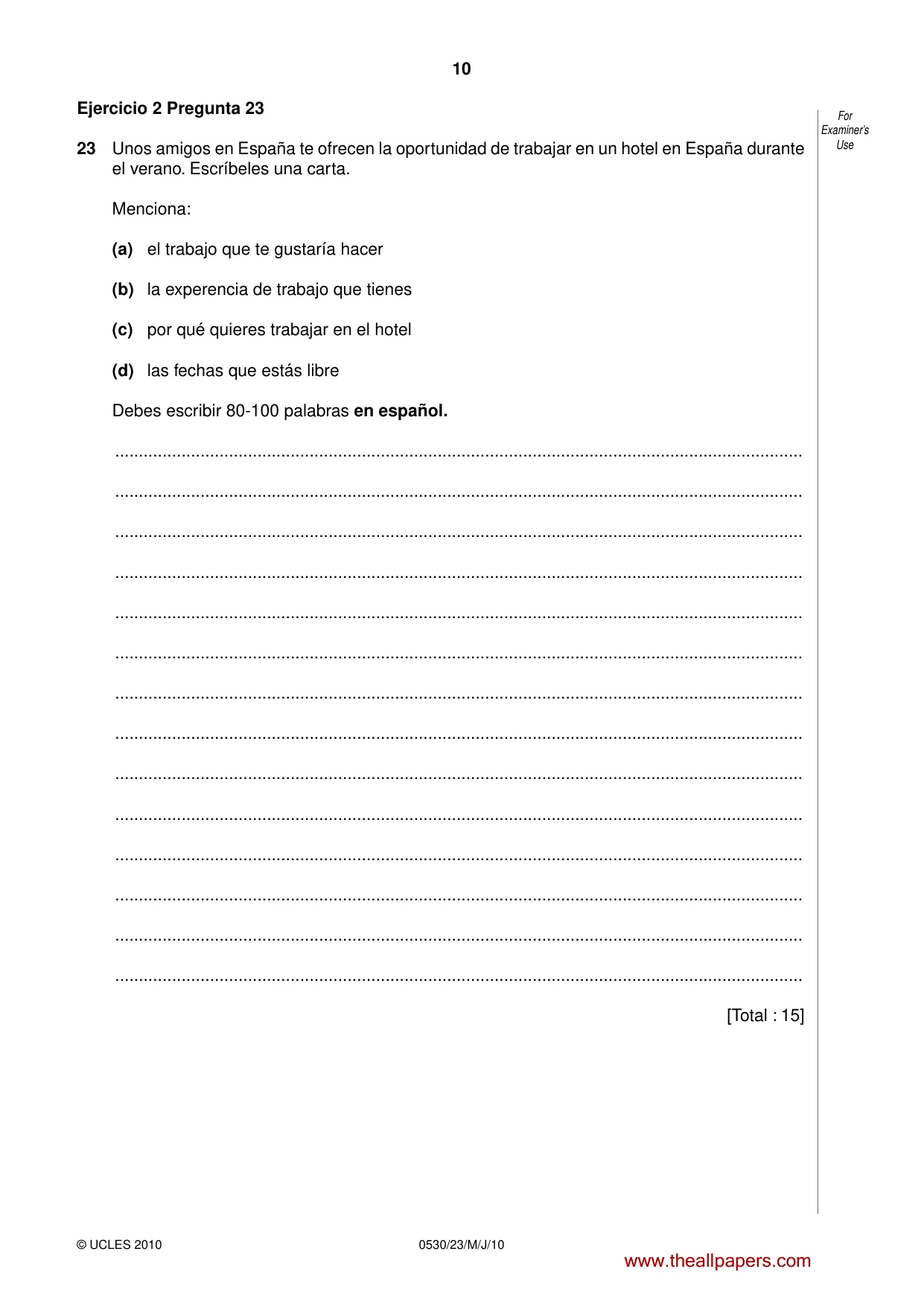
10 0530/23/M/J/10 © UCLES 2010 For Examiner’s Use Ejercicio 2 Pregunta 23 23 Unos amigos en España te ofrecen la oportunidad de trabajar en un hotel en España durante el verano. Escríbeles una carta. Menciona: (a) el trabajo que te gustaría hacer (b) la experencia de trabajo que tienes (c) por qué quieres trabajar en el hotel (d) las fechas que estás libre Debes escribir 80-100 palabras en español. … … … … … … … … … … … … … … [Total : 15] www.theallpapers.com
Question paper, page 11
11 0530/23/M/J/10 © UCLES 2010 [Dar la vuelta BLANK PAGE DAR LA VUELTA PARA LA SECCIÓN 3. www.theallpapers.com
Question paper, page 12
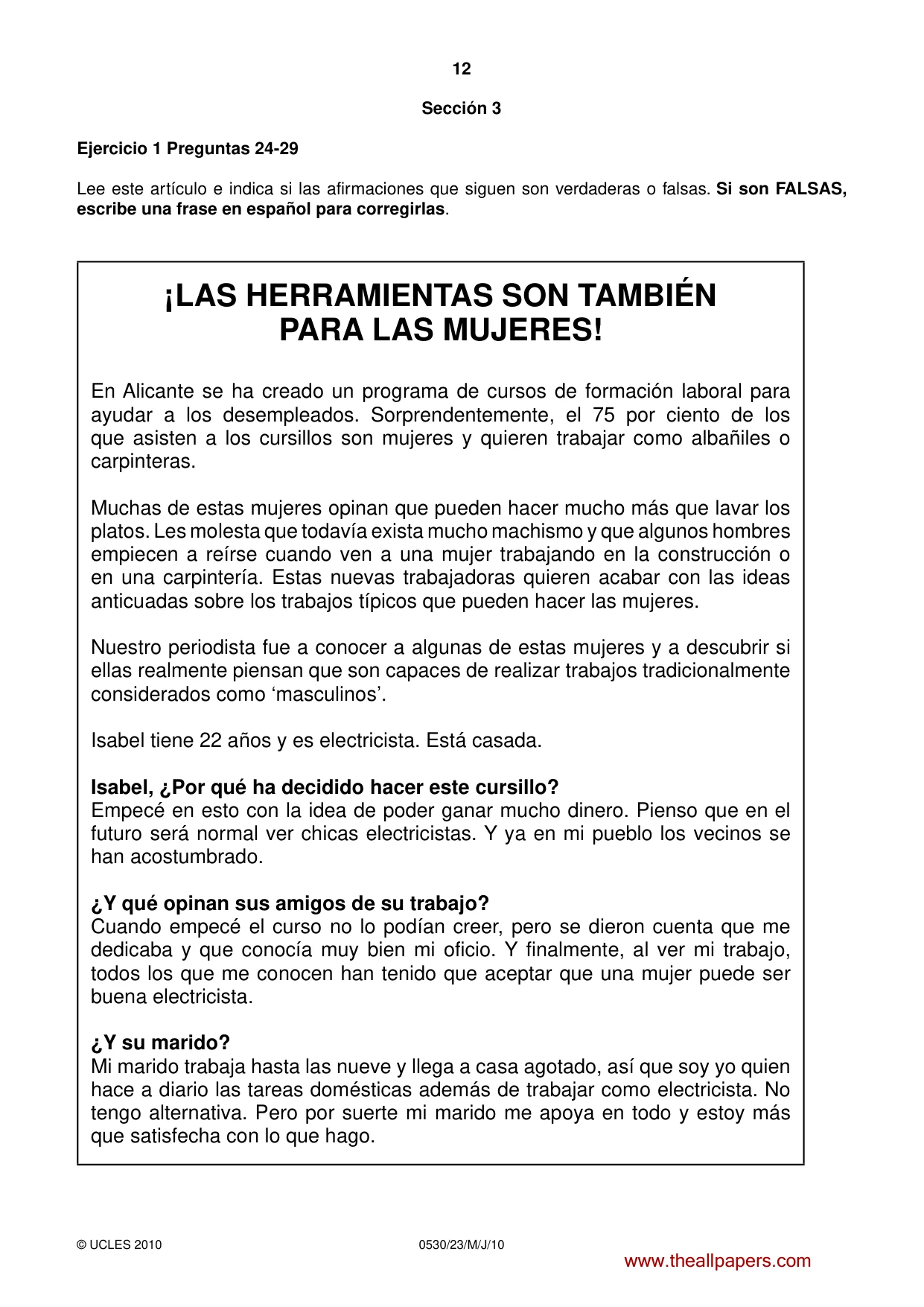
12 0530/23/M/J/10 © UCLES 2010 Sección 3 Ejercicio 1 Preguntas 24-29 Lee este artículo e indica si las afirmaciones que siguen son verdaderas o falsas. Si son FALSAS, escribe una frase en español para corregirlas. ¡LAS HERRAMIENTAS SON TAMBIÉN PARA LAS MUJERES! En Alicante se ha creado un programa de cursos de formación laboral para ayudar a los desempleados. Sorprendentemente, el 75 por ciento de los que asisten a los cursillos son mujeres y quieren trabajar como albañiles o carpinteras. Muchas de estas mujeres opinan que pueden hacer mucho más que lavar los platos. Les molesta que todavía exista mucho machismo y que algunos hombres empiecen a reírse cuando ven a una mujer trabajando en la construcción o en una carpintería. Estas nuevas trabajadoras quieren acabar con las ideas anticuadas sobre los trabajos típicos que pueden hacer las mujeres. Nuestro periodista fue a conocer a algunas de estas mujeres y a descubrir si ellas realmente piensan que son capaces de realizar trabajos tradicionalmente considerados como ‘masculinos’. Isabel tiene 22 años y es electricista. Está casada. Isabel, ¿Por qué ha decidido hacer este cursillo? Empecé en esto con la idea de poder ganar mucho dinero. Pienso que en el futuro será normal ver chicas electricistas. Y ya en mi pueblo los vecinos se han acostumbrado. ¿Y qué opinan sus amigos de su trabajo? Cuando empecé el curso no lo podían creer, pero se dieron cuenta que me dedicaba y que conocía muy bien mi oficio. Y finalmente, al ver mi trabajo, todos los que me conocen han tenido que aceptar que una mujer puede ser buena electricista. ¿Y su marido? Mi marido trabaja hasta las nueve y llega a casa agotado, así que soy yo quien hace a diario las tareas domésticas además de trabajar como electricista. No tengo alternativa. Pero por suerte mi marido me apoya en todo y estoy más que satisfecha con lo que hago. www.theallpapers.com
Question paper, page 13
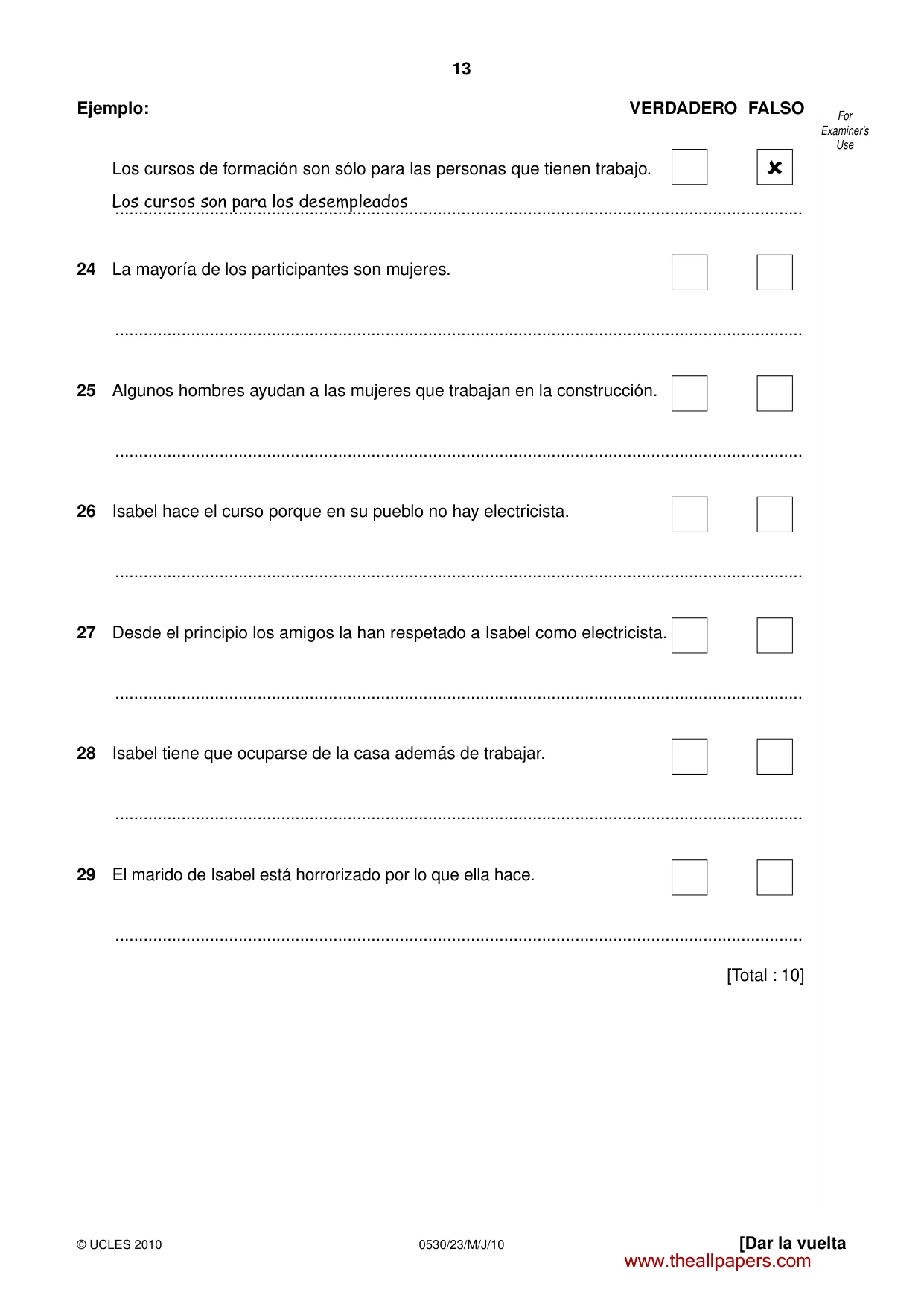
13 0530/23/M/J/10 © UCLES 2010 [Dar la vuelta For Examiner’s Use Ejemplo: VERDADERO FALSO Los cursos de formación son sólo para las personas que tienen trabajo. 8 … Los cursos son para los desempleados 24 La mayoría de los participantes son mujeres. … 25 Algunos hombres ayudan a las mujeres que trabajan en la construcción. … 26 Isabel hace el curso porque en su pueblo no hay electricista. … 27 Desde el principio los amigos la han respetado a Isabel como electricista. … 28 Isabel tiene que ocuparse de la casa además de trabajar. … 29 El marido de Isabel está horrorizado por lo que ella hace. … [Total : 10] www.theallpapers.com
Question paper, page 14
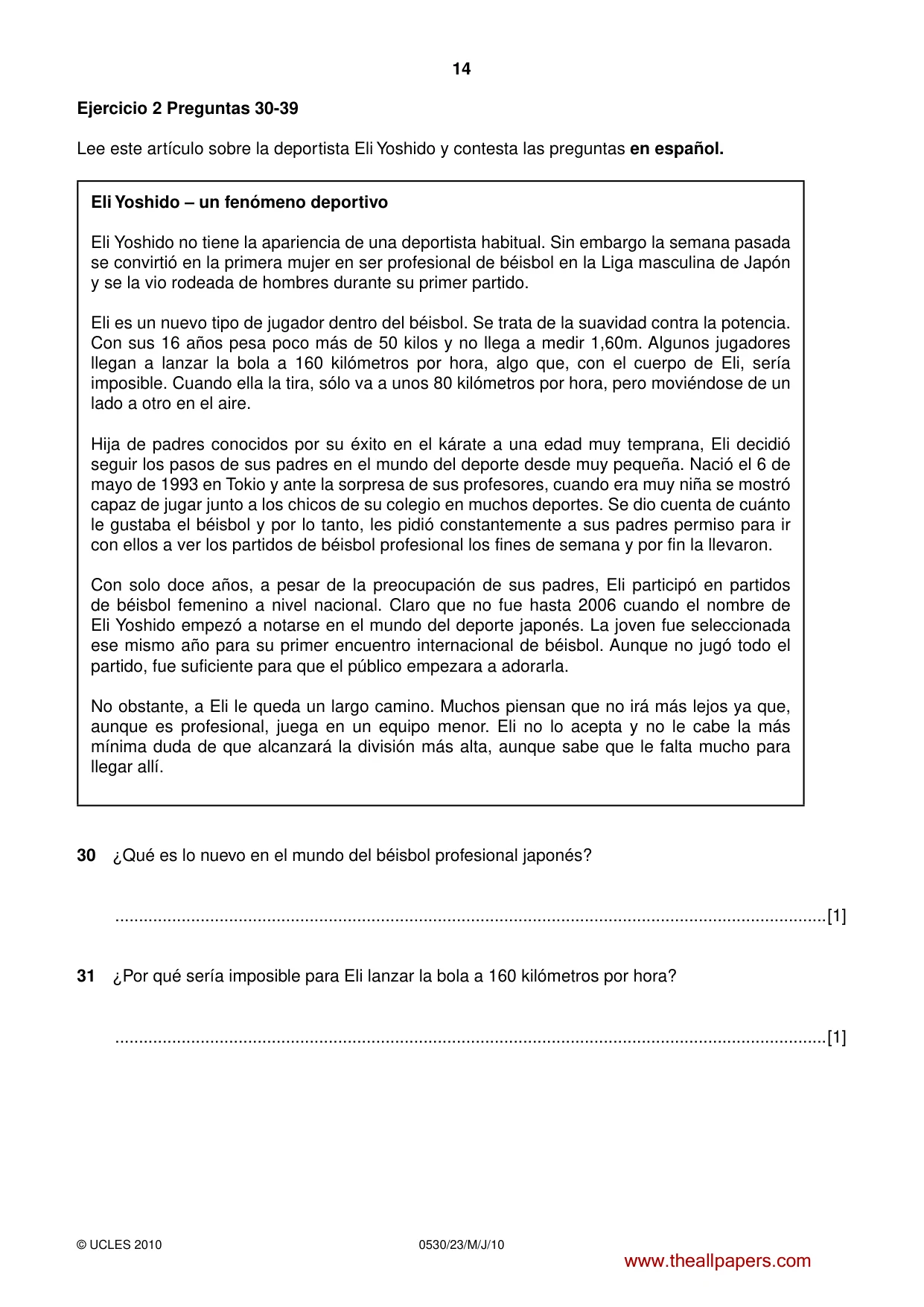
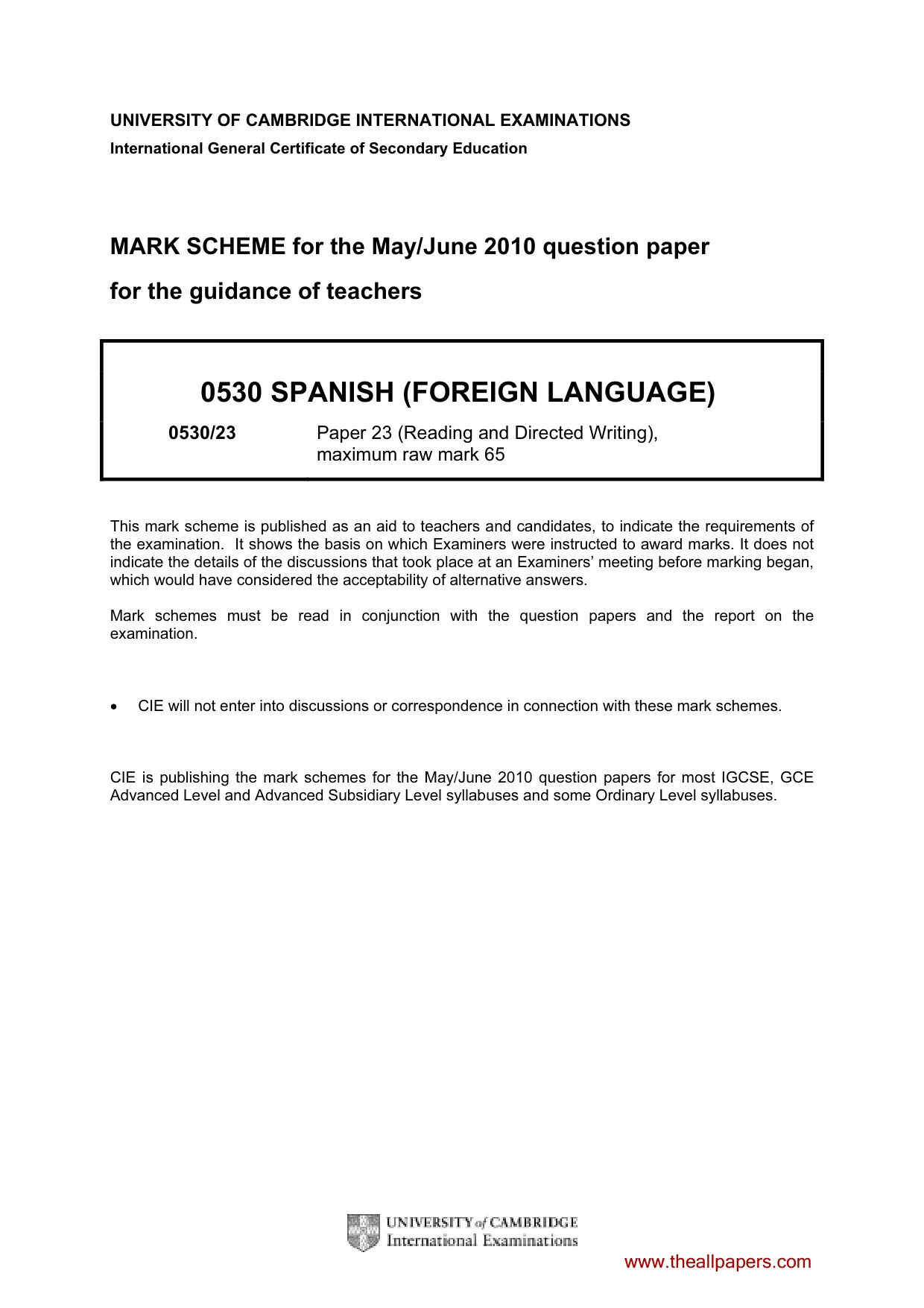
14 0530/23/M/J/10 © UCLES 2010 Ejercicio 2 Preguntas 30-39 Lee este artículo sobre la deportista Eli Yoshido y contesta las preguntas en español. Eli Yoshido – un fenómeno deportivo Eli Yoshido no tiene la apariencia de una deportista habitual. Sin embargo la semana pasada se convirtió en la primera mujer en ser profesional de béisbol en la Liga masculina de Japón y se la vio rodeada de hombres durante su primer partido. Eli es un nuevo tipo de jugador dentro del béisbol. Se trata de la suavidad contra la potencia. Con sus 16 años pesa poco más de 50 kilos y no llega a medir 1,60m. Algunos jugadores llegan a lanzar la bola a 160 kilómetros por hora, algo que, con el cuerpo de Eli, sería imposible. Cuando ella la tira, sólo va a unos 80 kilómetros por hora, pero moviéndose de un lado a otro en el aire. Hija de padres conocidos por su éxito en el kárate a una edad muy temprana, Eli decidió seguir los pasos de sus padres en el mundo del deporte desde muy pequeña. Nació el 6 de mayo de 1993 en Tokio y ante la sorpresa de sus profesores, cuando era muy niña se mostró capaz de jugar junto a los chicos de su colegio en muchos deportes. Se dio cuenta de cuánto le gustaba el béisbol y por lo tanto, les pidió constantemente a sus padres permiso para ir con ellos a ver los partidos de béisbol profesional los fines de semana y por fin la llevaron. Con solo doce años, a pesar de la preocupación de sus padres, Eli participó en partidos de béisbol femenino a nivel nacional. Claro que no fue hasta 2006 cuando el nombre de Eli Yoshido empezó a notarse en el mundo del deporte japonés. La joven fue seleccionada ese mismo año para su primer encuentro internacional de béisbol. Aunque no jugó todo el partido, fue suficiente para que el público empezara a adorarla. No obstante, a Eli le queda un largo camino. Muchos piensan que no irá más lejos ya que, aunque es profesional, juega en un equipo menor. Eli no lo acepta y no le cabe la más mínima duda de que alcanzará la división más alta, aunque sabe que le falta mucho para llegar allí. 30 ¿Qué es lo nuevo en el mundo del béisbol profesional japonés? …[1] 31 ¿Por qué sería imposible para Eli lanzar la bola a 160 kilómetros por hora? …[1] www.theallpapers.com
Question paper, page 15
15 0530/23/M/J/10 © UCLES 2010 For Examiner’s Use 32 ¿En qué se diferencia su forma de lanzar la bola? …[1] 33 ¿En qué se parece la carrera deportiva de Eli a la de sus padres? …[1] 34 ¿Qué llamó la atención desde que Eli empezó a practicar deportes? …[1] 35 ¿Cómo sus padres respondieron a su interés inicial en el béisbol? …[1] 36 ¿Por qué los padres de Eli estaban preocupados cuando empezó a jugar a nivel nacional? …[1] 37 ¿Por qué sorprendió un poco el éxito inmediato de Eli con el público? …[1] 38 ¿Por qué no todos creen en su éxito futuro? …[1] 39 ¿Con qué palabra se puede resumir la actitud de Eli hacia su futuro profesional? Indica tu respuesta colocando una X en la casilla correcta. A pesimista B temerosa C decidida D resignada [1] [Total : 10] www.theallpapers.com
Question paper, page 16
16 0530/23/M/J/10 © UCLES 2010 Permission to reproduce items where third-party owned material protected by copyright is included has been sought and cleared where possible. Every reasonable effort has been made by the publisher (UCLES) to trace copyright holders, but if any items requiring clearance have unwittingly been included, the publisher will be pleased to make amends at the earliest possible opportunity. University of Cambridge International Examinations is part of the Cambridge Assessment Group. Cambridge Assessment is the brand name of University of Cambridge Local Examinations Syndicate (UCLES), which is itself a department of the University of Cambridge. BLANK PAGE www.theallpapers.com
Mark scheme, page 1
UNIVERSITY OF CAMBRIDGE INTERNATIONAL EXAMINATIONS International General Certificate of Secondary Education MARK SCHEME for the May/June 2010 question paper for the guidance of teachers 0530 SPANISH (FOREIGN LANGUAGE) 0530/23 Paper 23 (Reading and Directed Writing), maximum raw mark 65 This mark scheme is published as an aid to teachers and candidates, to indicate the requirements of the examination. It shows the basis on which Examiners were instructed to award marks. It does not indicate the details of the discussions that took place at an Examiners’ meeting before marking began, which would have considered the acceptability of alternative answers. Mark schemes must be read in conjunction with the question papers and the report on the examination. • CIE will not enter into discussions or correspondence in connection with these mark schemes. CIE is publishing the mark schemes for the May/June 2010 question papers for most IGCSE, GCE Advanced Level and Advanced Subsidiary Level syllabuses and some Ordinary Level syllabuses. www.theallpapers.com
Mark scheme, page 2
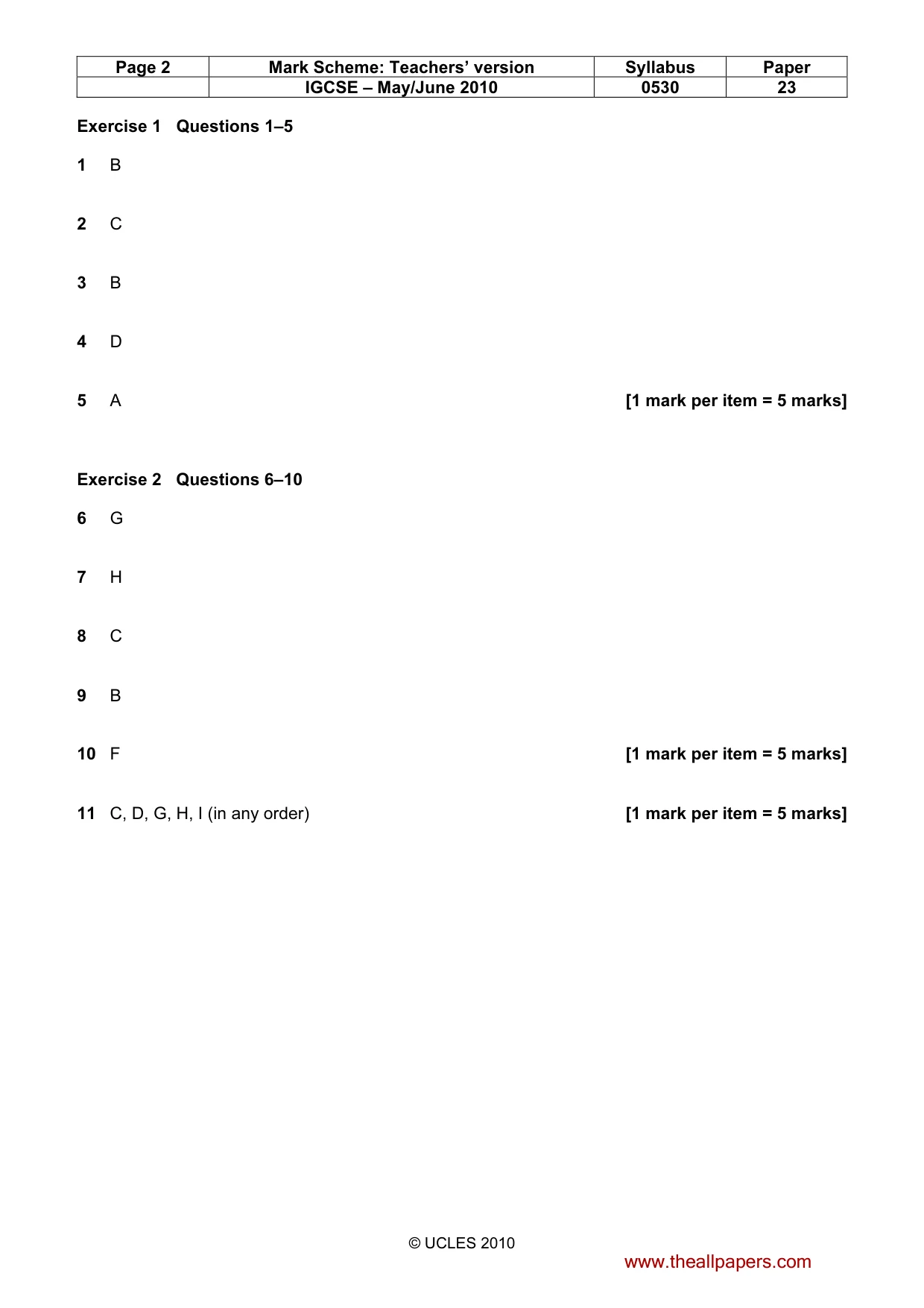
Page 2 Mark Scheme: Teachers’ version Syllabus Paper IGCSE – May/June 2010 0530 23 © UCLES 2010 Exercise 1 Questions 1–5 1 B 2 C 3 B 4 D 5 A [1 mark per item = 5 marks] Exercise 2 Questions 6–10 6 G 7 H 8 C 9 B 10 F [1 mark per item = 5 marks] 11 C, D, G, H, I (in any order) [1 mark per item = 5 marks] www.theallpapers.com
Mark scheme, page 3
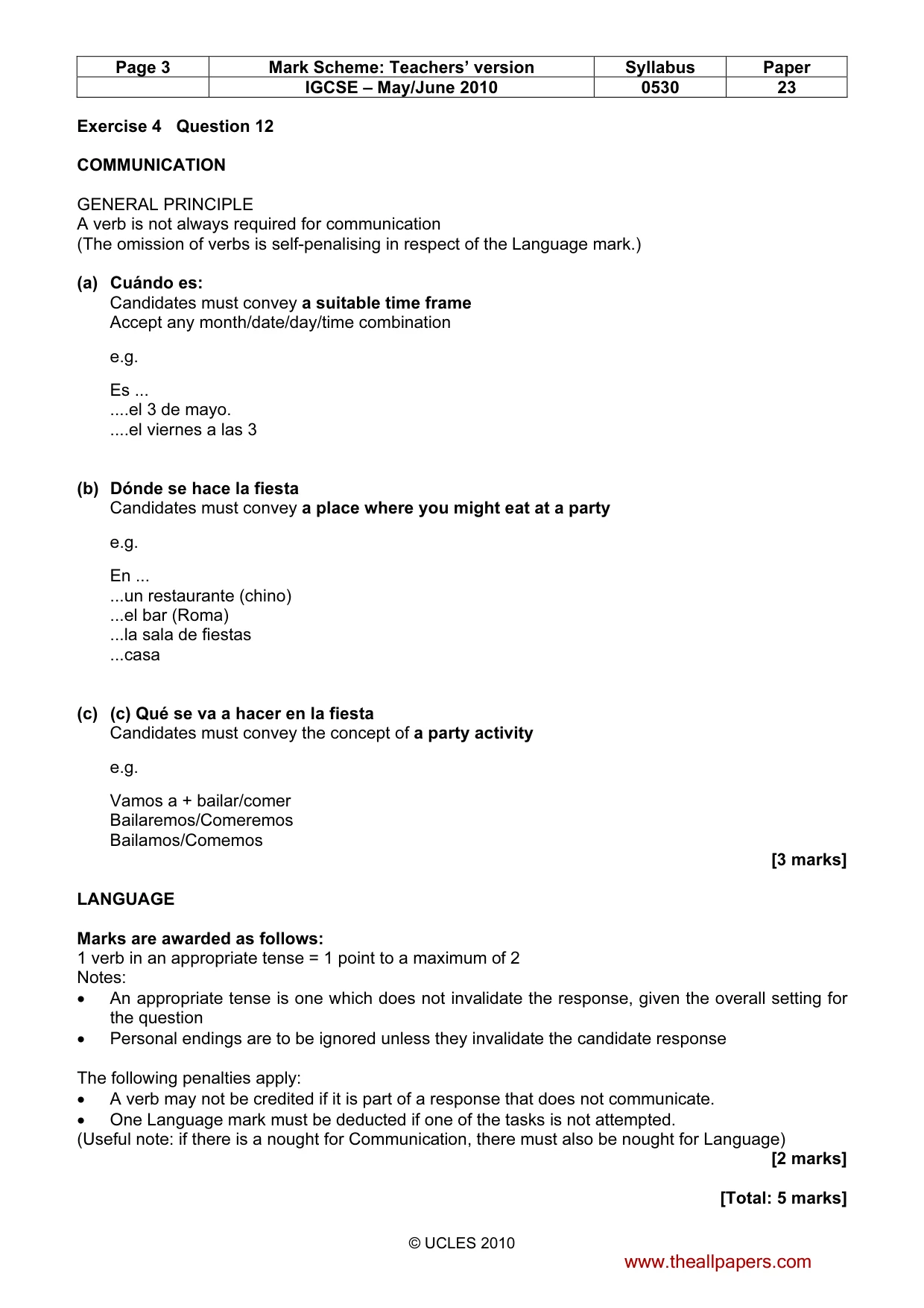
Page 3 Mark Scheme: Teachers’ version Syllabus Paper IGCSE – May/June 2010 0530 23 © UCLES 2010 Exercise 4 Question 12 COMMUNICATION GENERAL PRINCIPLE A verb is not always required for communication (The omission of verbs is self-penalising in respect of the Language mark.) (a) Cuándo es: Candidates must convey a suitable time frame Accept any month/date/day/time combination e.g. Es ... …el 3 de mayo. …el viernes a las 3 (b) Dónde se hace la fiesta Candidates must convey a place where you might eat at a party e.g. En ... ...un restaurante (chino) ...el bar (Roma) ...la sala de fiestas ...casa (c) (c) Qué se va a hacer en la fiesta Candidates must convey the concept of a party activity e.g. Vamos a + bailar/comer Bailaremos/Comeremos Bailamos/Comemos [3 marks] LANGUAGE Marks are awarded as follows: 1 verb in an appropriate tense = 1 point to a maximum of 2 Notes: • An appropriate tense is one which does not invalidate the response, given the overall setting for the question • Personal endings are to be ignored unless they invalidate the candidate response The following penalties apply: • A verb may not be credited if it is part of a response that does not communicate. • One Language mark must be deducted if one of the tasks is not attempted. (Useful note: if there is a nought for Communication, there must also be nought for Language) [2 marks] [Total: 5 marks] www.theallpapers.com
Mark scheme, page 4
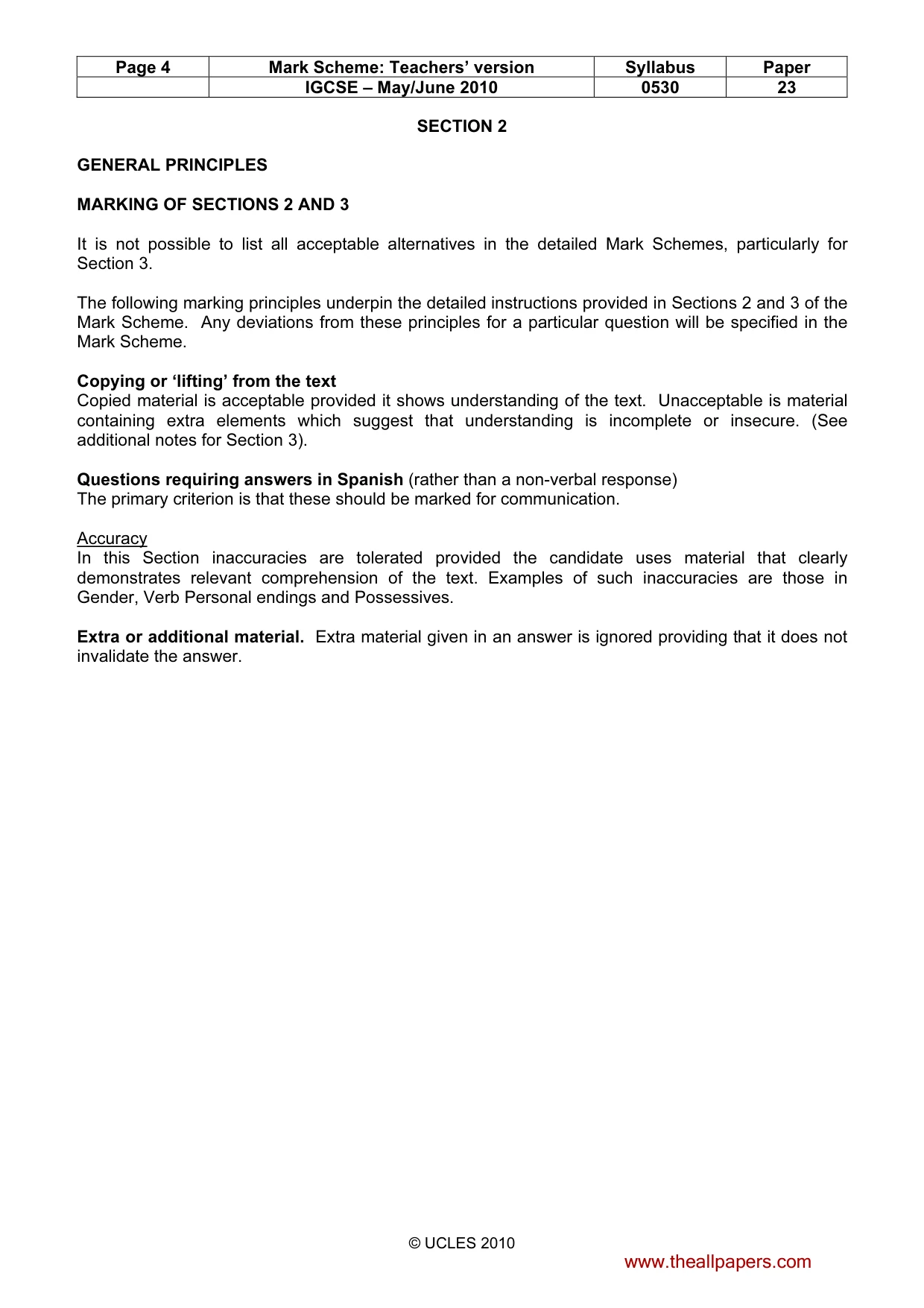
Page 4 Mark Scheme: Teachers’ version Syllabus Paper IGCSE – May/June 2010 0530 23 © UCLES 2010 SECTION 2 GENERAL PRINCIPLES MARKING OF SECTIONS 2 AND 3 It is not possible to list all acceptable alternatives in the detailed Mark Schemes, particularly for Section 3. The following marking principles underpin the detailed instructions provided in Sections 2 and 3 of the Mark Scheme. Any deviations from these principles for a particular question will be specified in the Mark Scheme. Copying or ‘lifting’ from the text Copied material is acceptable provided it shows understanding of the text. Unacceptable is material containing extra elements which suggest that understanding is incomplete or insecure. (See additional notes for Section 3). Questions requiring answers in Spanish (rather than a non-verbal response) The primary criterion is that these should be marked for communication. Accuracy In this Section inaccuracies are tolerated provided the candidate uses material that clearly demonstrates relevant comprehension of the text. Examples of such inaccuracies are those in Gender, Verb Personal endings and Possessives. Extra or additional material. Extra material given in an answer is ignored providing that it does not invalidate the answer. www.theallpapers.com
Mark scheme, page 5
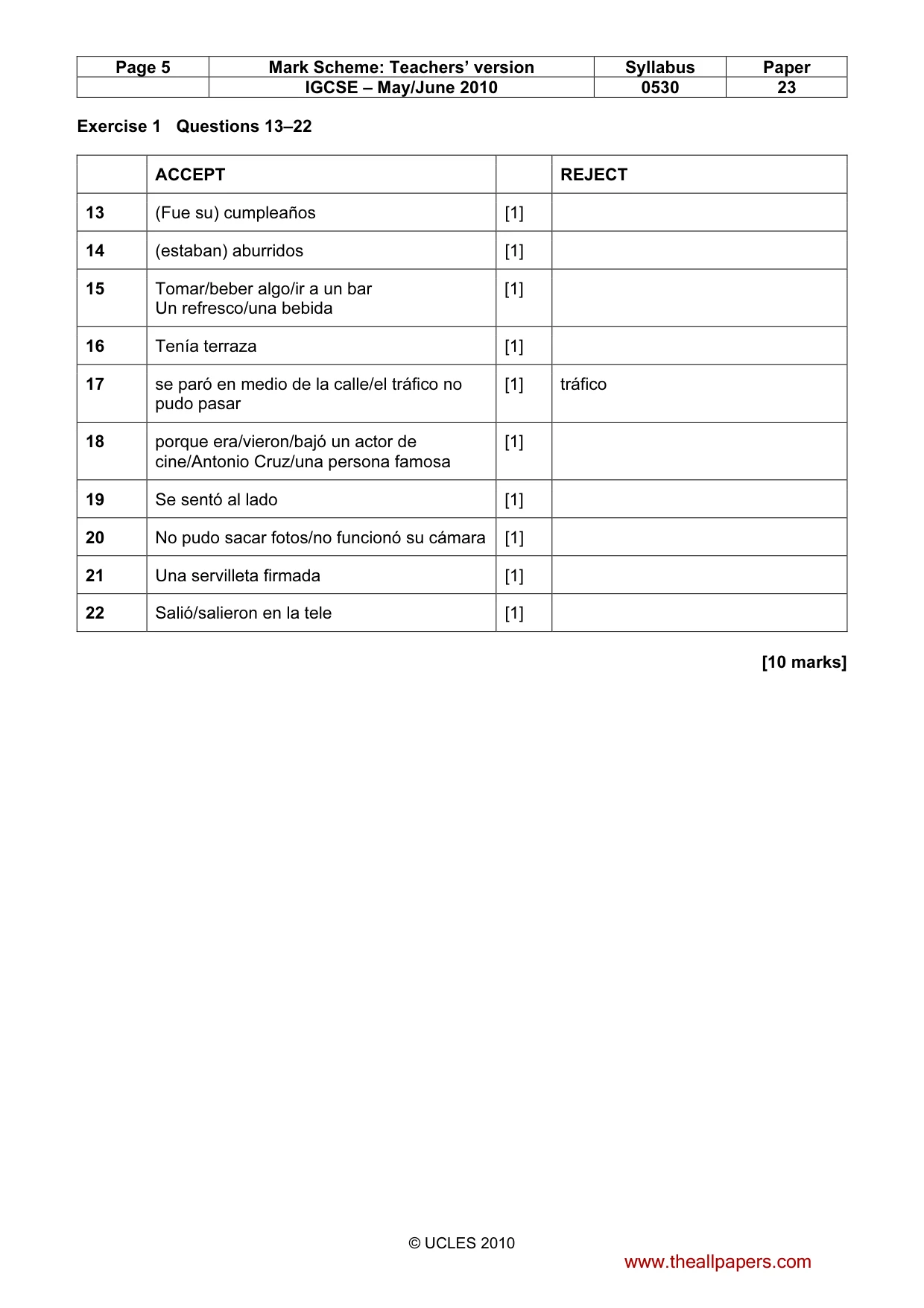
Page 5 Mark Scheme: Teachers’ version Syllabus Paper IGCSE – May/June 2010 0530 23 © UCLES 2010 Exercise 1 Questions 13–22 ACCEPT REJECT 13 (Fue su) cumpleaños [1] 14 (estaban) aburridos [1] 15 Tomar/beber algo/ir a un bar Un refresco/una bebida [1] 16 Tenía terraza [1] 17 se paró en medio de la calle/el tráfico no pudo pasar [1] tráfico 18 porque era/vieron/bajó un actor de cine/Antonio Cruz/una persona famosa [1] 19 Se sentó al lado [1] 20 No pudo sacar fotos/no funcionó su cámara [1] 21 Una servilleta firmada [1] 22 Salió/salieron en la tele [1] [10 marks] www.theallpapers.com
Mark scheme, page 6
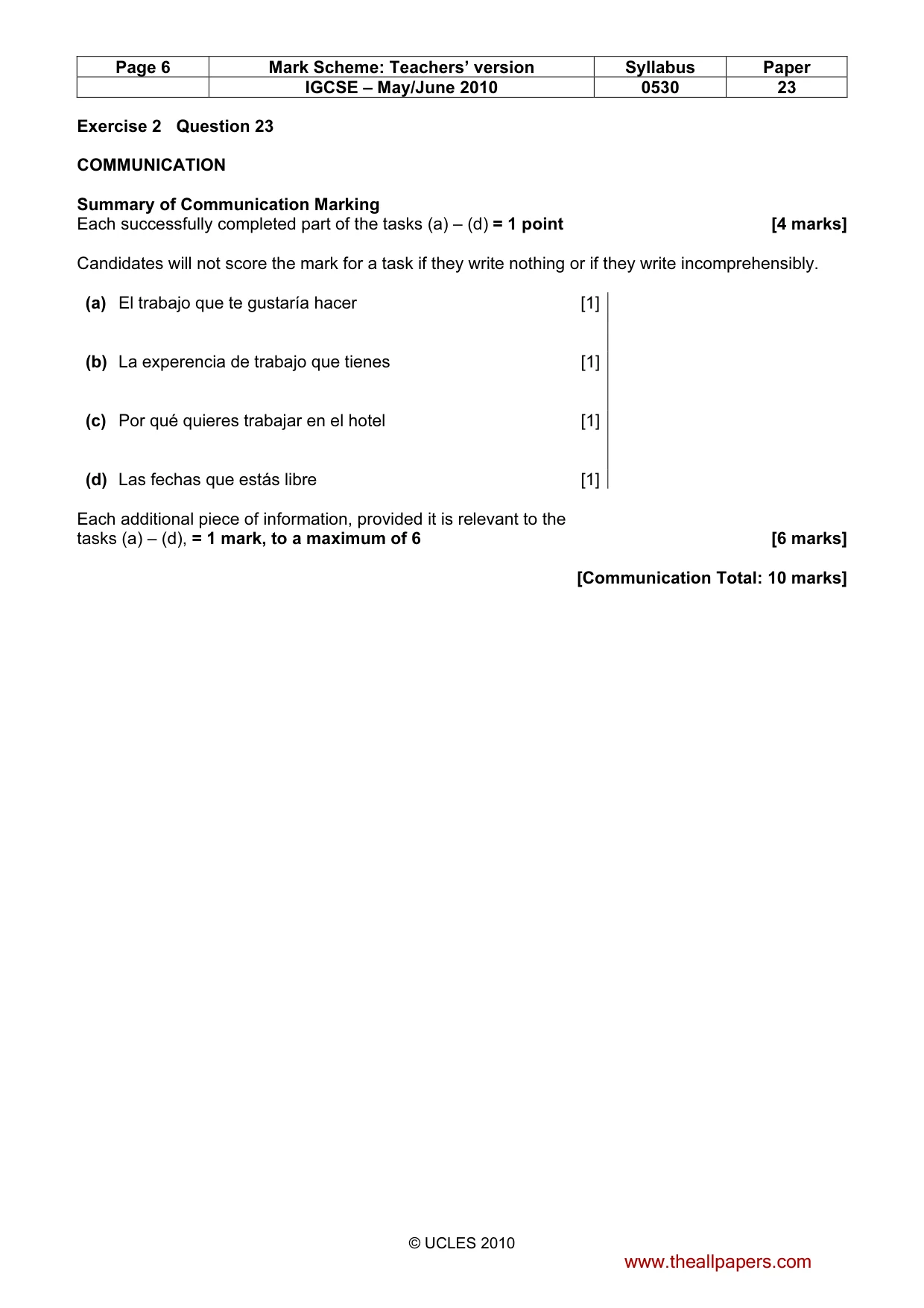
Page 6 Mark Scheme: Teachers’ version Syllabus Paper IGCSE – May/June 2010 0530 23 © UCLES 2010 Exercise 2 Question 23 COMMUNICATION Summary of Communication Marking Each successfully completed part of the tasks (a) – (d) = 1 point [4 marks] Candidates will not score the mark for a task if they write nothing or if they write incomprehensibly. (a) El trabajo que te gustaría hacer [1] (b) La experencia de trabajo que tienes [1] (c) Por qué quieres trabajar en el hotel [1] (d) Las fechas que estás libre [1] Each additional piece of information, provided it is relevant to the tasks (a) – (d), = 1 mark, to a maximum of 6 [6 marks] [Communication Total: 10 marks] www.theallpapers.com
Mark scheme, page 7
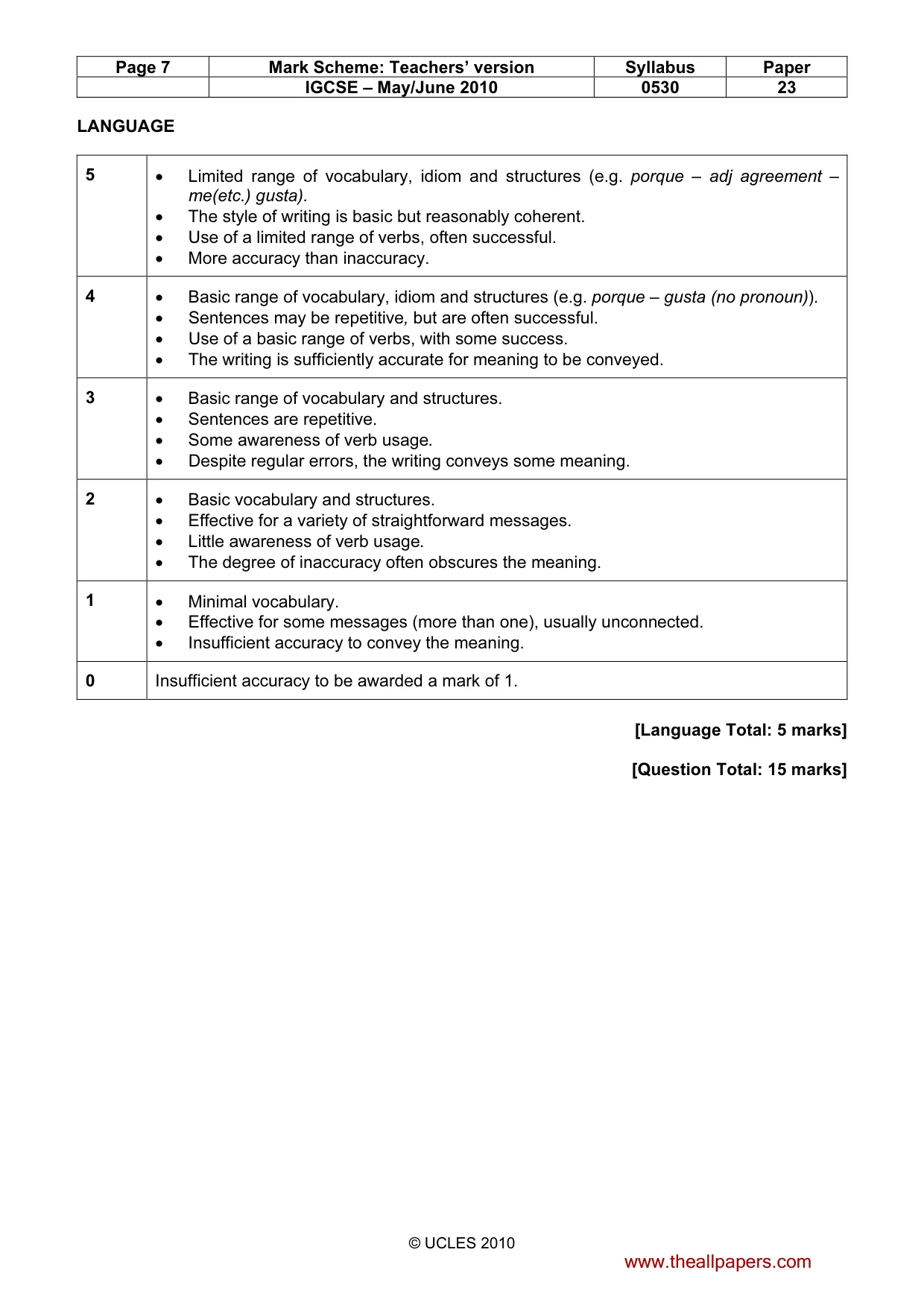
Page 7 Mark Scheme: Teachers’ version Syllabus Paper IGCSE – May/June 2010 0530 23 © UCLES 2010 LANGUAGE 5 • Limited range of vocabulary, idiom and structures (e.g. porque – adj agreement – me(etc.) gusta). • The style of writing is basic but reasonably coherent. • Use of a limited range of verbs, often successful. • More accuracy than inaccuracy. 4 • Basic range of vocabulary, idiom and structures (e.g. porque – gusta (no pronoun)). • Sentences may be repetitive, but are often successful. • Use of a basic range of verbs, with some success. • The writing is sufficiently accurate for meaning to be conveyed. 3 • Basic range of vocabulary and structures. • Sentences are repetitive. • Some awareness of verb usage. • Despite regular errors, the writing conveys some meaning. 2 • Basic vocabulary and structures. • Effective for a variety of straightforward messages. • Little awareness of verb usage. • The degree of inaccuracy often obscures the meaning. 1 • Minimal vocabulary. • Effective for some messages (more than one), usually unconnected. • Insufficient accuracy to convey the meaning. 0 Insufficient accuracy to be awarded a mark of 1. [Language Total: 5 marks] [Question Total: 15 marks] www.theallpapers.com
Mark scheme, page 8
Page 8 Mark Scheme: Teachers’ version Syllabus Paper IGCSE – May/June 2010 0530 23 © UCLES 2010 SECTION 3 GENERAL PRINCIPLES Criteria Answers are being marked primarily for understanding of the passage. But see below. Accuracy Errors in the following are only to be accepted providing they do not distort or invalidate the understanding of the passage. • Possessive adjectives and pronouns • Personal pronouns • Verb tense endings • Verb personal endings Extra material and copying In this Section it is the candidate’s responsibility to answer questions in such a way as to demonstrate comprehension of the texts/questions. Where candidates introduce extra, irrelevant material to an otherwise correct answer, the Examiner must ‘choose’ what is intended as the correct answer, which means that there is uncertainty about the candidate’s understanding. In this situation the mark is not awarded. Candidates who lift indiscriminately usually fail to demonstrate comprehension and do not score the mark. However, careful lifting of the details required to answer the question does demonstrate comprehension and is rewarded. The following general rules apply (unless a question has specific guidance in the relevant parts of the Mark Scheme). Extra material is mentioned in the Mark Scheme. If such material reinforces the correct answer or in itself constitutes an alternative correct answer, credit is given. Extra material constitutes an alternative answer which is not explicitly mentioned in the Mark Scheme. If the extra forms an alternative correct answer, credit is given. If it forms an answer which on its own would be refused, no credit is given (as below). Extra material constitutes an alternative answer specifically refused in the Mark Scheme. No credit. The extra material distorts or contradicts the correct answer. No credit given. The Examiner cannot be sure what the candidate has understood. The extra material is the candidate’s and does not feature in the text. Unlikely to be worthy of credit on the grounds that it can be difficult to draw the line between a possible deduction made on the basis of what has been read and pure guesswork. www.theallpapers.com
Mark scheme, page 9
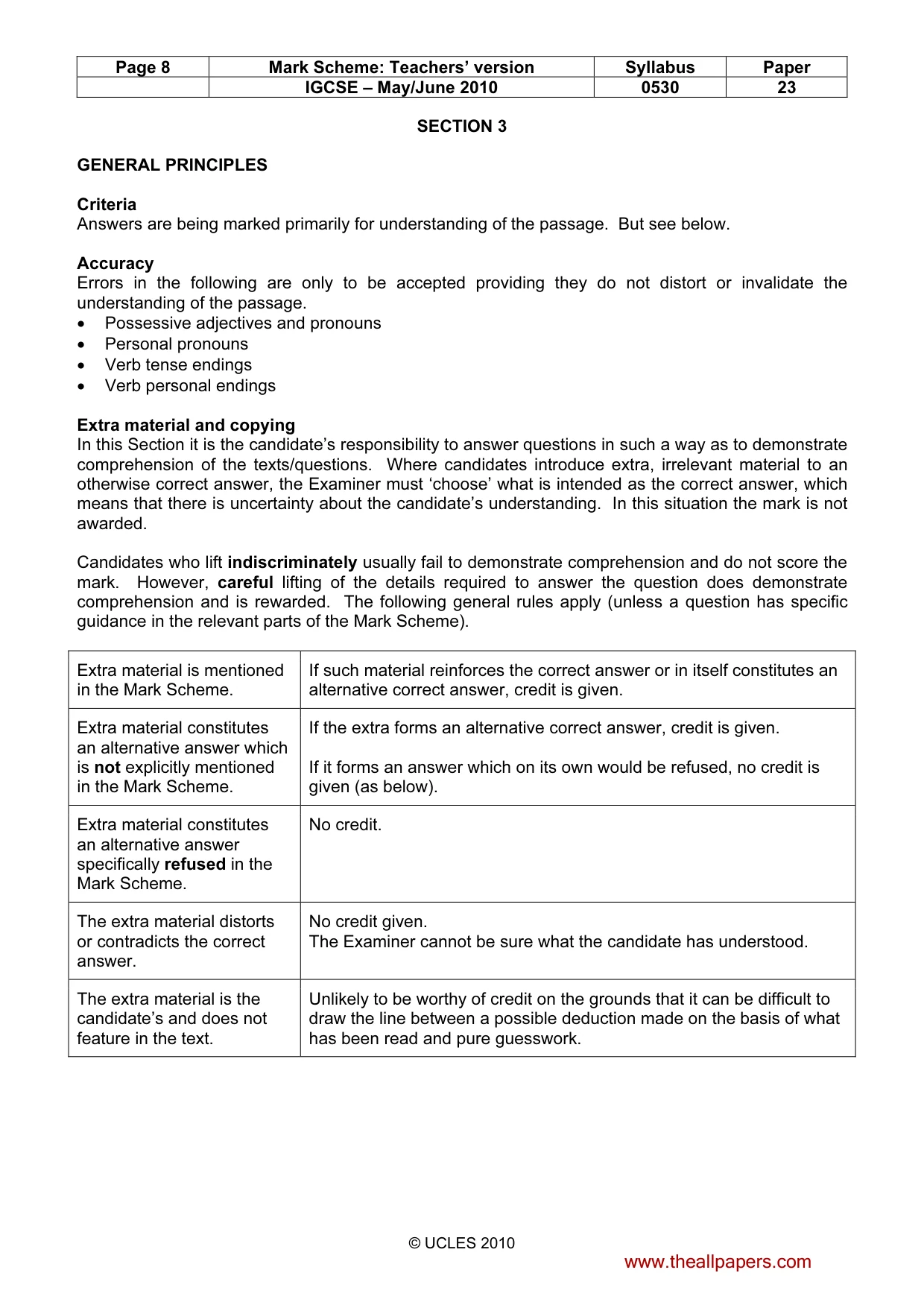
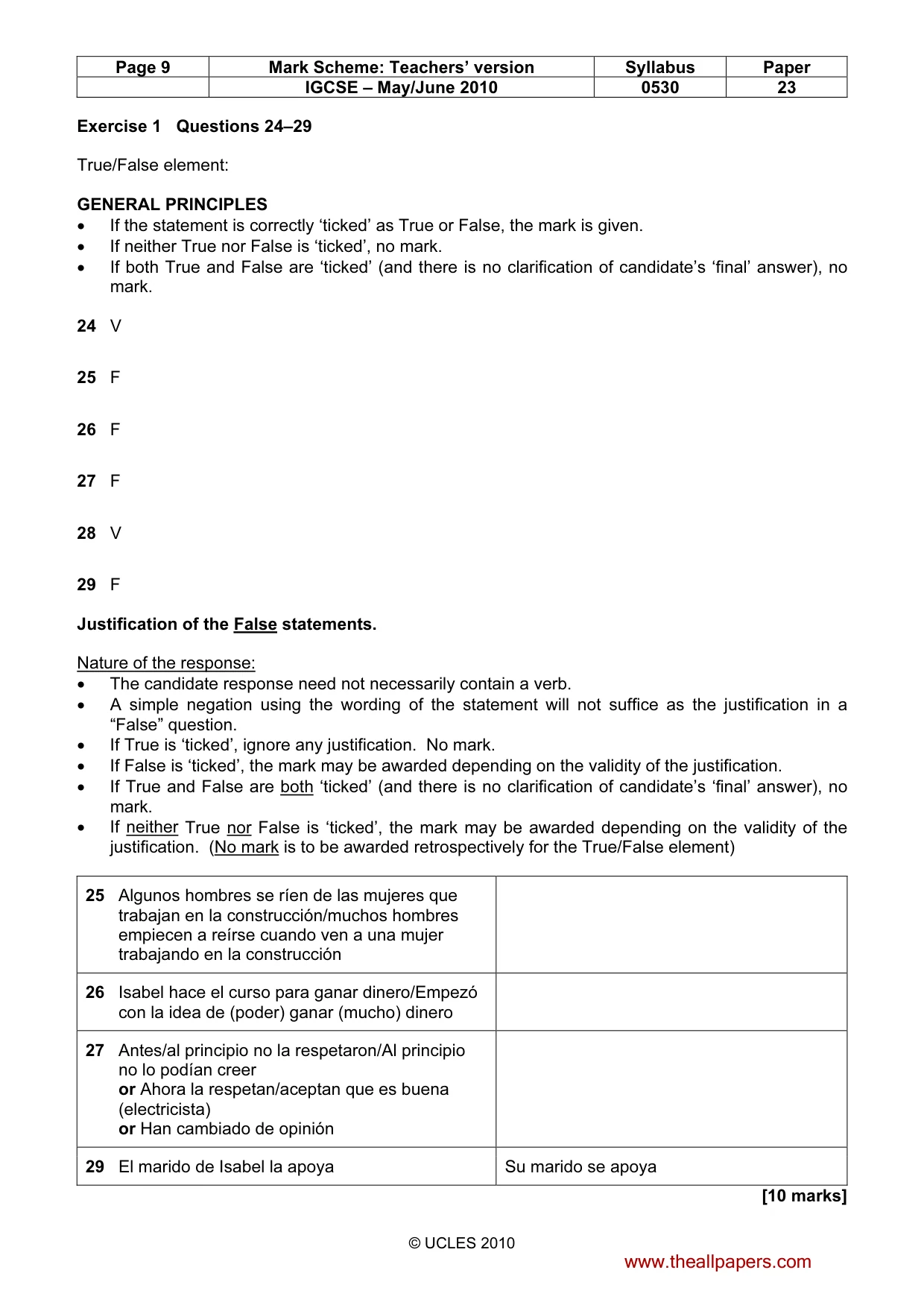
Page 9 Mark Scheme: Teachers’ version Syllabus Paper IGCSE – May/June 2010 0530 23 © UCLES 2010 Exercise 1 Questions 24–29 True/False element: GENERAL PRINCIPLES • If the statement is correctly ‘ticked’ as True or False, the mark is given. • If neither True nor False is ‘ticked’, no mark. • If both True and False are ‘ticked’ (and there is no clarification of candidate’s ‘final’ answer), no mark. 24 V 25 F 26 F 27 F 28 V 29 F Justification of the False statements. Nature of the response: • The candidate response need not necessarily contain a verb. • A simple negation using the wording of the statement will not suffice as the justification in a “False” question. • If True is ‘ticked’, ignore any justification. No mark. • If False is ‘ticked’, the mark may be awarded depending on the validity of the justification. • If True and False are both ‘ticked’ (and there is no clarification of candidate’s ‘final’ answer), no mark. • If neither True nor False is ‘ticked’, the mark may be awarded depending on the validity of the justification. (No mark is to be awarded retrospectively for the True/False element) 25 Algunos hombres se ríen de las mujeres que trabajan en la construcción/muchos hombres empiecen a reírse cuando ven a una mujer trabajando en la construcción 26 Isabel hace el curso para ganar dinero/Empezó con la idea de (poder) ganar (mucho) dinero 27 Antes/al principio no la respetaron/Al principio no lo podían creer or Ahora la respetan/aceptan que es buena (electricista) or Han cambiado de opinión 29 El marido de Isabel la apoya Su marido se apoya [10 marks] www.theallpapers.com
Mark scheme, page 10
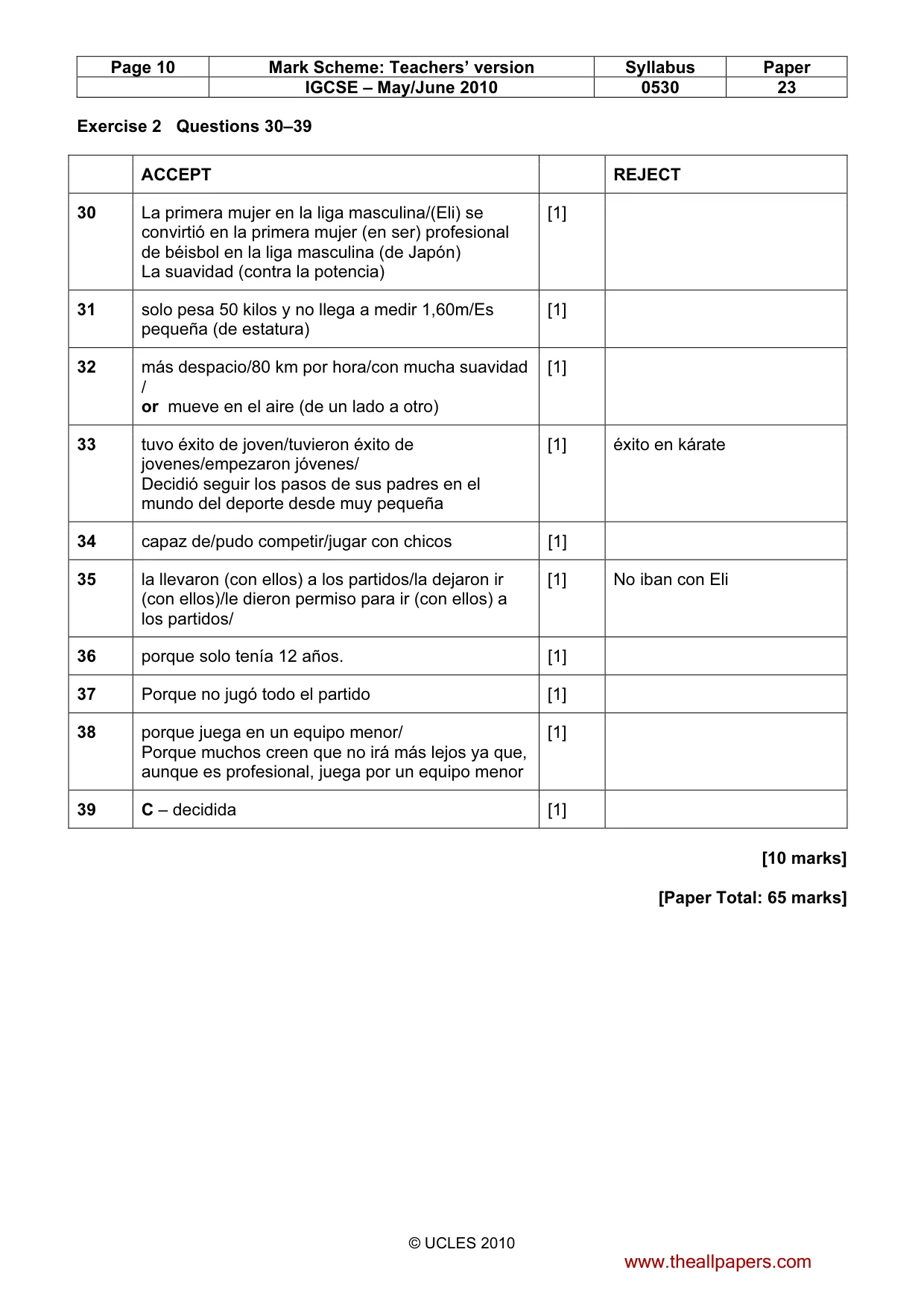
Page 10 Mark Scheme: Teachers’ version Syllabus Paper IGCSE – May/June 2010 0530 23 © UCLES 2010 Exercise 2 Questions 30–39 ACCEPT REJECT 30 La primera mujer en la liga masculina/(Eli) se convirtió en la primera mujer (en ser) profesional de béisbol en la liga masculina (de Japón) La suavidad (contra la potencia) [1] 31 solo pesa 50 kilos y no llega a medir 1,60m/Es pequeña (de estatura) [1] 32 más despacio/80 km por hora/con mucha suavidad / or mueve en el aire (de un lado a otro) [1] 33 tuvo éxito de joven/tuvieron éxito de jovenes/empezaron jóvenes/ Decidió seguir los pasos de sus padres en el mundo del deporte desde muy pequeña [1] éxito en kárate 34 capaz de/pudo competir/jugar con chicos [1] 35 la llevaron (con ellos) a los partidos/la dejaron ir (con ellos)/le dieron permiso para ir (con ellos) a los partidos/ [1] No iban con Eli 36 porque solo tenía 12 años. [1] 37 Porque no jugó todo el partido [1] 38 porque juega en un equipo menor/ Porque muchos creen que no irá más lejos ya que, aunque es profesional, juega por un equipo menor [1] 39 C – decidida [1] [10 marks] [Paper Total: 65 marks] www.theallpapers.com
What you needed in this session
Cambridge’s own grade thresholds for 2010 May/June, Paper 2 · Variant 3. A higher threshold means an easier paper — the bar moves with how the cohort did.