Cambridge IGCSE Sociology 0495 — 2025 Oct/Nov Paper 2 · Variant 3
0495/23/O/N/25 · 3 questions · 80 marks · 105 min
The question paper and its mark scheme, free to read here and free to download. This is Cambridge’s own paper, exactly as it was sat.
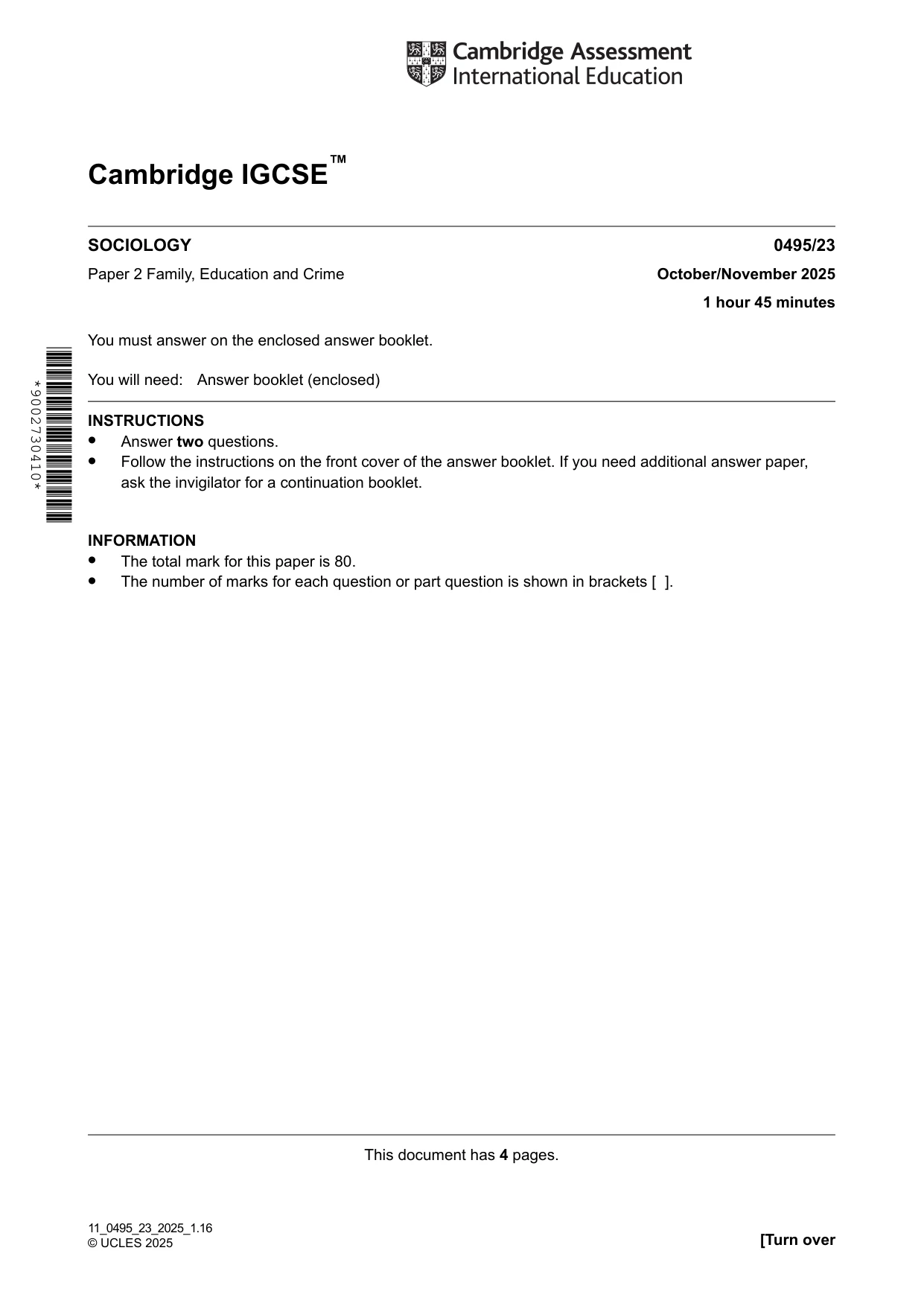
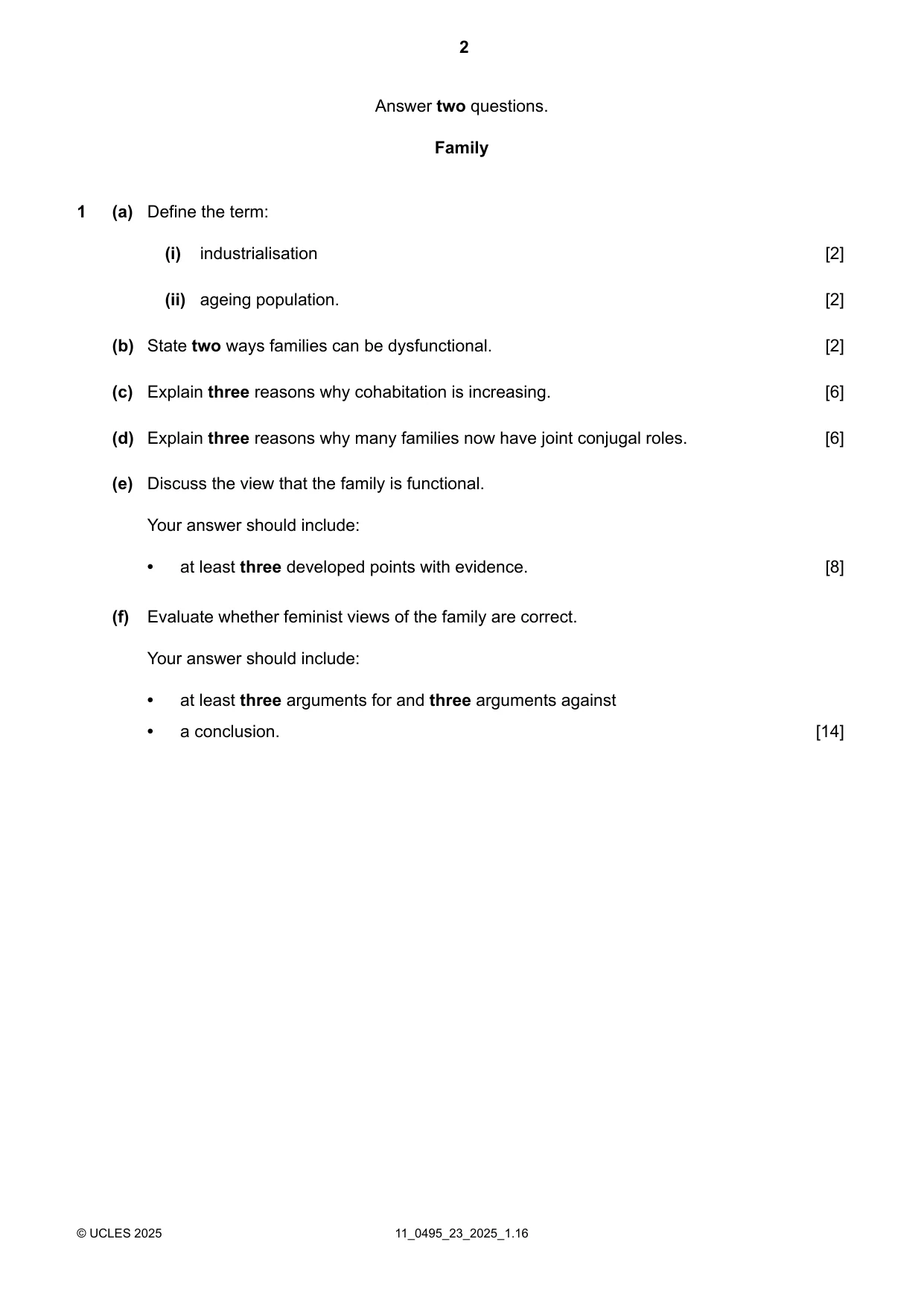
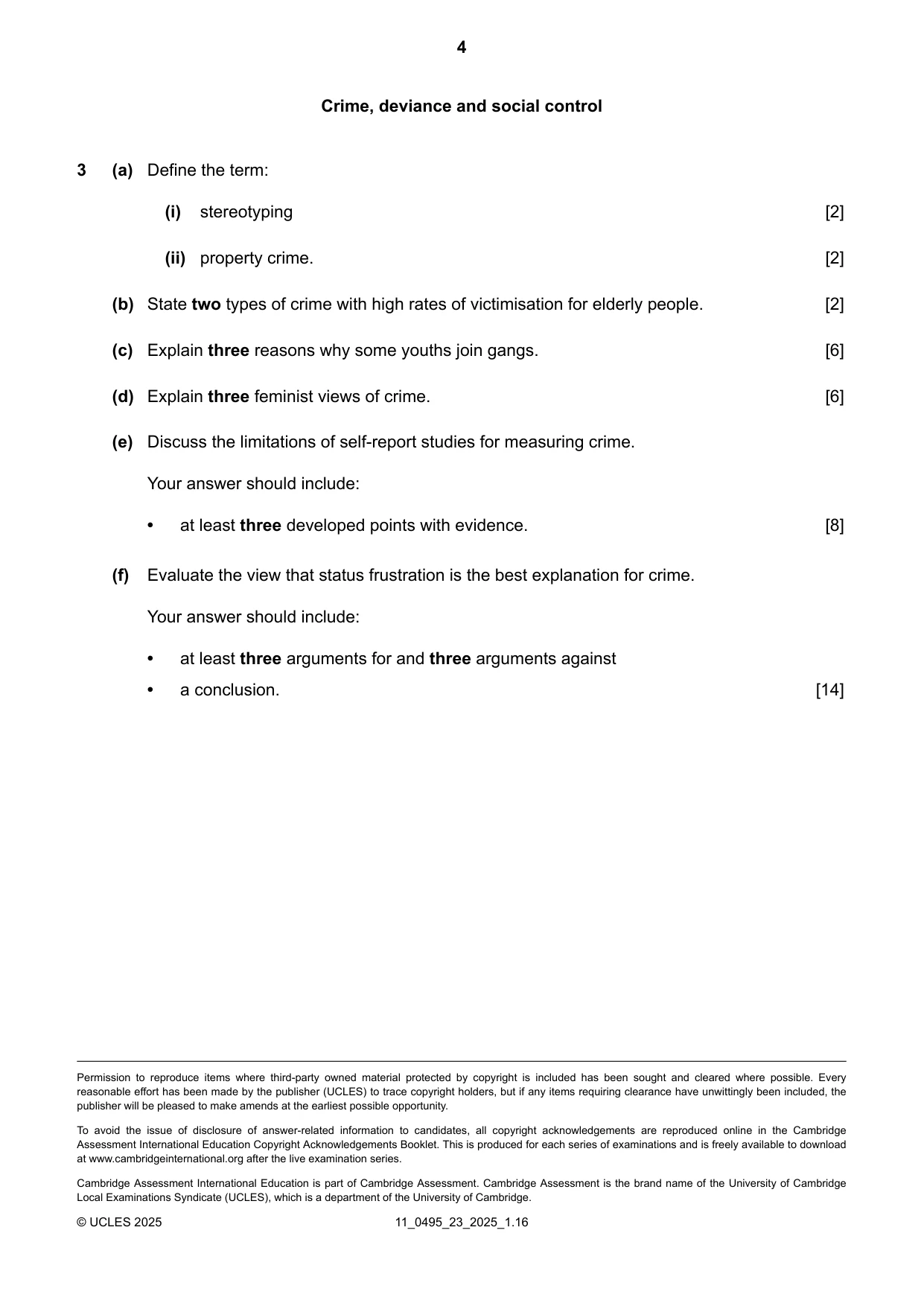
Question paper4 pages

Mark scheme26 pages
Answers below. Sit the paper first if you are practising.










Questions as text
Q1 · Define the term: (i) industrialisation [2] (ii) ageing population
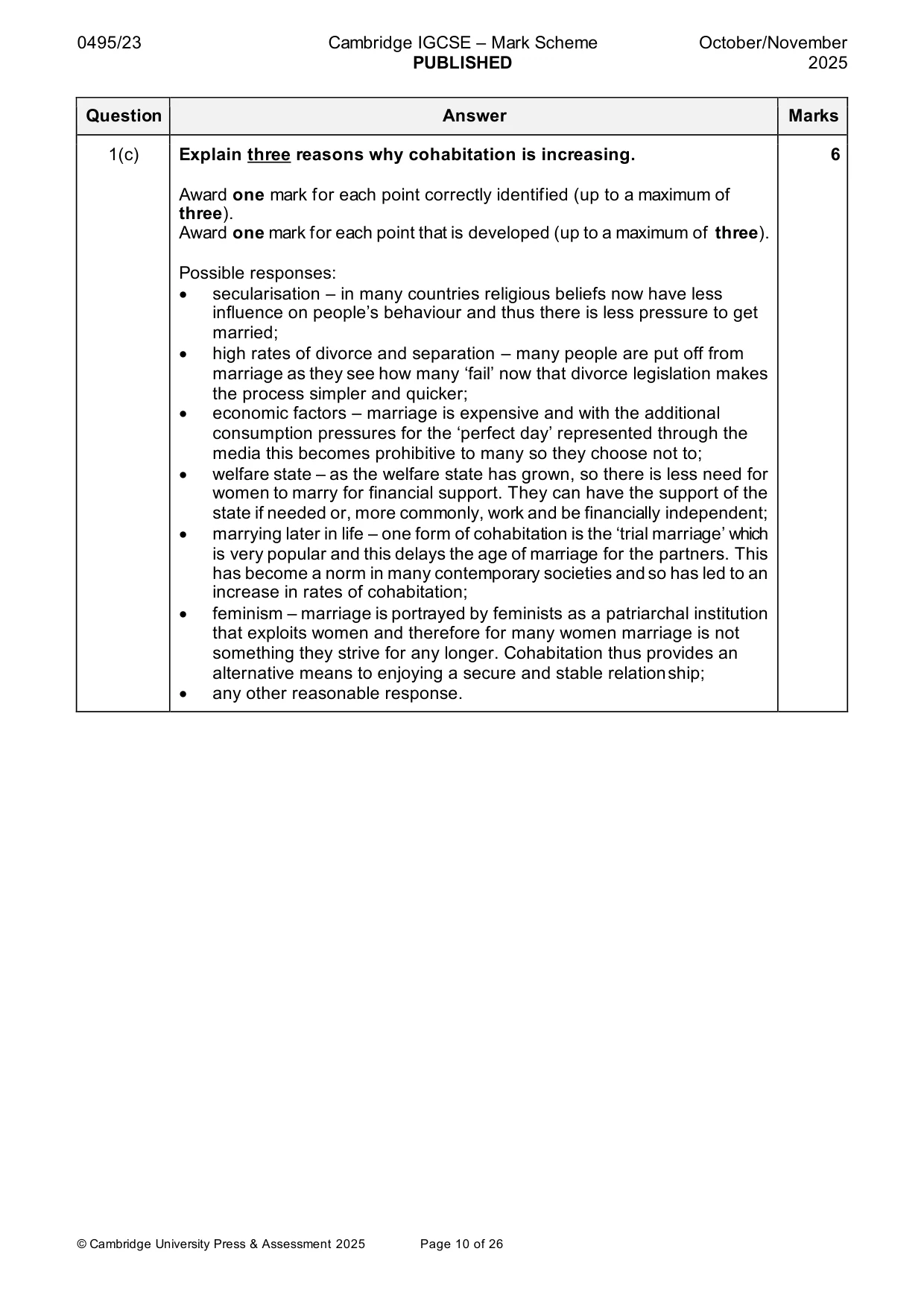
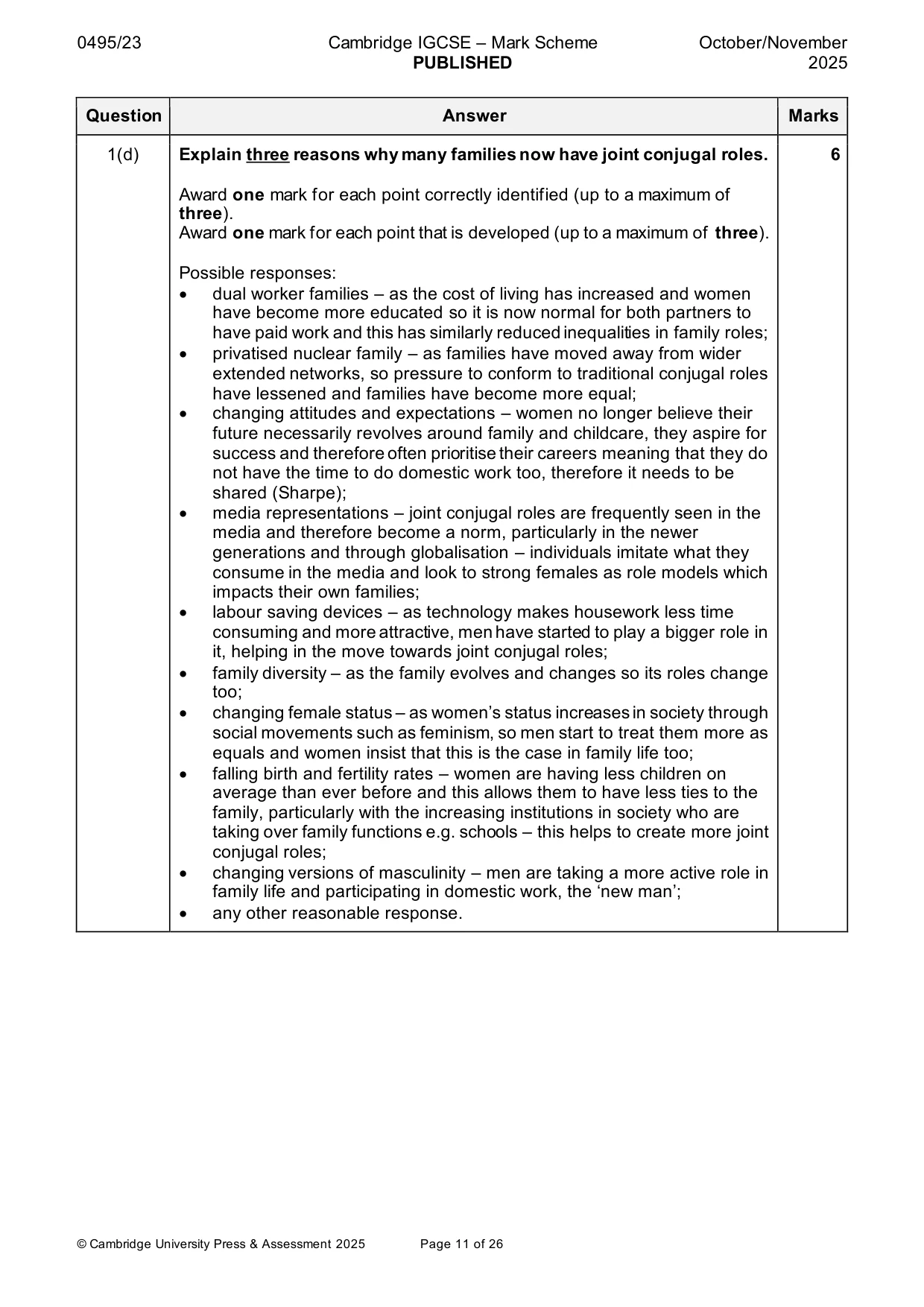
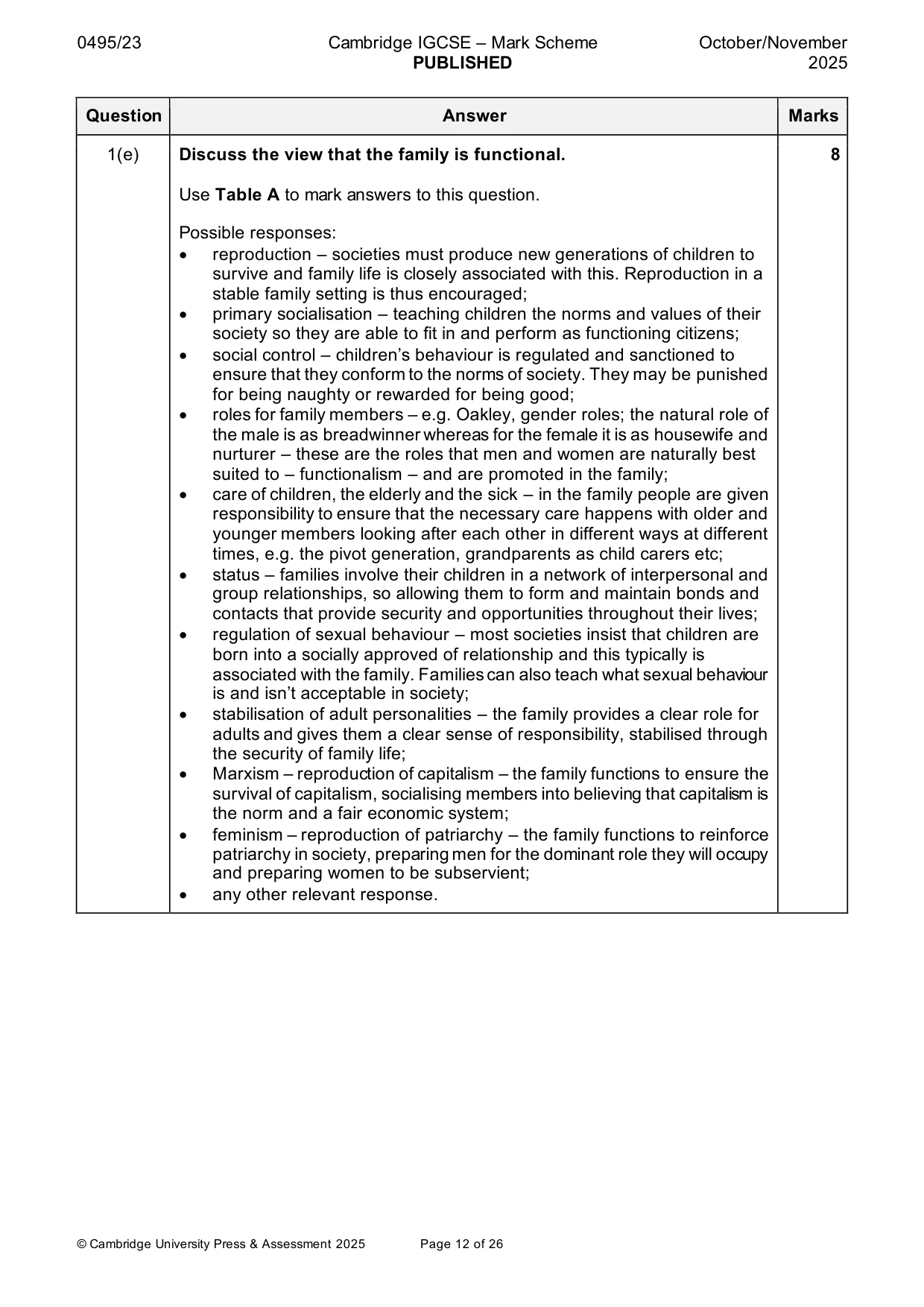
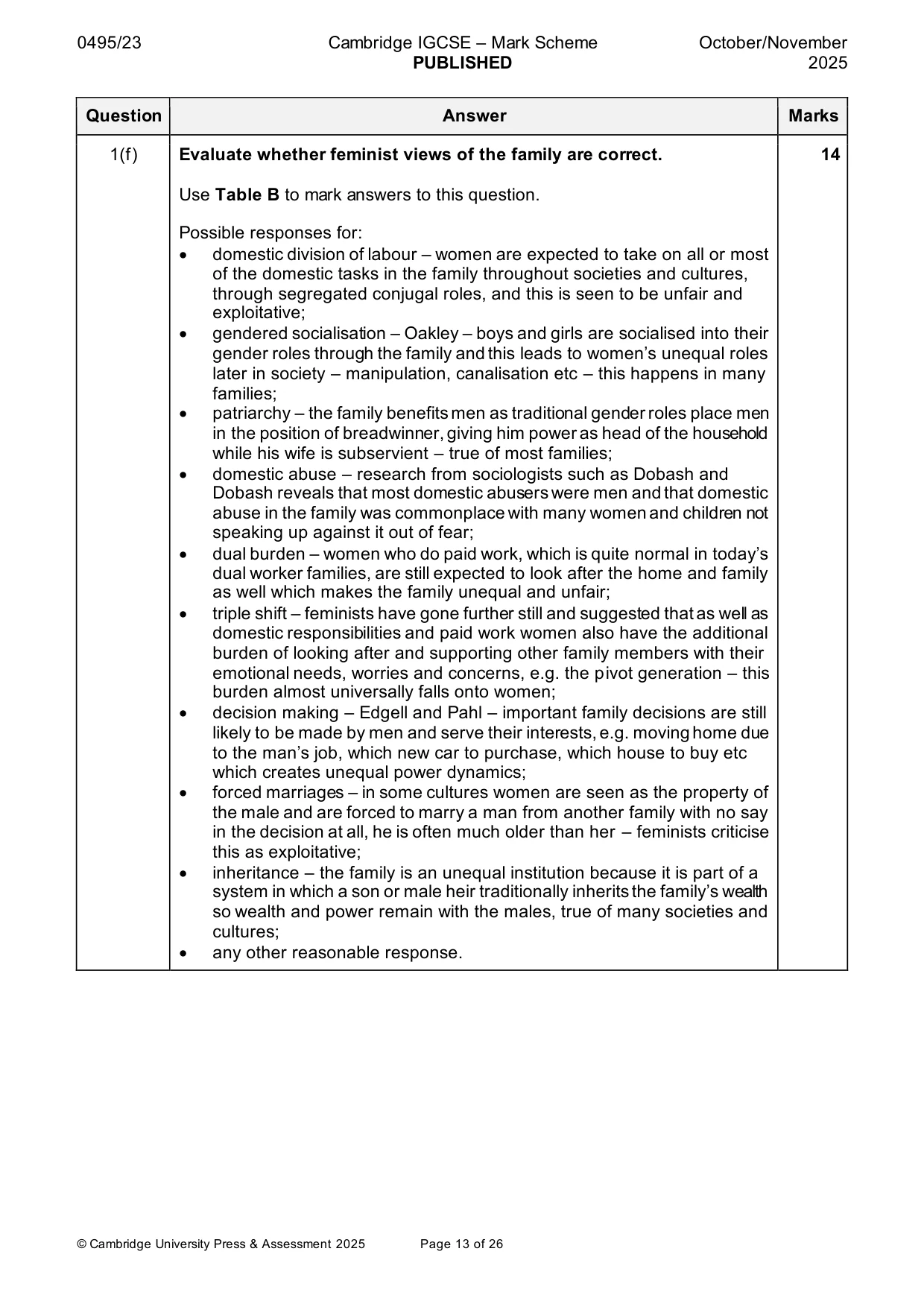
1 (a) Define the term: (i) industrialisation [2] (ii) ageing population. [2] (b) State two ways families can be dysfunctional. [2] (c) Explain three reasons why cohabitation is increasing. [6] (d) Explain three reasons why many families now have joint conjugal roles. [6] (e) Discuss the view that the family is functional. Your answer should include: • at least three developed points with evidence. [8] (f) Evaluate whether feminist views of the family are correct. Your answer should include: • at least three arguments for and three arguments against • a conclusion. [14] Education
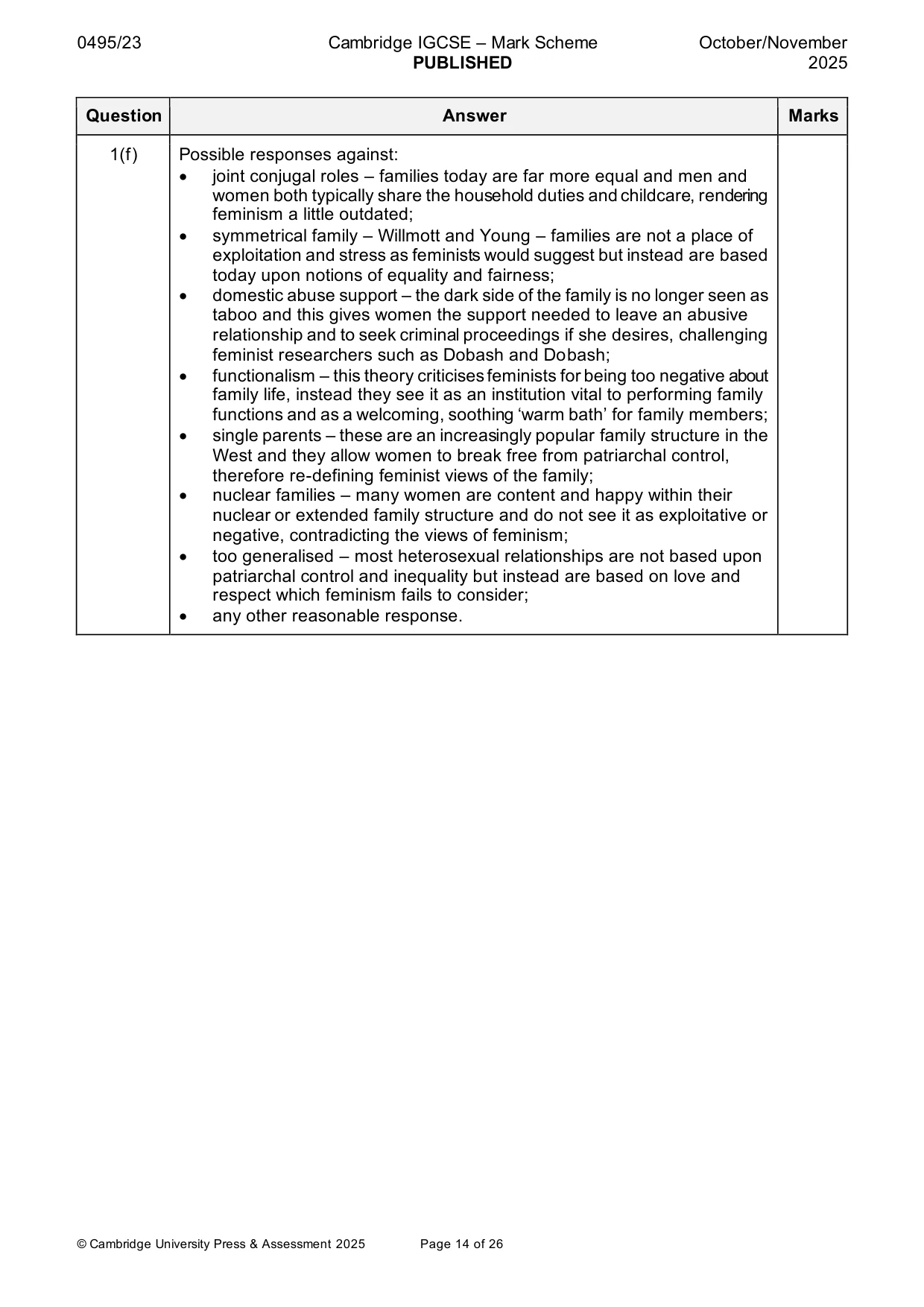
Mark scheme: Question Answer Marks 1(a)(i) Define the term industrialisation. 2 Award one mark for a partial definition, e.g. factory working. Award two marks for a clear definition, e.g. the process in history in which societies changed from being mainly rural and based on agriculture to being urban with more people working in industries. Accept any other reasonable response. 1(a)(ii) Define the term ageing population. 2 Award one mark for a partial definition, e.g. more older people. Award two marks for a clear definition, e.g. the proportion of older people in a population increases. Accept any other reasonable response. 1(b) State two ways families can be dysfunctional. 2 Award one mark for each correct example (up to a maximum of two). Possible responses: • divorce/reconstituted families; • family diversity; • inadequate socialisation; • domestic abuse; • lone parent families; • cohabitation; • increase in working women; • dependency culture; • lack of male role models; • any other reasonable response. 1(c) Explain three reasons why cohabitation is increasing. 6 Award one mark for each point correctly identified (up to a maximum of three). Award one mark for each point that is developed (up to a maximum of three). Possible responses: • secularisation – in many countries religious beliefs now have less influence on people’s behaviour and thus there is less pressure to get married; • high rates of divorce and separation – many people are put off from marriage as they see how many ‘fail’ now that divorce legislation makes the process simpler and quicker; • economic factors – marriage is expensive and with the additional consumption pressures for the ‘perfect day’ represented through the media this becomes prohibitive to many so they choose not to; • welfare state – as the welfare state has grown, so there is less need for women to marry for financial support. They can have the support of the state if needed or, more commonly, work and be financially independent; • marrying later in life – one form of cohabitation is the ‘trial marriage’ which is very popular and this delays the age of marriage for the partners. This has become a norm in many contemporary societies and so has led to an increase in rates of cohabitation; • feminism – marriage is portrayed by feminists as a patriarchal institution that exploits women and therefore for many women marriage is not something they strive for any longer. Cohabitation thus provides an alternative means to enjoying a secure and stable relationship; • any other reasonable response. 1(d) Explain three reasons why many families now have joint conjugal roles. 6 Award one mark for each point correctly identified (up to a maximum of three). Award one mark for each point that is developed (up to a maximum of three). Possible responses: • dual worker families – as the cost of living has increased and women have become more educated so it is now normal for both partners to have paid work and this has similarly reduced inequalities in family roles; • privatised nuclear family – as families have moved away from wider extended networks, so pressure to conform to traditional conjugal roles have lessened and families have become more equal; • changing attitudes and expectations – women no longer believe their future necessarily revolves around family and childcare, they aspire for success and therefore often prioritise their careers meaning that they do not have the time to do domestic work too, therefore it needs to be shared (Sharpe); • media representations – joint conjugal roles are frequently seen in the media and therefore become a norm, particularly in the newer generations and through globalisation – individuals imitate what they consume in the media and look to strong females as role models which impacts their own families; • labour saving devices – as technology makes housework less time consuming and more attractive, men have started to play a bigger role in it, helping in the move towards joint conjugal roles; • family diversity – as the family evolves and changes so its roles change too; • changing female status – as women’s status increases in society through social movements such as feminism, so men start to treat them more as equals and women insist that this is the case in family life too; • falling birth and fertility rates – women are having less children on average than ever before and this allows them to have less ties to the family, particularly with the increasing institutions in society who are taking over family functions e.g. schools – this helps to create more joint conjugal roles; • changing versions of masculinity – men are taking a more active role in family life and participating in domestic work, the ‘new man’; • any other reasonable response. 1(e) Discuss the view that the family is functional. 8 Use Table A to mark answers to this question. Possible responses: • reproduction – societies must produce new generations of children to survive and family life is closely associated with this. Reproduction in a stable family setting is thus encouraged; • primary socialisation – teaching children the norms and values of their society so they are able to fit in and perform as functioning citizens; • social control – children’s behaviour is regulated and sanctioned to ensure that they conform to the norms of society. They may be punished for being naughty or rewarded for being good; • roles for family members – e.g. Oakley, gender roles; the natural role of the male is as breadwinner whereas for the female it is as housewife and nurturer – these are the roles that men and women are naturally best suited to – functionalism – and are promoted in the family; • care of children, the elderly and the sick – in the family people are given responsibility to ensure that the necessary care happens with older and younger members looking after each other in different ways at different times, e.g. the pivot generation, grandparents as child carers etc; • status – families involve their children in a network of interpersonal and group relationships, so allowing them to form and maintain bonds and contacts that provide security and opportunities throughout their lives; • regulation of sexual behaviour – most societies insist that children are born into a socially approved of relationship and this typically is associated with the family. Families can also teach what sexual behaviour is and isn’t acceptable in society; • stabilisation of adult personalities – the family provides a clear role for adults and gives them a clear sense of responsibility, stabilised through the security of family life; • Marxism – reproduction of capitalism – the family functions to ensure the survival of capitalism, socialising members into believing that capitalism is the norm and a fair economic system; • feminism – reproduction of patriarchy – the family functions to reinforce patriarchy in society, preparing men for the dominant role they will occupy and preparing women to be subservient; • any other relevant response. 1(f) Evaluate whether feminist views of the family are correct. 14 Use Table B to mark answers to this question. Possible responses for: • domestic division of labour – women are expected to take on all or most of the domestic tasks in the family throughout societies and cultures, through segregated conjugal roles, and this is seen to be unfair and exploitative; • gendered socialisation – Oakley – boys and girls are socialised into their gender roles through the family and this leads to women’s unequal roles later in society – manipulation, canalisation etc – this happens in many families; • patriarchy – the family benefits men as traditional gender roles place men in the position of breadwinner, giving him power as head of the household while his wife is subservient – true of most families; • domestic abuse – research from sociologists such as Dobash and Dobash reveals that most domestic abusers were men and that domestic abuse in the family was commonplace with many women and children not speaking up against it out of fear; • dual burden – women who do paid work, which is quite normal in today’s dual worker families, are still expected to look after the home and family as well which makes the family unequal and unfair; • triple shift – feminists have gone further still and suggested that as well as domestic responsibilities and paid work women also have the additional burden of looking after and supporting other family members with their emotional needs, worries and concerns, e.g. the pivot generation – this burden almost universally falls onto women; • decision making – Edgell and Pahl – important family decisions are still likely to be made by men and serve their interests, e.g. moving home due to the man’s job, which new car to purchase, which house to buy etc which creates unequal power dynamics; • forced marriages – in some cultures women are seen as the property of the male and are forced to marry a man from another family with no say in the decision at all, he is often much older than her – feminists criticise this as exploitative; • inheritance – the family is an unequal institution because it is part of a system in which a son or male heir traditionally inherits the family’s wealth so wealth and power remain with the males, true of many societies and cultures; • any other reasonable response. 1(f) Possible responses against: • joint conjugal roles – families today are far more equal and men and women both typically share the household duties and childcare, rendering feminism a little outdated; • symmetrical family – Willmott and Young – families are not a place of exploitation and stress as feminists would suggest but instead are based today upon notions of equality and fairness; • domestic abuse support – the dark side of the family is no longer seen as taboo and this gives women the support needed to leave an abusive relationship and to seek criminal proceedings if she desires, challenging feminist researchers such as Dobash and Dobash; • functionalism – this theory criticises feminists for being too negative about family life, instead they see it as an institution vital to performing family functions and as a welcoming, soothing ‘warm bath’ for family members; • single parents – these are an increasingly popular family structure in the West and they allow women to break free from patriarchal control, therefore re-defining feminist views of the family; • nuclear families – many women are content and happy within their nuclear or extended family structure and do not see it as exploitative or negative, contradicting the views of feminism; • too generalised – most heterosexual relationships are not based upon patriarchal control and inequality but instead are based on love and respect which feminism fails to consider; • any other reasonable response.
Q2 · Define the term: (i) role model [2] (ii) international school
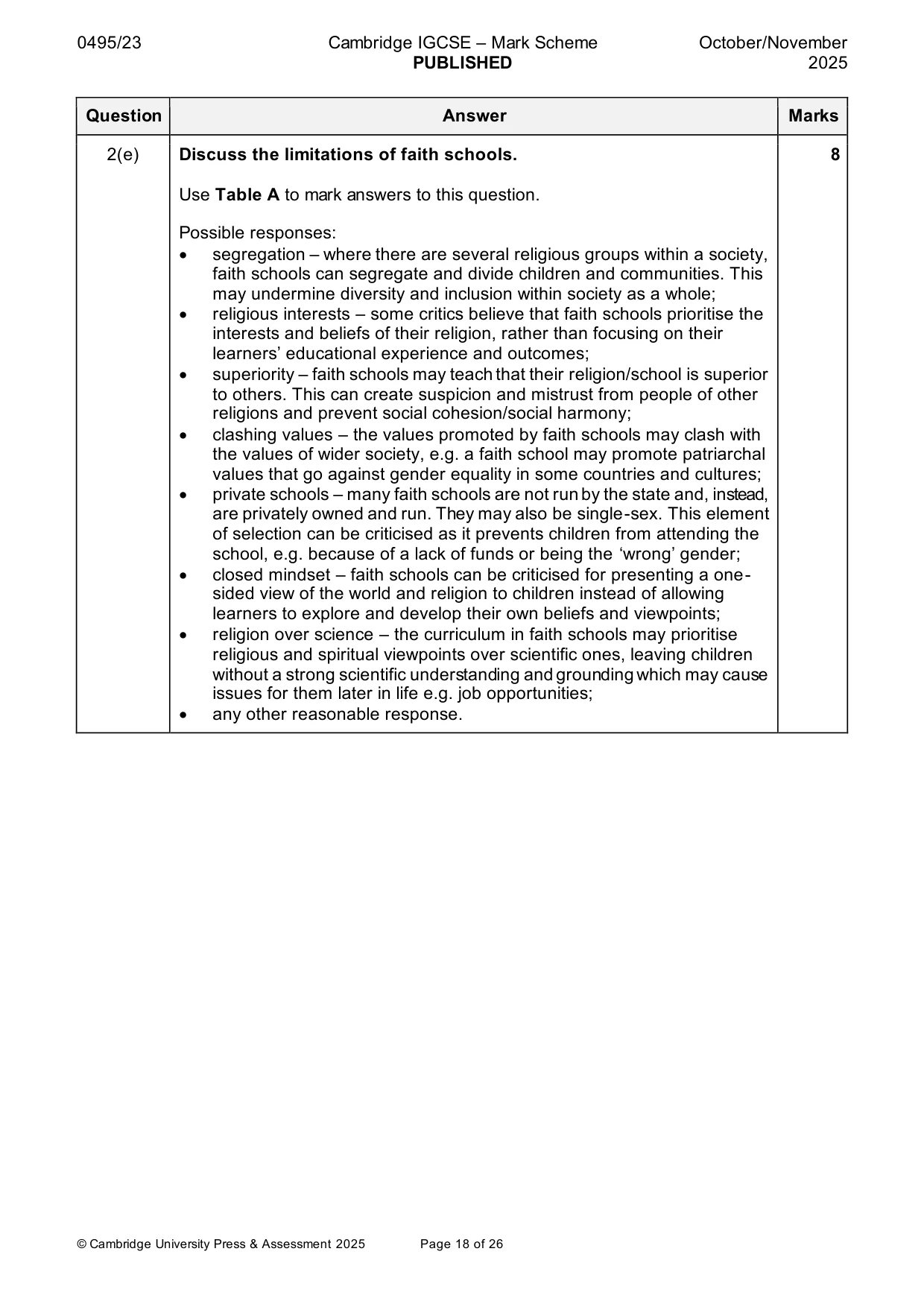
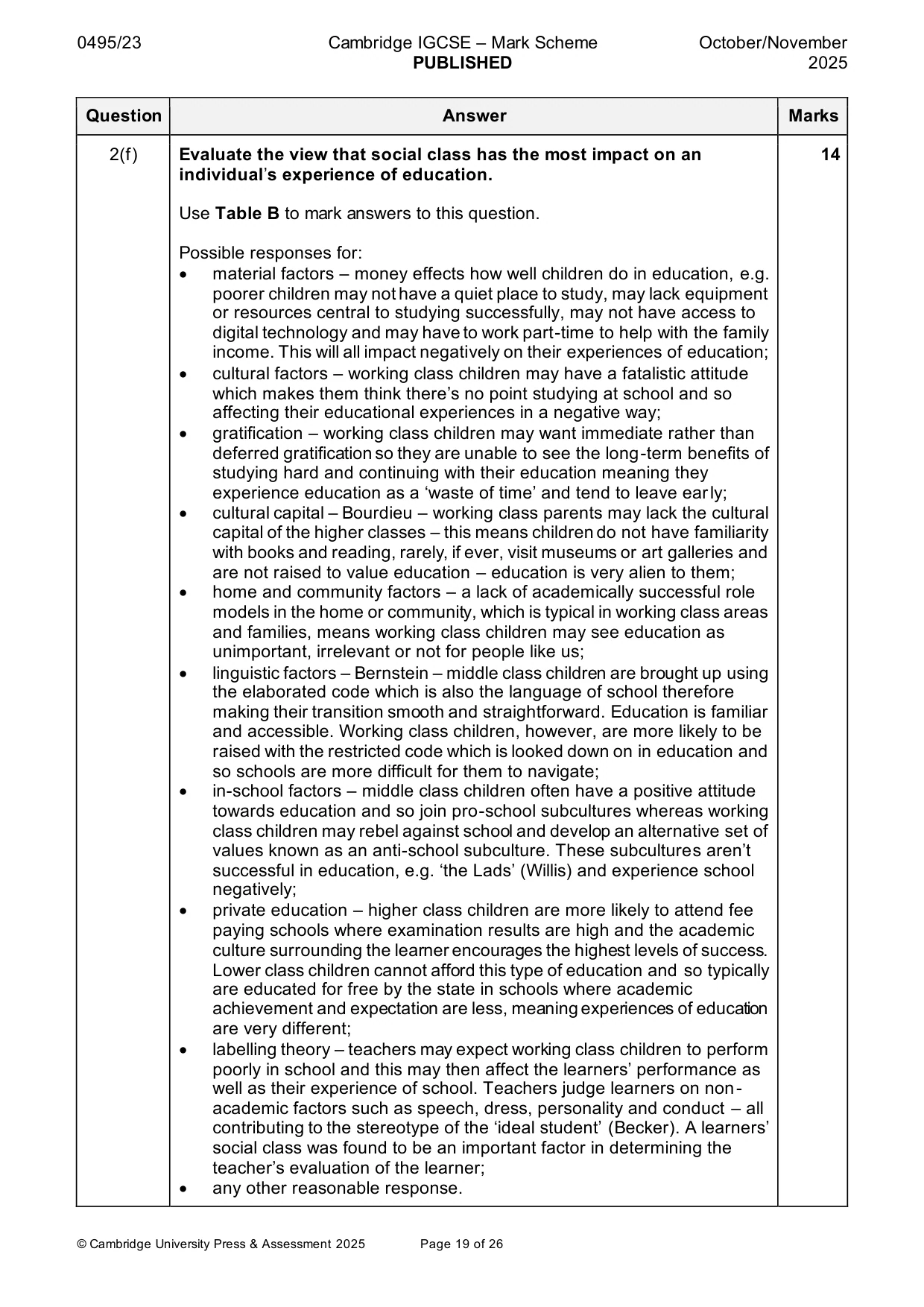
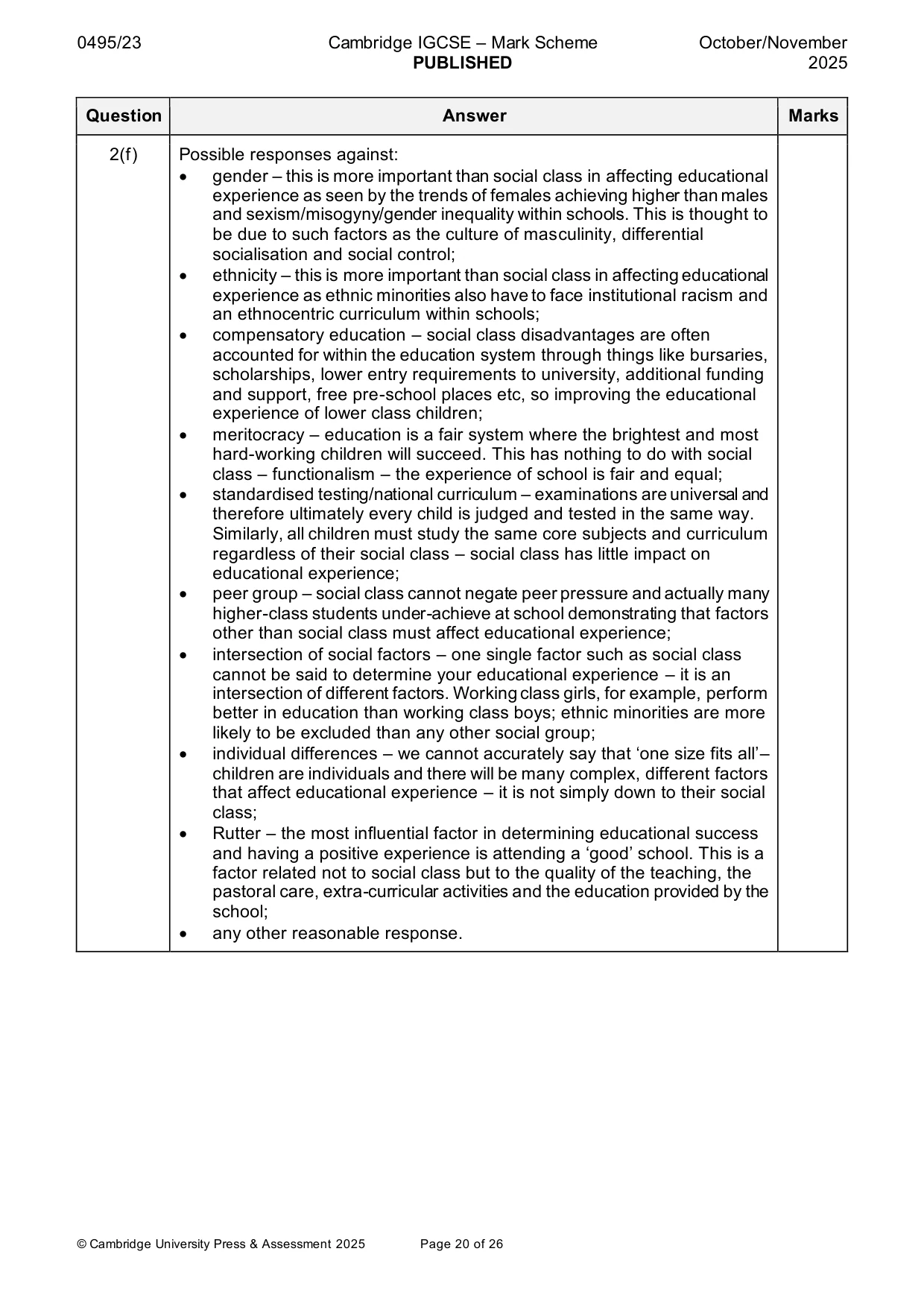
2 (a) Define the term: (i) role model [2] (ii) international school. [2] (b) State two strengths of homeschooling. [2] (c) Explain three ways in-school factors can affect educational achievement. [6] (d) Explain three roles of education. [6] (e) Discuss the limitations of faith schools. Your answer should include: • at least three developed points with evidence. [8] (f) Evaluate the view that social class has the most impact on an individual’s experience of education. Your answer should include: • at least three arguments for and three arguments against • a conclusion. [14] Crime, deviance and social control
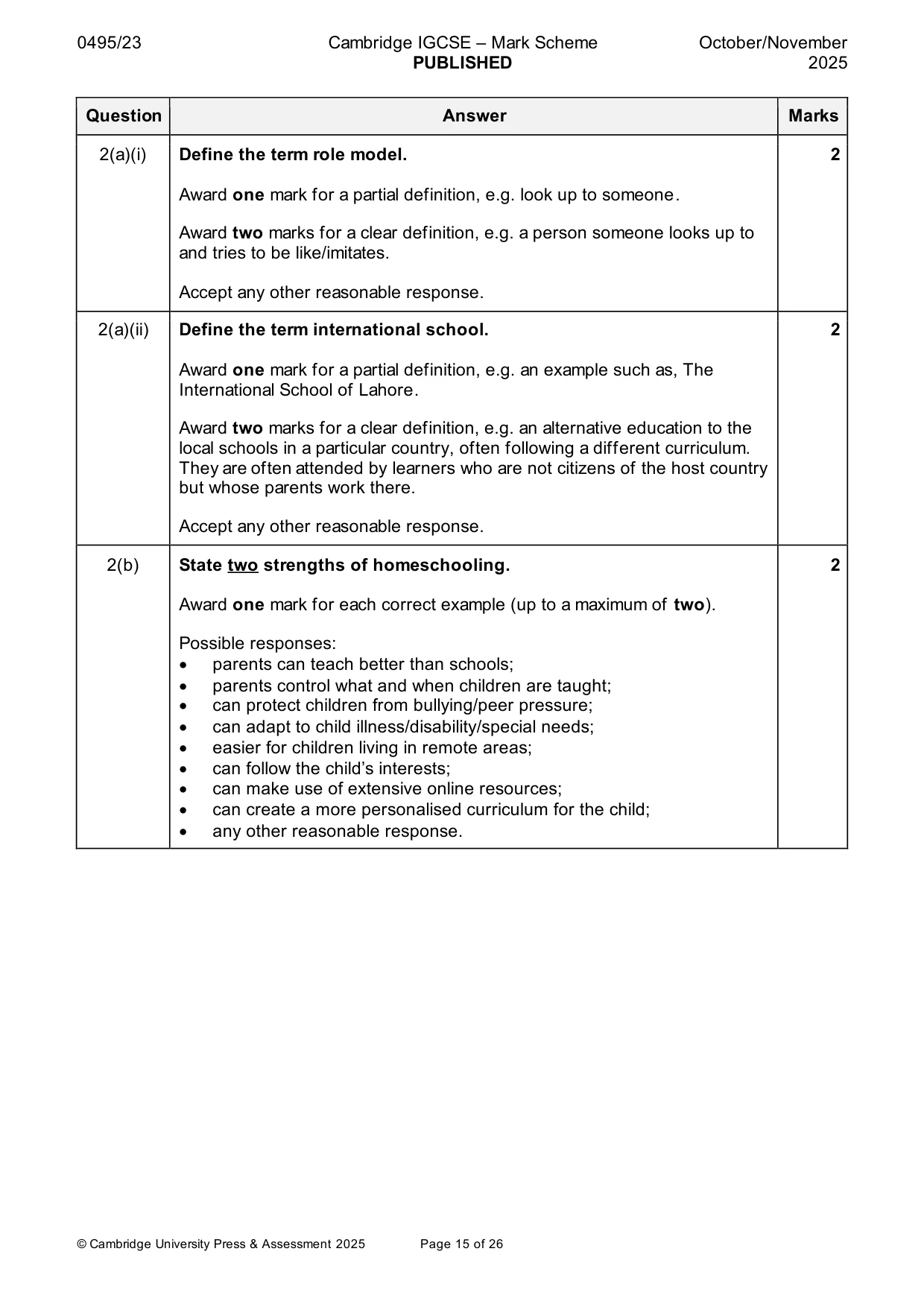
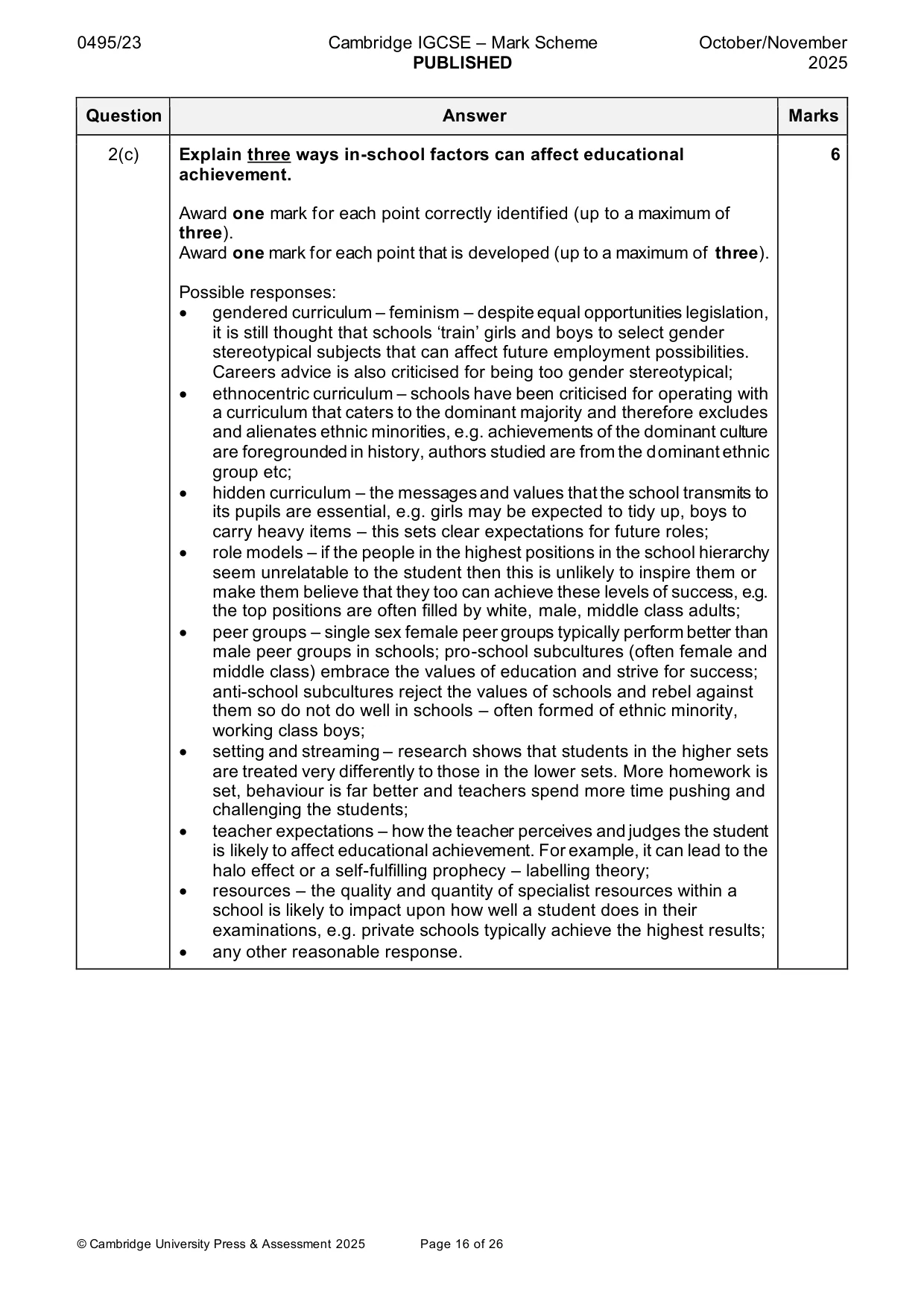
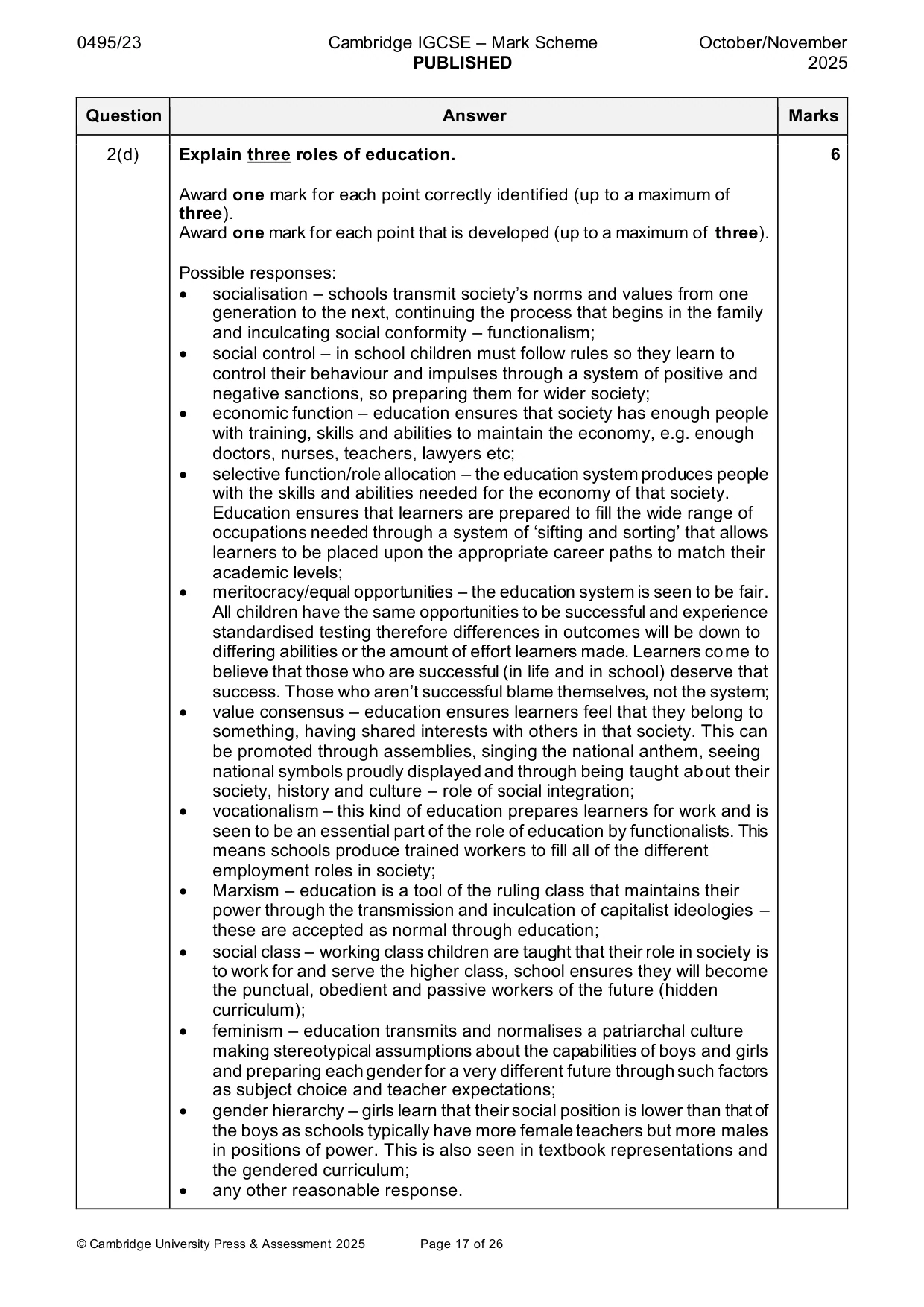
Mark scheme: 2(a)(i) Define the term role model. 2 Award one mark for a partial definition, e.g. look up to someone. Award two marks for a clear definition, e.g. a person someone looks up to and tries to be like/imitates. Accept any other reasonable response. 2(a)(ii) Define the term international school. 2 Award one mark for a partial definition, e.g. an example such as, The International School of Lahore. Award two marks for a clear definition, e.g. an alternative education to the local schools in a particular country, often following a different curriculum. They are often attended by learners who are not citizens of the host country but whose parents work there. Accept any other reasonable response. 2(b) State two strengths of homeschooling. 2 Award one mark for each correct example (up to a maximum of two). Possible responses: • parents can teach better than schools; • parents control what and when children are taught; • can protect children from bullying/peer pressure; • can adapt to child illness/disability/special needs; • easier for children living in remote areas; • can follow the child’s interests; • can make use of extensive online resources; • can create a more personalised curriculum for the child; • any other reasonable response. 2(c) Explain three ways in-school factors can affect educational 6 achievement. Award one mark for each point correctly identified (up to a maximum of three). Award one mark for each point that is developed (up to a maximum of three). Possible responses: • gendered curriculum – feminism – despite equal opportunities legislation, it is still thought that schools ‘train’ girls and boys to select gender stereotypical subjects that can affect future employment possibilities. Careers advice is also criticised for being too gender stereotypical; • ethnocentric curriculum – schools have been criticised for operating with a curriculum that caters to the dominant majority and therefore excludes and alienates ethnic minorities, e.g. achievements of the dominant culture are foregrounded in history, authors studied are from the dominant ethnic group etc; • hidden curriculum – the messages and values that the school transmits to its pupils are essential, e.g. girls may be expected to tidy up, boys to carry heavy items – this sets clear expectations for future roles; • role models – if the people in the highest positions in the school hierarchy seem unrelatable to the student then this is unlikely to inspire them or make them believe that they too can achieve these levels of success, e.g. the top positions are often filled by white, male, middle class adults; • peer groups – single sex female peer groups typically perform better than male peer groups in schools; pro-school subcultures (often female and middle class) embrace the values of education and strive for success; anti-school subcultures reject the values of schools and rebel against them so do not do well in schools – often formed of ethnic minority, working class boys; • setting and streaming – research shows that students in the higher sets are treated very differently to those in the lower sets. More homework is set, behaviour is far better and teachers spend more time pushing and challenging the students; • teacher expectations – how the teacher perceives and judges the student is likely to affect educational achievement. For example, it can lead to the halo effect or a self-fulfilling prophecy – labelling theory; • resources – the quality and quantity of specialist resources within a school is likely to impact upon how well a student does in their examinations, e.g. private schools typically achieve the highest results; • any other reasonable response. 2(d) Explain three roles of education. 6 Award one mark for each point correctly identified (up to a maximum of three). Award one mark for each point that is developed (up to a maximum of three). Possible responses: • socialisation – schools transmit society’s norms and values from one generation to the next, continuing the process that begins in the family and inculcating social conformity – functionalism; • social control – in school children must follow rules so they learn to control their behaviour and impulses through a system of positive and negative sanctions, so preparing them for wider society; • economic function – education ensures that society has enough people with training, skills and abilities to maintain the economy, e.g. enough doctors, nurses, teachers, lawyers etc; • selective function/role allocation – the education system produces people with the skills and abilities needed for the economy of that society. Education ensures that learners are prepared to fill the wide range of occupations needed through a system of ‘sifting and sorting’ that allows learners to be placed upon the appropriate career paths to match their academic levels; • meritocracy/equal opportunities – the education system is seen to be fair. All children have the same opportunities to be successful and experience standardised testing therefore differences in outcomes will be down to differing abilities or the amount of effort learners made. Learners come to believe that those who are successful (in life and in school) deserve that success. Those who aren’t successful blame themselves, not the system; • value consensus – education ensures learners feel that they belong to something, having shared interests with others in that society. This can be promoted through assemblies, singing the national anthem, seeing national symbols proudly displayed and through being taught about their society, history and culture – role of social integration; • vocationalism – this kind of education prepares learners for work and is seen to be an essential part of the role of education by functionalists. This means schools produce trained workers to fill all of the different employment roles in society; • Marxism – education is a tool of the ruling class that maintains their power through the transmission and inculcation of capitalist ideologies – these are accepted as normal through education; • social class – working class children are taught that their role in society is to work for and serve the higher class, school ensures they will become the punctual, obedient and passive workers of the future (hidden curriculum); • feminism – education transmits and normalises a patriarchal culture making stereotypical assumptions about the capabilities of boys and girls and preparing each gender for a very different future through such factors as subject choice and teacher expectations; • gender hierarchy – girls learn that their social position is lower than that of the boys as schools typically have more female teachers but more males in positions of power. This is also seen in textbook representations and the gendered curriculum; • any other reasonable response. 2(e) Discuss the limitations of faith schools. 8 Use Table A to mark answers to this question. Possible responses: • segregation – where there are several religious groups within a society, faith schools can segregate and divide children and communities. This may undermine diversity and inclusion within society as a whole; • religious interests – some critics believe that faith schools prioritise the interests and beliefs of their religion, rather than focusing on their learners’ educational experience and outcomes; • superiority – faith schools may teach that their religion/school is superior to others. This can create suspicion and mistrust from people of other religions and prevent social cohesion/social harmony; • clashing values – the values promoted by faith schools may clash with the values of wider society, e.g. a faith school may promote patriarchal values that go against gender equality in some countries and cultures; • private schools – many faith schools are not run by the state and, instead, are privately owned and run. They may also be single-sex. This element of selection can be criticised as it prevents children from attending the school, e.g. because of a lack of funds or being the ‘wrong’ gender; • closed mindset – faith schools can be criticised for presenting a one- sided view of the world and religion to children instead of allowing learners to explore and develop their own beliefs and viewpoints; • religion over science – the curriculum in faith schools may prioritise religious and spiritual viewpoints over scientific ones, leaving children without a strong scientific understanding and grounding which may cause issues for them later in life e.g. job opportunities; • any other reasonable response. 2(f) Evaluate the view that social class has the most impact on an 14 individual’s experience of education. Use Table B to mark answers to this question. Possible responses for: • material factors – money effects how well children do in education, e.g. poorer children may not have a quiet place to study, may lack equipment or resources central to studying successfully, may not have access to digital technology and may have to work part-time to help with the family income. This will all impact negatively on their experiences of education; • cultural factors – working class children may have a fatalistic attitude which makes them think there’s no point studying at school and so affecting their educational experiences in a negative way; • gratification – working class children may want immediate rather than deferred gratification so they are unable to see the long-term benefits of studying hard and continuing with their education meaning they experience education as a ‘waste of time’ and tend to leave early; • cultural capital – Bourdieu – working class parents may lack the cultural capital of the higher classes – this means children do not have familiarity with books and reading, rarely, if ever, visit museums or art galleries and are not raised to value education – education is very alien to them; • home and community factors – a lack of academically successful role models in the home or community, which is typical in working class areas and families, means working class children may see education as unimportant, irrelevant or not for people like us; • linguistic factors – Bernstein – middle class children are brought up using the elaborated code which is also the language of school therefore making their transition smooth and straightforward. Education is familiar and accessible. Working class children, however, are more likely to be raised with the restricted code which is looked down on in education and so schools are more difficult for them to navigate; • in-school factors – middle class children often have a positive attitude towards education and so join pro-school subcultures whereas working class children may rebel against school and develop an alternative set of values known as an anti-school subculture. These subcultures aren’t successful in education, e.g. ‘the Lads’ (Willis) and experience school negatively; • private education – higher class children are more likely to attend fee paying schools where examination results are high and the academic culture surrounding the learner encourages the highest levels of success. Lower class children cannot afford this type of education and so typically are educated for free by the state in schools where academic achievement and expectation are less, meaning experiences of education are very different; • labelling theory – teachers may expect working class children to perform poorly in school and this may then affect the learners’ performance as well as their experience of school. Teachers judge learners on non- academic factors such as speech, dress, personality and conduct – all contributing to the stereotype of the ‘ideal student’ (Becker). A learners’ social class was found to be an important factor in determining the teacher’s evaluation of the learner; • any other reasonable response. 2(f) Possible responses against: • gender – this is more important than social class in affecting educational experience as seen by the trends of females achieving higher than males and sexism/misogyny/gender inequality within schools. This is thought to be due to such factors as the culture of masculinity, differential socialisation and social control; • ethnicity – this is more important than social class in affecting educational experience as ethnic minorities also have to face institutional racism and an ethnocentric curriculum within schools; • compensatory education – social class disadvantages are often accounted for within the education system through things like bursaries, scholarships, lower entry requirements to university, additional funding and support, free pre-school places etc, so improving the educational experience of lower class children; • meritocracy – education is a fair system where the brightest and most hard-working children will succeed. This has nothing to do with social class – functionalism – the experience of school is fair and equal; • standardised testing/national curriculum – examinations are universal and therefore ultimately every child is judged and tested in the same way. Similarly, all children must study the same core subjects and curriculum regardless of their social class – social class has little impact on educational experience; • peer group – social class cannot negate peer pressure and actually many higher-class students under-achieve at school demonstrating that factors other than social class must affect educational experience; • intersection of social factors – one single factor such as social class cannot be said to determine your educational experience – it is an intersection of different factors. Working class girls, for example, perform better in education than working class boys; ethnic minorities are more likely to be excluded than any other social group; • individual differences – we cannot accurately say that ‘one size fits all’– children are individuals and there will be many complex, different factors that affect educational experience – it is not simply down to their social class; • Rutter – the most influential factor in determining educational success and having a positive experience is attending a ‘good’ school. This is a factor related not to social class but to the quality of the teaching, the pastoral care, extra-curricular activities and the education provided by the school; • any other reasonable response.
Q3 · Define the term: (i) stereotyping [2] (ii) property crime
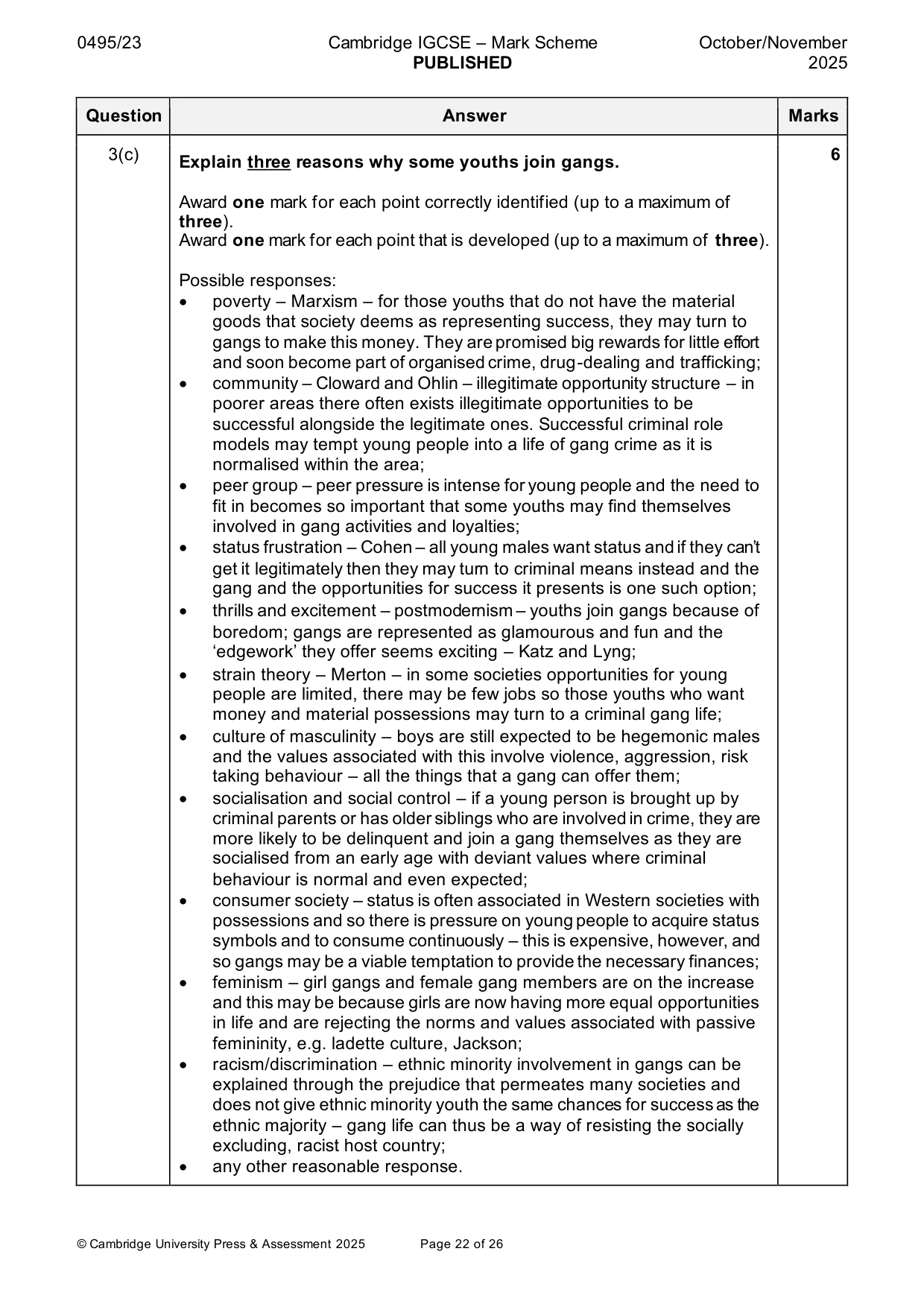
3 (a) Define the term: (i) stereotyping [2] (ii) property crime. [2] (b) State two types of crime with high rates of victimisation for elderly people. [2] (c) Explain three reasons why some youths join gangs. [6] (d) Explain three feminist views of crime. [6] (e) Discuss the limitations of self-report studies for measuring crime. Your answer should include: • at least three developed points with evidence. [8] (f) Evaluate the view that status frustration is the best explanation for crime. Your answer should include: • at least three arguments for and three arguments against • a conclusion. [14]
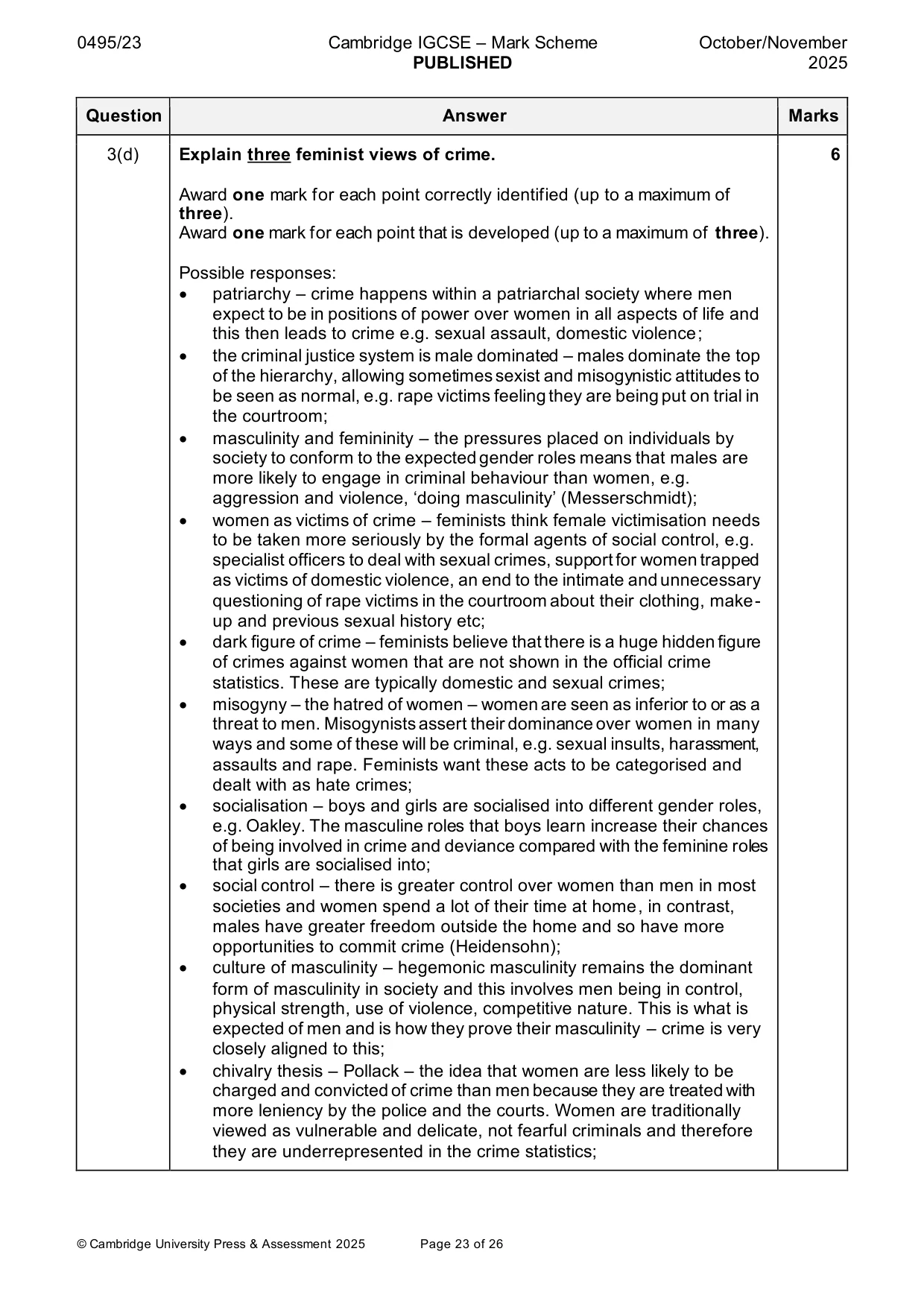
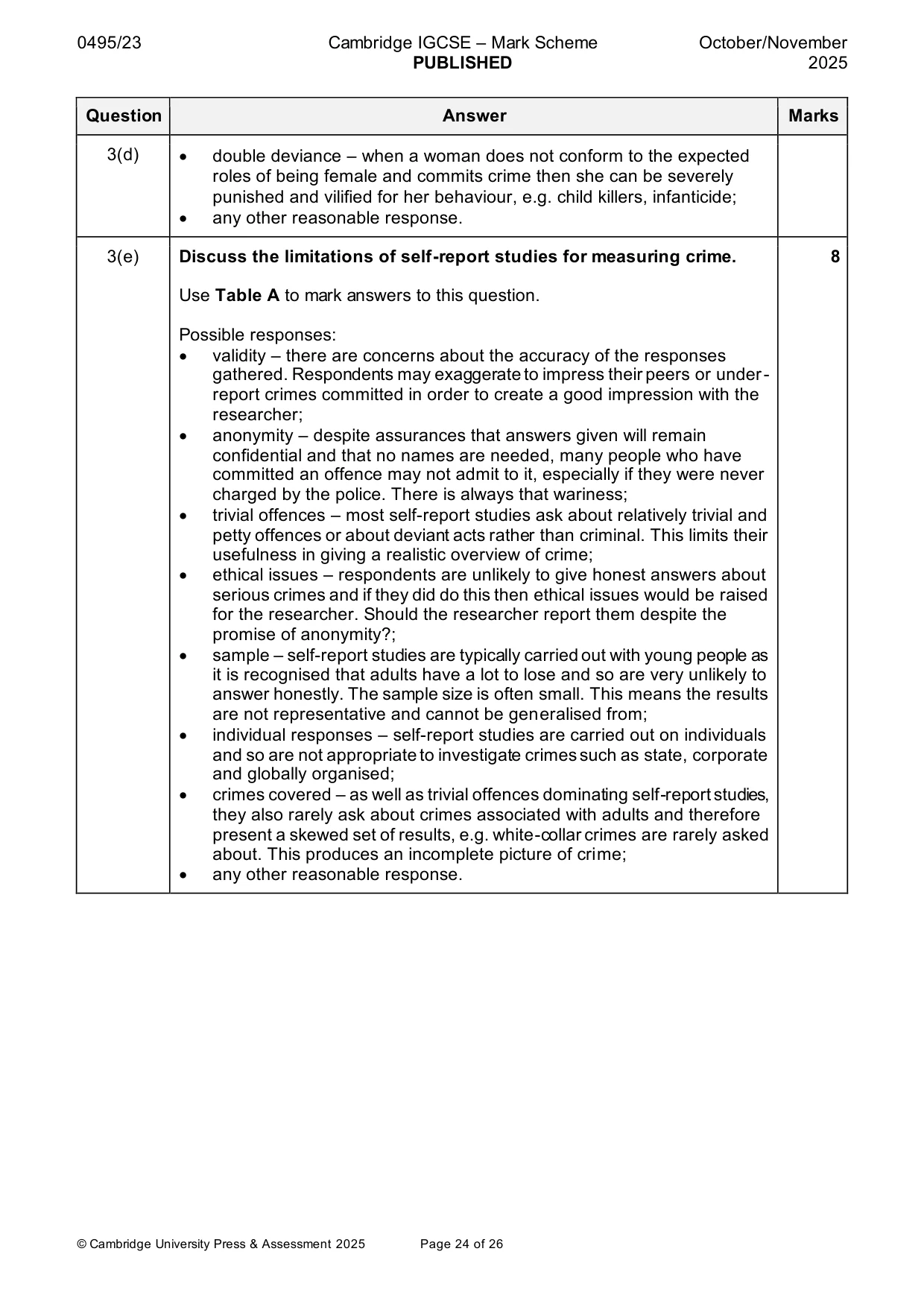
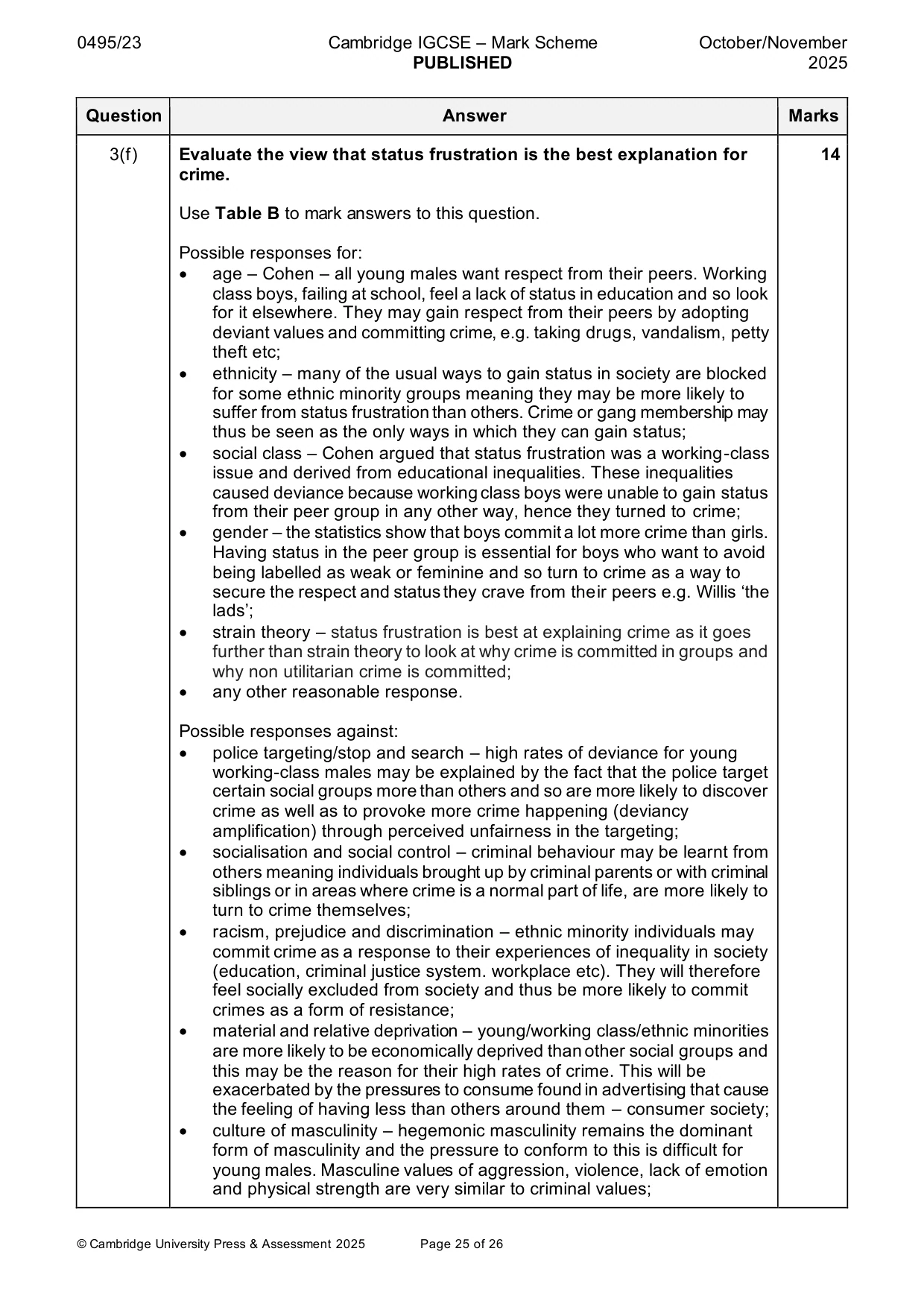
Mark scheme: 3(a)(i) 2 Define the term stereotyping. Award one mark for a partial definition, e.g. an example such as, teenage delinquents. Award two marks for a clear definition, e.g. a widely held idea about a particular group of people, based on characteristics such as their ethnicity, gender, age etc. These can be oversimplified, often negative and not always true. Accept any other reasonable response. 3(a)(ii) 2 Define the term property crime. Award one mark for a partial definition, e.g. stealing something/theft. Award two marks for a clear definition, e.g. theft of or intentional damage to things/places owned by an individual, group or organisation. Accept any other reasonable response. 3(b) 2 State two types of crime with high rates of victimisation for elderly people. Award one mark for each correct example (up to a maximum of two). Possible responses: • online fraud; • cybercrimes; • identity theft; • theft; • elderly abuse; • financial abuse; • neglect; • any other reasonable response. 3(c) 6 Explain three reasons why some youths join gangs. Award one mark for each point correctly identified (up to a maximum of three). Award one mark for each point that is developed (up to a maximum of three). Possible responses: • poverty – Marxism – for those youths that do not have the material goods that society deems as representing success, they may turn to gangs to make this money. They are promised big rewards for little effort and soon become part of organised crime, drug-dealing and trafficking; • community – Cloward and Ohlin – illegitimate opportunity structure – in poorer areas there often exists illegitimate opportunities to be successful alongside the legitimate ones. Successful criminal role models may tempt young people into a life of gang crime as it is normalised within the area; • peer group – peer pressure is intense for young people and the need to fit in becomes so important that some youths may find themselves involved in gang activities and loyalties; • status frustration – Cohen – all young males want status and if they can’t get it legitimately then they may turn to criminal means instead and the gang and the opportunities for success it presents is one such option; • thrills and excitement – postmodernism – youths join gangs because of boredom; gangs are represented as glamourous and fun and the ‘edgework’ they offer seems exciting – Katz and Lyng; • strain theory – Merton – in some societies opportunities for young people are limited, there may be few jobs so those youths who want money and material possessions may turn to a criminal gang life; • culture of masculinity – boys are still expected to be hegemonic males and the values associated with this involve violence, aggression, risk taking behaviour – all the things that a gang can offer them; • socialisation and social control – if a young person is brought up by criminal parents or has older siblings who are involved in crime, they are more likely to be delinquent and join a gang themselves as they are socialised from an early age with deviant values where criminal behaviour is normal and even expected; • consumer society – status is often associated in Western societies with possessions and so there is pressure on young people to acquire status symbols and to consume continuously – this is expensive, however, and so gangs may be a viable temptation to provide the necessary finances; • feminism – girl gangs and female gang members are on the increase and this may be because girls are now having more equal opportunities in life and are rejecting the norms and values associated with passive femininity, e.g. ladette culture, Jackson; • racism/discrimination – ethnic minority involvement in gangs can be explained through the prejudice that permeates many societies and does not give ethnic minority youth the same chances for success as the ethnic majority – gang life can thus be a way of resisting the socially excluding, racist host country; • any other reasonable response. 3(d) Explain three feminist views of crime. 6 Award one mark for each point correctly identified (up to a maximum of three). Award one mark for each point that is developed (up to a maximum of three). Possible responses: • patriarchy – crime happens within a patriarchal society where men expect to be in positions of power over women in all aspects of life and this then leads to crime e.g. sexual assault, domestic violence; • the criminal justice system is male dominated – males dominate the top of the hierarchy, allowing sometimes sexist and misogynistic attitudes to be seen as normal, e.g. rape victims feeling they are being put on trial in the courtroom; • masculinity and femininity – the pressures placed on individuals by society to conform to the expected gender roles means that males are more likely to engage in criminal behaviour than women, e.g. aggression and violence, ‘doing masculinity’ (Messerschmidt); • women as victims of crime – feminists think female victimisation needs to be taken more seriously by the formal agents of social control, e.g. specialist officers to deal with sexual crimes, support for women trapped as victims of domestic violence, an end to the intimate and unnecessary questioning of rape victims in the courtroom about their clothing, make- up and previous sexual history etc; • dark figure of crime – feminists believe that there is a huge hidden figure of crimes against women that are not shown in the official crime statistics. These are typically domestic and sexual crimes; • misogyny – the hatred of women – women are seen as inferior to or as a threat to men. Misogynists assert their dominance over women in many ways and some of these will be criminal, e.g. sexual insults, harassment, assaults and rape. Feminists want these acts to be categorised and dealt with as hate crimes; • socialisation – boys and girls are socialised into different gender roles, e.g. Oakley. The masculine roles that boys learn increase their chances of being involved in crime and deviance compared with the feminine roles that girls are socialised into; • social control – there is greater control over women than men in most societies and women spend a lot of their time at home, in contrast, males have greater freedom outside the home and so have more opportunities to commit crime (Heidensohn); • culture of masculinity – hegemonic masculinity remains the dominant form of masculinity in society and this involves men being in control, physical strength, use of violence, competitive nature. This is what is expected of men and is how they prove their masculinity – crime is very closely aligned to this; • chivalry thesis – Pollack – the idea that women are less likely to be charged and convicted of crime than men because they are treated with more leniency by the police and the courts. Women are traditionally viewed as vulnerable and delicate, not fearful criminals and therefore they are underrepresented in the crime statistics; 3(d) • double deviance – when a woman does not conform to the expected roles of being female and commits crime then she can be severely punished and vilified for her behaviour, e.g. child killers, infanticide; • any other reasonable response. 3(e) Discuss the limitations of self-report studies for measuring crime. 8 Use Table A to mark answers to this question. Possible responses: • validity – there are concerns about the accuracy of the responses gathered. Respondents may exaggerate to impress their peers or under- report crimes committed in order to create a good impression with the researcher; • anonymity – despite assurances that answers given will remain confidential and that no names are needed, many people who have committed an offence may not admit to it, especially if they were never charged by the police. There is always that wariness; • trivial offences – most self-report studies ask about relatively trivial and petty offences or about deviant acts rather than criminal. This limits their usefulness in giving a realistic overview of crime; • ethical issues – respondents are unlikely to give honest answers about serious crimes and if they did do this then ethical issues would be raised for the researcher. Should the researcher report them despite the promise of anonymity?; • sample – self-report studies are typically carried out with young people as it is recognised that adults have a lot to lose and so are very unlikely to answer honestly. The sample size is often small. This means the results are not representative and cannot be generalised from; • individual responses – self-report studies are carried out on individuals and so are not appropriate to investigate crimes such as state, corporate and globally organised; • crimes covered – as well as trivial offences dominating self-report studies, they also rarely ask about crimes associated with adults and therefore present a skewed set of results, e.g. white-collar crimes are rarely asked about. This produces an incomplete picture of crime; • any other reasonable response. 3(f) Evaluate the view that status frustration is the best explanation for 14 crime. Use Table B to mark answers to this question. Possible responses for: • age – Cohen – all young males want respect from their peers. Working class boys, failing at school, feel a lack of status in education and so look for it elsewhere. They may gain respect from their peers by adopting deviant values and committing crime, e.g. taking drugs, vandalism, petty theft etc; • ethnicity – many of the usual ways to gain status in society are blocked for some ethnic minority groups meaning they may be more likely to suffer from status frustration than others. Crime or gang membership may thus be seen as the only ways in which they can gain status; • social class – Cohen argued that status frustration was a working-class issue and derived from educational inequalities. These inequalities caused deviance because working class boys were unable to gain status from their peer group in any other way, hence they turned to crime; • gender – the statistics show that boys commit a lot more crime than girls. Having status in the peer group is essential for boys who want to avoid being labelled as weak or feminine and so turn to crime as a way to secure the respect and status they crave from their peers e.g. Willis ‘the lads’; • strain theory – status frustration is best at explaining crime as it goes further than strain theory to look at why crime is committed in groups and why non utilitarian crime is committed; • any other reasonable response. Possible responses against: • police targeting/stop and search – high rates of deviance for young working-class males may be explained by the fact that the police target certain social groups more than others and so are more likely to discover crime as well as to provoke more crime happening (deviancy amplification) through perceived unfairness in the targeting; • socialisation and social control – criminal behaviour may be learnt from others meaning individuals brought up by criminal parents or with criminal siblings or in areas where crime is a normal part of life, are more likely to turn to crime themselves; • racism, prejudice and discrimination – ethnic minority individuals may commit crime as a response to their experiences of inequality in society (education, criminal justice system. workplace etc). They will therefore feel socially excluded from society and thus be more likely to commit crimes as a form of resistance; • material and relative deprivation – young/working class/ethnic minorities are more likely to be economically deprived than other social groups and this may be the reason for their high rates of crime. This will be exacerbated by the pressures to consume found in advertising that cause the feeling of having less than others around them – consumer society; • culture of masculinity – hegemonic masculinity remains the dominant form of masculinity and the pressure to conform to this is difficult for young males. Masculine values of aggression, violence, lack of emotion and physical strength are very similar to criminal values; 3(f) • power inequalities – high crime rates are often associated with individuals having a lack of power in society which can result in the criminalisation of some people, e.g. working class, ethnic minorities, the young, women (domestic and sexual crimes); • inadequate socialisation – Murray, the New Right – crime can be explained by some individuals not being properly socialised by their parents. Murray associates this with the underclass and blames the decline in marriage and the rise in single parent families for the issues; • any other reasonable response.
What was in this paper
The subtopics covered by these 3 questions, and how many questions each got. Open one in a new tab to see every Cambridge question on it.
What you needed in this session
Cambridge’s own grade thresholds for 2025 Oct/Nov, Paper 2 · Variant 3. A higher threshold means an easier paper — the bar moves with how the cohort did.