Cambridge IGCSE Sociology 0495 — 2024 Oct/Nov Paper 2 · Variant 3
0495/23/O/N/24 · 4 questions · 70 marks · ≈79 min
The question paper and its mark scheme, free to read here and free to download. This is Cambridge’s own paper, exactly as it was sat.
Question paper4 pages
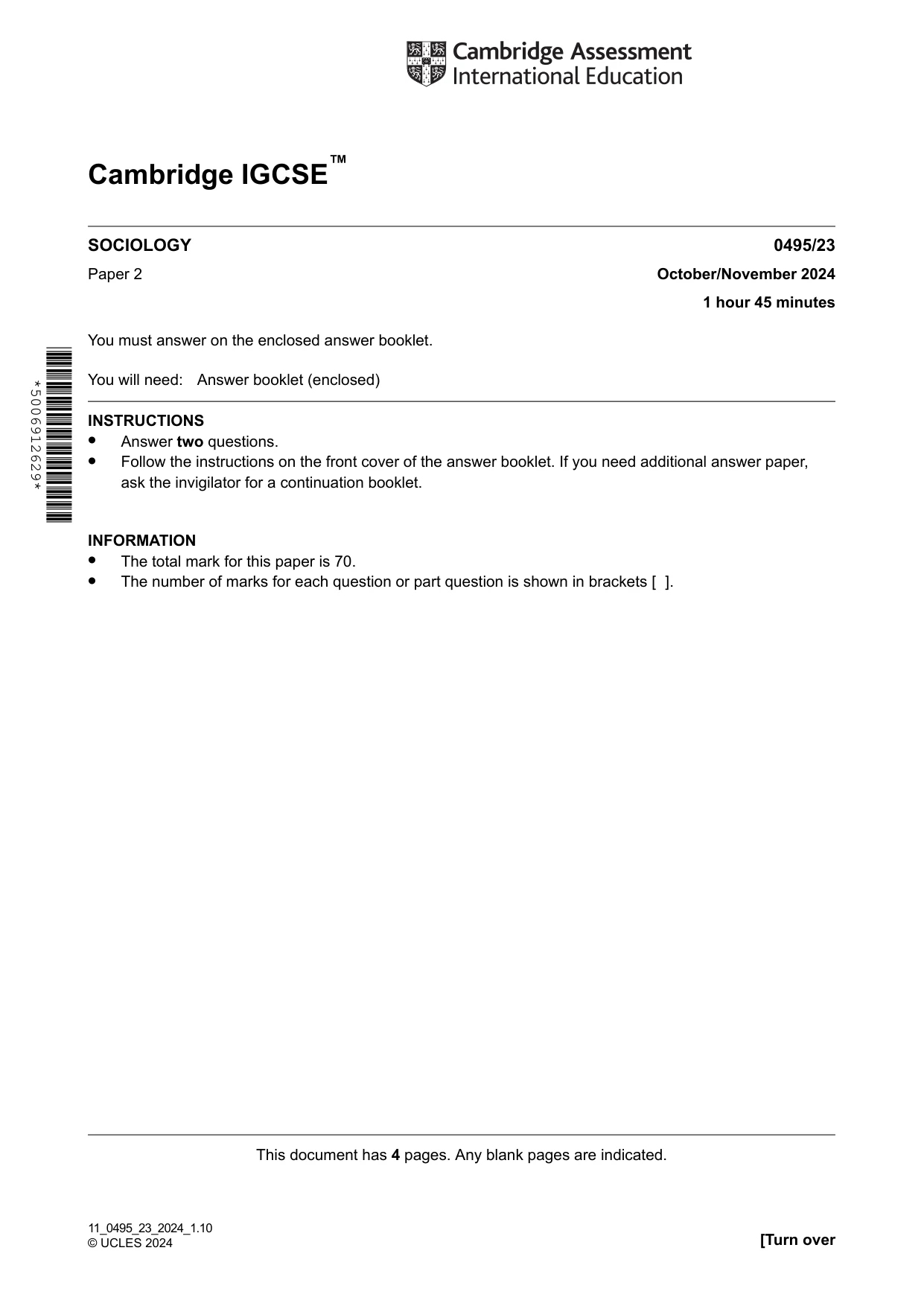
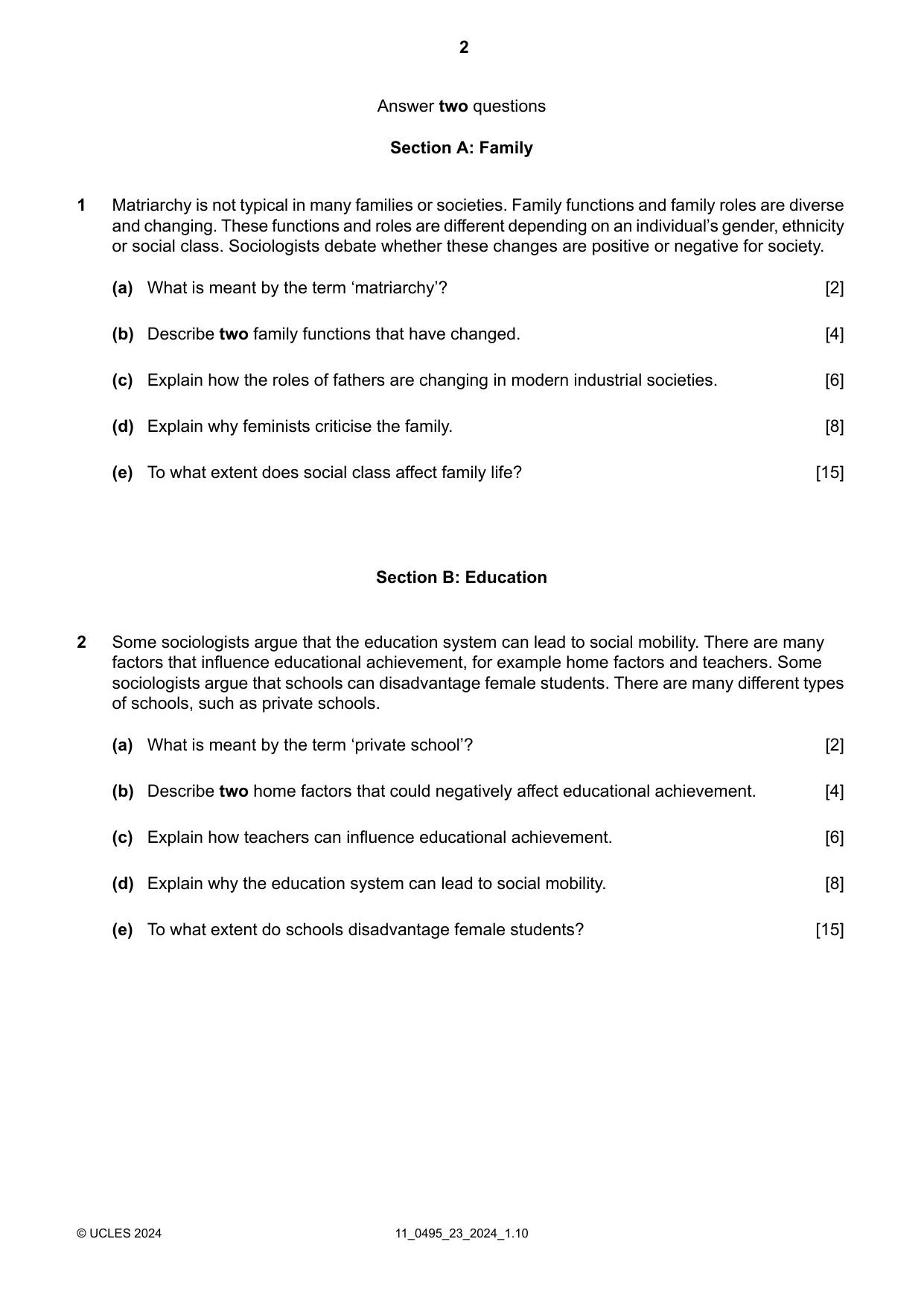
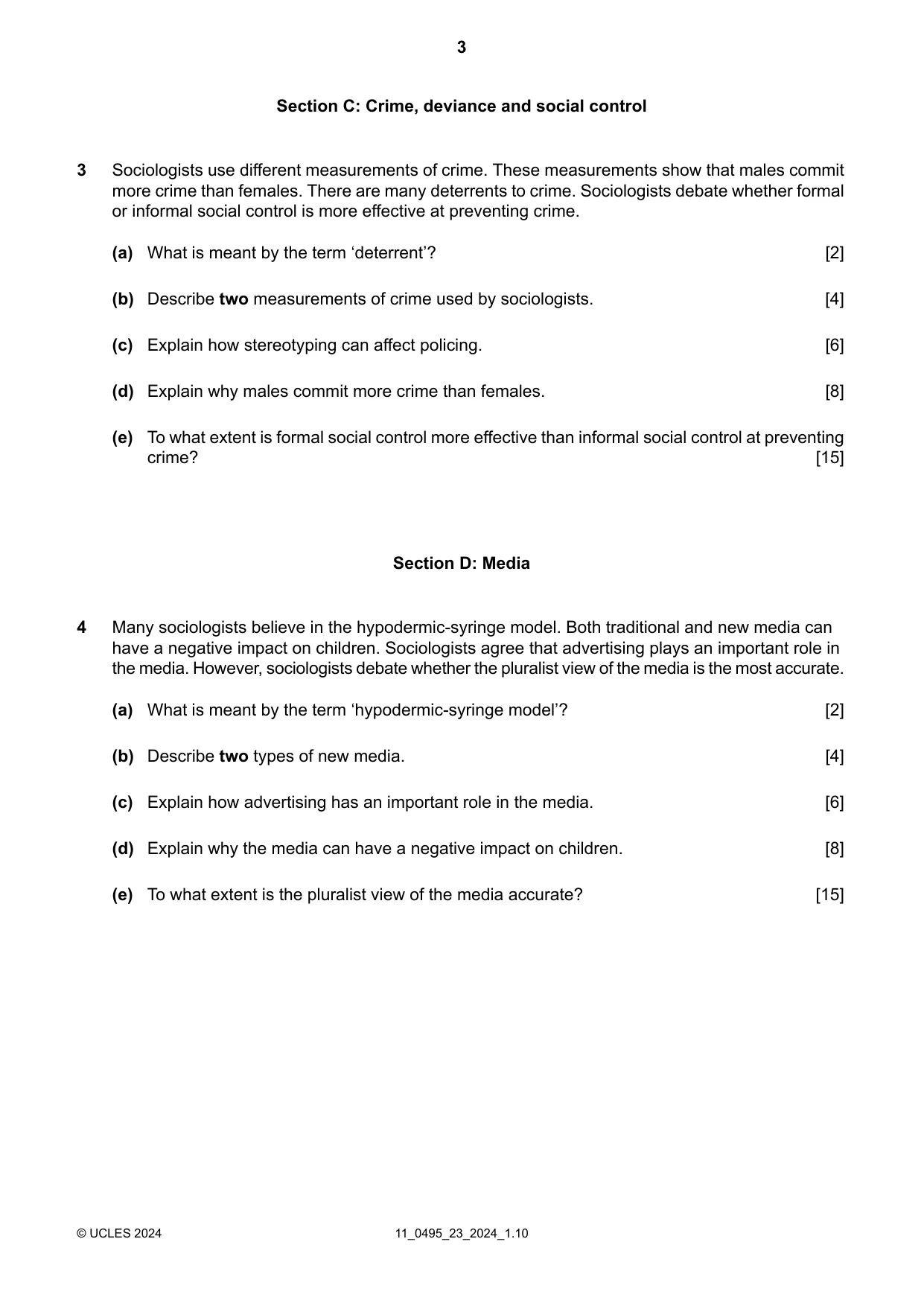

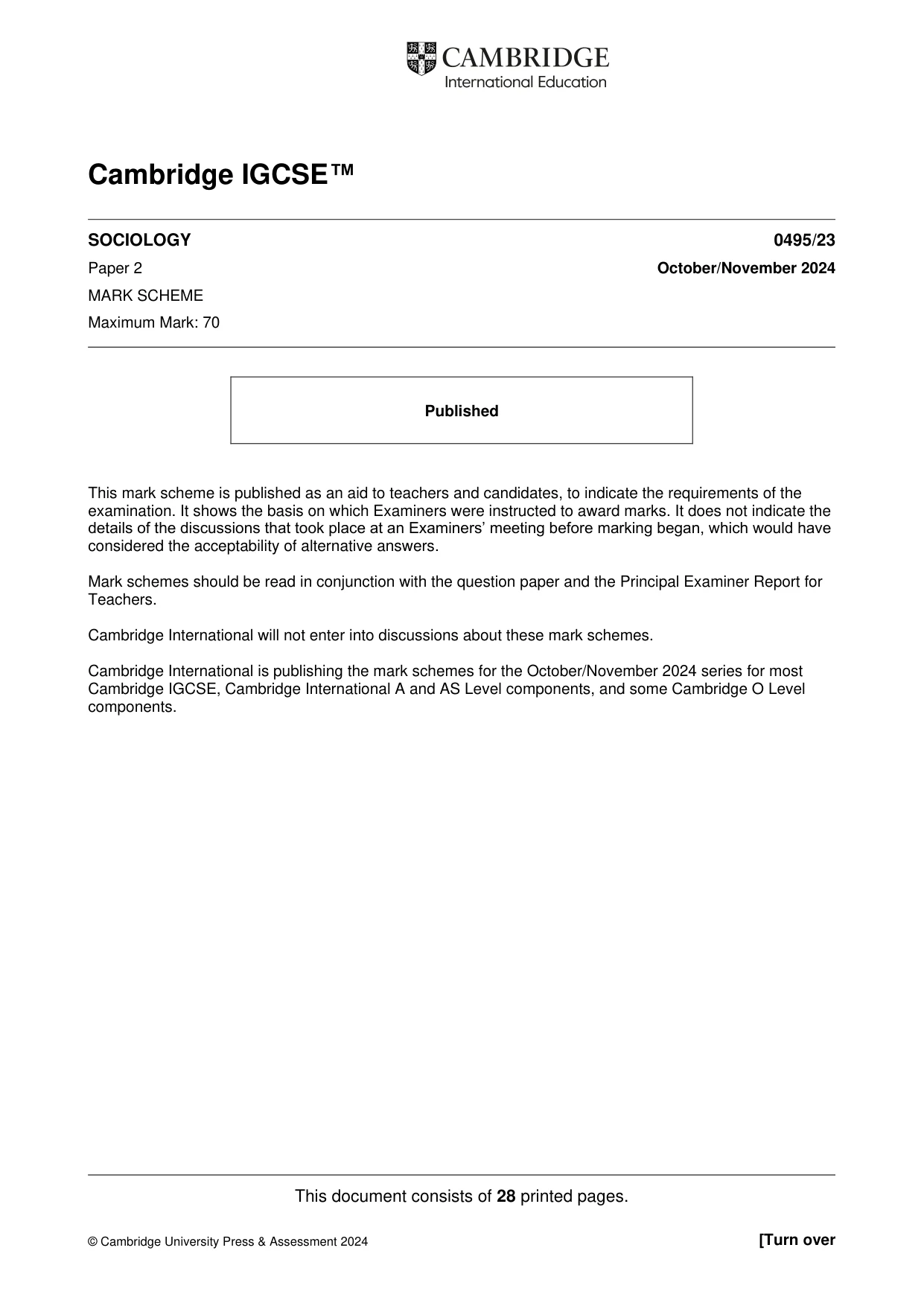
Mark scheme28 pages
Answers below. Sit the paper first if you are practising.

Questions as text
Q1 · Matriarchy is not typical in many families or societies
1 Matriarchy is not typical in many families or societies. Family functions and family roles are diverse and changing. These functions and roles are different depending on an individual’s gender, ethnicity or social class. Sociologists debate whether these changes are positive or negative for society. (a) What is meant by the term ‘matriarchy’? [2] (b) Describe two family functions that have changed. [4] (c) Explain how the roles of fathers are changing in modern industrial societies. [6] (d) Explain why feminists criticise the family. [8] (e) To what extent does social class affect family life? [15]
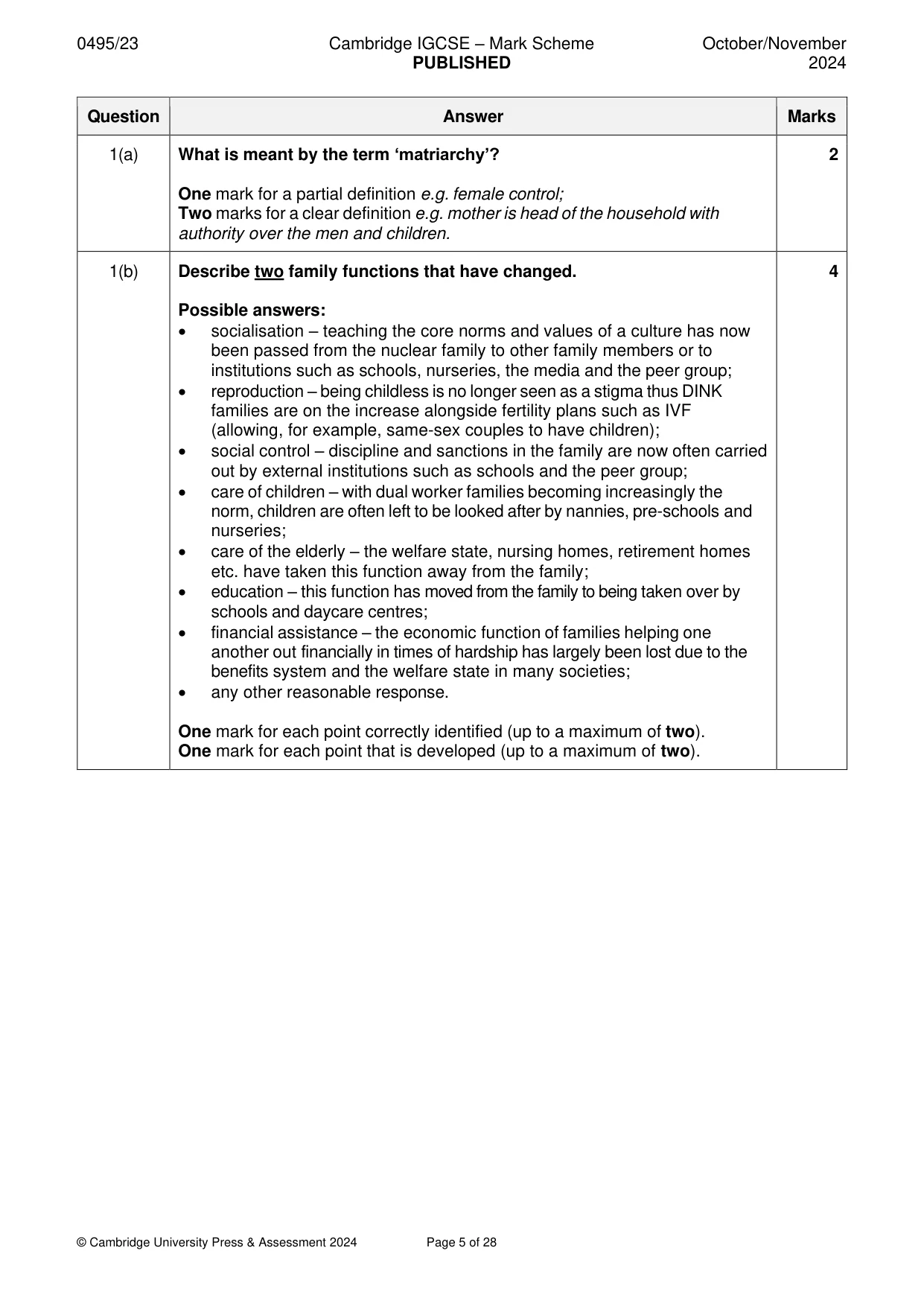
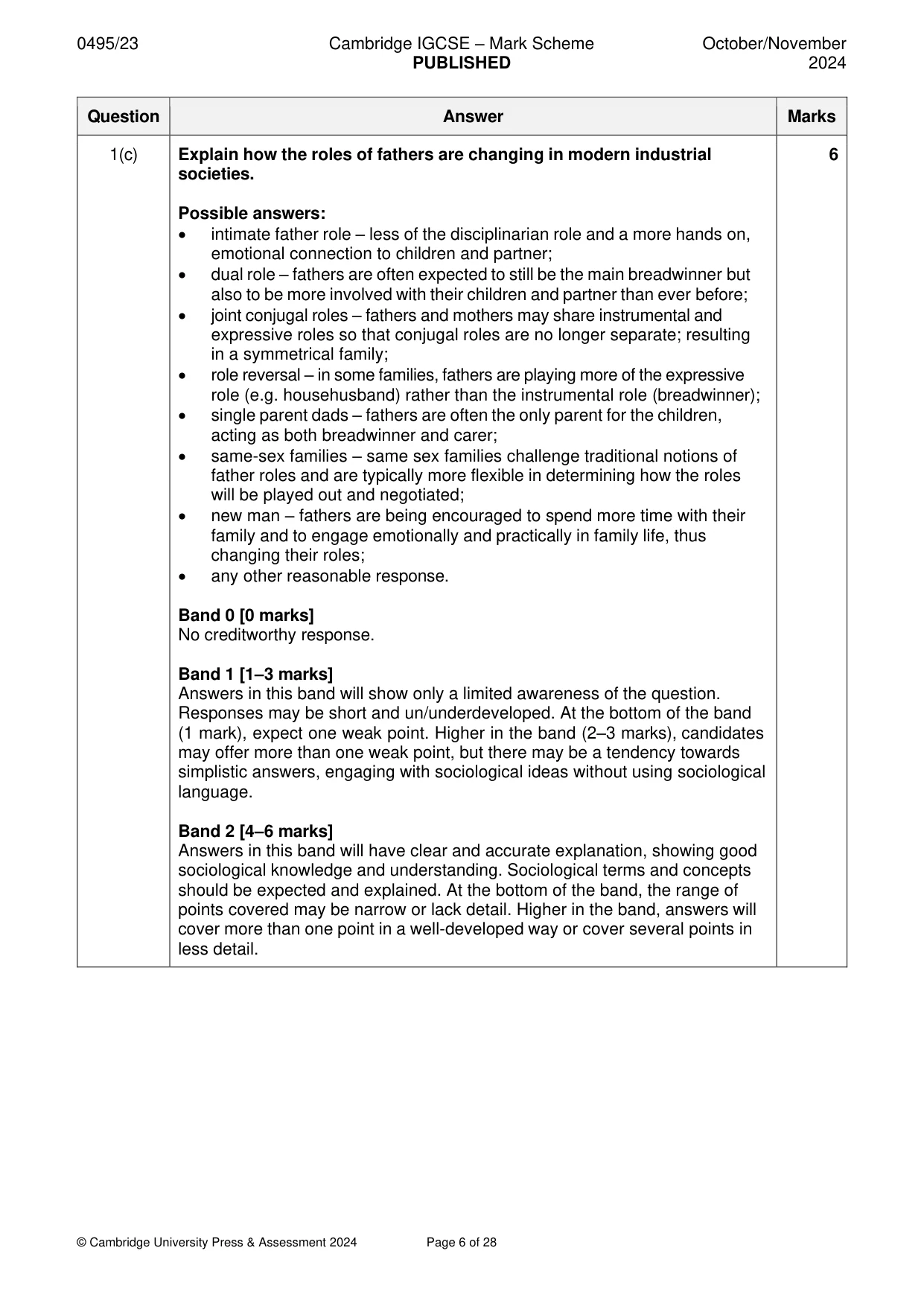
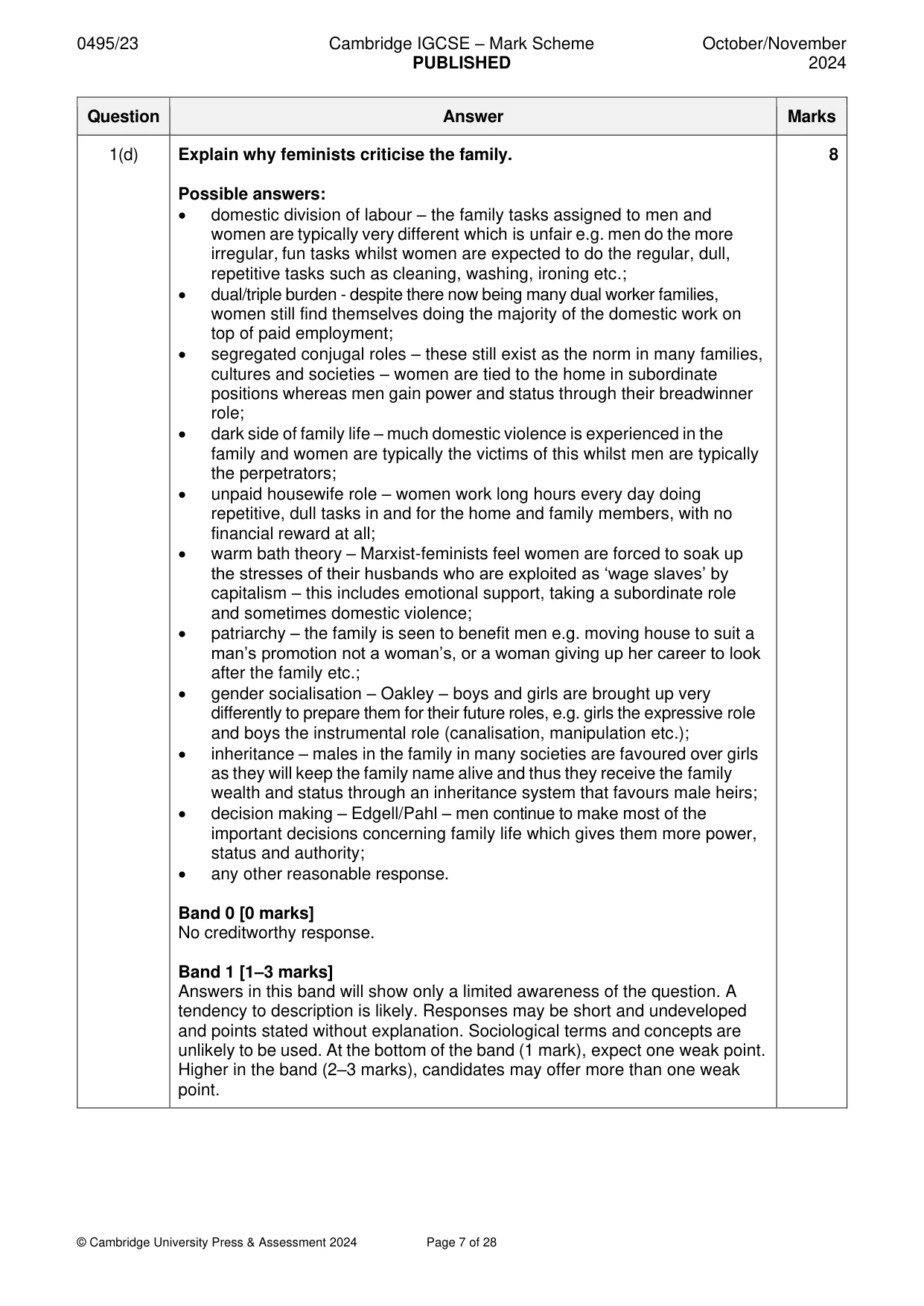
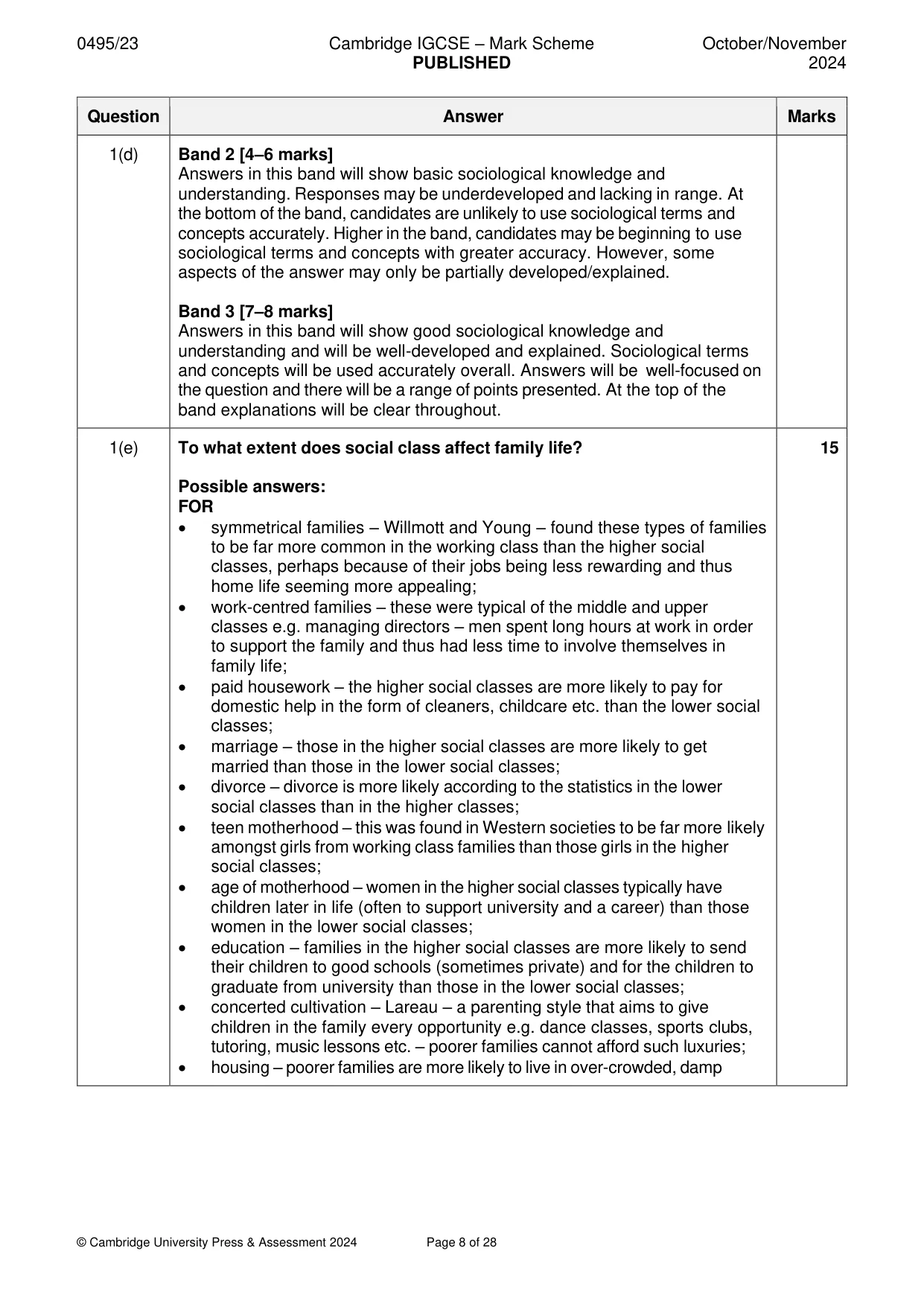
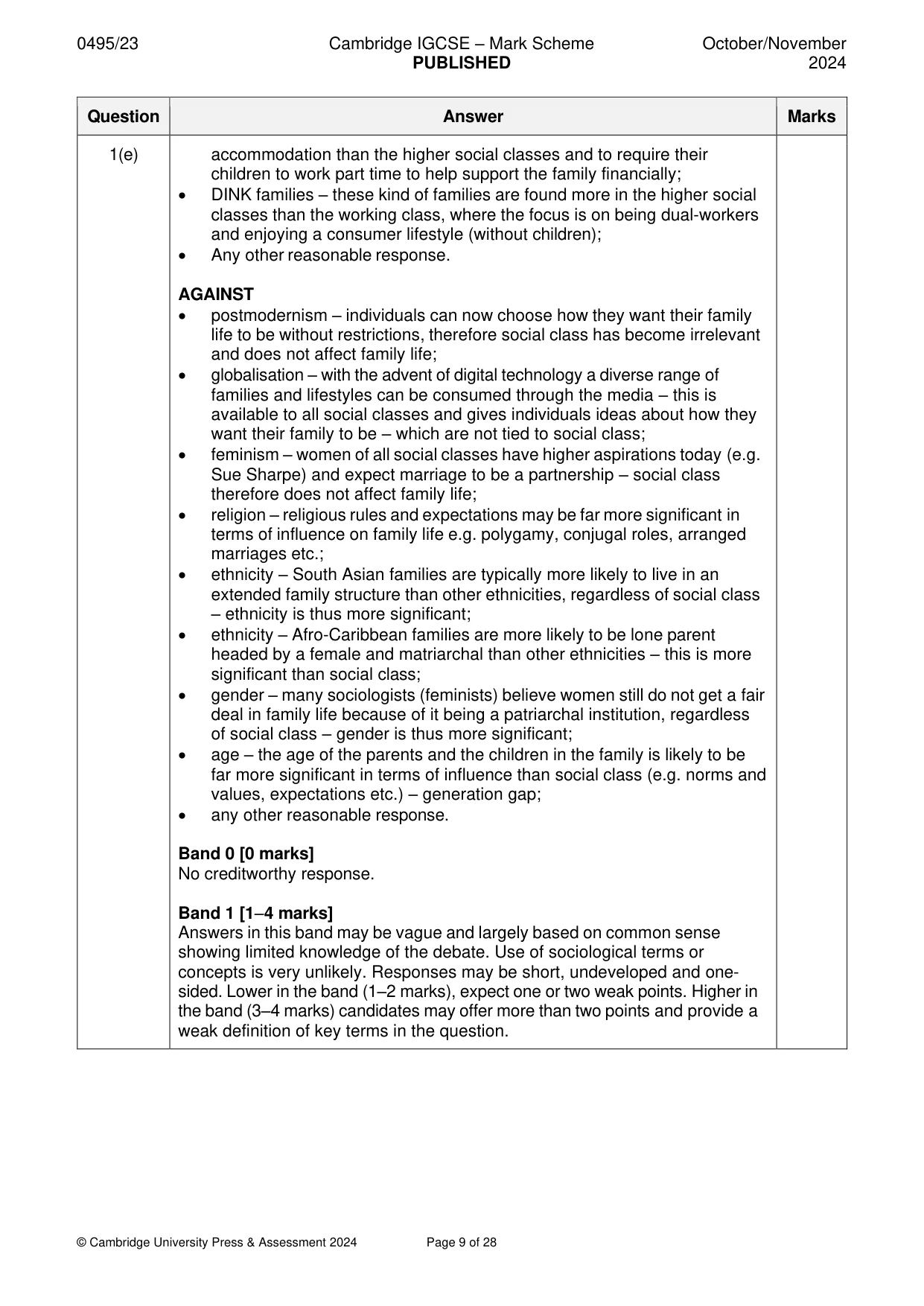
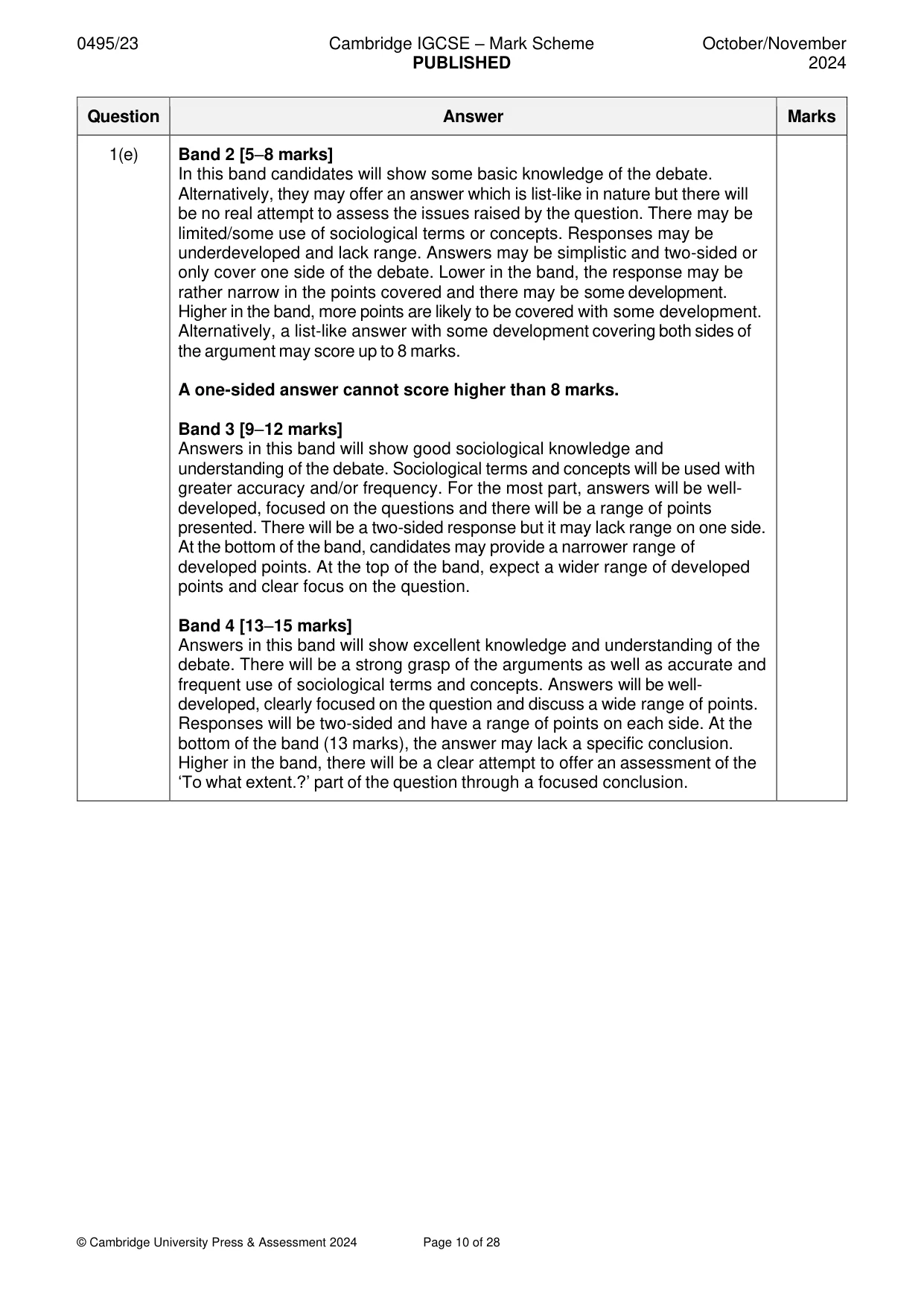
Mark scheme: Question Answer Marks 1(a) What is meant by the term ‘matriarchy’? 2 One mark for a partial definition e.g. female control; Two marks for a clear definition e.g. mother is head of the household with authority over the men and children. 1(b) Describe two family functions that have changed. 4 Possible answers: • socialisation – teaching the core norms and values of a culture has now been passed from the nuclear family to other family members or to institutions such as schools, nurseries, the media and the peer group; • reproduction – being childless is no longer seen as a stigma thus DINK families are on the increase alongside fertility plans such as IVF (allowing, for example, same-sex couples to have children); • social control – discipline and sanctions in the family are now often carried out by external institutions such as schools and the peer group; • care of children – with dual worker families becoming increasingly the norm, children are often left to be looked after by nannies, pre-schools and nurseries; • care of the elderly – the welfare state, nursing homes, retirement homes etc. have taken this function away from the family; • education – this function has moved from the family to being taken over by schools and daycare centres; • financial assistance – the economic function of families helping one another out financially in times of hardship has largely been lost due to the benefits system and the welfare state in many societies; • any other reasonable response. One mark for each point correctly identified (up to a maximum of two). One mark for each point that is developed (up to a maximum of two). 1(c) Explain how the roles of fathers are changing in modern industrial 6 societies. Possible answers: • intimate father role – less of the disciplinarian role and a more hands on, emotional connection to children and partner; • dual role – fathers are often expected to still be the main breadwinner but also to be more involved with their children and partner than ever before; • joint conjugal roles – fathers and mothers may share instrumental and expressive roles so that conjugal roles are no longer separate; resulting in a symmetrical family; • role reversal – in some families, fathers are playing more of the expressive role (e.g. househusband) rather than the instrumental role (breadwinner); • single parent dads – fathers are often the only parent for the children, acting as both breadwinner and carer; • same-sex families – same sex families challenge traditional notions of father roles and are typically more flexible in determining how the roles will be played out and negotiated; • new man – fathers are being encouraged to spend more time with their family and to engage emotionally and practically in family life, thus changing their roles; • any other reasonable response. Band 0 [0 marks] No creditworthy response. Band 1 [1–3 marks] Answers in this band will show only a limited awareness of the question. Responses may be short and un/underdeveloped. At the bottom of the band (1 mark), expect one weak point. Higher in the band (2–3 marks), candidates may offer more than one weak point, but there may be a tendency towards simplistic answers, engaging with sociological ideas without using sociological language. Band 2 [4–6 marks] Answers in this band will have clear and accurate explanation, showing good sociological knowledge and understanding. Sociological terms and concepts should be expected and explained. At the bottom of the band, the range of points covered may be narrow or lack detail. Higher in the band, answers will cover more than one point in a well-developed way or cover several points in less detail. 1(d) Explain why feminists criticise the family. 8 Possible answers: • domestic division of labour – the family tasks assigned to men and women are typically very different which is unfair e.g. men do the more irregular, fun tasks whilst women are expected to do the regular, dull, repetitive tasks such as cleaning, washing, ironing etc.; • dual/triple burden - despite there now being many dual worker families, women still find themselves doing the majority of the domestic work on top of paid employment; • segregated conjugal roles – these still exist as the norm in many families, cultures and societies – women are tied to the home in subordinate positions whereas men gain power and status through their breadwinner role; • dark side of family life – much domestic violence is experienced in the family and women are typically the victims of this whilst men are typically the perpetrators; • unpaid housewife role – women work long hours every day doing repetitive, dull tasks in and for the home and family members, with no financial reward at all; • warm bath theory – Marxist-feminists feel women are forced to soak up the stresses of their husbands who are exploited as ‘wage slaves’ by capitalism – this includes emotional support, taking a subordinate role and sometimes domestic violence; • patriarchy – the family is seen to benefit men e.g. moving house to suit a man’s promotion not a woman’s, or a woman giving up her career to look after the family etc.; • gender socialisation – Oakley – boys and girls are brought up very differently to prepare them for their future roles, e.g. girls the expressive role and boys the instrumental role (canalisation, manipulation etc.); • inheritance – males in the family in many societies are favoured over girls as they will keep the family name alive and thus they receive the family wealth and status through an inheritance system that favours male heirs; • decision making – Edgell/Pahl – men continue to make most of the important decisions concerning family life which gives them more power, status and authority; • any other reasonable response. Band 0 [0 marks] No creditworthy response. Band 1 [1–3 marks] Answers in this band will show only a limited awareness of the question. A tendency to description is likely. Responses may be short and undeveloped and points stated without explanation. Sociological terms and concepts are unlikely to be used. At the bottom of the band (1 mark), expect one weak point. Higher in the band (2–3 marks), candidates may offer more than one weak point. 1(d) Band 2 [4–6 marks] Answers in this band will show basic sociological knowledge and understanding. Responses may be underdeveloped and lacking in range. At the bottom of the band, candidates are unlikely to use sociological terms and concepts accurately. Higher in the band, candidates may be beginning to use sociological terms and concepts with greater accuracy. However, some aspects of the answer may only be partially developed/explained. Band 3 [7–8 marks] Answers in this band will show good sociological knowledge and understanding and will be well-developed and explained. Sociological terms and concepts will be used accurately overall. Answers will be well-focused on the question and there will be a range of points presented. At the top of the band explanations will be clear throughout. 1(e) To what extent does social class affect family life? 15 Possible answers: FOR • symmetrical families – Willmott and Young – found these types of families to be far more common in the working class than the higher social classes, perhaps because of their jobs being less rewarding and thus home life seeming more appealing; • work-centred families – these were typical of the middle and upper classes e.g. managing directors – men spent long hours at work in order to support the family and thus had less time to involve themselves in family life; • paid housework – the higher social classes are more likely to pay for domestic help in the form of cleaners, childcare etc. than the lower social classes; • marriage – those in the higher social classes are more likely to get married than those in the lower social classes; • divorce – divorce is more likely according to the statistics in the lower social classes than in the higher classes; • teen motherhood – this was found in Western societies to be far more likely amongst girls from working class families than those girls in the higher social classes; • age of motherhood – women in the higher social classes typically have children later in life (often to support university and a career) than those women in the lower social classes; • education – families in the higher social classes are more likely to send their children to good schools (sometimes private) and for the children to graduate from university than those in the lower social classes; • concerted cultivation – Lareau – a parenting style that aims to give children in the family every opportunity e.g. dance classes, sports clubs, tutoring, music lessons etc. – poorer families cannot afford such luxuries; • housing – poorer families are more likely to live in over-crowded, damp 1(e) accommodation than the higher social classes and to require their children to work part time to help support the family financially; • DINK families – these kind of families are found more in the higher social classes than the working class, where the focus is on being dual-workers and enjoying a consumer lifestyle (without children); • Any other reasonable response. AGAINST • postmodernism – individuals can now choose how they want their family life to be without restrictions, therefore social class has become irrelevant and does not affect family life; • globalisation – with the advent of digital technology a diverse range of families and lifestyles can be consumed through the media – this is available to all social classes and gives individuals ideas about how they want their family to be – which are not tied to social class; • feminism – women of all social classes have higher aspirations today (e.g. Sue Sharpe) and expect marriage to be a partnership – social class therefore does not affect family life; • religion – religious rules and expectations may be far more significant in terms of influence on family life e.g. polygamy, conjugal roles, arranged marriages etc.; • ethnicity – South Asian families are typically more likely to live in an extended family structure than other ethnicities, regardless of social class – ethnicity is thus more significant; • ethnicity – Afro-Caribbean families are more likely to be lone parent headed by a female and matriarchal than other ethnicities – this is more significant than social class; • gender – many sociologists (feminists) believe women still do not get a fair deal in family life because of it being a patriarchal institution, regardless of social class – gender is thus more significant; • age – the age of the parents and the children in the family is likely to be far more significant in terms of influence than social class (e.g. norms and values, expectations etc.) – generation gap; • any other reasonable response. Band 0 [0 marks] No creditworthy response. Band 1 [1–4 marks] Answers in this band may be vague and largely based on common sense showing limited knowledge of the debate. Use of sociological terms or concepts is very unlikely. Responses may be short, undeveloped and one- sided. Lower in the band (1–2 marks), expect one or two weak points. Higher in the band (3–4 marks) candidates may offer more than two points and provide a weak definition of key terms in the question. 1(e) Band 2 [5–8 marks] In this band candidates will show some basic knowledge of the debate. Alternatively, they may offer an answer which is list-like in nature but there will be no real attempt to assess the issues raised by the question. There may be limited/some use of sociological terms or concepts. Responses may be underdeveloped and lack range. Answers may be simplistic and two-sided or only cover one side of the debate. Lower in the band, the response may be rather narrow in the points covered and there may be some development. Higher in the band, more points are likely to be covered with some development. Alternatively, a list-like answer with some development covering both sides of the argument may score up to 8 marks. A one-sided answer cannot score higher than 8 marks. Band 3 [9–12 marks] Answers in this band will show good sociological knowledge and understanding of the debate. Sociological terms and concepts will be used with greater accuracy and/or frequency. For the most part, answers will be well- developed, focused on the questions and there will be a range of points presented. There will be a two-sided response but it may lack range on one side. At the bottom of the band, candidates may provide a narrower range of developed points. At the top of the band, expect a wider range of developed points and clear focus on the question. Band 4 [13–15 marks] Answers in this band will show excellent knowledge and understanding of the debate. There will be a strong grasp of the arguments as well as accurate and frequent use of sociological terms and concepts. Answers will be well- developed, clearly focused on the question and discuss a wide range of points. Responses will be two-sided and have a range of points on each side. At the bottom of the band (13 marks), the answer may lack a specific conclusion. Higher in the band, there will be a clear attempt to offer an assessment of the ‘To what extent.?’ part of the question through a focused conclusion.
Q2 · Some sociologists argue that the education system can lead to social mobility
2 Some sociologists argue that the education system can lead to social mobility. There are many factors that influence educational achievement, for example home factors and teachers. Some sociologists argue that schools can disadvantage female students. There are many different types of schools, such as private schools. (a) What is meant by the term ‘private school’? [2] (b) Describe two home factors that could negatively affect educational achievement. [4] (c) Explain how teachers can influence educational achievement. [6] (d) Explain why the education system can lead to social mobility. [8] (e) To what extent do schools disadvantage female students? [15] Section C: Crime, deviance and social control
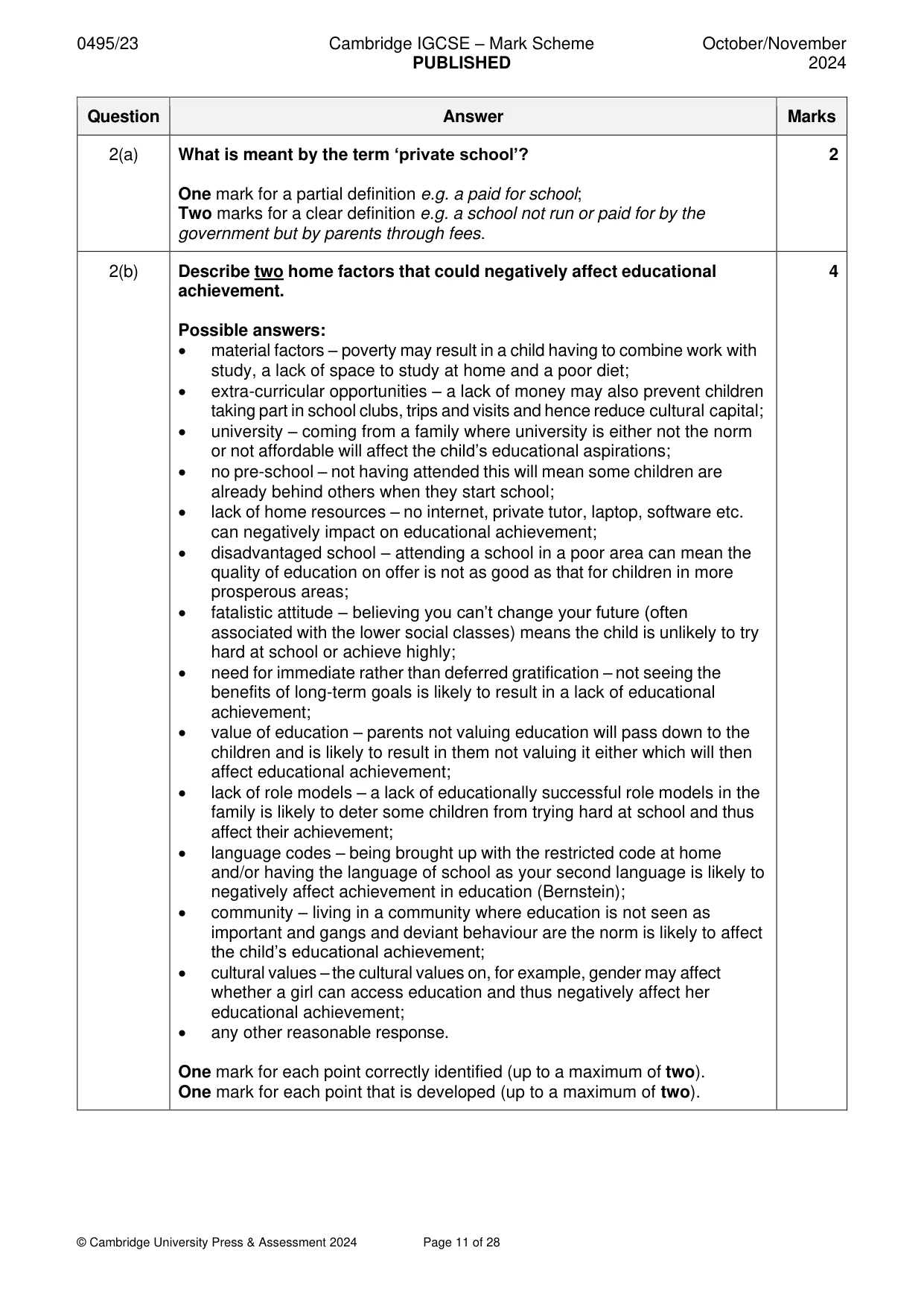
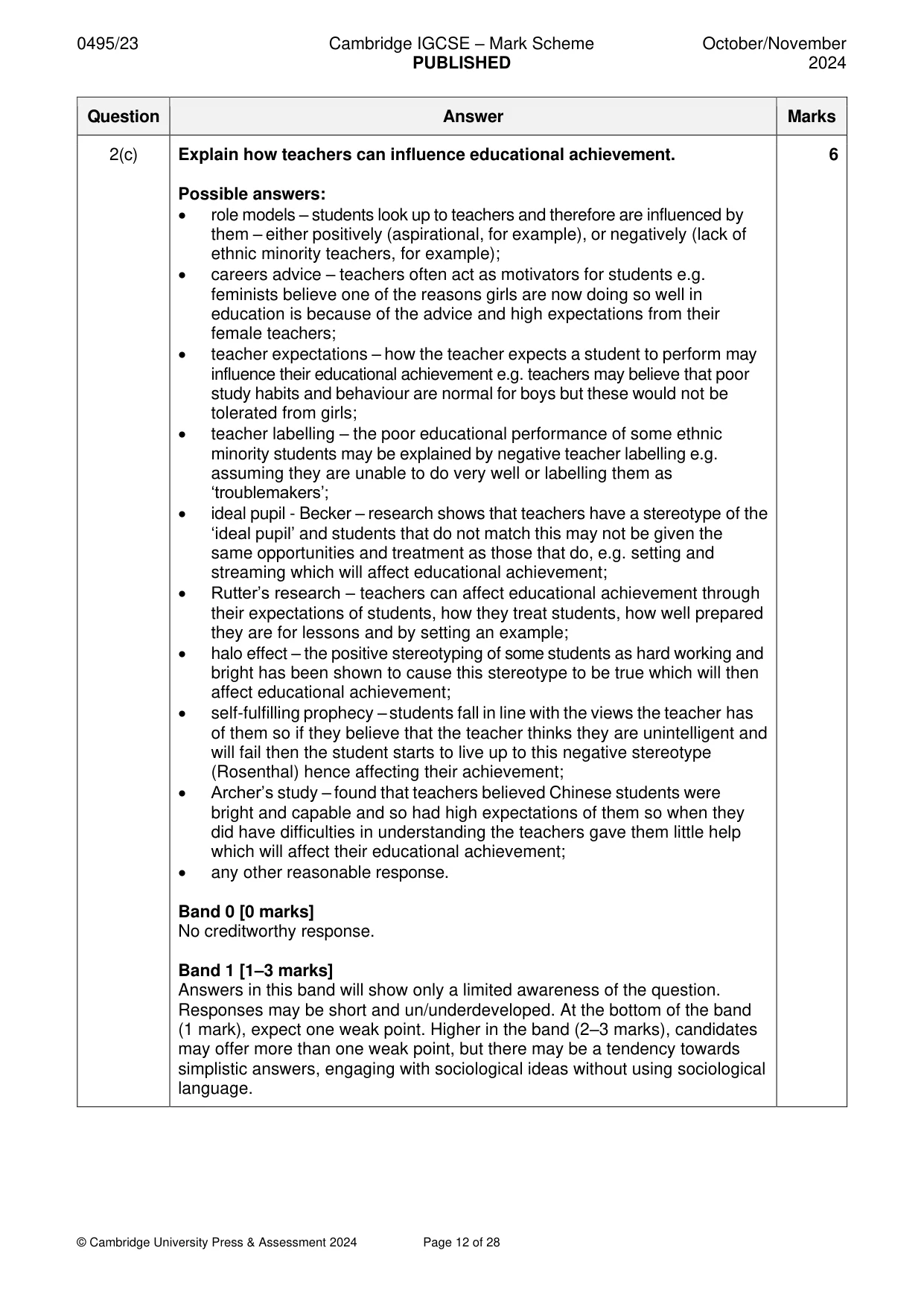
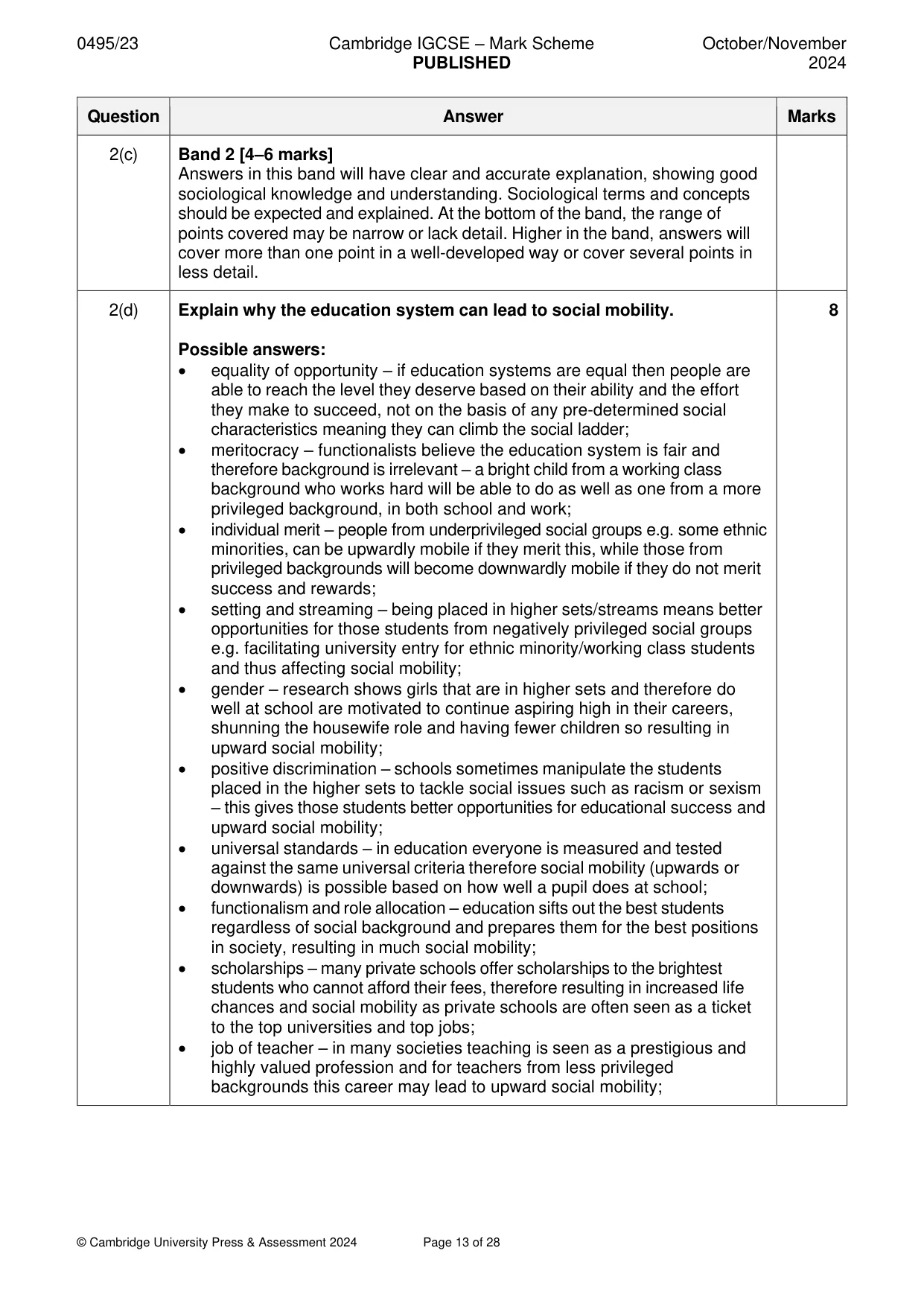
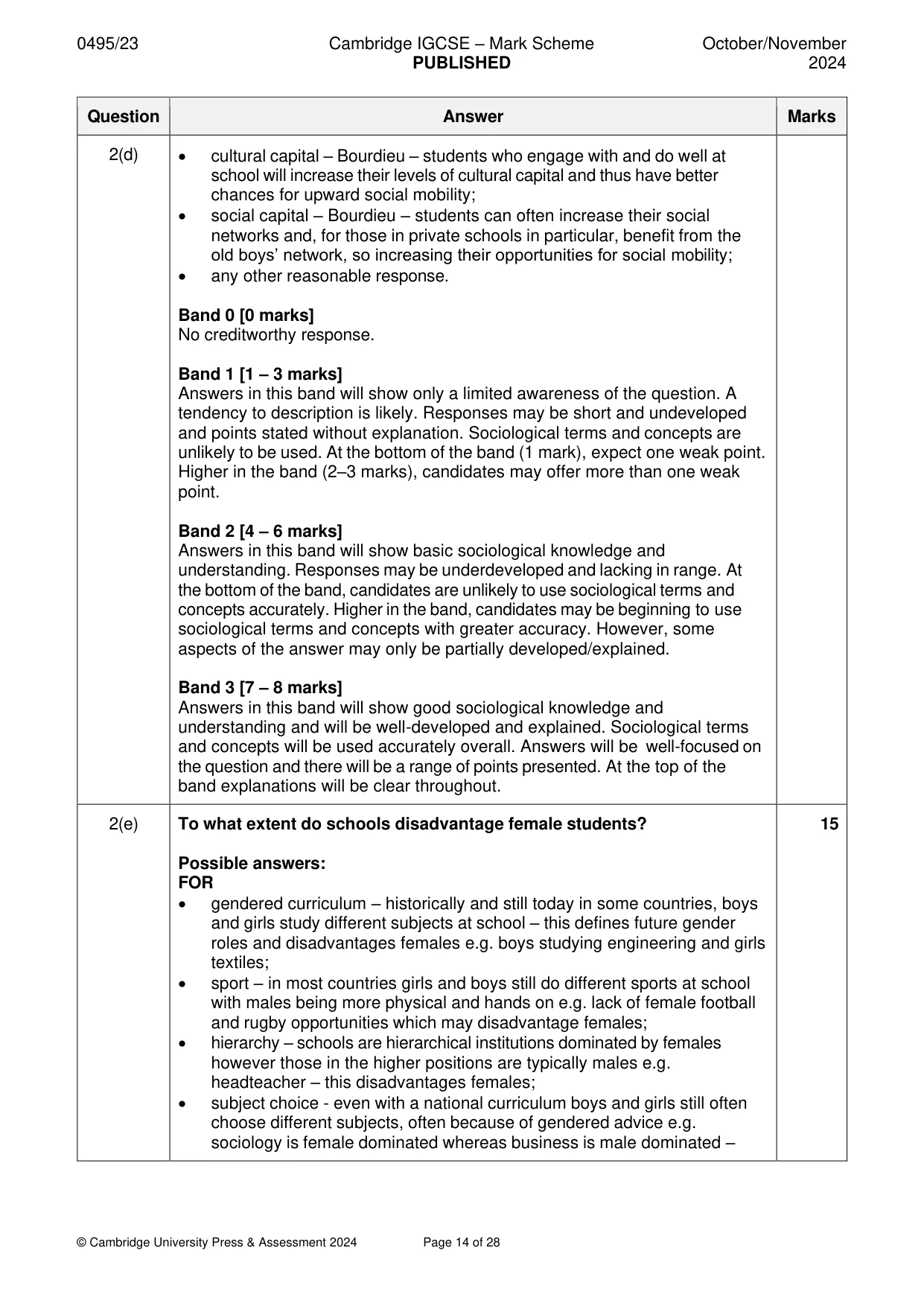
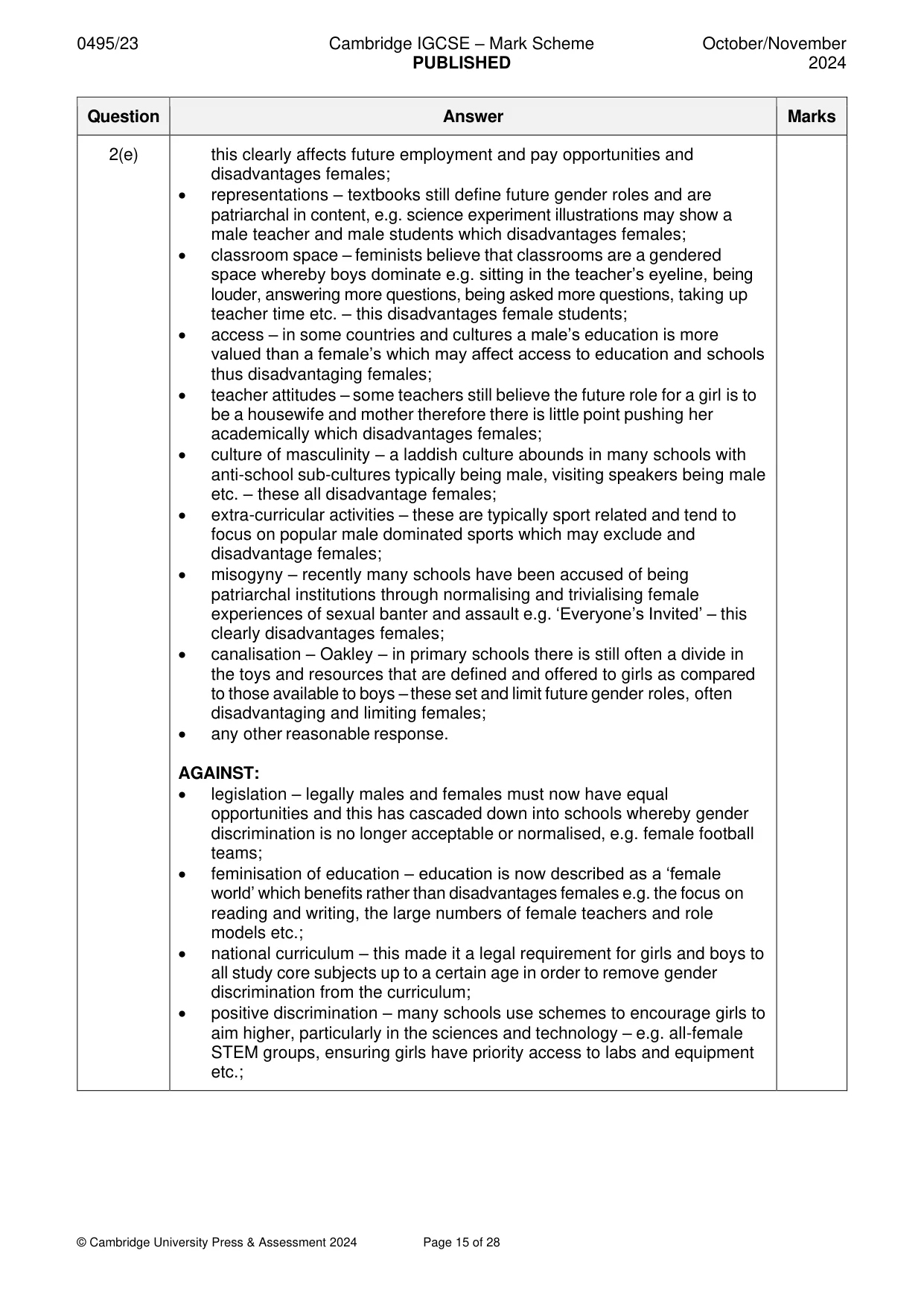
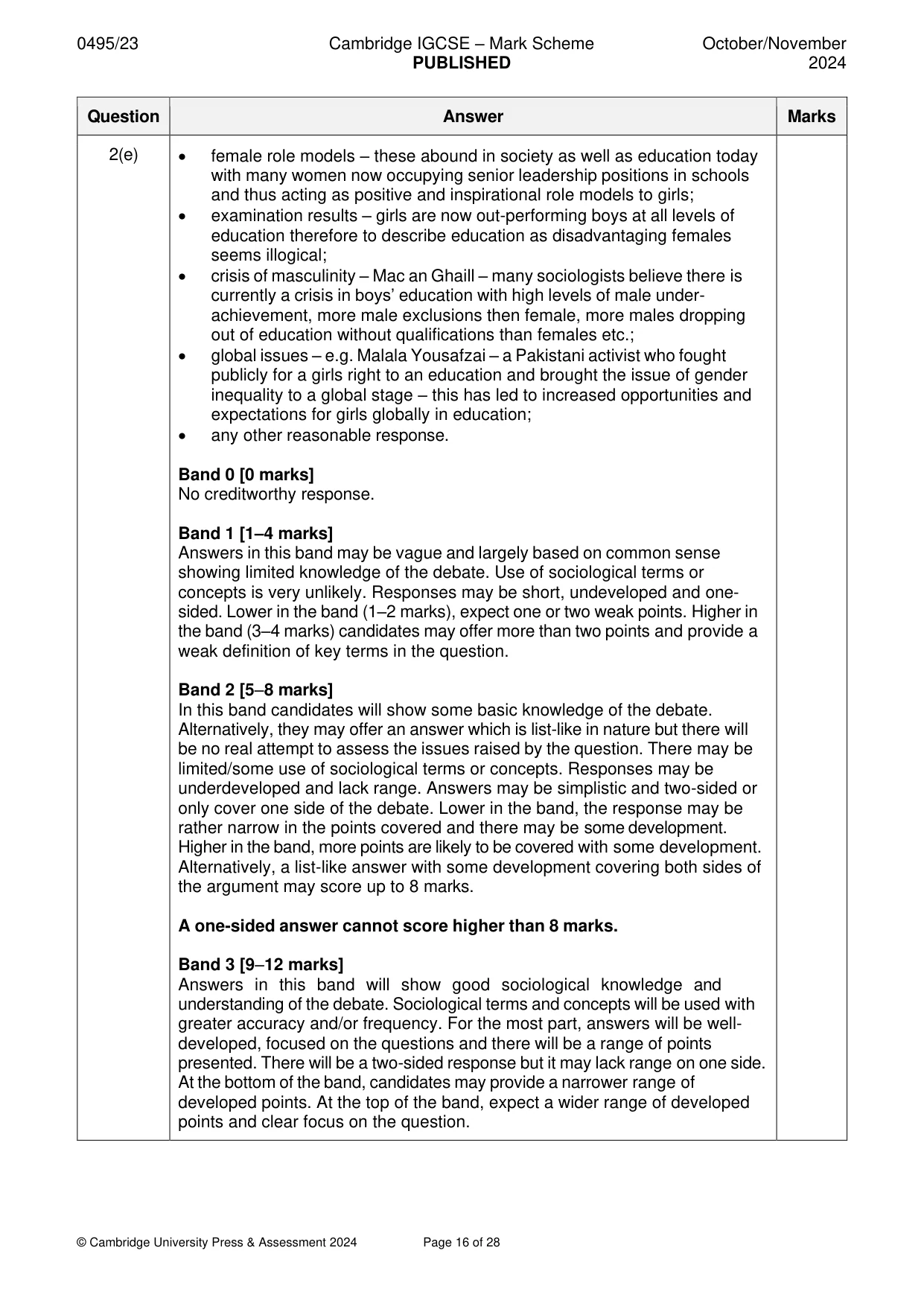
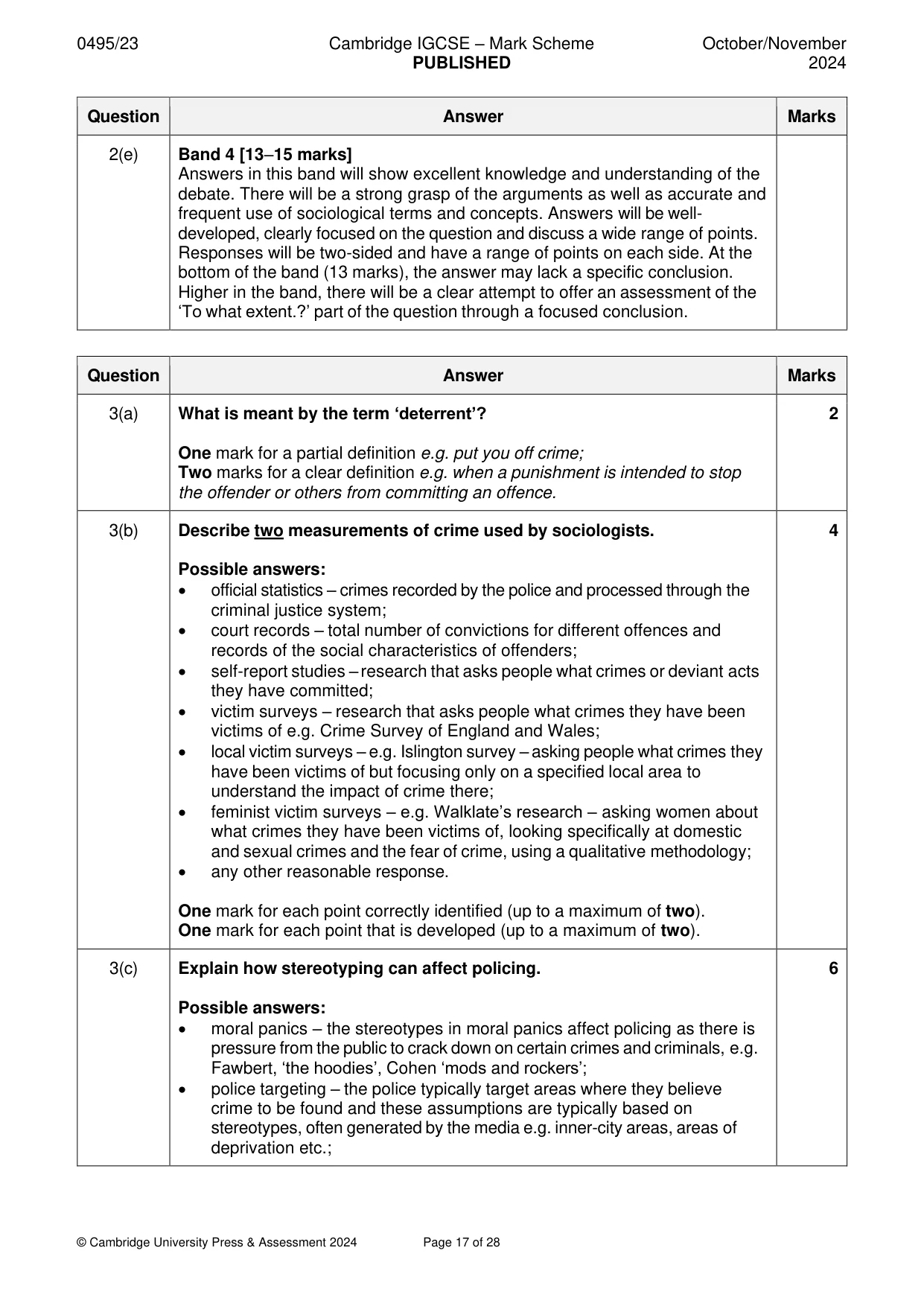
Mark scheme: 2(a) What is meant by the term ‘private school’? 2 One mark for a partial definition e.g. a paid for school; Two marks for a clear definition e.g. a school not run or paid for by the government but by parents through fees. 2(b) Describe two home factors that could negatively affect educational 4 achievement. Possible answers: • material factors – poverty may result in a child having to combine work with study, a lack of space to study at home and a poor diet; • extra-curricular opportunities – a lack of money may also prevent children taking part in school clubs, trips and visits and hence reduce cultural capital; • university – coming from a family where university is either not the norm or not affordable will affect the child’s educational aspirations; • no pre-school – not having attended this will mean some children are already behind others when they start school; • lack of home resources – no internet, private tutor, laptop, software etc. can negatively impact on educational achievement; • disadvantaged school – attending a school in a poor area can mean the quality of education on offer is not as good as that for children in more prosperous areas; • fatalistic attitude – believing you can’t change your future (often associated with the lower social classes) means the child is unlikely to try hard at school or achieve highly; • need for immediate rather than deferred gratification – not seeing the benefits of long-term goals is likely to result in a lack of educational achievement; • value of education – parents not valuing education will pass down to the children and is likely to result in them not valuing it either which will then affect educational achievement; • lack of role models – a lack of educationally successful role models in the family is likely to deter some children from trying hard at school and thus affect their achievement; • language codes – being brought up with the restricted code at home and/or having the language of school as your second language is likely to negatively affect achievement in education (Bernstein); • community – living in a community where education is not seen as important and gangs and deviant behaviour are the norm is likely to affect the child’s educational achievement; • cultural values – the cultural values on, for example, gender may affect whether a girl can access education and thus negatively affect her educational achievement; • any other reasonable response. One mark for each point correctly identified (up to a maximum of two). One mark for each point that is developed (up to a maximum of two). 2(c) Explain how teachers can influence educational achievement. 6 Possible answers: • role models – students look up to teachers and therefore are influenced by them – either positively (aspirational, for example), or negatively (lack of ethnic minority teachers, for example); • careers advice – teachers often act as motivators for students e.g. feminists believe one of the reasons girls are now doing so well in education is because of the advice and high expectations from their female teachers; • teacher expectations – how the teacher expects a student to perform may influence their educational achievement e.g. teachers may believe that poor study habits and behaviour are normal for boys but these would not be tolerated from girls; • teacher labelling – the poor educational performance of some ethnic minority students may be explained by negative teacher labelling e.g. assuming they are unable to do very well or labelling them as ‘troublemakers’; • ideal pupil - Becker – research shows that teachers have a stereotype of the ‘ideal pupil’ and students that do not match this may not be given the same opportunities and treatment as those that do, e.g. setting and streaming which will affect educational achievement; • Rutter’s research – teachers can affect educational achievement through their expectations of students, how they treat students, how well prepared they are for lessons and by setting an example; • halo effect – the positive stereotyping of some students as hard working and bright has been shown to cause this stereotype to be true which will then affect educational achievement; • self-fulfilling prophecy – students fall in line with the views the teacher has of them so if they believe that the teacher thinks they are unintelligent and will fail then the student starts to live up to this negative stereotype (Rosenthal) hence affecting their achievement; • Archer’s study – found that teachers believed Chinese students were bright and capable and so had high expectations of them so when they did have difficulties in understanding the teachers gave them little help which will affect their educational achievement; • any other reasonable response. Band 0 [0 marks] No creditworthy response. Band 1 [1–3 marks] Answers in this band will show only a limited awareness of the question. Responses may be short and un/underdeveloped. At the bottom of the band (1 mark), expect one weak point. Higher in the band (2–3 marks), candidates may offer more than one weak point, but there may be a tendency towards simplistic answers, engaging with sociological ideas without using sociological language. 2(c) Band 2 [4–6 marks] Answers in this band will have clear and accurate explanation, showing good sociological knowledge and understanding. Sociological terms and concepts should be expected and explained. At the bottom of the band, the range of points covered may be narrow or lack detail. Higher in the band, answers will cover more than one point in a well-developed way or cover several points in less detail. 2(d) Explain why the education system can lead to social mobility. 8 Possible answers: • equality of opportunity – if education systems are equal then people are able to reach the level they deserve based on their ability and the effort they make to succeed, not on the basis of any pre-determined social characteristics meaning they can climb the social ladder; • meritocracy – functionalists believe the education system is fair and therefore background is irrelevant – a bright child from a working class background who works hard will be able to do as well as one from a more privileged background, in both school and work; • individual merit – people from underprivileged social groups e.g. some ethnic minorities, can be upwardly mobile if they merit this, while those from privileged backgrounds will become downwardly mobile if they do not merit success and rewards; • setting and streaming – being placed in higher sets/streams means better opportunities for those students from negatively privileged social groups e.g. facilitating university entry for ethnic minority/working class students and thus affecting social mobility; • gender – research shows girls that are in higher sets and therefore do well at school are motivated to continue aspiring high in their careers, shunning the housewife role and having fewer children so resulting in upward social mobility; • positive discrimination – schools sometimes manipulate the students placed in the higher sets to tackle social issues such as racism or sexism – this gives those students better opportunities for educational success and upward social mobility; • universal standards – in education everyone is measured and tested against the same universal criteria therefore social mobility (upwards or downwards) is possible based on how well a pupil does at school; • functionalism and role allocation – education sifts out the best students regardless of social background and prepares them for the best positions in society, resulting in much social mobility; • scholarships – many private schools offer scholarships to the brightest students who cannot afford their fees, therefore resulting in increased life chances and social mobility as private schools are often seen as a ticket to the top universities and top jobs; • job of teacher – in many societies teaching is seen as a prestigious and highly valued profession and for teachers from less privileged backgrounds this career may lead to upward social mobility; 2(d) • cultural capital – Bourdieu – students who engage with and do well at school will increase their levels of cultural capital and thus have better chances for upward social mobility; • social capital – Bourdieu – students can often increase their social networks and, for those in private schools in particular, benefit from the old boys’ network, so increasing their opportunities for social mobility; • any other reasonable response. Band 0 [0 marks] No creditworthy response. Band 1 [1 – 3 marks] Answers in this band will show only a limited awareness of the question. A tendency to description is likely. Responses may be short and undeveloped and points stated without explanation. Sociological terms and concepts are unlikely to be used. At the bottom of the band (1 mark), expect one weak point. Higher in the band (2–3 marks), candidates may offer more than one weak point. Band 2 [4 – 6 marks] Answers in this band will show basic sociological knowledge and understanding. Responses may be underdeveloped and lacking in range. At the bottom of the band, candidates are unlikely to use sociological terms and concepts accurately. Higher in the band, candidates may be beginning to use sociological terms and concepts with greater accuracy. However, some aspects of the answer may only be partially developed/explained. Band 3 [7 – 8 marks] Answers in this band will show good sociological knowledge and understanding and will be well-developed and explained. Sociological terms and concepts will be used accurately overall. Answers will be well-focused on the question and there will be a range of points presented. At the top of the band explanations will be clear throughout. 2(e) To what extent do schools disadvantage female students? 15 Possible answers: FOR • gendered curriculum – historically and still today in some countries, boys and girls study different subjects at school – this defines future gender roles and disadvantages females e.g. boys studying engineering and girls textiles; • sport – in most countries girls and boys still do different sports at school with males being more physical and hands on e.g. lack of female football and rugby opportunities which may disadvantage females; • hierarchy – schools are hierarchical institutions dominated by females however those in the higher positions are typically males e.g. headteacher – this disadvantages females; • subject choice - even with a national curriculum boys and girls still often choose different subjects, often because of gendered advice e.g. sociology is female dominated whereas business is male dominated – 2(e) this clearly affects future employment and pay opportunities and disadvantages females; • representations – textbooks still define future gender roles and are patriarchal in content, e.g. science experiment illustrations may show a male teacher and male students which disadvantages females; • classroom space – feminists believe that classrooms are a gendered space whereby boys dominate e.g. sitting in the teacher’s eyeline, being louder, answering more questions, being asked more questions, taking up teacher time etc. – this disadvantages female students; • access – in some countries and cultures a male’s education is more valued than a female’s which may affect access to education and schools thus disadvantaging females; • teacher attitudes – some teachers still believe the future role for a girl is to be a housewife and mother therefore there is little point pushing her academically which disadvantages females; • culture of masculinity – a laddish culture abounds in many schools with anti-school sub-cultures typically being male, visiting speakers being male etc. – these all disadvantage females; • extra-curricular activities – these are typically sport related and tend to focus on popular male dominated sports which may exclude and disadvantage females; • misogyny – recently many schools have been accused of being patriarchal institutions through normalising and trivialising female experiences of sexual banter and assault e.g. ‘Everyone’s Invited’ – this clearly disadvantages females; • canalisation – Oakley – in primary schools there is still often a divide in the toys and resources that are defined and offered to girls as compared to those available to boys – these set and limit future gender roles, often disadvantaging and limiting females; • any other reasonable response. AGAINST: • legislation – legally males and females must now have equal opportunities and this has cascaded down into schools whereby gender discrimination is no longer acceptable or normalised, e.g. female football teams; • feminisation of education – education is now described as a ‘female world’ which benefits rather than disadvantages females e.g. the focus on reading and writing, the large numbers of female teachers and role models etc.; • national curriculum – this made it a legal requirement for girls and boys to all study core subjects up to a certain age in order to remove gender discrimination from the curriculum; • positive discrimination – many schools use schemes to encourage girls to aim higher, particularly in the sciences and technology – e.g. all-female STEM groups, ensuring girls have priority access to labs and equipment etc.; 2(e) • female role models – these abound in society as well as education today with many women now occupying senior leadership positions in schools and thus acting as positive and inspirational role models to girls; • examination results – girls are now out-performing boys at all levels of education therefore to describe education as disadvantaging females seems illogical; • crisis of masculinity – Mac an Ghaill – many sociologists believe there is currently a crisis in boys’ education with high levels of male under- achievement, more male exclusions then female, more males dropping out of education without qualifications than females etc.; • global issues – e.g. Malala Yousafzai – a Pakistani activist who fought publicly for a girls right to an education and brought the issue of gender inequality to a global stage – this has led to increased opportunities and expectations for girls globally in education; • any other reasonable response. Band 0 [0 marks] No creditworthy response. Band 1 [1–4 marks] Answers in this band may be vague and largely based on common sense showing limited knowledge of the debate. Use of sociological terms or concepts is very unlikely. Responses may be short, undeveloped and one- sided. Lower in the band (1–2 marks), expect one or two weak points. Higher in the band (3–4 marks) candidates may offer more than two points and provide a weak definition of key terms in the question. Band 2 [5–8 marks] In this band candidates will show some basic knowledge of the debate. Alternatively, they may offer an answer which is list-like in nature but there will be no real attempt to assess the issues raised by the question. There may be limited/some use of sociological terms or concepts. Responses may be underdeveloped and lack range. Answers may be simplistic and two-sided or only cover one side of the debate. Lower in the band, the response may be rather narrow in the points covered and there may be some development. Higher in the band, more points are likely to be covered with some development. Alternatively, a list-like answer with some development covering both sides of the argument may score up to 8 marks. A one-sided answer cannot score higher than 8 marks. Band 3 [9–12 marks] Answers in this band will show good sociological knowledge and understanding of the debate. Sociological terms and concepts will be used with greater accuracy and/or frequency. For the most part, answers will be well- developed, focused on the questions and there will be a range of points presented. There will be a two-sided response but it may lack range on one side. At the bottom of the band, candidates may provide a narrower range of developed points. At the top of the band, expect a wider range of developed points and clear focus on the question. 2(e) Band 4 [13–15 marks] Answers in this band will show excellent knowledge and understanding of the debate. There will be a strong grasp of the arguments as well as accurate and frequent use of sociological terms and concepts. Answers will be well- developed, clearly focused on the question and discuss a wide range of points. Responses will be two-sided and have a range of points on each side. At the bottom of the band (13 marks), the answer may lack a specific conclusion. Higher in the band, there will be a clear attempt to offer an assessment of the ‘To what extent.?’ part of the question through a focused conclusion.
Q3 · Sociologists use different measurements of crime
3 Sociologists use different measurements of crime. These measurements show that males commit more crime than females. There are many deterrents to crime. Sociologists debate whether formal or informal social control is more effective at preventing crime. (a) What is meant by the term ‘deterrent’? [2] (b) Describe two measurements of crime used by sociologists. [4] (c) Explain how stereotyping can affect policing. [6] (d) Explain why males commit more crime than females. [8] (e) To what extent is formal social control more effective than informal social control at preventing crime? [15] Section D: Media
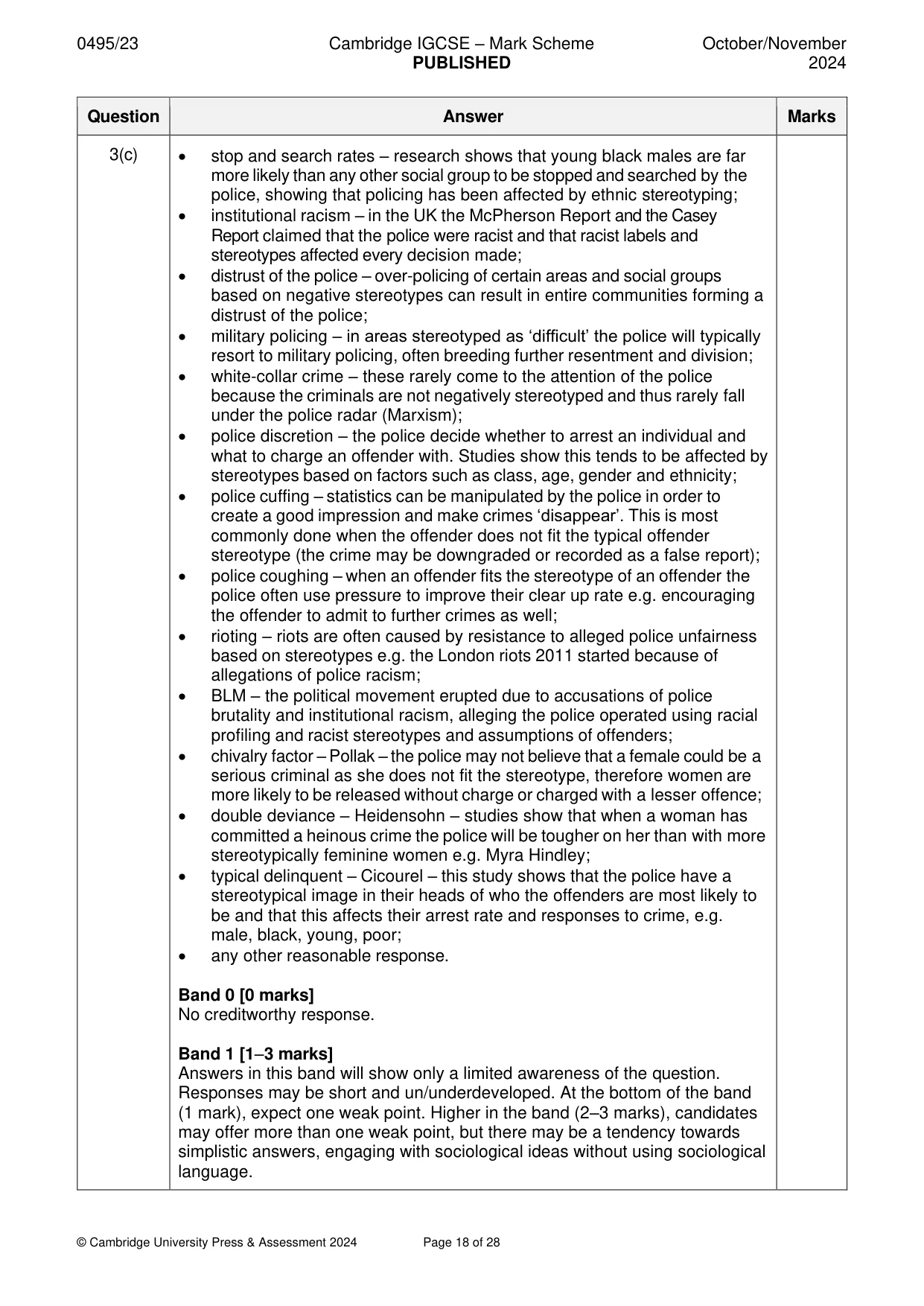
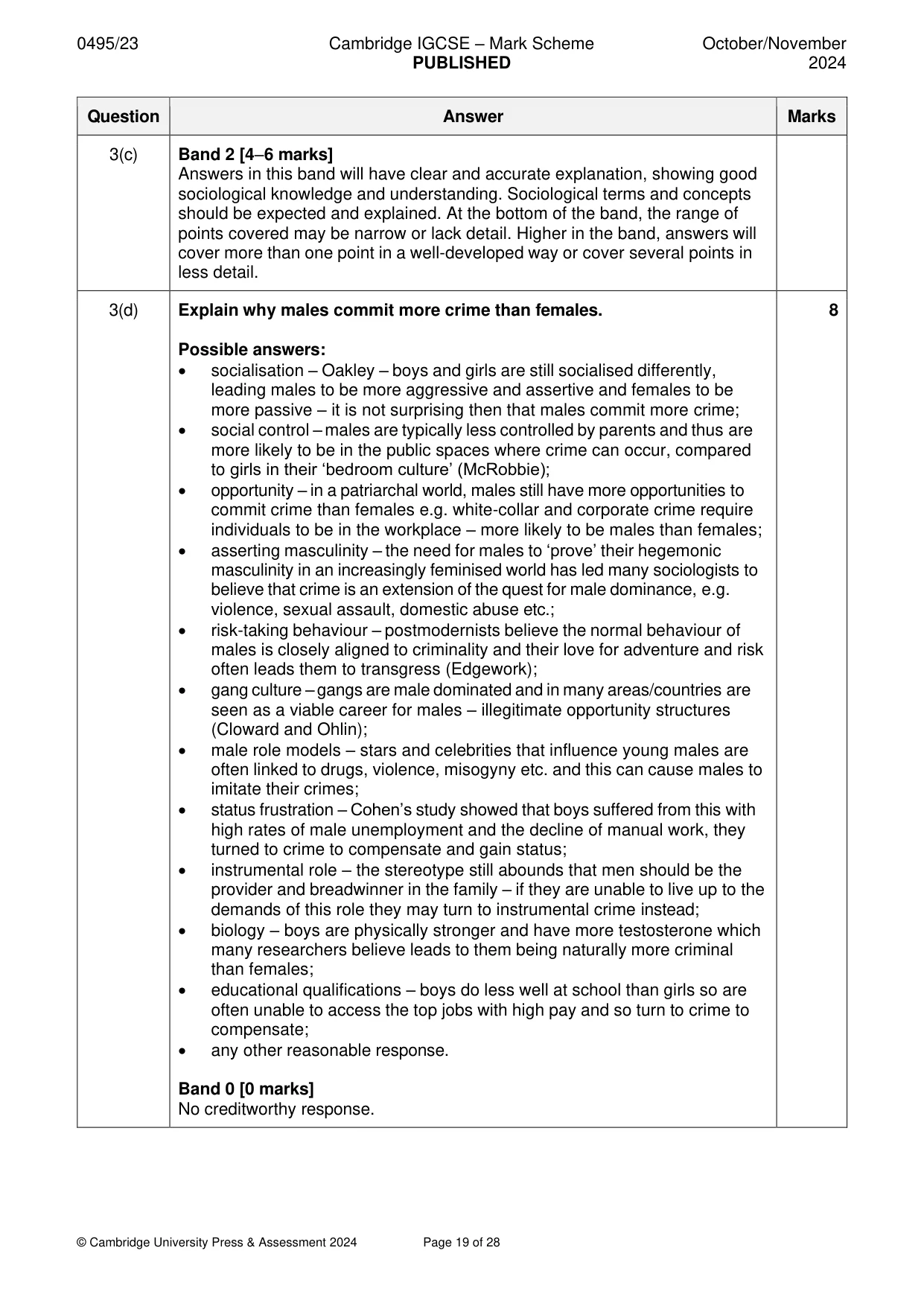
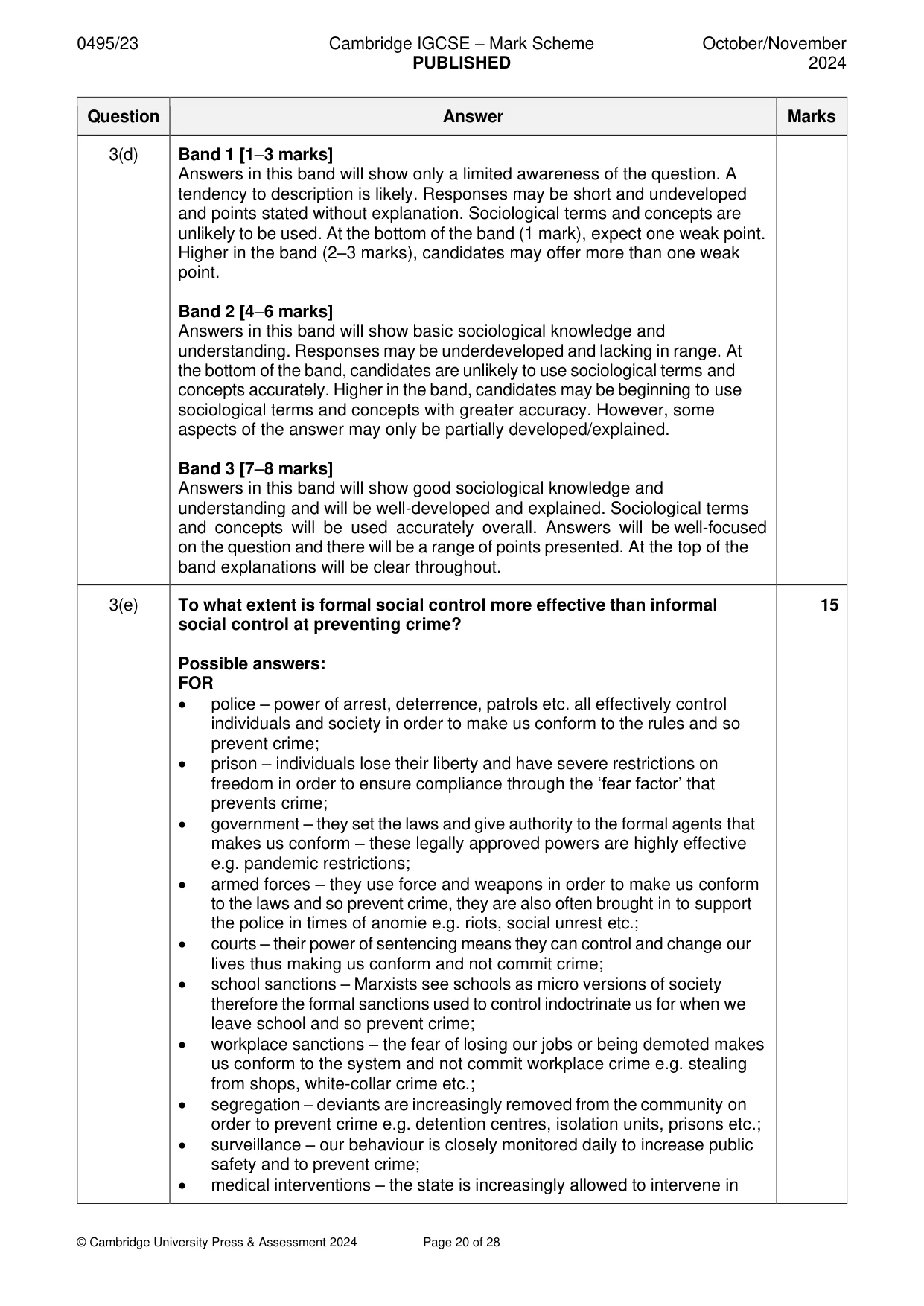
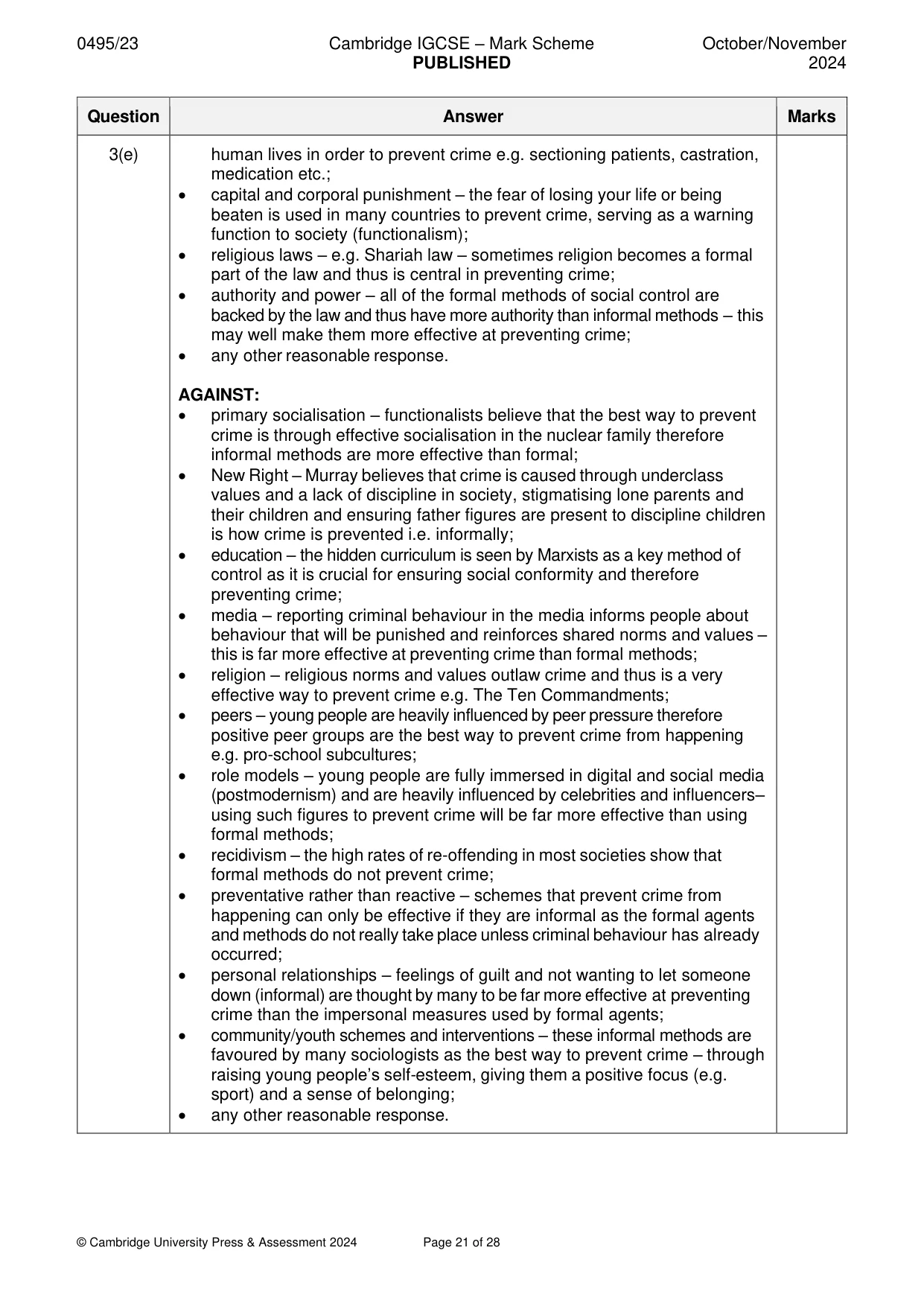
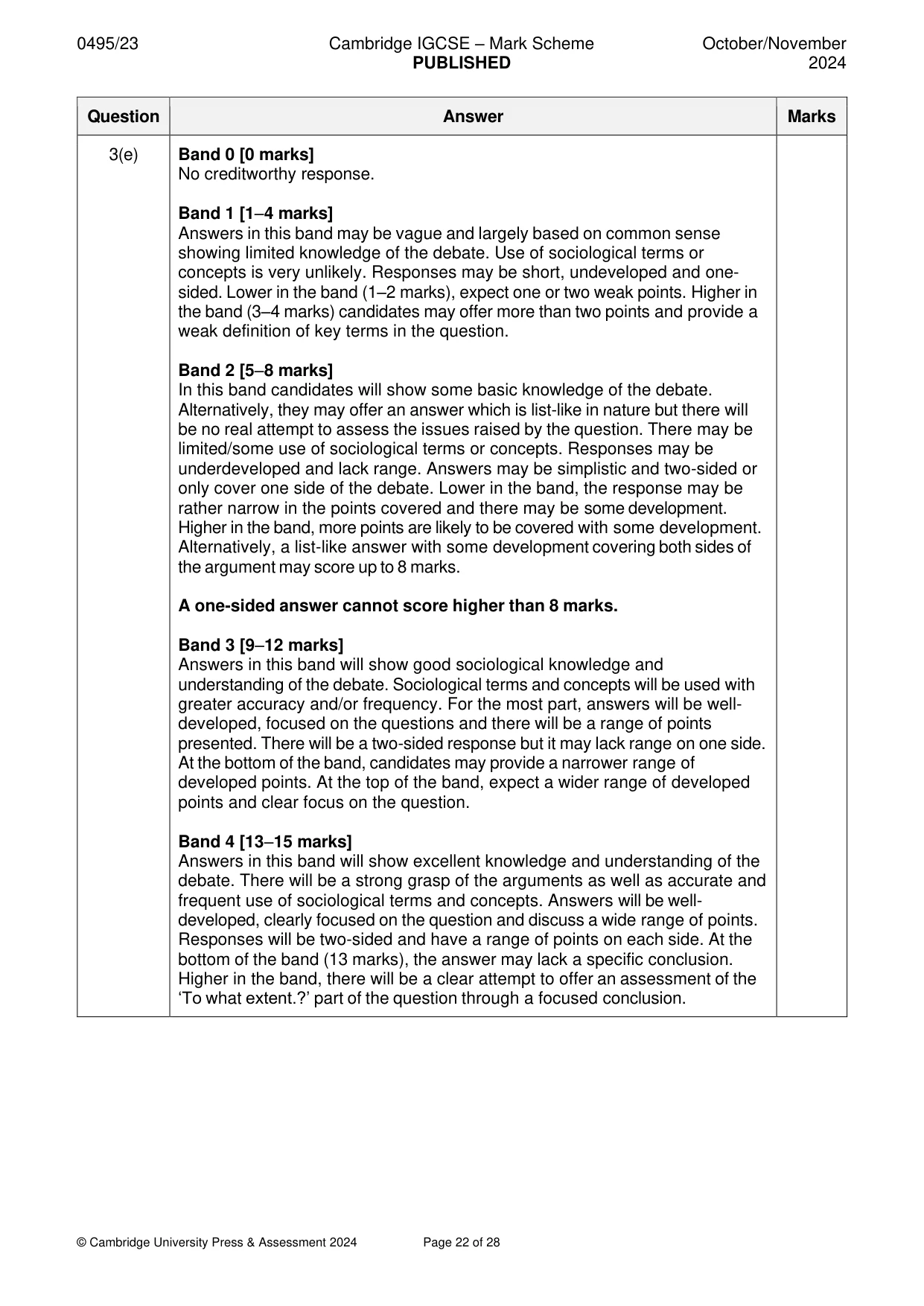
Mark scheme: 3(a) What is meant by the term ‘deterrent’? 2 One mark for a partial definition e.g. put you off crime; Two marks for a clear definition e.g. when a punishment is intended to stop the offender or others from committing an offence. 3(b) Describe two measurements of crime used by sociologists. 4 Possible answers: • official statistics – crimes recorded by the police and processed through the criminal justice system; • court records – total number of convictions for different offences and records of the social characteristics of offenders; • self-report studies – research that asks people what crimes or deviant acts they have committed; • victim surveys – research that asks people what crimes they have been victims of e.g. Crime Survey of England and Wales; • local victim surveys – e.g. Islington survey – asking people what crimes they have been victims of but focusing only on a specified local area to understand the impact of crime there; • feminist victim surveys – e.g. Walklate’s research – asking women about what crimes they have been victims of, looking specifically at domestic and sexual crimes and the fear of crime, using a qualitative methodology; • any other reasonable response. One mark for each point correctly identified (up to a maximum of two). One mark for each point that is developed (up to a maximum of two). 3(c) Explain how stereotyping can affect policing. 6 Possible answers: • moral panics – the stereotypes in moral panics affect policing as there is pressure from the public to crack down on certain crimes and criminals, e.g. Fawbert, ‘the hoodies’, Cohen ‘mods and rockers’; • police targeting – the police typically target areas where they believe crime to be found and these assumptions are typically based on stereotypes, often generated by the media e.g. inner-city areas, areas of deprivation etc.; 3(c) • stop and search rates – research shows that young black males are far more likely than any other social group to be stopped and searched by the police, showing that policing has been affected by ethnic stereotyping; • institutional racism – in the UK the McPherson Report and the Casey Report claimed that the police were racist and that racist labels and stereotypes affected every decision made; • distrust of the police – over-policing of certain areas and social groups based on negative stereotypes can result in entire communities forming a distrust of the police; • military policing – in areas stereotyped as ‘difficult’ the police will typically resort to military policing, often breeding further resentment and division; • white-collar crime – these rarely come to the attention of the police because the criminals are not negatively stereotyped and thus rarely fall under the police radar (Marxism); • police discretion – the police decide whether to arrest an individual and what to charge an offender with. Studies show this tends to be affected by stereotypes based on factors such as class, age, gender and ethnicity; • police cuffing – statistics can be manipulated by the police in order to create a good impression and make crimes ‘disappear’. This is most commonly done when the offender does not fit the typical offender stereotype (the crime may be downgraded or recorded as a false report); • police coughing – when an offender fits the stereotype of an offender the police often use pressure to improve their clear up rate e.g. encouraging the offender to admit to further crimes as well; • rioting – riots are often caused by resistance to alleged police unfairness based on stereotypes e.g. the London riots 2011 started because of allegations of police racism; • BLM – the political movement erupted due to accusations of police brutality and institutional racism, alleging the police operated using racial profiling and racist stereotypes and assumptions of offenders; • chivalry factor – Pollak – the police may not believe that a female could be a serious criminal as she does not fit the stereotype, therefore women are more likely to be released without charge or charged with a lesser offence; • double deviance – Heidensohn – studies show that when a woman has committed a heinous crime the police will be tougher on her than with more stereotypically feminine women e.g. Myra Hindley; • typical delinquent – Cicourel – this study shows that the police have a stereotypical image in their heads of who the offenders are most likely to be and that this affects their arrest rate and responses to crime, e.g. male, black, young, poor; • any other reasonable response. Band 0 [0 marks] No creditworthy response. Band 1 [1–3 marks] Answers in this band will show only a limited awareness of the question. Responses may be short and un/underdeveloped. At the bottom of the band (1 mark), expect one weak point. Higher in the band (2–3 marks), candidates may offer more than one weak point, but there may be a tendency towards simplistic answers, engaging with sociological ideas without using sociological language. 3(c) Band 2 [4–6 marks] Answers in this band will have clear and accurate explanation, showing good sociological knowledge and understanding. Sociological terms and concepts should be expected and explained. At the bottom of the band, the range of points covered may be narrow or lack detail. Higher in the band, answers will cover more than one point in a well-developed way or cover several points in less detail. 3(d) Explain why males commit more crime than females. 8 Possible answers: • socialisation – Oakley – boys and girls are still socialised differently, leading males to be more aggressive and assertive and females to be more passive – it is not surprising then that males commit more crime; • social control – males are typically less controlled by parents and thus are more likely to be in the public spaces where crime can occur, compared to girls in their ‘bedroom culture’ (McRobbie); • opportunity – in a patriarchal world, males still have more opportunities to commit crime than females e.g. white-collar and corporate crime require individuals to be in the workplace – more likely to be males than females; • asserting masculinity – the need for males to ‘prove’ their hegemonic masculinity in an increasingly feminised world has led many sociologists to believe that crime is an extension of the quest for male dominance, e.g. violence, sexual assault, domestic abuse etc.; • risk-taking behaviour – postmodernists believe the normal behaviour of males is closely aligned to criminality and their love for adventure and risk often leads them to transgress (Edgework); • gang culture – gangs are male dominated and in many areas/countries are seen as a viable career for males – illegitimate opportunity structures (Cloward and Ohlin); • male role models – stars and celebrities that influence young males are often linked to drugs, violence, misogyny etc. and this can cause males to imitate their crimes; • status frustration – Cohen’s study showed that boys suffered from this with high rates of male unemployment and the decline of manual work, they turned to crime to compensate and gain status; • instrumental role – the stereotype still abounds that men should be the provider and breadwinner in the family – if they are unable to live up to the demands of this role they may turn to instrumental crime instead; • biology – boys are physically stronger and have more testosterone which many researchers believe leads to them being naturally more criminal than females; • educational qualifications – boys do less well at school than girls so are often unable to access the top jobs with high pay and so turn to crime to compensate; • any other reasonable response. Band 0 [0 marks] No creditworthy response. 3(d) Band 1 [1–3 marks] Answers in this band will show only a limited awareness of the question. A tendency to description is likely. Responses may be short and undeveloped and points stated without explanation. Sociological terms and concepts are unlikely to be used. At the bottom of the band (1 mark), expect one weak point. Higher in the band (2–3 marks), candidates may offer more than one weak point. Band 2 [4–6 marks] Answers in this band will show basic sociological knowledge and understanding. Responses may be underdeveloped and lacking in range. At the bottom of the band, candidates are unlikely to use sociological terms and concepts accurately. Higher in the band, candidates may be beginning to use sociological terms and concepts with greater accuracy. However, some aspects of the answer may only be partially developed/explained. Band 3 [7–8 marks] Answers in this band will show good sociological knowledge and understanding and will be well-developed and explained. Sociological terms and concepts will be used accurately overall. Answers will be well-focused on the question and there will be a range of points presented. At the top of the band explanations will be clear throughout. 3(e) To what extent is formal social control more effective than informal 15 social control at preventing crime? Possible answers: FOR • police – power of arrest, deterrence, patrols etc. all effectively control individuals and society in order to make us conform to the rules and so prevent crime; • prison – individuals lose their liberty and have severe restrictions on freedom in order to ensure compliance through the ‘fear factor’ that prevents crime; • government – they set the laws and give authority to the formal agents that makes us conform – these legally approved powers are highly effective e.g. pandemic restrictions; • armed forces – they use force and weapons in order to make us conform to the laws and so prevent crime, they are also often brought in to support the police in times of anomie e.g. riots, social unrest etc.; • courts – their power of sentencing means they can control and change our lives thus making us conform and not commit crime; • school sanctions – Marxists see schools as micro versions of society therefore the formal sanctions used to control indoctrinate us for when we leave school and so prevent crime; • workplace sanctions – the fear of losing our jobs or being demoted makes us conform to the system and not commit workplace crime e.g. stealing from shops, white-collar crime etc.; • segregation – deviants are increasingly removed from the community on order to prevent crime e.g. detention centres, isolation units, prisons etc.; • surveillance – our behaviour is closely monitored daily to increase public safety and to prevent crime; • medical interventions – the state is increasingly allowed to intervene in 3(e) human lives in order to prevent crime e.g. sectioning patients, castration, medication etc.; • capital and corporal punishment – the fear of losing your life or being beaten is used in many countries to prevent crime, serving as a warning function to society (functionalism); • religious laws – e.g. Shariah law – sometimes religion becomes a formal part of the law and thus is central in preventing crime; • authority and power – all of the formal methods of social control are backed by the law and thus have more authority than informal methods – this may well make them more effective at preventing crime; • any other reasonable response. AGAINST: • primary socialisation – functionalists believe that the best way to prevent crime is through effective socialisation in the nuclear family therefore informal methods are more effective than formal; • New Right – Murray believes that crime is caused through underclass values and a lack of discipline in society, stigmatising lone parents and their children and ensuring father figures are present to discipline children is how crime is prevented i.e. informally; • education – the hidden curriculum is seen by Marxists as a key method of control as it is crucial for ensuring social conformity and therefore preventing crime; • media – reporting criminal behaviour in the media informs people about behaviour that will be punished and reinforces shared norms and values – this is far more effective at preventing crime than formal methods; • religion – religious norms and values outlaw crime and thus is a very effective way to prevent crime e.g. The Ten Commandments; • peers – young people are heavily influenced by peer pressure therefore positive peer groups are the best way to prevent crime from happening e.g. pro-school subcultures; • role models – young people are fully immersed in digital and social media (postmodernism) and are heavily influenced by celebrities and influencers– using such figures to prevent crime will be far more effective than using formal methods; • recidivism – the high rates of re-offending in most societies show that formal methods do not prevent crime; • preventative rather than reactive – schemes that prevent crime from happening can only be effective if they are informal as the formal agents and methods do not really take place unless criminal behaviour has already occurred; • personal relationships – feelings of guilt and not wanting to let someone down (informal) are thought by many to be far more effective at preventing crime than the impersonal measures used by formal agents; • community/youth schemes and interventions – these informal methods are favoured by many sociologists as the best way to prevent crime – through raising young people’s self-esteem, giving them a positive focus (e.g. sport) and a sense of belonging; • any other reasonable response. 3(e) Band 0 [0 marks] No creditworthy response. Band 1 [1–4 marks] Answers in this band may be vague and largely based on common sense showing limited knowledge of the debate. Use of sociological terms or concepts is very unlikely. Responses may be short, undeveloped and one- sided. Lower in the band (1–2 marks), expect one or two weak points. Higher in the band (3–4 marks) candidates may offer more than two points and provide a weak definition of key terms in the question. Band 2 [5–8 marks] In this band candidates will show some basic knowledge of the debate. Alternatively, they may offer an answer which is list-like in nature but there will be no real attempt to assess the issues raised by the question. There may be limited/some use of sociological terms or concepts. Responses may be underdeveloped and lack range. Answers may be simplistic and two-sided or only cover one side of the debate. Lower in the band, the response may be rather narrow in the points covered and there may be some development. Higher in the band, more points are likely to be covered with some development. Alternatively, a list-like answer with some development covering both sides of the argument may score up to 8 marks. A one-sided answer cannot score higher than 8 marks. Band 3 [9–12 marks] Answers in this band will show good sociological knowledge and understanding of the debate. Sociological terms and concepts will be used with greater accuracy and/or frequency. For the most part, answers will be well- developed, focused on the questions and there will be a range of points presented. There will be a two-sided response but it may lack range on one side. At the bottom of the band, candidates may provide a narrower range of developed points. At the top of the band, expect a wider range of developed points and clear focus on the question. Band 4 [13–15 marks] Answers in this band will show excellent knowledge and understanding of the debate. There will be a strong grasp of the arguments as well as accurate and frequent use of sociological terms and concepts. Answers will be well- developed, clearly focused on the question and discuss a wide range of points. Responses will be two-sided and have a range of points on each side. At the bottom of the band (13 marks), the answer may lack a specific conclusion. Higher in the band, there will be a clear attempt to offer an assessment of the ‘To what extent.?’ part of the question through a focused conclusion.
Q4 · Many sociologists believe in the hypodermic-syringe model
4 Many sociologists believe in the hypodermic-syringe model. Both traditional and new media can have a negative impact on children. Sociologists agree that advertising plays an important role in the media. However, sociologists debate whether the pluralist view of the media is the most accurate. (a) What is meant by the term ‘hypodermic-syringe model’? [2] (b) Describe two types of new media. [4] (c) Explain how advertising has an important role in the media. [6] (d) Explain why the media can have a negative impact on children. [8] (e) To what extent is the pluralist view of the media accurate? [15]
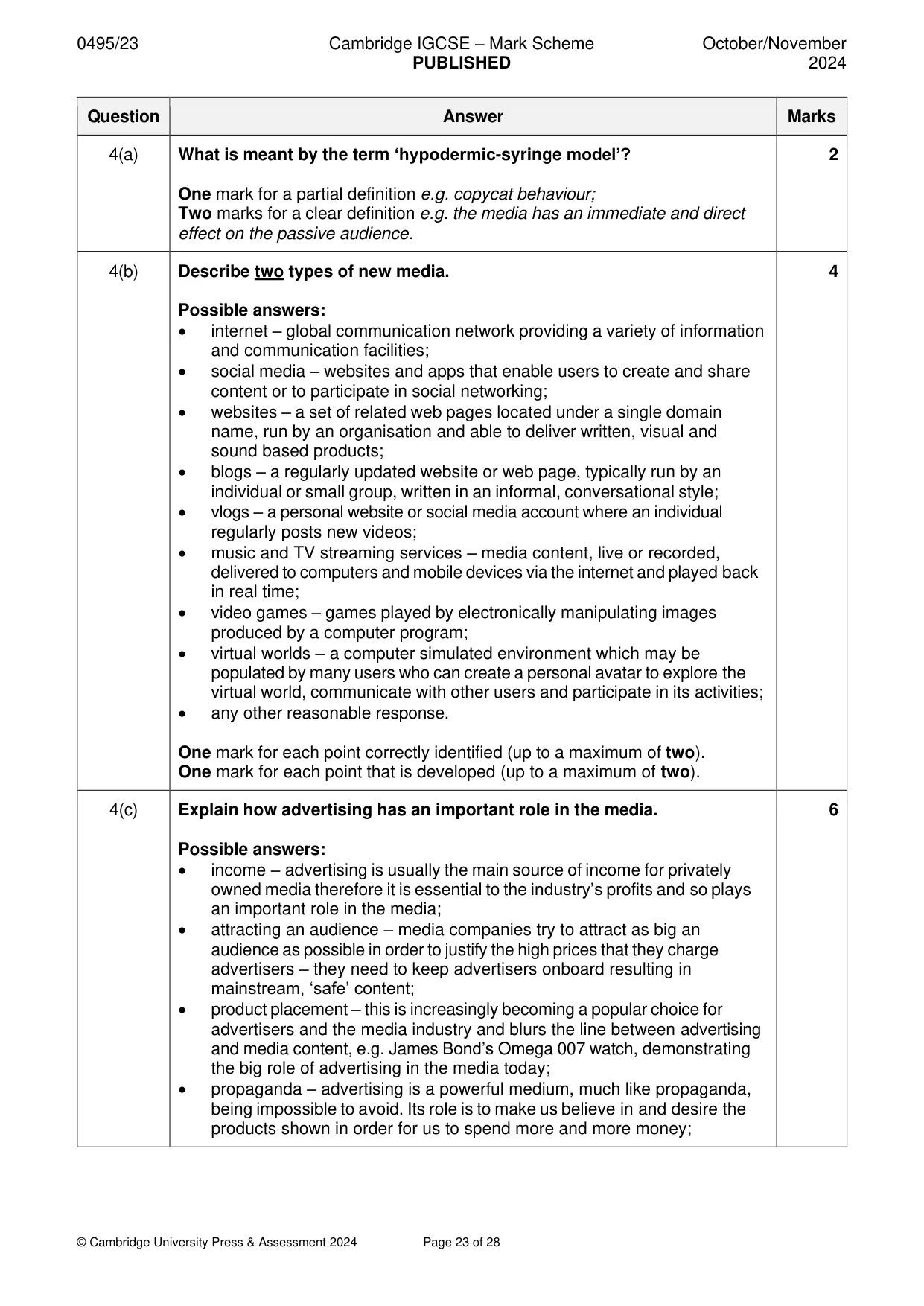
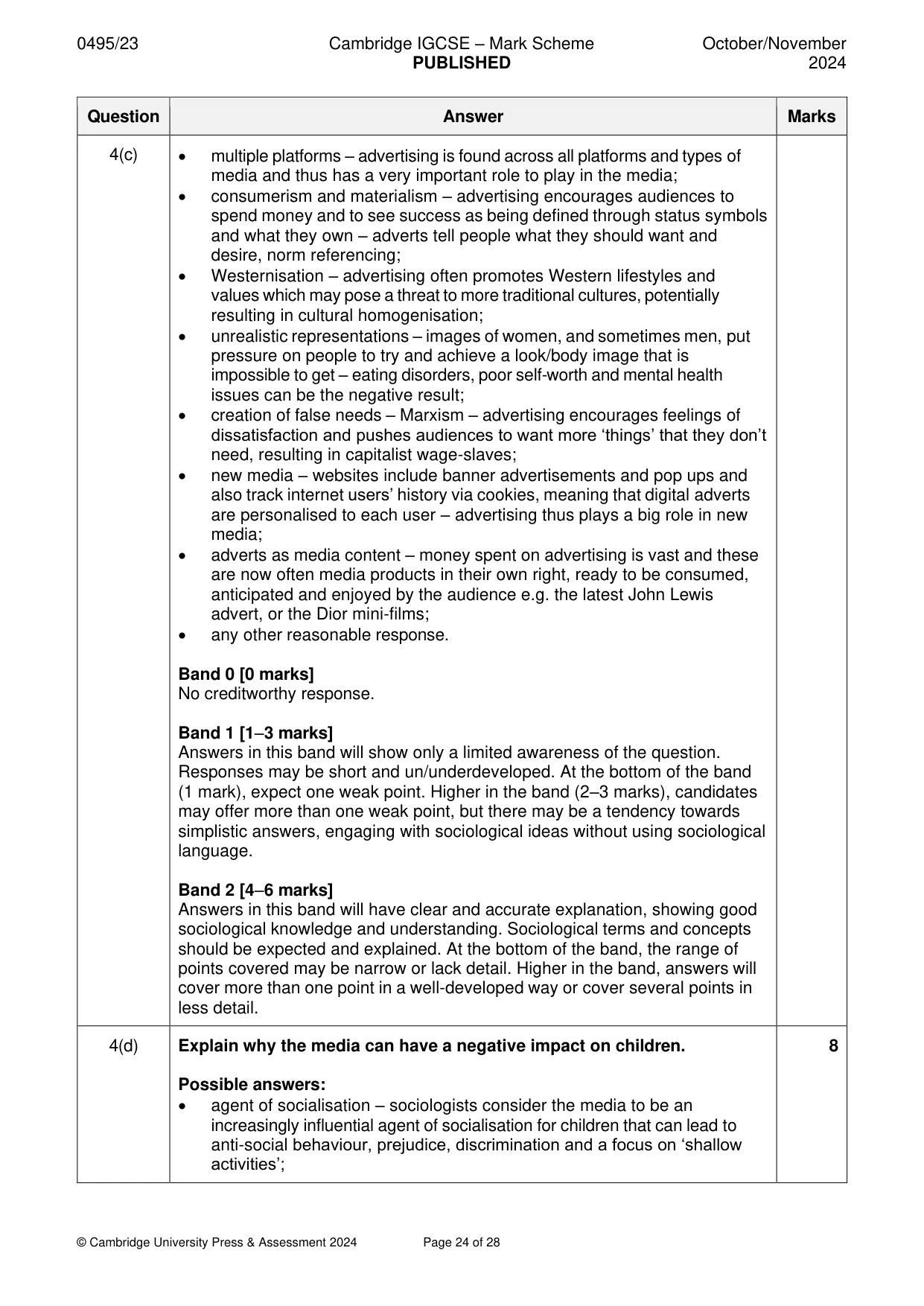
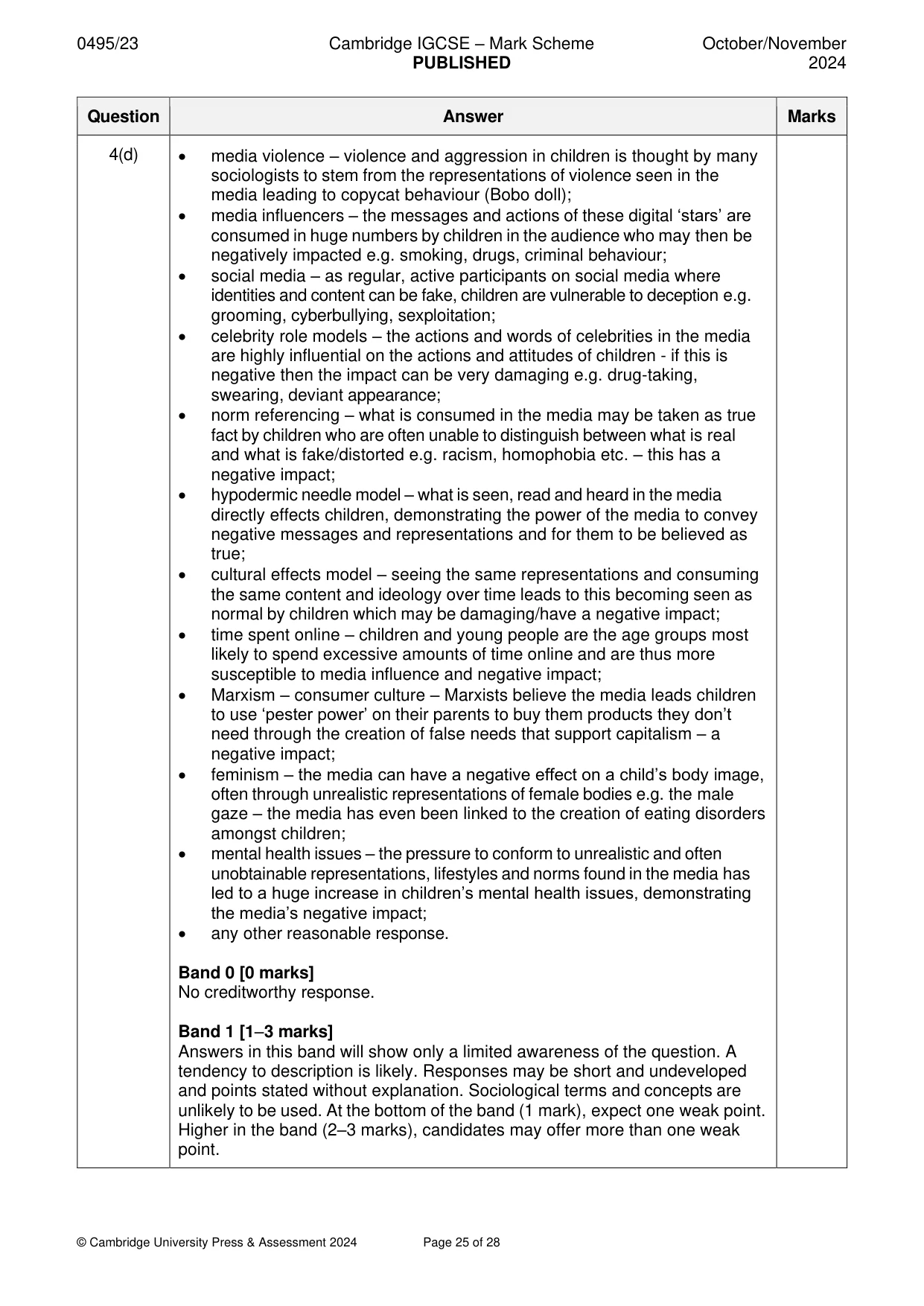
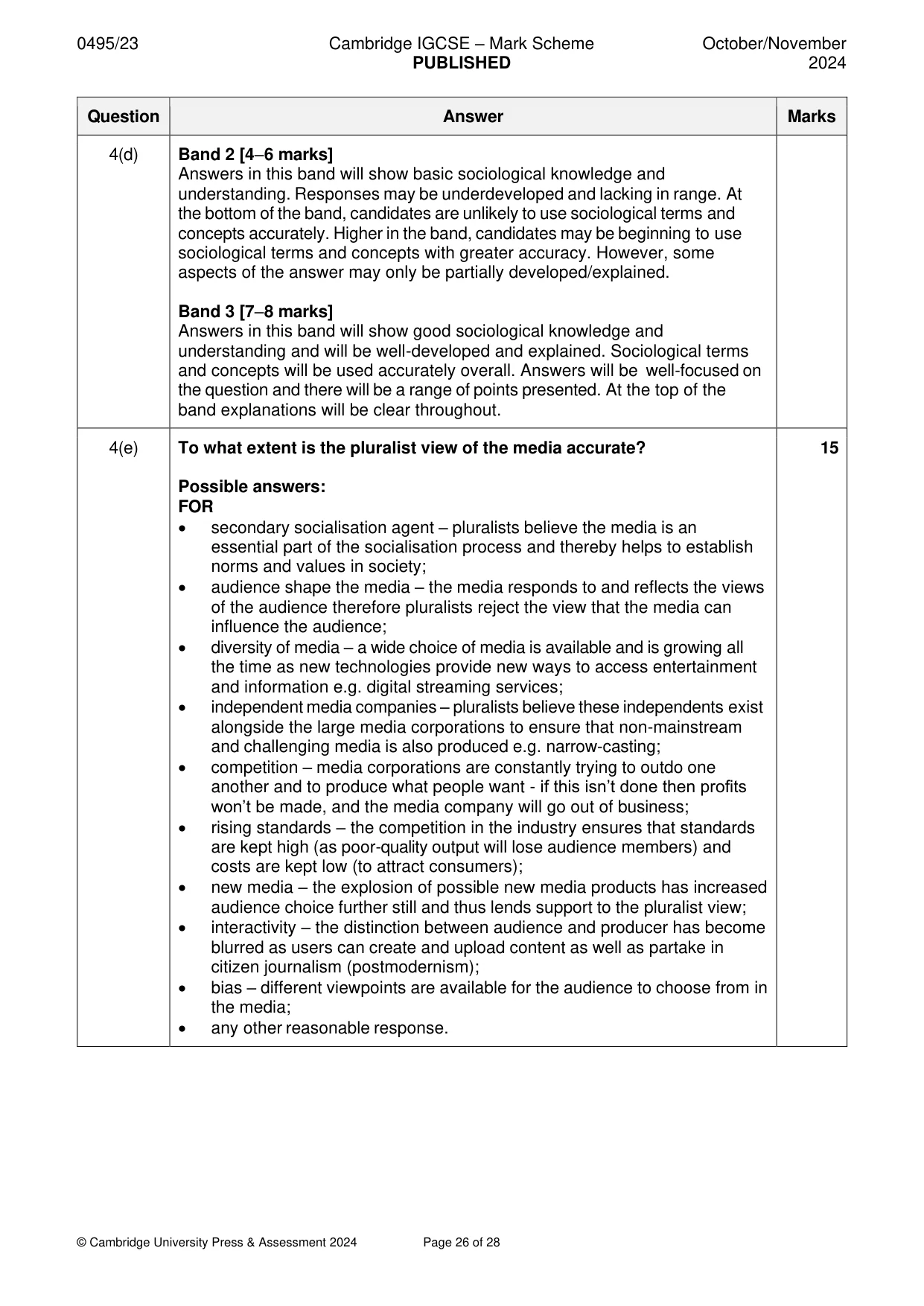
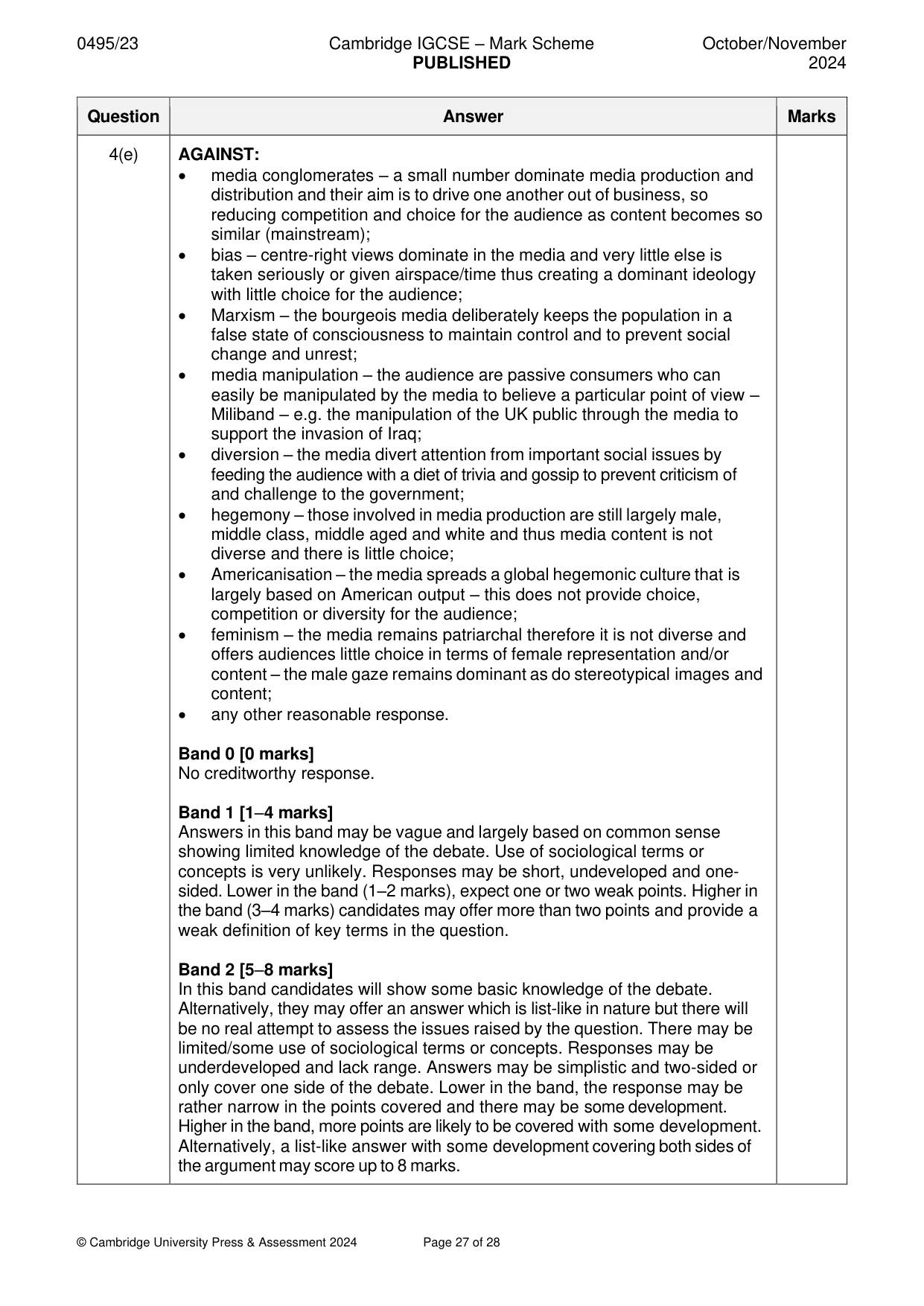
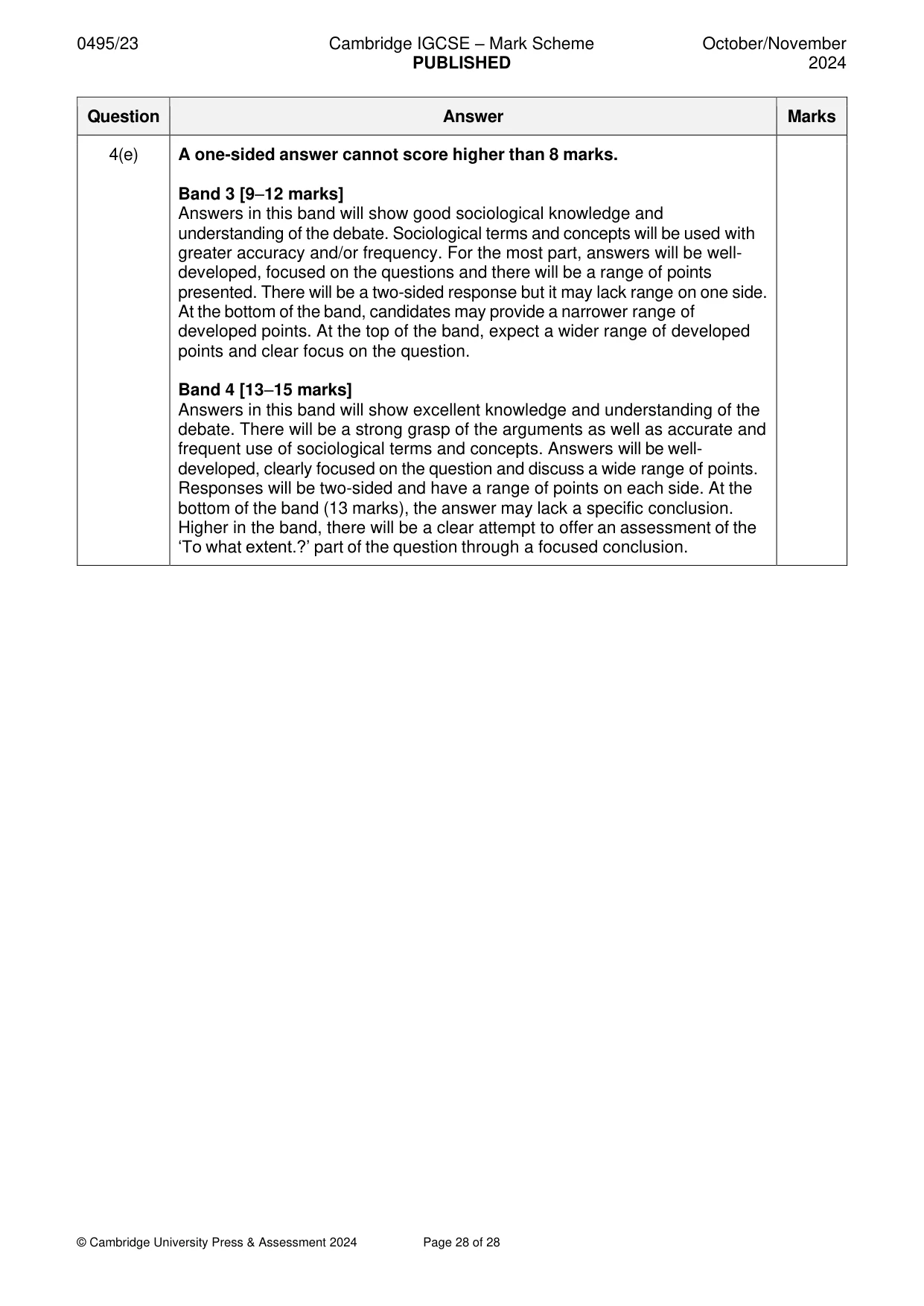
Mark scheme: 4(a) What is meant by the term ‘hypodermic-syringe model’? 2 One mark for a partial definition e.g. copycat behaviour; Two marks for a clear definition e.g. the media has an immediate and direct effect on the passive audience. 4(b) Describe two types of new media. 4 Possible answers: • internet – global communication network providing a variety of information and communication facilities; • social media – websites and apps that enable users to create and share content or to participate in social networking; • websites – a set of related web pages located under a single domain name, run by an organisation and able to deliver written, visual and sound based products; • blogs – a regularly updated website or web page, typically run by an individual or small group, written in an informal, conversational style; • vlogs – a personal website or social media account where an individual regularly posts new videos; • music and TV streaming services – media content, live or recorded, delivered to computers and mobile devices via the internet and played back in real time; • video games – games played by electronically manipulating images produced by a computer program; • virtual worlds – a computer simulated environment which may be populated by many users who can create a personal avatar to explore the virtual world, communicate with other users and participate in its activities; • any other reasonable response. One mark for each point correctly identified (up to a maximum of two). One mark for each point that is developed (up to a maximum of two). 4(c) Explain how advertising has an important role in the media. 6 Possible answers: • income – advertising is usually the main source of income for privately owned media therefore it is essential to the industry’s profits and so plays an important role in the media; • attracting an audience – media companies try to attract as big an audience as possible in order to justify the high prices that they charge advertisers – they need to keep advertisers onboard resulting in mainstream, ‘safe’ content; • product placement – this is increasingly becoming a popular choice for advertisers and the media industry and blurs the line between advertising and media content, e.g. James Bond’s Omega 007 watch, demonstrating the big role of advertising in the media today; • propaganda – advertising is a powerful medium, much like propaganda, being impossible to avoid. Its role is to make us believe in and desire the products shown in order for us to spend more and more money; 4(c) • multiple platforms – advertising is found across all platforms and types of media and thus has a very important role to play in the media; • consumerism and materialism – advertising encourages audiences to spend money and to see success as being defined through status symbols and what they own – adverts tell people what they should want and desire, norm referencing; • Westernisation – advertising often promotes Western lifestyles and values which may pose a threat to more traditional cultures, potentially resulting in cultural homogenisation; • unrealistic representations – images of women, and sometimes men, put pressure on people to try and achieve a look/body image that is impossible to get – eating disorders, poor self-worth and mental health issues can be the negative result; • creation of false needs – Marxism – advertising encourages feelings of dissatisfaction and pushes audiences to want more ‘things’ that they don’t need, resulting in capitalist wage-slaves; • new media – websites include banner advertisements and pop ups and also track internet users’ history via cookies, meaning that digital adverts are personalised to each user – advertising thus plays a big role in new media; • adverts as media content – money spent on advertising is vast and these are now often media products in their own right, ready to be consumed, anticipated and enjoyed by the audience e.g. the latest John Lewis advert, or the Dior mini-films; • any other reasonable response. Band 0 [0 marks] No creditworthy response. Band 1 [1–3 marks] Answers in this band will show only a limited awareness of the question. Responses may be short and un/underdeveloped. At the bottom of the band (1 mark), expect one weak point. Higher in the band (2–3 marks), candidates may offer more than one weak point, but there may be a tendency towards simplistic answers, engaging with sociological ideas without using sociological language. Band 2 [4–6 marks] Answers in this band will have clear and accurate explanation, showing good sociological knowledge and understanding. Sociological terms and concepts should be expected and explained. At the bottom of the band, the range of points covered may be narrow or lack detail. Higher in the band, answers will cover more than one point in a well-developed way or cover several points in less detail. 4(d) Explain why the media can have a negative impact on children. 8 Possible answers: • agent of socialisation – sociologists consider the media to be an increasingly influential agent of socialisation for children that can lead to anti-social behaviour, prejudice, discrimination and a focus on ‘shallow activities’; 4(d) • media violence – violence and aggression in children is thought by many sociologists to stem from the representations of violence seen in the media leading to copycat behaviour (Bobo doll); • media influencers – the messages and actions of these digital ‘stars’ are consumed in huge numbers by children in the audience who may then be negatively impacted e.g. smoking, drugs, criminal behaviour; • social media – as regular, active participants on social media where identities and content can be fake, children are vulnerable to deception e.g. grooming, cyberbullying, sexploitation; • celebrity role models – the actions and words of celebrities in the media are highly influential on the actions and attitudes of children - if this is negative then the impact can be very damaging e.g. drug-taking, swearing, deviant appearance; • norm referencing – what is consumed in the media may be taken as true fact by children who are often unable to distinguish between what is real and what is fake/distorted e.g. racism, homophobia etc. – this has a negative impact; • hypodermic needle model – what is seen, read and heard in the media directly effects children, demonstrating the power of the media to convey negative messages and representations and for them to be believed as true; • cultural effects model – seeing the same representations and consuming the same content and ideology over time leads to this becoming seen as normal by children which may be damaging/have a negative impact; • time spent online – children and young people are the age groups most likely to spend excessive amounts of time online and are thus more susceptible to media influence and negative impact; • Marxism – consumer culture – Marxists believe the media leads children to use ‘pester power’ on their parents to buy them products they don’t need through the creation of false needs that support capitalism – a negative impact; • feminism – the media can have a negative effect on a child’s body image, often through unrealistic representations of female bodies e.g. the male gaze – the media has even been linked to the creation of eating disorders amongst children; • mental health issues – the pressure to conform to unrealistic and often unobtainable representations, lifestyles and norms found in the media has led to a huge increase in children’s mental health issues, demonstrating the media’s negative impact; • any other reasonable response. Band 0 [0 marks] No creditworthy response. Band 1 [1–3 marks] Answers in this band will show only a limited awareness of the question. A tendency to description is likely. Responses may be short and undeveloped and points stated without explanation. Sociological terms and concepts are unlikely to be used. At the bottom of the band (1 mark), expect one weak point. Higher in the band (2–3 marks), candidates may offer more than one weak point. 4(d) Band 2 [4–6 marks] Answers in this band will show basic sociological knowledge and understanding. Responses may be underdeveloped and lacking in range. At the bottom of the band, candidates are unlikely to use sociological terms and concepts accurately. Higher in the band, candidates may be beginning to use sociological terms and concepts with greater accuracy. However, some aspects of the answer may only be partially developed/explained. Band 3 [7–8 marks] Answers in this band will show good sociological knowledge and understanding and will be well-developed and explained. Sociological terms and concepts will be used accurately overall. Answers will be well-focused on the question and there will be a range of points presented. At the top of the band explanations will be clear throughout. 4(e) To what extent is the pluralist view of the media accurate? 15 Possible answers: FOR • secondary socialisation agent – pluralists believe the media is an essential part of the socialisation process and thereby helps to establish norms and values in society; • audience shape the media – the media responds to and reflects the views of the audience therefore pluralists reject the view that the media can influence the audience; • diversity of media – a wide choice of media is available and is growing all the time as new technologies provide new ways to access entertainment and information e.g. digital streaming services; • independent media companies – pluralists believe these independents exist alongside the large media corporations to ensure that non-mainstream and challenging media is also produced e.g. narrow-casting; • competition – media corporations are constantly trying to outdo one another and to produce what people want - if this isn’t done then profits won’t be made, and the media company will go out of business; • rising standards – the competition in the industry ensures that standards are kept high (as poor-quality output will lose audience members) and costs are kept low (to attract consumers); • new media – the explosion of possible new media products has increased audience choice further still and thus lends support to the pluralist view; • interactivity – the distinction between audience and producer has become blurred as users can create and upload content as well as partake in citizen journalism (postmodernism); • bias – different viewpoints are available for the audience to choose from in the media; • any other reasonable response. 4(e) AGAINST: • media conglomerates – a small number dominate media production and distribution and their aim is to drive one another out of business, so reducing competition and choice for the audience as content becomes so similar (mainstream); • bias – centre-right views dominate in the media and very little else is taken seriously or given airspace/time thus creating a dominant ideology with little choice for the audience; • Marxism – the bourgeois media deliberately keeps the population in a false state of consciousness to maintain control and to prevent social change and unrest; • media manipulation – the audience are passive consumers who can easily be manipulated by the media to believe a particular point of view – Miliband – e.g. the manipulation of the UK public through the media to support the invasion of Iraq; • diversion – the media divert attention from important social issues by feeding the audience with a diet of trivia and gossip to prevent criticism of and challenge to the government; • hegemony – those involved in media production are still largely male, middle class, middle aged and white and thus media content is not diverse and there is little choice; • Americanisation – the media spreads a global hegemonic culture that is largely based on American output – this does not provide choice, competition or diversity for the audience; • feminism – the media remains patriarchal therefore it is not diverse and offers audiences little choice in terms of female representation and/or content – the male gaze remains dominant as do stereotypical images and content; • any other reasonable response. Band 0 [0 marks] No creditworthy response. Band 1 [1–4 marks] Answers in this band may be vague and largely based on common sense showing limited knowledge of the debate. Use of sociological terms or concepts is very unlikely. Responses may be short, undeveloped and one- sided. Lower in the band (1–2 marks), expect one or two weak points. Higher in the band (3–4 marks) candidates may offer more than two points and provide a weak definition of key terms in the question. Band 2 [5–8 marks] In this band candidates will show some basic knowledge of the debate. Alternatively, they may offer an answer which is list-like in nature but there will be no real attempt to assess the issues raised by the question. There may be limited/some use of sociological terms or concepts. Responses may be underdeveloped and lack range. Answers may be simplistic and two-sided or only cover one side of the debate. Lower in the band, the response may be rather narrow in the points covered and there may be some development. Higher in the band, more points are likely to be covered with some development. Alternatively, a list-like answer with some development covering both sides of the argument may score up to 8 marks. 4(e) A one-sided answer cannot score higher than 8 marks. Band 3 [9–12 marks] Answers in this band will show good sociological knowledge and understanding of the debate. Sociological terms and concepts will be used with greater accuracy and/or frequency. For the most part, answers will be well- developed, focused on the questions and there will be a range of points presented. There will be a two-sided response but it may lack range on one side. At the bottom of the band, candidates may provide a narrower range of developed points. At the top of the band, expect a wider range of developed points and clear focus on the question. Band 4 [13–15 marks] Answers in this band will show excellent knowledge and understanding of the debate. There will be a strong grasp of the arguments as well as accurate and frequent use of sociological terms and concepts. Answers will be well- developed, clearly focused on the question and discuss a wide range of points. Responses will be two-sided and have a range of points on each side. At the bottom of the band (13 marks), the answer may lack a specific conclusion. Higher in the band, there will be a clear attempt to offer an assessment of the ‘To what extent.?’ part of the question through a focused conclusion.
More questions on How do sociologists approach the study of society?
What was in this paper
The subtopics covered by these 4 questions, and how many questions each got. Open one in a new tab to see every Cambridge question on it.
What you needed in this session
Cambridge’s own grade thresholds for 2024 Oct/Nov, Paper 2 · Variant 3. A higher threshold means an easier paper — the bar moves with how the cohort did.