Cambridge IGCSE Sociology 0495 — 2022 May/June Paper 2 · Variant 3
0495/23/M/J/22 · 4 questions · 70 marks · ≈79 min
The question paper and its mark scheme, free to read here and free to download. This is Cambridge’s own paper, exactly as it was sat.
Question paper4 pages
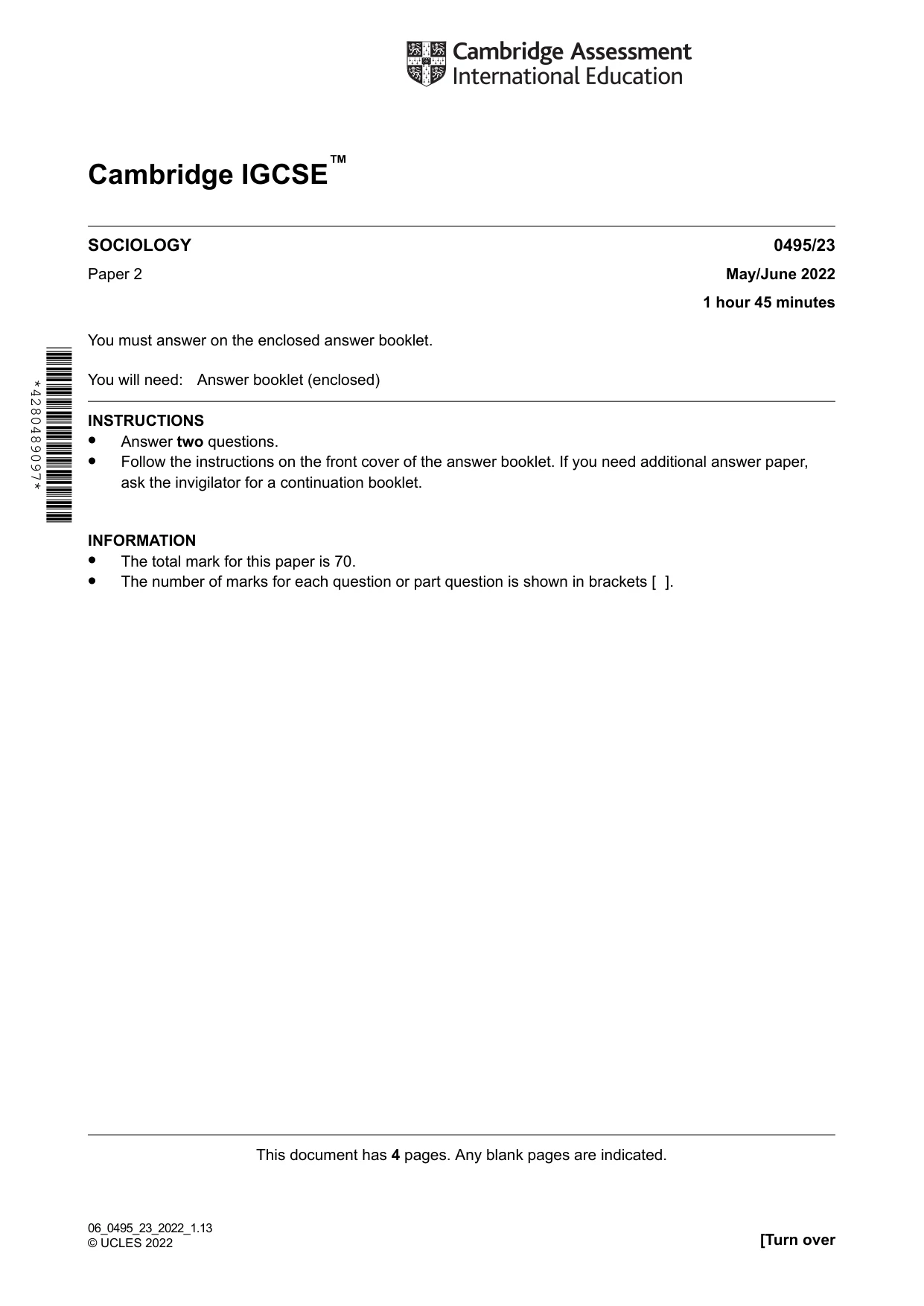
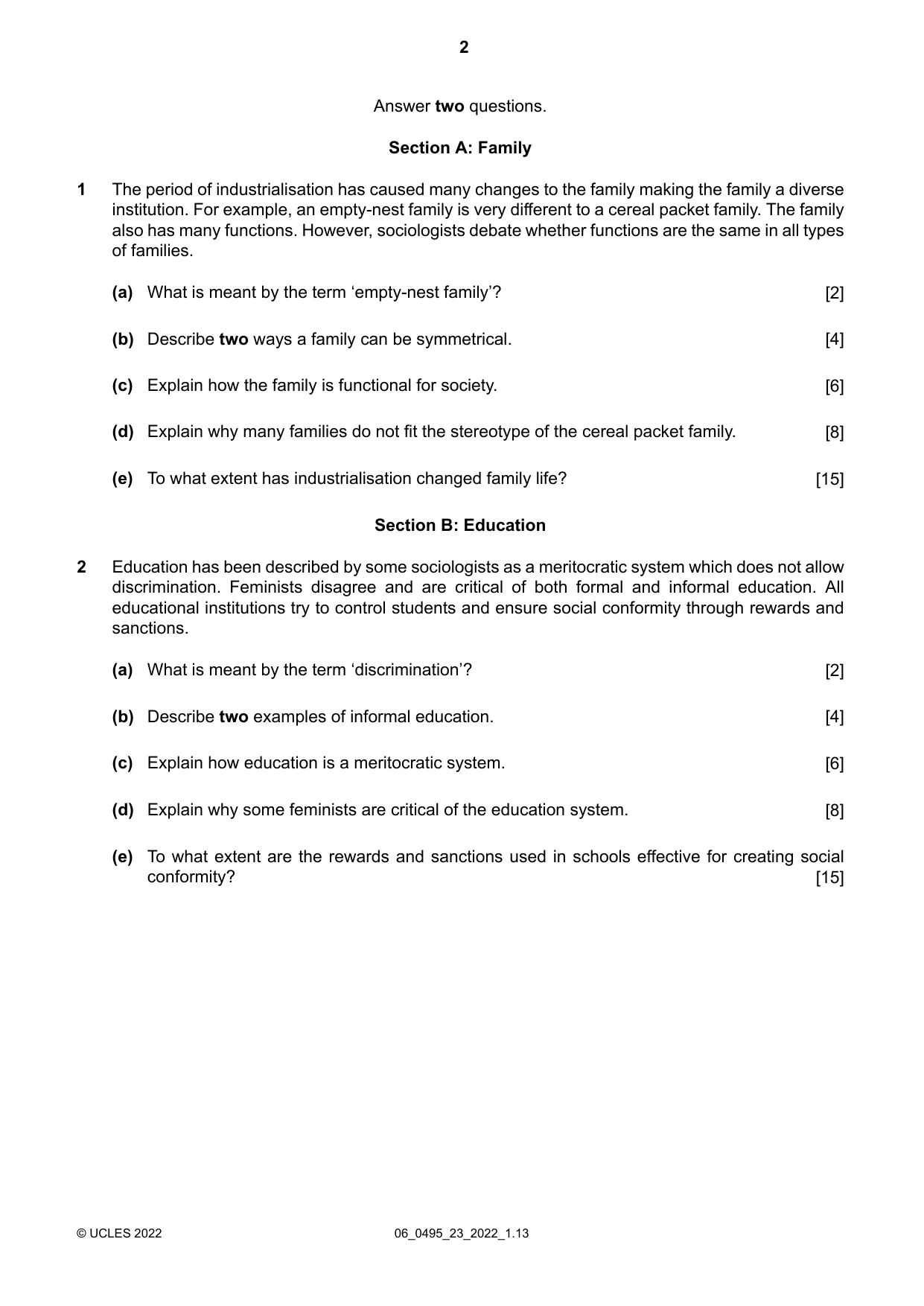
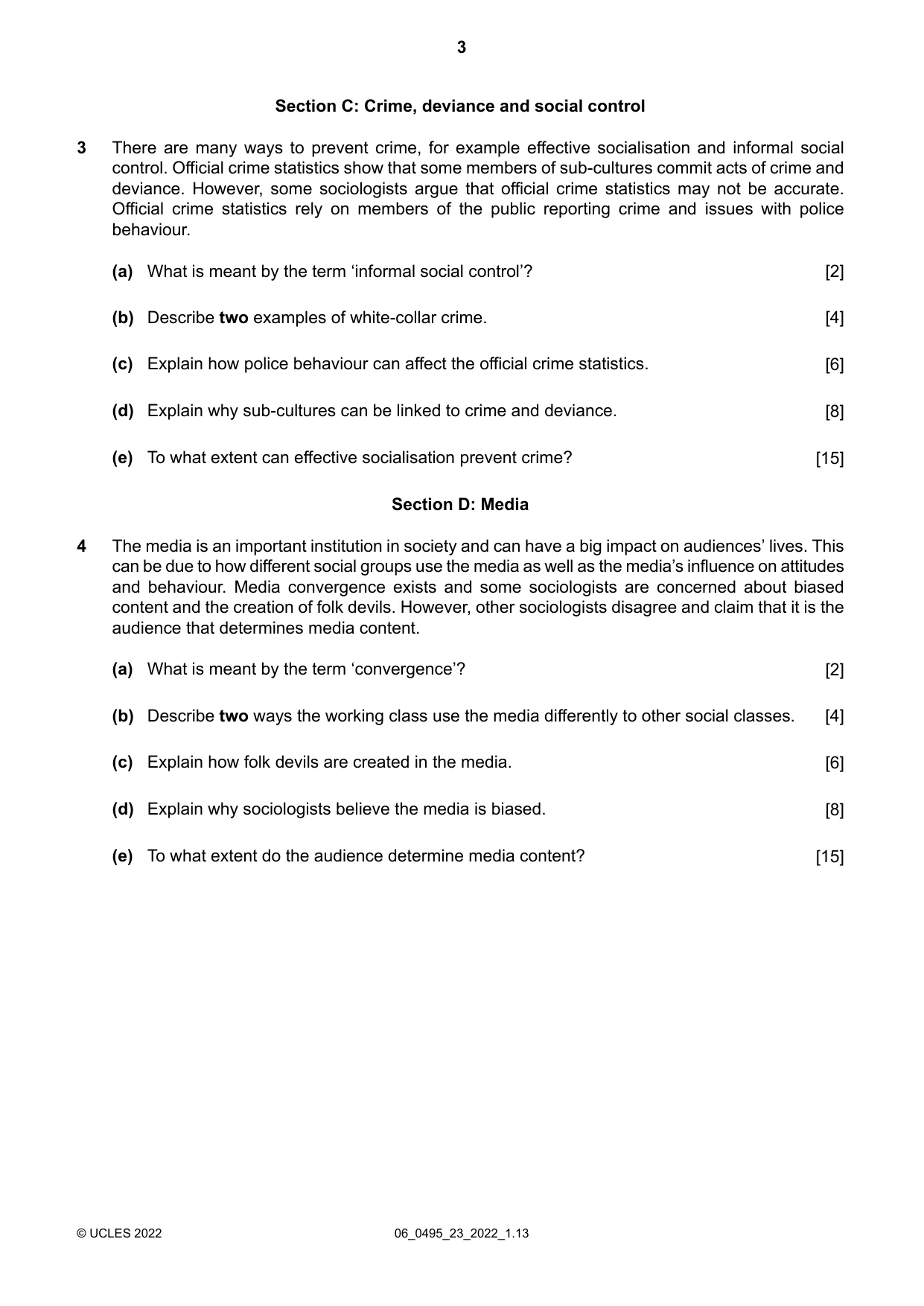

Mark scheme25 pages
Answers below. Sit the paper first if you are practising.


Questions as text
Q1 · The period of industrialisation has caused many changes to the family making the family a…
1 The period of industrialisation has caused many changes to the family making the family a diverse institution. For example, an empty-nest family is very different to a cereal packet family. The family also has many functions. However, sociologists debate whether functions are the same in all types of families. (a) What is meant by the term ‘empty-nest family’? [2] (b) Describe two ways a family can be symmetrical. [4] (c) Explain how the family is functional for society. [6] (d) Explain why many families do not fit the stereotype of the cereal packet family. [8] (e) To what extent has industrialisation changed family life? [15]
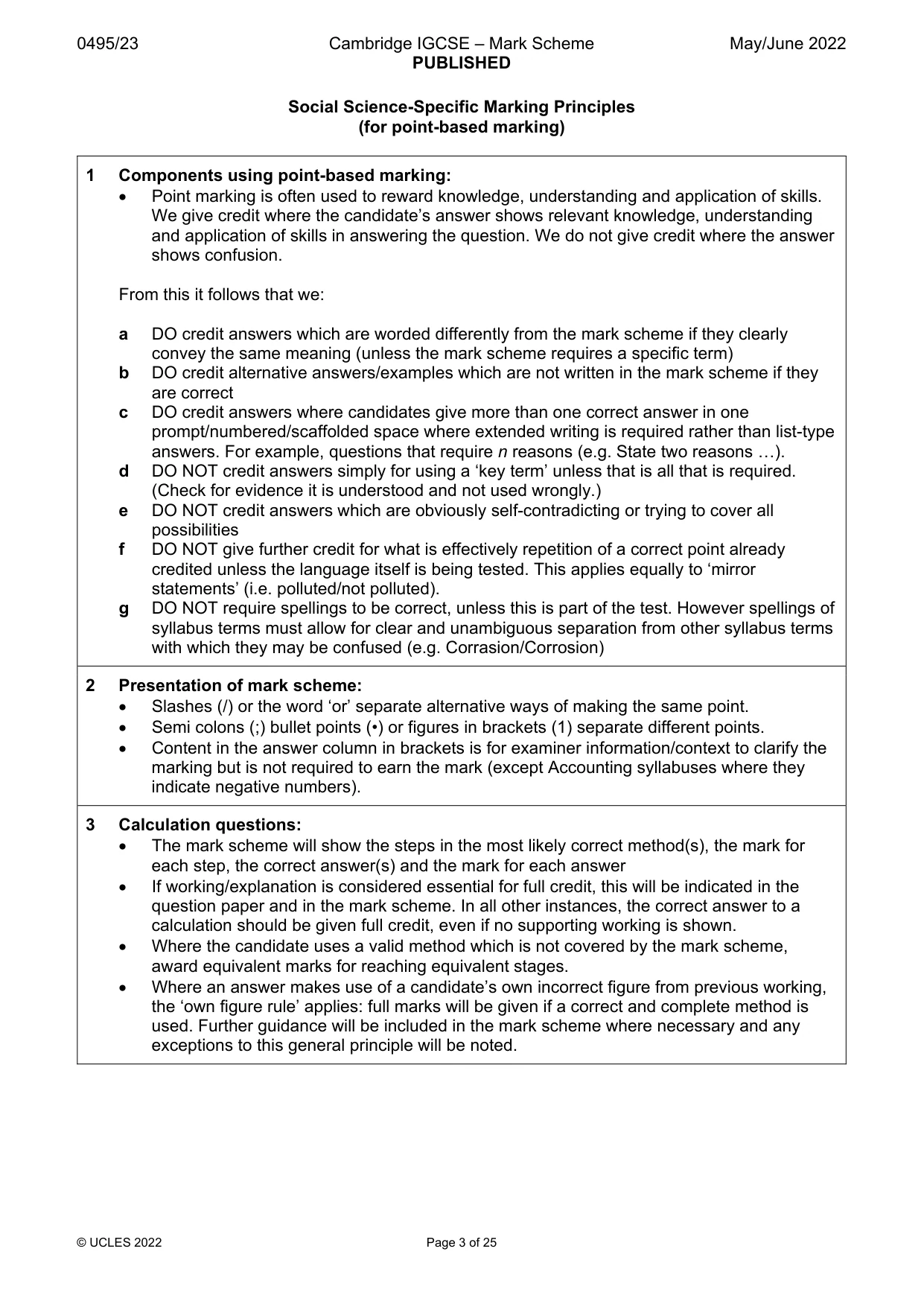
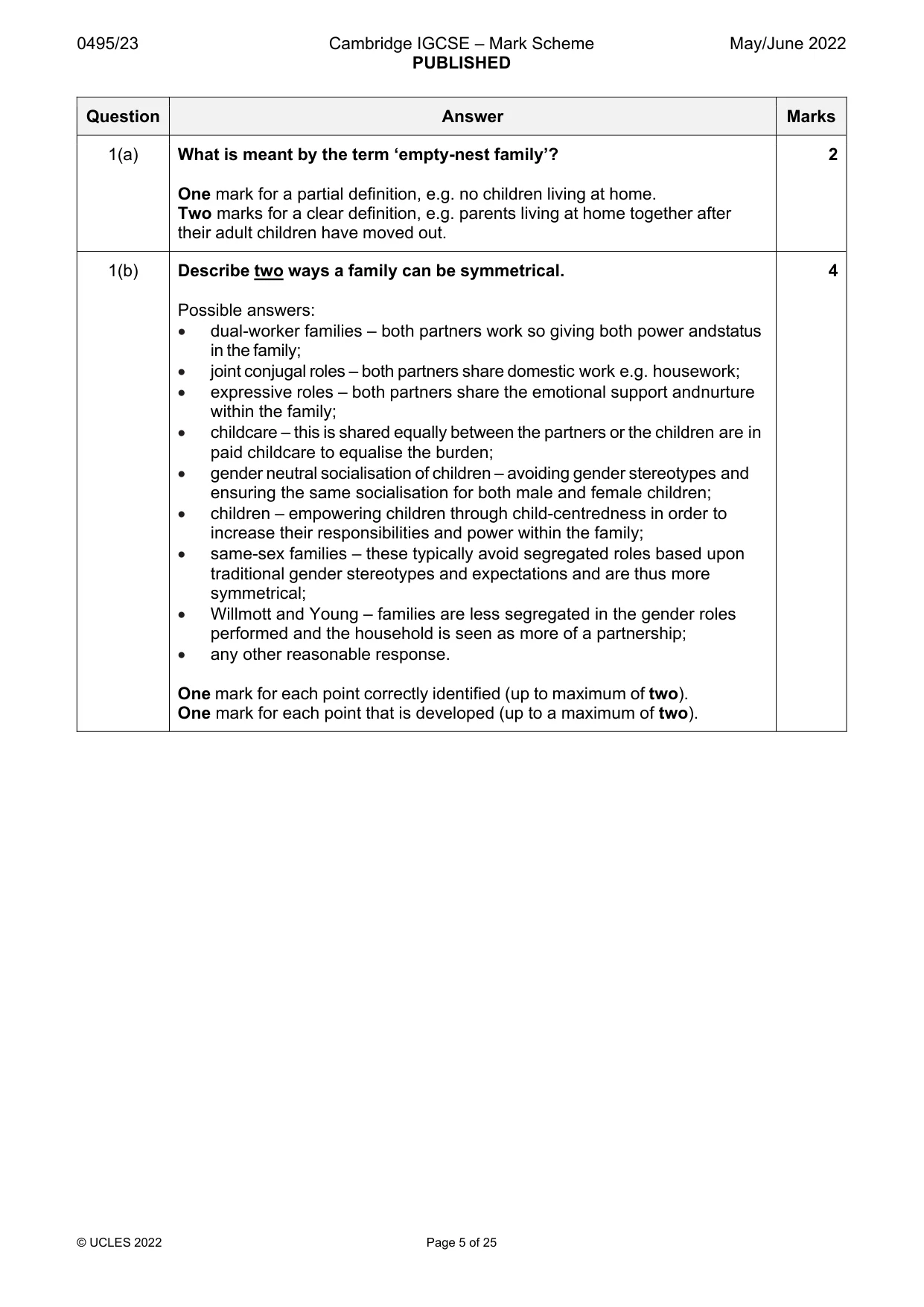
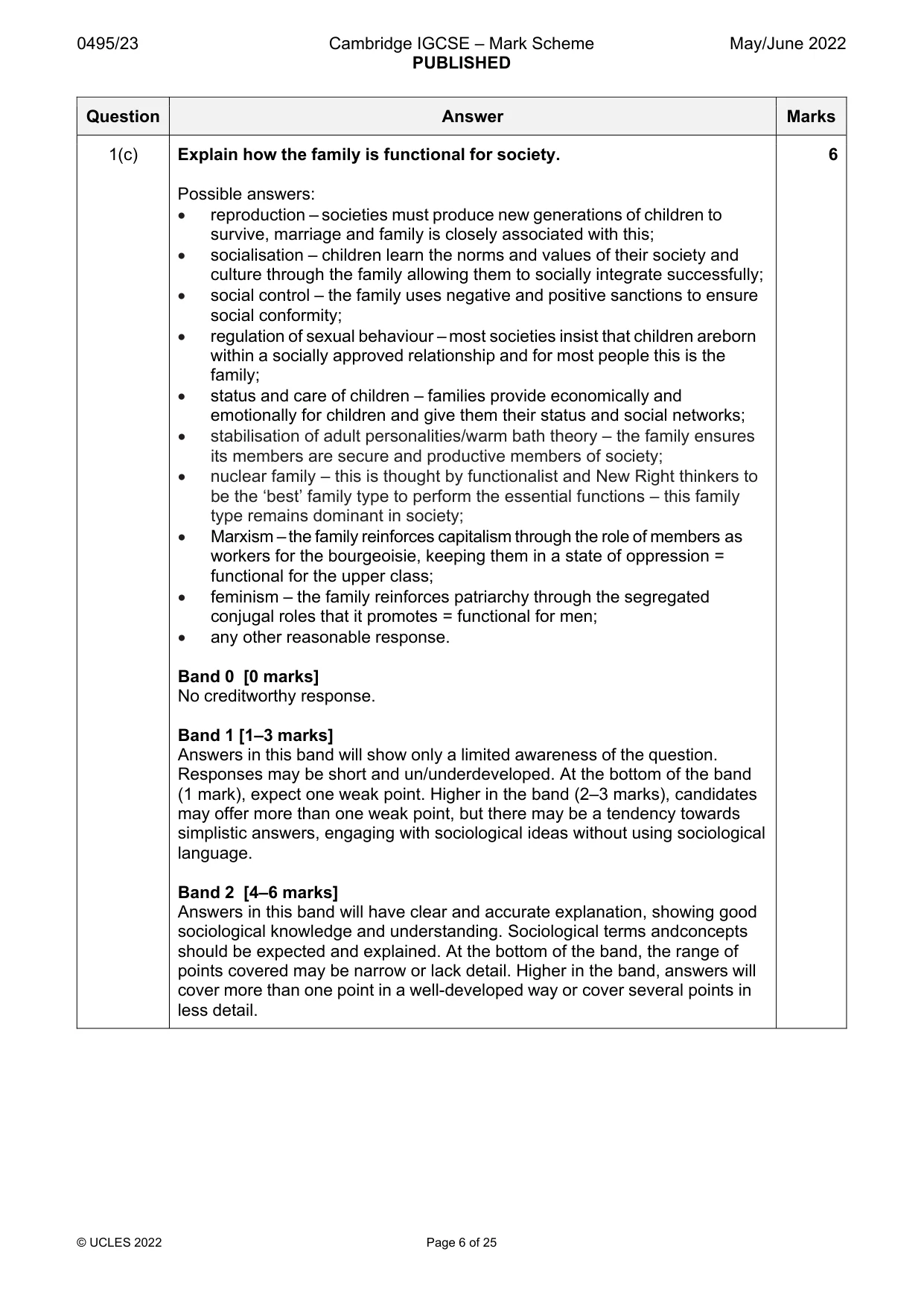
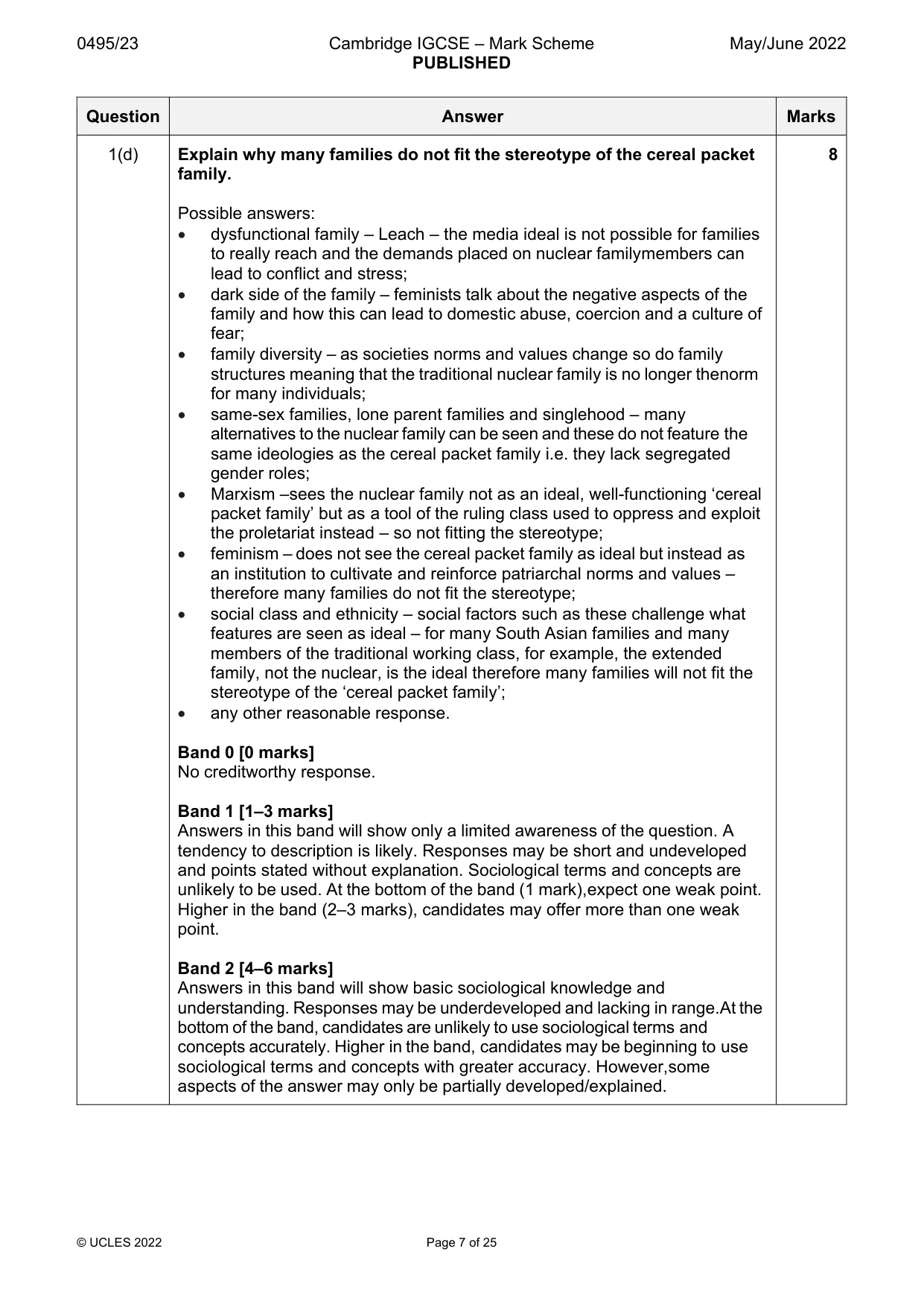
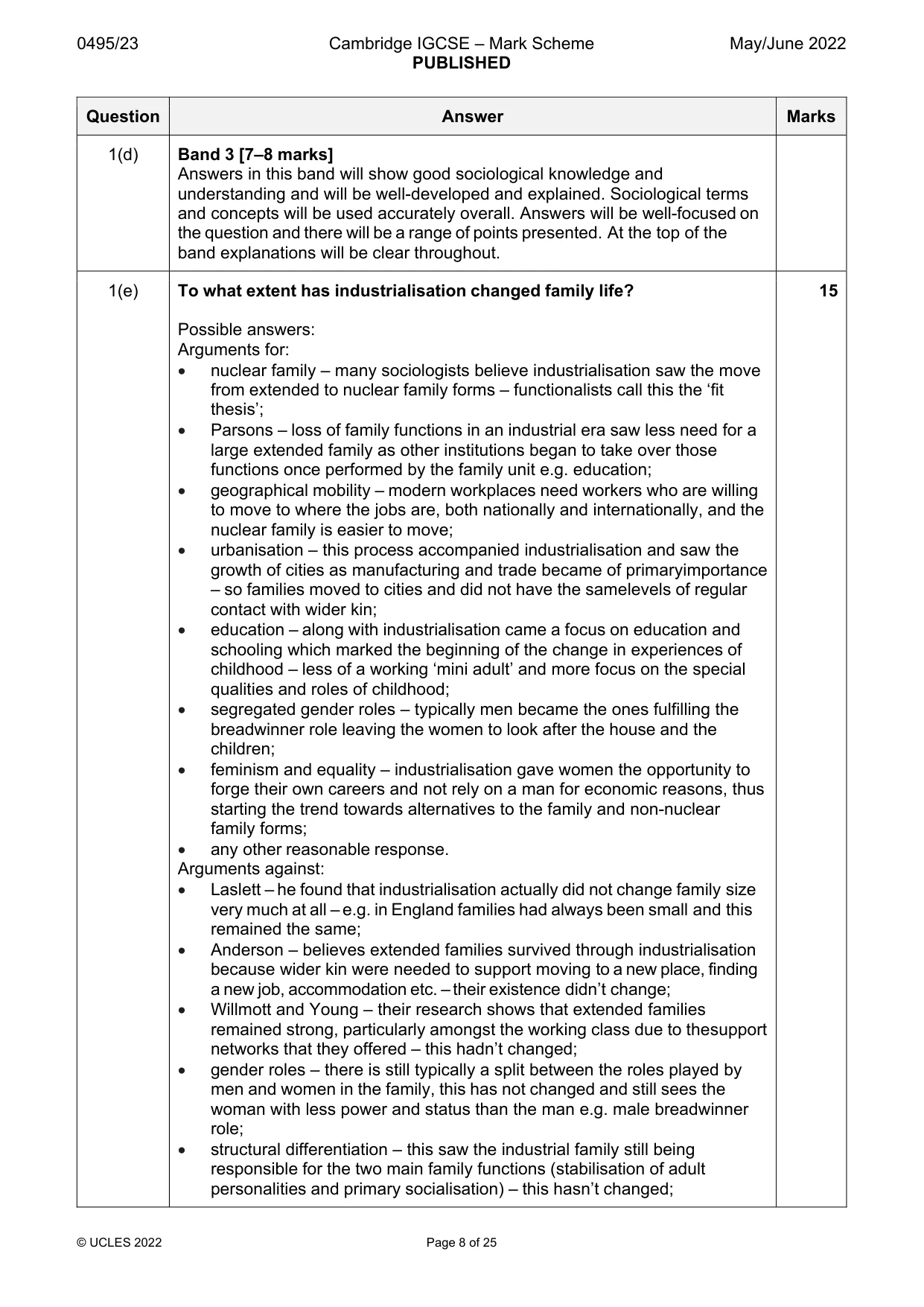
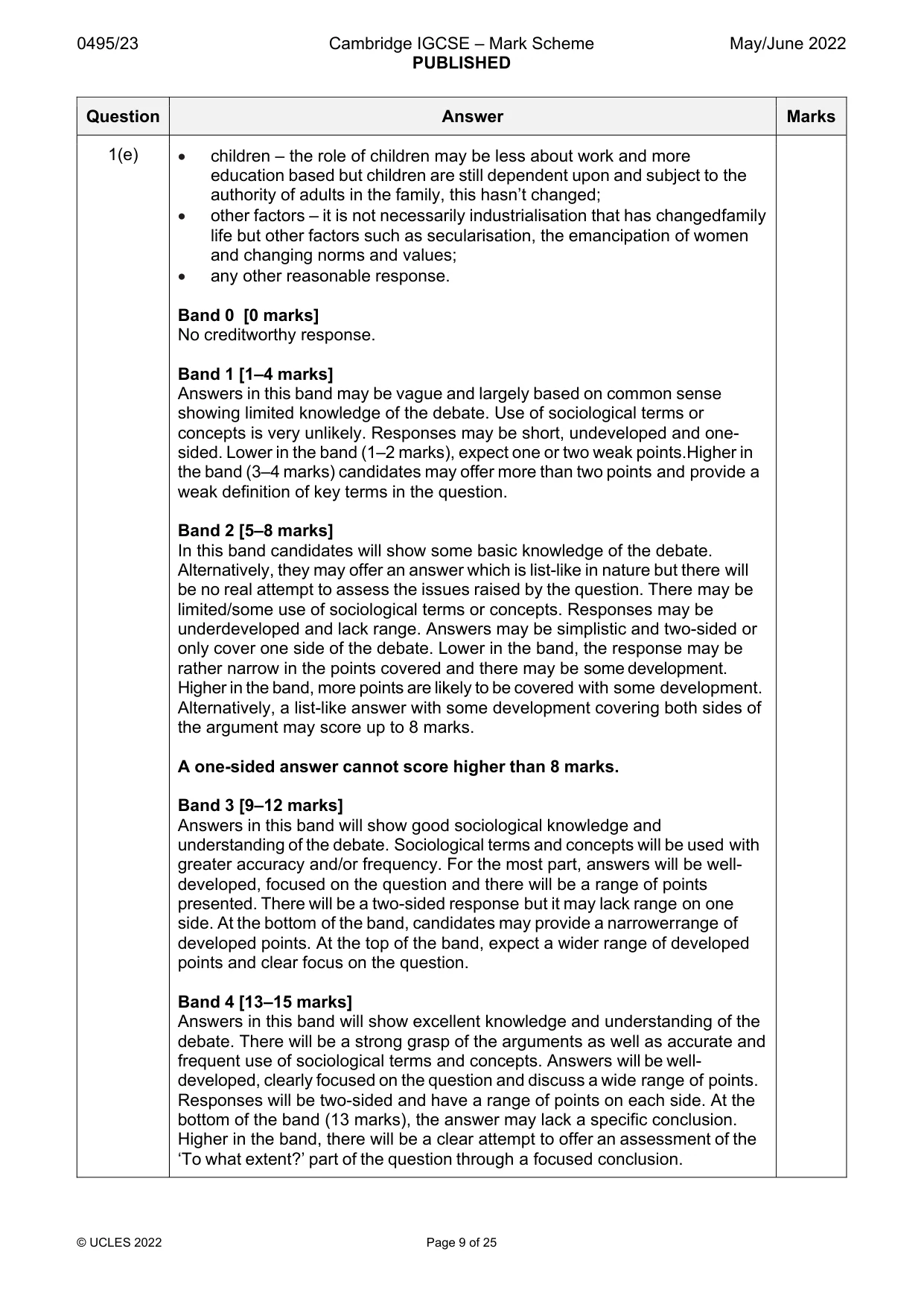
Mark scheme: Question Answer Marks 1(a) What is meant by the term ‘empty-nest family’? 2 One mark for a partial definition, e.g. no children living at home. Two marks for a clear definition, e.g. parents living at home together after their adult children have moved out. 1(b) Describe two ways a family can be symmetrical. 4 Possible answers: dual-worker families – both partners work so giving both power and status in the family; joint conjugal roles – both partners share domestic work e.g. housework; expressive roles – both partners share the emotional support and nurture within the family; childcare – this is shared equally between the partners or the children are in paid childcare to equalise the burden; gender neutral socialisation of children – avoiding gender stereotypes and ensuring the same socialisation for both male and female children; children – empowering children through child-centredness in order to increase their responsibilities and power within the family; same-sex families – these typically avoid segregated roles based upon traditional gender stereotypes and expectations and are thus more symmetrical; Willmott and Young – families are less segregated in the gender roles performed and the household is seen as more of a partnership; any other reasonable response. One mark for each point correctly identified (up to maximum of two). One mark for each point that is developed (up to a maximum of two). 1(c) Explain how the family is functional for society. 6 Possible answers: reproduction – societies must produce new generations of children to survive, marriage and family is closely associated with this; socialisation – children learn the norms and values of their society and culture through the family allowing them to socially integrate successfully; social control – the family uses negative and positive sanctions to ensure social conformity; regulation of sexual behaviour – most societies insist that children are born within a socially approved relationship and for most people this is the family; status and care of children – families provide economically and emotionally for children and give them their status and social networks; stabilisation of adult personalities/warm bath theory – the family ensures its members are secure and productive members of society; nuclear family – this is thought by functionalist and New Right thinkers to be the ‘best’ family type to perform the essential functions – this family type remains dominant in society; Marxism – the family reinforces capitalism through the role of members as workers for the bourgeoisie, keeping them in a state of oppression = functional for the upper class; feminism – the family reinforces patriarchy through the segregated conjugal roles that it promotes = functional for men; any other reasonable response. Band 0 [0 marks] No creditworthy response. Band 1 [1–3 marks] Answers in this band will show only a limited awareness of the question. Responses may be short and un/underdeveloped. At the bottom of the band (1 mark), expect one weak point. Higher in the band (2–3 marks), candidates may offer more than one weak point, but there may be a tendency towards simplistic answers, engaging with sociological ideas without using sociological language. Band 2 [4–6 marks] Answers in this band will have clear and accurate explanation, showing good sociological knowledge and understanding. Sociological terms and concepts should be expected and explained. At the bottom of the band, the range of points covered may be narrow or lack detail. Higher in the band, answers will cover more than one point in a well-developed way or cover several points in less detail. 1(d) Explain why many families do not fit the stereotype of the cereal packet 8 family. Possible answers: dysfunctional family – Leach – the media ideal is not possible for families to really reach and the demands placed on nuclear family members can lead to conflict and stress; dark side of the family – feminists talk about the negative aspects of the family and how this can lead to domestic abuse, coercion and a culture of fear; family diversity – as societies norms and values change so do family structures meaning that the traditional nuclear family is no longer the norm for many individuals; same-sex families, lone parent families and singlehood – many alternatives to the nuclear family can be seen and these do not feature the same ideologies as the cereal packet family i.e. they lack segregated gender roles; Marxism –sees the nuclear family not as an ideal, well-functioning ‘cereal packet family’ but as a tool of the ruling class used to oppress and exploit the proletariat instead – so not fitting the stereotype; feminism – does not see the cereal packet family as ideal but instead as an institution to cultivate and reinforce patriarchal norms and values – therefore many families do not fit the stereotype; social class and ethnicity – social factors such as these challenge what features are seen as ideal – for many South Asian families and many members of the traditional working class, for example, the extended family, not the nuclear, is the ideal therefore many families will not fit the stereotype of the ‘cereal packet family’; any other reasonable response. Band 0 [0 marks] No creditworthy response. Band 1 [1–3 marks] Answers in this band will show only a limited awareness of the question. A tendency to description is likely. Responses may be short and undeveloped and points stated without explanation. Sociological terms and concepts are unlikely to be used. At the bottom of the band (1 mark), expect one weak point. Higher in the band (2–3 marks), candidates may offer more than one weak point. Band 2 [4–6 marks] Answers in this band will show basic sociological knowledge and understanding. Responses may be underdeveloped and lacking in range. At the bottom of the band, candidates are unlikely to use sociological terms and concepts accurately. Higher in the band, candidates may be beginning to use sociological terms and concepts with greater accuracy. However, some aspects of the answer may only be partially developed/explained. 1(d) Band 3 [7–8 marks] Answers in this band will show good sociological knowledge and understanding and will be well-developed and explained. Sociological terms and concepts will be used accurately overall. Answers will be well-focused on the question and there will be a range of points presented. At the top of the band explanations will be clear throughout. 1(e) To what extent has industrialisation changed family life? 15 Possible answers: Arguments for: nuclear family – many sociologists believe industrialisation saw the move from extended to nuclear family forms – functionalists call this the ‘fit thesis’; Parsons – loss of family functions in an industrial era saw less need for a large extended family as other institutions began to take over those functions once performed by the family unit e.g. education; geographical mobility – modern workplaces need workers who are willing to move to where the jobs are, both nationally and internationally, and the nuclear family is easier to move; urbanisation – this process accompanied industrialisation and saw the growth of cities as manufacturing and trade became of primary importance – so families moved to cities and did not have the same levels of regular contact with wider kin; education – along with industrialisation came a focus on education and schooling which marked the beginning of the change in experiences of childhood – less of a working ‘mini adult’ and more focus on the special qualities and roles of childhood; segregated gender roles – typically men became the ones fulfilling the breadwinner role leaving the women to look after the house and the children; feminism and equality – industrialisation gave women the opportunity to forge their own careers and not rely on a man for economic reasons, thus starting the trend towards alternatives to the family and non-nuclear family forms; any other reasonable response. Arguments against: Laslett – he found that industrialisation actually did not change family size very much at all – e.g. in England families had always been small and this remained the same; Anderson – believes extended families survived through industrialisation because wider kin were needed to support moving to a new place, finding a new job, accommodation etc. – their existence didn’t change; Willmott and Young – their research shows that extended families remained strong, particularly amongst the working class due to the support networks that they offered – this hadn’t changed; gender roles – there is still typically a split between the roles played by men and women in the family, this has not changed and still sees the woman with less power and status than the man e.g. male breadwinner role; structural differentiation – this saw the industrial family still being responsible for the two main family functions (stabilisation of adult personalities and primary socialisation) – this hasn’t changed; 1(e) children – the role of children may be less about work and more education based but children are still dependent upon and subject to the authority of adults in the family, this hasn’t changed; other factors – it is not necessarily industrialisation that has changed family life but other factors such as secularisation, the emancipation of women and changing norms and values; any other reasonable response. Band 0 [0 marks] No creditworthy response. Band 1 [1–4 marks] Answers in this band may be vague and largely based on common sense showing limited knowledge of the debate. Use of sociological terms or concepts is very unlikely. Responses may be short, undeveloped and one- sided. Lower in the band (1–2 marks), expect one or two weak points. Higher in the band (3–4 marks) candidates may offer more than two points and provide a weak definition of key terms in the question. Band 2 [5–8 marks] In this band candidates will show some basic knowledge of the debate. Alternatively, they may offer an answer which is list-like in nature but there will be no real attempt to assess the issues raised by the question. There may be limited/some use of sociological terms or concepts. Responses may be underdeveloped and lack range. Answers may be simplistic and two-sided or only cover one side of the debate. Lower in the band, the response may be rather narrow in the points covered and there may be some development. Higher in the band, more points are likely to be covered with some development. Alternatively, a list-like answer with some development covering both sides of the argument may score up to 8 marks. A one-sided answer cannot score higher than 8 marks. Band 3 [9–12 marks] Answers in this band will show good sociological knowledge and understanding of the debate. Sociological terms and concepts will be used with greater accuracy and/or frequency. For the most part, answers will be well- developed, focused on the question and there will be a range of points presented. There will be a two-sided response but it may lack range on one side. At the bottom of the band, candidates may provide a narrower range of developed points. At the top of the band, expect a wider range of developed points and clear focus on the question. Band 4 [13–15 marks] Answers in this band will show excellent knowledge and understanding of the debate. There will be a strong grasp of the arguments as well as accurate and frequent use of sociological terms and concepts. Answers will be well- developed, clearly focused on the question and discuss a wide range of points. Responses will be two-sided and have a range of points on each side. At the bottom of the band (13 marks), the answer may lack a specific conclusion. Higher in the band, there will be a clear attempt to offer an assessment of the ‘To what extent?’ part of the question through a focused conclusion.
Q2 · Education has been described by some sociologists as a meritocratic system which does not…
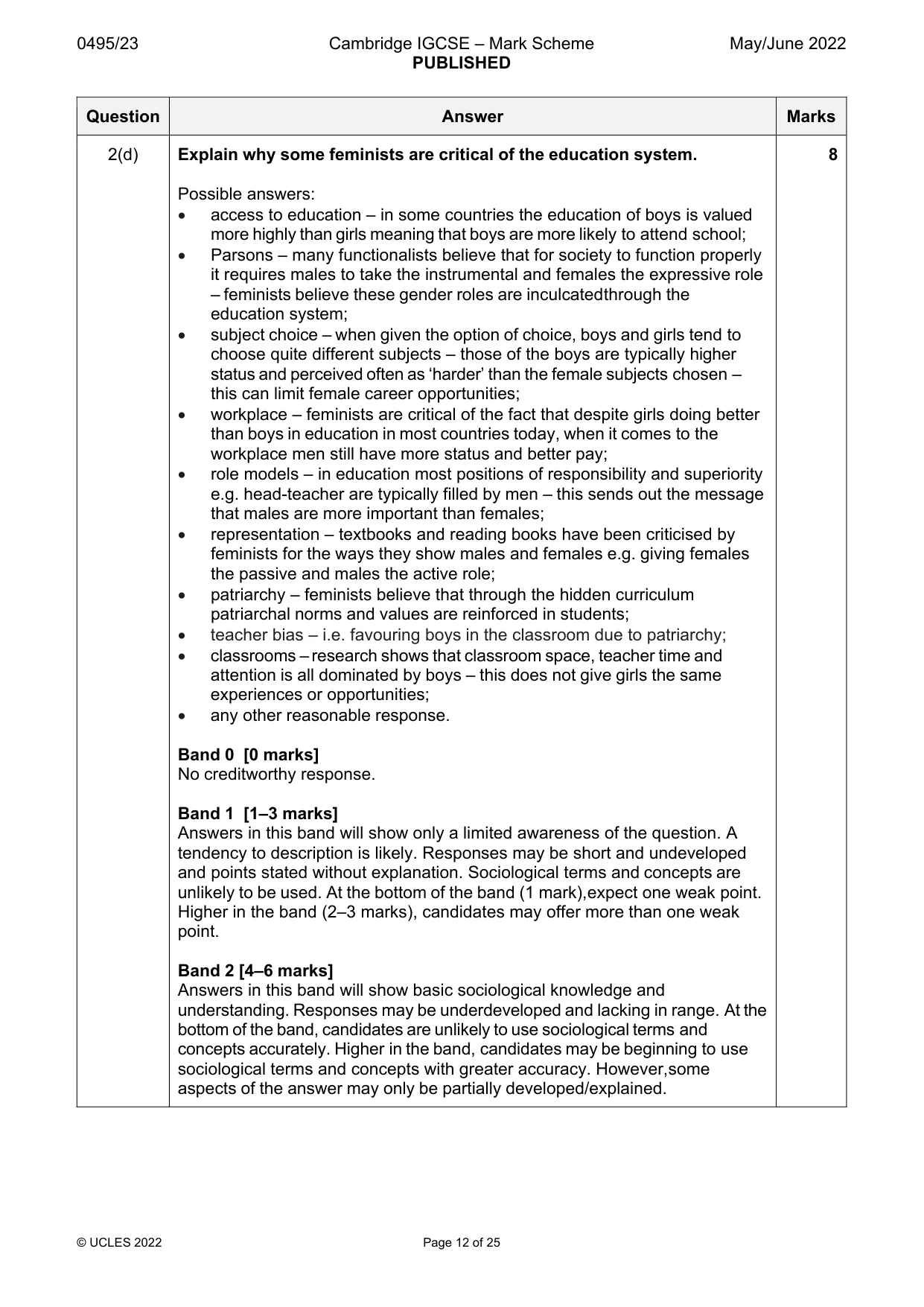
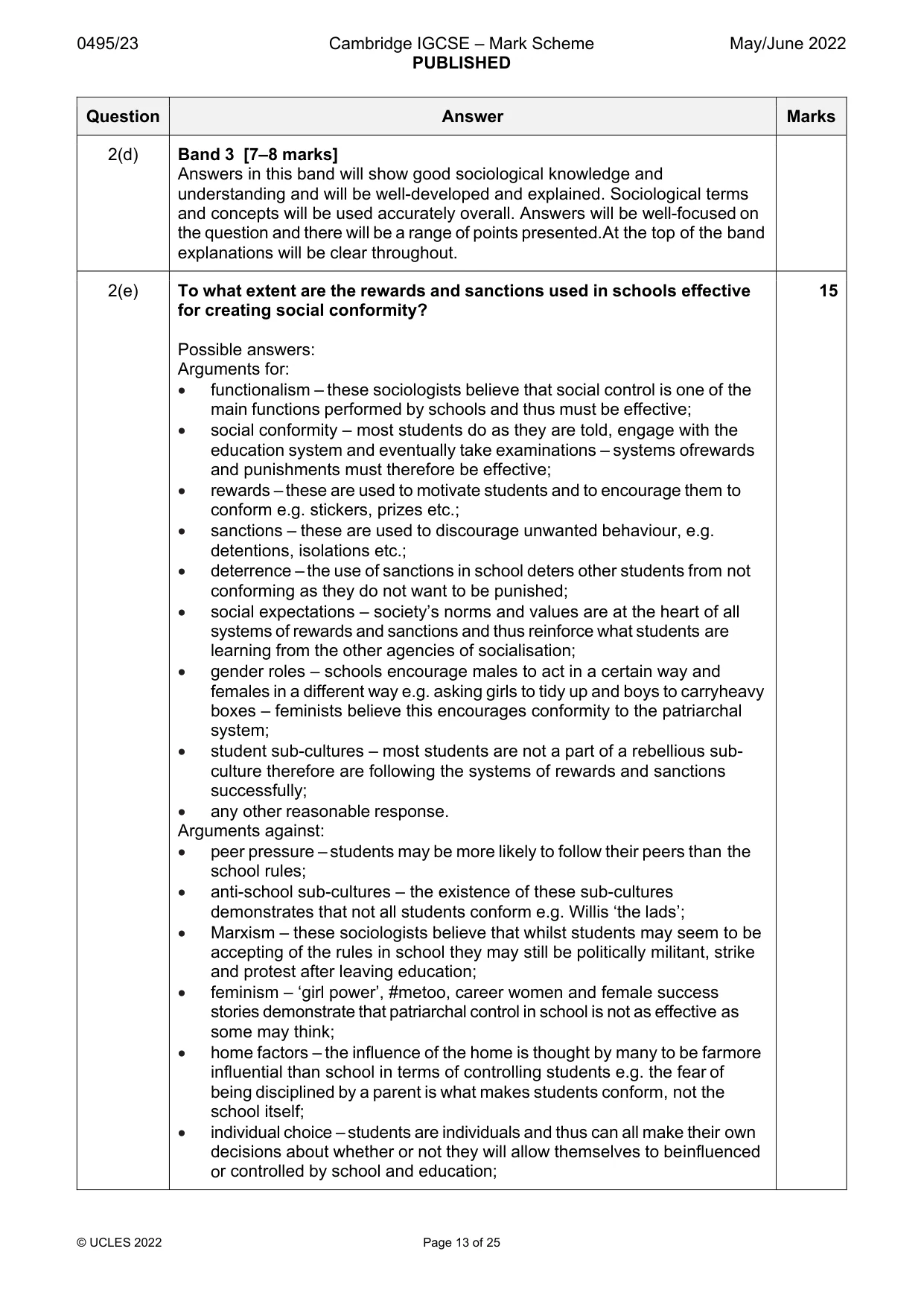
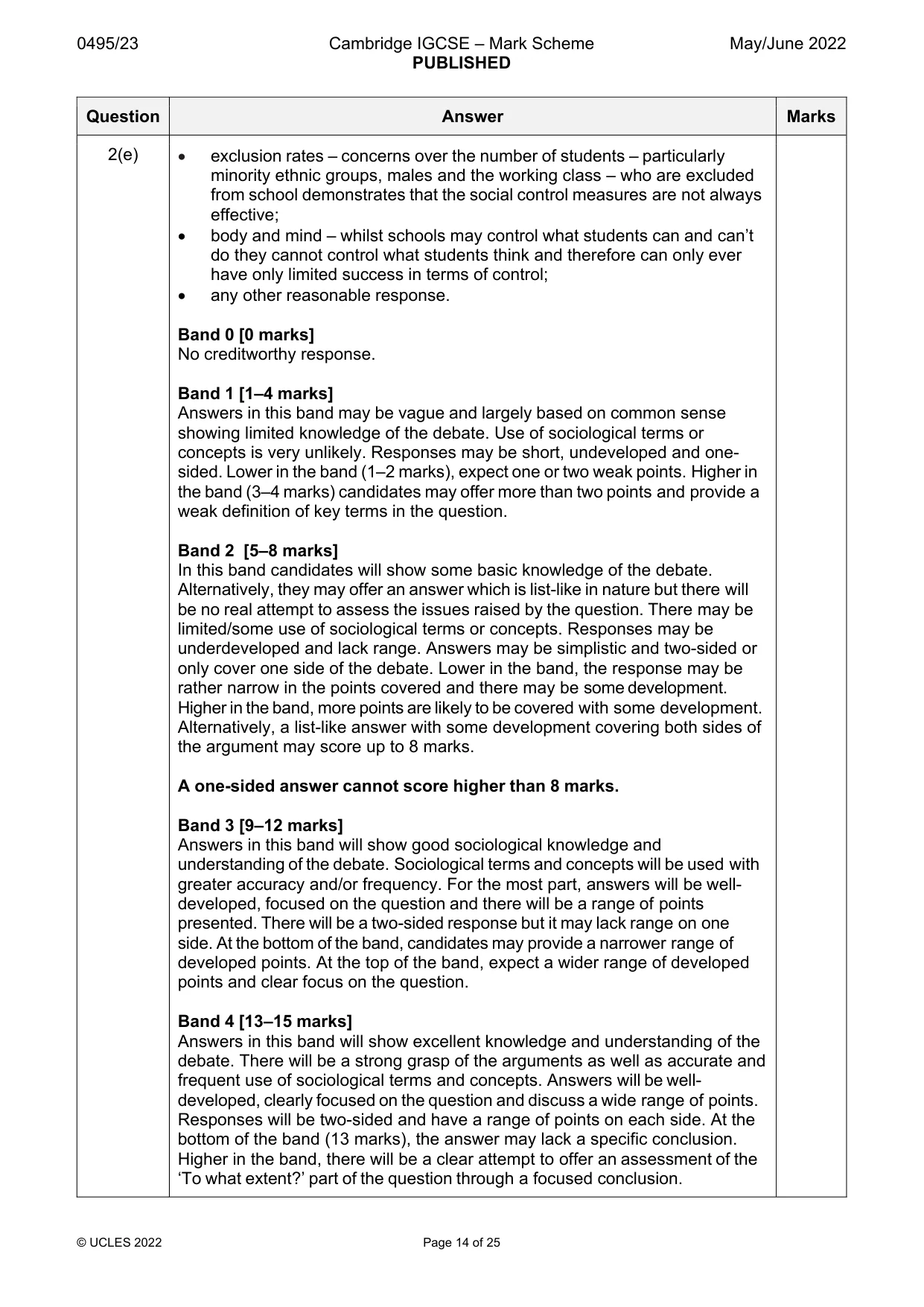
2 Education has been described by some sociologists as a meritocratic system which does not allow discrimination. Feminists disagree and are critical of both formal and informal education. All educational institutions try to control students and ensure social conformity through rewards and sanctions. (a) What is meant by the term ‘discrimination’? [2] (b) Describe two examples of informal education. [4] (c) Explain how education is a meritocratic system. [6] (d) Explain why some feminists are critical of the education system. [8] (e) To what extent are the rewards and sanctions used in schools effective for creating social conformity? [15] Section C: Crime, deviance and social control
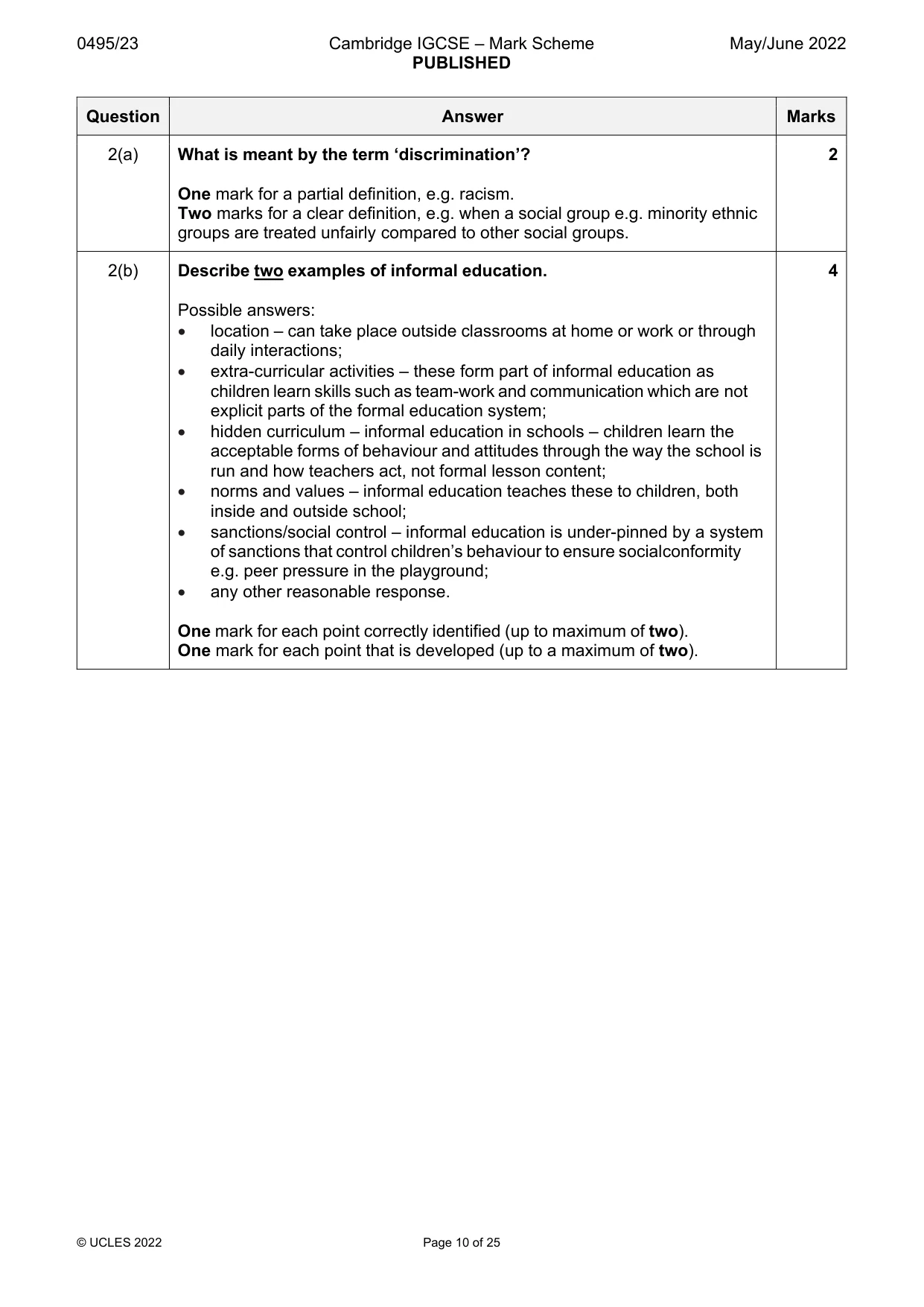
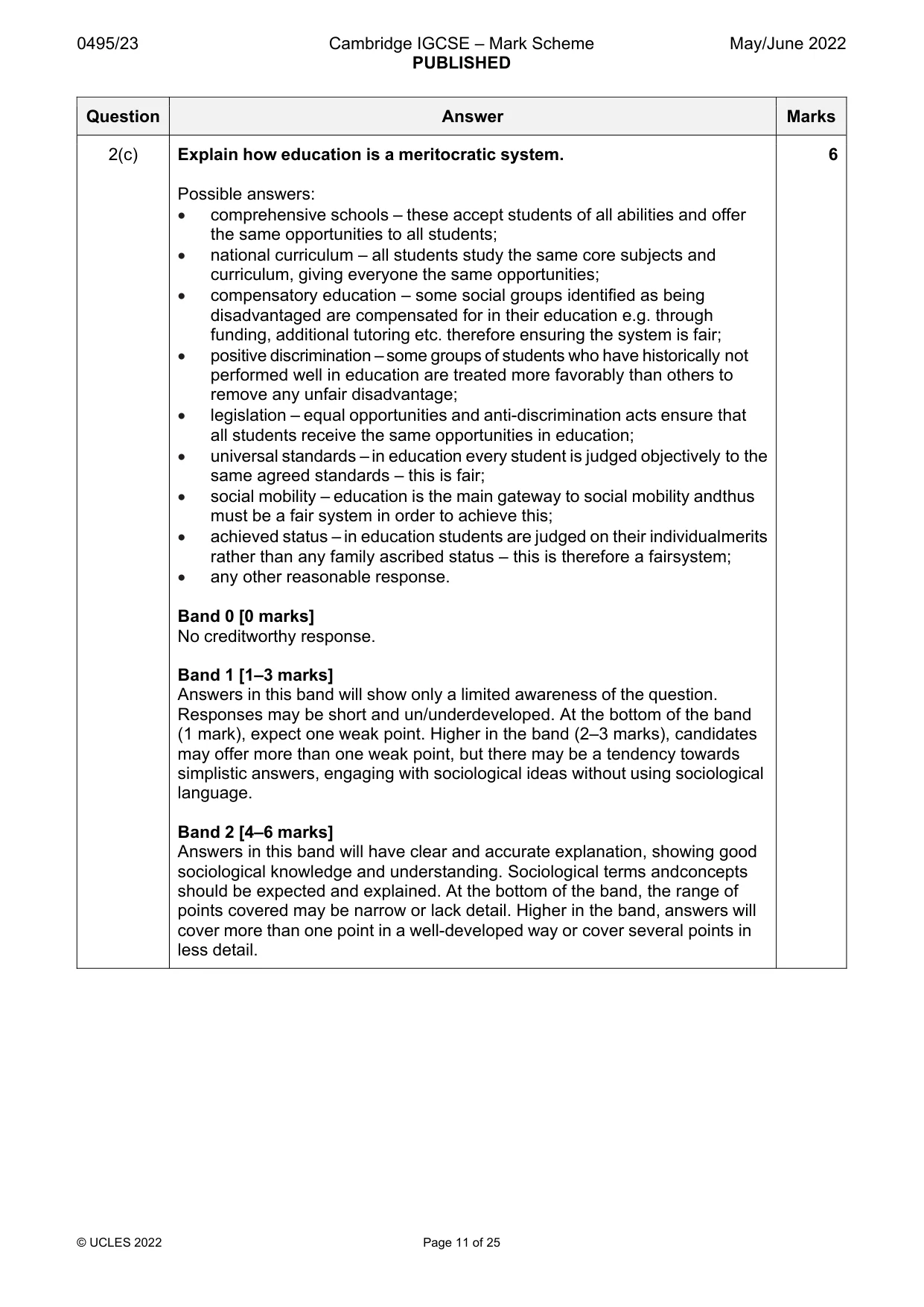
Mark scheme: 2(a) What is meant by the term ‘discrimination’? 2 One mark for a partial definition, e.g. racism. Two marks for a clear definition, e.g. when a social group e.g. minority ethnic groups are treated unfairly compared to other social groups. 2(b) Describe two examples of informal education. 4 Possible answers: location – can take place outside classrooms at home or work or through daily interactions; extra-curricular activities – these form part of informal education as children learn skills such as team-work and communication which are not explicit parts of the formal education system; hidden curriculum – informal education in schools – children learn the acceptable forms of behaviour and attitudes through the way the school is run and how teachers act, not formal lesson content; norms and values – informal education teaches these to children, both inside and outside school; sanctions/social control – informal education is under-pinned by a system of sanctions that control children’s behaviour to ensure social conformity e.g. peer pressure in the playground; any other reasonable response. One mark for each point correctly identified (up to maximum of two). One mark for each point that is developed (up to a maximum of two). 2(c) Explain how education is a meritocratic system. 6 Possible answers: comprehensive schools – these accept students of all abilities and offer the same opportunities to all students; national curriculum – all students study the same core subjects and curriculum, giving everyone the same opportunities; compensatory education – some social groups identified as being disadvantaged are compensated for in their education e.g. through funding, additional tutoring etc. therefore ensuring the system is fair; positive discrimination – some groups of students who have historically not performed well in education are treated more favorably than others to remove any unfair disadvantage; legislation – equal opportunities and anti-discrimination acts ensure that all students receive the same opportunities in education; universal standards – in education every student is judged objectively to the same agreed standards – this is fair; social mobility – education is the main gateway to social mobility and thus must be a fair system in order to achieve this; achieved status – in education students are judged on their individual merits rather than any family ascribed status – this is therefore a fair system; any other reasonable response. Band 0 [0 marks] No creditworthy response. Band 1 [1–3 marks] Answers in this band will show only a limited awareness of the question. Responses may be short and un/underdeveloped. At the bottom of the band (1 mark), expect one weak point. Higher in the band (2–3 marks), candidates may offer more than one weak point, but there may be a tendency towards simplistic answers, engaging with sociological ideas without using sociological language. Band 2 [4–6 marks] Answers in this band will have clear and accurate explanation, showing good sociological knowledge and understanding. Sociological terms and concepts should be expected and explained. At the bottom of the band, the range of points covered may be narrow or lack detail. Higher in the band, answers will cover more than one point in a well-developed way or cover several points in less detail. 2(d) Explain why some feminists are critical of the education system. 8 Possible answers: access to education – in some countries the education of boys is valued more highly than girls meaning that boys are more likely to attend school; Parsons – many functionalists believe that for society to function properly it requires males to take the instrumental and females the expressive role – feminists believe these gender roles are inculcated through the education system; subject choice – when given the option of choice, boys and girls tend to choose quite different subjects – those of the boys are typically higher status and perceived often as ‘harder’ than the female subjects chosen – this can limit female career opportunities; workplace – feminists are critical of the fact that despite girls doing better than boys in education in most countries today, when it comes to the workplace men still have more status and better pay; role models – in education most positions of responsibility and superiority e.g. head-teacher are typically filled by men – this sends out the message that males are more important than females; representation – textbooks and reading books have been criticised by feminists for the ways they show males and females e.g. giving females the passive and males the active role; patriarchy – feminists believe that through the hidden curriculum patriarchal norms and values are reinforced in students; teacher bias – i.e. favouring boys in the classroom due to patriarchy; classrooms – research shows that classroom space, teacher time and attention is all dominated by boys – this does not give girls the same experiences or opportunities; any other reasonable response. Band 0 [0 marks] No creditworthy response. Band 1 [1–3 marks] Answers in this band will show only a limited awareness of the question. A tendency to description is likely. Responses may be short and undeveloped and points stated without explanation. Sociological terms and concepts are unlikely to be used. At the bottom of the band (1 mark), expect one weak point. Higher in the band (2–3 marks), candidates may offer more than one weak point. Band 2 [4–6 marks] Answers in this band will show basic sociological knowledge and understanding. Responses may be underdeveloped and lacking in range. At the bottom of the band, candidates are unlikely to use sociological terms and concepts accurately. Higher in the band, candidates may be beginning to use sociological terms and concepts with greater accuracy. However, some aspects of the answer may only be partially developed/explained. 2(d) Band 3 [7–8 marks] Answers in this band will show good sociological knowledge and understanding and will be well-developed and explained. Sociological terms and concepts will be used accurately overall. Answers will be well-focused on the question and there will be a range of points presented. At the top of the band explanations will be clear throughout. 2(e) To what extent are the rewards and sanctions used in schools effective 15 for creating social conformity? Possible answers: Arguments for: functionalism – these sociologists believe that social control is one of the main functions performed by schools and thus must be effective; social conformity – most students do as they are told, engage with the education system and eventually take examinations – systems of rewards and punishments must therefore be effective; rewards – these are used to motivate students and to encourage them to conform e.g. stickers, prizes etc.; sanctions – these are used to discourage unwanted behaviour, e.g. detentions, isolations etc.; deterrence – the use of sanctions in school deters other students from not conforming as they do not want to be punished; social expectations – society’s norms and values are at the heart of all systems of rewards and sanctions and thus reinforce what students are learning from the other agencies of socialisation; gender roles – schools encourage males to act in a certain way and females in a different way e.g. asking girls to tidy up and boys to carry heavy boxes – feminists believe this encourages conformity to the patriarchal system; student sub-cultures – most students are not a part of a rebellious sub- culture therefore are following the systems of rewards and sanctions successfully; any other reasonable response. Arguments against: peer pressure – students may be more likely to follow their peers than the school rules; anti-school sub-cultures – the existence of these sub-cultures demonstrates that not all students conform e.g. Willis ‘the lads’; Marxism – these sociologists believe that whilst students may seem to be accepting of the rules in school they may still be politically militant, strike and protest after leaving education; feminism – ‘girl power’, #metoo, career women and female success stories demonstrate that patriarchal control in school is not as effective as some may think; home factors – the influence of the home is thought by many to be far more influential than school in terms of controlling students e.g. the fear of being disciplined by a parent is what makes students conform, not the school itself; individual choice – students are individuals and thus can all make their own decisions about whether or not they will allow themselves to be influenced or controlled by school and education; 2(e) exclusion rates – concerns over the number of students – particularly minority ethnic groups, males and the working class – who are excluded from school demonstrates that the social control measures are not always effective; body and mind – whilst schools may control what students can and can’t do they cannot control what students think and therefore can only ever have only limited success in terms of control; any other reasonable response. Band 0 [0 marks] No creditworthy response. Band 1 [1–4 marks] Answers in this band may be vague and largely based on common sense showing limited knowledge of the debate. Use of sociological terms or concepts is very unlikely. Responses may be short, undeveloped and one- sided. Lower in the band (1–2 marks), expect one or two weak points. Higher in the band (3–4 marks) candidates may offer more than two points and provide a weak definition of key terms in the question. Band 2 [5–8 marks] In this band candidates will show some basic knowledge of the debate. Alternatively, they may offer an answer which is list-like in nature but there will be no real attempt to assess the issues raised by the question. There may be limited/some use of sociological terms or concepts. Responses may be underdeveloped and lack range. Answers may be simplistic and two-sided or only cover one side of the debate. Lower in the band, the response may be rather narrow in the points covered and there may be some development. Higher in the band, more points are likely to be covered with some development. Alternatively, a list-like answer with some development covering both sides of the argument may score up to 8 marks. A one-sided answer cannot score higher than 8 marks. Band 3 [9–12 marks] Answers in this band will show good sociological knowledge and understanding of the debate. Sociological terms and concepts will be used with greater accuracy and/or frequency. For the most part, answers will be well- developed, focused on the question and there will be a range of points presented. There will be a two-sided response but it may lack range on one side. At the bottom of the band, candidates may provide a narrower range of developed points. At the top of the band, expect a wider range of developed points and clear focus on the question. Band 4 [13–15 marks] Answers in this band will show excellent knowledge and understanding of the debate. There will be a strong grasp of the arguments as well as accurate and frequent use of sociological terms and concepts. Answers will be well- developed, clearly focused on the question and discuss a wide range of points. Responses will be two-sided and have a range of points on each side. At the bottom of the band (13 marks), the answer may lack a specific conclusion. Higher in the band, there will be a clear attempt to offer an assessment of the ‘To what extent?’ part of the question through a focused conclusion.
Q3 · There are many ways to prevent crime, for example effective socialisation and informal…
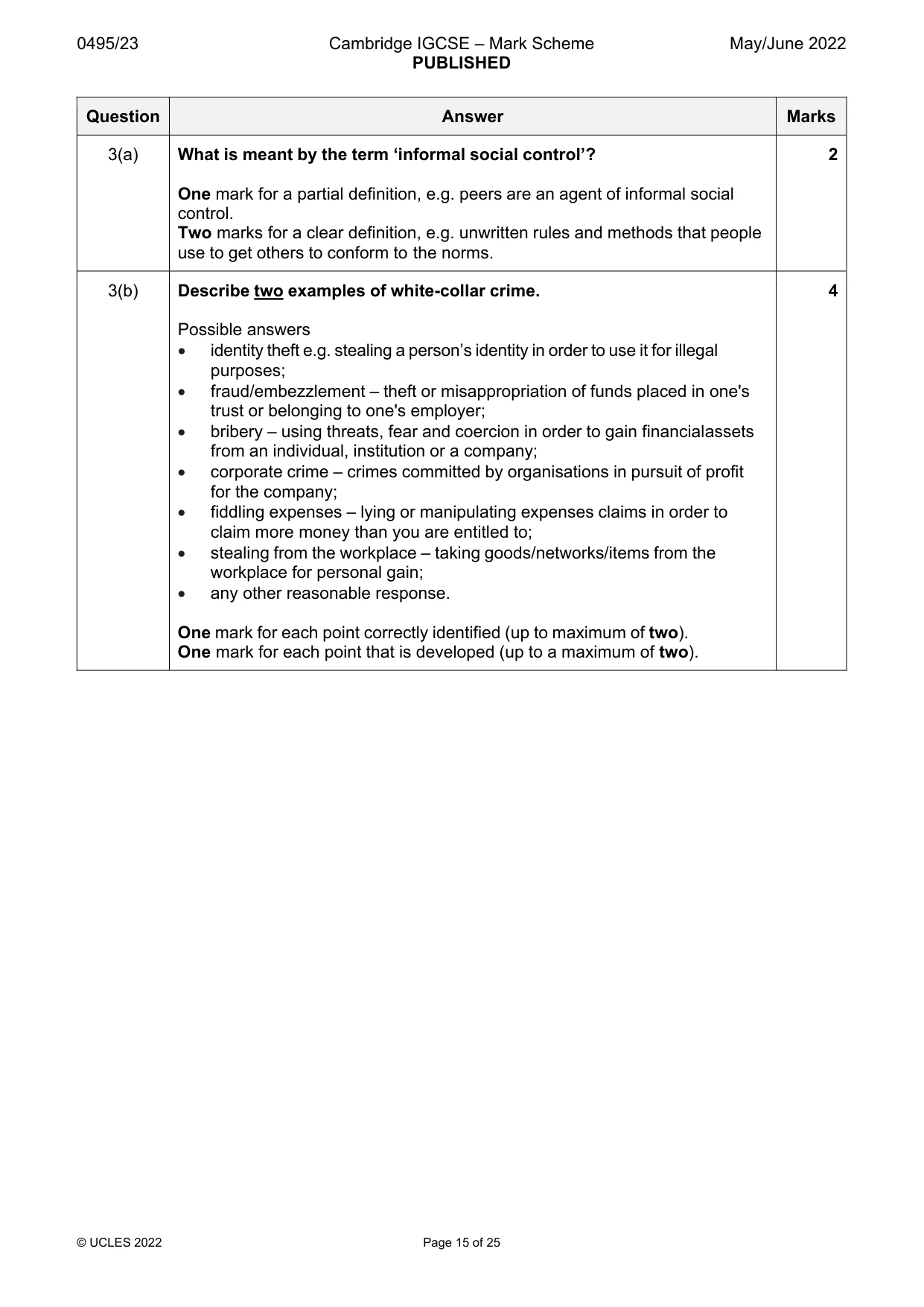
3 There are many ways to prevent crime, for example effective socialisation and informal social control. Official crime statistics show that some members of sub-cultures commit acts of crime and deviance. However, some sociologists argue that official crime statistics may not be accurate. Official crime statistics rely on members of the public reporting crime and issues with police behaviour. (a) What is meant by the term ‘informal social control’? [2] (b) Describe two examples of white-collar crime. [4] (c) Explain how police behaviour can affect the official crime statistics. [6] (d) Explain why sub-cultures can be linked to crime and deviance. [8] (e) To what extent can effective socialisation prevent crime? [15] Section D: Media
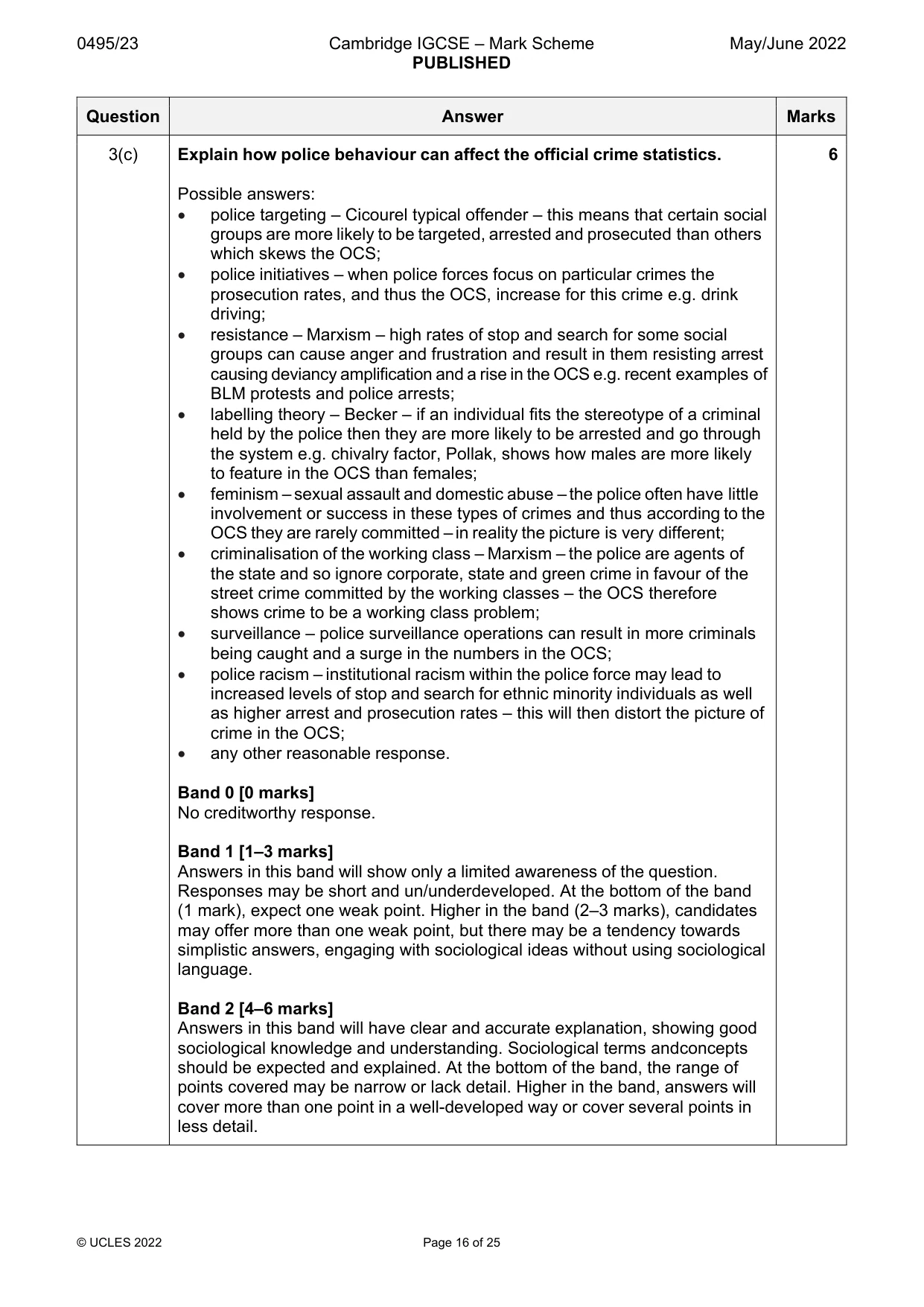
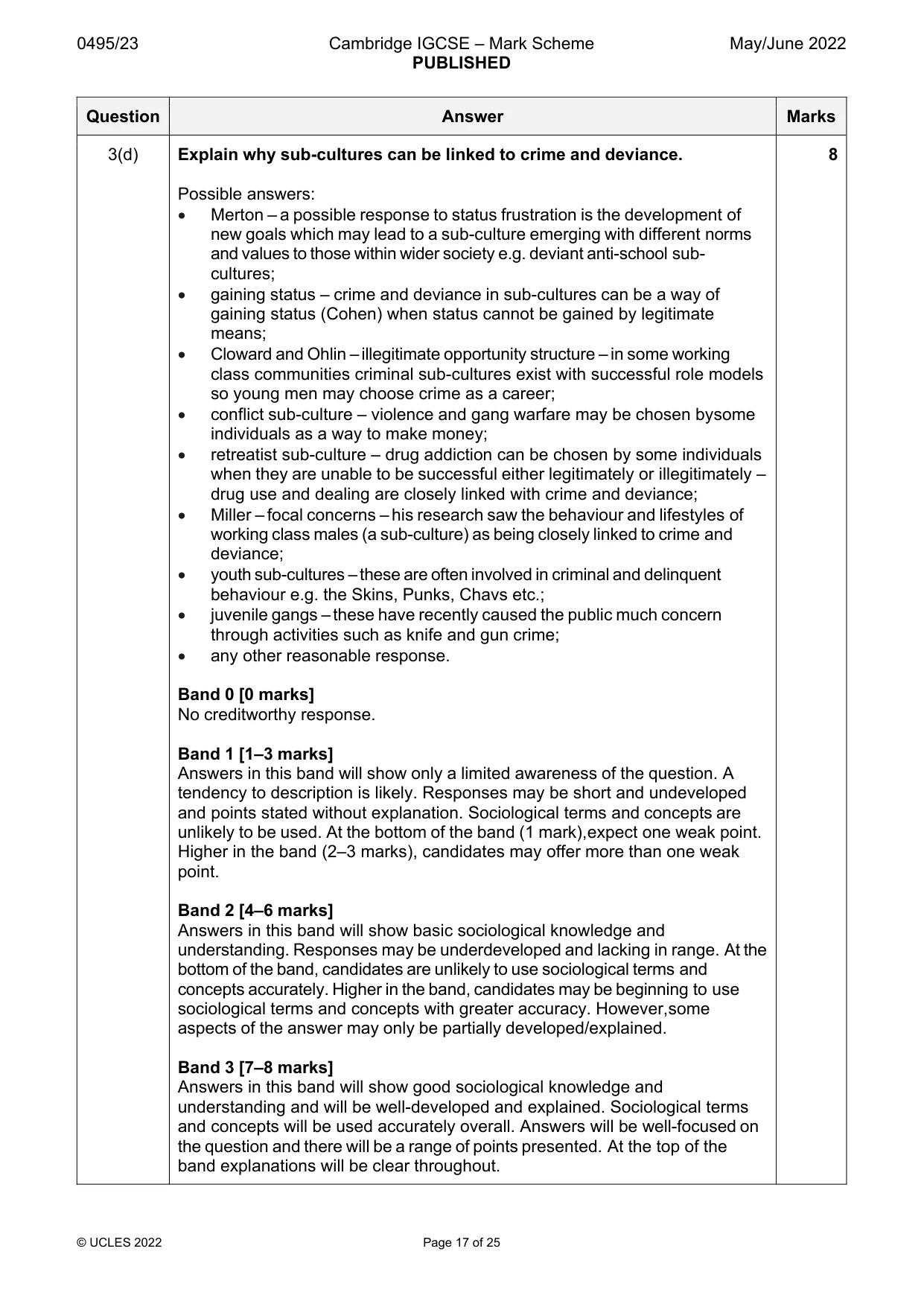
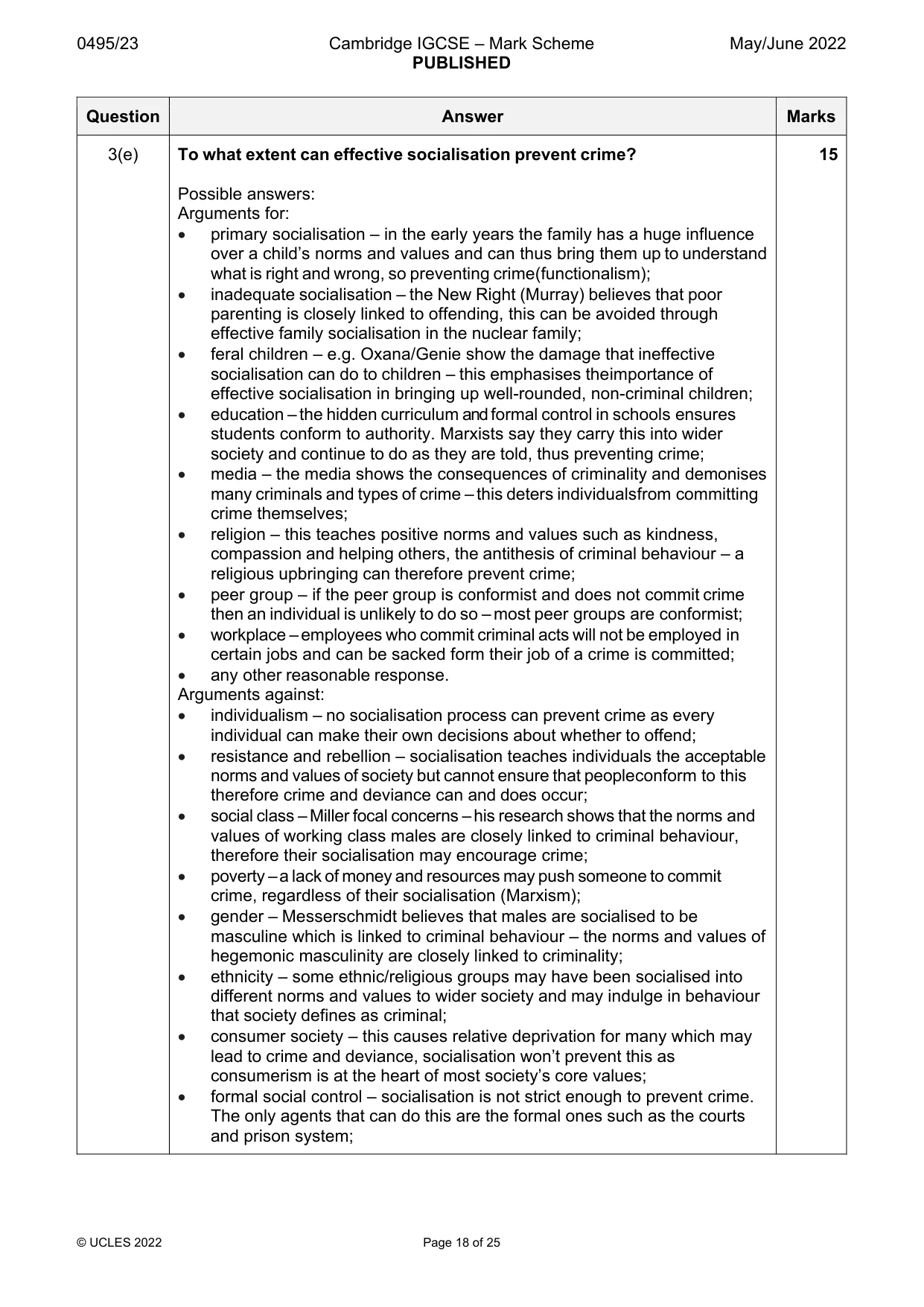
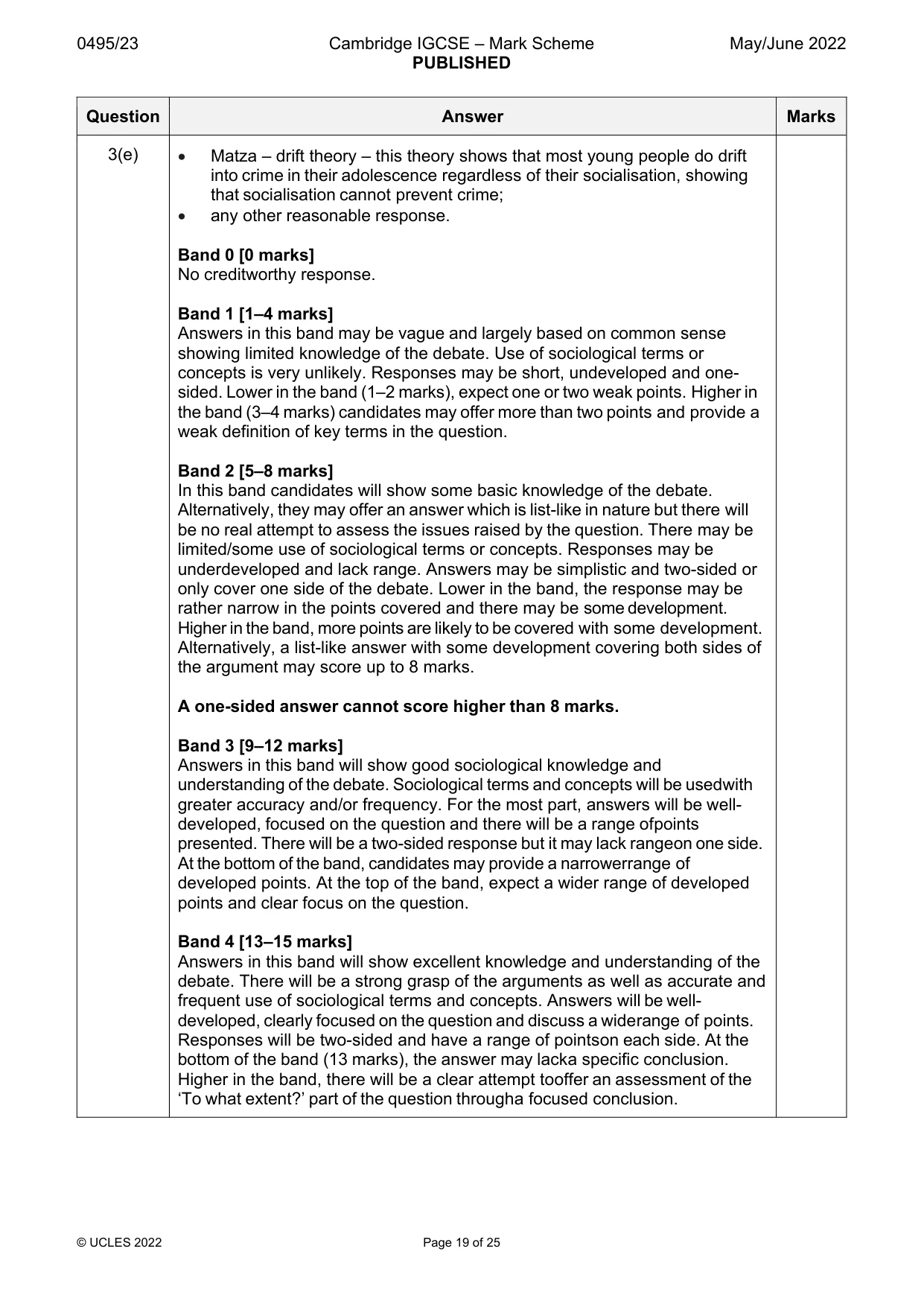
Mark scheme: 3(a) What is meant by the term ‘informal social control’? 2 One mark for a partial definition, e.g. peers are an agent of informal social control. Two marks for a clear definition, e.g. unwritten rules and methods that people use to get others to conform to the norms. 3(b) Describe two examples of white-collar crime. 4 Possible answers identity theft e.g. stealing a person’s identity in order to use it for illegal purposes; fraud/embezzlement – theft or misappropriation of funds placed in one's trust or belonging to one's employer; bribery – using threats, fear and coercion in order to gain financial assets from an individual, institution or a company; corporate crime – crimes committed by organisations in pursuit of profit for the company; fiddling expenses – lying or manipulating expenses claims in order to claim more money than you are entitled to; stealing from the workplace – taking goods/networks/items from the workplace for personal gain; any other reasonable response. One mark for each point correctly identified (up to maximum of two). One mark for each point that is developed (up to a maximum of two). 3(c) Explain how police behaviour can affect the official crime statistics. 6 Possible answers: police targeting – Cicourel typical offender – this means that certain social groups are more likely to be targeted, arrested and prosecuted than others which skews the OCS; police initiatives – when police forces focus on particular crimes the prosecution rates, and thus the OCS, increase for this crime e.g. drink driving; resistance – Marxism – high rates of stop and search for some social groups can cause anger and frustration and result in them resisting arrest causing deviancy amplification and a rise in the OCS e.g. recent examples of BLM protests and police arrests; labelling theory – Becker – if an individual fits the stereotype of a criminal held by the police then they are more likely to be arrested and go through the system e.g. chivalry factor, Pollak, shows how males are more likely to feature in the OCS than females; feminism – sexual assault and domestic abuse – the police often have little involvement or success in these types of crimes and thus according to the OCS they are rarely committed – in reality the picture is very different; criminalisation of the working class – Marxism – the police are agents of the state and so ignore corporate, state and green crime in favour of the street crime committed by the working classes – the OCS therefore shows crime to be a working class problem; surveillance – police surveillance operations can result in more criminals being caught and a surge in the numbers in the OCS; police racism – institutional racism within the police force may lead to increased levels of stop and search for ethnic minority individuals as well as higher arrest and prosecution rates – this will then distort the picture of crime in the OCS; any other reasonable response. Band 0 [0 marks] No creditworthy response. Band 1 [1–3 marks] Answers in this band will show only a limited awareness of the question. Responses may be short and un/underdeveloped. At the bottom of the band (1 mark), expect one weak point. Higher in the band (2–3 marks), candidates may offer more than one weak point, but there may be a tendency towards simplistic answers, engaging with sociological ideas without using sociological language. Band 2 [4–6 marks] Answers in this band will have clear and accurate explanation, showing good sociological knowledge and understanding. Sociological terms and concepts should be expected and explained. At the bottom of the band, the range of points covered may be narrow or lack detail. Higher in the band, answers will cover more than one point in a well-developed way or cover several points in less detail. 3(d) Explain why sub-cultures can be linked to crime and deviance. 8 Possible answers: Merton – a possible response to status frustration is the development of new goals which may lead to a sub-culture emerging with different norms and values to those within wider society e.g. deviant anti-school sub- cultures; gaining status – crime and deviance in sub-cultures can be a way of gaining status (Cohen) when status cannot be gained by legitimate means; Cloward and Ohlin – illegitimate opportunity structure – in some working class communities criminal sub-cultures exist with successful role models so young men may choose crime as a career; conflict sub-culture – violence and gang warfare may be chosen by some individuals as a way to make money; retreatist sub-culture – drug addiction can be chosen by some individuals when they are unable to be successful either legitimately or illegitimately – drug use and dealing are closely linked with crime and deviance; Miller – focal concerns – his research saw the behaviour and lifestyles of working class males (a sub-culture) as being closely linked to crime and deviance; youth sub-cultures – these are often involved in criminal and delinquent behaviour e.g. the Skins, Punks, Chavs etc.; juvenile gangs – these have recently caused the public much concern through activities such as knife and gun crime; any other reasonable response. Band 0 [0 marks] No creditworthy response. Band 1 [1–3 marks] Answers in this band will show only a limited awareness of the question. A tendency to description is likely. Responses may be short and undeveloped and points stated without explanation. Sociological terms and concepts are unlikely to be used. At the bottom of the band (1 mark), expect one weak point. Higher in the band (2–3 marks), candidates may offer more than one weak point. Band 2 [4–6 marks] Answers in this band will show basic sociological knowledge and understanding. Responses may be underdeveloped and lacking in range. At the bottom of the band, candidates are unlikely to use sociological terms and concepts accurately. Higher in the band, candidates may be beginning to use sociological terms and concepts with greater accuracy. However, some aspects of the answer may only be partially developed/explained. Band 3 [7–8 marks] Answers in this band will show good sociological knowledge and understanding and will be well-developed and explained. Sociological terms and concepts will be used accurately overall. Answers will be well-focused on the question and there will be a range of points presented. At the top of the band explanations will be clear throughout. 3(e) To what extent can effective socialisation prevent crime? 15 Possible answers: Arguments for: primary socialisation – in the early years the family has a huge influence over a child’s norms and values and can thus bring them up to understand what is right and wrong, so preventing crime (functionalism); inadequate socialisation – the New Right (Murray) believes that poor parenting is closely linked to offending, this can be avoided through effective family socialisation in the nuclear family; feral children – e.g. Oxana/Genie show the damage that ineffective socialisation can do to children – this emphasises the importance of effective socialisation in bringing up well-rounded, non-criminal children; education – the hidden curriculum and formal control in schools ensures students conform to authority. Marxists say they carry this into wider society and continue to do as they are told, thus preventing crime; media – the media shows the consequences of criminality and demonises many criminals and types of crime – this deters individuals from committing crime themselves; religion – this teaches positive norms and values such as kindness, compassion and helping others, the antithesis of criminal behaviour – a religious upbringing can therefore prevent crime; peer group – if the peer group is conformist and does not commit crime then an individual is unlikely to do so – most peer groups are conformist; workplace – employees who commit criminal acts will not be employed in certain jobs and can be sacked form their job of a crime is committed; any other reasonable response. Arguments against: individualism – no socialisation process can prevent crime as every individual can make their own decisions about whether to offend; resistance and rebellion – socialisation teaches individuals the acceptable norms and values of society but cannot ensure that people conform to this therefore crime and deviance can and does occur; social class – Miller focal concerns – his research shows that the norms and values of working class males are closely linked to criminal behaviour, therefore their socialisation may encourage crime; poverty – a lack of money and resources may push someone to commit crime, regardless of their socialisation (Marxism); gender – Messerschmidt believes that males are socialised to be masculine which is linked to criminal behaviour – the norms and values of hegemonic masculinity are closely linked to criminality; ethnicity – some ethnic/religious groups may have been socialised into different norms and values to wider society and may indulge in behaviour that society defines as criminal; consumer society – this causes relative deprivation for many which may lead to crime and deviance, socialisation won’t prevent this as consumerism is at the heart of most society’s core values; formal social control – socialisation is not strict enough to prevent crime. The only agents that can do this are the formal ones such as the courts and prison system; 3(e) Matza – drift theory – this theory shows that most young people do drift into crime in their adolescence regardless of their socialisation, showing that socialisation cannot prevent crime; any other reasonable response. Band 0 [0 marks] No creditworthy response. Band 1 [1–4 marks] Answers in this band may be vague and largely based on common sense showing limited knowledge of the debate. Use of sociological terms or concepts is very unlikely. Responses may be short, undeveloped and one- sided. Lower in the band (1–2 marks), expect one or two weak points. Higher in the band (3–4 marks) candidates may offer more than two points and provide a weak definition of key terms in the question. Band 2 [5–8 marks] In this band candidates will show some basic knowledge of the debate. Alternatively, they may offer an answer which is list-like in nature but there will be no real attempt to assess the issues raised by the question. There may be limited/some use of sociological terms or concepts. Responses may be underdeveloped and lack range. Answers may be simplistic and two-sided or only cover one side of the debate. Lower in the band, the response may be rather narrow in the points covered and there may be some development. Higher in the band, more points are likely to be covered with some development. Alternatively, a list-like answer with some development covering both sides of the argument may score up to 8 marks. A one-sided answer cannot score higher than 8 marks. Band 3 [9–12 marks] Answers in this band will show good sociological knowledge and understanding of the debate. Sociological terms and concepts will be used with greater accuracy and/or frequency. For the most part, answers will be well- developed, focused on the question and there will be a range of points presented. There will be a two-sided response but it may lack range on one side. At the bottom of the band, candidates may provide a narrower range of developed points. At the top of the band, expect a wider range of developed points and clear focus on the question. Band 4 [13–15 marks] Answers in this band will show excellent knowledge and understanding of the debate. There will be a strong grasp of the arguments as well as accurate and frequent use of sociological terms and concepts. Answers will be well- developed, clearly focused on the question and discuss a wide range of points. Responses will be two-sided and have a range of points on each side. At the bottom of the band (13 marks), the answer may lack a specific conclusion. Higher in the band, there will be a clear attempt to offer an assessment of the ‘To what extent?’ part of the question through a focused conclusion.
Q4 · The media is an important institution in society and can have a big impact on audiences’…
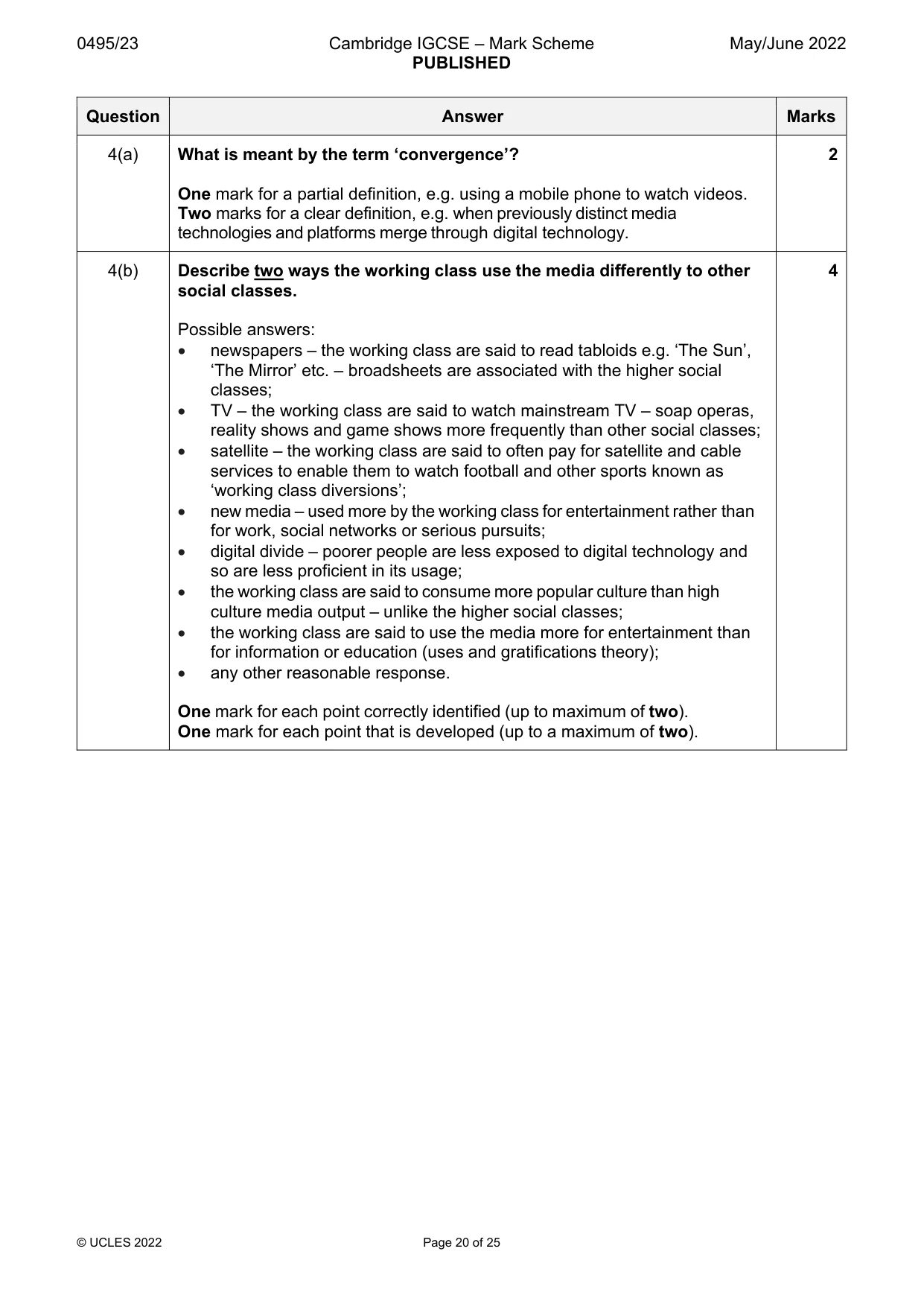
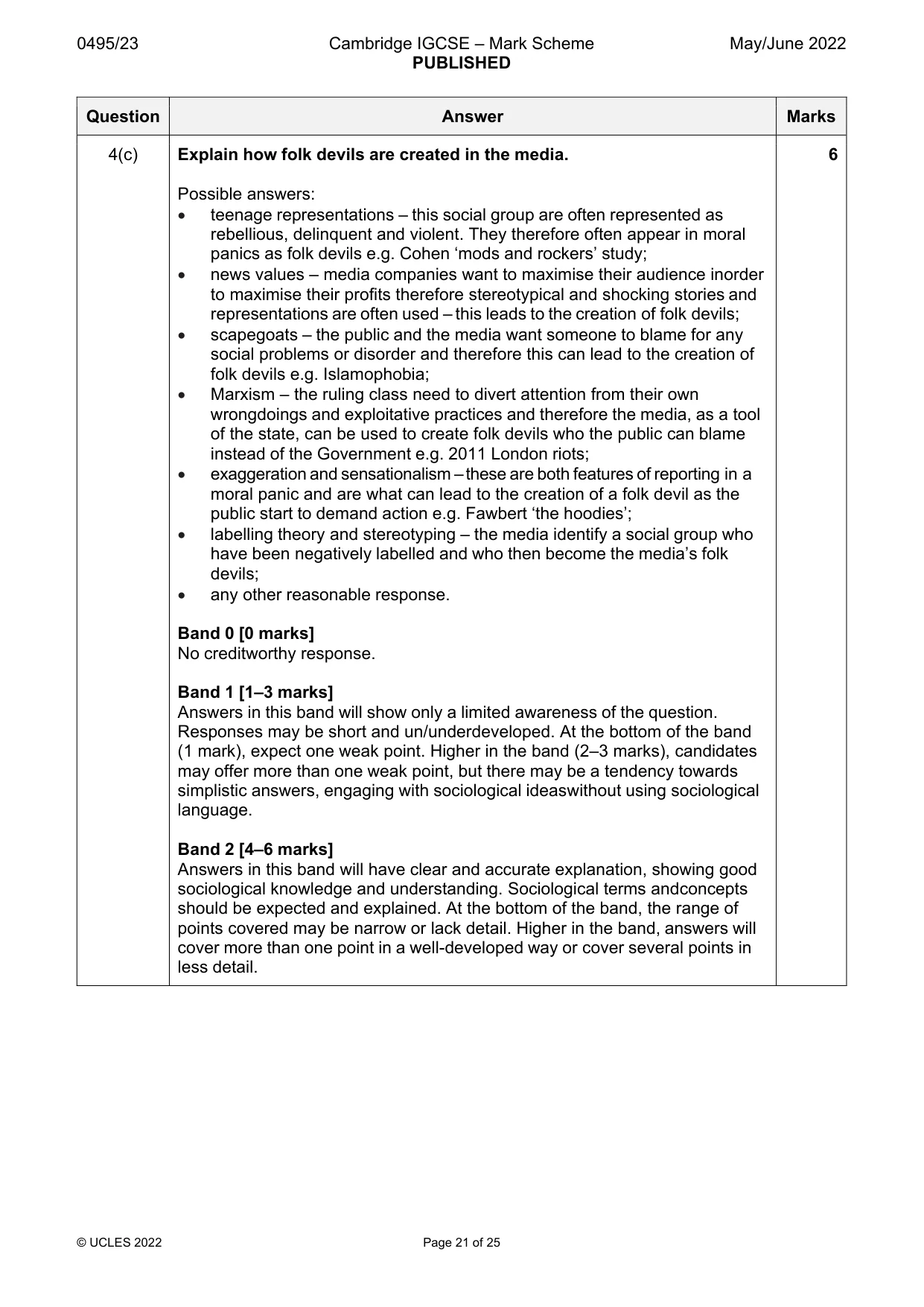
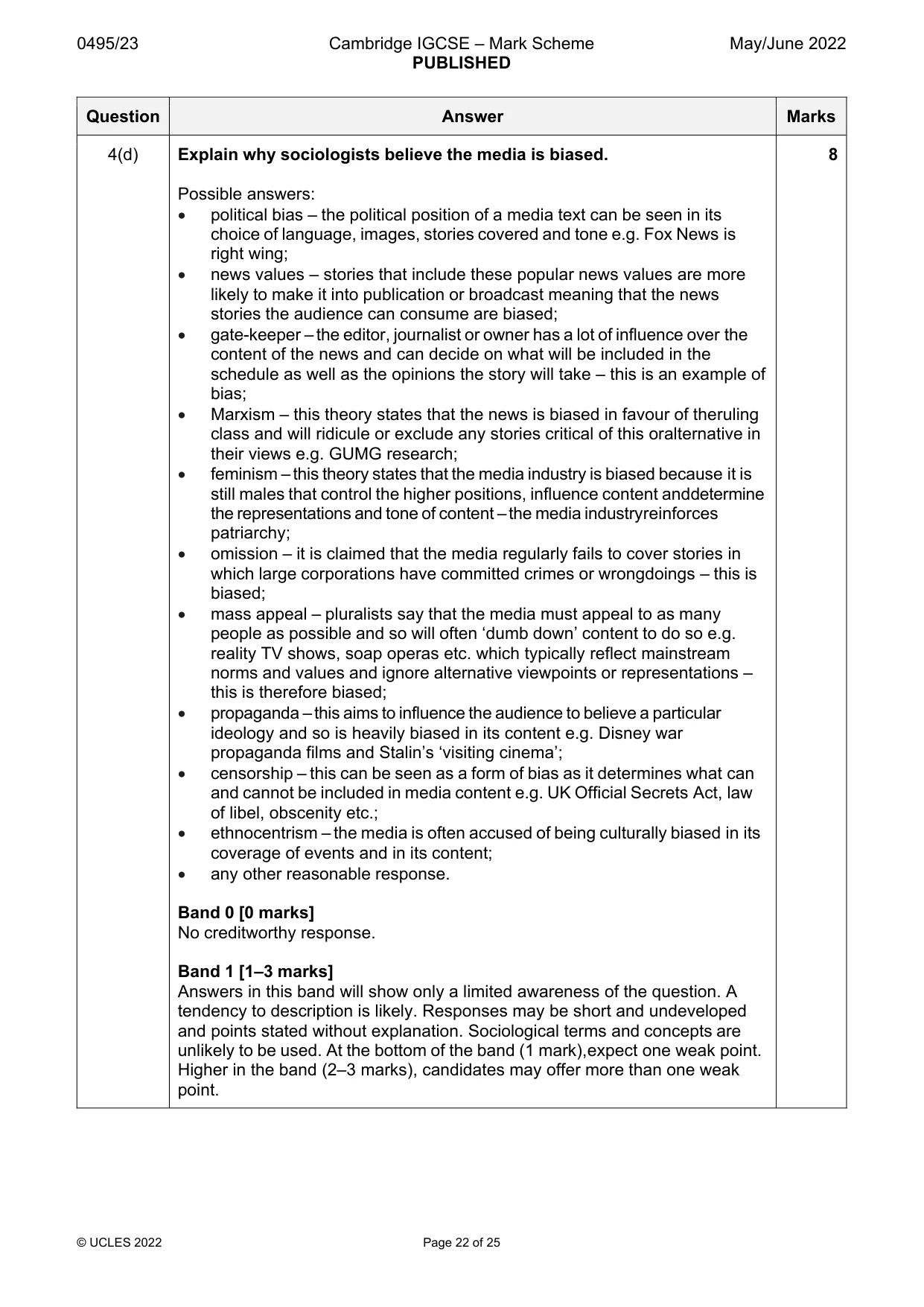
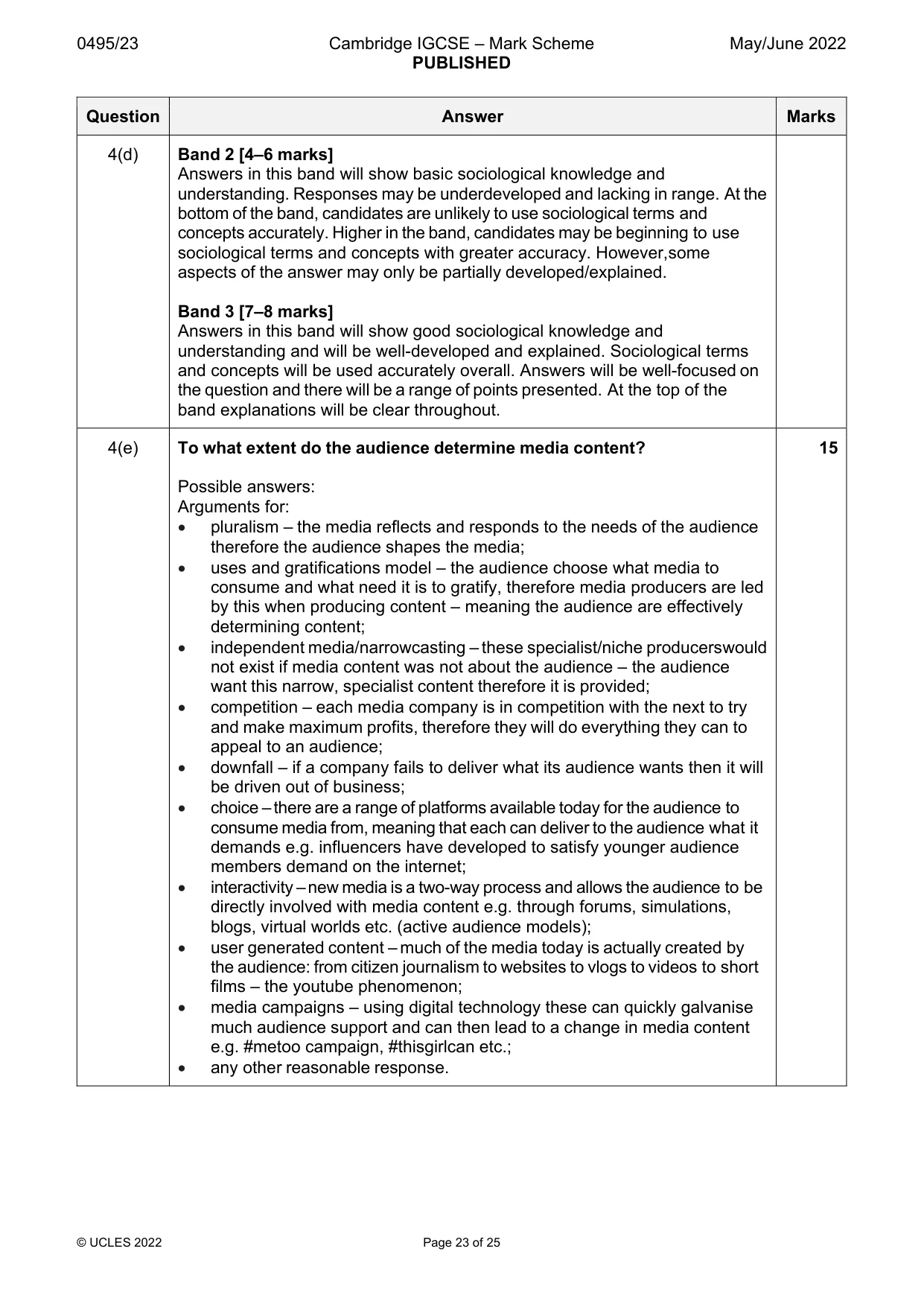
4 The media is an important institution in society and can have a big impact on audiences’ lives. This can be due to how different social groups use the media as well as the media’s influence on attitudes and behaviour. Media convergence exists and some sociologists are concerned about biased content and the creation of folk devils. However, other sociologists disagree and claim that it is the audience that determines media content. (a) What is meant by the term ‘convergence’? [2] (b) Describe two ways the working class use the media differently to other social classes. [4] (c) Explain how folk devils are created in the media. [6] (d) Explain why sociologists believe the media is biased. [8] (e) To what extent do the audience determine media content? [15]
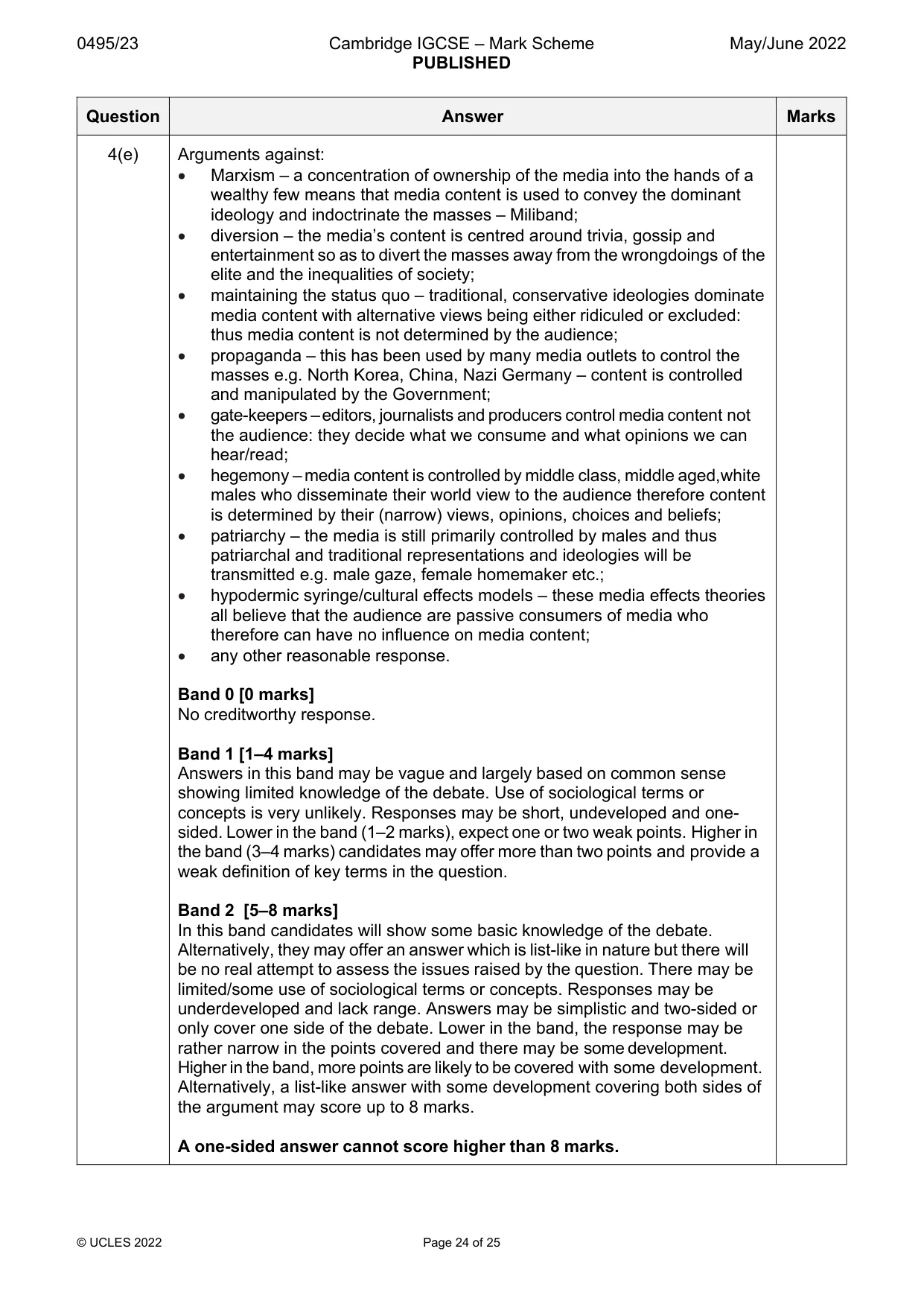
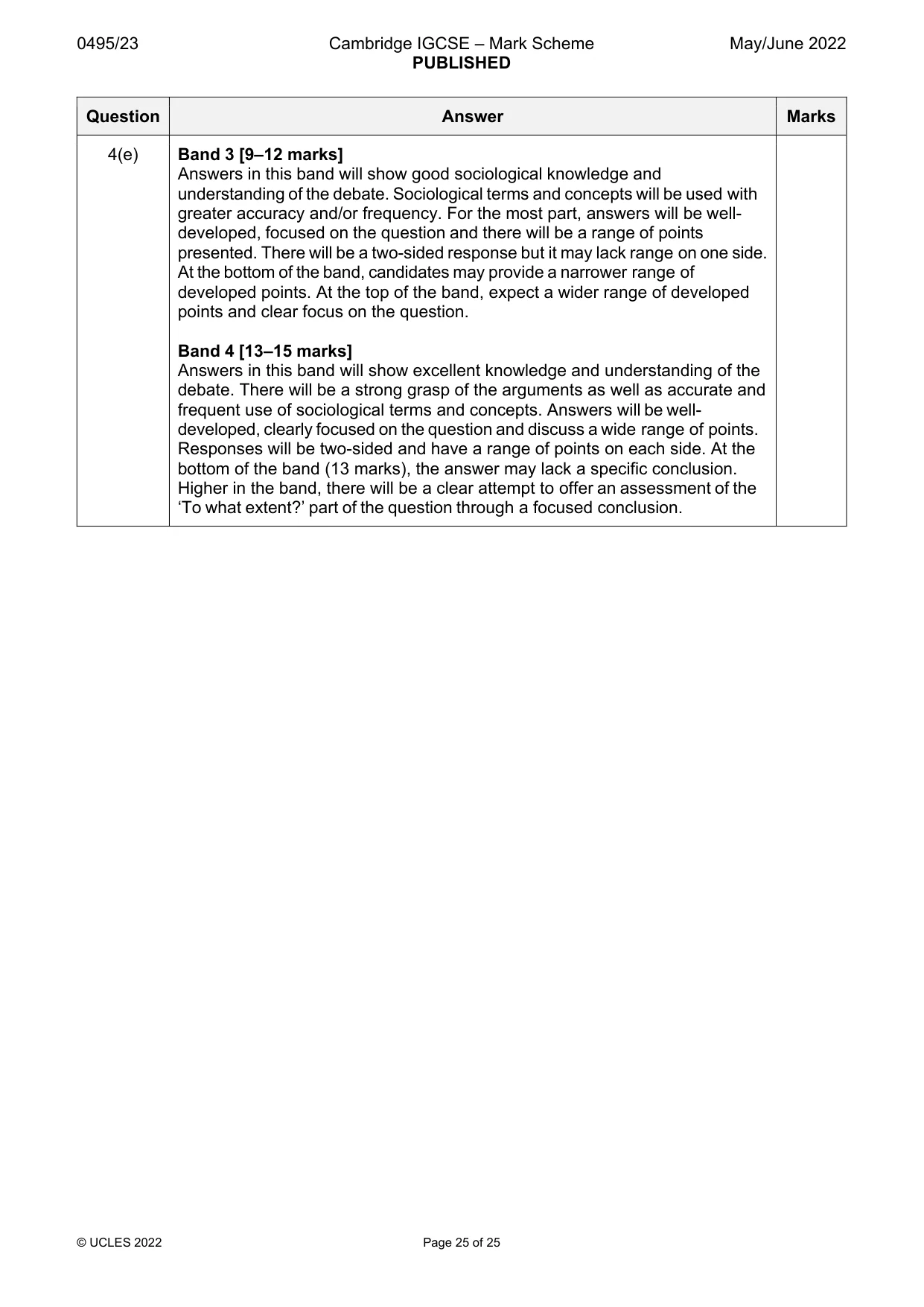
Mark scheme: 4(a) What is meant by the term ‘convergence’? 2 One mark for a partial definition, e.g. using a mobile phone to watch videos. Two marks for a clear definition, e.g. when previously distinct media technologies and platforms merge through digital technology. 4(b) Describe two ways the working class use the media differently to other 4 social classes. Possible answers: newspapers – the working class are said to read tabloids e.g. ‘The Sun’, ‘The Mirror’ etc. – broadsheets are associated with the higher social classes; TV – the working class are said to watch mainstream TV – soap operas, reality shows and game shows more frequently than other social classes; satellite – the working class are said to often pay for satellite and cable services to enable them to watch football and other sports known as ‘working class diversions’; new media – used more by the working class for entertainment rather than for work, social networks or serious pursuits; digital divide – poorer people are less exposed to digital technology and so are less proficient in its usage; the working class are said to consume more popular culture than high culture media output – unlike the higher social classes; the working class are said to use the media more for entertainment than for information or education (uses and gratifications theory); any other reasonable response. One mark for each point correctly identified (up to maximum of two). One mark for each point that is developed (up to a maximum of two). 4(c) Explain how folk devils are created in the media. 6 Possible answers: teenage representations – this social group are often represented as rebellious, delinquent and violent. They therefore often appear in moral panics as folk devils e.g. Cohen ‘mods and rockers’ study; news values – media companies want to maximise their audience in order to maximise their profits therefore stereotypical and shocking stories and representations are often used – this leads to the creation of folk devils; scapegoats – the public and the media want someone to blame for any social problems or disorder and therefore this can lead to the creation of folk devils e.g. Islamophobia; Marxism – the ruling class need to divert attention from their own wrongdoings and exploitative practices and therefore the media, as a tool of the state, can be used to create folk devils who the public can blame instead of the Government e.g. 2011 London riots; exaggeration and sensationalism – these are both features of reporting in a moral panic and are what can lead to the creation of a folk devil as the public start to demand action e.g. Fawbert ‘the hoodies’; labelling theory and stereotyping – the media identify a social group who have been negatively labelled and who then become the media’s folk devils; any other reasonable response. Band 0 [0 marks] No creditworthy response. Band 1 [1–3 marks] Answers in this band will show only a limited awareness of the question. Responses may be short and un/underdeveloped. At the bottom of the band (1 mark), expect one weak point. Higher in the band (2–3 marks), candidates may offer more than one weak point, but there may be a tendency towards simplistic answers, engaging with sociological ideas without using sociological language. Band 2 [4–6 marks] Answers in this band will have clear and accurate explanation, showing good sociological knowledge and understanding. Sociological terms and concepts should be expected and explained. At the bottom of the band, the range of points covered may be narrow or lack detail. Higher in the band, answers will cover more than one point in a well-developed way or cover several points in less detail. 4(d) Explain why sociologists believe the media is biased. 8 Possible answers: political bias – the political position of a media text can be seen in its choice of language, images, stories covered and tone e.g. Fox News is right wing; news values – stories that include these popular news values are more likely to make it into publication or broadcast meaning that the news stories the audience can consume are biased; gate-keeper – the editor, journalist or owner has a lot of influence over the content of the news and can decide on what will be included in the schedule as well as the opinions the story will take – this is an example of bias; Marxism – this theory states that the news is biased in favour of the ruling class and will ridicule or exclude any stories critical of this or alternative in their views e.g. GUMG research; feminism – this theory states that the media industry is biased because it is still males that control the higher positions, influence content and determine the representations and tone of content – the media industry reinforces patriarchy; omission – it is claimed that the media regularly fails to cover stories in which large corporations have committed crimes or wrongdoings – this is biased; mass appeal – pluralists say that the media must appeal to as many people as possible and so will often ‘dumb down’ content to do so e.g. reality TV shows, soap operas etc. which typically reflect mainstream norms and values and ignore alternative viewpoints or representations – this is therefore biased; propaganda – this aims to influence the audience to believe a particular ideology and so is heavily biased in its content e.g. Disney war propaganda films and Stalin’s ‘visiting cinema’; censorship – this can be seen as a form of bias as it determines what can and cannot be included in media content e.g. UK Official Secrets Act, law of libel, obscenity etc.; ethnocentrism – the media is often accused of being culturally biased in its coverage of events and in its content; any other reasonable response. Band 0 [0 marks] No creditworthy response. Band 1 [1–3 marks] Answers in this band will show only a limited awareness of the question. A tendency to description is likely. Responses may be short and undeveloped and points stated without explanation. Sociological terms and concepts are unlikely to be used. At the bottom of the band (1 mark), expect one weak point. Higher in the band (2–3 marks), candidates may offer more than one weak point. 4(d) Band 2 [4–6 marks] Answers in this band will show basic sociological knowledge and understanding. Responses may be underdeveloped and lacking in range. At the bottom of the band, candidates are unlikely to use sociological terms and concepts accurately. Higher in the band, candidates may be beginning to use sociological terms and concepts with greater accuracy. However, some aspects of the answer may only be partially developed/explained. Band 3 [7–8 marks] Answers in this band will show good sociological knowledge and understanding and will be well-developed and explained. Sociological terms and concepts will be used accurately overall. Answers will be well-focused on the question and there will be a range of points presented. At the top of the band explanations will be clear throughout. 4(e) To what extent do the audience determine media content? 15 Possible answers: Arguments for: pluralism – the media reflects and responds to the needs of the audience therefore the audience shapes the media; uses and gratifications model – the audience choose what media to consume and what need it is to gratify, therefore media producers are led by this when producing content – meaning the audience are effectively determining content; independent media/narrowcasting – these specialist/niche producers would not exist if media content was not about the audience – the audience want this narrow, specialist content therefore it is provided; competition – each media company is in competition with the next to try and make maximum profits, therefore they will do everything they can to appeal to an audience; downfall – if a company fails to deliver what its audience wants then it will be driven out of business; choice – there are a range of platforms available today for the audience to consume media from, meaning that each can deliver to the audience what it demands e.g. influencers have developed to satisfy younger audience members demand on the internet; interactivity – new media is a two-way process and allows the audience to be directly involved with media content e.g. through forums, simulations, blogs, virtual worlds etc. (active audience models); user generated content – much of the media today is actually created by the audience: from citizen journalism to websites to vlogs to videos to short films – the youtube phenomenon; media campaigns – using digital technology these can quickly galvanise much audience support and can then lead to a change in media content e.g. #metoo campaign, #thisgirlcan etc.; any other reasonable response. 4(e) Arguments against: Marxism – a concentration of ownership of the media into the hands of a wealthy few means that media content is used to convey the dominant ideology and indoctrinate the masses – Miliband; diversion – the media’s content is centred around trivia, gossip and entertainment so as to divert the masses away from the wrongdoings of the elite and the inequalities of society; maintaining the status quo – traditional, conservative ideologies dominate media content with alternative views being either ridiculed or excluded: thus media content is not determined by the audience; propaganda – this has been used by many media outlets to control the masses e.g. North Korea, China, Nazi Germany – content is controlled and manipulated by the Government; gate-keepers – editors, journalists and producers control media content not the audience: they decide what we consume and what opinions we can hear/read; hegemony – media content is controlled by middle class, middle aged, white males who disseminate their world view to the audience therefore content is determined by their (narrow) views, opinions, choices and beliefs; patriarchy – the media is still primarily controlled by males and thus patriarchal and traditional representations and ideologies will be transmitted e.g. male gaze, female homemaker etc.; hypodermic syringe/cultural effects models – these media effects theories all believe that the audience are passive consumers of media who therefore can have no influence on media content; any other reasonable response. Band 0 [0 marks] No creditworthy response. Band 1 [1–4 marks] Answers in this band may be vague and largely based on common sense showing limited knowledge of the debate. Use of sociological terms or concepts is very unlikely. Responses may be short, undeveloped and one- sided. Lower in the band (1–2 marks), expect one or two weak points. Higher in the band (3–4 marks) candidates may offer more than two points and provide a weak definition of key terms in the question. Band 2 [5–8 marks] In this band candidates will show some basic knowledge of the debate. Alternatively, they may offer an answer which is list-like in nature but there will be no real attempt to assess the issues raised by the question. There may be limited/some use of sociological terms or concepts. Responses may be underdeveloped and lack range. Answers may be simplistic and two-sided or only cover one side of the debate. Lower in the band, the response may be rather narrow in the points covered and there may be some development. Higher in the band, more points are likely to be covered with some development. Alternatively, a list-like answer with some development covering both sides of the argument may score up to 8 marks. A one-sided answer cannot score higher than 8 marks. 4(e) Band 3 [9–12 marks] Answers in this band will show good sociological knowledge and understanding of the debate. Sociological terms and concepts will be used with greater accuracy and/or frequency. For the most part, answers will be well- developed, focused on the question and there will be a range of points presented. There will be a two-sided response but it may lack range on one side. At the bottom of the band, candidates may provide a narrower range of developed points. At the top of the band, expect a wider range of developed points and clear focus on the question. Band 4 [13–15 marks] Answers in this band will show excellent knowledge and understanding of the debate. There will be a strong grasp of the arguments as well as accurate and frequent use of sociological terms and concepts. Answers will be well- developed, clearly focused on the question and discuss a wide range of points. Responses will be two-sided and have a range of points on each side. At the bottom of the band (13 marks), the answer may lack a specific conclusion. Higher in the band, there will be a clear attempt to offer an assessment of the ‘To what extent?’ part of the question through a focused conclusion.
More questions on How do sociologists approach the study of society?
What was in this paper
The subtopics covered by these 4 questions, and how many questions each got. Open one in a new tab to see every Cambridge question on it.
What you needed in this session
Cambridge’s own grade thresholds for 2022 May/June, Paper 2 · Variant 3. A higher threshold means an easier paper — the bar moves with how the cohort did.