Cambridge IGCSE Sociology 0495 — 2025 May/June Paper 2 · Variant 3
0495/23/M/J/25 · 3 questions · 80 marks · 105 min
The question paper and its mark scheme, free to read here and free to download. This is Cambridge’s own paper, exactly as it was sat.
Question paper4 pages
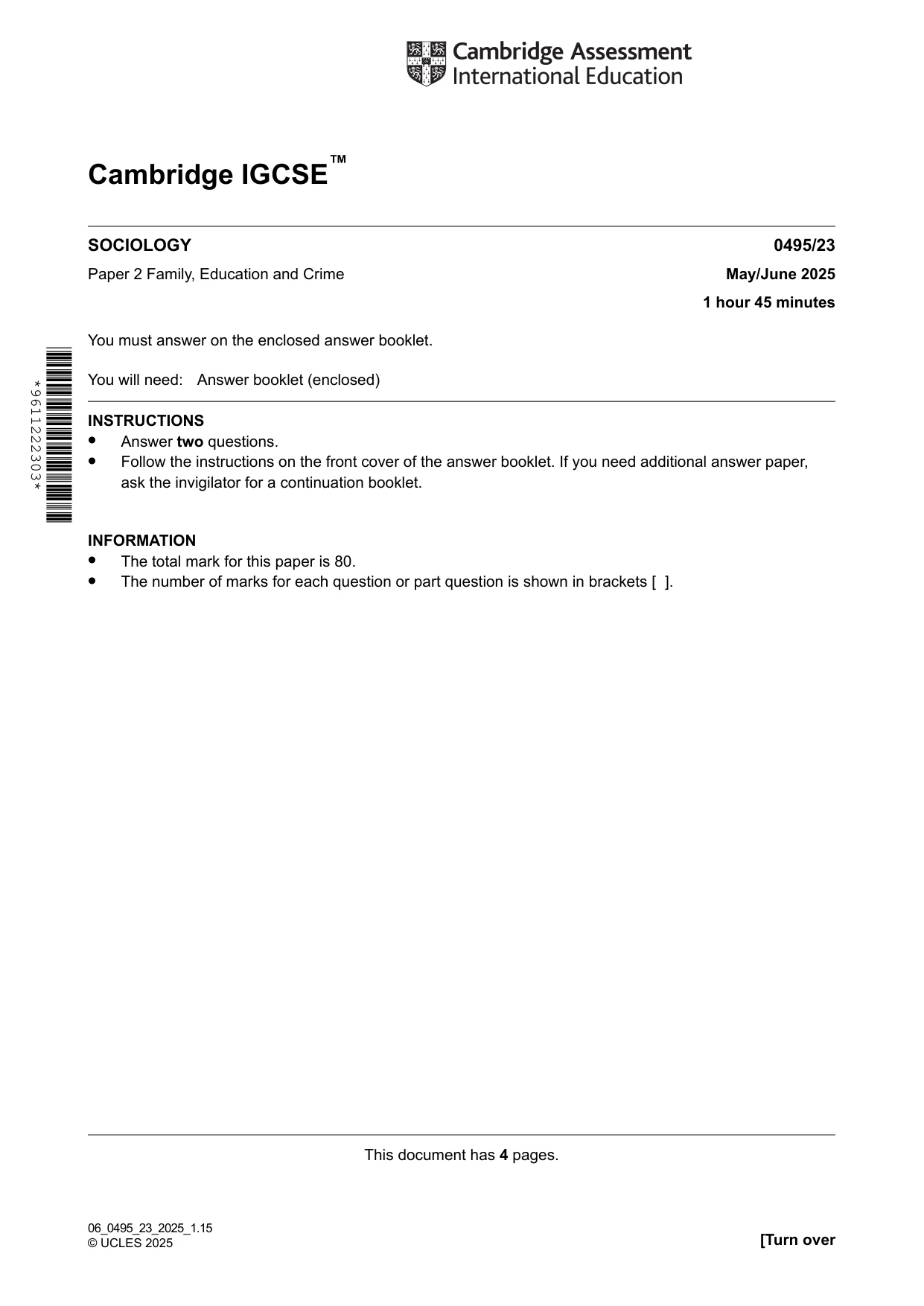
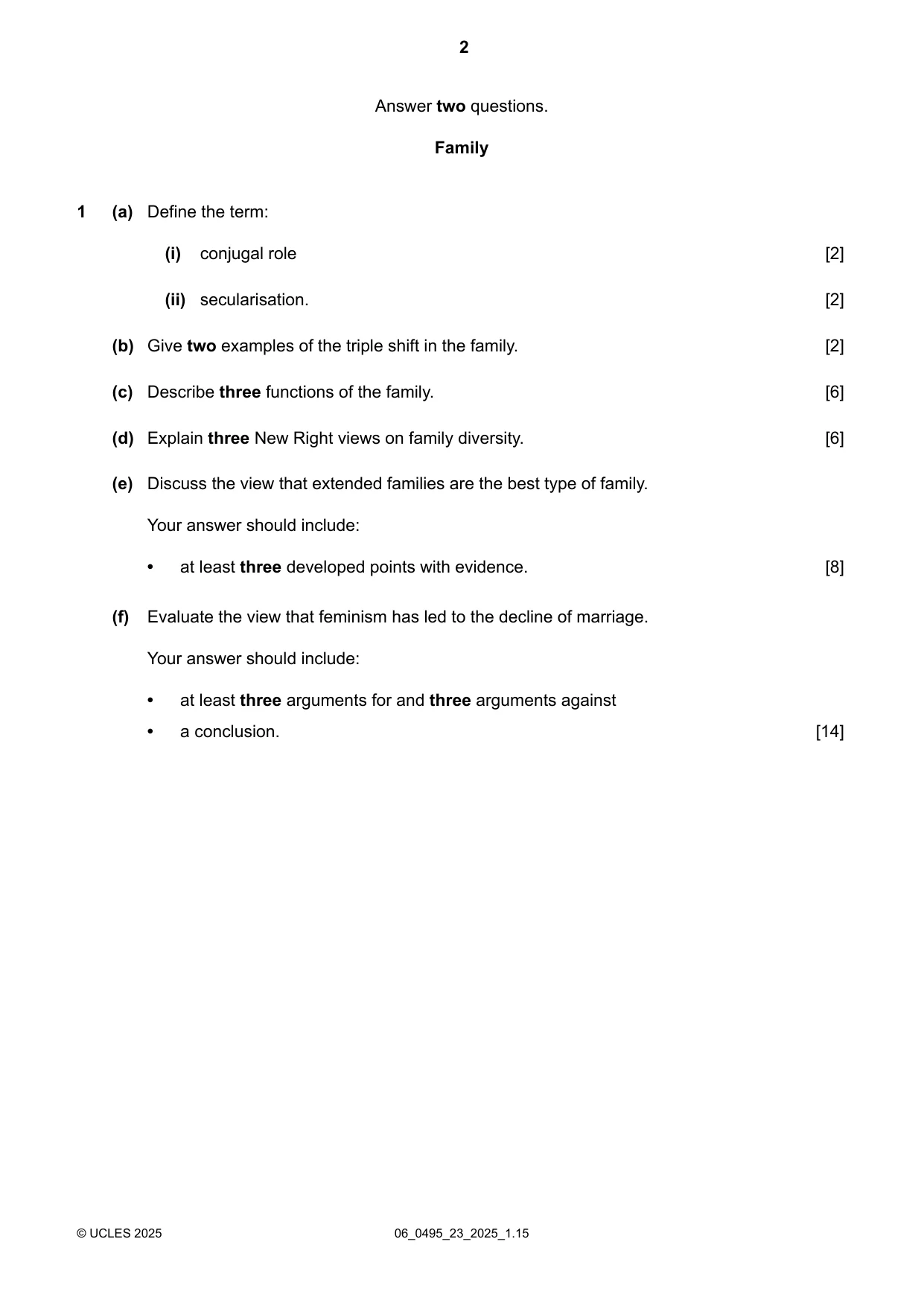
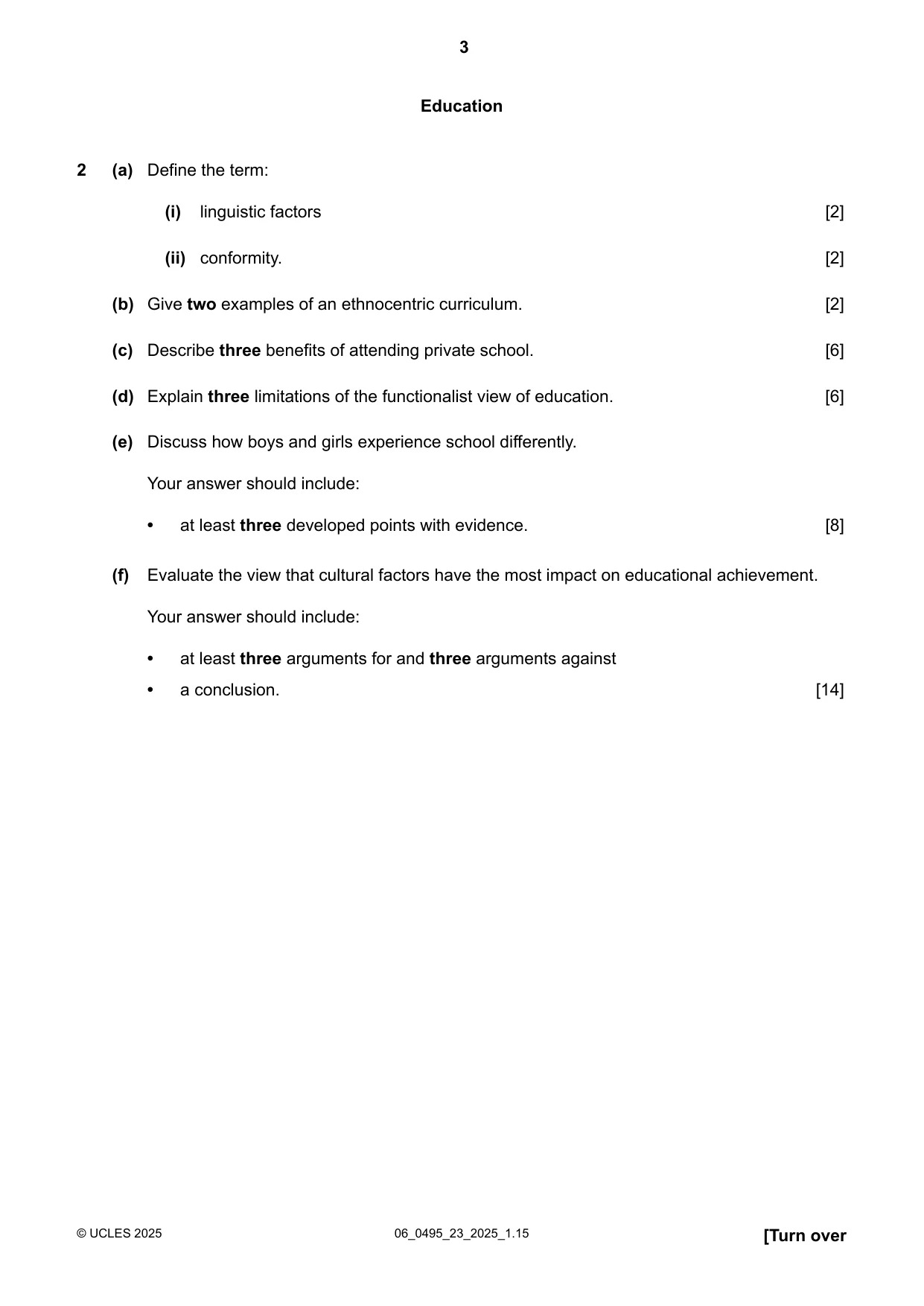

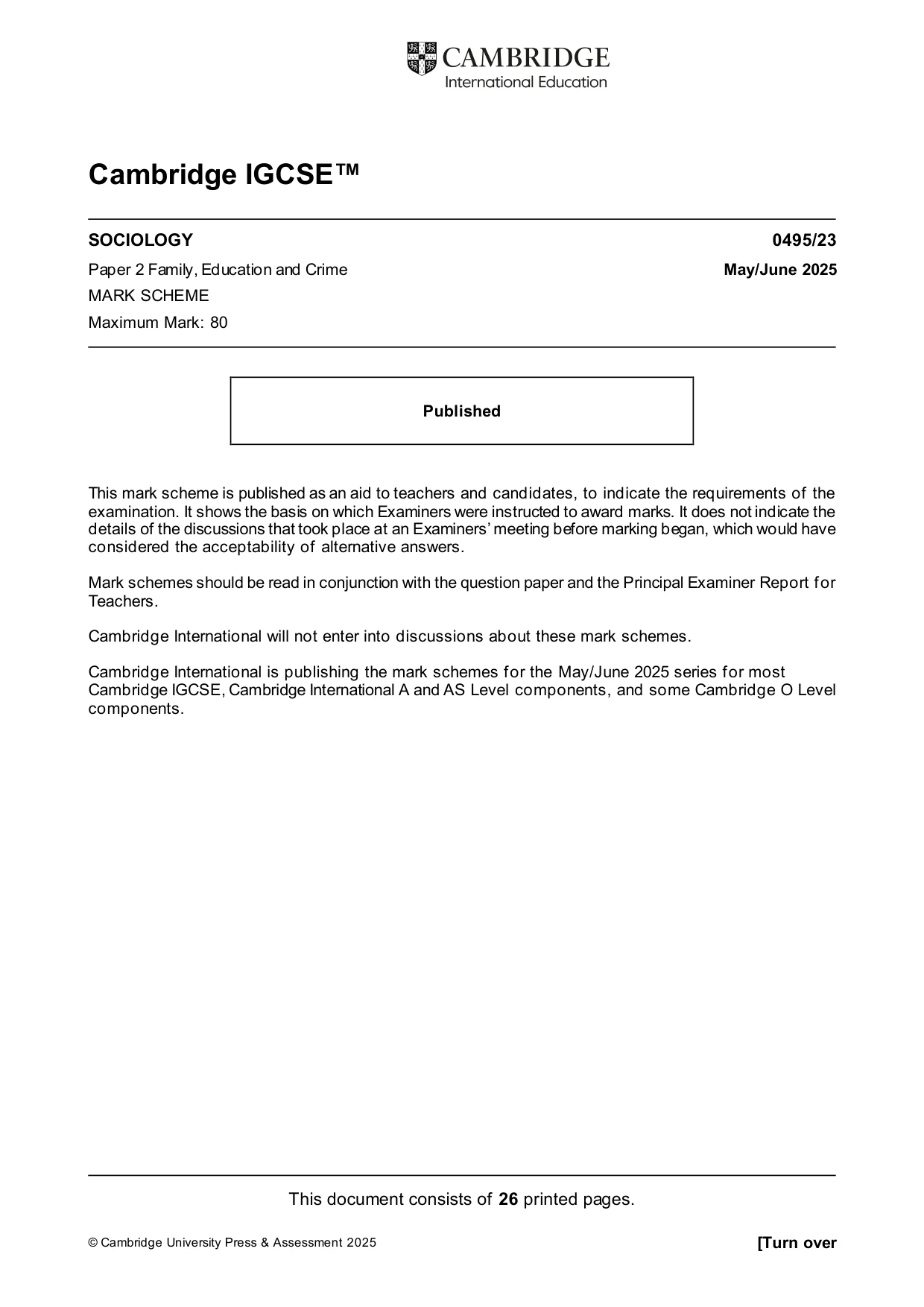
Mark scheme26 pages
Answers below. Sit the paper first if you are practising.













Questions as text
Q1 · Define the term: (i) conjugal role [2] (ii) secularisation
1 (a) Define the term: (i) conjugal role [2] (ii) secularisation. [2] (b) Give two examples of the triple shift in the family. [2] (c) Describe three functions of the family. [6] (d) Explain three New Right views on family diversity. [6] (e) Discuss the view that extended families are the best type of family. Your answer should include: • at least three developed points with evidence. [8] (f) Evaluate the view that feminism has led to the decline of marriage. Your answer should include: • at least three arguments for and three arguments against • a conclusion. [14] Education
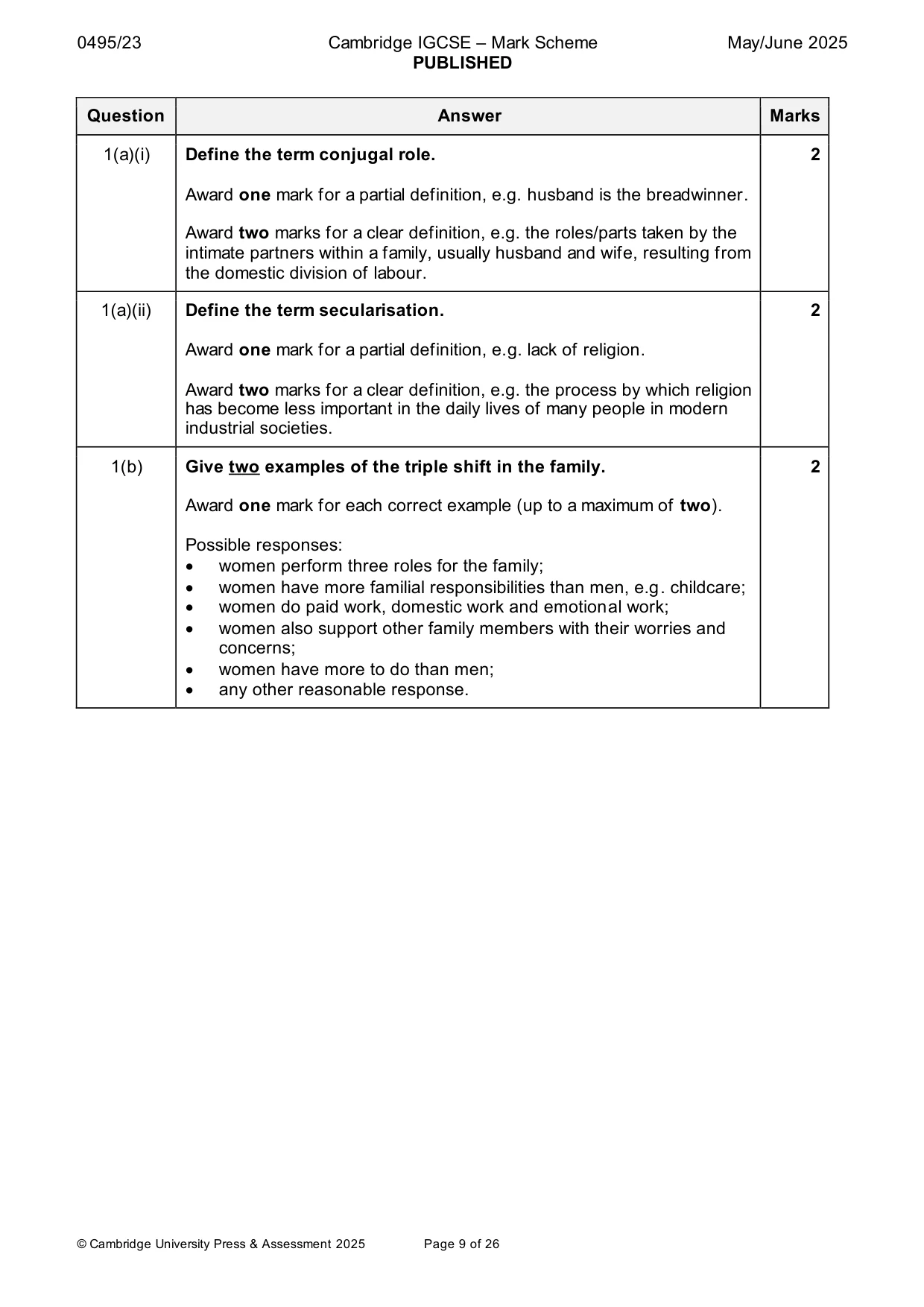
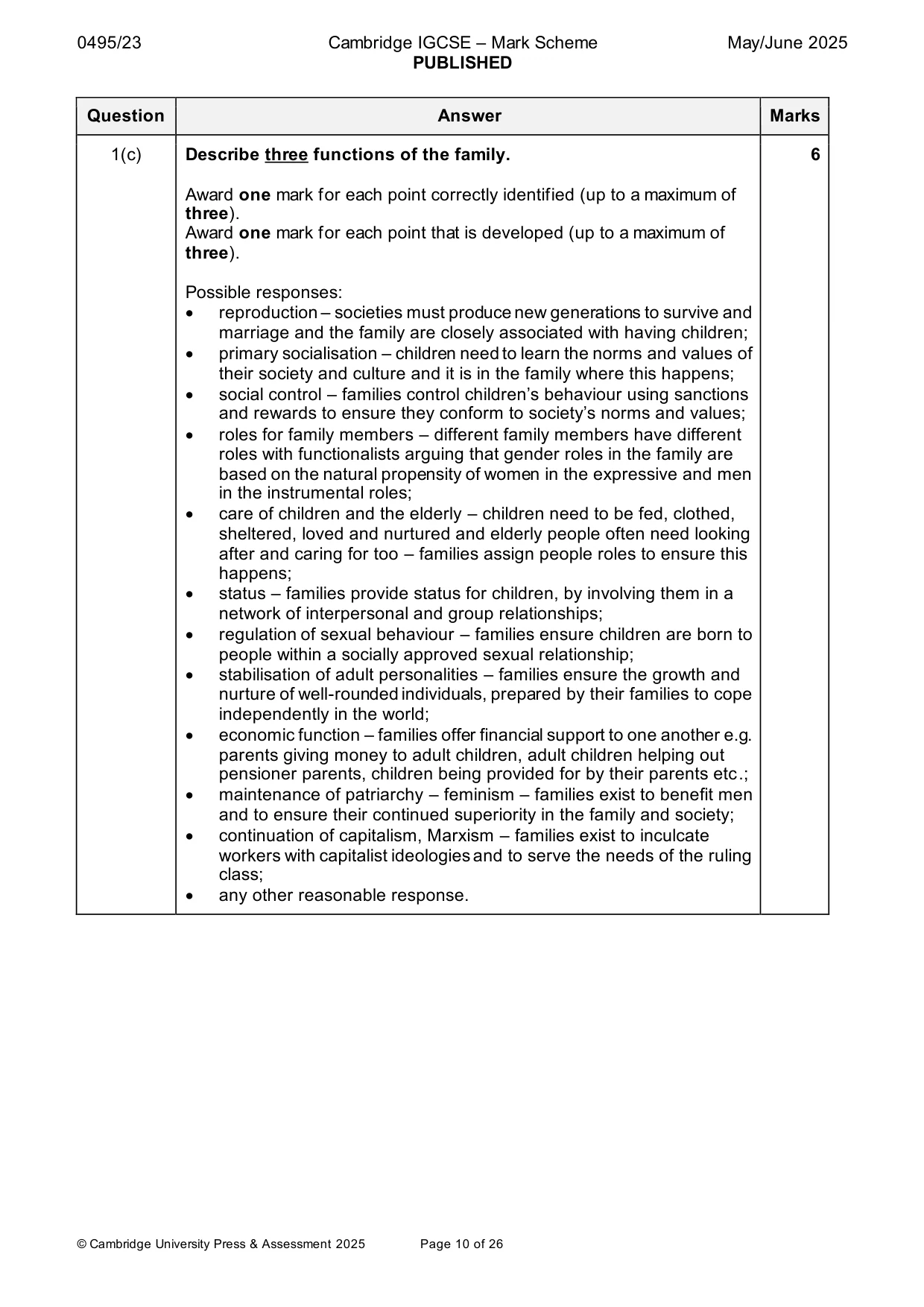
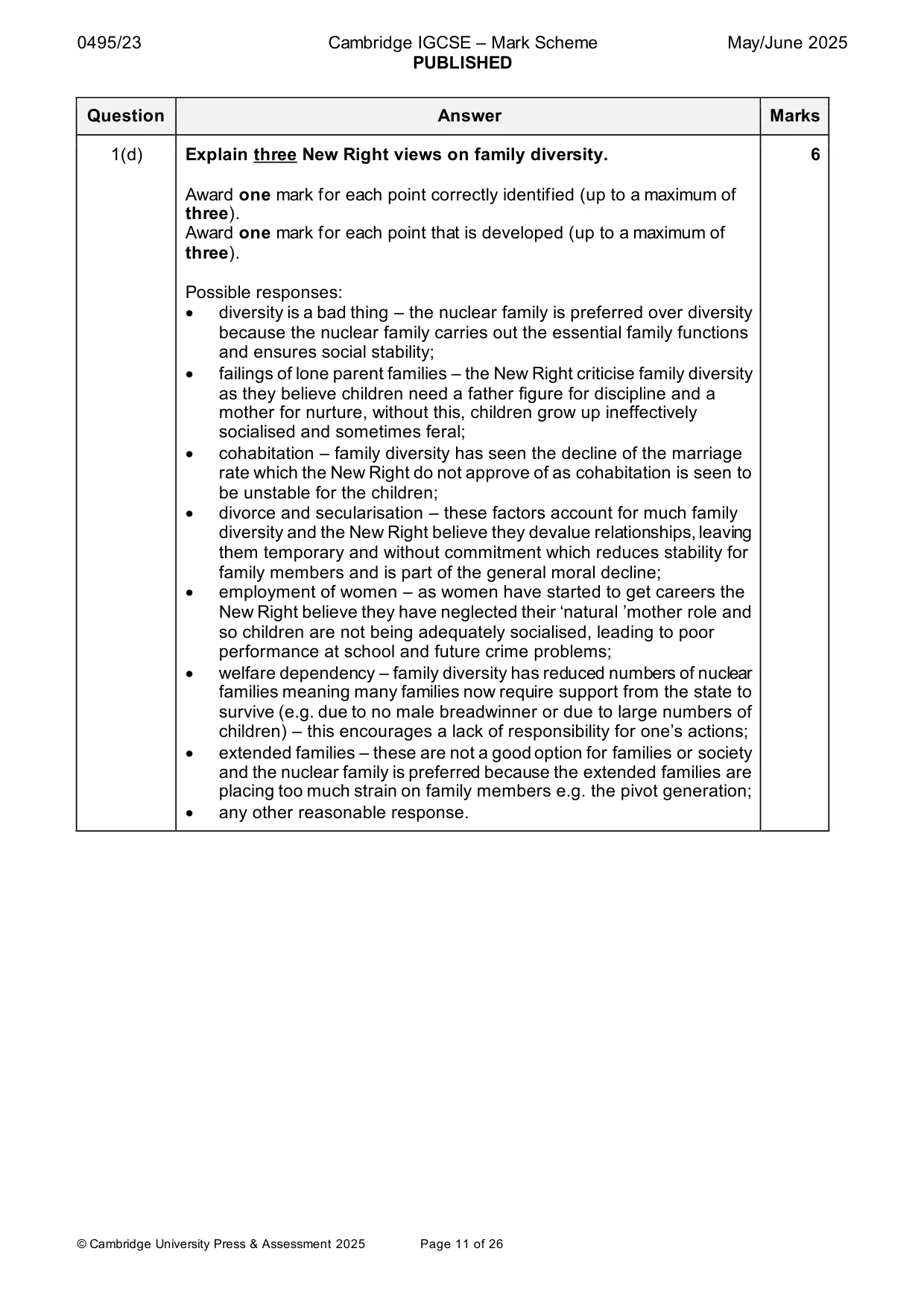
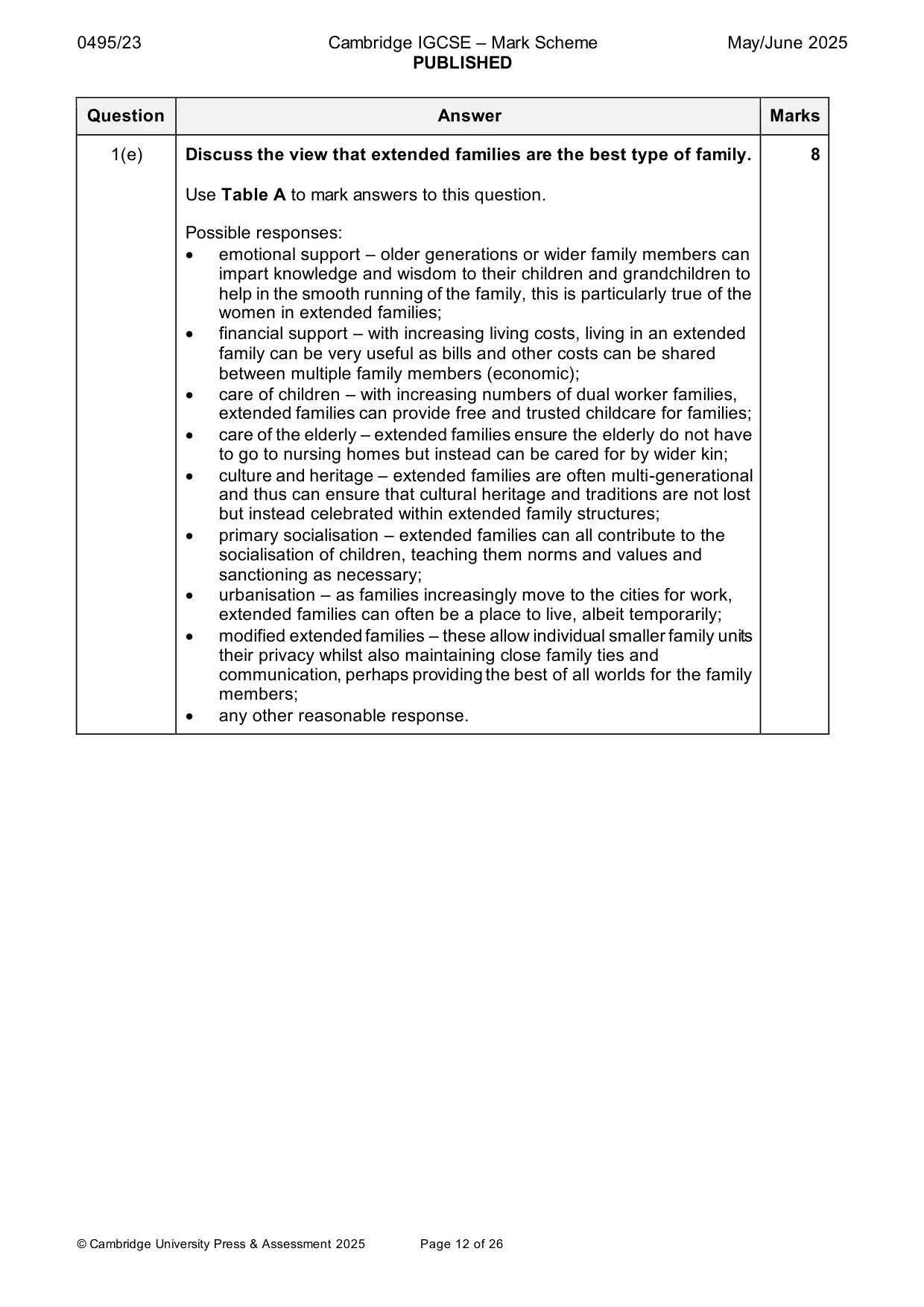
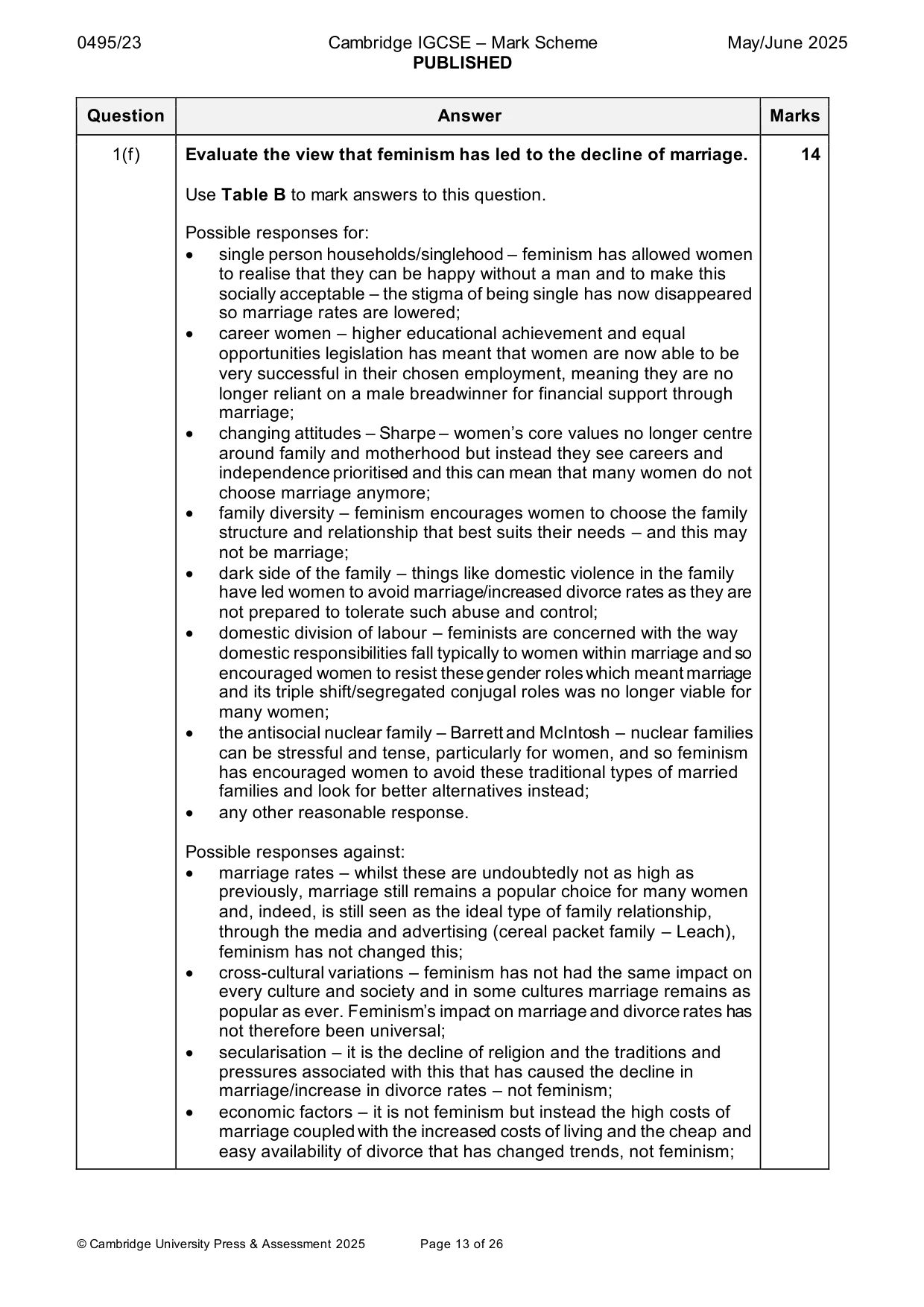
Mark scheme: Question Answer Marks 1(a)(i) Define the term conjugal role. 2 Award one mark for a partial definition, e.g. husband is the breadwinner. Award two marks for a clear definition, e.g. the roles/parts taken by the intimate partners within a family, usually husband and wife, resulting from the domestic division of labour. 1(a)(ii) Define the term secularisation. 2 Award one mark for a partial definition, e.g. lack of religion. Award two marks for a clear definition, e.g. the process by which religion has become less important in the daily lives of many people in modern industrial societies. 1(b) Give two examples of the triple shift in the family. 2 Award one mark for each correct example (up to a maximum of two). Possible responses: • women perform three roles for the family; • women have more familial responsibilities than men, e.g. childcare; • women do paid work, domestic work and emotional work; • women also support other family members with their worries and concerns; • women have more to do than men; • any other reasonable response. 1(c) Describe three functions of the family. 6 Award one mark for each point correctly identified (up to a maximum of three). Award one mark for each point that is developed (up to a maximum of three). Possible responses: • reproduction – societies must produce new generations to survive and marriage and the family are closely associated with having children; • primary socialisation – children need to learn the norms and values of their society and culture and it is in the family where this happens; • social control – families control children’s behaviour using sanctions and rewards to ensure they conform to society’s norms and values; • roles for family members – different family members have different roles with functionalists arguing that gender roles in the family are based on the natural propensity of women in the expressive and men in the instrumental roles; • care of children and the elderly – children need to be fed, clothed, sheltered, loved and nurtured and elderly people often need looking after and caring for too – families assign people roles to ensure this happens; • status – families provide status for children, by involving them in a network of interpersonal and group relationships; • regulation of sexual behaviour – families ensure children are born to people within a socially approved sexual relationship; • stabilisation of adult personalities – families ensure the growth and nurture of well-rounded individuals, prepared by their families to cope independently in the world; • economic function – families offer financial support to one another e.g. parents giving money to adult children, adult children helping out pensioner parents, children being provided for by their parents etc.; • maintenance of patriarchy – feminism – families exist to benefit men and to ensure their continued superiority in the family and society; • continuation of capitalism, Marxism – families exist to inculcate workers with capitalist ideologies and to serve the needs of the ruling class; • any other reasonable response. 1(d) Explain three New Right views on family diversity. 6 Award one mark for each point correctly identified (up to a maximum of three). Award one mark for each point that is developed (up to a maximum of three). Possible responses: • diversity is a bad thing – the nuclear family is preferred over diversity because the nuclear family carries out the essential family functions and ensures social stability; • failings of lone parent families – the New Right criticise family diversity as they believe children need a father figure for discipline and a mother for nurture, without this, children grow up ineffectively socialised and sometimes feral; • cohabitation – family diversity has seen the decline of the marriage rate which the New Right do not approve of as cohabitation is seen to be unstable for the children; • divorce and secularisation – these factors account for much family diversity and the New Right believe they devalue relationships, leaving them temporary and without commitment which reduces stability for family members and is part of the general moral decline; • employment of women – as women have started to get careers the New Right believe they have neglected their ‘natural ’mother role and so children are not being adequately socialised, leading to poor performance at school and future crime problems; • welfare dependency – family diversity has reduced numbers of nuclear families meaning many families now require support from the state to survive (e.g. due to no male breadwinner or due to large numbers of children) – this encourages a lack of responsibility for one’s actions; • extended families – these are not a good option for families or society and the nuclear family is preferred because the extended families are placing too much strain on family members e.g. the pivot generation; • any other reasonable response. 1(e) Discuss the view that extended families are the best type of family. 8 Use Table A to mark answers to this question. Possible responses: • emotional support – older generations or wider family members can impart knowledge and wisdom to their children and grandchildren to help in the smooth running of the family, this is particularly true of the women in extended families; • financial support – with increasing living costs, living in an extended family can be very useful as bills and other costs can be shared between multiple family members (economic); • care of children – with increasing numbers of dual worker families, extended families can provide free and trusted childcare for families; • care of the elderly – extended families ensure the elderly do not have to go to nursing homes but instead can be cared for by wider kin; • culture and heritage – extended families are often multi-generational and thus can ensure that cultural heritage and traditions are not lost but instead celebrated within extended family structures; • primary socialisation – extended families can all contribute to the socialisation of children, teaching them norms and values and sanctioning as necessary; • urbanisation – as families increasingly move to the cities for work, extended families can often be a place to live, albeit temporarily; • modified extended families – these allow individual smaller family units their privacy whilst also maintaining close family ties and communication, perhaps providing the best of all worlds for the family members; • any other reasonable response. 1(f) Evaluate the view that feminism has led to the decline of marriage. 14 Use Table B to mark answers to this question. Possible responses for: • single person households/singlehood – feminism has allowed women to realise that they can be happy without a man and to make this socially acceptable – the stigma of being single has now disappeared so marriage rates are lowered; • career women – higher educational achievement and equal opportunities legislation has meant that women are now able to be very successful in their chosen employment, meaning they are no longer reliant on a male breadwinner for financial support through marriage; • changing attitudes – Sharpe – women’s core values no longer centre around family and motherhood but instead they see careers and independence prioritised and this can mean that many women do not choose marriage anymore; • family diversity – feminism encourages women to choose the family structure and relationship that best suits their needs – and this may not be marriage; • dark side of the family – things like domestic violence in the family have led women to avoid marriage/increased divorce rates as they are not prepared to tolerate such abuse and control; • domestic division of labour – feminists are concerned with the way domestic responsibilities fall typically to women within marriage and so encouraged women to resist these gender roles which meant marriage and its triple shift/segregated conjugal roles was no longer viable for many women; • the antisocial nuclear family – Barrett and McIntosh – nuclear families can be stressful and tense, particularly for women, and so feminism has encouraged women to avoid these traditional types of married families and look for better alternatives instead; • any other reasonable response. Possible responses against: • marriage rates – whilst these are undoubtedly not as high as previously, marriage still remains a popular choice for many women and, indeed, is still seen as the ideal type of family relationship, through the media and advertising (cereal packet family – Leach), feminism has not changed this; • cross-cultural variations – feminism has not had the same impact on every culture and society and in some cultures marriage remains as popular as ever. Feminism’s impact on marriage and divorce rates has not therefore been universal; • secularisation – it is the decline of religion and the traditions and pressures associated with this that has caused the decline in marriage/increase in divorce rates – not feminism; • economic factors – it is not feminism but instead the high costs of marriage coupled with the increased costs of living and the cheap and easy availability of divorce that has changed trends, not feminism; 1(f) • The New Right and moral decline – it is not feminism but the moral decay in society, promiscuity and fatherless families that are to blame for the decline in marriage; • empty-nest families – these still exist across the globe, showing that many marriages continue regardless of feminism and do not end in divorce; • reconstituted families and remarriage – these are increasing in numbers, particularly in the West, showing that marriage is as valued as it was before and that people still see a committed family life as the norm and the ideal; • any other reasonable response.
Q2 · Define the term: (i) linguistic factors [2] (ii) conformity
2 (a) Define the term: (i) linguistic factors [2] (ii) conformity. [2] (b) Give two examples of an ethnocentric curriculum. [2] (c) Describe three benefits of attending private school. [6] (d) Explain three limitations of the functionalist view of education. [6] (e) Discuss how boys and girls experience school differently. Your answer should include: • at least three developed points with evidence. [8] (f) Evaluate the view that cultural factors have the most impact on educational achievement. Your answer should include: • at least three arguments for and three arguments against • a conclusion. [14] Crime, deviance and social control
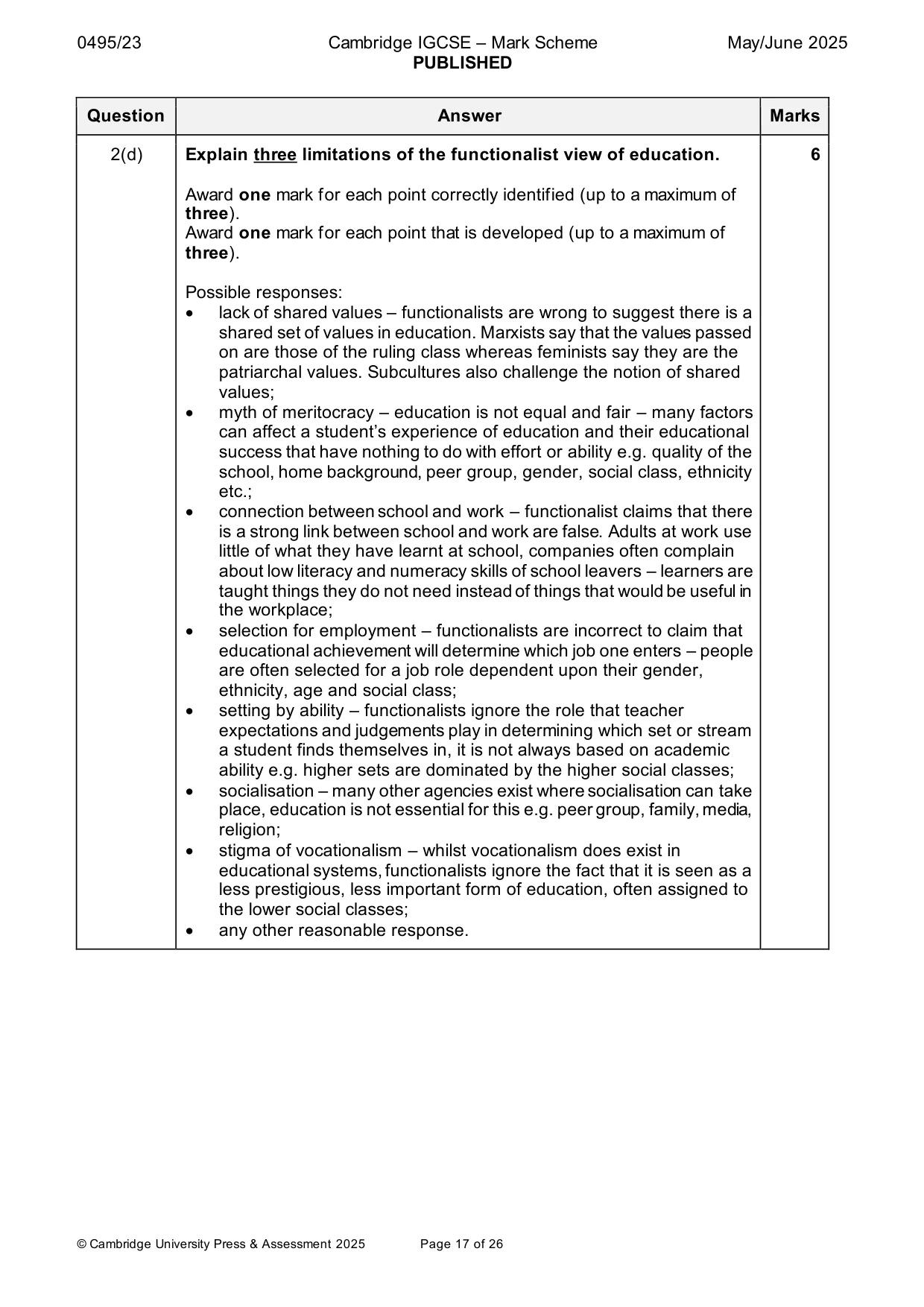
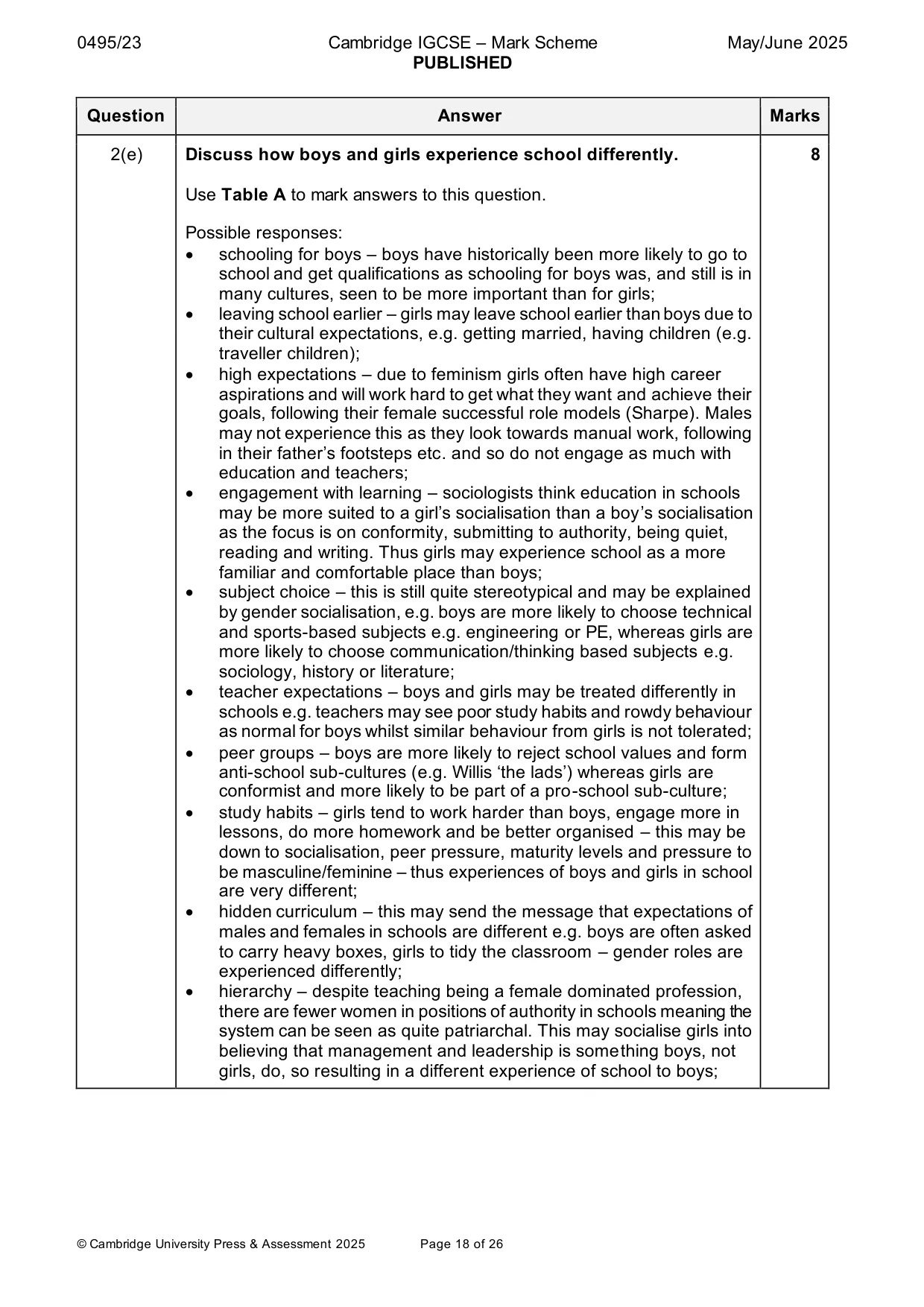
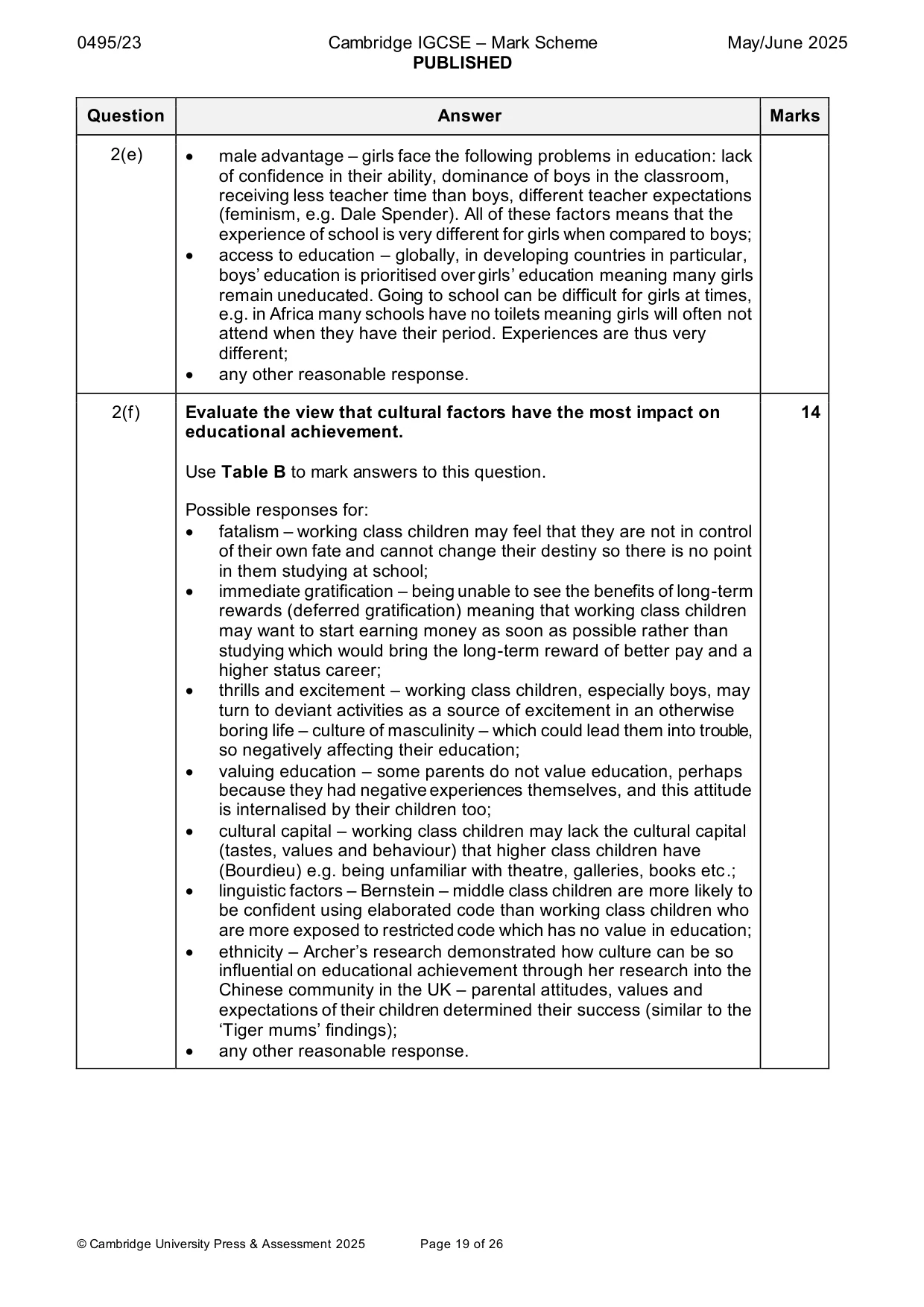
Mark scheme: 2(a)(i) Define the term linguistic factors. 2 Award one mark for a partial definition, e.g. language. Award two marks for a clear definition, e.g. the type of language children speak e.g. restricted and elaborated codes. 2(a)(ii) Define the term conformity. 2 Award one mark for a partial definition, e.g. fitting in. Award two marks for a clear definition, e.g. behaviour that follows the usual standards and expectations of a group, culture and/or society. 2(b) Give two examples of an ethnocentric curriculum. 2 Award one mark for each correct example (up to a maximum of two). Possible responses: • host nation – their norms, values and beliefs are embedded into the educational curriculum; • language teaching – the language and cultures of ethnic minority learners may be seen by the school as being of lesser value; • teaching of literature – poetry and books from the culture of ethnic minority learners may not be considered worth studying; • teaching of history – learners from ethnic minority groups may learn nothing about their own people’s experiences; • religion and worship in assemblies – the ethnic minority learners’ beliefs may be ignored and they may even be forced to follow the practices of the majority; • celebration of festivals based on the dominant culture – ethnic minority learners’ festivals may be ignored; • any other reasonable response. 2(c) Describe three benefits of attending private school. 6 Award one mark for each point correctly identified (up to a maximum of three). Award one mark for each point that is developed (up to a maximum of three). Possible responses: • class sizes – classes in private schools tend to be smaller, so individual learners get more attention from the teacher; • more choice in curriculum – private schools do not have to follow a national curriculum so they can concentrate on teaching what they believe to be most important and/or what their parents want; • parental choice – private schools are very diverse institutions and so parents can choose the school that best suits their children’s needs; • money and funding – private schools have more money than state schools meaning they have better resources and facilities for the students e.g. swimming pools, ICT, science equipment etc., often also resulting in better results; • social capital – Bourdieu – private schools allow students to make networks and connections that can help them find employment in high status professions and companies in the future; • extra-curricular opportunities – private schools are renowned for the plethora of extra-curricular activities on offer, allowing students to experience a wide variety of sports, culture, arts, theatre etc. and so increasing cultural capital (Bourdieu); • life chances and social mobility – private schools typically gain better examination results than the state sector meaning that students have better chances of entering highly paid and high status fields of employment; • any other reasonable response. 2(d) Explain three limitations of the functionalist view of education. 6 Award one mark for each point correctly identified (up to a maximum of three). Award one mark for each point that is developed (up to a maximum of three). Possible responses: • lack of shared values – functionalists are wrong to suggest there is a shared set of values in education. Marxists say that the values passed on are those of the ruling class whereas feminists say they are the patriarchal values. Subcultures also challenge the notion of shared values; • myth of meritocracy – education is not equal and fair – many factors can affect a student’s experience of education and their educational success that have nothing to do with effort or ability e.g. quality of the school, home background, peer group, gender, social class, ethnicity etc.; • connection between school and work – functionalist claims that there is a strong link between school and work are false. Adults at work use little of what they have learnt at school, companies often complain about low literacy and numeracy skills of school leavers – learners are taught things they do not need instead of things that would be useful in the workplace; • selection for employment – functionalists are incorrect to claim that educational achievement will determine which job one enters – people are often selected for a job role dependent upon their gender, ethnicity, age and social class; • setting by ability – functionalists ignore the role that teacher expectations and judgements play in determining which set or stream a student finds themselves in, it is not always based on academic ability e.g. higher sets are dominated by the higher social classes; • socialisation – many other agencies exist where socialisation can take place, education is not essential for this e.g. peer group, family, media, religion; • stigma of vocationalism – whilst vocationalism does exist in educational systems, functionalists ignore the fact that it is seen as a less prestigious, less important form of education, often assigned to the lower social classes; • any other reasonable response. 2(e) Discuss how boys and girls experience school differently. 8 Use Table A to mark answers to this question. Possible responses: • schooling for boys – boys have historically been more likely to go to school and get qualifications as schooling for boys was, and still is in many cultures, seen to be more important than for girls; • leaving school earlier – girls may leave school earlier than boys due to their cultural expectations, e.g. getting married, having children (e.g. traveller children); • high expectations – due to feminism girls often have high career aspirations and will work hard to get what they want and achieve their goals, following their female successful role models (Sharpe). Males may not experience this as they look towards manual work, following in their father’s footsteps etc. and so do not engage as much with education and teachers; • engagement with learning – sociologists think education in schools may be more suited to a girl’s socialisation than a boy’s socialisation as the focus is on conformity, submitting to authority, being quiet, reading and writing. Thus girls may experience school as a more familiar and comfortable place than boys; • subject choice – this is still quite stereotypical and may be explained by gender socialisation, e.g. boys are more likely to choose technical and sports-based subjects e.g. engineering or PE, whereas girls are more likely to choose communication/thinking based subjects e.g. sociology, history or literature; • teacher expectations – boys and girls may be treated differently in schools e.g. teachers may see poor study habits and rowdy behaviour as normal for boys whilst similar behaviour from girls is not tolerated; • peer groups – boys are more likely to reject school values and form anti-school sub-cultures (e.g. Willis ‘the lads’) whereas girls are conformist and more likely to be part of a pro-school sub-culture; • study habits – girls tend to work harder than boys, engage more in lessons, do more homework and be better organised – this may be down to socialisation, peer pressure, maturity levels and pressure to be masculine/feminine – thus experiences of boys and girls in school are very different; • hidden curriculum – this may send the message that expectations of males and females in schools are different e.g. boys are often asked to carry heavy boxes, girls to tidy the classroom – gender roles are experienced differently; • hierarchy – despite teaching being a female dominated profession, there are fewer women in positions of authority in schools meaning the system can be seen as quite patriarchal. This may socialise girls into believing that management and leadership is something boys, not girls, do, so resulting in a different experience of school to boys; 2(e) • male advantage – girls face the following problems in education: lack of confidence in their ability, dominance of boys in the classroom, receiving less teacher time than boys, different teacher expectations (feminism, e.g. Dale Spender). All of these factors means that the experience of school is very different for girls when compared to boys; • access to education – globally, in developing countries in particular, boys’ education is prioritised over girls’ education meaning many girls remain uneducated. Going to school can be difficult for girls at times, e.g. in Africa many schools have no toilets meaning girls will often not attend when they have their period. Experiences are thus very different; • any other reasonable response. 2(f) Evaluate the view that cultural factors have the most impact on 14 educational achievement. Use Table B to mark answers to this question. Possible responses for: • fatalism – working class children may feel that they are not in control of their own fate and cannot change their destiny so there is no point in them studying at school; • immediate gratification – being unable to see the benefits of long-term rewards (deferred gratification) meaning that working class children may want to start earning money as soon as possible rather than studying which would bring the long-term reward of better pay and a higher status career; • thrills and excitement – working class children, especially boys, may turn to deviant activities as a source of excitement in an otherwise boring life – culture of masculinity – which could lead them into trouble, so negatively affecting their education; • valuing education – some parents do not value education, perhaps because they had negative experiences themselves, and this attitude is internalised by their children too; • cultural capital – working class children may lack the cultural capital (tastes, values and behaviour) that higher class children have (Bourdieu) e.g. being unfamiliar with theatre, galleries, books etc.; • linguistic factors – Bernstein – middle class children are more likely to be confident using elaborated code than working class children who are more exposed to restricted code which has no value in education; • ethnicity – Archer’s research demonstrated how culture can be so influential on educational achievement through her research into the Chinese community in the UK – parental attitudes, values and expectations of their children determined their success (similar to the ‘Tiger mums’ findings); • any other reasonable response. 2(f) Possible responses against: • material factors – material deprivation may be more important than cultural factors in explaining educational achievement e.g. not having a quiet place to study, unable to afford resources and equipment, having part time jobs to help support the family etc.; • in-school factors – Rutter’s research indicates that the most important factor in determining educational success is whether or not you attend a ‘good school‘, not cultural factors; • home factors – lack of successful role models in the family. If a child does not know someone who has benefitted from doing well in education then they are unlikely to see its benefits themselves; • community factors – children may be tempted into gangs/deviant behaviour if they live in communities blighted by drugs and crime – this will affect their chances of educational success; • peer group – whether a student belongs to a pro- or an anti-school subculture may be the most important influence on how well they do in education (e.g. Willis); • type of school – students attending private and/or selective education are more likely to do well in school than those who cannot afford this type of school (Marxism); • labelling theory – teachers make assumptions about and judge students based on appearance and background and Interactionists like Becker believe this explains educational achievement e.g. through the self-fulfilling prophecy or halo effect; • setting and streaming – teacher expectations are different for students in different sets and this may be the most influential factor in determining educational achievement; • racism and the ethnocentric curriculum – when the dominant culture is seen to be more important than other cultures, giving them little place in the school curriculum, ethnic minority students may feel marginalised and so disengage or ‘play up’; • feminisation of education – boys may not achieve as well as girls in education because education is seen to be a ‘feminine’ world where reading, writing and creativity are valued over actions; • any other reasonable response.
Q3 · Define the term: (i) police targeting [2] (ii) retribution
3 (a) Define the term: (i) police targeting [2] (ii) retribution. [2] (b) State two agencies of formal social control. [2] (c) Describe three examples of global crime. [6] (d) Explain three limitations of the Marxist view of crime. [6] (e) Discuss the view that punishment reduces crime. Your answer should include: • at least three developed points with evidence. [8] (f) Evaluate the view that victim surveys are the best way to measure crime. Your answer should include: • at least three arguments for and three arguments against • a conclusion. [14]
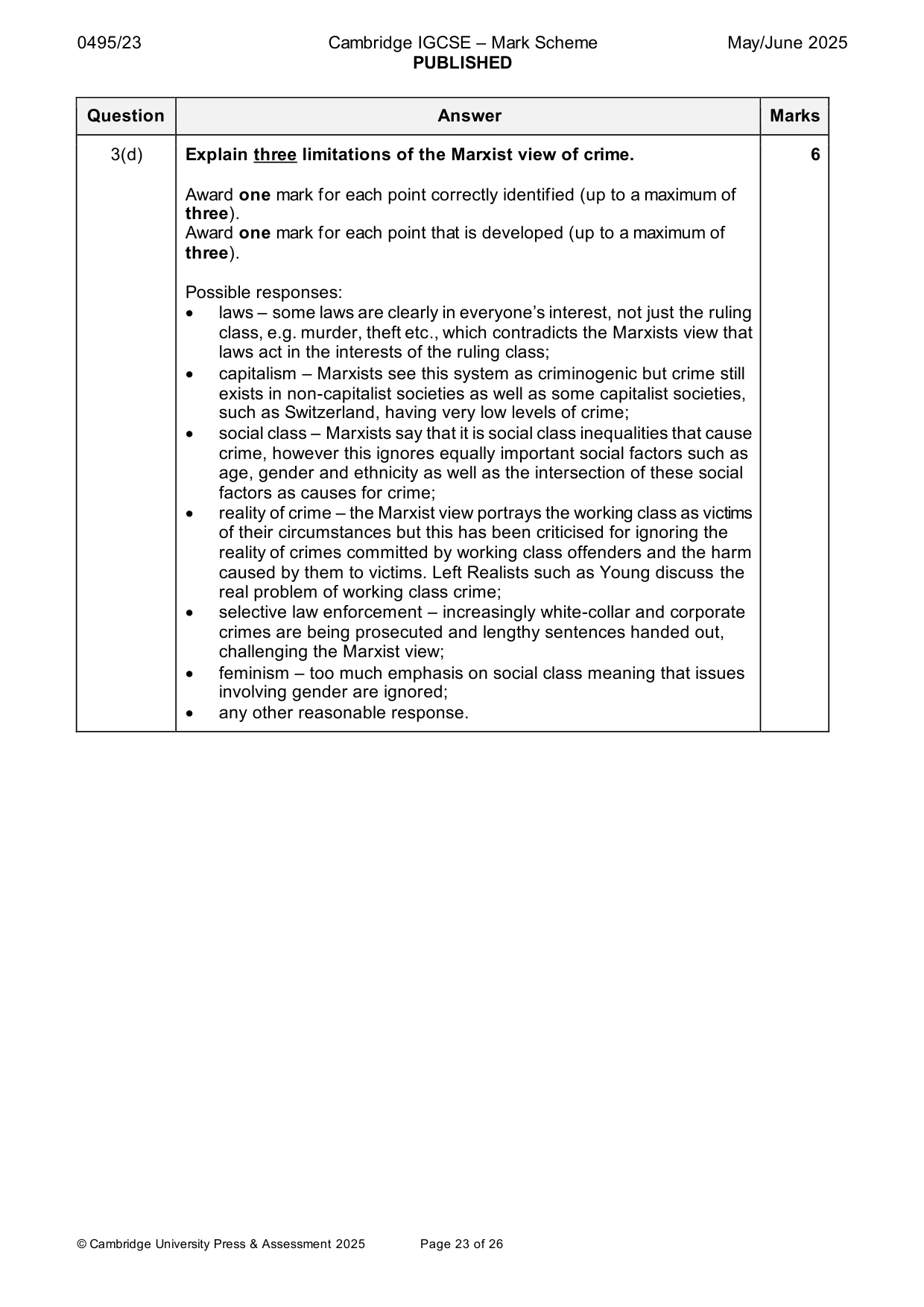
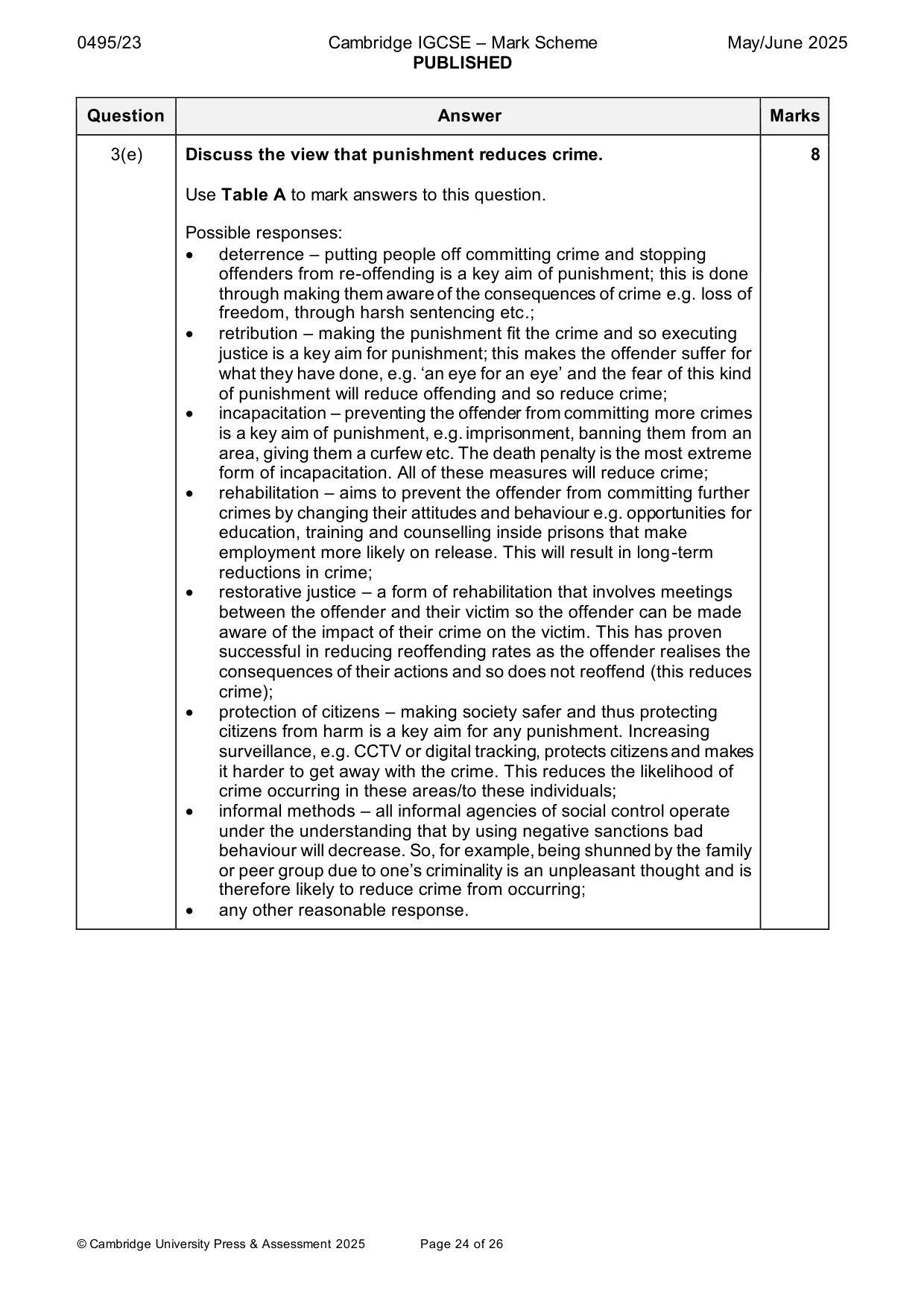
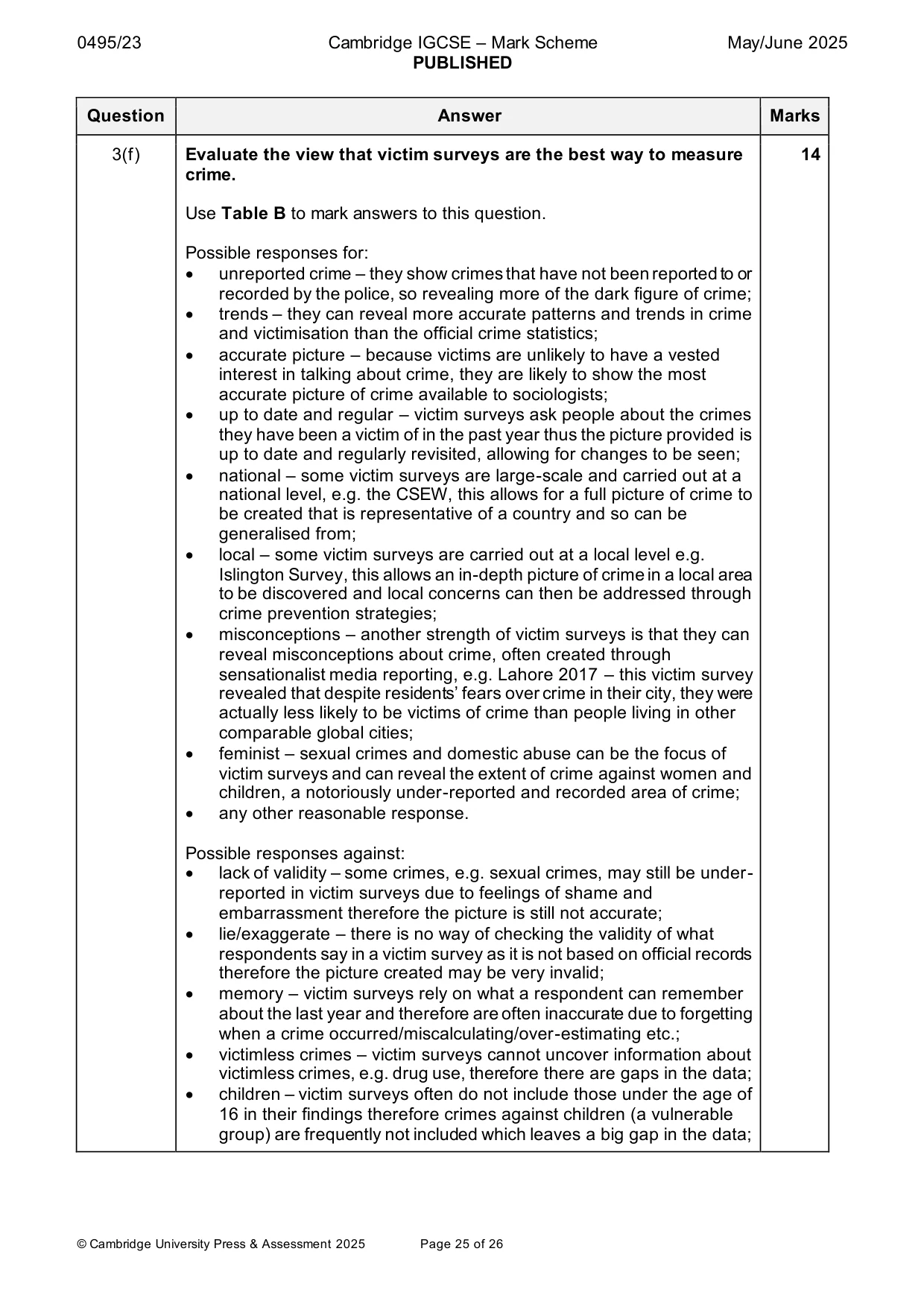
Mark scheme: 3(a)(i) Define the term police targeting. 2 Award one mark for a partial definition, e.g. stop and search. Award two marks for a clear definition, e.g. when the police focus on a particular group of people, believing that they are more likely to be involved in criminal behaviour than others. 3(a)(ii) Define the term retribution. 2 Award one mark for a partial definition, e.g. taking revenge. Award two marks for a clear definition, e.g. punishments intended as a means of revenge for wrong doing. 3(b) Give two agencies of formal social control. 2 Award one mark for each correct agency (up to a maximum of two). Possible responses: • police; • courts/judiciary/judge/magistrate; • armed forces; • government; • penal system/prison; • any other reasonable response. 3(c) Describe three examples of global crime. 6 Award one mark for each point correctly identified (up to a maximum of three). Award one mark for each point that is developed (up to a maximum of three). Possible responses: • illegal trade by international criminal organisations – drugs and weapon dealing; • people trafficking – the moving and selling of people from low-income countries to wealthier countries for asylum or for work; • sex trafficking – the moving and selling of people, usually females, from low-income countries to wealthier ones for sex work; • selling body organs – the global transportation of human body parts from low-income countries to wealthier ones; • global financial crime – money earned illegally is laundered through legitimate businesses and banks, erasing all traces of the original criminality as the money is moved and ‘cleaned’; • organised global gangs – widespread criminal involvement in organised violent crime from groups such as the Mafia in Italy, the Triads of Hong Kong and the Yakuza of Japan; • animal trafficking – the global trade in protected species of animals and their body parts, e.g. elephant tusks; • green crime – for example deforestation and illegal logging by Western companies in the Amazon rainforest for financial gain and profit; • cybercrime – new technologies and the internet allow digital crime to be committed on a global scale, for example drug trafficking, the dark web, internet scams, hacking, cyberterrorism, cyberbullying etc.; • terrorism – acts of terror typically impact globally, e.g. Neo-Nazi global groups, ISIS global groups etc.; • any other reasonable response. 3(d) Explain three limitations of the Marxist view of crime. 6 Award one mark for each point correctly identified (up to a maximum of three). Award one mark for each point that is developed (up to a maximum of three). Possible responses: • laws – some laws are clearly in everyone’s interest, not just the ruling class, e.g. murder, theft etc., which contradicts the Marxists view that laws act in the interests of the ruling class; • capitalism – Marxists see this system as criminogenic but crime still exists in non-capitalist societies as well as some capitalist societies, such as Switzerland, having very low levels of crime; • social class – Marxists say that it is social class inequalities that cause crime, however this ignores equally important social factors such as age, gender and ethnicity as well as the intersection of these social factors as causes for crime; • reality of crime – the Marxist view portrays the working class as victims of their circumstances but this has been criticised for ignoring the reality of crimes committed by working class offenders and the harm caused by them to victims. Left Realists such as Young discuss the real problem of working class crime; • selective law enforcement – increasingly white-collar and corporate crimes are being prosecuted and lengthy sentences handed out, challenging the Marxist view; • feminism – too much emphasis on social class meaning that issues involving gender are ignored; • any other reasonable response. 3(e) Discuss the view that punishment reduces crime. 8 Use Table A to mark answers to this question. Possible responses: • deterrence – putting people off committing crime and stopping offenders from re-offending is a key aim of punishment; this is done through making them aware of the consequences of crime e.g. loss of freedom, through harsh sentencing etc.; • retribution – making the punishment fit the crime and so executing justice is a key aim for punishment; this makes the offender suffer for what they have done, e.g. ‘an eye for an eye’ and the fear of this kind of punishment will reduce offending and so reduce crime; • incapacitation – preventing the offender from committing more crimes is a key aim of punishment, e.g. imprisonment, banning them from an area, giving them a curfew etc. The death penalty is the most extreme form of incapacitation. All of these measures will reduce crime; • rehabilitation – aims to prevent the offender from committing further crimes by changing their attitudes and behaviour e.g. opportunities for education, training and counselling inside prisons that make employment more likely on release. This will result in long-term reductions in crime; • restorative justice – a form of rehabilitation that involves meetings between the offender and their victim so the offender can be made aware of the impact of their crime on the victim. This has proven successful in reducing reoffending rates as the offender realises the consequences of their actions and so does not reoffend (this reduces crime); • protection of citizens – making society safer and thus protecting citizens from harm is a key aim for any punishment. Increasing surveillance, e.g. CCTV or digital tracking, protects citizens and makes it harder to get away with the crime. This reduces the likelihood of crime occurring in these areas/to these individuals; • informal methods – all informal agencies of social control operate under the understanding that by using negative sanctions bad behaviour will decrease. So, for example, being shunned by the family or peer group due to one’s criminality is an unpleasant thought and is therefore likely to reduce crime from occurring; • any other reasonable response. 3(f) Evaluate the view that victim surveys are the best way to measure 14 crime. Use Table B to mark answers to this question. Possible responses for: • unreported crime – they show crimes that have not been reported to or recorded by the police, so revealing more of the dark figure of crime; • trends – they can reveal more accurate patterns and trends in crime and victimisation than the official crime statistics; • accurate picture – because victims are unlikely to have a vested interest in talking about crime, they are likely to show the most accurate picture of crime available to sociologists; • up to date and regular – victim surveys ask people about the crimes they have been a victim of in the past year thus the picture provided is up to date and regularly revisited, allowing for changes to be seen; • national – some victim surveys are large-scale and carried out at a national level, e.g. the CSEW, this allows for a full picture of crime to be created that is representative of a country and so can be generalised from; • local – some victim surveys are carried out at a local level e.g. Islington Survey, this allows an in-depth picture of crime in a local area to be discovered and local concerns can then be addressed through crime prevention strategies; • misconceptions – another strength of victim surveys is that they can reveal misconceptions about crime, often created through sensationalist media reporting, e.g. Lahore 2017 – this victim survey revealed that despite residents’ fears over crime in their city, they were actually less likely to be victims of crime than people living in other comparable global cities; • feminist – sexual crimes and domestic abuse can be the focus of victim surveys and can reveal the extent of crime against women and children, a notoriously under-reported and recorded area of crime; • any other reasonable response. Possible responses against: • lack of validity – some crimes, e.g. sexual crimes, may still be under- reported in victim surveys due to feelings of shame and embarrassment therefore the picture is still not accurate; • lie/exaggerate – there is no way of checking the validity of what respondents say in a victim survey as it is not based on official records therefore the picture created may be very invalid; • memory – victim surveys rely on what a respondent can remember about the last year and therefore are often inaccurate due to forgetting when a crime occurred/miscalculating/over-estimating etc.; • victimless crimes – victim surveys cannot uncover information about victimless crimes, e.g. drug use, therefore there are gaps in the data; • children – victim surveys often do not include those under the age of 16 in their findings therefore crimes against children (a vulnerable group) are frequently not included which leaves a big gap in the data; 3(f) • awareness of crime – not everyone is aware that they have been a victim of crime and therefore they will not report this crime in their responses, e.g. victims of fraud, hacking, identity theft etc. are often unaware that they have been a victim; • local/feminist surveys – these often use a small sample in a local area and therefore cannot claim to be as representative as the official crime statistics. This means they cannot be generalised from; • any other reasonable response.
What was in this paper
The subtopics covered by these 3 questions, and how many questions each got. Open one in a new tab to see every Cambridge question on it.
What you needed in this session
Cambridge’s own grade thresholds for 2025 May/June, Paper 2 · Variant 3. A higher threshold means an easier paper — the bar moves with how the cohort did.