Cambridge IGCSE Sociology 0495 — 2023 May/June Paper 2 · Variant 3
0495/23/M/J/23 · 4 questions · 70 marks · ≈79 min
The question paper and its mark scheme, free to read here and free to download. This is Cambridge’s own paper, exactly as it was sat.
Question paper4 pages
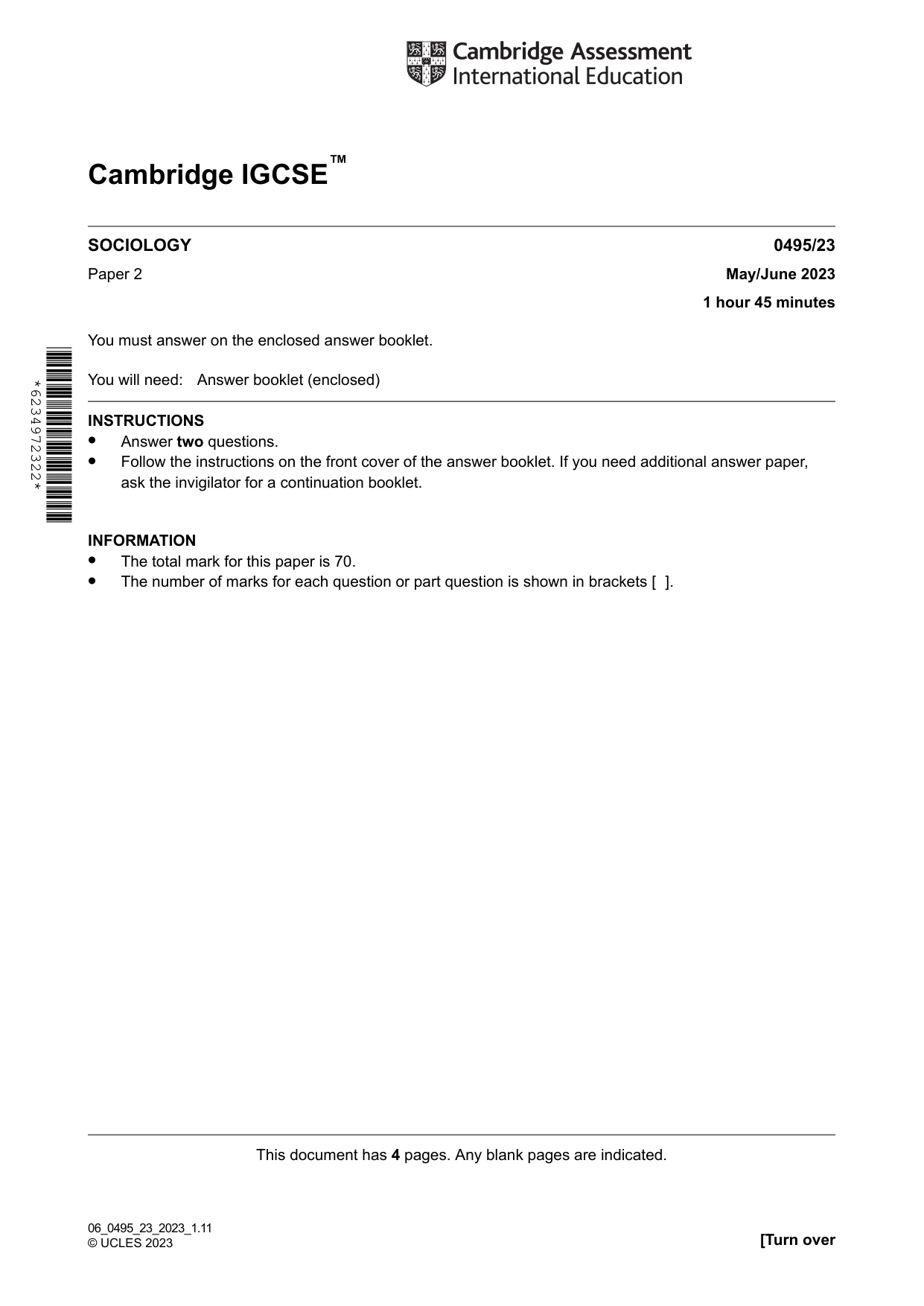

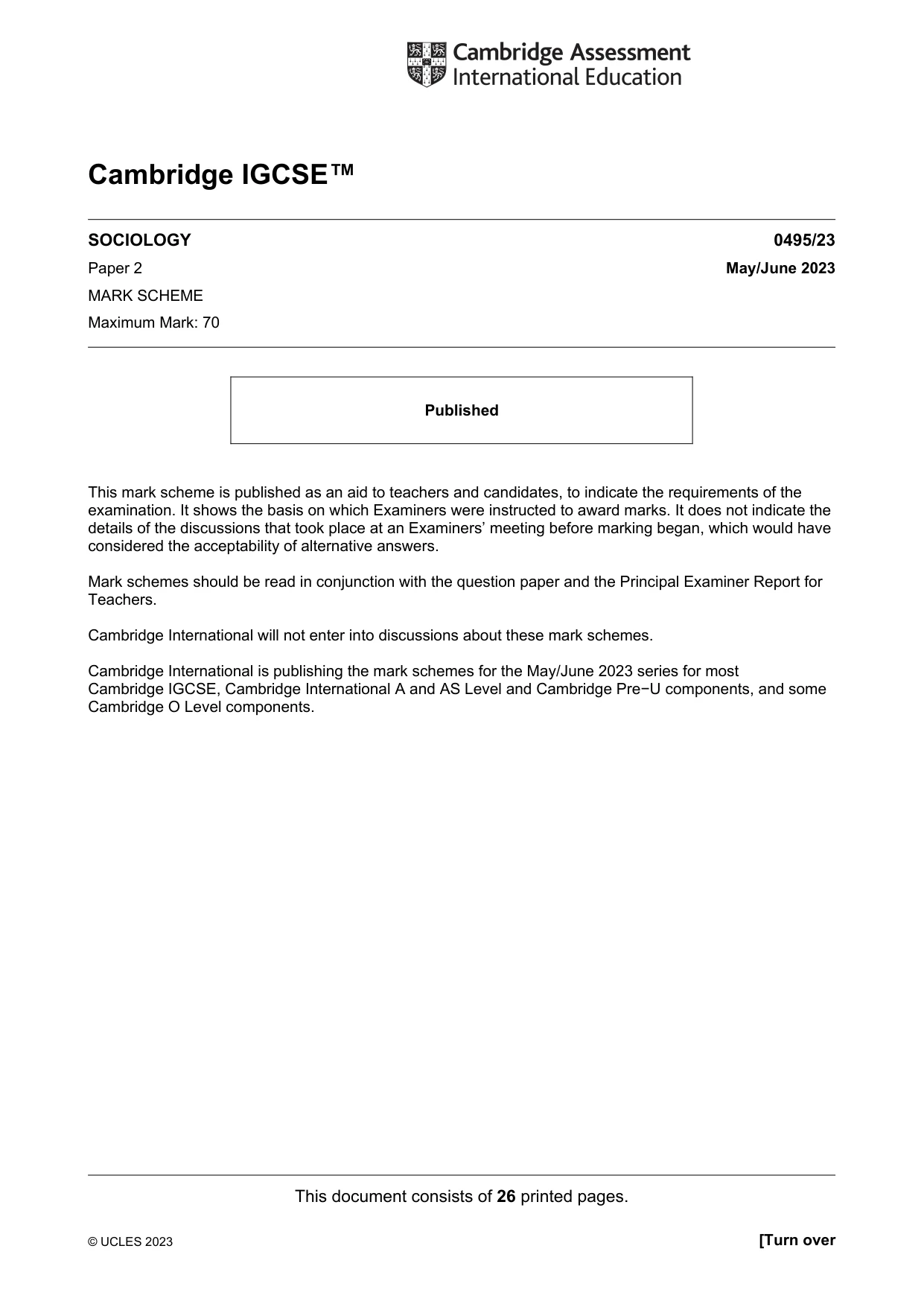
Mark scheme26 pages
Answers below. Sit the paper first if you are practising.



Questions as text
Q1 · The family has many important functions and is essential for teaching norms and values to…
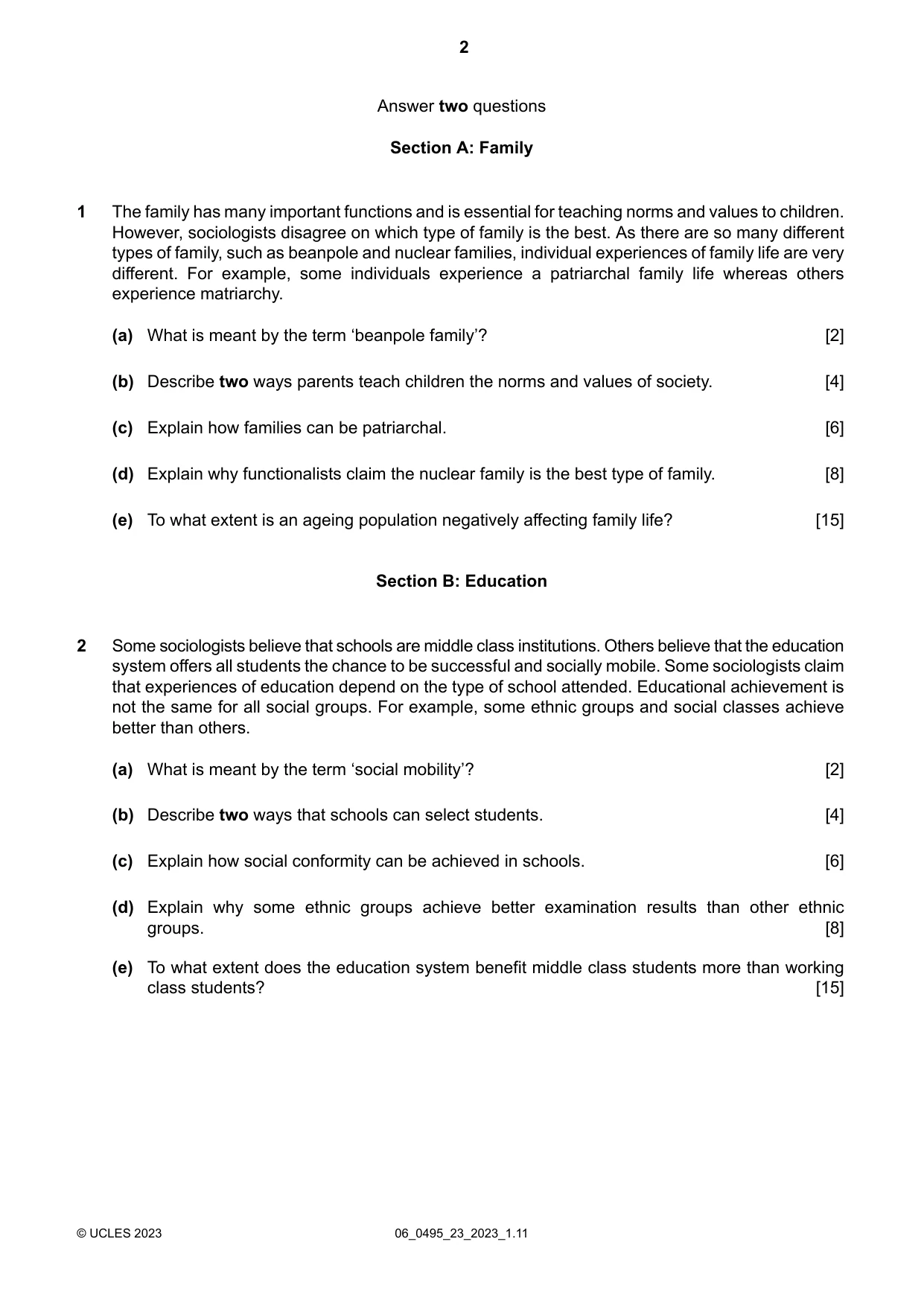
1 The family has many important functions and is essential for teaching norms and values to children. However, sociologists disagree on which type of family is the best. As there are so many different types of family, such as beanpole and nuclear families, individual experiences of family life are very different. For example, some individuals experience a patriarchal family life whereas others experience matriarchy. (a) What is meant by the term ‘beanpole family’? [2] (b) Describe two ways parents teach children the norms and values of society. [4] (c) Explain how families can be patriarchal. [6] (d) Explain why functionalists claim the nuclear family is the best type of family. [8] (e) To what extent is an ageing population negatively affecting family life? [15]
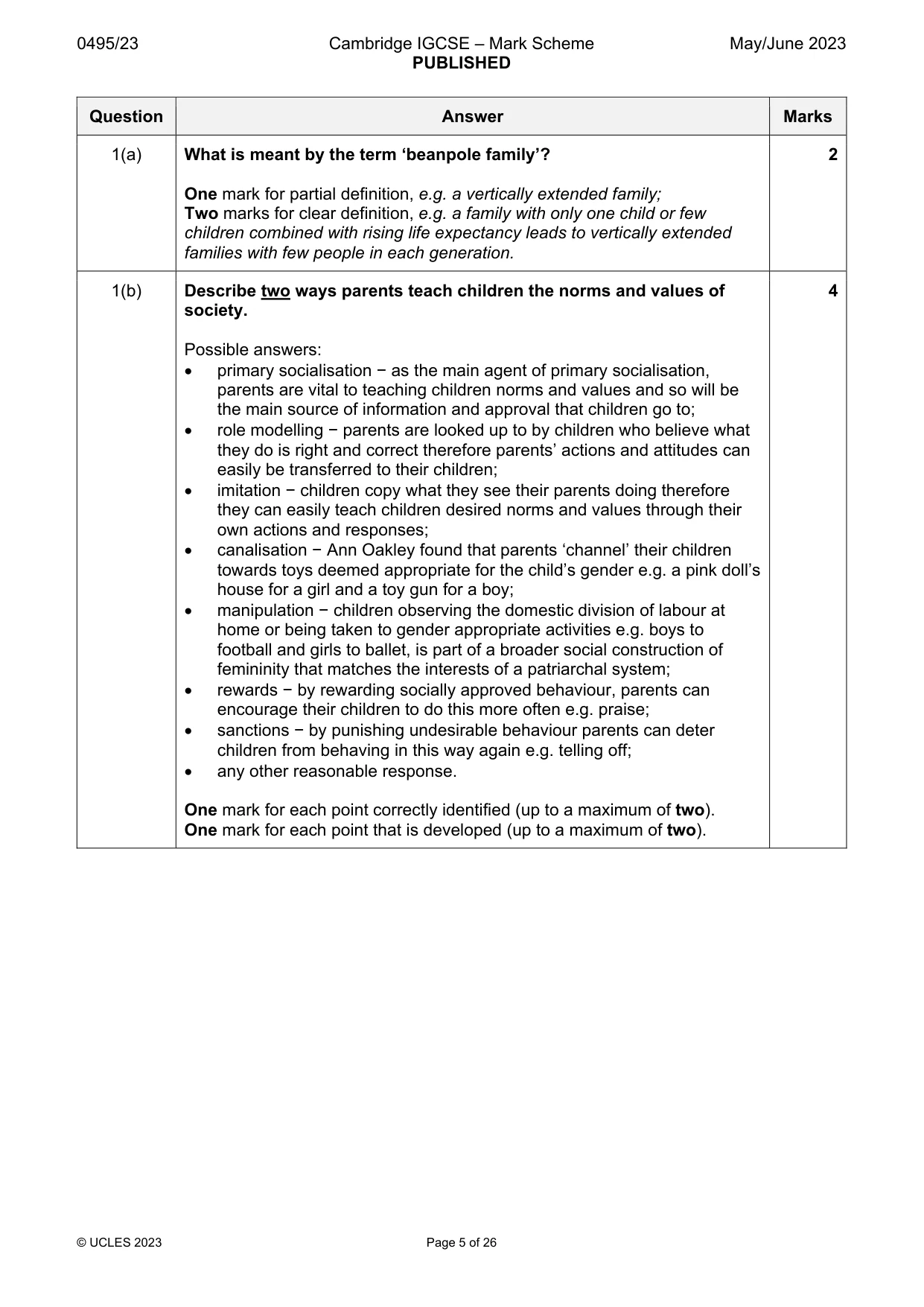
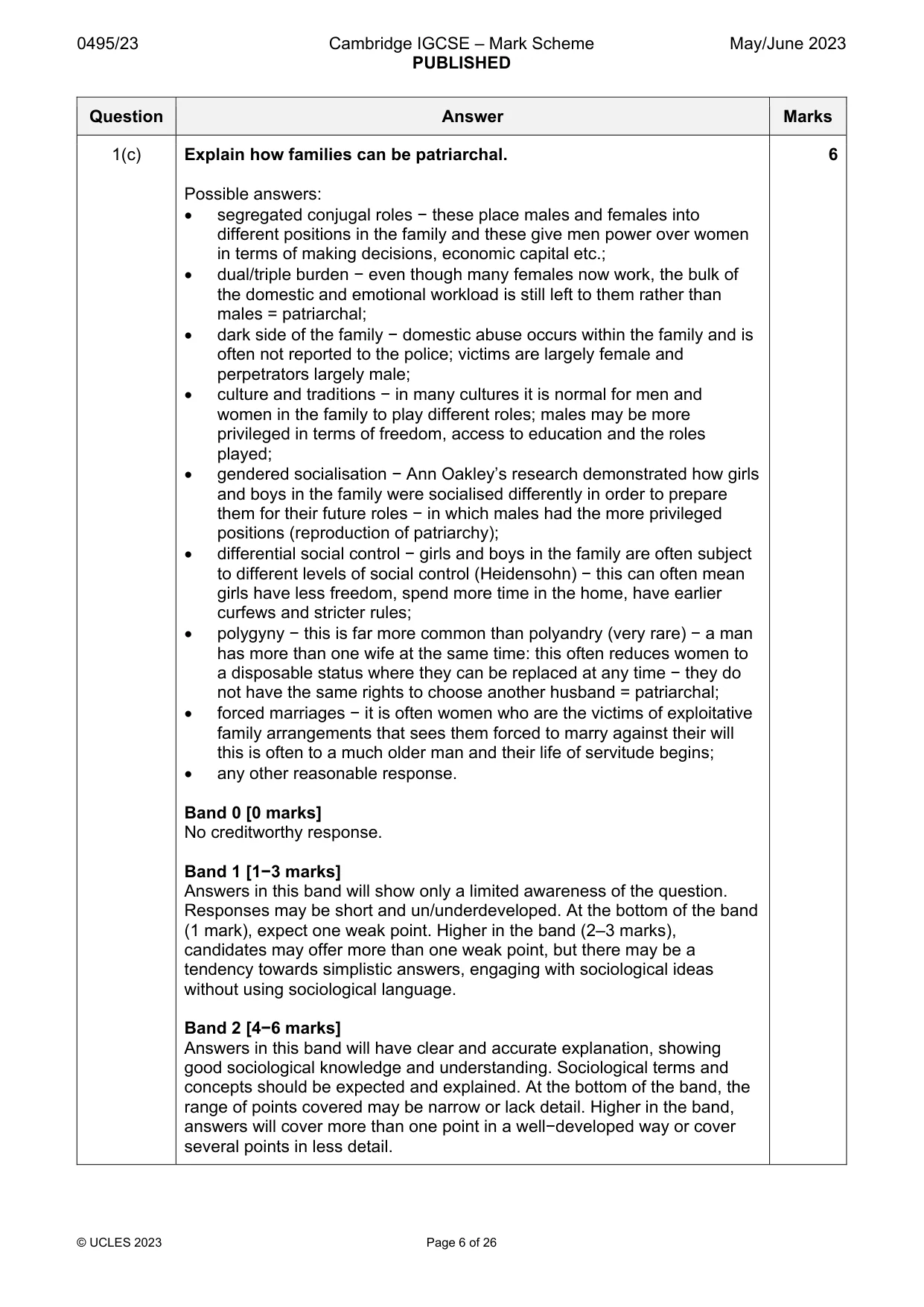
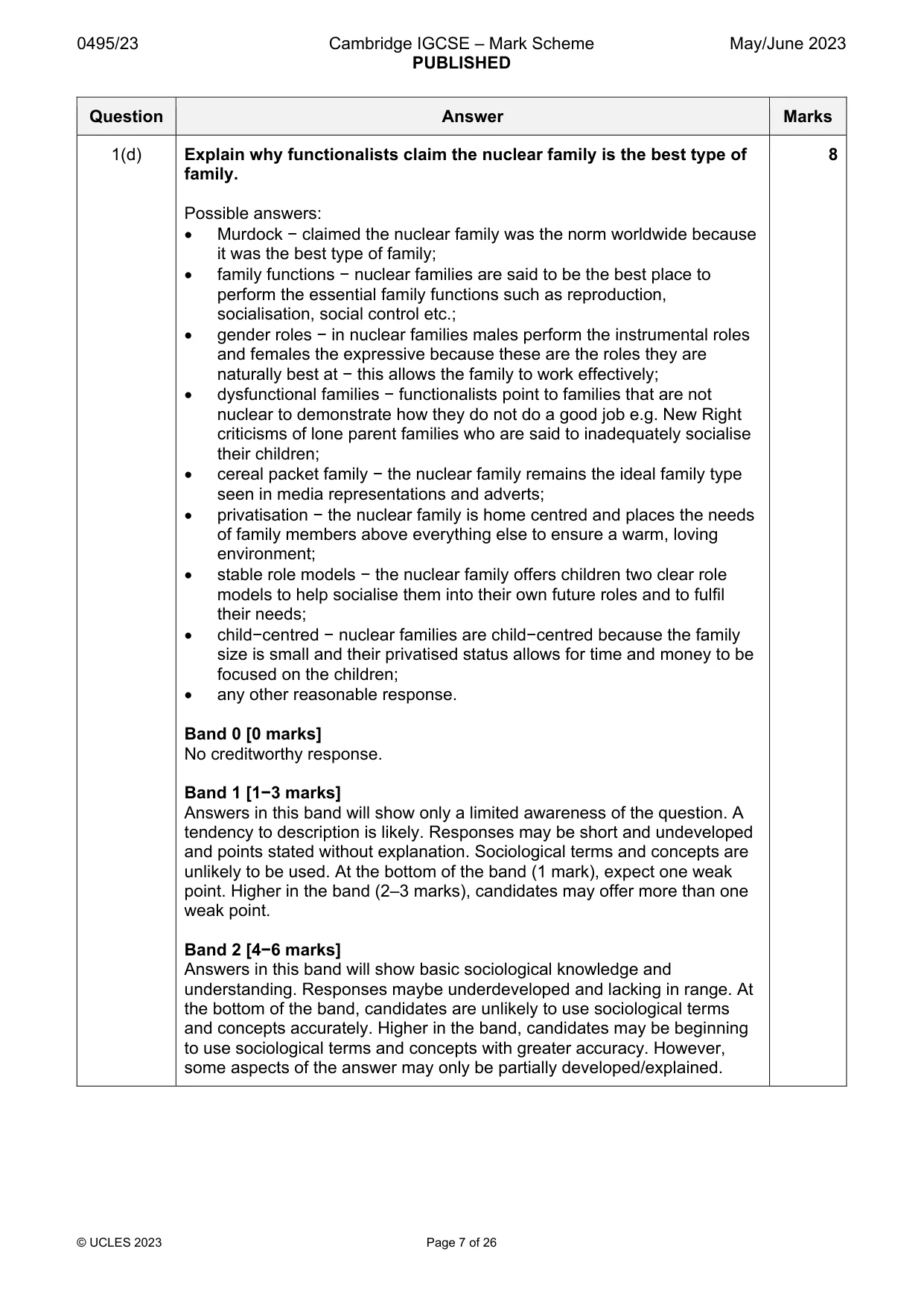
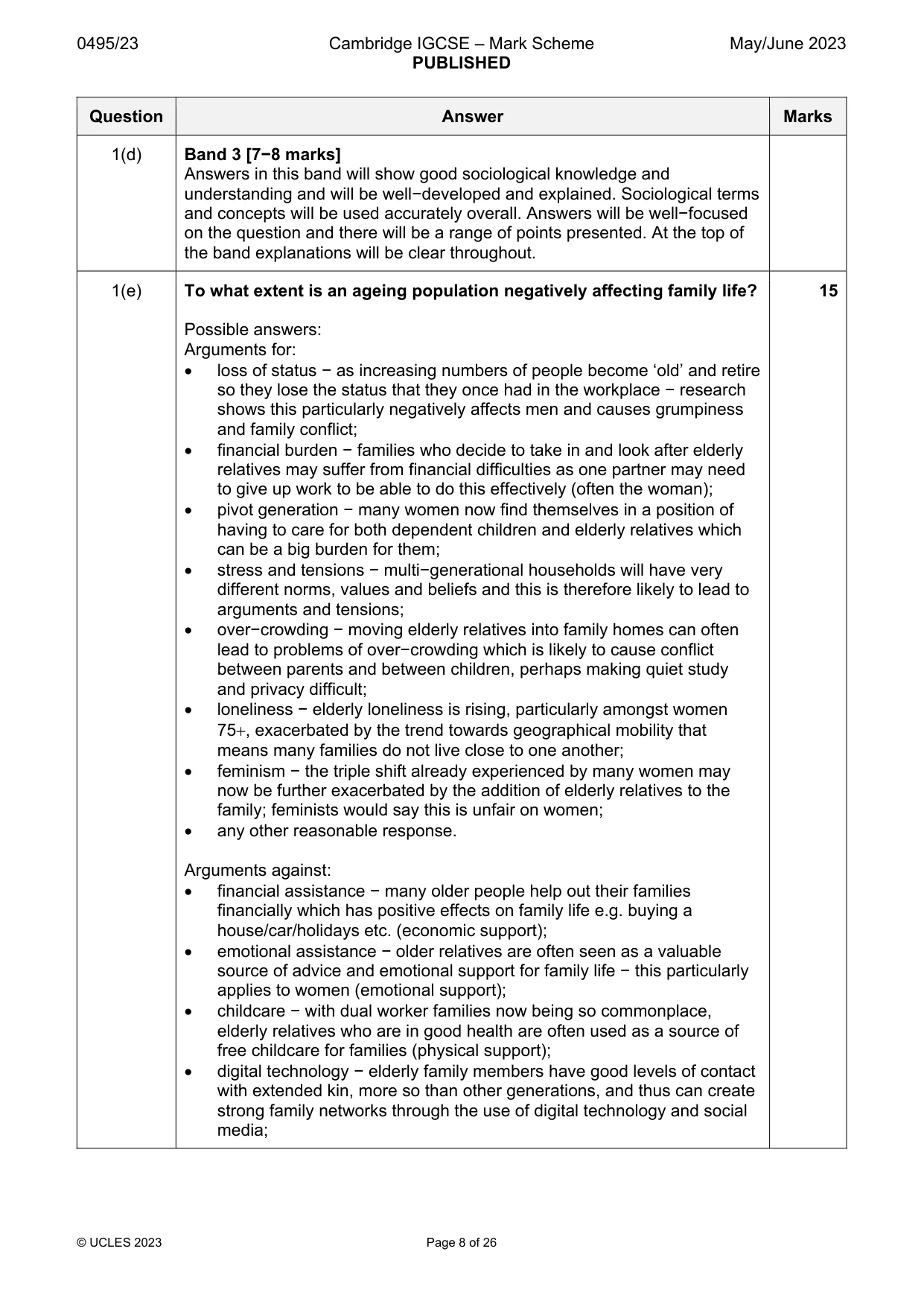
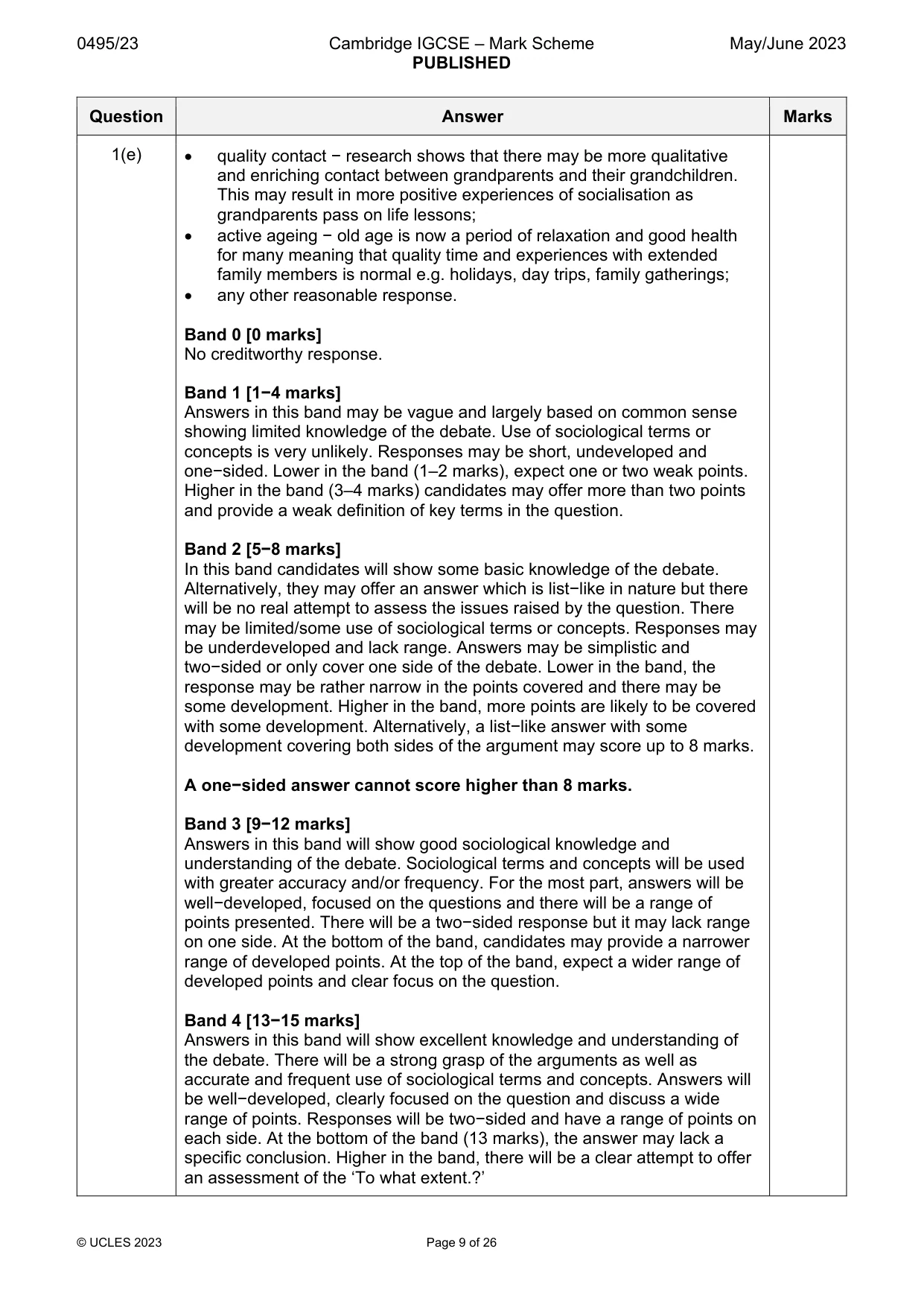
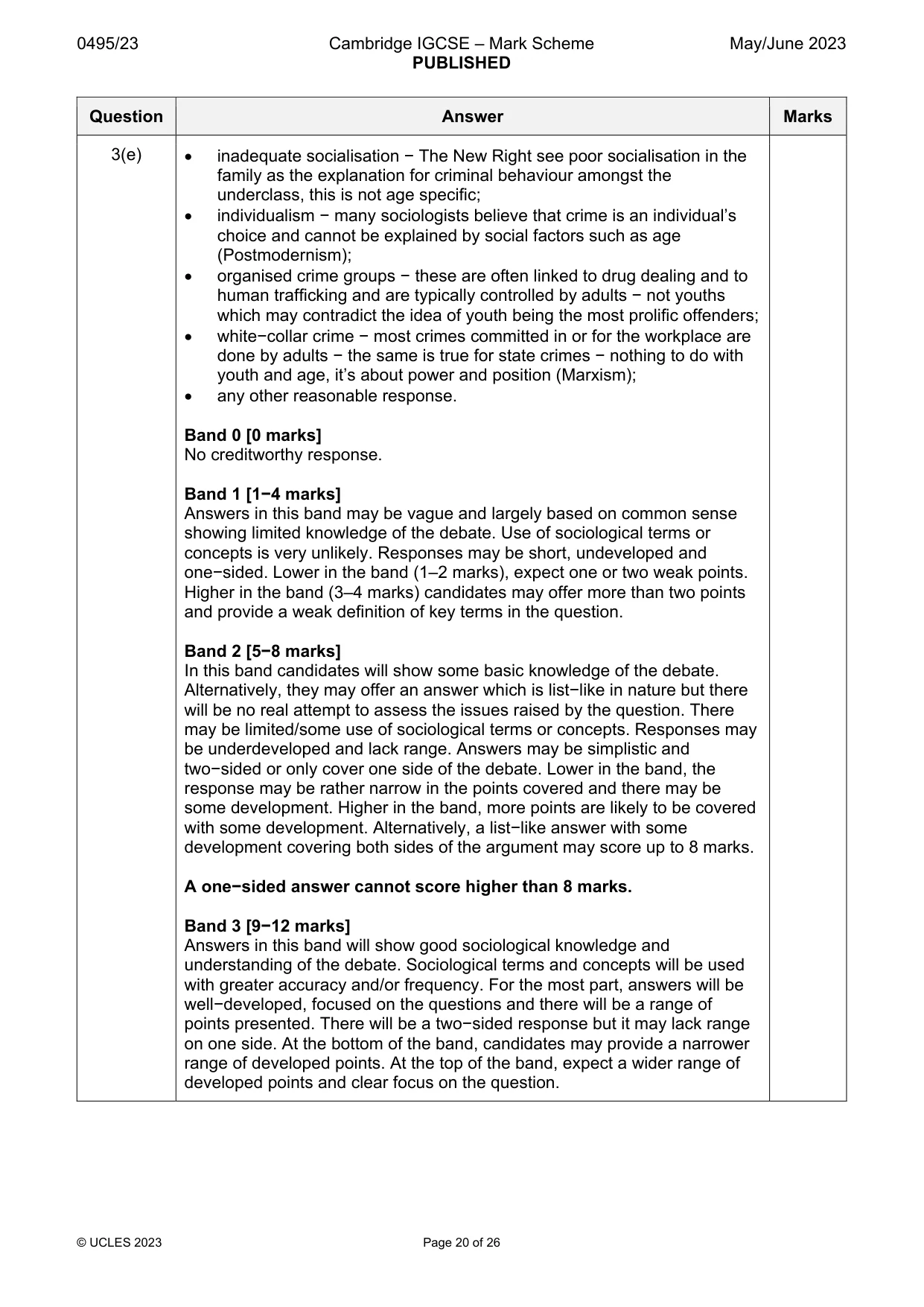
Mark scheme: Question Answer Marks 1(a) What is meant by the term ‘beanpole family’? 2 One mark for partial definition, e.g. a vertically extended family; Two marks for clear definition, e.g. a family with only one child or few children combined with rising life expectancy leads to vertically extended families with few people in each generation. 1(b) Describe two ways parents teach children the norms and values of 4 society. Possible answers: primary socialisation − as the main agent of primary socialisation, parents are vital to teaching children norms and values and so will be the main source of information and approval that children go to; role modelling − parents are looked up to by children who believe what they do is right and correct therefore parents’ actions and attitudes can easily be transferred to their children; imitation − children copy what they see their parents doing therefore they can easily teach children desired norms and values through their own actions and responses; canalisation − Ann Oakley found that parents ‘channel’ their children towards toys deemed appropriate for the child’s gender e.g. a pink doll’s house for a girl and a toy gun for a boy; manipulation − children observing the domestic division of labour at home or being taken to gender appropriate activities e.g. boys to football and girls to ballet, is part of a broader social construction of femininity that matches the interests of a patriarchal system; rewards − by rewarding socially approved behaviour, parents can encourage their children to do this more often e.g. praise; sanctions − by punishing undesirable behaviour parents can deter children from behaving in this way again e.g. telling off; any other reasonable response. One mark for each point correctly identified (up to a maximum of two). One mark for each point that is developed (up to a maximum of two). 1(c) Explain how families can be patriarchal. 6 Possible answers: segregated conjugal roles − these place males and females into different positions in the family and these give men power over women in terms of making decisions, economic capital etc.; dual/triple burden − even though many females now work, the bulk of the domestic and emotional workload is still left to them rather than males = patriarchal; dark side of the family − domestic abuse occurs within the family and is often not reported to the police; victims are largely female and perpetrators largely male; culture and traditions − in many cultures it is normal for men and women in the family to play different roles; males may be more privileged in terms of freedom, access to education and the roles played; gendered socialisation − Ann Oakley’s research demonstrated how girls and boys in the family were socialised differently in order to prepare them for their future roles − in which males had the more privileged positions (reproduction of patriarchy); differential social control − girls and boys in the family are often subject to different levels of social control (Heidensohn) − this can often mean girls have less freedom, spend more time in the home, have earlier curfews and stricter rules; polygyny − this is far more common than polyandry (very rare) − a man has more than one wife at the same time: this often reduces women to a disposable status where they can be replaced at any time − they do not have the same rights to choose another husband = patriarchal; forced marriages − it is often women who are the victims of exploitative family arrangements that sees them forced to marry against their will this is often to a much older man and their life of servitude begins; any other reasonable response. Band 0 [0 marks] No creditworthy response. Band 1 [1−3 marks] Answers in this band will show only a limited awareness of the question. Responses may be short and un/underdeveloped. At the bottom of the band (1 mark), expect one weak point. Higher in the band (2–3 marks), candidates may offer more than one weak point, but there may be a tendency towards simplistic answers, engaging with sociological ideas without using sociological language. Band 2 [4−6 marks] Answers in this band will have clear and accurate explanation, showing good sociological knowledge and understanding. Sociological terms and concepts should be expected and explained. At the bottom of the band, the range of points covered may be narrow or lack detail. Higher in the band, answers will cover more than one point in a well−developed way or cover several points in less detail. 1(d) Explain why functionalists claim the nuclear family is the best type of 8 family. Possible answers: Murdock − claimed the nuclear family was the norm worldwide because it was the best type of family; family functions − nuclear families are said to be the best place to perform the essential family functions such as reproduction, socialisation, social control etc.; gender roles − in nuclear families males perform the instrumental roles and females the expressive because these are the roles they are naturally best at − this allows the family to work effectively; dysfunctional families − functionalists point to families that are not nuclear to demonstrate how they do not do a good job e.g. New Right criticisms of lone parent families who are said to inadequately socialise their children; cereal packet family − the nuclear family remains the ideal family type seen in media representations and adverts; privatisation − the nuclear family is home centred and places the needs of family members above everything else to ensure a warm, loving environment; stable role models − the nuclear family offers children two clear role models to help socialise them into their own future roles and to fulfil their needs; child−centred − nuclear families are child−centred because the family size is small and their privatised status allows for time and money to be focused on the children; any other reasonable response. Band 0 [0 marks] No creditworthy response. Band 1 [1−3 marks] Answers in this band will show only a limited awareness of the question. A tendency to description is likely. Responses may be short and undeveloped and points stated without explanation. Sociological terms and concepts are unlikely to be used. At the bottom of the band (1 mark), expect one weak point. Higher in the band (2–3 marks), candidates may offer more than one weak point. Band 2 [4−6 marks] Answers in this band will show basic sociological knowledge and understanding. Responses maybe underdeveloped and lacking in range. At the bottom of the band, candidates are unlikely to use sociological terms and concepts accurately. Higher in the band, candidates may be beginning to use sociological terms and concepts with greater accuracy. However, some aspects of the answer may only be partially developed/explained. 1(d) Band 3 [7−8 marks] Answers in this band will show good sociological knowledge and understanding and will be well−developed and explained. Sociological terms and concepts will be used accurately overall. Answers will be well−focused on the question and there will be a range of points presented. At the top of the band explanations will be clear throughout. 1(e) To what extent is an ageing population negatively affecting family life? 15 Possible answers: Arguments for: loss of status − as increasing numbers of people become ‘old’ and retire so they lose the status that they once had in the workplace − research shows this particularly negatively affects men and causes grumpiness and family conflict; financial burden − families who decide to take in and look after elderly relatives may suffer from financial difficulties as one partner may need to give up work to be able to do this effectively (often the woman); pivot generation − many women now find themselves in a position of having to care for both dependent children and elderly relatives which can be a big burden for them; stress and tensions − multi−generational households will have very different norms, values and beliefs and this is therefore likely to lead to arguments and tensions; over−crowding − moving elderly relatives into family homes can often lead to problems of over−crowding which is likely to cause conflict between parents and between children, perhaps making quiet study and privacy difficult; loneliness − elderly loneliness is rising, particularly amongst women 75, exacerbated by the trend towards geographical mobility that means many families do not live close to one another; feminism − the triple shift already experienced by many women may now be further exacerbated by the addition of elderly relatives to the family; feminists would say this is unfair on women; any other reasonable response. Arguments against: financial assistance − many older people help out their families financially which has positive effects on family life e.g. buying a house/car/holidays etc. (economic support); emotional assistance − older relatives are often seen as a valuable source of advice and emotional support for family life − this particularly applies to women (emotional support); childcare − with dual worker families now being so commonplace, elderly relatives who are in good health are often used as a source of free childcare for families (physical support); digital technology − elderly family members have good levels of contact with extended kin, more so than other generations, and thus can create strong family networks through the use of digital technology and social media; 1(e) quality contact − research shows that there may be more qualitative and enriching contact between grandparents and their grandchildren. This may result in more positive experiences of socialisation as grandparents pass on life lessons; active ageing − old age is now a period of relaxation and good health for many meaning that quality time and experiences with extended family members is normal e.g. holidays, day trips, family gatherings; any other reasonable response. Band 0 [0 marks] No creditworthy response. Band 1 [1−4 marks] Answers in this band may be vague and largely based on common sense showing limited knowledge of the debate. Use of sociological terms or concepts is very unlikely. Responses may be short, undeveloped and one−sided. Lower in the band (1–2 marks), expect one or two weak points. Higher in the band (3–4 marks) candidates may offer more than two points and provide a weak definition of key terms in the question. Band 2 [5−8 marks] In this band candidates will show some basic knowledge of the debate. Alternatively, they may offer an answer which is list−like in nature but there will be no real attempt to assess the issues raised by the question. There may be limited/some use of sociological terms or concepts. Responses may be underdeveloped and lack range. Answers may be simplistic and two−sided or only cover one side of the debate. Lower in the band, the response may be rather narrow in the points covered and there may be some development. Higher in the band, more points are likely to be covered with some development. Alternatively, a list−like answer with some development covering both sides of the argument may score up to 8 marks. A one−sided answer cannot score higher than 8 marks. Band 3 [9−12 marks] Answers in this band will show good sociological knowledge and understanding of the debate. Sociological terms and concepts will be used with greater accuracy and/or frequency. For the most part, answers will be well−developed, focused on the questions and there will be a range of points presented. There will be a two−sided response but it may lack range on one side. At the bottom of the band, candidates may provide a narrower range of developed points. At the top of the band, expect a wider range of developed points and clear focus on the question. Band 4 [13−15 marks] Answers in this band will show excellent knowledge and understanding of the debate. There will be a strong grasp of the arguments as well as accurate and frequent use of sociological terms and concepts. Answers will be well−developed, clearly focused on the question and discuss a wide range of points. Responses will be two−sided and have a range of points on each side. At the bottom of the band (13 marks), the answer may lack a specific conclusion. Higher in the band, there will be a clear attempt to offer an assessment of the ‘To what extent.?’
Q2 · Some sociologists believe that schools are middle class institutions
2 Some sociologists believe that schools are middle class institutions. Others believe that the education system offers all students the chance to be successful and socially mobile. Some sociologists claim that experiences of education depend on the type of school attended. Educational achievement is not the same for all social groups. For example, some ethnic groups and social classes achieve better than others. (a) What is meant by the term ‘social mobility’? [2] (b) Describe two ways that schools can select students. [4] (c) Explain how social conformity can be achieved in schools. [6] (d) Explain why some ethnic groups achieve better examination results than other ethnic groups. [8] (e) To what extent does the education system benefit middle class students more than working class students? [15] Section C: Crime, deviance and social control
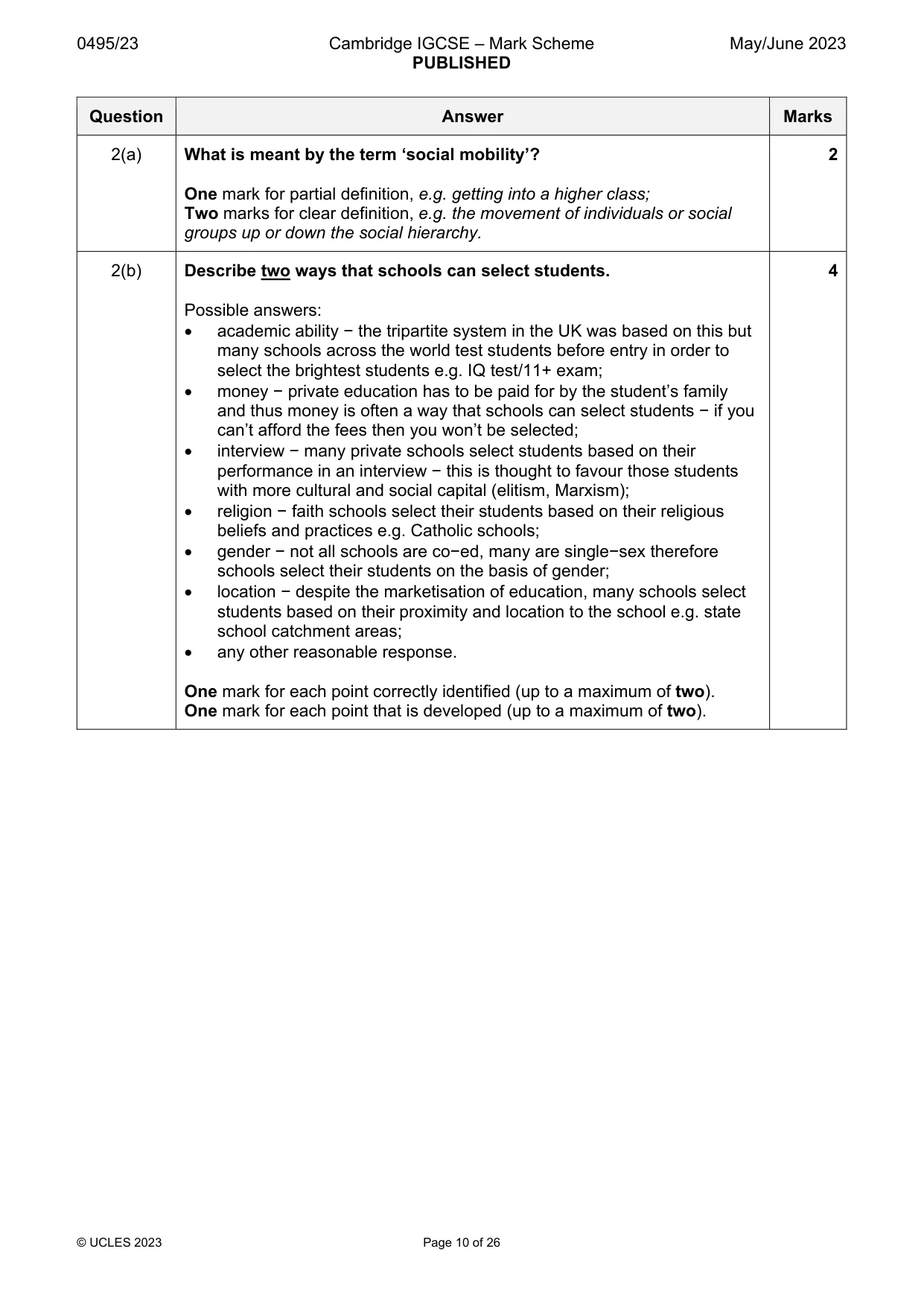
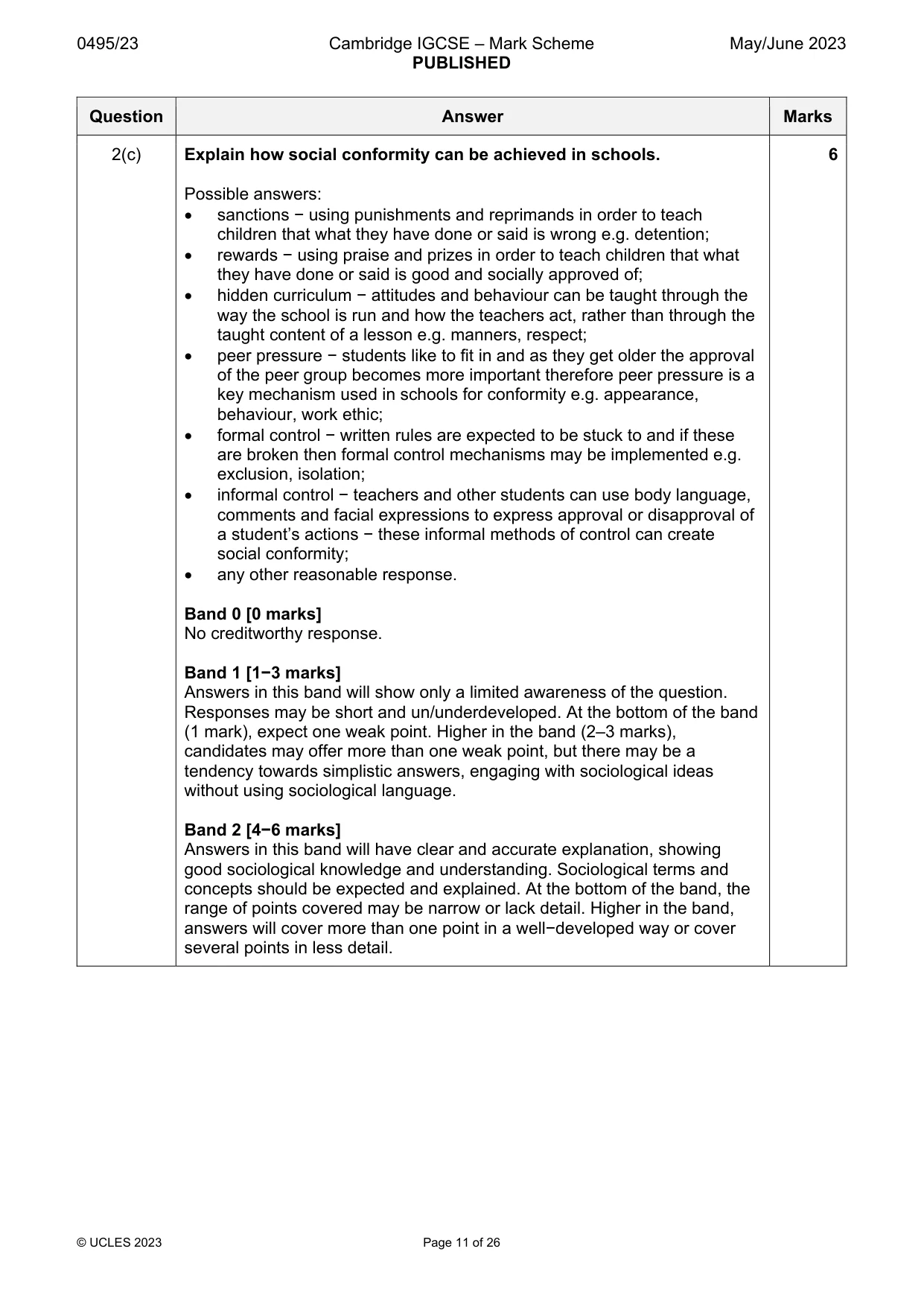
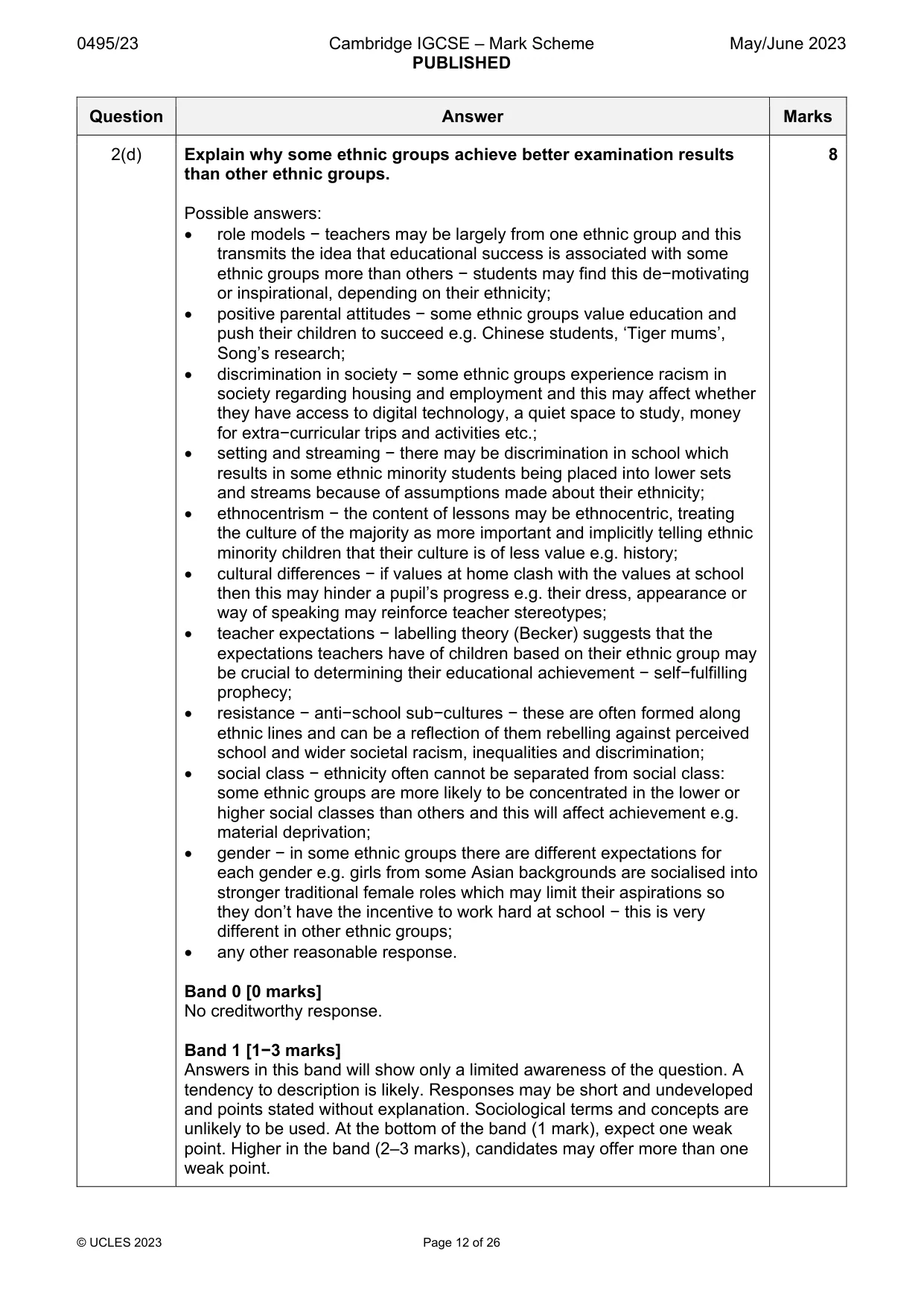
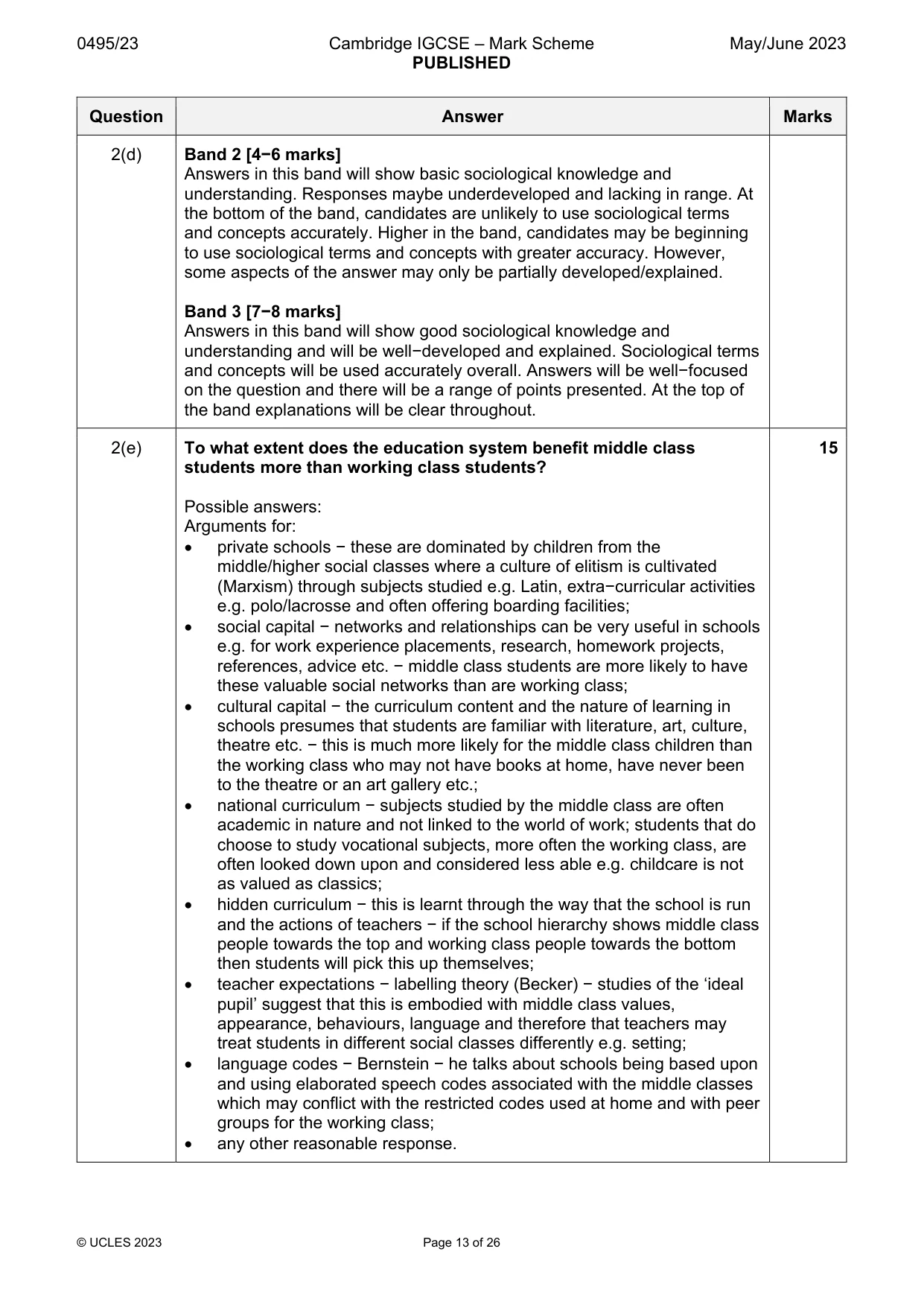
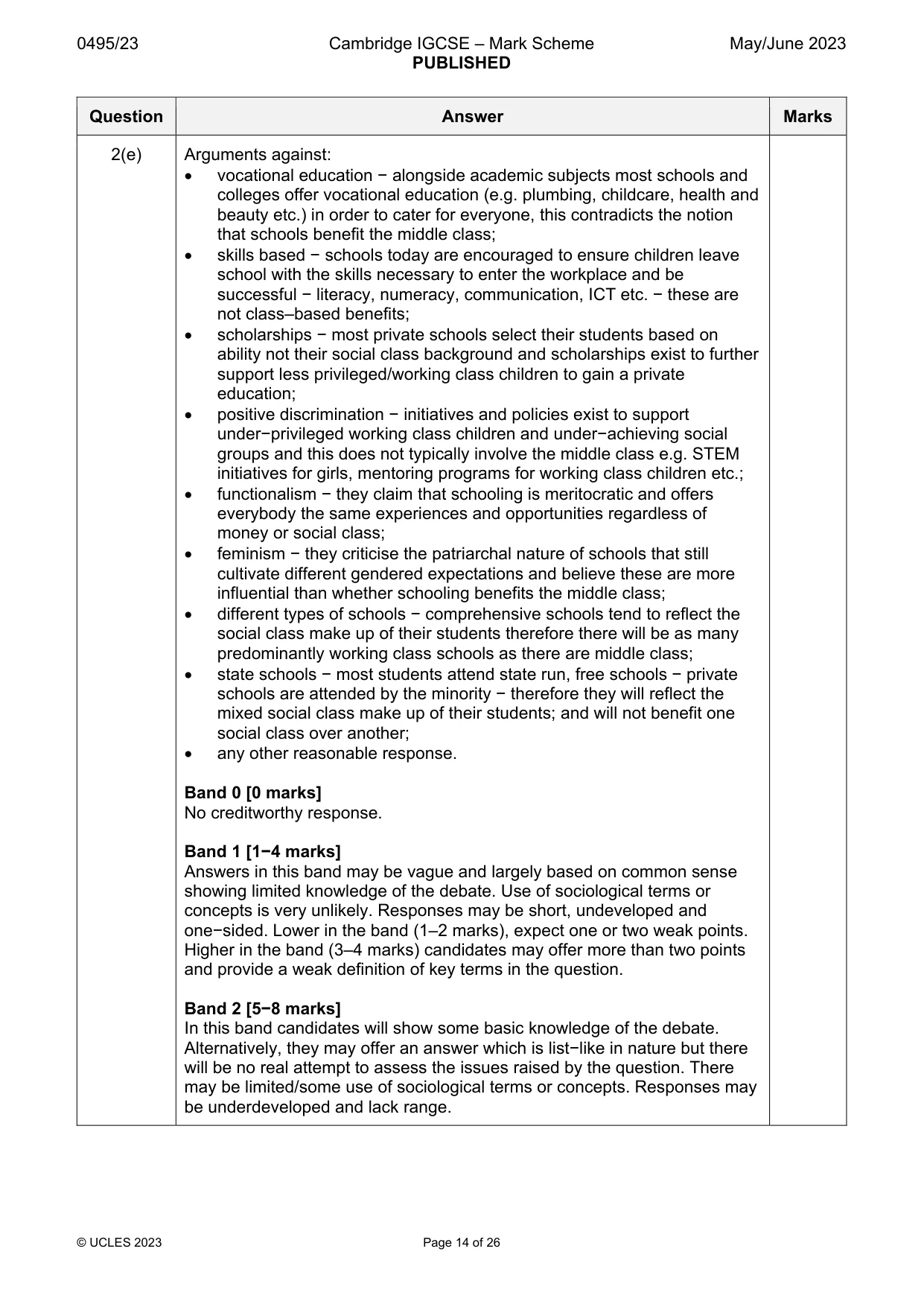
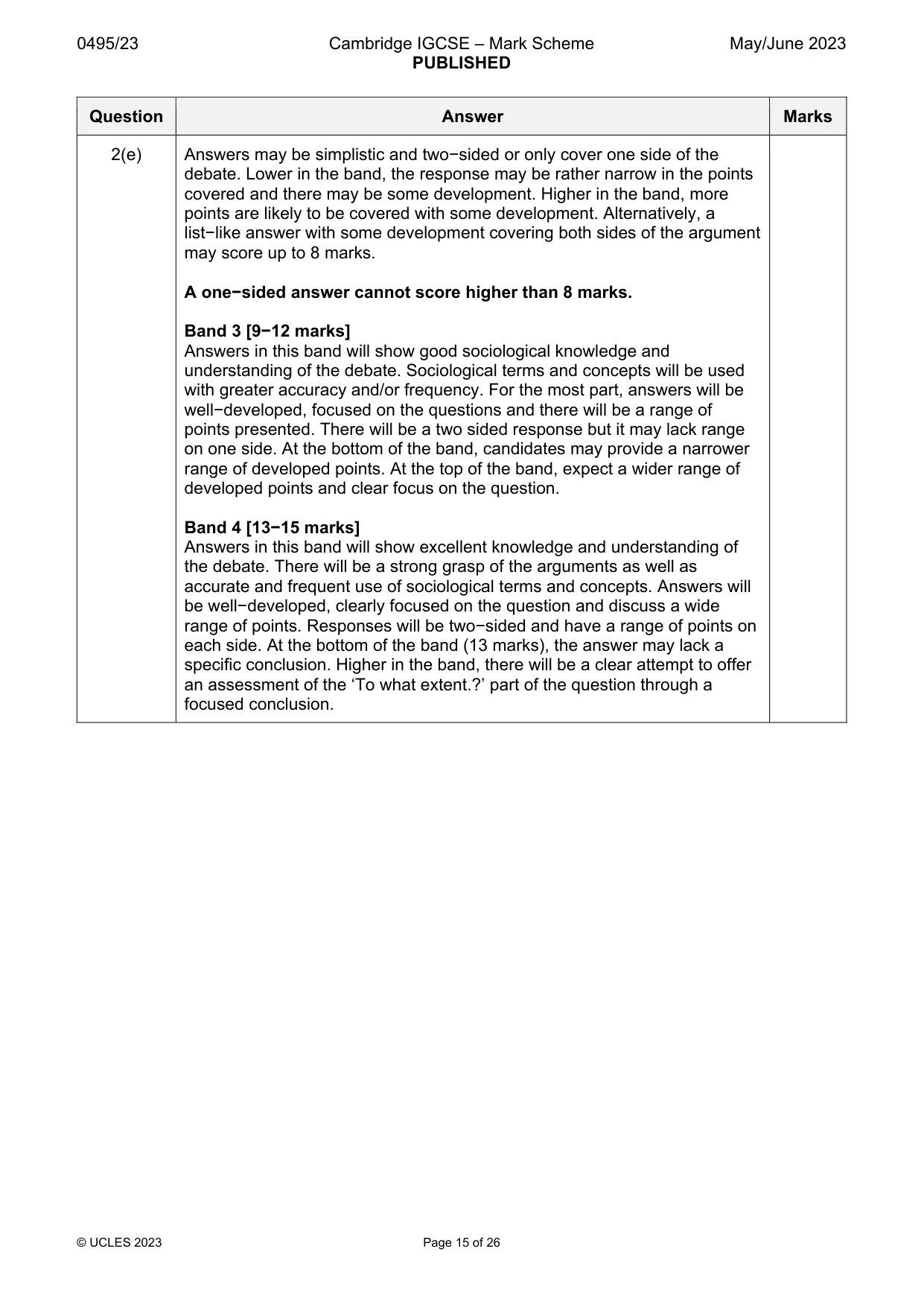
Mark scheme: 2(a) What is meant by the term ‘social mobility’? 2 One mark for partial definition, e.g. getting into a higher class; Two marks for clear definition, e.g. the movement of individuals or social groups up or down the social hierarchy. 2(b) Describe two ways that schools can select students. 4 Possible answers: academic ability − the tripartite system in the UK was based on this but many schools across the world test students before entry in order to select the brightest students e.g. IQ test/11+ exam; money − private education has to be paid for by the student’s family and thus money is often a way that schools can select students − if you can’t afford the fees then you won’t be selected; interview − many private schools select students based on their performance in an interview − this is thought to favour those students with more cultural and social capital (elitism, Marxism); religion − faith schools select their students based on their religious beliefs and practices e.g. Catholic schools; gender − not all schools are co−ed, many are single−sex therefore schools select their students on the basis of gender; location − despite the marketisation of education, many schools select students based on their proximity and location to the school e.g. state school catchment areas; any other reasonable response. One mark for each point correctly identified (up to a maximum of two). One mark for each point that is developed (up to a maximum of two). 2(c) Explain how social conformity can be achieved in schools. 6 Possible answers: sanctions − using punishments and reprimands in order to teach children that what they have done or said is wrong e.g. detention; rewards − using praise and prizes in order to teach children that what they have done or said is good and socially approved of; hidden curriculum − attitudes and behaviour can be taught through the way the school is run and how the teachers act, rather than through the taught content of a lesson e.g. manners, respect; peer pressure − students like to fit in and as they get older the approval of the peer group becomes more important therefore peer pressure is a key mechanism used in schools for conformity e.g. appearance, behaviour, work ethic; formal control − written rules are expected to be stuck to and if these are broken then formal control mechanisms may be implemented e.g. exclusion, isolation; informal control − teachers and other students can use body language, comments and facial expressions to express approval or disapproval of a student’s actions − these informal methods of control can create social conformity; any other reasonable response. Band 0 [0 marks] No creditworthy response. Band 1 [1−3 marks] Answers in this band will show only a limited awareness of the question. Responses may be short and un/underdeveloped. At the bottom of the band (1 mark), expect one weak point. Higher in the band (2–3 marks), candidates may offer more than one weak point, but there may be a tendency towards simplistic answers, engaging with sociological ideas without using sociological language. Band 2 [4−6 marks] Answers in this band will have clear and accurate explanation, showing good sociological knowledge and understanding. Sociological terms and concepts should be expected and explained. At the bottom of the band, the range of points covered may be narrow or lack detail. Higher in the band, answers will cover more than one point in a well−developed way or cover several points in less detail. 2(d) Explain why some ethnic groups achieve better examination results 8 than other ethnic groups. Possible answers: role models − teachers may be largely from one ethnic group and this transmits the idea that educational success is associated with some ethnic groups more than others − students may find this de−motivating or inspirational, depending on their ethnicity; positive parental attitudes − some ethnic groups value education and push their children to succeed e.g. Chinese students, ‘Tiger mums’, Song’s research; discrimination in society − some ethnic groups experience racism in society regarding housing and employment and this may affect whether they have access to digital technology, a quiet space to study, money for extra−curricular trips and activities etc.; setting and streaming − there may be discrimination in school which results in some ethnic minority students being placed into lower sets and streams because of assumptions made about their ethnicity; ethnocentrism − the content of lessons may be ethnocentric, treating the culture of the majority as more important and implicitly telling ethnic minority children that their culture is of less value e.g. history; cultural differences − if values at home clash with the values at school then this may hinder a pupil’s progress e.g. their dress, appearance or way of speaking may reinforce teacher stereotypes; teacher expectations − labelling theory (Becker) suggests that the expectations teachers have of children based on their ethnic group may be crucial to determining their educational achievement − self−fulfilling prophecy; resistance − anti−school sub−cultures − these are often formed along ethnic lines and can be a reflection of them rebelling against perceived school and wider societal racism, inequalities and discrimination; social class − ethnicity often cannot be separated from social class: some ethnic groups are more likely to be concentrated in the lower or higher social classes than others and this will affect achievement e.g. material deprivation; gender − in some ethnic groups there are different expectations for each gender e.g. girls from some Asian backgrounds are socialised into stronger traditional female roles which may limit their aspirations so they don’t have the incentive to work hard at school − this is very different in other ethnic groups; any other reasonable response. Band 0 [0 marks] No creditworthy response. Band 1 [1−3 marks] Answers in this band will show only a limited awareness of the question. A tendency to description is likely. Responses may be short and undeveloped and points stated without explanation. Sociological terms and concepts are unlikely to be used. At the bottom of the band (1 mark), expect one weak point. Higher in the band (2–3 marks), candidates may offer more than one weak point. 2(d) Band 2 [4−6 marks] Answers in this band will show basic sociological knowledge and understanding. Responses maybe underdeveloped and lacking in range. At the bottom of the band, candidates are unlikely to use sociological terms and concepts accurately. Higher in the band, candidates may be beginning to use sociological terms and concepts with greater accuracy. However, some aspects of the answer may only be partially developed/explained. Band 3 [7−8 marks] Answers in this band will show good sociological knowledge and understanding and will be well−developed and explained. Sociological terms and concepts will be used accurately overall. Answers will be well−focused on the question and there will be a range of points presented. At the top of the band explanations will be clear throughout. 2(e) To what extent does the education system benefit middle class 15 students more than working class students? Possible answers: Arguments for: private schools − these are dominated by children from the middle/higher social classes where a culture of elitism is cultivated (Marxism) through subjects studied e.g. Latin, extra−curricular activities e.g. polo/lacrosse and often offering boarding facilities; social capital − networks and relationships can be very useful in schools e.g. for work experience placements, research, homework projects, references, advice etc. − middle class students are more likely to have these valuable social networks than are working class; cultural capital − the curriculum content and the nature of learning in schools presumes that students are familiar with literature, art, culture, theatre etc. − this is much more likely for the middle class children than the working class who may not have books at home, have never been to the theatre or an art gallery etc.; national curriculum − subjects studied by the middle class are often academic in nature and not linked to the world of work; students that do choose to study vocational subjects, more often the working class, are often looked down upon and considered less able e.g. childcare is not as valued as classics; hidden curriculum − this is learnt through the way that the school is run and the actions of teachers − if the school hierarchy shows middle class people towards the top and working class people towards the bottom then students will pick this up themselves; teacher expectations − labelling theory (Becker) − studies of the ‘ideal pupil’ suggest that this is embodied with middle class values, appearance, behaviours, language and therefore that teachers may treat students in different social classes differently e.g. setting; language codes − Bernstein − he talks about schools being based upon and using elaborated speech codes associated with the middle classes which may conflict with the restricted codes used at home and with peer groups for the working class; any other reasonable response. 2(e) Arguments against: vocational education − alongside academic subjects most schools and colleges offer vocational education (e.g. plumbing, childcare, health and beauty etc.) in order to cater for everyone, this contradicts the notion that schools benefit the middle class; skills based − schools today are encouraged to ensure children leave school with the skills necessary to enter the workplace and be successful − literacy, numeracy, communication, ICT etc. − these are not class–based benefits; scholarships − most private schools select their students based on ability not their social class background and scholarships exist to further support less privileged/working class children to gain a private education; positive discrimination − initiatives and policies exist to support under−privileged working class children and under−achieving social groups and this does not typically involve the middle class e.g. STEM initiatives for girls, mentoring programs for working class children etc.; functionalism − they claim that schooling is meritocratic and offers everybody the same experiences and opportunities regardless of money or social class; feminism − they criticise the patriarchal nature of schools that still cultivate different gendered expectations and believe these are more influential than whether schooling benefits the middle class; different types of schools − comprehensive schools tend to reflect the social class make up of their students therefore there will be as many predominantly working class schools as there are middle class; state schools − most students attend state run, free schools − private schools are attended by the minority − therefore they will reflect the mixed social class make up of their students; and will not benefit one social class over another; any other reasonable response. Band 0 [0 marks] No creditworthy response. Band 1 [1−4 marks] Answers in this band may be vague and largely based on common sense showing limited knowledge of the debate. Use of sociological terms or concepts is very unlikely. Responses may be short, undeveloped and one−sided. Lower in the band (1–2 marks), expect one or two weak points. Higher in the band (3–4 marks) candidates may offer more than two points and provide a weak definition of key terms in the question. Band 2 [5−8 marks] In this band candidates will show some basic knowledge of the debate. Alternatively, they may offer an answer which is list−like in nature but there will be no real attempt to assess the issues raised by the question. There may be limited/some use of sociological terms or concepts. Responses may be underdeveloped and lack range. 2(e) Answers may be simplistic and two−sided or only cover one side of the debate. Lower in the band, the response may be rather narrow in the points covered and there may be some development. Higher in the band, more points are likely to be covered with some development. Alternatively, a list−like answer with some development covering both sides of the argument may score up to 8 marks. A one−sided answer cannot score higher than 8 marks. Band 3 [9−12 marks] Answers in this band will show good sociological knowledge and understanding of the debate. Sociological terms and concepts will be used with greater accuracy and/or frequency. For the most part, answers will be well−developed, focused on the questions and there will be a range of points presented. There will be a two sided response but it may lack range on one side. At the bottom of the band, candidates may provide a narrower range of developed points. At the top of the band, expect a wider range of developed points and clear focus on the question. Band 4 [13−15 marks] Answers in this band will show excellent knowledge and understanding of the debate. There will be a strong grasp of the arguments as well as accurate and frequent use of sociological terms and concepts. Answers will be well−developed, clearly focused on the question and discuss a wide range of points. Responses will be two−sided and have a range of points on each side. At the bottom of the band (13 marks), the answer may lack a specific conclusion. Higher in the band, there will be a clear attempt to offer an assessment of the ‘To what extent.?’ part of the question through a focused conclusion.
Q3 · Different measurements of crime show the patterns of who commits crime and the types of…
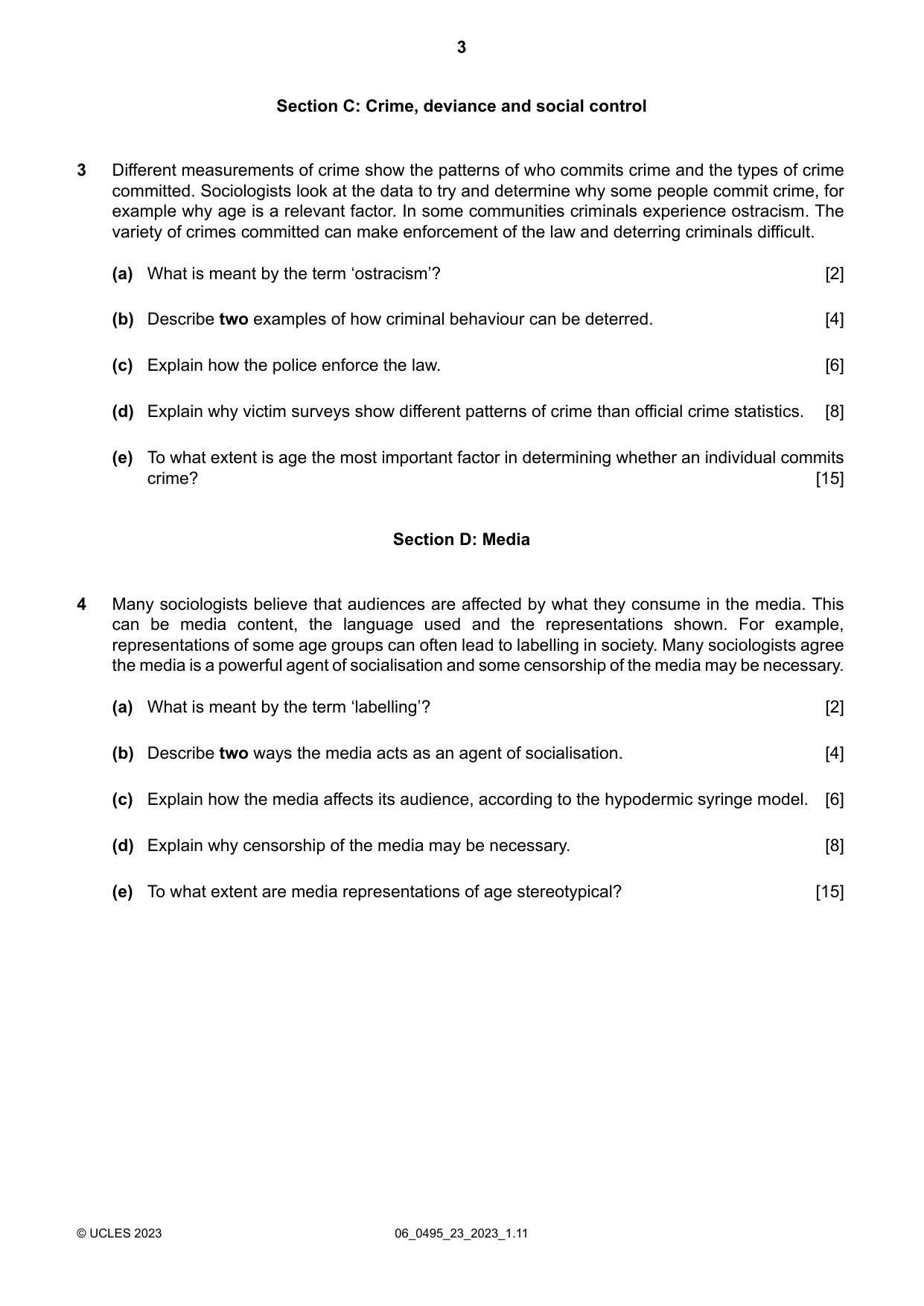
3 Different measurements of crime show the patterns of who commits crime and the types of crime committed. Sociologists look at the data to try and determine why some people commit crime, for example why age is a relevant factor. In some communities criminals experience ostracism. The variety of crimes committed can make enforcement of the law and deterring criminals difficult. (a) What is meant by the term ‘ostracism’? [2] (b) Describe two examples of how criminal behaviour can be deterred. [4] (c) Explain how the police enforce the law. [6] (d) Explain why victim surveys show different patterns of crime than official crime statistics. [8] (e) To what extent is age the most important factor in determining whether an individual commits crime? [15] Section D: Media
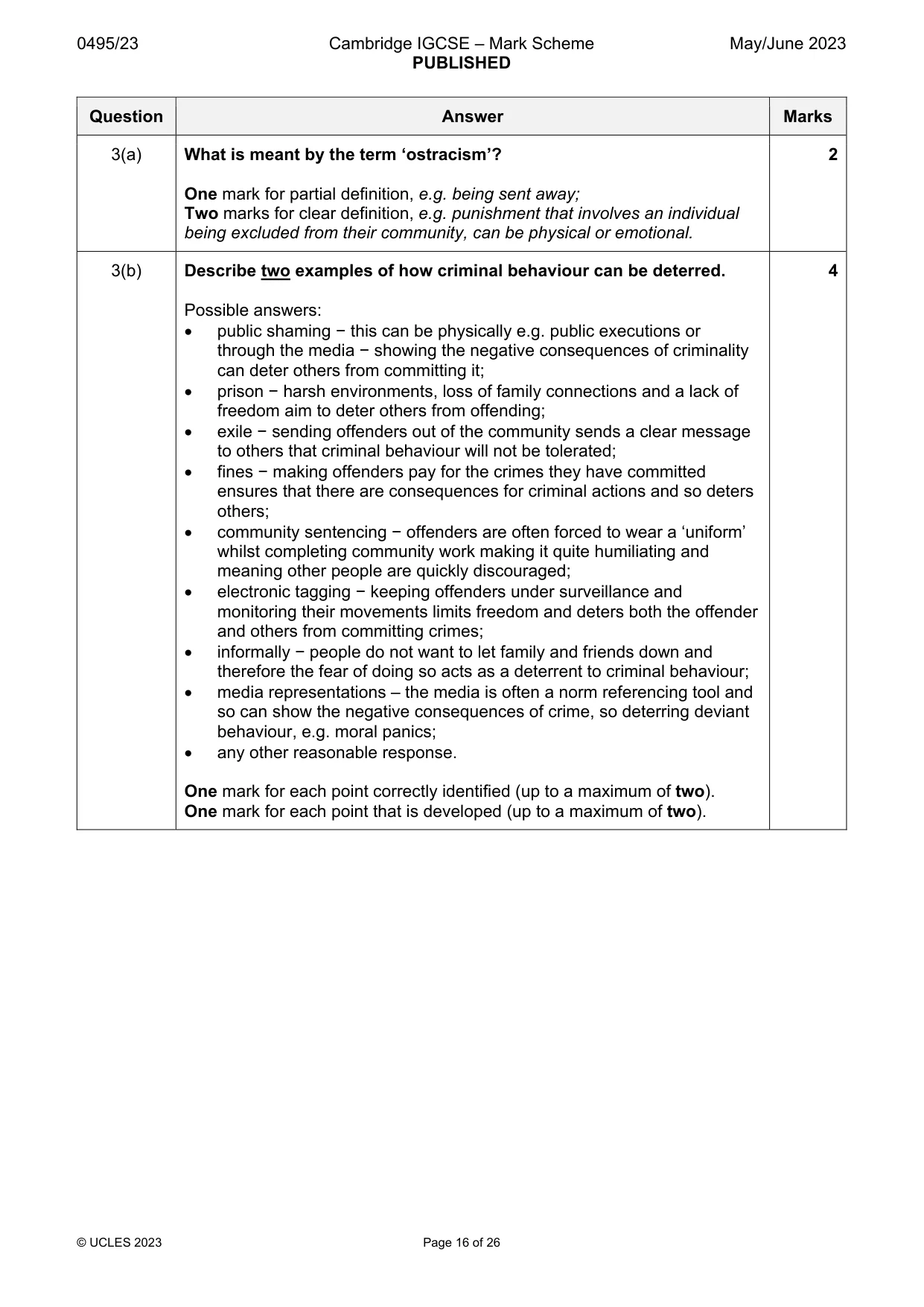
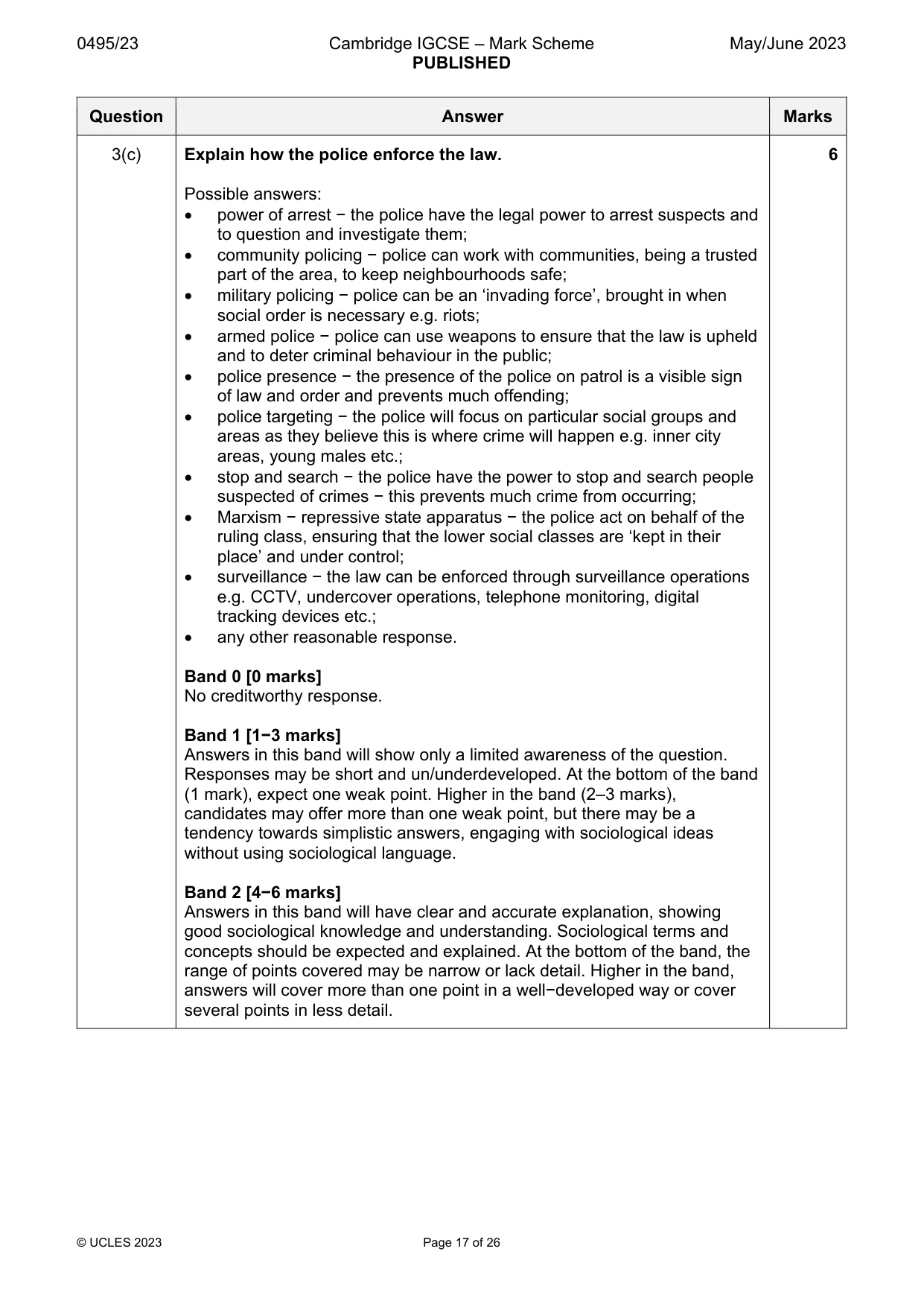
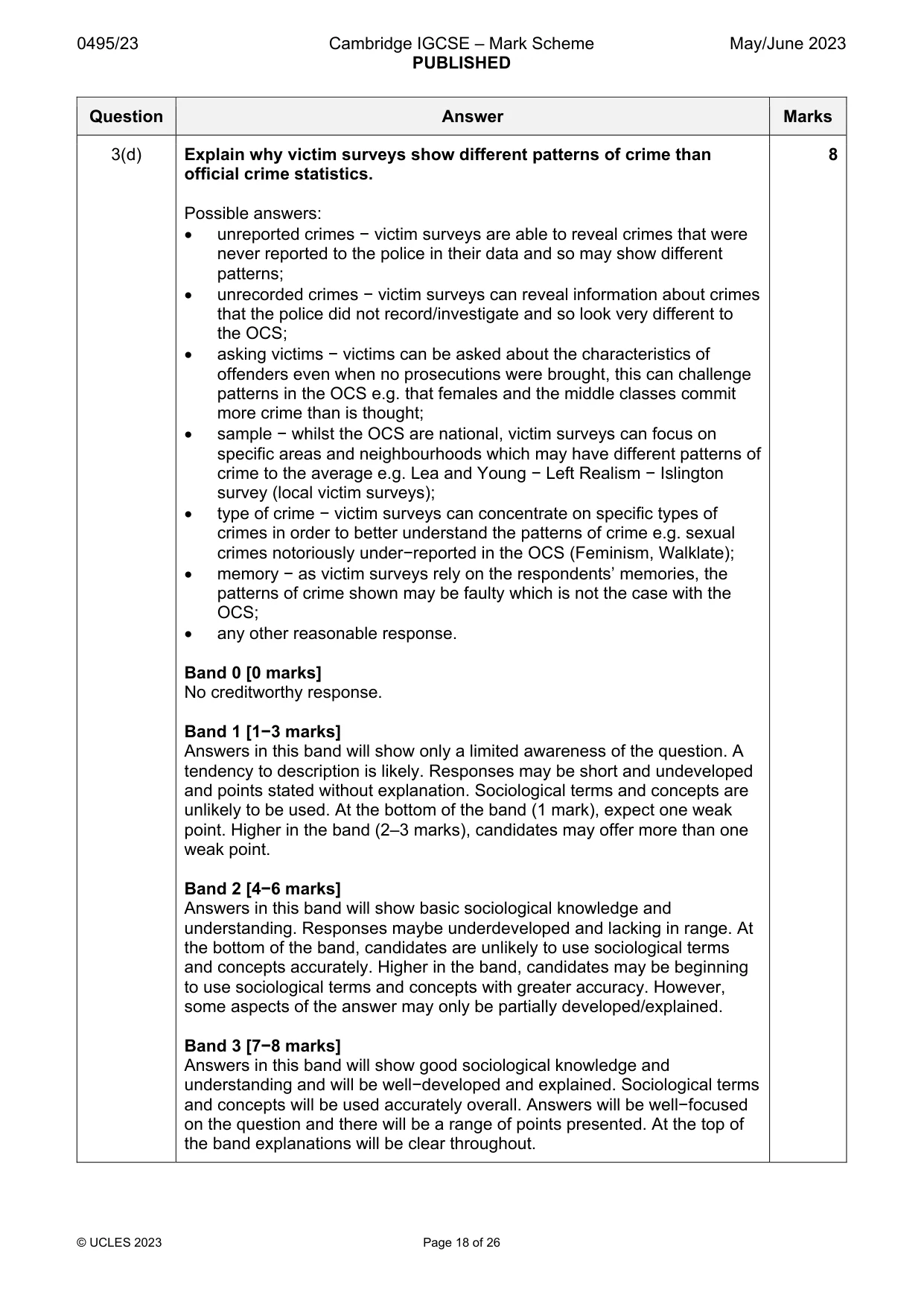
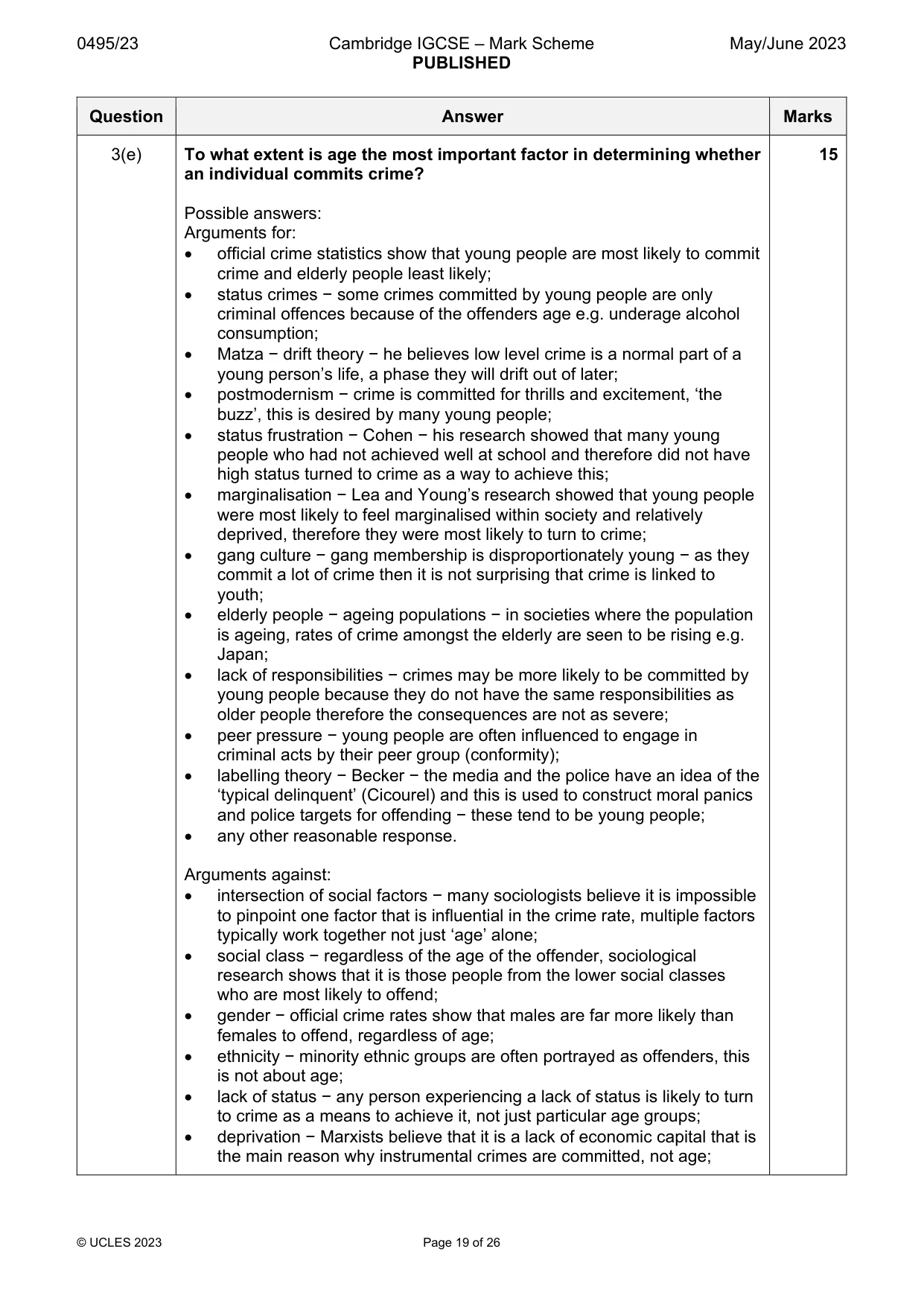
Mark scheme: 3(a) What is meant by the term ‘ostracism’? 2 One mark for partial definition, e.g. being sent away; Two marks for clear definition, e.g. punishment that involves an individual being excluded from their community, can be physical or emotional. 3(b) Describe two examples of how criminal behaviour can be deterred. 4 Possible answers: public shaming − this can be physically e.g. public executions or through the media − showing the negative consequences of criminality can deter others from committing it; prison − harsh environments, loss of family connections and a lack of freedom aim to deter others from offending; exile − sending offenders out of the community sends a clear message to others that criminal behaviour will not be tolerated; fines − making offenders pay for the crimes they have committed ensures that there are consequences for criminal actions and so deters others; community sentencing − offenders are often forced to wear a ‘uniform’ whilst completing community work making it quite humiliating and meaning other people are quickly discouraged; electronic tagging − keeping offenders under surveillance and monitoring their movements limits freedom and deters both the offender and others from committing crimes; informally − people do not want to let family and friends down and therefore the fear of doing so acts as a deterrent to criminal behaviour; media representations – the media is often a norm referencing tool and so can show the negative consequences of crime, so deterring deviant behaviour, e.g. moral panics; any other reasonable response. One mark for each point correctly identified (up to a maximum of two). One mark for each point that is developed (up to a maximum of two). 3(c) Explain how the police enforce the law. 6 Possible answers: power of arrest − the police have the legal power to arrest suspects and to question and investigate them; community policing − police can work with communities, being a trusted part of the area, to keep neighbourhoods safe; military policing − police can be an ‘invading force’, brought in when social order is necessary e.g. riots; armed police − police can use weapons to ensure that the law is upheld and to deter criminal behaviour in the public; police presence − the presence of the police on patrol is a visible sign of law and order and prevents much offending; police targeting − the police will focus on particular social groups and areas as they believe this is where crime will happen e.g. inner city areas, young males etc.; stop and search − the police have the power to stop and search people suspected of crimes − this prevents much crime from occurring; Marxism − repressive state apparatus − the police act on behalf of the ruling class, ensuring that the lower social classes are ‘kept in their place’ and under control; surveillance − the law can be enforced through surveillance operations e.g. CCTV, undercover operations, telephone monitoring, digital tracking devices etc.; any other reasonable response. Band 0 [0 marks] No creditworthy response. Band 1 [1−3 marks] Answers in this band will show only a limited awareness of the question. Responses may be short and un/underdeveloped. At the bottom of the band (1 mark), expect one weak point. Higher in the band (2–3 marks), candidates may offer more than one weak point, but there may be a tendency towards simplistic answers, engaging with sociological ideas without using sociological language. Band 2 [4−6 marks] Answers in this band will have clear and accurate explanation, showing good sociological knowledge and understanding. Sociological terms and concepts should be expected and explained. At the bottom of the band, the range of points covered may be narrow or lack detail. Higher in the band, answers will cover more than one point in a well−developed way or cover several points in less detail. 3(d) Explain why victim surveys show different patterns of crime than 8 official crime statistics. Possible answers: unreported crimes − victim surveys are able to reveal crimes that were never reported to the police in their data and so may show different patterns; unrecorded crimes − victim surveys can reveal information about crimes that the police did not record/investigate and so look very different to the OCS; asking victims − victims can be asked about the characteristics of offenders even when no prosecutions were brought, this can challenge patterns in the OCS e.g. that females and the middle classes commit more crime than is thought; sample − whilst the OCS are national, victim surveys can focus on specific areas and neighbourhoods which may have different patterns of crime to the average e.g. Lea and Young − Left Realism − Islington survey (local victim surveys); type of crime − victim surveys can concentrate on specific types of crimes in order to better understand the patterns of crime e.g. sexual crimes notoriously under−reported in the OCS (Feminism, Walklate); memory − as victim surveys rely on the respondents’ memories, the patterns of crime shown may be faulty which is not the case with the OCS; any other reasonable response. Band 0 [0 marks] No creditworthy response. Band 1 [1−3 marks] Answers in this band will show only a limited awareness of the question. A tendency to description is likely. Responses may be short and undeveloped and points stated without explanation. Sociological terms and concepts are unlikely to be used. At the bottom of the band (1 mark), expect one weak point. Higher in the band (2–3 marks), candidates may offer more than one weak point. Band 2 [4−6 marks] Answers in this band will show basic sociological knowledge and understanding. Responses maybe underdeveloped and lacking in range. At the bottom of the band, candidates are unlikely to use sociological terms and concepts accurately. Higher in the band, candidates may be beginning to use sociological terms and concepts with greater accuracy. However, some aspects of the answer may only be partially developed/explained. Band 3 [7−8 marks] Answers in this band will show good sociological knowledge and understanding and will be well−developed and explained. Sociological terms and concepts will be used accurately overall. Answers will be well−focused on the question and there will be a range of points presented. At the top of the band explanations will be clear throughout. 3(e) To what extent is age the most important factor in determining whether 15 an individual commits crime? Possible answers: Arguments for: official crime statistics show that young people are most likely to commit crime and elderly people least likely; status crimes − some crimes committed by young people are only criminal offences because of the offenders age e.g. underage alcohol consumption; Matza − drift theory − he believes low level crime is a normal part of a young person’s life, a phase they will drift out of later; postmodernism − crime is committed for thrills and excitement, ‘the buzz’, this is desired by many young people; status frustration − Cohen − his research showed that many young people who had not achieved well at school and therefore did not have high status turned to crime as a way to achieve this; marginalisation − Lea and Young’s research showed that young people were most likely to feel marginalised within society and relatively deprived, therefore they were most likely to turn to crime; gang culture − gang membership is disproportionately young − as they commit a lot of crime then it is not surprising that crime is linked to youth; elderly people − ageing populations − in societies where the population is ageing, rates of crime amongst the elderly are seen to be rising e.g. Japan; lack of responsibilities − crimes may be more likely to be committed by young people because they do not have the same responsibilities as older people therefore the consequences are not as severe; peer pressure − young people are often influenced to engage in criminal acts by their peer group (conformity); labelling theory − Becker − the media and the police have an idea of the ‘typical delinquent’ (Cicourel) and this is used to construct moral panics and police targets for offending − these tend to be young people; any other reasonable response. Arguments against: intersection of social factors − many sociologists believe it is impossible to pinpoint one factor that is influential in the crime rate, multiple factors typically work together not just ‘age’ alone; social class − regardless of the age of the offender, sociological research shows that it is those people from the lower social classes who are most likely to offend; gender − official crime rates show that males are far more likely than females to offend, regardless of age; ethnicity − minority ethnic groups are often portrayed as offenders, this is not about age; lack of status − any person experiencing a lack of status is likely to turn to crime as a means to achieve it, not just particular age groups; deprivation − Marxists believe that it is a lack of economic capital that is the main reason why instrumental crimes are committed, not age; 3(e) inadequate socialisation − The New Right see poor socialisation in the family as the explanation for criminal behaviour amongst the underclass, this is not age specific; individualism − many sociologists believe that crime is an individual’s choice and cannot be explained by social factors such as age (Postmodernism); organised crime groups − these are often linked to drug dealing and to human trafficking and are typically controlled by adults − not youths which may contradict the idea of youth being the most prolific offenders; white−collar crime − most crimes committed in or for the workplace are done by adults − the same is true for state crimes − nothing to do with youth and age, it’s about power and position (Marxism); any other reasonable response. Band 0 [0 marks] No creditworthy response. Band 1 [1−4 marks] Answers in this band may be vague and largely based on common sense showing limited knowledge of the debate. Use of sociological terms or concepts is very unlikely. Responses may be short, undeveloped and one−sided. Lower in the band (1–2 marks), expect one or two weak points. Higher in the band (3–4 marks) candidates may offer more than two points and provide a weak definition of key terms in the question. Band 2 [5−8 marks] In this band candidates will show some basic knowledge of the debate. Alternatively, they may offer an answer which is list−like in nature but there will be no real attempt to assess the issues raised by the question. There may be limited/some use of sociological terms or concepts. Responses may be underdeveloped and lack range. Answers may be simplistic and two−sided or only cover one side of the debate. Lower in the band, the response may be rather narrow in the points covered and there may be some development. Higher in the band, more points are likely to be covered with some development. Alternatively, a list−like answer with some development covering both sides of the argument may score up to 8 marks. A one−sided answer cannot score higher than 8 marks. Band 3 [9−12 marks] Answers in this band will show good sociological knowledge and understanding of the debate. Sociological terms and concepts will be used with greater accuracy and/or frequency. For the most part, answers will be well−developed, focused on the questions and there will be a range of points presented. There will be a two−sided response but it may lack range on one side. At the bottom of the band, candidates may provide a narrower range of developed points. At the top of the band, expect a wider range of developed points and clear focus on the question. 3(e) Band 4 [13−15 marks] Answers in this band will show excellent knowledge and understanding of the debate. There will be a strong grasp of the arguments as well as accurate and frequent use of sociological terms and concepts. Answers will be well−developed, clearly focused on the question and discuss a wide range of points. Responses will be two−sided and have a range of points on each side. At the bottom of the band (13 marks), the answer may lack a specific conclusion. Higher in the band, there will be a clear attempt to offer an assessment of the ‘To what extent.?’ part of the question through a focused conclusion.
Q4 · Many sociologists believe that audiences are affected by what they consume in the media
4 Many sociologists believe that audiences are affected by what they consume in the media. This can be media content, the language used and the representations shown. For example, representations of some age groups can often lead to labelling in society. Many sociologists agree the media is a powerful agent of socialisation and some censorship of the media may be necessary. (a) What is meant by the term ‘labelling’? [2] (b) Describe two ways the media acts as an agent of socialisation. [4] (c) Explain how the media affects its audience, according to the hypodermic syringe model. [6] (d) Explain why censorship of the media may be necessary. [8] (e) To what extent are media representations of age stereotypical? [15]
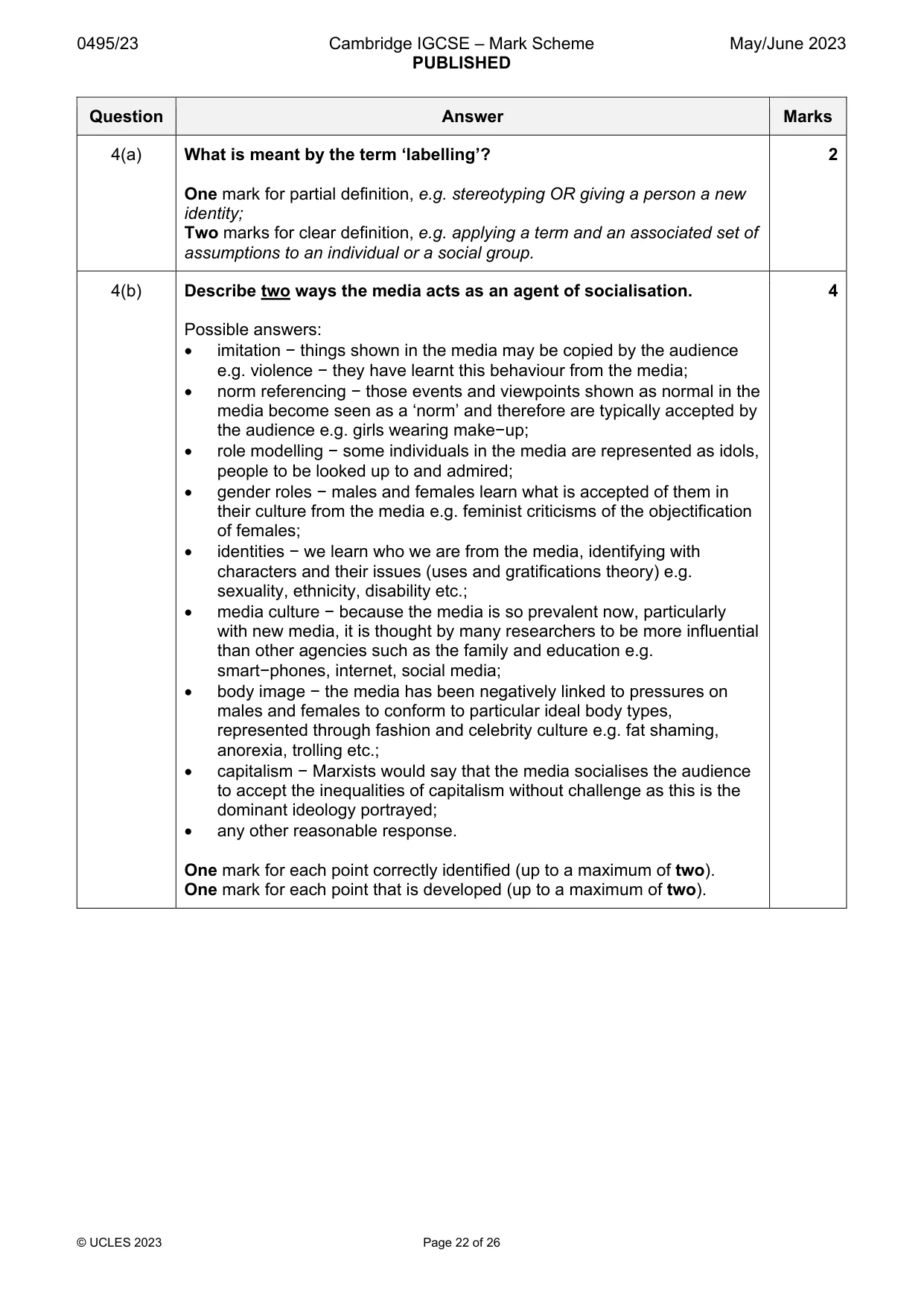
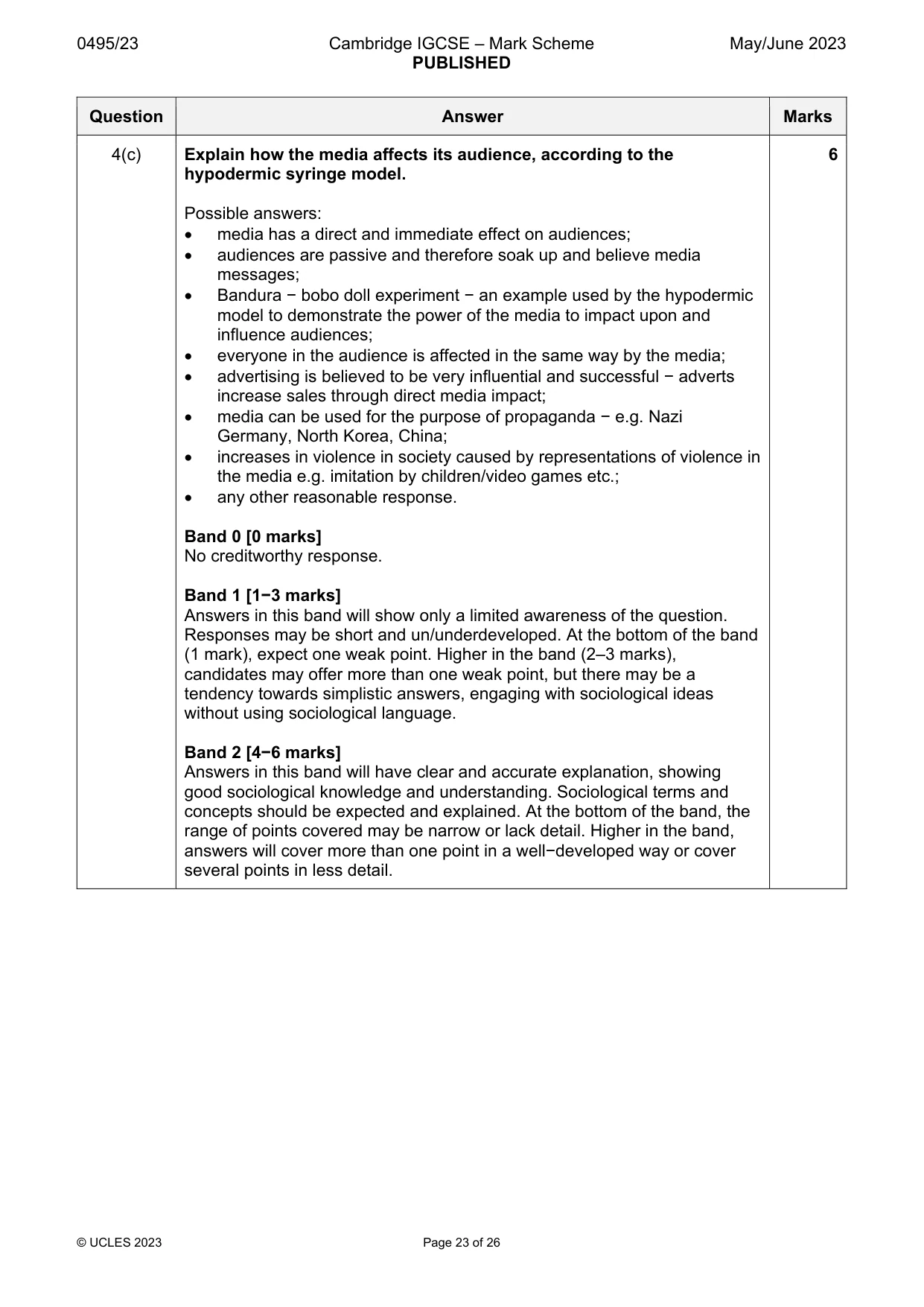
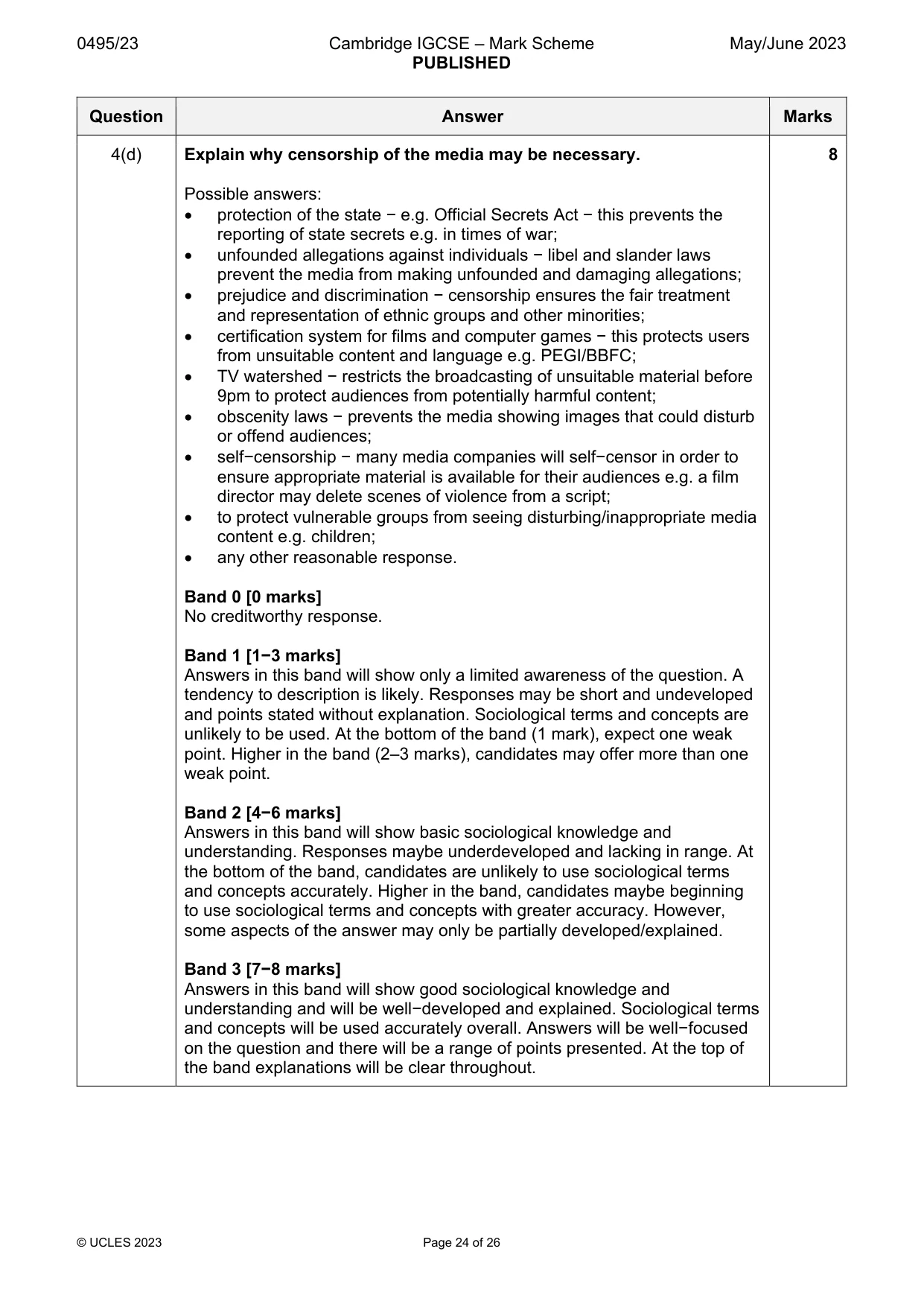
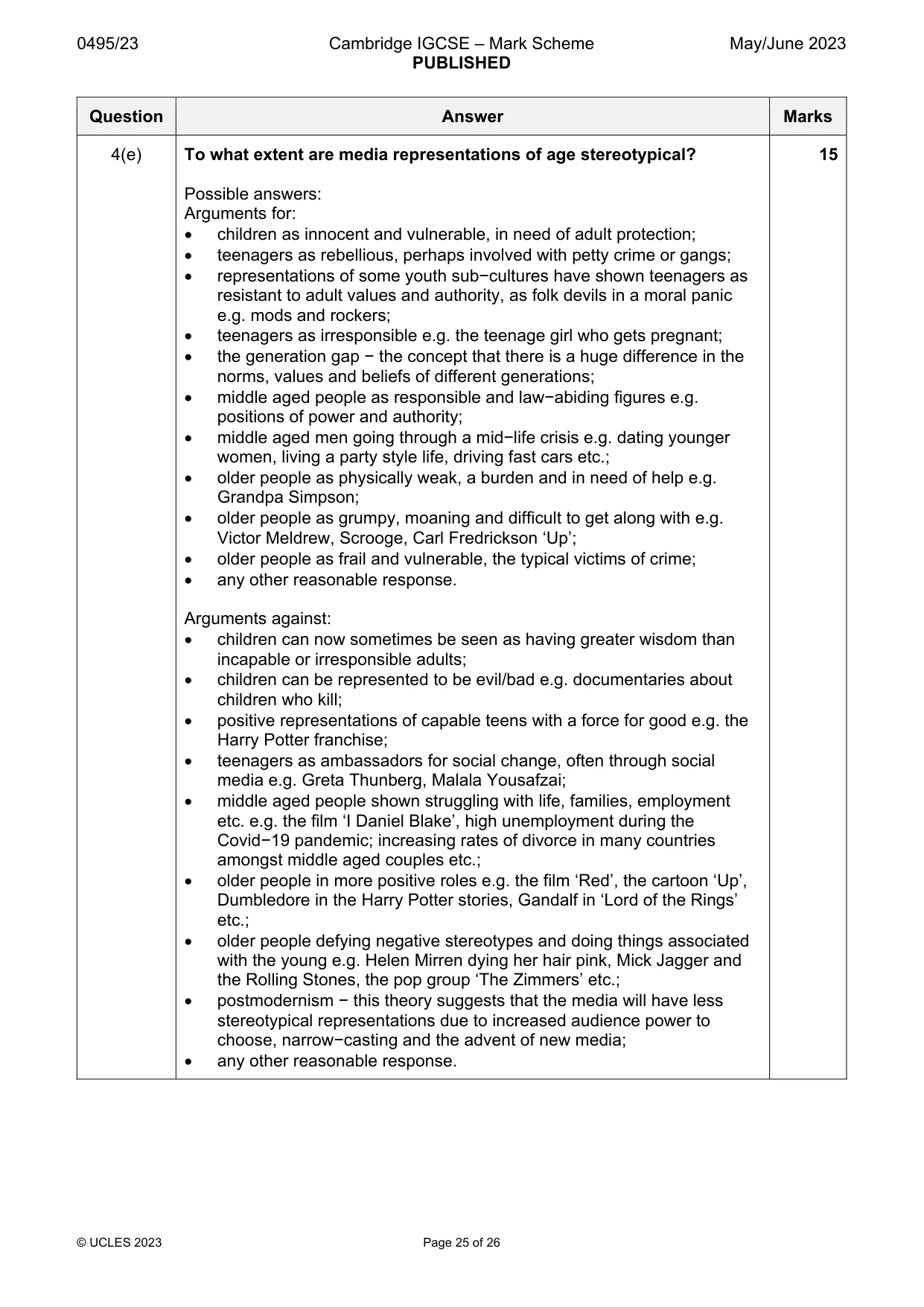
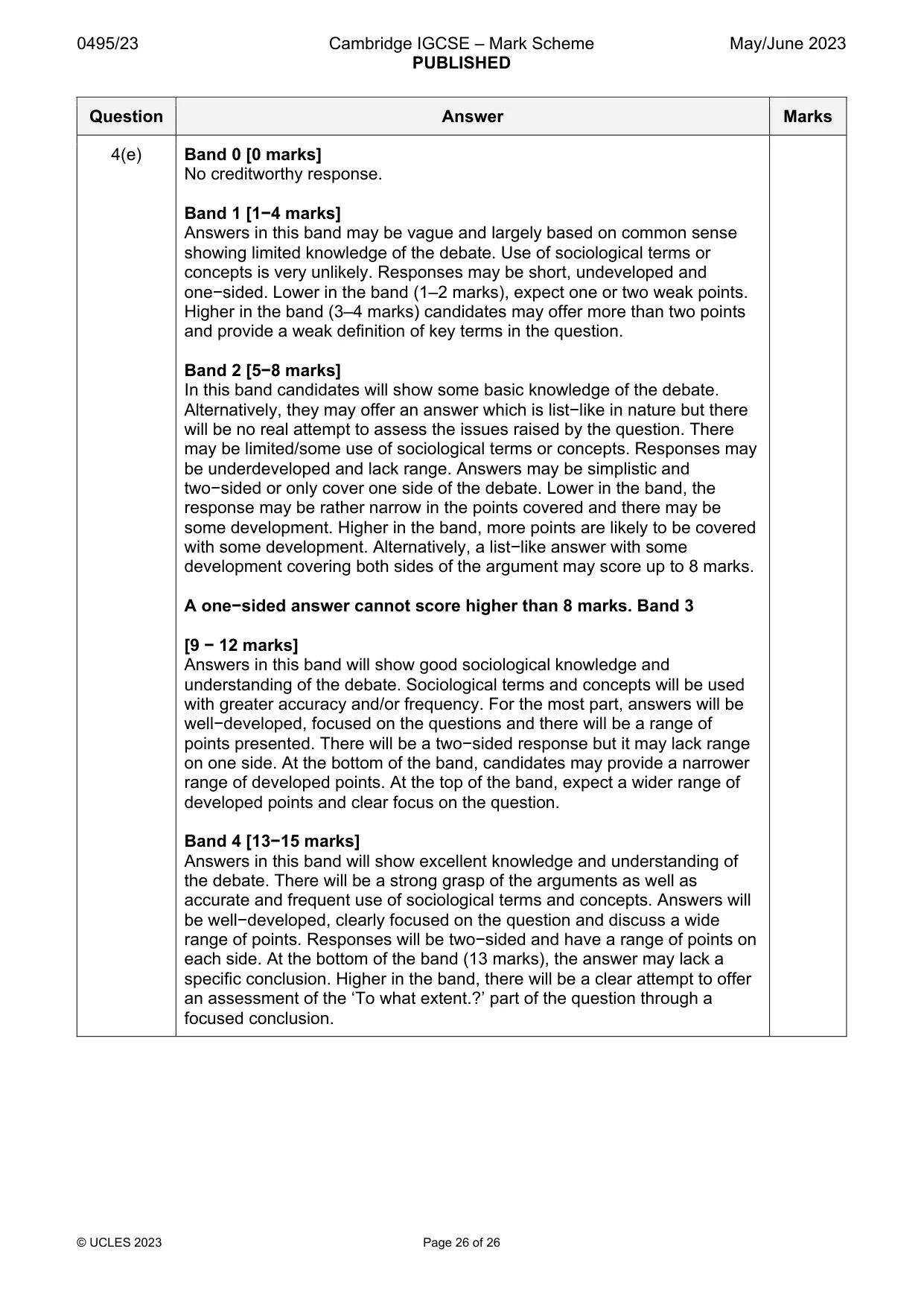
Mark scheme: 4(a) What is meant by the term ‘labelling’? 2 One mark for partial definition, e.g. stereotyping OR giving a person a new identity; Two marks for clear definition, e.g. applying a term and an associated set of assumptions to an individual or a social group. 4(b) Describe two ways the media acts as an agent of socialisation. 4 Possible answers: imitation − things shown in the media may be copied by the audience e.g. violence − they have learnt this behaviour from the media; norm referencing − those events and viewpoints shown as normal in the media become seen as a ‘norm’ and therefore are typically accepted by the audience e.g. girls wearing make−up; role modelling − some individuals in the media are represented as idols, people to be looked up to and admired; gender roles − males and females learn what is accepted of them in their culture from the media e.g. feminist criticisms of the objectification of females; identities − we learn who we are from the media, identifying with characters and their issues (uses and gratifications theory) e.g. sexuality, ethnicity, disability etc.; media culture − because the media is so prevalent now, particularly with new media, it is thought by many researchers to be more influential than other agencies such as the family and education e.g. smart−phones, internet, social media; body image − the media has been negatively linked to pressures on males and females to conform to particular ideal body types, represented through fashion and celebrity culture e.g. fat shaming, anorexia, trolling etc.; capitalism − Marxists would say that the media socialises the audience to accept the inequalities of capitalism without challenge as this is the dominant ideology portrayed; any other reasonable response. One mark for each point correctly identified (up to a maximum of two). One mark for each point that is developed (up to a maximum of two). 4(c) Explain how the media affects its audience, according to the 6 hypodermic syringe model. Possible answers: media has a direct and immediate effect on audiences; audiences are passive and therefore soak up and believe media messages; Bandura − bobo doll experiment − an example used by the hypodermic model to demonstrate the power of the media to impact upon and influence audiences; everyone in the audience is affected in the same way by the media; advertising is believed to be very influential and successful − adverts increase sales through direct media impact; media can be used for the purpose of propaganda − e.g. Nazi Germany, North Korea, China; increases in violence in society caused by representations of violence in the media e.g. imitation by children/video games etc.; any other reasonable response. Band 0 [0 marks] No creditworthy response. Band 1 [1−3 marks] Answers in this band will show only a limited awareness of the question. Responses may be short and un/underdeveloped. At the bottom of the band (1 mark), expect one weak point. Higher in the band (2–3 marks), candidates may offer more than one weak point, but there may be a tendency towards simplistic answers, engaging with sociological ideas without using sociological language. Band 2 [4−6 marks] Answers in this band will have clear and accurate explanation, showing good sociological knowledge and understanding. Sociological terms and concepts should be expected and explained. At the bottom of the band, the range of points covered may be narrow or lack detail. Higher in the band, answers will cover more than one point in a well−developed way or cover several points in less detail. 4(d) Explain why censorship of the media may be necessary. 8 Possible answers: protection of the state − e.g. Official Secrets Act − this prevents the reporting of state secrets e.g. in times of war; unfounded allegations against individuals − libel and slander laws prevent the media from making unfounded and damaging allegations; prejudice and discrimination − censorship ensures the fair treatment and representation of ethnic groups and other minorities; certification system for films and computer games − this protects users from unsuitable content and language e.g. PEGI/BBFC; TV watershed − restricts the broadcasting of unsuitable material before 9pm to protect audiences from potentially harmful content; obscenity laws − prevents the media showing images that could disturb or offend audiences; self−censorship − many media companies will self−censor in order to ensure appropriate material is available for their audiences e.g. a film director may delete scenes of violence from a script; to protect vulnerable groups from seeing disturbing/inappropriate media content e.g. children; any other reasonable response. Band 0 [0 marks] No creditworthy response. Band 1 [1−3 marks] Answers in this band will show only a limited awareness of the question. A tendency to description is likely. Responses may be short and undeveloped and points stated without explanation. Sociological terms and concepts are unlikely to be used. At the bottom of the band (1 mark), expect one weak point. Higher in the band (2–3 marks), candidates may offer more than one weak point. Band 2 [4−6 marks] Answers in this band will show basic sociological knowledge and understanding. Responses maybe underdeveloped and lacking in range. At the bottom of the band, candidates are unlikely to use sociological terms and concepts accurately. Higher in the band, candidates maybe beginning to use sociological terms and concepts with greater accuracy. However, some aspects of the answer may only be partially developed/explained. Band 3 [7−8 marks] Answers in this band will show good sociological knowledge and understanding and will be well−developed and explained. Sociological terms and concepts will be used accurately overall. Answers will be well−focused on the question and there will be a range of points presented. At the top of the band explanations will be clear throughout. 4(e) To what extent are media representations of age stereotypical? 15 Possible answers: Arguments for: children as innocent and vulnerable, in need of adult protection; teenagers as rebellious, perhaps involved with petty crime or gangs; representations of some youth sub−cultures have shown teenagers as resistant to adult values and authority, as folk devils in a moral panic e.g. mods and rockers; teenagers as irresponsible e.g. the teenage girl who gets pregnant; the generation gap − the concept that there is a huge difference in the norms, values and beliefs of different generations; middle aged people as responsible and law−abiding figures e.g. positions of power and authority; middle aged men going through a mid−life crisis e.g. dating younger women, living a party style life, driving fast cars etc.; older people as physically weak, a burden and in need of help e.g. Grandpa Simpson; older people as grumpy, moaning and difficult to get along with e.g. Victor Meldrew, Scrooge, Carl Fredrickson ‘Up’; older people as frail and vulnerable, the typical victims of crime; any other reasonable response. Arguments against: children can now sometimes be seen as having greater wisdom than incapable or irresponsible adults; children can be represented to be evil/bad e.g. documentaries about children who kill; positive representations of capable teens with a force for good e.g. the Harry Potter franchise; teenagers as ambassadors for social change, often through social media e.g. Greta Thunberg, Malala Yousafzai; middle aged people shown struggling with life, families, employment etc. e.g. the film ‘I Daniel Blake’, high unemployment during the Covid−19 pandemic; increasing rates of divorce in many countries amongst middle aged couples etc.; older people in more positive roles e.g. the film ‘Red’, the cartoon ‘Up’, Dumbledore in the Harry Potter stories, Gandalf in ‘Lord of the Rings’ etc.; older people defying negative stereotypes and doing things associated with the young e.g. Helen Mirren dying her hair pink, Mick Jagger and the Rolling Stones, the pop group ‘The Zimmers’ etc.; postmodernism − this theory suggests that the media will have less stereotypical representations due to increased audience power to choose, narrow−casting and the advent of new media; any other reasonable response. 4(e) Band 0 [0 marks] No creditworthy response. Band 1 [1−4 marks] Answers in this band may be vague and largely based on common sense showing limited knowledge of the debate. Use of sociological terms or concepts is very unlikely. Responses may be short, undeveloped and one−sided. Lower in the band (1–2 marks), expect one or two weak points. Higher in the band (3–4 marks) candidates may offer more than two points and provide a weak definition of key terms in the question. Band 2 [5−8 marks] In this band candidates will show some basic knowledge of the debate. Alternatively, they may offer an answer which is list−like in nature but there will be no real attempt to assess the issues raised by the question. There may be limited/some use of sociological terms or concepts. Responses may be underdeveloped and lack range. Answers may be simplistic and two−sided or only cover one side of the debate. Lower in the band, the response may be rather narrow in the points covered and there may be some development. Higher in the band, more points are likely to be covered with some development. Alternatively, a list−like answer with some development covering both sides of the argument may score up to 8 marks. A one−sided answer cannot score higher than 8 marks. Band 3 [9 − 12 marks] Answers in this band will show good sociological knowledge and understanding of the debate. Sociological terms and concepts will be used with greater accuracy and/or frequency. For the most part, answers will be well−developed, focused on the questions and there will be a range of points presented. There will be a two−sided response but it may lack range on one side. At the bottom of the band, candidates may provide a narrower range of developed points. At the top of the band, expect a wider range of developed points and clear focus on the question. Band 4 [13−15 marks] Answers in this band will show excellent knowledge and understanding of the debate. There will be a strong grasp of the arguments as well as accurate and frequent use of sociological terms and concepts. Answers will be well−developed, clearly focused on the question and discuss a wide range of points. Responses will be two−sided and have a range of points on each side. At the bottom of the band (13 marks), the answer may lack a specific conclusion. Higher in the band, there will be a clear attempt to offer an assessment of the ‘To what extent.?’ part of the question through a focused conclusion.
What was in this paper
The subtopics covered by these 4 questions, and how many questions each got. Open one in a new tab to see every Cambridge question on it.
What you needed in this session
Cambridge’s own grade thresholds for 2023 May/June, Paper 2 · Variant 3. A higher threshold means an easier paper — the bar moves with how the cohort did.