Cambridge IGCSE Sociology 0495 — 2025 Oct/Nov Paper 2 · Variant 2
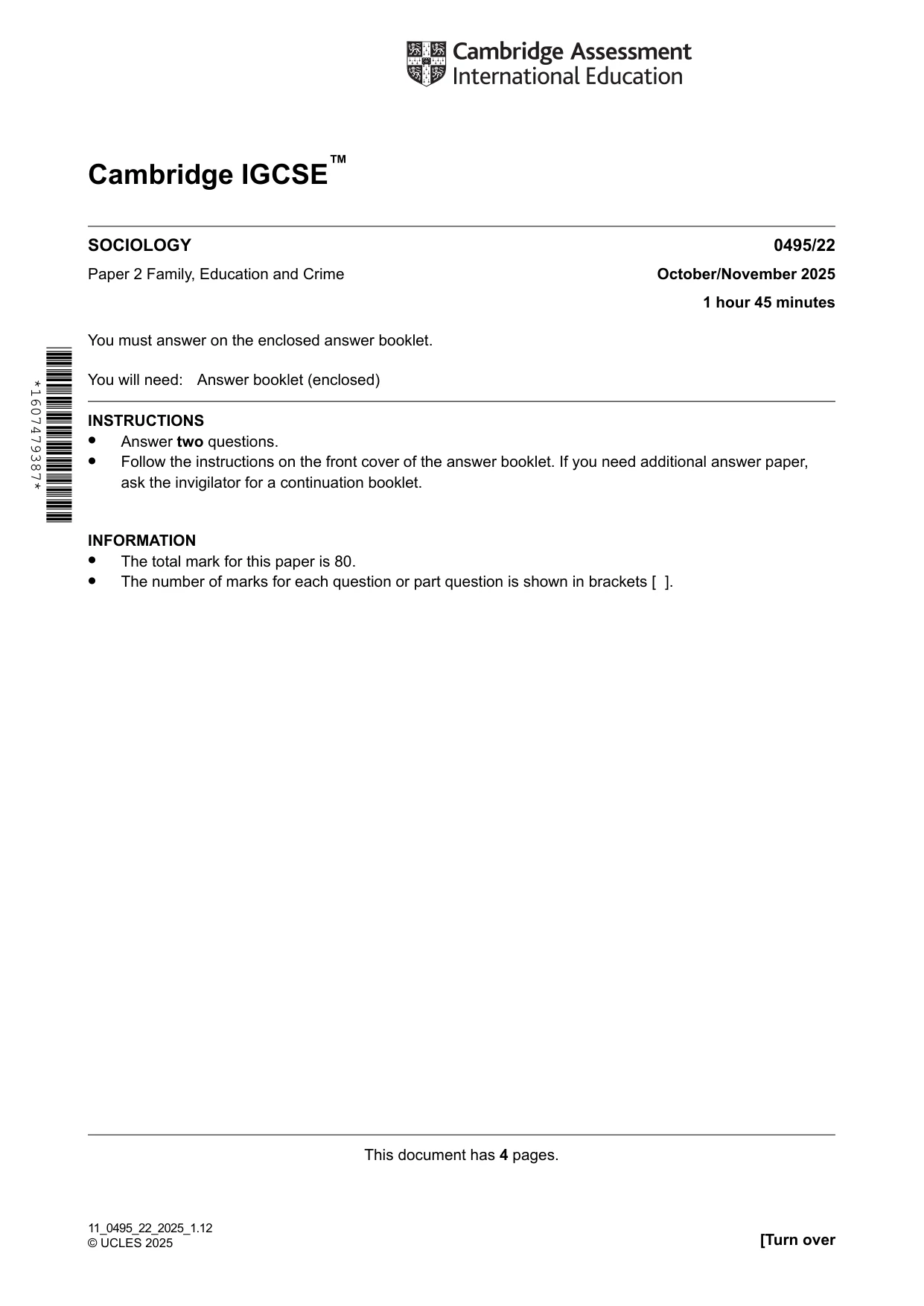
0495/22/O/N/25 · 3 questions · 80 marks · 105 min
The question paper and its mark scheme, free to read here and free to download. This is Cambridge’s own paper, exactly as it was sat.
Question paper4 pages
Mark scheme26 pages
Answers below. Sit the paper first if you are practising.



Questions as text
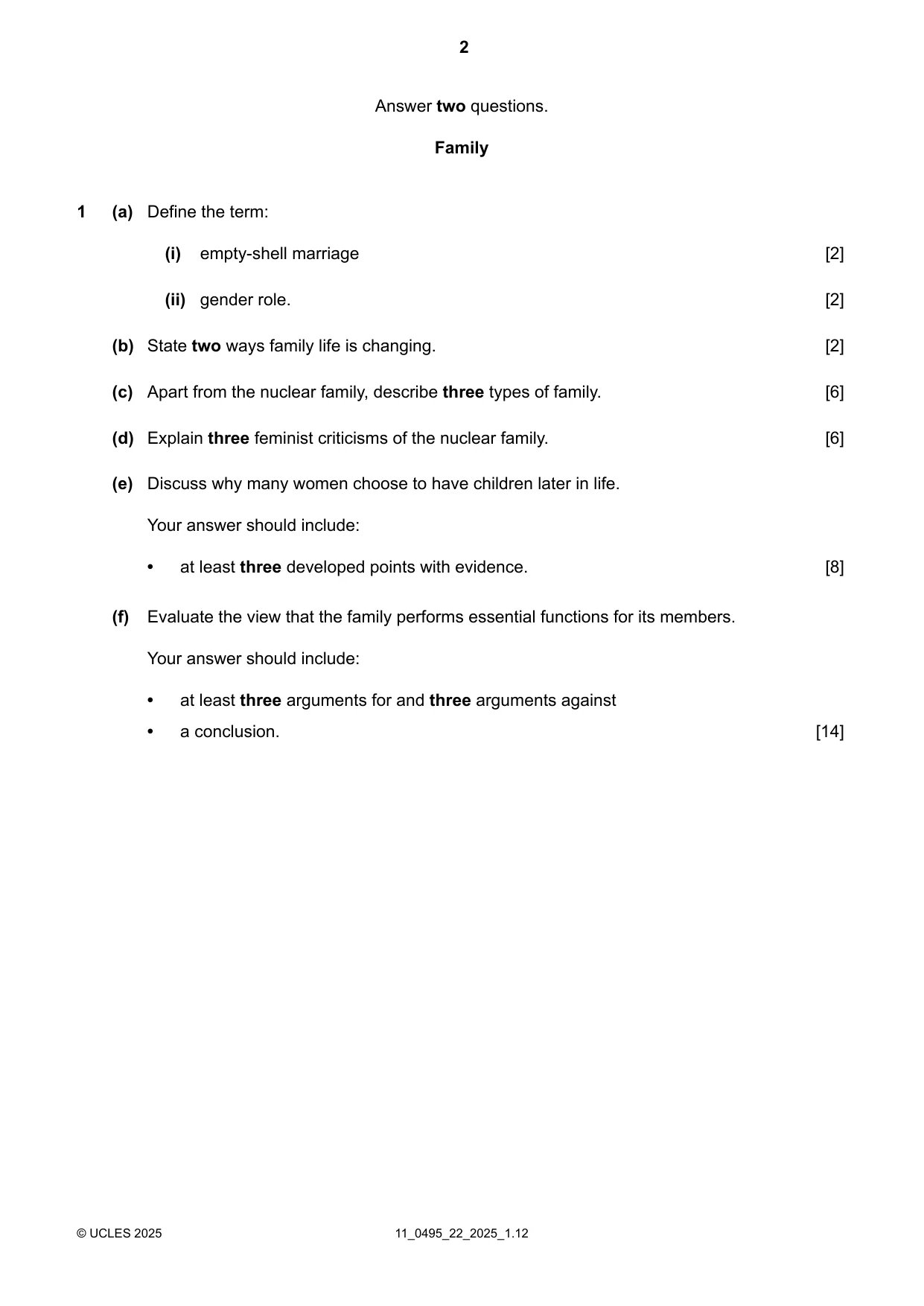
Q1 · Define the term: (i) empty-shell marriage [2] (ii) gender role
1 (a) Define the term: (i) empty-shell marriage [2] (ii) gender role. [2] (b) State two ways family life is changing. [2] (c) Apart from the nuclear family, describe three types of family. [6] (d) Explain three feminist criticisms of the nuclear family. [6] (e) Discuss why many women choose to have children later in life. Your answer should include: • at least three developed points with evidence. [8] (f) Evaluate the view that the family performs essential functions for its members. Your answer should include: • at least three arguments for and three arguments against • a conclusion. [14] Education
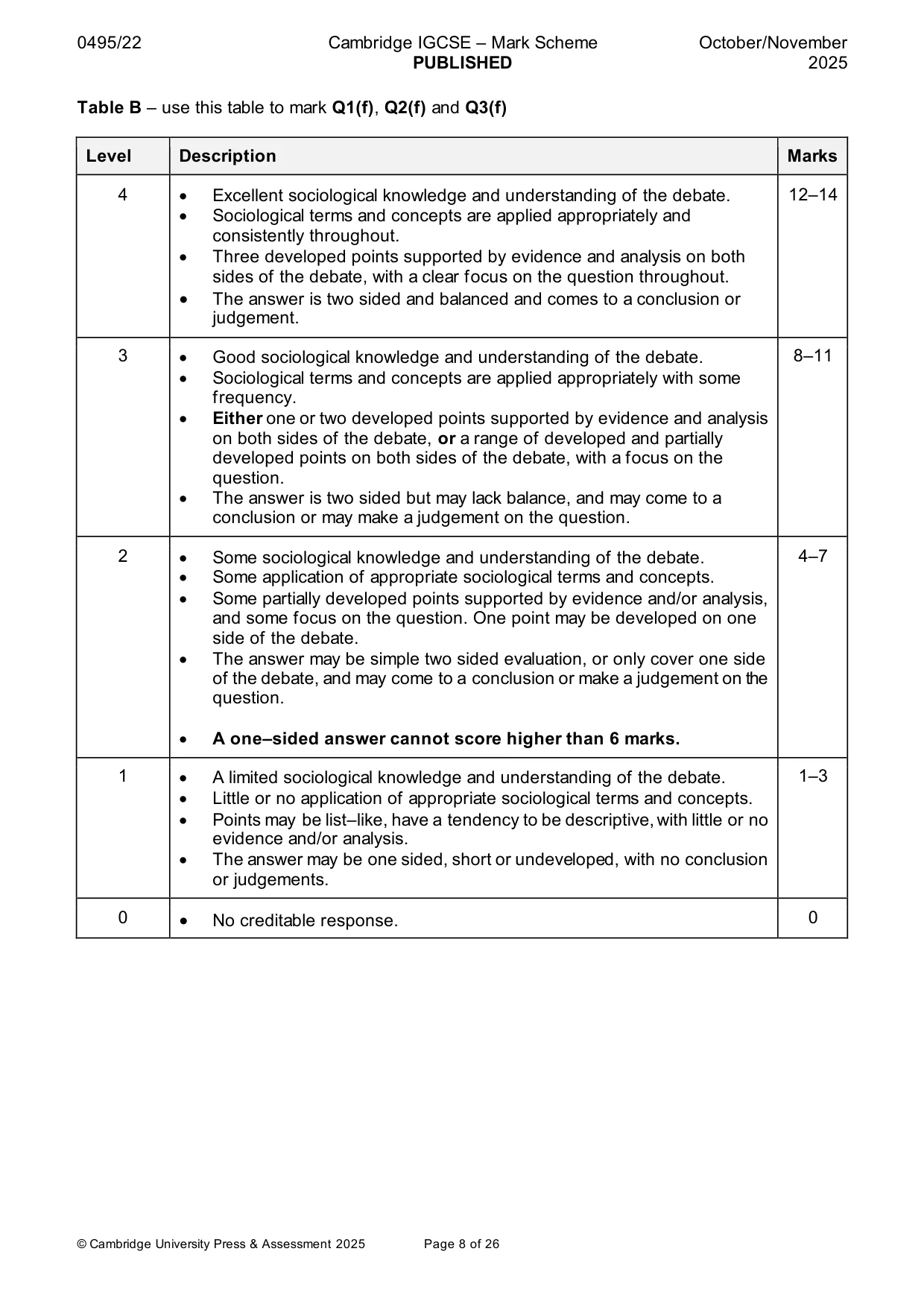
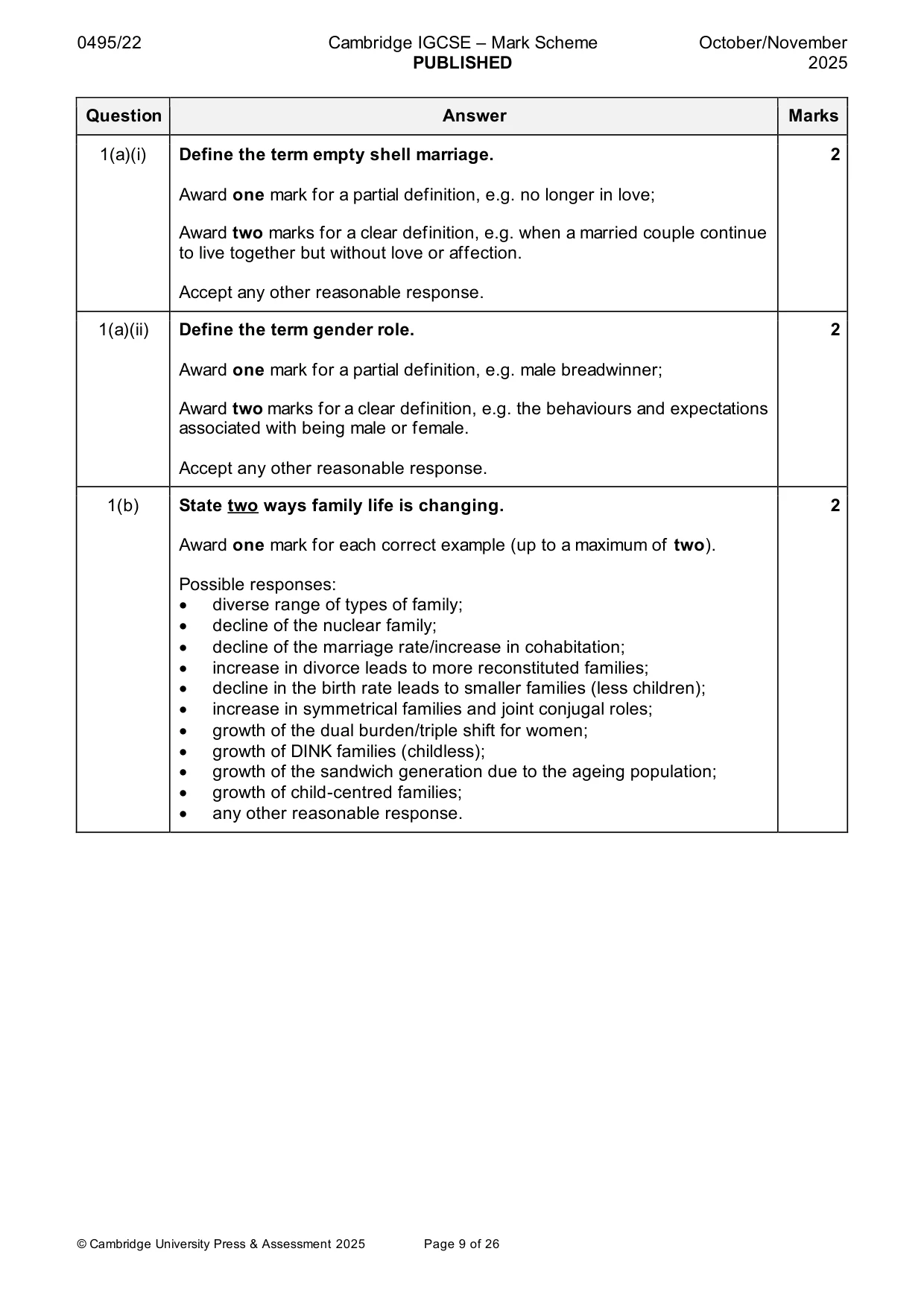
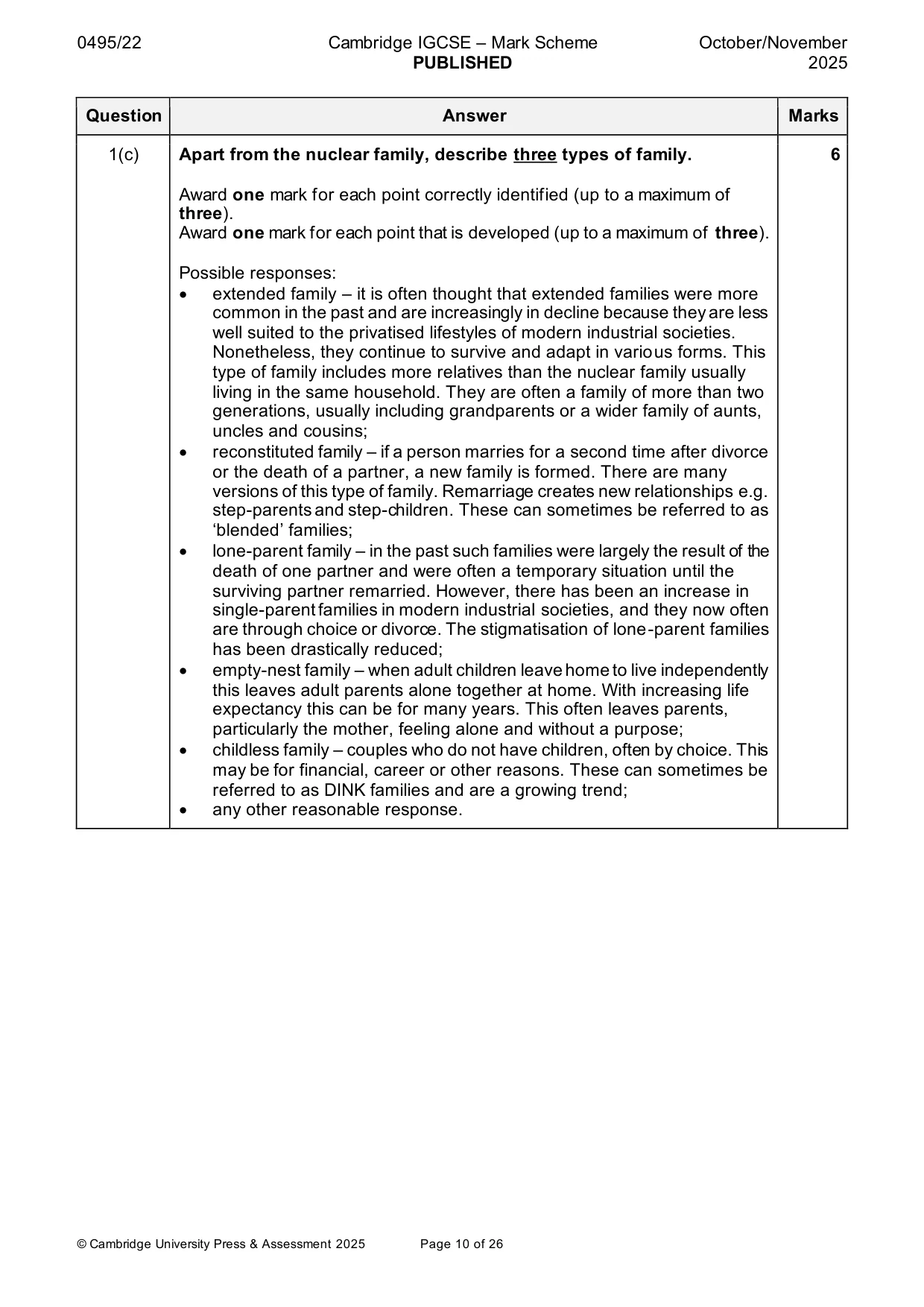
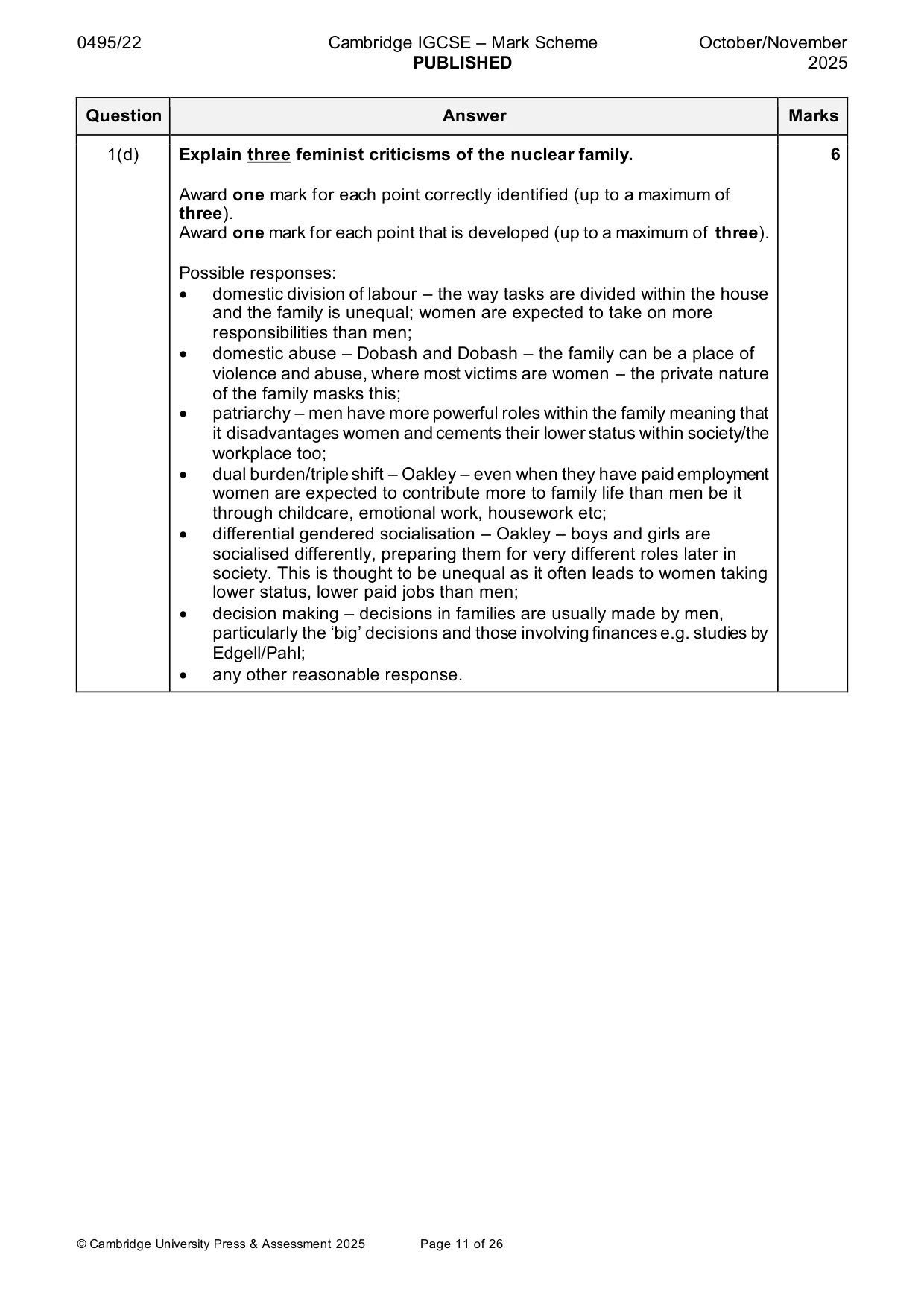
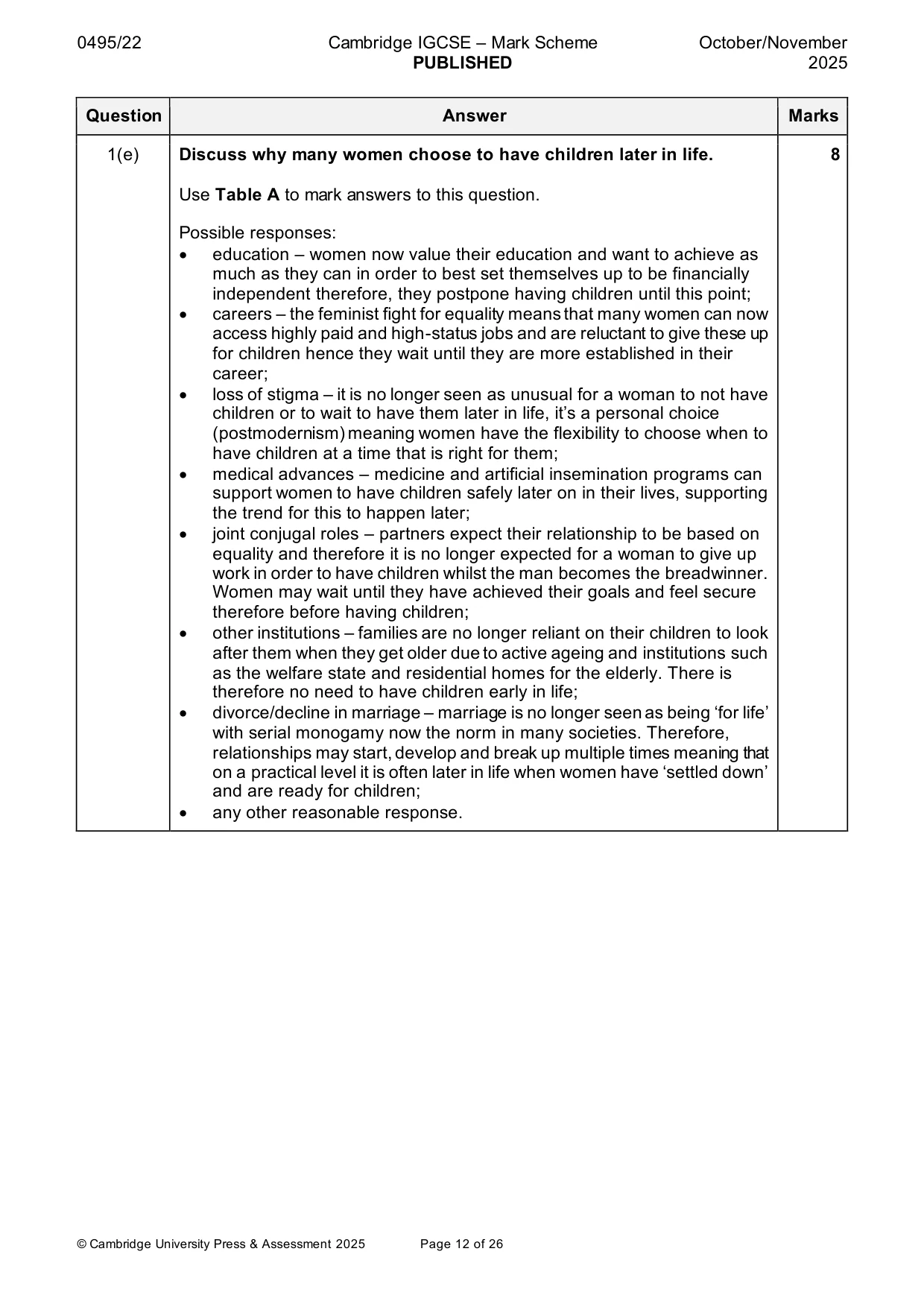
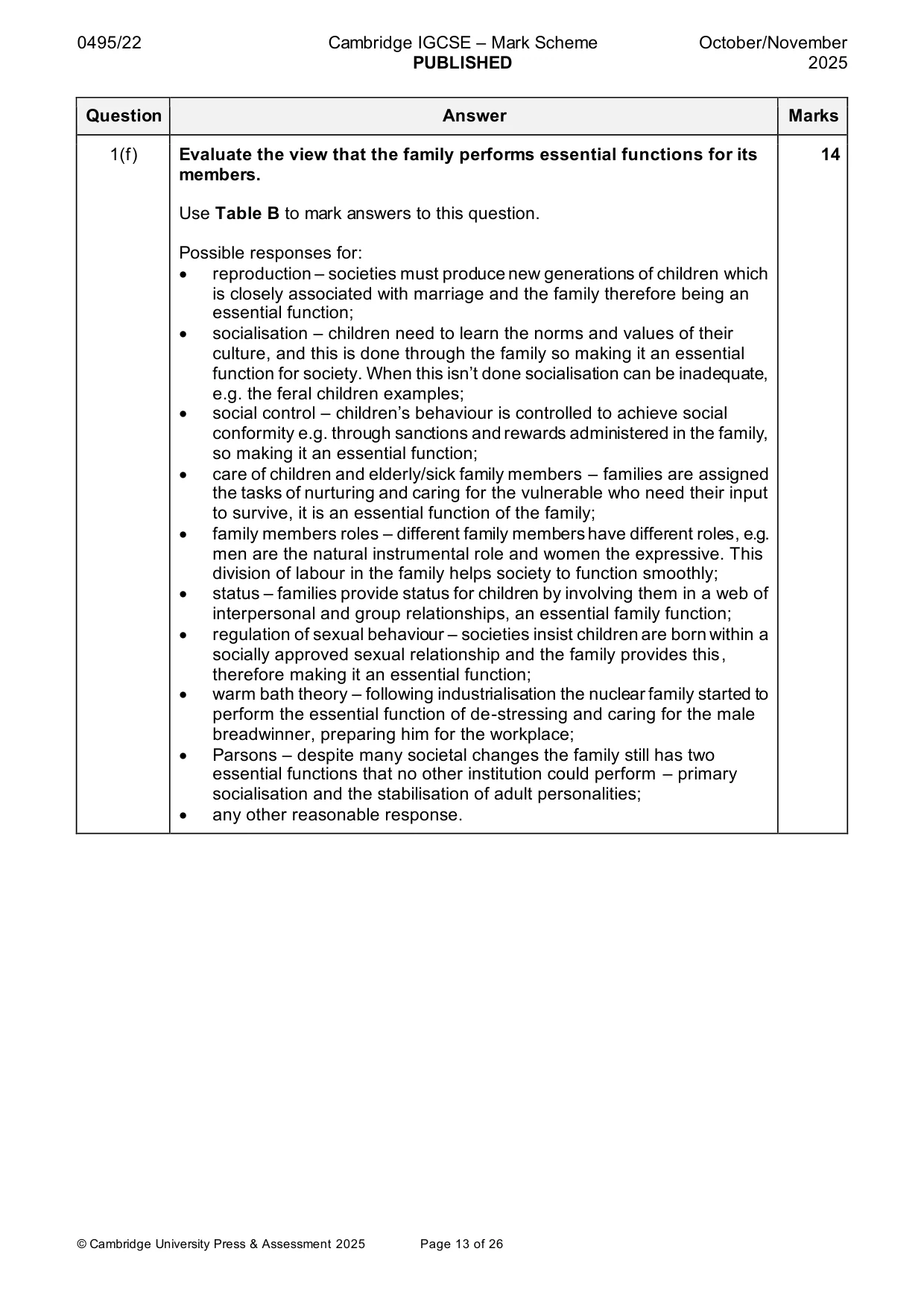
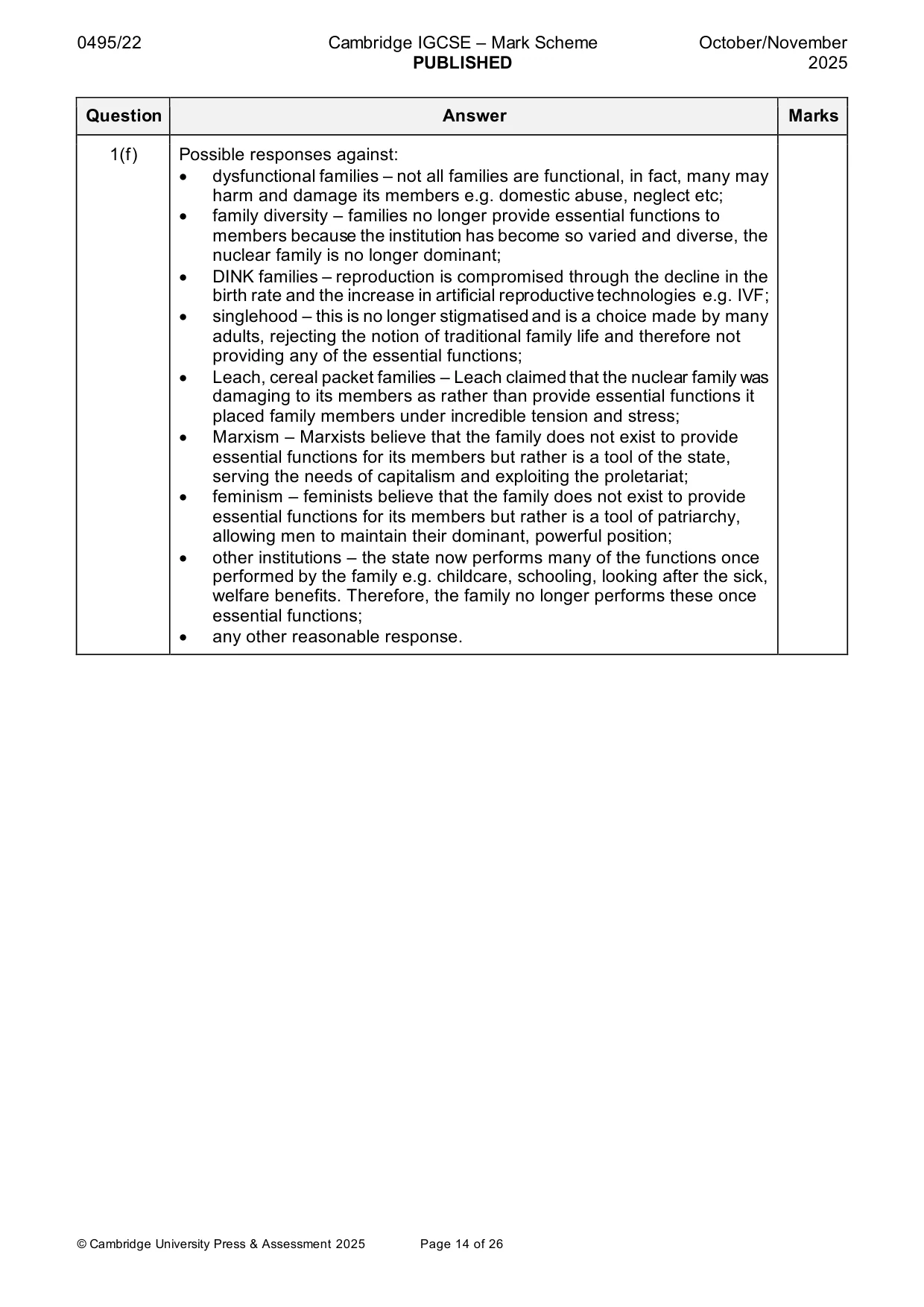
Mark scheme: Question Answer Marks 1(a)(i) Define the term empty shell marriage. 2 Award one mark for a partial definition, e.g. no longer in love; Award two marks for a clear definition, e.g. when a married couple continue to live together but without love or affection. Accept any other reasonable response. 1(a)(ii) Define the term gender role. 2 Award one mark for a partial definition, e.g. male breadwinner; Award two marks for a clear definition, e.g. the behaviours and expectations associated with being male or female. Accept any other reasonable response. 1(b) State two ways family life is changing. 2 Award one mark for each correct example (up to a maximum of two). Possible responses: • diverse range of types of family; • decline of the nuclear family; • decline of the marriage rate/increase in cohabitation; • increase in divorce leads to more reconstituted families; • decline in the birth rate leads to smaller families (less children); • increase in symmetrical families and joint conjugal roles; • growth of the dual burden/triple shift for women; • growth of DINK families (childless); • growth of the sandwich generation due to the ageing population; • growth of child-centred families; • any other reasonable response. 1(c) Apart from the nuclear family, describe three types of family. 6 Award one mark for each point correctly identified (up to a maximum of three). Award one mark for each point that is developed (up to a maximum of three). Possible responses: • extended family – it is often thought that extended families were more common in the past and are increasingly in decline because they are less well suited to the privatised lifestyles of modern industrial societies. Nonetheless, they continue to survive and adapt in various forms. This type of family includes more relatives than the nuclear family usually living in the same household. They are often a family of more than two generations, usually including grandparents or a wider family of aunts, uncles and cousins; • reconstituted family – if a person marries for a second time after divorce or the death of a partner, a new family is formed. There are many versions of this type of family. Remarriage creates new relationships e.g. step-parents and step-children. These can sometimes be referred to as ‘blended’ families; • lone-parent family – in the past such families were largely the result of the death of one partner and were often a temporary situation until the surviving partner remarried. However, there has been an increase in single-parent families in modern industrial societies, and they now often are through choice or divorce. The stigmatisation of lone-parent families has been drastically reduced; • empty-nest family – when adult children leave home to live independently this leaves adult parents alone together at home. With increasing life expectancy this can be for many years. This often leaves parents, particularly the mother, feeling alone and without a purpose; • childless family – couples who do not have children, often by choice. This may be for financial, career or other reasons. These can sometimes be referred to as DINK families and are a growing trend; • any other reasonable response. 1(d) Explain three feminist criticisms of the nuclear family. 6 Award one mark for each point correctly identified (up to a maximum of three). Award one mark for each point that is developed (up to a maximum of three). Possible responses: • domestic division of labour – the way tasks are divided within the house and the family is unequal; women are expected to take on more responsibilities than men; • domestic abuse – Dobash and Dobash – the family can be a place of violence and abuse, where most victims are women – the private nature of the family masks this; • patriarchy – men have more powerful roles within the family meaning that it disadvantages women and cements their lower status within society/the workplace too; • dual burden/triple shift – Oakley – even when they have paid employment women are expected to contribute more to family life than men be it through childcare, emotional work, housework etc; • differential gendered socialisation – Oakley – boys and girls are socialised differently, preparing them for very different roles later in society. This is thought to be unequal as it often leads to women taking lower status, lower paid jobs than men; • decision making – decisions in families are usually made by men, particularly the ‘big’ decisions and those involving finances e.g. studies by Edgell/Pahl; • any other reasonable response. 1(e) Discuss why many women choose to have children later in life. 8 Use Table A to mark answers to this question. Possible responses: • education – women now value their education and want to achieve as much as they can in order to best set themselves up to be financially independent therefore, they postpone having children until this point; • careers – the feminist fight for equality means that many women can now access highly paid and high-status jobs and are reluctant to give these up for children hence they wait until they are more established in their career; • loss of stigma – it is no longer seen as unusual for a woman to not have children or to wait to have them later in life, it’s a personal choice (postmodernism) meaning women have the flexibility to choose when to have children at a time that is right for them; • medical advances – medicine and artificial insemination programs can support women to have children safely later on in their lives, supporting the trend for this to happen later; • joint conjugal roles – partners expect their relationship to be based on equality and therefore it is no longer expected for a woman to give up work in order to have children whilst the man becomes the breadwinner. Women may wait until they have achieved their goals and feel secure therefore before having children; • other institutions – families are no longer reliant on their children to look after them when they get older due to active ageing and institutions such as the welfare state and residential homes for the elderly. There is therefore no need to have children early in life; • divorce/decline in marriage – marriage is no longer seen as being ‘for life’ with serial monogamy now the norm in many societies. Therefore, relationships may start, develop and break up multiple times meaning that on a practical level it is often later in life when women have ‘settled down’ and are ready for children; • any other reasonable response. 1(f) Evaluate the view that the family performs essential functions for its 14 members. Use Table B to mark answers to this question. Possible responses for: • reproduction – societies must produce new generations of children which is closely associated with marriage and the family therefore being an essential function; • socialisation – children need to learn the norms and values of their culture, and this is done through the family so making it an essential function for society. When this isn’t done socialisation can be inadequate, e.g. the feral children examples; • social control – children’s behaviour is controlled to achieve social conformity e.g. through sanctions and rewards administered in the family, so making it an essential function; • care of children and elderly/sick family members – families are assigned the tasks of nurturing and caring for the vulnerable who need their input to survive, it is an essential function of the family; • family members roles – different family members have different roles, e.g. men are the natural instrumental role and women the expressive. This division of labour in the family helps society to function smoothly; • status – families provide status for children by involving them in a web of interpersonal and group relationships, an essential family function; • regulation of sexual behaviour – societies insist children are born within a socially approved sexual relationship and the family provides this, therefore making it an essential function; • warm bath theory – following industrialisation the nuclear family started to perform the essential function of de-stressing and caring for the male breadwinner, preparing him for the workplace; • Parsons – despite many societal changes the family still has two essential functions that no other institution could perform – primary socialisation and the stabilisation of adult personalities; • any other reasonable response. 1(f) Possible responses against: • dysfunctional families – not all families are functional, in fact, many may harm and damage its members e.g. domestic abuse, neglect etc; • family diversity – families no longer provide essential functions to members because the institution has become so varied and diverse, the nuclear family is no longer dominant; • DINK families – reproduction is compromised through the decline in the birth rate and the increase in artificial reproductive technologies e.g. IVF; • singlehood – this is no longer stigmatised and is a choice made by many adults, rejecting the notion of traditional family life and therefore not providing any of the essential functions; • Leach, cereal packet families – Leach claimed that the nuclear family was damaging to its members as rather than provide essential functions it placed family members under incredible tension and stress; • Marxism – Marxists believe that the family does not exist to provide essential functions for its members but rather is a tool of the state, serving the needs of capitalism and exploiting the proletariat; • feminism – feminists believe that the family does not exist to provide essential functions for its members but rather is a tool of patriarchy, allowing men to maintain their dominant, powerful position; • other institutions – the state now performs many of the functions once performed by the family e.g. childcare, schooling, looking after the sick, welfare benefits. Therefore, the family no longer performs these once essential functions; • any other reasonable response.
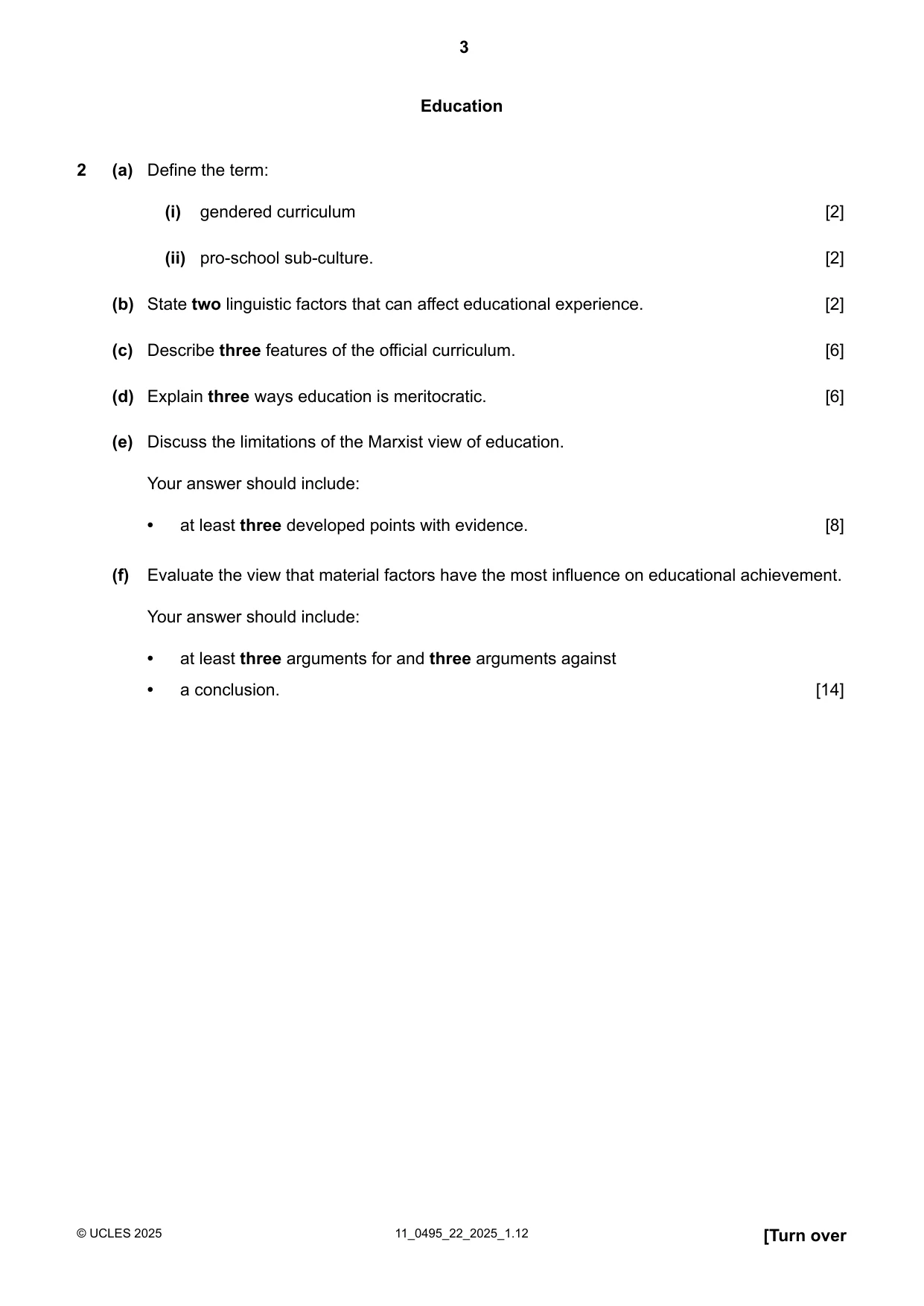
Q2 · Define the term: (i) gendered curriculum [2] (ii) pro-school sub-culture
2 (a) Define the term: (i) gendered curriculum [2] (ii) pro-school sub-culture. [2] (b) State two linguistic factors that can affect educational experience. [2] (c) Describe three features of the official curriculum. [6] (d) Explain three ways education is meritocratic. [6] (e) Discuss the limitations of the Marxist view of education. Your answer should include: • at least three developed points with evidence. [8] (f) Evaluate the view that material factors have the most influence on educational achievement. Your answer should include: • at least three arguments for and three arguments against • a conclusion. [14] Crime, deviance and social control
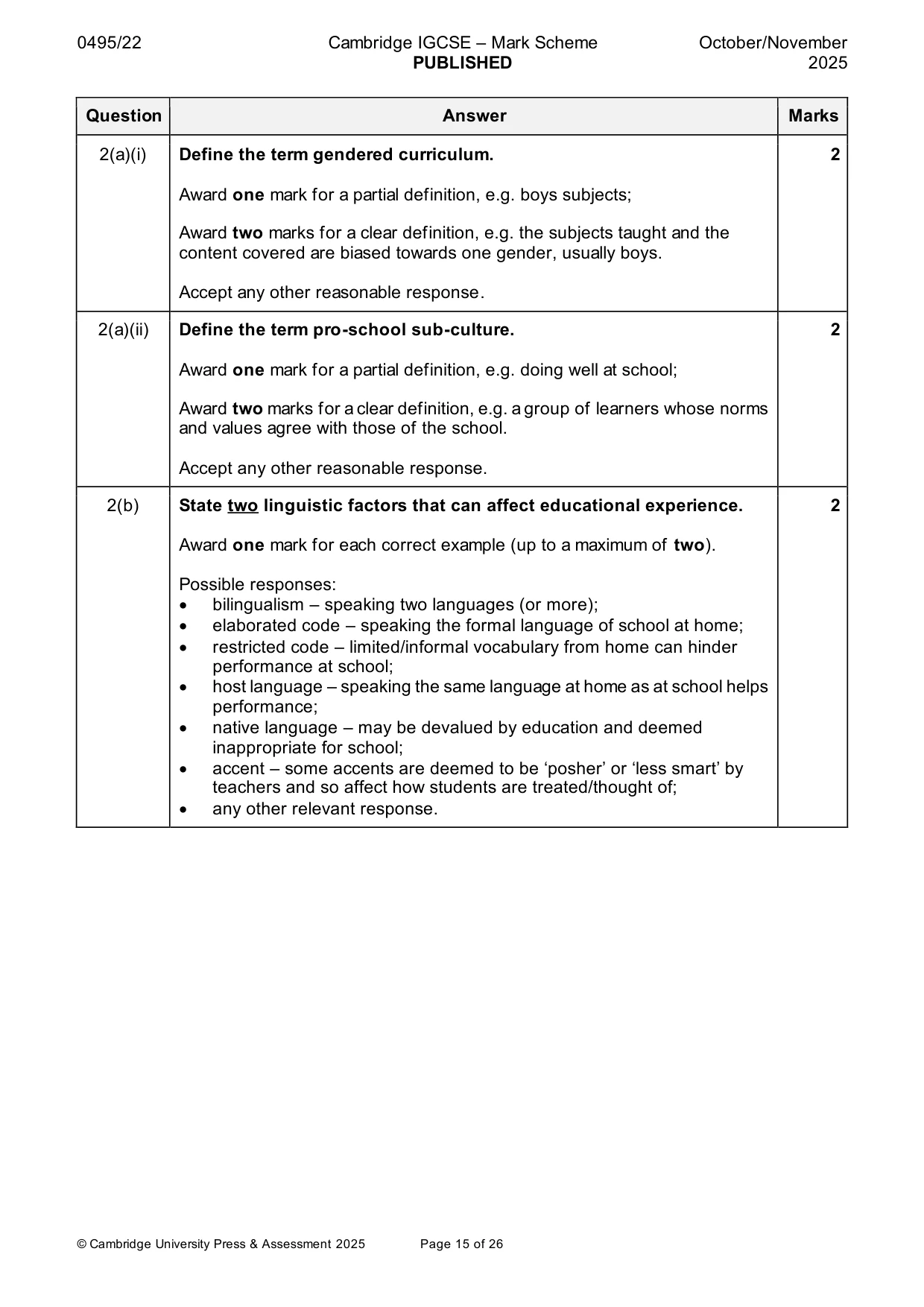
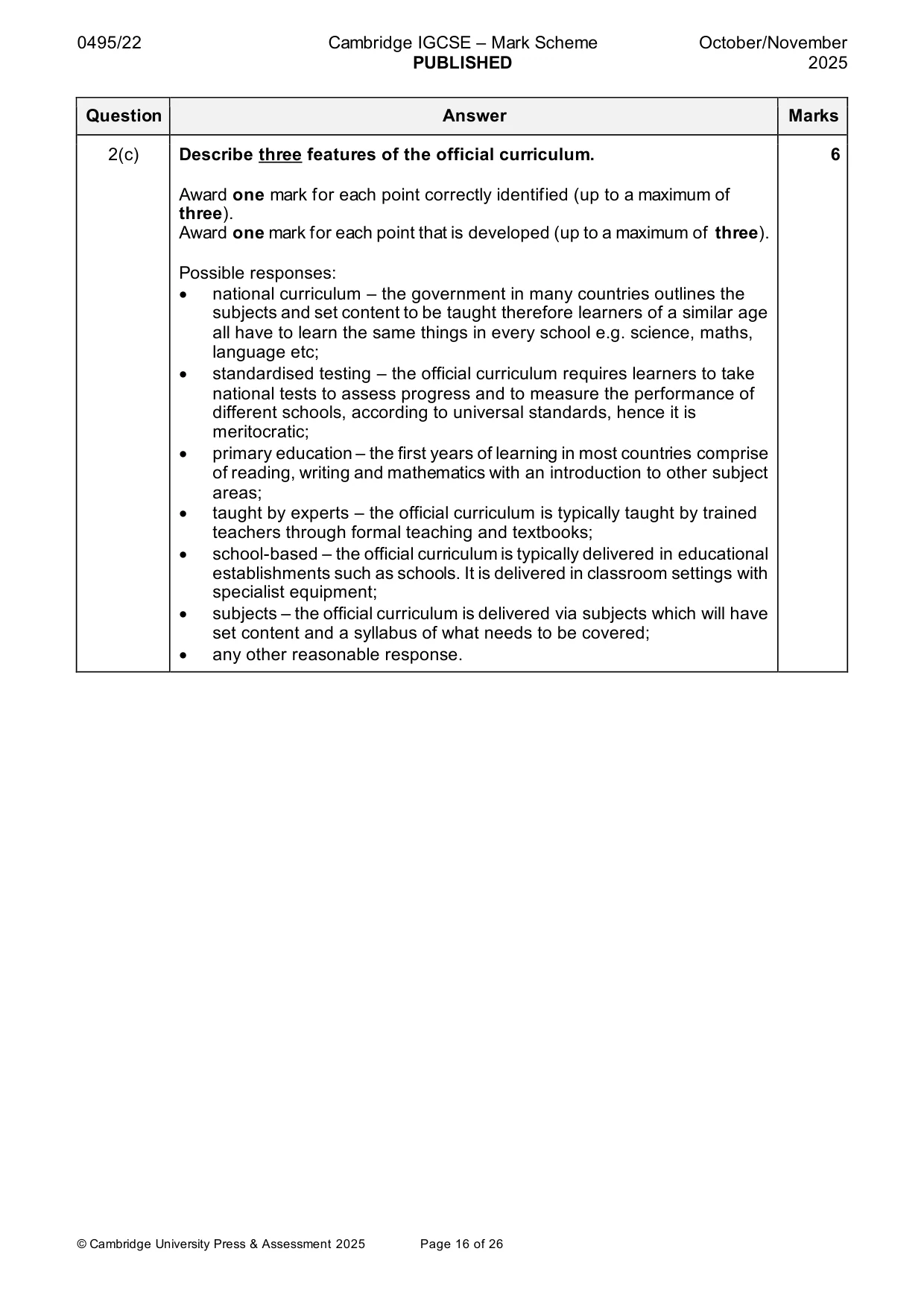
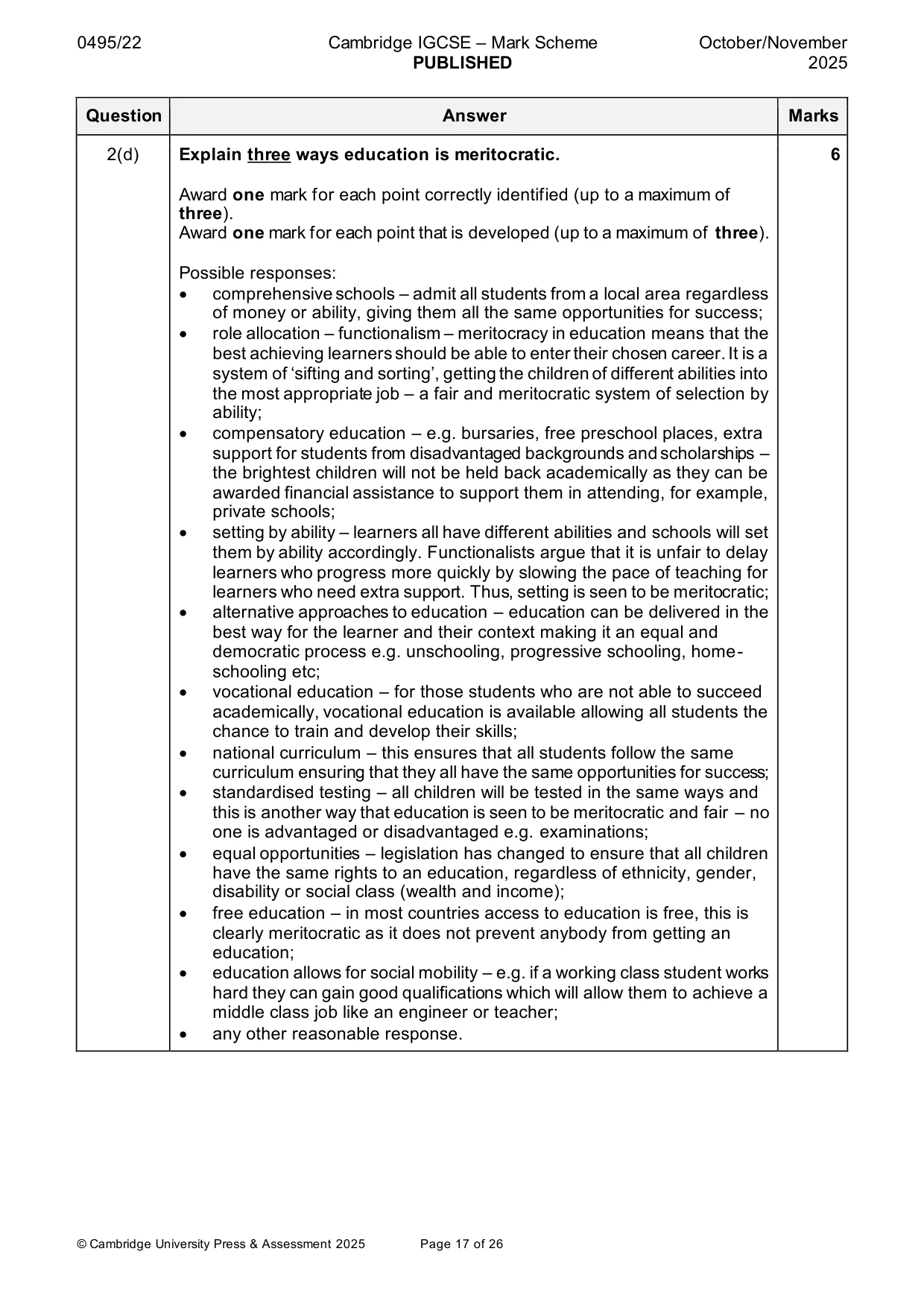
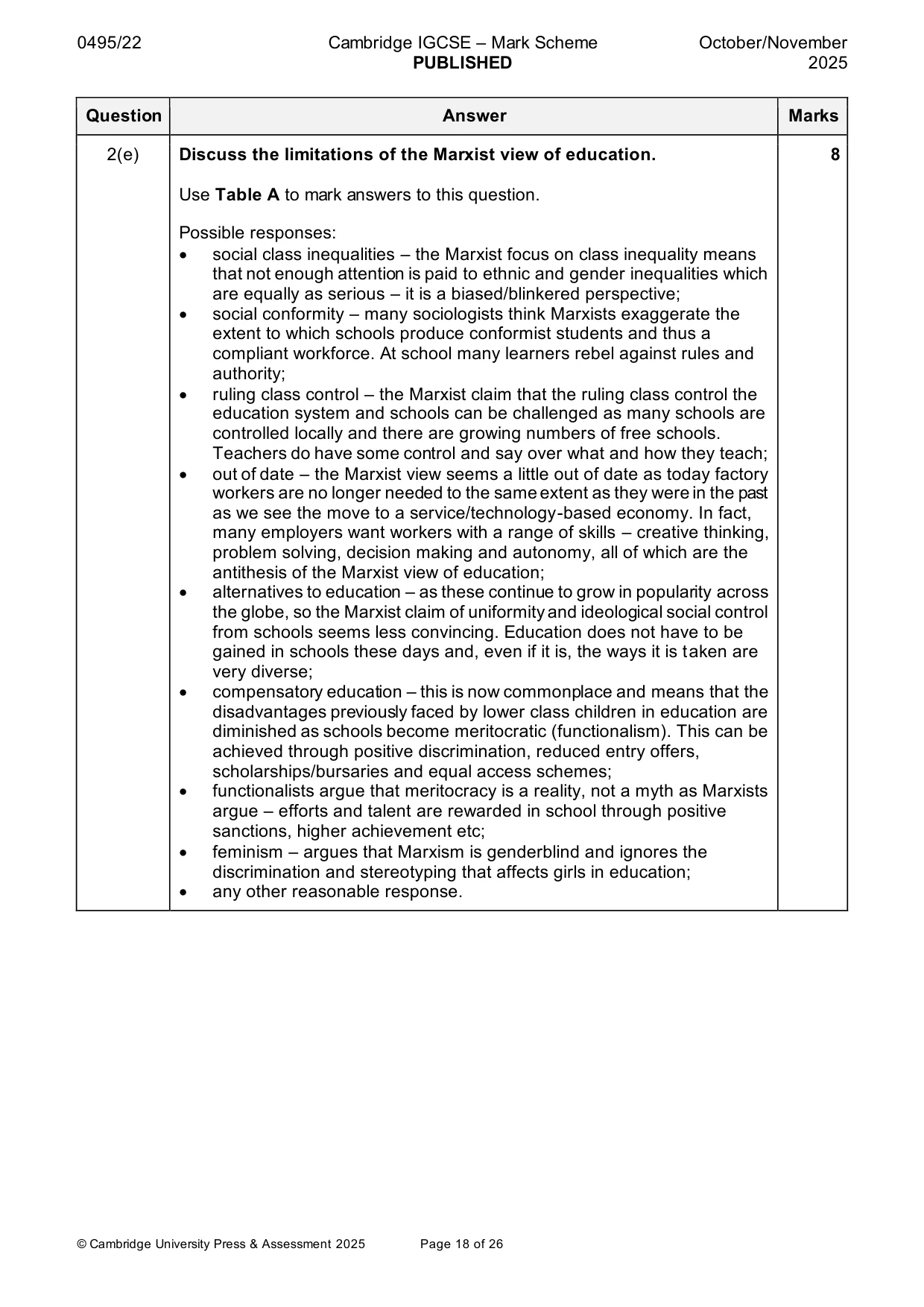
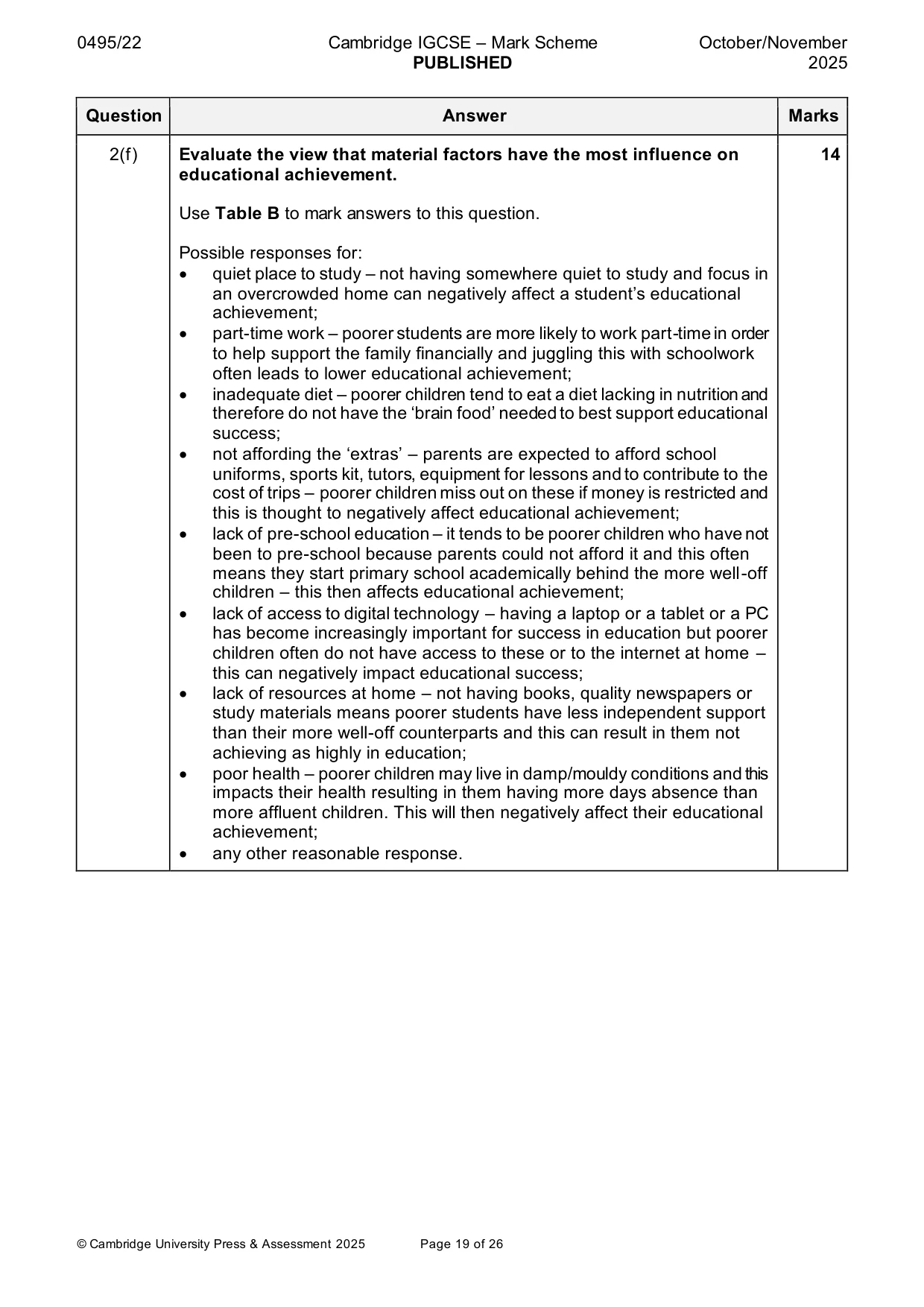
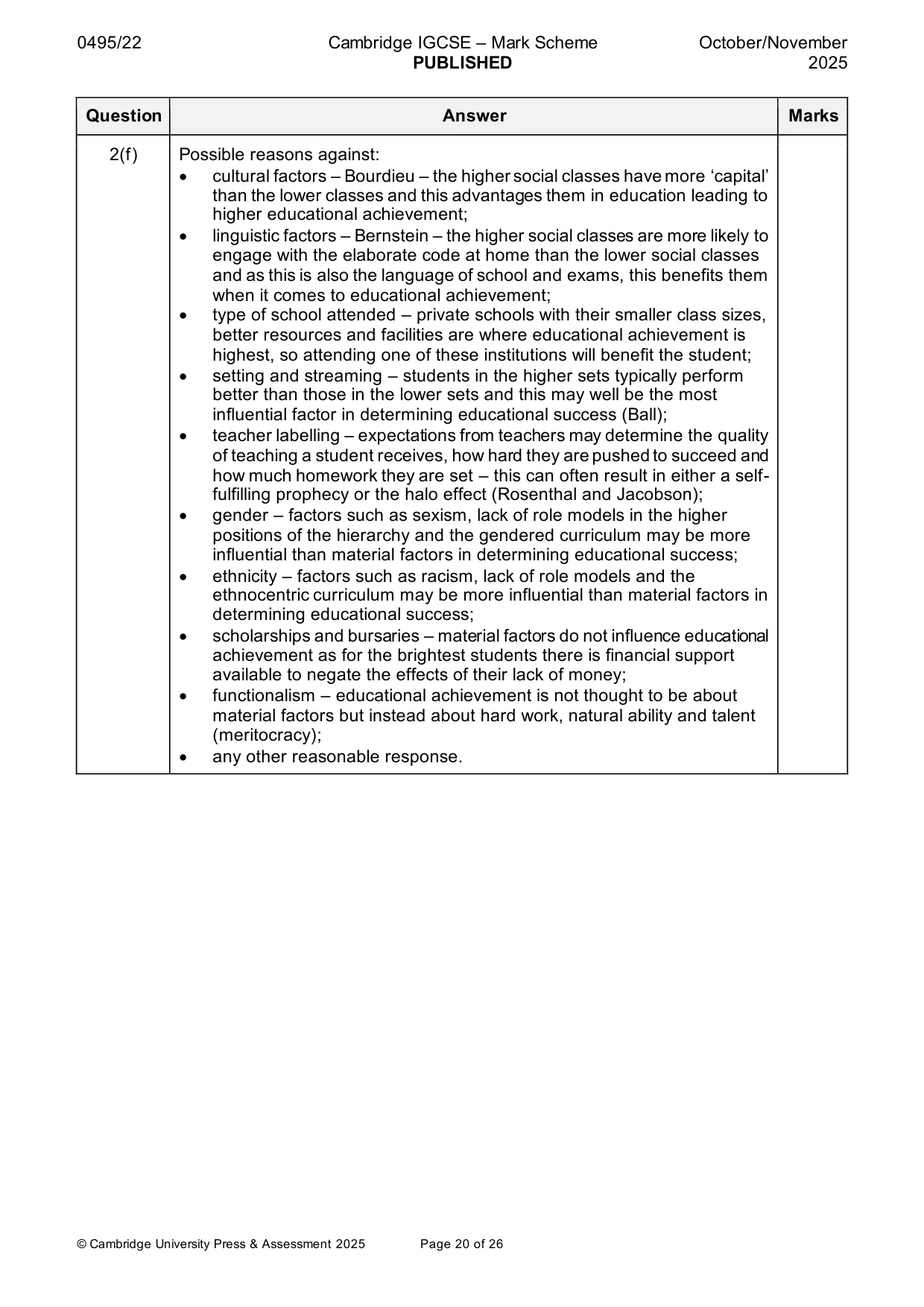
Mark scheme: 2(a)(i) Define the term gendered curriculum. 2 Award one mark for a partial definition, e.g. boys subjects; Award two marks for a clear definition, e.g. the subjects taught and the content covered are biased towards one gender, usually boys. Accept any other reasonable response. 2(a)(ii) Define the term pro-school sub-culture. 2 Award one mark for a partial definition, e.g. doing well at school; Award two marks for a clear definition, e.g. a group of learners whose norms and values agree with those of the school. Accept any other reasonable response. 2(b) State two linguistic factors that can affect educational experience. 2 Award one mark for each correct example (up to a maximum of two). Possible responses: • bilingualism – speaking two languages (or more); • elaborated code – speaking the formal language of school at home; • restricted code – limited/informal vocabulary from home can hinder performance at school; • host language – speaking the same language at home as at school helps performance; • native language – may be devalued by education and deemed inappropriate for school; • accent – some accents are deemed to be ‘posher’ or ‘less smart’ by teachers and so affect how students are treated/thought of; • any other relevant response. 2(c) Describe three features of the official curriculum. 6 Award one mark for each point correctly identified (up to a maximum of three). Award one mark for each point that is developed (up to a maximum of three). Possible responses: • national curriculum – the government in many countries outlines the subjects and set content to be taught therefore learners of a similar age all have to learn the same things in every school e.g. science, maths, language etc; • standardised testing – the official curriculum requires learners to take national tests to assess progress and to measure the performance of different schools, according to universal standards, hence it is meritocratic; • primary education – the first years of learning in most countries comprise of reading, writing and mathematics with an introduction to other subject areas; • taught by experts – the official curriculum is typically taught by trained teachers through formal teaching and textbooks; • school-based – the official curriculum is typically delivered in educational establishments such as schools. It is delivered in classroom settings with specialist equipment; • subjects – the official curriculum is delivered via subjects which will have set content and a syllabus of what needs to be covered; • any other reasonable response. 2(d) Explain three ways education is meritocratic. 6 Award one mark for each point correctly identified (up to a maximum of three). Award one mark for each point that is developed (up to a maximum of three). Possible responses: • comprehensive schools – admit all students from a local area regardless of money or ability, giving them all the same opportunities for success; • role allocation – functionalism – meritocracy in education means that the best achieving learners should be able to enter their chosen career. It is a system of ‘sifting and sorting’, getting the children of different abilities into the most appropriate job – a fair and meritocratic system of selection by ability; • compensatory education – e.g. bursaries, free preschool places, extra support for students from disadvantaged backgrounds and scholarships – the brightest children will not be held back academically as they can be awarded financial assistance to support them in attending, for example, private schools; • setting by ability – learners all have different abilities and schools will set them by ability accordingly. Functionalists argue that it is unfair to delay learners who progress more quickly by slowing the pace of teaching for learners who need extra support. Thus, setting is seen to be meritocratic; • alternative approaches to education – education can be delivered in the best way for the learner and their context making it an equal and democratic process e.g. unschooling, progressive schooling, home- schooling etc; • vocational education – for those students who are not able to succeed academically, vocational education is available allowing all students the chance to train and develop their skills; • national curriculum – this ensures that all students follow the same curriculum ensuring that they all have the same opportunities for success; • standardised testing – all children will be tested in the same ways and this is another way that education is seen to be meritocratic and fair – no one is advantaged or disadvantaged e.g. examinations; • equal opportunities – legislation has changed to ensure that all children have the same rights to an education, regardless of ethnicity, gender, disability or social class (wealth and income); • free education – in most countries access to education is free, this is clearly meritocratic as it does not prevent anybody from getting an education; • education allows for social mobility – e.g. if a working class student works hard they can gain good qualifications which will allow them to achieve a middle class job like an engineer or teacher; • any other reasonable response. 2(e) Discuss the limitations of the Marxist view of education. 8 Use Table A to mark answers to this question. Possible responses: • social class inequalities – the Marxist focus on class inequality means that not enough attention is paid to ethnic and gender inequalities which are equally as serious – it is a biased/blinkered perspective; • social conformity – many sociologists think Marxists exaggerate the extent to which schools produce conformist students and thus a compliant workforce. At school many learners rebel against rules and authority; • ruling class control – the Marxist claim that the ruling class control the education system and schools can be challenged as many schools are controlled locally and there are growing numbers of free schools. Teachers do have some control and say over what and how they teach; • out of date – the Marxist view seems a little out of date as today factory workers are no longer needed to the same extent as they were in the past as we see the move to a service/technology-based economy. In fact, many employers want workers with a range of skills – creative thinking, problem solving, decision making and autonomy, all of which are the antithesis of the Marxist view of education; • alternatives to education – as these continue to grow in popularity across the globe, so the Marxist claim of uniformity and ideological social control from schools seems less convincing. Education does not have to be gained in schools these days and, even if it is, the ways it is taken are very diverse; • compensatory education – this is now commonplace and means that the disadvantages previously faced by lower class children in education are diminished as schools become meritocratic (functionalism). This can be achieved through positive discrimination, reduced entry offers, scholarships/bursaries and equal access schemes; • functionalists argue that meritocracy is a reality, not a myth as Marxists argue – efforts and talent are rewarded in school through positive sanctions, higher achievement etc; • feminism – argues that Marxism is genderblind and ignores the discrimination and stereotyping that affects girls in education; • any other reasonable response. 2(f) Evaluate the view that material factors have the most influence on 14 educational achievement. Use Table B to mark answers to this question. Possible responses for: • quiet place to study – not having somewhere quiet to study and focus in an overcrowded home can negatively affect a student’s educational achievement; • part-time work – poorer students are more likely to work part-time in order to help support the family financially and juggling this with schoolwork often leads to lower educational achievement; • inadequate diet – poorer children tend to eat a diet lacking in nutrition and therefore do not have the ‘brain food’ needed to best support educational success; • not affording the ‘extras’ – parents are expected to afford school uniforms, sports kit, tutors, equipment for lessons and to contribute to the cost of trips – poorer children miss out on these if money is restricted and this is thought to negatively affect educational achievement; • lack of pre-school education – it tends to be poorer children who have not been to pre-school because parents could not afford it and this often means they start primary school academically behind the more well-off children – this then affects educational achievement; • lack of access to digital technology – having a laptop or a tablet or a PC has become increasingly important for success in education but poorer children often do not have access to these or to the internet at home – this can negatively impact educational success; • lack of resources at home – not having books, quality newspapers or study materials means poorer students have less independent support than their more well-off counterparts and this can result in them not achieving as highly in education; • poor health – poorer children may live in damp/mouldy conditions and this impacts their health resulting in them having more days absence than more affluent children. This will then negatively affect their educational achievement; • any other reasonable response. 2(f) Possible reasons against: • cultural factors – Bourdieu – the higher social classes have more ‘capital’ than the lower classes and this advantages them in education leading to higher educational achievement; • linguistic factors – Bernstein – the higher social classes are more likely to engage with the elaborate code at home than the lower social classes and as this is also the language of school and exams, this benefits them when it comes to educational achievement; • type of school attended – private schools with their smaller class sizes, better resources and facilities are where educational achievement is highest, so attending one of these institutions will benefit the student; • setting and streaming – students in the higher sets typically perform better than those in the lower sets and this may well be the most influential factor in determining educational success (Ball); • teacher labelling – expectations from teachers may determine the quality of teaching a student receives, how hard they are pushed to succeed and how much homework they are set – this can often result in either a self- fulfilling prophecy or the halo effect (Rosenthal and Jacobson); • gender – factors such as sexism, lack of role models in the higher positions of the hierarchy and the gendered curriculum may be more influential than material factors in determining educational success; • ethnicity – factors such as racism, lack of role models and the ethnocentric curriculum may be more influential than material factors in determining educational success; • scholarships and bursaries – material factors do not influence educational achievement as for the brightest students there is financial support available to negate the effects of their lack of money; • functionalism – educational achievement is not thought to be about material factors but instead about hard work, natural ability and talent (meritocracy); • any other reasonable response.
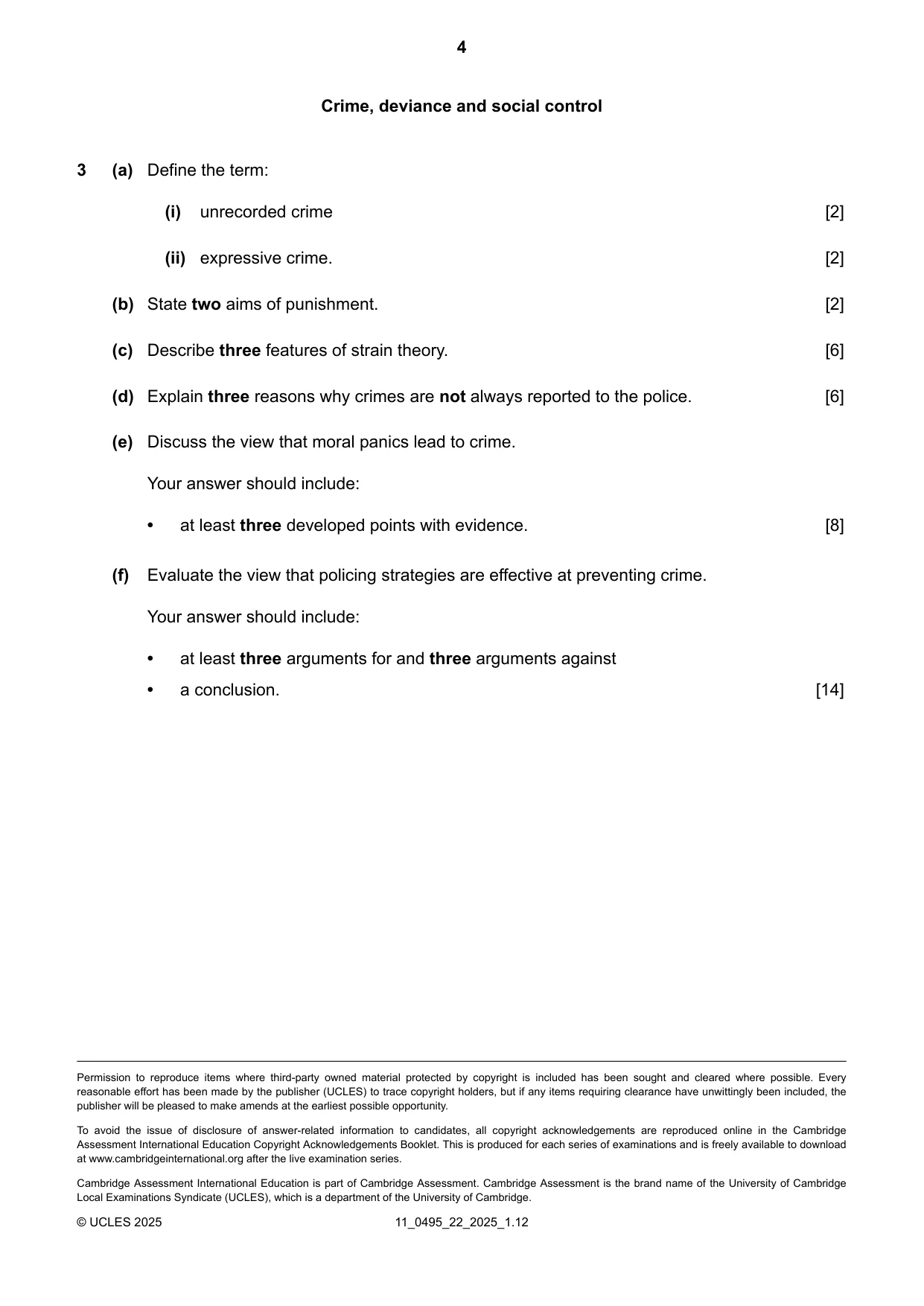
Q3 · Define the term: (i) unrecorded crime [2] (ii) expressive crime
3 (a) Define the term: (i) unrecorded crime [2] (ii) expressive crime. [2] (b) State two aims of punishment. [2] (c) Describe three features of strain theory. [6] (d) Explain three reasons why crimes are not always reported to the police. [6] (e) Discuss the view that moral panics lead to crime. Your answer should include: • at least three developed points with evidence. [8] (f) Evaluate the view that policing strategies are effective at preventing crime. Your answer should include: • at least three arguments for and three arguments against • a conclusion. [14]
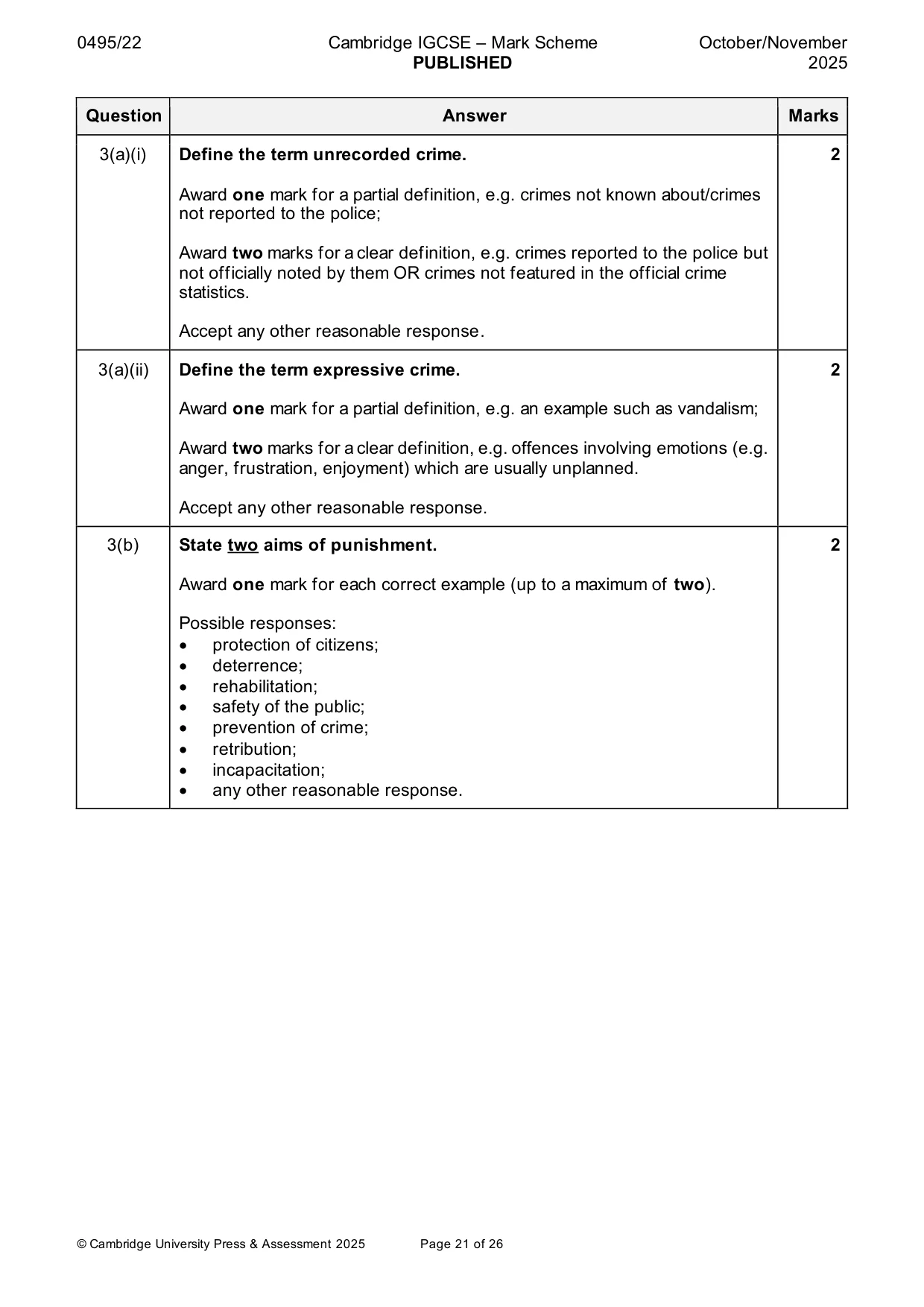
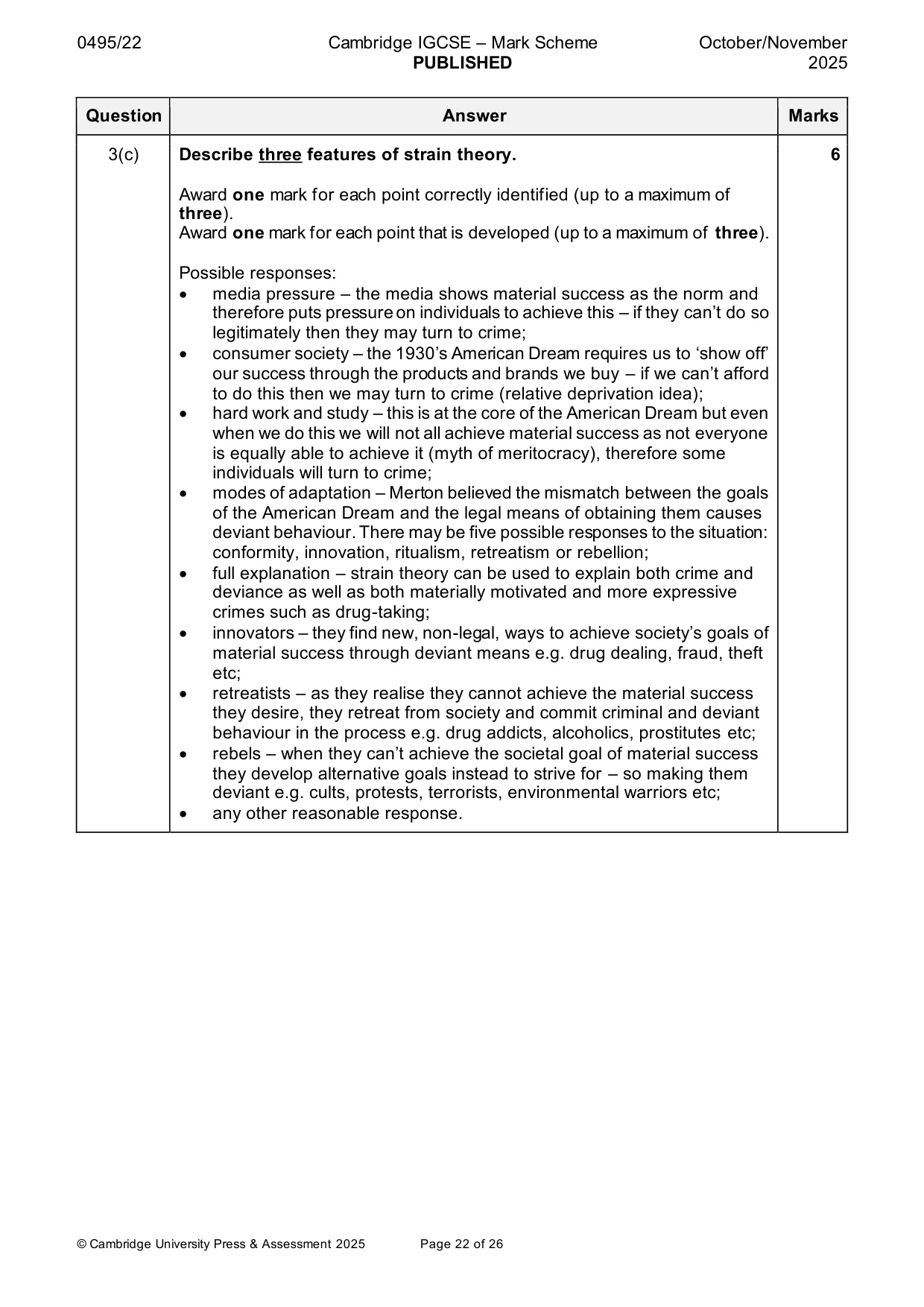
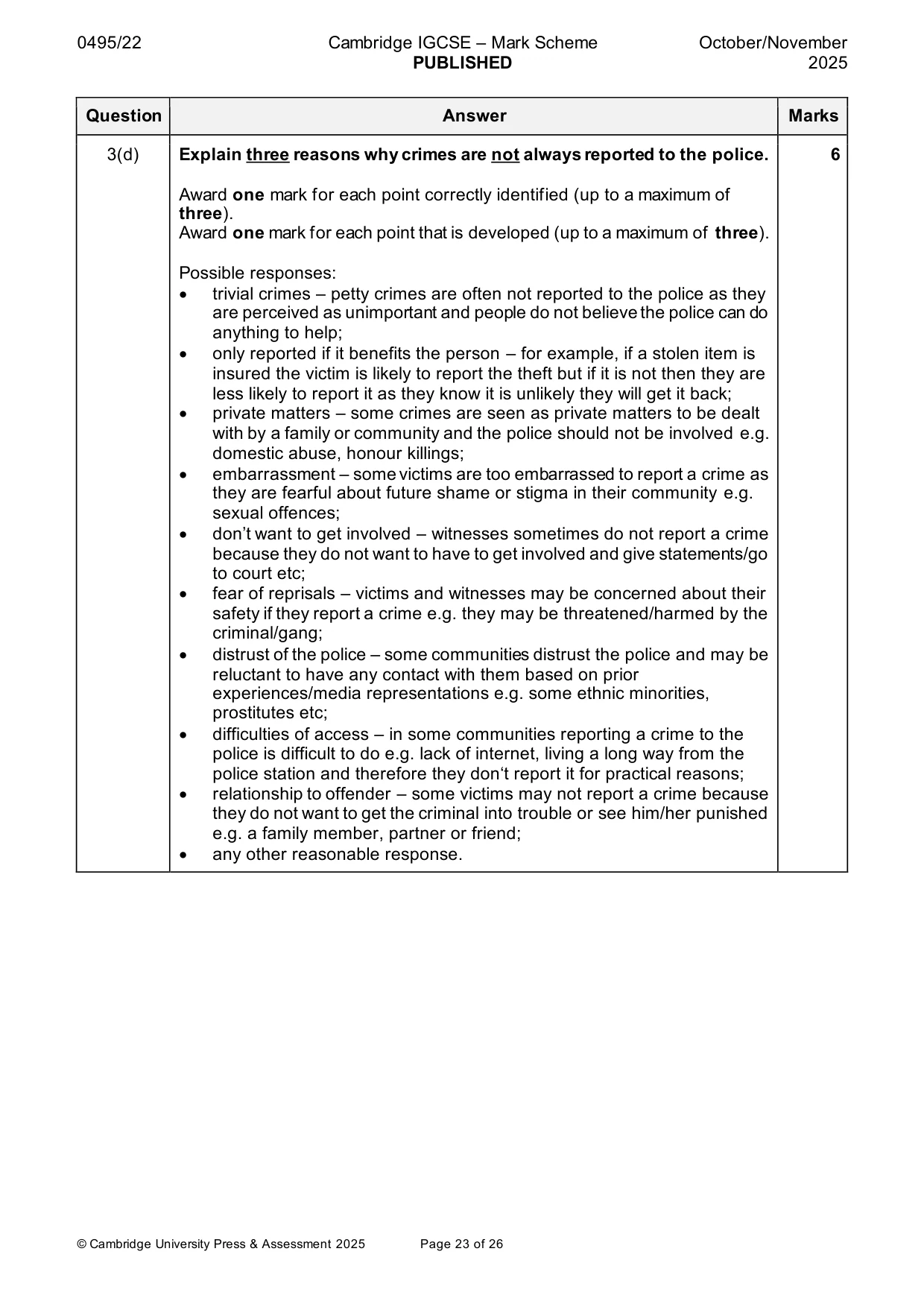
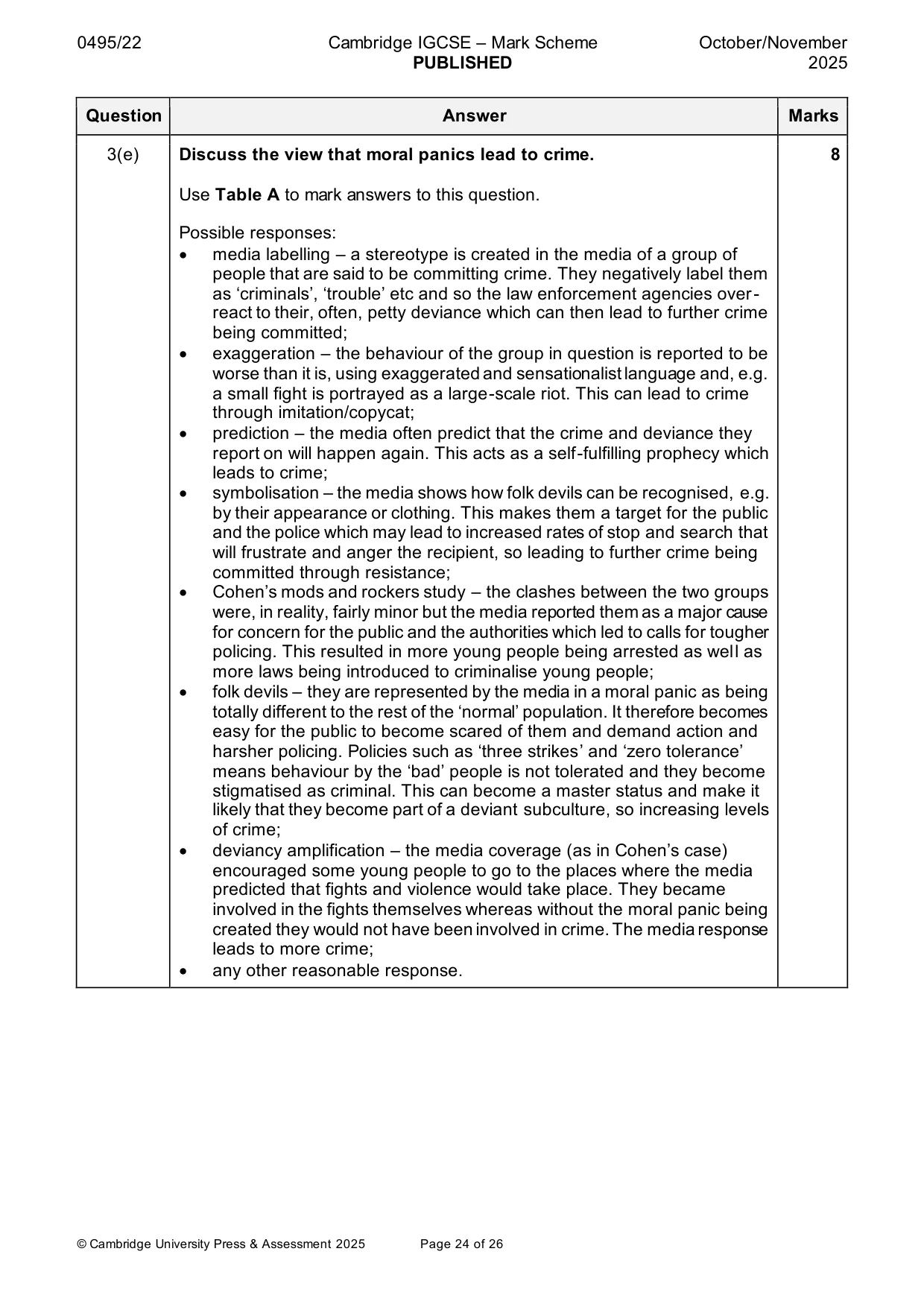
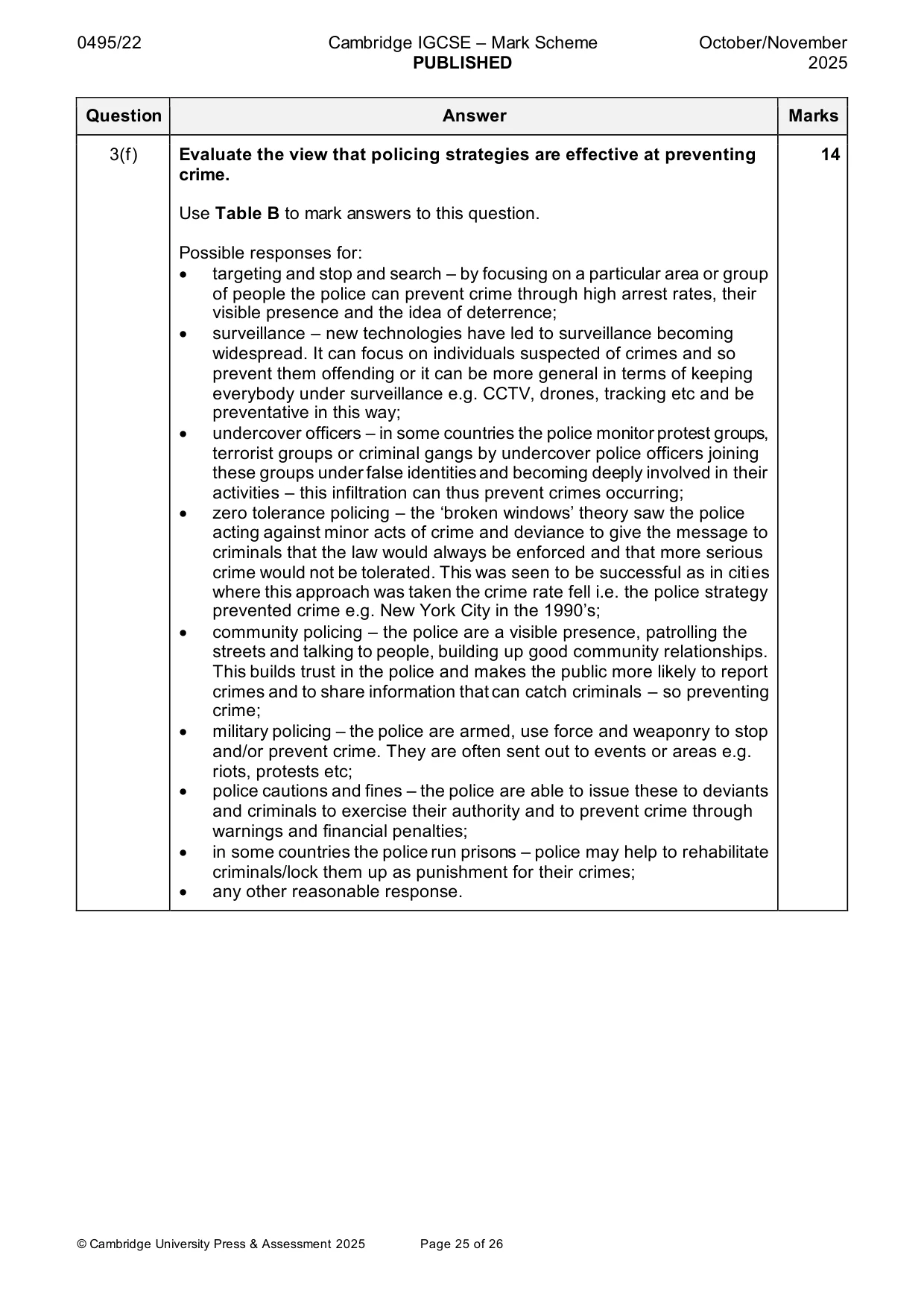
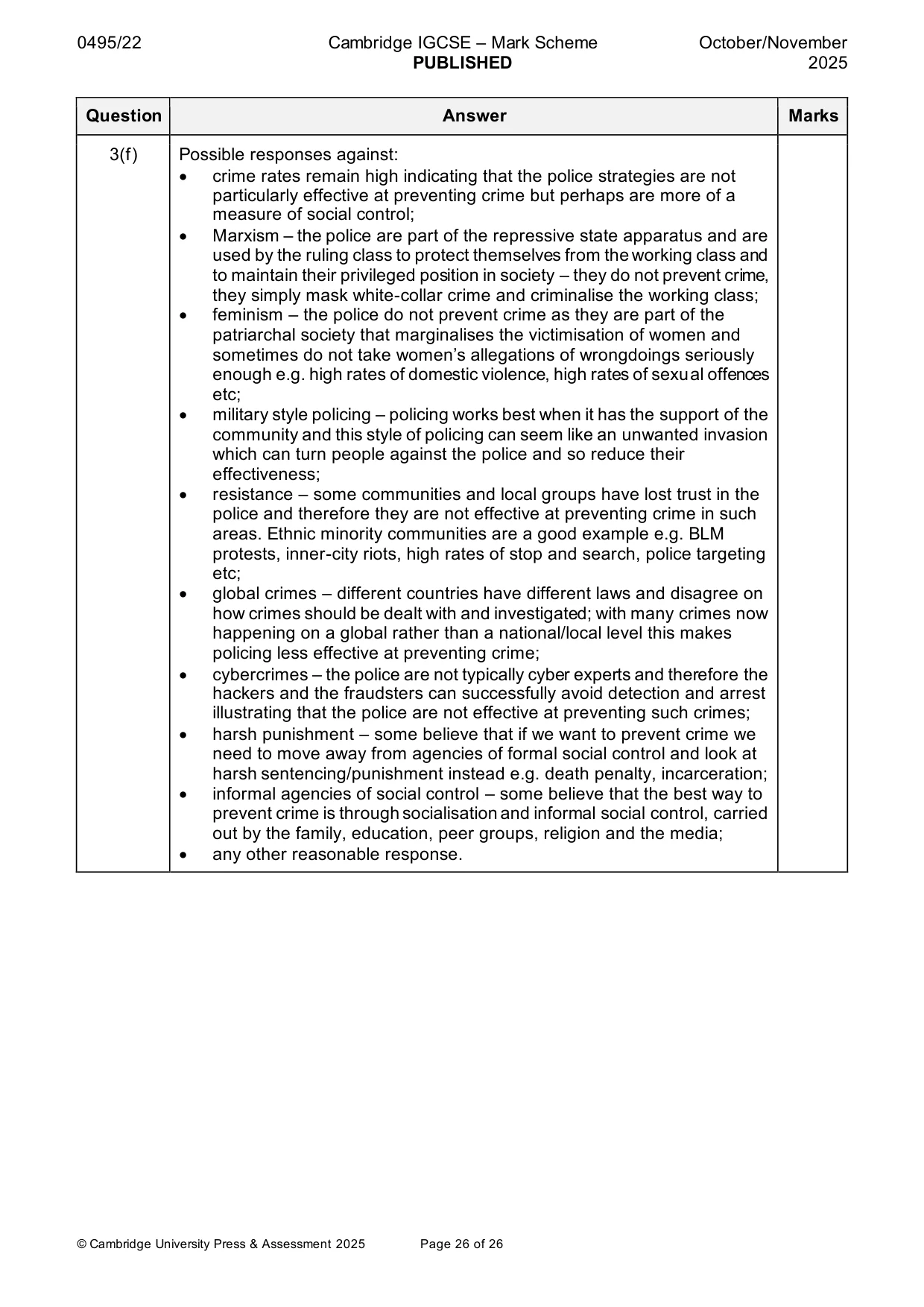
Mark scheme: 3(a)(i) Define the term unrecorded crime. 2 Award one mark for a partial definition, e.g. crimes not known about/crimes not reported to the police; Award two marks for a clear definition, e.g. crimes reported to the police but not officially noted by them OR crimes not featured in the official crime statistics. Accept any other reasonable response. 3(a)(ii) Define the term expressive crime. 2 Award one mark for a partial definition, e.g. an example such as vandalism; Award two marks for a clear definition, e.g. offences involving emotions (e.g. anger, frustration, enjoyment) which are usually unplanned. Accept any other reasonable response. 3(b) State two aims of punishment. 2 Award one mark for each correct example (up to a maximum of two). Possible responses: • protection of citizens; • deterrence; • rehabilitation; • safety of the public; • prevention of crime; • retribution; • incapacitation; • any other reasonable response. 3(c) Describe three features of strain theory. 6 Award one mark for each point correctly identified (up to a maximum of three). Award one mark for each point that is developed (up to a maximum of three). Possible responses: • media pressure – the media shows material success as the norm and therefore puts pressure on individuals to achieve this – if they can’t do so legitimately then they may turn to crime; • consumer society – the 1930’s American Dream requires us to ‘show off’ our success through the products and brands we buy – if we can’t afford to do this then we may turn to crime (relative deprivation idea); • hard work and study – this is at the core of the American Dream but even when we do this we will not all achieve material success as not everyone is equally able to achieve it (myth of meritocracy), therefore some individuals will turn to crime; • modes of adaptation – Merton believed the mismatch between the goals of the American Dream and the legal means of obtaining them causes deviant behaviour. There may be five possible responses to the situation: conformity, innovation, ritualism, retreatism or rebellion; • full explanation – strain theory can be used to explain both crime and deviance as well as both materially motivated and more expressive crimes such as drug-taking; • innovators – they find new, non-legal, ways to achieve society’s goals of material success through deviant means e.g. drug dealing, fraud, theft etc; • retreatists – as they realise they cannot achieve the material success they desire, they retreat from society and commit criminal and deviant behaviour in the process e.g. drug addicts, alcoholics, prostitutes etc; • rebels – when they can’t achieve the societal goal of material success they develop alternative goals instead to strive for – so making them deviant e.g. cults, protests, terrorists, environmental warriors etc; • any other reasonable response. 3(d) Explain three reasons why crimes are not always reported to the police. 6 Award one mark for each point correctly identified (up to a maximum of three). Award one mark for each point that is developed (up to a maximum of three). Possible responses: • trivial crimes – petty crimes are often not reported to the police as they are perceived as unimportant and people do not believe the police can do anything to help; • only reported if it benefits the person – for example, if a stolen item is insured the victim is likely to report the theft but if it is not then they are less likely to report it as they know it is unlikely they will get it back; • private matters – some crimes are seen as private matters to be dealt with by a family or community and the police should not be involved e.g. domestic abuse, honour killings; • embarrassment – some victims are too embarrassed to report a crime as they are fearful about future shame or stigma in their community e.g. sexual offences; • don’t want to get involved – witnesses sometimes do not report a crime because they do not want to have to get involved and give statements/go to court etc; • fear of reprisals – victims and witnesses may be concerned about their safety if they report a crime e.g. they may be threatened/harmed by the criminal/gang; • distrust of the police – some communities distrust the police and may be reluctant to have any contact with them based on prior experiences/media representations e.g. some ethnic minorities, prostitutes etc; • difficulties of access – in some communities reporting a crime to the police is difficult to do e.g. lack of internet, living a long way from the police station and therefore they don‘t report it for practical reasons; • relationship to offender – some victims may not report a crime because they do not want to get the criminal into trouble or see him/her punished e.g. a family member, partner or friend; • any other reasonable response. 3(e) Discuss the view that moral panics lead to crime. 8 Use Table A to mark answers to this question. Possible responses: • media labelling – a stereotype is created in the media of a group of people that are said to be committing crime. They negatively label them as ‘criminals’, ‘trouble’ etc and so the law enforcement agencies over- react to their, often, petty deviance which can then lead to further crime being committed; • exaggeration – the behaviour of the group in question is reported to be worse than it is, using exaggerated and sensationalist language and, e.g. a small fight is portrayed as a large-scale riot. This can lead to crime through imitation/copycat; • prediction – the media often predict that the crime and deviance they report on will happen again. This acts as a self-fulfilling prophecy which leads to crime; • symbolisation – the media shows how folk devils can be recognised, e.g. by their appearance or clothing. This makes them a target for the public and the police which may lead to increased rates of stop and search that will frustrate and anger the recipient, so leading to further crime being committed through resistance; • Cohen’s mods and rockers study – the clashes between the two groups were, in reality, fairly minor but the media reported them as a major cause for concern for the public and the authorities which led to calls for tougher policing. This resulted in more young people being arrested as well as more laws being introduced to criminalise young people; • folk devils – they are represented by the media in a moral panic as being totally different to the rest of the ‘normal’ population. It therefore becomes easy for the public to become scared of them and demand action and harsher policing. Policies such as ‘three strikes’ and ‘zero tolerance’ means behaviour by the ‘bad’ people is not tolerated and they become stigmatised as criminal. This can become a master status and make it likely that they become part of a deviant subculture, so increasing levels of crime; • deviancy amplification – the media coverage (as in Cohen’s case) encouraged some young people to go to the places where the media predicted that fights and violence would take place. They became involved in the fights themselves whereas without the moral panic being created they would not have been involved in crime. The media response leads to more crime; • any other reasonable response. 3(f) Evaluate the view that policing strategies are effective at preventing 14 crime. Use Table B to mark answers to this question. Possible responses for: • targeting and stop and search – by focusing on a particular area or group of people the police can prevent crime through high arrest rates, their visible presence and the idea of deterrence; • surveillance – new technologies have led to surveillance becoming widespread. It can focus on individuals suspected of crimes and so prevent them offending or it can be more general in terms of keeping everybody under surveillance e.g. CCTV, drones, tracking etc and be preventative in this way; • undercover officers – in some countries the police monitor protest groups, terrorist groups or criminal gangs by undercover police officers joining these groups under false identities and becoming deeply involved in their activities – this infiltration can thus prevent crimes occurring; • zero tolerance policing – the ‘broken windows’ theory saw the police acting against minor acts of crime and deviance to give the message to criminals that the law would always be enforced and that more serious crime would not be tolerated. This was seen to be successful as in cities where this approach was taken the crime rate fell i.e. the police strategy prevented crime e.g. New York City in the 1990’s; • community policing – the police are a visible presence, patrolling the streets and talking to people, building up good community relationships. This builds trust in the police and makes the public more likely to report crimes and to share information that can catch criminals – so preventing crime; • military policing – the police are armed, use force and weaponry to stop and/or prevent crime. They are often sent out to events or areas e.g. riots, protests etc; • police cautions and fines – the police are able to issue these to deviants and criminals to exercise their authority and to prevent crime through warnings and financial penalties; • in some countries the police run prisons – police may help to rehabilitate criminals/lock them up as punishment for their crimes; • any other reasonable response. 3(f) Possible responses against: • crime rates remain high indicating that the police strategies are not particularly effective at preventing crime but perhaps are more of a measure of social control; • Marxism – the police are part of the repressive state apparatus and are used by the ruling class to protect themselves from the working class and to maintain their privileged position in society – they do not prevent crime, they simply mask white-collar crime and criminalise the working class; • feminism – the police do not prevent crime as they are part of the patriarchal society that marginalises the victimisation of women and sometimes do not take women’s allegations of wrongdoings seriously enough e.g. high rates of domestic violence, high rates of sexual offences etc; • military style policing – policing works best when it has the support of the community and this style of policing can seem like an unwanted invasion which can turn people against the police and so reduce their effectiveness; • resistance – some communities and local groups have lost trust in the police and therefore they are not effective at preventing crime in such areas. Ethnic minority communities are a good example e.g. BLM protests, inner-city riots, high rates of stop and search, police targeting etc; • global crimes – different countries have different laws and disagree on how crimes should be dealt with and investigated; with many crimes now happening on a global rather than a national/local level this makes policing less effective at preventing crime; • cybercrimes – the police are not typically cyber experts and therefore the hackers and the fraudsters can successfully avoid detection and arrest illustrating that the police are not effective at preventing such crimes; • harsh punishment – some believe that if we want to prevent crime we need to move away from agencies of formal social control and look at harsh sentencing/punishment instead e.g. death penalty, incarceration; • informal agencies of social control – some believe that the best way to prevent crime is through socialisation and informal social control, carried out by the family, education, peer groups, religion and the media; • any other reasonable response.
What was in this paper
The subtopics covered by these 3 questions, and how many questions each got. Open one in a new tab to see every Cambridge question on it.
What you needed in this session
Cambridge’s own grade thresholds for 2025 Oct/Nov, Paper 2 · Variant 2. A higher threshold means an easier paper — the bar moves with how the cohort did.