Cambridge IGCSE Sociology 0495 — 2025 Oct/Nov Paper 2 · Variant 1
0495/21/O/N/25 · 3 questions · 80 marks · 105 min
The question paper and its mark scheme, free to read here and free to download. This is Cambridge’s own paper, exactly as it was sat.
Question paper4 pages




Mark scheme25 pages
Answers below. Sit the paper first if you are practising.









Questions as text
Q1 · Define the term: (i) domestic division of labour [2] (ii) life expectancy
1 (a) Define the term: (i) domestic division of labour [2] (ii) life expectancy. [2] (b) State two family structures. [2] (c) Describe three ways family life can be positive for its members. [6] (d) Explain three ways urbanisation affects family life. [6] (e) Discuss the view that family life is diverse. Your answer should include: • at least three developed points with evidence. [8] (f) Evaluate the view that the family benefits capitalism. Your answer should include: • at least three arguments for and three arguments against • a conclusion. [14] Education
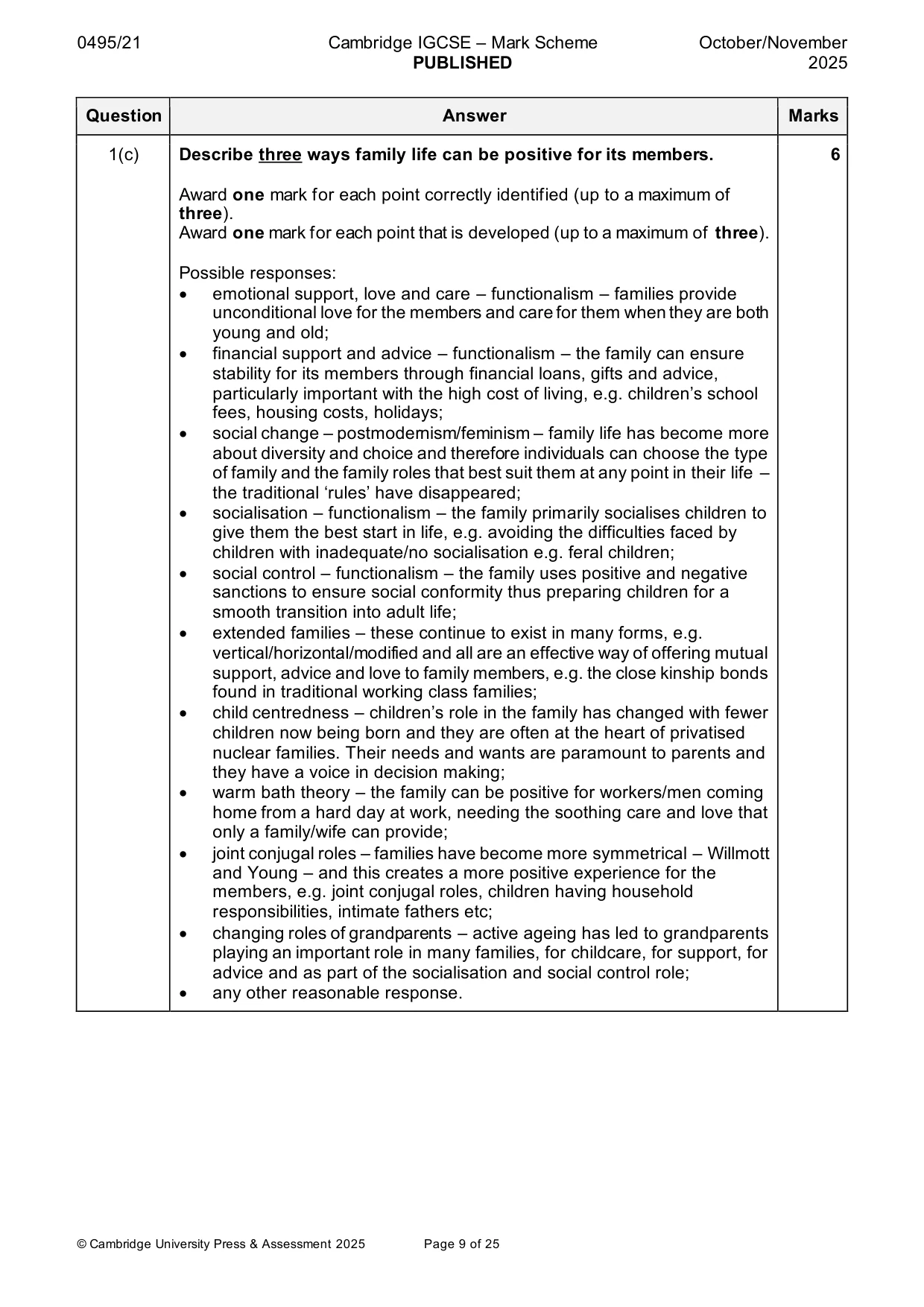
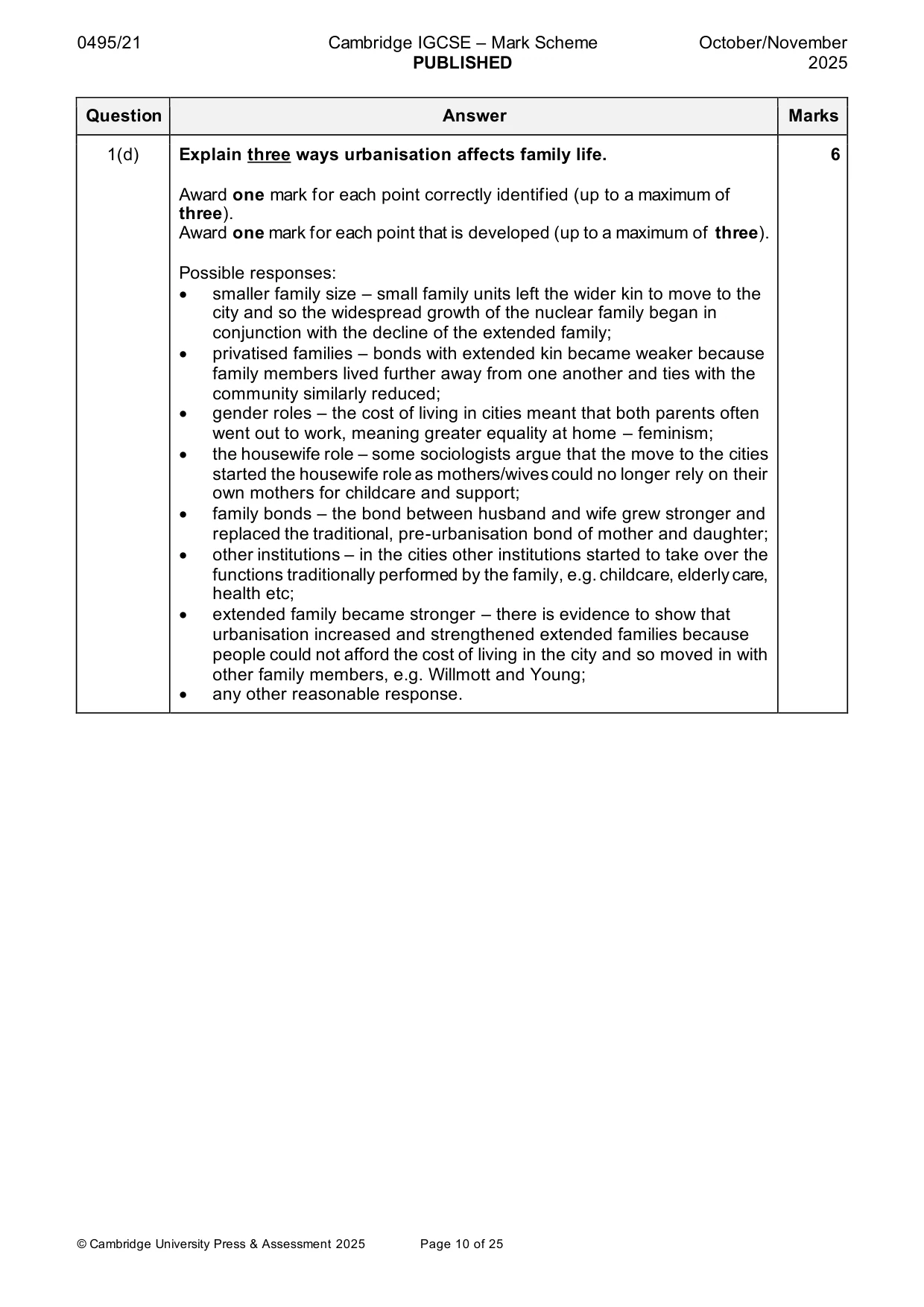
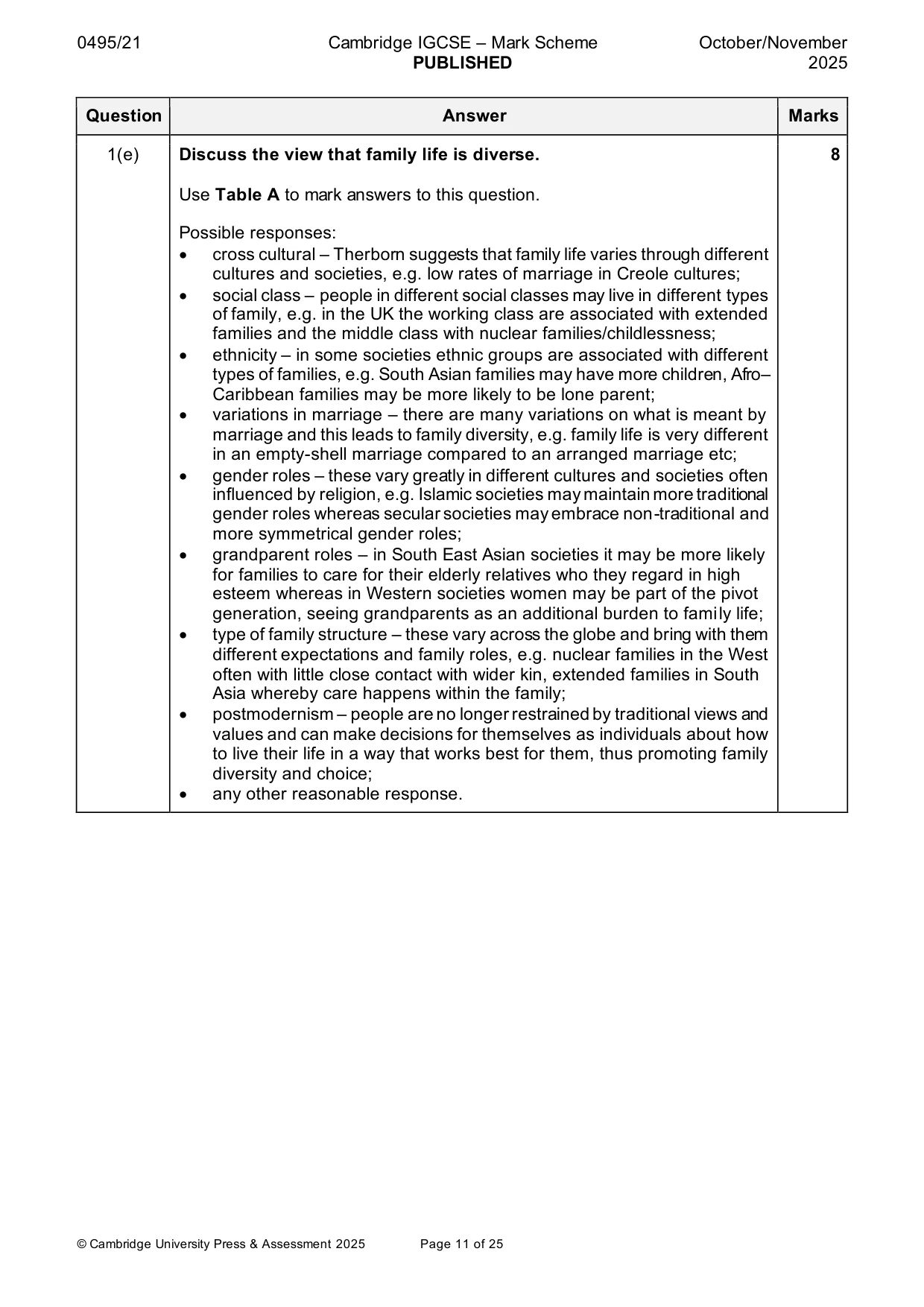
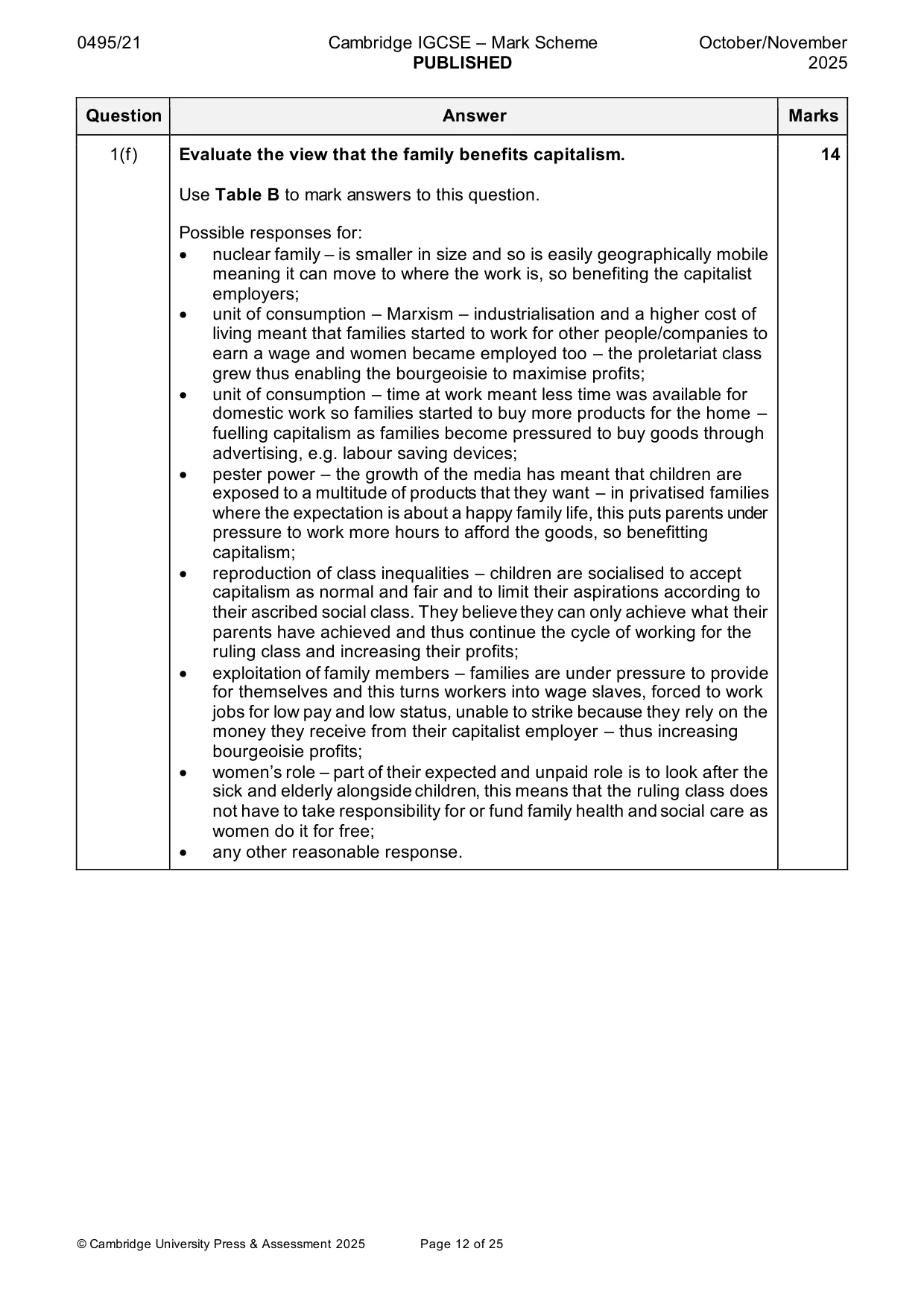
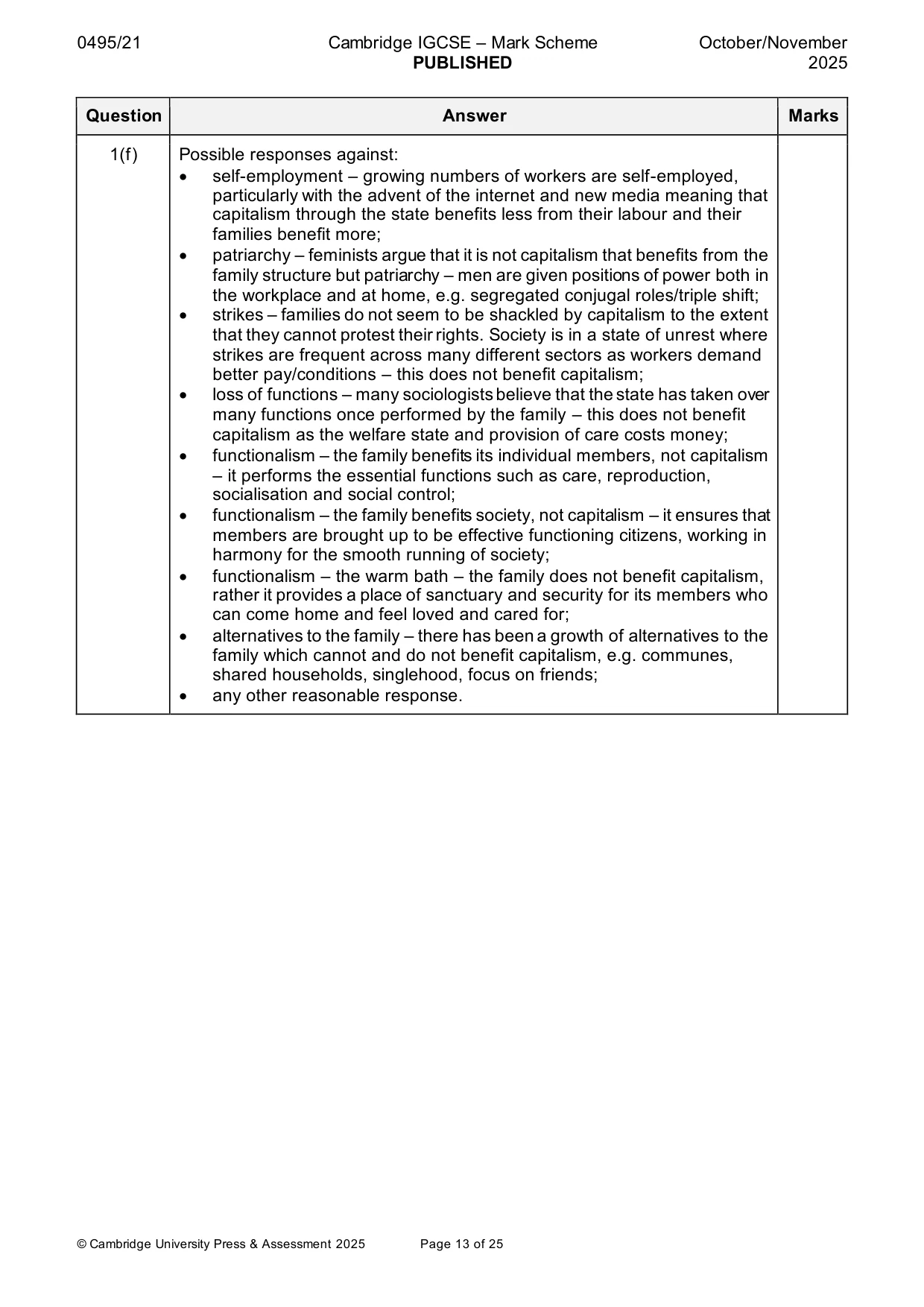
Mark scheme: Question Answer Marks 1(a)(i) Define the term domestic division of labour. 2 Award one mark for a partial definition, e.g. the wife cooks. Award two marks for a clear definition, e.g. the way in which tasks in the home are divided between husband and wife. Accept any other reasonable response. 1(a)(ii) Define the term life expectancy. 2 Award one mark for a partial definition, e.g. how long you live. Award two marks for a clear definition, e.g. the age to which men and women are expected to live in a society. Accept any other reasonable response. 1(b) State two family structures. 2 Award one mark for each correct point (up to a maximum of two). Possible responses: • nuclear; • extended; • reconstituted; • lone parent; • empty nest; • childless; • any other reasonable response. 1(c) Describe three ways family life can be positive for its members. 6 Award one mark for each point correctly identified (up to a maximum of three). Award one mark for each point that is developed (up to a maximum of three). Possible responses: • emotional support, love and care – functionalism – families provide unconditional love for the members and care for them when they are both young and old; • financial support and advice – functionalism – the family can ensure stability for its members through financial loans, gifts and advice, particularly important with the high cost of living, e.g. children’s school fees, housing costs, holidays; • social change – postmodernism/feminism – family life has become more about diversity and choice and therefore individuals can choose the type of family and the family roles that best suit them at any point in their life – the traditional ‘rules’ have disappeared; • socialisation – functionalism – the family primarily socialises children to give them the best start in life, e.g. avoiding the difficulties faced by children with inadequate/no socialisation e.g. feral children; • social control – functionalism – the family uses positive and negative sanctions to ensure social conformity thus preparing children for a smooth transition into adult life; • extended families – these continue to exist in many forms, e.g. vertical/horizontal/modified and all are an effective way of offering mutual support, advice and love to family members, e.g. the close kinship bonds found in traditional working class families; • child centredness – children’s role in the family has changed with fewer children now being born and they are often at the heart of privatised nuclear families. Their needs and wants are paramount to parents and they have a voice in decision making; • warm bath theory – the family can be positive for workers/men coming home from a hard day at work, needing the soothing care and love that only a family/wife can provide; • joint conjugal roles – families have become more symmetrical – Willmott and Young – and this creates a more positive experience for the members, e.g. joint conjugal roles, children having household responsibilities, intimate fathers etc; • changing roles of grandparents – active ageing has led to grandparents playing an important role in many families, for childcare, for support, for advice and as part of the socialisation and social control role; • any other reasonable response. 1(d) Explain three ways urbanisation affects family life. 6 Award one mark for each point correctly identified (up to a maximum of three). Award one mark for each point that is developed (up to a maximum of three). Possible responses: • smaller family size – small family units left the wider kin to move to the city and so the widespread growth of the nuclear family began in conjunction with the decline of the extended family; • privatised families – bonds with extended kin became weaker because family members lived further away from one another and ties with the community similarly reduced; • gender roles – the cost of living in cities meant that both parents often went out to work, meaning greater equality at home – feminism; • the housewife role – some sociologists argue that the move to the cities started the housewife role as mothers/wives could no longer rely on their own mothers for childcare and support; • family bonds – the bond between husband and wife grew stronger and replaced the traditional, pre-urbanisation bond of mother and daughter; • other institutions – in the cities other institutions started to take over the functions traditionally performed by the family, e.g. childcare, elderly care, health etc; • extended family became stronger – there is evidence to show that urbanisation increased and strengthened extended families because people could not afford the cost of living in the city and so moved in with other family members, e.g. Willmott and Young; • any other reasonable response. 1(e) Discuss the view that family life is diverse. 8 Use Table A to mark answers to this question. Possible responses: • cross cultural – Therborn suggests that family life varies through different cultures and societies, e.g. low rates of marriage in Creole cultures; • social class – people in different social classes may live in different types of family, e.g. in the UK the working class are associated with extended families and the middle class with nuclear families/childlessness; • ethnicity – in some societies ethnic groups are associated with different types of families, e.g. South Asian families may have more children, Afro– Caribbean families may be more likely to be lone parent; • variations in marriage – there are many variations on what is meant by marriage and this leads to family diversity, e.g. family life is very different in an empty-shell marriage compared to an arranged marriage etc; • gender roles – these vary greatly in different cultures and societies often influenced by religion, e.g. Islamic societies may maintain more traditional gender roles whereas secular societies may embrace non-traditional and more symmetrical gender roles; • grandparent roles – in South East Asian societies it may be more likely for families to care for their elderly relatives who they regard in high esteem whereas in Western societies women may be part of the pivot generation, seeing grandparents as an additional burden to family life; • type of family structure – these vary across the globe and bring with them different expectations and family roles, e.g. nuclear families in the West often with little close contact with wider kin, extended families in South Asia whereby care happens within the family; • postmodernism – people are no longer restrained by traditional views and values and can make decisions for themselves as individuals about how to live their life in a way that works best for them, thus promoting family diversity and choice; • any other reasonable response. 1(f) Evaluate the view that the family benefits capitalism. 14 Use Table B to mark answers to this question. Possible responses for: • nuclear family – is smaller in size and so is easily geographically mobile meaning it can move to where the work is, so benefiting the capitalist employers; • unit of consumption – Marxism – industrialisation and a higher cost of living meant that families started to work for other people/companies to earn a wage and women became employed too – the proletariat class grew thus enabling the bourgeoisie to maximise profits; • unit of consumption – time at work meant less time was available for domestic work so families started to buy more products for the home – fuelling capitalism as families become pressured to buy goods through advertising, e.g. labour saving devices; • pester power – the growth of the media has meant that children are exposed to a multitude of products that they want – in privatised families where the expectation is about a happy family life, this puts parents under pressure to work more hours to afford the goods, so benefitting capitalism; • reproduction of class inequalities – children are socialised to accept capitalism as normal and fair and to limit their aspirations according to their ascribed social class. They believe they can only achieve what their parents have achieved and thus continue the cycle of working for the ruling class and increasing their profits; • exploitation of family members – families are under pressure to provide for themselves and this turns workers into wage slaves, forced to work jobs for low pay and low status, unable to strike because they rely on the money they receive from their capitalist employer – thus increasing bourgeoisie profits; • women’s role – part of their expected and unpaid role is to look after the sick and elderly alongside children, this means that the ruling class does not have to take responsibility for or fund family health and social care as women do it for free; • any other reasonable response. 1(f) Possible responses against: • self-employment – growing numbers of workers are self-employed, particularly with the advent of the internet and new media meaning that capitalism through the state benefits less from their labour and their families benefit more; • patriarchy – feminists argue that it is not capitalism that benefits from the family structure but patriarchy – men are given positions of power both in the workplace and at home, e.g. segregated conjugal roles/triple shift; • strikes – families do not seem to be shackled by capitalism to the extent that they cannot protest their rights. Society is in a state of unrest where strikes are frequent across many different sectors as workers demand better pay/conditions – this does not benefit capitalism; • loss of functions – many sociologists believe that the state has taken over many functions once performed by the family – this does not benefit capitalism as the welfare state and provision of care costs money; • functionalism – the family benefits its individual members, not capitalism – it performs the essential functions such as care, reproduction, socialisation and social control; • functionalism – the family benefits society, not capitalism – it ensures that members are brought up to be effective functioning citizens, working in harmony for the smooth running of society; • functionalism – the warm bath – the family does not benefit capitalism, rather it provides a place of sanctuary and security for its members who can come home and feel loved and cared for; • alternatives to the family – there has been a growth of alternatives to the family which cannot and do not benefit capitalism, e.g. communes, shared households, singlehood, focus on friends; • any other reasonable response.
Q2 · Define the term: (i) homeschooling [2] (ii) formal education
2 (a) Define the term: (i) homeschooling [2] (ii) formal education. [2] (b) Give two examples of gender hierarchy in schools. [2] (c) Describe three features of progressive schooling. [6] (d) Explain three ways schools prepare students for the workplace. [6] (e) Discuss why state schools are criticised. Your answer should include: • at least three developed points with evidence. [8] (f) Evaluate the view that all ethnic groups are given equal opportunities in schools. Your answer should include: • at least three arguments for and three arguments against • a conclusion. [14] Crime, deviance and social control
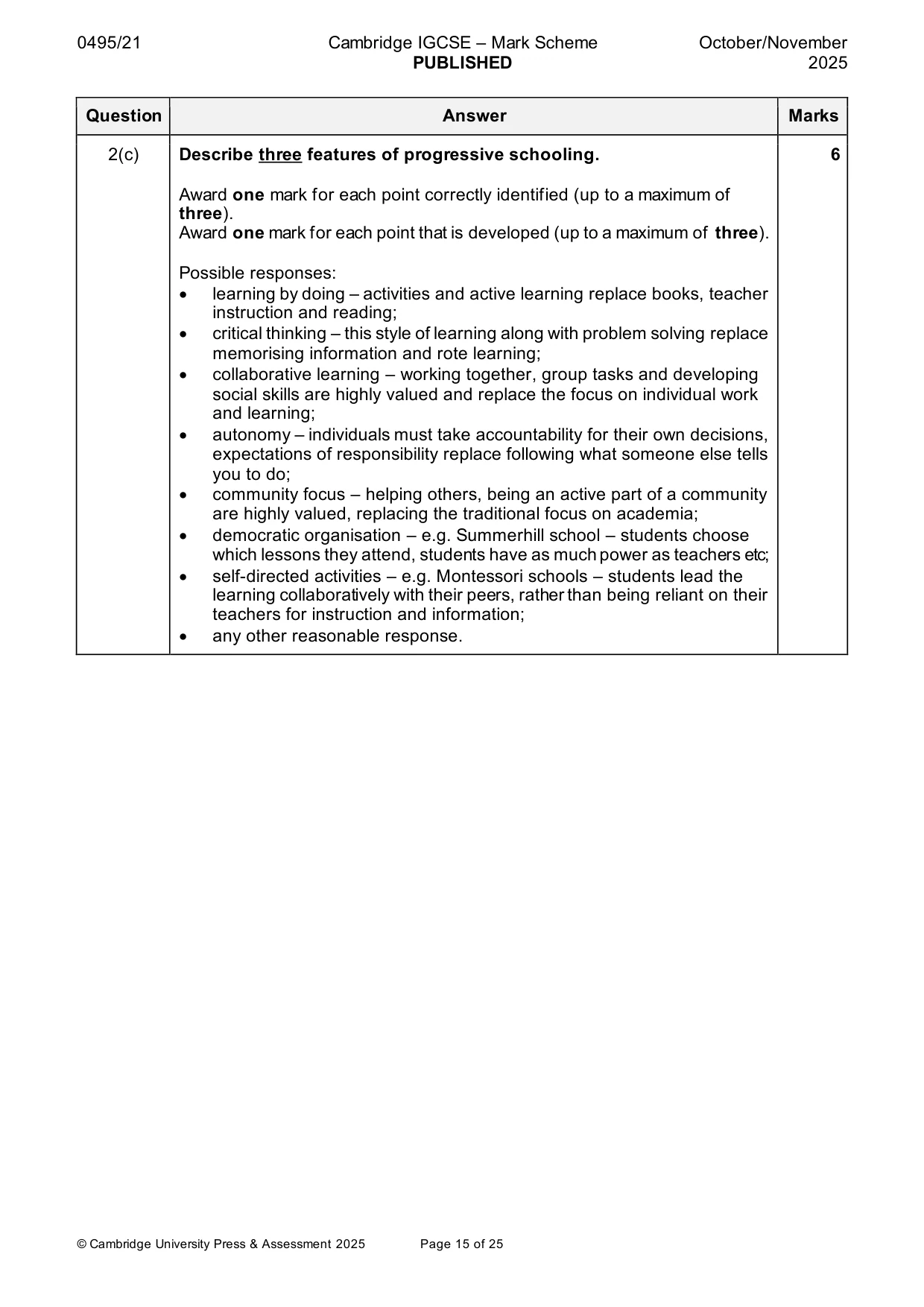
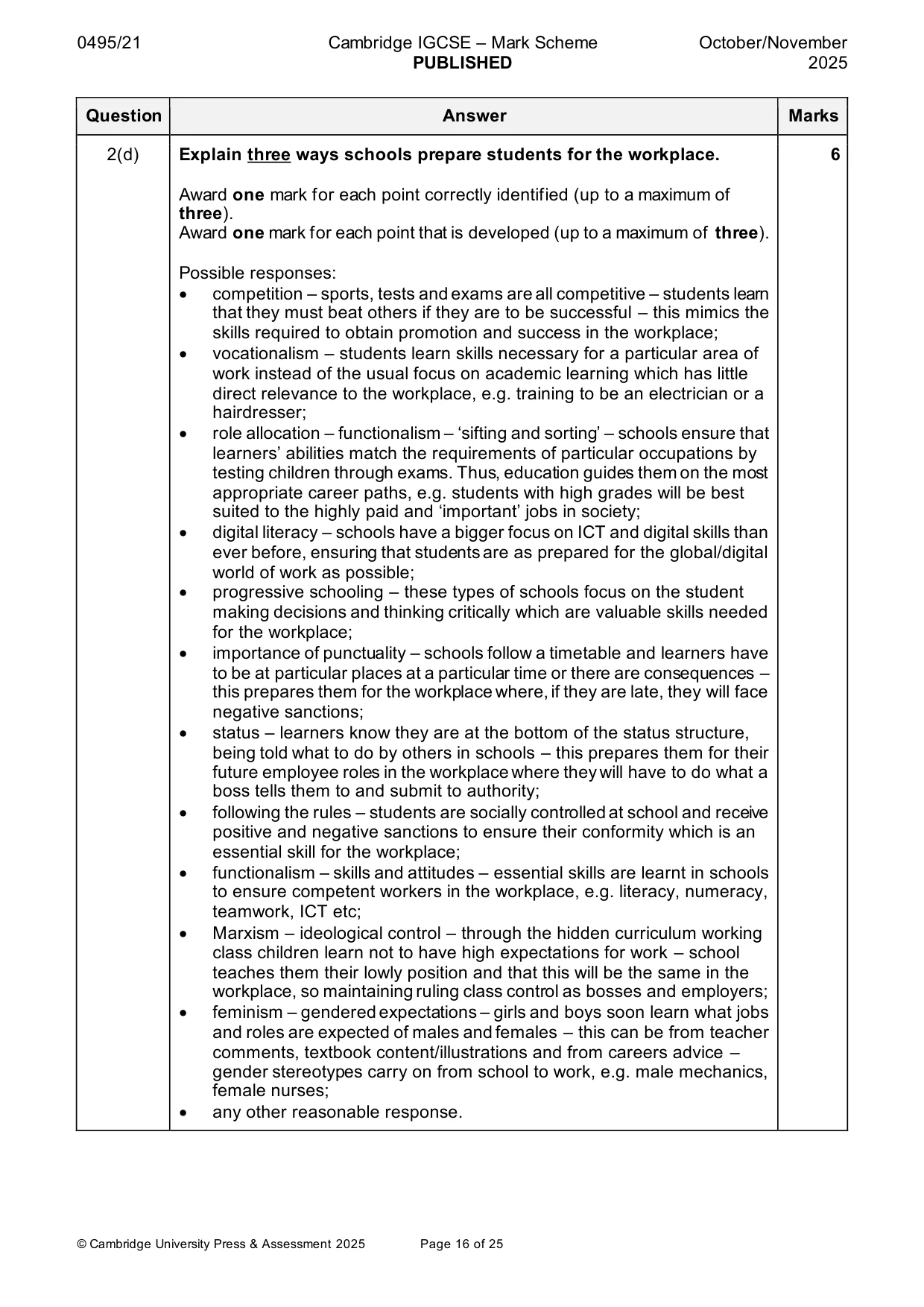
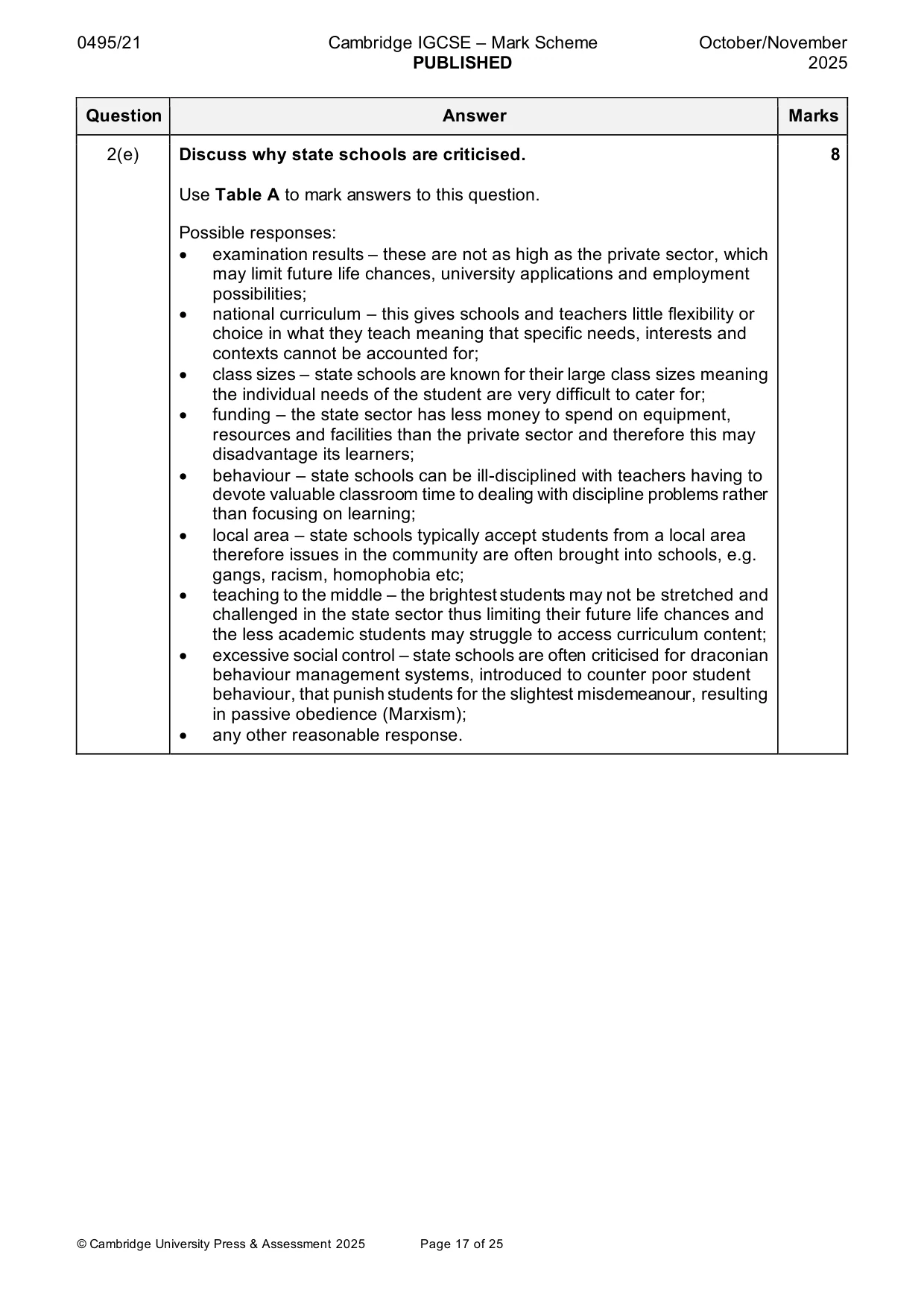
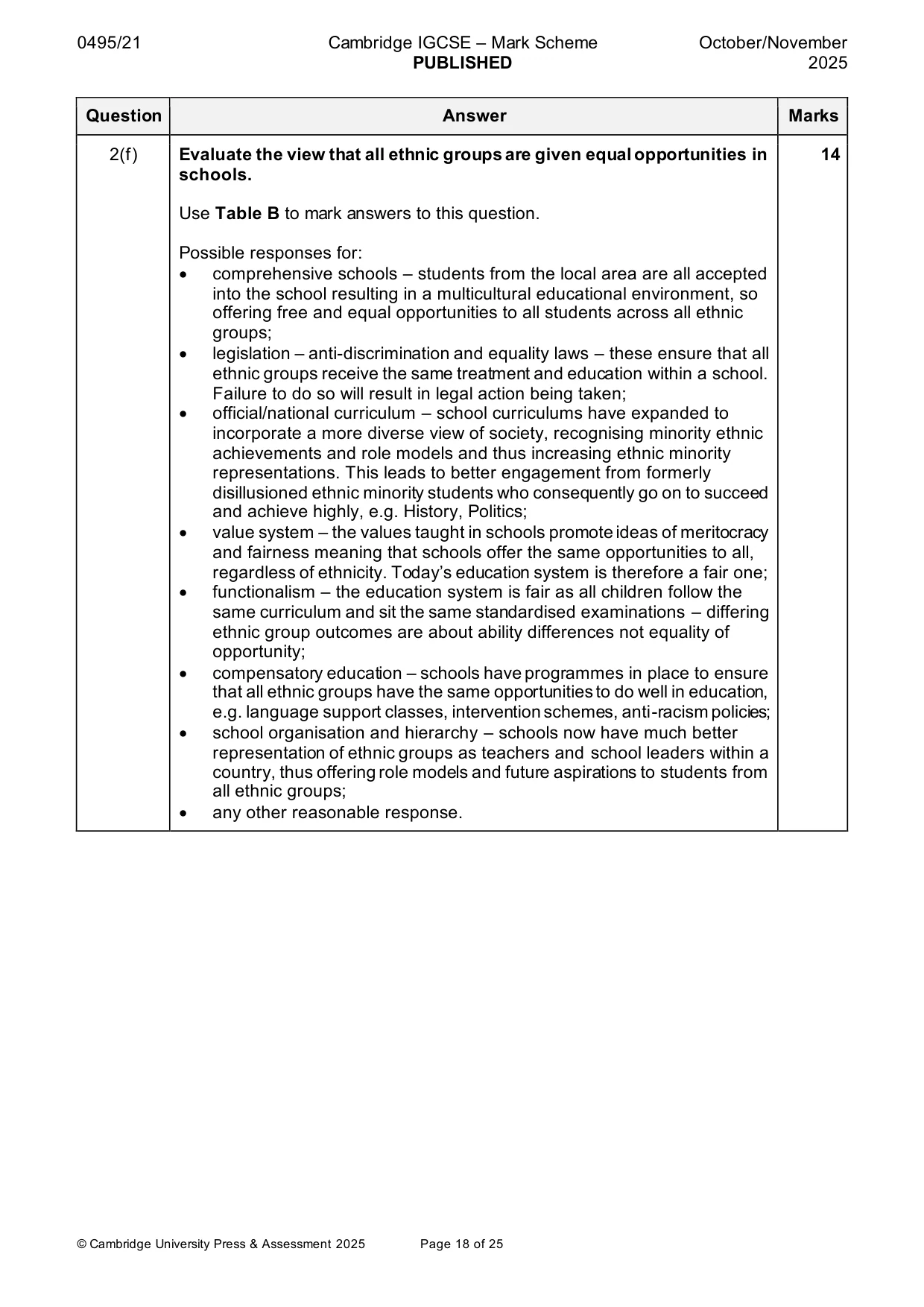
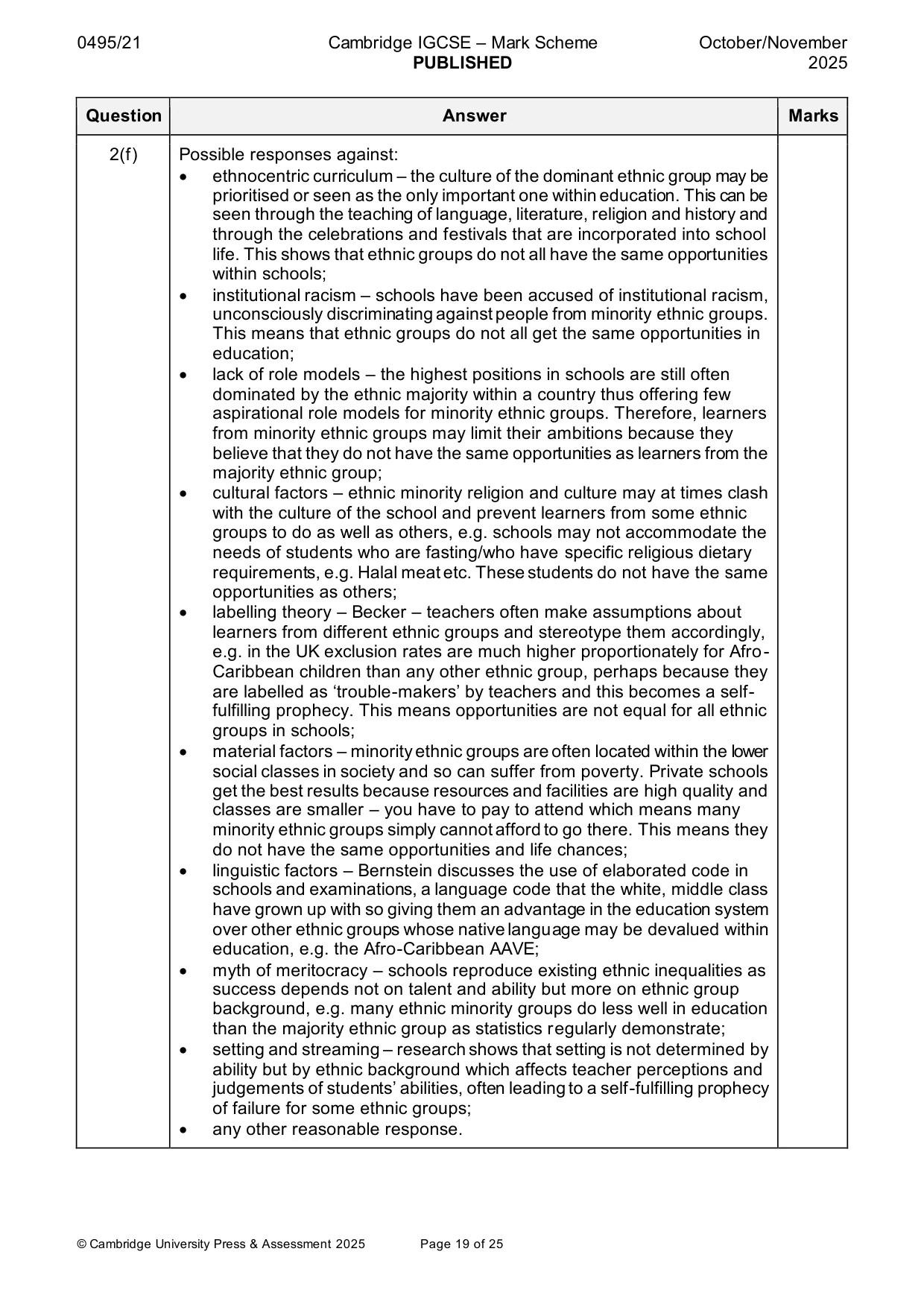
Mark scheme: 2(a)(i) Define the term homeschooling. 2 Award one mark for a partial definition, e.g. parents as teachers. Award two marks for a clear definition, e.g. education of school-aged children in the home, rather than at school. Accept any other reasonable response. 2(a)(ii) Define the term formal education. 2 Award one mark for a partial definition, e.g. education in schools. Award two marks for a clear definition, e.g. education that takes place in classrooms, with professional teachers and set content to be taught and learnt. Accept any other reasonable response. 2(b) Give two examples of gender hierarchy in schools. 2 Award one mark for each correct example (up to a maximum of two). Possible responses: • gendered curriculum – content of lessons may emphasise male achievements and accomplishments e.g. male leaders in History; • teaching of subjects – staff allocated to teach particular subjects may reflect inherent gender stereotypes in schools about the importance of particular subjects, e.g. male science teachers (high status), female cooking teachers (lower status); • organisation of schools – activities for males may attract more status than those for girls, e.g. a focus on male football/cricket/rugby teams and their sporting success; • positions of power – these may be more likely to be held by men within a school, e.g. headteacher, heads of faculty; • classroom dynamics – male students may be allowed to dominate classroom space e.g. through sitting in the teachers eyeline, dominating classroom talk, use of equipment etc (Spender); • equipment – male students tend to dominate the use of equipment within practical lessons, e.g. STEM and design technology/woodwork; • teacher expectations – teachers may assume male students are more intelligent than females and so focus attention more on them; • any other reasonable response. 2(c) Describe three features of progressive schooling. 6 Award one mark for each point correctly identified (up to a maximum of three). Award one mark for each point that is developed (up to a maximum of three). Possible responses: • learning by doing – activities and active learning replace books, teacher instruction and reading; • critical thinking – this style of learning along with problem solving replace memorising information and rote learning; • collaborative learning – working together, group tasks and developing social skills are highly valued and replace the focus on individual work and learning; • autonomy – individuals must take accountability for their own decisions, expectations of responsibility replace following what someone else tells you to do; • community focus – helping others, being an active part of a community are highly valued, replacing the traditional focus on academia; • democratic organisation – e.g. Summerhill school – students choose which lessons they attend, students have as much power as teachers etc; • self-directed activities – e.g. Montessori schools – students lead the learning collaboratively with their peers, rather than being reliant on their teachers for instruction and information; • any other reasonable response. 2(d) Explain three ways schools prepare students for the workplace. 6 Award one mark for each point correctly identified (up to a maximum of three). Award one mark for each point that is developed (up to a maximum of three). Possible responses: • competition – sports, tests and exams are all competitive – students learn that they must beat others if they are to be successful – this mimics the skills required to obtain promotion and success in the workplace; • vocationalism – students learn skills necessary for a particular area of work instead of the usual focus on academic learning which has little direct relevance to the workplace, e.g. training to be an electrician or a hairdresser; • role allocation – functionalism – ‘sifting and sorting’ – schools ensure that learners’ abilities match the requirements of particular occupations by testing children through exams. Thus, education guides them on the most appropriate career paths, e.g. students with high grades will be best suited to the highly paid and ‘important’ jobs in society; • digital literacy – schools have a bigger focus on ICT and digital skills than ever before, ensuring that students are as prepared for the global/digital world of work as possible; • progressive schooling – these types of schools focus on the student making decisions and thinking critically which are valuable skills needed for the workplace; • importance of punctuality – schools follow a timetable and learners have to be at particular places at a particular time or there are consequences – this prepares them for the workplace where, if they are late, they will face negative sanctions; • status – learners know they are at the bottom of the status structure, being told what to do by others in schools – this prepares them for their future employee roles in the workplace where they will have to do what a boss tells them to and submit to authority; • following the rules – students are socially controlled at school and receive positive and negative sanctions to ensure their conformity which is an essential skill for the workplace; • functionalism – skills and attitudes – essential skills are learnt in schools to ensure competent workers in the workplace, e.g. literacy, numeracy, teamwork, ICT etc; • Marxism – ideological control – through the hidden curriculum working class children learn not to have high expectations for work – school teaches them their lowly position and that this will be the same in the workplace, so maintaining ruling class control as bosses and employers; • feminism – gendered expectations – girls and boys soon learn what jobs and roles are expected of males and females – this can be from teacher comments, textbook content/illustrations and from careers advice – gender stereotypes carry on from school to work, e.g. male mechanics, female nurses; • any other reasonable response. 2(e) Discuss why state schools are criticised. 8 Use Table A to mark answers to this question. Possible responses: • examination results – these are not as high as the private sector, which may limit future life chances, university applications and employment possibilities; • national curriculum – this gives schools and teachers little flexibility or choice in what they teach meaning that specific needs, interests and contexts cannot be accounted for; • class sizes – state schools are known for their large class sizes meaning the individual needs of the student are very difficult to cater for; • funding – the state sector has less money to spend on equipment, resources and facilities than the private sector and therefore this may disadvantage its learners; • behaviour – state schools can be ill-disciplined with teachers having to devote valuable classroom time to dealing with discipline problems rather than focusing on learning; • local area – state schools typically accept students from a local area therefore issues in the community are often brought into schools, e.g. gangs, racism, homophobia etc; • teaching to the middle – the brightest students may not be stretched and challenged in the state sector thus limiting their future life chances and the less academic students may struggle to access curriculum content; • excessive social control – state schools are often criticised for draconian behaviour management systems, introduced to counter poor student behaviour, that punish students for the slightest misdemeanour, resulting in passive obedience (Marxism); • any other reasonable response. 2(f) Evaluate the view that all ethnic groups are given equal opportunities in 14 schools. Use Table B to mark answers to this question. Possible responses for: • comprehensive schools – students from the local area are all accepted into the school resulting in a multicultural educational environment, so offering free and equal opportunities to all students across all ethnic groups; • legislation – anti-discrimination and equality laws – these ensure that all ethnic groups receive the same treatment and education within a school. Failure to do so will result in legal action being taken; • official/national curriculum – school curriculums have expanded to incorporate a more diverse view of society, recognising minority ethnic achievements and role models and thus increasing ethnic minority representations. This leads to better engagement from formerly disillusioned ethnic minority students who consequently go on to succeed and achieve highly, e.g. History, Politics; • value system – the values taught in schools promote ideas of meritocracy and fairness meaning that schools offer the same opportunities to all, regardless of ethnicity. Today’s education system is therefore a fair one; • functionalism – the education system is fair as all children follow the same curriculum and sit the same standardised examinations – differing ethnic group outcomes are about ability differences not equality of opportunity; • compensatory education – schools have programmes in place to ensure that all ethnic groups have the same opportunities to do well in education, e.g. language support classes, intervention schemes, anti-racism policies; • school organisation and hierarchy – schools now have much better representation of ethnic groups as teachers and school leaders within a country, thus offering role models and future aspirations to students from all ethnic groups; • any other reasonable response. 2(f) Possible responses against: • ethnocentric curriculum – the culture of the dominant ethnic group may be prioritised or seen as the only important one within education. This can be seen through the teaching of language, literature, religion and history and through the celebrations and festivals that are incorporated into school life. This shows that ethnic groups do not all have the same opportunities within schools; • institutional racism – schools have been accused of institutional racism, unconsciously discriminating against people from minority ethnic groups. This means that ethnic groups do not all get the same opportunities in education; • lack of role models – the highest positions in schools are still often dominated by the ethnic majority within a country thus offering few aspirational role models for minority ethnic groups. Therefore, learners from minority ethnic groups may limit their ambitions because they believe that they do not have the same opportunities as learners from the majority ethnic group; • cultural factors – ethnic minority religion and culture may at times clash with the culture of the school and prevent learners from some ethnic groups to do as well as others, e.g. schools may not accommodate the needs of students who are fasting/who have specific religious dietary requirements, e.g. Halal meat etc. These students do not have the same opportunities as others; • labelling theory – Becker – teachers often make assumptions about learners from different ethnic groups and stereotype them accordingly, e.g. in the UK exclusion rates are much higher proportionately for Afro- Caribbean children than any other ethnic group, perhaps because they are labelled as ‘trouble-makers’ by teachers and this becomes a self- fulfilling prophecy. This means opportunities are not equal for all ethnic groups in schools; • material factors – minority ethnic groups are often located within the lower social classes in society and so can suffer from poverty. Private schools get the best results because resources and facilities are high quality and classes are smaller – you have to pay to attend which means many minority ethnic groups simply cannot afford to go there. This means they do not have the same opportunities and life chances; • linguistic factors – Bernstein discusses the use of elaborated code in schools and examinations, a language code that the white, middle class have grown up with so giving them an advantage in the education system over other ethnic groups whose native language may be devalued within education, e.g. the Afro-Caribbean AAVE; • myth of meritocracy – schools reproduce existing ethnic inequalities as success depends not on talent and ability but more on ethnic group background, e.g. many ethnic minority groups do less well in education than the majority ethnic group as statistics regularly demonstrate; • setting and streaming – research shows that setting is not determined by ability but by ethnic background which affects teacher perceptions and judgements of students’ abilities, often leading to a self-fulfilling prophecy of failure for some ethnic groups; • any other reasonable response.
Q3 · Define the term: (i) discrimination [2] (ii) probation
3 (a) Define the term: (i) discrimination [2] (ii) probation. [2] (b) State two patterns of victimisation. [2] (c) Describe three ways informal agencies of social control can prevent crime. [6] (d) Explain three limitations of feminist explanations for crime. [6] (e) Discuss the view that ethnicity is an important factor in explaining why individuals commit crime. Your answer should include: • at least three developed points with evidence. [8] (f) Evaluate the view that rehabilitation is the most effective way to deal with crime. Your answer should include: • at least three arguments for and three arguments against • a conclusion. [14]
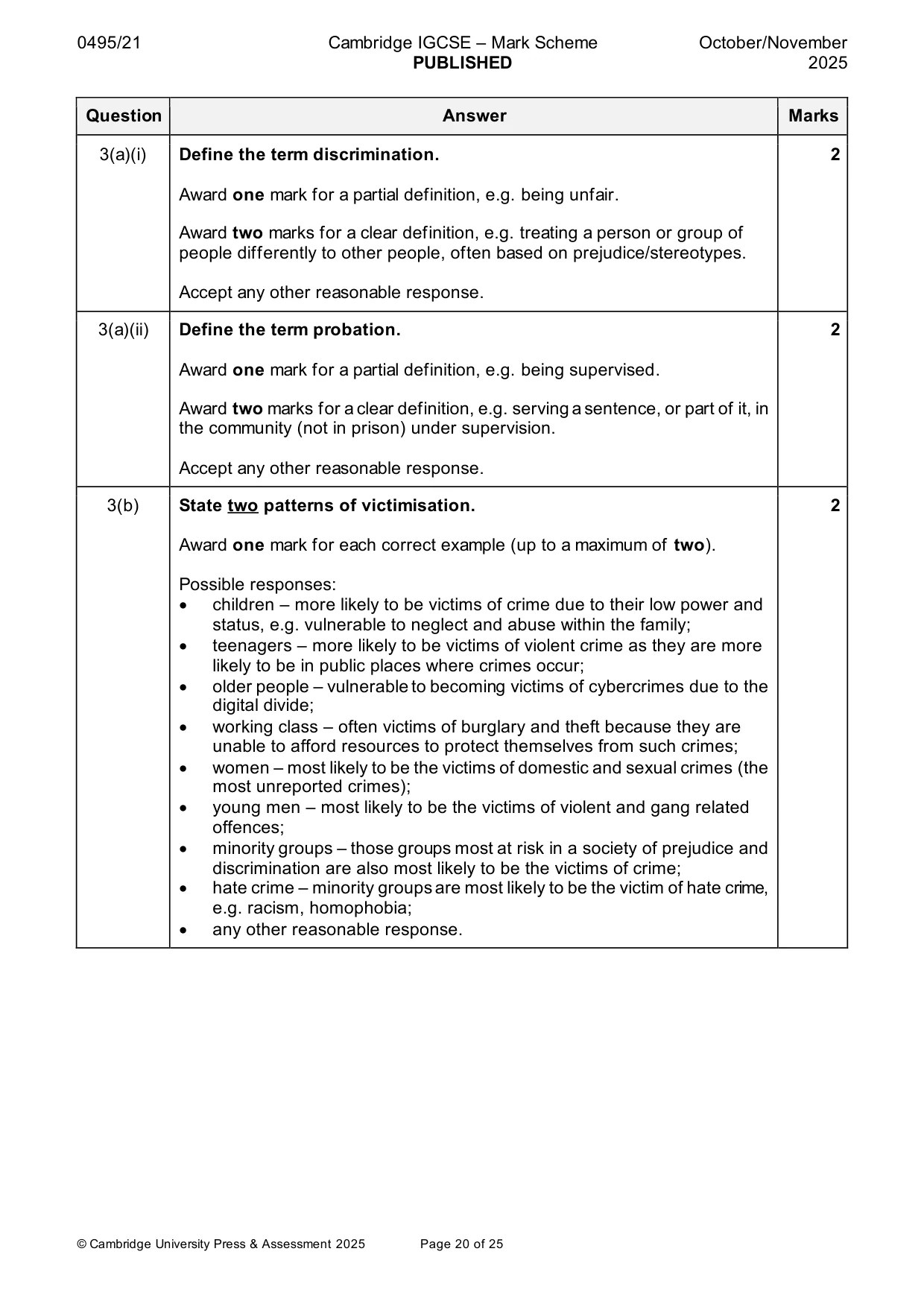
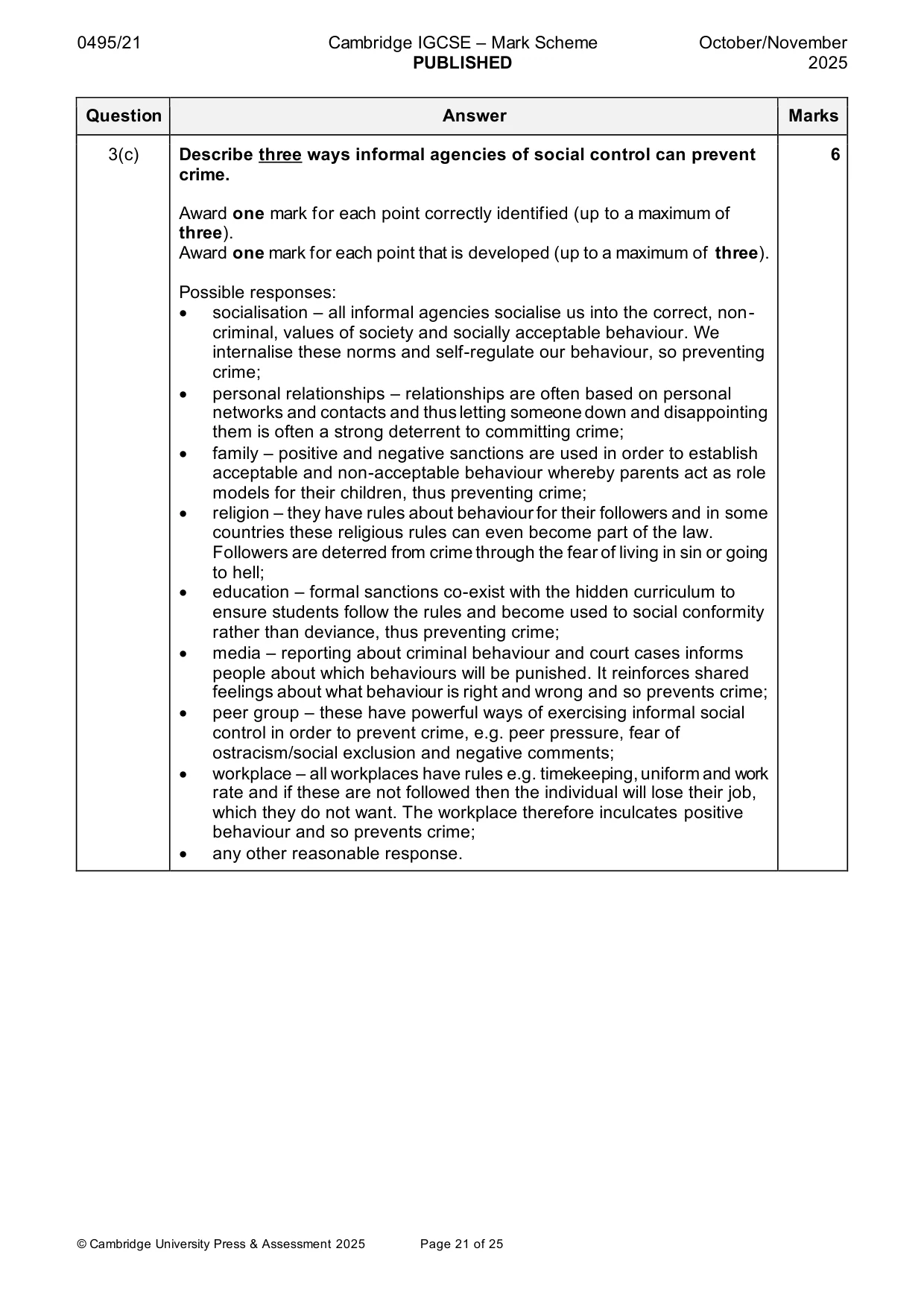
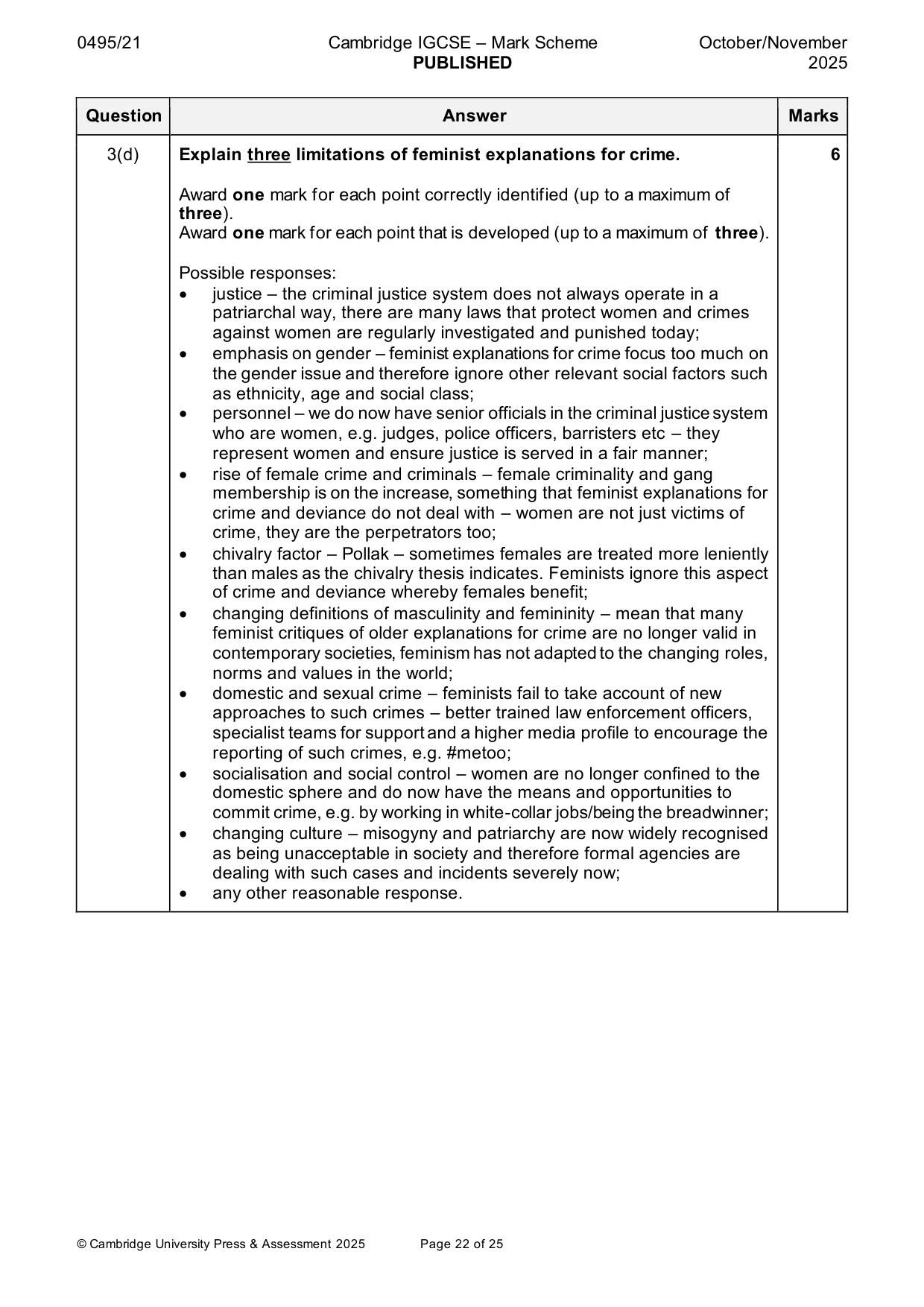
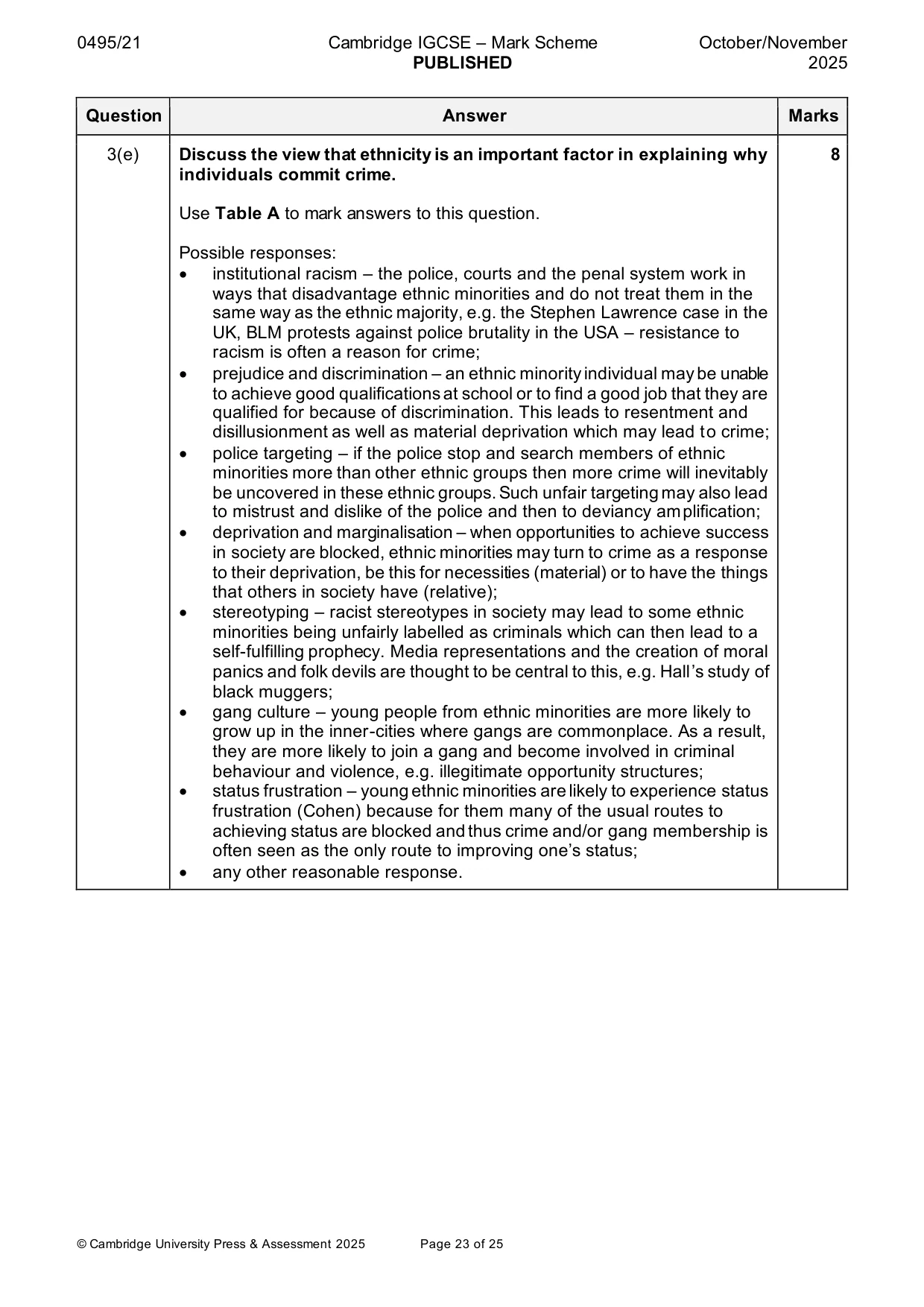
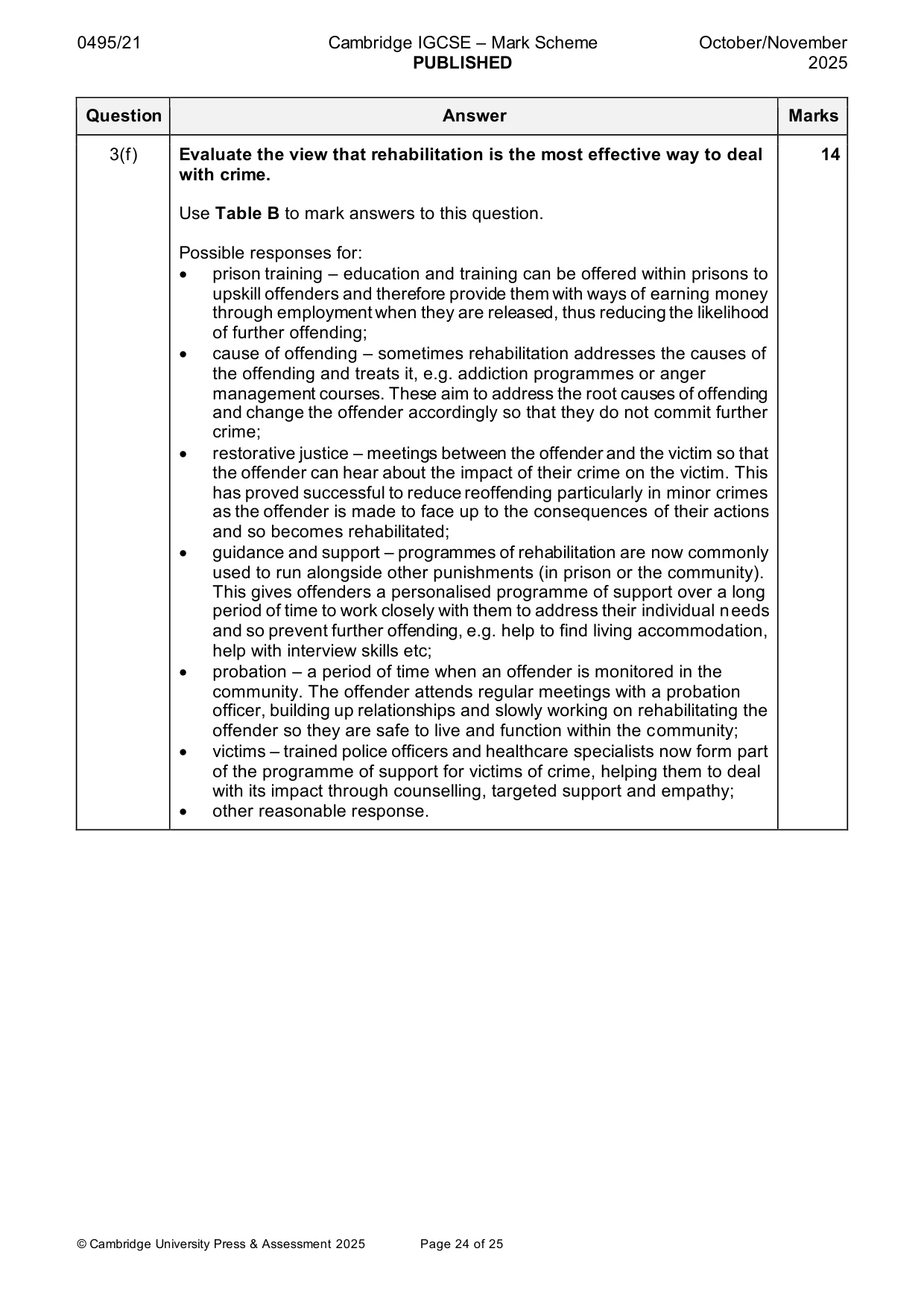
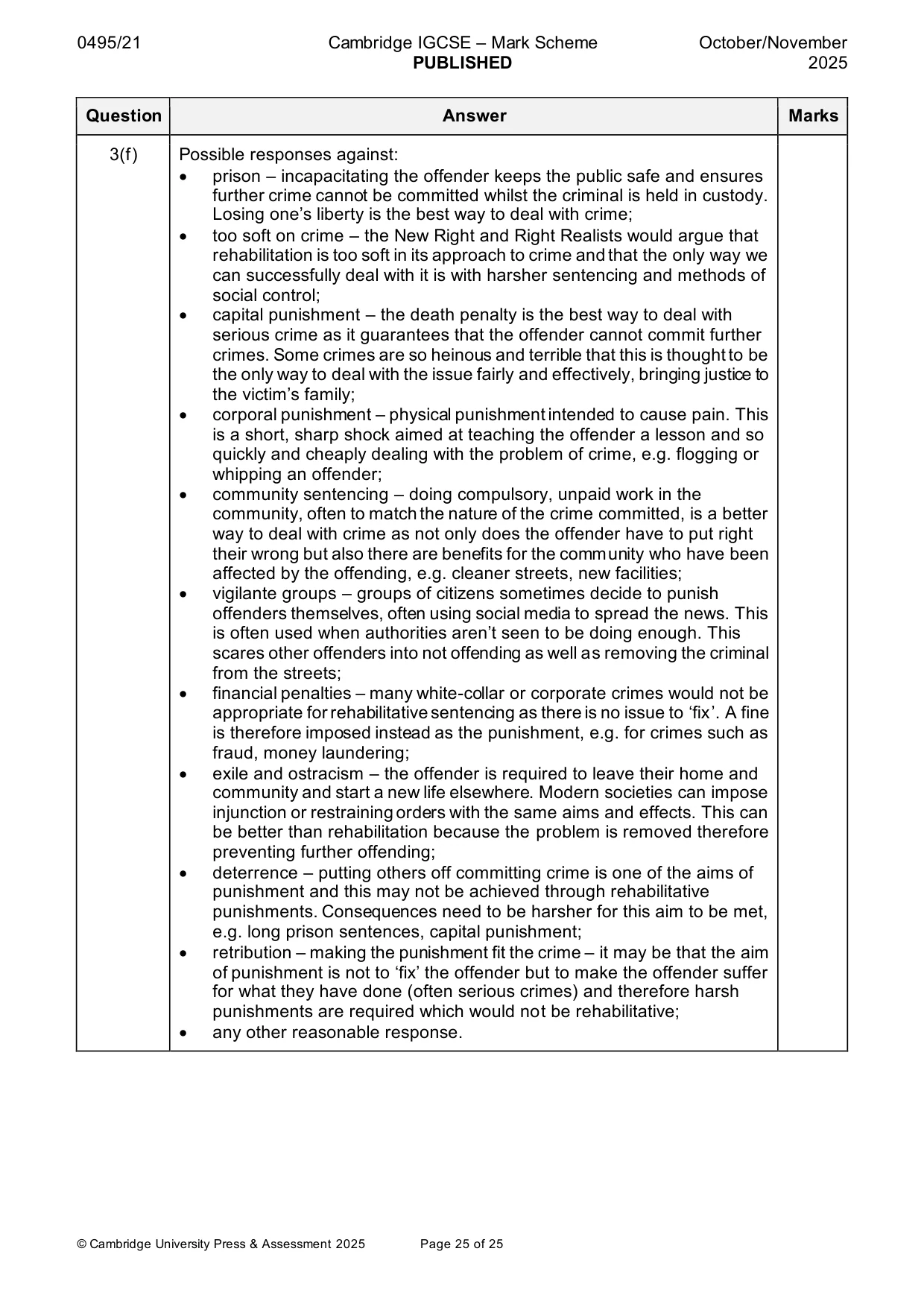
Mark scheme: 3(a)(i) Define the term discrimination. 2 Award one mark for a partial definition, e.g. being unfair. Award two marks for a clear definition, e.g. treating a person or group of people differently to other people, often based on prejudice/stereotypes. Accept any other reasonable response. 3(a)(ii) Define the term probation. 2 Award one mark for a partial definition, e.g. being supervised. Award two marks for a clear definition, e.g. serving a sentence, or part of it, in the community (not in prison) under supervision. Accept any other reasonable response. 3(b) State two patterns of victimisation. 2 Award one mark for each correct example (up to a maximum of two). Possible responses: • children – more likely to be victims of crime due to their low power and status, e.g. vulnerable to neglect and abuse within the family; • teenagers – more likely to be victims of violent crime as they are more likely to be in public places where crimes occur; • older people – vulnerable to becoming victims of cybercrimes due to the digital divide; • working class – often victims of burglary and theft because they are unable to afford resources to protect themselves from such crimes; • women – most likely to be the victims of domestic and sexual crimes (the most unreported crimes); • young men – most likely to be the victims of violent and gang related offences; • minority groups – those groups most at risk in a society of prejudice and discrimination are also most likely to be the victims of crime; • hate crime – minority groups are most likely to be the victim of hate crime, e.g. racism, homophobia; • any other reasonable response. 3(c) Describe three ways informal agencies of social control can prevent 6 crime. Award one mark for each point correctly identified (up to a maximum of three). Award one mark for each point that is developed (up to a maximum of three). Possible responses: • socialisation – all informal agencies socialise us into the correct, non- criminal, values of society and socially acceptable behaviour. We internalise these norms and self-regulate our behaviour, so preventing crime; • personal relationships – relationships are often based on personal networks and contacts and thus letting someone down and disappointing them is often a strong deterrent to committing crime; • family – positive and negative sanctions are used in order to establish acceptable and non-acceptable behaviour whereby parents act as role models for their children, thus preventing crime; • religion – they have rules about behaviour for their followers and in some countries these religious rules can even become part of the law. Followers are deterred from crime through the fear of living in sin or going to hell; • education – formal sanctions co-exist with the hidden curriculum to ensure students follow the rules and become used to social conformity rather than deviance, thus preventing crime; • media – reporting about criminal behaviour and court cases informs people about which behaviours will be punished. It reinforces shared feelings about what behaviour is right and wrong and so prevents crime; • peer group – these have powerful ways of exercising informal social control in order to prevent crime, e.g. peer pressure, fear of ostracism/social exclusion and negative comments; • workplace – all workplaces have rules e.g. timekeeping, uniform and work rate and if these are not followed then the individual will lose their job, which they do not want. The workplace therefore inculcates positive behaviour and so prevents crime; • any other reasonable response. 3(d) Explain three limitations of feminist explanations for crime. 6 Award one mark for each point correctly identified (up to a maximum of three). Award one mark for each point that is developed (up to a maximum of three). Possible responses: • justice – the criminal justice system does not always operate in a patriarchal way, there are many laws that protect women and crimes against women are regularly investigated and punished today; • emphasis on gender – feminist explanations for crime focus too much on the gender issue and therefore ignore other relevant social factors such as ethnicity, age and social class; • personnel – we do now have senior officials in the criminal justice system who are women, e.g. judges, police officers, barristers etc – they represent women and ensure justice is served in a fair manner; • rise of female crime and criminals – female criminality and gang membership is on the increase, something that feminist explanations for crime and deviance do not deal with – women are not just victims of crime, they are the perpetrators too; • chivalry factor – Pollak – sometimes females are treated more leniently than males as the chivalry thesis indicates. Feminists ignore this aspect of crime and deviance whereby females benefit; • changing definitions of masculinity and femininity – mean that many feminist critiques of older explanations for crime are no longer valid in contemporary societies, feminism has not adapted to the changing roles, norms and values in the world; • domestic and sexual crime – feminists fail to take account of new approaches to such crimes – better trained law enforcement officers, specialist teams for support and a higher media profile to encourage the reporting of such crimes, e.g. #metoo; • socialisation and social control – women are no longer confined to the domestic sphere and do now have the means and opportunities to commit crime, e.g. by working in white-collar jobs/being the breadwinner; • changing culture – misogyny and patriarchy are now widely recognised as being unacceptable in society and therefore formal agencies are dealing with such cases and incidents severely now; • any other reasonable response. 3(e) Discuss the view that ethnicity is an important factor in explaining why 8 individuals commit crime. Use Table A to mark answers to this question. Possible responses: • institutional racism – the police, courts and the penal system work in ways that disadvantage ethnic minorities and do not treat them in the same way as the ethnic majority, e.g. the Stephen Lawrence case in the UK, BLM protests against police brutality in the USA – resistance to racism is often a reason for crime; • prejudice and discrimination – an ethnic minority individual may be unable to achieve good qualifications at school or to find a good job that they are qualified for because of discrimination. This leads to resentment and disillusionment as well as material deprivation which may lead to crime; • police targeting – if the police stop and search members of ethnic minorities more than other ethnic groups then more crime will inevitably be uncovered in these ethnic groups. Such unfair targeting may also lead to mistrust and dislike of the police and then to deviancy amplification; • deprivation and marginalisation – when opportunities to achieve success in society are blocked, ethnic minorities may turn to crime as a response to their deprivation, be this for necessities (material) or to have the things that others in society have (relative); • stereotyping – racist stereotypes in society may lead to some ethnic minorities being unfairly labelled as criminals which can then lead to a self-fulfilling prophecy. Media representations and the creation of moral panics and folk devils are thought to be central to this, e.g. Hall’s study of black muggers; • gang culture – young people from ethnic minorities are more likely to grow up in the inner-cities where gangs are commonplace. As a result, they are more likely to join a gang and become involved in criminal behaviour and violence, e.g. illegitimate opportunity structures; • status frustration – young ethnic minorities are likely to experience status frustration (Cohen) because for them many of the usual routes to achieving status are blocked and thus crime and/or gang membership is often seen as the only route to improving one’s status; • any other reasonable response. 3(f) Evaluate the view that rehabilitation is the most effective way to deal 14 with crime. Use Table B to mark answers to this question. Possible responses for: • prison training – education and training can be offered within prisons to upskill offenders and therefore provide them with ways of earning money through employment when they are released, thus reducing the likelihood of further offending; • cause of offending – sometimes rehabilitation addresses the causes of the offending and treats it, e.g. addiction programmes or anger management courses. These aim to address the root causes of offending and change the offender accordingly so that they do not commit further crime; • restorative justice – meetings between the offender and the victim so that the offender can hear about the impact of their crime on the victim. This has proved successful to reduce reoffending particularly in minor crimes as the offender is made to face up to the consequences of their actions and so becomes rehabilitated; • guidance and support – programmes of rehabilitation are now commonly used to run alongside other punishments (in prison or the community). This gives offenders a personalised programme of support over a long period of time to work closely with them to address their individual needs and so prevent further offending, e.g. help to find living accommodation, help with interview skills etc; • probation – a period of time when an offender is monitored in the community. The offender attends regular meetings with a probation officer, building up relationships and slowly working on rehabilitating the offender so they are safe to live and function within the community; • victims – trained police officers and healthcare specialists now form part of the programme of support for victims of crime, helping them to deal with its impact through counselling, targeted support and empathy; • other reasonable response. 3(f) Possible responses against: • prison – incapacitating the offender keeps the public safe and ensures further crime cannot be committed whilst the criminal is held in custody. Losing one’s liberty is the best way to deal with crime; • too soft on crime – the New Right and Right Realists would argue that rehabilitation is too soft in its approach to crime and that the only way we can successfully deal with it is with harsher sentencing and methods of social control; • capital punishment – the death penalty is the best way to deal with serious crime as it guarantees that the offender cannot commit further crimes. Some crimes are so heinous and terrible that this is thought to be the only way to deal with the issue fairly and effectively, bringing justice to the victim’s family; • corporal punishment – physical punishment intended to cause pain. This is a short, sharp shock aimed at teaching the offender a lesson and so quickly and cheaply dealing with the problem of crime, e.g. flogging or whipping an offender; • community sentencing – doing compulsory, unpaid work in the community, often to match the nature of the crime committed, is a better way to deal with crime as not only does the offender have to put right their wrong but also there are benefits for the community who have been affected by the offending, e.g. cleaner streets, new facilities; • vigilante groups – groups of citizens sometimes decide to punish offenders themselves, often using social media to spread the news. This is often used when authorities aren’t seen to be doing enough. This scares other offenders into not offending as well as removing the criminal from the streets; • financial penalties – many white-collar or corporate crimes would not be appropriate for rehabilitative sentencing as there is no issue to ‘fix’. A fine is therefore imposed instead as the punishment, e.g. for crimes such as fraud, money laundering; • exile and ostracism – the offender is required to leave their home and community and start a new life elsewhere. Modern societies can impose injunction or restraining orders with the same aims and effects. This can be better than rehabilitation because the problem is removed therefore preventing further offending; • deterrence – putting others off committing crime is one of the aims of punishment and this may not be achieved through rehabilitative punishments. Consequences need to be harsher for this aim to be met, e.g. long prison sentences, capital punishment; • retribution – making the punishment fit the crime – it may be that the aim of punishment is not to ‘fix’ the offender but to make the offender suffer for what they have done (often serious crimes) and therefore harsh punishments are required which would not be rehabilitative; • any other reasonable response.
What was in this paper
The subtopics covered by these 3 questions, and how many questions each got. Open one in a new tab to see every Cambridge question on it.
What you needed in this session
Cambridge’s own grade thresholds for 2025 Oct/Nov, Paper 2 · Variant 1. A higher threshold means an easier paper — the bar moves with how the cohort did.