Cambridge IGCSE Sociology 0495 — 2023 Oct/Nov Paper 2 · Variant 3
0495/23/O/N/23 · 4 questions · 70 marks · ≈79 min
The question paper and its mark scheme, free to read here and free to download. This is Cambridge’s own paper, exactly as it was sat.
Question paper4 pages

Mark scheme28 pages
Answers below. Sit the paper first if you are practising.



Questions as text
Q1 · In modern industrial societies nuclear families are not the only type of family
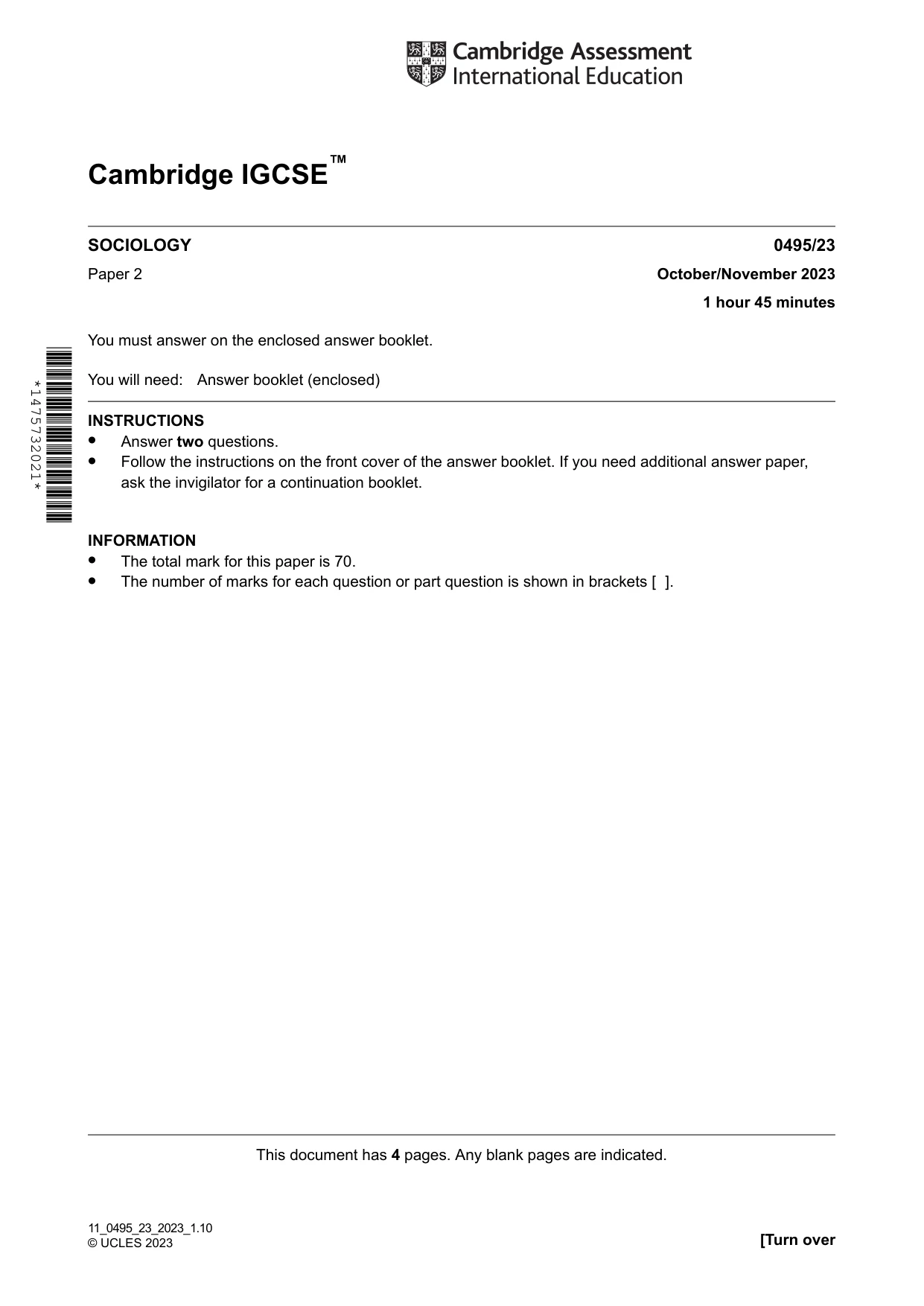
1 In modern industrial societies nuclear families are not the only type of family. Some families are extended, while others are dual worker. Some sociologists view this diversity negatively as they argue that the nuclear family is still the best. However, changes to family roles and structures make it difficult to claim one family type is the best for everyone. (a) What is meant by the term ‘dual worker families’? [2] (b) Describe two types of extended family. [4] (c) Explain how industrialisation has changed the family. [6] (d) Explain why traditional conjugal roles are changing. [8] (e) To what extent is the nuclear family the best type of family? [15]
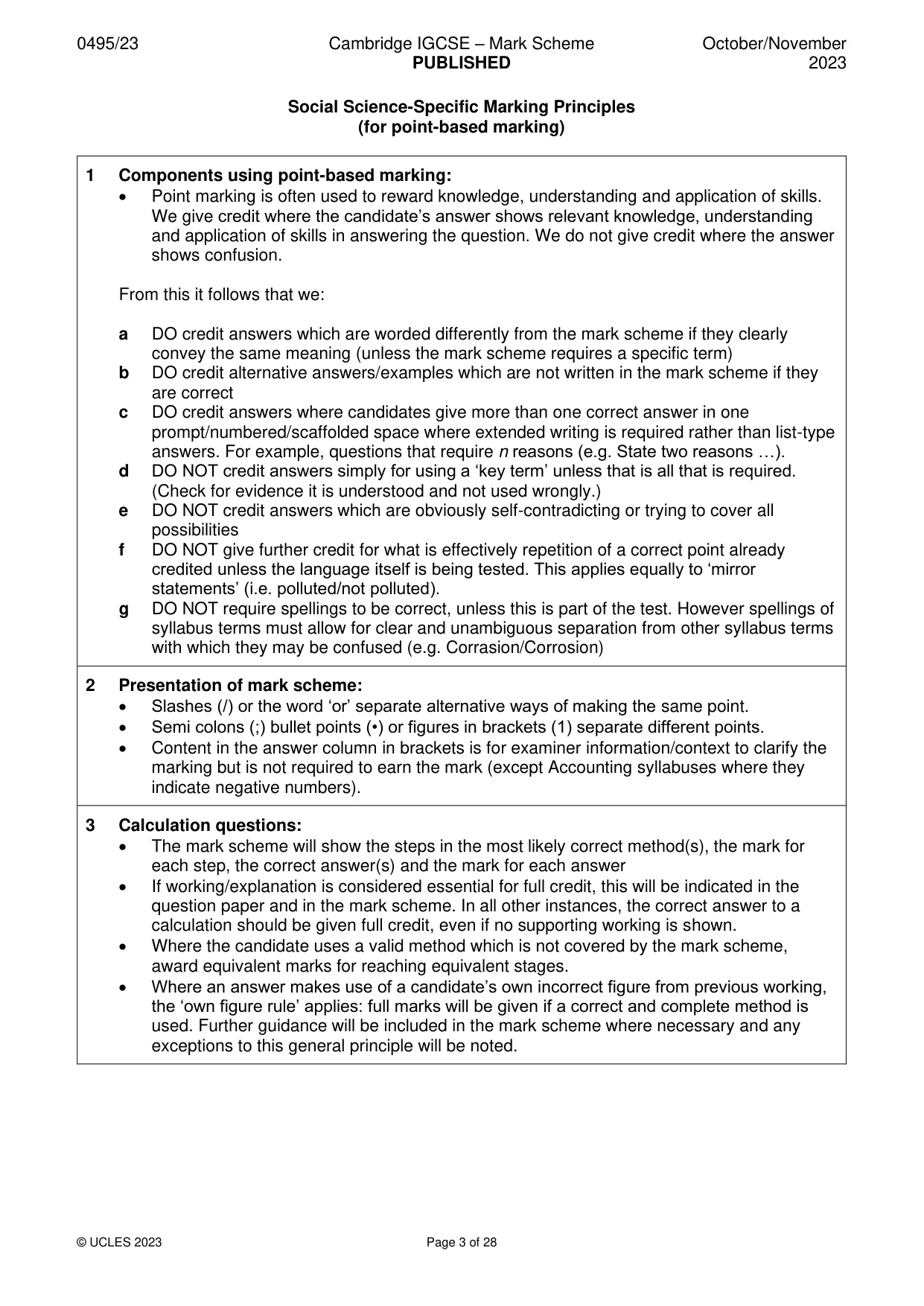
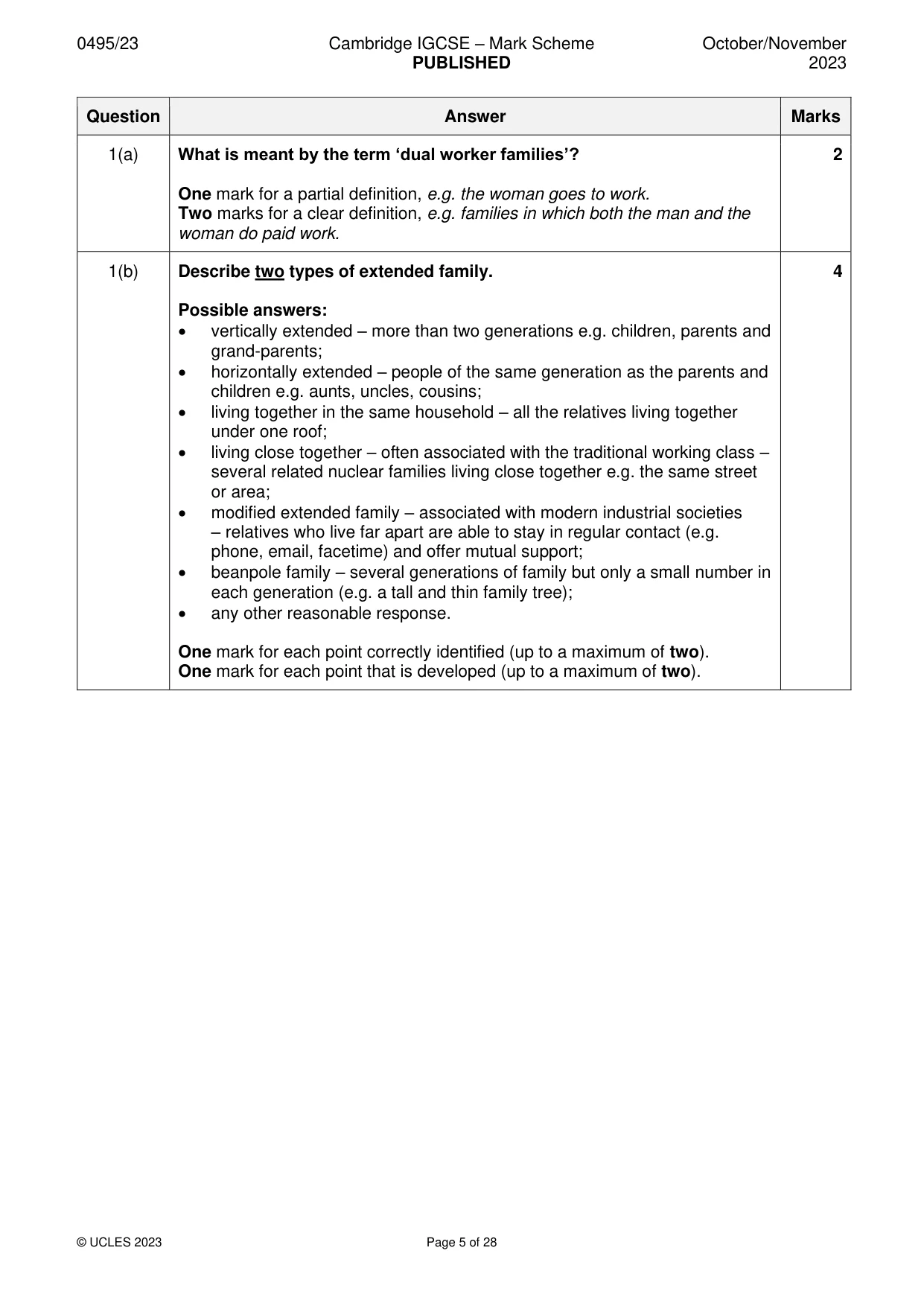
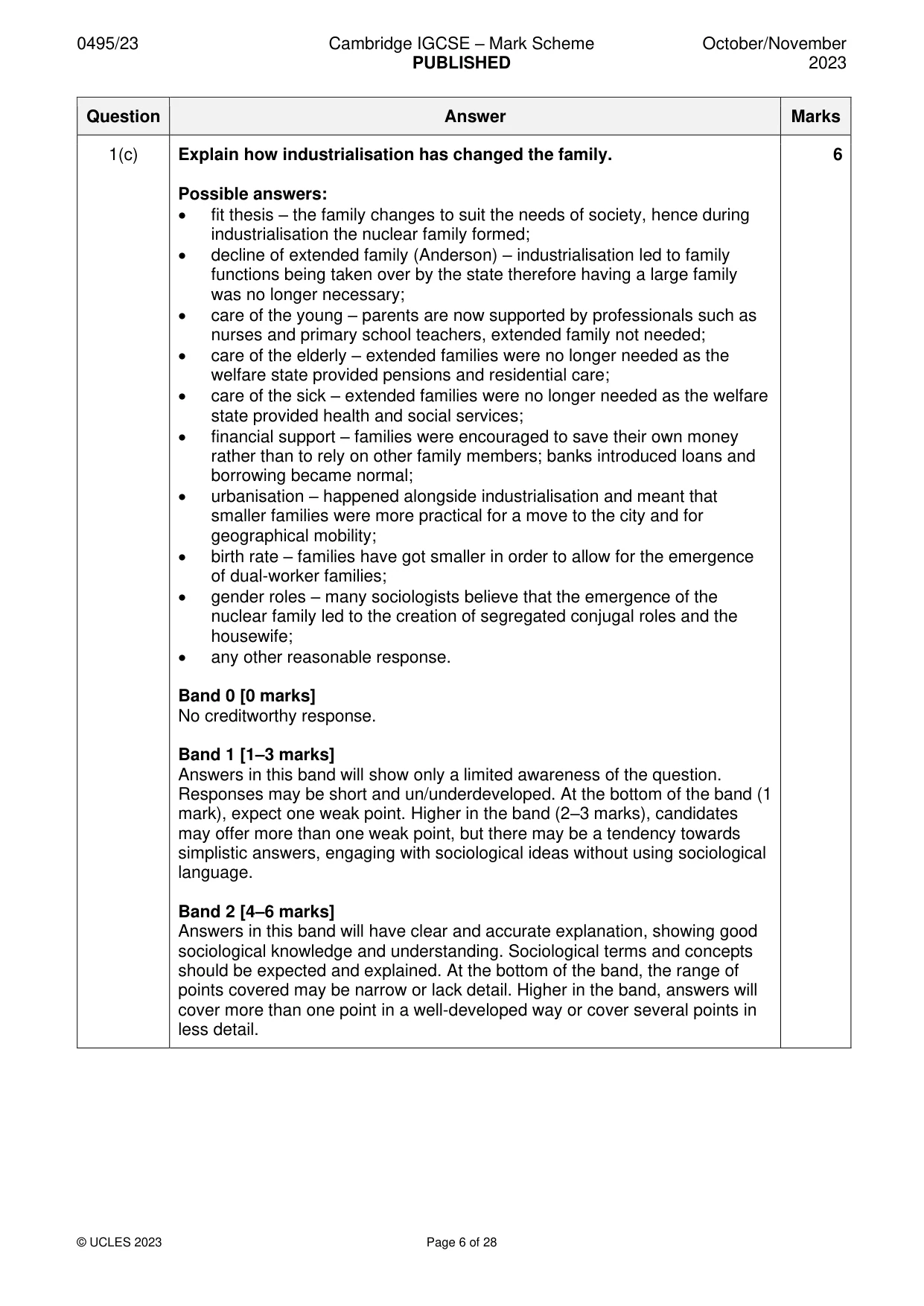
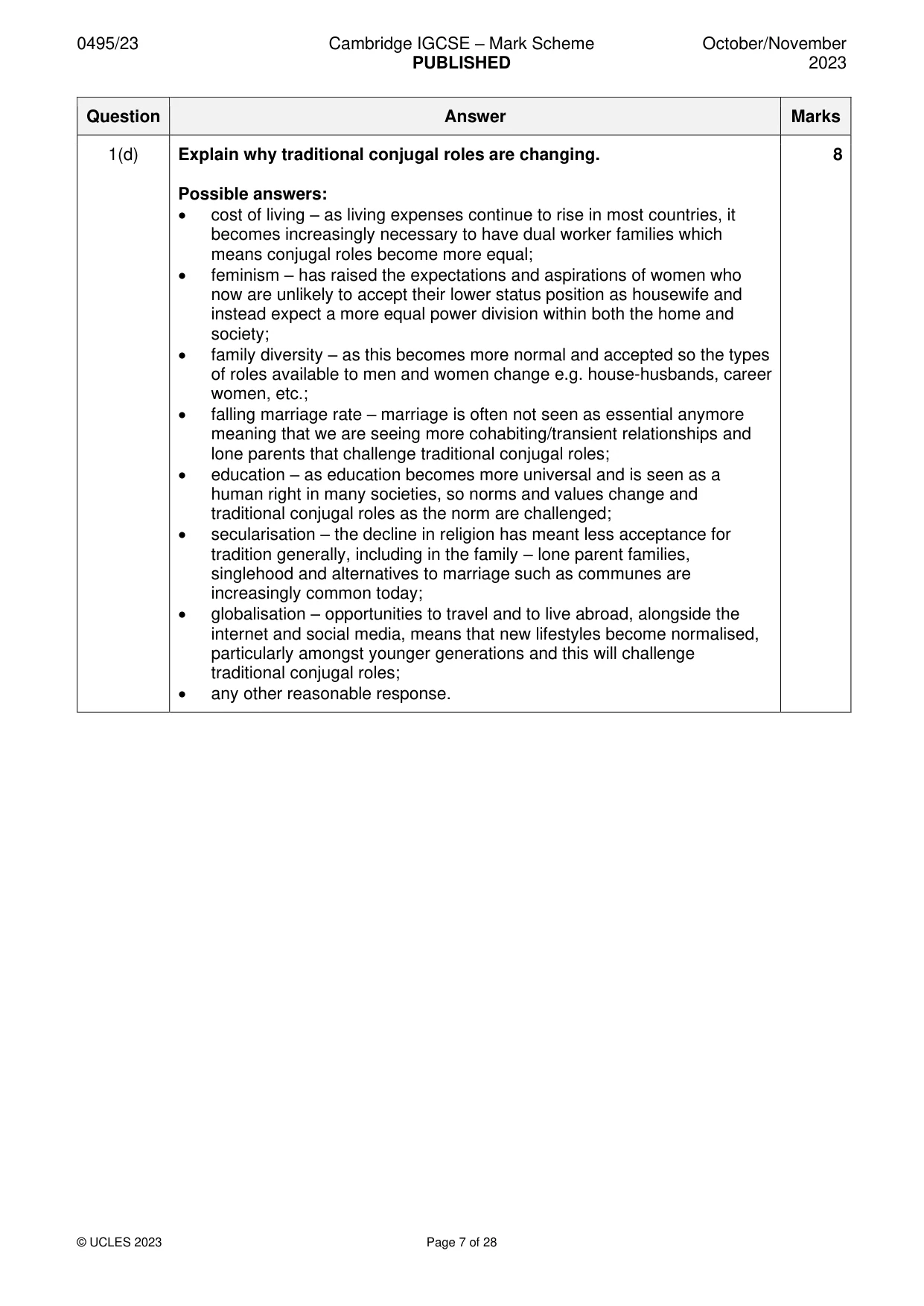
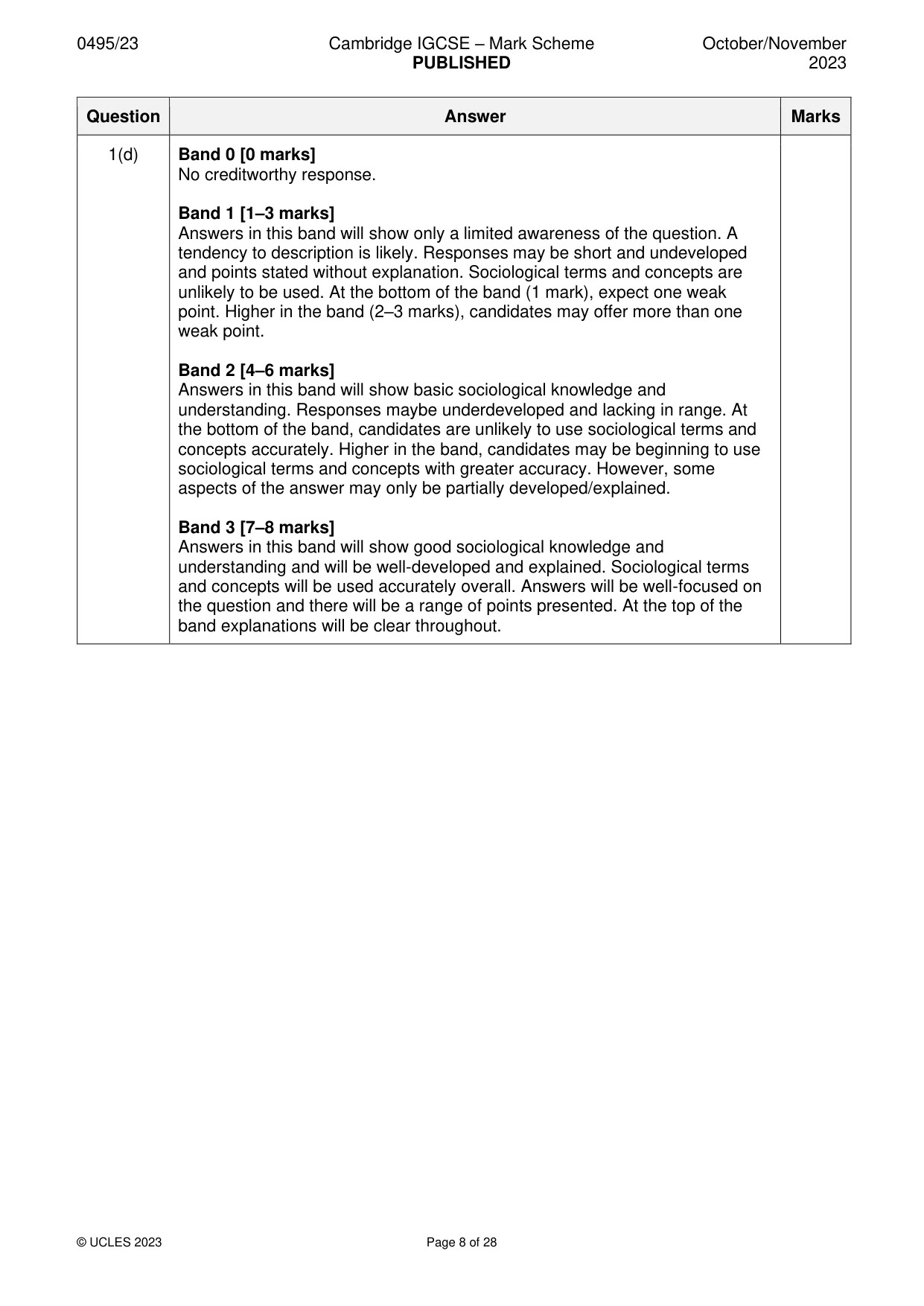
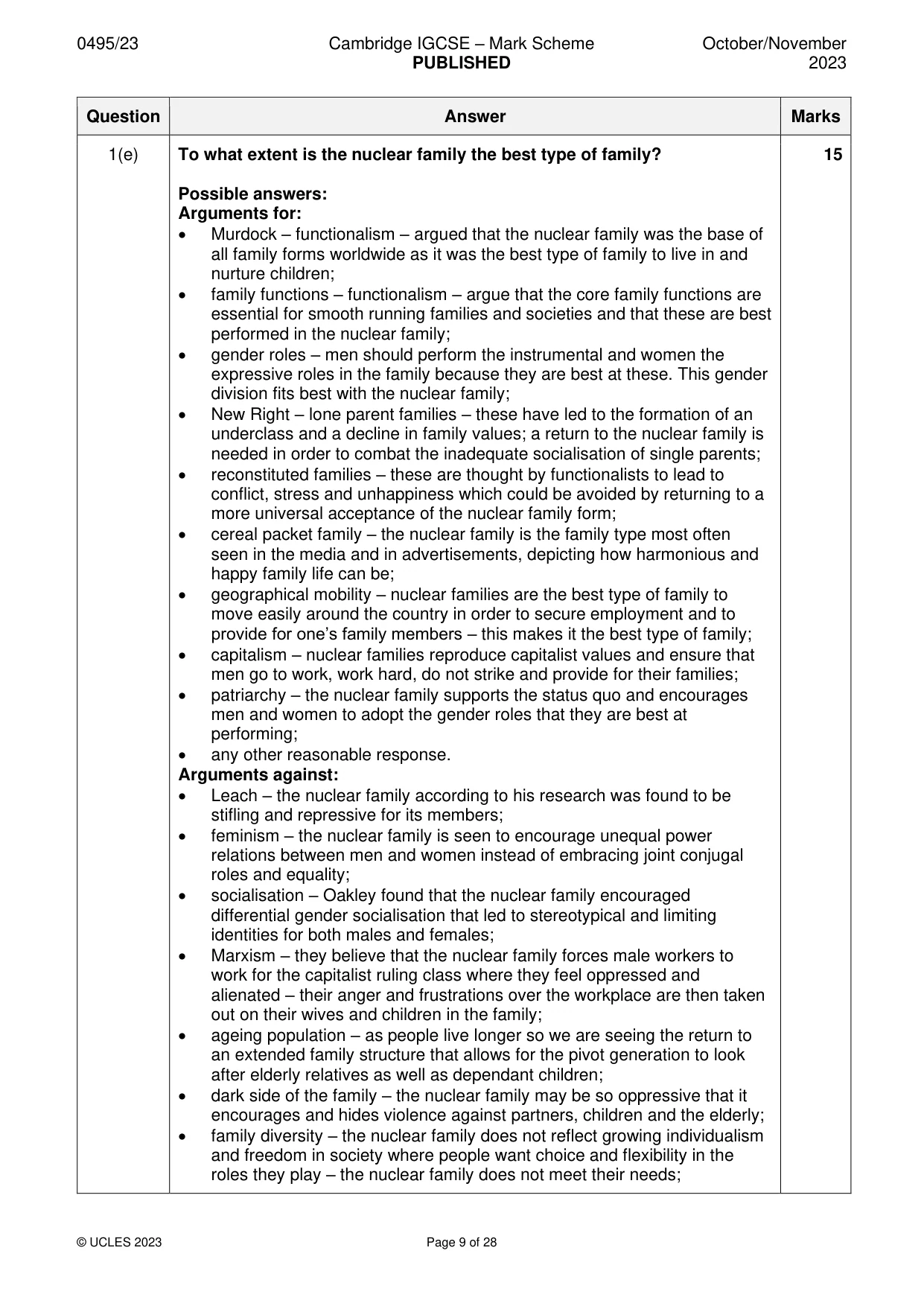
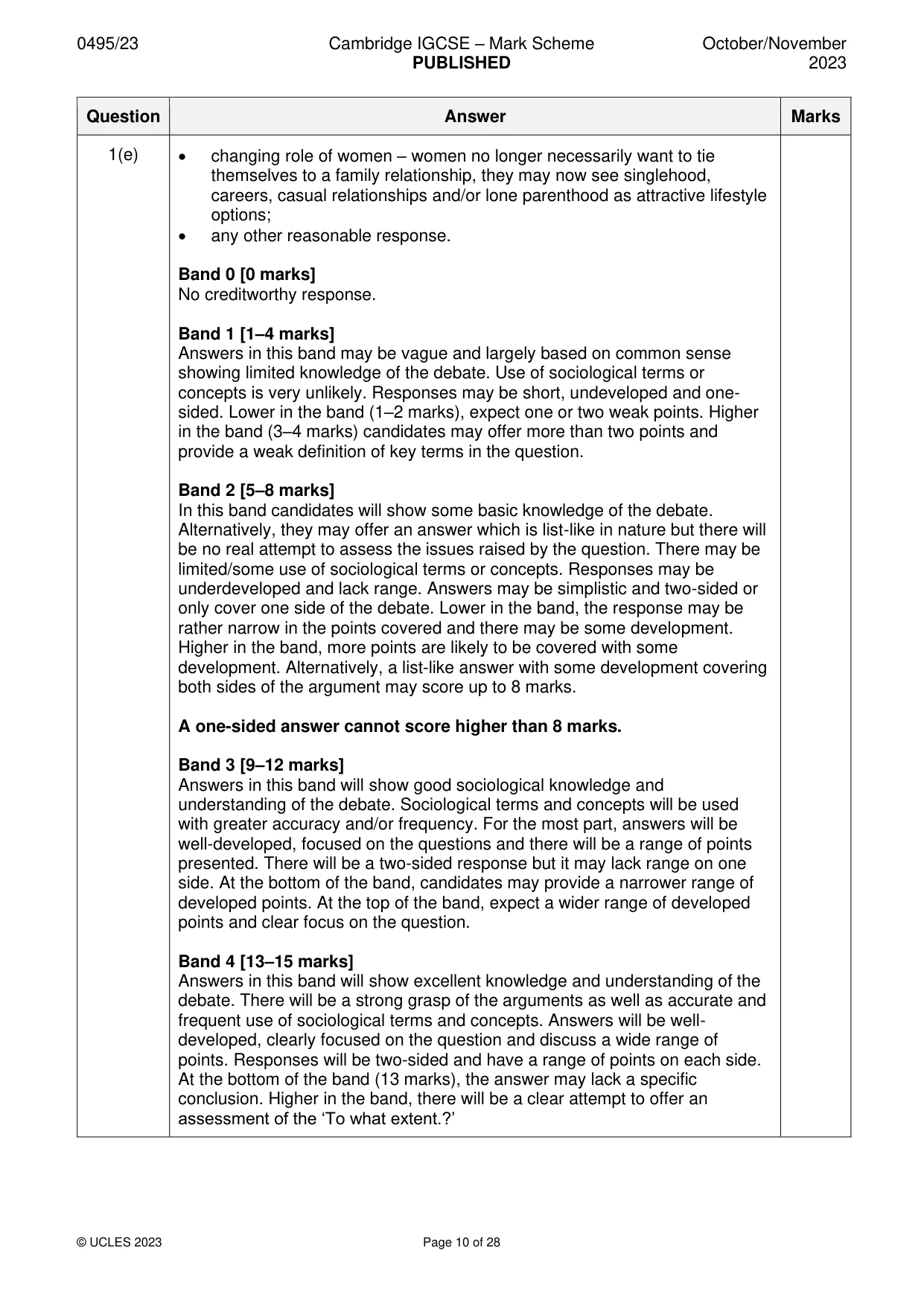
Mark scheme: Question Answer Marks 1(a) What is meant by the term ‘dual worker families’? 2 One mark for a partial definition, e.g. the woman goes to work. Two marks for a clear definition, e.g. families in which both the man and the woman do paid work. 1(b) Describe two types of extended family. 4 Possible answers: • vertically extended – more than two generations e.g. children, parents and grand-parents; • horizontally extended – people of the same generation as the parents and children e.g. aunts, uncles, cousins; • living together in the same household – all the relatives living together under one roof; • living close together – often associated with the traditional working class – several related nuclear families living close together e.g. the same street or area; • modified extended family – associated with modern industrial societies – relatives who live far apart are able to stay in regular contact (e.g. phone, email, facetime) and offer mutual support; • beanpole family – several generations of family but only a small number in each generation (e.g. a tall and thin family tree); • any other reasonable response. One mark for each point correctly identified (up to a maximum of two). One mark for each point that is developed (up to a maximum of two). 1(c) Explain how industrialisation has changed the family. 6 Possible answers: • fit thesis – the family changes to suit the needs of society, hence during industrialisation the nuclear family formed; • decline of extended family (Anderson) – industrialisation led to family functions being taken over by the state therefore having a large family was no longer necessary; • care of the young – parents are now supported by professionals such as nurses and primary school teachers, extended family not needed; • care of the elderly – extended families were no longer needed as the welfare state provided pensions and residential care; • care of the sick – extended families were no longer needed as the welfare state provided health and social services; • financial support – families were encouraged to save their own money rather than to rely on other family members; banks introduced loans and borrowing became normal; • urbanisation – happened alongside industrialisation and meant that smaller families were more practical for a move to the city and for geographical mobility; • birth rate – families have got smaller in order to allow for the emergence of dual-worker families; • gender roles – many sociologists believe that the emergence of the nuclear family led to the creation of segregated conjugal roles and the housewife; • any other reasonable response. Band 0 [0 marks] No creditworthy response. Band 1 [1–3 marks] Answers in this band will show only a limited awareness of the question. Responses may be short and un/underdeveloped. At the bottom of the band (1 mark), expect one weak point. Higher in the band (2–3 marks), candidates may offer more than one weak point, but there may be a tendency towards simplistic answers, engaging with sociological ideas without using sociological language. Band 2 [4–6 marks] Answers in this band will have clear and accurate explanation, showing good sociological knowledge and understanding. Sociological terms and concepts should be expected and explained. At the bottom of the band, the range of points covered may be narrow or lack detail. Higher in the band, answers will cover more than one point in a well-developed way or cover several points in less detail. 1(d) Explain why traditional conjugal roles are changing. 8 Possible answers: • cost of living – as living expenses continue to rise in most countries, it becomes increasingly necessary to have dual worker families which means conjugal roles become more equal; • feminism – has raised the expectations and aspirations of women who now are unlikely to accept their lower status position as housewife and instead expect a more equal power division within both the home and society; • family diversity – as this becomes more normal and accepted so the types of roles available to men and women change e.g. house-husbands, career women, etc.; • falling marriage rate – marriage is often not seen as essential anymore meaning that we are seeing more cohabiting/transient relationships and lone parents that challenge traditional conjugal roles; • education – as education becomes more universal and is seen as a human right in many societies, so norms and values change and traditional conjugal roles as the norm are challenged; • secularisation – the decline in religion has meant less acceptance for tradition generally, including in the family – lone parent families, singlehood and alternatives to marriage such as communes are increasingly common today; • globalisation – opportunities to travel and to live abroad, alongside the internet and social media, means that new lifestyles become normalised, particularly amongst younger generations and this will challenge traditional conjugal roles; • any other reasonable response. 1(d) Band 0 [0 marks] No creditworthy response. Band 1 [1–3 marks] Answers in this band will show only a limited awareness of the question. A tendency to description is likely. Responses may be short and undeveloped and points stated without explanation. Sociological terms and concepts are unlikely to be used. At the bottom of the band (1 mark), expect one weak point. Higher in the band (2–3 marks), candidates may offer more than one weak point. Band 2 [4–6 marks] Answers in this band will show basic sociological knowledge and understanding. Responses maybe underdeveloped and lacking in range. At the bottom of the band, candidates are unlikely to use sociological terms and concepts accurately. Higher in the band, candidates may be beginning to use sociological terms and concepts with greater accuracy. However, some aspects of the answer may only be partially developed/explained. Band 3 [7–8 marks] Answers in this band will show good sociological knowledge and understanding and will be well-developed and explained. Sociological terms and concepts will be used accurately overall. Answers will be well-focused on the question and there will be a range of points presented. At the top of the band explanations will be clear throughout. 1(e) To what extent is the nuclear family the best type of family? 15 Possible answers: Arguments for: • Murdock – functionalism – argued that the nuclear family was the base of all family forms worldwide as it was the best type of family to live in and nurture children; • family functions – functionalism – argue that the core family functions are essential for smooth running families and societies and that these are best performed in the nuclear family; • gender roles – men should perform the instrumental and women the expressive roles in the family because they are best at these. This gender division fits best with the nuclear family; • New Right – lone parent families – these have led to the formation of an underclass and a decline in family values; a return to the nuclear family is needed in order to combat the inadequate socialisation of single parents; • reconstituted families – these are thought by functionalists to lead to conflict, stress and unhappiness which could be avoided by returning to a more universal acceptance of the nuclear family form; • cereal packet family – the nuclear family is the family type most often seen in the media and in advertisements, depicting how harmonious and happy family life can be; • geographical mobility – nuclear families are the best type of family to move easily around the country in order to secure employment and to provide for one’s family members – this makes it the best type of family; • capitalism – nuclear families reproduce capitalist values and ensure that men go to work, work hard, do not strike and provide for their families; • patriarchy – the nuclear family supports the status quo and encourages men and women to adopt the gender roles that they are best at performing; • any other reasonable response. Arguments against: • Leach – the nuclear family according to his research was found to be stifling and repressive for its members; • feminism – the nuclear family is seen to encourage unequal power relations between men and women instead of embracing joint conjugal roles and equality; • socialisation – Oakley found that the nuclear family encouraged differential gender socialisation that led to stereotypical and limiting identities for both males and females; • Marxism – they believe that the nuclear family forces male workers to work for the capitalist ruling class where they feel oppressed and alienated – their anger and frustrations over the workplace are then taken out on their wives and children in the family; • ageing population – as people live longer so we are seeing the return to an extended family structure that allows for the pivot generation to look after elderly relatives as well as dependant children; • dark side of the family – the nuclear family may be so oppressive that it encourages and hides violence against partners, children and the elderly; • family diversity – the nuclear family does not reflect growing individualism and freedom in society where people want choice and flexibility in the roles they play – the nuclear family does not meet their needs; 1(e) • changing role of women – women no longer necessarily want to tie themselves to a family relationship, they may now see singlehood, careers, casual relationships and/or lone parenthood as attractive lifestyle options; • any other reasonable response. Band 0 [0 marks] No creditworthy response. Band 1 [1–4 marks] Answers in this band may be vague and largely based on common sense showing limited knowledge of the debate. Use of sociological terms or concepts is very unlikely. Responses may be short, undeveloped and one- sided. Lower in the band (1–2 marks), expect one or two weak points. Higher in the band (3–4 marks) candidates may offer more than two points and provide a weak definition of key terms in the question. Band 2 [5–8 marks] In this band candidates will show some basic knowledge of the debate. Alternatively, they may offer an answer which is list-like in nature but there will be no real attempt to assess the issues raised by the question. There may be limited/some use of sociological terms or concepts. Responses may be underdeveloped and lack range. Answers may be simplistic and two-sided or only cover one side of the debate. Lower in the band, the response may be rather narrow in the points covered and there may be some development. Higher in the band, more points are likely to be covered with some development. Alternatively, a list-like answer with some development covering both sides of the argument may score up to 8 marks. A one-sided answer cannot score higher than 8 marks. Band 3 [9–12 marks] Answers in this band will show good sociological knowledge and understanding of the debate. Sociological terms and concepts will be used with greater accuracy and/or frequency. For the most part, answers will be well-developed, focused on the questions and there will be a range of points presented. There will be a two-sided response but it may lack range on one side. At the bottom of the band, candidates may provide a narrower range of developed points. At the top of the band, expect a wider range of developed points and clear focus on the question. Band 4 [13–15 marks] Answers in this band will show excellent knowledge and understanding of the debate. There will be a strong grasp of the arguments as well as accurate and frequent use of sociological terms and concepts. Answers will be well- developed, clearly focused on the question and discuss a wide range of points. Responses will be two-sided and have a range of points on each side. At the bottom of the band (13 marks), the answer may lack a specific conclusion. Higher in the band, there will be a clear attempt to offer an assessment of the ‘To what extent.?’
Q2 · There are many different types of education available to students, for example formal and…
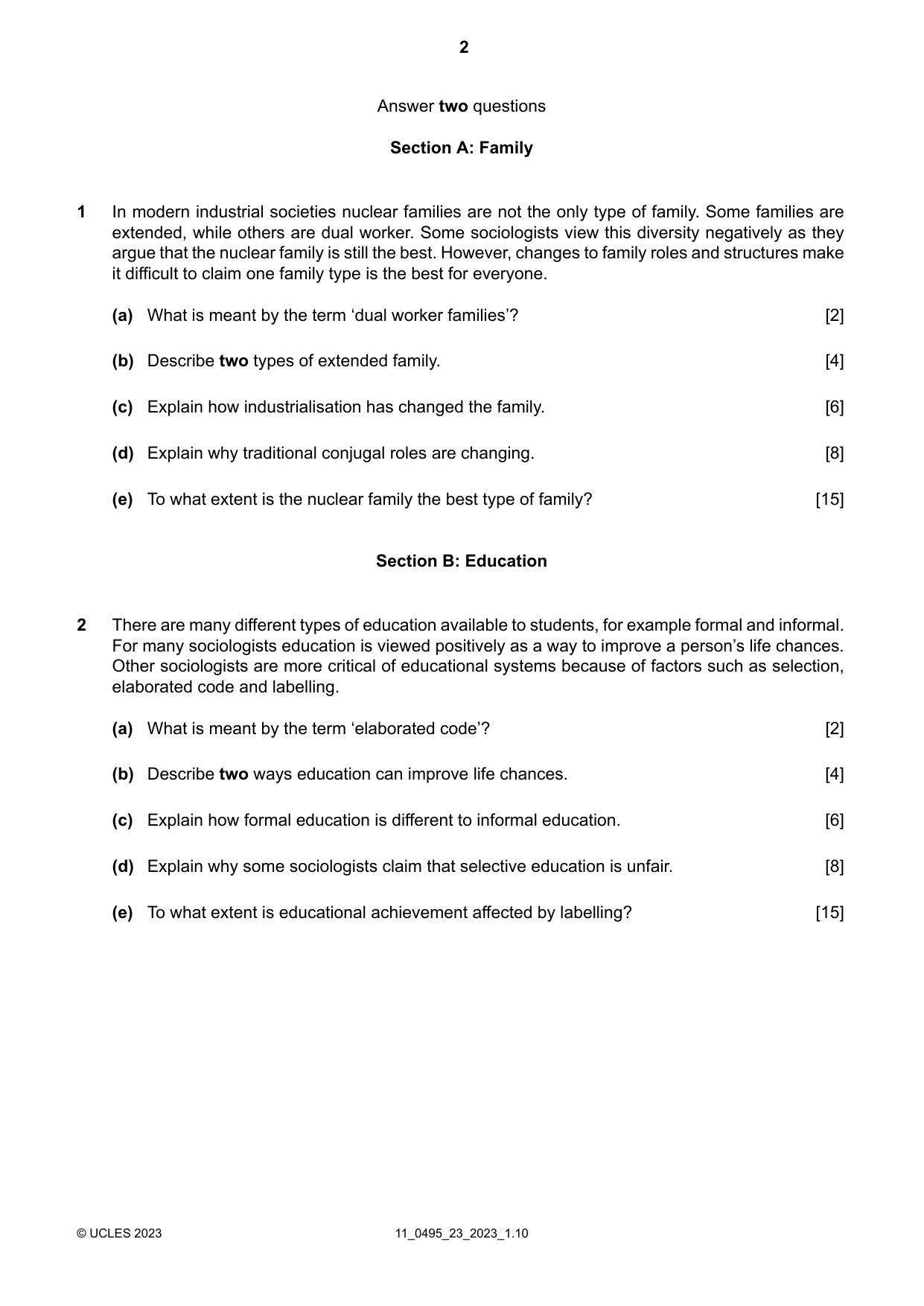
2 There are many different types of education available to students, for example formal and informal. For many sociologists education is viewed positively as a way to improve a person’s life chances. Other sociologists are more critical of educational systems because of factors such as selection, elaborated code and labelling. (a) What is meant by the term ‘elaborated code’? [2] (b) Describe two ways education can improve life chances. [4] (c) Explain how formal education is different to informal education. [6] (d) Explain why some sociologists claim that selective education is unfair. [8] (e) To what extent is educational achievement affected by labelling? [15] Section C: Crime, deviance and social control
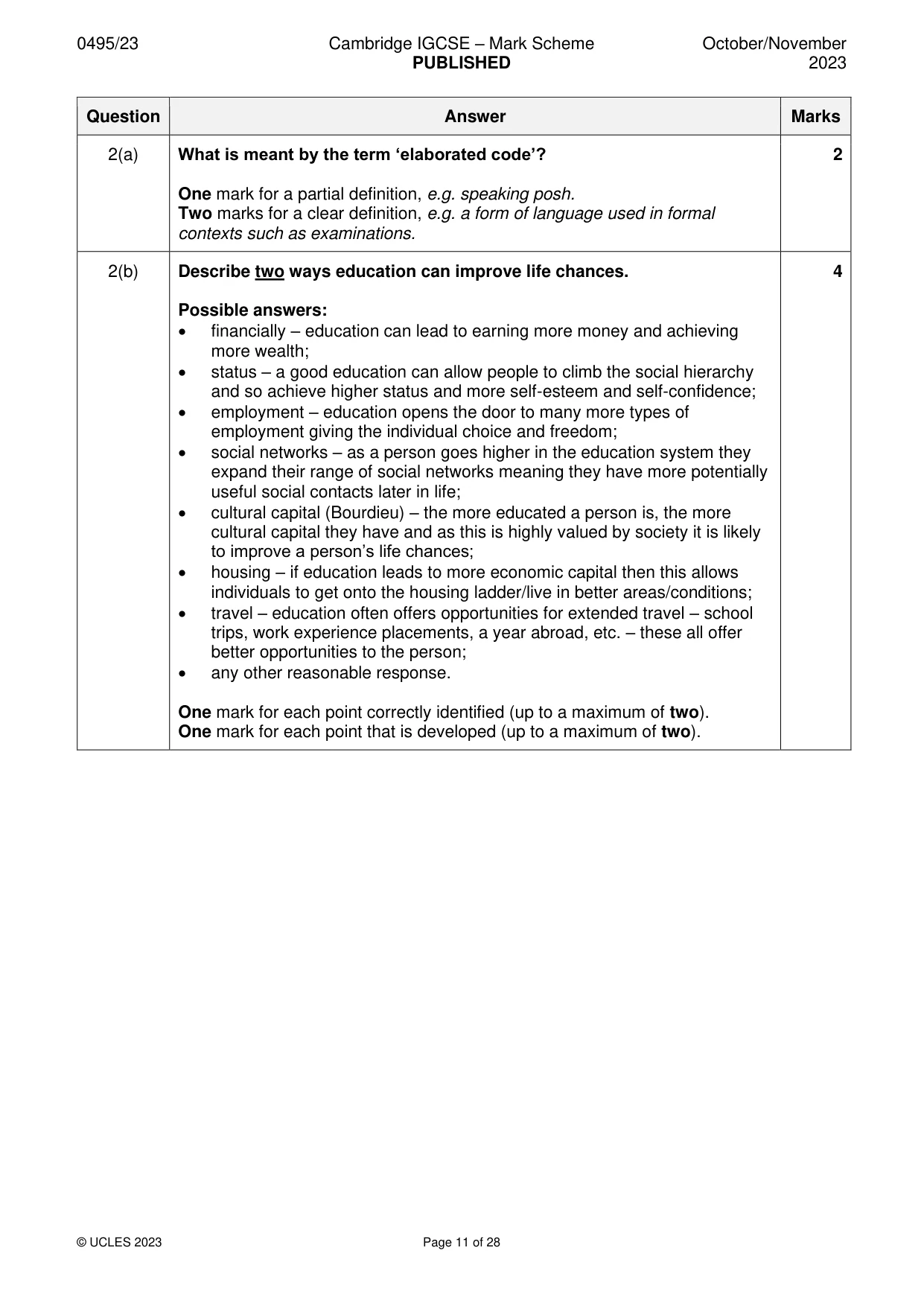
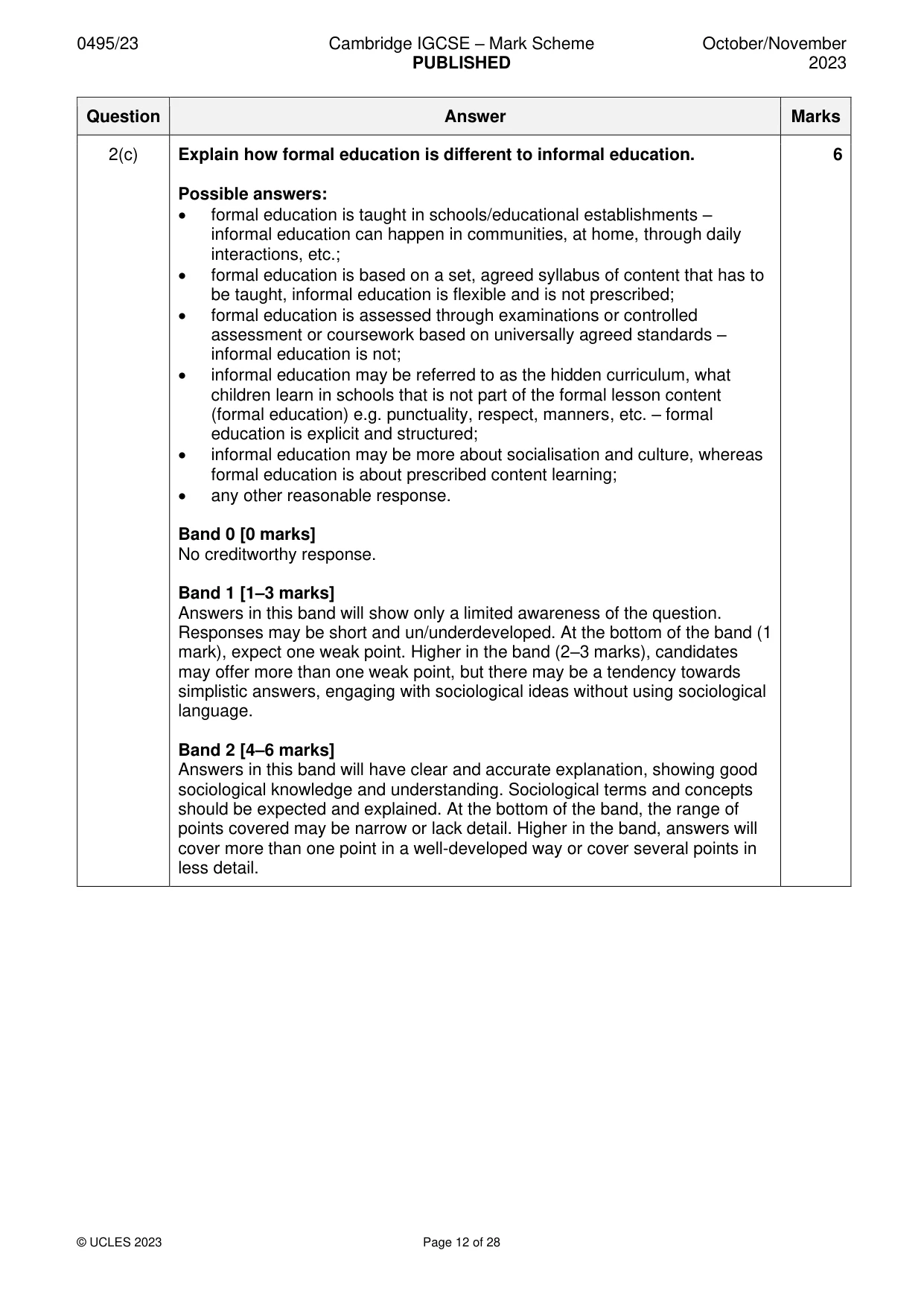
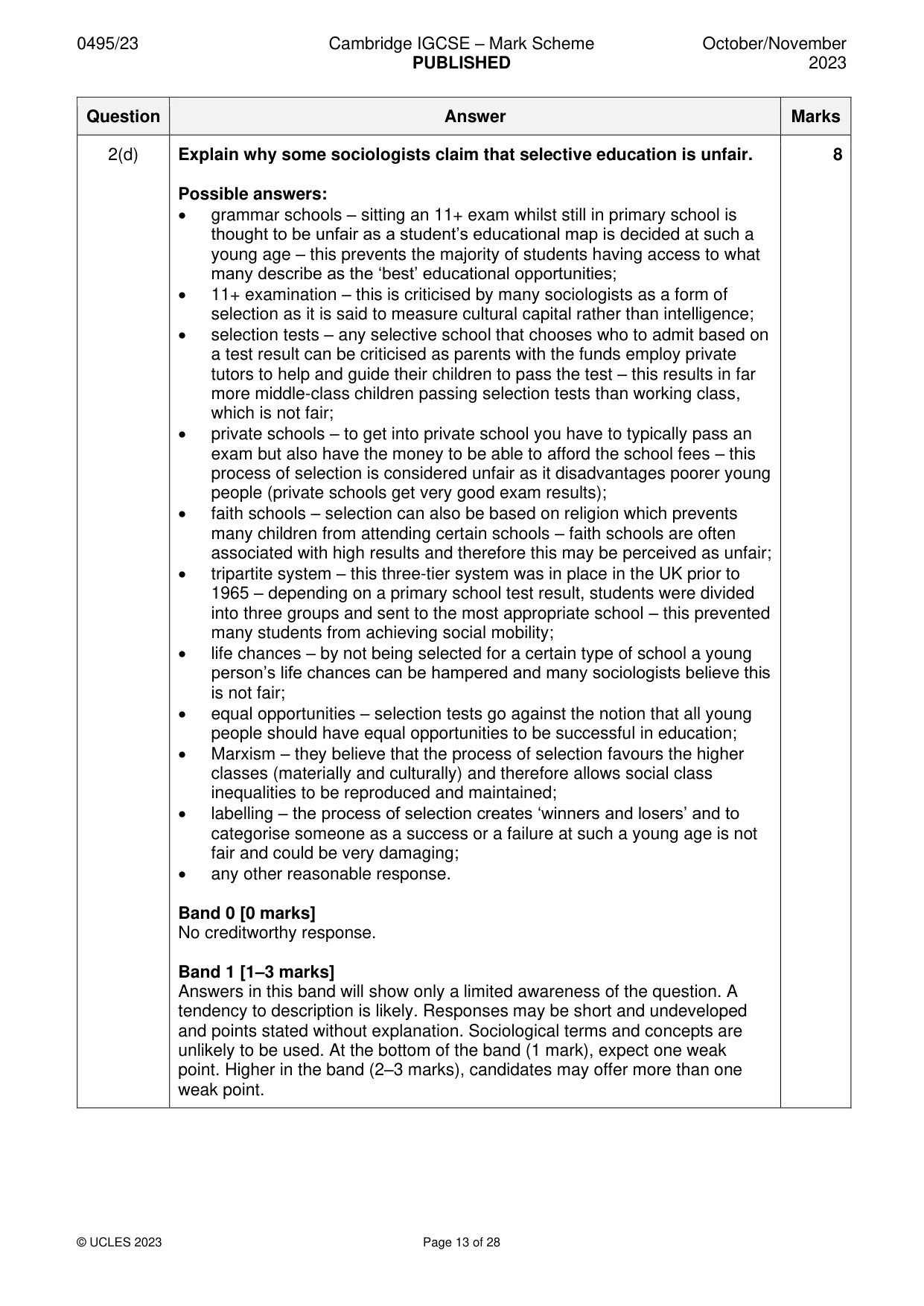
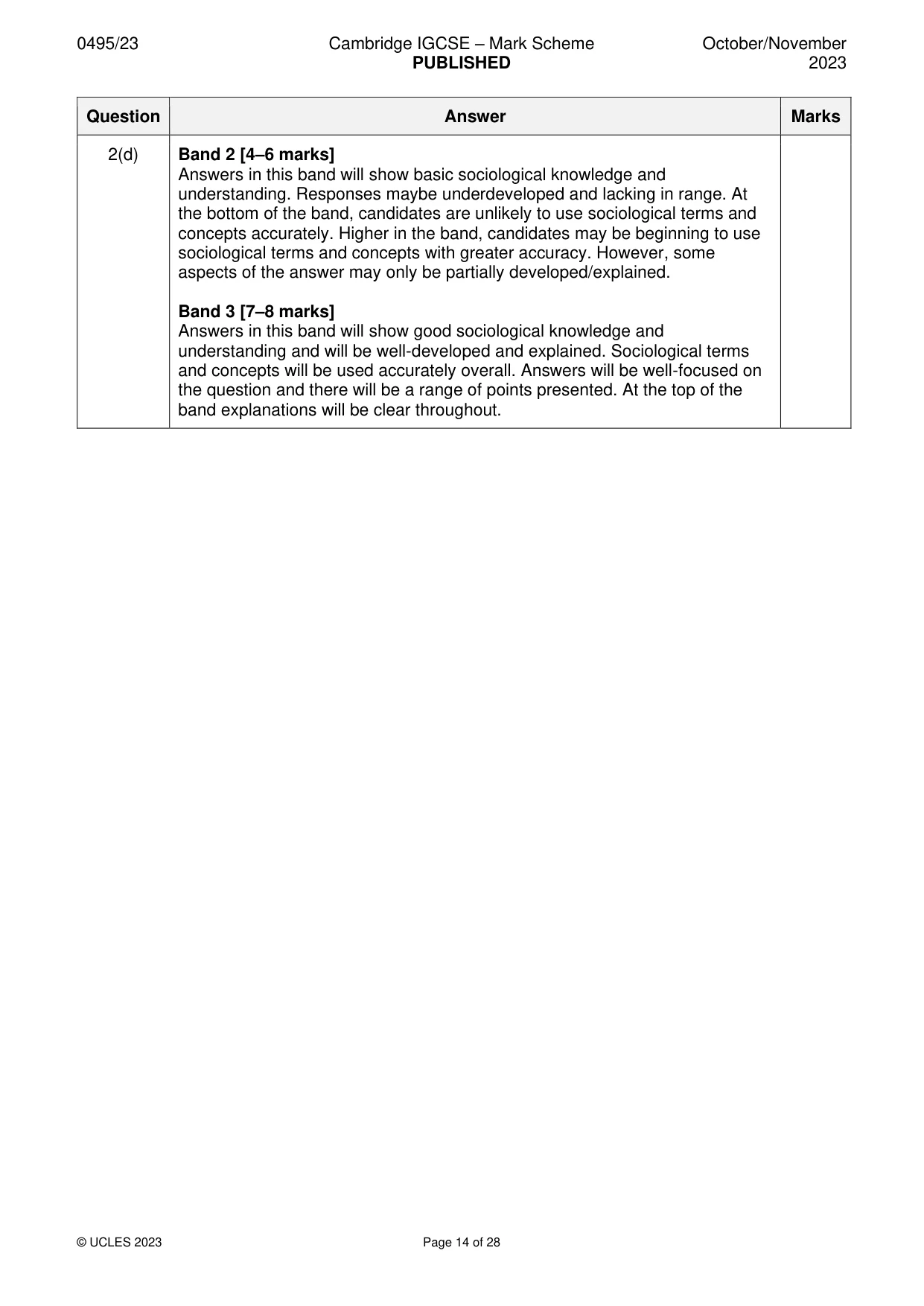
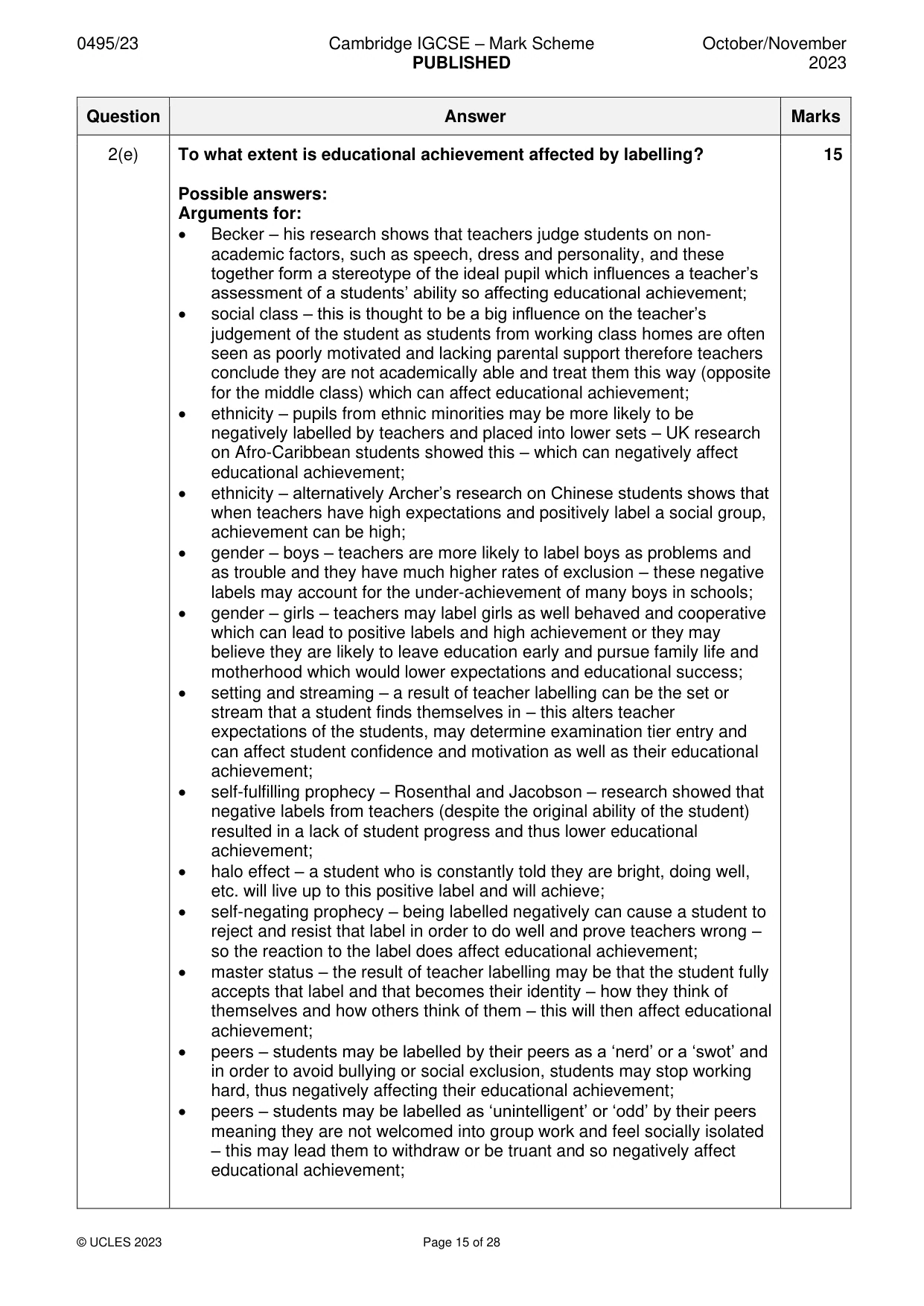
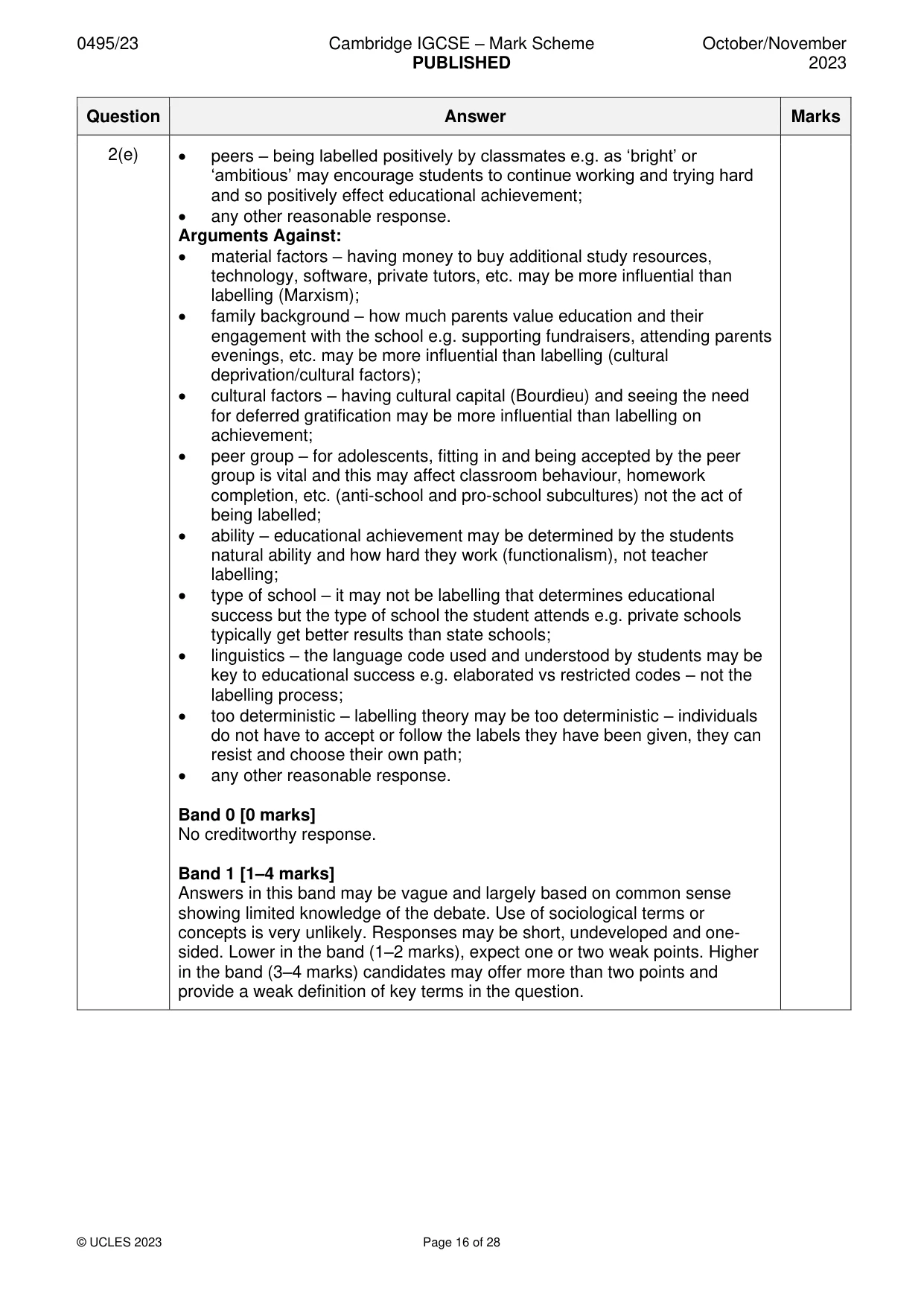
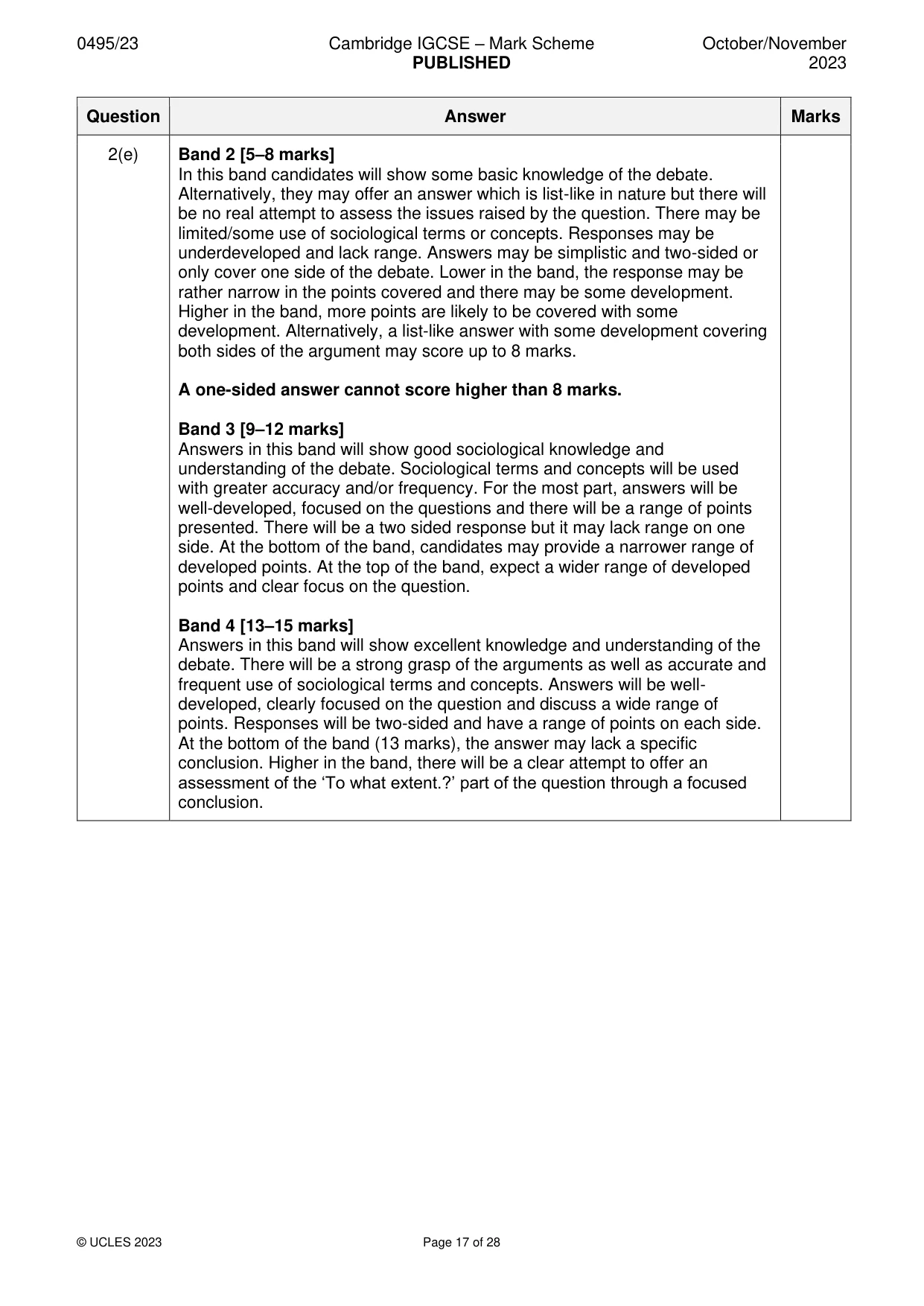
Mark scheme: 2(a) What is meant by the term ‘elaborated code’? 2 One mark for a partial definition, e.g. speaking posh. Two marks for a clear definition, e.g. a form of language used in formal contexts such as examinations. 2(b) Describe two ways education can improve life chances. 4 Possible answers: • financially – education can lead to earning more money and achieving more wealth; • status – a good education can allow people to climb the social hierarchy and so achieve higher status and more self-esteem and self-confidence; • employment – education opens the door to many more types of employment giving the individual choice and freedom; • social networks – as a person goes higher in the education system they expand their range of social networks meaning they have more potentially useful social contacts later in life; • cultural capital (Bourdieu) – the more educated a person is, the more cultural capital they have and as this is highly valued by society it is likely to improve a person’s life chances; • housing – if education leads to more economic capital then this allows individuals to get onto the housing ladder/live in better areas/conditions; • travel – education often offers opportunities for extended travel – school trips, work experience placements, a year abroad, etc. – these all offer better opportunities to the person; • any other reasonable response. One mark for each point correctly identified (up to a maximum of two). One mark for each point that is developed (up to a maximum of two). 2(c) Explain how formal education is different to informal education. 6 Possible answers: • formal education is taught in schools/educational establishments – informal education can happen in communities, at home, through daily interactions, etc.; • formal education is based on a set, agreed syllabus of content that has to be taught, informal education is flexible and is not prescribed; • formal education is assessed through examinations or controlled assessment or coursework based on universally agreed standards – informal education is not; • informal education may be referred to as the hidden curriculum, what children learn in schools that is not part of the formal lesson content (formal education) e.g. punctuality, respect, manners, etc. – formal education is explicit and structured; • informal education may be more about socialisation and culture, whereas formal education is about prescribed content learning; • any other reasonable response. Band 0 [0 marks] No creditworthy response. Band 1 [1–3 marks] Answers in this band will show only a limited awareness of the question. Responses may be short and un/underdeveloped. At the bottom of the band (1 mark), expect one weak point. Higher in the band (2–3 marks), candidates may offer more than one weak point, but there may be a tendency towards simplistic answers, engaging with sociological ideas without using sociological language. Band 2 [4–6 marks] Answers in this band will have clear and accurate explanation, showing good sociological knowledge and understanding. Sociological terms and concepts should be expected and explained. At the bottom of the band, the range of points covered may be narrow or lack detail. Higher in the band, answers will cover more than one point in a well-developed way or cover several points in less detail. 2(d) Explain why some sociologists claim that selective education is unfair. 8 Possible answers: • grammar schools – sitting an 11+ exam whilst still in primary school is thought to be unfair as a student’s educational map is decided at such a young age – this prevents the majority of students having access to what many describe as the ‘best’ educational opportunities; • 11+ examination – this is criticised by many sociologists as a form of selection as it is said to measure cultural capital rather than intelligence; • selection tests – any selective school that chooses who to admit based on a test result can be criticised as parents with the funds employ private tutors to help and guide their children to pass the test – this results in far more middle-class children passing selection tests than working class, which is not fair; • private schools – to get into private school you have to typically pass an exam but also have the money to be able to afford the school fees – this process of selection is considered unfair as it disadvantages poorer young people (private schools get very good exam results); • faith schools – selection can also be based on religion which prevents many children from attending certain schools – faith schools are often associated with high results and therefore this may be perceived as unfair; • tripartite system – this three-tier system was in place in the UK prior to 1965 – depending on a primary school test result, students were divided into three groups and sent to the most appropriate school – this prevented many students from achieving social mobility; • life chances – by not being selected for a certain type of school a young person’s life chances can be hampered and many sociologists believe this is not fair; • equal opportunities – selection tests go against the notion that all young people should have equal opportunities to be successful in education; • Marxism – they believe that the process of selection favours the higher classes (materially and culturally) and therefore allows social class inequalities to be reproduced and maintained; • labelling – the process of selection creates ‘winners and losers’ and to categorise someone as a success or a failure at such a young age is not fair and could be very damaging; • any other reasonable response. Band 0 [0 marks] No creditworthy response. Band 1 [1–3 marks] Answers in this band will show only a limited awareness of the question. A tendency to description is likely. Responses may be short and undeveloped and points stated without explanation. Sociological terms and concepts are unlikely to be used. At the bottom of the band (1 mark), expect one weak point. Higher in the band (2–3 marks), candidates may offer more than one weak point. 2(d) Band 2 [4–6 marks] Answers in this band will show basic sociological knowledge and understanding. Responses maybe underdeveloped and lacking in range. At the bottom of the band, candidates are unlikely to use sociological terms and concepts accurately. Higher in the band, candidates may be beginning to use sociological terms and concepts with greater accuracy. However, some aspects of the answer may only be partially developed/explained. Band 3 [7–8 marks] Answers in this band will show good sociological knowledge and understanding and will be well-developed and explained. Sociological terms and concepts will be used accurately overall. Answers will be well-focused on the question and there will be a range of points presented. At the top of the band explanations will be clear throughout. 2(e) To what extent is educational achievement affected by labelling? 15 Possible answers: Arguments for: • Becker – his research shows that teachers judge students on non- academic factors, such as speech, dress and personality, and these together form a stereotype of the ideal pupil which influences a teacher’s assessment of a students’ ability so affecting educational achievement; • social class – this is thought to be a big influence on the teacher’s judgement of the student as students from working class homes are often seen as poorly motivated and lacking parental support therefore teachers conclude they are not academically able and treat them this way (opposite for the middle class) which can affect educational achievement; • ethnicity – pupils from ethnic minorities may be more likely to be negatively labelled by teachers and placed into lower sets – UK research on Afro-Caribbean students showed this – which can negatively affect educational achievement; • ethnicity – alternatively Archer’s research on Chinese students shows that when teachers have high expectations and positively label a social group, achievement can be high; • gender – boys – teachers are more likely to label boys as problems and as trouble and they have much higher rates of exclusion – these negative labels may account for the under-achievement of many boys in schools; • gender – girls – teachers may label girls as well behaved and cooperative which can lead to positive labels and high achievement or they may believe they are likely to leave education early and pursue family life and motherhood which would lower expectations and educational success; • setting and streaming – a result of teacher labelling can be the set or stream that a student finds themselves in – this alters teacher expectations of the students, may determine examination tier entry and can affect student confidence and motivation as well as their educational achievement; • self-fulfilling prophecy – Rosenthal and Jacobson – research showed that negative labels from teachers (despite the original ability of the student) resulted in a lack of student progress and thus lower educational achievement; • halo effect – a student who is constantly told they are bright, doing well, etc. will live up to this positive label and will achieve; • self-negating prophecy – being labelled negatively can cause a student to reject and resist that label in order to do well and prove teachers wrong – so the reaction to the label does affect educational achievement; • master status – the result of teacher labelling may be that the student fully accepts that label and that becomes their identity – how they think of themselves and how others think of them – this will then affect educational achievement; • peers – students may be labelled by their peers as a ‘nerd’ or a ‘swot’ and in order to avoid bullying or social exclusion, students may stop working hard, thus negatively affecting their educational achievement; • peers – students may be labelled as ‘unintelligent’ or ‘odd’ by their peers meaning they are not welcomed into group work and feel socially isolated – this may lead them to withdraw or be truant and so negatively affect educational achievement; 2(e) • peers – being labelled positively by classmates e.g. as ‘bright’ or ‘ambitious’ may encourage students to continue working and trying hard and so positively effect educational achievement; • any other reasonable response. Arguments Against: • material factors – having money to buy additional study resources, technology, software, private tutors, etc. may be more influential than labelling (Marxism); • family background – how much parents value education and their engagement with the school e.g. supporting fundraisers, attending parents evenings, etc. may be more influential than labelling (cultural deprivation/cultural factors); • cultural factors – having cultural capital (Bourdieu) and seeing the need for deferred gratification may be more influential than labelling on achievement; • peer group – for adolescents, fitting in and being accepted by the peer group is vital and this may affect classroom behaviour, homework completion, etc. (anti-school and pro-school subcultures) not the act of being labelled; • ability – educational achievement may be determined by the students natural ability and how hard they work (functionalism), not teacher labelling; • type of school – it may not be labelling that determines educational success but the type of school the student attends e.g. private schools typically get better results than state schools; • linguistics – the language code used and understood by students may be key to educational success e.g. elaborated vs restricted codes – not the labelling process; • too deterministic – labelling theory may be too deterministic – individuals do not have to accept or follow the labels they have been given, they can resist and choose their own path; • any other reasonable response. Band 0 [0 marks] No creditworthy response. Band 1 [1–4 marks] Answers in this band may be vague and largely based on common sense showing limited knowledge of the debate. Use of sociological terms or concepts is very unlikely. Responses may be short, undeveloped and one- sided. Lower in the band (1–2 marks), expect one or two weak points. Higher in the band (3–4 marks) candidates may offer more than two points and provide a weak definition of key terms in the question. 2(e) Band 2 [5–8 marks] In this band candidates will show some basic knowledge of the debate. Alternatively, they may offer an answer which is list-like in nature but there will be no real attempt to assess the issues raised by the question. There may be limited/some use of sociological terms or concepts. Responses may be underdeveloped and lack range. Answers may be simplistic and two-sided or only cover one side of the debate. Lower in the band, the response may be rather narrow in the points covered and there may be some development. Higher in the band, more points are likely to be covered with some development. Alternatively, a list-like answer with some development covering both sides of the argument may score up to 8 marks. A one-sided answer cannot score higher than 8 marks. Band 3 [9–12 marks] Answers in this band will show good sociological knowledge and understanding of the debate. Sociological terms and concepts will be used with greater accuracy and/or frequency. For the most part, answers will be well-developed, focused on the questions and there will be a range of points presented. There will be a two sided response but it may lack range on one side. At the bottom of the band, candidates may provide a narrower range of developed points. At the top of the band, expect a wider range of developed points and clear focus on the question. Band 4 [13–15 marks] Answers in this band will show excellent knowledge and understanding of the debate. There will be a strong grasp of the arguments as well as accurate and frequent use of sociological terms and concepts. Answers will be well- developed, clearly focused on the question and discuss a wide range of points. Responses will be two-sided and have a range of points on each side. At the bottom of the band (13 marks), the answer may lack a specific conclusion. Higher in the band, there will be a clear attempt to offer an assessment of the ‘To what extent.?’ part of the question through a focused conclusion.
Q3 · According to official crime statistics people from the lower social classes, such as…
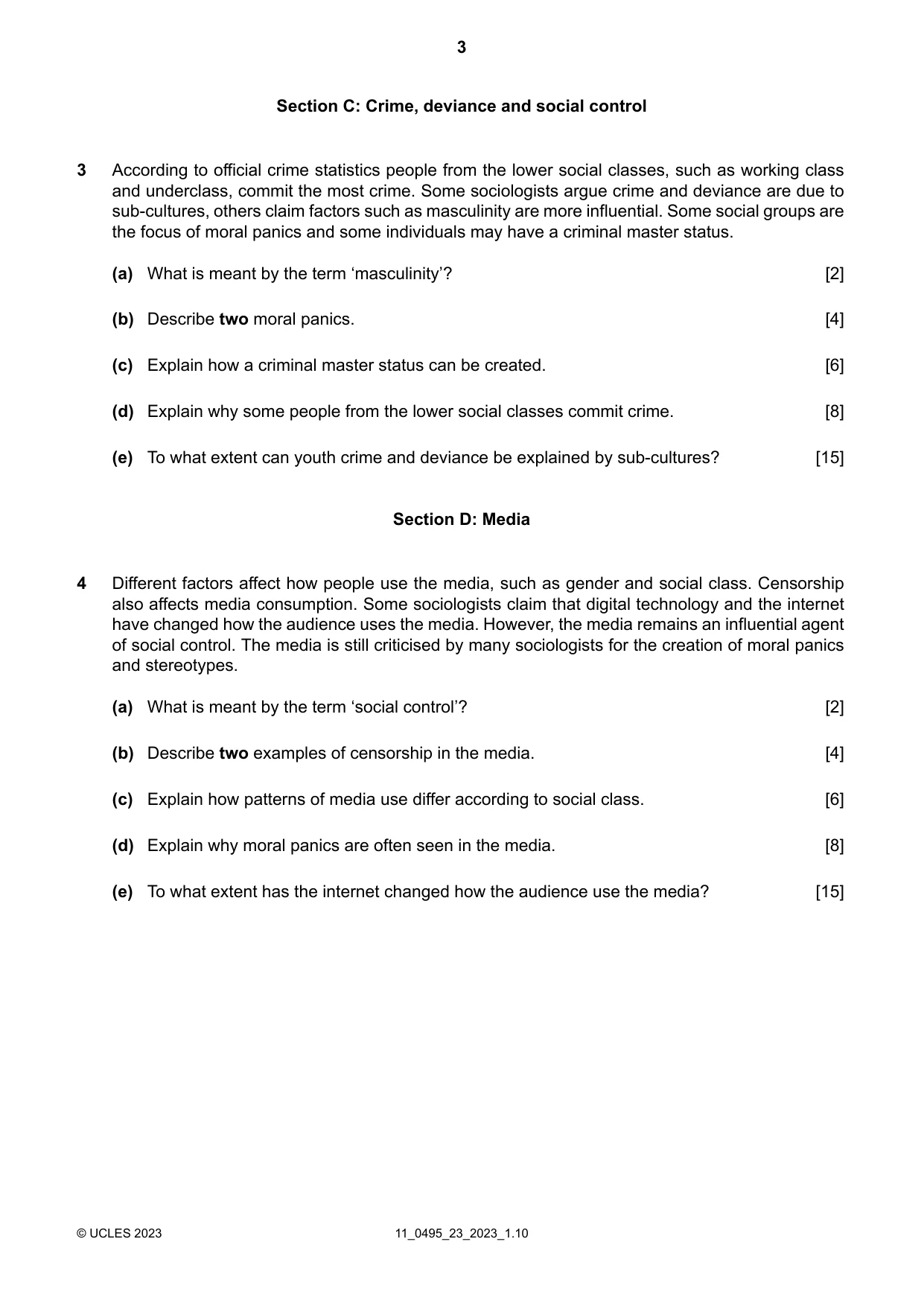
3 According to official crime statistics people from the lower social classes, such as working class and underclass, commit the most crime. Some sociologists argue crime and deviance are due to sub-cultures, others claim factors such as masculinity are more influential. Some social groups are the focus of moral panics and some individuals may have a criminal master status. (a) What is meant by the term ‘masculinity’? [2] (b) Describe two moral panics. [4] (c) Explain how a criminal master status can be created. [6] (d) Explain why some people from the lower social classes commit crime. [8] (e) To what extent can youth crime and deviance be explained by sub-cultures? [15] Section D: Media
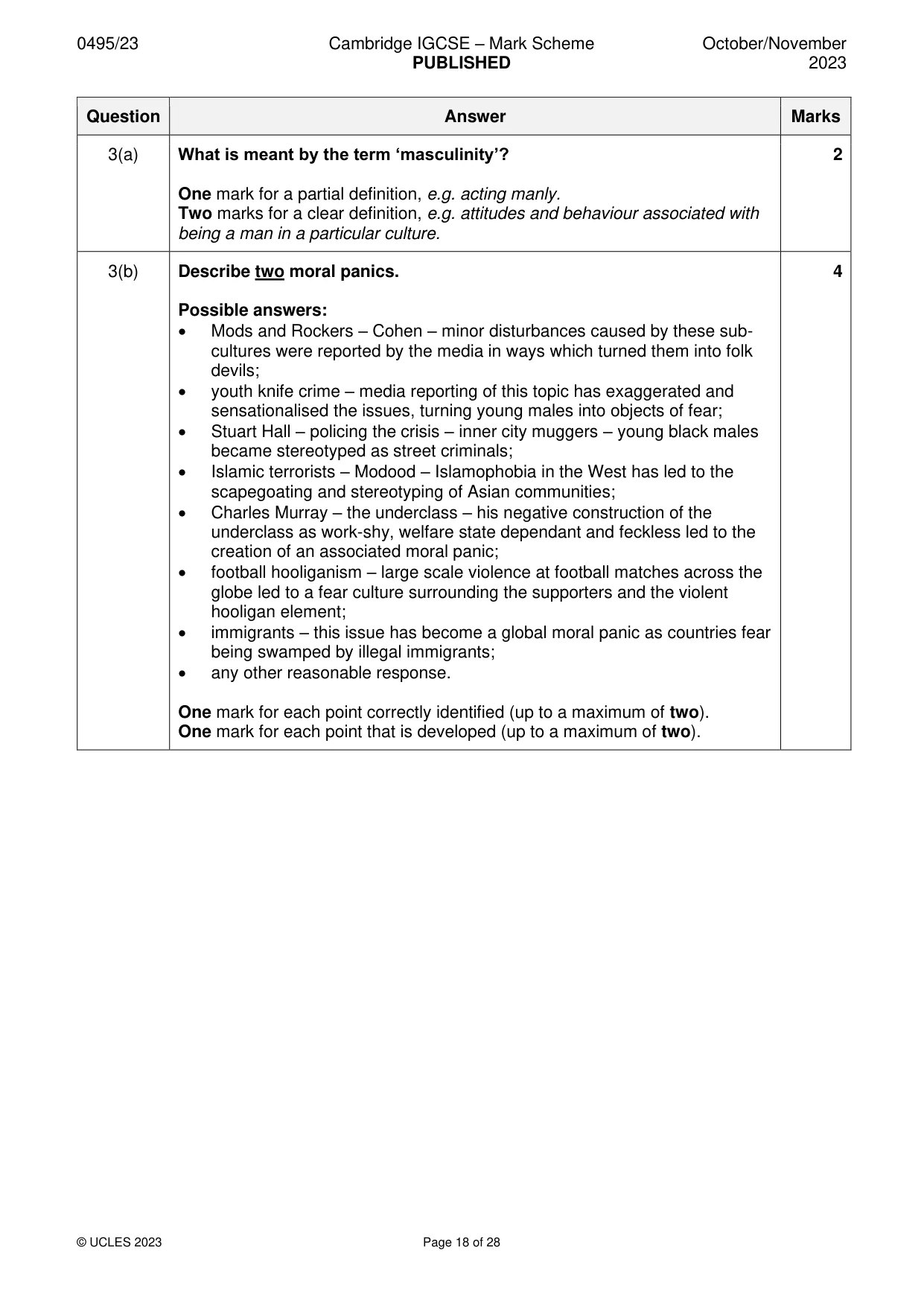
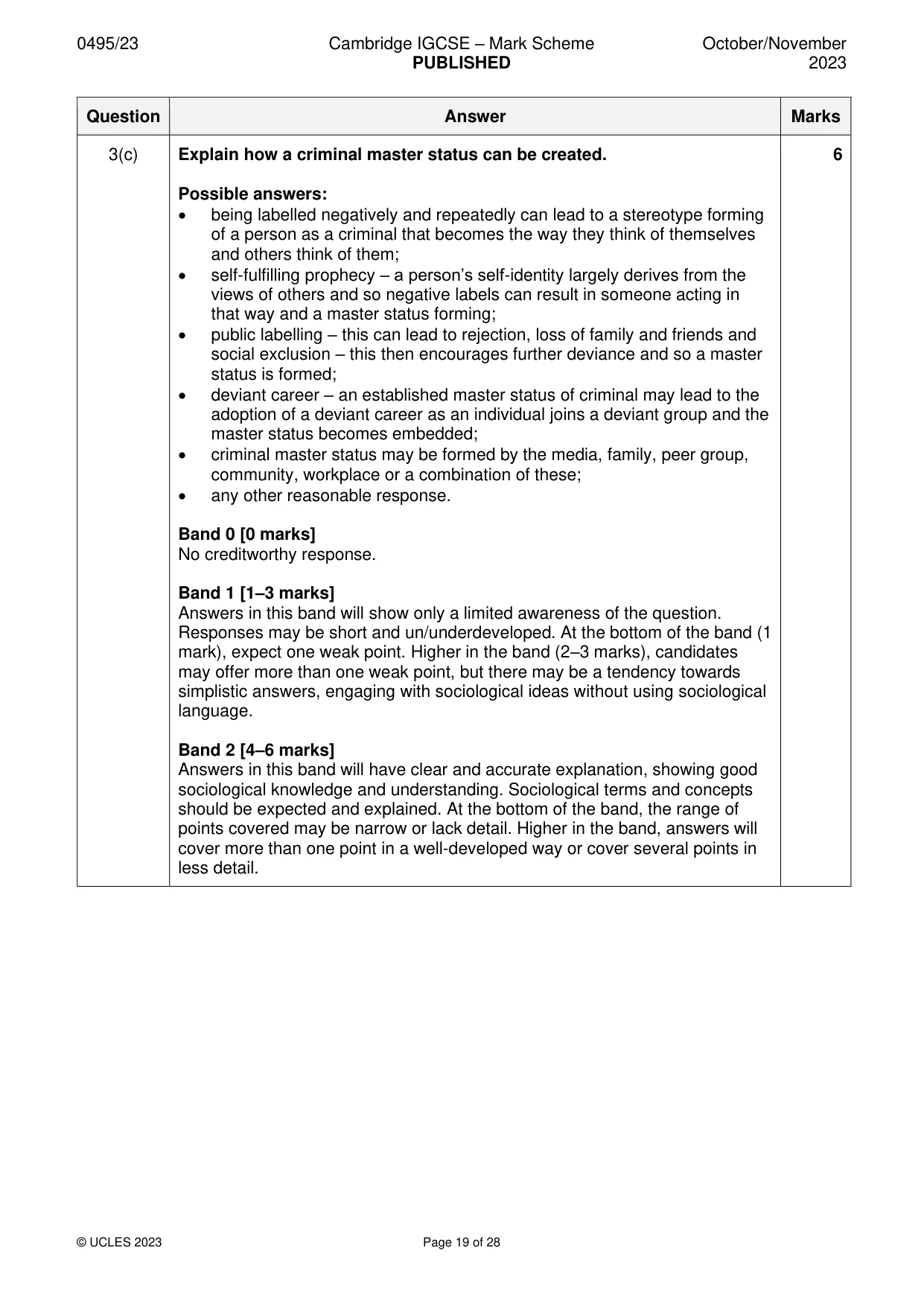
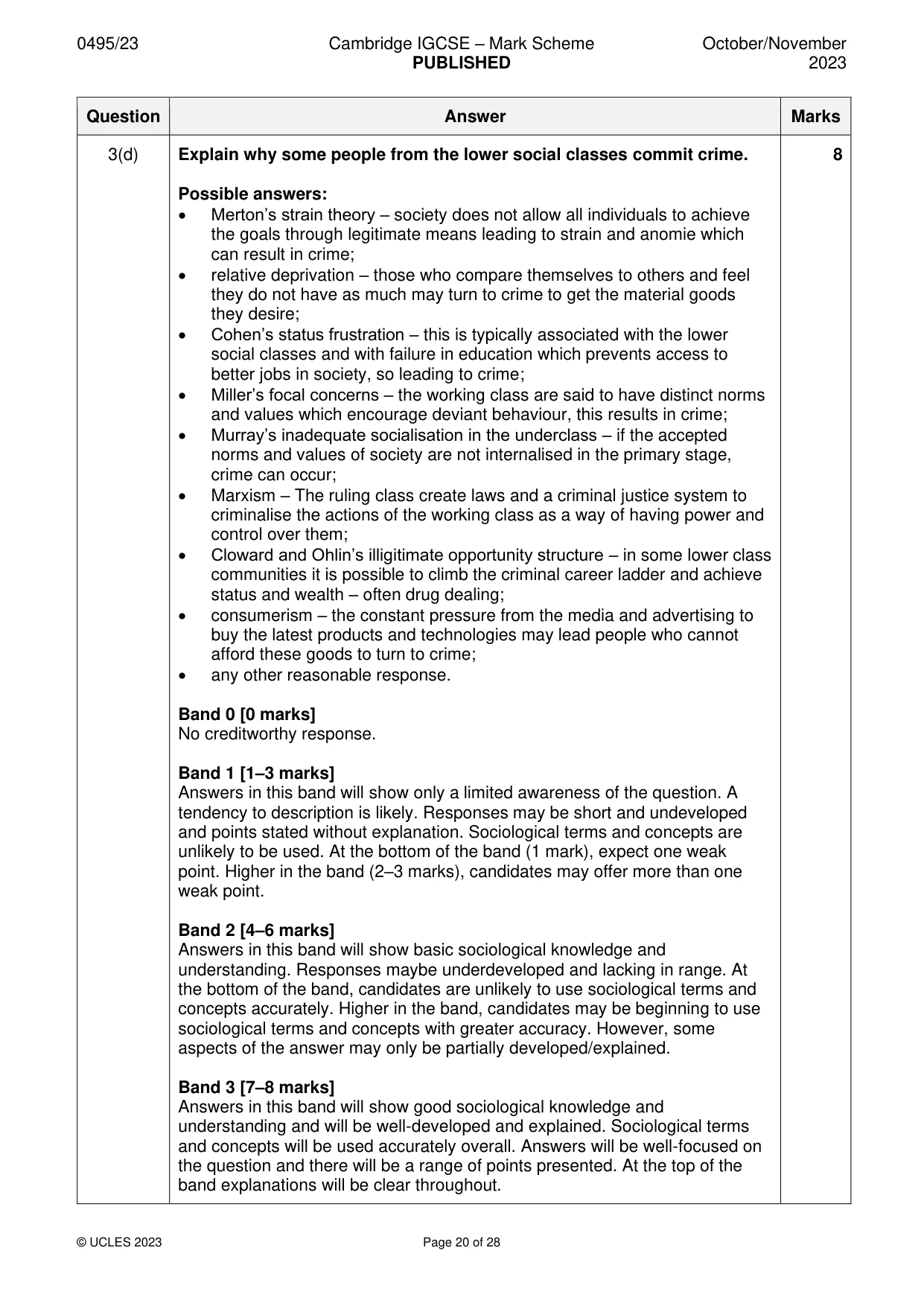
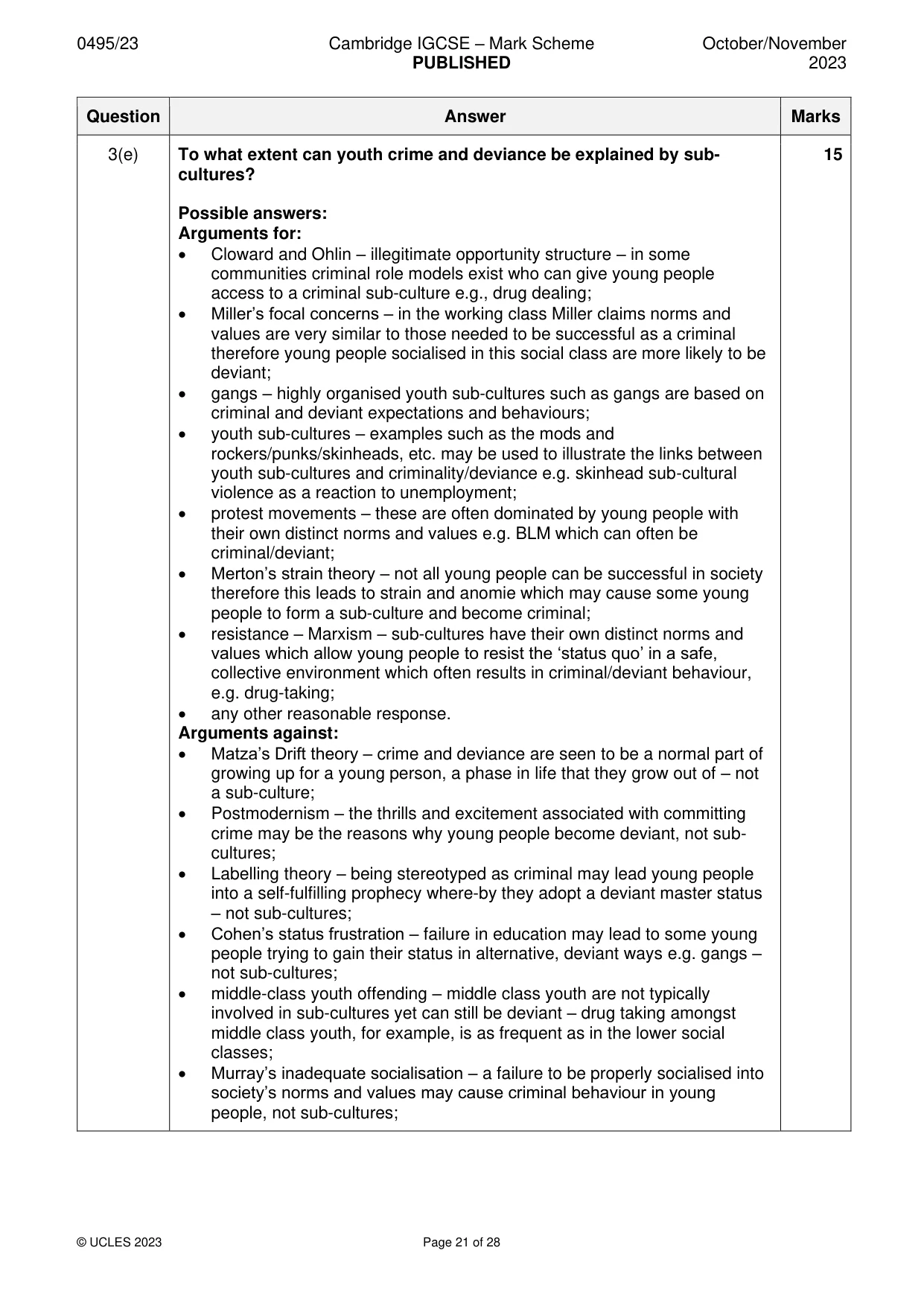
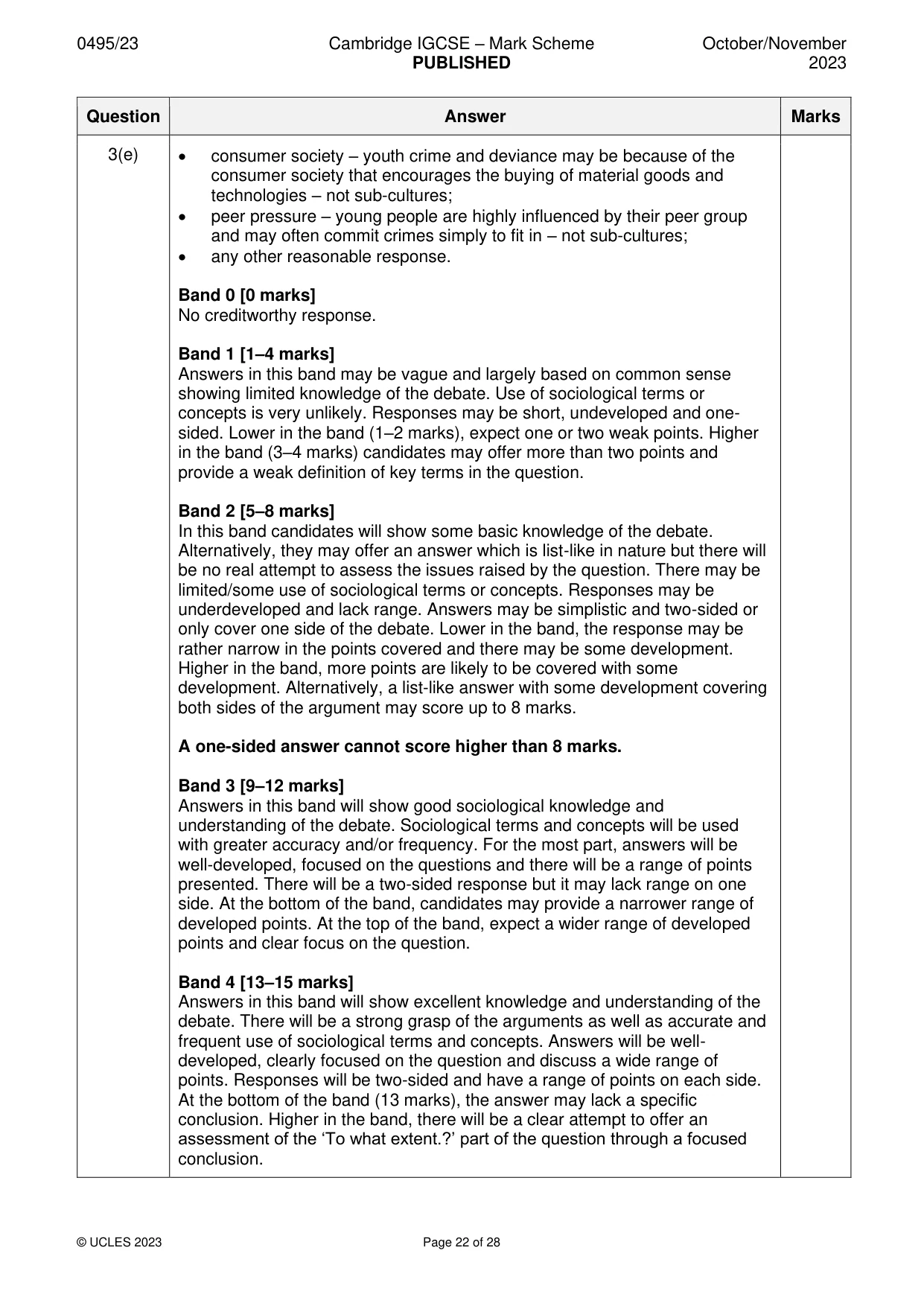
Mark scheme: 3(a) What is meant by the term ‘masculinity’? 2 One mark for a partial definition, e.g. acting manly. Two marks for a clear definition, e.g. attitudes and behaviour associated with being a man in a particular culture. 3(b) Describe two moral panics. 4 Possible answers: • Mods and Rockers – Cohen – minor disturbances caused by these sub- cultures were reported by the media in ways which turned them into folk devils; • youth knife crime – media reporting of this topic has exaggerated and sensationalised the issues, turning young males into objects of fear; • Stuart Hall – policing the crisis – inner city muggers – young black males became stereotyped as street criminals; • Islamic terrorists – Modood – Islamophobia in the West has led to the scapegoating and stereotyping of Asian communities; • Charles Murray – the underclass – his negative construction of the underclass as work-shy, welfare state dependant and feckless led to the creation of an associated moral panic; • football hooliganism – large scale violence at football matches across the globe led to a fear culture surrounding the supporters and the violent hooligan element; • immigrants – this issue has become a global moral panic as countries fear being swamped by illegal immigrants; • any other reasonable response. One mark for each point correctly identified (up to a maximum of two). One mark for each point that is developed (up to a maximum of two). 3(c) Explain how a criminal master status can be created. 6 Possible answers: • being labelled negatively and repeatedly can lead to a stereotype forming of a person as a criminal that becomes the way they think of themselves and others think of them; • self-fulfilling prophecy – a person’s self-identity largely derives from the views of others and so negative labels can result in someone acting in that way and a master status forming; • public labelling – this can lead to rejection, loss of family and friends and social exclusion – this then encourages further deviance and so a master status is formed; • deviant career – an established master status of criminal may lead to the adoption of a deviant career as an individual joins a deviant group and the master status becomes embedded; • criminal master status may be formed by the media, family, peer group, community, workplace or a combination of these; • any other reasonable response. Band 0 [0 marks] No creditworthy response. Band 1 [1–3 marks] Answers in this band will show only a limited awareness of the question. Responses may be short and un/underdeveloped. At the bottom of the band (1 mark), expect one weak point. Higher in the band (2–3 marks), candidates may offer more than one weak point, but there may be a tendency towards simplistic answers, engaging with sociological ideas without using sociological language. Band 2 [4–6 marks] Answers in this band will have clear and accurate explanation, showing good sociological knowledge and understanding. Sociological terms and concepts should be expected and explained. At the bottom of the band, the range of points covered may be narrow or lack detail. Higher in the band, answers will cover more than one point in a well-developed way or cover several points in less detail. 3(d) Explain why some people from the lower social classes commit crime. 8 Possible answers: • Merton’s strain theory – society does not allow all individuals to achieve the goals through legitimate means leading to strain and anomie which can result in crime; • relative deprivation – those who compare themselves to others and feel they do not have as much may turn to crime to get the material goods they desire; • Cohen’s status frustration – this is typically associated with the lower social classes and with failure in education which prevents access to better jobs in society, so leading to crime; • Miller’s focal concerns – the working class are said to have distinct norms and values which encourage deviant behaviour, this results in crime; • Murray’s inadequate socialisation in the underclass – if the accepted norms and values of society are not internalised in the primary stage, crime can occur; • Marxism – The ruling class create laws and a criminal justice system to criminalise the actions of the working class as a way of having power and control over them; • Cloward and Ohlin’s illigitimate opportunity structure – in some lower class communities it is possible to climb the criminal career ladder and achieve status and wealth – often drug dealing; • consumerism – the constant pressure from the media and advertising to buy the latest products and technologies may lead people who cannot afford these goods to turn to crime; • any other reasonable response. Band 0 [0 marks] No creditworthy response. Band 1 [1–3 marks] Answers in this band will show only a limited awareness of the question. A tendency to description is likely. Responses may be short and undeveloped and points stated without explanation. Sociological terms and concepts are unlikely to be used. At the bottom of the band (1 mark), expect one weak point. Higher in the band (2–3 marks), candidates may offer more than one weak point. Band 2 [4–6 marks] Answers in this band will show basic sociological knowledge and understanding. Responses maybe underdeveloped and lacking in range. At the bottom of the band, candidates are unlikely to use sociological terms and concepts accurately. Higher in the band, candidates may be beginning to use sociological terms and concepts with greater accuracy. However, some aspects of the answer may only be partially developed/explained. Band 3 [7–8 marks] Answers in this band will show good sociological knowledge and understanding and will be well-developed and explained. Sociological terms and concepts will be used accurately overall. Answers will be well-focused on the question and there will be a range of points presented. At the top of the band explanations will be clear throughout. 3(e) To what extent can youth crime and deviance be explained by sub- 15 cultures? Possible answers: Arguments for: • Cloward and Ohlin – illegitimate opportunity structure – in some communities criminal role models exist who can give young people access to a criminal sub-culture e.g., drug dealing; • Miller’s focal concerns – in the working class Miller claims norms and values are very similar to those needed to be successful as a criminal therefore young people socialised in this social class are more likely to be deviant; • gangs – highly organised youth sub-cultures such as gangs are based on criminal and deviant expectations and behaviours; • youth sub-cultures – examples such as the mods and rockers/punks/skinheads, etc. may be used to illustrate the links between youth sub-cultures and criminality/deviance e.g. skinhead sub-cultural violence as a reaction to unemployment; • protest movements – these are often dominated by young people with their own distinct norms and values e.g. BLM which can often be criminal/deviant; • Merton’s strain theory – not all young people can be successful in society therefore this leads to strain and anomie which may cause some young people to form a sub-culture and become criminal; • resistance – Marxism – sub-cultures have their own distinct norms and values which allow young people to resist the ‘status quo’ in a safe, collective environment which often results in criminal/deviant behaviour, e.g. drug-taking; • any other reasonable response. Arguments against: • Matza’s Drift theory – crime and deviance are seen to be a normal part of growing up for a young person, a phase in life that they grow out of – not a sub-culture; • Postmodernism – the thrills and excitement associated with committing crime may be the reasons why young people become deviant, not sub- cultures; • Labelling theory – being stereotyped as criminal may lead young people into a self-fulfilling prophecy where-by they adopt a deviant master status – not sub-cultures; • Cohen’s status frustration – failure in education may lead to some young people trying to gain their status in alternative, deviant ways e.g. gangs – not sub-cultures; • middle-class youth offending – middle class youth are not typically involved in sub-cultures yet can still be deviant – drug taking amongst middle class youth, for example, is as frequent as in the lower social classes; • Murray’s inadequate socialisation – a failure to be properly socialised into society’s norms and values may cause criminal behaviour in young people, not sub-cultures; 3(e) • consumer society – youth crime and deviance may be because of the consumer society that encourages the buying of material goods and technologies – not sub-cultures; • peer pressure – young people are highly influenced by their peer group and may often commit crimes simply to fit in – not sub-cultures; • any other reasonable response. Band 0 [0 marks] No creditworthy response. Band 1 [1–4 marks] Answers in this band may be vague and largely based on common sense showing limited knowledge of the debate. Use of sociological terms or concepts is very unlikely. Responses may be short, undeveloped and one- sided. Lower in the band (1–2 marks), expect one or two weak points. Higher in the band (3–4 marks) candidates may offer more than two points and provide a weak definition of key terms in the question. Band 2 [5–8 marks] In this band candidates will show some basic knowledge of the debate. Alternatively, they may offer an answer which is list-like in nature but there will be no real attempt to assess the issues raised by the question. There may be limited/some use of sociological terms or concepts. Responses may be underdeveloped and lack range. Answers may be simplistic and two-sided or only cover one side of the debate. Lower in the band, the response may be rather narrow in the points covered and there may be some development. Higher in the band, more points are likely to be covered with some development. Alternatively, a list-like answer with some development covering both sides of the argument may score up to 8 marks. A one-sided answer cannot score higher than 8 marks. Band 3 [9–12 marks] Answers in this band will show good sociological knowledge and understanding of the debate. Sociological terms and concepts will be used with greater accuracy and/or frequency. For the most part, answers will be well-developed, focused on the questions and there will be a range of points presented. There will be a two-sided response but it may lack range on one side. At the bottom of the band, candidates may provide a narrower range of developed points. At the top of the band, expect a wider range of developed points and clear focus on the question. Band 4 [13–15 marks] Answers in this band will show excellent knowledge and understanding of the debate. There will be a strong grasp of the arguments as well as accurate and frequent use of sociological terms and concepts. Answers will be well- developed, clearly focused on the question and discuss a wide range of points. Responses will be two-sided and have a range of points on each side. At the bottom of the band (13 marks), the answer may lack a specific conclusion. Higher in the band, there will be a clear attempt to offer an assessment of the ‘To what extent.?’ part of the question through a focused conclusion.
More questions on How do sociologists approach the study of society?
Q4 · Different factors affect how people use the media, such as gender and social class
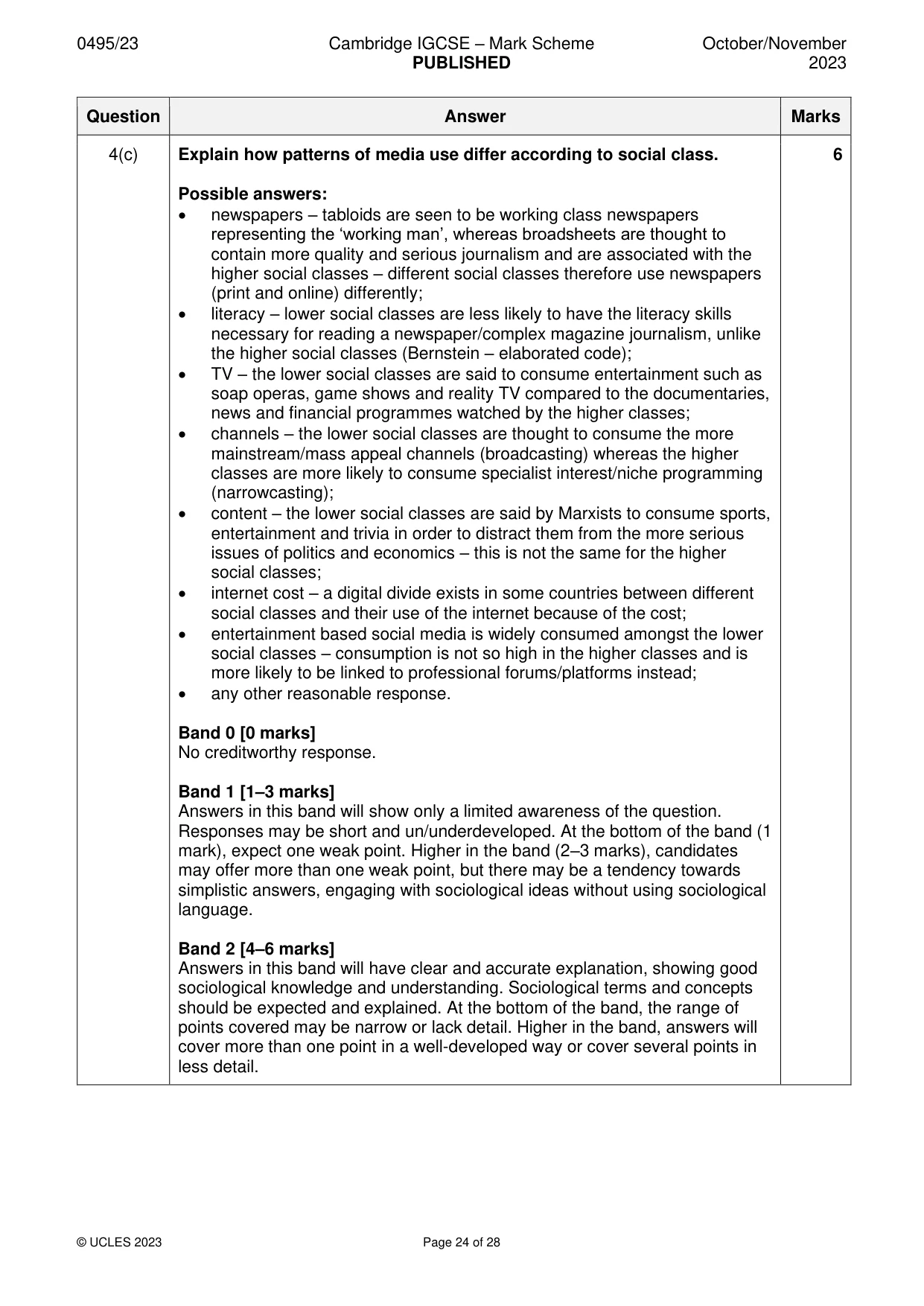
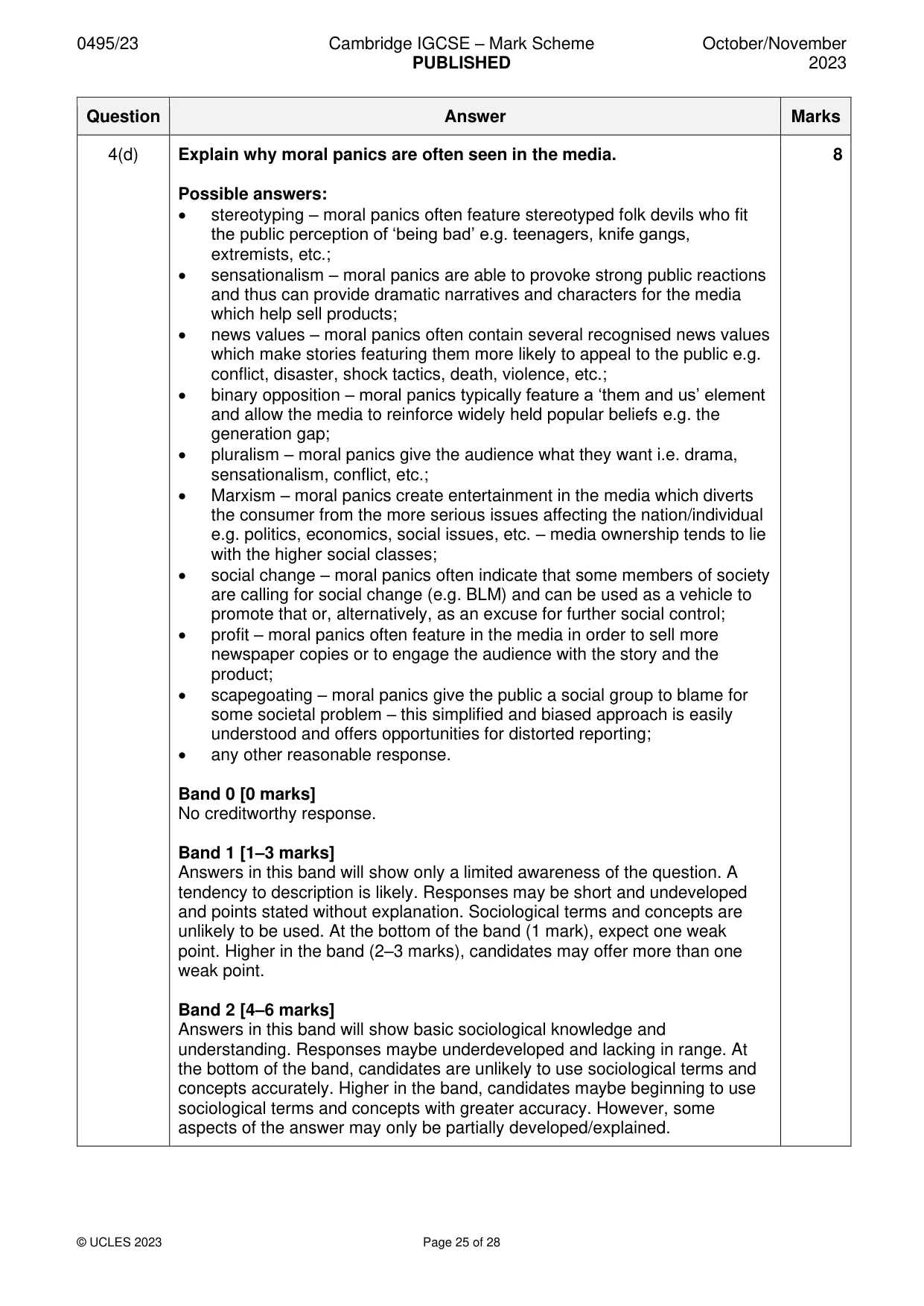
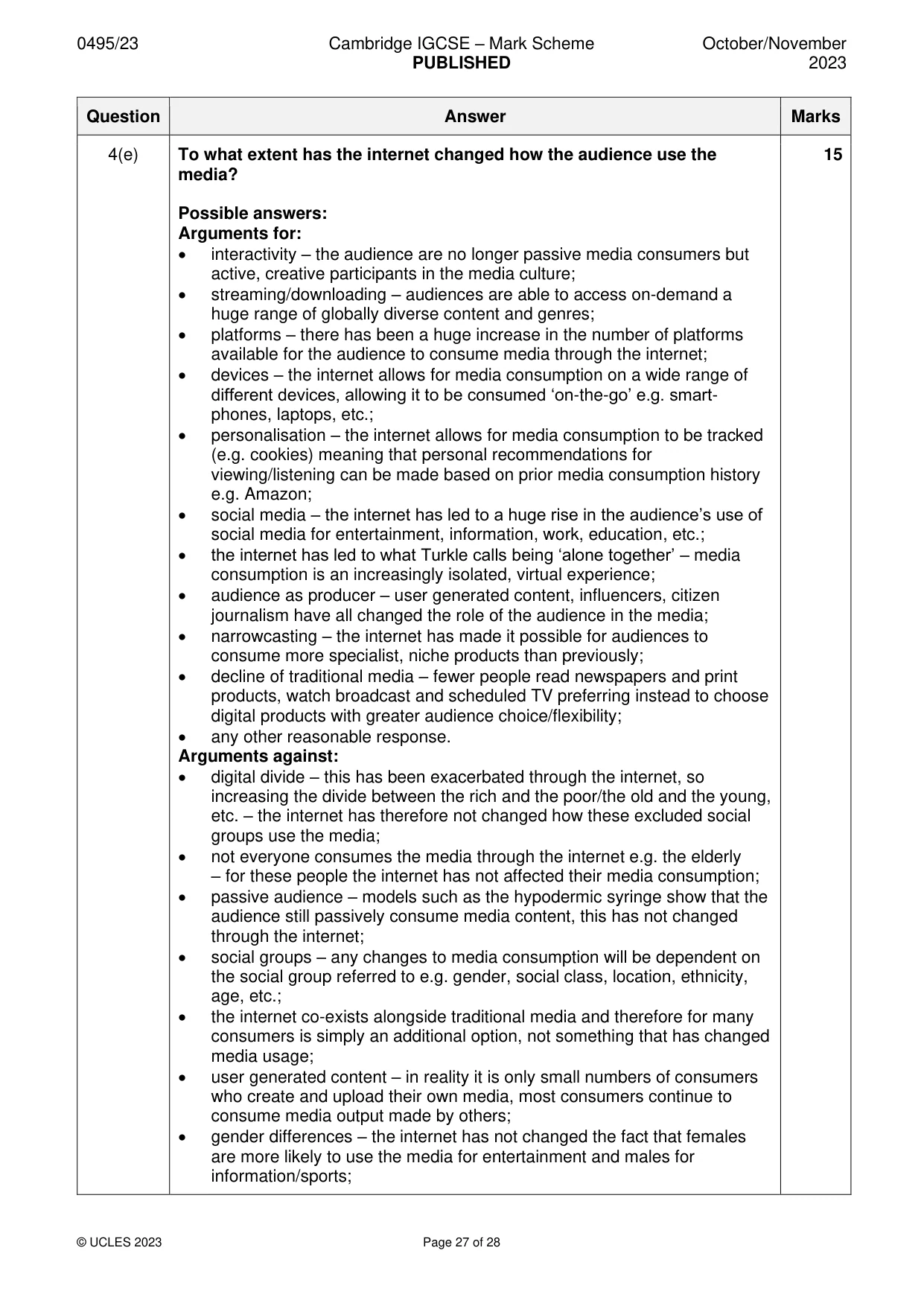
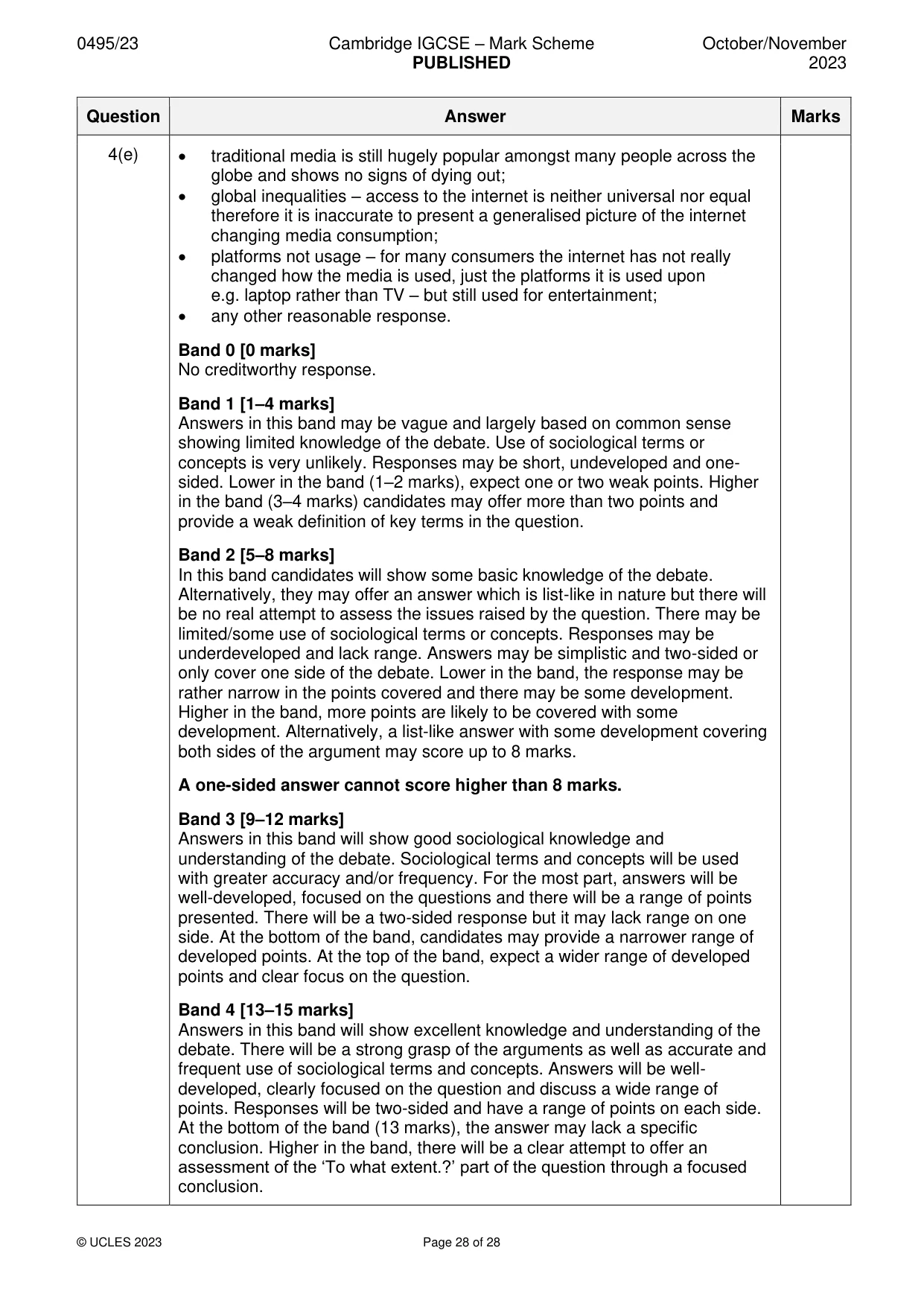
4 Different factors affect how people use the media, such as gender and social class. Censorship also affects media consumption. Some sociologists claim that digital technology and the internet have changed how the audience uses the media. However, the media remains an influential agent of social control. The media is still criticised by many sociologists for the creation of moral panics and stereotypes. (a) What is meant by the term ‘social control’? [2] (b) Describe two examples of censorship in the media. [4] (c) Explain how patterns of media use differ according to social class. [6] (d) Explain why moral panics are often seen in the media. [8] (e) To what extent has the internet changed how the audience use the media? [15]
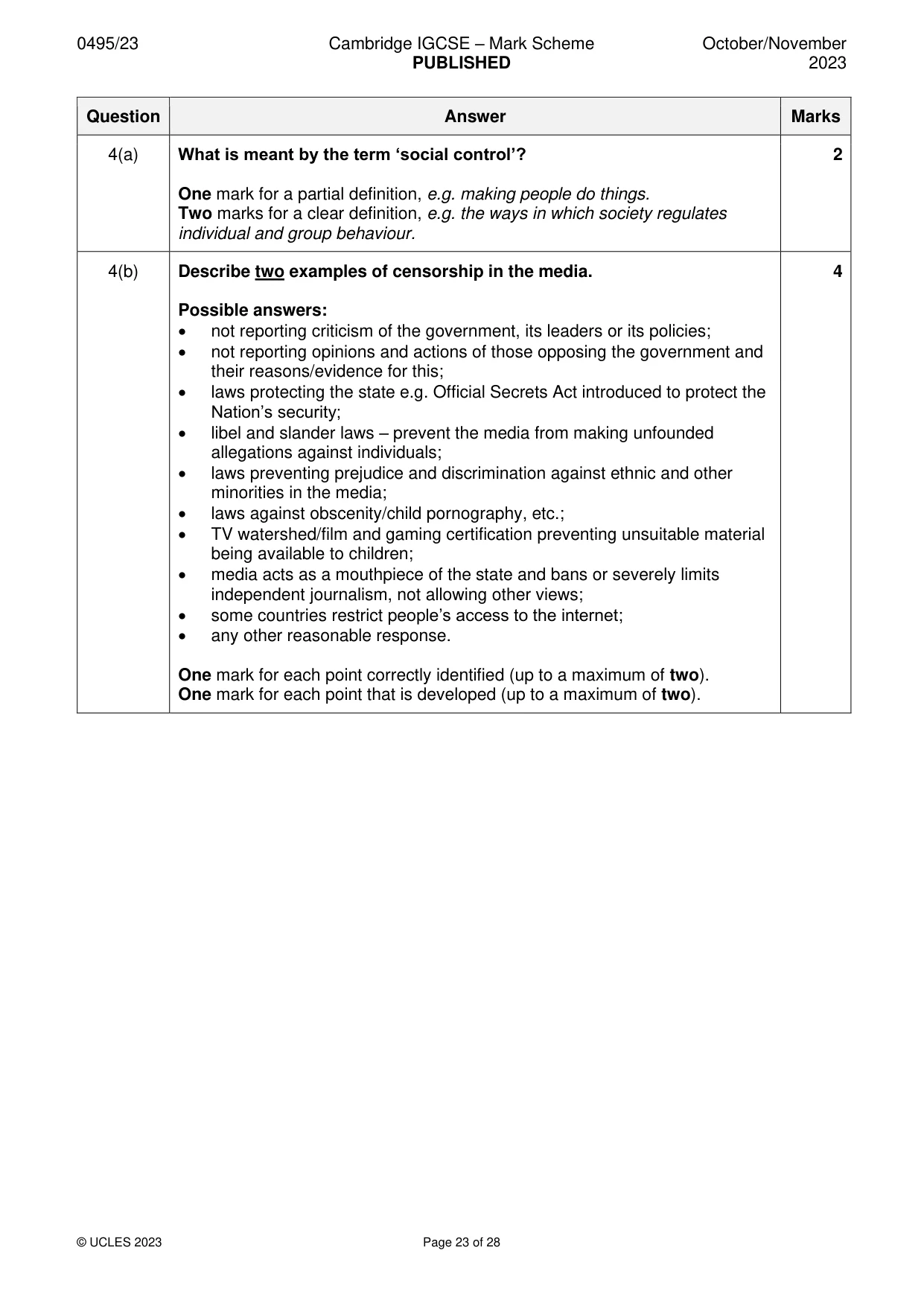
Mark scheme: 4(a) What is meant by the term ‘social control’? 2 One mark for a partial definition, e.g. making people do things. Two marks for a clear definition, e.g. the ways in which society regulates individual and group behaviour. 4(b) Describe two examples of censorship in the media. 4 Possible answers: • not reporting criticism of the government, its leaders or its policies; • not reporting opinions and actions of those opposing the government and their reasons/evidence for this; • laws protecting the state e.g. Official Secrets Act introduced to protect the Nation’s security; • libel and slander laws – prevent the media from making unfounded allegations against individuals; • laws preventing prejudice and discrimination against ethnic and other minorities in the media; • laws against obscenity/child pornography, etc.; • TV watershed/film and gaming certification preventing unsuitable material being available to children; • media acts as a mouthpiece of the state and bans or severely limits independent journalism, not allowing other views; • some countries restrict people’s access to the internet; • any other reasonable response. One mark for each point correctly identified (up to a maximum of two). One mark for each point that is developed (up to a maximum of two). 4(c) Explain how patterns of media use differ according to social class. 6 Possible answers: • newspapers – tabloids are seen to be working class newspapers representing the ‘working man’, whereas broadsheets are thought to contain more quality and serious journalism and are associated with the higher social classes – different social classes therefore use newspapers (print and online) differently; • literacy – lower social classes are less likely to have the literacy skills necessary for reading a newspaper/complex magazine journalism, unlike the higher social classes (Bernstein – elaborated code); • TV – the lower social classes are said to consume entertainment such as soap operas, game shows and reality TV compared to the documentaries, news and financial programmes watched by the higher classes; • channels – the lower social classes are thought to consume the more mainstream/mass appeal channels (broadcasting) whereas the higher classes are more likely to consume specialist interest/niche programming (narrowcasting); • content – the lower social classes are said by Marxists to consume sports, entertainment and trivia in order to distract them from the more serious issues of politics and economics – this is not the same for the higher social classes; • internet cost – a digital divide exists in some countries between different social classes and their use of the internet because of the cost; • entertainment based social media is widely consumed amongst the lower social classes – consumption is not so high in the higher classes and is more likely to be linked to professional forums/platforms instead; • any other reasonable response. Band 0 [0 marks] No creditworthy response. Band 1 [1–3 marks] Answers in this band will show only a limited awareness of the question. Responses may be short and un/underdeveloped. At the bottom of the band (1 mark), expect one weak point. Higher in the band (2–3 marks), candidates may offer more than one weak point, but there may be a tendency towards simplistic answers, engaging with sociological ideas without using sociological language. Band 2 [4–6 marks] Answers in this band will have clear and accurate explanation, showing good sociological knowledge and understanding. Sociological terms and concepts should be expected and explained. At the bottom of the band, the range of points covered may be narrow or lack detail. Higher in the band, answers will cover more than one point in a well-developed way or cover several points in less detail. 4(d) Explain why moral panics are often seen in the media. 8 Possible answers: • stereotyping – moral panics often feature stereotyped folk devils who fit the public perception of ‘being bad’ e.g. teenagers, knife gangs, extremists, etc.; • sensationalism – moral panics are able to provoke strong public reactions and thus can provide dramatic narratives and characters for the media which help sell products; • news values – moral panics often contain several recognised news values which make stories featuring them more likely to appeal to the public e.g. conflict, disaster, shock tactics, death, violence, etc.; • binary opposition – moral panics typically feature a ‘them and us’ element and allow the media to reinforce widely held popular beliefs e.g. the generation gap; • pluralism – moral panics give the audience what they want i.e. drama, sensationalism, conflict, etc.; • Marxism – moral panics create entertainment in the media which diverts the consumer from the more serious issues affecting the nation/individual e.g. politics, economics, social issues, etc. – media ownership tends to lie with the higher social classes; • social change – moral panics often indicate that some members of society are calling for social change (e.g. BLM) and can be used as a vehicle to promote that or, alternatively, as an excuse for further social control; • profit – moral panics often feature in the media in order to sell more newspaper copies or to engage the audience with the story and the product; • scapegoating – moral panics give the public a social group to blame for some societal problem – this simplified and biased approach is easily understood and offers opportunities for distorted reporting; • any other reasonable response. Band 0 [0 marks] No creditworthy response. Band 1 [1–3 marks] Answers in this band will show only a limited awareness of the question. A tendency to description is likely. Responses may be short and undeveloped and points stated without explanation. Sociological terms and concepts are unlikely to be used. At the bottom of the band (1 mark), expect one weak point. Higher in the band (2–3 marks), candidates may offer more than one weak point. Band 2 [4–6 marks] Answers in this band will show basic sociological knowledge and understanding. Responses maybe underdeveloped and lacking in range. At the bottom of the band, candidates are unlikely to use sociological terms and concepts accurately. Higher in the band, candidates maybe beginning to use sociological terms and concepts with greater accuracy. However, some aspects of the answer may only be partially developed/explained. 4(d) Band 3 [7–8 marks] Answers in this band will show good sociological knowledge and understanding and will be well-developed and explained. Sociological terms and concepts will be used accurately overall. Answers will be well-focused on the question and there will be a range of points presented. At the top of the band explanations will be clear throughout. 4(e) To what extent has the internet changed how the audience use the 15 media? Possible answers: Arguments for: • interactivity – the audience are no longer passive media consumers but active, creative participants in the media culture; • streaming/downloading – audiences are able to access on-demand a huge range of globally diverse content and genres; • platforms – there has been a huge increase in the number of platforms available for the audience to consume media through the internet; • devices – the internet allows for media consumption on a wide range of different devices, allowing it to be consumed ‘on-the-go’ e.g. smart- phones, laptops, etc.; • personalisation – the internet allows for media consumption to be tracked (e.g. cookies) meaning that personal recommendations for viewing/listening can be made based on prior media consumption history e.g. Amazon; • social media – the internet has led to a huge rise in the audience’s use of social media for entertainment, information, work, education, etc.; • the internet has led to what Turkle calls being ‘alone together’ – media consumption is an increasingly isolated, virtual experience; • audience as producer – user generated content, influencers, citizen journalism have all changed the role of the audience in the media; • narrowcasting – the internet has made it possible for audiences to consume more specialist, niche products than previously; • decline of traditional media – fewer people read newspapers and print products, watch broadcast and scheduled TV preferring instead to choose digital products with greater audience choice/flexibility; • any other reasonable response. Arguments against: • digital divide – this has been exacerbated through the internet, so increasing the divide between the rich and the poor/the old and the young, etc. – the internet has therefore not changed how these excluded social groups use the media; • not everyone consumes the media through the internet e.g. the elderly – for these people the internet has not affected their media consumption; • passive audience – models such as the hypodermic syringe show that the audience still passively consume media content, this has not changed through the internet; • social groups – any changes to media consumption will be dependent on the social group referred to e.g. gender, social class, location, ethnicity, age, etc.; • the internet co-exists alongside traditional media and therefore for many consumers is simply an additional option, not something that has changed media usage; • user generated content – in reality it is only small numbers of consumers who create and upload their own media, most consumers continue to consume media output made by others; • gender differences – the internet has not changed the fact that females are more likely to use the media for entertainment and males for information/sports; 4(e) • traditional media is still hugely popular amongst many people across the globe and shows no signs of dying out; • global inequalities – access to the internet is neither universal nor equal therefore it is inaccurate to present a generalised picture of the internet changing media consumption; • platforms not usage – for many consumers the internet has not really changed how the media is used, just the platforms it is used upon e.g. laptop rather than TV – but still used for entertainment; • any other reasonable response. Band 0 [0 marks] No creditworthy response. Band 1 [1–4 marks] Answers in this band may be vague and largely based on common sense showing limited knowledge of the debate. Use of sociological terms or concepts is very unlikely. Responses may be short, undeveloped and one- sided. Lower in the band (1–2 marks), expect one or two weak points. Higher in the band (3–4 marks) candidates may offer more than two points and provide a weak definition of key terms in the question. Band 2 [5–8 marks] In this band candidates will show some basic knowledge of the debate. Alternatively, they may offer an answer which is list-like in nature but there will be no real attempt to assess the issues raised by the question. There may be limited/some use of sociological terms or concepts. Responses may be underdeveloped and lack range. Answers may be simplistic and two-sided or only cover one side of the debate. Lower in the band, the response may be rather narrow in the points covered and there may be some development. Higher in the band, more points are likely to be covered with some development. Alternatively, a list-like answer with some development covering both sides of the argument may score up to 8 marks. A one-sided answer cannot score higher than 8 marks. Band 3 [9–12 marks] Answers in this band will show good sociological knowledge and understanding of the debate. Sociological terms and concepts will be used with greater accuracy and/or frequency. For the most part, answers will be well-developed, focused on the questions and there will be a range of points presented. There will be a two-sided response but it may lack range on one side. At the bottom of the band, candidates may provide a narrower range of developed points. At the top of the band, expect a wider range of developed points and clear focus on the question. Band 4 [13–15 marks] Answers in this band will show excellent knowledge and understanding of the debate. There will be a strong grasp of the arguments as well as accurate and frequent use of sociological terms and concepts. Answers will be well- developed, clearly focused on the question and discuss a wide range of points. Responses will be two-sided and have a range of points on each side. At the bottom of the band (13 marks), the answer may lack a specific conclusion. Higher in the band, there will be a clear attempt to offer an assessment of the ‘To what extent.?’ part of the question through a focused conclusion.
More questions on How do sociologists approach the study of society?
What was in this paper
The subtopics covered by these 4 questions, and how many questions each got. Open one in a new tab to see every Cambridge question on it.
What you needed in this session
Cambridge’s own grade thresholds for 2023 Oct/Nov, Paper 2 · Variant 3. A higher threshold means an easier paper — the bar moves with how the cohort did.