Cambridge IGCSE Sociology 0495 — 2023 May/June Paper 2 · Variant 2
0495/22/M/J/23 · 4 questions · 70 marks · ≈79 min
The question paper and its mark scheme, free to read here and free to download. This is Cambridge’s own paper, exactly as it was sat.
Question paper4 pages

Mark scheme28 pages
Answers below. Sit the paper first if you are practising.



Questions as text
Q1 · Family life has changed
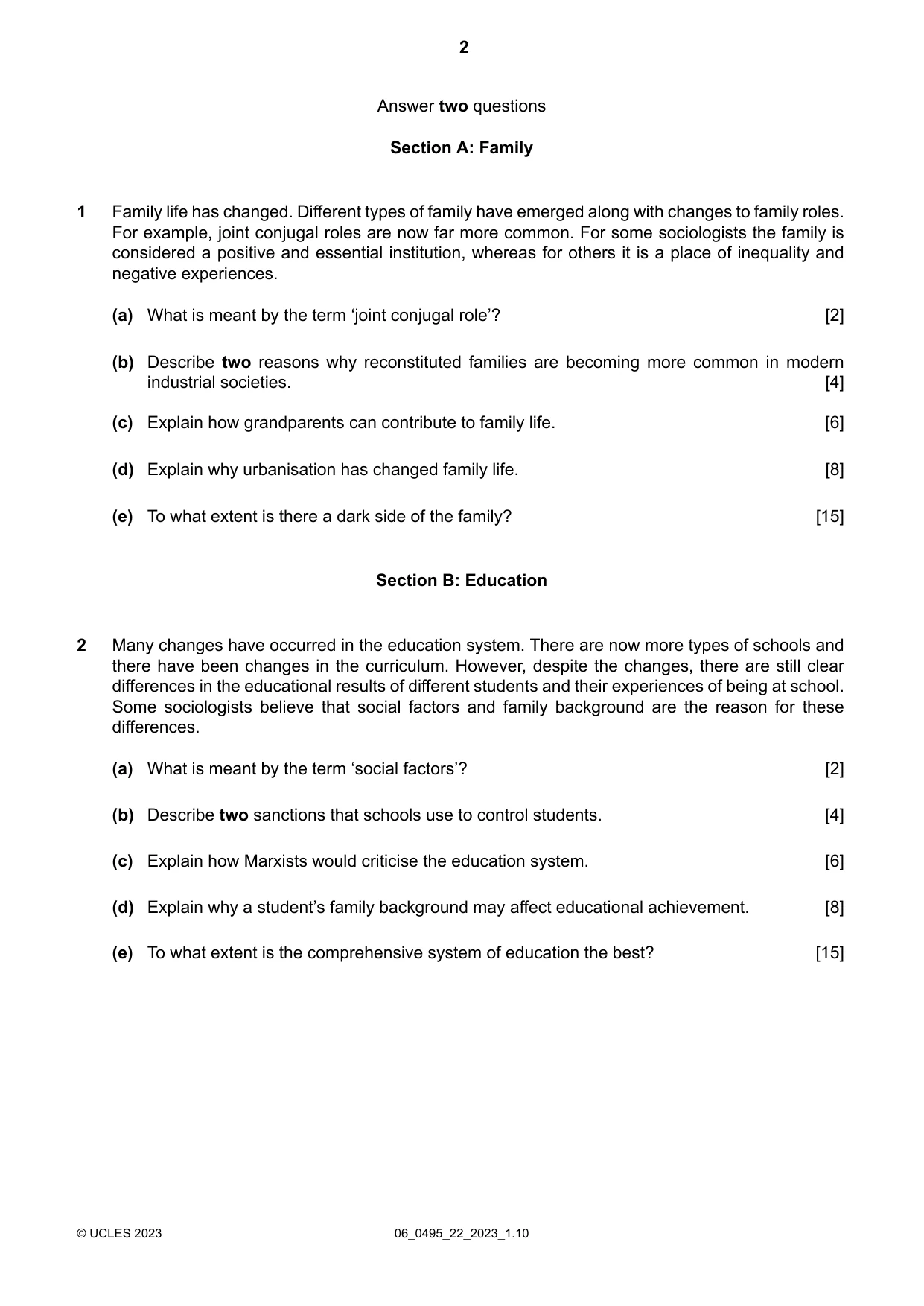
1 Family life has changed. Different types of family have emerged along with changes to family roles. For example, joint conjugal roles are now far more common. For some sociologists the family is considered a positive and essential institution, whereas for others it is a place of inequality and negative experiences. (a) What is meant by the term ‘joint conjugal role’? [2] (b) Describe two reasons why reconstituted families are becoming more common in modern industrial societies. [4] (c) Explain how grandparents can contribute to family life. [6] (d) Explain why urbanisation has changed family life. [8] (e) To what extent is there a dark side of the family? [15]
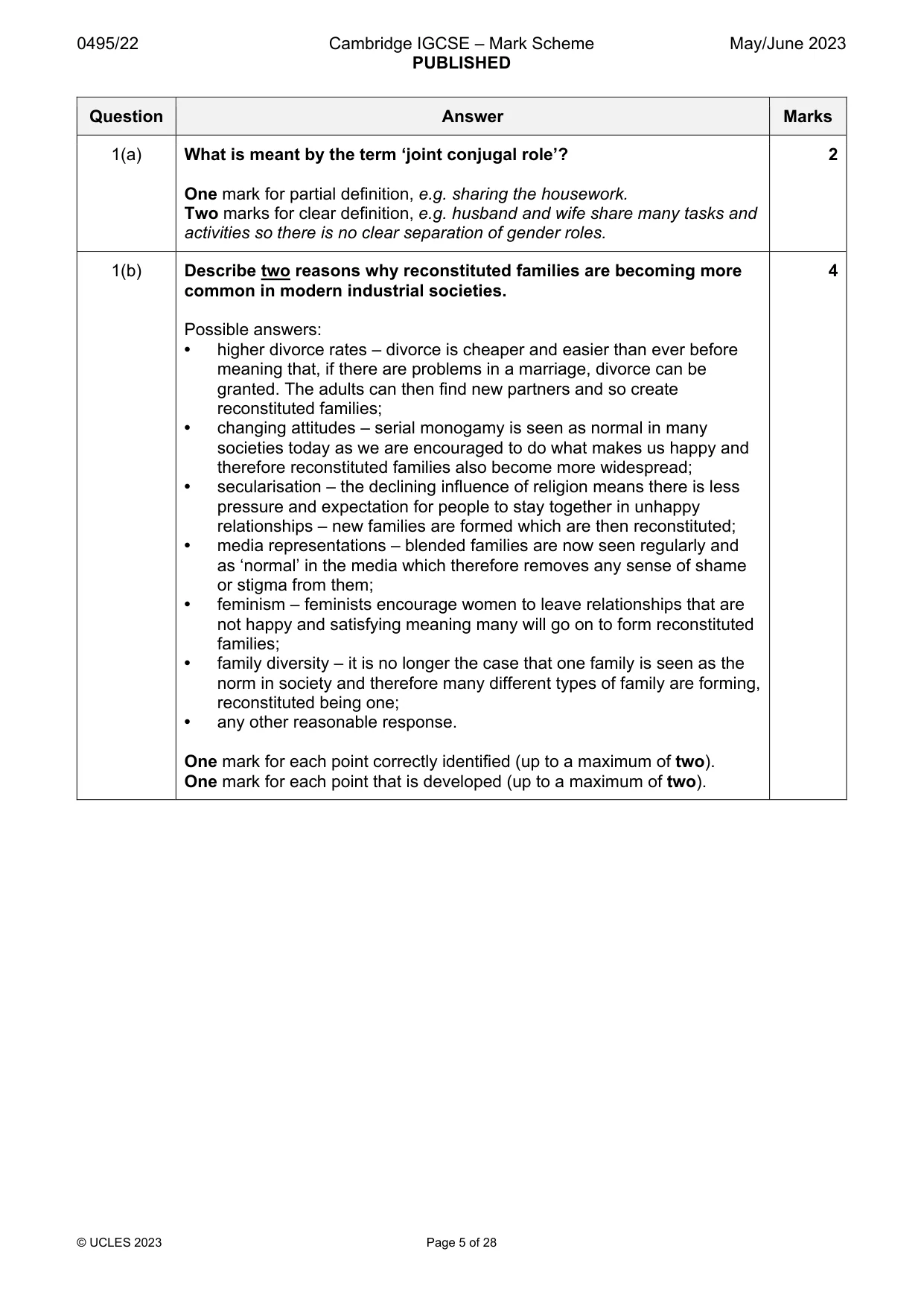
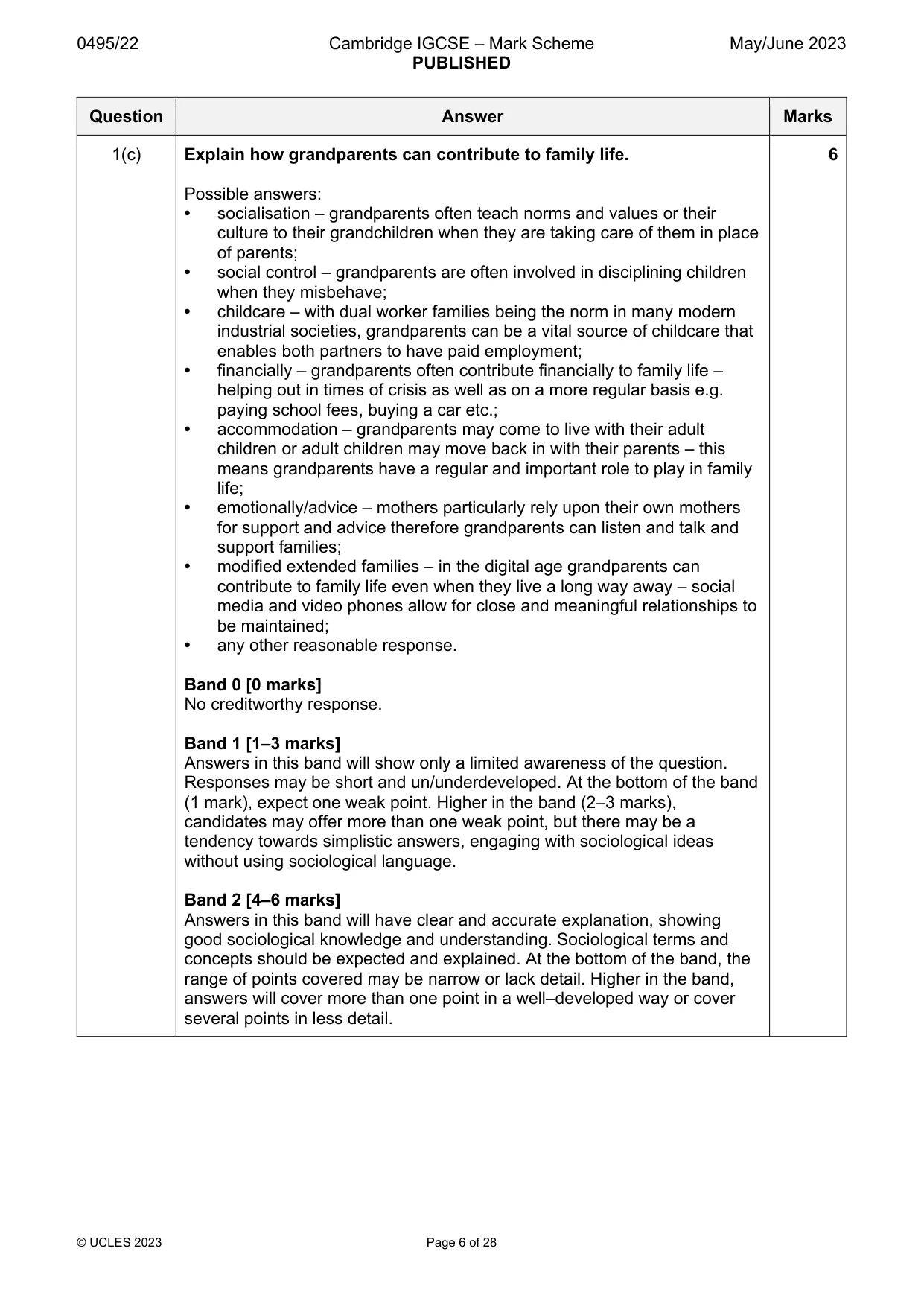
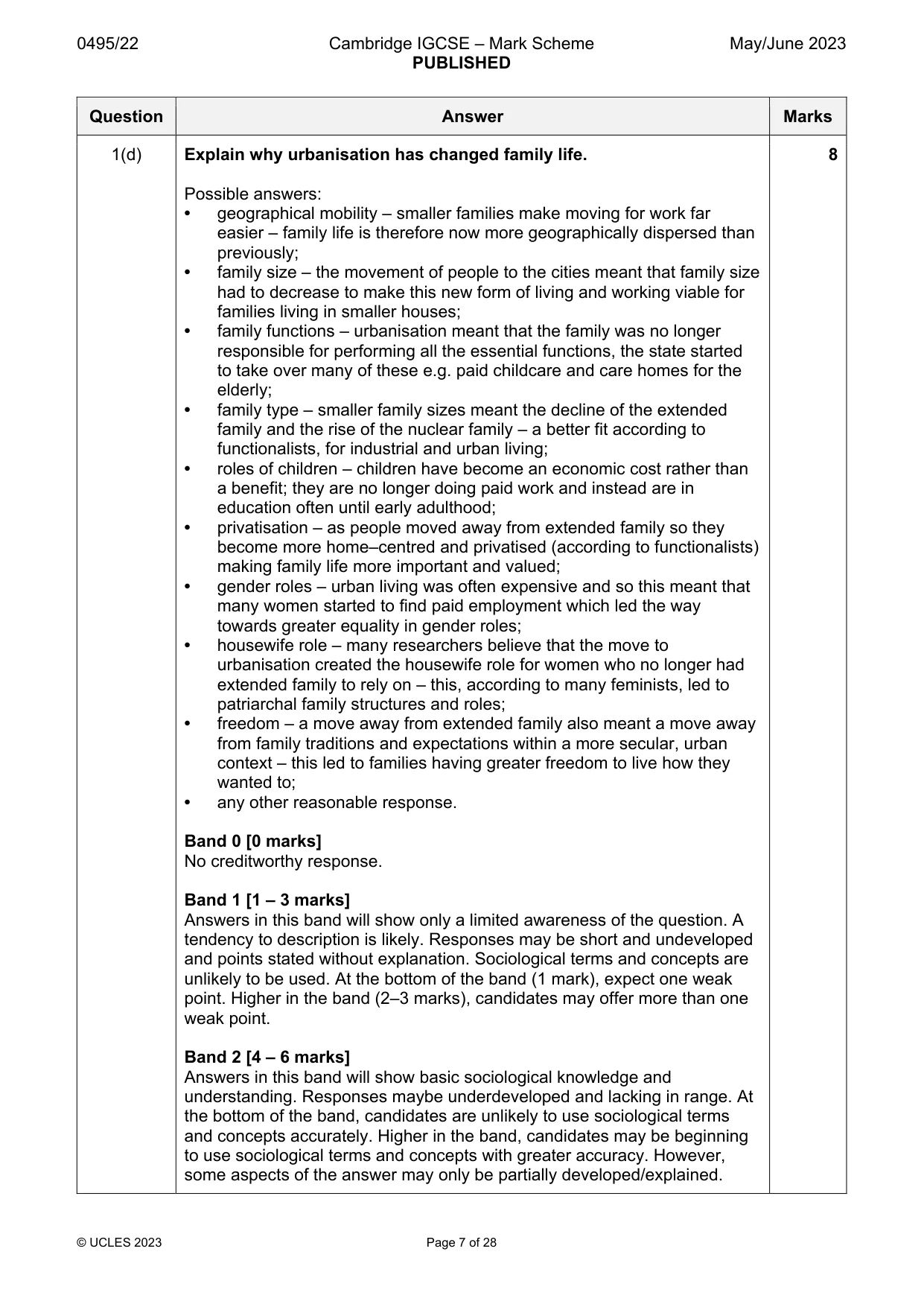
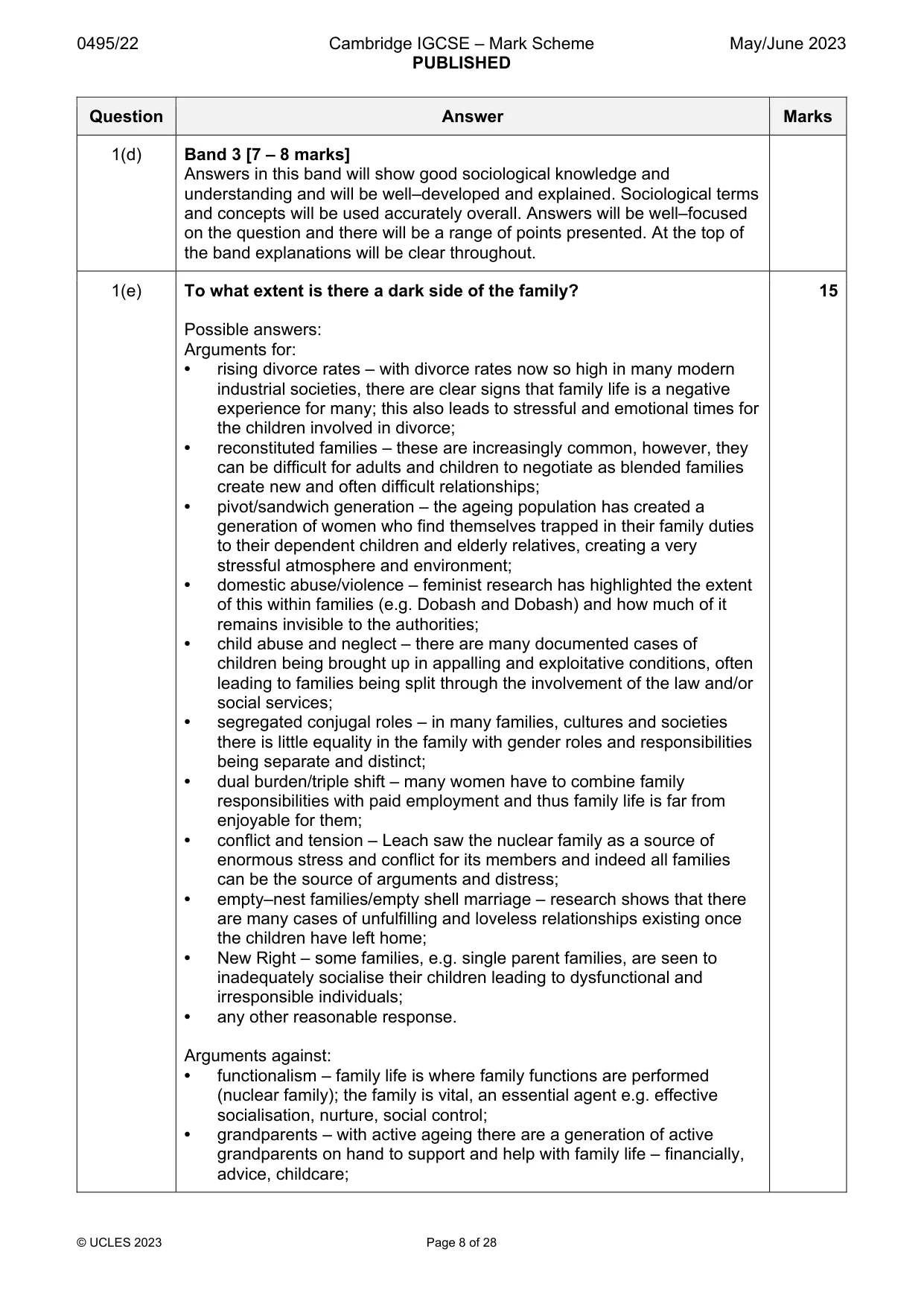
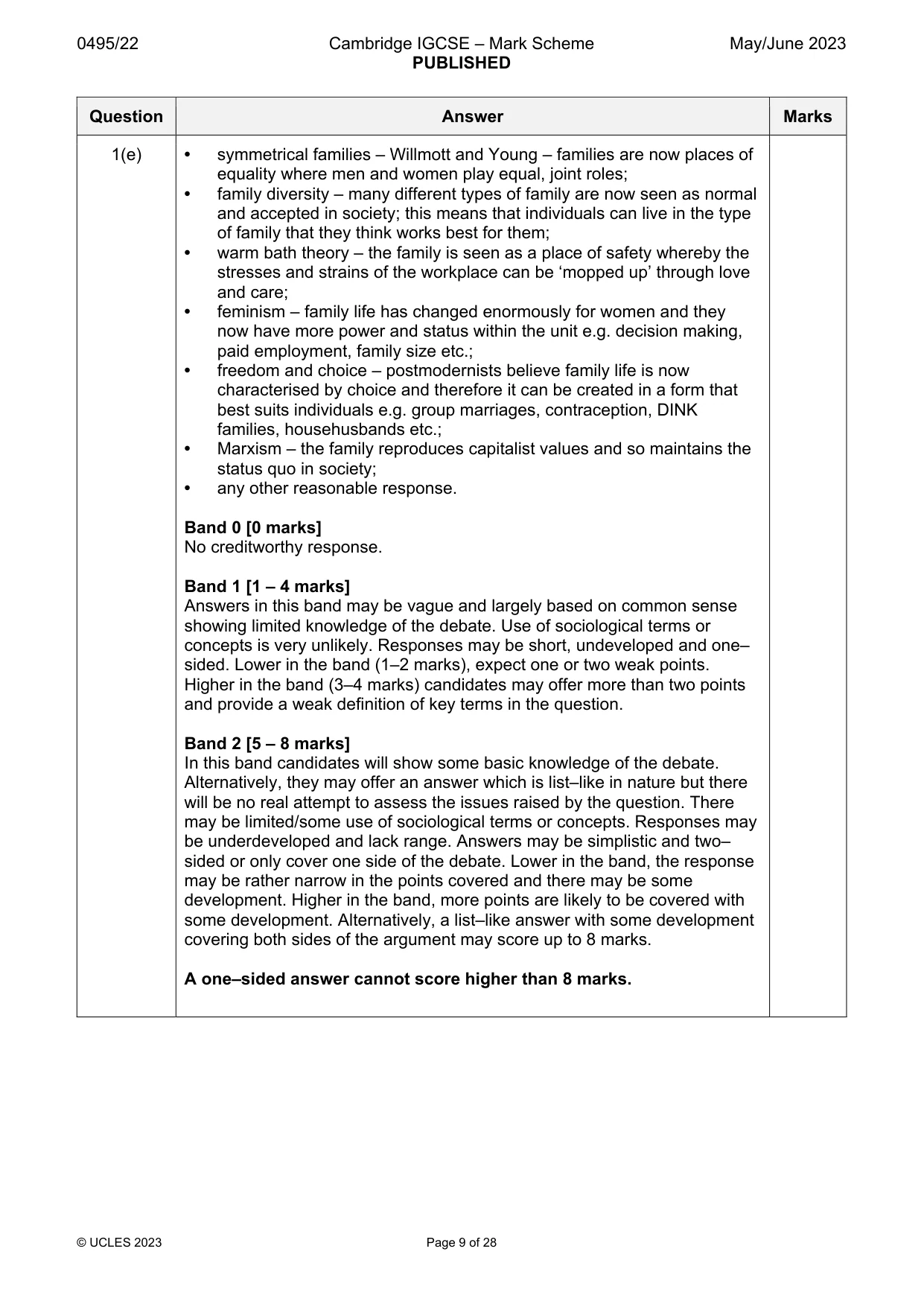
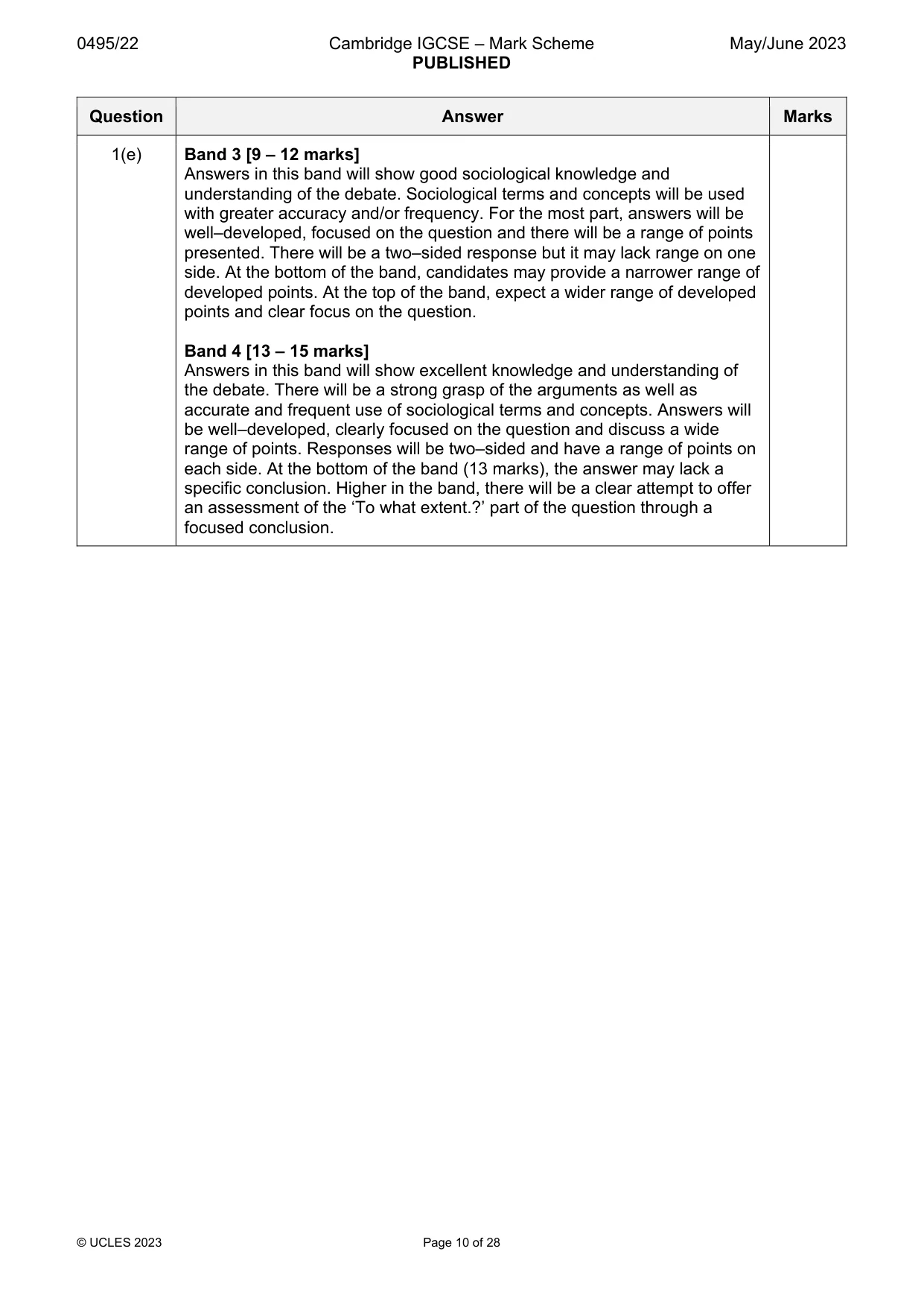
Mark scheme: Question Answer Marks 1(a) What is meant by the term ‘joint conjugal role’? 2 One mark for partial definition, e.g. sharing the housework. Two marks for clear definition, e.g. husband and wife share many tasks and activities so there is no clear separation of gender roles. 1(b) Describe two reasons why reconstituted families are becoming more 4 common in modern industrial societies. Possible answers: • higher divorce rates – divorce is cheaper and easier than ever before meaning that, if there are problems in a marriage, divorce can be granted. The adults can then find new partners and so create reconstituted families; • changing attitudes – serial monogamy is seen as normal in many societies today as we are encouraged to do what makes us happy and therefore reconstituted families also become more widespread; • secularisation – the declining influence of religion means there is less pressure and expectation for people to stay together in unhappy relationships – new families are formed which are then reconstituted; • media representations – blended families are now seen regularly and as ‘normal’ in the media which therefore removes any sense of shame or stigma from them; • feminism – feminists encourage women to leave relationships that are not happy and satisfying meaning many will go on to form reconstituted families; • family diversity – it is no longer the case that one family is seen as the norm in society and therefore many different types of family are forming, reconstituted being one; • any other reasonable response. One mark for each point correctly identified (up to a maximum of two). One mark for each point that is developed (up to a maximum of two). 1(c) Explain how grandparents can contribute to family life. 6 Possible answers: • socialisation – grandparents often teach norms and values or their culture to their grandchildren when they are taking care of them in place of parents; • social control – grandparents are often involved in disciplining children when they misbehave; • childcare – with dual worker families being the norm in many modern industrial societies, grandparents can be a vital source of childcare that enables both partners to have paid employment; • financially – grandparents often contribute financially to family life – helping out in times of crisis as well as on a more regular basis e.g. paying school fees, buying a car etc.; • accommodation – grandparents may come to live with their adult children or adult children may move back in with their parents – this means grandparents have a regular and important role to play in family life; • emotionally/advice – mothers particularly rely upon their own mothers for support and advice therefore grandparents can listen and talk and support families; • modified extended families – in the digital age grandparents can contribute to family life even when they live a long way away – social media and video phones allow for close and meaningful relationships to be maintained; • any other reasonable response. Band 0 [0 marks] No creditworthy response. Band 1 [1–3 marks] Answers in this band will show only a limited awareness of the question. Responses may be short and un/underdeveloped. At the bottom of the band (1 mark), expect one weak point. Higher in the band (2–3 marks), candidates may offer more than one weak point, but there may be a tendency towards simplistic answers, engaging with sociological ideas without using sociological language. Band 2 [4–6 marks] Answers in this band will have clear and accurate explanation, showing good sociological knowledge and understanding. Sociological terms and concepts should be expected and explained. At the bottom of the band, the range of points covered may be narrow or lack detail. Higher in the band, answers will cover more than one point in a well–developed way or cover several points in less detail. 1(d) Explain why urbanisation has changed family life. 8 Possible answers: • geographical mobility – smaller families make moving for work far easier – family life is therefore now more geographically dispersed than previously; • family size – the movement of people to the cities meant that family size had to decrease to make this new form of living and working viable for families living in smaller houses; • family functions – urbanisation meant that the family was no longer responsible for performing all the essential functions, the state started to take over many of these e.g. paid childcare and care homes for the elderly; • family type – smaller family sizes meant the decline of the extended family and the rise of the nuclear family – a better fit according to functionalists, for industrial and urban living; • roles of children – children have become an economic cost rather than a benefit; they are no longer doing paid work and instead are in education often until early adulthood; • privatisation – as people moved away from extended family so they become more home–centred and privatised (according to functionalists) making family life more important and valued; • gender roles – urban living was often expensive and so this meant that many women started to find paid employment which led the way towards greater equality in gender roles; • housewife role – many researchers believe that the move to urbanisation created the housewife role for women who no longer had extended family to rely on – this, according to many feminists, led to patriarchal family structures and roles; • freedom – a move away from extended family also meant a move away from family traditions and expectations within a more secular, urban context – this led to families having greater freedom to live how they wanted to; • any other reasonable response. Band 0 [0 marks] No creditworthy response. Band 1 [1 – 3 marks] Answers in this band will show only a limited awareness of the question. A tendency to description is likely. Responses may be short and undeveloped and points stated without explanation. Sociological terms and concepts are unlikely to be used. At the bottom of the band (1 mark), expect one weak point. Higher in the band (2–3 marks), candidates may offer more than one weak point. Band 2 [4 – 6 marks] Answers in this band will show basic sociological knowledge and understanding. Responses maybe underdeveloped and lacking in range. At the bottom of the band, candidates are unlikely to use sociological terms and concepts accurately. Higher in the band, candidates may be beginning to use sociological terms and concepts with greater accuracy. However, some aspects of the answer may only be partially developed/explained. 1(d) Band 3 [7 – 8 marks] Answers in this band will show good sociological knowledge and understanding and will be well–developed and explained. Sociological terms and concepts will be used accurately overall. Answers will be well–focused on the question and there will be a range of points presented. At the top of the band explanations will be clear throughout. 1(e) To what extent is there a dark side of the family? 15 Possible answers: Arguments for: • rising divorce rates – with divorce rates now so high in many modern industrial societies, there are clear signs that family life is a negative experience for many; this also leads to stressful and emotional times for the children involved in divorce; • reconstituted families – these are increasingly common, however, they can be difficult for adults and children to negotiate as blended families create new and often difficult relationships; • pivot/sandwich generation – the ageing population has created a generation of women who find themselves trapped in their family duties to their dependent children and elderly relatives, creating a very stressful atmosphere and environment; • domestic abuse/violence – feminist research has highlighted the extent of this within families (e.g. Dobash and Dobash) and how much of it remains invisible to the authorities; • child abuse and neglect – there are many documented cases of children being brought up in appalling and exploitative conditions, often leading to families being split through the involvement of the law and/or social services; • segregated conjugal roles – in many families, cultures and societies there is little equality in the family with gender roles and responsibilities being separate and distinct; • dual burden/triple shift – many women have to combine family responsibilities with paid employment and thus family life is far from enjoyable for them; • conflict and tension – Leach saw the nuclear family as a source of enormous stress and conflict for its members and indeed all families can be the source of arguments and distress; • empty–nest families/empty shell marriage – research shows that there are many cases of unfulfilling and loveless relationships existing once the children have left home; • New Right – some families, e.g. single parent families, are seen to inadequately socialise their children leading to dysfunctional and irresponsible individuals; • any other reasonable response. Arguments against: • functionalism – family life is where family functions are performed (nuclear family); the family is vital, an essential agent e.g. effective socialisation, nurture, social control; • grandparents – with active ageing there are a generation of active grandparents on hand to support and help with family life – financially, advice, childcare; 1(e) • symmetrical families – Willmott and Young – families are now places of equality where men and women play equal, joint roles; • family diversity – many different types of family are now seen as normal and accepted in society; this means that individuals can live in the type of family that they think works best for them; • warm bath theory – the family is seen as a place of safety whereby the stresses and strains of the workplace can be ‘mopped up’ through love and care; • feminism – family life has changed enormously for women and they now have more power and status within the unit e.g. decision making, paid employment, family size etc.; • freedom and choice – postmodernists believe family life is now characterised by choice and therefore it can be created in a form that best suits individuals e.g. group marriages, contraception, DINK families, househusbands etc.; • Marxism – the family reproduces capitalist values and so maintains the status quo in society; • any other reasonable response. Band 0 [0 marks] No creditworthy response. Band 1 [1 – 4 marks] Answers in this band may be vague and largely based on common sense showing limited knowledge of the debate. Use of sociological terms or concepts is very unlikely. Responses may be short, undeveloped and one– sided. Lower in the band (1–2 marks), expect one or two weak points. Higher in the band (3–4 marks) candidates may offer more than two points and provide a weak definition of key terms in the question. Band 2 [5 – 8 marks] In this band candidates will show some basic knowledge of the debate. Alternatively, they may offer an answer which is list–like in nature but there will be no real attempt to assess the issues raised by the question. There may be limited/some use of sociological terms or concepts. Responses may be underdeveloped and lack range. Answers may be simplistic and two– sided or only cover one side of the debate. Lower in the band, the response may be rather narrow in the points covered and there may be some development. Higher in the band, more points are likely to be covered with some development. Alternatively, a list–like answer with some development covering both sides of the argument may score up to 8 marks. A one–sided answer cannot score higher than 8 marks. 1(e) Band 3 [9 – 12 marks] Answers in this band will show good sociological knowledge and understanding of the debate. Sociological terms and concepts will be used with greater accuracy and/or frequency. For the most part, answers will be well–developed, focused on the question and there will be a range of points presented. There will be a two–sided response but it may lack range on one side. At the bottom of the band, candidates may provide a narrower range of developed points. At the top of the band, expect a wider range of developed points and clear focus on the question. Band 4 [13 – 15 marks] Answers in this band will show excellent knowledge and understanding of the debate. There will be a strong grasp of the arguments as well as accurate and frequent use of sociological terms and concepts. Answers will be well–developed, clearly focused on the question and discuss a wide range of points. Responses will be two–sided and have a range of points on each side. At the bottom of the band (13 marks), the answer may lack a specific conclusion. Higher in the band, there will be a clear attempt to offer an assessment of the ‘To what extent.?’ part of the question through a focused conclusion.
Q2 · Many changes have occurred in the education system
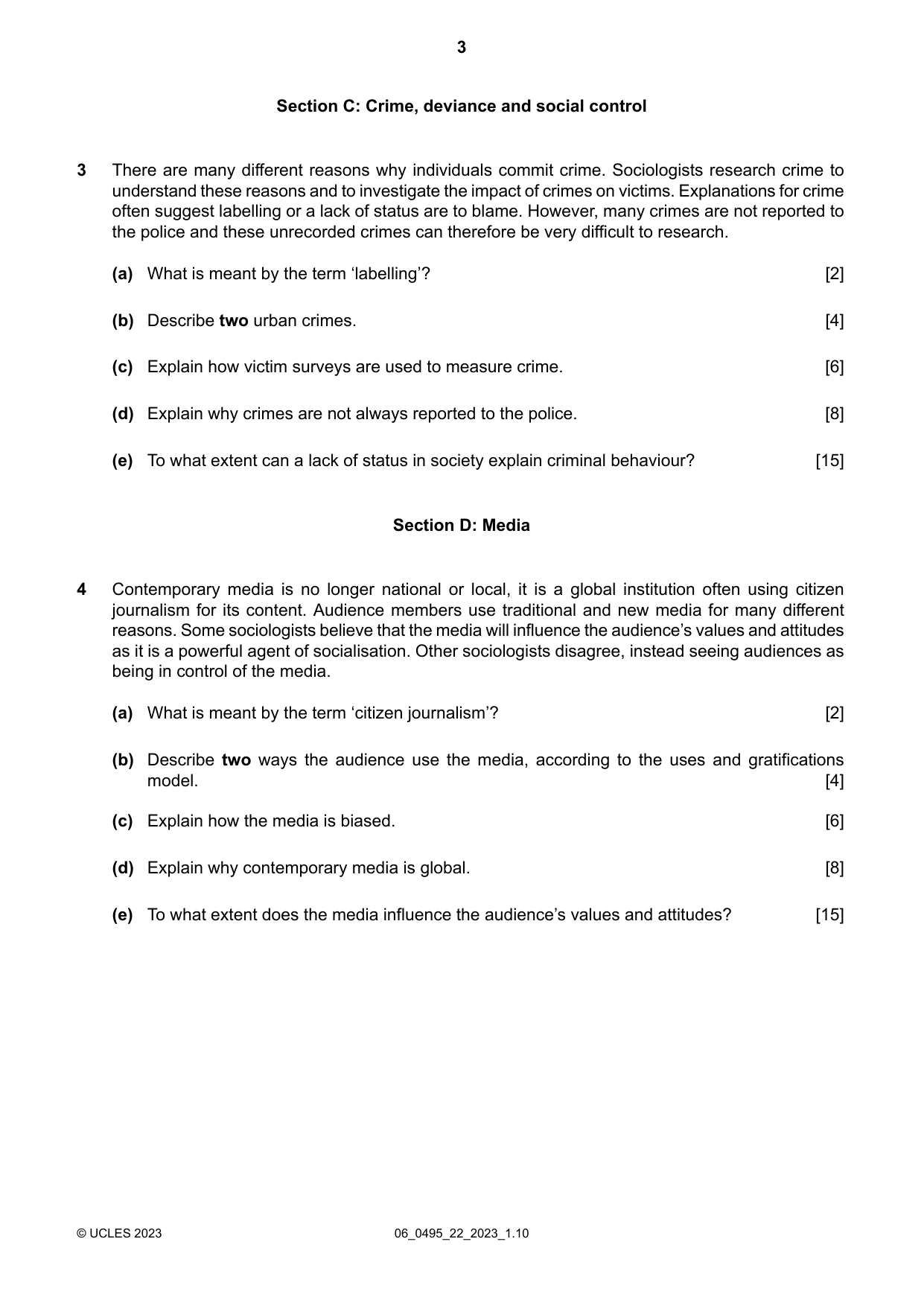
2 Many changes have occurred in the education system. There are now more types of schools and there have been changes in the curriculum. However, despite the changes, there are still clear differences in the educational results of different students and their experiences of being at school. Some sociologists believe that social factors and family background are the reason for these differences. (a) What is meant by the term ‘social factors’? [2] (b) Describe two sanctions that schools use to control students. [4] (c) Explain how Marxists would criticise the education system. [6] (d) Explain why a student’s family background may affect educational achievement. [8] (e) To what extent is the comprehensive system of education the best? [15] Section C: Crime, deviance and social control
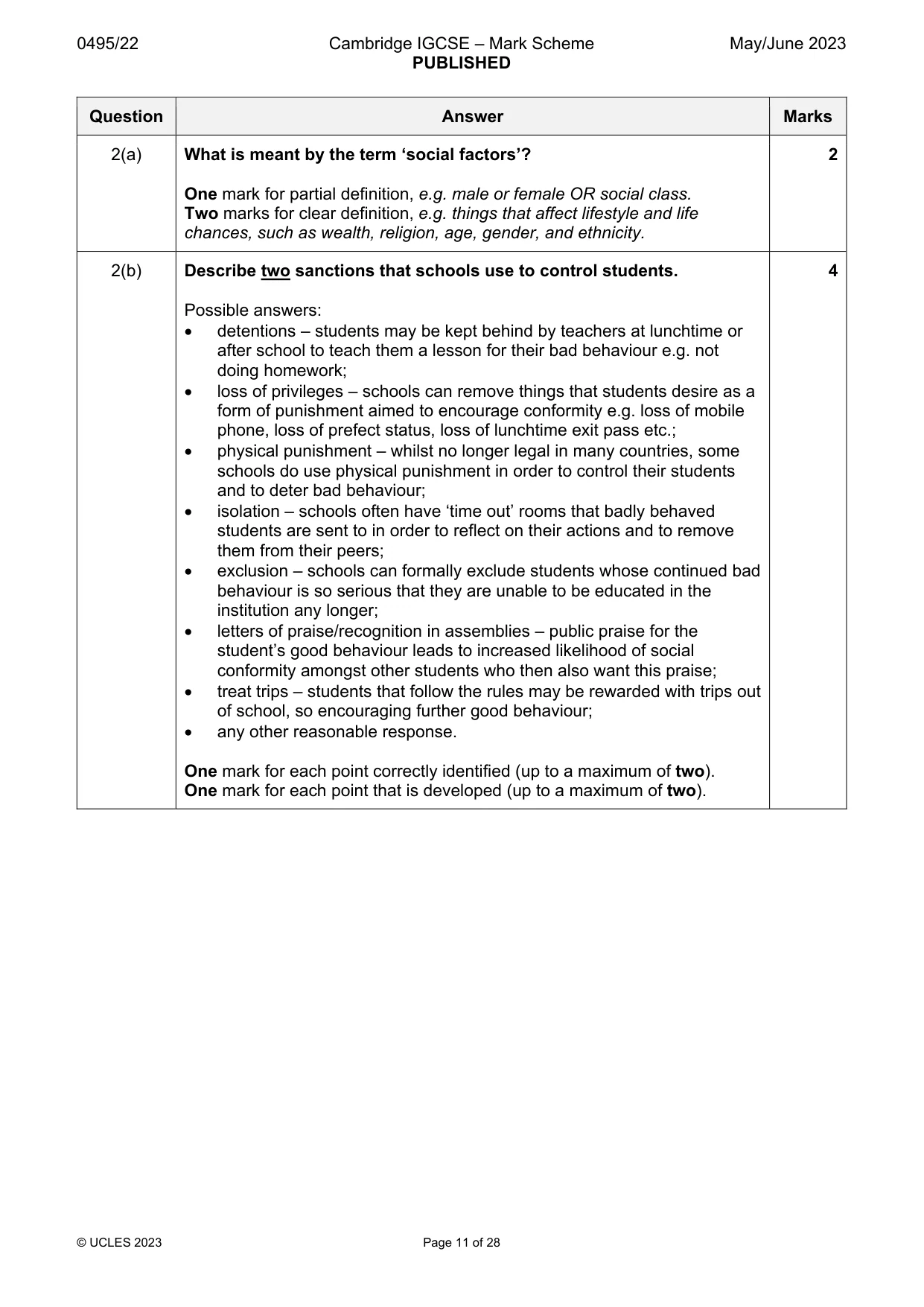
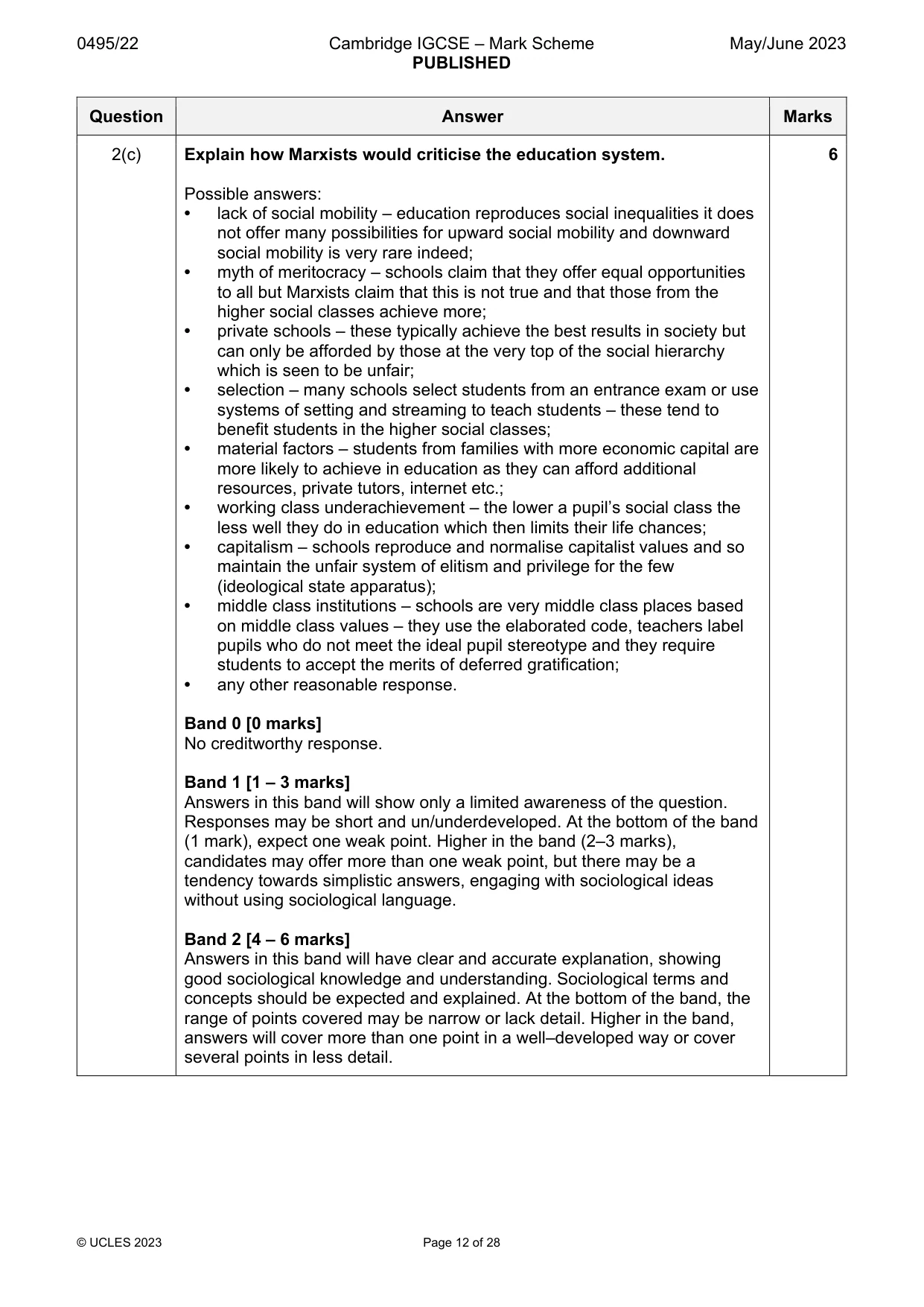
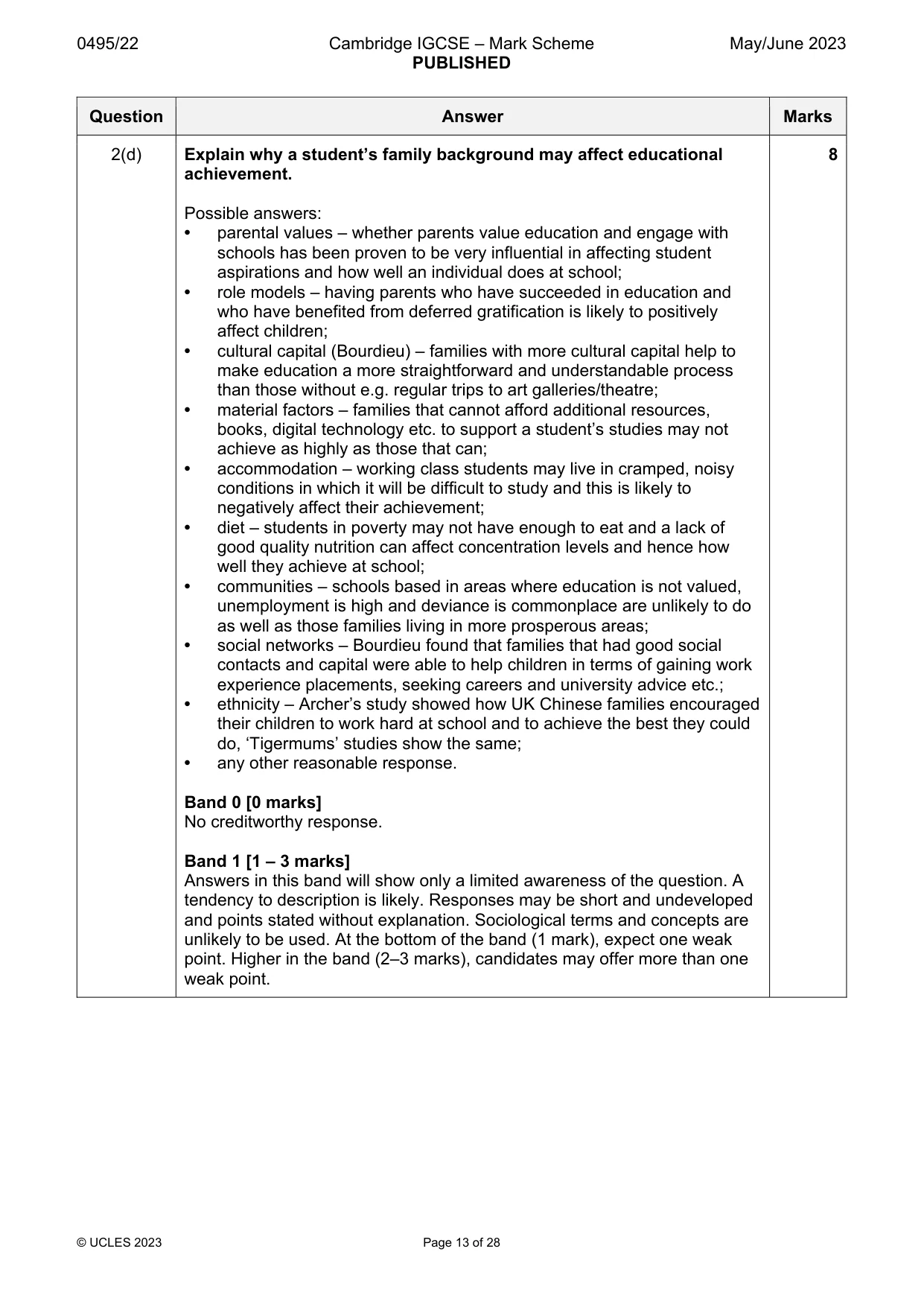
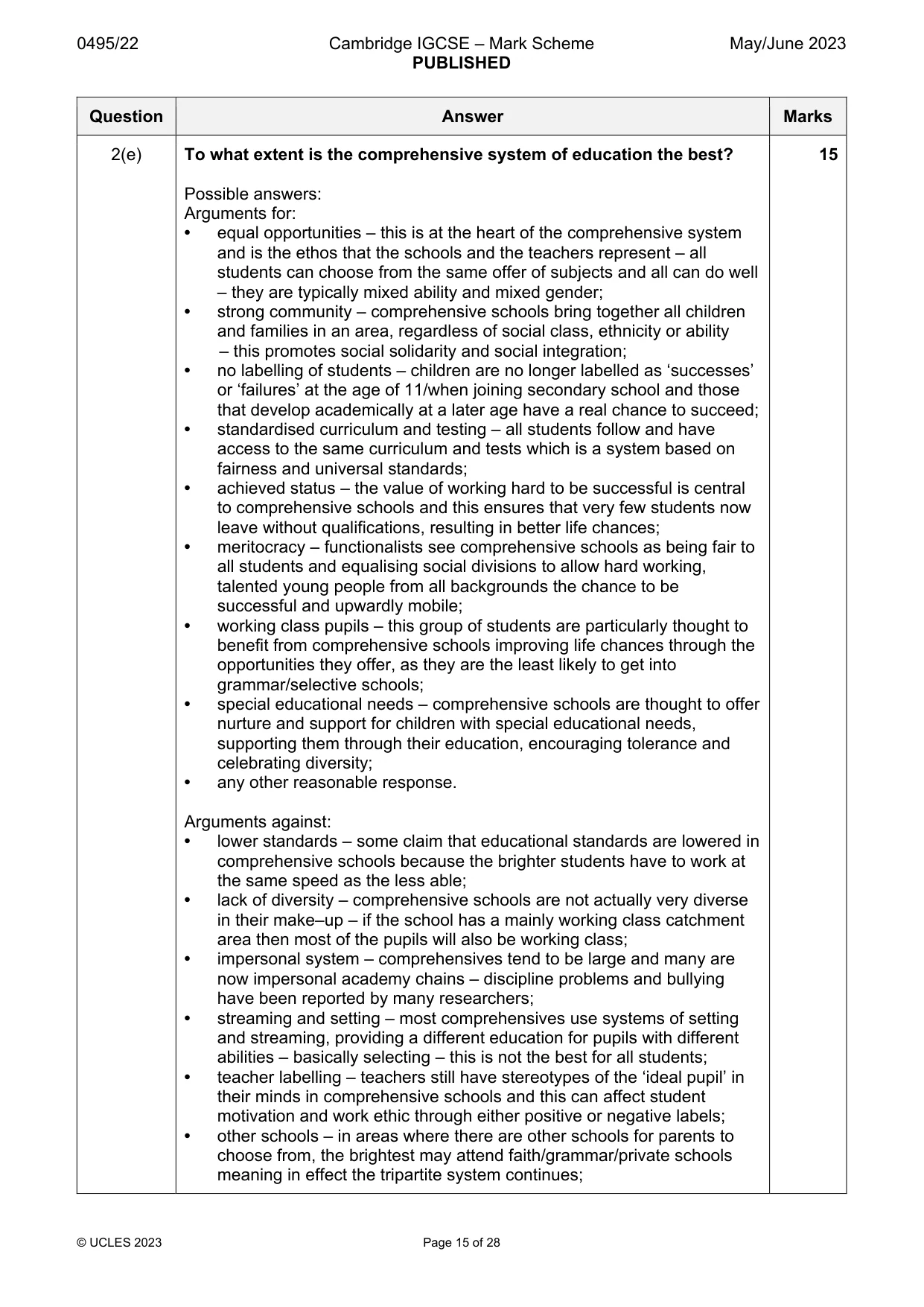
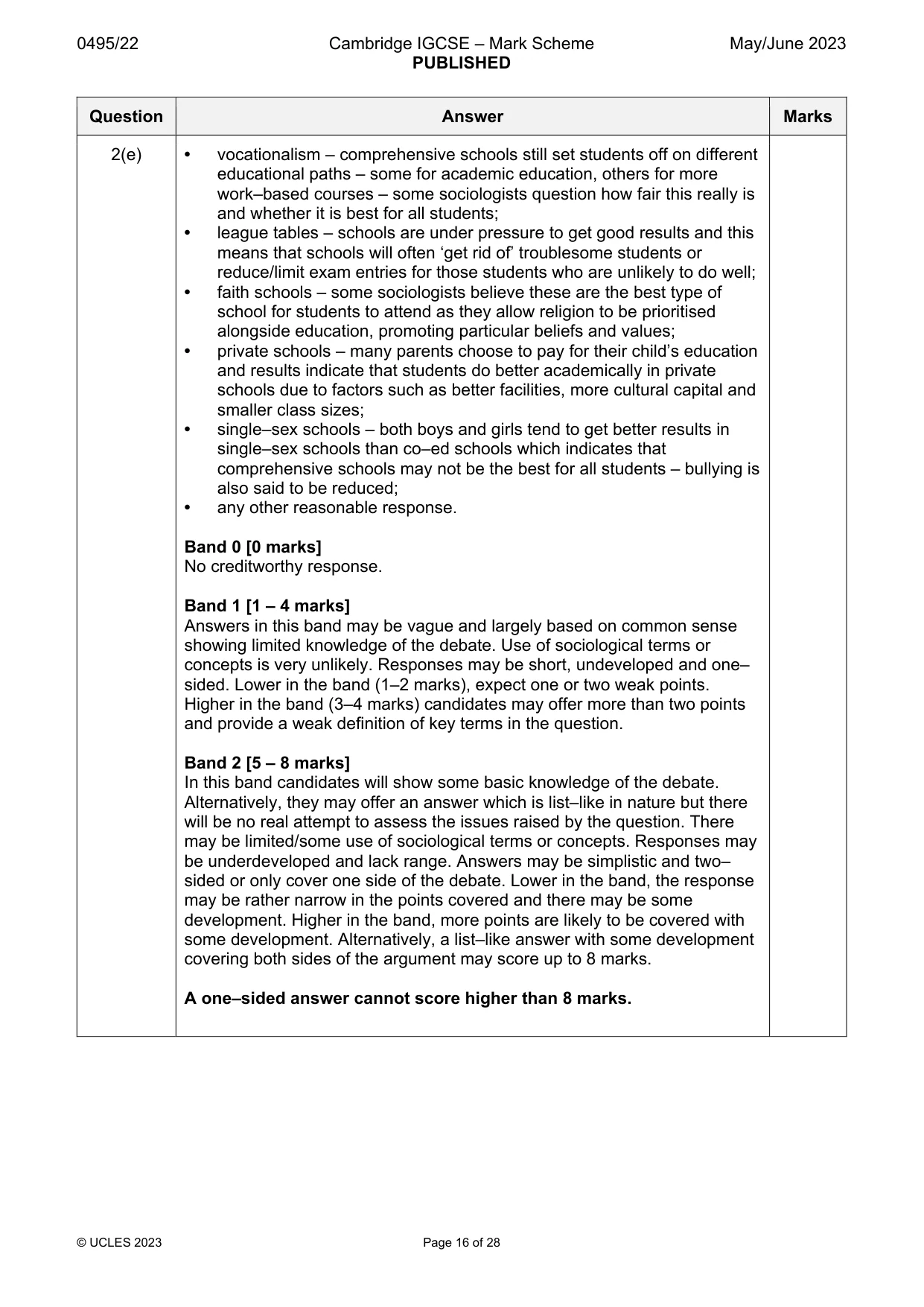
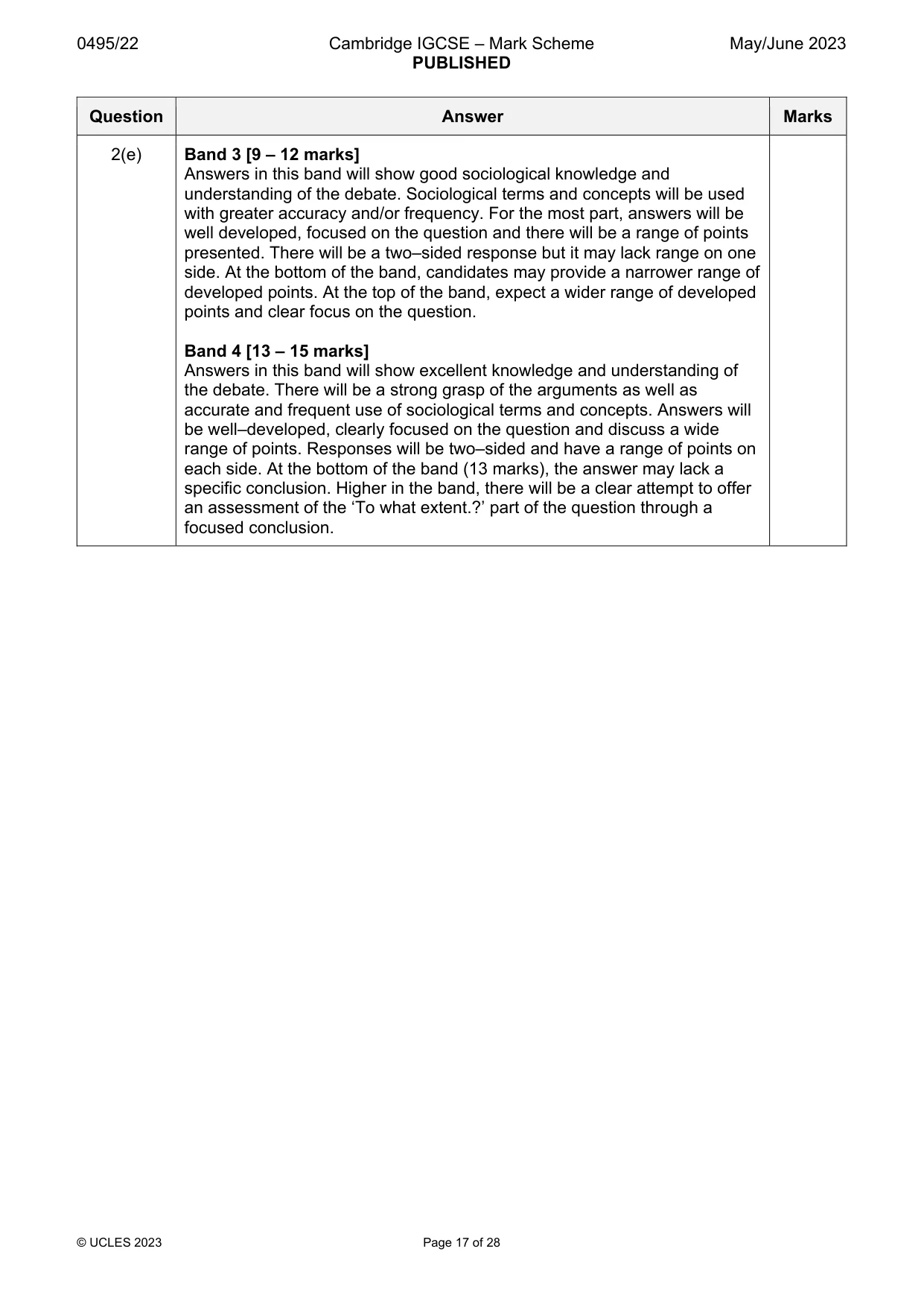
Mark scheme: 2(a) What is meant by the term ‘social factors’? 2 One mark for partial definition, e.g. male or female OR social class. Two marks for clear definition, e.g. things that affect lifestyle and life chances, such as wealth, religion, age, gender, and ethnicity. 2(b) Describe two sanctions that schools use to control students. 4 Possible answers: detentions – students may be kept behind by teachers at lunchtime or after school to teach them a lesson for their bad behaviour e.g. not doing homework; loss of privileges – schools can remove things that students desire as a form of punishment aimed to encourage conformity e.g. loss of mobile phone, loss of prefect status, loss of lunchtime exit pass etc.; physical punishment – whilst no longer legal in many countries, some schools do use physical punishment in order to control their students and to deter bad behaviour; isolation – schools often have ‘time out’ rooms that badly behaved students are sent to in order to reflect on their actions and to remove them from their peers; exclusion – schools can formally exclude students whose continued bad behaviour is so serious that they are unable to be educated in the institution any longer; letters of praise/recognition in assemblies – public praise for the student’s good behaviour leads to increased likelihood of social conformity amongst other students who then also want this praise; treat trips – students that follow the rules may be rewarded with trips out of school, so encouraging further good behaviour; any other reasonable response. One mark for each point correctly identified (up to a maximum of two). One mark for each point that is developed (up to a maximum of two). 2(c) Explain how Marxists would criticise the education system. 6 Possible answers: • lack of social mobility – education reproduces social inequalities it does not offer many possibilities for upward social mobility and downward social mobility is very rare indeed; • myth of meritocracy – schools claim that they offer equal opportunities to all but Marxists claim that this is not true and that those from the higher social classes achieve more; • private schools – these typically achieve the best results in society but can only be afforded by those at the very top of the social hierarchy which is seen to be unfair; • selection – many schools select students from an entrance exam or use systems of setting and streaming to teach students – these tend to benefit students in the higher social classes; • material factors – students from families with more economic capital are more likely to achieve in education as they can afford additional resources, private tutors, internet etc.; • working class underachievement – the lower a pupil’s social class the less well they do in education which then limits their life chances; • capitalism – schools reproduce and normalise capitalist values and so maintain the unfair system of elitism and privilege for the few (ideological state apparatus); • middle class institutions – schools are very middle class places based on middle class values – they use the elaborated code, teachers label pupils who do not meet the ideal pupil stereotype and they require students to accept the merits of deferred gratification; • any other reasonable response. Band 0 [0 marks] No creditworthy response. Band 1 [1 – 3 marks] Answers in this band will show only a limited awareness of the question. Responses may be short and un/underdeveloped. At the bottom of the band (1 mark), expect one weak point. Higher in the band (2–3 marks), candidates may offer more than one weak point, but there may be a tendency towards simplistic answers, engaging with sociological ideas without using sociological language. Band 2 [4 – 6 marks] Answers in this band will have clear and accurate explanation, showing good sociological knowledge and understanding. Sociological terms and concepts should be expected and explained. At the bottom of the band, the range of points covered may be narrow or lack detail. Higher in the band, answers will cover more than one point in a well–developed way or cover several points in less detail. 2(d) Explain why a student’s family background may affect educational 8 achievement. Possible answers: • parental values – whether parents value education and engage with schools has been proven to be very influential in affecting student aspirations and how well an individual does at school; • role models – having parents who have succeeded in education and who have benefited from deferred gratification is likely to positively affect children; • cultural capital (Bourdieu) – families with more cultural capital help to make education a more straightforward and understandable process than those without e.g. regular trips to art galleries/theatre; • material factors – families that cannot afford additional resources, books, digital technology etc. to support a student’s studies may not achieve as highly as those that can; • accommodation – working class students may live in cramped, noisy conditions in which it will be difficult to study and this is likely to negatively affect their achievement; • diet – students in poverty may not have enough to eat and a lack of good quality nutrition can affect concentration levels and hence how well they achieve at school; • communities – schools based in areas where education is not valued, unemployment is high and deviance is commonplace are unlikely to do as well as those families living in more prosperous areas; • social networks – Bourdieu found that families that had good social contacts and capital were able to help children in terms of gaining work experience placements, seeking careers and university advice etc.; • ethnicity – Archer’s study showed how UK Chinese families encouraged their children to work hard at school and to achieve the best they could do, ‘Tigermums’ studies show the same; • any other reasonable response. Band 0 [0 marks] No creditworthy response. Band 1 [1 – 3 marks] Answers in this band will show only a limited awareness of the question. A tendency to description is likely. Responses may be short and undeveloped and points stated without explanation. Sociological terms and concepts are unlikely to be used. At the bottom of the band (1 mark), expect one weak point. Higher in the band (2–3 marks), candidates may offer more than one weak point. 2(d) Band 2 [4 – 6 marks] Answers in this band will show basic sociological knowledge and understanding. Responses maybe underdeveloped and lacking in range. At the bottom of the band, candidates are unlikely to use sociological terms and concepts accurately. Higher in the band, candidates may be beginning to use sociological terms and concepts with greater accuracy. However, some aspects of the answer may only be partially developed/explained. Band 3 [7 – 8 marks] Answers in this band will show good sociological knowledge and understanding and will be well–developed and explained. Sociological terms and concepts will be used accurately overall. Answers will be well–focused on the question and there will be a range of points presented. At the top of the band explanations will be clear throughout. 2(e) To what extent is the comprehensive system of education the best? 15 Possible answers: Arguments for: • equal opportunities – this is at the heart of the comprehensive system and is the ethos that the schools and the teachers represent – all students can choose from the same offer of subjects and all can do well – they are typically mixed ability and mixed gender; • strong community – comprehensive schools bring together all children and families in an area, regardless of social class, ethnicity or ability – this promotes social solidarity and social integration; • no labelling of students – children are no longer labelled as ‘successes’ or ‘failures’ at the age of 11/when joining secondary school and those that develop academically at a later age have a real chance to succeed; • standardised curriculum and testing – all students follow and have access to the same curriculum and tests which is a system based on fairness and universal standards; • achieved status – the value of working hard to be successful is central to comprehensive schools and this ensures that very few students now leave without qualifications, resulting in better life chances; • meritocracy – functionalists see comprehensive schools as being fair to all students and equalising social divisions to allow hard working, talented young people from all backgrounds the chance to be successful and upwardly mobile; • working class pupils – this group of students are particularly thought to benefit from comprehensive schools improving life chances through the opportunities they offer, as they are the least likely to get into grammar/selective schools; • special educational needs – comprehensive schools are thought to offer nurture and support for children with special educational needs, supporting them through their education, encouraging tolerance and celebrating diversity; • any other reasonable response. Arguments against: • lower standards – some claim that educational standards are lowered in comprehensive schools because the brighter students have to work at the same speed as the less able; • lack of diversity – comprehensive schools are not actually very diverse in their make–up – if the school has a mainly working class catchment area then most of the pupils will also be working class; • impersonal system – comprehensives tend to be large and many are now impersonal academy chains – discipline problems and bullying have been reported by many researchers; • streaming and setting – most comprehensives use systems of setting and streaming, providing a different education for pupils with different abilities – basically selecting – this is not the best for all students; • teacher labelling – teachers still have stereotypes of the ‘ideal pupil’ in their minds in comprehensive schools and this can affect student motivation and work ethic through either positive or negative labels; • other schools – in areas where there are other schools for parents to choose from, the brightest may attend faith/grammar/private schools meaning in effect the tripartite system continues; 2(e) • vocationalism – comprehensive schools still set students off on different educational paths – some for academic education, others for more work–based courses – some sociologists question how fair this really is and whether it is best for all students; • league tables – schools are under pressure to get good results and this means that schools will often ‘get rid of’ troublesome students or reduce/limit exam entries for those students who are unlikely to do well; • faith schools – some sociologists believe these are the best type of school for students to attend as they allow religion to be prioritised alongside education, promoting particular beliefs and values; • private schools – many parents choose to pay for their child’s education and results indicate that students do better academically in private schools due to factors such as better facilities, more cultural capital and smaller class sizes; • single–sex schools – both boys and girls tend to get better results in single–sex schools than co–ed schools which indicates that comprehensive schools may not be the best for all students – bullying is also said to be reduced; • any other reasonable response. Band 0 [0 marks] No creditworthy response. Band 1 [1 – 4 marks] Answers in this band may be vague and largely based on common sense showing limited knowledge of the debate. Use of sociological terms or concepts is very unlikely. Responses may be short, undeveloped and one– sided. Lower in the band (1–2 marks), expect one or two weak points. Higher in the band (3–4 marks) candidates may offer more than two points and provide a weak definition of key terms in the question. Band 2 [5 – 8 marks] In this band candidates will show some basic knowledge of the debate. Alternatively, they may offer an answer which is list–like in nature but there will be no real attempt to assess the issues raised by the question. There may be limited/some use of sociological terms or concepts. Responses may be underdeveloped and lack range. Answers may be simplistic and two– sided or only cover one side of the debate. Lower in the band, the response may be rather narrow in the points covered and there may be some development. Higher in the band, more points are likely to be covered with some development. Alternatively, a list–like answer with some development covering both sides of the argument may score up to 8 marks. A one–sided answer cannot score higher than 8 marks. 2(e) Band 3 [9 – 12 marks] Answers in this band will show good sociological knowledge and understanding of the debate. Sociological terms and concepts will be used with greater accuracy and/or frequency. For the most part, answers will be well developed, focused on the question and there will be a range of points presented. There will be a two–sided response but it may lack range on one side. At the bottom of the band, candidates may provide a narrower range of developed points. At the top of the band, expect a wider range of developed points and clear focus on the question. Band 4 [13 – 15 marks] Answers in this band will show excellent knowledge and understanding of the debate. There will be a strong grasp of the arguments as well as accurate and frequent use of sociological terms and concepts. Answers will be well–developed, clearly focused on the question and discuss a wide range of points. Responses will be two–sided and have a range of points on each side. At the bottom of the band (13 marks), the answer may lack a specific conclusion. Higher in the band, there will be a clear attempt to offer an assessment of the ‘To what extent.?’ part of the question through a focused conclusion.
Q3 · There are many different reasons why individuals commit crime
3 There are many different reasons why individuals commit crime. Sociologists research crime to understand these reasons and to investigate the impact of crimes on victims. Explanations for crime often suggest labelling or a lack of status are to blame. However, many crimes are not reported to the police and these unrecorded crimes can therefore be very difficult to research. (a) What is meant by the term ‘labelling’? [2] (b) Describe two urban crimes. [4] (c) Explain how victim surveys are used to measure crime. [6] (d) Explain why crimes are not always reported to the police. [8] (e) To what extent can a lack of status in society explain criminal behaviour? [15] Section D: Media
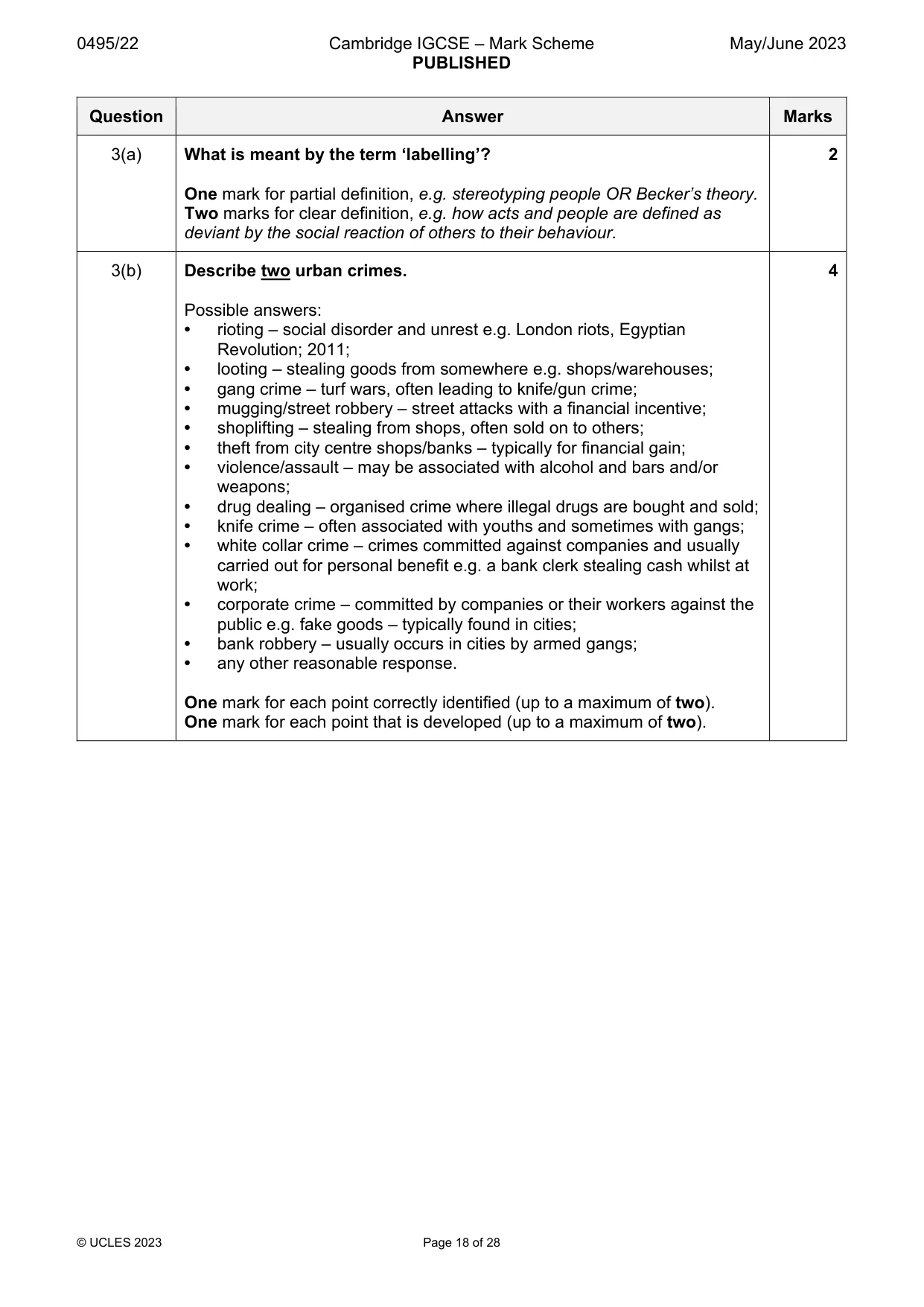
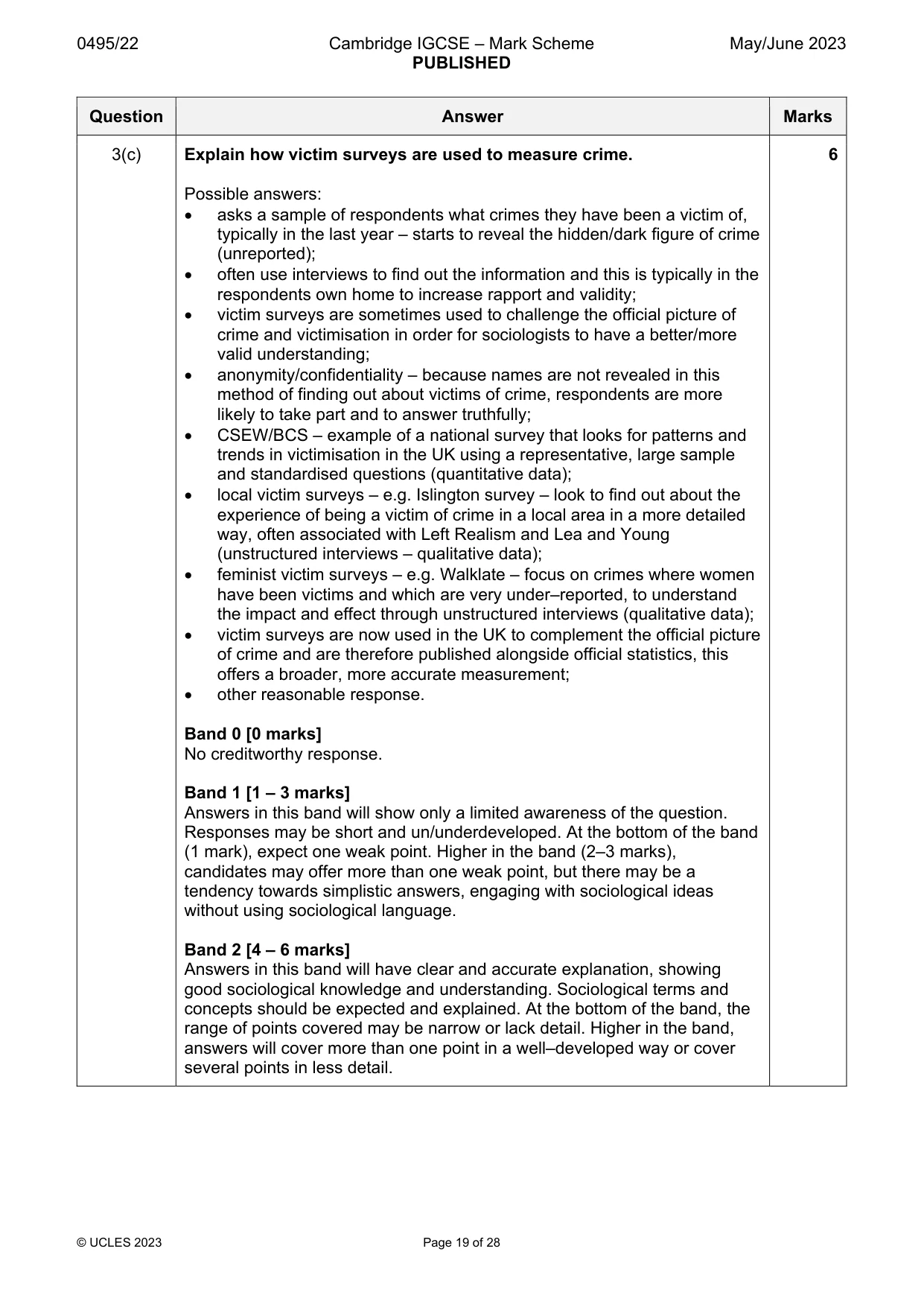
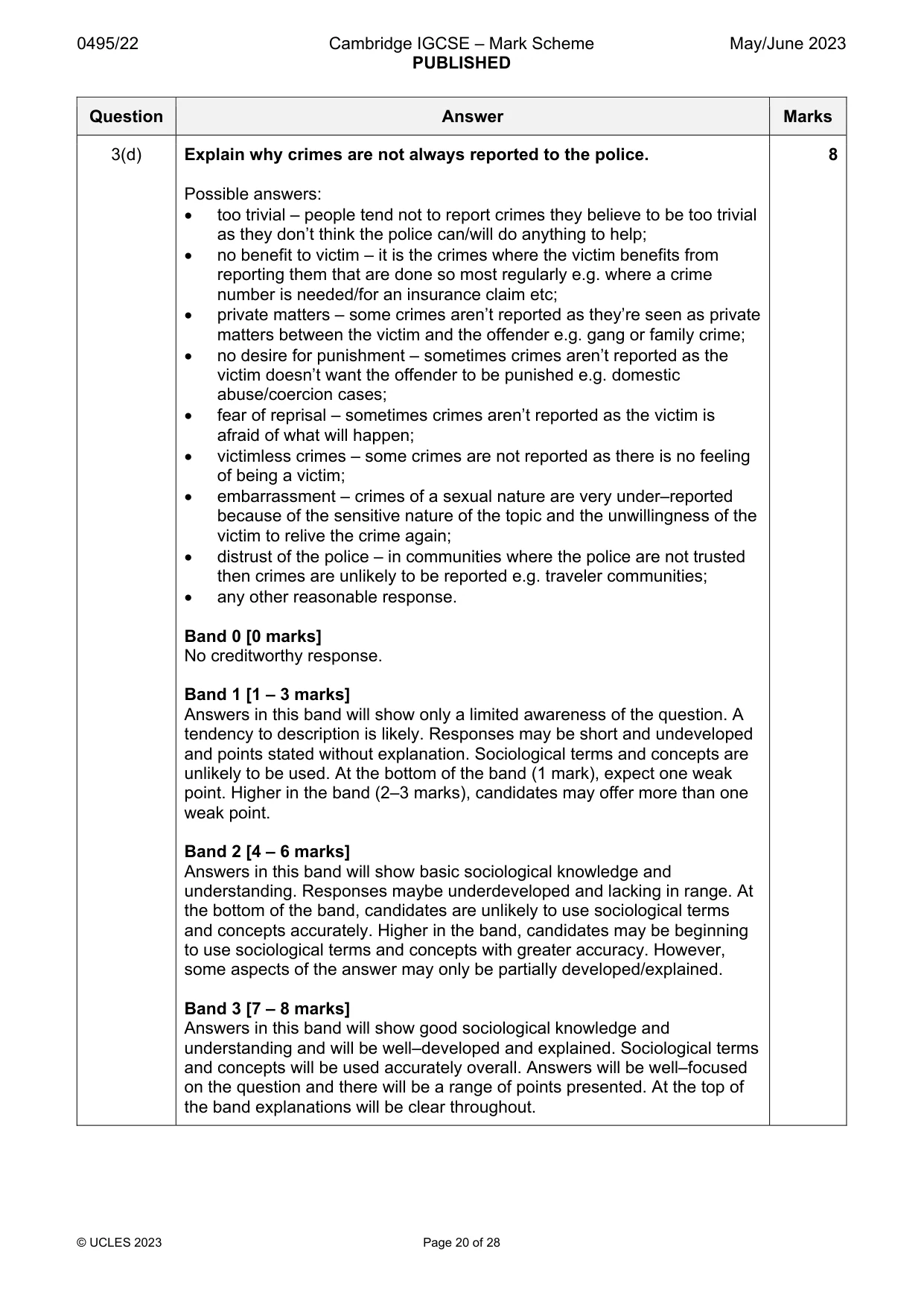
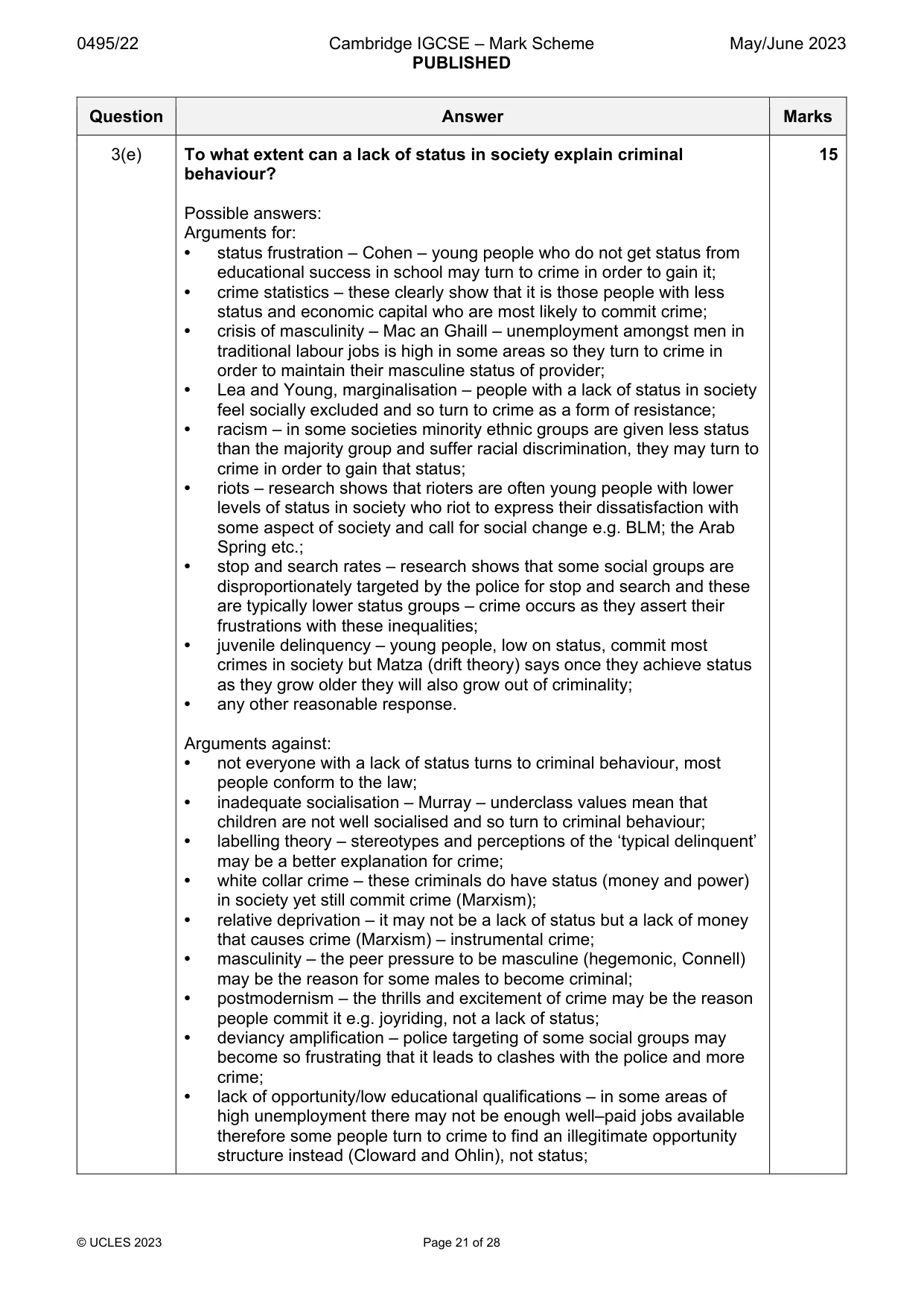
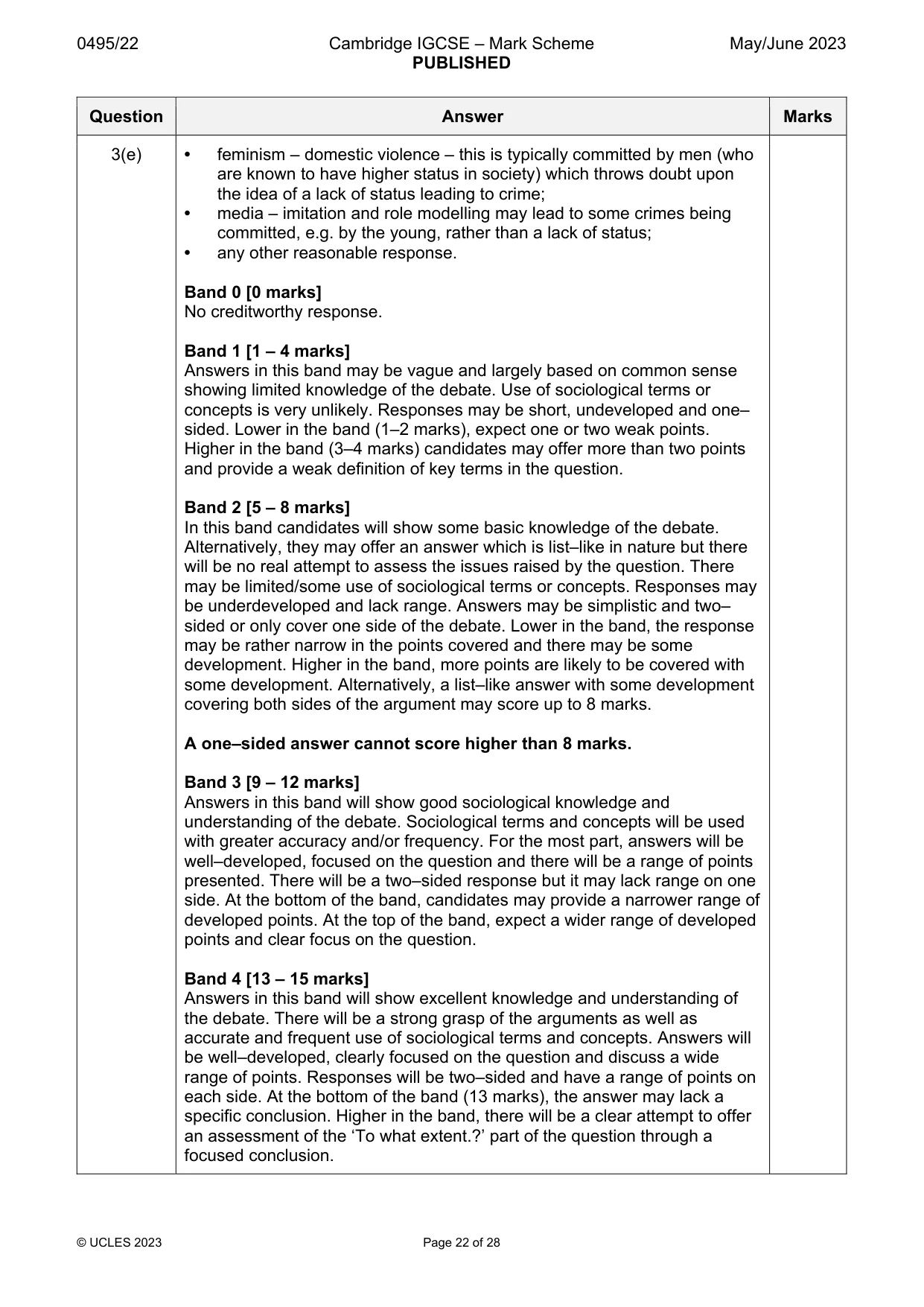
Mark scheme: 3(a) What is meant by the term ‘labelling’? 2 One mark for partial definition, e.g. stereotyping people OR Becker’s theory. Two marks for clear definition, e.g. how acts and people are defined as deviant by the social reaction of others to their behaviour. 3(b) Describe two urban crimes. 4 Possible answers: • rioting – social disorder and unrest e.g. London riots, Egyptian Revolution; 2011; • looting – stealing goods from somewhere e.g. shops/warehouses; • gang crime – turf wars, often leading to knife/gun crime; • mugging/street robbery – street attacks with a financial incentive; • shoplifting – stealing from shops, often sold on to others; • theft from city centre shops/banks – typically for financial gain; • violence/assault – may be associated with alcohol and bars and/or weapons; • drug dealing – organised crime where illegal drugs are bought and sold; • knife crime – often associated with youths and sometimes with gangs; • white collar crime – crimes committed against companies and usually carried out for personal benefit e.g. a bank clerk stealing cash whilst at work; • corporate crime – committed by companies or their workers against the public e.g. fake goods – typically found in cities; • bank robbery – usually occurs in cities by armed gangs; • any other reasonable response. One mark for each point correctly identified (up to a maximum of two). One mark for each point that is developed (up to a maximum of two). 3(c) Explain how victim surveys are used to measure crime. 6 Possible answers: asks a sample of respondents what crimes they have been a victim of, typically in the last year – starts to reveal the hidden/dark figure of crime (unreported); often use interviews to find out the information and this is typically in the respondents own home to increase rapport and validity; victim surveys are sometimes used to challenge the official picture of crime and victimisation in order for sociologists to have a better/more valid understanding; anonymity/confidentiality – because names are not revealed in this method of finding out about victims of crime, respondents are more likely to take part and to answer truthfully; CSEW/BCS – example of a national survey that looks for patterns and trends in victimisation in the UK using a representative, large sample and standardised questions (quantitative data); local victim surveys – e.g. Islington survey – look to find out about the experience of being a victim of crime in a local area in a more detailed way, often associated with Left Realism and Lea and Young (unstructured interviews – qualitative data); feminist victim surveys – e.g. Walklate – focus on crimes where women have been victims and which are very under–reported, to understand the impact and effect through unstructured interviews (qualitative data); victim surveys are now used in the UK to complement the official picture of crime and are therefore published alongside official statistics, this offers a broader, more accurate measurement; other reasonable response. Band 0 [0 marks] No creditworthy response. Band 1 [1 – 3 marks] Answers in this band will show only a limited awareness of the question. Responses may be short and un/underdeveloped. At the bottom of the band (1 mark), expect one weak point. Higher in the band (2–3 marks), candidates may offer more than one weak point, but there may be a tendency towards simplistic answers, engaging with sociological ideas without using sociological language. Band 2 [4 – 6 marks] Answers in this band will have clear and accurate explanation, showing good sociological knowledge and understanding. Sociological terms and concepts should be expected and explained. At the bottom of the band, the range of points covered may be narrow or lack detail. Higher in the band, answers will cover more than one point in a well–developed way or cover several points in less detail. 3(d) Explain why crimes are not always reported to the police. 8 Possible answers: too trivial – people tend not to report crimes they believe to be too trivial as they don’t think the police can/will do anything to help; no benefit to victim – it is the crimes where the victim benefits from reporting them that are done so most regularly e.g. where a crime number is needed/for an insurance claim etc; private matters – some crimes aren’t reported as they’re seen as private matters between the victim and the offender e.g. gang or family crime; no desire for punishment – sometimes crimes aren’t reported as the victim doesn’t want the offender to be punished e.g. domestic abuse/coercion cases; fear of reprisal – sometimes crimes aren’t reported as the victim is afraid of what will happen; victimless crimes – some crimes are not reported as there is no feeling of being a victim; embarrassment – crimes of a sexual nature are very under–reported because of the sensitive nature of the topic and the unwillingness of the victim to relive the crime again; distrust of the police – in communities where the police are not trusted then crimes are unlikely to be reported e.g. traveler communities; any other reasonable response. Band 0 [0 marks] No creditworthy response. Band 1 [1 – 3 marks] Answers in this band will show only a limited awareness of the question. A tendency to description is likely. Responses may be short and undeveloped and points stated without explanation. Sociological terms and concepts are unlikely to be used. At the bottom of the band (1 mark), expect one weak point. Higher in the band (2–3 marks), candidates may offer more than one weak point. Band 2 [4 – 6 marks] Answers in this band will show basic sociological knowledge and understanding. Responses maybe underdeveloped and lacking in range. At the bottom of the band, candidates are unlikely to use sociological terms and concepts accurately. Higher in the band, candidates may be beginning to use sociological terms and concepts with greater accuracy. However, some aspects of the answer may only be partially developed/explained. Band 3 [7 – 8 marks] Answers in this band will show good sociological knowledge and understanding and will be well–developed and explained. Sociological terms and concepts will be used accurately overall. Answers will be well–focused on the question and there will be a range of points presented. At the top of the band explanations will be clear throughout. 3(e) To what extent can a lack of status in society explain criminal 15 behaviour? Possible answers: Arguments for: • status frustration – Cohen – young people who do not get status from educational success in school may turn to crime in order to gain it; • crime statistics – these clearly show that it is those people with less status and economic capital who are most likely to commit crime; • crisis of masculinity – Mac an Ghaill – unemployment amongst men in traditional labour jobs is high in some areas so they turn to crime in order to maintain their masculine status of provider; • Lea and Young, marginalisation – people with a lack of status in society feel socially excluded and so turn to crime as a form of resistance; • racism – in some societies minority ethnic groups are given less status than the majority group and suffer racial discrimination, they may turn to crime in order to gain that status; • riots – research shows that rioters are often young people with lower levels of status in society who riot to express their dissatisfaction with some aspect of society and call for social change e.g. BLM; the Arab Spring etc.; • stop and search rates – research shows that some social groups are disproportionately targeted by the police for stop and search and these are typically lower status groups – crime occurs as they assert their frustrations with these inequalities; • juvenile delinquency – young people, low on status, commit most crimes in society but Matza (drift theory) says once they achieve status as they grow older they will also grow out of criminality; • any other reasonable response. Arguments against: • not everyone with a lack of status turns to criminal behaviour, most people conform to the law; • inadequate socialisation – Murray – underclass values mean that children are not well socialised and so turn to criminal behaviour; • labelling theory – stereotypes and perceptions of the ‘typical delinquent’ may be a better explanation for crime; • white collar crime – these criminals do have status (money and power) in society yet still commit crime (Marxism); • relative deprivation – it may not be a lack of status but a lack of money that causes crime (Marxism) – instrumental crime; • masculinity – the peer pressure to be masculine (hegemonic, Connell) may be the reason for some males to become criminal; • postmodernism – the thrills and excitement of crime may be the reason people commit it e.g. joyriding, not a lack of status; • deviancy amplification – police targeting of some social groups may become so frustrating that it leads to clashes with the police and more crime; • lack of opportunity/low educational qualifications – in some areas of high unemployment there may not be enough well–paid jobs available therefore some people turn to crime to find an illegitimate opportunity structure instead (Cloward and Ohlin), not status; 3(e) • feminism – domestic violence – this is typically committed by men (who are known to have higher status in society) which throws doubt upon the idea of a lack of status leading to crime; • media – imitation and role modelling may lead to some crimes being committed, e.g. by the young, rather than a lack of status; • any other reasonable response. Band 0 [0 marks] No creditworthy response. Band 1 [1 – 4 marks] Answers in this band may be vague and largely based on common sense showing limited knowledge of the debate. Use of sociological terms or concepts is very unlikely. Responses may be short, undeveloped and one– sided. Lower in the band (1–2 marks), expect one or two weak points. Higher in the band (3–4 marks) candidates may offer more than two points and provide a weak definition of key terms in the question. Band 2 [5 – 8 marks] In this band candidates will show some basic knowledge of the debate. Alternatively, they may offer an answer which is list–like in nature but there will be no real attempt to assess the issues raised by the question. There may be limited/some use of sociological terms or concepts. Responses may be underdeveloped and lack range. Answers may be simplistic and two– sided or only cover one side of the debate. Lower in the band, the response may be rather narrow in the points covered and there may be some development. Higher in the band, more points are likely to be covered with some development. Alternatively, a list–like answer with some development covering both sides of the argument may score up to 8 marks. A one–sided answer cannot score higher than 8 marks. Band 3 [9 – 12 marks] Answers in this band will show good sociological knowledge and understanding of the debate. Sociological terms and concepts will be used with greater accuracy and/or frequency. For the most part, answers will be well–developed, focused on the question and there will be a range of points presented. There will be a two–sided response but it may lack range on one side. At the bottom of the band, candidates may provide a narrower range of developed points. At the top of the band, expect a wider range of developed points and clear focus on the question. Band 4 [13 – 15 marks] Answers in this band will show excellent knowledge and understanding of the debate. There will be a strong grasp of the arguments as well as accurate and frequent use of sociological terms and concepts. Answers will be well–developed, clearly focused on the question and discuss a wide range of points. Responses will be two–sided and have a range of points on each side. At the bottom of the band (13 marks), the answer may lack a specific conclusion. Higher in the band, there will be a clear attempt to offer an assessment of the ‘To what extent.?’ part of the question through a focused conclusion.
Q4 · Contemporary media is no longer national or local, it is a global institution often using…
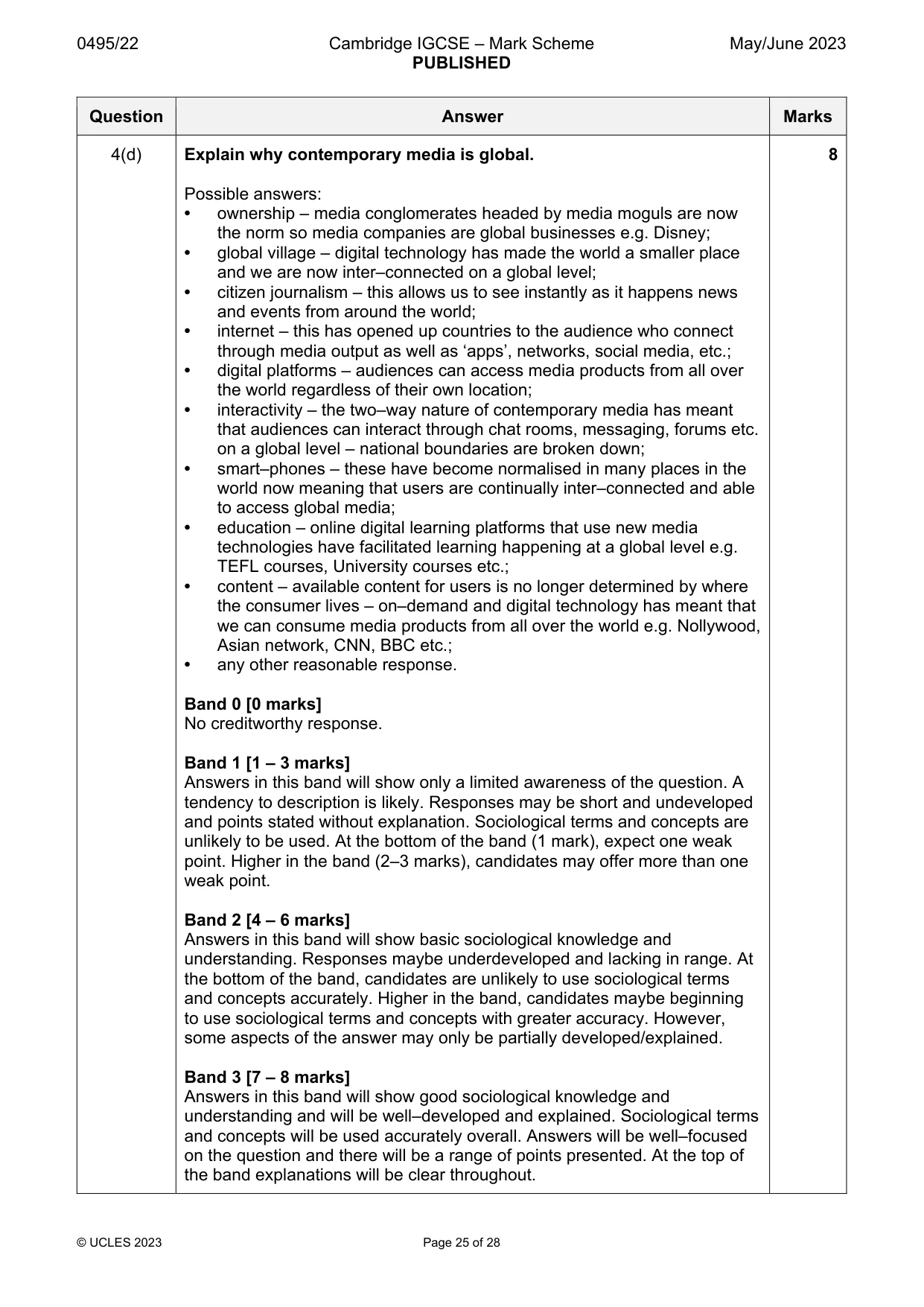
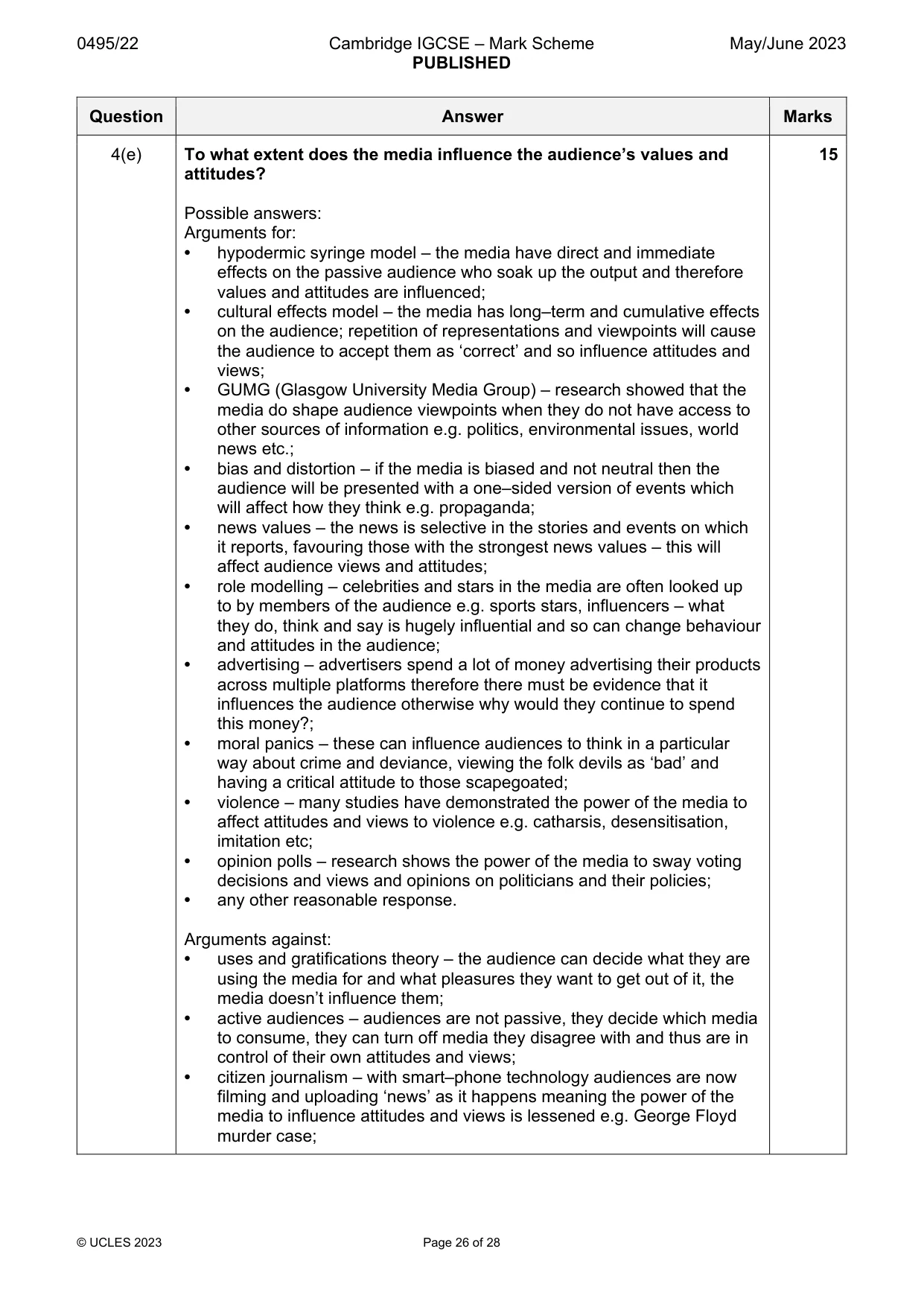
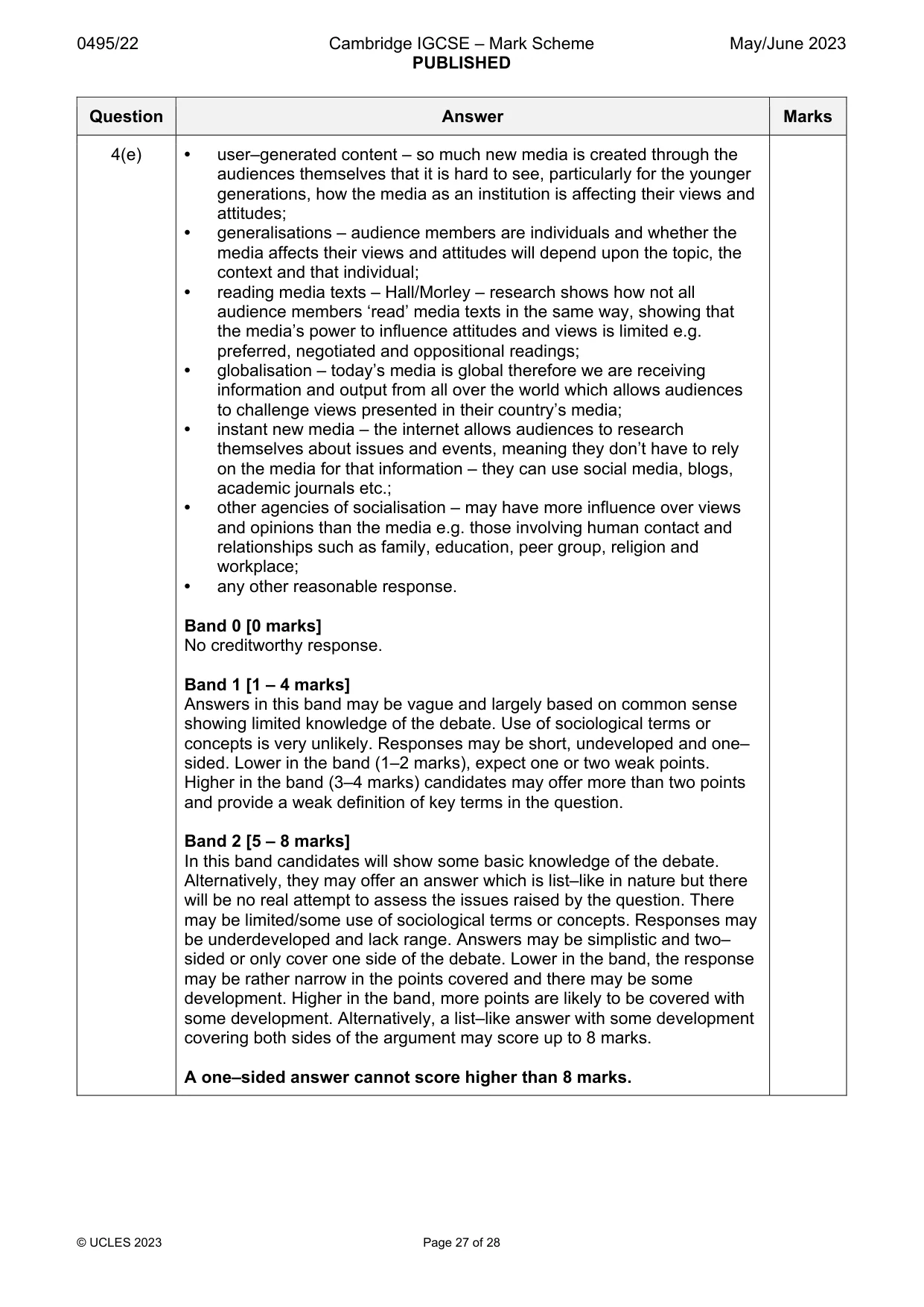
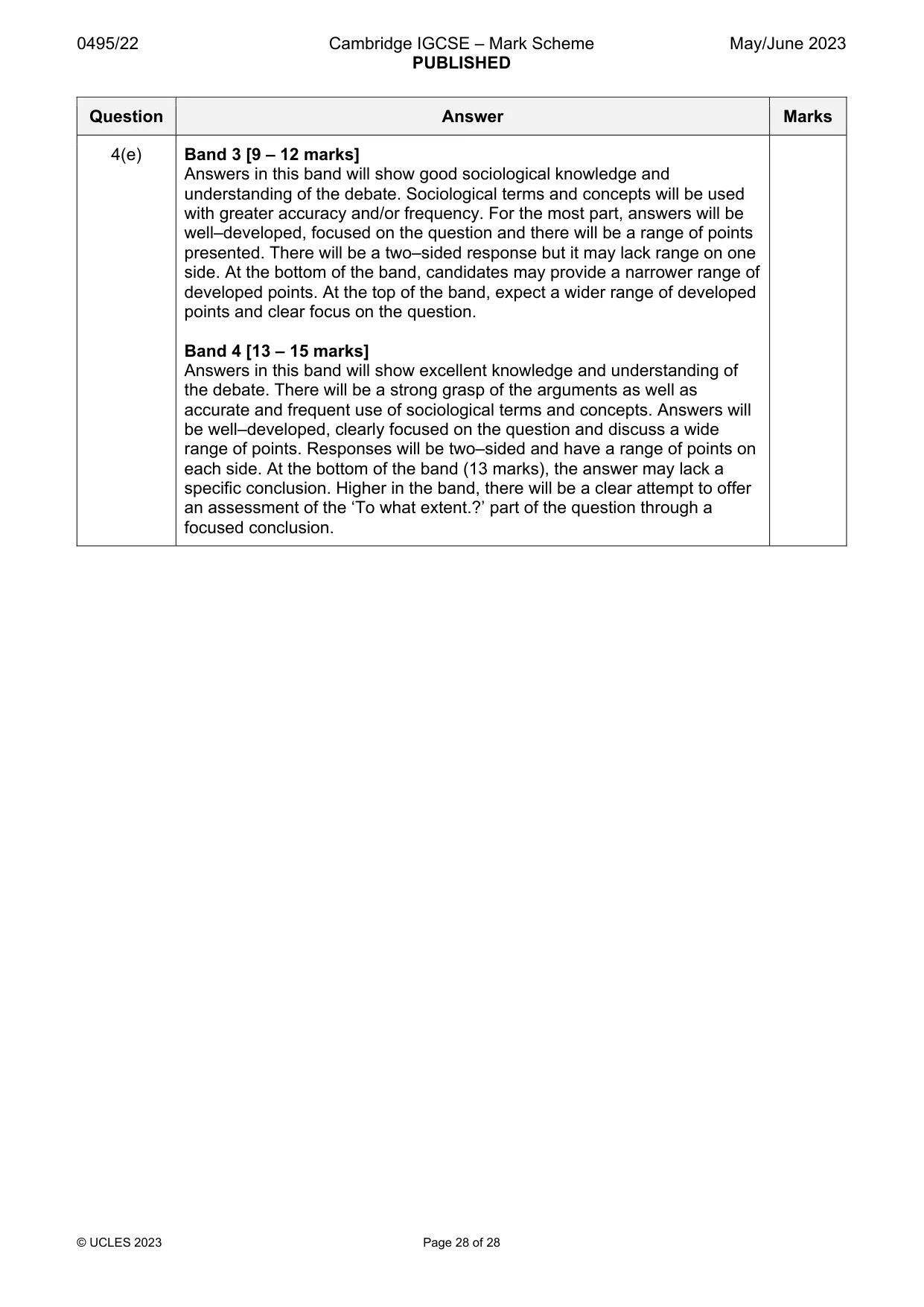
4 Contemporary media is no longer national or local, it is a global institution often using citizen journalism for its content. Audience members use traditional and new media for many different reasons. Some sociologists believe that the media will influence the audience’s values and attitudes as it is a powerful agent of socialisation. Other sociologists disagree, instead seeing audiences as being in control of the media. (a) What is meant by the term ‘citizen journalism’? [2] (b) Describe two ways the audience use the media, according to the uses and gratifications model. [4] (c) Explain how the media is biased. [6] (d) Explain why contemporary media is global. [8] (e) To what extent does the media influence the audience’s values and attitudes? [15]
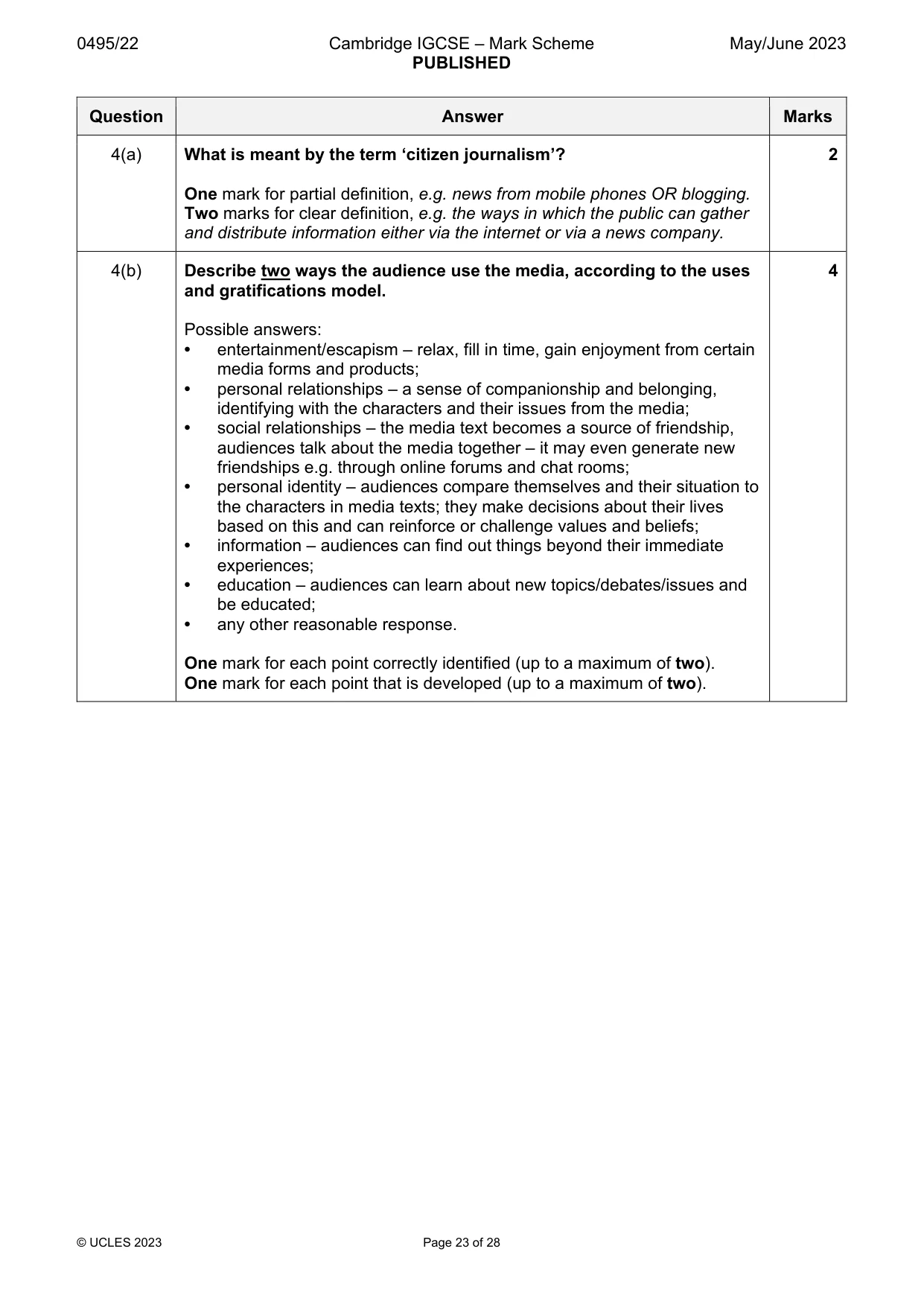
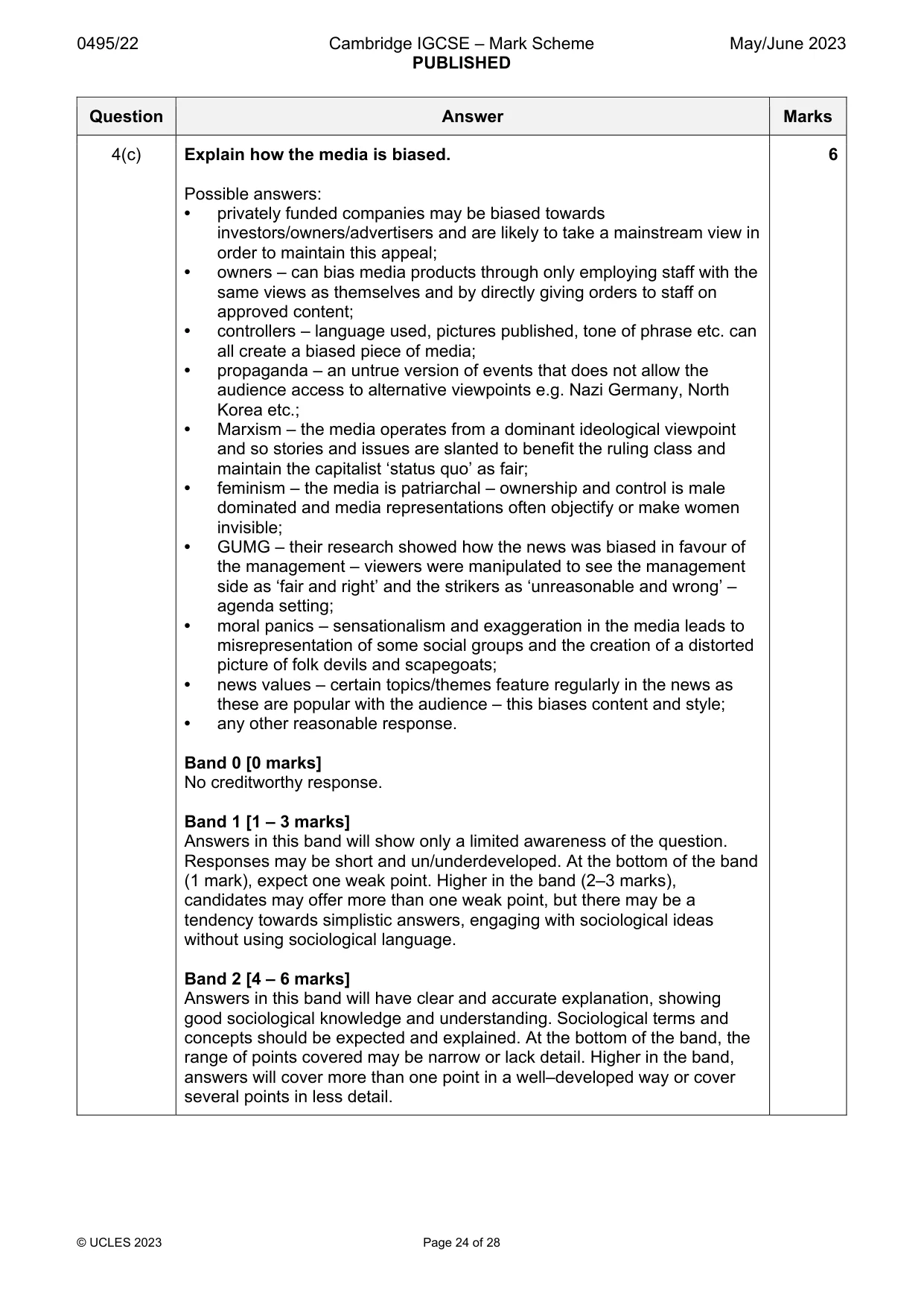
Mark scheme: 4(a) What is meant by the term ‘citizen journalism’? 2 One mark for partial definition, e.g. news from mobile phones OR blogging. Two marks for clear definition, e.g. the ways in which the public can gather and distribute information either via the internet or via a news company. 4(b) Describe two ways the audience use the media, according to the uses 4 and gratifications model. Possible answers: • entertainment/escapism – relax, fill in time, gain enjoyment from certain media forms and products; • personal relationships – a sense of companionship and belonging, identifying with the characters and their issues from the media; • social relationships – the media text becomes a source of friendship, audiences talk about the media together – it may even generate new friendships e.g. through online forums and chat rooms; • personal identity – audiences compare themselves and their situation to the characters in media texts; they make decisions about their lives based on this and can reinforce or challenge values and beliefs; • information – audiences can find out things beyond their immediate experiences; • education – audiences can learn about new topics/debates/issues and be educated; • any other reasonable response. One mark for each point correctly identified (up to a maximum of two). One mark for each point that is developed (up to a maximum of two). 4(c) Explain how the media is biased. 6 Possible answers: • privately funded companies may be biased towards investors/owners/advertisers and are likely to take a mainstream view in order to maintain this appeal; • owners – can bias media products through only employing staff with the same views as themselves and by directly giving orders to staff on approved content; • controllers – language used, pictures published, tone of phrase etc. can all create a biased piece of media; • propaganda – an untrue version of events that does not allow the audience access to alternative viewpoints e.g. Nazi Germany, North Korea etc.; • Marxism – the media operates from a dominant ideological viewpoint and so stories and issues are slanted to benefit the ruling class and maintain the capitalist ‘status quo’ as fair; • feminism – the media is patriarchal – ownership and control is male dominated and media representations often objectify or make women invisible; • GUMG – their research showed how the news was biased in favour of the management – viewers were manipulated to see the management side as ‘fair and right’ and the strikers as ‘unreasonable and wrong’ – agenda setting; • moral panics – sensationalism and exaggeration in the media leads to misrepresentation of some social groups and the creation of a distorted picture of folk devils and scapegoats; • news values – certain topics/themes feature regularly in the news as these are popular with the audience – this biases content and style; • any other reasonable response. Band 0 [0 marks] No creditworthy response. Band 1 [1 – 3 marks] Answers in this band will show only a limited awareness of the question. Responses may be short and un/underdeveloped. At the bottom of the band (1 mark), expect one weak point. Higher in the band (2–3 marks), candidates may offer more than one weak point, but there may be a tendency towards simplistic answers, engaging with sociological ideas without using sociological language. Band 2 [4 – 6 marks] Answers in this band will have clear and accurate explanation, showing good sociological knowledge and understanding. Sociological terms and concepts should be expected and explained. At the bottom of the band, the range of points covered may be narrow or lack detail. Higher in the band, answers will cover more than one point in a well–developed way or cover several points in less detail. 4(d) Explain why contemporary media is global. 8 Possible answers: • ownership – media conglomerates headed by media moguls are now the norm so media companies are global businesses e.g. Disney; • global village – digital technology has made the world a smaller place and we are now inter–connected on a global level; • citizen journalism – this allows us to see instantly as it happens news and events from around the world; • internet – this has opened up countries to the audience who connect through media output as well as ‘apps’, networks, social media, etc.; • digital platforms – audiences can access media products from all over the world regardless of their own location; • interactivity – the two–way nature of contemporary media has meant that audiences can interact through chat rooms, messaging, forums etc. on a global level – national boundaries are broken down; • smart–phones – these have become normalised in many places in the world now meaning that users are continually inter–connected and able to access global media; • education – online digital learning platforms that use new media technologies have facilitated learning happening at a global level e.g. TEFL courses, University courses etc.; • content – available content for users is no longer determined by where the consumer lives – on–demand and digital technology has meant that we can consume media products from all over the world e.g. Nollywood, Asian network, CNN, BBC etc.; • any other reasonable response. Band 0 [0 marks] No creditworthy response. Band 1 [1 – 3 marks] Answers in this band will show only a limited awareness of the question. A tendency to description is likely. Responses may be short and undeveloped and points stated without explanation. Sociological terms and concepts are unlikely to be used. At the bottom of the band (1 mark), expect one weak point. Higher in the band (2–3 marks), candidates may offer more than one weak point. Band 2 [4 – 6 marks] Answers in this band will show basic sociological knowledge and understanding. Responses maybe underdeveloped and lacking in range. At the bottom of the band, candidates are unlikely to use sociological terms and concepts accurately. Higher in the band, candidates maybe beginning to use sociological terms and concepts with greater accuracy. However, some aspects of the answer may only be partially developed/explained. Band 3 [7 – 8 marks] Answers in this band will show good sociological knowledge and understanding and will be well–developed and explained. Sociological terms and concepts will be used accurately overall. Answers will be well–focused on the question and there will be a range of points presented. At the top of the band explanations will be clear throughout. 4(e) To what extent does the media influence the audience’s values and 15 attitudes? Possible answers: Arguments for: • hypodermic syringe model – the media have direct and immediate effects on the passive audience who soak up the output and therefore values and attitudes are influenced; • cultural effects model – the media has long–term and cumulative effects on the audience; repetition of representations and viewpoints will cause the audience to accept them as ‘correct’ and so influence attitudes and views; • GUMG (Glasgow University Media Group) – research showed that the media do shape audience viewpoints when they do not have access to other sources of information e.g. politics, environmental issues, world news etc.; • bias and distortion – if the media is biased and not neutral then the audience will be presented with a one–sided version of events which will affect how they think e.g. propaganda; • news values – the news is selective in the stories and events on which it reports, favouring those with the strongest news values – this will affect audience views and attitudes; • role modelling – celebrities and stars in the media are often looked up to by members of the audience e.g. sports stars, influencers – what they do, think and say is hugely influential and so can change behaviour and attitudes in the audience; • advertising – advertisers spend a lot of money advertising their products across multiple platforms therefore there must be evidence that it influences the audience otherwise why would they continue to spend this money?; • moral panics – these can influence audiences to think in a particular way about crime and deviance, viewing the folk devils as ‘bad’ and having a critical attitude to those scapegoated; • violence – many studies have demonstrated the power of the media to affect attitudes and views to violence e.g. catharsis, desensitisation, imitation etc; • opinion polls – research shows the power of the media to sway voting decisions and views and opinions on politicians and their policies; • any other reasonable response. Arguments against: • uses and gratifications theory – the audience can decide what they are using the media for and what pleasures they want to get out of it, the media doesn’t influence them; • active audiences – audiences are not passive, they decide which media to consume, they can turn off media they disagree with and thus are in control of their own attitudes and views; • citizen journalism – with smart–phone technology audiences are now filming and uploading ‘news’ as it happens meaning the power of the media to influence attitudes and views is lessened e.g. George Floyd murder case; 4(e) • user–generated content – so much new media is created through the audiences themselves that it is hard to see, particularly for the younger generations, how the media as an institution is affecting their views and attitudes; • generalisations – audience members are individuals and whether the media affects their views and attitudes will depend upon the topic, the context and that individual; • reading media texts – Hall/Morley – research shows how not all audience members ‘read’ media texts in the same way, showing that the media’s power to influence attitudes and views is limited e.g. preferred, negotiated and oppositional readings; • globalisation – today’s media is global therefore we are receiving information and output from all over the world which allows audiences to challenge views presented in their country’s media; • instant new media – the internet allows audiences to research themselves about issues and events, meaning they don’t have to rely on the media for that information – they can use social media, blogs, academic journals etc.; • other agencies of socialisation – may have more influence over views and opinions than the media e.g. those involving human contact and relationships such as family, education, peer group, religion and workplace; • any other reasonable response. Band 0 [0 marks] No creditworthy response. Band 1 [1 – 4 marks] Answers in this band may be vague and largely based on common sense showing limited knowledge of the debate. Use of sociological terms or concepts is very unlikely. Responses may be short, undeveloped and one– sided. Lower in the band (1–2 marks), expect one or two weak points. Higher in the band (3–4 marks) candidates may offer more than two points and provide a weak definition of key terms in the question. Band 2 [5 – 8 marks] In this band candidates will show some basic knowledge of the debate. Alternatively, they may offer an answer which is list–like in nature but there will be no real attempt to assess the issues raised by the question. There may be limited/some use of sociological terms or concepts. Responses may be underdeveloped and lack range. Answers may be simplistic and two– sided or only cover one side of the debate. Lower in the band, the response may be rather narrow in the points covered and there may be some development. Higher in the band, more points are likely to be covered with some development. Alternatively, a list–like answer with some development covering both sides of the argument may score up to 8 marks. A one–sided answer cannot score higher than 8 marks. 4(e) Band 3 [9 – 12 marks] Answers in this band will show good sociological knowledge and understanding of the debate. Sociological terms and concepts will be used with greater accuracy and/or frequency. For the most part, answers will be well–developed, focused on the question and there will be a range of points presented. There will be a two–sided response but it may lack range on one side. At the bottom of the band, candidates may provide a narrower range of developed points. At the top of the band, expect a wider range of developed points and clear focus on the question. Band 4 [13 – 15 marks] Answers in this band will show excellent knowledge and understanding of the debate. There will be a strong grasp of the arguments as well as accurate and frequent use of sociological terms and concepts. Answers will be well–developed, clearly focused on the question and discuss a wide range of points. Responses will be two–sided and have a range of points on each side. At the bottom of the band (13 marks), the answer may lack a specific conclusion. Higher in the band, there will be a clear attempt to offer an assessment of the ‘To what extent.?’ part of the question through a focused conclusion.
What was in this paper
The subtopics covered by these 4 questions, and how many questions each got. Open one in a new tab to see every Cambridge question on it.
What you needed in this session
Cambridge’s own grade thresholds for 2023 May/June, Paper 2 · Variant 2. A higher threshold means an easier paper — the bar moves with how the cohort did.