Cambridge IGCSE Sociology 0495 — 2024 Oct/Nov Paper 2 · Variant 2
0495/22/O/N/24 · 4 questions · 70 marks · ≈79 min
The question paper and its mark scheme, free to read here and free to download. This is Cambridge’s own paper, exactly as it was sat.
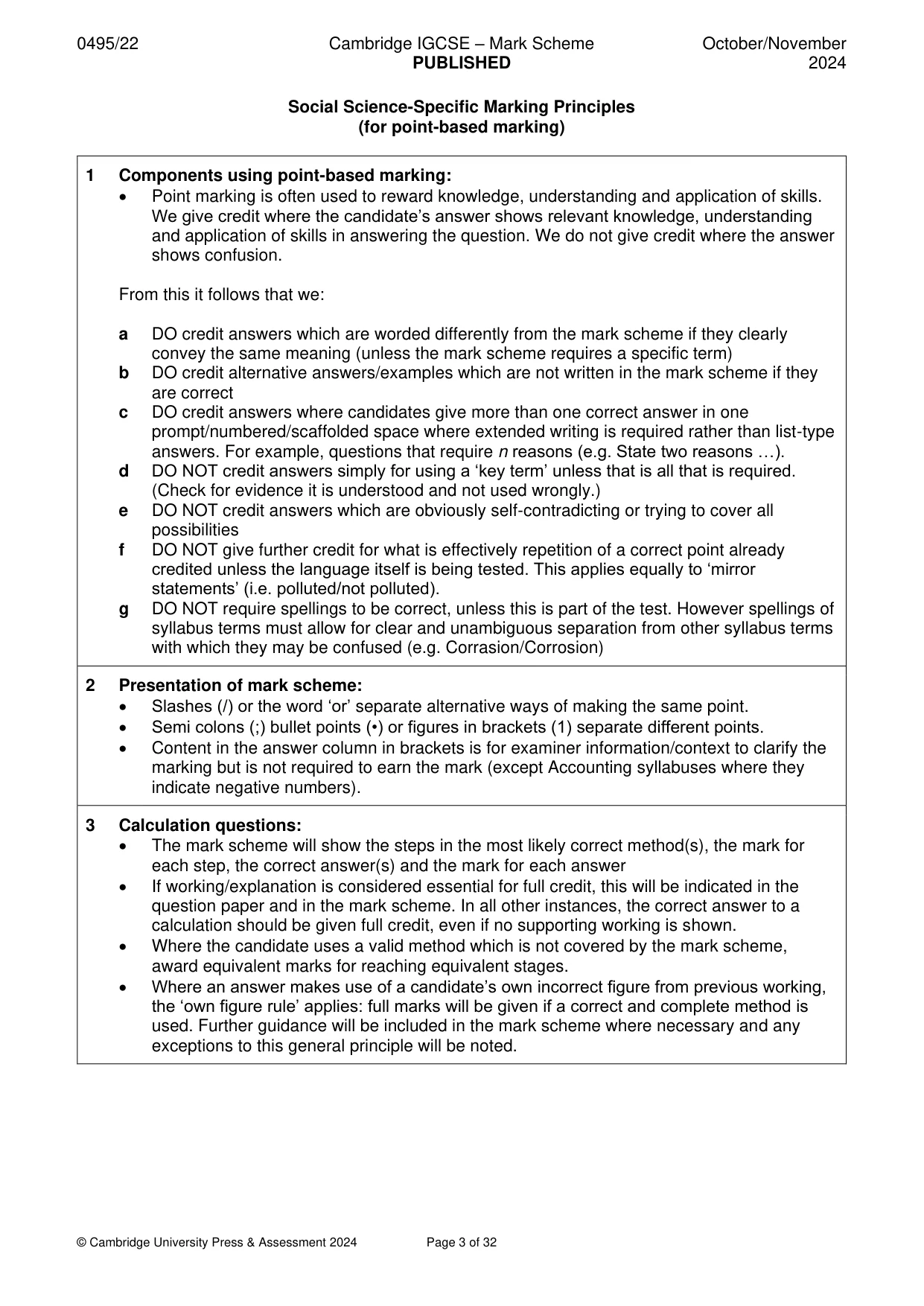
Question paper4 pages
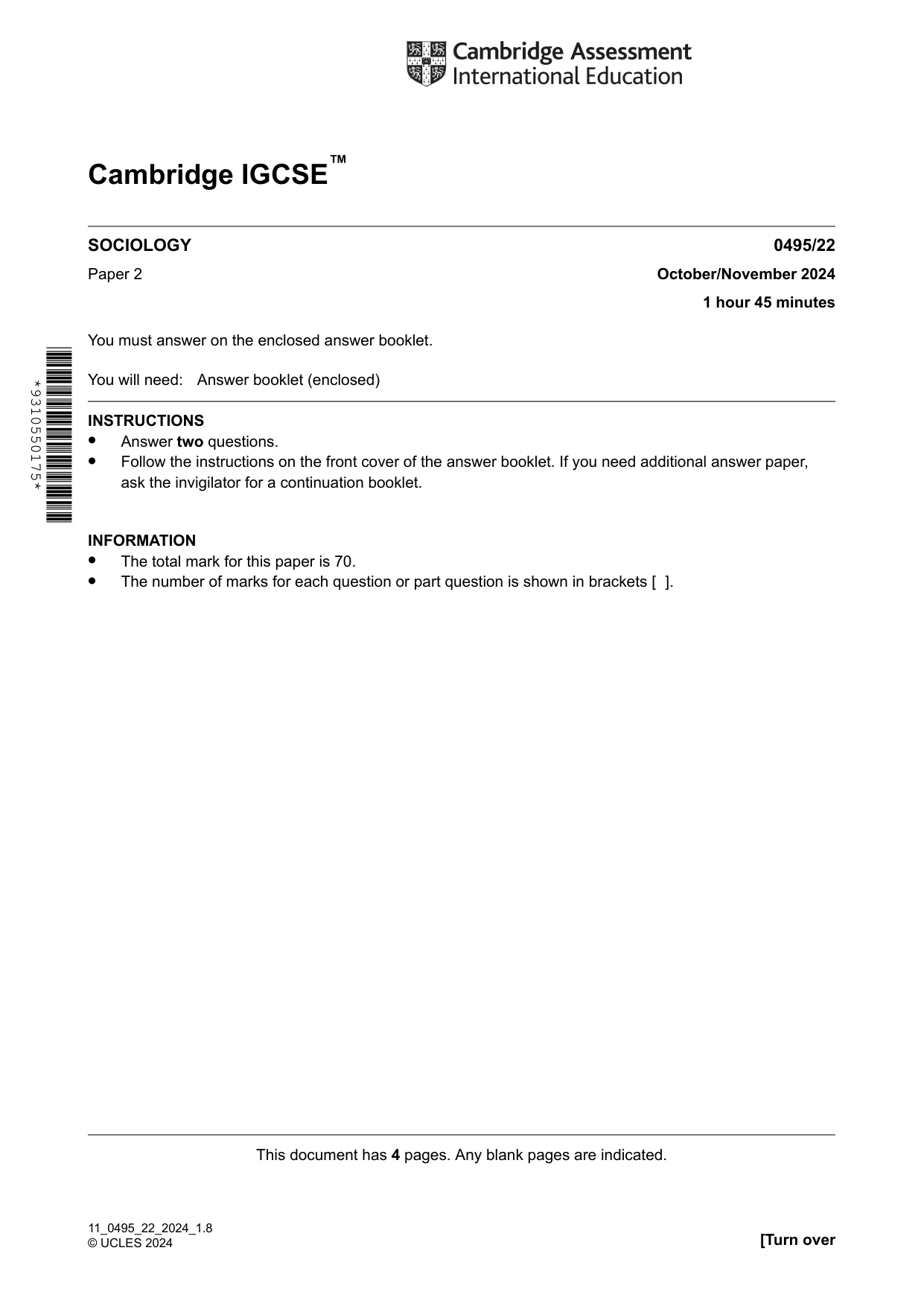

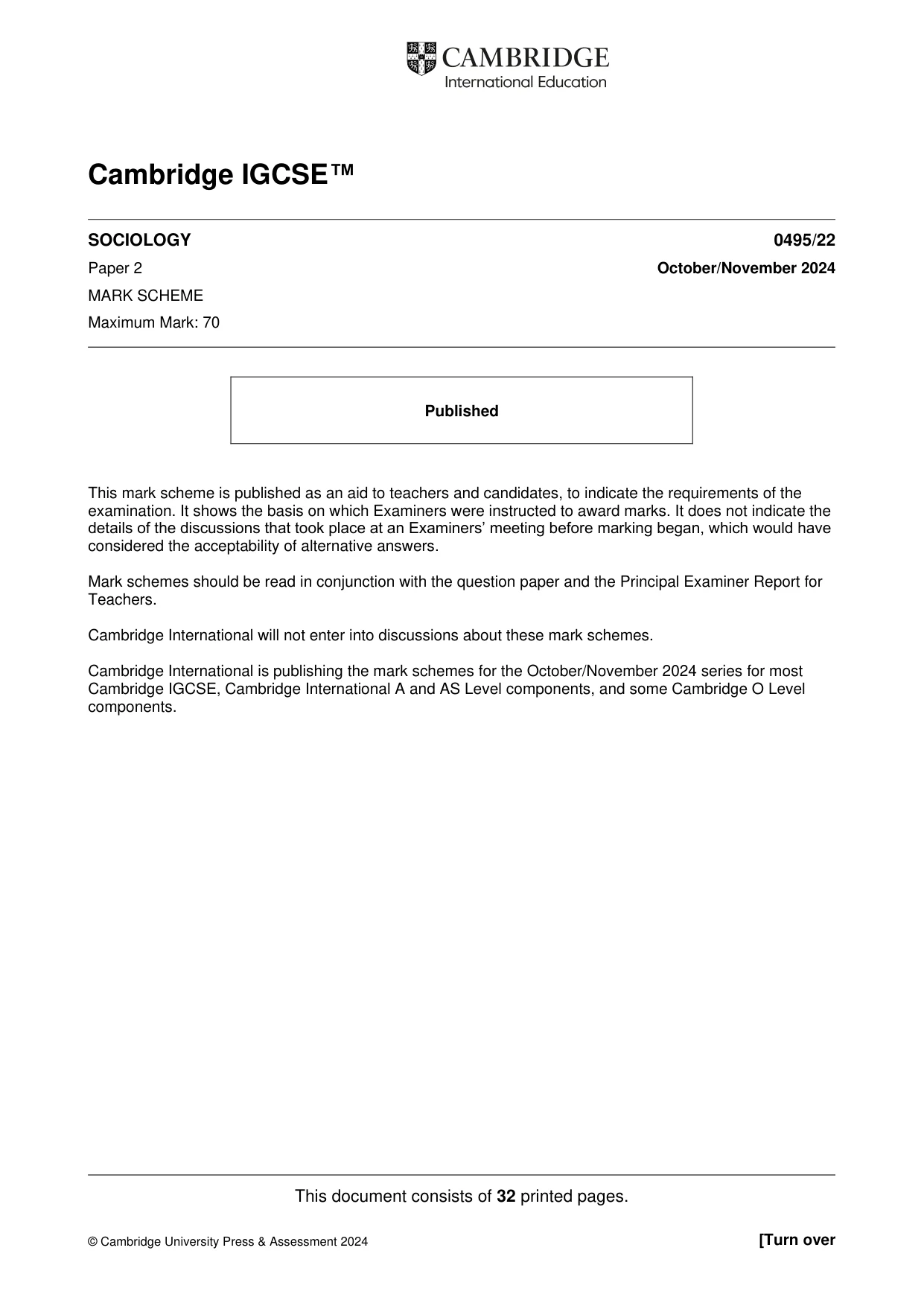
Mark scheme32 pages
Answers below. Sit the paper first if you are practising.



Questions as text
Q1 · In modern industrial societies there have been many changes in family roles, family types…
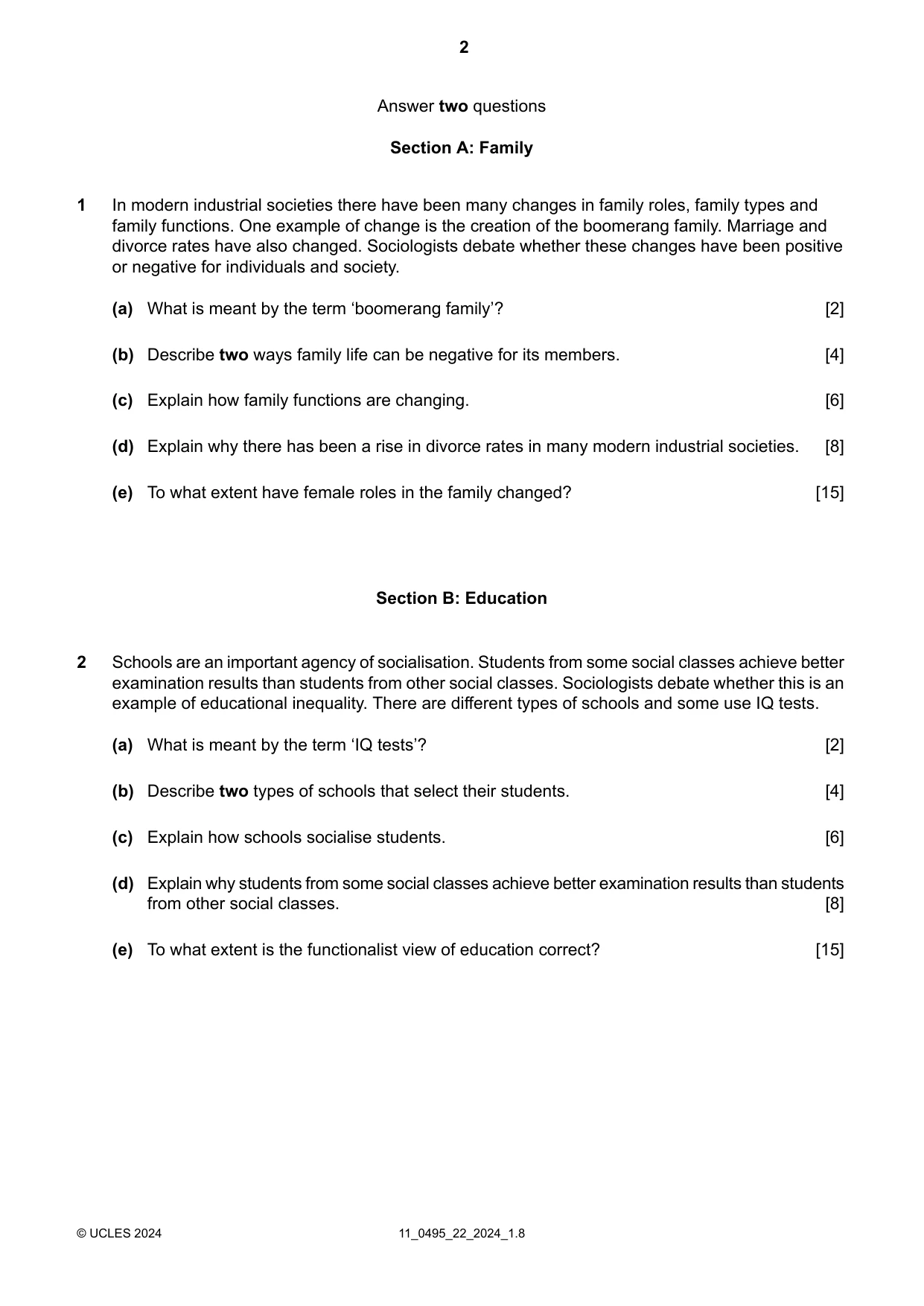
1 In modern industrial societies there have been many changes in family roles, family types and family functions. One example of change is the creation of the boomerang family. Marriage and divorce rates have also changed. Sociologists debate whether these changes have been positive or negative for individuals and society. (a) What is meant by the term ‘boomerang family’? [2] (b) Describe two ways family life can be negative for its members. [4] (c) Explain how family functions are changing. [6] (d) Explain why there has been a rise in divorce rates in many modern industrial societies. [8] (e) To what extent have female roles in the family changed? [15]
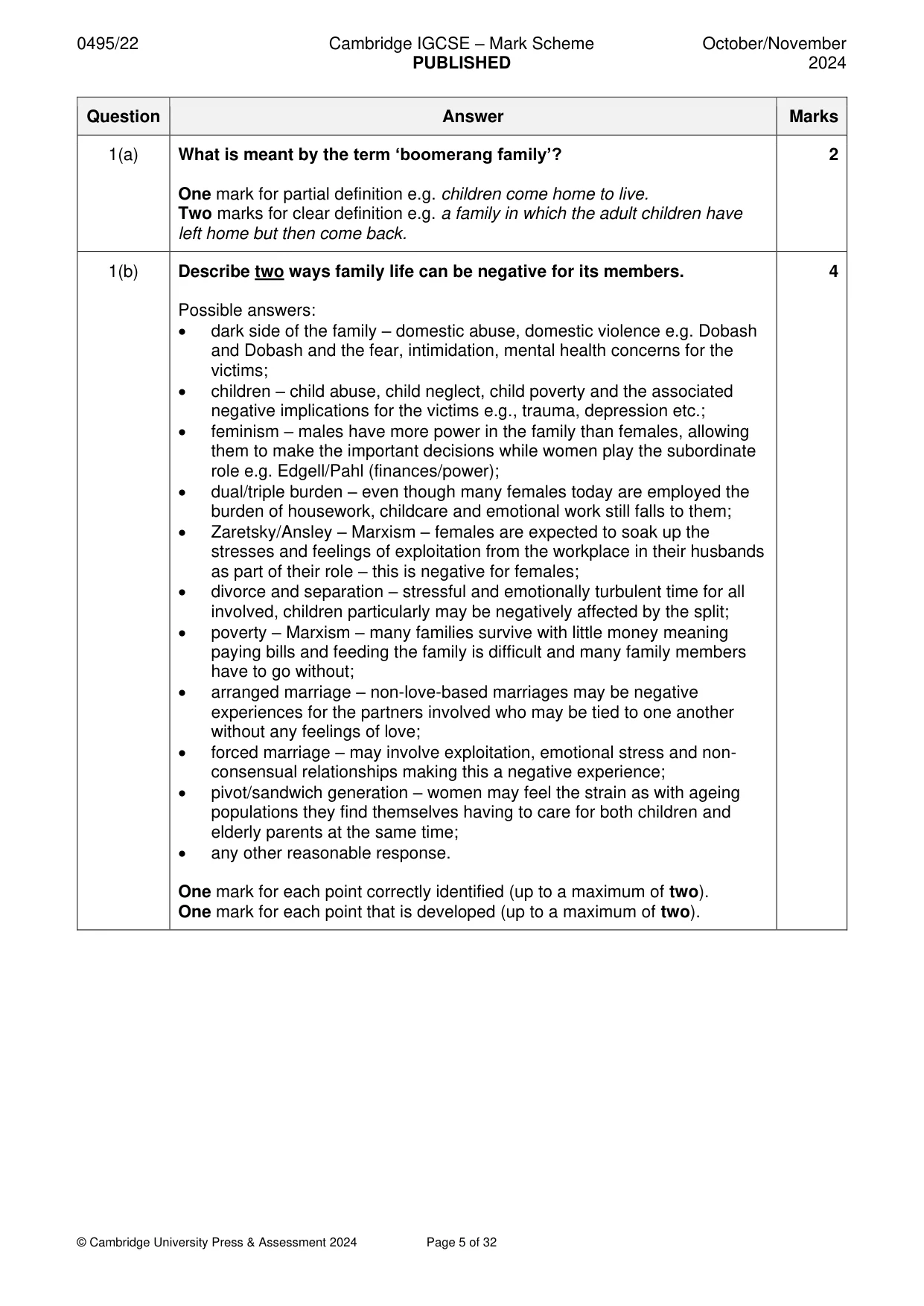
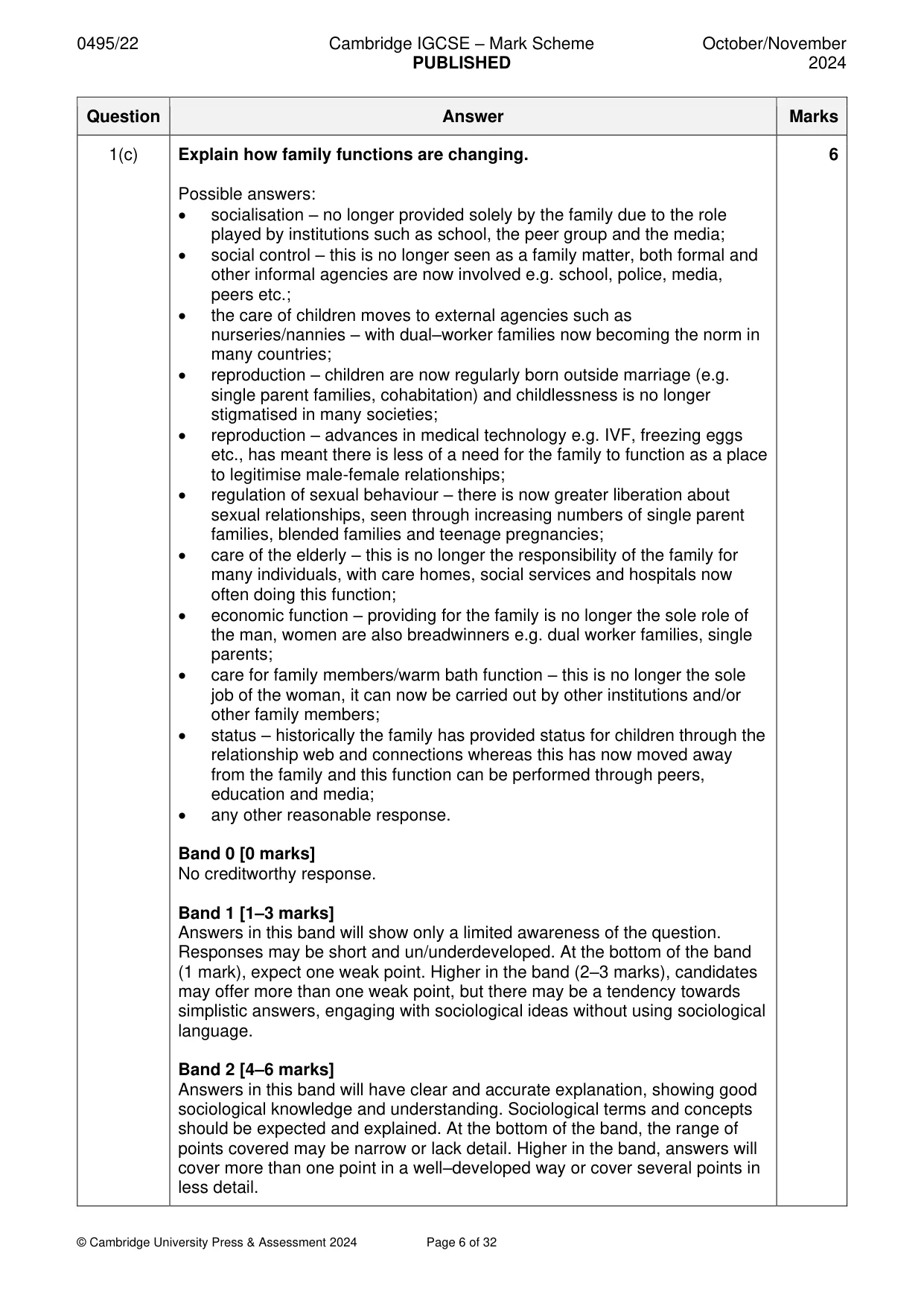
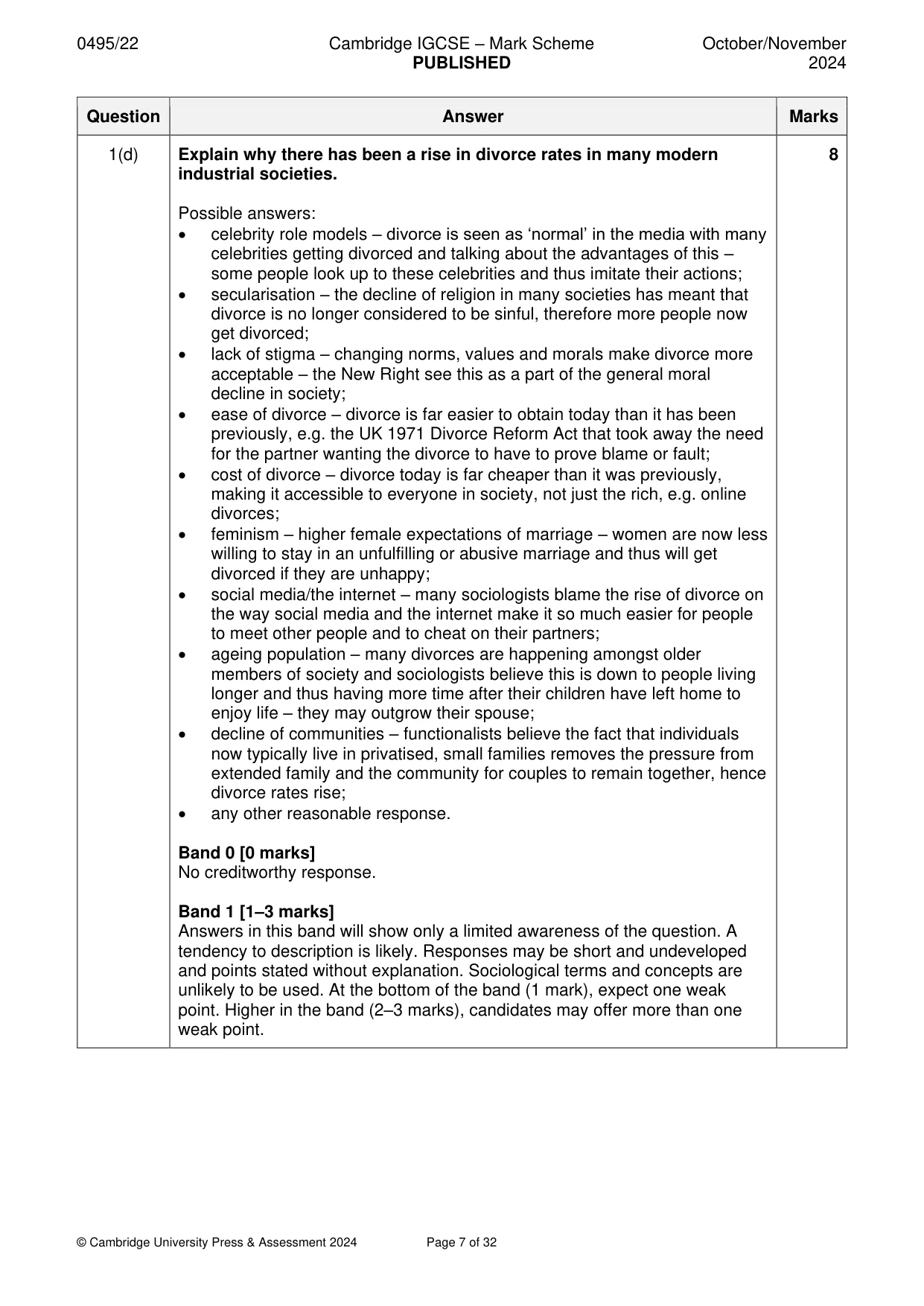
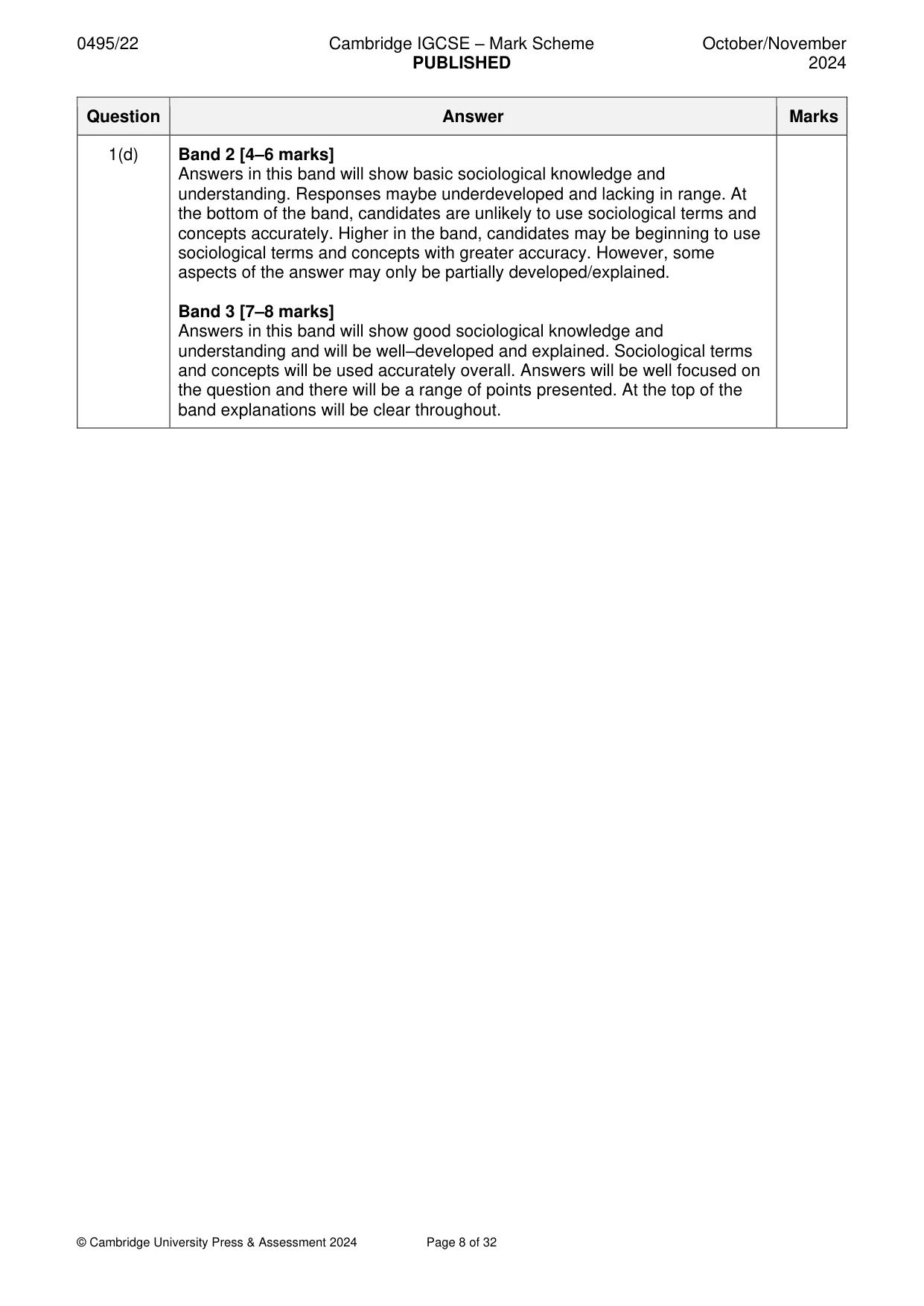
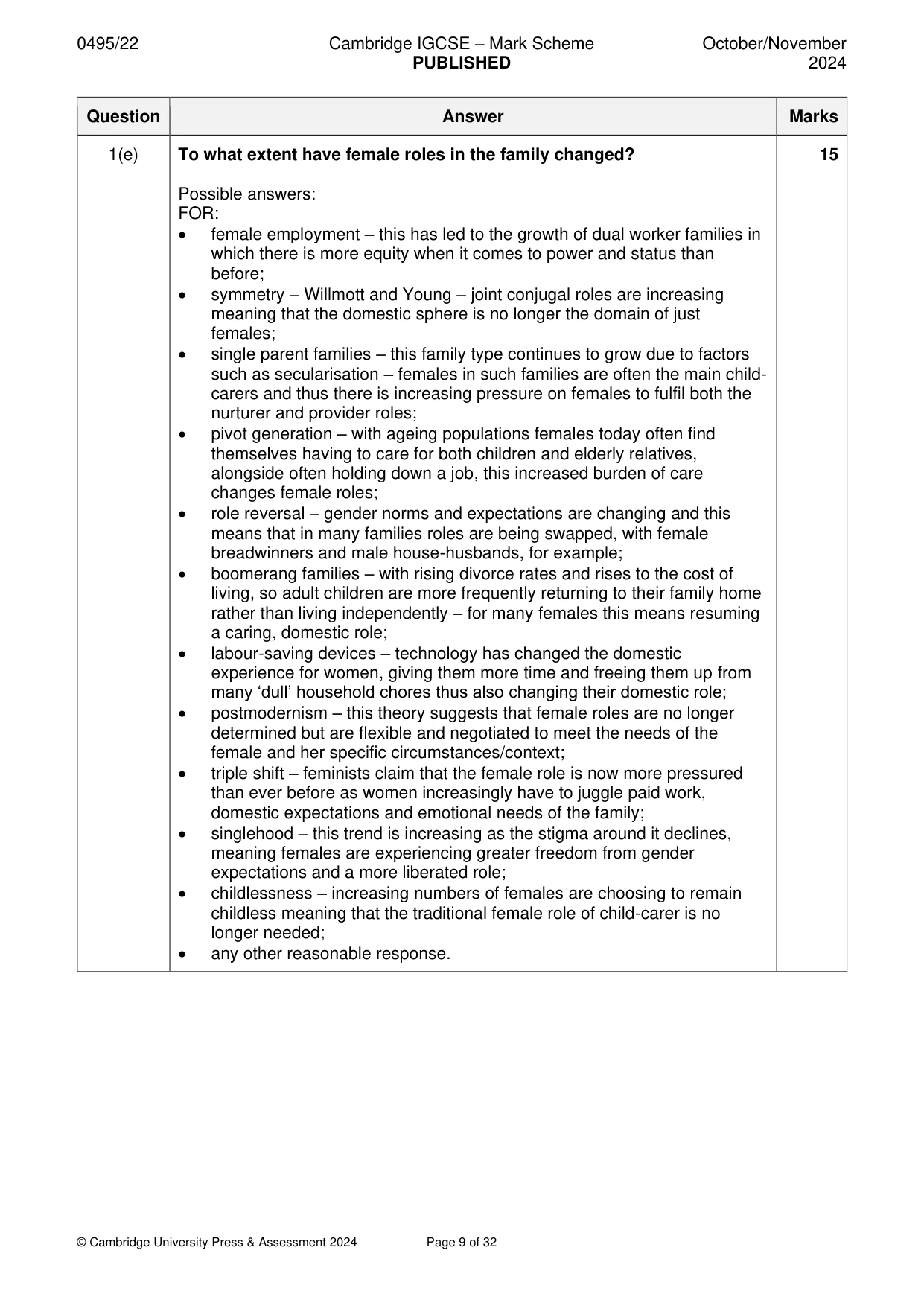
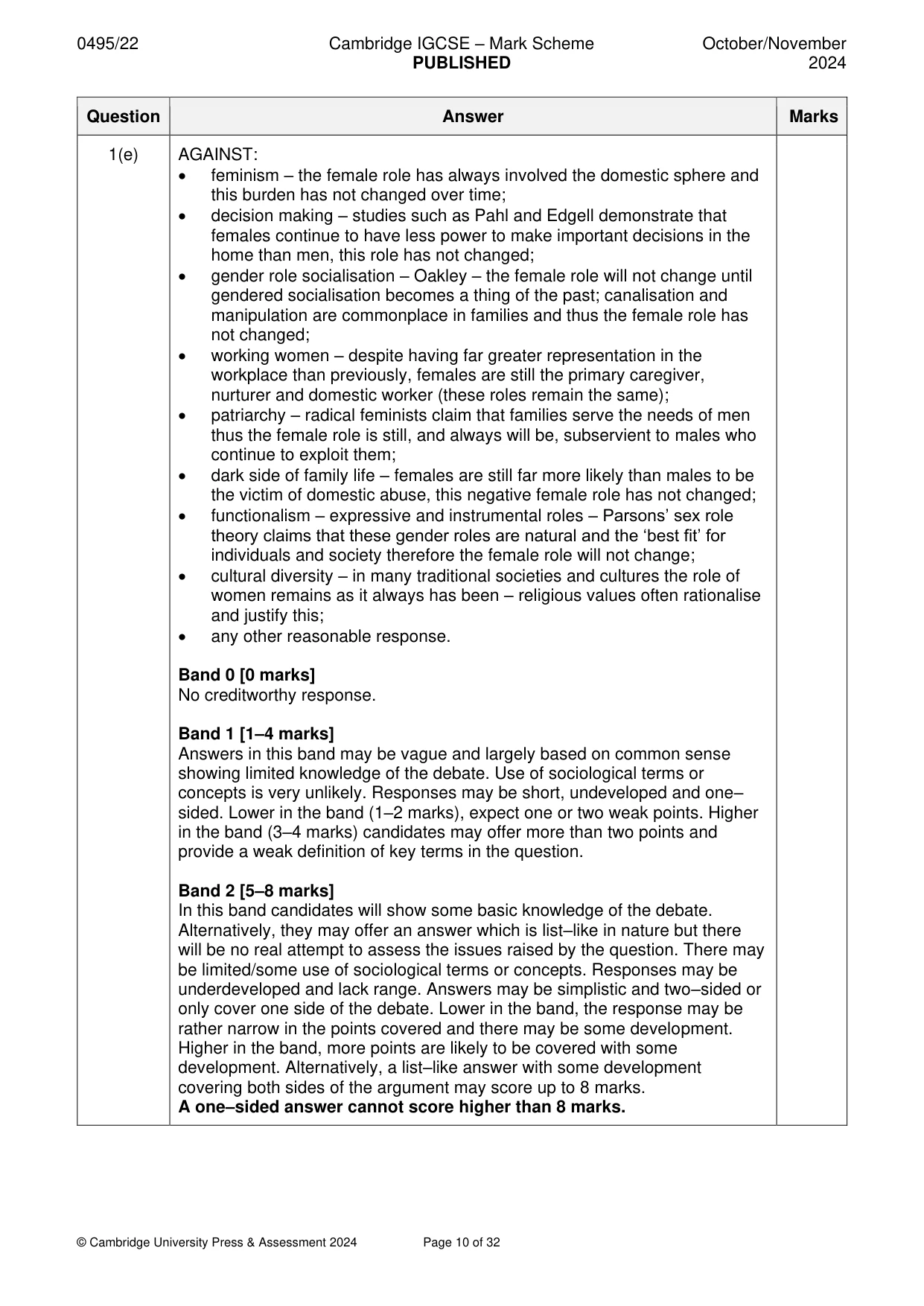
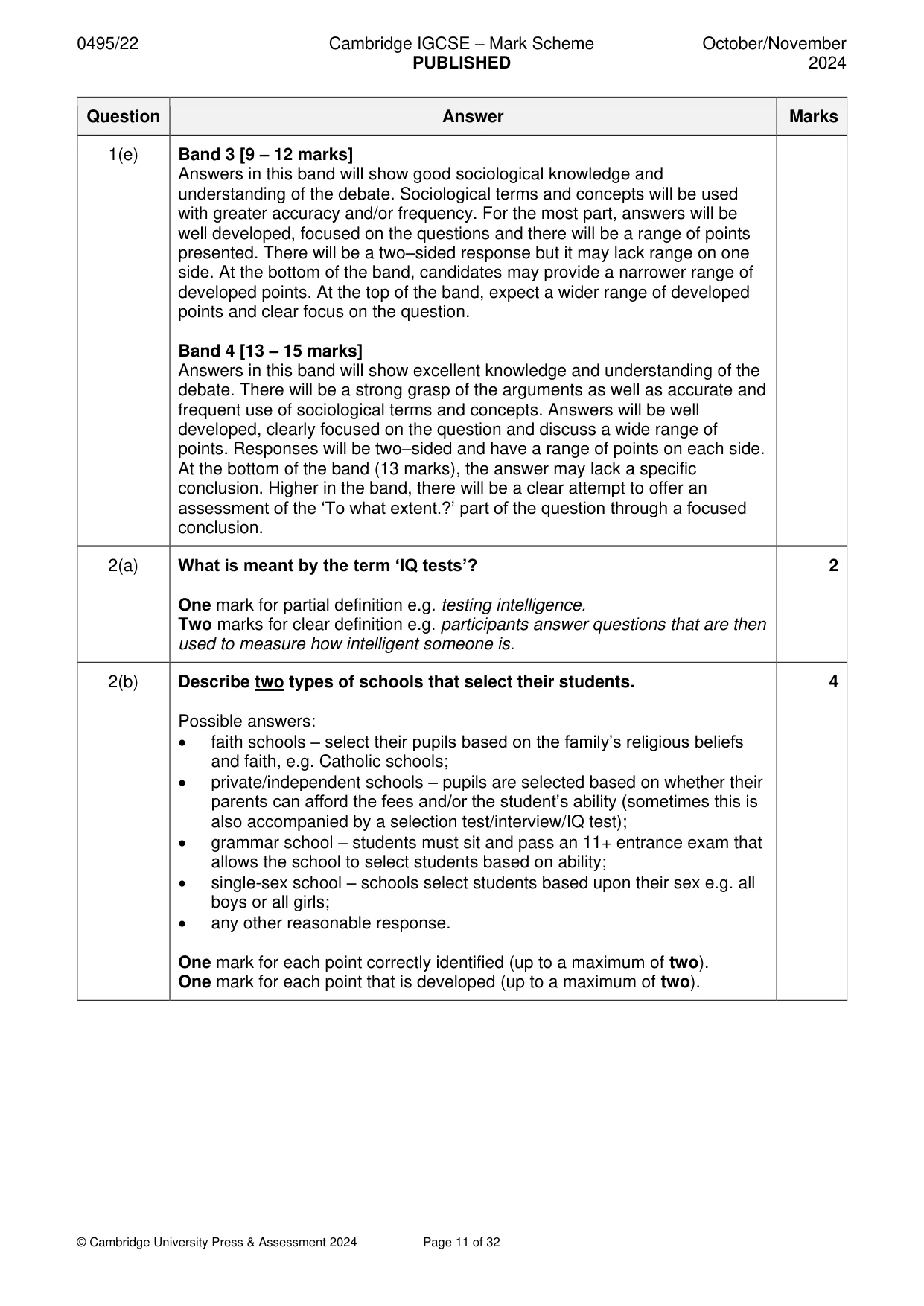
Mark scheme: Question Answer Marks 1(a) What is meant by the term ‘boomerang family’? 2 One mark for partial definition e.g. children come home to live. Two marks for clear definition e.g. a family in which the adult children have left home but then come back. 1(b) Describe two ways family life can be negative for its members. 4 Possible answers: • dark side of the family – domestic abuse, domestic violence e.g. Dobash and Dobash and the fear, intimidation, mental health concerns for the victims; • children – child abuse, child neglect, child poverty and the associated negative implications for the victims e.g., trauma, depression etc.; • feminism – males have more power in the family than females, allowing them to make the important decisions while women play the subordinate role e.g. Edgell/Pahl (finances/power); • dual/triple burden – even though many females today are employed the burden of housework, childcare and emotional work still falls to them; • Zaretsky/Ansley – Marxism – females are expected to soak up the stresses and feelings of exploitation from the workplace in their husbands as part of their role – this is negative for females; • divorce and separation – stressful and emotionally turbulent time for all involved, children particularly may be negatively affected by the split; • poverty – Marxism – many families survive with little money meaning paying bills and feeding the family is difficult and many family members have to go without; • arranged marriage – non-love-based marriages may be negative experiences for the partners involved who may be tied to one another without any feelings of love; • forced marriage – may involve exploitation, emotional stress and non- consensual relationships making this a negative experience; • pivot/sandwich generation – women may feel the strain as with ageing populations they find themselves having to care for both children and elderly parents at the same time; • any other reasonable response. One mark for each point correctly identified (up to a maximum of two). One mark for each point that is developed (up to a maximum of two). 1(c) Explain how family functions are changing. 6 Possible answers: • socialisation – no longer provided solely by the family due to the role played by institutions such as school, the peer group and the media; • social control – this is no longer seen as a family matter, both formal and other informal agencies are now involved e.g. school, police, media, peers etc.; • the care of children moves to external agencies such as nurseries/nannies – with dual–worker families now becoming the norm in many countries; • reproduction – children are now regularly born outside marriage (e.g. single parent families, cohabitation) and childlessness is no longer stigmatised in many societies; • reproduction – advances in medical technology e.g. IVF, freezing eggs etc., has meant there is less of a need for the family to function as a place to legitimise male-female relationships; • regulation of sexual behaviour – there is now greater liberation about sexual relationships, seen through increasing numbers of single parent families, blended families and teenage pregnancies; • care of the elderly – this is no longer the responsibility of the family for many individuals, with care homes, social services and hospitals now often doing this function; • economic function – providing for the family is no longer the sole role of the man, women are also breadwinners e.g. dual worker families, single parents; • care for family members/warm bath function – this is no longer the sole job of the woman, it can now be carried out by other institutions and/or other family members; • status – historically the family has provided status for children through the relationship web and connections whereas this has now moved away from the family and this function can be performed through peers, education and media; • any other reasonable response. Band 0 [0 marks] No creditworthy response. Band 1 [1–3 marks] Answers in this band will show only a limited awareness of the question. Responses may be short and un/underdeveloped. At the bottom of the band (1 mark), expect one weak point. Higher in the band (2–3 marks), candidates may offer more than one weak point, but there may be a tendency towards simplistic answers, engaging with sociological ideas without using sociological language. Band 2 [4–6 marks] Answers in this band will have clear and accurate explanation, showing good sociological knowledge and understanding. Sociological terms and concepts should be expected and explained. At the bottom of the band, the range of points covered may be narrow or lack detail. Higher in the band, answers will cover more than one point in a well–developed way or cover several points in less detail. 1(d) Explain why there has been a rise in divorce rates in many modern 8 industrial societies. Possible answers: • celebrity role models – divorce is seen as ‘normal’ in the media with many celebrities getting divorced and talking about the advantages of this – some people look up to these celebrities and thus imitate their actions; • secularisation – the decline of religion in many societies has meant that divorce is no longer considered to be sinful, therefore more people now get divorced; • lack of stigma – changing norms, values and morals make divorce more acceptable – the New Right see this as a part of the general moral decline in society; • ease of divorce – divorce is far easier to obtain today than it has been previously, e.g. the UK 1971 Divorce Reform Act that took away the need for the partner wanting the divorce to have to prove blame or fault; • cost of divorce – divorce today is far cheaper than it was previously, making it accessible to everyone in society, not just the rich, e.g. online divorces; • feminism – higher female expectations of marriage – women are now less willing to stay in an unfulfilling or abusive marriage and thus will get divorced if they are unhappy; • social media/the internet – many sociologists blame the rise of divorce on the way social media and the internet make it so much easier for people to meet other people and to cheat on their partners; • ageing population – many divorces are happening amongst older members of society and sociologists believe this is down to people living longer and thus having more time after their children have left home to enjoy life – they may outgrow their spouse; • decline of communities – functionalists believe the fact that individuals now typically live in privatised, small families removes the pressure from extended family and the community for couples to remain together, hence divorce rates rise; • any other reasonable response. Band 0 [0 marks] No creditworthy response. Band 1 [1–3 marks] Answers in this band will show only a limited awareness of the question. A tendency to description is likely. Responses may be short and undeveloped and points stated without explanation. Sociological terms and concepts are unlikely to be used. At the bottom of the band (1 mark), expect one weak point. Higher in the band (2–3 marks), candidates may offer more than one weak point. 1(d) Band 2 [4–6 marks] Answers in this band will show basic sociological knowledge and understanding. Responses maybe underdeveloped and lacking in range. At the bottom of the band, candidates are unlikely to use sociological terms and concepts accurately. Higher in the band, candidates may be beginning to use sociological terms and concepts with greater accuracy. However, some aspects of the answer may only be partially developed/explained. Band 3 [7–8 marks] Answers in this band will show good sociological knowledge and understanding and will be well–developed and explained. Sociological terms and concepts will be used accurately overall. Answers will be well focused on the question and there will be a range of points presented. At the top of the band explanations will be clear throughout. 1(e) To what extent have female roles in the family changed? 15 Possible answers: FOR: • female employment – this has led to the growth of dual worker families in which there is more equity when it comes to power and status than before; • symmetry – Willmott and Young – joint conjugal roles are increasing meaning that the domestic sphere is no longer the domain of just females; • single parent families – this family type continues to grow due to factors such as secularisation – females in such families are often the main child- carers and thus there is increasing pressure on females to fulfil both the nurturer and provider roles; • pivot generation – with ageing populations females today often find themselves having to care for both children and elderly relatives, alongside often holding down a job, this increased burden of care changes female roles; • role reversal – gender norms and expectations are changing and this means that in many families roles are being swapped, with female breadwinners and male house-husbands, for example; • boomerang families – with rising divorce rates and rises to the cost of living, so adult children are more frequently returning to their family home rather than living independently – for many females this means resuming a caring, domestic role; • labour-saving devices – technology has changed the domestic experience for women, giving them more time and freeing them up from many ‘dull’ household chores thus also changing their domestic role; • postmodernism – this theory suggests that female roles are no longer determined but are flexible and negotiated to meet the needs of the female and her specific circumstances/context; • triple shift – feminists claim that the female role is now more pressured than ever before as women increasingly have to juggle paid work, domestic expectations and emotional needs of the family; • singlehood – this trend is increasing as the stigma around it declines, meaning females are experiencing greater freedom from gender expectations and a more liberated role; • childlessness – increasing numbers of females are choosing to remain childless meaning that the traditional female role of child-carer is no longer needed; • any other reasonable response. 1(e) AGAINST: • feminism – the female role has always involved the domestic sphere and this burden has not changed over time; • decision making – studies such as Pahl and Edgell demonstrate that females continue to have less power to make important decisions in the home than men, this role has not changed; • gender role socialisation – Oakley – the female role will not change until gendered socialisation becomes a thing of the past; canalisation and manipulation are commonplace in families and thus the female role has not changed; • working women – despite having far greater representation in the workplace than previously, females are still the primary caregiver, nurturer and domestic worker (these roles remain the same); • patriarchy – radical feminists claim that families serve the needs of men thus the female role is still, and always will be, subservient to males who continue to exploit them; • dark side of family life – females are still far more likely than males to be the victim of domestic abuse, this negative female role has not changed; • functionalism – expressive and instrumental roles – Parsons’ sex role theory claims that these gender roles are natural and the ‘best fit’ for individuals and society therefore the female role will not change; • cultural diversity – in many traditional societies and cultures the role of women remains as it always has been – religious values often rationalise and justify this; • any other reasonable response. Band 0 [0 marks] No creditworthy response. Band 1 [1–4 marks] Answers in this band may be vague and largely based on common sense showing limited knowledge of the debate. Use of sociological terms or concepts is very unlikely. Responses may be short, undeveloped and one– sided. Lower in the band (1–2 marks), expect one or two weak points. Higher in the band (3–4 marks) candidates may offer more than two points and provide a weak definition of key terms in the question. Band 2 [5–8 marks] In this band candidates will show some basic knowledge of the debate. Alternatively, they may offer an answer which is list–like in nature but there will be no real attempt to assess the issues raised by the question. There may be limited/some use of sociological terms or concepts. Responses may be underdeveloped and lack range. Answers may be simplistic and two–sided or only cover one side of the debate. Lower in the band, the response may be rather narrow in the points covered and there may be some development. Higher in the band, more points are likely to be covered with some development. Alternatively, a list–like answer with some development covering both sides of the argument may score up to 8 marks. A one–sided answer cannot score higher than 8 marks. 1(e) Band 3 [9 – 12 marks] Answers in this band will show good sociological knowledge and understanding of the debate. Sociological terms and concepts will be used with greater accuracy and/or frequency. For the most part, answers will be well developed, focused on the questions and there will be a range of points presented. There will be a two–sided response but it may lack range on one side. At the bottom of the band, candidates may provide a narrower range of developed points. At the top of the band, expect a wider range of developed points and clear focus on the question. Band 4 [13 – 15 marks] Answers in this band will show excellent knowledge and understanding of the debate. There will be a strong grasp of the arguments as well as accurate and frequent use of sociological terms and concepts. Answers will be well developed, clearly focused on the question and discuss a wide range of points. Responses will be two–sided and have a range of points on each side. At the bottom of the band (13 marks), the answer may lack a specific conclusion. Higher in the band, there will be a clear attempt to offer an assessment of the ‘To what extent.?’ part of the question through a focused conclusion.
Q2 · Schools are an important agency of socialisation
2 Schools are an important agency of socialisation. Students from some social classes achieve better examination results than students from other social classes. Sociologists debate whether this is an example of educational inequality. There are different types of schools and some use IQ tests. (a) What is meant by the term ‘IQ tests’? [2] (b) Describe two types of schools that select their students. [4] (c) Explain how schools socialise students. [6] (d) Explain why students from some social classes achieve better examination results than students from other social classes. [8] (e) To what extent is the functionalist view of education correct? [15] Section C: Crime, deviance and social control
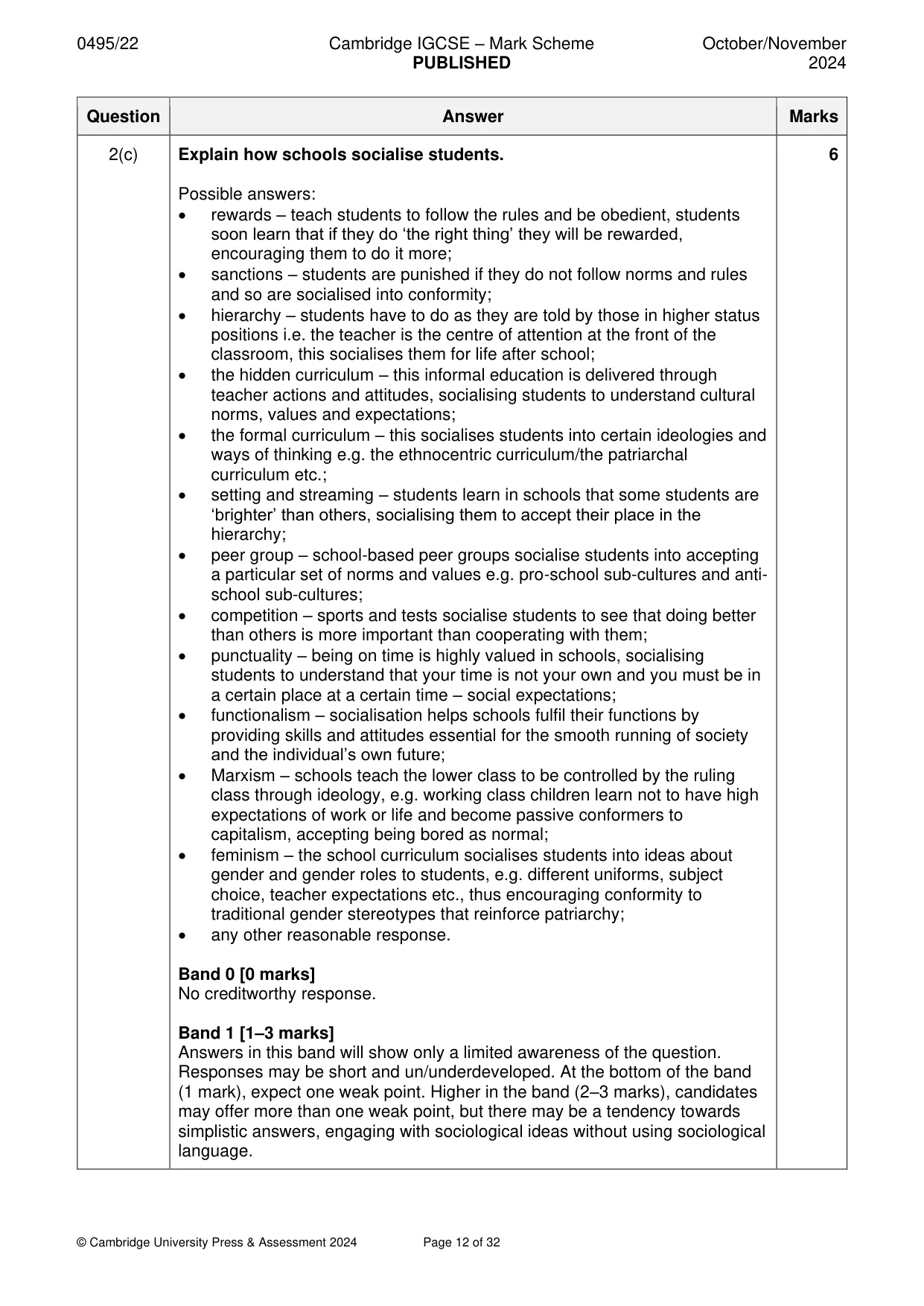
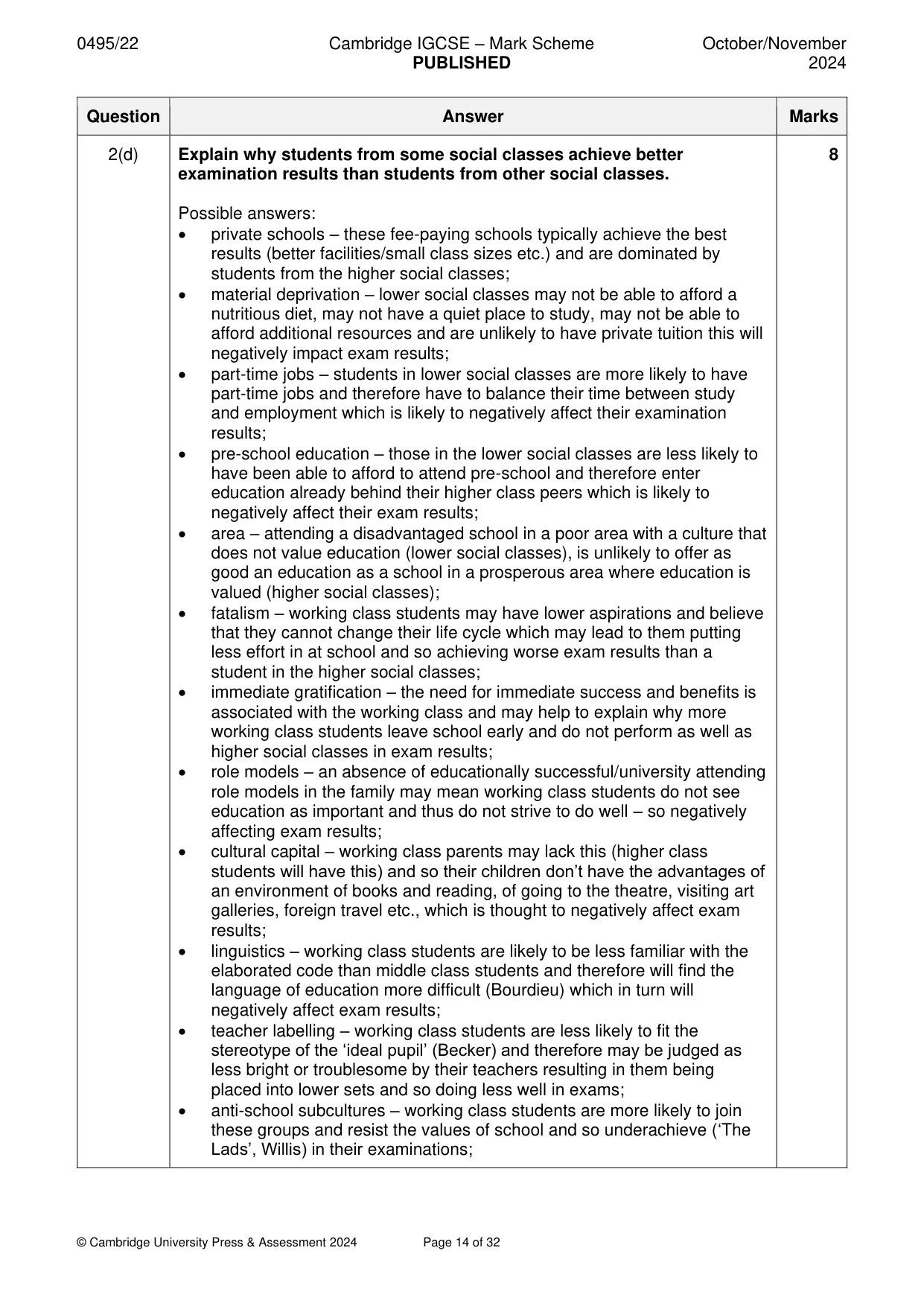
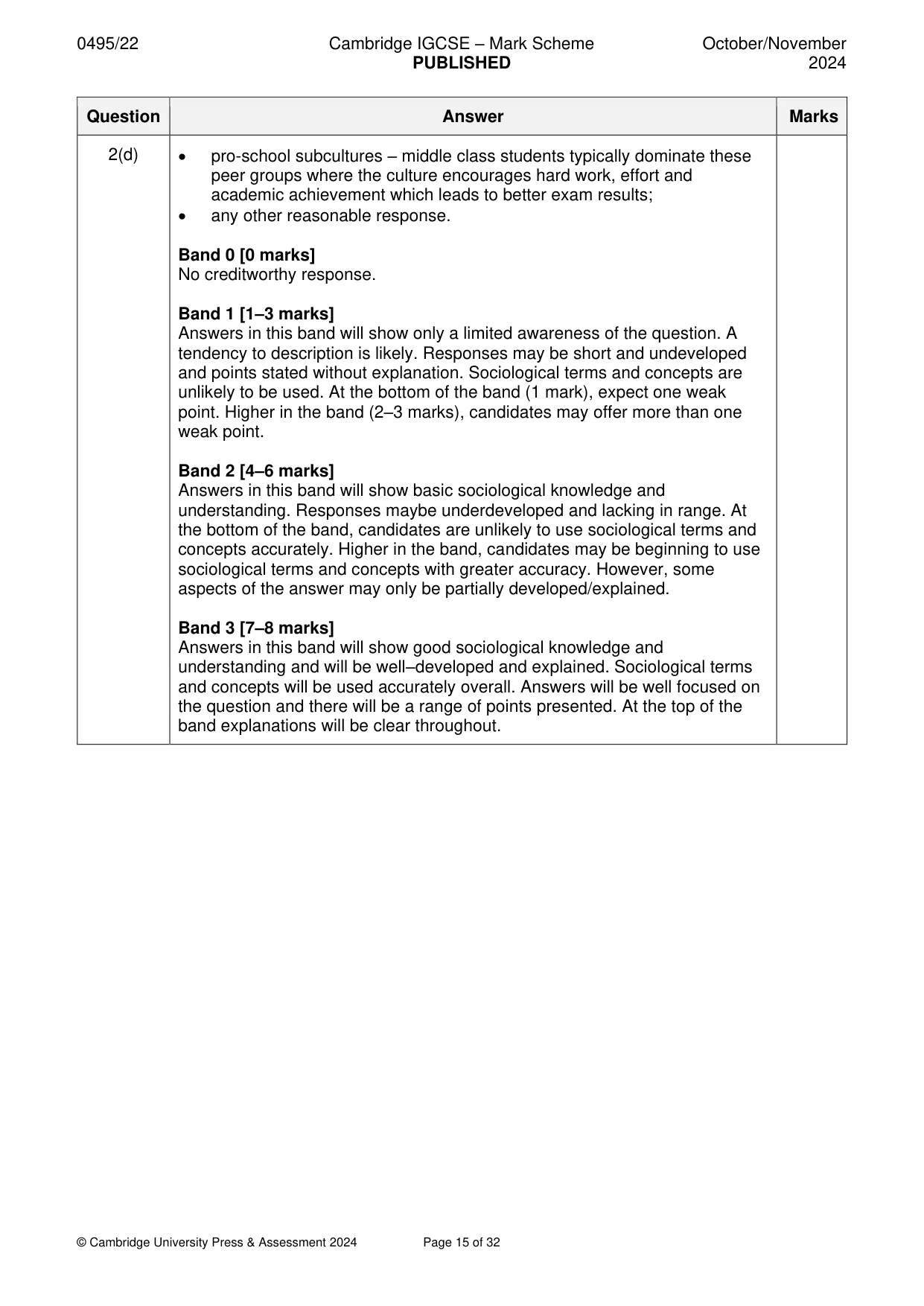
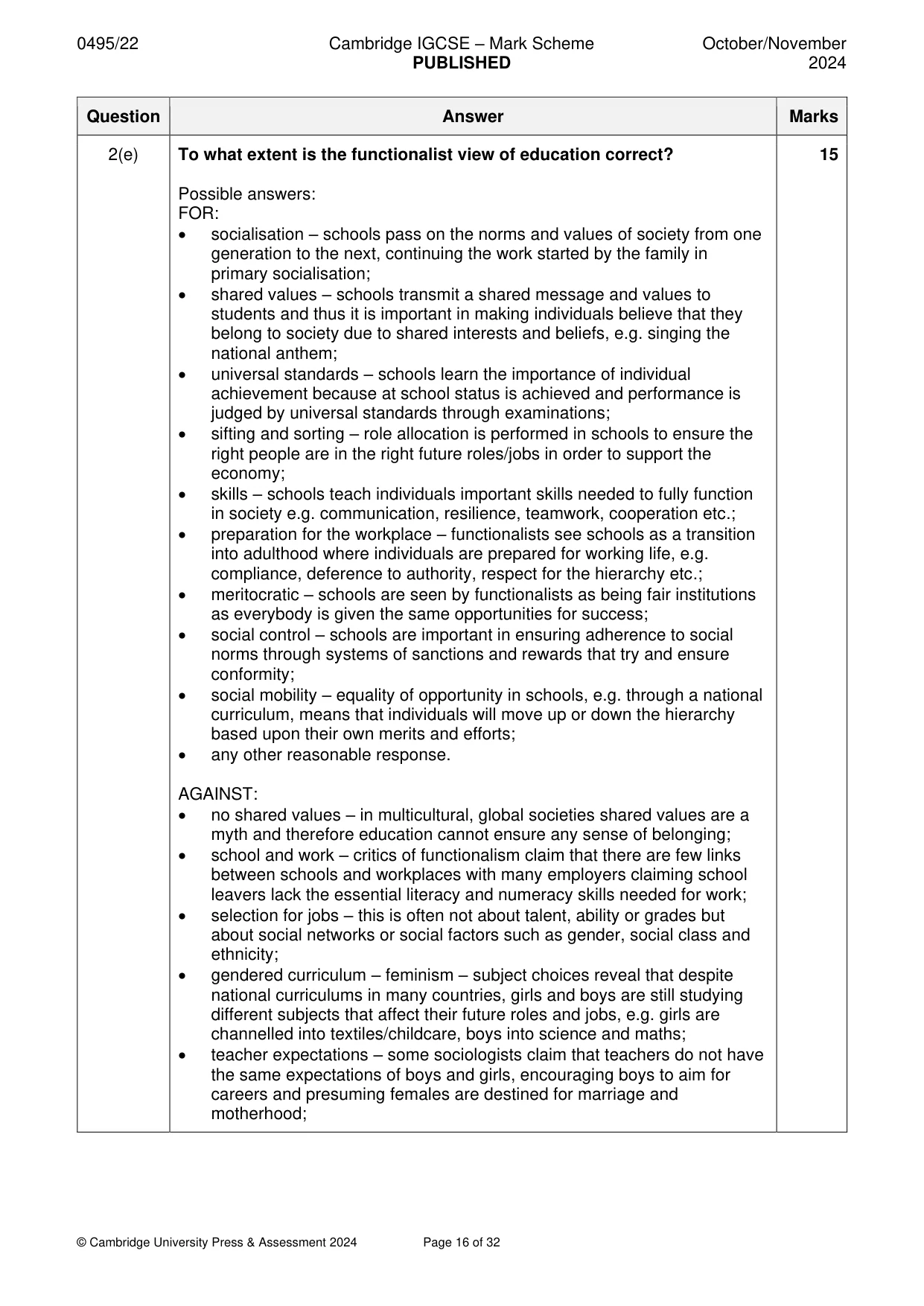
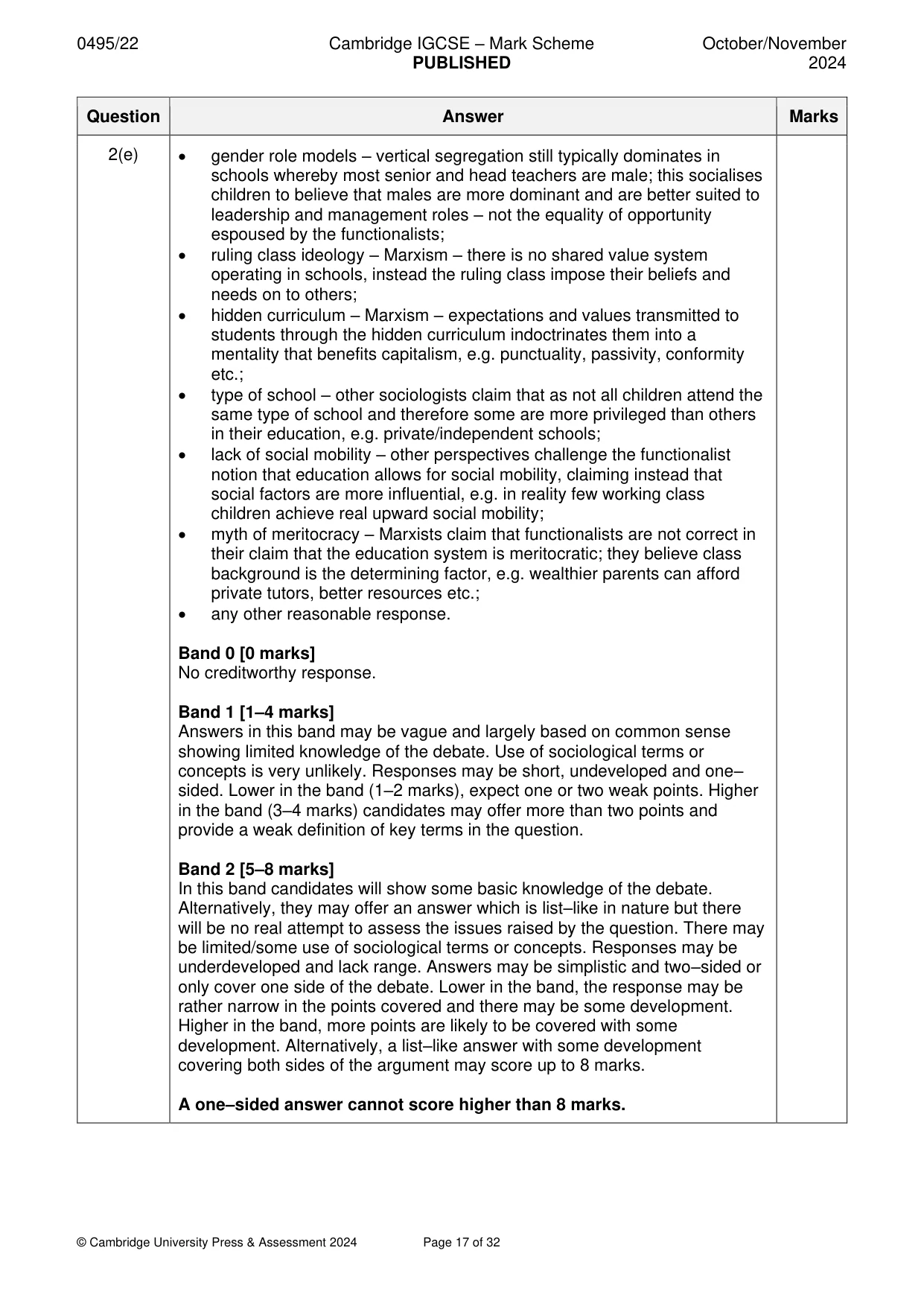
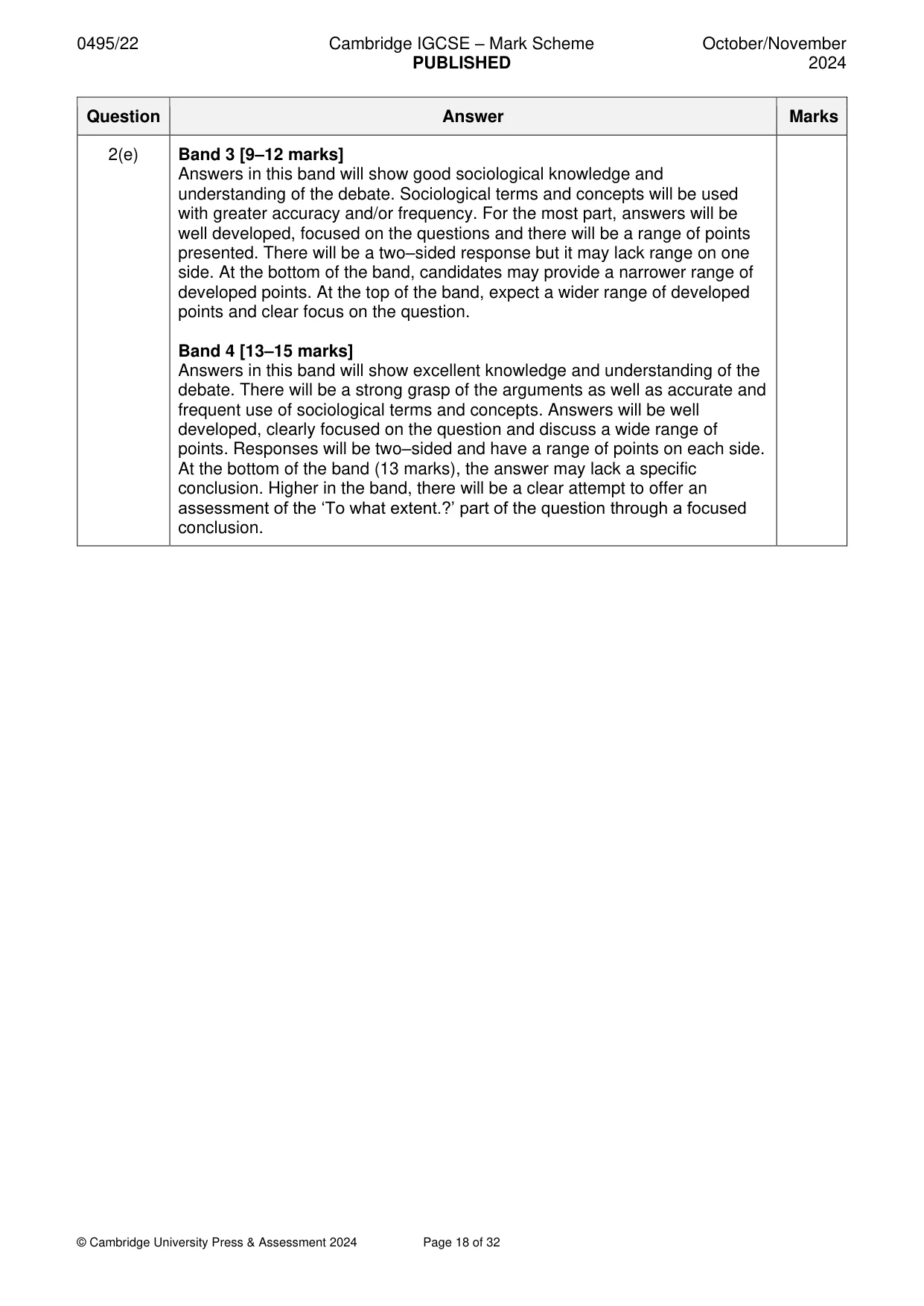
Mark scheme: 2(a) What is meant by the term ‘IQ tests’? 2 One mark for partial definition e.g. testing intelligence. Two marks for clear definition e.g. participants answer questions that are then used to measure how intelligent someone is. 2(b) Describe two types of schools that select their students. 4 Possible answers: • faith schools – select their pupils based on the family’s religious beliefs and faith, e.g. Catholic schools; • private/independent schools – pupils are selected based on whether their parents can afford the fees and/or the student’s ability (sometimes this is also accompanied by a selection test/interview/IQ test); • grammar school – students must sit and pass an 11+ entrance exam that allows the school to select students based on ability; • single-sex school – schools select students based upon their sex e.g. all boys or all girls; • any other reasonable response. One mark for each point correctly identified (up to a maximum of two). One mark for each point that is developed (up to a maximum of two). 2(c) Explain how schools socialise students. 6 Possible answers: • rewards – teach students to follow the rules and be obedient, students soon learn that if they do ‘the right thing’ they will be rewarded, encouraging them to do it more; • sanctions – students are punished if they do not follow norms and rules and so are socialised into conformity; • hierarchy – students have to do as they are told by those in higher status positions i.e. the teacher is the centre of attention at the front of the classroom, this socialises them for life after school; • the hidden curriculum – this informal education is delivered through teacher actions and attitudes, socialising students to understand cultural norms, values and expectations; • the formal curriculum – this socialises students into certain ideologies and ways of thinking e.g. the ethnocentric curriculum/the patriarchal curriculum etc.; • setting and streaming – students learn in schools that some students are ‘brighter’ than others, socialising them to accept their place in the hierarchy; • peer group – school-based peer groups socialise students into accepting a particular set of norms and values e.g. pro-school sub-cultures and anti- school sub-cultures; • competition – sports and tests socialise students to see that doing better than others is more important than cooperating with them; • punctuality – being on time is highly valued in schools, socialising students to understand that your time is not your own and you must be in a certain place at a certain time – social expectations; • functionalism – socialisation helps schools fulfil their functions by providing skills and attitudes essential for the smooth running of society and the individual’s own future; • Marxism – schools teach the lower class to be controlled by the ruling class through ideology, e.g. working class children learn not to have high expectations of work or life and become passive conformers to capitalism, accepting being bored as normal; • feminism – the school curriculum socialises students into ideas about gender and gender roles to students, e.g. different uniforms, subject choice, teacher expectations etc., thus encouraging conformity to traditional gender stereotypes that reinforce patriarchy; • any other reasonable response. Band 0 [0 marks] No creditworthy response. Band 1 [1–3 marks] Answers in this band will show only a limited awareness of the question. Responses may be short and un/underdeveloped. At the bottom of the band (1 mark), expect one weak point. Higher in the band (2–3 marks), candidates may offer more than one weak point, but there may be a tendency towards simplistic answers, engaging with sociological ideas without using sociological language. 2(c) Band 2 [4–6 marks] Answers in this band will have clear and accurate explanation, showing good sociological knowledge and understanding. Sociological terms and concepts should be expected and explained. At the bottom of the band, the range of points covered may be narrow or lack detail. Higher in the band, answers will cover more than one point in a well–developed way or cover several points in less detail. 2(d) Explain why students from some social classes achieve better 8 examination results than students from other social classes. Possible answers: • private schools – these fee-paying schools typically achieve the best results (better facilities/small class sizes etc.) and are dominated by students from the higher social classes; • material deprivation – lower social classes may not be able to afford a nutritious diet, may not have a quiet place to study, may not be able to afford additional resources and are unlikely to have private tuition this will negatively impact exam results; • part-time jobs – students in lower social classes are more likely to have part-time jobs and therefore have to balance their time between study and employment which is likely to negatively affect their examination results; • pre-school education – those in the lower social classes are less likely to have been able to afford to attend pre-school and therefore enter education already behind their higher class peers which is likely to negatively affect their exam results; • area – attending a disadvantaged school in a poor area with a culture that does not value education (lower social classes), is unlikely to offer as good an education as a school in a prosperous area where education is valued (higher social classes); • fatalism – working class students may have lower aspirations and believe that they cannot change their life cycle which may lead to them putting less effort in at school and so achieving worse exam results than a student in the higher social classes; • immediate gratification – the need for immediate success and benefits is associated with the working class and may help to explain why more working class students leave school early and do not perform as well as higher social classes in exam results; • role models – an absence of educationally successful/university attending role models in the family may mean working class students do not see education as important and thus do not strive to do well – so negatively affecting exam results; • cultural capital – working class parents may lack this (higher class students will have this) and so their children don’t have the advantages of an environment of books and reading, of going to the theatre, visiting art galleries, foreign travel etc., which is thought to negatively affect exam results; • linguistics – working class students are likely to be less familiar with the elaborated code than middle class students and therefore will find the language of education more difficult (Bourdieu) which in turn will negatively affect exam results; • teacher labelling – working class students are less likely to fit the stereotype of the ‘ideal pupil’ (Becker) and therefore may be judged as less bright or troublesome by their teachers resulting in them being placed into lower sets and so doing less well in exams; • anti-school subcultures – working class students are more likely to join these groups and resist the values of school and so underachieve (‘The Lads’, Willis) in their examinations; 2(d) • pro-school subcultures – middle class students typically dominate these peer groups where the culture encourages hard work, effort and academic achievement which leads to better exam results; • any other reasonable response. Band 0 [0 marks] No creditworthy response. Band 1 [1–3 marks] Answers in this band will show only a limited awareness of the question. A tendency to description is likely. Responses may be short and undeveloped and points stated without explanation. Sociological terms and concepts are unlikely to be used. At the bottom of the band (1 mark), expect one weak point. Higher in the band (2–3 marks), candidates may offer more than one weak point. Band 2 [4–6 marks] Answers in this band will show basic sociological knowledge and understanding. Responses maybe underdeveloped and lacking in range. At the bottom of the band, candidates are unlikely to use sociological terms and concepts accurately. Higher in the band, candidates may be beginning to use sociological terms and concepts with greater accuracy. However, some aspects of the answer may only be partially developed/explained. Band 3 [7–8 marks] Answers in this band will show good sociological knowledge and understanding and will be well–developed and explained. Sociological terms and concepts will be used accurately overall. Answers will be well focused on the question and there will be a range of points presented. At the top of the band explanations will be clear throughout. 2(e) To what extent is the functionalist view of education correct? 15 Possible answers: FOR: • socialisation – schools pass on the norms and values of society from one generation to the next, continuing the work started by the family in primary socialisation; • shared values – schools transmit a shared message and values to students and thus it is important in making individuals believe that they belong to society due to shared interests and beliefs, e.g. singing the national anthem; • universal standards – schools learn the importance of individual achievement because at school status is achieved and performance is judged by universal standards through examinations; • sifting and sorting – role allocation is performed in schools to ensure the right people are in the right future roles/jobs in order to support the economy; • skills – schools teach individuals important skills needed to fully function in society e.g. communication, resilience, teamwork, cooperation etc.; • preparation for the workplace – functionalists see schools as a transition into adulthood where individuals are prepared for working life, e.g. compliance, deference to authority, respect for the hierarchy etc.; • meritocratic – schools are seen by functionalists as being fair institutions as everybody is given the same opportunities for success; • social control – schools are important in ensuring adherence to social norms through systems of sanctions and rewards that try and ensure conformity; • social mobility – equality of opportunity in schools, e.g. through a national curriculum, means that individuals will move up or down the hierarchy based upon their own merits and efforts; • any other reasonable response. AGAINST: • no shared values – in multicultural, global societies shared values are a myth and therefore education cannot ensure any sense of belonging; • school and work – critics of functionalism claim that there are few links between schools and workplaces with many employers claiming school leavers lack the essential literacy and numeracy skills needed for work; • selection for jobs – this is often not about talent, ability or grades but about social networks or social factors such as gender, social class and ethnicity; • gendered curriculum – feminism – subject choices reveal that despite national curriculums in many countries, girls and boys are still studying different subjects that affect their future roles and jobs, e.g. girls are channelled into textiles/childcare, boys into science and maths; • teacher expectations – some sociologists claim that teachers do not have the same expectations of boys and girls, encouraging boys to aim for careers and presuming females are destined for marriage and motherhood; 2(e) • gender role models – vertical segregation still typically dominates in schools whereby most senior and head teachers are male; this socialises children to believe that males are more dominant and are better suited to leadership and management roles – not the equality of opportunity espoused by the functionalists; • ruling class ideology – Marxism – there is no shared value system operating in schools, instead the ruling class impose their beliefs and needs on to others; • hidden curriculum – Marxism – expectations and values transmitted to students through the hidden curriculum indoctrinates them into a mentality that benefits capitalism, e.g. punctuality, passivity, conformity etc.; • type of school – other sociologists claim that as not all children attend the same type of school and therefore some are more privileged than others in their education, e.g. private/independent schools; • lack of social mobility – other perspectives challenge the functionalist notion that education allows for social mobility, claiming instead that social factors are more influential, e.g. in reality few working class children achieve real upward social mobility; • myth of meritocracy – Marxists claim that functionalists are not correct in their claim that the education system is meritocratic; they believe class background is the determining factor, e.g. wealthier parents can afford private tutors, better resources etc.; • any other reasonable response. Band 0 [0 marks] No creditworthy response. Band 1 [1–4 marks] Answers in this band may be vague and largely based on common sense showing limited knowledge of the debate. Use of sociological terms or concepts is very unlikely. Responses may be short, undeveloped and one– sided. Lower in the band (1–2 marks), expect one or two weak points. Higher in the band (3–4 marks) candidates may offer more than two points and provide a weak definition of key terms in the question. Band 2 [5–8 marks] In this band candidates will show some basic knowledge of the debate. Alternatively, they may offer an answer which is list–like in nature but there will be no real attempt to assess the issues raised by the question. There may be limited/some use of sociological terms or concepts. Responses may be underdeveloped and lack range. Answers may be simplistic and two–sided or only cover one side of the debate. Lower in the band, the response may be rather narrow in the points covered and there may be some development. Higher in the band, more points are likely to be covered with some development. Alternatively, a list–like answer with some development covering both sides of the argument may score up to 8 marks. A one–sided answer cannot score higher than 8 marks. 2(e) Band 3 [9–12 marks] Answers in this band will show good sociological knowledge and understanding of the debate. Sociological terms and concepts will be used with greater accuracy and/or frequency. For the most part, answers will be well developed, focused on the questions and there will be a range of points presented. There will be a two–sided response but it may lack range on one side. At the bottom of the band, candidates may provide a narrower range of developed points. At the top of the band, expect a wider range of developed points and clear focus on the question. Band 4 [13–15 marks] Answers in this band will show excellent knowledge and understanding of the debate. There will be a strong grasp of the arguments as well as accurate and frequent use of sociological terms and concepts. Answers will be well developed, clearly focused on the question and discuss a wide range of points. Responses will be two–sided and have a range of points on each side. At the bottom of the band (13 marks), the answer may lack a specific conclusion. Higher in the band, there will be a clear attempt to offer an assessment of the ‘To what extent.?’ part of the question through a focused conclusion.
More questions on How do sociologists approach the study of society?
Q3 · Official crime statistics show how much crime has been committed in society
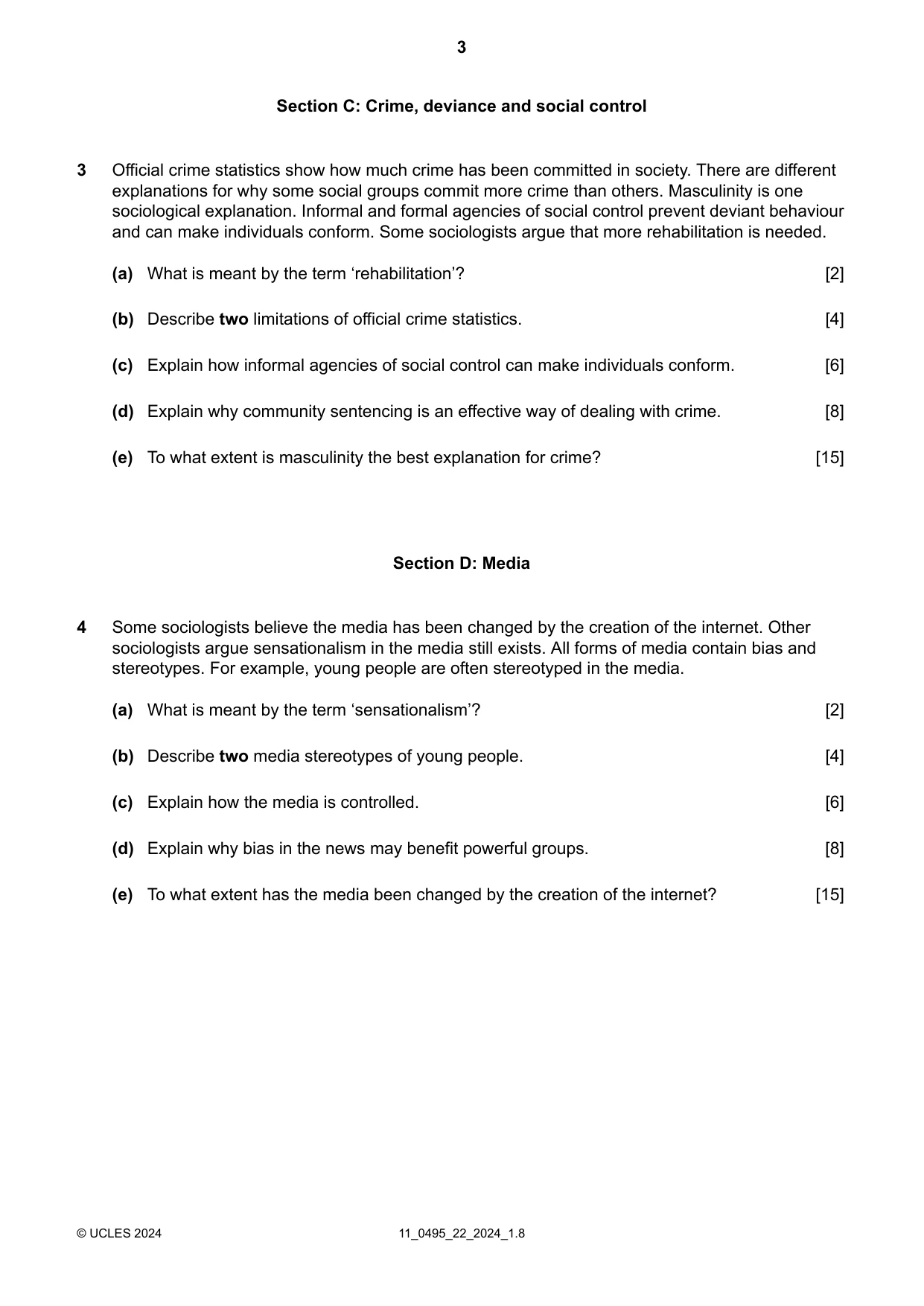
3 Official crime statistics show how much crime has been committed in society. There are different explanations for why some social groups commit more crime than others. Masculinity is one sociological explanation. Informal and formal agencies of social control prevent deviant behaviour and can make individuals conform. Some sociologists argue that more rehabilitation is needed. (a) What is meant by the term ‘rehabilitation’? [2] (b) Describe two limitations of official crime statistics. [4] (c) Explain how informal agencies of social control can make individuals conform. [6] (d) Explain why community sentencing is an effective way of dealing with crime. [8] (e) To what extent is masculinity the best explanation for crime? [15] Section D: Media
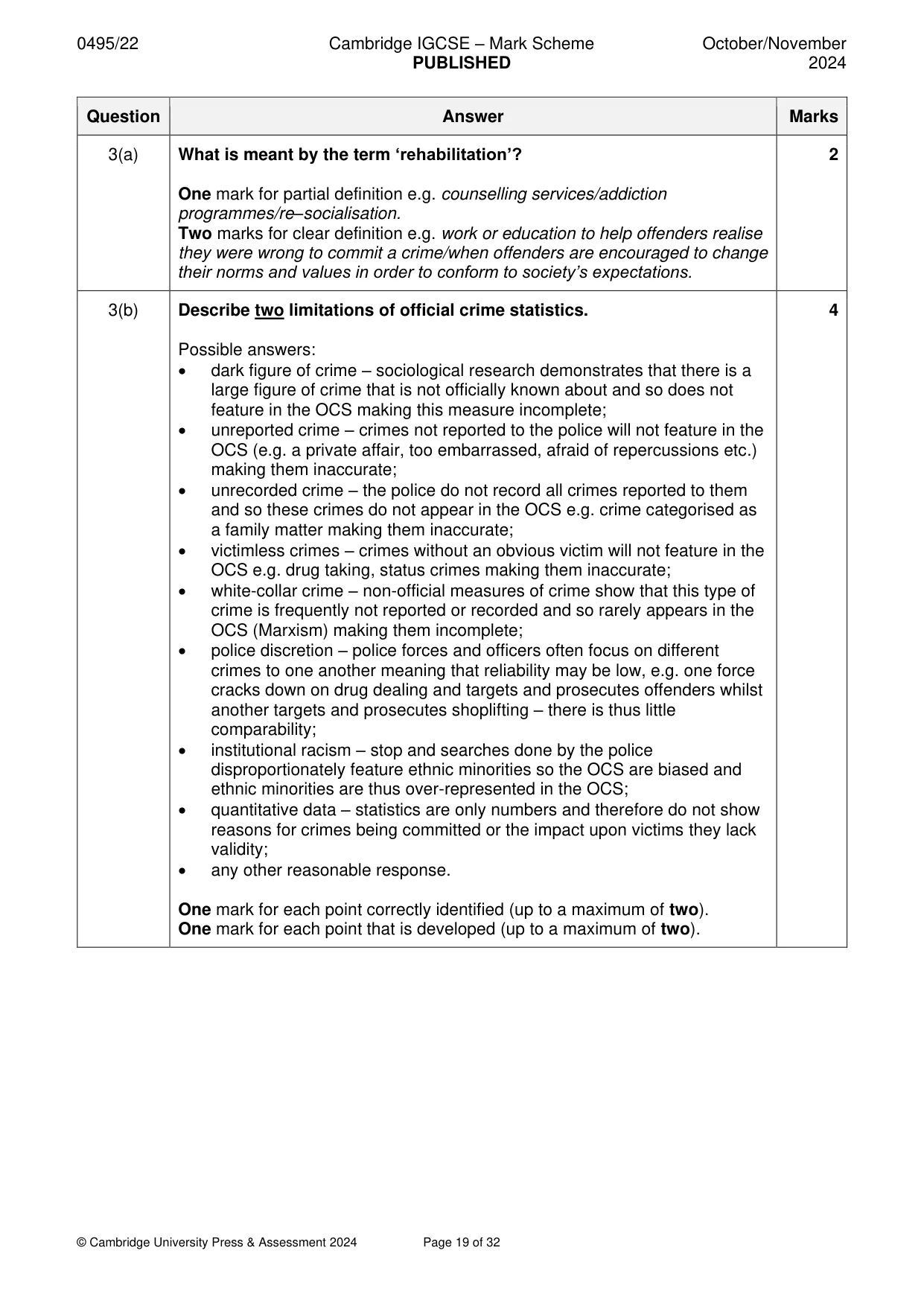
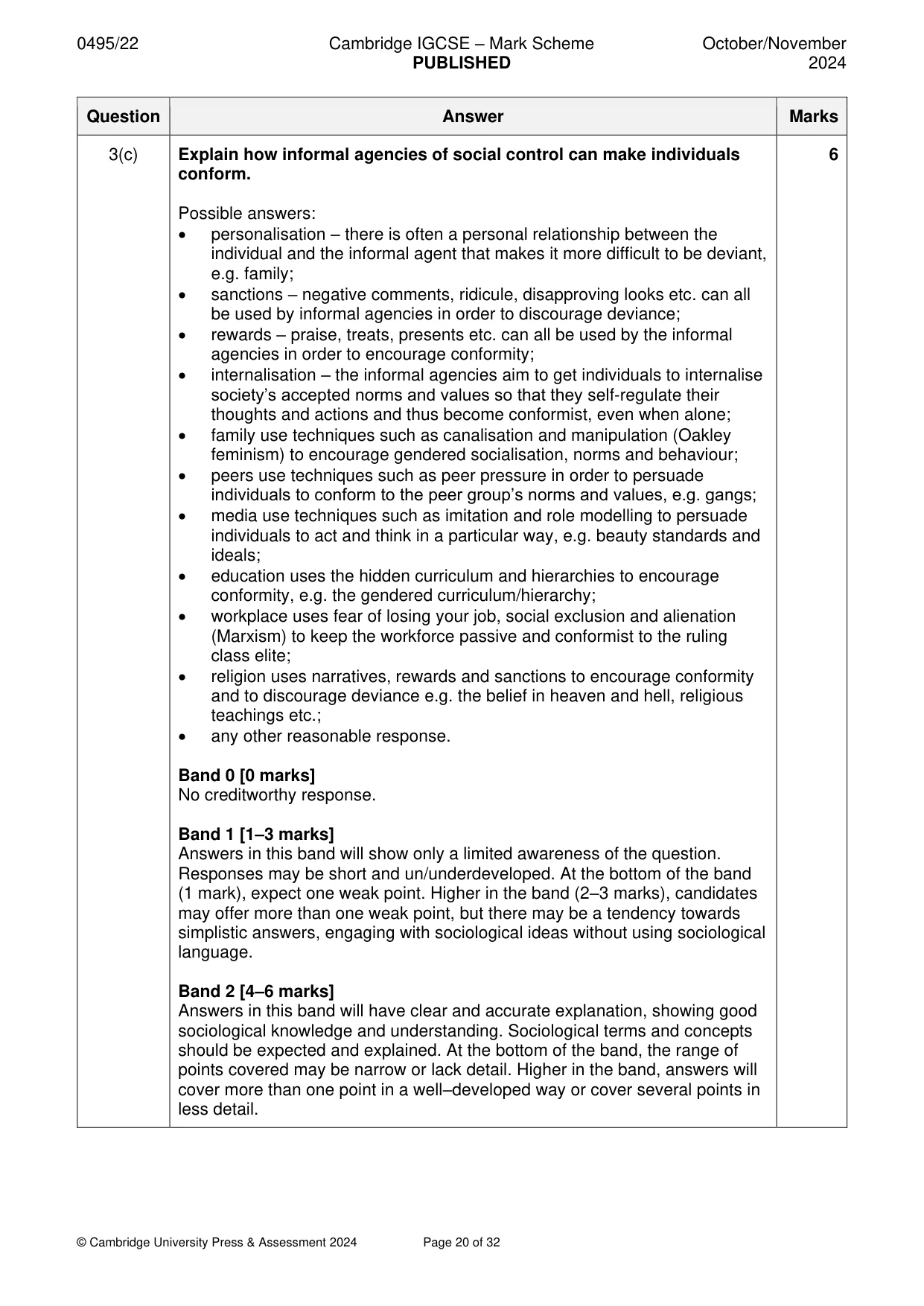
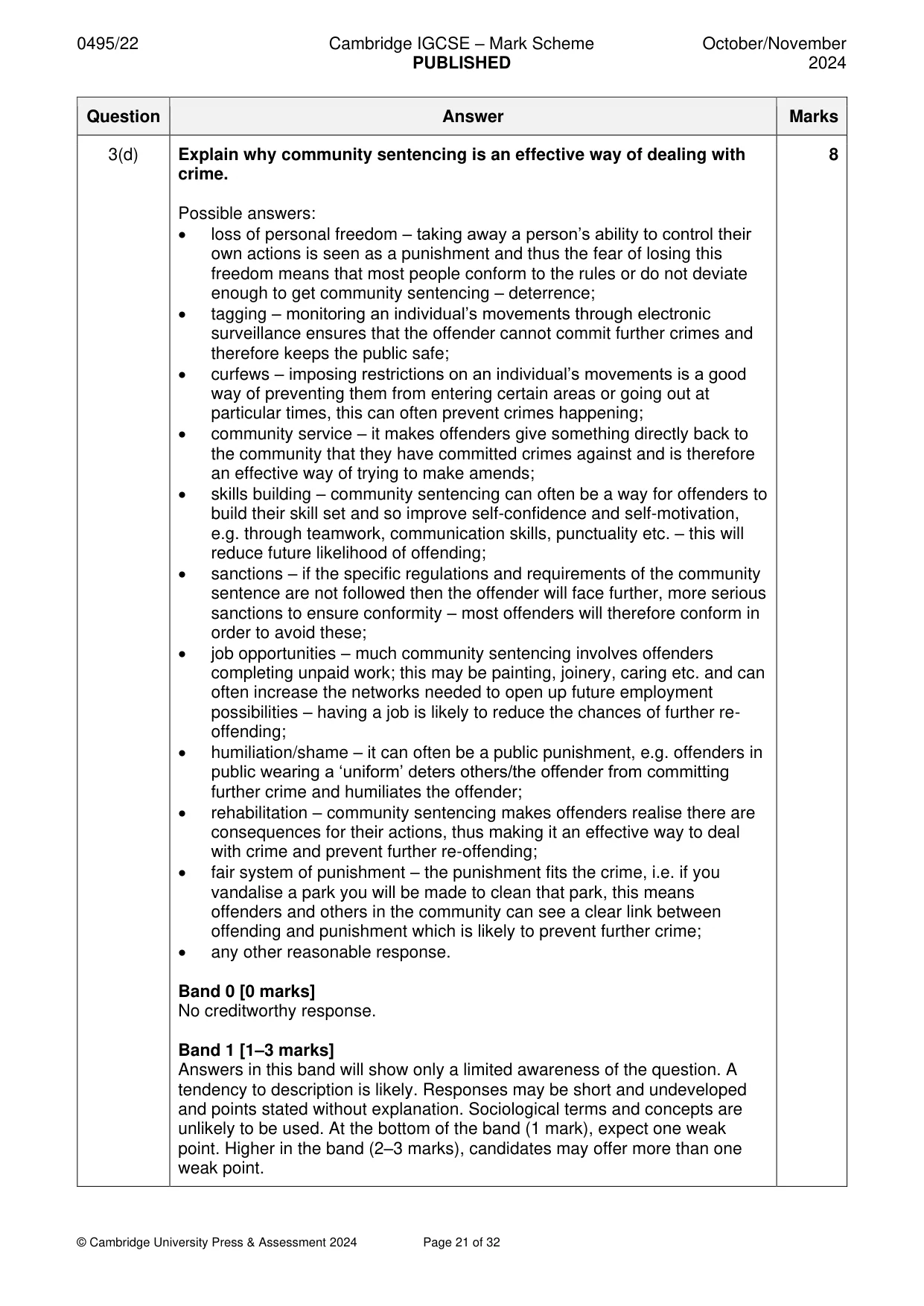
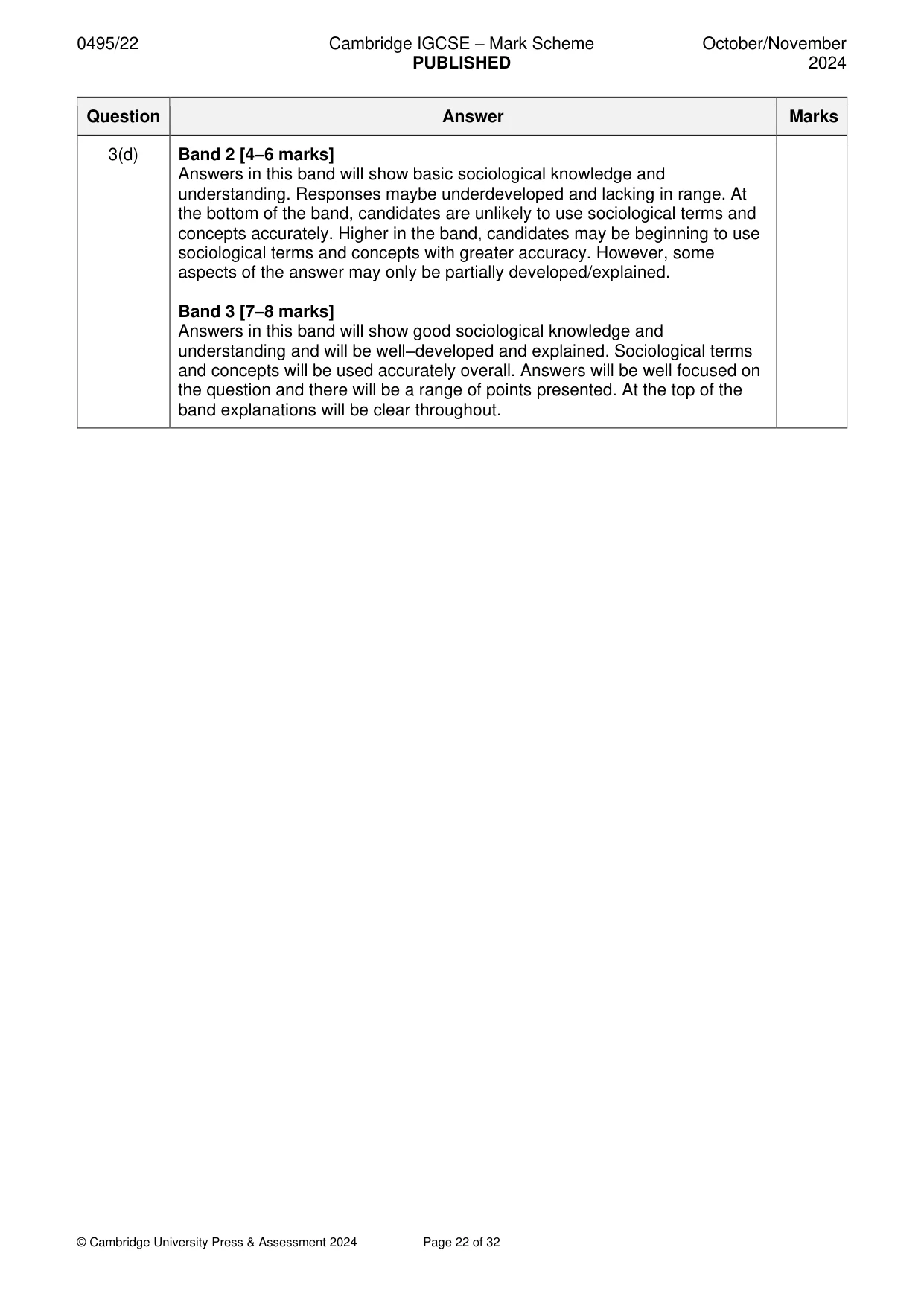
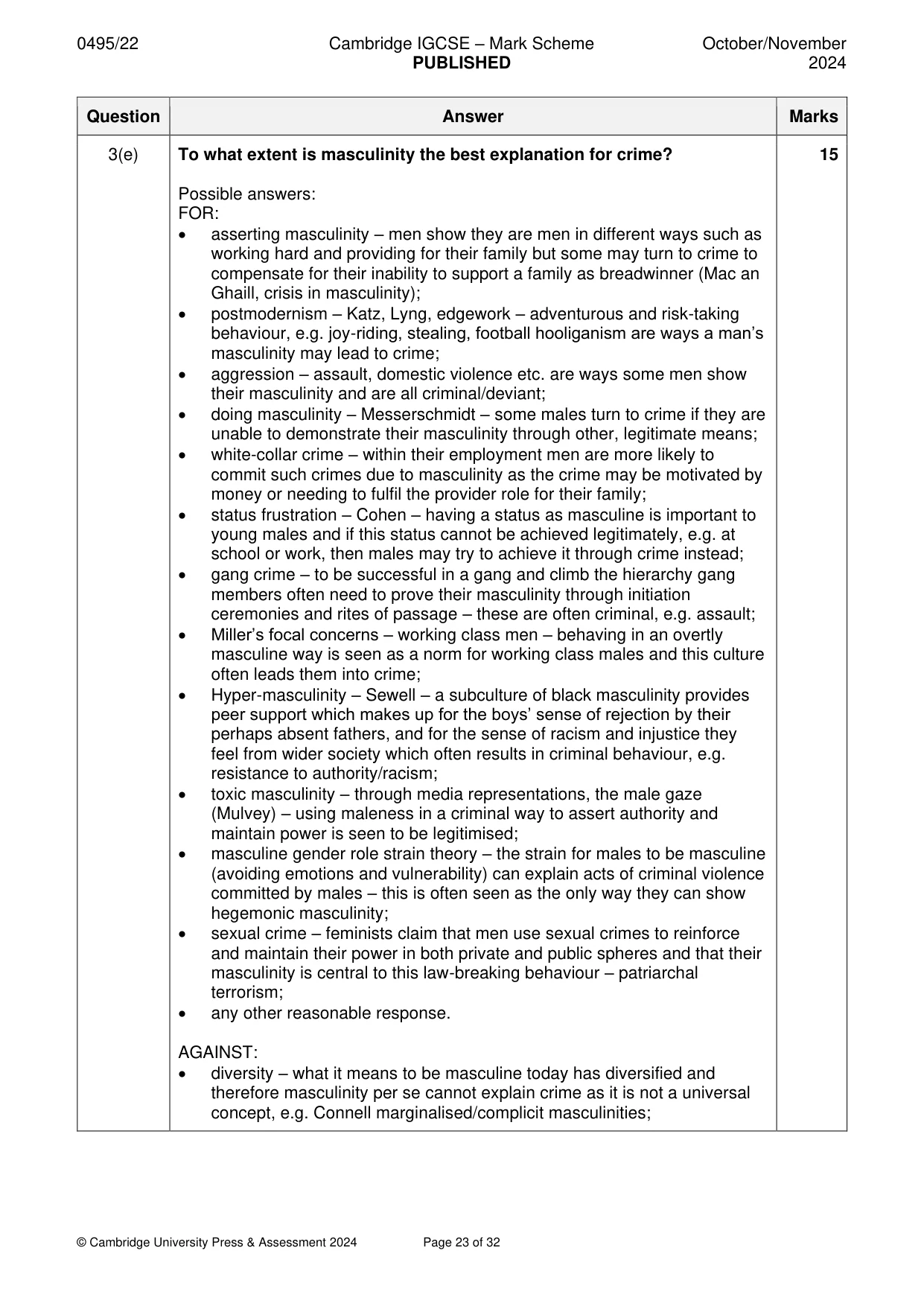
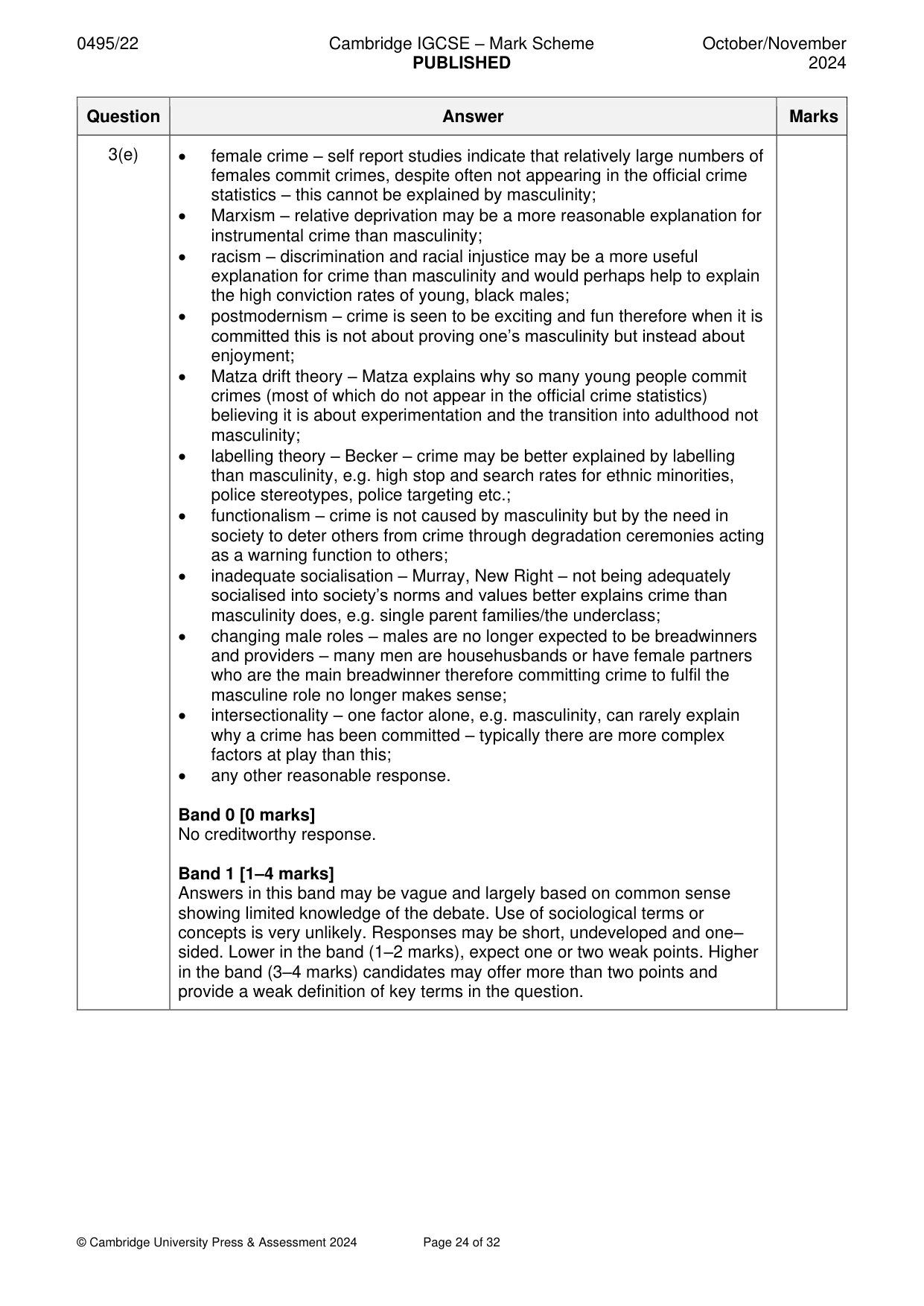
Mark scheme: 3(a) What is meant by the term ‘rehabilitation’? 2 One mark for partial definition e.g. counselling services/addiction programmes/re–socialisation. Two marks for clear definition e.g. work or education to help offenders realise they were wrong to commit a crime/when offenders are encouraged to change their norms and values in order to conform to society’s expectations. 3(b) Describe two limitations of official crime statistics. 4 Possible answers: • dark figure of crime – sociological research demonstrates that there is a large figure of crime that is not officially known about and so does not feature in the OCS making this measure incomplete; • unreported crime – crimes not reported to the police will not feature in the OCS (e.g. a private affair, too embarrassed, afraid of repercussions etc.) making them inaccurate; • unrecorded crime – the police do not record all crimes reported to them and so these crimes do not appear in the OCS e.g. crime categorised as a family matter making them inaccurate; • victimless crimes – crimes without an obvious victim will not feature in the OCS e.g. drug taking, status crimes making them inaccurate; • white-collar crime – non-official measures of crime show that this type of crime is frequently not reported or recorded and so rarely appears in the OCS (Marxism) making them incomplete; • police discretion – police forces and officers often focus on different crimes to one another meaning that reliability may be low, e.g. one force cracks down on drug dealing and targets and prosecutes offenders whilst another targets and prosecutes shoplifting – there is thus little comparability; • institutional racism – stop and searches done by the police disproportionately feature ethnic minorities so the OCS are biased and ethnic minorities are thus over-represented in the OCS; • quantitative data – statistics are only numbers and therefore do not show reasons for crimes being committed or the impact upon victims they lack validity; • any other reasonable response. One mark for each point correctly identified (up to a maximum of two). One mark for each point that is developed (up to a maximum of two). 3(c) Explain how informal agencies of social control can make individuals 6 conform. Possible answers: • personalisation – there is often a personal relationship between the individual and the informal agent that makes it more difficult to be deviant, e.g. family; • sanctions – negative comments, ridicule, disapproving looks etc. can all be used by informal agencies in order to discourage deviance; • rewards – praise, treats, presents etc. can all be used by the informal agencies in order to encourage conformity; • internalisation – the informal agencies aim to get individuals to internalise society’s accepted norms and values so that they self-regulate their thoughts and actions and thus become conformist, even when alone; • family use techniques such as canalisation and manipulation (Oakley feminism) to encourage gendered socialisation, norms and behaviour; • peers use techniques such as peer pressure in order to persuade individuals to conform to the peer group’s norms and values, e.g. gangs; • media use techniques such as imitation and role modelling to persuade individuals to act and think in a particular way, e.g. beauty standards and ideals; • education uses the hidden curriculum and hierarchies to encourage conformity, e.g. the gendered curriculum/hierarchy; • workplace uses fear of losing your job, social exclusion and alienation (Marxism) to keep the workforce passive and conformist to the ruling class elite; • religion uses narratives, rewards and sanctions to encourage conformity and to discourage deviance e.g. the belief in heaven and hell, religious teachings etc.; • any other reasonable response. Band 0 [0 marks] No creditworthy response. Band 1 [1–3 marks] Answers in this band will show only a limited awareness of the question. Responses may be short and un/underdeveloped. At the bottom of the band (1 mark), expect one weak point. Higher in the band (2–3 marks), candidates may offer more than one weak point, but there may be a tendency towards simplistic answers, engaging with sociological ideas without using sociological language. Band 2 [4–6 marks] Answers in this band will have clear and accurate explanation, showing good sociological knowledge and understanding. Sociological terms and concepts should be expected and explained. At the bottom of the band, the range of points covered may be narrow or lack detail. Higher in the band, answers will cover more than one point in a well–developed way or cover several points in less detail. 3(d) Explain why community sentencing is an effective way of dealing with 8 crime. Possible answers: • loss of personal freedom – taking away a person’s ability to control their own actions is seen as a punishment and thus the fear of losing this freedom means that most people conform to the rules or do not deviate enough to get community sentencing – deterrence; • tagging – monitoring an individual’s movements through electronic surveillance ensures that the offender cannot commit further crimes and therefore keeps the public safe; • curfews – imposing restrictions on an individual’s movements is a good way of preventing them from entering certain areas or going out at particular times, this can often prevent crimes happening; • community service – it makes offenders give something directly back to the community that they have committed crimes against and is therefore an effective way of trying to make amends; • skills building – community sentencing can often be a way for offenders to build their skill set and so improve self-confidence and self-motivation, e.g. through teamwork, communication skills, punctuality etc. – this will reduce future likelihood of offending; • sanctions – if the specific regulations and requirements of the community sentence are not followed then the offender will face further, more serious sanctions to ensure conformity – most offenders will therefore conform in order to avoid these; • job opportunities – much community sentencing involves offenders completing unpaid work; this may be painting, joinery, caring etc. and can often increase the networks needed to open up future employment possibilities – having a job is likely to reduce the chances of further re- offending; • humiliation/shame – it can often be a public punishment, e.g. offenders in public wearing a ‘uniform’ deters others/the offender from committing further crime and humiliates the offender; • rehabilitation – community sentencing makes offenders realise there are consequences for their actions, thus making it an effective way to deal with crime and prevent further re-offending; • fair system of punishment – the punishment fits the crime, i.e. if you vandalise a park you will be made to clean that park, this means offenders and others in the community can see a clear link between offending and punishment which is likely to prevent further crime; • any other reasonable response. Band 0 [0 marks] No creditworthy response. Band 1 [1–3 marks] Answers in this band will show only a limited awareness of the question. A tendency to description is likely. Responses may be short and undeveloped and points stated without explanation. Sociological terms and concepts are unlikely to be used. At the bottom of the band (1 mark), expect one weak point. Higher in the band (2–3 marks), candidates may offer more than one weak point. 3(d) Band 2 [4–6 marks] Answers in this band will show basic sociological knowledge and understanding. Responses maybe underdeveloped and lacking in range. At the bottom of the band, candidates are unlikely to use sociological terms and concepts accurately. Higher in the band, candidates may be beginning to use sociological terms and concepts with greater accuracy. However, some aspects of the answer may only be partially developed/explained. Band 3 [7–8 marks] Answers in this band will show good sociological knowledge and understanding and will be well–developed and explained. Sociological terms and concepts will be used accurately overall. Answers will be well focused on the question and there will be a range of points presented. At the top of the band explanations will be clear throughout. 3(e) To what extent is masculinity the best explanation for crime? 15 Possible answers: FOR: • asserting masculinity – men show they are men in different ways such as working hard and providing for their family but some may turn to crime to compensate for their inability to support a family as breadwinner (Mac an Ghaill, crisis in masculinity); • postmodernism – Katz, Lyng, edgework – adventurous and risk-taking behaviour, e.g. joy-riding, stealing, football hooliganism are ways a man’s masculinity may lead to crime; • aggression – assault, domestic violence etc. are ways some men show their masculinity and are all criminal/deviant; • doing masculinity – Messerschmidt – some males turn to crime if they are unable to demonstrate their masculinity through other, legitimate means; • white-collar crime – within their employment men are more likely to commit such crimes due to masculinity as the crime may be motivated by money or needing to fulfil the provider role for their family; • status frustration – Cohen – having a status as masculine is important to young males and if this status cannot be achieved legitimately, e.g. at school or work, then males may try to achieve it through crime instead; • gang crime – to be successful in a gang and climb the hierarchy gang members often need to prove their masculinity through initiation ceremonies and rites of passage – these are often criminal, e.g. assault; • Miller’s focal concerns – working class men – behaving in an overtly masculine way is seen as a norm for working class males and this culture often leads them into crime; • Hyper-masculinity – Sewell – a subculture of black masculinity provides peer support which makes up for the boys’ sense of rejection by their perhaps absent fathers, and for the sense of racism and injustice they feel from wider society which often results in criminal behaviour, e.g. resistance to authority/racism; • toxic masculinity – through media representations, the male gaze (Mulvey) – using maleness in a criminal way to assert authority and maintain power is seen to be legitimised; • masculine gender role strain theory – the strain for males to be masculine (avoiding emotions and vulnerability) can explain acts of criminal violence committed by males – this is often seen as the only way they can show hegemonic masculinity; • sexual crime – feminists claim that men use sexual crimes to reinforce and maintain their power in both private and public spheres and that their masculinity is central to this law-breaking behaviour – patriarchal terrorism; • any other reasonable response. AGAINST: • diversity – what it means to be masculine today has diversified and therefore masculinity per se cannot explain crime as it is not a universal concept, e.g. Connell marginalised/complicit masculinities; 3(e) • female crime – self report studies indicate that relatively large numbers of females commit crimes, despite often not appearing in the official crime statistics – this cannot be explained by masculinity; • Marxism – relative deprivation may be a more reasonable explanation for instrumental crime than masculinity; • racism – discrimination and racial injustice may be a more useful explanation for crime than masculinity and would perhaps help to explain the high conviction rates of young, black males; • postmodernism – crime is seen to be exciting and fun therefore when it is committed this is not about proving one’s masculinity but instead about enjoyment; • Matza drift theory – Matza explains why so many young people commit crimes (most of which do not appear in the official crime statistics) believing it is about experimentation and the transition into adulthood not masculinity; • labelling theory – Becker – crime may be better explained by labelling than masculinity, e.g. high stop and search rates for ethnic minorities, police stereotypes, police targeting etc.; • functionalism – crime is not caused by masculinity but by the need in society to deter others from crime through degradation ceremonies acting as a warning function to others; • inadequate socialisation – Murray, New Right – not being adequately socialised into society’s norms and values better explains crime than masculinity does, e.g. single parent families/the underclass; • changing male roles – males are no longer expected to be breadwinners and providers – many men are househusbands or have female partners who are the main breadwinner therefore committing crime to fulfil the masculine role no longer makes sense; • intersectionality – one factor alone, e.g. masculinity, can rarely explain why a crime has been committed – typically there are more complex factors at play than this; • any other reasonable response. Band 0 [0 marks] No creditworthy response. Band 1 [1–4 marks] Answers in this band may be vague and largely based on common sense showing limited knowledge of the debate. Use of sociological terms or concepts is very unlikely. Responses may be short, undeveloped and one– sided. Lower in the band (1–2 marks), expect one or two weak points. Higher in the band (3–4 marks) candidates may offer more than two points and provide a weak definition of key terms in the question. 3(e) Band 2 [5–8 marks] In this band candidates will show some basic knowledge of the debate. Alternatively, they may offer an answer which is list–like in nature but there will be no real attempt to assess the issues raised by the question. There may be limited/some use of sociological terms or concepts. Responses may be underdeveloped and lack range. Answers may be simplistic and two–sided or only cover one side of the debate. Lower in the band, the response may be rather narrow in the points covered and there may be some development. Higher in the band, more points are likely to be covered with some development. Alternatively, a list–like answer with some development covering both sides of the argument may score up to 8 marks. A one–sided answer cannot score higher than 8 marks. Band 3 [9–12 marks] Answers in this band will show good sociological knowledge and understanding of the debate. Sociological terms and concepts will be used with greater accuracy and/or frequency. For the most part, answers will be well–developed, focused on the questions and there will be a range of points presented. There will be a two–sided response but it may lack range on one side. At the bottom of the band, candidates may provide a narrower range of developed points. At the top of the band, expect a wider range of developed points and clear focus on the question. Band 4 [13–15 marks] Answers in this band will show excellent knowledge and understanding of the debate. There will be a strong grasp of the arguments as well as accurate and frequent use of sociological terms and concepts. Answers will be well– developed, clearly focused on the question and discuss a wide range of points. Responses will be two–sided and have a range of points on each side. At the bottom of the band (13 marks), the answer may lack a specific conclusion. Higher in the band, there will be a clear attempt to offer an assessment of the ‘To what extent.?’ part of the question through a focused conclusion.
Q4 · Some sociologists believe the media has been changed by the creation of the internet
4 Some sociologists believe the media has been changed by the creation of the internet. Other sociologists argue sensationalism in the media still exists. All forms of media contain bias and stereotypes. For example, young people are often stereotyped in the media. (a) What is meant by the term ‘sensationalism’? [2] (b) Describe two media stereotypes of young people. [4] (c) Explain how the media is controlled. [6] (d) Explain why bias in the news may benefit powerful groups. [8] (e) To what extent has the media been changed by the creation of the internet? [15]
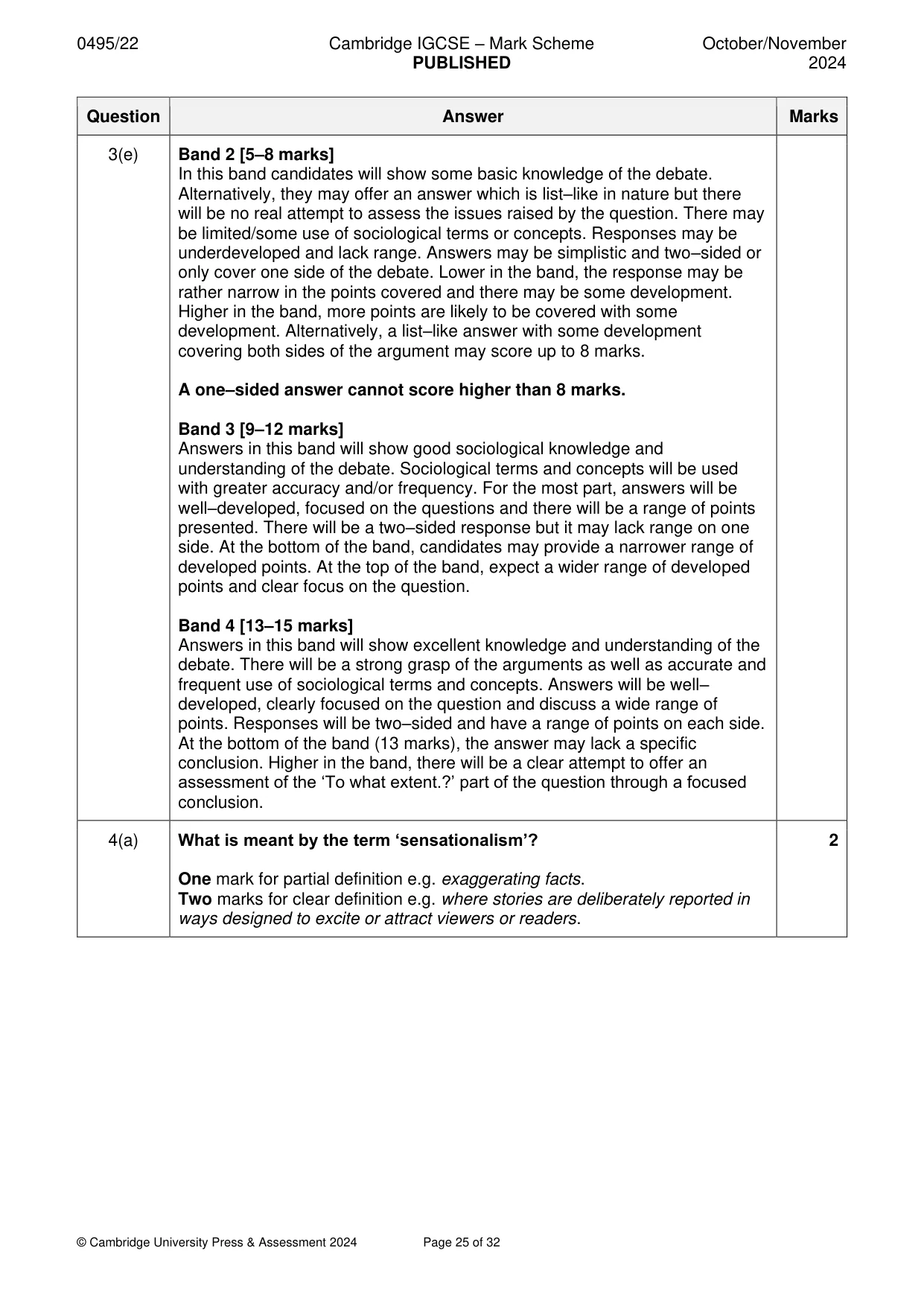
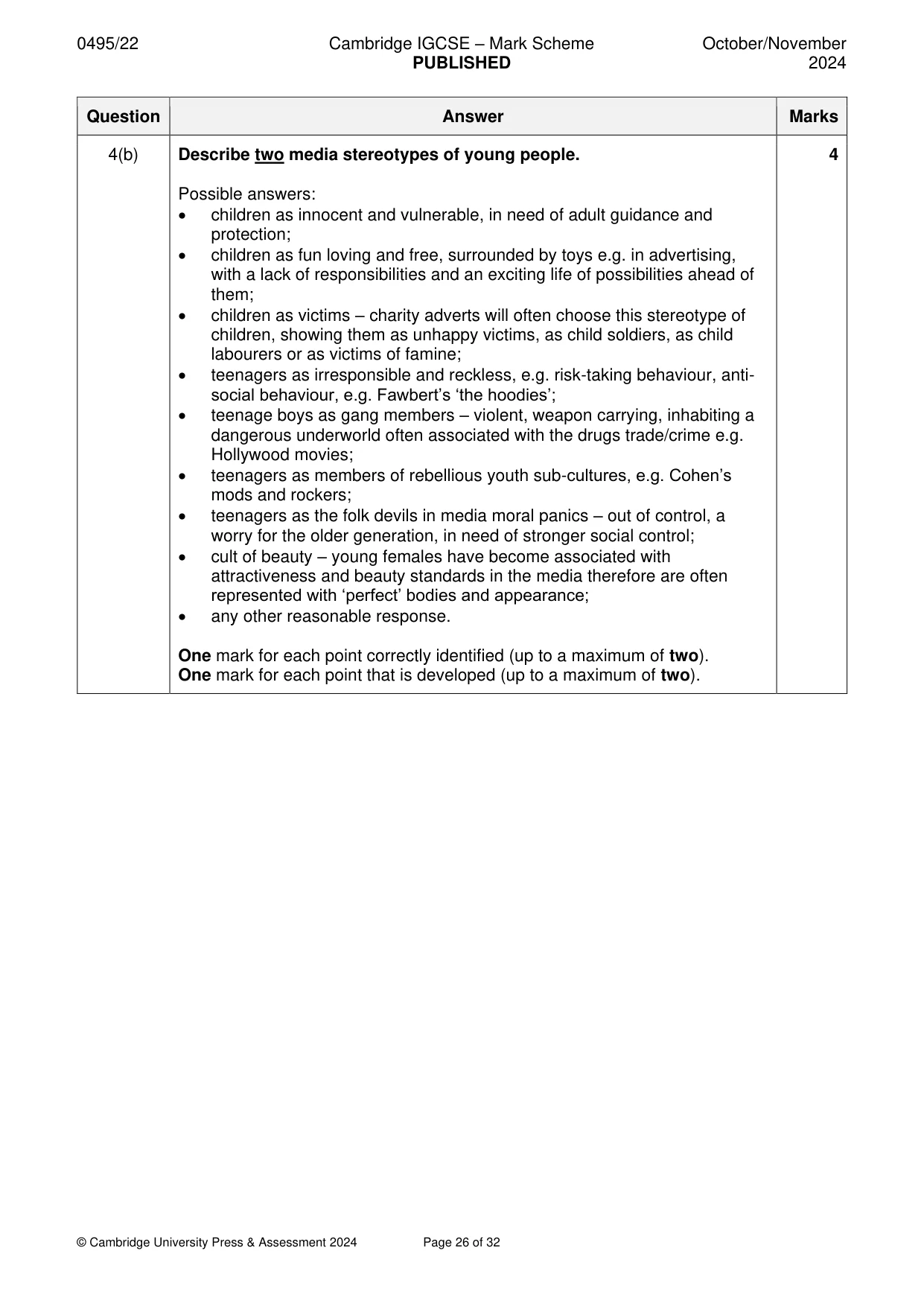
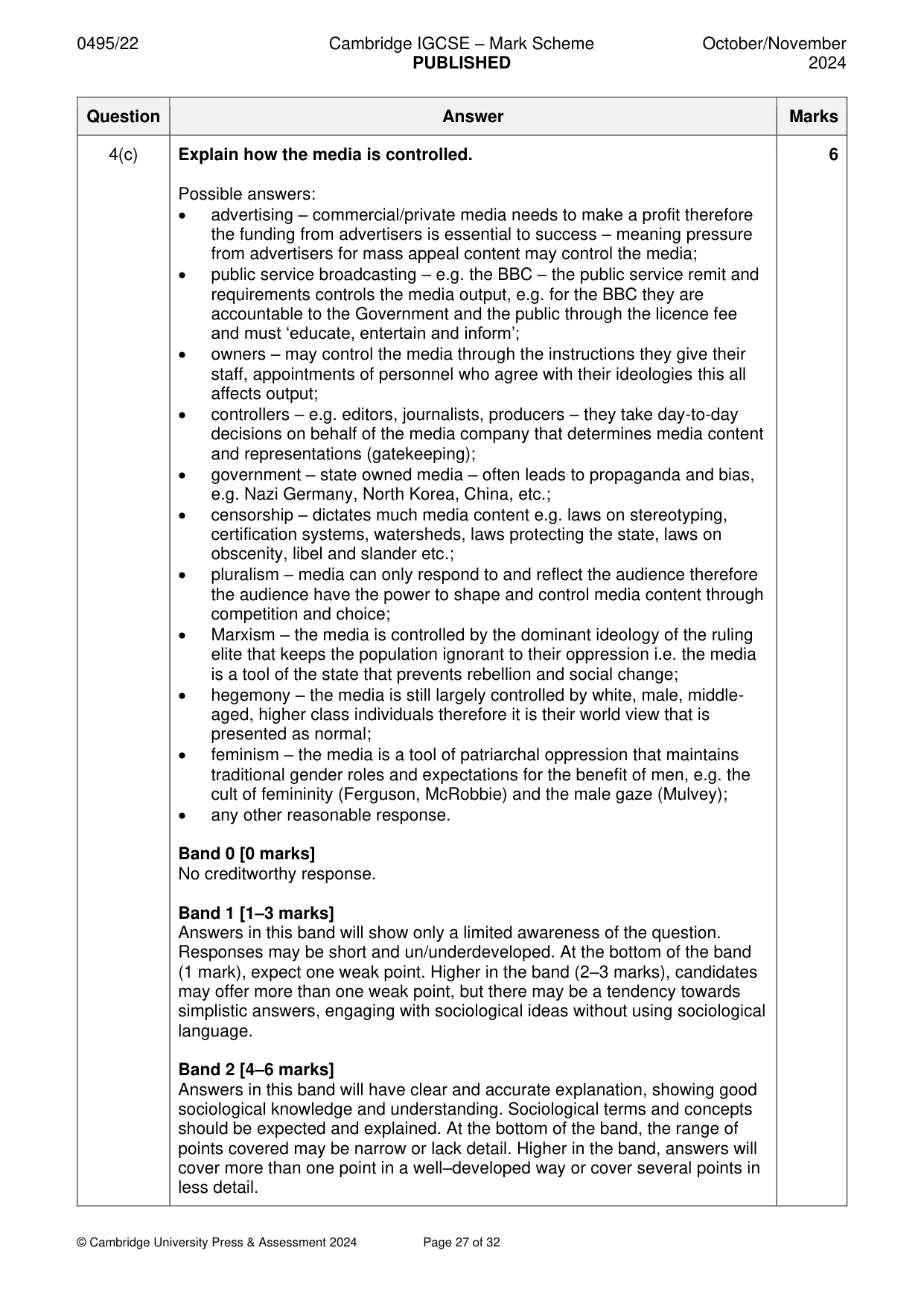
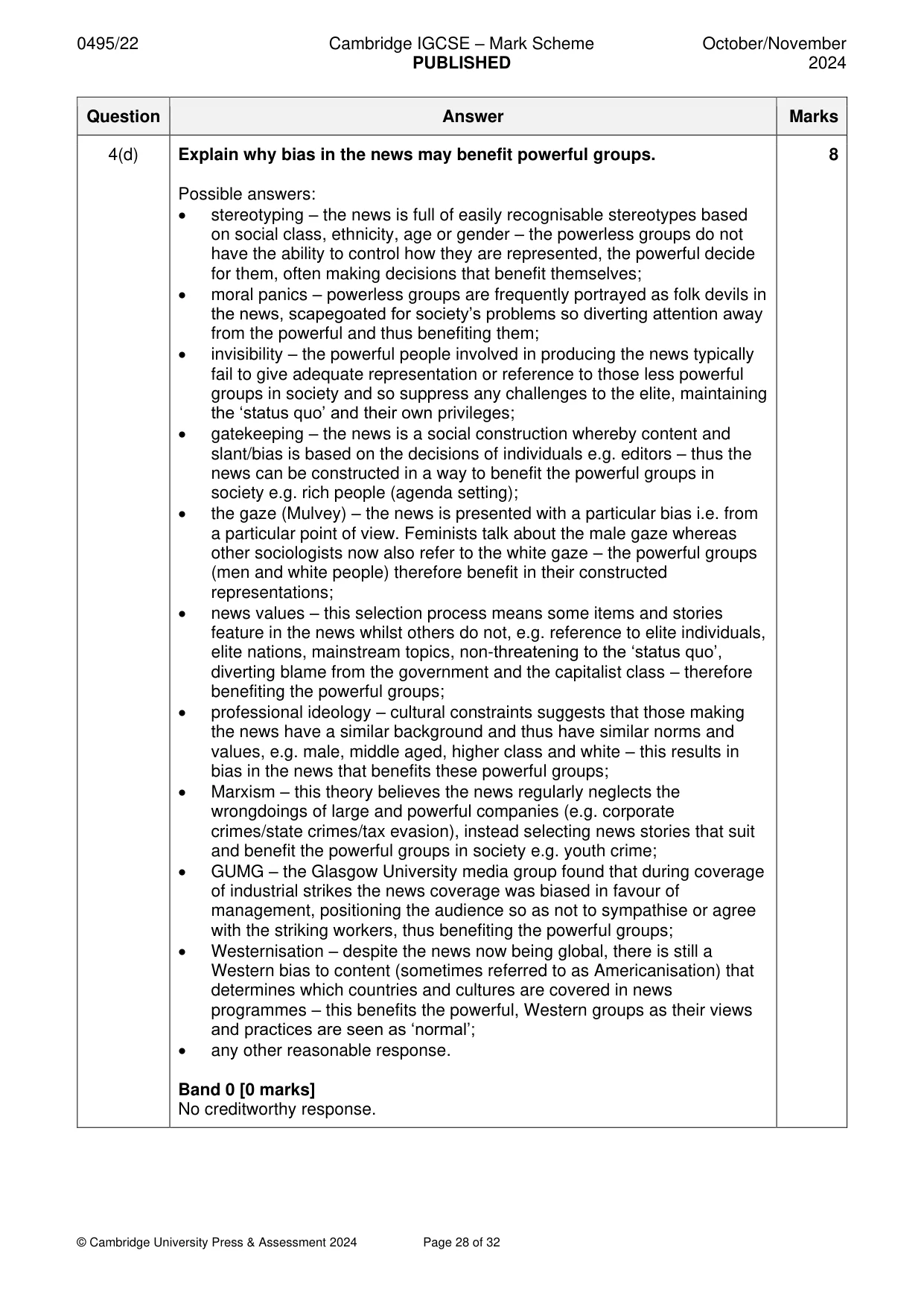
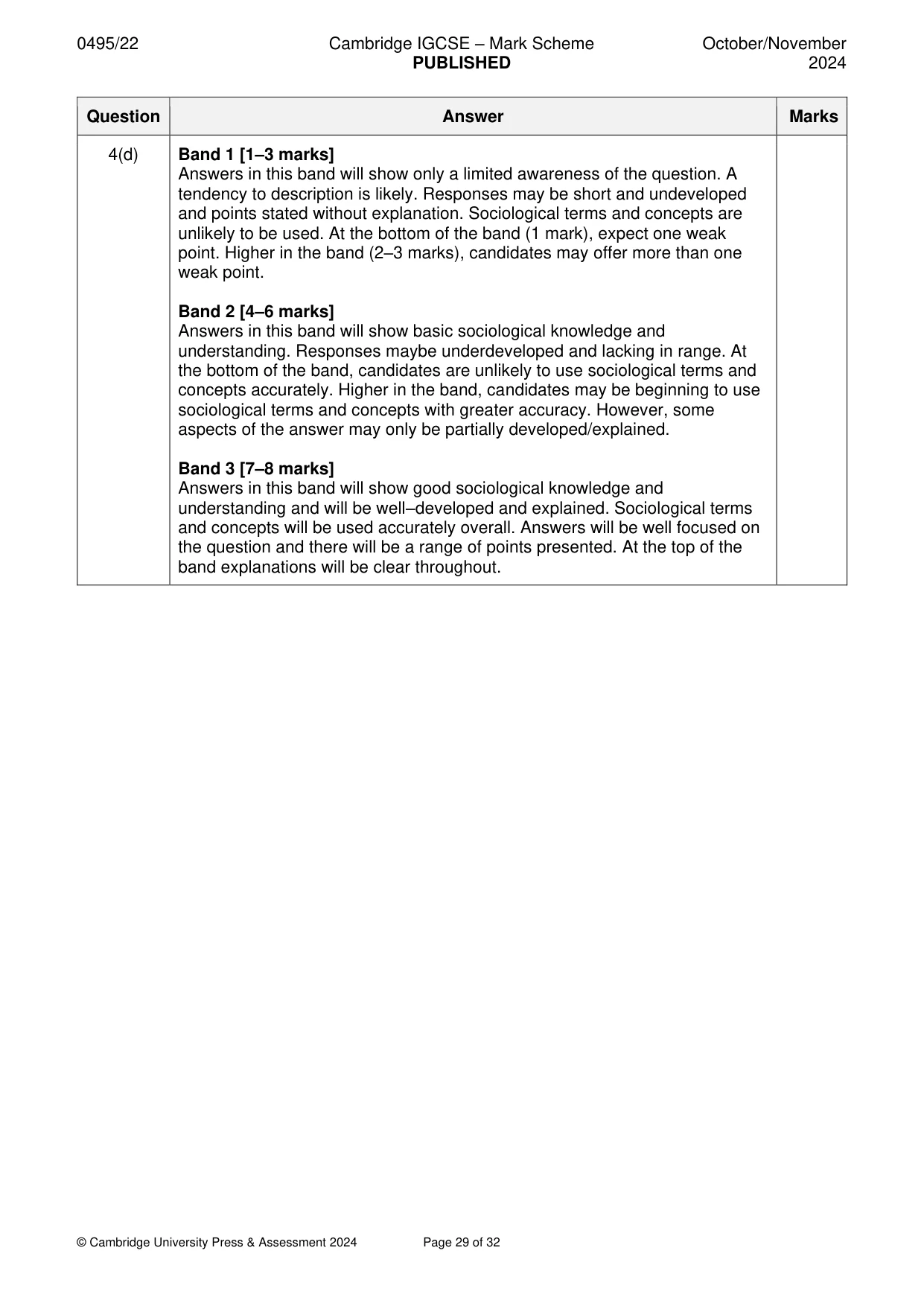
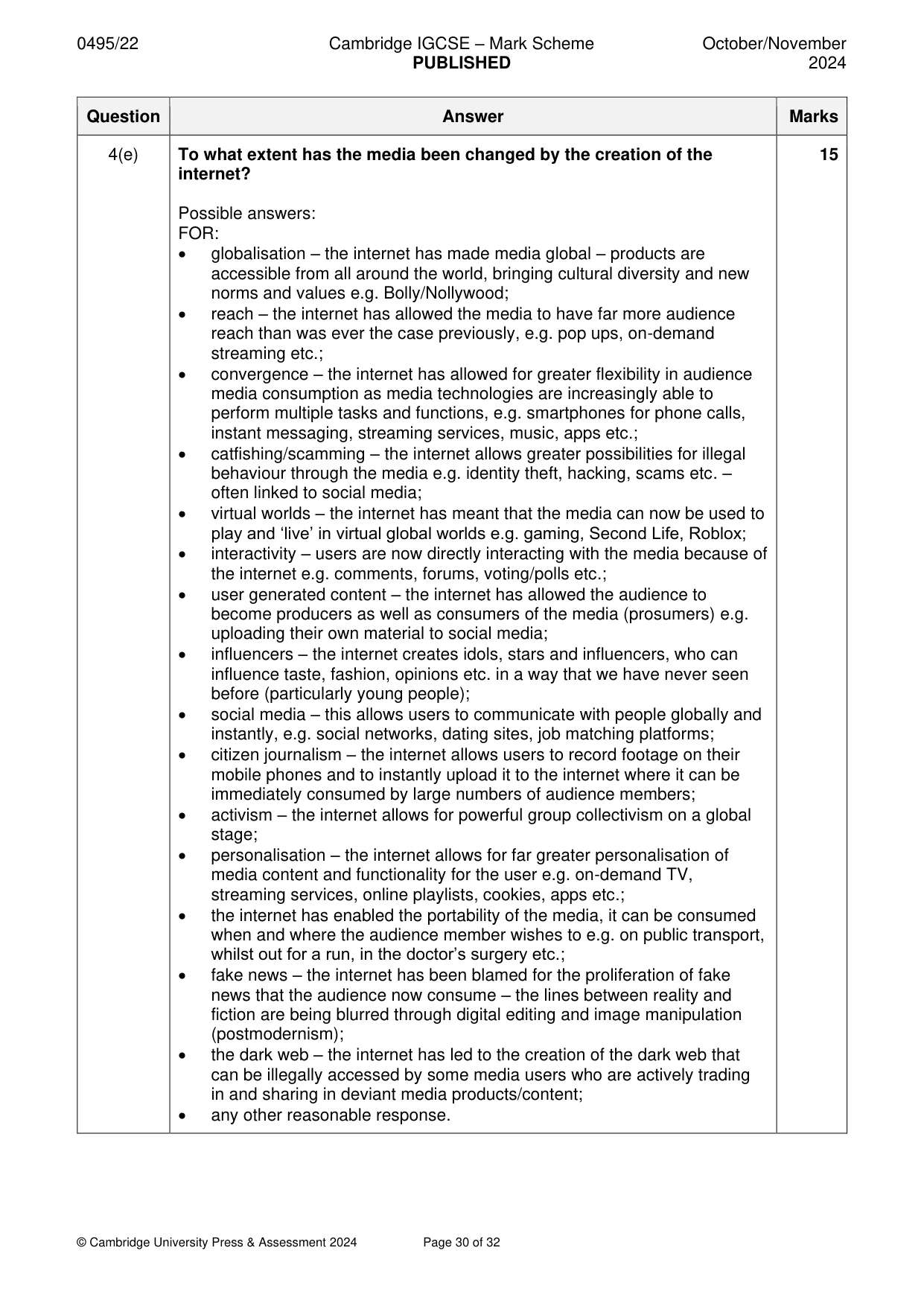
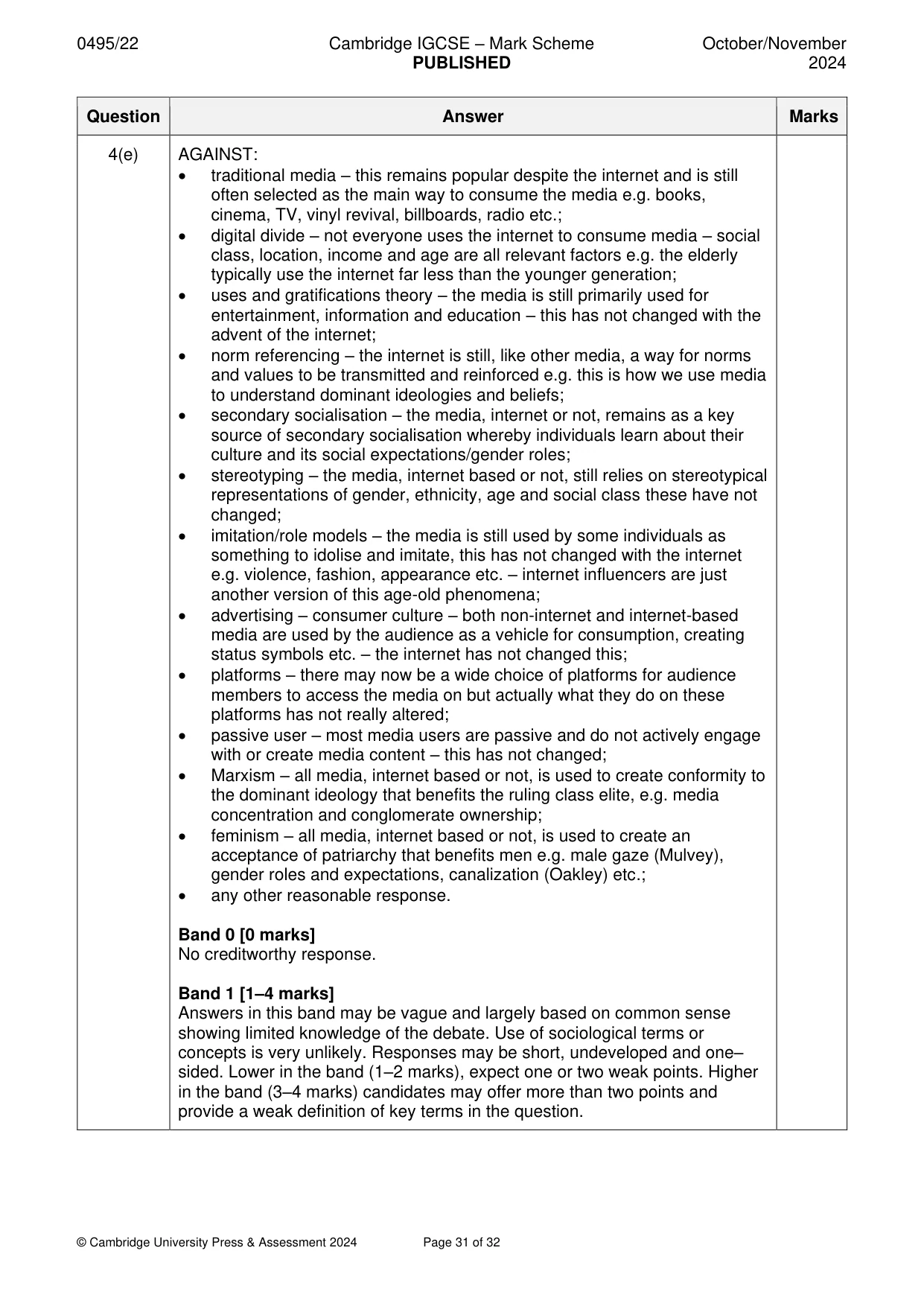
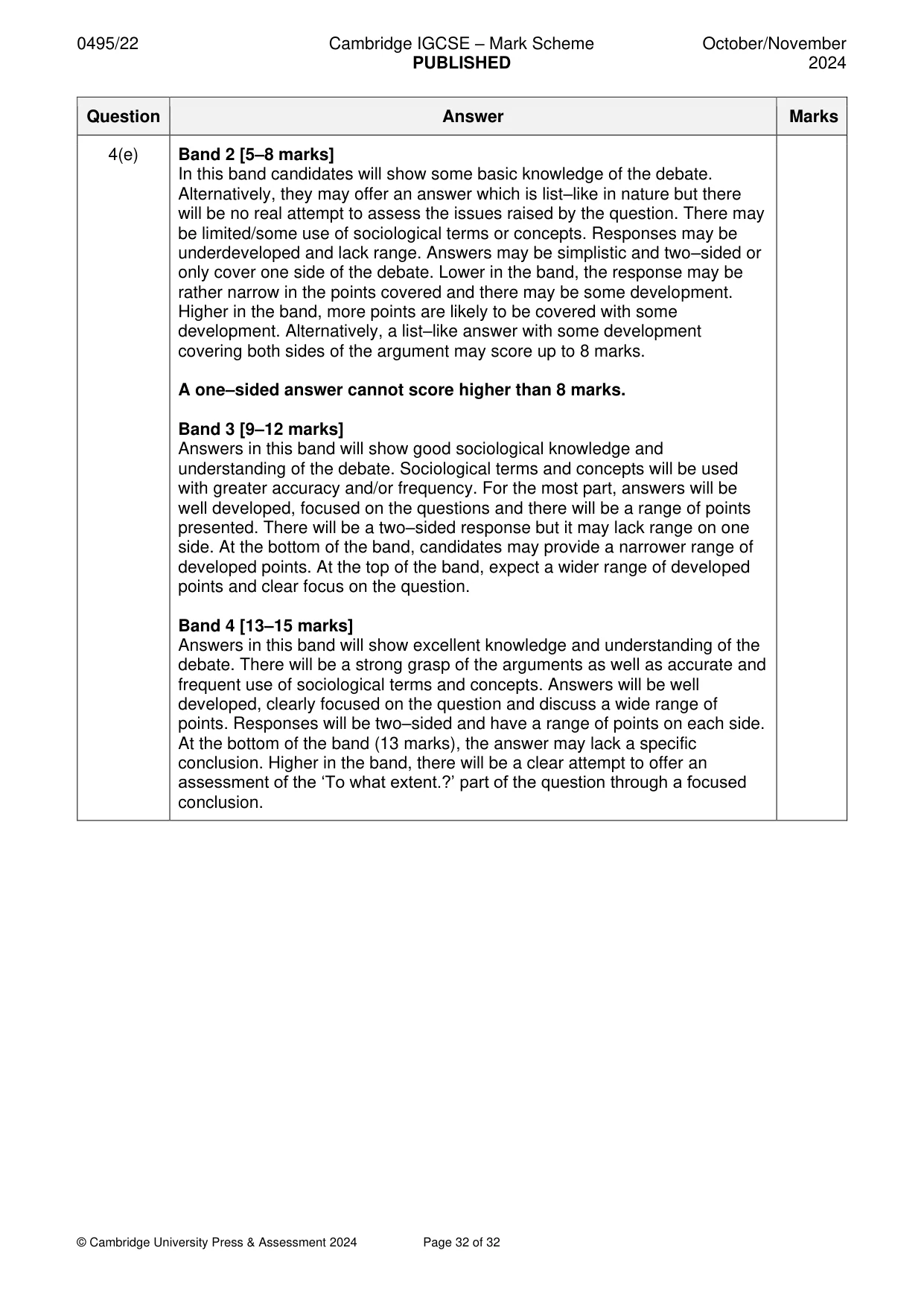
Mark scheme: 4(a) What is meant by the term ‘sensationalism’? 2 One mark for partial definition e.g. exaggerating facts. Two marks for clear definition e.g. where stories are deliberately reported in ways designed to excite or attract viewers or readers. 4(b) Describe two media stereotypes of young people. 4 Possible answers: • children as innocent and vulnerable, in need of adult guidance and protection; • children as fun loving and free, surrounded by toys e.g. in advertising, with a lack of responsibilities and an exciting life of possibilities ahead of them; • children as victims – charity adverts will often choose this stereotype of children, showing them as unhappy victims, as child soldiers, as child labourers or as victims of famine; • teenagers as irresponsible and reckless, e.g. risk-taking behaviour, anti- social behaviour, e.g. Fawbert’s ‘the hoodies’; • teenage boys as gang members – violent, weapon carrying, inhabiting a dangerous underworld often associated with the drugs trade/crime e.g. Hollywood movies; • teenagers as members of rebellious youth sub-cultures, e.g. Cohen’s mods and rockers; • teenagers as the folk devils in media moral panics – out of control, a worry for the older generation, in need of stronger social control; • cult of beauty – young females have become associated with attractiveness and beauty standards in the media therefore are often represented with ‘perfect’ bodies and appearance; • any other reasonable response. One mark for each point correctly identified (up to a maximum of two). One mark for each point that is developed (up to a maximum of two). 4(c) Explain how the media is controlled. 6 Possible answers: • advertising – commercial/private media needs to make a profit therefore the funding from advertisers is essential to success – meaning pressure from advertisers for mass appeal content may control the media; • public service broadcasting – e.g. the BBC – the public service remit and requirements controls the media output, e.g. for the BBC they are accountable to the Government and the public through the licence fee and must ‘educate, entertain and inform’; • owners – may control the media through the instructions they give their staff, appointments of personnel who agree with their ideologies this all affects output; • controllers – e.g. editors, journalists, producers – they take day-to-day decisions on behalf of the media company that determines media content and representations (gatekeeping); • government – state owned media – often leads to propaganda and bias, e.g. Nazi Germany, North Korea, China, etc.; • censorship – dictates much media content e.g. laws on stereotyping, certification systems, watersheds, laws protecting the state, laws on obscenity, libel and slander etc.; • pluralism – media can only respond to and reflect the audience therefore the audience have the power to shape and control media content through competition and choice; • Marxism – the media is controlled by the dominant ideology of the ruling elite that keeps the population ignorant to their oppression i.e. the media is a tool of the state that prevents rebellion and social change; • hegemony – the media is still largely controlled by white, male, middle- aged, higher class individuals therefore it is their world view that is presented as normal; • feminism – the media is a tool of patriarchal oppression that maintains traditional gender roles and expectations for the benefit of men, e.g. the cult of femininity (Ferguson, McRobbie) and the male gaze (Mulvey); • any other reasonable response. Band 0 [0 marks] No creditworthy response. Band 1 [1–3 marks] Answers in this band will show only a limited awareness of the question. Responses may be short and un/underdeveloped. At the bottom of the band (1 mark), expect one weak point. Higher in the band (2–3 marks), candidates may offer more than one weak point, but there may be a tendency towards simplistic answers, engaging with sociological ideas without using sociological language. Band 2 [4–6 marks] Answers in this band will have clear and accurate explanation, showing good sociological knowledge and understanding. Sociological terms and concepts should be expected and explained. At the bottom of the band, the range of points covered may be narrow or lack detail. Higher in the band, answers will cover more than one point in a well–developed way or cover several points in less detail. 4(d) Explain why bias in the news may benefit powerful groups. 8 Possible answers: • stereotyping – the news is full of easily recognisable stereotypes based on social class, ethnicity, age or gender – the powerless groups do not have the ability to control how they are represented, the powerful decide for them, often making decisions that benefit themselves; • moral panics – powerless groups are frequently portrayed as folk devils in the news, scapegoated for society’s problems so diverting attention away from the powerful and thus benefiting them; • invisibility – the powerful people involved in producing the news typically fail to give adequate representation or reference to those less powerful groups in society and so suppress any challenges to the elite, maintaining the ‘status quo’ and their own privileges; • gatekeeping – the news is a social construction whereby content and slant/bias is based on the decisions of individuals e.g. editors – thus the news can be constructed in a way to benefit the powerful groups in society e.g. rich people (agenda setting); • the gaze (Mulvey) – the news is presented with a particular bias i.e. from a particular point of view. Feminists talk about the male gaze whereas other sociologists now also refer to the white gaze – the powerful groups (men and white people) therefore benefit in their constructed representations; • news values – this selection process means some items and stories feature in the news whilst others do not, e.g. reference to elite individuals, elite nations, mainstream topics, non-threatening to the ‘status quo’, diverting blame from the government and the capitalist class – therefore benefiting the powerful groups; • professional ideology – cultural constraints suggests that those making the news have a similar background and thus have similar norms and values, e.g. male, middle aged, higher class and white – this results in bias in the news that benefits these powerful groups; • Marxism – this theory believes the news regularly neglects the wrongdoings of large and powerful companies (e.g. corporate crimes/state crimes/tax evasion), instead selecting news stories that suit and benefit the powerful groups in society e.g. youth crime; • GUMG – the Glasgow University media group found that during coverage of industrial strikes the news coverage was biased in favour of management, positioning the audience so as not to sympathise or agree with the striking workers, thus benefiting the powerful groups; • Westernisation – despite the news now being global, there is still a Western bias to content (sometimes referred to as Americanisation) that determines which countries and cultures are covered in news programmes – this benefits the powerful, Western groups as their views and practices are seen as ‘normal’; • any other reasonable response. Band 0 [0 marks] No creditworthy response. 4(d) Band 1 [1–3 marks] Answers in this band will show only a limited awareness of the question. A tendency to description is likely. Responses may be short and undeveloped and points stated without explanation. Sociological terms and concepts are unlikely to be used. At the bottom of the band (1 mark), expect one weak point. Higher in the band (2–3 marks), candidates may offer more than one weak point. Band 2 [4–6 marks] Answers in this band will show basic sociological knowledge and understanding. Responses maybe underdeveloped and lacking in range. At the bottom of the band, candidates are unlikely to use sociological terms and concepts accurately. Higher in the band, candidates may be beginning to use sociological terms and concepts with greater accuracy. However, some aspects of the answer may only be partially developed/explained. Band 3 [7–8 marks] Answers in this band will show good sociological knowledge and understanding and will be well–developed and explained. Sociological terms and concepts will be used accurately overall. Answers will be well focused on the question and there will be a range of points presented. At the top of the band explanations will be clear throughout. 4(e) To what extent has the media been changed by the creation of the 15 internet? Possible answers: FOR: • globalisation – the internet has made media global – products are accessible from all around the world, bringing cultural diversity and new norms and values e.g. Bolly/Nollywood; • reach – the internet has allowed the media to have far more audience reach than was ever the case previously, e.g. pop ups, on-demand streaming etc.; • convergence – the internet has allowed for greater flexibility in audience media consumption as media technologies are increasingly able to perform multiple tasks and functions, e.g. smartphones for phone calls, instant messaging, streaming services, music, apps etc.; • catfishing/scamming – the internet allows greater possibilities for illegal behaviour through the media e.g. identity theft, hacking, scams etc. – often linked to social media; • virtual worlds – the internet has meant that the media can now be used to play and ‘live’ in virtual global worlds e.g. gaming, Second Life, Roblox; • interactivity – users are now directly interacting with the media because of the internet e.g. comments, forums, voting/polls etc.; • user generated content – the internet has allowed the audience to become producers as well as consumers of the media (prosumers) e.g. uploading their own material to social media; • influencers – the internet creates idols, stars and influencers, who can influence taste, fashion, opinions etc. in a way that we have never seen before (particularly young people); • social media – this allows users to communicate with people globally and instantly, e.g. social networks, dating sites, job matching platforms; • citizen journalism – the internet allows users to record footage on their mobile phones and to instantly upload it to the internet where it can be immediately consumed by large numbers of audience members; • activism – the internet allows for powerful group collectivism on a global stage; • personalisation – the internet allows for far greater personalisation of media content and functionality for the user e.g. on-demand TV, streaming services, online playlists, cookies, apps etc.; • the internet has enabled the portability of the media, it can be consumed when and where the audience member wishes to e.g. on public transport, whilst out for a run, in the doctor’s surgery etc.; • fake news – the internet has been blamed for the proliferation of fake news that the audience now consume – the lines between reality and fiction are being blurred through digital editing and image manipulation (postmodernism); • the dark web – the internet has led to the creation of the dark web that can be illegally accessed by some media users who are actively trading in and sharing in deviant media products/content; • any other reasonable response. 4(e) AGAINST: • traditional media – this remains popular despite the internet and is still often selected as the main way to consume the media e.g. books, cinema, TV, vinyl revival, billboards, radio etc.; • digital divide – not everyone uses the internet to consume media – social class, location, income and age are all relevant factors e.g. the elderly typically use the internet far less than the younger generation; • uses and gratifications theory – the media is still primarily used for entertainment, information and education – this has not changed with the advent of the internet; • norm referencing – the internet is still, like other media, a way for norms and values to be transmitted and reinforced e.g. this is how we use media to understand dominant ideologies and beliefs; • secondary socialisation – the media, internet or not, remains as a key source of secondary socialisation whereby individuals learn about their culture and its social expectations/gender roles; • stereotyping – the media, internet based or not, still relies on stereotypical representations of gender, ethnicity, age and social class these have not changed; • imitation/role models – the media is still used by some individuals as something to idolise and imitate, this has not changed with the internet e.g. violence, fashion, appearance etc. – internet influencers are just another version of this age-old phenomena; • advertising – consumer culture – both non-internet and internet-based media are used by the audience as a vehicle for consumption, creating status symbols etc. – the internet has not changed this; • platforms – there may now be a wide choice of platforms for audience members to access the media on but actually what they do on these platforms has not really altered; • passive user – most media users are passive and do not actively engage with or create media content – this has not changed; • Marxism – all media, internet based or not, is used to create conformity to the dominant ideology that benefits the ruling class elite, e.g. media concentration and conglomerate ownership; • feminism – all media, internet based or not, is used to create an acceptance of patriarchy that benefits men e.g. male gaze (Mulvey), gender roles and expectations, canalization (Oakley) etc.; • any other reasonable response. Band 0 [0 marks] No creditworthy response. Band 1 [1–4 marks] Answers in this band may be vague and largely based on common sense showing limited knowledge of the debate. Use of sociological terms or concepts is very unlikely. Responses may be short, undeveloped and one– sided. Lower in the band (1–2 marks), expect one or two weak points. Higher in the band (3–4 marks) candidates may offer more than two points and provide a weak definition of key terms in the question. 4(e) Band 2 [5–8 marks] In this band candidates will show some basic knowledge of the debate. Alternatively, they may offer an answer which is list–like in nature but there will be no real attempt to assess the issues raised by the question. There may be limited/some use of sociological terms or concepts. Responses may be underdeveloped and lack range. Answers may be simplistic and two–sided or only cover one side of the debate. Lower in the band, the response may be rather narrow in the points covered and there may be some development. Higher in the band, more points are likely to be covered with some development. Alternatively, a list–like answer with some development covering both sides of the argument may score up to 8 marks. A one–sided answer cannot score higher than 8 marks. Band 3 [9–12 marks] Answers in this band will show good sociological knowledge and understanding of the debate. Sociological terms and concepts will be used with greater accuracy and/or frequency. For the most part, answers will be well developed, focused on the questions and there will be a range of points presented. There will be a two–sided response but it may lack range on one side. At the bottom of the band, candidates may provide a narrower range of developed points. At the top of the band, expect a wider range of developed points and clear focus on the question. Band 4 [13–15 marks] Answers in this band will show excellent knowledge and understanding of the debate. There will be a strong grasp of the arguments as well as accurate and frequent use of sociological terms and concepts. Answers will be well developed, clearly focused on the question and discuss a wide range of points. Responses will be two–sided and have a range of points on each side. At the bottom of the band (13 marks), the answer may lack a specific conclusion. Higher in the band, there will be a clear attempt to offer an assessment of the ‘To what extent.?’ part of the question through a focused conclusion.
More questions on How do sociologists approach the study of society?
What was in this paper
The subtopics covered by these 4 questions, and how many questions each got. Open one in a new tab to see every Cambridge question on it.
What you needed in this session
Cambridge’s own grade thresholds for 2024 Oct/Nov, Paper 2 · Variant 2. A higher threshold means an easier paper — the bar moves with how the cohort did.