Cambridge IGCSE Sociology 0495 — 2022 May/June Paper 2 · Variant 2
0495/22/M/J/22 · 4 questions · 70 marks · ≈79 min
The question paper and its mark scheme, free to read here and free to download. This is Cambridge’s own paper, exactly as it was sat.
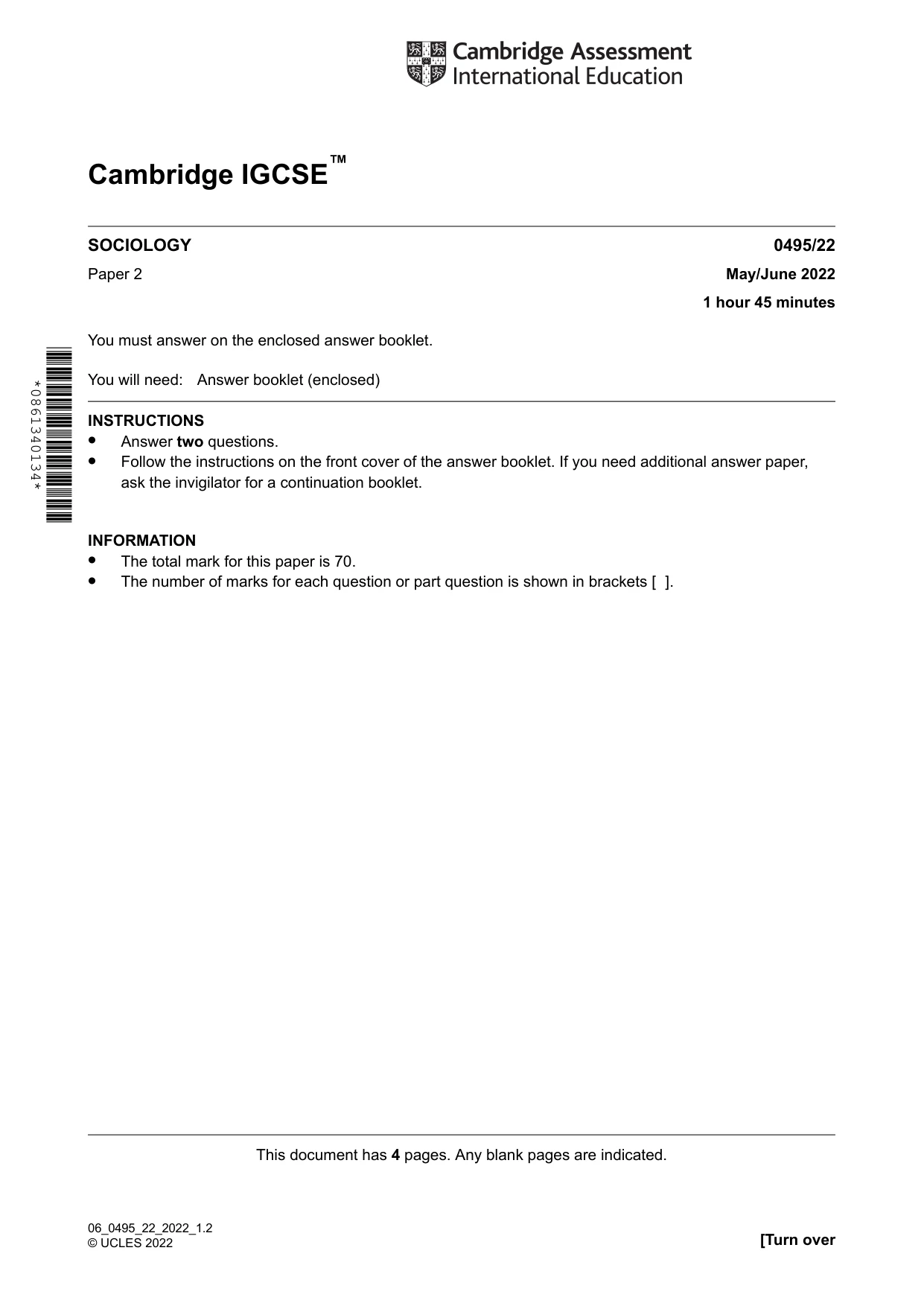
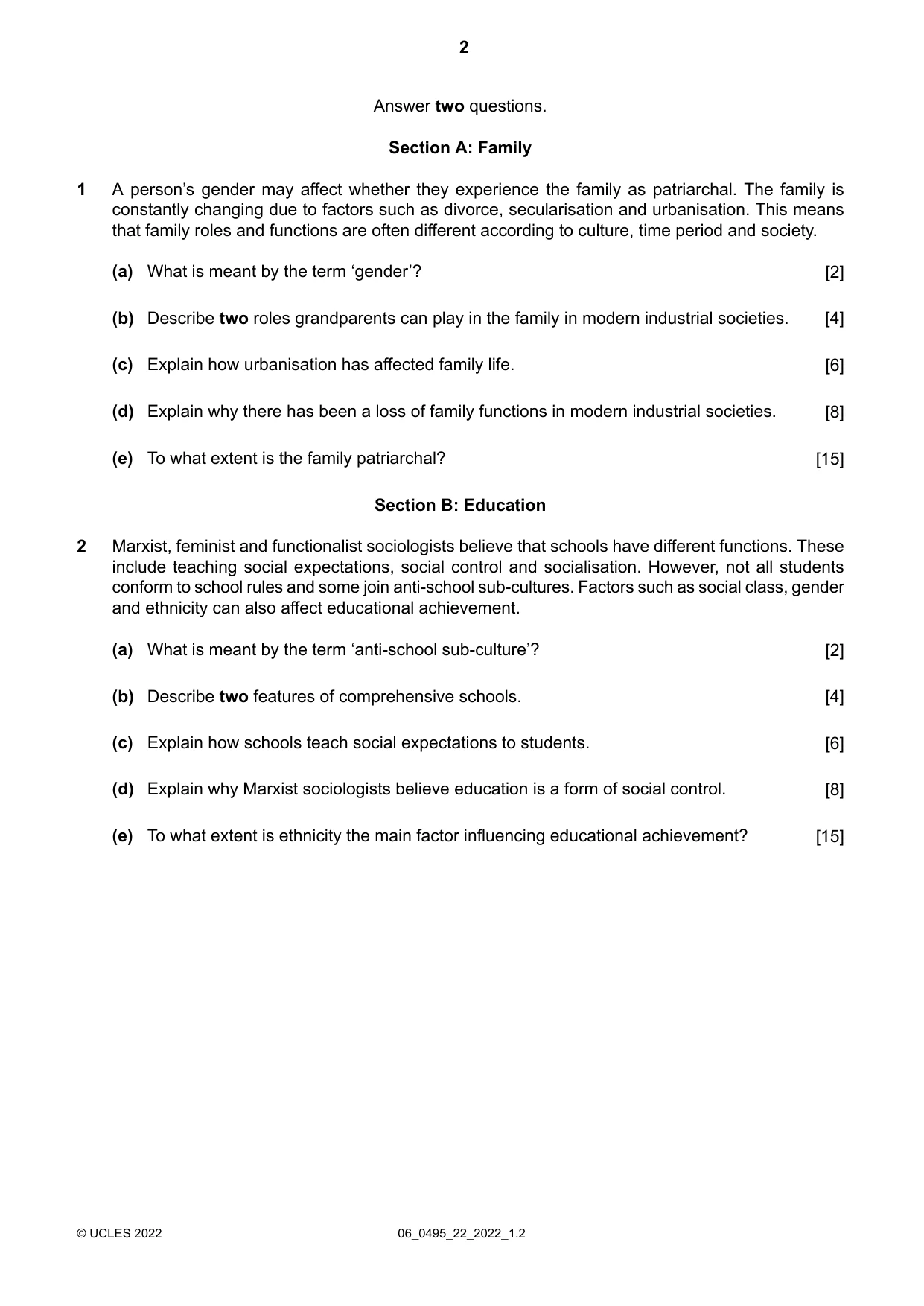
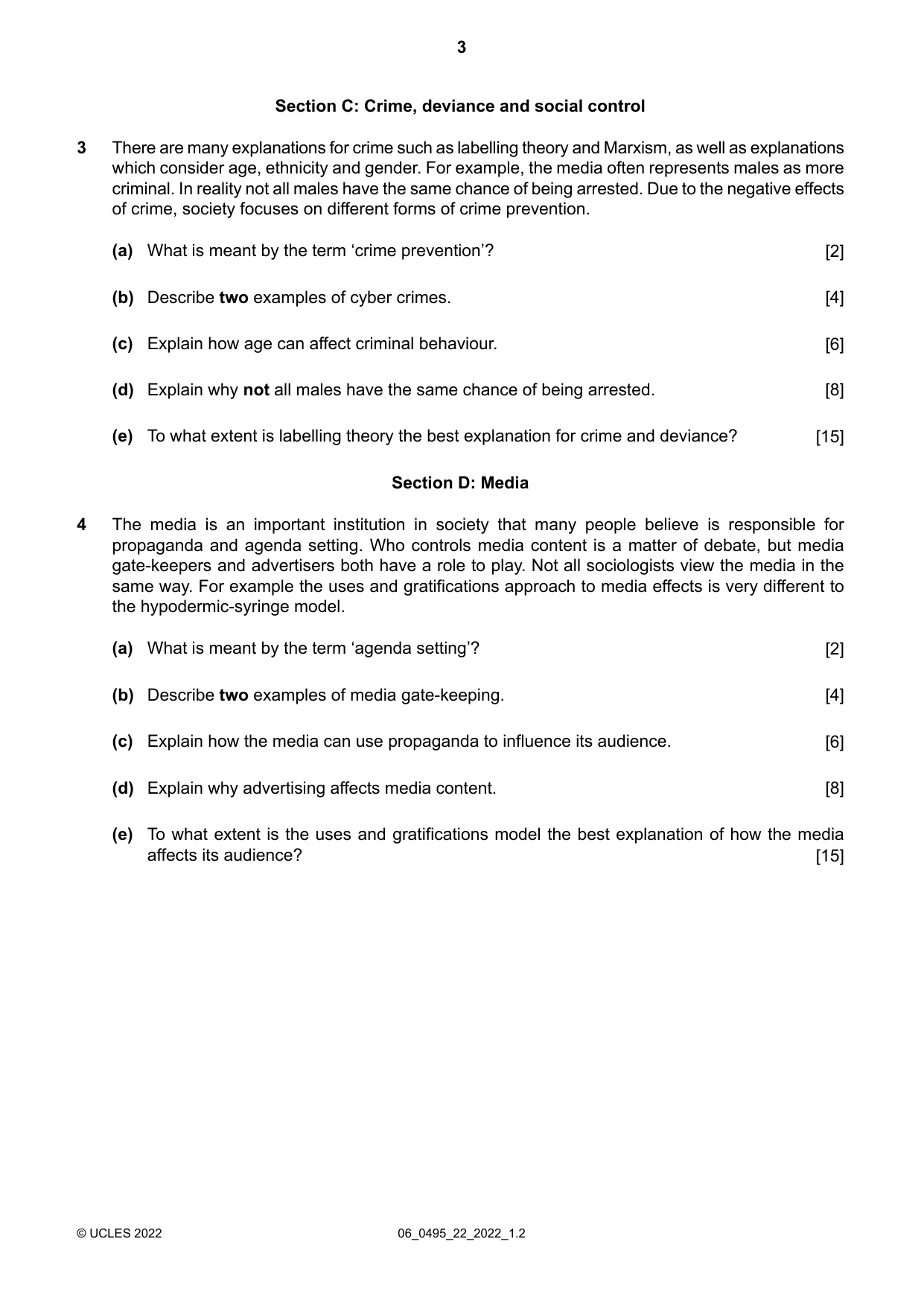
Question paper4 pages

Mark scheme24 pages
Answers below. Sit the paper first if you are practising.

Questions as text
Q1 · A person’s gender may affect whether they experience the family as patriarchal
1 A person’s gender may affect whether they experience the family as patriarchal. The family is constantly changing due to factors such as divorce, secularisation and urbanisation. This means that family roles and functions are often different according to culture, time period and society. (a) What is meant by the term ‘gender’? [2] (b) Describe two roles grandparents can play in the family in modern industrial societies. [4] (c) Explain how urbanisation has affected family life. [6] (d) Explain why there has been a loss of family functions in modern industrial societies. [8] (e) To what extent is the family patriarchal? [15]
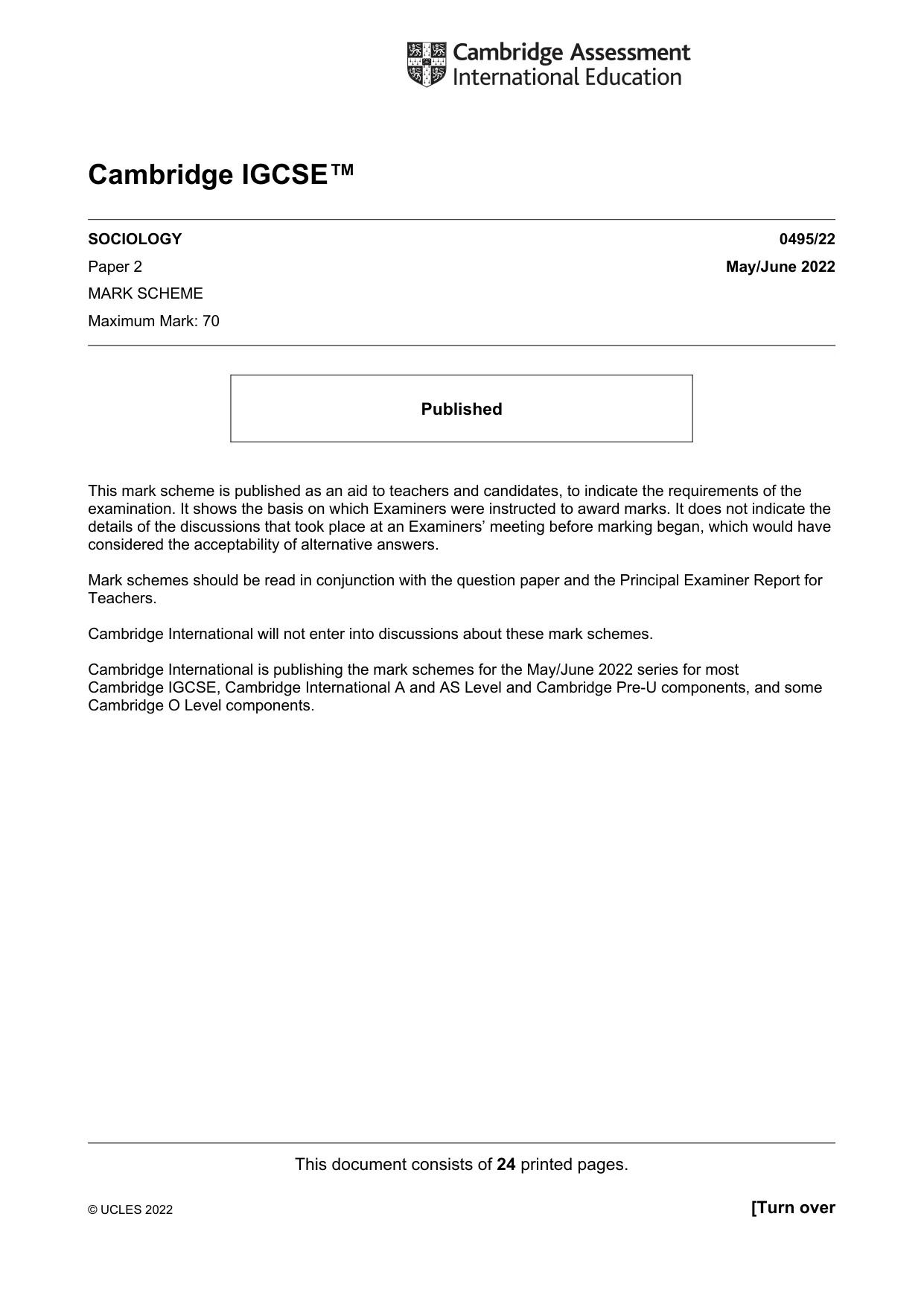
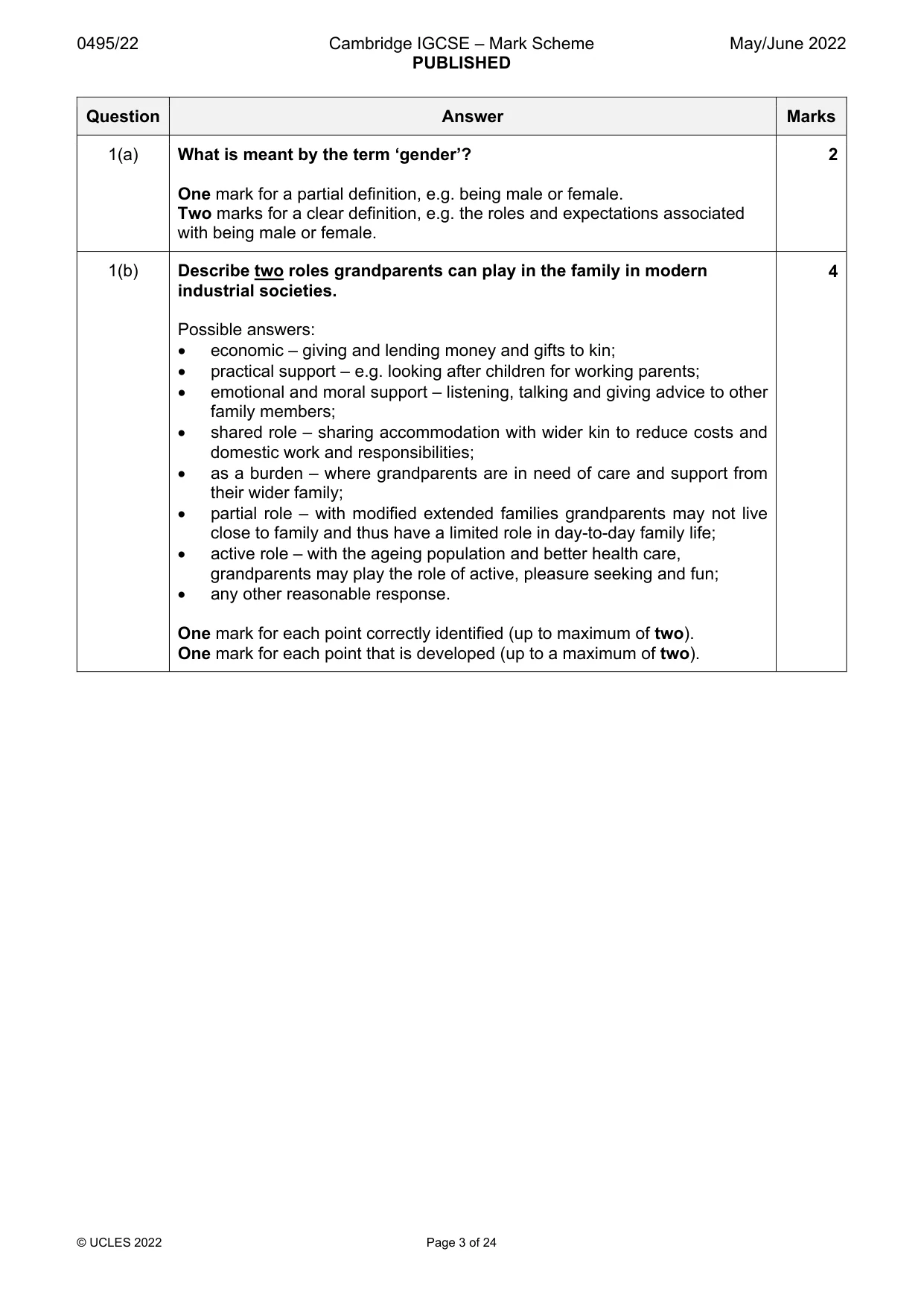
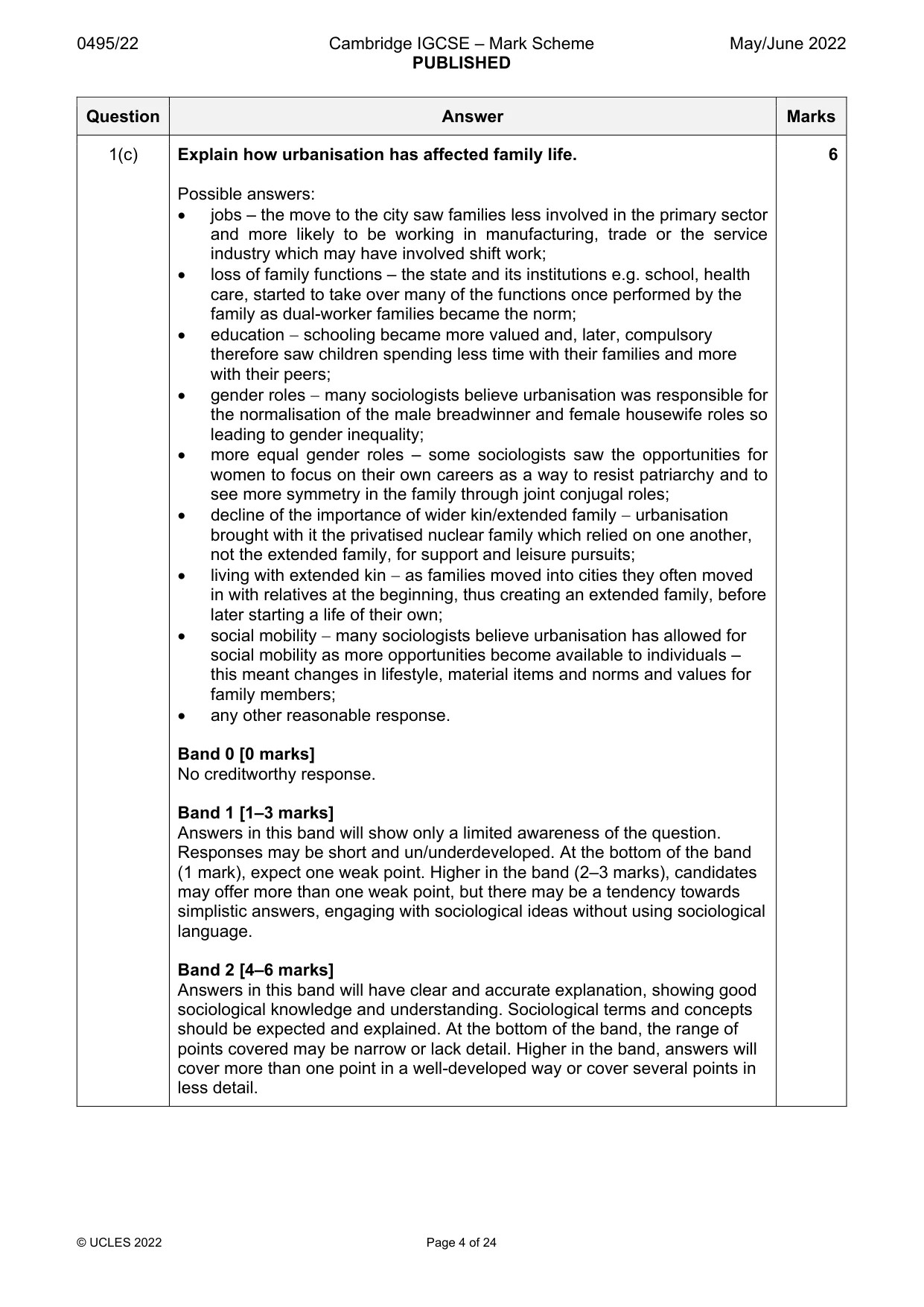
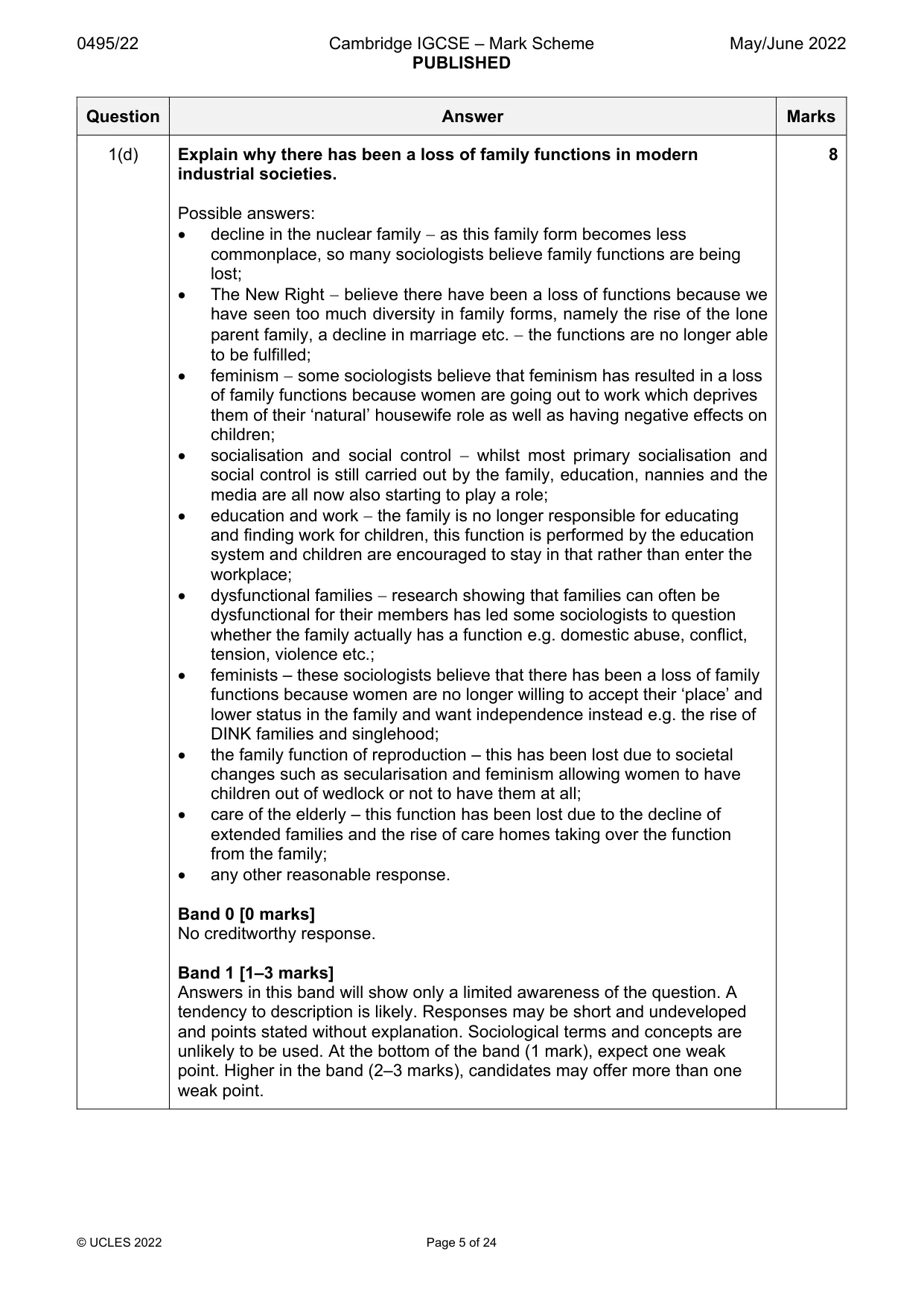
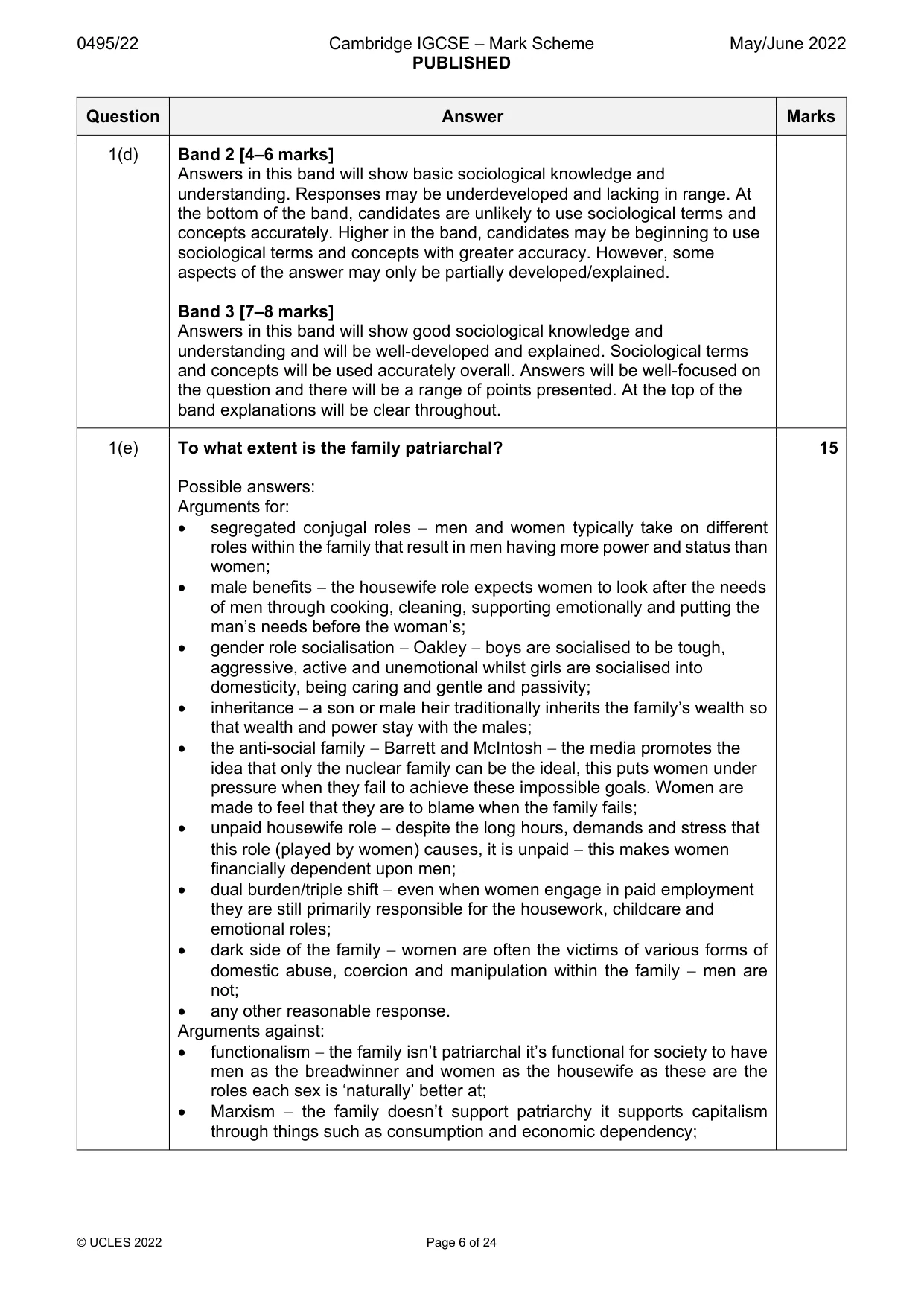
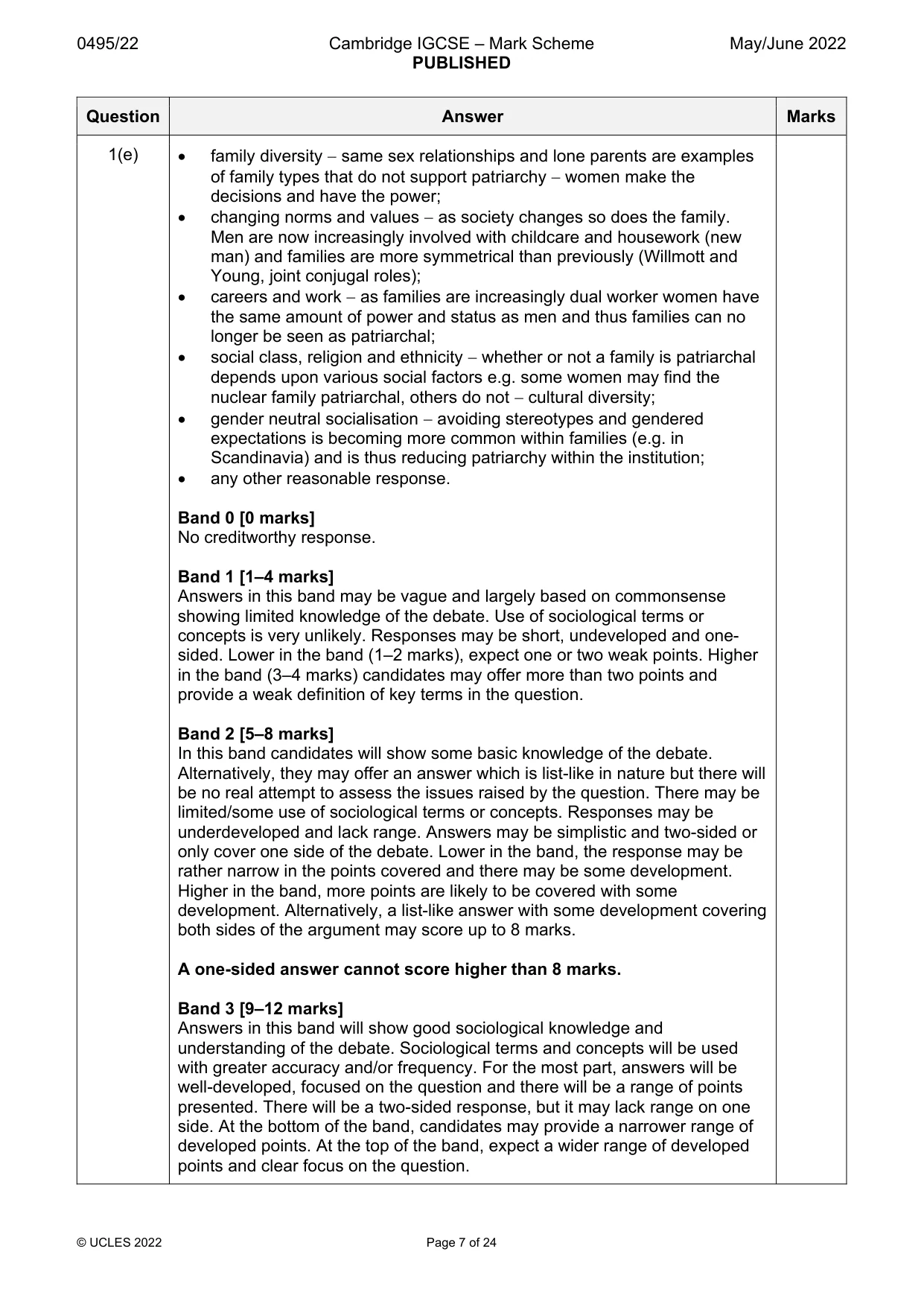
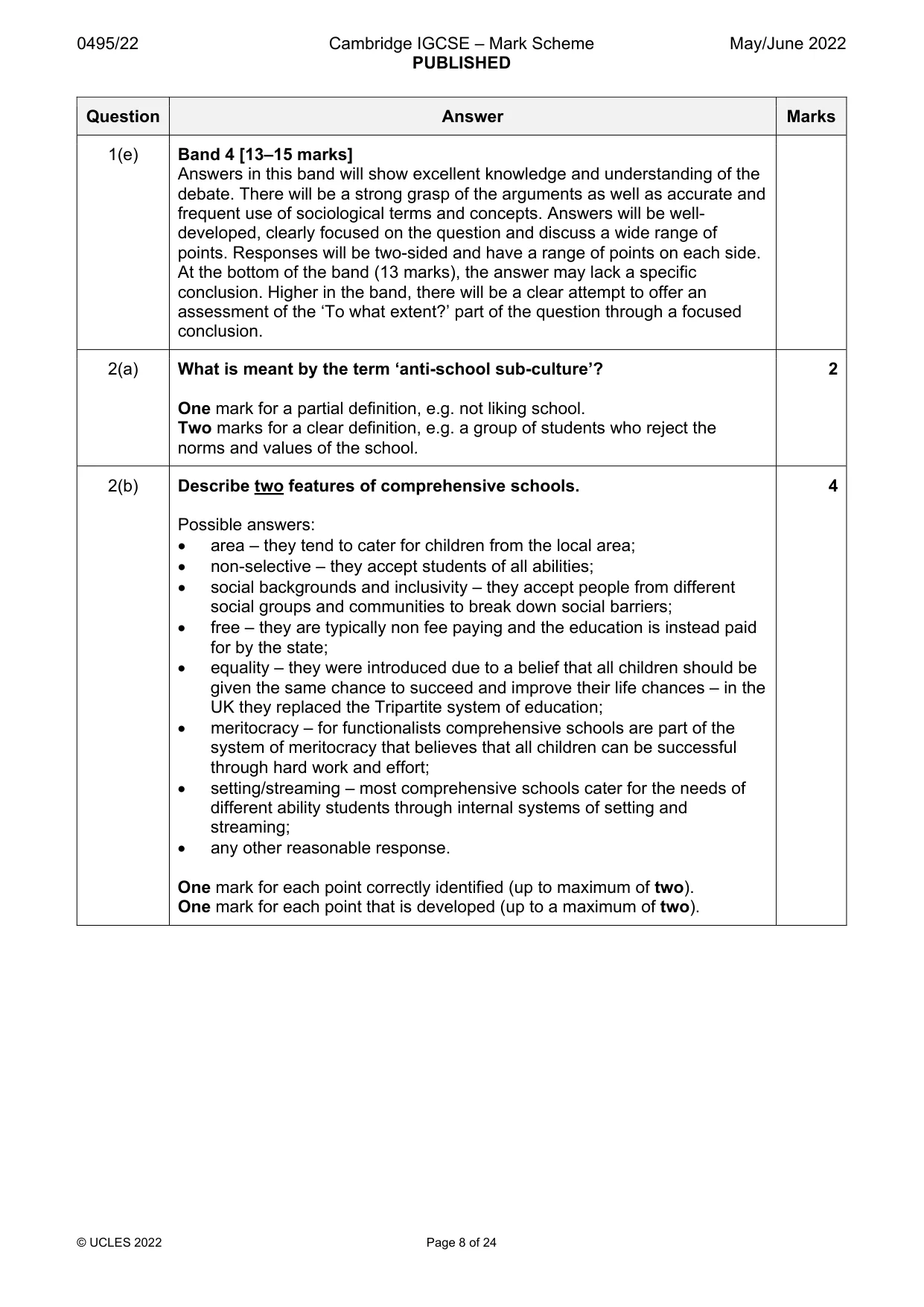
Mark scheme: Question Answer Marks 1(a) What is meant by the term ‘gender’? 2 One mark for a partial definition, e.g. being male or female. Two marks for a clear definition, e.g. the roles and expectations associated with being male or female. 1(b) Describe two roles grandparents can play in the family in modern 4 industrial societies. Possible answers: economic – giving and lending money and gifts to kin; practical support – e.g. looking after children for working parents; emotional and moral support – listening, talking and giving advice to other family members; shared role – sharing accommodation with wider kin to reduce costs and domestic work and responsibilities; as a burden – where grandparents are in need of care and support from their wider family; partial role – with modified extended families grandparents may not live close to family and thus have a limited role in day-to-day family life; active role – with the ageing population and better health care, grandparents may play the role of active, pleasure seeking and fun; any other reasonable response. One mark for each point correctly identified (up to maximum of two). One mark for each point that is developed (up to a maximum of two). 1(c) Explain how urbanisation has affected family life. 6 Possible answers: jobs – the move to the city saw families less involved in the primary sector and more likely to be working in manufacturing, trade or the service industry which may have involved shift work; loss of family functions – the state and its institutions e.g. school, health care, started to take over many of the functions once performed by the family as dual-worker families became the norm; education schooling became more valued and, later, compulsory therefore saw children spending less time with their families and more with their peers; gender roles many sociologists believe urbanisation was responsible for the normalisation of the male breadwinner and female housewife roles so leading to gender inequality; more equal gender roles – some sociologists saw the opportunities for women to focus on their own careers as a way to resist patriarchy and to see more symmetry in the family through joint conjugal roles; decline of the importance of wider kin/extended family urbanisation brought with it the privatised nuclear family which relied on one another, not the extended family, for support and leisure pursuits; living with extended kin as families moved into cities they often moved in with relatives at the beginning, thus creating an extended family, before later starting a life of their own; social mobility many sociologists believe urbanisation has allowed for social mobility as more opportunities become available to individuals – this meant changes in lifestyle, material items and norms and values for family members; any other reasonable response. Band 0 [0 marks] No creditworthy response. Band 1 [1–3 marks] Answers in this band will show only a limited awareness of the question. Responses may be short and un/underdeveloped. At the bottom of the band (1 mark), expect one weak point. Higher in the band (2–3 marks), candidates may offer more than one weak point, but there may be a tendency towards simplistic answers, engaging with sociological ideas without using sociological language. Band 2 [4–6 marks] Answers in this band will have clear and accurate explanation, showing good sociological knowledge and understanding. Sociological terms and concepts should be expected and explained. At the bottom of the band, the range of points covered may be narrow or lack detail. Higher in the band, answers will cover more than one point in a well-developed way or cover several points in less detail. 1(d) Explain why there has been a loss of family functions in modern 8 industrial societies. Possible answers: decline in the nuclear family as this family form becomes less commonplace, so many sociologists believe family functions are being lost; The New Right believe there have been a loss of functions because we have seen too much diversity in family forms, namely the rise of the lone parent family, a decline in marriage etc. the functions are no longer able to be fulfilled; feminism some sociologists believe that feminism has resulted in a loss of family functions because women are going out to work which deprives them of their ‘natural’ housewife role as well as having negative effects on children; socialisation and social control whilst most primary socialisation and social control is still carried out by the family, education, nannies and the media are all now also starting to play a role; education and work the family is no longer responsible for educating and finding work for children, this function is performed by the education system and children are encouraged to stay in that rather than enter the workplace; dysfunctional families research showing that families can often be dysfunctional for their members has led some sociologists to question whether the family actually has a function e.g. domestic abuse, conflict, tension, violence etc.; feminists – these sociologists believe that there has been a loss of family functions because women are no longer willing to accept their ‘place’ and lower status in the family and want independence instead e.g. the rise of DINK families and singlehood; the family function of reproduction – this has been lost due to societal changes such as secularisation and feminism allowing women to have children out of wedlock or not to have them at all; care of the elderly – this function has been lost due to the decline of extended families and the rise of care homes taking over the function from the family; any other reasonable response. Band 0 [0 marks] No creditworthy response. Band 1 [1–3 marks] Answers in this band will show only a limited awareness of the question. A tendency to description is likely. Responses may be short and undeveloped and points stated without explanation. Sociological terms and concepts are unlikely to be used. At the bottom of the band (1 mark), expect one weak point. Higher in the band (2–3 marks), candidates may offer more than one weak point. 1(d) Band 2 [4–6 marks] Answers in this band will show basic sociological knowledge and understanding. Responses may be underdeveloped and lacking in range. At the bottom of the band, candidates are unlikely to use sociological terms and concepts accurately. Higher in the band, candidates may be beginning to use sociological terms and concepts with greater accuracy. However, some aspects of the answer may only be partially developed/explained. Band 3 [7–8 marks] Answers in this band will show good sociological knowledge and understanding and will be well-developed and explained. Sociological terms and concepts will be used accurately overall. Answers will be well-focused on the question and there will be a range of points presented. At the top of the band explanations will be clear throughout. 1(e) To what extent is the family patriarchal? 15 Possible answers: Arguments for: segregated conjugal roles men and women typically take on different roles within the family that result in men having more power and status than women; male benefits the housewife role expects women to look after the needs of men through cooking, cleaning, supporting emotionally and putting the man’s needs before the woman’s; gender role socialisation Oakley boys are socialised to be tough, aggressive, active and unemotional whilst girls are socialised into domesticity, being caring and gentle and passivity; inheritance a son or male heir traditionally inherits the family’s wealth so that wealth and power stay with the males; the anti-social family Barrett and McIntosh the media promotes the idea that only the nuclear family can be the ideal, this puts women under pressure when they fail to achieve these impossible goals. Women are made to feel that they are to blame when the family fails; unpaid housewife role despite the long hours, demands and stress that this role (played by women) causes, it is unpaid this makes women financially dependent upon men; dual burden/triple shift even when women engage in paid employment they are still primarily responsible for the housework, childcare and emotional roles; dark side of the family women are often the victims of various forms of domestic abuse, coercion and manipulation within the family men are not; any other reasonable response. Arguments against: functionalism the family isn’t patriarchal it’s functional for society to have men as the breadwinner and women as the housewife as these are the roles each sex is ‘naturally’ better at; Marxism the family doesn’t support patriarchy it supports capitalism through things such as consumption and economic dependency; 1(e) family diversity same sex relationships and lone parents are examples of family types that do not support patriarchy women make the decisions and have the power; changing norms and values as society changes so does the family. Men are now increasingly involved with childcare and housework (new man) and families are more symmetrical than previously (Willmott and Young, joint conjugal roles); careers and work as families are increasingly dual worker women have the same amount of power and status as men and thus families can no longer be seen as patriarchal; social class, religion and ethnicity whether or not a family is patriarchal depends upon various social factors e.g. some women may find the nuclear family patriarchal, others do not cultural diversity; gender neutral socialisation avoiding stereotypes and gendered expectations is becoming more common within families (e.g. in Scandinavia) and is thus reducing patriarchy within the institution; any other reasonable response. Band 0 [0 marks] No creditworthy response. Band 1 [1–4 marks] Answers in this band may be vague and largely based on commonsense showing limited knowledge of the debate. Use of sociological terms or concepts is very unlikely. Responses may be short, undeveloped and one- sided. Lower in the band (1–2 marks), expect one or two weak points. Higher in the band (3–4 marks) candidates may offer more than two points and provide a weak definition of key terms in the question. Band 2 [5–8 marks] In this band candidates will show some basic knowledge of the debate. Alternatively, they may offer an answer which is list-like in nature but there will be no real attempt to assess the issues raised by the question. There may be limited/some use of sociological terms or concepts. Responses may be underdeveloped and lack range. Answers may be simplistic and two-sided or only cover one side of the debate. Lower in the band, the response may be rather narrow in the points covered and there may be some development. Higher in the band, more points are likely to be covered with some development. Alternatively, a list-like answer with some development covering both sides of the argument may score up to 8 marks. A one-sided answer cannot score higher than 8 marks. Band 3 [9–12 marks] Answers in this band will show good sociological knowledge and understanding of the debate. Sociological terms and concepts will be used with greater accuracy and/or frequency. For the most part, answers will be well-developed, focused on the question and there will be a range of points presented. There will be a two-sided response, but it may lack range on one side. At the bottom of the band, candidates may provide a narrower range of developed points. At the top of the band, expect a wider range of developed points and clear focus on the question. 1(e) Band 4 [13–15 marks] Answers in this band will show excellent knowledge and understanding of the debate. There will be a strong grasp of the arguments as well as accurate and frequent use of sociological terms and concepts. Answers will be well- developed, clearly focused on the question and discuss a wide range of points. Responses will be two-sided and have a range of points on each side. At the bottom of the band (13 marks), the answer may lack a specific conclusion. Higher in the band, there will be a clear attempt to offer an assessment of the ‘To what extent?’ part of the question through a focused conclusion.
Q2 · Marxist, feminist and functionalist sociologists believe that schools have different…
2 Marxist, feminist and functionalist sociologists believe that schools have different functions. These include teaching social expectations, social control and socialisation. However, not all students conform to school rules and some join anti-school sub-cultures. Factors such as social class, gender and ethnicity can also affect educational achievement. (a) What is meant by the term ‘anti-school sub-culture’? [2] (b) Describe two features of comprehensive schools. [4] (c) Explain how schools teach social expectations to students. [6] (d) Explain why Marxist sociologists believe education is a form of social control. [8] (e) To what extent is ethnicity the main factor influencing educational achievement? [15] Section C: Crime, deviance and social control
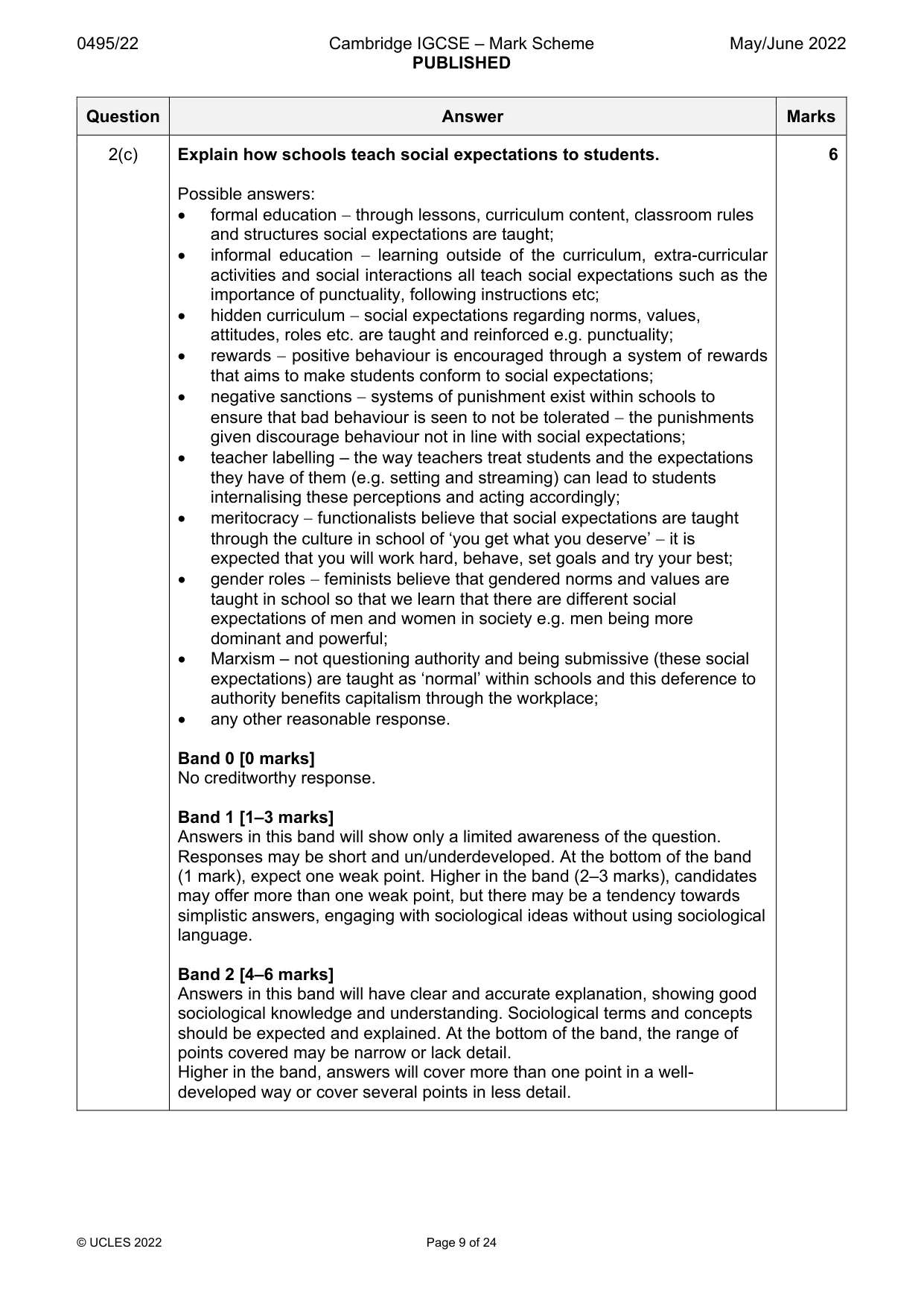
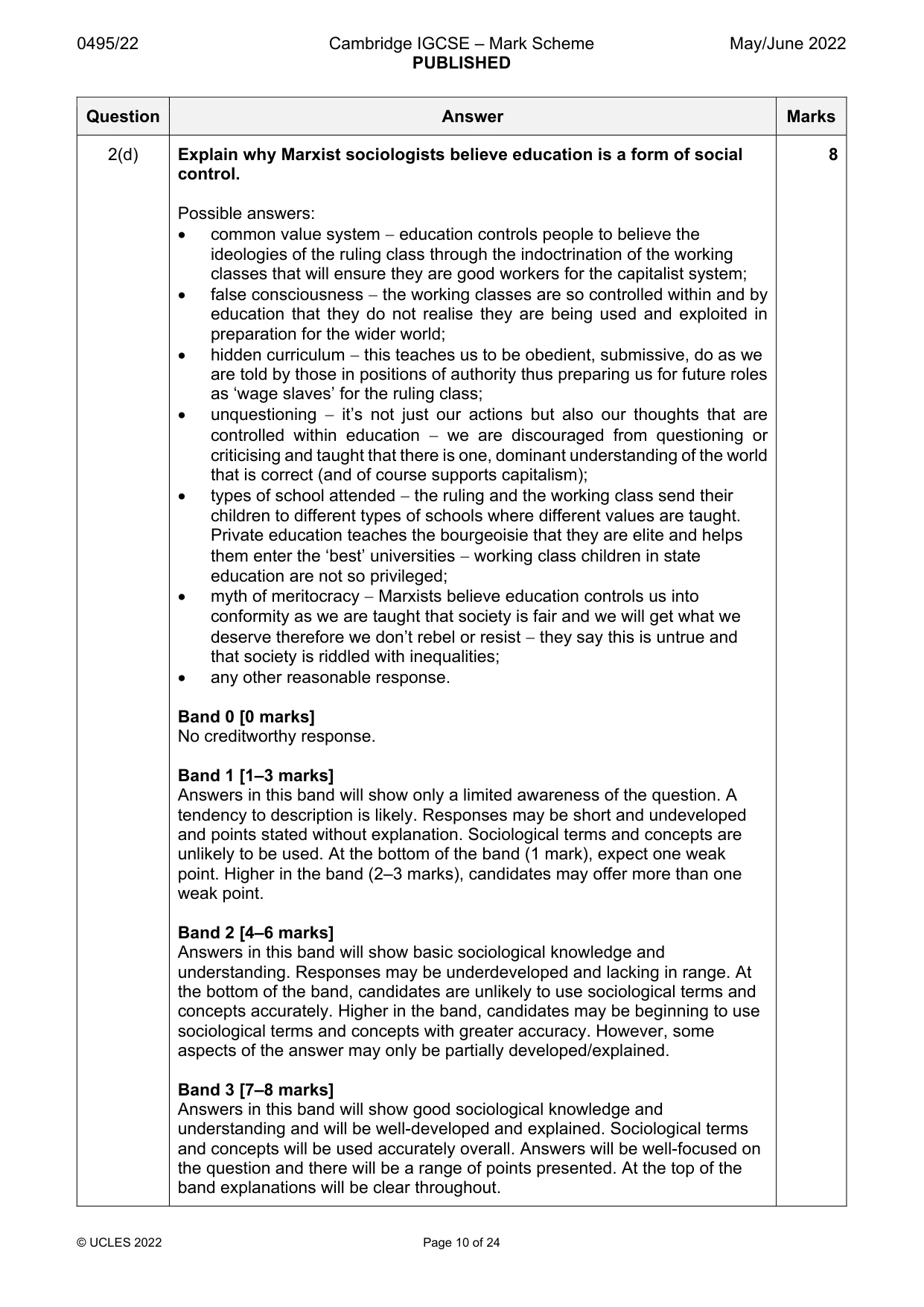
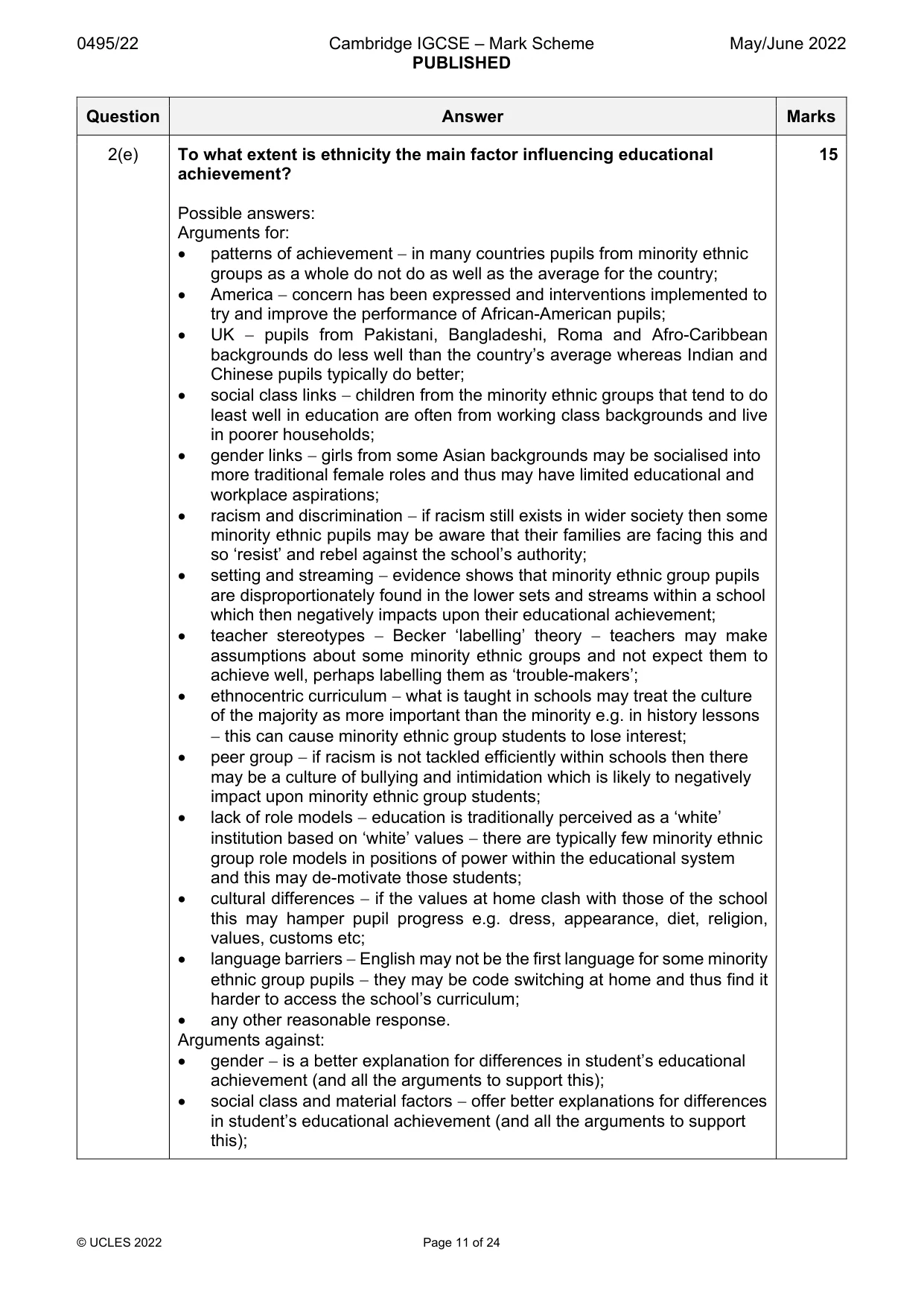
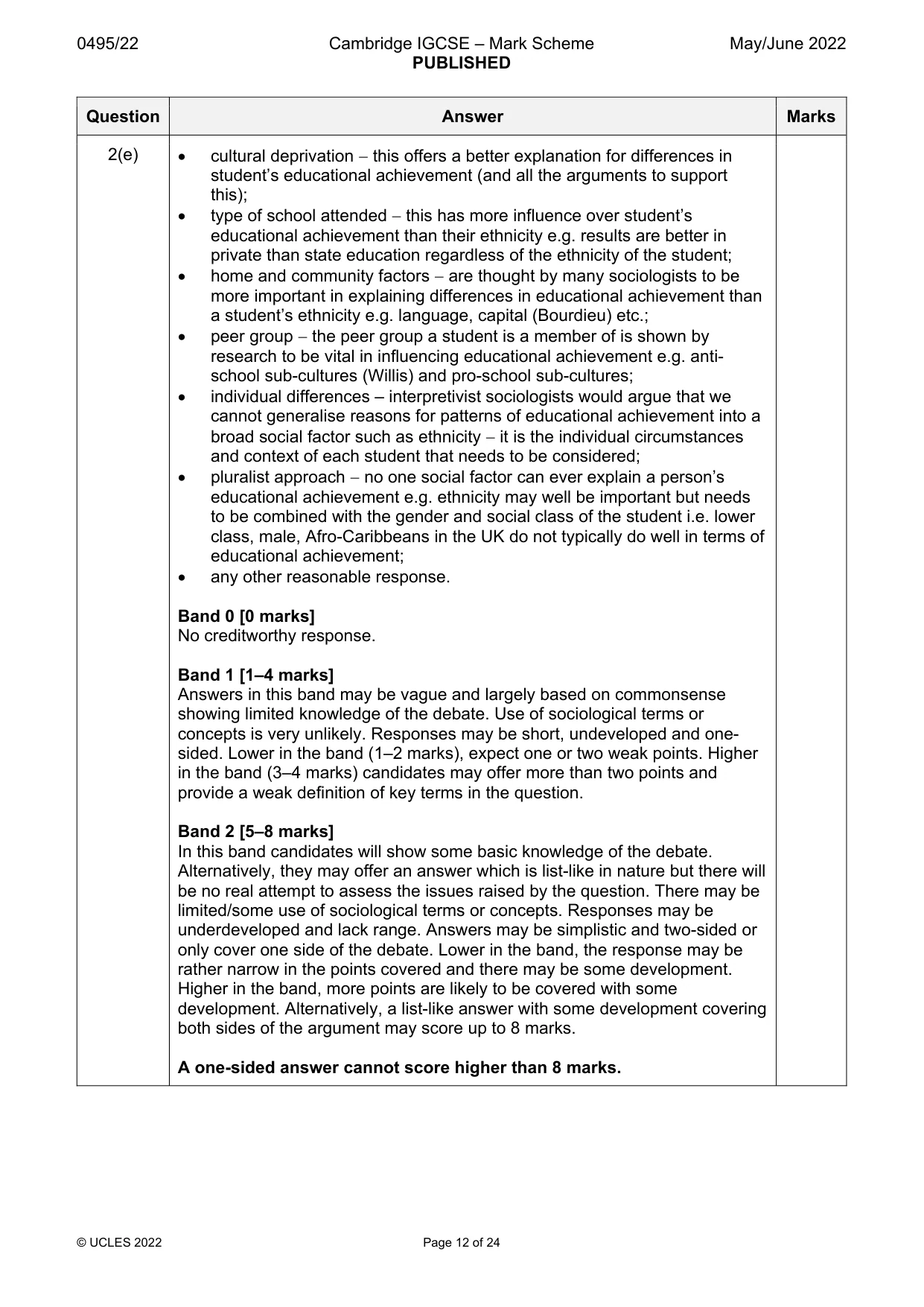
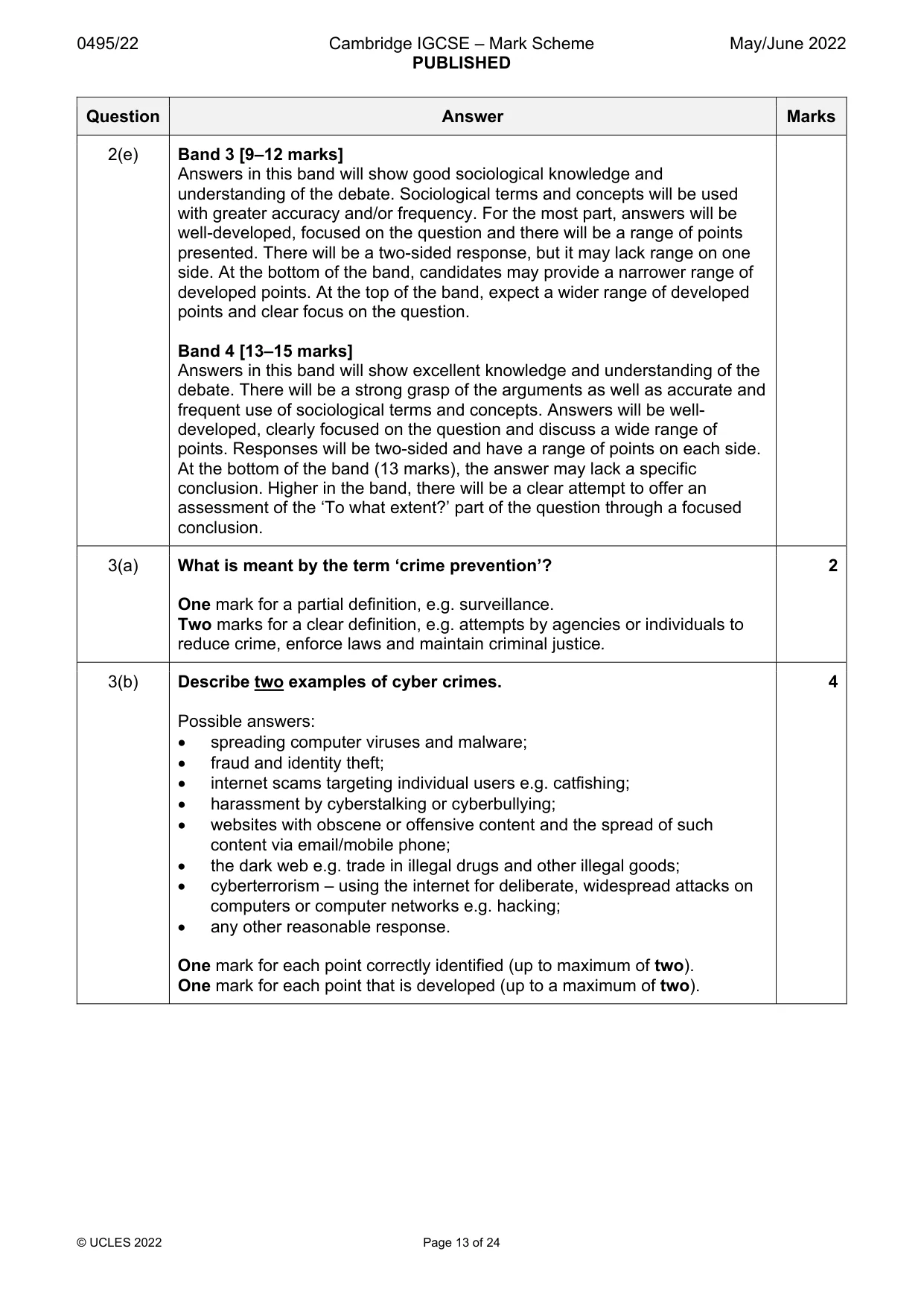
Mark scheme: 2(a) What is meant by the term ‘anti-school sub-culture’? 2 One mark for a partial definition, e.g. not liking school. Two marks for a clear definition, e.g. a group of students who reject the norms and values of the school. 2(b) Describe two features of comprehensive schools. 4 Possible answers: area – they tend to cater for children from the local area; non-selective – they accept students of all abilities; social backgrounds and inclusivity – they accept people from different social groups and communities to break down social barriers; free – they are typically non fee paying and the education is instead paid for by the state; equality – they were introduced due to a belief that all children should be given the same chance to succeed and improve their life chances – in the UK they replaced the Tripartite system of education; meritocracy – for functionalists comprehensive schools are part of the system of meritocracy that believes that all children can be successful through hard work and effort; setting/streaming – most comprehensive schools cater for the needs of different ability students through internal systems of setting and streaming; any other reasonable response. One mark for each point correctly identified (up to maximum of two). One mark for each point that is developed (up to a maximum of two). 2(c) Explain how schools teach social expectations to students. 6 Possible answers: formal education through lessons, curriculum content, classroom rules and structures social expectations are taught; informal education learning outside of the curriculum, extra-curricular activities and social interactions all teach social expectations such as the importance of punctuality, following instructions etc; hidden curriculum social expectations regarding norms, values, attitudes, roles etc. are taught and reinforced e.g. punctuality; rewards positive behaviour is encouraged through a system of rewards that aims to make students conform to social expectations; negative sanctions systems of punishment exist within schools to ensure that bad behaviour is seen to not be tolerated the punishments given discourage behaviour not in line with social expectations; teacher labelling – the way teachers treat students and the expectations they have of them (e.g. setting and streaming) can lead to students internalising these perceptions and acting accordingly; meritocracy functionalists believe that social expectations are taught through the culture in school of ‘you get what you deserve’ it is expected that you will work hard, behave, set goals and try your best; gender roles feminists believe that gendered norms and values are taught in school so that we learn that there are different social expectations of men and women in society e.g. men being more dominant and powerful; Marxism – not questioning authority and being submissive (these social expectations) are taught as ‘normal’ within schools and this deference to authority benefits capitalism through the workplace; any other reasonable response. Band 0 [0 marks] No creditworthy response. Band 1 [1–3 marks] Answers in this band will show only a limited awareness of the question. Responses may be short and un/underdeveloped. At the bottom of the band (1 mark), expect one weak point. Higher in the band (2–3 marks), candidates may offer more than one weak point, but there may be a tendency towards simplistic answers, engaging with sociological ideas without using sociological language. Band 2 [4–6 marks] Answers in this band will have clear and accurate explanation, showing good sociological knowledge and understanding. Sociological terms and concepts should be expected and explained. At the bottom of the band, the range of points covered may be narrow or lack detail. Higher in the band, answers will cover more than one point in a well- developed way or cover several points in less detail. 2(d) Explain why Marxist sociologists believe education is a form of social 8 control. Possible answers: common value system education controls people to believe the ideologies of the ruling class through the indoctrination of the working classes that will ensure they are good workers for the capitalist system; false consciousness the working classes are so controlled within and by education that they do not realise they are being used and exploited in preparation for the wider world; hidden curriculum this teaches us to be obedient, submissive, do as we are told by those in positions of authority thus preparing us for future roles as ‘wage slaves’ for the ruling class; unquestioning it’s not just our actions but also our thoughts that are controlled within education we are discouraged from questioning or criticising and taught that there is one, dominant understanding of the world that is correct (and of course supports capitalism); types of school attended the ruling and the working class send their children to different types of schools where different values are taught. Private education teaches the bourgeoisie that they are elite and helps them enter the ‘best’ universities working class children in state education are not so privileged; myth of meritocracy Marxists believe education controls us into conformity as we are taught that society is fair and we will get what we deserve therefore we don’t rebel or resist they say this is untrue and that society is riddled with inequalities; any other reasonable response. Band 0 [0 marks] No creditworthy response. Band 1 [1–3 marks] Answers in this band will show only a limited awareness of the question. A tendency to description is likely. Responses may be short and undeveloped and points stated without explanation. Sociological terms and concepts are unlikely to be used. At the bottom of the band (1 mark), expect one weak point. Higher in the band (2–3 marks), candidates may offer more than one weak point. Band 2 [4–6 marks] Answers in this band will show basic sociological knowledge and understanding. Responses may be underdeveloped and lacking in range. At the bottom of the band, candidates are unlikely to use sociological terms and concepts accurately. Higher in the band, candidates may be beginning to use sociological terms and concepts with greater accuracy. However, some aspects of the answer may only be partially developed/explained. Band 3 [7–8 marks] Answers in this band will show good sociological knowledge and understanding and will be well-developed and explained. Sociological terms and concepts will be used accurately overall. Answers will be well-focused on the question and there will be a range of points presented. At the top of the band explanations will be clear throughout. 2(e) To what extent is ethnicity the main factor influencing educational 15 achievement? Possible answers: Arguments for: patterns of achievement in many countries pupils from minority ethnic groups as a whole do not do as well as the average for the country; America concern has been expressed and interventions implemented to try and improve the performance of African-American pupils; UK pupils from Pakistani, Bangladeshi, Roma and Afro-Caribbean backgrounds do less well than the country’s average whereas Indian and Chinese pupils typically do better; social class links children from the minority ethnic groups that tend to do least well in education are often from working class backgrounds and live in poorer households; gender links girls from some Asian backgrounds may be socialised into more traditional female roles and thus may have limited educational and workplace aspirations; racism and discrimination if racism still exists in wider society then some minority ethnic pupils may be aware that their families are facing this and so ‘resist’ and rebel against the school’s authority; setting and streaming evidence shows that minority ethnic group pupils are disproportionately found in the lower sets and streams within a school which then negatively impacts upon their educational achievement; teacher stereotypes Becker ‘labelling’ theory teachers may make assumptions about some minority ethnic groups and not expect them to achieve well, perhaps labelling them as ‘trouble-makers’; ethnocentric curriculum what is taught in schools may treat the culture of the majority as more important than the minority e.g. in history lessons this can cause minority ethnic group students to lose interest; peer group if racism is not tackled efficiently within schools then there may be a culture of bullying and intimidation which is likely to negatively impact upon minority ethnic group students; lack of role models education is traditionally perceived as a ‘white’ institution based on ‘white’ values there are typically few minority ethnic group role models in positions of power within the educational system and this may de-motivate those students; cultural differences if the values at home clash with those of the school this may hamper pupil progress e.g. dress, appearance, diet, religion, values, customs etc; language barriers English may not be the first language for some minority ethnic group pupils they may be code switching at home and thus find it harder to access the school’s curriculum; any other reasonable response. Arguments against: gender is a better explanation for differences in student’s educational achievement (and all the arguments to support this); social class and material factors offer better explanations for differences in student’s educational achievement (and all the arguments to support this); 2(e) cultural deprivation this offers a better explanation for differences in student’s educational achievement (and all the arguments to support this); type of school attended this has more influence over student’s educational achievement than their ethnicity e.g. results are better in private than state education regardless of the ethnicity of the student; home and community factors are thought by many sociologists to be more important in explaining differences in educational achievement than a student’s ethnicity e.g. language, capital (Bourdieu) etc.; peer group the peer group a student is a member of is shown by research to be vital in influencing educational achievement e.g. anti- school sub-cultures (Willis) and pro-school sub-cultures; individual differences – interpretivist sociologists would argue that we cannot generalise reasons for patterns of educational achievement into a broad social factor such as ethnicity it is the individual circumstances and context of each student that needs to be considered; pluralist approach no one social factor can ever explain a person’s educational achievement e.g. ethnicity may well be important but needs to be combined with the gender and social class of the student i.e. lower class, male, Afro-Caribbeans in the UK do not typically do well in terms of educational achievement; any other reasonable response. Band 0 [0 marks] No creditworthy response. Band 1 [1–4 marks] Answers in this band may be vague and largely based on commonsense showing limited knowledge of the debate. Use of sociological terms or concepts is very unlikely. Responses may be short, undeveloped and one- sided. Lower in the band (1–2 marks), expect one or two weak points. Higher in the band (3–4 marks) candidates may offer more than two points and provide a weak definition of key terms in the question. Band 2 [5–8 marks] In this band candidates will show some basic knowledge of the debate. Alternatively, they may offer an answer which is list-like in nature but there will be no real attempt to assess the issues raised by the question. There may be limited/some use of sociological terms or concepts. Responses may be underdeveloped and lack range. Answers may be simplistic and two-sided or only cover one side of the debate. Lower in the band, the response may be rather narrow in the points covered and there may be some development. Higher in the band, more points are likely to be covered with some development. Alternatively, a list-like answer with some development covering both sides of the argument may score up to 8 marks. A one-sided answer cannot score higher than 8 marks. 2(e) Band 3 [9–12 marks] Answers in this band will show good sociological knowledge and understanding of the debate. Sociological terms and concepts will be used with greater accuracy and/or frequency. For the most part, answers will be well-developed, focused on the question and there will be a range of points presented. There will be a two-sided response, but it may lack range on one side. At the bottom of the band, candidates may provide a narrower range of developed points. At the top of the band, expect a wider range of developed points and clear focus on the question. Band 4 [13–15 marks] Answers in this band will show excellent knowledge and understanding of the debate. There will be a strong grasp of the arguments as well as accurate and frequent use of sociological terms and concepts. Answers will be well- developed, clearly focused on the question and discuss a wide range of points. Responses will be two-sided and have a range of points on each side. At the bottom of the band (13 marks), the answer may lack a specific conclusion. Higher in the band, there will be a clear attempt to offer an assessment of the ‘To what extent?’ part of the question through a focused conclusion.
Q3 · There are many explanations for crime such as labelling theory and Marxism, as well as…
3 There are many explanations for crime such as labelling theory and Marxism, as well as explanations which consider age, ethnicity and gender. For example, the media often represents males as more criminal. In reality not all males have the same chance of being arrested. Due to the negative effects of crime, society focuses on different forms of crime prevention. (a) What is meant by the term ‘crime prevention’? [2] (b) Describe two examples of cyber crimes. [4] (c) Explain how age can affect criminal behaviour. [6] (d) Explain why not all males have the same chance of being arrested. [8] (e) To what extent is labelling theory the best explanation for crime and deviance? [15] Section D: Media
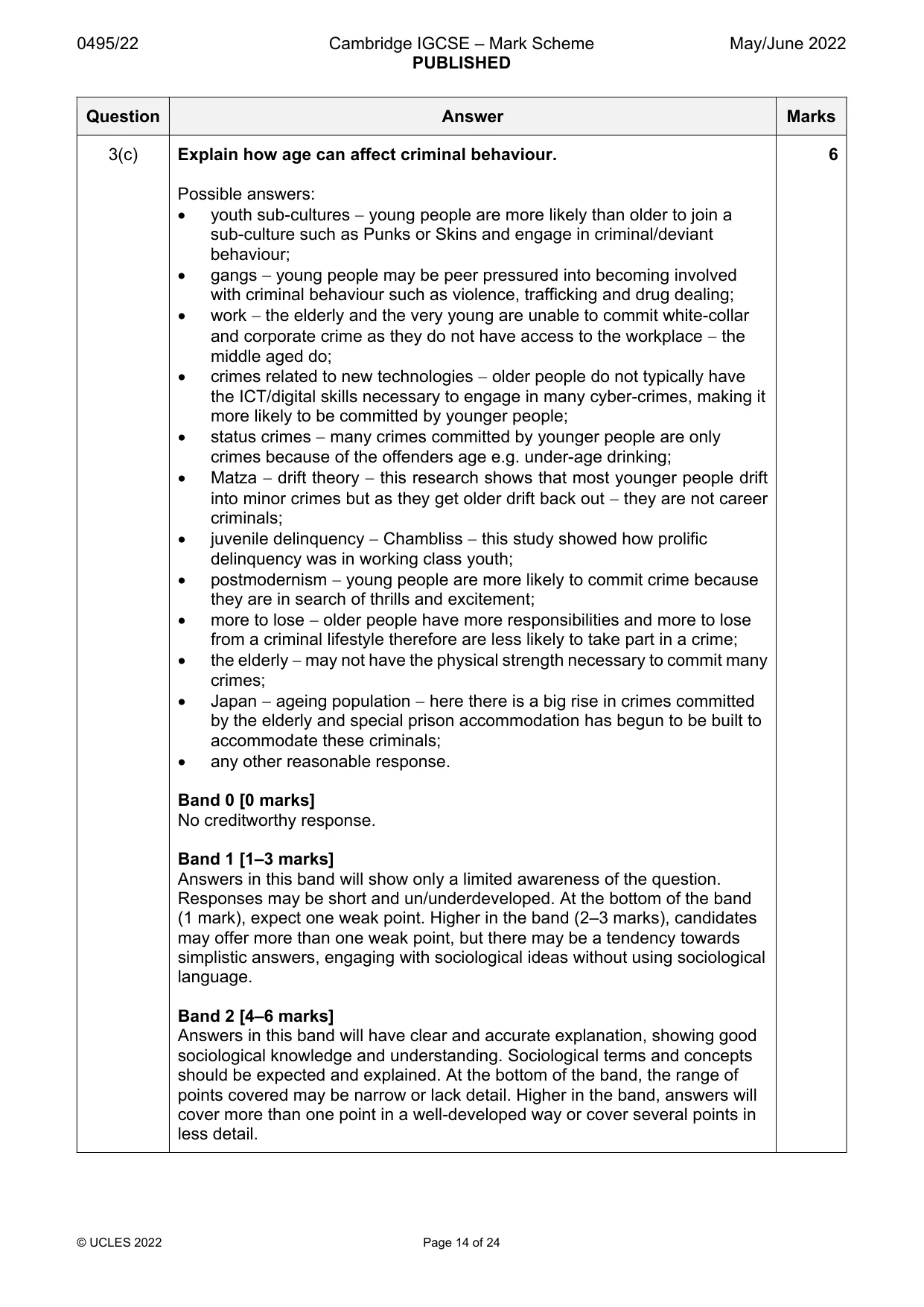
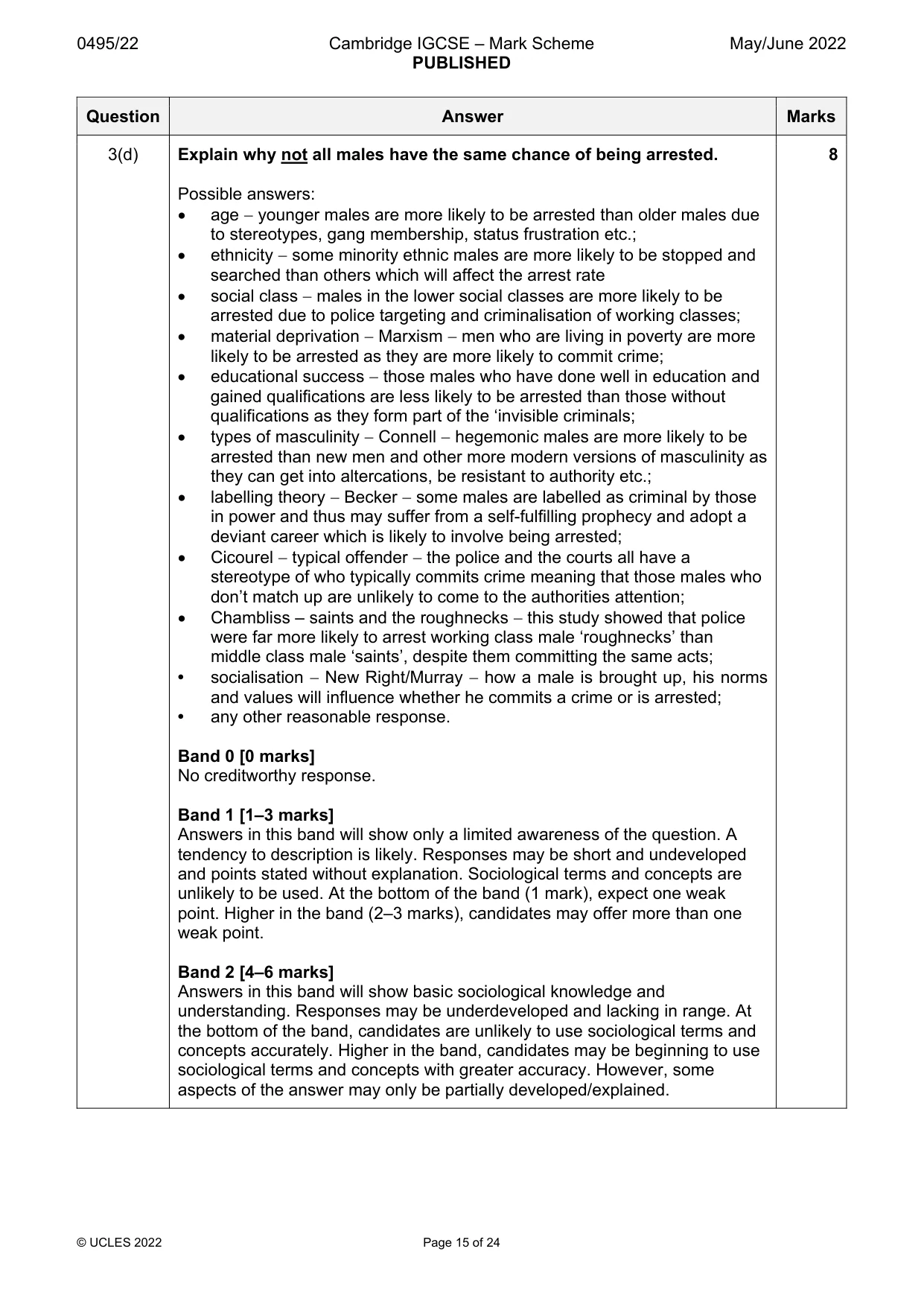
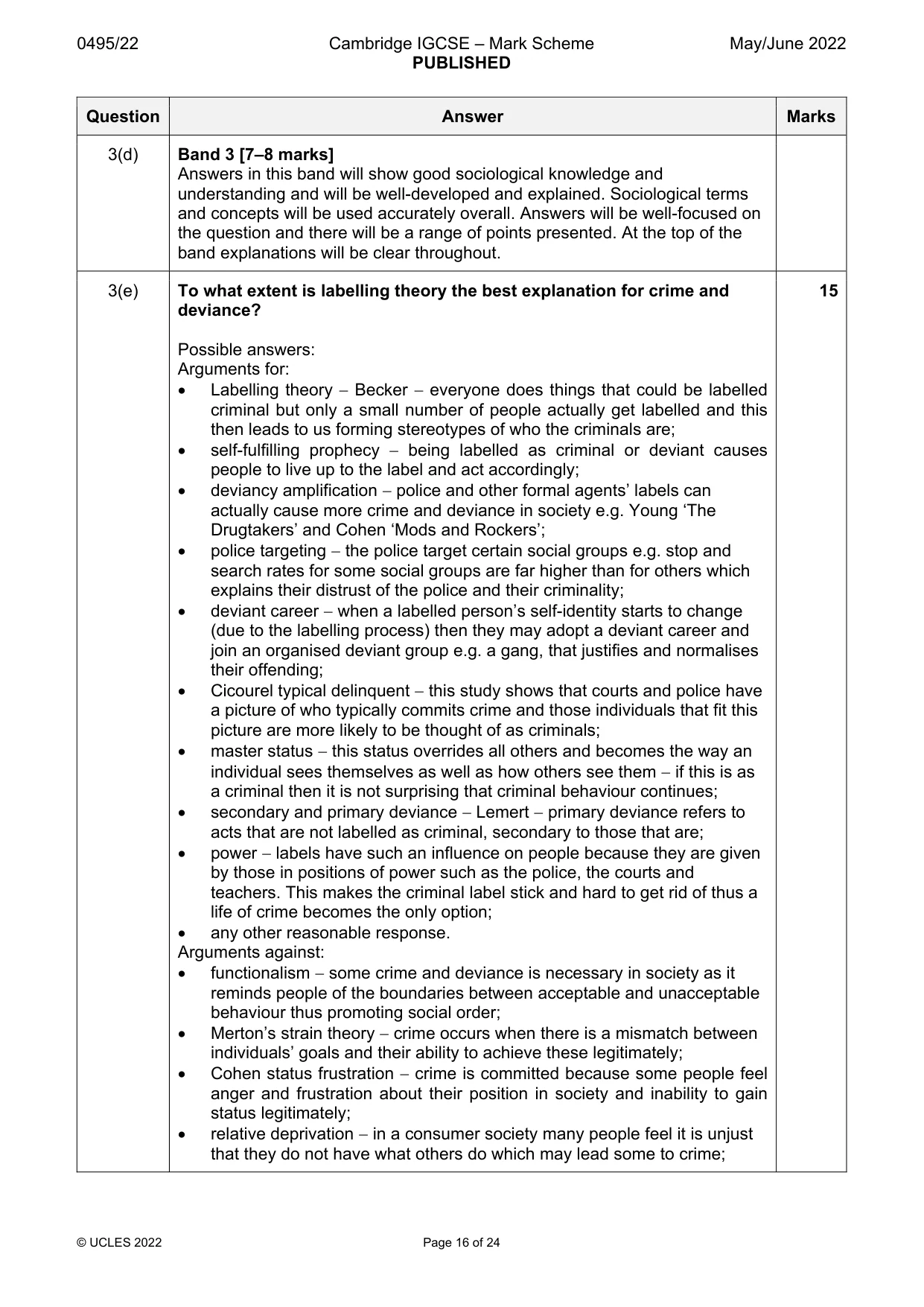
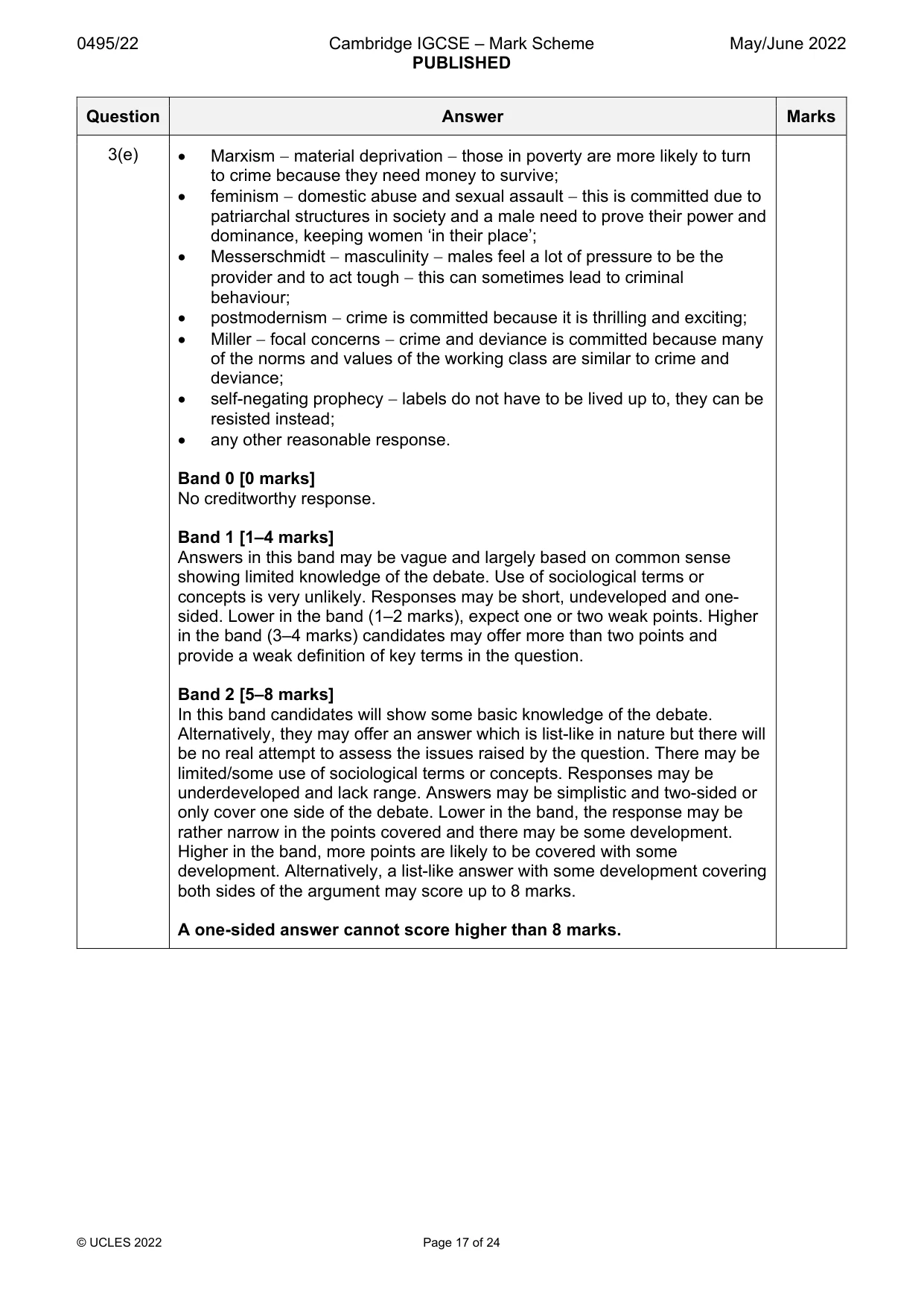
Mark scheme: 3(a) What is meant by the term ‘crime prevention’? 2 One mark for a partial definition, e.g. surveillance. Two marks for a clear definition, e.g. attempts by agencies or individuals to reduce crime, enforce laws and maintain criminal justice. 3(b) Describe two examples of cyber crimes. 4 Possible answers: spreading computer viruses and malware; fraud and identity theft; internet scams targeting individual users e.g. catfishing; harassment by cyberstalking or cyberbullying; websites with obscene or offensive content and the spread of such content via email/mobile phone; the dark web e.g. trade in illegal drugs and other illegal goods; cyberterrorism – using the internet for deliberate, widespread attacks on computers or computer networks e.g. hacking; any other reasonable response. One mark for each point correctly identified (up to maximum of two). One mark for each point that is developed (up to a maximum of two). 3(c) Explain how age can affect criminal behaviour. 6 Possible answers: youth sub-cultures young people are more likely than older to join a sub-culture such as Punks or Skins and engage in criminal/deviant behaviour; gangs young people may be peer pressured into becoming involved with criminal behaviour such as violence, trafficking and drug dealing; work the elderly and the very young are unable to commit white-collar and corporate crime as they do not have access to the workplace the middle aged do; crimes related to new technologies older people do not typically have the ICT/digital skills necessary to engage in many cyber-crimes, making it more likely to be committed by younger people; status crimes many crimes committed by younger people are only crimes because of the offenders age e.g. under-age drinking; Matza drift theory this research shows that most younger people drift into minor crimes but as they get older drift back out they are not career criminals; juvenile delinquency Chambliss this study showed how prolific delinquency was in working class youth; postmodernism young people are more likely to commit crime because they are in search of thrills and excitement; more to lose older people have more responsibilities and more to lose from a criminal lifestyle therefore are less likely to take part in a crime; the elderly may not have the physical strength necessary to commit many crimes; Japan ageing population here there is a big rise in crimes committed by the elderly and special prison accommodation has begun to be built to accommodate these criminals; any other reasonable response. Band 0 [0 marks] No creditworthy response. Band 1 [1–3 marks] Answers in this band will show only a limited awareness of the question. Responses may be short and un/underdeveloped. At the bottom of the band (1 mark), expect one weak point. Higher in the band (2–3 marks), candidates may offer more than one weak point, but there may be a tendency towards simplistic answers, engaging with sociological ideas without using sociological language. Band 2 [4–6 marks] Answers in this band will have clear and accurate explanation, showing good sociological knowledge and understanding. Sociological terms and concepts should be expected and explained. At the bottom of the band, the range of points covered may be narrow or lack detail. Higher in the band, answers will cover more than one point in a well-developed way or cover several points in less detail. 3(d) Explain why not all males have the same chance of being arrested. 8 Possible answers: age younger males are more likely to be arrested than older males due to stereotypes, gang membership, status frustration etc.; ethnicity some minority ethnic males are more likely to be stopped and searched than others which will affect the arrest rate social class males in the lower social classes are more likely to be arrested due to police targeting and criminalisation of working classes; material deprivation Marxism men who are living in poverty are more likely to be arrested as they are more likely to commit crime; educational success those males who have done well in education and gained qualifications are less likely to be arrested than those without qualifications as they form part of the ‘invisible criminals; types of masculinity Connell hegemonic males are more likely to be arrested than new men and other more modern versions of masculinity as they can get into altercations, be resistant to authority etc.; labelling theory Becker some males are labelled as criminal by those in power and thus may suffer from a self-fulfilling prophecy and adopt a deviant career which is likely to involve being arrested; Cicourel typical offender the police and the courts all have a stereotype of who typically commits crime meaning that those males who don’t match up are unlikely to come to the authorities attention; Chambliss – saints and the roughnecks this study showed that police were far more likely to arrest working class male ‘roughnecks’ than middle class male ‘saints’, despite them committing the same acts; • socialisation New Right/Murray how a male is brought up, his norms and values will influence whether he commits a crime or is arrested; • any other reasonable response. Band 0 [0 marks] No creditworthy response. Band 1 [1–3 marks] Answers in this band will show only a limited awareness of the question. A tendency to description is likely. Responses may be short and undeveloped and points stated without explanation. Sociological terms and concepts are unlikely to be used. At the bottom of the band (1 mark), expect one weak point. Higher in the band (2–3 marks), candidates may offer more than one weak point. Band 2 [4–6 marks] Answers in this band will show basic sociological knowledge and understanding. Responses may be underdeveloped and lacking in range. At the bottom of the band, candidates are unlikely to use sociological terms and concepts accurately. Higher in the band, candidates may be beginning to use sociological terms and concepts with greater accuracy. However, some aspects of the answer may only be partially developed/explained. 3(d) Band 3 [7–8 marks] Answers in this band will show good sociological knowledge and understanding and will be well-developed and explained. Sociological terms and concepts will be used accurately overall. Answers will be well-focused on the question and there will be a range of points presented. At the top of the band explanations will be clear throughout. 3(e) To what extent is labelling theory the best explanation for crime and 15 deviance? Possible answers: Arguments for: Labelling theory Becker everyone does things that could be labelled criminal but only a small number of people actually get labelled and this then leads to us forming stereotypes of who the criminals are; self-fulfilling prophecy being labelled as criminal or deviant causes people to live up to the label and act accordingly; deviancy amplification police and other formal agents’ labels can actually cause more crime and deviance in society e.g. Young ‘The Drugtakers’ and Cohen ‘Mods and Rockers’; police targeting the police target certain social groups e.g. stop and search rates for some social groups are far higher than for others which explains their distrust of the police and their criminality; deviant career when a labelled person’s self-identity starts to change (due to the labelling process) then they may adopt a deviant career and join an organised deviant group e.g. a gang, that justifies and normalises their offending; Cicourel typical delinquent this study shows that courts and police have a picture of who typically commits crime and those individuals that fit this picture are more likely to be thought of as criminals; master status this status overrides all others and becomes the way an individual sees themselves as well as how others see them if this is as a criminal then it is not surprising that criminal behaviour continues; secondary and primary deviance Lemert primary deviance refers to acts that are not labelled as criminal, secondary to those that are; power labels have such an influence on people because they are given by those in positions of power such as the police, the courts and teachers. This makes the criminal label stick and hard to get rid of thus a life of crime becomes the only option; any other reasonable response. Arguments against: functionalism some crime and deviance is necessary in society as it reminds people of the boundaries between acceptable and unacceptable behaviour thus promoting social order; Merton’s strain theory crime occurs when there is a mismatch between individuals’ goals and their ability to achieve these legitimately; Cohen status frustration crime is committed because some people feel anger and frustration about their position in society and inability to gain status legitimately; relative deprivation in a consumer society many people feel it is unjust that they do not have what others do which may lead some to crime; 3(e) Marxism material deprivation those in poverty are more likely to turn to crime because they need money to survive; feminism domestic abuse and sexual assault this is committed due to patriarchal structures in society and a male need to prove their power and dominance, keeping women ‘in their place’; Messerschmidt masculinity males feel a lot of pressure to be the provider and to act tough this can sometimes lead to criminal behaviour; postmodernism crime is committed because it is thrilling and exciting; Miller focal concerns crime and deviance is committed because many of the norms and values of the working class are similar to crime and deviance; self-negating prophecy labels do not have to be lived up to, they can be resisted instead; any other reasonable response. Band 0 [0 marks] No creditworthy response. Band 1 [1–4 marks] Answers in this band may be vague and largely based on common sense showing limited knowledge of the debate. Use of sociological terms or concepts is very unlikely. Responses may be short, undeveloped and one- sided. Lower in the band (1–2 marks), expect one or two weak points. Higher in the band (3–4 marks) candidates may offer more than two points and provide a weak definition of key terms in the question. Band 2 [5–8 marks] In this band candidates will show some basic knowledge of the debate. Alternatively, they may offer an answer which is list-like in nature but there will be no real attempt to assess the issues raised by the question. There may be limited/some use of sociological terms or concepts. Responses may be underdeveloped and lack range. Answers may be simplistic and two-sided or only cover one side of the debate. Lower in the band, the response may be rather narrow in the points covered and there may be some development. Higher in the band, more points are likely to be covered with some development. Alternatively, a list-like answer with some development covering both sides of the argument may score up to 8 marks. A one-sided answer cannot score higher than 8 marks. 3(e) Band 3 [9–12 marks] Answers in this band will show good sociological knowledge and understanding of the debate. Sociological terms and concepts will be used with greater accuracy and/or frequency. For the most part, answers will be well-developed, focused on the question and there will be a range of points presented. There will be a two-sided response but it may lack range on one side. At the bottom of the band, candidates may provide a narrower range of developed points. At the top of the band, expect a wider range of developed points and clear focus on the question. Band 4 [13–15 marks] Answers in this band will show excellent knowledge and understanding of the debate. There will be a strong grasp of the arguments as well as accurate and frequent use of sociological terms and concepts. Answers will be well- developed, clearly focused on the question and discuss a wide range of points. Responses will be two-sided and have a range of points on each side. At the bottom of the band (13 marks), the answer may lack a specific conclusion. Higher in the band, there will be a clear attempt to offer an assessment of the ‘To what extent?’ part of the question through a focused conclusion.
More questions on How do sociologists approach the study of society?
Q4 · The media is an important institution in society that many people believe is responsible…
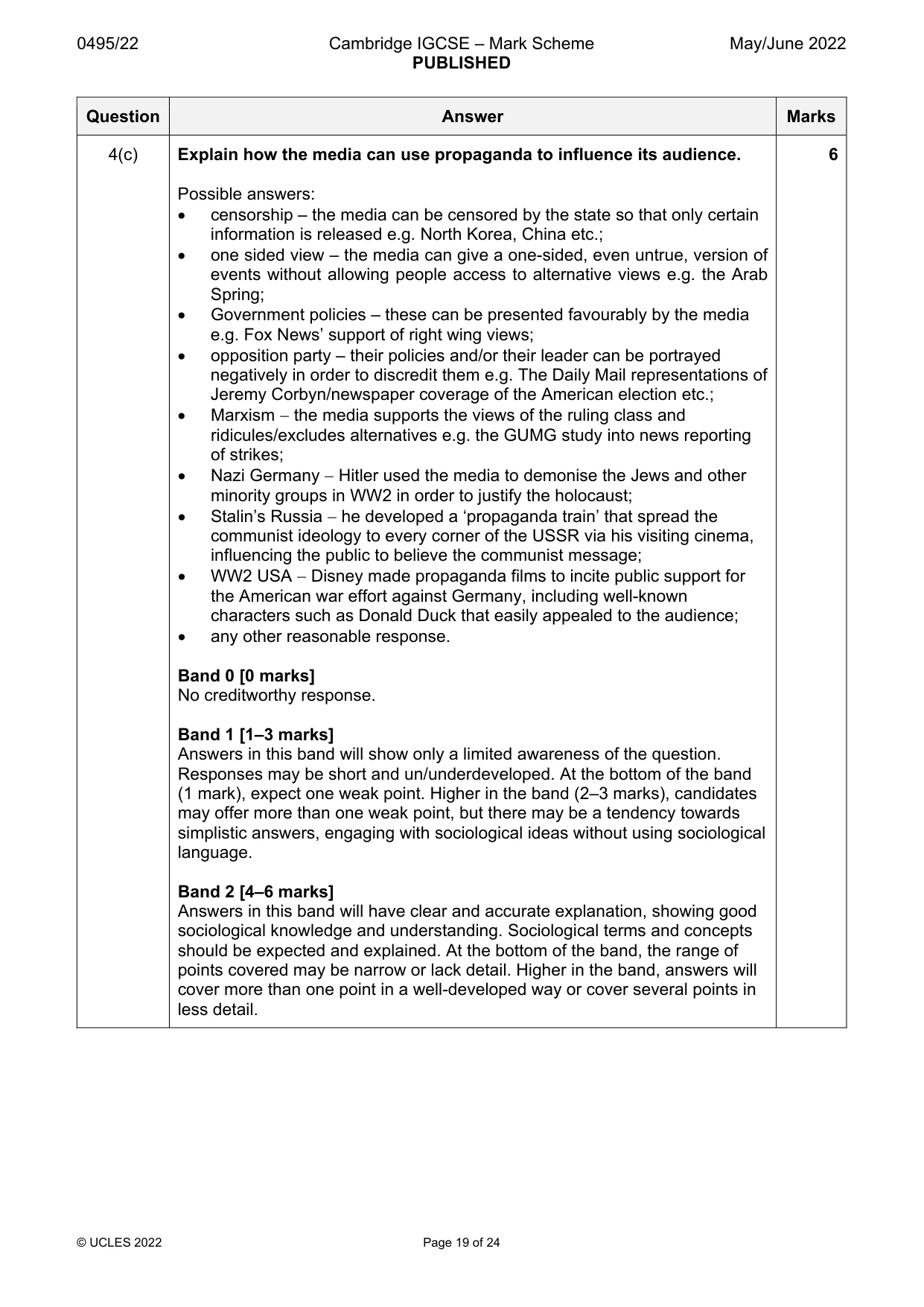
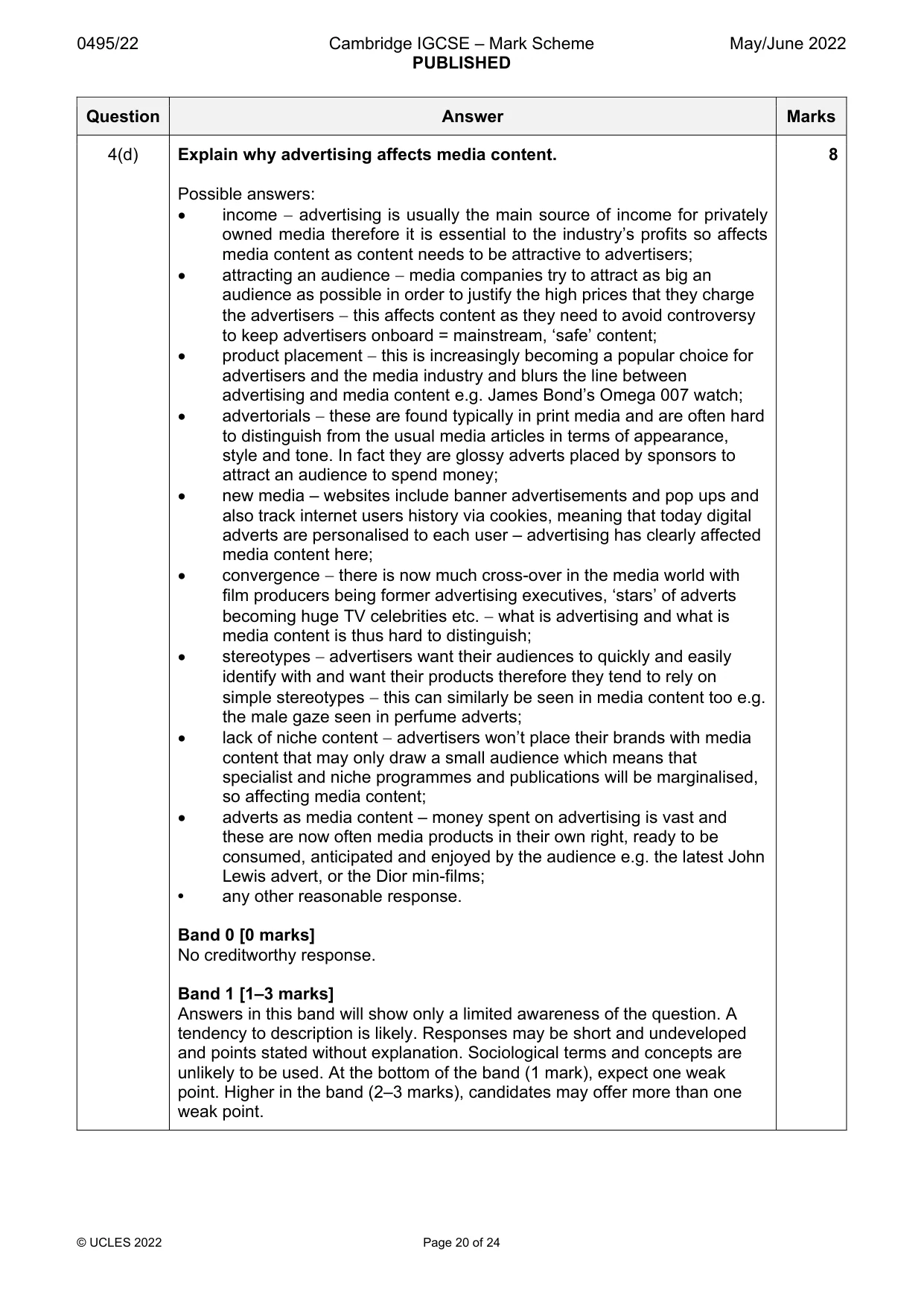
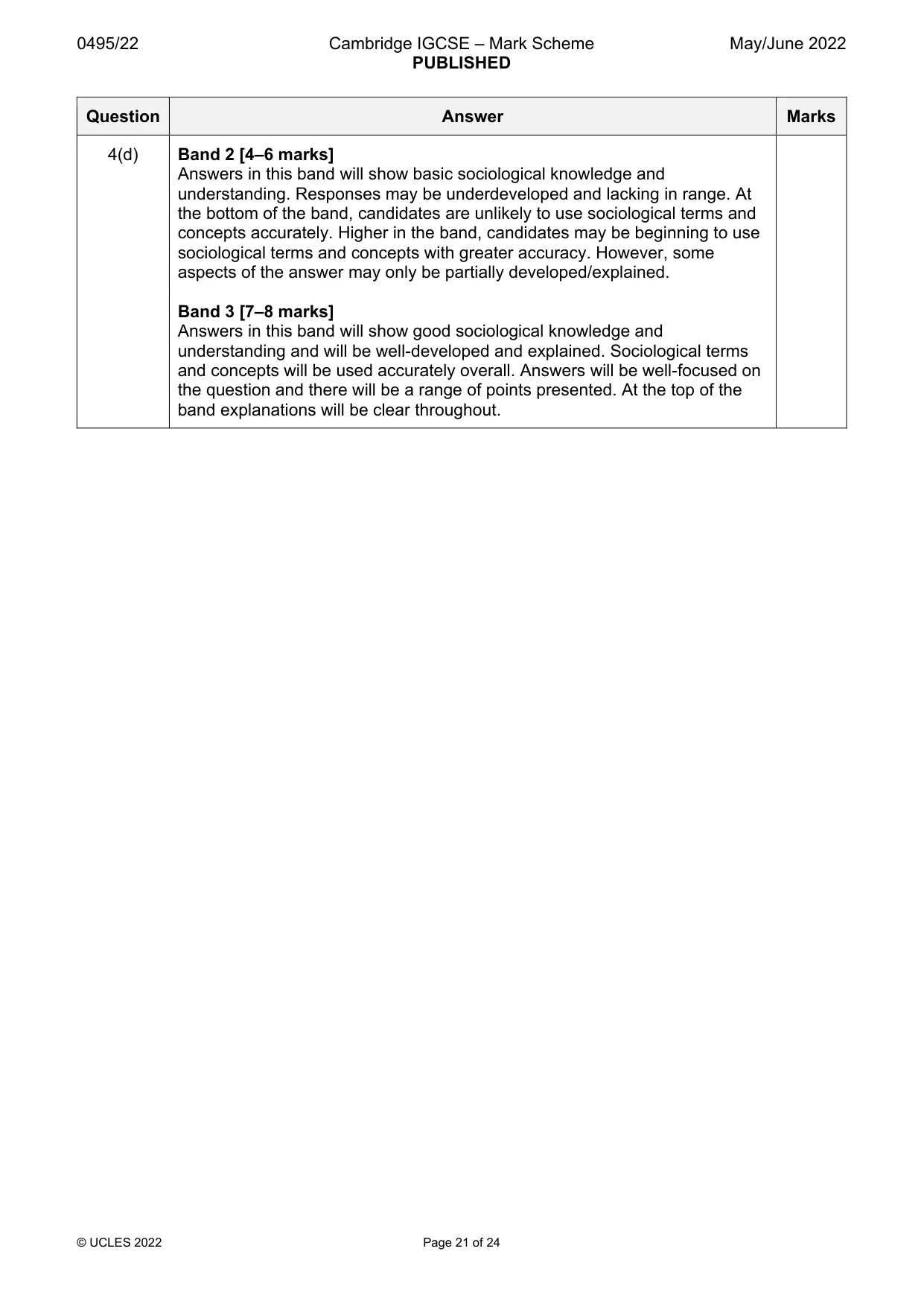
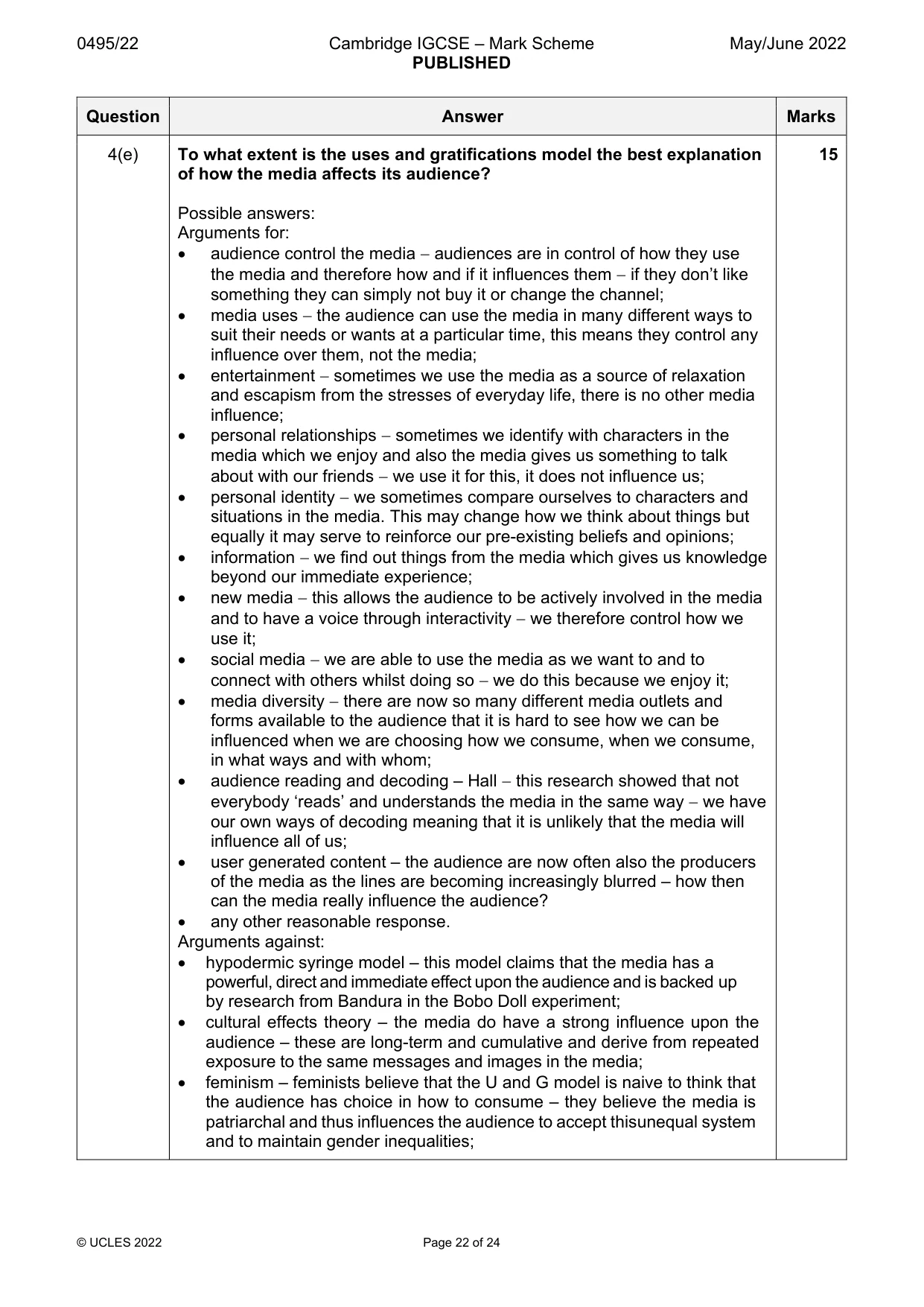
4 The media is an important institution in society that many people believe is responsible for propaganda and agenda setting. Who controls media content is a matter of debate, but media gate-keepers and advertisers both have a role to play. Not all sociologists view the media in the same way. For example the uses and gratifications approach to media effects is very different to the hypodermic-syringe model. (a) What is meant by the term ‘agenda setting’? [2] (b) Describe two examples of media gate-keeping. [4] (c) Explain how the media can use propaganda to influence its audience. [6] (d) Explain why advertising affects media content. [8] (e) To what extent is the uses and gratifications model the best explanation of how the media affects its audience? [15]
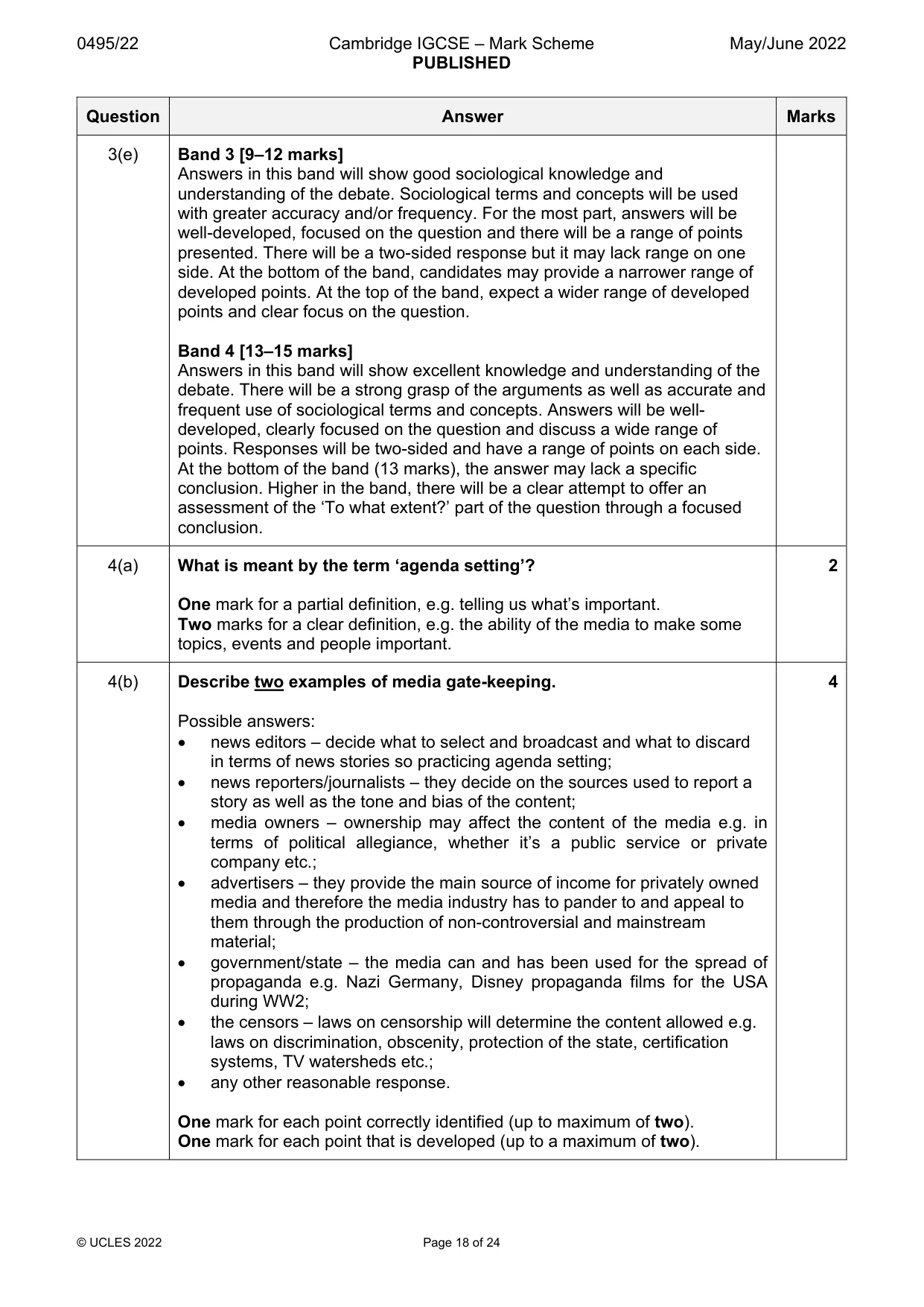
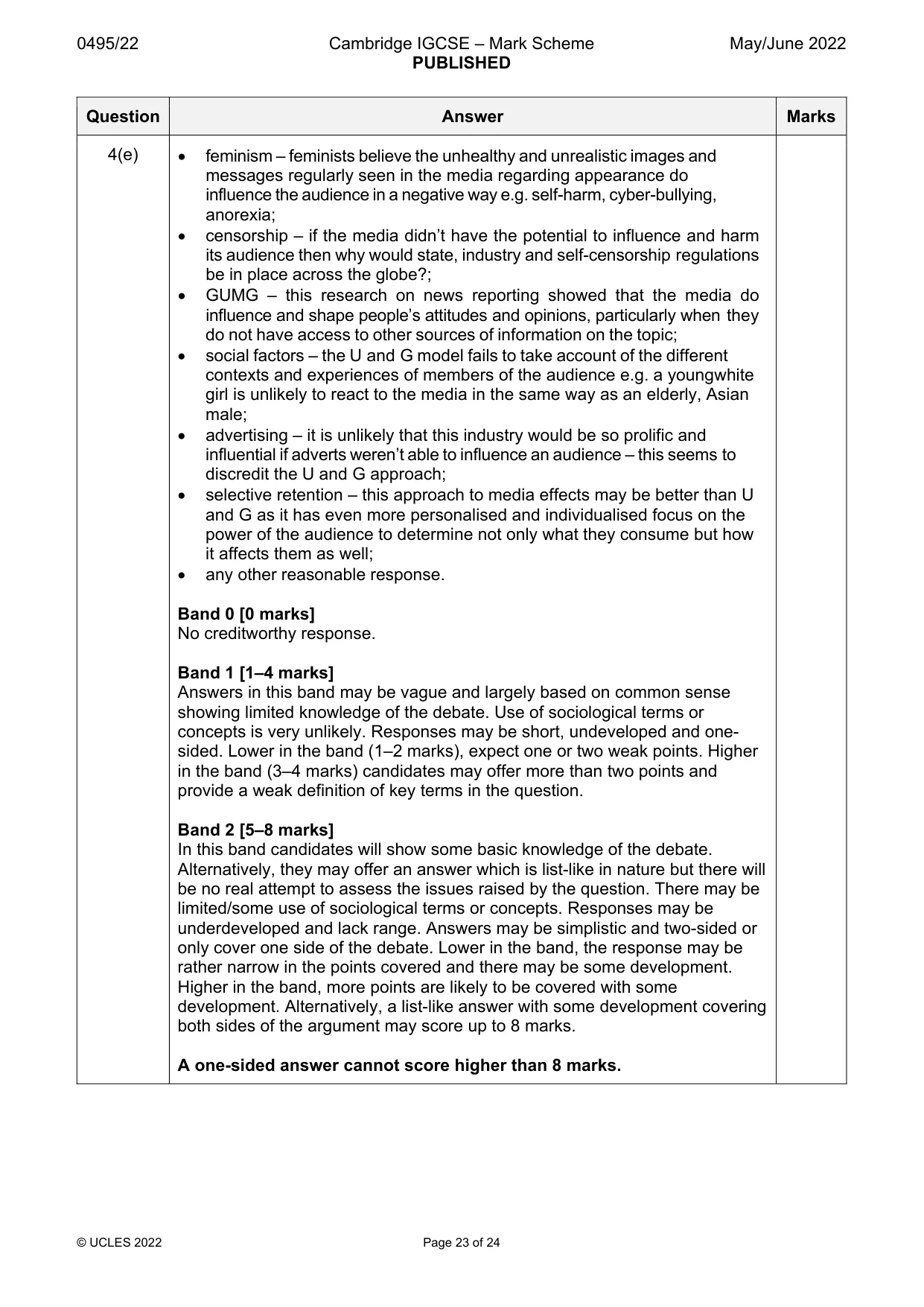
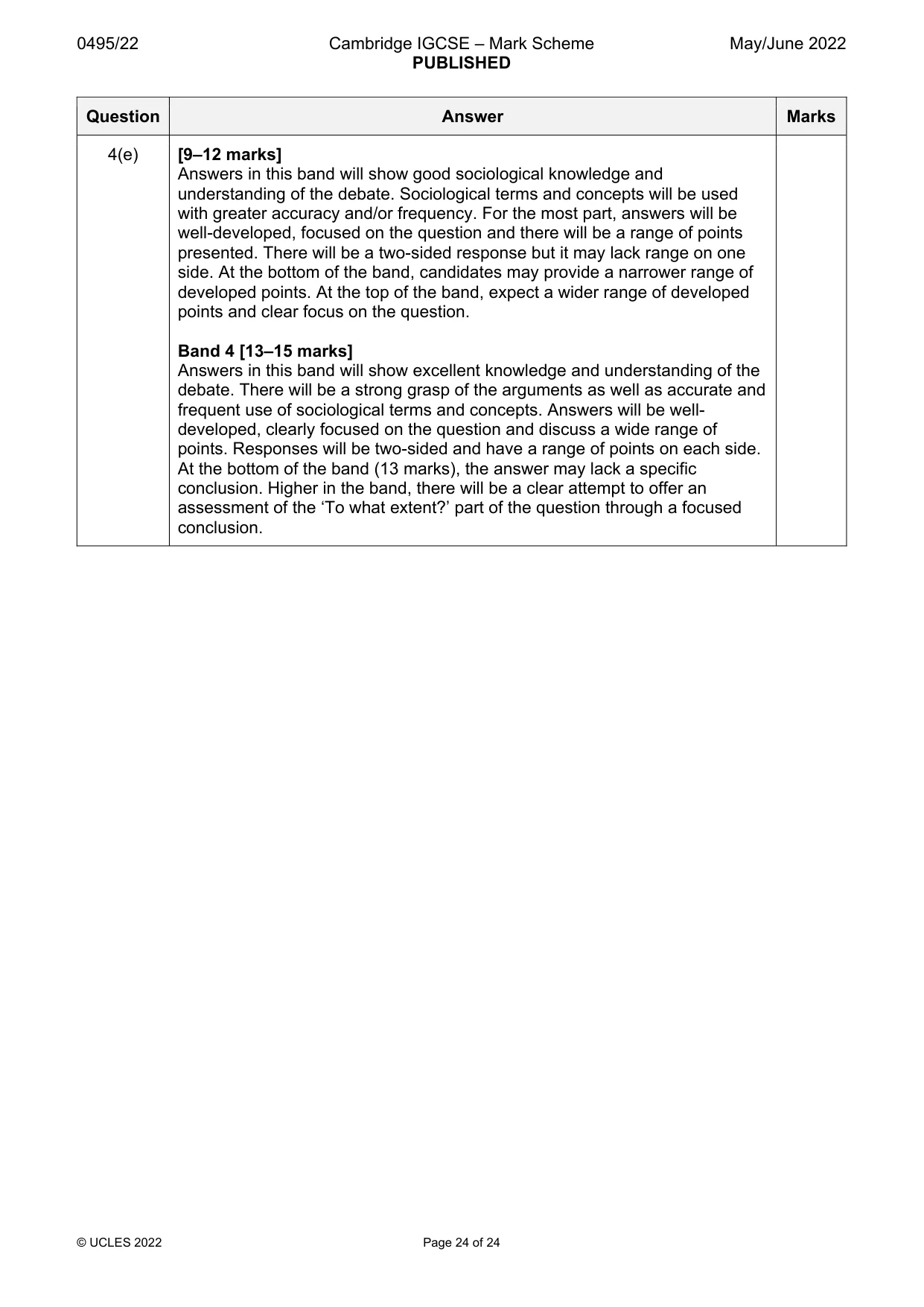
Mark scheme: 4(a) What is meant by the term ‘agenda setting’? 2 One mark for a partial definition, e.g. telling us what’s important. Two marks for a clear definition, e.g. the ability of the media to make some topics, events and people important. 4(b) Describe two examples of media gate-keeping. 4 Possible answers: news editors – decide what to select and broadcast and what to discard in terms of news stories so practicing agenda setting; news reporters/journalists – they decide on the sources used to report a story as well as the tone and bias of the content; media owners – ownership may affect the content of the media e.g. in terms of political allegiance, whether it’s a public service or private company etc.; advertisers – they provide the main source of income for privately owned media and therefore the media industry has to pander to and appeal to them through the production of non-controversial and mainstream material; government/state – the media can and has been used for the spread of propaganda e.g. Nazi Germany, Disney propaganda films for the USA during WW2; the censors – laws on censorship will determine the content allowed e.g. laws on discrimination, obscenity, protection of the state, certification systems, TV watersheds etc.; any other reasonable response. One mark for each point correctly identified (up to maximum of two). One mark for each point that is developed (up to a maximum of two). 4(c) Explain how the media can use propaganda to influence its audience. 6 Possible answers: censorship – the media can be censored by the state so that only certain information is released e.g. North Korea, China etc.; one sided view – the media can give a one-sided, even untrue, version of events without allowing people access to alternative views e.g. the Arab Spring; Government policies – these can be presented favourably by the media e.g. Fox News’ support of right wing views; opposition party – their policies and/or their leader can be portrayed negatively in order to discredit them e.g. The Daily Mail representations of Jeremy Corbyn/newspaper coverage of the American election etc.; Marxism the media supports the views of the ruling class and ridicules/excludes alternatives e.g. the GUMG study into news reporting of strikes; Nazi Germany Hitler used the media to demonise the Jews and other minority groups in WW2 in order to justify the holocaust; Stalin’s Russia he developed a ‘propaganda train’ that spread the communist ideology to every corner of the USSR via his visiting cinema, influencing the public to believe the communist message; WW2 USA Disney made propaganda films to incite public support for the American war effort against Germany, including well-known characters such as Donald Duck that easily appealed to the audience; any other reasonable response. Band 0 [0 marks] No creditworthy response. Band 1 [1–3 marks] Answers in this band will show only a limited awareness of the question. Responses may be short and un/underdeveloped. At the bottom of the band (1 mark), expect one weak point. Higher in the band (2–3 marks), candidates may offer more than one weak point, but there may be a tendency towards simplistic answers, engaging with sociological ideas without using sociological language. Band 2 [4–6 marks] Answers in this band will have clear and accurate explanation, showing good sociological knowledge and understanding. Sociological terms and concepts should be expected and explained. At the bottom of the band, the range of points covered may be narrow or lack detail. Higher in the band, answers will cover more than one point in a well-developed way or cover several points in less detail. 4(d) Explain why advertising affects media content. 8 Possible answers: income advertising is usually the main source of income for privately owned media therefore it is essential to the industry’s profits so affects media content as content needs to be attractive to advertisers; attracting an audience media companies try to attract as big an audience as possible in order to justify the high prices that they charge the advertisers this affects content as they need to avoid controversy to keep advertisers onboard = mainstream, ‘safe’ content; product placement this is increasingly becoming a popular choice for advertisers and the media industry and blurs the line between advertising and media content e.g. James Bond’s Omega 007 watch; advertorials these are found typically in print media and are often hard to distinguish from the usual media articles in terms of appearance, style and tone. In fact they are glossy adverts placed by sponsors to attract an audience to spend money; new media – websites include banner advertisements and pop ups and also track internet users history via cookies, meaning that today digital adverts are personalised to each user – advertising has clearly affected media content here; convergence there is now much cross-over in the media world with film producers being former advertising executives, ‘stars’ of adverts becoming huge TV celebrities etc. what is advertising and what is media content is thus hard to distinguish; stereotypes advertisers want their audiences to quickly and easily identify with and want their products therefore they tend to rely on simple stereotypes this can similarly be seen in media content too e.g. the male gaze seen in perfume adverts; lack of niche content advertisers won’t place their brands with media content that may only draw a small audience which means that specialist and niche programmes and publications will be marginalised, so affecting media content; adverts as media content – money spent on advertising is vast and these are now often media products in their own right, ready to be consumed, anticipated and enjoyed by the audience e.g. the latest John Lewis advert, or the Dior min-films; • any other reasonable response. Band 0 [0 marks] No creditworthy response. Band 1 [1–3 marks] Answers in this band will show only a limited awareness of the question. A tendency to description is likely. Responses may be short and undeveloped and points stated without explanation. Sociological terms and concepts are unlikely to be used. At the bottom of the band (1 mark), expect one weak point. Higher in the band (2–3 marks), candidates may offer more than one weak point. 4(d) Band 2 [4–6 marks] Answers in this band will show basic sociological knowledge and understanding. Responses may be underdeveloped and lacking in range. At the bottom of the band, candidates are unlikely to use sociological terms and concepts accurately. Higher in the band, candidates may be beginning to use sociological terms and concepts with greater accuracy. However, some aspects of the answer may only be partially developed/explained. Band 3 [7–8 marks] Answers in this band will show good sociological knowledge and understanding and will be well-developed and explained. Sociological terms and concepts will be used accurately overall. Answers will be well-focused on the question and there will be a range of points presented. At the top of the band explanations will be clear throughout. 4(e) To what extent is the uses and gratifications model the best explanation 15 of how the media affects its audience? Possible answers: Arguments for: audience control the media audiences are in control of how they use the media and therefore how and if it influences them if they don’t like something they can simply not buy it or change the channel; media uses the audience can use the media in many different ways to suit their needs or wants at a particular time, this means they control any influence over them, not the media; entertainment sometimes we use the media as a source of relaxation and escapism from the stresses of everyday life, there is no other media influence; personal relationships sometimes we identify with characters in the media which we enjoy and also the media gives us something to talk about with our friends we use it for this, it does not influence us; personal identity we sometimes compare ourselves to characters and situations in the media. This may change how we think about things but equally it may serve to reinforce our pre-existing beliefs and opinions; information we find out things from the media which gives us knowledge beyond our immediate experience; new media this allows the audience to be actively involved in the media and to have a voice through interactivity we therefore control how we use it; social media we are able to use the media as we want to and to connect with others whilst doing so we do this because we enjoy it; media diversity there are now so many different media outlets and forms available to the audience that it is hard to see how we can be influenced when we are choosing how we consume, when we consume, in what ways and with whom; audience reading and decoding – Hall this research showed that not everybody ‘reads’ and understands the media in the same way we have our own ways of decoding meaning that it is unlikely that the media will influence all of us; user generated content – the audience are now often also the producers of the media as the lines are becoming increasingly blurred – how then can the media really influence the audience? any other reasonable response. Arguments against: hypodermic syringe model – this model claims that the media has a powerful, direct and immediate effect upon the audience and is backed up by research from Bandura in the Bobo Doll experiment; cultural effects theory – the media do have a strong influence upon the audience – these are long-term and cumulative and derive from repeated exposure to the same messages and images in the media; feminism – feminists believe that the U and G model is naive to think that the audience has choice in how to consume – they believe the media is patriarchal and thus influences the audience to accept this unequal system and to maintain gender inequalities; 4(e) feminism – feminists believe the unhealthy and unrealistic images and messages regularly seen in the media regarding appearance do influence the audience in a negative way e.g. self-harm, cyber-bullying, anorexia; censorship – if the media didn’t have the potential to influence and harm its audience then why would state, industry and self-censorship regulations be in place across the globe?; GUMG – this research on news reporting showed that the media do influence and shape people’s attitudes and opinions, particularly when they do not have access to other sources of information on the topic; social factors – the U and G model fails to take account of the different contexts and experiences of members of the audience e.g. a young white girl is unlikely to react to the media in the same way as an elderly, Asian male; advertising – it is unlikely that this industry would be so prolific and influential if adverts weren’t able to influence an audience – this seems to discredit the U and G approach; selective retention – this approach to media effects may be better than U and G as it has even more personalised and individualised focus on the power of the audience to determine not only what they consume but how it affects them as well; any other reasonable response. Band 0 [0 marks] No creditworthy response. Band 1 [1–4 marks] Answers in this band may be vague and largely based on common sense showing limited knowledge of the debate. Use of sociological terms or concepts is very unlikely. Responses may be short, undeveloped and one- sided. Lower in the band (1–2 marks), expect one or two weak points. Higher in the band (3–4 marks) candidates may offer more than two points and provide a weak definition of key terms in the question. Band 2 [5–8 marks] In this band candidates will show some basic knowledge of the debate. Alternatively, they may offer an answer which is list-like in nature but there will be no real attempt to assess the issues raised by the question. There may be limited/some use of sociological terms or concepts. Responses may be underdeveloped and lack range. Answers may be simplistic and two-sided or only cover one side of the debate. Lower in the band, the response may be rather narrow in the points covered and there may be some development. Higher in the band, more points are likely to be covered with some development. Alternatively, a list-like answer with some development covering both sides of the argument may score up to 8 marks. A one-sided answer cannot score higher than 8 marks. 4(e) [9–12 marks] Answers in this band will show good sociological knowledge and understanding of the debate. Sociological terms and concepts will be used with greater accuracy and/or frequency. For the most part, answers will be well-developed, focused on the question and there will be a range of points presented. There will be a two-sided response but it may lack range on one side. At the bottom of the band, candidates may provide a narrower range of developed points. At the top of the band, expect a wider range of developed points and clear focus on the question. Band 4 [13–15 marks] Answers in this band will show excellent knowledge and understanding of the debate. There will be a strong grasp of the arguments as well as accurate and frequent use of sociological terms and concepts. Answers will be well- developed, clearly focused on the question and discuss a wide range of points. Responses will be two-sided and have a range of points on each side. At the bottom of the band (13 marks), the answer may lack a specific conclusion. Higher in the band, there will be a clear attempt to offer an assessment of the ‘To what extent?’ part of the question through a focused conclusion.
More questions on How do sociologists approach the study of society?
What was in this paper
The subtopics covered by these 4 questions, and how many questions each got. Open one in a new tab to see every Cambridge question on it.
What you needed in this session
Cambridge’s own grade thresholds for 2022 May/June, Paper 2 · Variant 2. A higher threshold means an easier paper — the bar moves with how the cohort did.