Cambridge IGCSE Sociology 0495 — 2025 May/June Paper 2 · Variant 2
0495/22/M/J/25 · 3 questions · 80 marks · 105 min
The question paper and its mark scheme, free to read here and free to download. This is Cambridge’s own paper, exactly as it was sat.
Question paper4 pages

Mark scheme26 pages
Answers below. Sit the paper first if you are practising.








Questions as text
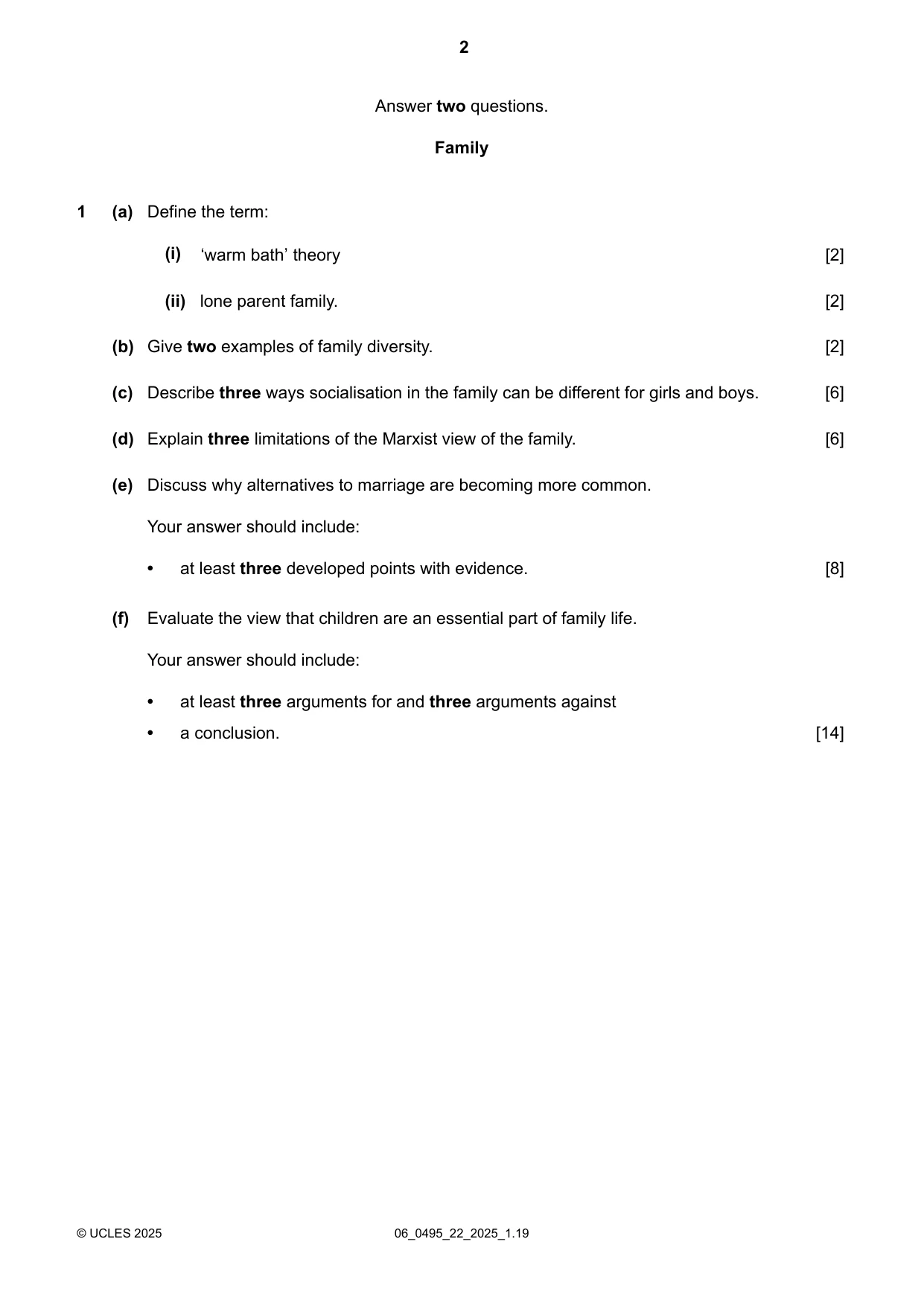
Q1 · Define the term: (i) ‘warm bath’ theory [2] (ii) lone parent family
1 (a) Define the term: (i) ‘warm bath’ theory [2] (ii) lone parent family. [2] (b) Give two examples of family diversity. [2] (c) Describe three ways socialisation in the family can be different for girls and boys. [6] (d) Explain three limitations of the Marxist view of the family. [6] (e) Discuss why alternatives to marriage are becoming more common. Your answer should include: • at least three developed points with evidence. [8] (f) Evaluate the view that children are an essential part of family life. Your answer should include: • at least three arguments for and three arguments against • a conclusion. [14] Education
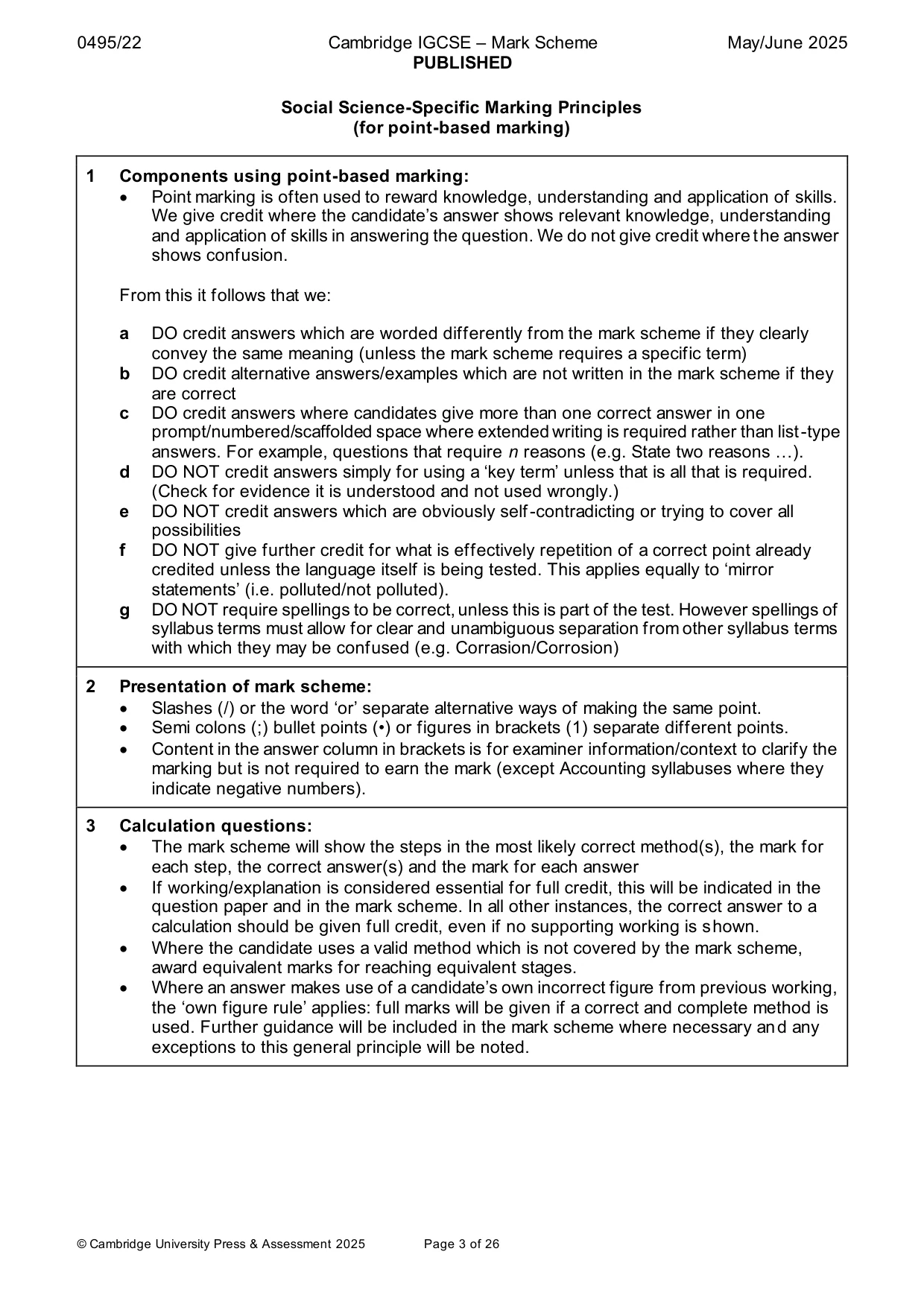
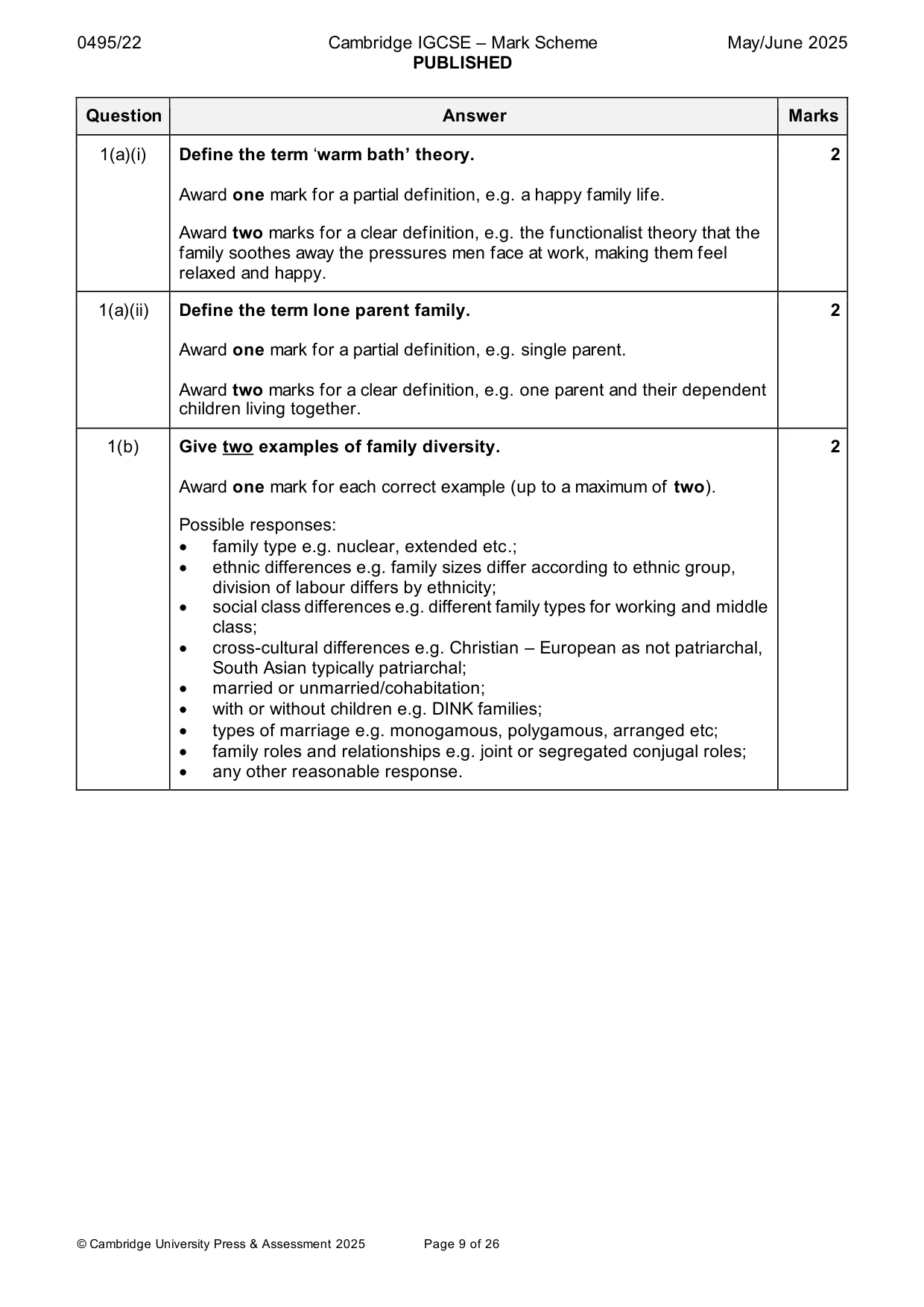
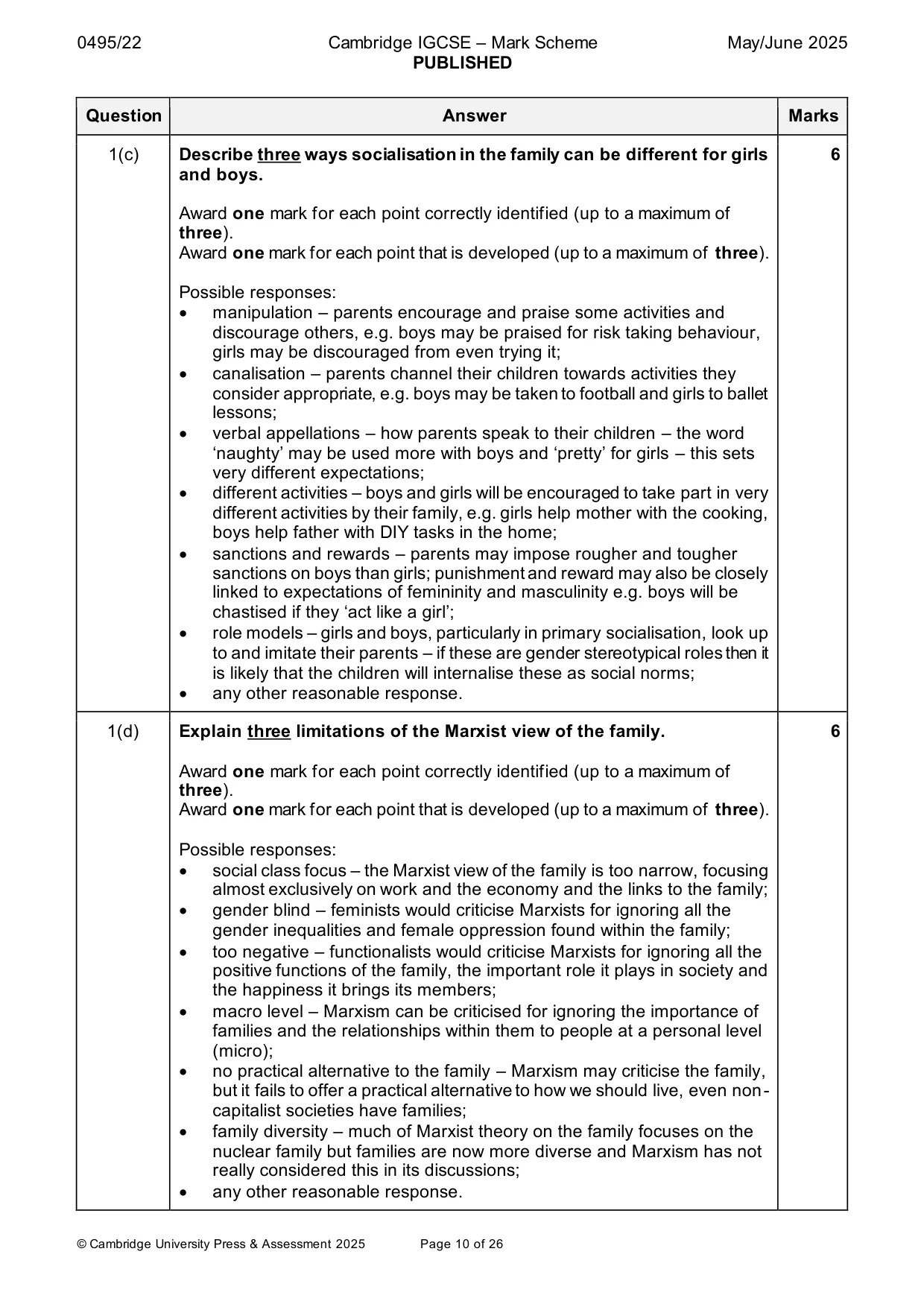
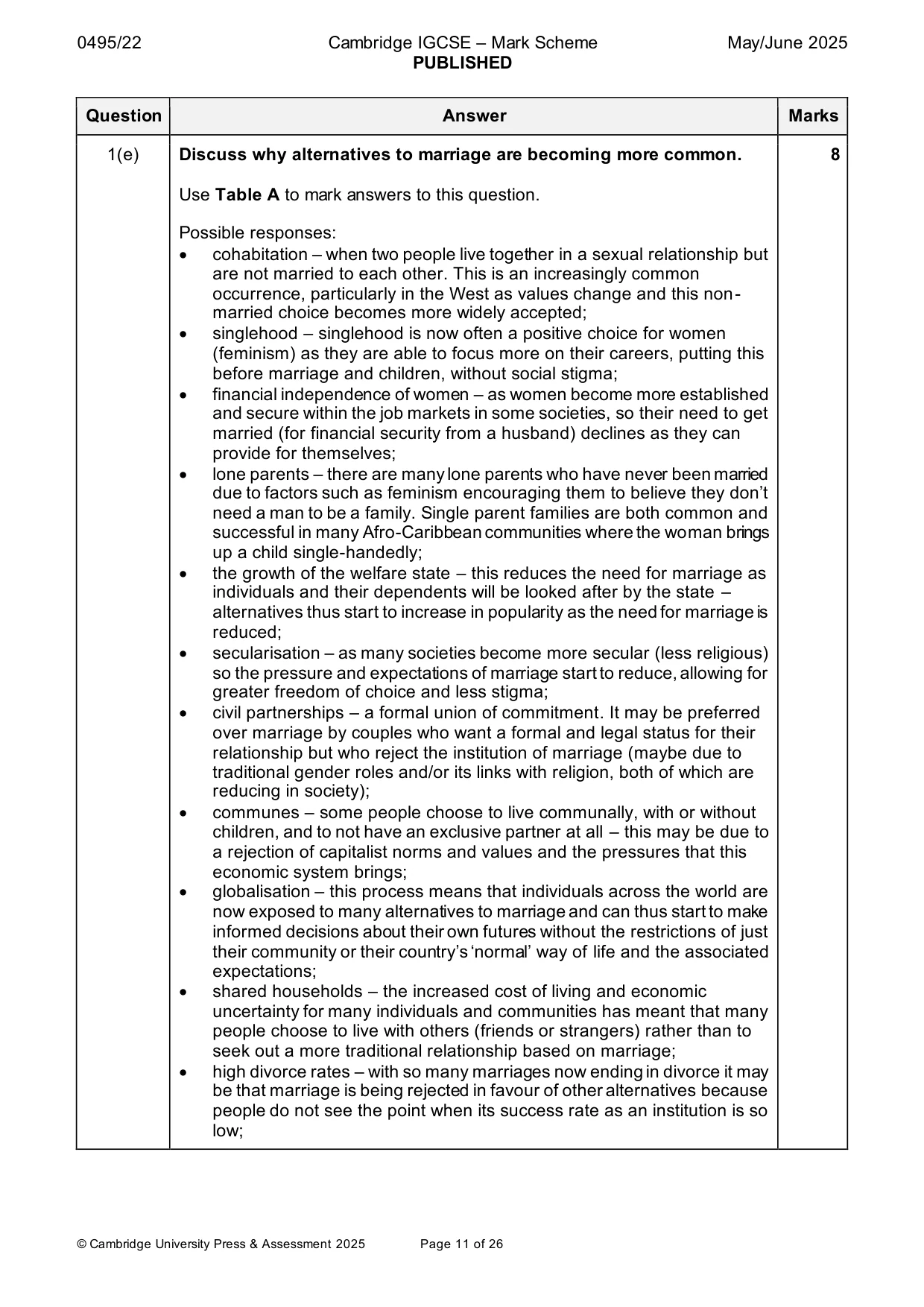
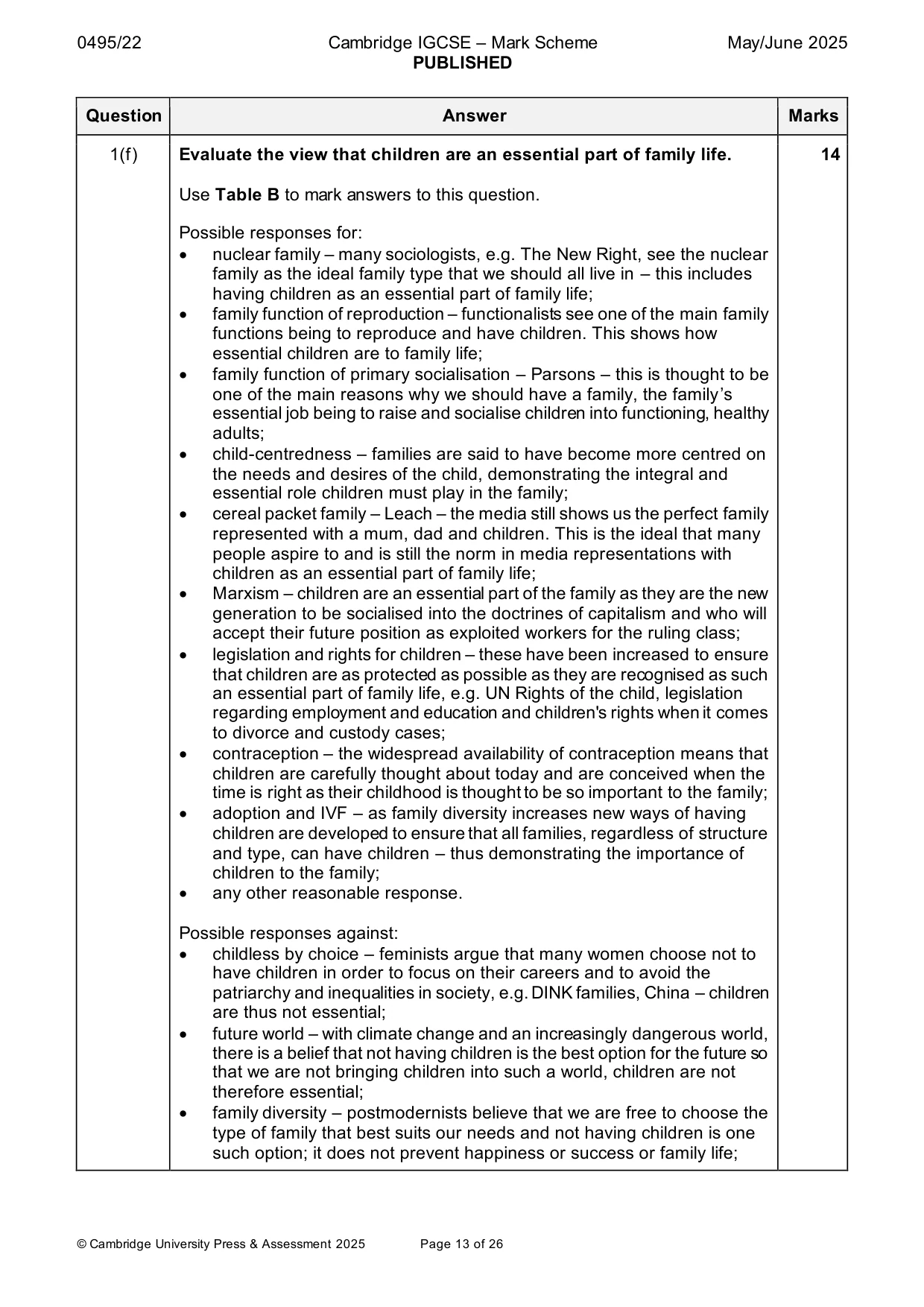
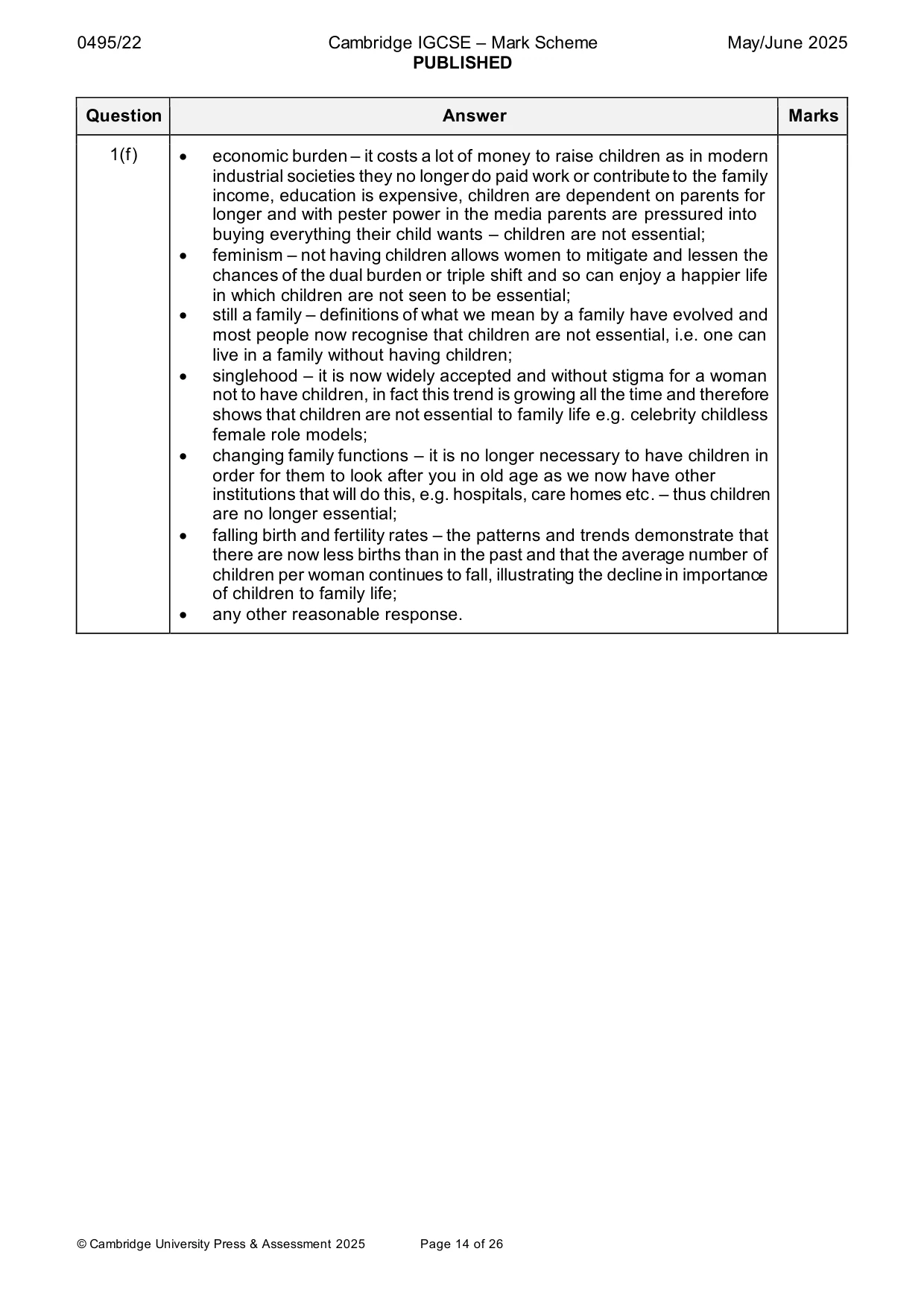
Mark scheme: Question Answer Marks 1(a)(i) Define the term ‘warm bath’ theory. 2 Award one mark for a partial definition, e.g. a happy family life. Award two marks for a clear definition, e.g. the functionalist theory that the family soothes away the pressures men face at work, making them feel relaxed and happy. 1(a)(ii) Define the term lone parent family. 2 Award one mark for a partial definition, e.g. single parent. Award two marks for a clear definition, e.g. one parent and their dependent children living together. 1(b) Give two examples of family diversity. 2 Award one mark for each correct example (up to a maximum of two). Possible responses: • family type e.g. nuclear, extended etc.; • ethnic differences e.g. family sizes differ according to ethnic group, division of labour differs by ethnicity; • social class differences e.g. different family types for working and middle class; • cross-cultural differences e.g. Christian – European as not patriarchal, South Asian typically patriarchal; • married or unmarried/cohabitation; • with or without children e.g. DINK families; • types of marriage e.g. monogamous, polygamous, arranged etc; • family roles and relationships e.g. joint or segregated conjugal roles; • any other reasonable response. 1(c) Describe three ways socialisation in the family can be different for girls 6 and boys. Award one mark for each point correctly identified (up to a maximum of three). Award one mark for each point that is developed (up to a maximum of three). Possible responses: • manipulation – parents encourage and praise some activities and discourage others, e.g. boys may be praised for risk taking behaviour, girls may be discouraged from even trying it; • canalisation – parents channel their children towards activities they consider appropriate, e.g. boys may be taken to football and girls to ballet lessons; • verbal appellations – how parents speak to their children – the word ‘naughty’ may be used more with boys and ‘pretty’ for girls – this sets very different expectations; • different activities – boys and girls will be encouraged to take part in very different activities by their family, e.g. girls help mother with the cooking, boys help father with DIY tasks in the home; • sanctions and rewards – parents may impose rougher and tougher sanctions on boys than girls; punishment and reward may also be closely linked to expectations of femininity and masculinity e.g. boys will be chastised if they ‘act like a girl’; • role models – girls and boys, particularly in primary socialisation, look up to and imitate their parents – if these are gender stereotypical roles then it is likely that the children will internalise these as social norms; • any other reasonable response. 1(d) Explain three limitations of the Marxist view of the family. 6 Award one mark for each point correctly identified (up to a maximum of three). Award one mark for each point that is developed (up to a maximum of three). Possible responses: • social class focus – the Marxist view of the family is too narrow, focusing almost exclusively on work and the economy and the links to the family; • gender blind – feminists would criticise Marxists for ignoring all the gender inequalities and female oppression found within the family; • too negative – functionalists would criticise Marxists for ignoring all the positive functions of the family, the important role it plays in society and the happiness it brings its members; • macro level – Marxism can be criticised for ignoring the importance of families and the relationships within them to people at a personal level (micro); • no practical alternative to the family – Marxism may criticise the family, but it fails to offer a practical alternative to how we should live, even non- capitalist societies have families; • family diversity – much of Marxist theory on the family focuses on the nuclear family but families are now more diverse and Marxism has not really considered this in its discussions; • any other reasonable response. 1(e) Discuss why alternatives to marriage are becoming more common. 8 Use Table A to mark answers to this question. Possible responses: • cohabitation – when two people live together in a sexual relationship but are not married to each other. This is an increasingly common occurrence, particularly in the West as values change and this non- married choice becomes more widely accepted; • singlehood – singlehood is now often a positive choice for women (feminism) as they are able to focus more on their careers, putting this before marriage and children, without social stigma; • financial independence of women – as women become more established and secure within the job markets in some societies, so their need to get married (for financial security from a husband) declines as they can provide for themselves; • lone parents – there are many lone parents who have never been married due to factors such as feminism encouraging them to believe they don’t need a man to be a family. Single parent families are both common and successful in many Afro-Caribbean communities where the woman brings up a child single-handedly; • the growth of the welfare state – this reduces the need for marriage as individuals and their dependents will be looked after by the state – alternatives thus start to increase in popularity as the need for marriage is reduced; • secularisation – as many societies become more secular (less religious) so the pressure and expectations of marriage start to reduce, allowing for greater freedom of choice and less stigma; • civil partnerships – a formal union of commitment. It may be preferred over marriage by couples who want a formal and legal status for their relationship but who reject the institution of marriage (maybe due to traditional gender roles and/or its links with religion, both of which are reducing in society); • communes – some people choose to live communally, with or without children, and to not have an exclusive partner at all – this may be due to a rejection of capitalist norms and values and the pressures that this economic system brings; • globalisation – this process means that individuals across the world are now exposed to many alternatives to marriage and can thus start to make informed decisions about their own futures without the restrictions of just their community or their country’s ‘normal’ way of life and the associated expectations; • shared households – the increased cost of living and economic uncertainty for many individuals and communities has meant that many people choose to live with others (friends or strangers) rather than to seek out a more traditional relationship based on marriage; • high divorce rates – with so many marriages now ending in divorce it may be that marriage is being rejected in favour of other alternatives because people do not see the point when its success rate as an institution is so low; 1(e) • cost of marriage – due to consumer culture marriage has become a costly business and for many people this makes it unaffordable or a waste of money – thus individuals choose alternatives instead that meet their needs just as well; • any other reasonable response. 1(f) Evaluate the view that children are an essential part of family life. 14 Use Table B to mark answers to this question. Possible responses for: • nuclear family – many sociologists, e.g. The New Right, see the nuclear family as the ideal family type that we should all live in – this includes having children as an essential part of family life; • family function of reproduction – functionalists see one of the main family functions being to reproduce and have children. This shows how essential children are to family life; • family function of primary socialisation – Parsons – this is thought to be one of the main reasons why we should have a family, the family’s essential job being to raise and socialise children into functioning, healthy adults; • child-centredness – families are said to have become more centred on the needs and desires of the child, demonstrating the integral and essential role children must play in the family; • cereal packet family – Leach – the media still shows us the perfect family represented with a mum, dad and children. This is the ideal that many people aspire to and is still the norm in media representations with children as an essential part of family life; • Marxism – children are an essential part of the family as they are the new generation to be socialised into the doctrines of capitalism and who will accept their future position as exploited workers for the ruling class; • legislation and rights for children – these have been increased to ensure that children are as protected as possible as they are recognised as such an essential part of family life, e.g. UN Rights of the child, legislation regarding employment and education and children's rights when it comes to divorce and custody cases; • contraception – the widespread availability of contraception means that children are carefully thought about today and are conceived when the time is right as their childhood is thought to be so important to the family; • adoption and IVF – as family diversity increases new ways of having children are developed to ensure that all families, regardless of structure and type, can have children – thus demonstrating the importance of children to the family; • any other reasonable response. Possible responses against: • childless by choice – feminists argue that many women choose not to have children in order to focus on their careers and to avoid the patriarchy and inequalities in society, e.g. DINK families, China – children are thus not essential; • future world – with climate change and an increasingly dangerous world, there is a belief that not having children is the best option for the future so that we are not bringing children into such a world, children are not therefore essential; • family diversity – postmodernists believe that we are free to choose the type of family that best suits our needs and not having children is one such option; it does not prevent happiness or success or family life; 1(f) • economic burden – it costs a lot of money to raise children as in modern industrial societies they no longer do paid work or contribute to the family income, education is expensive, children are dependent on parents for longer and with pester power in the media parents are pressured into buying everything their child wants – children are not essential; • feminism – not having children allows women to mitigate and lessen the chances of the dual burden or triple shift and so can enjoy a happier life in which children are not seen to be essential; • still a family – definitions of what we mean by a family have evolved and most people now recognise that children are not essential, i.e. one can live in a family without having children; • singlehood – it is now widely accepted and without stigma for a woman not to have children, in fact this trend is growing all the time and therefore shows that children are not essential to family life e.g. celebrity childless female role models; • changing family functions – it is no longer necessary to have children in order for them to look after you in old age as we now have other institutions that will do this, e.g. hospitals, care homes etc. – thus children are no longer essential; • falling birth and fertility rates – the patterns and trends demonstrate that there are now less births than in the past and that the average number of children per woman continues to fall, illustrating the decline in importance of children to family life; • any other reasonable response.
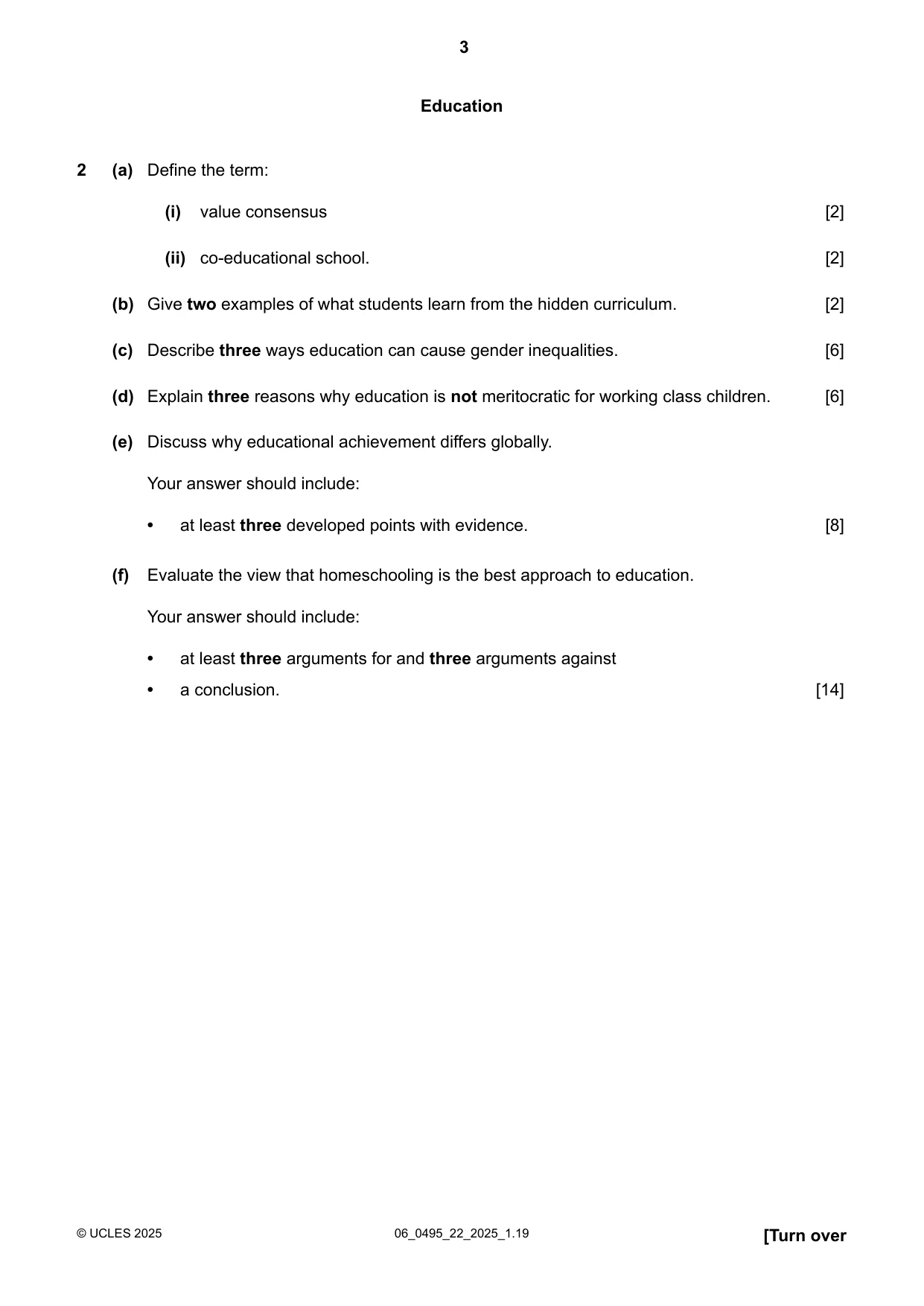
Q2 · Define the term: (i) value consensus [2] (ii) co-educational school
2 (a) Define the term: (i) value consensus [2] (ii) co-educational school. [2] (b) Give two examples of what students learn from the hidden curriculum. [2] (c) Describe three ways education can cause gender inequalities. [6] (d) Explain three reasons why education is not meritocratic for working class children. [6] (e) Discuss why educational achievement differs globally. Your answer should include: • at least three developed points with evidence. [8] (f) Evaluate the view that homeschooling is the best approach to education. Your answer should include: • at least three arguments for and three arguments against • a conclusion. [14] Crime, deviance and social control
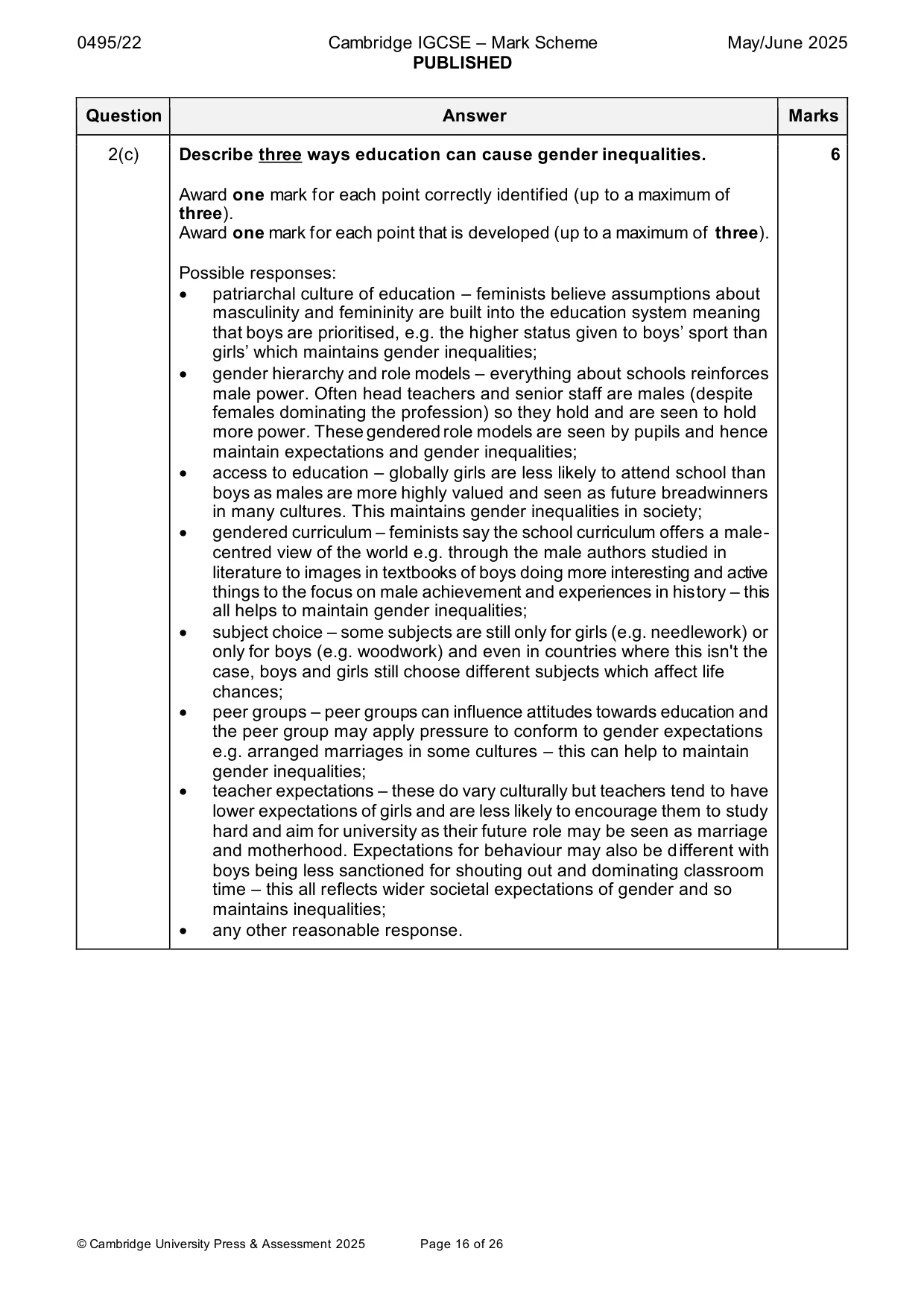
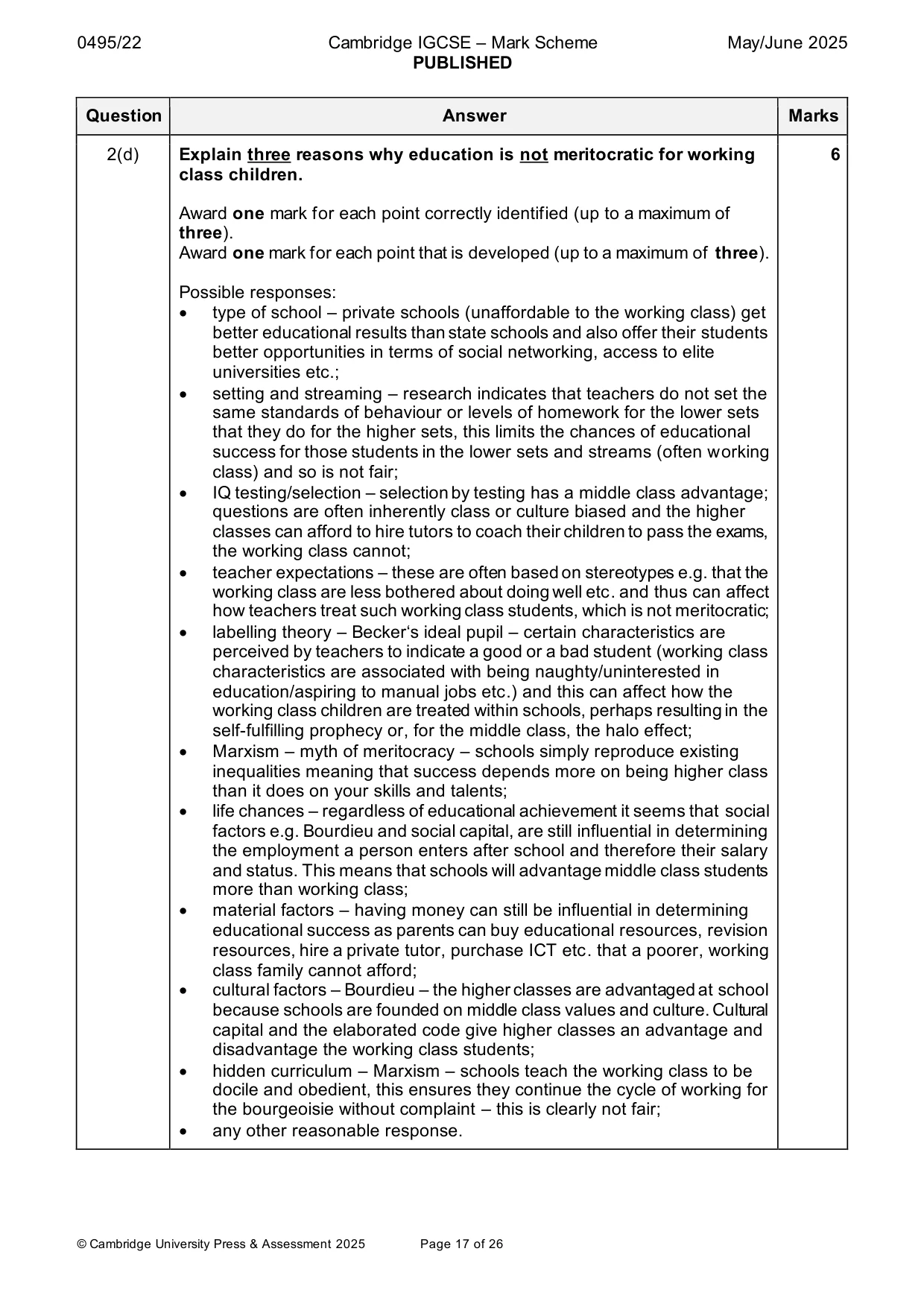
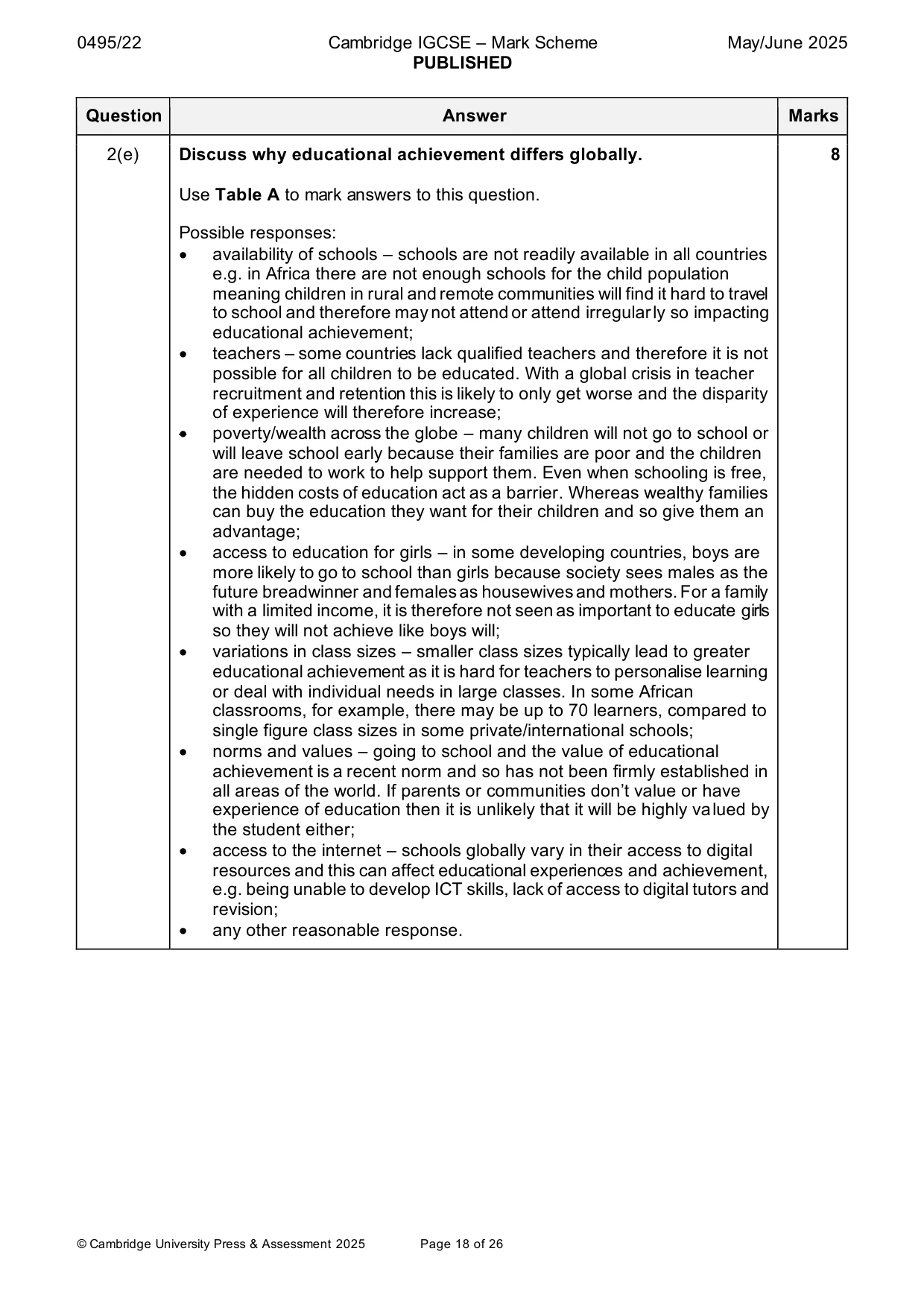
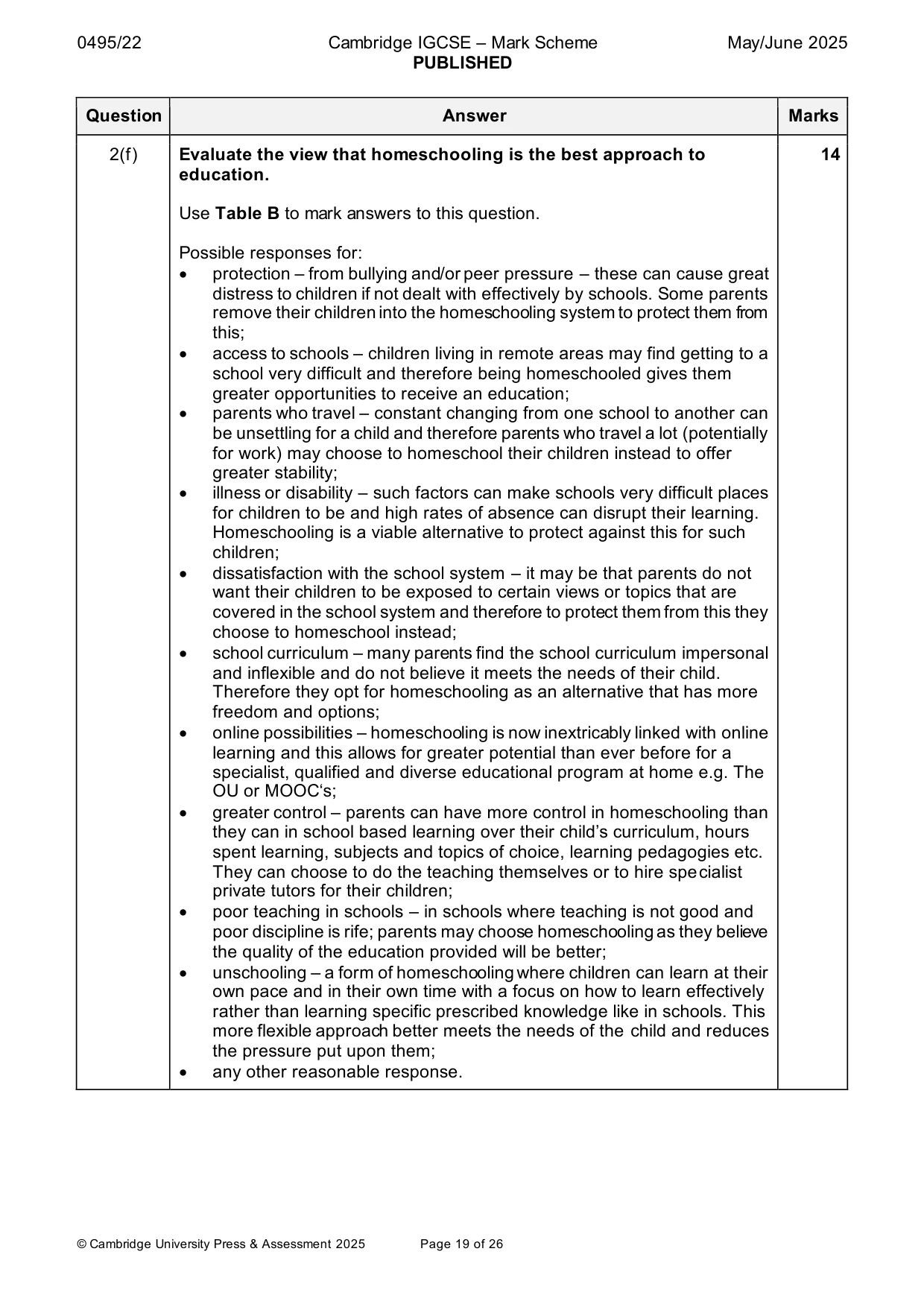
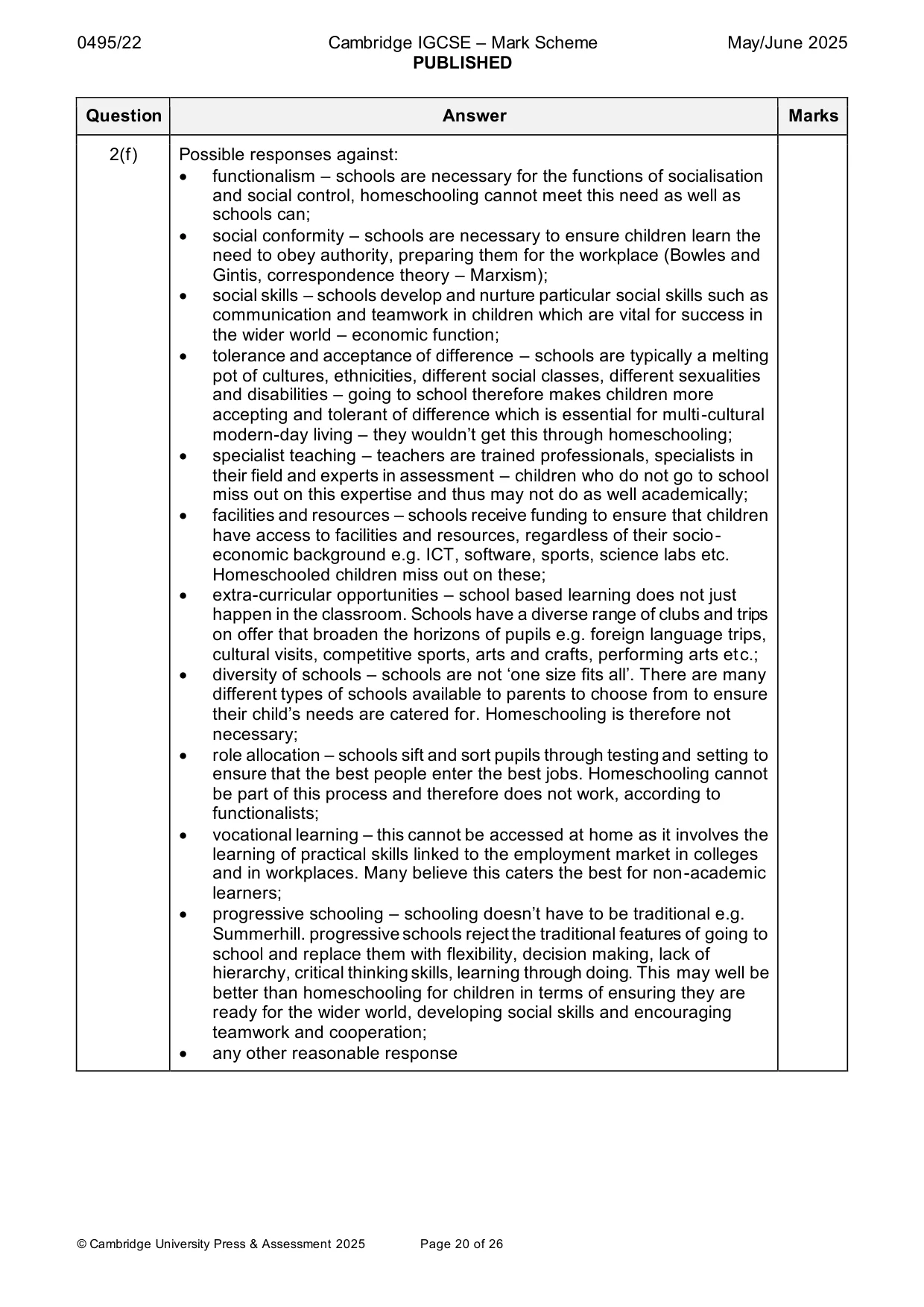
Mark scheme: 2(a)(i) Define the term value consensus. 2 Award one mark for a partial definition, e.g. agreement. Award two marks for a clear definition, e.g. widespread, general agreement on the things that are important. 2(a)(ii) Define the term co-educational school. 2 Award one mark for a partial definition, e.g. schools for everyone. Award two marks for a clear definition, e.g. schools that accept both male and female learners. 2(b) Give two examples of what students learn from the hidden curriculum. 2 Award one mark for each correct example (up to a maximum of two). Possible responses: • roles (e.g. gender roles); • deference to authority; • hierarchies; • norms and values; • social expectations; • social conformity; • competition; • importance of punctuality; • sense of belonging; • passivity; • stereotypes; • preparation for the workplace; • any other reasonable response. 2(c) Describe three ways education can cause gender inequalities. 6 Award one mark for each point correctly identified (up to a maximum of three). Award one mark for each point that is developed (up to a maximum of three). Possible responses: • patriarchal culture of education – feminists believe assumptions about masculinity and femininity are built into the education system meaning that boys are prioritised, e.g. the higher status given to boys’ sport than girls’ which maintains gender inequalities; • gender hierarchy and role models – everything about schools reinforces male power. Often head teachers and senior staff are males (despite females dominating the profession) so they hold and are seen to hold more power. These gendered role models are seen by pupils and hence maintain expectations and gender inequalities; • access to education – globally girls are less likely to attend school than boys as males are more highly valued and seen as future breadwinners in many cultures. This maintains gender inequalities in society; • gendered curriculum – feminists say the school curriculum offers a male- centred view of the world e.g. through the male authors studied in literature to images in textbooks of boys doing more interesting and active things to the focus on male achievement and experiences in history – this all helps to maintain gender inequalities; • subject choice – some subjects are still only for girls (e.g. needlework) or only for boys (e.g. woodwork) and even in countries where this isn't the case, boys and girls still choose different subjects which affect life chances; • peer groups – peer groups can influence attitudes towards education and the peer group may apply pressure to conform to gender expectations e.g. arranged marriages in some cultures – this can help to maintain gender inequalities; • teacher expectations – these do vary culturally but teachers tend to have lower expectations of girls and are less likely to encourage them to study hard and aim for university as their future role may be seen as marriage and motherhood. Expectations for behaviour may also be different with boys being less sanctioned for shouting out and dominating classroom time – this all reflects wider societal expectations of gender and so maintains inequalities; • any other reasonable response. 2(d) Explain three reasons why education is not meritocratic for working 6 class children. Award one mark for each point correctly identified (up to a maximum of three). Award one mark for each point that is developed (up to a maximum of three). Possible responses: • type of school – private schools (unaffordable to the working class) get better educational results than state schools and also offer their students better opportunities in terms of social networking, access to elite universities etc.; • setting and streaming – research indicates that teachers do not set the same standards of behaviour or levels of homework for the lower sets that they do for the higher sets, this limits the chances of educational success for those students in the lower sets and streams (often working class) and so is not fair; • IQ testing/selection – selection by testing has a middle class advantage; questions are often inherently class or culture biased and the higher classes can afford to hire tutors to coach their children to pass the exams, the working class cannot; • teacher expectations – these are often based on stereotypes e.g. that the working class are less bothered about doing well etc. and thus can affect how teachers treat such working class students, which is not meritocratic; • labelling theory – Becker‘s ideal pupil – certain characteristics are perceived by teachers to indicate a good or a bad student (working class characteristics are associated with being naughty/uninterested in education/aspiring to manual jobs etc.) and this can affect how the working class children are treated within schools, perhaps resulting in the self-fulfilling prophecy or, for the middle class, the halo effect; • Marxism – myth of meritocracy – schools simply reproduce existing inequalities meaning that success depends more on being higher class than it does on your skills and talents; • life chances – regardless of educational achievement it seems that social factors e.g. Bourdieu and social capital, are still influential in determining the employment a person enters after school and therefore their salary and status. This means that schools will advantage middle class students more than working class; • material factors – having money can still be influential in determining educational success as parents can buy educational resources, revision resources, hire a private tutor, purchase ICT etc. that a poorer, working class family cannot afford; • cultural factors – Bourdieu – the higher classes are advantaged at school because schools are founded on middle class values and culture. Cultural capital and the elaborated code give higher classes an advantage and disadvantage the working class students; • hidden curriculum – Marxism – schools teach the working class to be docile and obedient, this ensures they continue the cycle of working for the bourgeoisie without complaint – this is clearly not fair; • any other reasonable response. 2(e) Discuss why educational achievement differs globally. 8 Use Table A to mark answers to this question. Possible responses: • availability of schools – schools are not readily available in all countries e.g. in Africa there are not enough schools for the child population meaning children in rural and remote communities will find it hard to travel to school and therefore may not attend or attend irregularly so impacting educational achievement; • teachers – some countries lack qualified teachers and therefore it is not possible for all children to be educated. With a global crisis in teacher recruitment and retention this is likely to only get worse and the disparity of experience will therefore increase; • poverty/wealth across the globe – many children will not go to school or will leave school early because their families are poor and the children are needed to work to help support them. Even when schooling is free, the hidden costs of education act as a barrier. Whereas wealthy families can buy the education they want for their children and so give them an advantage; • access to education for girls – in some developing countries, boys are more likely to go to school than girls because society sees males as the future breadwinner and females as housewives and mothers. For a family with a limited income, it is therefore not seen as important to educate girls so they will not achieve like boys will; • variations in class sizes – smaller class sizes typically lead to greater educational achievement as it is hard for teachers to personalise learning or deal with individual needs in large classes. In some African classrooms, for example, there may be up to 70 learners, compared to single figure class sizes in some private/international schools; • norms and values – going to school and the value of educational achievement is a recent norm and so has not been firmly established in all areas of the world. If parents or communities don’t value or have experience of education then it is unlikely that it will be highly valued by the student either; • access to the internet – schools globally vary in their access to digital resources and this can affect educational experiences and achievement, e.g. being unable to develop ICT skills, lack of access to digital tutors and revision; • any other reasonable response. 2(f) Evaluate the view that homeschooling is the best approach to 14 education. Use Table B to mark answers to this question. Possible responses for: • protection – from bullying and/or peer pressure – these can cause great distress to children if not dealt with effectively by schools. Some parents remove their children into the homeschooling system to protect them from this; • access to schools – children living in remote areas may find getting to a school very difficult and therefore being homeschooled gives them greater opportunities to receive an education; • parents who travel – constant changing from one school to another can be unsettling for a child and therefore parents who travel a lot (potentially for work) may choose to homeschool their children instead to offer greater stability; • illness or disability – such factors can make schools very difficult places for children to be and high rates of absence can disrupt their learning. Homeschooling is a viable alternative to protect against this for such children; • dissatisfaction with the school system – it may be that parents do not want their children to be exposed to certain views or topics that are covered in the school system and therefore to protect them from this they choose to homeschool instead; • school curriculum – many parents find the school curriculum impersonal and inflexible and do not believe it meets the needs of their child. Therefore they opt for homeschooling as an alternative that has more freedom and options; • online possibilities – homeschooling is now inextricably linked with online learning and this allows for greater potential than ever before for a specialist, qualified and diverse educational program at home e.g. The OU or MOOC‘s; • greater control – parents can have more control in homeschooling than they can in school based learning over their child’s curriculum, hours spent learning, subjects and topics of choice, learning pedagogies etc. They can choose to do the teaching themselves or to hire specialist private tutors for their children; • poor teaching in schools – in schools where teaching is not good and poor discipline is rife; parents may choose homeschooling as they believe the quality of the education provided will be better; • unschooling – a form of homeschooling where children can learn at their own pace and in their own time with a focus on how to learn effectively rather than learning specific prescribed knowledge like in schools. This more flexible approach better meets the needs of the child and reduces the pressure put upon them; • any other reasonable response. 2(f) Possible responses against: • functionalism – schools are necessary for the functions of socialisation and social control, homeschooling cannot meet this need as well as schools can; • social conformity – schools are necessary to ensure children learn the need to obey authority, preparing them for the workplace (Bowles and Gintis, correspondence theory – Marxism); • social skills – schools develop and nurture particular social skills such as communication and teamwork in children which are vital for success in the wider world – economic function; • tolerance and acceptance of difference – schools are typically a melting pot of cultures, ethnicities, different social classes, different sexualities and disabilities – going to school therefore makes children more accepting and tolerant of difference which is essential for multi-cultural modern-day living – they wouldn’t get this through homeschooling; • specialist teaching – teachers are trained professionals, specialists in their field and experts in assessment – children who do not go to school miss out on this expertise and thus may not do as well academically; • facilities and resources – schools receive funding to ensure that children have access to facilities and resources, regardless of their socio- economic background e.g. ICT, software, sports, science labs etc. Homeschooled children miss out on these; • extra-curricular opportunities – school based learning does not just happen in the classroom. Schools have a diverse range of clubs and trips on offer that broaden the horizons of pupils e.g. foreign language trips, cultural visits, competitive sports, arts and crafts, performing arts etc.; • diversity of schools – schools are not ‘one size fits all’. There are many different types of schools available to parents to choose from to ensure their child’s needs are catered for. Homeschooling is therefore not necessary; • role allocation – schools sift and sort pupils through testing and setting to ensure that the best people enter the best jobs. Homeschooling cannot be part of this process and therefore does not work, according to functionalists; • vocational learning – this cannot be accessed at home as it involves the learning of practical skills linked to the employment market in colleges and in workplaces. Many believe this caters the best for non-academic learners; • progressive schooling – schooling doesn’t have to be traditional e.g. Summerhill. progressive schools reject the traditional features of going to school and replace them with flexibility, decision making, lack of hierarchy, critical thinking skills, learning through doing. This may well be better than homeschooling for children in terms of ensuring they are ready for the wider world, developing social skills and encouraging teamwork and cooperation; • any other reasonable response
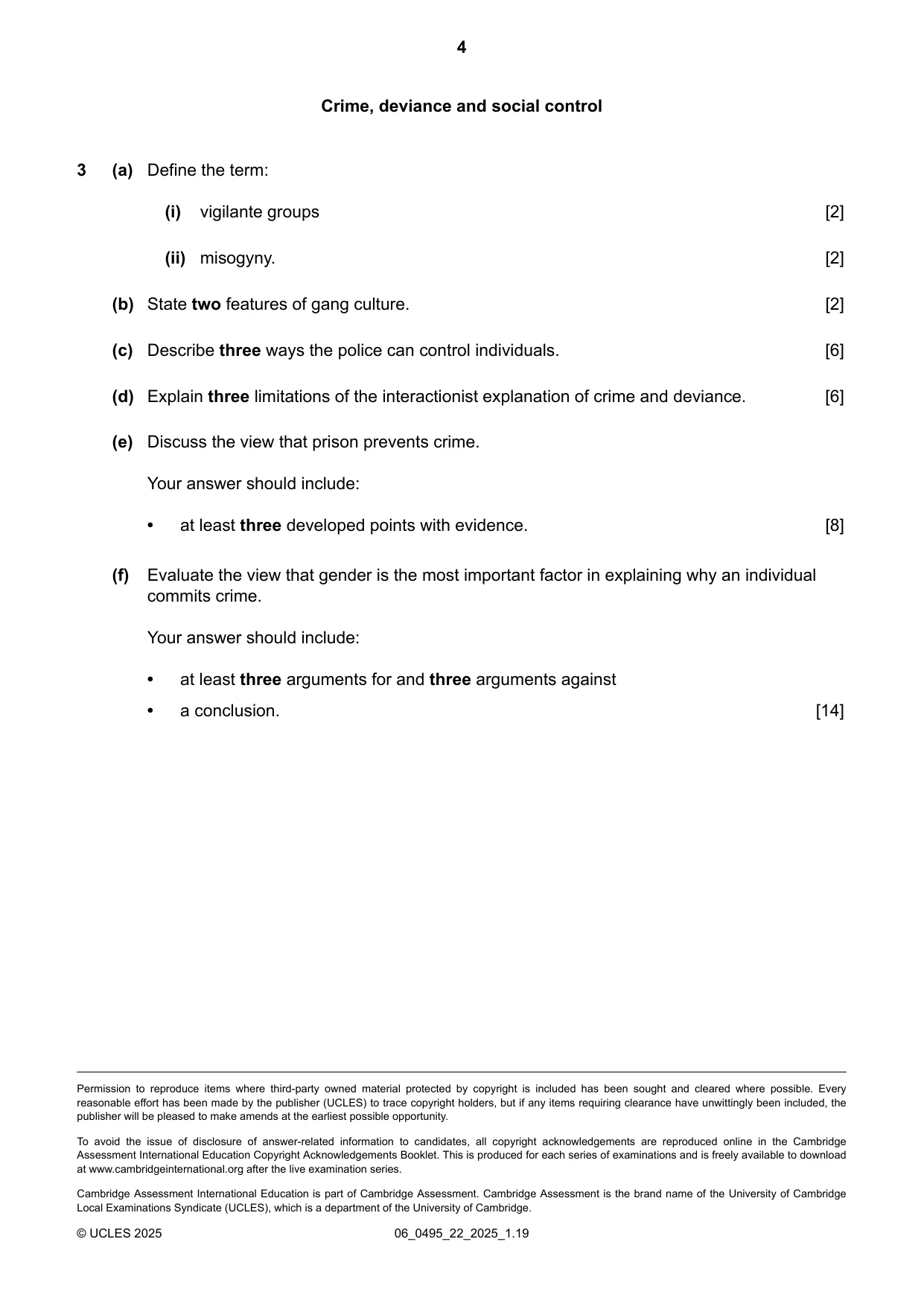
Q3 · Define the term: (i) vigilante groups [2] (ii) misogyny
3 (a) Define the term: (i) vigilante groups [2] (ii) misogyny. [2] (b) State two features of gang culture. [2] (c) Describe three ways the police can control individuals. [6] (d) Explain three limitations of the interactionist explanation of crime and deviance. [6] (e) Discuss the view that prison prevents crime. Your answer should include: • at least three developed points with evidence. [8] (f) Evaluate the view that gender is the most important factor in explaining why an individual commits crime. Your answer should include: • at least three arguments for and three arguments against • a conclusion. [14]
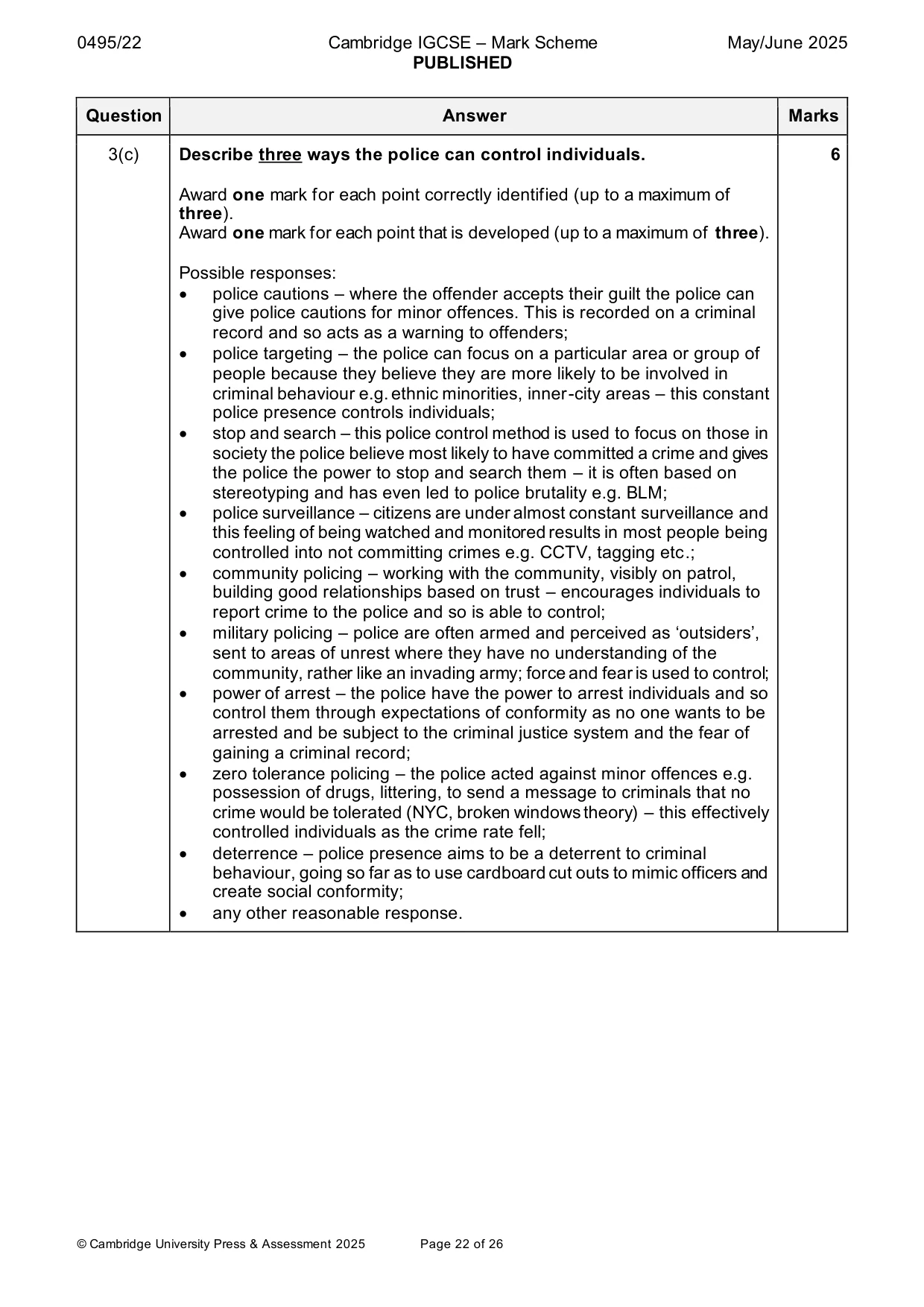
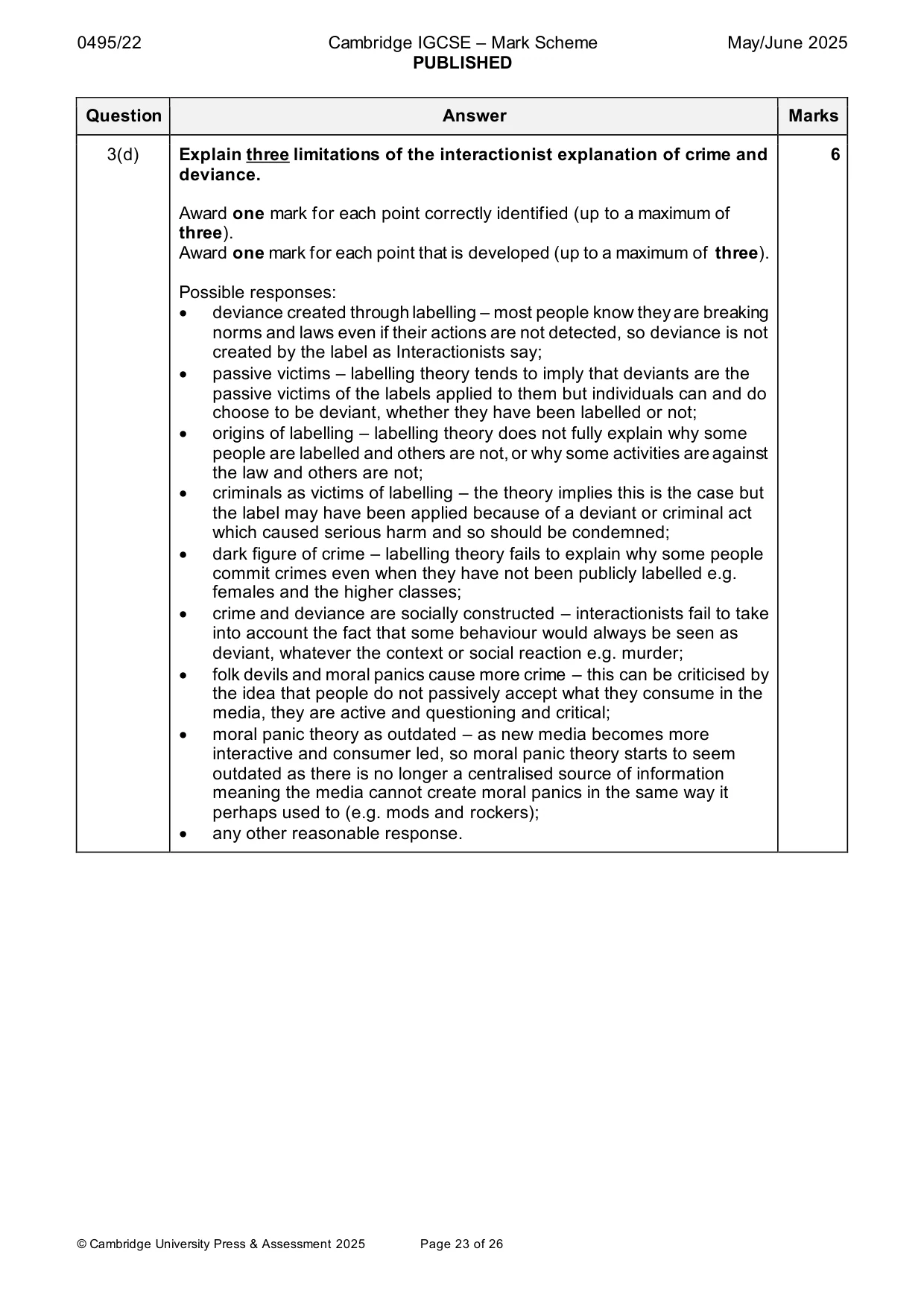
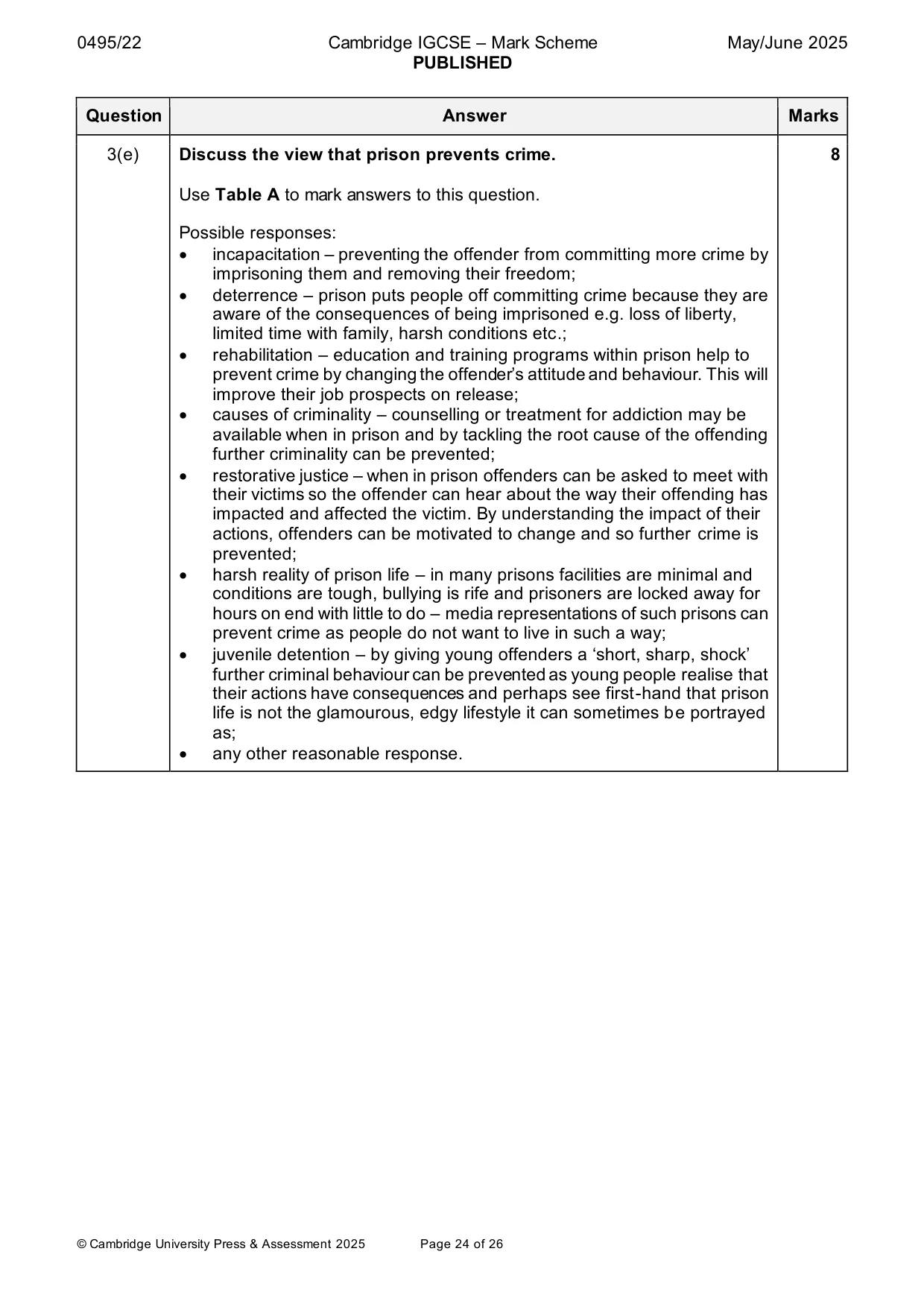
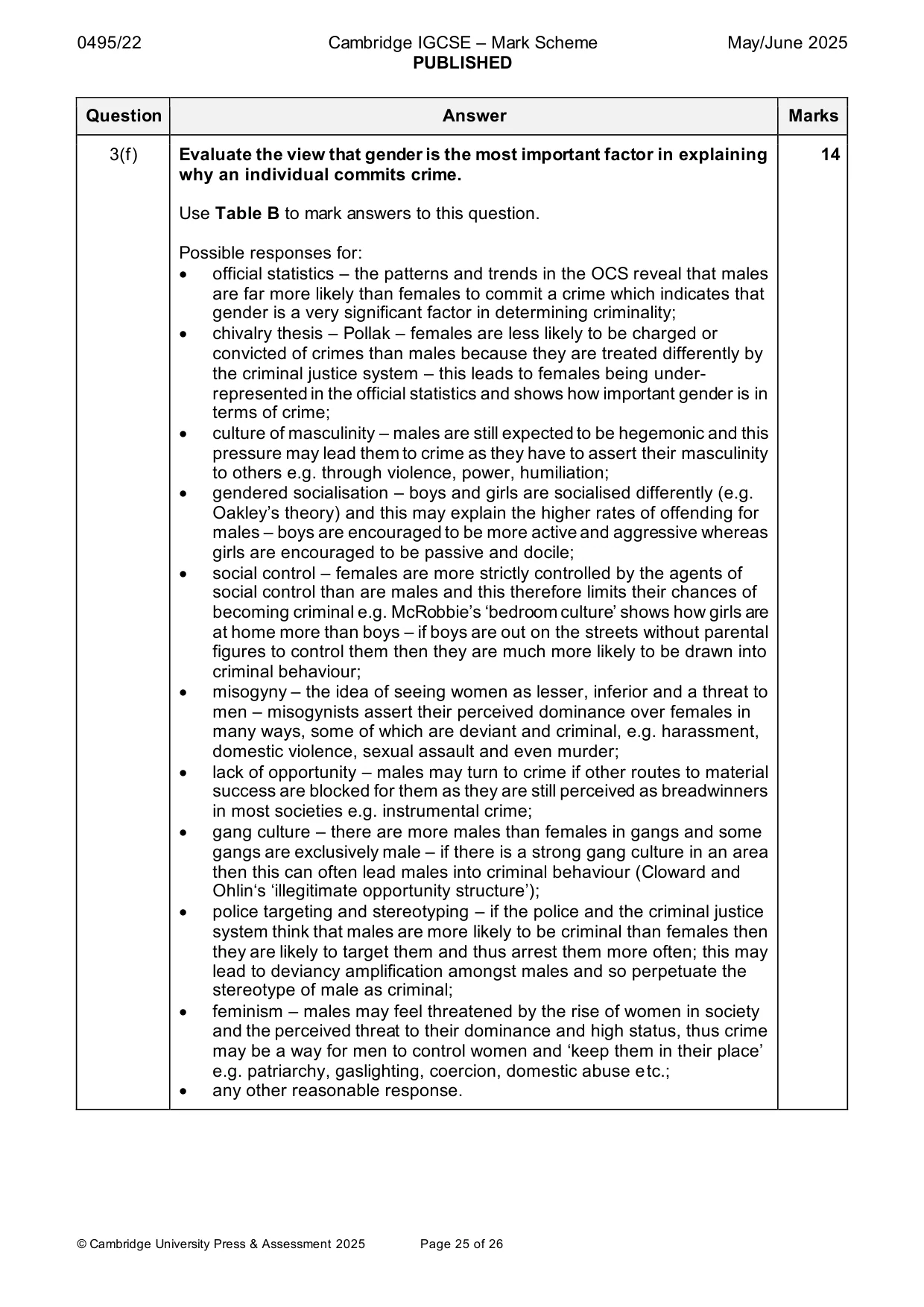
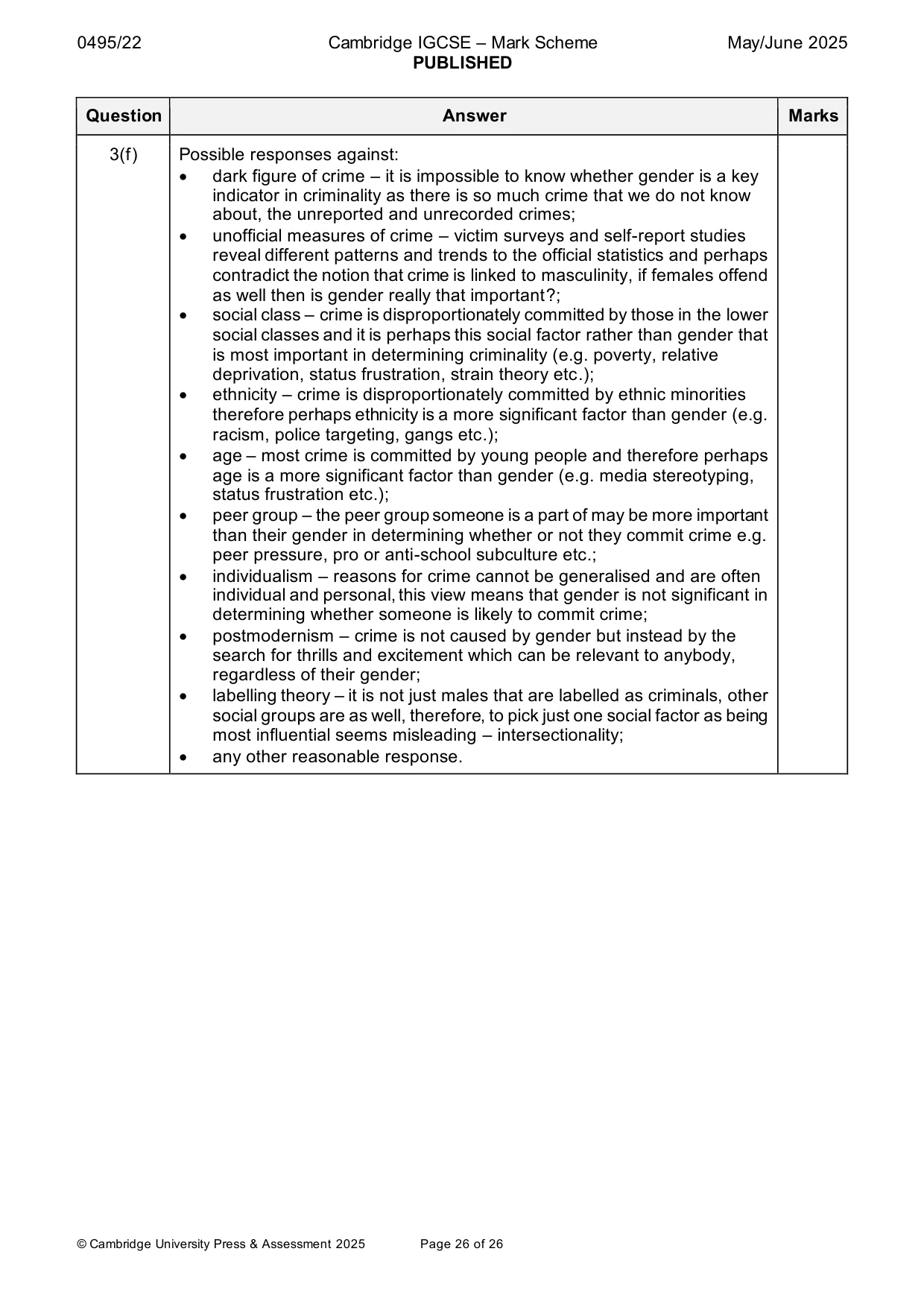
Mark scheme: 3(a)(i) Define the term vigilante groups. 2 Award one mark for a partial definition, e.g. take the law into your own hands. Award two marks for a clear definition, e.g. self-appointed people with no legal authority who punish people they believe are offenders. 3(a)(ii) Define the term misogyny. 2 Award one mark for a partial definition, e.g. sexism. Award two marks for a clear definition, e.g. hatred of women, predominantly by men. 3(b) State two features of gang culture. 2 Award one mark for each correct feature (up to a maximum of two). Possible responses: • often comprised of young people; • often comprised of males; • often comprised of ethnic minorities; • criminal and/or violent behaviour as the norm e.g. drug dealing; • organised group of people, usually with a clear hierarchy and leader; • often territorial in nature e.g. postcode gangs; • often involves an initiation process, a ‘test’ to prove one’s loyalty to the gang; • often associated with deprived, inner-city areas (working class); • defending the gang and not reporting crime to the police is highly valued; • people may join gangs for protection e.g. from racist attacks; • associated gang ‘uniform’ e.g. wearing particular colours; • gang symbols/markers e.g. tattoos; • any other reasonable response. 3(c) Describe three ways the police can control individuals. 6 Award one mark for each point correctly identified (up to a maximum of three). Award one mark for each point that is developed (up to a maximum of three). Possible responses: • police cautions – where the offender accepts their guilt the police can give police cautions for minor offences. This is recorded on a criminal record and so acts as a warning to offenders; • police targeting – the police can focus on a particular area or group of people because they believe they are more likely to be involved in criminal behaviour e.g. ethnic minorities, inner-city areas – this constant police presence controls individuals; • stop and search – this police control method is used to focus on those in society the police believe most likely to have committed a crime and gives the police the power to stop and search them – it is often based on stereotyping and has even led to police brutality e.g. BLM; • police surveillance – citizens are under almost constant surveillance and this feeling of being watched and monitored results in most people being controlled into not committing crimes e.g. CCTV, tagging etc.; • community policing – working with the community, visibly on patrol, building good relationships based on trust – encourages individuals to report crime to the police and so is able to control; • military policing – police are often armed and perceived as ‘outsiders’, sent to areas of unrest where they have no understanding of the community, rather like an invading army; force and fear is used to control; • power of arrest – the police have the power to arrest individuals and so control them through expectations of conformity as no one wants to be arrested and be subject to the criminal justice system and the fear of gaining a criminal record; • zero tolerance policing – the police acted against minor offences e.g. possession of drugs, littering, to send a message to criminals that no crime would be tolerated (NYC, broken windows theory) – this effectively controlled individuals as the crime rate fell; • deterrence – police presence aims to be a deterrent to criminal behaviour, going so far as to use cardboard cut outs to mimic officers and create social conformity; • any other reasonable response. 3(d) Explain three limitations of the interactionist explanation of crime and 6 deviance. Award one mark for each point correctly identified (up to a maximum of three). Award one mark for each point that is developed (up to a maximum of three). Possible responses: • deviance created through labelling – most people know they are breaking norms and laws even if their actions are not detected, so deviance is not created by the label as Interactionists say; • passive victims – labelling theory tends to imply that deviants are the passive victims of the labels applied to them but individuals can and do choose to be deviant, whether they have been labelled or not; • origins of labelling – labelling theory does not fully explain why some people are labelled and others are not, or why some activities are against the law and others are not; • criminals as victims of labelling – the theory implies this is the case but the label may have been applied because of a deviant or criminal act which caused serious harm and so should be condemned; • dark figure of crime – labelling theory fails to explain why some people commit crimes even when they have not been publicly labelled e.g. females and the higher classes; • crime and deviance are socially constructed – interactionists fail to take into account the fact that some behaviour would always be seen as deviant, whatever the context or social reaction e.g. murder; • folk devils and moral panics cause more crime – this can be criticised by the idea that people do not passively accept what they consume in the media, they are active and questioning and critical; • moral panic theory as outdated – as new media becomes more interactive and consumer led, so moral panic theory starts to seem outdated as there is no longer a centralised source of information meaning the media cannot create moral panics in the same way it perhaps used to (e.g. mods and rockers); • any other reasonable response. 3(e) Discuss the view that prison prevents crime. 8 Use Table A to mark answers to this question. Possible responses: • incapacitation – preventing the offender from committing more crime by imprisoning them and removing their freedom; • deterrence – prison puts people off committing crime because they are aware of the consequences of being imprisoned e.g. loss of liberty, limited time with family, harsh conditions etc.; • rehabilitation – education and training programs within prison help to prevent crime by changing the offender’s attitude and behaviour. This will improve their job prospects on release; • causes of criminality – counselling or treatment for addiction may be available when in prison and by tackling the root cause of the offending further criminality can be prevented; • restorative justice – when in prison offenders can be asked to meet with their victims so the offender can hear about the way their offending has impacted and affected the victim. By understanding the impact of their actions, offenders can be motivated to change and so further crime is prevented; • harsh reality of prison life – in many prisons facilities are minimal and conditions are tough, bullying is rife and prisoners are locked away for hours on end with little to do – media representations of such prisons can prevent crime as people do not want to live in such a way; • juvenile detention – by giving young offenders a ‘short, sharp, shock’ further criminal behaviour can be prevented as young people realise that their actions have consequences and perhaps see first-hand that prison life is not the glamourous, edgy lifestyle it can sometimes be portrayed as; • any other reasonable response. 3(f) Evaluate the view that gender is the most important factor in explaining 14 why an individual commits crime. Use Table B to mark answers to this question. Possible responses for: • official statistics – the patterns and trends in the OCS reveal that males are far more likely than females to commit a crime which indicates that gender is a very significant factor in determining criminality; • chivalry thesis – Pollak – females are less likely to be charged or convicted of crimes than males because they are treated differently by the criminal justice system – this leads to females being under- represented in the official statistics and shows how important gender is in terms of crime; • culture of masculinity – males are still expected to be hegemonic and this pressure may lead them to crime as they have to assert their masculinity to others e.g. through violence, power, humiliation; • gendered socialisation – boys and girls are socialised differently (e.g. Oakley’s theory) and this may explain the higher rates of offending for males – boys are encouraged to be more active and aggressive whereas girls are encouraged to be passive and docile; • social control – females are more strictly controlled by the agents of social control than are males and this therefore limits their chances of becoming criminal e.g. McRobbie’s ‘bedroom culture’ shows how girls are at home more than boys – if boys are out on the streets without parental figures to control them then they are much more likely to be drawn into criminal behaviour; • misogyny – the idea of seeing women as lesser, inferior and a threat to men – misogynists assert their perceived dominance over females in many ways, some of which are deviant and criminal, e.g. harassment, domestic violence, sexual assault and even murder; • lack of opportunity – males may turn to crime if other routes to material success are blocked for them as they are still perceived as breadwinners in most societies e.g. instrumental crime; • gang culture – there are more males than females in gangs and some gangs are exclusively male – if there is a strong gang culture in an area then this can often lead males into criminal behaviour (Cloward and Ohlin‘s ‘illegitimate opportunity structure’); • police targeting and stereotyping – if the police and the criminal justice system think that males are more likely to be criminal than females then they are likely to target them and thus arrest them more often; this may lead to deviancy amplification amongst males and so perpetuate the stereotype of male as criminal; • feminism – males may feel threatened by the rise of women in society and the perceived threat to their dominance and high status, thus crime may be a way for men to control women and ‘keep them in their place’ e.g. patriarchy, gaslighting, coercion, domestic abuse etc.; • any other reasonable response. 3(f) Possible responses against: • dark figure of crime – it is impossible to know whether gender is a key indicator in criminality as there is so much crime that we do not know about, the unreported and unrecorded crimes; • unofficial measures of crime – victim surveys and self-report studies reveal different patterns and trends to the official statistics and perhaps contradict the notion that crime is linked to masculinity, if females offend as well then is gender really that important?; • social class – crime is disproportionately committed by those in the lower social classes and it is perhaps this social factor rather than gender that is most important in determining criminality (e.g. poverty, relative deprivation, status frustration, strain theory etc.); • ethnicity – crime is disproportionately committed by ethnic minorities therefore perhaps ethnicity is a more significant factor than gender (e.g. racism, police targeting, gangs etc.); • age – most crime is committed by young people and therefore perhaps age is a more significant factor than gender (e.g. media stereotyping, status frustration etc.); • peer group – the peer group someone is a part of may be more important than their gender in determining whether or not they commit crime e.g. peer pressure, pro or anti-school subculture etc.; • individualism – reasons for crime cannot be generalised and are often individual and personal, this view means that gender is not significant in determining whether someone is likely to commit crime; • postmodernism – crime is not caused by gender but instead by the search for thrills and excitement which can be relevant to anybody, regardless of their gender; • labelling theory – it is not just males that are labelled as criminals, other social groups are as well, therefore, to pick just one social factor as being most influential seems misleading – intersectionality; • any other reasonable response.
What was in this paper
The subtopics covered by these 3 questions, and how many questions each got. Open one in a new tab to see every Cambridge question on it.
What you needed in this session
Cambridge’s own grade thresholds for 2025 May/June, Paper 2 · Variant 2. A higher threshold means an easier paper — the bar moves with how the cohort did.