Cambridge IGCSE Sociology 0495 — 2024 Oct/Nov Paper 2 · Variant 1
0495/21/O/N/24 · 4 questions · 70 marks · ≈79 min
The question paper and its mark scheme, free to read here and free to download. This is Cambridge’s own paper, exactly as it was sat.
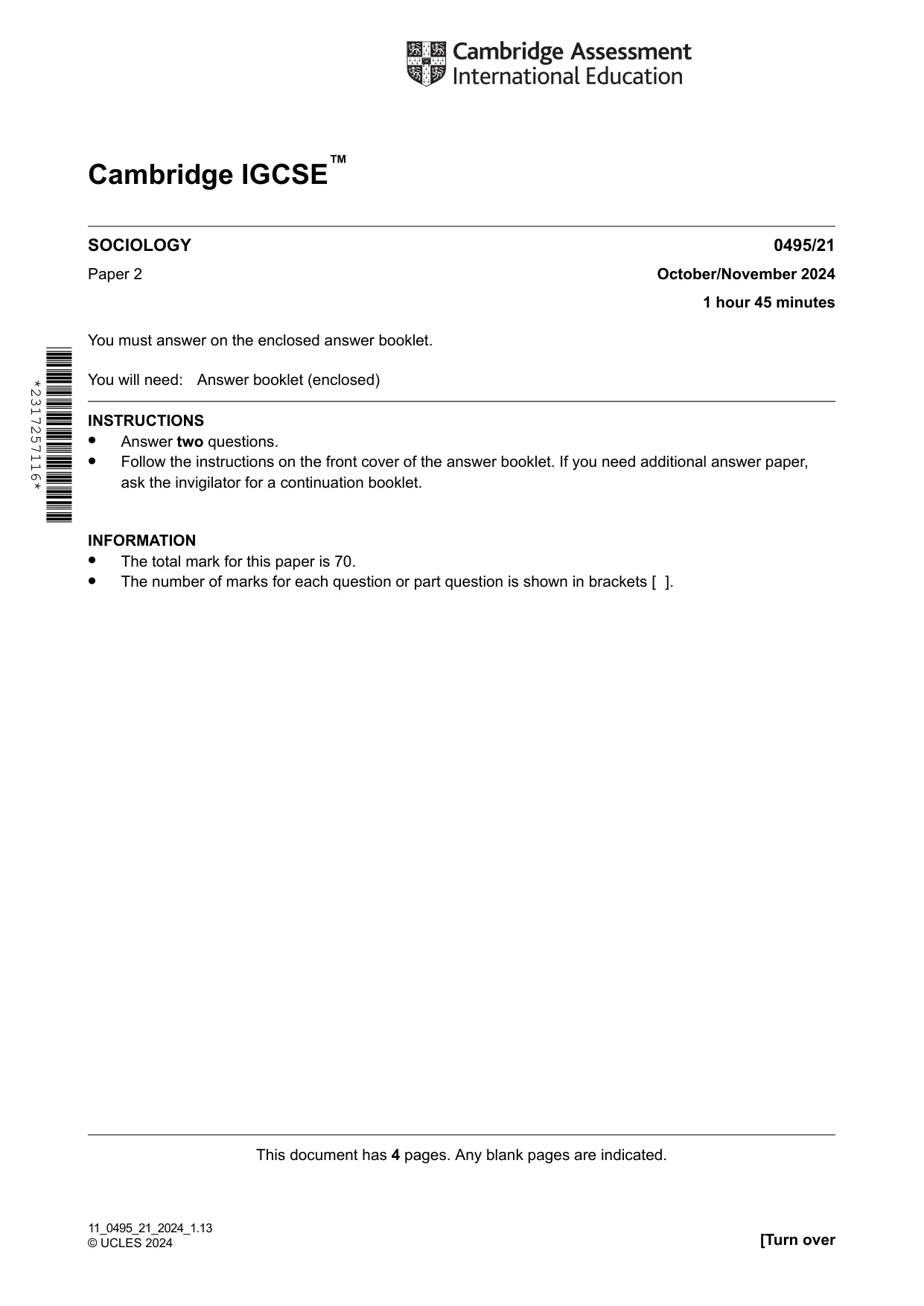
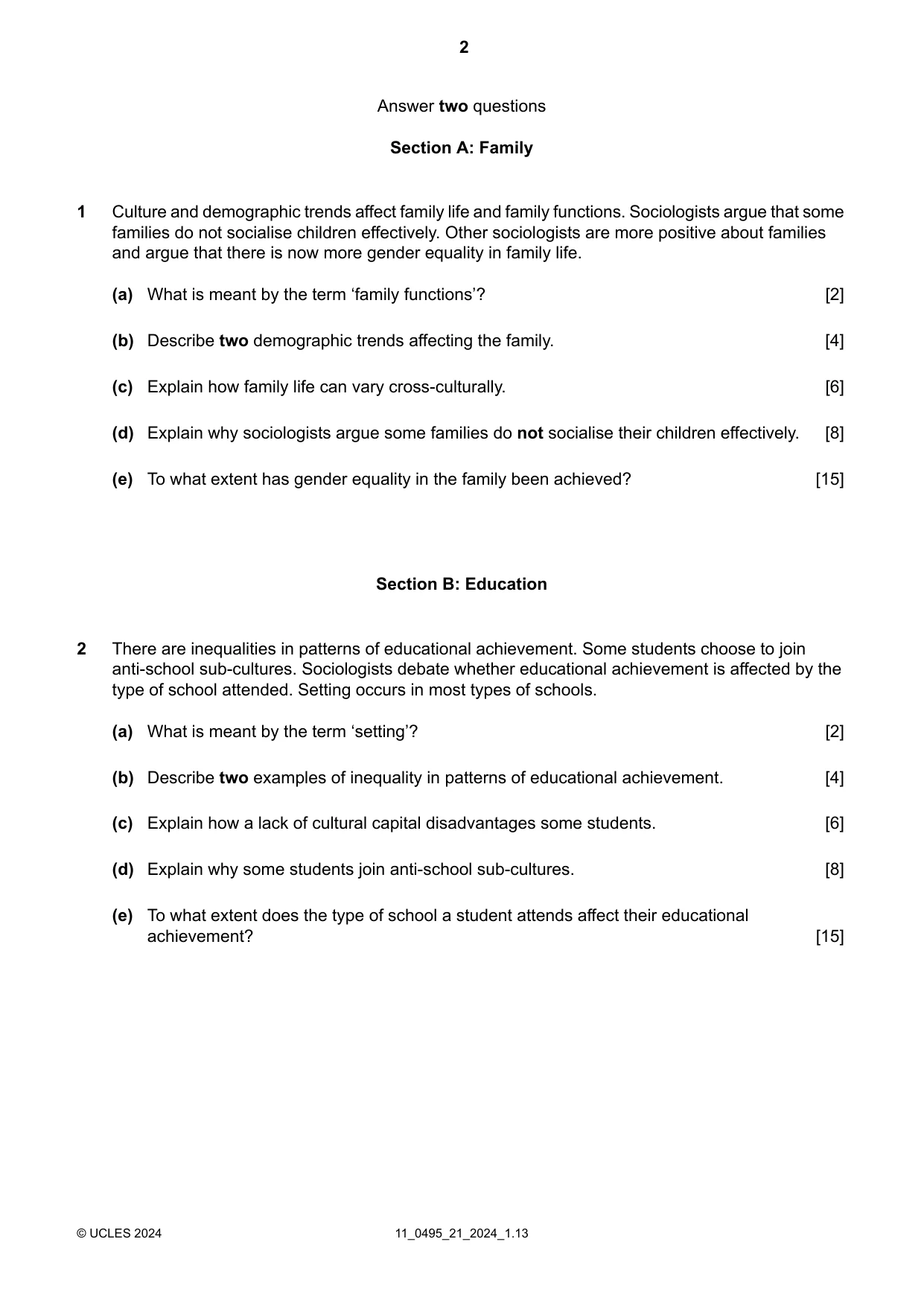
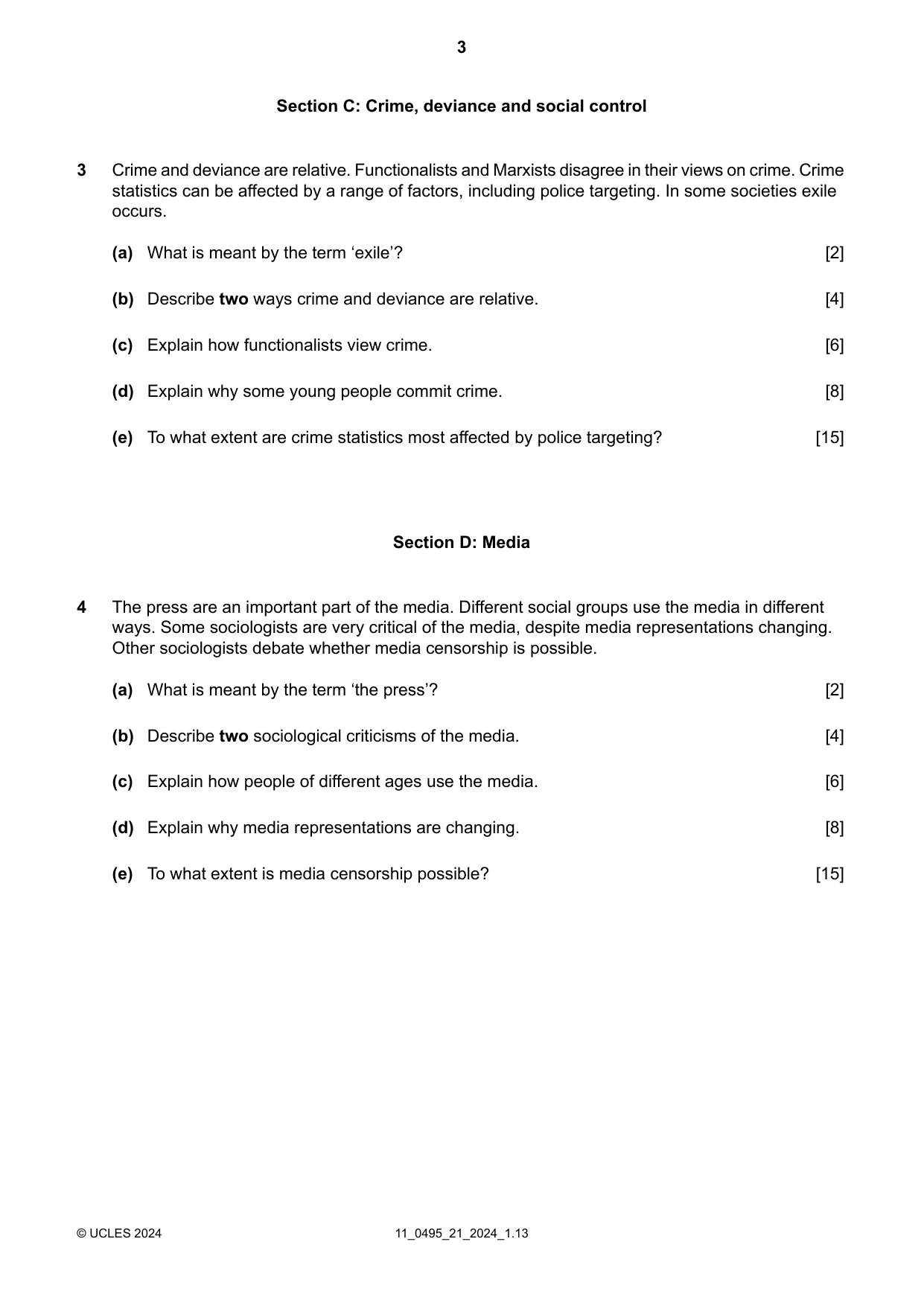
Question paper4 pages

Mark scheme31 pages
Answers below. Sit the paper first if you are practising.





Questions as text
Q1 · Culture and demographic trends affect family life and family functions
1 Culture and demographic trends affect family life and family functions. Sociologists argue that some families do not socialise children effectively. Other sociologists are more positive about families and argue that there is now more gender equality in family life. (a) What is meant by the term ‘family functions’? [2] (b) Describe two demographic trends affecting the family. [4] (c) Explain how family life can vary cross-culturally. [6] (d) Explain why sociologists argue some families do not socialise their children effectively. [8] (e) To what extent has gender equality in the family been achieved? [15]
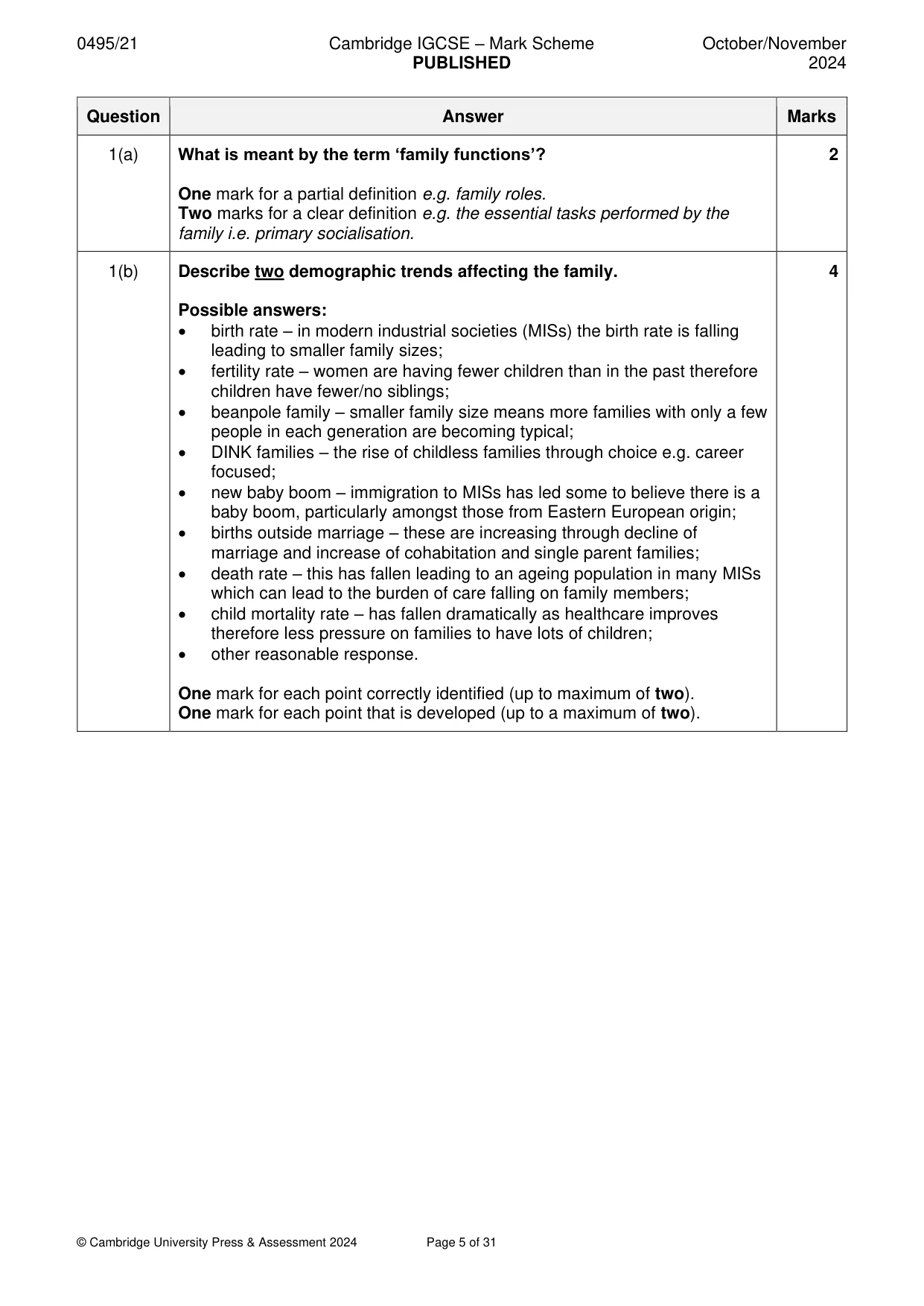
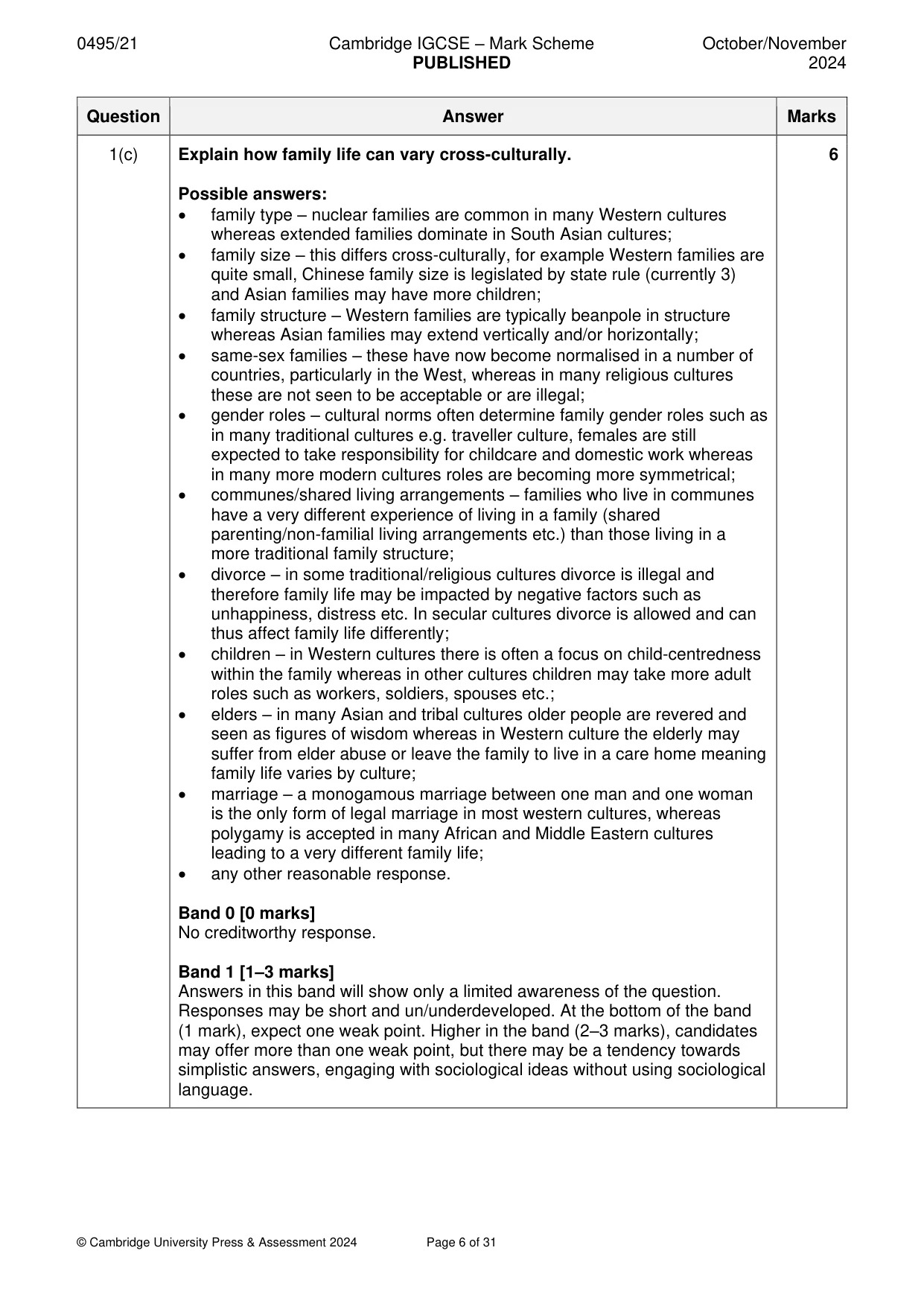
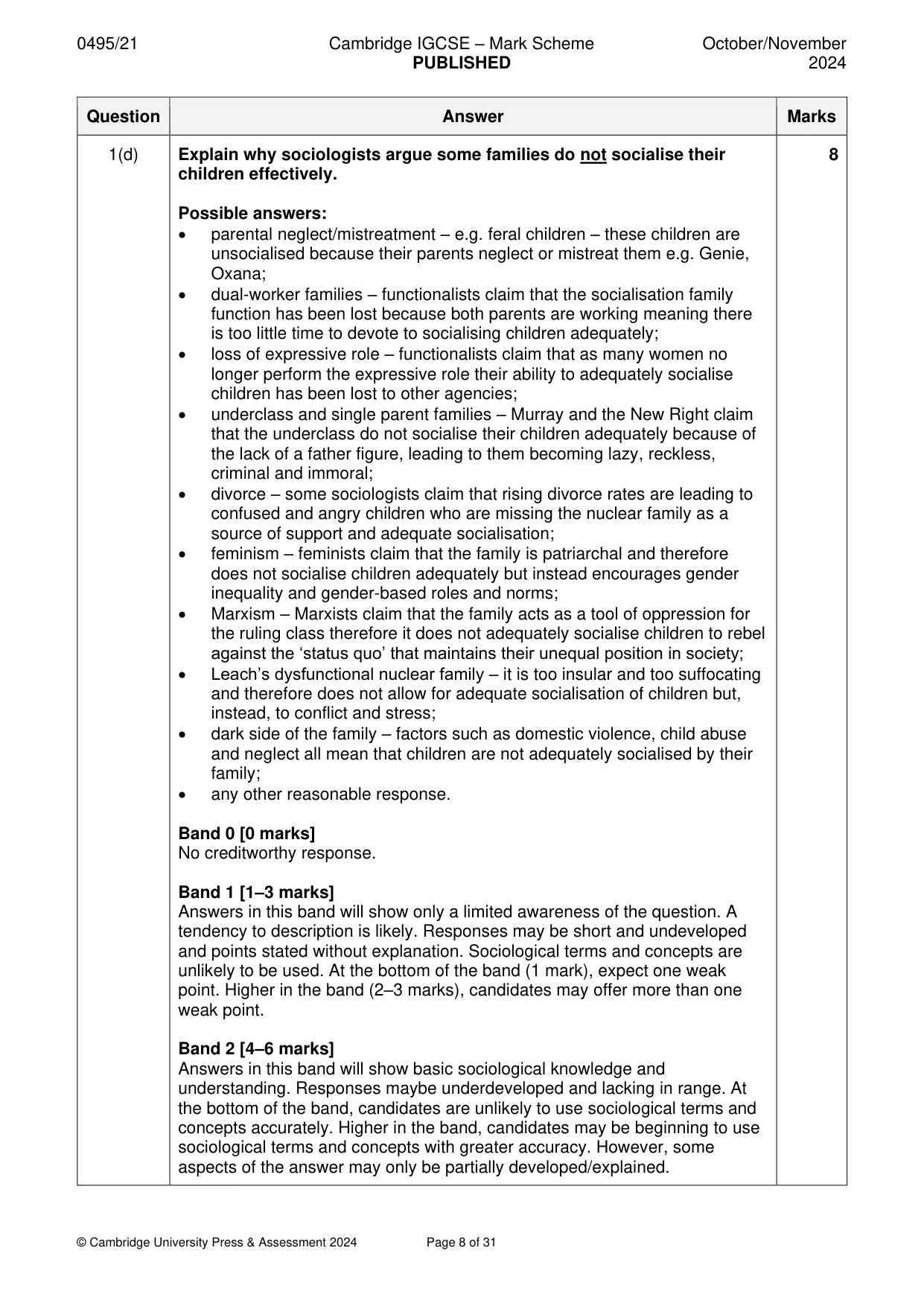
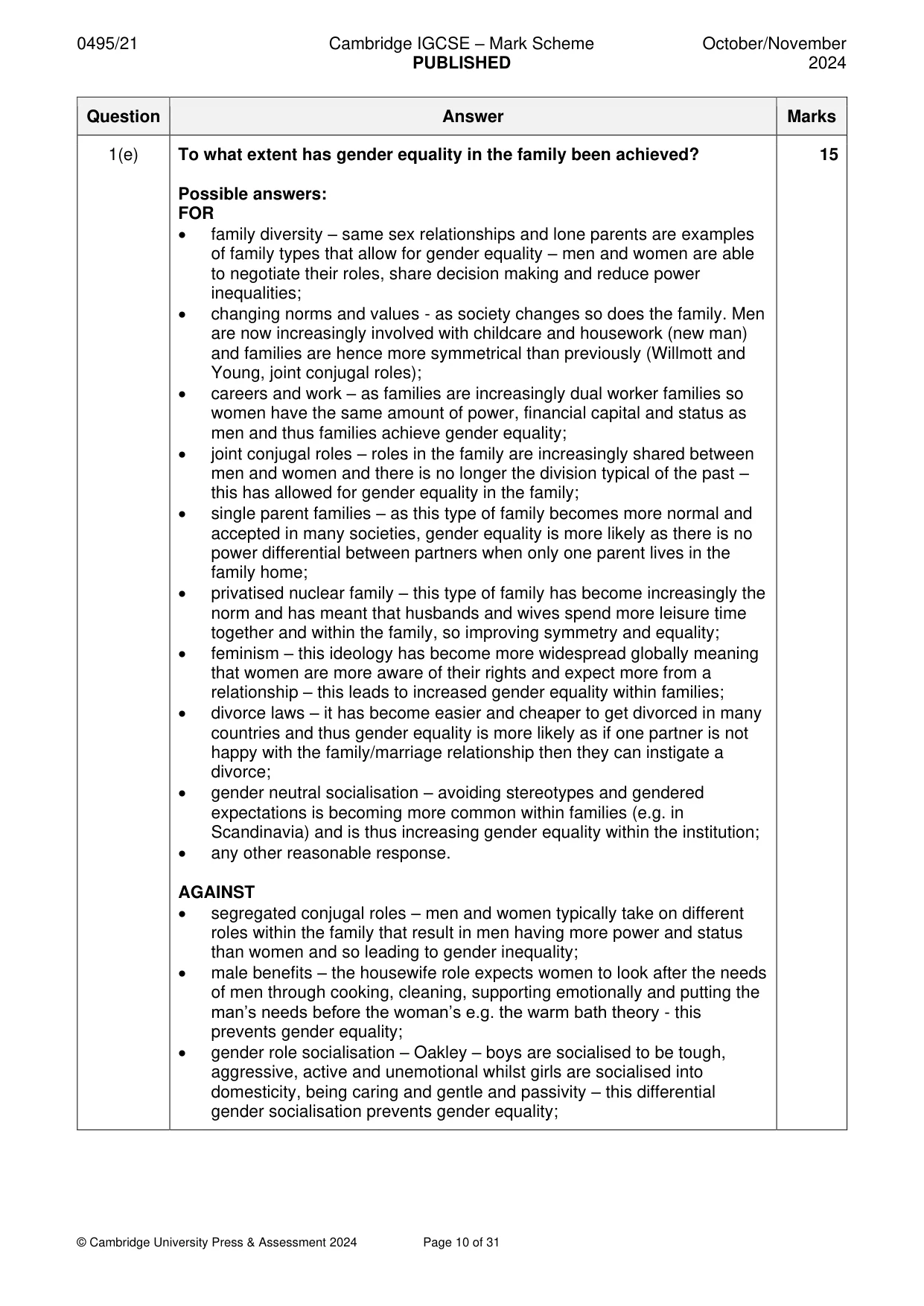
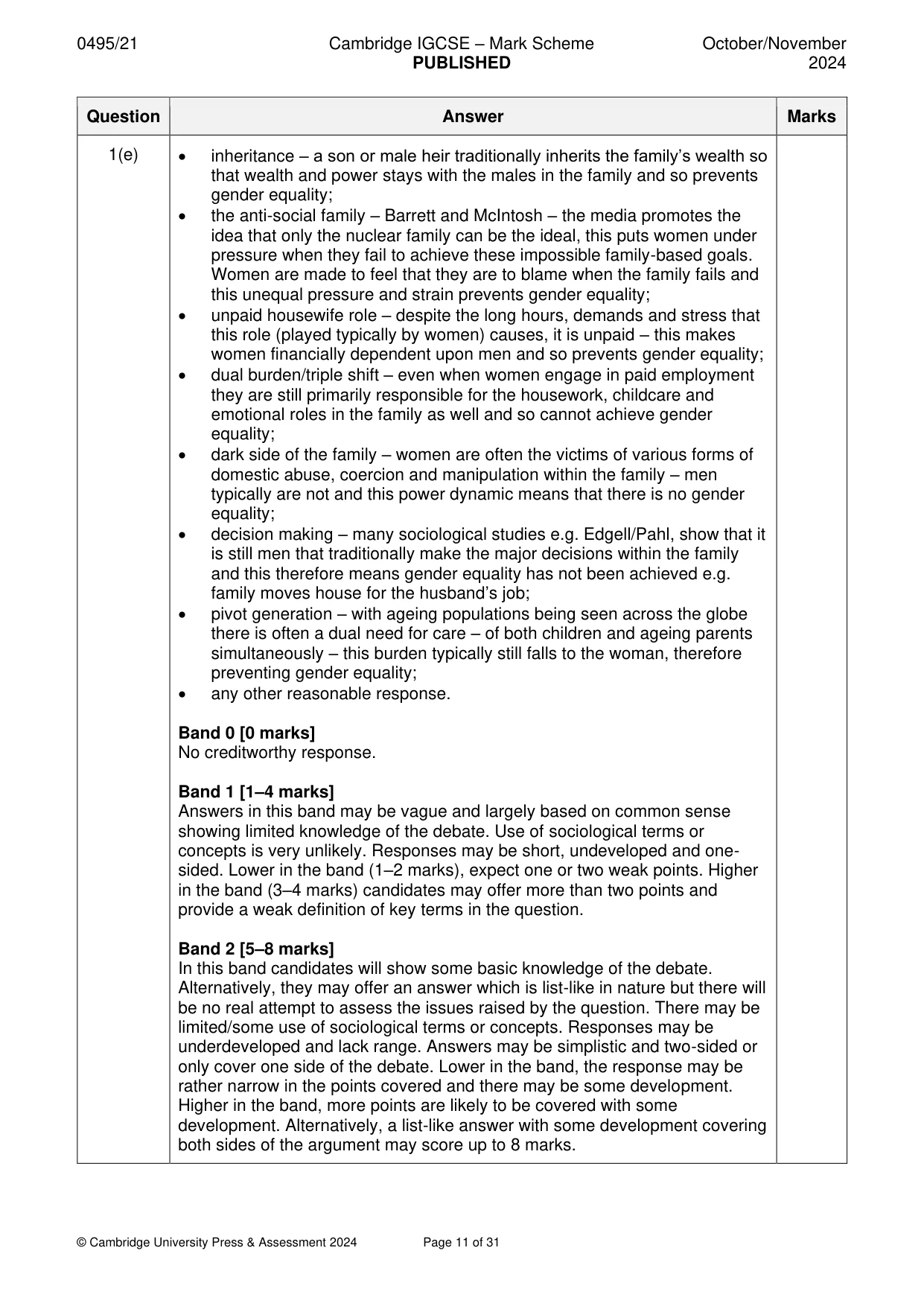
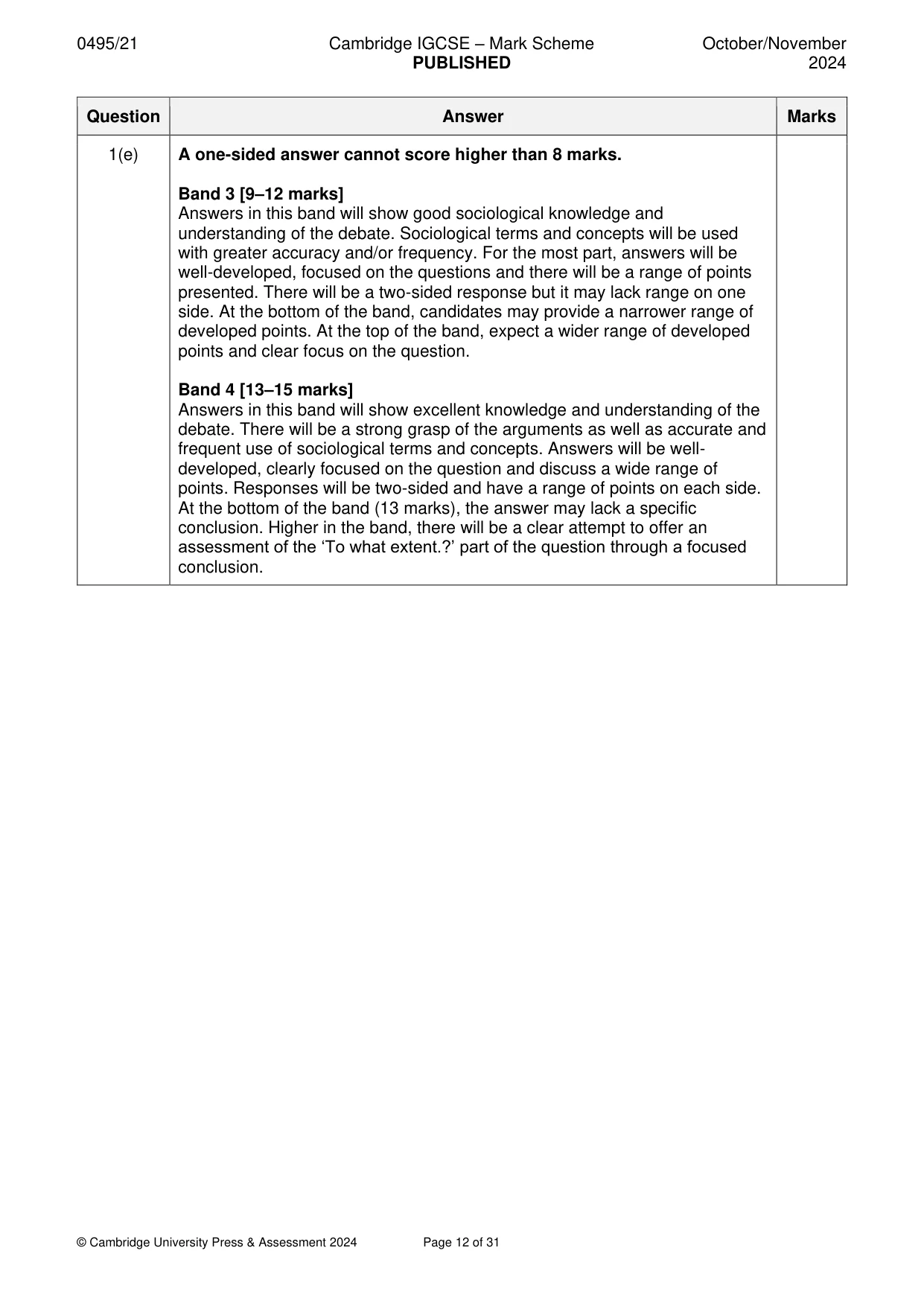
Mark scheme: Question Answer Marks 1(a) What is meant by the term ‘family functions’? 2 One mark for a partial definition e.g. family roles. Two marks for a clear definition e.g. the essential tasks performed by the family i.e. primary socialisation. 1(b) Describe two demographic trends affecting the family. 4 Possible answers: • birth rate – in modern industrial societies (MISs) the birth rate is falling leading to smaller family sizes; • fertility rate – women are having fewer children than in the past therefore children have fewer/no siblings; • beanpole family – smaller family size means more families with only a few people in each generation are becoming typical; • DINK families – the rise of childless families through choice e.g. career focused; • new baby boom – immigration to MISs has led some to believe there is a baby boom, particularly amongst those from Eastern European origin; • births outside marriage – these are increasing through decline of marriage and increase of cohabitation and single parent families; • death rate – this has fallen leading to an ageing population in many MISs which can lead to the burden of care falling on family members; • child mortality rate – has fallen dramatically as healthcare improves therefore less pressure on families to have lots of children; • other reasonable response. One mark for each point correctly identified (up to maximum of two). One mark for each point that is developed (up to a maximum of two). 1(c) Explain how family life can vary cross-culturally. 6 Possible answers: • family type – nuclear families are common in many Western cultures whereas extended families dominate in South Asian cultures; • family size – this differs cross-culturally, for example Western families are quite small, Chinese family size is legislated by state rule (currently 3) and Asian families may have more children; • family structure – Western families are typically beanpole in structure whereas Asian families may extend vertically and/or horizontally; • same-sex families – these have now become normalised in a number of countries, particularly in the West, whereas in many religious cultures these are not seen to be acceptable or are illegal; • gender roles – cultural norms often determine family gender roles such as in many traditional cultures e.g. traveller culture, females are still expected to take responsibility for childcare and domestic work whereas in many more modern cultures roles are becoming more symmetrical; • communes/shared living arrangements – families who live in communes have a very different experience of living in a family (shared parenting/non-familial living arrangements etc.) than those living in a more traditional family structure; • divorce – in some traditional/religious cultures divorce is illegal and therefore family life may be impacted by negative factors such as unhappiness, distress etc. In secular cultures divorce is allowed and can thus affect family life differently; • children – in Western cultures there is often a focus on child-centredness within the family whereas in other cultures children may take more adult roles such as workers, soldiers, spouses etc.; • elders – in many Asian and tribal cultures older people are revered and seen as figures of wisdom whereas in Western culture the elderly may suffer from elder abuse or leave the family to live in a care home meaning family life varies by culture; • marriage – a monogamous marriage between one man and one woman is the only form of legal marriage in most western cultures, whereas polygamy is accepted in many African and Middle Eastern cultures leading to a very different family life; • any other reasonable response. Band 0 [0 marks] No creditworthy response. Band 1 [1–3 marks] Answers in this band will show only a limited awareness of the question. Responses may be short and un/underdeveloped. At the bottom of the band (1 mark), expect one weak point. Higher in the band (2–3 marks), candidates may offer more than one weak point, but there may be a tendency towards simplistic answers, engaging with sociological ideas without using sociological language. 1(c) Band 2 [4–6 marks] Answers in this band will have clear and accurate explanation, showing good sociological knowledge and understanding. Sociological terms and concepts should be expected and explained. At the bottom of the band, the range of points covered may be narrow or lack detail. Higher in the band, answers will cover more than one point in a well-developed way or cover several points in less detail. 1(d) Explain why sociologists argue some families do not socialise their 8 children effectively. Possible answers: • parental neglect/mistreatment – e.g. feral children – these children are unsocialised because their parents neglect or mistreat them e.g. Genie, Oxana; • dual-worker families – functionalists claim that the socialisation family function has been lost because both parents are working meaning there is too little time to devote to socialising children adequately; • loss of expressive role – functionalists claim that as many women no longer perform the expressive role their ability to adequately socialise children has been lost to other agencies; • underclass and single parent families – Murray and the New Right claim that the underclass do not socialise their children adequately because of the lack of a father figure, leading to them becoming lazy, reckless, criminal and immoral; • divorce – some sociologists claim that rising divorce rates are leading to confused and angry children who are missing the nuclear family as a source of support and adequate socialisation; • feminism – feminists claim that the family is patriarchal and therefore does not socialise children adequately but instead encourages gender inequality and gender-based roles and norms; • Marxism – Marxists claim that the family acts as a tool of oppression for the ruling class therefore it does not adequately socialise children to rebel against the ‘status quo’ that maintains their unequal position in society; • Leach’s dysfunctional nuclear family – it is too insular and too suffocating and therefore does not allow for adequate socialisation of children but, instead, to conflict and stress; • dark side of the family – factors such as domestic violence, child abuse and neglect all mean that children are not adequately socialised by their family; • any other reasonable response. Band 0 [0 marks] No creditworthy response. Band 1 [1–3 marks] Answers in this band will show only a limited awareness of the question. A tendency to description is likely. Responses may be short and undeveloped and points stated without explanation. Sociological terms and concepts are unlikely to be used. At the bottom of the band (1 mark), expect one weak point. Higher in the band (2–3 marks), candidates may offer more than one weak point. Band 2 [4–6 marks] Answers in this band will show basic sociological knowledge and understanding. Responses maybe underdeveloped and lacking in range. At the bottom of the band, candidates are unlikely to use sociological terms and concepts accurately. Higher in the band, candidates may be beginning to use sociological terms and concepts with greater accuracy. However, some aspects of the answer may only be partially developed/explained. 1(d) Band 3 [7–8 marks] Answers in this band will show good sociological knowledge and understanding and will be well-developed and explained. Sociological terms and concepts will be used accurately overall. Answers will be well-focused on the question and there will be a range of points presented. At the top of the band explanations will be clear throughout. 1(e) To what extent has gender equality in the family been achieved? 15 Possible answers: FOR • family diversity – same sex relationships and lone parents are examples of family types that allow for gender equality – men and women are able to negotiate their roles, share decision making and reduce power inequalities; • changing norms and values - as society changes so does the family. Men are now increasingly involved with childcare and housework (new man) and families are hence more symmetrical than previously (Willmott and Young, joint conjugal roles); • careers and work – as families are increasingly dual worker families so women have the same amount of power, financial capital and status as men and thus families achieve gender equality; • joint conjugal roles – roles in the family are increasingly shared between men and women and there is no longer the division typical of the past – this has allowed for gender equality in the family; • single parent families – as this type of family becomes more normal and accepted in many societies, gender equality is more likely as there is no power differential between partners when only one parent lives in the family home; • privatised nuclear family – this type of family has become increasingly the norm and has meant that husbands and wives spend more leisure time together and within the family, so improving symmetry and equality; • feminism – this ideology has become more widespread globally meaning that women are more aware of their rights and expect more from a relationship – this leads to increased gender equality within families; • divorce laws – it has become easier and cheaper to get divorced in many countries and thus gender equality is more likely as if one partner is not happy with the family/marriage relationship then they can instigate a divorce; • gender neutral socialisation – avoiding stereotypes and gendered expectations is becoming more common within families (e.g. in Scandinavia) and is thus increasing gender equality within the institution; • any other reasonable response. AGAINST • segregated conjugal roles – men and women typically take on different roles within the family that result in men having more power and status than women and so leading to gender inequality; • male benefits – the housewife role expects women to look after the needs of men through cooking, cleaning, supporting emotionally and putting the man’s needs before the woman’s e.g. the warm bath theory - this prevents gender equality; • gender role socialisation – Oakley – boys are socialised to be tough, aggressive, active and unemotional whilst girls are socialised into domesticity, being caring and gentle and passivity – this differential gender socialisation prevents gender equality; 1(e) • inheritance – a son or male heir traditionally inherits the family’s wealth so that wealth and power stays with the males in the family and so prevents gender equality; • the anti-social family – Barrett and McIntosh – the media promotes the idea that only the nuclear family can be the ideal, this puts women under pressure when they fail to achieve these impossible family-based goals. Women are made to feel that they are to blame when the family fails and this unequal pressure and strain prevents gender equality; • unpaid housewife role – despite the long hours, demands and stress that this role (played typically by women) causes, it is unpaid – this makes women financially dependent upon men and so prevents gender equality; • dual burden/triple shift – even when women engage in paid employment they are still primarily responsible for the housework, childcare and emotional roles in the family as well and so cannot achieve gender equality; • dark side of the family – women are often the victims of various forms of domestic abuse, coercion and manipulation within the family – men typically are not and this power dynamic means that there is no gender equality; • decision making – many sociological studies e.g. Edgell/Pahl, show that it is still men that traditionally make the major decisions within the family and this therefore means gender equality has not been achieved e.g. family moves house for the husband’s job; • pivot generation – with ageing populations being seen across the globe there is often a dual need for care – of both children and ageing parents simultaneously – this burden typically still falls to the woman, therefore preventing gender equality; • any other reasonable response. Band 0 [0 marks] No creditworthy response. Band 1 [1–4 marks] Answers in this band may be vague and largely based on common sense showing limited knowledge of the debate. Use of sociological terms or concepts is very unlikely. Responses may be short, undeveloped and one- sided. Lower in the band (1–2 marks), expect one or two weak points. Higher in the band (3–4 marks) candidates may offer more than two points and provide a weak definition of key terms in the question. Band 2 [5–8 marks] In this band candidates will show some basic knowledge of the debate. Alternatively, they may offer an answer which is list-like in nature but there will be no real attempt to assess the issues raised by the question. There may be limited/some use of sociological terms or concepts. Responses may be underdeveloped and lack range. Answers may be simplistic and two-sided or only cover one side of the debate. Lower in the band, the response may be rather narrow in the points covered and there may be some development. Higher in the band, more points are likely to be covered with some development. Alternatively, a list-like answer with some development covering both sides of the argument may score up to 8 marks. 1(e) A one-sided answer cannot score higher than 8 marks. Band 3 [9–12 marks] Answers in this band will show good sociological knowledge and understanding of the debate. Sociological terms and concepts will be used with greater accuracy and/or frequency. For the most part, answers will be well-developed, focused on the questions and there will be a range of points presented. There will be a two-sided response but it may lack range on one side. At the bottom of the band, candidates may provide a narrower range of developed points. At the top of the band, expect a wider range of developed points and clear focus on the question. Band 4 [13–15 marks] Answers in this band will show excellent knowledge and understanding of the debate. There will be a strong grasp of the arguments as well as accurate and frequent use of sociological terms and concepts. Answers will be well- developed, clearly focused on the question and discuss a wide range of points. Responses will be two-sided and have a range of points on each side. At the bottom of the band (13 marks), the answer may lack a specific conclusion. Higher in the band, there will be a clear attempt to offer an assessment of the ‘To what extent.?’ part of the question through a focused conclusion.
Q2 · There are inequalities in patterns of educational achievement
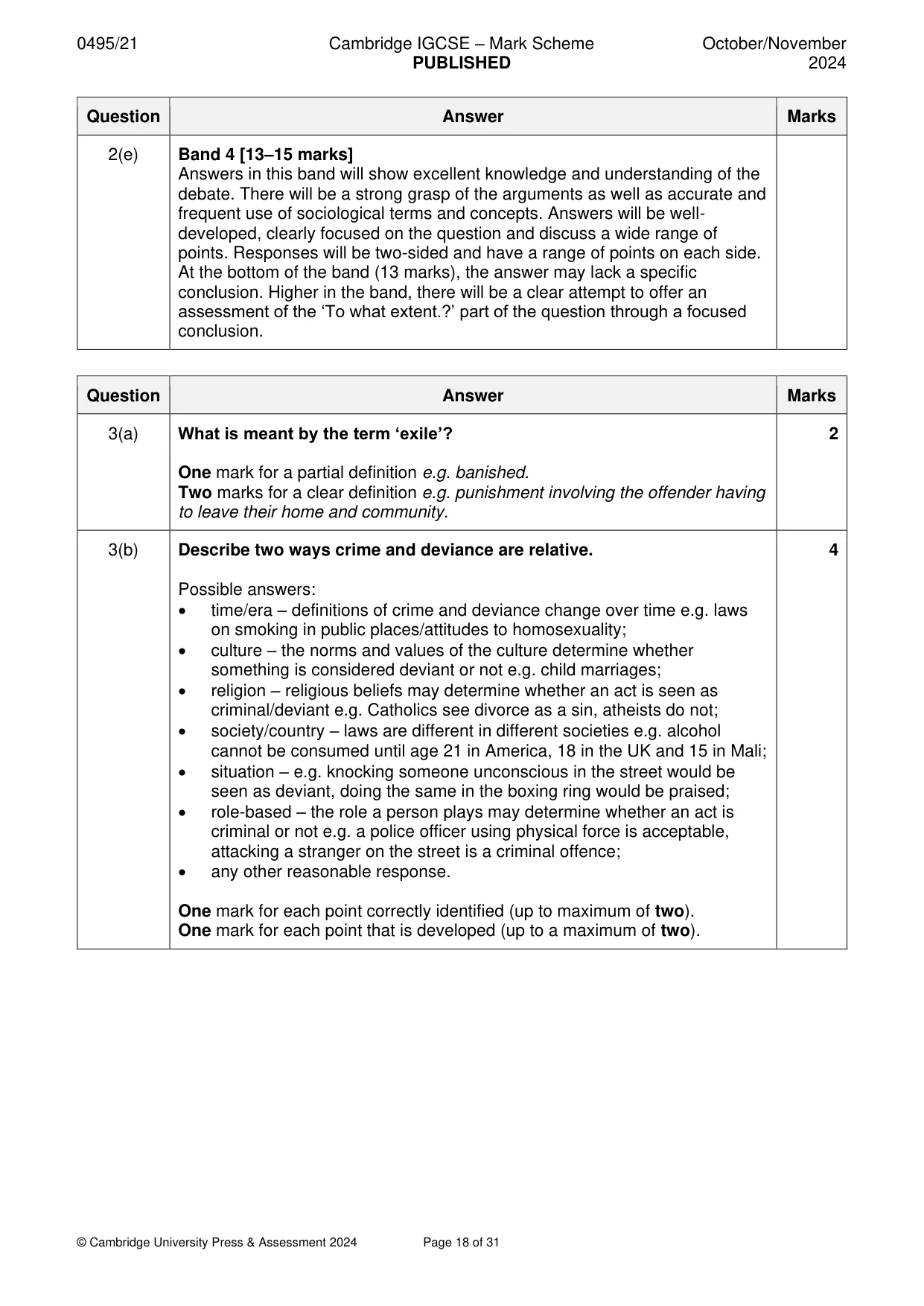
2 There are inequalities in patterns of educational achievement. Some students choose to join anti-school sub-cultures. Sociologists debate whether educational achievement is affected by the type of school attended. Setting occurs in most types of schools. (a) What is meant by the term ‘setting’? [2] (b) Describe two examples of inequality in patterns of educational achievement. [4] (c) Explain how a lack of cultural capital disadvantages some students. [6] (d) Explain why some students join anti-school sub-cultures. [8] (e) To what extent does the type of school a student attends affect their educational achievement? [15] Section C: Crime, deviance and social control
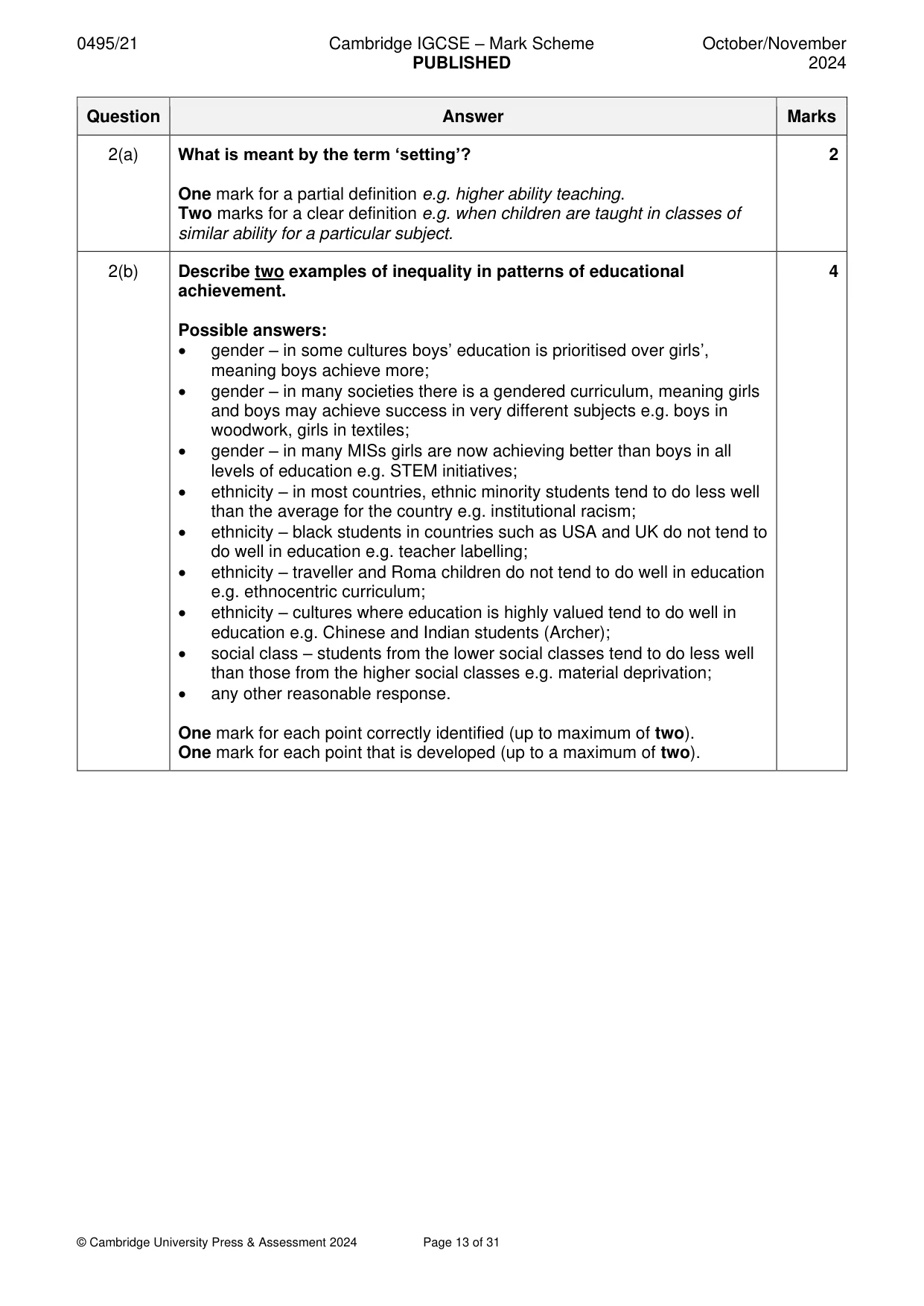
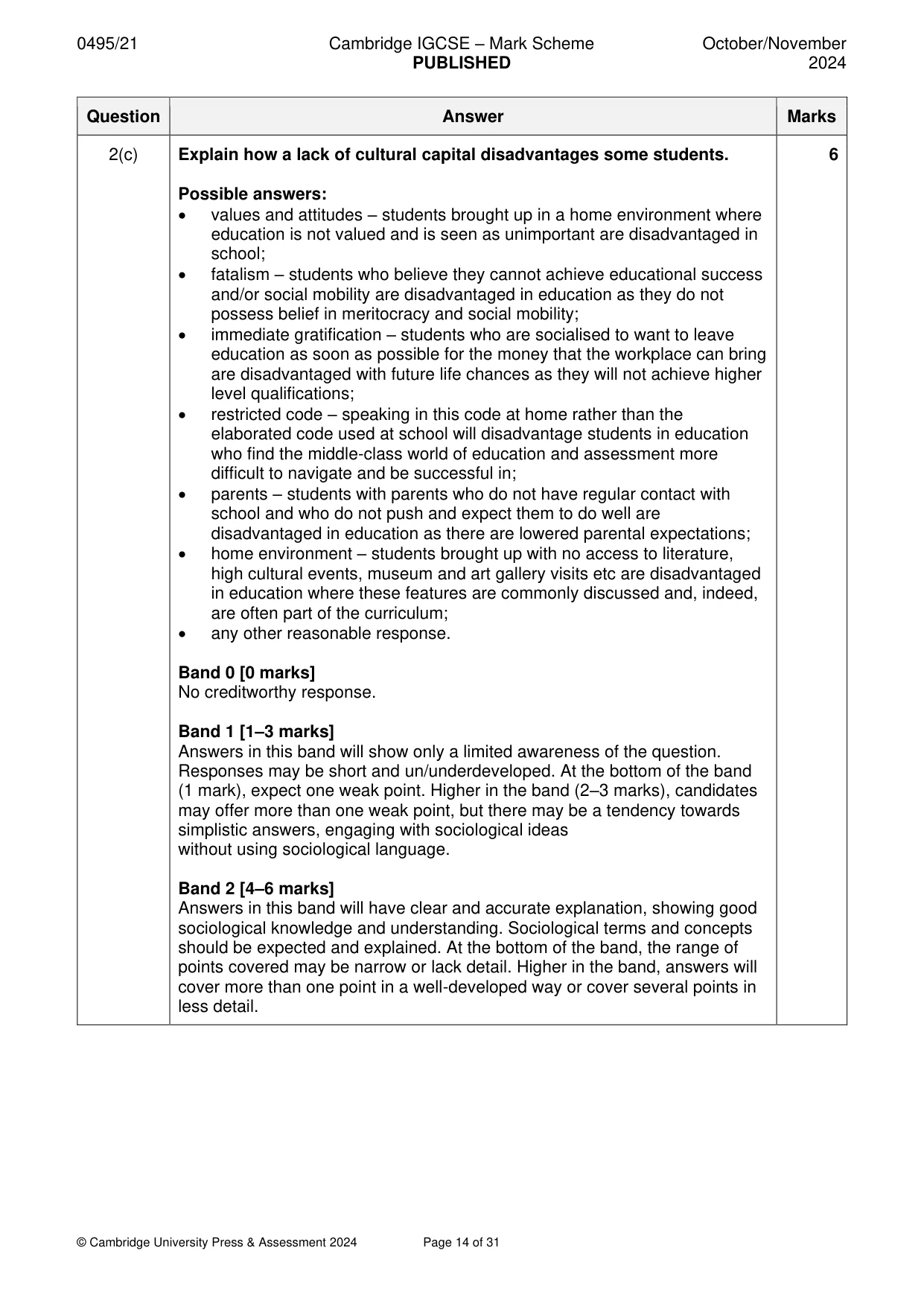
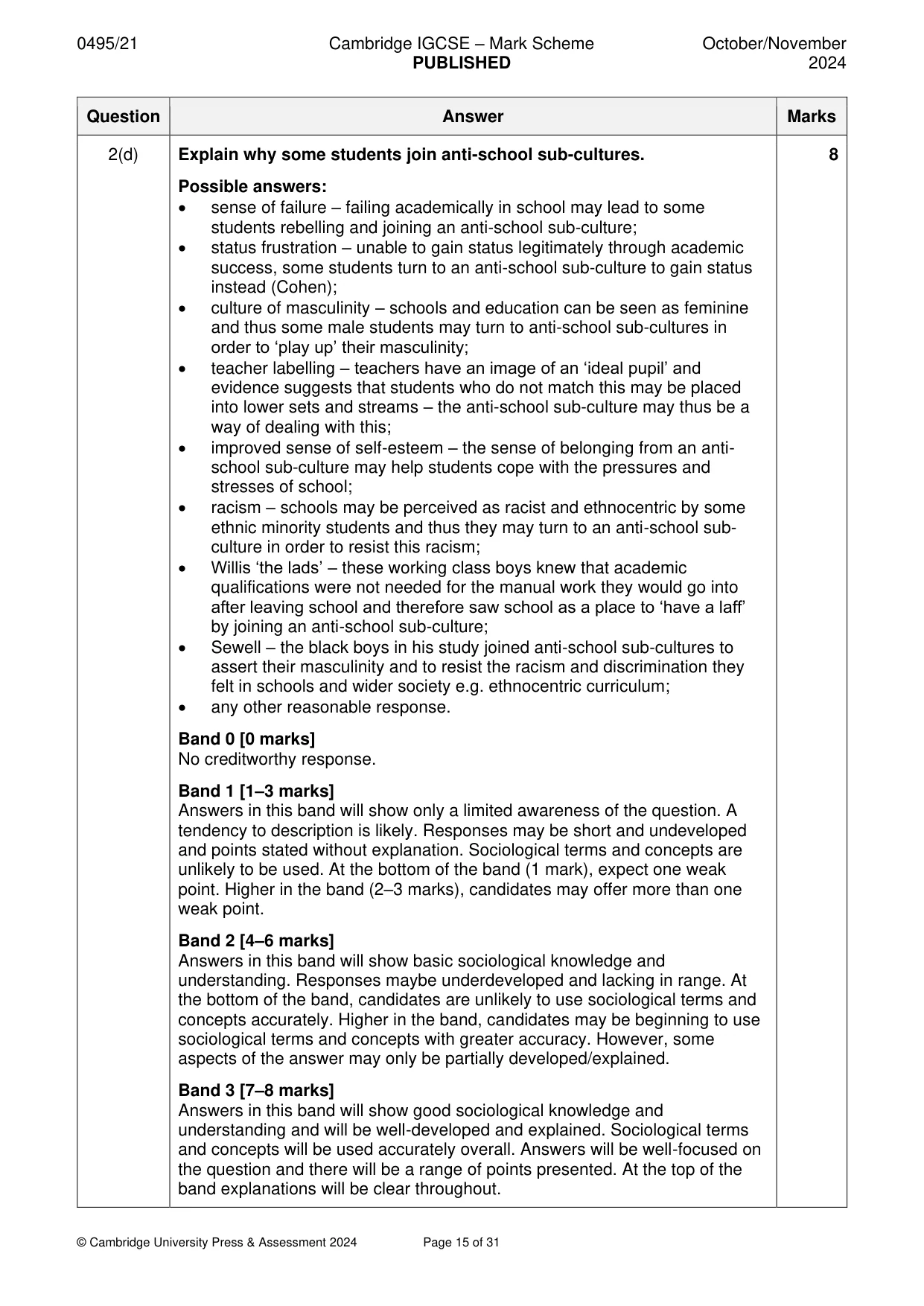
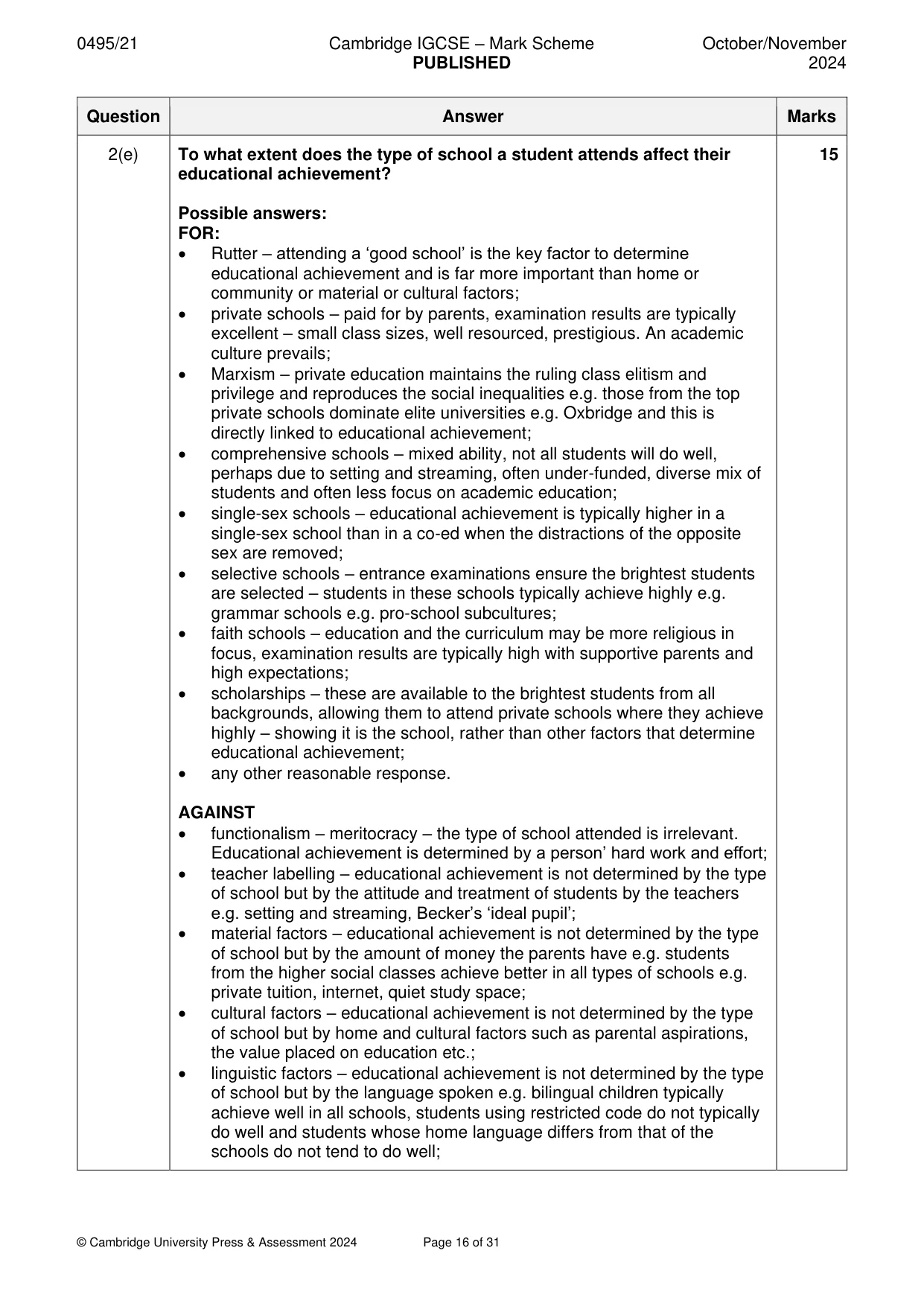
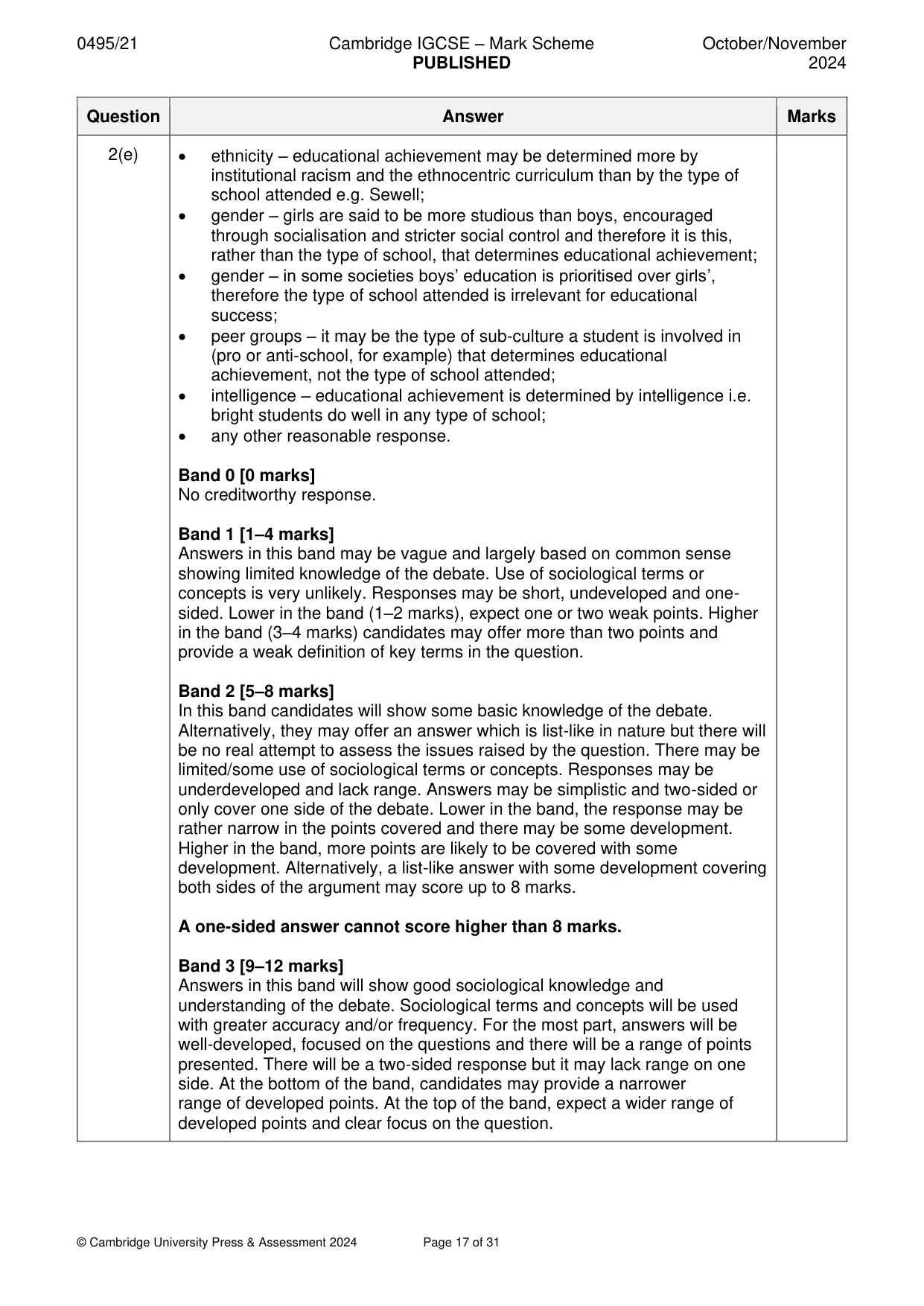
Mark scheme: 2(a) What is meant by the term ‘setting’? 2 One mark for a partial definition e.g. higher ability teaching. Two marks for a clear definition e.g. when children are taught in classes of similar ability for a particular subject. 2(b) Describe two examples of inequality in patterns of educational 4 achievement. Possible answers: • gender – in some cultures boys’ education is prioritised over girls’, meaning boys achieve more; • gender – in many societies there is a gendered curriculum, meaning girls and boys may achieve success in very different subjects e.g. boys in woodwork, girls in textiles; • gender – in many MISs girls are now achieving better than boys in all levels of education e.g. STEM initiatives; • ethnicity – in most countries, ethnic minority students tend to do less well than the average for the country e.g. institutional racism; • ethnicity – black students in countries such as USA and UK do not tend to do well in education e.g. teacher labelling; • ethnicity – traveller and Roma children do not tend to do well in education e.g. ethnocentric curriculum; • ethnicity – cultures where education is highly valued tend to do well in education e.g. Chinese and Indian students (Archer); • social class – students from the lower social classes tend to do less well than those from the higher social classes e.g. material deprivation; • any other reasonable response. One mark for each point correctly identified (up to maximum of two). One mark for each point that is developed (up to a maximum of two). 2(c) Explain how a lack of cultural capital disadvantages some students. 6 Possible answers: • values and attitudes – students brought up in a home environment where education is not valued and is seen as unimportant are disadvantaged in school; • fatalism – students who believe they cannot achieve educational success and/or social mobility are disadvantaged in education as they do not possess belief in meritocracy and social mobility; • immediate gratification – students who are socialised to want to leave education as soon as possible for the money that the workplace can bring are disadvantaged with future life chances as they will not achieve higher level qualifications; • restricted code – speaking in this code at home rather than the elaborated code used at school will disadvantage students in education who find the middle-class world of education and assessment more difficult to navigate and be successful in; • parents – students with parents who do not have regular contact with school and who do not push and expect them to do well are disadvantaged in education as there are lowered parental expectations; • home environment – students brought up with no access to literature, high cultural events, museum and art gallery visits etc are disadvantaged in education where these features are commonly discussed and, indeed, are often part of the curriculum; • any other reasonable response. Band 0 [0 marks] No creditworthy response. Band 1 [1–3 marks] Answers in this band will show only a limited awareness of the question. Responses may be short and un/underdeveloped. At the bottom of the band (1 mark), expect one weak point. Higher in the band (2–3 marks), candidates may offer more than one weak point, but there may be a tendency towards simplistic answers, engaging with sociological ideas without using sociological language. Band 2 [4–6 marks] Answers in this band will have clear and accurate explanation, showing good sociological knowledge and understanding. Sociological terms and concepts should be expected and explained. At the bottom of the band, the range of points covered may be narrow or lack detail. Higher in the band, answers will cover more than one point in a well-developed way or cover several points in less detail. 2(d) Explain why some students join anti-school sub-cultures. 8 Possible answers: • sense of failure – failing academically in school may lead to some students rebelling and joining an anti-school sub-culture; • status frustration – unable to gain status legitimately through academic success, some students turn to an anti-school sub-culture to gain status instead (Cohen); • culture of masculinity – schools and education can be seen as feminine and thus some male students may turn to anti-school sub-cultures in order to ‘play up’ their masculinity; • teacher labelling – teachers have an image of an ‘ideal pupil’ and evidence suggests that students who do not match this may be placed into lower sets and streams – the anti-school sub-culture may thus be a way of dealing with this; • improved sense of self-esteem – the sense of belonging from an anti- school sub-culture may help students cope with the pressures and stresses of school; • racism – schools may be perceived as racist and ethnocentric by some ethnic minority students and thus they may turn to an anti-school sub- culture in order to resist this racism; • Willis ‘the lads’ – these working class boys knew that academic qualifications were not needed for the manual work they would go into after leaving school and therefore saw school as a place to ‘have a laff’ by joining an anti-school sub-culture; • Sewell – the black boys in his study joined anti-school sub-cultures to assert their masculinity and to resist the racism and discrimination they felt in schools and wider society e.g. ethnocentric curriculum; • any other reasonable response. Band 0 [0 marks] No creditworthy response. Band 1 [1–3 marks] Answers in this band will show only a limited awareness of the question. A tendency to description is likely. Responses may be short and undeveloped and points stated without explanation. Sociological terms and concepts are unlikely to be used. At the bottom of the band (1 mark), expect one weak point. Higher in the band (2–3 marks), candidates may offer more than one weak point. Band 2 [4–6 marks] Answers in this band will show basic sociological knowledge and understanding. Responses maybe underdeveloped and lacking in range. At the bottom of the band, candidates are unlikely to use sociological terms and concepts accurately. Higher in the band, candidates may be beginning to use sociological terms and concepts with greater accuracy. However, some aspects of the answer may only be partially developed/explained. Band 3 [7–8 marks] Answers in this band will show good sociological knowledge and understanding and will be well-developed and explained. Sociological terms and concepts will be used accurately overall. Answers will be well-focused on the question and there will be a range of points presented. At the top of the band explanations will be clear throughout. 2(e) To what extent does the type of school a student attends affect their 15 educational achievement? Possible answers: FOR: • Rutter – attending a ‘good school’ is the key factor to determine educational achievement and is far more important than home or community or material or cultural factors; • private schools – paid for by parents, examination results are typically excellent – small class sizes, well resourced, prestigious. An academic culture prevails; • Marxism – private education maintains the ruling class elitism and privilege and reproduces the social inequalities e.g. those from the top private schools dominate elite universities e.g. Oxbridge and this is directly linked to educational achievement; • comprehensive schools – mixed ability, not all students will do well, perhaps due to setting and streaming, often under-funded, diverse mix of students and often less focus on academic education; • single-sex schools – educational achievement is typically higher in a single-sex school than in a co-ed when the distractions of the opposite sex are removed; • selective schools – entrance examinations ensure the brightest students are selected – students in these schools typically achieve highly e.g. grammar schools e.g. pro-school subcultures; • faith schools – education and the curriculum may be more religious in focus, examination results are typically high with supportive parents and high expectations; • scholarships – these are available to the brightest students from all backgrounds, allowing them to attend private schools where they achieve highly – showing it is the school, rather than other factors that determine educational achievement; • any other reasonable response. AGAINST • functionalism – meritocracy – the type of school attended is irrelevant. Educational achievement is determined by a person’ hard work and effort; • teacher labelling – educational achievement is not determined by the type of school but by the attitude and treatment of students by the teachers e.g. setting and streaming, Becker’s ‘ideal pupil’; • material factors – educational achievement is not determined by the type of school but by the amount of money the parents have e.g. students from the higher social classes achieve better in all types of schools e.g. private tuition, internet, quiet study space; • cultural factors – educational achievement is not determined by the type of school but by home and cultural factors such as parental aspirations, the value placed on education etc.; • linguistic factors – educational achievement is not determined by the type of school but by the language spoken e.g. bilingual children typically achieve well in all schools, students using restricted code do not typically do well and students whose home language differs from that of the schools do not tend to do well; 2(e) • ethnicity – educational achievement may be determined more by institutional racism and the ethnocentric curriculum than by the type of school attended e.g. Sewell; • gender – girls are said to be more studious than boys, encouraged through socialisation and stricter social control and therefore it is this, rather than the type of school, that determines educational achievement; • gender – in some societies boys’ education is prioritised over girls’, therefore the type of school attended is irrelevant for educational success; • peer groups – it may be the type of sub-culture a student is involved in (pro or anti-school, for example) that determines educational achievement, not the type of school attended; • intelligence – educational achievement is determined by intelligence i.e. bright students do well in any type of school; • any other reasonable response. Band 0 [0 marks] No creditworthy response. Band 1 [1–4 marks] Answers in this band may be vague and largely based on common sense showing limited knowledge of the debate. Use of sociological terms or concepts is very unlikely. Responses may be short, undeveloped and one- sided. Lower in the band (1–2 marks), expect one or two weak points. Higher in the band (3–4 marks) candidates may offer more than two points and provide a weak definition of key terms in the question. Band 2 [5–8 marks] In this band candidates will show some basic knowledge of the debate. Alternatively, they may offer an answer which is list-like in nature but there will be no real attempt to assess the issues raised by the question. There may be limited/some use of sociological terms or concepts. Responses may be underdeveloped and lack range. Answers may be simplistic and two-sided or only cover one side of the debate. Lower in the band, the response may be rather narrow in the points covered and there may be some development. Higher in the band, more points are likely to be covered with some development. Alternatively, a list-like answer with some development covering both sides of the argument may score up to 8 marks. A one-sided answer cannot score higher than 8 marks. Band 3 [9–12 marks] Answers in this band will show good sociological knowledge and understanding of the debate. Sociological terms and concepts will be used with greater accuracy and/or frequency. For the most part, answers will be well-developed, focused on the questions and there will be a range of points presented. There will be a two-sided response but it may lack range on one side. At the bottom of the band, candidates may provide a narrower range of developed points. At the top of the band, expect a wider range of developed points and clear focus on the question. 2(e) Band 4 [13–15 marks] Answers in this band will show excellent knowledge and understanding of the debate. There will be a strong grasp of the arguments as well as accurate and frequent use of sociological terms and concepts. Answers will be well- developed, clearly focused on the question and discuss a wide range of points. Responses will be two-sided and have a range of points on each side. At the bottom of the band (13 marks), the answer may lack a specific conclusion. Higher in the band, there will be a clear attempt to offer an assessment of the ‘To what extent.?’ part of the question through a focused conclusion.
Q3 · Crime and deviance are relative
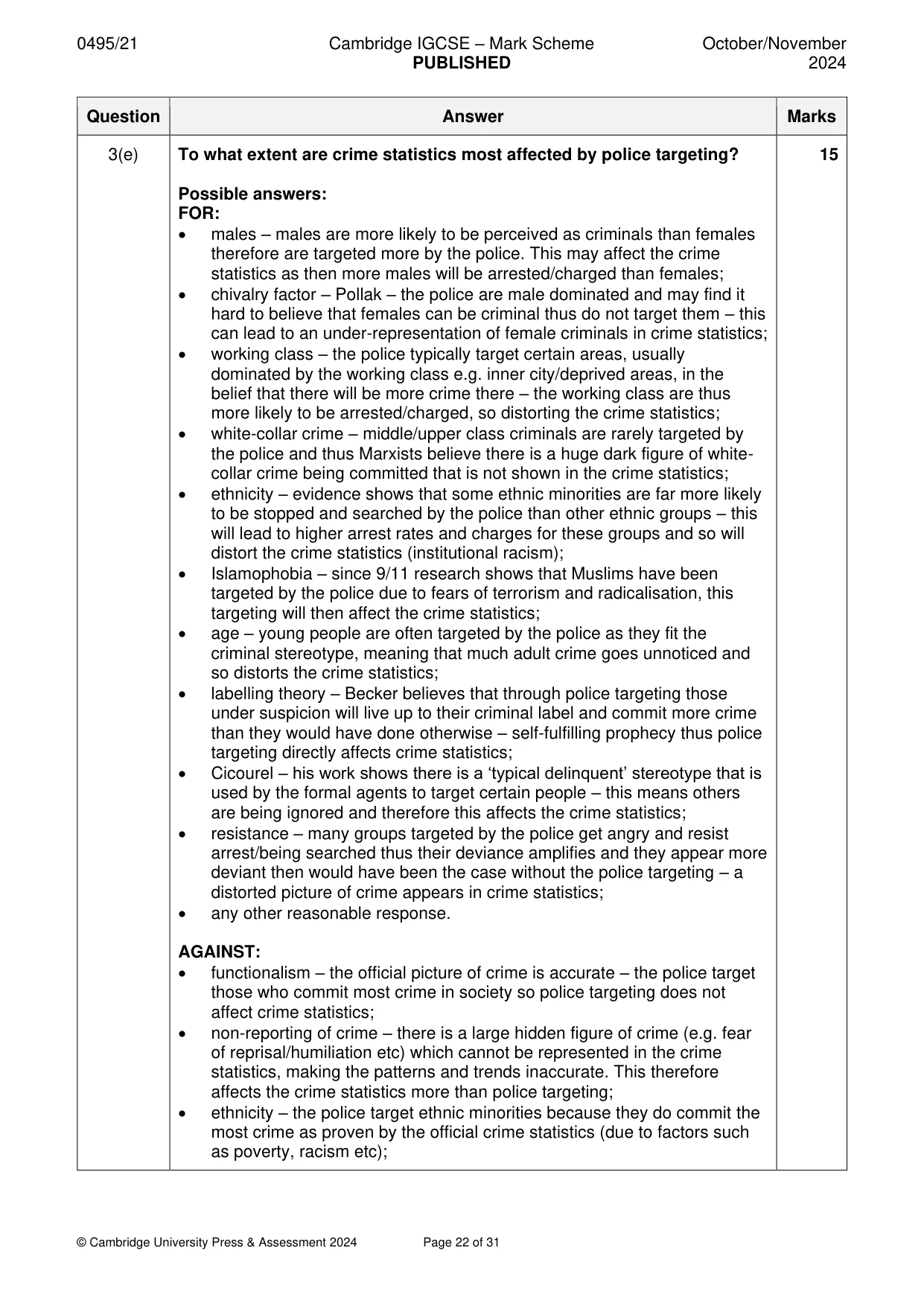
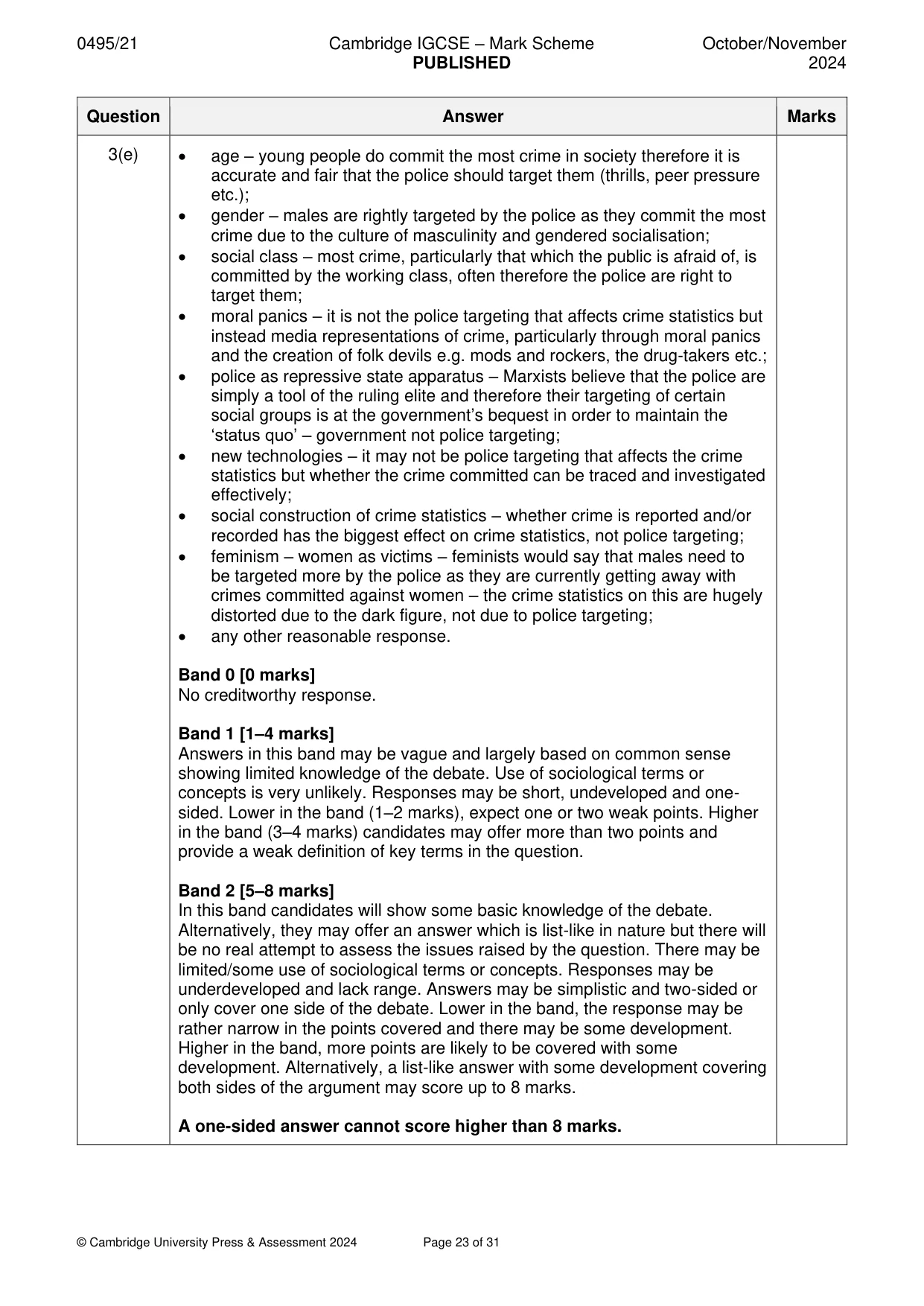
3 Crime and deviance are relative. Functionalists and Marxists disagree in their views on crime. Crime statistics can be affected by a range of factors, including police targeting. In some societies exile occurs. (a) What is meant by the term ‘exile’? [2] (b) Describe two ways crime and deviance are relative. [4] (c) Explain how functionalists view crime. [6] (d) Explain why some young people commit crime. [8] (e) To what extent are crime statistics most affected by police targeting? [15] Section D: Media
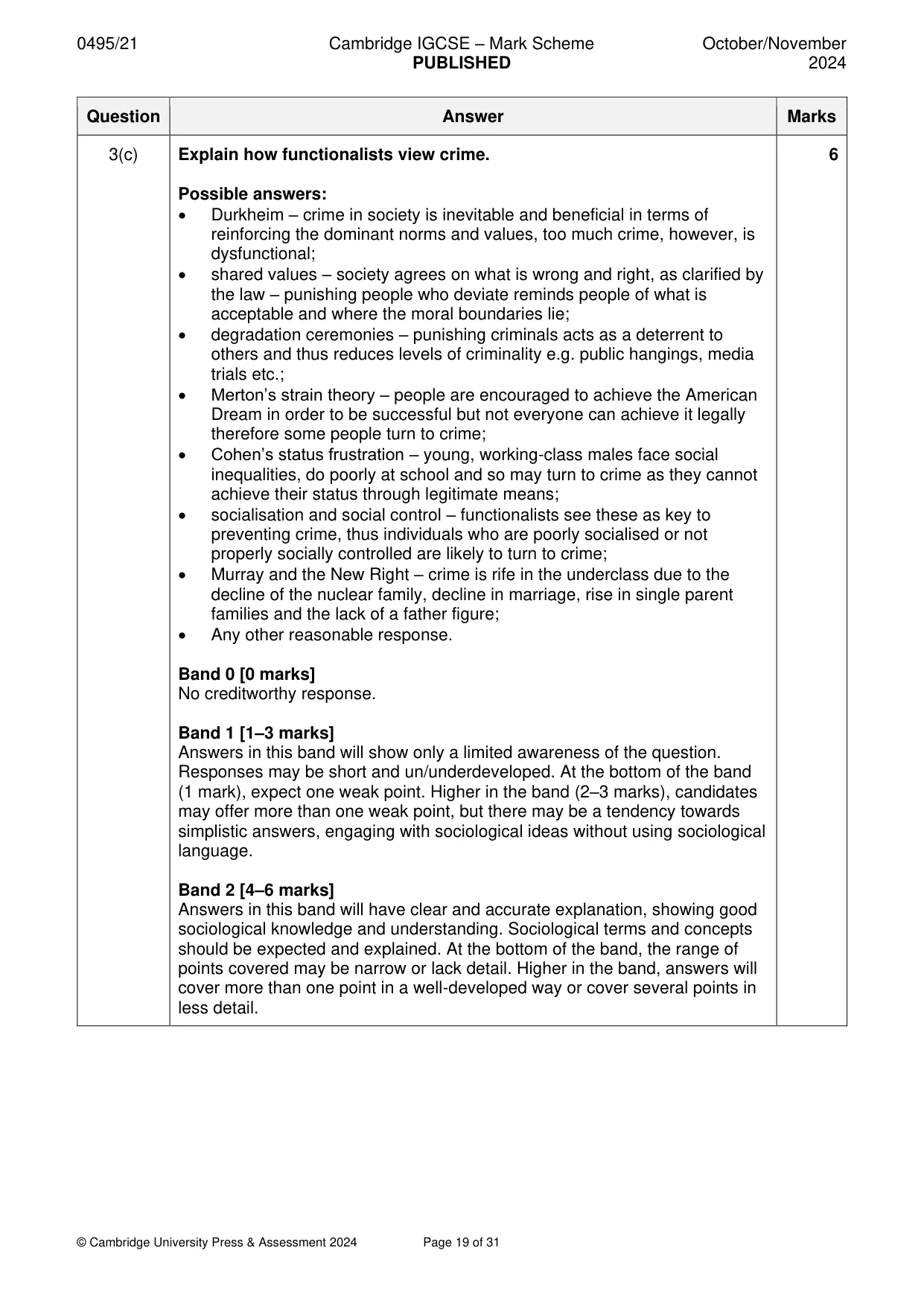
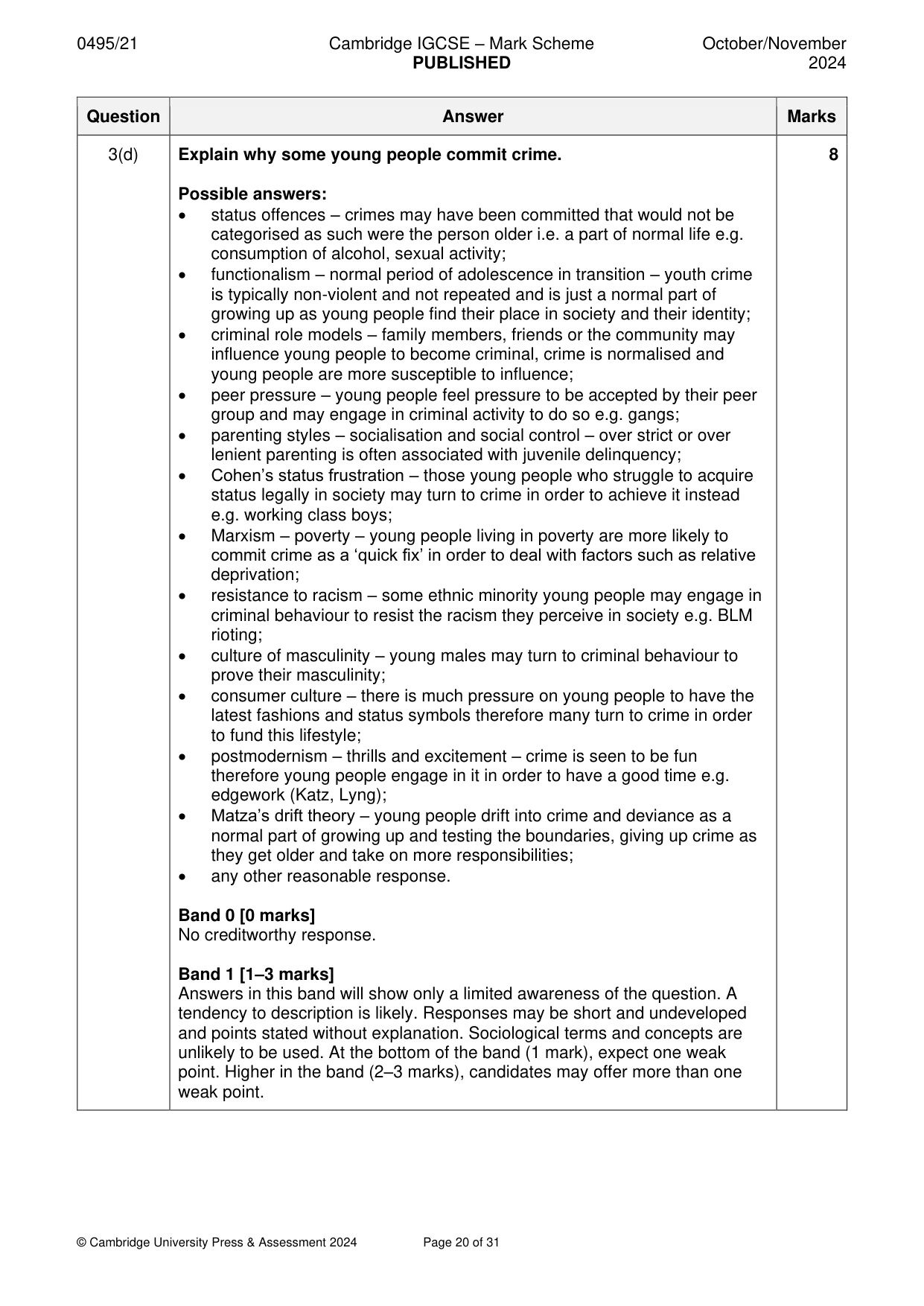
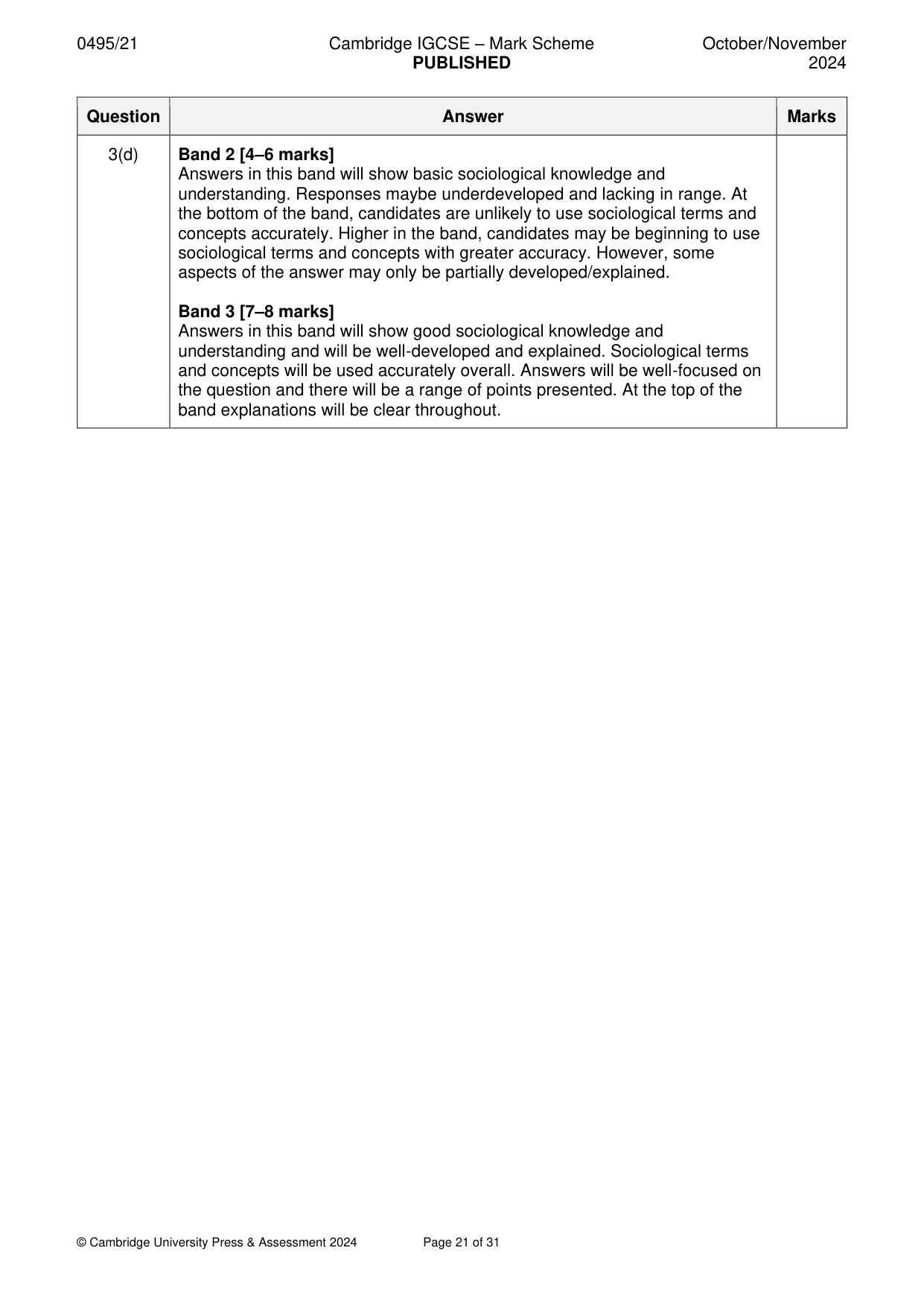
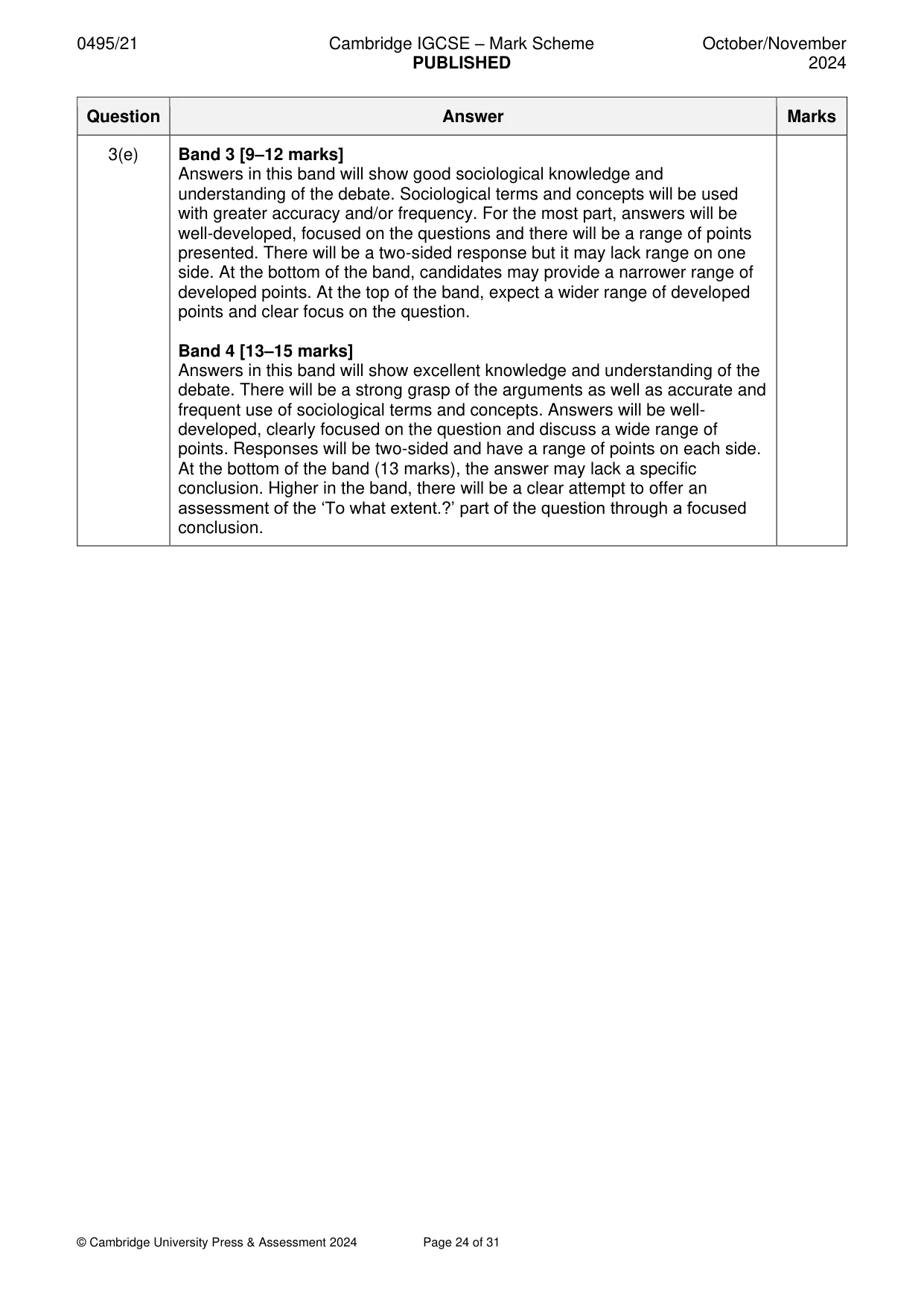
Mark scheme: 3(a) What is meant by the term ‘exile’? 2 One mark for a partial definition e.g. banished. Two marks for a clear definition e.g. punishment involving the offender having to leave their home and community. 3(b) Describe two ways crime and deviance are relative. 4 Possible answers: • time/era – definitions of crime and deviance change over time e.g. laws on smoking in public places/attitudes to homosexuality; • culture – the norms and values of the culture determine whether something is considered deviant or not e.g. child marriages; • religion – religious beliefs may determine whether an act is seen as criminal/deviant e.g. Catholics see divorce as a sin, atheists do not; • society/country – laws are different in different societies e.g. alcohol cannot be consumed until age 21 in America, 18 in the UK and 15 in Mali; • situation – e.g. knocking someone unconscious in the street would be seen as deviant, doing the same in the boxing ring would be praised; • role-based – the role a person plays may determine whether an act is criminal or not e.g. a police officer using physical force is acceptable, attacking a stranger on the street is a criminal offence; • any other reasonable response. One mark for each point correctly identified (up to maximum of two). One mark for each point that is developed (up to a maximum of two). 3(c) Explain how functionalists view crime. 6 Possible answers: • Durkheim – crime in society is inevitable and beneficial in terms of reinforcing the dominant norms and values, too much crime, however, is dysfunctional; • shared values – society agrees on what is wrong and right, as clarified by the law – punishing people who deviate reminds people of what is acceptable and where the moral boundaries lie; • degradation ceremonies – punishing criminals acts as a deterrent to others and thus reduces levels of criminality e.g. public hangings, media trials etc.; • Merton’s strain theory – people are encouraged to achieve the American Dream in order to be successful but not everyone can achieve it legally therefore some people turn to crime; • Cohen’s status frustration – young, working-class males face social inequalities, do poorly at school and so may turn to crime as they cannot achieve their status through legitimate means; • socialisation and social control – functionalists see these as key to preventing crime, thus individuals who are poorly socialised or not properly socially controlled are likely to turn to crime; • Murray and the New Right – crime is rife in the underclass due to the decline of the nuclear family, decline in marriage, rise in single parent families and the lack of a father figure; • Any other reasonable response. Band 0 [0 marks] No creditworthy response. Band 1 [1–3 marks] Answers in this band will show only a limited awareness of the question. Responses may be short and un/underdeveloped. At the bottom of the band (1 mark), expect one weak point. Higher in the band (2–3 marks), candidates may offer more than one weak point, but there may be a tendency towards simplistic answers, engaging with sociological ideas without using sociological language. Band 2 [4–6 marks] Answers in this band will have clear and accurate explanation, showing good sociological knowledge and understanding. Sociological terms and concepts should be expected and explained. At the bottom of the band, the range of points covered may be narrow or lack detail. Higher in the band, answers will cover more than one point in a well-developed way or cover several points in less detail. 3(d) Explain why some young people commit crime. 8 Possible answers: • status offences – crimes may have been committed that would not be categorised as such were the person older i.e. a part of normal life e.g. consumption of alcohol, sexual activity; • functionalism – normal period of adolescence in transition – youth crime is typically non-violent and not repeated and is just a normal part of growing up as young people find their place in society and their identity; • criminal role models – family members, friends or the community may influence young people to become criminal, crime is normalised and young people are more susceptible to influence; • peer pressure – young people feel pressure to be accepted by their peer group and may engage in criminal activity to do so e.g. gangs; • parenting styles – socialisation and social control – over strict or over lenient parenting is often associated with juvenile delinquency; • Cohen’s status frustration – those young people who struggle to acquire status legally in society may turn to crime in order to achieve it instead e.g. working class boys; • Marxism – poverty – young people living in poverty are more likely to commit crime as a ‘quick fix’ in order to deal with factors such as relative deprivation; • resistance to racism – some ethnic minority young people may engage in criminal behaviour to resist the racism they perceive in society e.g. BLM rioting; • culture of masculinity – young males may turn to criminal behaviour to prove their masculinity; • consumer culture – there is much pressure on young people to have the latest fashions and status symbols therefore many turn to crime in order to fund this lifestyle; • postmodernism – thrills and excitement – crime is seen to be fun therefore young people engage in it in order to have a good time e.g. edgework (Katz, Lyng); • Matza’s drift theory – young people drift into crime and deviance as a normal part of growing up and testing the boundaries, giving up crime as they get older and take on more responsibilities; • any other reasonable response. Band 0 [0 marks] No creditworthy response. Band 1 [1–3 marks] Answers in this band will show only a limited awareness of the question. A tendency to description is likely. Responses may be short and undeveloped and points stated without explanation. Sociological terms and concepts are unlikely to be used. At the bottom of the band (1 mark), expect one weak point. Higher in the band (2–3 marks), candidates may offer more than one weak point. 3(d) Band 2 [4–6 marks] Answers in this band will show basic sociological knowledge and understanding. Responses maybe underdeveloped and lacking in range. At the bottom of the band, candidates are unlikely to use sociological terms and concepts accurately. Higher in the band, candidates may be beginning to use sociological terms and concepts with greater accuracy. However, some aspects of the answer may only be partially developed/explained. Band 3 [7–8 marks] Answers in this band will show good sociological knowledge and understanding and will be well-developed and explained. Sociological terms and concepts will be used accurately overall. Answers will be well-focused on the question and there will be a range of points presented. At the top of the band explanations will be clear throughout. 3(e) To what extent are crime statistics most affected by police targeting? 15 Possible answers: FOR: • males – males are more likely to be perceived as criminals than females therefore are targeted more by the police. This may affect the crime statistics as then more males will be arrested/charged than females; • chivalry factor – Pollak – the police are male dominated and may find it hard to believe that females can be criminal thus do not target them – this can lead to an under-representation of female criminals in crime statistics; • working class – the police typically target certain areas, usually dominated by the working class e.g. inner city/deprived areas, in the belief that there will be more crime there – the working class are thus more likely to be arrested/charged, so distorting the crime statistics; • white-collar crime – middle/upper class criminals are rarely targeted by the police and thus Marxists believe there is a huge dark figure of white- collar crime being committed that is not shown in the crime statistics; • ethnicity – evidence shows that some ethnic minorities are far more likely to be stopped and searched by the police than other ethnic groups – this will lead to higher arrest rates and charges for these groups and so will distort the crime statistics (institutional racism); • Islamophobia – since 9/11 research shows that Muslims have been targeted by the police due to fears of terrorism and radicalisation, this targeting will then affect the crime statistics; • age – young people are often targeted by the police as they fit the criminal stereotype, meaning that much adult crime goes unnoticed and so distorts the crime statistics; • labelling theory – Becker believes that through police targeting those under suspicion will live up to their criminal label and commit more crime than they would have done otherwise – self-fulfilling prophecy thus police targeting directly affects crime statistics; • Cicourel – his work shows there is a ‘typical delinquent’ stereotype that is used by the formal agents to target certain people – this means others are being ignored and therefore this affects the crime statistics; • resistance – many groups targeted by the police get angry and resist arrest/being searched thus their deviance amplifies and they appear more deviant then would have been the case without the police targeting – a distorted picture of crime appears in crime statistics; • any other reasonable response. AGAINST: • functionalism – the official picture of crime is accurate – the police target those who commit most crime in society so police targeting does not affect crime statistics; • non-reporting of crime – there is a large hidden figure of crime (e.g. fear of reprisal/humiliation etc) which cannot be represented in the crime statistics, making the patterns and trends inaccurate. This therefore affects the crime statistics more than police targeting; • ethnicity – the police target ethnic minorities because they do commit the most crime as proven by the official crime statistics (due to factors such as poverty, racism etc); 3(e) • age – young people do commit the most crime in society therefore it is accurate and fair that the police should target them (thrills, peer pressure etc.); • gender – males are rightly targeted by the police as they commit the most crime due to the culture of masculinity and gendered socialisation; • social class – most crime, particularly that which the public is afraid of, is committed by the working class, often therefore the police are right to target them; • moral panics – it is not the police targeting that affects crime statistics but instead media representations of crime, particularly through moral panics and the creation of folk devils e.g. mods and rockers, the drug-takers etc.; • police as repressive state apparatus – Marxists believe that the police are simply a tool of the ruling elite and therefore their targeting of certain social groups is at the government’s bequest in order to maintain the ‘status quo’ – government not police targeting; • new technologies – it may not be police targeting that affects the crime statistics but whether the crime committed can be traced and investigated effectively; • social construction of crime statistics – whether crime is reported and/or recorded has the biggest effect on crime statistics, not police targeting; • feminism – women as victims – feminists would say that males need to be targeted more by the police as they are currently getting away with crimes committed against women – the crime statistics on this are hugely distorted due to the dark figure, not due to police targeting; • any other reasonable response. Band 0 [0 marks] No creditworthy response. Band 1 [1–4 marks] Answers in this band may be vague and largely based on common sense showing limited knowledge of the debate. Use of sociological terms or concepts is very unlikely. Responses may be short, undeveloped and one- sided. Lower in the band (1–2 marks), expect one or two weak points. Higher in the band (3–4 marks) candidates may offer more than two points and provide a weak definition of key terms in the question. Band 2 [5–8 marks] In this band candidates will show some basic knowledge of the debate. Alternatively, they may offer an answer which is list-like in nature but there will be no real attempt to assess the issues raised by the question. There may be limited/some use of sociological terms or concepts. Responses may be underdeveloped and lack range. Answers may be simplistic and two-sided or only cover one side of the debate. Lower in the band, the response may be rather narrow in the points covered and there may be some development. Higher in the band, more points are likely to be covered with some development. Alternatively, a list-like answer with some development covering both sides of the argument may score up to 8 marks. A one-sided answer cannot score higher than 8 marks. 3(e) Band 3 [9–12 marks] Answers in this band will show good sociological knowledge and understanding of the debate. Sociological terms and concepts will be used with greater accuracy and/or frequency. For the most part, answers will be well-developed, focused on the questions and there will be a range of points presented. There will be a two-sided response but it may lack range on one side. At the bottom of the band, candidates may provide a narrower range of developed points. At the top of the band, expect a wider range of developed points and clear focus on the question. Band 4 [13–15 marks] Answers in this band will show excellent knowledge and understanding of the debate. There will be a strong grasp of the arguments as well as accurate and frequent use of sociological terms and concepts. Answers will be well- developed, clearly focused on the question and discuss a wide range of points. Responses will be two-sided and have a range of points on each side. At the bottom of the band (13 marks), the answer may lack a specific conclusion. Higher in the band, there will be a clear attempt to offer an assessment of the ‘To what extent.?’ part of the question through a focused conclusion.
More questions on What types of data and evidence do sociologists use?
Q4 · The press are an important part of the media
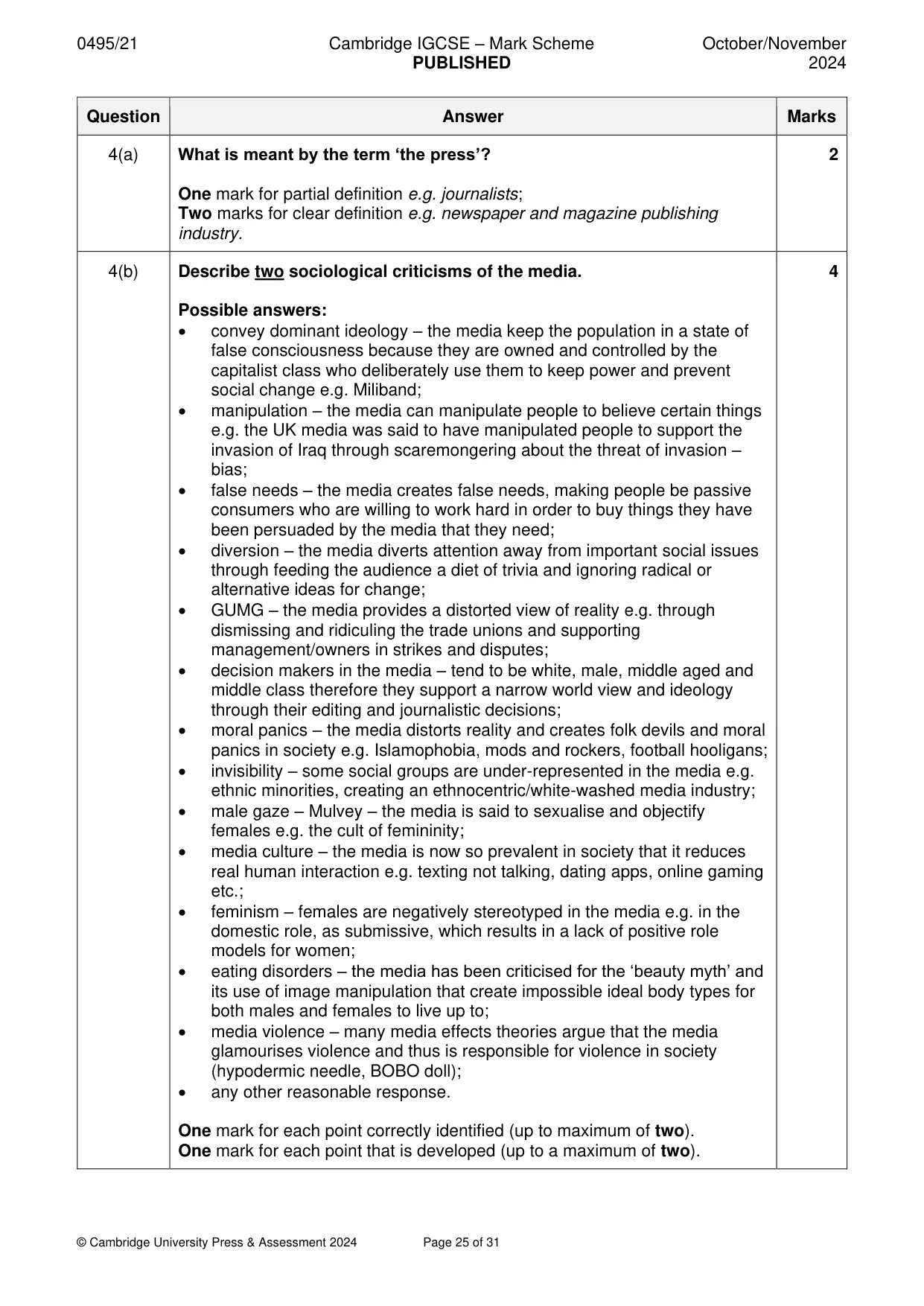
4 The press are an important part of the media. Different social groups use the media in different ways. Some sociologists are very critical of the media, despite media representations changing. Other sociologists debate whether media censorship is possible. (a) What is meant by the term ‘the press’? [2] (b) Describe two sociological criticisms of the media. [4] (c) Explain how people of different ages use the media. [6] (d) Explain why media representations are changing. [8] (e) To what extent is media censorship possible? [15]
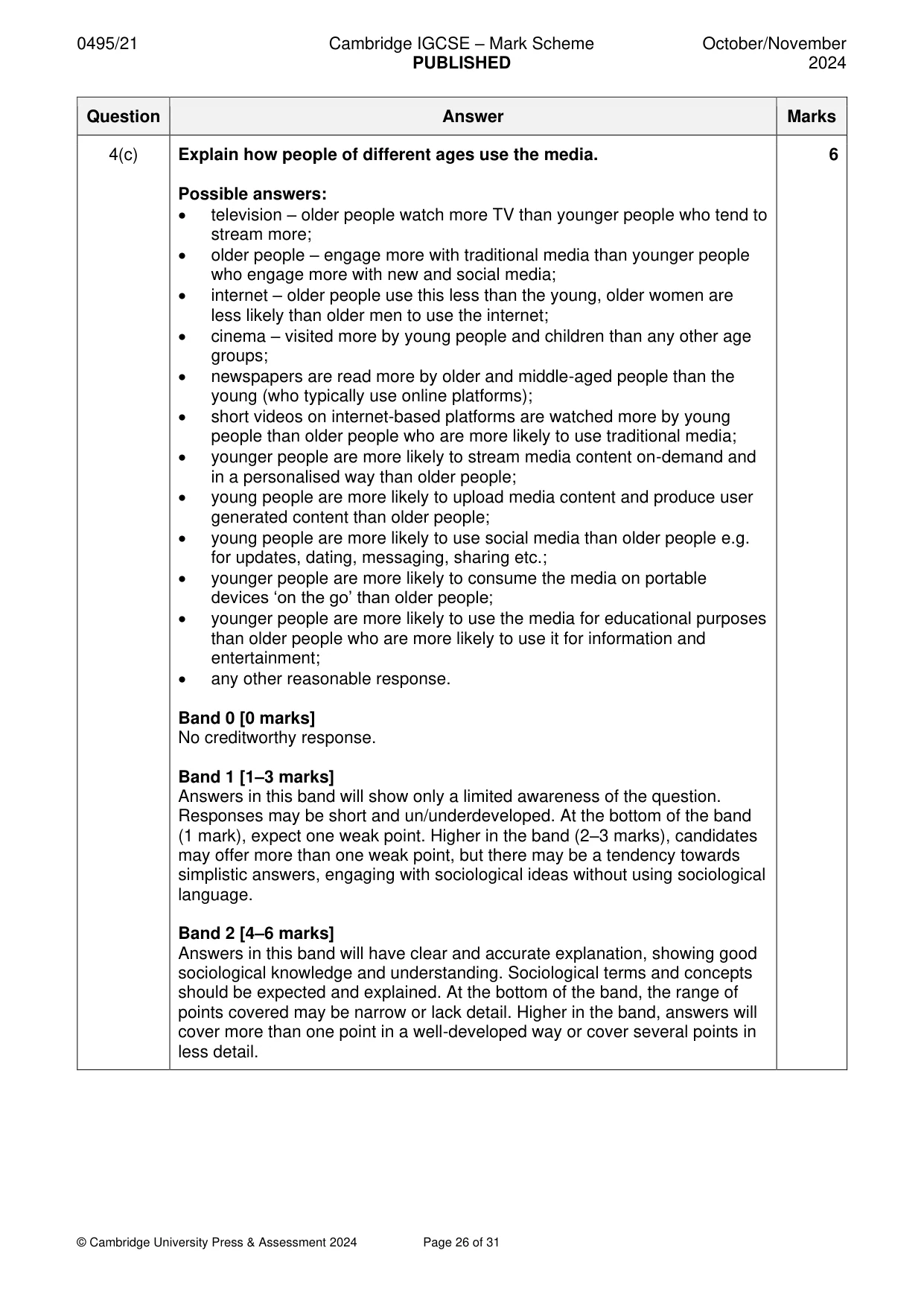
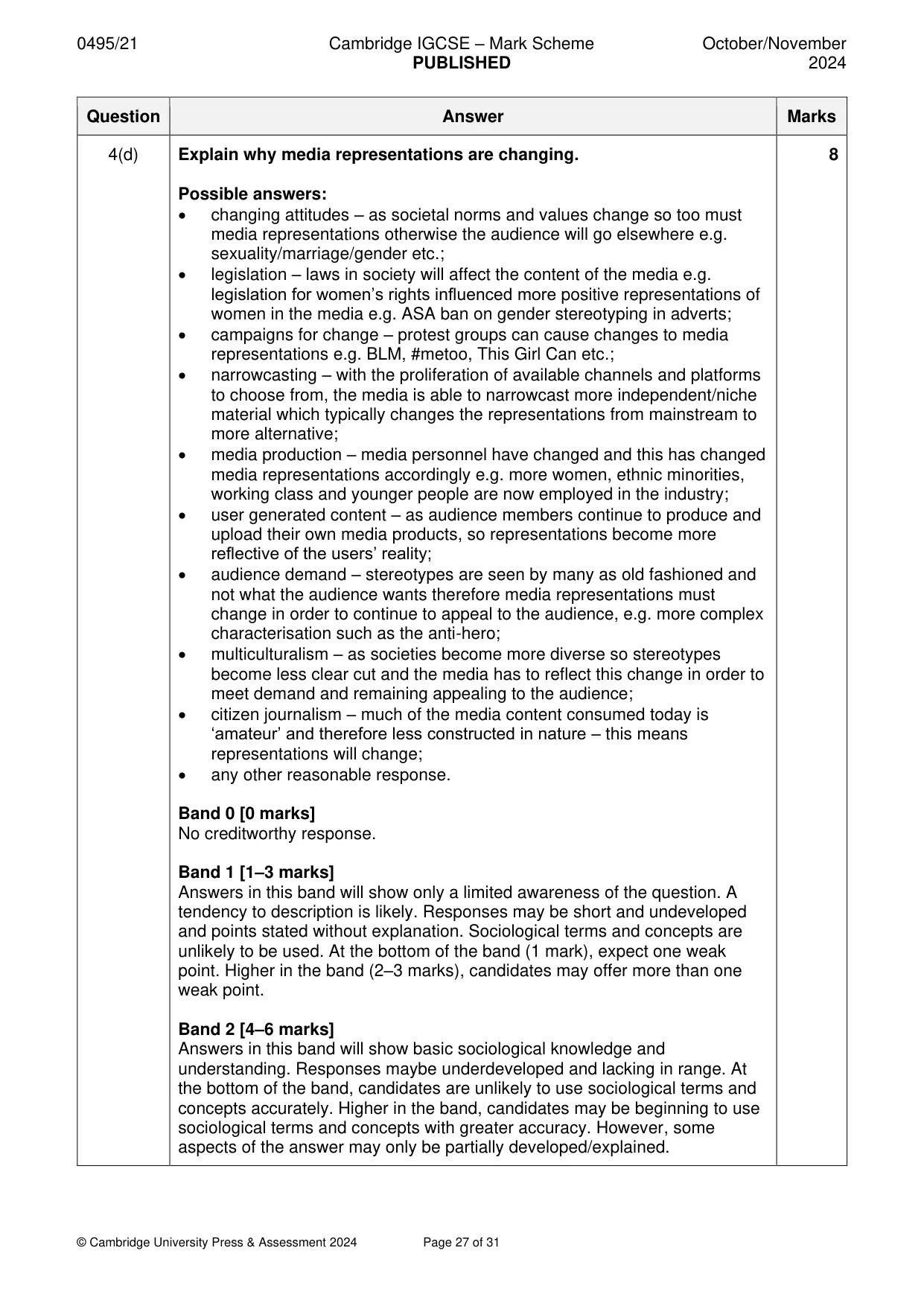
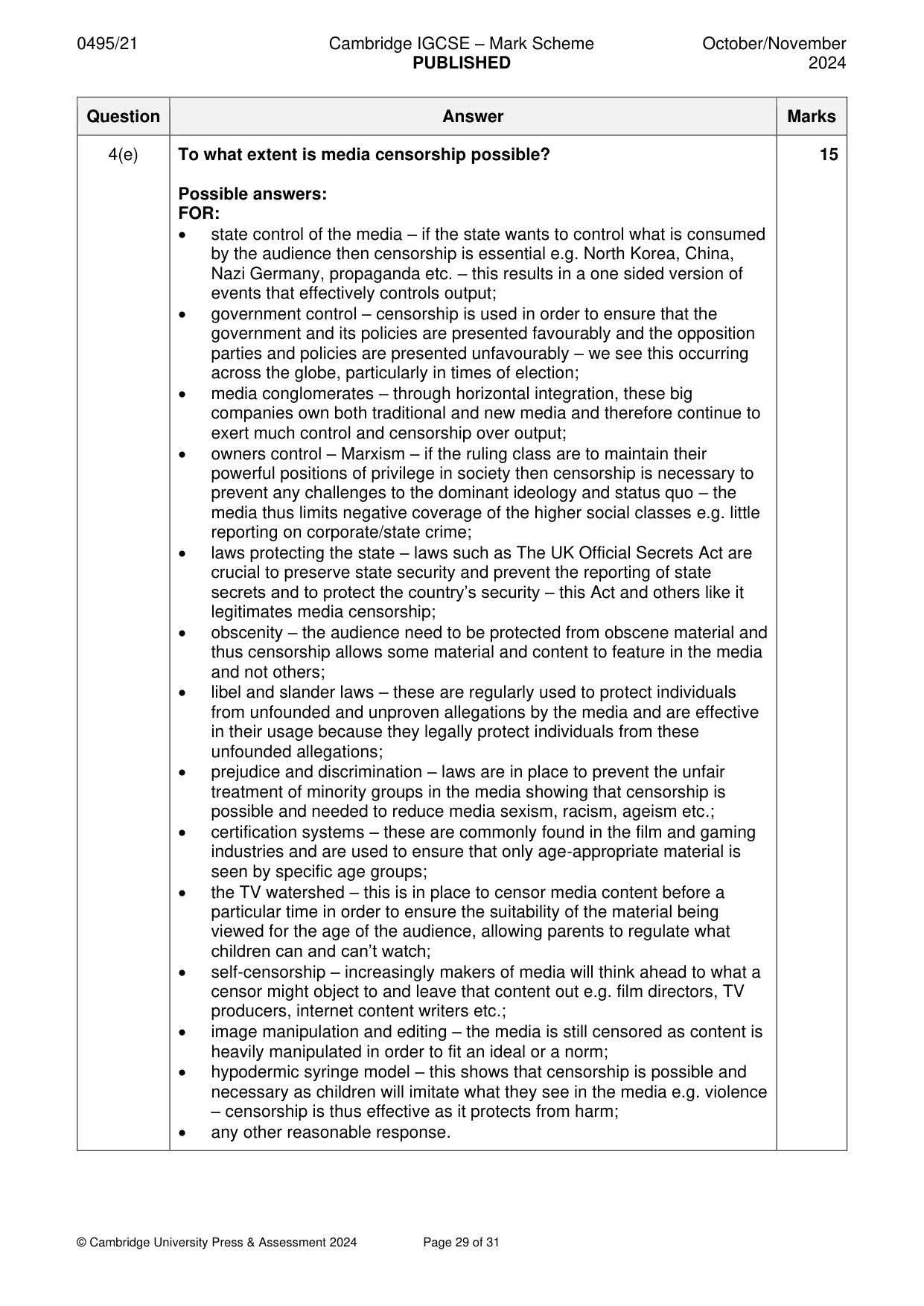
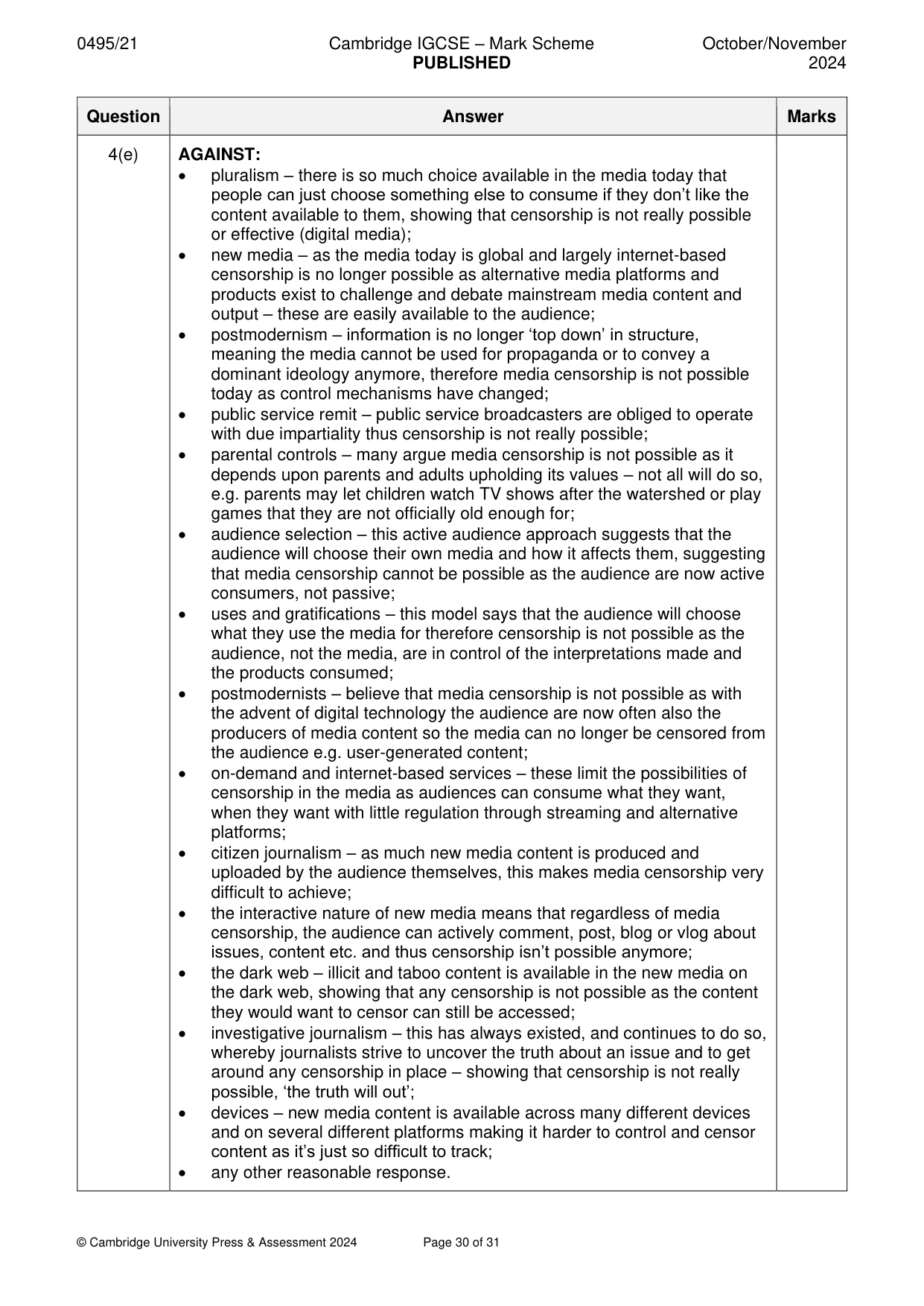
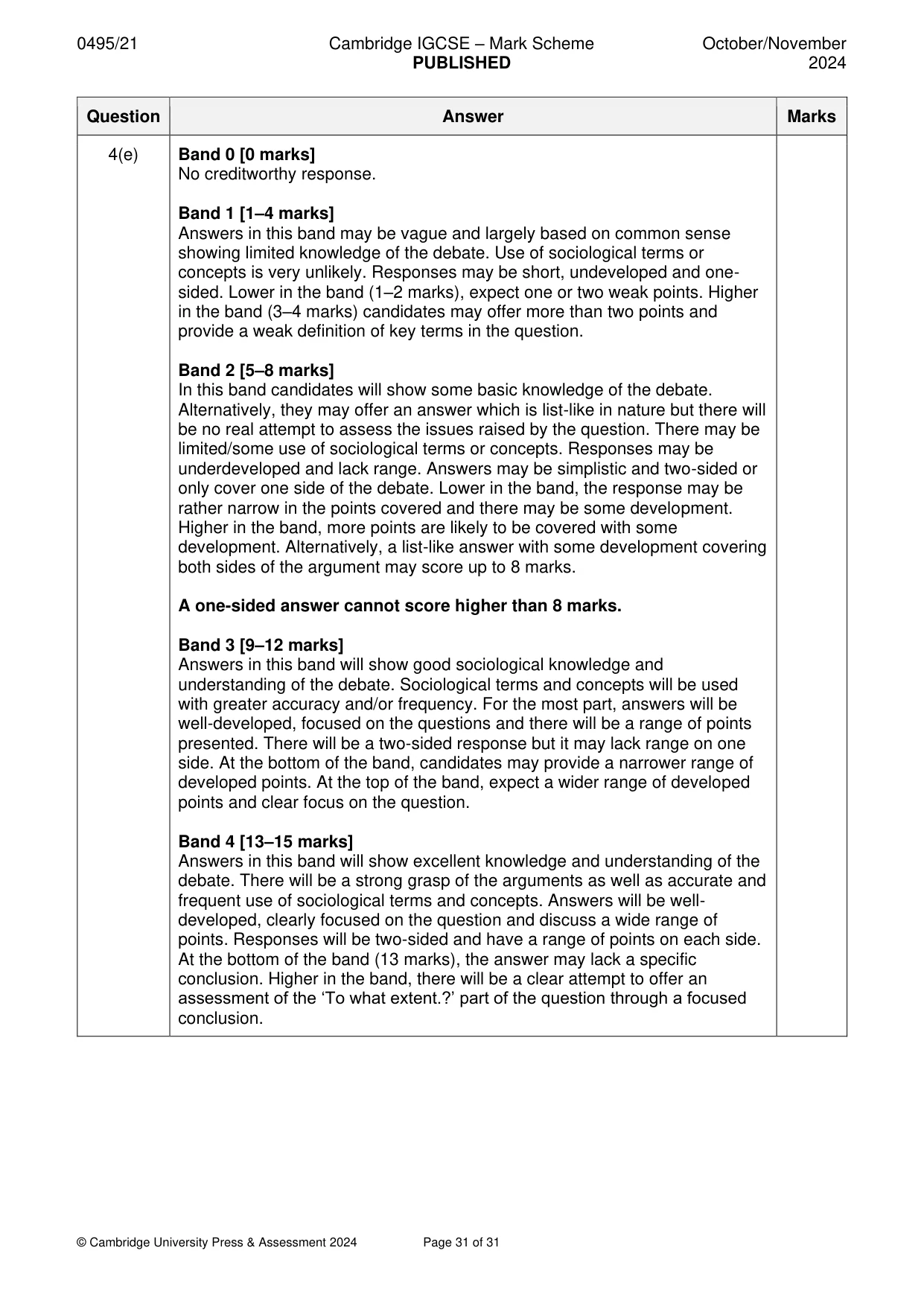
Mark scheme: 4(a) What is meant by the term ‘the press’? 2 One mark for partial definition e.g. journalists; Two marks for clear definition e.g. newspaper and magazine publishing industry. 4(b) Describe two sociological criticisms of the media. 4 Possible answers: • convey dominant ideology – the media keep the population in a state of false consciousness because they are owned and controlled by the capitalist class who deliberately use them to keep power and prevent social change e.g. Miliband; • manipulation – the media can manipulate people to believe certain things e.g. the UK media was said to have manipulated people to support the invasion of Iraq through scaremongering about the threat of invasion – bias; • false needs – the media creates false needs, making people be passive consumers who are willing to work hard in order to buy things they have been persuaded by the media that they need; • diversion – the media diverts attention away from important social issues through feeding the audience a diet of trivia and ignoring radical or alternative ideas for change; • GUMG – the media provides a distorted view of reality e.g. through dismissing and ridiculing the trade unions and supporting management/owners in strikes and disputes; • decision makers in the media – tend to be white, male, middle aged and middle class therefore they support a narrow world view and ideology through their editing and journalistic decisions; • moral panics – the media distorts reality and creates folk devils and moral panics in society e.g. Islamophobia, mods and rockers, football hooligans; • invisibility – some social groups are under-represented in the media e.g. ethnic minorities, creating an ethnocentric/white-washed media industry; • male gaze – Mulvey – the media is said to sexualise and objectify females e.g. the cult of femininity; • media culture – the media is now so prevalent in society that it reduces real human interaction e.g. texting not talking, dating apps, online gaming etc.; • feminism – females are negatively stereotyped in the media e.g. in the domestic role, as submissive, which results in a lack of positive role models for women; • eating disorders – the media has been criticised for the ‘beauty myth’ and its use of image manipulation that create impossible ideal body types for both males and females to live up to; • media violence – many media effects theories argue that the media glamourises violence and thus is responsible for violence in society (hypodermic needle, BOBO doll); • any other reasonable response. One mark for each point correctly identified (up to maximum of two). One mark for each point that is developed (up to a maximum of two). 4(c) Explain how people of different ages use the media. 6 Possible answers: • television – older people watch more TV than younger people who tend to stream more; • older people – engage more with traditional media than younger people who engage more with new and social media; • internet – older people use this less than the young, older women are less likely than older men to use the internet; • cinema – visited more by young people and children than any other age groups; • newspapers are read more by older and middle-aged people than the young (who typically use online platforms); • short videos on internet-based platforms are watched more by young people than older people who are more likely to use traditional media; • younger people are more likely to stream media content on-demand and in a personalised way than older people; • young people are more likely to upload media content and produce user generated content than older people; • young people are more likely to use social media than older people e.g. for updates, dating, messaging, sharing etc.; • younger people are more likely to consume the media on portable devices ‘on the go’ than older people; • younger people are more likely to use the media for educational purposes than older people who are more likely to use it for information and entertainment; • any other reasonable response. Band 0 [0 marks] No creditworthy response. Band 1 [1–3 marks] Answers in this band will show only a limited awareness of the question. Responses may be short and un/underdeveloped. At the bottom of the band (1 mark), expect one weak point. Higher in the band (2–3 marks), candidates may offer more than one weak point, but there may be a tendency towards simplistic answers, engaging with sociological ideas without using sociological language. Band 2 [4–6 marks] Answers in this band will have clear and accurate explanation, showing good sociological knowledge and understanding. Sociological terms and concepts should be expected and explained. At the bottom of the band, the range of points covered may be narrow or lack detail. Higher in the band, answers will cover more than one point in a well-developed way or cover several points in less detail. 4(d) Explain why media representations are changing. 8 Possible answers: • changing attitudes – as societal norms and values change so too must media representations otherwise the audience will go elsewhere e.g. sexuality/marriage/gender etc.; • legislation – laws in society will affect the content of the media e.g. legislation for women’s rights influenced more positive representations of women in the media e.g. ASA ban on gender stereotyping in adverts; • campaigns for change – protest groups can cause changes to media representations e.g. BLM, #metoo, This Girl Can etc.; • narrowcasting – with the proliferation of available channels and platforms to choose from, the media is able to narrowcast more independent/niche material which typically changes the representations from mainstream to more alternative; • media production – media personnel have changed and this has changed media representations accordingly e.g. more women, ethnic minorities, working class and younger people are now employed in the industry; • user generated content – as audience members continue to produce and upload their own media products, so representations become more reflective of the users’ reality; • audience demand – stereotypes are seen by many as old fashioned and not what the audience wants therefore media representations must change in order to continue to appeal to the audience, e.g. more complex characterisation such as the anti-hero; • multiculturalism – as societies become more diverse so stereotypes become less clear cut and the media has to reflect this change in order to meet demand and remaining appealing to the audience; • citizen journalism – much of the media content consumed today is ‘amateur’ and therefore less constructed in nature – this means representations will change; • any other reasonable response. Band 0 [0 marks] No creditworthy response. Band 1 [1–3 marks] Answers in this band will show only a limited awareness of the question. A tendency to description is likely. Responses may be short and undeveloped and points stated without explanation. Sociological terms and concepts are unlikely to be used. At the bottom of the band (1 mark), expect one weak point. Higher in the band (2–3 marks), candidates may offer more than one weak point. Band 2 [4–6 marks] Answers in this band will show basic sociological knowledge and understanding. Responses maybe underdeveloped and lacking in range. At the bottom of the band, candidates are unlikely to use sociological terms and concepts accurately. Higher in the band, candidates may be beginning to use sociological terms and concepts with greater accuracy. However, some aspects of the answer may only be partially developed/explained. 4(d) Band 3 [7–8 marks] Answers in this band will show good sociological knowledge and understanding and will be well-developed and explained. Sociological terms and concepts will be used accurately overall. Answers will be well-focused on the question and there will be a range of points presented. At the top of the band explanations will be clear throughout. 4(e) To what extent is media censorship possible? 15 Possible answers: FOR: • state control of the media – if the state wants to control what is consumed by the audience then censorship is essential e.g. North Korea, China, Nazi Germany, propaganda etc. – this results in a one sided version of events that effectively controls output; • government control – censorship is used in order to ensure that the government and its policies are presented favourably and the opposition parties and policies are presented unfavourably – we see this occurring across the globe, particularly in times of election; • media conglomerates – through horizontal integration, these big companies own both traditional and new media and therefore continue to exert much control and censorship over output; • owners control – Marxism – if the ruling class are to maintain their powerful positions of privilege in society then censorship is necessary to prevent any challenges to the dominant ideology and status quo – the media thus limits negative coverage of the higher social classes e.g. little reporting on corporate/state crime; • laws protecting the state – laws such as The UK Official Secrets Act are crucial to preserve state security and prevent the reporting of state secrets and to protect the country’s security – this Act and others like it legitimates media censorship; • obscenity – the audience need to be protected from obscene material and thus censorship allows some material and content to feature in the media and not others; • libel and slander laws – these are regularly used to protect individuals from unfounded and unproven allegations by the media and are effective in their usage because they legally protect individuals from these unfounded allegations; • prejudice and discrimination – laws are in place to prevent the unfair treatment of minority groups in the media showing that censorship is possible and needed to reduce media sexism, racism, ageism etc.; • certification systems – these are commonly found in the film and gaming industries and are used to ensure that only age-appropriate material is seen by specific age groups; • the TV watershed – this is in place to censor media content before a particular time in order to ensure the suitability of the material being viewed for the age of the audience, allowing parents to regulate what children can and can’t watch; • self-censorship – increasingly makers of media will think ahead to what a censor might object to and leave that content out e.g. film directors, TV producers, internet content writers etc.; • image manipulation and editing – the media is still censored as content is heavily manipulated in order to fit an ideal or a norm; • hypodermic syringe model – this shows that censorship is possible and necessary as children will imitate what they see in the media e.g. violence – censorship is thus effective as it protects from harm; • any other reasonable response. 4(e) AGAINST: • pluralism – there is so much choice available in the media today that people can just choose something else to consume if they don’t like the content available to them, showing that censorship is not really possible or effective (digital media); • new media – as the media today is global and largely internet-based censorship is no longer possible as alternative media platforms and products exist to challenge and debate mainstream media content and output – these are easily available to the audience; • postmodernism – information is no longer ‘top down’ in structure, meaning the media cannot be used for propaganda or to convey a dominant ideology anymore, therefore media censorship is not possible today as control mechanisms have changed; • public service remit – public service broadcasters are obliged to operate with due impartiality thus censorship is not really possible; • parental controls – many argue media censorship is not possible as it depends upon parents and adults upholding its values – not all will do so, e.g. parents may let children watch TV shows after the watershed or play games that they are not officially old enough for; • audience selection – this active audience approach suggests that the audience will choose their own media and how it affects them, suggesting that media censorship cannot be possible as the audience are now active consumers, not passive; • uses and gratifications – this model says that the audience will choose what they use the media for therefore censorship is not possible as the audience, not the media, are in control of the interpretations made and the products consumed; • postmodernists – believe that media censorship is not possible as with the advent of digital technology the audience are now often also the producers of media content so the media can no longer be censored from the audience e.g. user-generated content; • on-demand and internet-based services – these limit the possibilities of censorship in the media as audiences can consume what they want, when they want with little regulation through streaming and alternative platforms; • citizen journalism – as much new media content is produced and uploaded by the audience themselves, this makes media censorship very difficult to achieve; • the interactive nature of new media means that regardless of media censorship, the audience can actively comment, post, blog or vlog about issues, content etc. and thus censorship isn’t possible anymore; • the dark web – illicit and taboo content is available in the new media on the dark web, showing that any censorship is not possible as the content they would want to censor can still be accessed; • investigative journalism – this has always existed, and continues to do so, whereby journalists strive to uncover the truth about an issue and to get around any censorship in place – showing that censorship is not really possible, ‘the truth will out’; • devices – new media content is available across many different devices and on several different platforms making it harder to control and censor content as it’s just so difficult to track; • any other reasonable response. 4(e) Band 0 [0 marks] No creditworthy response. Band 1 [1–4 marks] Answers in this band may be vague and largely based on common sense showing limited knowledge of the debate. Use of sociological terms or concepts is very unlikely. Responses may be short, undeveloped and one- sided. Lower in the band (1–2 marks), expect one or two weak points. Higher in the band (3–4 marks) candidates may offer more than two points and provide a weak definition of key terms in the question. Band 2 [5–8 marks] In this band candidates will show some basic knowledge of the debate. Alternatively, they may offer an answer which is list-like in nature but there will be no real attempt to assess the issues raised by the question. There may be limited/some use of sociological terms or concepts. Responses may be underdeveloped and lack range. Answers may be simplistic and two-sided or only cover one side of the debate. Lower in the band, the response may be rather narrow in the points covered and there may be some development. Higher in the band, more points are likely to be covered with some development. Alternatively, a list-like answer with some development covering both sides of the argument may score up to 8 marks. A one-sided answer cannot score higher than 8 marks. Band 3 [9–12 marks] Answers in this band will show good sociological knowledge and understanding of the debate. Sociological terms and concepts will be used with greater accuracy and/or frequency. For the most part, answers will be well-developed, focused on the questions and there will be a range of points presented. There will be a two-sided response but it may lack range on one side. At the bottom of the band, candidates may provide a narrower range of developed points. At the top of the band, expect a wider range of developed points and clear focus on the question. Band 4 [13–15 marks] Answers in this band will show excellent knowledge and understanding of the debate. There will be a strong grasp of the arguments as well as accurate and frequent use of sociological terms and concepts. Answers will be well- developed, clearly focused on the question and discuss a wide range of points. Responses will be two-sided and have a range of points on each side. At the bottom of the band (13 marks), the answer may lack a specific conclusion. Higher in the band, there will be a clear attempt to offer an assessment of the ‘To what extent.?’ part of the question through a focused conclusion.
More questions on How do sociologists approach the study of society?
What was in this paper
The subtopics covered by these 4 questions, and how many questions each got. Open one in a new tab to see every Cambridge question on it.
What you needed in this session
Cambridge’s own grade thresholds for 2024 Oct/Nov, Paper 2 · Variant 1. A higher threshold means an easier paper — the bar moves with how the cohort did.