Cambridge IGCSE Sociology 0495 — 2022 May/June Paper 2 · Variant 1
0495/21/M/J/22 · 4 questions · 70 marks · ≈79 min
The question paper and its mark scheme, free to read here and free to download. This is Cambridge’s own paper, exactly as it was sat.
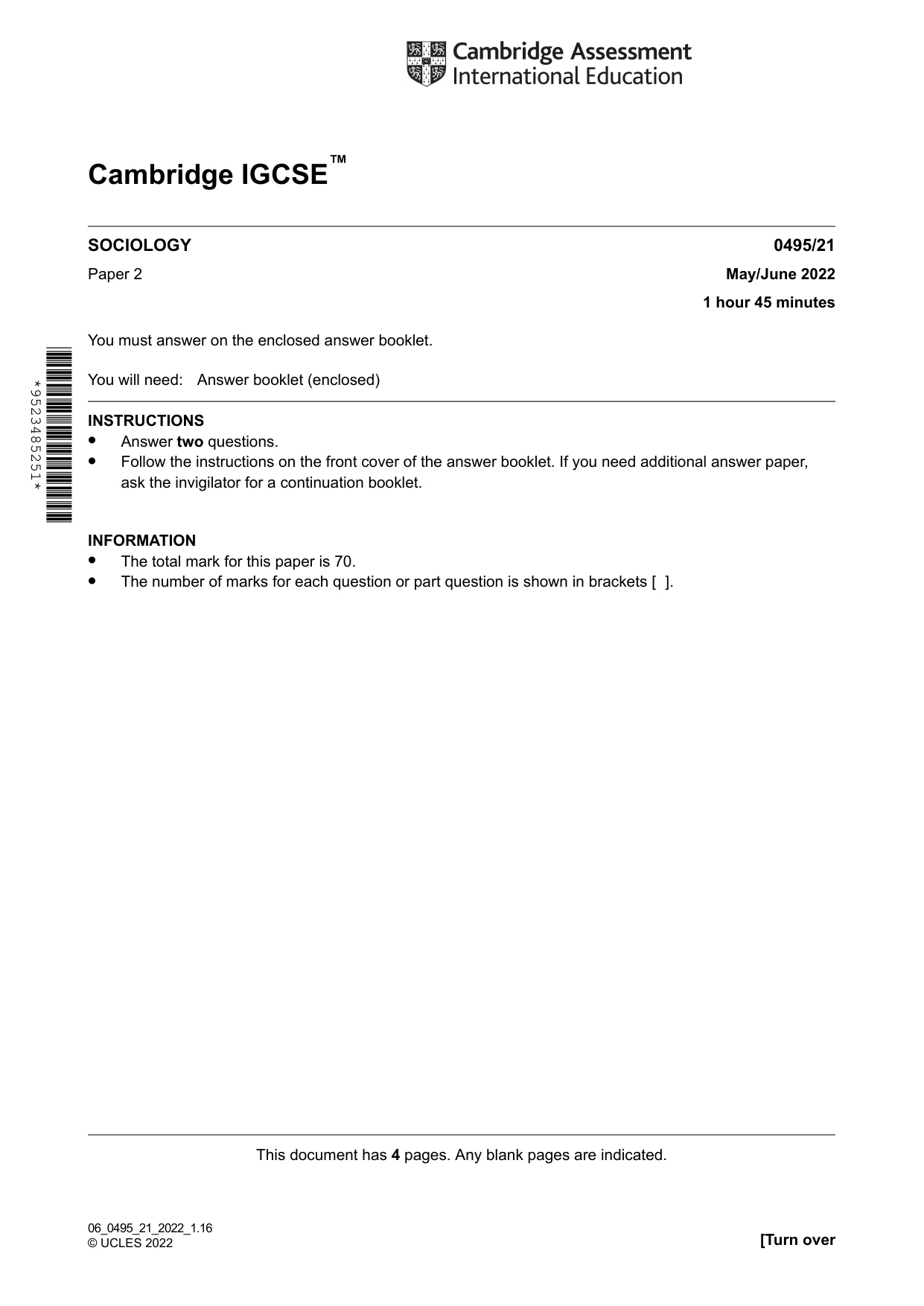
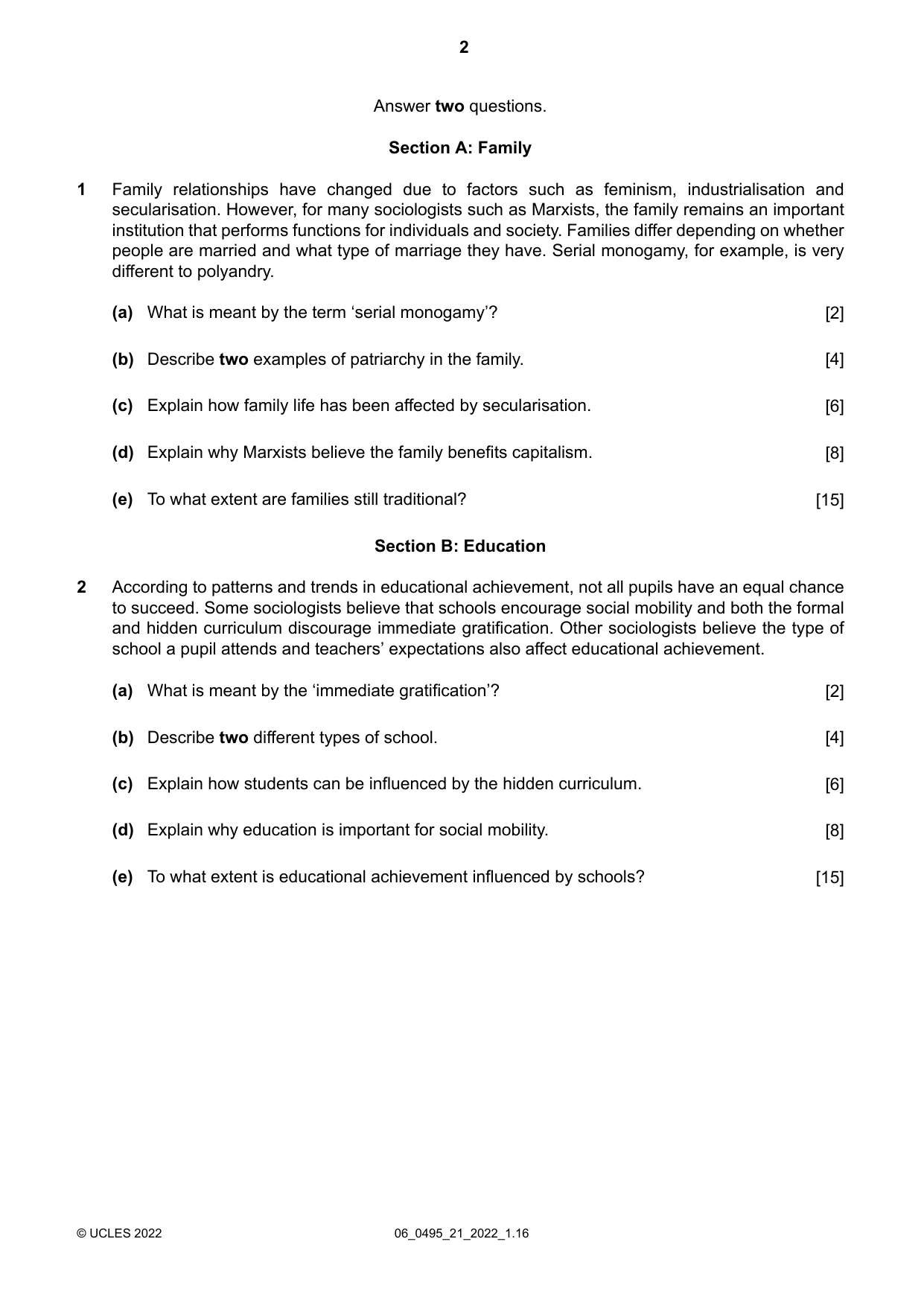
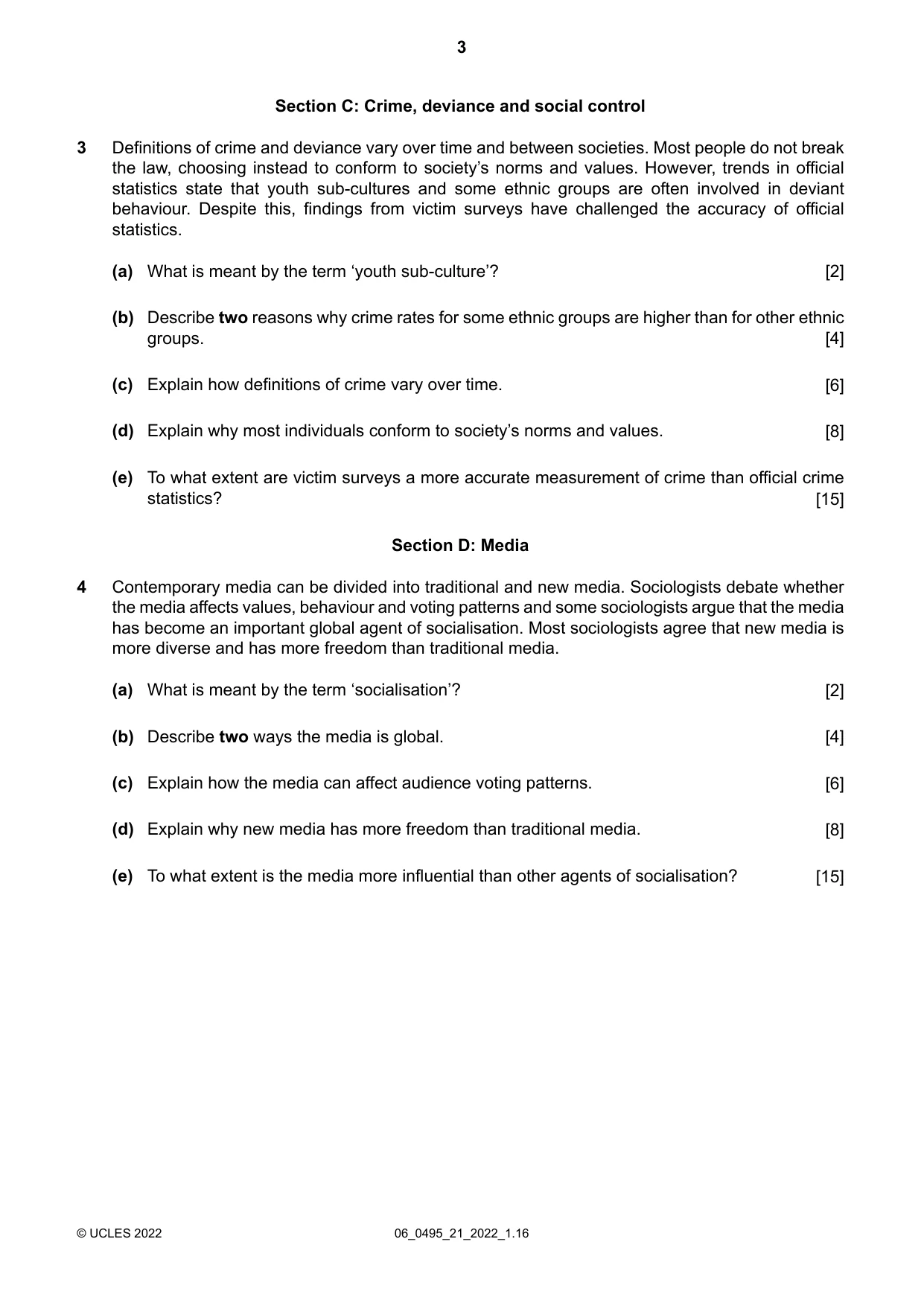
Question paper4 pages

Mark scheme26 pages
Answers below. Sit the paper first if you are practising.



Questions as text
Q1 · Family relationships have changed due to factors such as feminism, industrialisation and…
1 Family relationships have changed due to factors such as feminism, industrialisation and secularisation. However, for many sociologists such as Marxists, the family remains an important institution that performs functions for individuals and society. Families differ depending on whether people are married and what type of marriage they have. Serial monogamy, for example, is very different to polyandry. (a) What is meant by the term ‘serial monogamy’? [2] (b) Describe two examples of patriarchy in the family. [4] (c) Explain how family life has been affected by secularisation. [6] (d) Explain why Marxists believe the family benefits capitalism. [8] (e) To what extent are families still traditional? [15]
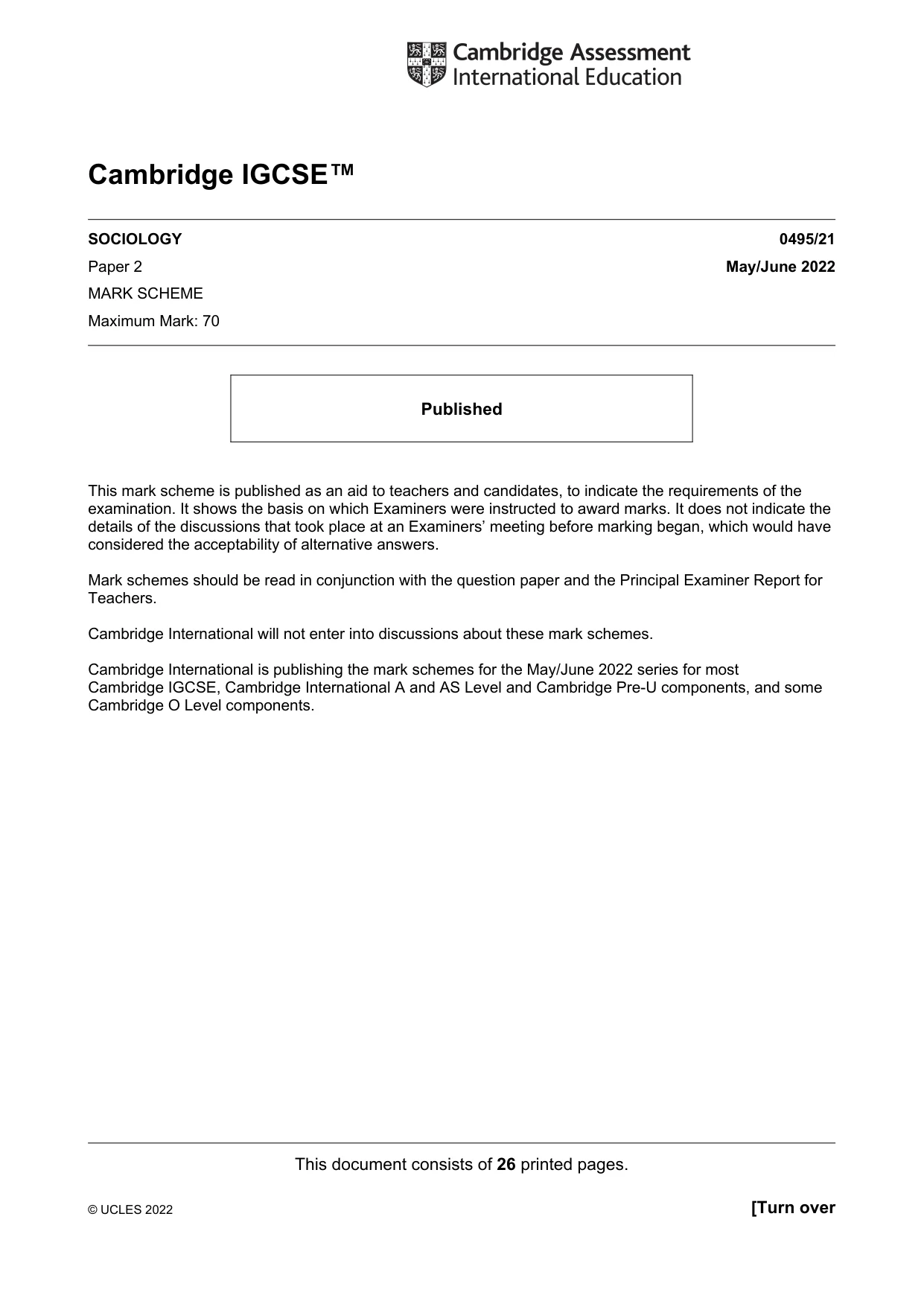
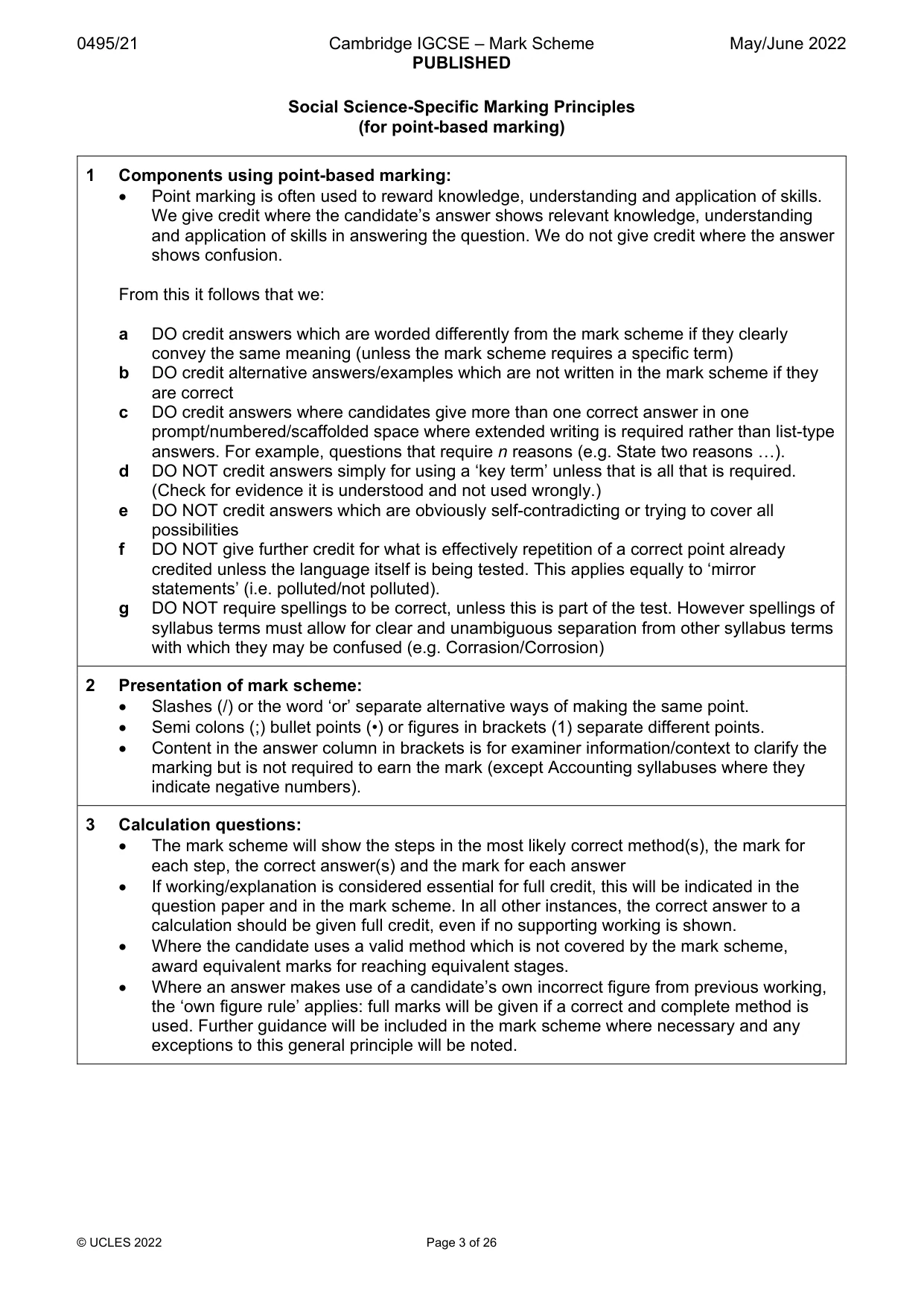
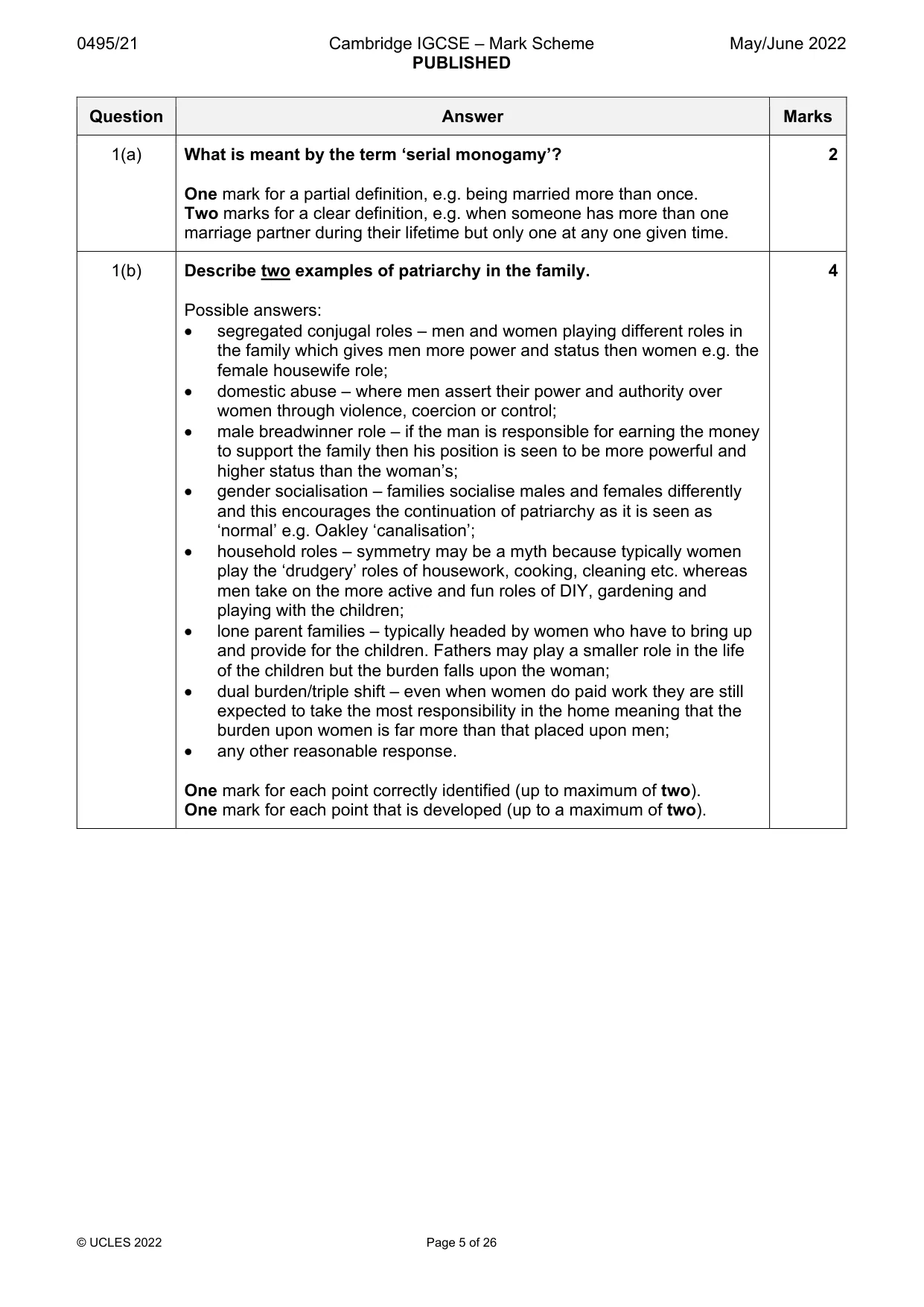
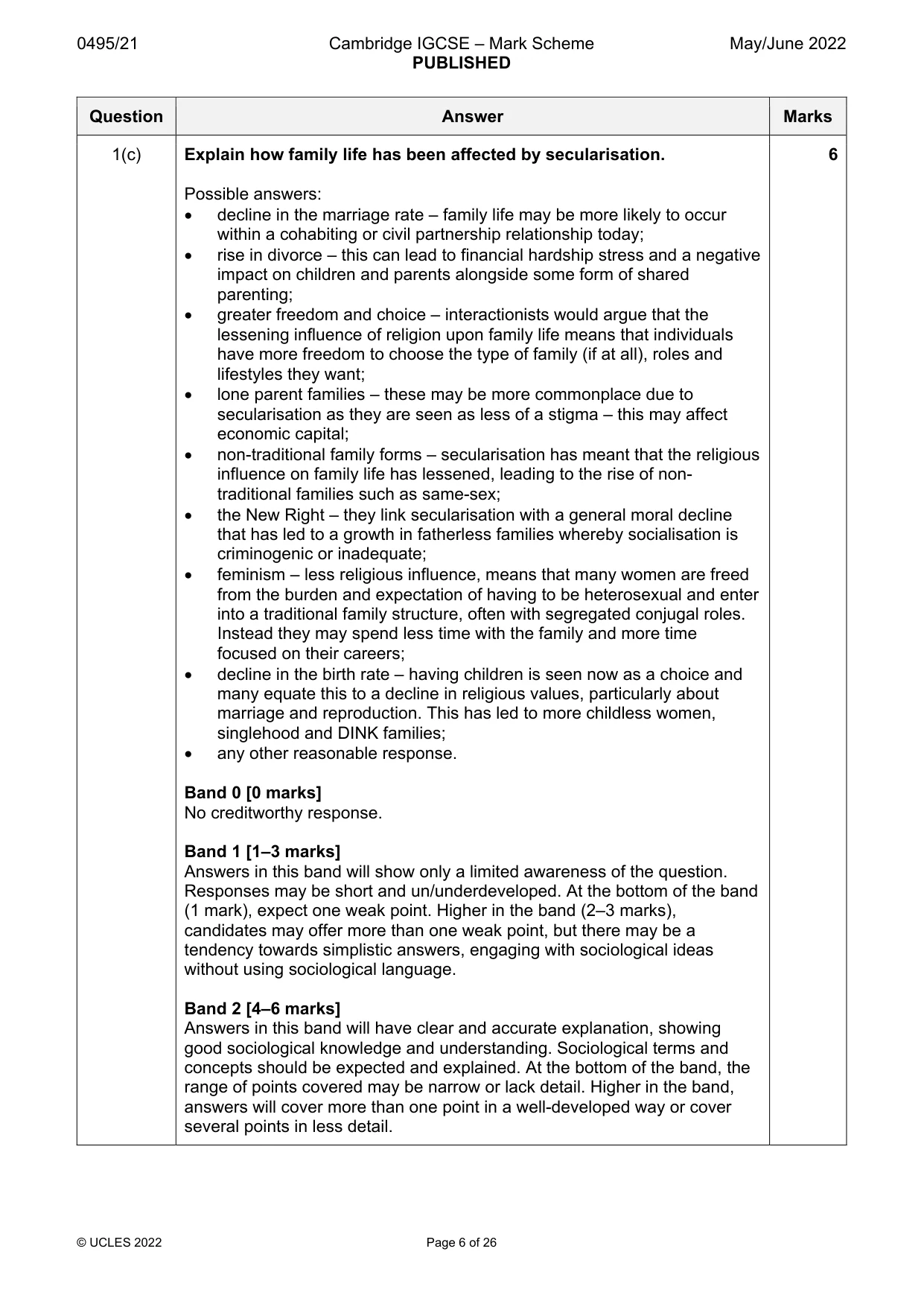
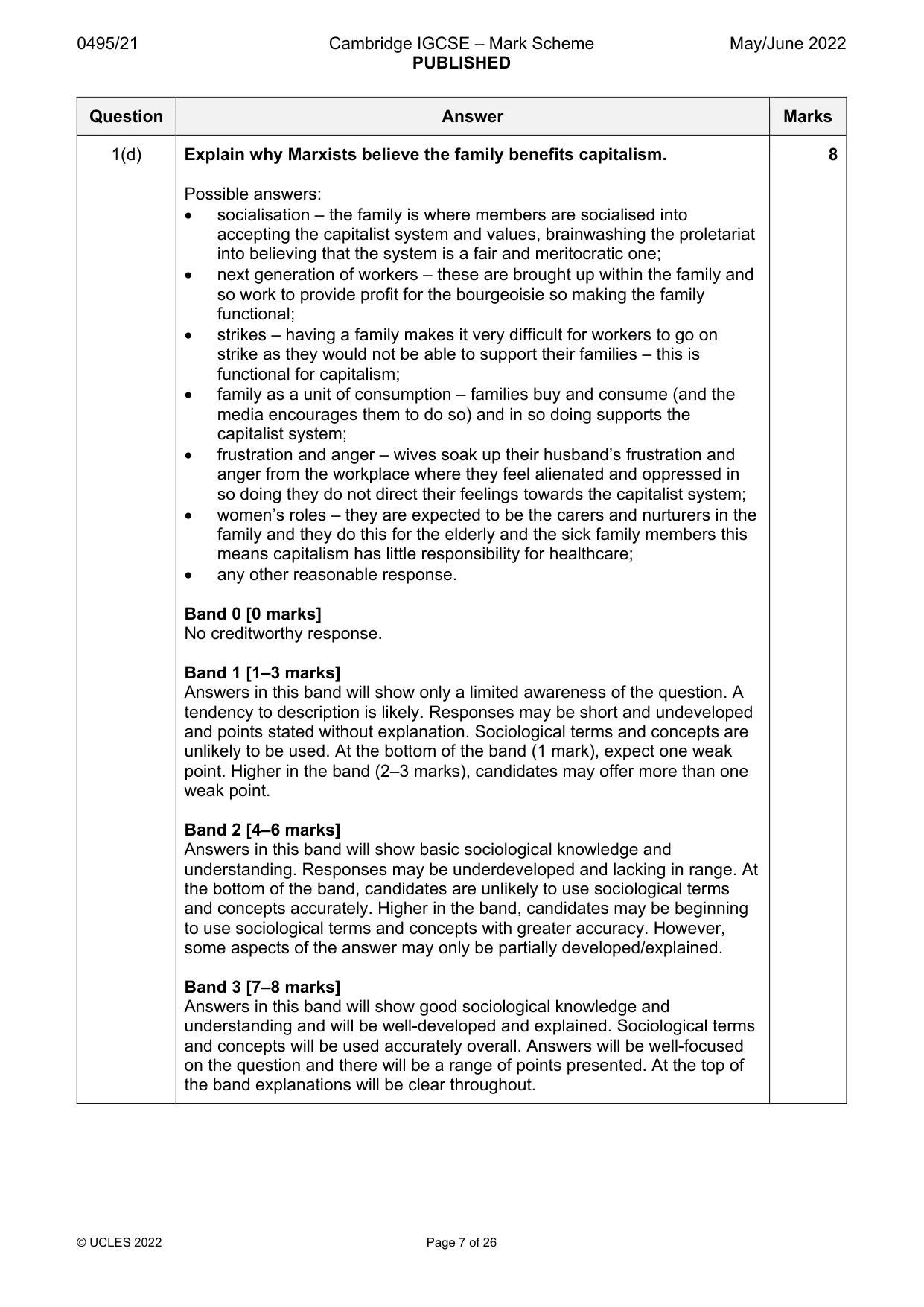
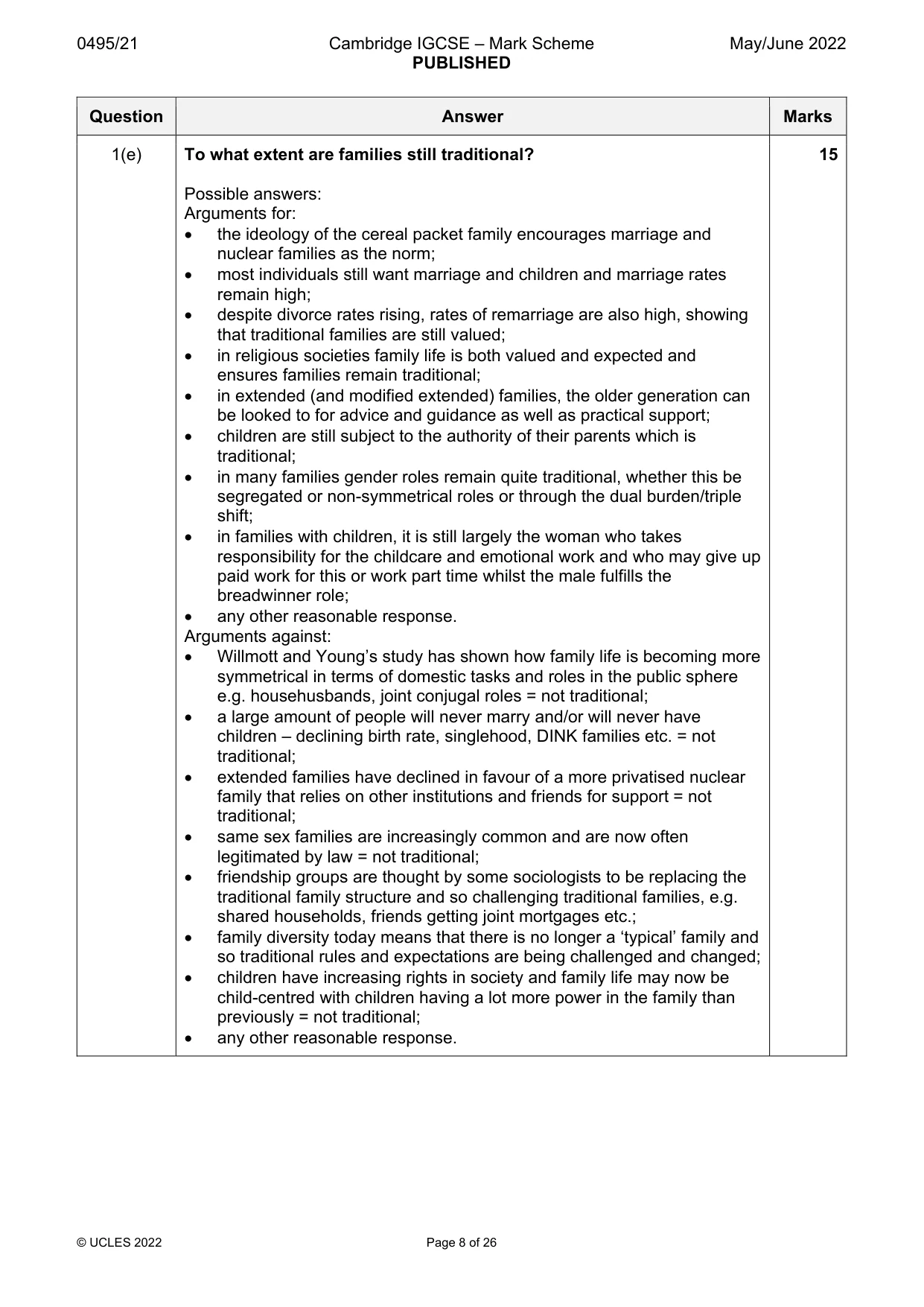
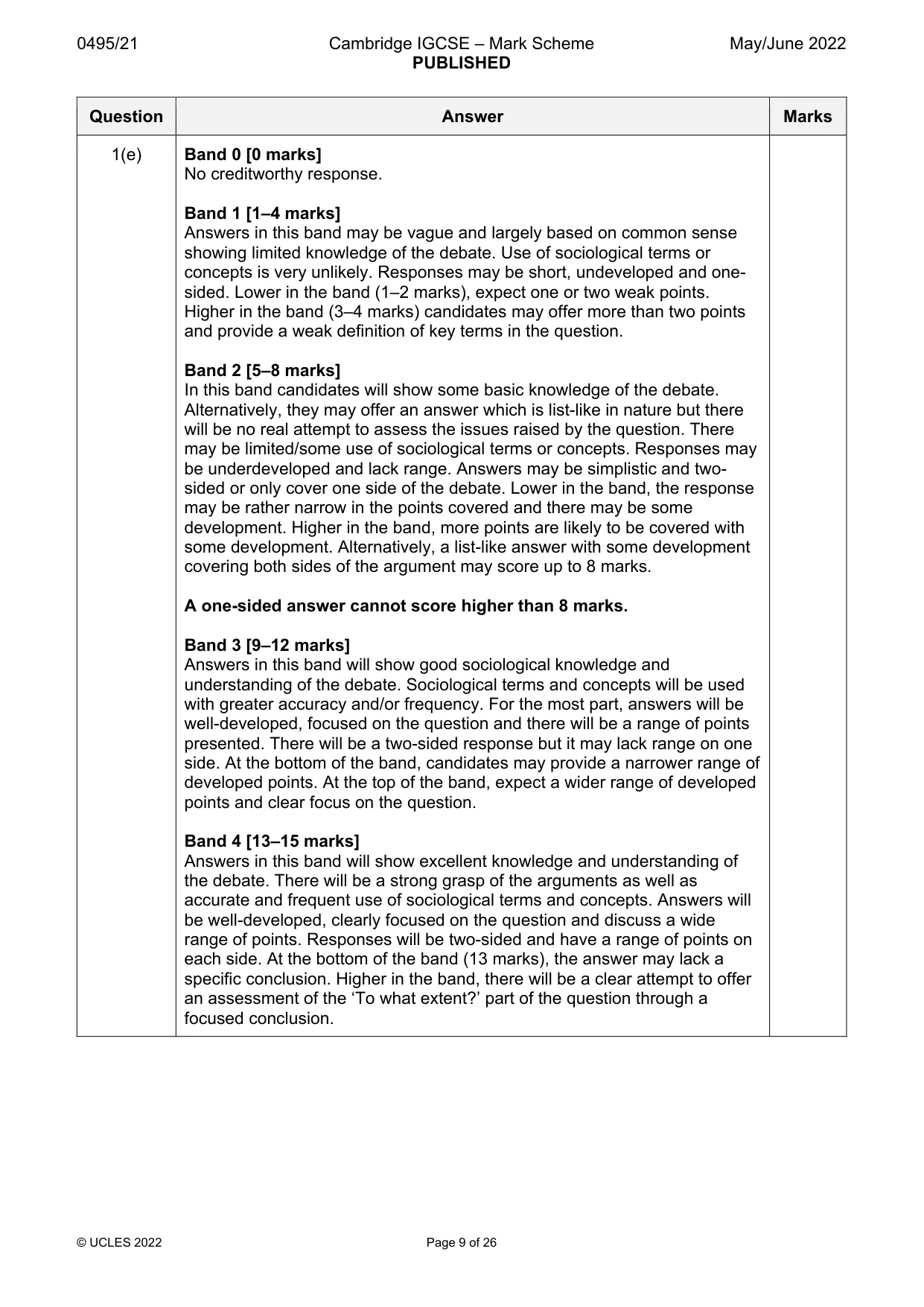
Mark scheme: Question Answer Marks 1(a) What is meant by the term ‘serial monogamy’? 2 One mark for a partial definition, e.g. being married more than once. Two marks for a clear definition, e.g. when someone has more than one marriage partner during their lifetime but only one at any one given time. 1(b) Describe two examples of patriarchy in the family. 4 Possible answers: segregated conjugal roles – men and women playing different roles in the family which gives men more power and status then women e.g. the female housewife role; domestic abuse – where men assert their power and authority over women through violence, coercion or control; male breadwinner role – if the man is responsible for earning the money to support the family then his position is seen to be more powerful and higher status than the woman’s; gender socialisation – families socialise males and females differently and this encourages the continuation of patriarchy as it is seen as ‘normal’ e.g. Oakley ‘canalisation’; household roles – symmetry may be a myth because typically women play the ‘drudgery’ roles of housework, cooking, cleaning etc. whereas men take on the more active and fun roles of DIY, gardening and playing with the children; lone parent families – typically headed by women who have to bring up and provide for the children. Fathers may play a smaller role in the life of the children but the burden falls upon the woman; dual burden/triple shift – even when women do paid work they are still expected to take the most responsibility in the home meaning that the burden upon women is far more than that placed upon men; any other reasonable response. One mark for each point correctly identified (up to maximum of two). One mark for each point that is developed (up to a maximum of two). 1(c) Explain how family life has been affected by secularisation. 6 Possible answers: decline in the marriage rate – family life may be more likely to occur within a cohabiting or civil partnership relationship today; rise in divorce – this can lead to financial hardship stress and a negative impact on children and parents alongside some form of shared parenting; greater freedom and choice – interactionists would argue that the lessening influence of religion upon family life means that individuals have more freedom to choose the type of family (if at all), roles and lifestyles they want; lone parent families – these may be more commonplace due to secularisation as they are seen as less of a stigma – this may affect economic capital; non-traditional family forms – secularisation has meant that the religious influence on family life has lessened, leading to the rise of non- traditional families such as same-sex; the New Right – they link secularisation with a general moral decline that has led to a growth in fatherless families whereby socialisation is criminogenic or inadequate; feminism – less religious influence, means that many women are freed from the burden and expectation of having to be heterosexual and enter into a traditional family structure, often with segregated conjugal roles. Instead they may spend less time with the family and more time focused on their careers; decline in the birth rate – having children is seen now as a choice and many equate this to a decline in religious values, particularly about marriage and reproduction. This has led to more childless women, singlehood and DINK families; any other reasonable response. Band 0 [0 marks] No creditworthy response. Band 1 [1–3 marks] Answers in this band will show only a limited awareness of the question. Responses may be short and un/underdeveloped. At the bottom of the band (1 mark), expect one weak point. Higher in the band (2–3 marks), candidates may offer more than one weak point, but there may be a tendency towards simplistic answers, engaging with sociological ideas without using sociological language. Band 2 [4–6 marks] Answers in this band will have clear and accurate explanation, showing good sociological knowledge and understanding. Sociological terms and concepts should be expected and explained. At the bottom of the band, the range of points covered may be narrow or lack detail. Higher in the band, answers will cover more than one point in a well-developed way or cover several points in less detail. 1(d) Explain why Marxists believe the family benefits capitalism. 8 Possible answers: socialisation – the family is where members are socialised into accepting the capitalist system and values, brainwashing the proletariat into believing that the system is a fair and meritocratic one; next generation of workers – these are brought up within the family and so work to provide profit for the bourgeoisie so making the family functional; strikes – having a family makes it very difficult for workers to go on strike as they would not be able to support their families – this is functional for capitalism; family as a unit of consumption – families buy and consume (and the media encourages them to do so) and in so doing supports the capitalist system; frustration and anger – wives soak up their husband’s frustration and anger from the workplace where they feel alienated and oppressed in so doing they do not direct their feelings towards the capitalist system; women’s roles – they are expected to be the carers and nurturers in the family and they do this for the elderly and the sick family members this means capitalism has little responsibility for healthcare; any other reasonable response. Band 0 [0 marks] No creditworthy response. Band 1 [1–3 marks] Answers in this band will show only a limited awareness of the question. A tendency to description is likely. Responses may be short and undeveloped and points stated without explanation. Sociological terms and concepts are unlikely to be used. At the bottom of the band (1 mark), expect one weak point. Higher in the band (2–3 marks), candidates may offer more than one weak point. Band 2 [4–6 marks] Answers in this band will show basic sociological knowledge and understanding. Responses may be underdeveloped and lacking in range. At the bottom of the band, candidates are unlikely to use sociological terms and concepts accurately. Higher in the band, candidates may be beginning to use sociological terms and concepts with greater accuracy. However, some aspects of the answer may only be partially developed/explained. Band 3 [7–8 marks] Answers in this band will show good sociological knowledge and understanding and will be well-developed and explained. Sociological terms and concepts will be used accurately overall. Answers will be well-focused on the question and there will be a range of points presented. At the top of the band explanations will be clear throughout. 1(e) To what extent are families still traditional? 15 Possible answers: Arguments for: the ideology of the cereal packet family encourages marriage and nuclear families as the norm; most individuals still want marriage and children and marriage rates remain high; despite divorce rates rising, rates of remarriage are also high, showing that traditional families are still valued; in religious societies family life is both valued and expected and ensures families remain traditional; in extended (and modified extended) families, the older generation can be looked to for advice and guidance as well as practical support; children are still subject to the authority of their parents which is traditional; in many families gender roles remain quite traditional, whether this be segregated or non-symmetrical roles or through the dual burden/triple shift; in families with children, it is still largely the woman who takes responsibility for the childcare and emotional work and who may give up paid work for this or work part time whilst the male fulfills the breadwinner role; any other reasonable response. Arguments against: Willmott and Young’s study has shown how family life is becoming more symmetrical in terms of domestic tasks and roles in the public sphere e.g. househusbands, joint conjugal roles = not traditional; a large amount of people will never marry and/or will never have children – declining birth rate, singlehood, DINK families etc. = not traditional; extended families have declined in favour of a more privatised nuclear family that relies on other institutions and friends for support = not traditional; same sex families are increasingly common and are now often legitimated by law = not traditional; friendship groups are thought by some sociologists to be replacing the traditional family structure and so challenging traditional families, e.g. shared households, friends getting joint mortgages etc.; family diversity today means that there is no longer a ‘typical’ family and so traditional rules and expectations are being challenged and changed; children have increasing rights in society and family life may now be child-centred with children having a lot more power in the family than previously = not traditional; any other reasonable response. 1(e) Band 0 [0 marks] No creditworthy response. Band 1 [1–4 marks] Answers in this band may be vague and largely based on common sense showing limited knowledge of the debate. Use of sociological terms or concepts is very unlikely. Responses may be short, undeveloped and one- sided. Lower in the band (1–2 marks), expect one or two weak points. Higher in the band (3–4 marks) candidates may offer more than two points and provide a weak definition of key terms in the question. Band 2 [5–8 marks] In this band candidates will show some basic knowledge of the debate. Alternatively, they may offer an answer which is list-like in nature but there will be no real attempt to assess the issues raised by the question. There may be limited/some use of sociological terms or concepts. Responses may be underdeveloped and lack range. Answers may be simplistic and two- sided or only cover one side of the debate. Lower in the band, the response may be rather narrow in the points covered and there may be some development. Higher in the band, more points are likely to be covered with some development. Alternatively, a list-like answer with some development covering both sides of the argument may score up to 8 marks. A one-sided answer cannot score higher than 8 marks. Band 3 [9–12 marks] Answers in this band will show good sociological knowledge and understanding of the debate. Sociological terms and concepts will be used with greater accuracy and/or frequency. For the most part, answers will be well-developed, focused on the question and there will be a range of points presented. There will be a two-sided response but it may lack range on one side. At the bottom of the band, candidates may provide a narrower range of developed points. At the top of the band, expect a wider range of developed points and clear focus on the question. Band 4 [13–15 marks] Answers in this band will show excellent knowledge and understanding of the debate. There will be a strong grasp of the arguments as well as accurate and frequent use of sociological terms and concepts. Answers will be well-developed, clearly focused on the question and discuss a wide range of points. Responses will be two-sided and have a range of points on each side. At the bottom of the band (13 marks), the answer may lack a specific conclusion. Higher in the band, there will be a clear attempt to offer an assessment of the ‘To what extent?’ part of the question through a focused conclusion.
Q2 · According to patterns and trends in educational achievement, not all pupils have an equal…
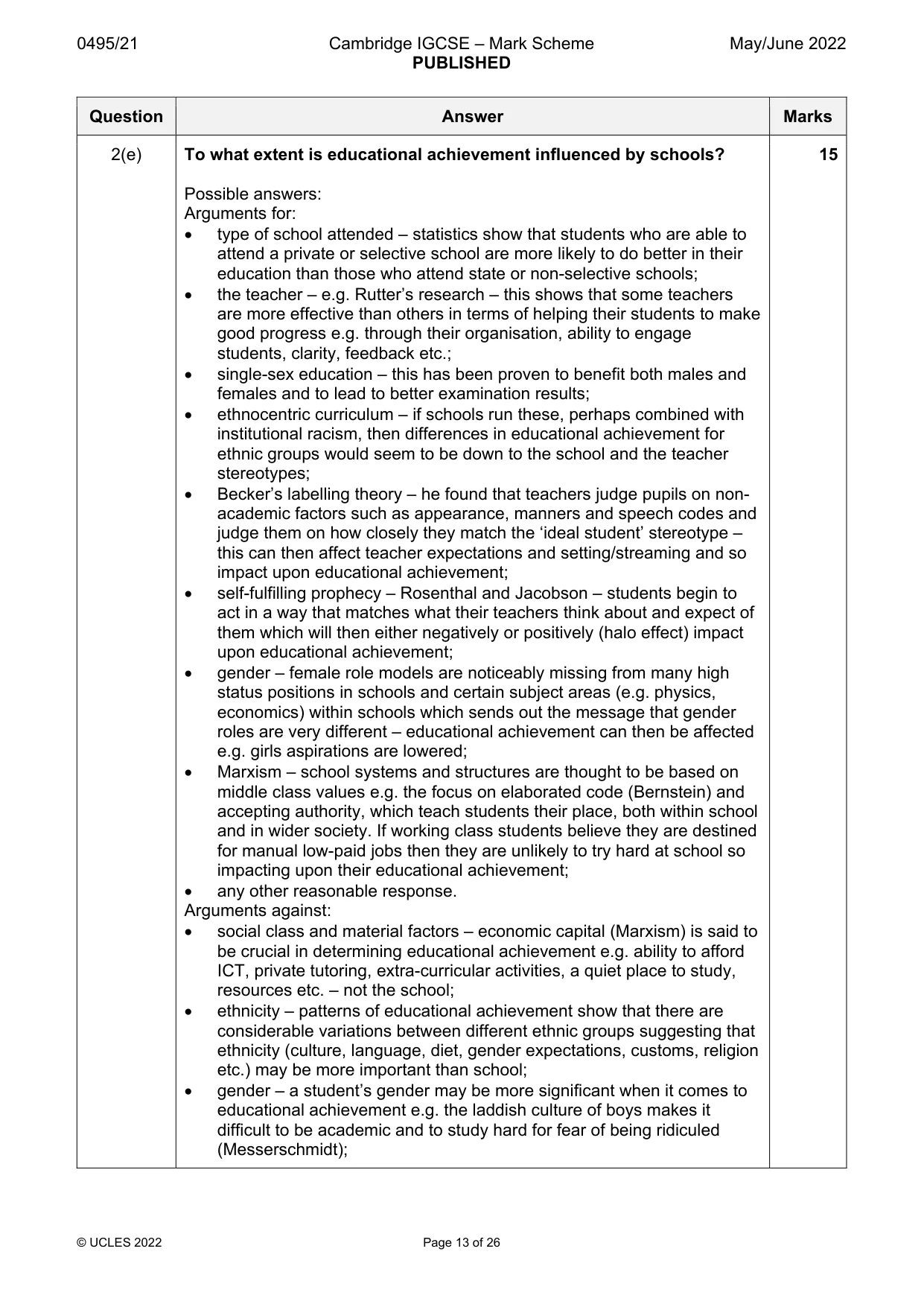
2 According to patterns and trends in educational achievement, not all pupils have an equal chance to succeed. Some sociologists believe that schools encourage social mobility and both the formal and hidden curriculum discourage immediate gratification. Other sociologists believe the type of school a pupil attends and teachers’ expectations also affect educational achievement. (a) What is meant by the ‘immediate gratification’? [2] (b) Describe two different types of school. [4] (c) Explain how students can be influenced by the hidden curriculum. [6] (d) Explain why education is important for social mobility. [8] (e) To what extent is educational achievement influenced by schools? [15] Section C: Crime, deviance and social control
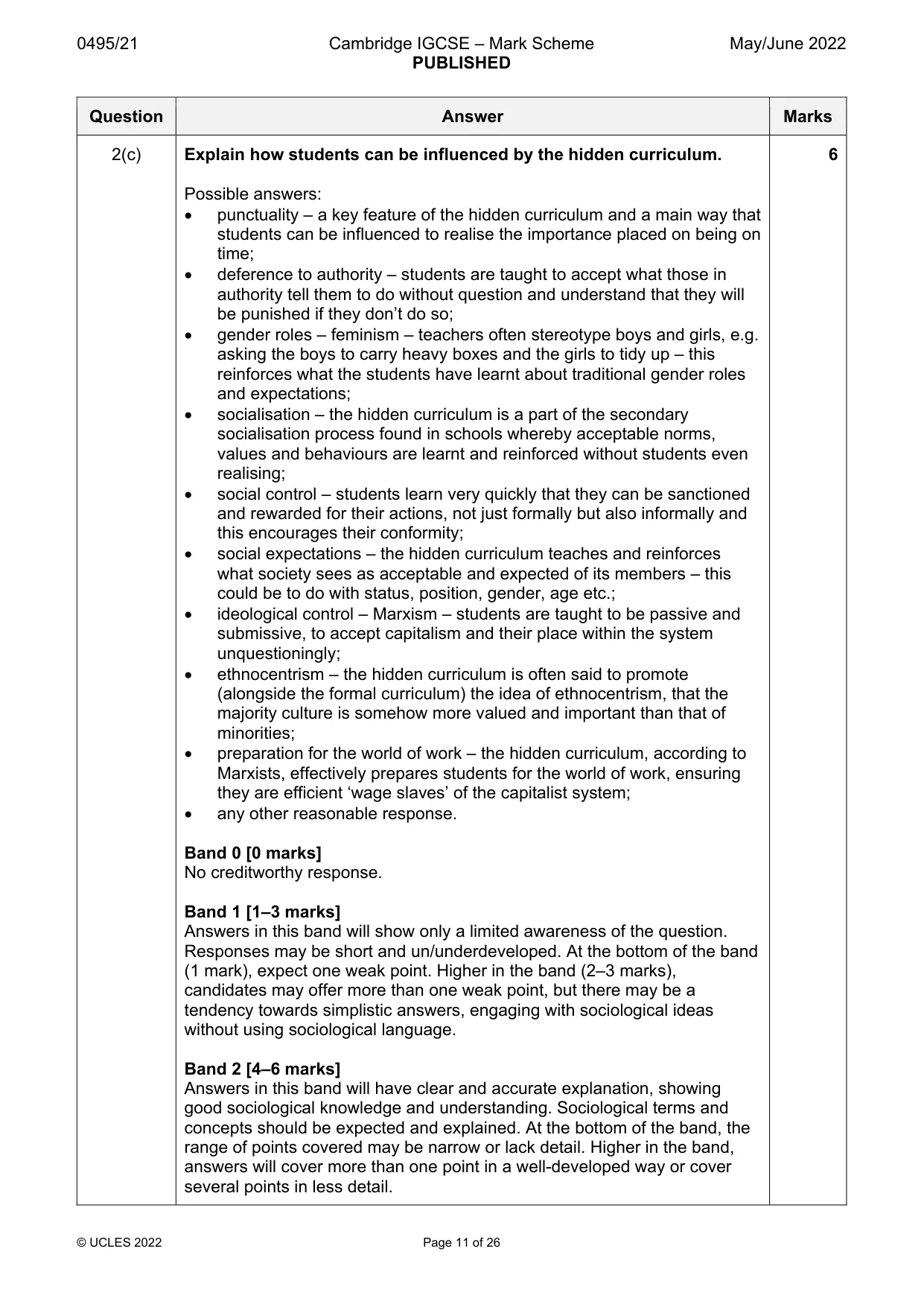
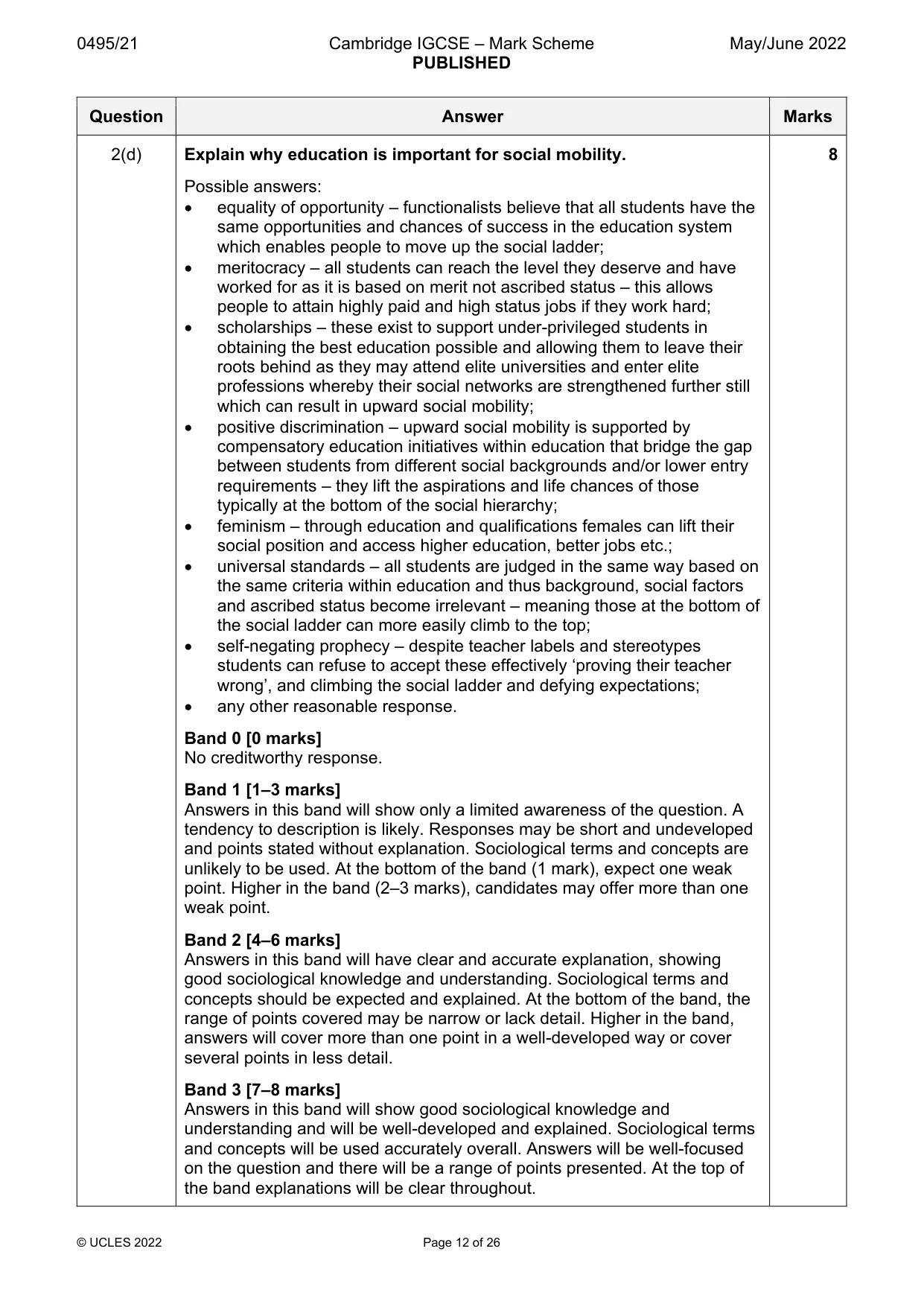
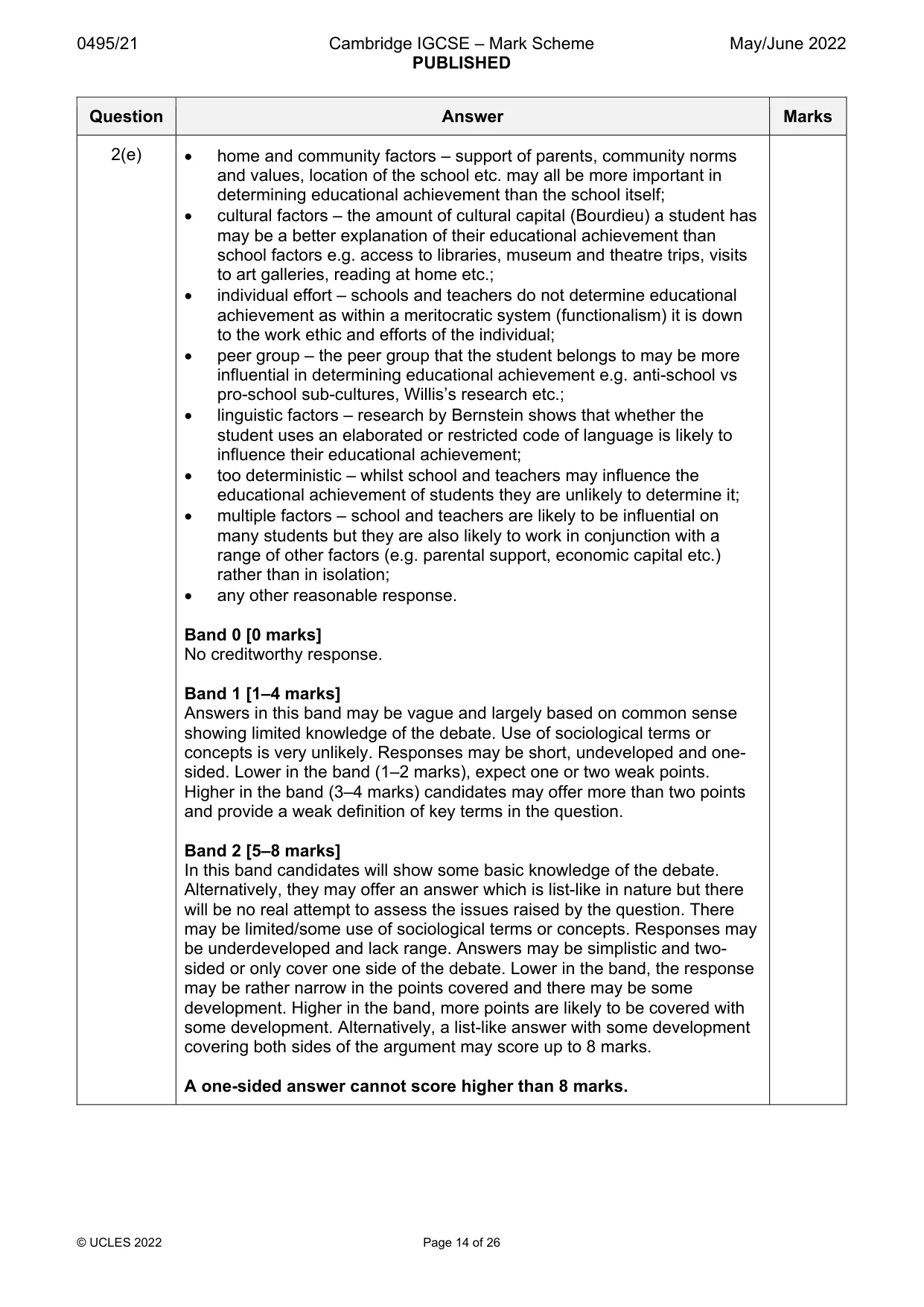
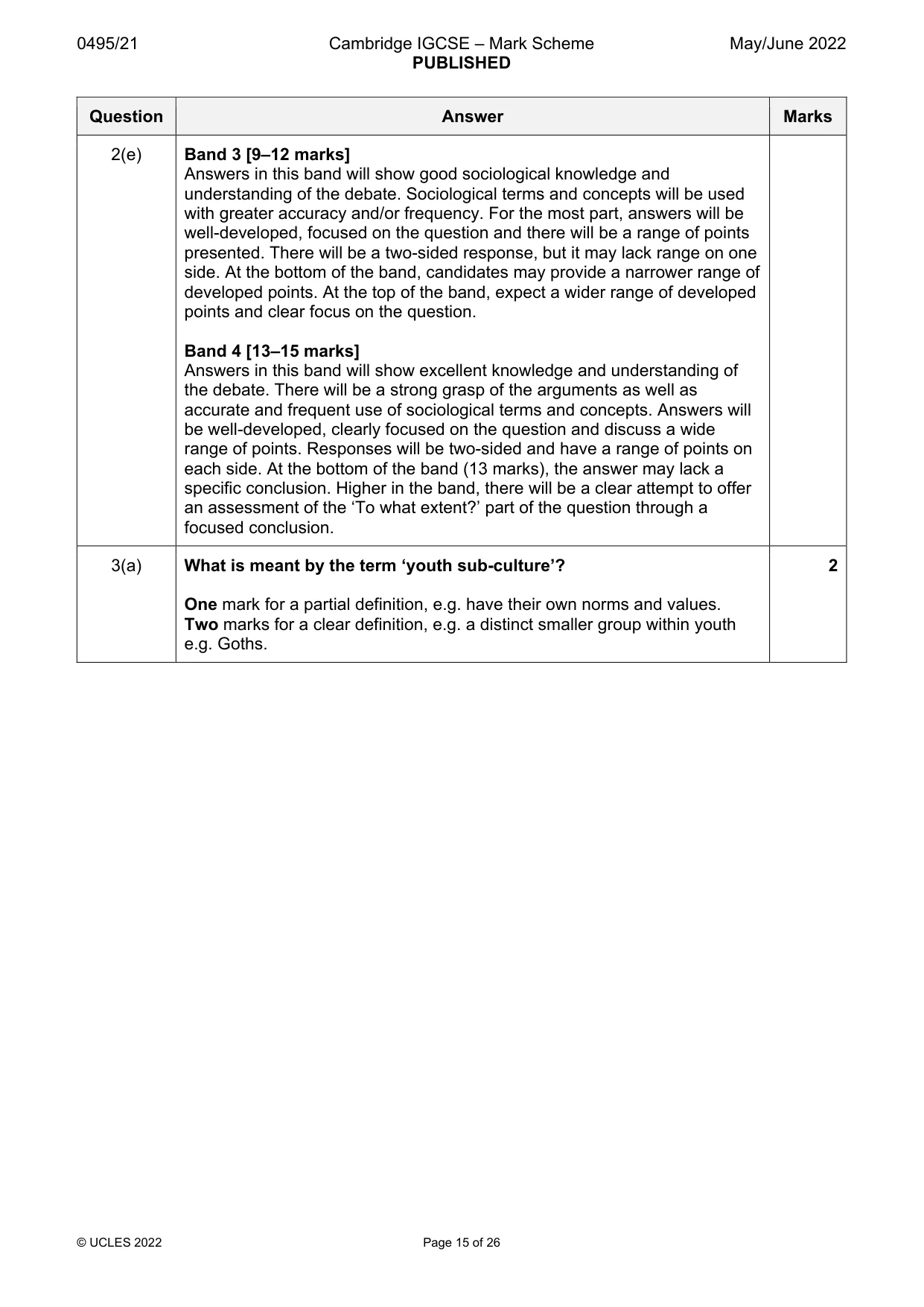
Mark scheme: 2(a) What is meant by the ‘immediate gratification’? 2 One mark for a partial definition, e.g. not wanting to wait for rewards. Two marks for a clear definition, e.g. having short term aims and goals and wanting rewards straight away. 2(b) Describe two different types of school. 4 Possible answers: state – schools that are run, directly or indirectly, by the Government and are funded through systems such as taxation; comprehensive – non-selective secondary schools, accepting all children of that age and of all abilities in a local area; private – a school that is not run or controlled by the Government and is funded privately through tuition fees; single-sex – schools that are made up of students all of the same sex e.g. an all boys or an all girls school; faith – schools that are controlled by a religious organisation and are partly selective as they can give priority to children who share and are members of the school’s faith and ethos; primary – schools that are responsible for the first years of compulsory formal education; secondary – schools that continue a child’s formal education after the primary stage and are where external assessments, e.g. IGCSE’s, A Levels and IB’s, are sat; any other reasonable response. One mark for each point correctly identified (up to maximum of two). One mark for each point that is developed (up to a maximum of two). 2(c) Explain how students can be influenced by the hidden curriculum. 6 Possible answers: punctuality – a key feature of the hidden curriculum and a main way that students can be influenced to realise the importance placed on being on time; deference to authority – students are taught to accept what those in authority tell them to do without question and understand that they will be punished if they don’t do so; gender roles – feminism – teachers often stereotype boys and girls, e.g. asking the boys to carry heavy boxes and the girls to tidy up – this reinforces what the students have learnt about traditional gender roles and expectations; socialisation – the hidden curriculum is a part of the secondary socialisation process found in schools whereby acceptable norms, values and behaviours are learnt and reinforced without students even realising; social control – students learn very quickly that they can be sanctioned and rewarded for their actions, not just formally but also informally and this encourages their conformity; social expectations – the hidden curriculum teaches and reinforces what society sees as acceptable and expected of its members – this could be to do with status, position, gender, age etc.; ideological control – Marxism – students are taught to be passive and submissive, to accept capitalism and their place within the system unquestioningly; ethnocentrism – the hidden curriculum is often said to promote (alongside the formal curriculum) the idea of ethnocentrism, that the majority culture is somehow more valued and important than that of minorities; preparation for the world of work – the hidden curriculum, according to Marxists, effectively prepares students for the world of work, ensuring they are efficient ‘wage slaves’ of the capitalist system; any other reasonable response. Band 0 [0 marks] No creditworthy response. Band 1 [1–3 marks] Answers in this band will show only a limited awareness of the question. Responses may be short and un/underdeveloped. At the bottom of the band (1 mark), expect one weak point. Higher in the band (2–3 marks), candidates may offer more than one weak point, but there may be a tendency towards simplistic answers, engaging with sociological ideas without using sociological language. Band 2 [4–6 marks] Answers in this band will have clear and accurate explanation, showing good sociological knowledge and understanding. Sociological terms and concepts should be expected and explained. At the bottom of the band, the range of points covered may be narrow or lack detail. Higher in the band, answers will cover more than one point in a well-developed way or cover several points in less detail. 2(d) Explain why education is important for social mobility. 8 Possible answers: equality of opportunity – functionalists believe that all students have the same opportunities and chances of success in the education system which enables people to move up the social ladder; meritocracy – all students can reach the level they deserve and have worked for as it is based on merit not ascribed status – this allows people to attain highly paid and high status jobs if they work hard; scholarships – these exist to support under-privileged students in obtaining the best education possible and allowing them to leave their roots behind as they may attend elite universities and enter elite professions whereby their social networks are strengthened further still which can result in upward social mobility; positive discrimination – upward social mobility is supported by compensatory education initiatives within education that bridge the gap between students from different social backgrounds and/or lower entry requirements – they lift the aspirations and life chances of those typically at the bottom of the social hierarchy; feminism – through education and qualifications females can lift their social position and access higher education, better jobs etc.; universal standards – all students are judged in the same way based on the same criteria within education and thus background, social factors and ascribed status become irrelevant – meaning those at the bottom of the social ladder can more easily climb to the top; self-negating prophecy – despite teacher labels and stereotypes students can refuse to accept these effectively ‘proving their teacher wrong’, and climbing the social ladder and defying expectations; any other reasonable response. Band 0 [0 marks] No creditworthy response. Band 1 [1–3 marks] Answers in this band will show only a limited awareness of the question. A tendency to description is likely. Responses may be short and undeveloped and points stated without explanation. Sociological terms and concepts are unlikely to be used. At the bottom of the band (1 mark), expect one weak point. Higher in the band (2–3 marks), candidates may offer more than one weak point. Band 2 [4–6 marks] Answers in this band will have clear and accurate explanation, showing good sociological knowledge and understanding. Sociological terms and concepts should be expected and explained. At the bottom of the band, the range of points covered may be narrow or lack detail. Higher in the band, answers will cover more than one point in a well-developed way or cover several points in less detail. Band 3 [7–8 marks] Answers in this band will show good sociological knowledge and understanding and will be well-developed and explained. Sociological terms and concepts will be used accurately overall. Answers will be well-focused on the question and there will be a range of points presented. At the top of the band explanations will be clear throughout. 2(e) To what extent is educational achievement influenced by schools? 15 Possible answers: Arguments for: type of school attended – statistics show that students who are able to attend a private or selective school are more likely to do better in their education than those who attend state or non-selective schools; the teacher – e.g. Rutter’s research – this shows that some teachers are more effective than others in terms of helping their students to make good progress e.g. through their organisation, ability to engage students, clarity, feedback etc.; single-sex education – this has been proven to benefit both males and females and to lead to better examination results; ethnocentric curriculum – if schools run these, perhaps combined with institutional racism, then differences in educational achievement for ethnic groups would seem to be down to the school and the teacher stereotypes; Becker’s labelling theory – he found that teachers judge pupils on non- academic factors such as appearance, manners and speech codes and judge them on how closely they match the ‘ideal student’ stereotype – this can then affect teacher expectations and setting/streaming and so impact upon educational achievement; self-fulfilling prophecy – Rosenthal and Jacobson – students begin to act in a way that matches what their teachers think about and expect of them which will then either negatively or positively (halo effect) impact upon educational achievement; gender – female role models are noticeably missing from many high status positions in schools and certain subject areas (e.g. physics, economics) within schools which sends out the message that gender roles are very different – educational achievement can then be affected e.g. girls aspirations are lowered; Marxism – school systems and structures are thought to be based on middle class values e.g. the focus on elaborated code (Bernstein) and accepting authority, which teach students their place, both within school and in wider society. If working class students believe they are destined for manual low-paid jobs then they are unlikely to try hard at school so impacting upon their educational achievement; any other reasonable response. Arguments against: social class and material factors – economic capital (Marxism) is said to be crucial in determining educational achievement e.g. ability to afford ICT, private tutoring, extra-curricular activities, a quiet place to study, resources etc. – not the school; ethnicity – patterns of educational achievement show that there are considerable variations between different ethnic groups suggesting that ethnicity (culture, language, diet, gender expectations, customs, religion etc.) may be more important than school; gender – a student’s gender may be more significant when it comes to educational achievement e.g. the laddish culture of boys makes it difficult to be academic and to study hard for fear of being ridiculed (Messerschmidt); 2(e) home and community factors – support of parents, community norms and values, location of the school etc. may all be more important in determining educational achievement than the school itself; cultural factors – the amount of cultural capital (Bourdieu) a student has may be a better explanation of their educational achievement than school factors e.g. access to libraries, museum and theatre trips, visits to art galleries, reading at home etc.; individual effort – schools and teachers do not determine educational achievement as within a meritocratic system (functionalism) it is down to the work ethic and efforts of the individual; peer group – the peer group that the student belongs to may be more influential in determining educational achievement e.g. anti-school vs pro-school sub-cultures, Willis’s research etc.; linguistic factors – research by Bernstein shows that whether the student uses an elaborated or restricted code of language is likely to influence their educational achievement; too deterministic – whilst school and teachers may influence the educational achievement of students they are unlikely to determine it; multiple factors – school and teachers are likely to be influential on many students but they are also likely to work in conjunction with a range of other factors (e.g. parental support, economic capital etc.) rather than in isolation; any other reasonable response. Band 0 [0 marks] No creditworthy response. Band 1 [1–4 marks] Answers in this band may be vague and largely based on common sense showing limited knowledge of the debate. Use of sociological terms or concepts is very unlikely. Responses may be short, undeveloped and one- sided. Lower in the band (1–2 marks), expect one or two weak points. Higher in the band (3–4 marks) candidates may offer more than two points and provide a weak definition of key terms in the question. Band 2 [5–8 marks] In this band candidates will show some basic knowledge of the debate. Alternatively, they may offer an answer which is list-like in nature but there will be no real attempt to assess the issues raised by the question. There may be limited/some use of sociological terms or concepts. Responses may be underdeveloped and lack range. Answers may be simplistic and two- sided or only cover one side of the debate. Lower in the band, the response may be rather narrow in the points covered and there may be some development. Higher in the band, more points are likely to be covered with some development. Alternatively, a list-like answer with some development covering both sides of the argument may score up to 8 marks. A one-sided answer cannot score higher than 8 marks. 2(e) Band 3 [9–12 marks] Answers in this band will show good sociological knowledge and understanding of the debate. Sociological terms and concepts will be used with greater accuracy and/or frequency. For the most part, answers will be well-developed, focused on the question and there will be a range of points presented. There will be a two-sided response, but it may lack range on one side. At the bottom of the band, candidates may provide a narrower range of developed points. At the top of the band, expect a wider range of developed points and clear focus on the question. Band 4 [13–15 marks] Answers in this band will show excellent knowledge and understanding of the debate. There will be a strong grasp of the arguments as well as accurate and frequent use of sociological terms and concepts. Answers will be well-developed, clearly focused on the question and discuss a wide range of points. Responses will be two-sided and have a range of points on each side. At the bottom of the band (13 marks), the answer may lack a specific conclusion. Higher in the band, there will be a clear attempt to offer an assessment of the ‘To what extent?’ part of the question through a focused conclusion.
Q3 · Definitions of crime and deviance vary over time and between societies
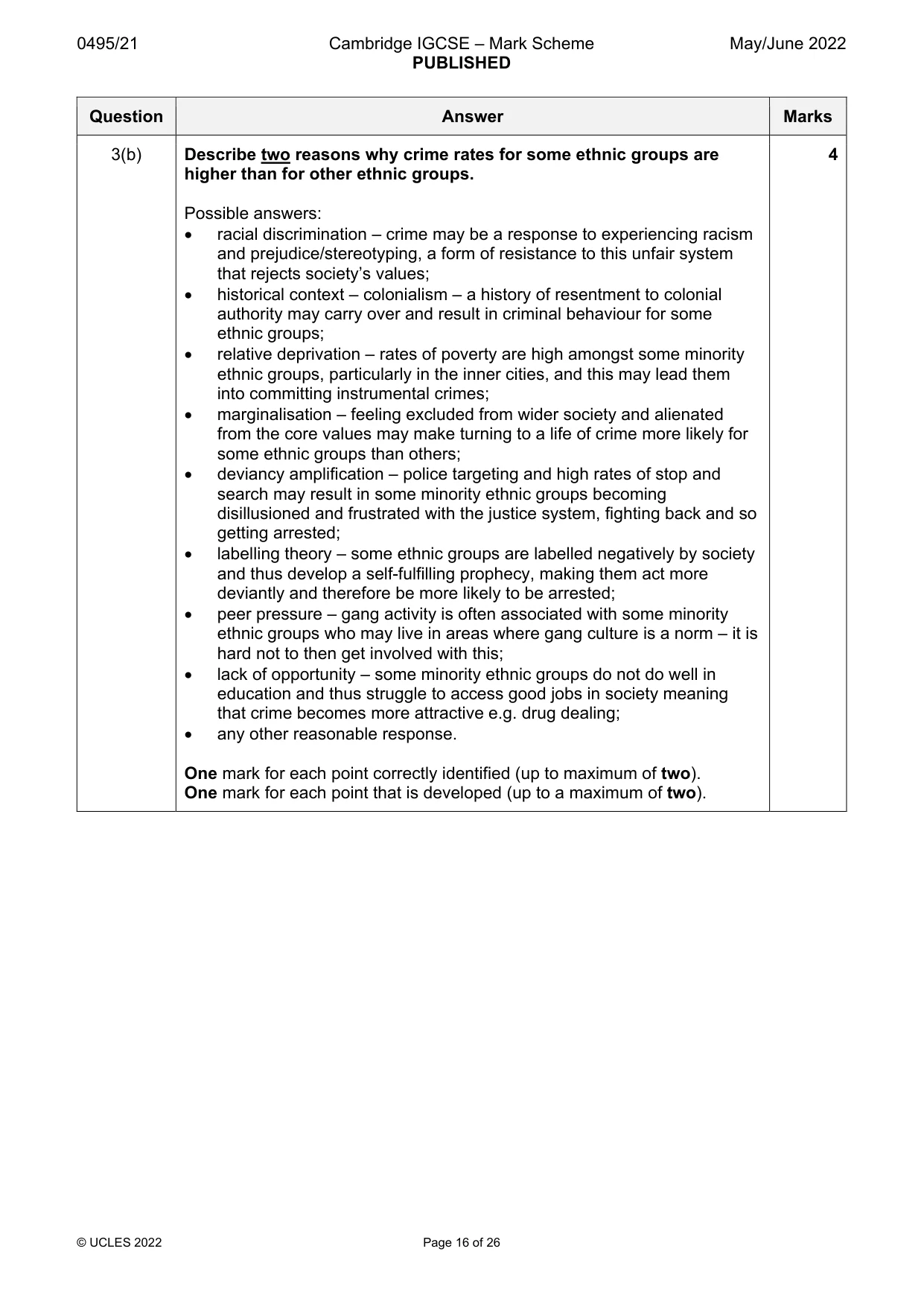
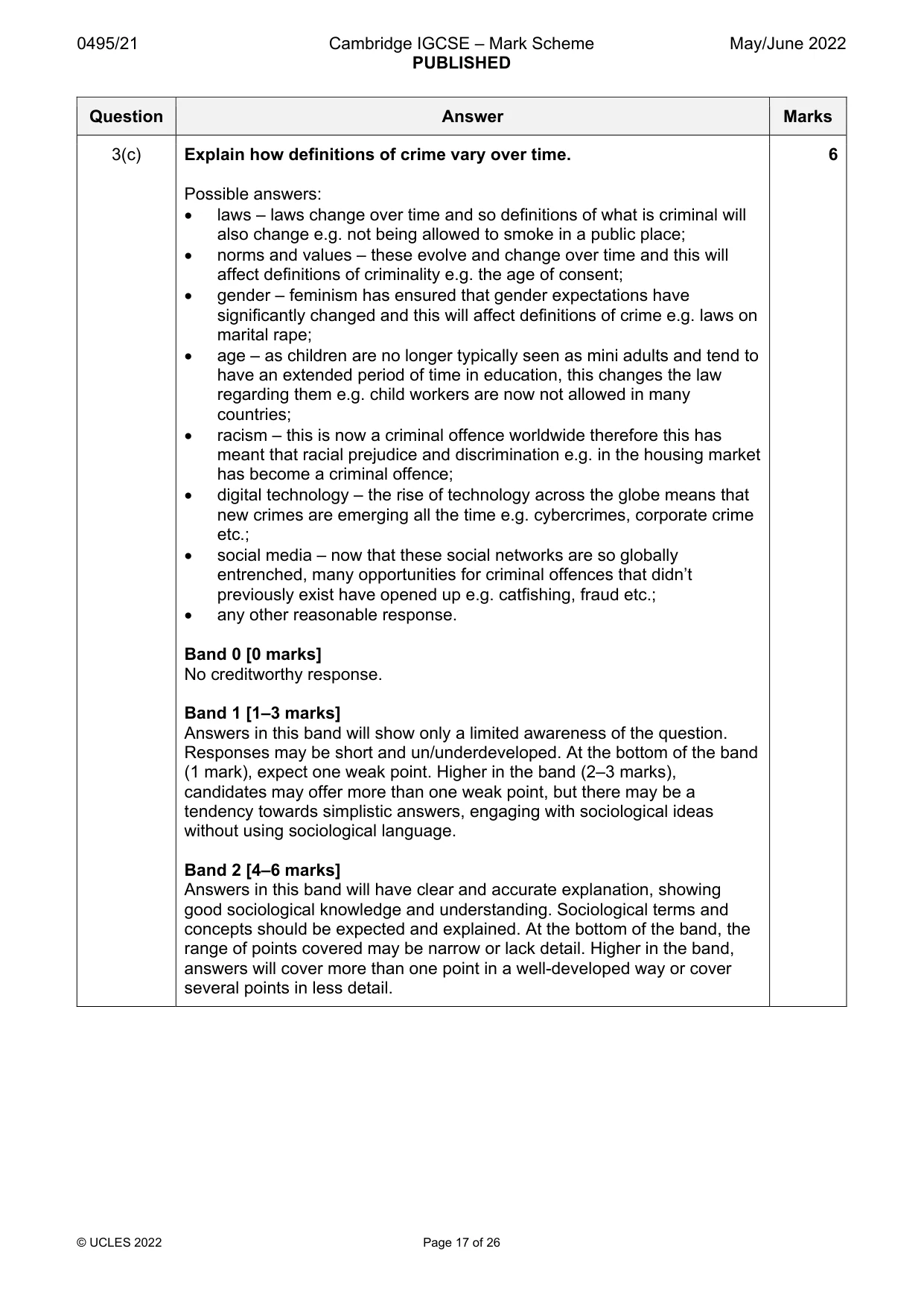
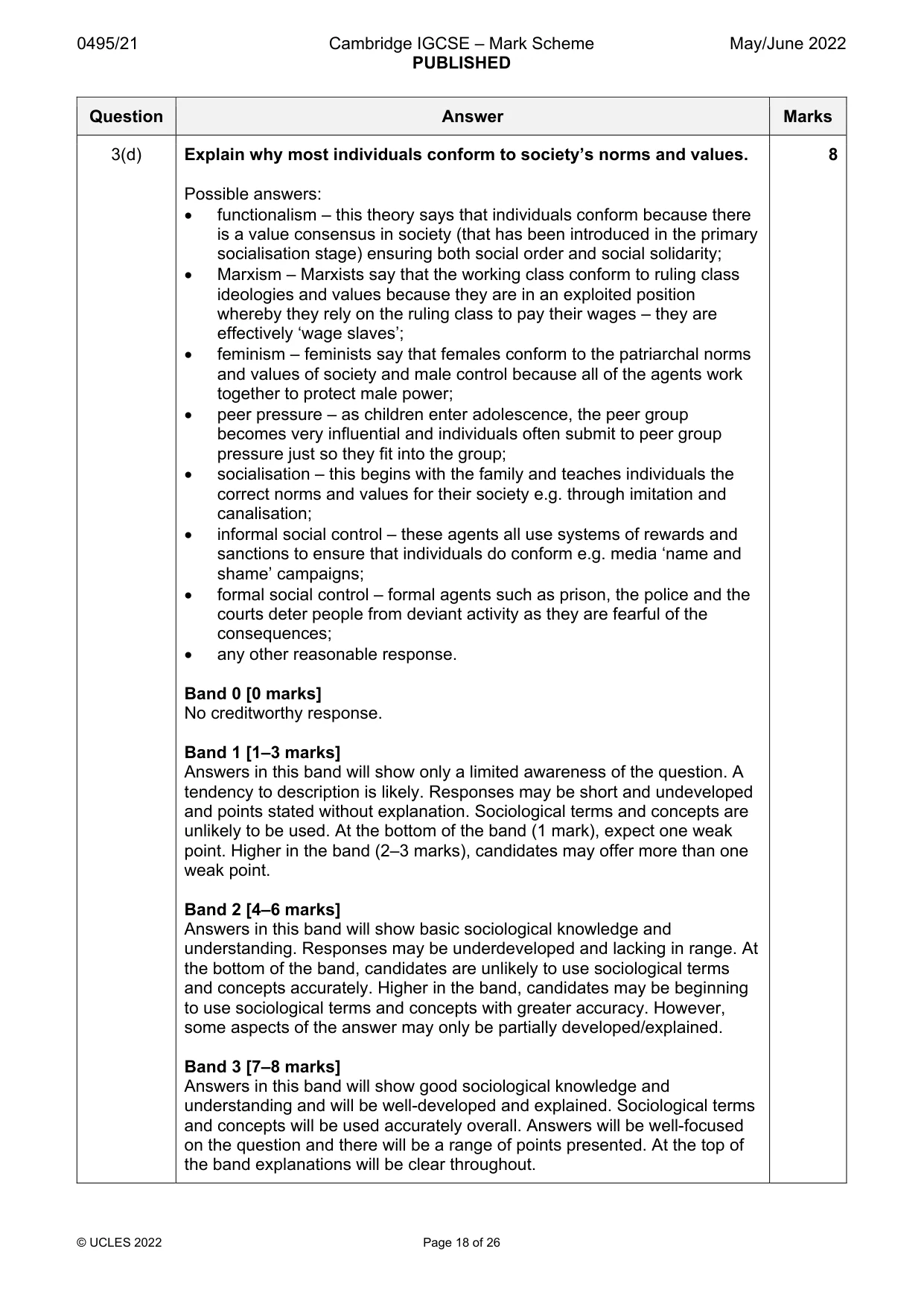
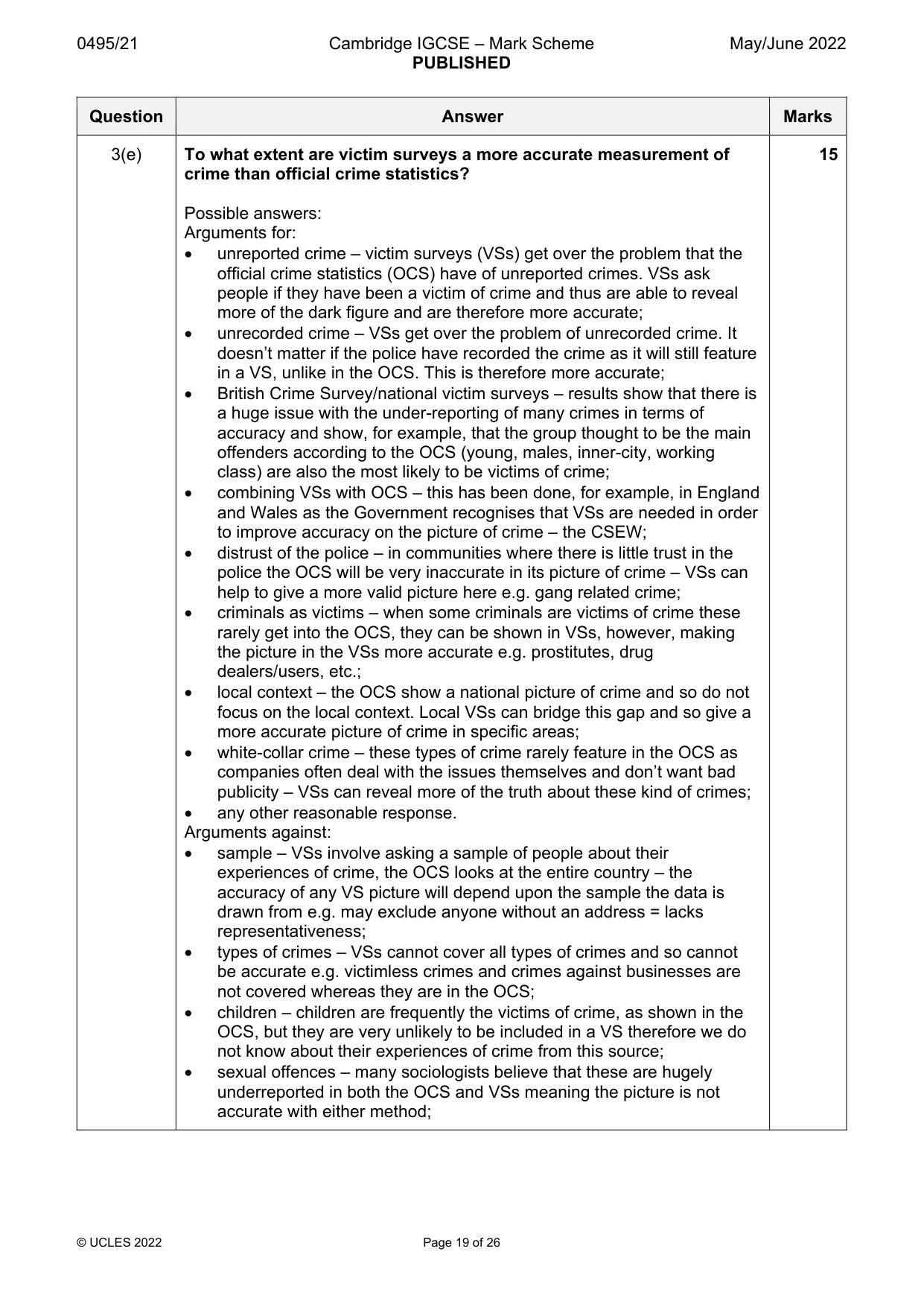
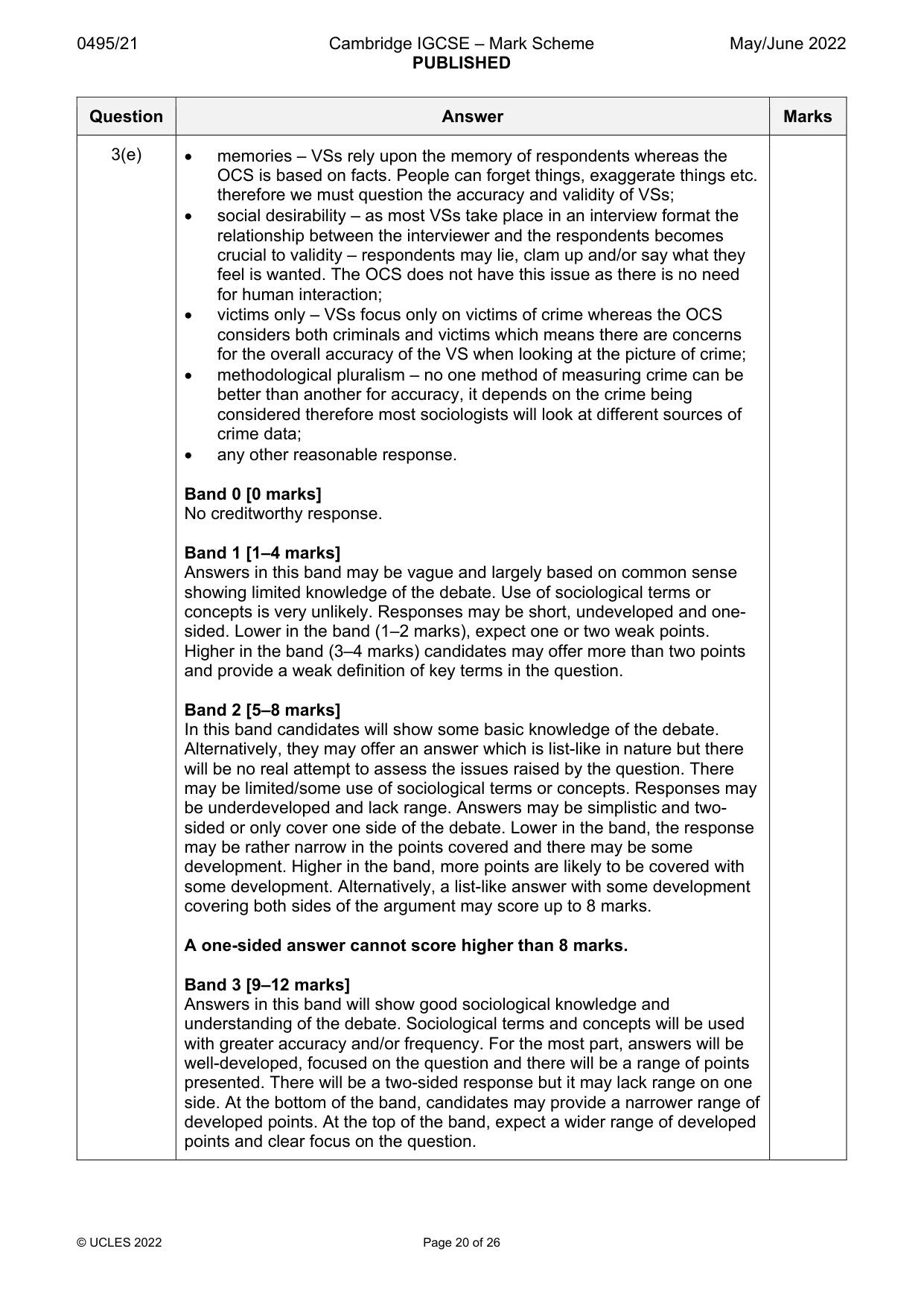
3 Definitions of crime and deviance vary over time and between societies. Most people do not break the law, choosing instead to conform to society’s norms and values. However, trends in official statistics state that youth sub-cultures and some ethnic groups are often involved in deviant behaviour. Despite this, findings from victim surveys have challenged the accuracy of official statistics. (a) What is meant by the term ‘youth sub-culture’? [2] (b) Describe two reasons why crime rates for some ethnic groups are higher than for other ethnic groups. [4] (c) Explain how definitions of crime vary over time. [6] (d) Explain why most individuals conform to society’s norms and values. [8] (e) To what extent are victim surveys a more accurate measurement of crime than official crime statistics? [15] Section D: Media
Mark scheme: 3(a) What is meant by the term ‘youth sub-culture’? 2 One mark for a partial definition, e.g. have their own norms and values. Two marks for a clear definition, e.g. a distinct smaller group within youth e.g. Goths. 3(b) Describe two reasons why crime rates for some ethnic groups are 4 higher than for other ethnic groups. Possible answers: racial discrimination – crime may be a response to experiencing racism and prejudice/stereotyping, a form of resistance to this unfair system that rejects society’s values; historical context – colonialism – a history of resentment to colonial authority may carry over and result in criminal behaviour for some ethnic groups; relative deprivation – rates of poverty are high amongst some minority ethnic groups, particularly in the inner cities, and this may lead them into committing instrumental crimes; marginalisation – feeling excluded from wider society and alienated from the core values may make turning to a life of crime more likely for some ethnic groups than others; deviancy amplification – police targeting and high rates of stop and search may result in some minority ethnic groups becoming disillusioned and frustrated with the justice system, fighting back and so getting arrested; labelling theory – some ethnic groups are labelled negatively by society and thus develop a self-fulfilling prophecy, making them act more deviantly and therefore be more likely to be arrested; peer pressure – gang activity is often associated with some minority ethnic groups who may live in areas where gang culture is a norm – it is hard not to then get involved with this; lack of opportunity – some minority ethnic groups do not do well in education and thus struggle to access good jobs in society meaning that crime becomes more attractive e.g. drug dealing; any other reasonable response. One mark for each point correctly identified (up to maximum of two). One mark for each point that is developed (up to a maximum of two). 3(c) Explain how definitions of crime vary over time. 6 Possible answers: laws – laws change over time and so definitions of what is criminal will also change e.g. not being allowed to smoke in a public place; norms and values – these evolve and change over time and this will affect definitions of criminality e.g. the age of consent; gender – feminism has ensured that gender expectations have significantly changed and this will affect definitions of crime e.g. laws on marital rape; age – as children are no longer typically seen as mini adults and tend to have an extended period of time in education, this changes the law regarding them e.g. child workers are now not allowed in many countries; racism – this is now a criminal offence worldwide therefore this has meant that racial prejudice and discrimination e.g. in the housing market has become a criminal offence; digital technology – the rise of technology across the globe means that new crimes are emerging all the time e.g. cybercrimes, corporate crime etc.; social media – now that these social networks are so globally entrenched, many opportunities for criminal offences that didn’t previously exist have opened up e.g. catfishing, fraud etc.; any other reasonable response. Band 0 [0 marks] No creditworthy response. Band 1 [1–3 marks] Answers in this band will show only a limited awareness of the question. Responses may be short and un/underdeveloped. At the bottom of the band (1 mark), expect one weak point. Higher in the band (2–3 marks), candidates may offer more than one weak point, but there may be a tendency towards simplistic answers, engaging with sociological ideas without using sociological language. Band 2 [4–6 marks] Answers in this band will have clear and accurate explanation, showing good sociological knowledge and understanding. Sociological terms and concepts should be expected and explained. At the bottom of the band, the range of points covered may be narrow or lack detail. Higher in the band, answers will cover more than one point in a well-developed way or cover several points in less detail. 3(d) Explain why most individuals conform to society’s norms and values. 8 Possible answers: functionalism – this theory says that individuals conform because there is a value consensus in society (that has been introduced in the primary socialisation stage) ensuring both social order and social solidarity; Marxism – Marxists say that the working class conform to ruling class ideologies and values because they are in an exploited position whereby they rely on the ruling class to pay their wages – they are effectively ‘wage slaves’; feminism – feminists say that females conform to the patriarchal norms and values of society and male control because all of the agents work together to protect male power; peer pressure – as children enter adolescence, the peer group becomes very influential and individuals often submit to peer group pressure just so they fit into the group; socialisation – this begins with the family and teaches individuals the correct norms and values for their society e.g. through imitation and canalisation; informal social control – these agents all use systems of rewards and sanctions to ensure that individuals do conform e.g. media ‘name and shame’ campaigns; formal social control – formal agents such as prison, the police and the courts deter people from deviant activity as they are fearful of the consequences; any other reasonable response. Band 0 [0 marks] No creditworthy response. Band 1 [1–3 marks] Answers in this band will show only a limited awareness of the question. A tendency to description is likely. Responses may be short and undeveloped and points stated without explanation. Sociological terms and concepts are unlikely to be used. At the bottom of the band (1 mark), expect one weak point. Higher in the band (2–3 marks), candidates may offer more than one weak point. Band 2 [4–6 marks] Answers in this band will show basic sociological knowledge and understanding. Responses may be underdeveloped and lacking in range. At the bottom of the band, candidates are unlikely to use sociological terms and concepts accurately. Higher in the band, candidates may be beginning to use sociological terms and concepts with greater accuracy. However, some aspects of the answer may only be partially developed/explained. Band 3 [7–8 marks] Answers in this band will show good sociological knowledge and understanding and will be well-developed and explained. Sociological terms and concepts will be used accurately overall. Answers will be well-focused on the question and there will be a range of points presented. At the top of the band explanations will be clear throughout. 3(e) To what extent are victim surveys a more accurate measurement of 15 crime than official crime statistics? Possible answers: Arguments for: unreported crime – victim surveys (VSs) get over the problem that the official crime statistics (OCS) have of unreported crimes. VSs ask people if they have been a victim of crime and thus are able to reveal more of the dark figure and are therefore more accurate; unrecorded crime – VSs get over the problem of unrecorded crime. It doesn’t matter if the police have recorded the crime as it will still feature in a VS, unlike in the OCS. This is therefore more accurate; British Crime Survey/national victim surveys – results show that there is a huge issue with the under-reporting of many crimes in terms of accuracy and show, for example, that the group thought to be the main offenders according to the OCS (young, males, inner-city, working class) are also the most likely to be victims of crime; combining VSs with OCS – this has been done, for example, in England and Wales as the Government recognises that VSs are needed in order to improve accuracy on the picture of crime – the CSEW; distrust of the police – in communities where there is little trust in the police the OCS will be very inaccurate in its picture of crime – VSs can help to give a more valid picture here e.g. gang related crime; criminals as victims – when some criminals are victims of crime these rarely get into the OCS, they can be shown in VSs, however, making the picture in the VSs more accurate e.g. prostitutes, drug dealers/users, etc.; local context – the OCS show a national picture of crime and so do not focus on the local context. Local VSs can bridge this gap and so give a more accurate picture of crime in specific areas; white-collar crime – these types of crime rarely feature in the OCS as companies often deal with the issues themselves and don’t want bad publicity – VSs can reveal more of the truth about these kind of crimes; any other reasonable response. Arguments against: sample – VSs involve asking a sample of people about their experiences of crime, the OCS looks at the entire country – the accuracy of any VS picture will depend upon the sample the data is drawn from e.g. may exclude anyone without an address = lacks representativeness; types of crimes – VSs cannot cover all types of crimes and so cannot be accurate e.g. victimless crimes and crimes against businesses are not covered whereas they are in the OCS; children – children are frequently the victims of crime, as shown in the OCS, but they are very unlikely to be included in a VS therefore we do not know about their experiences of crime from this source; sexual offences – many sociologists believe that these are hugely underreported in both the OCS and VSs meaning the picture is not accurate with either method; 3(e) memories – VSs rely upon the memory of respondents whereas the OCS is based on facts. People can forget things, exaggerate things etc. therefore we must question the accuracy and validity of VSs; social desirability – as most VSs take place in an interview format the relationship between the interviewer and the respondents becomes crucial to validity – respondents may lie, clam up and/or say what they feel is wanted. The OCS does not have this issue as there is no need for human interaction; victims only – VSs focus only on victims of crime whereas the OCS considers both criminals and victims which means there are concerns for the overall accuracy of the VS when looking at the picture of crime; methodological pluralism – no one method of measuring crime can be better than another for accuracy, it depends on the crime being considered therefore most sociologists will look at different sources of crime data; any other reasonable response. Band 0 [0 marks] No creditworthy response. Band 1 [1–4 marks] Answers in this band may be vague and largely based on common sense showing limited knowledge of the debate. Use of sociological terms or concepts is very unlikely. Responses may be short, undeveloped and one- sided. Lower in the band (1–2 marks), expect one or two weak points. Higher in the band (3–4 marks) candidates may offer more than two points and provide a weak definition of key terms in the question. Band 2 [5–8 marks] In this band candidates will show some basic knowledge of the debate. Alternatively, they may offer an answer which is list-like in nature but there will be no real attempt to assess the issues raised by the question. There may be limited/some use of sociological terms or concepts. Responses may be underdeveloped and lack range. Answers may be simplistic and two- sided or only cover one side of the debate. Lower in the band, the response may be rather narrow in the points covered and there may be some development. Higher in the band, more points are likely to be covered with some development. Alternatively, a list-like answer with some development covering both sides of the argument may score up to 8 marks. A one-sided answer cannot score higher than 8 marks. Band 3 [9–12 marks] Answers in this band will show good sociological knowledge and understanding of the debate. Sociological terms and concepts will be used with greater accuracy and/or frequency. For the most part, answers will be well-developed, focused on the question and there will be a range of points presented. There will be a two-sided response but it may lack range on one side. At the bottom of the band, candidates may provide a narrower range of developed points. At the top of the band, expect a wider range of developed points and clear focus on the question. 3(e) Band 4 [13–15 marks] Answers in this band will show excellent knowledge and understanding of the debate. There will be a strong grasp of the arguments as well as accurate and frequent use of sociological terms and concepts. Answers will be well-developed, clearly focused on the question and discuss a wide range of points. Responses will be two-sided and have a range of points on each side. At the bottom of the band (13 marks), the answer may lack a specific conclusion. Higher in the band, there will be a clear attempt to offer an assessment of the ‘To what extent?’ part of the question through a focused conclusion
More questions on What types of data and evidence do sociologists use?
Q4 · Contemporary media can be divided into traditional and new media
4 Contemporary media can be divided into traditional and new media. Sociologists debate whether the media affects values, behaviour and voting patterns and some sociologists argue that the media has become an important global agent of socialisation. Most sociologists agree that new media is more diverse and has more freedom than traditional media. (a) What is meant by the term ‘socialisation’? [2] (b) Describe two ways the media is global. [4] (c) Explain how the media can affect audience voting patterns. [6] (d) Explain why new media has more freedom than traditional media. [8] (e) To what extent is the media more influential than other agents of socialisation? [15]
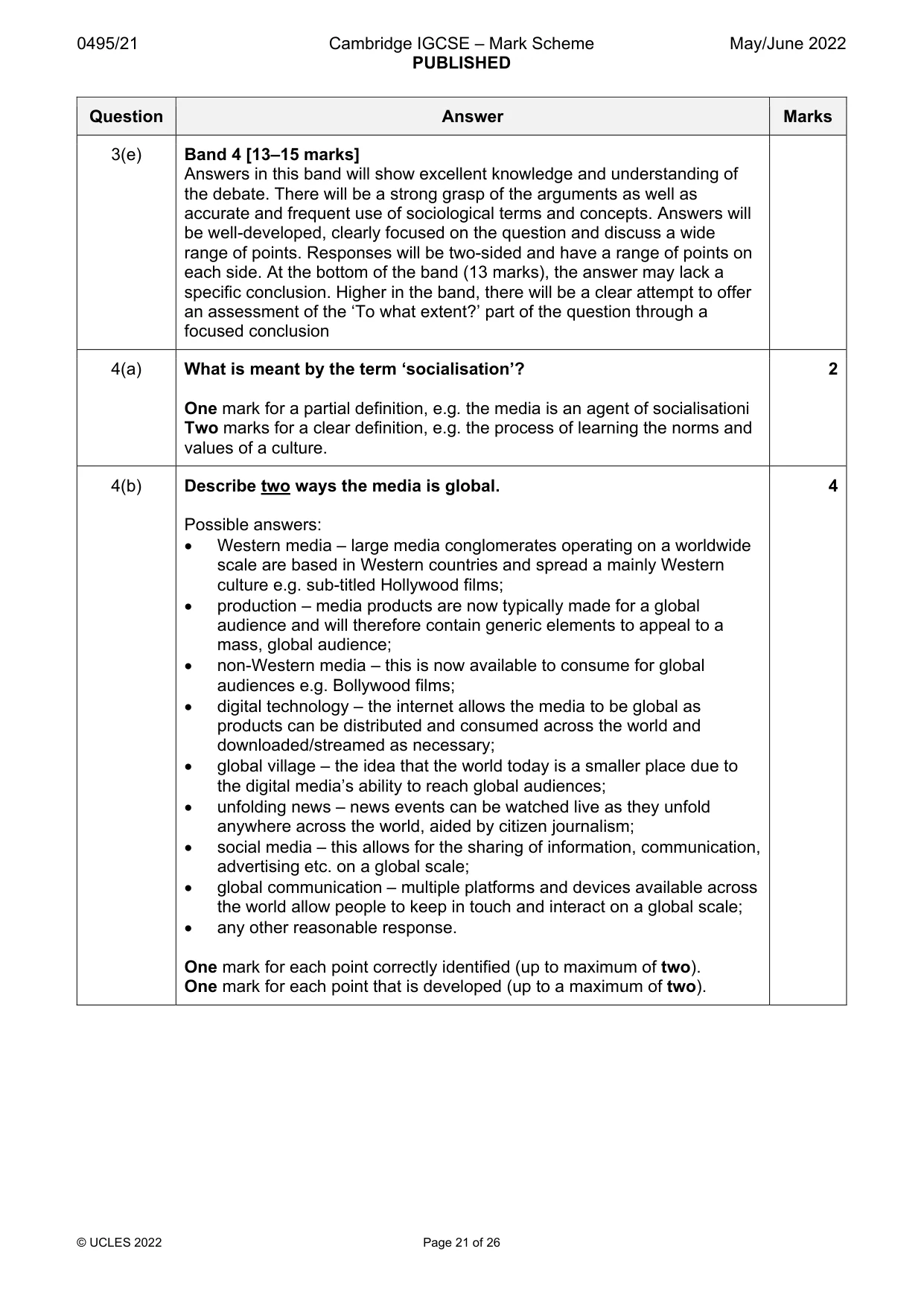
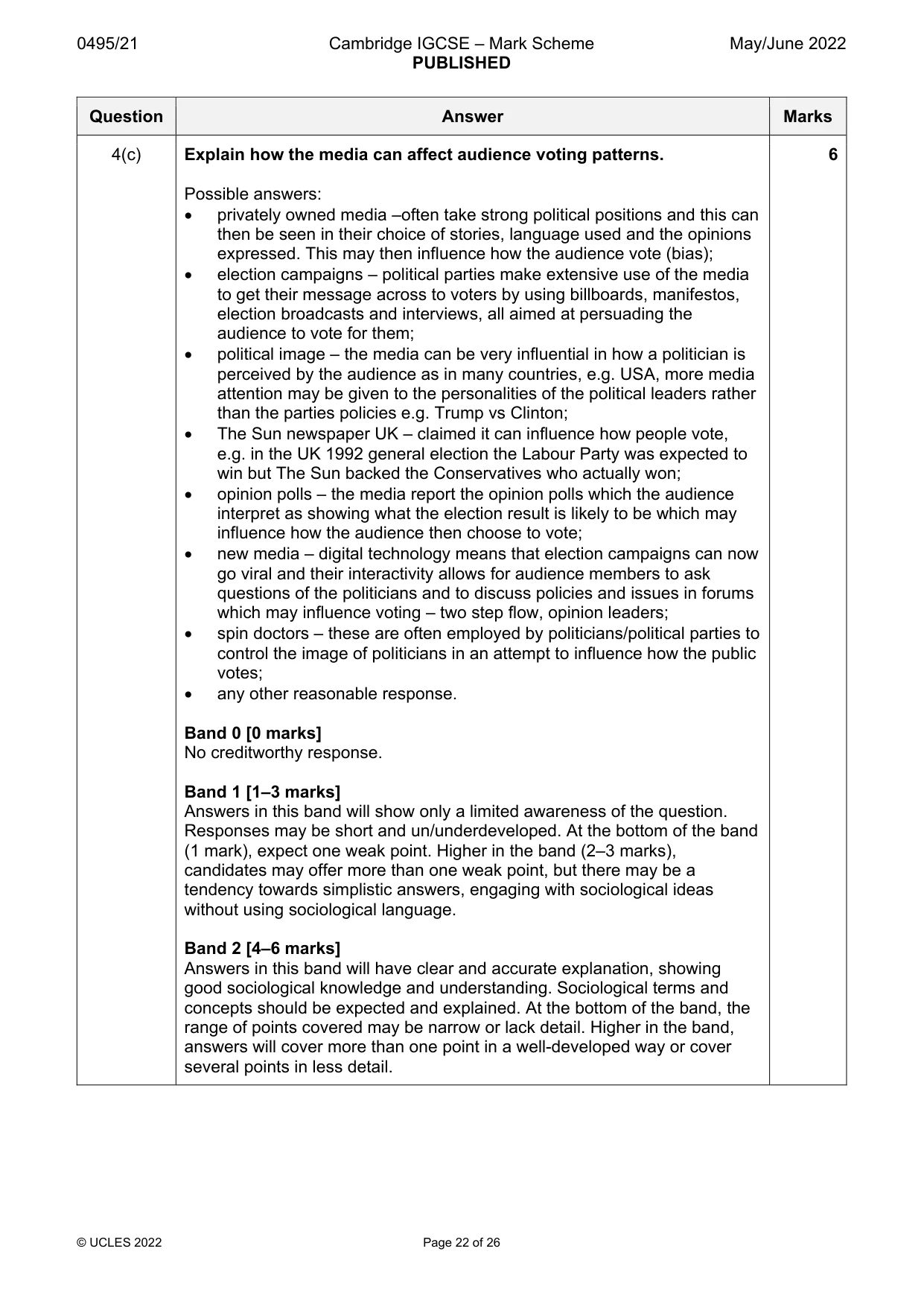
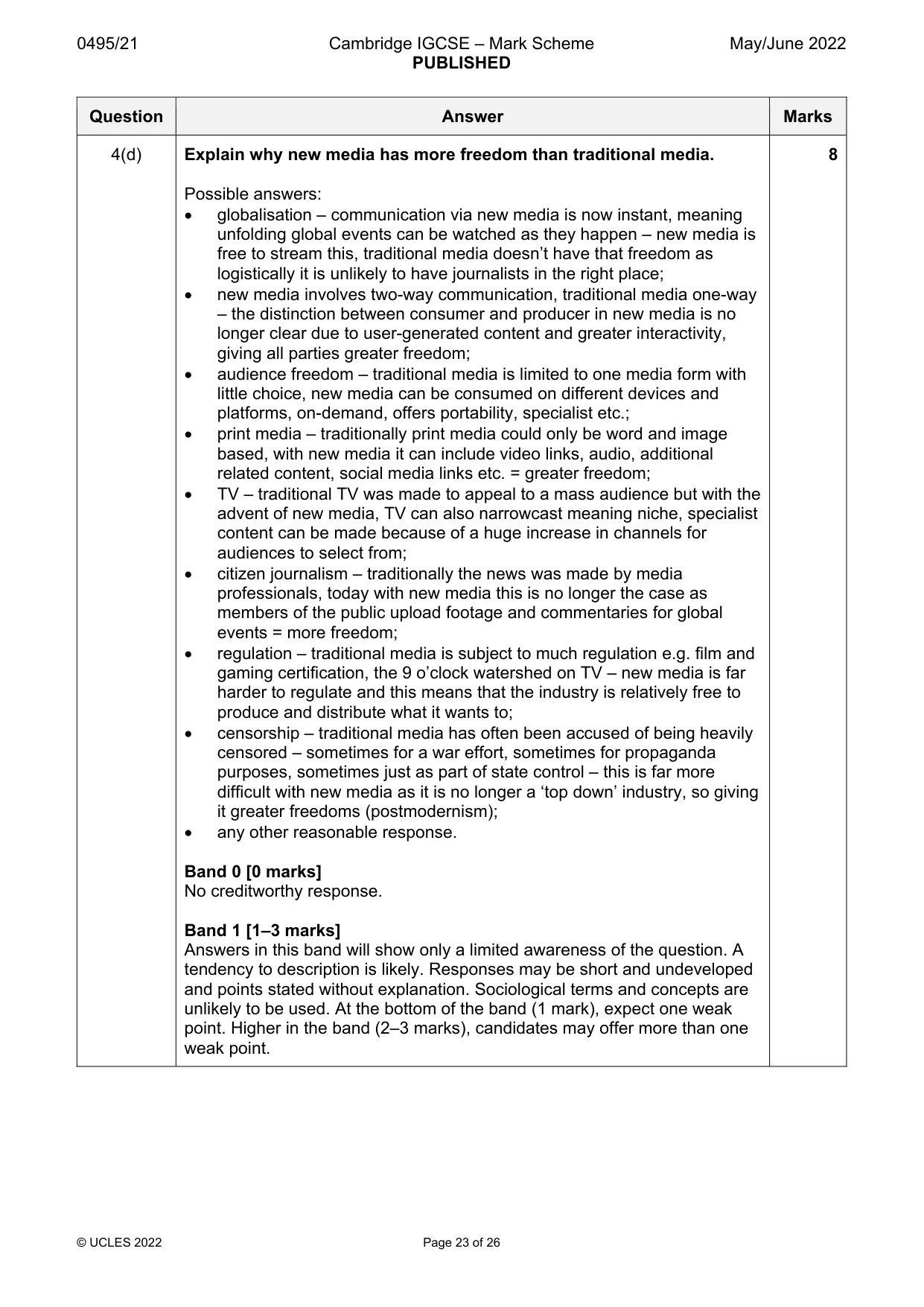
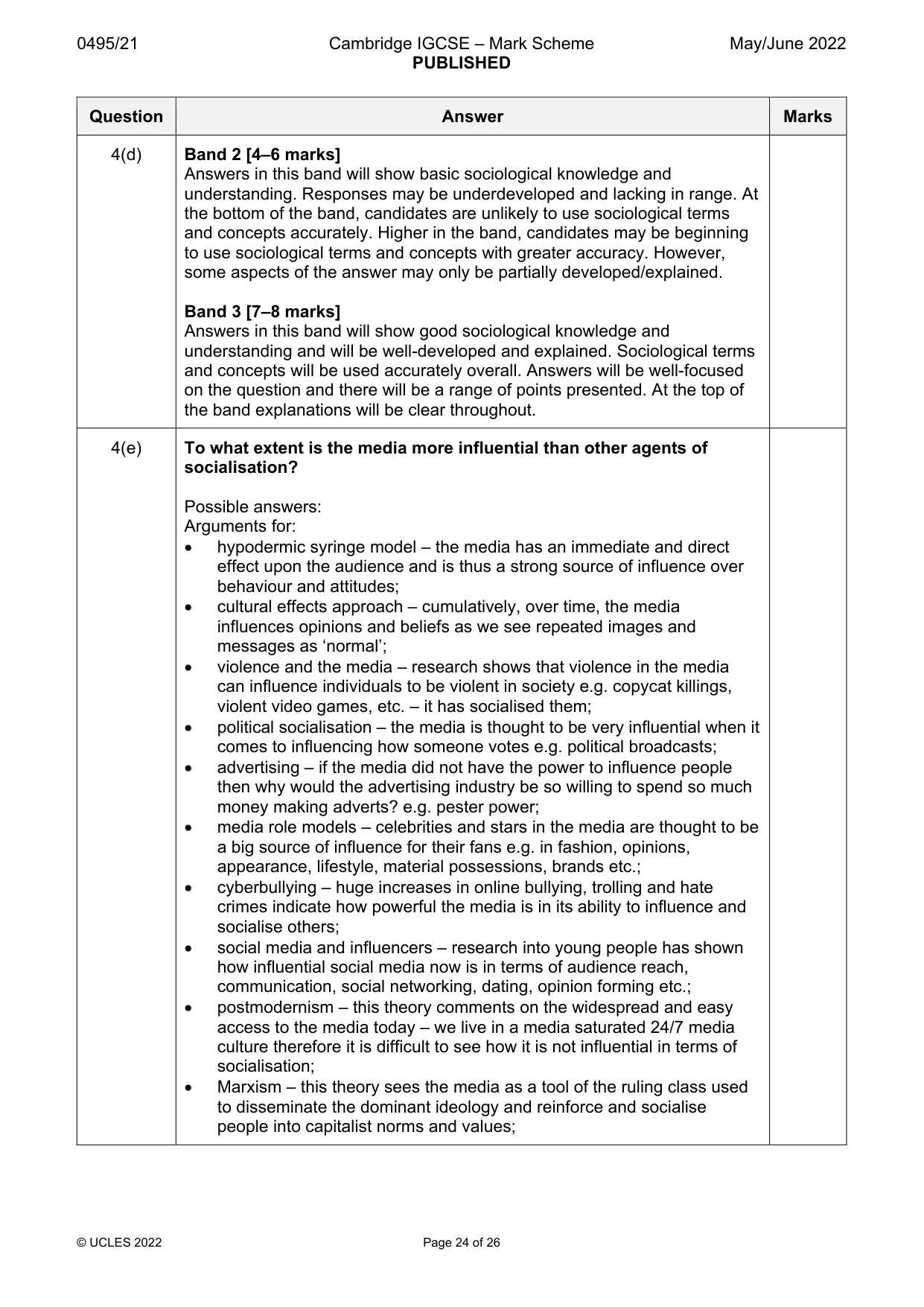
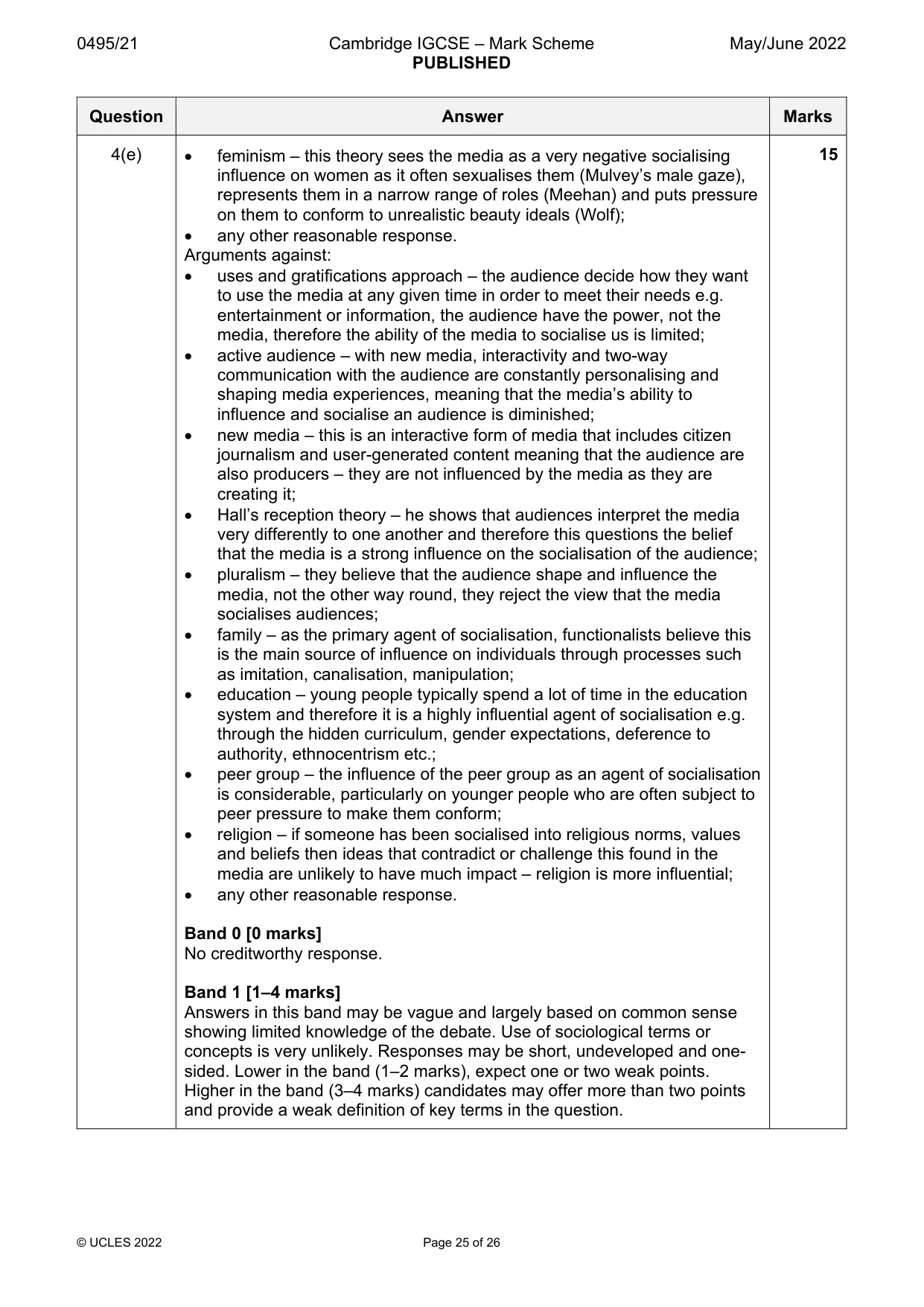
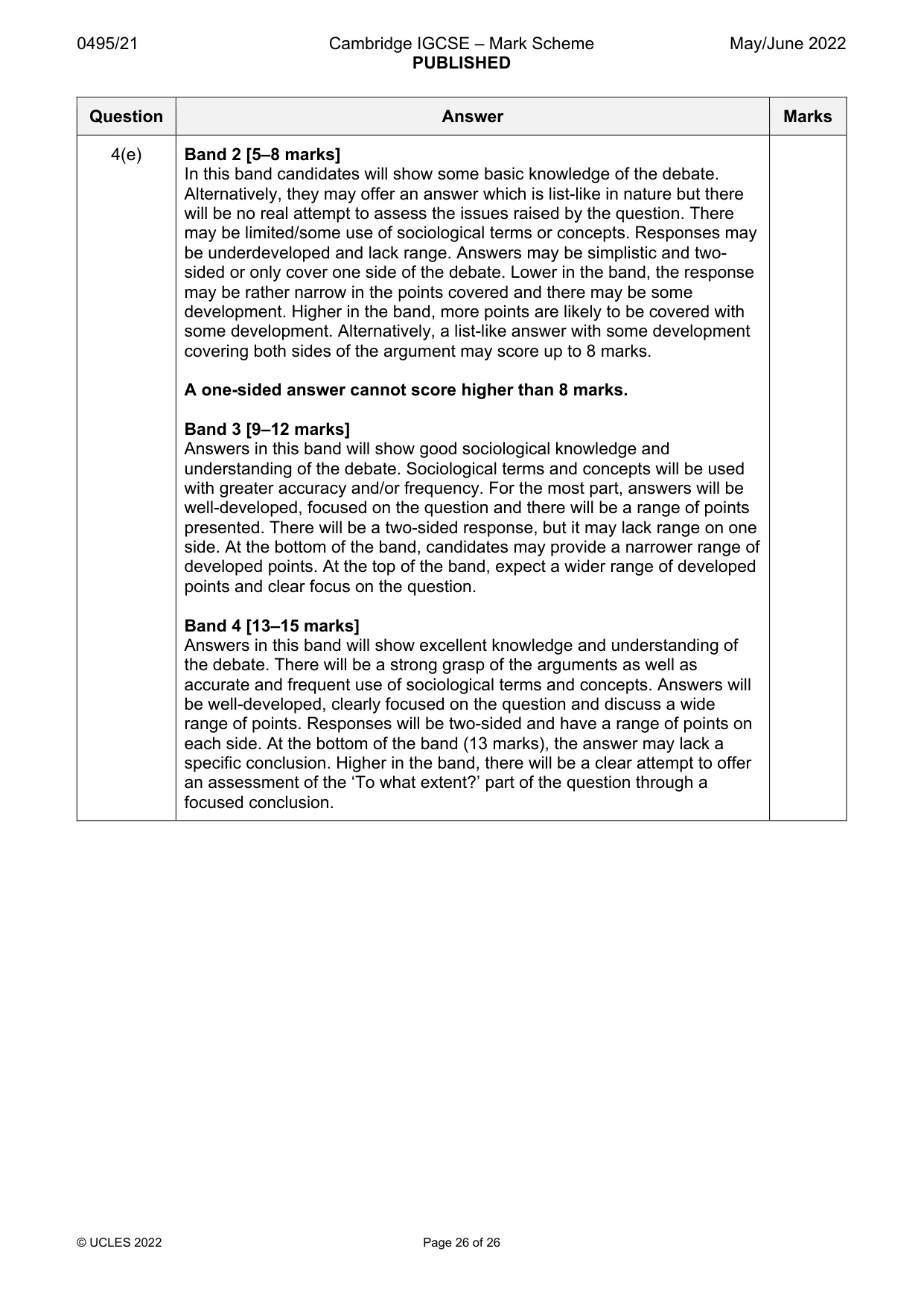
Mark scheme: 4(a) What is meant by the term ‘socialisation’? 2 One mark for a partial definition, e.g. the media is an agent of socialisationi Two marks for a clear definition, e.g. the process of learning the norms and values of a culture. 4(b) Describe two ways the media is global. 4 Possible answers: Western media – large media conglomerates operating on a worldwide scale are based in Western countries and spread a mainly Western culture e.g. sub-titled Hollywood films; production – media products are now typically made for a global audience and will therefore contain generic elements to appeal to a mass, global audience; non-Western media – this is now available to consume for global audiences e.g. Bollywood films; digital technology – the internet allows the media to be global as products can be distributed and consumed across the world and downloaded/streamed as necessary; global village – the idea that the world today is a smaller place due to the digital media’s ability to reach global audiences; unfolding news – news events can be watched live as they unfold anywhere across the world, aided by citizen journalism; social media – this allows for the sharing of information, communication, advertising etc. on a global scale; global communication – multiple platforms and devices available across the world allow people to keep in touch and interact on a global scale; any other reasonable response. One mark for each point correctly identified (up to maximum of two). One mark for each point that is developed (up to a maximum of two). 4(c) Explain how the media can affect audience voting patterns. 6 Possible answers: privately owned media –often take strong political positions and this can then be seen in their choice of stories, language used and the opinions expressed. This may then influence how the audience vote (bias); election campaigns – political parties make extensive use of the media to get their message across to voters by using billboards, manifestos, election broadcasts and interviews, all aimed at persuading the audience to vote for them; political image – the media can be very influential in how a politician is perceived by the audience as in many countries, e.g. USA, more media attention may be given to the personalities of the political leaders rather than the parties policies e.g. Trump vs Clinton; The Sun newspaper UK – claimed it can influence how people vote, e.g. in the UK 1992 general election the Labour Party was expected to win but The Sun backed the Conservatives who actually won; opinion polls – the media report the opinion polls which the audience interpret as showing what the election result is likely to be which may influence how the audience then choose to vote; new media – digital technology means that election campaigns can now go viral and their interactivity allows for audience members to ask questions of the politicians and to discuss policies and issues in forums which may influence voting – two step flow, opinion leaders; spin doctors – these are often employed by politicians/political parties to control the image of politicians in an attempt to influence how the public votes; any other reasonable response. Band 0 [0 marks] No creditworthy response. Band 1 [1–3 marks] Answers in this band will show only a limited awareness of the question. Responses may be short and un/underdeveloped. At the bottom of the band (1 mark), expect one weak point. Higher in the band (2–3 marks), candidates may offer more than one weak point, but there may be a tendency towards simplistic answers, engaging with sociological ideas without using sociological language. Band 2 [4–6 marks] Answers in this band will have clear and accurate explanation, showing good sociological knowledge and understanding. Sociological terms and concepts should be expected and explained. At the bottom of the band, the range of points covered may be narrow or lack detail. Higher in the band, answers will cover more than one point in a well-developed way or cover several points in less detail. 4(d) Explain why new media has more freedom than traditional media. 8 Possible answers: globalisation – communication via new media is now instant, meaning unfolding global events can be watched as they happen – new media is free to stream this, traditional media doesn’t have that freedom as logistically it is unlikely to have journalists in the right place; new media involves two-way communication, traditional media one-way – the distinction between consumer and producer in new media is no longer clear due to user-generated content and greater interactivity, giving all parties greater freedom; audience freedom – traditional media is limited to one media form with little choice, new media can be consumed on different devices and platforms, on-demand, offers portability, specialist etc.; print media – traditionally print media could only be word and image based, with new media it can include video links, audio, additional related content, social media links etc. = greater freedom; TV – traditional TV was made to appeal to a mass audience but with the advent of new media, TV can also narrowcast meaning niche, specialist content can be made because of a huge increase in channels for audiences to select from; citizen journalism – traditionally the news was made by media professionals, today with new media this is no longer the case as members of the public upload footage and commentaries for global events = more freedom; regulation – traditional media is subject to much regulation e.g. film and gaming certification, the 9 o’clock watershed on TV – new media is far harder to regulate and this means that the industry is relatively free to produce and distribute what it wants to; censorship – traditional media has often been accused of being heavily censored – sometimes for a war effort, sometimes for propaganda purposes, sometimes just as part of state control – this is far more difficult with new media as it is no longer a ‘top down’ industry, so giving it greater freedoms (postmodernism); any other reasonable response. Band 0 [0 marks] No creditworthy response. Band 1 [1–3 marks] Answers in this band will show only a limited awareness of the question. A tendency to description is likely. Responses may be short and undeveloped and points stated without explanation. Sociological terms and concepts are unlikely to be used. At the bottom of the band (1 mark), expect one weak point. Higher in the band (2–3 marks), candidates may offer more than one weak point. 4(d) Band 2 [4–6 marks] Answers in this band will show basic sociological knowledge and understanding. Responses may be underdeveloped and lacking in range. At the bottom of the band, candidates are unlikely to use sociological terms and concepts accurately. Higher in the band, candidates may be beginning to use sociological terms and concepts with greater accuracy. However, some aspects of the answer may only be partially developed/explained. Band 3 [7–8 marks] Answers in this band will show good sociological knowledge and understanding and will be well-developed and explained. Sociological terms and concepts will be used accurately overall. Answers will be well-focused on the question and there will be a range of points presented. At the top of the band explanations will be clear throughout. 4(e) To what extent is the media more influential than other agents of socialisation? Possible answers: Arguments for: hypodermic syringe model – the media has an immediate and direct effect upon the audience and is thus a strong source of influence over behaviour and attitudes; cultural effects approach – cumulatively, over time, the media influences opinions and beliefs as we see repeated images and messages as ‘normal’; violence and the media – research shows that violence in the media can influence individuals to be violent in society e.g. copycat killings, violent video games, etc. – it has socialised them; political socialisation – the media is thought to be very influential when it comes to influencing how someone votes e.g. political broadcasts; advertising – if the media did not have the power to influence people then why would the advertising industry be so willing to spend so much money making adverts? e.g. pester power; media role models – celebrities and stars in the media are thought to be a big source of influence for their fans e.g. in fashion, opinions, appearance, lifestyle, material possessions, brands etc.; cyberbullying – huge increases in online bullying, trolling and hate crimes indicate how powerful the media is in its ability to influence and socialise others; social media and influencers – research into young people has shown how influential social media now is in terms of audience reach, communication, social networking, dating, opinion forming etc.; postmodernism – this theory comments on the widespread and easy access to the media today – we live in a media saturated 24/7 media culture therefore it is difficult to see how it is not influential in terms of socialisation; Marxism – this theory sees the media as a tool of the ruling class used to disseminate the dominant ideology and reinforce and socialise people into capitalist norms and values; 4(e) feminism – this theory sees the media as a very negative socialising 15 influence on women as it often sexualises them (Mulvey’s male gaze), represents them in a narrow range of roles (Meehan) and puts pressure on them to conform to unrealistic beauty ideals (Wolf); any other reasonable response. Arguments against: uses and gratifications approach – the audience decide how they want to use the media at any given time in order to meet their needs e.g. entertainment or information, the audience have the power, not the media, therefore the ability of the media to socialise us is limited; active audience – with new media, interactivity and two-way communication with the audience are constantly personalising and shaping media experiences, meaning that the media’s ability to influence and socialise an audience is diminished; new media – this is an interactive form of media that includes citizen journalism and user-generated content meaning that the audience are also producers – they are not influenced by the media as they are creating it; Hall’s reception theory – he shows that audiences interpret the media very differently to one another and therefore this questions the belief that the media is a strong influence on the socialisation of the audience; pluralism – they believe that the audience shape and influence the media, not the other way round, they reject the view that the media socialises audiences; family – as the primary agent of socialisation, functionalists believe this is the main source of influence on individuals through processes such as imitation, canalisation, manipulation; education – young people typically spend a lot of time in the education system and therefore it is a highly influential agent of socialisation e.g. through the hidden curriculum, gender expectations, deference to authority, ethnocentrism etc.; peer group – the influence of the peer group as an agent of socialisation is considerable, particularly on younger people who are often subject to peer pressure to make them conform; religion – if someone has been socialised into religious norms, values and beliefs then ideas that contradict or challenge this found in the media are unlikely to have much impact – religion is more influential; any other reasonable response. Band 0 [0 marks] No creditworthy response. Band 1 [1–4 marks] Answers in this band may be vague and largely based on common sense showing limited knowledge of the debate. Use of sociological terms or concepts is very unlikely. Responses may be short, undeveloped and one- sided. Lower in the band (1–2 marks), expect one or two weak points. Higher in the band (3–4 marks) candidates may offer more than two points and provide a weak definition of key terms in the question. 4(e) Band 2 [5–8 marks] In this band candidates will show some basic knowledge of the debate. Alternatively, they may offer an answer which is list-like in nature but there will be no real attempt to assess the issues raised by the question. There may be limited/some use of sociological terms or concepts. Responses may be underdeveloped and lack range. Answers may be simplistic and two- sided or only cover one side of the debate. Lower in the band, the response may be rather narrow in the points covered and there may be some development. Higher in the band, more points are likely to be covered with some development. Alternatively, a list-like answer with some development covering both sides of the argument may score up to 8 marks. A one-sided answer cannot score higher than 8 marks. Band 3 [9–12 marks] Answers in this band will show good sociological knowledge and understanding of the debate. Sociological terms and concepts will be used with greater accuracy and/or frequency. For the most part, answers will be well-developed, focused on the question and there will be a range of points presented. There will be a two-sided response, but it may lack range on one side. At the bottom of the band, candidates may provide a narrower range of developed points. At the top of the band, expect a wider range of developed points and clear focus on the question. Band 4 [13–15 marks] Answers in this band will show excellent knowledge and understanding of the debate. There will be a strong grasp of the arguments as well as accurate and frequent use of sociological terms and concepts. Answers will be well-developed, clearly focused on the question and discuss a wide range of points. Responses will be two-sided and have a range of points on each side. At the bottom of the band (13 marks), the answer may lack a specific conclusion. Higher in the band, there will be a clear attempt to offer an assessment of the ‘To what extent?’ part of the question through a focused conclusion.
What was in this paper
The subtopics covered by these 4 questions, and how many questions each got. Open one in a new tab to see every Cambridge question on it.
What you needed in this session
Cambridge’s own grade thresholds for 2022 May/June, Paper 2 · Variant 1. A higher threshold means an easier paper — the bar moves with how the cohort did.