Cambridge IGCSE Sociology 0495 — 2024 May/June Paper 2 · Variant 1
0495/21/M/J/24 · 4 questions · 70 marks · ≈79 min
The question paper and its mark scheme, free to read here and free to download. This is Cambridge’s own paper, exactly as it was sat.
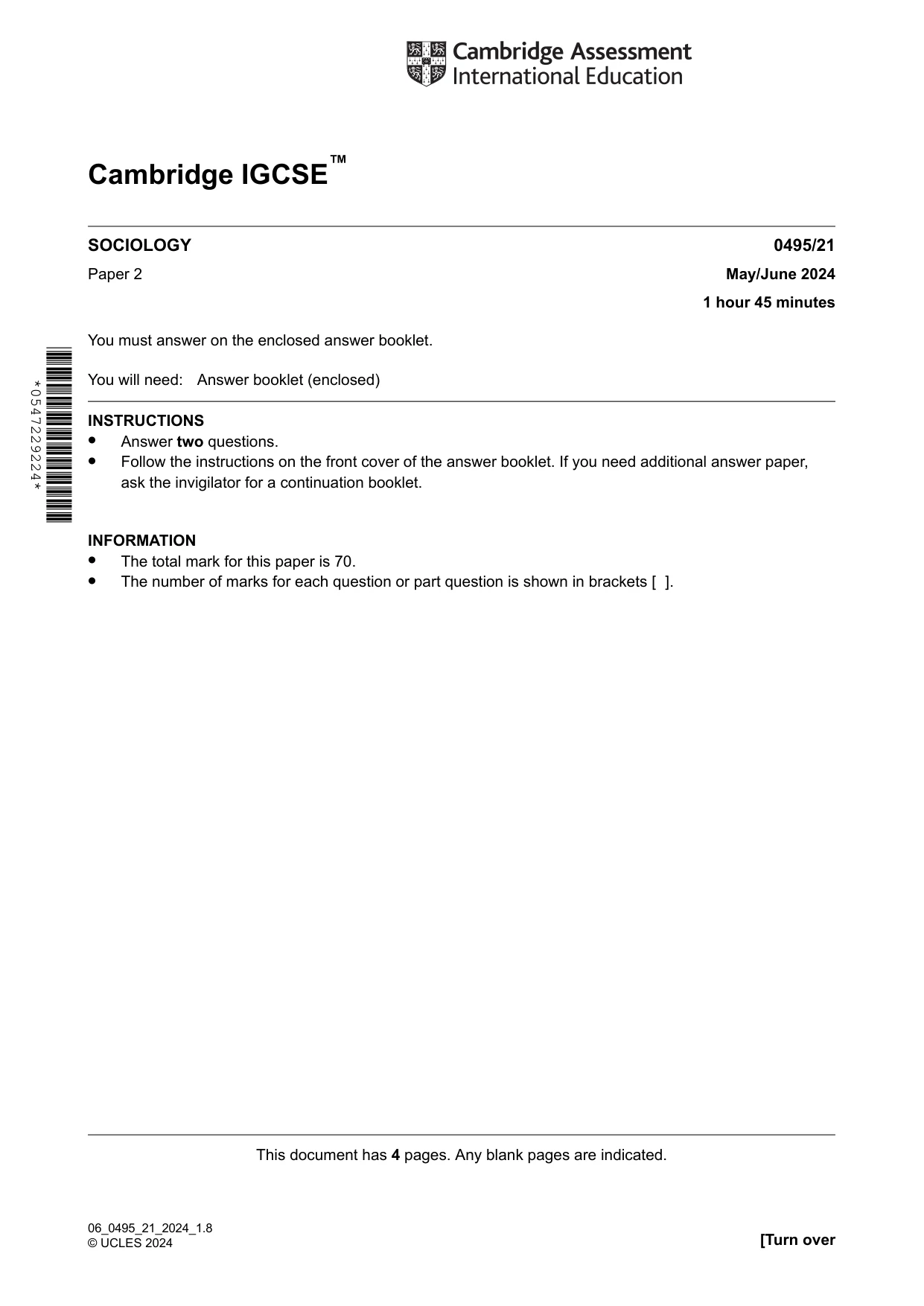
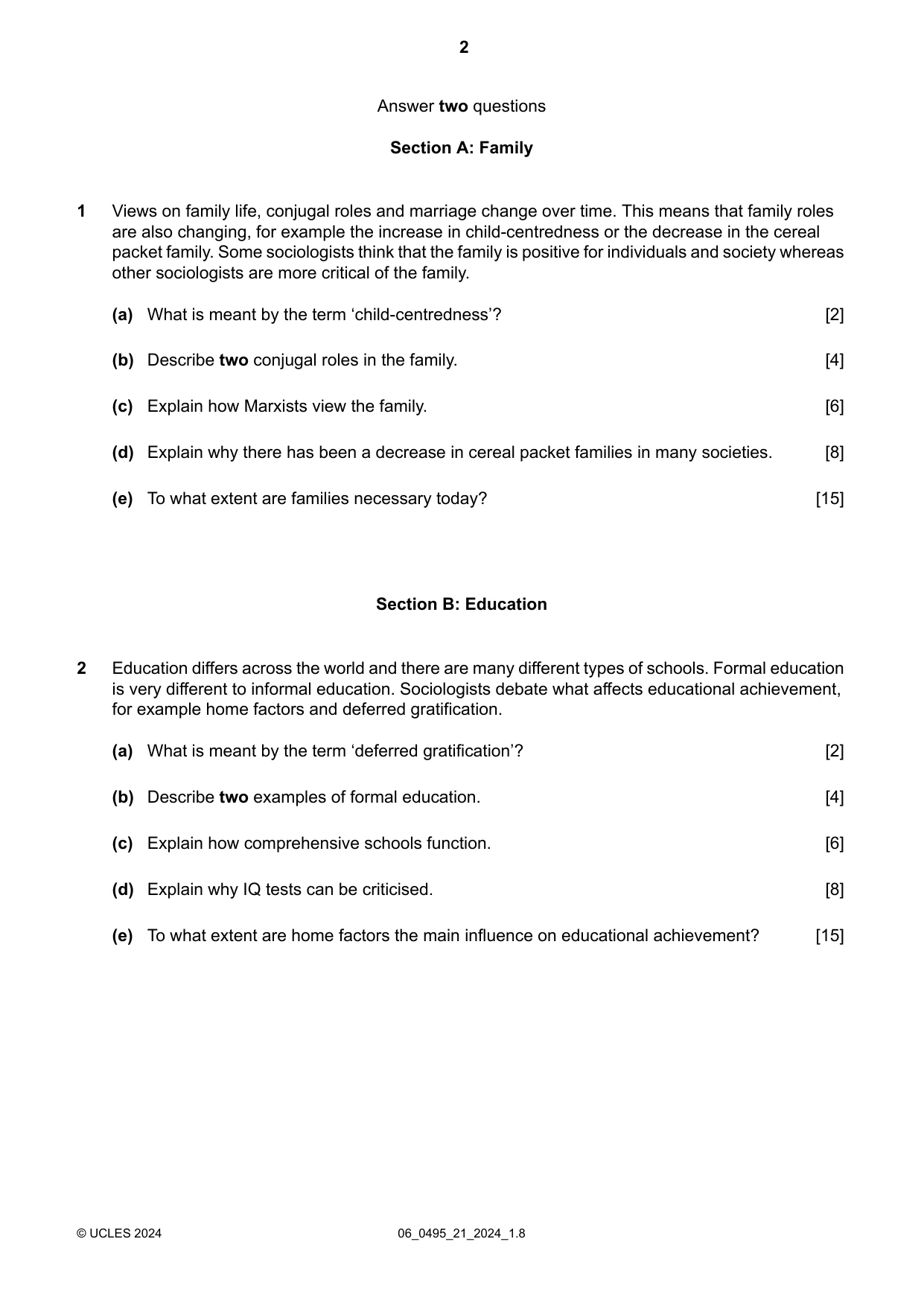
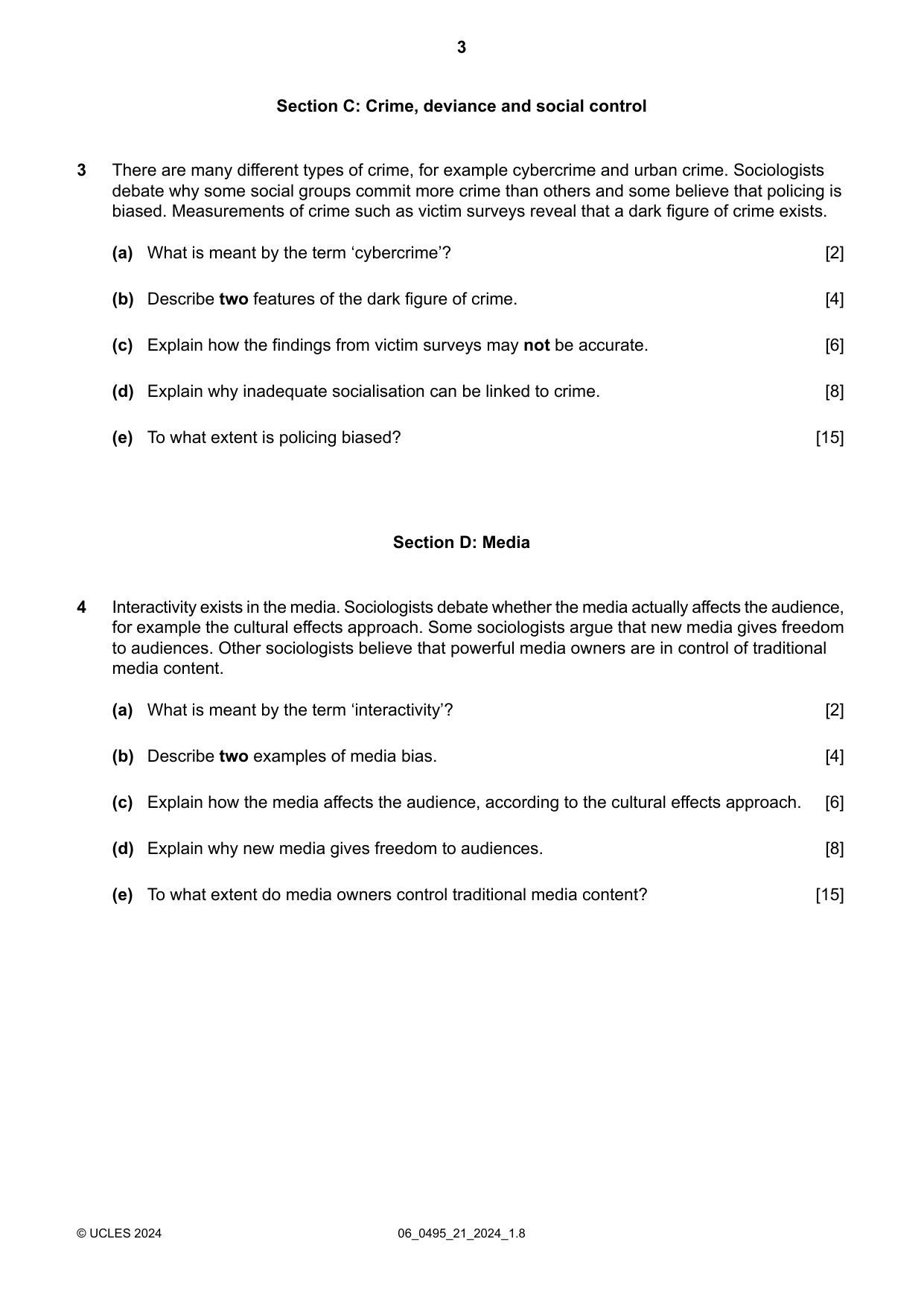
Question paper4 pages

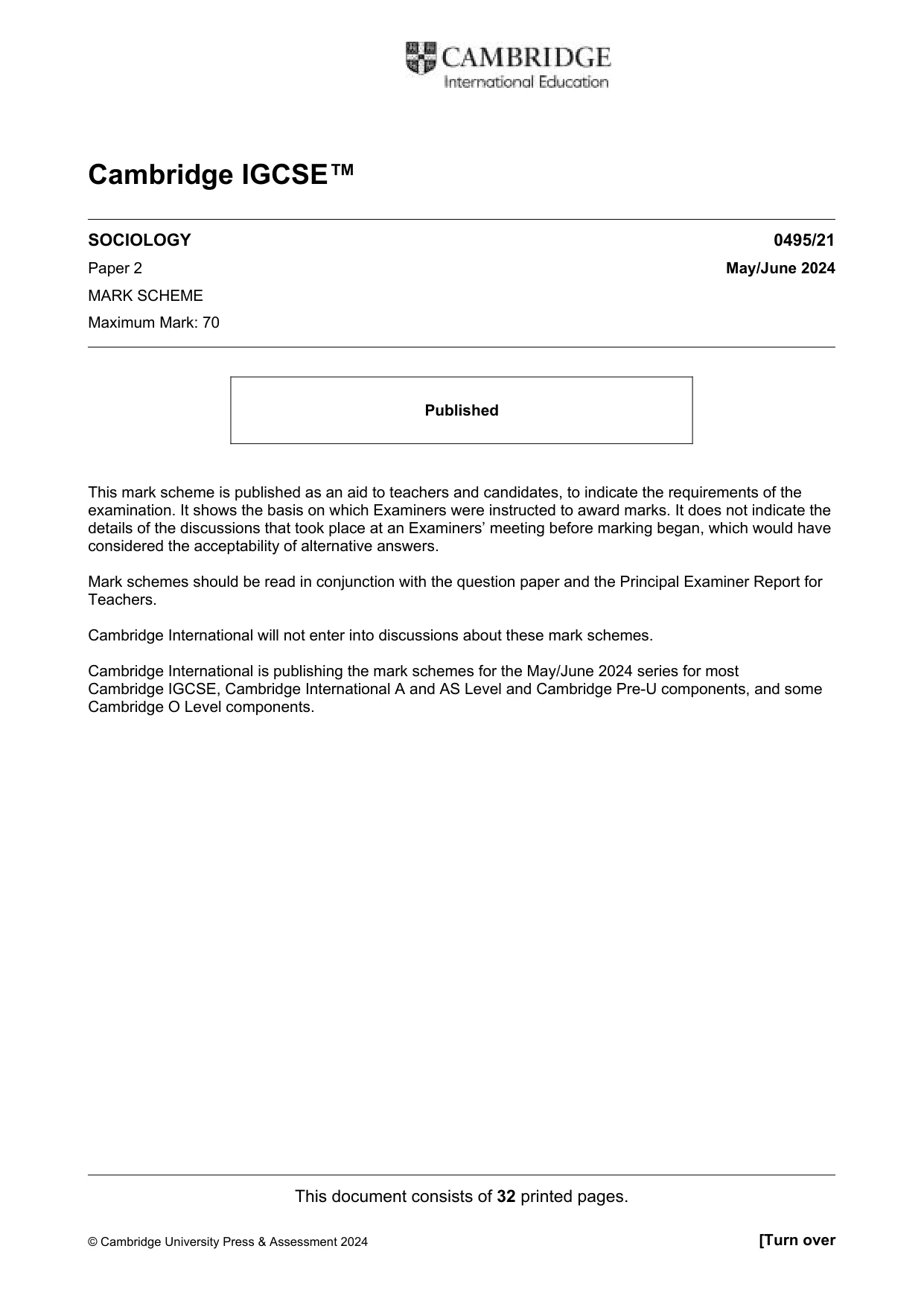
Mark scheme32 pages
Answers below. Sit the paper first if you are practising.


Questions as text
Q1 · Views on family life, conjugal roles and marriage change over time
1 Views on family life, conjugal roles and marriage change over time. This means that family roles are also changing, for example the increase in child-centredness or the decrease in the cereal packet family. Some sociologists think that the family is positive for individuals and society whereas other sociologists are more critical of the family. (a) What is meant by the term ‘child-centredness’? [2] (b) Describe two conjugal roles in the family. [4] (c) Explain how Marxists view the family. [6] (d) Explain why there has been a decrease in cereal packet families in many societies. [8] (e) To what extent are families necessary today? [15]
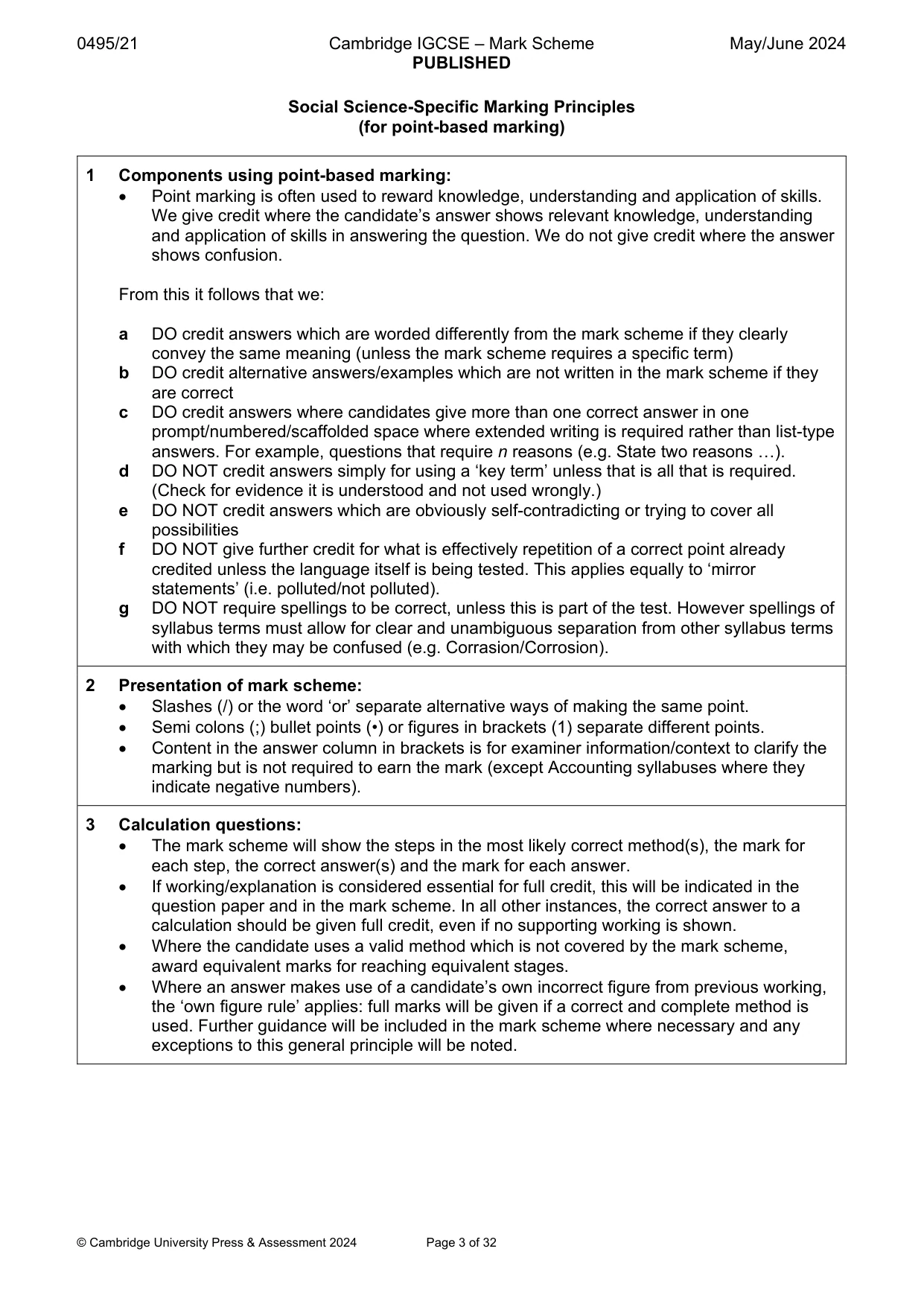
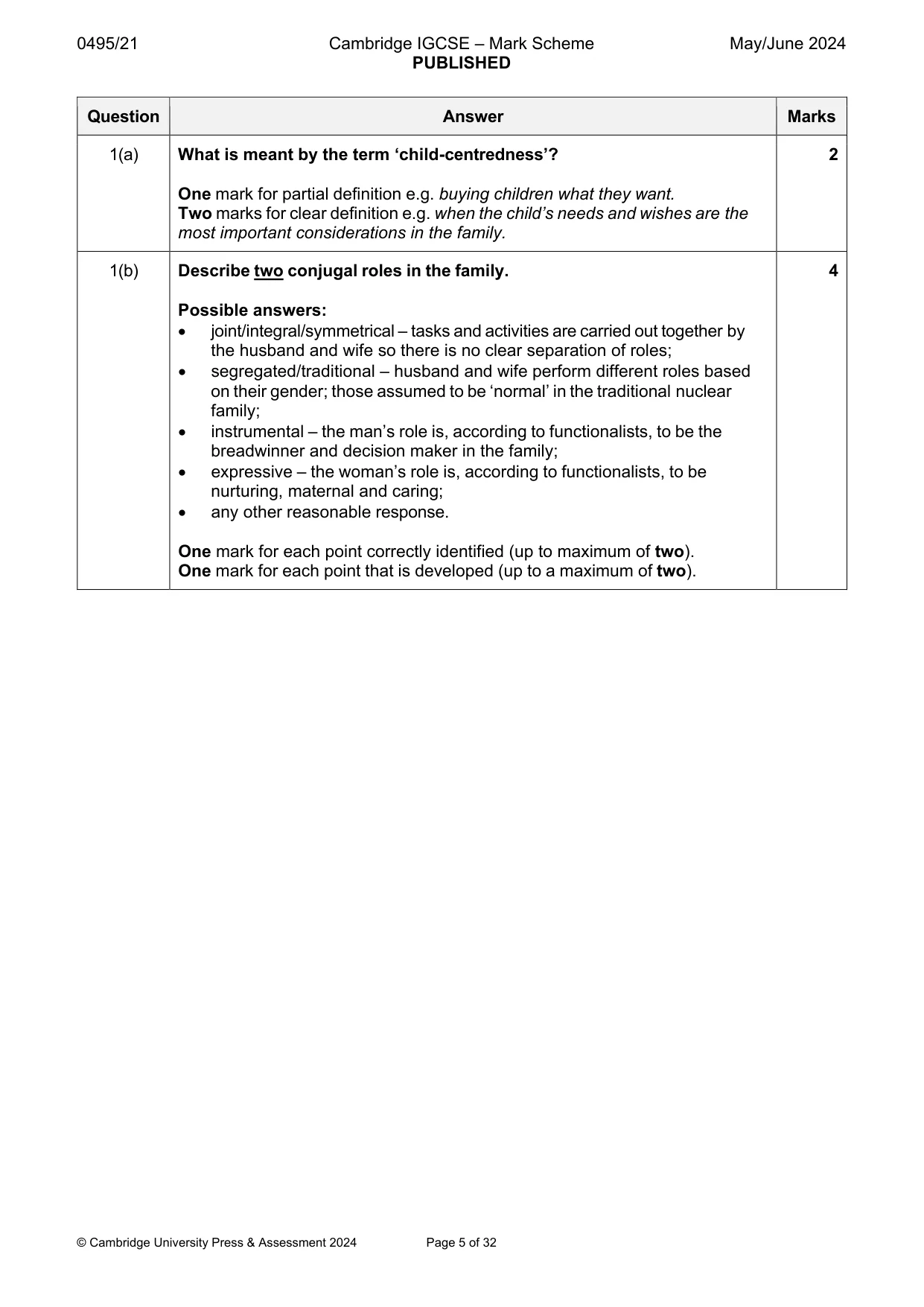
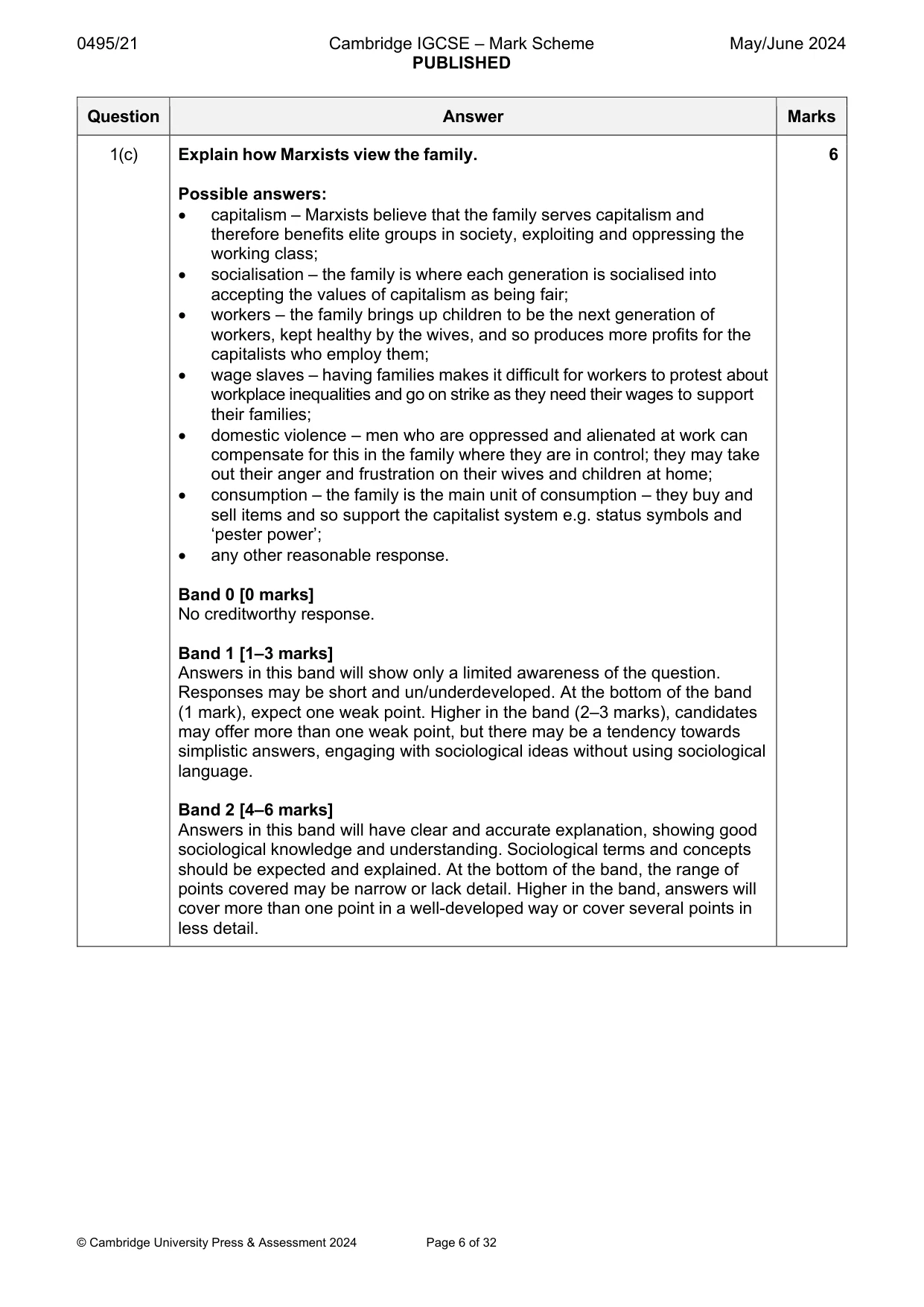
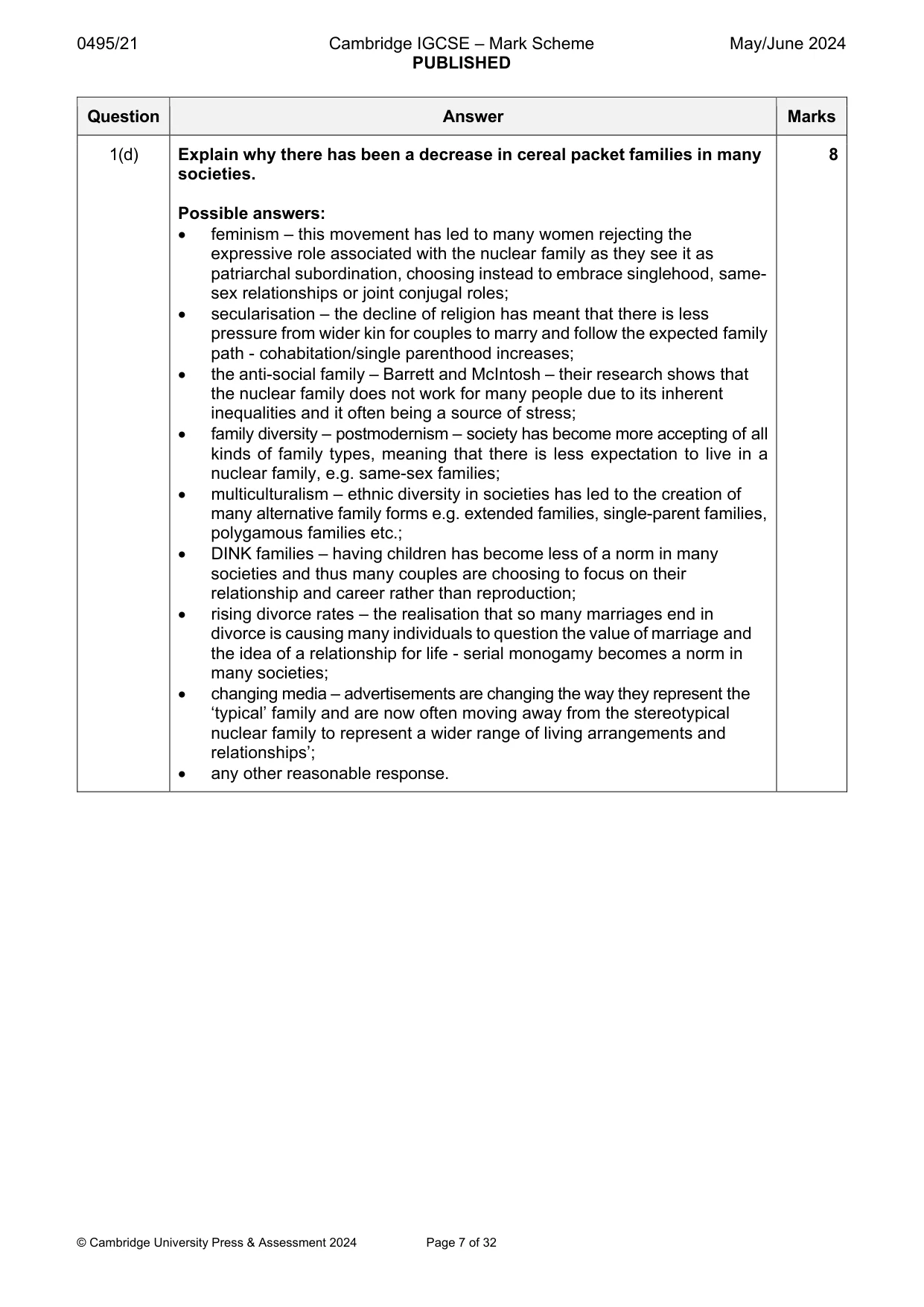
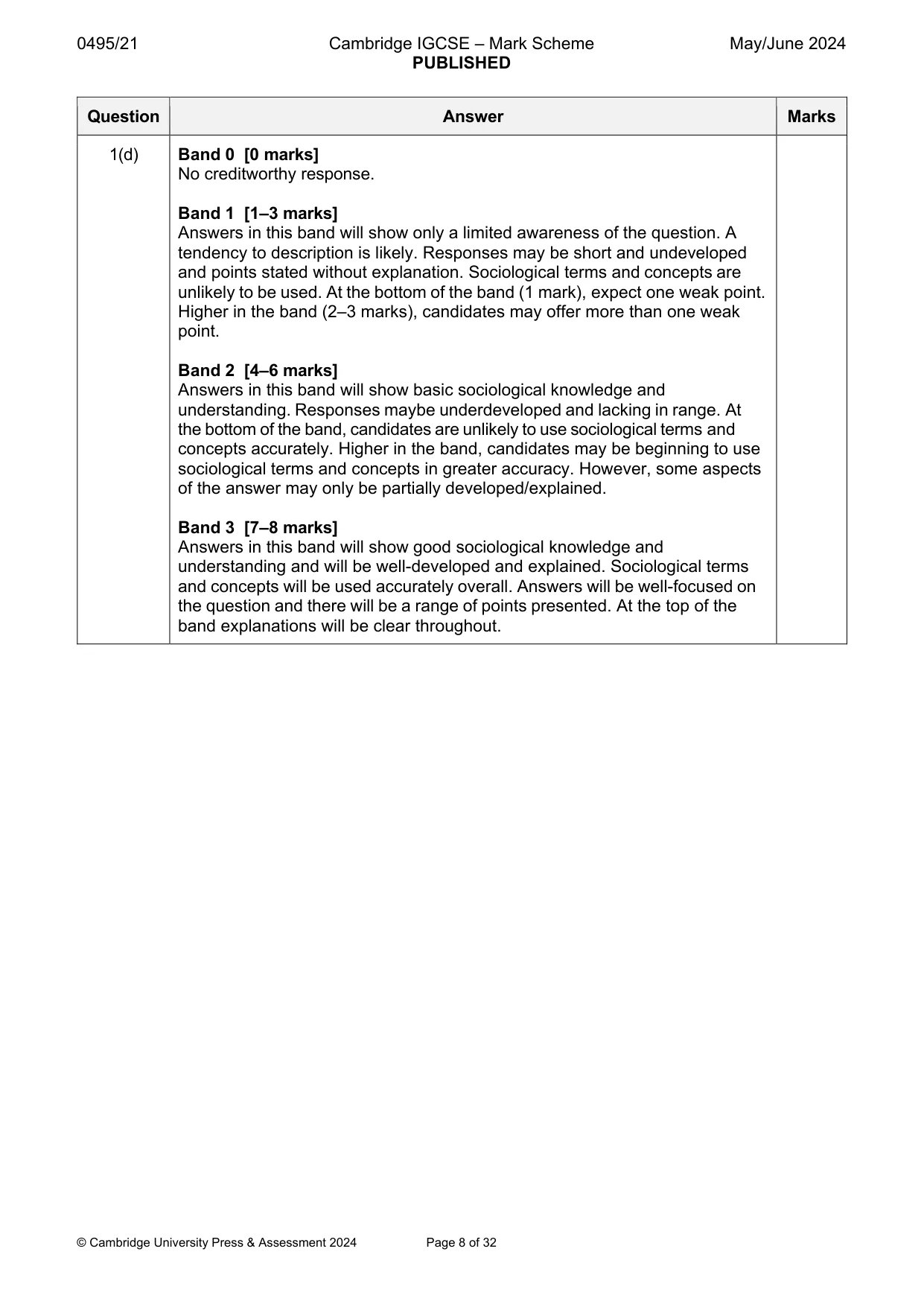
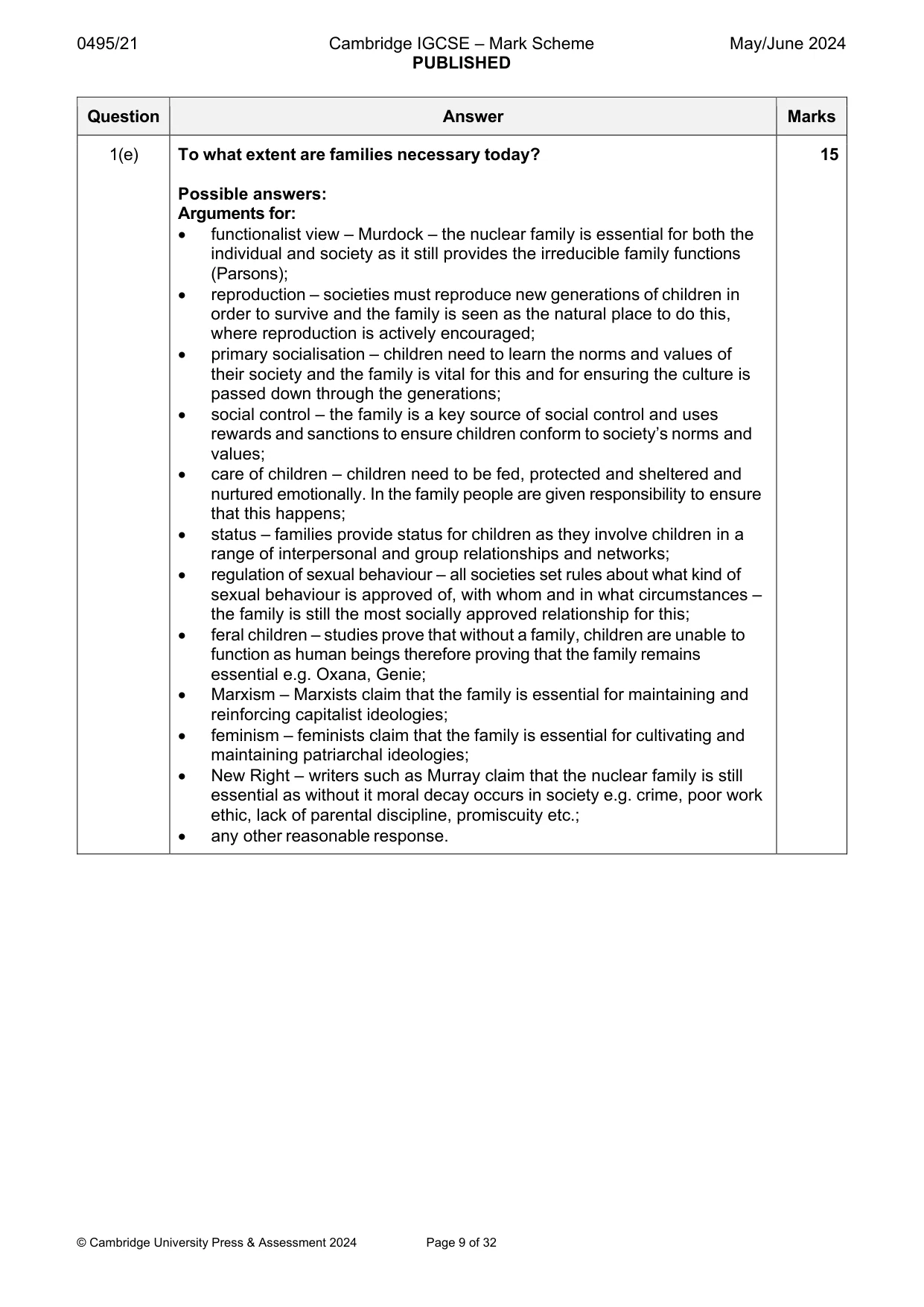
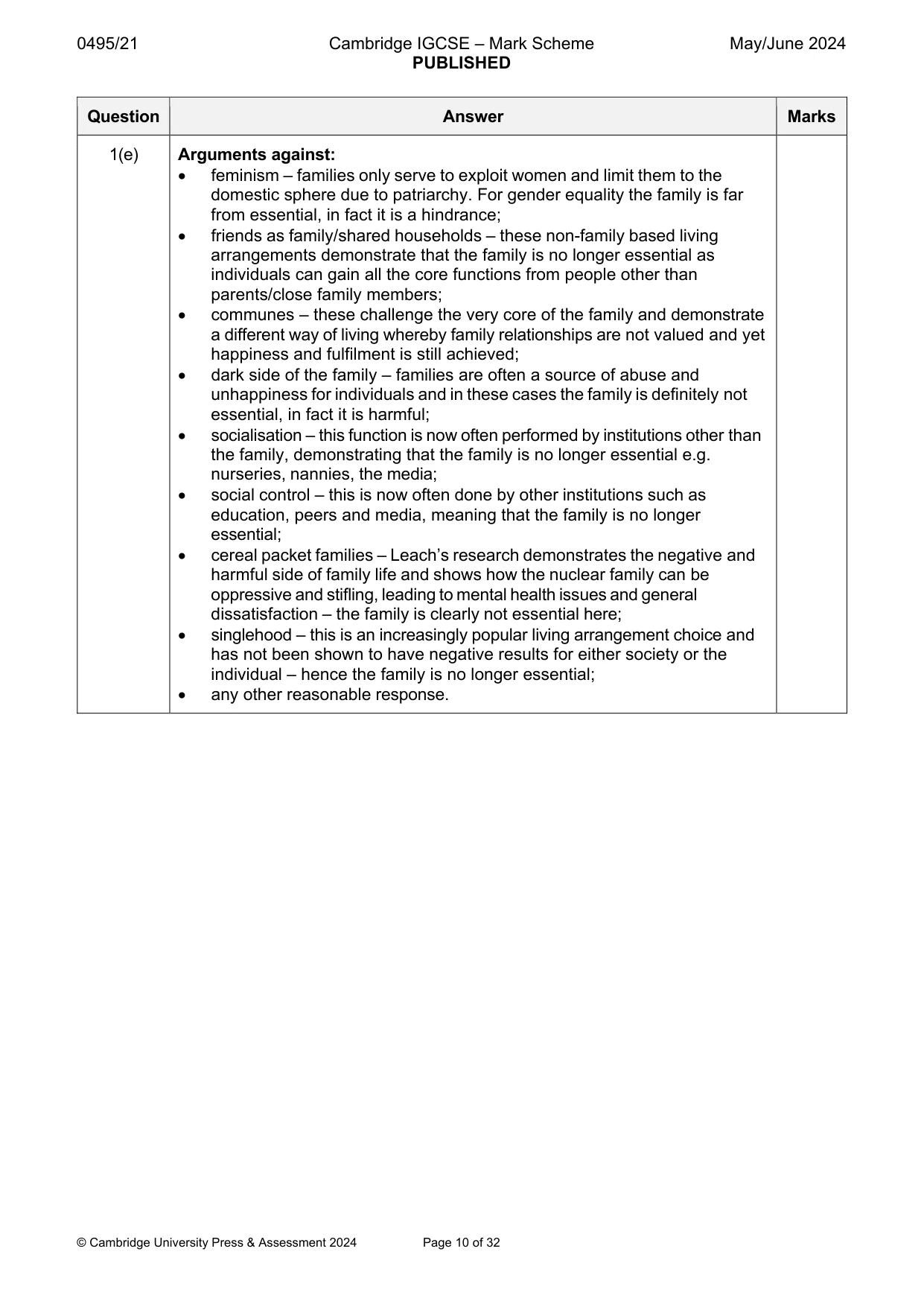
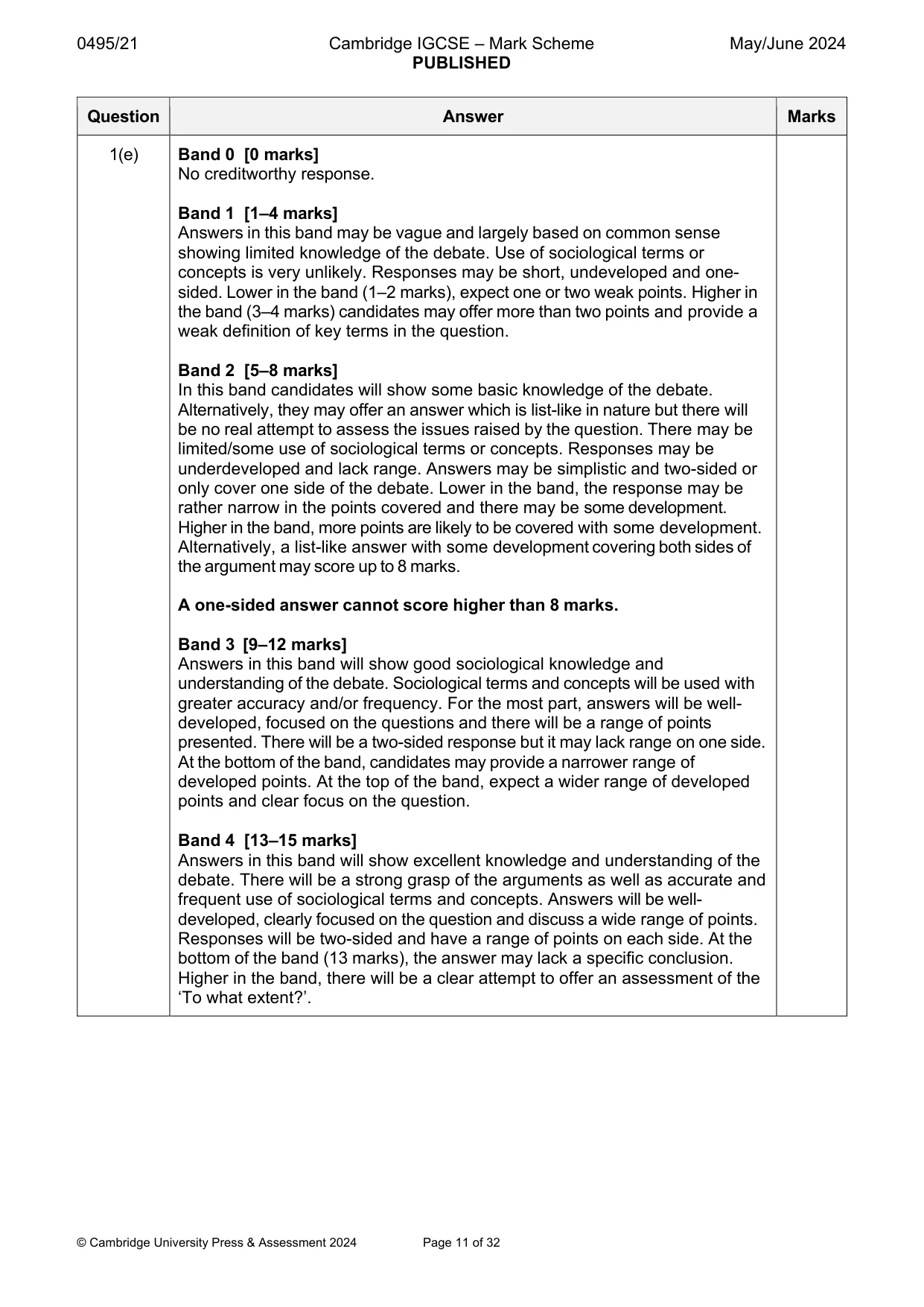
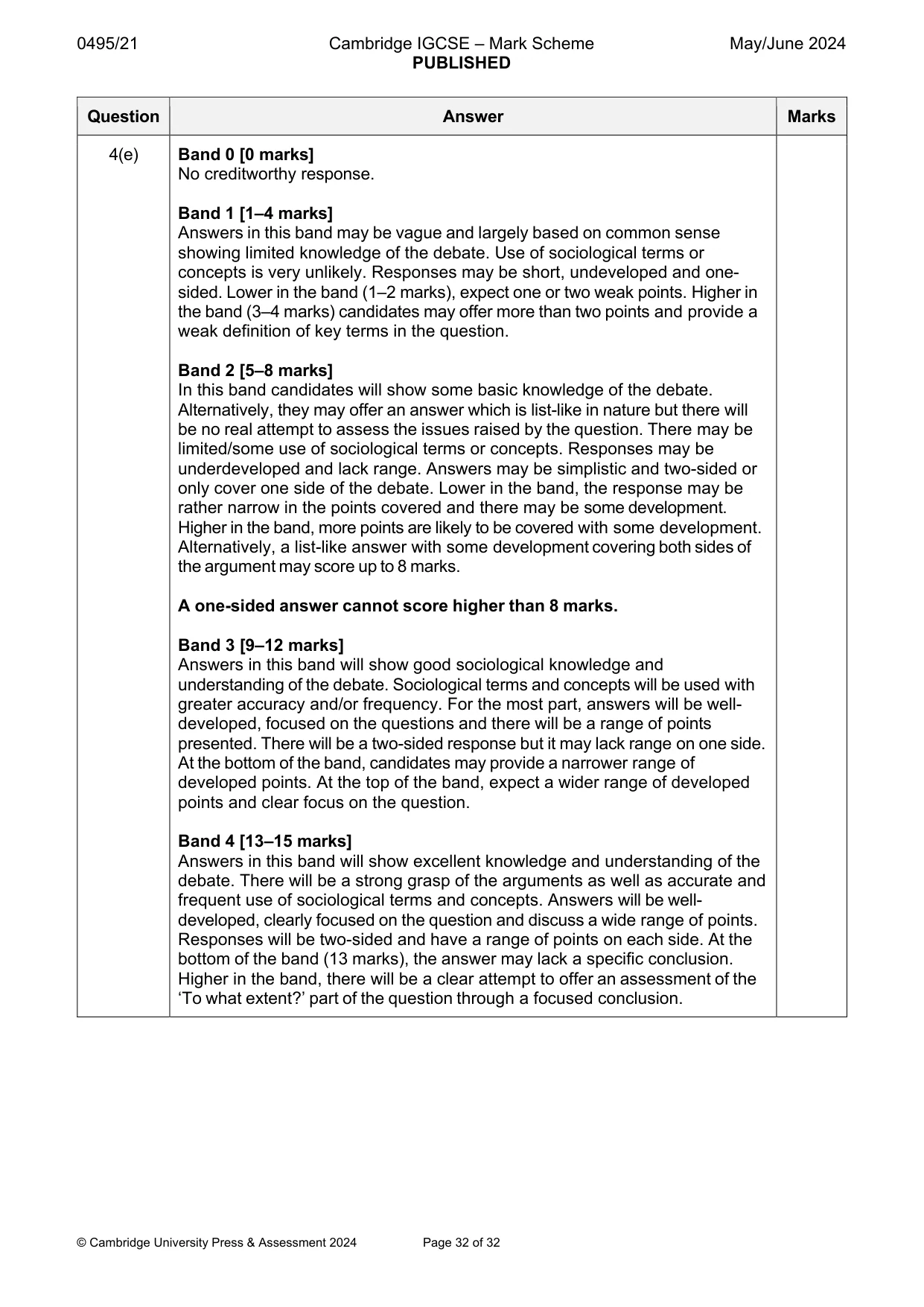
Mark scheme: Question Answer Marks 1(a) What is meant by the term ‘child-centredness’? 2 One mark for partial definition e.g. buying children what they want. Two marks for clear definition e.g. when the child’s needs and wishes are the most important considerations in the family. 1(b) Describe two conjugal roles in the family. 4 Possible answers: joint/integral/symmetrical – tasks and activities are carried out together by the husband and wife so there is no clear separation of roles; segregated/traditional – husband and wife perform different roles based on their gender; those assumed to be ‘normal’ in the traditional nuclear family; instrumental – the man’s role is, according to functionalists, to be the breadwinner and decision maker in the family; expressive – the woman’s role is, according to functionalists, to be nurturing, maternal and caring; any other reasonable response. One mark for each point correctly identified (up to maximum of two). One mark for each point that is developed (up to a maximum of two). 1(c) Explain how Marxists view the family. 6 Possible answers: capitalism – Marxists believe that the family serves capitalism and therefore benefits elite groups in society, exploiting and oppressing the working class; socialisation – the family is where each generation is socialised into accepting the values of capitalism as being fair; workers – the family brings up children to be the next generation of workers, kept healthy by the wives, and so produces more profits for the capitalists who employ them; wage slaves – having families makes it difficult for workers to protest about workplace inequalities and go on strike as they need their wages to support their families; domestic violence – men who are oppressed and alienated at work can compensate for this in the family where they are in control; they may take out their anger and frustration on their wives and children at home; consumption – the family is the main unit of consumption – they buy and sell items and so support the capitalist system e.g. status symbols and ‘pester power’; any other reasonable response. Band 0 [0 marks] No creditworthy response. Band 1 [1–3 marks] Answers in this band will show only a limited awareness of the question. Responses may be short and un/underdeveloped. At the bottom of the band (1 mark), expect one weak point. Higher in the band (2–3 marks), candidates may offer more than one weak point, but there may be a tendency towards simplistic answers, engaging with sociological ideas without using sociological language. Band 2 [4–6 marks] Answers in this band will have clear and accurate explanation, showing good sociological knowledge and understanding. Sociological terms and concepts should be expected and explained. At the bottom of the band, the range of points covered may be narrow or lack detail. Higher in the band, answers will cover more than one point in a well-developed way or cover several points in less detail. 1(d) Explain why there has been a decrease in cereal packet families in many 8 societies. Possible answers: feminism – this movement has led to many women rejecting the expressive role associated with the nuclear family as they see it as patriarchal subordination, choosing instead to embrace singlehood, same- sex relationships or joint conjugal roles; secularisation – the decline of religion has meant that there is less pressure from wider kin for couples to marry and follow the expected family path - cohabitation/single parenthood increases; the anti-social family – Barrett and McIntosh – their research shows that the nuclear family does not work for many people due to its inherent inequalities and it often being a source of stress; family diversity – postmodernism – society has become more accepting of all kinds of family types, meaning that there is less expectation to live in a nuclear family, e.g. same-sex families; multiculturalism – ethnic diversity in societies has led to the creation of many alternative family forms e.g. extended families, single-parent families, polygamous families etc.; DINK families – having children has become less of a norm in many societies and thus many couples are choosing to focus on their relationship and career rather than reproduction; rising divorce rates – the realisation that so many marriages end in divorce is causing many individuals to question the value of marriage and the idea of a relationship for life - serial monogamy becomes a norm in many societies; changing media – advertisements are changing the way they represent the ‘typical’ family and are now often moving away from the stereotypical nuclear family to represent a wider range of living arrangements and relationships’; any other reasonable response. 1(d) Band 0 [0 marks] No creditworthy response. Band 1 [1–3 marks] Answers in this band will show only a limited awareness of the question. A tendency to description is likely. Responses may be short and undeveloped and points stated without explanation. Sociological terms and concepts are unlikely to be used. At the bottom of the band (1 mark), expect one weak point. Higher in the band (2–3 marks), candidates may offer more than one weak point. Band 2 [4–6 marks] Answers in this band will show basic sociological knowledge and understanding. Responses maybe underdeveloped and lacking in range. At the bottom of the band, candidates are unlikely to use sociological terms and concepts accurately. Higher in the band, candidates may be beginning to use sociological terms and concepts in greater accuracy. However, some aspects of the answer may only be partially developed/explained. Band 3 [7–8 marks] Answers in this band will show good sociological knowledge and understanding and will be well-developed and explained. Sociological terms and concepts will be used accurately overall. Answers will be well-focused on the question and there will be a range of points presented. At the top of the band explanations will be clear throughout. 1(e) To what extent are families necessary today? 15 Possible answers: Arguments for: functionalist view – Murdock – the nuclear family is essential for both the individual and society as it still provides the irreducible family functions (Parsons); reproduction – societies must reproduce new generations of children in order to survive and the family is seen as the natural place to do this, where reproduction is actively encouraged; primary socialisation – children need to learn the norms and values of their society and the family is vital for this and for ensuring the culture is passed down through the generations; social control – the family is a key source of social control and uses rewards and sanctions to ensure children conform to society’s norms and values; care of children – children need to be fed, protected and sheltered and nurtured emotionally. In the family people are given responsibility to ensure that this happens; status – families provide status for children as they involve children in a range of interpersonal and group relationships and networks; regulation of sexual behaviour – all societies set rules about what kind of sexual behaviour is approved of, with whom and in what circumstances – the family is still the most socially approved relationship for this; feral children – studies prove that without a family, children are unable to function as human beings therefore proving that the family remains essential e.g. Oxana, Genie; Marxism – Marxists claim that the family is essential for maintaining and reinforcing capitalist ideologies; feminism – feminists claim that the family is essential for cultivating and maintaining patriarchal ideologies; New Right – writers such as Murray claim that the nuclear family is still essential as without it moral decay occurs in society e.g. crime, poor work ethic, lack of parental discipline, promiscuity etc.; any other reasonable response. 1(e) Arguments against: feminism – families only serve to exploit women and limit them to the domestic sphere due to patriarchy. For gender equality the family is far from essential, in fact it is a hindrance; friends as family/shared households – these non-family based living arrangements demonstrate that the family is no longer essential as individuals can gain all the core functions from people other than parents/close family members; communes – these challenge the very core of the family and demonstrate a different way of living whereby family relationships are not valued and yet happiness and fulfilment is still achieved; dark side of the family – families are often a source of abuse and unhappiness for individuals and in these cases the family is definitely not essential, in fact it is harmful; socialisation – this function is now often performed by institutions other than the family, demonstrating that the family is no longer essential e.g. nurseries, nannies, the media; social control – this is now often done by other institutions such as education, peers and media, meaning that the family is no longer essential; cereal packet families – Leach’s research demonstrates the negative and harmful side of family life and shows how the nuclear family can be oppressive and stifling, leading to mental health issues and general dissatisfaction – the family is clearly not essential here; singlehood – this is an increasingly popular living arrangement choice and has not been shown to have negative results for either society or the individual – hence the family is no longer essential; any other reasonable response. 1(e) Band 0 [0 marks] No creditworthy response. Band 1 [1–4 marks] Answers in this band may be vague and largely based on common sense showing limited knowledge of the debate. Use of sociological terms or concepts is very unlikely. Responses may be short, undeveloped and one- sided. Lower in the band (1–2 marks), expect one or two weak points. Higher in the band (3–4 marks) candidates may offer more than two points and provide a weak definition of key terms in the question. Band 2 [5–8 marks] In this band candidates will show some basic knowledge of the debate. Alternatively, they may offer an answer which is list-like in nature but there will be no real attempt to assess the issues raised by the question. There may be limited/some use of sociological terms or concepts. Responses may be underdeveloped and lack range. Answers may be simplistic and two-sided or only cover one side of the debate. Lower in the band, the response may be rather narrow in the points covered and there may be some development. Higher in the band, more points are likely to be covered with some development. Alternatively, a list-like answer with some development covering both sides of the argument may score up to 8 marks. A one-sided answer cannot score higher than 8 marks. Band 3 [9–12 marks] Answers in this band will show good sociological knowledge and understanding of the debate. Sociological terms and concepts will be used with greater accuracy and/or frequency. For the most part, answers will be well- developed, focused on the questions and there will be a range of points presented. There will be a two-sided response but it may lack range on one side. At the bottom of the band, candidates may provide a narrower range of developed points. At the top of the band, expect a wider range of developed points and clear focus on the question. Band 4 [13–15 marks] Answers in this band will show excellent knowledge and understanding of the debate. There will be a strong grasp of the arguments as well as accurate and frequent use of sociological terms and concepts. Answers will be well- developed, clearly focused on the question and discuss a wide range of points. Responses will be two-sided and have a range of points on each side. At the bottom of the band (13 marks), the answer may lack a specific conclusion. Higher in the band, there will be a clear attempt to offer an assessment of the ‘To what extent?’.
More questions on How do sociologists approach the study of society?
Q2 · Education differs across the world and there are many different types of schools
2 Education differs across the world and there are many different types of schools. Formal education is very different to informal education. Sociologists debate what affects educational achievement, for example home factors and deferred gratification. (a) What is meant by the term ‘deferred gratification’? [2] (b) Describe two examples of formal education. [4] (c) Explain how comprehensive schools function. [6] (d) Explain why IQ tests can be criticised. [8] (e) To what extent are home factors the main influence on educational achievement? [15] Section C: Crime, deviance and social control
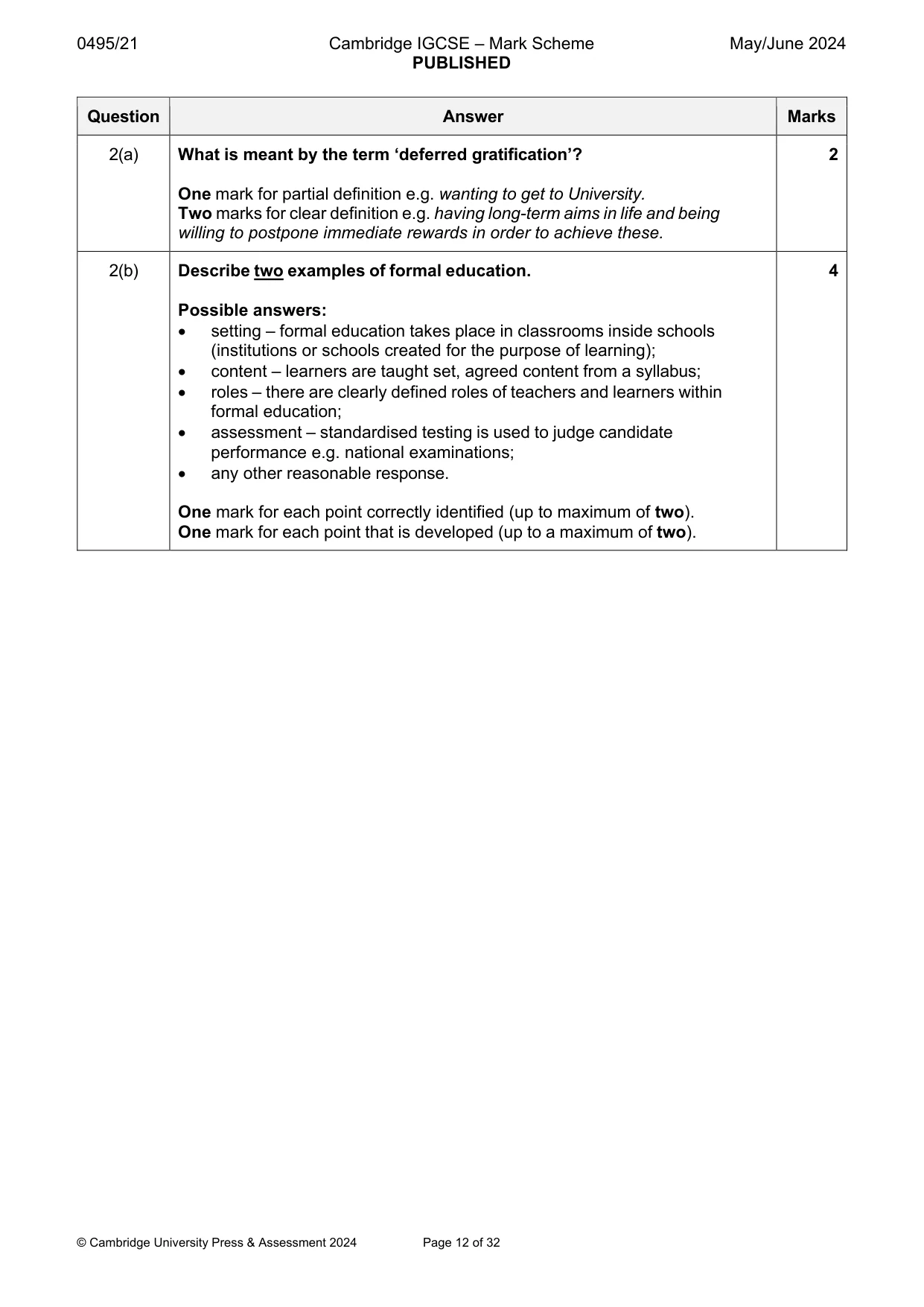
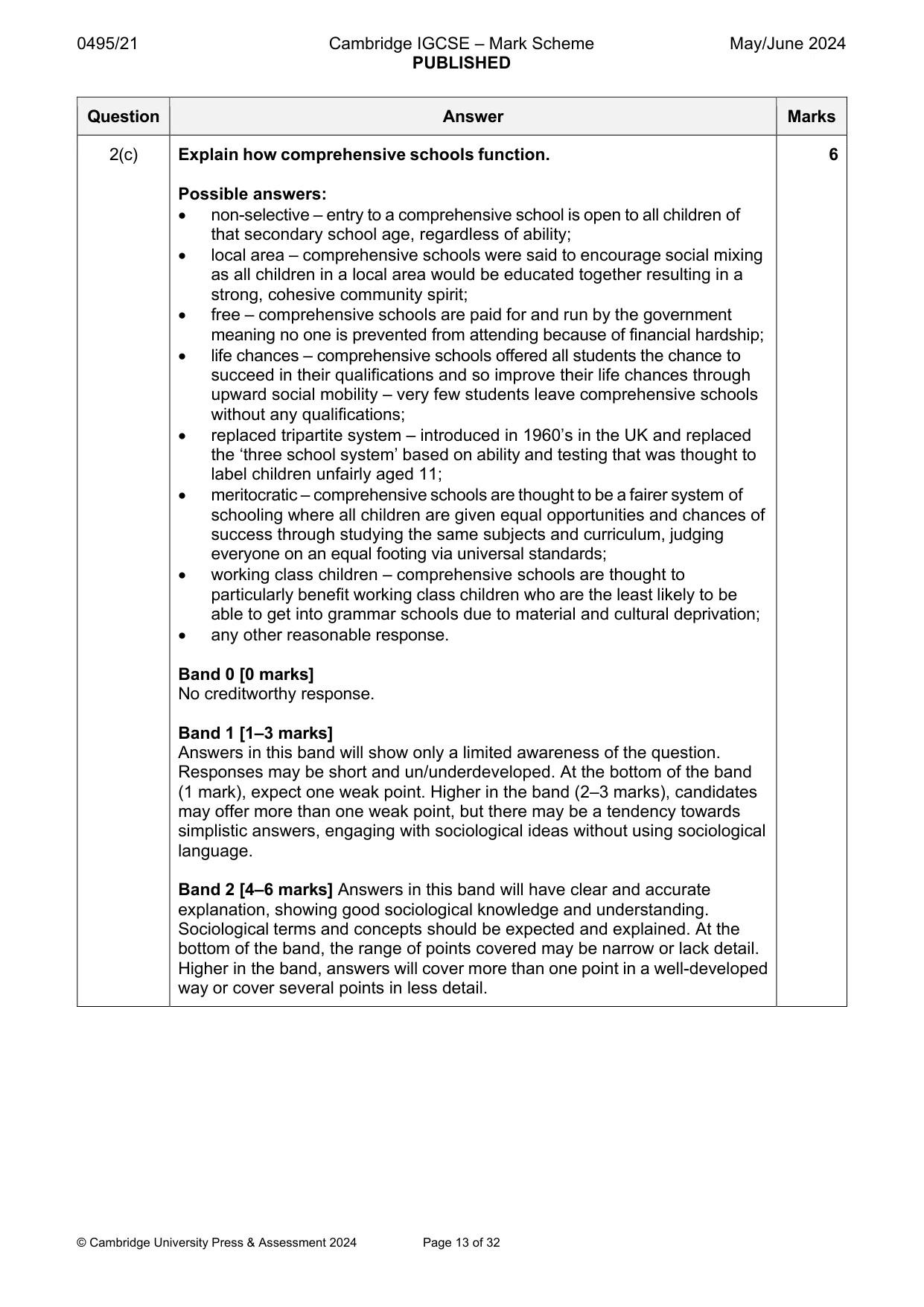
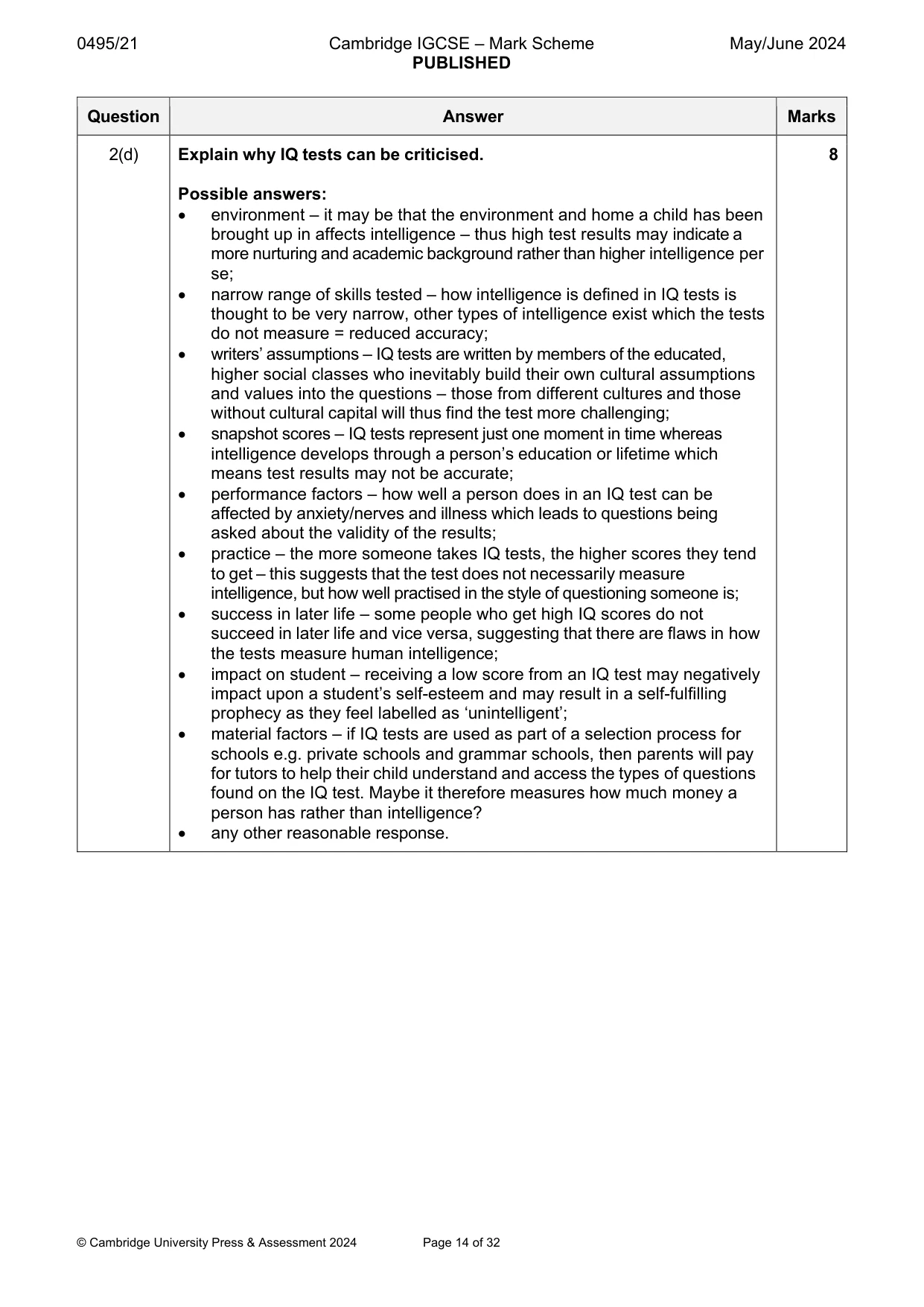
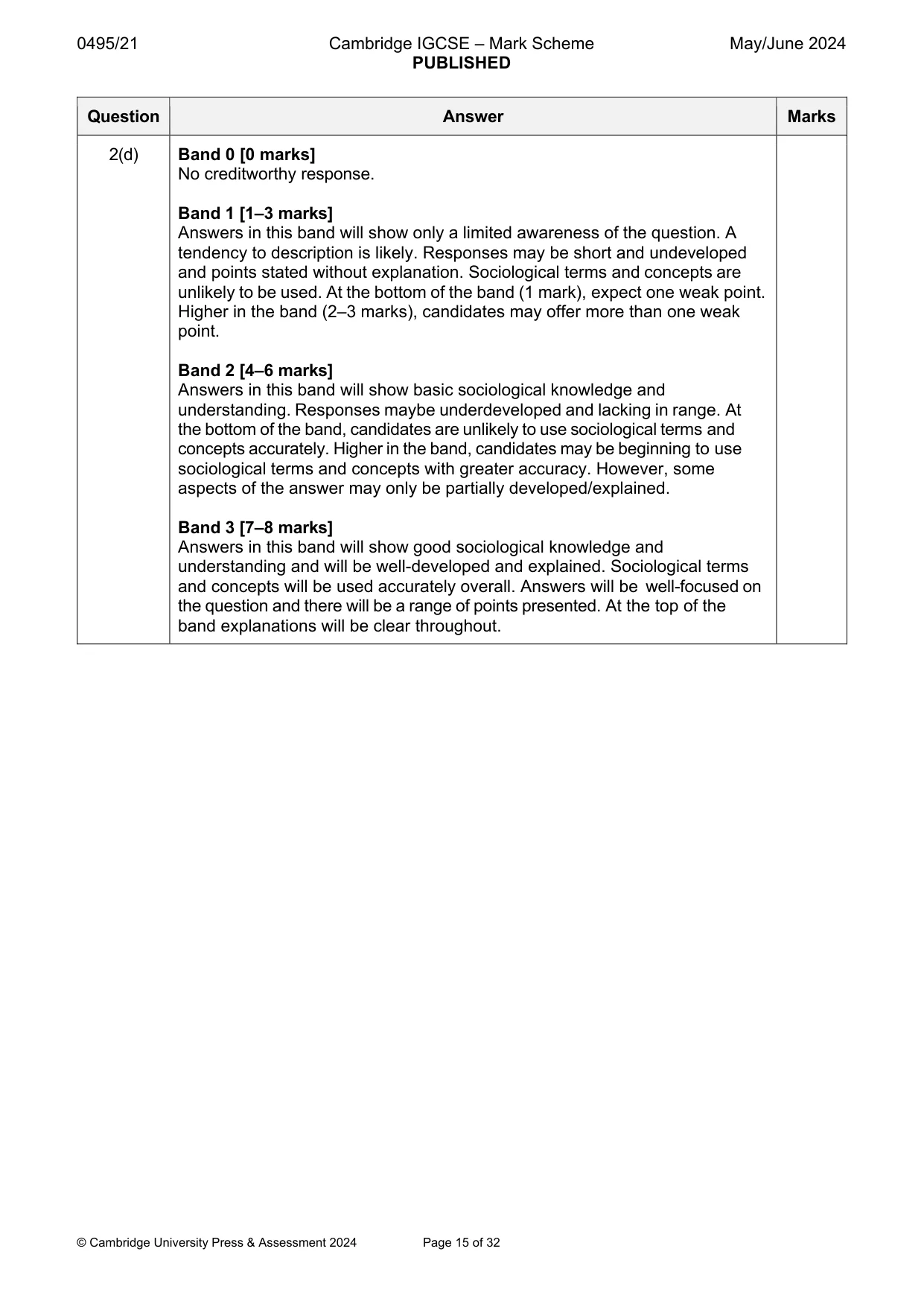
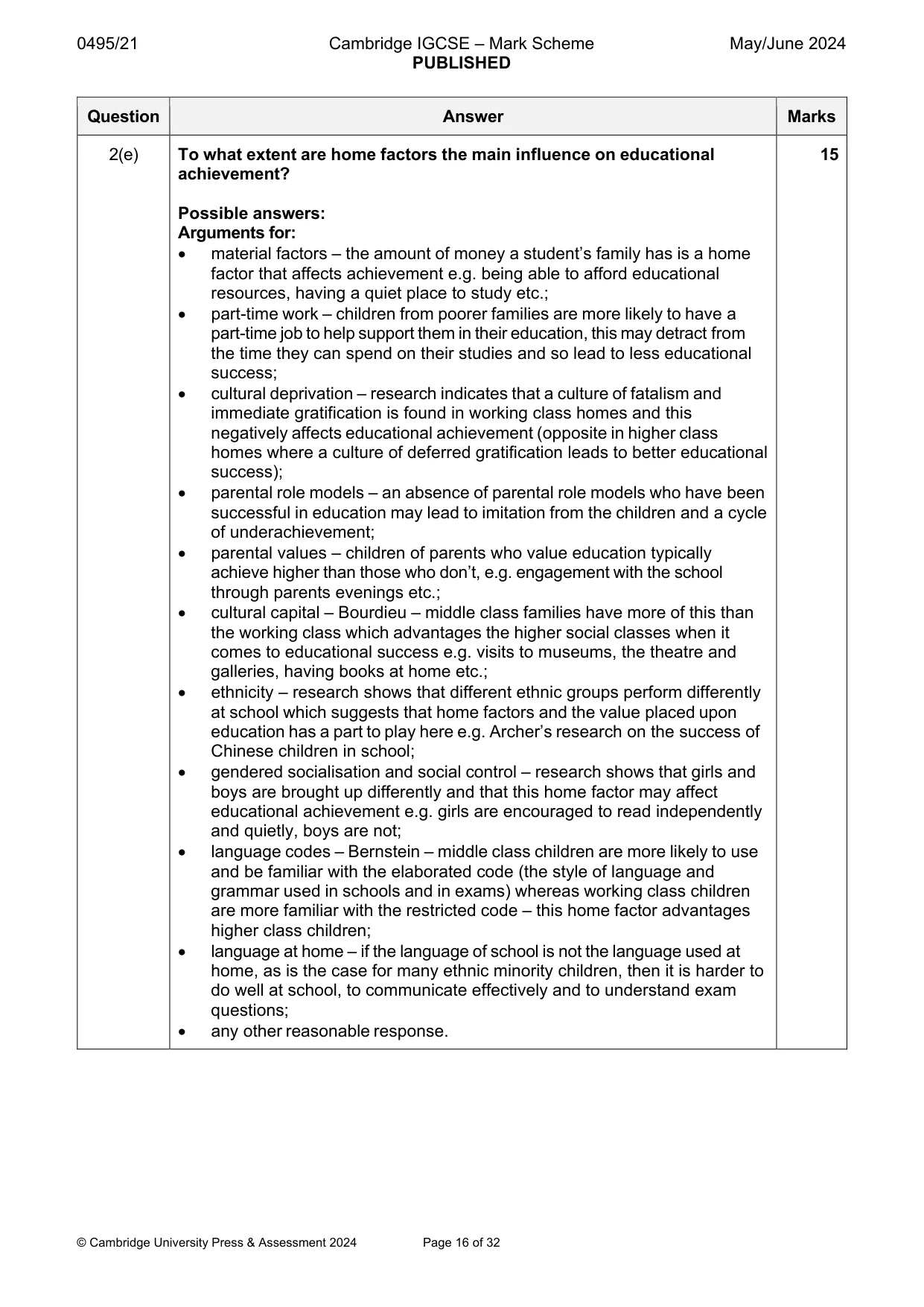
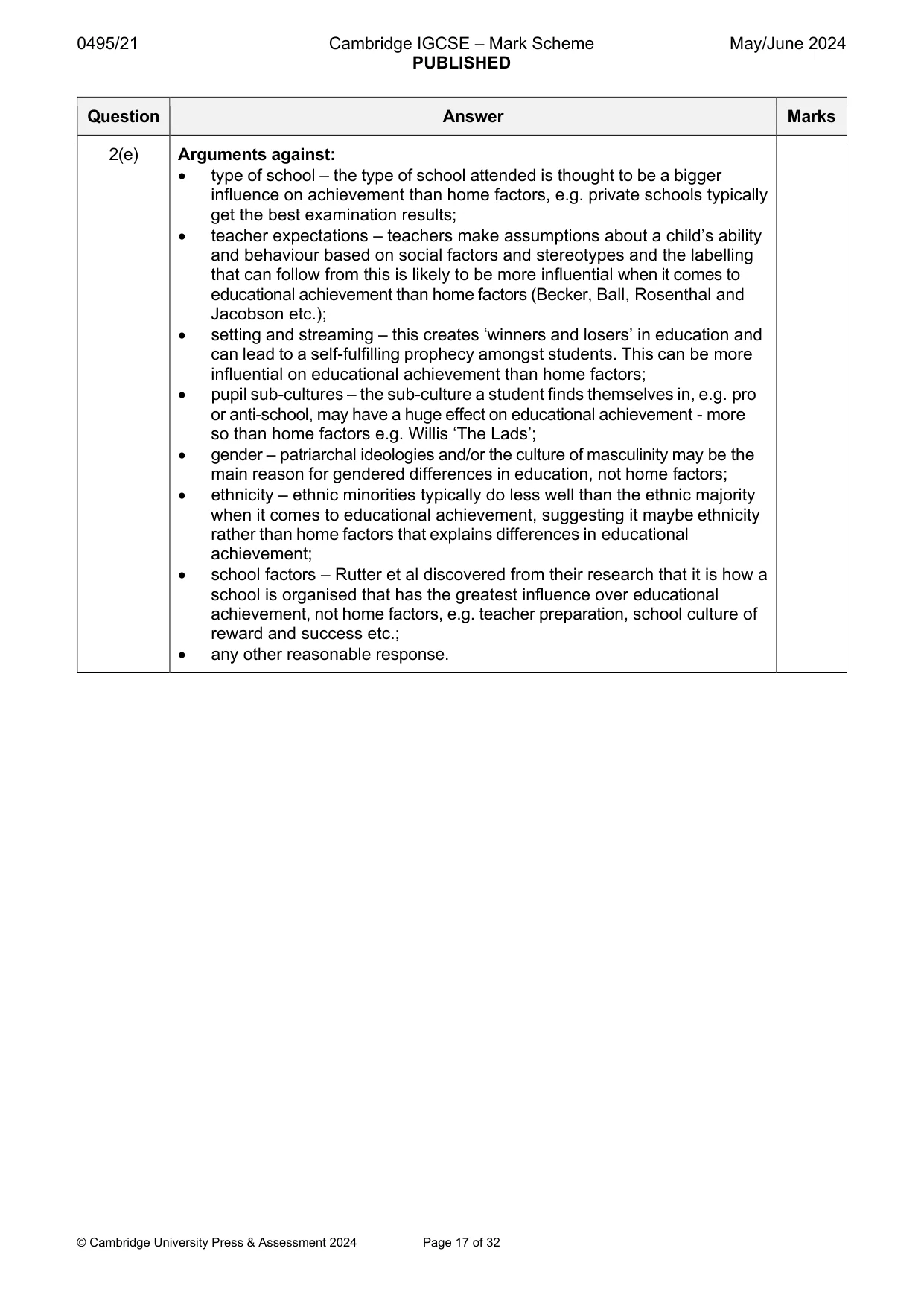
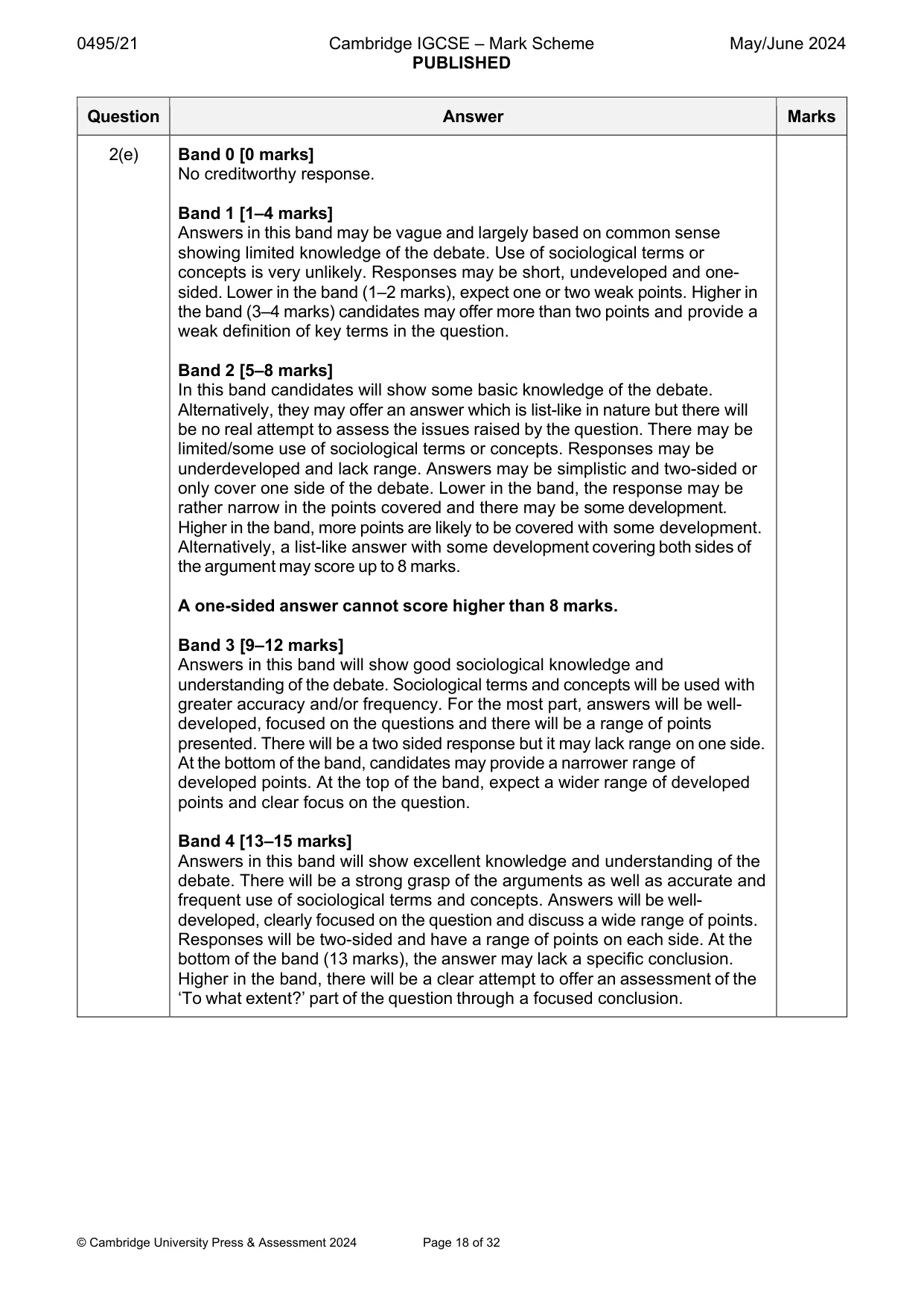
Mark scheme: 2(a) What is meant by the term ‘deferred gratification’? 2 One mark for partial definition e.g. wanting to get to University. Two marks for clear definition e.g. having long-term aims in life and being willing to postpone immediate rewards in order to achieve these. 2(b) Describe two examples of formal education. 4 Possible answers: setting – formal education takes place in classrooms inside schools (institutions or schools created for the purpose of learning); content – learners are taught set, agreed content from a syllabus; roles – there are clearly defined roles of teachers and learners within formal education; assessment – standardised testing is used to judge candidate performance e.g. national examinations; any other reasonable response. One mark for each point correctly identified (up to maximum of two). One mark for each point that is developed (up to a maximum of two). 2(c) Explain how comprehensive schools function. 6 Possible answers: non-selective – entry to a comprehensive school is open to all children of that secondary school age, regardless of ability; local area – comprehensive schools were said to encourage social mixing as all children in a local area would be educated together resulting in a strong, cohesive community spirit; free – comprehensive schools are paid for and run by the government meaning no one is prevented from attending because of financial hardship; life chances – comprehensive schools offered all students the chance to succeed in their qualifications and so improve their life chances through upward social mobility – very few students leave comprehensive schools without any qualifications; replaced tripartite system – introduced in 1960’s in the UK and replaced the ‘three school system’ based on ability and testing that was thought to label children unfairly aged 11; meritocratic – comprehensive schools are thought to be a fairer system of schooling where all children are given equal opportunities and chances of success through studying the same subjects and curriculum, judging everyone on an equal footing via universal standards; working class children – comprehensive schools are thought to particularly benefit working class children who are the least likely to be able to get into grammar schools due to material and cultural deprivation; any other reasonable response. Band 0 [0 marks] No creditworthy response. Band 1 [1–3 marks] Answers in this band will show only a limited awareness of the question. Responses may be short and un/underdeveloped. At the bottom of the band (1 mark), expect one weak point. Higher in the band (2–3 marks), candidates may offer more than one weak point, but there may be a tendency towards simplistic answers, engaging with sociological ideas without using sociological language. Band 2 [4–6 marks] Answers in this band will have clear and accurate explanation, showing good sociological knowledge and understanding. Sociological terms and concepts should be expected and explained. At the bottom of the band, the range of points covered may be narrow or lack detail. Higher in the band, answers will cover more than one point in a well-developed way or cover several points in less detail. 2(d) Explain why IQ tests can be criticised. 8 Possible answers: environment – it may be that the environment and home a child has been brought up in affects intelligence – thus high test results may indicate a more nurturing and academic background rather than higher intelligence per se; narrow range of skills tested – how intelligence is defined in IQ tests is thought to be very narrow, other types of intelligence exist which the tests do not measure = reduced accuracy; writers’ assumptions – IQ tests are written by members of the educated, higher social classes who inevitably build their own cultural assumptions and values into the questions – those from different cultures and those without cultural capital will thus find the test more challenging; snapshot scores – IQ tests represent just one moment in time whereas intelligence develops through a person’s education or lifetime which means test results may not be accurate; performance factors – how well a person does in an IQ test can be affected by anxiety/nerves and illness which leads to questions being asked about the validity of the results; practice – the more someone takes IQ tests, the higher scores they tend to get – this suggests that the test does not necessarily measure intelligence, but how well practised in the style of questioning someone is; success in later life – some people who get high IQ scores do not succeed in later life and vice versa, suggesting that there are flaws in how the tests measure human intelligence; impact on student – receiving a low score from an IQ test may negatively impact upon a student’s self-esteem and may result in a self-fulfilling prophecy as they feel labelled as ‘unintelligent’; material factors – if IQ tests are used as part of a selection process for schools e.g. private schools and grammar schools, then parents will pay for tutors to help their child understand and access the types of questions found on the IQ test. Maybe it therefore measures how much money a person has rather than intelligence? any other reasonable response. 2(d) Band 0 [0 marks] No creditworthy response. Band 1 [1–3 marks] Answers in this band will show only a limited awareness of the question. A tendency to description is likely. Responses may be short and undeveloped and points stated without explanation. Sociological terms and concepts are unlikely to be used. At the bottom of the band (1 mark), expect one weak point. Higher in the band (2–3 marks), candidates may offer more than one weak point. Band 2 [4–6 marks] Answers in this band will show basic sociological knowledge and understanding. Responses maybe underdeveloped and lacking in range. At the bottom of the band, candidates are unlikely to use sociological terms and concepts accurately. Higher in the band, candidates may be beginning to use sociological terms and concepts with greater accuracy. However, some aspects of the answer may only be partially developed/explained. Band 3 [7–8 marks] Answers in this band will show good sociological knowledge and understanding and will be well-developed and explained. Sociological terms and concepts will be used accurately overall. Answers will be well-focused on the question and there will be a range of points presented. At the top of the band explanations will be clear throughout. 2(e) To what extent are home factors the main influence on educational 15 achievement? Possible answers: Arguments for: material factors – the amount of money a student’s family has is a home factor that affects achievement e.g. being able to afford educational resources, having a quiet place to study etc.; part-time work – children from poorer families are more likely to have a part-time job to help support them in their education, this may detract from the time they can spend on their studies and so lead to less educational success; cultural deprivation – research indicates that a culture of fatalism and immediate gratification is found in working class homes and this negatively affects educational achievement (opposite in higher class homes where a culture of deferred gratification leads to better educational success); parental role models – an absence of parental role models who have been successful in education may lead to imitation from the children and a cycle of underachievement; parental values – children of parents who value education typically achieve higher than those who don’t, e.g. engagement with the school through parents evenings etc.; cultural capital – Bourdieu – middle class families have more of this than the working class which advantages the higher social classes when it comes to educational success e.g. visits to museums, the theatre and galleries, having books at home etc.; ethnicity – research shows that different ethnic groups perform differently at school which suggests that home factors and the value placed upon education has a part to play here e.g. Archer’s research on the success of Chinese children in school; gendered socialisation and social control – research shows that girls and boys are brought up differently and that this home factor may affect educational achievement e.g. girls are encouraged to read independently and quietly, boys are not; language codes – Bernstein – middle class children are more likely to use and be familiar with the elaborated code (the style of language and grammar used in schools and in exams) whereas working class children are more familiar with the restricted code – this home factor advantages higher class children; language at home – if the language of school is not the language used at home, as is the case for many ethnic minority children, then it is harder to do well at school, to communicate effectively and to understand exam questions; any other reasonable response. 2(e) Arguments against: type of school – the type of school attended is thought to be a bigger influence on achievement than home factors, e.g. private schools typically get the best examination results; teacher expectations – teachers make assumptions about a child’s ability and behaviour based on social factors and stereotypes and the labelling that can follow from this is likely to be more influential when it comes to educational achievement than home factors (Becker, Ball, Rosenthal and Jacobson etc.); setting and streaming – this creates ‘winners and losers’ in education and can lead to a self-fulfilling prophecy amongst students. This can be more influential on educational achievement than home factors; pupil sub-cultures – the sub-culture a student finds themselves in, e.g. pro or anti-school, may have a huge effect on educational achievement - more so than home factors e.g. Willis ‘The Lads’; gender – patriarchal ideologies and/or the culture of masculinity may be the main reason for gendered differences in education, not home factors; ethnicity – ethnic minorities typically do less well than the ethnic majority when it comes to educational achievement, suggesting it maybe ethnicity rather than home factors that explains differences in educational achievement; school factors – Rutter et al discovered from their research that it is how a school is organised that has the greatest influence over educational achievement, not home factors, e.g. teacher preparation, school culture of reward and success etc.; any other reasonable response. 2(e) Band 0 [0 marks] No creditworthy response. Band 1 [1–4 marks] Answers in this band may be vague and largely based on common sense showing limited knowledge of the debate. Use of sociological terms or concepts is very unlikely. Responses may be short, undeveloped and one- sided. Lower in the band (1–2 marks), expect one or two weak points. Higher in the band (3–4 marks) candidates may offer more than two points and provide a weak definition of key terms in the question. Band 2 [5–8 marks] In this band candidates will show some basic knowledge of the debate. Alternatively, they may offer an answer which is list-like in nature but there will be no real attempt to assess the issues raised by the question. There may be limited/some use of sociological terms or concepts. Responses may be underdeveloped and lack range. Answers may be simplistic and two-sided or only cover one side of the debate. Lower in the band, the response may be rather narrow in the points covered and there may be some development. Higher in the band, more points are likely to be covered with some development. Alternatively, a list-like answer with some development covering both sides of the argument may score up to 8 marks. A one-sided answer cannot score higher than 8 marks. Band 3 [9–12 marks] Answers in this band will show good sociological knowledge and understanding of the debate. Sociological terms and concepts will be used with greater accuracy and/or frequency. For the most part, answers will be well- developed, focused on the questions and there will be a range of points presented. There will be a two sided response but it may lack range on one side. At the bottom of the band, candidates may provide a narrower range of developed points. At the top of the band, expect a wider range of developed points and clear focus on the question. Band 4 [13–15 marks] Answers in this band will show excellent knowledge and understanding of the debate. There will be a strong grasp of the arguments as well as accurate and frequent use of sociological terms and concepts. Answers will be well- developed, clearly focused on the question and discuss a wide range of points. Responses will be two-sided and have a range of points on each side. At the bottom of the band (13 marks), the answer may lack a specific conclusion. Higher in the band, there will be a clear attempt to offer an assessment of the ‘To what extent?’ part of the question through a focused conclusion.
Q3 · There are many different types of crime, for example cybercrime and urban crime
3 There are many different types of crime, for example cybercrime and urban crime. Sociologists debate why some social groups commit more crime than others and some believe that policing is biased. Measurements of crime such as victim surveys reveal that a dark figure of crime exists. (a) What is meant by the term ‘cybercrime’? [2] (b) Describe two features of the dark figure of crime. [4] (c) Explain how the findings from victim surveys may not be accurate. [6] (d) Explain why inadequate socialisation can be linked to crime. [8] (e) To what extent is policing biased? [15] Section D: Media
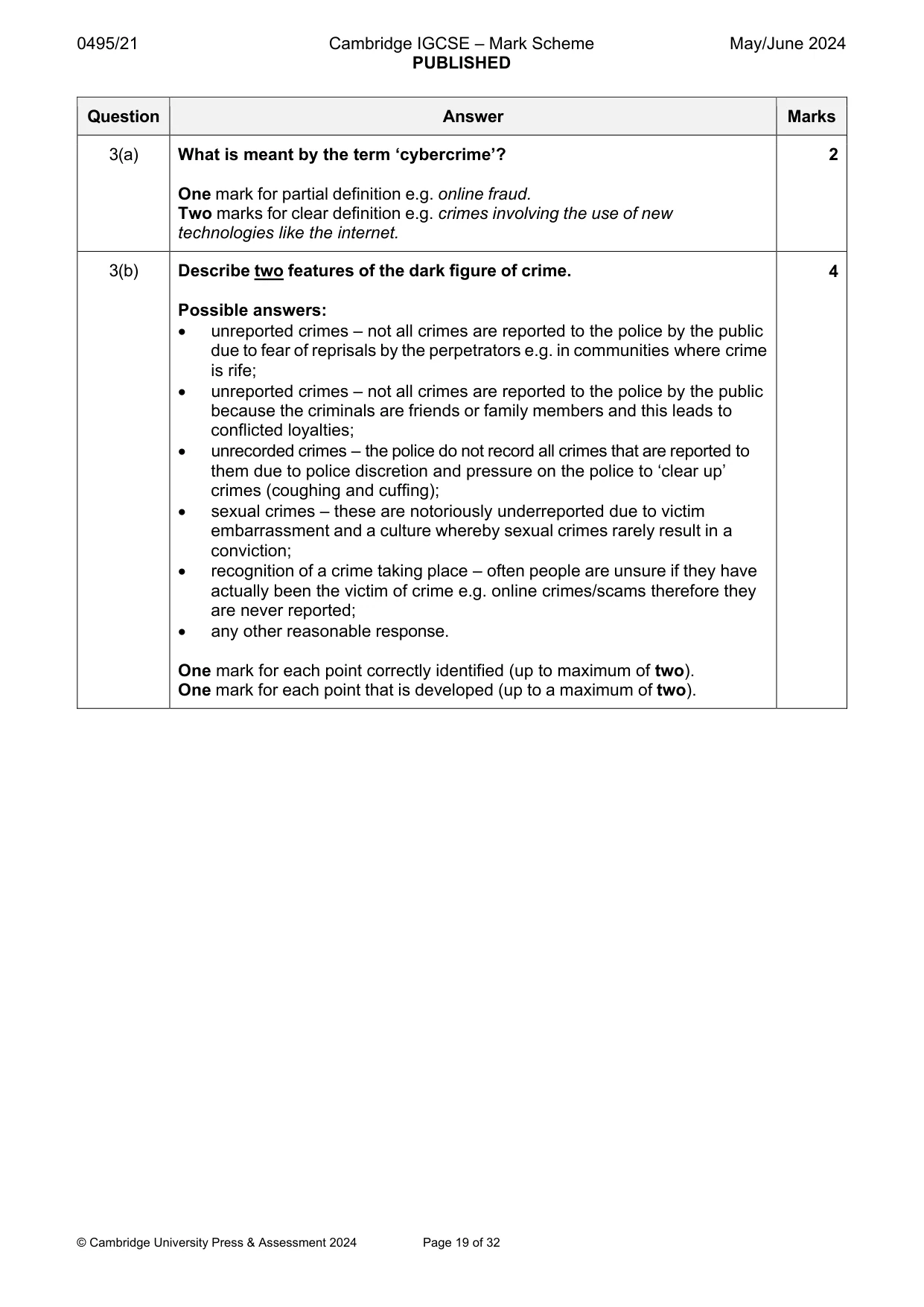
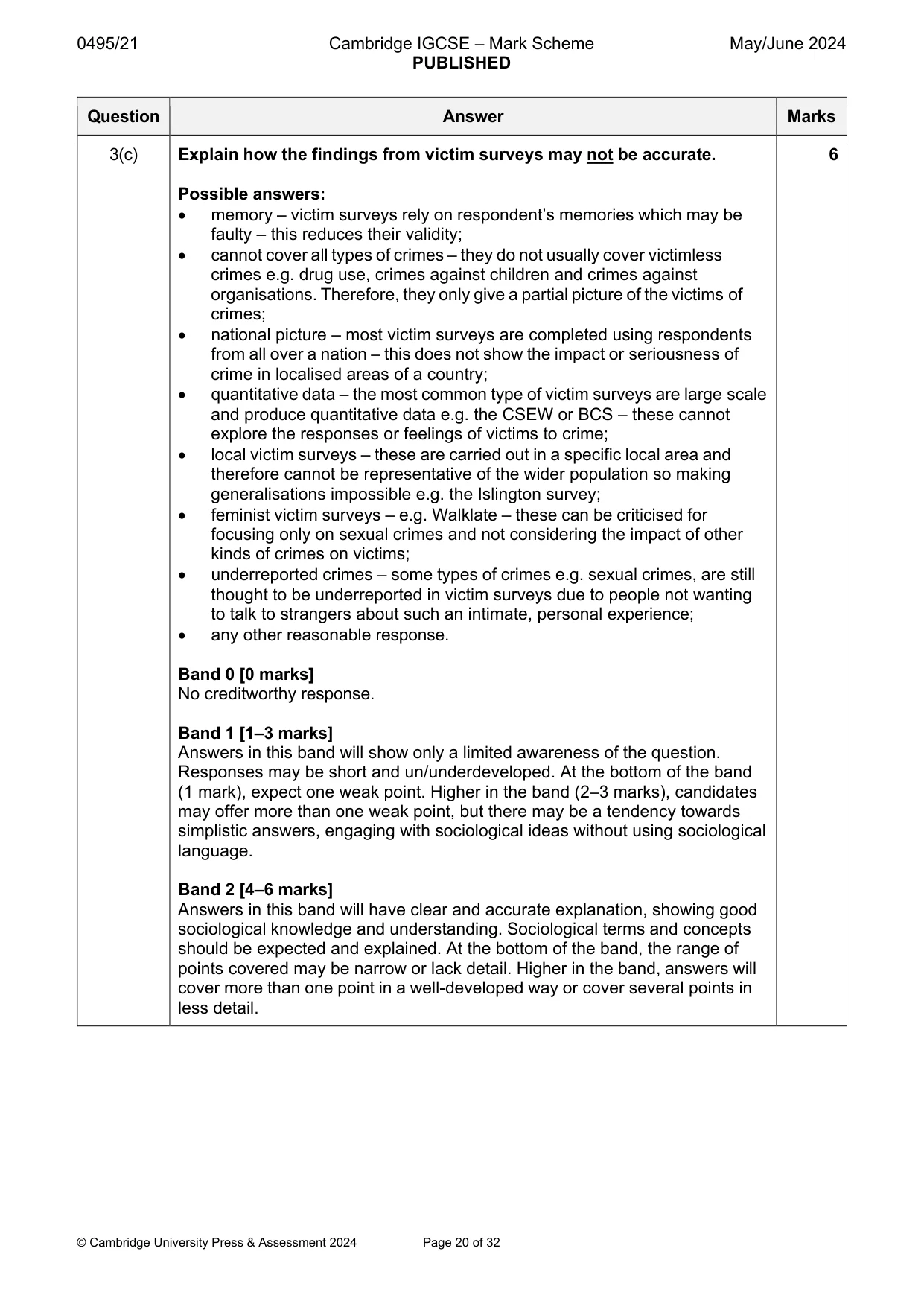
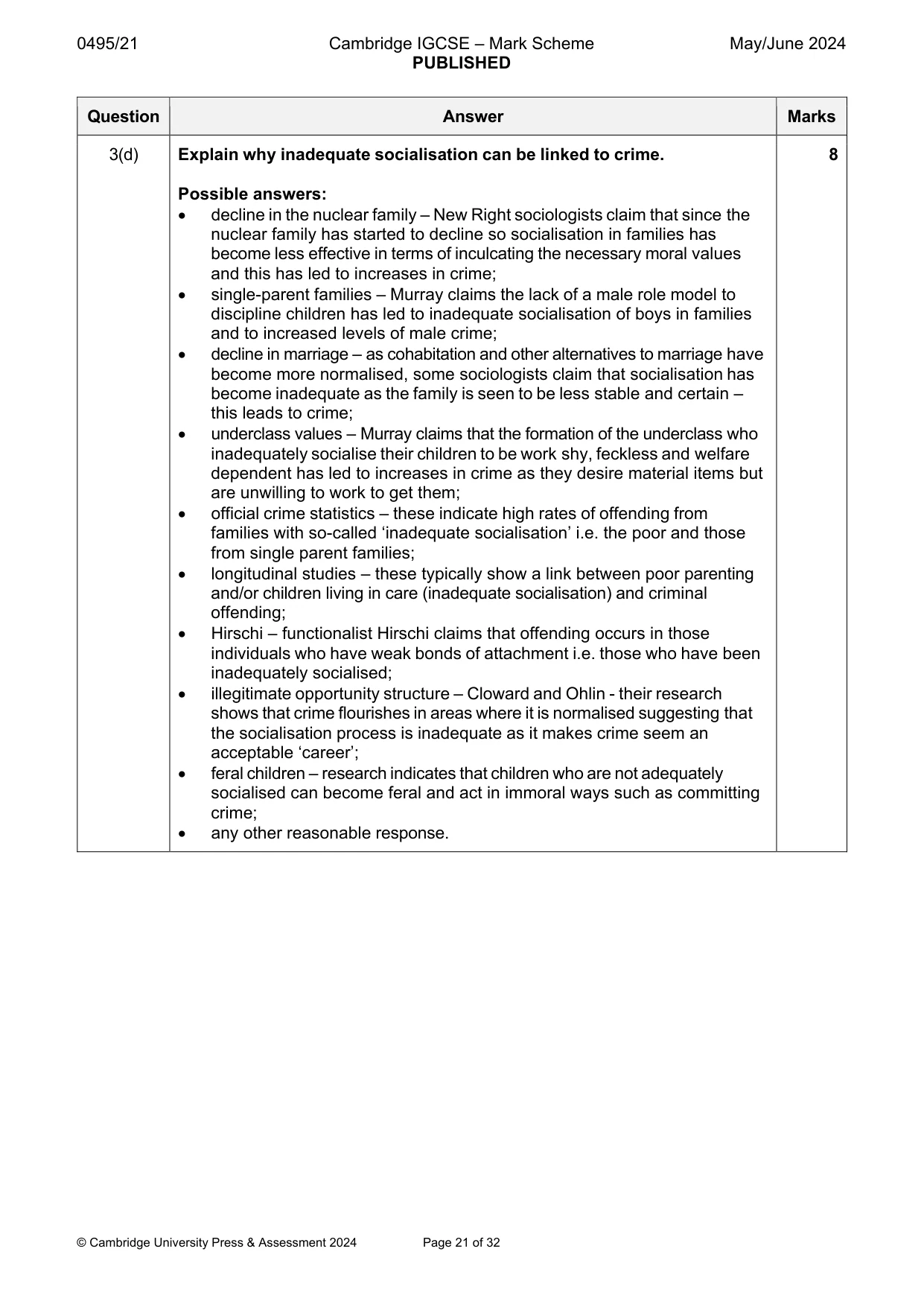
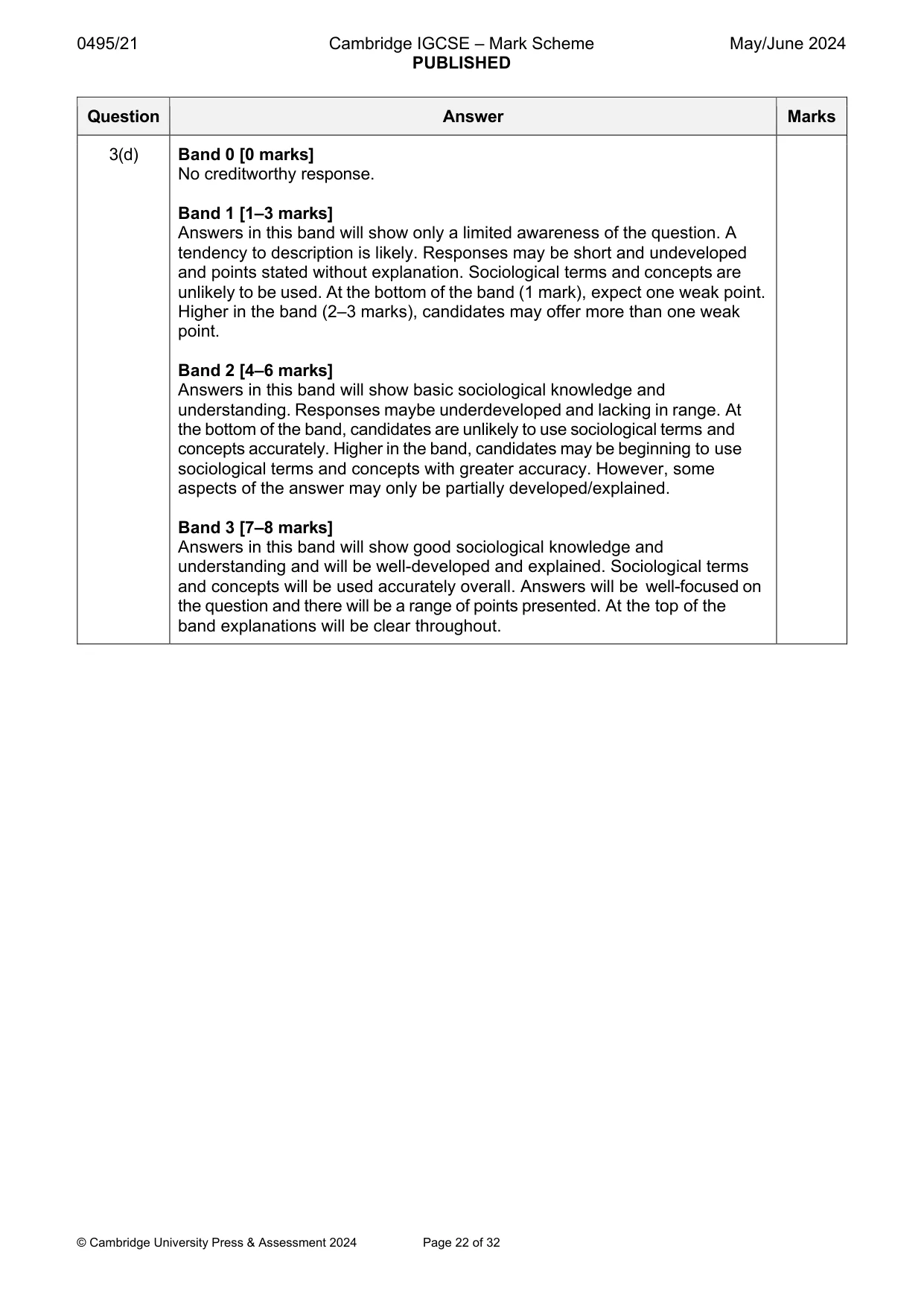
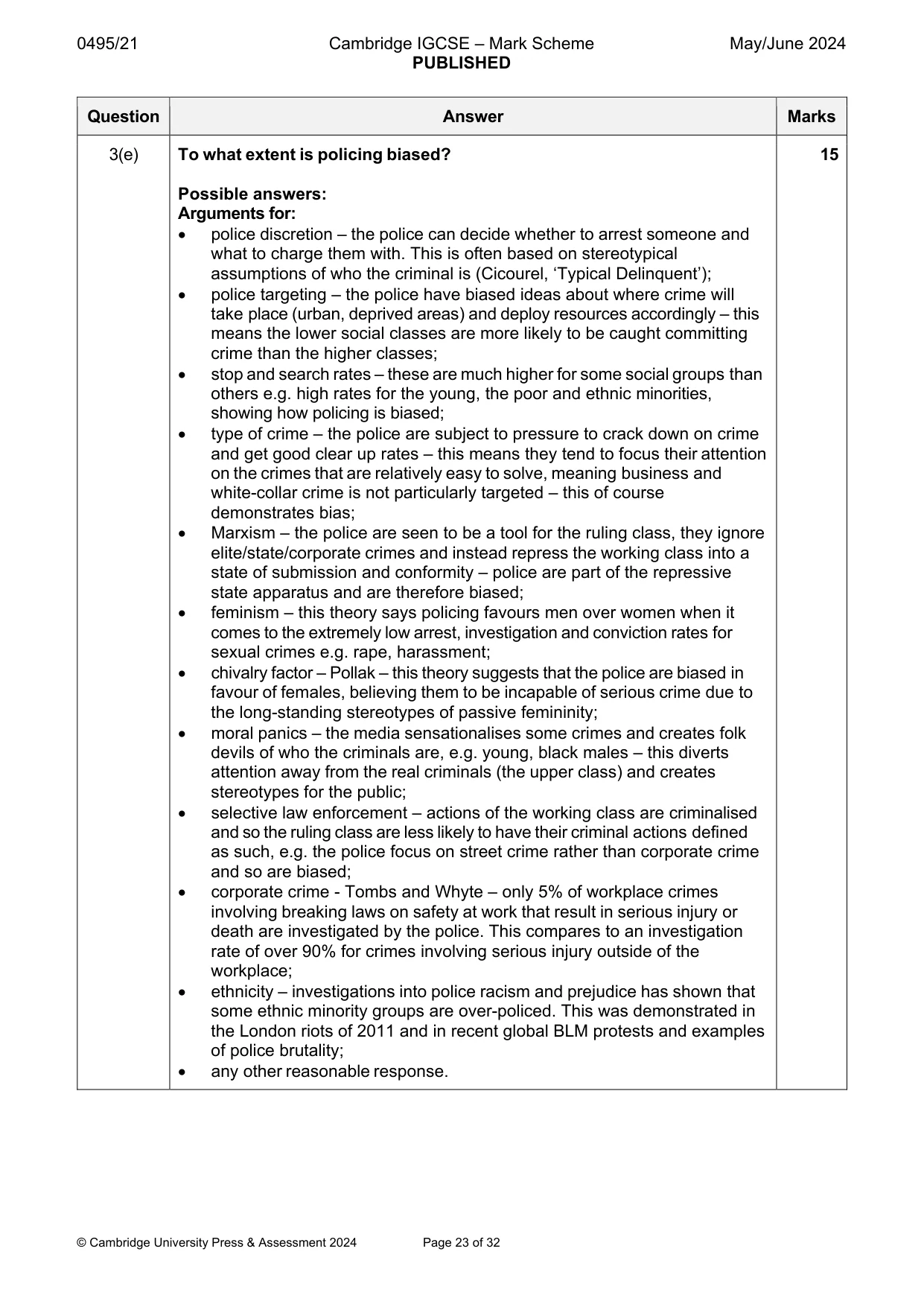
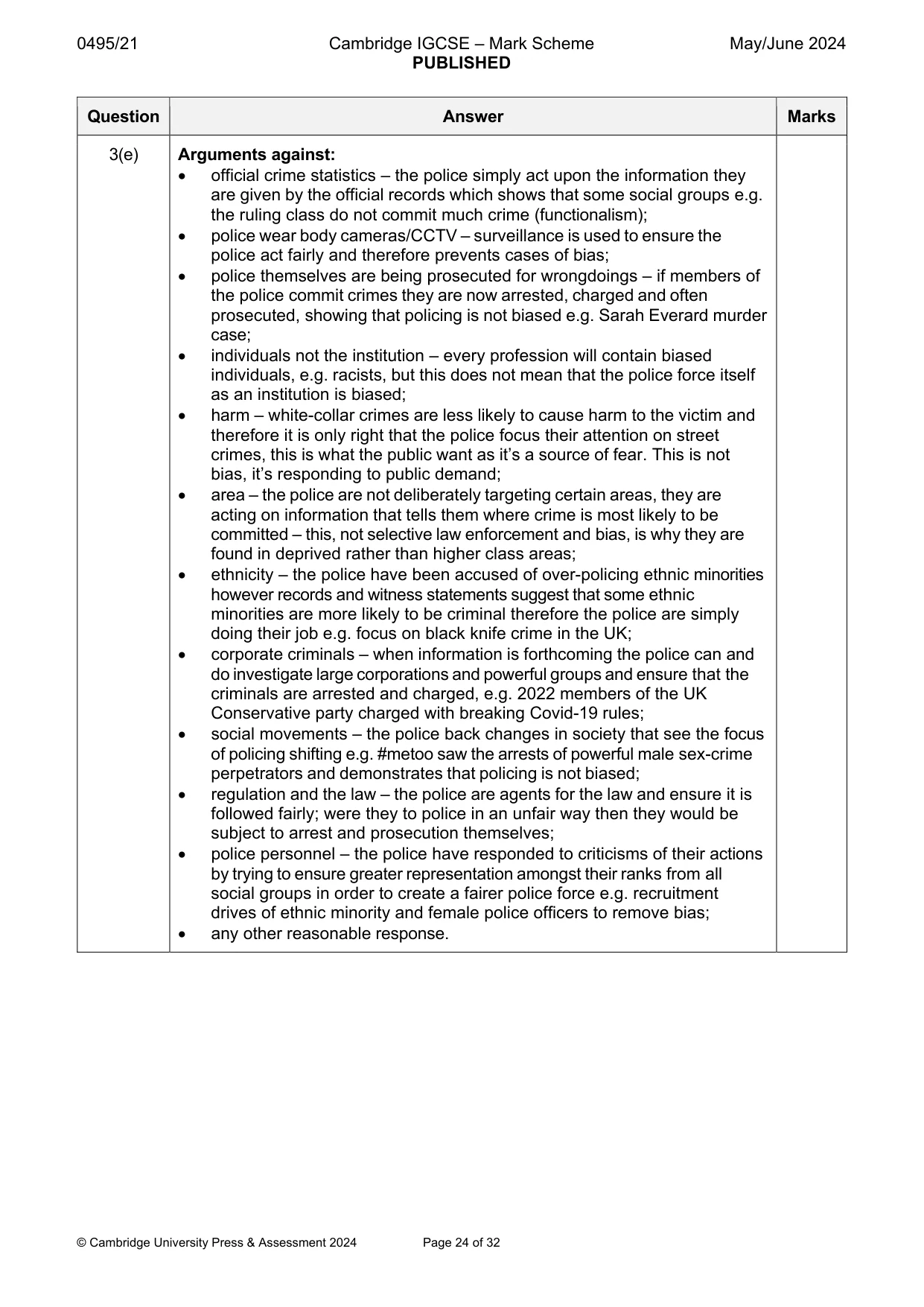
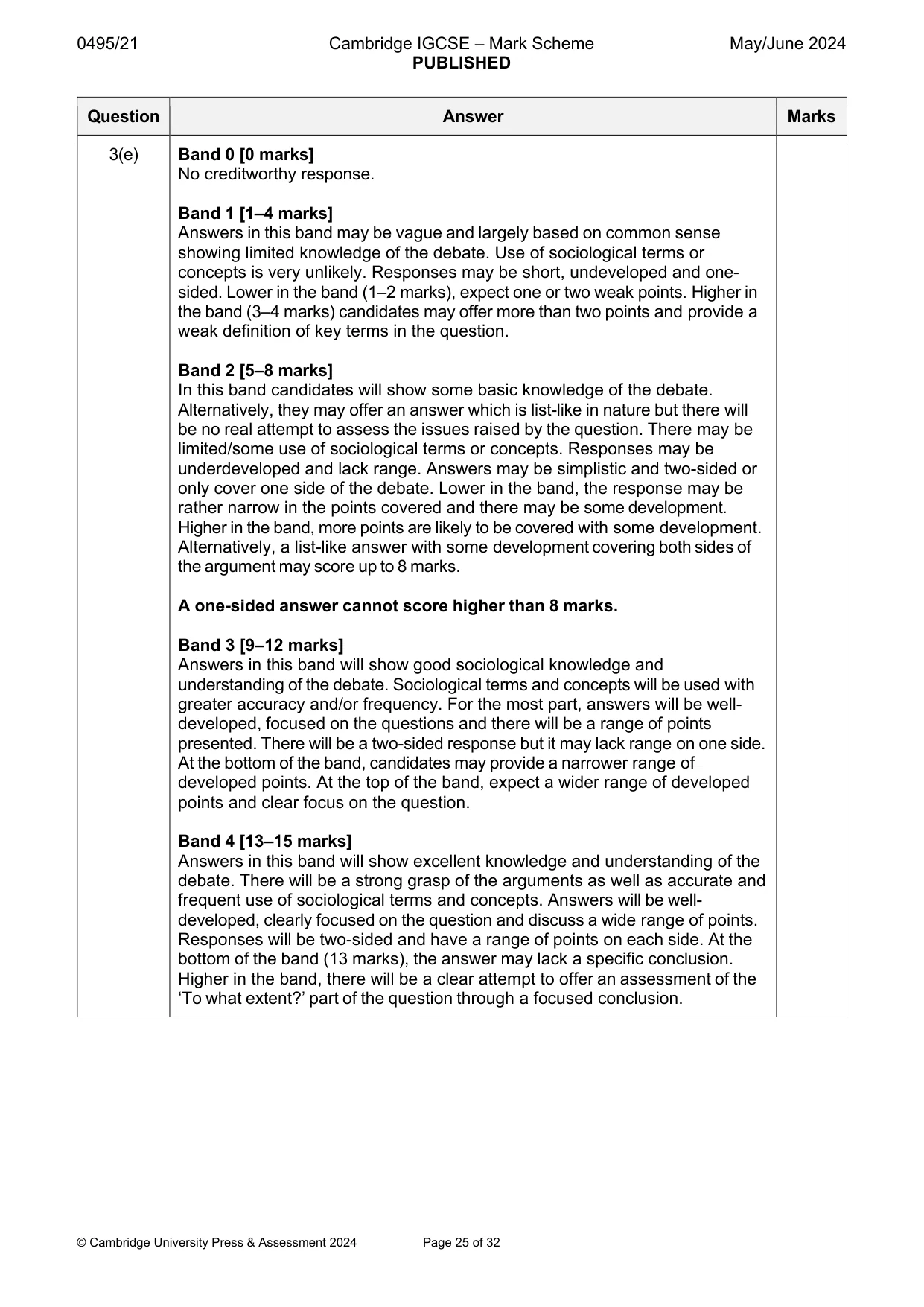
Mark scheme: 3(a) What is meant by the term ‘cybercrime’? 2 One mark for partial definition e.g. online fraud. Two marks for clear definition e.g. crimes involving the use of new technologies like the internet. 3(b) Describe two features of the dark figure of crime. 4 Possible answers: unreported crimes – not all crimes are reported to the police by the public due to fear of reprisals by the perpetrators e.g. in communities where crime is rife; unreported crimes – not all crimes are reported to the police by the public because the criminals are friends or family members and this leads to conflicted loyalties; unrecorded crimes – the police do not record all crimes that are reported to them due to police discretion and pressure on the police to ‘clear up’ crimes (coughing and cuffing); sexual crimes – these are notoriously underreported due to victim embarrassment and a culture whereby sexual crimes rarely result in a conviction; recognition of a crime taking place – often people are unsure if they have actually been the victim of crime e.g. online crimes/scams therefore they are never reported; any other reasonable response. One mark for each point correctly identified (up to maximum of two). One mark for each point that is developed (up to a maximum of two). 3(c) Explain how the findings from victim surveys may not be accurate. 6 Possible answers: memory – victim surveys rely on respondent’s memories which may be faulty – this reduces their validity; cannot cover all types of crimes – they do not usually cover victimless crimes e.g. drug use, crimes against children and crimes against organisations. Therefore, they only give a partial picture of the victims of crimes; national picture – most victim surveys are completed using respondents from all over a nation – this does not show the impact or seriousness of crime in localised areas of a country; quantitative data – the most common type of victim surveys are large scale and produce quantitative data e.g. the CSEW or BCS – these cannot explore the responses or feelings of victims to crime; local victim surveys – these are carried out in a specific local area and therefore cannot be representative of the wider population so making generalisations impossible e.g. the Islington survey; feminist victim surveys – e.g. Walklate – these can be criticised for focusing only on sexual crimes and not considering the impact of other kinds of crimes on victims; underreported crimes – some types of crimes e.g. sexual crimes, are still thought to be underreported in victim surveys due to people not wanting to talk to strangers about such an intimate, personal experience; any other reasonable response. Band 0 [0 marks] No creditworthy response. Band 1 [1–3 marks] Answers in this band will show only a limited awareness of the question. Responses may be short and un/underdeveloped. At the bottom of the band (1 mark), expect one weak point. Higher in the band (2–3 marks), candidates may offer more than one weak point, but there may be a tendency towards simplistic answers, engaging with sociological ideas without using sociological language. Band 2 [4–6 marks] Answers in this band will have clear and accurate explanation, showing good sociological knowledge and understanding. Sociological terms and concepts should be expected and explained. At the bottom of the band, the range of points covered may be narrow or lack detail. Higher in the band, answers will cover more than one point in a well-developed way or cover several points in less detail. 3(d) Explain why inadequate socialisation can be linked to crime. 8 Possible answers: decline in the nuclear family – New Right sociologists claim that since the nuclear family has started to decline so socialisation in families has become less effective in terms of inculcating the necessary moral values and this has led to increases in crime; single-parent families – Murray claims the lack of a male role model to discipline children has led to inadequate socialisation of boys in families and to increased levels of male crime; decline in marriage – as cohabitation and other alternatives to marriage have become more normalised, some sociologists claim that socialisation has become inadequate as the family is seen to be less stable and certain – this leads to crime; underclass values – Murray claims that the formation of the underclass who inadequately socialise their children to be work shy, feckless and welfare dependent has led to increases in crime as they desire material items but are unwilling to work to get them; official crime statistics – these indicate high rates of offending from families with so-called ‘inadequate socialisation’ i.e. the poor and those from single parent families; longitudinal studies – these typically show a link between poor parenting and/or children living in care (inadequate socialisation) and criminal offending; Hirschi – functionalist Hirschi claims that offending occurs in those individuals who have weak bonds of attachment i.e. those who have been inadequately socialised; illegitimate opportunity structure – Cloward and Ohlin - their research shows that crime flourishes in areas where it is normalised suggesting that the socialisation process is inadequate as it makes crime seem an acceptable ‘career’; feral children – research indicates that children who are not adequately socialised can become feral and act in immoral ways such as committing crime; any other reasonable response. 3(d) Band 0 [0 marks] No creditworthy response. Band 1 [1–3 marks] Answers in this band will show only a limited awareness of the question. A tendency to description is likely. Responses may be short and undeveloped and points stated without explanation. Sociological terms and concepts are unlikely to be used. At the bottom of the band (1 mark), expect one weak point. Higher in the band (2–3 marks), candidates may offer more than one weak point. Band 2 [4–6 marks] Answers in this band will show basic sociological knowledge and understanding. Responses maybe underdeveloped and lacking in range. At the bottom of the band, candidates are unlikely to use sociological terms and concepts accurately. Higher in the band, candidates may be beginning to use sociological terms and concepts with greater accuracy. However, some aspects of the answer may only be partially developed/explained. Band 3 [7–8 marks] Answers in this band will show good sociological knowledge and understanding and will be well-developed and explained. Sociological terms and concepts will be used accurately overall. Answers will be well-focused on the question and there will be a range of points presented. At the top of the band explanations will be clear throughout. 3(e) To what extent is policing biased? 15 Possible answers: Arguments for: police discretion – the police can decide whether to arrest someone and what to charge them with. This is often based on stereotypical assumptions of who the criminal is (Cicourel, ‘Typical Delinquent’); police targeting – the police have biased ideas about where crime will take place (urban, deprived areas) and deploy resources accordingly – this means the lower social classes are more likely to be caught committing crime than the higher classes; stop and search rates – these are much higher for some social groups than others e.g. high rates for the young, the poor and ethnic minorities, showing how policing is biased; type of crime – the police are subject to pressure to crack down on crime and get good clear up rates – this means they tend to focus their attention on the crimes that are relatively easy to solve, meaning business and white-collar crime is not particularly targeted – this of course demonstrates bias; Marxism – the police are seen to be a tool for the ruling class, they ignore elite/state/corporate crimes and instead repress the working class into a state of submission and conformity – police are part of the repressive state apparatus and are therefore biased; feminism – this theory says policing favours men over women when it comes to the extremely low arrest, investigation and conviction rates for sexual crimes e.g. rape, harassment; chivalry factor – Pollak – this theory suggests that the police are biased in favour of females, believing them to be incapable of serious crime due to the long-standing stereotypes of passive femininity; moral panics – the media sensationalises some crimes and creates folk devils of who the criminals are, e.g. young, black males – this diverts attention away from the real criminals (the upper class) and creates stereotypes for the public; selective law enforcement – actions of the working class are criminalised and so the ruling class are less likely to have their criminal actions defined as such, e.g. the police focus on street crime rather than corporate crime and so are biased; corporate crime - Tombs and Whyte – only 5% of workplace crimes involving breaking laws on safety at work that result in serious injury or death are investigated by the police. This compares to an investigation rate of over 90% for crimes involving serious injury outside of the workplace; ethnicity – investigations into police racism and prejudice has shown that some ethnic minority groups are over-policed. This was demonstrated in the London riots of 2011 and in recent global BLM protests and examples of police brutality; any other reasonable response. 3(e) Arguments against: official crime statistics – the police simply act upon the information they are given by the official records which shows that some social groups e.g. the ruling class do not commit much crime (functionalism); police wear body cameras/CCTV – surveillance is used to ensure the police act fairly and therefore prevents cases of bias; police themselves are being prosecuted for wrongdoings – if members of the police commit crimes they are now arrested, charged and often prosecuted, showing that policing is not biased e.g. Sarah Everard murder case; individuals not the institution – every profession will contain biased individuals, e.g. racists, but this does not mean that the police force itself as an institution is biased; harm – white-collar crimes are less likely to cause harm to the victim and therefore it is only right that the police focus their attention on street crimes, this is what the public want as it’s a source of fear. This is not bias, it’s responding to public demand; area – the police are not deliberately targeting certain areas, they are acting on information that tells them where crime is most likely to be committed – this, not selective law enforcement and bias, is why they are found in deprived rather than higher class areas; ethnicity – the police have been accused of over-policing ethnic minorities however records and witness statements suggest that some ethnic minorities are more likely to be criminal therefore the police are simply doing their job e.g. focus on black knife crime in the UK; corporate criminals – when information is forthcoming the police can and do investigate large corporations and powerful groups and ensure that the criminals are arrested and charged, e.g. 2022 members of the UK Conservative party charged with breaking Covid-19 rules; social movements – the police back changes in society that see the focus of policing shifting e.g. #metoo saw the arrests of powerful male sex-crime perpetrators and demonstrates that policing is not biased; regulation and the law – the police are agents for the law and ensure it is followed fairly; were they to police in an unfair way then they would be subject to arrest and prosecution themselves; police personnel – the police have responded to criticisms of their actions by trying to ensure greater representation amongst their ranks from all social groups in order to create a fairer police force e.g. recruitment drives of ethnic minority and female police officers to remove bias; any other reasonable response. 3(e) Band 0 [0 marks] No creditworthy response. Band 1 [1–4 marks] Answers in this band may be vague and largely based on common sense showing limited knowledge of the debate. Use of sociological terms or concepts is very unlikely. Responses may be short, undeveloped and one- sided. Lower in the band (1–2 marks), expect one or two weak points. Higher in the band (3–4 marks) candidates may offer more than two points and provide a weak definition of key terms in the question. Band 2 [5–8 marks] In this band candidates will show some basic knowledge of the debate. Alternatively, they may offer an answer which is list-like in nature but there will be no real attempt to assess the issues raised by the question. There may be limited/some use of sociological terms or concepts. Responses may be underdeveloped and lack range. Answers may be simplistic and two-sided or only cover one side of the debate. Lower in the band, the response may be rather narrow in the points covered and there may be some development. Higher in the band, more points are likely to be covered with some development. Alternatively, a list-like answer with some development covering both sides of the argument may score up to 8 marks. A one-sided answer cannot score higher than 8 marks. Band 3 [9–12 marks] Answers in this band will show good sociological knowledge and understanding of the debate. Sociological terms and concepts will be used with greater accuracy and/or frequency. For the most part, answers will be well- developed, focused on the questions and there will be a range of points presented. There will be a two-sided response but it may lack range on one side. At the bottom of the band, candidates may provide a narrower range of developed points. At the top of the band, expect a wider range of developed points and clear focus on the question. Band 4 [13–15 marks] Answers in this band will show excellent knowledge and understanding of the debate. There will be a strong grasp of the arguments as well as accurate and frequent use of sociological terms and concepts. Answers will be well- developed, clearly focused on the question and discuss a wide range of points. Responses will be two-sided and have a range of points on each side. At the bottom of the band (13 marks), the answer may lack a specific conclusion. Higher in the band, there will be a clear attempt to offer an assessment of the ‘To what extent?’ part of the question through a focused conclusion.
Q4 · Interactivity exists in the media
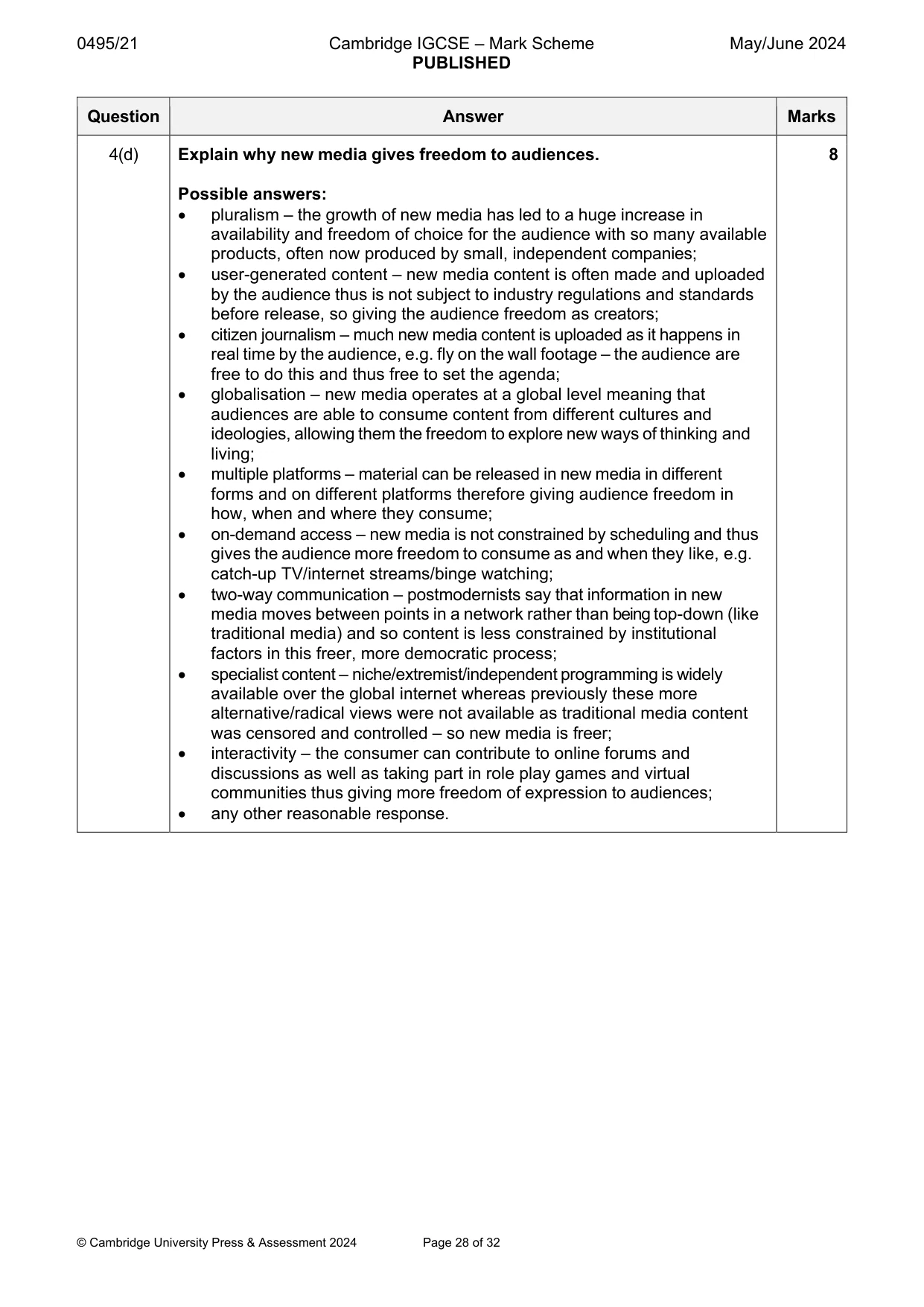
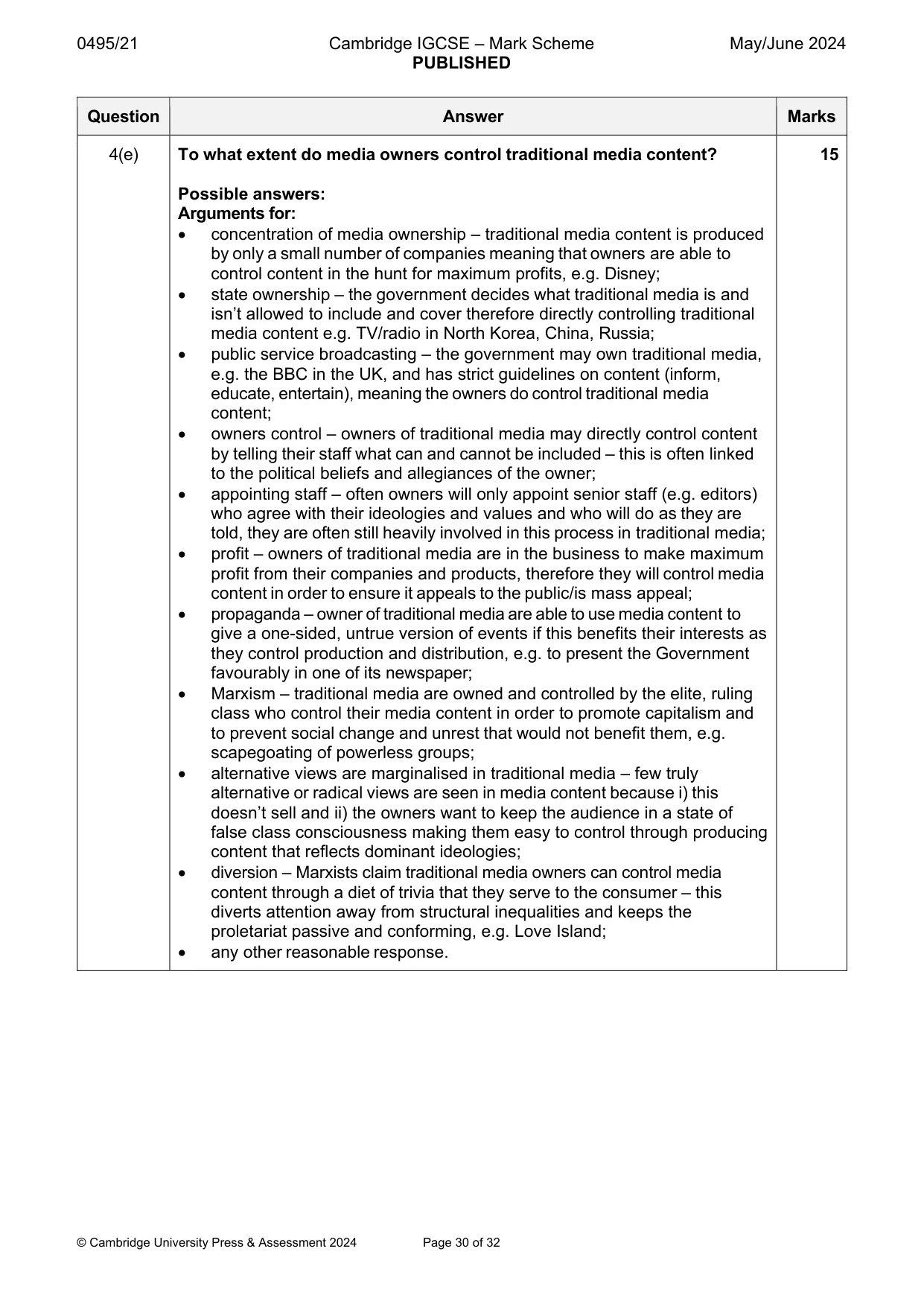
4 Interactivity exists in the media. Sociologists debate whether the media actually affects the audience, for example the cultural effects approach. Some sociologists argue that new media gives freedom to audiences. Other sociologists believe that powerful media owners are in control of traditional media content. (a) What is meant by the term ‘interactivity’? [2] (b) Describe two examples of media bias. [4] (c) Explain how the media affects the audience, according to the cultural effects approach. [6] (d) Explain why new media gives freedom to audiences. [8] (e) To what extent do media owners control traditional media content? [15]
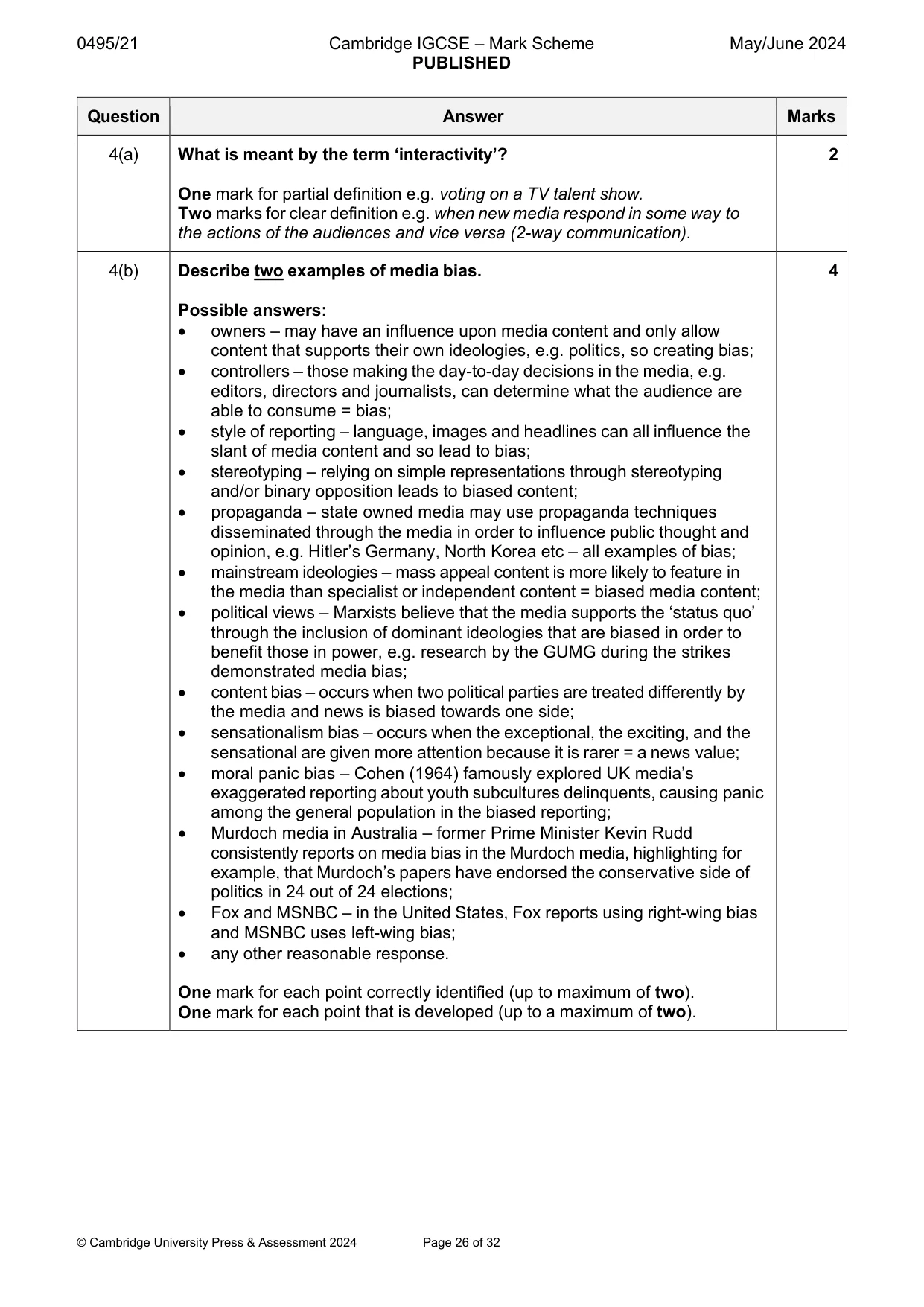
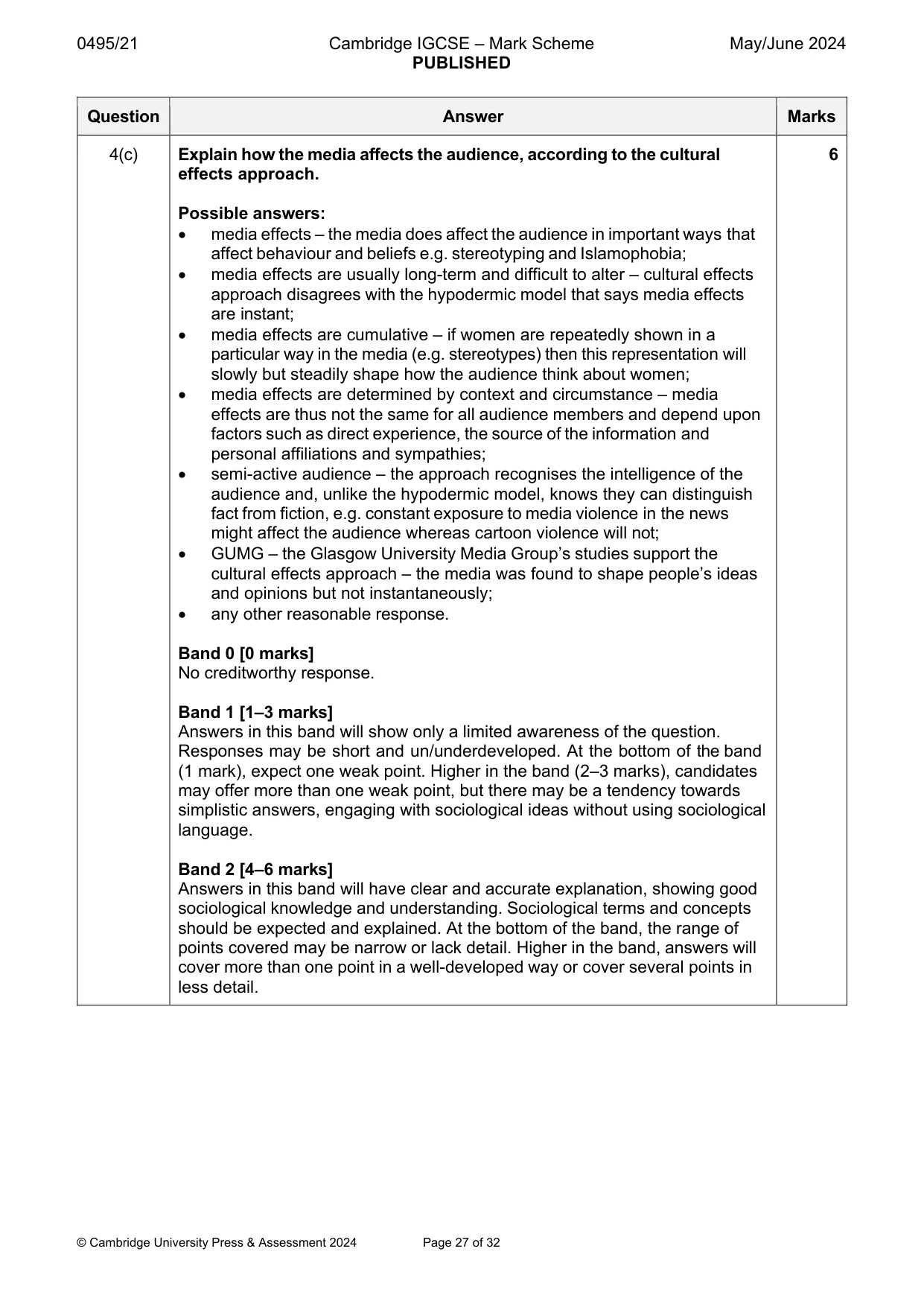
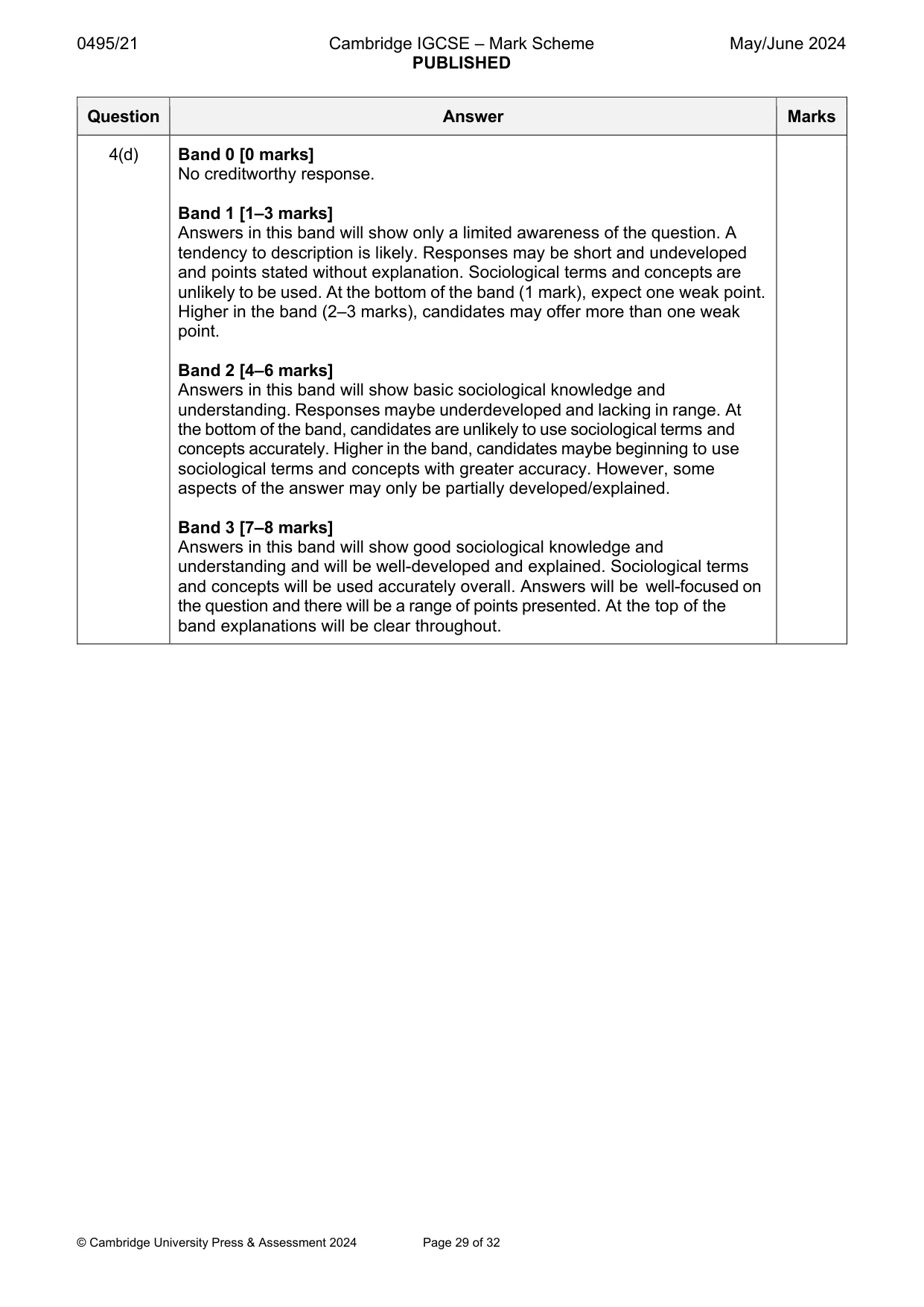
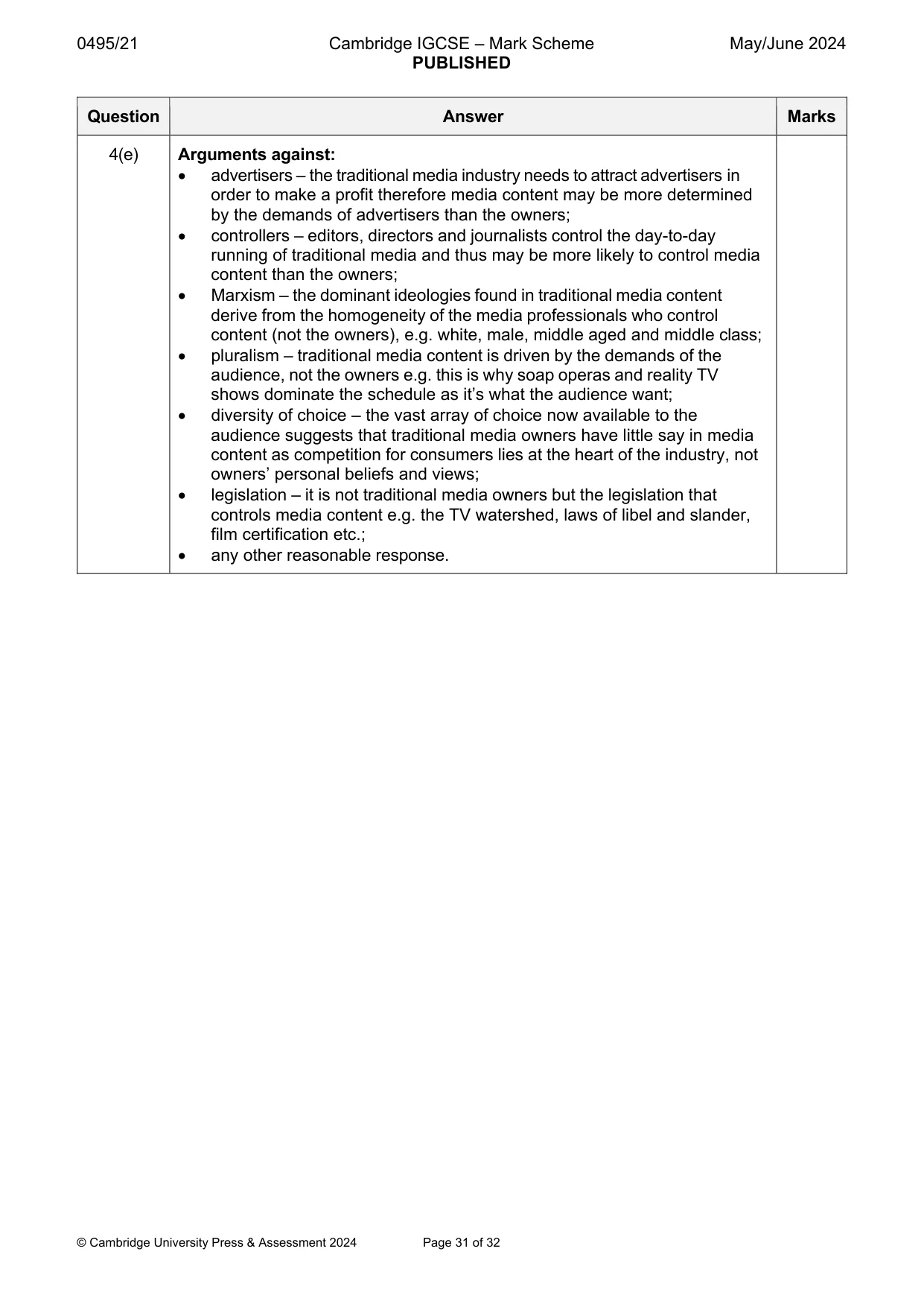
Mark scheme: 4(a) What is meant by the term ‘interactivity’? 2 One mark for partial definition e.g. voting on a TV talent show. Two marks for clear definition e.g. when new media respond in some way to the actions of the audiences and vice versa (2-way communication). 4(b) Describe two examples of media bias. 4 Possible answers: owners – may have an influence upon media content and only allow content that supports their own ideologies, e.g. politics, so creating bias; controllers – those making the day-to-day decisions in the media, e.g. editors, directors and journalists, can determine what the audience are able to consume = bias; style of reporting – language, images and headlines can all influence the slant of media content and so lead to bias; stereotyping – relying on simple representations through stereotyping and/or binary opposition leads to biased content; propaganda – state owned media may use propaganda techniques disseminated through the media in order to influence public thought and opinion, e.g. Hitler’s Germany, North Korea etc – all examples of bias; mainstream ideologies – mass appeal content is more likely to feature in the media than specialist or independent content = biased media content; political views – Marxists believe that the media supports the ‘status quo’ through the inclusion of dominant ideologies that are biased in order to benefit those in power, e.g. research by the GUMG during the strikes demonstrated media bias; content bias – occurs when two political parties are treated differently by the media and news is biased towards one side; sensationalism bias – occurs when the exceptional, the exciting, and the sensational are given more attention because it is rarer = a news value; moral panic bias – Cohen (1964) famously explored UK media’s exaggerated reporting about youth subcultures delinquents, causing panic among the general population in the biased reporting; Murdoch media in Australia – former Prime Minister Kevin Rudd consistently reports on media bias in the Murdoch media, highlighting for example, that Murdoch’s papers have endorsed the conservative side of politics in 24 out of 24 elections; Fox and MSNBC – in the United States, Fox reports using right-wing bias and MSNBC uses left-wing bias; any other reasonable response. One mark for each point correctly identified (up to maximum of two). One mark for each point that is developed (up to a maximum of two). 4(c) Explain how the media affects the audience, according to the cultural 6 effects approach. Possible answers: media effects – the media does affect the audience in important ways that affect behaviour and beliefs e.g. stereotyping and Islamophobia; media effects are usually long-term and difficult to alter – cultural effects approach disagrees with the hypodermic model that says media effects are instant; media effects are cumulative – if women are repeatedly shown in a particular way in the media (e.g. stereotypes) then this representation will slowly but steadily shape how the audience think about women; media effects are determined by context and circumstance – media effects are thus not the same for all audience members and depend upon factors such as direct experience, the source of the information and personal affiliations and sympathies; semi-active audience – the approach recognises the intelligence of the audience and, unlike the hypodermic model, knows they can distinguish fact from fiction, e.g. constant exposure to media violence in the news might affect the audience whereas cartoon violence will not; GUMG – the Glasgow University Media Group’s studies support the cultural effects approach – the media was found to shape people’s ideas and opinions but not instantaneously; any other reasonable response. Band 0 [0 marks] No creditworthy response. Band 1 [1–3 marks] Answers in this band will show only a limited awareness of the question. Responses may be short and un/underdeveloped. At the bottom of the band (1 mark), expect one weak point. Higher in the band (2–3 marks), candidates may offer more than one weak point, but there may be a tendency towards simplistic answers, engaging with sociological ideas without using sociological language. Band 2 [4–6 marks] Answers in this band will have clear and accurate explanation, showing good sociological knowledge and understanding. Sociological terms and concepts should be expected and explained. At the bottom of the band, the range of points covered may be narrow or lack detail. Higher in the band, answers will cover more than one point in a well-developed way or cover several points in less detail. 4(d) Explain why new media gives freedom to audiences. 8 Possible answers: pluralism – the growth of new media has led to a huge increase in availability and freedom of choice for the audience with so many available products, often now produced by small, independent companies; user-generated content – new media content is often made and uploaded by the audience thus is not subject to industry regulations and standards before release, so giving the audience freedom as creators; citizen journalism – much new media content is uploaded as it happens in real time by the audience, e.g. fly on the wall footage – the audience are free to do this and thus free to set the agenda; globalisation – new media operates at a global level meaning that audiences are able to consume content from different cultures and ideologies, allowing them the freedom to explore new ways of thinking and living; multiple platforms – material can be released in new media in different forms and on different platforms therefore giving audience freedom in how, when and where they consume; on-demand access – new media is not constrained by scheduling and thus gives the audience more freedom to consume as and when they like, e.g. catch-up TV/internet streams/binge watching; two-way communication – postmodernists say that information in new media moves between points in a network rather than being top-down (like traditional media) and so content is less constrained by institutional factors in this freer, more democratic process; specialist content – niche/extremist/independent programming is widely available over the global internet whereas previously these more alternative/radical views were not available as traditional media content was censored and controlled – so new media is freer; interactivity – the consumer can contribute to online forums and discussions as well as taking part in role play games and virtual communities thus giving more freedom of expression to audiences; any other reasonable response. 4(d) Band 0 [0 marks] No creditworthy response. Band 1 [1–3 marks] Answers in this band will show only a limited awareness of the question. A tendency to description is likely. Responses may be short and undeveloped and points stated without explanation. Sociological terms and concepts are unlikely to be used. At the bottom of the band (1 mark), expect one weak point. Higher in the band (2–3 marks), candidates may offer more than one weak point. Band 2 [4–6 marks] Answers in this band will show basic sociological knowledge and understanding. Responses maybe underdeveloped and lacking in range. At the bottom of the band, candidates are unlikely to use sociological terms and concepts accurately. Higher in the band, candidates maybe beginning to use sociological terms and concepts with greater accuracy. However, some aspects of the answer may only be partially developed/explained. Band 3 [7–8 marks] Answers in this band will show good sociological knowledge and understanding and will be well-developed and explained. Sociological terms and concepts will be used accurately overall. Answers will be well-focused on the question and there will be a range of points presented. At the top of the band explanations will be clear throughout. 4(e) To what extent do media owners control traditional media content? 15 Possible answers: Arguments for: concentration of media ownership – traditional media content is produced by only a small number of companies meaning that owners are able to control content in the hunt for maximum profits, e.g. Disney; state ownership – the government decides what traditional media is and isn’t allowed to include and cover therefore directly controlling traditional media content e.g. TV/radio in North Korea, China, Russia; public service broadcasting – the government may own traditional media, e.g. the BBC in the UK, and has strict guidelines on content (inform, educate, entertain), meaning the owners do control traditional media content; owners control – owners of traditional media may directly control content by telling their staff what can and cannot be included – this is often linked to the political beliefs and allegiances of the owner; appointing staff – often owners will only appoint senior staff (e.g. editors) who agree with their ideologies and values and who will do as they are told, they are often still heavily involved in this process in traditional media; profit – owners of traditional media are in the business to make maximum profit from their companies and products, therefore they will control media content in order to ensure it appeals to the public/is mass appeal; propaganda – owner of traditional media are able to use media content to give a one-sided, untrue version of events if this benefits their interests as they control production and distribution, e.g. to present the Government favourably in one of its newspaper; Marxism – traditional media are owned and controlled by the elite, ruling class who control their media content in order to promote capitalism and to prevent social change and unrest that would not benefit them, e.g. scapegoating of powerless groups; alternative views are marginalised in traditional media – few truly alternative or radical views are seen in media content because i) this doesn’t sell and ii) the owners want to keep the audience in a state of false class consciousness making them easy to control through producing content that reflects dominant ideologies; diversion – Marxists claim traditional media owners can control media content through a diet of trivia that they serve to the consumer – this diverts attention away from structural inequalities and keeps the proletariat passive and conforming, e.g. Love Island; any other reasonable response. 4(e) Arguments against: advertisers – the traditional media industry needs to attract advertisers in order to make a profit therefore media content may be more determined by the demands of advertisers than the owners; controllers – editors, directors and journalists control the day-to-day running of traditional media and thus may be more likely to control media content than the owners; Marxism – the dominant ideologies found in traditional media content derive from the homogeneity of the media professionals who control content (not the owners), e.g. white, male, middle aged and middle class; pluralism – traditional media content is driven by the demands of the audience, not the owners e.g. this is why soap operas and reality TV shows dominate the schedule as it’s what the audience want; diversity of choice – the vast array of choice now available to the audience suggests that traditional media owners have little say in media content as competition for consumers lies at the heart of the industry, not owners’ personal beliefs and views; legislation – it is not traditional media owners but the legislation that controls media content e.g. the TV watershed, laws of libel and slander, film certification etc.; any other reasonable response. 4(e) Band 0 [0 marks] No creditworthy response. Band 1 [1–4 marks] Answers in this band may be vague and largely based on common sense showing limited knowledge of the debate. Use of sociological terms or concepts is very unlikely. Responses may be short, undeveloped and one- sided. Lower in the band (1–2 marks), expect one or two weak points. Higher in the band (3–4 marks) candidates may offer more than two points and provide a weak definition of key terms in the question. Band 2 [5–8 marks] In this band candidates will show some basic knowledge of the debate. Alternatively, they may offer an answer which is list-like in nature but there will be no real attempt to assess the issues raised by the question. There may be limited/some use of sociological terms or concepts. Responses may be underdeveloped and lack range. Answers may be simplistic and two-sided or only cover one side of the debate. Lower in the band, the response may be rather narrow in the points covered and there may be some development. Higher in the band, more points are likely to be covered with some development. Alternatively, a list-like answer with some development covering both sides of the argument may score up to 8 marks. A one-sided answer cannot score higher than 8 marks. Band 3 [9–12 marks] Answers in this band will show good sociological knowledge and understanding of the debate. Sociological terms and concepts will be used with greater accuracy and/or frequency. For the most part, answers will be well- developed, focused on the questions and there will be a range of points presented. There will be a two-sided response but it may lack range on one side. At the bottom of the band, candidates may provide a narrower range of developed points. At the top of the band, expect a wider range of developed points and clear focus on the question. Band 4 [13–15 marks] Answers in this band will show excellent knowledge and understanding of the debate. There will be a strong grasp of the arguments as well as accurate and frequent use of sociological terms and concepts. Answers will be well- developed, clearly focused on the question and discuss a wide range of points. Responses will be two-sided and have a range of points on each side. At the bottom of the band (13 marks), the answer may lack a specific conclusion. Higher in the band, there will be a clear attempt to offer an assessment of the ‘To what extent?’ part of the question through a focused conclusion.
More questions on How do sociologists approach the study of society?
What was in this paper
The subtopics covered by these 4 questions, and how many questions each got. Open one in a new tab to see every Cambridge question on it.
What you needed in this session
Cambridge’s own grade thresholds for 2024 May/June, Paper 2 · Variant 1. A higher threshold means an easier paper — the bar moves with how the cohort did.