Cambridge IGCSE Sociology 0495 — 2023 May/June Paper 2 · Variant 1
0495/21/M/J/23 · 4 questions · 70 marks · ≈79 min
The question paper and its mark scheme, free to read here and free to download. This is Cambridge’s own paper, exactly as it was sat.
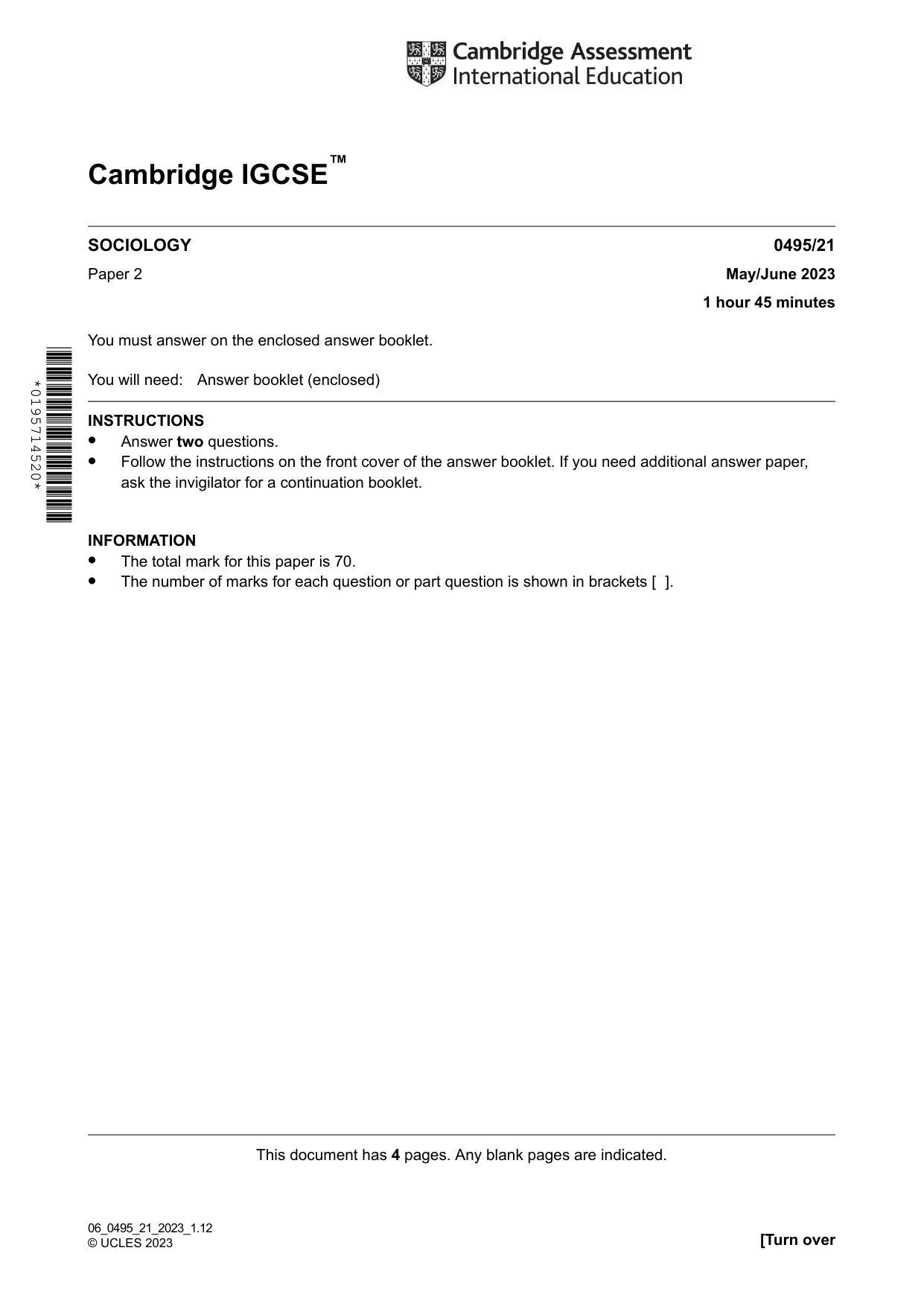
Question paper4 pages

Mark scheme27 pages
Answers below. Sit the paper first if you are practising.


Questions as text
Q1 · Family life is different for everyone
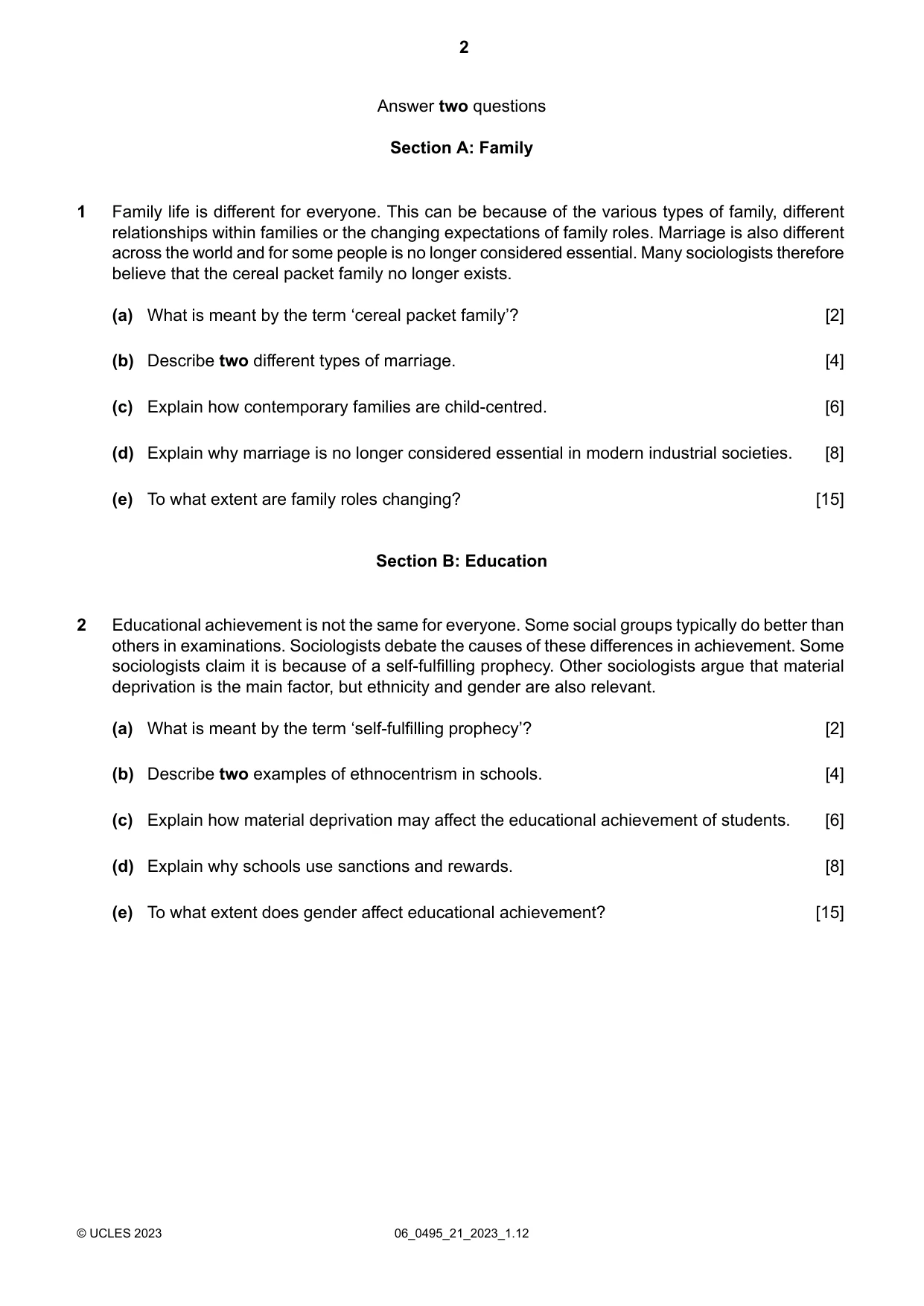
1 Family life is different for everyone. This can be because of the various types of family, different relationships within families or the changing expectations of family roles. Marriage is also different across the world and for some people is no longer considered essential. Many sociologists therefore believe that the cereal packet family no longer exists. (a) What is meant by the term ‘cereal packet family’? [2] (b) Describe two different types of marriage. [4] (c) Explain how contemporary families are child-centred. [6] (d) Explain why marriage is no longer considered essential in modern industrial societies. [8] (e) To what extent are family roles changing? [15]
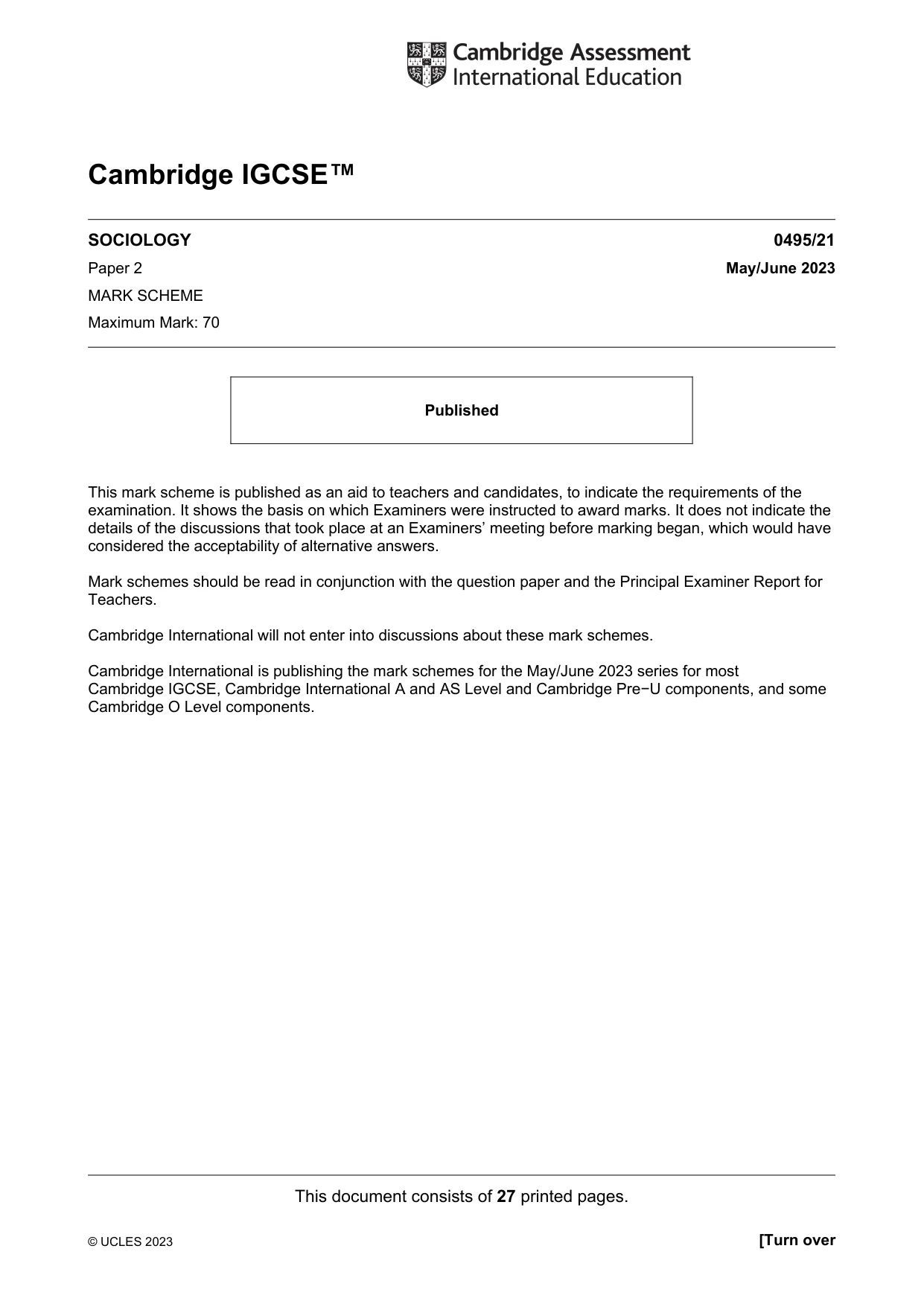
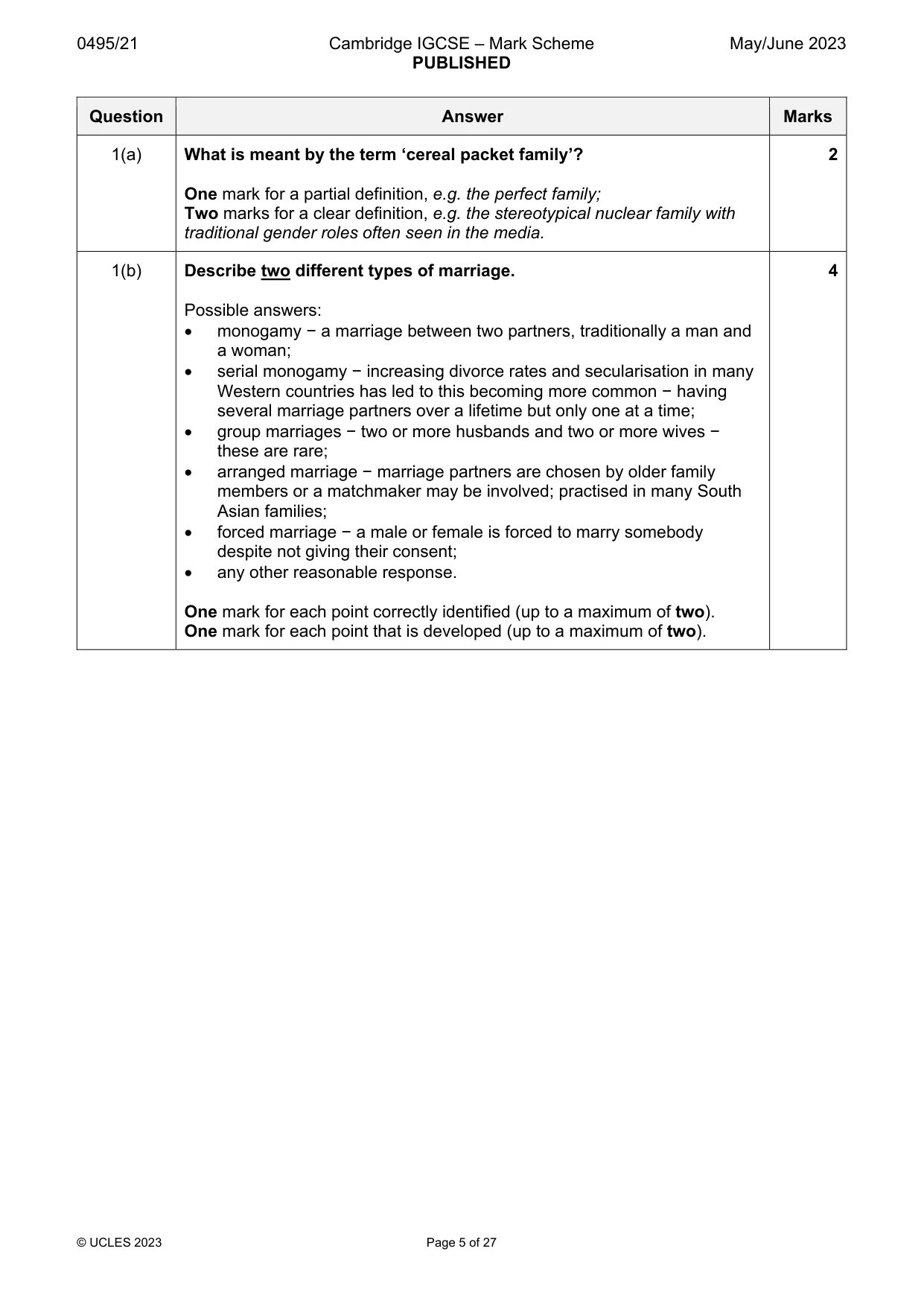
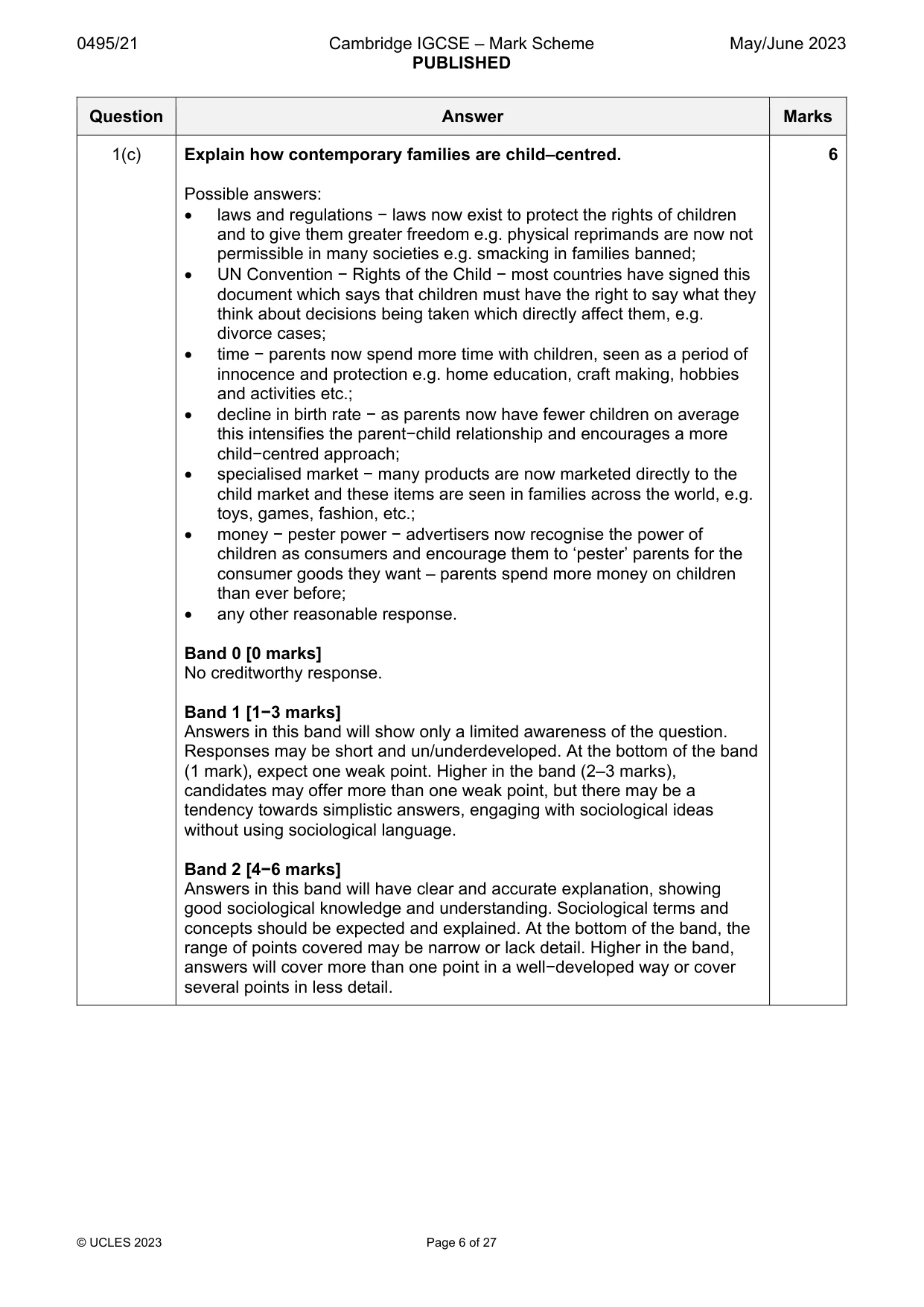
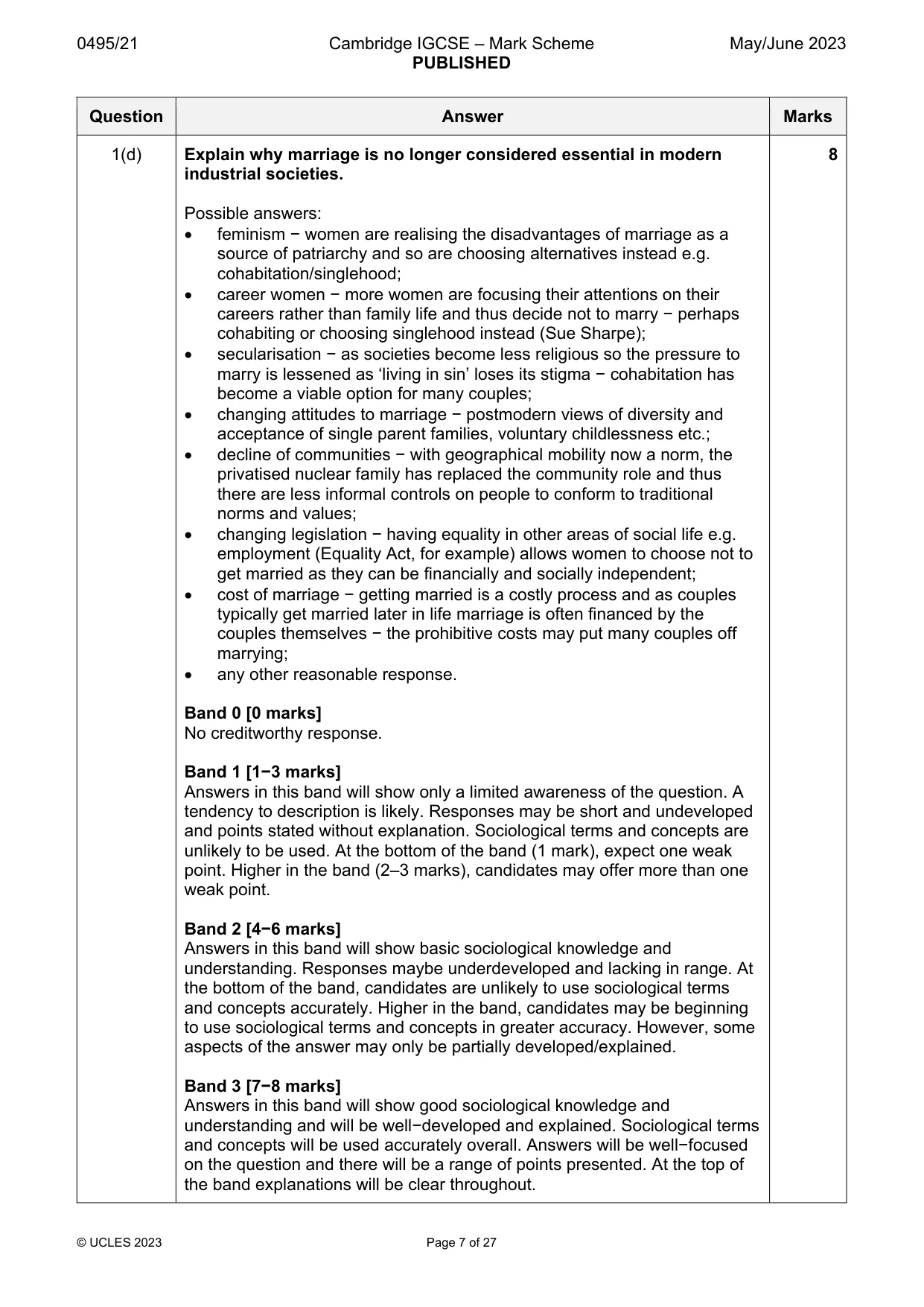
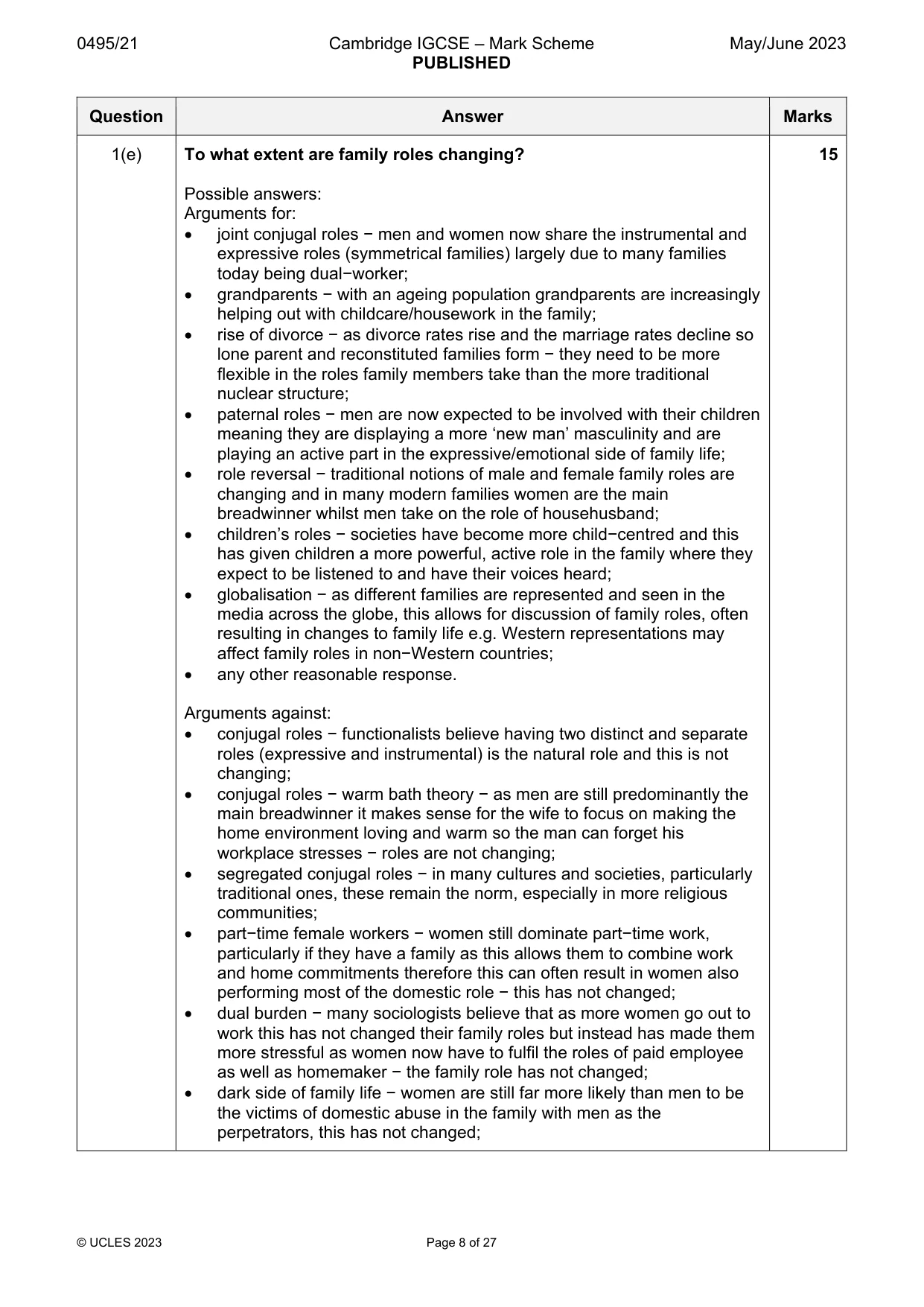
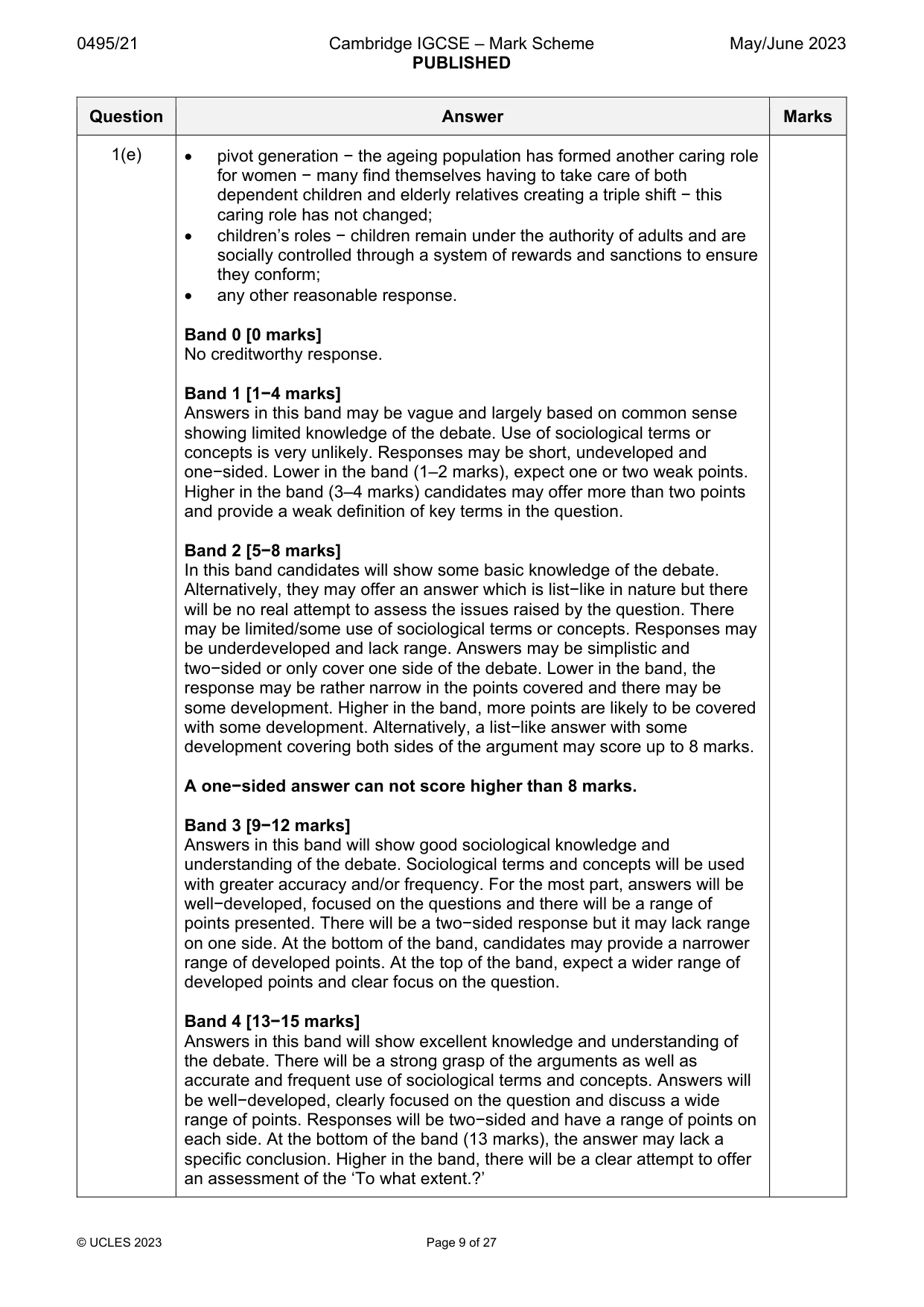
Mark scheme: Question Answer Marks 1(a) What is meant by the term ‘cereal packet family’? 2 One mark for a partial definition, e.g. the perfect family; Two marks for a clear definition, e.g. the stereotypical nuclear family with traditional gender roles often seen in the media. 1(b) Describe two different types of marriage. 4 Possible answers: monogamy − a marriage between two partners, traditionally a man and a woman; serial monogamy − increasing divorce rates and secularisation in many Western countries has led to this becoming more common − having several marriage partners over a lifetime but only one at a time; group marriages − two or more husbands and two or more wives − these are rare; arranged marriage − marriage partners are chosen by older family members or a matchmaker may be involved; practised in many South Asian families; forced marriage − a male or female is forced to marry somebody despite not giving their consent; any other reasonable response. One mark for each point correctly identified (up to a maximum of two). One mark for each point that is developed (up to a maximum of two). 1(c) Explain how contemporary families are child–centred. 6 Possible answers: laws and regulations − laws now exist to protect the rights of children and to give them greater freedom e.g. physical reprimands are now not permissible in many societies e.g. smacking in families banned; UN Convention − Rights of the Child − most countries have signed this document which says that children must have the right to say what they think about decisions being taken which directly affect them, e.g. divorce cases; time − parents now spend more time with children, seen as a period of innocence and protection e.g. home education, craft making, hobbies and activities etc.; decline in birth rate − as parents now have fewer children on average this intensifies the parent−child relationship and encourages a more child−centred approach; specialised market − many products are now marketed directly to the child market and these items are seen in families across the world, e.g. toys, games, fashion, etc.; money − pester power − advertisers now recognise the power of children as consumers and encourage them to ‘pester’ parents for the consumer goods they want – parents spend more money on children than ever before; any other reasonable response. Band 0 [0 marks] No creditworthy response. Band 1 [1−3 marks] Answers in this band will show only a limited awareness of the question. Responses may be short and un/underdeveloped. At the bottom of the band (1 mark), expect one weak point. Higher in the band (2–3 marks), candidates may offer more than one weak point, but there may be a tendency towards simplistic answers, engaging with sociological ideas without using sociological language. Band 2 [4−6 marks] Answers in this band will have clear and accurate explanation, showing good sociological knowledge and understanding. Sociological terms and concepts should be expected and explained. At the bottom of the band, the range of points covered may be narrow or lack detail. Higher in the band, answers will cover more than one point in a well−developed way or cover several points in less detail. 1(d) Explain why marriage is no longer considered essential in modern 8 industrial societies. Possible answers: feminism − women are realising the disadvantages of marriage as a source of patriarchy and so are choosing alternatives instead e.g. cohabitation/singlehood; career women − more women are focusing their attentions on their careers rather than family life and thus decide not to marry − perhaps cohabiting or choosing singlehood instead (Sue Sharpe); secularisation − as societies become less religious so the pressure to marry is lessened as ‘living in sin’ loses its stigma − cohabitation has become a viable option for many couples; changing attitudes to marriage − postmodern views of diversity and acceptance of single parent families, voluntary childlessness etc.; decline of communities − with geographical mobility now a norm, the privatised nuclear family has replaced the community role and thus there are less informal controls on people to conform to traditional norms and values; changing legislation − having equality in other areas of social life e.g. employment (Equality Act, for example) allows women to choose not to get married as they can be financially and socially independent; cost of marriage − getting married is a costly process and as couples typically get married later in life marriage is often financed by the couples themselves − the prohibitive costs may put many couples off marrying; any other reasonable response. Band 0 [0 marks] No creditworthy response. Band 1 [1−3 marks] Answers in this band will show only a limited awareness of the question. A tendency to description is likely. Responses may be short and undeveloped and points stated without explanation. Sociological terms and concepts are unlikely to be used. At the bottom of the band (1 mark), expect one weak point. Higher in the band (2–3 marks), candidates may offer more than one weak point. Band 2 [4−6 marks] Answers in this band will show basic sociological knowledge and understanding. Responses maybe underdeveloped and lacking in range. At the bottom of the band, candidates are unlikely to use sociological terms and concepts accurately. Higher in the band, candidates may be beginning to use sociological terms and concepts in greater accuracy. However, some aspects of the answer may only be partially developed/explained. Band 3 [7−8 marks] Answers in this band will show good sociological knowledge and understanding and will be well−developed and explained. Sociological terms and concepts will be used accurately overall. Answers will be well−focused on the question and there will be a range of points presented. At the top of the band explanations will be clear throughout. 1(e) To what extent are family roles changing? 15 Possible answers: Arguments for: joint conjugal roles − men and women now share the instrumental and expressive roles (symmetrical families) largely due to many families today being dual−worker; grandparents − with an ageing population grandparents are increasingly helping out with childcare/housework in the family; rise of divorce − as divorce rates rise and the marriage rates decline so lone parent and reconstituted families form − they need to be more flexible in the roles family members take than the more traditional nuclear structure; paternal roles − men are now expected to be involved with their children meaning they are displaying a more ‘new man’ masculinity and are playing an active part in the expressive/emotional side of family life; role reversal − traditional notions of male and female family roles are changing and in many modern families women are the main breadwinner whilst men take on the role of househusband; children’s roles − societies have become more child−centred and this has given children a more powerful, active role in the family where they expect to be listened to and have their voices heard; globalisation − as different families are represented and seen in the media across the globe, this allows for discussion of family roles, often resulting in changes to family life e.g. Western representations may affect family roles in non−Western countries; any other reasonable response. Arguments against: conjugal roles − functionalists believe having two distinct and separate roles (expressive and instrumental) is the natural role and this is not changing; conjugal roles − warm bath theory − as men are still predominantly the main breadwinner it makes sense for the wife to focus on making the home environment loving and warm so the man can forget his workplace stresses − roles are not changing; segregated conjugal roles − in many cultures and societies, particularly traditional ones, these remain the norm, especially in more religious communities; part−time female workers − women still dominate part−time work, particularly if they have a family as this allows them to combine work and home commitments therefore this can often result in women also performing most of the domestic role − this has not changed; dual burden − many sociologists believe that as more women go out to work this has not changed their family roles but instead has made them more stressful as women now have to fulfil the roles of paid employee as well as homemaker − the family role has not changed; dark side of family life − women are still far more likely than men to be the victims of domestic abuse in the family with men as the perpetrators, this has not changed; 1(e) pivot generation − the ageing population has formed another caring role for women − many find themselves having to take care of both dependent children and elderly relatives creating a triple shift − this caring role has not changed; children’s roles − children remain under the authority of adults and are socially controlled through a system of rewards and sanctions to ensure they conform; any other reasonable response. Band 0 [0 marks] No creditworthy response. Band 1 [1−4 marks] Answers in this band may be vague and largely based on common sense showing limited knowledge of the debate. Use of sociological terms or concepts is very unlikely. Responses may be short, undeveloped and one−sided. Lower in the band (1–2 marks), expect one or two weak points. Higher in the band (3–4 marks) candidates may offer more than two points and provide a weak definition of key terms in the question. Band 2 [5−8 marks] In this band candidates will show some basic knowledge of the debate. Alternatively, they may offer an answer which is list−like in nature but there will be no real attempt to assess the issues raised by the question. There may be limited/some use of sociological terms or concepts. Responses may be underdeveloped and lack range. Answers may be simplistic and two−sided or only cover one side of the debate. Lower in the band, the response may be rather narrow in the points covered and there may be some development. Higher in the band, more points are likely to be covered with some development. Alternatively, a list−like answer with some development covering both sides of the argument may score up to 8 marks. A one−sided answer can not score higher than 8 marks. Band 3 [9−12 marks] Answers in this band will show good sociological knowledge and understanding of the debate. Sociological terms and concepts will be used with greater accuracy and/or frequency. For the most part, answers will be well−developed, focused on the questions and there will be a range of points presented. There will be a two−sided response but it may lack range on one side. At the bottom of the band, candidates may provide a narrower range of developed points. At the top of the band, expect a wider range of developed points and clear focus on the question. Band 4 [13−15 marks] Answers in this band will show excellent knowledge and understanding of the debate. There will be a strong grasp of the arguments as well as accurate and frequent use of sociological terms and concepts. Answers will be well−developed, clearly focused on the question and discuss a wide range of points. Responses will be two−sided and have a range of points on each side. At the bottom of the band (13 marks), the answer may lack a specific conclusion. Higher in the band, there will be a clear attempt to offer an assessment of the ‘To what extent.?’
Q2 · Educational achievement is not the same for everyone
2 Educational achievement is not the same for everyone. Some social groups typically do better than others in examinations. Sociologists debate the causes of these differences in achievement. Some sociologists claim it is because of a self-fulfilling prophecy. Other sociologists argue that material deprivation is the main factor, but ethnicity and gender are also relevant. (a) What is meant by the term ‘self-fulfilling prophecy’? [2] (b) Describe two examples of ethnocentrism in schools. [4] (c) Explain how material deprivation may affect the educational achievement of students. [6] (d) Explain why schools use sanctions and rewards. [8] (e) To what extent does gender affect educational achievement? [15] Section C: Crime, deviance and social control
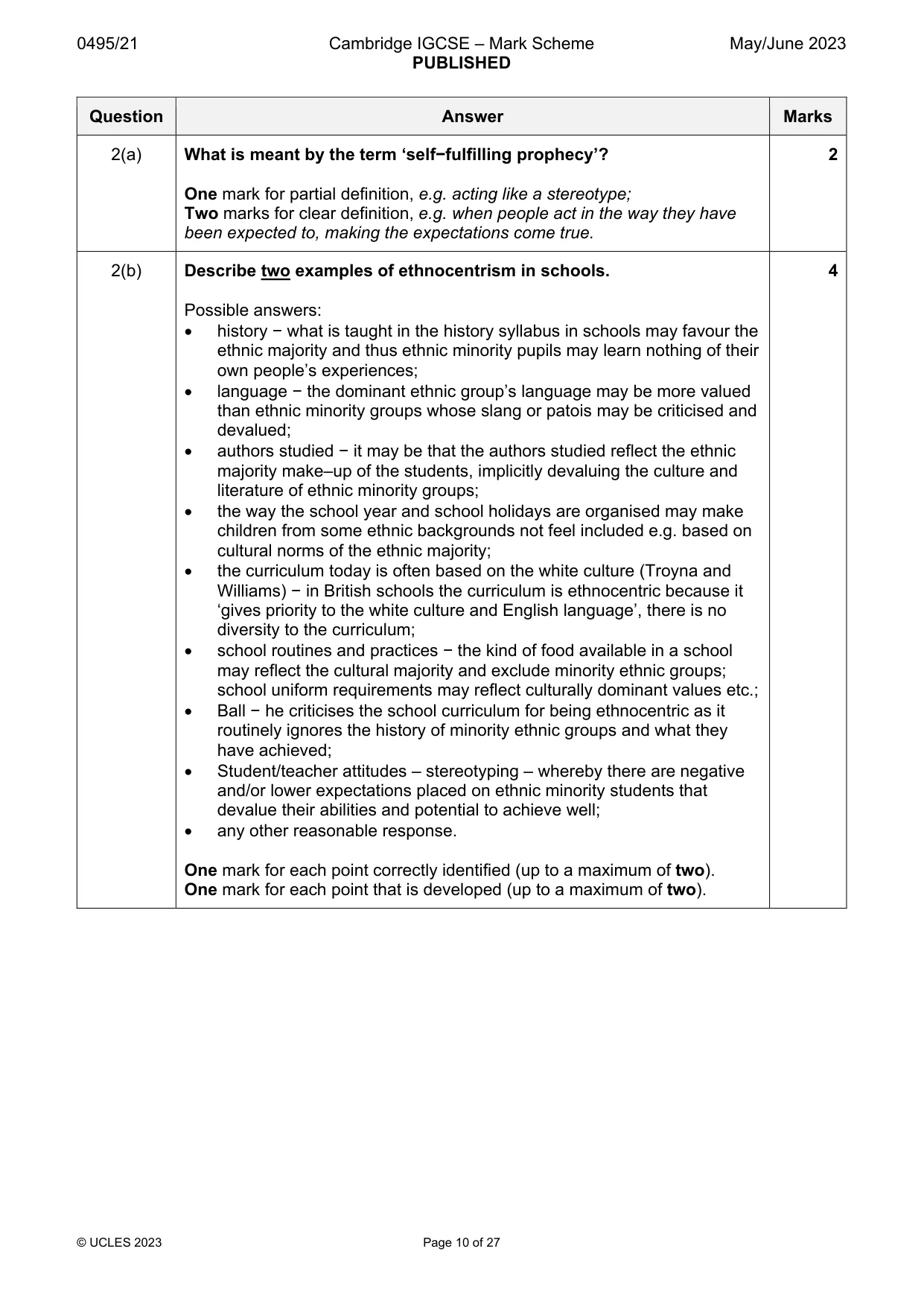
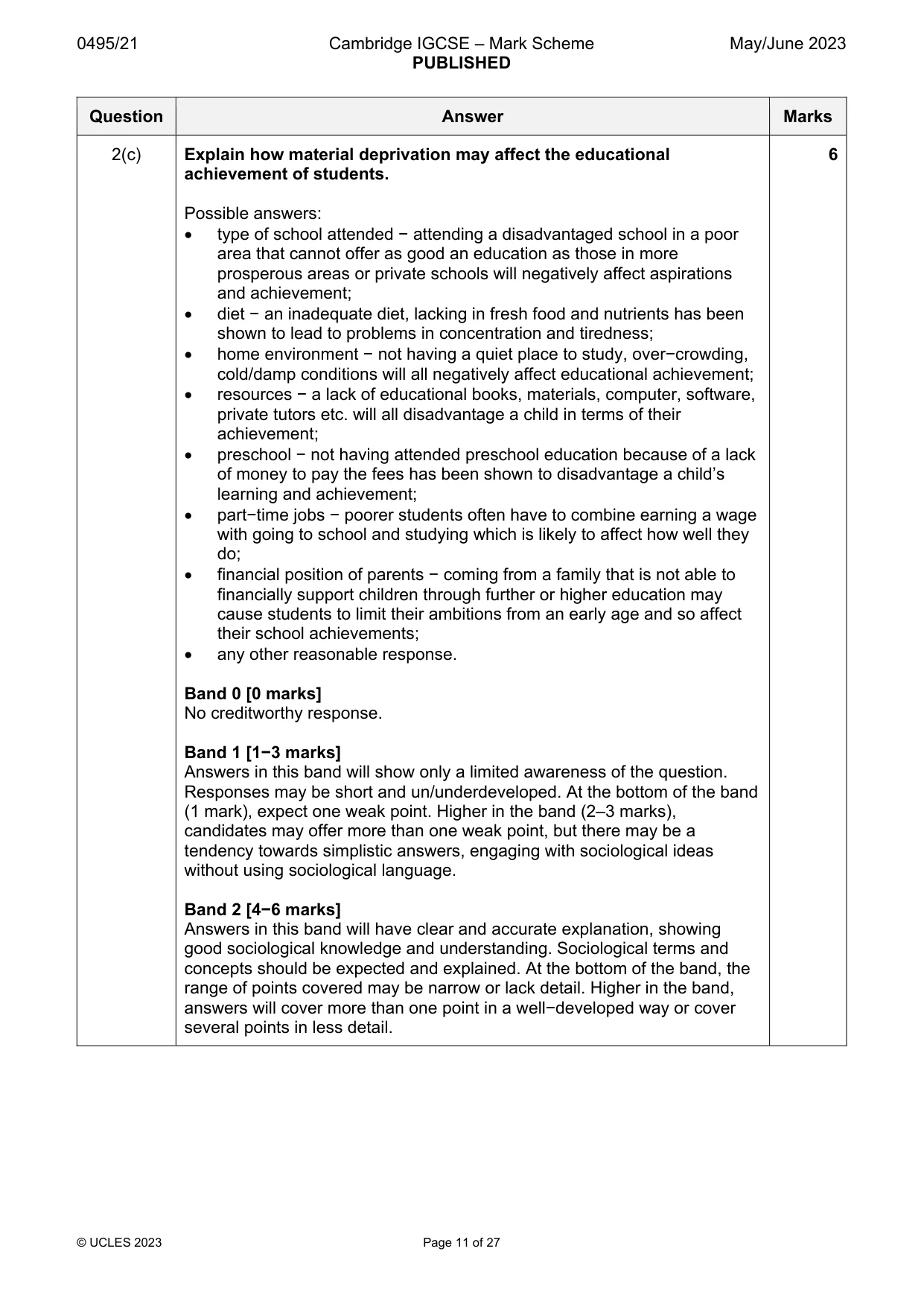
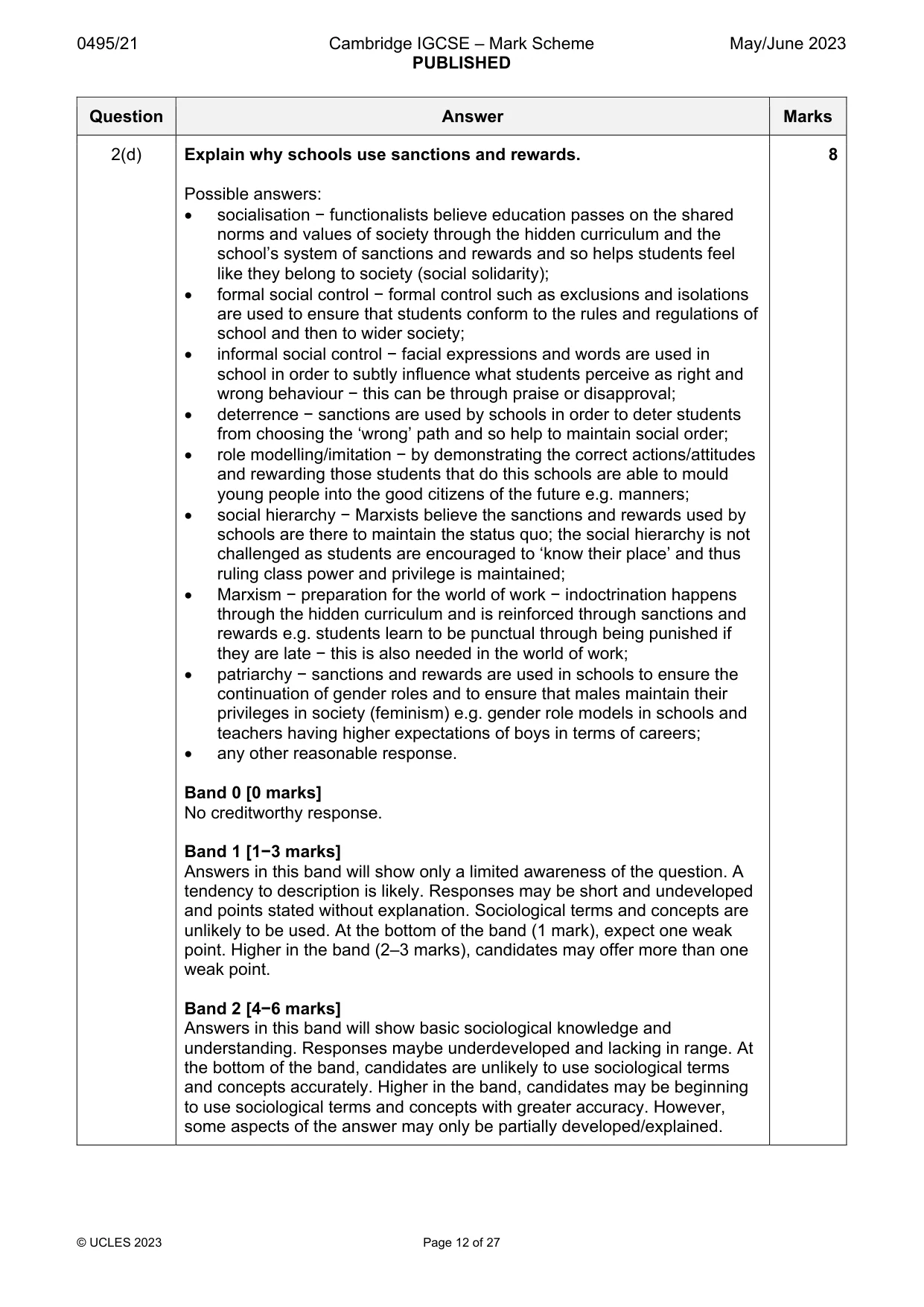
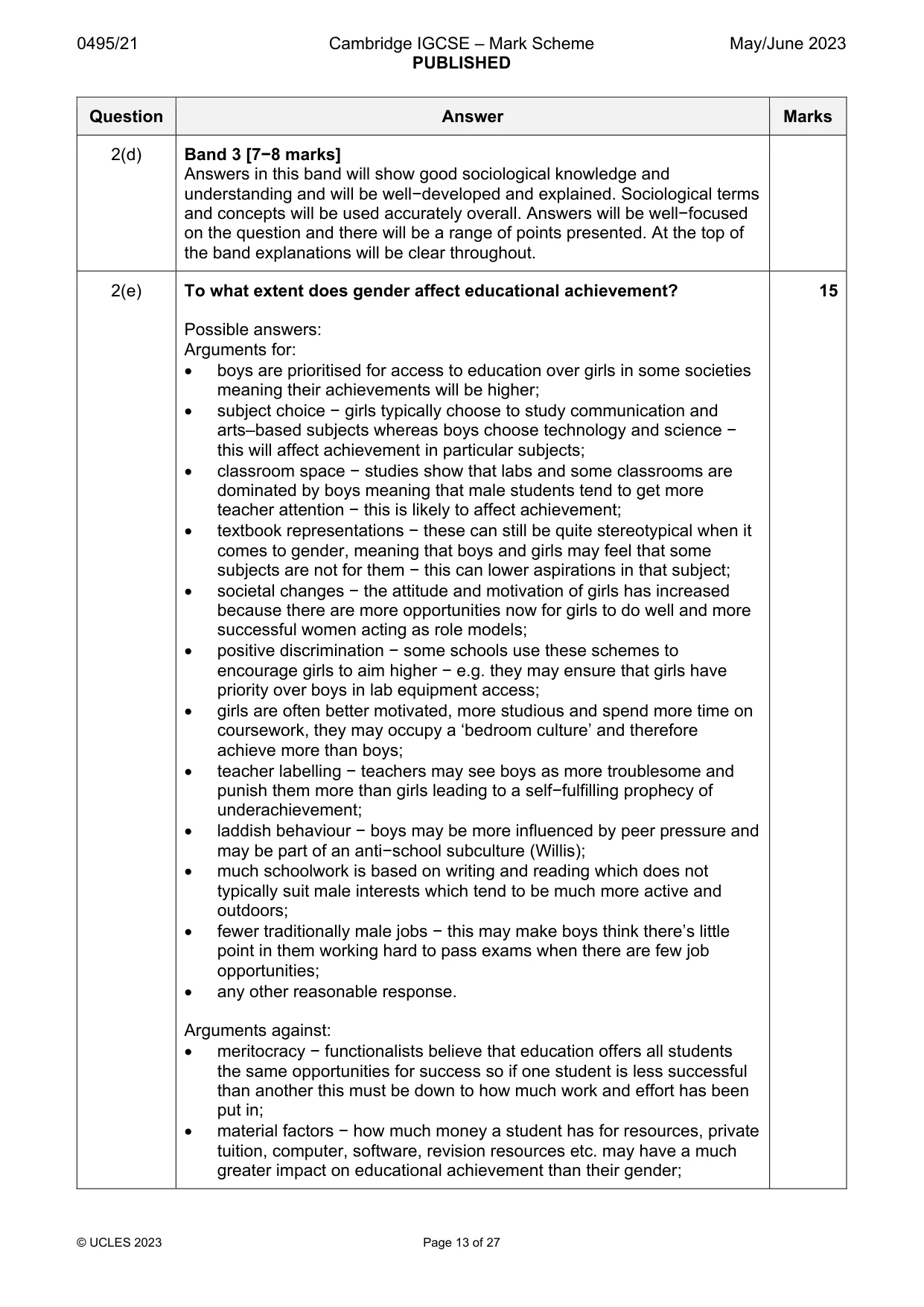
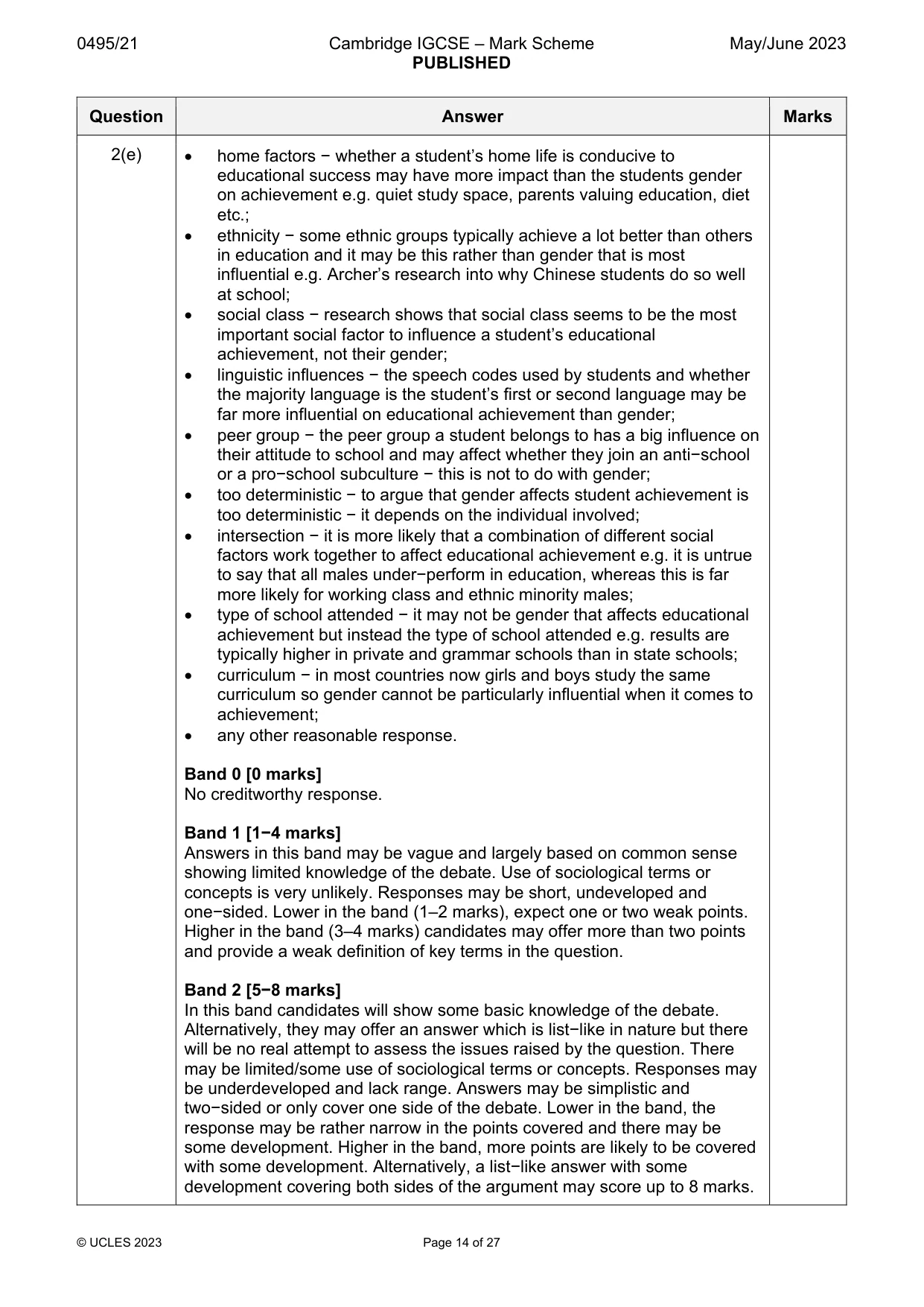
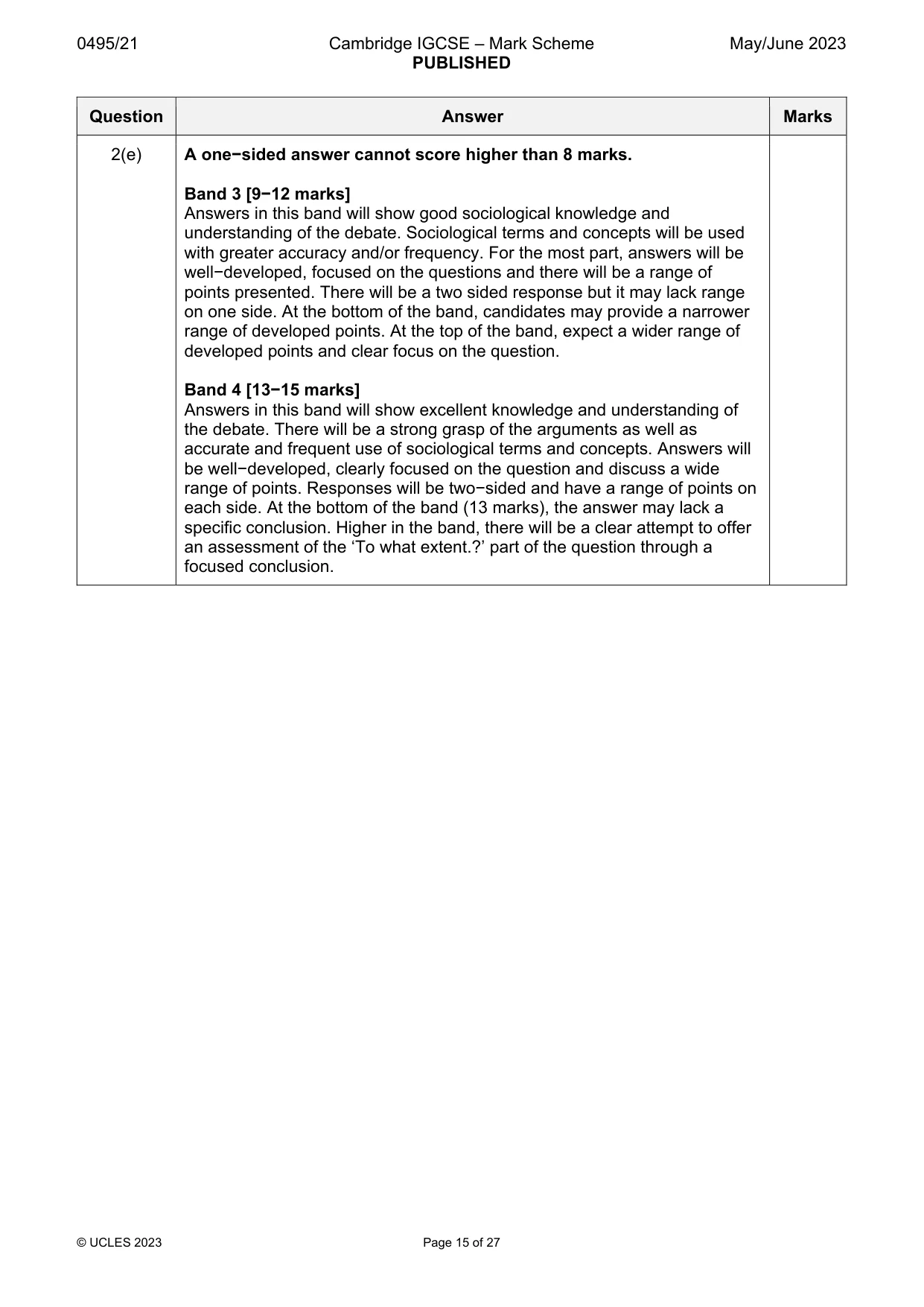
Mark scheme: 2(a) What is meant by the term ‘self−fulfilling prophecy’? 2 One mark for partial definition, e.g. acting like a stereotype; Two marks for clear definition, e.g. when people act in the way they have been expected to, making the expectations come true. 2(b) Describe two examples of ethnocentrism in schools. 4 Possible answers: history − what is taught in the history syllabus in schools may favour the ethnic majority and thus ethnic minority pupils may learn nothing of their own people’s experiences; language − the dominant ethnic group’s language may be more valued than ethnic minority groups whose slang or patois may be criticised and devalued; authors studied − it may be that the authors studied reflect the ethnic majority make–up of the students, implicitly devaluing the culture and literature of ethnic minority groups; the way the school year and school holidays are organised may make children from some ethnic backgrounds not feel included e.g. based on cultural norms of the ethnic majority; the curriculum today is often based on the white culture (Troyna and Williams) − in British schools the curriculum is ethnocentric because it ‘gives priority to the white culture and English language’, there is no diversity to the curriculum; school routines and practices − the kind of food available in a school may reflect the cultural majority and exclude minority ethnic groups; school uniform requirements may reflect culturally dominant values etc.; Ball − he criticises the school curriculum for being ethnocentric as it routinely ignores the history of minority ethnic groups and what they have achieved; Student/teacher attitudes – stereotyping – whereby there are negative and/or lower expectations placed on ethnic minority students that devalue their abilities and potential to achieve well; any other reasonable response. One mark for each point correctly identified (up to a maximum of two). One mark for each point that is developed (up to a maximum of two). 2(c) Explain how material deprivation may affect the educational 6 achievement of students. Possible answers: type of school attended − attending a disadvantaged school in a poor area that cannot offer as good an education as those in more prosperous areas or private schools will negatively affect aspirations and achievement; diet − an inadequate diet, lacking in fresh food and nutrients has been shown to lead to problems in concentration and tiredness; home environment − not having a quiet place to study, over−crowding, cold/damp conditions will all negatively affect educational achievement; resources − a lack of educational books, materials, computer, software, private tutors etc. will all disadvantage a child in terms of their achievement; preschool − not having attended preschool education because of a lack of money to pay the fees has been shown to disadvantage a child’s learning and achievement; part−time jobs − poorer students often have to combine earning a wage with going to school and studying which is likely to affect how well they do; financial position of parents − coming from a family that is not able to financially support children through further or higher education may cause students to limit their ambitions from an early age and so affect their school achievements; any other reasonable response. Band 0 [0 marks] No creditworthy response. Band 1 [1−3 marks] Answers in this band will show only a limited awareness of the question. Responses may be short and un/underdeveloped. At the bottom of the band (1 mark), expect one weak point. Higher in the band (2–3 marks), candidates may offer more than one weak point, but there may be a tendency towards simplistic answers, engaging with sociological ideas without using sociological language. Band 2 [4−6 marks] Answers in this band will have clear and accurate explanation, showing good sociological knowledge and understanding. Sociological terms and concepts should be expected and explained. At the bottom of the band, the range of points covered may be narrow or lack detail. Higher in the band, answers will cover more than one point in a well−developed way or cover several points in less detail. 2(d) Explain why schools use sanctions and rewards. 8 Possible answers: socialisation − functionalists believe education passes on the shared norms and values of society through the hidden curriculum and the school’s system of sanctions and rewards and so helps students feel like they belong to society (social solidarity); formal social control − formal control such as exclusions and isolations are used to ensure that students conform to the rules and regulations of school and then to wider society; informal social control − facial expressions and words are used in school in order to subtly influence what students perceive as right and wrong behaviour − this can be through praise or disapproval; deterrence − sanctions are used by schools in order to deter students from choosing the ‘wrong’ path and so help to maintain social order; role modelling/imitation − by demonstrating the correct actions/attitudes and rewarding those students that do this schools are able to mould young people into the good citizens of the future e.g. manners; social hierarchy − Marxists believe the sanctions and rewards used by schools are there to maintain the status quo; the social hierarchy is not challenged as students are encouraged to ‘know their place’ and thus ruling class power and privilege is maintained; Marxism − preparation for the world of work − indoctrination happens through the hidden curriculum and is reinforced through sanctions and rewards e.g. students learn to be punctual through being punished if they are late − this is also needed in the world of work; patriarchy − sanctions and rewards are used in schools to ensure the continuation of gender roles and to ensure that males maintain their privileges in society (feminism) e.g. gender role models in schools and teachers having higher expectations of boys in terms of careers; any other reasonable response. Band 0 [0 marks] No creditworthy response. Band 1 [1−3 marks] Answers in this band will show only a limited awareness of the question. A tendency to description is likely. Responses may be short and undeveloped and points stated without explanation. Sociological terms and concepts are unlikely to be used. At the bottom of the band (1 mark), expect one weak point. Higher in the band (2–3 marks), candidates may offer more than one weak point. Band 2 [4−6 marks] Answers in this band will show basic sociological knowledge and understanding. Responses maybe underdeveloped and lacking in range. At the bottom of the band, candidates are unlikely to use sociological terms and concepts accurately. Higher in the band, candidates may be beginning to use sociological terms and concepts with greater accuracy. However, some aspects of the answer may only be partially developed/explained. 2(d) Band 3 [7−8 marks] Answers in this band will show good sociological knowledge and understanding and will be well−developed and explained. Sociological terms and concepts will be used accurately overall. Answers will be well−focused on the question and there will be a range of points presented. At the top of the band explanations will be clear throughout. 2(e) To what extent does gender affect educational achievement? 15 Possible answers: Arguments for: boys are prioritised for access to education over girls in some societies meaning their achievements will be higher; subject choice − girls typically choose to study communication and arts–based subjects whereas boys choose technology and science − this will affect achievement in particular subjects; classroom space − studies show that labs and some classrooms are dominated by boys meaning that male students tend to get more teacher attention − this is likely to affect achievement; textbook representations − these can still be quite stereotypical when it comes to gender, meaning that boys and girls may feel that some subjects are not for them − this can lower aspirations in that subject; societal changes − the attitude and motivation of girls has increased because there are more opportunities now for girls to do well and more successful women acting as role models; positive discrimination − some schools use these schemes to encourage girls to aim higher − e.g. they may ensure that girls have priority over boys in lab equipment access; girls are often better motivated, more studious and spend more time on coursework, they may occupy a ‘bedroom culture’ and therefore achieve more than boys; teacher labelling − teachers may see boys as more troublesome and punish them more than girls leading to a self−fulfilling prophecy of underachievement; laddish behaviour − boys may be more influenced by peer pressure and may be part of an anti−school subculture (Willis); much schoolwork is based on writing and reading which does not typically suit male interests which tend to be much more active and outdoors; fewer traditionally male jobs − this may make boys think there’s little point in them working hard to pass exams when there are few job opportunities; any other reasonable response. Arguments against: meritocracy − functionalists believe that education offers all students the same opportunities for success so if one student is less successful than another this must be down to how much work and effort has been put in; material factors − how much money a student has for resources, private tuition, computer, software, revision resources etc. may have a much greater impact on educational achievement than their gender; 2(e) home factors − whether a student’s home life is conducive to educational success may have more impact than the students gender on achievement e.g. quiet study space, parents valuing education, diet etc.; ethnicity − some ethnic groups typically achieve a lot better than others in education and it may be this rather than gender that is most influential e.g. Archer’s research into why Chinese students do so well at school; social class − research shows that social class seems to be the most important social factor to influence a student’s educational achievement, not their gender; linguistic influences − the speech codes used by students and whether the majority language is the student’s first or second language may be far more influential on educational achievement than gender; peer group − the peer group a student belongs to has a big influence on their attitude to school and may affect whether they join an anti−school or a pro−school subculture − this is not to do with gender; too deterministic − to argue that gender affects student achievement is too deterministic − it depends on the individual involved; intersection − it is more likely that a combination of different social factors work together to affect educational achievement e.g. it is untrue to say that all males under−perform in education, whereas this is far more likely for working class and ethnic minority males; type of school attended − it may not be gender that affects educational achievement but instead the type of school attended e.g. results are typically higher in private and grammar schools than in state schools; curriculum − in most countries now girls and boys study the same curriculum so gender cannot be particularly influential when it comes to achievement; any other reasonable response. Band 0 [0 marks] No creditworthy response. Band 1 [1−4 marks] Answers in this band may be vague and largely based on common sense showing limited knowledge of the debate. Use of sociological terms or concepts is very unlikely. Responses may be short, undeveloped and one−sided. Lower in the band (1–2 marks), expect one or two weak points. Higher in the band (3–4 marks) candidates may offer more than two points and provide a weak definition of key terms in the question. Band 2 [5−8 marks] In this band candidates will show some basic knowledge of the debate. Alternatively, they may offer an answer which is list−like in nature but there will be no real attempt to assess the issues raised by the question. There may be limited/some use of sociological terms or concepts. Responses may be underdeveloped and lack range. Answers may be simplistic and two−sided or only cover one side of the debate. Lower in the band, the response may be rather narrow in the points covered and there may be some development. Higher in the band, more points are likely to be covered with some development. Alternatively, a list−like answer with some development covering both sides of the argument may score up to 8 marks. 2(e) A one−sided answer cannot score higher than 8 marks. Band 3 [9−12 marks] Answers in this band will show good sociological knowledge and understanding of the debate. Sociological terms and concepts will be used with greater accuracy and/or frequency. For the most part, answers will be well−developed, focused on the questions and there will be a range of points presented. There will be a two sided response but it may lack range on one side. At the bottom of the band, candidates may provide a narrower range of developed points. At the top of the band, expect a wider range of developed points and clear focus on the question. Band 4 [13−15 marks] Answers in this band will show excellent knowledge and understanding of the debate. There will be a strong grasp of the arguments as well as accurate and frequent use of sociological terms and concepts. Answers will be well−developed, clearly focused on the question and discuss a wide range of points. Responses will be two−sided and have a range of points on each side. At the bottom of the band (13 marks), the answer may lack a specific conclusion. Higher in the band, there will be a clear attempt to offer an assessment of the ‘To what extent.?’ part of the question through a focused conclusion.
Q3 · Crime rates are measured in different ways by sociologists and governments
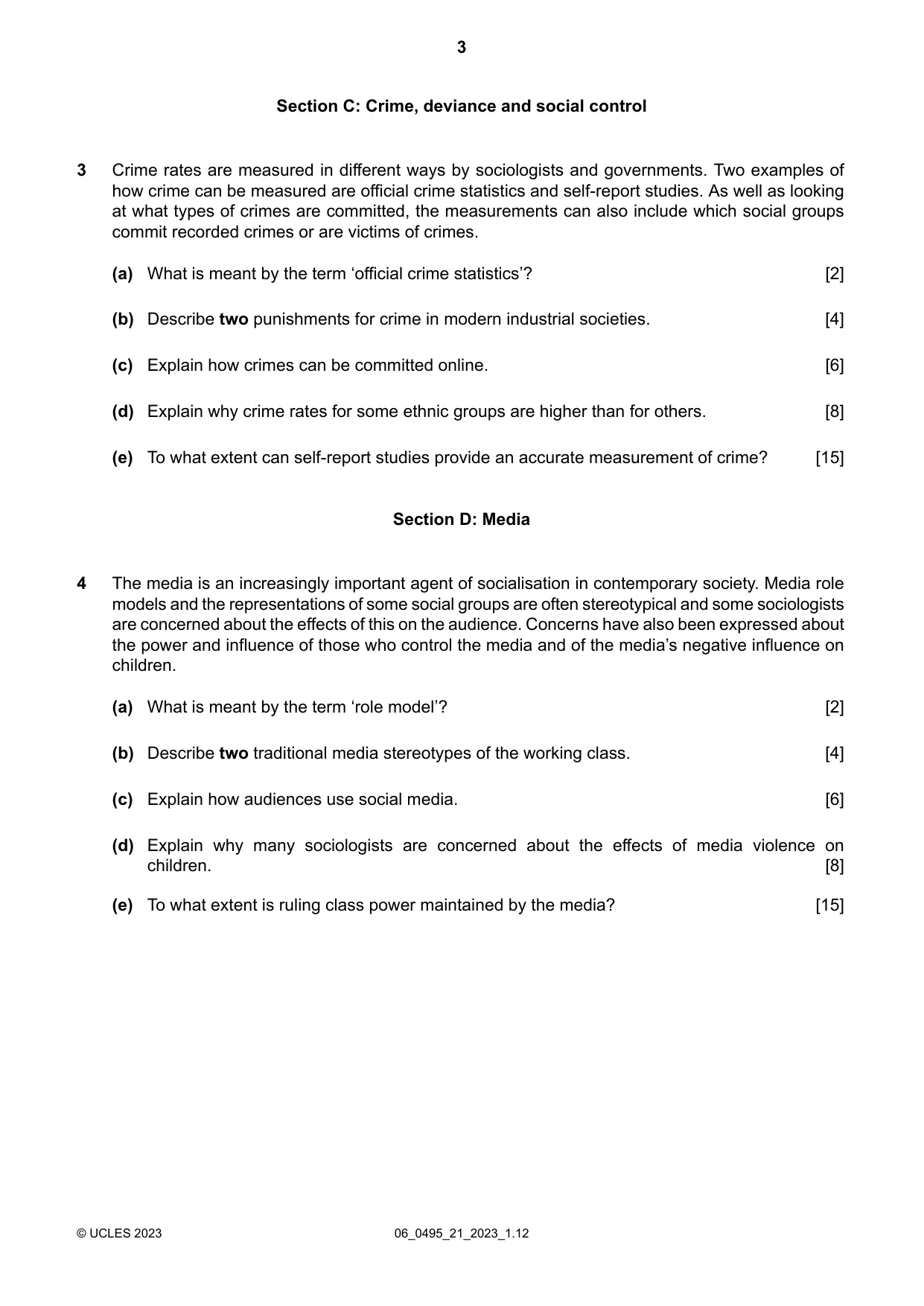
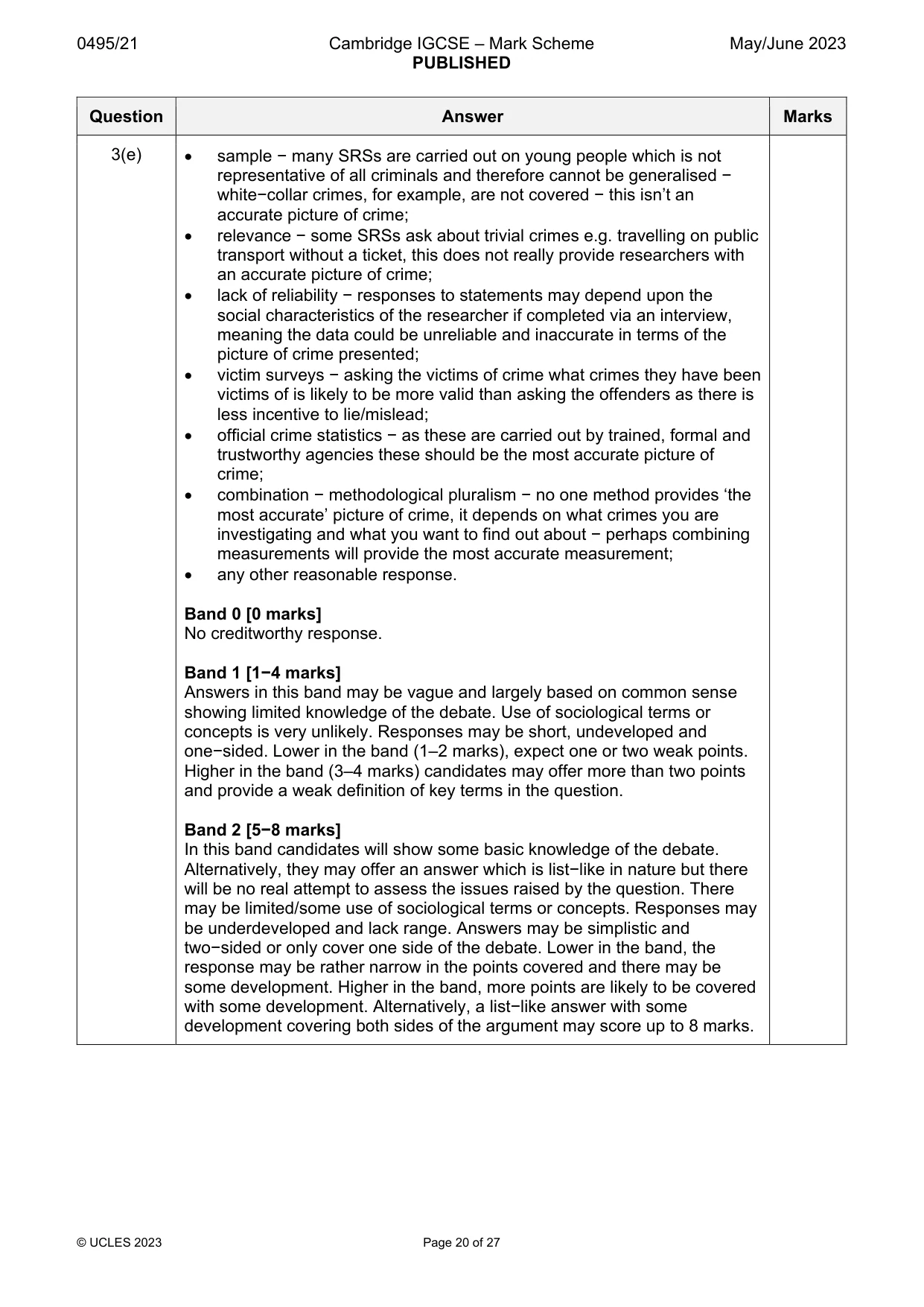
3 Crime rates are measured in different ways by sociologists and governments. Two examples of how crime can be measured are official crime statistics and self-report studies. As well as looking at what types of crimes are committed, the measurements can also include which social groups commit recorded crimes or are victims of crimes. (a) What is meant by the term ‘official crime statistics’? [2] (b) Describe two punishments for crime in modern industrial societies. [4] (c) Explain how crimes can be committed online. [6] (d) Explain why crime rates for some ethnic groups are higher than for others. [8] (e) To what extent can self-report studies provide an accurate measurement of crime? [15] Section D: Media
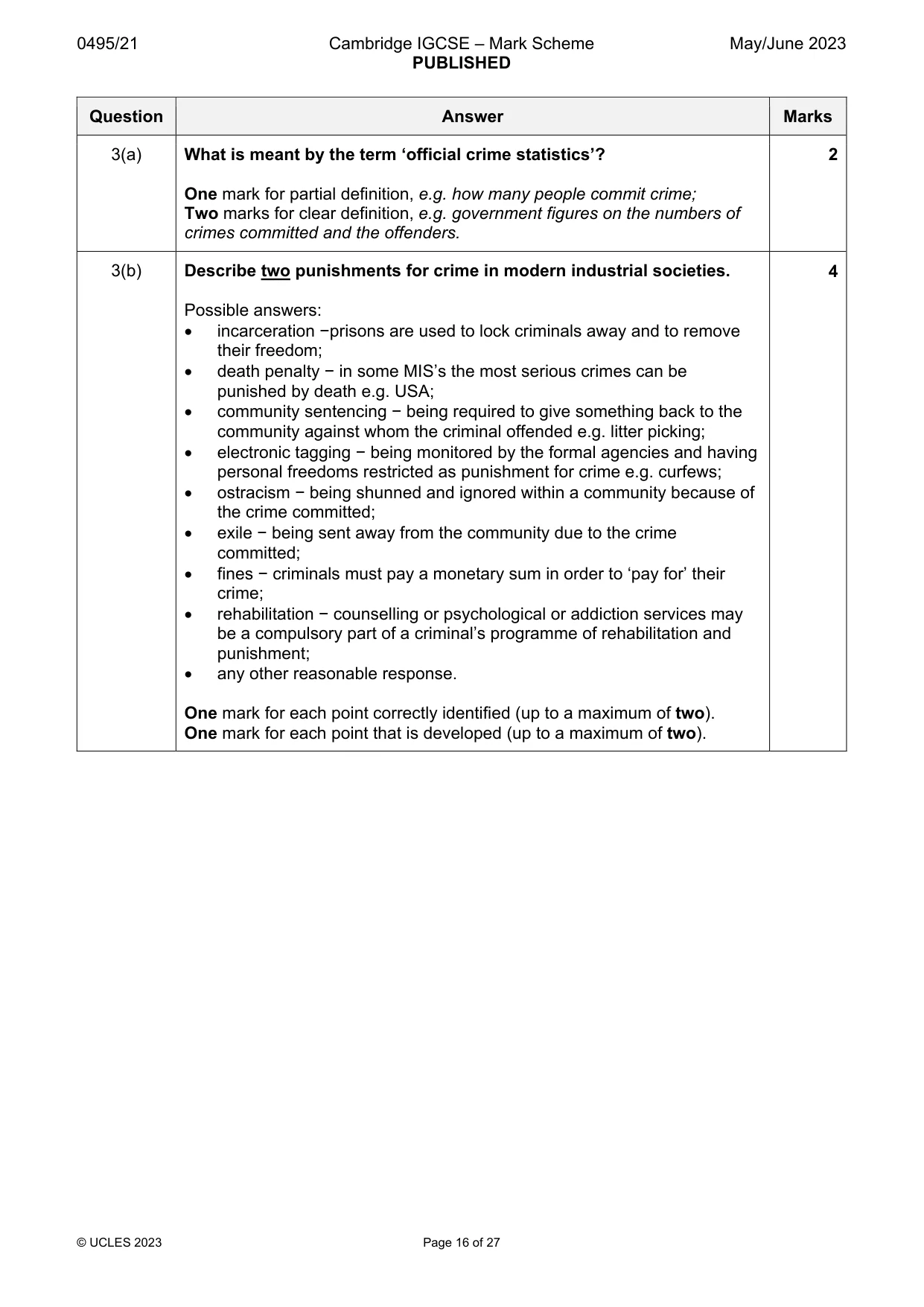
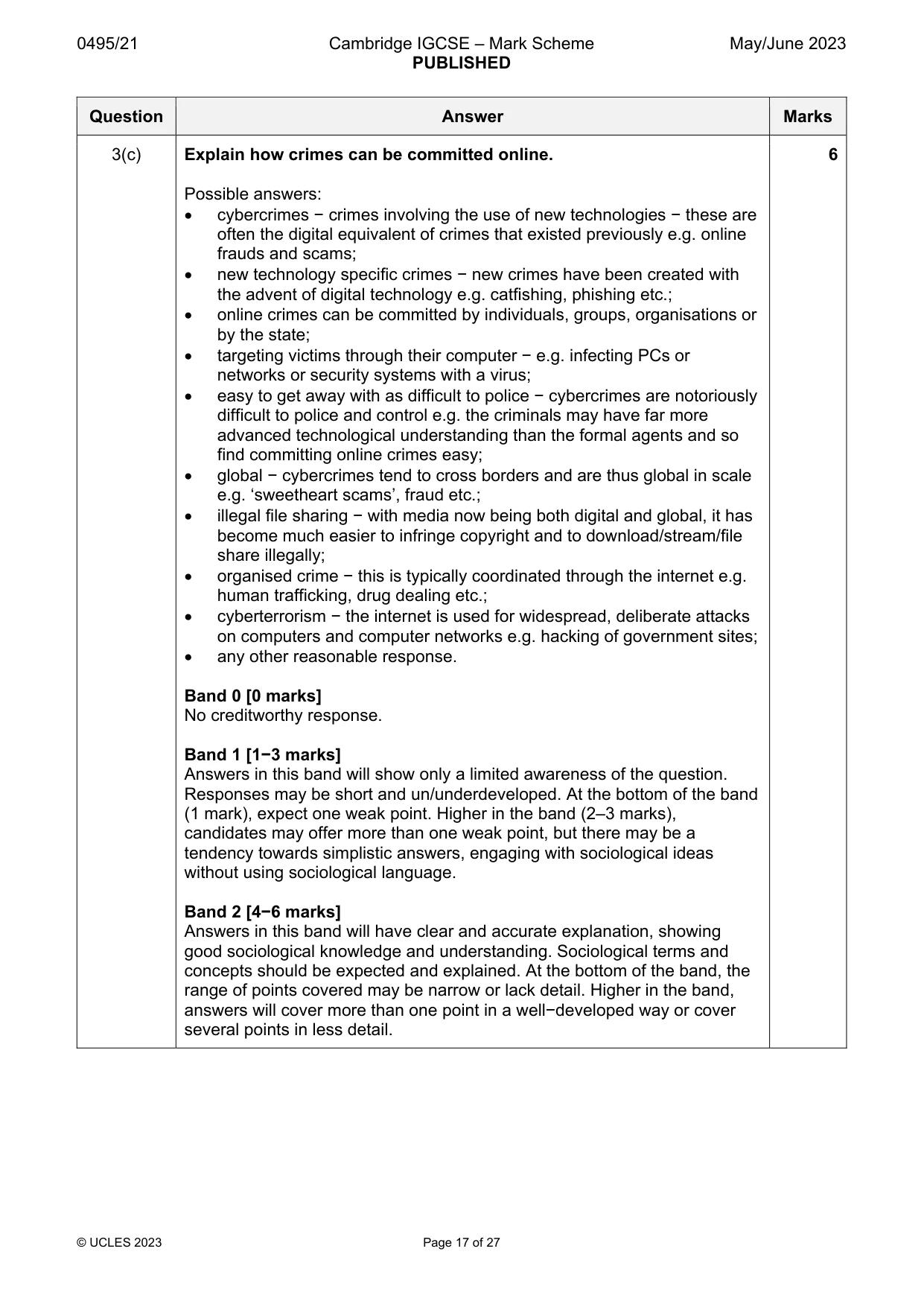
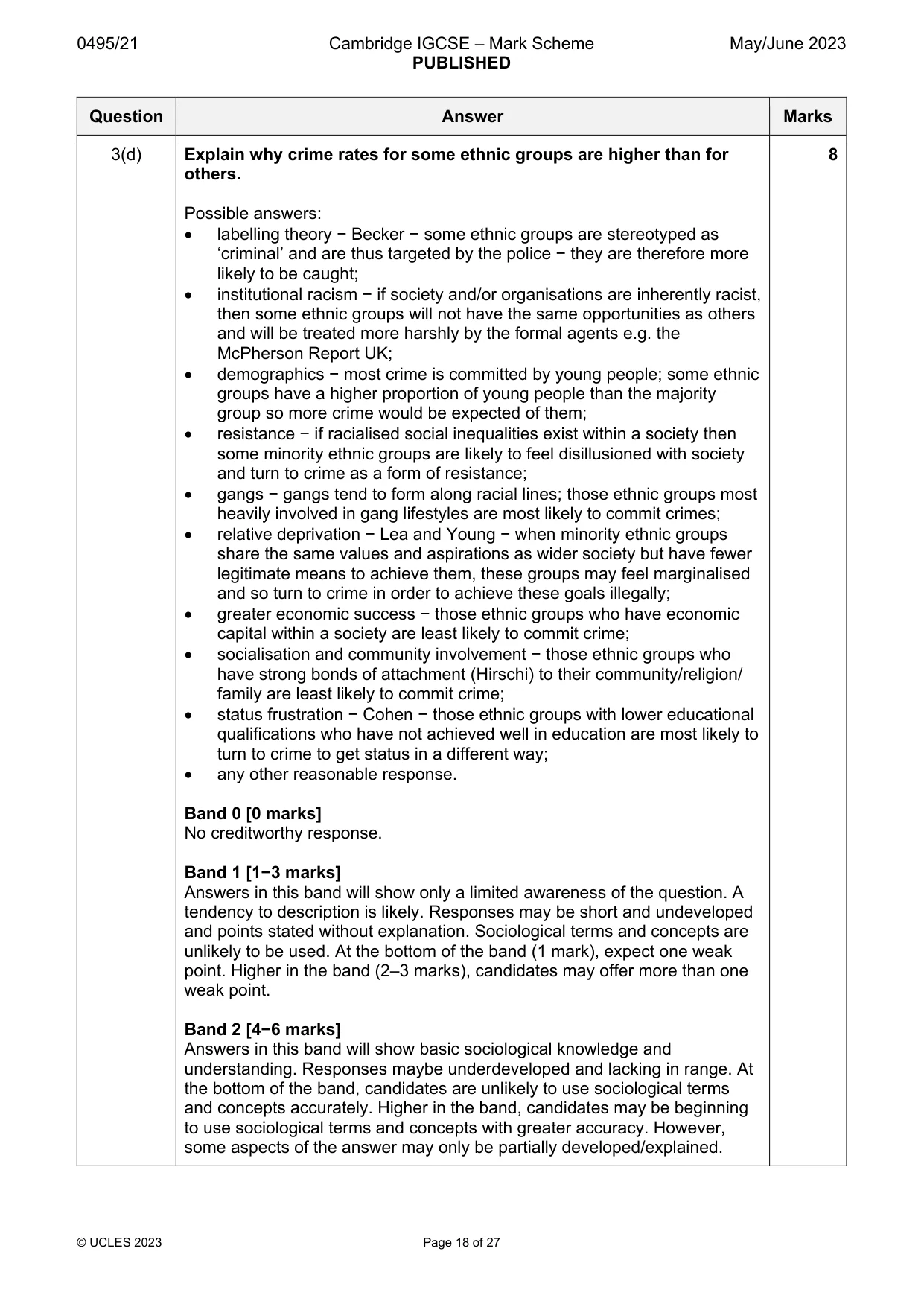
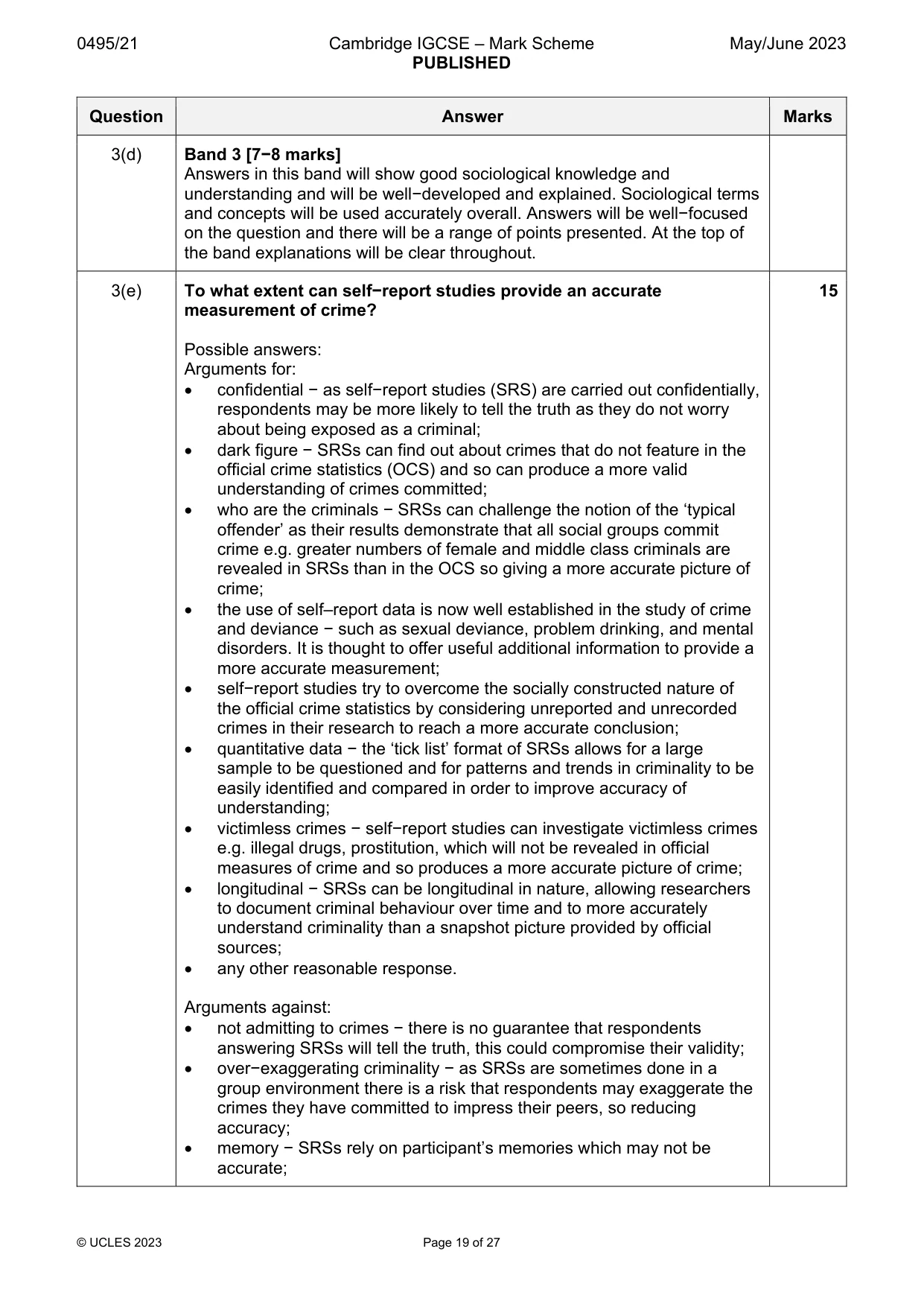
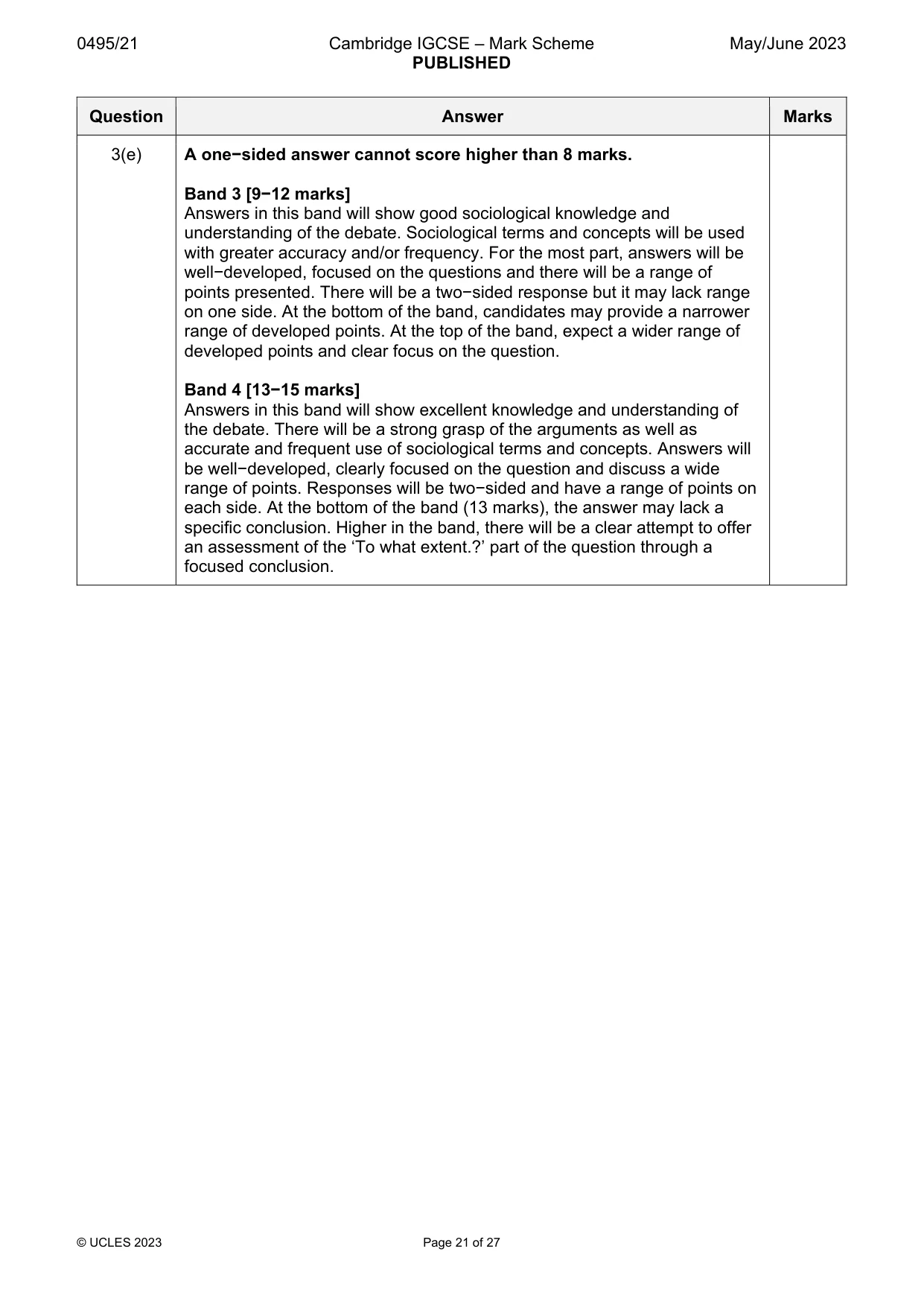
Mark scheme: 3(a) What is meant by the term ‘official crime statistics’? 2 One mark for partial definition, e.g. how many people commit crime; Two marks for clear definition, e.g. government figures on the numbers of crimes committed and the offenders. 3(b) Describe two punishments for crime in modern industrial societies. 4 Possible answers: incarceration −prisons are used to lock criminals away and to remove their freedom; death penalty − in some MIS’s the most serious crimes can be punished by death e.g. USA; community sentencing − being required to give something back to the community against whom the criminal offended e.g. litter picking; electronic tagging − being monitored by the formal agencies and having personal freedoms restricted as punishment for crime e.g. curfews; ostracism − being shunned and ignored within a community because of the crime committed; exile − being sent away from the community due to the crime committed; fines − criminals must pay a monetary sum in order to ‘pay for’ their crime; rehabilitation − counselling or psychological or addiction services may be a compulsory part of a criminal’s programme of rehabilitation and punishment; any other reasonable response. One mark for each point correctly identified (up to a maximum of two). One mark for each point that is developed (up to a maximum of two). 3(c) Explain how crimes can be committed online. 6 Possible answers: cybercrimes − crimes involving the use of new technologies − these are often the digital equivalent of crimes that existed previously e.g. online frauds and scams; new technology specific crimes − new crimes have been created with the advent of digital technology e.g. catfishing, phishing etc.; online crimes can be committed by individuals, groups, organisations or by the state; targeting victims through their computer − e.g. infecting PCs or networks or security systems with a virus; easy to get away with as difficult to police − cybercrimes are notoriously difficult to police and control e.g. the criminals may have far more advanced technological understanding than the formal agents and so find committing online crimes easy; global − cybercrimes tend to cross borders and are thus global in scale e.g. ‘sweetheart scams’, fraud etc.; illegal file sharing − with media now being both digital and global, it has become much easier to infringe copyright and to download/stream/file share illegally; organised crime − this is typically coordinated through the internet e.g. human trafficking, drug dealing etc.; cyberterrorism − the internet is used for widespread, deliberate attacks on computers and computer networks e.g. hacking of government sites; any other reasonable response. Band 0 [0 marks] No creditworthy response. Band 1 [1−3 marks] Answers in this band will show only a limited awareness of the question. Responses may be short and un/underdeveloped. At the bottom of the band (1 mark), expect one weak point. Higher in the band (2–3 marks), candidates may offer more than one weak point, but there may be a tendency towards simplistic answers, engaging with sociological ideas without using sociological language. Band 2 [4−6 marks] Answers in this band will have clear and accurate explanation, showing good sociological knowledge and understanding. Sociological terms and concepts should be expected and explained. At the bottom of the band, the range of points covered may be narrow or lack detail. Higher in the band, answers will cover more than one point in a well−developed way or cover several points in less detail. 3(d) Explain why crime rates for some ethnic groups are higher than for 8 others. Possible answers: labelling theory − Becker − some ethnic groups are stereotyped as ‘criminal’ and are thus targeted by the police − they are therefore more likely to be caught; institutional racism − if society and/or organisations are inherently racist, then some ethnic groups will not have the same opportunities as others and will be treated more harshly by the formal agents e.g. the McPherson Report UK; demographics − most crime is committed by young people; some ethnic groups have a higher proportion of young people than the majority group so more crime would be expected of them; resistance − if racialised social inequalities exist within a society then some minority ethnic groups are likely to feel disillusioned with society and turn to crime as a form of resistance; gangs − gangs tend to form along racial lines; those ethnic groups most heavily involved in gang lifestyles are most likely to commit crimes; relative deprivation − Lea and Young − when minority ethnic groups share the same values and aspirations as wider society but have fewer legitimate means to achieve them, these groups may feel marginalised and so turn to crime in order to achieve these goals illegally; greater economic success − those ethnic groups who have economic capital within a society are least likely to commit crime; socialisation and community involvement − those ethnic groups who have strong bonds of attachment (Hirschi) to their community/religion/ family are least likely to commit crime; status frustration − Cohen − those ethnic groups with lower educational qualifications who have not achieved well in education are most likely to turn to crime to get status in a different way; any other reasonable response. Band 0 [0 marks] No creditworthy response. Band 1 [1−3 marks] Answers in this band will show only a limited awareness of the question. A tendency to description is likely. Responses may be short and undeveloped and points stated without explanation. Sociological terms and concepts are unlikely to be used. At the bottom of the band (1 mark), expect one weak point. Higher in the band (2–3 marks), candidates may offer more than one weak point. Band 2 [4−6 marks] Answers in this band will show basic sociological knowledge and understanding. Responses maybe underdeveloped and lacking in range. At the bottom of the band, candidates are unlikely to use sociological terms and concepts accurately. Higher in the band, candidates may be beginning to use sociological terms and concepts with greater accuracy. However, some aspects of the answer may only be partially developed/explained. 3(d) Band 3 [7−8 marks] Answers in this band will show good sociological knowledge and understanding and will be well−developed and explained. Sociological terms and concepts will be used accurately overall. Answers will be well−focused on the question and there will be a range of points presented. At the top of the band explanations will be clear throughout. 3(e) To what extent can self−report studies provide an accurate 15 measurement of crime? Possible answers: Arguments for: confidential − as self−report studies (SRS) are carried out confidentially, respondents may be more likely to tell the truth as they do not worry about being exposed as a criminal; dark figure − SRSs can find out about crimes that do not feature in the official crime statistics (OCS) and so can produce a more valid understanding of crimes committed; who are the criminals − SRSs can challenge the notion of the ‘typical offender’ as their results demonstrate that all social groups commit crime e.g. greater numbers of female and middle class criminals are revealed in SRSs than in the OCS so giving a more accurate picture of crime; the use of self–report data is now well established in the study of crime and deviance − such as sexual deviance, problem drinking, and mental disorders. It is thought to offer useful additional information to provide a more accurate measurement; self−report studies try to overcome the socially constructed nature of the official crime statistics by considering unreported and unrecorded crimes in their research to reach a more accurate conclusion; quantitative data − the ‘tick list’ format of SRSs allows for a large sample to be questioned and for patterns and trends in criminality to be easily identified and compared in order to improve accuracy of understanding; victimless crimes − self−report studies can investigate victimless crimes e.g. illegal drugs, prostitution, which will not be revealed in official measures of crime and so produces a more accurate picture of crime; longitudinal − SRSs can be longitudinal in nature, allowing researchers to document criminal behaviour over time and to more accurately understand criminality than a snapshot picture provided by official sources; any other reasonable response. Arguments against: not admitting to crimes − there is no guarantee that respondents answering SRSs will tell the truth, this could compromise their validity; over−exaggerating criminality − as SRSs are sometimes done in a group environment there is a risk that respondents may exaggerate the crimes they have committed to impress their peers, so reducing accuracy; memory − SRSs rely on participant’s memories which may not be accurate; 3(e) sample − many SRSs are carried out on young people which is not representative of all criminals and therefore cannot be generalised − white−collar crimes, for example, are not covered − this isn’t an accurate picture of crime; relevance − some SRSs ask about trivial crimes e.g. travelling on public transport without a ticket, this does not really provide researchers with an accurate picture of crime; lack of reliability − responses to statements may depend upon the social characteristics of the researcher if completed via an interview, meaning the data could be unreliable and inaccurate in terms of the picture of crime presented; victim surveys − asking the victims of crime what crimes they have been victims of is likely to be more valid than asking the offenders as there is less incentive to lie/mislead; official crime statistics − as these are carried out by trained, formal and trustworthy agencies these should be the most accurate picture of crime; combination − methodological pluralism − no one method provides ‘the most accurate’ picture of crime, it depends on what crimes you are investigating and what you want to find out about − perhaps combining measurements will provide the most accurate measurement; any other reasonable response. Band 0 [0 marks] No creditworthy response. Band 1 [1−4 marks] Answers in this band may be vague and largely based on common sense showing limited knowledge of the debate. Use of sociological terms or concepts is very unlikely. Responses may be short, undeveloped and one−sided. Lower in the band (1–2 marks), expect one or two weak points. Higher in the band (3–4 marks) candidates may offer more than two points and provide a weak definition of key terms in the question. Band 2 [5−8 marks] In this band candidates will show some basic knowledge of the debate. Alternatively, they may offer an answer which is list−like in nature but there will be no real attempt to assess the issues raised by the question. There may be limited/some use of sociological terms or concepts. Responses may be underdeveloped and lack range. Answers may be simplistic and two−sided or only cover one side of the debate. Lower in the band, the response may be rather narrow in the points covered and there may be some development. Higher in the band, more points are likely to be covered with some development. Alternatively, a list−like answer with some development covering both sides of the argument may score up to 8 marks. 3(e) A one−sided answer cannot score higher than 8 marks. Band 3 [9−12 marks] Answers in this band will show good sociological knowledge and understanding of the debate. Sociological terms and concepts will be used with greater accuracy and/or frequency. For the most part, answers will be well−developed, focused on the questions and there will be a range of points presented. There will be a two−sided response but it may lack range on one side. At the bottom of the band, candidates may provide a narrower range of developed points. At the top of the band, expect a wider range of developed points and clear focus on the question. Band 4 [13−15 marks] Answers in this band will show excellent knowledge and understanding of the debate. There will be a strong grasp of the arguments as well as accurate and frequent use of sociological terms and concepts. Answers will be well−developed, clearly focused on the question and discuss a wide range of points. Responses will be two−sided and have a range of points on each side. At the bottom of the band (13 marks), the answer may lack a specific conclusion. Higher in the band, there will be a clear attempt to offer an assessment of the ‘To what extent.?’ part of the question through a focused conclusion.
More questions on What types of data and evidence do sociologists use?
Q4 · The media is an increasingly important agent of socialisation in contemporary society
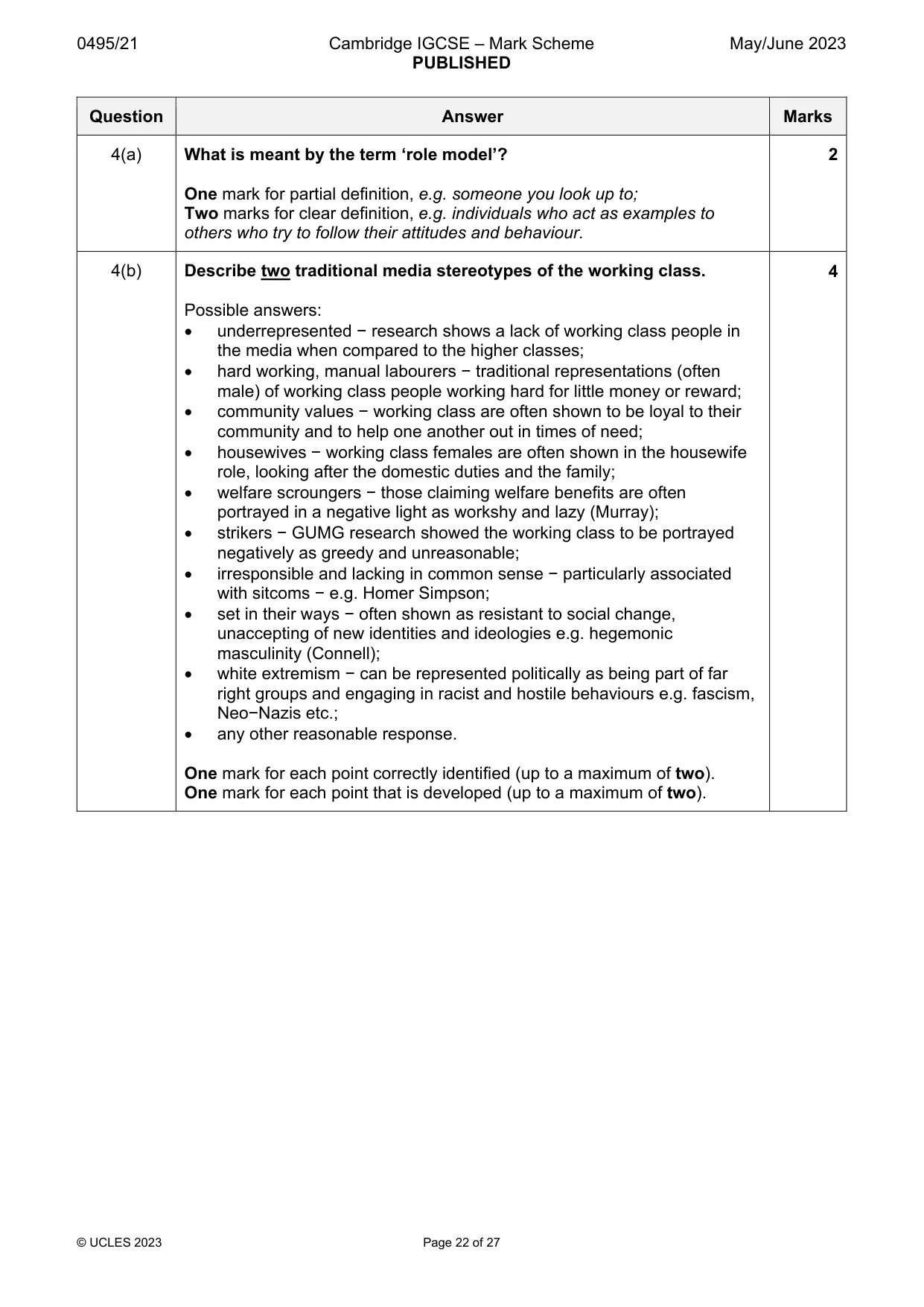
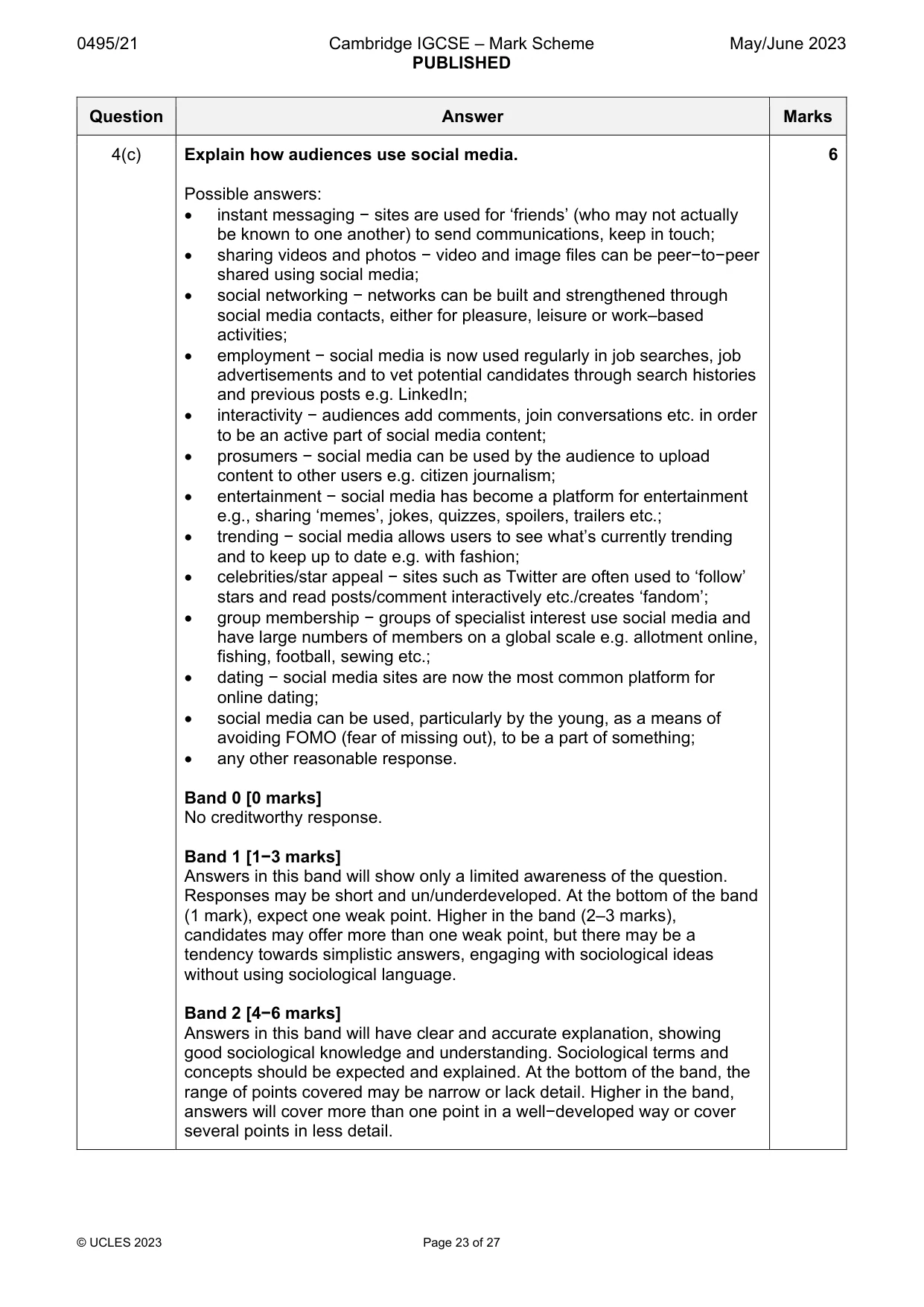
4 The media is an increasingly important agent of socialisation in contemporary society. Media role models and the representations of some social groups are often stereotypical and some sociologists are concerned about the effects of this on the audience. Concerns have also been expressed about the power and influence of those who control the media and of the media’s negative influence on children. (a) What is meant by the term ‘role model’? [2] (b) Describe two traditional media stereotypes of the working class. [4] (c) Explain how audiences use social media. [6] (d) Explain why many sociologists are concerned about the effects of media violence on children. [8] (e) To what extent is ruling class power maintained by the media? [15]
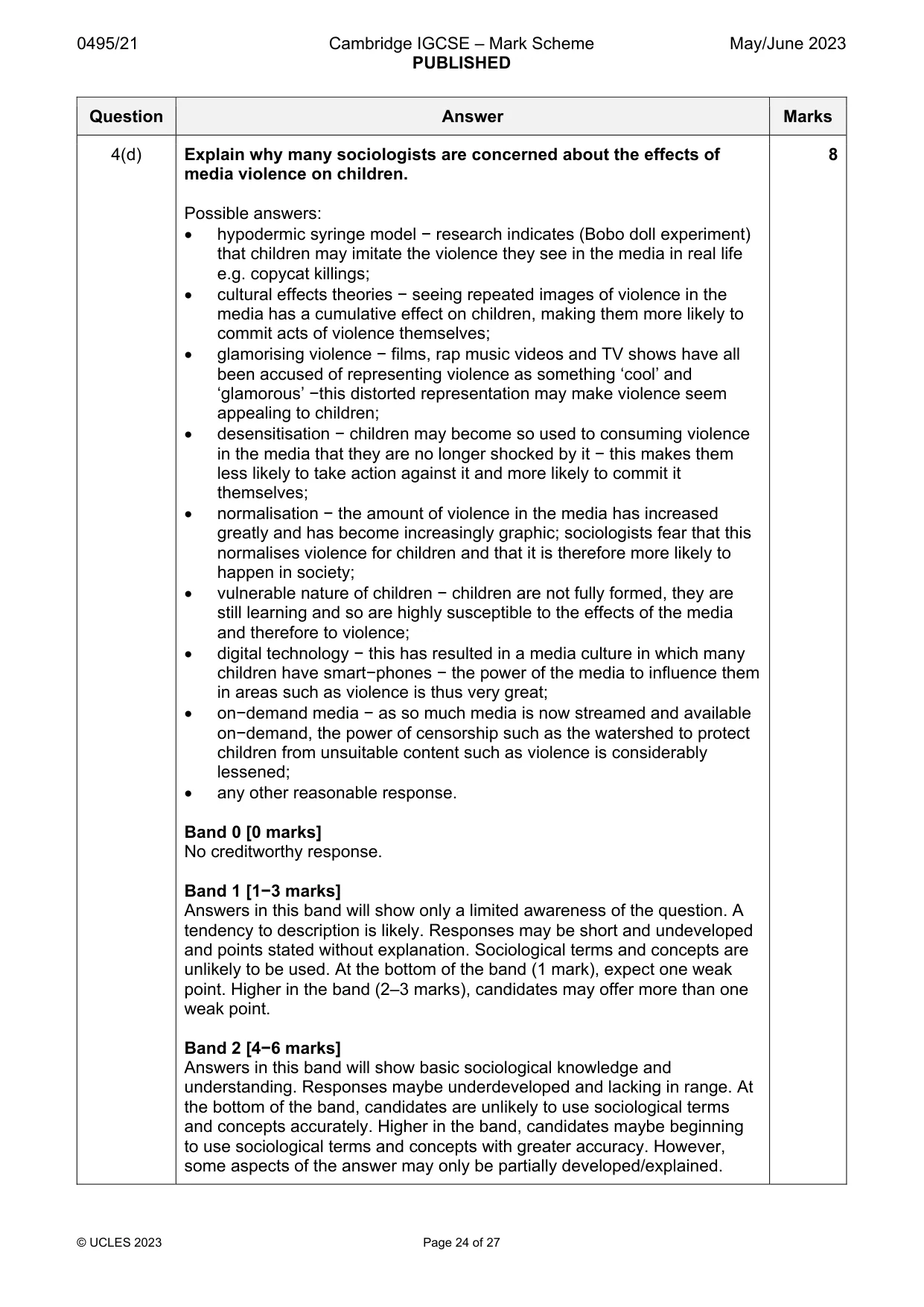
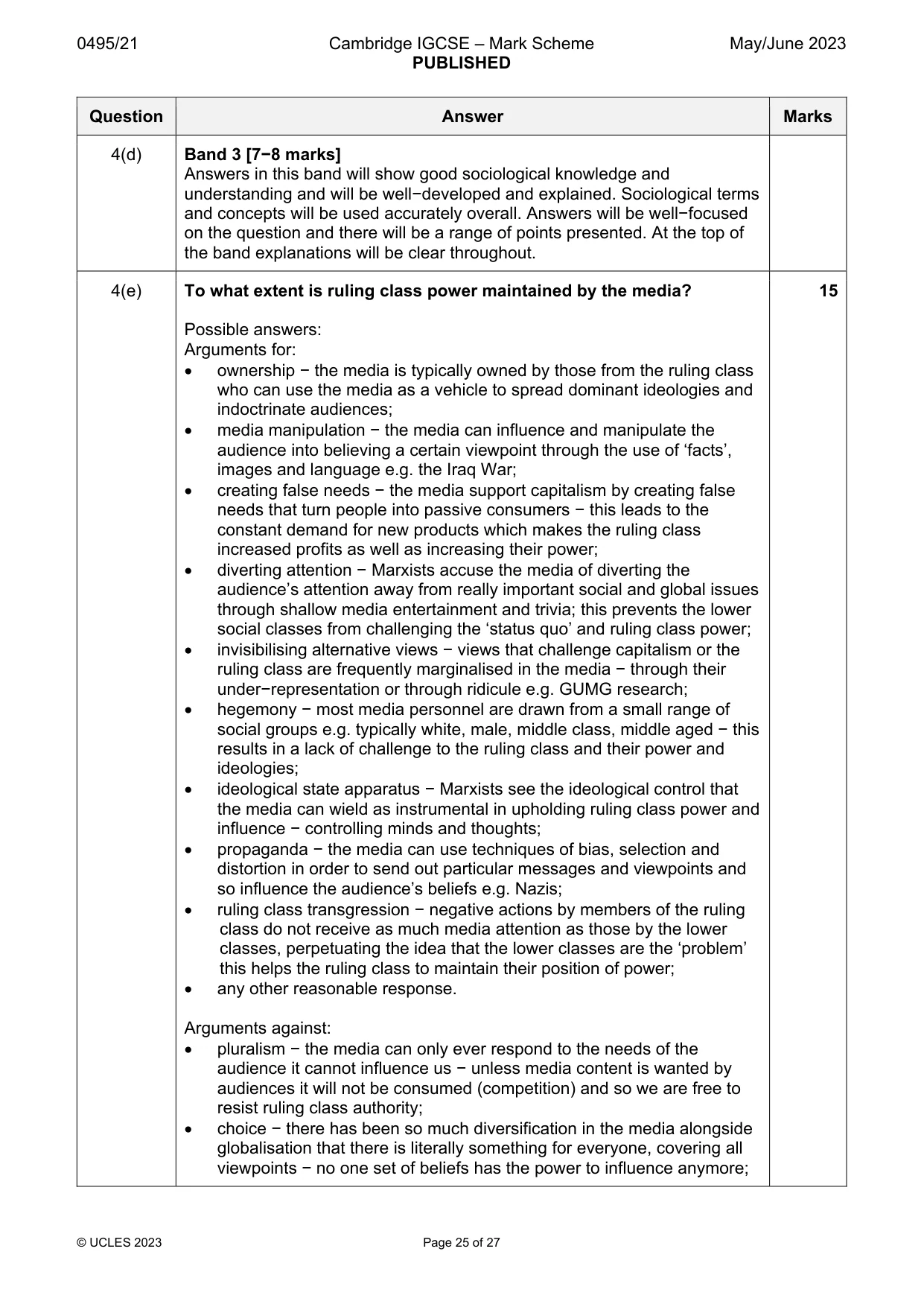
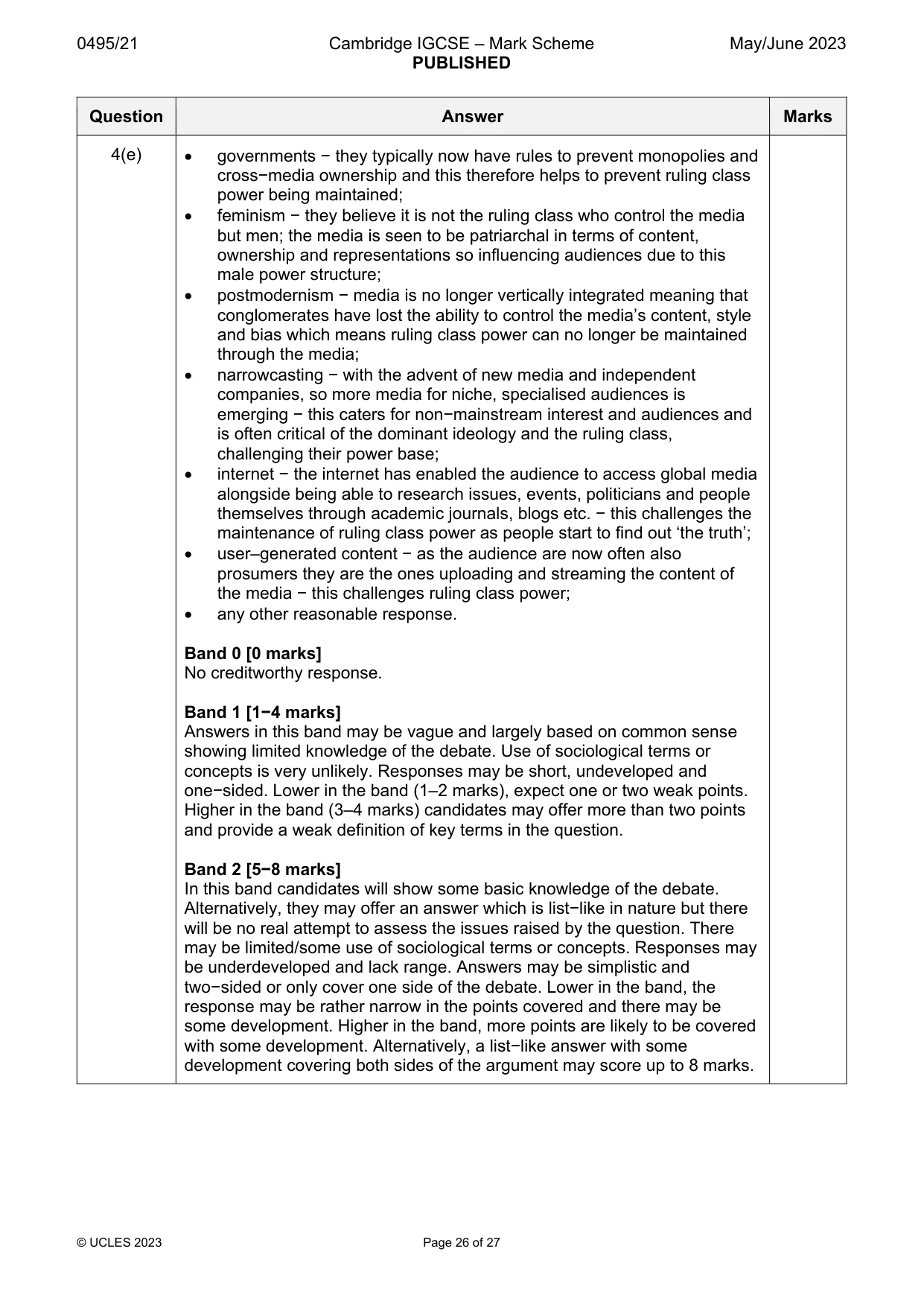
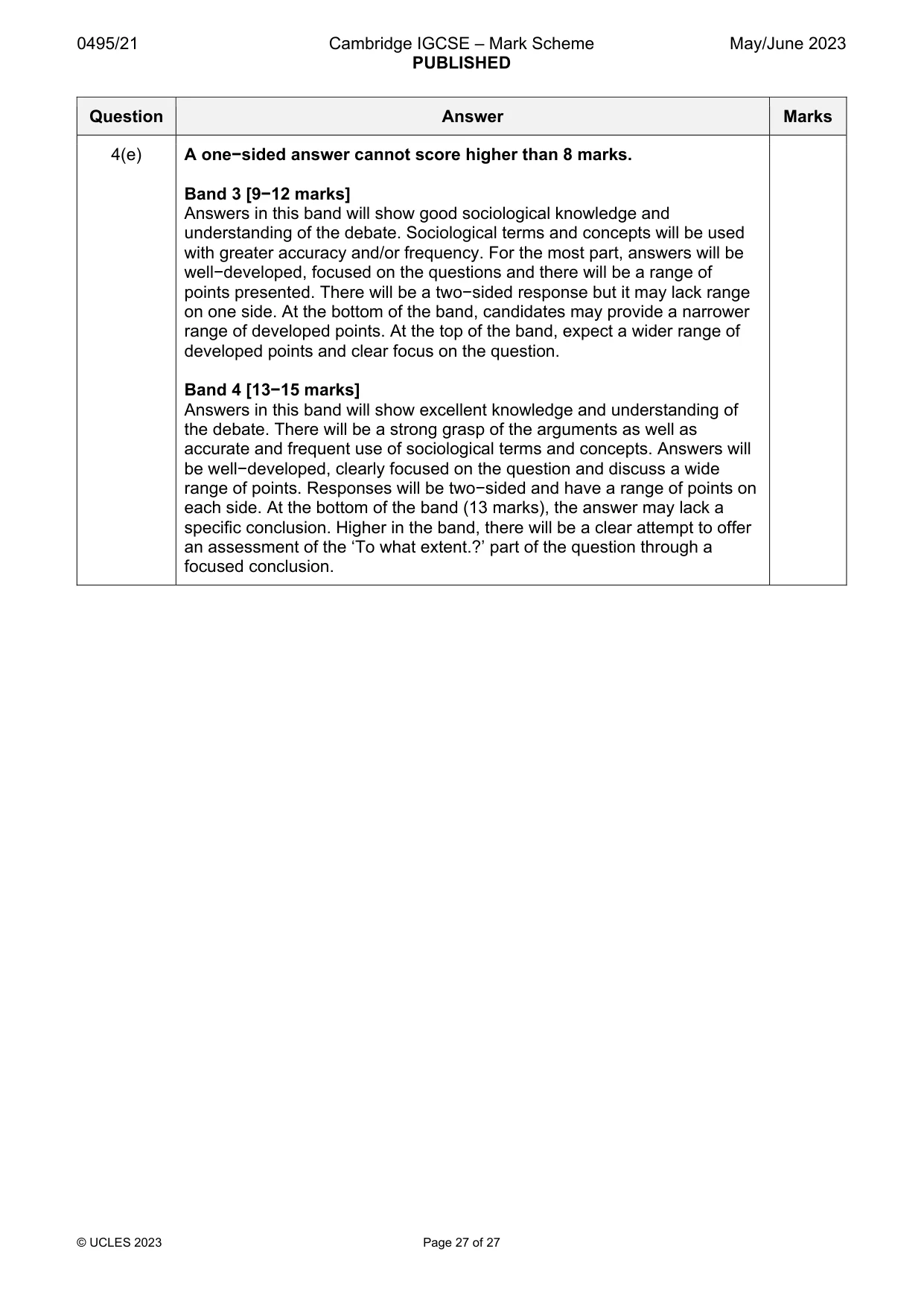
Mark scheme: 4(a) What is meant by the term ‘role model’? 2 One mark for partial definition, e.g. someone you look up to; Two marks for clear definition, e.g. individuals who act as examples to others who try to follow their attitudes and behaviour. 4(b) Describe two traditional media stereotypes of the working class. 4 Possible answers: underrepresented − research shows a lack of working class people in the media when compared to the higher classes; hard working, manual labourers − traditional representations (often male) of working class people working hard for little money or reward; community values − working class are often shown to be loyal to their community and to help one another out in times of need; housewives − working class females are often shown in the housewife role, looking after the domestic duties and the family; welfare scroungers − those claiming welfare benefits are often portrayed in a negative light as workshy and lazy (Murray); strikers − GUMG research showed the working class to be portrayed negatively as greedy and unreasonable; irresponsible and lacking in common sense − particularly associated with sitcoms − e.g. Homer Simpson; set in their ways − often shown as resistant to social change, unaccepting of new identities and ideologies e.g. hegemonic masculinity (Connell); white extremism − can be represented politically as being part of far right groups and engaging in racist and hostile behaviours e.g. fascism, Neo−Nazis etc.; any other reasonable response. One mark for each point correctly identified (up to a maximum of two). One mark for each point that is developed (up to a maximum of two). 4(c) Explain how audiences use social media. 6 Possible answers: instant messaging − sites are used for ‘friends’ (who may not actually be known to one another) to send communications, keep in touch; sharing videos and photos − video and image files can be peer−to−peer shared using social media; social networking − networks can be built and strengthened through social media contacts, either for pleasure, leisure or work–based activities; employment − social media is now used regularly in job searches, job advertisements and to vet potential candidates through search histories and previous posts e.g. LinkedIn; interactivity − audiences add comments, join conversations etc. in order to be an active part of social media content; prosumers − social media can be used by the audience to upload content to other users e.g. citizen journalism; entertainment − social media has become a platform for entertainment e.g., sharing ‘memes’, jokes, quizzes, spoilers, trailers etc.; trending − social media allows users to see what’s currently trending and to keep up to date e.g. with fashion; celebrities/star appeal − sites such as Twitter are often used to ‘follow’ stars and read posts/comment interactively etc./creates ‘fandom’; group membership − groups of specialist interest use social media and have large numbers of members on a global scale e.g. allotment online, fishing, football, sewing etc.; dating − social media sites are now the most common platform for online dating; social media can be used, particularly by the young, as a means of avoiding FOMO (fear of missing out), to be a part of something; any other reasonable response. Band 0 [0 marks] No creditworthy response. Band 1 [1−3 marks] Answers in this band will show only a limited awareness of the question. Responses may be short and un/underdeveloped. At the bottom of the band (1 mark), expect one weak point. Higher in the band (2–3 marks), candidates may offer more than one weak point, but there may be a tendency towards simplistic answers, engaging with sociological ideas without using sociological language. Band 2 [4−6 marks] Answers in this band will have clear and accurate explanation, showing good sociological knowledge and understanding. Sociological terms and concepts should be expected and explained. At the bottom of the band, the range of points covered may be narrow or lack detail. Higher in the band, answers will cover more than one point in a well−developed way or cover several points in less detail. 4(d) Explain why many sociologists are concerned about the effects of 8 media violence on children. Possible answers: hypodermic syringe model − research indicates (Bobo doll experiment) that children may imitate the violence they see in the media in real life e.g. copycat killings; cultural effects theories − seeing repeated images of violence in the media has a cumulative effect on children, making them more likely to commit acts of violence themselves; glamorising violence − films, rap music videos and TV shows have all been accused of representing violence as something ‘cool’ and ‘glamorous’ −this distorted representation may make violence seem appealing to children; desensitisation − children may become so used to consuming violence in the media that they are no longer shocked by it − this makes them less likely to take action against it and more likely to commit it themselves; normalisation − the amount of violence in the media has increased greatly and has become increasingly graphic; sociologists fear that this normalises violence for children and that it is therefore more likely to happen in society; vulnerable nature of children − children are not fully formed, they are still learning and so are highly susceptible to the effects of the media and therefore to violence; digital technology − this has resulted in a media culture in which many children have smart−phones − the power of the media to influence them in areas such as violence is thus very great; on−demand media − as so much media is now streamed and available on−demand, the power of censorship such as the watershed to protect children from unsuitable content such as violence is considerably lessened; any other reasonable response. Band 0 [0 marks] No creditworthy response. Band 1 [1−3 marks] Answers in this band will show only a limited awareness of the question. A tendency to description is likely. Responses may be short and undeveloped and points stated without explanation. Sociological terms and concepts are unlikely to be used. At the bottom of the band (1 mark), expect one weak point. Higher in the band (2–3 marks), candidates may offer more than one weak point. Band 2 [4−6 marks] Answers in this band will show basic sociological knowledge and understanding. Responses maybe underdeveloped and lacking in range. At the bottom of the band, candidates are unlikely to use sociological terms and concepts accurately. Higher in the band, candidates maybe beginning to use sociological terms and concepts with greater accuracy. However, some aspects of the answer may only be partially developed/explained. 4(d) Band 3 [7−8 marks] Answers in this band will show good sociological knowledge and understanding and will be well−developed and explained. Sociological terms and concepts will be used accurately overall. Answers will be well−focused on the question and there will be a range of points presented. At the top of the band explanations will be clear throughout. 4(e) To what extent is ruling class power maintained by the media? 15 Possible answers: Arguments for: ownership − the media is typically owned by those from the ruling class who can use the media as a vehicle to spread dominant ideologies and indoctrinate audiences; media manipulation − the media can influence and manipulate the audience into believing a certain viewpoint through the use of ‘facts’, images and language e.g. the Iraq War; creating false needs − the media support capitalism by creating false needs that turn people into passive consumers − this leads to the constant demand for new products which makes the ruling class increased profits as well as increasing their power; diverting attention − Marxists accuse the media of diverting the audience’s attention away from really important social and global issues through shallow media entertainment and trivia; this prevents the lower social classes from challenging the ‘status quo’ and ruling class power; invisibilising alternative views − views that challenge capitalism or the ruling class are frequently marginalised in the media − through their under−representation or through ridicule e.g. GUMG research; hegemony − most media personnel are drawn from a small range of social groups e.g. typically white, male, middle class, middle aged − this results in a lack of challenge to the ruling class and their power and ideologies; ideological state apparatus − Marxists see the ideological control that the media can wield as instrumental in upholding ruling class power and influence − controlling minds and thoughts; propaganda − the media can use techniques of bias, selection and distortion in order to send out particular messages and viewpoints and so influence the audience’s beliefs e.g. Nazis; ruling class transgression − negative actions by members of the ruling class do not receive as much media attention as those by the lower classes, perpetuating the idea that the lower classes are the ‘problem’ this helps the ruling class to maintain their position of power; any other reasonable response. Arguments against: pluralism − the media can only ever respond to the needs of the audience it cannot influence us − unless media content is wanted by audiences it will not be consumed (competition) and so we are free to resist ruling class authority; choice − there has been so much diversification in the media alongside globalisation that there is literally something for everyone, covering all viewpoints − no one set of beliefs has the power to influence anymore; 4(e) governments − they typically now have rules to prevent monopolies and cross−media ownership and this therefore helps to prevent ruling class power being maintained; feminism − they believe it is not the ruling class who control the media but men; the media is seen to be patriarchal in terms of content, ownership and representations so influencing audiences due to this male power structure; postmodernism − media is no longer vertically integrated meaning that conglomerates have lost the ability to control the media’s content, style and bias which means ruling class power can no longer be maintained through the media; narrowcasting − with the advent of new media and independent companies, so more media for niche, specialised audiences is emerging − this caters for non−mainstream interest and audiences and is often critical of the dominant ideology and the ruling class, challenging their power base; internet − the internet has enabled the audience to access global media alongside being able to research issues, events, politicians and people themselves through academic journals, blogs etc. − this challenges the maintenance of ruling class power as people start to find out ‘the truth’; user–generated content − as the audience are now often also prosumers they are the ones uploading and streaming the content of the media − this challenges ruling class power; any other reasonable response. Band 0 [0 marks] No creditworthy response. Band 1 [1−4 marks] Answers in this band may be vague and largely based on common sense showing limited knowledge of the debate. Use of sociological terms or concepts is very unlikely. Responses may be short, undeveloped and one−sided. Lower in the band (1–2 marks), expect one or two weak points. Higher in the band (3–4 marks) candidates may offer more than two points and provide a weak definition of key terms in the question. Band 2 [5−8 marks] In this band candidates will show some basic knowledge of the debate. Alternatively, they may offer an answer which is list−like in nature but there will be no real attempt to assess the issues raised by the question. There may be limited/some use of sociological terms or concepts. Responses may be underdeveloped and lack range. Answers may be simplistic and two−sided or only cover one side of the debate. Lower in the band, the response may be rather narrow in the points covered and there may be some development. Higher in the band, more points are likely to be covered with some development. Alternatively, a list−like answer with some development covering both sides of the argument may score up to 8 marks. 4(e) A one−sided answer cannot score higher than 8 marks. Band 3 [9−12 marks] Answers in this band will show good sociological knowledge and understanding of the debate. Sociological terms and concepts will be used with greater accuracy and/or frequency. For the most part, answers will be well−developed, focused on the questions and there will be a range of points presented. There will be a two−sided response but it may lack range on one side. At the bottom of the band, candidates may provide a narrower range of developed points. At the top of the band, expect a wider range of developed points and clear focus on the question. Band 4 [13−15 marks] Answers in this band will show excellent knowledge and understanding of the debate. There will be a strong grasp of the arguments as well as accurate and frequent use of sociological terms and concepts. Answers will be well−developed, clearly focused on the question and discuss a wide range of points. Responses will be two−sided and have a range of points on each side. At the bottom of the band (13 marks), the answer may lack a specific conclusion. Higher in the band, there will be a clear attempt to offer an assessment of the ‘To what extent.?’ part of the question through a focused conclusion.
What was in this paper
The subtopics covered by these 4 questions, and how many questions each got. Open one in a new tab to see every Cambridge question on it.
What you needed in this session
Cambridge’s own grade thresholds for 2023 May/June, Paper 2 · Variant 1. A higher threshold means an easier paper — the bar moves with how the cohort did.