Cambridge IGCSE Sociology 0495 — 2025 May/June Paper 2 · Variant 1
0495/21/M/J/25 · 3 questions · 80 marks · 105 min
The question paper and its mark scheme, free to read here and free to download. This is Cambridge’s own paper, exactly as it was sat.
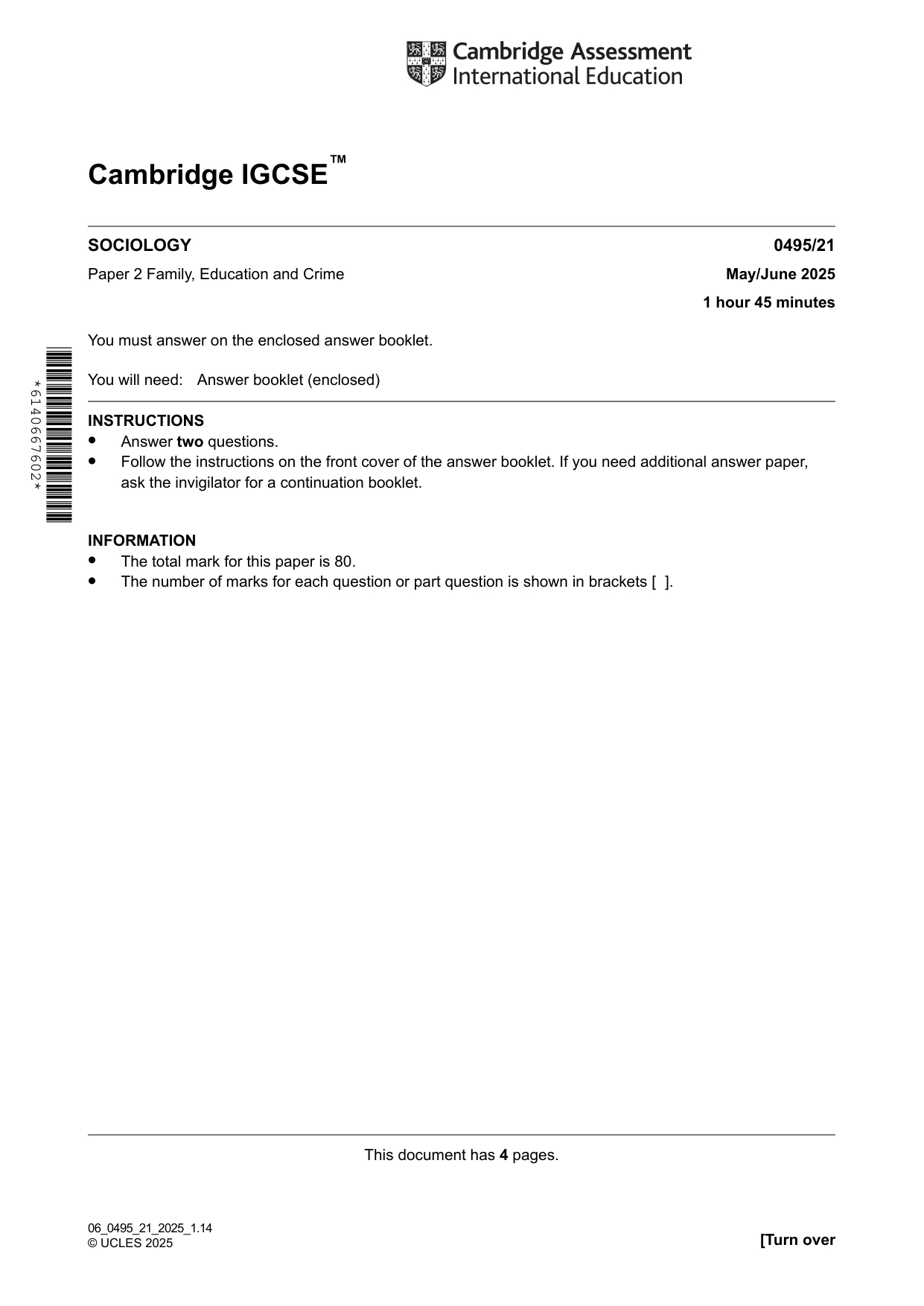
Question paper4 pages


Mark scheme24 pages
Answers below. Sit the paper first if you are practising.









Questions as text
Q1 · Define the term: (i) cross-cultural [2] (ii) nuclear family
1 (a) Define the term: (i) cross-cultural [2] (ii) nuclear family. [2] (b) State two ways the family benefits men. [2] (c) Explain three changing patterns in marriage. [6] (d) Explain three roles grandparents may have in the family. [6] (e) Discuss the view that the triple shift is unfair for women. Your answer should include: • at least three developed points with evidence. [8] (f) Evaluate the view that the family is now diverse. Your answer should include: • at least three arguments for and three arguments against • a conclusion. [14] Education
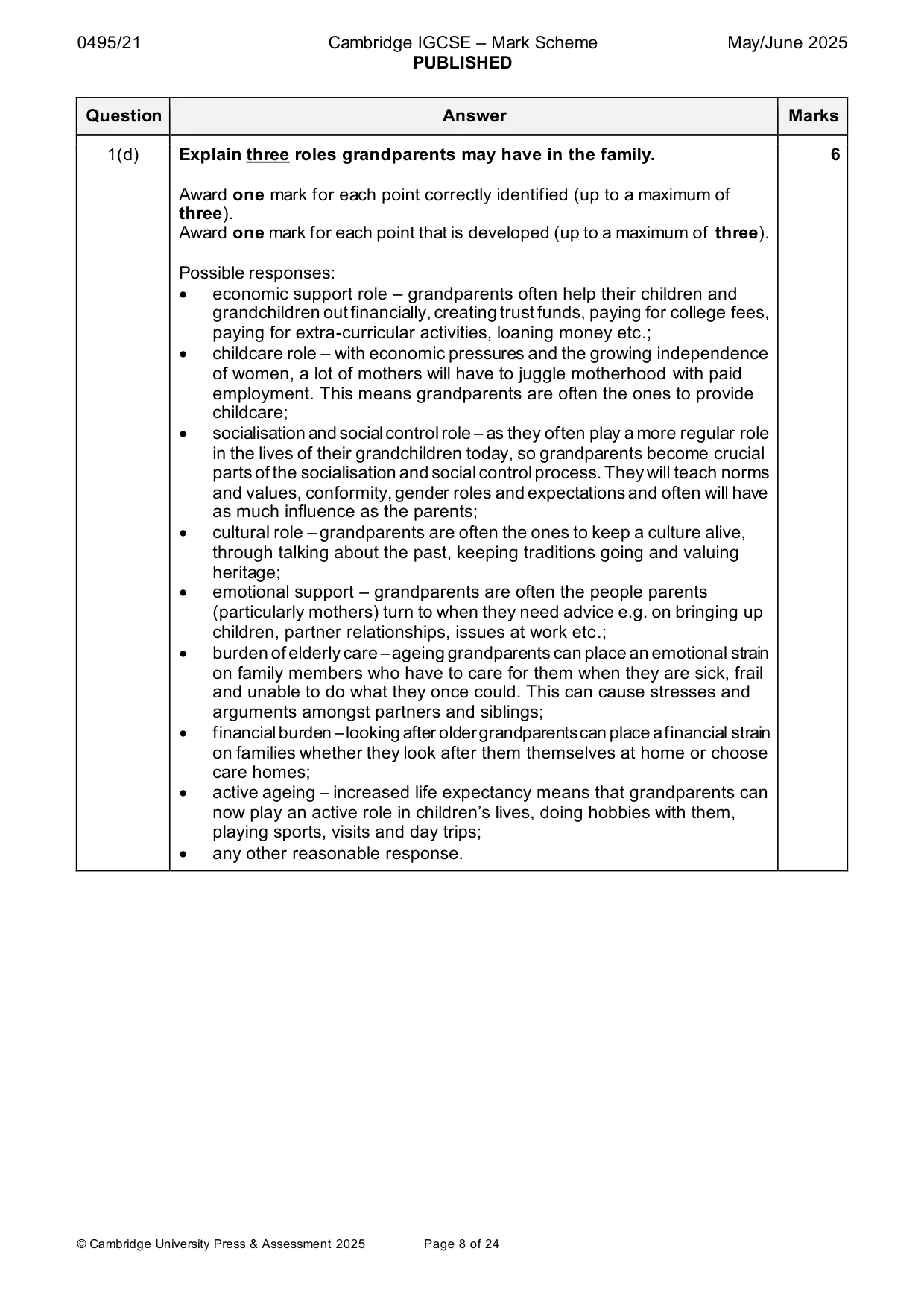
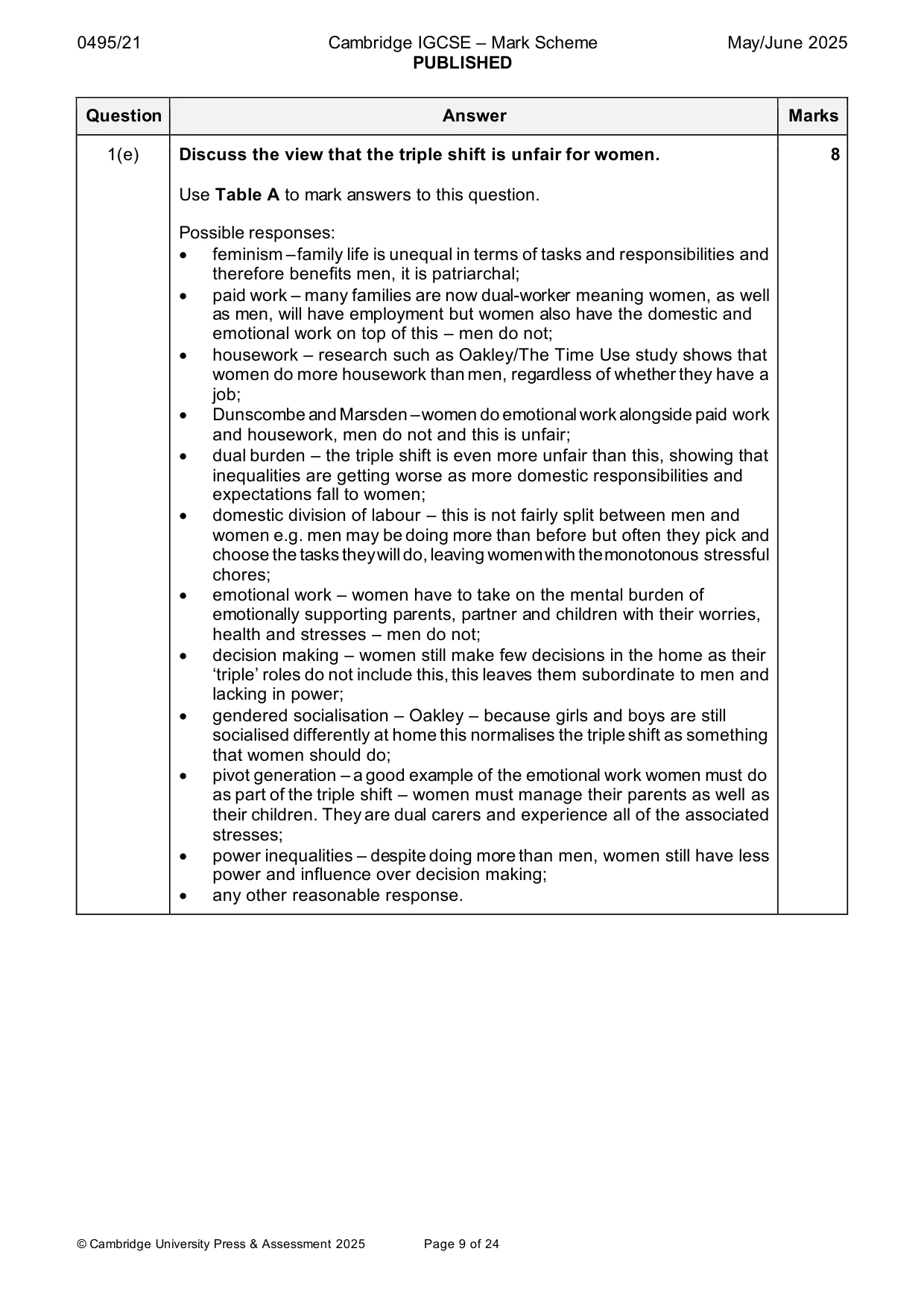
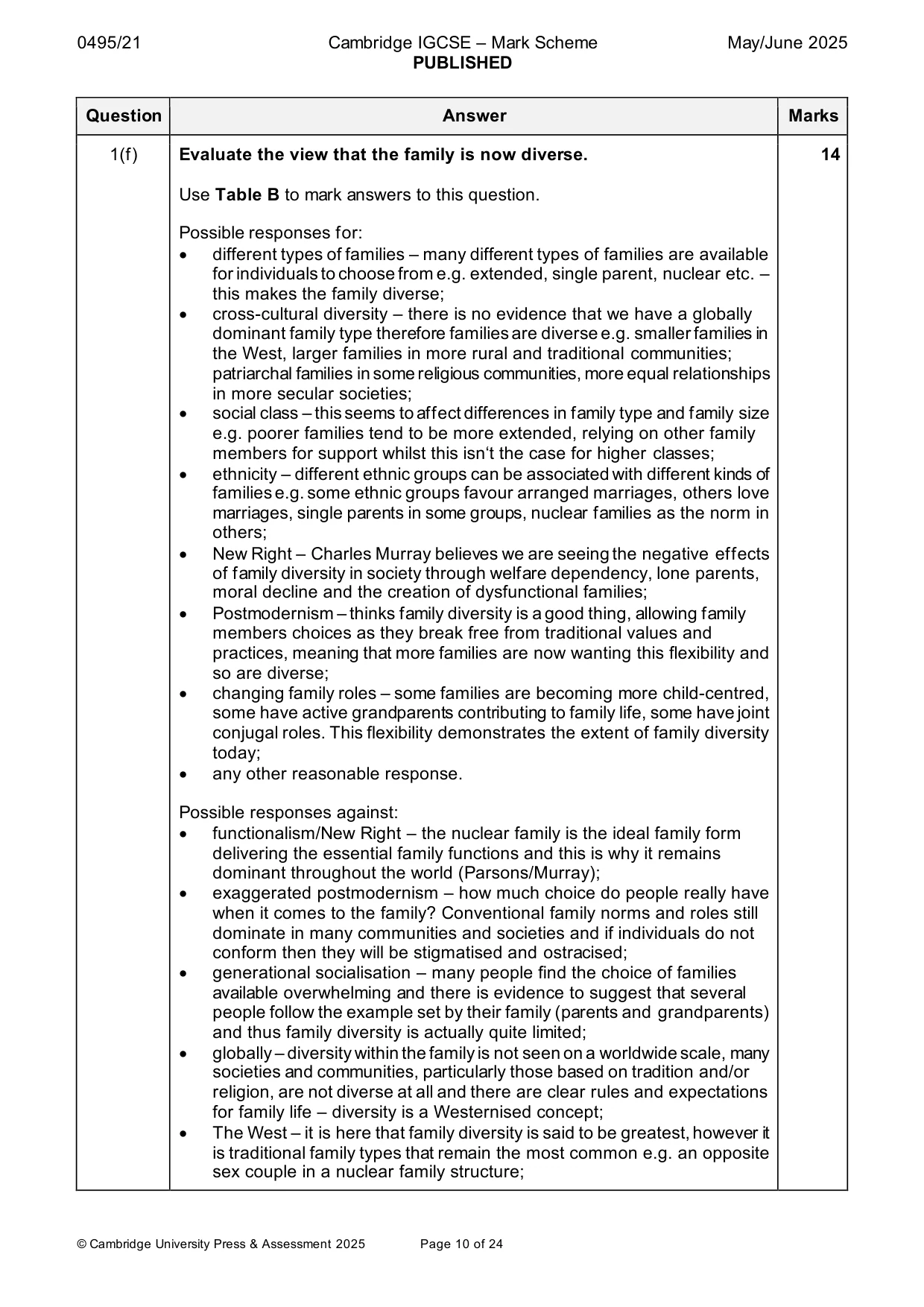
Mark scheme: Question Answer Marks 1(a)(i) Define the term cross-cultural. 2 Award one mark for a partial definition, e.g. religious differences. Award two marks for a clear definition, e.g. differences in family type and structure based on cultural backgrounds, heritage, religion and/or ethnicities. 1(a)(ii) Define the term nuclear family. 2 Award one mark for a partial definition, e.g. a married couple. Award two marks for a clear definition, e.g. an adult male and female, married or in a relationship and living together, with dependent children. 1(b) State two ways the family benefits men. 2 Award one mark for each correct way (up to a maximum of two). Possible responses: • men do less domestic labour; • men make key decisions; • patriarchy – men have more power; • men often have control over the household finances; • men are breadwinners giving them higher status; • men do not have the triple shift/dual burden; • warm bath – men are looked after by their wives in the family; • any other reasonable response. 1(c) Explain three changing patterns in marriage. 6 Award one mark for each point correctly identified (up to a maximum of three). Award one mark for each point that is developed (up to a maximum of three). Possible responses: • more people now get married later in life – career women and feminism often mean that marriage comes later; • more people never marry at all – being unmarried is no longer stigmatised and is no longer a necessity in modern industrial societies, people have freedom to choose; • more people’s marriages end in divorce – higher expectations of marriage and a lack of obligation to stay in a loveless marriage; • more people live together (cohabit) without ever getting married – changing attitudes and secularisation may account for this; • increased rates of remarriages – following divorce, many people choose to marry again, often forming reconstituted families; • increased number of civil/non-religious marriages – marriage is no longer necessarily linked with religion but rather is seen as a commitment between two people, thus civil ceremonies increase in popularity; • growth of empty-shell marriages – due to the ageing population and/or the rising cost of living; • any other reasonable response. 1(d) Explain three roles grandparents may have in the family. 6 Award one mark for each point correctly identified (up to a maximum of three). Award one mark for each point that is developed (up to a maximum of three). Possible responses: • economic support role – grandparents often help their children and grandchildren out financially, creating trust funds, paying for college fees, paying for extra-curricular activities, loaning money etc.; • childcare role – with economic pressures and the growing independence of women, a lot of mothers will have to juggle motherhood with paid employment. This means grandparents are often the ones to provide childcare; • socialisation and social control role – as they often play a more regular role in the lives of their grandchildren today, so grandparents become crucial parts of the socialisation and social control process. They will teach norms and values, conformity, gender roles and expectations and often will have as much influence as the parents; • cultural role – grandparents are often the ones to keep a culture alive, through talking about the past, keeping traditions going and valuing heritage; • emotional support – grandparents are often the people parents (particularly mothers) turn to when they need advice e.g. on bringing up children, partner relationships, issues at work etc.; • burden of elderly care – ageing grandparents can place an emotional strain on family members who have to care for them when they are sick, frail and unable to do what they once could. This can cause stresses and arguments amongst partners and siblings; • financial burden – looking after older grandparents can place a financial strain on families whether they look after them themselves at home or choose care homes; • active ageing – increased life expectancy means that grandparents can now play an active role in children’s lives, doing hobbies with them, playing sports, visits and day trips; • any other reasonable response. 1(e) Discuss the view that the triple shift is unfair for women. 8 Use Table A to mark answers to this question. Possible responses: • feminism – family life is unequal in terms of tasks and responsibilities and therefore benefits men, it is patriarchal; • paid work – many families are now dual-worker meaning women, as well as men, will have employment but women also have the domestic and emotional work on top of this – men do not; • housework – research such as Oakley/The Time Use study shows that women do more housework than men, regardless of whether they have a job; • Dunscombe and Marsden – women do emotional work alongside paid work and housework, men do not and this is unfair; • dual burden – the triple shift is even more unfair than this, showing that inequalities are getting worse as more domestic responsibilities and expectations fall to women; • domestic division of labour – this is not fairly split between men and women e.g. men may be doing more than before but often they pick and choose the tasks they will do, leaving women with the monotonous stressful chores; • emotional work – women have to take on the mental burden of emotionally supporting parents, partner and children with their worries, health and stresses – men do not; • decision making – women still make few decisions in the home as their ‘triple’ roles do not include this, this leaves them subordinate to men and lacking in power; • gendered socialisation – Oakley – because girls and boys are still socialised differently at home this normalises the triple shift as something that women should do; • pivot generation – a good example of the emotional work women must do as part of the triple shift – women must manage their parents as well as their children. They are dual carers and experience all of the associated stresses; • power inequalities – despite doing more than men, women still have less power and influence over decision making; • any other reasonable response. 1(f) Evaluate the view that the family is now diverse. 14 Use Table B to mark answers to this question. Possible responses for: • different types of families – many different types of families are available for individuals to choose from e.g. extended, single parent, nuclear etc. – this makes the family diverse; • cross-cultural diversity – there is no evidence that we have a globally dominant family type therefore families are diverse e.g. smaller families in the West, larger families in more rural and traditional communities; patriarchal families in some religious communities, more equal relationships in more secular societies; • social class – this seems to affect differences in family type and family size e.g. poorer families tend to be more extended, relying on other family members for support whilst this isn‘t the case for higher classes; • ethnicity – different ethnic groups can be associated with different kinds of families e.g. some ethnic groups favour arranged marriages, others love marriages, single parents in some groups, nuclear families as the norm in others; • New Right – Charles Murray believes we are seeing the negative effects of family diversity in society through welfare dependency, lone parents, moral decline and the creation of dysfunctional families; • Postmodernism – thinks family diversity is a good thing, allowing family members choices as they break free from traditional values and practices, meaning that more families are now wanting this flexibility and so are diverse; • changing family roles – some families are becoming more child-centred, some have active grandparents contributing to family life, some have joint conjugal roles. This flexibility demonstrates the extent of family diversity today; • any other reasonable response. Possible responses against: • functionalism/New Right – the nuclear family is the ideal family form delivering the essential family functions and this is why it remains dominant throughout the world (Parsons/Murray); • exaggerated postmodernism – how much choice do people really have when it comes to the family? Conventional family norms and roles still dominate in many communities and societies and if individuals do not conform then they will be stigmatised and ostracised; • generational socialisation – many people find the choice of families available overwhelming and there is evidence to suggest that several people follow the example set by their family (parents and grandparents) and thus family diversity is actually quite limited; • globally – diversity within the family is not seen on a worldwide scale, many societies and communities, particularly those based on tradition and/or religion, are not diverse at all and there are clear rules and expectations for family life – diversity is a Westernised concept; • The West – it is here that family diversity is said to be greatest, however it is traditional family types that remain the most common e.g. an opposite sex couple in a nuclear family structure; 1(f) • cereal packet family – media representations continue to show the nuclear family with its clear gender roles as the norm and the ideal and thus this is what many aspire to – which contradicts the notion of family diversity; • family diversity as a temporary stage – some sociologists believe that any diversity we may see in the family is not permanent and that ultimately most people end up in a traditional family unit that is the ‘best fit’ for their society; • any other reasonable response.
Q2 · Define the term: (i) role allocation [2] (ii) institutional racism
2 (a) Define the term: (i) role allocation [2] (ii) institutional racism. [2] (b) State two reasons why private schools get good examination results. [2] (c) Explain three ways education differs globally for girls. [6] (d) Explain three positive functions of education. [6] (e) Discuss why Marxists criticise the hidden curriculum. Your answer should include: • at least three developed points with evidence. [8] (f) Evaluate the view that in-school factors have the most influence on educational achievement. Your answer should include: • at least three arguments for and three arguments against • a conclusion. [14] Crime, deviance and social control
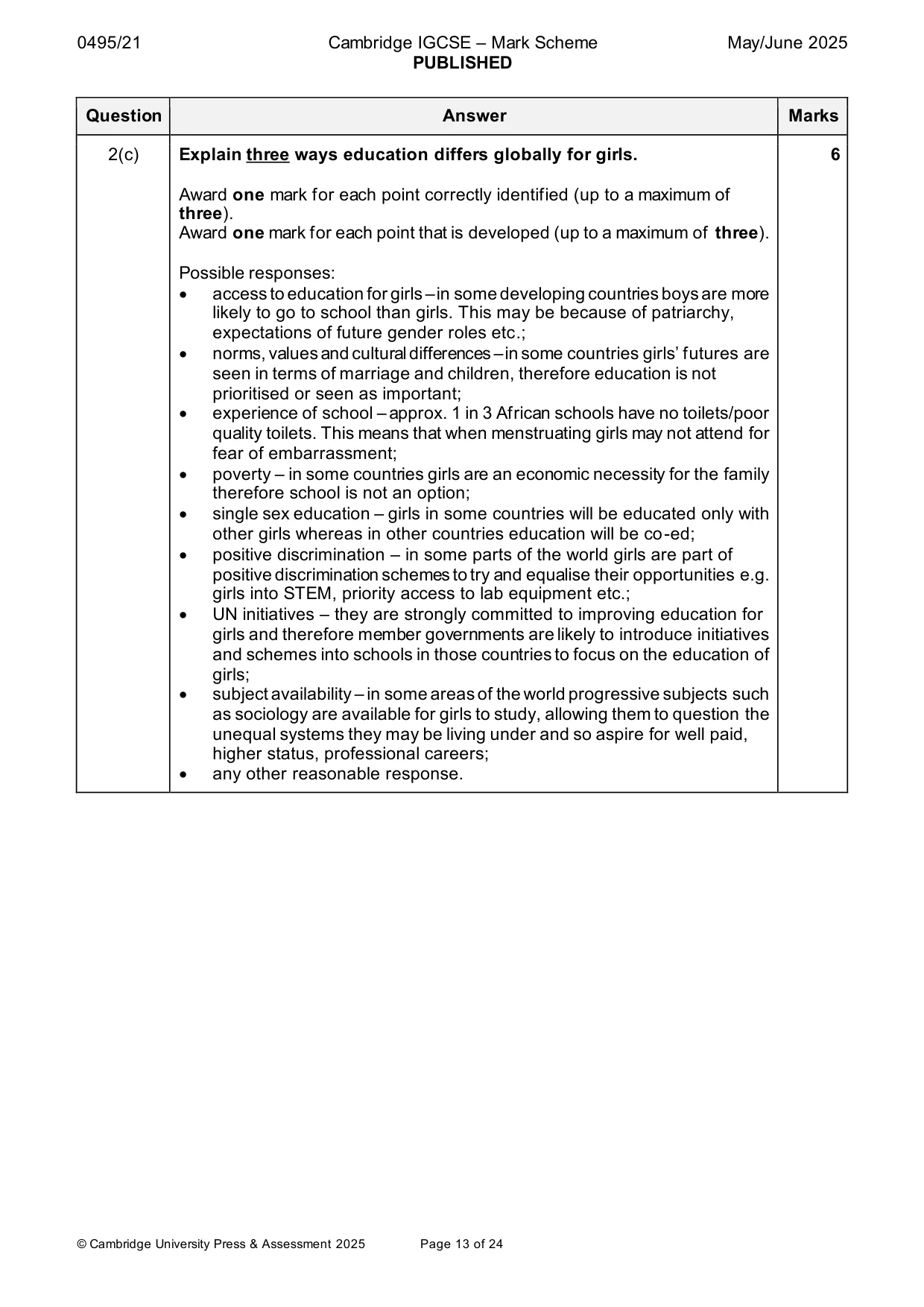
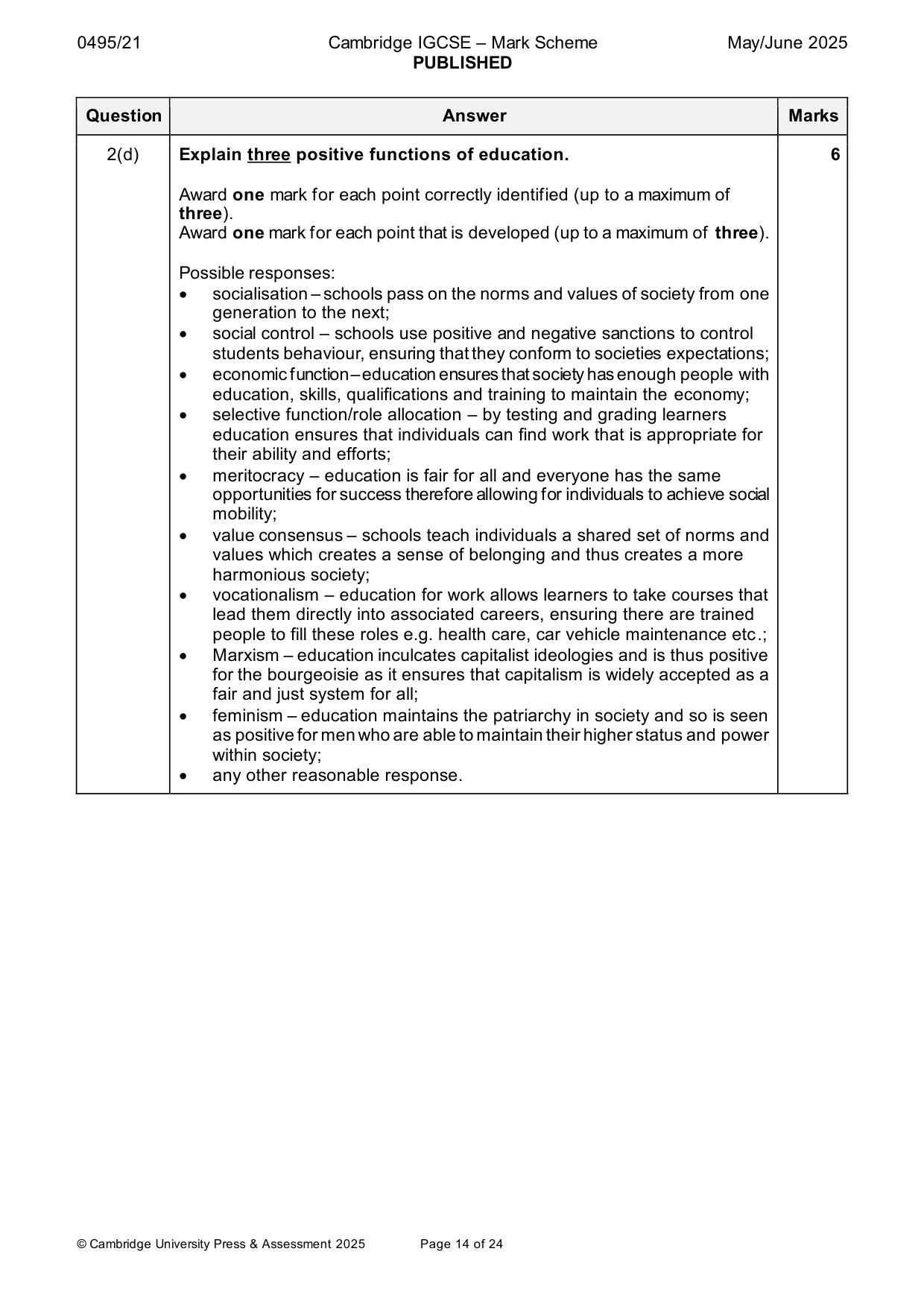
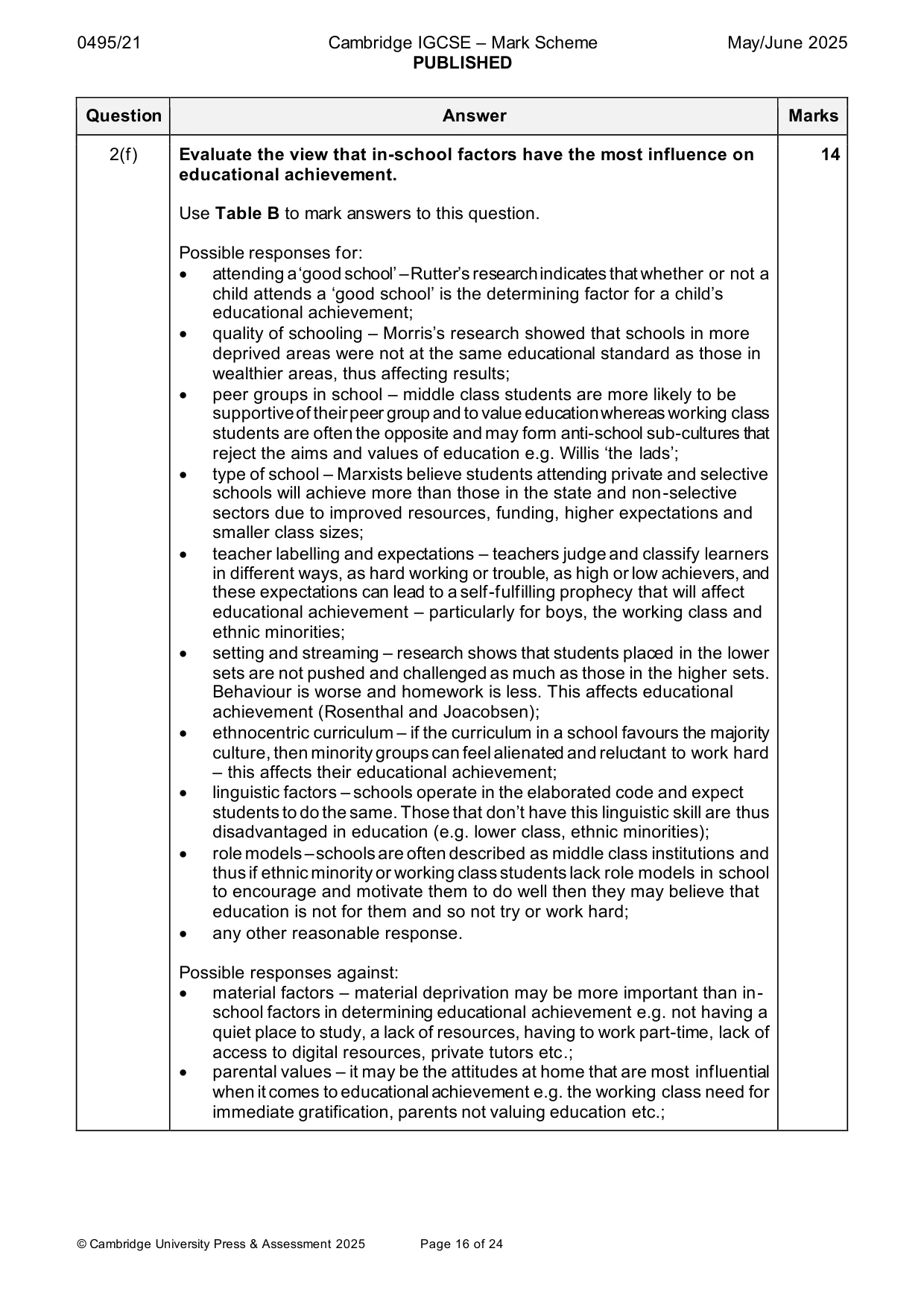
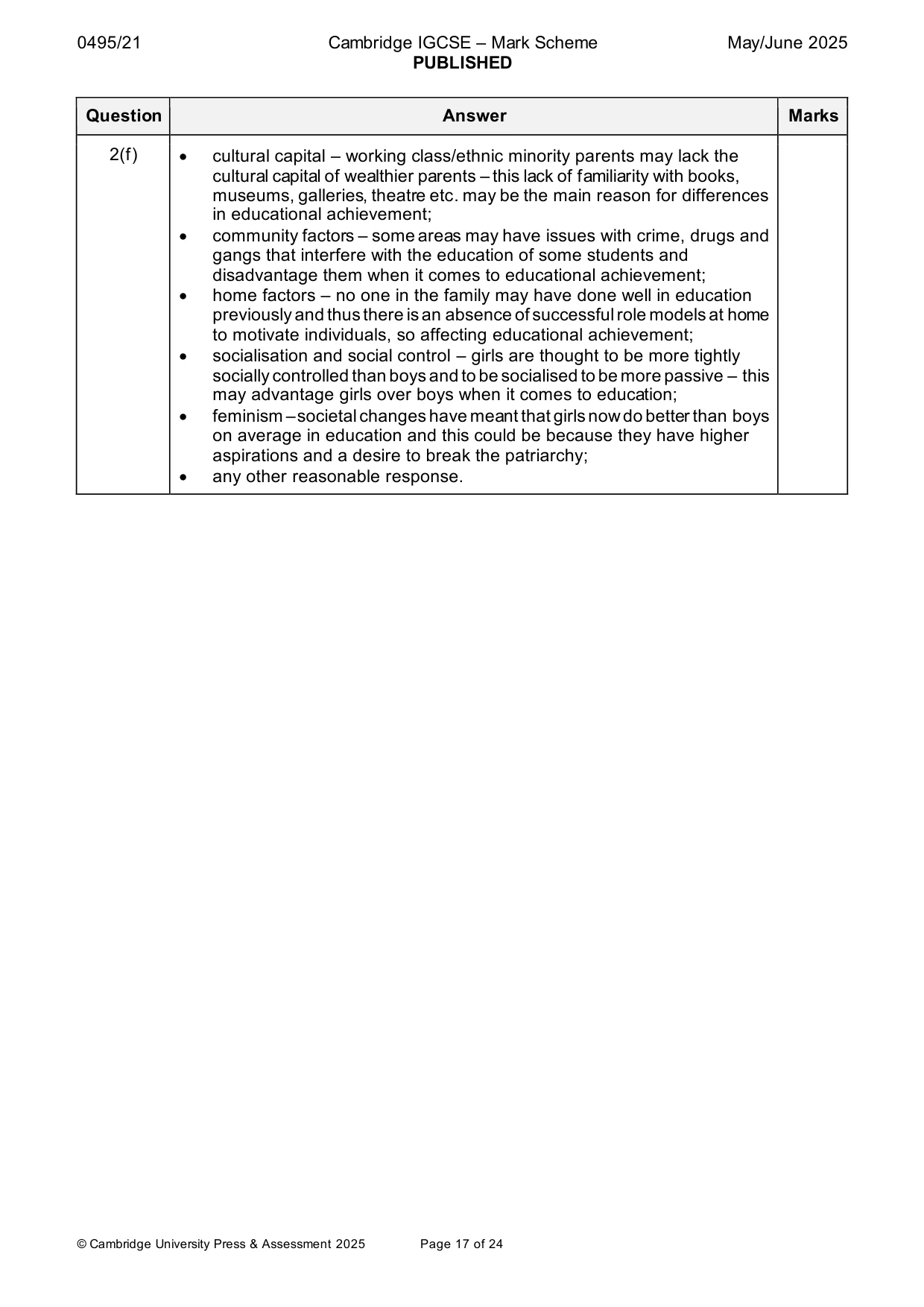
Mark scheme: 2(a)(i) Define the term role allocation. 2 Award one mark for a partial definition, e.g. schools decide your future job. Award two marks for a clear definition, e.g. sorting individuals into appropriate jobs and roles based on achievement in school. 2(a)(ii) Define the term institutional racism. 2 Award one mark for a partial definition, e.g. schools treat ethnic groups differently. Award two marks for a clear definition, e.g. when the functioning of the education system involves systems and expectations that lead to discrimination against an ethnic group. 2(b) State two reasons why private schools get good examination results. 2 Award one mark for each correct reason (up to a maximum of two). Possible responses: • classes are smaller – more individual attention helps with results; • better facilities and resources – supports better results; parents are fee- paying customers so demand high levels of service – resulting in better results; • selection by ability – brightest students attend so get the best results; • pro-school sub-cultures – work hard to achieve good results; • high value placed on education by all stakeholders – meaning good results; • opportunities – high social capital and social networking opportunities; • any other reasonable response. 2(c) Explain three ways education differs globally for girls. 6 Award one mark for each point correctly identified (up to a maximum of three). Award one mark for each point that is developed (up to a maximum of three). Possible responses: • access to education for girls – in some developing countries boys are more likely to go to school than girls. This may be because of patriarchy, expectations of future gender roles etc.; • norms, values and cultural differences – in some countries girls’ futures are seen in terms of marriage and children, therefore education is not prioritised or seen as important; • experience of school – approx. 1 in 3 African schools have no toilets/poor quality toilets. This means that when menstruating girls may not attend for fear of embarrassment; • poverty – in some countries girls are an economic necessity for the family therefore school is not an option; • single sex education – girls in some countries will be educated only with other girls whereas in other countries education will be co-ed; • positive discrimination – in some parts of the world girls are part of positive discrimination schemes to try and equalise their opportunities e.g. girls into STEM, priority access to lab equipment etc.; • UN initiatives – they are strongly committed to improving education for girls and therefore member governments are likely to introduce initiatives and schemes into schools in those countries to focus on the education of girls; • subject availability – in some areas of the world progressive subjects such as sociology are available for girls to study, allowing them to question the unequal systems they may be living under and so aspire for well paid, higher status, professional careers; • any other reasonable response. 2(d) Explain three positive functions of education. 6 Award one mark for each point correctly identified (up to a maximum of three). Award one mark for each point that is developed (up to a maximum of three). Possible responses: • socialisation – schools pass on the norms and values of society from one generation to the next; • social control – schools use positive and negative sanctions to control students behaviour, ensuring that they conform to societies expectations; • economic function – education ensures that society has enough people with education, skills, qualifications and training to maintain the economy; • selective function/role allocation – by testing and grading learners education ensures that individuals can find work that is appropriate for their ability and efforts; • meritocracy – education is fair for all and everyone has the same opportunities for success therefore allowing for individuals to achieve social mobility; • value consensus – schools teach individuals a shared set of norms and values which creates a sense of belonging and thus creates a more harmonious society; • vocationalism – education for work allows learners to take courses that lead them directly into associated careers, ensuring there are trained people to fill these roles e.g. health care, car vehicle maintenance etc.; • Marxism – education inculcates capitalist ideologies and is thus positive for the bourgeoisie as it ensures that capitalism is widely accepted as a fair and just system for all; • feminism – education maintains the patriarchy in society and so is seen as positive for men who are able to maintain their higher status and power within society; • any other reasonable response. 2(e) Discuss why Marxists criticise the hidden curriculum. 8 Use Table A to mark answers to this question. Possible responses: • hierarchies – students learn their place and the associated norms that go with their role – older students may have higher status than younger students and teachers definitely are higher in the hierarchy than students – this prepares lower class learners for the low position they will have in society and the workplace – they accept their place; • norms and values – expected social norms and values that support the ‘status quo’ and discourage social criticism are learnt, normalised and reinforced when at school, leading to a culture of passivity; • competition – sports and academic testing are both a form of competition found in schools – they give the message that doing better than others is important for success which benefits the bourgeoisie who will employ these students in the future as their workers – high productivity = maximum profit; • importance of punctuality – students follow a timetable and are often ‘ruled by the bell’, they have to be in classrooms at particular times and will be sanctioned if late. This prepares them for the same level of control in their future world of work; • social conformity – positive and negative sanctions are used in schools to ensure that student behaviour is controlled and students conform to the school rules and expectations, making them passive and thus benefiting the bourgeoisie later in life; • Marxism – the hidden curriculum is about the bourgeoisie controlling the proletariat through ideology (ISA) – they learn not to have high expectations of work or of life, they accept orders from others and being bored is expected; • fatalism – education persuades working class learners that it is their own fault that they do badly in school when in fact Marxists believe that the system has been designed to ensure that most of the working class do not do well at school; • upper class children – Marxists believe that the hidden curriculum for the upper class is very different to that of the working class as they learn to expect a high-status occupation in which they will tell others what to do as they will be in positions of authority; • any other reasonable response. 2(f) Evaluate the view that in-school factors have the most influence on 14 educational achievement. Use Table B to mark answers to this question. Possible responses for: • attending a ‘good school’ – Rutter’s research indicates that whether or not a child attends a ‘good school’ is the determining factor for a child’s educational achievement; • quality of schooling – Morris’s research showed that schools in more deprived areas were not at the same educational standard as those in wealthier areas, thus affecting results; • peer groups in school – middle class students are more likely to be supportive of their peer group and to value education whereas working class students are often the opposite and may form anti-school sub-cultures that reject the aims and values of education e.g. Willis ‘the lads’; • type of school – Marxists believe students attending private and selective schools will achieve more than those in the state and non-selective sectors due to improved resources, funding, higher expectations and smaller class sizes; • teacher labelling and expectations – teachers judge and classify learners in different ways, as hard working or trouble, as high or low achievers, and these expectations can lead to a self-fulfilling prophecy that will affect educational achievement – particularly for boys, the working class and ethnic minorities; • setting and streaming – research shows that students placed in the lower sets are not pushed and challenged as much as those in the higher sets. Behaviour is worse and homework is less. This affects educational achievement (Rosenthal and Joacobsen); • ethnocentric curriculum – if the curriculum in a school favours the majority culture, then minority groups can feel alienated and reluctant to work hard – this affects their educational achievement; • linguistic factors – schools operate in the elaborated code and expect students to do the same. Those that don’t have this linguistic skill are thus disadvantaged in education (e.g. lower class, ethnic minorities); • role models – schools are often described as middle class institutions and thus if ethnic minority or working class students lack role models in school to encourage and motivate them to do well then they may believe that education is not for them and so not try or work hard; • any other reasonable response. Possible responses against: • material factors – material deprivation may be more important than in- school factors in determining educational achievement e.g. not having a quiet place to study, a lack of resources, having to work part-time, lack of access to digital resources, private tutors etc.; • parental values – it may be the attitudes at home that are most influential when it comes to educational achievement e.g. the working class need for immediate gratification, parents not valuing education etc.; 2(f) • cultural capital – working class/ethnic minority parents may lack the cultural capital of wealthier parents – this lack of familiarity with books, museums, galleries, theatre etc. may be the main reason for differences in educational achievement; • community factors – some areas may have issues with crime, drugs and gangs that interfere with the education of some students and disadvantage them when it comes to educational achievement; • home factors – no one in the family may have done well in education previously and thus there is an absence of successful role models at home to motivate individuals, so affecting educational achievement; • socialisation and social control – girls are thought to be more tightly socially controlled than boys and to be socialised to be more passive – this may advantage girls over boys when it comes to education; • feminism – societal changes have meant that girls now do better than boys on average in education and this could be because they have higher aspirations and a desire to break the patriarchy; • any other reasonable response.
Q3 · Define the term: (i) peer group [2] (ii) hate crime
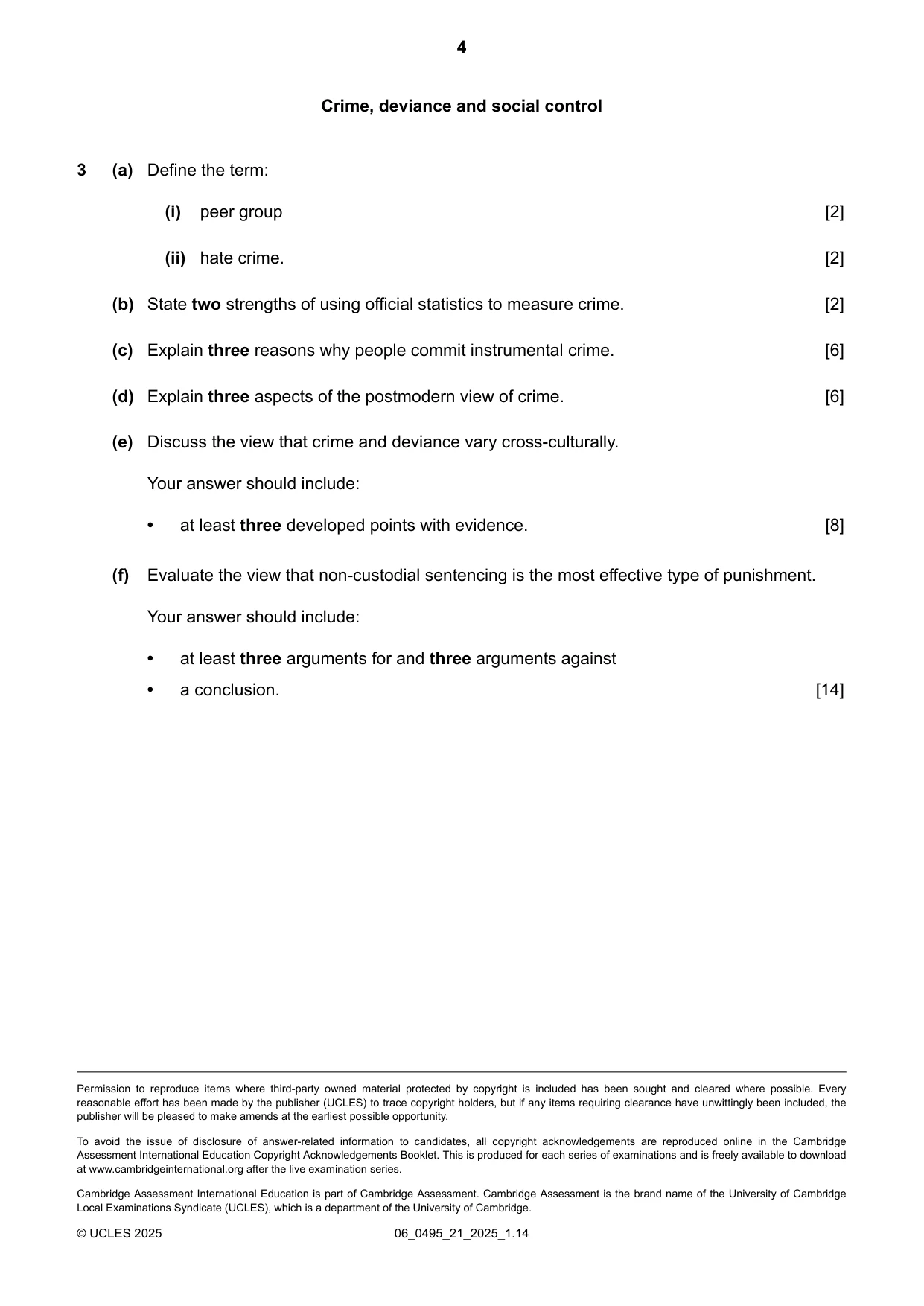
3 (a) Define the term: (i) peer group [2] (ii) hate crime. [2] (b) State two strengths of using official statistics to measure crime. [2] (c) Explain three reasons why people commit instrumental crime. [6] (d) Explain three aspects of the postmodern view of crime. [6] (e) Discuss the view that crime and deviance vary cross-culturally. Your answer should include: • at least three developed points with evidence. [8] (f) Evaluate the view that non-custodial sentencing is the most effective type of punishment. Your answer should include: • at least three arguments for and three arguments against • a conclusion. [14]
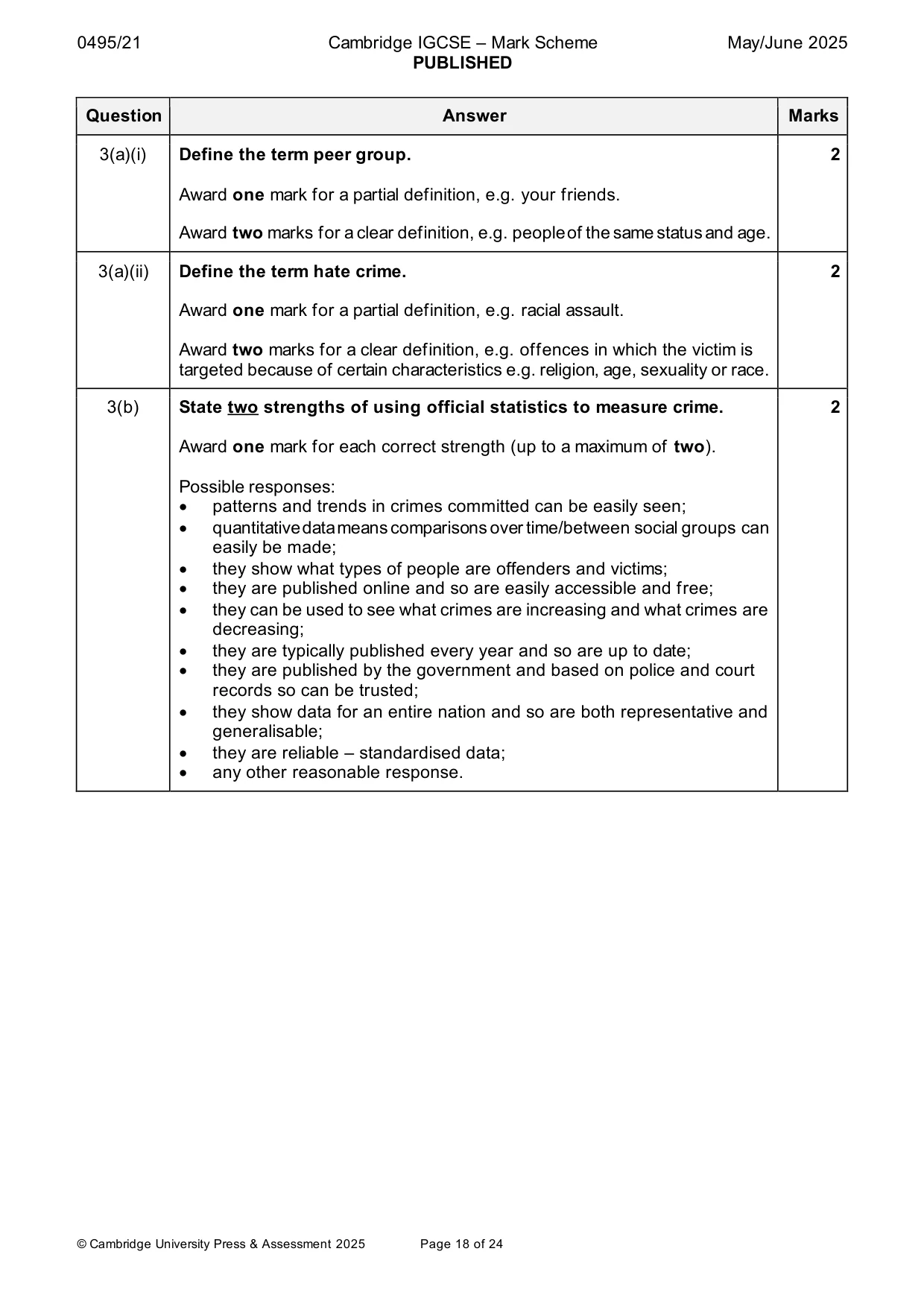
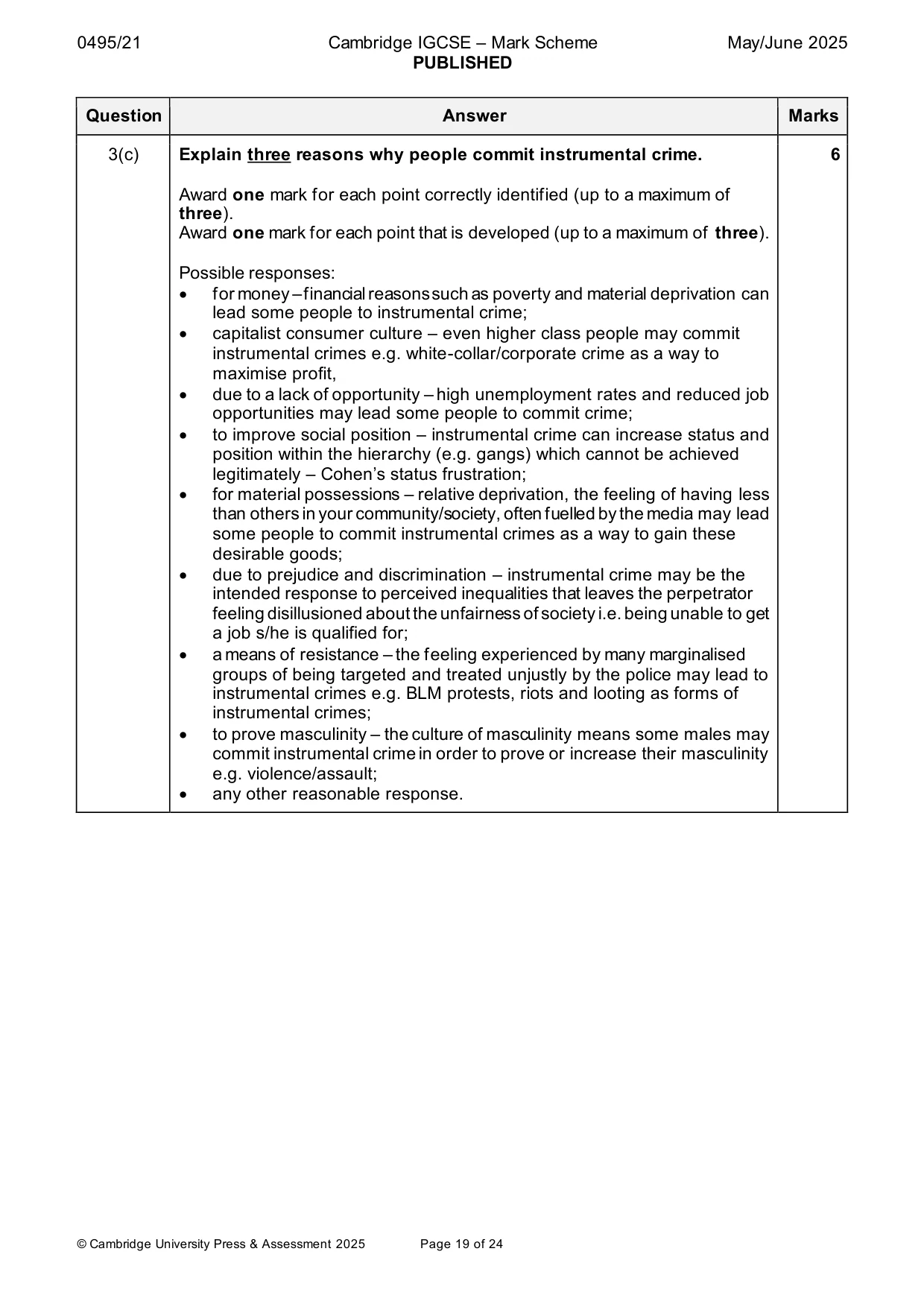
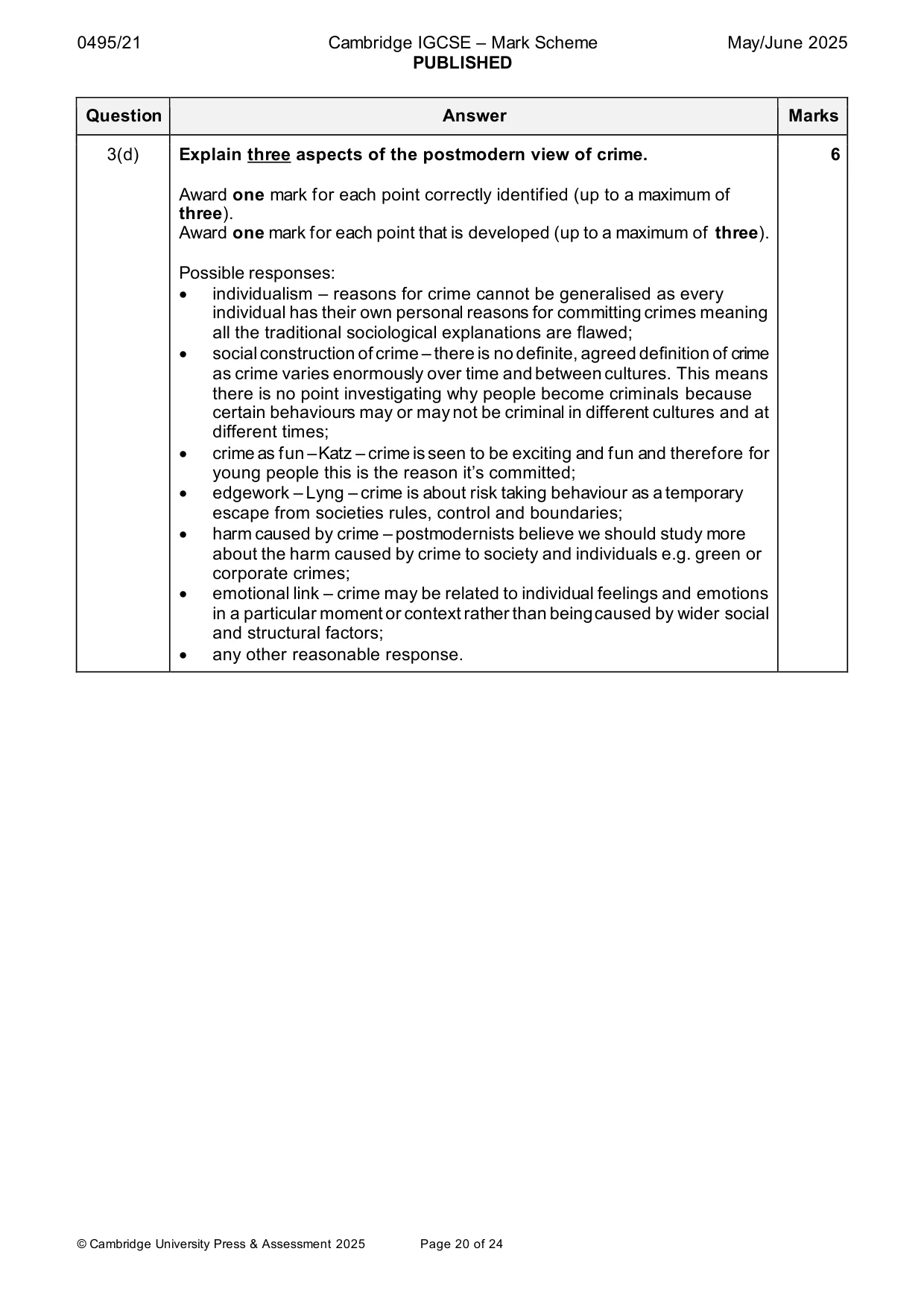
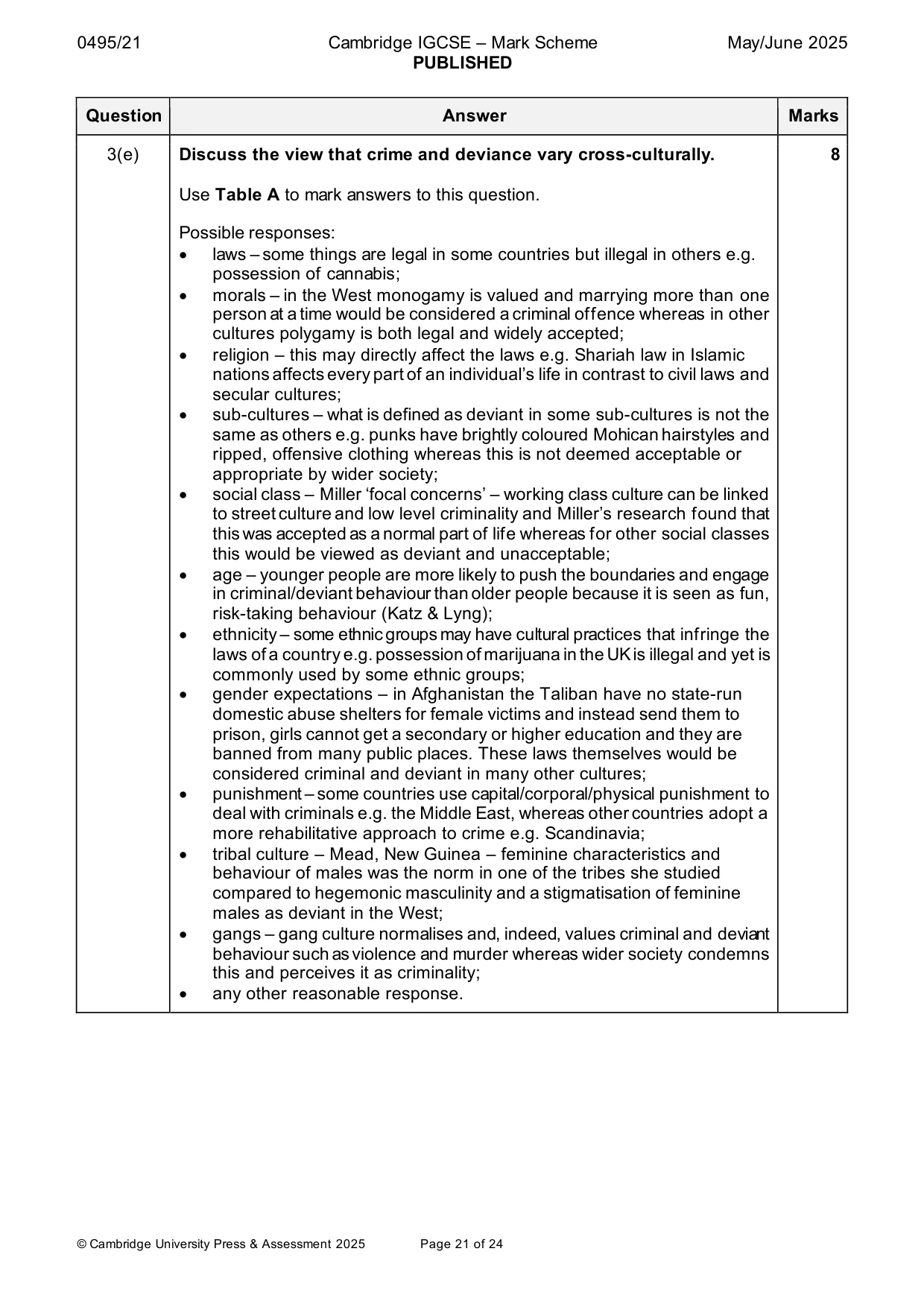
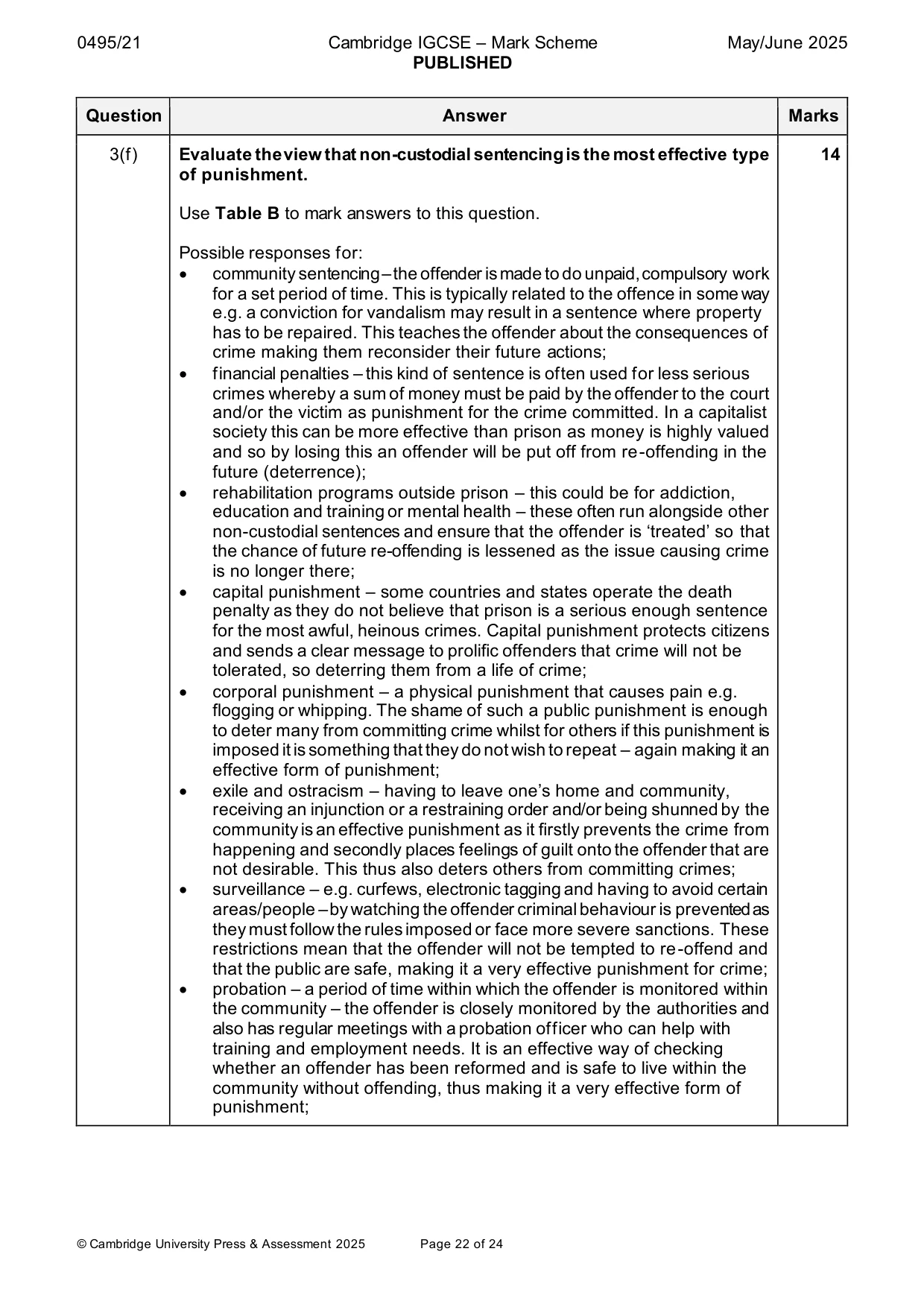
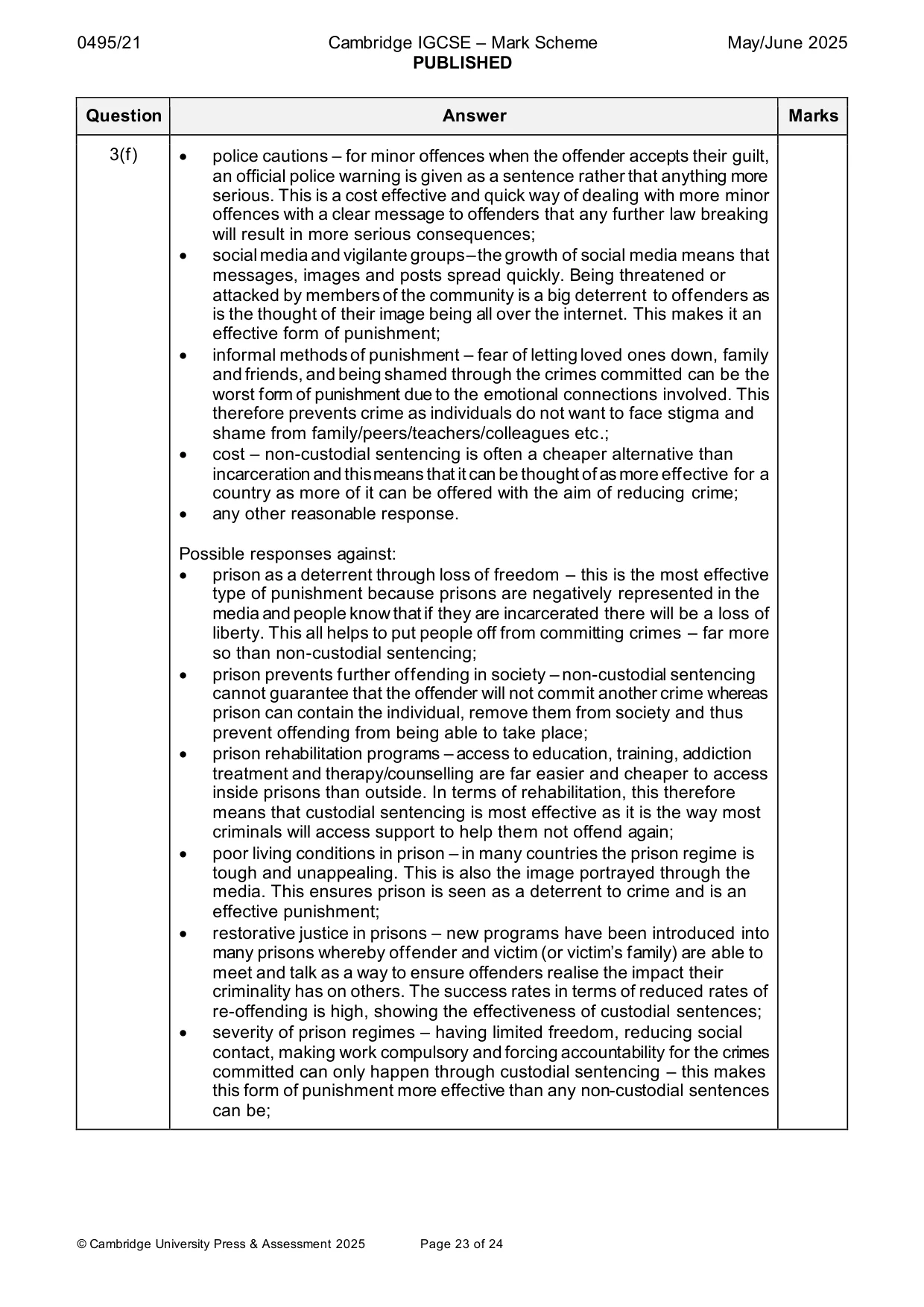
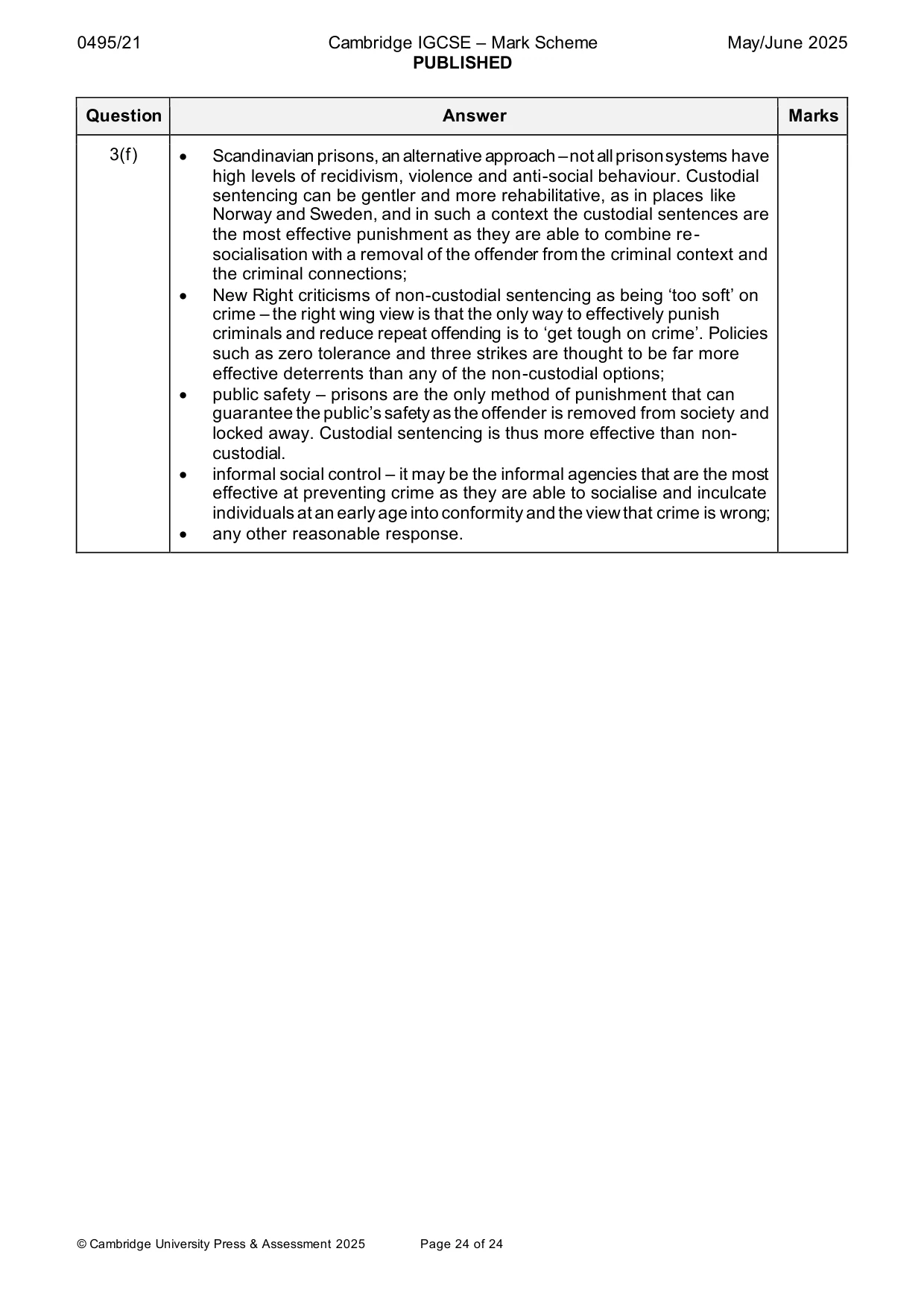
Mark scheme: 3(a)(i) Define the term peer group. 2 Award one mark for a partial definition, e.g. your friends. Award two marks for a clear definition, e.g. people of the same status and age. 3(a)(ii) Define the term hate crime. 2 Award one mark for a partial definition, e.g. racial assault. Award two marks for a clear definition, e.g. offences in which the victim is targeted because of certain characteristics e.g. religion, age, sexuality or race. 3(b) State two strengths of using official statistics to measure crime. 2 Award one mark for each correct strength (up to a maximum of two). Possible responses: • patterns and trends in crimes committed can be easily seen; • quantitative data means comparisons over time/between social groups can easily be made; • they show what types of people are offenders and victims; • they are published online and so are easily accessible and free; • they can be used to see what crimes are increasing and what crimes are decreasing; • they are typically published every year and so are up to date; • they are published by the government and based on police and court records so can be trusted; • they show data for an entire nation and so are both representative and generalisable; • they are reliable – standardised data; • any other reasonable response. 3(c) Explain three reasons why people commit instrumental crime. 6 Award one mark for each point correctly identified (up to a maximum of three). Award one mark for each point that is developed (up to a maximum of three). Possible responses: • for money – financial reasons such as poverty and material deprivation can lead some people to instrumental crime; • capitalist consumer culture – even higher class people may commit instrumental crimes e.g. white-collar/corporate crime as a way to maximise profit, • due to a lack of opportunity – high unemployment rates and reduced job opportunities may lead some people to commit crime; • to improve social position – instrumental crime can increase status and position within the hierarchy (e.g. gangs) which cannot be achieved legitimately – Cohen’s status frustration; • for material possessions – relative deprivation, the feeling of having less than others in your community/society, often fuelled by the media may lead some people to commit instrumental crimes as a way to gain these desirable goods; • due to prejudice and discrimination – instrumental crime may be the intended response to perceived inequalities that leaves the perpetrator feeling disillusioned about the unfairness of society i.e. being unable to get a job s/he is qualified for; • a means of resistance – the feeling experienced by many marginalised groups of being targeted and treated unjustly by the police may lead to instrumental crimes e.g. BLM protests, riots and looting as forms of instrumental crimes; • to prove masculinity – the culture of masculinity means some males may commit instrumental crime in order to prove or increase their masculinity e.g. violence/assault; • any other reasonable response. 3(d) Explain three aspects of the postmodern view of crime. 6 Award one mark for each point correctly identified (up to a maximum of three). Award one mark for each point that is developed (up to a maximum of three). Possible responses: • individualism – reasons for crime cannot be generalised as every individual has their own personal reasons for committing crimes meaning all the traditional sociological explanations are flawed; • social construction of crime – there is no definite, agreed definition of crime as crime varies enormously over time and between cultures. This means there is no point investigating why people become criminals because certain behaviours may or may not be criminal in different cultures and at different times; • crime as fun – Katz – crime is seen to be exciting and fun and therefore for young people this is the reason it’s committed; • edgework – Lyng – crime is about risk taking behaviour as a temporary escape from societies rules, control and boundaries; • harm caused by crime – postmodernists believe we should study more about the harm caused by crime to society and individuals e.g. green or corporate crimes; • emotional link – crime may be related to individual feelings and emotions in a particular moment or context rather than being caused by wider social and structural factors; • any other reasonable response. 3(e) Discuss the view that crime and deviance vary cross-culturally. 8 Use Table A to mark answers to this question. Possible responses: • laws – some things are legal in some countries but illegal in others e.g. possession of cannabis; • morals – in the West monogamy is valued and marrying more than one person at a time would be considered a criminal offence whereas in other cultures polygamy is both legal and widely accepted; • religion – this may directly affect the laws e.g. Shariah law in Islamic nations affects every part of an individual’s life in contrast to civil laws and secular cultures; • sub-cultures – what is defined as deviant in some sub-cultures is not the same as others e.g. punks have brightly coloured Mohican hairstyles and ripped, offensive clothing whereas this is not deemed acceptable or appropriate by wider society; • social class – Miller ‘focal concerns’ – working class culture can be linked to street culture and low level criminality and Miller’s research found that this was accepted as a normal part of life whereas for other social classes this would be viewed as deviant and unacceptable; • age – younger people are more likely to push the boundaries and engage in criminal/deviant behaviour than older people because it is seen as fun, risk-taking behaviour (Katz & Lyng); • ethnicity – some ethnic groups may have cultural practices that infringe the laws of a country e.g. possession of marijuana in the UK is illegal and yet is commonly used by some ethnic groups; • gender expectations – in Afghanistan the Taliban have no state-run domestic abuse shelters for female victims and instead send them to prison, girls cannot get a secondary or higher education and they are banned from many public places. These laws themselves would be considered criminal and deviant in many other cultures; • punishment – some countries use capital/corporal/physical punishment to deal with criminals e.g. the Middle East, whereas other countries adopt a more rehabilitative approach to crime e.g. Scandinavia; • tribal culture – Mead, New Guinea – feminine characteristics and behaviour of males was the norm in one of the tribes she studied compared to hegemonic masculinity and a stigmatisation of feminine males as deviant in the West; • gangs – gang culture normalises and, indeed, values criminal and deviant behaviour such as violence and murder whereas wider society condemns this and perceives it as criminality; • any other reasonable response. 3(f) Evaluate the view that non-custodial sentencing is the most effective type 14 of punishment. Use Table B to mark answers to this question. Possible responses for: • community sentencing – the offender is made to do unpaid, compulsory work for a set period of time. This is typically related to the offence in some way e.g. a conviction for vandalism may result in a sentence where property has to be repaired. This teaches the offender about the consequences of crime making them reconsider their future actions; • financial penalties – this kind of sentence is often used for less serious crimes whereby a sum of money must be paid by the offender to the court and/or the victim as punishment for the crime committed. In a capitalist society this can be more effective than prison as money is highly valued and so by losing this an offender will be put off from re-offending in the future (deterrence); • rehabilitation programs outside prison – this could be for addiction, education and training or mental health – these often run alongside other non-custodial sentences and ensure that the offender is ‘treated’ so that the chance of future re-offending is lessened as the issue causing crime is no longer there; • capital punishment – some countries and states operate the death penalty as they do not believe that prison is a serious enough sentence for the most awful, heinous crimes. Capital punishment protects citizens and sends a clear message to prolific offenders that crime will not be tolerated, so deterring them from a life of crime; • corporal punishment – a physical punishment that causes pain e.g. flogging or whipping. The shame of such a public punishment is enough to deter many from committing crime whilst for others if this punishment is imposed it is something that they do not wish to repeat – again making it an effective form of punishment; • exile and ostracism – having to leave one’s home and community, receiving an injunction or a restraining order and/or being shunned by the community is an effective punishment as it firstly prevents the crime from happening and secondly places feelings of guilt onto the offender that are not desirable. This thus also deters others from committing crimes; • surveillance – e.g. curfews, electronic tagging and having to avoid certain areas/people – by watching the offender criminal behaviour is prevented as they must follow the rules imposed or face more severe sanctions. These restrictions mean that the offender will not be tempted to re-offend and that the public are safe, making it a very effective punishment for crime; • probation – a period of time within which the offender is monitored within the community – the offender is closely monitored by the authorities and also has regular meetings with a probation officer who can help with training and employment needs. It is an effective way of checking whether an offender has been reformed and is safe to live within the community without offending, thus making it a very effective form of punishment; 3(f) • police cautions – for minor offences when the offender accepts their guilt, an official police warning is given as a sentence rather that anything more serious. This is a cost effective and quick way of dealing with more minor offences with a clear message to offenders that any further law breaking will result in more serious consequences; • social media and vigilante groups – the growth of social media means that messages, images and posts spread quickly. Being threatened or attacked by members of the community is a big deterrent to offenders as is the thought of their image being all over the internet. This makes it an effective form of punishment; • informal methods of punishment – fear of letting loved ones down, family and friends, and being shamed through the crimes committed can be the worst form of punishment due to the emotional connections involved. This therefore prevents crime as individuals do not want to face stigma and shame from family/peers/teachers/colleagues etc.; • cost – non-custodial sentencing is often a cheaper alternative than incarceration and this means that it can be thought of as more effective for a country as more of it can be offered with the aim of reducing crime; • any other reasonable response. Possible responses against: • prison as a deterrent through loss of freedom – this is the most effective type of punishment because prisons are negatively represented in the media and people know that if they are incarcerated there will be a loss of liberty. This all helps to put people off from committing crimes – far more so than non-custodial sentencing; • prison prevents further offending in society – non-custodial sentencing cannot guarantee that the offender will not commit another crime whereas prison can contain the individual, remove them from society and thus prevent offending from being able to take place; • prison rehabilitation programs – access to education, training, addiction treatment and therapy/counselling are far easier and cheaper to access inside prisons than outside. In terms of rehabilitation, this therefore means that custodial sentencing is most effective as it is the way most criminals will access support to help them not offend again; • poor living conditions in prison – in many countries the prison regime is tough and unappealing. This is also the image portrayed through the media. This ensures prison is seen as a deterrent to crime and is an effective punishment; • restorative justice in prisons – new programs have been introduced into many prisons whereby offender and victim (or victim’s family) are able to meet and talk as a way to ensure offenders realise the impact their criminality has on others. The success rates in terms of reduced rates of re-offending is high, showing the effectiveness of custodial sentences; • severity of prison regimes – having limited freedom, reducing social contact, making work compulsory and forcing accountability for the crimes committed can only happen through custodial sentencing – this makes this form of punishment more effective than any non-custodial sentences can be; 3(f) • Scandinavian prisons, an alternative approach – not all prison systems have high levels of recidivism, violence and anti-social behaviour. Custodial sentencing can be gentler and more rehabilitative, as in places like Norway and Sweden, and in such a context the custodial sentences are the most effective punishment as they are able to combine re- socialisation with a removal of the offender from the criminal context and the criminal connections; • New Right criticisms of non-custodial sentencing as being ‘too soft’ on crime – the right wing view is that the only way to effectively punish criminals and reduce repeat offending is to ‘get tough on crime’. Policies such as zero tolerance and three strikes are thought to be far more effective deterrents than any of the non-custodial options; • public safety – prisons are the only method of punishment that can guarantee the public’s safety as the offender is removed from society and locked away. Custodial sentencing is thus more effective than non- custodial. • informal social control – it may be the informal agencies that are the most effective at preventing crime as they are able to socialise and inculcate individuals at an early age into conformity and the view that crime is wrong; • any other reasonable response.
More questions on How do sociologists approach the study of society?
What was in this paper
The subtopics covered by these 3 questions, and how many questions each got. Open one in a new tab to see every Cambridge question on it.
What you needed in this session
Cambridge’s own grade thresholds for 2025 May/June, Paper 2 · Variant 1. A higher threshold means an easier paper — the bar moves with how the cohort did.