Cambridge IGCSE Sociology 0495 — 2023 Oct/Nov Paper 2 · Variant 1
0495/21/O/N/23 · 4 questions · 70 marks · ≈79 min
The question paper and its mark scheme, free to read here and free to download. This is Cambridge’s own paper, exactly as it was sat.
Question paper4 pages
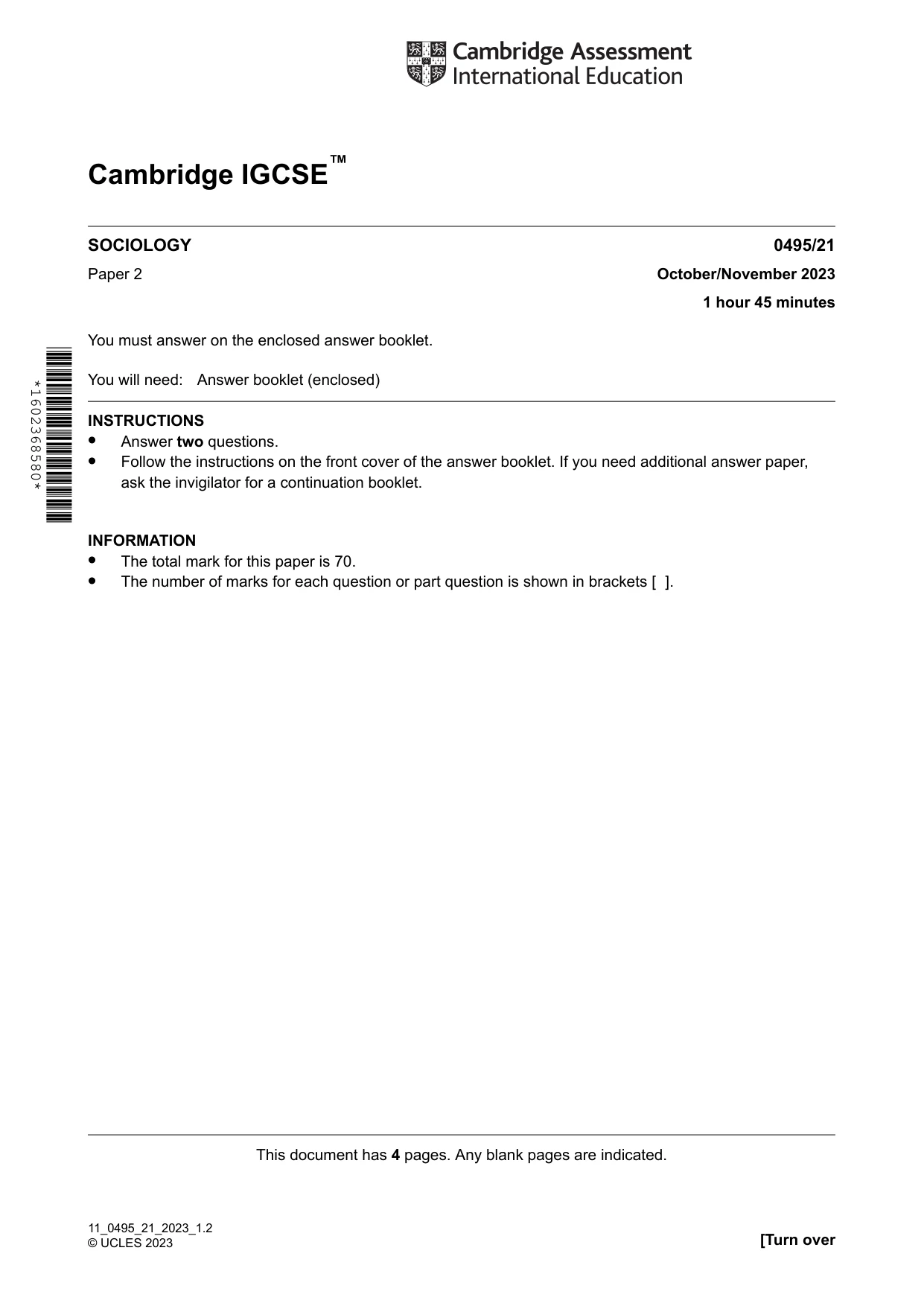
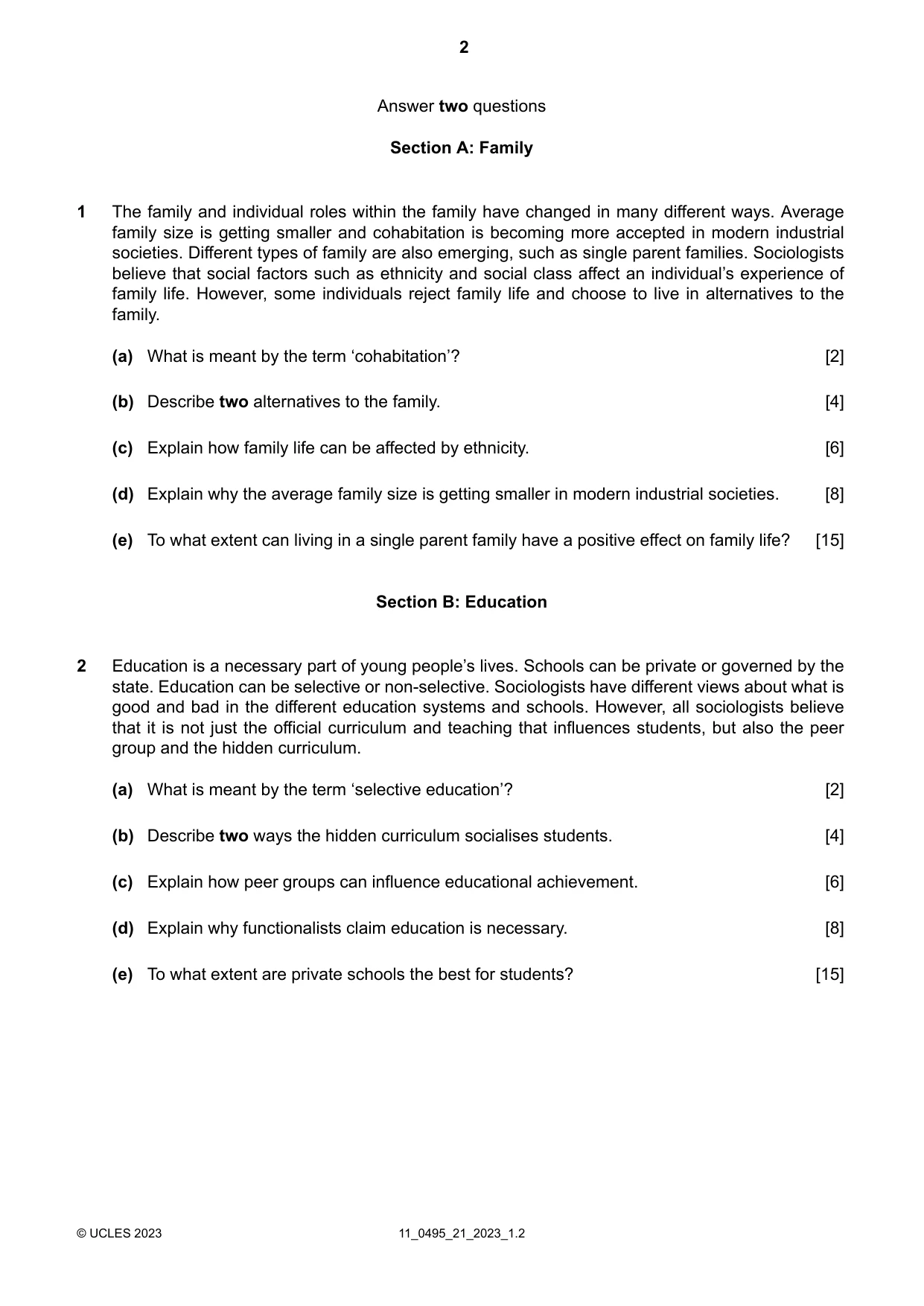
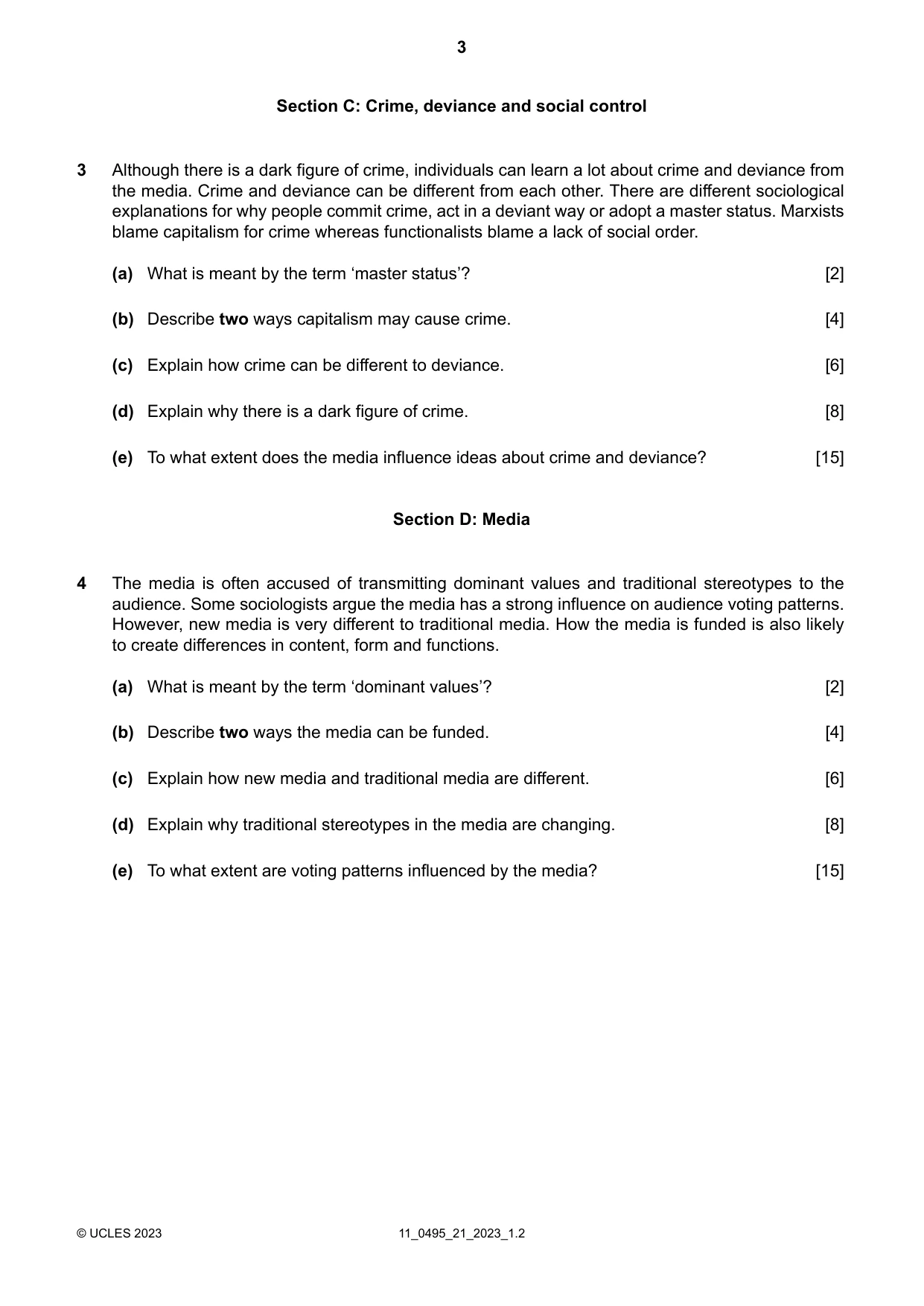

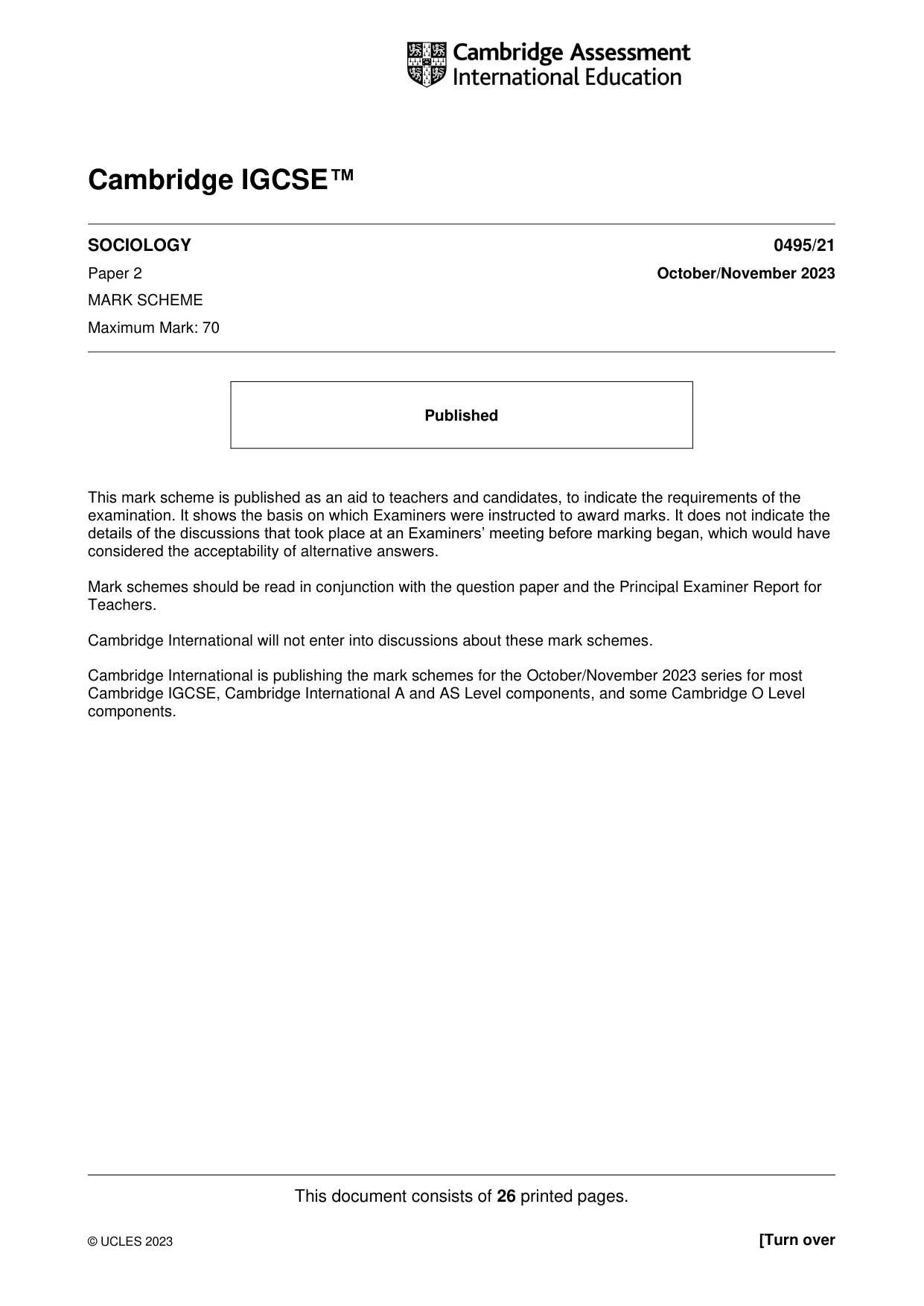
Mark scheme26 pages
Answers below. Sit the paper first if you are practising.


Questions as text
Q1 · The family and individual roles within the family have changed in many different ways
1 The family and individual roles within the family have changed in many different ways. Average family size is getting smaller and cohabitation is becoming more accepted in modern industrial societies. Different types of family are also emerging, such as single parent families. Sociologists believe that social factors such as ethnicity and social class affect an individual’s experience of family life. However, some individuals reject family life and choose to live in alternatives to the family. (a) What is meant by the term ‘cohabitation’? [2] (b) Describe two alternatives to the family. [4] (c) Explain how family life can be affected by ethnicity. [6] (d) Explain why the average family size is getting smaller in modern industrial societies. [8] (e) To what extent can living in a single parent family have a positive effect on family life? [15]
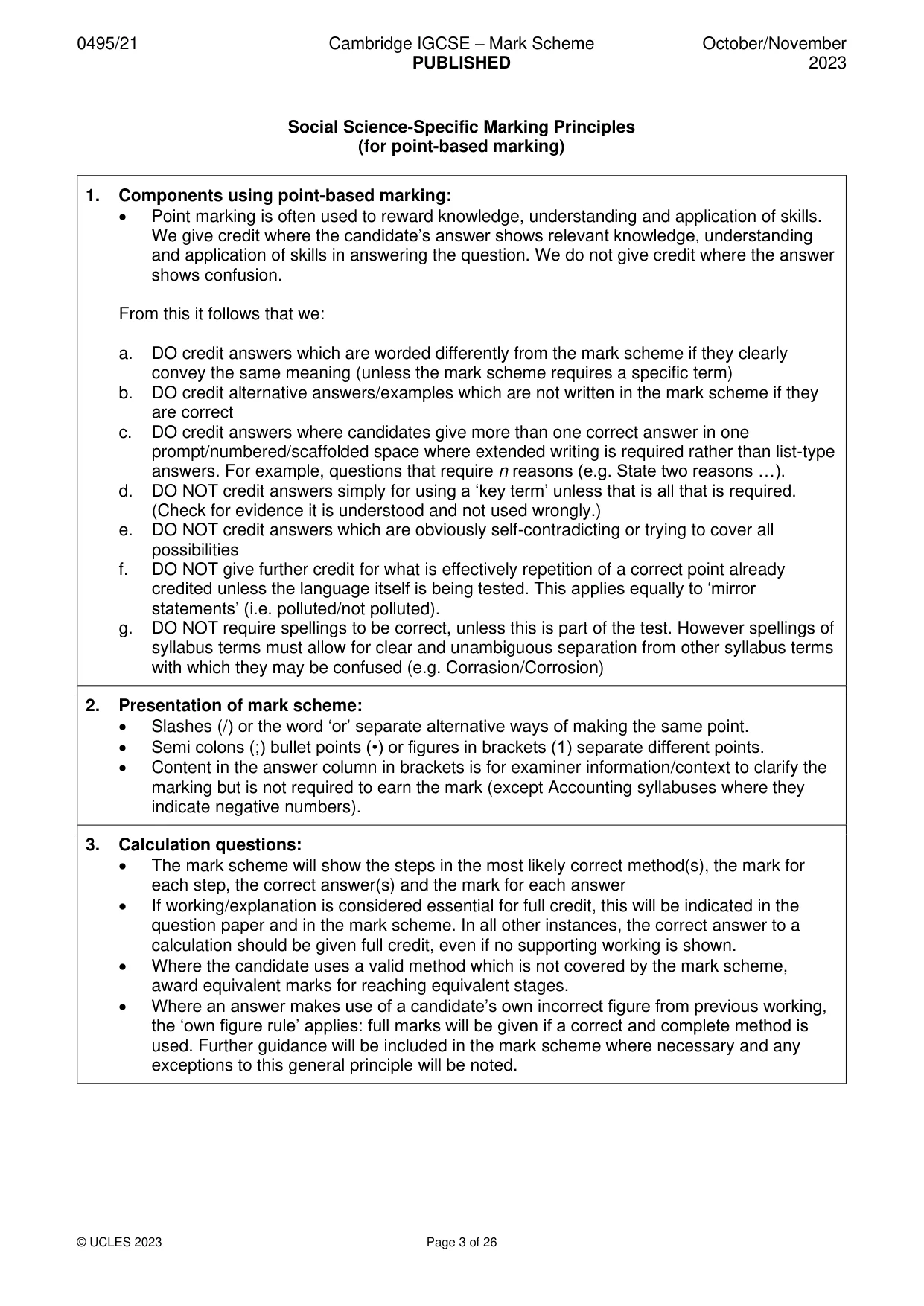
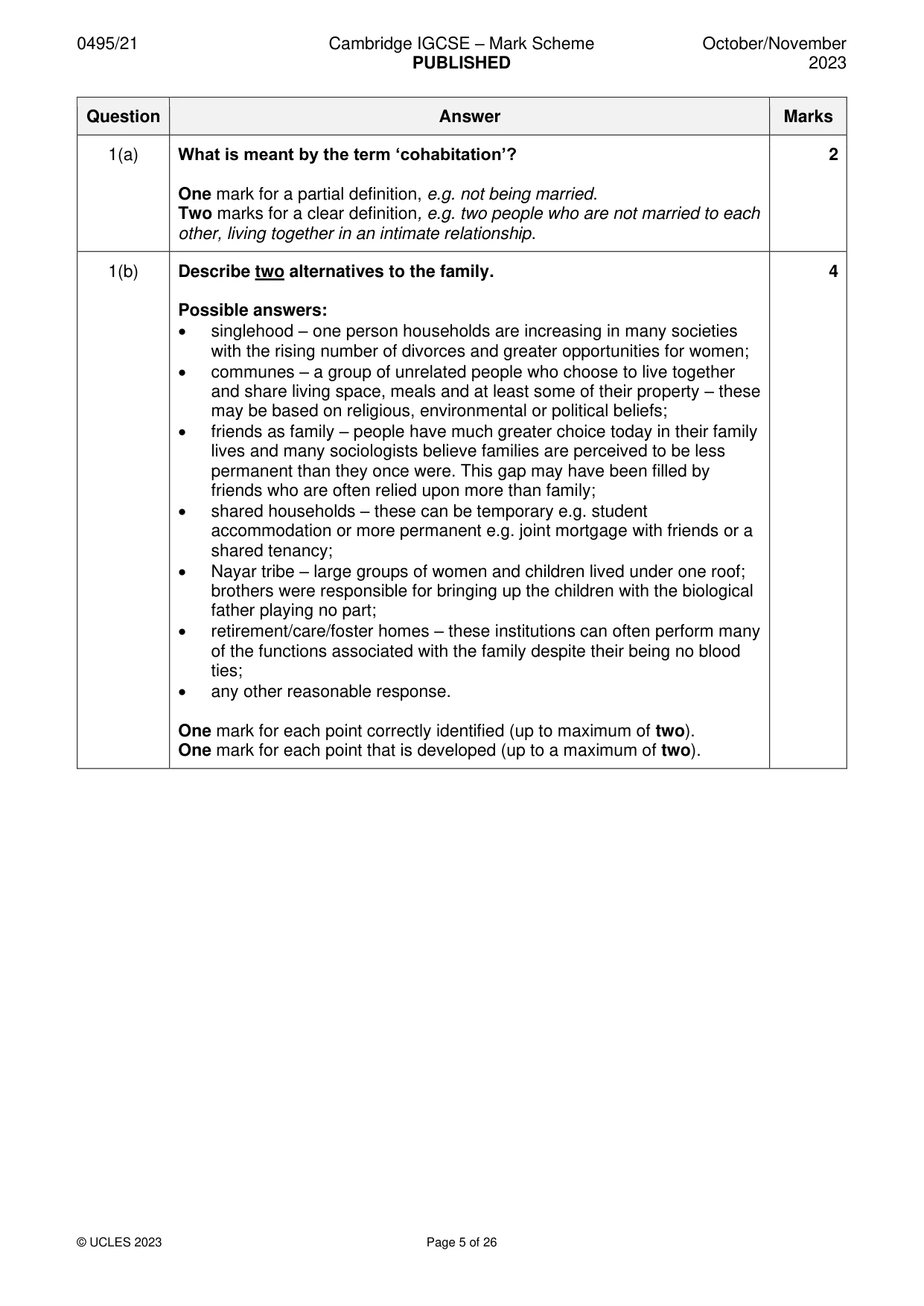
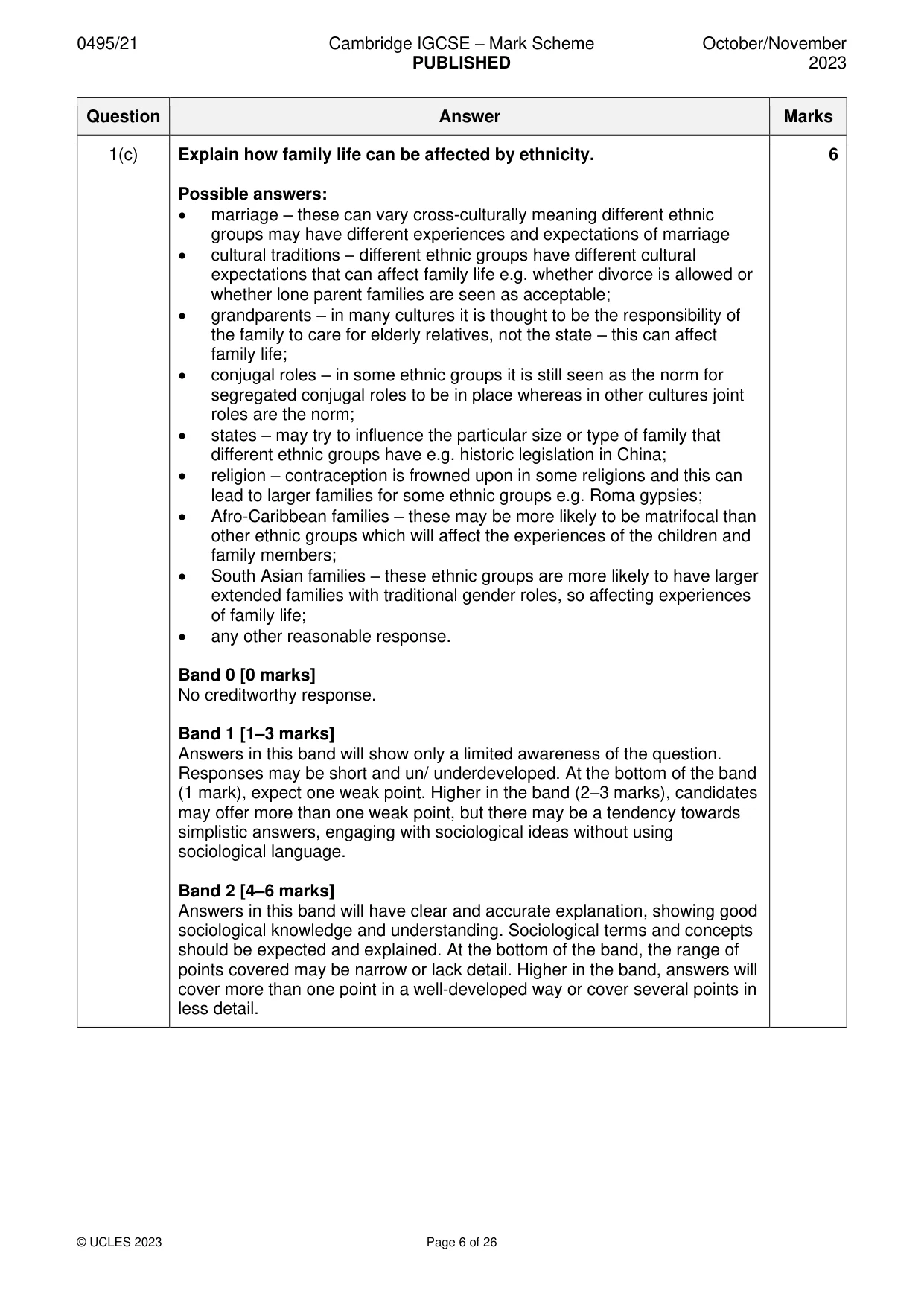
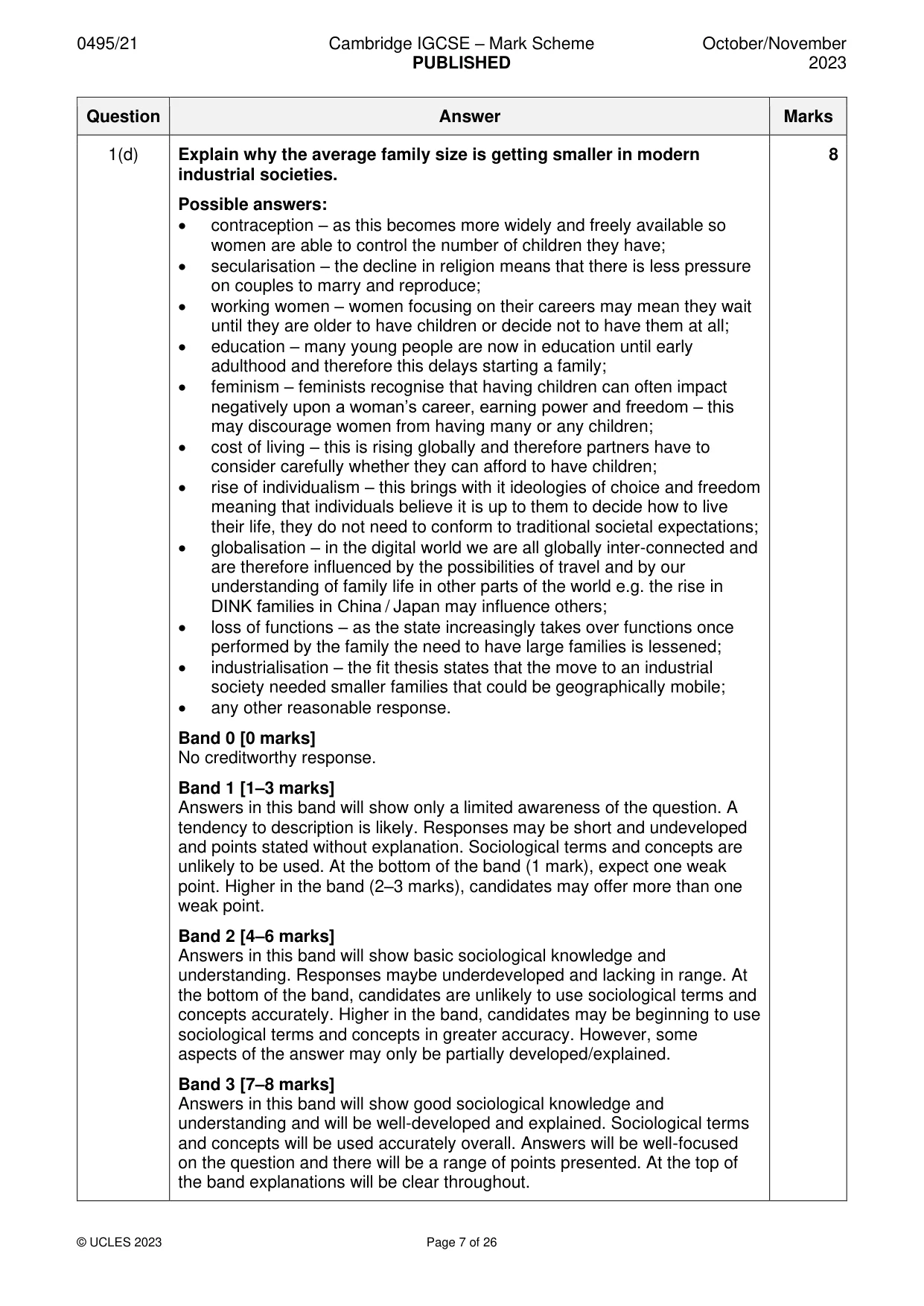
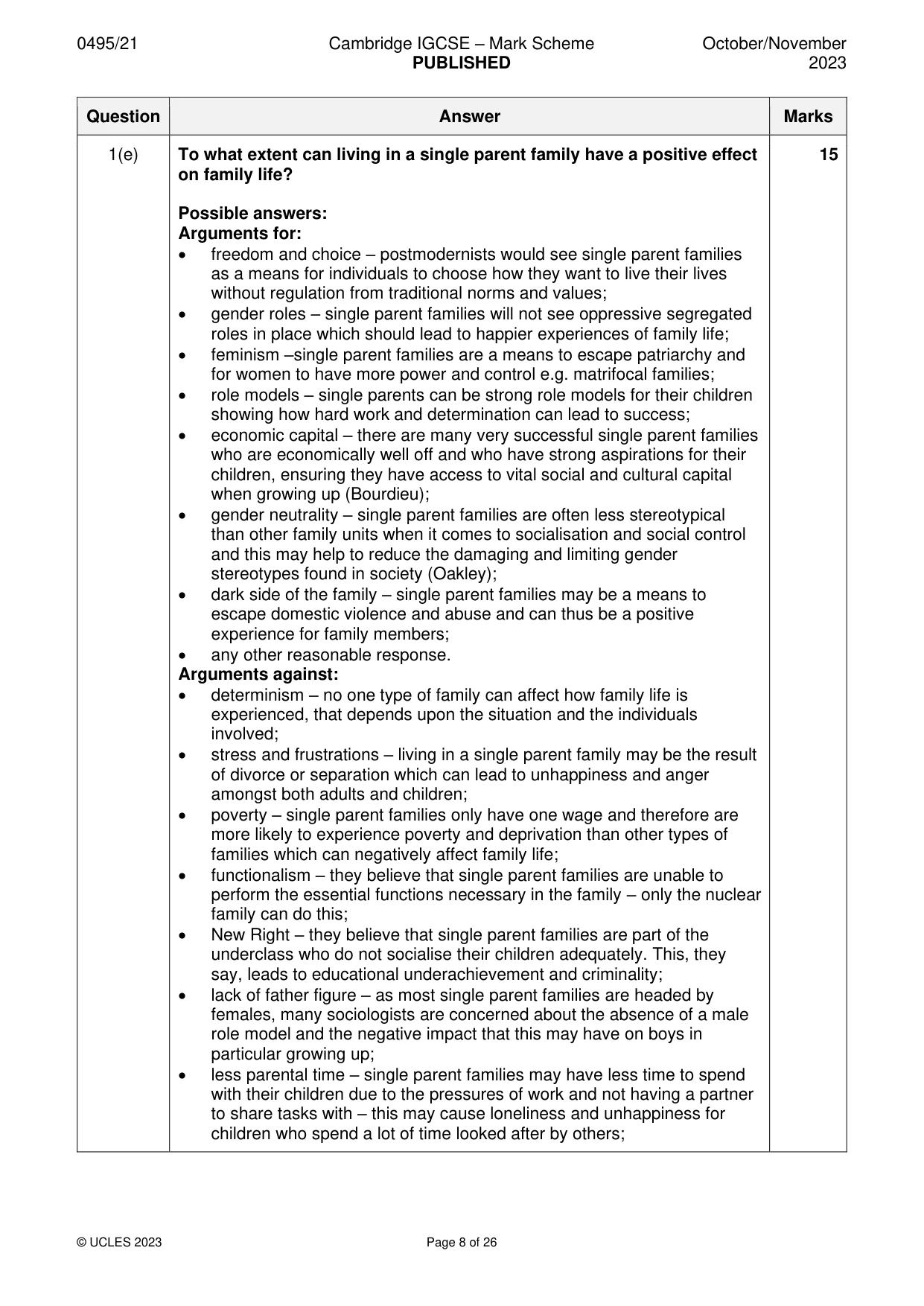
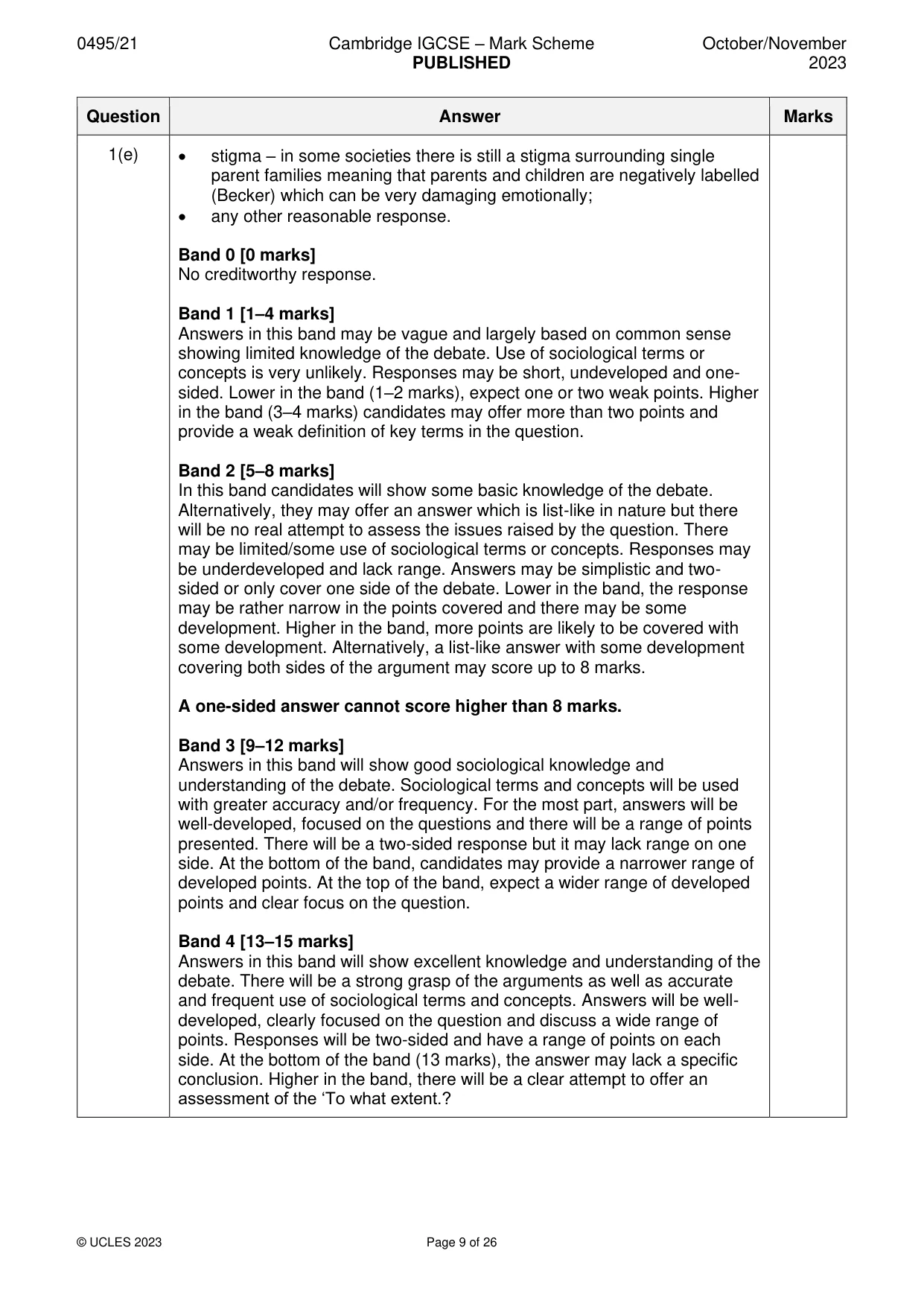
Mark scheme: Question Answer Marks 1(a) What is meant by the term ‘cohabitation’? 2 One mark for a partial definition, e.g. not being married. Two marks for a clear definition, e.g. two people who are not married to each other, living together in an intimate relationship. 1(b) Describe two alternatives to the family. 4 Possible answers: • singlehood – one person households are increasing in many societies with the rising number of divorces and greater opportunities for women; • communes – a group of unrelated people who choose to live together and share living space, meals and at least some of their property – these may be based on religious, environmental or political beliefs; • friends as family – people have much greater choice today in their family lives and many sociologists believe families are perceived to be less permanent than they once were. This gap may have been filled by friends who are often relied upon more than family; • shared households – these can be temporary e.g. student accommodation or more permanent e.g. joint mortgage with friends or a shared tenancy; • Nayar tribe – large groups of women and children lived under one roof; brothers were responsible for bringing up the children with the biological father playing no part; • retirement/care/foster homes – these institutions can often perform many of the functions associated with the family despite their being no blood ties; • any other reasonable response. One mark for each point correctly identified (up to maximum of two). One mark for each point that is developed (up to a maximum of two). 1(c) Explain how family life can be affected by ethnicity. 6 Possible answers: • marriage – these can vary cross-culturally meaning different ethnic groups may have different experiences and expectations of marriage • cultural traditions – different ethnic groups have different cultural expectations that can affect family life e.g. whether divorce is allowed or whether lone parent families are seen as acceptable; • grandparents – in many cultures it is thought to be the responsibility of the family to care for elderly relatives, not the state – this can affect family life; • conjugal roles – in some ethnic groups it is still seen as the norm for segregated conjugal roles to be in place whereas in other cultures joint roles are the norm; • states – may try to influence the particular size or type of family that different ethnic groups have e.g. historic legislation in China; • religion – contraception is frowned upon in some religions and this can lead to larger families for some ethnic groups e.g. Roma gypsies; • Afro-Caribbean families – these may be more likely to be matrifocal than other ethnic groups which will affect the experiences of the children and family members; • South Asian families – these ethnic groups are more likely to have larger extended families with traditional gender roles, so affecting experiences of family life; • any other reasonable response. Band 0 [0 marks] No creditworthy response. Band 1 [1–3 marks] Answers in this band will show only a limited awareness of the question. Responses may be short and un/ underdeveloped. At the bottom of the band (1 mark), expect one weak point. Higher in the band (2–3 marks), candidates may offer more than one weak point, but there may be a tendency towards simplistic answers, engaging with sociological ideas without using sociological language. Band 2 [4–6 marks] Answers in this band will have clear and accurate explanation, showing good sociological knowledge and understanding. Sociological terms and concepts should be expected and explained. At the bottom of the band, the range of points covered may be narrow or lack detail. Higher in the band, answers will cover more than one point in a well-developed way or cover several points in less detail. 1(d) Explain why the average family size is getting smaller in modern 8 industrial societies. Possible answers: • contraception – as this becomes more widely and freely available so women are able to control the number of children they have; • secularisation – the decline in religion means that there is less pressure on couples to marry and reproduce; • working women – women focusing on their careers may mean they wait until they are older to have children or decide not to have them at all; • education – many young people are now in education until early adulthood and therefore this delays starting a family; • feminism – feminists recognise that having children can often impact negatively upon a woman’s career, earning power and freedom – this may discourage women from having many or any children; • cost of living – this is rising globally and therefore partners have to consider carefully whether they can afford to have children; • rise of individualism – this brings with it ideologies of choice and freedom meaning that individuals believe it is up to them to decide how to live their life, they do not need to conform to traditional societal expectations; • globalisation – in the digital world we are all globally inter-connected and are therefore influenced by the possibilities of travel and by our understanding of family life in other parts of the world e.g. the rise in DINK families in China / Japan may influence others; • loss of functions – as the state increasingly takes over functions once performed by the family the need to have large families is lessened; • industrialisation – the fit thesis states that the move to an industrial society needed smaller families that could be geographically mobile; • any other reasonable response. Band 0 [0 marks] No creditworthy response. Band 1 [1–3 marks] Answers in this band will show only a limited awareness of the question. A tendency to description is likely. Responses may be short and undeveloped and points stated without explanation. Sociological terms and concepts are unlikely to be used. At the bottom of the band (1 mark), expect one weak point. Higher in the band (2–3 marks), candidates may offer more than one weak point. Band 2 [4–6 marks] Answers in this band will show basic sociological knowledge and understanding. Responses maybe underdeveloped and lacking in range. At the bottom of the band, candidates are unlikely to use sociological terms and concepts accurately. Higher in the band, candidates may be beginning to use sociological terms and concepts in greater accuracy. However, some aspects of the answer may only be partially developed/explained. Band 3 [7–8 marks] Answers in this band will show good sociological knowledge and understanding and will be well-developed and explained. Sociological terms and concepts will be used accurately overall. Answers will be well-focused on the question and there will be a range of points presented. At the top of the band explanations will be clear throughout. 1(e) To what extent can living in a single parent family have a positive effect 15 on family life? Possible answers: Arguments for: • freedom and choice – postmodernists would see single parent families as a means for individuals to choose how they want to live their lives without regulation from traditional norms and values; • gender roles – single parent families will not see oppressive segregated roles in place which should lead to happier experiences of family life; • feminism –single parent families are a means to escape patriarchy and for women to have more power and control e.g. matrifocal families; • role models – single parents can be strong role models for their children showing how hard work and determination can lead to success; • economic capital – there are many very successful single parent families who are economically well off and who have strong aspirations for their children, ensuring they have access to vital social and cultural capital when growing up (Bourdieu); • gender neutrality – single parent families are often less stereotypical than other family units when it comes to socialisation and social control and this may help to reduce the damaging and limiting gender stereotypes found in society (Oakley); • dark side of the family – single parent families may be a means to escape domestic violence and abuse and can thus be a positive experience for family members; • any other reasonable response. Arguments against: • determinism – no one type of family can affect how family life is experienced, that depends upon the situation and the individuals involved; • stress and frustrations – living in a single parent family may be the result of divorce or separation which can lead to unhappiness and anger amongst both adults and children; • poverty – single parent families only have one wage and therefore are more likely to experience poverty and deprivation than other types of families which can negatively affect family life; • functionalism – they believe that single parent families are unable to perform the essential functions necessary in the family – only the nuclear family can do this; • New Right – they believe that single parent families are part of the underclass who do not socialise their children adequately. This, they say, leads to educational underachievement and criminality; • lack of father figure – as most single parent families are headed by females, many sociologists are concerned about the absence of a male role model and the negative impact that this may have on boys in particular growing up; • less parental time – single parent families may have less time to spend with their children due to the pressures of work and not having a partner to share tasks with – this may cause loneliness and unhappiness for children who spend a lot of time looked after by others; 1(e) • stigma – in some societies there is still a stigma surrounding single parent families meaning that parents and children are negatively labelled (Becker) which can be very damaging emotionally; • any other reasonable response. Band 0 [0 marks] No creditworthy response. Band 1 [1–4 marks] Answers in this band may be vague and largely based on common sense showing limited knowledge of the debate. Use of sociological terms or concepts is very unlikely. Responses may be short, undeveloped and one- sided. Lower in the band (1–2 marks), expect one or two weak points. Higher in the band (3–4 marks) candidates may offer more than two points and provide a weak definition of key terms in the question. Band 2 [5–8 marks] In this band candidates will show some basic knowledge of the debate. Alternatively, they may offer an answer which is list-like in nature but there will be no real attempt to assess the issues raised by the question. There may be limited/some use of sociological terms or concepts. Responses may be underdeveloped and lack range. Answers may be simplistic and two- sided or only cover one side of the debate. Lower in the band, the response may be rather narrow in the points covered and there may be some development. Higher in the band, more points are likely to be covered with some development. Alternatively, a list-like answer with some development covering both sides of the argument may score up to 8 marks. A one-sided answer cannot score higher than 8 marks. Band 3 [9–12 marks] Answers in this band will show good sociological knowledge and understanding of the debate. Sociological terms and concepts will be used with greater accuracy and/or frequency. For the most part, answers will be well-developed, focused on the questions and there will be a range of points presented. There will be a two-sided response but it may lack range on one side. At the bottom of the band, candidates may provide a narrower range of developed points. At the top of the band, expect a wider range of developed points and clear focus on the question. Band 4 [13–15 marks] Answers in this band will show excellent knowledge and understanding of the debate. There will be a strong grasp of the arguments as well as accurate and frequent use of sociological terms and concepts. Answers will be well- developed, clearly focused on the question and discuss a wide range of points. Responses will be two-sided and have a range of points on each side. At the bottom of the band (13 marks), the answer may lack a specific conclusion. Higher in the band, there will be a clear attempt to offer an assessment of the ‘To what extent.?
Q2 · Education is a necessary part of young people’s lives
2 Education is a necessary part of young people’s lives. Schools can be private or governed by the state. Education can be selective or non-selective. Sociologists have different views about what is good and bad in the different education systems and schools. However, all sociologists believe that it is not just the official curriculum and teaching that influences students, but also the peer group and the hidden curriculum. (a) What is meant by the term ‘selective education’? [2] (b) Describe two ways the hidden curriculum socialises students. [4] (c) Explain how peer groups can influence educational achievement. [6] (d) Explain why functionalists claim education is necessary. [8] (e) To what extent are private schools the best for students? [15] Section C: Crime, deviance and social control
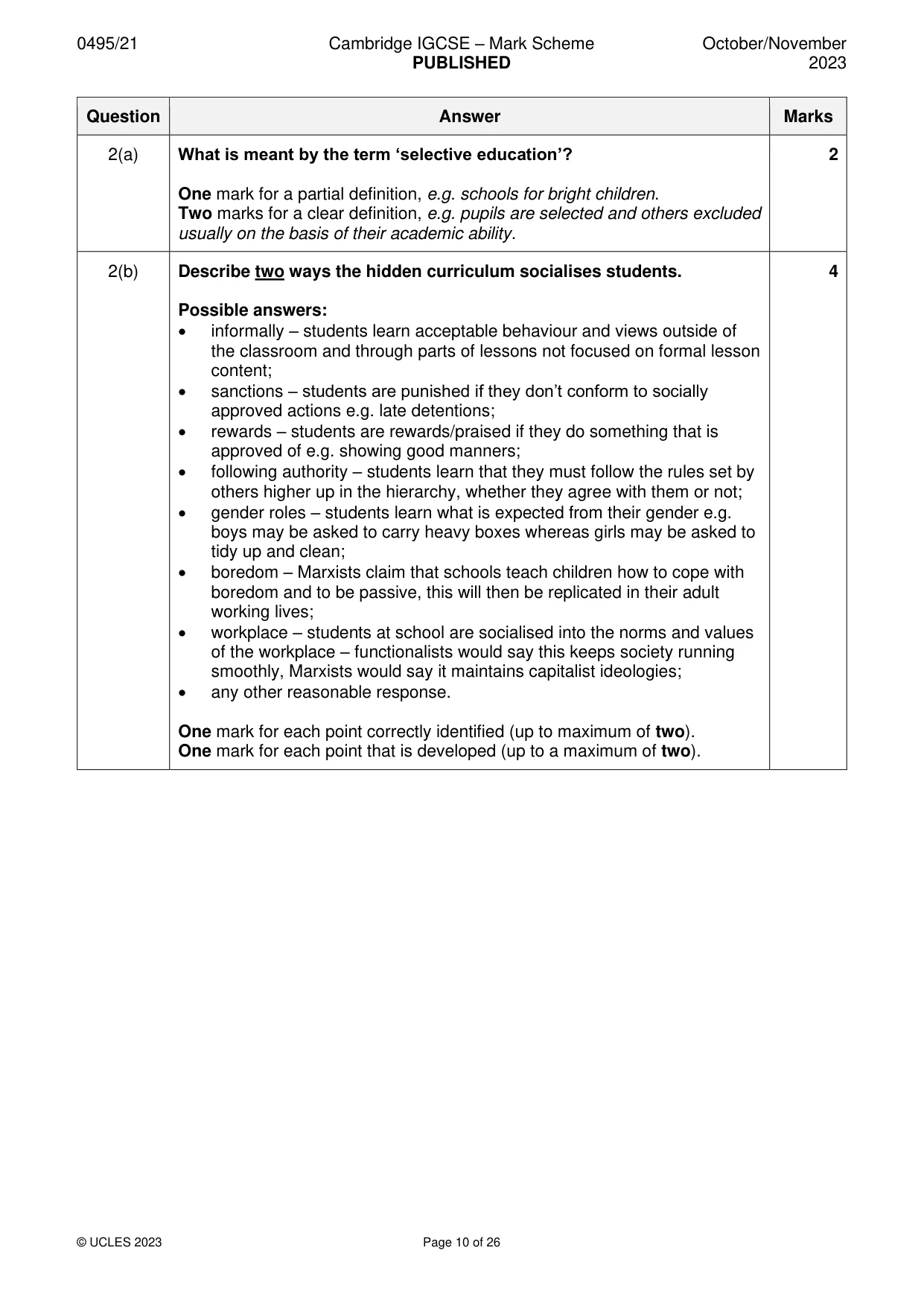
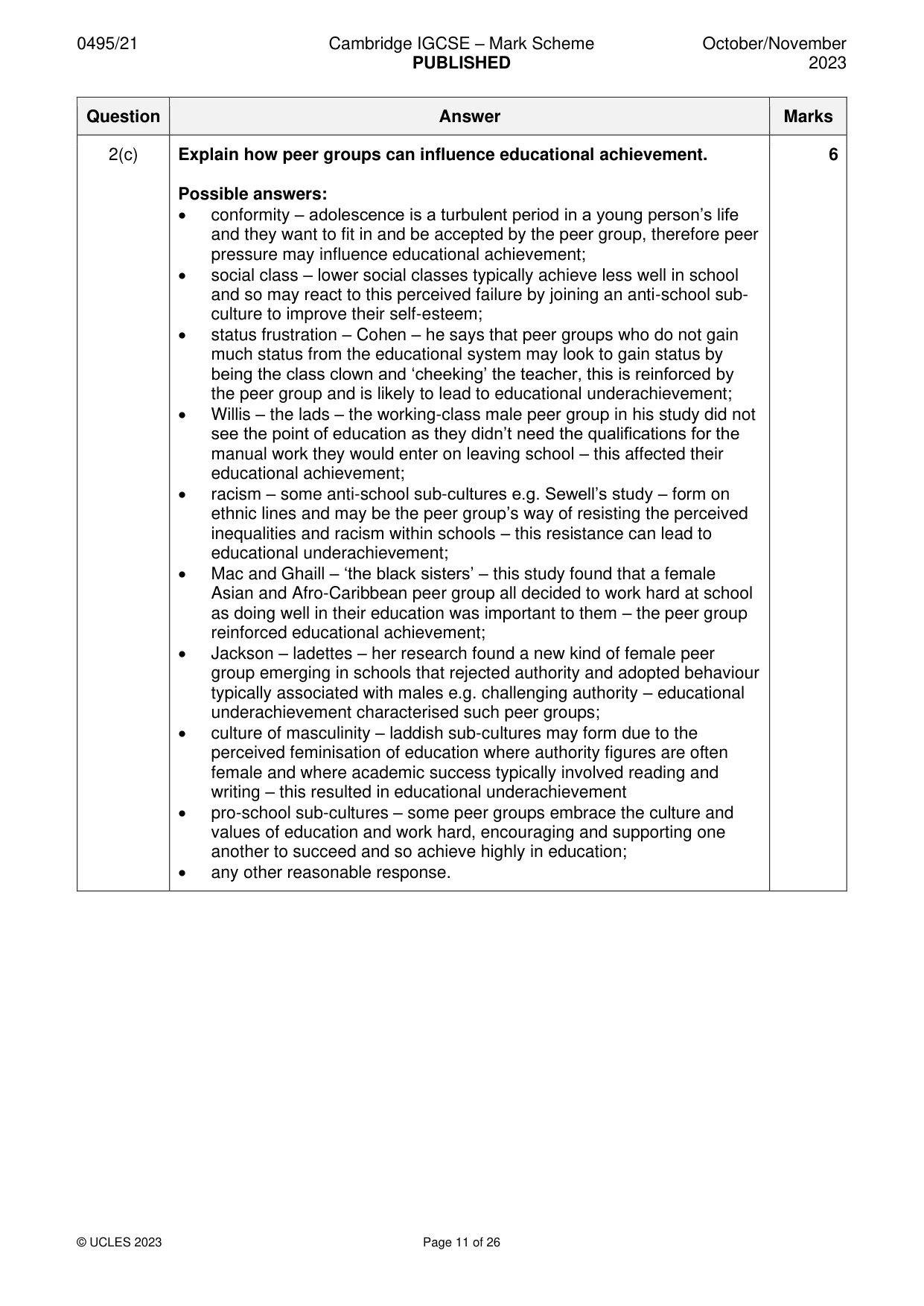
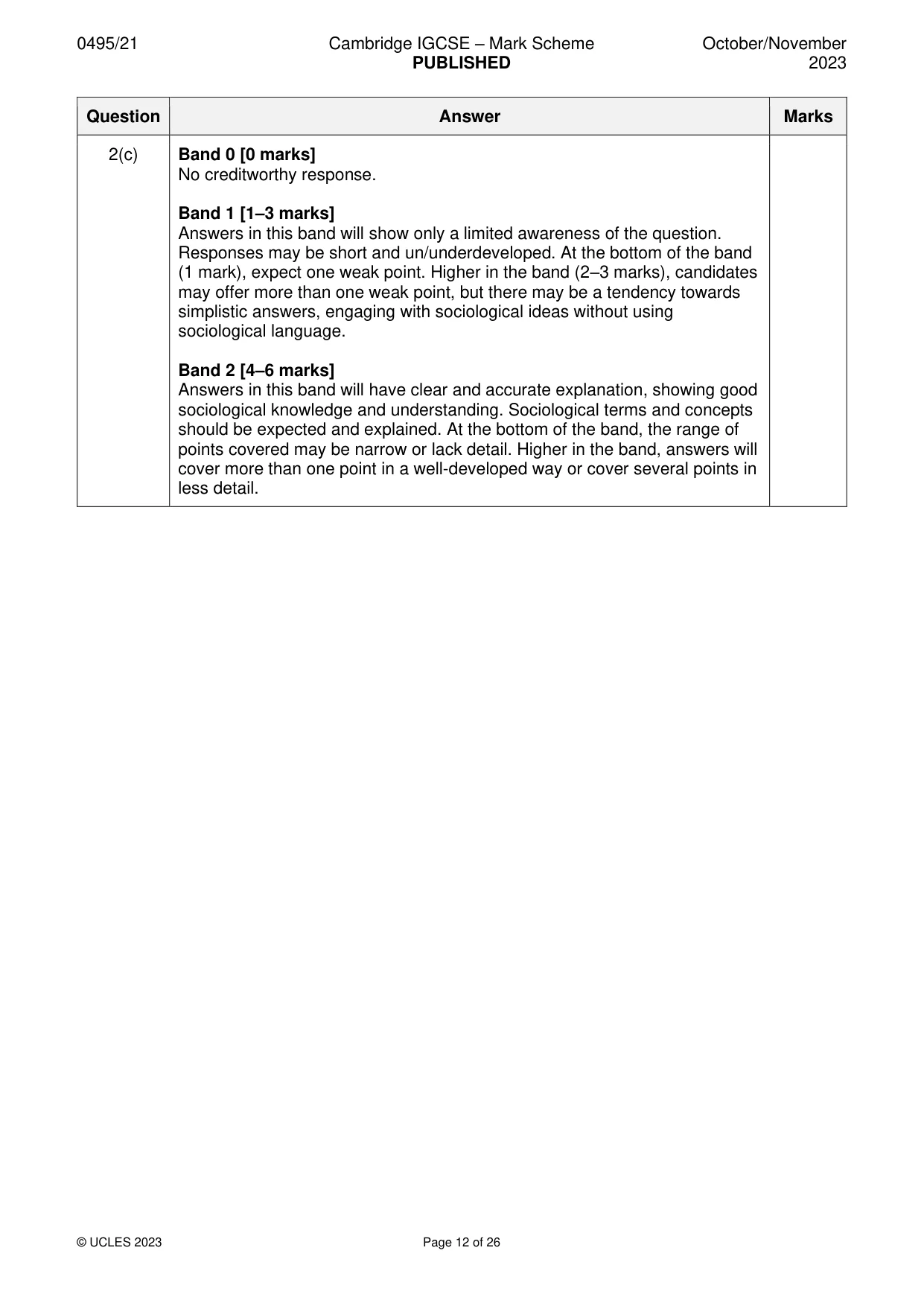
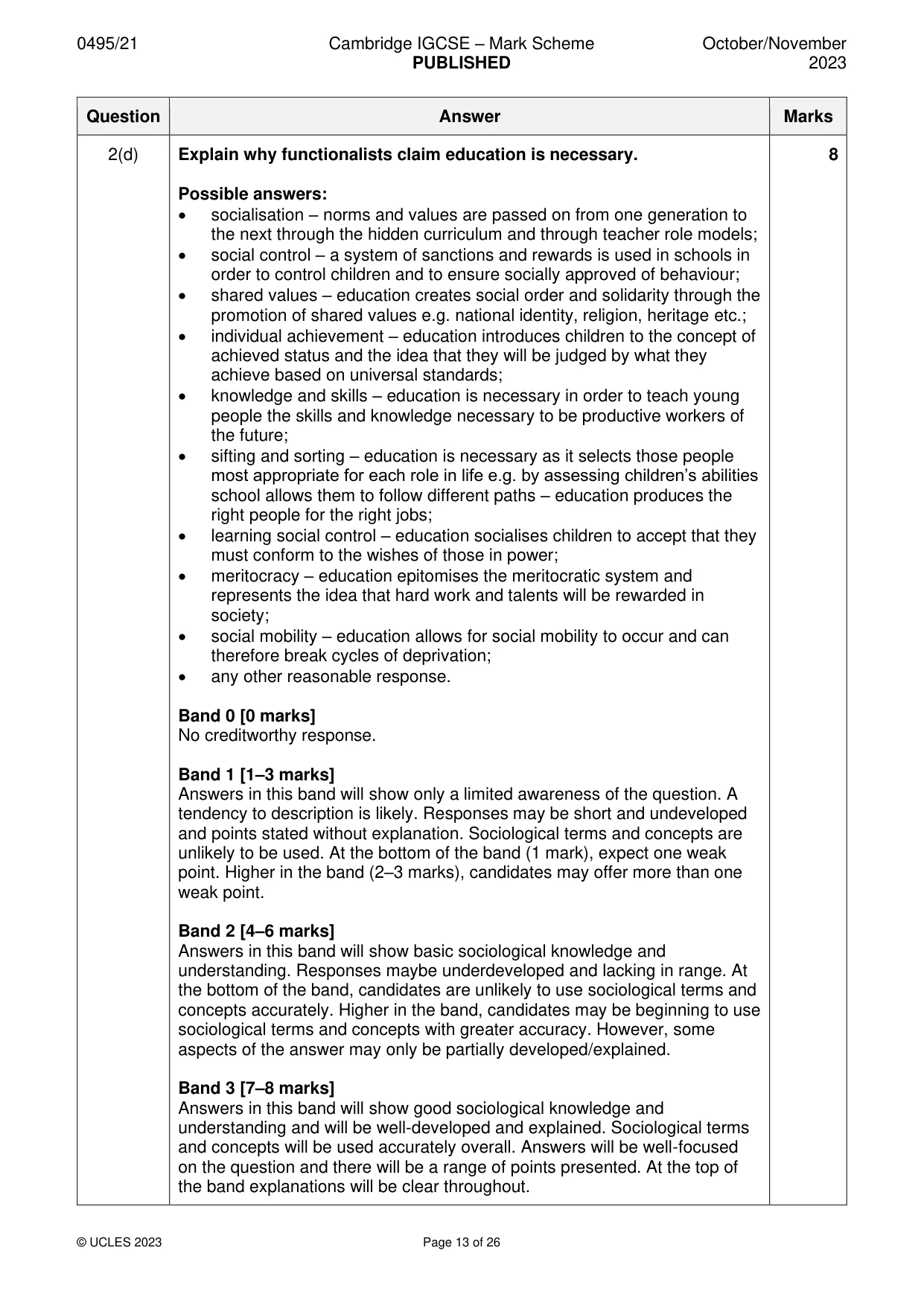
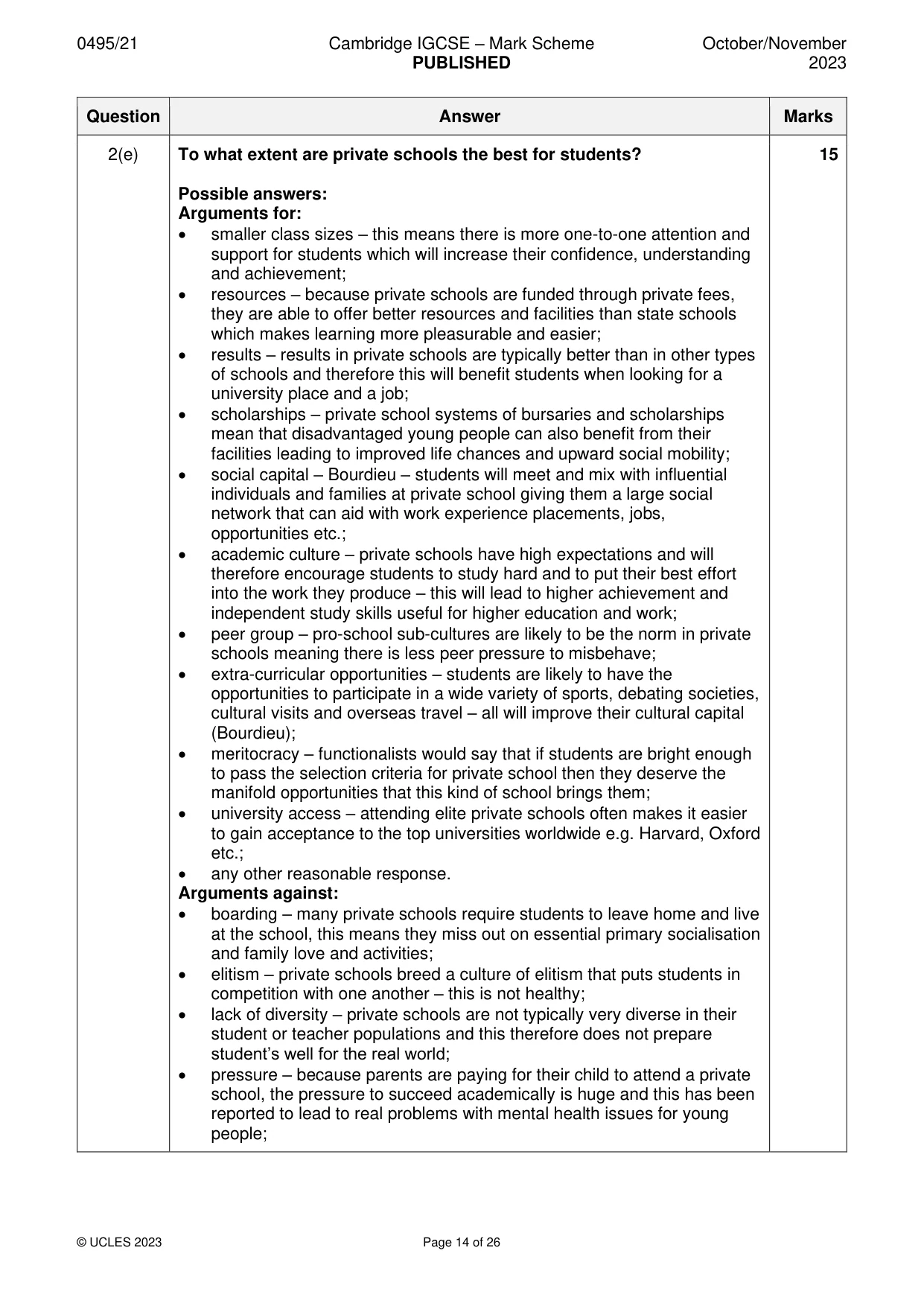
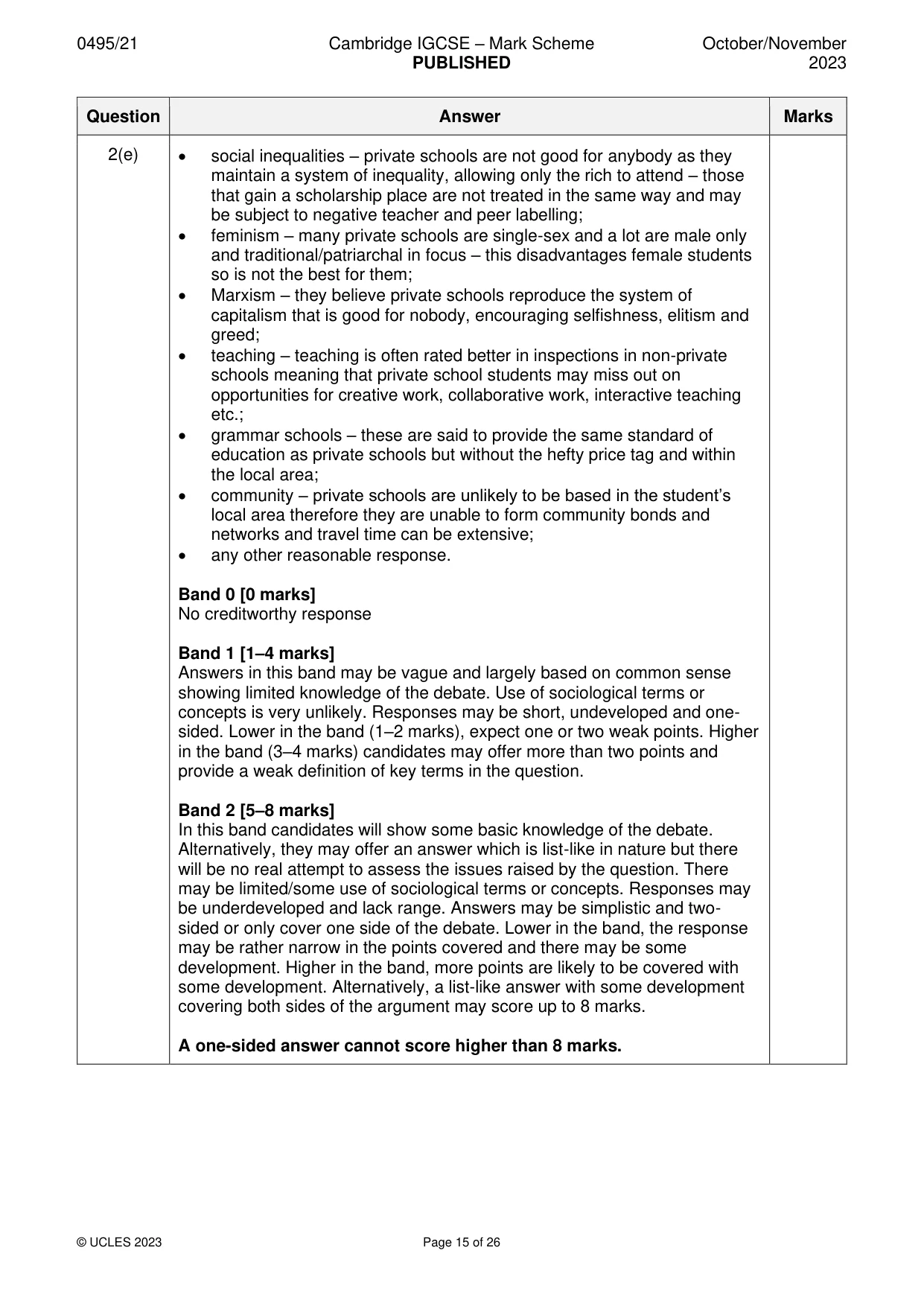
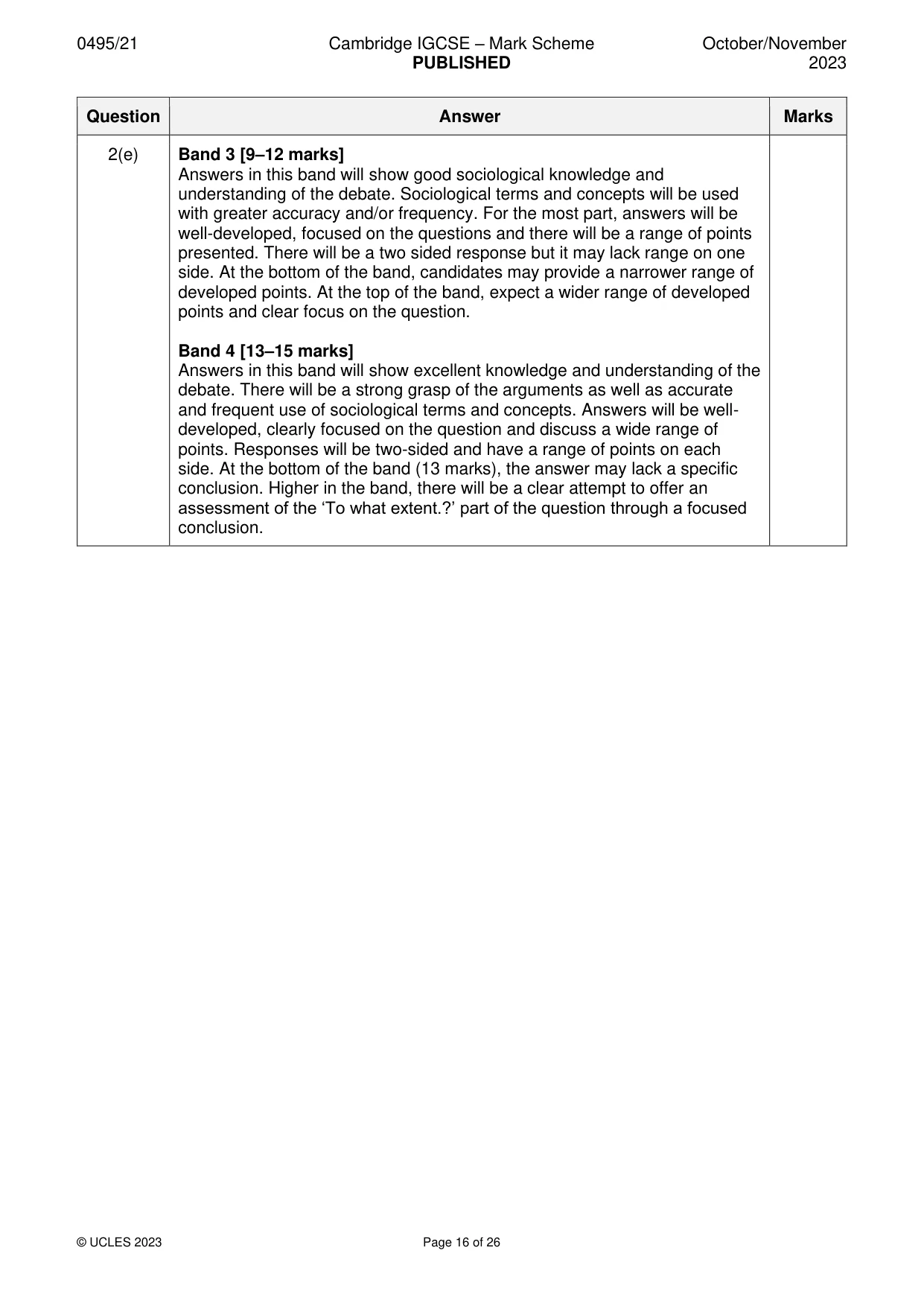
Mark scheme: 2(a) What is meant by the term ‘selective education’? 2 One mark for a partial definition, e.g. schools for bright children. Two marks for a clear definition, e.g. pupils are selected and others excluded usually on the basis of their academic ability. 2(b) Describe two ways the hidden curriculum socialises students. 4 Possible answers: • informally – students learn acceptable behaviour and views outside of the classroom and through parts of lessons not focused on formal lesson content; • sanctions – students are punished if they don’t conform to socially approved actions e.g. late detentions; • rewards – students are rewards/praised if they do something that is approved of e.g. showing good manners; • following authority – students learn that they must follow the rules set by others higher up in the hierarchy, whether they agree with them or not; • gender roles – students learn what is expected from their gender e.g. boys may be asked to carry heavy boxes whereas girls may be asked to tidy up and clean; • boredom – Marxists claim that schools teach children how to cope with boredom and to be passive, this will then be replicated in their adult working lives; • workplace – students at school are socialised into the norms and values of the workplace – functionalists would say this keeps society running smoothly, Marxists would say it maintains capitalist ideologies; • any other reasonable response. One mark for each point correctly identified (up to maximum of two). One mark for each point that is developed (up to a maximum of two). 2(c) Explain how peer groups can influence educational achievement. 6 Possible answers: • conformity – adolescence is a turbulent period in a young person’s life and they want to fit in and be accepted by the peer group, therefore peer pressure may influence educational achievement; • social class – lower social classes typically achieve less well in school and so may react to this perceived failure by joining an anti-school sub- culture to improve their self-esteem; • status frustration – Cohen – he says that peer groups who do not gain much status from the educational system may look to gain status by being the class clown and ‘cheeking’ the teacher, this is reinforced by the peer group and is likely to lead to educational underachievement; • Willis – the lads – the working-class male peer group in his study did not see the point of education as they didn’t need the qualifications for the manual work they would enter on leaving school – this affected their educational achievement; • racism – some anti-school sub-cultures e.g. Sewell’s study – form on ethnic lines and may be the peer group’s way of resisting the perceived inequalities and racism within schools – this resistance can lead to educational underachievement; • Mac and Ghaill – ‘the black sisters’ – this study found that a female Asian and Afro-Caribbean peer group all decided to work hard at school as doing well in their education was important to them – the peer group reinforced educational achievement; • Jackson – ladettes – her research found a new kind of female peer group emerging in schools that rejected authority and adopted behaviour typically associated with males e.g. challenging authority – educational underachievement characterised such peer groups; • culture of masculinity – laddish sub-cultures may form due to the perceived feminisation of education where authority figures are often female and where academic success typically involved reading and writing – this resulted in educational underachievement • pro-school sub-cultures – some peer groups embrace the culture and values of education and work hard, encouraging and supporting one another to succeed and so achieve highly in education; • any other reasonable response. 2(c) Band 0 [0 marks] No creditworthy response. Band 1 [1–3 marks] Answers in this band will show only a limited awareness of the question. Responses may be short and un/underdeveloped. At the bottom of the band (1 mark), expect one weak point. Higher in the band (2–3 marks), candidates may offer more than one weak point, but there may be a tendency towards simplistic answers, engaging with sociological ideas without using sociological language. Band 2 [4–6 marks] Answers in this band will have clear and accurate explanation, showing good sociological knowledge and understanding. Sociological terms and concepts should be expected and explained. At the bottom of the band, the range of points covered may be narrow or lack detail. Higher in the band, answers will cover more than one point in a well-developed way or cover several points in less detail. 2(d) Explain why functionalists claim education is necessary. 8 Possible answers: • socialisation – norms and values are passed on from one generation to the next through the hidden curriculum and through teacher role models; • social control – a system of sanctions and rewards is used in schools in order to control children and to ensure socially approved of behaviour; • shared values – education creates social order and solidarity through the promotion of shared values e.g. national identity, religion, heritage etc.; • individual achievement – education introduces children to the concept of achieved status and the idea that they will be judged by what they achieve based on universal standards; • knowledge and skills – education is necessary in order to teach young people the skills and knowledge necessary to be productive workers of the future; • sifting and sorting – education is necessary as it selects those people most appropriate for each role in life e.g. by assessing children’s abilities school allows them to follow different paths – education produces the right people for the right jobs; • learning social control – education socialises children to accept that they must conform to the wishes of those in power; • meritocracy – education epitomises the meritocratic system and represents the idea that hard work and talents will be rewarded in society; • social mobility – education allows for social mobility to occur and can therefore break cycles of deprivation; • any other reasonable response. Band 0 [0 marks] No creditworthy response. Band 1 [1–3 marks] Answers in this band will show only a limited awareness of the question. A tendency to description is likely. Responses may be short and undeveloped and points stated without explanation. Sociological terms and concepts are unlikely to be used. At the bottom of the band (1 mark), expect one weak point. Higher in the band (2–3 marks), candidates may offer more than one weak point. Band 2 [4–6 marks] Answers in this band will show basic sociological knowledge and understanding. Responses maybe underdeveloped and lacking in range. At the bottom of the band, candidates are unlikely to use sociological terms and concepts accurately. Higher in the band, candidates may be beginning to use sociological terms and concepts with greater accuracy. However, some aspects of the answer may only be partially developed/explained. Band 3 [7–8 marks] Answers in this band will show good sociological knowledge and understanding and will be well-developed and explained. Sociological terms and concepts will be used accurately overall. Answers will be well-focused on the question and there will be a range of points presented. At the top of the band explanations will be clear throughout. 2(e) To what extent are private schools the best for students? 15 Possible answers: Arguments for: • smaller class sizes – this means there is more one-to-one attention and support for students which will increase their confidence, understanding and achievement; • resources – because private schools are funded through private fees, they are able to offer better resources and facilities than state schools which makes learning more pleasurable and easier; • results – results in private schools are typically better than in other types of schools and therefore this will benefit students when looking for a university place and a job; • scholarships – private school systems of bursaries and scholarships mean that disadvantaged young people can also benefit from their facilities leading to improved life chances and upward social mobility; • social capital – Bourdieu – students will meet and mix with influential individuals and families at private school giving them a large social network that can aid with work experience placements, jobs, opportunities etc.; • academic culture – private schools have high expectations and will therefore encourage students to study hard and to put their best effort into the work they produce – this will lead to higher achievement and independent study skills useful for higher education and work; • peer group – pro-school sub-cultures are likely to be the norm in private schools meaning there is less peer pressure to misbehave; • extra-curricular opportunities – students are likely to have the opportunities to participate in a wide variety of sports, debating societies, cultural visits and overseas travel – all will improve their cultural capital (Bourdieu); • meritocracy – functionalists would say that if students are bright enough to pass the selection criteria for private school then they deserve the manifold opportunities that this kind of school brings them; • university access – attending elite private schools often makes it easier to gain acceptance to the top universities worldwide e.g. Harvard, Oxford etc.; • any other reasonable response. Arguments against: • boarding – many private schools require students to leave home and live at the school, this means they miss out on essential primary socialisation and family love and activities; • elitism – private schools breed a culture of elitism that puts students in competition with one another – this is not healthy; • lack of diversity – private schools are not typically very diverse in their student or teacher populations and this therefore does not prepare student’s well for the real world; • pressure – because parents are paying for their child to attend a private school, the pressure to succeed academically is huge and this has been reported to lead to real problems with mental health issues for young people; 2(e) • social inequalities – private schools are not good for anybody as they maintain a system of inequality, allowing only the rich to attend – those that gain a scholarship place are not treated in the same way and may be subject to negative teacher and peer labelling; • feminism – many private schools are single-sex and a lot are male only and traditional/patriarchal in focus – this disadvantages female students so is not the best for them; • Marxism – they believe private schools reproduce the system of capitalism that is good for nobody, encouraging selfishness, elitism and greed; • teaching – teaching is often rated better in inspections in non-private schools meaning that private school students may miss out on opportunities for creative work, collaborative work, interactive teaching etc.; • grammar schools – these are said to provide the same standard of education as private schools but without the hefty price tag and within the local area; • community – private schools are unlikely to be based in the student’s local area therefore they are unable to form community bonds and networks and travel time can be extensive; • any other reasonable response. Band 0 [0 marks] No creditworthy response Band 1 [1–4 marks] Answers in this band may be vague and largely based on common sense showing limited knowledge of the debate. Use of sociological terms or concepts is very unlikely. Responses may be short, undeveloped and one- sided. Lower in the band (1–2 marks), expect one or two weak points. Higher in the band (3–4 marks) candidates may offer more than two points and provide a weak definition of key terms in the question. Band 2 [5–8 marks] In this band candidates will show some basic knowledge of the debate. Alternatively, they may offer an answer which is list-like in nature but there will be no real attempt to assess the issues raised by the question. There may be limited/some use of sociological terms or concepts. Responses may be underdeveloped and lack range. Answers may be simplistic and two- sided or only cover one side of the debate. Lower in the band, the response may be rather narrow in the points covered and there may be some development. Higher in the band, more points are likely to be covered with some development. Alternatively, a list-like answer with some development covering both sides of the argument may score up to 8 marks. A one-sided answer cannot score higher than 8 marks. 2(e) Band 3 [9–12 marks] Answers in this band will show good sociological knowledge and understanding of the debate. Sociological terms and concepts will be used with greater accuracy and/or frequency. For the most part, answers will be well-developed, focused on the questions and there will be a range of points presented. There will be a two sided response but it may lack range on one side. At the bottom of the band, candidates may provide a narrower range of developed points. At the top of the band, expect a wider range of developed points and clear focus on the question. Band 4 [13–15 marks] Answers in this band will show excellent knowledge and understanding of the debate. There will be a strong grasp of the arguments as well as accurate and frequent use of sociological terms and concepts. Answers will be well- developed, clearly focused on the question and discuss a wide range of points. Responses will be two-sided and have a range of points on each side. At the bottom of the band (13 marks), the answer may lack a specific conclusion. Higher in the band, there will be a clear attempt to offer an assessment of the ‘To what extent.?’ part of the question through a focused conclusion.
Q3 · Although there is a dark figure of crime, individuals can learn a lot about crime and…
3 Although there is a dark figure of crime, individuals can learn a lot about crime and deviance from the media. Crime and deviance can be different from each other. There are different sociological explanations for why people commit crime, act in a deviant way or adopt a master status. Marxists blame capitalism for crime whereas functionalists blame a lack of social order. (a) What is meant by the term ‘master status’? [2] (b) Describe two ways capitalism may cause crime. [4] (c) Explain how crime can be different to deviance. [6] (d) Explain why there is a dark figure of crime. [8] (e) To what extent does the media influence ideas about crime and deviance? [15] Section D: Media
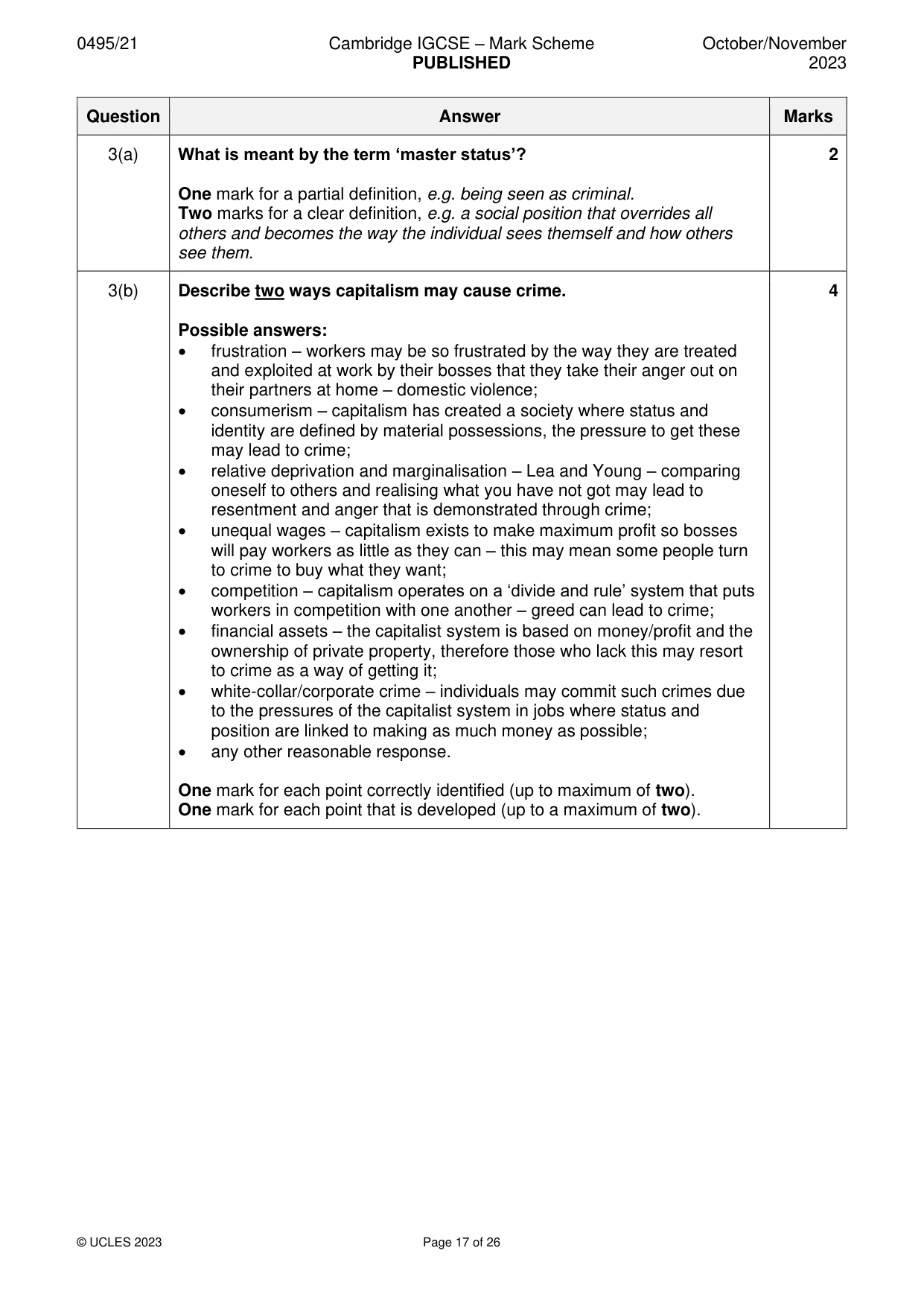
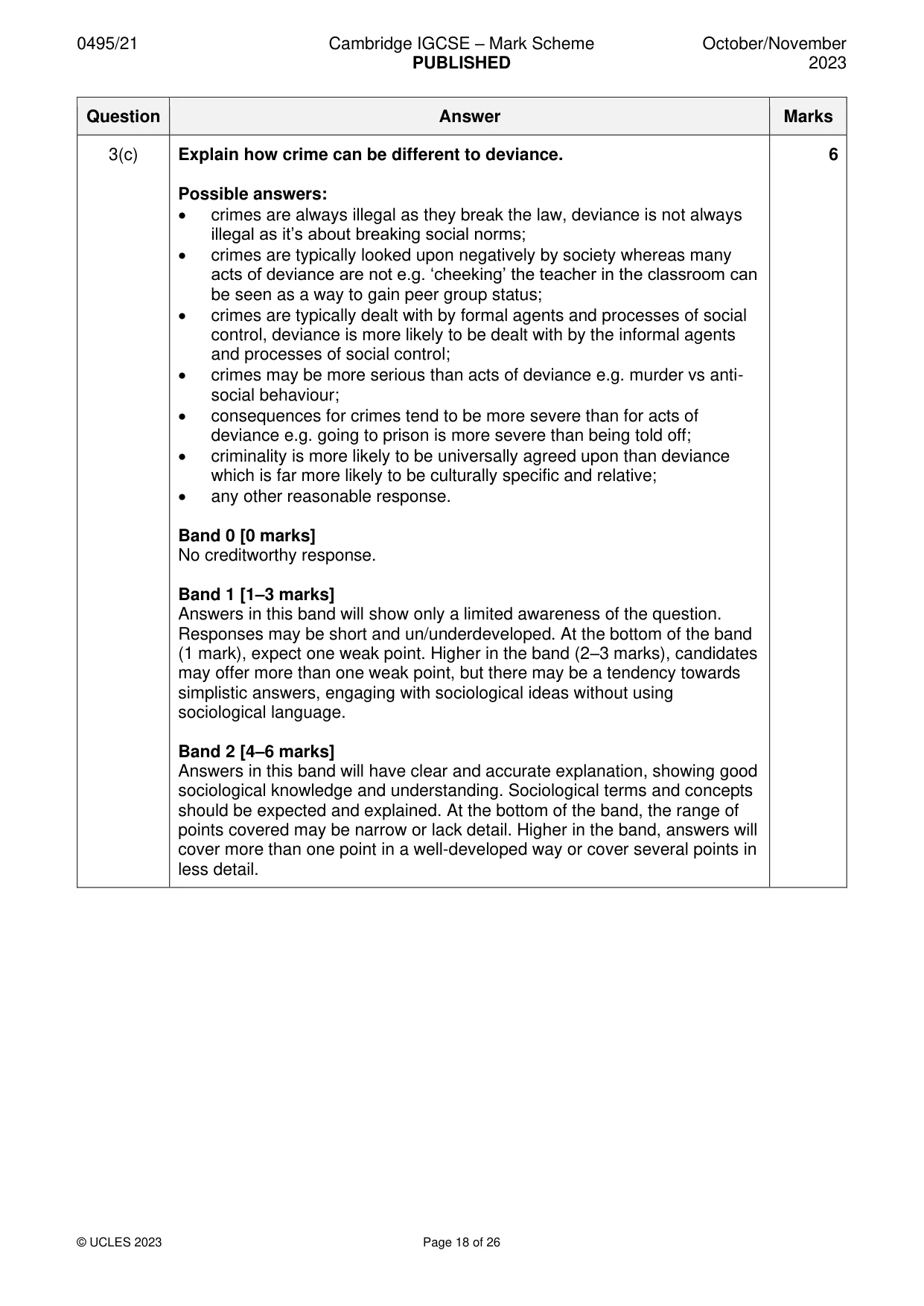
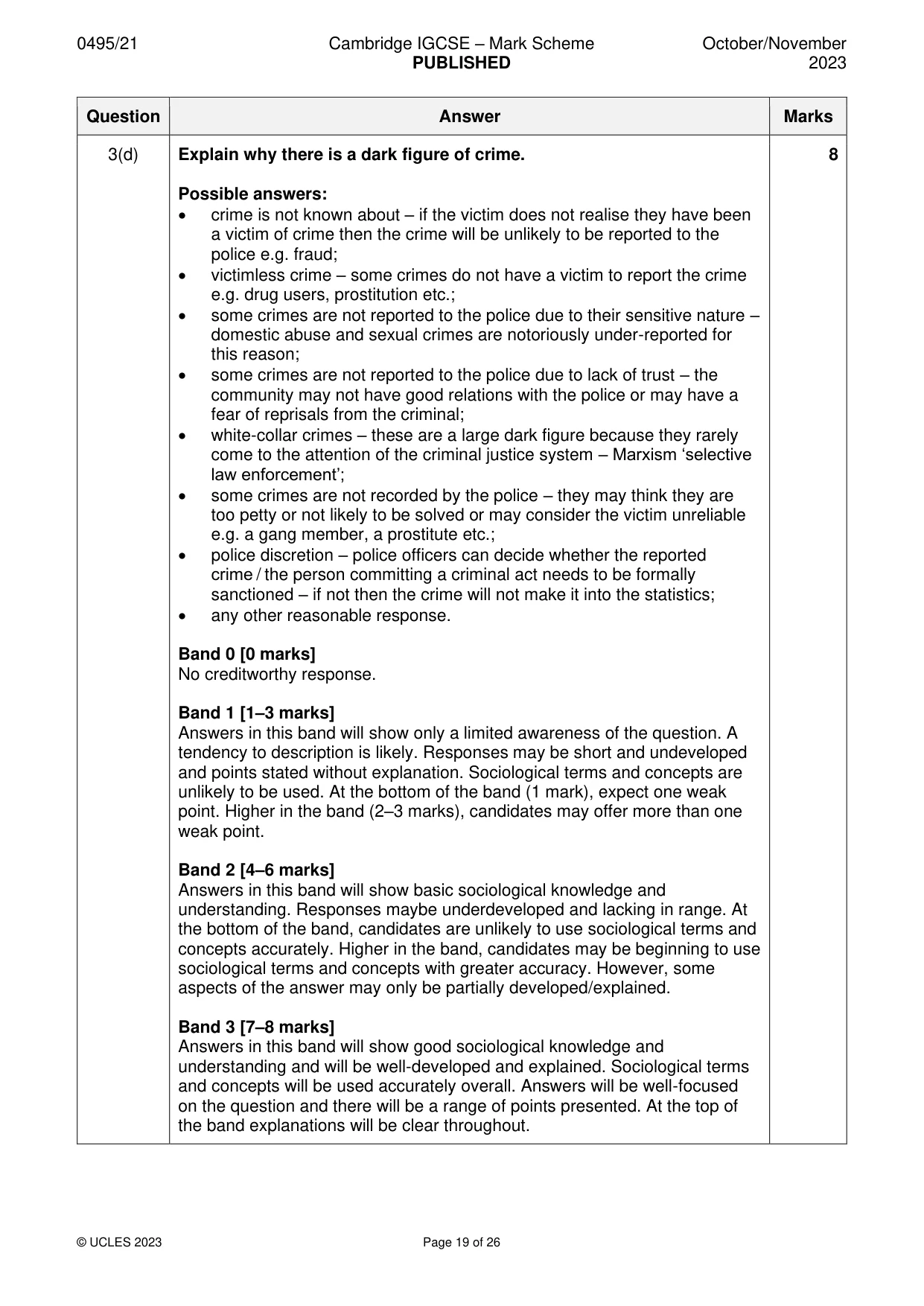
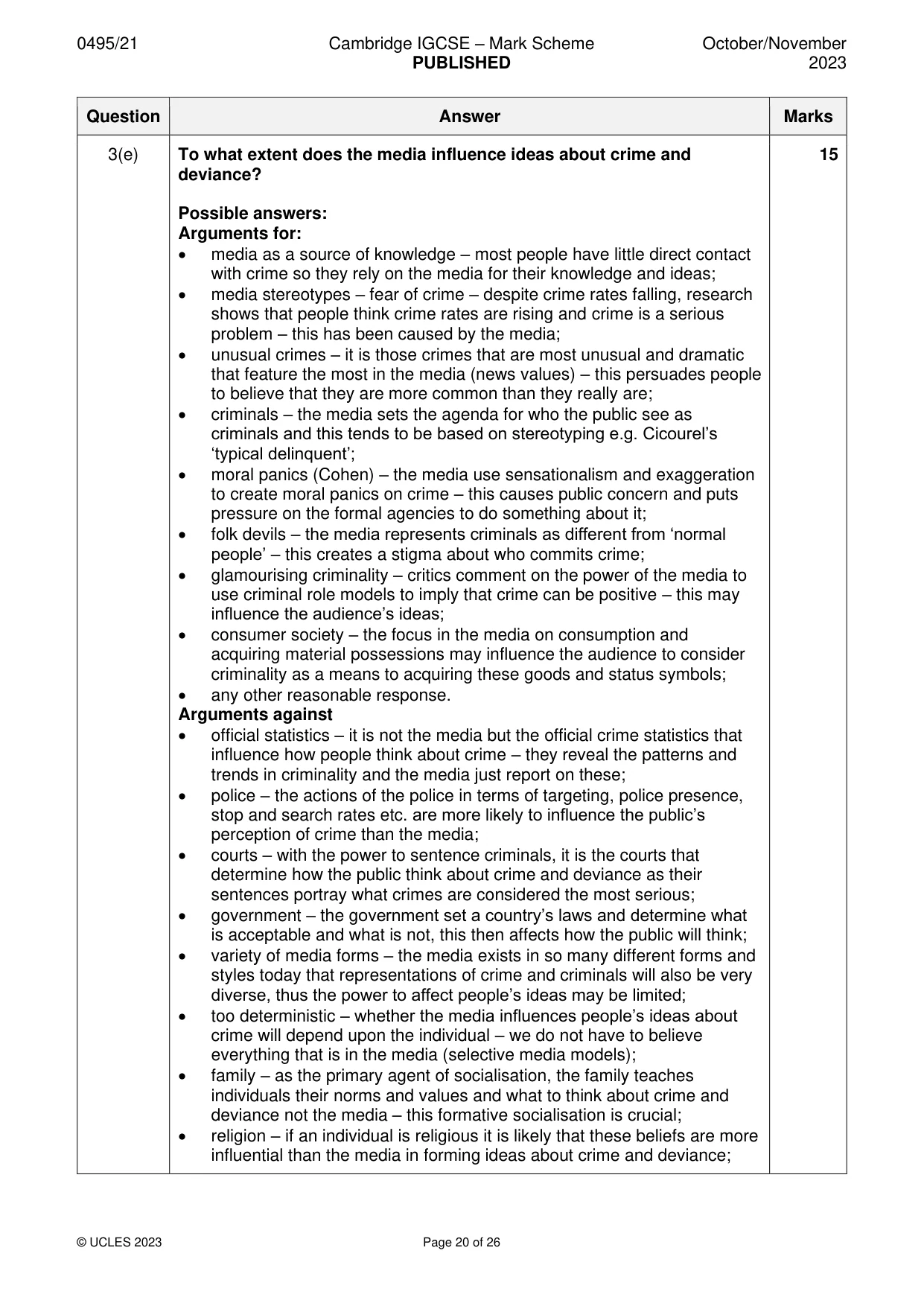
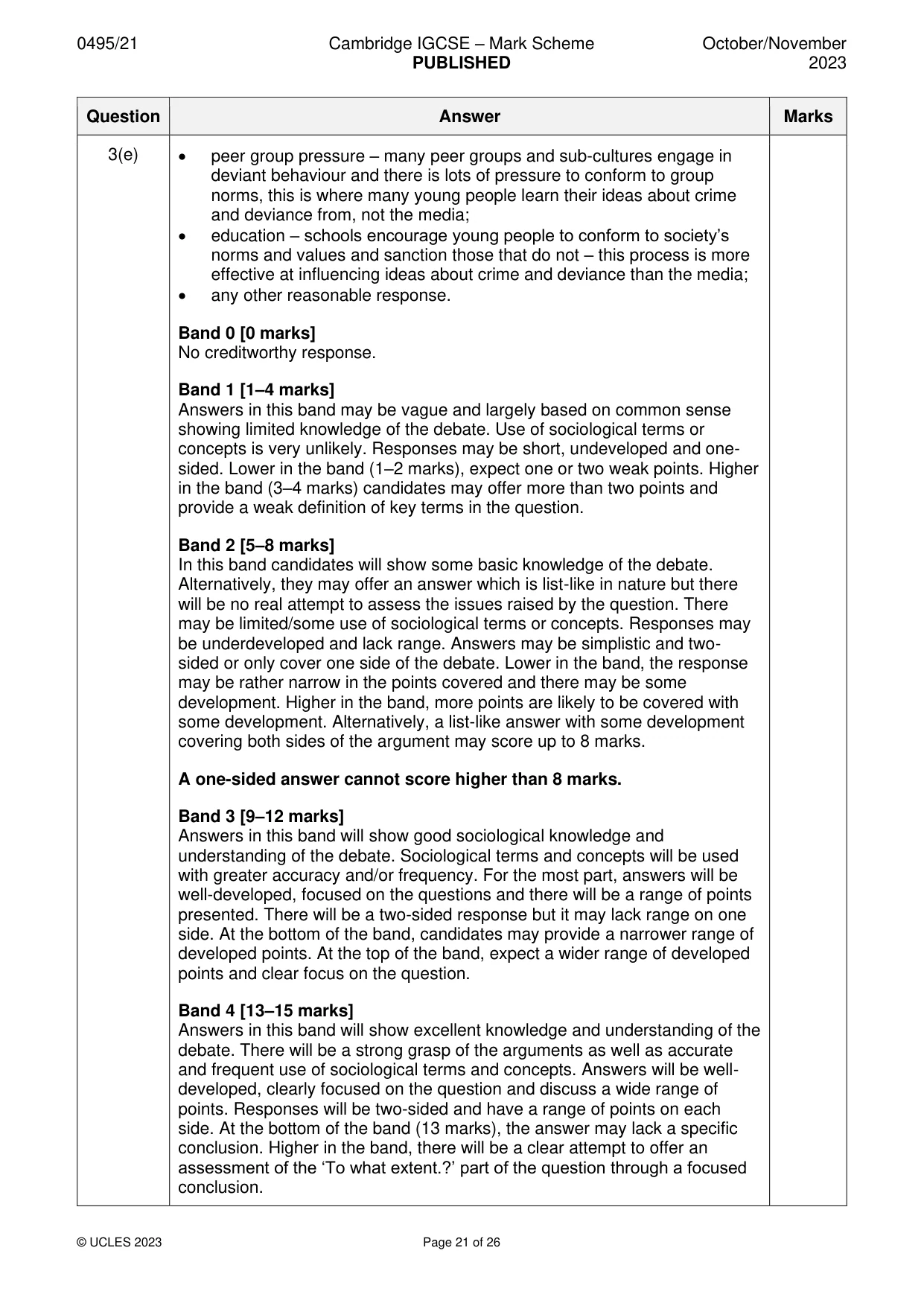
Mark scheme: 3(a) What is meant by the term ‘master status’? 2 One mark for a partial definition, e.g. being seen as criminal. Two marks for a clear definition, e.g. a social position that overrides all others and becomes the way the individual sees themself and how others see them. 3(b) Describe two ways capitalism may cause crime. 4 Possible answers: • frustration – workers may be so frustrated by the way they are treated and exploited at work by their bosses that they take their anger out on their partners at home – domestic violence; • consumerism – capitalism has created a society where status and identity are defined by material possessions, the pressure to get these may lead to crime; • relative deprivation and marginalisation – Lea and Young – comparing oneself to others and realising what you have not got may lead to resentment and anger that is demonstrated through crime; • unequal wages – capitalism exists to make maximum profit so bosses will pay workers as little as they can – this may mean some people turn to crime to buy what they want; • competition – capitalism operates on a ‘divide and rule’ system that puts workers in competition with one another – greed can lead to crime; • financial assets – the capitalist system is based on money/profit and the ownership of private property, therefore those who lack this may resort to crime as a way of getting it; • white-collar/corporate crime – individuals may commit such crimes due to the pressures of the capitalist system in jobs where status and position are linked to making as much money as possible; • any other reasonable response. One mark for each point correctly identified (up to maximum of two). One mark for each point that is developed (up to a maximum of two). 3(c) Explain how crime can be different to deviance. 6 Possible answers: • crimes are always illegal as they break the law, deviance is not always illegal as it’s about breaking social norms; • crimes are typically looked upon negatively by society whereas many acts of deviance are not e.g. ‘cheeking’ the teacher in the classroom can be seen as a way to gain peer group status; • crimes are typically dealt with by formal agents and processes of social control, deviance is more likely to be dealt with by the informal agents and processes of social control; • crimes may be more serious than acts of deviance e.g. murder vs anti- social behaviour; • consequences for crimes tend to be more severe than for acts of deviance e.g. going to prison is more severe than being told off; • criminality is more likely to be universally agreed upon than deviance which is far more likely to be culturally specific and relative; • any other reasonable response. Band 0 [0 marks] No creditworthy response. Band 1 [1–3 marks] Answers in this band will show only a limited awareness of the question. Responses may be short and un/underdeveloped. At the bottom of the band (1 mark), expect one weak point. Higher in the band (2–3 marks), candidates may offer more than one weak point, but there may be a tendency towards simplistic answers, engaging with sociological ideas without using sociological language. Band 2 [4–6 marks] Answers in this band will have clear and accurate explanation, showing good sociological knowledge and understanding. Sociological terms and concepts should be expected and explained. At the bottom of the band, the range of points covered may be narrow or lack detail. Higher in the band, answers will cover more than one point in a well-developed way or cover several points in less detail. 3(d) Explain why there is a dark figure of crime. 8 Possible answers: • crime is not known about – if the victim does not realise they have been a victim of crime then the crime will be unlikely to be reported to the police e.g. fraud; • victimless crime – some crimes do not have a victim to report the crime e.g. drug users, prostitution etc.; • some crimes are not reported to the police due to their sensitive nature – domestic abuse and sexual crimes are notoriously under-reported for this reason; • some crimes are not reported to the police due to lack of trust – the community may not have good relations with the police or may have a fear of reprisals from the criminal; • white-collar crimes – these are a large dark figure because they rarely come to the attention of the criminal justice system – Marxism ‘selective law enforcement’; • some crimes are not recorded by the police – they may think they are too petty or not likely to be solved or may consider the victim unreliable e.g. a gang member, a prostitute etc.; • police discretion – police officers can decide whether the reported crime / the person committing a criminal act needs to be formally sanctioned – if not then the crime will not make it into the statistics; • any other reasonable response. Band 0 [0 marks] No creditworthy response. Band 1 [1–3 marks] Answers in this band will show only a limited awareness of the question. A tendency to description is likely. Responses may be short and undeveloped and points stated without explanation. Sociological terms and concepts are unlikely to be used. At the bottom of the band (1 mark), expect one weak point. Higher in the band (2–3 marks), candidates may offer more than one weak point. Band 2 [4–6 marks] Answers in this band will show basic sociological knowledge and understanding. Responses maybe underdeveloped and lacking in range. At the bottom of the band, candidates are unlikely to use sociological terms and concepts accurately. Higher in the band, candidates may be beginning to use sociological terms and concepts with greater accuracy. However, some aspects of the answer may only be partially developed/explained. Band 3 [7–8 marks] Answers in this band will show good sociological knowledge and understanding and will be well-developed and explained. Sociological terms and concepts will be used accurately overall. Answers will be well-focused on the question and there will be a range of points presented. At the top of the band explanations will be clear throughout. 3(e) To what extent does the media influence ideas about crime and 15 deviance? Possible answers: Arguments for: • media as a source of knowledge – most people have little direct contact with crime so they rely on the media for their knowledge and ideas; • media stereotypes – fear of crime – despite crime rates falling, research shows that people think crime rates are rising and crime is a serious problem – this has been caused by the media; • unusual crimes – it is those crimes that are most unusual and dramatic that feature the most in the media (news values) – this persuades people to believe that they are more common than they really are; • criminals – the media sets the agenda for who the public see as criminals and this tends to be based on stereotyping e.g. Cicourel’s ‘typical delinquent’; • moral panics (Cohen) – the media use sensationalism and exaggeration to create moral panics on crime – this causes public concern and puts pressure on the formal agencies to do something about it; • folk devils – the media represents criminals as different from ‘normal people’ – this creates a stigma about who commits crime; • glamourising criminality – critics comment on the power of the media to use criminal role models to imply that crime can be positive – this may influence the audience’s ideas; • consumer society – the focus in the media on consumption and acquiring material possessions may influence the audience to consider criminality as a means to acquiring these goods and status symbols; • any other reasonable response. Arguments against • official statistics – it is not the media but the official crime statistics that influence how people think about crime – they reveal the patterns and trends in criminality and the media just report on these; • police – the actions of the police in terms of targeting, police presence, stop and search rates etc. are more likely to influence the public’s perception of crime than the media; • courts – with the power to sentence criminals, it is the courts that determine how the public think about crime and deviance as their sentences portray what crimes are considered the most serious; • government – the government set a country’s laws and determine what is acceptable and what is not, this then affects how the public will think; • variety of media forms – the media exists in so many different forms and styles today that representations of crime and criminals will also be very diverse, thus the power to affect people’s ideas may be limited; • too deterministic – whether the media influences people’s ideas about crime will depend upon the individual – we do not have to believe everything that is in the media (selective media models); • family – as the primary agent of socialisation, the family teaches individuals their norms and values and what to think about crime and deviance not the media – this formative socialisation is crucial; • religion – if an individual is religious it is likely that these beliefs are more influential than the media in forming ideas about crime and deviance; 3(e) • peer group pressure – many peer groups and sub-cultures engage in deviant behaviour and there is lots of pressure to conform to group norms, this is where many young people learn their ideas about crime and deviance from, not the media; • education – schools encourage young people to conform to society’s norms and values and sanction those that do not – this process is more effective at influencing ideas about crime and deviance than the media; • any other reasonable response. Band 0 [0 marks] No creditworthy response. Band 1 [1–4 marks] Answers in this band may be vague and largely based on common sense showing limited knowledge of the debate. Use of sociological terms or concepts is very unlikely. Responses may be short, undeveloped and one- sided. Lower in the band (1–2 marks), expect one or two weak points. Higher in the band (3–4 marks) candidates may offer more than two points and provide a weak definition of key terms in the question. Band 2 [5–8 marks] In this band candidates will show some basic knowledge of the debate. Alternatively, they may offer an answer which is list-like in nature but there will be no real attempt to assess the issues raised by the question. There may be limited/some use of sociological terms or concepts. Responses may be underdeveloped and lack range. Answers may be simplistic and two- sided or only cover one side of the debate. Lower in the band, the response may be rather narrow in the points covered and there may be some development. Higher in the band, more points are likely to be covered with some development. Alternatively, a list-like answer with some development covering both sides of the argument may score up to 8 marks. A one-sided answer cannot score higher than 8 marks. Band 3 [9–12 marks] Answers in this band will show good sociological knowledge and understanding of the debate. Sociological terms and concepts will be used with greater accuracy and/or frequency. For the most part, answers will be well-developed, focused on the questions and there will be a range of points presented. There will be a two-sided response but it may lack range on one side. At the bottom of the band, candidates may provide a narrower range of developed points. At the top of the band, expect a wider range of developed points and clear focus on the question. Band 4 [13–15 marks] Answers in this band will show excellent knowledge and understanding of the debate. There will be a strong grasp of the arguments as well as accurate and frequent use of sociological terms and concepts. Answers will be well- developed, clearly focused on the question and discuss a wide range of points. Responses will be two-sided and have a range of points on each side. At the bottom of the band (13 marks), the answer may lack a specific conclusion. Higher in the band, there will be a clear attempt to offer an assessment of the ‘To what extent.?’ part of the question through a focused conclusion.
More questions on What types of data and evidence do sociologists use?
Q4 · The media is often accused of transmitting dominant values and traditional stereotypes to…
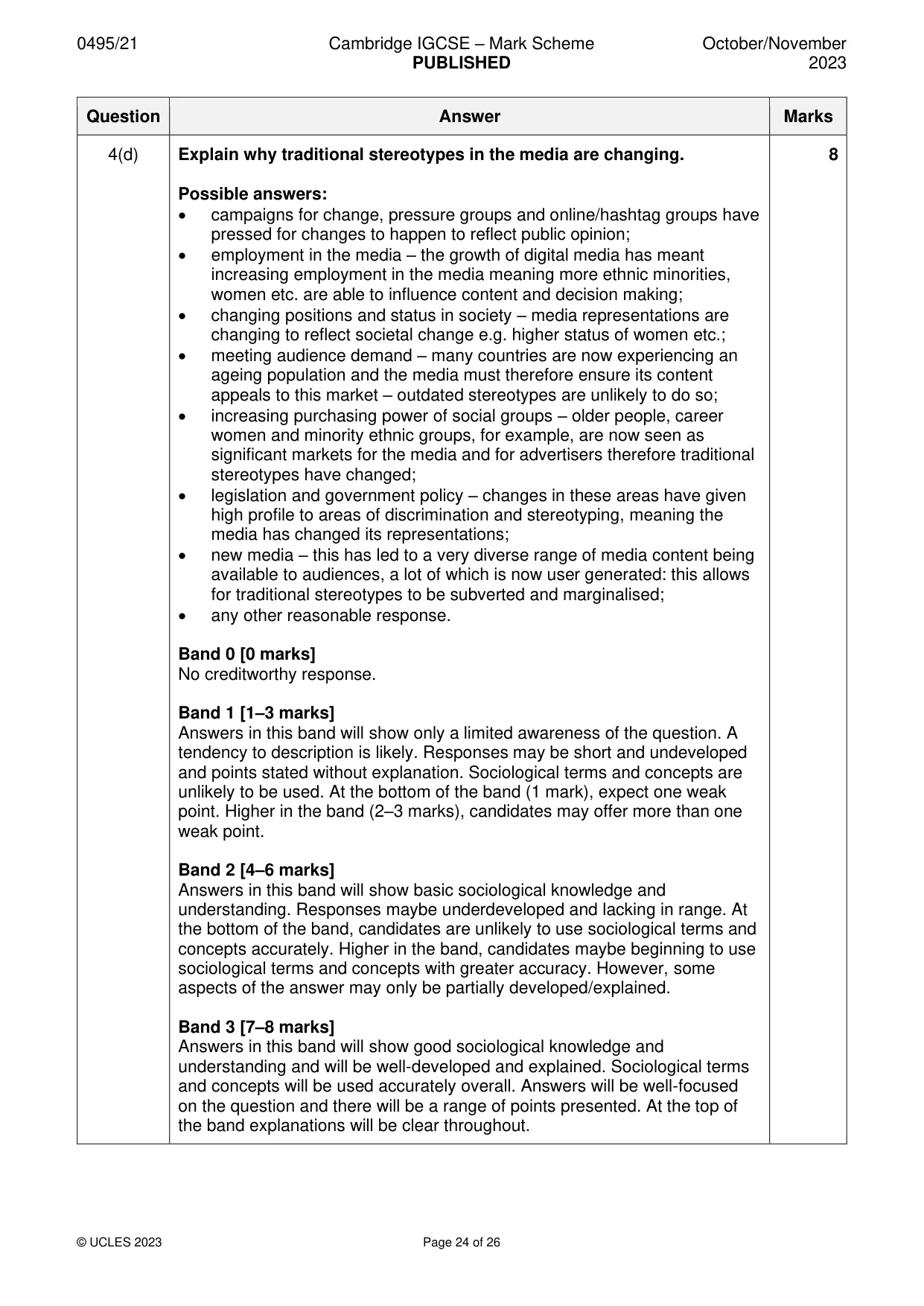
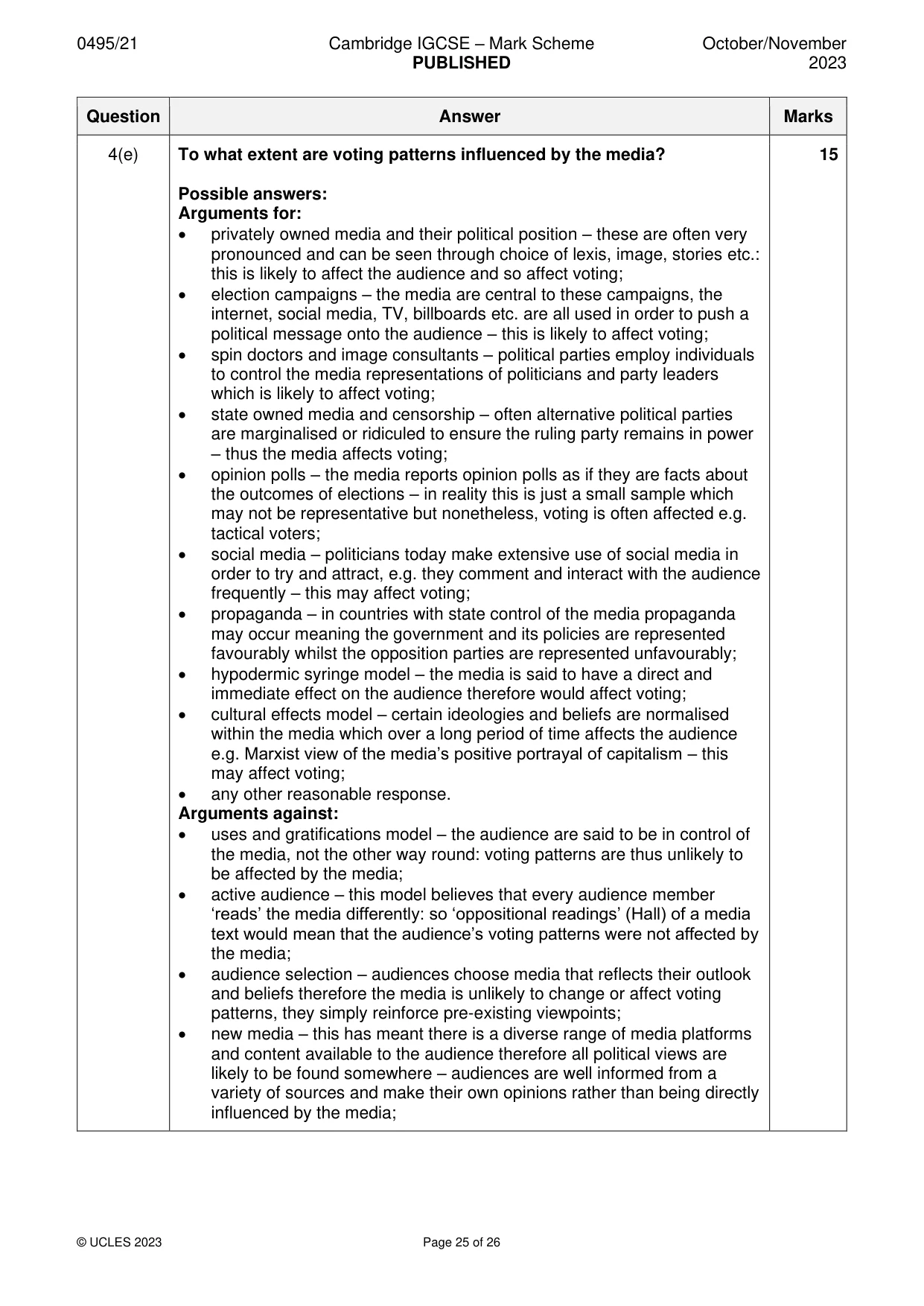
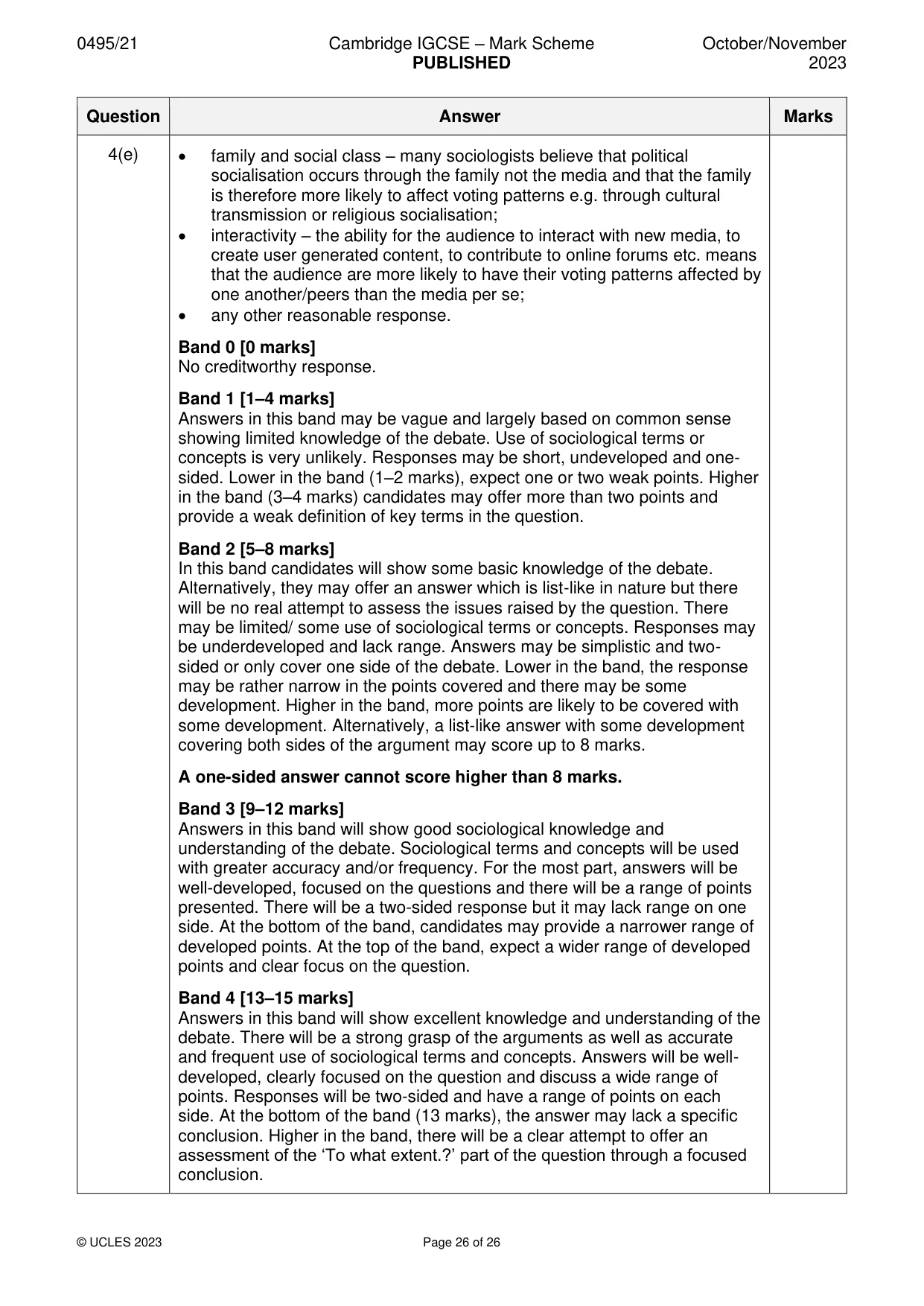
4 The media is often accused of transmitting dominant values and traditional stereotypes to the audience. Some sociologists argue the media has a strong influence on audience voting patterns. However, new media is very different to traditional media. How the media is funded is also likely to create differences in content, form and functions. (a) What is meant by the term ‘dominant values’? [2] (b) Describe two ways the media can be funded. [4] (c) Explain how new media and traditional media are different. [6] (d) Explain why traditional stereotypes in the media are changing. [8] (e) To what extent are voting patterns influenced by the media? [15]
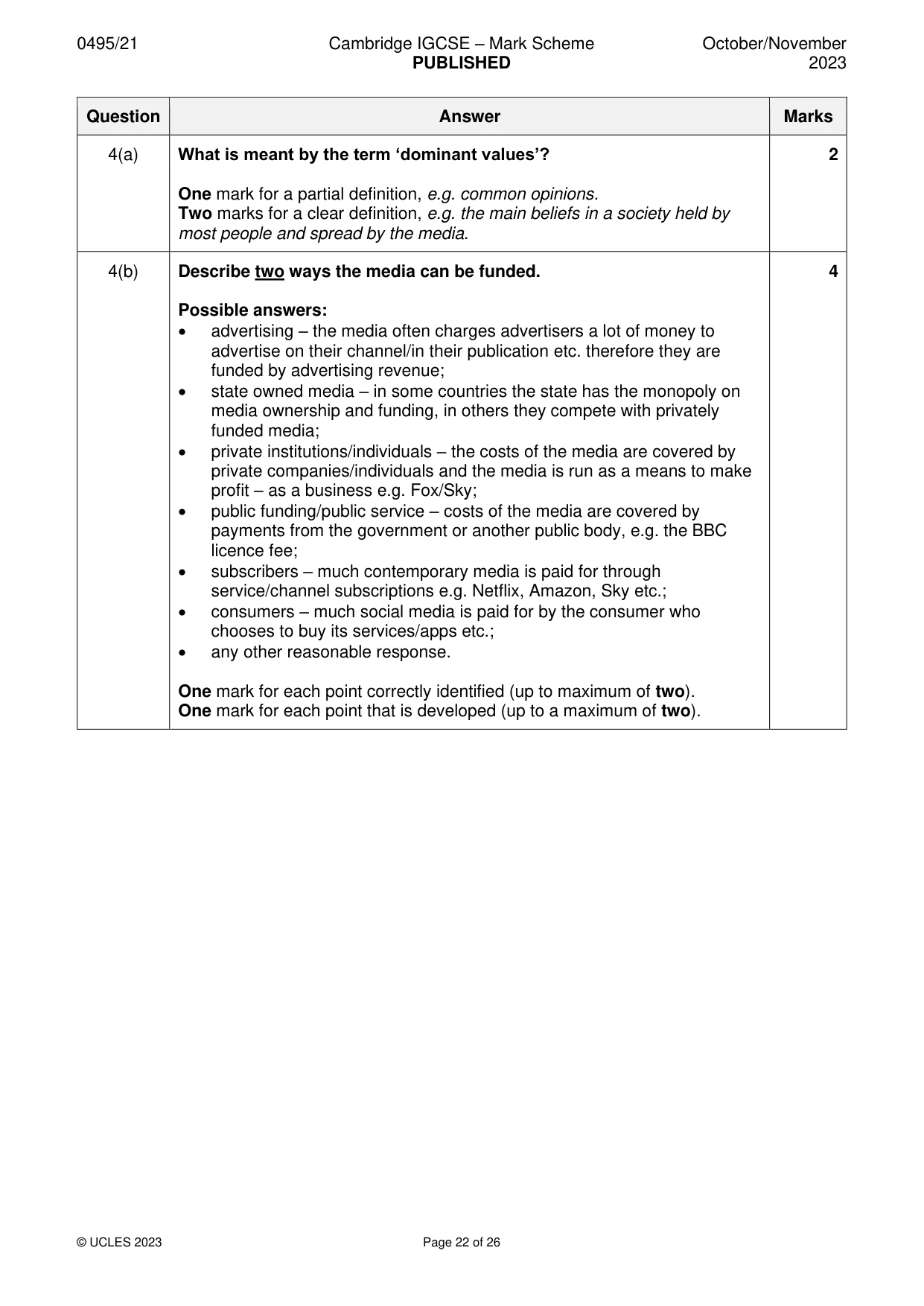
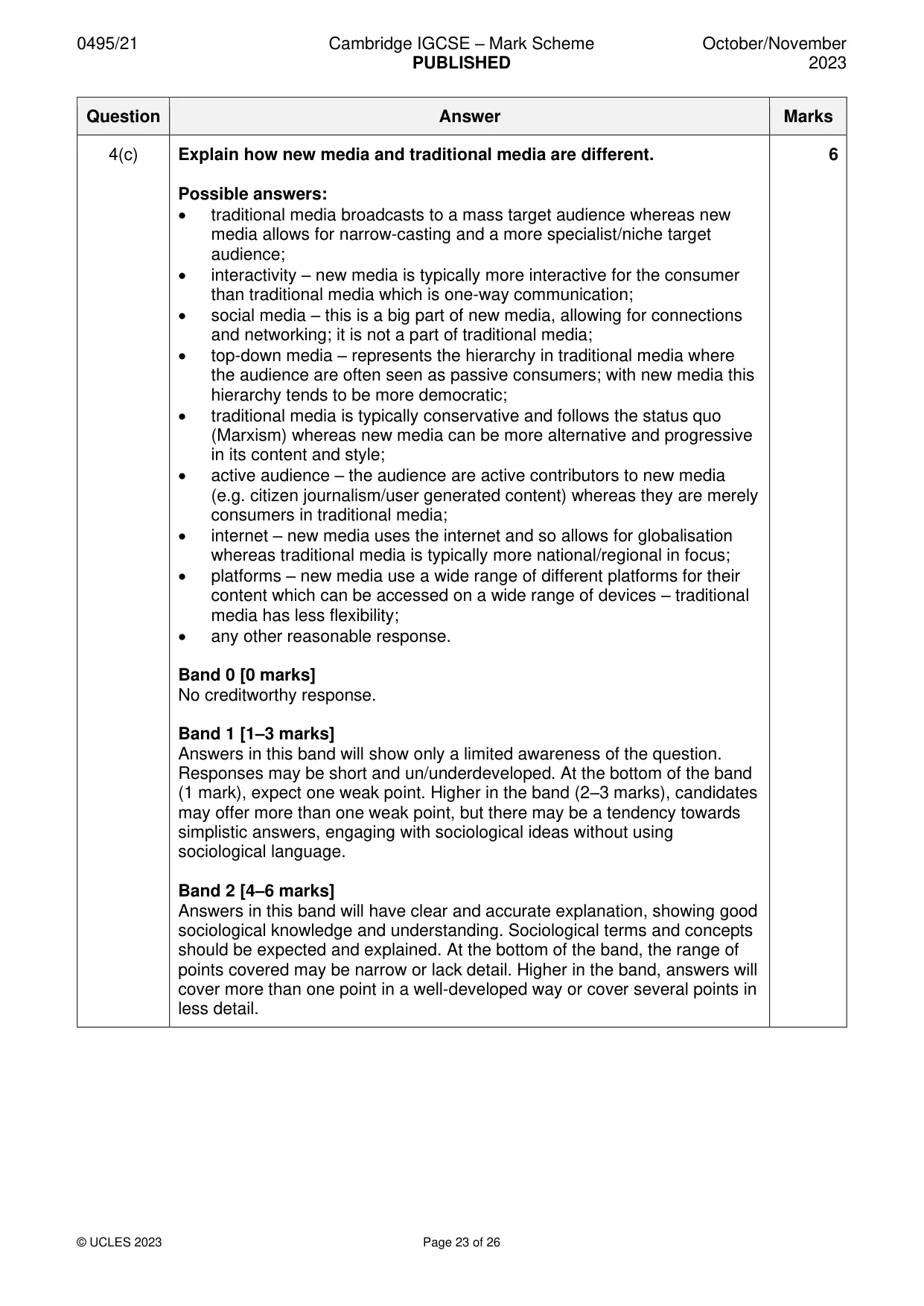
Mark scheme: 4(a) What is meant by the term ‘dominant values’? 2 One mark for a partial definition, e.g. common opinions. Two marks for a clear definition, e.g. the main beliefs in a society held by most people and spread by the media. 4(b) Describe two ways the media can be funded. 4 Possible answers: • advertising – the media often charges advertisers a lot of money to advertise on their channel/in their publication etc. therefore they are funded by advertising revenue; • state owned media – in some countries the state has the monopoly on media ownership and funding, in others they compete with privately funded media; • private institutions/individuals – the costs of the media are covered by private companies/individuals and the media is run as a means to make profit – as a business e.g. Fox/Sky; • public funding/public service – costs of the media are covered by payments from the government or another public body, e.g. the BBC licence fee; • subscribers – much contemporary media is paid for through service/channel subscriptions e.g. Netflix, Amazon, Sky etc.; • consumers – much social media is paid for by the consumer who chooses to buy its services/apps etc.; • any other reasonable response. One mark for each point correctly identified (up to maximum of two). One mark for each point that is developed (up to a maximum of two). 4(c) Explain how new media and traditional media are different. 6 Possible answers: • traditional media broadcasts to a mass target audience whereas new media allows for narrow-casting and a more specialist/niche target audience; • interactivity – new media is typically more interactive for the consumer than traditional media which is one-way communication; • social media – this is a big part of new media, allowing for connections and networking; it is not a part of traditional media; • top-down media – represents the hierarchy in traditional media where the audience are often seen as passive consumers; with new media this hierarchy tends to be more democratic; • traditional media is typically conservative and follows the status quo (Marxism) whereas new media can be more alternative and progressive in its content and style; • active audience – the audience are active contributors to new media (e.g. citizen journalism/user generated content) whereas they are merely consumers in traditional media; • internet – new media uses the internet and so allows for globalisation whereas traditional media is typically more national/regional in focus; • platforms – new media use a wide range of different platforms for their content which can be accessed on a wide range of devices – traditional media has less flexibility; • any other reasonable response. Band 0 [0 marks] No creditworthy response. Band 1 [1–3 marks] Answers in this band will show only a limited awareness of the question. Responses may be short and un/underdeveloped. At the bottom of the band (1 mark), expect one weak point. Higher in the band (2–3 marks), candidates may offer more than one weak point, but there may be a tendency towards simplistic answers, engaging with sociological ideas without using sociological language. Band 2 [4–6 marks] Answers in this band will have clear and accurate explanation, showing good sociological knowledge and understanding. Sociological terms and concepts should be expected and explained. At the bottom of the band, the range of points covered may be narrow or lack detail. Higher in the band, answers will cover more than one point in a well-developed way or cover several points in less detail. 4(d) Explain why traditional stereotypes in the media are changing. 8 Possible answers: • campaigns for change, pressure groups and online/hashtag groups have pressed for changes to happen to reflect public opinion; • employment in the media – the growth of digital media has meant increasing employment in the media meaning more ethnic minorities, women etc. are able to influence content and decision making; • changing positions and status in society – media representations are changing to reflect societal change e.g. higher status of women etc.; • meeting audience demand – many countries are now experiencing an ageing population and the media must therefore ensure its content appeals to this market – outdated stereotypes are unlikely to do so; • increasing purchasing power of social groups – older people, career women and minority ethnic groups, for example, are now seen as significant markets for the media and for advertisers therefore traditional stereotypes have changed; • legislation and government policy – changes in these areas have given high profile to areas of discrimination and stereotyping, meaning the media has changed its representations; • new media – this has led to a very diverse range of media content being available to audiences, a lot of which is now user generated: this allows for traditional stereotypes to be subverted and marginalised; • any other reasonable response. Band 0 [0 marks] No creditworthy response. Band 1 [1–3 marks] Answers in this band will show only a limited awareness of the question. A tendency to description is likely. Responses may be short and undeveloped and points stated without explanation. Sociological terms and concepts are unlikely to be used. At the bottom of the band (1 mark), expect one weak point. Higher in the band (2–3 marks), candidates may offer more than one weak point. Band 2 [4–6 marks] Answers in this band will show basic sociological knowledge and understanding. Responses maybe underdeveloped and lacking in range. At the bottom of the band, candidates are unlikely to use sociological terms and concepts accurately. Higher in the band, candidates maybe beginning to use sociological terms and concepts with greater accuracy. However, some aspects of the answer may only be partially developed/explained. Band 3 [7–8 marks] Answers in this band will show good sociological knowledge and understanding and will be well-developed and explained. Sociological terms and concepts will be used accurately overall. Answers will be well-focused on the question and there will be a range of points presented. At the top of the band explanations will be clear throughout. 4(e) To what extent are voting patterns influenced by the media? 15 Possible answers: Arguments for: • privately owned media and their political position – these are often very pronounced and can be seen through choice of lexis, image, stories etc.: this is likely to affect the audience and so affect voting; • election campaigns – the media are central to these campaigns, the internet, social media, TV, billboards etc. are all used in order to push a political message onto the audience – this is likely to affect voting; • spin doctors and image consultants – political parties employ individuals to control the media representations of politicians and party leaders which is likely to affect voting; • state owned media and censorship – often alternative political parties are marginalised or ridiculed to ensure the ruling party remains in power – thus the media affects voting; • opinion polls – the media reports opinion polls as if they are facts about the outcomes of elections – in reality this is just a small sample which may not be representative but nonetheless, voting is often affected e.g. tactical voters; • social media – politicians today make extensive use of social media in order to try and attract, e.g. they comment and interact with the audience frequently – this may affect voting; • propaganda – in countries with state control of the media propaganda may occur meaning the government and its policies are represented favourably whilst the opposition parties are represented unfavourably; • hypodermic syringe model – the media is said to have a direct and immediate effect on the audience therefore would affect voting; • cultural effects model – certain ideologies and beliefs are normalised within the media which over a long period of time affects the audience e.g. Marxist view of the media’s positive portrayal of capitalism – this may affect voting; • any other reasonable response. Arguments against: • uses and gratifications model – the audience are said to be in control of the media, not the other way round: voting patterns are thus unlikely to be affected by the media; • active audience – this model believes that every audience member ‘reads’ the media differently: so ‘oppositional readings’ (Hall) of a media text would mean that the audience’s voting patterns were not affected by the media; • audience selection – audiences choose media that reflects their outlook and beliefs therefore the media is unlikely to change or affect voting patterns, they simply reinforce pre-existing viewpoints; • new media – this has meant there is a diverse range of media platforms and content available to the audience therefore all political views are likely to be found somewhere – audiences are well informed from a variety of sources and make their own opinions rather than being directly influenced by the media; 4(e) • family and social class – many sociologists believe that political socialisation occurs through the family not the media and that the family is therefore more likely to affect voting patterns e.g. through cultural transmission or religious socialisation; • interactivity – the ability for the audience to interact with new media, to create user generated content, to contribute to online forums etc. means that the audience are more likely to have their voting patterns affected by one another/peers than the media per se; • any other reasonable response. Band 0 [0 marks] No creditworthy response. Band 1 [1–4 marks] Answers in this band may be vague and largely based on common sense showing limited knowledge of the debate. Use of sociological terms or concepts is very unlikely. Responses may be short, undeveloped and one- sided. Lower in the band (1–2 marks), expect one or two weak points. Higher in the band (3–4 marks) candidates may offer more than two points and provide a weak definition of key terms in the question. Band 2 [5–8 marks] In this band candidates will show some basic knowledge of the debate. Alternatively, they may offer an answer which is list-like in nature but there will be no real attempt to assess the issues raised by the question. There may be limited/ some use of sociological terms or concepts. Responses may be underdeveloped and lack range. Answers may be simplistic and two- sided or only cover one side of the debate. Lower in the band, the response may be rather narrow in the points covered and there may be some development. Higher in the band, more points are likely to be covered with some development. Alternatively, a list-like answer with some development covering both sides of the argument may score up to 8 marks. A one-sided answer cannot score higher than 8 marks. Band 3 [9–12 marks] Answers in this band will show good sociological knowledge and understanding of the debate. Sociological terms and concepts will be used with greater accuracy and/or frequency. For the most part, answers will be well-developed, focused on the questions and there will be a range of points presented. There will be a two-sided response but it may lack range on one side. At the bottom of the band, candidates may provide a narrower range of developed points. At the top of the band, expect a wider range of developed points and clear focus on the question. Band 4 [13–15 marks] Answers in this band will show excellent knowledge and understanding of the debate. There will be a strong grasp of the arguments as well as accurate and frequent use of sociological terms and concepts. Answers will be well- developed, clearly focused on the question and discuss a wide range of points. Responses will be two-sided and have a range of points on each side. At the bottom of the band (13 marks), the answer may lack a specific conclusion. Higher in the band, there will be a clear attempt to offer an assessment of the ‘To what extent.?’ part of the question through a focused conclusion.
More questions on How do sociologists approach the study of society?
What was in this paper
The subtopics covered by these 4 questions, and how many questions each got. Open one in a new tab to see every Cambridge question on it.
What you needed in this session
Cambridge’s own grade thresholds for 2023 Oct/Nov, Paper 2 · Variant 1. A higher threshold means an easier paper — the bar moves with how the cohort did.