Cambridge IGCSE Sociology 0495 — 2025 Oct/Nov Paper 1 · Variant 3
0495/13/O/N/25 · 80 marks · 120 min
The question paper and its mark scheme, free to read here and free to download. This is Cambridge’s own paper, exactly as it was sat.
Question paper8 pages




Mark scheme28 pages
Answers below. Sit the paper first if you are practising.
Paper as text
Question paper, page 1
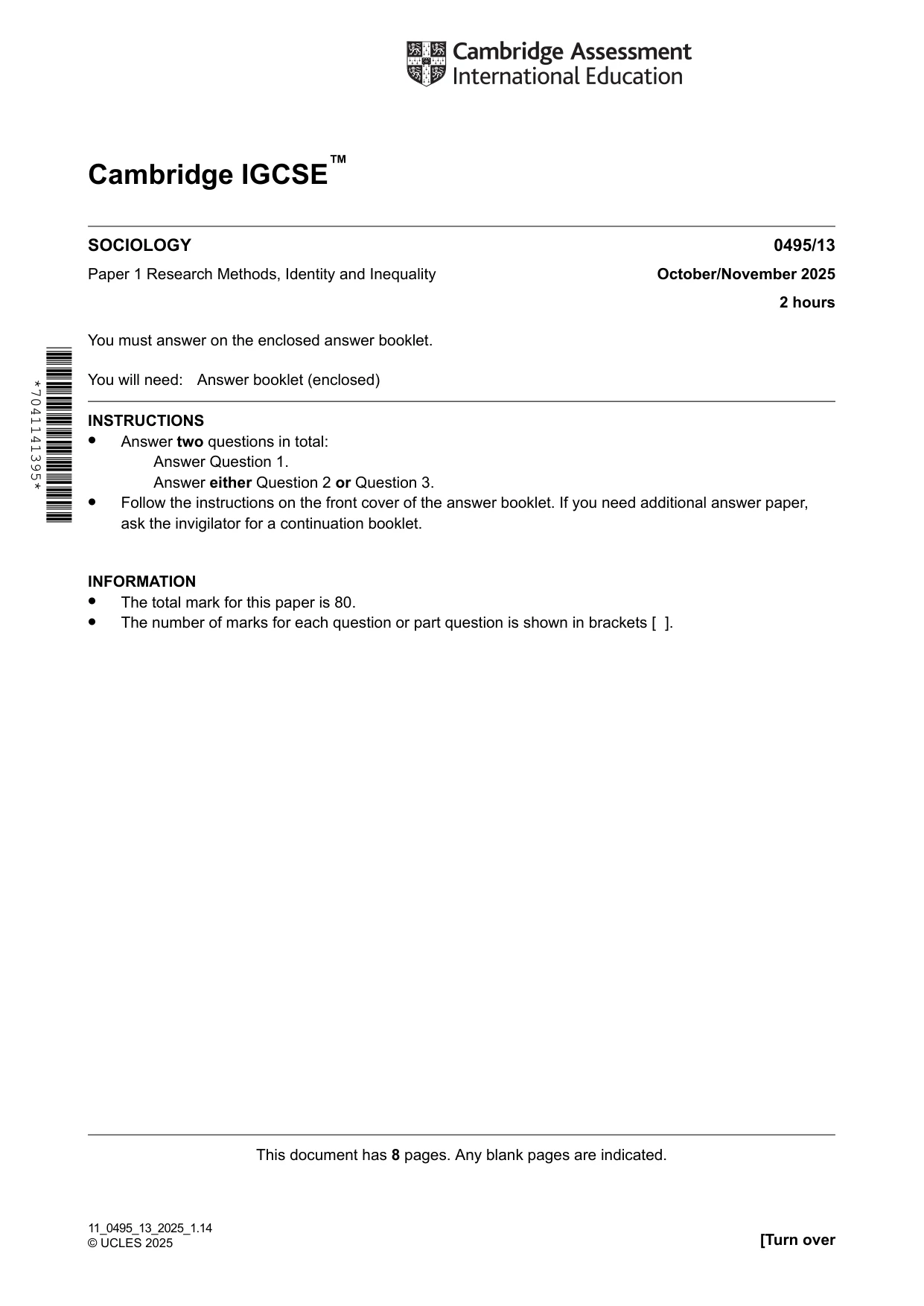
Cambridge IGCSE™ 0495/13 October/November 2025 2 hours SOCIOLOGY Paper 1 Research Methods, Identity and Inequality You must answer on the enclosed answer booklet. You will need: Answer booklet (enclosed) INSTRUCTIONS • Answer two questions in total: Answer Question 1. Answer either Question 2 or Question 3. • Follow the instructions on the front cover of the answer booklet. If you need additional answer paper, ask the invigilator for a continuation booklet. INFORMATION • The total mark for this paper is 80. • The number of marks for each question or part question is shown in brackets [ ]. This document has 8 pages. Any blank pages are indicated. [Turn over 11_0495_13_2025_1.14 © UCLES 2025 *7041141395*
Question paper, page 2
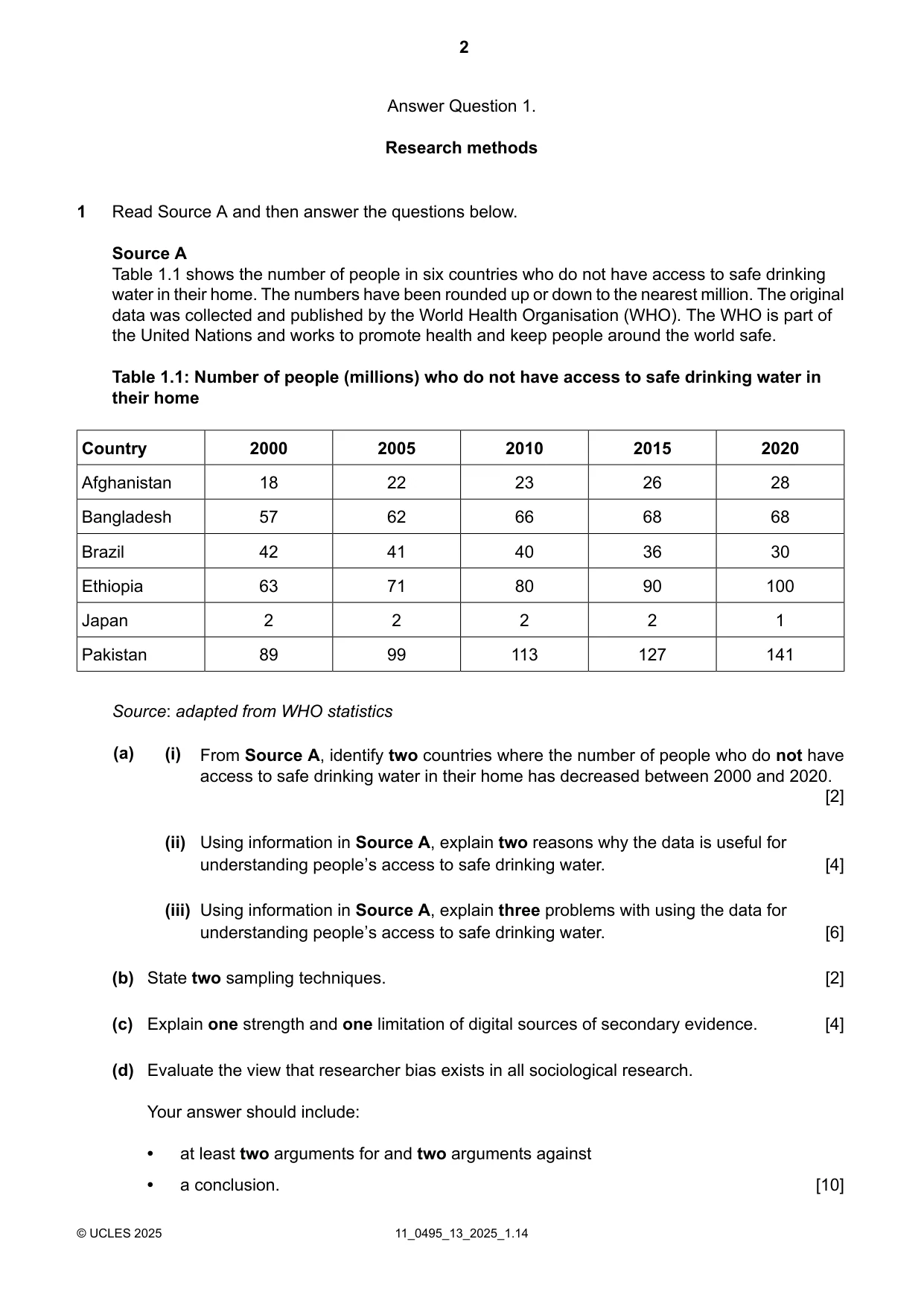
Answer Question 1. Research methods Read Source A and then answer the questions below. 1 Source A Table 1.1 shows the number of people in six countries who do not have access to safe drinking water in their home. The numbers have been rounded up or down to the nearest million. The original data was collected and published by the World Health Organisation (WHO). The WHO is part of the United Nations and works to promote health and keep people around the world safe. Table 1.1: Number of people (millions) who do not have access to safe drinking water in their home 2020 2015 2010 2005 2000 Country 28 26 23 22 18 Afghanistan 68 68 66 62 57 Bangladesh 30 36 40 41 42 Brazil 100 90 80 71 63 Ethiopia 1 2 2 2 2 Japan 141 127 113 99 89 Pakistan Source: adapted from WHO statistics (a) From Source A, identify two countries where the number of people who do not have access to safe drinking water in their home has decreased between 2000 and 2020. [2] (i) Using information in Source A, explain two reasons why the data is useful for understanding people’s access to safe drinking water. [4] (ii) Using information in Source A, explain three problems with using the data for understanding people’s access to safe drinking water. [6] (iii) State two sampling techniques. [2] (b) Explain one strength and one limitation of digital sources of secondary evidence. [4] (c) Evaluate the view that researcher bias exists in all sociological research. Your answer should include: (d) • at least two arguments for and two arguments against • a conclusion. [10] 11_0495_13_2025_1.14 © UCLES 2025 2
Question paper, page 3
Explain the research methods and evidence that you would choose to investigate gender inequalities in the home. Give reasons for your choices. Your answer should include: (e) • two primary methods with relevant sampling • one source of secondary evidence. [12] [Turn over 11_0495_13_2025_1.14 © UCLES 2025 3
Question paper, page 4
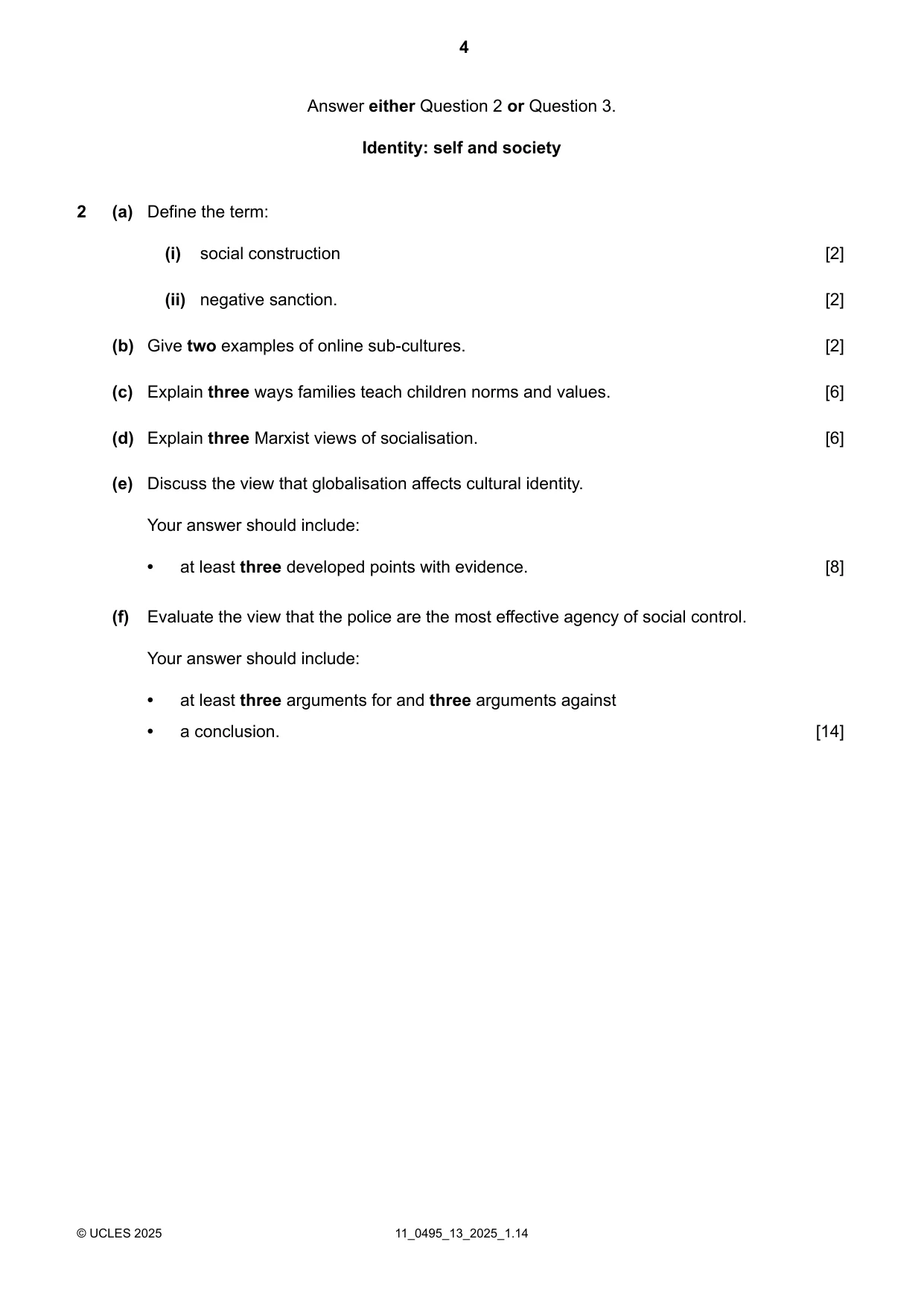
Answer either Question 2 or Question 3. Identity: self and society Define the term: (a) 2 social construction [2] (i) negative sanction. [2] (ii) Give two examples of online sub-cultures. [2] (b) Explain three ways families teach children norms and values. [6] (c) Explain three Marxist views of socialisation. [6] (d) Discuss the view that globalisation affects cultural identity. Your answer should include: (e) • at least three developed points with evidence. [8] Evaluate the view that the police are the most effective agency of social control. Your answer should include: (f) • at least three arguments for and three arguments against • a conclusion. [14] 11_0495_13_2025_1.14 © UCLES 2025 4
Question paper, page 5
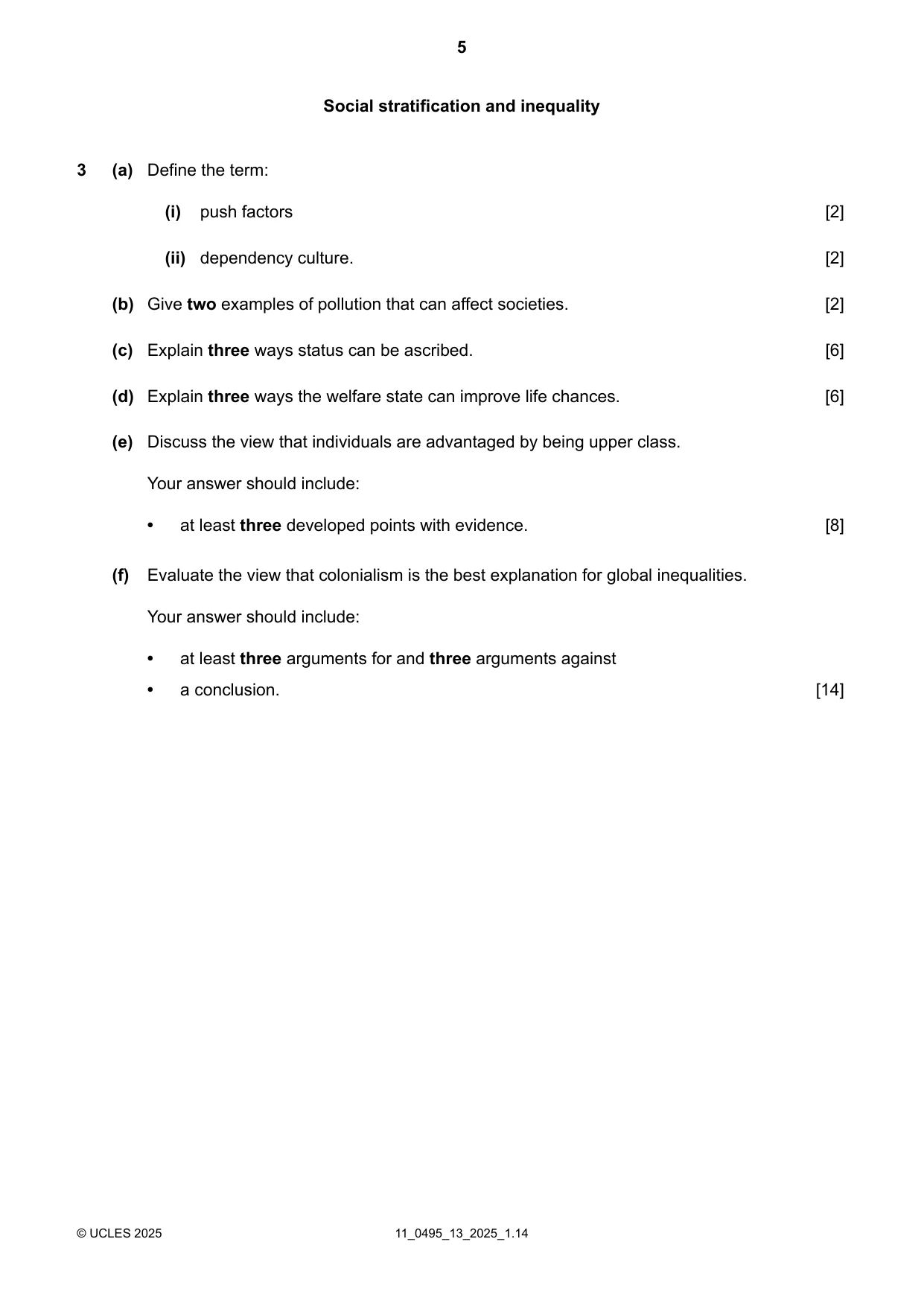
Social stratification and inequality Define the term: (a) 3 push factors [2] (i) dependency culture. [2] (ii) Give two examples of pollution that can affect societies. [2] (b) Explain three ways status can be ascribed. [6] (c) Explain three ways the welfare state can improve life chances. [6] (d) Discuss the view that individuals are advantaged by being upper class. Your answer should include: (e) • at least three developed points with evidence. [8] Evaluate the view that colonialism is the best explanation for global inequalities. Your answer should include: (f) • at least three arguments for and three arguments against • a conclusion. [14] 11_0495_13_2025_1.14 © UCLES 2025 5
Question paper, page 6
BLANK PAGE 11_0495_13_2025_1.14 © UCLES 2025 6
Question paper, page 7
BLANK PAGE 11_0495_13_2025_1.14 © UCLES 2025 7
Question paper, page 8
BLANK PAGE Permission to reproduce items where third-party owned material protected by copyright is included has been sought and cleared where possible. Every reasonable effort has been made by the publisher (UCLES) to trace copyright holders, but if any items requiring clearance have unwittingly been included, the publisher will be pleased to make amends at the earliest possible opportunity. To avoid the issue of disclosure of answer-related information to candidates, all copyright acknowledgements are reproduced online in the Cambridge Assessment International Education Copyright Acknowledgements Booklet. This is produced for each series of examinations and is freely available to download at www.cambridgeinternational.org after the live examination series. Cambridge Assessment International Education is part of Cambridge Assessment. Cambridge Assessment is the brand name of the University of Cambridge Local Examinations Syndicate (UCLES), which is a department of the University of Cambridge. 11_0495_13_2025_1.14 © UCLES 2025 8
Mark scheme, page 1
This document consists of 28 printed pages. © Cambridge University Press & Assessment 2025 [Turn over Cambridge IGCSE™ SOCIOLOGY 0495/13 Paper 1 Research Methods, Identity and Inequality October/November 2025 MARK SCHEME Maximum Mark: 80 Published This mark scheme is published as an aid to teachers and candidates, to indicate the requirements of the examination. It shows the basis on which Examiners were instructed to award marks. It does not indicate the details of the discussions that took place at an Examiners’ meeting before marking began, which would have considered the acceptability of alternative answers. Mark schemes should be read in conjunction with the question paper and the Principal Examiner Report for Teachers. Cambridge International will not enter into discussions about these mark schemes. Cambridge International is publishing the mark schemes for the October/November 2025 series for most Cambridge IGCSE, Cambridge International A and AS Level components, and some Cambridge O Level components.
Mark scheme, page 2
0495/13 Cambridge IGCSE – Mark Scheme PUBLISHED October/November 2025 © Cambridge University Press & Assessment 2025 Page 2 of 28 Generic Marking Principles These general marking principles must be applied by all examiners when marking candidate answers. They should be applied alongside the specific content of the mark scheme or generic level descriptions for a question. Each question paper and mark scheme will also comply with these marking principles. GENERIC MARKING PRINCIPLE 1: Marks must be awarded in line with: • the specific content of the mark scheme or the generic level descriptors for the question • the specific skills defined in the mark scheme or in the generic level descriptors for the question • the standard of response required by a candidate as exemplified by the standardisation scripts. GENERIC MARKING PRINCIPLE 2: Marks awarded are always whole marks (not half marks, or other fractions). GENERIC MARKING PRINCIPLE 3: Marks must be awarded positively: • marks are awarded for correct/valid answers, as defined in the mark scheme. However, credit is given for valid answers which go beyond the scope of the syllabus and mark scheme, referring to your Team Leader as appropriate • marks are awarded when candidates clearly demonstrate what they know and can do • marks are not deducted for errors • marks are not deducted for omissions • answers should only be judged on the quality of spelling, punctuation and grammar when these features are specifically assessed by the question as indicated by the mark scheme. The meaning, however, should be unambiguous. GENERIC MARKING PRINCIPLE 4: Rules must be applied consistently, e.g. in situations where candidates have not followed instructions or in the application of generic level descriptors. GENERIC MARKING PRINCIPLE 5: Marks should be awarded using the full range of marks defined in the mark scheme for the question (however; the use of the full mark range may be limited according to the quality of the candidate responses seen). GENERIC MARKING PRINCIPLE 6: Marks awarded are based solely on the requirements as defined in the mark scheme. Marks should not be awarded with grade thresholds or grade descriptors in mind.
Mark scheme, page 3
0495/13 Cambridge IGCSE – Mark Scheme PUBLISHED October/November 2025 © Cambridge University Press & Assessment 2025 Page 3 of 28 Social Science-Specific Marking Principles (for point-based marking) 1 Components using point-based marking: • Point marking is often used to reward knowledge, understanding and application of skills. We give credit where the candidate’s answer shows relevant knowledge, understanding and application of skills in answering the question. We do not give credit where the answer shows confusion. From this it follows that we: a DO credit answers which are worded differently from the mark scheme if they clearly convey the same meaning (unless the mark scheme requires a specific term) b DO credit alternative answers/examples which are not written in the mark scheme if they are correct c DO credit answers where candidates give more than one correct answer in one prompt/numbered/scaffolded space where extended writing is required rather than list-type answers. For example, questions that require n reasons (e.g. State two reasons …). d DO NOT credit answers simply for using a ‘key term’ unless that is all that is required. (Check for evidence it is understood and not used wrongly.) e DO NOT credit answers which are obviously self-contradicting or trying to cover all possibilities f DO NOT give further credit for what is effectively repetition of a correct point already credited unless the language itself is being tested. This applies equally to ‘mirror statements’ (i.e. polluted/not polluted). g DO NOT require spellings to be correct, unless this is part of the test. However spellings of syllabus terms must allow for clear and unambiguous separation from other syllabus terms with which they may be confused (e.g. Corrasion/Corrosion) 2 Presentation of mark scheme: • Slashes (/) or the word ‘or’ separate alternative ways of making the same point. • Semi colons (;) bullet points (•) or figures in brackets (1) separate different points. • Content in the answer column in brackets is for examiner information/context to clarify the marking but is not required to earn the mark (except Accounting syllabuses where they indicate negative numbers). 3 Calculation questions: • The mark scheme will show the steps in the most likely correct method(s), the mark for each step, the correct answer(s) and the mark for each answer • If working/explanation is considered essential for full credit, this will be indicated in the question paper and in the mark scheme. In all other instances, the correct answer to a calculation should be given full credit, even if no supporting working is shown. • Where the candidate uses a valid method which is not covered by the mark scheme, award equivalent marks for reaching equivalent stages. • Where an answer makes use of a candidate’s own incorrect figure from previous working, the ‘own figure rule’ applies: full marks will be given if a correct and complete method is used. Further guidance will be included in the mark scheme where necessary and any exceptions to this general principle will be noted.
Mark scheme, page 4
0495/13 Cambridge IGCSE – Mark Scheme PUBLISHED October/November 2025 © Cambridge University Press & Assessment 2025 Page 4 of 28 4 Annotation: • For point marking, ticks can be used to indicate correct answers and crosses can be used to indicate wrong answers. There is no direct relationship between ticks and marks. Ticks have no defined meaning for levels of response marking. • For levels of response marking, the level awarded should be annotated on the script. • Other annotations will be used by examiners as agreed during standardisation, and the meaning will be understood by all examiners who marked that paper.
Mark scheme, page 5
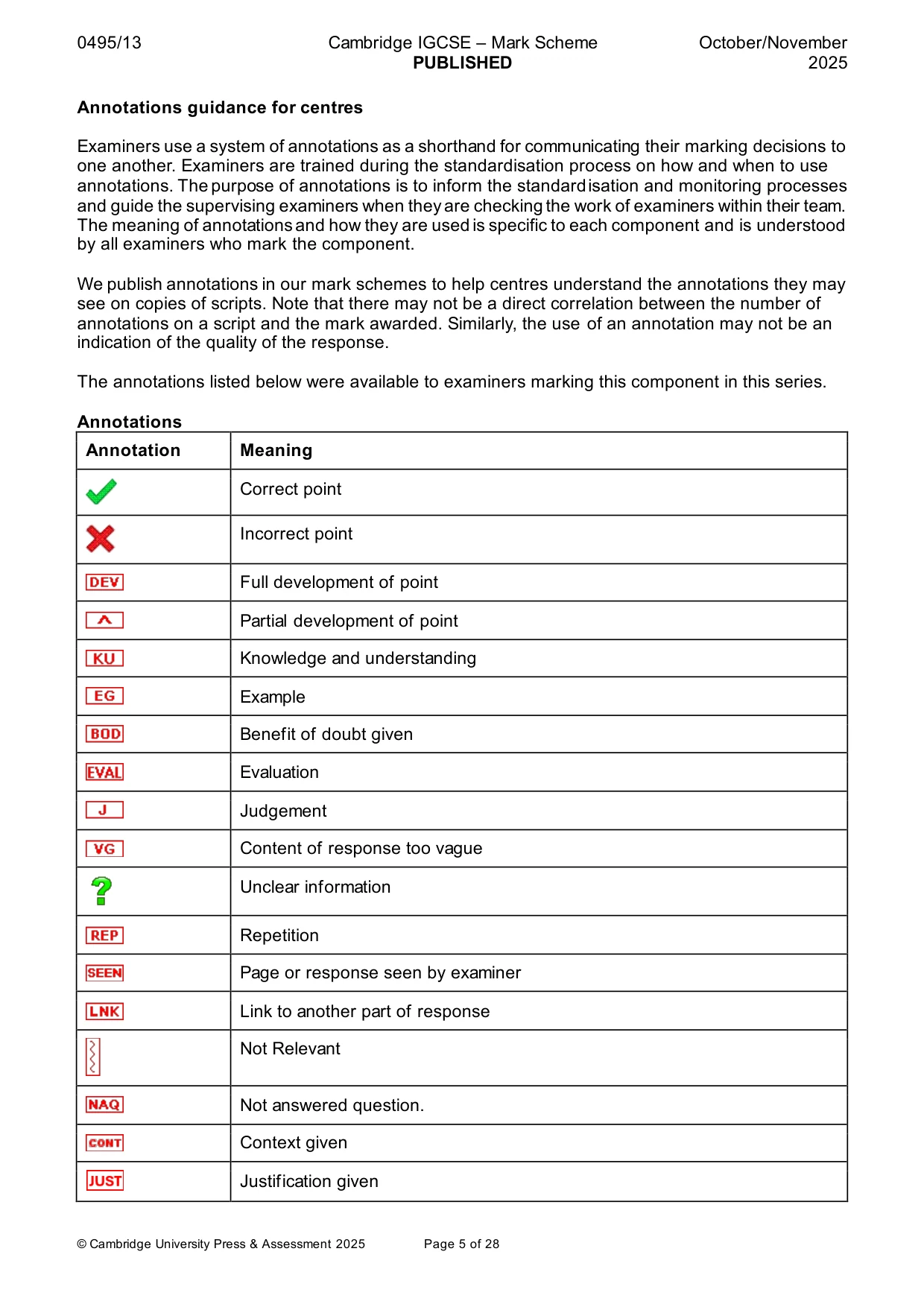
0495/13 Cambridge IGCSE – Mark Scheme PUBLISHED October/November 2025 © Cambridge University Press & Assessment 2025 Page 5 of 28 Annotations guidance for centres Examiners use a system of annotations as a shorthand for communicating their marking decisions to one another. Examiners are trained during the standardisation process on how and when to use annotations. The purpose of annotations is to inform the standardisation and monitoring processes and guide the supervising examiners when they are checking the work of examiners within their team. The meaning of annotations and how they are used is specific to each component and is understood by all examiners who mark the component. We publish annotations in our mark schemes to help centres understand the annotations they may see on copies of scripts. Note that there may not be a direct correlation between the number of annotations on a script and the mark awarded. Similarly, the use of an annotation may not be an indication of the quality of the response. The annotations listed below were available to examiners marking this component in this series. Annotations Annotation Meaning Correct point Incorrect point Full development of point Partial development of point Knowledge and understanding Example Benefit of doubt given Evaluation Judgement Content of response too vague Unclear information Repetition Page or response seen by examiner Link to another part of response Not Relevant Not answered question. Context given Justification given
Mark scheme, page 6
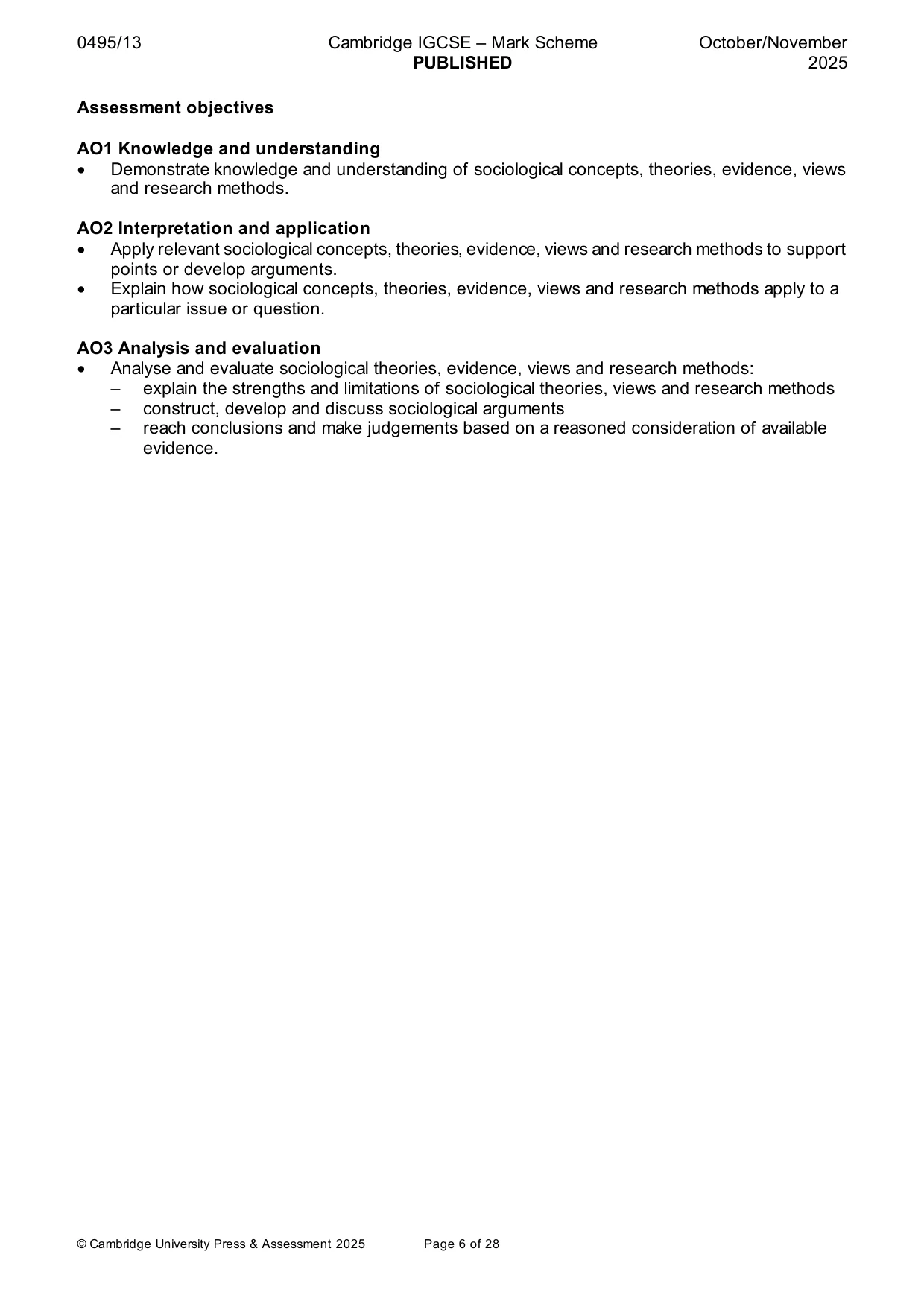
0495/13 Cambridge IGCSE – Mark Scheme PUBLISHED October/November 2025 © Cambridge University Press & Assessment 2025 Page 6 of 28 Assessment objectives AO1 Knowledge and understanding • Demonstrate knowledge and understanding of sociological concepts, theories, evidence, views and research methods. AO2 Interpretation and application • Apply relevant sociological concepts, theories, evidence, views and research methods to support points or develop arguments. • Explain how sociological concepts, theories, evidence, views and research methods apply to a particular issue or question. AO3 Analysis and evaluation • Analyse and evaluate sociological theories, evidence, views and research methods: – explain the strengths and limitations of sociological theories, views and research methods – construct, develop and discuss sociological arguments – reach conclusions and make judgements based on a reasoned consideration of available evidence.
Mark scheme, page 7
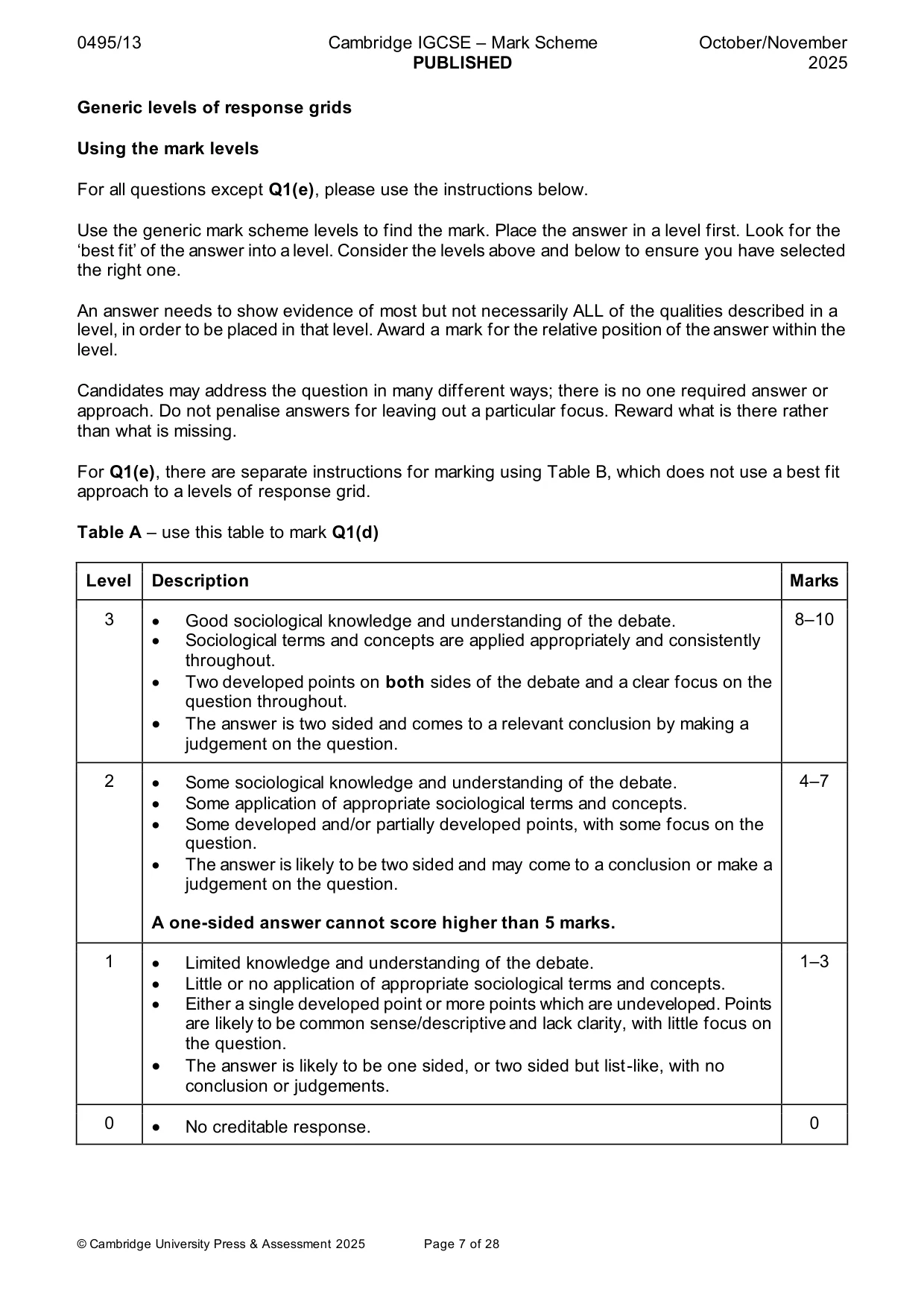
0495/13 Cambridge IGCSE – Mark Scheme PUBLISHED October/November 2025 © Cambridge University Press & Assessment 2025 Page 7 of 28 Generic levels of response grids Using the mark levels For all questions except Q1(e), please use the instructions below. Use the generic mark scheme levels to find the mark. Place the answer in a level first. Look for the ‘best fit’ of the answer into a level. Consider the levels above and below to ensure you have selected the right one. An answer needs to show evidence of most but not necessarily ALL of the qualities described in a level, in order to be placed in that level. Award a mark for the relative position of the answer within the level. Candidates may address the question in many different ways; there is no one required answer or approach. Do not penalise answers for leaving out a particular focus. Reward what is there rather than what is missing. For Q1(e), there are separate instructions for marking using Table B, which does not use a best fit approach to a levels of response grid. Table A – use this table to mark Q1(d) Level Description Marks 3 • Good sociological knowledge and understanding of the debate. • Sociological terms and concepts are applied appropriately and consistently throughout. • Two developed points on both sides of the debate and a clear focus on the question throughout. • The answer is two sided and comes to a relevant conclusion by making a judgement on the question. 8–10 2 • Some sociological knowledge and understanding of the debate. • Some application of appropriate sociological terms and concepts. • Some developed and/or partially developed points, with some focus on the question. • The answer is likely to be two sided and may come to a conclusion or make a judgement on the question. A one-sided answer cannot score higher than 5 marks. 4–7 1 • Limited knowledge and understanding of the debate. • Little or no application of appropriate sociological terms and concepts. • Either a single developed point or more points which are undeveloped. Points are likely to be common sense/descriptive and lack clarity, with little focus on the question. • The answer is likely to be one sided, or two sided but list-like, with no conclusion or judgements. 1–3 0 • No creditable response. 0
Mark scheme, page 8
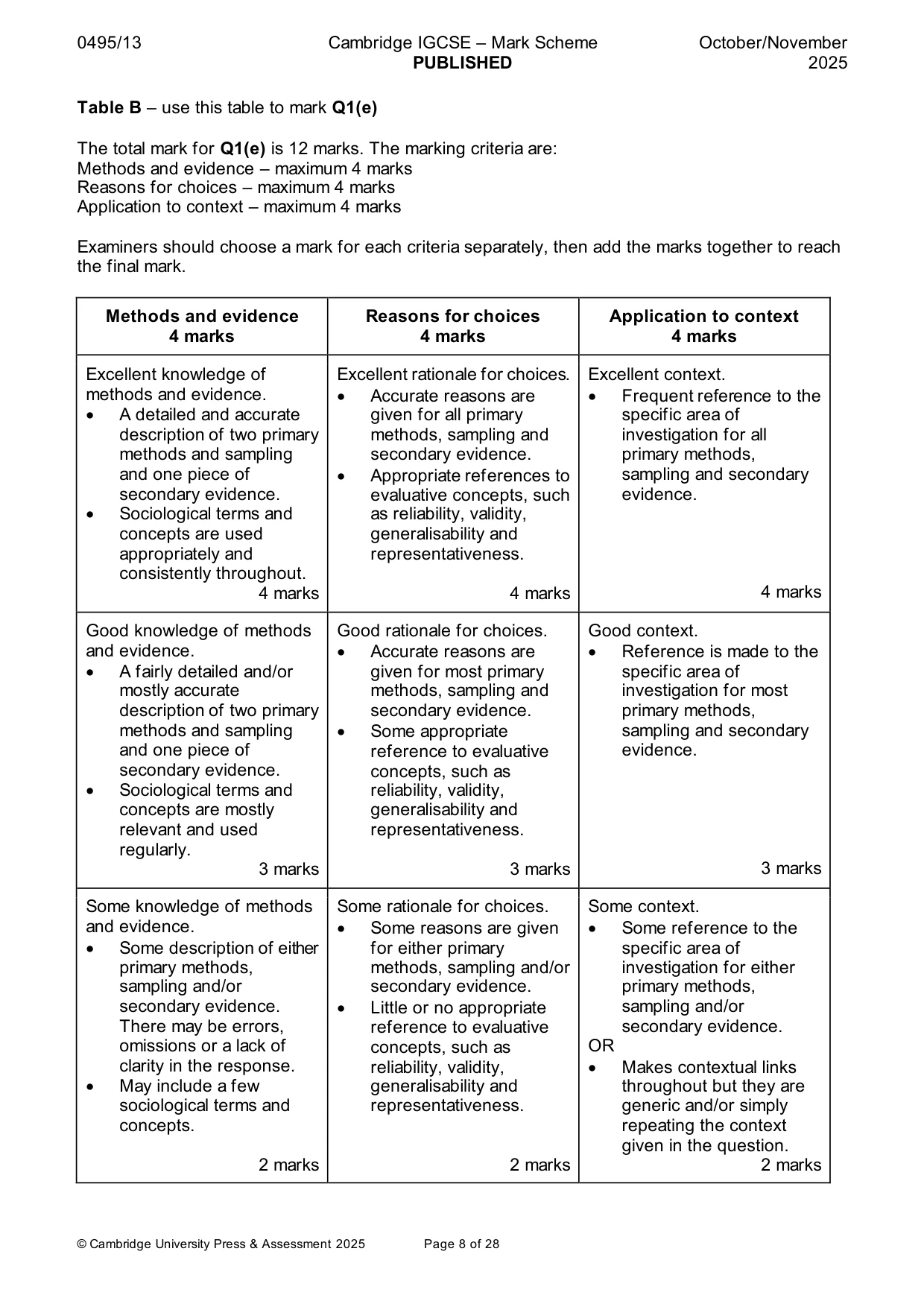
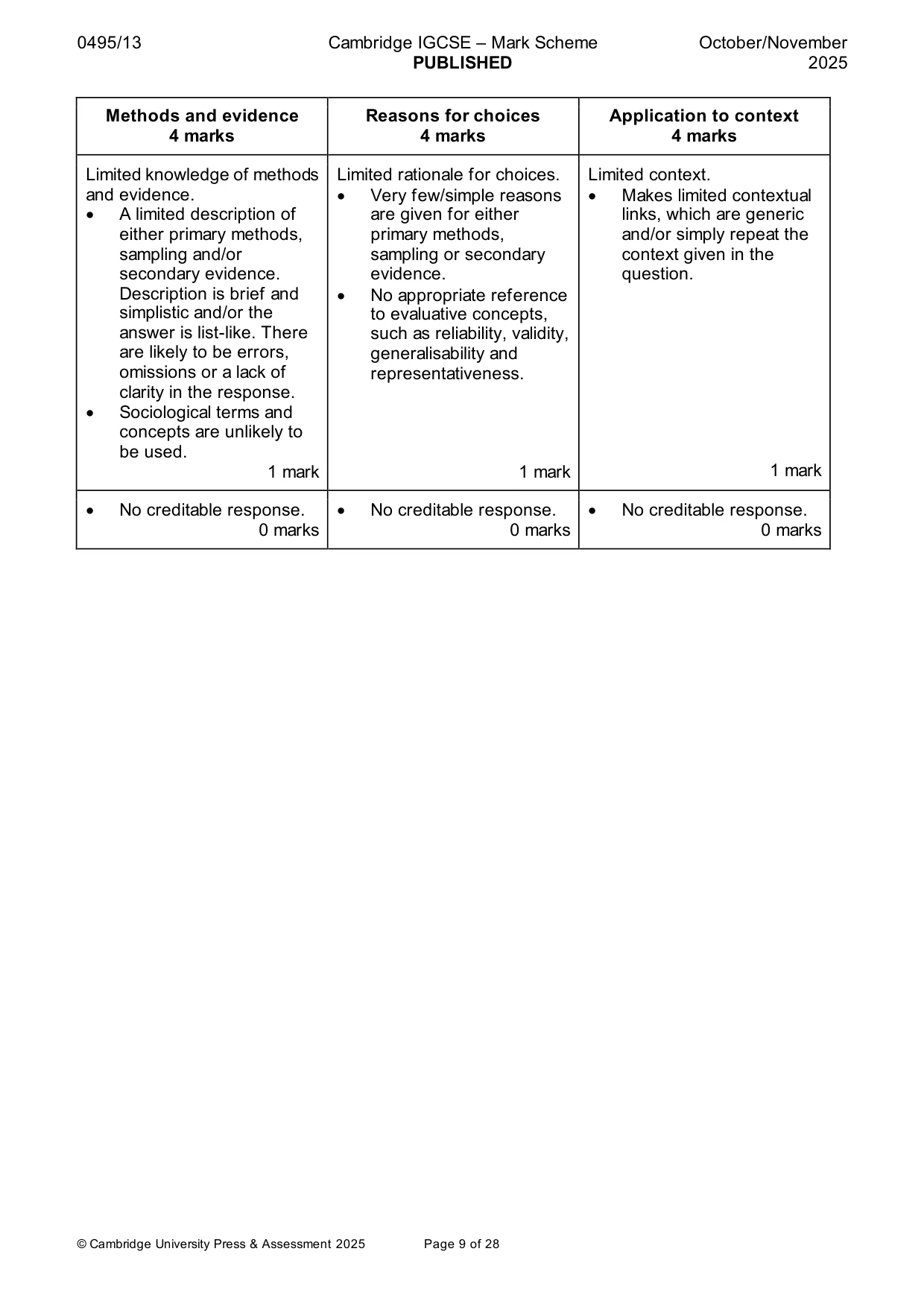
0495/13 Cambridge IGCSE – Mark Scheme PUBLISHED October/November 2025 © Cambridge University Press & Assessment 2025 Page 8 of 28 Table B – use this table to mark Q1(e) The total mark for Q1(e) is 12 marks. The marking criteria are: Methods and evidence – maximum 4 marks Reasons for choices – maximum 4 marks Application to context – maximum 4 marks Examiners should choose a mark for each criteria separately, then add the marks together to reach the final mark. Methods and evidence 4 marks Reasons for choices 4 marks Application to context 4 marks Excellent knowledge of methods and evidence. • A detailed and accurate description of two primary methods and sampling and one piece of secondary evidence. • Sociological terms and concepts are used appropriately and consistently throughout. 4 marks Excellent rationale for choices. • Accurate reasons are given for all primary methods, sampling and secondary evidence. • Appropriate references to evaluative concepts, such as reliability, validity, generalisability and representativeness. 4 marks Excellent context. • Frequent reference to the specific area of investigation for all primary methods, sampling and secondary evidence. 4 marks Good knowledge of methods and evidence. • A fairly detailed and/or mostly accurate description of two primary methods and sampling and one piece of secondary evidence. • Sociological terms and concepts are mostly relevant and used regularly. 3 marks Good rationale for choices. • Accurate reasons are given for most primary methods, sampling and secondary evidence. • Some appropriate reference to evaluative concepts, such as reliability, validity, generalisability and representativeness. 3 marks Good context. • Reference is made to the specific area of investigation for most primary methods, sampling and secondary evidence. 3 marks Some knowledge of methods and evidence. • Some description of either primary methods, sampling and/or secondary evidence. There may be errors, omissions or a lack of clarity in the response. • May include a few sociological terms and concepts. 2 marks Some rationale for choices. • Some reasons are given for either primary methods, sampling and/or secondary evidence. • Little or no appropriate reference to evaluative concepts, such as reliability, validity, generalisability and representativeness. 2 marks Some context. • Some reference to the specific area of investigation for either primary methods, sampling and/or secondary evidence. OR • Makes contextual links throughout but they are generic and/or simply repeating the context given in the question. 2 marks
Mark scheme, page 9
0495/13 Cambridge IGCSE – Mark Scheme PUBLISHED October/November 2025 © Cambridge University Press & Assessment 2025 Page 9 of 28 Methods and evidence 4 marks Reasons for choices 4 marks Application to context 4 marks Limited knowledge of methods and evidence. • A limited description of either primary methods, sampling and/or secondary evidence. Description is brief and simplistic and/or the answer is list-like. There are likely to be errors, omissions or a lack of clarity in the response. • Sociological terms and concepts are unlikely to be used. 1 mark Limited rationale for choices. • Very few/simple reasons are given for either primary methods, sampling or secondary evidence. • No appropriate reference to evaluative concepts, such as reliability, validity, generalisability and representativeness. 1 mark Limited context. • Makes limited contextual links, which are generic and/or simply repeat the context given in the question. 1 mark • No creditable response. 0 marks • No creditable response. 0 marks • No creditable response. 0 marks
Mark scheme, page 10
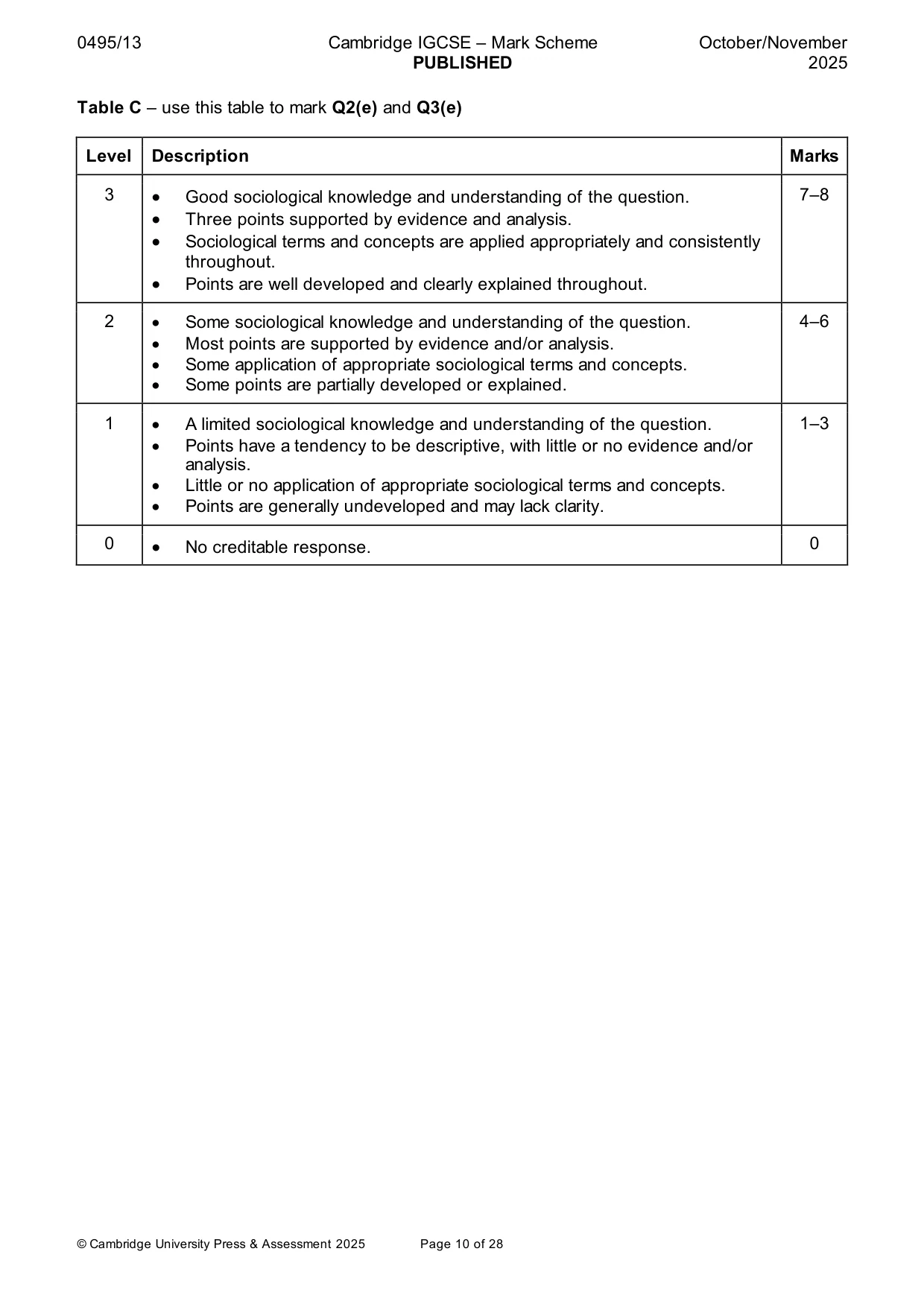
0495/13 Cambridge IGCSE – Mark Scheme PUBLISHED October/November 2025 © Cambridge University Press & Assessment 2025 Page 10 of 28 Table C – use this table to mark Q2(e) and Q3(e) Level Description Marks 3 • Good sociological knowledge and understanding of the question. • Three points supported by evidence and analysis. • Sociological terms and concepts are applied appropriately and consistently throughout. • Points are well developed and clearly explained throughout. 7–8 2 • Some sociological knowledge and understanding of the question. • Most points are supported by evidence and/or analysis. • Some application of appropriate sociological terms and concepts. • Some points are partially developed or explained. 4–6 1 • A limited sociological knowledge and understanding of the question. • Points have a tendency to be descriptive, with little or no evidence and/or analysis. • Little or no application of appropriate sociological terms and concepts. • Points are generally undeveloped and may lack clarity. 1–3 0 • No creditable response. 0
Mark scheme, page 11
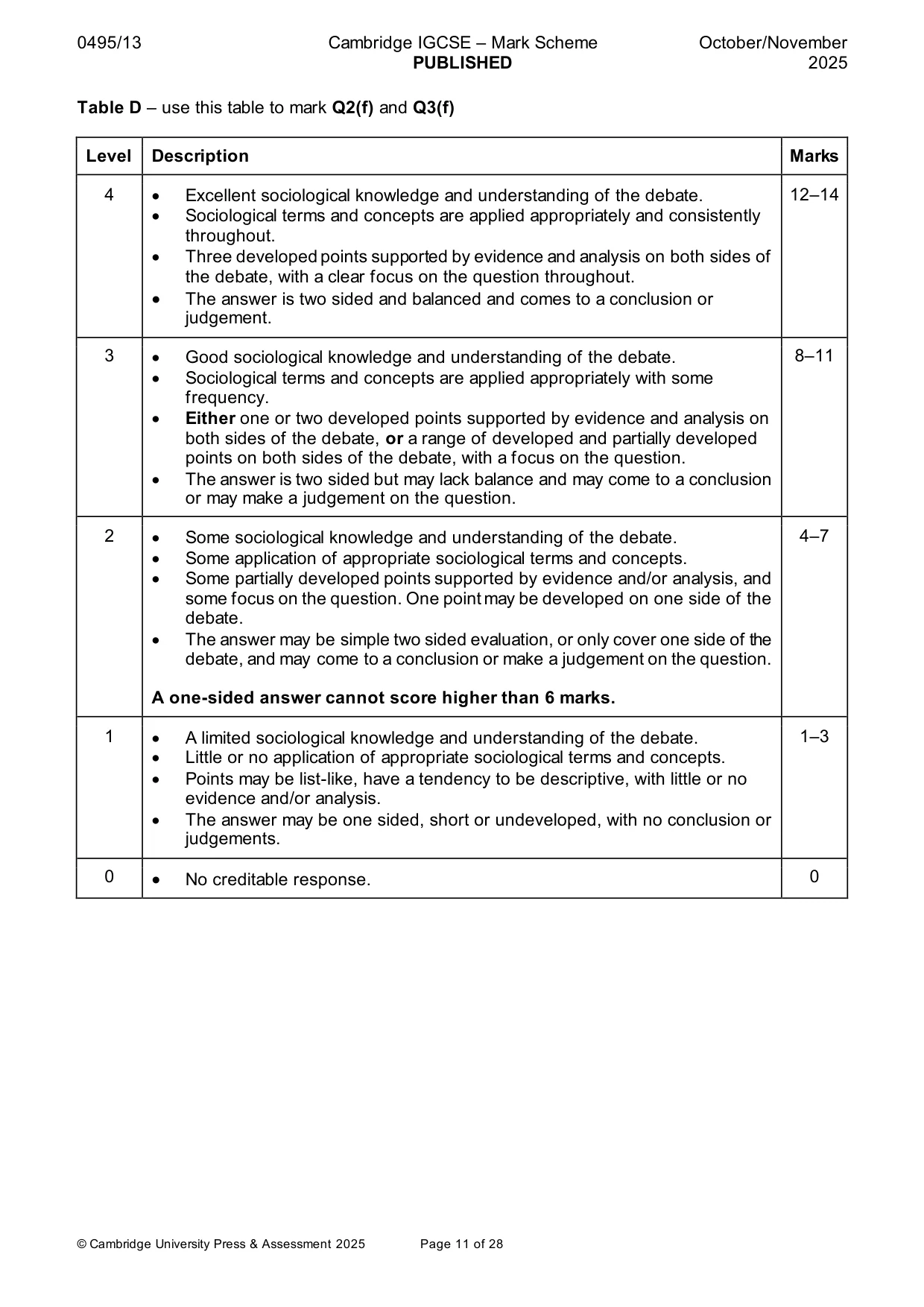
0495/13 Cambridge IGCSE – Mark Scheme PUBLISHED October/November 2025 © Cambridge University Press & Assessment 2025 Page 11 of 28 Table D – use this table to mark Q2(f) and Q3(f) Level Description Marks 4 • Excellent sociological knowledge and understanding of the debate. • Sociological terms and concepts are applied appropriately and consistently throughout. • Three developed points supported by evidence and analysis on both sides of the debate, with a clear focus on the question throughout. • The answer is two sided and balanced and comes to a conclusion or judgement. 12–14 3 • Good sociological knowledge and understanding of the debate. • Sociological terms and concepts are applied appropriately with some frequency. • Either one or two developed points supported by evidence and analysis on both sides of the debate, or a range of developed and partially developed points on both sides of the debate, with a focus on the question. • The answer is two sided but may lack balance and may come to a conclusion or may make a judgement on the question. 8–11 2 • Some sociological knowledge and understanding of the debate. • Some application of appropriate sociological terms and concepts. • Some partially developed points supported by evidence and/or analysis, and some focus on the question. One point may be developed on one side of the debate. • The answer may be simple two sided evaluation, or only cover one side of the debate, and may come to a conclusion or make a judgement on the question. A one-sided answer cannot score higher than 6 marks. 4–7 1 • A limited sociological knowledge and understanding of the debate. • Little or no application of appropriate sociological terms and concepts. • Points may be list-like, have a tendency to be descriptive, with little or no evidence and/or analysis. • The answer may be one sided, short or undeveloped, with no conclusion or judgements. 1–3 0 • No creditable response. 0
Mark scheme, page 12
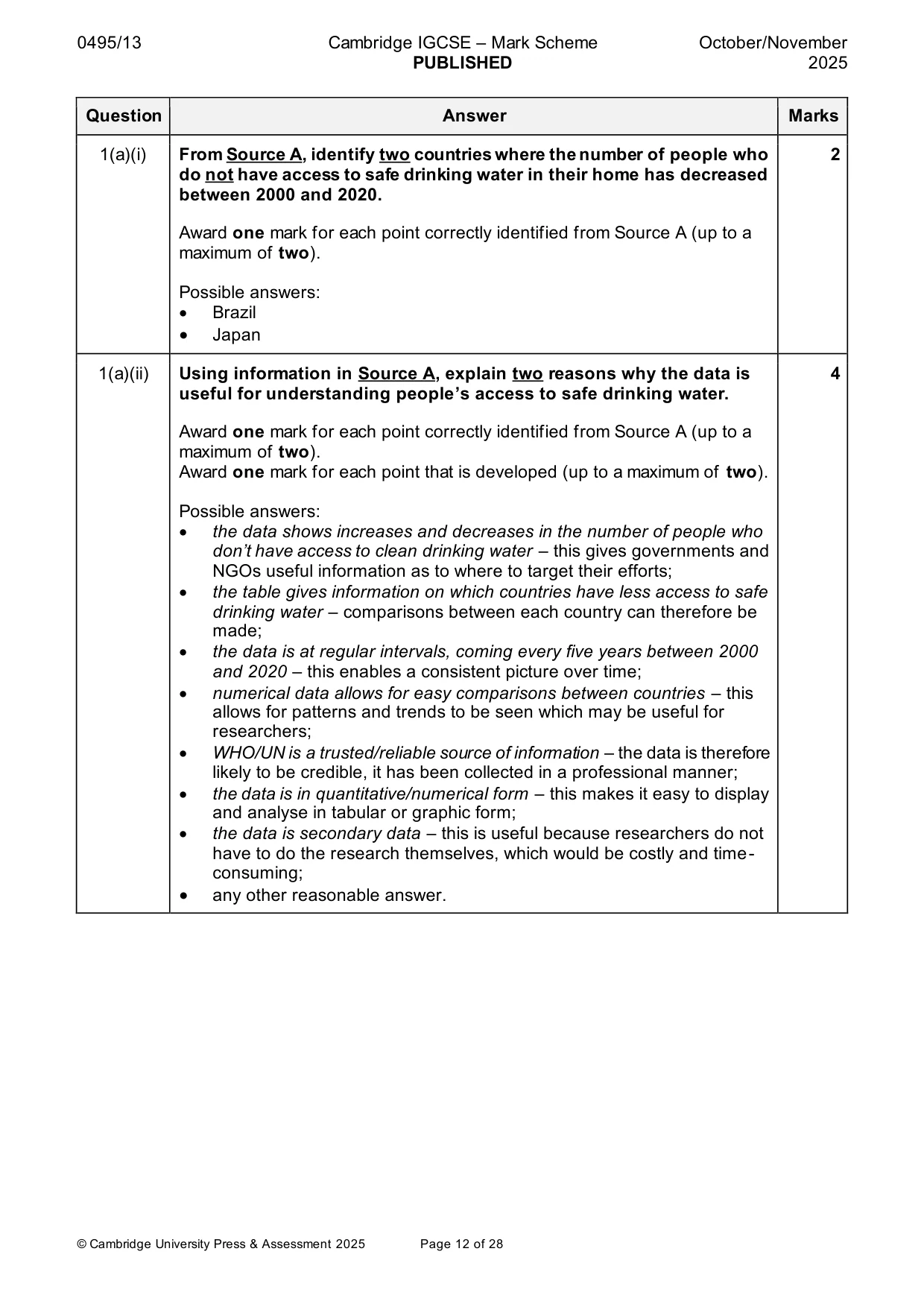
0495/13 Cambridge IGCSE – Mark Scheme PUBLISHED October/November 2025 © Cambridge University Press & Assessment 2025 Page 12 of 28 Question Answer Marks 1(a)(i) From Source A, identify two countries where the number of people who do not have access to safe drinking water in their home has decreased between 2000 and 2020. Award one mark for each point correctly identified from Source A (up to a maximum of two). Possible answers: • Brazil • Japan 2 1(a)(ii) Using information in Source A, explain two reasons why the data is useful for understanding people’s access to safe drinking water. Award one mark for each point correctly identified from Source A (up to a maximum of two). Award one mark for each point that is developed (up to a maximum of two). Possible answers: • the data shows increases and decreases in the number of people who don’t have access to clean drinking water – this gives governments and NGOs useful information as to where to target their efforts; • the table gives information on which countries have less access to safe drinking water – comparisons between each country can therefore be made; • the data is at regular intervals, coming every five years between 2000 and 2020 – this enables a consistent picture over time; • numerical data allows for easy comparisons between countries – this allows for patterns and trends to be seen which may be useful for researchers; • WHO/UN is a trusted/reliable source of information – the data is therefore likely to be credible, it has been collected in a professional manner; • the data is in quantitative/numerical form – this makes it easy to display and analyse in tabular or graphic form; • the data is secondary data – this is useful because researchers do not have to do the research themselves, which would be costly and time- consuming; • any other reasonable answer. 4
Mark scheme, page 13
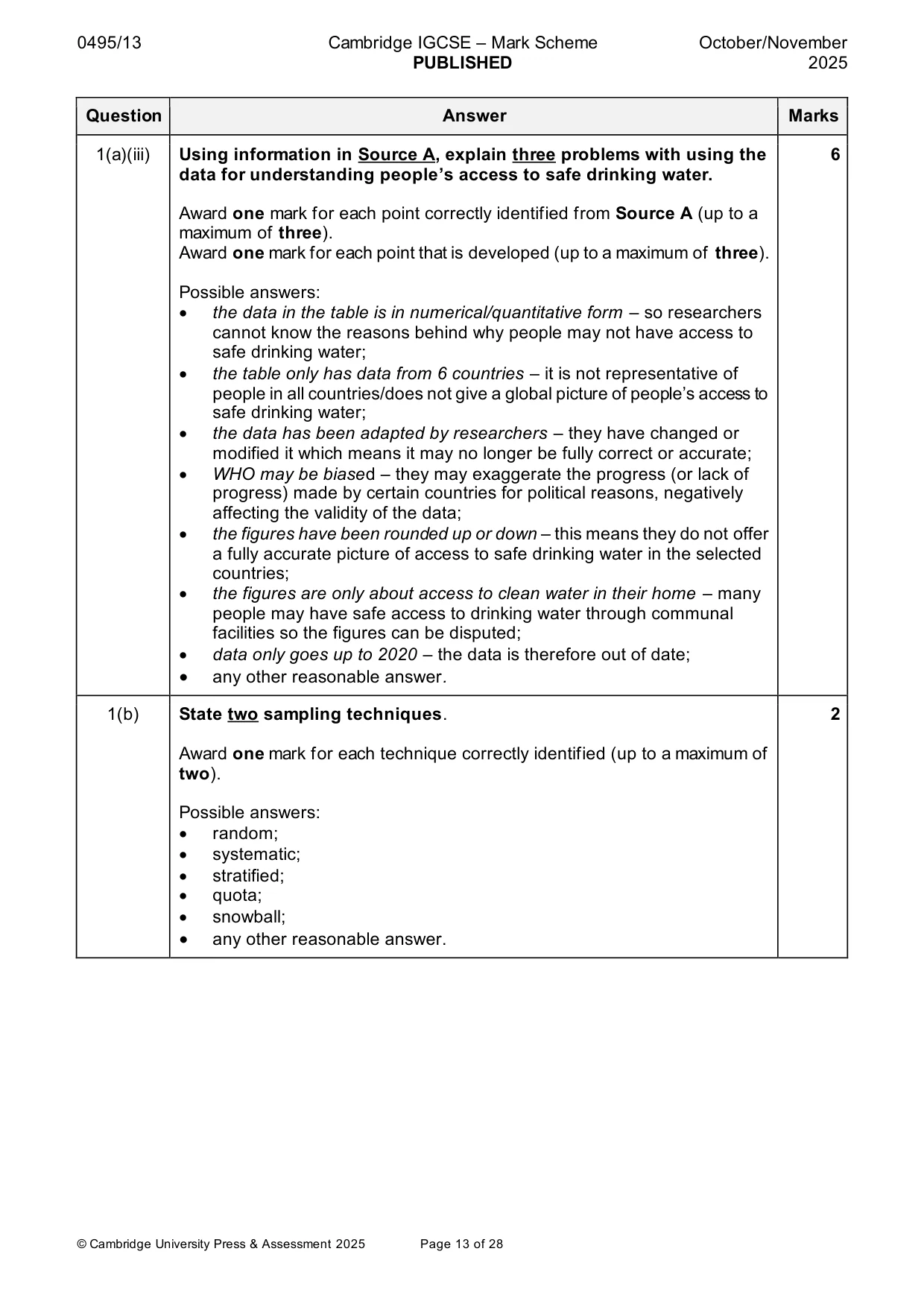
0495/13 Cambridge IGCSE – Mark Scheme PUBLISHED October/November 2025 © Cambridge University Press & Assessment 2025 Page 13 of 28 Question Answer Marks 1(a)(iii) Using information in Source A, explain three problems with using the data for understanding people’s access to safe drinking water. Award one mark for each point correctly identified from Source A (up to a maximum of three). Award one mark for each point that is developed (up to a maximum of three). Possible answers: • the data in the table is in numerical/quantitative form – so researchers cannot know the reasons behind why people may not have access to safe drinking water; • the table only has data from 6 countries – it is not representative of people in all countries/does not give a global picture of people’s access to safe drinking water; • the data has been adapted by researchers – they have changed or modified it which means it may no longer be fully correct or accurate; • WHO may be biased – they may exaggerate the progress (or lack of progress) made by certain countries for political reasons, negatively affecting the validity of the data; • the figures have been rounded up or down – this means they do not offer a fully accurate picture of access to safe drinking water in the selected countries; • the figures are only about access to clean water in their home – many people may have safe access to drinking water through communal facilities so the figures can be disputed; • data only goes up to 2020 – the data is therefore out of date; • any other reasonable answer. 6 1(b) State two sampling techniques. Award one mark for each technique correctly identified (up to a maximum of two). Possible answers: • random; • systematic; • stratified; • quota; • snowball; • any other reasonable answer. 2
Mark scheme, page 14
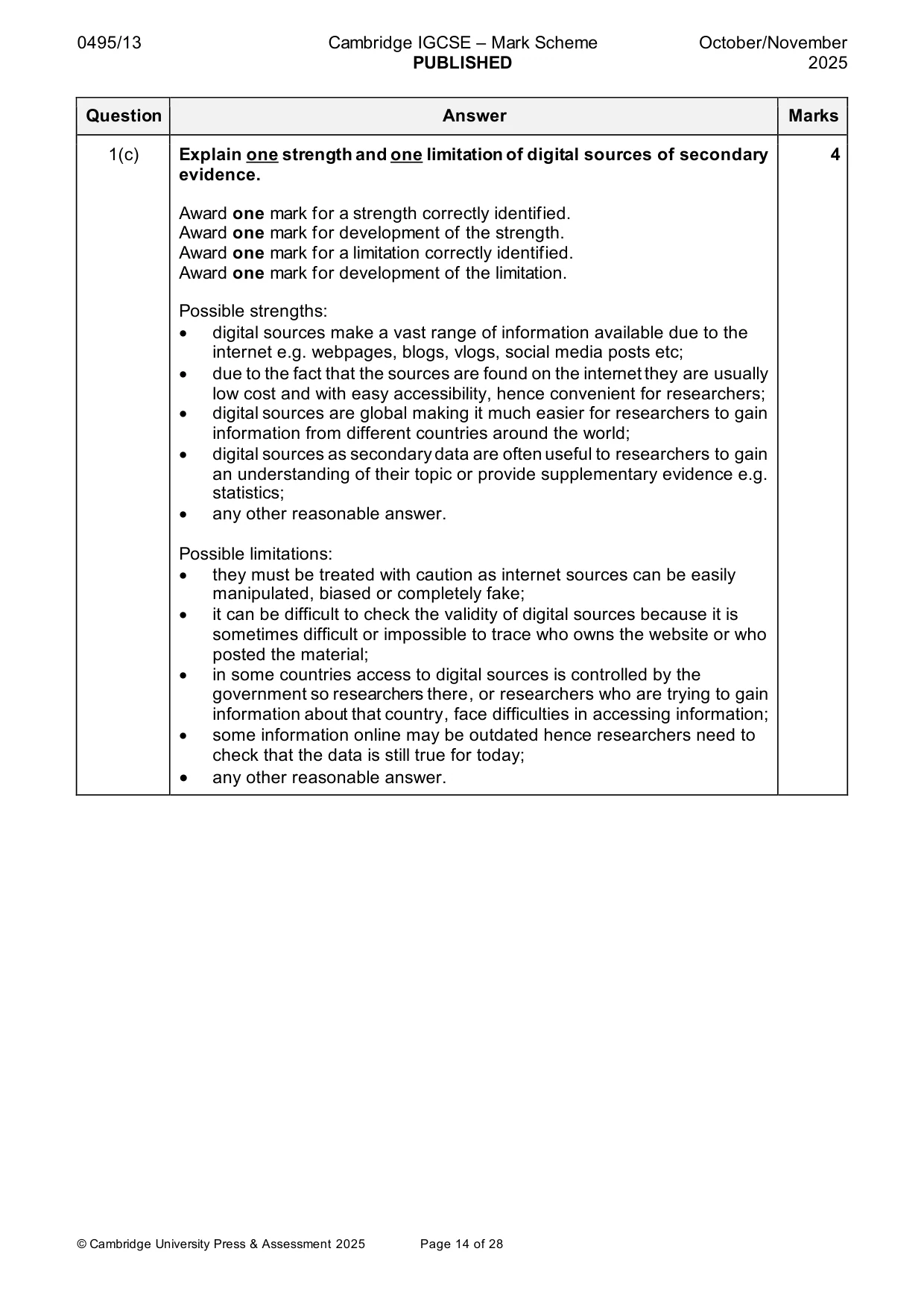
0495/13 Cambridge IGCSE – Mark Scheme PUBLISHED October/November 2025 © Cambridge University Press & Assessment 2025 Page 14 of 28 Question Answer Marks 1(c) Explain one strength and one limitation of digital sources of secondary evidence. Award one mark for a strength correctly identified. Award one mark for development of the strength. Award one mark for a limitation correctly identified. Award one mark for development of the limitation. Possible strengths: • digital sources make a vast range of information available due to the internet e.g. webpages, blogs, vlogs, social media posts etc; • due to the fact that the sources are found on the internet they are usually low cost and with easy accessibility, hence convenient for researchers; • digital sources are global making it much easier for researchers to gain information from different countries around the world; • digital sources as secondary data are often useful to researchers to gain an understanding of their topic or provide supplementary evidence e.g. statistics; • any other reasonable answer. Possible limitations: • they must be treated with caution as internet sources can be easily manipulated, biased or completely fake; • it can be difficult to check the validity of digital sources because it is sometimes difficult or impossible to trace who owns the website or who posted the material; • in some countries access to digital sources is controlled by the government so researchers there, or researchers who are trying to gain information about that country, face difficulties in accessing information; • some information online may be outdated hence researchers need to check that the data is still true for today; • any other reasonable answer. 4
Mark scheme, page 15
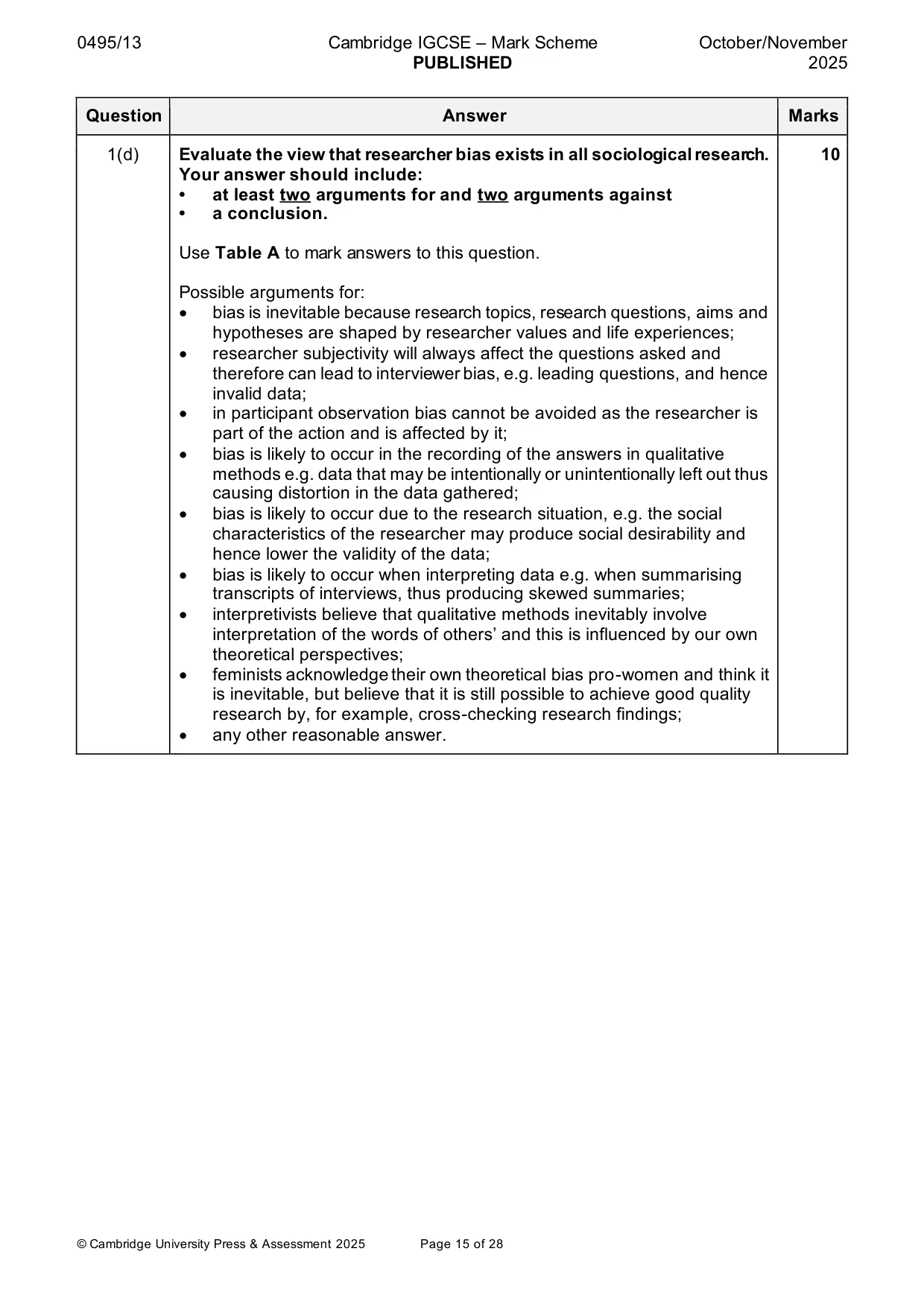
0495/13 Cambridge IGCSE – Mark Scheme PUBLISHED October/November 2025 © Cambridge University Press & Assessment 2025 Page 15 of 28 Question Answer Marks 1(d) Evaluate the view that researcher bias exists in all sociological research. Your answer should include: • at least two arguments for and two arguments against • a conclusion. Use Table A to mark answers to this question. Possible arguments for: • bias is inevitable because research topics, research questions, aims and hypotheses are shaped by researcher values and life experiences; • researcher subjectivity will always affect the questions asked and therefore can lead to interviewer bias, e.g. leading questions, and hence invalid data; • in participant observation bias cannot be avoided as the researcher is part of the action and is affected by it; • bias is likely to occur in the recording of the answers in qualitative methods e.g. data that may be intentionally or unintentionally left out thus causing distortion in the data gathered; • bias is likely to occur due to the research situation, e.g. the social characteristics of the researcher may produce social desirability and hence lower the validity of the data; • bias is likely to occur when interpreting data e.g. when summarising transcripts of interviews, thus producing skewed summaries; • interpretivists believe that qualitative methods inevitably involve interpretation of the words of others’ and this is influenced by our own theoretical perspectives; • feminists acknowledge their own theoretical bias pro-women and think it is inevitable, but believe that it is still possible to achieve good quality research by, for example, cross-checking research findings; • any other reasonable answer. 10
Mark scheme, page 16
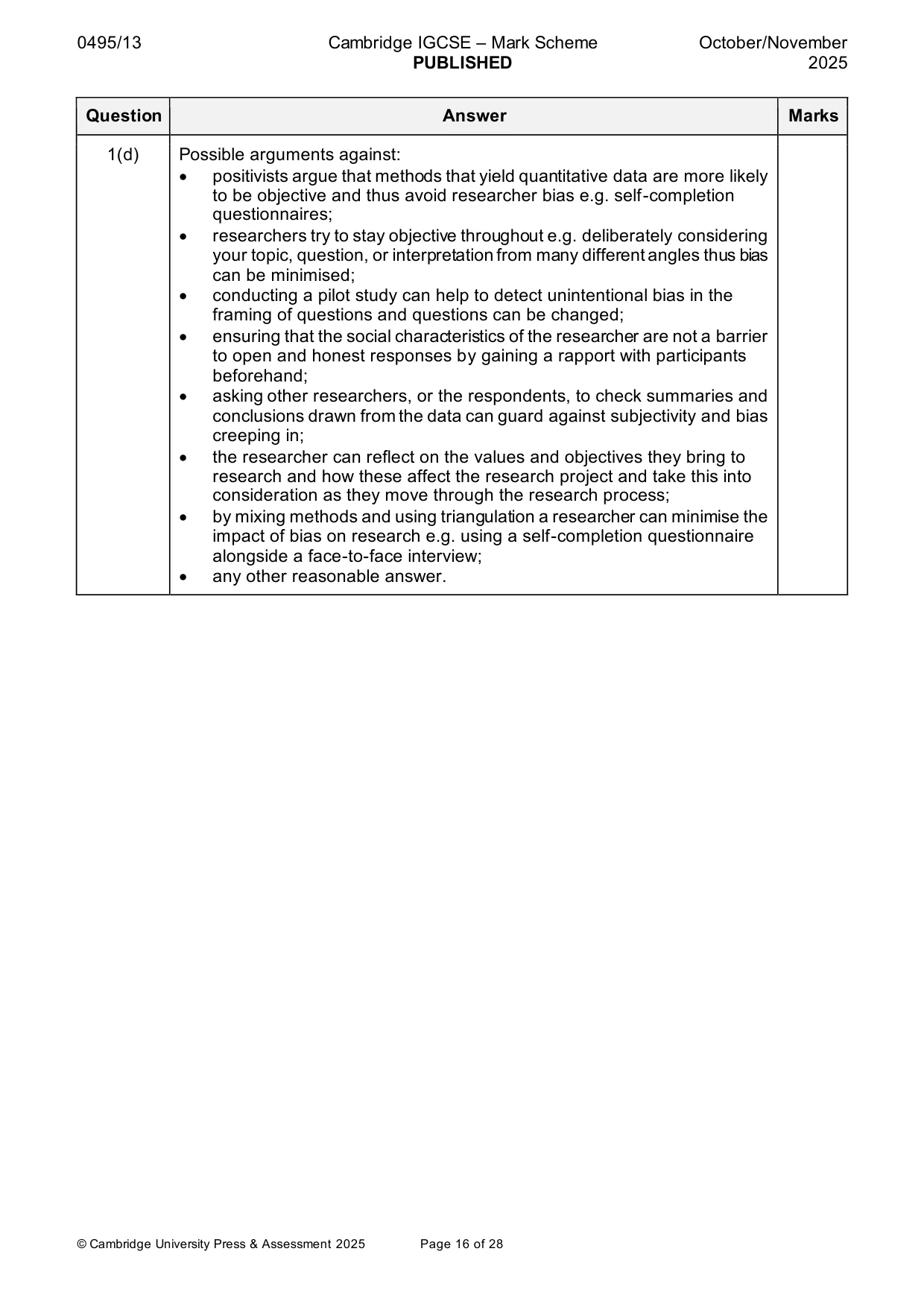
0495/13 Cambridge IGCSE – Mark Scheme PUBLISHED October/November 2025 © Cambridge University Press & Assessment 2025 Page 16 of 28 Question Answer Marks 1(d) Possible arguments against: • positivists argue that methods that yield quantitative data are more likely to be objective and thus avoid researcher bias e.g. self-completion questionnaires; • researchers try to stay objective throughout e.g. deliberately considering your topic, question, or interpretation from many different angles thus bias can be minimised; • conducting a pilot study can help to detect unintentional bias in the framing of questions and questions can be changed; • ensuring that the social characteristics of the researcher are not a barrier to open and honest responses by gaining a rapport with participants beforehand; • asking other researchers, or the respondents, to check summaries and conclusions drawn from the data can guard against subjectivity and bias creeping in; • the researcher can reflect on the values and objectives they bring to research and how these affect the research project and take this into consideration as they move through the research process; • by mixing methods and using triangulation a researcher can minimise the impact of bias on research e.g. using a self-completion questionnaire alongside a face-to-face interview; • any other reasonable answer.
Mark scheme, page 17
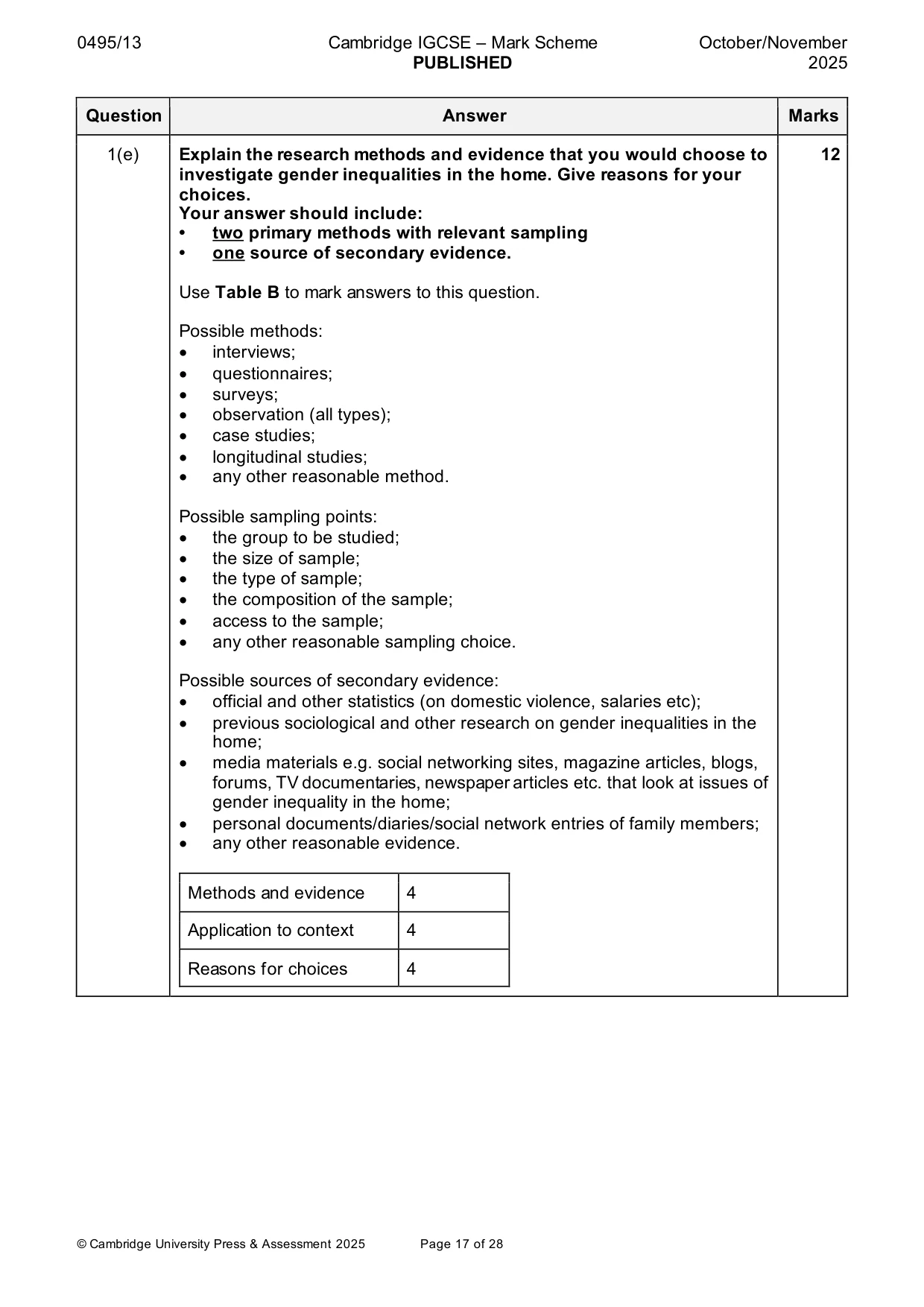
0495/13 Cambridge IGCSE – Mark Scheme PUBLISHED October/November 2025 © Cambridge University Press & Assessment 2025 Page 17 of 28 Question Answer Marks 1(e) Explain the research methods and evidence that you would choose to investigate gender inequalities in the home. Give reasons for your choices. Your answer should include: • two primary methods with relevant sampling • one source of secondary evidence. Use Table B to mark answers to this question. Possible methods: • interviews; • questionnaires; • surveys; • observation (all types); • case studies; • longitudinal studies; • any other reasonable method. Possible sampling points: • the group to be studied; • the size of sample; • the type of sample; • the composition of the sample; • access to the sample; • any other reasonable sampling choice. Possible sources of secondary evidence: • official and other statistics (on domestic violence, salaries etc); • previous sociological and other research on gender inequalities in the home; • media materials e.g. social networking sites, magazine articles, blogs, forums, TV documentaries, newspaper articles etc. that look at issues of gender inequality in the home; • personal documents/diaries/social network entries of family members; • any other reasonable evidence. Methods and evidence 4 Application to context 4 Reasons for choices 4 12
Mark scheme, page 18
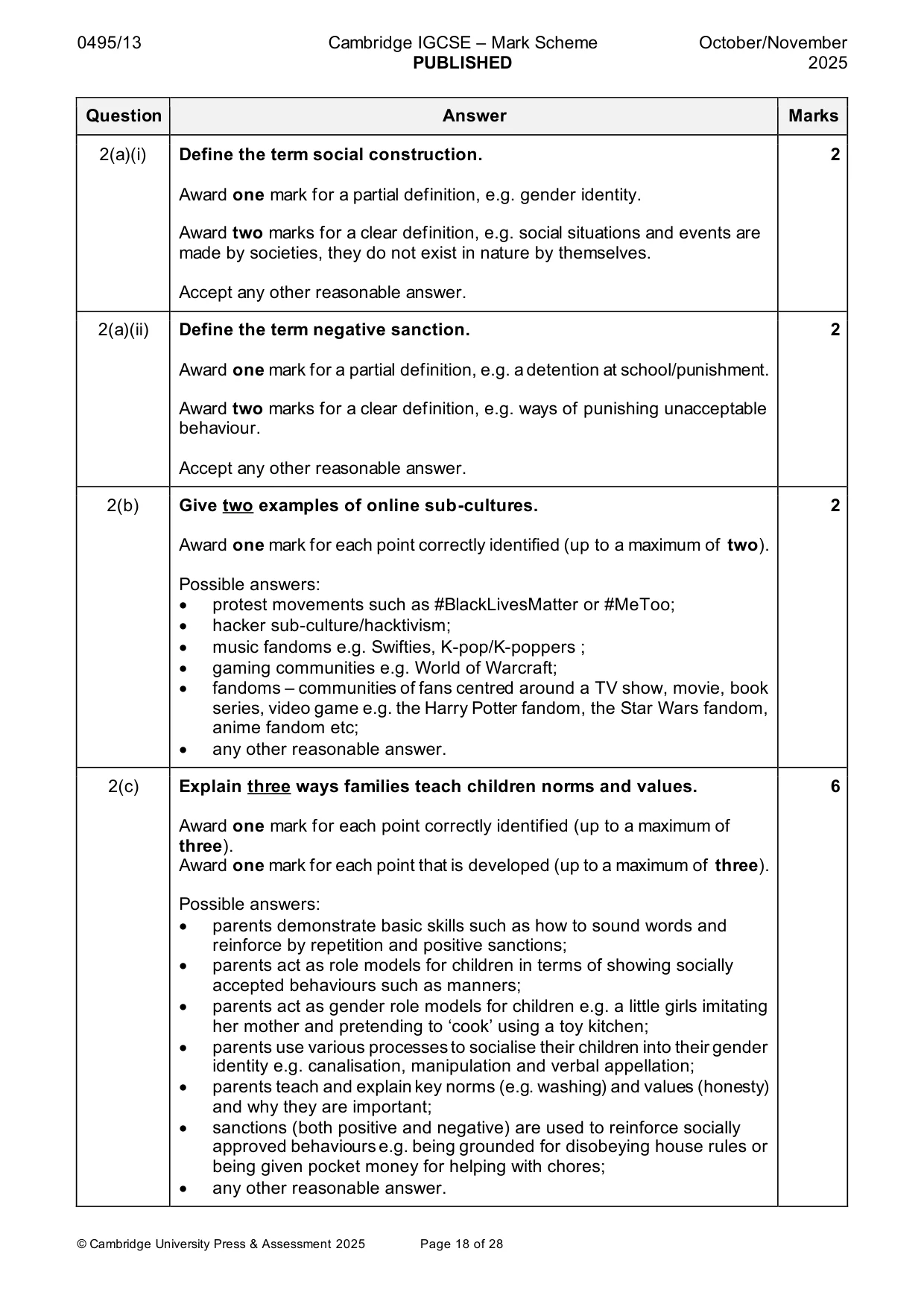
0495/13 Cambridge IGCSE – Mark Scheme PUBLISHED October/November 2025 © Cambridge University Press & Assessment 2025 Page 18 of 28 Question Answer Marks 2(a)(i) Define the term social construction. Award one mark for a partial definition, e.g. gender identity. Award two marks for a clear definition, e.g. social situations and events are made by societies, they do not exist in nature by themselves. Accept any other reasonable answer. 2 2(a)(ii) Define the term negative sanction. Award one mark for a partial definition, e.g. a detention at school/punishment. Award two marks for a clear definition, e.g. ways of punishing unacceptable behaviour. Accept any other reasonable answer. 2 2(b) Give two examples of online sub-cultures. Award one mark for each point correctly identified (up to a maximum of two). Possible answers: • protest movements such as #BlackLivesMatter or #MeToo; • hacker sub-culture/hacktivism; • music fandoms e.g. Swifties, K-pop/K-poppers ; • gaming communities e.g. World of Warcraft; • fandoms – communities of fans centred around a TV show, movie, book series, video game e.g. the Harry Potter fandom, the Star Wars fandom, anime fandom etc; • any other reasonable answer. 2 2(c) Explain three ways families teach children norms and values. Award one mark for each point correctly identified (up to a maximum of three). Award one mark for each point that is developed (up to a maximum of three). Possible answers: • parents demonstrate basic skills such as how to sound words and reinforce by repetition and positive sanctions; • parents act as role models for children in terms of showing socially accepted behaviours such as manners; • parents act as gender role models for children e.g. a little girls imitating her mother and pretending to ‘cook’ using a toy kitchen; • parents use various processes to socialise their children into their gender identity e.g. canalisation, manipulation and verbal appellation; • parents teach and explain key norms (e.g. washing) and values (honesty) and why they are important; • sanctions (both positive and negative) are used to reinforce socially approved behaviours e.g. being grounded for disobeying house rules or being given pocket money for helping with chores; • any other reasonable answer. 6
Mark scheme, page 19
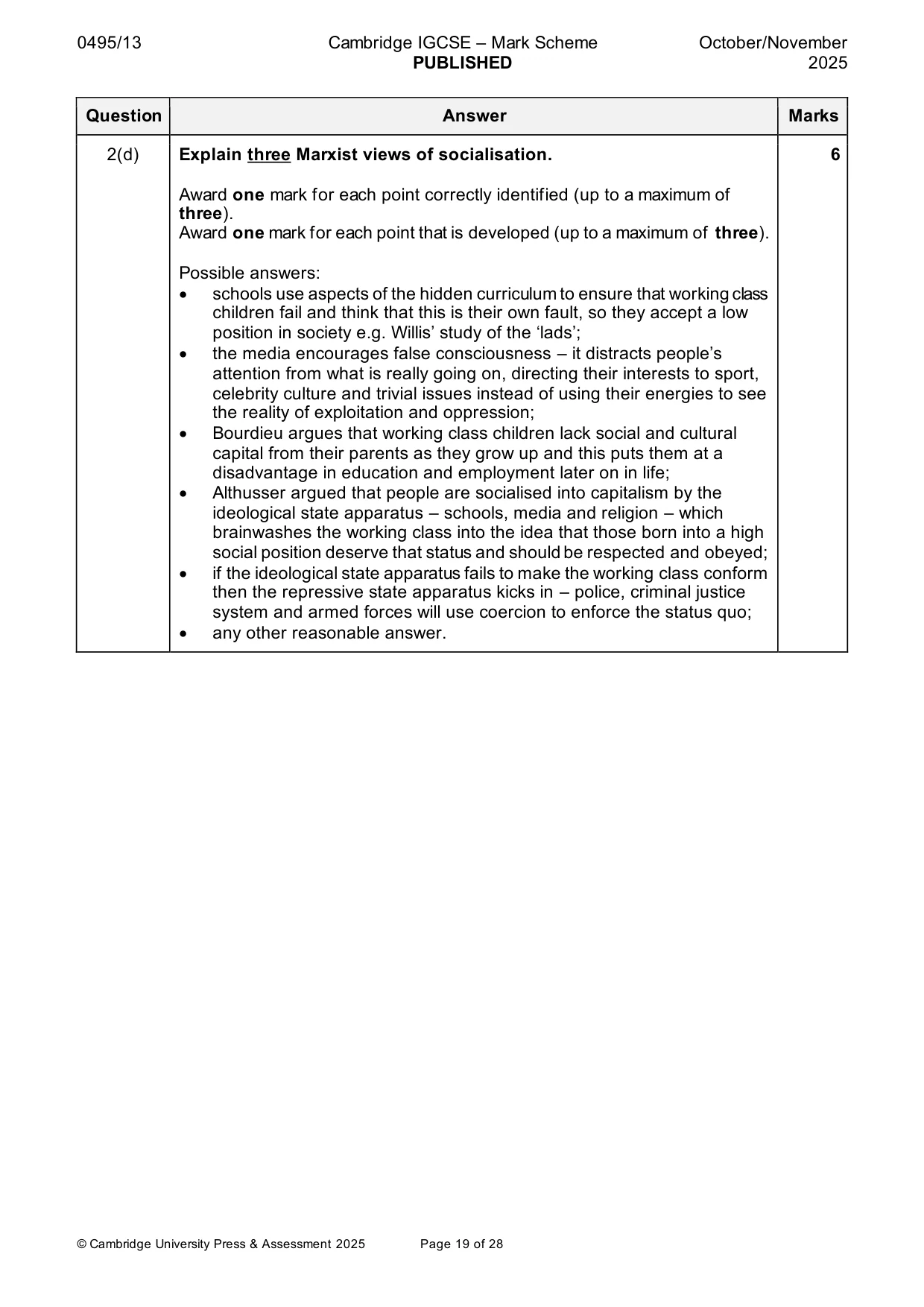
0495/13 Cambridge IGCSE – Mark Scheme PUBLISHED October/November 2025 © Cambridge University Press & Assessment 2025 Page 19 of 28 Question Answer Marks 2(d) Explain three Marxist views of socialisation. Award one mark for each point correctly identified (up to a maximum of three). Award one mark for each point that is developed (up to a maximum of three). Possible answers: • schools use aspects of the hidden curriculum to ensure that working class children fail and think that this is their own fault, so they accept a low position in society e.g. Willis’ study of the ‘lads’; • the media encourages false consciousness – it distracts people’s attention from what is really going on, directing their interests to sport, celebrity culture and trivial issues instead of using their energies to see the reality of exploitation and oppression; • Bourdieu argues that working class children lack social and cultural capital from their parents as they grow up and this puts them at a disadvantage in education and employment later on in life; • Althusser argued that people are socialised into capitalism by the ideological state apparatus – schools, media and religion – which brainwashes the working class into the idea that those born into a high social position deserve that status and should be respected and obeyed; • if the ideological state apparatus fails to make the working class conform then the repressive state apparatus kicks in – police, criminal justice system and armed forces will use coercion to enforce the status quo; • any other reasonable answer. 6
Mark scheme, page 20
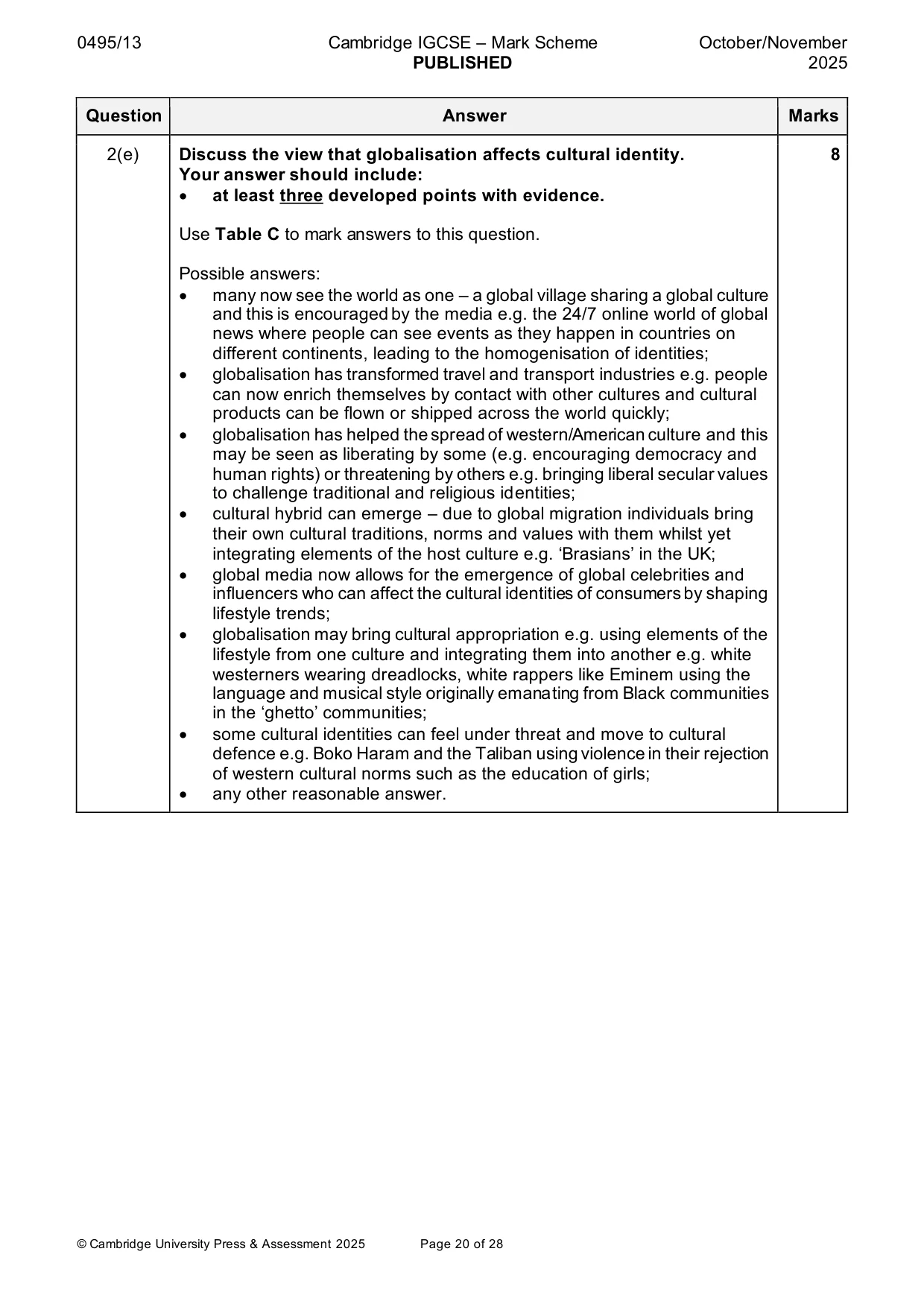
0495/13 Cambridge IGCSE – Mark Scheme PUBLISHED October/November 2025 © Cambridge University Press & Assessment 2025 Page 20 of 28 Question Answer Marks 2(e) Discuss the view that globalisation affects cultural identity. Your answer should include: • at least three developed points with evidence. Use Table C to mark answers to this question. Possible answers: • many now see the world as one – a global village sharing a global culture and this is encouraged by the media e.g. the 24/7 online world of global news where people can see events as they happen in countries on different continents, leading to the homogenisation of identities; • globalisation has transformed travel and transport industries e.g. people can now enrich themselves by contact with other cultures and cultural products can be flown or shipped across the world quickly; • globalisation has helped the spread of western/American culture and this may be seen as liberating by some (e.g. encouraging democracy and human rights) or threatening by others e.g. bringing liberal secular values to challenge traditional and religious identities; • cultural hybrid can emerge – due to global migration individuals bring their own cultural traditions, norms and values with them whilst yet integrating elements of the host culture e.g. ‘Brasians’ in the UK; • global media now allows for the emergence of global celebrities and influencers who can affect the cultural identities of consumers by shaping lifestyle trends; • globalisation may bring cultural appropriation e.g. using elements of the lifestyle from one culture and integrating them into another e.g. white westerners wearing dreadlocks, white rappers like Eminem using the language and musical style originally emanating from Black communities in the ‘ghetto’ communities; • some cultural identities can feel under threat and move to cultural defence e.g. Boko Haram and the Taliban using violence in their rejection of western cultural norms such as the education of girls; • any other reasonable answer. 8
Mark scheme, page 21
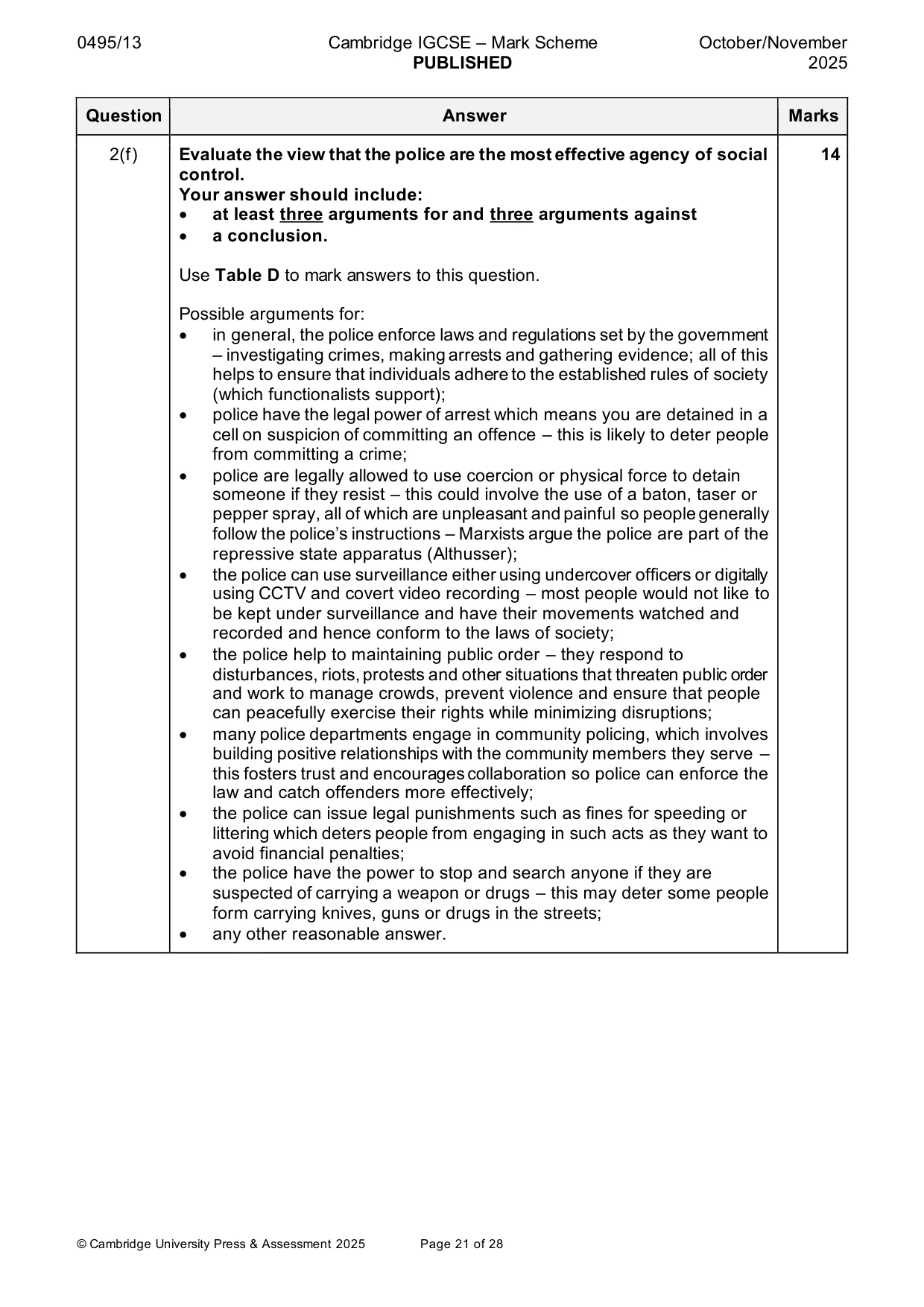
0495/13 Cambridge IGCSE – Mark Scheme PUBLISHED October/November 2025 © Cambridge University Press & Assessment 2025 Page 21 of 28 Question Answer Marks 2(f) Evaluate the view that the police are the most effective agency of social control. Your answer should include: • at least three arguments for and three arguments against • a conclusion. Use Table D to mark answers to this question. Possible arguments for: • in general, the police enforce laws and regulations set by the government – investigating crimes, making arrests and gathering evidence; all of this helps to ensure that individuals adhere to the established rules of society (which functionalists support); • police have the legal power of arrest which means you are detained in a cell on suspicion of committing an offence – this is likely to deter people from committing a crime; • police are legally allowed to use coercion or physical force to detain someone if they resist – this could involve the use of a baton, taser or pepper spray, all of which are unpleasant and painful so people generally follow the police’s instructions – Marxists argue the police are part of the repressive state apparatus (Althusser); • the police can use surveillance either using undercover officers or digitally using CCTV and covert video recording – most people would not like to be kept under surveillance and have their movements watched and recorded and hence conform to the laws of society; • the police help to maintaining public order – they respond to disturbances, riots, protests and other situations that threaten public order and work to manage crowds, prevent violence and ensure that people can peacefully exercise their rights while minimizing disruptions; • many police departments engage in community policing, which involves building positive relationships with the community members they serve – this fosters trust and encourages collaboration so police can enforce the law and catch offenders more effectively; • the police can issue legal punishments such as fines for speeding or littering which deters people from engaging in such acts as they want to avoid financial penalties; • the police have the power to stop and search anyone if they are suspected of carrying a weapon or drugs – this may deter some people form carrying knives, guns or drugs in the streets; • any other reasonable answer. 14
Mark scheme, page 22
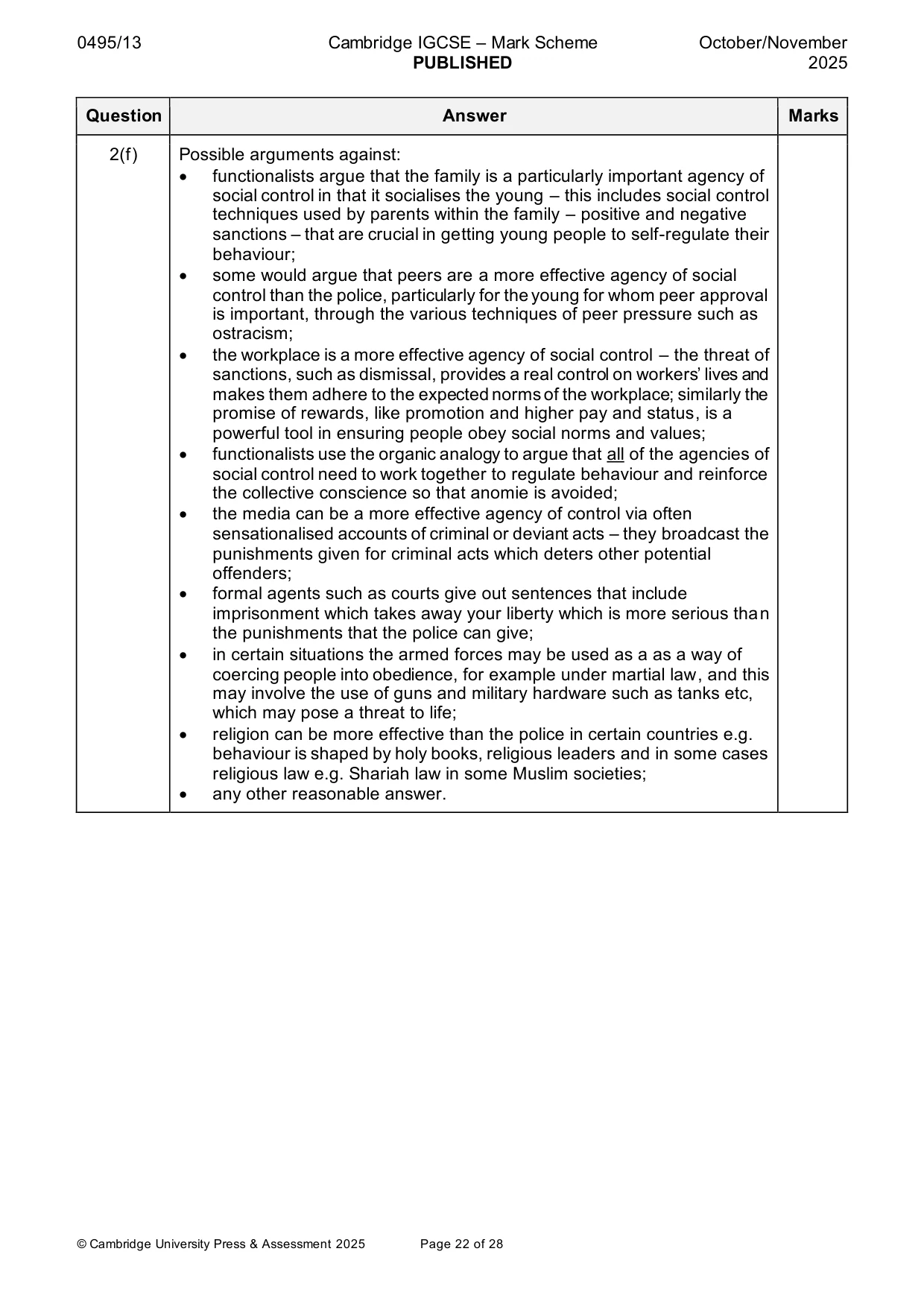
0495/13 Cambridge IGCSE – Mark Scheme PUBLISHED October/November 2025 © Cambridge University Press & Assessment 2025 Page 22 of 28 Question Answer Marks 2(f) Possible arguments against: • functionalists argue that the family is a particularly important agency of social control in that it socialises the young – this includes social control techniques used by parents within the family – positive and negative sanctions – that are crucial in getting young people to self-regulate their behaviour; • some would argue that peers are a more effective agency of social control than the police, particularly for the young for whom peer approval is important, through the various techniques of peer pressure such as ostracism; • the workplace is a more effective agency of social control – the threat of sanctions, such as dismissal, provides a real control on workers’ lives and makes them adhere to the expected norms of the workplace; similarly the promise of rewards, like promotion and higher pay and status, is a powerful tool in ensuring people obey social norms and values; • functionalists use the organic analogy to argue that all of the agencies of social control need to work together to regulate behaviour and reinforce the collective conscience so that anomie is avoided; • the media can be a more effective agency of control via often sensationalised accounts of criminal or deviant acts – they broadcast the punishments given for criminal acts which deters other potential offenders; • formal agents such as courts give out sentences that include imprisonment which takes away your liberty which is more serious than the punishments that the police can give; • in certain situations the armed forces may be used as a as a way of coercing people into obedience, for example under martial law, and this may involve the use of guns and military hardware such as tanks etc, which may pose a threat to life; • religion can be more effective than the police in certain countries e.g. behaviour is shaped by holy books, religious leaders and in some cases religious law e.g. Shariah law in some Muslim societies; • any other reasonable answer.
Mark scheme, page 23
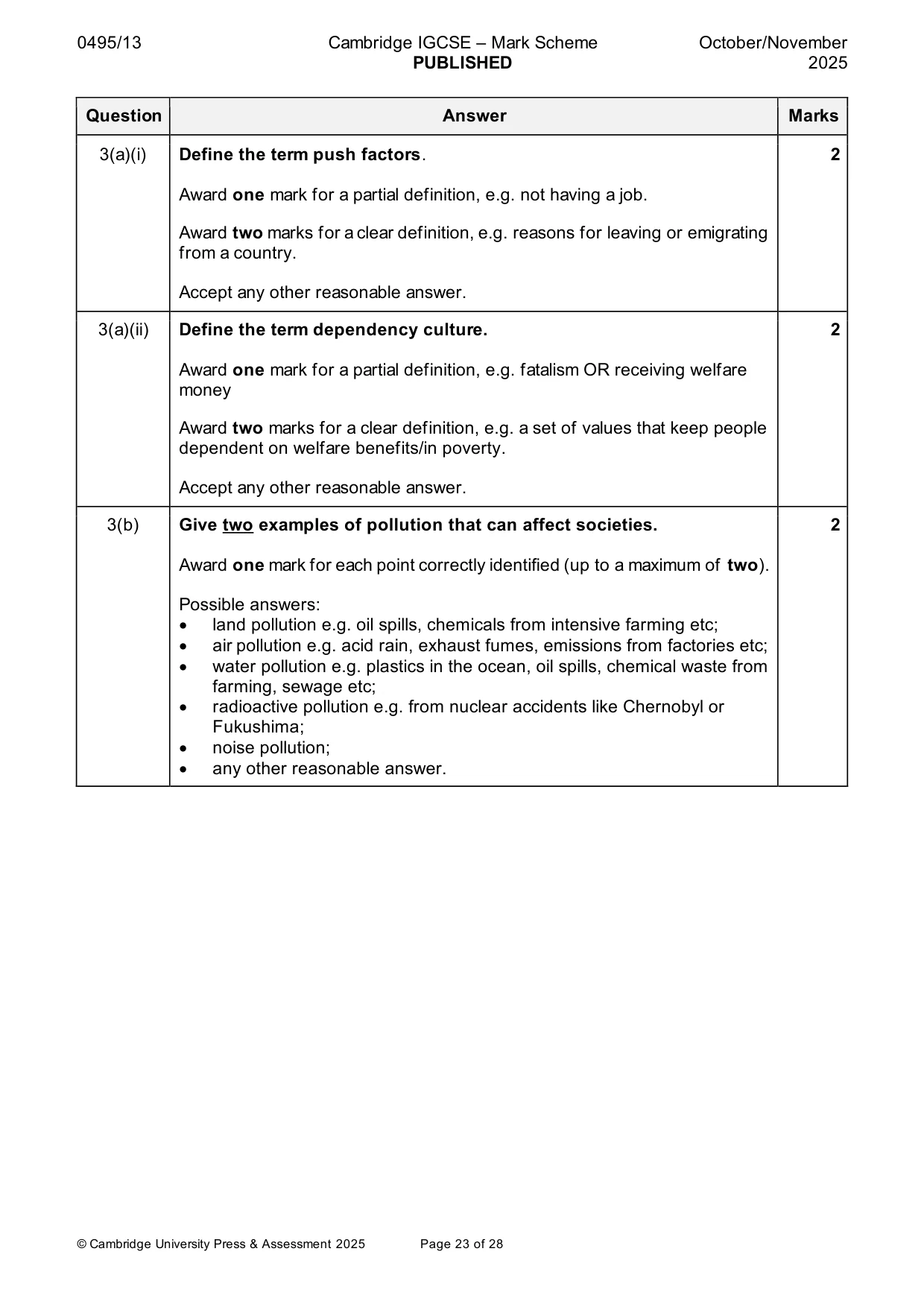
0495/13 Cambridge IGCSE – Mark Scheme PUBLISHED October/November 2025 © Cambridge University Press & Assessment 2025 Page 23 of 28 Question Answer Marks 3(a)(i) Define the term push factors. Award one mark for a partial definition, e.g. not having a job. Award two marks for a clear definition, e.g. reasons for leaving or emigrating from a country. Accept any other reasonable answer. 2 3(a)(ii) Define the term dependency culture. Award one mark for a partial definition, e.g. fatalism OR receiving welfare money Award two marks for a clear definition, e.g. a set of values that keep people dependent on welfare benefits/in poverty. Accept any other reasonable answer. 2 3(b) Give two examples of pollution that can affect societies. Award one mark for each point correctly identified (up to a maximum of two). Possible answers: • land pollution e.g. oil spills, chemicals from intensive farming etc; • air pollution e.g. acid rain, exhaust fumes, emissions from factories etc; • water pollution e.g. plastics in the ocean, oil spills, chemical waste from farming, sewage etc; • radioactive pollution e.g. from nuclear accidents like Chernobyl or Fukushima; • noise pollution; • any other reasonable answer. 2
Mark scheme, page 24
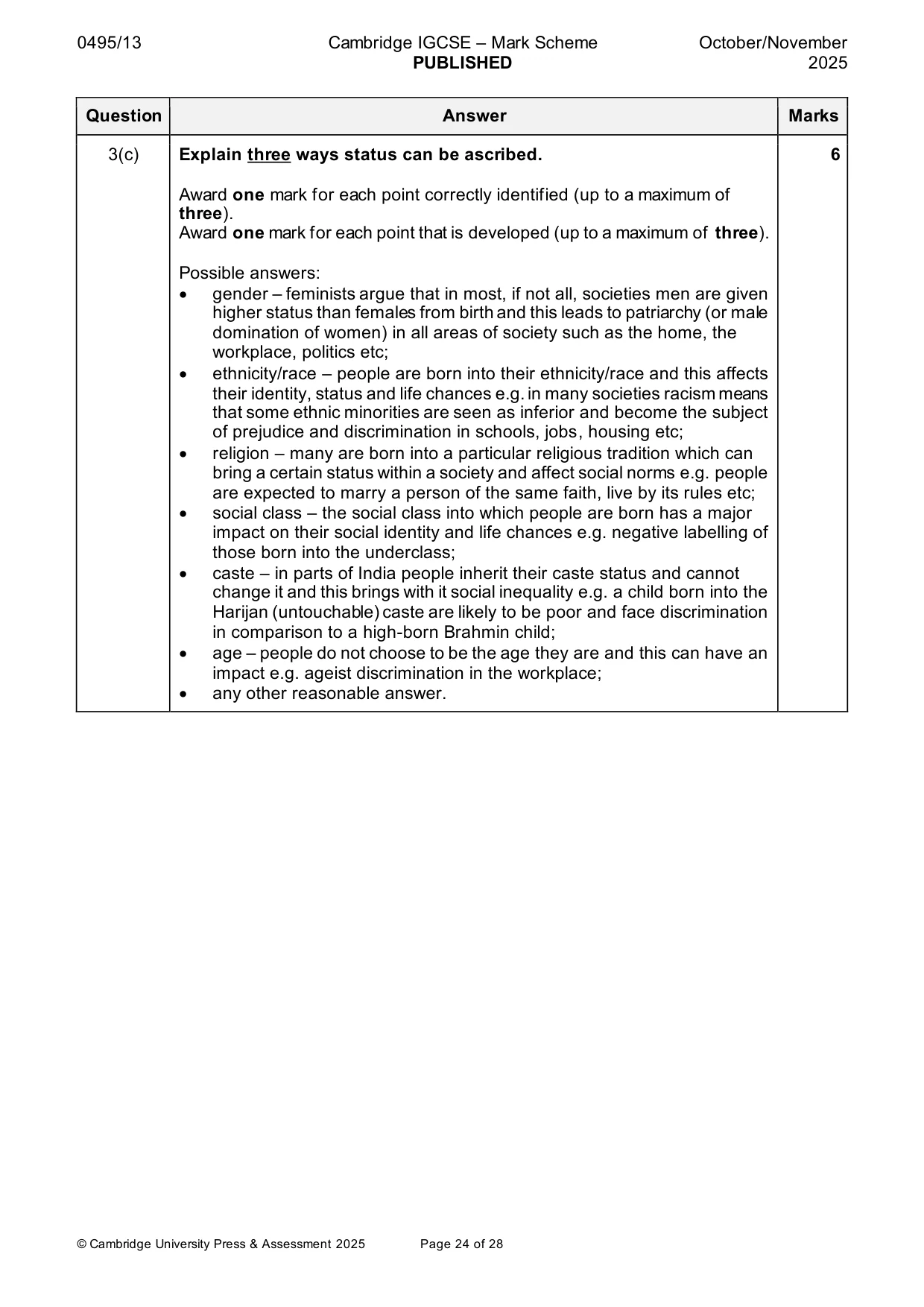
0495/13 Cambridge IGCSE – Mark Scheme PUBLISHED October/November 2025 © Cambridge University Press & Assessment 2025 Page 24 of 28 Question Answer Marks 3(c) Explain three ways status can be ascribed. Award one mark for each point correctly identified (up to a maximum of three). Award one mark for each point that is developed (up to a maximum of three). Possible answers: • gender – feminists argue that in most, if not all, societies men are given higher status than females from birth and this leads to patriarchy (or male domination of women) in all areas of society such as the home, the workplace, politics etc; • ethnicity/race – people are born into their ethnicity/race and this affects their identity, status and life chances e.g. in many societies racism means that some ethnic minorities are seen as inferior and become the subject of prejudice and discrimination in schools, jobs, housing etc; • religion – many are born into a particular religious tradition which can bring a certain status within a society and affect social norms e.g. people are expected to marry a person of the same faith, live by its rules etc; • social class – the social class into which people are born has a major impact on their social identity and life chances e.g. negative labelling of those born into the underclass; • caste – in parts of India people inherit their caste status and cannot change it and this brings with it social inequality e.g. a child born into the Harijan (untouchable) caste are likely to be poor and face discrimination in comparison to a high-born Brahmin child; • age – people do not choose to be the age they are and this can have an impact e.g. ageist discrimination in the workplace; • any other reasonable answer. 6
Mark scheme, page 25
0495/13 Cambridge IGCSE – Mark Scheme PUBLISHED October/November 2025 © Cambridge University Press & Assessment 2025 Page 25 of 28 Question Answer Marks 3(d) Explain three ways the welfare state can improve life chances. Award one mark for each point correctly identified (up to a maximum of three). Award one mark for each point that is developed (up to a maximum of three). Possible answers: • free universal education – this gives children the opportunity to gain more skills, qualifications and experience that will help them improve their employment prospects; • unemployment benefits – these payments are like a safety net, they can help people survive and support their family whilst they do not have a job and hence no income, keeping them from absolute poverty; • pensions – these payments to older people who reach the retirement age can be a crucial source of income for those who may be too old to work (or who have health issues linked to older age), keeping them from poverty; • low-cost housing – some governments provide housing at an affordable cost e.g. council housing in the UK which enables families to have decent quality homes to rent or even buy; • free healthcare – people who do not have much money may struggle to pay for medicines or to see a doctor and have hospital treatment so a system such as the NHS in the UK allows everyone to get a basic level of healthcare regardless of their social background; • universal basic income – this is where a government pays everyone a set amount of money, usually each month. The idea is that everyone will have a basic income and hence no one will be in poverty; • any other reasonable answer. 6
Mark scheme, page 26
0495/13 Cambridge IGCSE – Mark Scheme PUBLISHED October/November 2025 © Cambridge University Press & Assessment 2025 Page 26 of 28 Question Answer Marks 3(e) Discuss the view that individuals are advantaged by being upper class. Your answer should include: • at least three developed points with evidence. Use Table C to mark answers to this question. Possible answers: • wealth/income – the upper class have high levels of wealth and disposable income whereas the poor have none or very little spare after paying their living expenses; • education – upper class children are likely to go to private, fee-paying schools which have very good facilities and usually top exam results which then leads them to top universities such as Oxbridge and then top jobs in society; • education – upper class parents will pass on their cultural and social capital to their children which enables them to flourish in education e.g. they will speak in elaborate code, have knowledge of the arts and have connections with influential people who can help them into a good university; • employment – some members of the upper class will not need to work as they can live off their wealth, others are likely to be film or pop stars or run multi-billion dollar companies e.g. Mark Zuckerberg or Elon Musk who work because they want to not because they have to, unlike the ‘wage slaves’ in the working class; • health – the upper class can afford a healthy diet and also private healthcare enabling them access to prompt, top quality medicines and treatment, both of which may give them higher life expectancy than people in the working class; • housing – members of the upper class live in spacious, good quality homes usually with their own grounds unlike the poorest in society who may be homeless or live in insecure, overcrowded and low-grade accommodation which may bring health problems; • housing – the rich are likely to live in low crime areas with plenty of security e.g. alarms or private security in contrast to poor people who tend to live in high crime areas where they become victims of multiple crimes; • any other reasonable answer. 8
Mark scheme, page 27
0495/13 Cambridge IGCSE – Mark Scheme PUBLISHED October/November 2025 © Cambridge University Press & Assessment 2025 Page 27 of 28 Question Answer Marks 3(f) Evaluate the view that colonialism is the best explanation for global inequalities. Your answer should include: • at least three arguments for the view and three arguments against • a conclusion. Use Table D to mark answers to this question. Possible arguments for: • historically colonialism exploited the natural resources and labour force of the countries they invaded, destroying native civilisations and depriving inhabitants of full legal rights and this created the unequal basis from which such countries have not been fully able to recover; • colonial rulers wanted cash crops and disallowed indigenous people from growing their own crops, forcing them to sell for export and making them part of the capitalist economy where they were and continue to be often exploited; • even after independence many countries remained economically dependent on their former colonial rulers (e.g. having to sell cash crops to it); • often countries struggled in the aftermath of independence as many had little education and so lacked the knowledge or skills to create and maintain governments and the machinery of a self-governing state, leaving them vulnerable to coups, corruption etc; • colonialism is a form of racism and this continues to underpin the economic and socio-cultural relationships between Western former colonial powers and their former subordinate countries; • many former colonies were left with debt from loans taken out to finance colonial infrastructure projects – this debt has hindered the ability of post- colonial nations to invest in education, welfare initiatives or healthcare, perpetuating global inequalities; • any other reasonable answer. 14
Mark scheme, page 28
0495/13 Cambridge IGCSE – Mark Scheme PUBLISHED October/November 2025 © Cambridge University Press & Assessment 2025 Page 28 of 28 Question Answer Marks 3(f) Possible answers against: • climate change is a better explanation – global warming brings changing rainfall patterns affecting farmers in some poorer countries and makes natural disasters such as flooding more likely and more severe in some parts of the world with catastrophic consequences for some e.g. some small island societies in the Pacific and Indian oceans could disappear or large cities such as Kolkhata, Dhaka or Bangkok be flooded; • migration is a better explanation – the large-scale movement of people across countries can create social upheaval and economic problems in both the original and the destination country, making inequalities worse e.g. a ‘brain drain’ away from a country or an influx of refugees adding to already stretched social services; • feminists argue patriarchy is a better explanation – globally women still suffer many disadvantages compared to men in family life, health, education, the workplace and social and political rights and this goes beyond those affected by colonialism; • Marxists argue that global capitalism is a better explanation – TNCs in particular can cause ecological issues such as pollution which can negatively affect life chances in poorer countries and also economic inequalities as they often locate to countries where there is less legislation and they are able to exploit the workforce in terms of cheap labour; • some may argue that internal violence and conflicts (e.g. Syria) and also international wars between nations is a better explanation; • wars between nations is a better explanation – economic activity often grinds to a halt in countries at war and can disrupt supply chains across the world e.g. the Houthi attacks on merchant shipping in the Red Sea and the Russia-Ukraine conflict disrupting world grain supplies including to poorer countries who depend on it; • any other reasonable answer.
What you needed in this session
Cambridge’s own grade thresholds for 2025 Oct/Nov, Paper 1 · Variant 3. A higher threshold means an easier paper — the bar moves with how the cohort did.