Cambridge IGCSE Sociology 0495 — 2022 May/June Paper 1 · Variant 3
0495/13/M/J/22 · 80 marks · ≈90 min
The question paper and its mark scheme, free to read here and free to download. This is Cambridge’s own paper, exactly as it was sat.
Question paper4 pages

Mark scheme20 pages
Answers below. Sit the paper first if you are practising.

Paper as text
Question paper, page 1
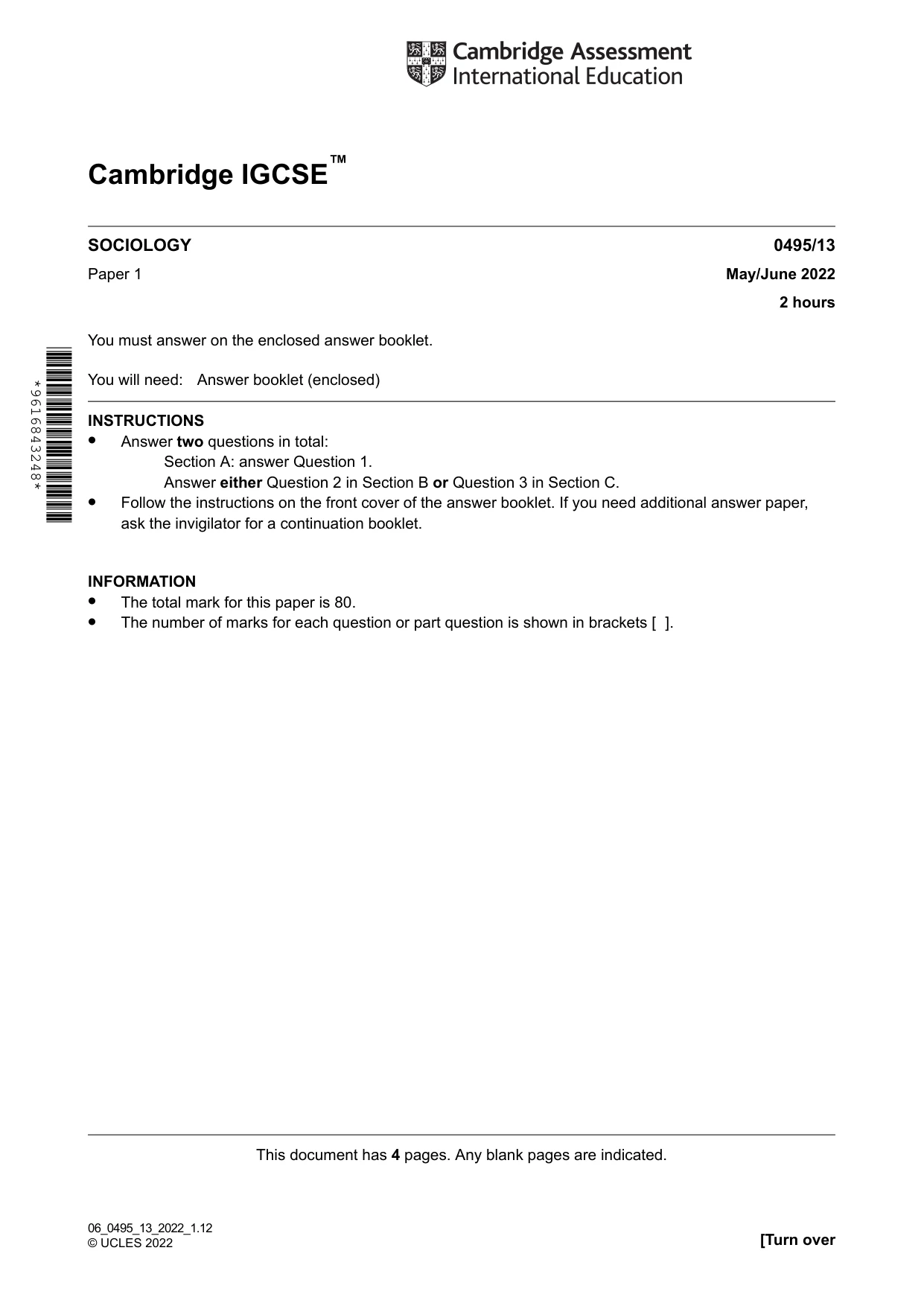
Cambridge IGCSE™ 0495/13 May/June 2022 2 hours SOCIOLOGY Paper 1 You must answer on the enclosed answer booklet. You will need: Answer booklet (enclosed) INSTRUCTIONS • Answer two questions in total: Section A: answer Question 1. Answer either Question 2 in Section B or Question 3 in Section C. • Follow the instructions on the front cover of the answer booklet. If you need additional answer paper, ask the invigilator for a continuation booklet. INFORMATION • The total mark for this paper is 80. • The number of marks for each question or part question is shown in brackets [ ]. This document has 4 pages. Any blank pages are indicated. [Turn over 06_0495_13_2022_1.12 © UCLES 2022 *9616843248*
Question paper, page 2
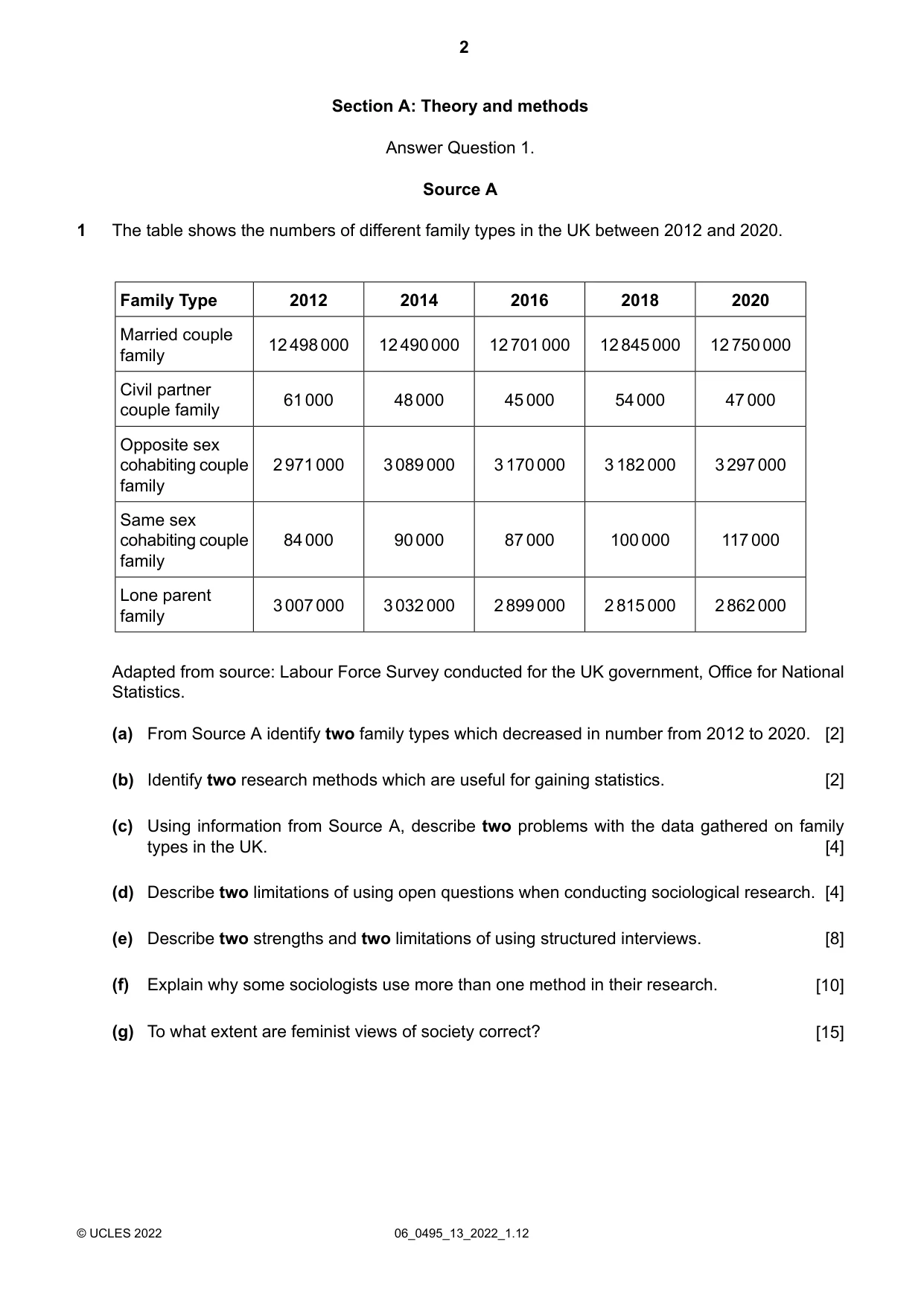
Section A: Theory and methods Answer Question 1. Source A The table shows the numbers of different family types in the UK between 2012 and 2020. 1 2020 2018 2016 2014 2012 Family Type 12750000 12845000 12701000 12490000 12498000 Married couple family 47000 54000 45000 48000 61000 Civil partner couple family 3297000 3182000 3170000 3089000 2971000 Opposite sex cohabiting couple family 117000 100000 87000 90000 84000 Same sex cohabiting couple family 2862000 2815000 2899000 3032000 3007000 Lone parent family Adapted from source: Labour Force Survey conducted for the UK government, Office for National Statistics. From Source A identify two family types which decreased in number from 2012 to 2020. [2] (a) Identify two research methods which are useful for gaining statistics. [2] (b) Using information from Source A, describe two problems with the data gathered on family types in the UK. [4] (c) Describe two limitations of using open questions when conducting sociological research. [4] (d) Describe two strengths and two limitations of using structured interviews. [8] (e) Explain why some sociologists use more than one method in their research. [10] (f) To what extent are feminist views of society correct? [15] (g) 06_0495_13_2022_1.12 © UCLES 2022 2
Question paper, page 3
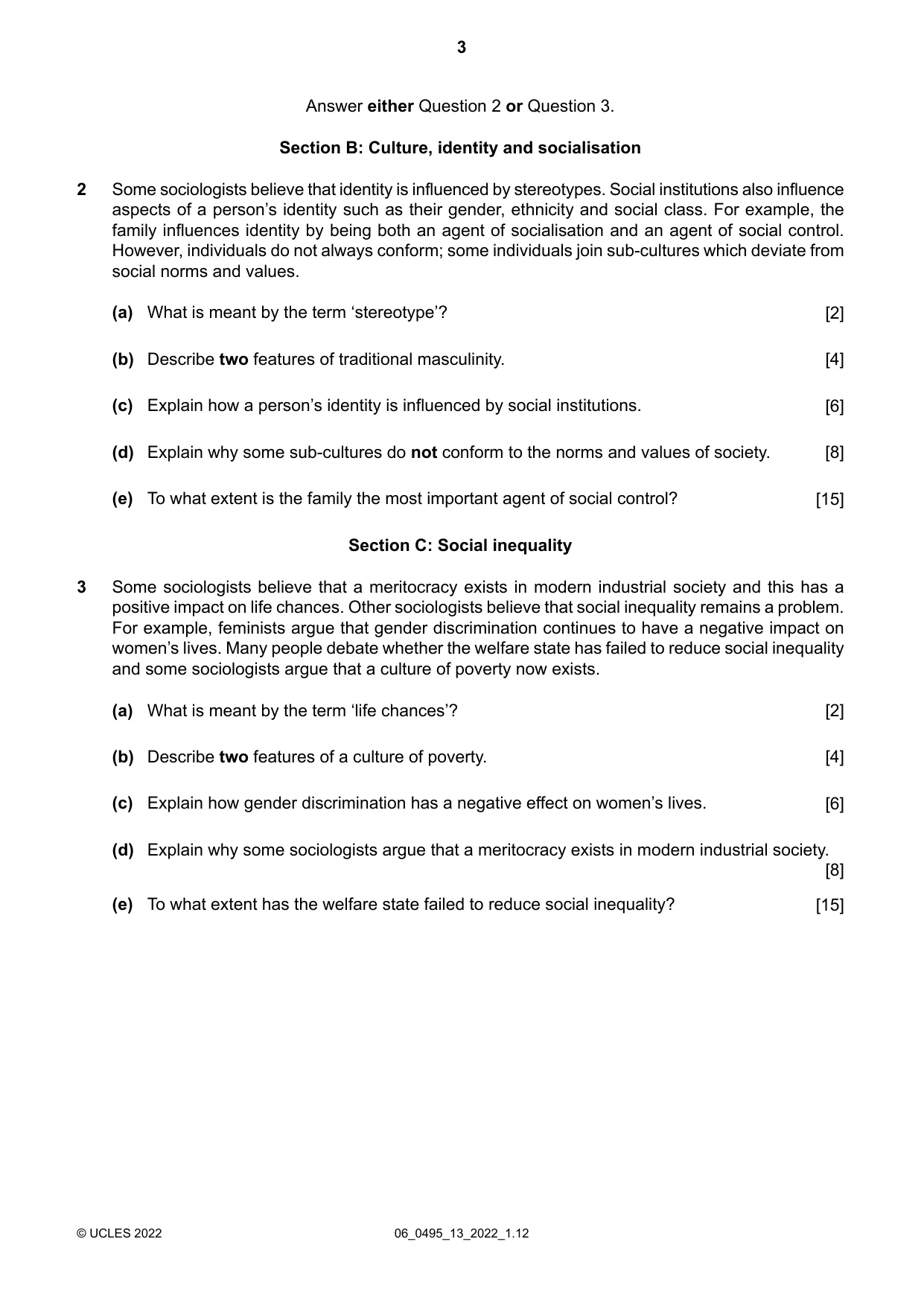
Answer either Question 2 or Question 3. Section B: Culture, identity and socialisation Some sociologists believe that identity is influenced by stereotypes. Social institutions also influence aspects of a person’s identity such as their gender, ethnicity and social class. For example, the 2 family influences identity by being both an agent of socialisation and an agent of social control. However, individuals do not always conform; some individuals join sub-cultures which deviate from social norms and values. What is meant by the term ‘stereotype’? [2] (a) Describe two features of traditional masculinity. [4] (b) Explain how a person’s identity is influenced by social institutions. [6] (c) Explain why some sub-cultures do not conform to the norms and values of society. [8] (d) To what extent is the family the most important agent of social control? [15] (e) Section C: Social inequality Some sociologists believe that a meritocracy exists in modern industrial society and this has a positive impact on life chances. Other sociologists believe that social inequality remains a problem. 3 For example, feminists argue that gender discrimination continues to have a negative impact on women’s lives. Many people debate whether the welfare state has failed to reduce social inequality and some sociologists argue that a culture of poverty now exists. What is meant by the term ‘life chances’? [2] (a) Describe two features of a culture of poverty. [4] (b) Explain how gender discrimination has a negative effect on women’s lives. [6] (c) Explain why some sociologists argue that a meritocracy exists in modern industrial society. [8] (d) To what extent has the welfare state failed to reduce social inequality? [15] (e) 06_0495_13_2022_1.12 © UCLES 2022 3
Question paper, page 4
BLANK PAGE Permission to reproduce items where third-party owned material protected by copyright is included has been sought and cleared where possible. Every reasonable effort has been made by the publisher (UCLES) to trace copyright holders, but if any items requiring clearance have unwittingly been included, the publisher will be pleased to make amends at the earliest possible opportunity. To avoid the issue of disclosure of answer-related information to candidates, all copyright acknowledgements are reproduced online in the Cambridge Assessment International Education Copyright Acknowledgements Booklet. This is produced for each series of examinations and is freely available to download at www.cambridgeinternational.org after the live examination series. Cambridge Assessment International Education is part of Cambridge Assessment. Cambridge Assessment is the brand name of the University of Cambridge Local Examinations Syndicate (UCLES), which is a department of the University of Cambridge. 06_0495_13_2022_1.12 © UCLES 2022 4
Mark scheme, page 1
This document consists of 20 printed pages. © UCLES 2022 [Turn over Cambridge IGCSE™ SOCIOLOGY 0495/13 Paper 1 Paper 1 May/June 2022 MARK SCHEME Maximum Mark: 80 Published This mark scheme is published as an aid to teachers and candidates, to indicate the requirements of the examination. It shows the basis on which Examiners were instructed to award marks. It does not indicate the details of the discussions that took place at an Examiners’ meeting before marking began, which would have considered the acceptability of alternative answers. Mark schemes should be read in conjunction with the question paper and the Principal Examiner Report for Teachers. Cambridge International will not enter into discussions about these mark schemes. Cambridge International is publishing the mark schemes for the May/June 2022 series for most Cambridge IGCSE, Cambridge International A and AS Level and Cambridge Pre-U components, and some Cambridge O Level components.
Mark scheme, page 2
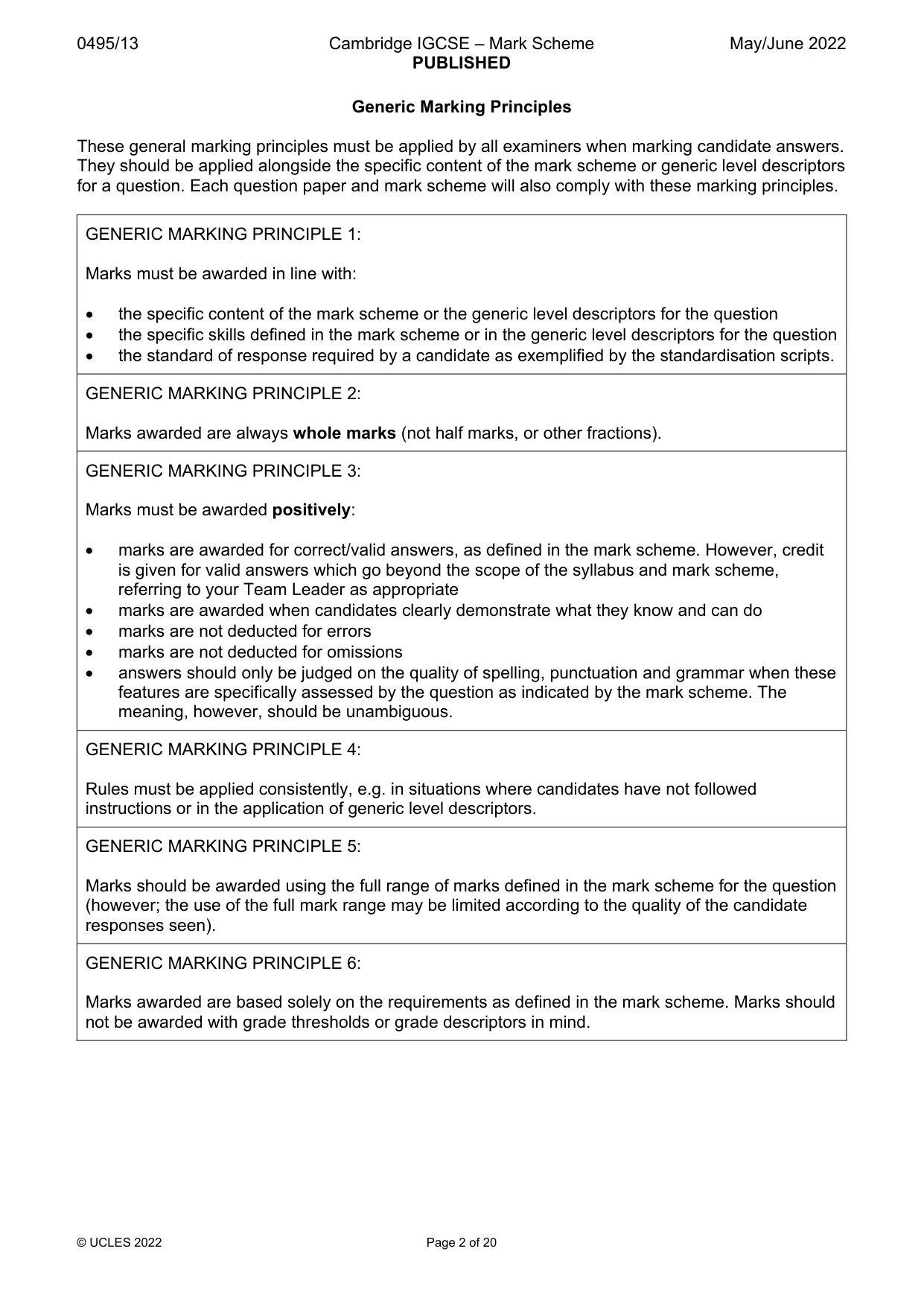
0495/13 Cambridge IGCSE – Mark Scheme PUBLISHED May/June 2022 © UCLES 2022 Page 2 of 20 Generic Marking Principles These general marking principles must be applied by all examiners when marking candidate answers. They should be applied alongside the specific content of the mark scheme or generic level descriptors for a question. Each question paper and mark scheme will also comply with these marking principles. GENERIC MARKING PRINCIPLE 1: Marks must be awarded in line with: the specific content of the mark scheme or the generic level descriptors for the question the specific skills defined in the mark scheme or in the generic level descriptors for the question the standard of response required by a candidate as exemplified by the standardisation scripts. GENERIC MARKING PRINCIPLE 2: Marks awarded are always whole marks (not half marks, or other fractions). GENERIC MARKING PRINCIPLE 3: Marks must be awarded positively: marks are awarded for correct/valid answers, as defined in the mark scheme. However, credit is given for valid answers which go beyond the scope of the syllabus and mark scheme, referring to your Team Leader as appropriate marks are awarded when candidates clearly demonstrate what they know and can do marks are not deducted for errors marks are not deducted for omissions answers should only be judged on the quality of spelling, punctuation and grammar when these features are specifically assessed by the question as indicated by the mark scheme. The meaning, however, should be unambiguous. GENERIC MARKING PRINCIPLE 4: Rules must be applied consistently, e.g. in situations where candidates have not followed instructions or in the application of generic level descriptors. GENERIC MARKING PRINCIPLE 5: Marks should be awarded using the full range of marks defined in the mark scheme for the question (however; the use of the full mark range may be limited according to the quality of the candidate responses seen). GENERIC MARKING PRINCIPLE 6: Marks awarded are based solely on the requirements as defined in the mark scheme. Marks should not be awarded with grade thresholds or grade descriptors in mind.
Mark scheme, page 3
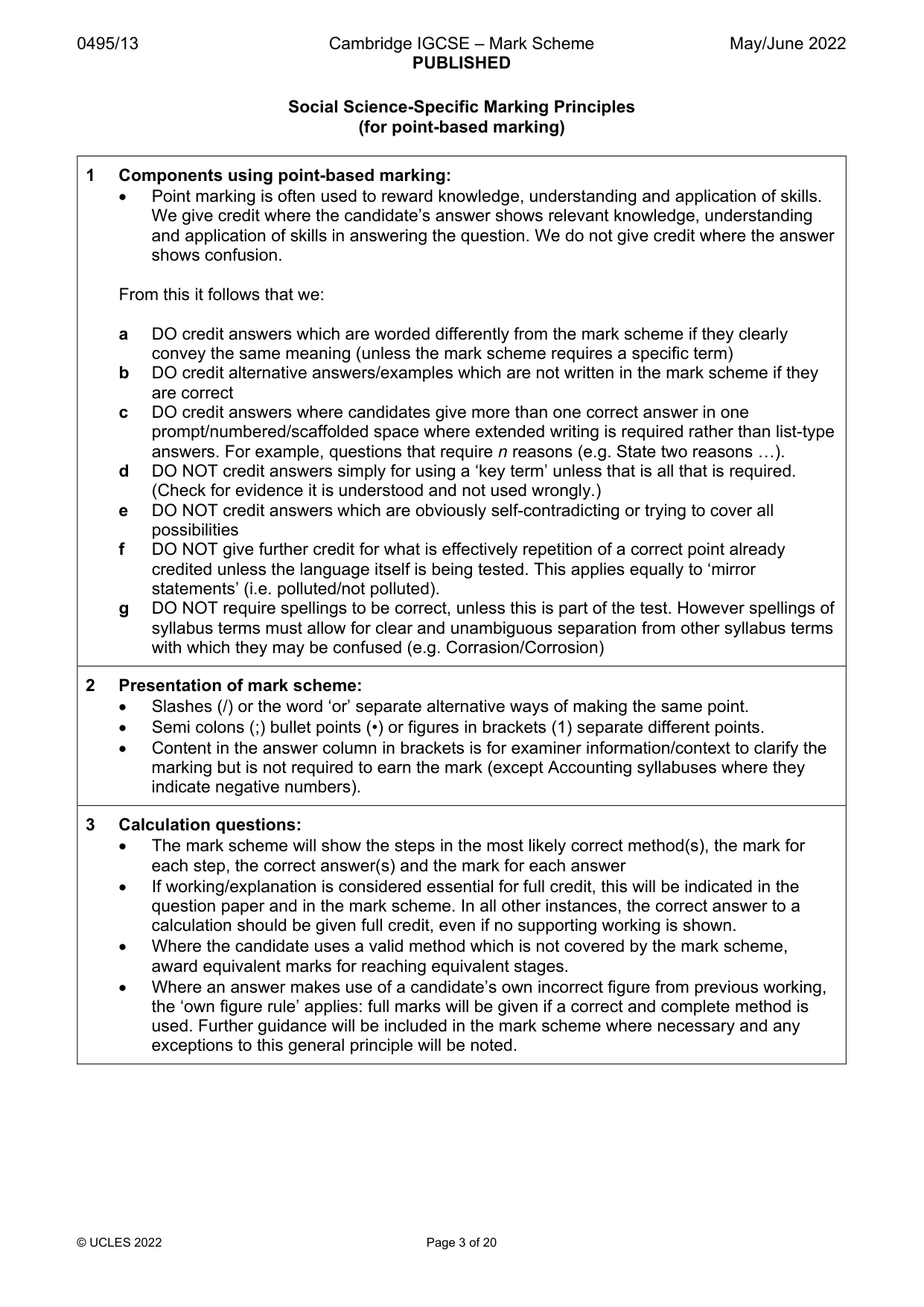
0495/13 Cambridge IGCSE – Mark Scheme PUBLISHED May/June 2022 © UCLES 2022 Page 3 of 20 Social Science-Specific Marking Principles (for point-based marking) 1 Components using point-based marking: Point marking is often used to reward knowledge, understanding and application of skills. We give credit where the candidate’s answer shows relevant knowledge, understanding and application of skills in answering the question. We do not give credit where the answer shows confusion. From this it follows that we: a DO credit answers which are worded differently from the mark scheme if they clearly convey the same meaning (unless the mark scheme requires a specific term) b DO credit alternative answers/examples which are not written in the mark scheme if they are correct c DO credit answers where candidates give more than one correct answer in one prompt/numbered/scaffolded space where extended writing is required rather than list-type answers. For example, questions that require n reasons (e.g. State two reasons …). d DO NOT credit answers simply for using a ‘key term’ unless that is all that is required. (Check for evidence it is understood and not used wrongly.) e DO NOT credit answers which are obviously self-contradicting or trying to cover all possibilities f DO NOT give further credit for what is effectively repetition of a correct point already credited unless the language itself is being tested. This applies equally to ‘mirror statements’ (i.e. polluted/not polluted). g DO NOT require spellings to be correct, unless this is part of the test. However spellings of syllabus terms must allow for clear and unambiguous separation from other syllabus terms with which they may be confused (e.g. Corrasion/Corrosion) 2 Presentation of mark scheme: Slashes (/) or the word ‘or’ separate alternative ways of making the same point. Semi colons (;) bullet points (•) or figures in brackets (1) separate different points. Content in the answer column in brackets is for examiner information/context to clarify the marking but is not required to earn the mark (except Accounting syllabuses where they indicate negative numbers). 3 Calculation questions: The mark scheme will show the steps in the most likely correct method(s), the mark for each step, the correct answer(s) and the mark for each answer If working/explanation is considered essential for full credit, this will be indicated in the question paper and in the mark scheme. In all other instances, the correct answer to a calculation should be given full credit, even if no supporting working is shown. Where the candidate uses a valid method which is not covered by the mark scheme, award equivalent marks for reaching equivalent stages. Where an answer makes use of a candidate’s own incorrect figure from previous working, the ‘own figure rule’ applies: full marks will be given if a correct and complete method is used. Further guidance will be included in the mark scheme where necessary and any exceptions to this general principle will be noted.
Mark scheme, page 4
0495/13 Cambridge IGCSE – Mark Scheme PUBLISHED May/June 2022 © UCLES 2022 Page 4 of 20 4 Annotation: For point marking, ticks can be used to indicate correct answers and crosses can be used to indicate wrong answers. There is no direct relationship between ticks and marks. Ticks have no defined meaning for levels of response marking. For levels of response marking, the level awarded should be annotated on the script. Other annotations will be used by examiners as agreed during standardisation, and the meaning will be understood by all examiners who marked that paper.
Mark scheme, page 5
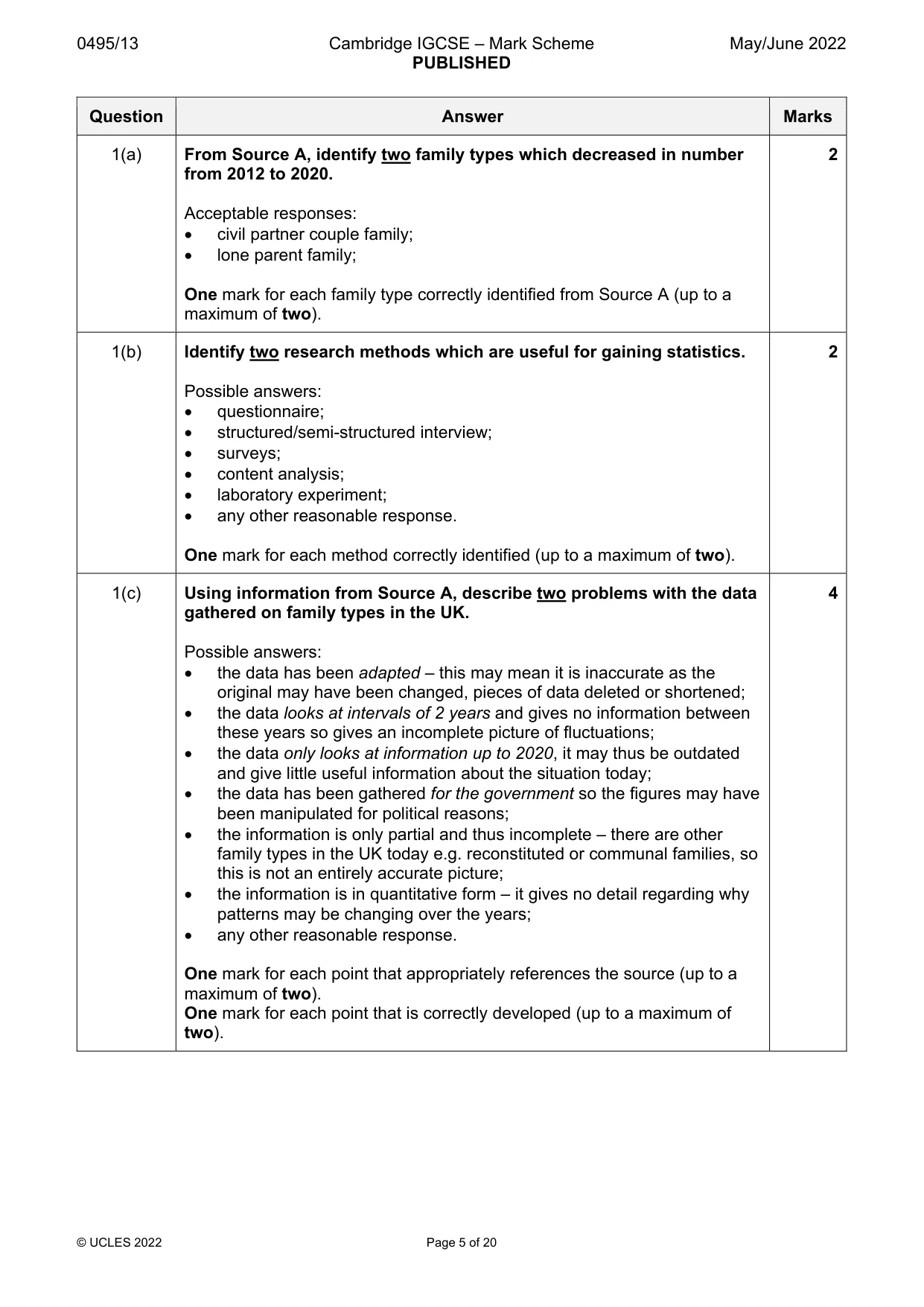
0495/13 Cambridge IGCSE – Mark Scheme PUBLISHED May/June 2022 © UCLES 2022 Page 5 of 20 Question Answer Marks 1(a) From Source A, identify two family types which decreased in number from 2012 to 2020. Acceptable responses: civil partner couple family; lone parent family; One mark for each family type correctly identified from Source A (up to a maximum of two). 2 1(b) Identify two research methods which are useful for gaining statistics. Possible answers: questionnaire; structured/semi-structured interview; surveys; content analysis; laboratory experiment; any other reasonable response. One mark for each method correctly identified (up to a maximum of two). 2 1(c) Using information from Source A, describe two problems with the data gathered on family types in the UK. Possible answers: the data has been adapted – this may mean it is inaccurate as the original may have been changed, pieces of data deleted or shortened; the data looks at intervals of 2 years and gives no information between these years so gives an incomplete picture of fluctuations; the data only looks at information up to 2020, it may thus be outdated and give little useful information about the situation today; the data has been gathered for the government so the figures may have been manipulated for political reasons; the information is only partial and thus incomplete – there are other family types in the UK today e.g. reconstituted or communal families, so this is not an entirely accurate picture; the information is in quantitative form – it gives no detail regarding why patterns may be changing over the years; any other reasonable response. One mark for each point that appropriately references the source (up to a maximum of two). One mark for each point that is correctly developed (up to a maximum of two). 4
Mark scheme, page 6
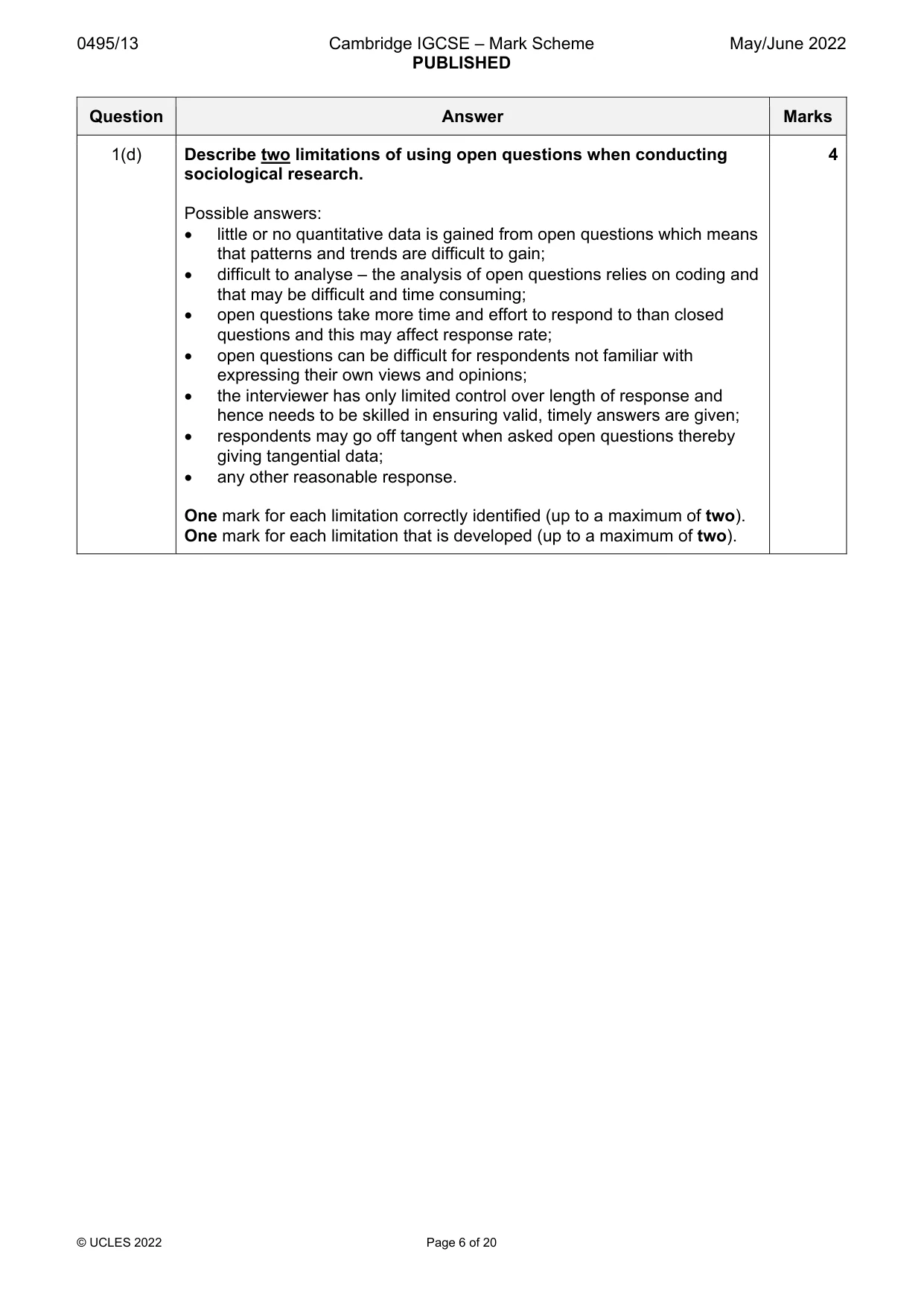
0495/13 Cambridge IGCSE – Mark Scheme PUBLISHED May/June 2022 © UCLES 2022 Page 6 of 20 Question Answer Marks 1(d) Describe two limitations of using open questions when conducting sociological research. Possible answers: little or no quantitative data is gained from open questions which means that patterns and trends are difficult to gain; difficult to analyse – the analysis of open questions relies on coding and that may be difficult and time consuming; open questions take more time and effort to respond to than closed questions and this may affect response rate; open questions can be difficult for respondents not familiar with expressing their own views and opinions; the interviewer has only limited control over length of response and hence needs to be skilled in ensuring valid, timely answers are given; respondents may go off tangent when asked open questions thereby giving tangential data; any other reasonable response. One mark for each limitation correctly identified (up to a maximum of two). One mark for each limitation that is developed (up to a maximum of two). 4
Mark scheme, page 7
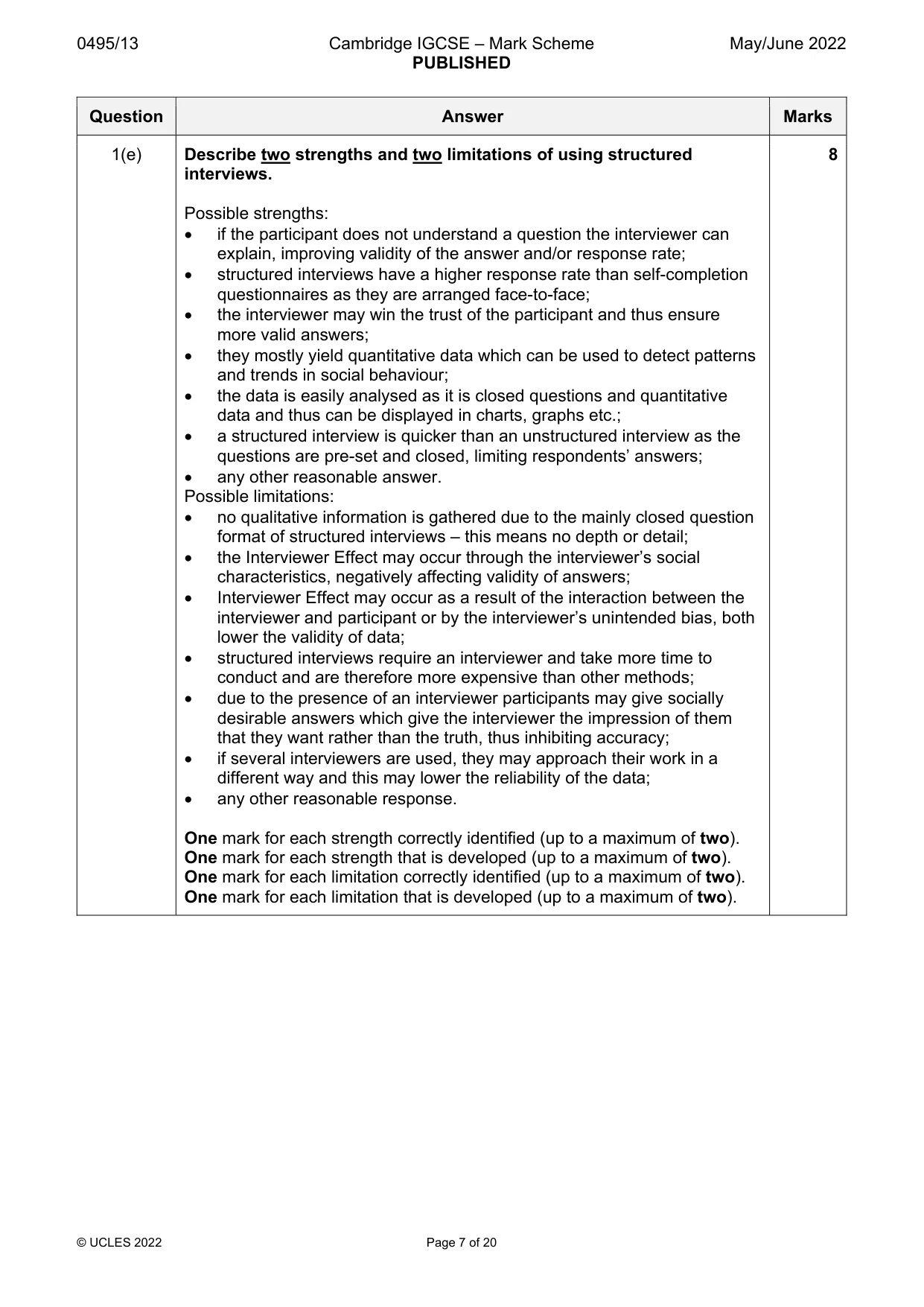
0495/13 Cambridge IGCSE – Mark Scheme PUBLISHED May/June 2022 © UCLES 2022 Page 7 of 20 Question Answer Marks 1(e) Describe two strengths and two limitations of using structured interviews. Possible strengths: if the participant does not understand a question the interviewer can explain, improving validity of the answer and/or response rate; structured interviews have a higher response rate than self-completion questionnaires as they are arranged face-to-face; the interviewer may win the trust of the participant and thus ensure more valid answers; they mostly yield quantitative data which can be used to detect patterns and trends in social behaviour; the data is easily analysed as it is closed questions and quantitative data and thus can be displayed in charts, graphs etc.; a structured interview is quicker than an unstructured interview as the questions are pre-set and closed, limiting respondents’ answers; any other reasonable answer. Possible limitations: no qualitative information is gathered due to the mainly closed question format of structured interviews – this means no depth or detail; the Interviewer Effect may occur through the interviewer’s social characteristics, negatively affecting validity of answers; Interviewer Effect may occur as a result of the interaction between the interviewer and participant or by the interviewer’s unintended bias, both lower the validity of data; structured interviews require an interviewer and take more time to conduct and are therefore more expensive than other methods; due to the presence of an interviewer participants may give socially desirable answers which give the interviewer the impression of them that they want rather than the truth, thus inhibiting accuracy; if several interviewers are used, they may approach their work in a different way and this may lower the reliability of the data; any other reasonable response. One mark for each strength correctly identified (up to a maximum of two). One mark for each strength that is developed (up to a maximum of two). One mark for each limitation correctly identified (up to a maximum of two). One mark for each limitation that is developed (up to a maximum of two). 8
Mark scheme, page 8
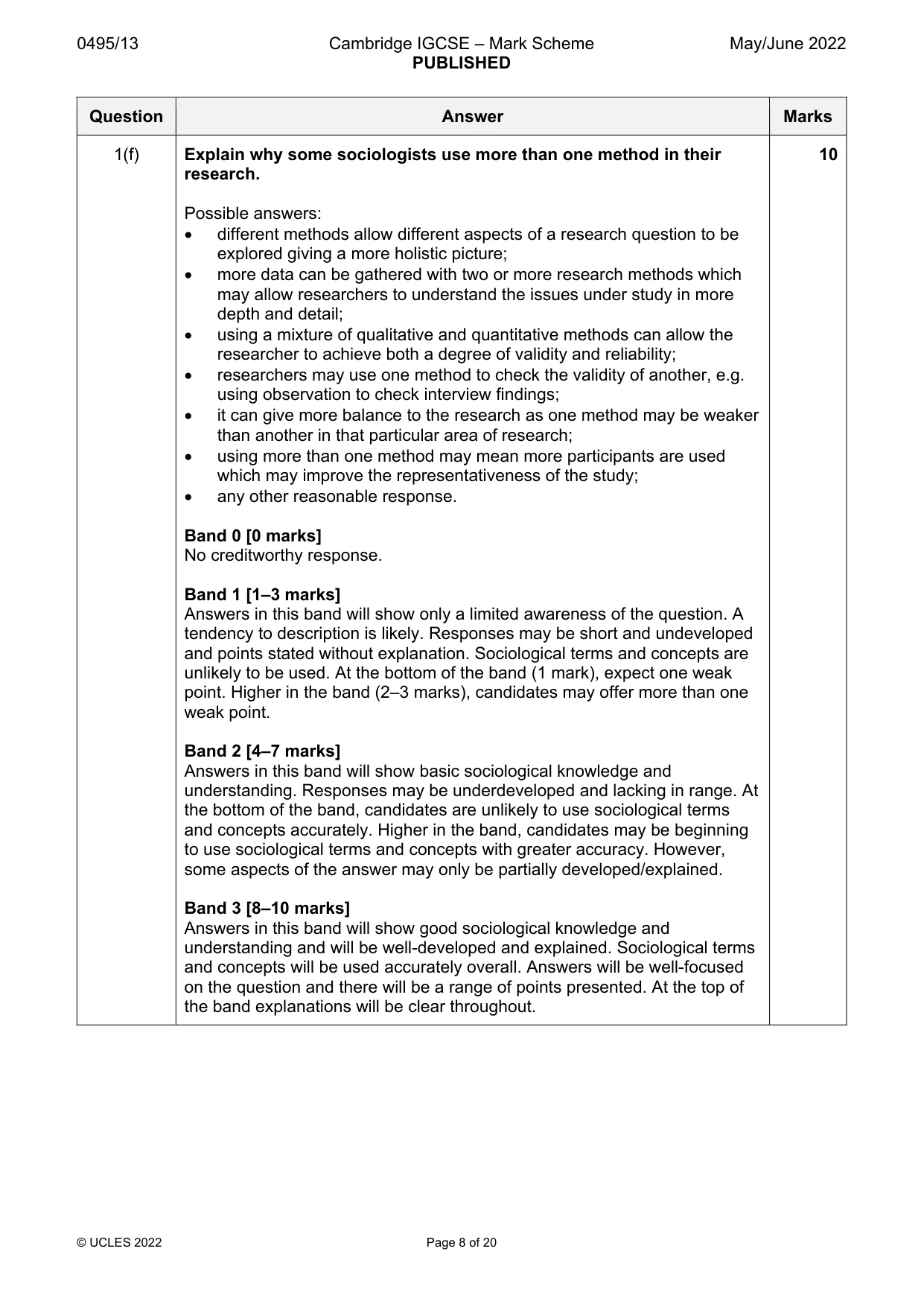
0495/13 Cambridge IGCSE – Mark Scheme PUBLISHED May/June 2022 © UCLES 2022 Page 8 of 20 Question Answer Marks 1(f) Explain why some sociologists use more than one method in their research. Possible answers: different methods allow different aspects of a research question to be explored giving a more holistic picture; more data can be gathered with two or more research methods which may allow researchers to understand the issues under study in more depth and detail; using a mixture of qualitative and quantitative methods can allow the researcher to achieve both a degree of validity and reliability; researchers may use one method to check the validity of another, e.g. using observation to check interview findings; it can give more balance to the research as one method may be weaker than another in that particular area of research; using more than one method may mean more participants are used which may improve the representativeness of the study; any other reasonable response. Band 0 [0 marks] No creditworthy response. Band 1 [1–3 marks] Answers in this band will show only a limited awareness of the question. A tendency to description is likely. Responses may be short and undeveloped and points stated without explanation. Sociological terms and concepts are unlikely to be used. At the bottom of the band (1 mark), expect one weak point. Higher in the band (2–3 marks), candidates may offer more than one weak point. Band 2 [4–7 marks] Answers in this band will show basic sociological knowledge and understanding. Responses may be underdeveloped and lacking in range. At the bottom of the band, candidates are unlikely to use sociological terms and concepts accurately. Higher in the band, candidates may be beginning to use sociological terms and concepts with greater accuracy. However, some aspects of the answer may only be partially developed/explained. Band 3 [8–10 marks] Answers in this band will show good sociological knowledge and understanding and will be well-developed and explained. Sociological terms and concepts will be used accurately overall. Answers will be well-focused on the question and there will be a range of points presented. At the top of the band explanations will be clear throughout. 10
Mark scheme, page 9
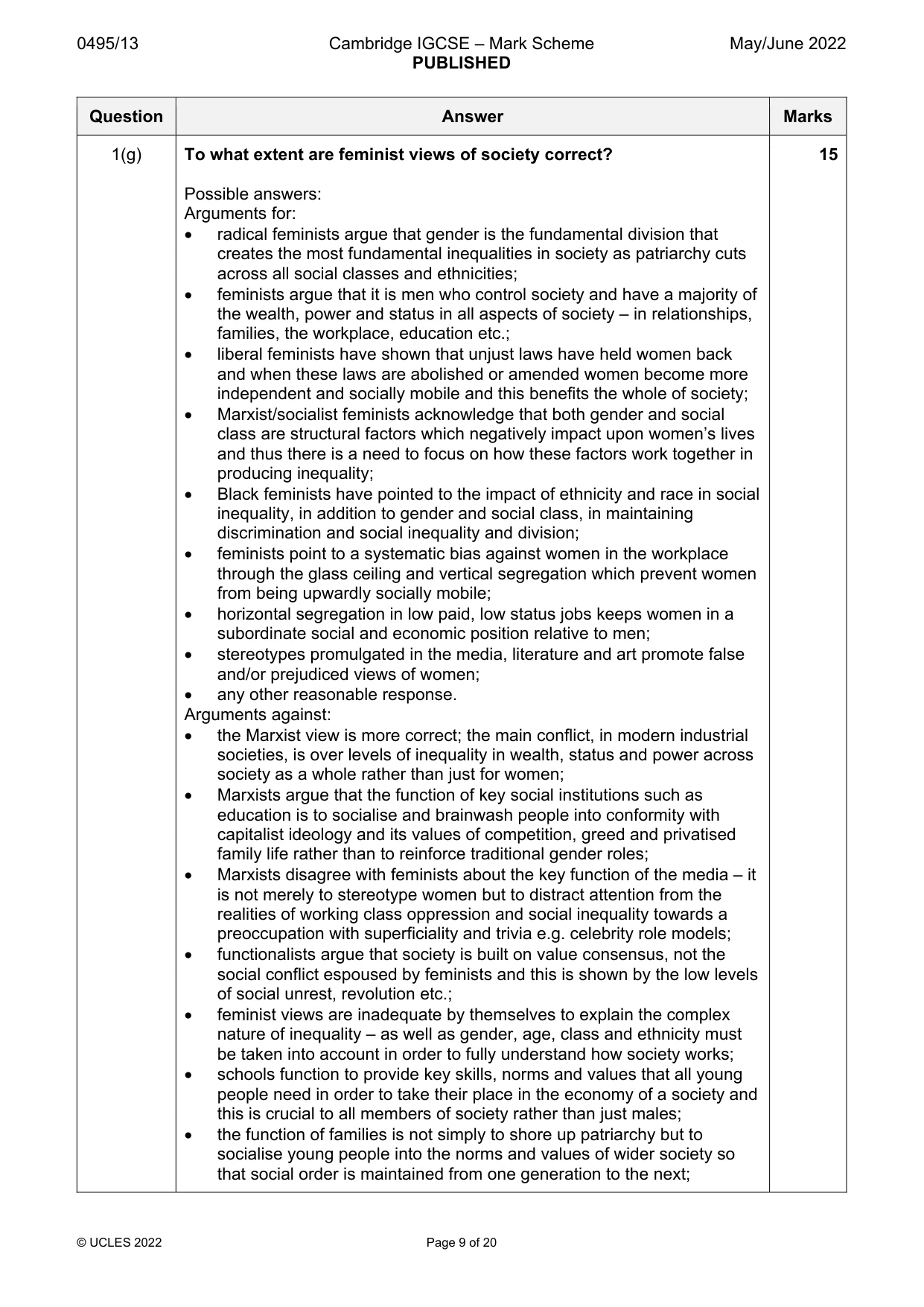
0495/13 Cambridge IGCSE – Mark Scheme PUBLISHED May/June 2022 © UCLES 2022 Page 9 of 20 Question Answer Marks 1(g) To what extent are feminist views of society correct? Possible answers: Arguments for: radical feminists argue that gender is the fundamental division that creates the most fundamental inequalities in society as patriarchy cuts across all social classes and ethnicities; feminists argue that it is men who control society and have a majority of the wealth, power and status in all aspects of society – in relationships, families, the workplace, education etc.; liberal feminists have shown that unjust laws have held women back and when these laws are abolished or amended women become more independent and socially mobile and this benefits the whole of society; Marxist/socialist feminists acknowledge that both gender and social class are structural factors which negatively impact upon women’s lives and thus there is a need to focus on how these factors work together in producing inequality; Black feminists have pointed to the impact of ethnicity and race in social inequality, in addition to gender and social class, in maintaining discrimination and social inequality and division; feminists point to a systematic bias against women in the workplace through the glass ceiling and vertical segregation which prevent women from being upwardly socially mobile; horizontal segregation in low paid, low status jobs keeps women in a subordinate social and economic position relative to men; stereotypes promulgated in the media, literature and art promote false and/or prejudiced views of women; any other reasonable response. Arguments against: the Marxist view is more correct; the main conflict, in modern industrial societies, is over levels of inequality in wealth, status and power across society as a whole rather than just for women; Marxists argue that the function of key social institutions such as education is to socialise and brainwash people into conformity with capitalist ideology and its values of competition, greed and privatised family life rather than to reinforce traditional gender roles; Marxists disagree with feminists about the key function of the media – it is not merely to stereotype women but to distract attention from the realities of working class oppression and social inequality towards a preoccupation with superficiality and trivia e.g. celebrity role models; functionalists argue that society is built on value consensus, not the social conflict espoused by feminists and this is shown by the low levels of social unrest, revolution etc.; feminist views are inadequate by themselves to explain the complex nature of inequality – as well as gender, age, class and ethnicity must be taken into account in order to fully understand how society works; schools function to provide key skills, norms and values that all young people need in order to take their place in the economy of a society and this is crucial to all members of society rather than just males; the function of families is not simply to shore up patriarchy but to socialise young people into the norms and values of wider society so that social order is maintained from one generation to the next; 15
Mark scheme, page 10
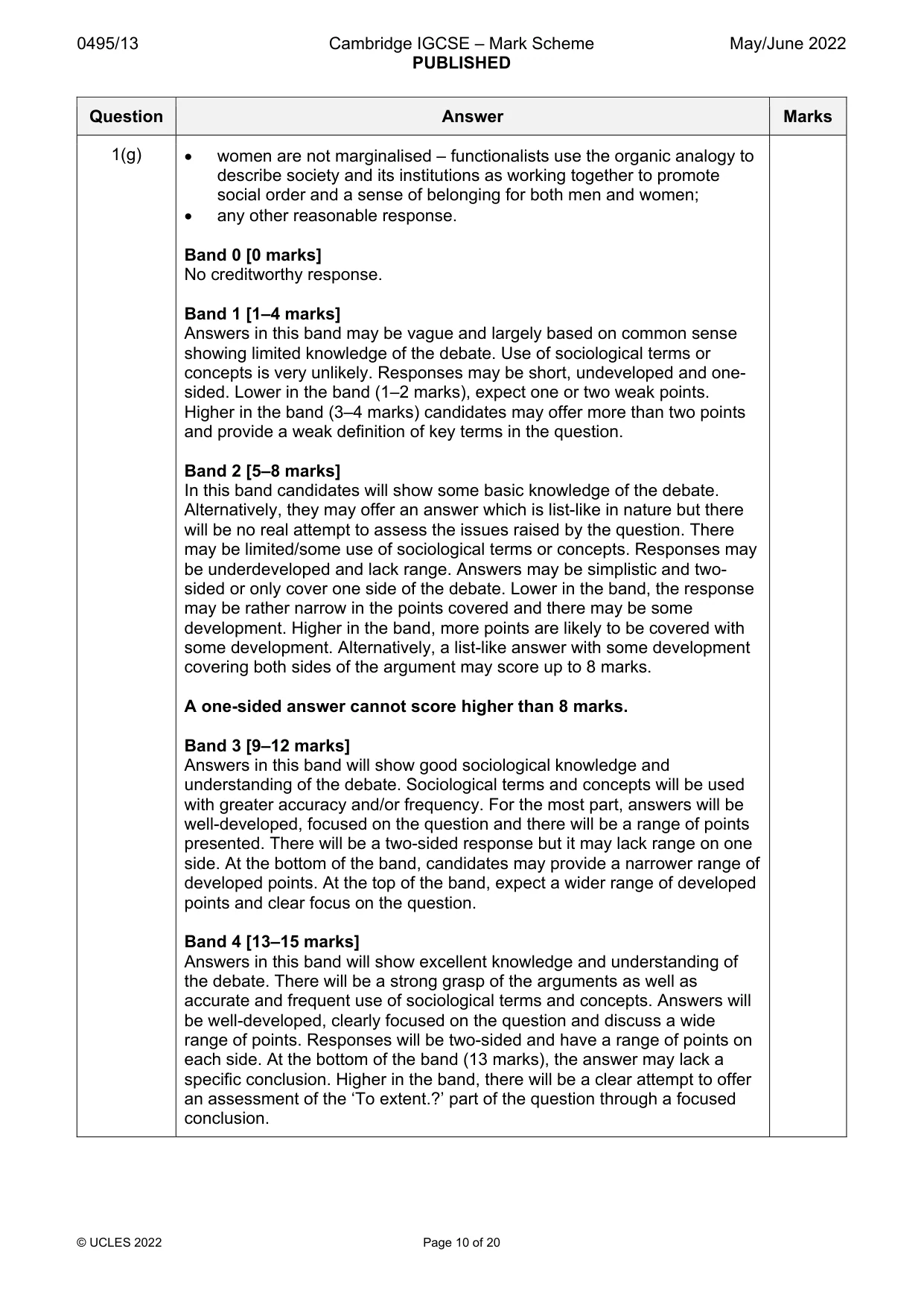
0495/13 Cambridge IGCSE – Mark Scheme PUBLISHED May/June 2022 © UCLES 2022 Page 10 of 20 Question Answer Marks 1(g) women are not marginalised – functionalists use the organic analogy to describe society and its institutions as working together to promote social order and a sense of belonging for both men and women; any other reasonable response. Band 0 [0 marks] No creditworthy response. Band 1 [1–4 marks] Answers in this band may be vague and largely based on common sense showing limited knowledge of the debate. Use of sociological terms or concepts is very unlikely. Responses may be short, undeveloped and one- sided. Lower in the band (1–2 marks), expect one or two weak points. Higher in the band (3–4 marks) candidates may offer more than two points and provide a weak definition of key terms in the question. Band 2 [5–8 marks] In this band candidates will show some basic knowledge of the debate. Alternatively, they may offer an answer which is list-like in nature but there will be no real attempt to assess the issues raised by the question. There may be limited/some use of sociological terms or concepts. Responses may be underdeveloped and lack range. Answers may be simplistic and two- sided or only cover one side of the debate. Lower in the band, the response may be rather narrow in the points covered and there may be some development. Higher in the band, more points are likely to be covered with some development. Alternatively, a list-like answer with some development covering both sides of the argument may score up to 8 marks. A one-sided answer cannot score higher than 8 marks. Band 3 [9–12 marks] Answers in this band will show good sociological knowledge and understanding of the debate. Sociological terms and concepts will be used with greater accuracy and/or frequency. For the most part, answers will be well-developed, focused on the question and there will be a range of points presented. There will be a two-sided response but it may lack range on one side. At the bottom of the band, candidates may provide a narrower range of developed points. At the top of the band, expect a wider range of developed points and clear focus on the question. Band 4 [13–15 marks] Answers in this band will show excellent knowledge and understanding of the debate. There will be a strong grasp of the arguments as well as accurate and frequent use of sociological terms and concepts. Answers will be well-developed, clearly focused on the question and discuss a wide range of points. Responses will be two-sided and have a range of points on each side. At the bottom of the band (13 marks), the answer may lack a specific conclusion. Higher in the band, there will be a clear attempt to offer an assessment of the ‘To extent.?’ part of the question through a focused conclusion.
Mark scheme, page 11
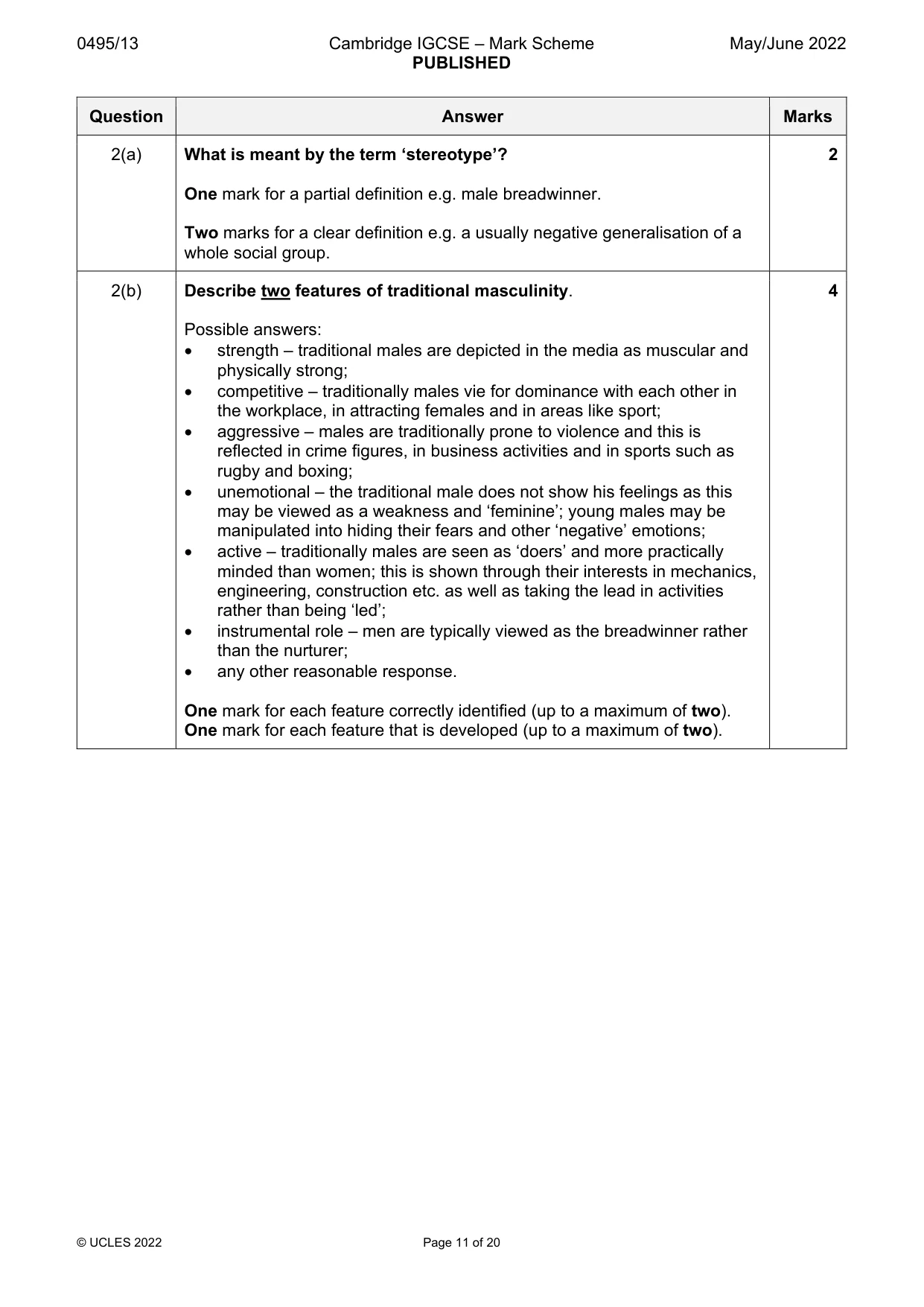
0495/13 Cambridge IGCSE – Mark Scheme PUBLISHED May/June 2022 © UCLES 2022 Page 11 of 20 Question Answer Marks 2(a) What is meant by the term ‘stereotype’? One mark for a partial definition e.g. male breadwinner. Two marks for a clear definition e.g. a usually negative generalisation of a whole social group. 2 2(b) Describe two features of traditional masculinity. Possible answers: strength – traditional males are depicted in the media as muscular and physically strong; competitive – traditionally males vie for dominance with each other in the workplace, in attracting females and in areas like sport; aggressive – males are traditionally prone to violence and this is reflected in crime figures, in business activities and in sports such as rugby and boxing; unemotional – the traditional male does not show his feelings as this may be viewed as a weakness and ‘feminine’; young males may be manipulated into hiding their fears and other ‘negative’ emotions; active – traditionally males are seen as ‘doers’ and more practically minded than women; this is shown through their interests in mechanics, engineering, construction etc. as well as taking the lead in activities rather than being ‘led’; instrumental role – men are typically viewed as the breadwinner rather than the nurturer; any other reasonable response. One mark for each feature correctly identified (up to a maximum of two). One mark for each feature that is developed (up to a maximum of two). 4
Mark scheme, page 12
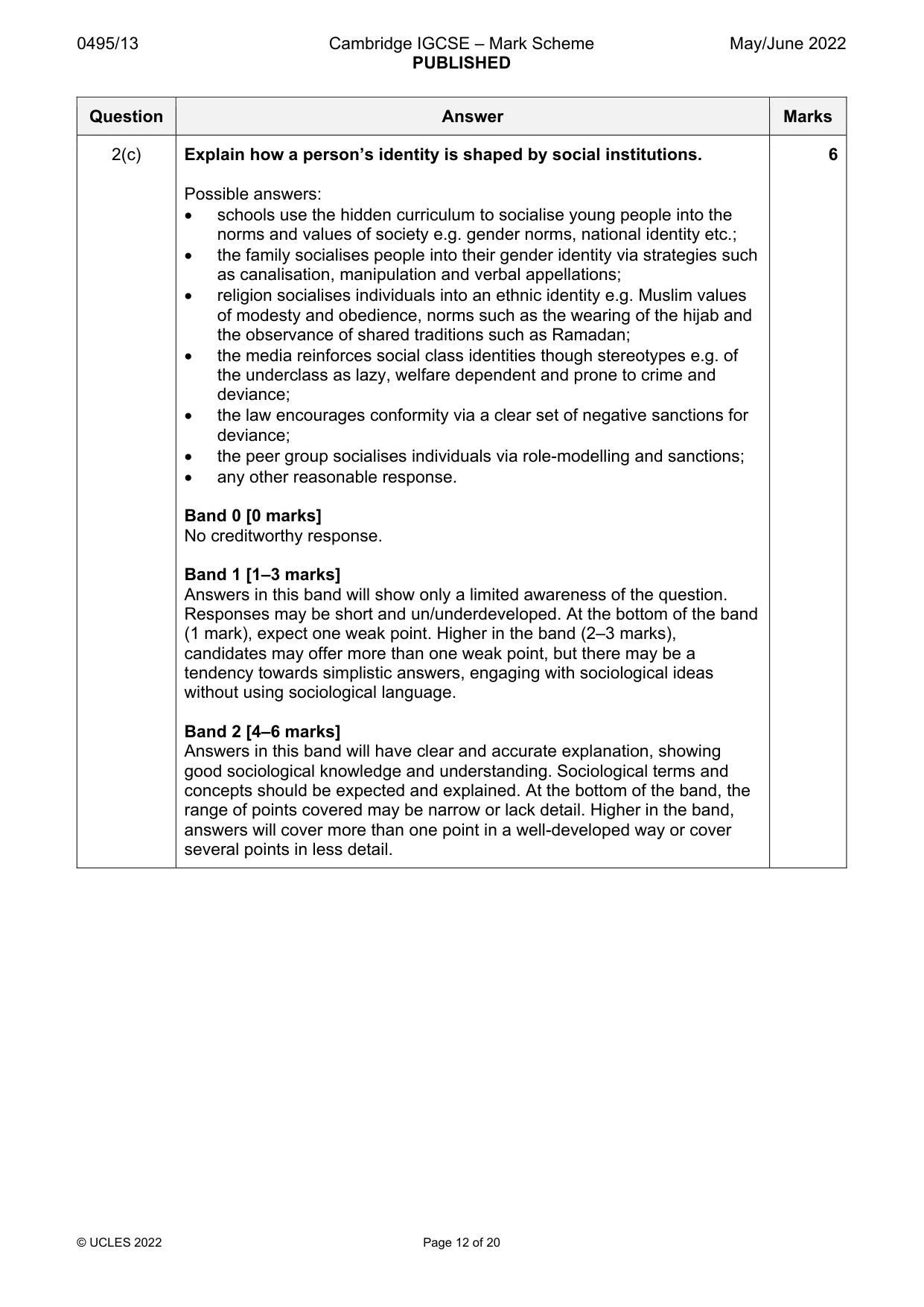
0495/13 Cambridge IGCSE – Mark Scheme PUBLISHED May/June 2022 © UCLES 2022 Page 12 of 20 Question Answer Marks 2(c) Explain how a person’s identity is shaped by social institutions. Possible answers: schools use the hidden curriculum to socialise young people into the norms and values of society e.g. gender norms, national identity etc.; the family socialises people into their gender identity via strategies such as canalisation, manipulation and verbal appellations; religion socialises individuals into an ethnic identity e.g. Muslim values of modesty and obedience, norms such as the wearing of the hijab and the observance of shared traditions such as Ramadan; the media reinforces social class identities though stereotypes e.g. of the underclass as lazy, welfare dependent and prone to crime and deviance; the law encourages conformity via a clear set of negative sanctions for deviance; the peer group socialises individuals via role-modelling and sanctions; any other reasonable response. Band 0 [0 marks] No creditworthy response. Band 1 [1–3 marks] Answers in this band will show only a limited awareness of the question. Responses may be short and un/underdeveloped. At the bottom of the band (1 mark), expect one weak point. Higher in the band (2–3 marks), candidates may offer more than one weak point, but there may be a tendency towards simplistic answers, engaging with sociological ideas without using sociological language. Band 2 [4–6 marks] Answers in this band will have clear and accurate explanation, showing good sociological knowledge and understanding. Sociological terms and concepts should be expected and explained. At the bottom of the band, the range of points covered may be narrow or lack detail. Higher in the band, answers will cover more than one point in a well-developed way or cover several points in less detail. 6
Mark scheme, page 13
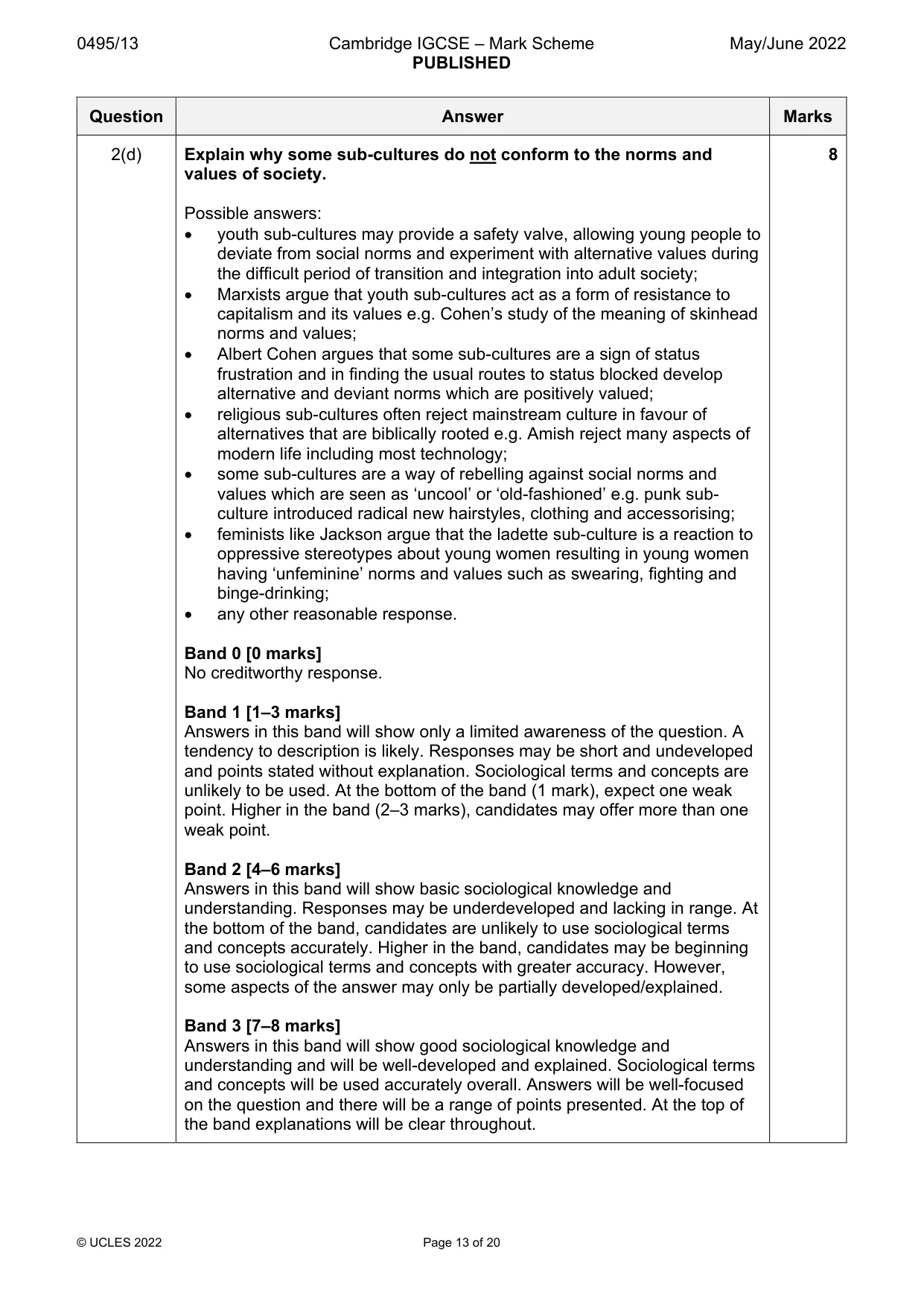
0495/13 Cambridge IGCSE – Mark Scheme PUBLISHED May/June 2022 © UCLES 2022 Page 13 of 20 Question Answer Marks 2(d) Explain why some sub-cultures do not conform to the norms and values of society. Possible answers: youth sub-cultures may provide a safety valve, allowing young people to deviate from social norms and experiment with alternative values during the difficult period of transition and integration into adult society; Marxists argue that youth sub-cultures act as a form of resistance to capitalism and its values e.g. Cohen’s study of the meaning of skinhead norms and values; Albert Cohen argues that some sub-cultures are a sign of status frustration and in finding the usual routes to status blocked develop alternative and deviant norms which are positively valued; religious sub-cultures often reject mainstream culture in favour of alternatives that are biblically rooted e.g. Amish reject many aspects of modern life including most technology; some sub-cultures are a way of rebelling against social norms and values which are seen as ‘uncool’ or ‘old-fashioned’ e.g. punk sub- culture introduced radical new hairstyles, clothing and accessorising; feminists like Jackson argue that the ladette sub-culture is a reaction to oppressive stereotypes about young women resulting in young women having ‘unfeminine’ norms and values such as swearing, fighting and binge-drinking; any other reasonable response. Band 0 [0 marks] No creditworthy response. Band 1 [1–3 marks] Answers in this band will show only a limited awareness of the question. A tendency to description is likely. Responses may be short and undeveloped and points stated without explanation. Sociological terms and concepts are unlikely to be used. At the bottom of the band (1 mark), expect one weak point. Higher in the band (2–3 marks), candidates may offer more than one weak point. Band 2 [4–6 marks] Answers in this band will show basic sociological knowledge and understanding. Responses may be underdeveloped and lacking in range. At the bottom of the band, candidates are unlikely to use sociological terms and concepts accurately. Higher in the band, candidates may be beginning to use sociological terms and concepts with greater accuracy. However, some aspects of the answer may only be partially developed/explained. Band 3 [7–8 marks] Answers in this band will show good sociological knowledge and understanding and will be well-developed and explained. Sociological terms and concepts will be used accurately overall. Answers will be well-focused on the question and there will be a range of points presented. At the top of the band explanations will be clear throughout. 8
Mark scheme, page 14
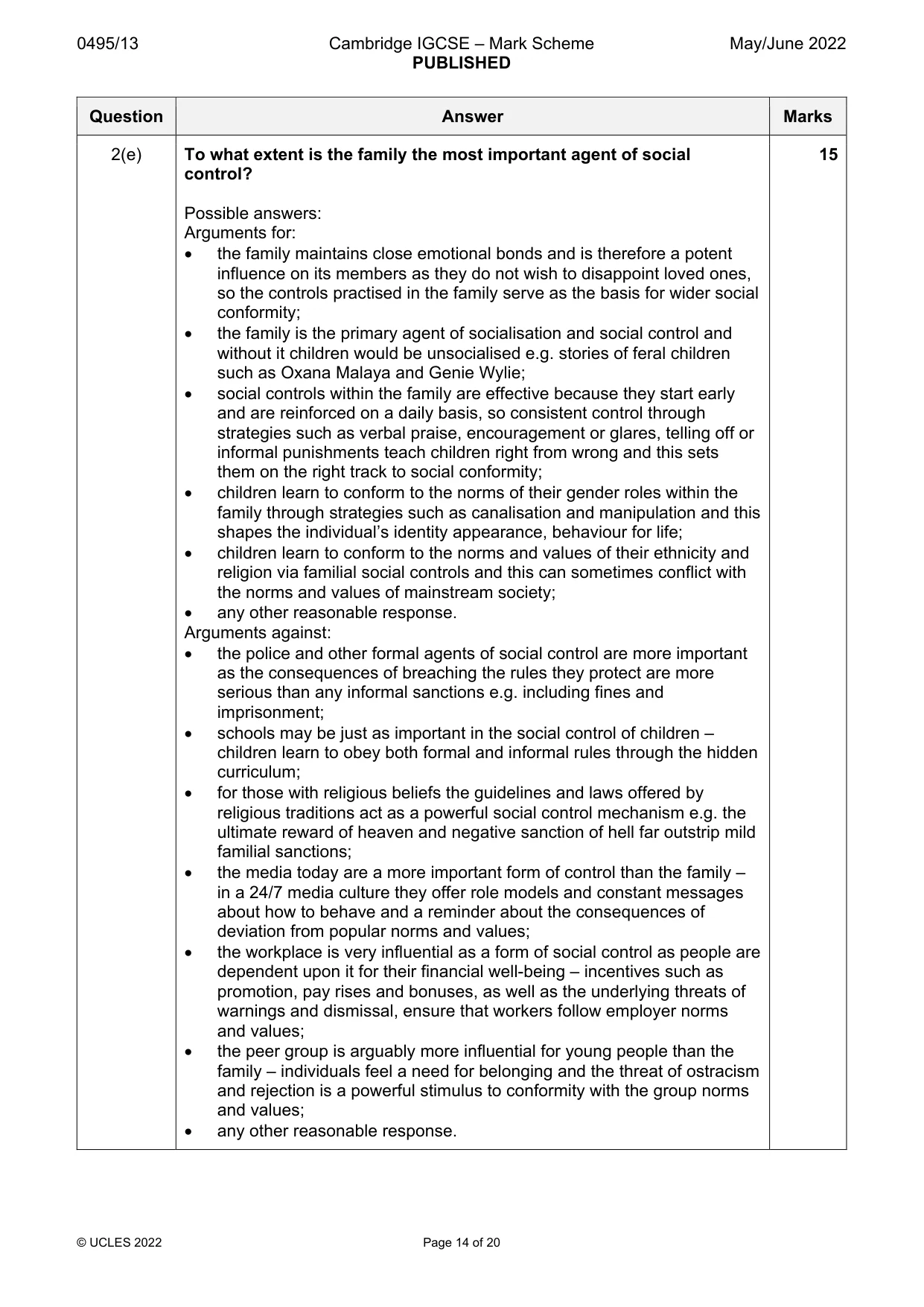
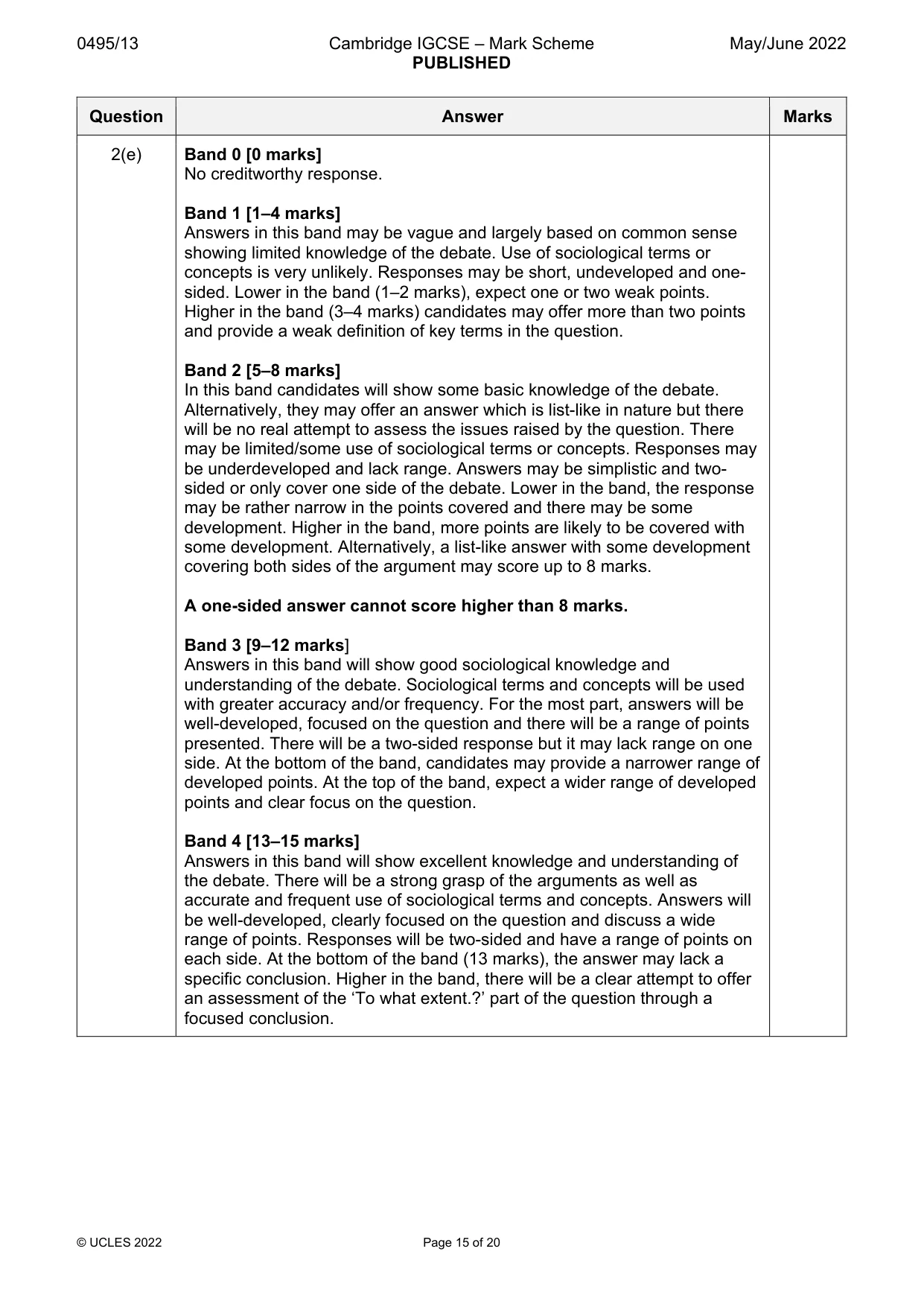
0495/13 Cambridge IGCSE – Mark Scheme PUBLISHED May/June 2022 © UCLES 2022 Page 14 of 20 Question Answer Marks 2(e) To what extent is the family the most important agent of social control? Possible answers: Arguments for: the family maintains close emotional bonds and is therefore a potent influence on its members as they do not wish to disappoint loved ones, so the controls practised in the family serve as the basis for wider social conformity; the family is the primary agent of socialisation and social control and without it children would be unsocialised e.g. stories of feral children such as Oxana Malaya and Genie Wylie; social controls within the family are effective because they start early and are reinforced on a daily basis, so consistent control through strategies such as verbal praise, encouragement or glares, telling off or informal punishments teach children right from wrong and this sets them on the right track to social conformity; children learn to conform to the norms of their gender roles within the family through strategies such as canalisation and manipulation and this shapes the individual’s identity appearance, behaviour for life; children learn to conform to the norms and values of their ethnicity and religion via familial social controls and this can sometimes conflict with the norms and values of mainstream society; any other reasonable response. Arguments against: the police and other formal agents of social control are more important as the consequences of breaching the rules they protect are more serious than any informal sanctions e.g. including fines and imprisonment; schools may be just as important in the social control of children – children learn to obey both formal and informal rules through the hidden curriculum; for those with religious beliefs the guidelines and laws offered by religious traditions act as a powerful social control mechanism e.g. the ultimate reward of heaven and negative sanction of hell far outstrip mild familial sanctions; the media today are a more important form of control than the family – in a 24/7 media culture they offer role models and constant messages about how to behave and a reminder about the consequences of deviation from popular norms and values; the workplace is very influential as a form of social control as people are dependent upon it for their financial well-being – incentives such as promotion, pay rises and bonuses, as well as the underlying threats of warnings and dismissal, ensure that workers follow employer norms and values; the peer group is arguably more influential for young people than the family – individuals feel a need for belonging and the threat of ostracism and rejection is a powerful stimulus to conformity with the group norms and values; any other reasonable response. 15
Mark scheme, page 15
0495/13 Cambridge IGCSE – Mark Scheme PUBLISHED May/June 2022 © UCLES 2022 Page 15 of 20 Question Answer Marks 2(e) Band 0 [0 marks] No creditworthy response. Band 1 [1–4 marks] Answers in this band may be vague and largely based on common sense showing limited knowledge of the debate. Use of sociological terms or concepts is very unlikely. Responses may be short, undeveloped and one- sided. Lower in the band (1–2 marks), expect one or two weak points. Higher in the band (3–4 marks) candidates may offer more than two points and provide a weak definition of key terms in the question. Band 2 [5–8 marks] In this band candidates will show some basic knowledge of the debate. Alternatively, they may offer an answer which is list-like in nature but there will be no real attempt to assess the issues raised by the question. There may be limited/some use of sociological terms or concepts. Responses may be underdeveloped and lack range. Answers may be simplistic and two- sided or only cover one side of the debate. Lower in the band, the response may be rather narrow in the points covered and there may be some development. Higher in the band, more points are likely to be covered with some development. Alternatively, a list-like answer with some development covering both sides of the argument may score up to 8 marks. A one-sided answer cannot score higher than 8 marks. Band 3 [9–12 marks] Answers in this band will show good sociological knowledge and understanding of the debate. Sociological terms and concepts will be used with greater accuracy and/or frequency. For the most part, answers will be well-developed, focused on the question and there will be a range of points presented. There will be a two-sided response but it may lack range on one side. At the bottom of the band, candidates may provide a narrower range of developed points. At the top of the band, expect a wider range of developed points and clear focus on the question. Band 4 [13–15 marks] Answers in this band will show excellent knowledge and understanding of the debate. There will be a strong grasp of the arguments as well as accurate and frequent use of sociological terms and concepts. Answers will be well-developed, clearly focused on the question and discuss a wide range of points. Responses will be two-sided and have a range of points on each side. At the bottom of the band (13 marks), the answer may lack a specific conclusion. Higher in the band, there will be a clear attempt to offer an assessment of the ‘To what extent.?’ part of the question through a focused conclusion.
Mark scheme, page 16
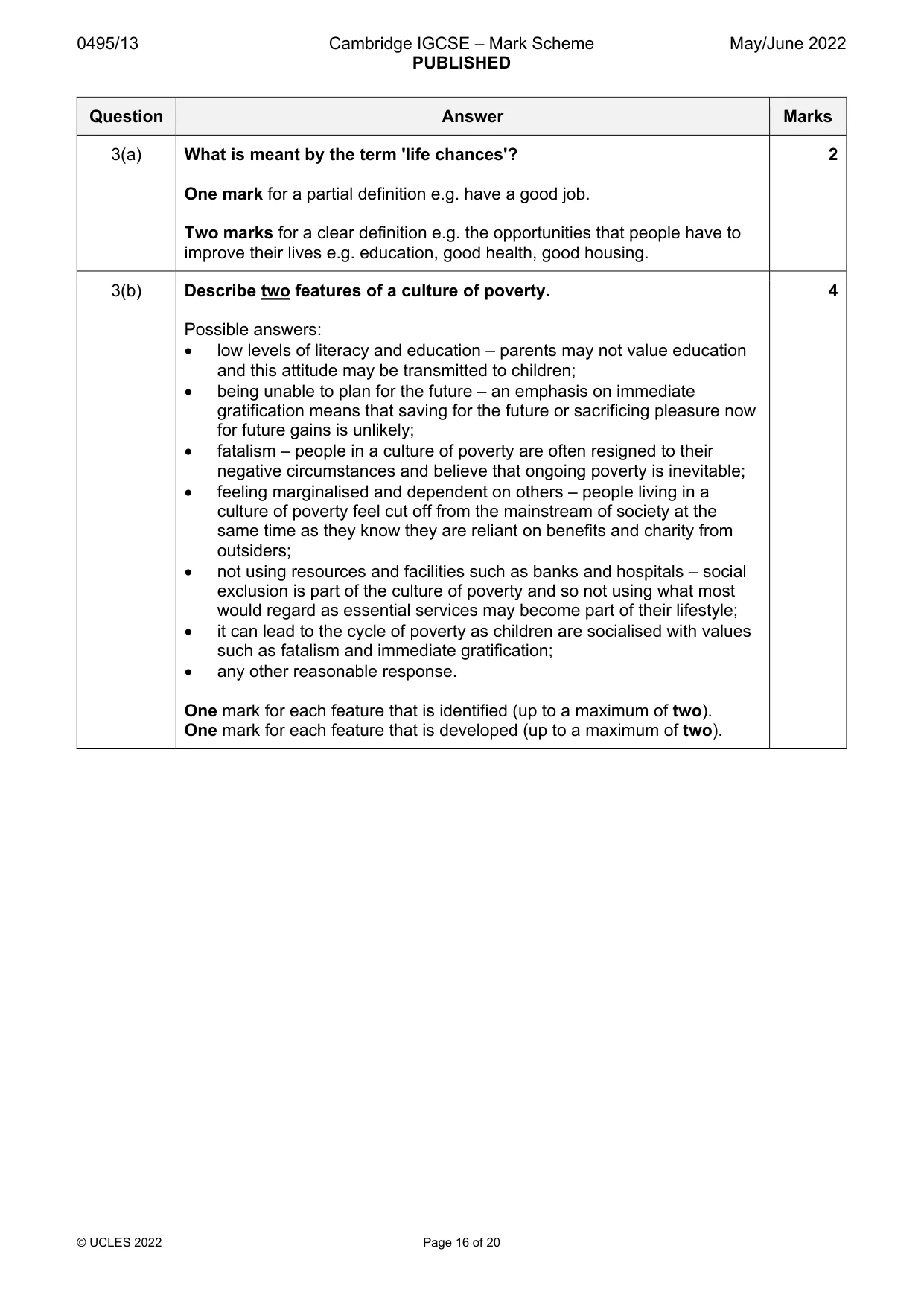
0495/13 Cambridge IGCSE – Mark Scheme PUBLISHED May/June 2022 © UCLES 2022 Page 16 of 20 Question Answer Marks 3(a) What is meant by the term 'life chances'? One mark for a partial definition e.g. have a good job. Two marks for a clear definition e.g. the opportunities that people have to improve their lives e.g. education, good health, good housing. 2 3(b) Describe two features of a culture of poverty. Possible answers: low levels of literacy and education – parents may not value education and this attitude may be transmitted to children; being unable to plan for the future – an emphasis on immediate gratification means that saving for the future or sacrificing pleasure now for future gains is unlikely; fatalism – people in a culture of poverty are often resigned to their negative circumstances and believe that ongoing poverty is inevitable; feeling marginalised and dependent on others – people living in a culture of poverty feel cut off from the mainstream of society at the same time as they know they are reliant on benefits and charity from outsiders; not using resources and facilities such as banks and hospitals – social exclusion is part of the culture of poverty and so not using what most would regard as essential services may become part of their lifestyle; it can lead to the cycle of poverty as children are socialised with values such as fatalism and immediate gratification; any other reasonable response. One mark for each feature that is identified (up to a maximum of two). One mark for each feature that is developed (up to a maximum of two). 4
Mark scheme, page 17
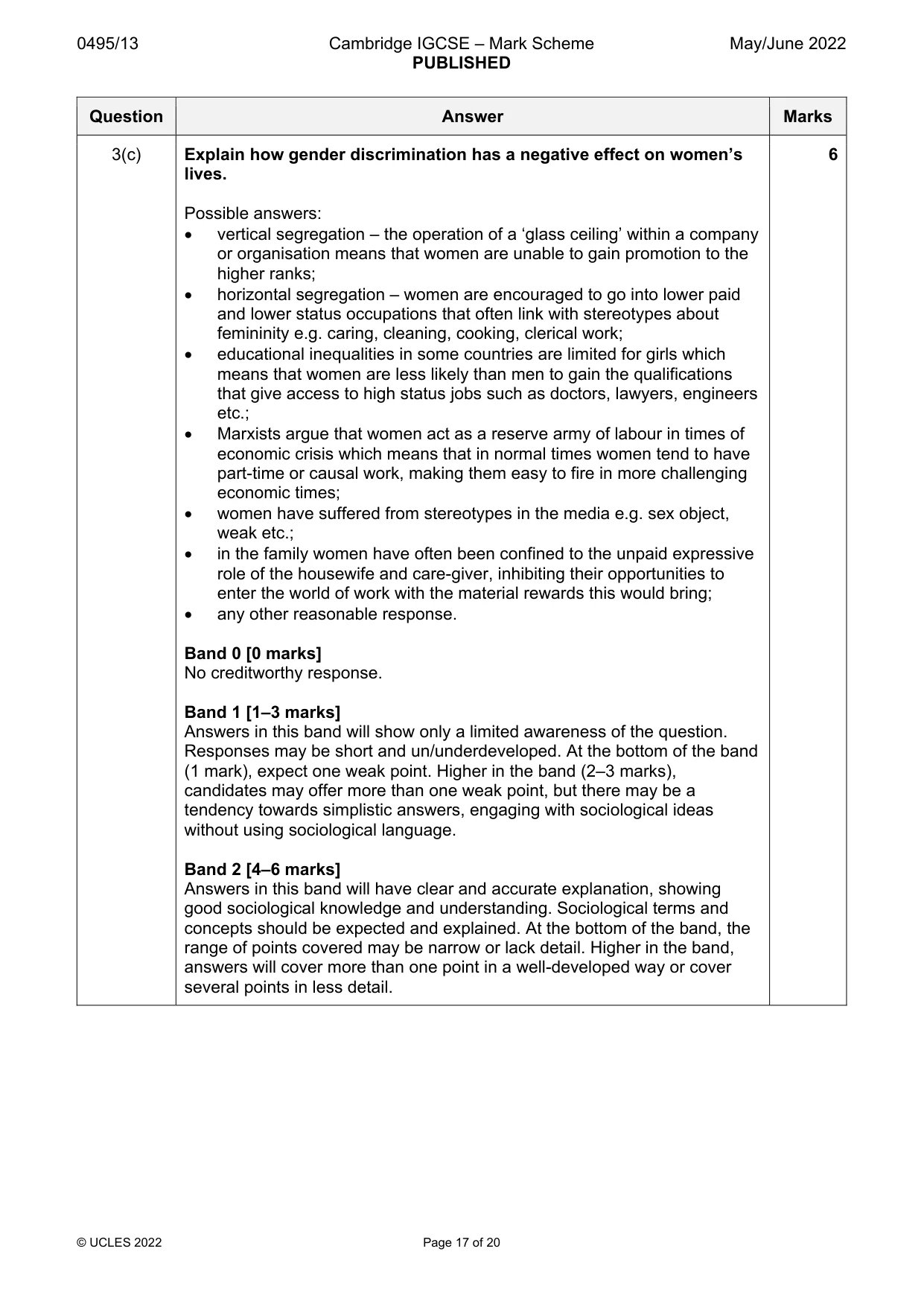
0495/13 Cambridge IGCSE – Mark Scheme PUBLISHED May/June 2022 © UCLES 2022 Page 17 of 20 Question Answer Marks 3(c) Explain how gender discrimination has a negative effect on women’s lives. Possible answers: vertical segregation – the operation of a ‘glass ceiling’ within a company or organisation means that women are unable to gain promotion to the higher ranks; horizontal segregation – women are encouraged to go into lower paid and lower status occupations that often link with stereotypes about femininity e.g. caring, cleaning, cooking, clerical work; educational inequalities in some countries are limited for girls which means that women are less likely than men to gain the qualifications that give access to high status jobs such as doctors, lawyers, engineers etc.; Marxists argue that women act as a reserve army of labour in times of economic crisis which means that in normal times women tend to have part-time or causal work, making them easy to fire in more challenging economic times; women have suffered from stereotypes in the media e.g. sex object, weak etc.; in the family women have often been confined to the unpaid expressive role of the housewife and care-giver, inhibiting their opportunities to enter the world of work with the material rewards this would bring; any other reasonable response. Band 0 [0 marks] No creditworthy response. Band 1 [1–3 marks] Answers in this band will show only a limited awareness of the question. Responses may be short and un/underdeveloped. At the bottom of the band (1 mark), expect one weak point. Higher in the band (2–3 marks), candidates may offer more than one weak point, but there may be a tendency towards simplistic answers, engaging with sociological ideas without using sociological language. Band 2 [4–6 marks] Answers in this band will have clear and accurate explanation, showing good sociological knowledge and understanding. Sociological terms and concepts should be expected and explained. At the bottom of the band, the range of points covered may be narrow or lack detail. Higher in the band, answers will cover more than one point in a well-developed way or cover several points in less detail. 6
Mark scheme, page 18
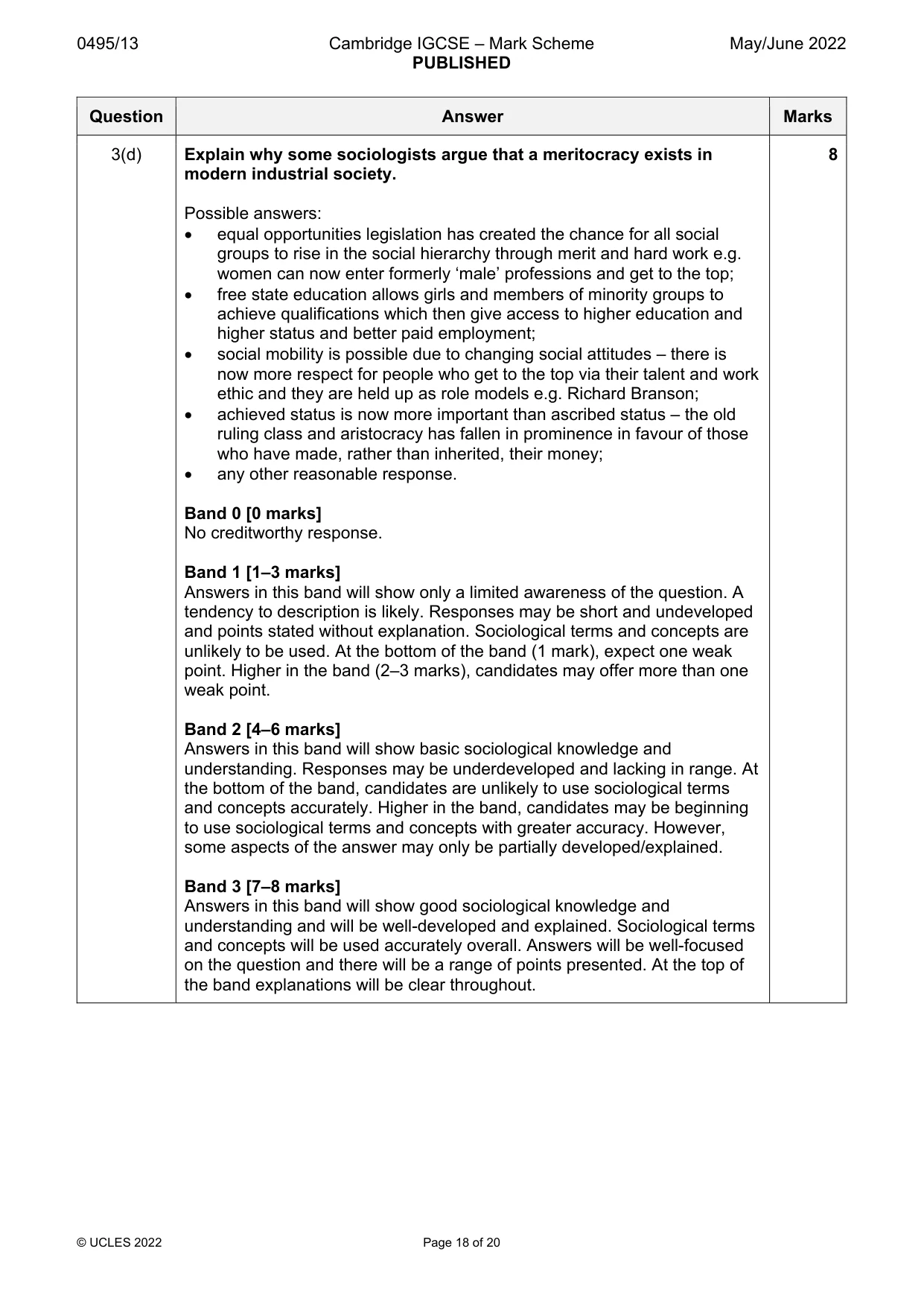
0495/13 Cambridge IGCSE – Mark Scheme PUBLISHED May/June 2022 © UCLES 2022 Page 18 of 20 Question Answer Marks 3(d) Explain why some sociologists argue that a meritocracy exists in modern industrial society. Possible answers: equal opportunities legislation has created the chance for all social groups to rise in the social hierarchy through merit and hard work e.g. women can now enter formerly ‘male’ professions and get to the top; free state education allows girls and members of minority groups to achieve qualifications which then give access to higher education and higher status and better paid employment; social mobility is possible due to changing social attitudes – there is now more respect for people who get to the top via their talent and work ethic and they are held up as role models e.g. Richard Branson; achieved status is now more important than ascribed status – the old ruling class and aristocracy has fallen in prominence in favour of those who have made, rather than inherited, their money; any other reasonable response. Band 0 [0 marks] No creditworthy response. Band 1 [1–3 marks] Answers in this band will show only a limited awareness of the question. A tendency to description is likely. Responses may be short and undeveloped and points stated without explanation. Sociological terms and concepts are unlikely to be used. At the bottom of the band (1 mark), expect one weak point. Higher in the band (2–3 marks), candidates may offer more than one weak point. Band 2 [4–6 marks] Answers in this band will show basic sociological knowledge and understanding. Responses may be underdeveloped and lacking in range. At the bottom of the band, candidates are unlikely to use sociological terms and concepts accurately. Higher in the band, candidates may be beginning to use sociological terms and concepts with greater accuracy. However, some aspects of the answer may only be partially developed/explained. Band 3 [7–8 marks] Answers in this band will show good sociological knowledge and understanding and will be well-developed and explained. Sociological terms and concepts will be used accurately overall. Answers will be well-focused on the question and there will be a range of points presented. At the top of the band explanations will be clear throughout. 8
Mark scheme, page 19
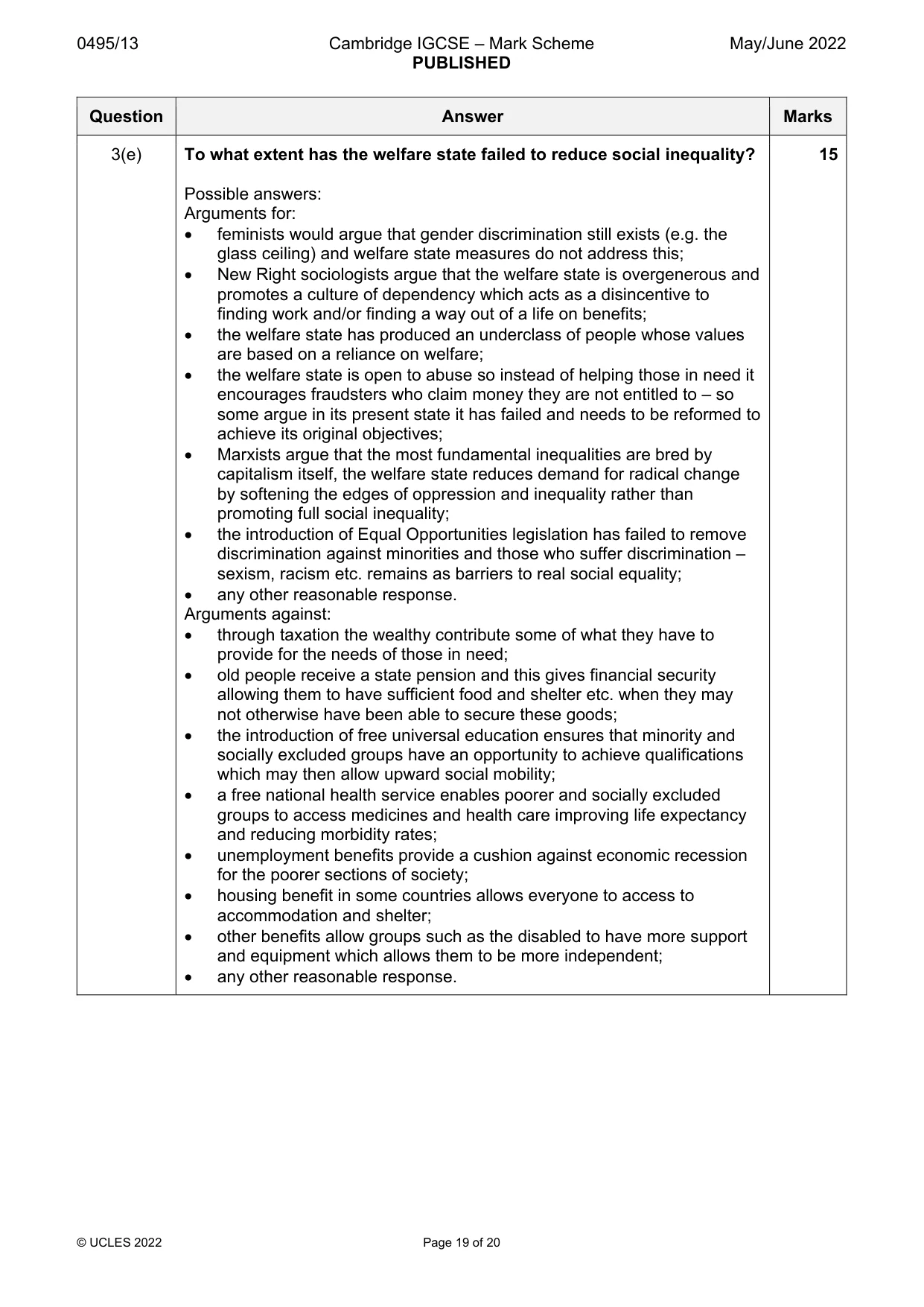
0495/13 Cambridge IGCSE – Mark Scheme PUBLISHED May/June 2022 © UCLES 2022 Page 19 of 20 Question Answer Marks 3(e) To what extent has the welfare state failed to reduce social inequality? Possible answers: Arguments for: feminists would argue that gender discrimination still exists (e.g. the glass ceiling) and welfare state measures do not address this; New Right sociologists argue that the welfare state is overgenerous and promotes a culture of dependency which acts as a disincentive to finding work and/or finding a way out of a life on benefits; the welfare state has produced an underclass of people whose values are based on a reliance on welfare; the welfare state is open to abuse so instead of helping those in need it encourages fraudsters who claim money they are not entitled to – so some argue in its present state it has failed and needs to be reformed to achieve its original objectives; Marxists argue that the most fundamental inequalities are bred by capitalism itself, the welfare state reduces demand for radical change by softening the edges of oppression and inequality rather than promoting full social inequality; the introduction of Equal Opportunities legislation has failed to remove discrimination against minorities and those who suffer discrimination – sexism, racism etc. remains as barriers to real social equality; any other reasonable response. Arguments against: through taxation the wealthy contribute some of what they have to provide for the needs of those in need; old people receive a state pension and this gives financial security allowing them to have sufficient food and shelter etc. when they may not otherwise have been able to secure these goods; the introduction of free universal education ensures that minority and socially excluded groups have an opportunity to achieve qualifications which may then allow upward social mobility; a free national health service enables poorer and socially excluded groups to access medicines and health care improving life expectancy and reducing morbidity rates; unemployment benefits provide a cushion against economic recession for the poorer sections of society; housing benefit in some countries allows everyone to access to accommodation and shelter; other benefits allow groups such as the disabled to have more support and equipment which allows them to be more independent; any other reasonable response. 15
Mark scheme, page 20
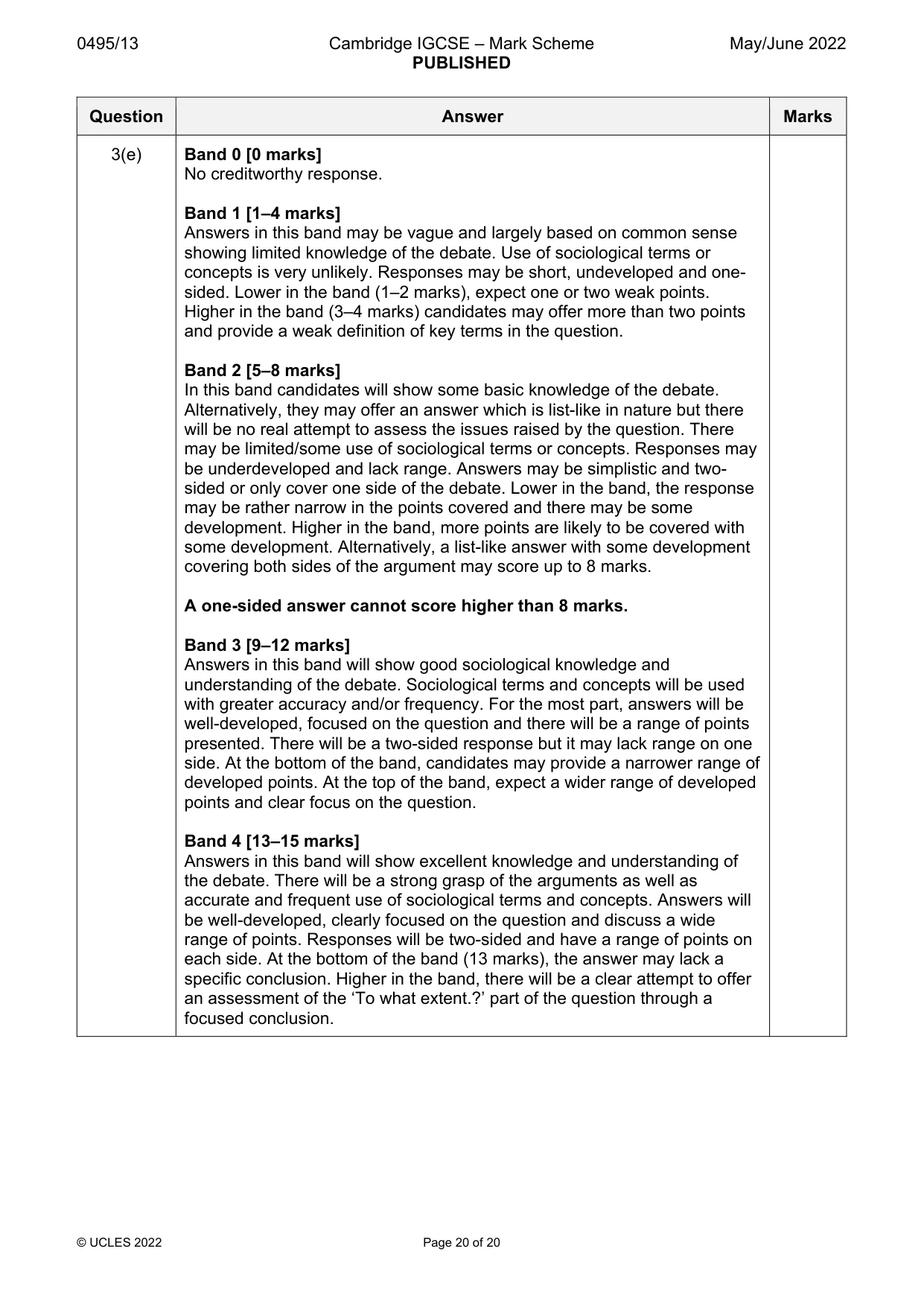
0495/13 Cambridge IGCSE – Mark Scheme PUBLISHED May/June 2022 © UCLES 2022 Page 20 of 20 Question Answer Marks 3(e) Band 0 [0 marks] No creditworthy response. Band 1 [1–4 marks] Answers in this band may be vague and largely based on common sense showing limited knowledge of the debate. Use of sociological terms or concepts is very unlikely. Responses may be short, undeveloped and one- sided. Lower in the band (1–2 marks), expect one or two weak points. Higher in the band (3–4 marks) candidates may offer more than two points and provide a weak definition of key terms in the question. Band 2 [5–8 marks] In this band candidates will show some basic knowledge of the debate. Alternatively, they may offer an answer which is list-like in nature but there will be no real attempt to assess the issues raised by the question. There may be limited/some use of sociological terms or concepts. Responses may be underdeveloped and lack range. Answers may be simplistic and two- sided or only cover one side of the debate. Lower in the band, the response may be rather narrow in the points covered and there may be some development. Higher in the band, more points are likely to be covered with some development. Alternatively, a list-like answer with some development covering both sides of the argument may score up to 8 marks. A one-sided answer cannot score higher than 8 marks. Band 3 [9–12 marks] Answers in this band will show good sociological knowledge and understanding of the debate. Sociological terms and concepts will be used with greater accuracy and/or frequency. For the most part, answers will be well-developed, focused on the question and there will be a range of points presented. There will be a two-sided response but it may lack range on one side. At the bottom of the band, candidates may provide a narrower range of developed points. At the top of the band, expect a wider range of developed points and clear focus on the question. Band 4 [13–15 marks] Answers in this band will show excellent knowledge and understanding of the debate. There will be a strong grasp of the arguments as well as accurate and frequent use of sociological terms and concepts. Answers will be well-developed, clearly focused on the question and discuss a wide range of points. Responses will be two-sided and have a range of points on each side. At the bottom of the band (13 marks), the answer may lack a specific conclusion. Higher in the band, there will be a clear attempt to offer an assessment of the ‘To what extent.?’ part of the question through a focused conclusion.
What you needed in this session
Cambridge’s own grade thresholds for 2022 May/June, Paper 1 · Variant 3. A higher threshold means an easier paper — the bar moves with how the cohort did.