Cambridge IGCSE Sociology 0495 — 2025 May/June Paper 1 · Variant 3
0495/13/M/J/25 · 80 marks · 120 min
The question paper and its mark scheme, free to read here and free to download. This is Cambridge’s own paper, exactly as it was sat.
Question paper8 pages




Mark scheme29 pages
Answers below. Sit the paper first if you are practising.



Paper as text
Question paper, page 1
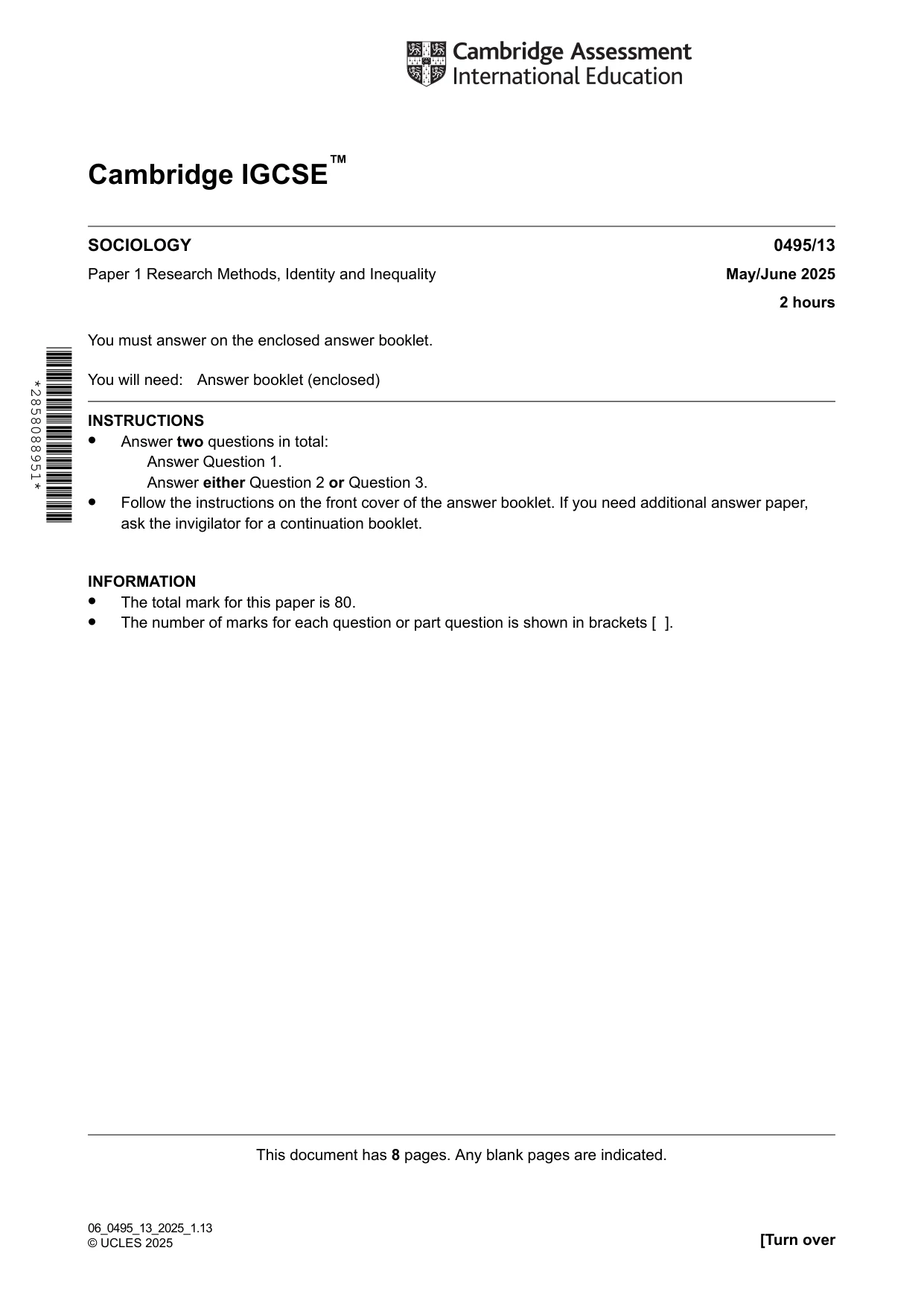
Cambridge IGCSE™ 0495/13 May/June 2025 2 hours SOCIOLOGY Paper 1 Research Methods, Identity and Inequality You must answer on the enclosed answer booklet. You will need: Answer booklet (enclosed) INSTRUCTIONS • Answer two questions in total: Answer Question 1. Answer either Question 2 or Question 3. • Follow the instructions on the front cover of the answer booklet. If you need additional answer paper, ask the invigilator for a continuation booklet. INFORMATION • The total mark for this paper is 80. • The number of marks for each question or part question is shown in brackets [ ]. This document has 8 pages. Any blank pages are indicated. [Turn over 06_0495_13_2025_1.13 © UCLES 2025 *2858088951*
Question paper, page 2
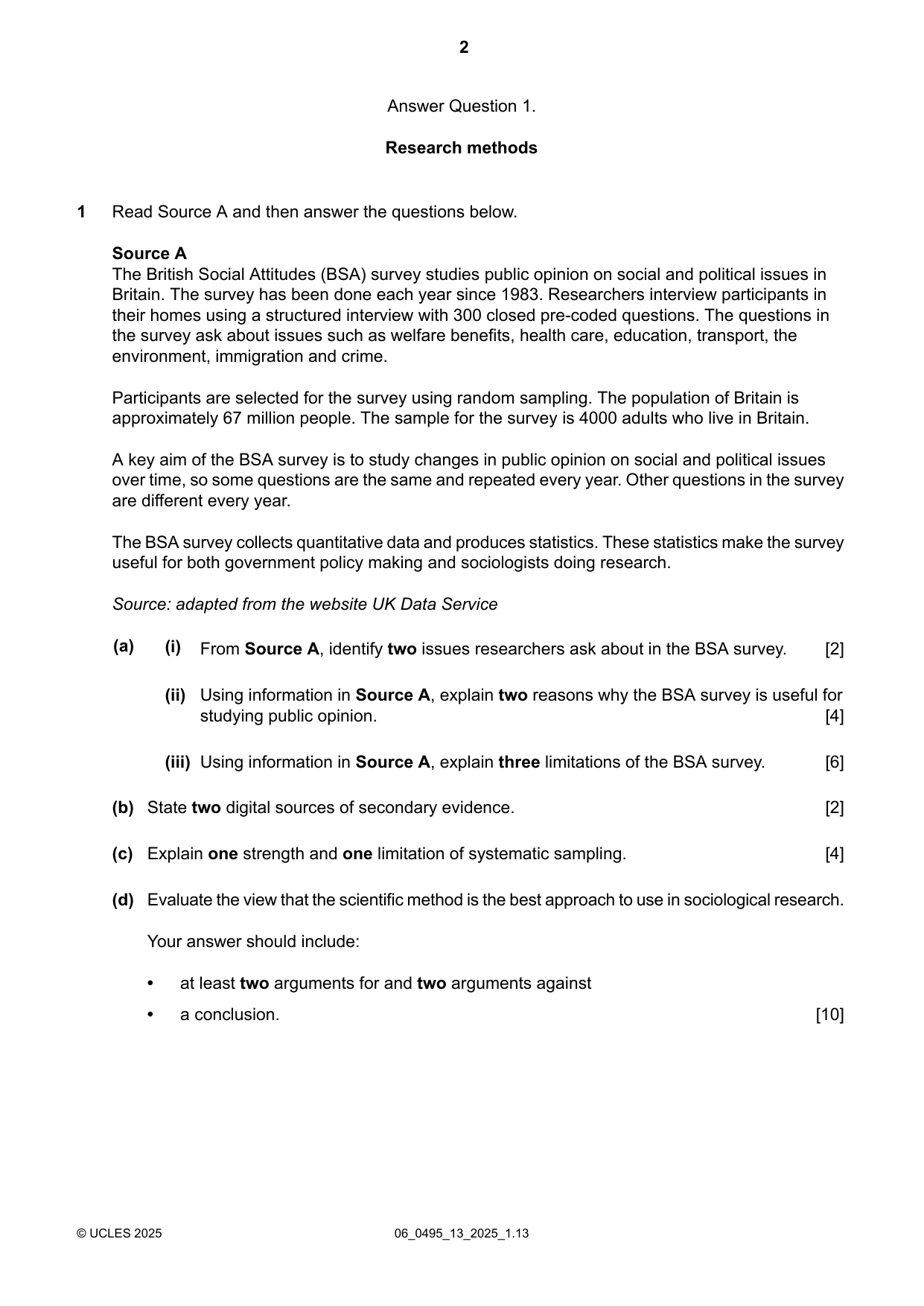
Answer Question 1. Research methods Read Source A and then answer the questions below. Source A The British Social Attitudes (BSA) survey studies public opinion on social and political issues in Britain. The survey has been done each year since 1983. Researchers interview participants in 1 their homes using a structured interview with 300 closed pre-coded questions. The questions in the survey ask about issues such as welfare benefits, health care, education, transport, the environment, immigration and crime. Participants are selected for the survey using random sampling. The population of Britain is approximately 67 million people. The sample for the survey is 4000 adults who live in Britain. A key aim of the BSA survey is to study changes in public opinion on social and political issues over time, so some questions are the same and repeated every year. Other questions in the survey are different every year. The BSA survey collects quantitative data and produces statistics. These statistics make the survey useful for both government policy making and sociologists doing research. Source: adapted from the website UK Data Service (a) From Source A, identify two issues researchers ask about in the BSA survey. [2] (i) Using information in Source A, explain two reasons why the BSA survey is useful for studying public opinion. [4] (ii) Using information in Source A, explain three limitations of the BSA survey. [6] (iii) State two digital sources of secondary evidence. [2] (b) Explain one strength and one limitation of systematic sampling. [4] (c) Evaluate the view that the scientific method is the best approach to use in sociological research. Your answer should include: (d) • at least two arguments for and two arguments against • a conclusion. [10] 06_0495_13_2025_1.13 © UCLES 2025 2
Question paper, page 3
Explain the research methods and evidence that you would choose to investigate why some young people join gangs. Give reasons for your choices. Your answer should include: (e) • two primary methods with relevant sampling • one source of secondary evidence. [12] [Turn over 06_0495_13_2025_1.13 © UCLES 2025 3
Question paper, page 4
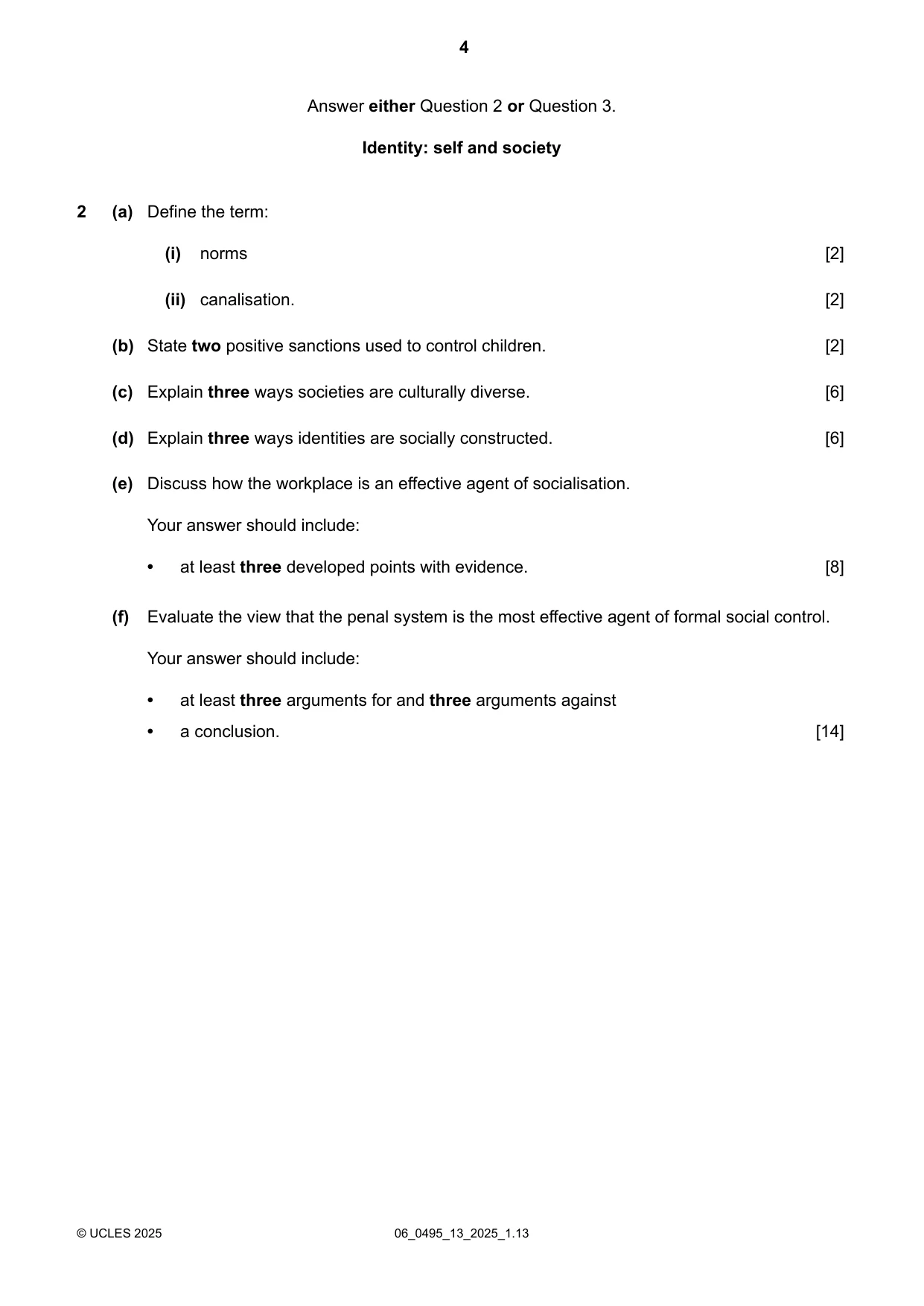
Answer either Question 2 or Question 3. Identity: self and society Define the term: (a) 2 norms [2] (i) canalisation. [2] (ii) State two positive sanctions used to control children. [2] (b) Explain three ways societies are culturally diverse. [6] (c) Explain three ways identities are socially constructed. [6] (d) Discuss how the workplace is an effective agent of socialisation. Your answer should include: (e) • at least three developed points with evidence. [8] Evaluate the view that the penal system is the most effective agent of formal social control. Your answer should include: (f) • at least three arguments for and three arguments against • a conclusion. [14] 06_0495_13_2025_1.13 © UCLES 2025 4
Question paper, page 5
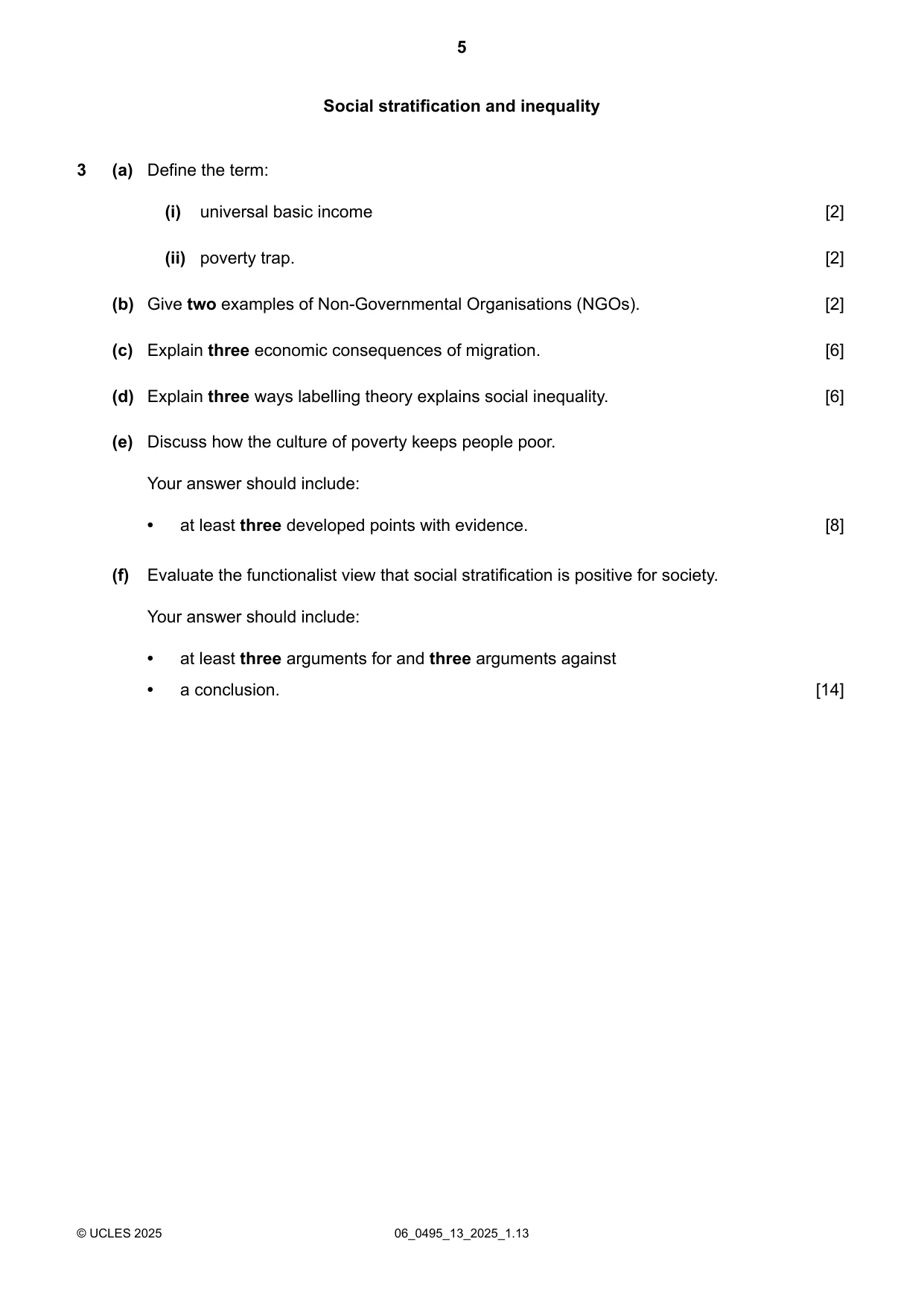
Social stratification and inequality Define the term: (a) 3 universal basic income [2] (i) poverty trap. [2] (ii) Give two examples of Non-Governmental Organisations (NGOs). [2] (b) Explain three economic consequences of migration. [6] (c) Explain three ways labelling theory explains social inequality. [6] (d) Discuss how the culture of poverty keeps people poor. Your answer should include: (e) • at least three developed points with evidence. [8] Evaluate the functionalist view that social stratification is positive for society. Your answer should include: (f) • at least three arguments for and three arguments against • a conclusion. [14] 06_0495_13_2025_1.13 © UCLES 2025 5
Question paper, page 6
BLANK PAGE 06_0495_13_2025_1.13 © UCLES 2025 6
Question paper, page 7
BLANK PAGE 06_0495_13_2025_1.13 © UCLES 2025 7
Question paper, page 8
BLANK PAGE Permission to reproduce items where third-party owned material protected by copyright is included has been sought and cleared where possible. Every reasonable effort has been made by the publisher (UCLES) to trace copyright holders, but if any items requiring clearance have unwittingly been included, the publisher will be pleased to make amends at the earliest possible opportunity. To avoid the issue of disclosure of answer-related information to candidates, all copyright acknowledgements are reproduced online in the Cambridge Assessment International Education Copyright Acknowledgements Booklet. This is produced for each series of examinations and is freely available to download at www.cambridgeinternational.org after the live examination series. Cambridge Assessment International Education is part of Cambridge Assessment. Cambridge Assessment is the brand name of the University of Cambridge Local Examinations Syndicate (UCLES), which is a department of the University of Cambridge. 06_0495_13_2025_1.13 © UCLES 2025 8
Mark scheme, page 1
This document consists of 29 printed pages. © Cambridge University Press & Assessment 2025 [Turn over Cambridge IGCSE™ SOCIOLOGY 0495/13 Paper 1 Research Methods, Identity and Inequality May/June 2025 MARK SCHEME Maximum Mark: 80 Published This mark scheme is published as an aid to teachers and candidates, to indicate the requirements of the examination. It shows the basis on which Examiners were instructed to award marks. It does not indicate the details of the discussions that took place at an Examiners’ meeting before marking began, which would have considered the acceptability of alternative answers. Mark schemes should be read in conjunction with the question paper and the Principal Examiner Report for Teachers. Cambridge International will not enter into discussions about these mark schemes. Cambridge International is publishing the mark schemes for the May/June 2025 series for most Cambridge IGCSE, Cambridge International A and AS Level components, and some Cambridge O Level components.
Mark scheme, page 2
0495/13 Cambridge IGCSE – Mark Scheme PUBLISHED May/June 2025 © Cambridge University Press & Assessment 2025 Page 2 of 29 Generic Marking Principles These general marking principles must be applied by all examiners when marking candidate answers. They should be applied alongside the specific content of the mark scheme or generic level descriptions for a question. Each question paper and mark scheme will also comply with these marking principles. GENERIC MARKING PRINCIPLE 1: Marks must be awarded in line with: • the specific content of the mark scheme or the generic level descriptors for the question • the specific skills defined in the mark scheme or in the generic level descriptors for the question • the standard of response required by a candidate as exemplified by the standardisation scripts. GENERIC MARKING PRINCIPLE 2: Marks awarded are always whole marks (not half marks, or other fractions). GENERIC MARKING PRINCIPLE 3: Marks must be awarded positively: • marks are awarded for correct/valid answers, as defined in the mark scheme. However, credit is given for valid answers which go beyond the scope of the syllabus and mark scheme, referring to your Team Leader as appropriate • marks are awarded when candidates clearly demonstrate what they know and can do • marks are not deducted for errors • marks are not deducted for omissions • answers should only be judged on the quality of spelling, punctuation and grammar when these features are specifically assessed by the question as indicated by the mark scheme. The meaning, however, should be unambiguous. GENERIC MARKING PRINCIPLE 4: Rules must be applied consistently, e.g. in situations where candidates have not followed instructions or in the application of generic level descriptors. GENERIC MARKING PRINCIPLE 5: Marks should be awarded using the full range of marks defined in the mark scheme for the question (however; the use of the full mark range may be limited according to the quality of the candidate responses seen). GENERIC MARKING PRINCIPLE 6: Marks awarded are based solely on the requirements as defined in the mark scheme. Marks should not be awarded with grade thresholds or grade descriptors in mind.
Mark scheme, page 3
0495/13 Cambridge IGCSE – Mark Scheme PUBLISHED May/June 2025 © Cambridge University Press & Assessment 2025 Page 3 of 29 Social Science-Specific Marking Principles (for point-based marking) 1 Components using point-based marking: • Point marking is often used to reward knowledge, understanding and application of skills. We give credit where the candidate’s answer shows relevant knowledge, understanding and application of skills in answering the question. We do not give credit where the answer shows confusion. From this it follows that we: a DO credit answers which are worded differently from the mark scheme if they clearly convey the same meaning (unless the mark scheme requires a specific term) b DO credit alternative answers/examples which are not written in the mark scheme if they are correct c DO credit answers where candidates give more than one correct answer in one prompt/numbered/scaffolded space where extended writing is required rather than list-type answers. For example, questions that require n reasons (e.g. State two reasons …). d DO NOT credit answers simply for using a ‘key term’ unless that is all that is required. (Check for evidence it is understood and not used wrongly.) e DO NOT credit answers which are obviously self-contradicting or trying to cover all possibilities f DO NOT give further credit for what is effectively repetition of a correct point already credited unless the language itself is being tested. This applies equally to ‘mirror statements’ (i.e. polluted/not polluted). g DO NOT require spellings to be correct, unless this is part of the test. However spellings of syllabus terms must allow for clear and unambiguous separation from other syllabus terms with which they may be confused (e.g. Corrasion/Corrosion) 2 Presentation of mark scheme: • Slashes (/) or the word ‘or’ separate alternative ways of making the same point. • Semi colons (;) bullet points (•) or figures in brackets (1) separate different points. • Content in the answer column in brackets is for examiner information/context to clarify the marking but is not required to earn the mark (except Accounting syllabuses where they indicate negative numbers). 3 Calculation questions: • The mark scheme will show the steps in the most likely correct method(s), the mark for each step, the correct answer(s) and the mark for each answer • If working/explanation is considered essential for full credit, this will be indicated in the question paper and in the mark scheme. In all other instances, the correct answer to a calculation should be given full credit, even if no supporting working is shown. • Where the candidate uses a valid method which is not covered by the mark scheme, award equivalent marks for reaching equivalent stages. • Where an answer makes use of a candidate’s own incorrect figure from previous working, the ‘own figure rule’ applies: full marks will be given if a correct and complete method is used. Further guidance will be included in the mark scheme where necessary and any exceptions to this general principle will be noted.
Mark scheme, page 4
0495/13 Cambridge IGCSE – Mark Scheme PUBLISHED May/June 2025 © Cambridge University Press & Assessment 2025 Page 4 of 29 4 Annotation: • For point marking, ticks can be used to indicate correct answers and crosses can be used to indicate wrong answers. There is no direct relationship between ticks and marks. Ticks have no defined meaning for levels of response marking. • For levels of response marking, the level awarded should be annotated on the script. • Other annotations will be used by examiners as agreed during standardisation, and the meaning will be understood by all examiners who marked that paper.
Mark scheme, page 5
0495/13 Cambridge IGCSE – Mark Scheme PUBLISHED May/June 2025 © Cambridge University Press & Assessment 2025 Page 5 of 29 Annotations guidance for centres Examiners use a system of annotations as a shorthand for communicating their marking decisions to one another. Examiners are trained during the standardisation process on how and when to use annotations. The purpose of annotations is to inform the standardisation and monitoring processes and guide the supervising examiners when they are checking the work of examiners within their team. The meaning of annotations and how they are used is specific to each component and is understood by all examiners who mark the component. We publish annotations in our mark schemes to help centres understand the annotations they may see on copies of scripts. Note that there may not be a direct correlation between the number of annotations on a script and the mark awarded. Similarly, the use of an annotation may not be an indication of the quality of the response. The annotations listed below were available to examiners marking this component in this series.
Mark scheme, page 6
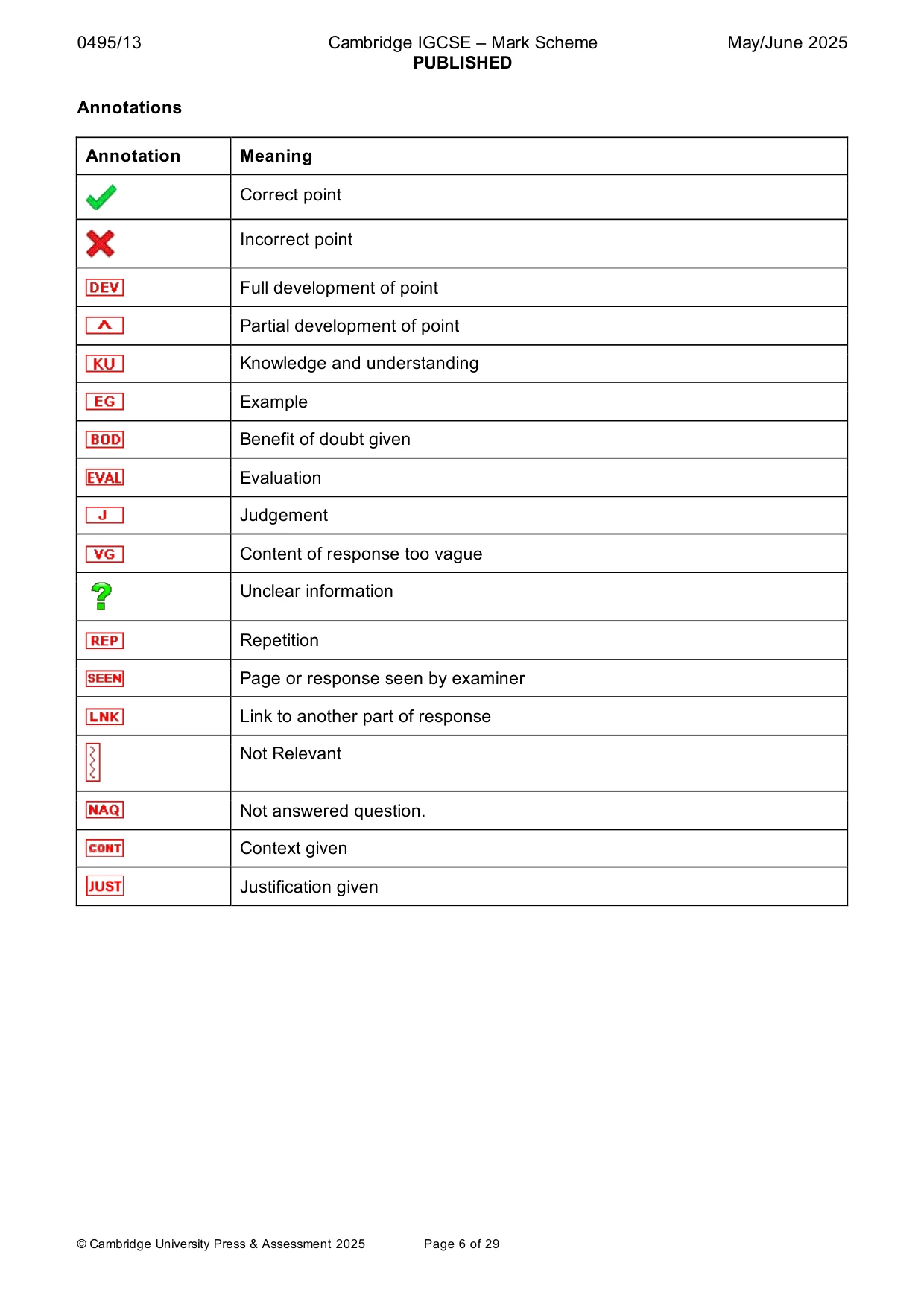
0495/13 Cambridge IGCSE – Mark Scheme PUBLISHED May/June 2025 © Cambridge University Press & Assessment 2025 Page 6 of 29 Annotations Annotation Meaning Correct point Incorrect point Full development of point Partial development of point Knowledge and understanding Example Benefit of doubt given Evaluation Judgement Content of response too vague Unclear information Repetition Page or response seen by examiner Link to another part of response Not Relevant Not answered question. Context given Justification given
Mark scheme, page 7
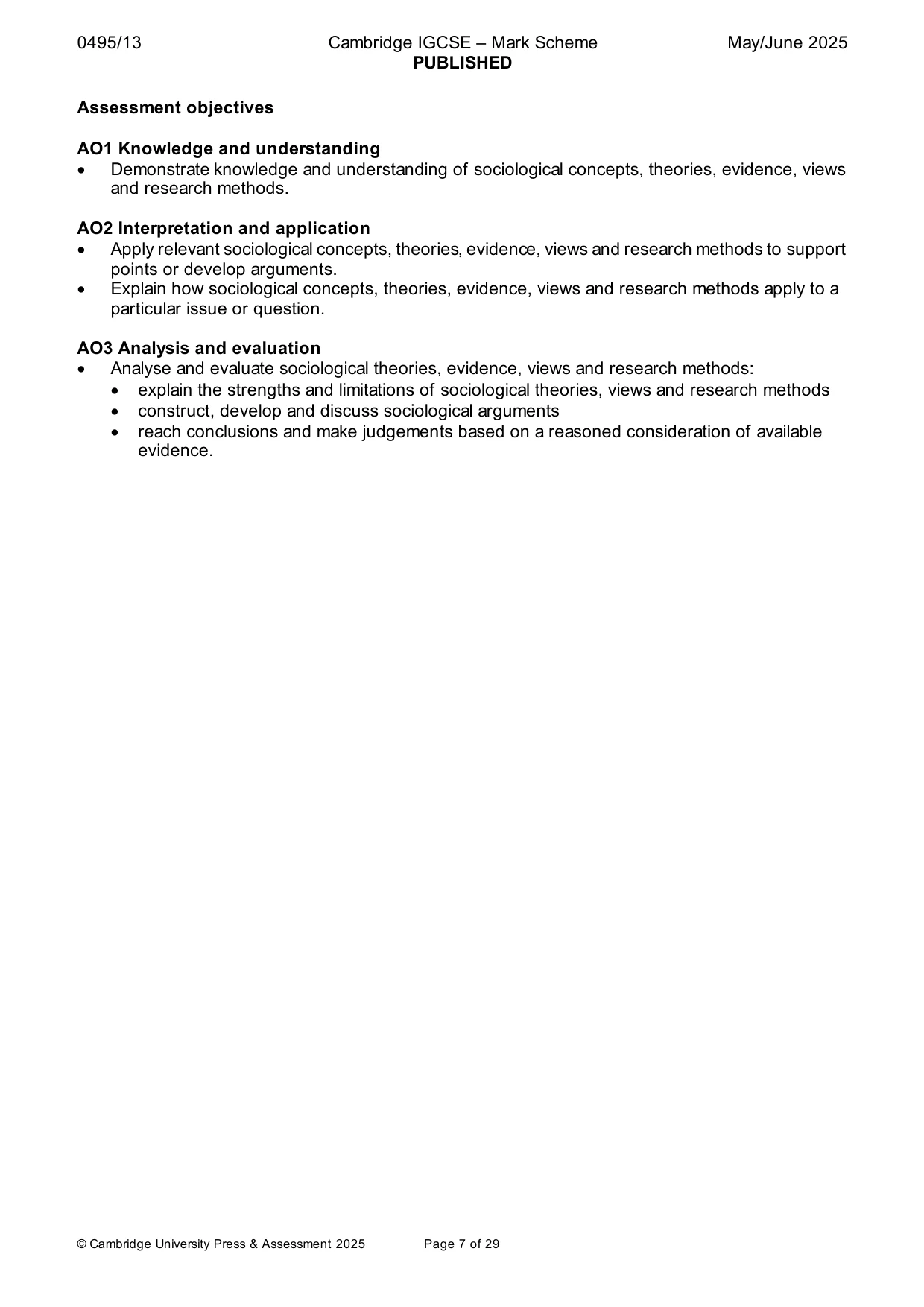
0495/13 Cambridge IGCSE – Mark Scheme PUBLISHED May/June 2025 © Cambridge University Press & Assessment 2025 Page 7 of 29 Assessment objectives AO1 Knowledge and understanding • Demonstrate knowledge and understanding of sociological concepts, theories, evidence, views and research methods. AO2 Interpretation and application • Apply relevant sociological concepts, theories, evidence, views and research methods to support points or develop arguments. • Explain how sociological concepts, theories, evidence, views and research methods apply to a particular issue or question. AO3 Analysis and evaluation • Analyse and evaluate sociological theories, evidence, views and research methods: • explain the strengths and limitations of sociological theories, views and research methods • construct, develop and discuss sociological arguments • reach conclusions and make judgements based on a reasoned consideration of available evidence.
Mark scheme, page 8
0495/13 Cambridge IGCSE – Mark Scheme PUBLISHED May/June 2025 © Cambridge University Press & Assessment 2025 Page 8 of 29 Generic levels of response grids Using the mark levels For all questions except Q1(e), please use the instructions below. Use the generic mark scheme levels to find the mark. Place the answer in a level first. Look for the ‘best fit’ of the answer into a level. Consider the levels above and below to ensure you have selected the right one. An answer needs to show evidence of most but not necessarily ALL of the qualities described in a level, in order to be placed in that level. Award a mark for the relative position of the answer within the level. Candidates may address the question in many different ways; there is no one required answer or approach. Do not penalise answers for leaving out a particular focus. Reward what is there rather than what is missing. For Q1(e), there are separate instructions for marking using Table B, which does not use a best fit approach to a levels of response grid.
Mark scheme, page 9
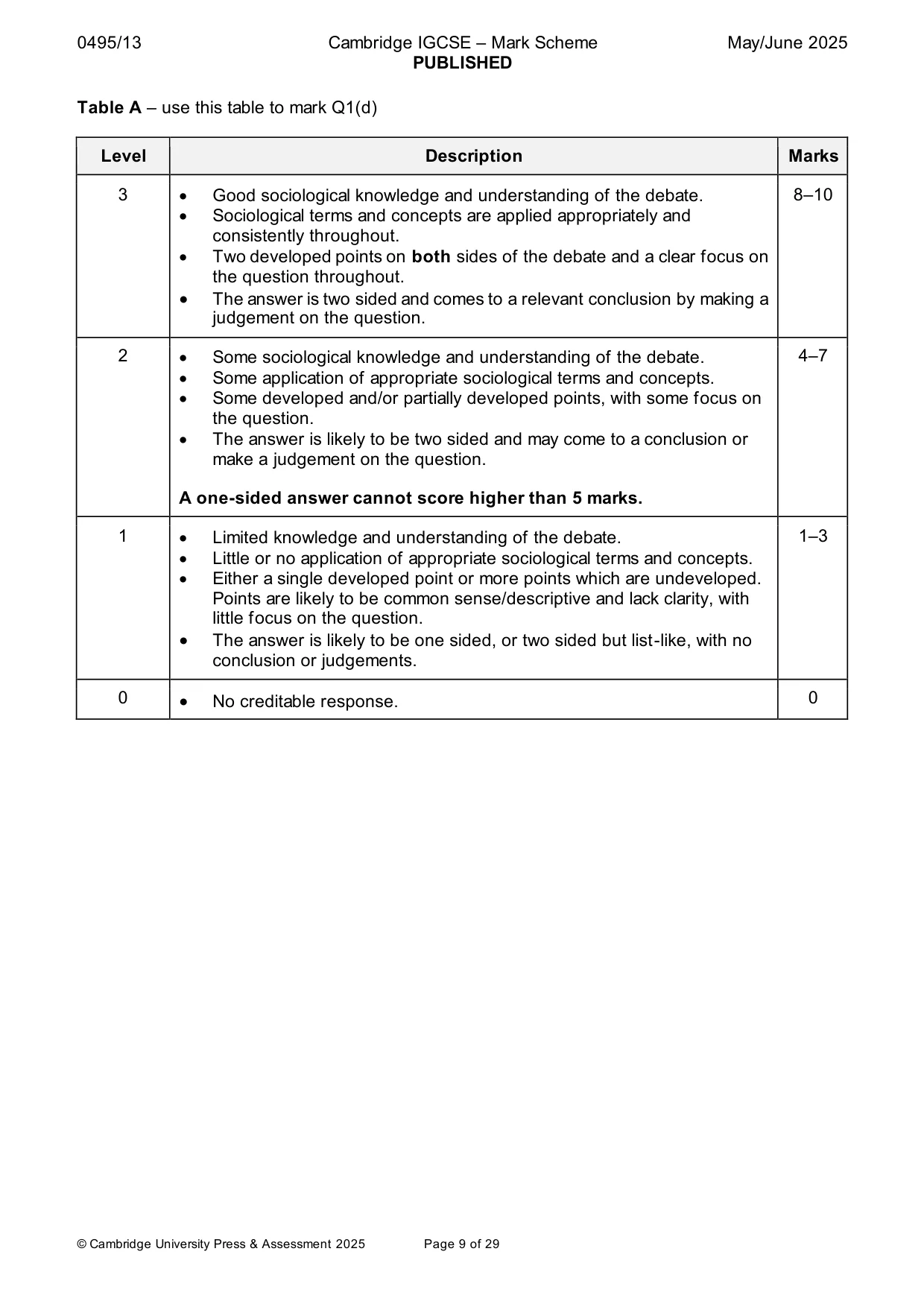
0495/13 Cambridge IGCSE – Mark Scheme PUBLISHED May/June 2025 © Cambridge University Press & Assessment 2025 Page 9 of 29 Table A – use this table to mark Q1(d) Level Description Marks 3 • Good sociological knowledge and understanding of the debate. • Sociological terms and concepts are applied appropriately and consistently throughout. • Two developed points on both sides of the debate and a clear focus on the question throughout. • The answer is two sided and comes to a relevant conclusion by making a judgement on the question. 8–10 2 • Some sociological knowledge and understanding of the debate. • Some application of appropriate sociological terms and concepts. • Some developed and/or partially developed points, with some focus on the question. • The answer is likely to be two sided and may come to a conclusion or make a judgement on the question. A one-sided answer cannot score higher than 5 marks. 4–7 1 • Limited knowledge and understanding of the debate. • Little or no application of appropriate sociological terms and concepts. • Either a single developed point or more points which are undeveloped. Points are likely to be common sense/descriptive and lack clarity, with little focus on the question. • The answer is likely to be one sided, or two sided but list-like, with no conclusion or judgements. 1–3 0 • No creditable response. 0
Mark scheme, page 10
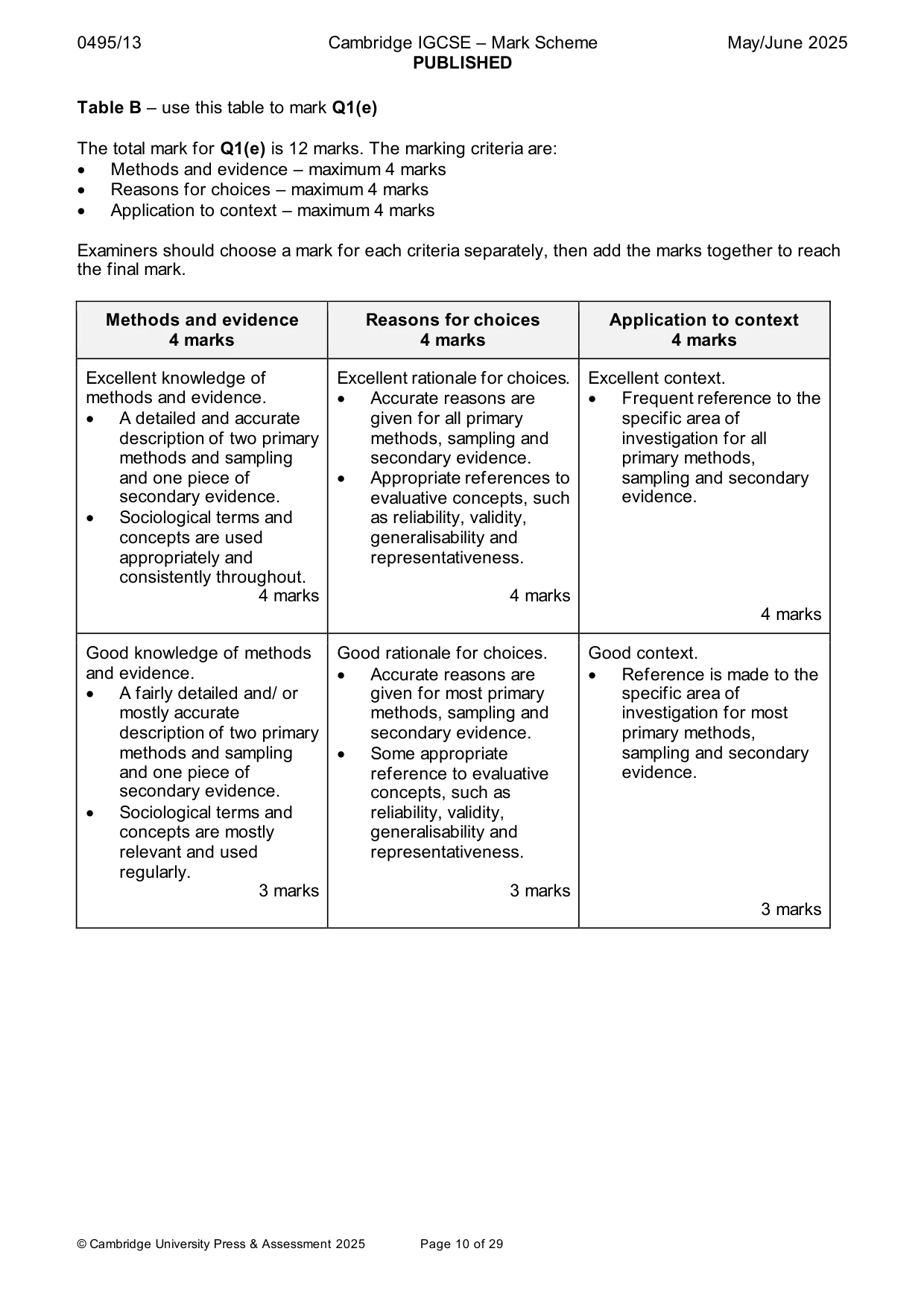
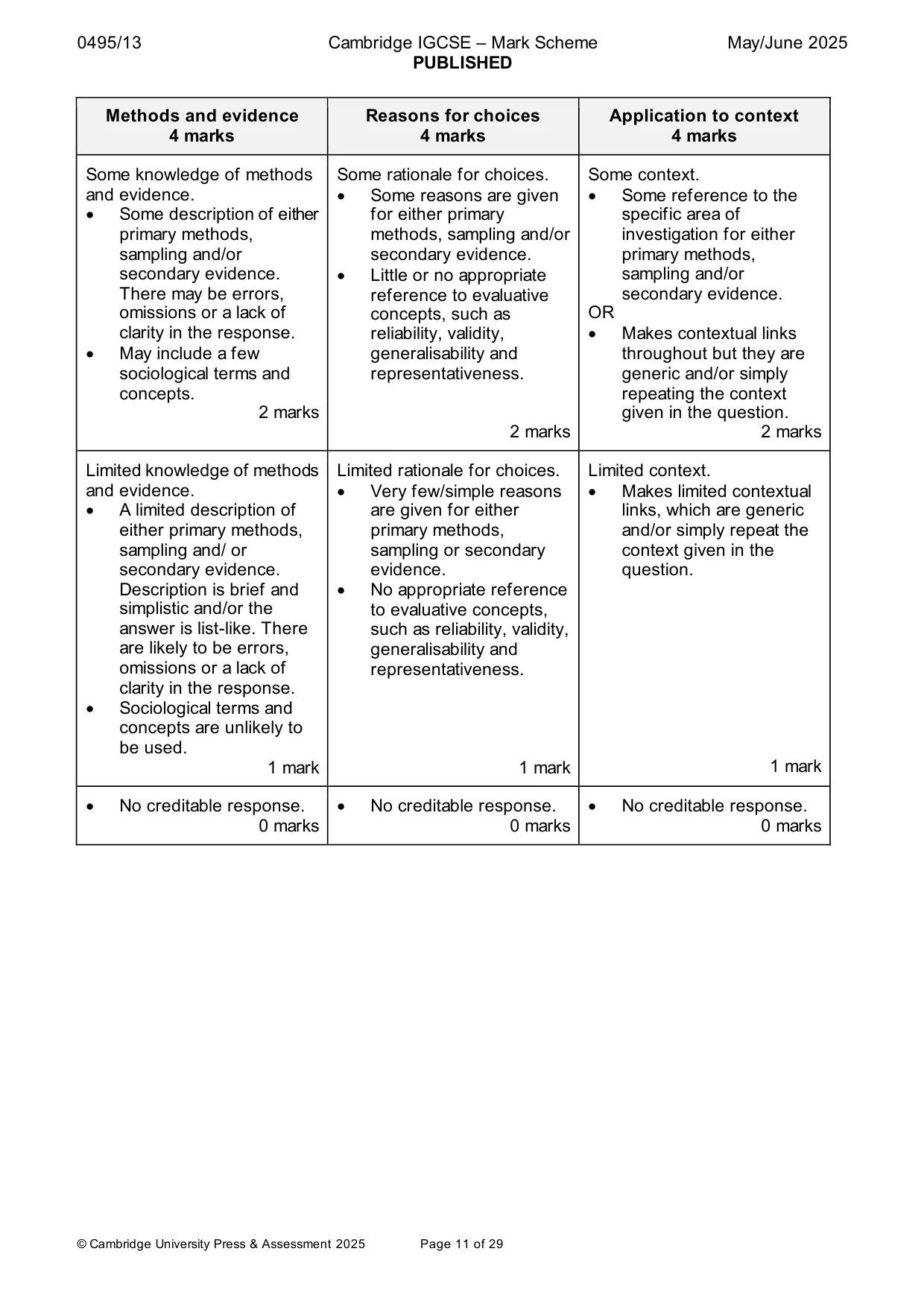
0495/13 Cambridge IGCSE – Mark Scheme PUBLISHED May/June 2025 © Cambridge University Press & Assessment 2025 Page 10 of 29 Table B – use this table to mark Q1(e) The total mark for Q1(e) is 12 marks. The marking criteria are: • Methods and evidence – maximum 4 marks • Reasons for choices – maximum 4 marks • Application to context – maximum 4 marks Examiners should choose a mark for each criteria separately, then add the marks together to reach the final mark. Methods and evidence 4 marks Reasons for choices 4 marks Application to context 4 marks Excellent knowledge of methods and evidence. • A detailed and accurate description of two primary methods and sampling and one piece of secondary evidence. • Sociological terms and concepts are used appropriately and consistently throughout. 4 marks Excellent rationale for choices. • Accurate reasons are given for all primary methods, sampling and secondary evidence. • Appropriate references to evaluative concepts, such as reliability, validity, generalisability and representativeness. 4 marks Excellent context. • Frequent reference to the specific area of investigation for all primary methods, sampling and secondary evidence. 4 marks Good knowledge of methods and evidence. • A fairly detailed and/ or mostly accurate description of two primary methods and sampling and one piece of secondary evidence. • Sociological terms and concepts are mostly relevant and used regularly. 3 marks Good rationale for choices. • Accurate reasons are given for most primary methods, sampling and secondary evidence. • Some appropriate reference to evaluative concepts, such as reliability, validity, generalisability and representativeness. 3 marks Good context. • Reference is made to the specific area of investigation for most primary methods, sampling and secondary evidence. 3 marks
Mark scheme, page 11
0495/13 Cambridge IGCSE – Mark Scheme PUBLISHED May/June 2025 © Cambridge University Press & Assessment 2025 Page 11 of 29 Methods and evidence 4 marks Reasons for choices 4 marks Application to context 4 marks Some knowledge of methods and evidence. • Some description of either primary methods, sampling and/or secondary evidence. There may be errors, omissions or a lack of clarity in the response. • May include a few sociological terms and concepts. 2 marks Some rationale for choices. • Some reasons are given for either primary methods, sampling and/or secondary evidence. • Little or no appropriate reference to evaluative concepts, such as reliability, validity, generalisability and representativeness. 2 marks Some context. • Some reference to the specific area of investigation for either primary methods, sampling and/or secondary evidence. OR • Makes contextual links throughout but they are generic and/or simply repeating the context given in the question. 2 marks Limited knowledge of methods and evidence. • A limited description of either primary methods, sampling and/ or secondary evidence. Description is brief and simplistic and/or the answer is list-like. There are likely to be errors, omissions or a lack of clarity in the response. • Sociological terms and concepts are unlikely to be used. 1 mark Limited rationale for choices. • Very few/simple reasons are given for either primary methods, sampling or secondary evidence. • No appropriate reference to evaluative concepts, such as reliability, validity, generalisability and representativeness. 1 mark Limited context. • Makes limited contextual links, which are generic and/or simply repeat the context given in the question. 1 mark • No creditable response. 0 marks • No creditable response. 0 marks • No creditable response. 0 marks
Mark scheme, page 12
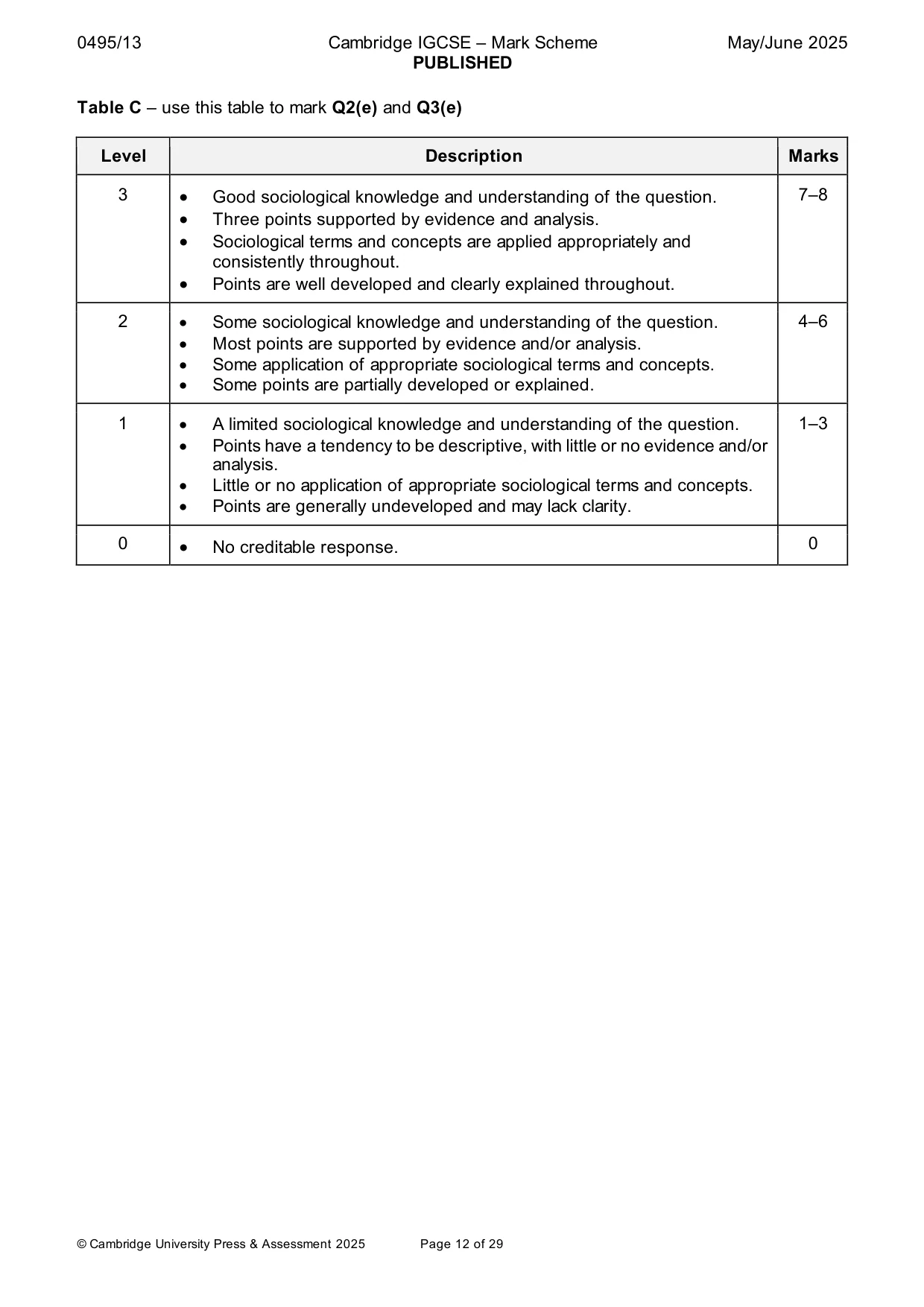
0495/13 Cambridge IGCSE – Mark Scheme PUBLISHED May/June 2025 © Cambridge University Press & Assessment 2025 Page 12 of 29 Table C – use this table to mark Q2(e) and Q3(e) Level Description Marks 3 • Good sociological knowledge and understanding of the question. • Three points supported by evidence and analysis. • Sociological terms and concepts are applied appropriately and consistently throughout. • Points are well developed and clearly explained throughout. 7–8 2 • Some sociological knowledge and understanding of the question. • Most points are supported by evidence and/or analysis. • Some application of appropriate sociological terms and concepts. • Some points are partially developed or explained. 4–6 1 • A limited sociological knowledge and understanding of the question. • Points have a tendency to be descriptive, with little or no evidence and/or analysis. • Little or no application of appropriate sociological terms and concepts. • Points are generally undeveloped and may lack clarity. 1–3 0 • No creditable response. 0
Mark scheme, page 13
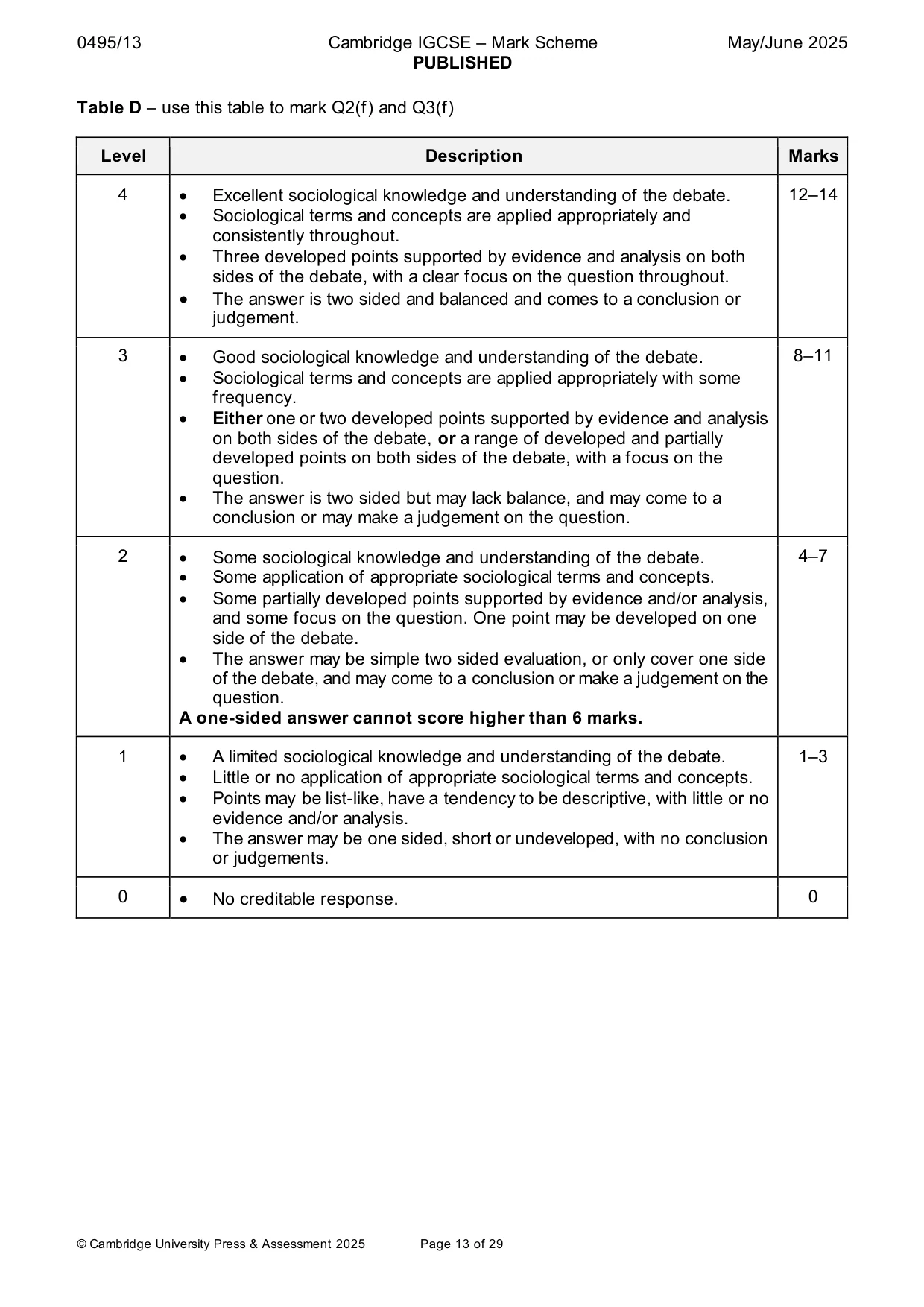
0495/13 Cambridge IGCSE – Mark Scheme PUBLISHED May/June 2025 © Cambridge University Press & Assessment 2025 Page 13 of 29 Table D – use this table to mark Q2(f) and Q3(f) Level Description Marks 4 • Excellent sociological knowledge and understanding of the debate. • Sociological terms and concepts are applied appropriately and consistently throughout. • Three developed points supported by evidence and analysis on both sides of the debate, with a clear focus on the question throughout. • The answer is two sided and balanced and comes to a conclusion or judgement. 12–14 3 • Good sociological knowledge and understanding of the debate. • Sociological terms and concepts are applied appropriately with some frequency. • Either one or two developed points supported by evidence and analysis on both sides of the debate, or a range of developed and partially developed points on both sides of the debate, with a focus on the question. • The answer is two sided but may lack balance, and may come to a conclusion or may make a judgement on the question. 8–11 2 • Some sociological knowledge and understanding of the debate. • Some application of appropriate sociological terms and concepts. • Some partially developed points supported by evidence and/or analysis, and some focus on the question. One point may be developed on one side of the debate. • The answer may be simple two sided evaluation, or only cover one side of the debate, and may come to a conclusion or make a judgement on the question. A one-sided answer cannot score higher than 6 marks. 4–7 1 • A limited sociological knowledge and understanding of the debate. • Little or no application of appropriate sociological terms and concepts. • Points may be list-like, have a tendency to be descriptive, with little or no evidence and/or analysis. • The answer may be one sided, short or undeveloped, with no conclusion or judgements. 1–3 0 • No creditable response. 0
Mark scheme, page 14
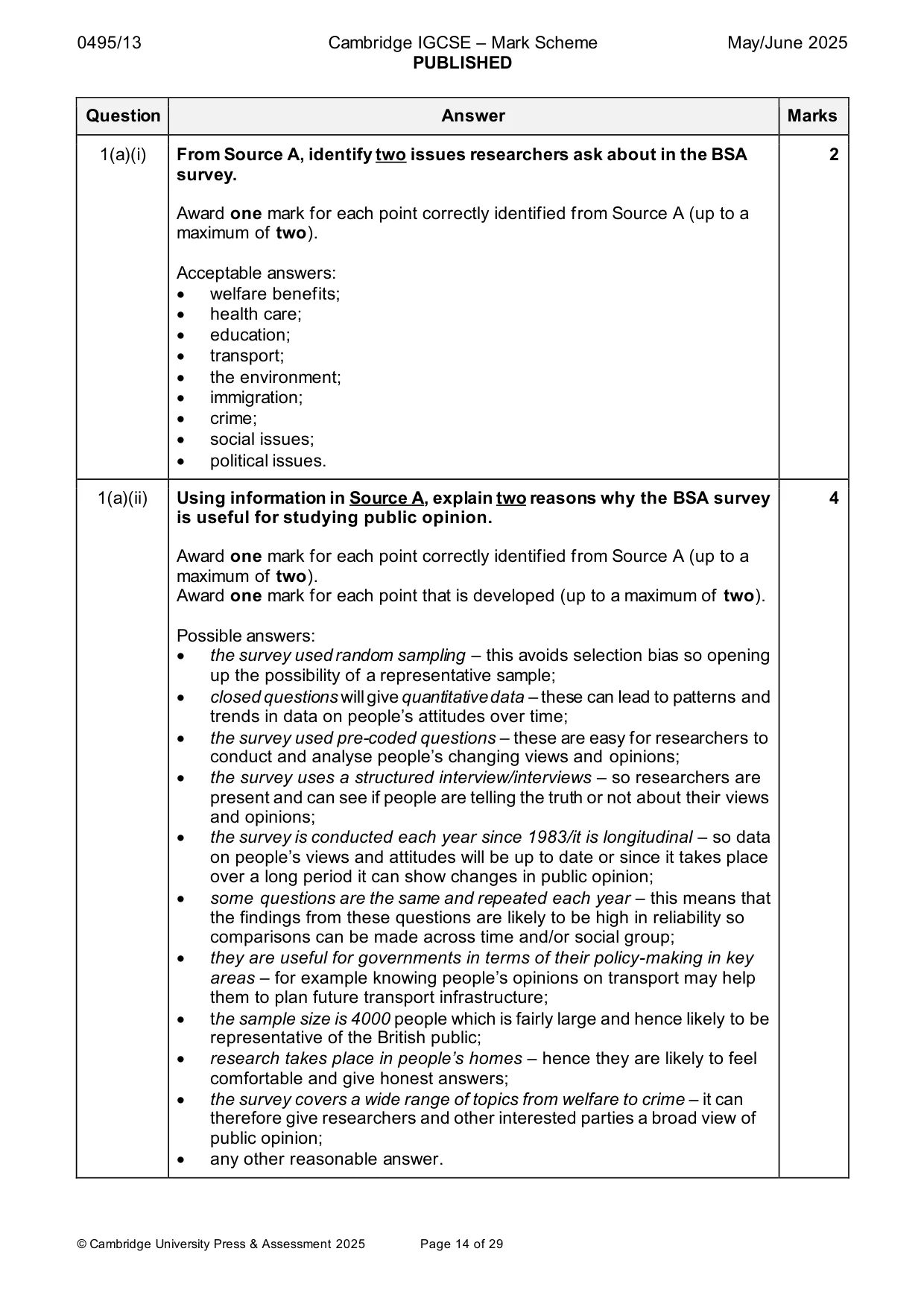
0495/13 Cambridge IGCSE – Mark Scheme PUBLISHED May/June 2025 © Cambridge University Press & Assessment 2025 Page 14 of 29 Question Answer Marks 1(a)(i) From Source A, identify two issues researchers ask about in the BSA survey. Award one mark for each point correctly identified from Source A (up to a maximum of two). Acceptable answers: • welfare benefits; • health care; • education; • transport; • the environment; • immigration; • crime; • social issues; • political issues. 2 1(a)(ii) Using information in Source A, explain two reasons why the BSA survey is useful for studying public opinion. Award one mark for each point correctly identified from Source A (up to a maximum of two). Award one mark for each point that is developed (up to a maximum of two). Possible answers: • the survey used random sampling – this avoids selection bias so opening up the possibility of a representative sample; • closed questions will give quantitative data – these can lead to patterns and trends in data on people’s attitudes over time; • the survey used pre-coded questions – these are easy for researchers to conduct and analyse people’s changing views and opinions; • the survey uses a structured interview/interviews – so researchers are present and can see if people are telling the truth or not about their views and opinions; • the survey is conducted each year since 1983/it is longitudinal – so data on people’s views and attitudes will be up to date or since it takes place over a long period it can show changes in public opinion; • some questions are the same and repeated each year – this means that the findings from these questions are likely to be high in reliability so comparisons can be made across time and/or social group; • they are useful for governments in terms of their policy-making in key areas – for example knowing people’s opinions on transport may help them to plan future transport infrastructure; • the sample size is 4000 people which is fairly large and hence likely to be representative of the British public; • research takes place in people’s homes – hence they are likely to feel comfortable and give honest answers; • the survey covers a wide range of topics from welfare to crime – it can therefore give researchers and other interested parties a broad view of public opinion; • any other reasonable answer. 4
Mark scheme, page 15
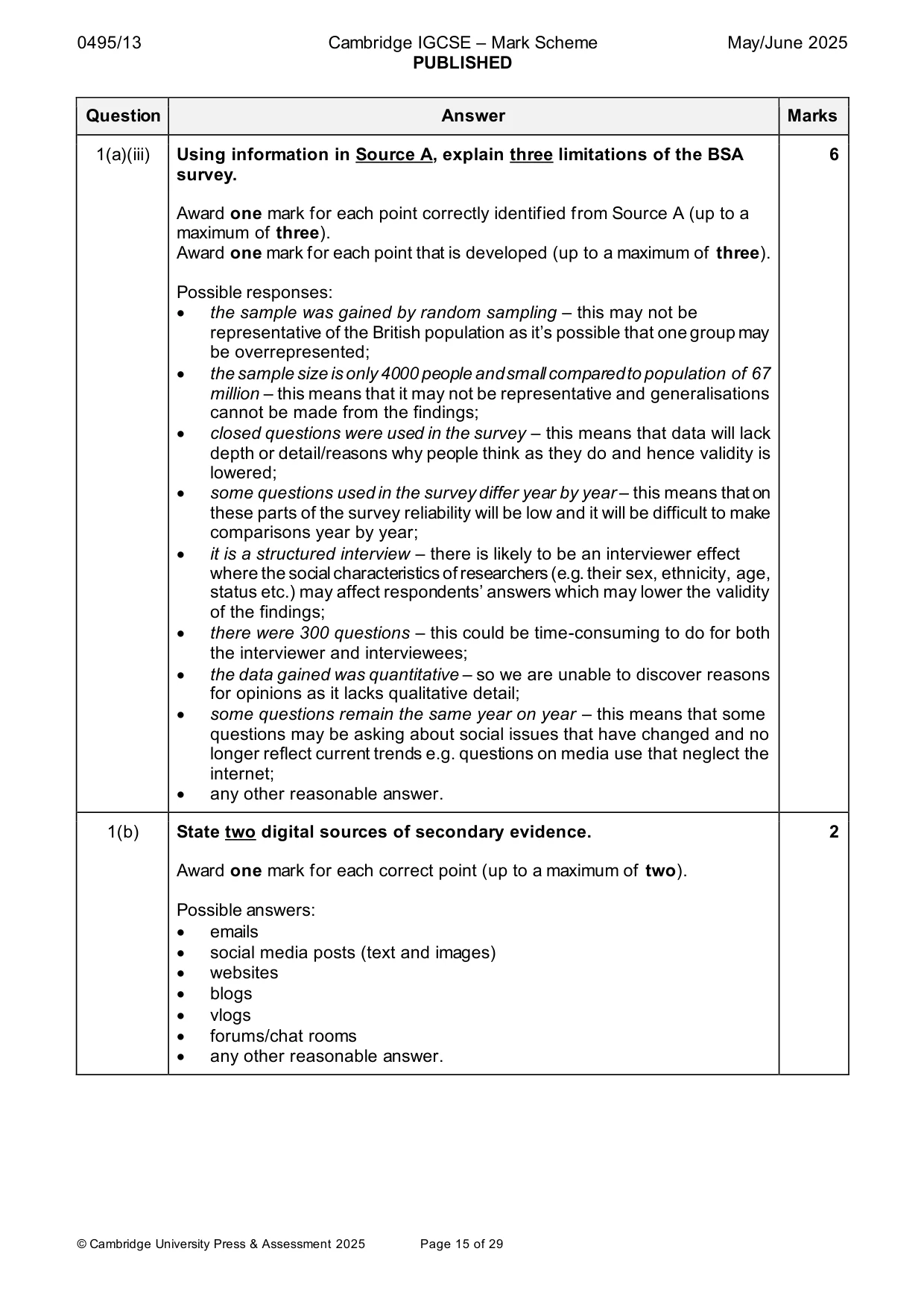
0495/13 Cambridge IGCSE – Mark Scheme PUBLISHED May/June 2025 © Cambridge University Press & Assessment 2025 Page 15 of 29 Question Answer Marks 1(a)(iii) Using information in Source A, explain three limitations of the BSA survey. Award one mark for each point correctly identified from Source A (up to a maximum of three). Award one mark for each point that is developed (up to a maximum of three). Possible responses: • the sample was gained by random sampling – this may not be representative of the British population as it’s possible that one group may be overrepresented; • the sample size is only 4000 people and small compared to population of 67 million – this means that it may not be representative and generalisations cannot be made from the findings; • closed questions were used in the survey – this means that data will lack depth or detail/reasons why people think as they do and hence validity is lowered; • some questions used in the survey differ year by year – this means that on these parts of the survey reliability will be low and it will be difficult to make comparisons year by year; • it is a structured interview – there is likely to be an interviewer effect where the social characteristics of researchers (e.g. their sex, ethnicity, age, status etc.) may affect respondents’ answers which may lower the validity of the findings; • there were 300 questions – this could be time-consuming to do for both the interviewer and interviewees; • the data gained was quantitative – so we are unable to discover reasons for opinions as it lacks qualitative detail; • some questions remain the same year on year – this means that some questions may be asking about social issues that have changed and no longer reflect current trends e.g. questions on media use that neglect the internet; • any other reasonable answer. 6 1(b) State two digital sources of secondary evidence. Award one mark for each correct point (up to a maximum of two). Possible answers: • emails • social media posts (text and images) • websites • blogs • vlogs • forums/chat rooms • any other reasonable answer. 2
Mark scheme, page 16
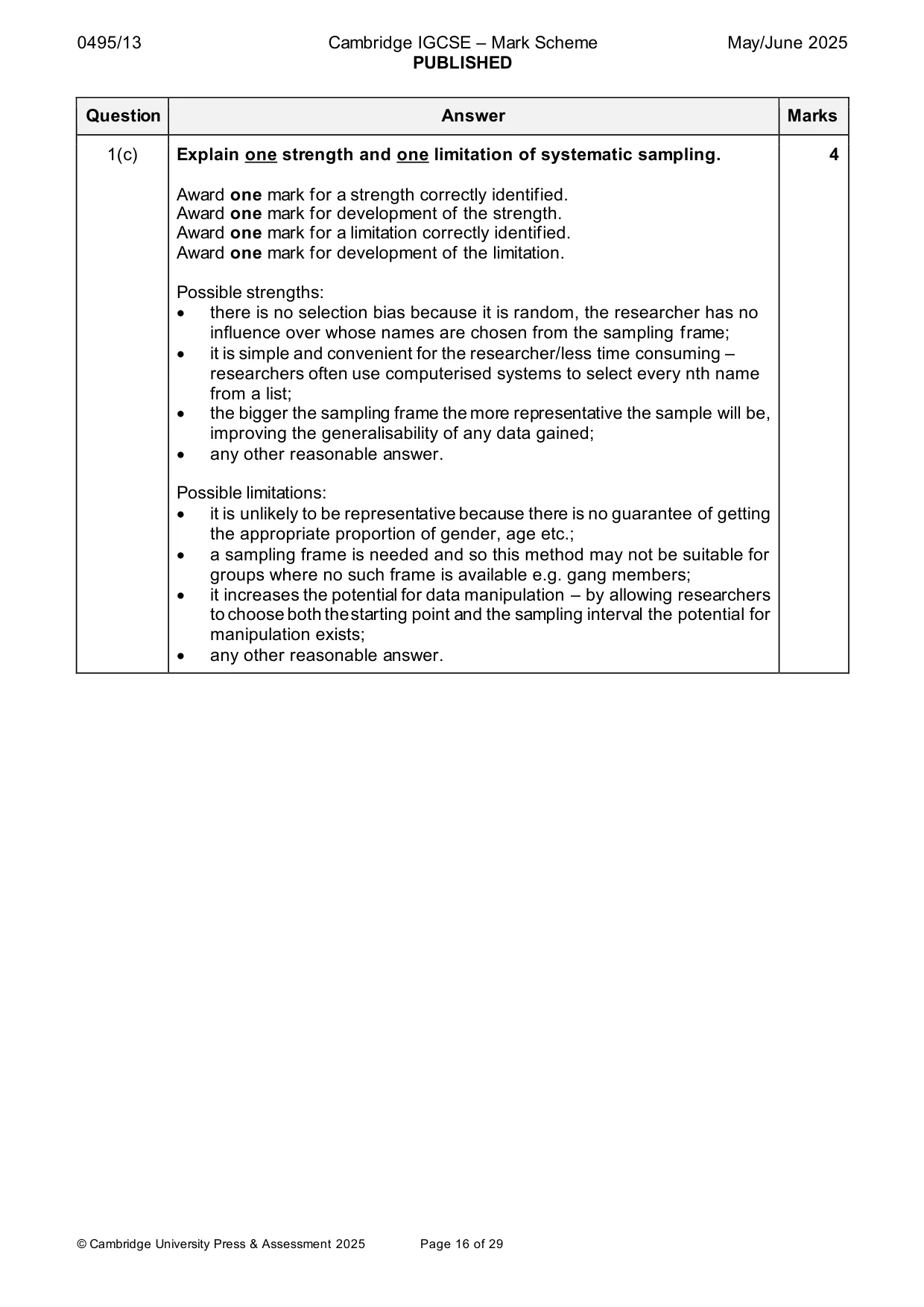
0495/13 Cambridge IGCSE – Mark Scheme PUBLISHED May/June 2025 © Cambridge University Press & Assessment 2025 Page 16 of 29 Question Answer Marks 1(c) Explain one strength and one limitation of systematic sampling. Award one mark for a strength correctly identified. Award one mark for development of the strength. Award one mark for a limitation correctly identified. Award one mark for development of the limitation. Possible strengths: • there is no selection bias because it is random, the researcher has no influence over whose names are chosen from the sampling frame; • it is simple and convenient for the researcher/less time consuming – researchers often use computerised systems to select every nth name from a list; • the bigger the sampling frame the more representative the sample will be, improving the generalisability of any data gained; • any other reasonable answer. Possible limitations: • it is unlikely to be representative because there is no guarantee of getting the appropriate proportion of gender, age etc.; • a sampling frame is needed and so this method may not be suitable for groups where no such frame is available e.g. gang members; • it increases the potential for data manipulation – by allowing researchers to choose both the starting point and the sampling interval the potential for manipulation exists; • any other reasonable answer. 4
Mark scheme, page 17
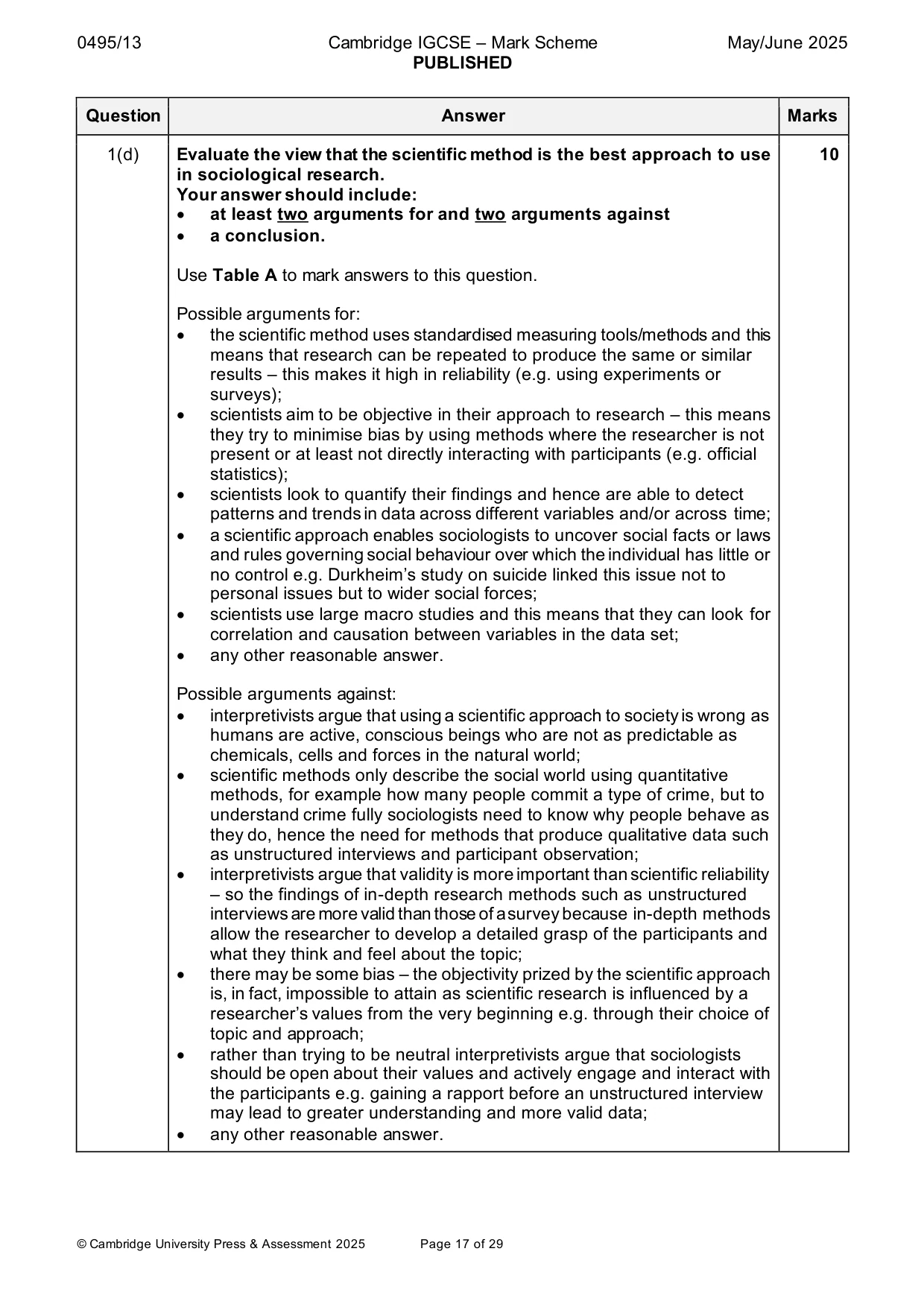
0495/13 Cambridge IGCSE – Mark Scheme PUBLISHED May/June 2025 © Cambridge University Press & Assessment 2025 Page 17 of 29 Question Answer Marks 1(d) Evaluate the view that the scientific method is the best approach to use in sociological research. Your answer should include: • at least two arguments for and two arguments against • a conclusion. Use Table A to mark answers to this question. Possible arguments for: • the scientific method uses standardised measuring tools/methods and this means that research can be repeated to produce the same or similar results – this makes it high in reliability (e.g. using experiments or surveys); • scientists aim to be objective in their approach to research – this means they try to minimise bias by using methods where the researcher is not present or at least not directly interacting with participants (e.g. official statistics); • scientists look to quantify their findings and hence are able to detect patterns and trends in data across different variables and/or across time; • a scientific approach enables sociologists to uncover social facts or laws and rules governing social behaviour over which the individual has little or no control e.g. Durkheim’s study on suicide linked this issue not to personal issues but to wider social forces; • scientists use large macro studies and this means that they can look for correlation and causation between variables in the data set; • any other reasonable answer. Possible arguments against: • interpretivists argue that using a scientific approach to society is wrong as humans are active, conscious beings who are not as predictable as chemicals, cells and forces in the natural world; • scientific methods only describe the social world using quantitative methods, for example how many people commit a type of crime, but to understand crime fully sociologists need to know why people behave as they do, hence the need for methods that produce qualitative data such as unstructured interviews and participant observation; • interpretivists argue that validity is more important than scientific reliability – so the findings of in-depth research methods such as unstructured interviews are more valid than those of a survey because in-depth methods allow the researcher to develop a detailed grasp of the participants and what they think and feel about the topic; • there may be some bias – the objectivity prized by the scientific approach is, in fact, impossible to attain as scientific research is influenced by a researcher’s values from the very beginning e.g. through their choice of topic and approach; • rather than trying to be neutral interpretivists argue that sociologists should be open about their values and actively engage and interact with the participants e.g. gaining a rapport before an unstructured interview may lead to greater understanding and more valid data; • any other reasonable answer. 10
Mark scheme, page 18
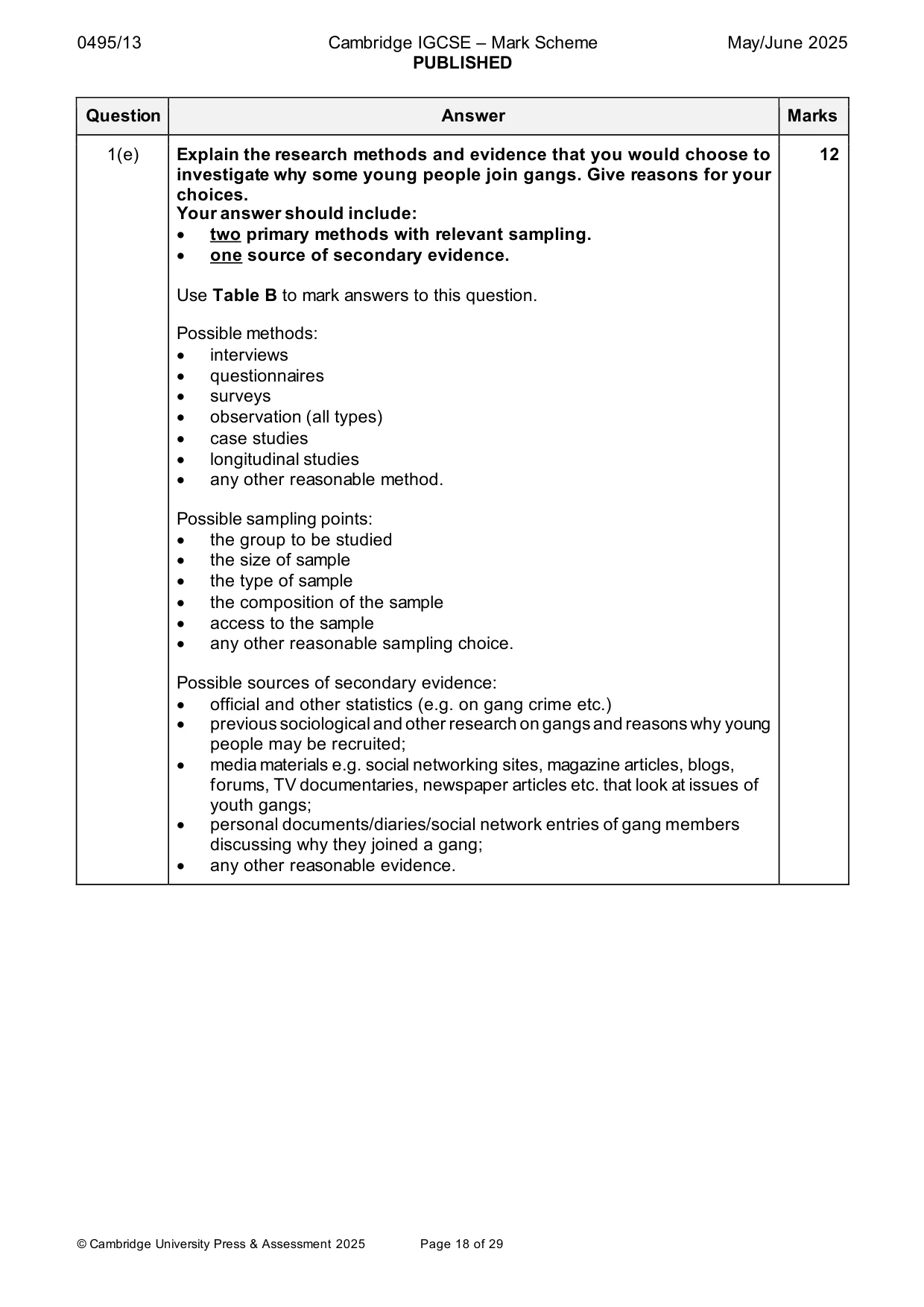
0495/13 Cambridge IGCSE – Mark Scheme PUBLISHED May/June 2025 © Cambridge University Press & Assessment 2025 Page 18 of 29 Question Answer Marks 1(e) Explain the research methods and evidence that you would choose to investigate why some young people join gangs. Give reasons for your choices. Your answer should include: • two primary methods with relevant sampling. • one source of secondary evidence. Use Table B to mark answers to this question. Possible methods: • interviews • questionnaires • surveys • observation (all types) • case studies • longitudinal studies • any other reasonable method. Possible sampling points: • the group to be studied • the size of sample • the type of sample • the composition of the sample • access to the sample • any other reasonable sampling choice. Possible sources of secondary evidence: • official and other statistics (e.g. on gang crime etc.) • previous sociological and other research on gangs and reasons why young people may be recruited; • media materials e.g. social networking sites, magazine articles, blogs, forums, TV documentaries, newspaper articles etc. that look at issues of youth gangs; • personal documents/diaries/social network entries of gang members discussing why they joined a gang; • any other reasonable evidence. 12
Mark scheme, page 19
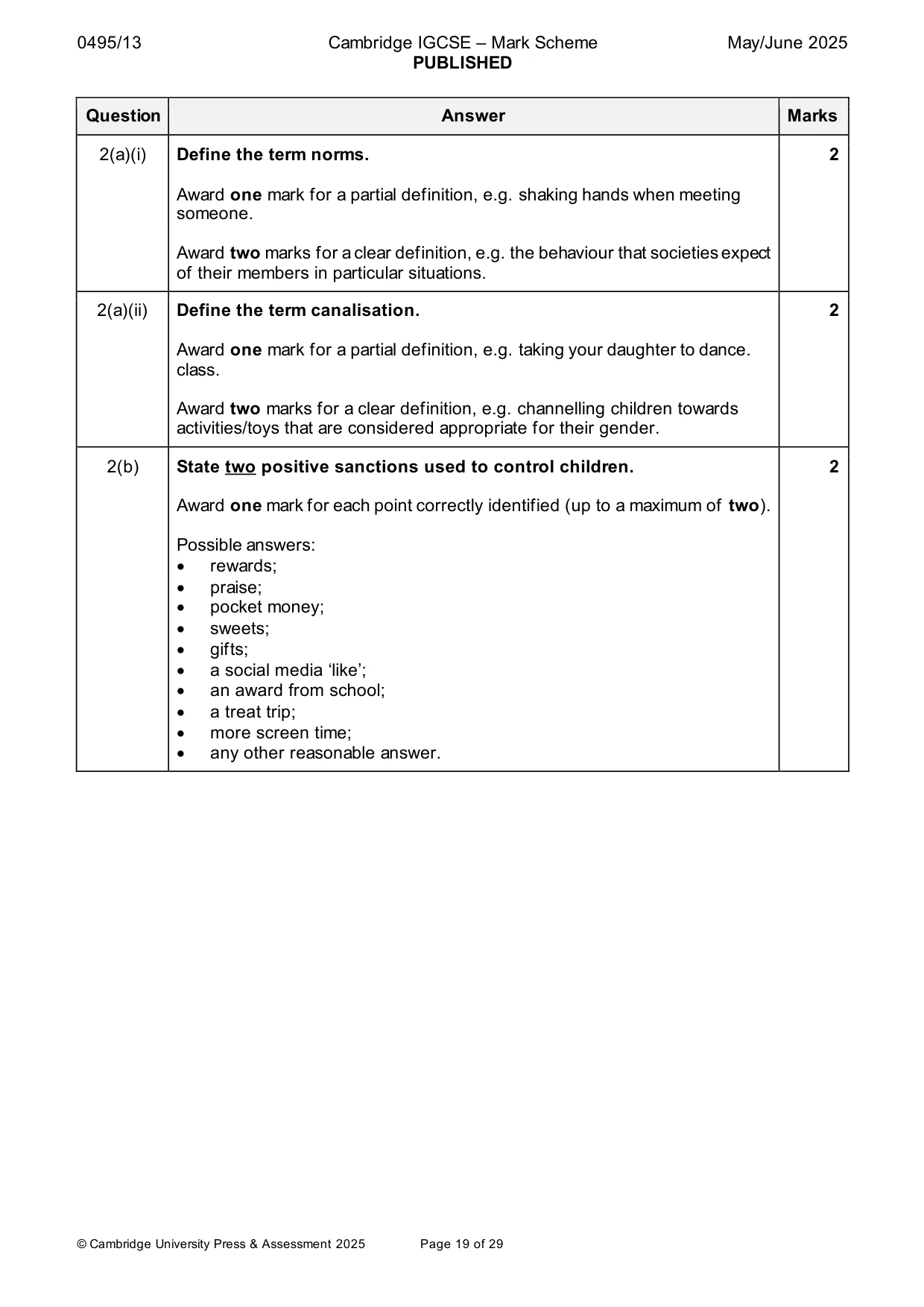
0495/13 Cambridge IGCSE – Mark Scheme PUBLISHED May/June 2025 © Cambridge University Press & Assessment 2025 Page 19 of 29 Question Answer Marks 2(a)(i) Define the term norms. Award one mark for a partial definition, e.g. shaking hands when meeting someone. Award two marks for a clear definition, e.g. the behaviour that societies expect of their members in particular situations. 2 2(a)(ii) Define the term canalisation. Award one mark for a partial definition, e.g. taking your daughter to dance. class. Award two marks for a clear definition, e.g. channelling children towards activities/toys that are considered appropriate for their gender. 2 2(b) State two positive sanctions used to control children. Award one mark for each point correctly identified (up to a maximum of two). Possible answers: • rewards; • praise; • pocket money; • sweets; • gifts; • a social media ‘like’; • an award from school; • a treat trip; • more screen time; • any other reasonable answer. 2
Mark scheme, page 20
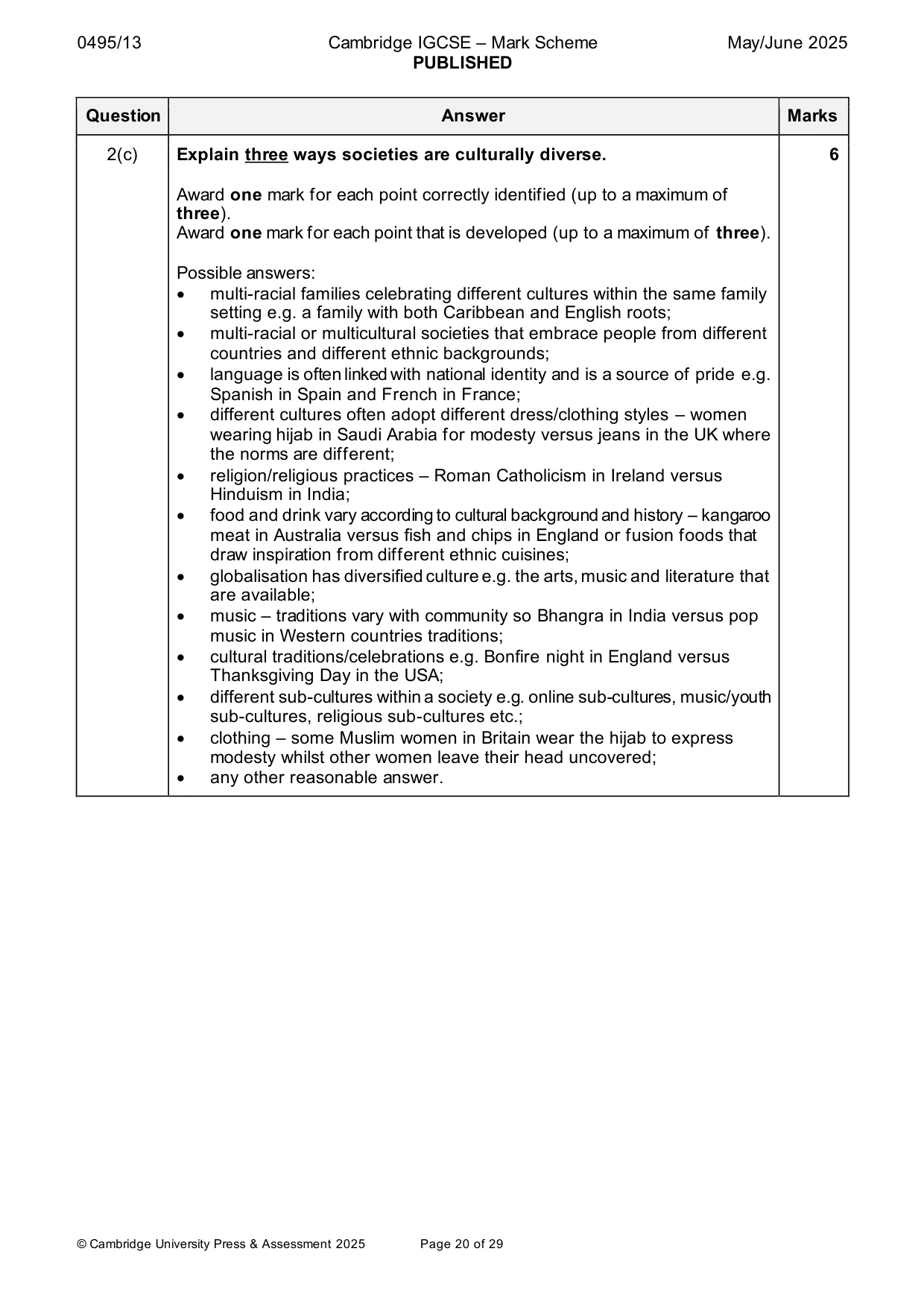
0495/13 Cambridge IGCSE – Mark Scheme PUBLISHED May/June 2025 © Cambridge University Press & Assessment 2025 Page 20 of 29 Question Answer Marks 2(c) Explain three ways societies are culturally diverse. Award one mark for each point correctly identified (up to a maximum of three). Award one mark for each point that is developed (up to a maximum of three). Possible answers: • multi-racial families celebrating different cultures within the same family setting e.g. a family with both Caribbean and English roots; • multi-racial or multicultural societies that embrace people from different countries and different ethnic backgrounds; • language is often linked with national identity and is a source of pride e.g. Spanish in Spain and French in France; • different cultures often adopt different dress/clothing styles – women wearing hijab in Saudi Arabia for modesty versus jeans in the UK where the norms are different; • religion/religious practices – Roman Catholicism in Ireland versus Hinduism in India; • food and drink vary according to cultural background and history – kangaroo meat in Australia versus fish and chips in England or fusion foods that draw inspiration from different ethnic cuisines; • globalisation has diversified culture e.g. the arts, music and literature that are available; • music – traditions vary with community so Bhangra in India versus pop music in Western countries traditions; • cultural traditions/celebrations e.g. Bonfire night in England versus Thanksgiving Day in the USA; • different sub-cultures within a society e.g. online sub-cultures, music/youth sub-cultures, religious sub-cultures etc.; • clothing – some Muslim women in Britain wear the hijab to express modesty whilst other women leave their head uncovered; • any other reasonable answer. 6
Mark scheme, page 21
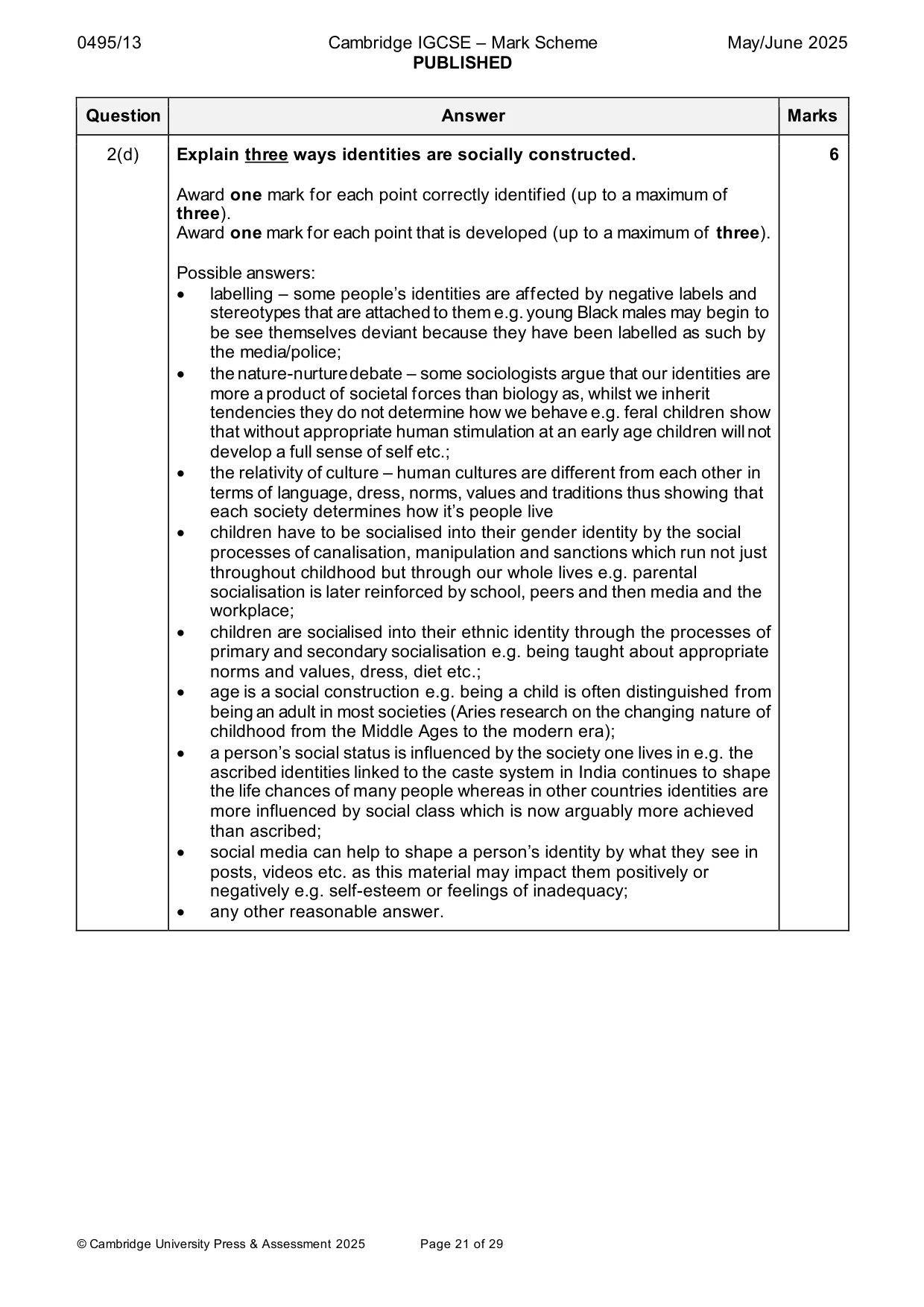
0495/13 Cambridge IGCSE – Mark Scheme PUBLISHED May/June 2025 © Cambridge University Press & Assessment 2025 Page 21 of 29 Question Answer Marks 2(d) Explain three ways identities are socially constructed. Award one mark for each point correctly identified (up to a maximum of three). Award one mark for each point that is developed (up to a maximum of three). Possible answers: • labelling – some people’s identities are affected by negative labels and stereotypes that are attached to them e.g. young Black males may begin to be see themselves deviant because they have been labelled as such by the media/police; • the nature-nurture debate – some sociologists argue that our identities are more a product of societal forces than biology as, whilst we inherit tendencies they do not determine how we behave e.g. feral children show that without appropriate human stimulation at an early age children will not develop a full sense of self etc.; • the relativity of culture – human cultures are different from each other in terms of language, dress, norms, values and traditions thus showing that each society determines how it’s people live • children have to be socialised into their gender identity by the social processes of canalisation, manipulation and sanctions which run not just throughout childhood but through our whole lives e.g. parental socialisation is later reinforced by school, peers and then media and the workplace; • children are socialised into their ethnic identity through the processes of primary and secondary socialisation e.g. being taught about appropriate norms and values, dress, diet etc.; • age is a social construction e.g. being a child is often distinguished from being an adult in most societies (Aries research on the changing nature of childhood from the Middle Ages to the modern era); • a person’s social status is influenced by the society one lives in e.g. the ascribed identities linked to the caste system in India continues to shape the life chances of many people whereas in other countries identities are more influenced by social class which is now arguably more achieved than ascribed; • social media can help to shape a person’s identity by what they see in posts, videos etc. as this material may impact them positively or negatively e.g. self-esteem or feelings of inadequacy; • any other reasonable answer. 6
Mark scheme, page 22
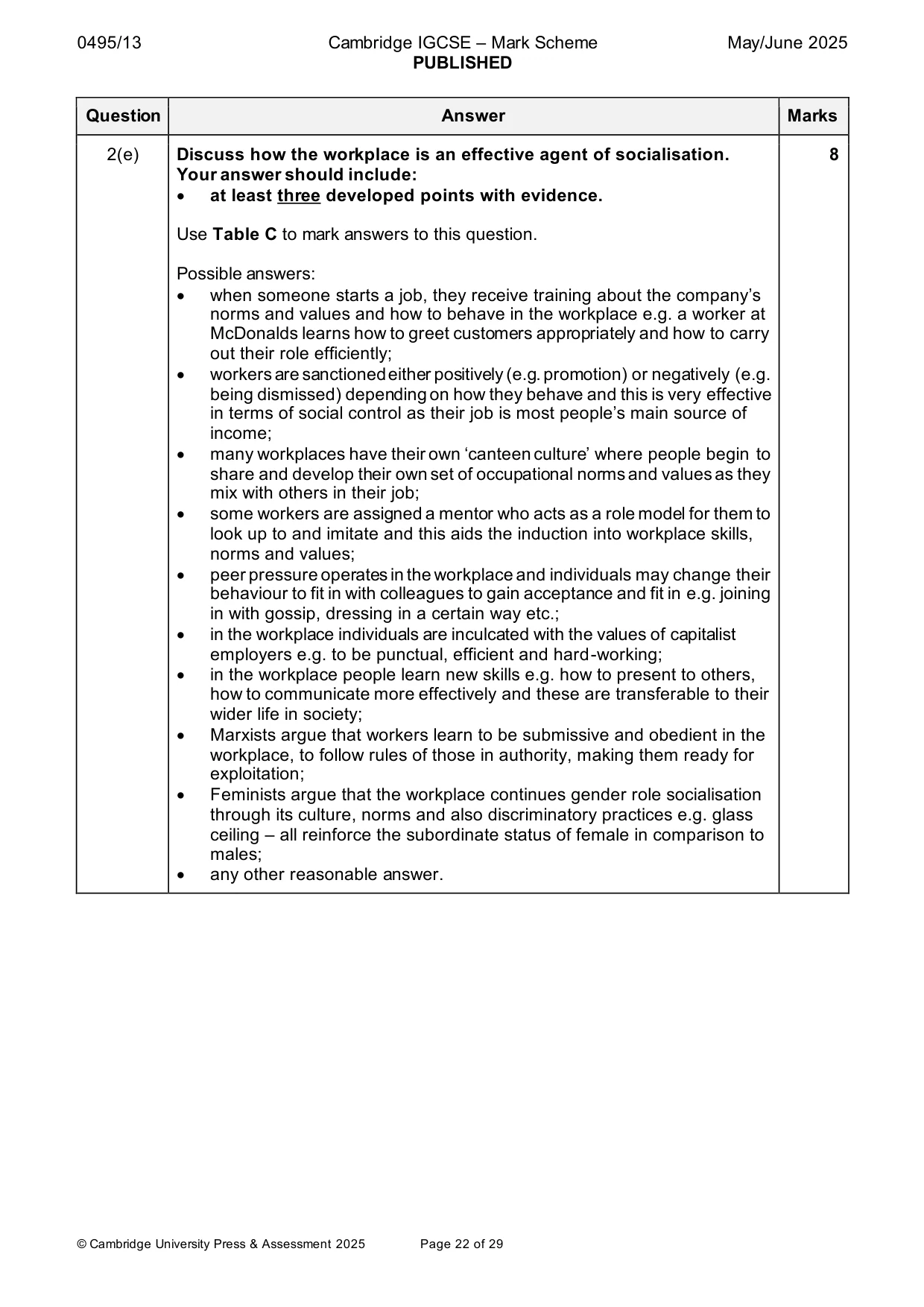
0495/13 Cambridge IGCSE – Mark Scheme PUBLISHED May/June 2025 © Cambridge University Press & Assessment 2025 Page 22 of 29 Question Answer Marks 2(e) Discuss how the workplace is an effective agent of socialisation. Your answer should include: • at least three developed points with evidence. Use Table C to mark answers to this question. Possible answers: • when someone starts a job, they receive training about the company’s norms and values and how to behave in the workplace e.g. a worker at McDonalds learns how to greet customers appropriately and how to carry out their role efficiently; • workers are sanctioned either positively (e.g. promotion) or negatively (e.g. being dismissed) depending on how they behave and this is very effective in terms of social control as their job is most people’s main source of income; • many workplaces have their own ‘canteen culture’ where people begin to share and develop their own set of occupational norms and values as they mix with others in their job; • some workers are assigned a mentor who acts as a role model for them to look up to and imitate and this aids the induction into workplace skills, norms and values; • peer pressure operates in the workplace and individuals may change their behaviour to fit in with colleagues to gain acceptance and fit in e.g. joining in with gossip, dressing in a certain way etc.; • in the workplace individuals are inculcated with the values of capitalist employers e.g. to be punctual, efficient and hard-working; • in the workplace people learn new skills e.g. how to present to others, how to communicate more effectively and these are transferable to their wider life in society; • Marxists argue that workers learn to be submissive and obedient in the workplace, to follow rules of those in authority, making them ready for exploitation; • Feminists argue that the workplace continues gender role socialisation through its culture, norms and also discriminatory practices e.g. glass ceiling – all reinforce the subordinate status of female in comparison to males; • any other reasonable answer. 8
Mark scheme, page 23
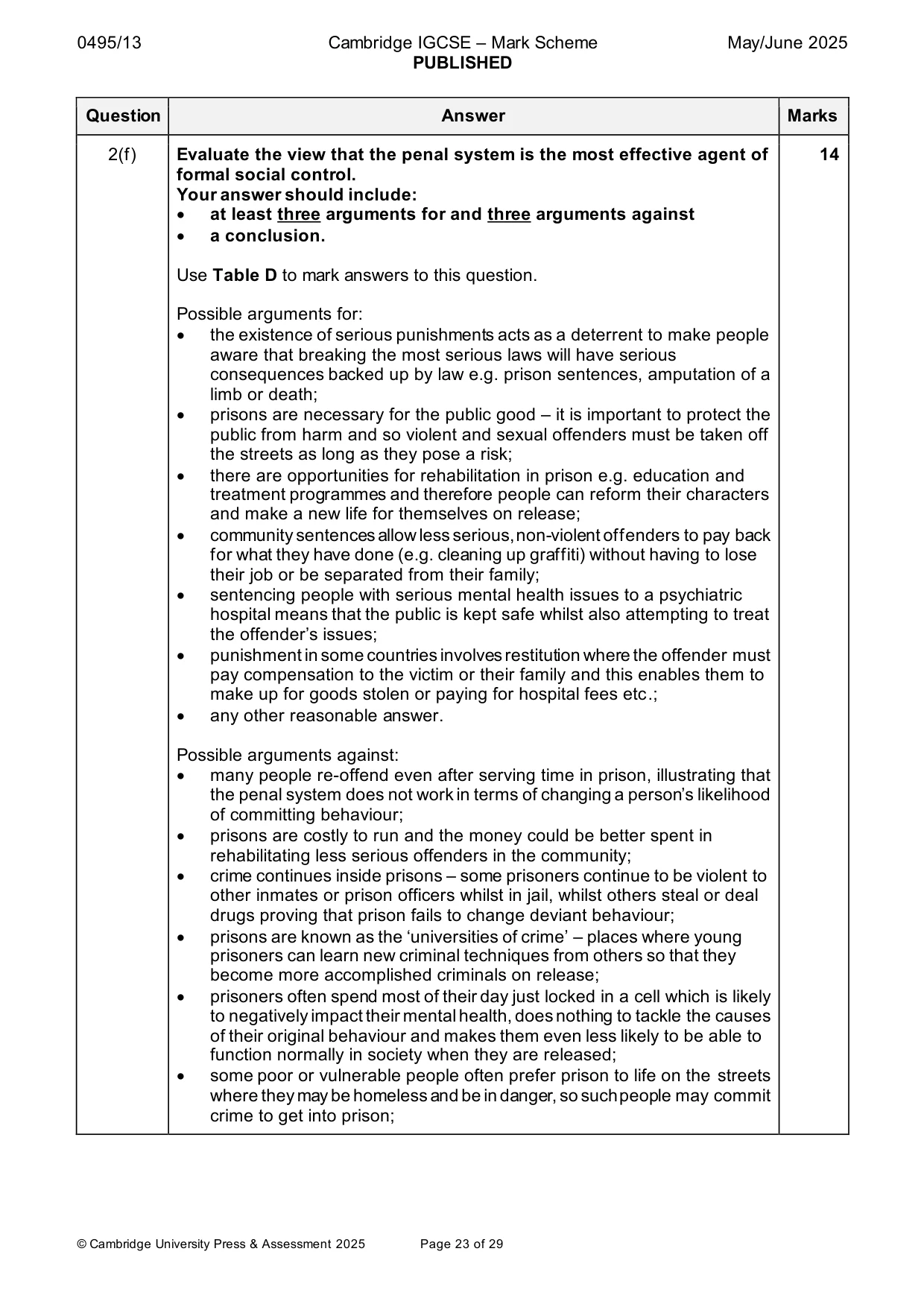
0495/13 Cambridge IGCSE – Mark Scheme PUBLISHED May/June 2025 © Cambridge University Press & Assessment 2025 Page 23 of 29 Question Answer Marks 2(f) Evaluate the view that the penal system is the most effective agent of formal social control. Your answer should include: • at least three arguments for and three arguments against • a conclusion. Use Table D to mark answers to this question. Possible arguments for: • the existence of serious punishments acts as a deterrent to make people aware that breaking the most serious laws will have serious consequences backed up by law e.g. prison sentences, amputation of a limb or death; • prisons are necessary for the public good – it is important to protect the public from harm and so violent and sexual offenders must be taken off the streets as long as they pose a risk; • there are opportunities for rehabilitation in prison e.g. education and treatment programmes and therefore people can reform their characters and make a new life for themselves on release; • community sentences allow less serious, non-violent offenders to pay back for what they have done (e.g. cleaning up graffiti) without having to lose their job or be separated from their family; • sentencing people with serious mental health issues to a psychiatric hospital means that the public is kept safe whilst also attempting to treat the offender’s issues; • punishment in some countries involves restitution where the offender must pay compensation to the victim or their family and this enables them to make up for goods stolen or paying for hospital fees etc.; • any other reasonable answer. Possible arguments against: • many people re-offend even after serving time in prison, illustrating that the penal system does not work in terms of changing a person’s likelihood of committing behaviour; • prisons are costly to run and the money could be better spent in rehabilitating less serious offenders in the community; • crime continues inside prisons – some prisoners continue to be violent to other inmates or prison officers whilst in jail, whilst others steal or deal drugs proving that prison fails to change deviant behaviour; • prisons are known as the ‘universities of crime’ – places where young prisoners can learn new criminal techniques from others so that they become more accomplished criminals on release; • prisoners often spend most of their day just locked in a cell which is likely to negatively impact their mental health, does nothing to tackle the causes of their original behaviour and makes them even less likely to be able to function normally in society when they are released; • some poor or vulnerable people often prefer prison to life on the streets where they may be homeless and be in danger, so such people may commit crime to get into prison; 14
Mark scheme, page 24
0495/13 Cambridge IGCSE – Mark Scheme PUBLISHED May/June 2025 © Cambridge University Press & Assessment 2025 Page 24 of 29 Question Answer Marks 2(f) • in certain situations the armed forces may be more effective e.g. in serious riots or coups; • the courts are ultimately the ones to sentence offenders – the prisons only carry out the sentence imposed by courts so getting the right sentence is important in protecting the public, giving adequate punishment etc.; • the government set the laws so ultimately it is their power that sets creates laws, sets sentence tariffs and funds prisons so they wield enormous power; • any other reasonable answer.
Mark scheme, page 25
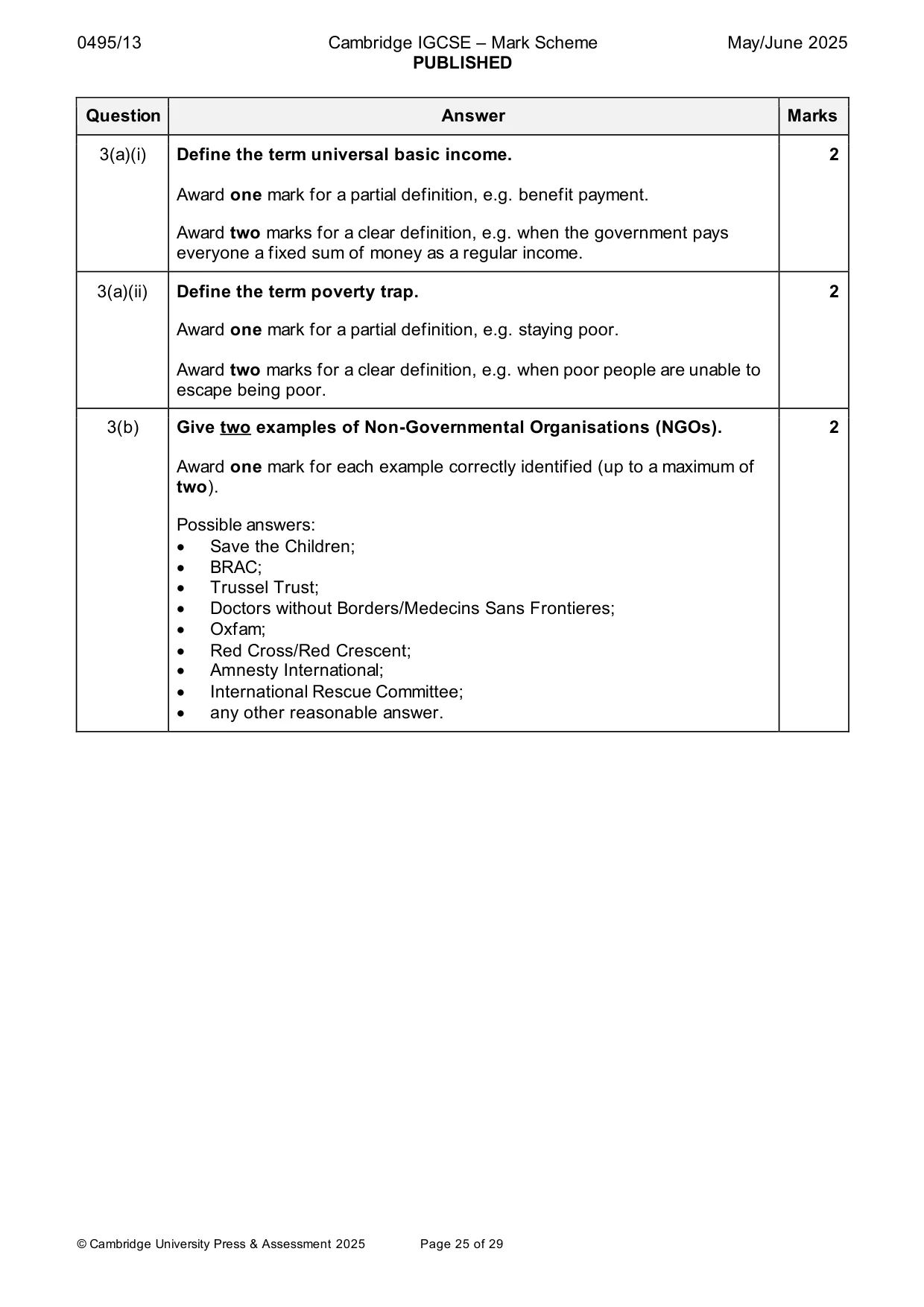
0495/13 Cambridge IGCSE – Mark Scheme PUBLISHED May/June 2025 © Cambridge University Press & Assessment 2025 Page 25 of 29 Question Answer Marks 3(a)(i) Define the term universal basic income. Award one mark for a partial definition, e.g. benefit payment. Award two marks for a clear definition, e.g. when the government pays everyone a fixed sum of money as a regular income. 2 3(a)(ii) Define the term poverty trap. Award one mark for a partial definition, e.g. staying poor. Award two marks for a clear definition, e.g. when poor people are unable to escape being poor. 2 3(b) Give two examples of Non-Governmental Organisations (NGOs). Award one mark for each example correctly identified (up to a maximum of two). Possible answers: • Save the Children; • BRAC; • Trussel Trust; • Doctors without Borders/Medecins Sans Frontieres; • Oxfam; • Red Cross/Red Crescent; • Amnesty International; • International Rescue Committee; • any other reasonable answer. 2
Mark scheme, page 26
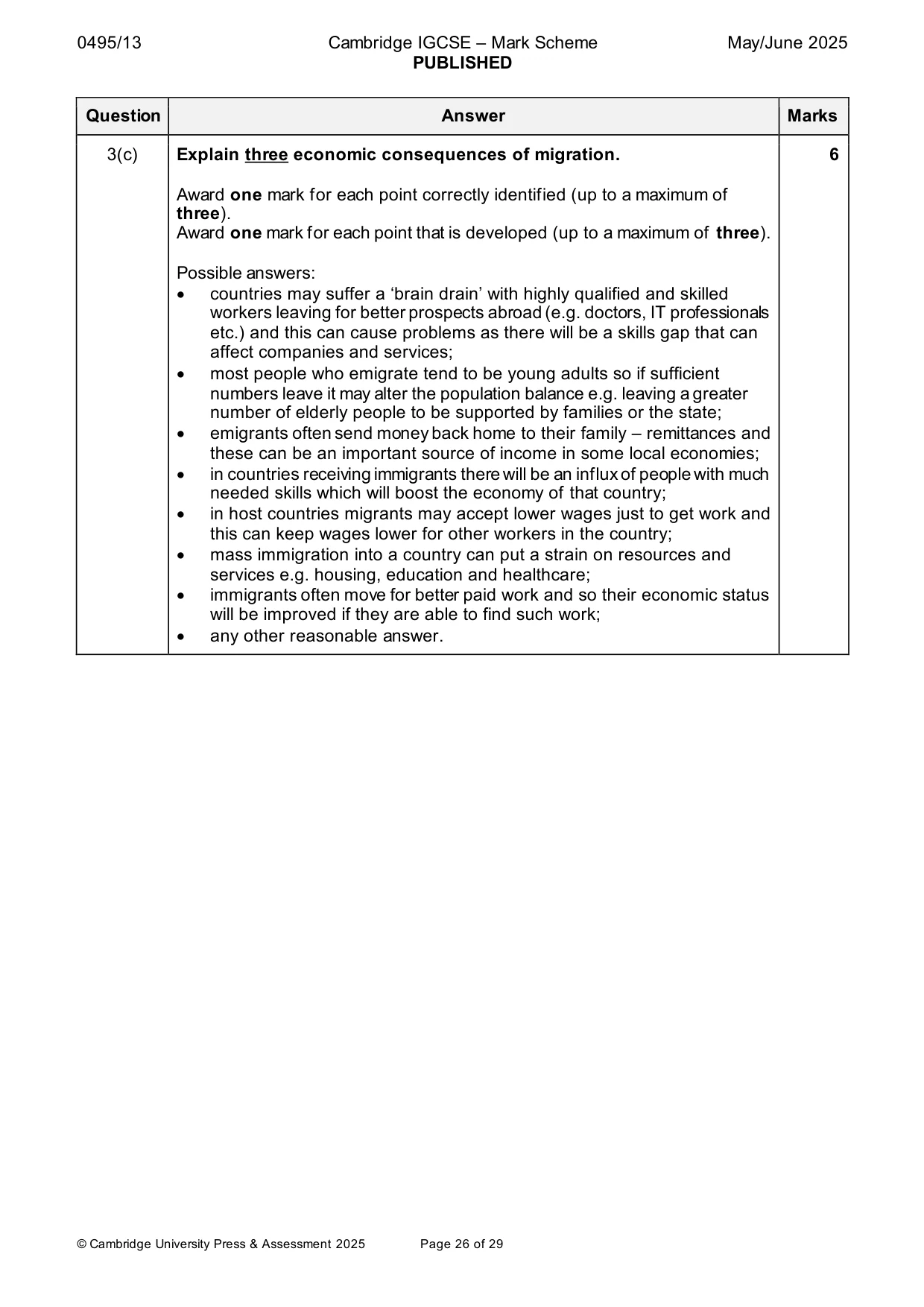
0495/13 Cambridge IGCSE – Mark Scheme PUBLISHED May/June 2025 © Cambridge University Press & Assessment 2025 Page 26 of 29 Question Answer Marks 3(c) Explain three economic consequences of migration. Award one mark for each point correctly identified (up to a maximum of three). Award one mark for each point that is developed (up to a maximum of three). Possible answers: • countries may suffer a ‘brain drain’ with highly qualified and skilled workers leaving for better prospects abroad (e.g. doctors, IT professionals etc.) and this can cause problems as there will be a skills gap that can affect companies and services; • most people who emigrate tend to be young adults so if sufficient numbers leave it may alter the population balance e.g. leaving a greater number of elderly people to be supported by families or the state; • emigrants often send money back home to their family – remittances and these can be an important source of income in some local economies; • in countries receiving immigrants there will be an influx of people with much needed skills which will boost the economy of that country; • in host countries migrants may accept lower wages just to get work and this can keep wages lower for other workers in the country; • mass immigration into a country can put a strain on resources and services e.g. housing, education and healthcare; • immigrants often move for better paid work and so their economic status will be improved if they are able to find such work; • any other reasonable answer. 6
Mark scheme, page 27
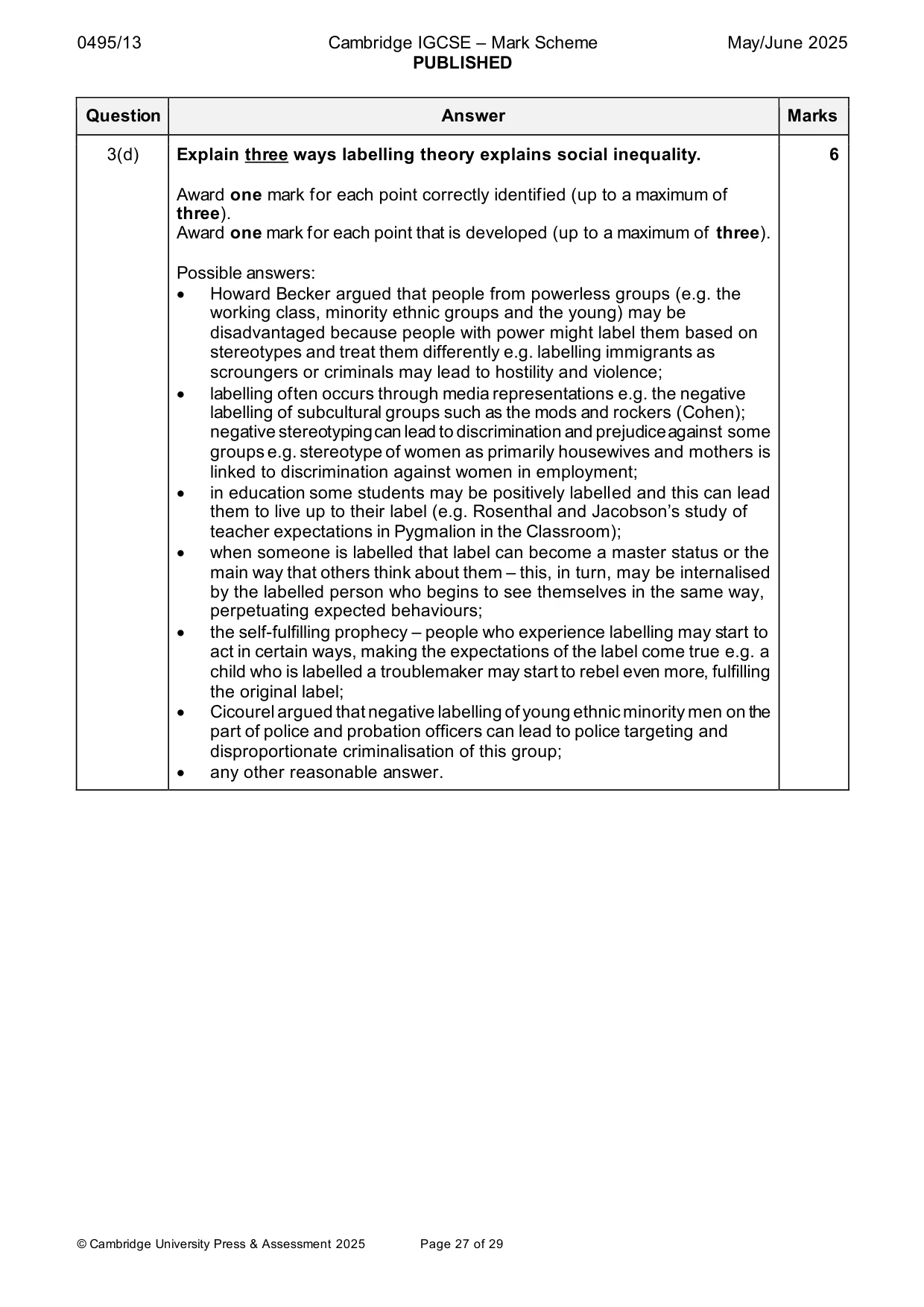
0495/13 Cambridge IGCSE – Mark Scheme PUBLISHED May/June 2025 © Cambridge University Press & Assessment 2025 Page 27 of 29 Question Answer Marks 3(d) Explain three ways labelling theory explains social inequality. Award one mark for each point correctly identified (up to a maximum of three). Award one mark for each point that is developed (up to a maximum of three). Possible answers: • Howard Becker argued that people from powerless groups (e.g. the working class, minority ethnic groups and the young) may be disadvantaged because people with power might label them based on stereotypes and treat them differently e.g. labelling immigrants as scroungers or criminals may lead to hostility and violence; • labelling often occurs through media representations e.g. the negative labelling of subcultural groups such as the mods and rockers (Cohen); negative stereotyping can lead to discrimination and prejudice against some groups e.g. stereotype of women as primarily housewives and mothers is linked to discrimination against women in employment; • in education some students may be positively labelled and this can lead them to live up to their label (e.g. Rosenthal and Jacobson’s study of teacher expectations in Pygmalion in the Classroom); • when someone is labelled that label can become a master status or the main way that others think about them – this, in turn, may be internalised by the labelled person who begins to see themselves in the same way, perpetuating expected behaviours; • the self-fulfilling prophecy – people who experience labelling may start to act in certain ways, making the expectations of the label come true e.g. a child who is labelled a troublemaker may start to rebel even more, fulfilling the original label; • Cicourel argued that negative labelling of young ethnic minority men on the part of police and probation officers can lead to police targeting and disproportionate criminalisation of this group; • any other reasonable answer. 6
Mark scheme, page 28
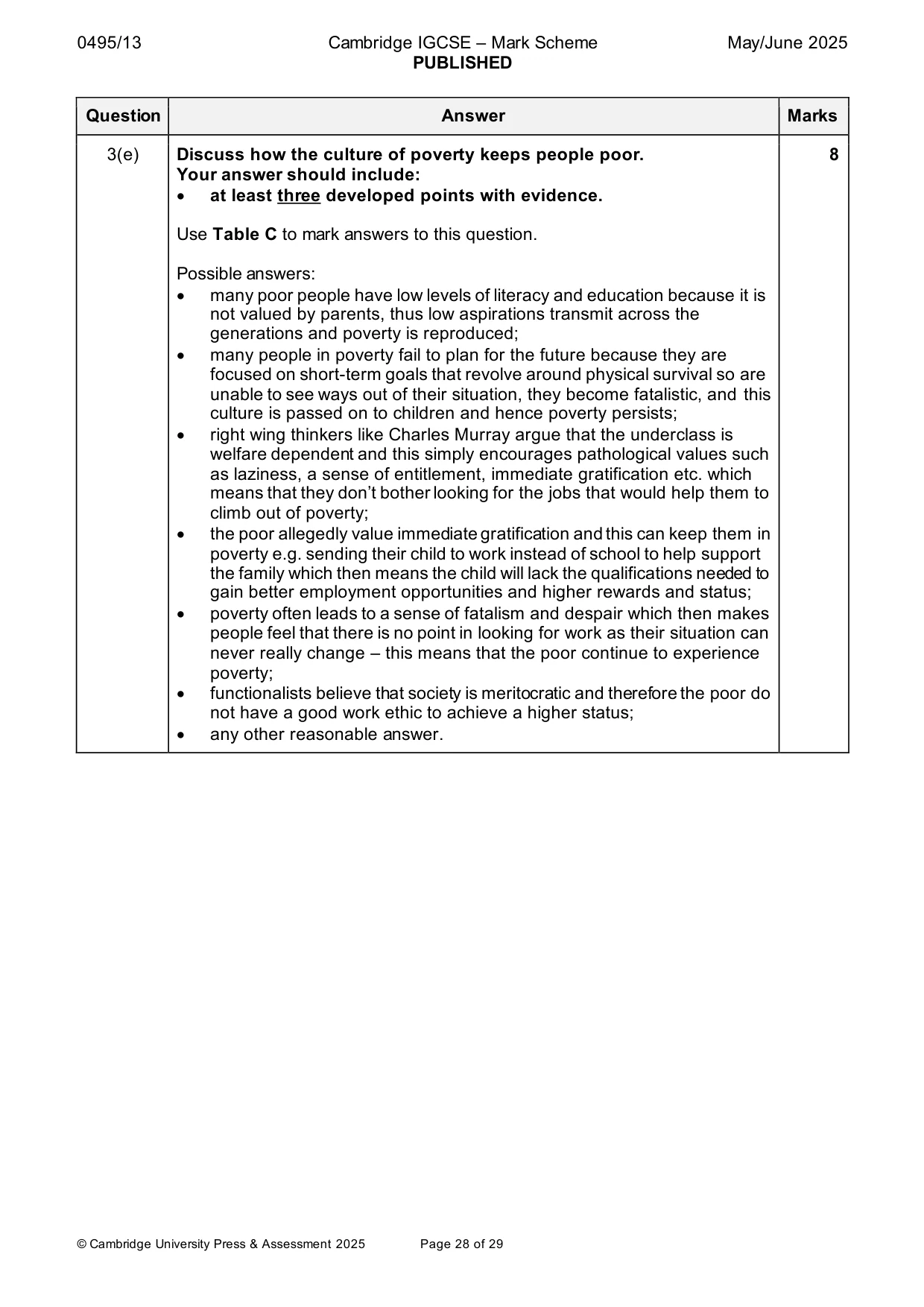
0495/13 Cambridge IGCSE – Mark Scheme PUBLISHED May/June 2025 © Cambridge University Press & Assessment 2025 Page 28 of 29 Question Answer Marks 3(e) Discuss how the culture of poverty keeps people poor. Your answer should include: • at least three developed points with evidence. Use Table C to mark answers to this question. Possible answers: • many poor people have low levels of literacy and education because it is not valued by parents, thus low aspirations transmit across the generations and poverty is reproduced; • many people in poverty fail to plan for the future because they are focused on short-term goals that revolve around physical survival so are unable to see ways out of their situation, they become fatalistic, and this culture is passed on to children and hence poverty persists; • right wing thinkers like Charles Murray argue that the underclass is welfare dependent and this simply encourages pathological values such as laziness, a sense of entitlement, immediate gratification etc. which means that they don’t bother looking for the jobs that would help them to climb out of poverty; • the poor allegedly value immediate gratification and this can keep them in poverty e.g. sending their child to work instead of school to help support the family which then means the child will lack the qualifications needed to gain better employment opportunities and higher rewards and status; • poverty often leads to a sense of fatalism and despair which then makes people feel that there is no point in looking for work as their situation can never really change – this means that the poor continue to experience poverty; • functionalists believe that society is meritocratic and therefore the poor do not have a good work ethic to achieve a higher status; • any other reasonable answer. 8
Mark scheme, page 29
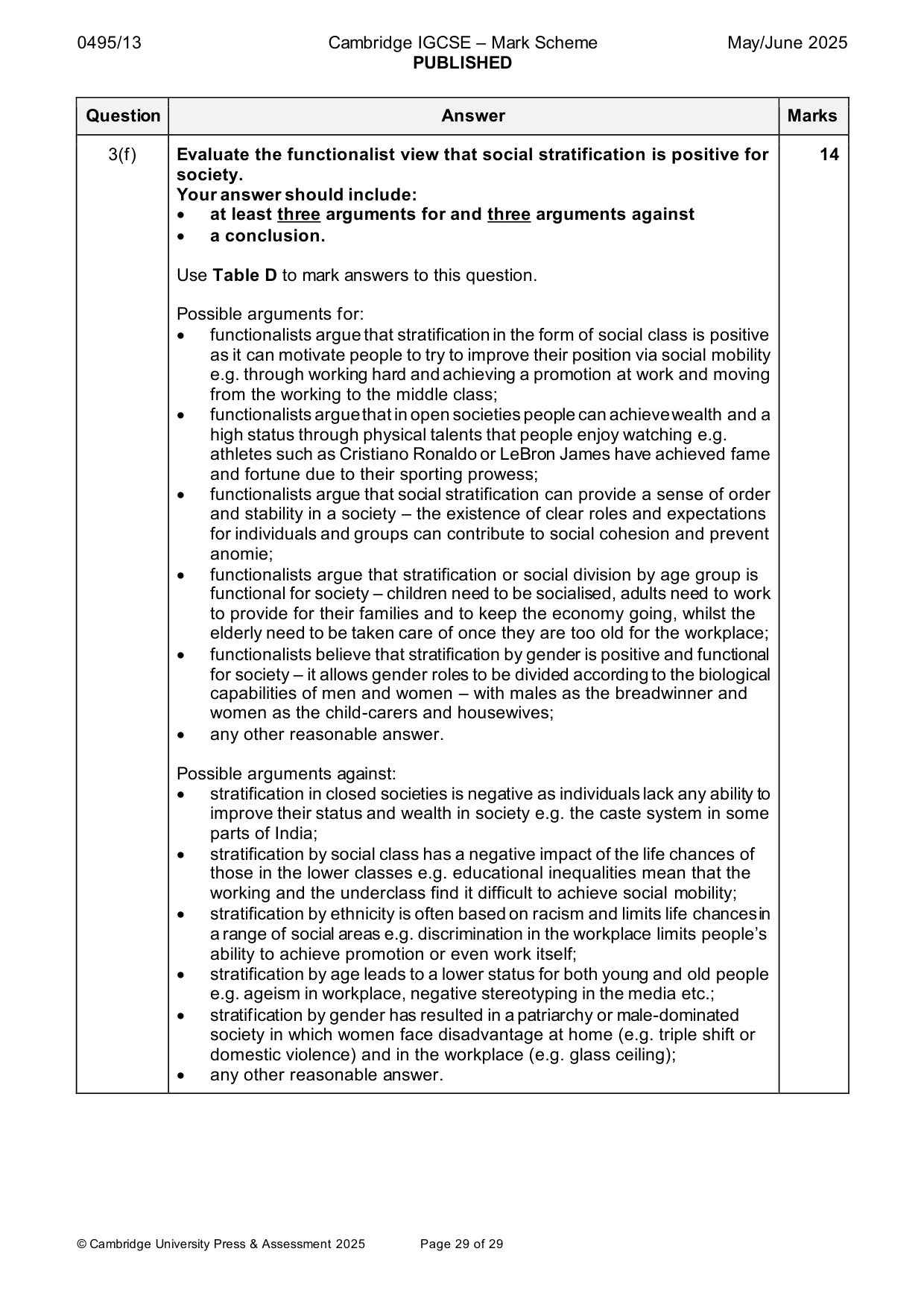
0495/13 Cambridge IGCSE – Mark Scheme PUBLISHED May/June 2025 © Cambridge University Press & Assessment 2025 Page 29 of 29 Question Answer Marks 3(f) Evaluate the functionalist view that social stratification is positive for society. Your answer should include: • at least three arguments for and three arguments against • a conclusion. Use Table D to mark answers to this question. Possible arguments for: • functionalists argue that stratification in the form of social class is positive as it can motivate people to try to improve their position via social mobility e.g. through working hard and achieving a promotion at work and moving from the working to the middle class; • functionalists argue that in open societies people can achieve wealth and a high status through physical talents that people enjoy watching e.g. athletes such as Cristiano Ronaldo or LeBron James have achieved fame and fortune due to their sporting prowess; • functionalists argue that social stratification can provide a sense of order and stability in a society – the existence of clear roles and expectations for individuals and groups can contribute to social cohesion and prevent anomie; • functionalists argue that stratification or social division by age group is functional for society – children need to be socialised, adults need to work to provide for their families and to keep the economy going, whilst the elderly need to be taken care of once they are too old for the workplace; • functionalists believe that stratification by gender is positive and functional for society – it allows gender roles to be divided according to the biological capabilities of men and women – with males as the breadwinner and women as the child-carers and housewives; • any other reasonable answer. Possible arguments against: • stratification in closed societies is negative as individuals lack any ability to improve their status and wealth in society e.g. the caste system in some parts of India; • stratification by social class has a negative impact of the life chances of those in the lower classes e.g. educational inequalities mean that the working and the underclass find it difficult to achieve social mobility; • stratification by ethnicity is often based on racism and limits life chances in a range of social areas e.g. discrimination in the workplace limits people’s ability to achieve promotion or even work itself; • stratification by age leads to a lower status for both young and old people e.g. ageism in workplace, negative stereotyping in the media etc.; • stratification by gender has resulted in a patriarchy or male-dominated society in which women face disadvantage at home (e.g. triple shift or domestic violence) and in the workplace (e.g. glass ceiling); • any other reasonable answer. 14
What you needed in this session
Cambridge’s own grade thresholds for 2025 May/June, Paper 1 · Variant 3. A higher threshold means an easier paper — the bar moves with how the cohort did.