Cambridge IGCSE Sociology 0495 — 2024 May/June Paper 1 · Variant 3
0495/13/M/J/24 · 80 marks · ≈90 min
The question paper and its mark scheme, free to read here and free to download. This is Cambridge’s own paper, exactly as it was sat.
Question paper4 pages

Mark scheme23 pages
Answers below. Sit the paper first if you are practising.


Paper as text
Question paper, page 1
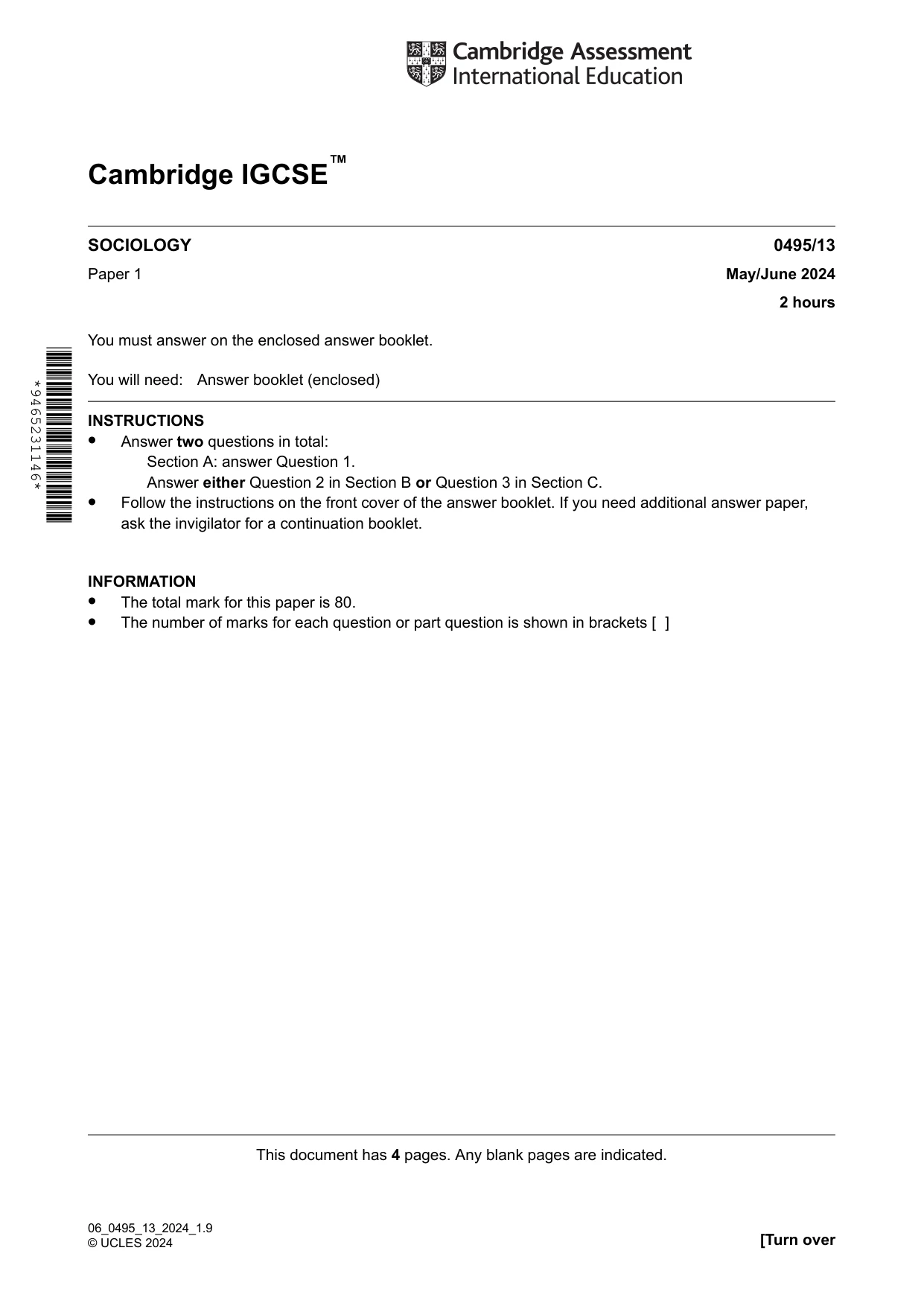
Cambridge IGCSE™ 0495/13 May/June 2024 2 hours SOCIOLOGY Paper 1 You must answer on the enclosed answer booklet. You will need: Answer booklet (enclosed) INSTRUCTIONS • Answer two questions in total: Section A: answer Question 1. Answer either Question 2 in Section B or Question 3 in Section C. • Follow the instructions on the front cover of the answer booklet. If you need additional answer paper, ask the invigilator for a continuation booklet. INFORMATION • The total mark for this paper is 80. • The number of marks for each question or part question is shown in brackets [ ] This document has 4 pages. Any blank pages are indicated. [Turn over 06_0495_13_2024_1.9 © UCLES 2024 *9465231146*
Question paper, page 2
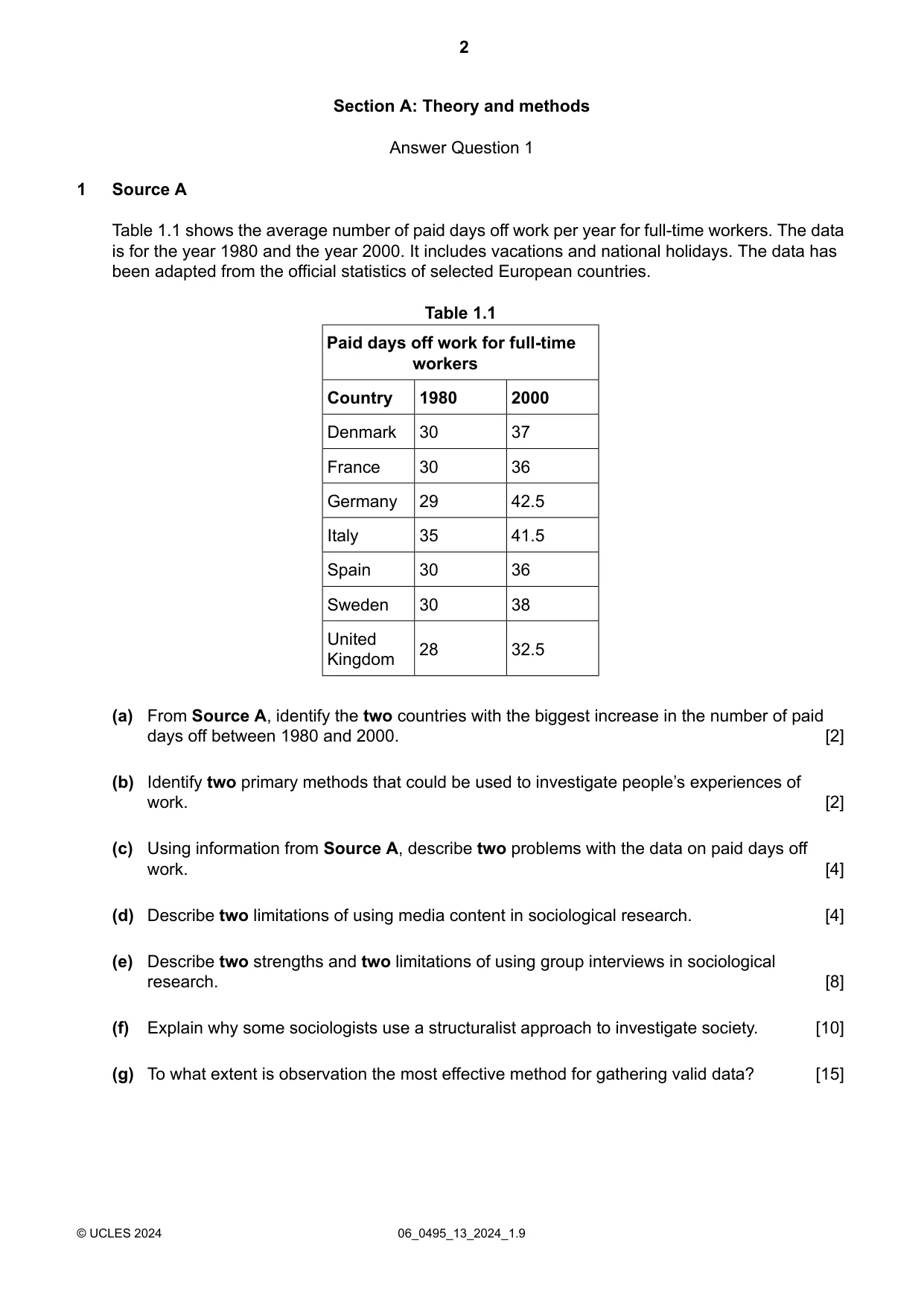
Section A: Theory and methods Answer Question 1 Source A 1 Table 1.1 shows the average number of paid days off work per year for full-time workers. The data is for the year 1980 and the year 2000. It includes vacations and national holidays. The data has been adapted from the official statistics of selected European countries. Table 1.1 Paid days off work for full-time workers 2000 1980 Country 37 30 Denmark 36 30 France 42.5 29 Germany 41.5 35 Italy 36 30 Spain 38 30 Sweden 32.5 28 United Kingdom From Source A, identify the two countries with the biggest increase in the number of paid days off between 1980 and 2000. [2] (a) Identify two primary methods that could be used to investigate people’s experiences of work. [2] (b) Using information from Source A, describe two problems with the data on paid days off work. [4] (c) Describe two limitations of using media content in sociological research. [4] (d) Describe two strengths and two limitations of using group interviews in sociological research. [8] (e) Explain why some sociologists use a structuralist approach to investigate society. [10] (f) To what extent is observation the most effective method for gathering valid data? [15] (g) 06_0495_13_2024_1.9 © UCLES 2024 2
Question paper, page 3
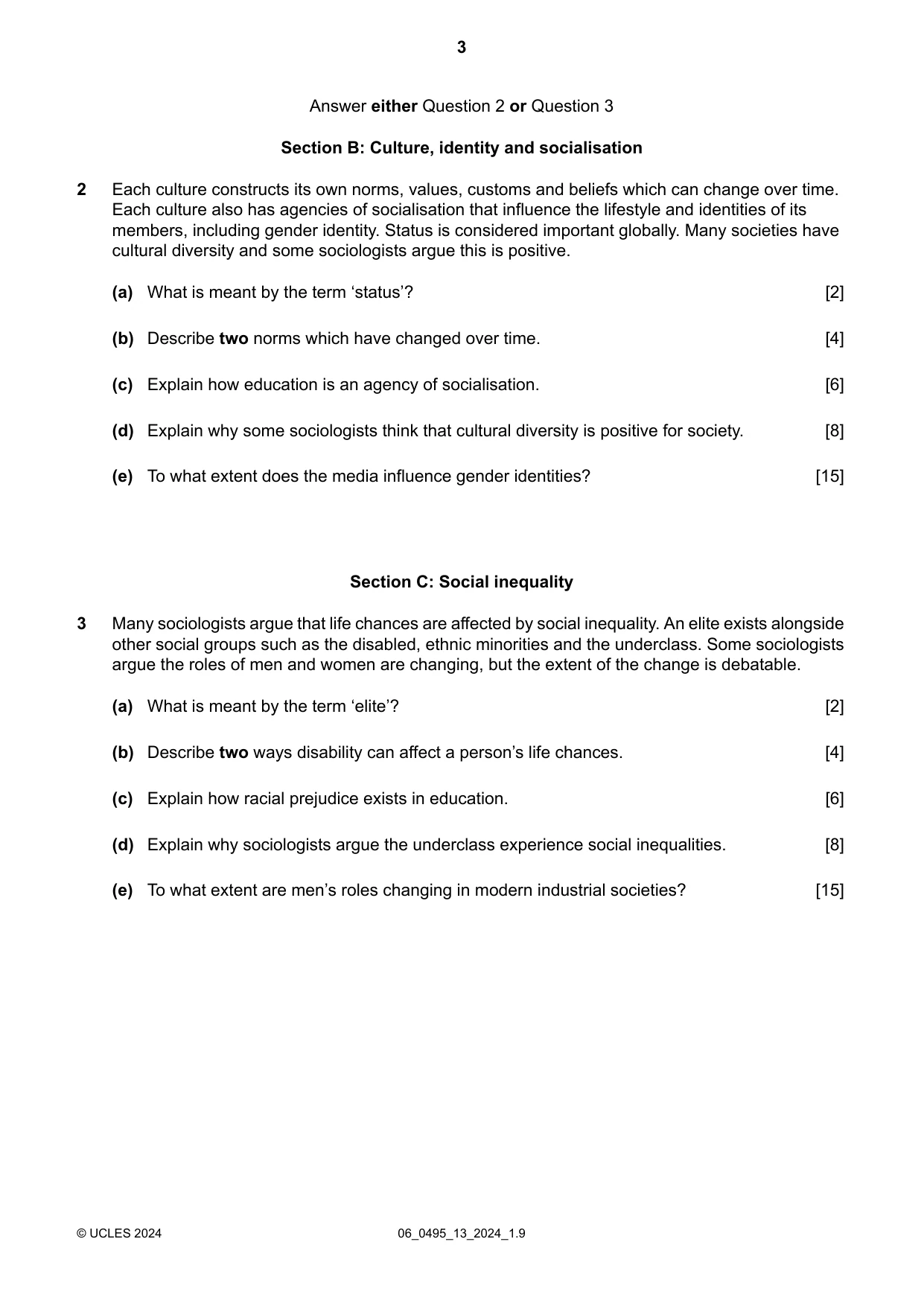
Answer either Question 2 or Question 3 Section B: Culture, identity and socialisation Each culture constructs its own norms, values, customs and beliefs which can change over time. Each culture also has agencies of socialisation that influence the lifestyle and identities of its 2 members, including gender identity. Status is considered important globally. Many societies have cultural diversity and some sociologists argue this is positive. What is meant by the term ‘status’? [2] (a) Describe two norms which have changed over time. [4] (b) Explain how education is an agency of socialisation. [6] (c) Explain why some sociologists think that cultural diversity is positive for society. [8] (d) To what extent does the media influence gender identities? [15] (e) Section C: Social inequality Many sociologists argue that life chances are affected by social inequality. An elite exists alongside other social groups such as the disabled, ethnic minorities and the underclass. Some sociologists argue the roles of men and women are changing, but the extent of the change is debatable. 3 What is meant by the term ‘elite’? [2] (a) Describe two ways disability can affect a person’s life chances. [4] (b) Explain how racial prejudice exists in education. [6] (c) Explain why sociologists argue the underclass experience social inequalities. [8] (d) To what extent are men’s roles changing in modern industrial societies? [15] (e) 06_0495_13_2024_1.9 © UCLES 2024 3
Question paper, page 4
BLANK PAGE Permission to reproduce items where third-party owned material protected by copyright is included has been sought and cleared where possible. Every reasonable effort has been made by the publisher (UCLES) to trace copyright holders, but if any items requiring clearance have unwittingly been included, the publisher will be pleased to make amends at the earliest possible opportunity. To avoid the issue of disclosure of answer-related information to candidates, all copyright acknowledgements are reproduced online in the Cambridge Assessment International Education Copyright Acknowledgements Booklet. This is produced for each series of examinations and is freely available to download at www.cambridgeinternational.org after the live examination series. Cambridge Assessment International Education is part of Cambridge Assessment. Cambridge Assessment is the brand name of the University of Cambridge Local Examinations Syndicate (UCLES), which is a department of the University of Cambridge. 06_0495_13_2024_1.9 © UCLES 2024 4
Mark scheme, page 1
This document consists of 23 printed pages. © Cambridge University Press & Assessment 2024 [Turn over Cambridge IGCSE™ SOCIOLOGY 0495/13 Paper 1 May/June 2024 MARK SCHEME Maximum Mark: 80 Published This mark scheme is published as an aid to teachers and candidates, to indicate the requirements of the examination. It shows the basis on which Examiners were instructed to award marks. It does not indicate the details of the discussions that took place at an Examiners’ meeting before marking began, which would have considered the acceptability of alternative answers. Mark schemes should be read in conjunction with the question paper and the Principal Examiner Report for Teachers. Cambridge International will not enter into discussions about these mark schemes. Cambridge International is publishing the mark schemes for the May/June 2024 series for most Cambridge IGCSE, Cambridge International A and AS Level and Cambridge Pre-U components, and some Cambridge O Level components.
Mark scheme, page 2
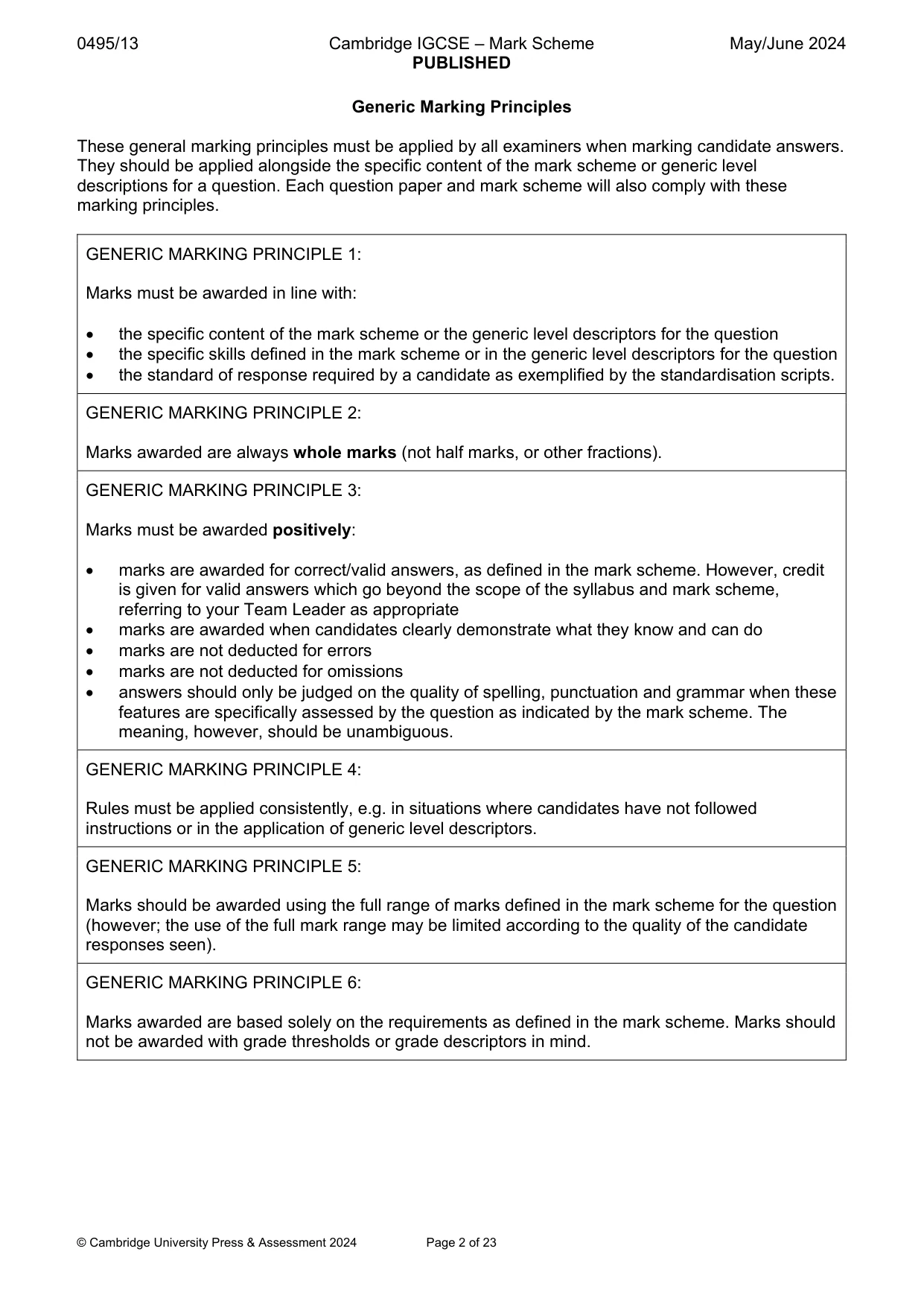
0495/13 Cambridge IGCSE – Mark Scheme PUBLISHED May/June 2024 © Cambridge University Press & Assessment 2024 Page 2 of 23 Generic Marking Principles These general marking principles must be applied by all examiners when marking candidate answers. They should be applied alongside the specific content of the mark scheme or generic level descriptions for a question. Each question paper and mark scheme will also comply with these marking principles. GENERIC MARKING PRINCIPLE 1: Marks must be awarded in line with: the specific content of the mark scheme or the generic level descriptors for the question the specific skills defined in the mark scheme or in the generic level descriptors for the question the standard of response required by a candidate as exemplified by the standardisation scripts. GENERIC MARKING PRINCIPLE 2: Marks awarded are always whole marks (not half marks, or other fractions). GENERIC MARKING PRINCIPLE 3: Marks must be awarded positively: marks are awarded for correct/valid answers, as defined in the mark scheme. However, credit is given for valid answers which go beyond the scope of the syllabus and mark scheme, referring to your Team Leader as appropriate marks are awarded when candidates clearly demonstrate what they know and can do marks are not deducted for errors marks are not deducted for omissions answers should only be judged on the quality of spelling, punctuation and grammar when these features are specifically assessed by the question as indicated by the mark scheme. The meaning, however, should be unambiguous. GENERIC MARKING PRINCIPLE 4: Rules must be applied consistently, e.g. in situations where candidates have not followed instructions or in the application of generic level descriptors. GENERIC MARKING PRINCIPLE 5: Marks should be awarded using the full range of marks defined in the mark scheme for the question (however; the use of the full mark range may be limited according to the quality of the candidate responses seen). GENERIC MARKING PRINCIPLE 6: Marks awarded are based solely on the requirements as defined in the mark scheme. Marks should not be awarded with grade thresholds or grade descriptors in mind.
Mark scheme, page 3
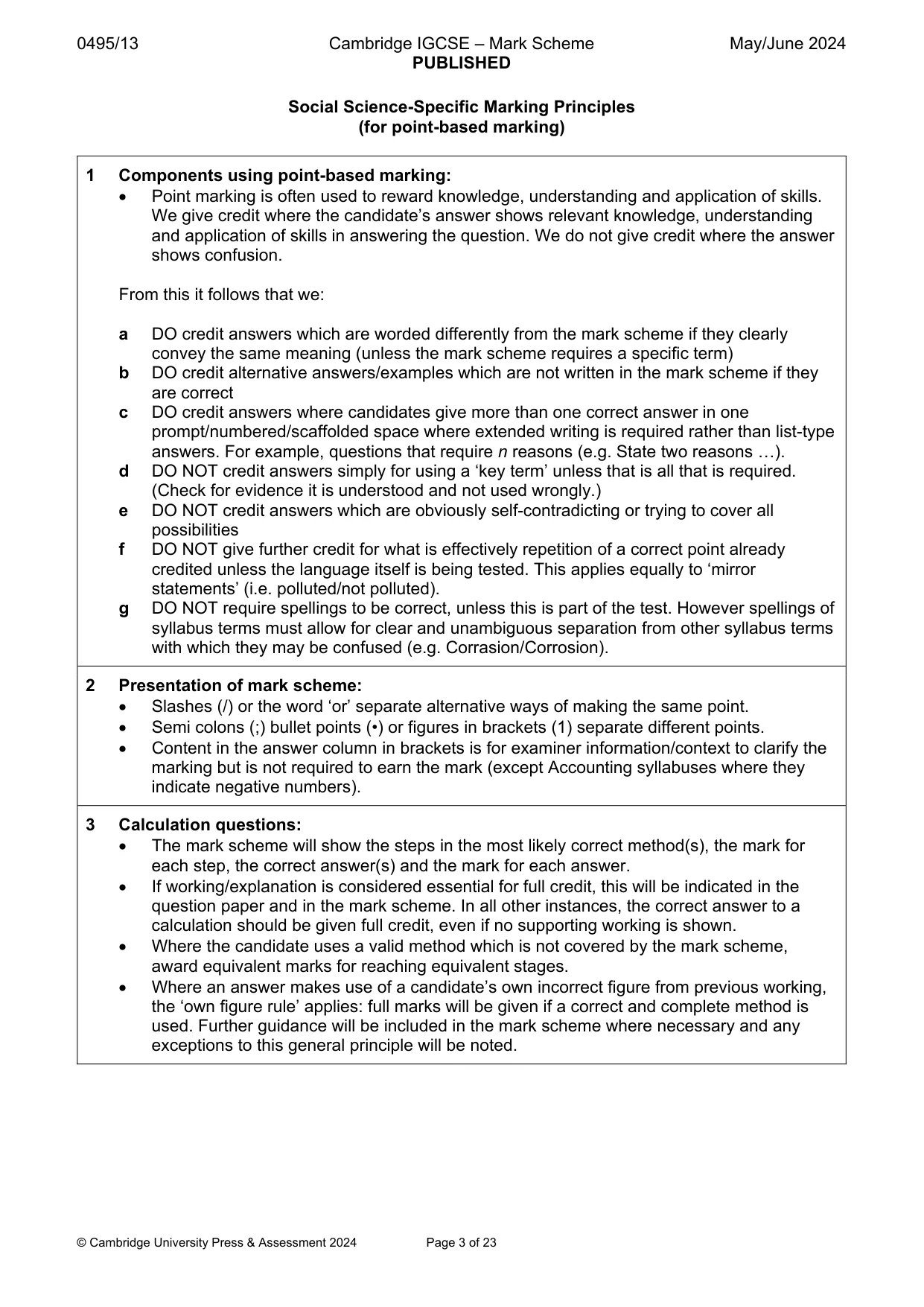
0495/13 Cambridge IGCSE – Mark Scheme PUBLISHED May/June 2024 © Cambridge University Press & Assessment 2024 Page 3 of 23 Social Science-Specific Marking Principles (for point-based marking) 1 Components using point-based marking: Point marking is often used to reward knowledge, understanding and application of skills. We give credit where the candidate’s answer shows relevant knowledge, understanding and application of skills in answering the question. We do not give credit where the answer shows confusion. From this it follows that we: a DO credit answers which are worded differently from the mark scheme if they clearly convey the same meaning (unless the mark scheme requires a specific term) b DO credit alternative answers/examples which are not written in the mark scheme if they are correct c DO credit answers where candidates give more than one correct answer in one prompt/numbered/scaffolded space where extended writing is required rather than list-type answers. For example, questions that require n reasons (e.g. State two reasons …). d DO NOT credit answers simply for using a ‘key term’ unless that is all that is required. (Check for evidence it is understood and not used wrongly.) e DO NOT credit answers which are obviously self-contradicting or trying to cover all possibilities f DO NOT give further credit for what is effectively repetition of a correct point already credited unless the language itself is being tested. This applies equally to ‘mirror statements’ (i.e. polluted/not polluted). g DO NOT require spellings to be correct, unless this is part of the test. However spellings of syllabus terms must allow for clear and unambiguous separation from other syllabus terms with which they may be confused (e.g. Corrasion/Corrosion). 2 Presentation of mark scheme: Slashes (/) or the word ‘or’ separate alternative ways of making the same point. Semi colons (;) bullet points (•) or figures in brackets (1) separate different points. Content in the answer column in brackets is for examiner information/context to clarify the marking but is not required to earn the mark (except Accounting syllabuses where they indicate negative numbers). 3 Calculation questions: The mark scheme will show the steps in the most likely correct method(s), the mark for each step, the correct answer(s) and the mark for each answer. If working/explanation is considered essential for full credit, this will be indicated in the question paper and in the mark scheme. In all other instances, the correct answer to a calculation should be given full credit, even if no supporting working is shown. Where the candidate uses a valid method which is not covered by the mark scheme, award equivalent marks for reaching equivalent stages. Where an answer makes use of a candidate’s own incorrect figure from previous working, the ‘own figure rule’ applies: full marks will be given if a correct and complete method is used. Further guidance will be included in the mark scheme where necessary and any exceptions to this general principle will be noted.
Mark scheme, page 4
0495/13 Cambridge IGCSE – Mark Scheme PUBLISHED May/June 2024 © Cambridge University Press & Assessment 2024 Page 4 of 23 4 Annotation: For point marking, ticks can be used to indicate correct answers and crosses can be used to indicate wrong answers. There is no direct relationship between ticks and marks. Ticks have no defined meaning for levels of response marking. For levels of response marking, the level awarded should be annotated on the script. Other annotations will be used by examiners as agreed during standardisation, and the meaning will be understood by all examiners who marked that paper.
Mark scheme, page 5
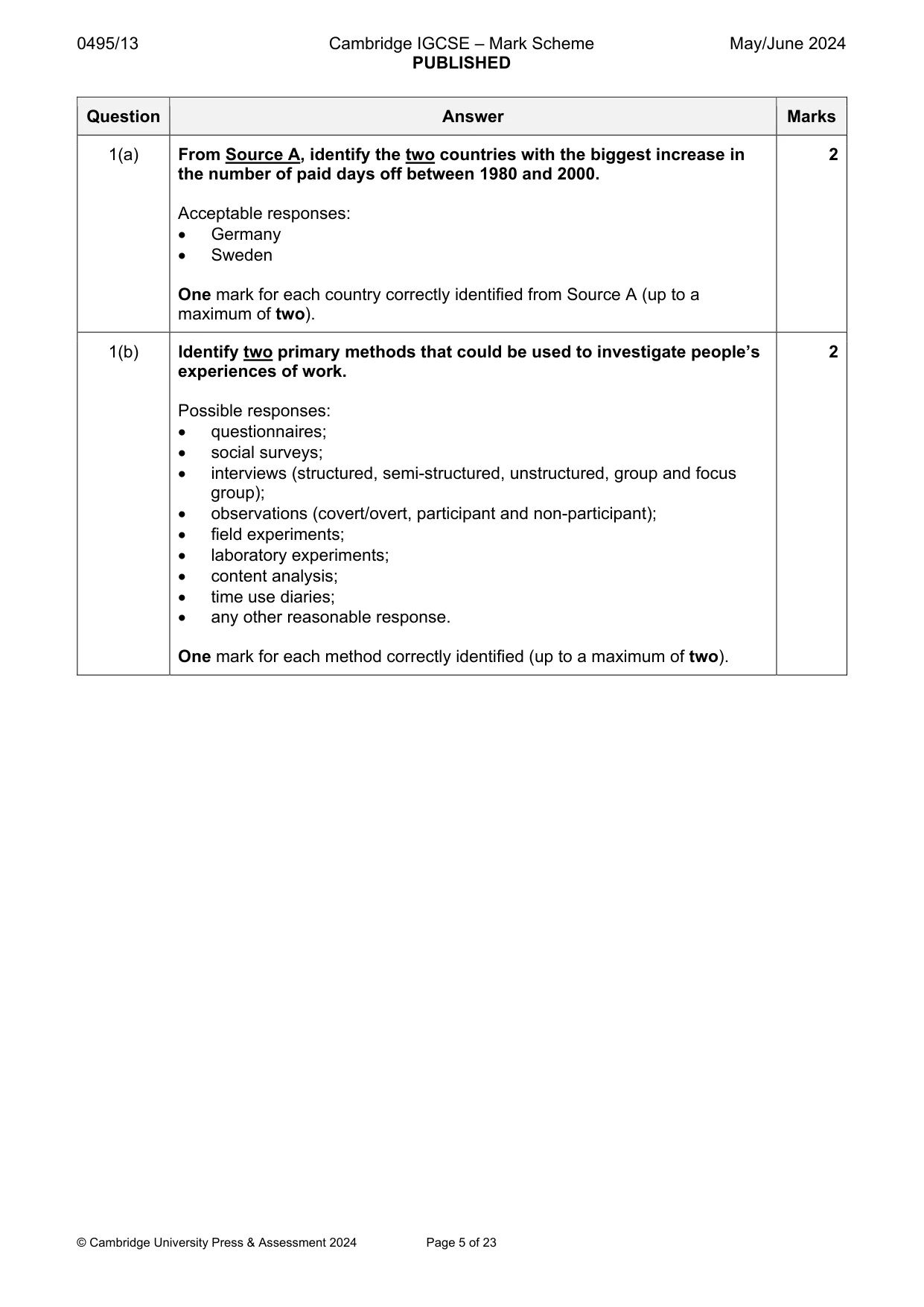
0495/13 Cambridge IGCSE – Mark Scheme PUBLISHED May/June 2024 © Cambridge University Press & Assessment 2024 Page 5 of 23 Question Answer Marks 1(a) From Source A, identify the two countries with the biggest increase in the number of paid days off between 1980 and 2000. Acceptable responses: Germany Sweden One mark for each country correctly identified from Source A (up to a maximum of two). 2 1(b) Identify two primary methods that could be used to investigate people’s experiences of work. Possible responses: questionnaires; social surveys; interviews (structured, semi-structured, unstructured, group and focus group); observations (covert/overt, participant and non-participant); field experiments; laboratory experiments; content analysis; time use diaries; any other reasonable response. One mark for each method correctly identified (up to a maximum of two). 2
Mark scheme, page 6
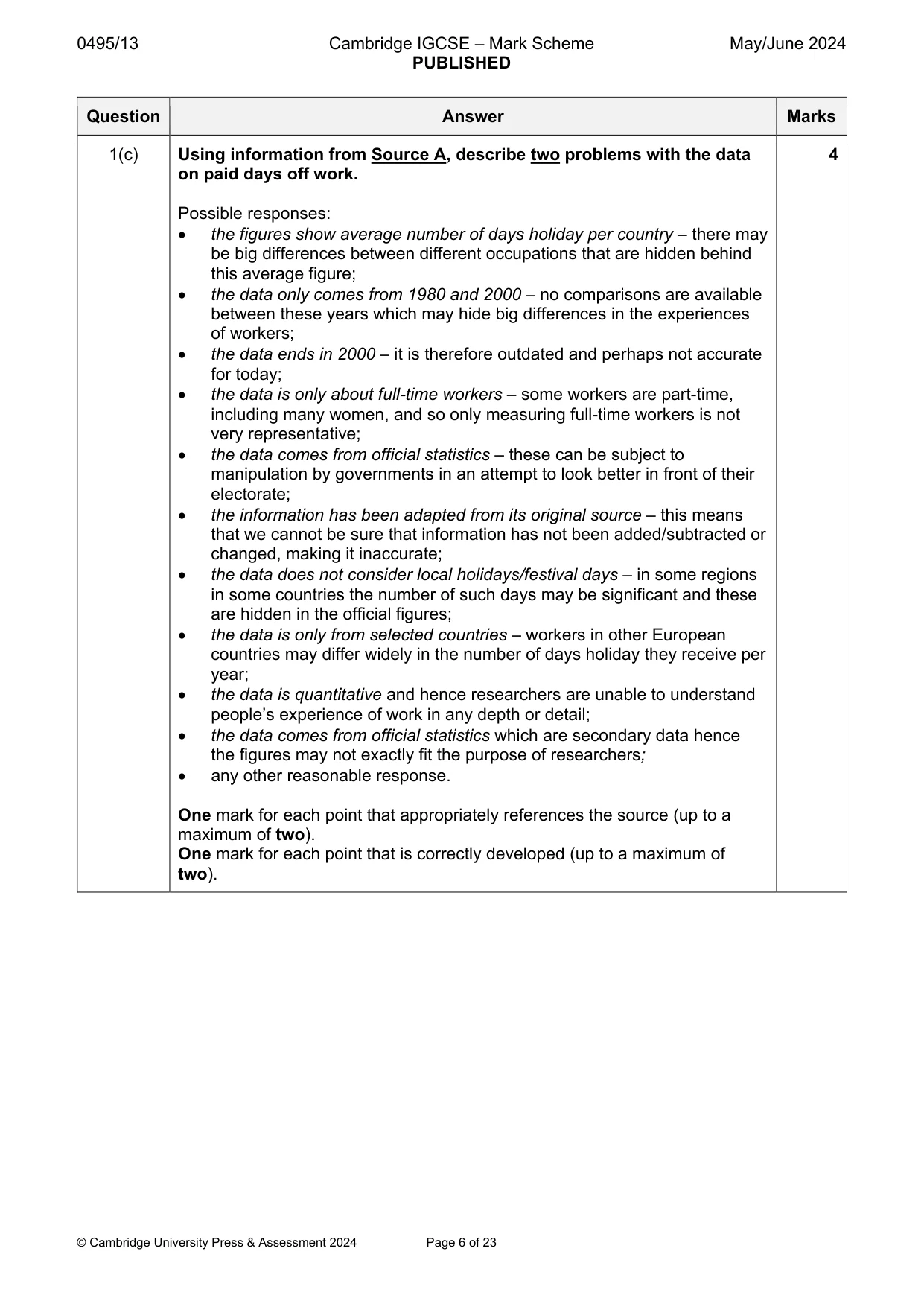
0495/13 Cambridge IGCSE – Mark Scheme PUBLISHED May/June 2024 © Cambridge University Press & Assessment 2024 Page 6 of 23 Question Answer Marks 1(c) Using information from Source A, describe two problems with the data on paid days off work. Possible responses: the figures show average number of days holiday per country – there may be big differences between different occupations that are hidden behind this average figure; the data only comes from 1980 and 2000 – no comparisons are available between these years which may hide big differences in the experiences of workers; the data ends in 2000 – it is therefore outdated and perhaps not accurate for today; the data is only about full-time workers – some workers are part-time, including many women, and so only measuring full-time workers is not very representative; the data comes from official statistics – these can be subject to manipulation by governments in an attempt to look better in front of their electorate; the information has been adapted from its original source – this means that we cannot be sure that information has not been added/subtracted or changed, making it inaccurate; the data does not consider local holidays/festival days – in some regions in some countries the number of such days may be significant and these are hidden in the official figures; the data is only from selected countries – workers in other European countries may differ widely in the number of days holiday they receive per year; the data is quantitative and hence researchers are unable to understand people’s experience of work in any depth or detail; the data comes from official statistics which are secondary data hence the figures may not exactly fit the purpose of researchers; any other reasonable response. One mark for each point that appropriately references the source (up to a maximum of two). One mark for each point that is correctly developed (up to a maximum of two). 4
Mark scheme, page 7
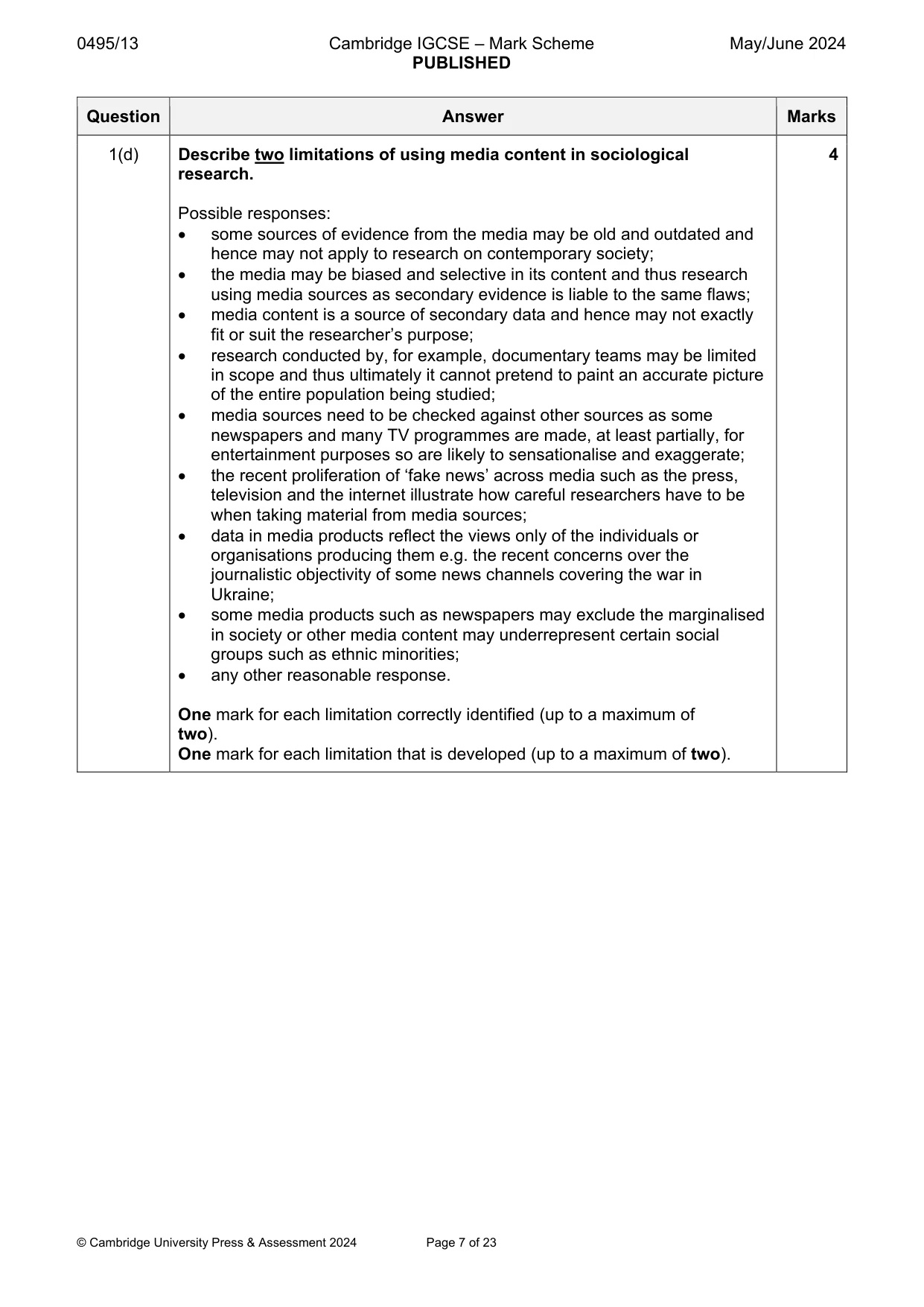
0495/13 Cambridge IGCSE – Mark Scheme PUBLISHED May/June 2024 © Cambridge University Press & Assessment 2024 Page 7 of 23 Question Answer Marks 1(d) Describe two limitations of using media content in sociological research. Possible responses: some sources of evidence from the media may be old and outdated and hence may not apply to research on contemporary society; the media may be biased and selective in its content and thus research using media sources as secondary evidence is liable to the same flaws; media content is a source of secondary data and hence may not exactly fit or suit the researcher’s purpose; research conducted by, for example, documentary teams may be limited in scope and thus ultimately it cannot pretend to paint an accurate picture of the entire population being studied; media sources need to be checked against other sources as some newspapers and many TV programmes are made, at least partially, for entertainment purposes so are likely to sensationalise and exaggerate; the recent proliferation of ‘fake news’ across media such as the press, television and the internet illustrate how careful researchers have to be when taking material from media sources; data in media products reflect the views only of the individuals or organisations producing them e.g. the recent concerns over the journalistic objectivity of some news channels covering the war in Ukraine; some media products such as newspapers may exclude the marginalised in society or other media content may underrepresent certain social groups such as ethnic minorities; any other reasonable response. One mark for each limitation correctly identified (up to a maximum of two). One mark for each limitation that is developed (up to a maximum of two). 4
Mark scheme, page 8
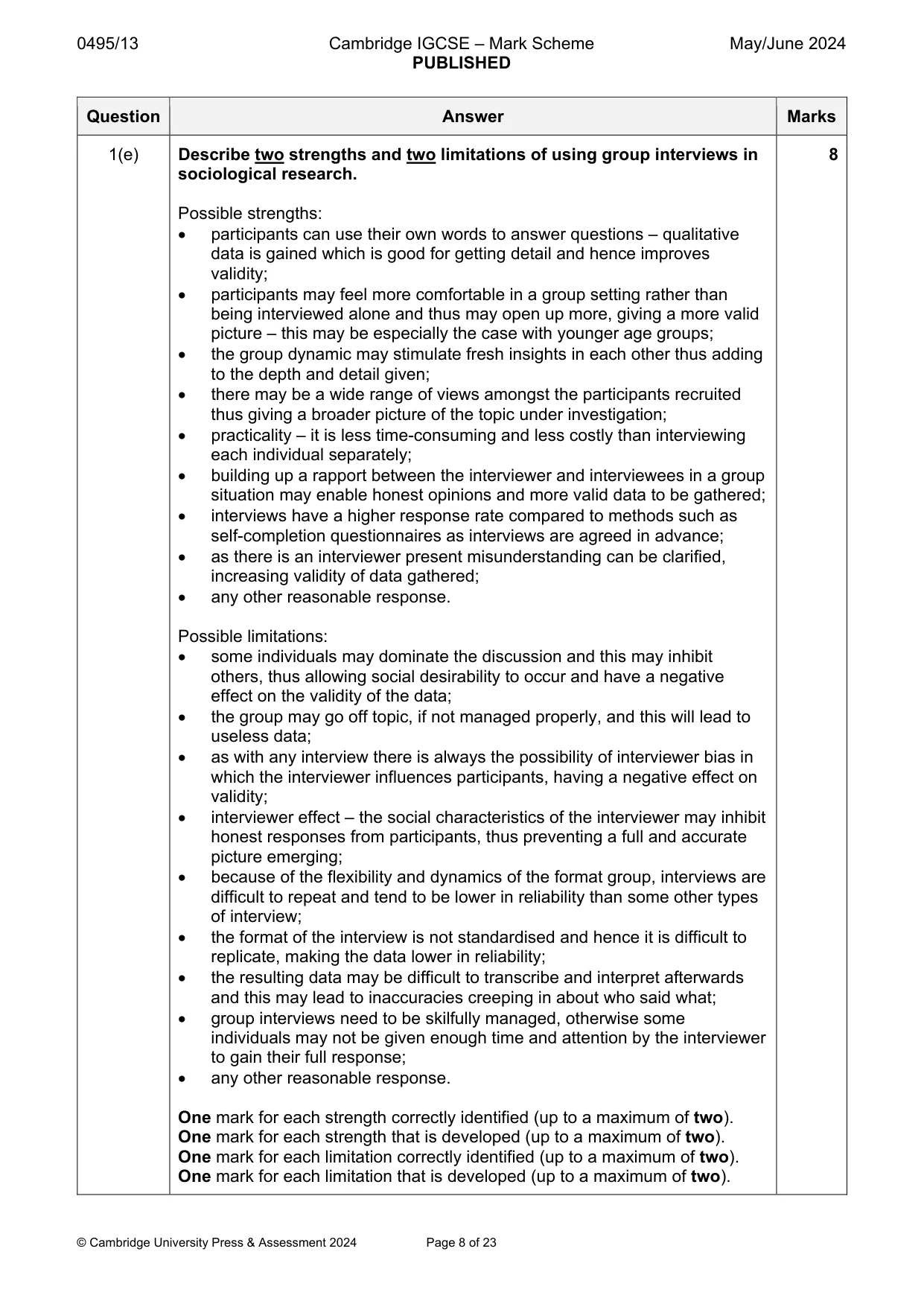
0495/13 Cambridge IGCSE – Mark Scheme PUBLISHED May/June 2024 © Cambridge University Press & Assessment 2024 Page 8 of 23 Question Answer Marks 1(e) Describe two strengths and two limitations of using group interviews in sociological research. Possible strengths: participants can use their own words to answer questions – qualitative data is gained which is good for getting detail and hence improves validity; participants may feel more comfortable in a group setting rather than being interviewed alone and thus may open up more, giving a more valid picture – this may be especially the case with younger age groups; the group dynamic may stimulate fresh insights in each other thus adding to the depth and detail given; there may be a wide range of views amongst the participants recruited thus giving a broader picture of the topic under investigation; practicality – it is less time-consuming and less costly than interviewing each individual separately; building up a rapport between the interviewer and interviewees in a group situation may enable honest opinions and more valid data to be gathered; interviews have a higher response rate compared to methods such as self-completion questionnaires as interviews are agreed in advance; as there is an interviewer present misunderstanding can be clarified, increasing validity of data gathered; any other reasonable response. Possible limitations: some individuals may dominate the discussion and this may inhibit others, thus allowing social desirability to occur and have a negative effect on the validity of the data; the group may go off topic, if not managed properly, and this will lead to useless data; as with any interview there is always the possibility of interviewer bias in which the interviewer influences participants, having a negative effect on validity; interviewer effect – the social characteristics of the interviewer may inhibit honest responses from participants, thus preventing a full and accurate picture emerging; because of the flexibility and dynamics of the format group, interviews are difficult to repeat and tend to be lower in reliability than some other types of interview; the format of the interview is not standardised and hence it is difficult to replicate, making the data lower in reliability; the resulting data may be difficult to transcribe and interpret afterwards and this may lead to inaccuracies creeping in about who said what; group interviews need to be skilfully managed, otherwise some individuals may not be given enough time and attention by the interviewer to gain their full response; any other reasonable response. One mark for each strength correctly identified (up to a maximum of two). One mark for each strength that is developed (up to a maximum of two). One mark for each limitation correctly identified (up to a maximum of two). One mark for each limitation that is developed (up to a maximum of two). 8
Mark scheme, page 9
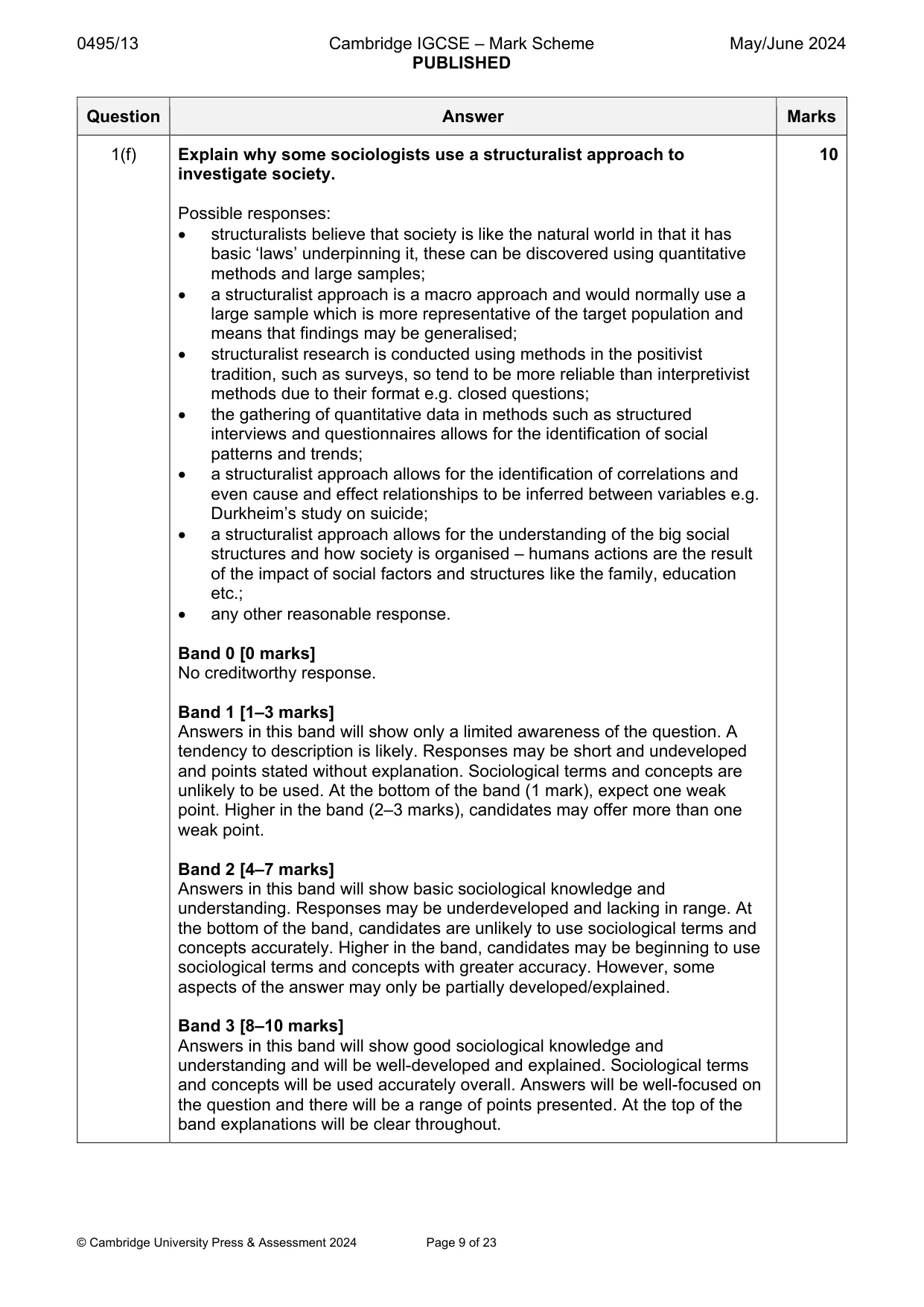
0495/13 Cambridge IGCSE – Mark Scheme PUBLISHED May/June 2024 © Cambridge University Press & Assessment 2024 Page 9 of 23 Question Answer Marks 1(f) Explain why some sociologists use a structuralist approach to investigate society. Possible responses: structuralists believe that society is like the natural world in that it has basic ‘laws’ underpinning it, these can be discovered using quantitative methods and large samples; a structuralist approach is a macro approach and would normally use a large sample which is more representative of the target population and means that findings may be generalised; structuralist research is conducted using methods in the positivist tradition, such as surveys, so tend to be more reliable than interpretivist methods due to their format e.g. closed questions; the gathering of quantitative data in methods such as structured interviews and questionnaires allows for the identification of social patterns and trends; a structuralist approach allows for the identification of correlations and even cause and effect relationships to be inferred between variables e.g. Durkheim’s study on suicide; a structuralist approach allows for the understanding of the big social structures and how society is organised – humans actions are the result of the impact of social factors and structures like the family, education etc.; any other reasonable response. Band 0 [0 marks] No creditworthy response. Band 1 [1–3 marks] Answers in this band will show only a limited awareness of the question. A tendency to description is likely. Responses may be short and undeveloped and points stated without explanation. Sociological terms and concepts are unlikely to be used. At the bottom of the band (1 mark), expect one weak point. Higher in the band (2–3 marks), candidates may offer more than one weak point. Band 2 [4–7 marks] Answers in this band will show basic sociological knowledge and understanding. Responses may be underdeveloped and lacking in range. At the bottom of the band, candidates are unlikely to use sociological terms and concepts accurately. Higher in the band, candidates may be beginning to use sociological terms and concepts with greater accuracy. However, some aspects of the answer may only be partially developed/explained. Band 3 [8–10 marks] Answers in this band will show good sociological knowledge and understanding and will be well-developed and explained. Sociological terms and concepts will be used accurately overall. Answers will be well-focused on the question and there will be a range of points presented. At the top of the band explanations will be clear throughout. 10
Mark scheme, page 10
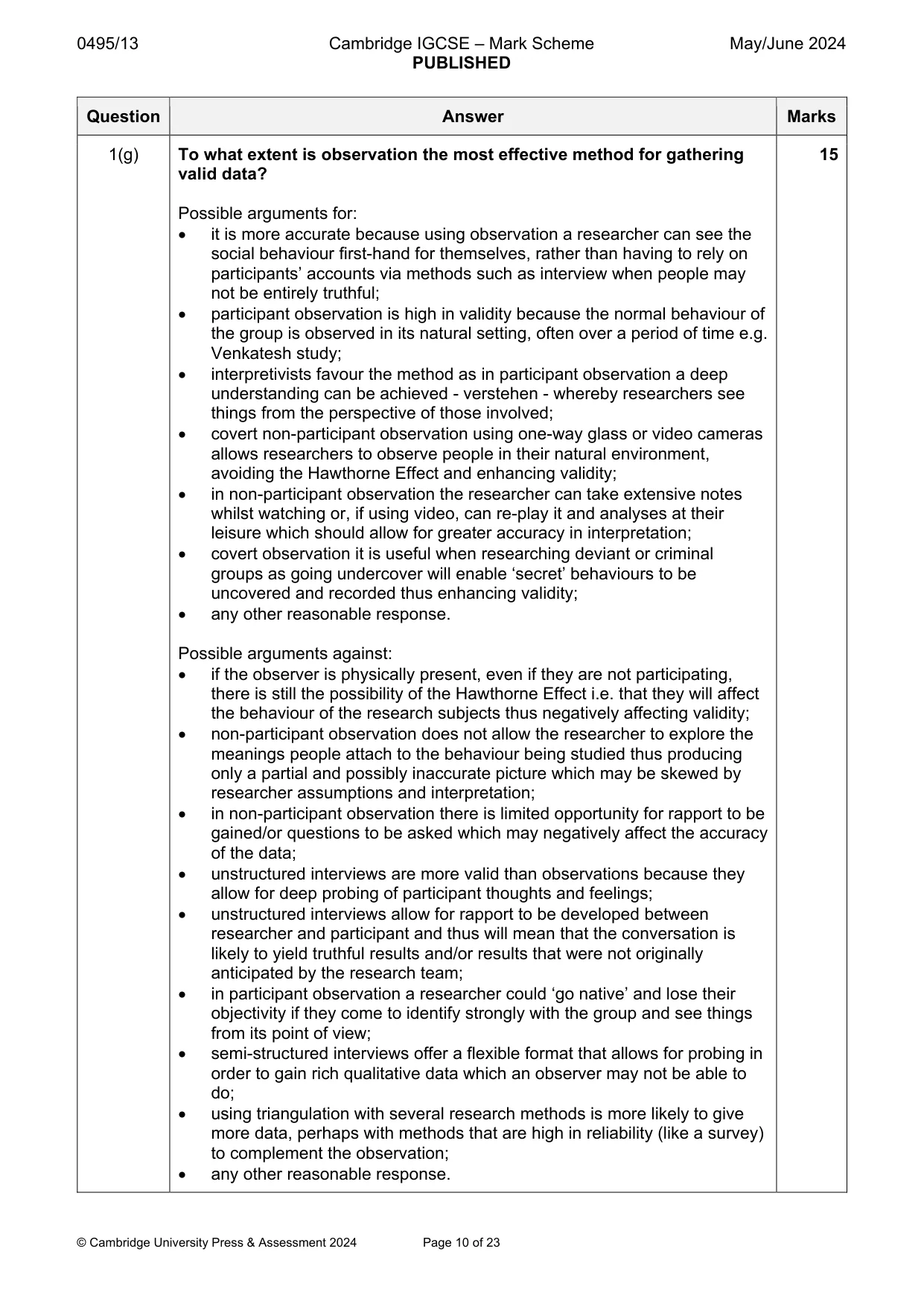
0495/13 Cambridge IGCSE – Mark Scheme PUBLISHED May/June 2024 © Cambridge University Press & Assessment 2024 Page 10 of 23 Question Answer Marks 1(g) To what extent is observation the most effective method for gathering valid data? Possible arguments for: it is more accurate because using observation a researcher can see the social behaviour first-hand for themselves, rather than having to rely on participants’ accounts via methods such as interview when people may not be entirely truthful; participant observation is high in validity because the normal behaviour of the group is observed in its natural setting, often over a period of time e.g. Venkatesh study; interpretivists favour the method as in participant observation a deep understanding can be achieved - verstehen - whereby researchers see things from the perspective of those involved; covert non-participant observation using one-way glass or video cameras allows researchers to observe people in their natural environment, avoiding the Hawthorne Effect and enhancing validity; in non-participant observation the researcher can take extensive notes whilst watching or, if using video, can re-play it and analyses at their leisure which should allow for greater accuracy in interpretation; covert observation it is useful when researching deviant or criminal groups as going undercover will enable ‘secret’ behaviours to be uncovered and recorded thus enhancing validity; any other reasonable response. Possible arguments against: if the observer is physically present, even if they are not participating, there is still the possibility of the Hawthorne Effect i.e. that they will affect the behaviour of the research subjects thus negatively affecting validity; non-participant observation does not allow the researcher to explore the meanings people attach to the behaviour being studied thus producing only a partial and possibly inaccurate picture which may be skewed by researcher assumptions and interpretation; in non-participant observation there is limited opportunity for rapport to be gained/or questions to be asked which may negatively affect the accuracy of the data; unstructured interviews are more valid than observations because they allow for deep probing of participant thoughts and feelings; unstructured interviews allow for rapport to be developed between researcher and participant and thus will mean that the conversation is likely to yield truthful results and/or results that were not originally anticipated by the research team; in participant observation a researcher could ‘go native’ and lose their objectivity if they come to identify strongly with the group and see things from its point of view; semi-structured interviews offer a flexible format that allows for probing in order to gain rich qualitative data which an observer may not be able to do; using triangulation with several research methods is more likely to give more data, perhaps with methods that are high in reliability (like a survey) to complement the observation; any other reasonable response. 15
Mark scheme, page 11
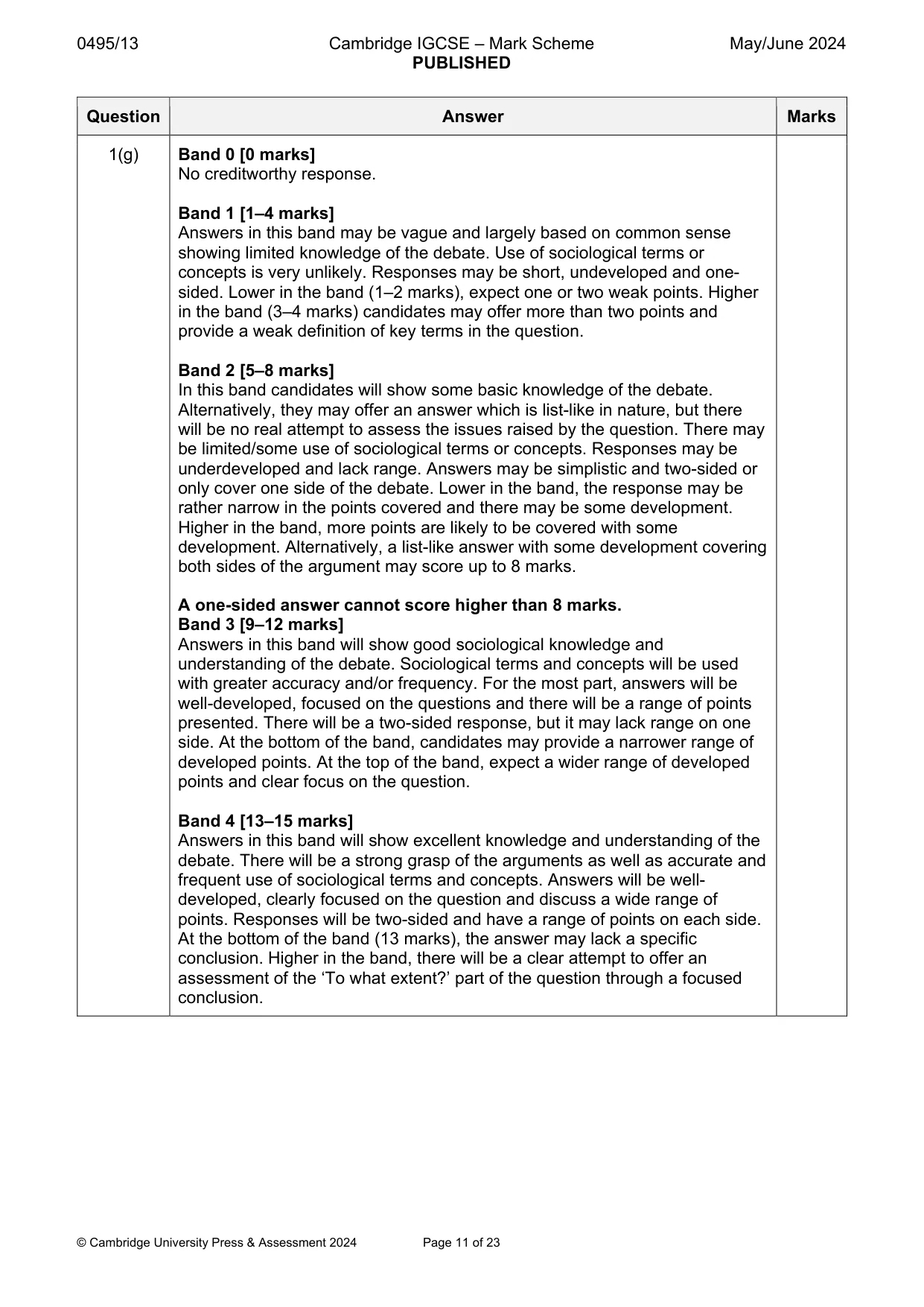
0495/13 Cambridge IGCSE – Mark Scheme PUBLISHED May/June 2024 © Cambridge University Press & Assessment 2024 Page 11 of 23 Question Answer Marks 1(g) Band 0 [0 marks] No creditworthy response. Band 1 [1–4 marks] Answers in this band may be vague and largely based on common sense showing limited knowledge of the debate. Use of sociological terms or concepts is very unlikely. Responses may be short, undeveloped and one- sided. Lower in the band (1–2 marks), expect one or two weak points. Higher in the band (3–4 marks) candidates may offer more than two points and provide a weak definition of key terms in the question. Band 2 [5–8 marks] In this band candidates will show some basic knowledge of the debate. Alternatively, they may offer an answer which is list-like in nature, but there will be no real attempt to assess the issues raised by the question. There may be limited/some use of sociological terms or concepts. Responses may be underdeveloped and lack range. Answers may be simplistic and two-sided or only cover one side of the debate. Lower in the band, the response may be rather narrow in the points covered and there may be some development. Higher in the band, more points are likely to be covered with some development. Alternatively, a list-like answer with some development covering both sides of the argument may score up to 8 marks. A one-sided answer cannot score higher than 8 marks. Band 3 [9–12 marks] Answers in this band will show good sociological knowledge and understanding of the debate. Sociological terms and concepts will be used with greater accuracy and/or frequency. For the most part, answers will be well-developed, focused on the questions and there will be a range of points presented. There will be a two-sided response, but it may lack range on one side. At the bottom of the band, candidates may provide a narrower range of developed points. At the top of the band, expect a wider range of developed points and clear focus on the question. Band 4 [13–15 marks] Answers in this band will show excellent knowledge and understanding of the debate. There will be a strong grasp of the arguments as well as accurate and frequent use of sociological terms and concepts. Answers will be well- developed, clearly focused on the question and discuss a wide range of points. Responses will be two-sided and have a range of points on each side. At the bottom of the band (13 marks), the answer may lack a specific conclusion. Higher in the band, there will be a clear attempt to offer an assessment of the ‘To what extent?’ part of the question through a focused conclusion.
Mark scheme, page 12
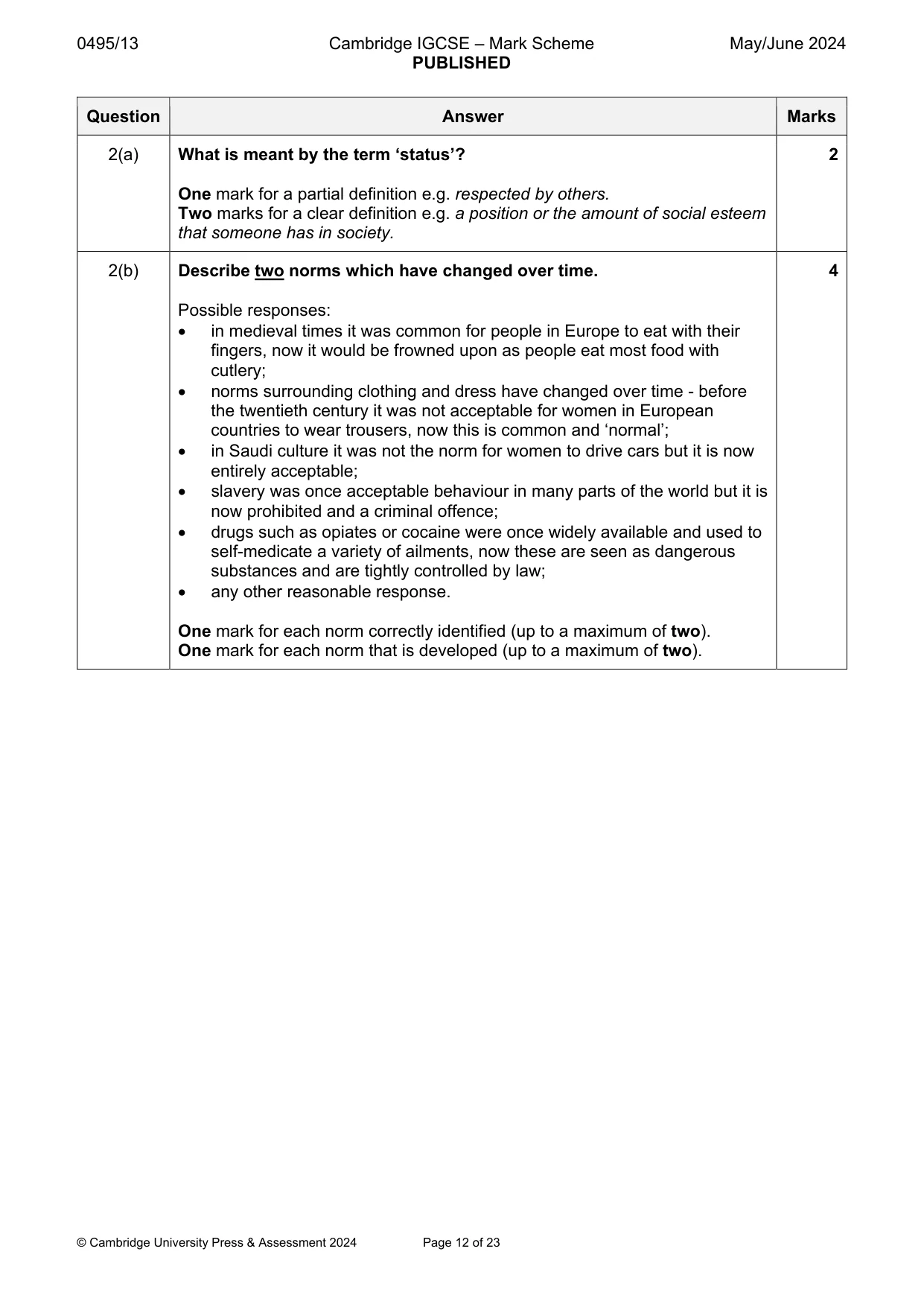
0495/13 Cambridge IGCSE – Mark Scheme PUBLISHED May/June 2024 © Cambridge University Press & Assessment 2024 Page 12 of 23 Question Answer Marks 2(a) What is meant by the term ‘status’? One mark for a partial definition e.g. respected by others. Two marks for a clear definition e.g. a position or the amount of social esteem that someone has in society. 2 2(b) Describe two norms which have changed over time. Possible responses: in medieval times it was common for people in Europe to eat with their fingers, now it would be frowned upon as people eat most food with cutlery; norms surrounding clothing and dress have changed over time - before the twentieth century it was not acceptable for women in European countries to wear trousers, now this is common and ‘normal’; in Saudi culture it was not the norm for women to drive cars but it is now entirely acceptable; slavery was once acceptable behaviour in many parts of the world but it is now prohibited and a criminal offence; drugs such as opiates or cocaine were once widely available and used to self-medicate a variety of ailments, now these are seen as dangerous substances and are tightly controlled by law; any other reasonable response. One mark for each norm correctly identified (up to a maximum of two). One mark for each norm that is developed (up to a maximum of two). 4
Mark scheme, page 13
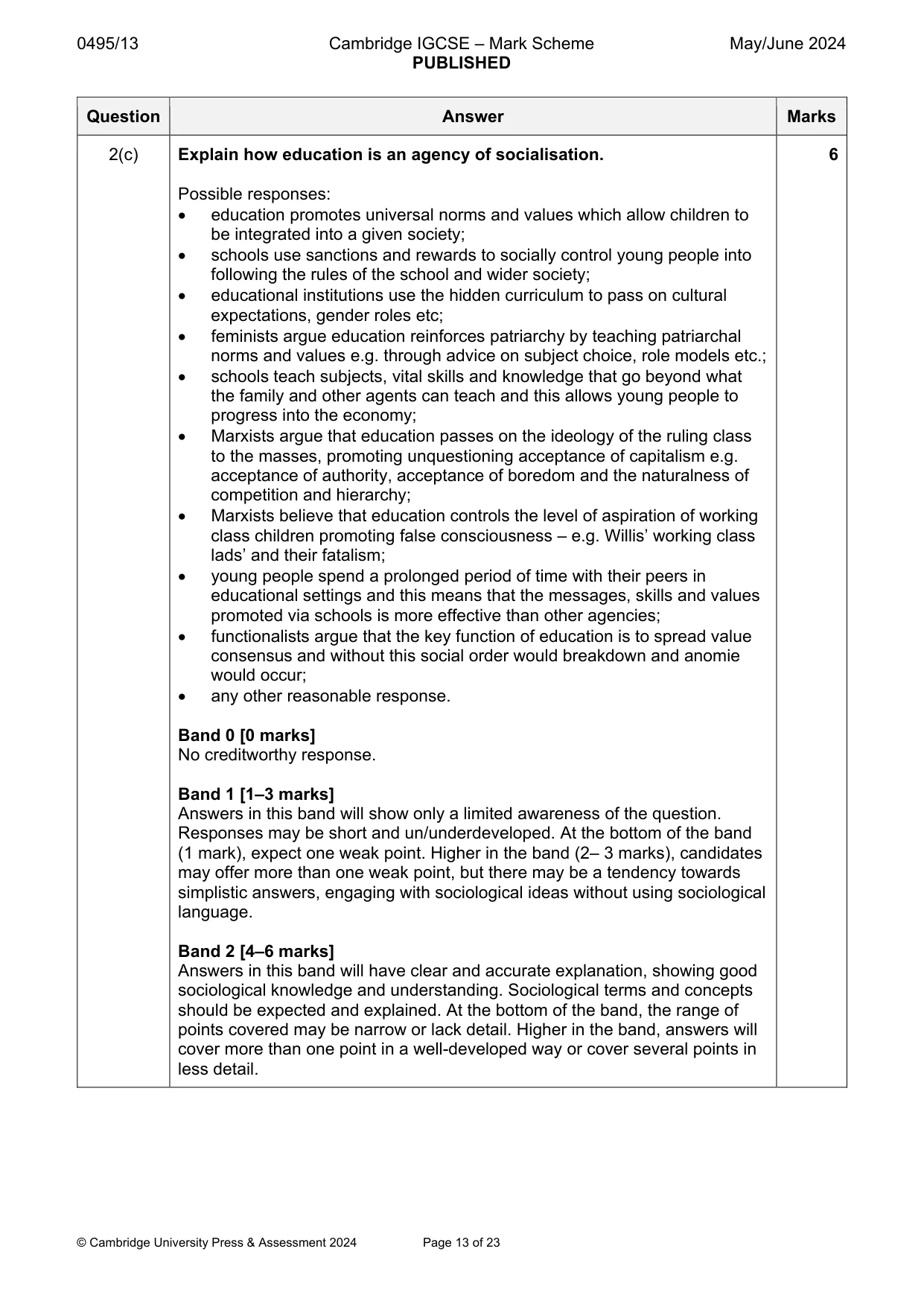
0495/13 Cambridge IGCSE – Mark Scheme PUBLISHED May/June 2024 © Cambridge University Press & Assessment 2024 Page 13 of 23 Question Answer Marks 2(c) Explain how education is an agency of socialisation. Possible responses: education promotes universal norms and values which allow children to be integrated into a given society; schools use sanctions and rewards to socially control young people into following the rules of the school and wider society; educational institutions use the hidden curriculum to pass on cultural expectations, gender roles etc; feminists argue education reinforces patriarchy by teaching patriarchal norms and values e.g. through advice on subject choice, role models etc.; schools teach subjects, vital skills and knowledge that go beyond what the family and other agents can teach and this allows young people to progress into the economy; Marxists argue that education passes on the ideology of the ruling class to the masses, promoting unquestioning acceptance of capitalism e.g. acceptance of authority, acceptance of boredom and the naturalness of competition and hierarchy; Marxists believe that education controls the level of aspiration of working class children promoting false consciousness – e.g. Willis’ working class lads’ and their fatalism; young people spend a prolonged period of time with their peers in educational settings and this means that the messages, skills and values promoted via schools is more effective than other agencies; functionalists argue that the key function of education is to spread value consensus and without this social order would breakdown and anomie would occur; any other reasonable response. Band 0 [0 marks] No creditworthy response. Band 1 [1–3 marks] Answers in this band will show only a limited awareness of the question. Responses may be short and un/underdeveloped. At the bottom of the band (1 mark), expect one weak point. Higher in the band (2– 3 marks), candidates may offer more than one weak point, but there may be a tendency towards simplistic answers, engaging with sociological ideas without using sociological language. Band 2 [4–6 marks] Answers in this band will have clear and accurate explanation, showing good sociological knowledge and understanding. Sociological terms and concepts should be expected and explained. At the bottom of the band, the range of points covered may be narrow or lack detail. Higher in the band, answers will cover more than one point in a well-developed way or cover several points in less detail. 6
Mark scheme, page 14
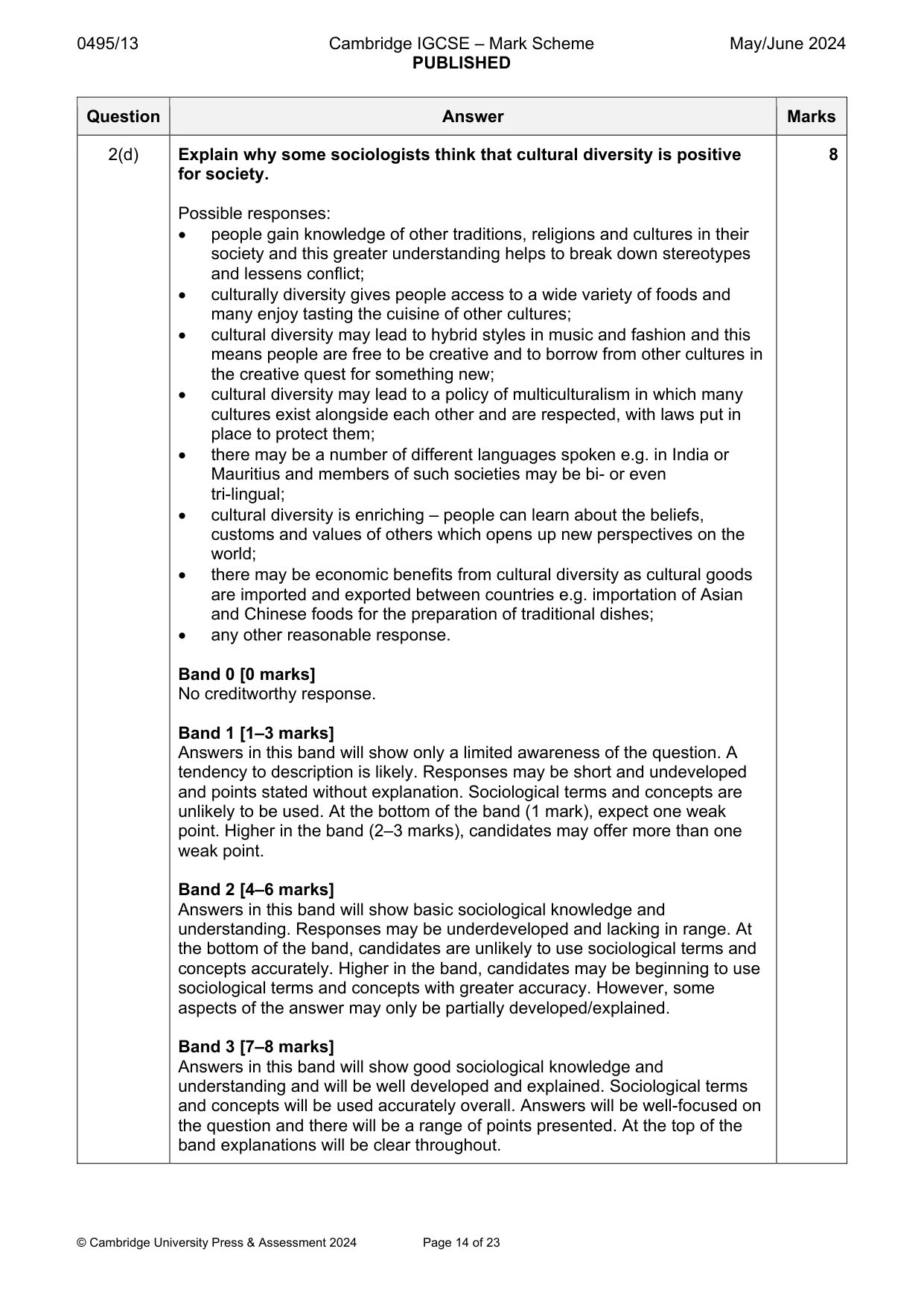
0495/13 Cambridge IGCSE – Mark Scheme PUBLISHED May/June 2024 © Cambridge University Press & Assessment 2024 Page 14 of 23 Question Answer Marks 2(d) Explain why some sociologists think that cultural diversity is positive for society. Possible responses: people gain knowledge of other traditions, religions and cultures in their society and this greater understanding helps to break down stereotypes and lessens conflict; culturally diversity gives people access to a wide variety of foods and many enjoy tasting the cuisine of other cultures; cultural diversity may lead to hybrid styles in music and fashion and this means people are free to be creative and to borrow from other cultures in the creative quest for something new; cultural diversity may lead to a policy of multiculturalism in which many cultures exist alongside each other and are respected, with laws put in place to protect them; there may be a number of different languages spoken e.g. in India or Mauritius and members of such societies may be bi- or even tri-lingual; cultural diversity is enriching – people can learn about the beliefs, customs and values of others which opens up new perspectives on the world; there may be economic benefits from cultural diversity as cultural goods are imported and exported between countries e.g. importation of Asian and Chinese foods for the preparation of traditional dishes; any other reasonable response. Band 0 [0 marks] No creditworthy response. Band 1 [1–3 marks] Answers in this band will show only a limited awareness of the question. A tendency to description is likely. Responses may be short and undeveloped and points stated without explanation. Sociological terms and concepts are unlikely to be used. At the bottom of the band (1 mark), expect one weak point. Higher in the band (2–3 marks), candidates may offer more than one weak point. Band 2 [4–6 marks] Answers in this band will show basic sociological knowledge and understanding. Responses may be underdeveloped and lacking in range. At the bottom of the band, candidates are unlikely to use sociological terms and concepts accurately. Higher in the band, candidates may be beginning to use sociological terms and concepts with greater accuracy. However, some aspects of the answer may only be partially developed/explained. Band 3 [7–8 marks] Answers in this band will show good sociological knowledge and understanding and will be well developed and explained. Sociological terms and concepts will be used accurately overall. Answers will be well-focused on the question and there will be a range of points presented. At the top of the band explanations will be clear throughout. 8
Mark scheme, page 15
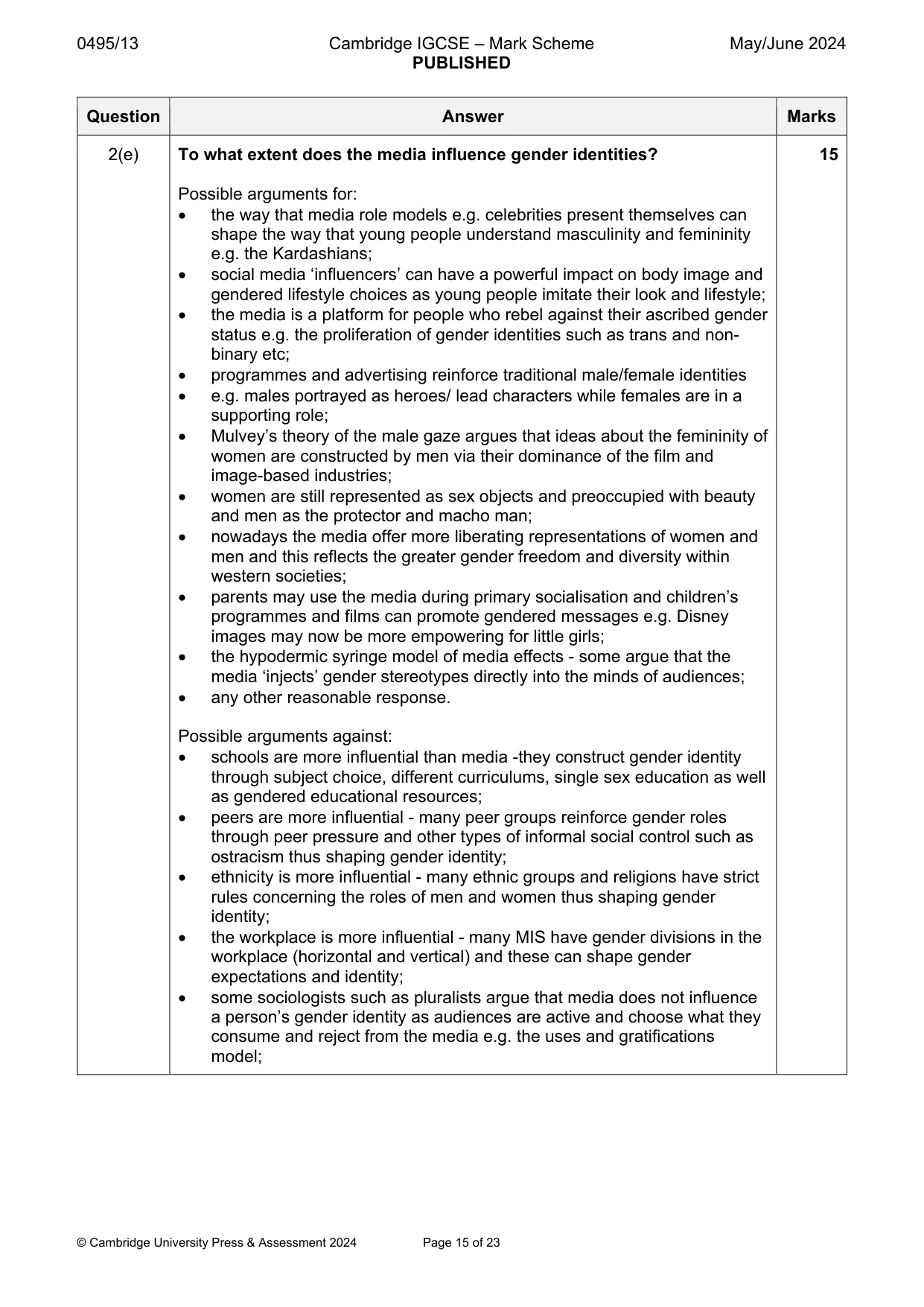
0495/13 Cambridge IGCSE – Mark Scheme PUBLISHED May/June 2024 © Cambridge University Press & Assessment 2024 Page 15 of 23 Question Answer Marks 2(e) To what extent does the media influence gender identities? Possible arguments for: the way that media role models e.g. celebrities present themselves can shape the way that young people understand masculinity and femininity e.g. the Kardashians; social media ‘influencers’ can have a powerful impact on body image and gendered lifestyle choices as young people imitate their look and lifestyle; the media is a platform for people who rebel against their ascribed gender status e.g. the proliferation of gender identities such as trans and non- binary etc; programmes and advertising reinforce traditional male/female identities e.g. males portrayed as heroes/ lead characters while females are in a supporting role; Mulvey’s theory of the male gaze argues that ideas about the femininity of women are constructed by men via their dominance of the film and image-based industries; women are still represented as sex objects and preoccupied with beauty and men as the protector and macho man; nowadays the media offer more liberating representations of women and men and this reflects the greater gender freedom and diversity within western societies; parents may use the media during primary socialisation and children’s programmes and films can promote gendered messages e.g. Disney images may now be more empowering for little girls; the hypodermic syringe model of media effects - some argue that the media ‘injects’ gender stereotypes directly into the minds of audiences; any other reasonable response. Possible arguments against: schools are more influential than media -they construct gender identity through subject choice, different curriculums, single sex education as well as gendered educational resources; peers are more influential - many peer groups reinforce gender roles through peer pressure and other types of informal social control such as ostracism thus shaping gender identity; ethnicity is more influential - many ethnic groups and religions have strict rules concerning the roles of men and women thus shaping gender identity; the workplace is more influential - many MIS have gender divisions in the workplace (horizontal and vertical) and these can shape gender expectations and identity; some sociologists such as pluralists argue that media does not influence a person’s gender identity as audiences are active and choose what they consume and reject from the media e.g. the uses and gratifications model; 15
Mark scheme, page 16
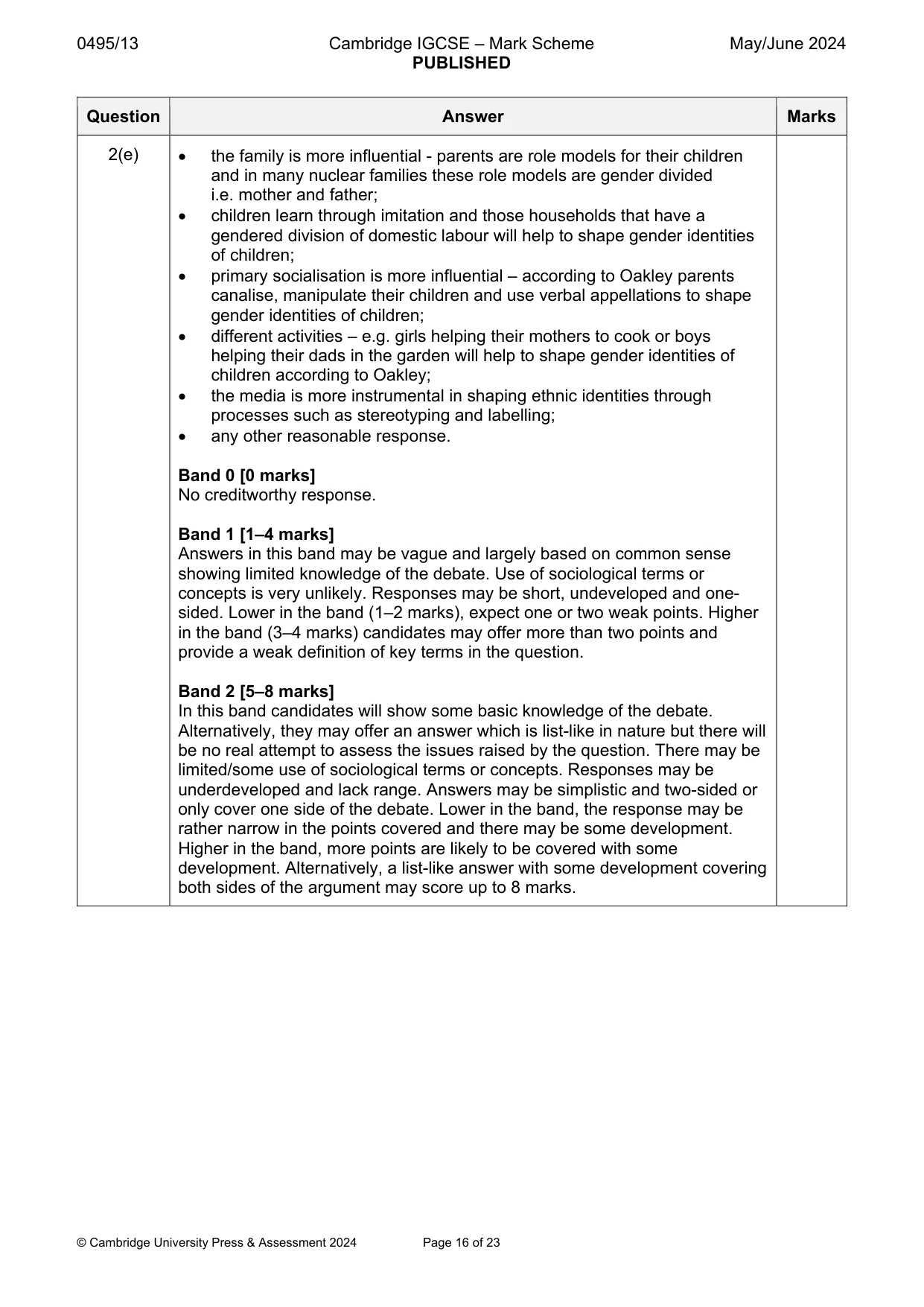
0495/13 Cambridge IGCSE – Mark Scheme PUBLISHED May/June 2024 © Cambridge University Press & Assessment 2024 Page 16 of 23 Question Answer Marks 2(e) the family is more influential - parents are role models for their children and in many nuclear families these role models are gender divided i.e. mother and father; children learn through imitation and those households that have a gendered division of domestic labour will help to shape gender identities of children; primary socialisation is more influential – according to Oakley parents canalise, manipulate their children and use verbal appellations to shape gender identities of children; different activities – e.g. girls helping their mothers to cook or boys helping their dads in the garden will help to shape gender identities of children according to Oakley; the media is more instrumental in shaping ethnic identities through processes such as stereotyping and labelling; any other reasonable response. Band 0 [0 marks] No creditworthy response. Band 1 [1–4 marks] Answers in this band may be vague and largely based on common sense showing limited knowledge of the debate. Use of sociological terms or concepts is very unlikely. Responses may be short, undeveloped and one- sided. Lower in the band (1–2 marks), expect one or two weak points. Higher in the band (3–4 marks) candidates may offer more than two points and provide a weak definition of key terms in the question. Band 2 [5–8 marks] In this band candidates will show some basic knowledge of the debate. Alternatively, they may offer an answer which is list-like in nature but there will be no real attempt to assess the issues raised by the question. There may be limited/some use of sociological terms or concepts. Responses may be underdeveloped and lack range. Answers may be simplistic and two-sided or only cover one side of the debate. Lower in the band, the response may be rather narrow in the points covered and there may be some development. Higher in the band, more points are likely to be covered with some development. Alternatively, a list-like answer with some development covering both sides of the argument may score up to 8 marks.
Mark scheme, page 17
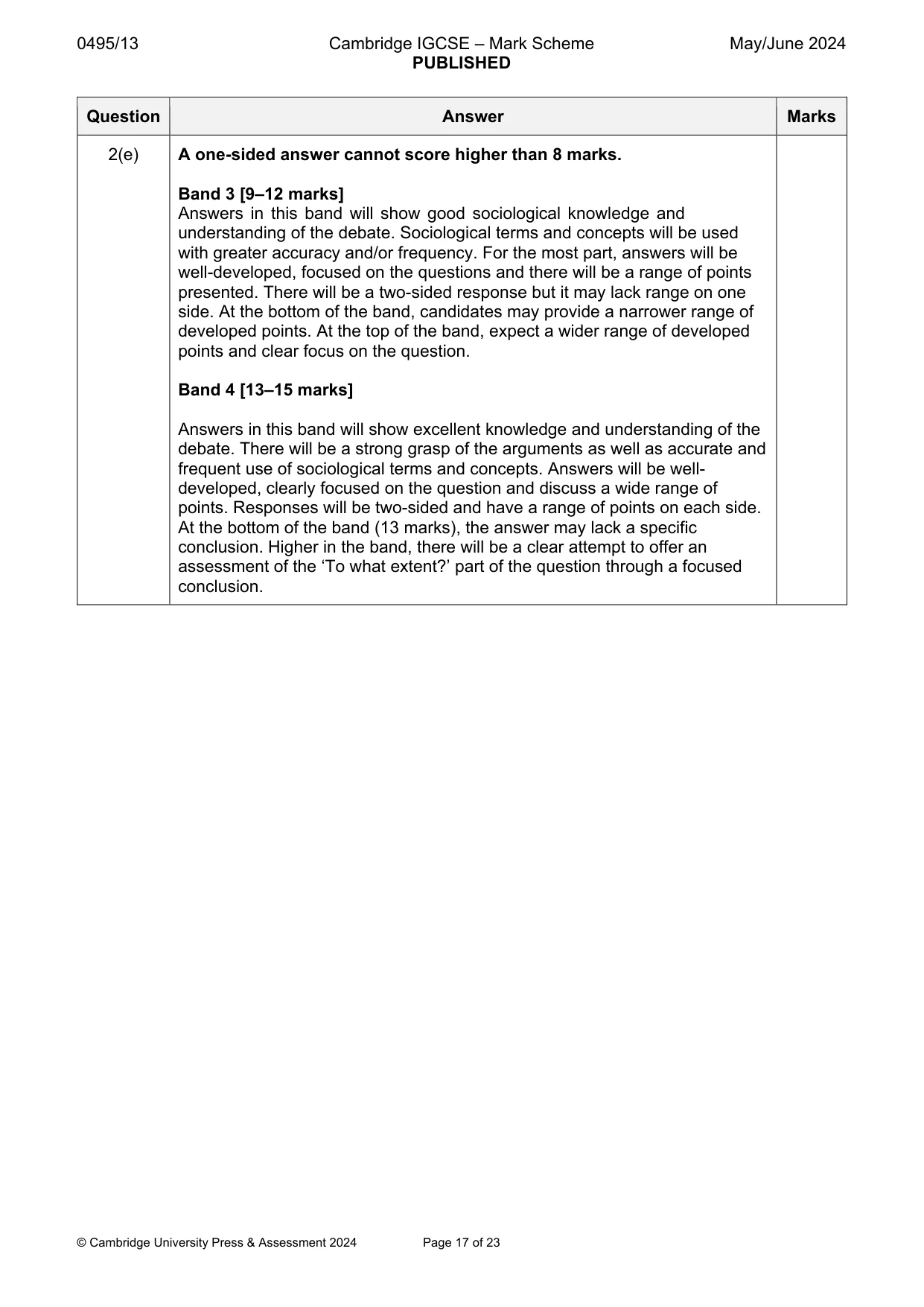
0495/13 Cambridge IGCSE – Mark Scheme PUBLISHED May/June 2024 © Cambridge University Press & Assessment 2024 Page 17 of 23 Question Answer Marks 2(e) A one-sided answer cannot score higher than 8 marks. Band 3 [9–12 marks] Answers in this band will show good sociological knowledge and understanding of the debate. Sociological terms and concepts will be used with greater accuracy and/or frequency. For the most part, answers will be well-developed, focused on the questions and there will be a range of points presented. There will be a two-sided response but it may lack range on one side. At the bottom of the band, candidates may provide a narrower range of developed points. At the top of the band, expect a wider range of developed points and clear focus on the question. Band 4 [13–15 marks] Answers in this band will show excellent knowledge and understanding of the debate. There will be a strong grasp of the arguments as well as accurate and frequent use of sociological terms and concepts. Answers will be well- developed, clearly focused on the question and discuss a wide range of points. Responses will be two-sided and have a range of points on each side. At the bottom of the band (13 marks), the answer may lack a specific conclusion. Higher in the band, there will be a clear attempt to offer an assessment of the ‘To what extent?’ part of the question through a focused conclusion.
Mark scheme, page 18
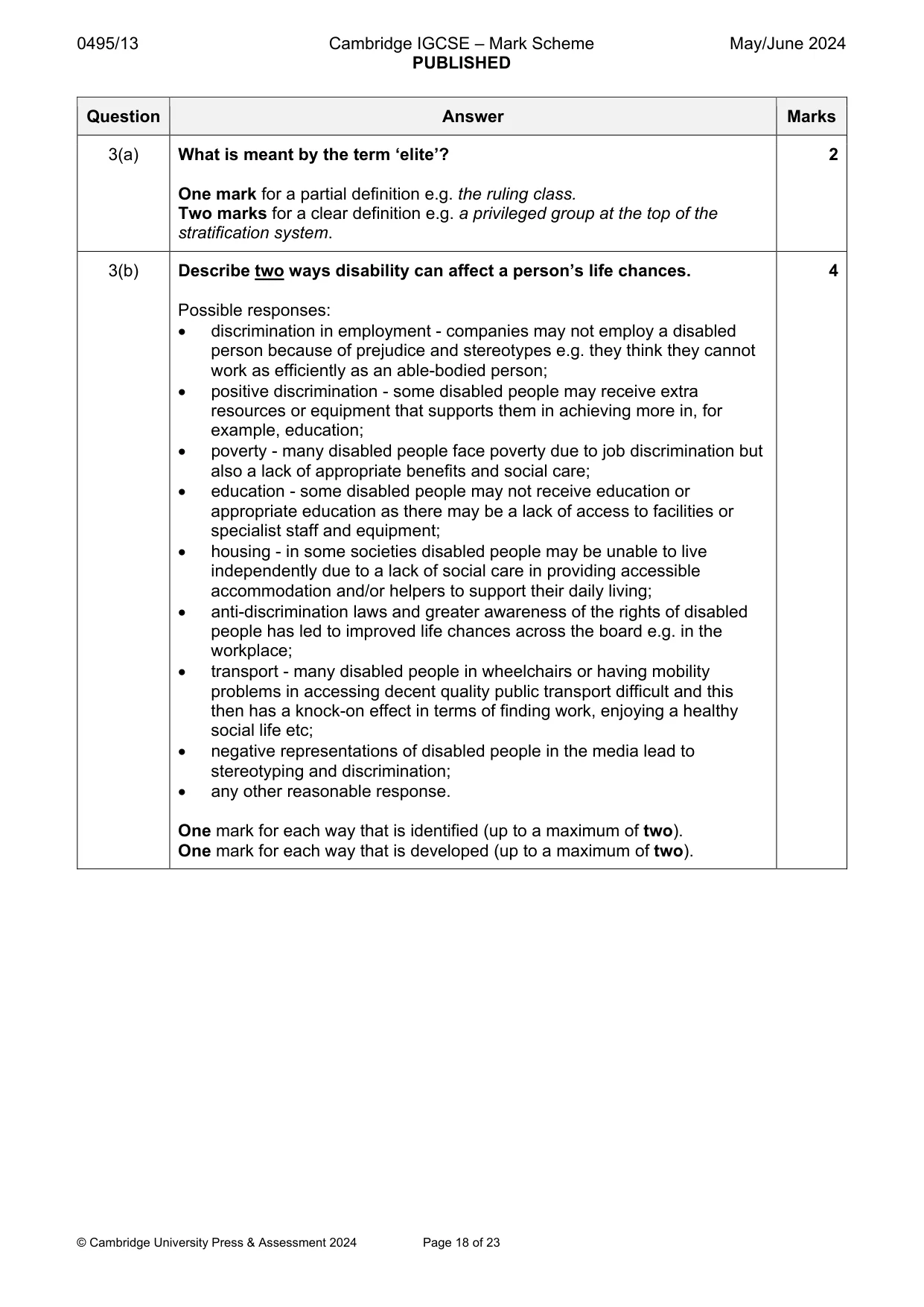
0495/13 Cambridge IGCSE – Mark Scheme PUBLISHED May/June 2024 © Cambridge University Press & Assessment 2024 Page 18 of 23 Question Answer Marks 3(a) What is meant by the term ‘elite’? One mark for a partial definition e.g. the ruling class. Two marks for a clear definition e.g. a privileged group at the top of the stratification system. 2 3(b) Describe two ways disability can affect a person’s life chances. Possible responses: discrimination in employment - companies may not employ a disabled person because of prejudice and stereotypes e.g. they think they cannot work as efficiently as an able-bodied person; positive discrimination - some disabled people may receive extra resources or equipment that supports them in achieving more in, for example, education; poverty - many disabled people face poverty due to job discrimination but also a lack of appropriate benefits and social care; education - some disabled people may not receive education or appropriate education as there may be a lack of access to facilities or specialist staff and equipment; housing - in some societies disabled people may be unable to live independently due to a lack of social care in providing accessible accommodation and/or helpers to support their daily living; anti-discrimination laws and greater awareness of the rights of disabled people has led to improved life chances across the board e.g. in the workplace; transport - many disabled people in wheelchairs or having mobility problems in accessing decent quality public transport difficult and this then has a knock-on effect in terms of finding work, enjoying a healthy social life etc; negative representations of disabled people in the media lead to stereotyping and discrimination; any other reasonable response. One mark for each way that is identified (up to a maximum of two). One mark for each way that is developed (up to a maximum of two). 4
Mark scheme, page 19
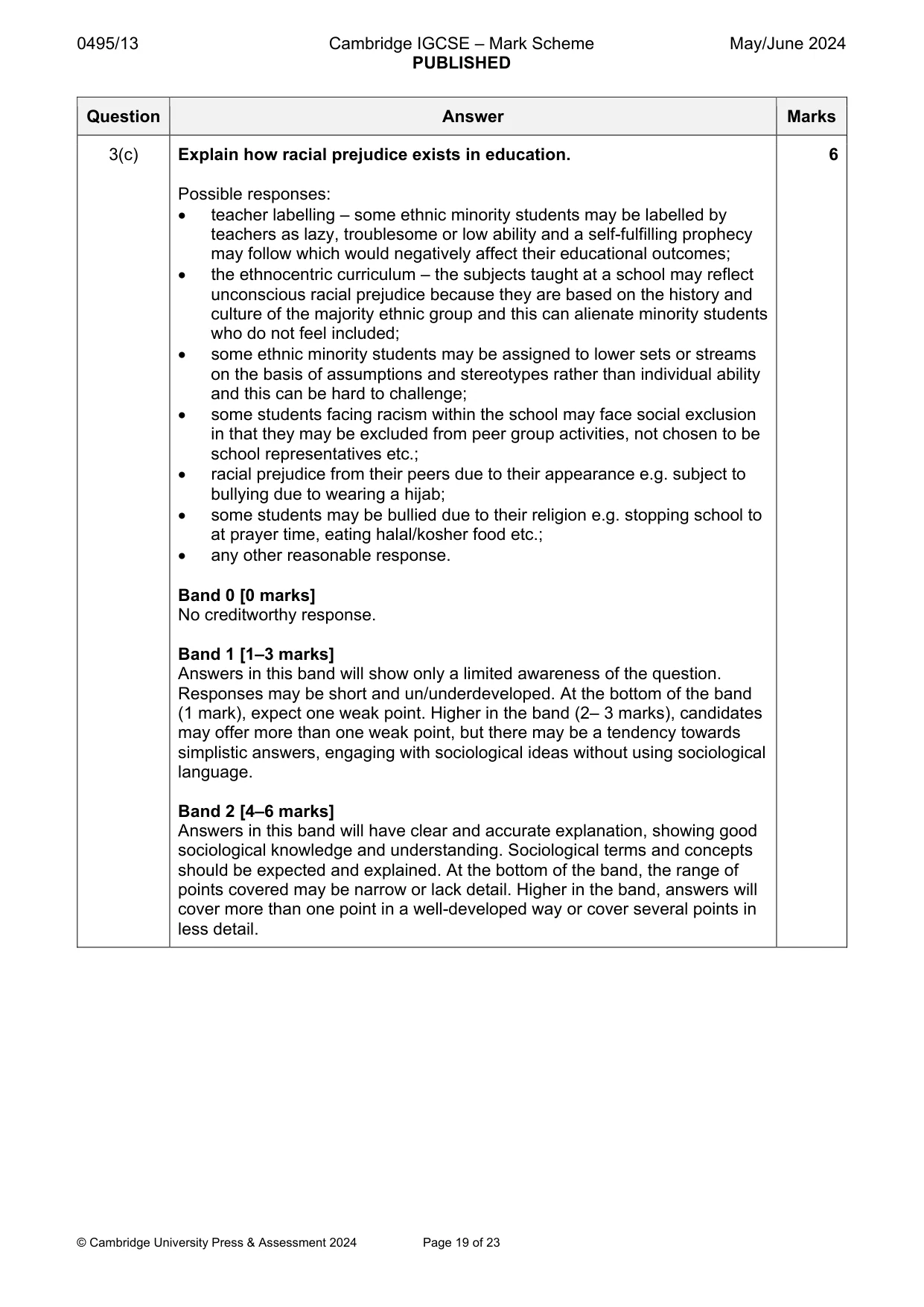
0495/13 Cambridge IGCSE – Mark Scheme PUBLISHED May/June 2024 © Cambridge University Press & Assessment 2024 Page 19 of 23 Question Answer Marks 3(c) Explain how racial prejudice exists in education. Possible responses: teacher labelling – some ethnic minority students may be labelled by teachers as lazy, troublesome or low ability and a self-fulfilling prophecy may follow which would negatively affect their educational outcomes; the ethnocentric curriculum – the subjects taught at a school may reflect unconscious racial prejudice because they are based on the history and culture of the majority ethnic group and this can alienate minority students who do not feel included; some ethnic minority students may be assigned to lower sets or streams on the basis of assumptions and stereotypes rather than individual ability and this can be hard to challenge; some students facing racism within the school may face social exclusion in that they may be excluded from peer group activities, not chosen to be school representatives etc.; racial prejudice from their peers due to their appearance e.g. subject to bullying due to wearing a hijab; some students may be bullied due to their religion e.g. stopping school to at prayer time, eating halal/kosher food etc.; any other reasonable response. Band 0 [0 marks] No creditworthy response. Band 1 [1–3 marks] Answers in this band will show only a limited awareness of the question. Responses may be short and un/underdeveloped. At the bottom of the band (1 mark), expect one weak point. Higher in the band (2– 3 marks), candidates may offer more than one weak point, but there may be a tendency towards simplistic answers, engaging with sociological ideas without using sociological language. Band 2 [4–6 marks] Answers in this band will have clear and accurate explanation, showing good sociological knowledge and understanding. Sociological terms and concepts should be expected and explained. At the bottom of the band, the range of points covered may be narrow or lack detail. Higher in the band, answers will cover more than one point in a well-developed way or cover several points in less detail. 6
Mark scheme, page 20
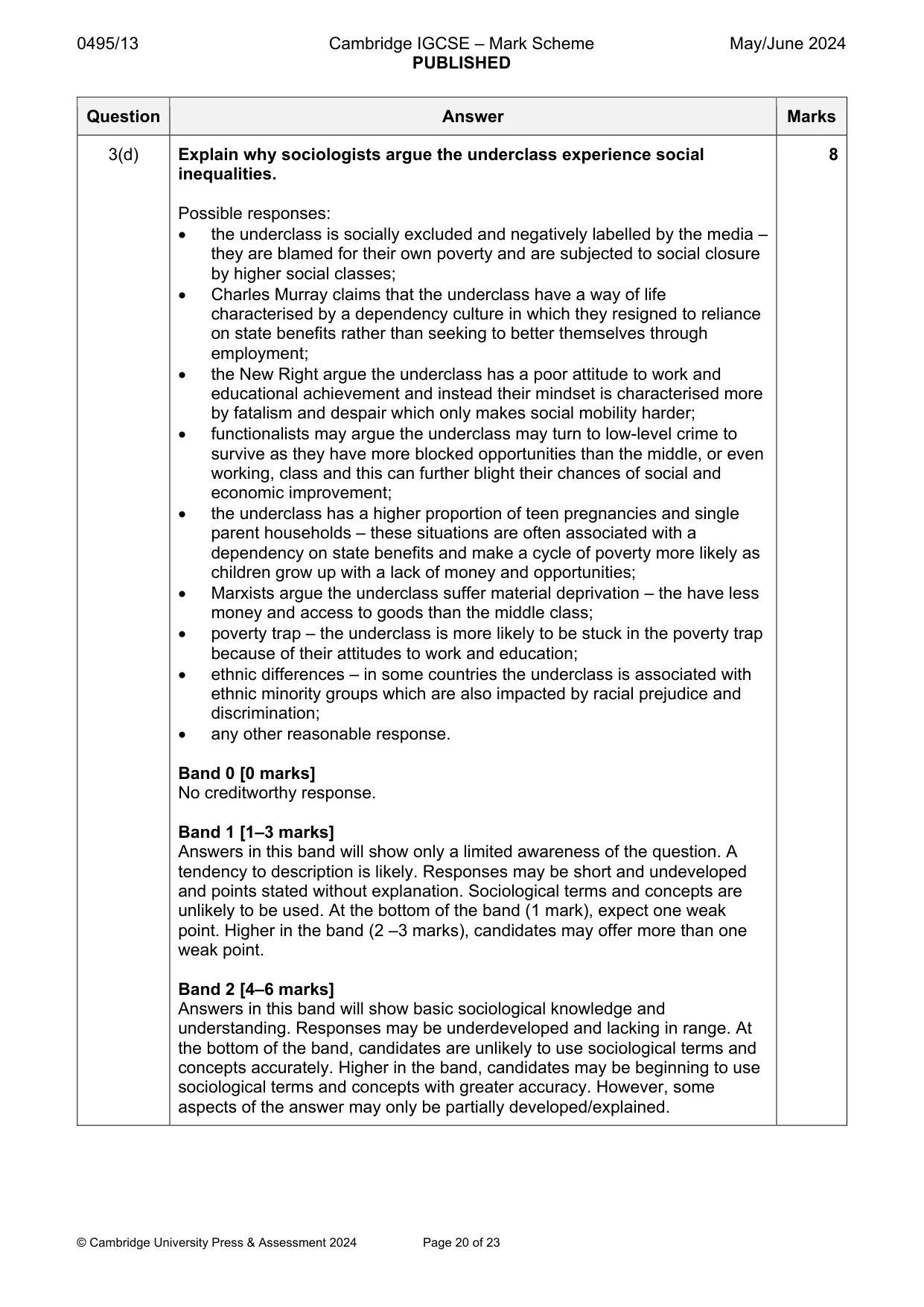
0495/13 Cambridge IGCSE – Mark Scheme PUBLISHED May/June 2024 © Cambridge University Press & Assessment 2024 Page 20 of 23 Question Answer Marks 3(d) Explain why sociologists argue the underclass experience social inequalities. Possible responses: the underclass is socially excluded and negatively labelled by the media – they are blamed for their own poverty and are subjected to social closure by higher social classes; Charles Murray claims that the underclass have a way of life characterised by a dependency culture in which they resigned to reliance on state benefits rather than seeking to better themselves through employment; the New Right argue the underclass has a poor attitude to work and educational achievement and instead their mindset is characterised more by fatalism and despair which only makes social mobility harder; functionalists may argue the underclass may turn to low-level crime to survive as they have more blocked opportunities than the middle, or even working, class and this can further blight their chances of social and economic improvement; the underclass has a higher proportion of teen pregnancies and single parent households – these situations are often associated with a dependency on state benefits and make a cycle of poverty more likely as children grow up with a lack of money and opportunities; Marxists argue the underclass suffer material deprivation – the have less money and access to goods than the middle class; poverty trap – the underclass is more likely to be stuck in the poverty trap because of their attitudes to work and education; ethnic differences – in some countries the underclass is associated with ethnic minority groups which are also impacted by racial prejudice and discrimination; any other reasonable response. Band 0 [0 marks] No creditworthy response. Band 1 [1–3 marks] Answers in this band will show only a limited awareness of the question. A tendency to description is likely. Responses may be short and undeveloped and points stated without explanation. Sociological terms and concepts are unlikely to be used. At the bottom of the band (1 mark), expect one weak point. Higher in the band (2 –3 marks), candidates may offer more than one weak point. Band 2 [4–6 marks] Answers in this band will show basic sociological knowledge and understanding. Responses may be underdeveloped and lacking in range. At the bottom of the band, candidates are unlikely to use sociological terms and concepts accurately. Higher in the band, candidates may be beginning to use sociological terms and concepts with greater accuracy. However, some aspects of the answer may only be partially developed/explained. 8
Mark scheme, page 21
0495/13 Cambridge IGCSE – Mark Scheme PUBLISHED May/June 2024 © Cambridge University Press & Assessment 2024 Page 21 of 23 Question Answer Marks 3(d) Band 3 [7–8 marks] Answers in this band will show good sociological knowledge and understanding and will be well-developed and explained. Sociological terms and concepts will be used accurately overall. Answers will be well-focused on the question and there will be a range of points presented. At the top of the band explanations will be clear throughout.
Mark scheme, page 22
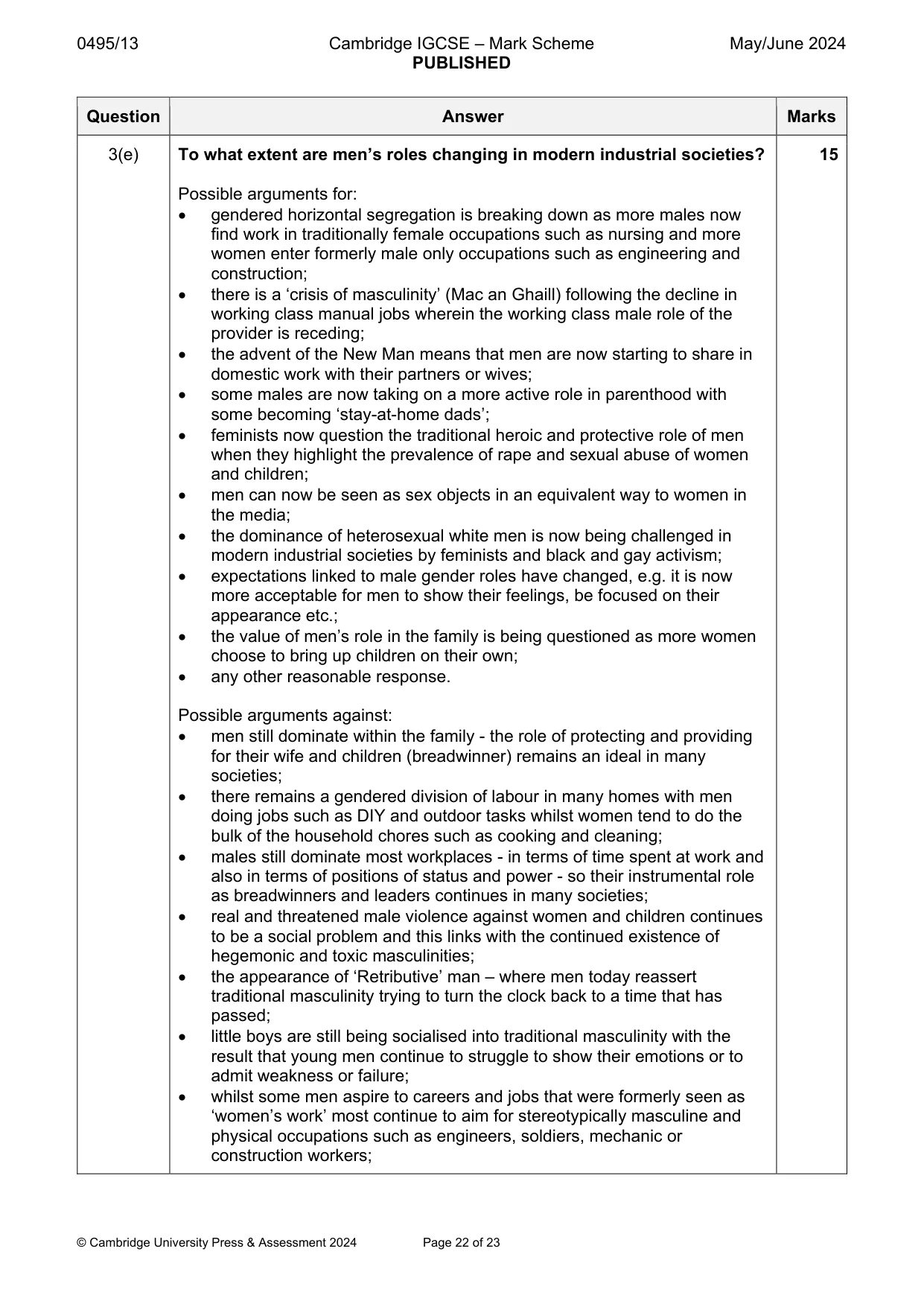
0495/13 Cambridge IGCSE – Mark Scheme PUBLISHED May/June 2024 © Cambridge University Press & Assessment 2024 Page 22 of 23 Question Answer Marks 3(e) To what extent are men’s roles changing in modern industrial societies? Possible arguments for: gendered horizontal segregation is breaking down as more males now find work in traditionally female occupations such as nursing and more women enter formerly male only occupations such as engineering and construction; there is a ‘crisis of masculinity’ (Mac an Ghaill) following the decline in working class manual jobs wherein the working class male role of the provider is receding; the advent of the New Man means that men are now starting to share in domestic work with their partners or wives; some males are now taking on a more active role in parenthood with some becoming ‘stay-at-home dads’; feminists now question the traditional heroic and protective role of men when they highlight the prevalence of rape and sexual abuse of women and children; men can now be seen as sex objects in an equivalent way to women in the media; the dominance of heterosexual white men is now being challenged in modern industrial societies by feminists and black and gay activism; expectations linked to male gender roles have changed, e.g. it is now more acceptable for men to show their feelings, be focused on their appearance etc.; the value of men’s role in the family is being questioned as more women choose to bring up children on their own; any other reasonable response. Possible arguments against: men still dominate within the family - the role of protecting and providing for their wife and children (breadwinner) remains an ideal in many societies; there remains a gendered division of labour in many homes with men doing jobs such as DIY and outdoor tasks whilst women tend to do the bulk of the household chores such as cooking and cleaning; males still dominate most workplaces - in terms of time spent at work and also in terms of positions of status and power - so their instrumental role as breadwinners and leaders continues in many societies; real and threatened male violence against women and children continues to be a social problem and this links with the continued existence of hegemonic and toxic masculinities; the appearance of ‘Retributive’ man – where men today reassert traditional masculinity trying to turn the clock back to a time that has passed; little boys are still being socialised into traditional masculinity with the result that young men continue to struggle to show their emotions or to admit weakness or failure; whilst some men aspire to careers and jobs that were formerly seen as ‘women’s work’ most continue to aim for stereotypically masculine and physical occupations such as engineers, soldiers, mechanic or construction workers; 15
Mark scheme, page 23
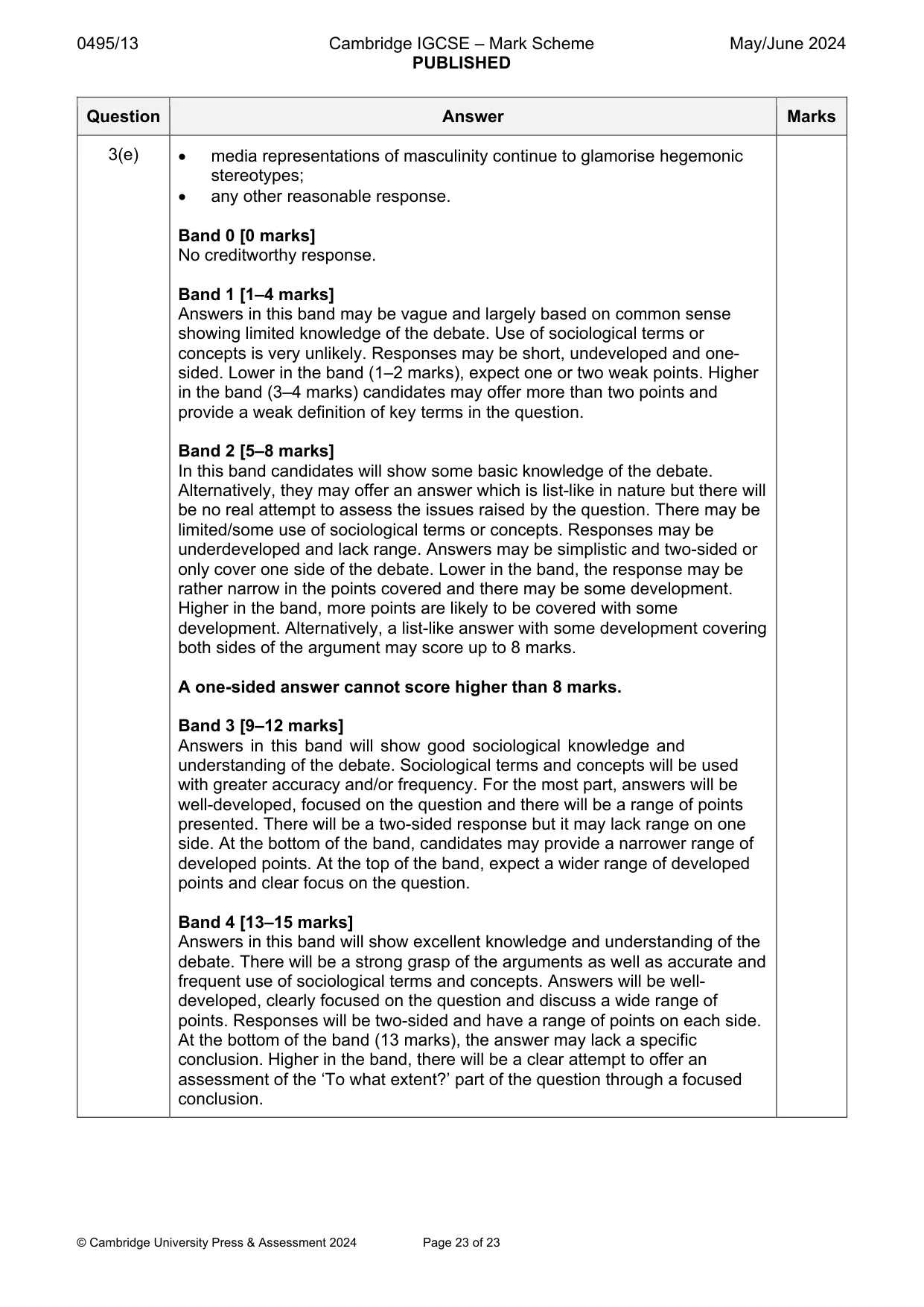
0495/13 Cambridge IGCSE – Mark Scheme PUBLISHED May/June 2024 © Cambridge University Press & Assessment 2024 Page 23 of 23 Question Answer Marks 3(e) media representations of masculinity continue to glamorise hegemonic stereotypes; any other reasonable response. Band 0 [0 marks] No creditworthy response. Band 1 [1–4 marks] Answers in this band may be vague and largely based on common sense showing limited knowledge of the debate. Use of sociological terms or concepts is very unlikely. Responses may be short, undeveloped and one- sided. Lower in the band (1–2 marks), expect one or two weak points. Higher in the band (3–4 marks) candidates may offer more than two points and provide a weak definition of key terms in the question. Band 2 [5–8 marks] In this band candidates will show some basic knowledge of the debate. Alternatively, they may offer an answer which is list-like in nature but there will be no real attempt to assess the issues raised by the question. There may be limited/some use of sociological terms or concepts. Responses may be underdeveloped and lack range. Answers may be simplistic and two-sided or only cover one side of the debate. Lower in the band, the response may be rather narrow in the points covered and there may be some development. Higher in the band, more points are likely to be covered with some development. Alternatively, a list-like answer with some development covering both sides of the argument may score up to 8 marks. A one-sided answer cannot score higher than 8 marks. Band 3 [9–12 marks] Answers in this band will show good sociological knowledge and understanding of the debate. Sociological terms and concepts will be used with greater accuracy and/or frequency. For the most part, answers will be well-developed, focused on the question and there will be a range of points presented. There will be a two-sided response but it may lack range on one side. At the bottom of the band, candidates may provide a narrower range of developed points. At the top of the band, expect a wider range of developed points and clear focus on the question. Band 4 [13–15 marks] Answers in this band will show excellent knowledge and understanding of the debate. There will be a strong grasp of the arguments as well as accurate and frequent use of sociological terms and concepts. Answers will be well- developed, clearly focused on the question and discuss a wide range of points. Responses will be two-sided and have a range of points on each side. At the bottom of the band (13 marks), the answer may lack a specific conclusion. Higher in the band, there will be a clear attempt to offer an assessment of the ‘To what extent?’ part of the question through a focused conclusion.
What you needed in this session
Cambridge’s own grade thresholds for 2024 May/June, Paper 1 · Variant 3. A higher threshold means an easier paper — the bar moves with how the cohort did.