Cambridge IGCSE Sociology 0495 — 2023 Oct/Nov Paper 1 · Variant 3
0495/13/O/N/23 · 80 marks · ≈90 min
The question paper and its mark scheme, free to read here and free to download. This is Cambridge’s own paper, exactly as it was sat.
Question paper4 pages

Mark scheme20 pages
Answers below. Sit the paper first if you are practising.

Paper as text
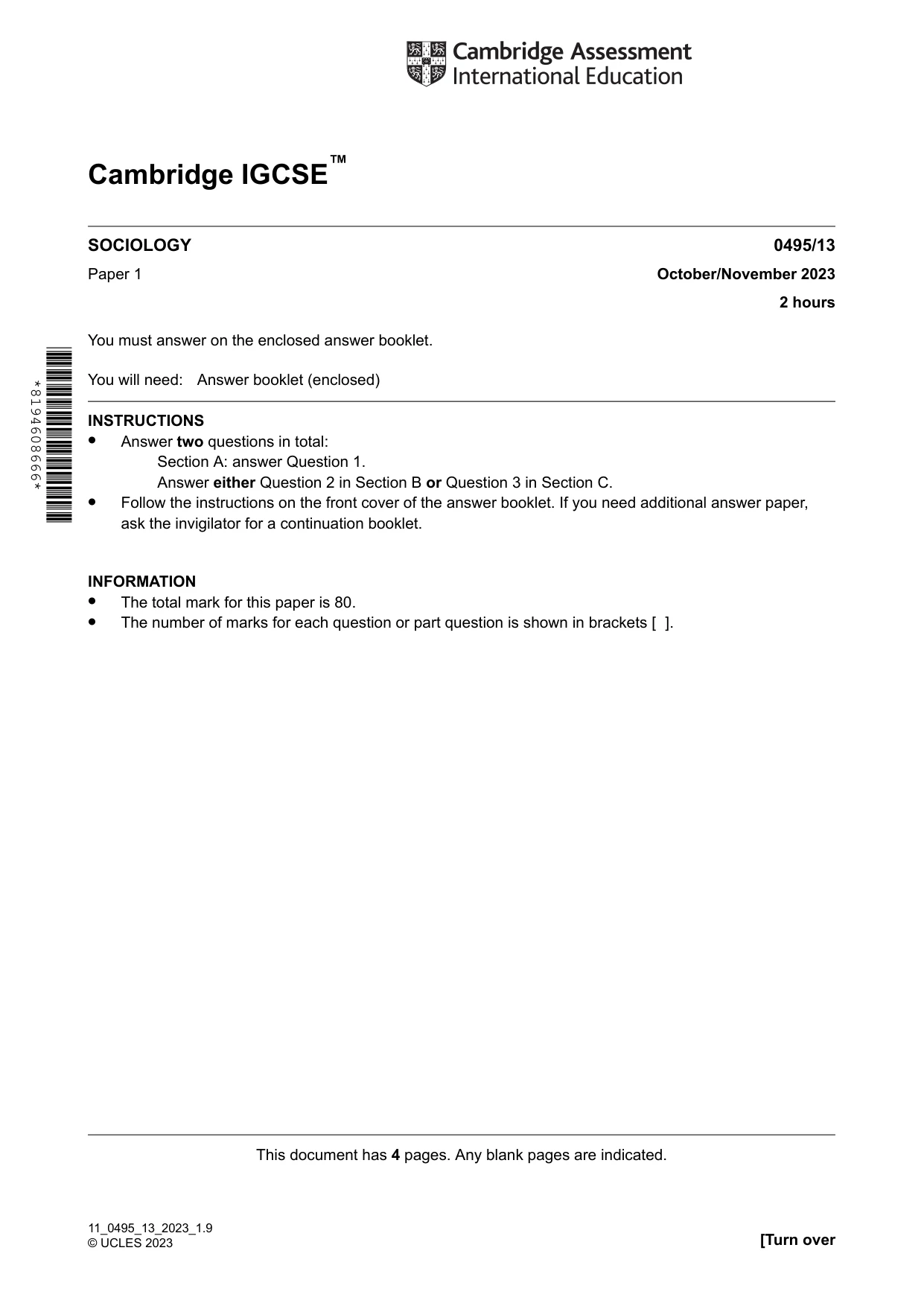
Question paper, page 1
Cambridge IGCSE™ 0495/13 October/November 2023 2 hours SOCIOLOGY Paper 1 You must answer on the enclosed answer booklet. You will need: Answer booklet (enclosed) INSTRUCTIONS • Answer two questions in total: Section A: answer Question 1. Answer either Question 2 in Section B or Question 3 in Section C. • Follow the instructions on the front cover of the answer booklet. If you need additional answer paper, ask the invigilator for a continuation booklet. INFORMATION • The total mark for this paper is 80. • The number of marks for each question or part question is shown in brackets [ ]. This document has 4 pages. Any blank pages are indicated. [Turn over 11_0495_13_2023_1.9 © UCLES 2023 *8194608666*
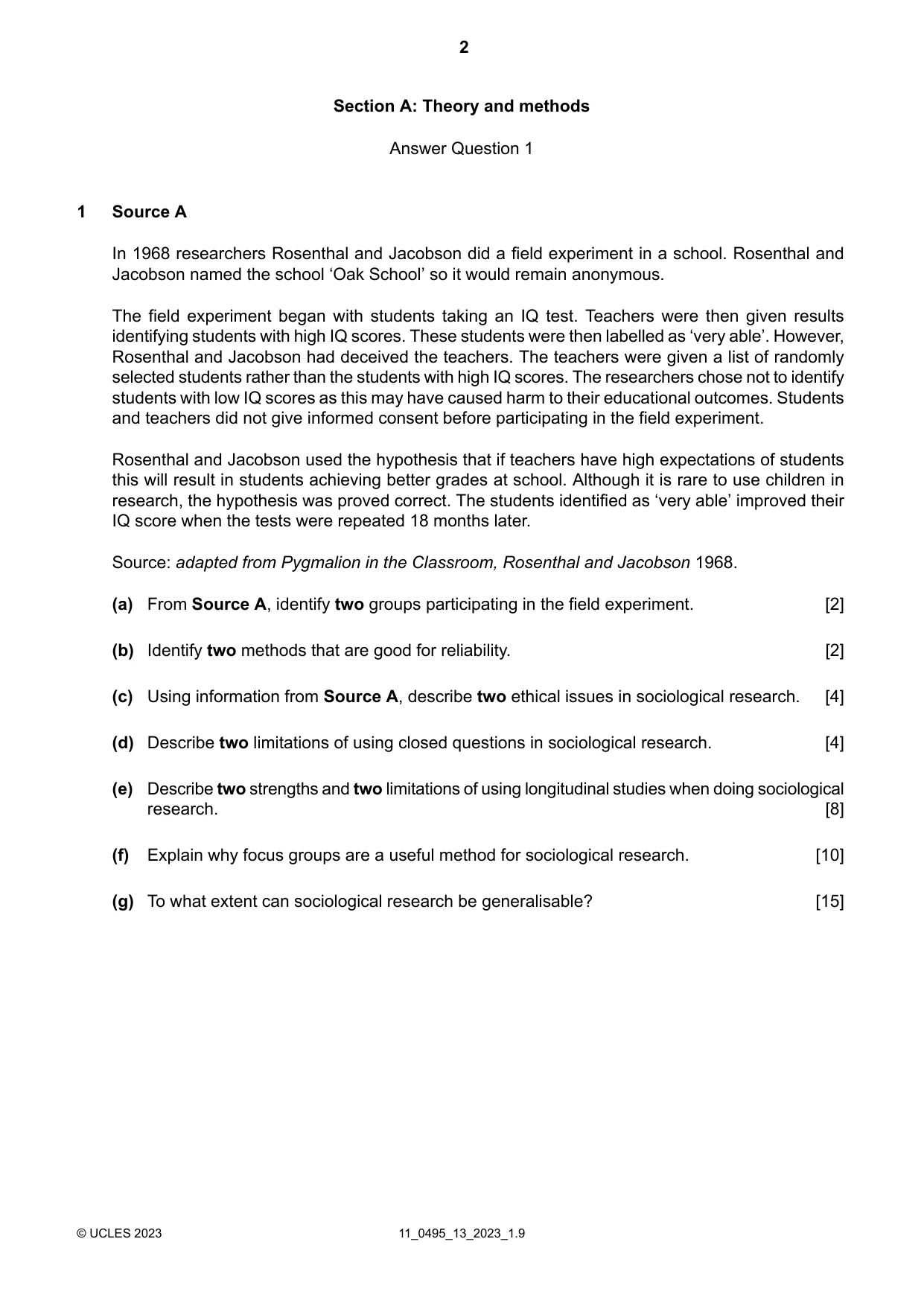
Question paper, page 2
Section A: Theory and methods Answer Question 1 Source A 1 In 1968 researchers Rosenthal and Jacobson did a field experiment in a school. Rosenthal and Jacobson named the school ‘Oak School’ so it would remain anonymous. The field experiment began with students taking an IQ test. Teachers were then given results identifying students with high IQ scores. These students were then labelled as ‘very able’. However, Rosenthal and Jacobson had deceived the teachers. The teachers were given a list of randomly selected students rather than the students with high IQ scores. The researchers chose not to identify students with low IQ scores as this may have caused harm to their educational outcomes. Students and teachers did not give informed consent before participating in the field experiment. Rosenthal and Jacobson used the hypothesis that if teachers have high expectations of students this will result in students achieving better grades at school. Although it is rare to use children in research, the hypothesis was proved correct. The students identified as ‘very able’ improved their IQ score when the tests were repeated 18 months later. Source: adapted from Pygmalion in the Classroom, Rosenthal and Jacobson 1968. From Source A, identify two groups participating in the field experiment. [2] (a) Identify two methods that are good for reliability. [2] (b) Using information from Source A, describe two ethical issues in sociological research. [4] (c) Describe two limitations of using closed questions in sociological research. [4] (d) Describe two strengths and two limitations of using longitudinal studies when doing sociological research. [8] (e) Explain why focus groups are a useful method for sociological research. [10] (f) To what extent can sociological research be generalisable? [15] (g) 11_0495_13_2023_1.9 © UCLES 2023 2
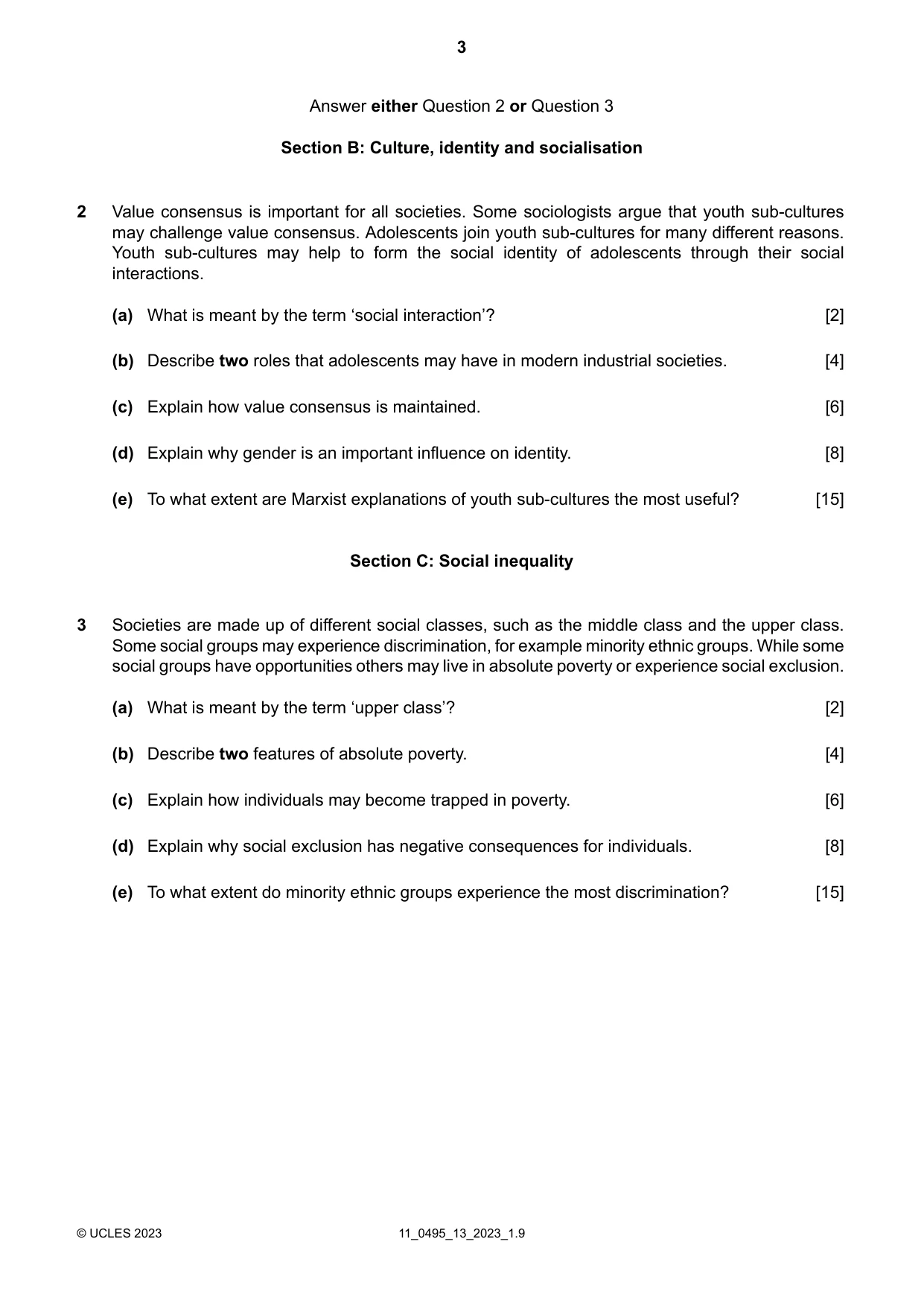
Question paper, page 3
Answer either Question 2 or Question 3 Section B: Culture, identity and socialisation Value consensus is important for all societies. Some sociologists argue that youth sub-cultures may challenge value consensus. Adolescents join youth sub-cultures for many different reasons. 2 Youth sub-cultures may help to form the social identity of adolescents through their social interactions. What is meant by the term ‘social interaction’? [2] (a) Describe two roles that adolescents may have in modern industrial societies. [4] (b) Explain how value consensus is maintained. [6] (c) Explain why gender is an important influence on identity. [8] (d) To what extent are Marxist explanations of youth sub-cultures the most useful? [15] (e) Section C: Social inequality Societies are made up of different social classes, such as the middle class and the upper class. Some social groups may experience discrimination, for example minority ethnic groups. While some social groups have opportunities others may live in absolute poverty or experience social exclusion. 3 What is meant by the term ‘upper class’? [2] (a) Describe two features of absolute poverty. [4] (b) Explain how individuals may become trapped in poverty. [6] (c) Explain why social exclusion has negative consequences for individuals. [8] (d) To what extent do minority ethnic groups experience the most discrimination? [15] (e) 11_0495_13_2023_1.9 © UCLES 2023 3
Question paper, page 4
BLANK PAGE Permission to reproduce items where third-party owned material protected by copyright is included has been sought and cleared where possible. Every reasonable effort has been made by the publisher (UCLES) to trace copyright holders, but if any items requiring clearance have unwittingly been included, the publisher will be pleased to make amends at the earliest possible opportunity. To avoid the issue of disclosure of answer-related information to candidates, all copyright acknowledgements are reproduced online in the Cambridge Assessment International Education Copyright Acknowledgements Booklet. This is produced for each series of examinations and is freely available to download at www.cambridgeinternational.org after the live examination series. Cambridge Assessment International Education is part of Cambridge Assessment. Cambridge Assessment is the brand name of the University of Cambridge Local Examinations Syndicate (UCLES), which is a department of the University of Cambridge. 11_0495_13_2023_1.9 © UCLES 2023 4
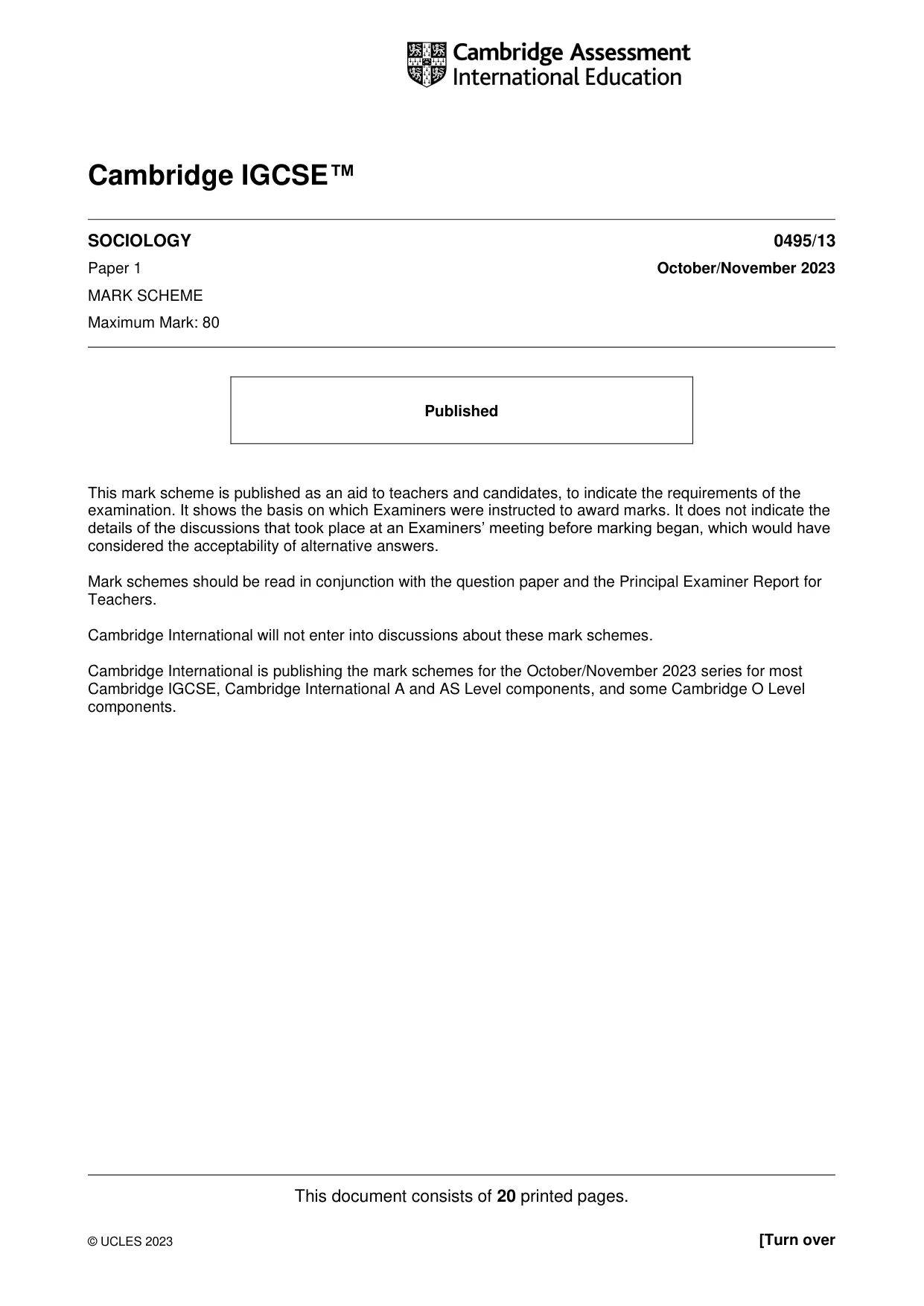
Mark scheme, page 1
This document consists of 20 printed pages. © UCLES 2023 [Turn over Cambridge IGCSE™ SOCIOLOGY 0495/13 Paper 1 October/November 2023 MARK SCHEME Maximum Mark: 80 Published This mark scheme is published as an aid to teachers and candidates, to indicate the requirements of the examination. It shows the basis on which Examiners were instructed to award marks. It does not indicate the details of the discussions that took place at an Examiners’ meeting before marking began, which would have considered the acceptability of alternative answers. Mark schemes should be read in conjunction with the question paper and the Principal Examiner Report for Teachers. Cambridge International will not enter into discussions about these mark schemes. Cambridge International is publishing the mark schemes for the October/November 2023 series for most Cambridge IGCSE, Cambridge International A and AS Level components, and some Cambridge O Level components.
Mark scheme, page 2
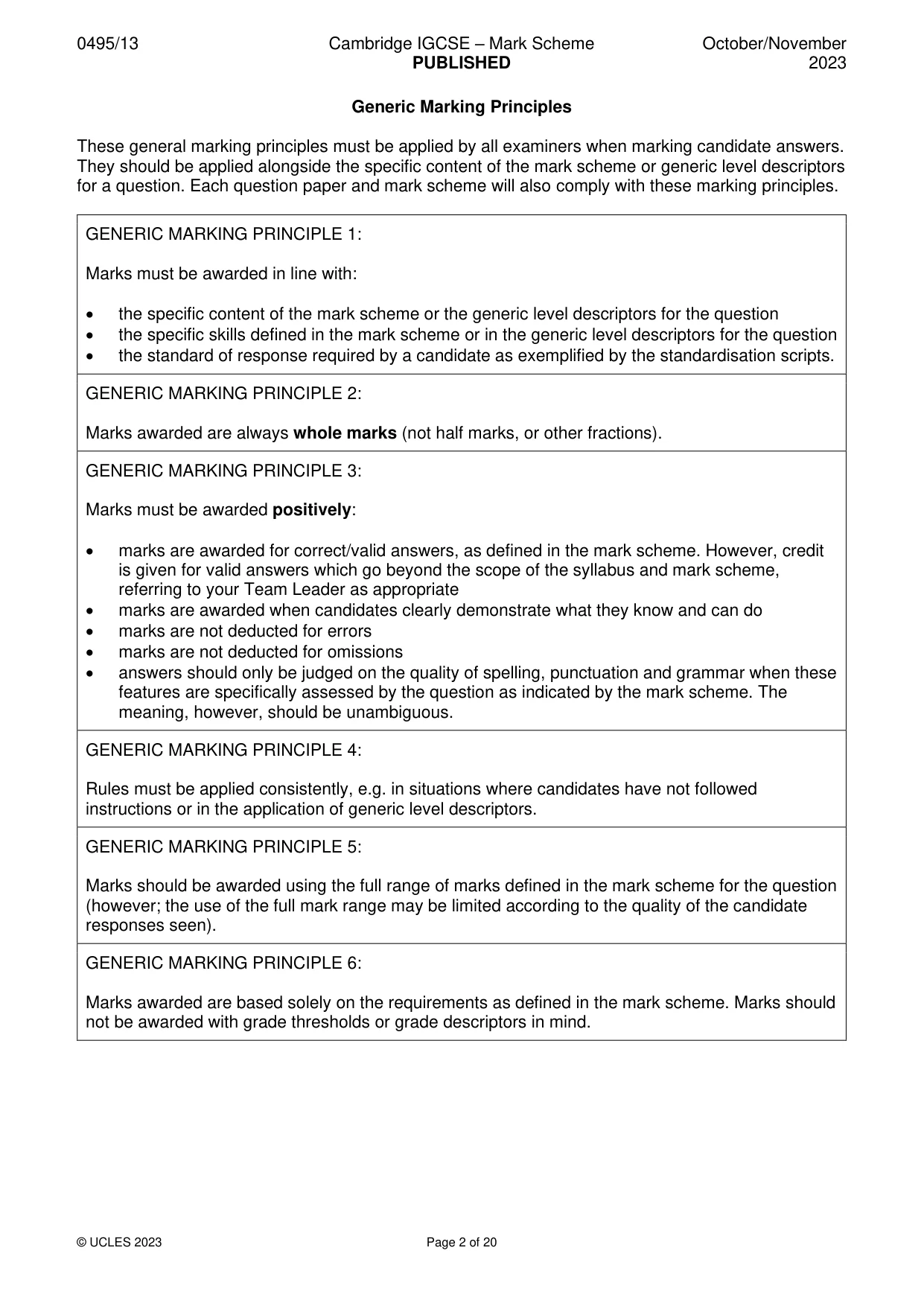
0495/13 Cambridge IGCSE – Mark Scheme PUBLISHED October/November 2023 © UCLES 2023 Page 2 of 20 Generic Marking Principles These general marking principles must be applied by all examiners when marking candidate answers. They should be applied alongside the specific content of the mark scheme or generic level descriptors for a question. Each question paper and mark scheme will also comply with these marking principles. GENERIC MARKING PRINCIPLE 1: Marks must be awarded in line with: • the specific content of the mark scheme or the generic level descriptors for the question • the specific skills defined in the mark scheme or in the generic level descriptors for the question • the standard of response required by a candidate as exemplified by the standardisation scripts. GENERIC MARKING PRINCIPLE 2: Marks awarded are always whole marks (not half marks, or other fractions). GENERIC MARKING PRINCIPLE 3: Marks must be awarded positively: • marks are awarded for correct/valid answers, as defined in the mark scheme. However, credit is given for valid answers which go beyond the scope of the syllabus and mark scheme, referring to your Team Leader as appropriate • marks are awarded when candidates clearly demonstrate what they know and can do • marks are not deducted for errors • marks are not deducted for omissions • answers should only be judged on the quality of spelling, punctuation and grammar when these features are specifically assessed by the question as indicated by the mark scheme. The meaning, however, should be unambiguous. GENERIC MARKING PRINCIPLE 4: Rules must be applied consistently, e.g. in situations where candidates have not followed instructions or in the application of generic level descriptors. GENERIC MARKING PRINCIPLE 5: Marks should be awarded using the full range of marks defined in the mark scheme for the question (however; the use of the full mark range may be limited according to the quality of the candidate responses seen). GENERIC MARKING PRINCIPLE 6: Marks awarded are based solely on the requirements as defined in the mark scheme. Marks should not be awarded with grade thresholds or grade descriptors in mind.
Mark scheme, page 3
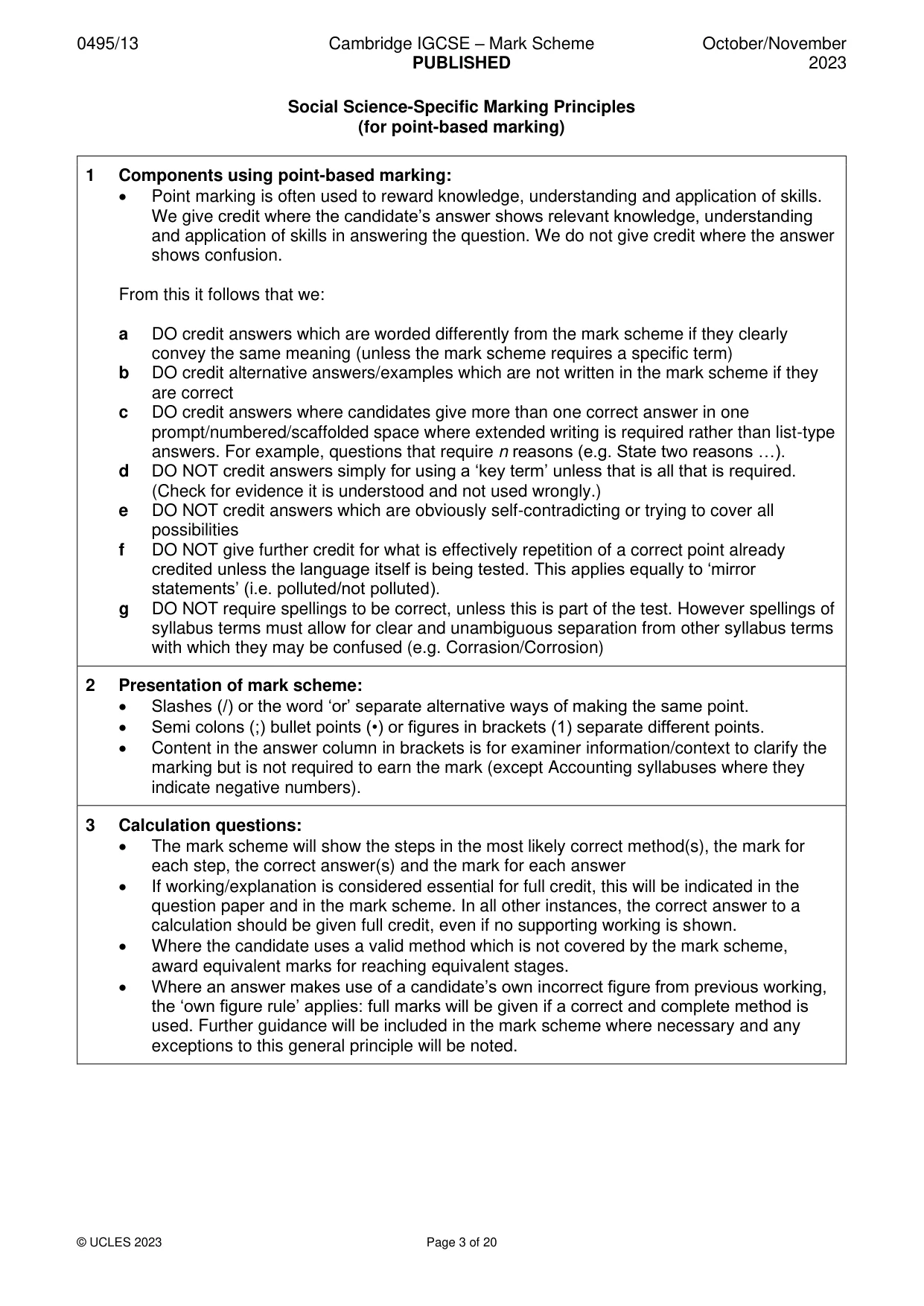
0495/13 Cambridge IGCSE – Mark Scheme PUBLISHED October/November 2023 © UCLES 2023 Page 3 of 20 Social Science-Specific Marking Principles (for point-based marking) 1 Components using point-based marking: • Point marking is often used to reward knowledge, understanding and application of skills. We give credit where the candidate’s answer shows relevant knowledge, understanding and application of skills in answering the question. We do not give credit where the answer shows confusion. From this it follows that we: a DO credit answers which are worded differently from the mark scheme if they clearly convey the same meaning (unless the mark scheme requires a specific term) b DO credit alternative answers/examples which are not written in the mark scheme if they are correct c DO credit answers where candidates give more than one correct answer in one prompt/numbered/scaffolded space where extended writing is required rather than list-type answers. For example, questions that require n reasons (e.g. State two reasons …). d DO NOT credit answers simply for using a ‘key term’ unless that is all that is required. (Check for evidence it is understood and not used wrongly.) e DO NOT credit answers which are obviously self-contradicting or trying to cover all possibilities f DO NOT give further credit for what is effectively repetition of a correct point already credited unless the language itself is being tested. This applies equally to ‘mirror statements’ (i.e. polluted/not polluted). g DO NOT require spellings to be correct, unless this is part of the test. However spellings of syllabus terms must allow for clear and unambiguous separation from other syllabus terms with which they may be confused (e.g. Corrasion/Corrosion) 2 Presentation of mark scheme: • Slashes (/) or the word ‘or’ separate alternative ways of making the same point. • Semi colons (;) bullet points (•) or figures in brackets (1) separate different points. • Content in the answer column in brackets is for examiner information/context to clarify the marking but is not required to earn the mark (except Accounting syllabuses where they indicate negative numbers). 3 Calculation questions: • The mark scheme will show the steps in the most likely correct method(s), the mark for each step, the correct answer(s) and the mark for each answer • If working/explanation is considered essential for full credit, this will be indicated in the question paper and in the mark scheme. In all other instances, the correct answer to a calculation should be given full credit, even if no supporting working is shown. • Where the candidate uses a valid method which is not covered by the mark scheme, award equivalent marks for reaching equivalent stages. • Where an answer makes use of a candidate’s own incorrect figure from previous working, the ‘own figure rule’ applies: full marks will be given if a correct and complete method is used. Further guidance will be included in the mark scheme where necessary and any exceptions to this general principle will be noted.
Mark scheme, page 4
0495/13 Cambridge IGCSE – Mark Scheme PUBLISHED October/November 2023 © UCLES 2023 Page 4 of 20 4 Annotation: • For point marking, ticks can be used to indicate correct answers and crosses can be used to indicate wrong answers. There is no direct relationship between ticks and marks. Ticks have no defined meaning for levels of response marking. • For levels of response marking, the level awarded should be annotated on the script. • Other annotations will be used by examiners as agreed during standardisation, and the meaning will be understood by all examiners who marked that paper.
Mark scheme, page 5
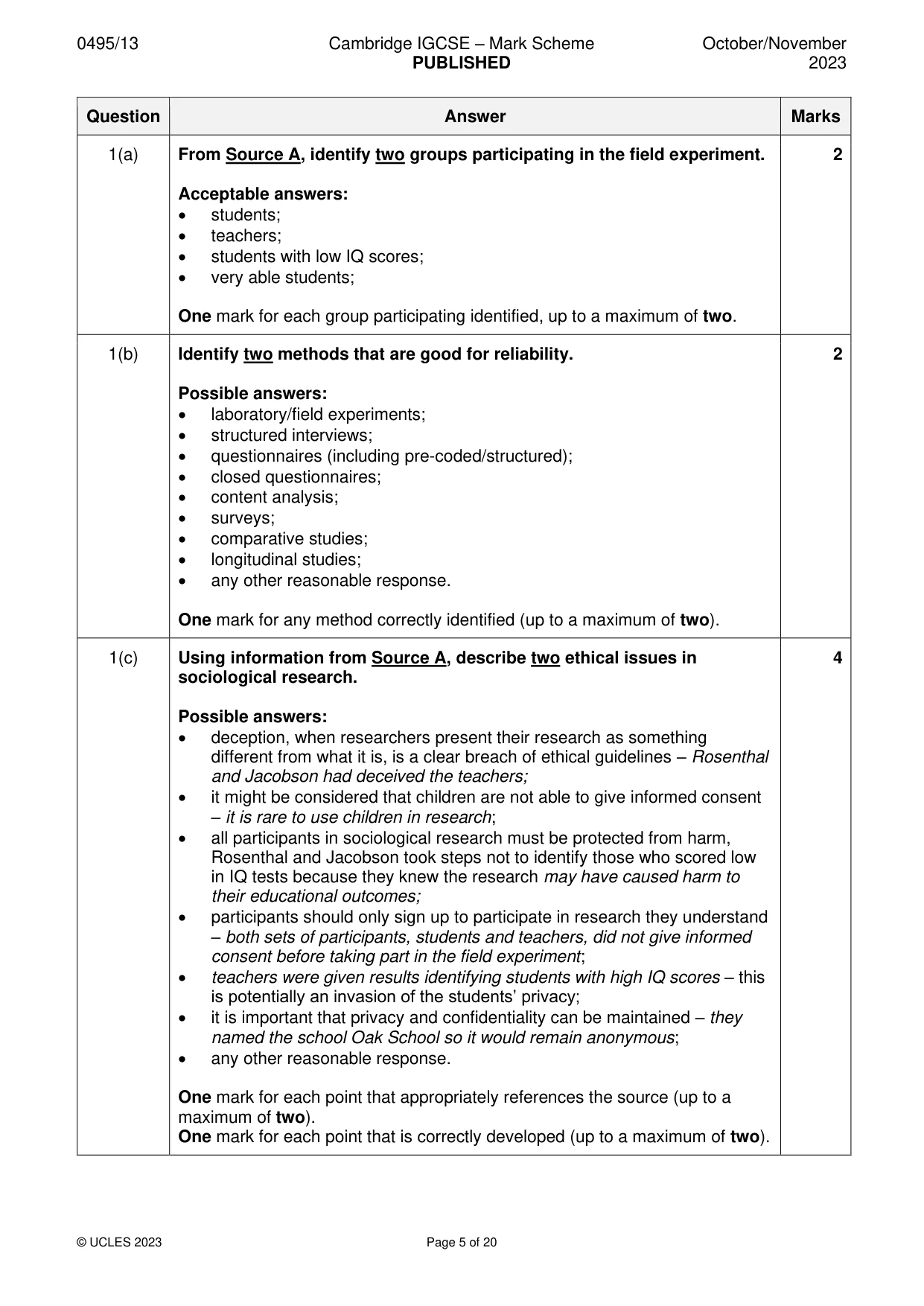
0495/13 Cambridge IGCSE – Mark Scheme PUBLISHED October/November 2023 © UCLES 2023 Page 5 of 20 Question Answer Marks 1(a) From Source A, identify two groups participating in the field experiment. Acceptable answers: • students; • teachers; • students with low IQ scores; • very able students; One mark for each group participating identified, up to a maximum of two. 2 1(b) Identify two methods that are good for reliability. Possible answers: • laboratory/field experiments; • structured interviews; • questionnaires (including pre-coded/structured); • closed questionnaires; • content analysis; • surveys; • comparative studies; • longitudinal studies; • any other reasonable response. One mark for any method correctly identified (up to a maximum of two). 2 1(c) Using information from Source A, describe two ethical issues in sociological research. Possible answers: • deception, when researchers present their research as something different from what it is, is a clear breach of ethical guidelines – Rosenthal and Jacobson had deceived the teachers; • it might be considered that children are not able to give informed consent – it is rare to use children in research; • all participants in sociological research must be protected from harm, Rosenthal and Jacobson took steps not to identify those who scored low in IQ tests because they knew the research may have caused harm to their educational outcomes; • participants should only sign up to participate in research they understand – both sets of participants, students and teachers, did not give informed consent before taking part in the field experiment; • teachers were given results identifying students with high IQ scores – this is potentially an invasion of the students’ privacy; • it is important that privacy and confidentiality can be maintained – they named the school Oak School so it would remain anonymous; • any other reasonable response. One mark for each point that appropriately references the source (up to a maximum of two). One mark for each point that is correctly developed (up to a maximum of two). 4
Mark scheme, page 6
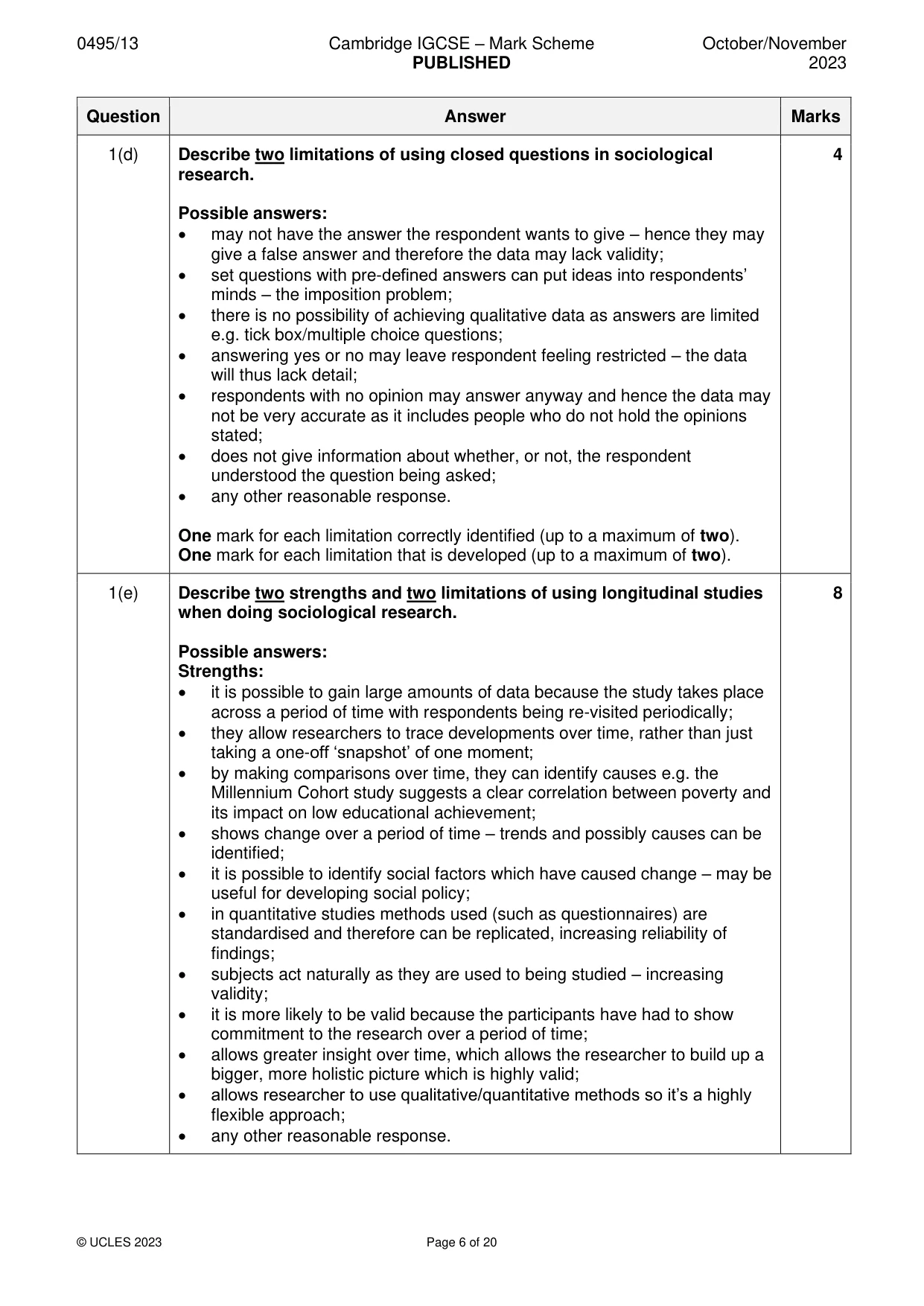
0495/13 Cambridge IGCSE – Mark Scheme PUBLISHED October/November 2023 © UCLES 2023 Page 6 of 20 Question Answer Marks 1(d) Describe two limitations of using closed questions in sociological research. Possible answers: • may not have the answer the respondent wants to give – hence they may give a false answer and therefore the data may lack validity; • set questions with pre-defined answers can put ideas into respondents’ minds – the imposition problem; • there is no possibility of achieving qualitative data as answers are limited e.g. tick box/multiple choice questions; • answering yes or no may leave respondent feeling restricted – the data will thus lack detail; • respondents with no opinion may answer anyway and hence the data may not be very accurate as it includes people who do not hold the opinions stated; • does not give information about whether, or not, the respondent understood the question being asked; • any other reasonable response. One mark for each limitation correctly identified (up to a maximum of two). One mark for each limitation that is developed (up to a maximum of two). 4 1(e) Describe two strengths and two limitations of using longitudinal studies when doing sociological research. Possible answers: Strengths: • it is possible to gain large amounts of data because the study takes place across a period of time with respondents being re-visited periodically; • they allow researchers to trace developments over time, rather than just taking a one-off ‘snapshot’ of one moment; • by making comparisons over time, they can identify causes e.g. the Millennium Cohort study suggests a clear correlation between poverty and its impact on low educational achievement; • shows change over a period of time – trends and possibly causes can be identified; • it is possible to identify social factors which have caused change – may be useful for developing social policy; • in quantitative studies methods used (such as questionnaires) are standardised and therefore can be replicated, increasing reliability of findings; • subjects act naturally as they are used to being studied – increasing validity; • it is more likely to be valid because the participants have had to show commitment to the research over a period of time; • allows greater insight over time, which allows the researcher to build up a bigger, more holistic picture which is highly valid; • allows researcher to use qualitative/quantitative methods so it’s a highly flexible approach; • any other reasonable response. 8
Mark scheme, page 7
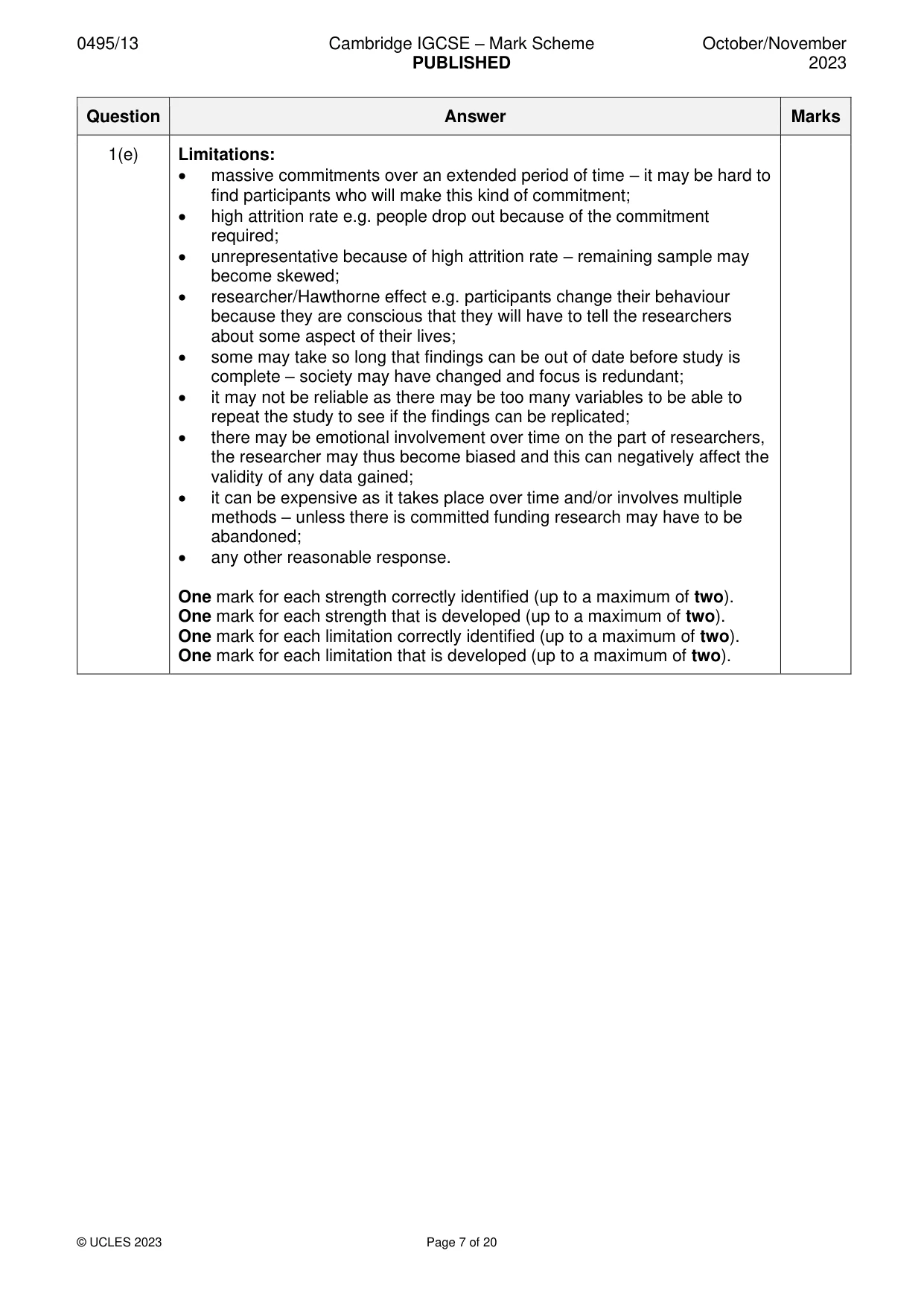
0495/13 Cambridge IGCSE – Mark Scheme PUBLISHED October/November 2023 © UCLES 2023 Page 7 of 20 Question Answer Marks 1(e) Limitations: • massive commitments over an extended period of time – it may be hard to find participants who will make this kind of commitment; • high attrition rate e.g. people drop out because of the commitment required; • unrepresentative because of high attrition rate – remaining sample may become skewed; • researcher/Hawthorne effect e.g. participants change their behaviour because they are conscious that they will have to tell the researchers about some aspect of their lives; • some may take so long that findings can be out of date before study is complete – society may have changed and focus is redundant; • it may not be reliable as there may be too many variables to be able to repeat the study to see if the findings can be replicated; • there may be emotional involvement over time on the part of researchers, the researcher may thus become biased and this can negatively affect the validity of any data gained; • it can be expensive as it takes place over time and/or involves multiple methods – unless there is committed funding research may have to be abandoned; • any other reasonable response. One mark for each strength correctly identified (up to a maximum of two). One mark for each strength that is developed (up to a maximum of two). One mark for each limitation correctly identified (up to a maximum of two). One mark for each limitation that is developed (up to a maximum of two).
Mark scheme, page 8
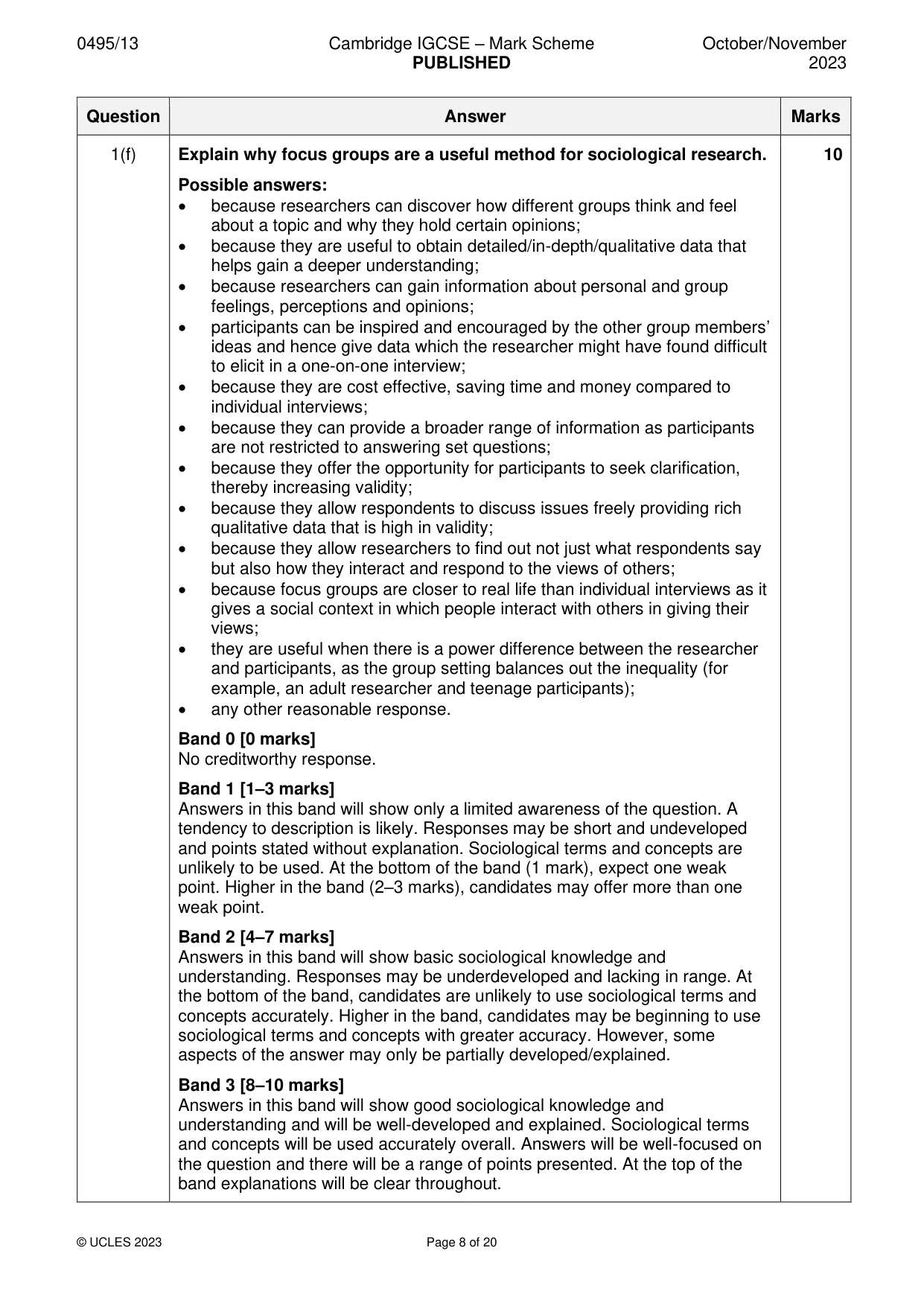
0495/13 Cambridge IGCSE – Mark Scheme PUBLISHED October/November 2023 © UCLES 2023 Page 8 of 20 Question Answer Marks 1(f) Explain why focus groups are a useful method for sociological research. Possible answers: • because researchers can discover how different groups think and feel about a topic and why they hold certain opinions; • because they are useful to obtain detailed/in-depth/qualitative data that helps gain a deeper understanding; • because researchers can gain information about personal and group feelings, perceptions and opinions; • participants can be inspired and encouraged by the other group members’ ideas and hence give data which the researcher might have found difficult to elicit in a one-on-one interview; • because they are cost effective, saving time and money compared to individual interviews; • because they can provide a broader range of information as participants are not restricted to answering set questions; • because they offer the opportunity for participants to seek clarification, thereby increasing validity; • because they allow respondents to discuss issues freely providing rich qualitative data that is high in validity; • because they allow researchers to find out not just what respondents say but also how they interact and respond to the views of others; • because focus groups are closer to real life than individual interviews as it gives a social context in which people interact with others in giving their views; • they are useful when there is a power difference between the researcher and participants, as the group setting balances out the inequality (for example, an adult researcher and teenage participants); • any other reasonable response. Band 0 [0 marks] No creditworthy response. Band 1 [1–3 marks] Answers in this band will show only a limited awareness of the question. A tendency to description is likely. Responses may be short and undeveloped and points stated without explanation. Sociological terms and concepts are unlikely to be used. At the bottom of the band (1 mark), expect one weak point. Higher in the band (2–3 marks), candidates may offer more than one weak point. Band 2 [4–7 marks] Answers in this band will show basic sociological knowledge and understanding. Responses may be underdeveloped and lacking in range. At the bottom of the band, candidates are unlikely to use sociological terms and concepts accurately. Higher in the band, candidates may be beginning to use sociological terms and concepts with greater accuracy. However, some aspects of the answer may only be partially developed/explained. Band 3 [8–10 marks] Answers in this band will show good sociological knowledge and understanding and will be well-developed and explained. Sociological terms and concepts will be used accurately overall. Answers will be well-focused on the question and there will be a range of points presented. At the top of the band explanations will be clear throughout. 10
Mark scheme, page 9
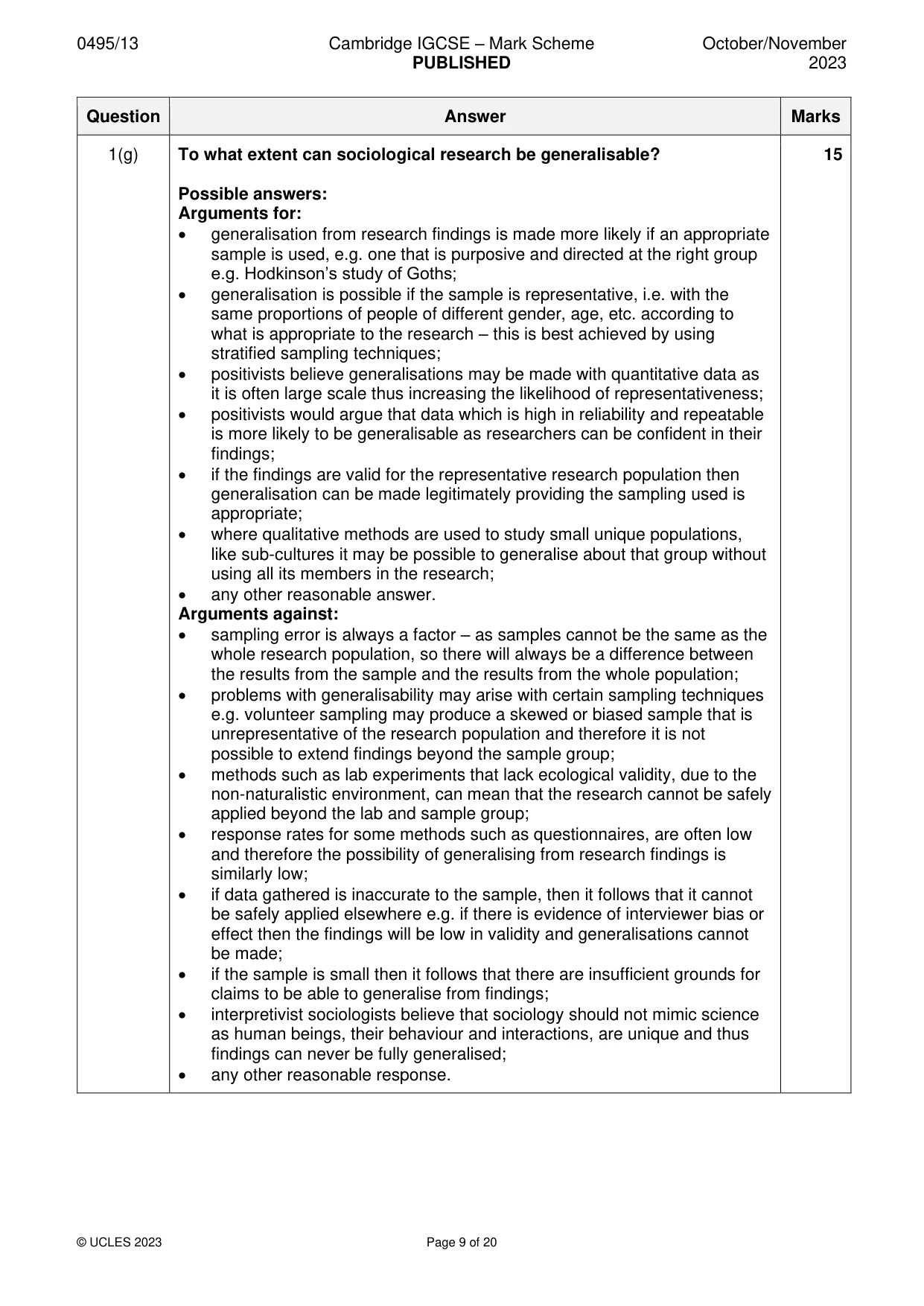
0495/13 Cambridge IGCSE – Mark Scheme PUBLISHED October/November 2023 © UCLES 2023 Page 9 of 20 Question Answer Marks 1(g) To what extent can sociological research be generalisable? Possible answers: Arguments for: • generalisation from research findings is made more likely if an appropriate sample is used, e.g. one that is purposive and directed at the right group e.g. Hodkinson’s study of Goths; • generalisation is possible if the sample is representative, i.e. with the same proportions of people of different gender, age, etc. according to what is appropriate to the research – this is best achieved by using stratified sampling techniques; • positivists believe generalisations may be made with quantitative data as it is often large scale thus increasing the likelihood of representativeness; • positivists would argue that data which is high in reliability and repeatable is more likely to be generalisable as researchers can be confident in their findings; • if the findings are valid for the representative research population then generalisation can be made legitimately providing the sampling used is appropriate; • where qualitative methods are used to study small unique populations, like sub-cultures it may be possible to generalise about that group without using all its members in the research; • any other reasonable answer. Arguments against: • sampling error is always a factor – as samples cannot be the same as the whole research population, so there will always be a difference between the results from the sample and the results from the whole population; • problems with generalisability may arise with certain sampling techniques e.g. volunteer sampling may produce a skewed or biased sample that is unrepresentative of the research population and therefore it is not possible to extend findings beyond the sample group; • methods such as lab experiments that lack ecological validity, due to the non-naturalistic environment, can mean that the research cannot be safely applied beyond the lab and sample group; • response rates for some methods such as questionnaires, are often low and therefore the possibility of generalising from research findings is similarly low; • if data gathered is inaccurate to the sample, then it follows that it cannot be safely applied elsewhere e.g. if there is evidence of interviewer bias or effect then the findings will be low in validity and generalisations cannot be made; • if the sample is small then it follows that there are insufficient grounds for claims to be able to generalise from findings; • interpretivist sociologists believe that sociology should not mimic science as human beings, their behaviour and interactions, are unique and thus findings can never be fully generalised; • any other reasonable response. 15
Mark scheme, page 10
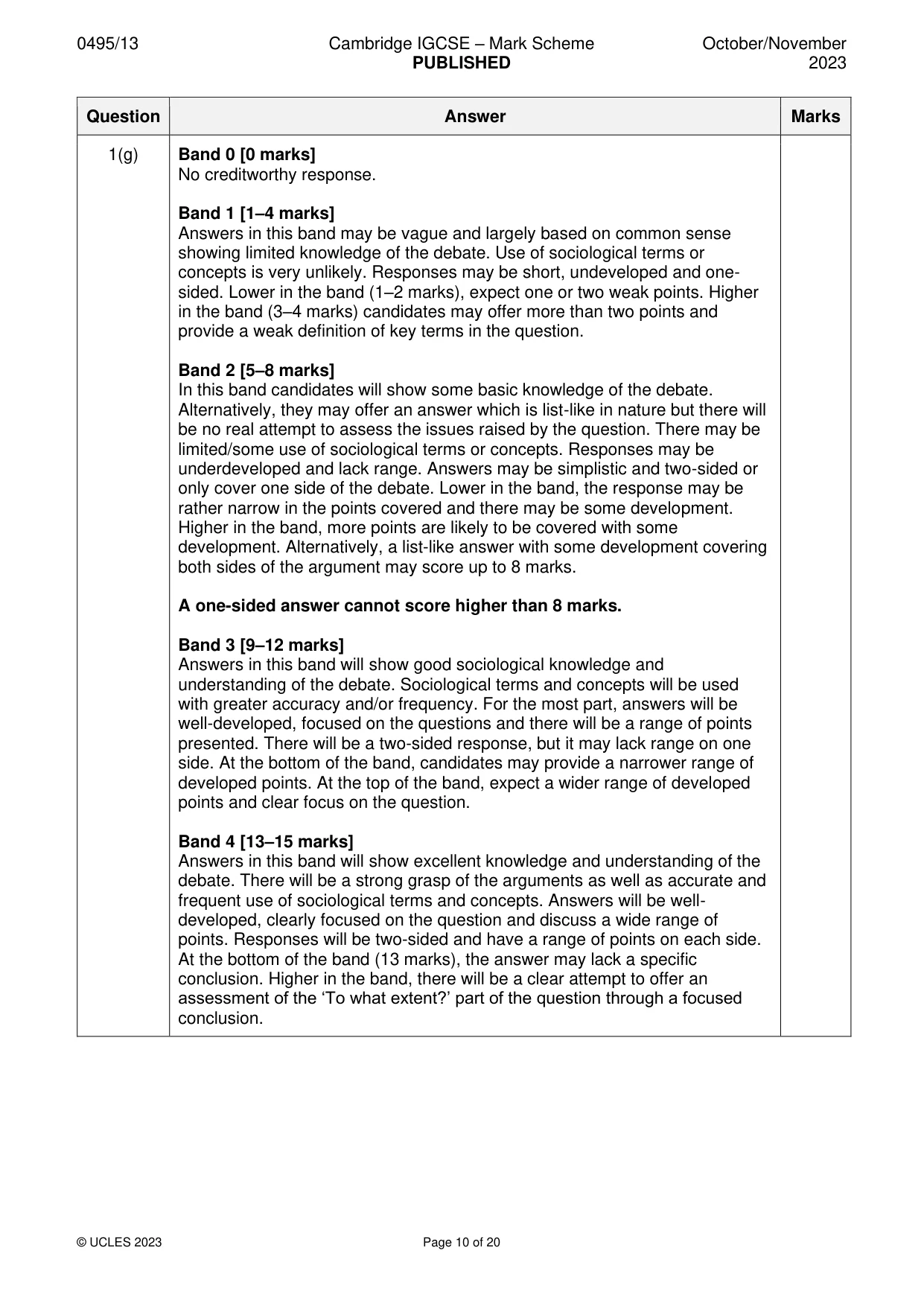
0495/13 Cambridge IGCSE – Mark Scheme PUBLISHED October/November 2023 © UCLES 2023 Page 10 of 20 Question Answer Marks 1(g) Band 0 [0 marks] No creditworthy response. Band 1 [1–4 marks] Answers in this band may be vague and largely based on common sense showing limited knowledge of the debate. Use of sociological terms or concepts is very unlikely. Responses may be short, undeveloped and one- sided. Lower in the band (1–2 marks), expect one or two weak points. Higher in the band (3–4 marks) candidates may offer more than two points and provide a weak definition of key terms in the question. Band 2 [5–8 marks] In this band candidates will show some basic knowledge of the debate. Alternatively, they may offer an answer which is list-like in nature but there will be no real attempt to assess the issues raised by the question. There may be limited/some use of sociological terms or concepts. Responses may be underdeveloped and lack range. Answers may be simplistic and two-sided or only cover one side of the debate. Lower in the band, the response may be rather narrow in the points covered and there may be some development. Higher in the band, more points are likely to be covered with some development. Alternatively, a list-like answer with some development covering both sides of the argument may score up to 8 marks. A one-sided answer cannot score higher than 8 marks. Band 3 [9–12 marks] Answers in this band will show good sociological knowledge and understanding of the debate. Sociological terms and concepts will be used with greater accuracy and/or frequency. For the most part, answers will be well-developed, focused on the questions and there will be a range of points presented. There will be a two-sided response, but it may lack range on one side. At the bottom of the band, candidates may provide a narrower range of developed points. At the top of the band, expect a wider range of developed points and clear focus on the question. Band 4 [13–15 marks] Answers in this band will show excellent knowledge and understanding of the debate. There will be a strong grasp of the arguments as well as accurate and frequent use of sociological terms and concepts. Answers will be well- developed, clearly focused on the question and discuss a wide range of points. Responses will be two-sided and have a range of points on each side. At the bottom of the band (13 marks), the answer may lack a specific conclusion. Higher in the band, there will be a clear attempt to offer an assessment of the ‘To what extent?’ part of the question through a focused conclusion.
Mark scheme, page 11
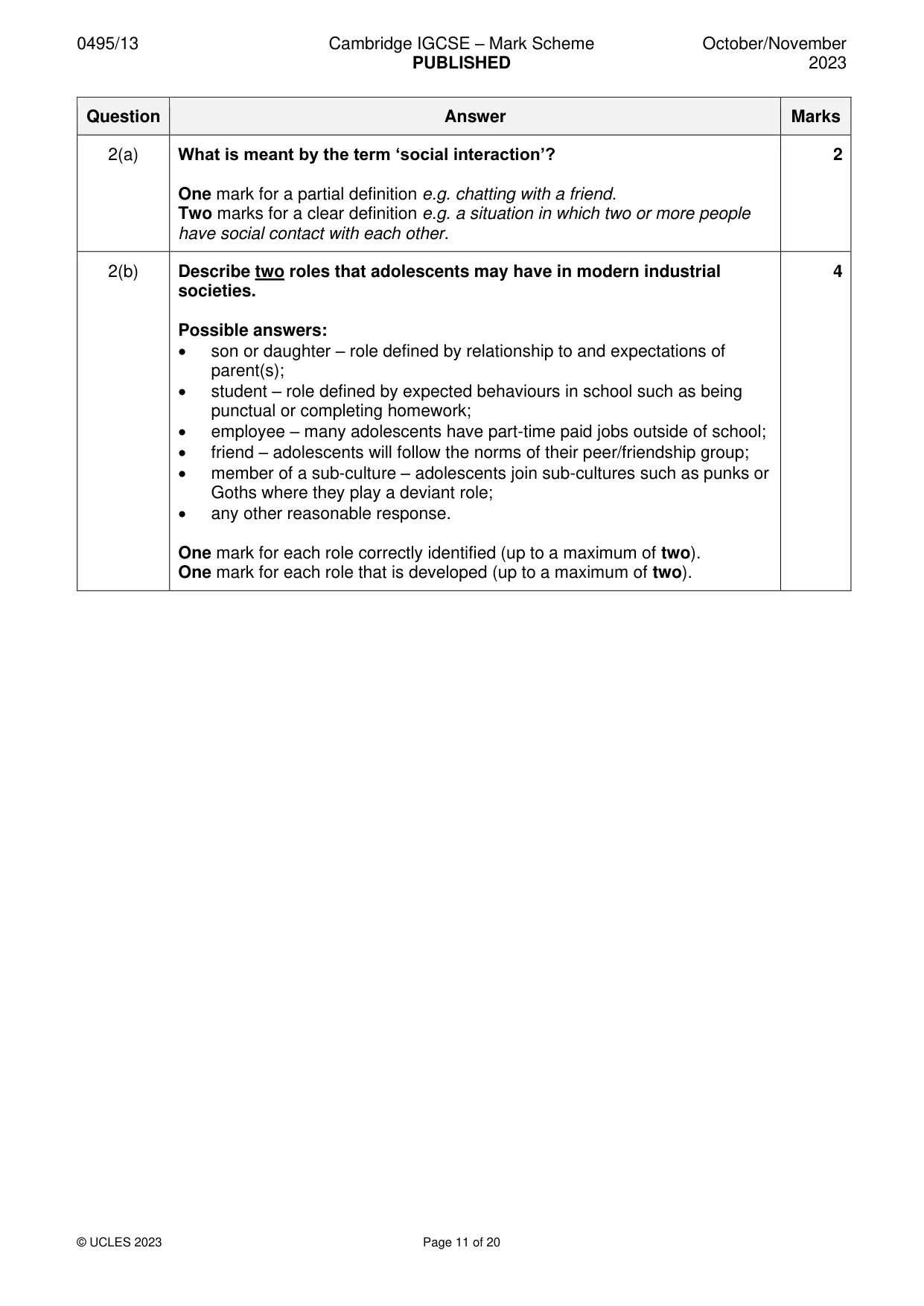
0495/13 Cambridge IGCSE – Mark Scheme PUBLISHED October/November 2023 © UCLES 2023 Page 11 of 20 Question Answer Marks 2(a) What is meant by the term ‘social interaction’? One mark for a partial definition e.g. chatting with a friend. Two marks for a clear definition e.g. a situation in which two or more people have social contact with each other. 2 2(b) Describe two roles that adolescents may have in modern industrial societies. Possible answers: • son or daughter – role defined by relationship to and expectations of parent(s); • student – role defined by expected behaviours in school such as being punctual or completing homework; • employee – many adolescents have part-time paid jobs outside of school; • friend – adolescents will follow the norms of their peer/friendship group; • member of a sub-culture – adolescents join sub-cultures such as punks or Goths where they play a deviant role; • any other reasonable response. One mark for each role correctly identified (up to a maximum of two). One mark for each role that is developed (up to a maximum of two). 4
Mark scheme, page 12
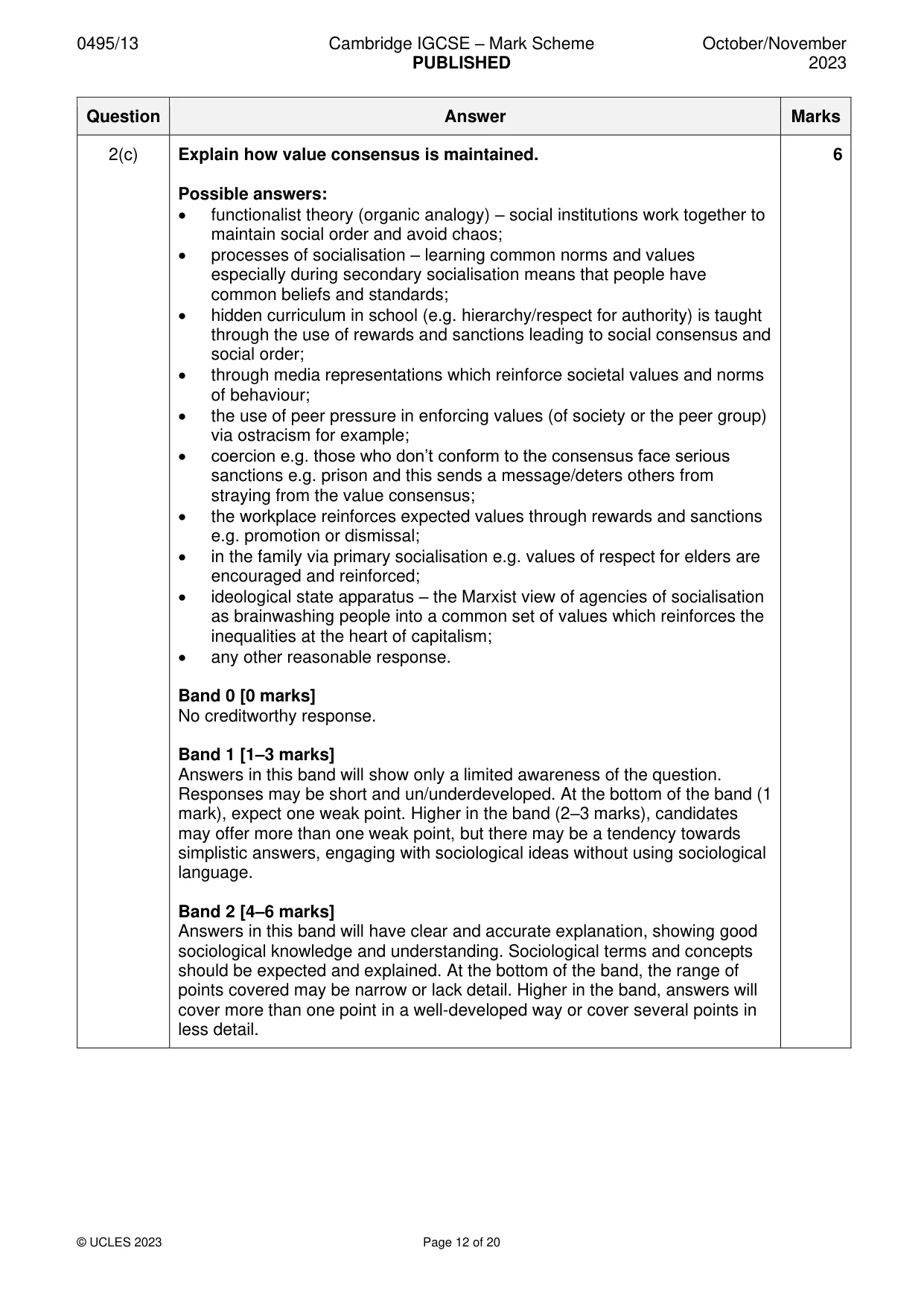
0495/13 Cambridge IGCSE – Mark Scheme PUBLISHED October/November 2023 © UCLES 2023 Page 12 of 20 Question Answer Marks 2(c) Explain how value consensus is maintained. Possible answers: • functionalist theory (organic analogy) – social institutions work together to maintain social order and avoid chaos; • processes of socialisation – learning common norms and values especially during secondary socialisation means that people have common beliefs and standards; • hidden curriculum in school (e.g. hierarchy/respect for authority) is taught through the use of rewards and sanctions leading to social consensus and social order; • through media representations which reinforce societal values and norms of behaviour; • the use of peer pressure in enforcing values (of society or the peer group) via ostracism for example; • coercion e.g. those who don’t conform to the consensus face serious sanctions e.g. prison and this sends a message/deters others from straying from the value consensus; • the workplace reinforces expected values through rewards and sanctions e.g. promotion or dismissal; • in the family via primary socialisation e.g. values of respect for elders are encouraged and reinforced; • ideological state apparatus – the Marxist view of agencies of socialisation as brainwashing people into a common set of values which reinforces the inequalities at the heart of capitalism; • any other reasonable response. Band 0 [0 marks] No creditworthy response. Band 1 [1–3 marks] Answers in this band will show only a limited awareness of the question. Responses may be short and un/underdeveloped. At the bottom of the band (1 mark), expect one weak point. Higher in the band (2–3 marks), candidates may offer more than one weak point, but there may be a tendency towards simplistic answers, engaging with sociological ideas without using sociological language. Band 2 [4–6 marks] Answers in this band will have clear and accurate explanation, showing good sociological knowledge and understanding. Sociological terms and concepts should be expected and explained. At the bottom of the band, the range of points covered may be narrow or lack detail. Higher in the band, answers will cover more than one point in a well-developed way or cover several points in less detail. 6
Mark scheme, page 13
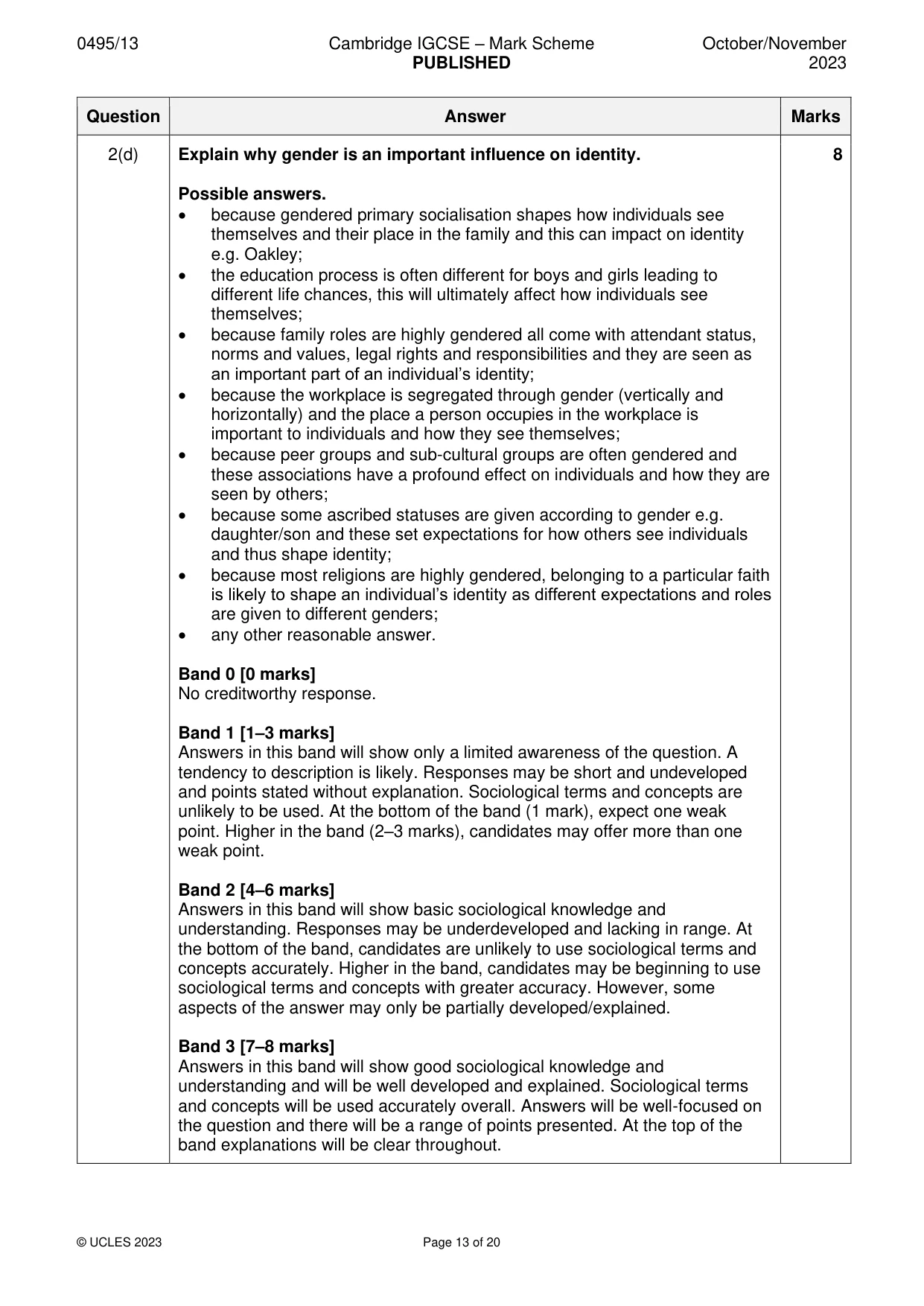
0495/13 Cambridge IGCSE – Mark Scheme PUBLISHED October/November 2023 © UCLES 2023 Page 13 of 20 Question Answer Marks 2(d) Explain why gender is an important influence on identity. Possible answers. • because gendered primary socialisation shapes how individuals see themselves and their place in the family and this can impact on identity e.g. Oakley; • the education process is often different for boys and girls leading to different life chances, this will ultimately affect how individuals see themselves; • because family roles are highly gendered all come with attendant status, norms and values, legal rights and responsibilities and they are seen as an important part of an individual’s identity; • because the workplace is segregated through gender (vertically and horizontally) and the place a person occupies in the workplace is important to individuals and how they see themselves; • because peer groups and sub-cultural groups are often gendered and these associations have a profound effect on individuals and how they are seen by others; • because some ascribed statuses are given according to gender e.g. daughter/son and these set expectations for how others see individuals and thus shape identity; • because most religions are highly gendered, belonging to a particular faith is likely to shape an individual’s identity as different expectations and roles are given to different genders; • any other reasonable answer. Band 0 [0 marks] No creditworthy response. Band 1 [1–3 marks] Answers in this band will show only a limited awareness of the question. A tendency to description is likely. Responses may be short and undeveloped and points stated without explanation. Sociological terms and concepts are unlikely to be used. At the bottom of the band (1 mark), expect one weak point. Higher in the band (2–3 marks), candidates may offer more than one weak point. Band 2 [4–6 marks] Answers in this band will show basic sociological knowledge and understanding. Responses may be underdeveloped and lacking in range. At the bottom of the band, candidates are unlikely to use sociological terms and concepts accurately. Higher in the band, candidates may be beginning to use sociological terms and concepts with greater accuracy. However, some aspects of the answer may only be partially developed/explained. Band 3 [7–8 marks] Answers in this band will show good sociological knowledge and understanding and will be well developed and explained. Sociological terms and concepts will be used accurately overall. Answers will be well-focused on the question and there will be a range of points presented. At the top of the band explanations will be clear throughout. 8
Mark scheme, page 14
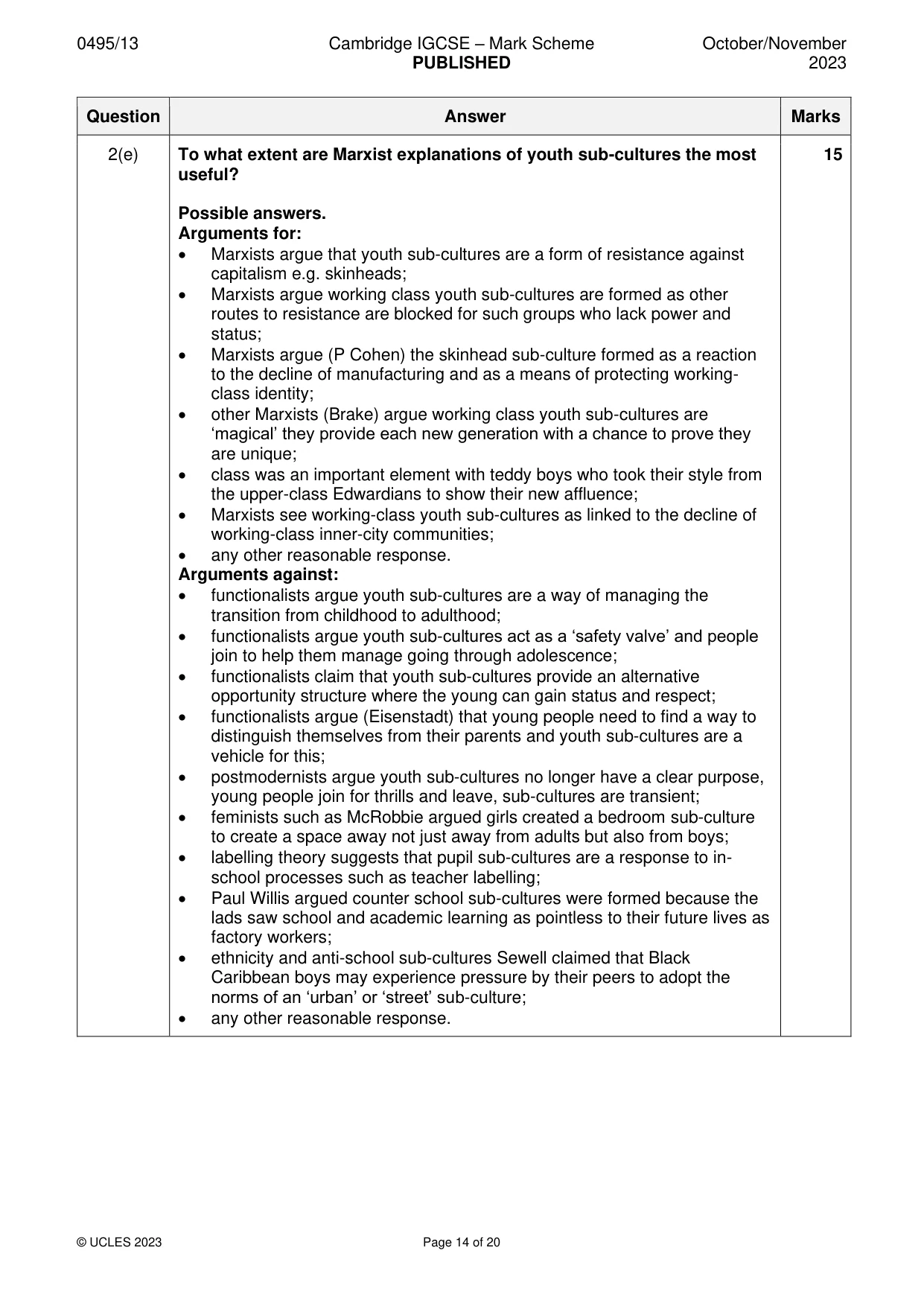
0495/13 Cambridge IGCSE – Mark Scheme PUBLISHED October/November 2023 © UCLES 2023 Page 14 of 20 Question Answer Marks 2(e) To what extent are Marxist explanations of youth sub-cultures the most useful? Possible answers. Arguments for: • Marxists argue that youth sub-cultures are a form of resistance against capitalism e.g. skinheads; • Marxists argue working class youth sub-cultures are formed as other routes to resistance are blocked for such groups who lack power and status; • Marxists argue (P Cohen) the skinhead sub-culture formed as a reaction to the decline of manufacturing and as a means of protecting working- class identity; • other Marxists (Brake) argue working class youth sub-cultures are ‘magical’ they provide each new generation with a chance to prove they are unique; • class was an important element with teddy boys who took their style from the upper-class Edwardians to show their new affluence; • Marxists see working-class youth sub-cultures as linked to the decline of working-class inner-city communities; • any other reasonable response. Arguments against: • functionalists argue youth sub-cultures are a way of managing the transition from childhood to adulthood; • functionalists argue youth sub-cultures act as a ‘safety valve’ and people join to help them manage going through adolescence; • functionalists claim that youth sub-cultures provide an alternative opportunity structure where the young can gain status and respect; • functionalists argue (Eisenstadt) that young people need to find a way to distinguish themselves from their parents and youth sub-cultures are a vehicle for this; • postmodernists argue youth sub-cultures no longer have a clear purpose, young people join for thrills and leave, sub-cultures are transient; • feminists such as McRobbie argued girls created a bedroom sub-culture to create a space away not just away from adults but also from boys; • labelling theory suggests that pupil sub-cultures are a response to in- school processes such as teacher labelling; • Paul Willis argued counter school sub-cultures were formed because the lads saw school and academic learning as pointless to their future lives as factory workers; • ethnicity and anti-school sub-cultures Sewell claimed that Black Caribbean boys may experience pressure by their peers to adopt the norms of an ‘urban’ or ‘street’ sub-culture; • any other reasonable response. 15
Mark scheme, page 15
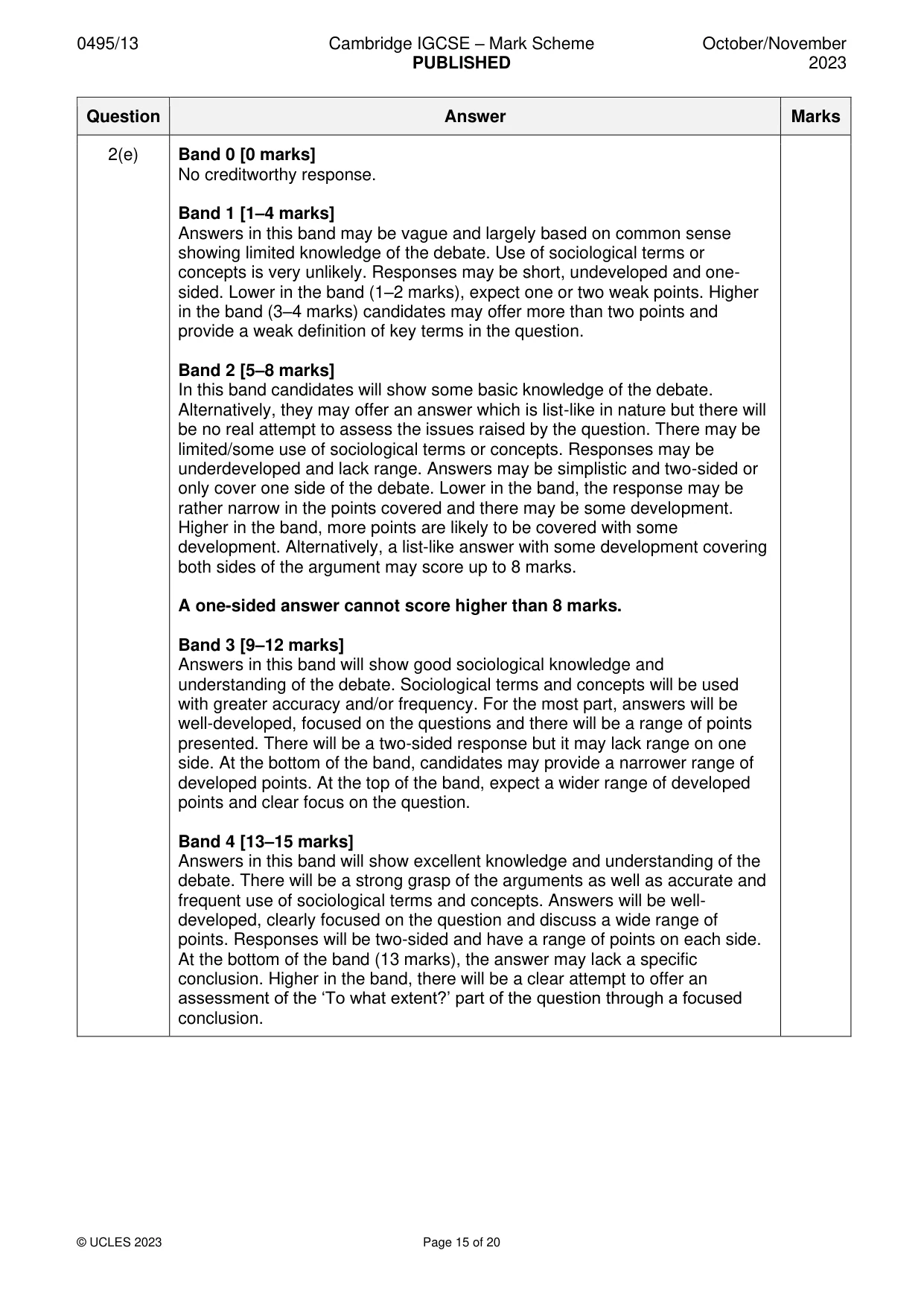
0495/13 Cambridge IGCSE – Mark Scheme PUBLISHED October/November 2023 © UCLES 2023 Page 15 of 20 Question Answer Marks 2(e) Band 0 [0 marks] No creditworthy response. Band 1 [1–4 marks] Answers in this band may be vague and largely based on common sense showing limited knowledge of the debate. Use of sociological terms or concepts is very unlikely. Responses may be short, undeveloped and one- sided. Lower in the band (1–2 marks), expect one or two weak points. Higher in the band (3–4 marks) candidates may offer more than two points and provide a weak definition of key terms in the question. Band 2 [5–8 marks] In this band candidates will show some basic knowledge of the debate. Alternatively, they may offer an answer which is list-like in nature but there will be no real attempt to assess the issues raised by the question. There may be limited/some use of sociological terms or concepts. Responses may be underdeveloped and lack range. Answers may be simplistic and two-sided or only cover one side of the debate. Lower in the band, the response may be rather narrow in the points covered and there may be some development. Higher in the band, more points are likely to be covered with some development. Alternatively, a list-like answer with some development covering both sides of the argument may score up to 8 marks. A one-sided answer cannot score higher than 8 marks. Band 3 [9–12 marks] Answers in this band will show good sociological knowledge and understanding of the debate. Sociological terms and concepts will be used with greater accuracy and/or frequency. For the most part, answers will be well-developed, focused on the questions and there will be a range of points presented. There will be a two-sided response but it may lack range on one side. At the bottom of the band, candidates may provide a narrower range of developed points. At the top of the band, expect a wider range of developed points and clear focus on the question. Band 4 [13–15 marks] Answers in this band will show excellent knowledge and understanding of the debate. There will be a strong grasp of the arguments as well as accurate and frequent use of sociological terms and concepts. Answers will be well- developed, clearly focused on the question and discuss a wide range of points. Responses will be two-sided and have a range of points on each side. At the bottom of the band (13 marks), the answer may lack a specific conclusion. Higher in the band, there will be a clear attempt to offer an assessment of the ‘To what extent?’ part of the question through a focused conclusion.
Mark scheme, page 16
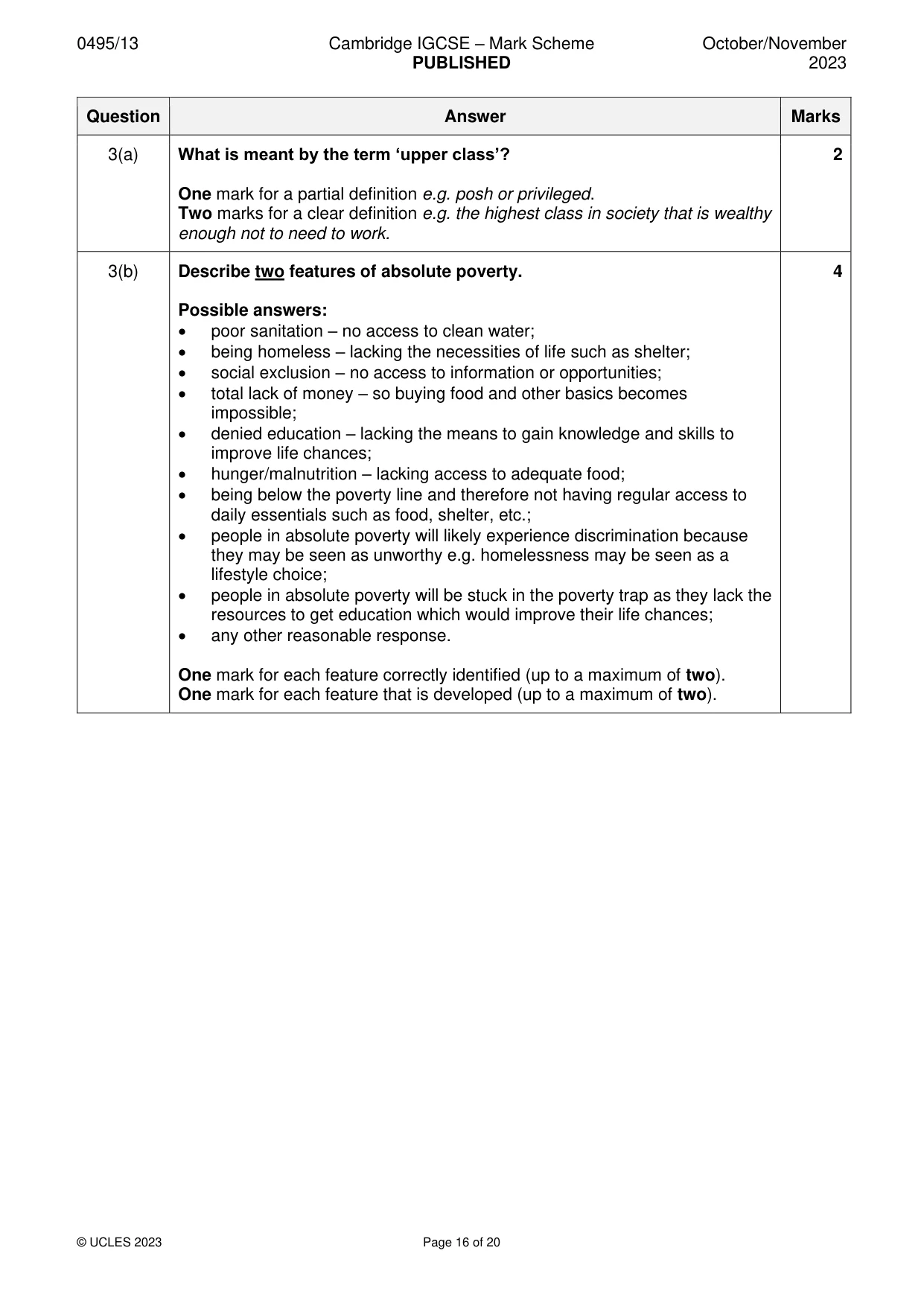
0495/13 Cambridge IGCSE – Mark Scheme PUBLISHED October/November 2023 © UCLES 2023 Page 16 of 20 Question Answer Marks 3(a) What is meant by the term ‘upper class’? One mark for a partial definition e.g. posh or privileged. Two marks for a clear definition e.g. the highest class in society that is wealthy enough not to need to work. 2 3(b) Describe two features of absolute poverty. Possible answers: • poor sanitation – no access to clean water; • being homeless – lacking the necessities of life such as shelter; • social exclusion – no access to information or opportunities; • total lack of money – so buying food and other basics becomes impossible; • denied education – lacking the means to gain knowledge and skills to improve life chances; • hunger/malnutrition – lacking access to adequate food; • being below the poverty line and therefore not having regular access to daily essentials such as food, shelter, etc.; • people in absolute poverty will likely experience discrimination because they may be seen as unworthy e.g. homelessness may be seen as a lifestyle choice; • people in absolute poverty will be stuck in the poverty trap as they lack the resources to get education which would improve their life chances; • any other reasonable response. One mark for each feature correctly identified (up to a maximum of two). One mark for each feature that is developed (up to a maximum of two). 4
Mark scheme, page 17
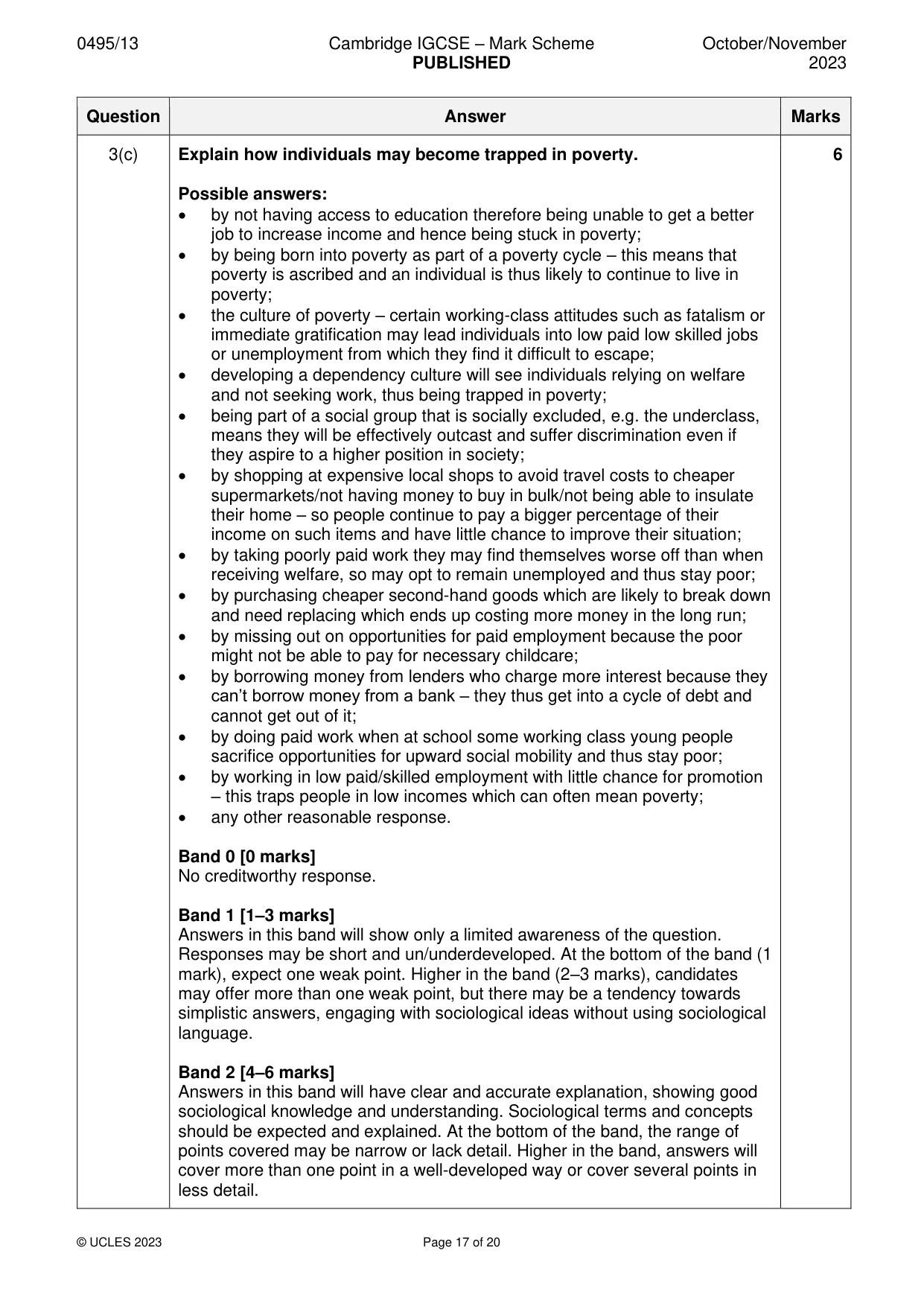
0495/13 Cambridge IGCSE – Mark Scheme PUBLISHED October/November 2023 © UCLES 2023 Page 17 of 20 Question Answer Marks 3(c) Explain how individuals may become trapped in poverty. Possible answers: • by not having access to education therefore being unable to get a better job to increase income and hence being stuck in poverty; • by being born into poverty as part of a poverty cycle – this means that poverty is ascribed and an individual is thus likely to continue to live in poverty; • the culture of poverty – certain working-class attitudes such as fatalism or immediate gratification may lead individuals into low paid low skilled jobs or unemployment from which they find it difficult to escape; • developing a dependency culture will see individuals relying on welfare and not seeking work, thus being trapped in poverty; • being part of a social group that is socially excluded, e.g. the underclass, means they will be effectively outcast and suffer discrimination even if they aspire to a higher position in society; • by shopping at expensive local shops to avoid travel costs to cheaper supermarkets/not having money to buy in bulk/not being able to insulate their home – so people continue to pay a bigger percentage of their income on such items and have little chance to improve their situation; • by taking poorly paid work they may find themselves worse off than when receiving welfare, so may opt to remain unemployed and thus stay poor; • by purchasing cheaper second-hand goods which are likely to break down and need replacing which ends up costing more money in the long run; • by missing out on opportunities for paid employment because the poor might not be able to pay for necessary childcare; • by borrowing money from lenders who charge more interest because they can’t borrow money from a bank – they thus get into a cycle of debt and cannot get out of it; • by doing paid work when at school some working class young people sacrifice opportunities for upward social mobility and thus stay poor; • by working in low paid/skilled employment with little chance for promotion – this traps people in low incomes which can often mean poverty; • any other reasonable response. Band 0 [0 marks] No creditworthy response. Band 1 [1–3 marks] Answers in this band will show only a limited awareness of the question. Responses may be short and un/underdeveloped. At the bottom of the band (1 mark), expect one weak point. Higher in the band (2–3 marks), candidates may offer more than one weak point, but there may be a tendency towards simplistic answers, engaging with sociological ideas without using sociological language. Band 2 [4–6 marks] Answers in this band will have clear and accurate explanation, showing good sociological knowledge and understanding. Sociological terms and concepts should be expected and explained. At the bottom of the band, the range of points covered may be narrow or lack detail. Higher in the band, answers will cover more than one point in a well-developed way or cover several points in less detail. 6
Mark scheme, page 18
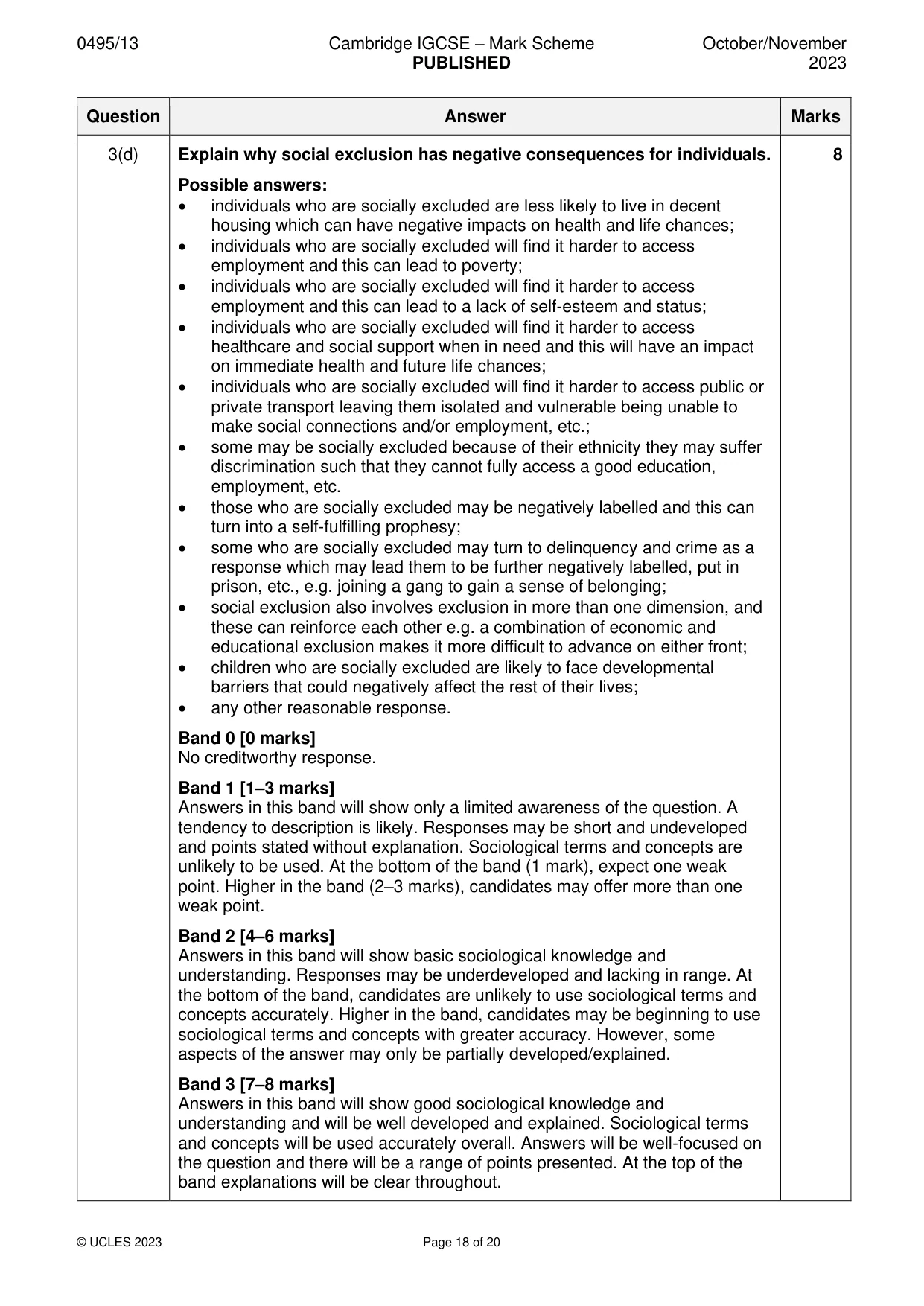
0495/13 Cambridge IGCSE – Mark Scheme PUBLISHED October/November 2023 © UCLES 2023 Page 18 of 20 Question Answer Marks 3(d) Explain why social exclusion has negative consequences for individuals. Possible answers: • individuals who are socially excluded are less likely to live in decent housing which can have negative impacts on health and life chances; • individuals who are socially excluded will find it harder to access employment and this can lead to poverty; • individuals who are socially excluded will find it harder to access employment and this can lead to a lack of self-esteem and status; • individuals who are socially excluded will find it harder to access healthcare and social support when in need and this will have an impact on immediate health and future life chances; • individuals who are socially excluded will find it harder to access public or private transport leaving them isolated and vulnerable being unable to make social connections and/or employment, etc.; • some may be socially excluded because of their ethnicity they may suffer discrimination such that they cannot fully access a good education, employment, etc. • those who are socially excluded may be negatively labelled and this can turn into a self-fulfilling prophesy; • some who are socially excluded may turn to delinquency and crime as a response which may lead them to be further negatively labelled, put in prison, etc., e.g. joining a gang to gain a sense of belonging; • social exclusion also involves exclusion in more than one dimension, and these can reinforce each other e.g. a combination of economic and educational exclusion makes it more difficult to advance on either front; • children who are socially excluded are likely to face developmental barriers that could negatively affect the rest of their lives; • any other reasonable response. Band 0 [0 marks] No creditworthy response. Band 1 [1–3 marks] Answers in this band will show only a limited awareness of the question. A tendency to description is likely. Responses may be short and undeveloped and points stated without explanation. Sociological terms and concepts are unlikely to be used. At the bottom of the band (1 mark), expect one weak point. Higher in the band (2–3 marks), candidates may offer more than one weak point. Band 2 [4–6 marks] Answers in this band will show basic sociological knowledge and understanding. Responses may be underdeveloped and lacking in range. At the bottom of the band, candidates are unlikely to use sociological terms and concepts accurately. Higher in the band, candidates may be beginning to use sociological terms and concepts with greater accuracy. However, some aspects of the answer may only be partially developed/explained. Band 3 [7–8 marks] Answers in this band will show good sociological knowledge and understanding and will be well developed and explained. Sociological terms and concepts will be used accurately overall. Answers will be well-focused on the question and there will be a range of points presented. At the top of the band explanations will be clear throughout. 8
Mark scheme, page 19
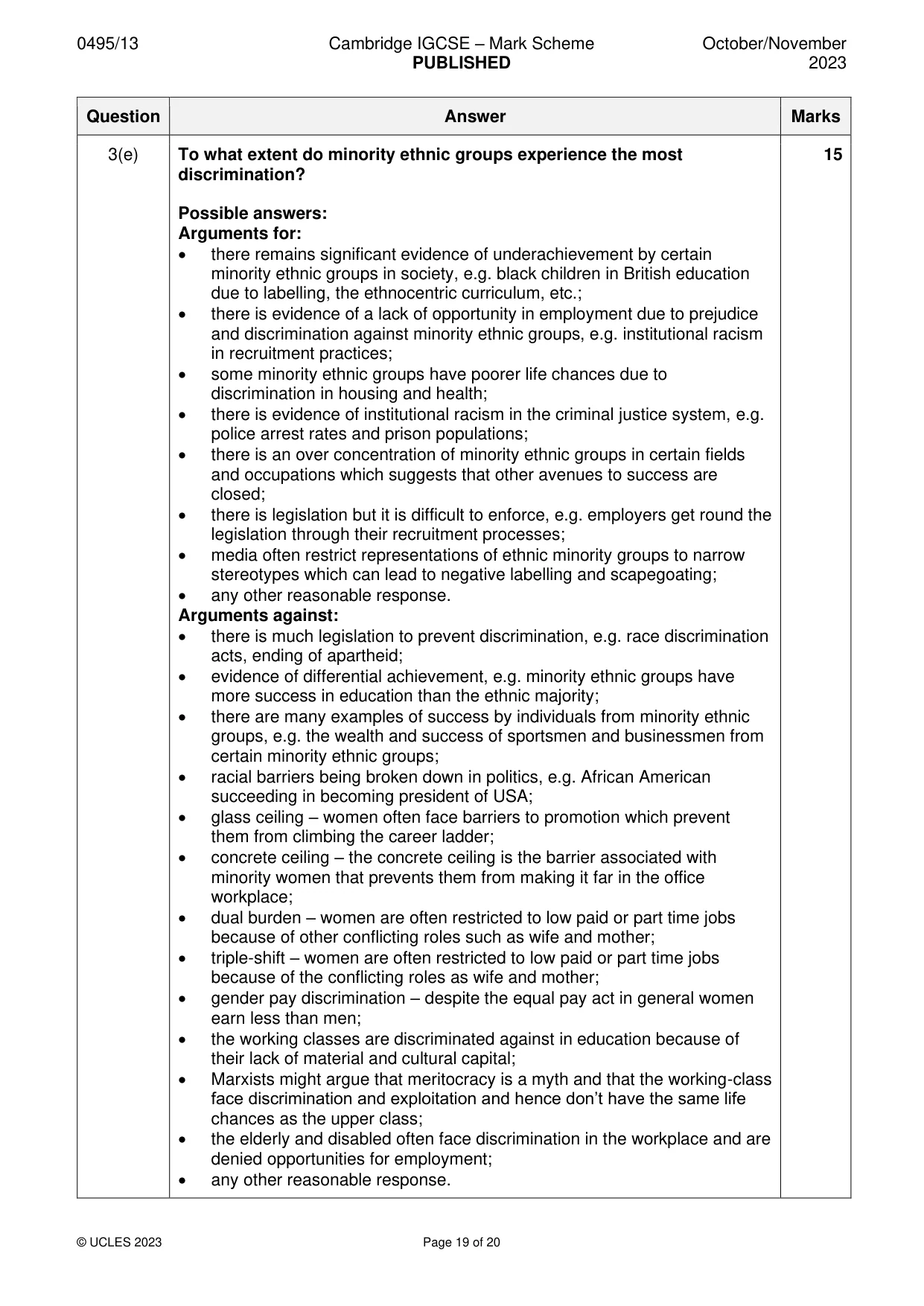
0495/13 Cambridge IGCSE – Mark Scheme PUBLISHED October/November 2023 © UCLES 2023 Page 19 of 20 Question Answer Marks 3(e) To what extent do minority ethnic groups experience the most discrimination? Possible answers: Arguments for: • there remains significant evidence of underachievement by certain minority ethnic groups in society, e.g. black children in British education due to labelling, the ethnocentric curriculum, etc.; • there is evidence of a lack of opportunity in employment due to prejudice and discrimination against minority ethnic groups, e.g. institutional racism in recruitment practices; • some minority ethnic groups have poorer life chances due to discrimination in housing and health; • there is evidence of institutional racism in the criminal justice system, e.g. police arrest rates and prison populations; • there is an over concentration of minority ethnic groups in certain fields and occupations which suggests that other avenues to success are closed; • there is legislation but it is difficult to enforce, e.g. employers get round the legislation through their recruitment processes; • media often restrict representations of ethnic minority groups to narrow stereotypes which can lead to negative labelling and scapegoating; • any other reasonable response. Arguments against: • there is much legislation to prevent discrimination, e.g. race discrimination acts, ending of apartheid; • evidence of differential achievement, e.g. minority ethnic groups have more success in education than the ethnic majority; • there are many examples of success by individuals from minority ethnic groups, e.g. the wealth and success of sportsmen and businessmen from certain minority ethnic groups; • racial barriers being broken down in politics, e.g. African American succeeding in becoming president of USA; • glass ceiling – women often face barriers to promotion which prevent them from climbing the career ladder; • concrete ceiling – the concrete ceiling is the barrier associated with minority women that prevents them from making it far in the office workplace; • dual burden – women are often restricted to low paid or part time jobs because of other conflicting roles such as wife and mother; • triple-shift – women are often restricted to low paid or part time jobs because of the conflicting roles as wife and mother; • gender pay discrimination – despite the equal pay act in general women earn less than men; • the working classes are discriminated against in education because of their lack of material and cultural capital; • Marxists might argue that meritocracy is a myth and that the working-class face discrimination and exploitation and hence don’t have the same life chances as the upper class; • the elderly and disabled often face discrimination in the workplace and are denied opportunities for employment; • any other reasonable response. 15
Mark scheme, page 20
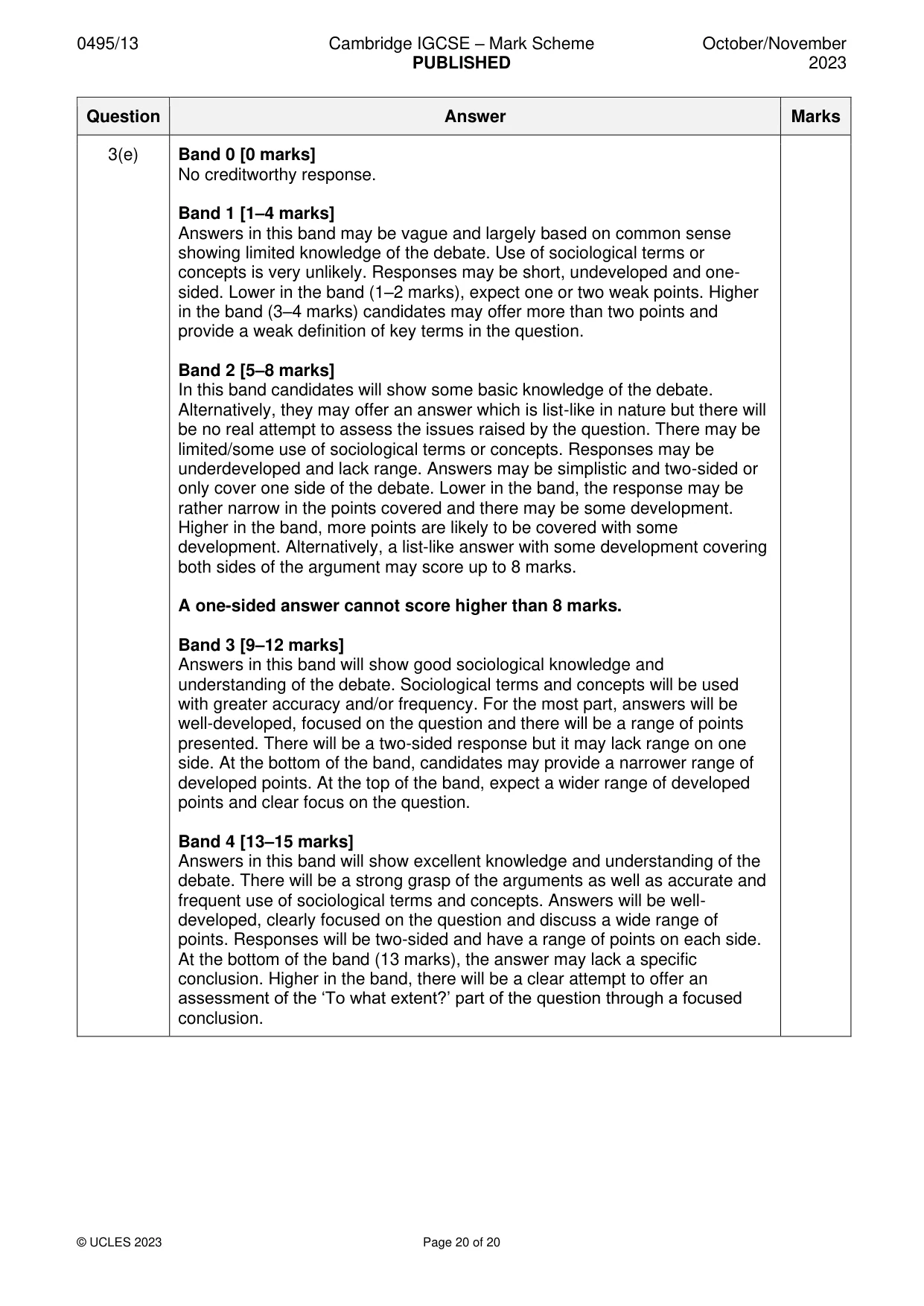
0495/13 Cambridge IGCSE – Mark Scheme PUBLISHED October/November 2023 © UCLES 2023 Page 20 of 20 Question Answer Marks 3(e) Band 0 [0 marks] No creditworthy response. Band 1 [1–4 marks] Answers in this band may be vague and largely based on common sense showing limited knowledge of the debate. Use of sociological terms or concepts is very unlikely. Responses may be short, undeveloped and one- sided. Lower in the band (1–2 marks), expect one or two weak points. Higher in the band (3–4 marks) candidates may offer more than two points and provide a weak definition of key terms in the question. Band 2 [5–8 marks] In this band candidates will show some basic knowledge of the debate. Alternatively, they may offer an answer which is list-like in nature but there will be no real attempt to assess the issues raised by the question. There may be limited/some use of sociological terms or concepts. Responses may be underdeveloped and lack range. Answers may be simplistic and two-sided or only cover one side of the debate. Lower in the band, the response may be rather narrow in the points covered and there may be some development. Higher in the band, more points are likely to be covered with some development. Alternatively, a list-like answer with some development covering both sides of the argument may score up to 8 marks. A one-sided answer cannot score higher than 8 marks. Band 3 [9–12 marks] Answers in this band will show good sociological knowledge and understanding of the debate. Sociological terms and concepts will be used with greater accuracy and/or frequency. For the most part, answers will be well-developed, focused on the question and there will be a range of points presented. There will be a two-sided response but it may lack range on one side. At the bottom of the band, candidates may provide a narrower range of developed points. At the top of the band, expect a wider range of developed points and clear focus on the question. Band 4 [13–15 marks] Answers in this band will show excellent knowledge and understanding of the debate. There will be a strong grasp of the arguments as well as accurate and frequent use of sociological terms and concepts. Answers will be well- developed, clearly focused on the question and discuss a wide range of points. Responses will be two-sided and have a range of points on each side. At the bottom of the band (13 marks), the answer may lack a specific conclusion. Higher in the band, there will be a clear attempt to offer an assessment of the ‘To what extent?’ part of the question through a focused conclusion.
What you needed in this session
Cambridge’s own grade thresholds for 2023 Oct/Nov, Paper 1 · Variant 3. A higher threshold means an easier paper — the bar moves with how the cohort did.