Cambridge IGCSE Sociology 0495 — 2025 Oct/Nov Paper 1 · Variant 1
0495/11/O/N/25 · 80 marks · 120 min
The question paper and its mark scheme, free to read here and free to download. This is Cambridge’s own paper, exactly as it was sat.
Question paper8 pages



Mark scheme28 pages
Answers below. Sit the paper first if you are practising.

Paper as text
Question paper, page 1
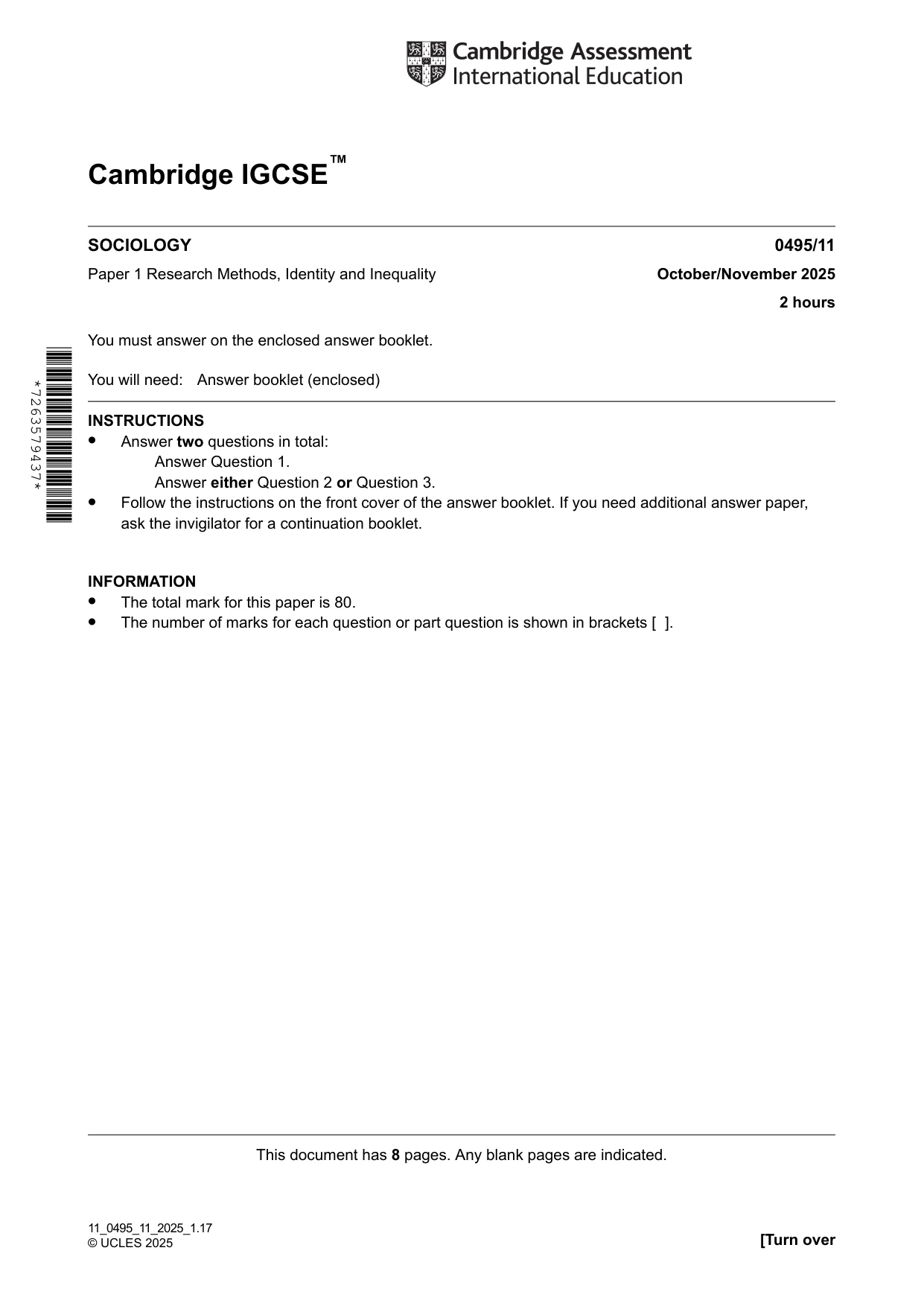
Cambridge IGCSE™ 0495/11 October/November 2025 2 hours SOCIOLOGY Paper 1 Research Methods, Identity and Inequality You must answer on the enclosed answer booklet. You will need: Answer booklet (enclosed) INSTRUCTIONS • Answer two questions in total: Answer Question 1. Answer either Question 2 or Question 3. • Follow the instructions on the front cover of the answer booklet. If you need additional answer paper, ask the invigilator for a continuation booklet. INFORMATION • The total mark for this paper is 80. • The number of marks for each question or part question is shown in brackets [ ]. This document has 8 pages. Any blank pages are indicated. [Turn over 11_0495_11_2025_1.17 © UCLES 2025 *7263579437*
Question paper, page 2
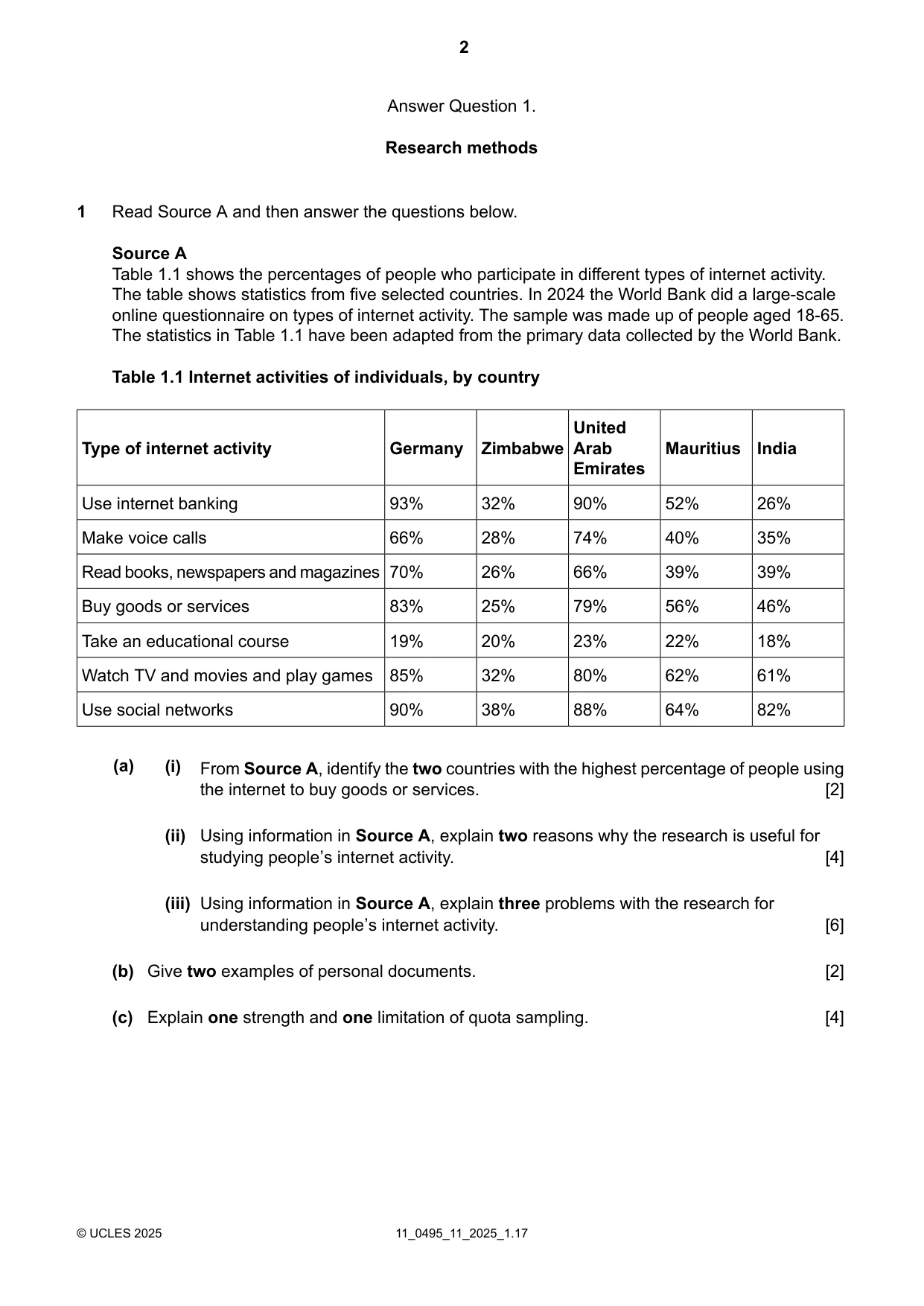
Answer Question 1. Research methods Read Source A and then answer the questions below. 1 Source A Table 1.1 shows the percentages of people who participate in different types of internet activity. The table shows statistics from five selected countries. In 2024 the World Bank did a large-scale online questionnaire on types of internet activity. The sample was made up of people aged 18-65. The statistics in Table 1.1 have been adapted from the primary data collected by the World Bank. Table 1.1 Internet activities of individuals, by country India Mauritius United Arab Emirates Zimbabwe Germany Type of internet activity 26% 52% 90% 32% 93% Use internet banking 35% 40% 74% 28% 66% Make voice calls 39% 39% 66% 26% 70% Read books, newspapers and magazines 46% 56% 79% 25% 83% Buy goods or services 18% 22% 23% 20% 19% Take an educational course 61% 62% 80% 32% 85% Watch TV and movies and play games 82% 64% 88% 38% 90% Use social networks (a) From Source A, identify the two countries with the highest percentage of people using the internet to buy goods or services. [2] (i) Using information in Source A, explain two reasons why the research is useful for studying people’s internet activity. [4] (ii) Using information in Source A, explain three problems with the research for understanding people’s internet activity. [6] (iii) Give two examples of personal documents. [2] (b) Explain one strength and one limitation of quota sampling. [4] (c) 11_0495_11_2025_1.17 © UCLES 2025 2
Question paper, page 3
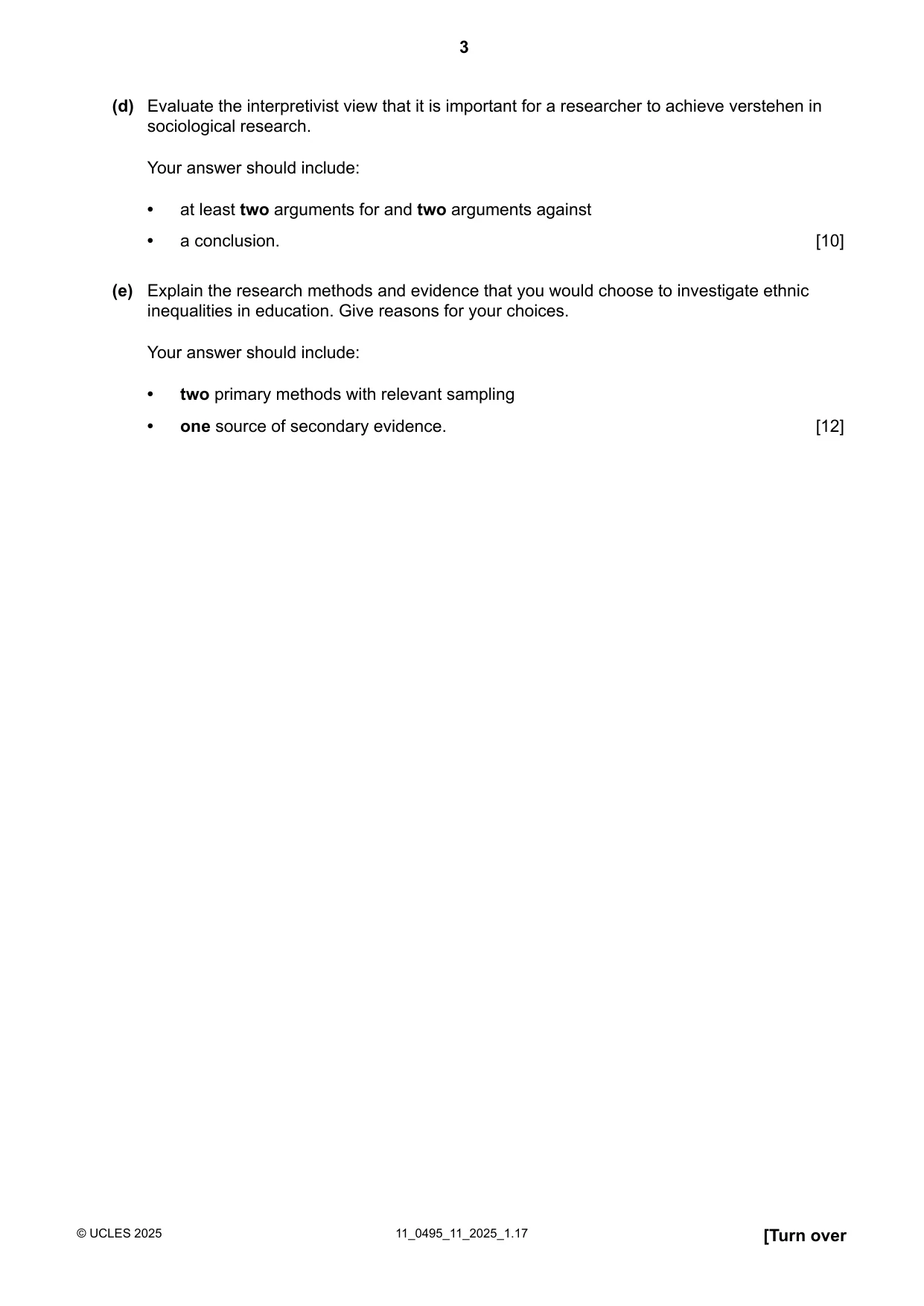
Evaluate the interpretivist view that it is important for a researcher to achieve verstehen in sociological research. Your answer should include: (d) • at least two arguments for and two arguments against • a conclusion. [10] Explain the research methods and evidence that you would choose to investigate ethnic inequalities in education. Give reasons for your choices. Your answer should include: (e) • two primary methods with relevant sampling • one source of secondary evidence. [12] [Turn over 11_0495_11_2025_1.17 © UCLES 2025 3
Question paper, page 4
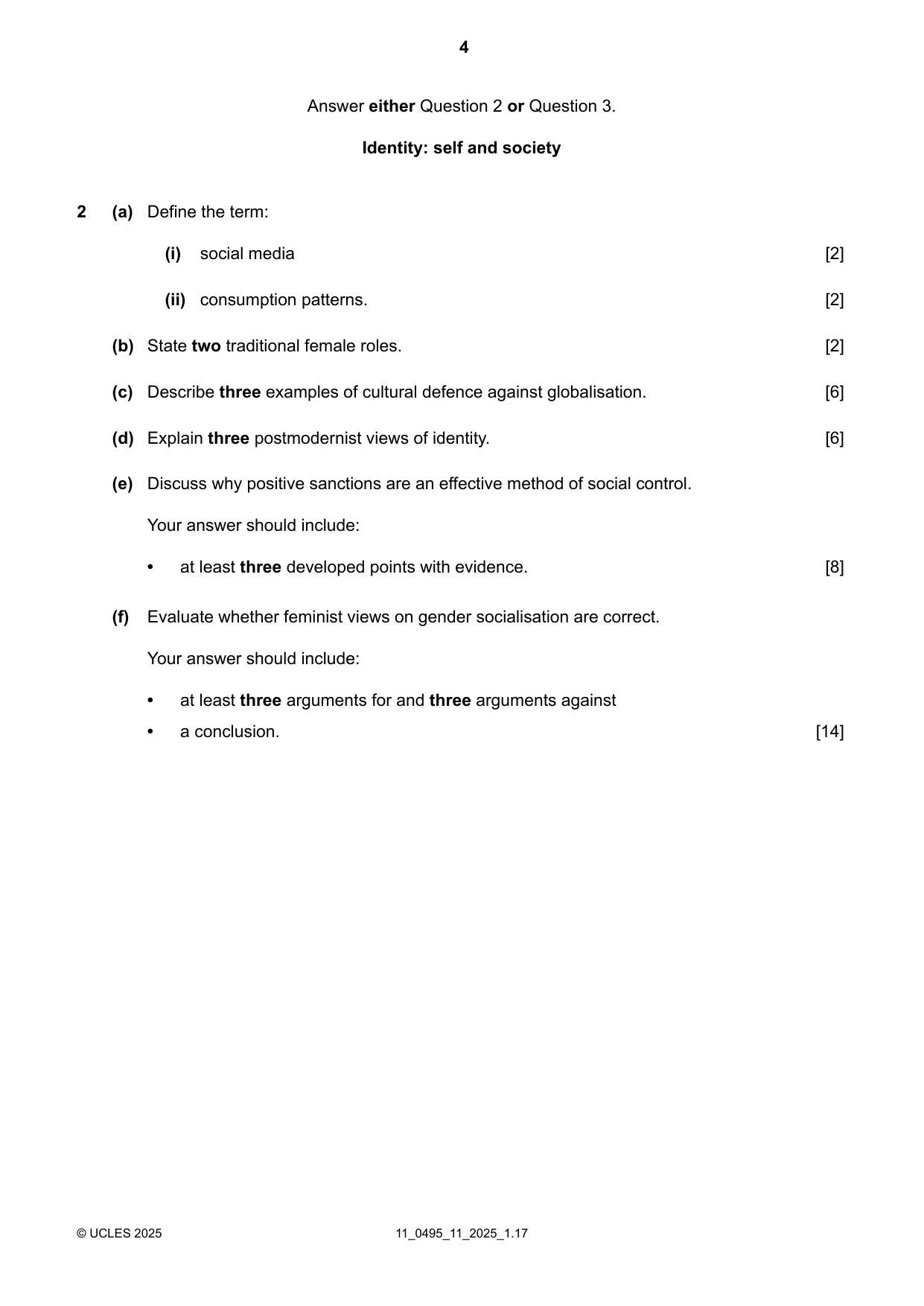
Answer either Question 2 or Question 3. Identity: self and society Define the term: (a) 2 social media [2] (i) consumption patterns. [2] (ii) State two traditional female roles. [2] (b) Describe three examples of cultural defence against globalisation. [6] (c) Explain three postmodernist views of identity. [6] (d) Discuss why positive sanctions are an effective method of social control. Your answer should include: (e) • at least three developed points with evidence. [8] Evaluate whether feminist views on gender socialisation are correct. Your answer should include: (f) • at least three arguments for and three arguments against • a conclusion. [14] 11_0495_11_2025_1.17 © UCLES 2025 4
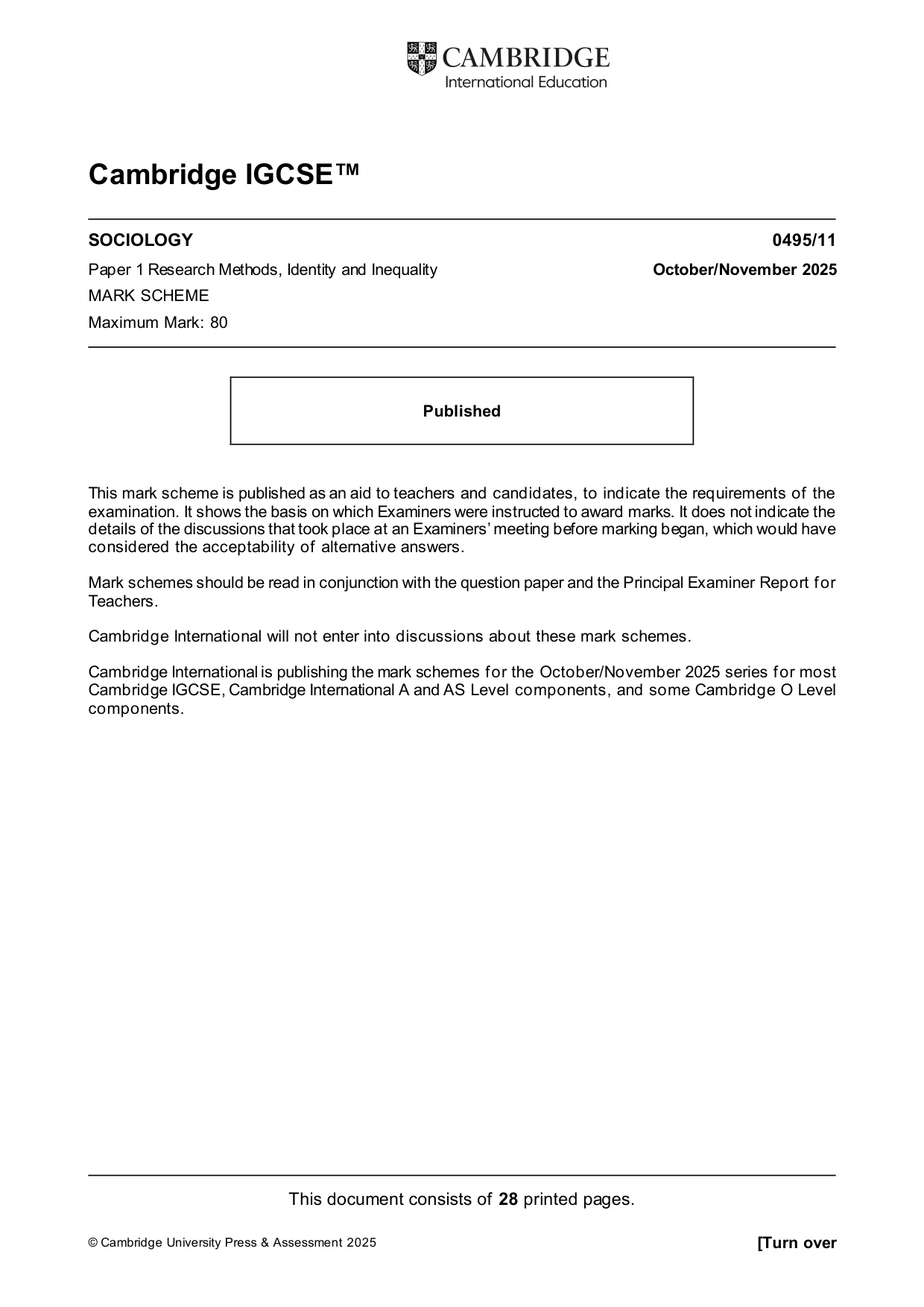
Question paper, page 5
Social stratification and inequality Define the term: (a) 3 emigration [2] (i) unemployment benefits. [2] (ii) State two features of modern slavery. [2] (b) Describe three ways transnational companies (TNCs) damage the environment. [6] (c) Explain three ways patriarchy creates global inequalities. [6] (d) Discuss how non-governmental organisations (NGOs) reduce inequalities. Your answer should include: (e) • at least three developed points with evidence. [8] Evaluate the functionalist view that societies are meritocratic. Your answer should include: (f) • at least three arguments for and three arguments against • a conclusion. [14] 11_0495_11_2025_1.17 © UCLES 2025 5
Question paper, page 6
BLANK PAGE 11_0495_11_2025_1.17 © UCLES 2025 6
Question paper, page 7
BLANK PAGE 11_0495_11_2025_1.17 © UCLES 2025 7
Question paper, page 8
BLANK PAGE Permission to reproduce items where third-party owned material protected by copyright is included has been sought and cleared where possible. Every reasonable effort has been made by the publisher (UCLES) to trace copyright holders, but if any items requiring clearance have unwittingly been included, the publisher will be pleased to make amends at the earliest possible opportunity. To avoid the issue of disclosure of answer-related information to candidates, all copyright acknowledgements are reproduced online in the Cambridge Assessment International Education Copyright Acknowledgements Booklet. This is produced for each series of examinations and is freely available to download at www.cambridgeinternational.org after the live examination series. Cambridge Assessment International Education is part of Cambridge Assessment. Cambridge Assessment is the brand name of the University of Cambridge Local Examinations Syndicate (UCLES), which is a department of the University of Cambridge. 11_0495_11_2025_1.17 © UCLES 2025 8
Mark scheme, page 1
This document consists of 28 printed pages. © Cambridge University Press & Assessment 2025 [Turn over Cambridge IGCSE™ SOCIOLOGY 0495/11 Paper 1 Research Methods, Identity and Inequality October/November 2025 MARK SCHEME Maximum Mark: 80 Published This mark scheme is published as an aid to teachers and candidates, to indicate the requirements of the examination. It shows the basis on which Examiners were instructed to award marks. It does not indicate the details of the discussions that took place at an Examiners’ meeting before marking began, which would have considered the acceptability of alternative answers. Mark schemes should be read in conjunction with the question paper and the Principal Examiner Report for Teachers. Cambridge International will not enter into discussions about these mark schemes. Cambridge International is publishing the mark schemes for the October/November 2025 series for most Cambridge IGCSE, Cambridge International A and AS Level components, and some Cambridge O Level components.
Mark scheme, page 2
0495/11 Cambridge IGCSE – Mark Scheme PUBLISHED October/November 2025 © Cambridge University Press & Assessment 2025 Page 2 of 28 Generic Marking Principles These general marking principles must be applied by all examiners when marking candidate answers. They should be applied alongside the specific content of the mark scheme or generic level descriptions for a question. Each question paper and mark scheme will also comply with these marking principles. GENERIC MARKING PRINCIPLE 1: Marks must be awarded in line with: • the specific content of the mark scheme or the generic level descriptors for the question • the specific skills defined in the mark scheme or in the generic level descriptors for the question • the standard of response required by a candidate as exemplified by the standardisation scripts. GENERIC MARKING PRINCIPLE 2: Marks awarded are always whole marks (not half marks, or other fractions). GENERIC MARKING PRINCIPLE 3: Marks must be awarded positively: • marks are awarded for correct/valid answers, as defined in the mark scheme. However, credit is given for valid answers which go beyond the scope of the syllabus and mark scheme, referring to your Team Leader as appropriate • marks are awarded when candidates clearly demonstrate what they know and can do • marks are not deducted for errors • marks are not deducted for omissions • answers should only be judged on the quality of spelling, punctuation and grammar when these features are specifically assessed by the question as indicated by the mark scheme. The meaning, however, should be unambiguous. GENERIC MARKING PRINCIPLE 4: Rules must be applied consistently, e.g. in situations where candidates have not followed instructions or in the application of generic level descriptors. GENERIC MARKING PRINCIPLE 5: Marks should be awarded using the full range of marks defined in the mark scheme for the question (however; the use of the full mark range may be limited according to the quality of the candidate responses seen). GENERIC MARKING PRINCIPLE 6: Marks awarded are based solely on the requirements as defined in the mark scheme. Marks should not be awarded with grade thresholds or grade descriptors in mind.
Mark scheme, page 3
0495/11 Cambridge IGCSE – Mark Scheme PUBLISHED October/November 2025 © Cambridge University Press & Assessment 2025 Page 3 of 28 Social Science-Specific Marking Principles (for point-based marking) 1 Components using point-based marking: • Point marking is often used to reward knowledge, understanding and application of skills. We give credit where the candidate’s answer shows relevant knowledge, understanding and application of skills in answering the question. We do not give credit where the answer shows confusion. From this it follows that we: a DO credit answers which are worded differently from the mark scheme if they clearly convey the same meaning (unless the mark scheme requires a specific term) b DO credit alternative answers/examples which are not written in the mark scheme if they are correct c DO credit answers where candidates give more than one correct answer in one prompt/numbered/scaffolded space where extended writing is required rather than list-type answers. For example, questions that require n reasons (e.g. State two reasons …). d DO NOT credit answers simply for using a ‘key term’ unless that is all that is required. (Check for evidence it is understood and not used wrongly.) e DO NOT credit answers which are obviously self-contradicting or trying to cover all possibilities f DO NOT give further credit for what is effectively repetition of a correct point already credited unless the language itself is being tested. This applies equally to ‘mirror statements’ (i.e. polluted/not polluted). g DO NOT require spellings to be correct, unless this is part of the test. However spellings of syllabus terms must allow for clear and unambiguous separation from other syllabus terms with which they may be confused (e.g. Corrasion/Corrosion) 2 Presentation of mark scheme: • Slashes (/) or the word ‘or’ separate alternative ways of making the same point. • Semi colons (;) bullet points (•) or figures in brackets (1) separate different points. • Content in the answer column in brackets is for examiner information/context to clarify the marking but is not required to earn the mark (except Accounting syllabuses where they indicate negative numbers). 3 Calculation questions: • The mark scheme will show the steps in the most likely correct method(s), the mark for each step, the correct answer(s) and the mark for each answer • If working/explanation is considered essential for full credit, this will be indicated in the question paper and in the mark scheme. In all other instances, the correct answer to a calculation should be given full credit, even if no supporting working is shown. • Where the candidate uses a valid method which is not covered by the mark scheme, award equivalent marks for reaching equivalent stages. • Where an answer makes use of a candidate’s own incorrect figure from previous working, the ‘own figure rule’ applies: full marks will be given if a correct and complete method is used. Further guidance will be included in the mark scheme where necessary and any exceptions to this general principle will be noted.
Mark scheme, page 4
0495/11 Cambridge IGCSE – Mark Scheme PUBLISHED October/November 2025 © Cambridge University Press & Assessment 2025 Page 4 of 28 4 Annotation: • For point marking, ticks can be used to indicate correct answers and crosses can be used to indicate wrong answers. There is no direct relationship between ticks and marks. Ticks have no defined meaning for levels of response marking. • For levels of response marking, the level awarded should be annotated on the script. • Other annotations will be used by examiners as agreed during standardisation, and the meaning will be understood by all examiners who marked that paper.
Mark scheme, page 5
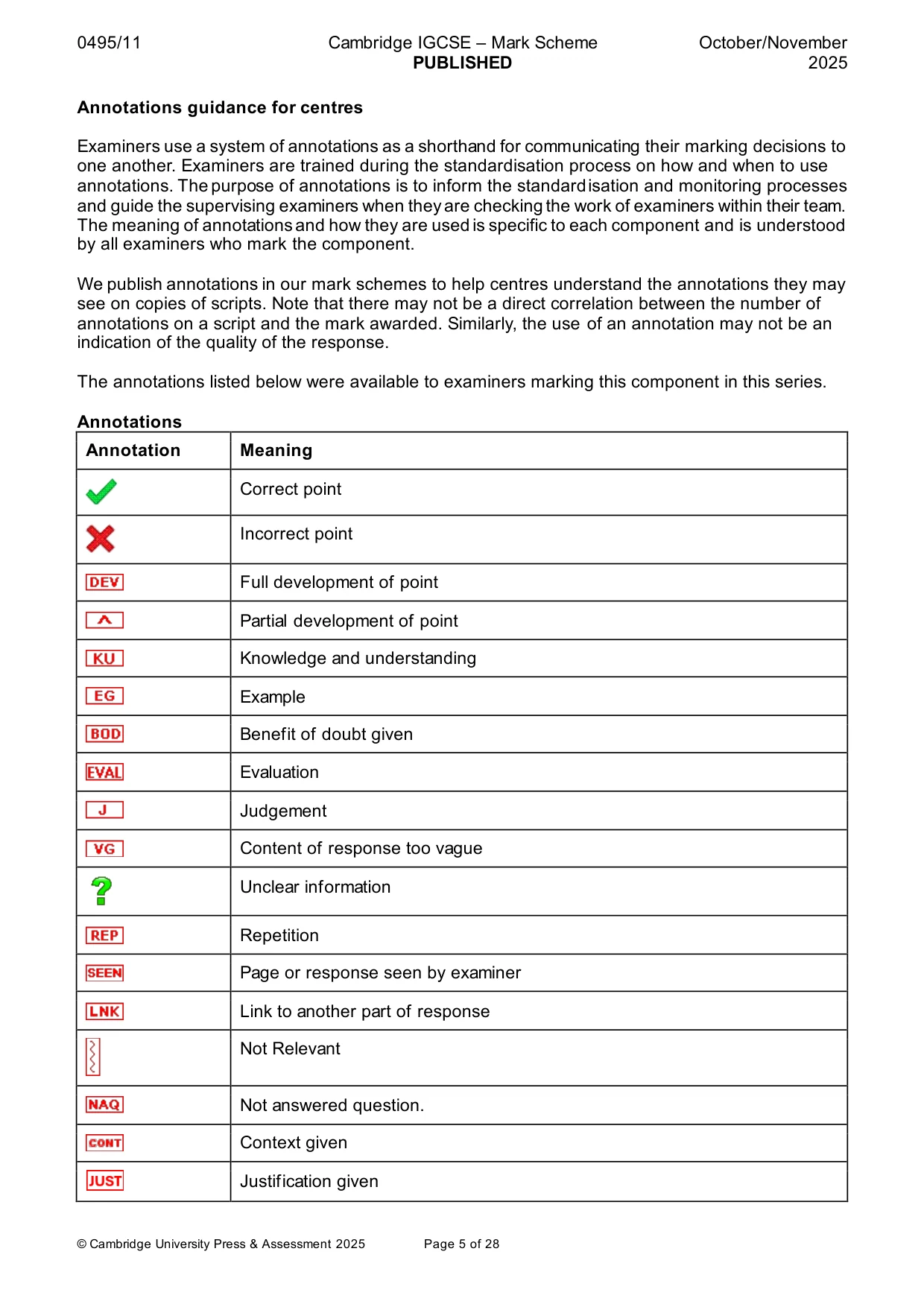
0495/11 Cambridge IGCSE – Mark Scheme PUBLISHED October/November 2025 © Cambridge University Press & Assessment 2025 Page 5 of 28 Annotations guidance for centres Examiners use a system of annotations as a shorthand for communicating their marking decisions to one another. Examiners are trained during the standardisation process on how and when to use annotations. The purpose of annotations is to inform the standardisation and monitoring processes and guide the supervising examiners when they are checking the work of examiners within their team. The meaning of annotations and how they are used is specific to each component and is understood by all examiners who mark the component. We publish annotations in our mark schemes to help centres understand the annotations they may see on copies of scripts. Note that there may not be a direct correlation between the number of annotations on a script and the mark awarded. Similarly, the use of an annotation may not be an indication of the quality of the response. The annotations listed below were available to examiners marking this component in this series. Annotations Annotation Meaning Correct point Incorrect point Full development of point Partial development of point Knowledge and understanding Example Benefit of doubt given Evaluation Judgement Content of response too vague Unclear information Repetition Page or response seen by examiner Link to another part of response Not Relevant Not answered question. Context given Justification given
Mark scheme, page 6
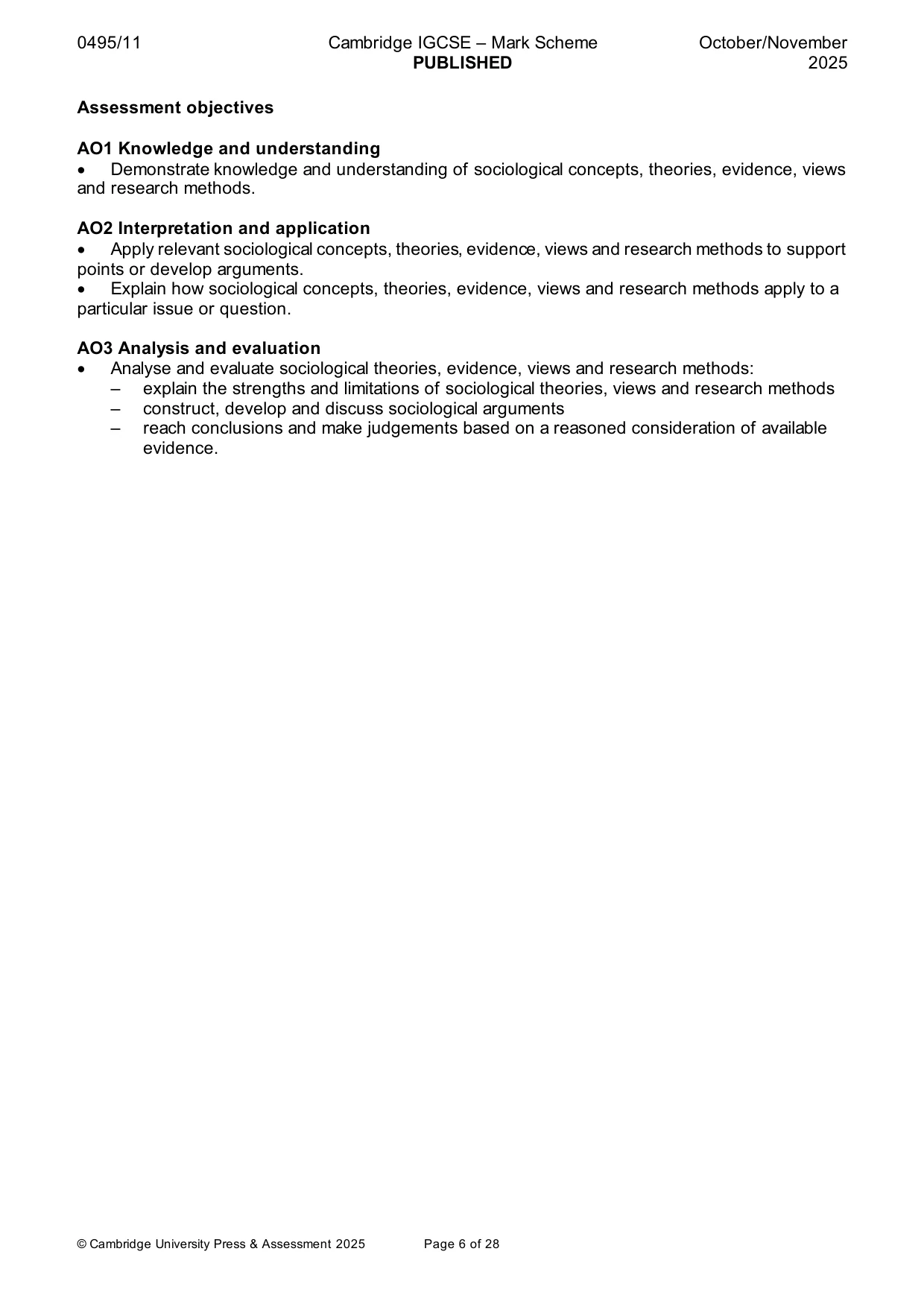
0495/11 Cambridge IGCSE – Mark Scheme PUBLISHED October/November 2025 © Cambridge University Press & Assessment 2025 Page 6 of 28 Assessment objectives AO1 Knowledge and understanding • Demonstrate knowledge and understanding of sociological concepts, theories, evidence, views and research methods. AO2 Interpretation and application • Apply relevant sociological concepts, theories, evidence, views and research methods to support points or develop arguments. • Explain how sociological concepts, theories, evidence, views and research methods apply to a particular issue or question. AO3 Analysis and evaluation • Analyse and evaluate sociological theories, evidence, views and research methods: – explain the strengths and limitations of sociological theories, views and research methods – construct, develop and discuss sociological arguments – reach conclusions and make judgements based on a reasoned consideration of available evidence.
Mark scheme, page 7
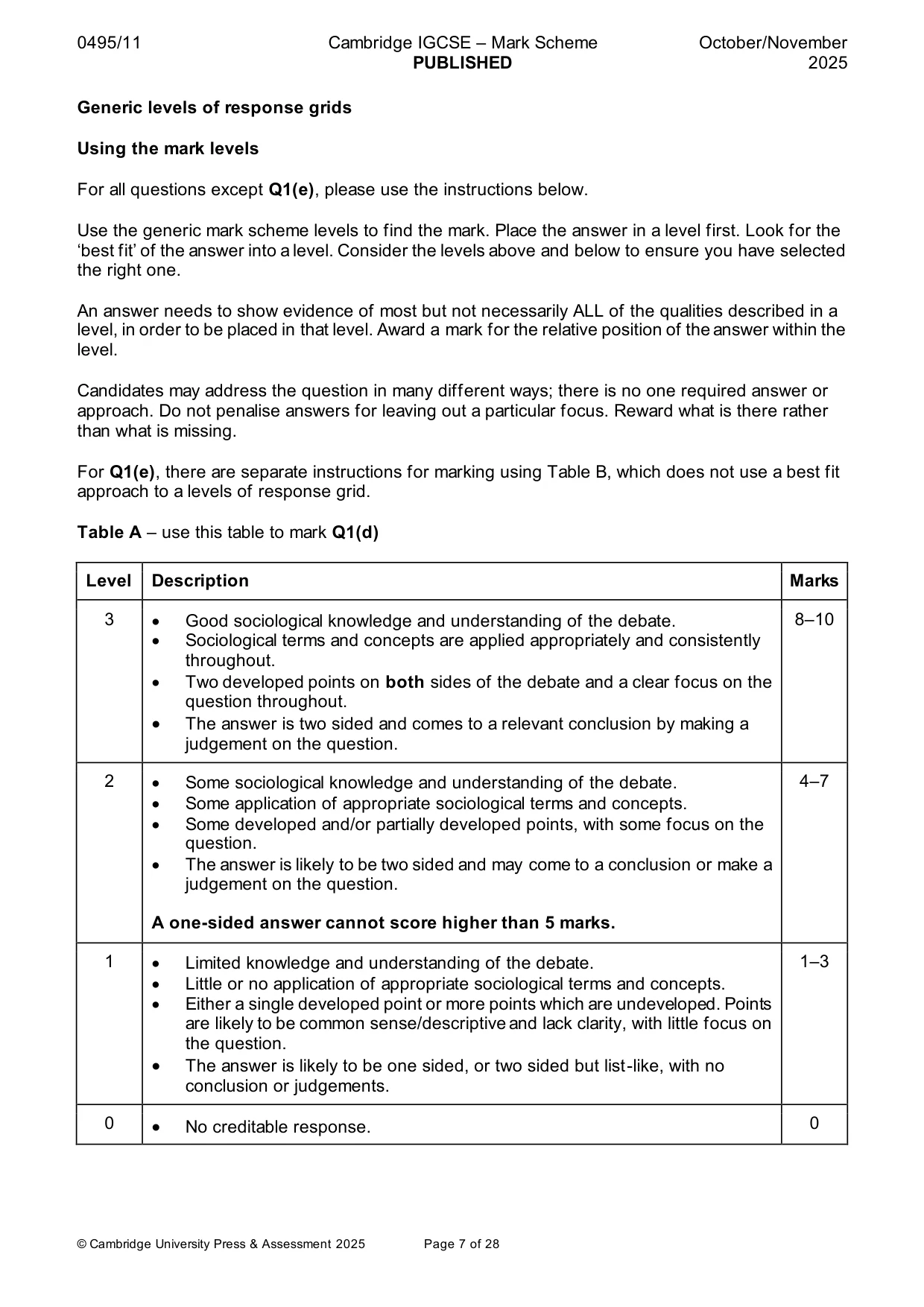
0495/11 Cambridge IGCSE – Mark Scheme PUBLISHED October/November 2025 © Cambridge University Press & Assessment 2025 Page 7 of 28 Generic levels of response grids Using the mark levels For all questions except Q1(e), please use the instructions below. Use the generic mark scheme levels to find the mark. Place the answer in a level first. Look for the ‘best fit’ of the answer into a level. Consider the levels above and below to ensure you have selected the right one. An answer needs to show evidence of most but not necessarily ALL of the qualities described in a level, in order to be placed in that level. Award a mark for the relative position of the answer within the level. Candidates may address the question in many different ways; there is no one required answer or approach. Do not penalise answers for leaving out a particular focus. Reward what is there rather than what is missing. For Q1(e), there are separate instructions for marking using Table B, which does not use a best fit approach to a levels of response grid. Table A – use this table to mark Q1(d) Level Description Marks 3 • Good sociological knowledge and understanding of the debate. • Sociological terms and concepts are applied appropriately and consistently throughout. • Two developed points on both sides of the debate and a clear focus on the question throughout. • The answer is two sided and comes to a relevant conclusion by making a judgement on the question. 8–10 2 • Some sociological knowledge and understanding of the debate. • Some application of appropriate sociological terms and concepts. • Some developed and/or partially developed points, with some focus on the question. • The answer is likely to be two sided and may come to a conclusion or make a judgement on the question. A one-sided answer cannot score higher than 5 marks. 4–7 1 • Limited knowledge and understanding of the debate. • Little or no application of appropriate sociological terms and concepts. • Either a single developed point or more points which are undeveloped. Points are likely to be common sense/descriptive and lack clarity, with little focus on the question. • The answer is likely to be one sided, or two sided but list-like, with no conclusion or judgements. 1–3 0 • No creditable response. 0
Mark scheme, page 8
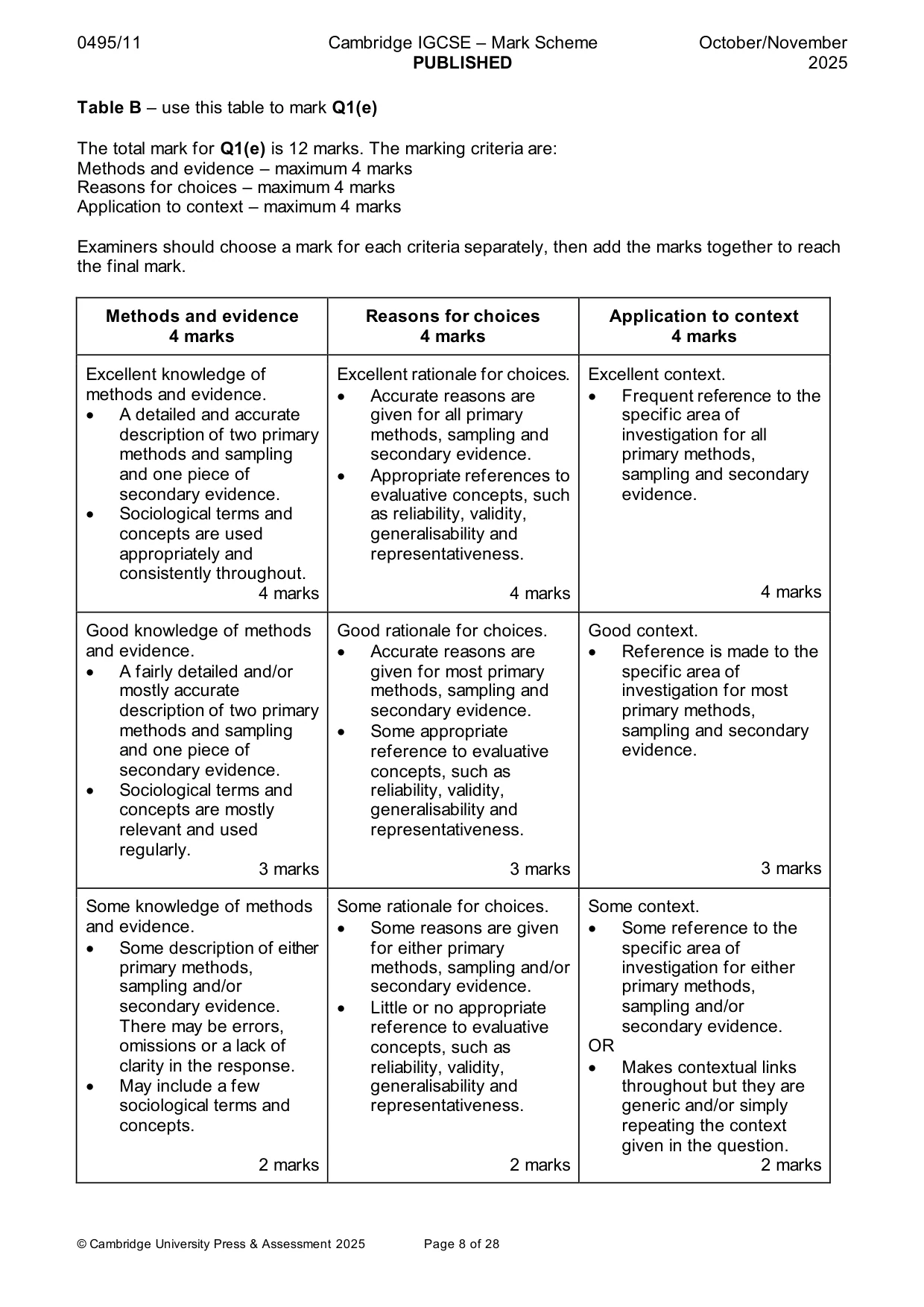
0495/11 Cambridge IGCSE – Mark Scheme PUBLISHED October/November 2025 © Cambridge University Press & Assessment 2025 Page 8 of 28 Table B – use this table to mark Q1(e) The total mark for Q1(e) is 12 marks. The marking criteria are: Methods and evidence – maximum 4 marks Reasons for choices – maximum 4 marks Application to context – maximum 4 marks Examiners should choose a mark for each criteria separately, then add the marks together to reach the final mark. Methods and evidence 4 marks Reasons for choices 4 marks Application to context 4 marks Excellent knowledge of methods and evidence. • A detailed and accurate description of two primary methods and sampling and one piece of secondary evidence. • Sociological terms and concepts are used appropriately and consistently throughout. 4 marks Excellent rationale for choices. • Accurate reasons are given for all primary methods, sampling and secondary evidence. • Appropriate references to evaluative concepts, such as reliability, validity, generalisability and representativeness. 4 marks Excellent context. • Frequent reference to the specific area of investigation for all primary methods, sampling and secondary evidence. 4 marks Good knowledge of methods and evidence. • A fairly detailed and/or mostly accurate description of two primary methods and sampling and one piece of secondary evidence. • Sociological terms and concepts are mostly relevant and used regularly. 3 marks Good rationale for choices. • Accurate reasons are given for most primary methods, sampling and secondary evidence. • Some appropriate reference to evaluative concepts, such as reliability, validity, generalisability and representativeness. 3 marks Good context. • Reference is made to the specific area of investigation for most primary methods, sampling and secondary evidence. 3 marks Some knowledge of methods and evidence. • Some description of either primary methods, sampling and/or secondary evidence. There may be errors, omissions or a lack of clarity in the response. • May include a few sociological terms and concepts. 2 marks Some rationale for choices. • Some reasons are given for either primary methods, sampling and/or secondary evidence. • Little or no appropriate reference to evaluative concepts, such as reliability, validity, generalisability and representativeness. 2 marks Some context. • Some reference to the specific area of investigation for either primary methods, sampling and/or secondary evidence. OR • Makes contextual links throughout but they are generic and/or simply repeating the context given in the question. 2 marks
Mark scheme, page 9
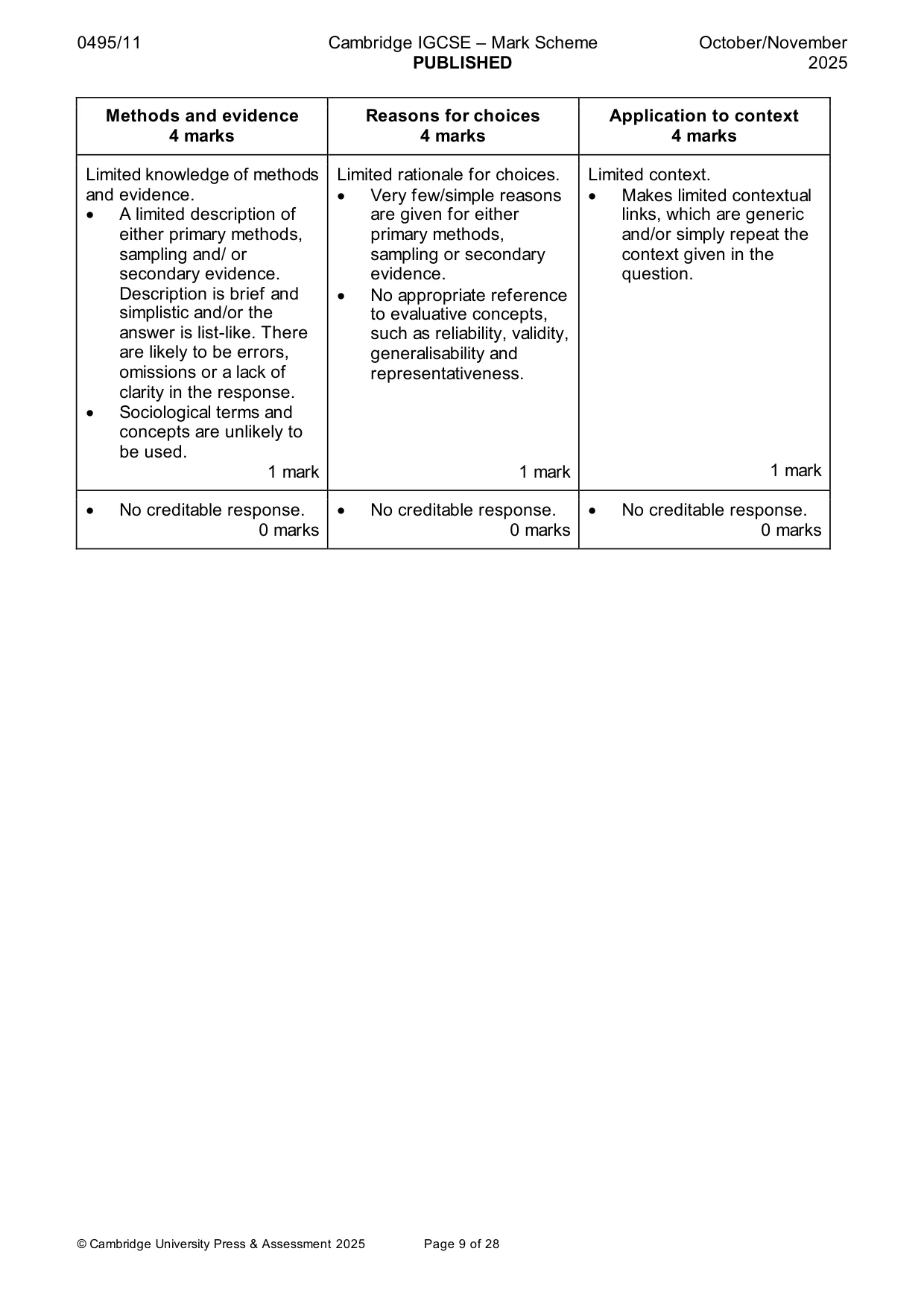
0495/11 Cambridge IGCSE – Mark Scheme PUBLISHED October/November 2025 © Cambridge University Press & Assessment 2025 Page 9 of 28 Methods and evidence 4 marks Reasons for choices 4 marks Application to context 4 marks Limited knowledge of methods and evidence. • A limited description of either primary methods, sampling and/ or secondary evidence. Description is brief and simplistic and/or the answer is list-like. There are likely to be errors, omissions or a lack of clarity in the response. • Sociological terms and concepts are unlikely to be used. 1 mark Limited rationale for choices. • Very few/simple reasons are given for either primary methods, sampling or secondary evidence. • No appropriate reference to evaluative concepts, such as reliability, validity, generalisability and representativeness. 1 mark Limited context. • Makes limited contextual links, which are generic and/or simply repeat the context given in the question. 1 mark • No creditable response. 0 marks • No creditable response. 0 marks • No creditable response. 0 marks
Mark scheme, page 10
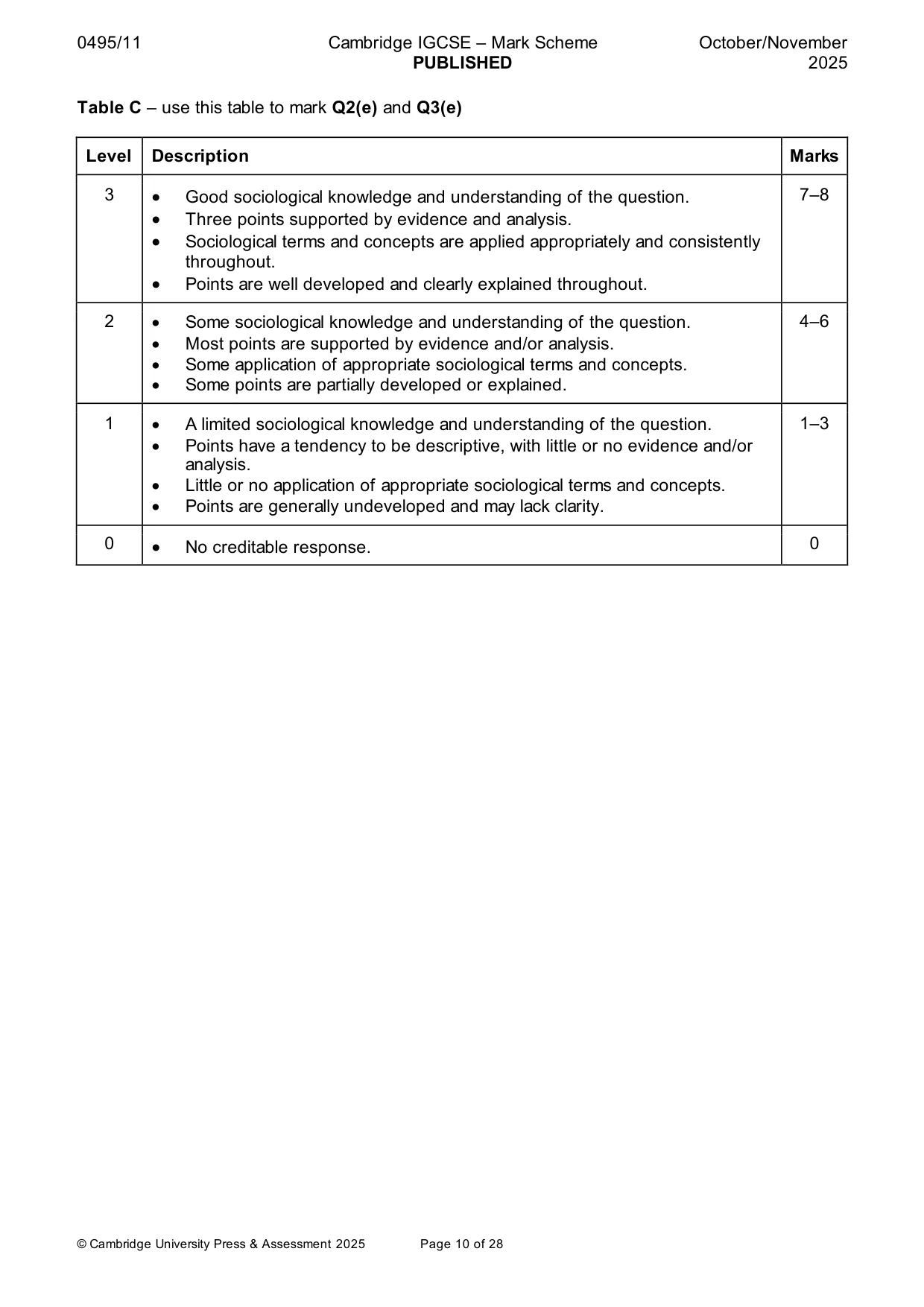
0495/11 Cambridge IGCSE – Mark Scheme PUBLISHED October/November 2025 © Cambridge University Press & Assessment 2025 Page 10 of 28 Table C – use this table to mark Q2(e) and Q3(e) Level Description Marks 3 • Good sociological knowledge and understanding of the question. • Three points supported by evidence and analysis. • Sociological terms and concepts are applied appropriately and consistently throughout. • Points are well developed and clearly explained throughout. 7–8 2 • Some sociological knowledge and understanding of the question. • Most points are supported by evidence and/or analysis. • Some application of appropriate sociological terms and concepts. • Some points are partially developed or explained. 4–6 1 • A limited sociological knowledge and understanding of the question. • Points have a tendency to be descriptive, with little or no evidence and/or analysis. • Little or no application of appropriate sociological terms and concepts. • Points are generally undeveloped and may lack clarity. 1–3 0 • No creditable response. 0
Mark scheme, page 11
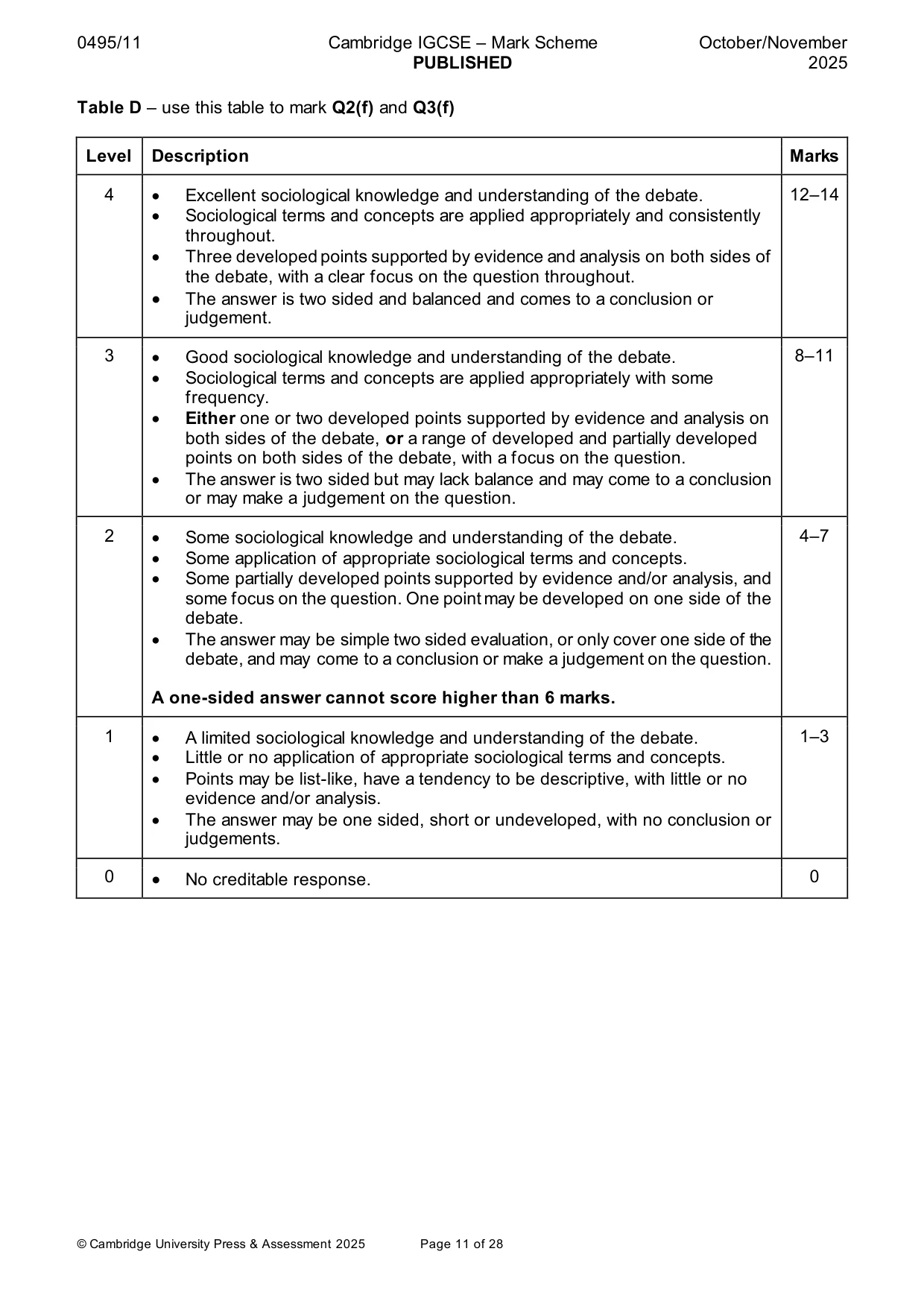
0495/11 Cambridge IGCSE – Mark Scheme PUBLISHED October/November 2025 © Cambridge University Press & Assessment 2025 Page 11 of 28 Table D – use this table to mark Q2(f) and Q3(f) Level Description Marks 4 • Excellent sociological knowledge and understanding of the debate. • Sociological terms and concepts are applied appropriately and consistently throughout. • Three developed points supported by evidence and analysis on both sides of the debate, with a clear focus on the question throughout. • The answer is two sided and balanced and comes to a conclusion or judgement. 12–14 3 • Good sociological knowledge and understanding of the debate. • Sociological terms and concepts are applied appropriately with some frequency. • Either one or two developed points supported by evidence and analysis on both sides of the debate, or a range of developed and partially developed points on both sides of the debate, with a focus on the question. • The answer is two sided but may lack balance and may come to a conclusion or may make a judgement on the question. 8–11 2 • Some sociological knowledge and understanding of the debate. • Some application of appropriate sociological terms and concepts. • Some partially developed points supported by evidence and/or analysis, and some focus on the question. One point may be developed on one side of the debate. • The answer may be simple two sided evaluation, or only cover one side of the debate, and may come to a conclusion or make a judgement on the question. A one-sided answer cannot score higher than 6 marks. 4–7 1 • A limited sociological knowledge and understanding of the debate. • Little or no application of appropriate sociological terms and concepts. • Points may be list-like, have a tendency to be descriptive, with little or no evidence and/or analysis. • The answer may be one sided, short or undeveloped, with no conclusion or judgements. 1–3 0 • No creditable response. 0
Mark scheme, page 12
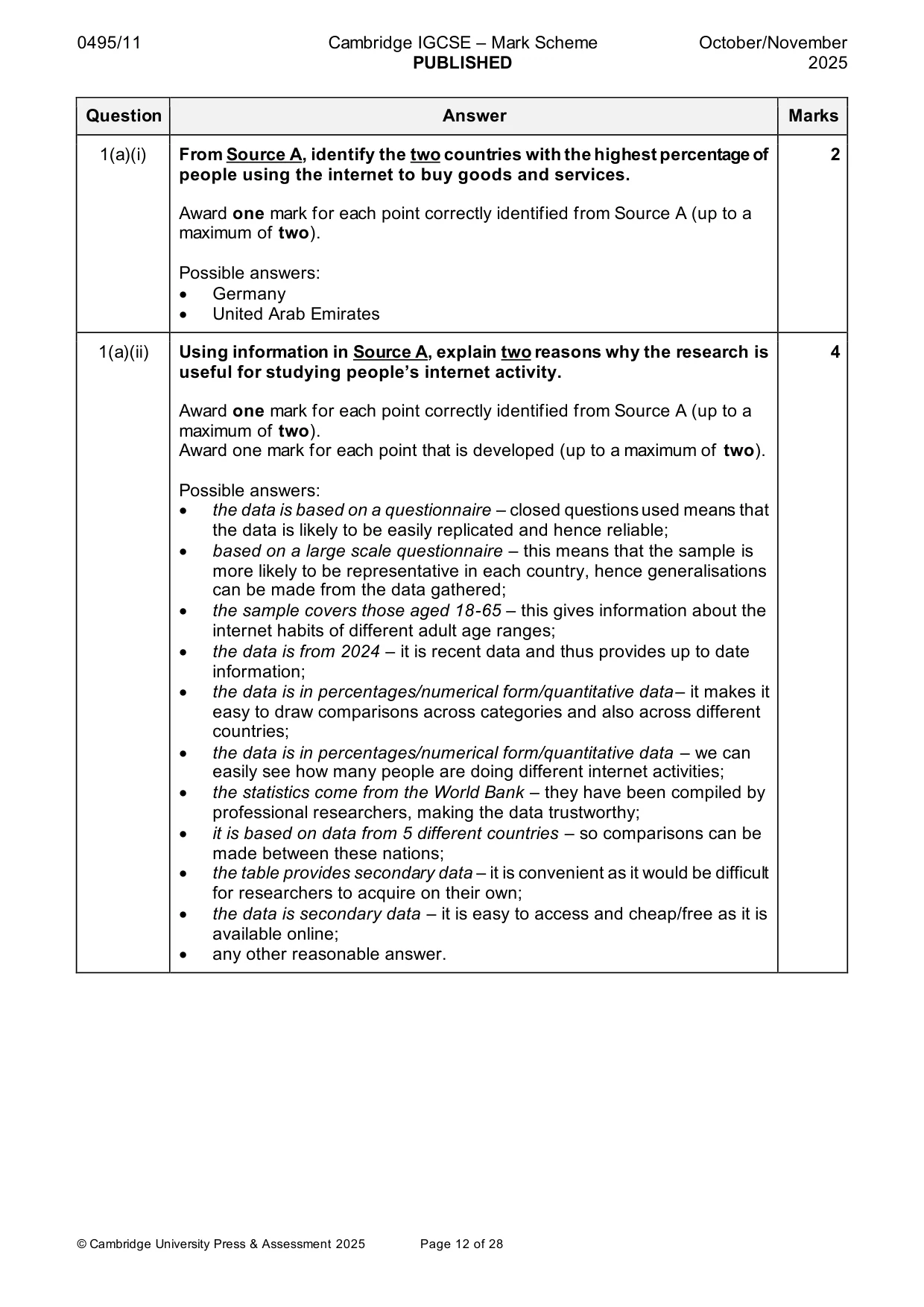
0495/11 Cambridge IGCSE – Mark Scheme PUBLISHED October/November 2025 © Cambridge University Press & Assessment 2025 Page 12 of 28 Question Answer Marks 1(a)(i) From Source A, identify the two countries with the highest percentage of people using the internet to buy goods and services. Award one mark for each point correctly identified from Source A (up to a maximum of two). Possible answers: • Germany • United Arab Emirates 2 1(a)(ii) Using information in Source A, explain two reasons why the research is useful for studying people’s internet activity. Award one mark for each point correctly identified from Source A (up to a maximum of two). Award one mark for each point that is developed (up to a maximum of two). Possible answers: • the data is based on a questionnaire – closed questions used means that the data is likely to be easily replicated and hence reliable; • based on a large scale questionnaire – this means that the sample is more likely to be representative in each country, hence generalisations can be made from the data gathered; • the sample covers those aged 18-65 – this gives information about the internet habits of different adult age ranges; • the data is from 2024 – it is recent data and thus provides up to date information; • the data is in percentages/numerical form/quantitative data– it makes it easy to draw comparisons across categories and also across different countries; • the data is in percentages/numerical form/quantitative data – we can easily see how many people are doing different internet activities; • the statistics come from the World Bank – they have been compiled by professional researchers, making the data trustworthy; • it is based on data from 5 different countries – so comparisons can be made between these nations; • the table provides secondary data – it is convenient as it would be difficult for researchers to acquire on their own; • the data is secondary data – it is easy to access and cheap/free as it is available online; • any other reasonable answer. 4
Mark scheme, page 13
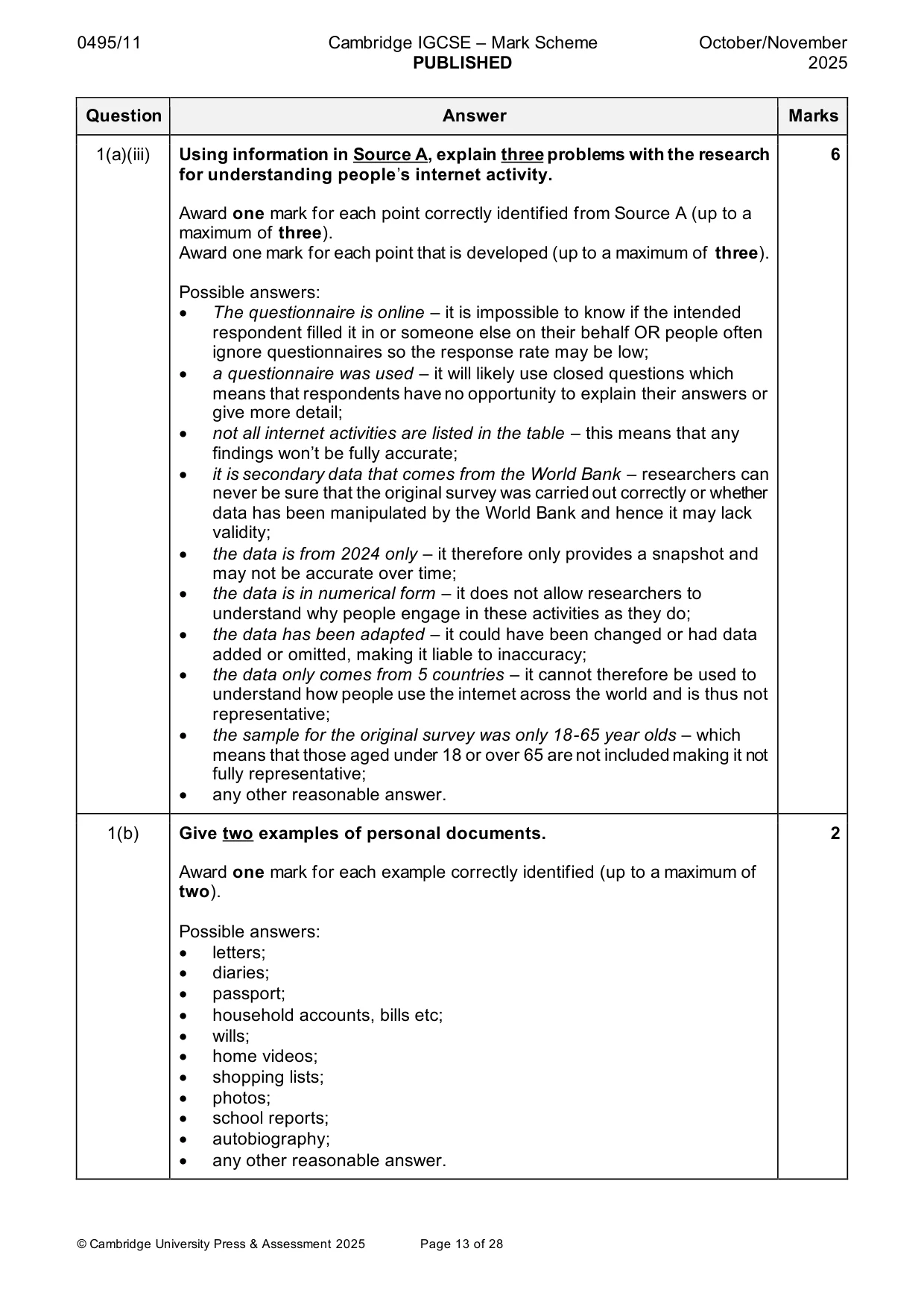
0495/11 Cambridge IGCSE – Mark Scheme PUBLISHED October/November 2025 © Cambridge University Press & Assessment 2025 Page 13 of 28 Question Answer Marks 1(a)(iii) Using information in Source A, explain three problems with the research for understanding people’s internet activity. Award one mark for each point correctly identified from Source A (up to a maximum of three). Award one mark for each point that is developed (up to a maximum of three). Possible answers: • The questionnaire is online – it is impossible to know if the intended respondent filled it in or someone else on their behalf OR people often ignore questionnaires so the response rate may be low; • a questionnaire was used – it will likely use closed questions which means that respondents have no opportunity to explain their answers or give more detail; • not all internet activities are listed in the table – this means that any findings won’t be fully accurate; • it is secondary data that comes from the World Bank – researchers can never be sure that the original survey was carried out correctly or whether data has been manipulated by the World Bank and hence it may lack validity; • the data is from 2024 only – it therefore only provides a snapshot and may not be accurate over time; • the data is in numerical form – it does not allow researchers to understand why people engage in these activities as they do; • the data has been adapted – it could have been changed or had data added or omitted, making it liable to inaccuracy; • the data only comes from 5 countries – it cannot therefore be used to understand how people use the internet across the world and is thus not representative; • the sample for the original survey was only 18-65 year olds – which means that those aged under 18 or over 65 are not included making it not fully representative; • any other reasonable answer. 6 1(b) Give two examples of personal documents. Award one mark for each example correctly identified (up to a maximum of two). Possible answers: • letters; • diaries; • passport; • household accounts, bills etc; • wills; • home videos; • shopping lists; • photos; • school reports; • autobiography; • any other reasonable answer. 2
Mark scheme, page 14
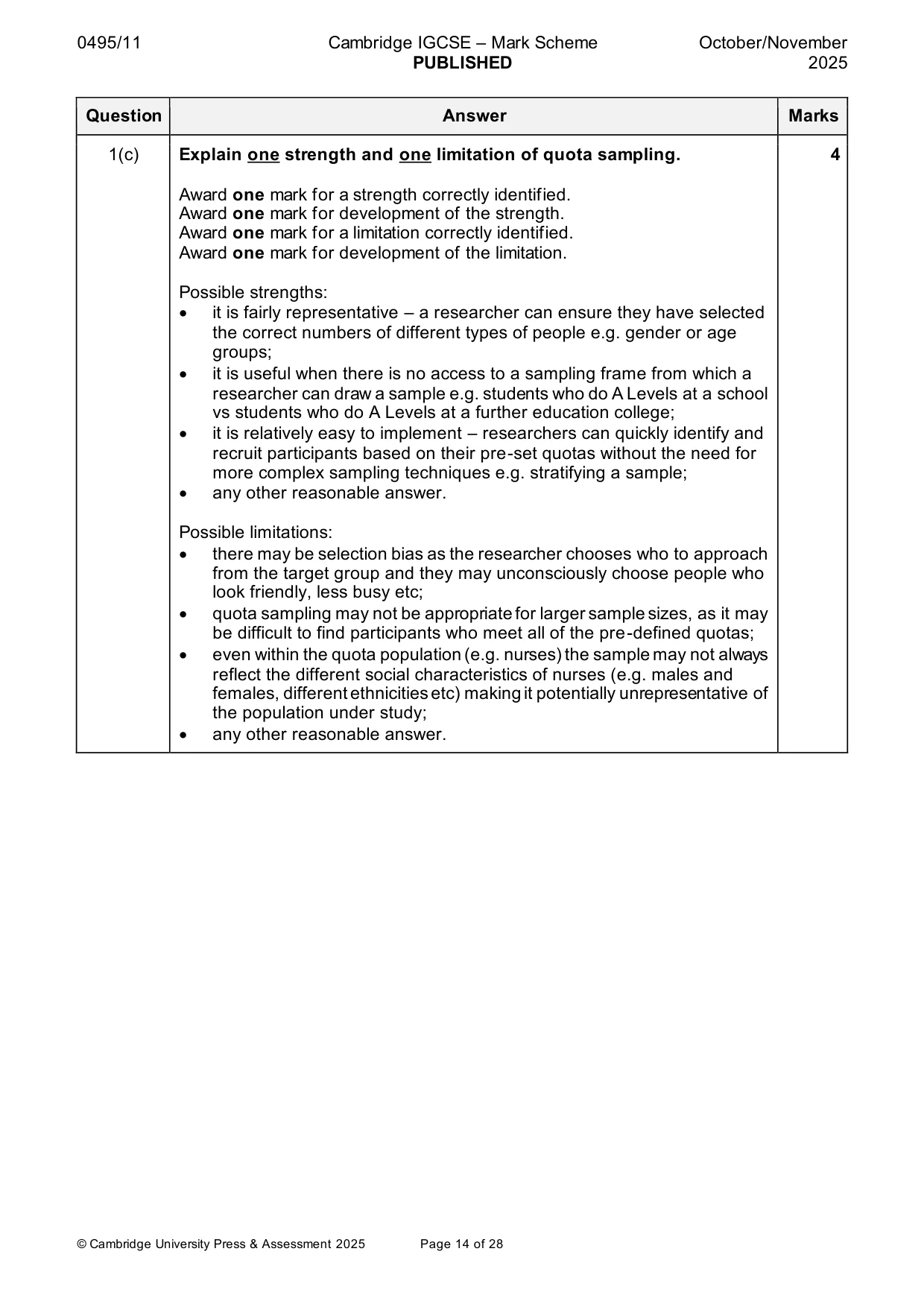
0495/11 Cambridge IGCSE – Mark Scheme PUBLISHED October/November 2025 © Cambridge University Press & Assessment 2025 Page 14 of 28 Question Answer Marks 1(c) Explain one strength and one limitation of quota sampling. Award one mark for a strength correctly identified. Award one mark for development of the strength. Award one mark for a limitation correctly identified. Award one mark for development of the limitation. Possible strengths: • it is fairly representative – a researcher can ensure they have selected the correct numbers of different types of people e.g. gender or age groups; • it is useful when there is no access to a sampling frame from which a researcher can draw a sample e.g. students who do A Levels at a school vs students who do A Levels at a further education college; • it is relatively easy to implement – researchers can quickly identify and recruit participants based on their pre-set quotas without the need for more complex sampling techniques e.g. stratifying a sample; • any other reasonable answer. Possible limitations: • there may be selection bias as the researcher chooses who to approach from the target group and they may unconsciously choose people who look friendly, less busy etc; • quota sampling may not be appropriate for larger sample sizes, as it may be difficult to find participants who meet all of the pre-defined quotas; • even within the quota population (e.g. nurses) the sample may not always reflect the different social characteristics of nurses (e.g. males and females, different ethnicities etc) making it potentially unrepresentative of the population under study; • any other reasonable answer. 4
Mark scheme, page 15
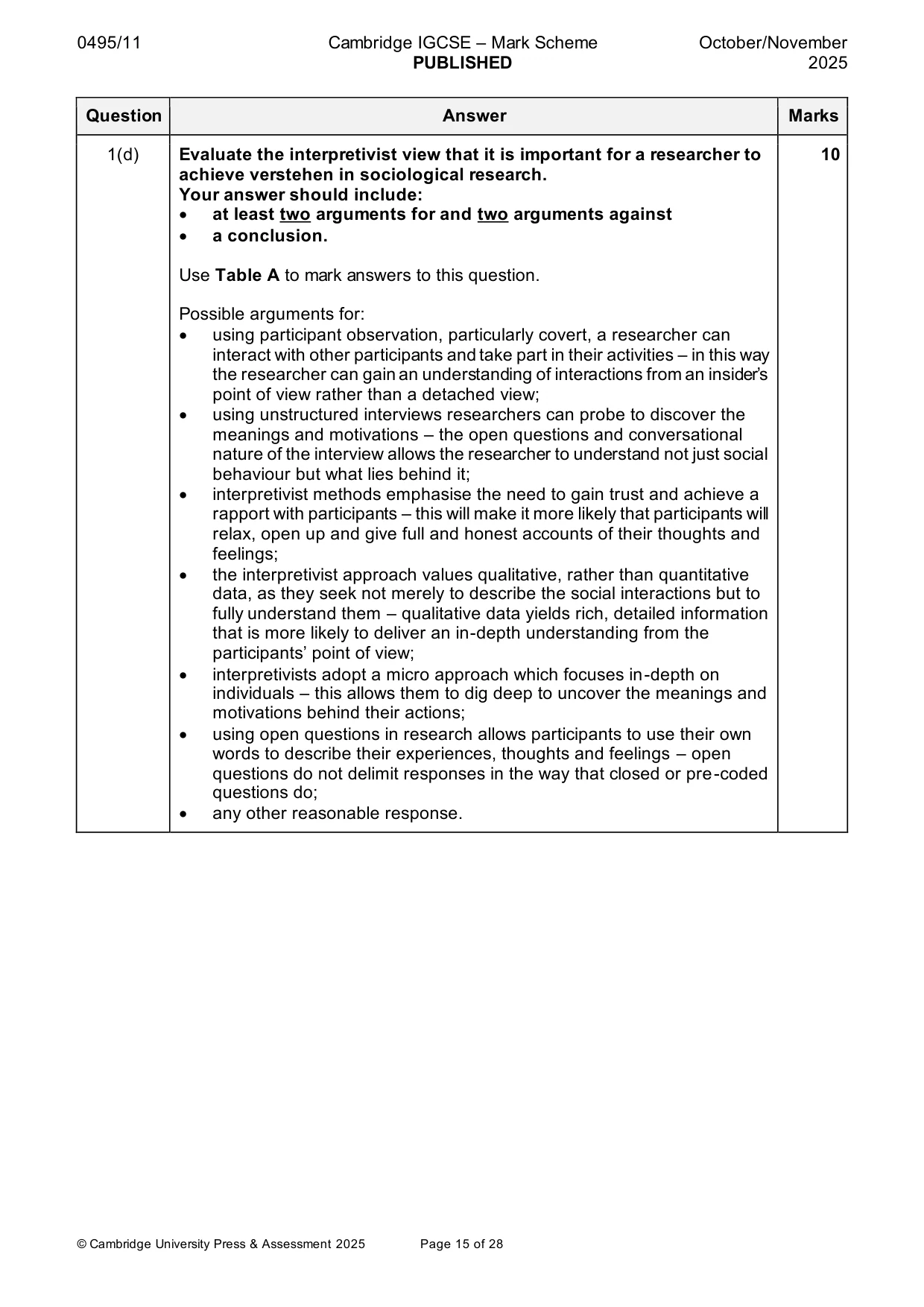
0495/11 Cambridge IGCSE – Mark Scheme PUBLISHED October/November 2025 © Cambridge University Press & Assessment 2025 Page 15 of 28 Question Answer Marks 1(d) Evaluate the interpretivist view that it is important for a researcher to achieve verstehen in sociological research. Your answer should include: • at least two arguments for and two arguments against • a conclusion. Use Table A to mark answers to this question. Possible arguments for: • using participant observation, particularly covert, a researcher can interact with other participants and take part in their activities – in this way the researcher can gain an understanding of interactions from an insider’s point of view rather than a detached view; • using unstructured interviews researchers can probe to discover the meanings and motivations – the open questions and conversational nature of the interview allows the researcher to understand not just social behaviour but what lies behind it; • interpretivist methods emphasise the need to gain trust and achieve a rapport with participants – this will make it more likely that participants will relax, open up and give full and honest accounts of their thoughts and feelings; • the interpretivist approach values qualitative, rather than quantitative data, as they seek not merely to describe the social interactions but to fully understand them – qualitative data yields rich, detailed information that is more likely to deliver an in-depth understanding from the participants’ point of view; • interpretivists adopt a micro approach which focuses in-depth on individuals – this allows them to dig deep to uncover the meanings and motivations behind their actions; • using open questions in research allows participants to use their own words to describe their experiences, thoughts and feelings – open questions do not delimit responses in the way that closed or pre-coded questions do; • any other reasonable response. 10
Mark scheme, page 16
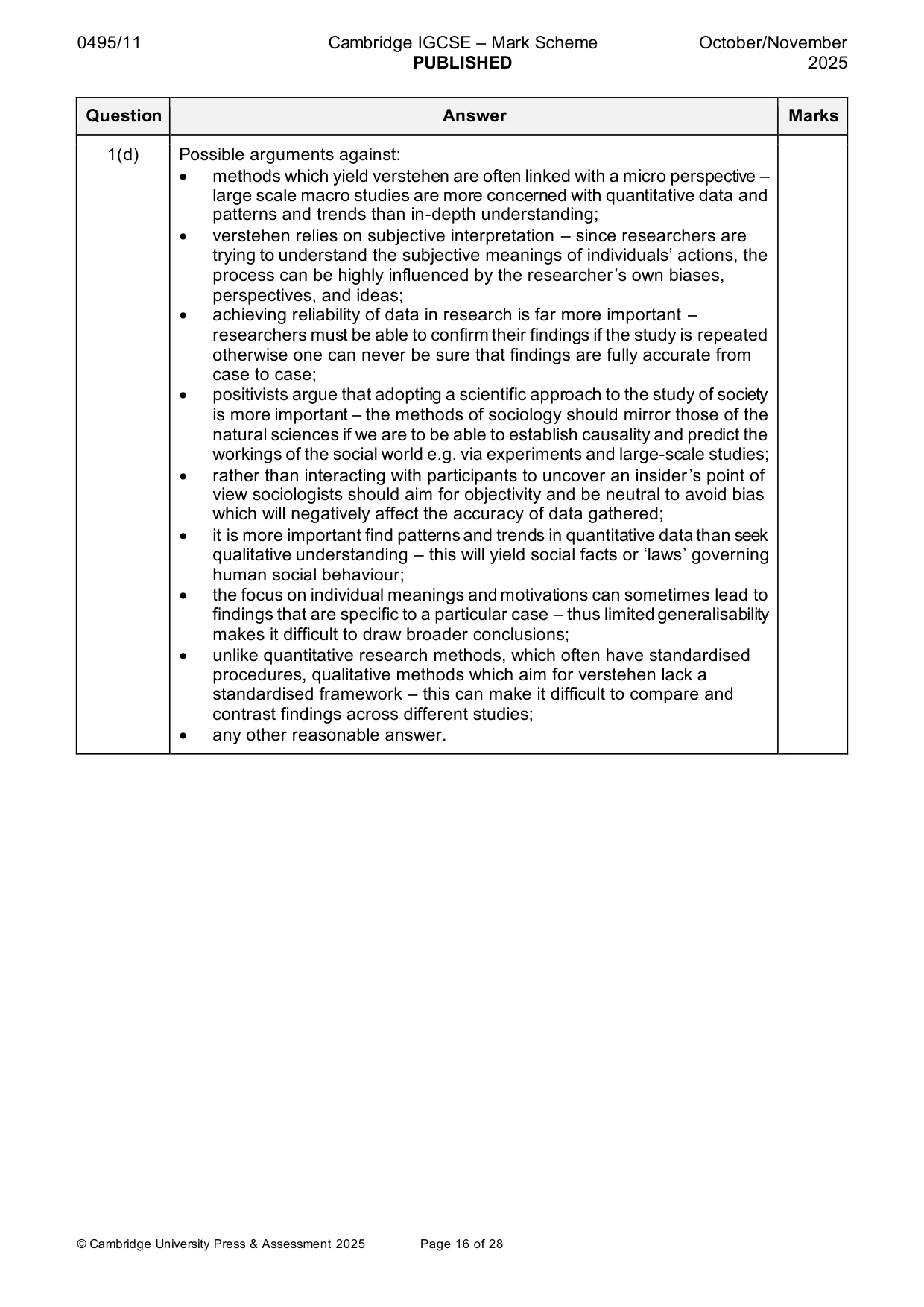
0495/11 Cambridge IGCSE – Mark Scheme PUBLISHED October/November 2025 © Cambridge University Press & Assessment 2025 Page 16 of 28 Question Answer Marks 1(d) Possible arguments against: • methods which yield verstehen are often linked with a micro perspective – large scale macro studies are more concerned with quantitative data and patterns and trends than in-depth understanding; • verstehen relies on subjective interpretation – since researchers are trying to understand the subjective meanings of individuals’ actions, the process can be highly influenced by the researcher’s own biases, perspectives, and ideas; • achieving reliability of data in research is far more important – researchers must be able to confirm their findings if the study is repeated otherwise one can never be sure that findings are fully accurate from case to case; • positivists argue that adopting a scientific approach to the study of society is more important – the methods of sociology should mirror those of the natural sciences if we are to be able to establish causality and predict the workings of the social world e.g. via experiments and large-scale studies; • rather than interacting with participants to uncover an insider’s point of view sociologists should aim for objectivity and be neutral to avoid bias which will negatively affect the accuracy of data gathered; • it is more important find patterns and trends in quantitative data than seek qualitative understanding – this will yield social facts or ‘laws’ governing human social behaviour; • the focus on individual meanings and motivations can sometimes lead to findings that are specific to a particular case – thus limited generalisability makes it difficult to draw broader conclusions; • unlike quantitative research methods, which often have standardised procedures, qualitative methods which aim for verstehen lack a standardised framework – this can make it difficult to compare and contrast findings across different studies; • any other reasonable answer.
Mark scheme, page 17
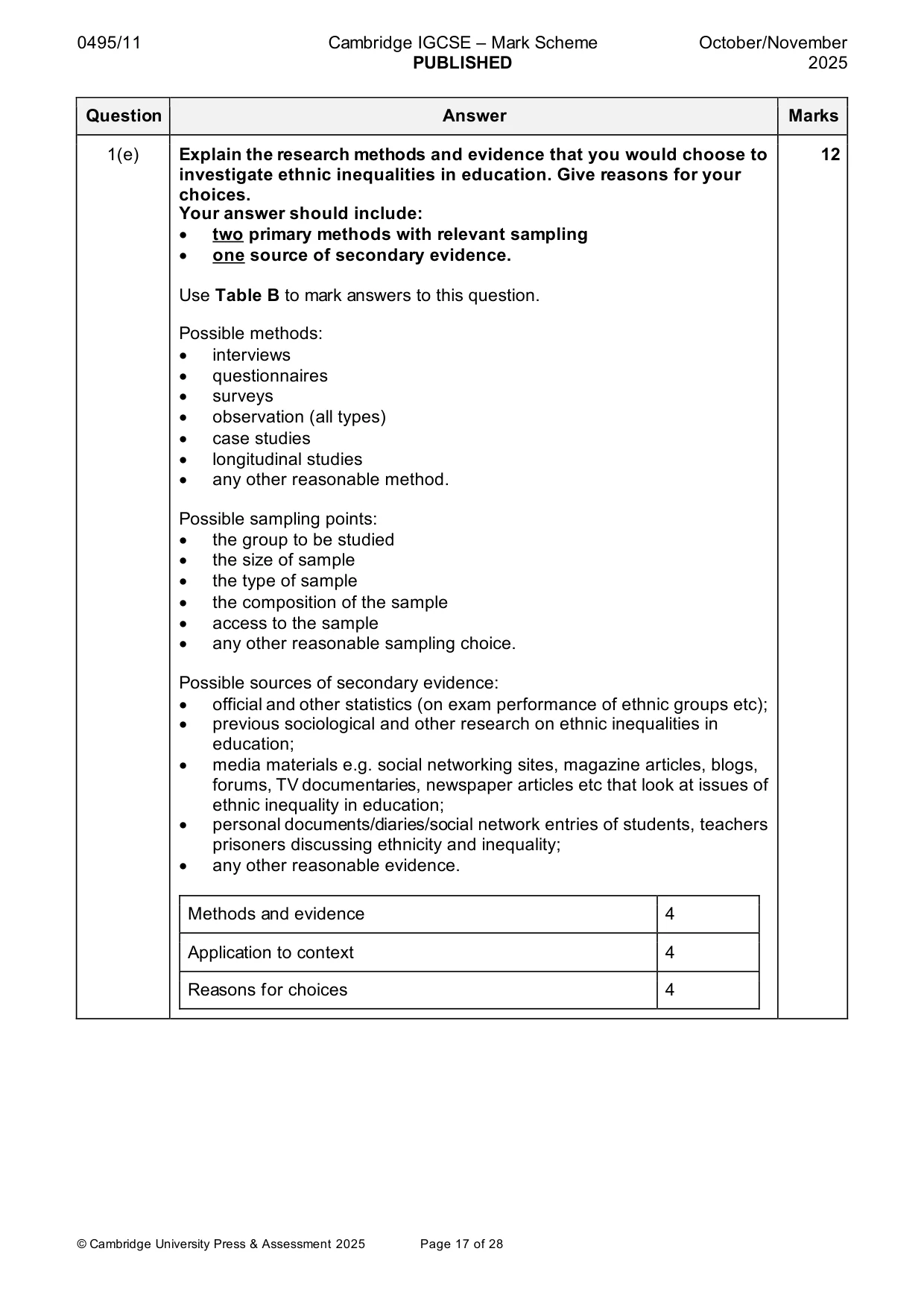
0495/11 Cambridge IGCSE – Mark Scheme PUBLISHED October/November 2025 © Cambridge University Press & Assessment 2025 Page 17 of 28 Question Answer Marks 1(e) Explain the research methods and evidence that you would choose to investigate ethnic inequalities in education. Give reasons for your choices. Your answer should include: • two primary methods with relevant sampling • one source of secondary evidence. Use Table B to mark answers to this question. Possible methods: • interviews • questionnaires • surveys • observation (all types) • case studies • longitudinal studies • any other reasonable method. Possible sampling points: • the group to be studied • the size of sample • the type of sample • the composition of the sample • access to the sample • any other reasonable sampling choice. Possible sources of secondary evidence: • official and other statistics (on exam performance of ethnic groups etc); • previous sociological and other research on ethnic inequalities in education; • media materials e.g. social networking sites, magazine articles, blogs, forums, TV documentaries, newspaper articles etc that look at issues of ethnic inequality in education; • personal documents/diaries/social network entries of students, teachers prisoners discussing ethnicity and inequality; • any other reasonable evidence. Methods and evidence 4 Application to context 4 Reasons for choices 4 12
Mark scheme, page 18
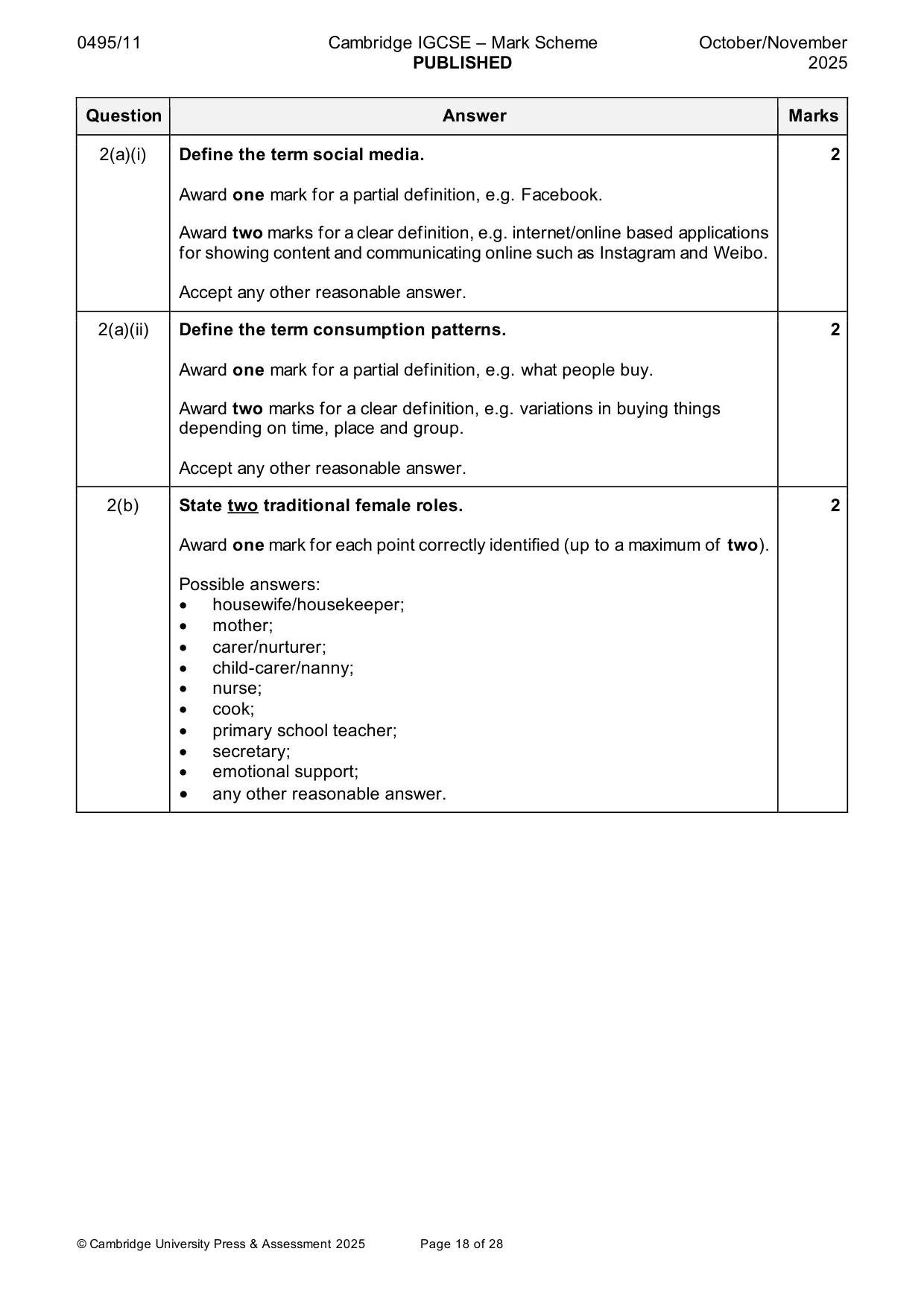
0495/11 Cambridge IGCSE – Mark Scheme PUBLISHED October/November 2025 © Cambridge University Press & Assessment 2025 Page 18 of 28 Question Answer Marks 2(a)(i) Define the term social media. Award one mark for a partial definition, e.g. Facebook. Award two marks for a clear definition, e.g. internet/online based applications for showing content and communicating online such as Instagram and Weibo. Accept any other reasonable answer. 2 2(a)(ii) Define the term consumption patterns. Award one mark for a partial definition, e.g. what people buy. Award two marks for a clear definition, e.g. variations in buying things depending on time, place and group. Accept any other reasonable answer. 2 2(b) State two traditional female roles. Award one mark for each point correctly identified (up to a maximum of two). Possible answers: • housewife/housekeeper; • mother; • carer/nurturer; • child-carer/nanny; • nurse; • cook; • primary school teacher; • secretary; • emotional support; • any other reasonable answer. 2
Mark scheme, page 19
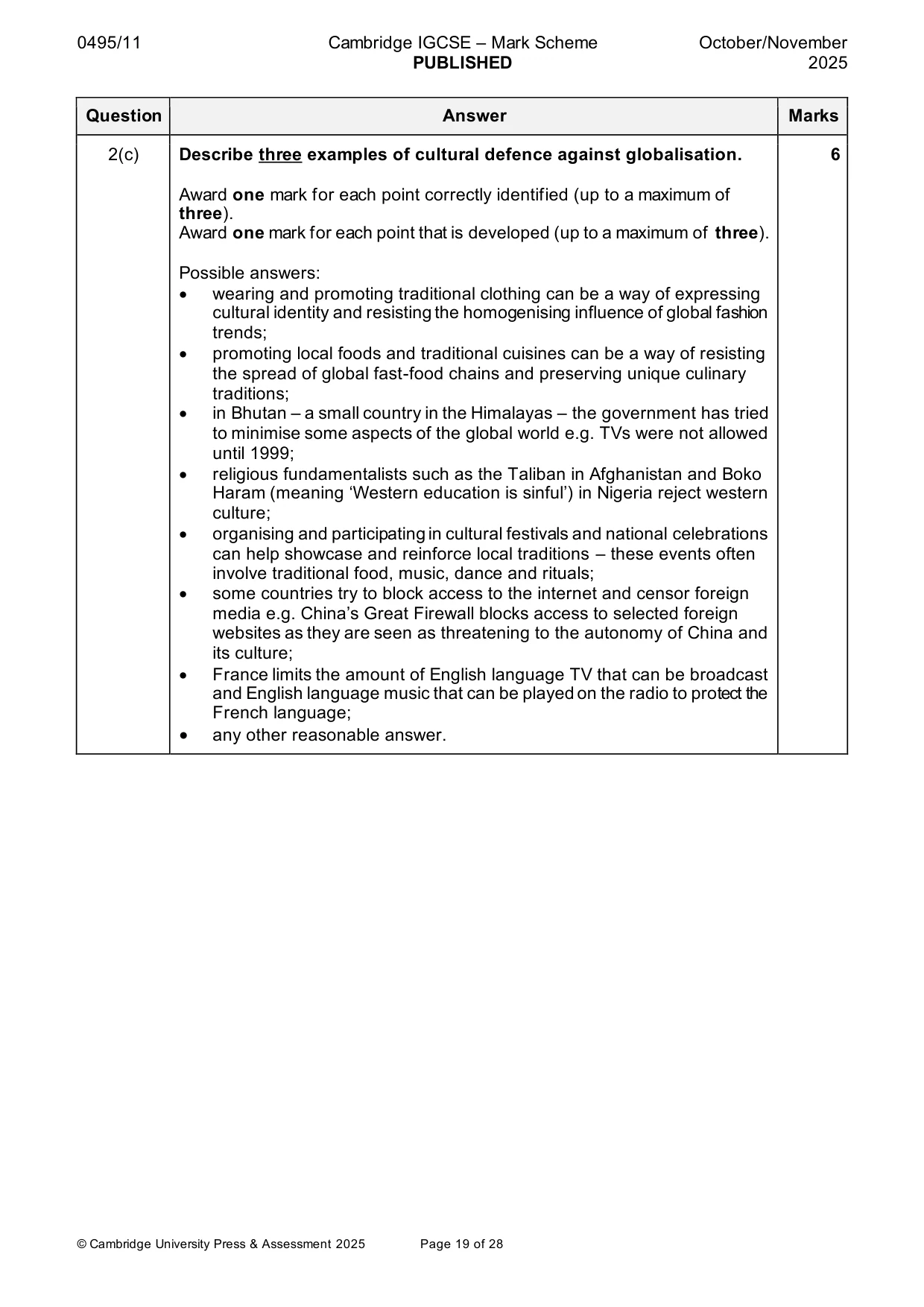
0495/11 Cambridge IGCSE – Mark Scheme PUBLISHED October/November 2025 © Cambridge University Press & Assessment 2025 Page 19 of 28 Question Answer Marks 2(c) Describe three examples of cultural defence against globalisation. Award one mark for each point correctly identified (up to a maximum of three). Award one mark for each point that is developed (up to a maximum of three). Possible answers: • wearing and promoting traditional clothing can be a way of expressing cultural identity and resisting the homogenising influence of global fashion trends; • promoting local foods and traditional cuisines can be a way of resisting the spread of global fast-food chains and preserving unique culinary traditions; • in Bhutan – a small country in the Himalayas – the government has tried to minimise some aspects of the global world e.g. TVs were not allowed until 1999; • religious fundamentalists such as the Taliban in Afghanistan and Boko Haram (meaning ‘Western education is sinful’) in Nigeria reject western culture; • organising and participating in cultural festivals and national celebrations can help showcase and reinforce local traditions – these events often involve traditional food, music, dance and rituals; • some countries try to block access to the internet and censor foreign media e.g. China’s Great Firewall blocks access to selected foreign websites as they are seen as threatening to the autonomy of China and its culture; • France limits the amount of English language TV that can be broadcast and English language music that can be played on the radio to protect the French language; • any other reasonable answer. 6
Mark scheme, page 20
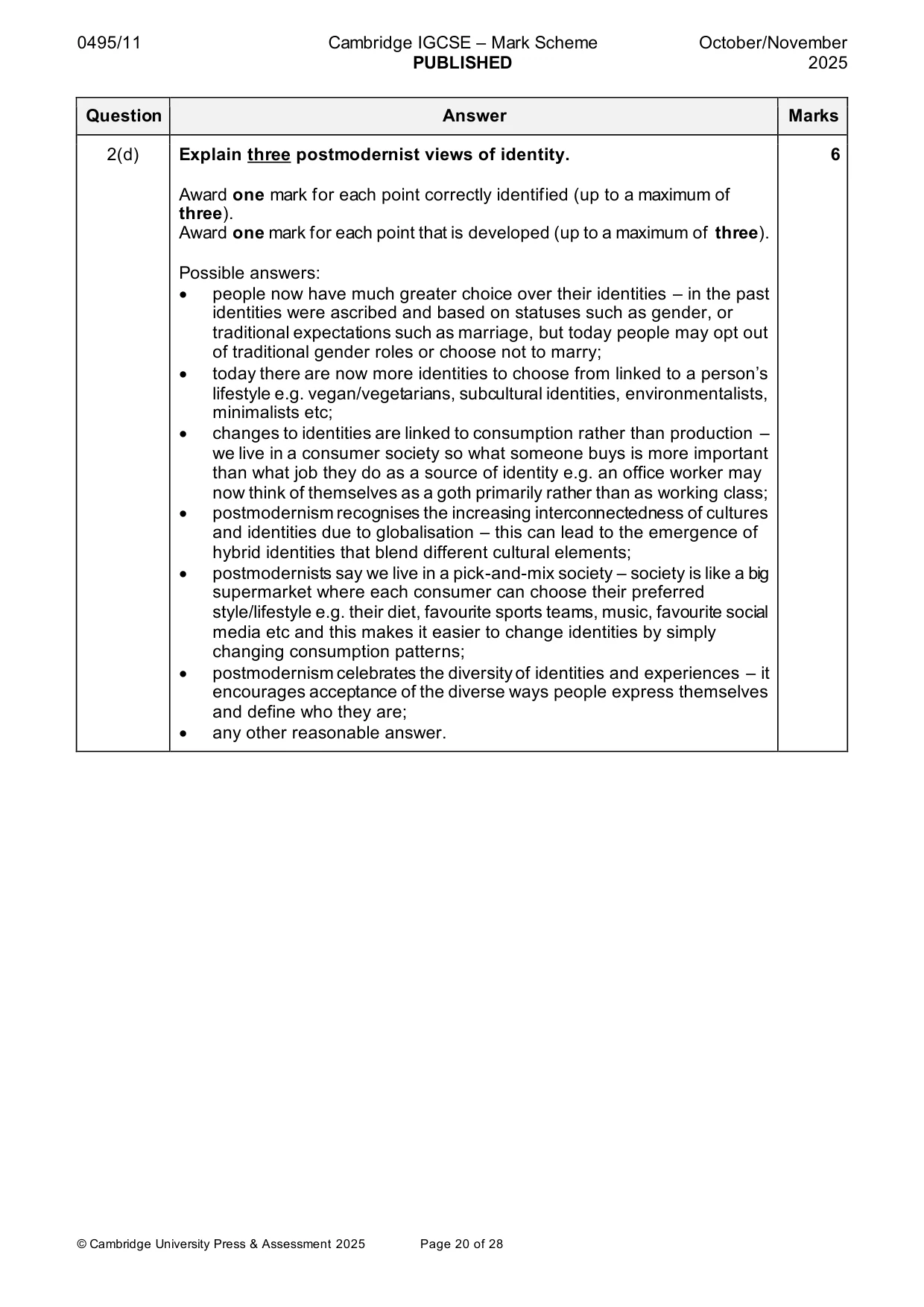
0495/11 Cambridge IGCSE – Mark Scheme PUBLISHED October/November 2025 © Cambridge University Press & Assessment 2025 Page 20 of 28 Question Answer Marks 2(d) Explain three postmodernist views of identity. Award one mark for each point correctly identified (up to a maximum of three). Award one mark for each point that is developed (up to a maximum of three). Possible answers: • people now have much greater choice over their identities – in the past identities were ascribed and based on statuses such as gender, or traditional expectations such as marriage, but today people may opt out of traditional gender roles or choose not to marry; • today there are now more identities to choose from linked to a person’s lifestyle e.g. vegan/vegetarians, subcultural identities, environmentalists, minimalists etc; • changes to identities are linked to consumption rather than production – we live in a consumer society so what someone buys is more important than what job they do as a source of identity e.g. an office worker may now think of themselves as a goth primarily rather than as working class; • postmodernism recognises the increasing interconnectedness of cultures and identities due to globalisation – this can lead to the emergence of hybrid identities that blend different cultural elements; • postmodernists say we live in a pick-and-mix society – society is like a big supermarket where each consumer can choose their preferred style/lifestyle e.g. their diet, favourite sports teams, music, favourite social media etc and this makes it easier to change identities by simply changing consumption patterns; • postmodernism celebrates the diversity of identities and experiences – it encourages acceptance of the diverse ways people express themselves and define who they are; • any other reasonable answer. 6
Mark scheme, page 21
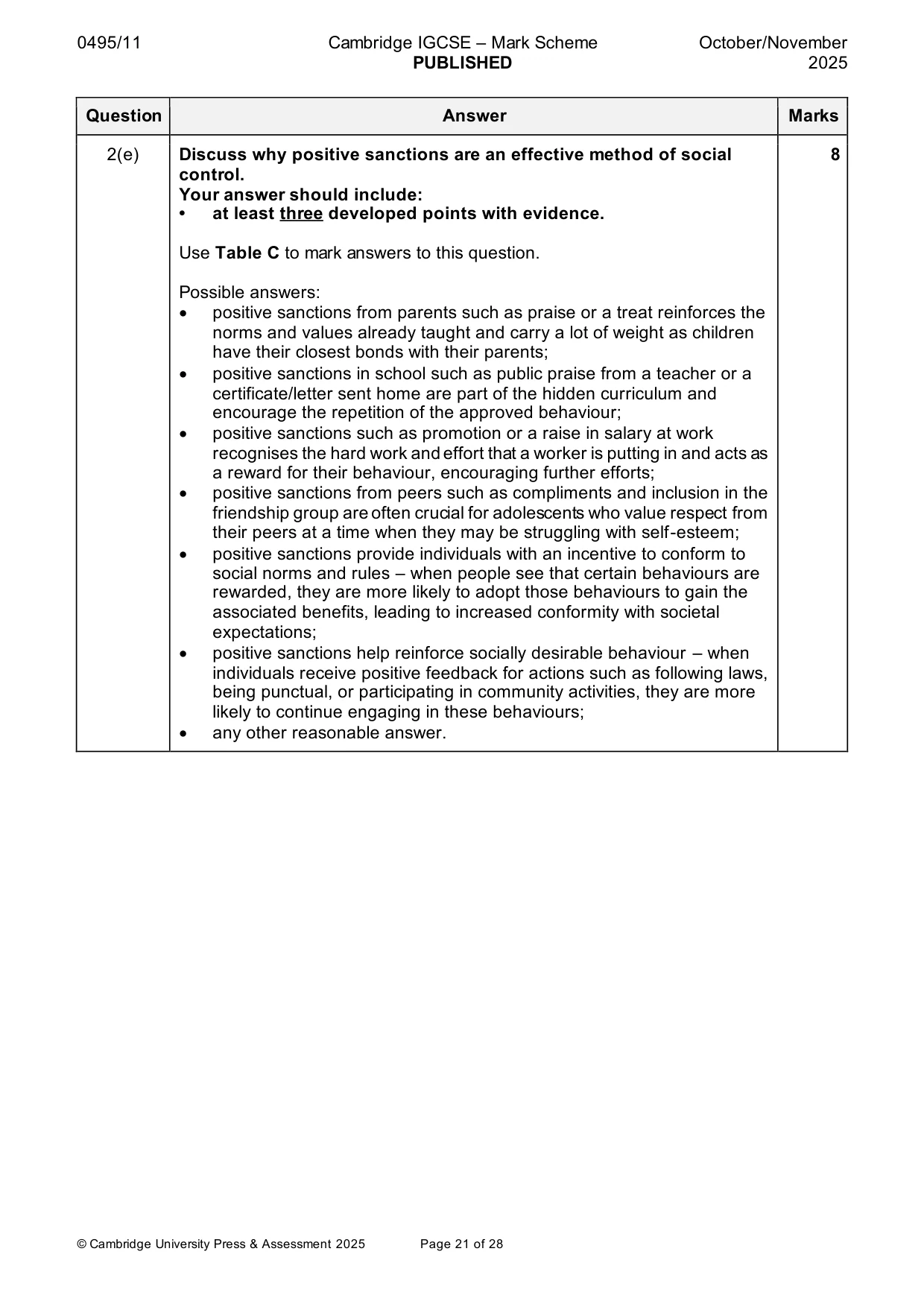
0495/11 Cambridge IGCSE – Mark Scheme PUBLISHED October/November 2025 © Cambridge University Press & Assessment 2025 Page 21 of 28 Question Answer Marks 2(e) Discuss why positive sanctions are an effective method of social control. Your answer should include: • at least three developed points with evidence. Use Table C to mark answers to this question. Possible answers: • positive sanctions from parents such as praise or a treat reinforces the norms and values already taught and carry a lot of weight as children have their closest bonds with their parents; • positive sanctions in school such as public praise from a teacher or a certificate/letter sent home are part of the hidden curriculum and encourage the repetition of the approved behaviour; • positive sanctions such as promotion or a raise in salary at work recognises the hard work and effort that a worker is putting in and acts as a reward for their behaviour, encouraging further efforts; • positive sanctions from peers such as compliments and inclusion in the friendship group are often crucial for adolescents who value respect from their peers at a time when they may be struggling with self-esteem; • positive sanctions provide individuals with an incentive to conform to social norms and rules – when people see that certain behaviours are rewarded, they are more likely to adopt those behaviours to gain the associated benefits, leading to increased conformity with societal expectations; • positive sanctions help reinforce socially desirable behaviour – when individuals receive positive feedback for actions such as following laws, being punctual, or participating in community activities, they are more likely to continue engaging in these behaviours; • any other reasonable answer. 8
Mark scheme, page 22
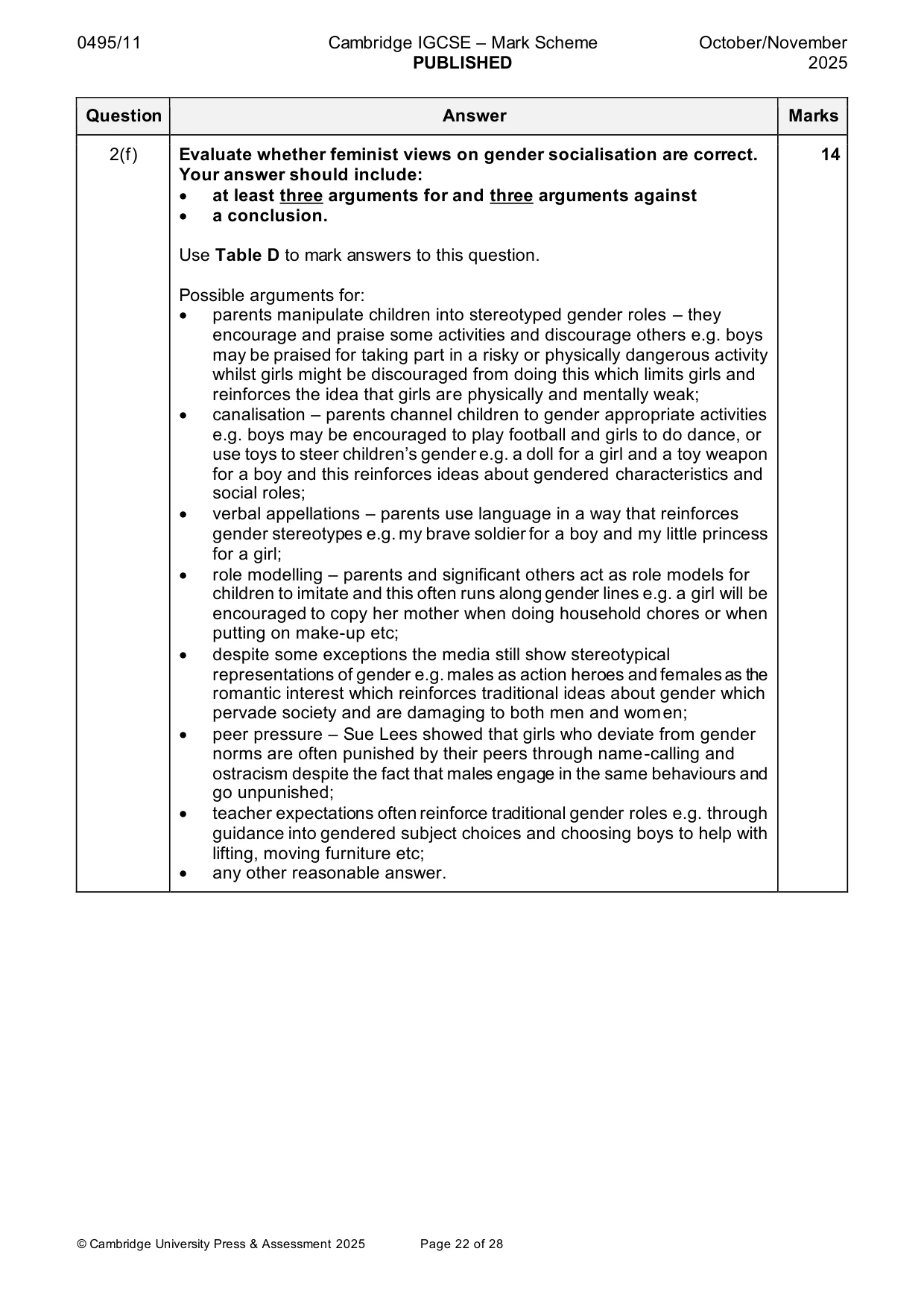
0495/11 Cambridge IGCSE – Mark Scheme PUBLISHED October/November 2025 © Cambridge University Press & Assessment 2025 Page 22 of 28 Question Answer Marks 2(f) Evaluate whether feminist views on gender socialisation are correct. Your answer should include: • at least three arguments for and three arguments against • a conclusion. Use Table D to mark answers to this question. Possible arguments for: • parents manipulate children into stereotyped gender roles – they encourage and praise some activities and discourage others e.g. boys may be praised for taking part in a risky or physically dangerous activity whilst girls might be discouraged from doing this which limits girls and reinforces the idea that girls are physically and mentally weak; • canalisation – parents channel children to gender appropriate activities e.g. boys may be encouraged to play football and girls to do dance, or use toys to steer children’s gender e.g. a doll for a girl and a toy weapon for a boy and this reinforces ideas about gendered characteristics and social roles; • verbal appellations – parents use language in a way that reinforces gender stereotypes e.g. my brave soldier for a boy and my little princess for a girl; • role modelling – parents and significant others act as role models for children to imitate and this often runs along gender lines e.g. a girl will be encouraged to copy her mother when doing household chores or when putting on make-up etc; • despite some exceptions the media still show stereotypical representations of gender e.g. males as action heroes and females as the romantic interest which reinforces traditional ideas about gender which pervade society and are damaging to both men and women; • peer pressure – Sue Lees showed that girls who deviate from gender norms are often punished by their peers through name-calling and ostracism despite the fact that males engage in the same behaviours and go unpunished; • teacher expectations often reinforce traditional gender roles e.g. through guidance into gendered subject choices and choosing boys to help with lifting, moving furniture etc; • any other reasonable answer. 14
Mark scheme, page 23
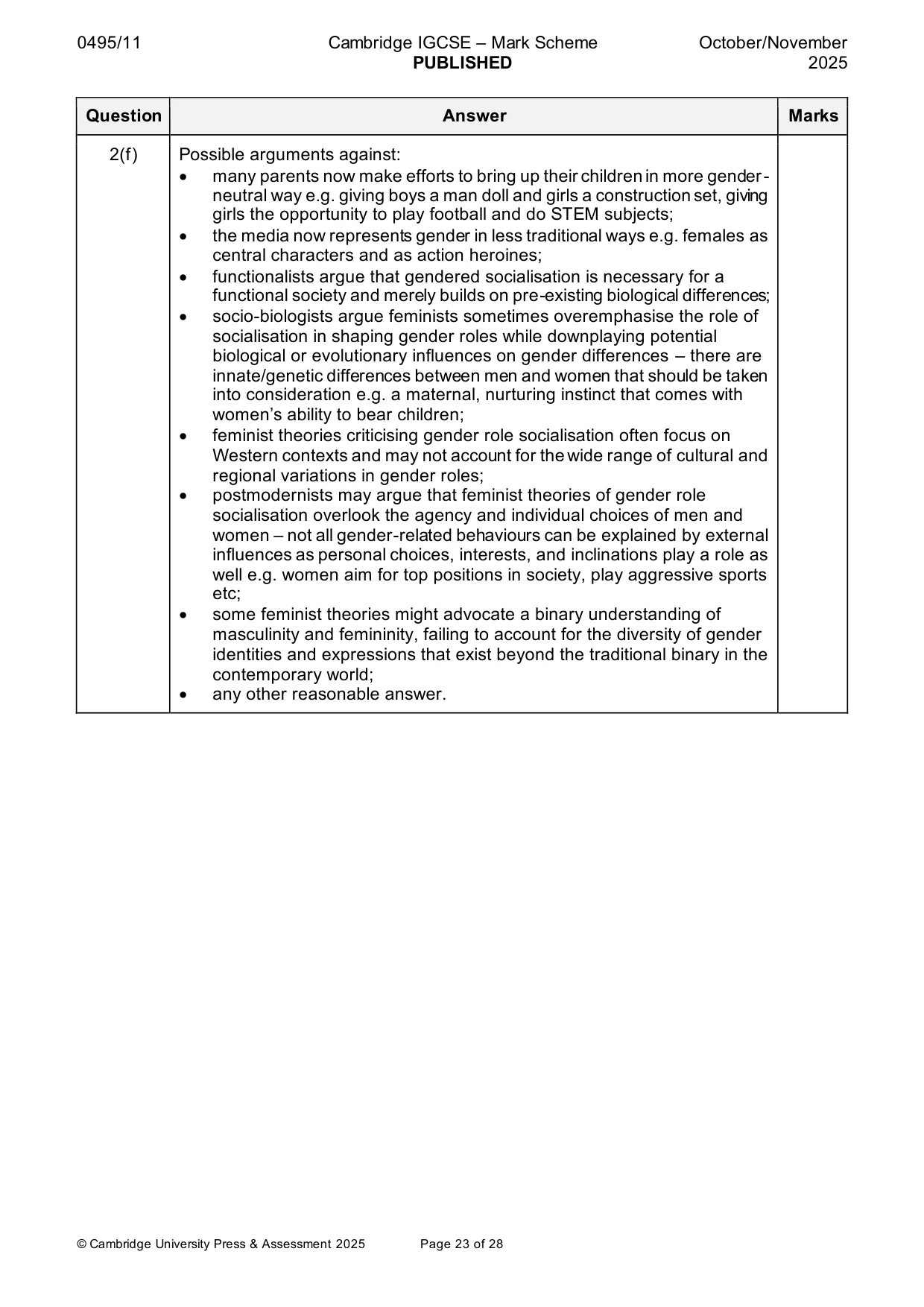
0495/11 Cambridge IGCSE – Mark Scheme PUBLISHED October/November 2025 © Cambridge University Press & Assessment 2025 Page 23 of 28 Question Answer Marks 2(f) Possible arguments against: • many parents now make efforts to bring up their children in more gender- neutral way e.g. giving boys a man doll and girls a construction set, giving girls the opportunity to play football and do STEM subjects; • the media now represents gender in less traditional ways e.g. females as central characters and as action heroines; • functionalists argue that gendered socialisation is necessary for a functional society and merely builds on pre-existing biological differences; • socio-biologists argue feminists sometimes overemphasise the role of socialisation in shaping gender roles while downplaying potential biological or evolutionary influences on gender differences – there are innate/genetic differences between men and women that should be taken into consideration e.g. a maternal, nurturing instinct that comes with women’s ability to bear children; • feminist theories criticising gender role socialisation often focus on Western contexts and may not account for the wide range of cultural and regional variations in gender roles; • postmodernists may argue that feminist theories of gender role socialisation overlook the agency and individual choices of men and women – not all gender-related behaviours can be explained by external influences as personal choices, interests, and inclinations play a role as well e.g. women aim for top positions in society, play aggressive sports etc; • some feminist theories might advocate a binary understanding of masculinity and femininity, failing to account for the diversity of gender identities and expressions that exist beyond the traditional binary in the contemporary world; • any other reasonable answer.
Mark scheme, page 24
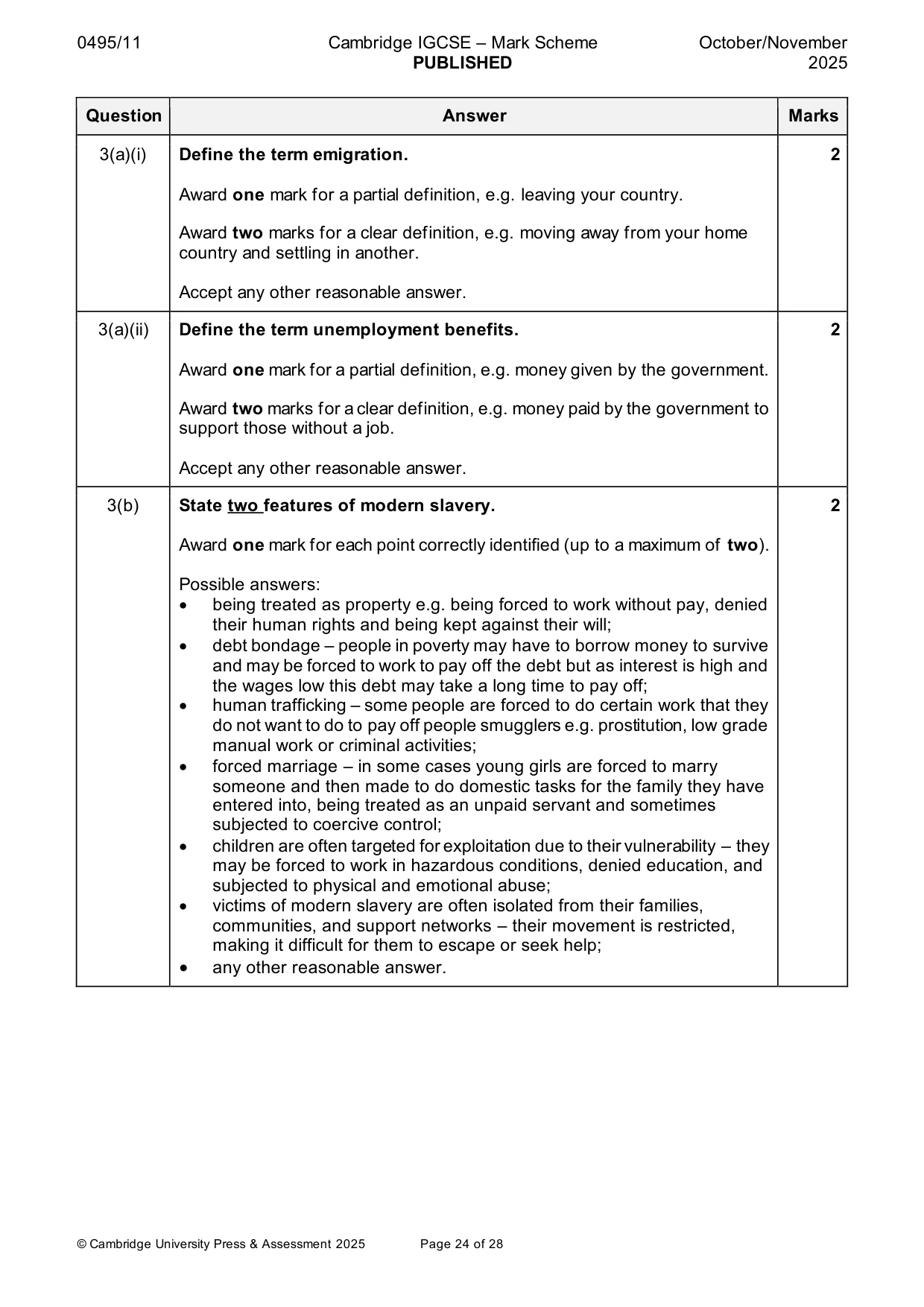
0495/11 Cambridge IGCSE – Mark Scheme PUBLISHED October/November 2025 © Cambridge University Press & Assessment 2025 Page 24 of 28 Question Answer Marks 3(a)(i) Define the term emigration. Award one mark for a partial definition, e.g. leaving your country. Award two marks for a clear definition, e.g. moving away from your home country and settling in another. Accept any other reasonable answer. 2 3(a)(ii) Define the term unemployment benefits. Award one mark for a partial definition, e.g. money given by the government. Award two marks for a clear definition, e.g. money paid by the government to support those without a job. Accept any other reasonable answer. 2 3(b) State two features of modern slavery. Award one mark for each point correctly identified (up to a maximum of two). Possible answers: • being treated as property e.g. being forced to work without pay, denied their human rights and being kept against their will; • debt bondage – people in poverty may have to borrow money to survive and may be forced to work to pay off the debt but as interest is high and the wages low this debt may take a long time to pay off; • human trafficking – some people are forced to do certain work that they do not want to do to pay off people smugglers e.g. prostitution, low grade manual work or criminal activities; • forced marriage – in some cases young girls are forced to marry someone and then made to do domestic tasks for the family they have entered into, being treated as an unpaid servant and sometimes subjected to coercive control; • children are often targeted for exploitation due to their vulnerability – they may be forced to work in hazardous conditions, denied education, and subjected to physical and emotional abuse; • victims of modern slavery are often isolated from their families, communities, and support networks – their movement is restricted, making it difficult for them to escape or seek help; • any other reasonable answer. 2
Mark scheme, page 25
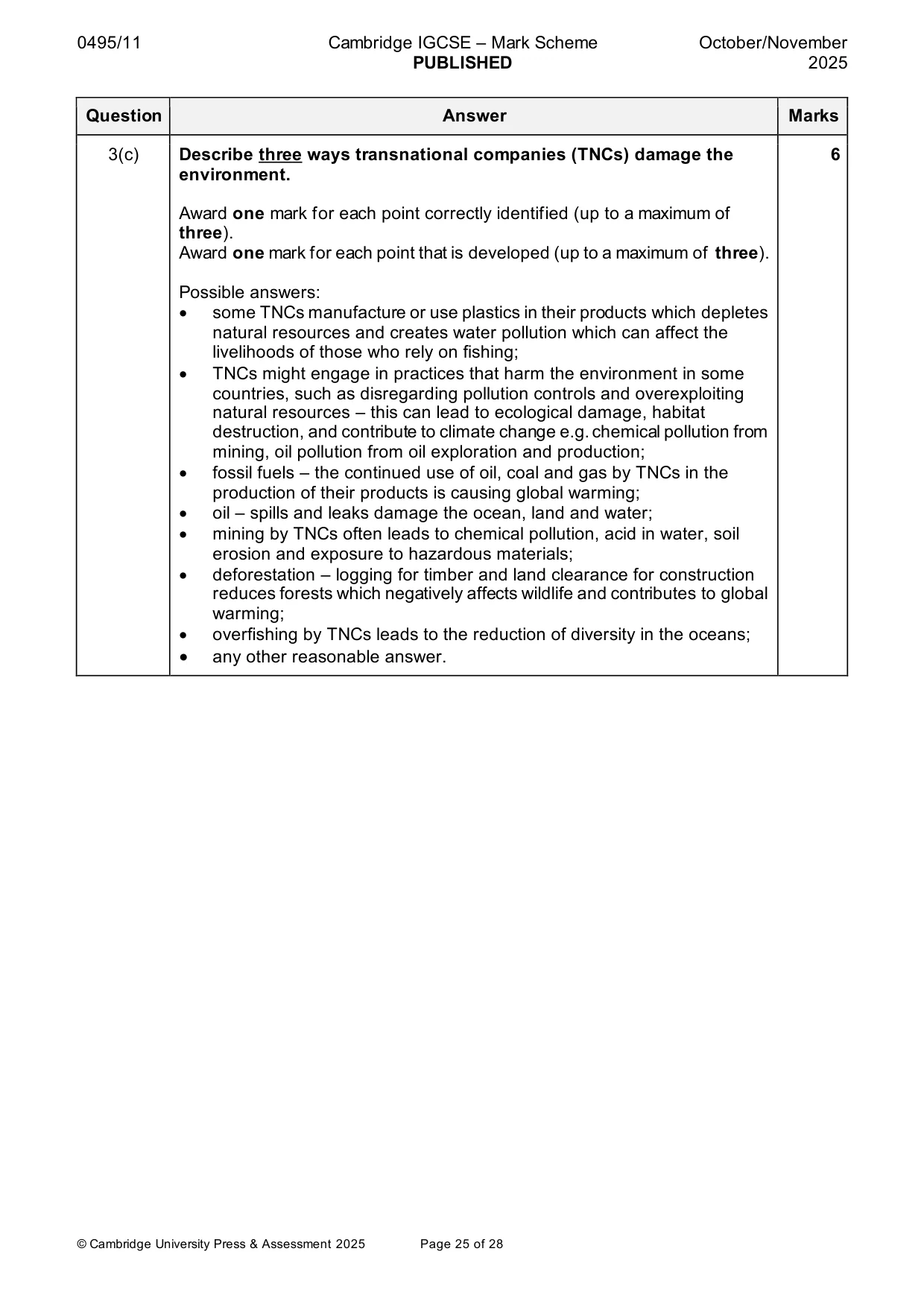
0495/11 Cambridge IGCSE – Mark Scheme PUBLISHED October/November 2025 © Cambridge University Press & Assessment 2025 Page 25 of 28 Question Answer Marks 3(c) Describe three ways transnational companies (TNCs) damage the environment. Award one mark for each point correctly identified (up to a maximum of three). Award one mark for each point that is developed (up to a maximum of three). Possible answers: • some TNCs manufacture or use plastics in their products which depletes natural resources and creates water pollution which can affect the livelihoods of those who rely on fishing; • TNCs might engage in practices that harm the environment in some countries, such as disregarding pollution controls and overexploiting natural resources – this can lead to ecological damage, habitat destruction, and contribute to climate change e.g. chemical pollution from mining, oil pollution from oil exploration and production; • fossil fuels – the continued use of oil, coal and gas by TNCs in the production of their products is causing global warming; • oil – spills and leaks damage the ocean, land and water; • mining by TNCs often leads to chemical pollution, acid in water, soil erosion and exposure to hazardous materials; • deforestation – logging for timber and land clearance for construction reduces forests which negatively affects wildlife and contributes to global warming; • overfishing by TNCs leads to the reduction of diversity in the oceans; • any other reasonable answer. 6
Mark scheme, page 26
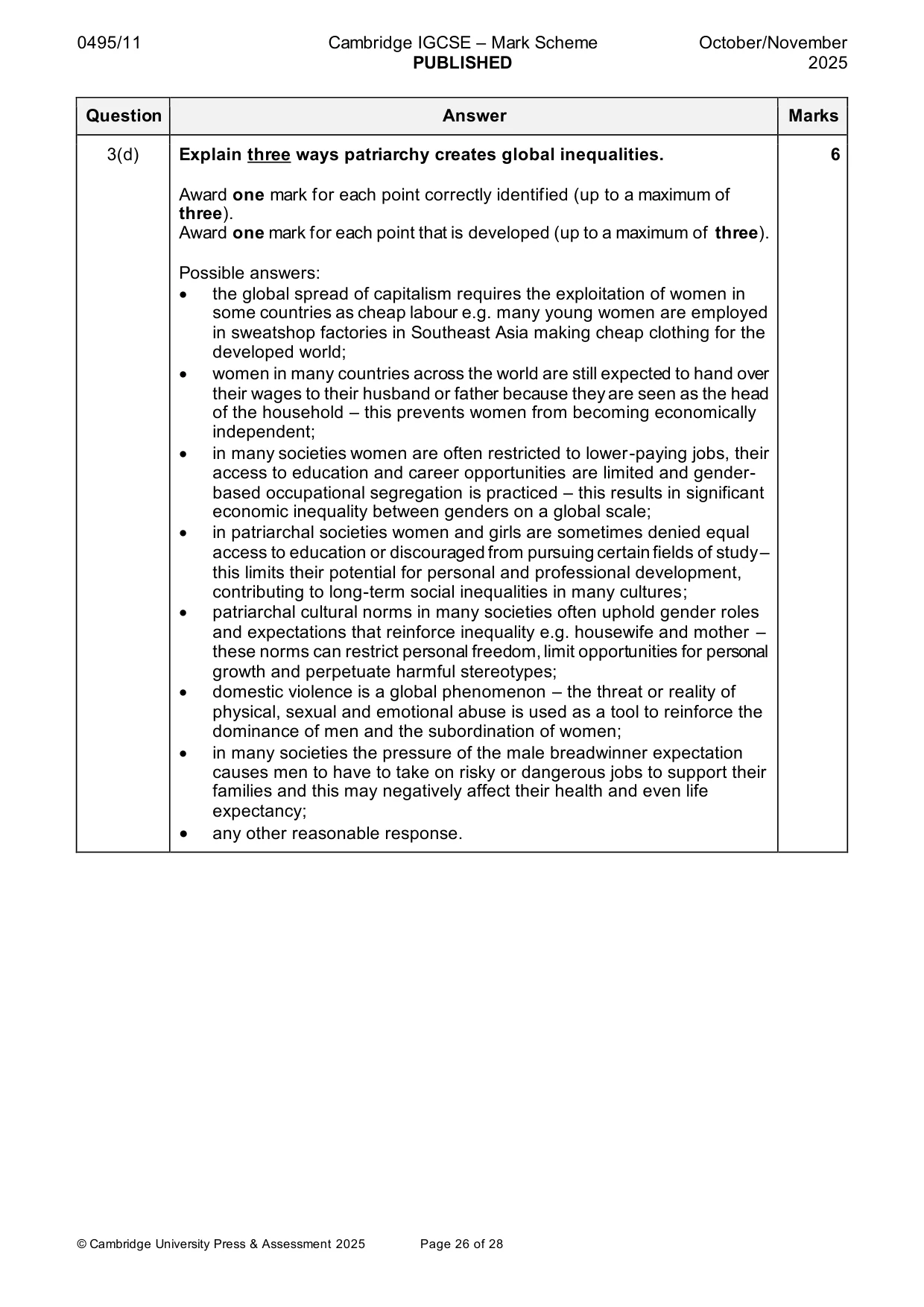
0495/11 Cambridge IGCSE – Mark Scheme PUBLISHED October/November 2025 © Cambridge University Press & Assessment 2025 Page 26 of 28 Question Answer Marks 3(d) Explain three ways patriarchy creates global inequalities. Award one mark for each point correctly identified (up to a maximum of three). Award one mark for each point that is developed (up to a maximum of three). Possible answers: • the global spread of capitalism requires the exploitation of women in some countries as cheap labour e.g. many young women are employed in sweatshop factories in Southeast Asia making cheap clothing for the developed world; • women in many countries across the world are still expected to hand over their wages to their husband or father because they are seen as the head of the household – this prevents women from becoming economically independent; • in many societies women are often restricted to lower-paying jobs, their access to education and career opportunities are limited and gender- based occupational segregation is practiced – this results in significant economic inequality between genders on a global scale; • in patriarchal societies women and girls are sometimes denied equal access to education or discouraged from pursuing certain fields of study– this limits their potential for personal and professional development, contributing to long-term social inequalities in many cultures; • patriarchal cultural norms in many societies often uphold gender roles and expectations that reinforce inequality e.g. housewife and mother – these norms can restrict personal freedom, limit opportunities for personal growth and perpetuate harmful stereotypes; • domestic violence is a global phenomenon – the threat or reality of physical, sexual and emotional abuse is used as a tool to reinforce the dominance of men and the subordination of women; • in many societies the pressure of the male breadwinner expectation causes men to have to take on risky or dangerous jobs to support their families and this may negatively affect their health and even life expectancy; • any other reasonable response. 6
Mark scheme, page 27
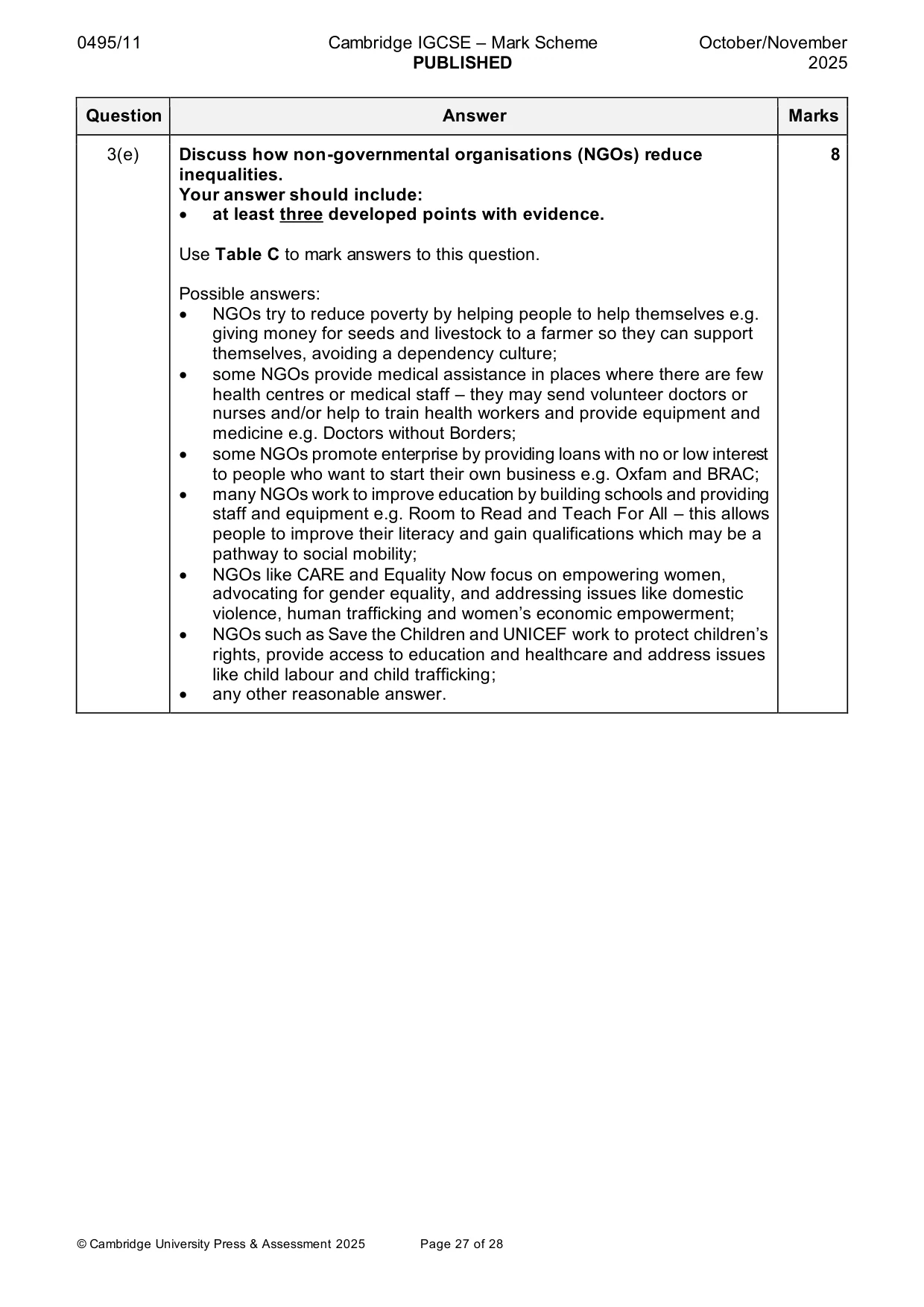
0495/11 Cambridge IGCSE – Mark Scheme PUBLISHED October/November 2025 © Cambridge University Press & Assessment 2025 Page 27 of 28 Question Answer Marks 3(e) Discuss how non-governmental organisations (NGOs) reduce inequalities. Your answer should include: • at least three developed points with evidence. Use Table C to mark answers to this question. Possible answers: • NGOs try to reduce poverty by helping people to help themselves e.g. giving money for seeds and livestock to a farmer so they can support themselves, avoiding a dependency culture; • some NGOs provide medical assistance in places where there are few health centres or medical staff – they may send volunteer doctors or nurses and/or help to train health workers and provide equipment and medicine e.g. Doctors without Borders; • some NGOs promote enterprise by providing loans with no or low interest to people who want to start their own business e.g. Oxfam and BRAC; • many NGOs work to improve education by building schools and providing staff and equipment e.g. Room to Read and Teach For All – this allows people to improve their literacy and gain qualifications which may be a pathway to social mobility; • NGOs like CARE and Equality Now focus on empowering women, advocating for gender equality, and addressing issues like domestic violence, human trafficking and women’s economic empowerment; • NGOs such as Save the Children and UNICEF work to protect children’s rights, provide access to education and healthcare and address issues like child labour and child trafficking; • any other reasonable answer. 8
Mark scheme, page 28
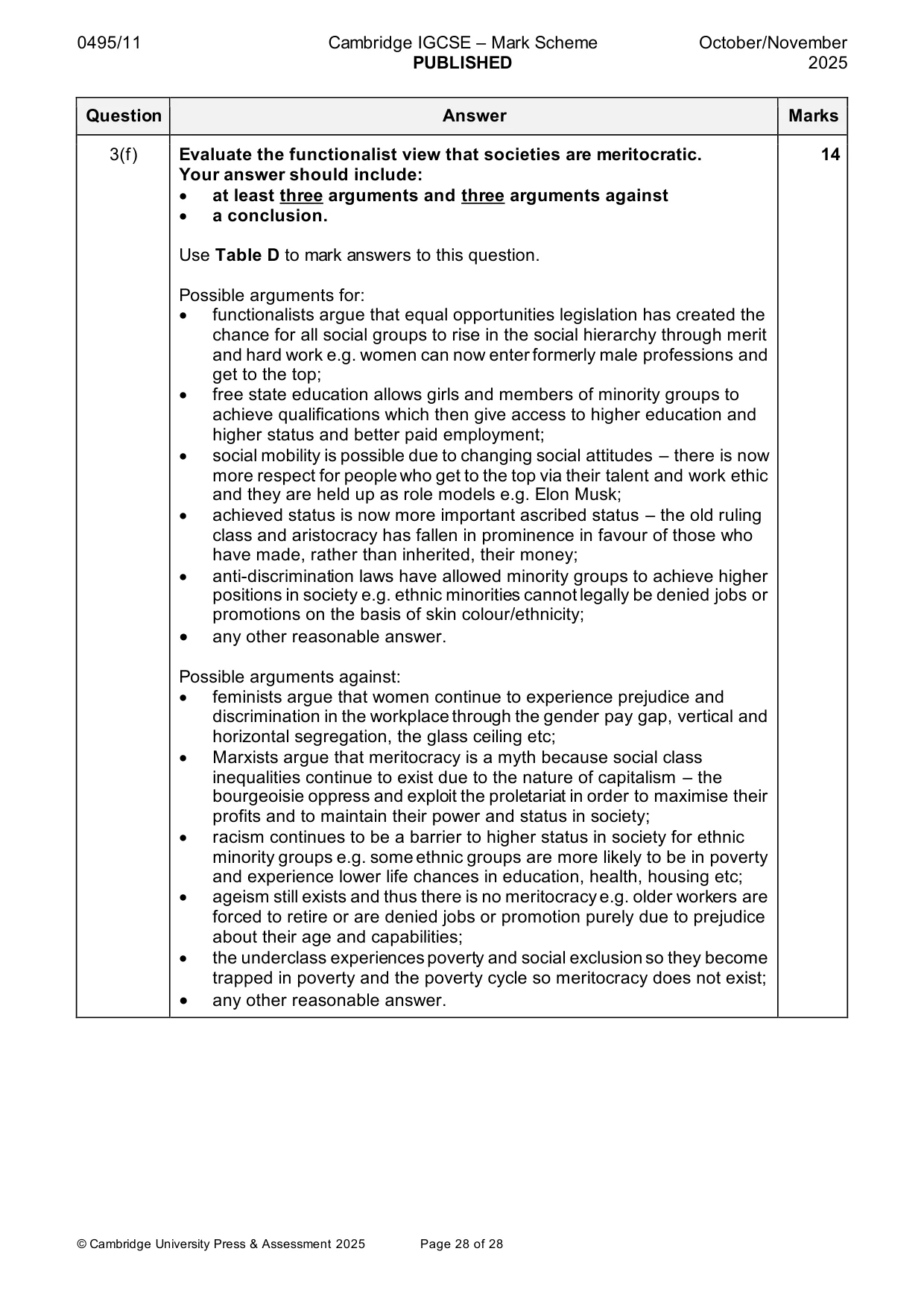
0495/11 Cambridge IGCSE – Mark Scheme PUBLISHED October/November 2025 © Cambridge University Press & Assessment 2025 Page 28 of 28 Question Answer Marks 3(f) Evaluate the functionalist view that societies are meritocratic. Your answer should include: • at least three arguments and three arguments against • a conclusion. Use Table D to mark answers to this question. Possible arguments for: • functionalists argue that equal opportunities legislation has created the chance for all social groups to rise in the social hierarchy through merit and hard work e.g. women can now enter formerly male professions and get to the top; • free state education allows girls and members of minority groups to achieve qualifications which then give access to higher education and higher status and better paid employment; • social mobility is possible due to changing social attitudes – there is now more respect for people who get to the top via their talent and work ethic and they are held up as role models e.g. Elon Musk; • achieved status is now more important ascribed status – the old ruling class and aristocracy has fallen in prominence in favour of those who have made, rather than inherited, their money; • anti-discrimination laws have allowed minority groups to achieve higher positions in society e.g. ethnic minorities cannot legally be denied jobs or promotions on the basis of skin colour/ethnicity; • any other reasonable answer. Possible arguments against: • feminists argue that women continue to experience prejudice and discrimination in the workplace through the gender pay gap, vertical and horizontal segregation, the glass ceiling etc; • Marxists argue that meritocracy is a myth because social class inequalities continue to exist due to the nature of capitalism – the bourgeoisie oppress and exploit the proletariat in order to maximise their profits and to maintain their power and status in society; • racism continues to be a barrier to higher status in society for ethnic minority groups e.g. some ethnic groups are more likely to be in poverty and experience lower life chances in education, health, housing etc; • ageism still exists and thus there is no meritocracy e.g. older workers are forced to retire or are denied jobs or promotion purely due to prejudice about their age and capabilities; • the underclass experiences poverty and social exclusion so they become trapped in poverty and the poverty cycle so meritocracy does not exist; • any other reasonable answer. 14
What you needed in this session
Cambridge’s own grade thresholds for 2025 Oct/Nov, Paper 1 · Variant 1. A higher threshold means an easier paper — the bar moves with how the cohort did.