Cambridge IGCSE Sociology 0495 — 2023 May/June Paper 1 · Variant 3
0495/13/M/J/23 · 80 marks · ≈90 min
The question paper and its mark scheme, free to read here and free to download. This is Cambridge’s own paper, exactly as it was sat.
Question paper4 pages

Mark scheme23 pages
Answers below. Sit the paper first if you are practising.



Paper as text
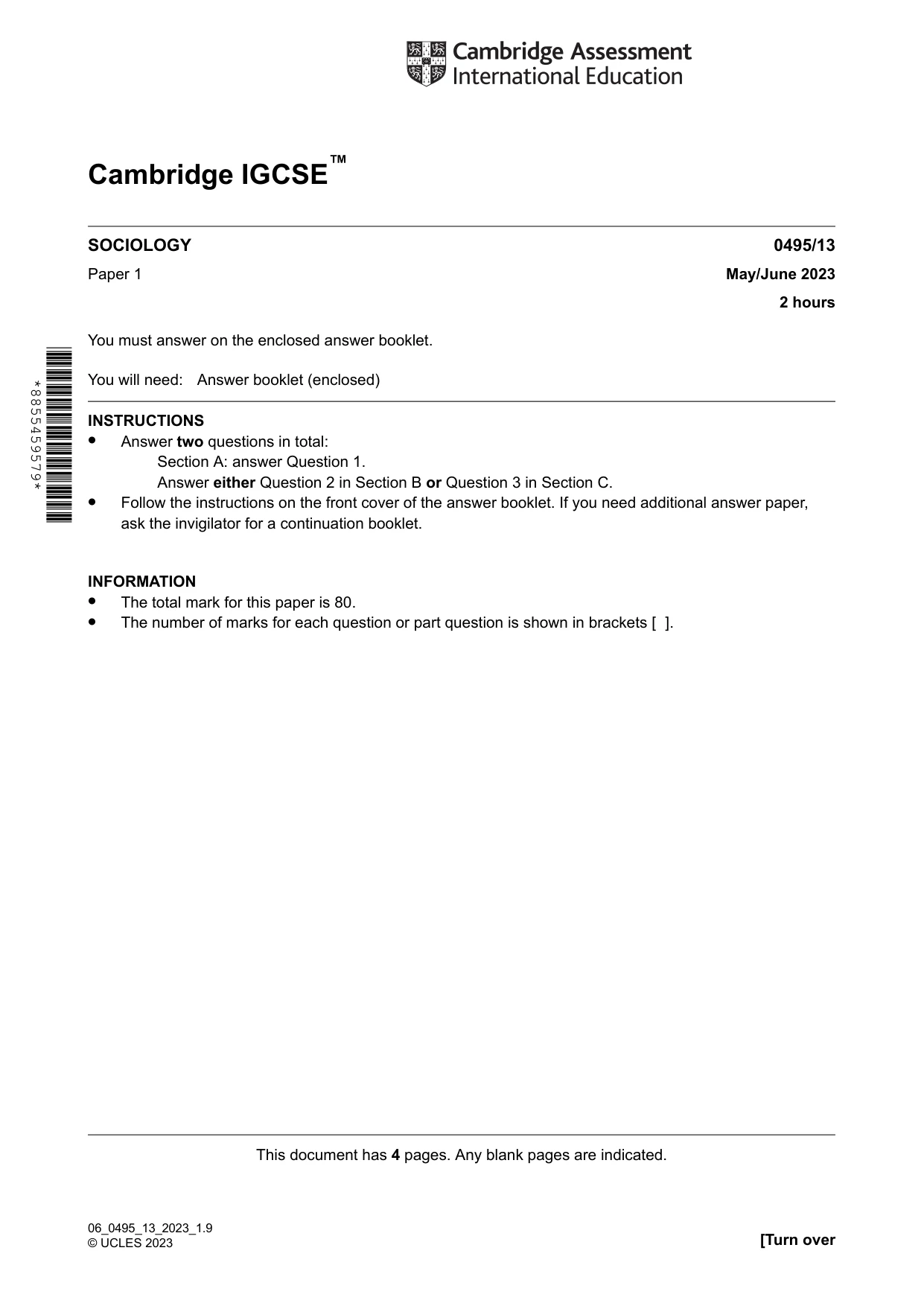
Question paper, page 1
Cambridge IGCSE™ 0495/13 May/June 2023 2 hours SOCIOLOGY Paper 1 You must answer on the enclosed answer booklet. You will need: Answer booklet (enclosed) INSTRUCTIONS • Answer two questions in total: Section A: answer Question 1. Answer either Question 2 in Section B or Question 3 in Section C. • Follow the instructions on the front cover of the answer booklet. If you need additional answer paper, ask the invigilator for a continuation booklet. INFORMATION • The total mark for this paper is 80. • The number of marks for each question or part question is shown in brackets [ ]. This document has 4 pages. Any blank pages are indicated. [Turn over 06_0495_13_2023_1.9 © UCLES 2023 *8855459579*
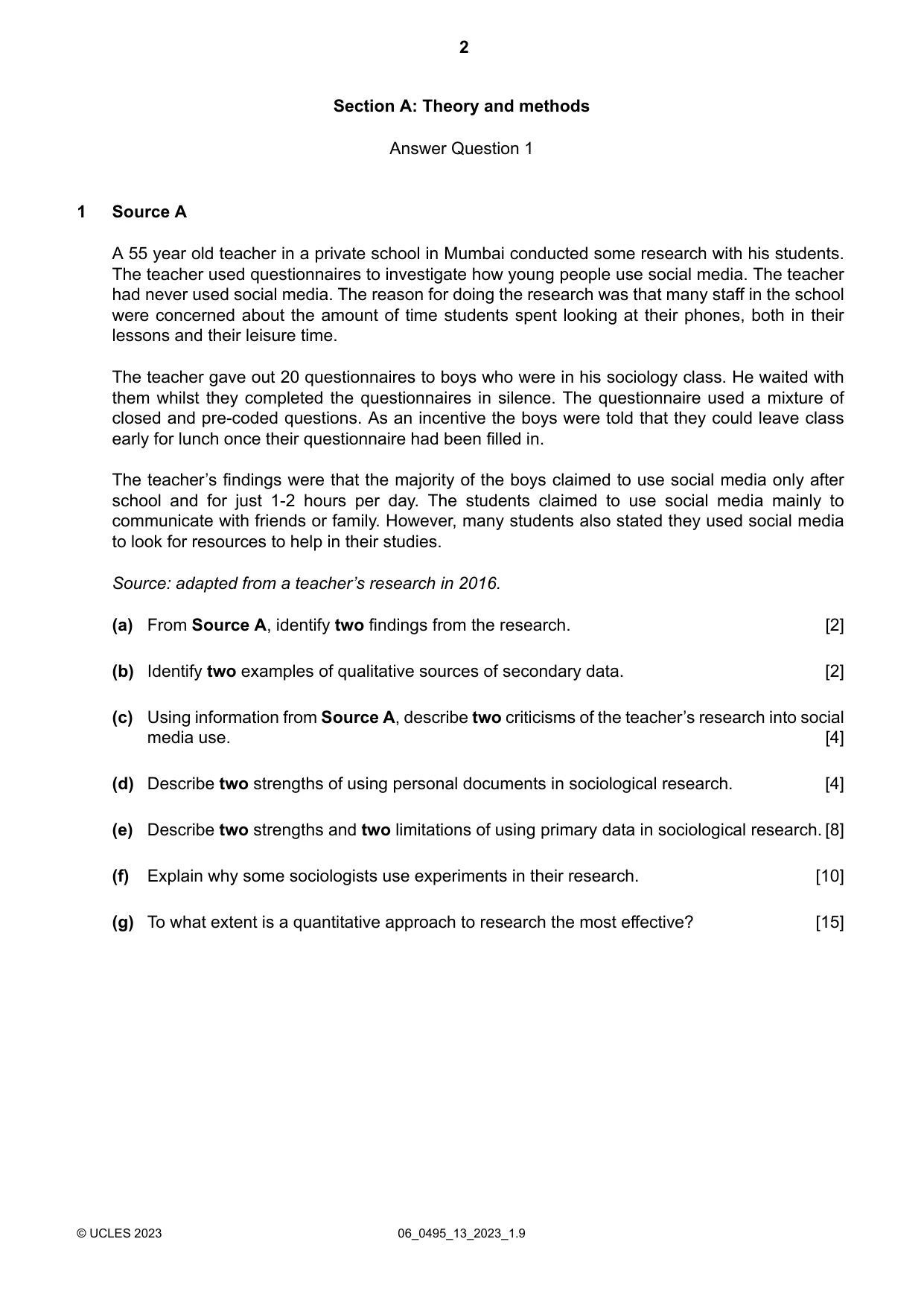
Question paper, page 2
Section A: Theory and methods Answer Question 1 Source A 1 A 55 year old teacher in a private school in Mumbai conducted some research with his students. The teacher used questionnaires to investigate how young people use social media. The teacher had never used social media. The reason for doing the research was that many staff in the school were concerned about the amount of time students spent looking at their phones, both in their lessons and their leisure time. The teacher gave out 20 questionnaires to boys who were in his sociology class. He waited with them whilst they completed the questionnaires in silence. The questionnaire used a mixture of closed and pre-coded questions. As an incentive the boys were told that they could leave class early for lunch once their questionnaire had been filled in. The teacher’s findings were that the majority of the boys claimed to use social media only after school and for just 1-2 hours per day. The students claimed to use social media mainly to communicate with friends or family. However, many students also stated they used social media to look for resources to help in their studies. Source: adapted from a teacher’s research in 2016. From Source A, identify two findings from the research. [2] (a) Identify two examples of qualitative sources of secondary data. [2] (b) Using information from Source A, describe two criticisms of the teacher’s research into social media use. [4] (c) Describe two strengths of using personal documents in sociological research. [4] (d) Describe two strengths and two limitations of using primary data in sociological research. [8] (e) Explain why some sociologists use experiments in their research. [10] (f) To what extent is a quantitative approach to research the most effective? [15] (g) 06_0495_13_2023_1.9 © UCLES 2023 2
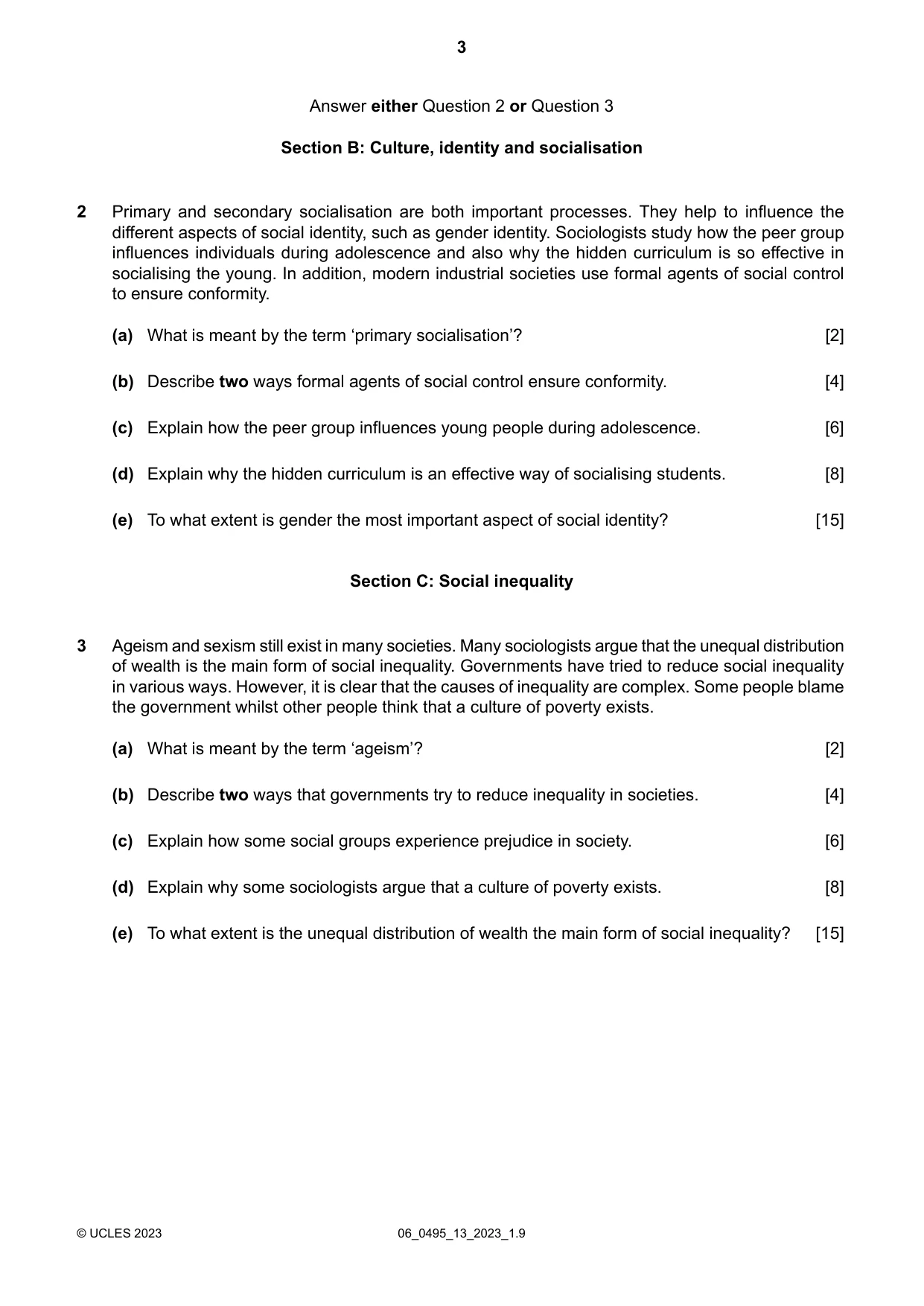
Question paper, page 3
Answer either Question 2 or Question 3 Section B: Culture, identity and socialisation Primary and secondary socialisation are both important processes. They help to influence the different aspects of social identity, such as gender identity. Sociologists study how the peer group 2 influences individuals during adolescence and also why the hidden curriculum is so effective in socialising the young. In addition, modern industrial societies use formal agents of social control to ensure conformity. What is meant by the term ‘primary socialisation’? [2] (a) Describe two ways formal agents of social control ensure conformity. [4] (b) Explain how the peer group influences young people during adolescence. [6] (c) Explain why the hidden curriculum is an effective way of socialising students. [8] (d) To what extent is gender the most important aspect of social identity? [15] (e) Section C: Social inequality Ageism and sexism still exist in many societies. Many sociologists argue that the unequal distribution of wealth is the main form of social inequality. Governments have tried to reduce social inequality 3 in various ways. However, it is clear that the causes of inequality are complex. Some people blame the government whilst other people think that a culture of poverty exists. What is meant by the term ‘ageism’? [2] (a) Describe two ways that governments try to reduce inequality in societies. [4] (b) Explain how some social groups experience prejudice in society. [6] (c) Explain why some sociologists argue that a culture of poverty exists. [8] (d) To what extent is the unequal distribution of wealth the main form of social inequality? [15] (e) 06_0495_13_2023_1.9 © UCLES 2023 3
Question paper, page 4
BLANK PAGE Permission to reproduce items where third-party owned material protected by copyright is included has been sought and cleared where possible. Every reasonable effort has been made by the publisher (UCLES) to trace copyright holders, but if any items requiring clearance have unwittingly been included, the publisher will be pleased to make amends at the earliest possible opportunity. To avoid the issue of disclosure of answer-related information to candidates, all copyright acknowledgements are reproduced online in the Cambridge Assessment International Education Copyright Acknowledgements Booklet. This is produced for each series of examinations and is freely available to download at www.cambridgeinternational.org after the live examination series. Cambridge Assessment International Education is part of Cambridge Assessment. Cambridge Assessment is the brand name of the University of Cambridge Local Examinations Syndicate (UCLES), which is a department of the University of Cambridge. 06_0495_13_2023_1.9 © UCLES 2023 4
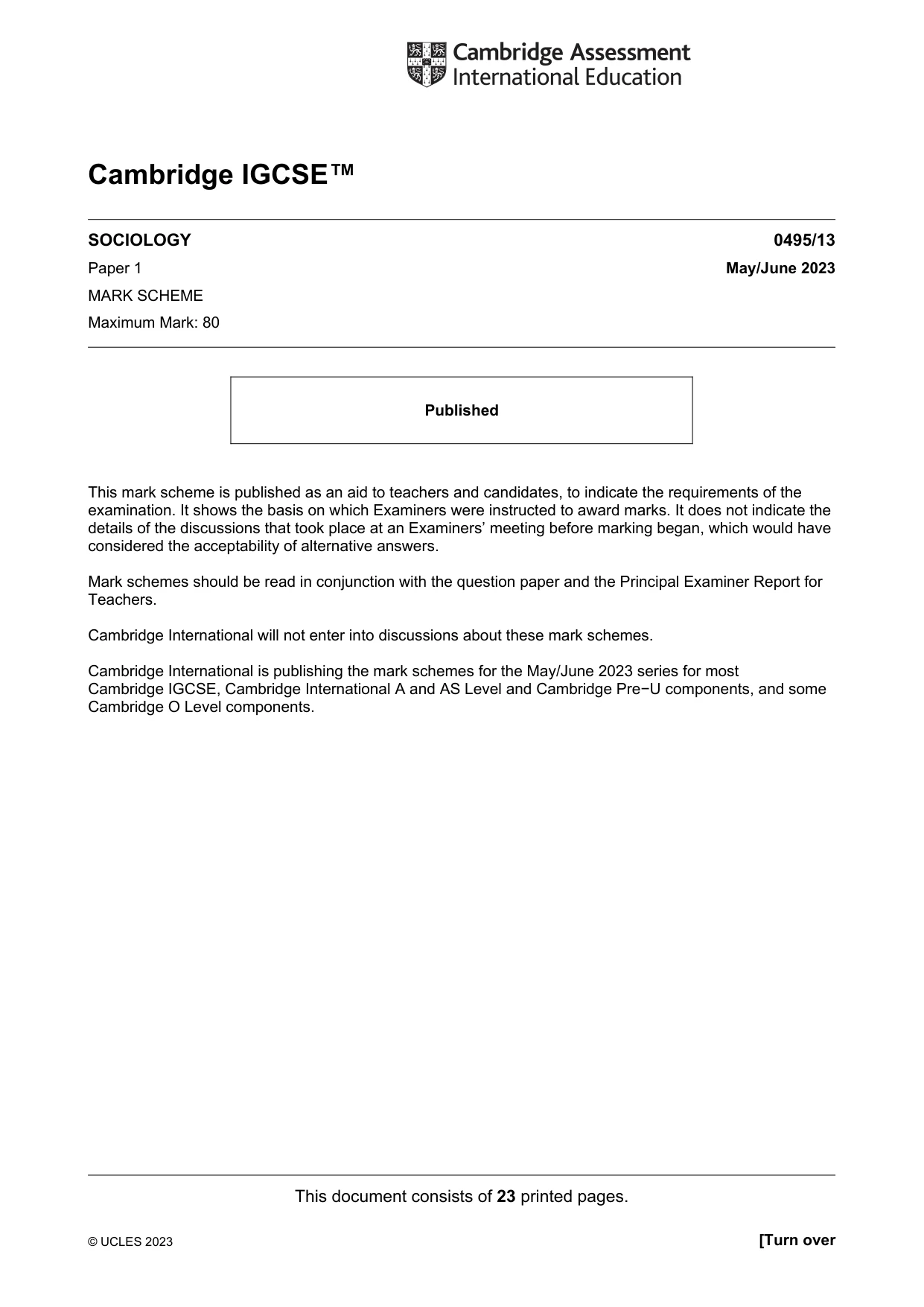
Mark scheme, page 1
This document consists of 23 printed pages. © UCLES 2023 [Turn over Cambridge IGCSE™ SOCIOLOGY 0495/13 Paper 1 May/June 2023 MARK SCHEME Maximum Mark: 80 Published This mark scheme is published as an aid to teachers and candidates, to indicate the requirements of the examination. It shows the basis on which Examiners were instructed to award marks. It does not indicate the details of the discussions that took place at an Examiners’ meeting before marking began, which would have considered the acceptability of alternative answers. Mark schemes should be read in conjunction with the question paper and the Principal Examiner Report for Teachers. Cambridge International will not enter into discussions about these mark schemes. Cambridge International is publishing the mark schemes for the May/June 2023 series for most Cambridge IGCSE, Cambridge International A and AS Level and Cambridge Pre−U components, and some Cambridge O Level components.
Mark scheme, page 2
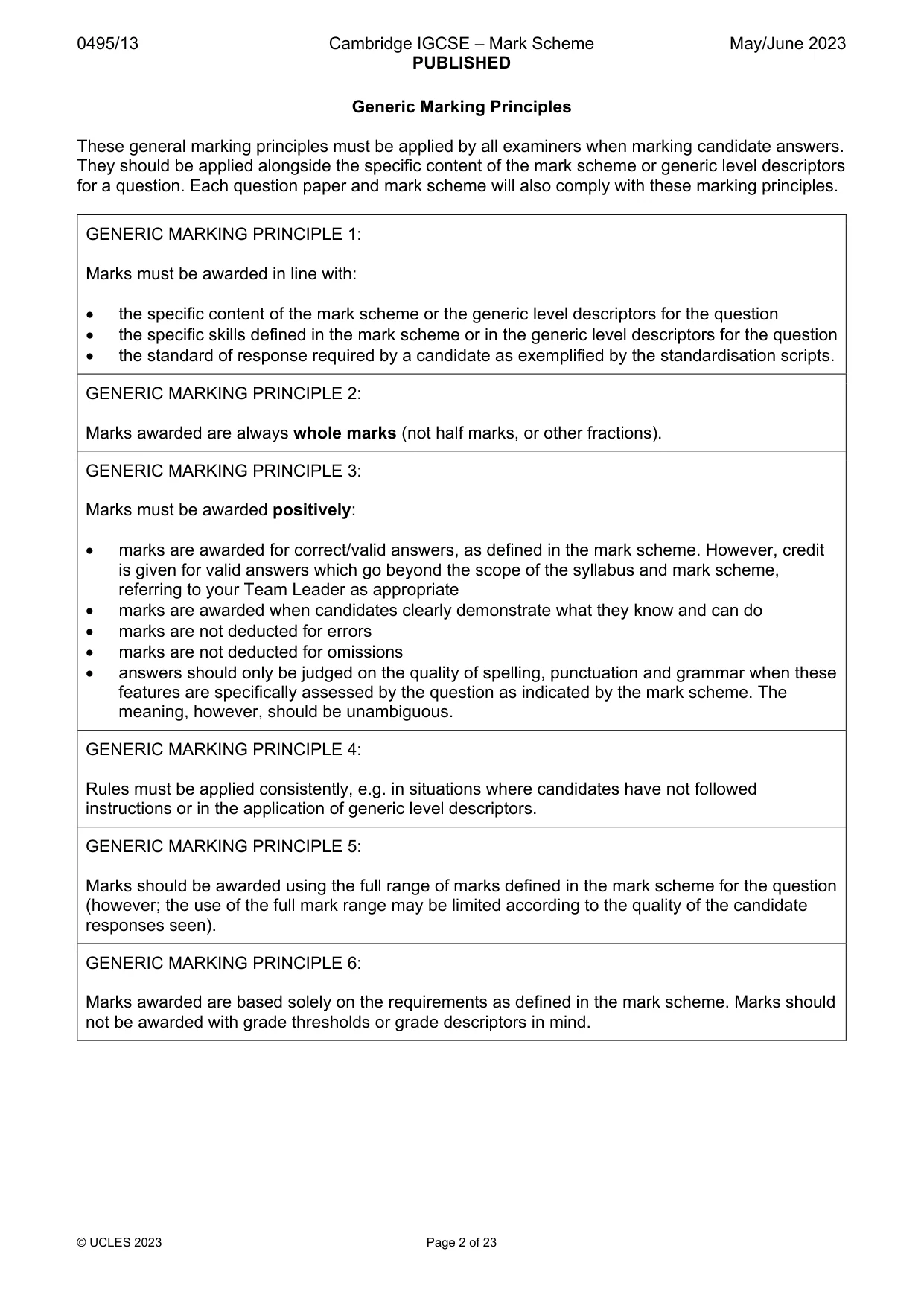
0495/13 Cambridge IGCSE – Mark Scheme PUBLISHED May/June 2023 © UCLES 2023 Page 2 of 23 Generic Marking Principles These general marking principles must be applied by all examiners when marking candidate answers. They should be applied alongside the specific content of the mark scheme or generic level descriptors for a question. Each question paper and mark scheme will also comply with these marking principles. GENERIC MARKING PRINCIPLE 1: Marks must be awarded in line with: the specific content of the mark scheme or the generic level descriptors for the question the specific skills defined in the mark scheme or in the generic level descriptors for the question the standard of response required by a candidate as exemplified by the standardisation scripts. GENERIC MARKING PRINCIPLE 2: Marks awarded are always whole marks (not half marks, or other fractions). GENERIC MARKING PRINCIPLE 3: Marks must be awarded positively: marks are awarded for correct/valid answers, as defined in the mark scheme. However, credit is given for valid answers which go beyond the scope of the syllabus and mark scheme, referring to your Team Leader as appropriate marks are awarded when candidates clearly demonstrate what they know and can do marks are not deducted for errors marks are not deducted for omissions answers should only be judged on the quality of spelling, punctuation and grammar when these features are specifically assessed by the question as indicated by the mark scheme. The meaning, however, should be unambiguous. GENERIC MARKING PRINCIPLE 4: Rules must be applied consistently, e.g. in situations where candidates have not followed instructions or in the application of generic level descriptors. GENERIC MARKING PRINCIPLE 5: Marks should be awarded using the full range of marks defined in the mark scheme for the question (however; the use of the full mark range may be limited according to the quality of the candidate responses seen). GENERIC MARKING PRINCIPLE 6: Marks awarded are based solely on the requirements as defined in the mark scheme. Marks should not be awarded with grade thresholds or grade descriptors in mind.
Mark scheme, page 3
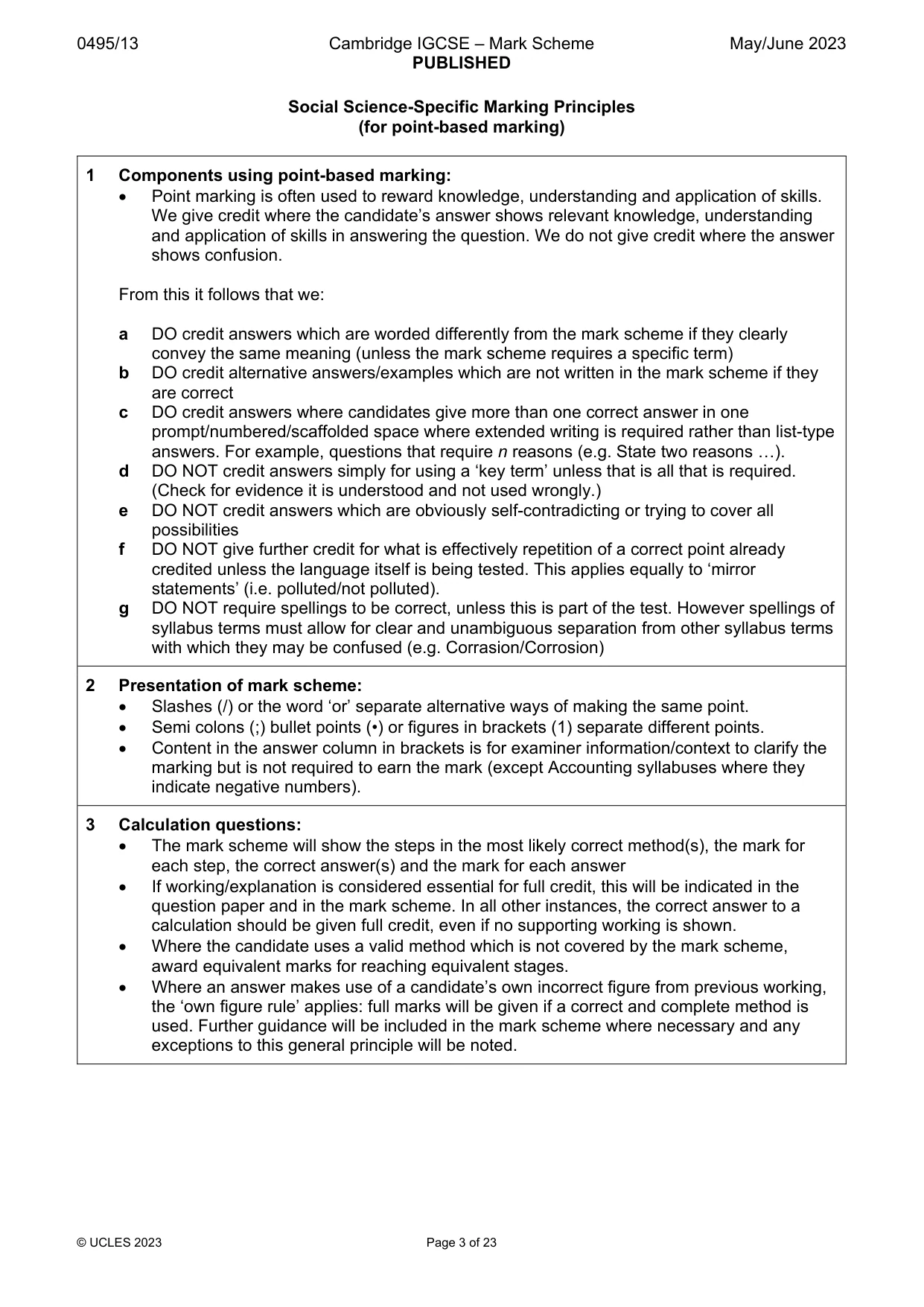
0495/13 Cambridge IGCSE – Mark Scheme PUBLISHED May/June 2023 © UCLES 2023 Page 3 of 23 Social Science-Specific Marking Principles (for point-based marking) 1 Components using point-based marking: Point marking is often used to reward knowledge, understanding and application of skills. We give credit where the candidate’s answer shows relevant knowledge, understanding and application of skills in answering the question. We do not give credit where the answer shows confusion. From this it follows that we: a DO credit answers which are worded differently from the mark scheme if they clearly convey the same meaning (unless the mark scheme requires a specific term) b DO credit alternative answers/examples which are not written in the mark scheme if they are correct c DO credit answers where candidates give more than one correct answer in one prompt/numbered/scaffolded space where extended writing is required rather than list-type answers. For example, questions that require n reasons (e.g. State two reasons …). d DO NOT credit answers simply for using a ‘key term’ unless that is all that is required. (Check for evidence it is understood and not used wrongly.) e DO NOT credit answers which are obviously self-contradicting or trying to cover all possibilities f DO NOT give further credit for what is effectively repetition of a correct point already credited unless the language itself is being tested. This applies equally to ‘mirror statements’ (i.e. polluted/not polluted). g DO NOT require spellings to be correct, unless this is part of the test. However spellings of syllabus terms must allow for clear and unambiguous separation from other syllabus terms with which they may be confused (e.g. Corrasion/Corrosion) 2 Presentation of mark scheme: Slashes (/) or the word ‘or’ separate alternative ways of making the same point. Semi colons (;) bullet points (•) or figures in brackets (1) separate different points. Content in the answer column in brackets is for examiner information/context to clarify the marking but is not required to earn the mark (except Accounting syllabuses where they indicate negative numbers). 3 Calculation questions: The mark scheme will show the steps in the most likely correct method(s), the mark for each step, the correct answer(s) and the mark for each answer If working/explanation is considered essential for full credit, this will be indicated in the question paper and in the mark scheme. In all other instances, the correct answer to a calculation should be given full credit, even if no supporting working is shown. Where the candidate uses a valid method which is not covered by the mark scheme, award equivalent marks for reaching equivalent stages. Where an answer makes use of a candidate’s own incorrect figure from previous working, the ‘own figure rule’ applies: full marks will be given if a correct and complete method is used. Further guidance will be included in the mark scheme where necessary and any exceptions to this general principle will be noted.
Mark scheme, page 4
0495/13 Cambridge IGCSE – Mark Scheme PUBLISHED May/June 2023 © UCLES 2023 Page 4 of 23 4 Annotation: For point marking, ticks can be used to indicate correct answers and crosses can be used to indicate wrong answers. There is no direct relationship between ticks and marks. Ticks have no defined meaning for levels of response marking. For levels of response marking, the level awarded should be annotated on the script. Other annotations will be used by examiners as agreed during standardisation, and the meaning will be understood by all examiners who marked that paper.
Mark scheme, page 5
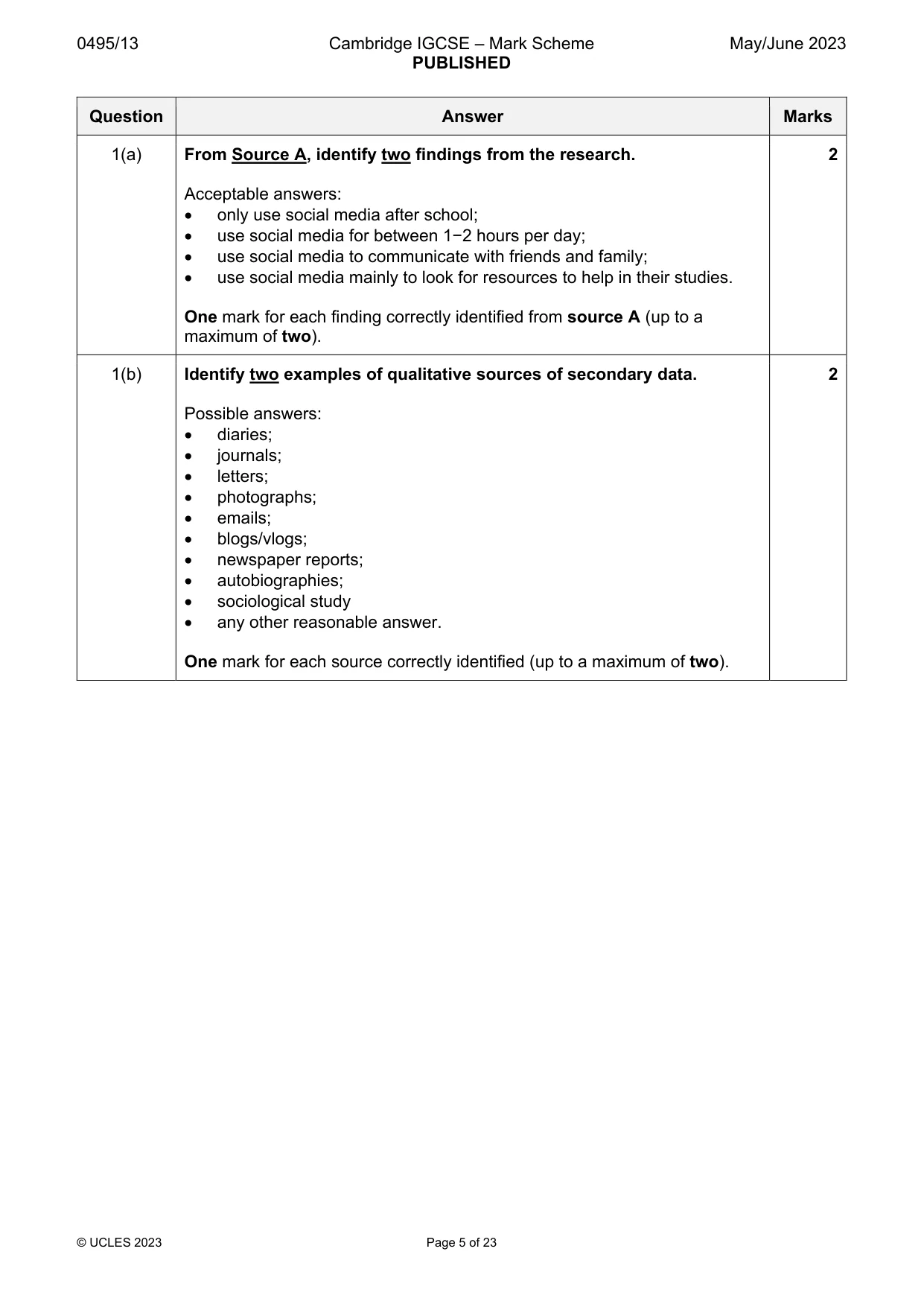
0495/13 Cambridge IGCSE – Mark Scheme PUBLISHED May/June 2023 © UCLES 2023 Page 5 of 23 Question Answer Marks 1(a) From Source A, identify two findings from the research. Acceptable answers: only use social media after school; use social media for between 1−2 hours per day; use social media to communicate with friends and family; use social media mainly to look for resources to help in their studies. One mark for each finding correctly identified from source A (up to a maximum of two). 2 1(b) Identify two examples of qualitative sources of secondary data. Possible answers: diaries; journals; letters; photographs; emails; blogs/vlogs; newspaper reports; autobiographies; sociological study any other reasonable answer. One mark for each source correctly identified (up to a maximum of two). 2
Mark scheme, page 6
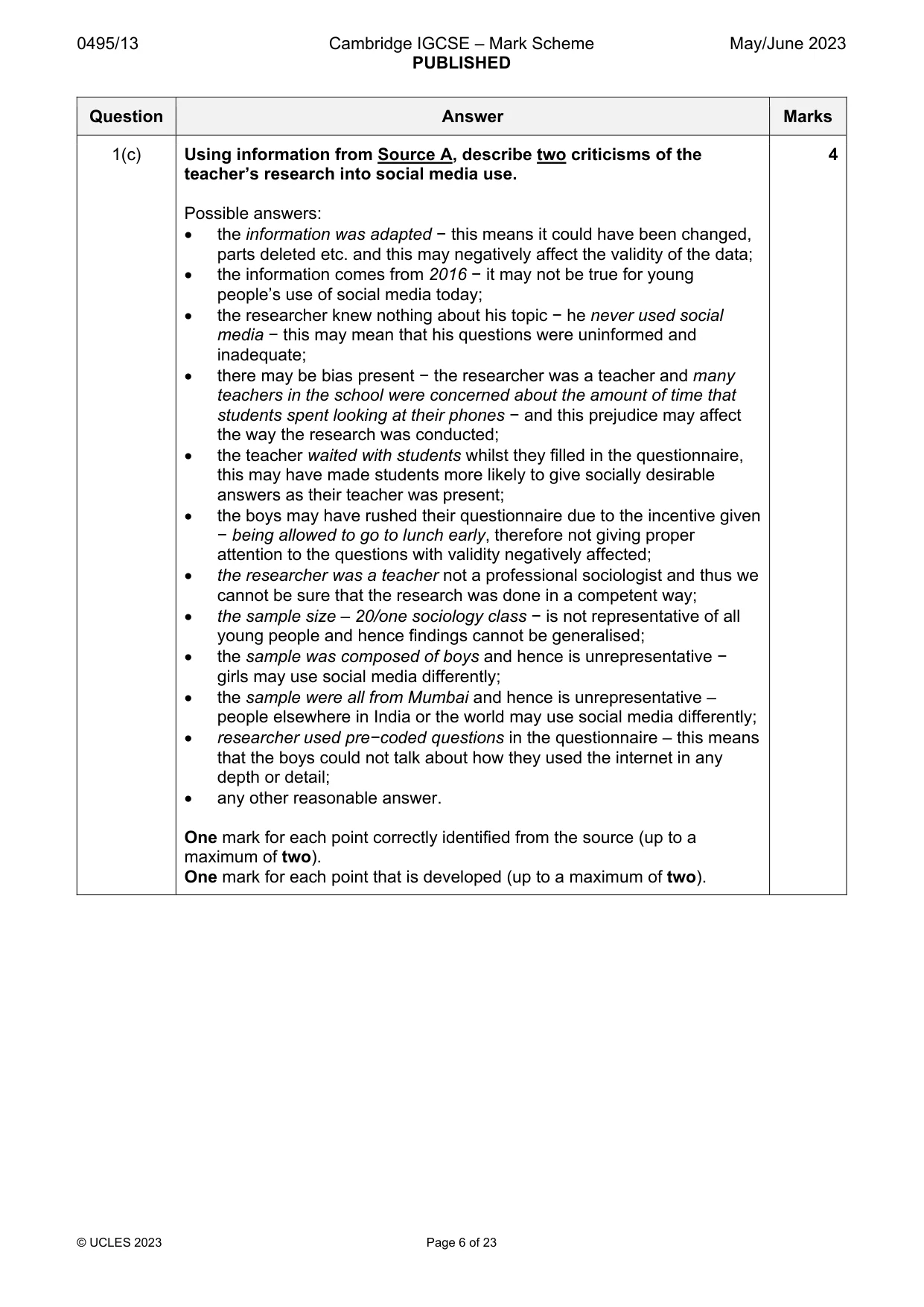
0495/13 Cambridge IGCSE – Mark Scheme PUBLISHED May/June 2023 © UCLES 2023 Page 6 of 23 Question Answer Marks 1(c) Using information from Source A, describe two criticisms of the teacher’s research into social media use. Possible answers: the information was adapted − this means it could have been changed, parts deleted etc. and this may negatively affect the validity of the data; the information comes from 2016 − it may not be true for young people’s use of social media today; the researcher knew nothing about his topic − he never used social media − this may mean that his questions were uninformed and inadequate; there may be bias present − the researcher was a teacher and many teachers in the school were concerned about the amount of time that students spent looking at their phones − and this prejudice may affect the way the research was conducted; the teacher waited with students whilst they filled in the questionnaire, this may have made students more likely to give socially desirable answers as their teacher was present; the boys may have rushed their questionnaire due to the incentive given − being allowed to go to lunch early, therefore not giving proper attention to the questions with validity negatively affected; the researcher was a teacher not a professional sociologist and thus we cannot be sure that the research was done in a competent way; the sample size – 20/one sociology class − is not representative of all young people and hence findings cannot be generalised; the sample was composed of boys and hence is unrepresentative − girls may use social media differently; the sample were all from Mumbai and hence is unrepresentative – people elsewhere in India or the world may use social media differently; researcher used pre−coded questions in the questionnaire – this means that the boys could not talk about how they used the internet in any depth or detail; any other reasonable answer. One mark for each point correctly identified from the source (up to a maximum of two). One mark for each point that is developed (up to a maximum of two). 4
Mark scheme, page 7
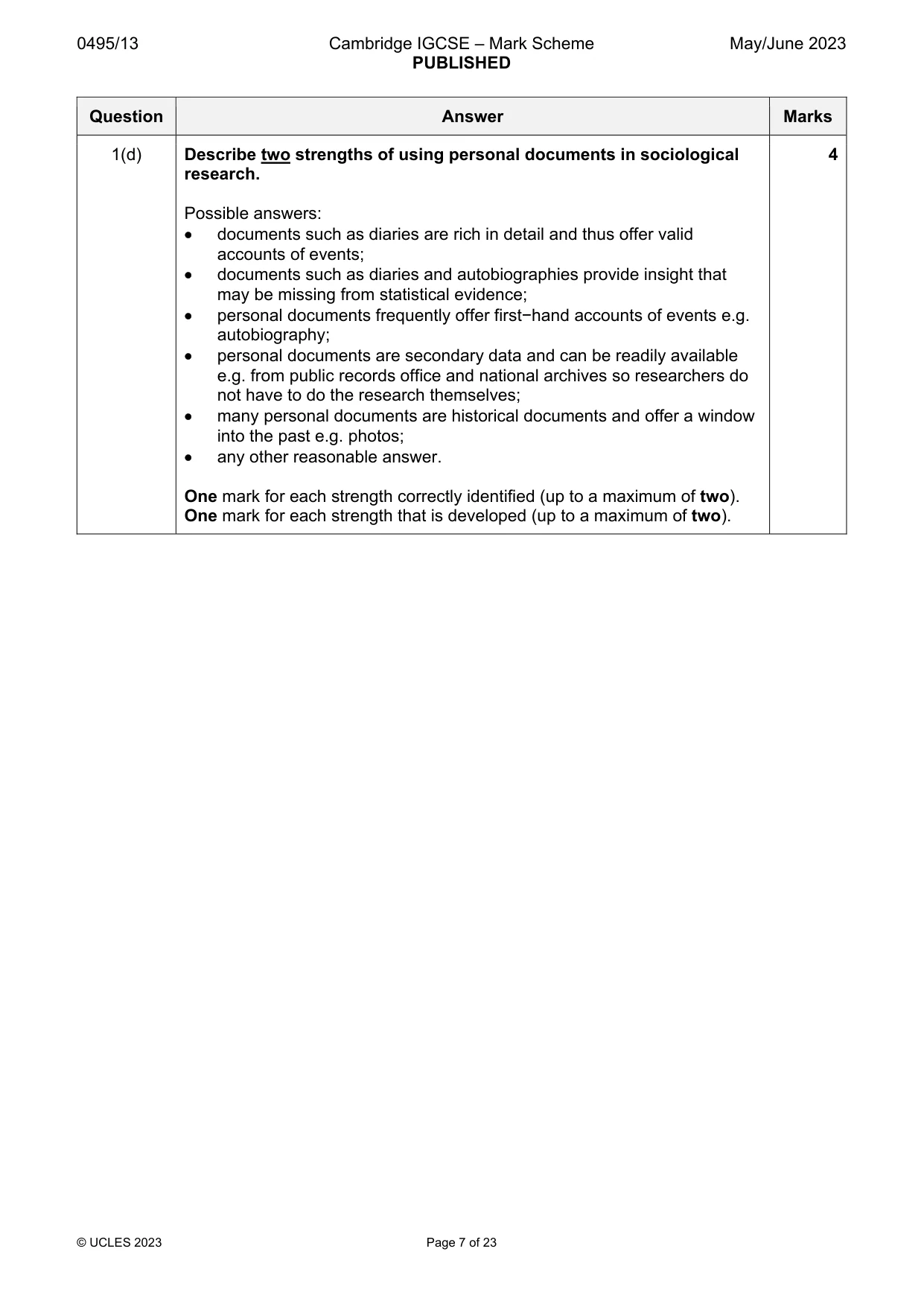
0495/13 Cambridge IGCSE – Mark Scheme PUBLISHED May/June 2023 © UCLES 2023 Page 7 of 23 Question Answer Marks 1(d) Describe two strengths of using personal documents in sociological research. Possible answers: documents such as diaries are rich in detail and thus offer valid accounts of events; documents such as diaries and autobiographies provide insight that may be missing from statistical evidence; personal documents frequently offer first−hand accounts of events e.g. autobiography; personal documents are secondary data and can be readily available e.g. from public records office and national archives so researchers do not have to do the research themselves; many personal documents are historical documents and offer a window into the past e.g. photos; any other reasonable answer. One mark for each strength correctly identified (up to a maximum of two). One mark for each strength that is developed (up to a maximum of two). 4
Mark scheme, page 8
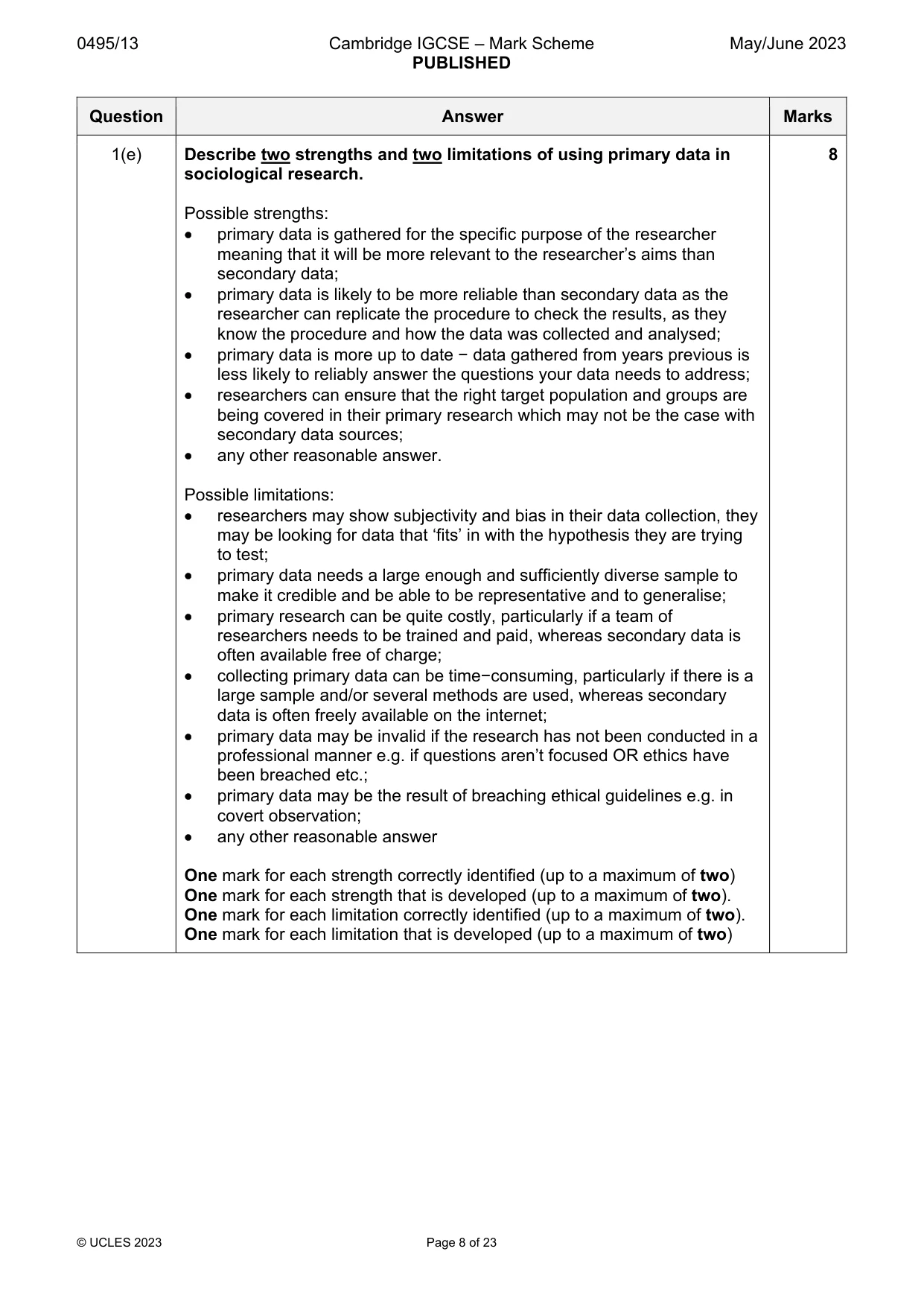
0495/13 Cambridge IGCSE – Mark Scheme PUBLISHED May/June 2023 © UCLES 2023 Page 8 of 23 Question Answer Marks 1(e) Describe two strengths and two limitations of using primary data in sociological research. Possible strengths: primary data is gathered for the specific purpose of the researcher meaning that it will be more relevant to the researcher’s aims than secondary data; primary data is likely to be more reliable than secondary data as the researcher can replicate the procedure to check the results, as they know the procedure and how the data was collected and analysed; primary data is more up to date − data gathered from years previous is less likely to reliably answer the questions your data needs to address; researchers can ensure that the right target population and groups are being covered in their primary research which may not be the case with secondary data sources; any other reasonable answer. Possible limitations: researchers may show subjectivity and bias in their data collection, they may be looking for data that ‘fits’ in with the hypothesis they are trying to test; primary data needs a large enough and sufficiently diverse sample to make it credible and be able to be representative and to generalise; primary research can be quite costly, particularly if a team of researchers needs to be trained and paid, whereas secondary data is often available free of charge; collecting primary data can be time−consuming, particularly if there is a large sample and/or several methods are used, whereas secondary data is often freely available on the internet; primary data may be invalid if the research has not been conducted in a professional manner e.g. if questions aren’t focused OR ethics have been breached etc.; primary data may be the result of breaching ethical guidelines e.g. in covert observation; any other reasonable answer One mark for each strength correctly identified (up to a maximum of two) One mark for each strength that is developed (up to a maximum of two). One mark for each limitation correctly identified (up to a maximum of two). One mark for each limitation that is developed (up to a maximum of two) 8
Mark scheme, page 9
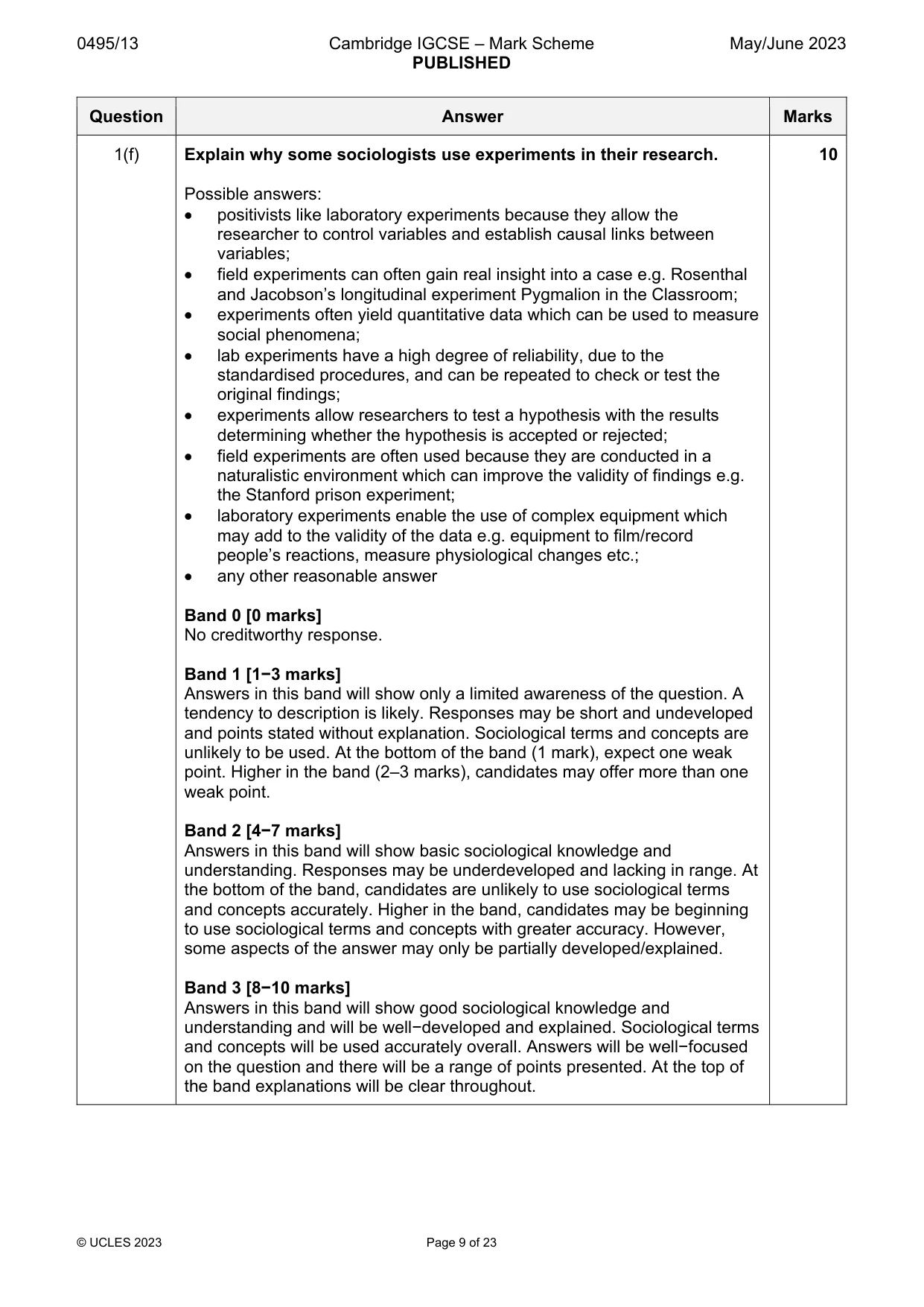
0495/13 Cambridge IGCSE – Mark Scheme PUBLISHED May/June 2023 © UCLES 2023 Page 9 of 23 Question Answer Marks 1(f) Explain why some sociologists use experiments in their research. Possible answers: positivists like laboratory experiments because they allow the researcher to control variables and establish causal links between variables; field experiments can often gain real insight into a case e.g. Rosenthal and Jacobson’s longitudinal experiment Pygmalion in the Classroom; experiments often yield quantitative data which can be used to measure social phenomena; lab experiments have a high degree of reliability, due to the standardised procedures, and can be repeated to check or test the original findings; experiments allow researchers to test a hypothesis with the results determining whether the hypothesis is accepted or rejected; field experiments are often used because they are conducted in a naturalistic environment which can improve the validity of findings e.g. the Stanford prison experiment; laboratory experiments enable the use of complex equipment which may add to the validity of the data e.g. equipment to film/record people’s reactions, measure physiological changes etc.; any other reasonable answer Band 0 [0 marks] No creditworthy response. Band 1 [1−3 marks] Answers in this band will show only a limited awareness of the question. A tendency to description is likely. Responses may be short and undeveloped and points stated without explanation. Sociological terms and concepts are unlikely to be used. At the bottom of the band (1 mark), expect one weak point. Higher in the band (2–3 marks), candidates may offer more than one weak point. Band 2 [4−7 marks] Answers in this band will show basic sociological knowledge and understanding. Responses may be underdeveloped and lacking in range. At the bottom of the band, candidates are unlikely to use sociological terms and concepts accurately. Higher in the band, candidates may be beginning to use sociological terms and concepts with greater accuracy. However, some aspects of the answer may only be partially developed/explained. Band 3 [8−10 marks] Answers in this band will show good sociological knowledge and understanding and will be well−developed and explained. Sociological terms and concepts will be used accurately overall. Answers will be well−focused on the question and there will be a range of points presented. At the top of the band explanations will be clear throughout. 10
Mark scheme, page 10
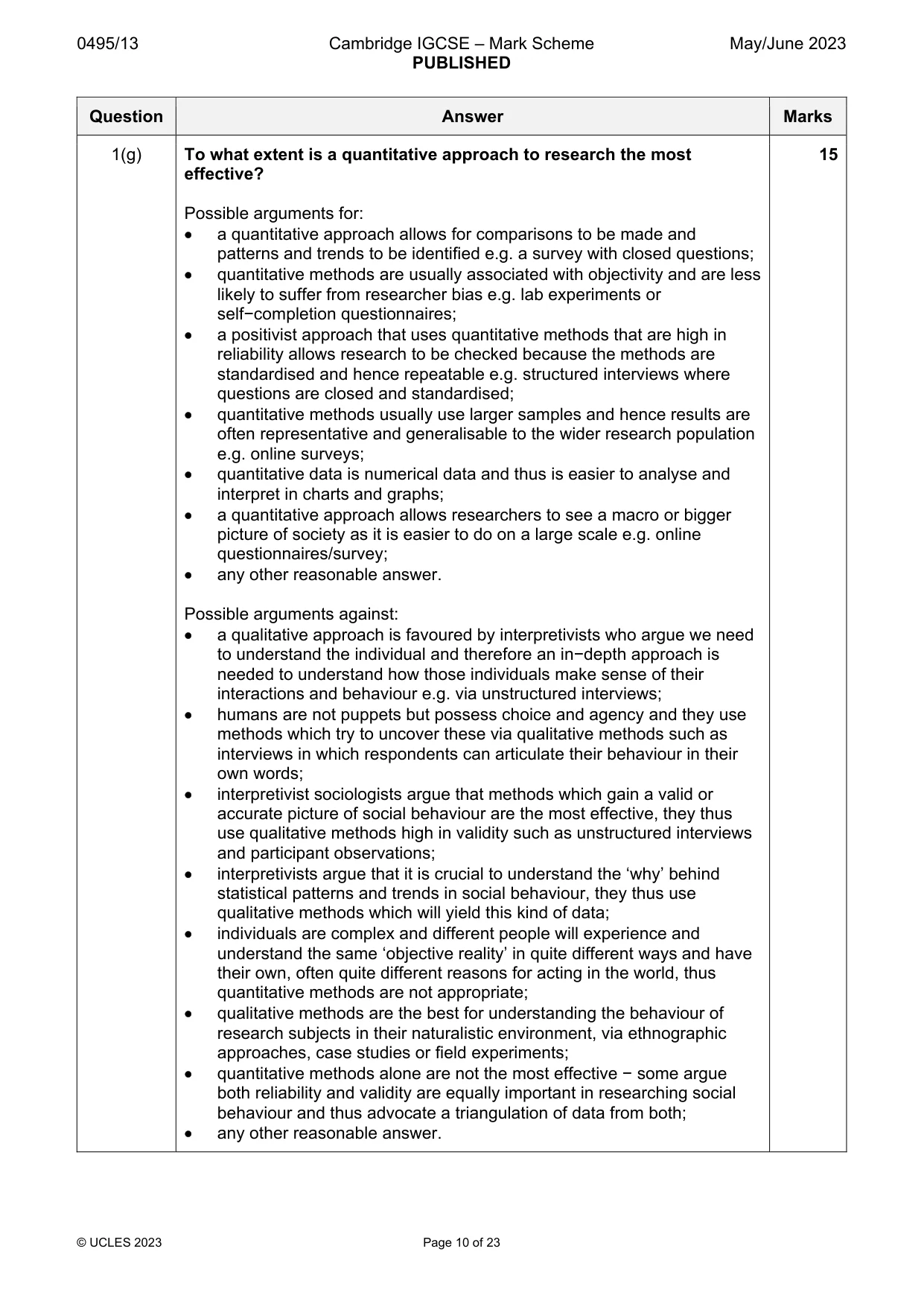
0495/13 Cambridge IGCSE – Mark Scheme PUBLISHED May/June 2023 © UCLES 2023 Page 10 of 23 Question Answer Marks 1(g) To what extent is a quantitative approach to research the most effective? Possible arguments for: a quantitative approach allows for comparisons to be made and patterns and trends to be identified e.g. a survey with closed questions; quantitative methods are usually associated with objectivity and are less likely to suffer from researcher bias e.g. lab experiments or self−completion questionnaires; a positivist approach that uses quantitative methods that are high in reliability allows research to be checked because the methods are standardised and hence repeatable e.g. structured interviews where questions are closed and standardised; quantitative methods usually use larger samples and hence results are often representative and generalisable to the wider research population e.g. online surveys; quantitative data is numerical data and thus is easier to analyse and interpret in charts and graphs; a quantitative approach allows researchers to see a macro or bigger picture of society as it is easier to do on a large scale e.g. online questionnaires/survey; any other reasonable answer. Possible arguments against: a qualitative approach is favoured by interpretivists who argue we need to understand the individual and therefore an in−depth approach is needed to understand how those individuals make sense of their interactions and behaviour e.g. via unstructured interviews; humans are not puppets but possess choice and agency and they use methods which try to uncover these via qualitative methods such as interviews in which respondents can articulate their behaviour in their own words; interpretivist sociologists argue that methods which gain a valid or accurate picture of social behaviour are the most effective, they thus use qualitative methods high in validity such as unstructured interviews and participant observations; interpretivists argue that it is crucial to understand the ‘why’ behind statistical patterns and trends in social behaviour, they thus use qualitative methods which will yield this kind of data; individuals are complex and different people will experience and understand the same ‘objective reality’ in quite different ways and have their own, often quite different reasons for acting in the world, thus quantitative methods are not appropriate; qualitative methods are the best for understanding the behaviour of research subjects in their naturalistic environment, via ethnographic approaches, case studies or field experiments; quantitative methods alone are not the most effective − some argue both reliability and validity are equally important in researching social behaviour and thus advocate a triangulation of data from both; any other reasonable answer. 15
Mark scheme, page 11
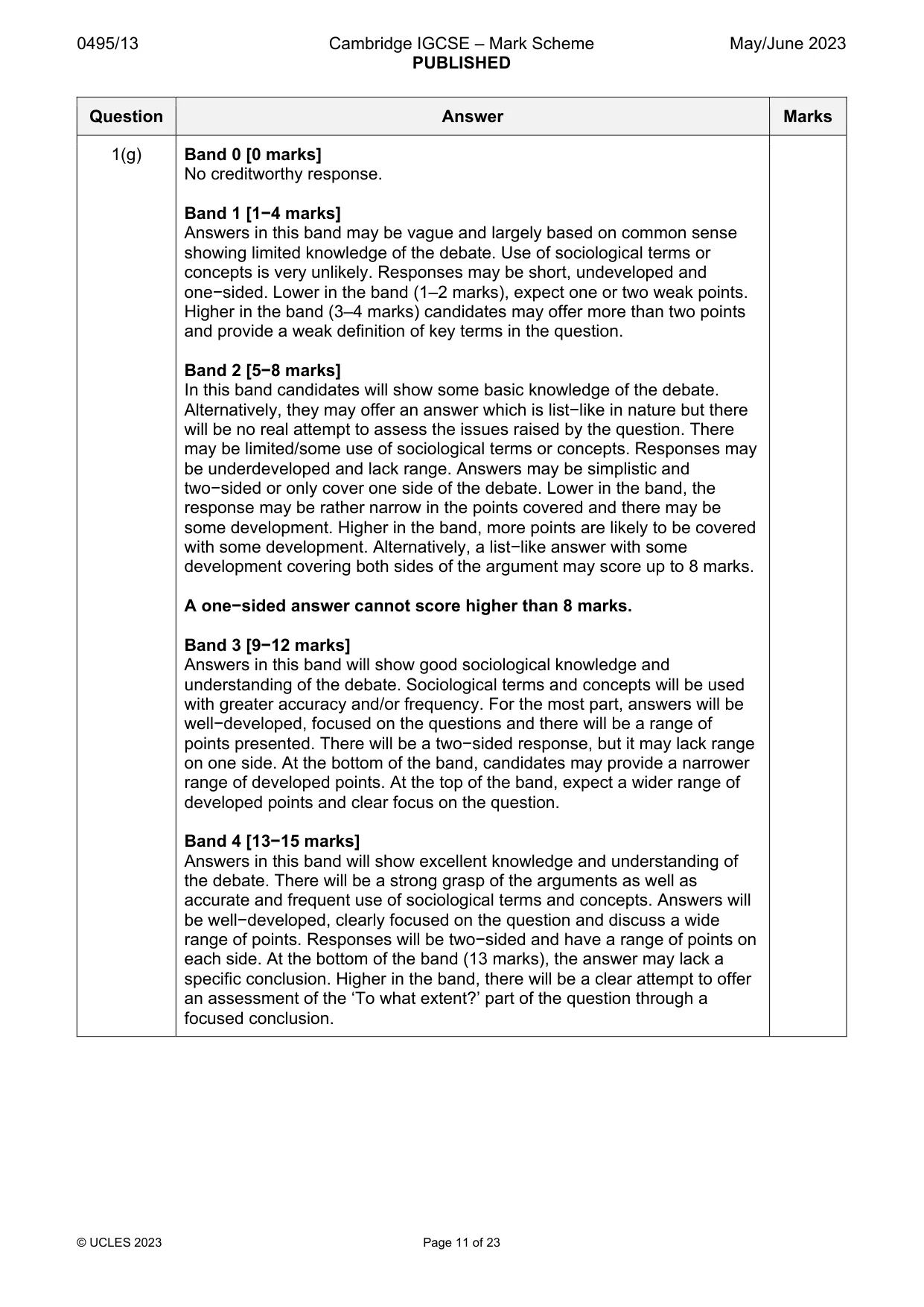
0495/13 Cambridge IGCSE – Mark Scheme PUBLISHED May/June 2023 © UCLES 2023 Page 11 of 23 Question Answer Marks 1(g) Band 0 [0 marks] No creditworthy response. Band 1 [1−4 marks] Answers in this band may be vague and largely based on common sense showing limited knowledge of the debate. Use of sociological terms or concepts is very unlikely. Responses may be short, undeveloped and one−sided. Lower in the band (1–2 marks), expect one or two weak points. Higher in the band (3–4 marks) candidates may offer more than two points and provide a weak definition of key terms in the question. Band 2 [5−8 marks] In this band candidates will show some basic knowledge of the debate. Alternatively, they may offer an answer which is list−like in nature but there will be no real attempt to assess the issues raised by the question. There may be limited/some use of sociological terms or concepts. Responses may be underdeveloped and lack range. Answers may be simplistic and two−sided or only cover one side of the debate. Lower in the band, the response may be rather narrow in the points covered and there may be some development. Higher in the band, more points are likely to be covered with some development. Alternatively, a list−like answer with some development covering both sides of the argument may score up to 8 marks. A one−sided answer cannot score higher than 8 marks. Band 3 [9−12 marks] Answers in this band will show good sociological knowledge and understanding of the debate. Sociological terms and concepts will be used with greater accuracy and/or frequency. For the most part, answers will be well−developed, focused on the questions and there will be a range of points presented. There will be a two−sided response, but it may lack range on one side. At the bottom of the band, candidates may provide a narrower range of developed points. At the top of the band, expect a wider range of developed points and clear focus on the question. Band 4 [13−15 marks] Answers in this band will show excellent knowledge and understanding of the debate. There will be a strong grasp of the arguments as well as accurate and frequent use of sociological terms and concepts. Answers will be well−developed, clearly focused on the question and discuss a wide range of points. Responses will be two−sided and have a range of points on each side. At the bottom of the band (13 marks), the answer may lack a specific conclusion. Higher in the band, there will be a clear attempt to offer an assessment of the ‘To what extent?’ part of the question through a focused conclusion.
Mark scheme, page 12
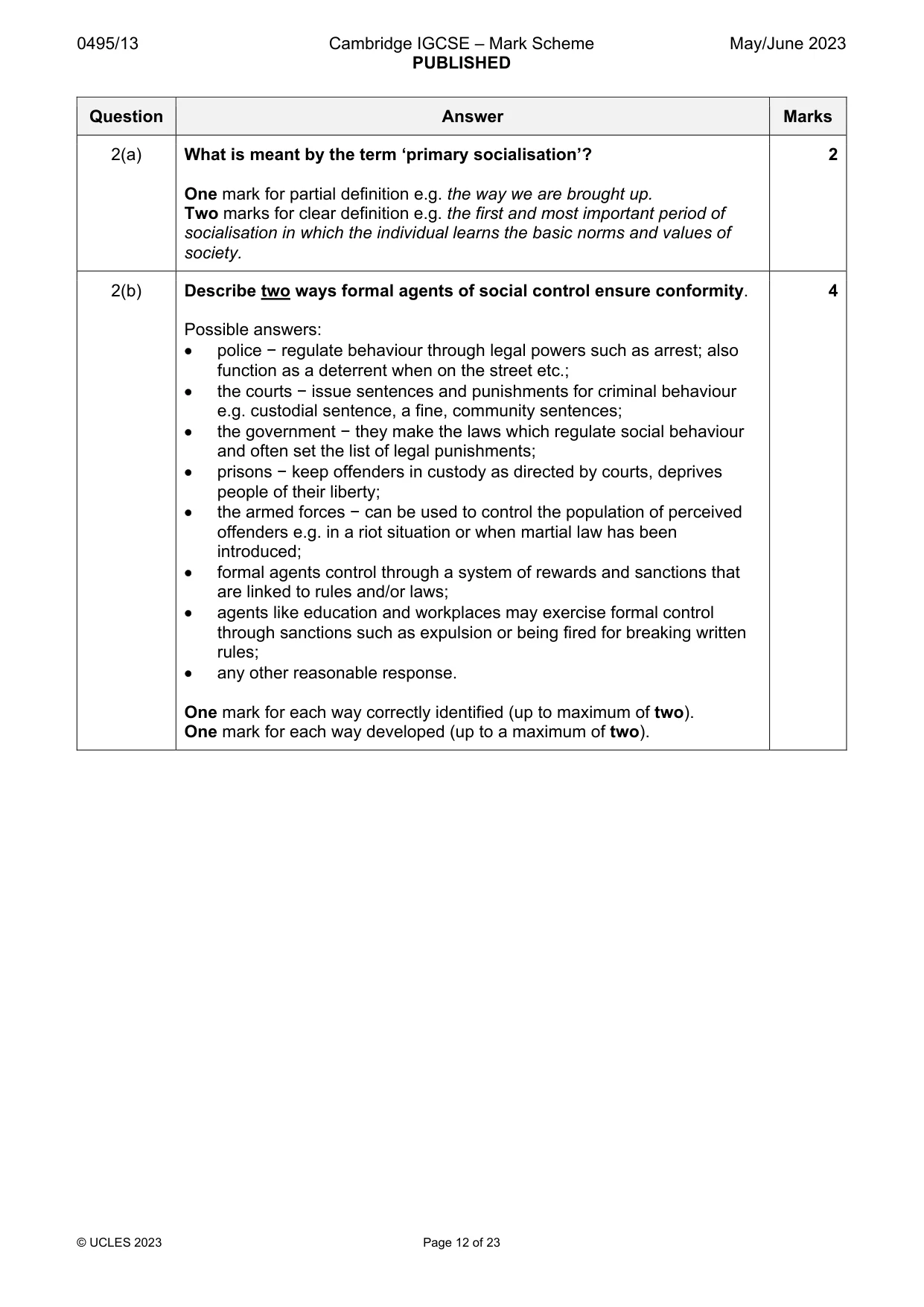
0495/13 Cambridge IGCSE – Mark Scheme PUBLISHED May/June 2023 © UCLES 2023 Page 12 of 23 Question Answer Marks 2(a) What is meant by the term ‘primary socialisation’? One mark for partial definition e.g. the way we are brought up. Two marks for clear definition e.g. the first and most important period of socialisation in which the individual learns the basic norms and values of society. 2 2(b) Describe two ways formal agents of social control ensure conformity. Possible answers: police − regulate behaviour through legal powers such as arrest; also function as a deterrent when on the street etc.; the courts − issue sentences and punishments for criminal behaviour e.g. custodial sentence, a fine, community sentences; the government − they make the laws which regulate social behaviour and often set the list of legal punishments; prisons − keep offenders in custody as directed by courts, deprives people of their liberty; the armed forces − can be used to control the population of perceived offenders e.g. in a riot situation or when martial law has been introduced; formal agents control through a system of rewards and sanctions that are linked to rules and/or laws; agents like education and workplaces may exercise formal control through sanctions such as expulsion or being fired for breaking written rules; any other reasonable response. One mark for each way correctly identified (up to maximum of two). One mark for each way developed (up to a maximum of two). 4
Mark scheme, page 13
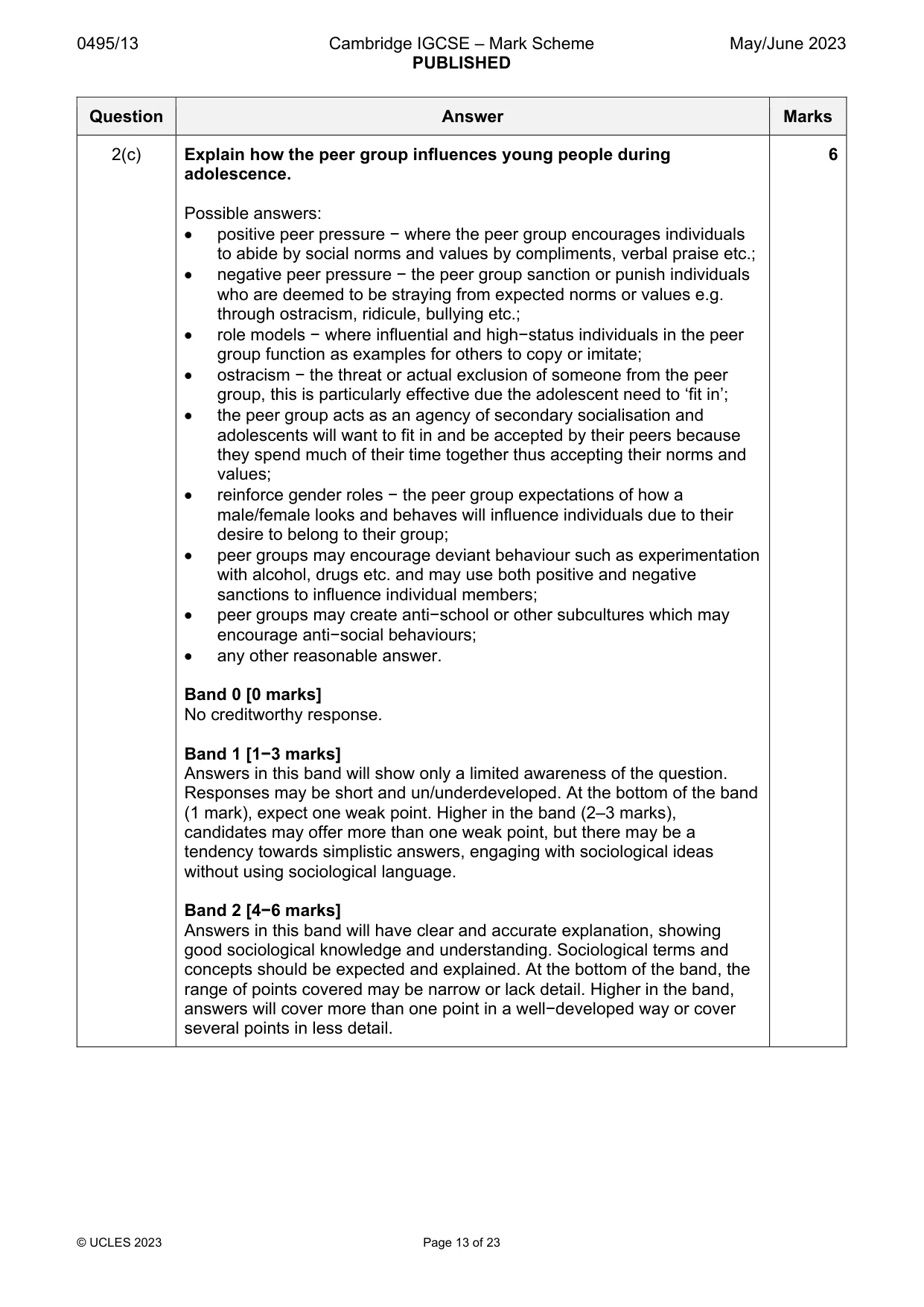
0495/13 Cambridge IGCSE – Mark Scheme PUBLISHED May/June 2023 © UCLES 2023 Page 13 of 23 Question Answer Marks 2(c) Explain how the peer group influences young people during adolescence. Possible answers: positive peer pressure − where the peer group encourages individuals to abide by social norms and values by compliments, verbal praise etc.; negative peer pressure − the peer group sanction or punish individuals who are deemed to be straying from expected norms or values e.g. through ostracism, ridicule, bullying etc.; role models − where influential and high−status individuals in the peer group function as examples for others to copy or imitate; ostracism − the threat or actual exclusion of someone from the peer group, this is particularly effective due the adolescent need to ‘fit in’; the peer group acts as an agency of secondary socialisation and adolescents will want to fit in and be accepted by their peers because they spend much of their time together thus accepting their norms and values; reinforce gender roles − the peer group expectations of how a male/female looks and behaves will influence individuals due to their desire to belong to their group; peer groups may encourage deviant behaviour such as experimentation with alcohol, drugs etc. and may use both positive and negative sanctions to influence individual members; peer groups may create anti−school or other subcultures which may encourage anti−social behaviours; any other reasonable answer. Band 0 [0 marks] No creditworthy response. Band 1 [1−3 marks] Answers in this band will show only a limited awareness of the question. Responses may be short and un/underdeveloped. At the bottom of the band (1 mark), expect one weak point. Higher in the band (2–3 marks), candidates may offer more than one weak point, but there may be a tendency towards simplistic answers, engaging with sociological ideas without using sociological language. Band 2 [4−6 marks] Answers in this band will have clear and accurate explanation, showing good sociological knowledge and understanding. Sociological terms and concepts should be expected and explained. At the bottom of the band, the range of points covered may be narrow or lack detail. Higher in the band, answers will cover more than one point in a well−developed way or cover several points in less detail. 6
Mark scheme, page 14
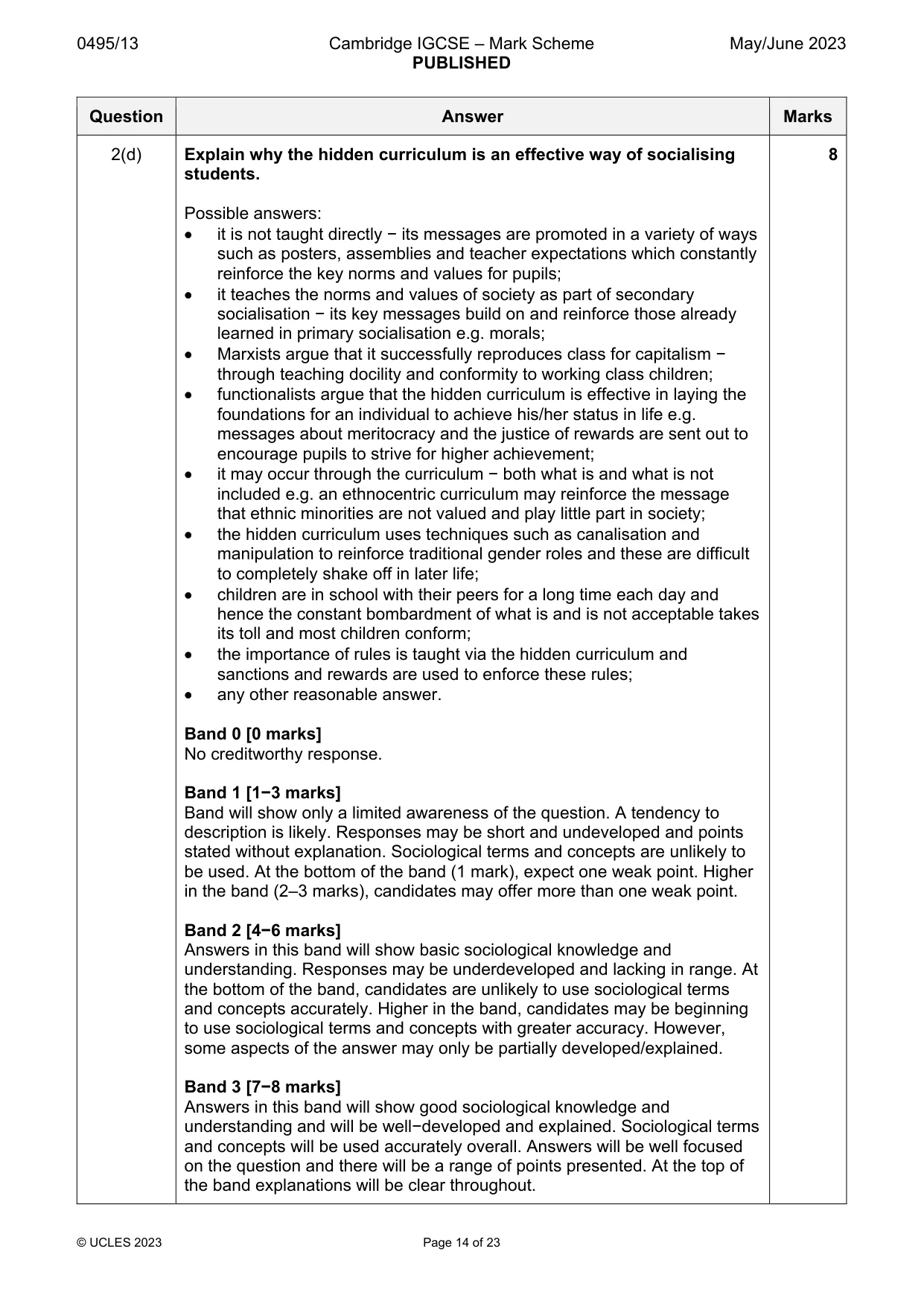
0495/13 Cambridge IGCSE – Mark Scheme PUBLISHED May/June 2023 © UCLES 2023 Page 14 of 23 Question Answer Marks 2(d) Explain why the hidden curriculum is an effective way of socialising students. Possible answers: it is not taught directly − its messages are promoted in a variety of ways such as posters, assemblies and teacher expectations which constantly reinforce the key norms and values for pupils; it teaches the norms and values of society as part of secondary socialisation − its key messages build on and reinforce those already learned in primary socialisation e.g. morals; Marxists argue that it successfully reproduces class for capitalism − through teaching docility and conformity to working class children; functionalists argue that the hidden curriculum is effective in laying the foundations for an individual to achieve his/her status in life e.g. messages about meritocracy and the justice of rewards are sent out to encourage pupils to strive for higher achievement; it may occur through the curriculum − both what is and what is not included e.g. an ethnocentric curriculum may reinforce the message that ethnic minorities are not valued and play little part in society; the hidden curriculum uses techniques such as canalisation and manipulation to reinforce traditional gender roles and these are difficult to completely shake off in later life; children are in school with their peers for a long time each day and hence the constant bombardment of what is and is not acceptable takes its toll and most children conform; the importance of rules is taught via the hidden curriculum and sanctions and rewards are used to enforce these rules; any other reasonable answer. Band 0 [0 marks] No creditworthy response. Band 1 [1−3 marks] Band will show only a limited awareness of the question. A tendency to description is likely. Responses may be short and undeveloped and points stated without explanation. Sociological terms and concepts are unlikely to be used. At the bottom of the band (1 mark), expect one weak point. Higher in the band (2–3 marks), candidates may offer more than one weak point. Band 2 [4−6 marks] Answers in this band will show basic sociological knowledge and understanding. Responses may be underdeveloped and lacking in range. At the bottom of the band, candidates are unlikely to use sociological terms and concepts accurately. Higher in the band, candidates may be beginning to use sociological terms and concepts with greater accuracy. However, some aspects of the answer may only be partially developed/explained. Band 3 [7−8 marks] Answers in this band will show good sociological knowledge and understanding and will be well−developed and explained. Sociological terms and concepts will be used accurately overall. Answers will be well focused on the question and there will be a range of points presented. At the top of the band explanations will be clear throughout. 8
Mark scheme, page 15
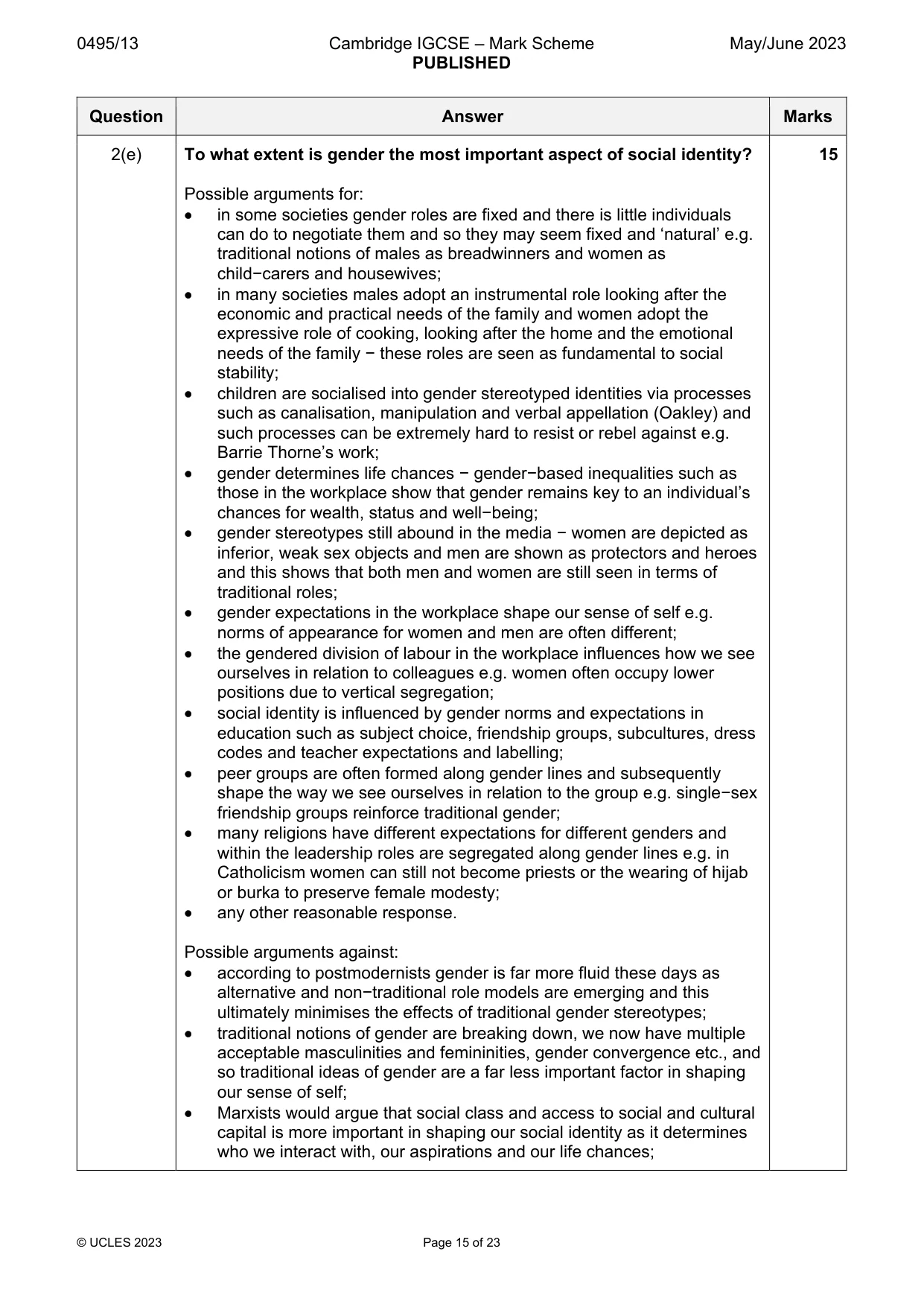
0495/13 Cambridge IGCSE – Mark Scheme PUBLISHED May/June 2023 © UCLES 2023 Page 15 of 23 Question Answer Marks 2(e) To what extent is gender the most important aspect of social identity? Possible arguments for: in some societies gender roles are fixed and there is little individuals can do to negotiate them and so they may seem fixed and ‘natural’ e.g. traditional notions of males as breadwinners and women as child−carers and housewives; in many societies males adopt an instrumental role looking after the economic and practical needs of the family and women adopt the expressive role of cooking, looking after the home and the emotional needs of the family − these roles are seen as fundamental to social stability; children are socialised into gender stereotyped identities via processes such as canalisation, manipulation and verbal appellation (Oakley) and such processes can be extremely hard to resist or rebel against e.g. Barrie Thorne’s work; gender determines life chances − gender−based inequalities such as those in the workplace show that gender remains key to an individual’s chances for wealth, status and well−being; gender stereotypes still abound in the media − women are depicted as inferior, weak sex objects and men are shown as protectors and heroes and this shows that both men and women are still seen in terms of traditional roles; gender expectations in the workplace shape our sense of self e.g. norms of appearance for women and men are often different; the gendered division of labour in the workplace influences how we see ourselves in relation to colleagues e.g. women often occupy lower positions due to vertical segregation; social identity is influenced by gender norms and expectations in education such as subject choice, friendship groups, subcultures, dress codes and teacher expectations and labelling; peer groups are often formed along gender lines and subsequently shape the way we see ourselves in relation to the group e.g. single−sex friendship groups reinforce traditional gender; many religions have different expectations for different genders and within the leadership roles are segregated along gender lines e.g. in Catholicism women can still not become priests or the wearing of hijab or burka to preserve female modesty; any other reasonable response. Possible arguments against: according to postmodernists gender is far more fluid these days as alternative and non−traditional role models are emerging and this ultimately minimises the effects of traditional gender stereotypes; traditional notions of gender are breaking down, we now have multiple acceptable masculinities and femininities, gender convergence etc., and so traditional ideas of gender are a far less important factor in shaping our sense of self; Marxists would argue that social class and access to social and cultural capital is more important in shaping our social identity as it determines who we interact with, our aspirations and our life chances; 15
Mark scheme, page 16
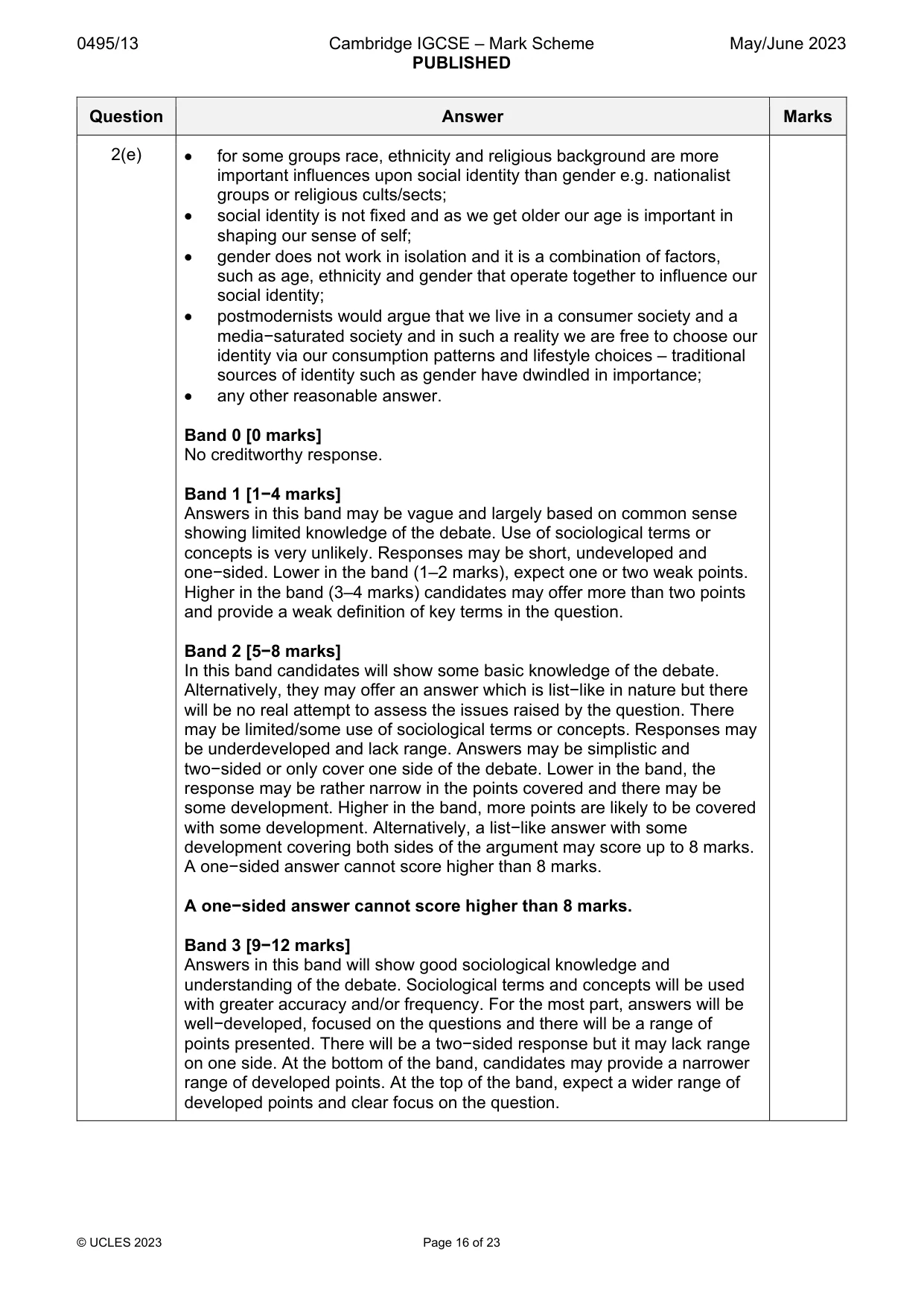
0495/13 Cambridge IGCSE – Mark Scheme PUBLISHED May/June 2023 © UCLES 2023 Page 16 of 23 Question Answer Marks 2(e) for some groups race, ethnicity and religious background are more important influences upon social identity than gender e.g. nationalist groups or religious cults/sects; social identity is not fixed and as we get older our age is important in shaping our sense of self; gender does not work in isolation and it is a combination of factors, such as age, ethnicity and gender that operate together to influence our social identity; postmodernists would argue that we live in a consumer society and a media−saturated society and in such a reality we are free to choose our identity via our consumption patterns and lifestyle choices – traditional sources of identity such as gender have dwindled in importance; any other reasonable answer. Band 0 [0 marks] No creditworthy response. Band 1 [1−4 marks] Answers in this band may be vague and largely based on common sense showing limited knowledge of the debate. Use of sociological terms or concepts is very unlikely. Responses may be short, undeveloped and one−sided. Lower in the band (1–2 marks), expect one or two weak points. Higher in the band (3–4 marks) candidates may offer more than two points and provide a weak definition of key terms in the question. Band 2 [5−8 marks] In this band candidates will show some basic knowledge of the debate. Alternatively, they may offer an answer which is list−like in nature but there will be no real attempt to assess the issues raised by the question. There may be limited/some use of sociological terms or concepts. Responses may be underdeveloped and lack range. Answers may be simplistic and two−sided or only cover one side of the debate. Lower in the band, the response may be rather narrow in the points covered and there may be some development. Higher in the band, more points are likely to be covered with some development. Alternatively, a list−like answer with some development covering both sides of the argument may score up to 8 marks. A one−sided answer cannot score higher than 8 marks. A one−sided answer cannot score higher than 8 marks. Band 3 [9−12 marks] Answers in this band will show good sociological knowledge and understanding of the debate. Sociological terms and concepts will be used with greater accuracy and/or frequency. For the most part, answers will be well−developed, focused on the questions and there will be a range of points presented. There will be a two−sided response but it may lack range on one side. At the bottom of the band, candidates may provide a narrower range of developed points. At the top of the band, expect a wider range of developed points and clear focus on the question.
Mark scheme, page 17
0495/13 Cambridge IGCSE – Mark Scheme PUBLISHED May/June 2023 © UCLES 2023 Page 17 of 23 Question Answer Marks 2(e) Band 4 [13−15 marks] Answers in this band will show excellent knowledge and understanding of the debate. There will be a strong grasp of the arguments as well as accurate and frequent use of sociological terms and concepts. Answers will be well−developed, clearly focused on the question and discuss a wide range of points. Responses will be two−sided and have a range of points on each side. At the bottom of the band (13 marks), the answer may lack a specific conclusion. Higher in the band, there will be a clear attempt to offer an assessment of the ‘To what extent?’ part of the question through a focused conclusion.
Mark scheme, page 18
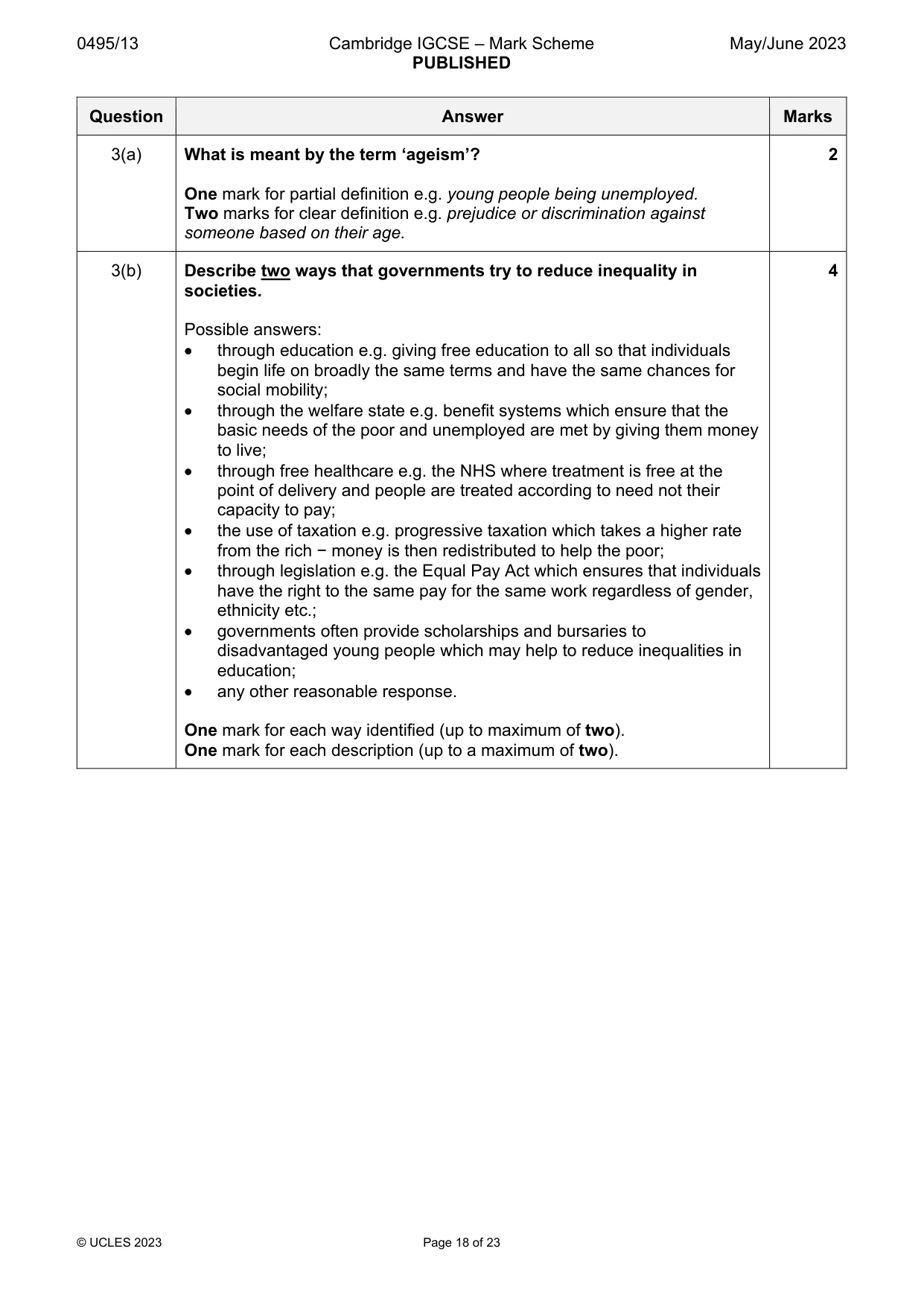
0495/13 Cambridge IGCSE – Mark Scheme PUBLISHED May/June 2023 © UCLES 2023 Page 18 of 23 Question Answer Marks 3(a) What is meant by the term ‘ageism’? One mark for partial definition e.g. young people being unemployed. Two marks for clear definition e.g. prejudice or discrimination against someone based on their age. 2 3(b) Describe two ways that governments try to reduce inequality in societies. Possible answers: through education e.g. giving free education to all so that individuals begin life on broadly the same terms and have the same chances for social mobility; through the welfare state e.g. benefit systems which ensure that the basic needs of the poor and unemployed are met by giving them money to live; through free healthcare e.g. the NHS where treatment is free at the point of delivery and people are treated according to need not their capacity to pay; the use of taxation e.g. progressive taxation which takes a higher rate from the rich − money is then redistributed to help the poor; through legislation e.g. the Equal Pay Act which ensures that individuals have the right to the same pay for the same work regardless of gender, ethnicity etc.; governments often provide scholarships and bursaries to disadvantaged young people which may help to reduce inequalities in education; any other reasonable response. One mark for each way identified (up to maximum of two). One mark for each description (up to a maximum of two). 4
Mark scheme, page 19
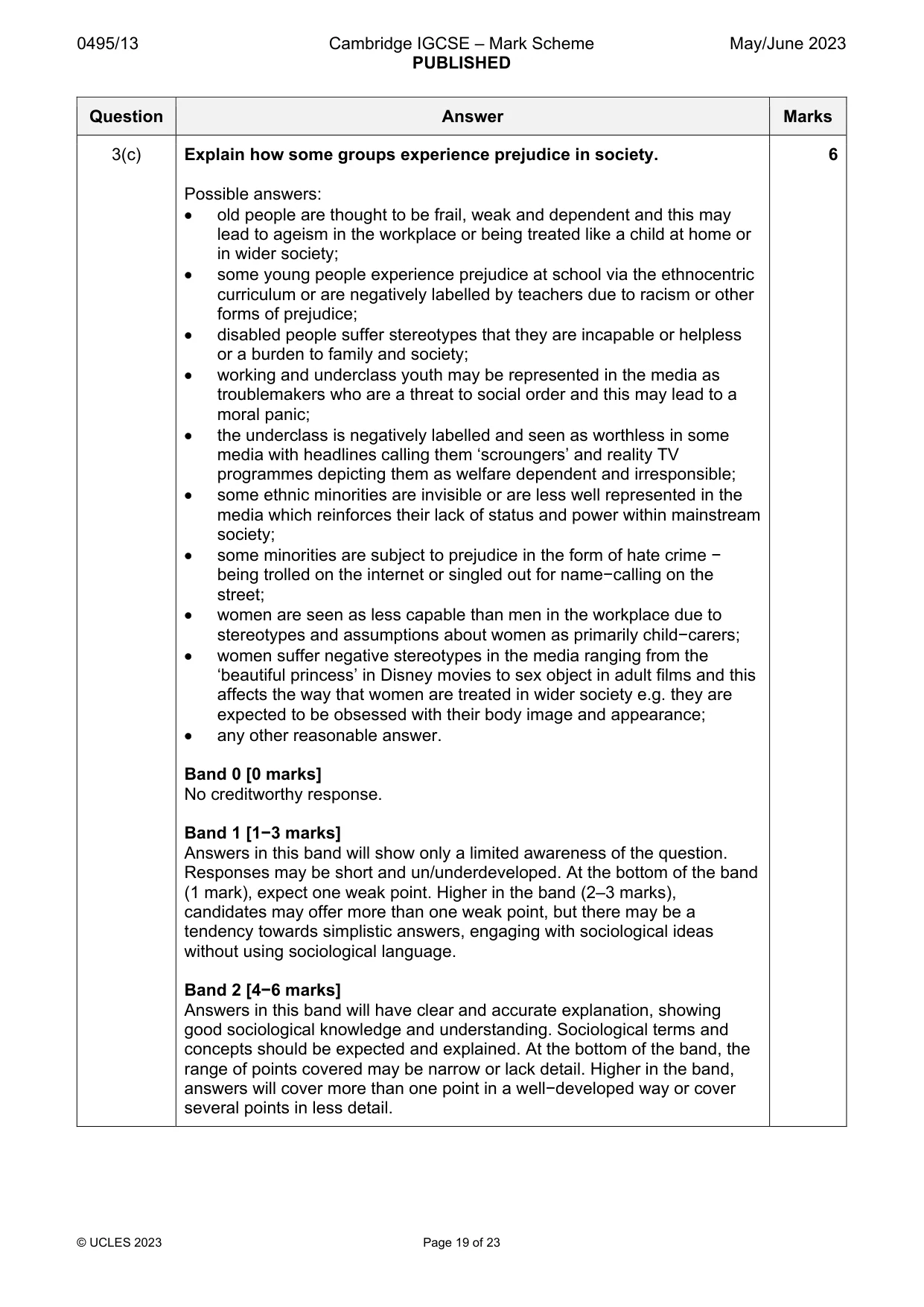
0495/13 Cambridge IGCSE – Mark Scheme PUBLISHED May/June 2023 © UCLES 2023 Page 19 of 23 Question Answer Marks 3(c) Explain how some groups experience prejudice in society. Possible answers: old people are thought to be frail, weak and dependent and this may lead to ageism in the workplace or being treated like a child at home or in wider society; some young people experience prejudice at school via the ethnocentric curriculum or are negatively labelled by teachers due to racism or other forms of prejudice; disabled people suffer stereotypes that they are incapable or helpless or a burden to family and society; working and underclass youth may be represented in the media as troublemakers who are a threat to social order and this may lead to a moral panic; the underclass is negatively labelled and seen as worthless in some media with headlines calling them ‘scroungers’ and reality TV programmes depicting them as welfare dependent and irresponsible; some ethnic minorities are invisible or are less well represented in the media which reinforces their lack of status and power within mainstream society; some minorities are subject to prejudice in the form of hate crime − being trolled on the internet or singled out for name−calling on the street; women are seen as less capable than men in the workplace due to stereotypes and assumptions about women as primarily child−carers; women suffer negative stereotypes in the media ranging from the ‘beautiful princess’ in Disney movies to sex object in adult films and this affects the way that women are treated in wider society e.g. they are expected to be obsessed with their body image and appearance; any other reasonable answer. Band 0 [0 marks] No creditworthy response. Band 1 [1−3 marks] Answers in this band will show only a limited awareness of the question. Responses may be short and un/underdeveloped. At the bottom of the band (1 mark), expect one weak point. Higher in the band (2–3 marks), candidates may offer more than one weak point, but there may be a tendency towards simplistic answers, engaging with sociological ideas without using sociological language. Band 2 [4−6 marks] Answers in this band will have clear and accurate explanation, showing good sociological knowledge and understanding. Sociological terms and concepts should be expected and explained. At the bottom of the band, the range of points covered may be narrow or lack detail. Higher in the band, answers will cover more than one point in a well−developed way or cover several points in less detail. 6
Mark scheme, page 20
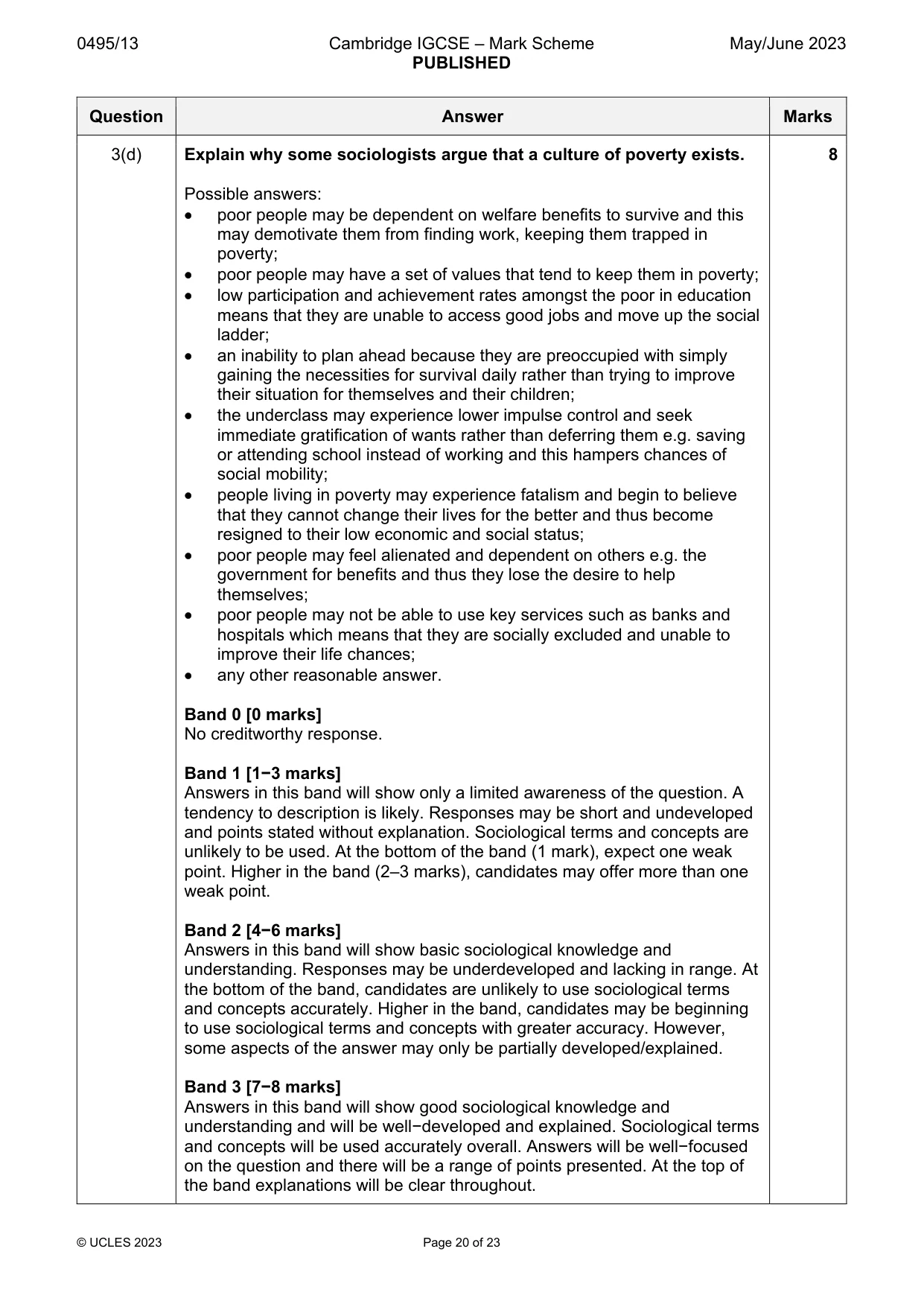
0495/13 Cambridge IGCSE – Mark Scheme PUBLISHED May/June 2023 © UCLES 2023 Page 20 of 23 Question Answer Marks 3(d) Explain why some sociologists argue that a culture of poverty exists. Possible answers: poor people may be dependent on welfare benefits to survive and this may demotivate them from finding work, keeping them trapped in poverty; poor people may have a set of values that tend to keep them in poverty; low participation and achievement rates amongst the poor in education means that they are unable to access good jobs and move up the social ladder; an inability to plan ahead because they are preoccupied with simply gaining the necessities for survival daily rather than trying to improve their situation for themselves and their children; the underclass may experience lower impulse control and seek immediate gratification of wants rather than deferring them e.g. saving or attending school instead of working and this hampers chances of social mobility; people living in poverty may experience fatalism and begin to believe that they cannot change their lives for the better and thus become resigned to their low economic and social status; poor people may feel alienated and dependent on others e.g. the government for benefits and thus they lose the desire to help themselves; poor people may not be able to use key services such as banks and hospitals which means that they are socially excluded and unable to improve their life chances; any other reasonable answer. Band 0 [0 marks] No creditworthy response. Band 1 [1−3 marks] Answers in this band will show only a limited awareness of the question. A tendency to description is likely. Responses may be short and undeveloped and points stated without explanation. Sociological terms and concepts are unlikely to be used. At the bottom of the band (1 mark), expect one weak point. Higher in the band (2–3 marks), candidates may offer more than one weak point. Band 2 [4−6 marks] Answers in this band will show basic sociological knowledge and understanding. Responses may be underdeveloped and lacking in range. At the bottom of the band, candidates are unlikely to use sociological terms and concepts accurately. Higher in the band, candidates may be beginning to use sociological terms and concepts with greater accuracy. However, some aspects of the answer may only be partially developed/explained. Band 3 [7−8 marks] Answers in this band will show good sociological knowledge and understanding and will be well−developed and explained. Sociological terms and concepts will be used accurately overall. Answers will be well−focused on the question and there will be a range of points presented. At the top of the band explanations will be clear throughout. 8
Mark scheme, page 21
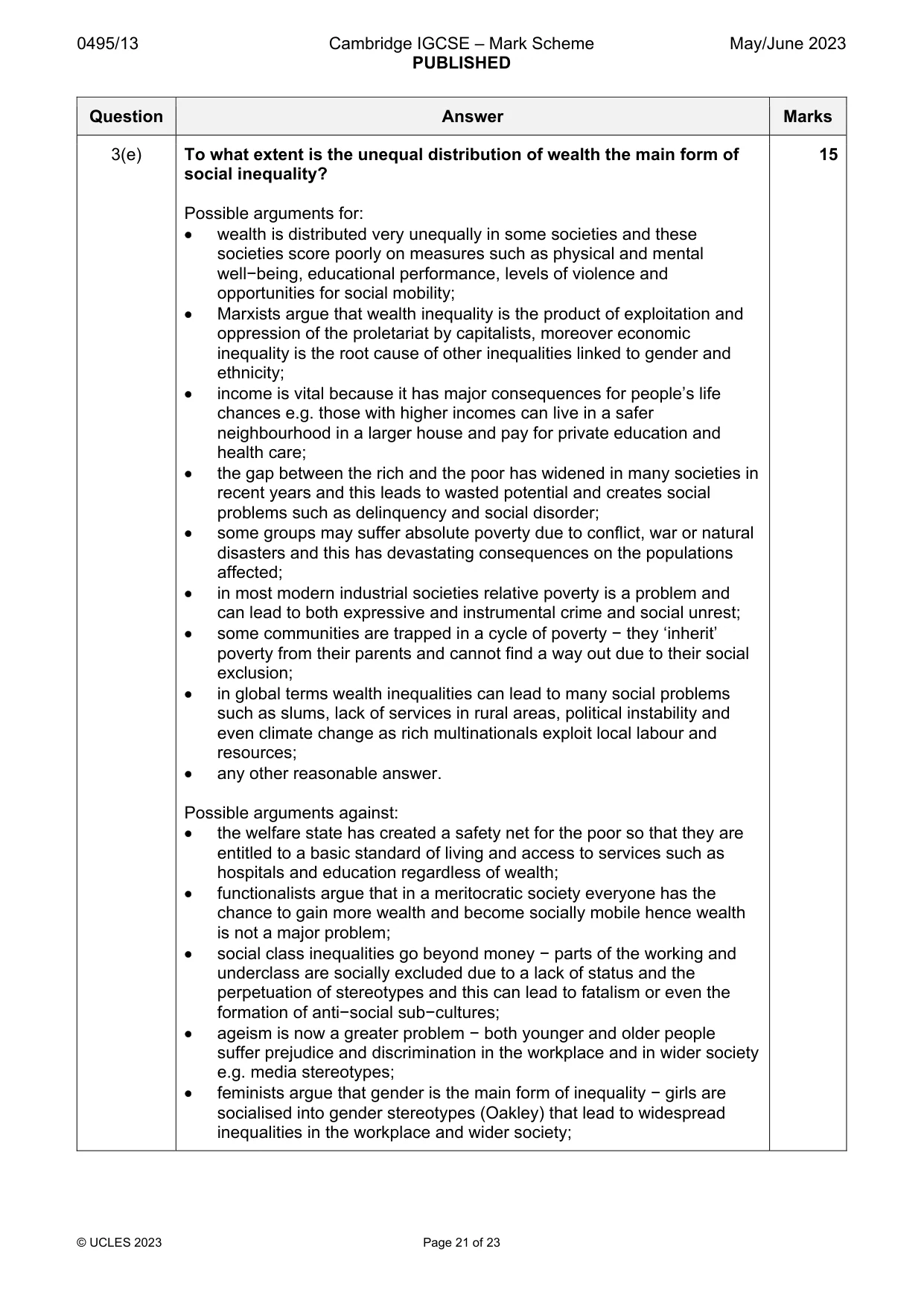
0495/13 Cambridge IGCSE – Mark Scheme PUBLISHED May/June 2023 © UCLES 2023 Page 21 of 23 Question Answer Marks 3(e) To what extent is the unequal distribution of wealth the main form of social inequality? Possible arguments for: wealth is distributed very unequally in some societies and these societies score poorly on measures such as physical and mental well−being, educational performance, levels of violence and opportunities for social mobility; Marxists argue that wealth inequality is the product of exploitation and oppression of the proletariat by capitalists, moreover economic inequality is the root cause of other inequalities linked to gender and ethnicity; income is vital because it has major consequences for people’s life chances e.g. those with higher incomes can live in a safer neighbourhood in a larger house and pay for private education and health care; the gap between the rich and the poor has widened in many societies in recent years and this leads to wasted potential and creates social problems such as delinquency and social disorder; some groups may suffer absolute poverty due to conflict, war or natural disasters and this has devastating consequences on the populations affected; in most modern industrial societies relative poverty is a problem and can lead to both expressive and instrumental crime and social unrest; some communities are trapped in a cycle of poverty − they ‘inherit’ poverty from their parents and cannot find a way out due to their social exclusion; in global terms wealth inequalities can lead to many social problems such as slums, lack of services in rural areas, political instability and even climate change as rich multinationals exploit local labour and resources; any other reasonable answer. Possible arguments against: the welfare state has created a safety net for the poor so that they are entitled to a basic standard of living and access to services such as hospitals and education regardless of wealth; functionalists argue that in a meritocratic society everyone has the chance to gain more wealth and become socially mobile hence wealth is not a major problem; social class inequalities go beyond money − parts of the working and underclass are socially excluded due to a lack of status and the perpetuation of stereotypes and this can lead to fatalism or even the formation of anti−social sub−cultures; ageism is now a greater problem − both younger and older people suffer prejudice and discrimination in the workplace and in wider society e.g. media stereotypes; feminists argue that gender is the main form of inequality − girls are socialised into gender stereotypes (Oakley) that lead to widespread inequalities in the workplace and wider society; 15
Mark scheme, page 22
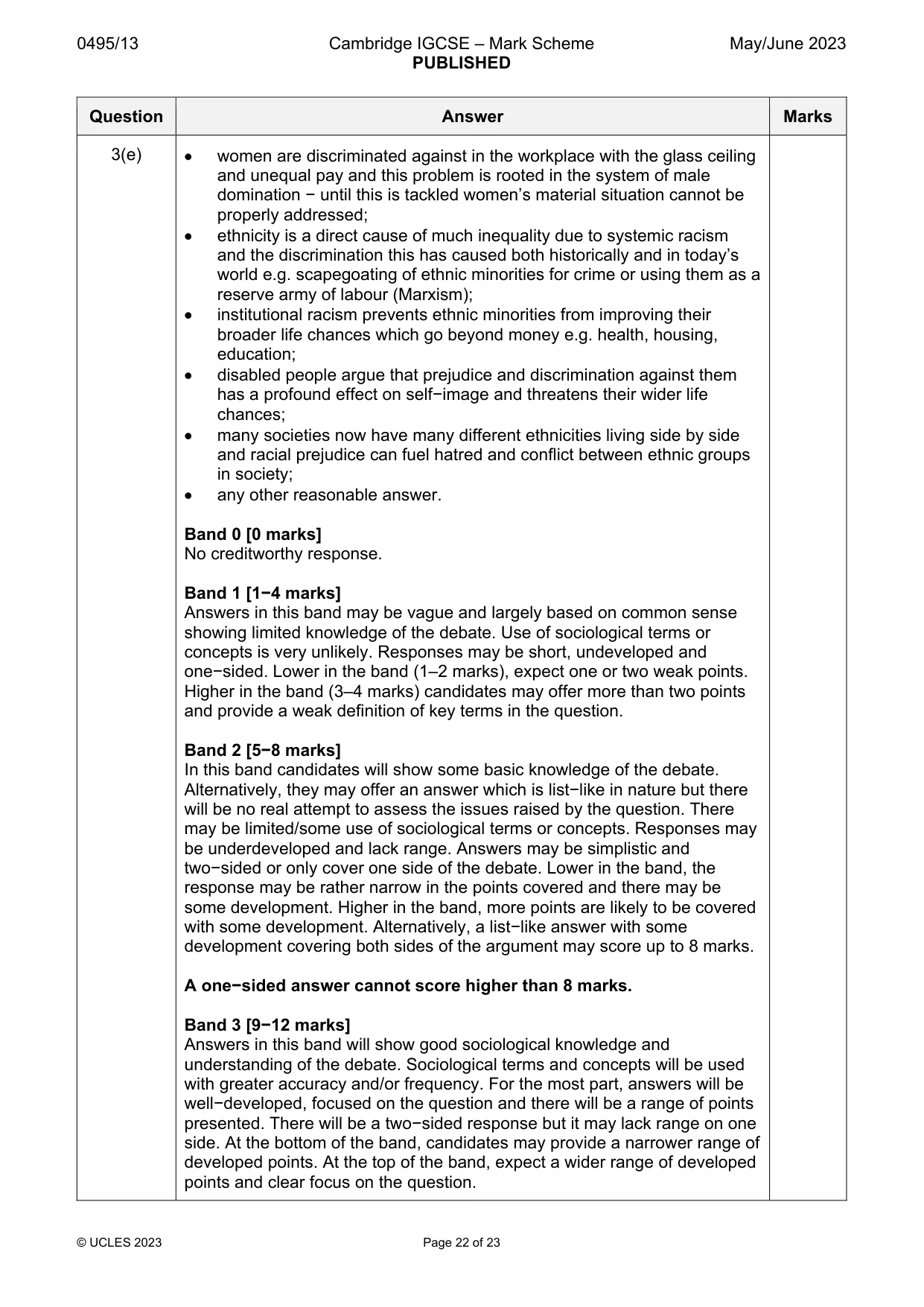
0495/13 Cambridge IGCSE – Mark Scheme PUBLISHED May/June 2023 © UCLES 2023 Page 22 of 23 Question Answer Marks 3(e) women are discriminated against in the workplace with the glass ceiling and unequal pay and this problem is rooted in the system of male domination − until this is tackled women’s material situation cannot be properly addressed; ethnicity is a direct cause of much inequality due to systemic racism and the discrimination this has caused both historically and in today’s world e.g. scapegoating of ethnic minorities for crime or using them as a reserve army of labour (Marxism); institutional racism prevents ethnic minorities from improving their broader life chances which go beyond money e.g. health, housing, education; disabled people argue that prejudice and discrimination against them has a profound effect on self−image and threatens their wider life chances; many societies now have many different ethnicities living side by side and racial prejudice can fuel hatred and conflict between ethnic groups in society; any other reasonable answer. Band 0 [0 marks] No creditworthy response. Band 1 [1−4 marks] Answers in this band may be vague and largely based on common sense showing limited knowledge of the debate. Use of sociological terms or concepts is very unlikely. Responses may be short, undeveloped and one−sided. Lower in the band (1–2 marks), expect one or two weak points. Higher in the band (3–4 marks) candidates may offer more than two points and provide a weak definition of key terms in the question. Band 2 [5−8 marks] In this band candidates will show some basic knowledge of the debate. Alternatively, they may offer an answer which is list−like in nature but there will be no real attempt to assess the issues raised by the question. There may be limited/some use of sociological terms or concepts. Responses may be underdeveloped and lack range. Answers may be simplistic and two−sided or only cover one side of the debate. Lower in the band, the response may be rather narrow in the points covered and there may be some development. Higher in the band, more points are likely to be covered with some development. Alternatively, a list−like answer with some development covering both sides of the argument may score up to 8 marks. A one−sided answer cannot score higher than 8 marks. Band 3 [9−12 marks] Answers in this band will show good sociological knowledge and understanding of the debate. Sociological terms and concepts will be used with greater accuracy and/or frequency. For the most part, answers will be well−developed, focused on the question and there will be a range of points presented. There will be a two−sided response but it may lack range on one side. At the bottom of the band, candidates may provide a narrower range of developed points. At the top of the band, expect a wider range of developed points and clear focus on the question.
Mark scheme, page 23
0495/13 Cambridge IGCSE – Mark Scheme PUBLISHED May/June 2023 © UCLES 2023 Page 23 of 23 Question Answer Marks 3(e) Band 4 [13−15 marks] Answers in this band will show excellent knowledge and understanding of the debate. There will be a strong grasp of the arguments as well as accurate and frequent use of sociological terms and concepts. Answers will be well−developed, clearly focused on the question and discuss a wide range of points. Responses will be two−sided and have a range of points on each side. At the bottom of the band (13 marks), the answer may lack a specific conclusion. Higher in the band, there will be a clear attempt to offer an assessment of the ‘To what extent?’ part of the question through a focused conclusion.
What you needed in this session
Cambridge’s own grade thresholds for 2023 May/June, Paper 1 · Variant 3. A higher threshold means an easier paper — the bar moves with how the cohort did.