Cambridge IGCSE Sociology 0495 — 2024 Oct/Nov Paper 1 · Variant 3
0495/13/O/N/24 · 80 marks · ≈90 min
The question paper and its mark scheme, free to read here and free to download. This is Cambridge’s own paper, exactly as it was sat.
Question paper4 pages

Mark scheme20 pages
Answers below. Sit the paper first if you are practising.

Paper as text
Question paper, page 1
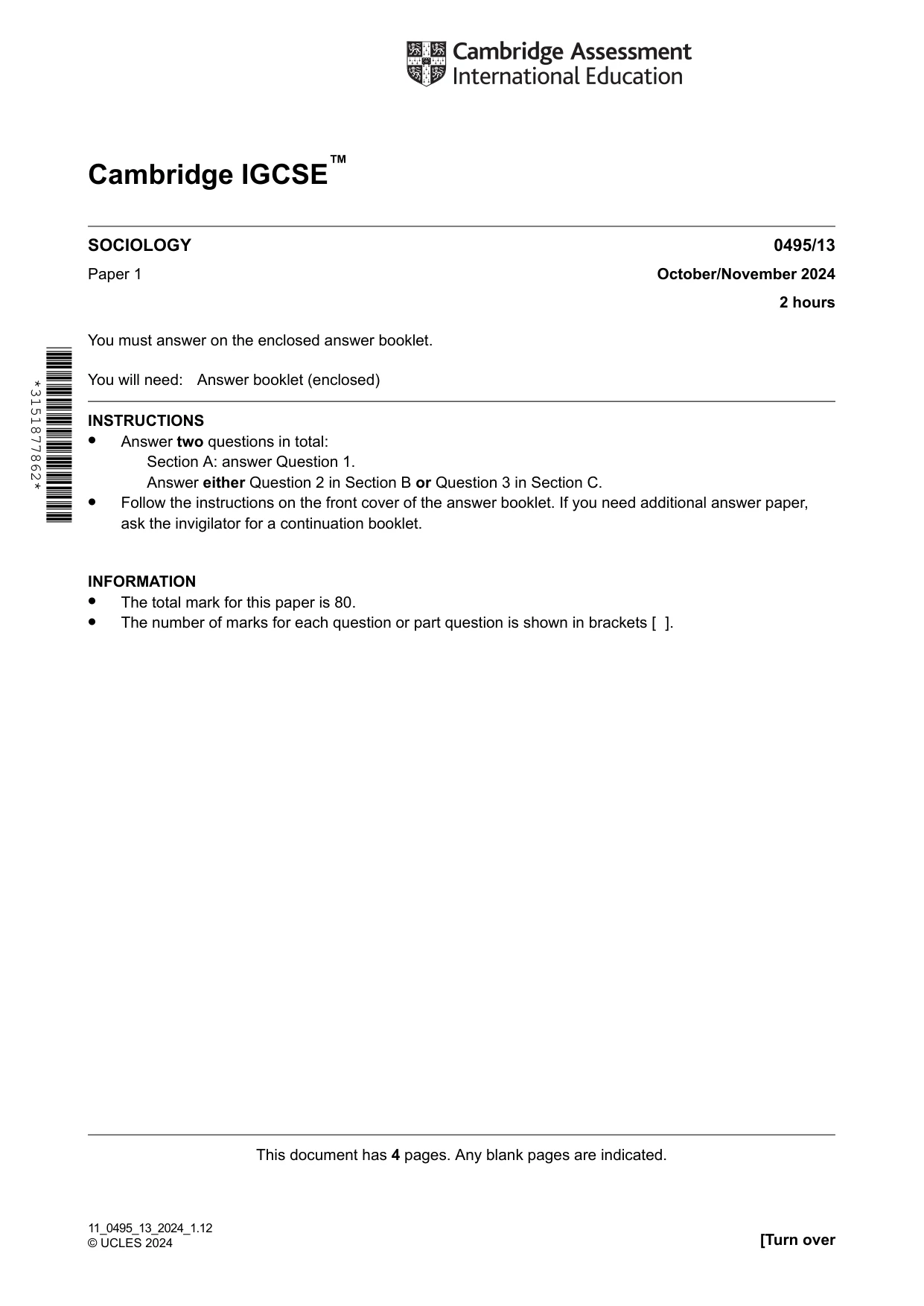
Cambridge IGCSE™ 0495/13 October/November 2024 2 hours SOCIOLOGY Paper 1 You must answer on the enclosed answer booklet. You will need: Answer booklet (enclosed) INSTRUCTIONS • Answer two questions in total: Section A: answer Question 1. Answer either Question 2 in Section B or Question 3 in Section C. • Follow the instructions on the front cover of the answer booklet. If you need additional answer paper, ask the invigilator for a continuation booklet. INFORMATION • The total mark for this paper is 80. • The number of marks for each question or part question is shown in brackets [ ]. This document has 4 pages. Any blank pages are indicated. [Turn over 11_0495_13_2024_1.12 © UCLES 2024 *3151877862*
Question paper, page 2
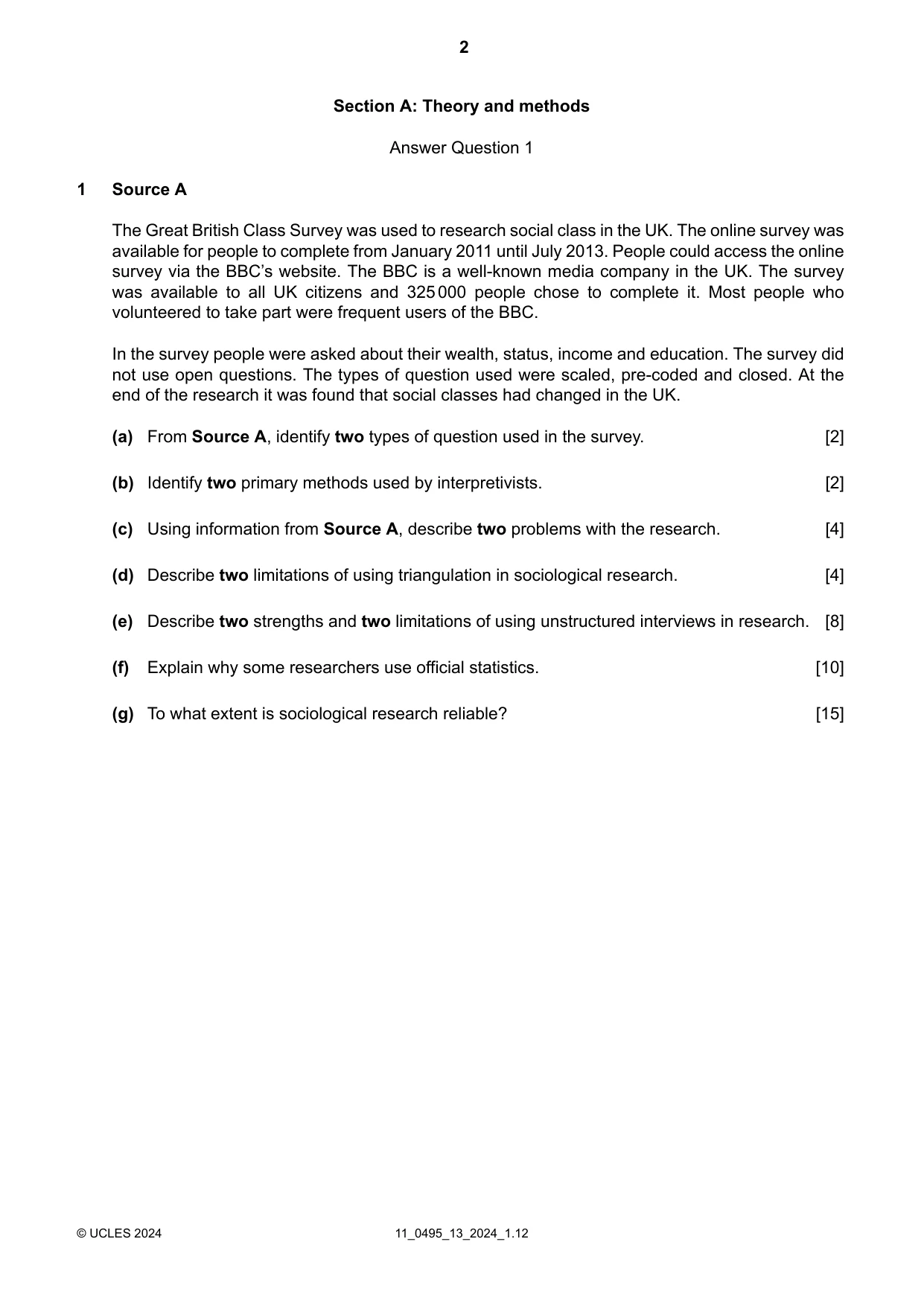
Section A: Theory and methods Answer Question 1 Source A 1 The Great British Class Survey was used to research social class in the UK. The online survey was available for people to complete from January 2011 until July 2013. People could access the online survey via the BBC’s website. The BBC is a well-known media company in the UK. The survey was available to all UK citizens and 325000 people chose to complete it. Most people who volunteered to take part were frequent users of the BBC. In the survey people were asked about their wealth, status, income and education. The survey did not use open questions. The types of question used were scaled, pre-coded and closed. At the end of the research it was found that social classes had changed in the UK. From Source A, identify two types of question used in the survey. [2] (a) Identify two primary methods used by interpretivists. [2] (b) Using information from Source A, describe two problems with the research. [4] (c) Describe two limitations of using triangulation in sociological research. [4] (d) Describe two strengths and two limitations of using unstructured interviews in research. [8] (e) Explain why some researchers use official statistics. [10] (f) To what extent is sociological research reliable? [15] (g) 11_0495_13_2024_1.12 © UCLES 2024 2
Question paper, page 3
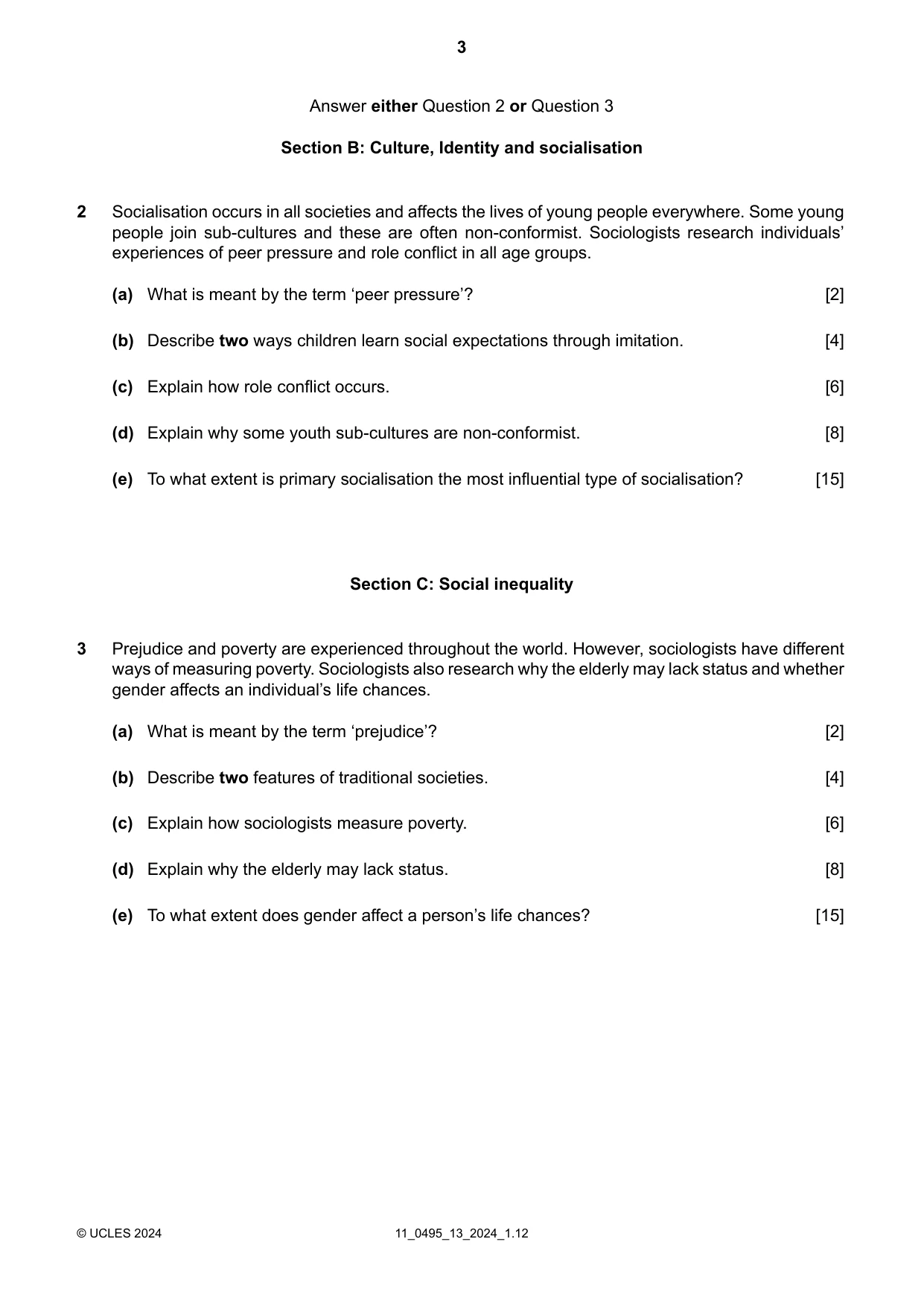
Answer either Question 2 or Question 3 Section B: Culture, Identity and socialisation Socialisation occurs in all societies and affects the lives of young people everywhere. Some young people join sub-cultures and these are often non-conformist. Sociologists research individuals’ experiences of peer pressure and role conflict in all age groups. 2 What is meant by the term ‘peer pressure’? [2] (a) Describe two ways children learn social expectations through imitation. [4] (b) Explain how role conflict occurs. [6] (c) Explain why some youth sub-cultures are non-conformist. [8] (d) To what extent is primary socialisation the most influential type of socialisation? [15] (e) Section C: Social inequality Prejudice and poverty are experienced throughout the world. However, sociologists have different ways of measuring poverty. Sociologists also research why the elderly may lack status and whether gender affects an individual’s life chances. 3 What is meant by the term ‘prejudice’? [2] (a) Describe two features of traditional societies. [4] (b) Explain how sociologists measure poverty. [6] (c) Explain why the elderly may lack status. [8] (d) To what extent does gender affect a person’s life chances? [15] (e) 11_0495_13_2024_1.12 © UCLES 2024 3
Question paper, page 4
BLANK PAGE Permission to reproduce items where third-party owned material protected by copyright is included has been sought and cleared where possible. Every reasonable effort has been made by the publisher (UCLES) to trace copyright holders, but if any items requiring clearance have unwittingly been included, the publisher will be pleased to make amends at the earliest possible opportunity. To avoid the issue of disclosure of answer-related information to candidates, all copyright acknowledgements are reproduced online in the Cambridge Assessment International Education Copyright Acknowledgements Booklet. This is produced for each series of examinations and is freely available to download at www.cambridgeinternational.org after the live examination series. Cambridge Assessment International Education is part of Cambridge Assessment. Cambridge Assessment is the brand name of the University of Cambridge Local Examinations Syndicate (UCLES), which is a department of the University of Cambridge. 11_0495_13_2024_1.12 © UCLES 2024 4
Mark scheme, page 1
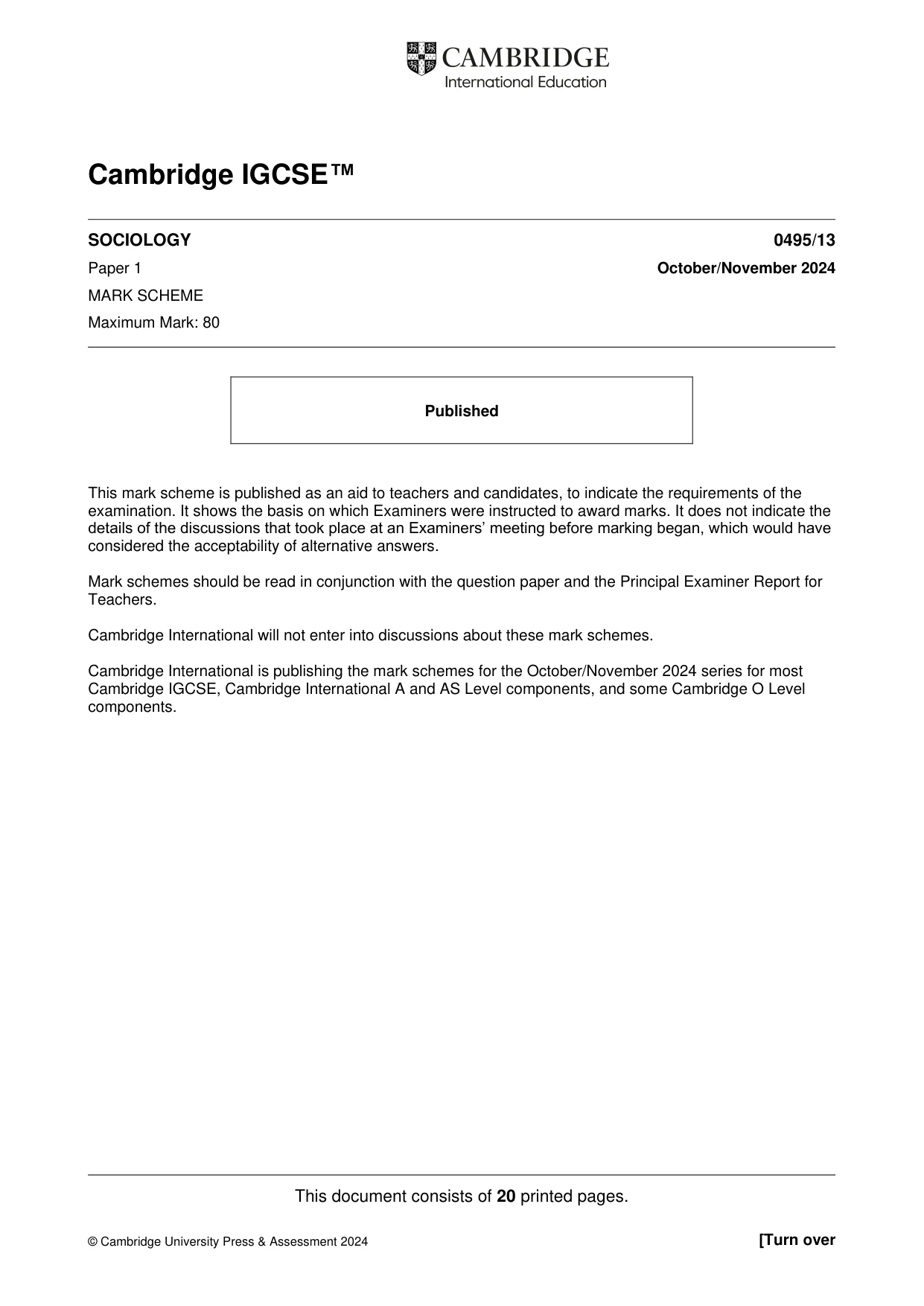
This document consists of 20 printed pages. © Cambridge University Press & Assessment 2024 [Turn over Cambridge IGCSE™ SOCIOLOGY 0495/13 Paper 1 October/November 2024 MARK SCHEME Maximum Mark: 80 Published This mark scheme is published as an aid to teachers and candidates, to indicate the requirements of the examination. It shows the basis on which Examiners were instructed to award marks. It does not indicate the details of the discussions that took place at an Examiners’ meeting before marking began, which would have considered the acceptability of alternative answers. Mark schemes should be read in conjunction with the question paper and the Principal Examiner Report for Teachers. Cambridge International will not enter into discussions about these mark schemes. Cambridge International is publishing the mark schemes for the October/November 2024 series for most Cambridge IGCSE, Cambridge International A and AS Level components, and some Cambridge O Level components.
Mark scheme, page 2
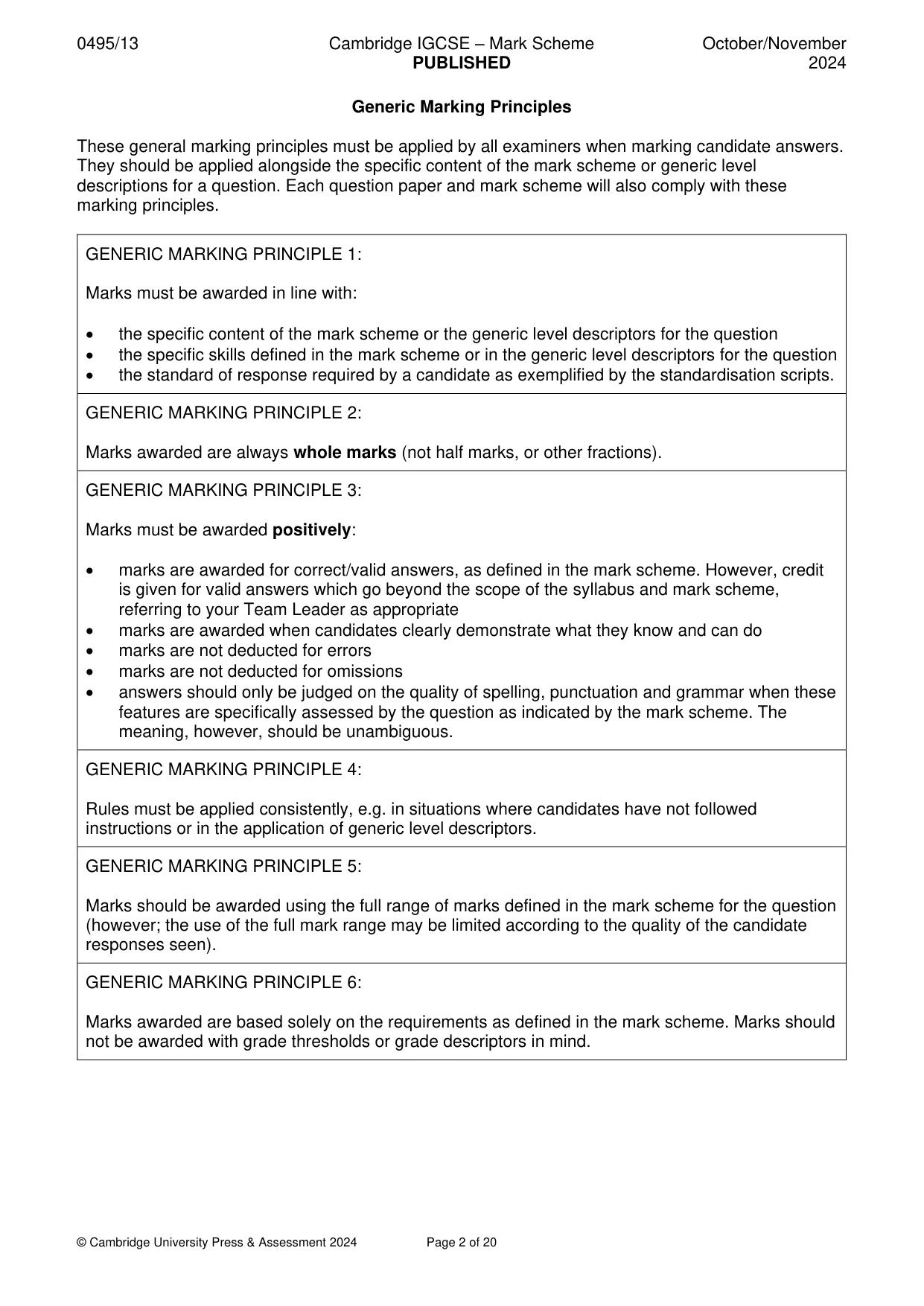
0495/13 Cambridge IGCSE – Mark Scheme PUBLISHED October/November 2024 © Cambridge University Press & Assessment 2024 Page 2 of 20 Generic Marking Principles These general marking principles must be applied by all examiners when marking candidate answers. They should be applied alongside the specific content of the mark scheme or generic level descriptions for a question. Each question paper and mark scheme will also comply with these marking principles. GENERIC MARKING PRINCIPLE 1: Marks must be awarded in line with: • the specific content of the mark scheme or the generic level descriptors for the question • the specific skills defined in the mark scheme or in the generic level descriptors for the question • the standard of response required by a candidate as exemplified by the standardisation scripts. GENERIC MARKING PRINCIPLE 2: Marks awarded are always whole marks (not half marks, or other fractions). GENERIC MARKING PRINCIPLE 3: Marks must be awarded positively: • marks are awarded for correct/valid answers, as defined in the mark scheme. However, credit is given for valid answers which go beyond the scope of the syllabus and mark scheme, referring to your Team Leader as appropriate • marks are awarded when candidates clearly demonstrate what they know and can do • marks are not deducted for errors • marks are not deducted for omissions • answers should only be judged on the quality of spelling, punctuation and grammar when these features are specifically assessed by the question as indicated by the mark scheme. The meaning, however, should be unambiguous. GENERIC MARKING PRINCIPLE 4: Rules must be applied consistently, e.g. in situations where candidates have not followed instructions or in the application of generic level descriptors. GENERIC MARKING PRINCIPLE 5: Marks should be awarded using the full range of marks defined in the mark scheme for the question (however; the use of the full mark range may be limited according to the quality of the candidate responses seen). GENERIC MARKING PRINCIPLE 6: Marks awarded are based solely on the requirements as defined in the mark scheme. Marks should not be awarded with grade thresholds or grade descriptors in mind.
Mark scheme, page 3
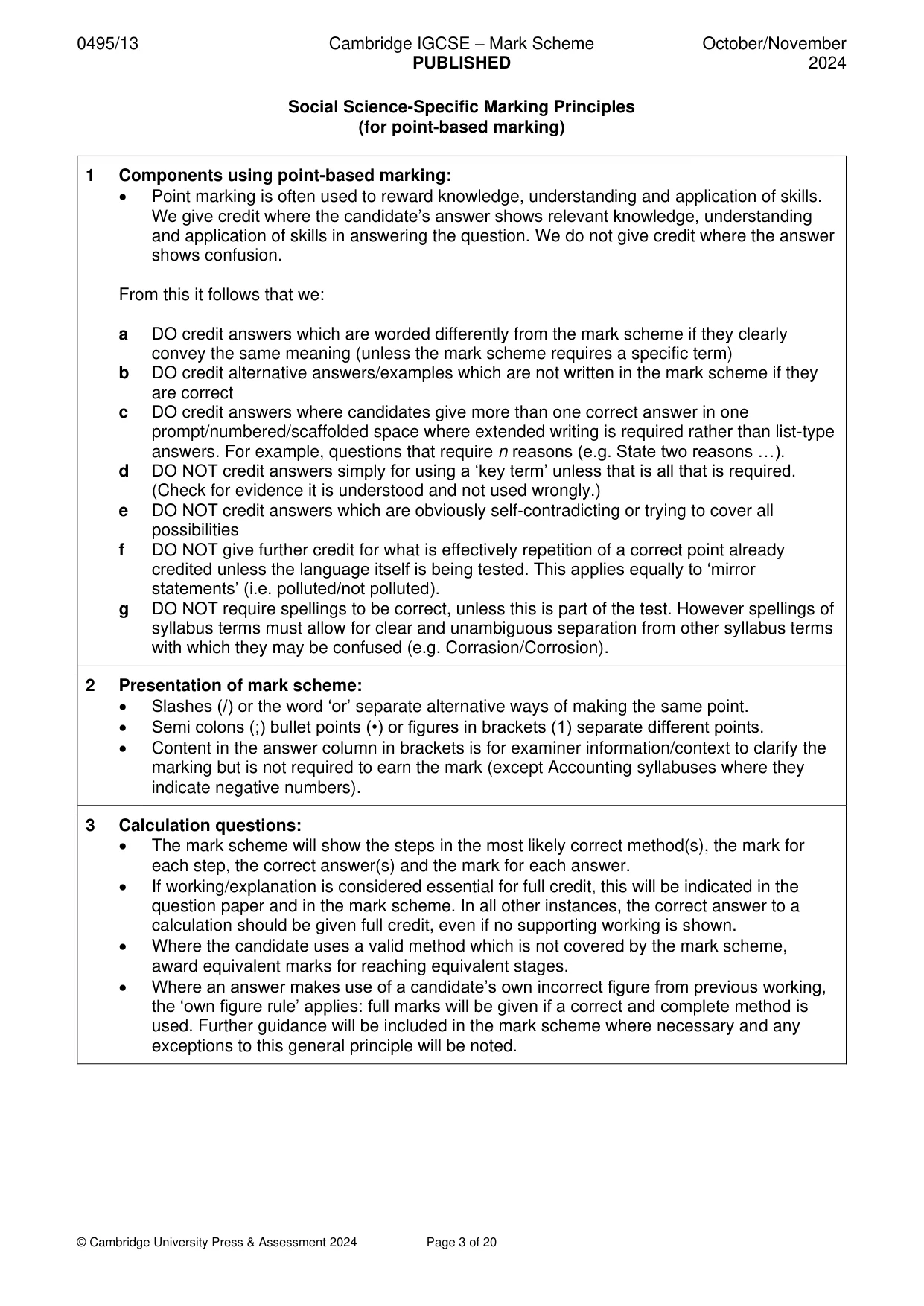
0495/13 Cambridge IGCSE – Mark Scheme PUBLISHED October/November 2024 © Cambridge University Press & Assessment 2024 Page 3 of 20 Social Science-Specific Marking Principles (for point-based marking) 1 Components using point-based marking: • Point marking is often used to reward knowledge, understanding and application of skills. We give credit where the candidate’s answer shows relevant knowledge, understanding and application of skills in answering the question. We do not give credit where the answer shows confusion. From this it follows that we: a DO credit answers which are worded differently from the mark scheme if they clearly convey the same meaning (unless the mark scheme requires a specific term) b DO credit alternative answers/examples which are not written in the mark scheme if they are correct c DO credit answers where candidates give more than one correct answer in one prompt/numbered/scaffolded space where extended writing is required rather than list-type answers. For example, questions that require n reasons (e.g. State two reasons …). d DO NOT credit answers simply for using a ‘key term’ unless that is all that is required. (Check for evidence it is understood and not used wrongly.) e DO NOT credit answers which are obviously self-contradicting or trying to cover all possibilities f DO NOT give further credit for what is effectively repetition of a correct point already credited unless the language itself is being tested. This applies equally to ‘mirror statements’ (i.e. polluted/not polluted). g DO NOT require spellings to be correct, unless this is part of the test. However spellings of syllabus terms must allow for clear and unambiguous separation from other syllabus terms with which they may be confused (e.g. Corrasion/Corrosion). 2 Presentation of mark scheme: • Slashes (/) or the word ‘or’ separate alternative ways of making the same point. • Semi colons (;) bullet points (•) or figures in brackets (1) separate different points. • Content in the answer column in brackets is for examiner information/context to clarify the marking but is not required to earn the mark (except Accounting syllabuses where they indicate negative numbers). 3 Calculation questions: • The mark scheme will show the steps in the most likely correct method(s), the mark for each step, the correct answer(s) and the mark for each answer. • If working/explanation is considered essential for full credit, this will be indicated in the question paper and in the mark scheme. In all other instances, the correct answer to a calculation should be given full credit, even if no supporting working is shown. • Where the candidate uses a valid method which is not covered by the mark scheme, award equivalent marks for reaching equivalent stages. • Where an answer makes use of a candidate’s own incorrect figure from previous working, the ‘own figure rule’ applies: full marks will be given if a correct and complete method is used. Further guidance will be included in the mark scheme where necessary and any exceptions to this general principle will be noted.
Mark scheme, page 4
0495/13 Cambridge IGCSE – Mark Scheme PUBLISHED October/November 2024 © Cambridge University Press & Assessment 2024 Page 4 of 20 4 Annotation: • For point marking, ticks can be used to indicate correct answers and crosses can be used to indicate wrong answers. There is no direct relationship between ticks and marks. Ticks have no defined meaning for levels of response marking. • For levels of response marking, the level awarded should be annotated on the script. • Other annotations will be used by examiners as agreed during standardisation, and the meaning will be understood by all examiners who marked that paper.
Mark scheme, page 5
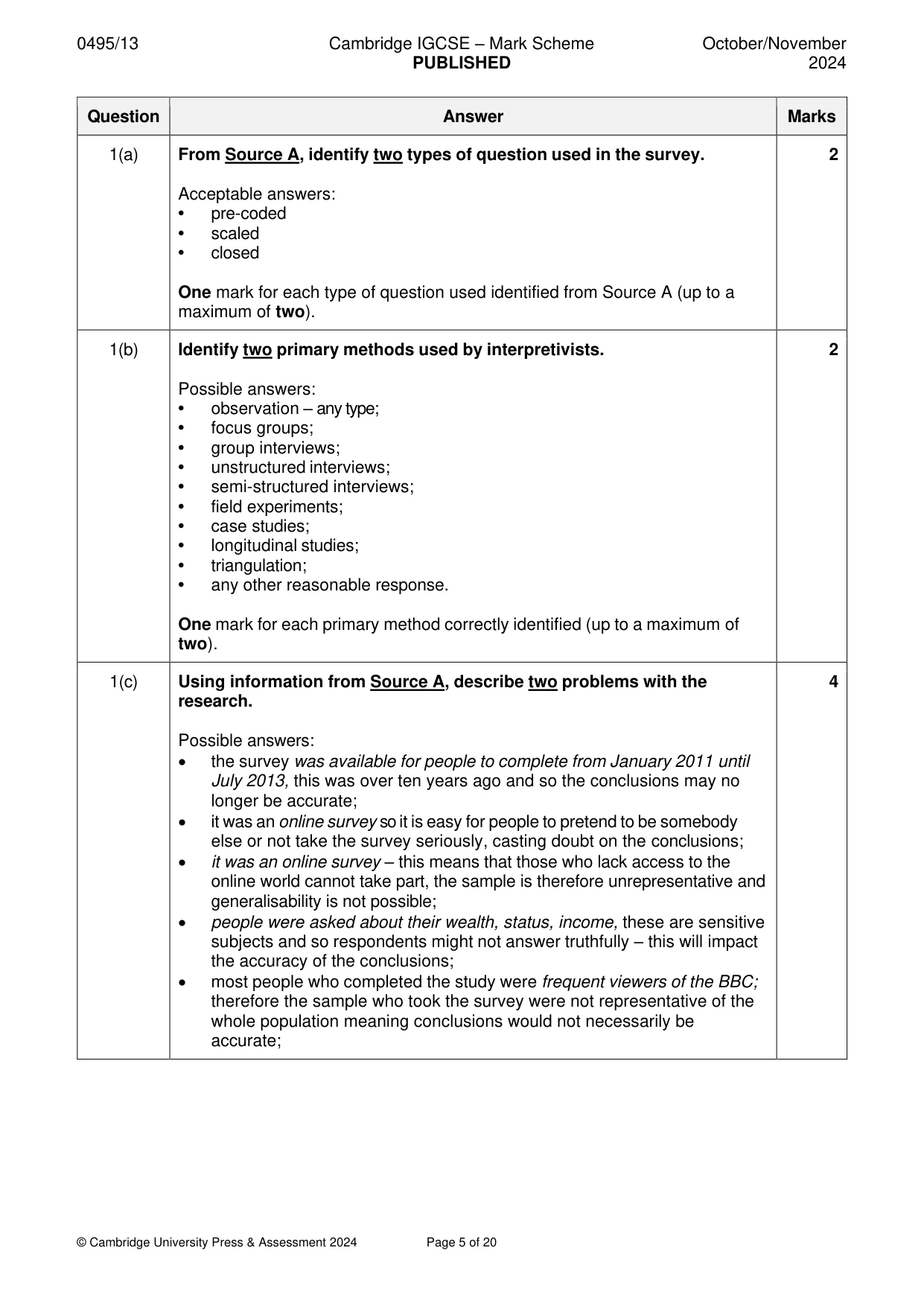
0495/13 Cambridge IGCSE – Mark Scheme PUBLISHED October/November 2024 © Cambridge University Press & Assessment 2024 Page 5 of 20 Question Answer Marks 1(a) From Source A, identify two types of question used in the survey. Acceptable answers: • pre-coded • scaled • closed One mark for each type of question used identified from Source A (up to a maximum of two). 2 1(b) Identify two primary methods used by interpretivists. Possible answers: • observation – any type; • focus groups; • group interviews; • unstructured interviews; • semi-structured interviews; • field experiments; • case studies; • longitudinal studies; • triangulation; • any other reasonable response. One mark for each primary method correctly identified (up to a maximum of two). 2 1(c) Using information from Source A, describe two problems with the research. Possible answers: • the survey was available for people to complete from January 2011 until July 2013, this was over ten years ago and so the conclusions may no longer be accurate; • it was an online survey so it is easy for people to pretend to be somebody else or not take the survey seriously, casting doubt on the conclusions; • it was an online survey – this means that those who lack access to the online world cannot take part, the sample is therefore unrepresentative and generalisability is not possible; • people were asked about their wealth, status, income, these are sensitive subjects and so respondents might not answer truthfully – this will impact the accuracy of the conclusions; • most people who completed the study were frequent viewers of the BBC; therefore the sample who took the survey were not representative of the whole population meaning conclusions would not necessarily be accurate; 4
Mark scheme, page 6
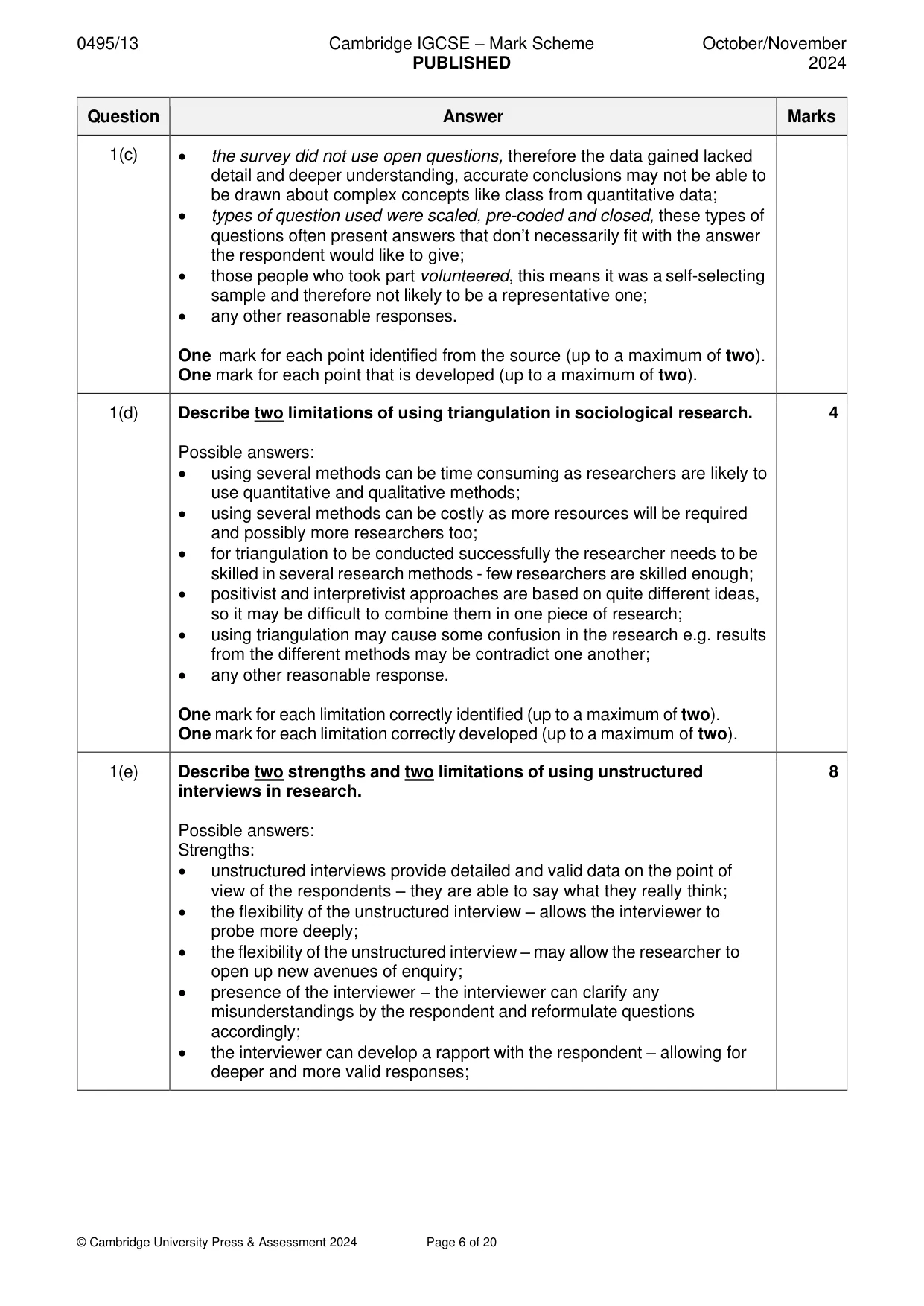
0495/13 Cambridge IGCSE – Mark Scheme PUBLISHED October/November 2024 © Cambridge University Press & Assessment 2024 Page 6 of 20 Question Answer Marks 1(c) • the survey did not use open questions, therefore the data gained lacked detail and deeper understanding, accurate conclusions may not be able to be drawn about complex concepts like class from quantitative data; • types of question used were scaled, pre-coded and closed, these types of questions often present answers that don’t necessarily fit with the answer the respondent would like to give; • those people who took part volunteered, this means it was a self-selecting sample and therefore not likely to be a representative one; • any other reasonable responses. One mark for each point identified from the source (up to a maximum of two). One mark for each point that is developed (up to a maximum of two). 1(d) Describe two limitations of using triangulation in sociological research. Possible answers: • using several methods can be time consuming as researchers are likely to use quantitative and qualitative methods; • using several methods can be costly as more resources will be required and possibly more researchers too; • for triangulation to be conducted successfully the researcher needs to be skilled in several research methods - few researchers are skilled enough; • positivist and interpretivist approaches are based on quite different ideas, so it may be difficult to combine them in one piece of research; • using triangulation may cause some confusion in the research e.g. results from the different methods may be contradict one another; • any other reasonable response. One mark for each limitation correctly identified (up to a maximum of two). One mark for each limitation correctly developed (up to a maximum of two). 4 1(e) Describe two strengths and two limitations of using unstructured interviews in research. Possible answers: Strengths: • unstructured interviews provide detailed and valid data on the point of view of the respondents – they are able to say what they really think; • the flexibility of the unstructured interview – allows the interviewer to probe more deeply; • the flexibility of the unstructured interview – may allow the researcher to open up new avenues of enquiry; • presence of the interviewer – the interviewer can clarify any misunderstandings by the respondent and reformulate questions accordingly; • the interviewer can develop a rapport with the respondent – allowing for deeper and more valid responses; 8
Mark scheme, page 7
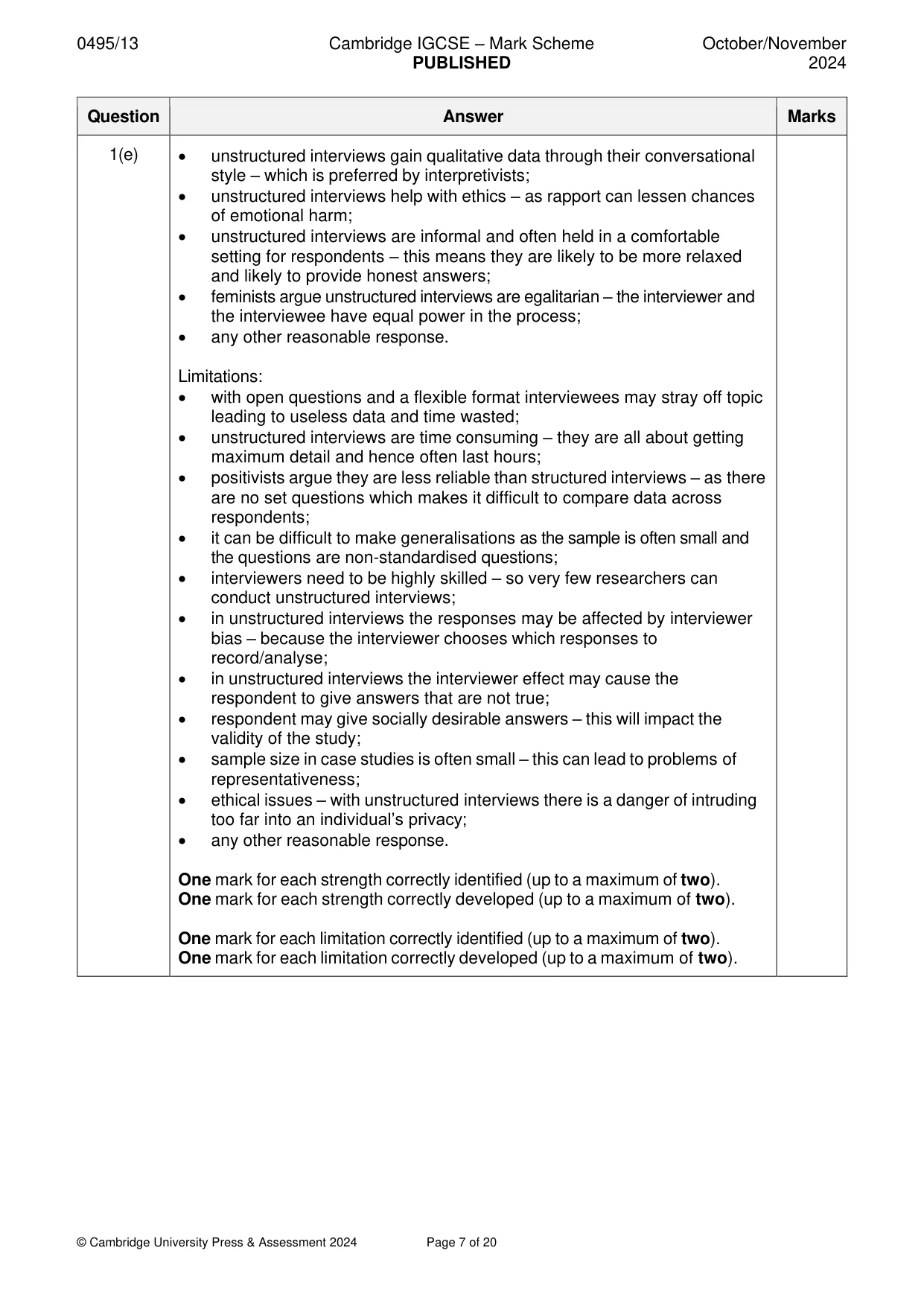
0495/13 Cambridge IGCSE – Mark Scheme PUBLISHED October/November 2024 © Cambridge University Press & Assessment 2024 Page 7 of 20 Question Answer Marks 1(e) • unstructured interviews gain qualitative data through their conversational style – which is preferred by interpretivists; • unstructured interviews help with ethics – as rapport can lessen chances of emotional harm; • unstructured interviews are informal and often held in a comfortable setting for respondents – this means they are likely to be more relaxed and likely to provide honest answers; • feminists argue unstructured interviews are egalitarian – the interviewer and the interviewee have equal power in the process; • any other reasonable response. Limitations: • with open questions and a flexible format interviewees may stray off topic leading to useless data and time wasted; • unstructured interviews are time consuming – they are all about getting maximum detail and hence often last hours; • positivists argue they are less reliable than structured interviews – as there are no set questions which makes it difficult to compare data across respondents; • it can be difficult to make generalisations as the sample is often small and the questions are non-standardised questions; • interviewers need to be highly skilled – so very few researchers can conduct unstructured interviews; • in unstructured interviews the responses may be affected by interviewer bias – because the interviewer chooses which responses to record/analyse; • in unstructured interviews the interviewer effect may cause the respondent to give answers that are not true; • respondent may give socially desirable answers – this will impact the validity of the study; • sample size in case studies is often small – this can lead to problems of representativeness; • ethical issues – with unstructured interviews there is a danger of intruding too far into an individual’s privacy; • any other reasonable response. One mark for each strength correctly identified (up to a maximum of two). One mark for each strength correctly developed (up to a maximum of two). One mark for each limitation correctly identified (up to a maximum of two). One mark for each limitation correctly developed (up to a maximum of two).
Mark scheme, page 8
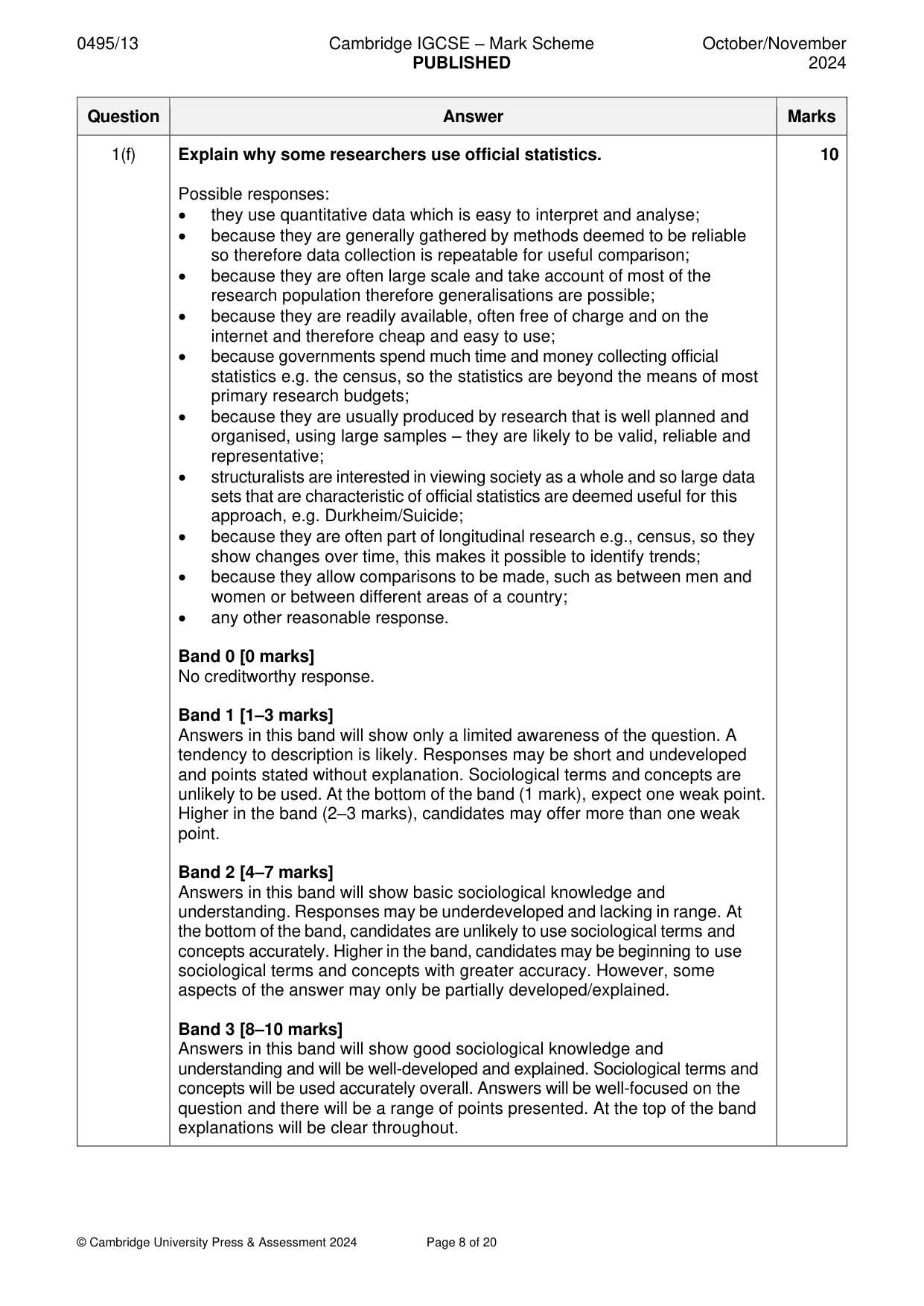
0495/13 Cambridge IGCSE – Mark Scheme PUBLISHED October/November 2024 © Cambridge University Press & Assessment 2024 Page 8 of 20 Question Answer Marks 1(f) Explain why some researchers use official statistics. Possible responses: • they use quantitative data which is easy to interpret and analyse; • because they are generally gathered by methods deemed to be reliable so therefore data collection is repeatable for useful comparison; • because they are often large scale and take account of most of the research population therefore generalisations are possible; • because they are readily available, often free of charge and on the internet and therefore cheap and easy to use; • because governments spend much time and money collecting official statistics e.g. the census, so the statistics are beyond the means of most primary research budgets; • because they are usually produced by research that is well planned and organised, using large samples – they are likely to be valid, reliable and representative; • structuralists are interested in viewing society as a whole and so large data sets that are characteristic of official statistics are deemed useful for this approach, e.g. Durkheim/Suicide; • because they are often part of longitudinal research e.g., census, so they show changes over time, this makes it possible to identify trends; • because they allow comparisons to be made, such as between men and women or between different areas of a country; • any other reasonable response. Band 0 [0 marks] No creditworthy response. Band 1 [1–3 marks] Answers in this band will show only a limited awareness of the question. A tendency to description is likely. Responses may be short and undeveloped and points stated without explanation. Sociological terms and concepts are unlikely to be used. At the bottom of the band (1 mark), expect one weak point. Higher in the band (2–3 marks), candidates may offer more than one weak point. Band 2 [4–7 marks] Answers in this band will show basic sociological knowledge and understanding. Responses may be underdeveloped and lacking in range. At the bottom of the band, candidates are unlikely to use sociological terms and concepts accurately. Higher in the band, candidates may be beginning to use sociological terms and concepts with greater accuracy. However, some aspects of the answer may only be partially developed/explained. Band 3 [8–10 marks] Answers in this band will show good sociological knowledge and understanding and will be well-developed and explained. Sociological terms and concepts will be used accurately overall. Answers will be well-focused on the question and there will be a range of points presented. At the top of the band explanations will be clear throughout. 10
Mark scheme, page 9
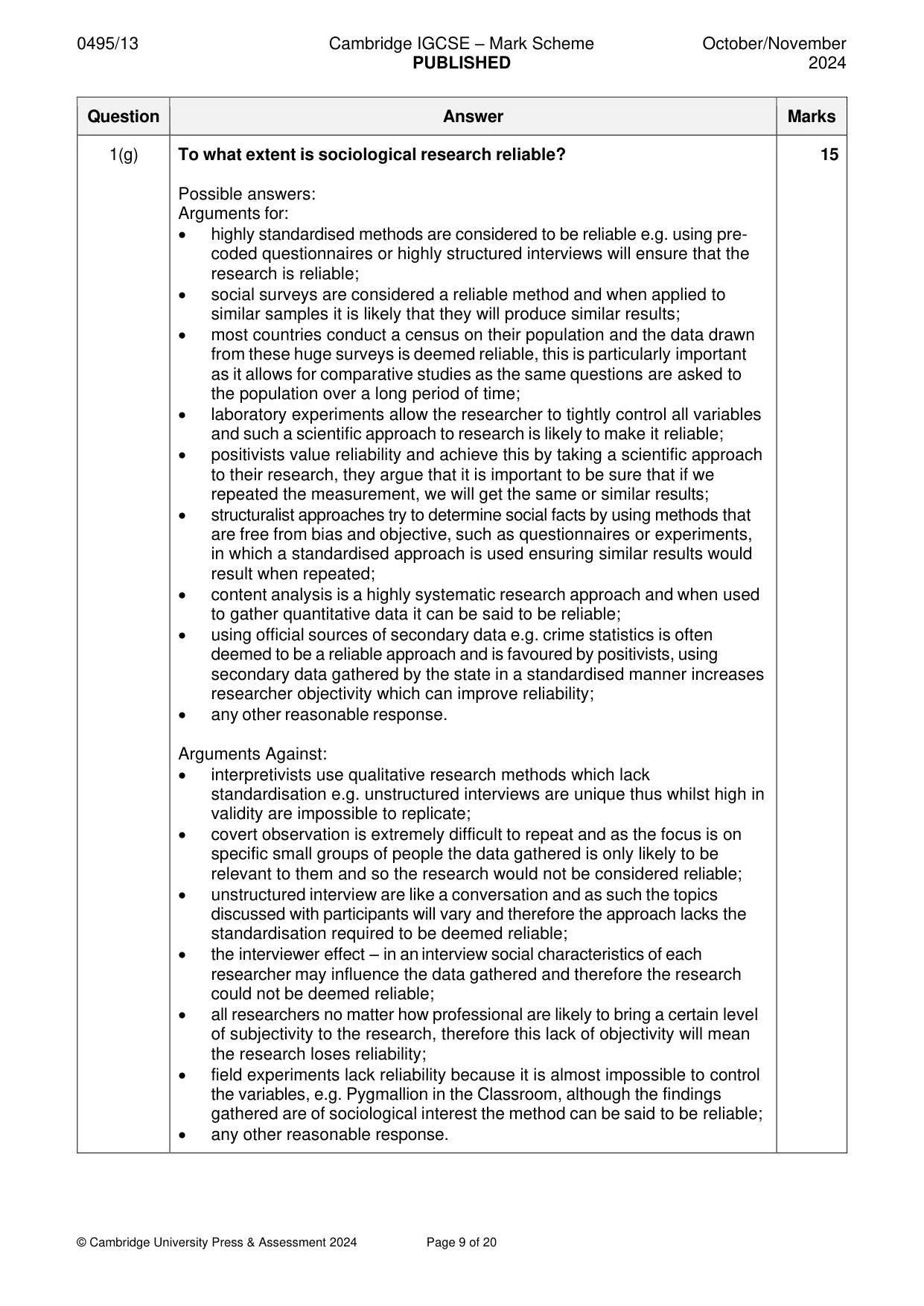
0495/13 Cambridge IGCSE – Mark Scheme PUBLISHED October/November 2024 © Cambridge University Press & Assessment 2024 Page 9 of 20 Question Answer Marks 1(g) To what extent is sociological research reliable? Possible answers: Arguments for: • highly standardised methods are considered to be reliable e.g. using pre- coded questionnaires or highly structured interviews will ensure that the research is reliable; • social surveys are considered a reliable method and when applied to similar samples it is likely that they will produce similar results; • most countries conduct a census on their population and the data drawn from these huge surveys is deemed reliable, this is particularly important as it allows for comparative studies as the same questions are asked to the population over a long period of time; • laboratory experiments allow the researcher to tightly control all variables and such a scientific approach to research is likely to make it reliable; • positivists value reliability and achieve this by taking a scientific approach to their research, they argue that it is important to be sure that if we repeated the measurement, we will get the same or similar results; • structuralist approaches try to determine social facts by using methods that are free from bias and objective, such as questionnaires or experiments, in which a standardised approach is used ensuring similar results would result when repeated; • content analysis is a highly systematic research approach and when used to gather quantitative data it can be said to be reliable; • using official sources of secondary data e.g. crime statistics is often deemed to be a reliable approach and is favoured by positivists, using secondary data gathered by the state in a standardised manner increases researcher objectivity which can improve reliability; • any other reasonable response. Arguments Against: • interpretivists use qualitative research methods which lack standardisation e.g. unstructured interviews are unique thus whilst high in validity are impossible to replicate; • covert observation is extremely difficult to repeat and as the focus is on specific small groups of people the data gathered is only likely to be relevant to them and so the research would not be considered reliable; • unstructured interview are like a conversation and as such the topics discussed with participants will vary and therefore the approach lacks the standardisation required to be deemed reliable; • the interviewer effect – in an interview social characteristics of each researcher may influence the data gathered and therefore the research could not be deemed reliable; • all researchers no matter how professional are likely to bring a certain level of subjectivity to the research, therefore this lack of objectivity will mean the research loses reliability; • field experiments lack reliability because it is almost impossible to control the variables, e.g. Pygmallion in the Classroom, although the findings gathered are of sociological interest the method can be said to be reliable; • any other reasonable response. 15
Mark scheme, page 10
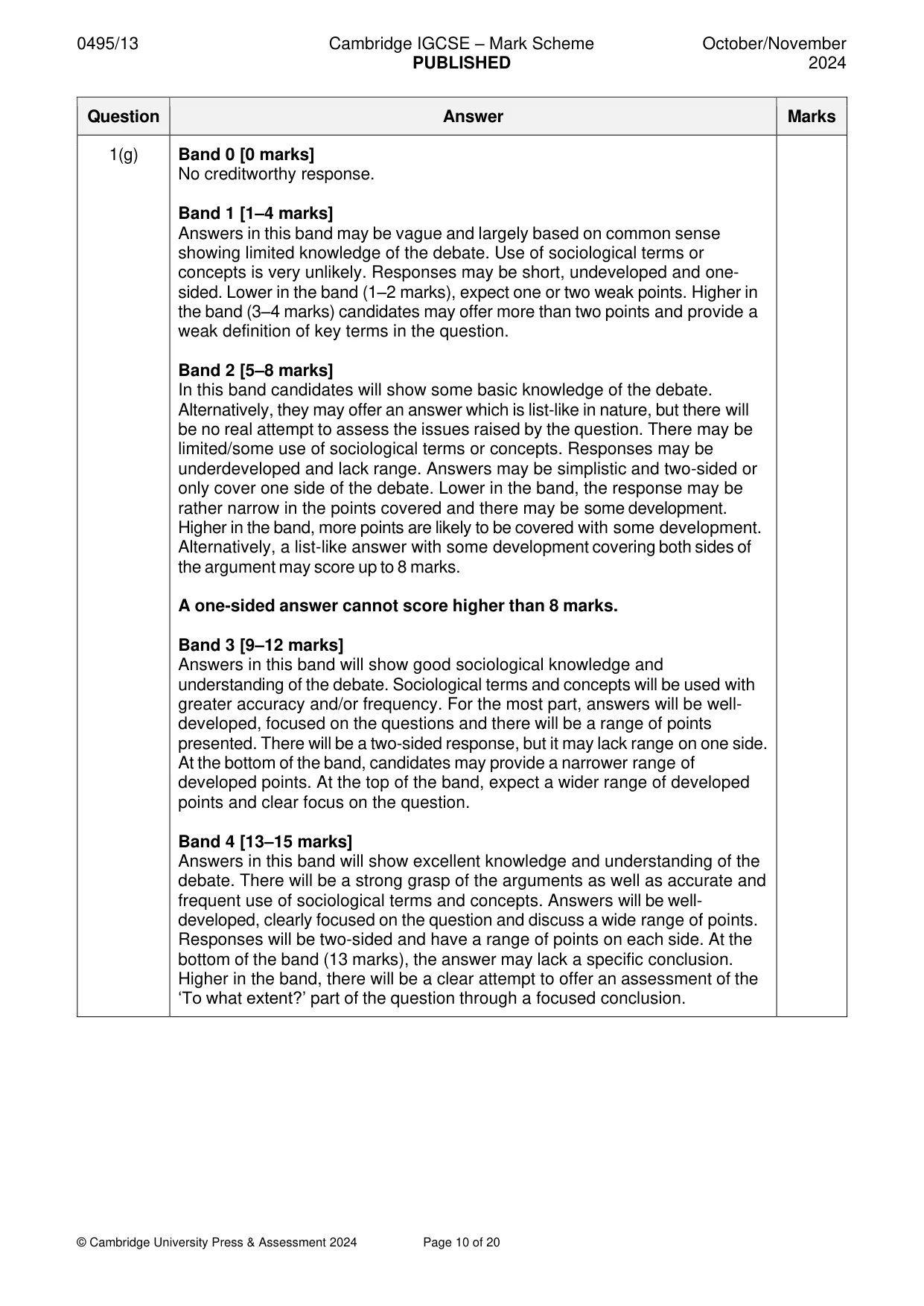
0495/13 Cambridge IGCSE – Mark Scheme PUBLISHED October/November 2024 © Cambridge University Press & Assessment 2024 Page 10 of 20 Question Answer Marks 1(g) Band 0 [0 marks] No creditworthy response. Band 1 [1–4 marks] Answers in this band may be vague and largely based on common sense showing limited knowledge of the debate. Use of sociological terms or concepts is very unlikely. Responses may be short, undeveloped and one- sided. Lower in the band (1–2 marks), expect one or two weak points. Higher in the band (3–4 marks) candidates may offer more than two points and provide a weak definition of key terms in the question. Band 2 [5–8 marks] In this band candidates will show some basic knowledge of the debate. Alternatively, they may offer an answer which is list-like in nature, but there will be no real attempt to assess the issues raised by the question. There may be limited/some use of sociological terms or concepts. Responses may be underdeveloped and lack range. Answers may be simplistic and two-sided or only cover one side of the debate. Lower in the band, the response may be rather narrow in the points covered and there may be some development. Higher in the band, more points are likely to be covered with some development. Alternatively, a list-like answer with some development covering both sides of the argument may score up to 8 marks. A one-sided answer cannot score higher than 8 marks. Band 3 [9–12 marks] Answers in this band will show good sociological knowledge and understanding of the debate. Sociological terms and concepts will be used with greater accuracy and/or frequency. For the most part, answers will be well- developed, focused on the questions and there will be a range of points presented. There will be a two-sided response, but it may lack range on one side. At the bottom of the band, candidates may provide a narrower range of developed points. At the top of the band, expect a wider range of developed points and clear focus on the question. Band 4 [13–15 marks] Answers in this band will show excellent knowledge and understanding of the debate. There will be a strong grasp of the arguments as well as accurate and frequent use of sociological terms and concepts. Answers will be well- developed, clearly focused on the question and discuss a wide range of points. Responses will be two-sided and have a range of points on each side. At the bottom of the band (13 marks), the answer may lack a specific conclusion. Higher in the band, there will be a clear attempt to offer an assessment of the ‘To what extent?’ part of the question through a focused conclusion.
Mark scheme, page 11
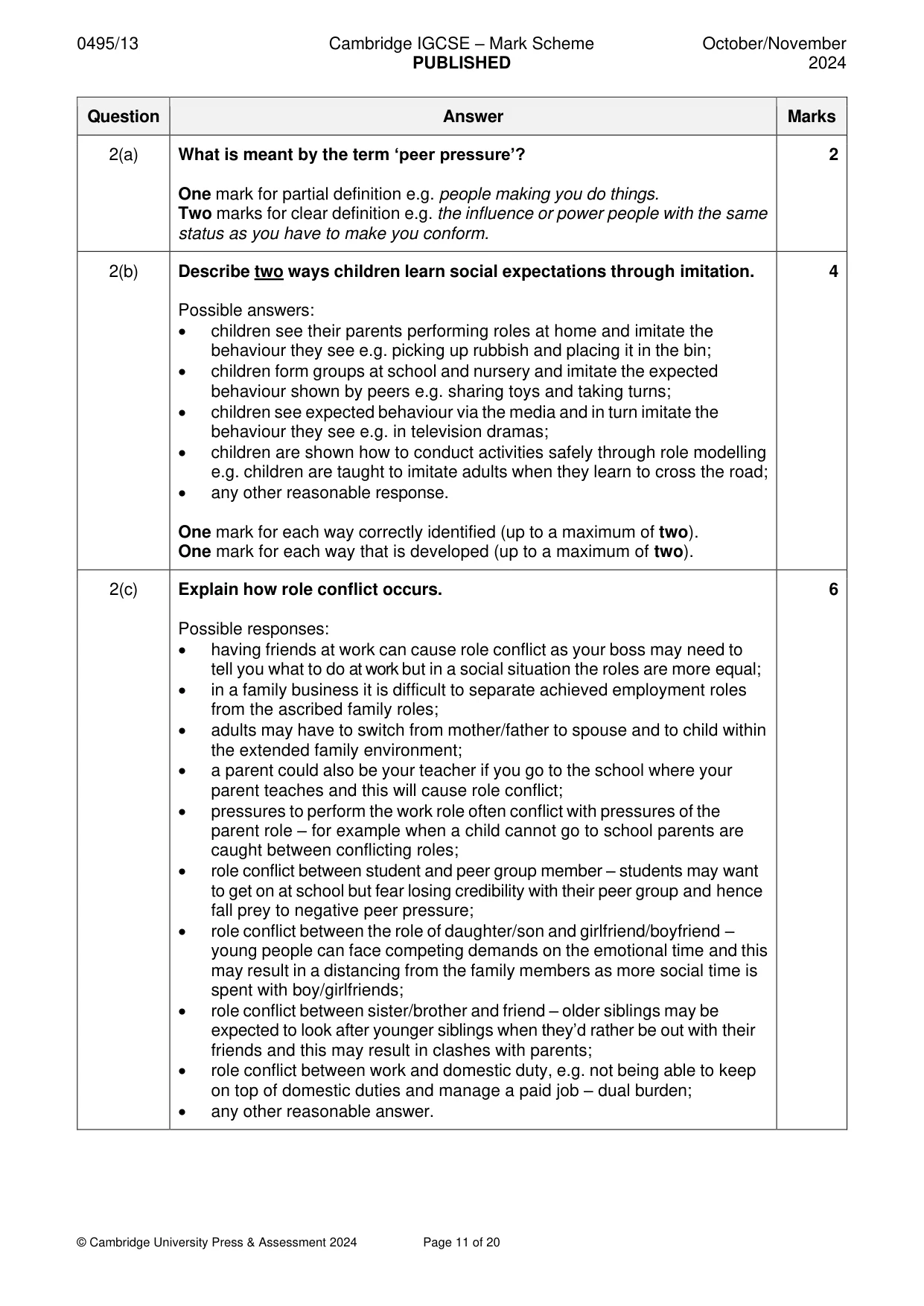
0495/13 Cambridge IGCSE – Mark Scheme PUBLISHED October/November 2024 © Cambridge University Press & Assessment 2024 Page 11 of 20 Question Answer Marks 2(a) What is meant by the term ‘peer pressure’? One mark for partial definition e.g. people making you do things. Two marks for clear definition e.g. the influence or power people with the same status as you have to make you conform. 2 2(b) Describe two ways children learn social expectations through imitation. Possible answers: • children see their parents performing roles at home and imitate the behaviour they see e.g. picking up rubbish and placing it in the bin; • children form groups at school and nursery and imitate the expected behaviour shown by peers e.g. sharing toys and taking turns; • children see expected behaviour via the media and in turn imitate the behaviour they see e.g. in television dramas; • children are shown how to conduct activities safely through role modelling e.g. children are taught to imitate adults when they learn to cross the road; • any other reasonable response. One mark for each way correctly identified (up to a maximum of two). One mark for each way that is developed (up to a maximum of two). 4 2(c) Explain how role conflict occurs. Possible responses: • having friends at work can cause role conflict as your boss may need to tell you what to do at work but in a social situation the roles are more equal; • in a family business it is difficult to separate achieved employment roles from the ascribed family roles; • adults may have to switch from mother/father to spouse and to child within the extended family environment; • a parent could also be your teacher if you go to the school where your parent teaches and this will cause role conflict; • pressures to perform the work role often conflict with pressures of the parent role – for example when a child cannot go to school parents are caught between conflicting roles; • role conflict between student and peer group member – students may want to get on at school but fear losing credibility with their peer group and hence fall prey to negative peer pressure; • role conflict between the role of daughter/son and girlfriend/boyfriend – young people can face competing demands on the emotional time and this may result in a distancing from the family members as more social time is spent with boy/girlfriends; • role conflict between sister/brother and friend – older siblings may be expected to look after younger siblings when they’d rather be out with their friends and this may result in clashes with parents; • role conflict between work and domestic duty, e.g. not being able to keep on top of domestic duties and manage a paid job – dual burden; • any other reasonable answer. 6
Mark scheme, page 12
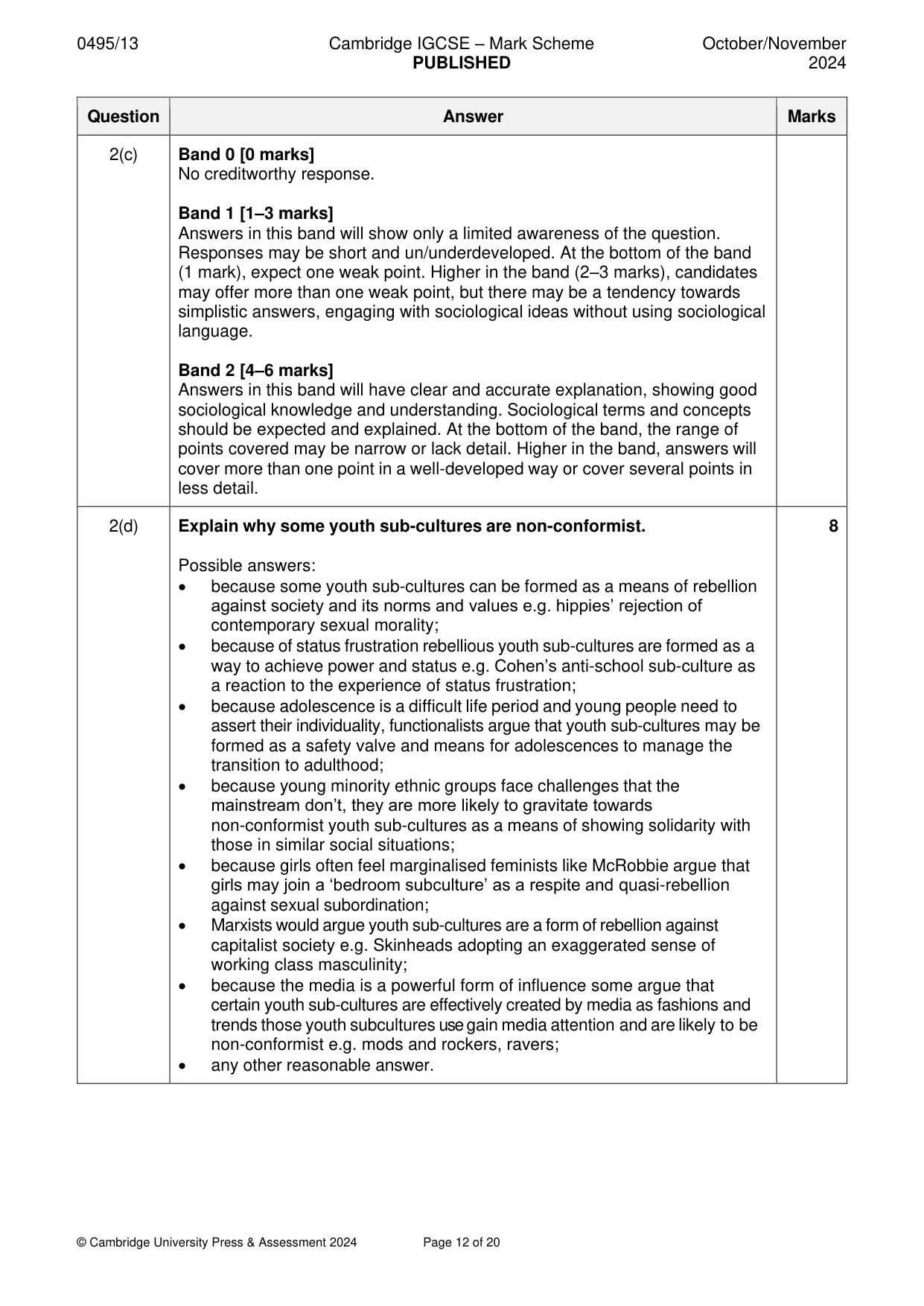
0495/13 Cambridge IGCSE – Mark Scheme PUBLISHED October/November 2024 © Cambridge University Press & Assessment 2024 Page 12 of 20 Question Answer Marks 2(c) Band 0 [0 marks] No creditworthy response. Band 1 [1–3 marks] Answers in this band will show only a limited awareness of the question. Responses may be short and un/underdeveloped. At the bottom of the band (1 mark), expect one weak point. Higher in the band (2–3 marks), candidates may offer more than one weak point, but there may be a tendency towards simplistic answers, engaging with sociological ideas without using sociological language. Band 2 [4–6 marks] Answers in this band will have clear and accurate explanation, showing good sociological knowledge and understanding. Sociological terms and concepts should be expected and explained. At the bottom of the band, the range of points covered may be narrow or lack detail. Higher in the band, answers will cover more than one point in a well-developed way or cover several points in less detail. 2(d) Explain why some youth sub-cultures are non-conformist. Possible answers: • because some youth sub-cultures can be formed as a means of rebellion against society and its norms and values e.g. hippies’ rejection of contemporary sexual morality; • because of status frustration rebellious youth sub-cultures are formed as a way to achieve power and status e.g. Cohen’s anti-school sub-culture as a reaction to the experience of status frustration; • because adolescence is a difficult life period and young people need to assert their individuality, functionalists argue that youth sub-cultures may be formed as a safety valve and means for adolescences to manage the transition to adulthood; • because young minority ethnic groups face challenges that the mainstream don’t, they are more likely to gravitate towards non-conformist youth sub-cultures as a means of showing solidarity with those in similar social situations; • because girls often feel marginalised feminists like McRobbie argue that girls may join a ‘bedroom subculture’ as a respite and quasi-rebellion against sexual subordination; • Marxists would argue youth sub-cultures are a form of rebellion against capitalist society e.g. Skinheads adopting an exaggerated sense of working class masculinity; • because the media is a powerful form of influence some argue that certain youth sub-cultures are effectively created by media as fashions and trends those youth subcultures use gain media attention and are likely to be non-conformist e.g. mods and rockers, ravers; • any other reasonable answer. 8
Mark scheme, page 13
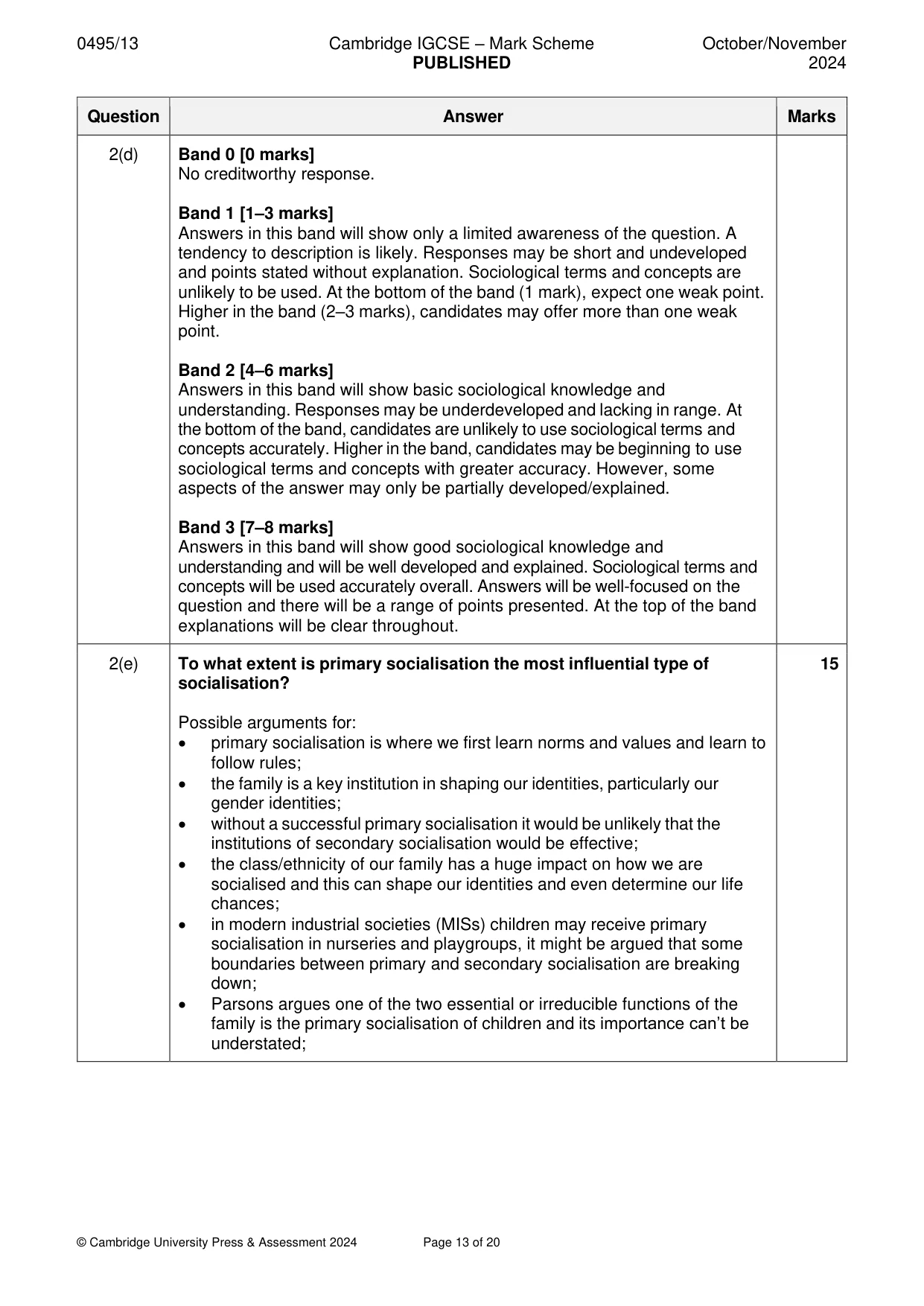
0495/13 Cambridge IGCSE – Mark Scheme PUBLISHED October/November 2024 © Cambridge University Press & Assessment 2024 Page 13 of 20 Question Answer Marks 2(d) Band 0 [0 marks] No creditworthy response. Band 1 [1–3 marks] Answers in this band will show only a limited awareness of the question. A tendency to description is likely. Responses may be short and undeveloped and points stated without explanation. Sociological terms and concepts are unlikely to be used. At the bottom of the band (1 mark), expect one weak point. Higher in the band (2–3 marks), candidates may offer more than one weak point. Band 2 [4–6 marks] Answers in this band will show basic sociological knowledge and understanding. Responses may be underdeveloped and lacking in range. At the bottom of the band, candidates are unlikely to use sociological terms and concepts accurately. Higher in the band, candidates may be beginning to use sociological terms and concepts with greater accuracy. However, some aspects of the answer may only be partially developed/explained. Band 3 [7–8 marks] Answers in this band will show good sociological knowledge and understanding and will be well developed and explained. Sociological terms and concepts will be used accurately overall. Answers will be well-focused on the question and there will be a range of points presented. At the top of the band explanations will be clear throughout. 2(e) To what extent is primary socialisation the most influential type of socialisation? Possible arguments for: • primary socialisation is where we first learn norms and values and learn to follow rules; • the family is a key institution in shaping our identities, particularly our gender identities; • without a successful primary socialisation it would be unlikely that the institutions of secondary socialisation would be effective; • the class/ethnicity of our family has a huge impact on how we are socialised and this can shape our identities and even determine our life chances; • in modern industrial societies (MISs) children may receive primary socialisation in nurseries and playgroups, it might be argued that some boundaries between primary and secondary socialisation are breaking down; • Parsons argues one of the two essential or irreducible functions of the family is the primary socialisation of children and its importance can’t be understated; 15
Mark scheme, page 14
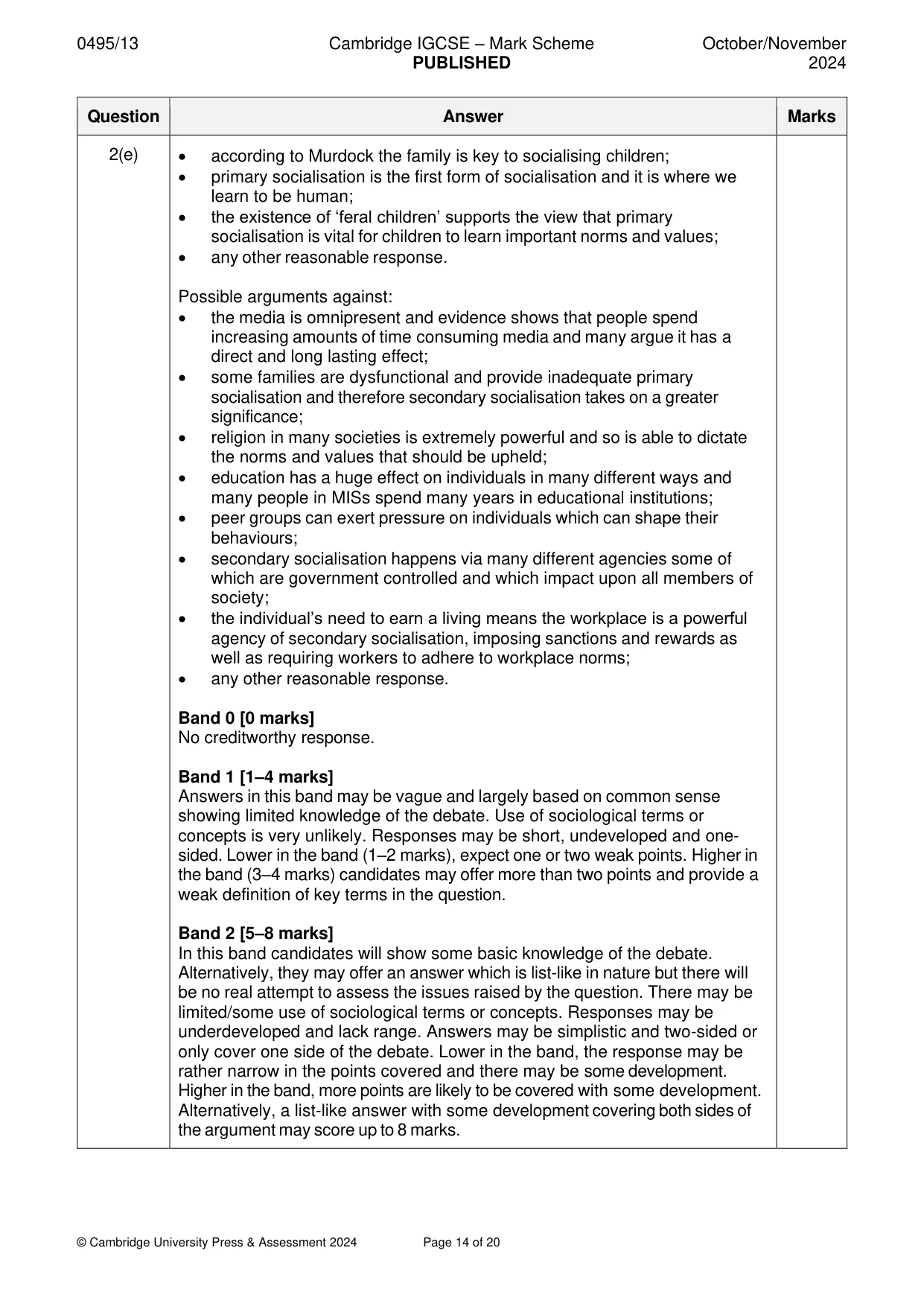
0495/13 Cambridge IGCSE – Mark Scheme PUBLISHED October/November 2024 © Cambridge University Press & Assessment 2024 Page 14 of 20 Question Answer Marks 2(e) • according to Murdock the family is key to socialising children; • primary socialisation is the first form of socialisation and it is where we learn to be human; • the existence of ‘feral children’ supports the view that primary socialisation is vital for children to learn important norms and values; • any other reasonable response. Possible arguments against: • the media is omnipresent and evidence shows that people spend increasing amounts of time consuming media and many argue it has a direct and long lasting effect; • some families are dysfunctional and provide inadequate primary socialisation and therefore secondary socialisation takes on a greater significance; • religion in many societies is extremely powerful and so is able to dictate the norms and values that should be upheld; • education has a huge effect on individuals in many different ways and many people in MISs spend many years in educational institutions; • peer groups can exert pressure on individuals which can shape their behaviours; • secondary socialisation happens via many different agencies some of which are government controlled and which impact upon all members of society; • the individual’s need to earn a living means the workplace is a powerful agency of secondary socialisation, imposing sanctions and rewards as well as requiring workers to adhere to workplace norms; • any other reasonable response. Band 0 [0 marks] No creditworthy response. Band 1 [1–4 marks] Answers in this band may be vague and largely based on common sense showing limited knowledge of the debate. Use of sociological terms or concepts is very unlikely. Responses may be short, undeveloped and one- sided. Lower in the band (1–2 marks), expect one or two weak points. Higher in the band (3–4 marks) candidates may offer more than two points and provide a weak definition of key terms in the question. Band 2 [5–8 marks] In this band candidates will show some basic knowledge of the debate. Alternatively, they may offer an answer which is list-like in nature but there will be no real attempt to assess the issues raised by the question. There may be limited/some use of sociological terms or concepts. Responses may be underdeveloped and lack range. Answers may be simplistic and two-sided or only cover one side of the debate. Lower in the band, the response may be rather narrow in the points covered and there may be some development. Higher in the band, more points are likely to be covered with some development. Alternatively, a list-like answer with some development covering both sides of the argument may score up to 8 marks.
Mark scheme, page 15
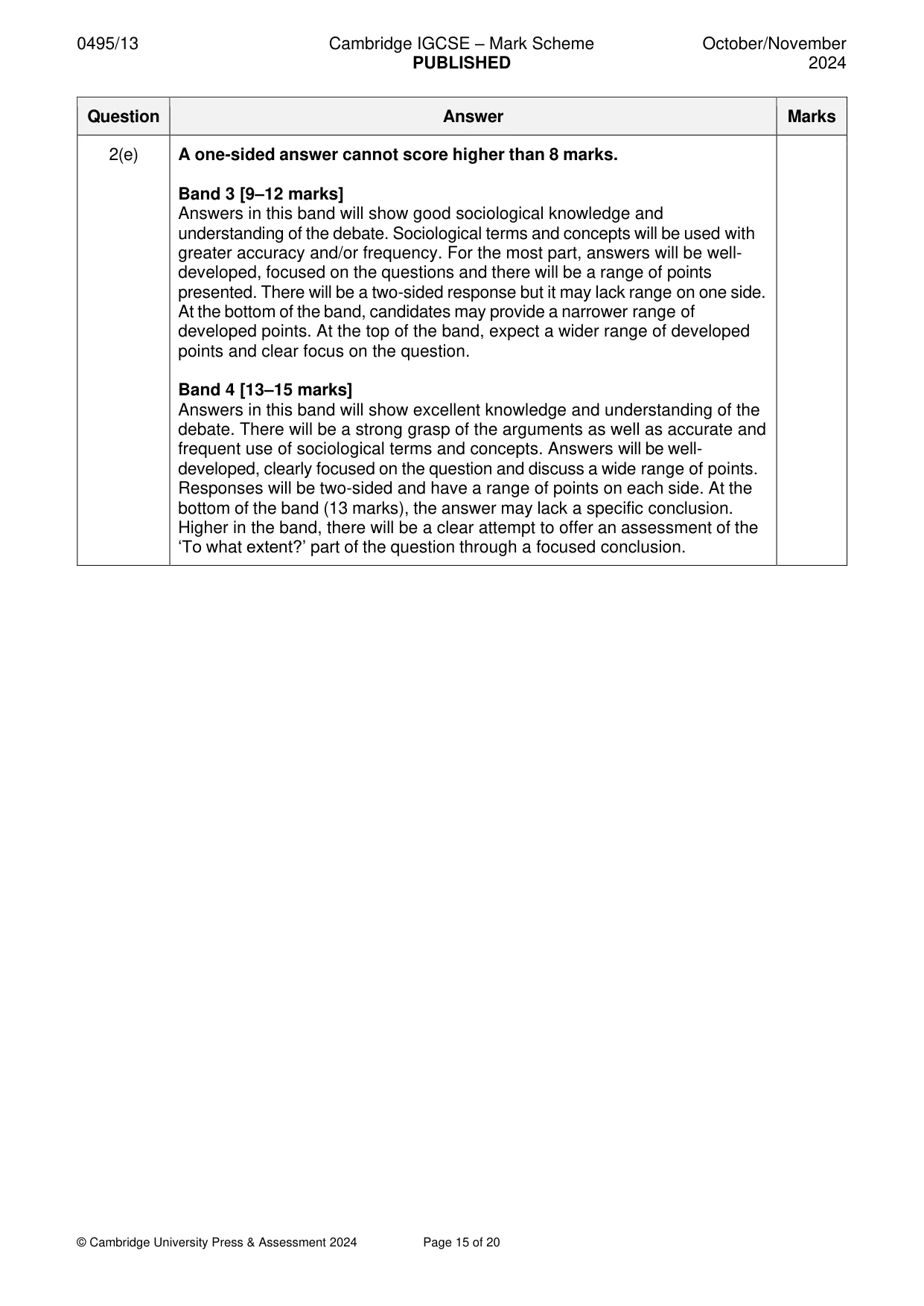
0495/13 Cambridge IGCSE – Mark Scheme PUBLISHED October/November 2024 © Cambridge University Press & Assessment 2024 Page 15 of 20 Question Answer Marks 2(e) A one-sided answer cannot score higher than 8 marks. Band 3 [9–12 marks] Answers in this band will show good sociological knowledge and understanding of the debate. Sociological terms and concepts will be used with greater accuracy and/or frequency. For the most part, answers will be well- developed, focused on the questions and there will be a range of points presented. There will be a two-sided response but it may lack range on one side. At the bottom of the band, candidates may provide a narrower range of developed points. At the top of the band, expect a wider range of developed points and clear focus on the question. Band 4 [13–15 marks] Answers in this band will show excellent knowledge and understanding of the debate. There will be a strong grasp of the arguments as well as accurate and frequent use of sociological terms and concepts. Answers will be well- developed, clearly focused on the question and discuss a wide range of points. Responses will be two-sided and have a range of points on each side. At the bottom of the band (13 marks), the answer may lack a specific conclusion. Higher in the band, there will be a clear attempt to offer an assessment of the ‘To what extent?’ part of the question through a focused conclusion.
Mark scheme, page 16
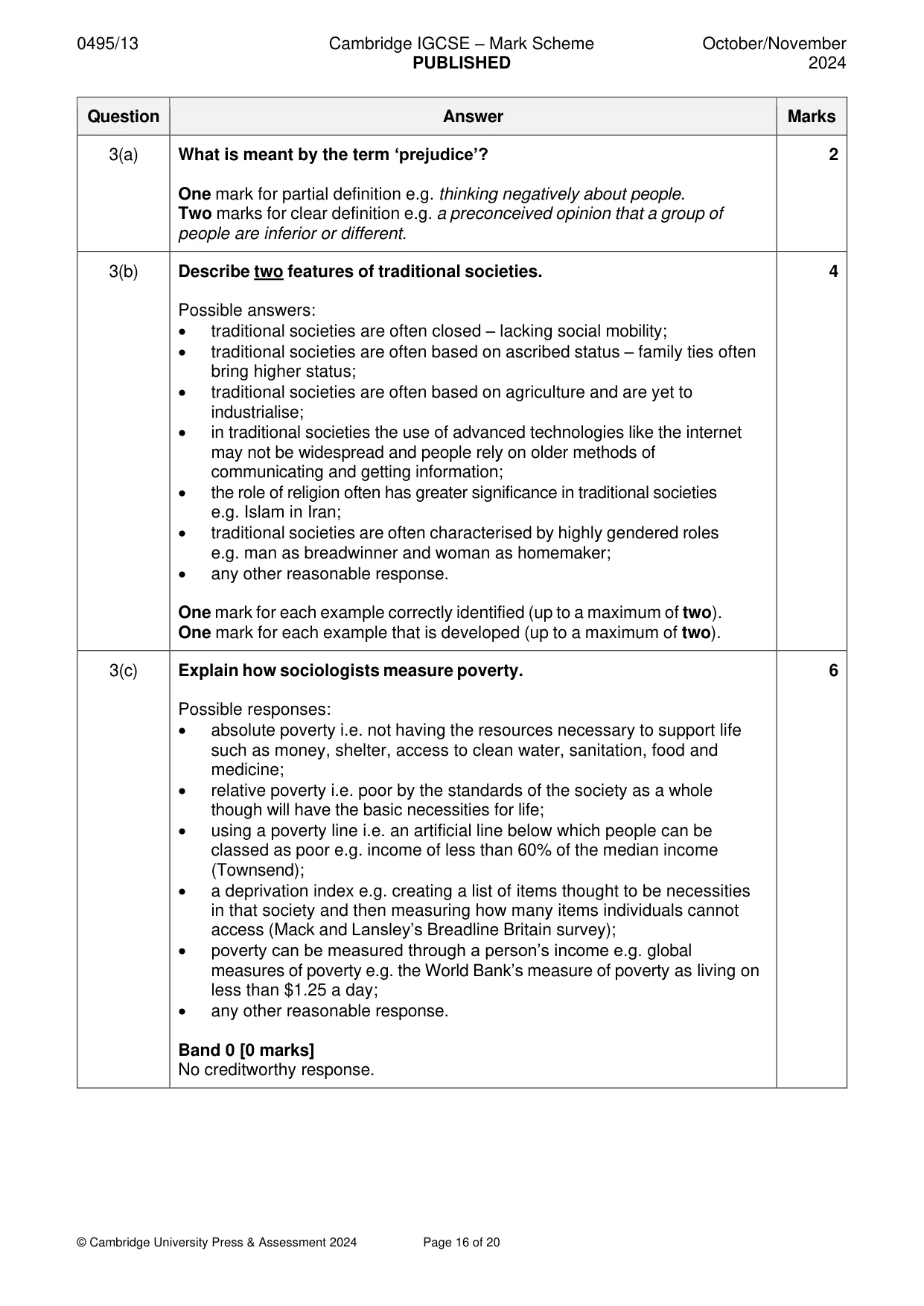
0495/13 Cambridge IGCSE – Mark Scheme PUBLISHED October/November 2024 © Cambridge University Press & Assessment 2024 Page 16 of 20 Question Answer Marks 3(a) What is meant by the term ‘prejudice’? One mark for partial definition e.g. thinking negatively about people. Two marks for clear definition e.g. a preconceived opinion that a group of people are inferior or different. 2 3(b) Describe two features of traditional societies. Possible answers: • traditional societies are often closed – lacking social mobility; • traditional societies are often based on ascribed status – family ties often bring higher status; • traditional societies are often based on agriculture and are yet to industrialise; • in traditional societies the use of advanced technologies like the internet may not be widespread and people rely on older methods of communicating and getting information; • the role of religion often has greater significance in traditional societies e.g. Islam in Iran; • traditional societies are often characterised by highly gendered roles e.g. man as breadwinner and woman as homemaker; • any other reasonable response. One mark for each example correctly identified (up to a maximum of two). One mark for each example that is developed (up to a maximum of two). 4 3(c) Explain how sociologists measure poverty. Possible responses: • absolute poverty i.e. not having the resources necessary to support life such as money, shelter, access to clean water, sanitation, food and medicine; • relative poverty i.e. poor by the standards of the society as a whole though will have the basic necessities for life; • using a poverty line i.e. an artificial line below which people can be classed as poor e.g. income of less than 60% of the median income (Townsend); • a deprivation index e.g. creating a list of items thought to be necessities in that society and then measuring how many items individuals cannot access (Mack and Lansley’s Breadline Britain survey); • poverty can be measured through a person’s income e.g. global measures of poverty e.g. the World Bank’s measure of poverty as living on less than $1.25 a day; • any other reasonable response. Band 0 [0 marks] No creditworthy response. 6
Mark scheme, page 17
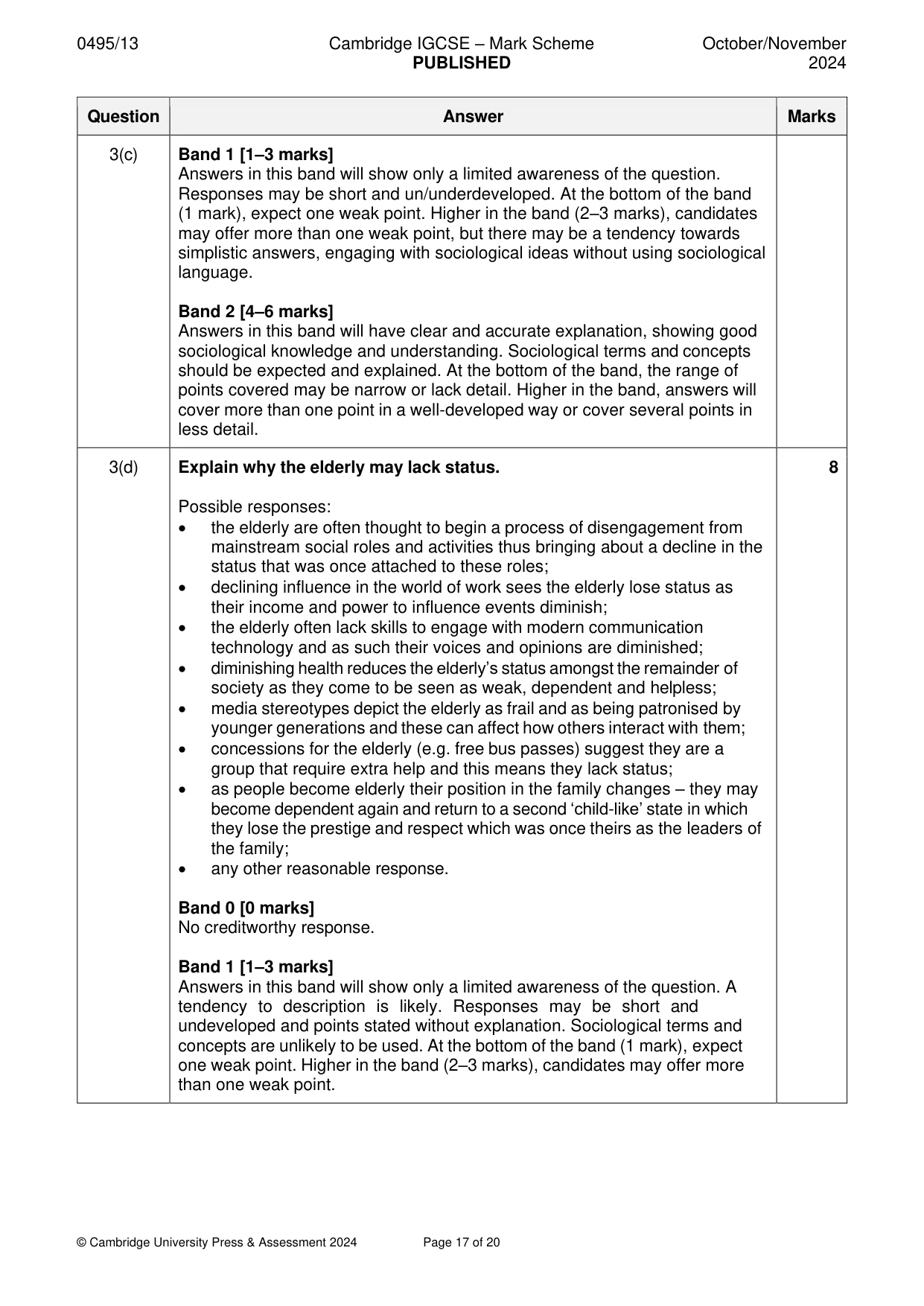
0495/13 Cambridge IGCSE – Mark Scheme PUBLISHED October/November 2024 © Cambridge University Press & Assessment 2024 Page 17 of 20 Question Answer Marks 3(c) Band 1 [1–3 marks] Answers in this band will show only a limited awareness of the question. Responses may be short and un/underdeveloped. At the bottom of the band (1 mark), expect one weak point. Higher in the band (2–3 marks), candidates may offer more than one weak point, but there may be a tendency towards simplistic answers, engaging with sociological ideas without using sociological language. Band 2 [4–6 marks] Answers in this band will have clear and accurate explanation, showing good sociological knowledge and understanding. Sociological terms and concepts should be expected and explained. At the bottom of the band, the range of points covered may be narrow or lack detail. Higher in the band, answers will cover more than one point in a well-developed way or cover several points in less detail. 3(d) Explain why the elderly may lack status. Possible responses: • the elderly are often thought to begin a process of disengagement from mainstream social roles and activities thus bringing about a decline in the status that was once attached to these roles; • declining influence in the world of work sees the elderly lose status as their income and power to influence events diminish; • the elderly often lack skills to engage with modern communication technology and as such their voices and opinions are diminished; • diminishing health reduces the elderly’s status amongst the remainder of society as they come to be seen as weak, dependent and helpless; • media stereotypes depict the elderly as frail and as being patronised by younger generations and these can affect how others interact with them; • concessions for the elderly (e.g. free bus passes) suggest they are a group that require extra help and this means they lack status; • as people become elderly their position in the family changes – they may become dependent again and return to a second ‘child-like’ state in which they lose the prestige and respect which was once theirs as the leaders of the family; • any other reasonable response. Band 0 [0 marks] No creditworthy response. Band 1 [1–3 marks] Answers in this band will show only a limited awareness of the question. A tendency to description is likely. Responses may be short and undeveloped and points stated without explanation. Sociological terms and concepts are unlikely to be used. At the bottom of the band (1 mark), expect one weak point. Higher in the band (2–3 marks), candidates may offer more than one weak point. 8
Mark scheme, page 18
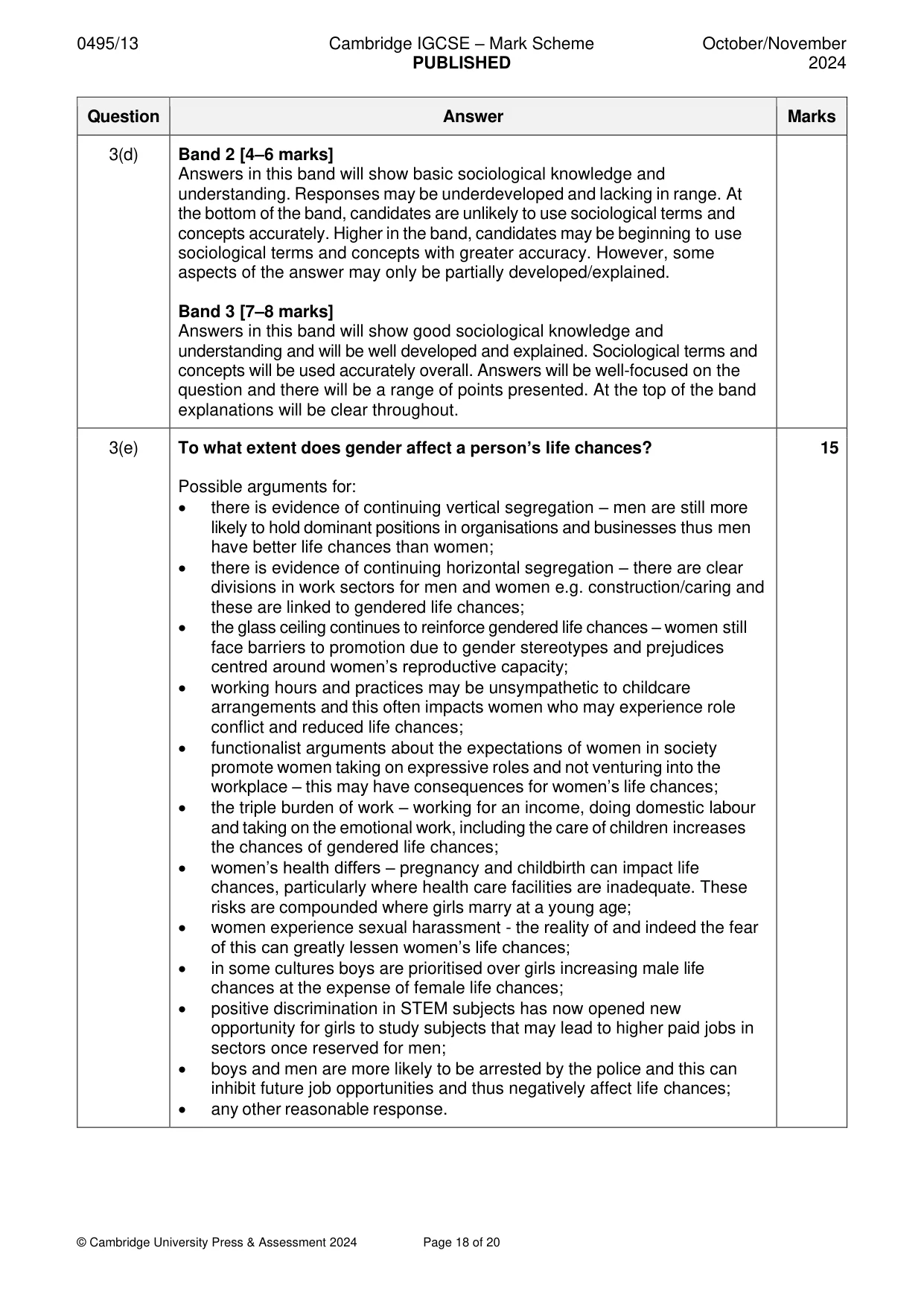
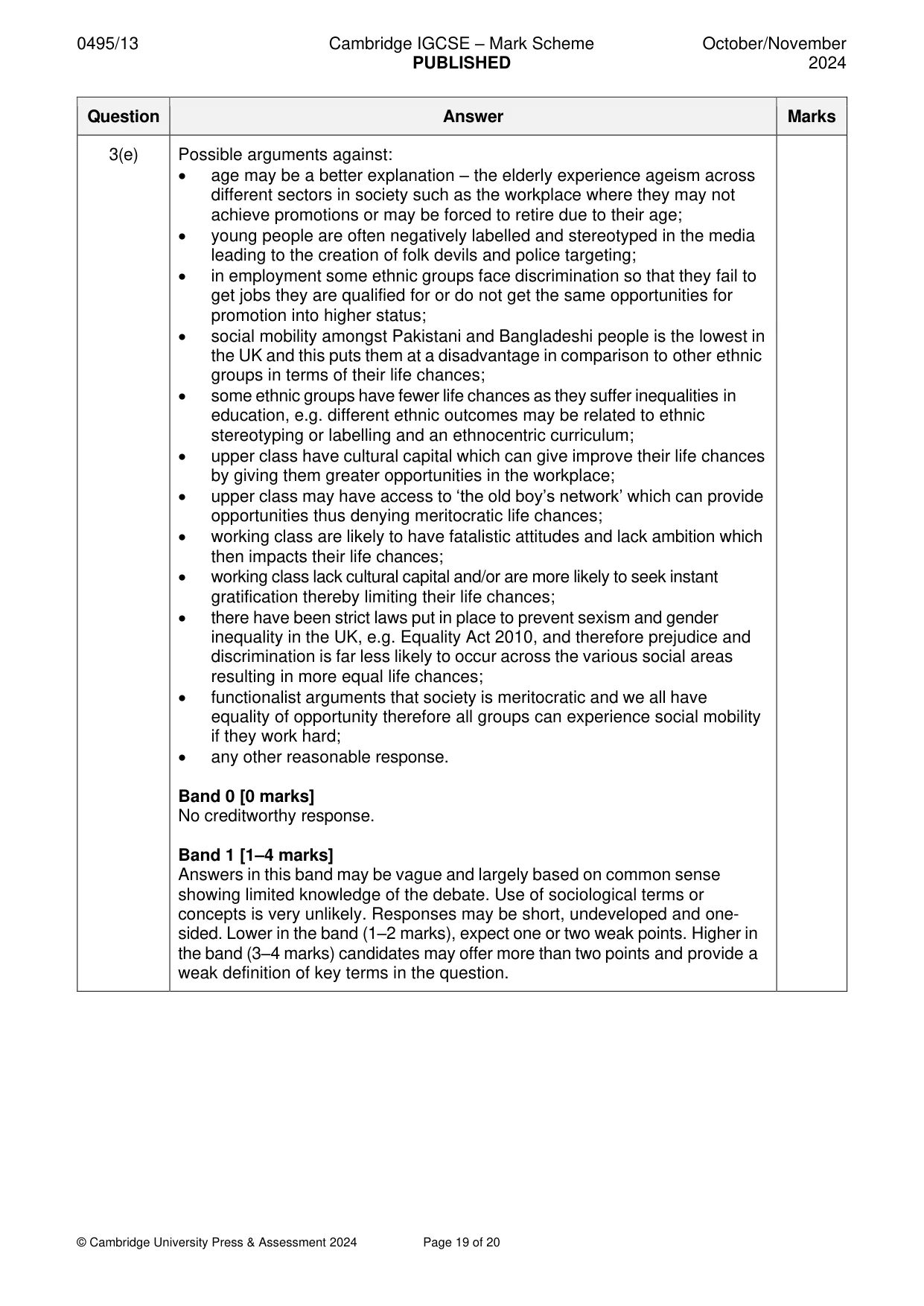
0495/13 Cambridge IGCSE – Mark Scheme PUBLISHED October/November 2024 © Cambridge University Press & Assessment 2024 Page 18 of 20 Question Answer Marks 3(d) Band 2 [4–6 marks] Answers in this band will show basic sociological knowledge and understanding. Responses may be underdeveloped and lacking in range. At the bottom of the band, candidates are unlikely to use sociological terms and concepts accurately. Higher in the band, candidates may be beginning to use sociological terms and concepts with greater accuracy. However, some aspects of the answer may only be partially developed/explained. Band 3 [7–8 marks] Answers in this band will show good sociological knowledge and understanding and will be well developed and explained. Sociological terms and concepts will be used accurately overall. Answers will be well-focused on the question and there will be a range of points presented. At the top of the band explanations will be clear throughout. 3(e) To what extent does gender affect a person’s life chances? Possible arguments for: • there is evidence of continuing vertical segregation – men are still more likely to hold dominant positions in organisations and businesses thus men have better life chances than women; • there is evidence of continuing horizontal segregation – there are clear divisions in work sectors for men and women e.g. construction/caring and these are linked to gendered life chances; • the glass ceiling continues to reinforce gendered life chances – women still face barriers to promotion due to gender stereotypes and prejudices centred around women’s reproductive capacity; • working hours and practices may be unsympathetic to childcare arrangements and this often impacts women who may experience role conflict and reduced life chances; • functionalist arguments about the expectations of women in society promote women taking on expressive roles and not venturing into the workplace – this may have consequences for women’s life chances; • the triple burden of work – working for an income, doing domestic labour and taking on the emotional work, including the care of children increases the chances of gendered life chances; • women’s health differs – pregnancy and childbirth can impact life chances, particularly where health care facilities are inadequate. These risks are compounded where girls marry at a young age; • women experience sexual harassment - the reality of and indeed the fear of this can greatly lessen women’s life chances; • in some cultures boys are prioritised over girls increasing male life chances at the expense of female life chances; • positive discrimination in STEM subjects has now opened new opportunity for girls to study subjects that may lead to higher paid jobs in sectors once reserved for men; • boys and men are more likely to be arrested by the police and this can inhibit future job opportunities and thus negatively affect life chances; • any other reasonable response. 15
Mark scheme, page 19
0495/13 Cambridge IGCSE – Mark Scheme PUBLISHED October/November 2024 © Cambridge University Press & Assessment 2024 Page 19 of 20 Question Answer Marks 3(e) Possible arguments against: • age may be a better explanation – the elderly experience ageism across different sectors in society such as the workplace where they may not achieve promotions or may be forced to retire due to their age; • young people are often negatively labelled and stereotyped in the media leading to the creation of folk devils and police targeting; • in employment some ethnic groups face discrimination so that they fail to get jobs they are qualified for or do not get the same opportunities for promotion into higher status; • social mobility amongst Pakistani and Bangladeshi people is the lowest in the UK and this puts them at a disadvantage in comparison to other ethnic groups in terms of their life chances; • some ethnic groups have fewer life chances as they suffer inequalities in education, e.g. different ethnic outcomes may be related to ethnic stereotyping or labelling and an ethnocentric curriculum; • upper class have cultural capital which can give improve their life chances by giving them greater opportunities in the workplace; • upper class may have access to ‘the old boy’s network’ which can provide opportunities thus denying meritocratic life chances; • working class are likely to have fatalistic attitudes and lack ambition which then impacts their life chances; • working class lack cultural capital and/or are more likely to seek instant gratification thereby limiting their life chances; • there have been strict laws put in place to prevent sexism and gender inequality in the UK, e.g. Equality Act 2010, and therefore prejudice and discrimination is far less likely to occur across the various social areas resulting in more equal life chances; • functionalist arguments that society is meritocratic and we all have equality of opportunity therefore all groups can experience social mobility if they work hard; • any other reasonable response. Band 0 [0 marks] No creditworthy response. Band 1 [1–4 marks] Answers in this band may be vague and largely based on common sense showing limited knowledge of the debate. Use of sociological terms or concepts is very unlikely. Responses may be short, undeveloped and one- sided. Lower in the band (1–2 marks), expect one or two weak points. Higher in the band (3–4 marks) candidates may offer more than two points and provide a weak definition of key terms in the question.
Mark scheme, page 20
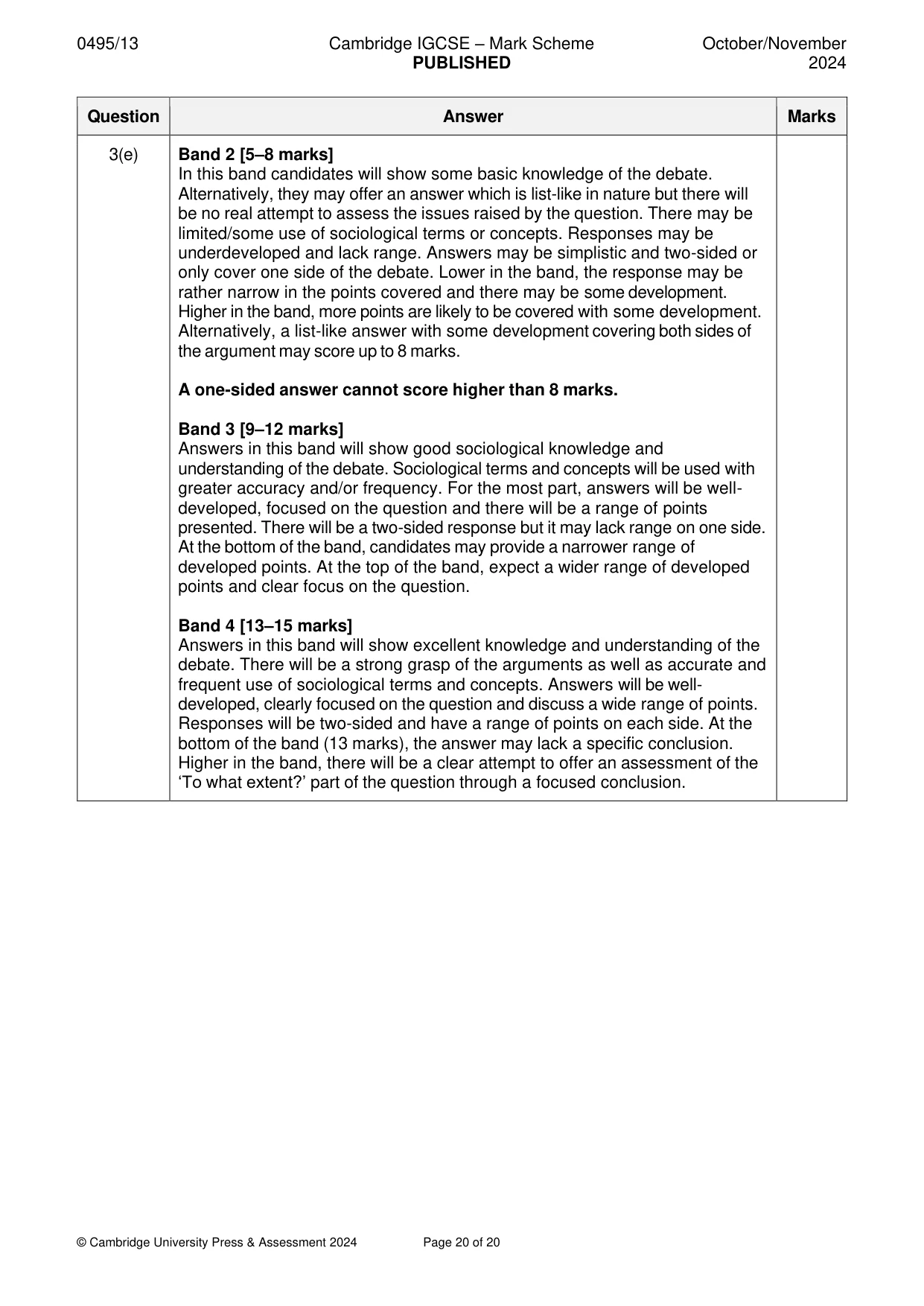
0495/13 Cambridge IGCSE – Mark Scheme PUBLISHED October/November 2024 © Cambridge University Press & Assessment 2024 Page 20 of 20 Question Answer Marks 3(e) Band 2 [5–8 marks] In this band candidates will show some basic knowledge of the debate. Alternatively, they may offer an answer which is list-like in nature but there will be no real attempt to assess the issues raised by the question. There may be limited/some use of sociological terms or concepts. Responses may be underdeveloped and lack range. Answers may be simplistic and two-sided or only cover one side of the debate. Lower in the band, the response may be rather narrow in the points covered and there may be some development. Higher in the band, more points are likely to be covered with some development. Alternatively, a list-like answer with some development covering both sides of the argument may score up to 8 marks. A one-sided answer cannot score higher than 8 marks. Band 3 [9–12 marks] Answers in this band will show good sociological knowledge and understanding of the debate. Sociological terms and concepts will be used with greater accuracy and/or frequency. For the most part, answers will be well- developed, focused on the question and there will be a range of points presented. There will be a two-sided response but it may lack range on one side. At the bottom of the band, candidates may provide a narrower range of developed points. At the top of the band, expect a wider range of developed points and clear focus on the question. Band 4 [13–15 marks] Answers in this band will show excellent knowledge and understanding of the debate. There will be a strong grasp of the arguments as well as accurate and frequent use of sociological terms and concepts. Answers will be well- developed, clearly focused on the question and discuss a wide range of points. Responses will be two-sided and have a range of points on each side. At the bottom of the band (13 marks), the answer may lack a specific conclusion. Higher in the band, there will be a clear attempt to offer an assessment of the ‘To what extent?’ part of the question through a focused conclusion.
What you needed in this session
Cambridge’s own grade thresholds for 2024 Oct/Nov, Paper 1 · Variant 3. A higher threshold means an easier paper — the bar moves with how the cohort did.